Reading In The Schools by Hannah Rahimi

The woman tells me I didn’t have to call. “Just sign up on the website,” she says.

“Oh, but I wanted to call,” I tell her. She doesn’t understand. Unless you are too old to use the internet, you are not supposed to want to call strangers.

Why did I want to call? I wanted someone to think highly of me when I signed up to read for Reading in the Schools. The internet doesn’t think highly of anyone unless you’re the right kind of active on twitter. Neither does the woman, it turns out.

I will be visiting Lake St. Public School for one hour a week to read to a little boy or girl in need of extra attention. Extra attention: these are the words from the Reading in the Schools brochure. On the phone, I tell the woman I would really like a girl. I tell her if everything goes well I might be able to do two hours. She is not impressed.

Why do I need someone to think highly of me? Shouldn’t Reading in the Schools be about reading in the schools and not about the person reading in the schools? In an ideal world. But is there any harm if my ego gets a boost while I devote an hour a week to the literacy and general well-being of a nice little girl?

As you may have guessed, I am in a funny phase of life. Not ha-ha funny. This is one way of saying I am divorced. Actually, not yet divorced. There are still papers to be delivered and signed. But for all intents and purposes I am divorced. I have cashed in five weeks’ vacation from my job at the Hamilton Archives and am staying at my parents’ house in West Toronto.

Actually, a little bit ha-ha funny. I make more jokes than I used to. I make them up from scratch.

What did one grain of sand say to the other before they broke up?

You’re such a beach!

“You’re planning to just mooch off us indefinitely?” This is my mother upon my arrival, half-kidding, half-Mussolini, half-tickled to finally use mooch in a sentence. My mother is the kind of woman who has a crossword with breakfast, Sudoku with lunch, bourbon with dinner, and cutthroat Scrabble with anyone who will play her over dessert. My father refuses to play. He is more of a rummy man.

I don’t mean to imply that divorce always = funny phase of life/moving in with parents. Only that in my particular case it has turned out this way. My future ex-husband, Arlo, is thriving, for example, post-separation.

Here is how we met: I was walking down College with a box of cannoli when someone behind me shouted, “Veronica! Hey, Veronica!” I turned around. There was a man: lion-mane hair, bowleg walk: Arlo, though I didn’t know it yet. Eyes met, sweat dripped, guts lurched, cannoli was shared, then fluids, terms of endearment, keys, rings, subtle barbs, pregnant silences, suspicions, admissions, apologies, retractions of apologies. Then rings were removed, flung into compost bin, retrieved from compost bin, rinsed in sink, etc.

To clarify, my name is not Veronica. My name is Abby. According to Arlo, the back of my head and the back of my navy pea coat are dead ringers for the back of Veronica’s head and the back of her navy pea coat. For a while Arlo and I told that story at parties. We stopped when we realized we were broadcasting to the world that our relationship was founded on a misunderstanding.

Why did I turn around? I hear a name that isn’t mine and turn in total obedience. You think I’m Veronica? I’ll be Veronica! What kind of person does that?

Of course, when I turned around, Arlo understood I wasn’t Veronica, but all the same there is a part of me that has been living on as Veronica these past four years. She is spunky and a little bit French. Now she is gone, along with my favorite mugs, and I am left to deal with what remains of Abby.

My mother tells me that doing nothing will make me depressed. “I’m already depressed,” I tell her. “And anyway, I am soon to be a Reader in the Schools.”

“Are you sure you’re qualified?” she says.

Magda and I sit in a corner of the school library on cushions that smell like apple juice. “What do you want to read?” I say.

“When is snack time?” she says.

Magda is not what I expected. She isn’t bigger than the other children but I get the sense that she is denser. If I were to drop her in water, she would sink twice as fast as another girl her age. Which is seven. She has a smoker’s voice and glasses with yellow plastic frames.

I pull Corduroy off the shelf and Magda plunks into my lap. Such affection for a total stranger — where are her defenses? I wasn’t like this as a child.

Corduroy, a stuffed bear, is getting into trouble, losing buttons, breaking into department stores. Magda is an impatient child who likes to flip the page before I finish reading. I want to tell her to slow down, that she will regret living this way, that before she knows it there will be no more pages to turn, and then what?

We finish Corduroy with 56 minutes to go.

In the middle of Clifford the Big Red Dog a boy sidles up. He looks like an illustration, all ink-splash and sprite. Magda gets territorial and elbows him away. “Magda!” I say, but she just shrugs. “That’s Devin,” she tells me. “He’s always doing the wrong thing.”

When I bring Magda back to her classroom Mrs. Gordon says, “Thank you, Abby. We’re very grateful for your support, aren’t we, Magda?”

Magda is staking her claim on goldfish at the snack table, and waves dismissively. “What did you read?” asks Mrs. Gordon. When I tell her, she is aghast. “Those are pre-school books,” she says.

Well I enjoyed them.

Arlo sends an email with the subject What if we just. In the body of the email is a hope that I am doing well. He may sound nice but it’s important to remember that he is sleeping with his daughter’s friend. Now that I am gone, she has moved in and is probably drinking from my “I Hate Broccoli” mug. A friend of his daughter. You’d think his daughter, Caroline, would mind, but apparently she is very enlightened and never thought I was right for him anyway. I have been trying to figure out why she would feel this way. Arlo once showed me pictures of his boyhood in Edmonton and Caroline said, more to him than to me, “Roland Barthes says photography is like a puncture wound.” Caroline is a grad student. Arlo is a professor of linguistics. I’ve gotten my share of degrees but I have never liked people who mention French intellectuals in casual conversation, so I said, “Roll-on Bart? Sounds like a Simpsons-themed deodorant!”

I guess you could say I made my judgment before she made hers, which is some consolation.

What if we just what, Arlo?

My father is baking corn muffins. To my knowledge he hasn’t made corn muffins since I was six years old. That was around the time we engaged in a practice called Mean Cuisine. Mean Cuisine = putting surprising things in my mother’s food. For example, soy sauce in coffee.

Another thing I did at six was chinning. I invented chinning. I used my chin as a weapon by digging it into the arm flesh of my enemies.

When my father cooks he listens to the CBC. Early in life, I learned that listening to the radio is a conversation. When Stuart McLean says, “Hello, I’m Stuart McLean,” at nine o’clock on Saturday morning, my father looks up from his corn muffin batter and says to the radio, “Hi Stuart.”

I myself tend to talk to the radio in a more confrontational manner. I take issue with voices of authority. The weatherman, for one. “Real Feel?” I said to him yesterday when he inflated the temperature by six degrees and then smugly prescribed light layers. “Who are you to tell me how it really feels?”

I am curious about Magda’s home life but I do not want to pry. Instead I ask, “Do your parents know about me?”

“They’ve never met you,” she says.

“Yes, but have you told them we are reading books together?”

“Sure,” she says. Sure. Like she’s placating me.

I am ashamed. I say, “You pick the book today, Magda.” I say, “Remind me to teach you about chinning.”

“What do you read the little girl?” my mother asks.

“This and that,” I tell her. “Whatever’s on the shelves.”

My mother doesn’t like this answer. She thinks the majority of children’s books involve cartoon animals who smile too much, i.e. Clifford the Big Red Dog. “Children are much smarter than we give them credit for,” she says. “They can handle intelligent, nuanced animals like Anansi the Spider and Brer Rabbit. Clifford is an idiot,” she says, “created by adults who think children are idiots.” She suggests I take some of my old books to read to Magda. She shows me where she keeps them in the attic.

“Thank you,” I say.

She says, “Arlo called.”

“Smell that?” I say to Magda. “That’s the smell of books. When I was your age I thought it smelled like cake.”

She sniffs and considers it. “It sort of does,” she concedes.

I can tell she likes the idea because she breathes like a yogi for the rest of the hour. I read her a book I brought from the attic. Miss Rumphius. Before Miss Rumphius was named after her marital status, when she was just a girl called Alice, she spent a lot of time with her grandfather, a painter. Sometimes he would let her paint the skies into his landscapes, which Magda and I agree would be quite the honor. Alice’s grandfather encouraged her to lead a life of adventure and then settle by the sea when she was finished with traveling. The caveat, because isn’t there always a caveat, was that she do her part to make the world beautiful.

“Wait,” says Magda, when I go to flip the page. She says, “Look at her hair.”

It is true that Alice has wonderful hair, a flaming cloud. With age it streaks white in all the right places. When we get to the picture of her house by the sea, we sigh. A gate, a mound of golden grass, a filigree cottage over water.

“Do you think it’s the ocean?” I ask Magda. “Or a lake? Or a pond?” Sometimes it is hard to come up with the right questions. I try to be educational.

“I think it’s a bay,” says Magda with a hush. In her voice, gravelly and reverent, “bay” is everything we’ve dreamed of. I hear a small gasp of agreement and realize that Devin is standing over my shoulder, hanging onto the bookshelf.

“Sit,” I say, and he does. Secure in my lap, Magda tells Devin he can turn the next page.

Friend to all! Reader extraordinaire! Champion of Reading in the Schools!

Wouldn’t it be nice if. Lately I’ve been thinking. It occurred to me. In the body of email after email, Arlo hopes that I am well. An observation that CBC does not sound the same when no one talks back to it. An offer: Do I want him to send along my favorite mugs?

What did one egg say to the other when it started crying in the café?

You’re cracking up.

This happened, minus the egg part. After avoiding most people in the weeks that I’ve been living with my parents, I let my friend Carol convince me that getting out was paramount to my recovery. Recovery. Like divorce is an illness? Then again, I have been spending more than the usual time in bed. We met yesterday at one of those cafés that is ruthlessly cool, all reclaimed wood and austerity. Everyone in that café is a contemporary dancer. They all live in the same neighborhood and drink cortados.

Carol sat me down, got me a mocha, blasted me with her best Dr. Phil look and said, “So how are you?” Then came the egg incident, minus the eggs. Actually she didn’t say, “You’re cracking up.” She said, “You’re a wreck!” Seconds later, she was ashamed to have made a judgment on my sanity and tried to cushion it with a hand on my hand. “You’re better off without him,” she said. “You’ll meet someone else,” she said (with her eyes on her latte art). “The best thing is to keep busy,” she said.

“I am a reader,” I told her, “for Reading in the Schools.”

Here goes. In the body of the email, a hope that I am well. A heads-up to check my mailbox, the real one not the virtual: the papers are on their way.

My father says that when he met my mother he knew within an hour he’d spend his life with her. I do not believe in that kind of knowing. I do not.

When Magda sees me at the door of her first grade classroom she runs over to throw her arms around my waist.

“Hey there Magda,” I say as I stumble from the force of it. There is something Olympian about her, and eager. It has been a long time since somebody hugged me with pure, eager strength. Together we walk down the hall to the library. We say hello to Ms. Margles at the desk. I sign our names in the Reading in the Schools ledger.

I breathe in and say, “What’s that great smell?”

Magda says, “Books!”

We giggle. Such is the pleasure of routine. We retire to our corner, but there is Devin on our cushion, with a grown-up of his own, a small woman with a pixie cut. Devin doesn’t even glance our way. Has he procured his own reader? What a picture the two of them paint, all button nose and eyelash.

I have always marveled at women with pixie cuts. How do they acquire such small skulls, such bird-bone faces? Once a year I paste my photo into pixie cuts on those websites where you can pair your face with somebody else’s hair, and every year the result is the same: a square peg in a round hole (i.e., a heart-shaped face in an elf toupee).

I will admit I feel defeated, though it is unclear by what: the loss of territory? The great hair? Magda and I march hand in hand to another corner. She gives the bookshelf a little kick before she sits. “Devin is always doing the wrong thing,” she says.

We are in the mood to read Miss Rumphius a second time. Near the end of the book, when she is old and somewhat infirm and living in her enviable cottage by the sea, Miss Rumphius has to come to terms with the fact that she hasn’t done her part to make the world beautiful. She has only made it beautiful for herself, with her nice living situation and backyard full of flowers. What selfishness, she realizes. What sadness. In sympathy, the illustrations fade to pastel. This time, as last time, Magda looks up at me when we get to this page. She doesn’t say a word, just raises her eyes to mine with — what? Distress, bewilderment, entreaty. She has unknown the ending so that she will feel these things as she felt them the first time. So that she will feel the full weight of the joy that comes after.

Miss Rumphius is out for a walk, windblown chic, when she notices lupines in the grass. The wind from the sea has distributed the seeds from the lupines in her garden. Then, of course, comes Miss Rumphius’s revelation. She spends the rest of her days strolling the countryside in a marvelous cloak, flinging seeds every which way, giving lupines back to the world.

My mother sits at the foot of my bed. “Will you help me with the crossword?” she asks, and I know the divorce papers have arrived.

What is the word for a throat that’s sore with sadness?

What is the word for the phantom of a body around your body? (Like the limbs that ache after you lose them.)

What is the word for the feeling of being too tall for your childhood bed?

Soon I will have to return to work. I will have to find an apartment. Soon. I will not be able to be a reader in the schools when I am working full time in Hamilton. What was I thinking, signing up for Reading in the Schools when I only had five weeks?

As if they know of my betrayal, the children are gone from the classroom. There is a note for me on the door. Dear Abby, Grade One is outside celebrating spring. Magda would love for you to join us. Signed, Mrs. Gordon.

In the playground the whole school wriggles with abandon. One of the teachers has turned a boombox out the window to play Paul Simon. Teachers dance, children dance. The littlest ones bounce in a crouch while the bigger ones articulate their shoulders, elbows, hips, knees, feet.

Devin hangs between two girls who are very tall and competent-looking. They maneuver him around the yard saying, “One, two, three, up you go!”

Magda sits alone on a swing, watching people dance. I realize I know almost nothing about her. I don’t know whether she is popular or shunned or somewhere in between. Is Mrs. Gordon fond of her? Do the children mock her glasses, her funny strength? Is there something in her for them to admire?

She takes off her glasses and rubs one eye with her fist, like a baby. It could be that she is crying but I don’t think so. I think she is tired. Not tired. Weary. She holds on loosely to the chains and sits chimp-like with her knees up, heels resting on the edge of the swing. Then she lowers her head to her knee, rests her chin there, presses it — she is chinning.

Why stop at photography, Caroline? Sight is a puncture wound. Why stop at puncture wound? Sight gores me. The sight of Magda weary on the swing, chinning her own knee.

The smile on her face when I approach: glass shattering to beads. I have to tell her; of course I have to tell her. But not yet.

“We don’t have to stay out here,” she says firmly. “We can still go to the library.”

“Great,” I say, with as many exclamation points as I can muster. “Let’s go.” But she just sits there, eyeing the playground.

“Abby?” she says. She sounds more formal, more deliberate than usual, perhaps because she’s never actually addressed me by name before. I like the way she says it, as if the name belongs to someone sharp and curious.

“Yes,” I say.

“Could you push me, please?”

I see a child on a swing and don’t immediately think to push? Where are my instincts, my adult skills? I am better with indoor activities, I tell myself. Reading, for instance. Dutifully, I shuffle around and place my palms on her slouching back. “Okay,” I say. “Here goes.”

My first push is laughable, a mere nudge, but she makes the best of it, pumping her legs to gain momentum. I do better the second time, and soon enough she is sitting up straight and traveling in regal sweeps. Why don’t people do this more often? Swinging requires no eye contact, no speech. It is a relief to apply yourself to nothing but the gradual gathering of someone else’s speed.

I grow ambitious. I remember, from my own days on the playground, the currency of choice for popular parents and reckless siblings: the underdog. But how exactly does it work? I was always the one swinging while someone else took care of the mechanics. What if I accidentally knock her off? If she kicks me in the head? From the vantage point of the ground, the potential for awkward calamity seems endless.

It is possible, as my father likes to say, that I am overthinking the matter. I do my best to breathe deeply. I follow through my push until Magda is just beginning to arc upwards, and then I let go and charge forward, ducking beneath her rising feet, as she shrieks into the air. That shriek, all terror and delight — the enviable sound of a child forgetting herself.

When I stop running, I turn back to watch. How long the motion stays with her; how far she flies.

Gabriel García Márquez to Grace the New Colombian 50,000-Peso Bill

“Face of Colombia’s second largest bill” can be added to the extensive resume of Nobel Prize-winning author Gabriel García Márquez. The rumors have been circulating since his death in 2014, and last week, following an official ceremony in Bogotá, Colombia put its new 50,000-Peso bill into circulation, featuring two images of the country’s beloved “Gabo.”

Best known for his novels 100 Years of Solitude and Love in the Time of Cholera, the famed magical realist will share the bill with two members of the Arawak tribe, a native people of Colombia, who are pictured along with a rendering of La Ciudad Perdida. The ruin in the nation’s coastal mountains predates Peru’s Machu Pichu by approximately 650 years. Fittingly, beside the author’s portrait, a cluster of butterflies flutters.

While literary figures do not appear on currency often, Marquez finds himself in good company. In the 1990s, Charles Dickens was featured on the British ten-pound note and fellow 19th century novelist Jane Austen will grace the bill beginning in 2017. Additionally, James Joyce graced Irish currency for a decade before the introduction of the Euro in 2002. The bill also included a line from Finnegans Wake: “Riverrun, past Eve and Adam’s, from swerve of shore to bend of bay, brings us by a commodious vicus of recirculation back to Howth Castle and Environs,” an artistic touch notably lacking in the various iterations of the American Dollar.

Writing Against the Fact

Strangeness, truth in non-fiction, and the space between the real and unreal

I should not have believed a word he said.” Gay Talese disavowed The Voyeur’s Motel, his book about Gerald Foos, a man who allegedly spied on his guests at a Colorado motel he owned from the 60s through the 90s. The Washington Post broke the news that property records show Foos did not own the motel for eight years in the 1980s and, so, the factuality of Talese’s book, of his claims, of the story, of what Foos did or did not see or know or do, were in question. A day later, Talese reclaimed ownership of the book. It became real again. It became true again.

A day later, Talese reclaimed ownership of the book. It became real again. It became true again.

John D’Agata has said that straight fact is insufficient for revealing human emotion. D’Agata himself wrote a book centered around his years-long argument with his fact checker, Jim Fingal, over an essay he wrote for The Believer. In this talk with Slate, D’Agata says, “You feel misled by my essay[…]I accept that. You feel that it’s inappropriate for me to have done this. While I feel that it’s a necessary part of my job to do this. By taking these liberties, I’m making a better work of art — a truer experience for the reader — than if I stuck to the facts.” In the essay in question, D’Agata includes any number of details that are inaccurate or describe things he could not have known. One example is D’Agata pushing against insistence that he correctly name the color of a brick at the base of a tower.

This turn — from truth to something not quite true, then back to the real — says about fact that it is malleable, fluid, intangible. When we say that truth is stranger than fiction, perhaps what we’re seeing is the magic of unreality in the strangeness. Fact is strange when it becomes unreal. When it is too real.

This is haunting. This feeling of unreality shocks us from the experience. We become so very aware of ourselves in relation to the fact of what is revealed. In the unreality — whether we’re talking what is reported to be fact, or in fiction — we find ourselves. We can talk about truth versus fact. We can talk about fiction’s job being to reveal something true about humanity or lived experience. But, I see in the unreal a sort of truth. The unreality is powerful. Perhaps we should embrace writing against the real.

The unreality is powerful. Perhaps we should embrace writing against the real.

I am writing a book with Jill Talbot. In our essays, we write to each other in a sort of call-and-response. She writes, I respond. We are writing our lost loves as ghosts that haunt, and writing the mourning of place as points on a map lost to us. It occurs to me now that one crucial element of the book is now unreal.

With the last essay we wrote, I wrote about a relationship in present tense. Of someone I love moving to another city to wait for me to meet her. Jill and I edited the essay toward its final version. It was true with that edit. I’m writing about fact now as that relationship has since become past tense. It is a ghost. A point on that map. I wonder about its truth. What changes in its reveal now that what I say is unreal?

I write in the essay that the eventuality of leaving Atlanta, of joining the woman I love, is a sort of future becoming. I wrote:

“I am already thinking about which shared things she will take with her and which things I will hold onto until I reach her. There’s a picture of us I took when we visited Baltimore for a wedding. We look so happy there — she lies across my lap, smiling up at me and I’m looking down at her. What you can’t see in that picture: we were near breaking right then. Because of me. I don’t want to write that down right now. I don’t want you to see it. But, know that it’s there in that picture. I know that’s the one thing I need to keep with me. Something to call me back to her, something to remind me of my future arriving.”

She haunts the rest of the book, too. She is there in present tense. I realize now that we need to edit the basic essence of part of the book entirely.

What was true about that paragraph then is true in a different way now. Or, the truth is different than what it was. Or, an entirely new truth is conjured from the writing’s new unreality.

That paragraph is shocking now, where it was simply an attempt at understanding before. The shock reveals something new to me, something I might not have seen until now. The ghost as a mirror. John D’Agata says that “[w]hat I didn’t realize when I was in school and what I suspect a lot of young writers today don’t get either is that you have to create the world that you want to exist in as an artist. You create your own audience, and your own community of peers, and in some ways you create your own forebears as well.” Though what I wrote was a different kind of true than it is now, I create myself, my forebears, in the act of writing. I write not fact, but toward the creation of truth. I write against the fact in the hope that I come to know the ghosts in me.

We write as a form of play. Play is unreal, generally, but we feel it as tangible. We believe in its unreality.

I created a forebear in that paragraph, though I did not know it then. That version of me calls to me from the page. It’s a mythology now. I’m not sure what to make of it, yet. I have not read Talese’s book. I don’t know if the reality of what is written is true or a different sort of true. I don’t know if I care. But, in the making of the mythology is creation of understanding. We write as a form of play. Play is unreal, generally, but we feel it as tangible. We believe in its unreality.

I’m thinking a lot about Rebecca Solnit’s writing lately. I recently finished The Faraway Nearby, which is in part about loss — of memory, of parents — and I finished this book just before my relationship ended. I do not wish to create meaning, or pretend there’s inherent meaning, in that fact. But, something sticks with me from the book: the image of apricots, lots of them, filling Solnit’s home, picked from her mother’s tree as her mother suffered from Alzheimer’s. She writes, “[t]his abundance of unstable apricots seemed to be not only a task set for me, but my birthright, my fairy-tale inheritance from my mother who had given me almost nothing since my childhood.”

We believe in ghosts perhaps because we need them.

We believe in ghosts perhaps because we need them. We need our ghosts to show us who we are, who we are becoming. The apricots mean a number of things to Solnit. They are a fairy tale and they are dangerous. She writes their meaning later, long after they’ve disappeared from her home. The fact of the apricots means nothing, really, but there’s magic in conjuring meaning from them. That paragraph I wrote is true in an unreal way now, but it carries meaning still. I want that unreality — it is dangerous and violent at times and carries the capacity of fairy tale transformation. I need to feel the shattering in what the truth reveals.

A Dog Following the Advice of His Nose: an Interview with Mauro Javier Cardenas

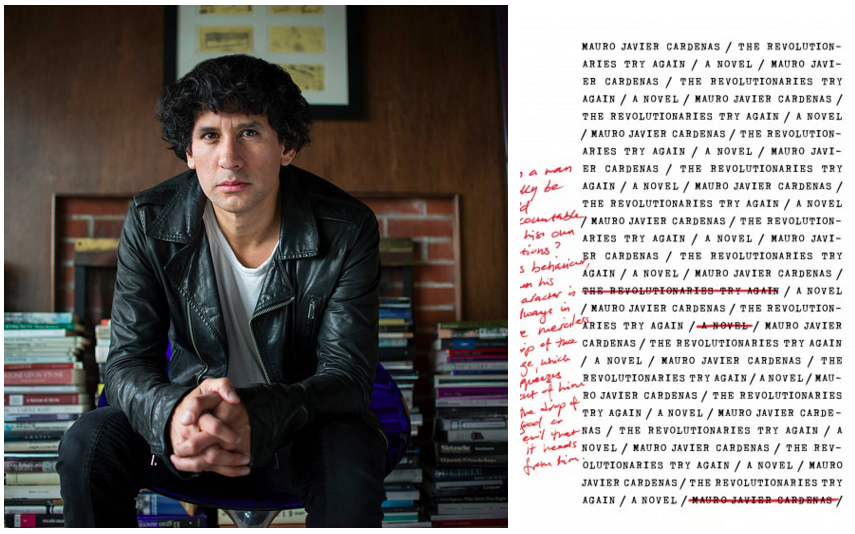
This week sees the release, at last, of Mauro Javier Cardenas’s long-gestated debut novel, The Revolutionaries Try Again (Coffee House Press), the coldest hot-blooded book I’ve read in many years. Like its cast of characters, the novel is colorful and disarming, bristling with idealism and disillusionment and profoundly embattled intelligence; like the country it brings to life without ever fully inhabiting, it’s noisy and claustrophobic and a dizzying thrill to get lost in. Because Mauro was beset with other book-launch obligations, we conducted this interview by email. His answers have been translated from his first language (Emoji) and lightly edited.

Daniel Levin Becker: Pretend this first question is coming from someone who knows nothing about you and has done no research whatsoever, including reading your book: why Ecuador?

Mauro Javier Cardenas: Because I missed my friends? Because I can still speak the highfalutin insult Spanish my friends and I would spitball at each other at my Jesuit high school in Guayaquil, Ecuador? Because I can still see Mazinger chasing Maid Killer across the soccer field of Colegio Javier? Or Microphone Head speechifying by Don Alban’s cafeteria? Because I boarded a plane to the United States after graduation and my friends, even the closest ones, ceased to exist for me? Because I wanted to return but didn’t? Is Padgett Powell going to be pissed about this? Do you know what he calls his (my) method of composition? Subconscious accretion.

DLB: How did the novel come to take the form and shape it did?

MJC: One succinct woof answer: I followed my nose. A less succinct woof answer: I like to believe the opening of Austerlitz by W. G. Sebald had tremendous influence on how I assembled The Revolutionaries Try Again. In Austerlitz, you don’t quite know why the narrator is telling you about raccoons and doomed fortresses, but you sense a submerged connection between them. I wanted to understand how he achieved this effect so I searched for everything Sebald and found an interview where he explains his method. If you look at a dog following the advice of his nose, W. G. Sebald says, he traverses a patch of land in a completely unplottable manner, invariably finding what he’s looking for. For instance: Cardenas questions the value of Voice of Witness at a dinner — → Cardenas becomes transcriber for a Voice of Witness project — → Cardenas decides his novel must end with a Voice of Witness monologue — → Cardenas can’t explain why this must be so — → Cardenas writes Voice of Witness monologue and hopes for the best. My mother, a transcendental therapist, would call this approach letting the unconscious do its work. My former devoted Catholic self would point out this approach is no different than being a devoted Catholic: always in search of connections and signs. My current sans devotion self would also point out Cortázar assembled Hopscotch the same way. Did I miss anyone? Does anyone else want to weigh in? Ah, yes, the guy with the day job in quantitative data analysis wants to say he (1) hates fiction patterned with pocket rulers, (2) does eventually analyze his haphazardly assembled sections in a spreadsheet, (3) would like to end with a line from Wendell Berry recited by a percussionist at a concert: every day do something that won’t compute.

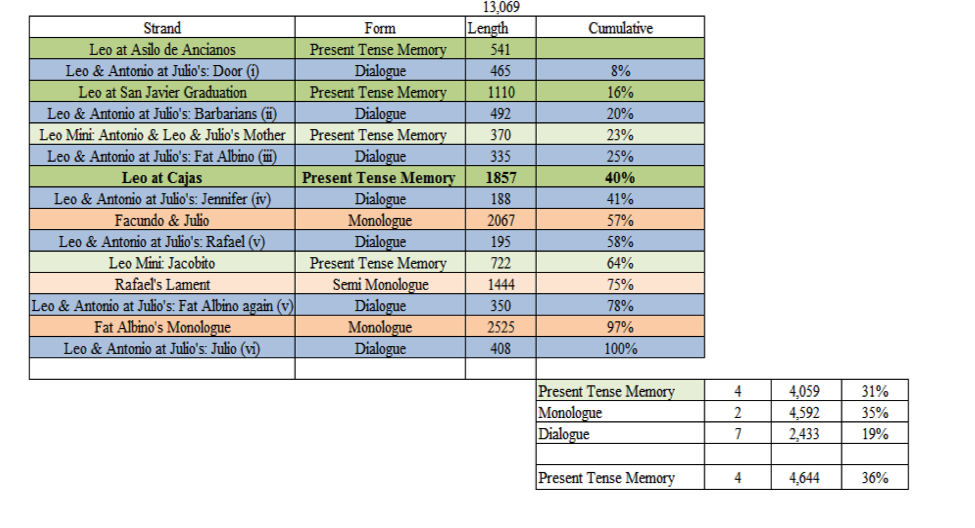
DLB: Can we see one of those spreadsheets?

MJC: Here’s a spreadsheet for the Leopoldo & Antonio at Julio’s Party chapter. The cumulative % was important for me to keep track of what surfaced when for the characters. The little table below is to keep tab on the balance between modes of narration.

Early version of Chapter XIII

DLB: Same question about form and shape, but on the sentence level. One reason your writing excites me so much is that it often mimics what I recognize as the rhythm of a noisy mind: it feels like I’m reading thought directly, in all its overlap and chaos. But then — if it took you more than a decade to finish this book, can that really be true? What’s the path these words took from your brain to the printed page?

MJC: I was exactly after what you call the rhythm of a noisy mind, Daniel: the dramatization of interiority, the overlaps and chaos and imaginary dialogues and blank memories. In other words the objective (to paraphrase Adam Phillips) was to find forms of incoherence that were readable. In other words I needed extremely flexible high-speed sentences (unlike the last two sentences, which require “in other words” to perform a simple overlap). I began by writing what I will call traditional long sentences, sentences that often rely on affirmations and negations to keep going on, and then I wrote what I will call my emdashed sentences, sentences that look like a horizontal JR by William Gaddis, and then (by trial and error, 100 words a day, year after year letting chance and whatever I was reading and whatever was happening to me interfere with the course of the sentences, thinking of the emdashed sentences, which I’d assigned to Rolando & Eva, as subversives infiltrating the traditional long sentences, which I’d assigned to Antonio & Leopoldo) I combined the two types of sentences, which yielded what I sometimes call long sentences with voices, sometimes performance of an impulse sentences. These, as you know, are the only kind of sentences I write now. I should have called them long sentences with snakes so I could end this question by saying, in other words, mister Levin Becker, The Revolutionaries Try Again can be read as the history of my [redacted] snakes.

DLB: What didn’t end up making it into the novel? Having read much of it in various earlier stages, I’m aware of some things that have changed (the most tragic to my mind being “maidkiller” becoming “maid killer,” a much less priapic nickname for a penis), but what stands out to you, structurally or sentimentally? Which darlings were you sorriest to murder?

MJC: I wish my approach of blanking parentheticals after writing them (coma con Joe, coma con Joe) and then trying to write about their potential content to dramatize my blanks in memory had worked. I was also attached to the following circa 2005/2006 sentence because it was one of the first ones that felt alive with the rhythms I was after, although it was too satirical in tone to keep, but I still love you, satirical sentence of my youth:

Along Rumichaca Street Antonio rushes to his first revolutionary meeting. At least he thinks it will be a revolutionary meeting. Although he knows that there will be no speeches about guerrilla uprisings. No plans to arm the poor on the hills of Mapasingue so they can descend upon a city that’s repulsed by them. No disquisitions about a new socialism penned by the young intellectuals of the Universidad Católica. No proclamations of a new presidential model with the power to bulldoze backward congresses with tanks, although this last notion does appeal to him, and there will be none of these partly because Antonio’s the kind of revolutionary who as a boy preferred clay saints over bronze soldiers (San Ignacio over Simon Bolívar, to his grandfather’s dismay), and partly because those attending this meeting wouldn’t appreciate being descended upon, and partly because all the young intellectuals he knows have either fled to Florida or opted for a career in business administration. Except Leopoldo. And Antonio, of course, who fled but has returned. And what a term, this revolutionary: super whitening toothpaste, triple decker tacos, digital monster tractors: everything around him seems to be revolutionary: on a billboard on the way to the San Francisco airport (the toothpaste), on an inflight magazine on his flight back to Guayaquil (the tacos), on posters on telephone poles along Rumichaca Street (the tractors). And yet despite the term’s debasement, and what to others might seem like a slight radical agenda, he still believes he’s heading to something revolutionary, leading him to conclude that perhaps revolutionary for him means: a protest at the corner of Rumicacha and Boyacá interrupts him, aiding him in postponing the conclusion that perhaps revolutionary for him means: any activity that includes him.

DLB: After such a long construction period, what made the novel finished? Does it feel that way to you now, or have you just moved on because it was time to move on? (I feel like I should know whether or not you subscribe to the never-finished-only-abandoned view of art, but I don’t.)

MJC: I used to think and perhaps still think of a novel as a radius of associations, where associations are like Christmas lights or stars in a constellation (I don’t understand the aversion to mixed metaphors in the USA, by the way, everything’s mixed up inside our brains, no?), and in the beginning the radius is dark so my task consists of switching the lights on, one by one, a task that obviously cannot be completed unless I live inside the radius, and some components like my high school memories will have an easy-to-find light switch, sure, but I’m a fan of the weird wires so most of the time my light switch is magic — do you like magic? — I don’t, Thom Pain says, enough about me — yes, Padgett Powell might have subconscious accretions but I have magic, clap once, twice, feed the radius with everything in the world, clap again, and once all the lights are on, the novel is done.

I don’t understand the aversion to mixed metaphors in the USA, by the way, everything’s mixed up inside our brains, no?

DLB: The book’s title — which I love — seems to me emblematic of the critical (in both senses) distance the novel manifests towards its characters. What was it like living with them for so long? How did your attitude and sympathies toward them evolve over time?

MJC: Someone said to me recently that the women in the book change the book, and I said yes, the appearance of the women in the book coincided with the appearance of my daughters, who have opened doors to rooms I did not know existed — the platypus, tata — rooms from which I like to believe I have been able to approach my characters differently, as if they were at the same time me (let’s satirize these guys!), my children (let’s pretend we’re not afraid let’s keep them safe under a dome of love!), and not me since too many years had gone by and I was no longer the same age as my characters (let’s feel loss and be nostalgic about them!). No wonder I dedicated The Revolutionaries Try Again to my daughters. In other words, mister Levin Becker, The Revolutionaries Try Again can be read as the history of my [redacted] lifestages.

DLB: Which makes me think of our friend Tony Tulathimutte’s various comments about writing a character whose identity is bound to be conflated with your own based on biographical/demographic cues. Antonio’s story mirrors yours at a number of points — which you’re not shy about making known, at least given the publicity materials Coffee House has been using — so how do you anticipate this playing out in your case?

MJC: I read Tony’s always incisive comments and thought aha, yes, that’s why his favorite section of my novel is the monologue in which the Fat Albino, the grandson of the greatest oligarch of them all, rants against Antonio and Leopoldo, two of the so-called protagonists of the novel, who think that, unlike everyone else in Ecuador, they are not fraudulent — I’ll tell you about that duo of thieves, the Fat Albino says — and so I read Tony’s always incisive comments and thought he’s right, if Antonio were a stand-in for me I might have banished his unsavory behaviors and thoughts for fear of being seeing as a bad person, but fortunately Antonio is not a stand-in for me but a stew of fact and fiction, and in any case if someone were to ask me about Antonio and his resemblance to me I would say think of the whole book as my alien child, mister, ripped out of my stomach over a period of 12 years.

DLB: Okay, long one, sorry in advance for being that one reading attendee who talks about nothing for four minutes and then says “can you speak to that?” But: where the book’s critical distance from its characters is most vivid for me is in this deep sense of doubt it seems to have about the ability of ideas — artistic, scholarly, religious, whatever — to change the world. To start a revolution, obviously, much less finish one, but also simply to attain a whole, existentially reconciled life. (Like, it’s satisfying to know and think about David Hume and Arvo Pärt, but what does that do to address economic disparity and lack of potable water, “destitution and injustice,” etc.) So now that you’ve written and published this brilliant novel both filled with and about ideas, what does it mean to you to join the firmament of artists and thinkers who represent that which you both love and doubt? Is success for this book different from success for its author?

MJC: How do we explain the coexistence of death squads and brunch? In How Holocausts Happen: the United States in Central America, Douglas Porpora brings up a condition called pluralistic ignorance, where we reinforce in each other the mistaken conviction that nothing is really wrong so that we don’t have to skip brunch. Will I skip any celebratory brunches if success comes for the book? No. But don’t ask me to stay for the churros (I’ll take those to go, though).

How do we explain the coexistence of death squads and brunch?

DLB: What’s the weirdest textual tic you indulge when you’re drafting? (For example, I rewrite sentences to get rid of ugly gaps in the right-hand margin; another friend of ours abhors sentences that end with the letter R.)

MJC: I don’t think this one is too weird,

but I draft my sentences like this,

one line until I hit a punctuation mark,

which I decided to do after I transcribed a slice of To The Lighthouse by hand the same way so as to learn how Woolf structures her rhythms,

yes,

like this,

a long line followed by a short one,

almost never a long line followed by a long line.

DLB: Name three authors you’re secretly afraid you’re influenced by.

MJC: Sometimes I am afraid to reread Saramago or Woolf or Antunes because I know I will be able to spot their influence, but most of the time I love to see how I’ve swallowed pieces of them to forge pieces of me.

The Alligator King

Shared Worlds, Malaprops, and Creating Fiction, by Jeff VanderMeer and friends

On July 30 of this year, six intrepid writers, including myself, created a round-robin story, sentence by sentence, at the legendary Malaprops Bookstore in Asheville, North Carolina. The others, fresh from teaching at the Shared Worlds teen SF/fantasy writing camp at Wofford College, were: Shirley Jackson Award-winner Nathan Ballingrud, NYT bestseller Tobias Buckell, critically acclaimed writers Julia Elliott and Terra Elan McVoy, and Bloomsbury US first-time novelist Leah Thomas. They’d just spent a long week having the students do writing exercises, critiquing their stories, and having one-on-one sessions with those students, with special guest Thomas Olde Heuvelt arriving late in the week to talk about his U.S tour for his novel HEX and being a writer from the Netherlands.

I help run the camp and my wife Ann serves as the editor in residence, and it’s always extremely rewarding. This is our ninth year of operation and the tradition of reading at Malaprops after the camp has become a kind of lucky charm, a great way to support a local Carolinas institution, and a nice way for writers who’ve worked hard with the students to unwind after the camp. This year, with such a cohesive and great group of writers, it seemed appropriate to create our own shared world through storytelling.

Shared Worlds founder Jeremy L.C. Jones set out the rules: “Each writer gets thirty seconds to think up the next sentence in the story, and we start with Julia Elliott. The audience will get to participate. Ann VanderMeer’s the editor. [If she feels it’s not going well] She can slam the brakes on this monster … redirect, edit, ask for more cats…” Olde Heuvelt asked, “Do we get electrical shocks when someone takes too long?”

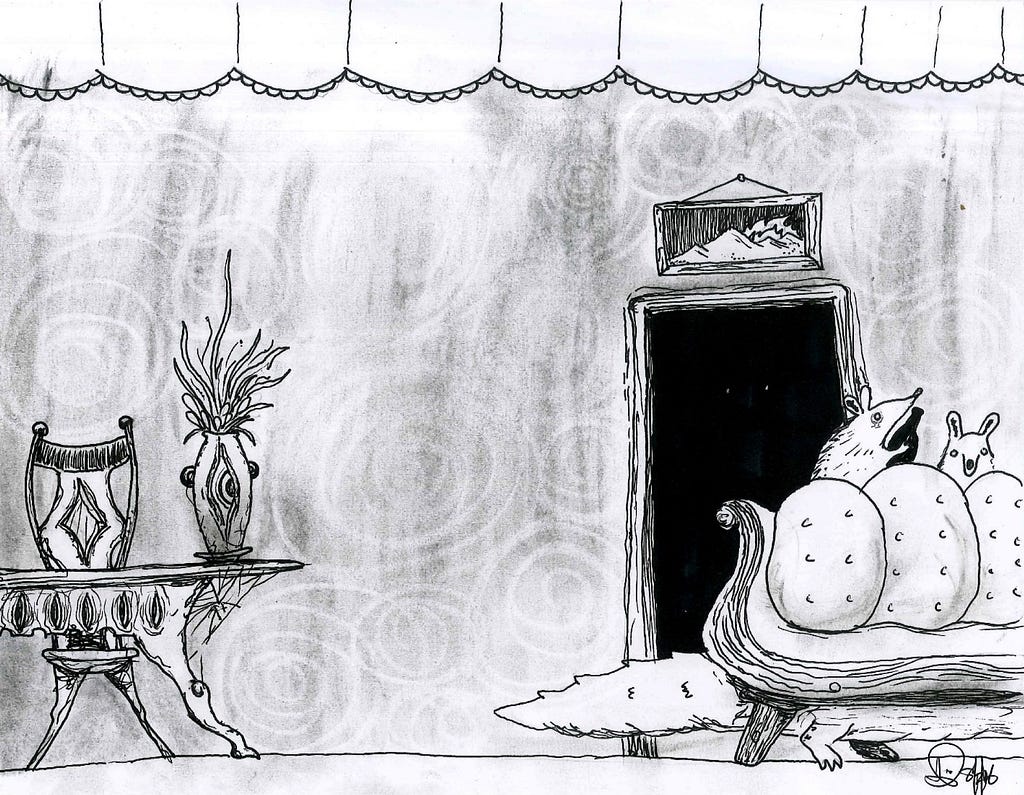
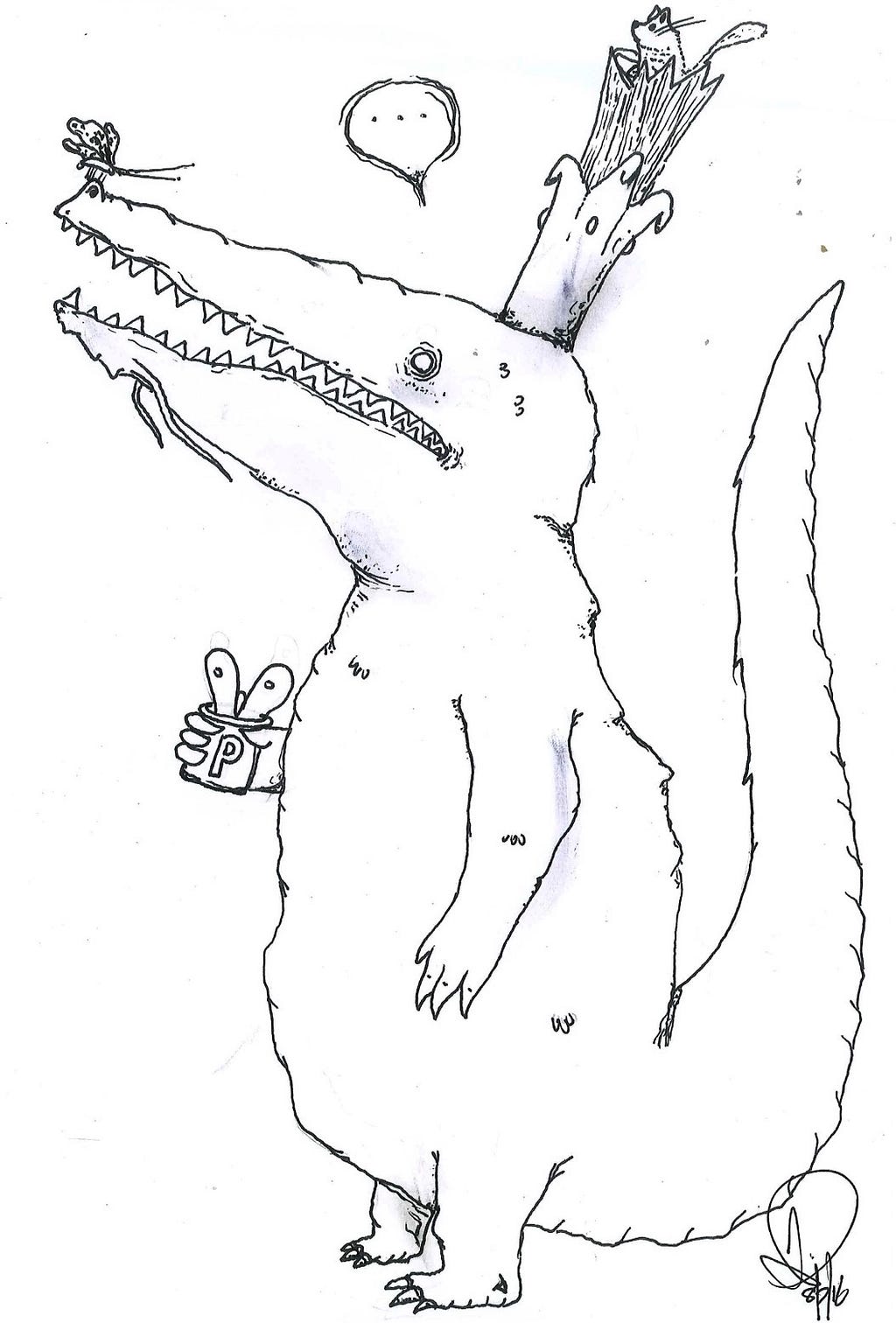
No, there were no electric shocks, but each writer did get one pass. Here are the results — with exclusive illustrations created by Shared Worlds in-house illustrator Jeremy Zerfoss.

— Jeff VanderMeer

AUNT FRANCINE & THE ALLIGATOR KING

(line by line)

Julia Elliott: Alligators, they say, creep right through her living room, and possums suckle litters on her velvet couch. Birds nest in her moss-festooned chandeliers. Open any closet and moths spew out.

Terra Elan McVoy: And yet she was still having trouble getting a jar of peanut butter open.

Thomas Olde Heuvelt: So when I visited her, for the sixth time in a row, I was like “Where do you hide the coffee in a place like this?”

Leah Thomas: She said, “The coffee is not the issue, it is only the peanut butter that I am preoccupied with… “

Tobias Buckell: But that was the problem with visiting Aunt Francine.

Jeff VanderMeer: PASS!

Nathan Ballingrud: What no one knew is that the coffee was hidden in the attic with the vulture.

Julia Elliott: When Aunt Francine poured wine upstairs to feed the vulture it had this annoying habit of peeling off her liver colored pantyhose and piling them into a damn pile on the floor.

Ann VanderMeer: Not enough cats [in this story]. Add more cats! More cats.

Terra Elan McVoy: So, since the vulture feeding always made my skin crawl I made myself useful and had to throw the peanut butter in.

Thomas Olde Heuvelt: “Don’t worry too much about Aunt Francine’s antics,” my mamma told me before I visited her.

Leah Thomas: “You know she hasn’t been the same ever since the cockroaches crawled into her ears.”

Tobias Buckell: “…And don’t worry, it was only three missing husbands.”

Jeff VanderMeer: But the real problem was in the basement, not the attic.

Audience Member: I should have known better than to ignore the alligators.

Nathan Ballingrud: The alligator came stirring from his slumber.

Julia Elliott: And hordes and hordes of kittens worshipped the Alligator King … adorable.

Terra Elan McVoy: I heard his slippery step upon the stair and turned and the door opened [and I was] aware all I had in my hand was that godforsaken jar of peanut butter.

Thomas Olde Heuvelt: As I smelled its stinky breath, I thought “Darn, I need some Smuckey.”

Leah Thomas: If only Smuckey were here, and if only Aunt Francine had not removed her pantyhose because everyone knows what draws the gator from the basement.

Tobias Buckell: Smuckey was always the faster thinker of us.

Jeff VanderMeer: Smuckey would have known exactly how to get that alligator king back in the basement, but I had no such luck.

Nathan Ballingrud: And the door creaked open and the alligator came walking into the living room, and Aunt Francine looked around and smiled.

Julia Elliott: Then she reached for her hidden jar of peanut butter and opened it and pulled out a rotten spoon from the stoop and dipped it into the peanut butter and held it out and the alligator came and licked dollops of peanut butter from the dissolving spoon.

Terra Elan McVoy: The kittens, upon seeing their king, feasting happily broke into song.

Thomas Olde Heuvelt: I’ll PASS on that.

Leah Thomas: “Meow, meow, meow, meow, meow, meow, meow, meow, meow, meow.”

Tobias Buckell: “Oh great Alligator King, denizen of the basement, bringer of all things good to adorable kittens, we salute you.”

Jeff VanderMeer: “Look,” the Alligator King said, “I’m really sick of getting this kind of reception when I just come out for some stinking peanut butter.”

Nathan Ballingrud: PASS.

Julia Elliott: [To the tune of the Meow Mix commercial] “Meow, meow, meow, meow, meow, meow … “

Terra Elan McVoy: Then I felt the old affection Smuckey always had for me covering me like a warm blanket and giving me the knowledge of exactly how to most beautifully wrap up this sixth visit with my Aunt Francine and her singing kittens.

Thomas Olde Heuvelt: I also remembered a thing my mamma [said]… she knew exactly what to do in a situation like this.

Leah Thomas: Could it be that Smuckey and the Alligator King were one in the same? (Everyone loves a terrible twist near the end of the story.)

Tobias Buckell: Because it was only after Smuckey had disappeared that the Alligator King showed up.

Jeff VanderMeer: “For eff’s sake,” [the Alligator King] said, “I’m standing right here while you’re standing right there looking at me.”

Jeremy Jones: Anyone in the audience? Anyone?

Tobias Buckell: They’re like “You dug your hole deep enough.”

Second Audience Member Contribution: “Sorry,” I said, “this is only my third time visiting my Aunt Francine and I’ve never met you before.”

Nathan Ballingrud: I moved to give him the jar of peanut butter but I gave him the coffee instead.

Julia Elliott: So the Alligator King upended the coffee can and gobbled up every last [bit].

Terra McVoy: Immediately upon licking the last coffee ground from his mouth, however, a hideous hissing crackling sound began to emerge from his stomach.

Thomas Olde Heuvelt: So I turned to Aunt Francine and I said “Can we now play Monopoly?”

Leah Thomas: I’m sorry, in this game of life, we only play Trouble.

Tobias Buckell: PASS.

Jeff VanderMeer: Francine said, “I’m actually only here for another purpose entirely and I’m just glad somebody came over and the Alligator King came up from the basement because there’s really something I have to tell you.”

Nathan Ballingrud: And then she pulled off her mask.

Julia Elliott: There was another mask and then she said “It’s time for me to molt and I need you to help me, go get a jar of Vaseline.”

Terra Elan McVoy: The Alligator King made a second sound of hissing disgust and headed back down to the basement. I would never know for sure if he had really been Smuckey or not.

Thomas Olde Heuvelt: So I crossed the street to the drug store and asked for a bottle of Vaseline and the lady behind the counter said “Not again.”

Leah Thomas: PASS.

Tobias Buckell: I stared right back at her and said “What’s an acceptable substitute?”

Jeff VanderMeer: And she said “Peanut butter.”

AUNT FRANCINE & THE ALLIGATOR KING

(all at once, now…)

Alligators, they say, creep right through her living room, and possums suckle litters on her velvet couch. Birds nest in her moss-festooned chandeliers. Open any closet and moths spew out. And yet she was still having trouble getting a jar of peanut butter open.

So when I visited her, for the sixth time in a row, I was like “Where do you hide the coffee in a place like this?”

She said, “The coffee is not the issue, it is only the peanut butter that I am preoccupied with… “

But that was the problem with visiting Aunt Francine.

What no one knew is that the coffee was hidden in the attic with the vulture. When Aunt Francine poured wine upstairs to feed the vulture it had this annoying habit of peeling off her liver colored pantyhose and piling them into a damn pile on the floor. So, since the vulture feeding always made my skin crawl I made myself useful and had to throw the peanut butter in.

“Don’t worry too much about Aunts Francine’s antics,” my mamma told me before I visited her. “You know she hasn’t been the same ever since the cockroaches crawled into her ears. And don’t worry, it was only three missing husbands.”

But the real problem was in the basement, not the attic. I should have known better than to ignore the alligators. [Because now] The alligator came stirring from his slumber. And hordes and hordes of kittens worshipped the Alligator King … adorable.

I heard his slippery step upon the stair and turned and the door opened [and I was] aware all I had in my hand was that godforsaken jar of peanut butter. As I smelled its stinky breath I thought “Darn, I need some Smuckey.” If only Smuckey were here, and if only Aunt Francine had not removed her pantyhose because everyone knows what draws the gator from the basement.

Smuckey was always the faster thinker of us. Smuckey would have known exactly how to get that alligator king back in the basement but I had no such luck.

The door creeped open and the alligator came walking into the living room and Aunt Francine looked around and smiled. Then she reached for her hidden jar of peanut butter and opened it and pulled out a rotten spoon from the stoop and dipped it into the peanut butter and held it out and the alligator came and licked dollops of peanut butter from the dissolving spoon.

The kittens, upon seeing their king feasting happily, broke into song.

“Meow, meow, meow, meow, meow, meow, meow, meow, meow, meow…Oh great Alligator King, denizen of the basement, bringer of all things good to adorable kittens, we salute you.”

“Look,” the alligator king said “I’m really sick of getting this kind of reception when I just come out for some stinking peanut butter.”

“Meow, meow, meow, meow, meow, meow … “

Then I felt the old affection Smuckey always had for me covering me like a warm blanket and giving me the knowledge of exactly how to most beautifully wrap up this sixth visit with my Aunt Francine and her singing kittens.

I also remembered a thing my mamma [said]… she knew exactly what to do in a situation like this.

[But] could it be that Smuckey and the Alligator King were one in the same? Because it was only after Smuckey had disappeared that the Alligator King showed up.

“For eff’s sake,” [the Alligator King] said, “I’m standing right here while you’re standing right there looking at me.”

“Sorry,” I said “this is only my third time visiting my Aunt Francine and I’ve never met you before I would be interested.”

I moved to give him the jar of peanut butter but I gave him the coffee instead. So the Alligator upended the coffee can and gobbled up every last [bit].

Immediately upon licking the last coffee ground from his mouth, however, a hideous hissing crackling sound began to emerge from his stomach.

So I turned to Aunt Francine and I said, “Can we now play Monopoly?”

“I’m sorry, in this game of life, we only play Trouble,” Francine said. “I’m actually only here for another purpose entirely and I’m just glad somebody came over and the Alligator King came up from the basement because there’s really something I have to tell you.”

And then she pulled off her mask.

There was another mask and then she said “It’s time for me to molt and I need you to help me, go get a jar of Vaseline.”

The Alligator King made a second sound of hissing disgust and headed back down to the basement. I would never know for sure if he had really been Smuckey or not.

So I crossed the street to the drug store and asked for a bottle of Vaseline and the lady behind the counter said “Not again.”

I stared right back at her and said “What’s an acceptable substitute?”

And she said “Peanut butter.”

What Keeps Peter Tieryas Awake at Night?

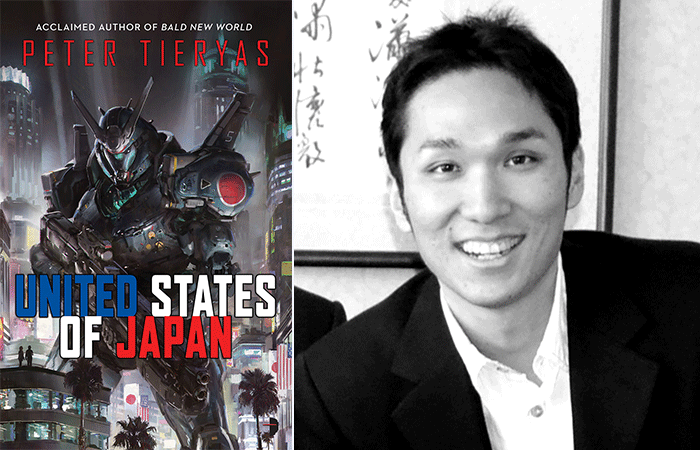
As I write this I am reading Philip K. Dick’s The Man in the High Castle for the first time. I considered reading it before diving into Peter Tieryas’ United States of Japan, which is described as a spiritual successor to PKD’s novel, but I couldn’t wait to dive into Tieryas’ book. From the description of the book to the awesome robot on the cover I could not resist cracking it open.

All that said, and if I’m being completely honest, I didn’t expect to love USJ. I expected to enjoy it and to be entertained, but I did not expect to become obsessed. And obsessed is probably a light word. I have been consumed by the world Tieryas created. I have thought about it daily for months. It has been a source of artistic inspiration that I have found in few books the last couple of years. So, naturally I was honored and excited when Tieryas indulged me in an email exchange that spanned months and spawned numerous other exchanges aside from the interview.

Art, powerful art, is often described as transformative and that is exactly what the combined experience of reading the book and corresponding with Tieryas has been.

Ryan W. Bradley: United States of Japan set me to thinking about alternative history. There are multiple schools when you break down basic plots. I have very little interest in the hypothetical “go back in time and kill Hitler” brand. What I realized draws me in is thinking about how the world would look for the everyday person and dealing with the realization that no matter the changes that are made there’s no such thing as “Utopia.” I think USJ falls into this camp. That said, what intrigued you most about exploring the alterations of World War II history and their effect on the society you crafted?

Peter Tieryas: Most Star Trek episodes focus on the senior staff, but one of my favorite episodes is Lower Decks when they show the perspective of regular crew members who are eager to get the attention of the officers. It was a completely different viewpoint from what I was used to, but also a more relatable episode as it was about the “everyday person.” I mention that because I was intrigued by the idea of what the world of The Man in the High Castle would be like for that everyday individual, someone with an office job, a bureaucrat, or, as it’s an authoritarian society, a member of the secret police. Not so much in the ‘60s as in High Castle, but what it would be like closer to our own time, skipping ahead a few decades. Would Axis rule have changed? What would the technology be like? How different would culture be since the memory of America pre-WWII would pretty much be a historical footnote? I’m making the assumption that with the advent of the Axis, religious perspectives would also change from a more Christian-influenced society to a Shinto one with the Emperor revered as a god. Would the judgment on what entails “good and evil” change? Would there be certain absolutes between alternate histories? Or would their system of values be almost unrecognizable by our standards? I was intrigued exploring these ambiguities and it was difficult finding the balance of being true to what they might espouse while writing characters that, even if not likable, could be understandable. If there’s one big regret I have in the book (among many), it’s that the timeline/mystery structure of the novel being split into hours and days precluded me from having moments where I could just slow down and bask in the society, showing how people shoot the shit in the USJ.

RWB: There’s a slippery slope, I think, in writing about characters who have a occupational relationship to the material. To reduce it to the basest versions: scientists in science fiction, wizards or dragons in fantasy, aging professors in “literature.” Something interesting happens when you start telling those stories in relation to the outlying characters.

By going further into the future you’ve also given your story a new dimension of being a second generation issue. USJ deals with some familial legacy questions that books like High Castle didn’t have the opportunity to explore. What kind of source material did you look to, whether research, personal experience, etc., to craft that tension between generations?

PT: One of the driving ideas behind USJ was trying to understand, what would the second and third generations in that alternate history think and believe? In High Castle, people still have memories of the world pre-Axis victory so they have a connection to it. But in USJ, they don’t.

I had to ask, would the morality and cultural values of those in the USJ be totally different, having been raised in a completely different environment? The generational divide could also be considered a philosophical one. These people don’t pine after a world they don’t/can’t remember. Axis domination is just a fact of life, and one they wouldn’t consider bad or evil because there’s no anchor of “good” to judge it against.

I think what made this more interesting was reading about life in Japan while WWII was going on. Propaganda hid defeats after the US entered the war, so that for those back at home, it sounded like everything was going great. It reminded me in many ways of the way the Iraq War was portrayed. I still remember Bush’s “Mission Accomplished” Speech. I think many Americans felt it was all over. None of us knew the conflict was just beginning and that all these years later, there still wouldn’t be peace. And the more news poured in from the front, the more people began to realize things weren’t going the way we’d been hearing about. The Iraqis view of America is totally different from our view, just the same way the view of those being attacked by the Nazis would be different from those under German rule (and the Japanese Empire as well). So those contrasts and dichotomies became an area I really wanted to delve into and explore.

A lot of that came from reading wartime accounts from those who lived through WWII, especially the civilian side. Some of that came from talking to people who had family members that lived through took place in Asia during the Pacific War. Another chunk of it had to do with my own experiences living in America (and Asia).

For the clashing and tension of generations, it really comes down to questions about ethics and morality. Is that part of the environment? Or is that something innately understood? I’d like to think it’s a combination of both, but as is shown in USJ, living for decades under an authoritarian regime changes their ethical system. Akiko’s attempt to find her “humanity” is part of the driving force in the book.

RWB: There’s a cultural relativism that goes hand-in-hand with moral relativism, and I think it’s easy, especially for Americans, to forget that every country’s citizens are going to see events differently, because our framework is not theirs. But I think something you express really well is the curiosity that comes in being a citizen of any country, any government. There is no “anchor” as you mention, to judge the USJ’s actions against, but as soon as there is a glimmer of an alternative, you see a person like Akiko have this drive to learn and investigate, even if she is, in many ways, a model citizen. It’s human to wonder about alternatives, once they are seen to exist.

You talk about the research that went into crafting the world view of the book. That is a part of fiction writing that fascinates me. Did you know what you were looking for at the start and seek that out or did your organic learning lead you places you didn’t know you’d end up? How did it work with the actual writing, were they concurrent or linear, going from research to drafting phases?

PT: It was definitely organic and this is part of where the nightmares came. The more I started researching about the Empire and its citizens, the more I started finding corresponding patterns and cycles with our own times. A lot of the extremism that happened had its roots in the economic turbulence of the ‘30s. That was right after the Great Depression where the entire world economy collapsed. People couldn’t just charge things to credit card the way we do now to stave off debt, and inflation made even the most basic requirements ridiculously unaffordable. It’d be like if you were told overnight, dinner costs a million dollars. How do you support your family? To what extent would you go to protect those you care about? And that’s where the back story began to take inception. Ben’s parents only appear for a short bit, but I talk about how the transition from the US Dollar to Yen caused great upheaval in the American economy.

It’d be like if you were told overnight, dinner costs a million dollars. How do you support your family?

With how volatile the economy and stock market have been the last few years, it was contemporary news headlines that had me asking myself, what if things take a drastic shift? How will we react as Americans if we default? Once I started seeing the history in that light and found the human core I could relate to, the specific nationalities might be different, but the fears, the hopes, and even the cruelties could have an understandable, if detestable, commonality. So much that at certain points, I actually swapped out Axis acts (which were often cruel to an inhuman extreme) with the forms of torture in contemporary life that people seem to regard as more palatable. And when that’s met with abhorrence, I wonder, why is it that the fiction arouses more anger than facts? Have we become numb to it when it’s foreigners aka “enemies?” That’s another aspect I explored in the atomic bombings of San Jose, Sausalito, and Sacramento. When it’s Hiroshima and Nagasaki, is there a different understanding of the price of war than when it involves American civilians? Again, questions like this kept me up at night and I understood why Philip K. Dick struggled with the idea of doing a sequel and eventually opted not to do one.

RWB: I believe that I read somewhere that the opening, where we see the end of the war and Ben’s parents, was actually a late addition to the book? Was that a product of the ongoing research? Were there other stories or historical tidbits you came across and wanted to use but couldn’t fit in the story you were telling?

PT: The opening was much shorter in the original draft. That’s when I visited the Japanese-American museum in San Jose where they had a recreation of one of the original internment bunks. The thing that was so shocking to me was that the people who were “interned” there were American citizens who’d committed no crimes, and yet were forcibly removed from their homes. If you were even a sixteenth Japanese, meaning your great-grandfather was Japanese, that meant you had to report to the camps. Some people had worked their whole lives just to establish a living, whether a business or a trade, and that was gone overnight. The photographs and notices ordering people to report for internment were of places that I recognized in San Francisco. These people’s lives were ruined and everything put on hold for several years. Why?

I couldn’t understand it. A few years after their imprisonment, when they were released, the guide told us many of the elderly didn’t want to leave as there was nothing to go back to. Many of their homes and businesses were snatched up by others who saw their vacancy as an opportunity to exploit.

Then I got to wondering, what if America started losing the war? What if they became scared of what this portended for those they’d imprisoned in those camps? Would things change in a negative light? What would be the perspective of the Japanese-Americans who’d been imprisoned to learn that they were being liberated by the Imperial Japanese Army?

There are lots of tidbits from the research I wasn’t able to use. Too many. Fortunately, I’m exploring them in a side story set in the USJ world and will take that further in the official sequel.

RWB: I’m glad you mention the sequel, because I think you are in a situation where most writers don’t find themselves, even as common as sequels and series might seem sometimes. Did you see USJ as a series or as more than one book from the outset or, if not, at what point did you realize the universe you had created would encompass more than one story? And what did you learn writing the first book that you have carried over into the sequel?

PT: I originally saw it as one book. Describing life under an authoritarian system took a big emotional toll because I’m a “method writer” (sorry if that term evokes a pompous feeling, ha ha) and try to become the characters I write about (which honestly sometimes weirds out my friends!). But as the book started coming to an end, another side of me didn’t want to leave the characters in the world yet. I wanted to know more about the USJ. I mentioned earlier how I had that one regret in not being able to just hit the pause and look around the world. I really wanted to get a glimpse at what it was like in other cities and their social circles. But would I get that chance? I spent a lot of time thinking about that so it is a very nice situation to get that opportunity and to know there are people who are looking forward to sequels.

The “official” sequel was going to follow some of the main characters and continue their arc. But before that, I actually wanted to take a step back and spend the length of a novella following the daily life of a student in the USJ. 40K words in, I find myself still going full steam, enjoying this in some ways more than USJ because not only was I familiar with the world, but I was spending time in some of the wackier/fascinating locales in the alternate America. Since I’ve paid my tribute to PKD in the first, I also felt a bit more liberated. I was worried that the first one, being a spiritual sequel, would stray too far from the spirit of the original, especially with its focus on the Asian side. But now, I’m taking the series in my own direction without feeling a sense of restraint which is both exciting and daunting in that it’s totally new ground.

Since I’ve paid my tribute to PKD in the first, I also felt a bit more liberated.

I learn from every book. I read many of the reviews. Most have been superb. Critiques usually revolve around the level of violence (for those who weren’t familiar with the past and were taken by surprise by the extent of the brutality), to the implausibility of mechas in the 1980s (I find it fascinating here that I actually followed PKD’s lead in which he mentioned the Nazis are colonizing space using robots, only taking that two decades further).

A few readers have specifically criticized the dream sequences which I interjected as a sort of allegorical representation of the bridge with the alternate universe, our world. In a repressed society, I felt dreams would be even more wild. So while most of the book is told in an almost restrained and brisk fashion to represent the general atmosphere of fear, there are bursts of language hinting at a deeper underbelly whenever the characters (particularly Akiko, but Ben too when he gets tortured) let their guard down. It was an experiment and as several people people found it distracting from the main narrative, I’m removing those sections for future iterations.

The rest, I’ll discover as I write and carve away. But having that first one in place as a sort of guidebook with specific rules makes it easier to focus on the characters and themes rather than the worldbuilding, even though there’s plenty of that left to do.

RWB: Sequels sometimes get a bad rap, but it seems like there is an advantage to them in the sense that some of that world building work has been done. Suddenly there’s almost a sense of writing about your hometown. Do you see the sequel and any future books in the universe as a “series” or as “stories of the USJ”? In essence, do you still see yourself writing a direct sequel or has the foray into the life of a previously unseen character opened up a broader scope for the world you created?

PT: A lot of times, and this is just my personal speculation, but I think it’s because either the sequel doesn’t get enough time, or the reasons for making it aren’t necessarily because there’s a story there. I’ve heard theories how if there’s X work (whether book, film, or game) and X amount of interest, a sequel has to come out within X amount of time in order to have the attention/excitement continue to build. Which is true in a sense. At the same time, if you rush something out to meet demand and the quality suffers — I think the saying goes, you can forgive a movie/game/book if it’s late, but not if it’s bad. Blizzard Games is a perfect model for that. They’re known for delaying games as long as it takes to achieve quality. They want to stay true to that world and reward the fans with an amazing experience. The same goes for Nintendo. I very much believe in that model and hope I can always stick to it.

For the USJ trilogy, I’ve always envisioned this as Agent Akiko Tsukino’s arc. I was heavily inspired by Yukio Mishima’s The Sea of Fertility tetralogy. All four books revolve around Shigekuni Honda, though in each, there’s a new character that’s the focal point. There’s themes between all four books, and yet each feels uniquely independent. The chaotic harmony threading through that “sea of fertility” is ripe for evolution and growth. So that’s what I originally was hoping to do after USJ came out. But I started getting really depressed again diving into the world of USJ, getting into the minds of the secret police as they tracked down a different kind of group. I was tantalized because this one had a bonafide villain, whereas the first one focuses more on tracking down Mutsuraga as a general threat (a la Man in the High Castle). But the more I got into it, the more I felt this sense of dread re-inhabiting that USJ state of mind.

On top of that, the areas I wanted to explore, I couldn’t because it detracted too much from the main narrative. I actually wanted to stop everything taking place and inject a scene where everyone has a day off so I could follow the characters around. No hunt, no villains, no Tokko business. Just follow the characters for a day (or two) having breakfast, driving to work, find out stupid things like what their bathrooms are like, where they drink, read books, go on dates, etc. I know, it sounds boring, right? But I wanted to know more about this world and just kick it with some different characters that live in a world where Nazis have developed all sorts of crazy monsters and you can see mechas stomping through the city on any given day. With the secret police members, I felt this approach probably wouldn’t work. So I started the above mentioned novella set in the universe with a different cast (that is now a novel). It’ll be very different in tone and structure to the first USJ and is more of a “story of the USJ” than a sequel. I love that because I feel way more freedom to improvise. Also, this story is much more focused on mechas which has been a blast to write.

I wanted to ask you: is there a big divide between literary and genre fiction? Are they mutually exclusive? I only bring this up because on two separate instances, “literary” authors have expressed their disappointment in me for writing “genre” with a big mecha on the front cover of my book without even reading my book. I was so surprised. I’ve never thought of myself as a genre writer per se and find these categories somewhat misrepresentative of what goes into any given story. They’re more of a marketing category, no? Good writing is good writing irrespective of whether there are mechas or not in the story?

RWB: It’s interesting that you mention how the historical background of the world brought on depression. That’s a side of this kind of writing people don’t think about. But I know that feeling of being emotionally drained by a topic you’re writing about. There’s an intensity and a grief almost. I think what you describe is a part of the maturation of a writer, too. We all experience it to one degree or another, finding where we can push ourselves, but also how to regain the enjoyment of what we’re doing.

Another aspect people don’t talk about much is the pressure of writing a sequel or a series. I imagine that, in part, that is what you’re talking about when you discuss the original ideas for a direct story arc surrounding Akiko. Bucking that pressure must have a lot to do with your publisher, Angry Robot. Were there discussions about your plans or your feelings about changing things up for the second book?

And to answer your question, it would depend on who you speak with. There are definitely literary writers and academics who look down on genres. But I have encountered the flipside of that as well, people who think that writing realism is boring and pointless. Obviously both points of view are very narrow and reductive. Like anything else in life there are great works of writing in any genre, just as there are terrible “literary” books. There is a false impression, especially in some circles, that literary equates to “better.” I’m the first to admit that I don’t read much science fiction or other genres, but that doesn’t stop me from enjoying a Neal Stephenson novel as much as one by Dave Eggers, though they couldn’t be more different. What they have in common is that they are both masters when it comes to storytelling.

PT: Intensity, grief, and sense of responsibility. What weighed on me the most was that a lot of the facts in the Pacific side are not well known here. Can you name some of the important WWII military figures in the Japanese Empire? How about in China, Korea, Singapore, India, Thailand, and more? I ask this because I’ll admit; I myself didn’t know many. I’d heard of a few, but they weren’t names I grew up with the way it was in the western front with the obvious figures like Hitler, Rommel, Goering, Himmler, Guderian, and others on the German side (on the American side, there’s obviously MacArthur, FDR, Churchill, Patton, and so may others). But it wasn’t the historical personages that were on my mind as I wrote USJ. It’s the fact that somewhere between 20–30 million civilians were killed in Asia. 20–30 million civilians, which doesn’t include military casualties. In bringing to light their experiences, I kept on thinking about all those who’d died and suffered heavy bouts of self-doubt. It wasn’t just the horrible photos I saw, but reading their accounts, hearing their stories, that made this such a difficult experience. I reworked sentences, took out anything that felt extraneous, and tried to create a plausible alternate history without spoonfeeding facts to readers in the form of an obvious chronology (although I eventually relented and did a little bit of that with Akiko).

In terms of pressure for the sequel, honestly, I don’t feel much because the sense of pressure I felt after United States of Japan was so intense, the day it published, it was like a flood releasing inside of me. If anything, I’m going to enjoy working on the sequels a lot more than the original. As for Angry Robot, they’ve been fantastic, totally supportive, and always a joy to work with. I’m immensely grateful to them for the chance to do more books in the series.

I am passionate about storytelling and feel anyone can do it in any genre, format, or style.

Genre vs. lit: Words and stories were the way a younger me came to enjoy, understand, and even endure the bleaker aspects of life. I am passionate about storytelling and feel anyone can do it in any genre, format, or style. That’s why I enjoy experimental works as much as poetry and even the next blockbuster. Every story is important to me and serves a special purpose. I recently read a view of USJ which said that while they recognize it’s a great and meaningful story, they were actually hoping for some popcorn escapism to cheer them up. I totally empathized. Sometimes I too just want to see big robots fight each other without any rhyme or reason. Escapist entertainment has its value as does highbrow independent literary works that push the frontiers of language. But why do they have to be mutually exclusive? I think if anything, the two working in conjunction produces the best results. I’m time and again struck by Iain M. Banks’s Culture series and how gorgeous his prose is. Margaret Weis fired my imagination growing up as a kid as I wandered the worlds of Dragonlance. I loved the philosophical sorties in Herman Melville’s Moby Dick. How can you not marvel at how lyrical Aliette de Bodard’s writing is in The House of Shattered Wings?

RWB: You’re right. Even as a former history minor there are very few names I can pull out of the ether beyond the United States, England, and Germany. Of course Tojo in Japan. Mao was a commander in the Chinese Army, I believe. And Zhukov in the Russian Army. When it comes to history in the United States the things we learn that pertain to other countries are the devastations. They are talking points. It’s a way to boil down history, and it’s an incredible disservice, not just to the past but to ourselves.

I had a tumultuous childhood as well and was a voracious reader from an early age. For me, I think there was a calm to it. Sitting in my room reading was a way to have some peace. I read anything and everything. As long as a book is engrossing in terms of the writing I will give it my time.

I don’t think there’s any kind of solid agreement on what makes something literary, but what concerns me more as a writer and a reader is a book that is viewed as disposable. I believe writing is important as any art. I’ve never read the Song of Fire and Ice/Game of Thrones books, but George R.R. Martin seems to take his time writing them despite pressure from his audience. I respect that over someone churning out books like they’re episodes of a TV show. Creating art and creating entertainment shouldn’t be mutually exclusive.

You seem mindful of wanting to write something that people will enjoy, but also of wanting to steer clear of producing something just for the sake of producing it. How do you balance your internalization of reader opinions with crafting a story you can get excited about? Because many writers will tell you to filter those opinions out.

PT: I often think about Clarence Budington “Bud” Kelland. Have you heard of him? I’m copying and pasting this from wiki:

“Clarence Budington “Bud” Kelland (July 11, 1881 — February 18, 1964) was an American writer. He once described himself as “the best second-rate writer in America”. Although largely forgotten now, Kelland had a long career as a writer of fiction and short stories, stretching from 1913 to 1960. He was published in many magazines, including The Saturday Evening Post and The American Magazine. A prolific writer, his output included sixty novels and some two hundred short stories.”

60 novels, 200 short stories, and his work inspired over 30 films. But I’d never even heard of him until I came across his name randomly in an article mentioning people who were famous during their time but are forgotten now. Contrast that with someone like, say, Herman Melville, who during his life was pretty much panned outside of his first two books, Typee and Omoo. Near the time of his death, he wrote a long poem. “Among the longest single poems in American literature, the book had an initial printing of 350 copies, but sales failed miserably, and the unsold copies were burned when Melville was unable to afford to buy them at cost.” And by “1876, all of his books were out of print.” Yet now, he’s considered one of the great American writers. (I personally love his work including White Jacket and Mardi which inspired parts of my earlier book, Bald New World, as well as his long novellas like “Billy Budd” and “Benito Cereno.”)

I went on that long segue just to point out how you can never tell the fate of a writer based on popularity, critical acclaim, and even sales. Ultimately, what we do will most likely be forgotten in a short period of time. In a year or so, most people won’t even remember United States of Japan. (fingers crossed that they do!)

So in that sense, I definitely try to keep everything I do in perspective. Writing is a love for me. Well maybe not writing so much as telling a story I feel passionate about, as writing is the technical expression of that desire. And as with any writing/story-telling, you’re doing it for an audience. Otherwise, you can just write journals to yourself. I try to take a serious look at what I love, studying my own reaction to favorites scenes in books, films, and games, then learn from them. How did they do that? What was the tempo in the diction and the number of syllables per sentence (Steinbeck is a master of rhythm)? How much description versus dialogue?

Learning how the masters did it is part of the development of a writer. But reviews can also be enlightening.

Technique is so important as is character development, and the latter is especially hard to do in a way that is organic for the reader. Learning how the masters did it is part of the development of a writer. But reviews can also be enlightening. You’ll always have your share of nasty reviews that just hate your work outright and those, I’ve come to filter out (though occasionally, one will slip through, stab me in the tongue, and convince me I should quit writing). There’s also criticisms that I can agree with. One I get on USJ a lot as I mentioned above is people’s shock at the amount of violence. But that’s intended. I didn’t want to censor the violence of WWII; I wanted to depict it in a brutally honest fashion, so I not only accept it, but embrace it. It’s when you start seeing a consensus about certain aspects of your writing that is producing an unintended effect that I go, oh, I should learn from that. Case in point, the dream sequences I mentioned above which will get toned down as it was detracting from the narrative experience. Then again, I get confused when other reviewers state that the dream sequences are their favorite part and they love the prose there!

The main thing I try to do is take the role of an audience member. Is this something I’d like? If yes, then I stick with it. I know my tastes are weird, so it might not always agree with everyone out there. But that’s okay.

‘With tears distill’d by moans’: The Bittersweet Hopefulness of ‘Holding the Man’

Timothy Conigrave’s memoir, Holding the Man, was published in his native Australia in 1995. The title of its first section keys you in immediately to what preoccupied a young Tim: “A Head Full of Boys.” Despite growing up at the end of the freely loving sixties (when “the world seemed very exciting for a nine-year-old”), Conigrave was not spared the bullying and badgering that greeted most young boys who happened not to be like the others. As he describes it, he never cared much about sports and would not have been able to define what “holding the man” even meant. What he did know, however, was that he had an unusual interest in other boys. He gives us his thoughts after he’d started up at a new all-boys school:

Sitting nearby was the sunglasses boy. I was thinking about his looks. What makes me think he’s handsome? I like the way he is. Calm and cool. Would the other guys think he was handsome?

Cover of first edition (1995)

Holding the Man’s most touching moments happen when Conigrave finds himself navigating, in ways both intellectual and emotional, his own sexuality. The book is honest in its exploration of the oft-hushed musings of pubescent homosexual boys, as well as in its frank mining of the limits of radical queer sexual politics in the 1970s and 80s. “You know I love you,” he tells his then boyfriend. “But I’m worried that we’re missing out on what people our age are supposed to be experiencing … I don’t believe that it’s fair to expect our lovers to fulfill all our needs.” Page by page we are guided through a personal narrative which overlaps crucially with the conversations happening around gay liberation in the late decades of the twentieth century.

In contrast, the filmed adaptation of Conigrave’s memoir excises these schoolyard moments almost entirely, opting for a framing device that allows for brief flashbacks. The film, directed by Neil Armfield, opens not with a bumbling young Tim negotiating his newfound same-sex attraction (a chastely erotic friendship with his fellow schoolmate, which endearingly ends with a realization: “Fuck, I’m a poofter.”). Rather, we’re given a first glimpse of our protagonist in his thirties, running down an Italian seaside street towards a payphone. When he finally connects with a female friend he is desperate to ask her: where had John been sitting during that first dinner that they had all shared together? He is already starting to forget, and he wants to get all the details right.

The effect of this structural change from the book is twofold: it dispenses with the narrative teleology that memoirs such as Conigrave’s depend on, and in doing so makes the film less about Tim than about the budding romance between him and his eventual partner, John Caleo. While the love story between the two is at the heart of Holding the Man the book, in minimizing Tim’s questioning teenage years the film refuses to simply walk its viewers through a narrativized version of what it’s like for someone to realize and act on their own homosexual urges, engaging the audience in a different way: by expecting more. Similarly, the film, released first in Australia in 2015, refuses a linear narrative for John and Tim’s romance — and later, of John’s death — shuttling strategically between them instead.

The real Timothy Conigrave and John Caleo

This strategy, of flashing back to their shared memories, immediately transforms the material into a narrative about grief. Not about AIDS — which we soon learn precipitated John’s decline — but about the aftereffects of that incredibly immense loss. The short phone call alerts us to the dual facts of John’s passing and of Conigrave’s heartbreak. When Tim runs out of change and must begrudgingly go on without being able to accurately recollect and thereby resurrect John (was his former lover sitting next to or opposite him at the party that night?), his feeling of strandedness overwhelms the screen.

As if in preparation for that moment, in the filmed version we are first introduced to the teenage Tim as he gets ready to perform Paris’s monologue at Juliet’s tomb. Dressed in full Shakespearean garb and awkwardly reciting his lines before his classmates (who snicker when the drama teacher asks him to imagine, by way of inspiration, what it might feel like to lose his girlfriend), Tim eventually finds his bearings. Unknowingly, he delivers the words that distill the loss he’ll come to feel for himself, when the boy he has in mind is gone:

Sweet flower, with flowers thy bridal bed I strew, — 
O woe! thy canopy is dust and stones; — 
Which with sweet water nightly I will dew,
Or, wanting that, with tears distill’d by moans:
The obsequies that I for thee will keep
Nightly shall be to strew thy grave and weep.

In this nod to Romeo & Juliet both the film and book reveal an aspiration to treat the story as a break and continuance of the long history of star-crossed lovers. But, rather than the expected comparison of Tim and John to the play’s eponymous lovers, their story is instead tied to Paris — to his grief, his tears (and, for readers of the Bard, to his ill-fated death, which follows shortly after this heartfelt scene).

Still from ‘Holding the Man’ (2015)

And yet, the very specificity of Holding the Man fights back any attempts to pinkwash its subject matter. This is an unabashedly homosexual film which tackles gay sex (even and especially in tandem with its treatment of AIDS) with welcome revelry. And again, because the film refuses a linearity of narrative, it manages to push back against reductive assertions that promiscuity led to its protagonists’ diagnoses. Not only are we given steamy sex scenes before and after Tim and John learn their HIV status, but the film stages its most heartbreaking moment as a tender lovemaking scene late in John’s struggle with his illness. Walking into his own childhood room, where years earlier John had asked Tim to screw him (“I want you inside me,” he pled), the scene functions as a meaningful re-performance of their youthful sexual bliss.

Still from ‘Holding the Man’ (2015)

Sporting a shaved head and carrying around an oxygen tank John sits on his bed, yet again asking Tim, “Will you screw me?” He may be frail, and the ensuing lovemaking awkward, but its depiction regardless speaks to the film’s staunch refusal to vilify consensual sex between men in the age of AIDS, while also celebrating the strong bond these two boys, whom we’ve seen grow up together, have with one another.

To top it off, the scene features a song written especially for the film, which restates that grief is the central narrative engine here. Composed by out singer-songwriter Rufus Wainwright, “Forever and a Year” is a melancholy ode to a lost loved one, even echoing Paris’s monologue:

A drop of rain, I swear
I felt upon my forehead
Why is it now
I cannot wipe my brow
’Twas not a drop of rain
And now your hands, I am holdin’
It was a tear
Forever and a year

Rather than using the track as a form of emotional underscoring after we’ve witnessed the loss, or presenting it diegetically with an onscreen depiction of tears, Armfield instead deploys the song for what turns out to be the last moment of sexual intimacy between Tim and John. It’s a powerful moment for the way it re-centers sex as integral to their relationship. At once caregiver and sexual partner, we see Tim holding John in his arms, cradling his frail boyfriend while fucking him, appropriating the sports expression that gives Conigrave’s memoir its title.

Still from ‘Holding the Man’ (2015)

Armfield confronts us with a radical image that brings together the two inescapable tropes of the AIDS film — sex and death — marrying them in a heartwarming and heartbreaking tableau. By the time Wainwright croons, “There’s only bright skies about us, just look away, just turn the other way,” the audience has been invited not to ignore the impending grief, but to embrace instead its palliative force. The bittersweet hopefulness of Holding the Man does not depend on a disavowal of the pain and suffering of men like Tim and John; nor does it presume to tie their story to an unwavering arc of progress. Instead, it focuses on the timeliness and timelessness of their love, their lust, and above all, their grief.

‘Holding the Man’ is currently streaming on Netflix.

Seeing Through the Eyes of a Polar Bear

Memoirs of a Polar Bear begins with an unnamed bear, writing in first person, describing the ways she’s contorting her body while being tickled in relation to the moon, first curling into a full moon, then pointing her “anus to the cosmos” in a sickle moon shape. Before the reader even has the opportunity to turn the page, Yoko Tawada’s facility with the beautiful and odd is shining.

Of course, it should have also been obvious before that. The book, originally written in German and translated by Susan Bernofsky is, after all, about three polar bears — a grandmother, a mother, and a son — one of whom, in the first chapter, “accidentally” writes a best-selling memoir. In the second chapter, the mother, Tosca, performs in a circus in East Germany, and among the myriad things that happen in the background is a labor strike by a group of polar bears that had been given to the circus as a gift from the Soviet government. In the final chapter, the son, Knut, is raised in a zoo by an attentive and loving zookeeper.

Odder still is that much of the book is also based on real events. In 2006, Tosca gave birth to Knut and, for reasons unknown, rejected him shortly thereafter, which lead to a male zookeeper acting as Knut’s mother figure for the duration of his infancy.

“[In Memoirs of a Polar Bear,] Yoko Tawada’s facility with the beautiful and odd is shining.”

Perhaps the most fascinating element of the novel is the role of ancestry. Tawada structures Memoirs of a Polar Bear in a manner that insists the reader always be thinking about the grandmother, Tosca, and Knut as a unit, but the way the bears engage with their own lineage is different. Both Tosca and Knut are aware of who brought them in to the world, but the importance of their mothers is not ingrained. When it matters, it is because others (often humans) have chosen to project the importance on to them, not because they are bringing it about themselves. This becomes especially poignant in the last chapter when humans and other animals around the zoo mock Knut for being raised by a human. To me, their words are cruel and hurtful To Knut, they seem misguided. He likes the man who raised him and doesn’t see why others fail to understand that.

That is reflective of Tawada’s commitment to the polar bear’s perspective. In the first and third chapters, the one’s wholly rooted in a non-human narrator, the pages are bursting with wonderful insights that benefit greatly from the species of who is thinking them. For example, in Knut’s chapter, he attempts to deconstruct the nature of his captivity.

“I felt endlessly liberated the first time I was allowed to leave my four walls and go for a walk in the zoo, but every outside world had yet another world outside it that filled me once more with unease. What was outside the zoo? And when would I finally be able to reach the outermost outside world?”

This passage is simultaneously insightful, naïve, and discomfiting. On one hand, it is a vital point in Knut’s intellectual development, realizing that his space is not the only space. On another, there is not really an outermost world. On land, everything is always contained by something else, even if some of the boundaries are imagined. And, of course, it is uncomfortable to think about zoo animals understanding their lives in these terms.

Early on in the book, the grandmother ruminates on the nature of the written word and its relation to the self, an idea that intersects with one’s work becoming a bestseller in a not entirely pleasant way. “Writing: a spooky activity. Staring at this sentence I’ve just written makes me dizzy. Where am I at this moment? In my story — Gone.” From a human, it’s possible that this observation could seem trite or boring or clichéd, but, well, I want to know what a polar bear thinks about their relationship to their writing. I’ve never read about that before. Tawada is always aware of where speaking through a non-human character can take her, and she navigates the territory better than nearly anyone else.

There are many remarkable things about Memoirs of a Polar Bear. The plot spans a little more than half a century, beginning in the post-World War II Soviet Union and ending in unified Germany in the early 2000s, and Tawada finds a way to weave the necessary political information through the narrative in a way that feels natural and informative without weighing down other elements. She seems free from preconceptions about what it might mean to be a polar bear who has an intellectual depth which rivals humans. And the prose, of course, is wonderful. Each paragraph has a phrase or sentence worth underlining. When this book is open, it’s never wise to put the pen cap back on. With Memoirs of a Polar Bear, Tawada has once again proven her supernatural ability with the supernatural.

Ted Wilson Reviews the World: Noma

★★★★☆ (4 out of 5)

Hello, and welcome to my week-by-week review of the world. Today I am reviewing Noma.

The city of Copenhagen is home to Noma, one of the world’s fanciest restaurants. Don’t get confused by the sign outside which looks a lot like it says “’Nomo,” and then walk right past the place like I did. I ended up wandering around the neighborhood for a couple of hours, and got so hungry I had to stop and eat dinner somewhere else beforehand.

Upon entering Noma, the entire staff was waiting to greet me, like a surprise birthday party but without any cake or balloons. Or presents. Sad, because it was actually my birthday. Frankly, I was a little creeped out to know that they had been watching me from afar and knew when I would walk in. What if I had picked my nose while they were watching me? Not that I ever do that.

Despite being fancy, there is no need to dress up at Noma. One customer was wearing salmon colored shorts with a wrinkled button down shirt, as if he had just woken up on a yacht. He made me feel out of place in my tuxedo.

The food at Noma is some of the most delicious and complex I’ve ever tasted. Much better than anything I could make at home, unless I lived in the Noma kitchen. I asked and they said no, but were extremely polite about it. Everyone was so warm and accommodating — like how your family would treat you if they found out you had a terminal illness but you didn’t know it yet.

The whole experience was unparalleled, but I couldn’t help get a little melancholy. Each plate was a serving of death. Dead plants and dead animals. Dead stillborn babies (fruits). Plate after plate of delicious, thoughtful, carefully crafted death. It reminded me that one day I’ll end up on a plate being served to Earth as she swallows me up. I ran to the bathroom so I could cry.

When I finally left I noticed a newly built footbridge just outside that crosses the river. I only wish I had spotted it sooner because then I wouldn’t have started undressing in preparation for my swim. A woman and her son spotted me wearing nothing more than my underwear and a cummerbund. It was hard to explain.

BEST FEATURE: One of the chefs named Rene told me he liked my smile.
WORST FEATURE: Some of the celebrities I saw were Wolf Blitzer and Judd Hirsch, neither of whom I care for.

Please join me next week when I’ll be reviewing Miracle-Gro.

The Price: A Queer Daughter of a Queer Mother

I am doomed to die an ugly death or at least to be separated from my partner, probably violently. So is my queer mother and my partner and my cousin and many of my friends. We are all doomed, it seems, because this is the only story American media tells about queer women. In fact, after the recent death of a popular lesbian character on the TV show, The 100, Autostraddle even created a list of the 156 (and counting) queer women on TV alone who have died, usually violently. If you believe this story, which is really the only story, queer women like me have no future. It seems we are doomed to the same future we’ve been marching and protesting and just living our lives against for so long. And the past is denied to us as well.

If you believe this story, which is really the only story, queer women like me have no future.

Maybe that’s why I’ve locked onto Patricia Highsmith’s The Price of Salt, which has re-entered the popular imagination via last year’s film adaptation, Carol. Because The Price of Salt is one of the only windows into the queer past for most of us that doesn’t end with the proscribed tragedy. It’s one of the only records of history we, as queer women, have that isn’t another dead end. It is still one of the only narratives we have about that supposed golden age so many conservative politicians want us to return to, a time when segregation was legal and being queer wasn’t, when being a (middle class, white) woman meant staying at home and rearing children while the men went to work. Or this is the (false) narrative of that time we’ve been sold by films and books. The Price of Salt gives us a rare glimpse of an alternate past that existed inside and beside that popular story manufactured by Hollywood. And that other past we get a glimpse of in The Price of Salt gives us at least the chance to rewrite the future for ourselves and a different past.

My story (and my mother’s) starts with photographs of the past: my parents’ wedding. These are are elegant black and white images like stills from a 1950s movie full of glittering, glamorous promise, but if you look carefully you can see that something isn’t right. After my parents divorce, I would bring out their wedding album looking for something about them that wasn’t about after but before. I was probably looking for clues to the disaster of their divorce, but I didn’t understand it that way at the time. Maybe I thought, in the naive way of seven-year-olds, that seeing these photos of their beginning would inspire in my parents a reunion and everything would go back to the way it had been. But all I learned was that these photos made Dad smile painfully and sometimes cry, made Mom angry (and probably sad) in that tight-lipped turning-away way of hers.

We’ve been taught to think of the tragic in women, its evidence, as beauty.

In those gorgeous wedding photos, my mother looked so tired and drawn, feverish, her smiles forced and cheerless even though she looks beautiful still. Maybe that’s why she looks so beautiful and I never questioned it: we’ve been taught to think of the tragic in women, its evidence, as beauty. My father told me long before they divorced and even after that Mom had been sick the night before the wedding and that was why she looked so raw.

It took twenty years before my mother would tell my girlfriend, my partner, the truth: She was in love with her maid of honor who had begged her to run away to San Fransisco and graduate school where they could be together. They spent that last night together crying because my mother chose the only route she understood, the one expected, and married my father. In her world in that time (and as Gabrielle Bellot points out in her essay, “The True Price of Salt: On the Book that Became ‘Carol’”, still in our world, our time) this was the only path to a happy, middle class life, which was the only life possible. Following her heart was a path that lead only to depravity and darkness. Everyone knew that tragic story.

I didn’t read The Price of Salt until I was in my late twenties even though it sat on my mother and her partner’s book shelves along with Adrienne Rich, Vita Sackville-West, Audre Lorde’s poetry, and, of course, Rubyfruit Jungle. Their bookshelf became a sort of do-not-read, anti-recommendation shelf for me. These books were queer and I wasn’t; I couldn’t be because I was nothing like them, so I drew a circle around these books that lasted even through most of my undergraduate life at Vassar. So I didn’t understand how radical The Price of Salt was, how strange and fabulist it is in parts, how hallucinatory and real. I didn’t know how revelatory a book could be to a life lived trying so hard to be normal. But the script of my life isn’t what you’re assuming either. My mother didn’t leave my father for another woman and my father was not in any way Harge. At any moment he could have taken my brother and I from our mother and her partner (this is still a reality for many children of LGBTQ parents), but he didn’t. And my mother loved him. When she realized she was in love with him after twelve years of marriage, she decided to be brutally honest and tell him the truth about her wedding night. She felt that he deserved that. But some truths are best left buried. This one (and probably other factors I haven’t been told, will never know because my POV is limited) broke their marriage. And them. And us.

I didn’t know how revelatory a book could be to a life lived trying so hard to be normal.

Andrew Wilson’s biography of Highsmith, Beautiful Shadow: A Life of Patricia Highsmith, reveals that she wrote The Price of Salt at a time when she was undergoing therapy to prepare her for a normal, heterosexual marriage. The Price of Salt was her own escape fantasy, based on a woman she saw while working at a department store much like the store where Therese worked in the book and film, the woman, much like Carol. And Highsmith wrote them a ‘happy’ ending, which was unheard of at the time, and as Gabrielle Bellot points out and anyone who watches TV and movies knows, is still an incredible rarity. Lesbians in popular film, books, and TV still don’t end up getting the girl and the happy ending; they are more likely to end up raped and murdered. This is the story that our culture and its media has written for us as the script of our lives, a cautionary tale. See what happens when you live outside the heteronormative lines? It’s not pretty. But The Price of Salt is. Breathtakingly so. It is everything we hope for even while the threats (Harge, the gun in the glove compartment, the private investigator) hover always at the edge of vision, the edge of our lives, menacing, always ready to explode into violence.

My partner and I met in college, but she was a year ahead of me because I was forced to take a year off after high school for financial reasons. It took me some time to come out of denial, during which she, the best friend, waited patiently while I went through the motions of falling for different guys who never turned out to be exactly right even though they were wonderful people. I was following the same script as my mother thinking it was somehow rebellious. Thinking I could never be like her, the woman who ruined her marriage, who, despite her advanced degree, lived in near-poverty with another woman, both of them such an embarrassment to my teenage self that I could barely stand to look at them. That was not my story. I would live the life she had failed to live and be a success. That was what I told myself and caused a great deal of pain to me and my partner, my mother, and those men as well. I tried to kill myself my freshman year, but told myself it was strictly chemical, no ‘real’ reason for it. My partner was the one who talked me down and tried, without saying as much, to tell me how my life was also hers and to take care with it.

I wish I could say that I read The Price of Salt at a time when I needed it, my ‘formative’ years that were really about unforming, but I didn’t read it until after. After I was queer. But I still needed it even then. This lone affirmation in the face of an entire world trying to negate us, erase us. An alternative to the standard narrative, printed and read by thousands of others. Like magic. Before the internet, this was its own net(work) connecting us through this story and its difference, the difference of its readers bringing it into the world with every word read and silently shared.

I was following the same script as my mother thinking it was somehow rebellious.

I’m often told how much easier it must have been for me having a queer mother and in some ways I guess it was. I didn’t have to fear being thrown out or abused because of my sexuality. All I had to fear was the ‘I told you so’ looks and remarks from them and all of my friends. But when your parents don’t fit the normal script or image of family, you work hard to distance yourself from them. Or I did. When your mother is as far off the norm as mine was, that distance becomes so large you can no longer see that it’s there. And I saw firsthand what this life meant, the stress and toll of it, on every minute of every day.

My mother chose not to talk to me about the fact that she was queer, thinking it was better to put it off until I was older even though she was living, we were living, with another woman, her partner. I found out the hard way. A mean girl who was friends with my best friend used the word ‘lezzie’ at soccer practice to describe someone she didn’t like and they all made faces as if this was the worst possible thing they could imagine. I had no idea what the word meant so she explained it to me with obvious delight and I can still hear her voice years later: “A lezzie is a woman who sleeps with other women.” They all made puking noises as I thought of my mother and her partner in their bed, sleeping, me trying to wake them up without making it too obvious, so they would make pancakes. Then the horrifying realization that my mother and her partner were monsters and my best friend had spent the night so many times, she must have known, but she never made the connection.

To them it was an abstract, a monstrous possibility that lived outside their world; to me it was a terrifying reality and I began at that moment to lie. Not only did I lie to my friends about my mother, but I created a silence at home that extended to everything from displays of affection (not allowed in my presence) to my soccer games and school functions, which they were no longer allowed to attend. I was a tyrant, punishing them not just for their queerness, but for lying to me, and for leaving me so unprepared for and vulnerable to the hatred that fills the world. I was the tyrannical director, writer, set designer forcing my own family to follow the script, to live in a world that couldn’t hold them. I told myself without telling myself that I was nothing like them. I was normal and they weren’t. I would never be like them. And because they felt guilt and shame about who they were and for making my life more difficult, they accepted it. And I became that mean girl I hated.

All of this because there was no other narrative but the one presented by that clueless mean girl who got that story from everything around her whispering and shouting it all the time or simply erasing us so that we didn’t exist at all except as monstrous mythological villains like werewolves or demons. I wish, like so many people, that I could have my childhood back. That I could live it without shame and guilt, without shaming my mother and her partner. It’s more complicated than this, of course (it always is). None of this would have been possible if my mother were the type of person who was open with her feelings, who talked about things. But she wasn’t. She isn’t. She learned early in a southern Methodist family full of secrets to keep her ‘perversion’ to herself. In fact, lesbianism was so taboo, so unspoken, she had no idea that all the making out she and her high school ‘girlfriends’ were doing (practicing for boys) was in any way wrong until her mother cornered her and asked her if she was ‘like that.’ When my mother asked what she meant, all my grandmother could think to say was that ‘girls like that’ touched each other’s breasts. My clueless, incredibly popular teenaged mom was so confused she said no, because they hadn’t done that. She hadn’t even understood that as a possibility.

These powerful men are letting us know by writing laws on bodies, that no body is safe from their gaze, their control and intrusion.

Re-reading The Price of Salt, I realized that on my first reading I had missed so much — joy, humor, the strange, almost hallucinatory descriptions, stunning writing — because I was so worried, terrified that the tragic ending our culture promises was waiting for them both. I skipped over entire scenes, just to make sure they survived. I was sure they as a couple or as Carol and Therese would not, could not survive this book, this love story. There are so many guns on the mantle in this book — the check, the letter, the actual gun in Carol’s suitcase, Therese and Carol’s illegal relationship, the long, low-speed car chase of the road trip — Highsmith plays on the very real heteronormative narrative limits to create this sickening dread without any real ‘action’ taking place. It’s difficult to remember when reading this intimate relationship novel that Highsmith is a writer famous and popular for her thrillers, until you understand how she played with these threats and the way they would and should operate in a different narrative. There’s no high-speed chase and the gun never goes off, but the letter does and it does as much if not more damage. Even though it was written by a wishful, naive Therese, that letter explodes Carol’s life. And the ever-absent Rindy’s.

That’s not to say that action and danger aren’t present in the book. Carol and Therese are constantly watched and surveilled by men — boyfriends, family, friends, the maid acting as an agent of Harge, private investigators. When they finally consummate their romance in a hotel room, Carol and Therese are spied on and recorded by the private investigator hired by Harge through a hotel room wall in a scene that has a disturbing contemporary mirror in the Erin Andrews trial. So there’s no tragic ending, the gun doesn’t go off, but as so many women and LGBTQ people still experience, there’s no end to the surveillance, the constant intrusion or threat of intrusion into their lives, which is its own insidious violence.

Think of the current cultural storm over bathroom laws, which have only ever been about cis-het men policing the bodies of women and non-binary people in what was once a relatively safe space. These powerful men are letting us know by writing laws on bodies, that no place, no body is safe from their gaze, their control and intrusion. That they can enter any space, control any body, in the name of keeping women safe.

This time, re-reading The Price of Salt, I thought of one of the many endings in the book, that girl losing her mother and all of my childhood fear that I would lose mine. Because that was the other unspoken story that always murmured under my denials: because of who my mother was, who she loved, they could take me from her at any time. If my father had been a different person, he could have easily gotten custody of both me and my brother. And he wanted custody badly, he just wasn’t anything like Harge. He was absolutely gorgeous and brilliant and broken and decent. He never fit the ideal of toxic masculinity and he suffered for it. He showed his love and affection frequently. It shouldn’t have to come down to my father’s decency, his love for us that was stronger than his need for revenge, but it did. It did.

But for my mother, it could never be that woman she denied on her wedding night and she was never again truly happy in love.

Rindy, that fictional child Carol lost because she refused to lie, because she refused to fulfill the tragic narrative and denounce her love for Therese, lost her mother and the possibility of another story herself. She was only a threat and a pawn to be used by Harge and his family to bend Carol to their heteronormative will, away from the happy ending. There is Rindy (and me, always me) moving away, manipulated by those around her, by the men and the patriarchal system that controls the narrative. Rindy’s story is my story. And then there is me again, Therese, finding the thing she didn’t even know existed and falling, falling away from everything she is told told to want. Away from the things that are supposed to be safe. Then there is Carol, my mother in another reality and somewhat in this one, beautiful and troubled, finding herself and her story with a younger woman, risking and losing everything for it. But for my mother, it could never be that woman she denied on her wedding night for the normal story and she was never again truly happy in love. Her love story had already had its tragic end and we were living in the aftermath.

Watching Carol was revelatory in different ways. The differences between the film and the book were the first things I noticed, the first things I criticized. Of course. It wasn’t my book anymore; Carol is its own separate, parallel universe. The translation from book to screen is never lossless, and with a book like The Price of Salt which relies so heavily on style, characterization, and sentence-level writing to tell a story that really barely moves despite all the travel, the loss was inevitable. But Todd Haynes, Blanchett, and Rooney as well as the entire crew of Carol create something new, a hybrid world, and a story that moves to a similar ending along different lines. This difference is probably because the story in the novel centered on Therese. In the novel, everything we knew about Carol was filtered through Therese’s naive, desperate, lovesick gaze, including Harge who barely appears, acting instead through agents (private investigators, lawyers, Rindy). But with an actor like Cate Blanchett in the role, it was always going to become Carol’s movie, and I think it suffers a bit for it. Because now we see too much of Harge. Instead of one more male presence circling Carol and Therese who are at the center of the story, Harge becomes more human, and sympathetic, a character in his own right. In the novel we don’t see the confrontation in the lawyer’s office that, in the film, leaves Harge looking more human, and worthy of our sympathy despite the fact that he’s taken their daughter from Carol and put her (and Therese and Abbey and his own daughter) through hell. He deserves no sympathy, but as moviegoers, we’ve been trained to look through the faults of male characters to see the pain beneath, and Harge is no exception.

In the novel, we know all about Therese, her tragic childhood, the orphanage, her drive and desire to succeed in set design, her stilted, bittersweet relationship with Richard, but the film barely scratches the surface of Therese’s world, focusing instead on Carol and her relationships. It’s Carol’s world and Harge, as the villain, is centered in a way that he wasn’t in the novel, pushing Therese to the margins. The book is Therese’s world; the film is Carol’s, and, to a certain extent, the audience’s.

Todd Haynes described the recurring theme of viewing Carol and Therese and their world through windows in an interview at rogerebert.com:

“It’s sort of about what we’re doing as viewers watching a movie. That looking is … we’re supposed to be invisible watching movies in the dark, anonymous, [the] camera is hidden, all of the apparatus is hidden. And we’re pretending that this thing is just happening by itself. But in fact, all of the machinery of looking is informing what we’re looking at. And so when stories and characters are looking at each other, or at things, or as in “Carol” — when the things being looked at are seen through windows and window panes and glass that’s dirty — the act of looking, and even the act of a camera looking is suggestive in that.”

I like things like that. I like making you think about … the thing that we’re not really supposed to think about, and yet all of our power comes from the act of looking, and what we project onto what we see.” I understand what Haynes is doing and that he is commenting on the omnipresent male gaze that is the real violence in Carol, but this reverses the novel’s perspective, which is Therese’s. It reverses the queer woman’s perspective, her only power. Todd Haynes, in making us aware of the male gaze, centers it, and Harge. Therese becomes the object of the gaze rather than the subject and the center she is in the book.

This reverses the novel’s perspective, which is Therese’s. It reverses the queer woman’s perspective, her only power.

I do wish that Carol had kept Therese’s occupation as an ambitious, hard-working set designer rather than a casual photographer who sort of falls into a job at The Times via a male friend, although I understand why they didn’t. In a film, photography can act as a more direct analogy for the process of filming itself. It’s also more immediately accessible in terms of the film viewer and acts as a visual stand-in for Therese’s obsession with Carol. But set design was such a brilliant choice for Therese. Alone with a script or play in her own decrepit apartment, creating idealized rooms (designed for men, always for men) that no one would ever live in. Rooms and worlds that were only ever for a backdrop where people would act out lines from a memorized script day after day. I could see my younger self in that role: redesigning our lives, our house to fit the script and the director’s (always men) interpretation of the story. Maybe that was always my role.

I can say that I was lucky. The man in our life, my mother’s life, was not Harge, but the rest of the story (the media, TV, books) is one dominated by invisible, threatening men and their omnipresent gaze. From the bosses who used my mother’s sexuality and her need to hide it to threaten and harass her, to keep her out of stable professions like teaching, to the medical school that refused to admit my mother despite her high MCAT scores because they felt she should stay home with her children, to the rich pedophile who used our poverty and outsiderness to (almost successfully) groom my younger brother, to the teachers and advisors who tried to keep me in my place despite my test scores and grades. Patriarchy is not just the invisible system of oppression, it is individual men (and women) who carry out its violence, its daily micro-aggressions to ensure that women (and other men) stick to the script. With all the advances we’ve made in terms of LGBTQ rights, it’s difficult to remember that in most states, including Kentucky where I grew up and now live, it’s perfectly legal to fire someone because they’re not cis-gendered and/or straight. It’s legal to deny us housing as well. More threats, more silent violences that could explode our lives at any moment.

I’ve written fan fiction for shows that didn’t include me, because it’s a way to write ourselves back in using the characters and worlds that exclude us.

The Price of Salt was a fantasy Patricia Highsmith wrote for herself, a sort of fanfiction for her own life, her own lovers, real and imagined, at a time when she was undergoing therapy to rid herself of this potentially lethal love. I bring up fan fiction because I’ve written it myself for shows and worlds that didn’t include me, because it’s a way that those of us who live lives outside the norm to write ourselves back in using the characters and worlds that exclude us. Highsmith took that narrative, her own (it’s never her/our own), and re-imagined it, wrote herself and all of us back into the story, wrote us all, if not a perfectly happy ending, at least one with the possibility of some happiness.

In my reimagined, rewritten life for my mother, in that other universe so close to ours, she and the love of her life are driving on those same highways all the way to San Fransisco and I am fading. Or maybe I’m not. I believed for so long that those were the only two possibilities, the only possible universes: the one that results in me and the one where my mother lived the life she didn’t even know she could dream of. Now I can finally believe that both and all are possible and maybe I am living that other life, the one she believed to be a literal dead end. I’ve lived the happy ending, am still living it with all of its difficulties and discrimination and thanks to Highsmith, I know that I’m not just living but writing that happy ending and the world with it, along with my partner, our friends and family, every difficult, terrible, beautiful day.