24 Most Controversial Books of All Time



In Mickey, a novella from Chelsea Martin, a portrait of a narrator is painted as someone lost, swimming in the midst of a curiously unfulfilling life. As in her other book, Even Though I Don’t Miss You, there is a backdrop of modern convenience and an exploration of its ironically negative effect on our interpersonal relationships. The beginning of the book depicts the narrator dumping the titular Mickey at a party, where we will come to realize that in our heroine’s thought process, marks the natural beginning of the relationship. Throughout the book, Mickey is brought up again and again as examples of an ideal, both as a person and a period of time. It seems strange that the narrator should initiate the break-up, but it is only the first example of the incredible lengths that she will go to in order to keep emotional control over her life.
“Mickey is brought up again and again as examples of an ideal, both as a person and a period of time.”
By her own account, we follow her through a series of sexual flings, stripped of any possibility for emotional attachment. This habit of alienation, a desperate attempt at sterile emotional control, is repeated for friends, co-workers, and her mother. All the while, she narrates the story with sound-bite musings evoking the nihilistic depth of Fernando Pessoa, specifically their ironic leanings to a personality deeply entrenched in both self-loathing and narcissism. Martin’s approach to narration on this subject, where the young woman simultaneously realizes both the logic and ill-logic of her behaviors, is where the novella finds its purpose. The narrator recognizes that she is a sort of emotional Schrodinger’s Cat, constantly trapped in a state of death and un-death, knowing and not-knowing, being okay while being absolutely not okay.
She lives a quasi-artistic life, in that she often talks about possibilities for art projects, attending art school and having friends who work as artists, but the reader isn’t shown any concrete evidence of her work. Martin uses this as a platform for some brilliant commentary on the sometimes-hypocritical, often-incestuous ‘art scene’ which could just as easily be ascribed to the world of literary politics with few minor changes. The predictable nature of ‘creatives’ is lampooned in her series of ‘Untitled’ one-liners:
“Untitled #2: I’M TERRIFIED THAT DEEP DOWN INSIDE I’M NOT THAT INTERESTING AND I’M TERRIFIED THAT EVERYONE ALREADY KNOWS.”
“Untitled #7: I AM SURE THAT ONE DAY I WILL BE A GREAT ARTIST. I’LL BE SO SUCCESSFUL THAT YOU’LL BE AFRAID TO TALK TO ME. AND I’LL STILL BE AFRAID TO TALK TO YOU, TOO.”
But even these satirical phrases hide a much deeper hurt, a history of self-sabotage and lack of inspiration she all but admits to later in the book. She struggles in a life where artistic merit can’t provide the needed existential purpose it seems to be giving everyone else, or can’t fake it as well as they can. Instead, it cruelly dangles (what she considers to be) the illusion of fulfillment and success before her. “Anything can be humiliating,” she writes, “but sometimes I think making art is a uniquely humiliating experience. For your work to be successful, it has to possess or imply original thought (which is impossible), intelligence (which is dependent on the intelligence of other people and therefore, uncontrollable), or visual appeal (which is pointless and stupid and demeaning).” The terrible truth behind lines like this is that they speak to an unspoken pain: a realization that any sort of success or even catharsis that the narrator could experience is so unreal that she has abandoned it to the realm of fantasy.
The underlying story may be the loss of the narrator’s job and subsequent slow dive into poverty, but she only observes this process with a Lispector-like detachment, saving emotional outbursts for existential matters. She seems to be present only in the moment and leaves thoughts of the future to odd daydreams that function as metaphors for her actions and the sometimes-convoluted reasons behind them. There are many moments in which her logic isn’t convoluted, but the process of arriving at it is. “But it was in Courtney’s best interest to believe that I was not a truly selfish asshole,” she writes after deliberately missing her friend’s gallery opening. “Because the implications that such a belief would have about Courtney’s self-worth (seeing as how she spent so much time with me, chose to live with me, etc.) were too terrible for someone like her to face.”
“The underlying story may be the loss of the narrator’s job and subsequent slow dive into poverty, but she only observes this process with a Lispector-like detachment.”
In the course of the story, the narrator desperately tries to reconnect with her estranged Mother. Her Mother is only described few a few phrases as absent, domineering, nurturing or vapid, depending on the narrator’s mood. Scenes from the past are usually set in the context of which boyfriend her Mother was seeing at the time, where it is implied that that particular status determined her mood and personality. “The cashier could blame my Mom for that one. My Mom had tried to instill in me an overeager politeness to strangers and her gross boyfriends. I rebelled against it, having nothing much else to rebel against.” If that is the case, the narrator’s relationship with Mickey can be viewed as a learned echo of behavior from years of observations of her single parent.
Much of the ink spilled about her Mother leads the reader to believe that they are more similar than they think. If that’s true, the clash of similar egos is simply too much for either of them to bear. In fact, it seems like the effort to reconnect is made on her part out of spite rather than seeking an emotional reunion. The Mother initiating the communication cut-off creates a vacuum of control in the narrator’s life, one she must fill by finding a way to have the last word. It is in the search for her Mother and the scenarios she posits to understand her life that channel the intellectual absurdity of Vonnegut, like this comparison of an adult child to a detached arm. “I can imagine wanting to disown the arm, overconfident and argumentative about its decisions, constantly making you feel old and foolish when you ask simple questions about its life.”

Like the narrator, Mickey can be described in a myriad of contradictory terms. It’s funny, tragic, relatable, fantastic, dark but also, in its own unique way, weirdly hopeful. It is a reflection of its time, where social media boils emotional output down to the bare nerve and can fray our ‘IRL’ connection with our fellow humans. It gives us exactly what appeals to our id in shows like Girls and media like Twitter: our thoughts ultra-brief but devastating, our narrators as amorphous stand-ins for the author, the reader, or someone else in between. Chelsea Martin is the kind of author that has her finger on the pulse of this style of writing. She does so with a precision that shows real, learned technique, an ability to satirize with deeper meaning. As the latest brave bard to document a particular moment in time, it is not her job to make you like it or hate it — only to report, to the best of her abilities.
Donald Ray Pollock has had what you might call an unconventional route to literary success. Born in the deliciously named backwater, now ghost town, of Knockemstiff, Ohio, the formerly hard-drinking Pollock worked in the nearby Mead paper mill (whose owners paid for four trips to rehab, the last of which stuck) as a laborer and dump truck driver until the age of 45, when he decided to turn his attention to writing. Since then Pollock’s unique brand of “hillbilly gothic” — bursting at the seams with unhinged misfits engaged in lurid violence, with a healthy dose of black humor thrown in for good measure — has earned him a slew of awards including the PEN/Robert Bingham W. Prize for debut fiction and Grand Prix de Litterature Policiere, as well as a prestigious Guggenheim fellowship. Not bad for a late bloomer.
His new novel, The Heavenly Table (Doubleday, 2016), ostensibly tells the story of the Jewett brothers — three dirt-poor siblings who set out across Ohio in 1917 on an ill-thought out but surprisingly effective spree of bank robbery and general mayhem — and their interaction with a well-meaning farmer named Ellsworth whose no-account son has recently abandoned the family to, his father suspects, join up with the large WWI-prepping army camp on the edge of town. More than that, though, the novel is a sprawling ensemble picaresque, where dozens of ne’er-do-wells of every stripe and deviancy orbit one another against the backdrop of war-prompted modernization and the growing mythos of the Jewetts.
I caught up with Pollock over email earlier this month.
Dan Sheehan: You worked for many years at a paper mill not far from your hometown. Did the desire to write creep up on you gradually throughout that period or did you wake up one day hungry for a change?
Donald Ray Pollock: I’d always been a reader, and for many, many years, writers had been my “heroes,” so to speak, much like other people admire sports figures or TV reality stars or billionaires, but, like most of them, I never had the confidence to think that I could actually be one myself. Then, when I was forty-five, my father retired from the mill and I imagined myself doing that twenty years down the road — putting away the work boots and heading for the TV — and I decided I wanted to try to do something else. By the time I was fifty, I’d published maybe six or seven stories, and I quit the mill and went to grad school at The Ohio State University.
Sheehan: Was that transition a difficult one?
Pollock: Yes, mostly because I didn’t have any idea about what I was doing. Though I had an English degree by that time, thanks to a program the paper mill sponsored for employees who wanted to further their education, I hadn’t taken any creative writing courses, and I didn’t know any writers personally. But I did have discipline, or maybe stubbornness is a better word, and I just kept hacking away at it. The first story I published was written maybe two years after I started.
Sheehan: Who were your influences before you started writing?
Pollock: The principal ones were probably Breece D’J Pancake, Earl Thompson, Hemingway (at least the short stories), Denis Johnson, Flannery O’Connor, Harry Crews, and William Gay. I have always loved the way Southern writers deal with place, religion, violence, and offbeat characters.
Sheehan: With the success of Knockemstiff and The Devil All the Time [Pollock’s debut short story collection and novel], were you ever tempted to leave Ohio and move to New York, as so many writers tend to do these days?
Pollock: Never. Though I don’t mind visiting a big city, just for a change of pace or whatever, I could never live in one. Too crowded, too noisy, too many people. I’m a complete dud at what is called “networking;” and because I don’t drink anymore, socializing or parties can sometimes be downright painful for me after an hour or two, so there really wouldn’t be any reason to do it. Also, I’d think that living in a place like NYC would be way too expensive for most writers.
Sheehan: The Heavenly Table is your third book set in Ohio. What is it about that landscape and its people that draws you back time and again in your fiction?
Pollock: Frankly, it’s really the only place I know well enough to write about. Of course, I imagine that would be the same for, say, someone who has lived in, say, Brooklyn or Seattle all their life.
Sheehan: Your books are peopled by an incredible rogue’s gallery of dark characters: serial killers, torturers, outlaws, rapists, thieves — pretty much every type of misfit imaginable. Is the imagined world of villains and anti-heroes just an inherently more fertile one for you, or do you draw from real life when looking for the seeds of these characters?
Pollock: No, I draw almost exclusively from my imagination. Some criticize my work for being too violent, but sixty-four people were shot in Chicago last weekend. Five cops killed by a sniper three nights ago in Texas. ISIS beheads little children to make a point. As I’ve said many times, I can pick up a newspaper from anywhere in the world and find a story that is worse than the ones I make up.
Sheehan: Amid the carnage, there’s a wonderful humor to the book, in particular whenever a character finds himself face to face with an aspect of modernity he hadn’t been aware of — be it motor cars, indoor toilets, or maps of the world. Before reading it, I would have never thought of the Midwest in 1917 as being a particularly suitable setting for a comic novel.
Pollock: I’m not sure the location or the year really matters when it comes to humor, or at least black humor. I read in an essay by Joseph Epstein that the Jews, at least the ones lucky enough to survive a while, told jokes in the extermination camps, which makes sense to me because, other than prayer, what other way did they have to take alleviate their suffering? I’m sure that what I think is funny falls flat with a lot of readers, but still, some do get it, and that reassures me that I hit the mark, at least once in a while.
Sheehan: The sheer number of characters into whose minds we’re transported in this novel is staggering. One minute we’re with the Jewett brothers watching a plane fly low overhead, and the next we’re in the cockpit learning about the vindictive playboy pilot who attempts to gun them down. As soon as the brothers rob their first bank, we spend a few subsequent pages with a hen-pecked clerk only too happy to use them as an excuse for months of disappearing cash. We also drop in on an evil saloon keeper, a brother bouncer, a mystical hermit, and a well-endowed sanitation worker to name but a few. Why did you decide to employ this more complex structure?
Pollock: I’m a very messy writer; and though I can, I guess, tell a story, I’m terrible at explaining how the story comes about. I didn’t outline the novel or plan it out. I just kept writing and different characters appeared. Some I kept and some I cast aside. Then I had to figure out how to fit them into the narrative.
Sheehan: Is there an idea or a story you’ve been mulling over that you just haven’t figured out how to get down on paper yet?
Pollock: Yes, the one I’m working on now, a novel set in 1959 called Rainsboro. But I know if I just go out to the shed every day and try, eventually it will begin to take shape.

★★★☆☆ (3 out of 5)

Hello, and welcome to my week-by-week review of the world. Today I am reviewing Singapore.
The first thing you’ll notice when stepping off the boat you accidentally took to Singapore is the heat and humidity combining forces to make you feel as if your soul is being extracted through your pores.
If you’ve brought a towel, the sweat almost becomes manageable, but the towel will quickly become so soaked that it’s too heavy to carry along with your luggage and you’ll be forced to abandon it.
When you reach immigration, they will find the fountain of sweat running down your face to be a suspicious sign that you may be trafficking in drugs or guns or gums.
(They say you’re not allowed to chew gum or spit in Singapore, but this is untrue. There is a secret spitting and gum chewing club that meets late at night where everyone just sits around spitting on the floor and chewing gum. It’s gross but so are many of the things I do when I’m alone. This is just a group of people unafraid to be gross in front of others.)
Taxis are the best way to get around Singapore, provided the taxi driver feels like going where you want them to go. I had many taxi drivers who said they wouldn’t take me to my destination. I said, “Take me wherever you’re going then.” I had a lot of adventures that way.
If you get stuck walking and need to cross the street, good luck with that. Crossing the street is some sort of Escher-like puzzle where you spend ten minutes walking in circles looking for the crosswalk only to discover there isn’t one. That’s when a sign directs you to an underground walkway that leads you into a mall, and then a mall within that mall. And the next thing you know you haven’t seen daylight in several hours because you found a great deal on yoga pants.

All of the heat and malls and the built-up saliva surplus in your mouth are easily forgotten if you get to eat a bowl of Katong laksa. A round little man made it for me and he was instantly my best friend, although I do not think he felt the same toward me. But the laksa made me so happy I didn’t care that it was an unrequited best friendship.
Best of all, Singapore is a great hub to quickly travel to any of the neighboring countries. Or if you don’t care for any of the nearby countries, you can always just drive to Africa, assuming you can make your way through the Middle East.
BEST FEATURE: The aforementioned Katong laksa. It’s like a bowl of heaven, but you can eat it. An edible heaven. You can almost taste God.
WORST FEATURE: There are homeless cats everywhere.
Please join me next week when I’ll be reviewing a squash.

If abandoned sugar beet factories and rusty grain elevators are obvious signs of post industrial decay, then the fictional town of Lions, Colorado, is doomed. But in her second novel, Bonnie Nadzam is not interested in linear narratives that start in abundance and end in ruin. Rather, the story of Lions is as much about its ghosts as the ghost town it has become. Chapters sway back and forth like alfalfa in the hot Lions breeze, alternating between the town’s goings-on and its legends. We meet the Walker family — John, his wife Georgianna, their son Gordon — and just as quickly lose John, who dies suddenly. For the rest of the book, Georgie and Gordon die slow deaths of their own.
Moments before he dies, John gives his son a list of instructions. He requests his son to follow them, but does not compel him to. Gordon neither agrees nor refuses, but in the quiet of the hospital room something shatters in Gordon’s mind; it is the first time his father has asked him for help. Readers aren’t surprised, therefore, by Gordon’s silent compliance with his father’s demands, even if the other characters wonder what he’s up to each time he sets off in his late father’s blue Silverado, and returns days later, shaggier and skinnier. Perhaps it has to do with Lamar Boggs, or Lucy Greaves, or Honora Strong, whose ghosts are as local to the town as Boyd’s bar and May’s diner. Perhaps Gordon’s secret trips have to do with something else. Whatever the reason, only one character is desperate to figure it out.
Leigh Ransom, May’s daughter, grew up next door to Gordon and the Walkers. The two children inevitably fall in love and plan a life together far, far away from Lions. Leigh dreams of college, restaurants, fashion, a family (one boy, one girl) — all of it with Gordon. Yet she knows as well as her mother and the rest of the town that the Walkers are different, and that building a future with one may not be possible outside of this town, so rooted are they to the land. For all her whims of luxury, Leigh knows that Gordon, like his father, is a detached man. The word “need” perplexes him, just as John, whose reputation as a welder has spread far beyond Lions, rarely accepts money for his painstaking work. John consistently engineers elegant solutions out of scrap material, and Gordon skips out on regular kid activities to cut metal with deadly precision. Both provoke wonder and suspicion among their peers; John’s clients come from all over the state, and Gordon’s classmates tease him from outside the shed. But neither looks up from their activities or discusses any other way to fill their time. In a town of unbearable heat — “flat as hell’s basement and empty as the boundless sky above it” — father and son toil daily in the shop dressed in wool, to avoid electrocuting themselves. Because for a Walker, not dying is reason enough to work.
So when Gordon travels north out of Lions to continue his late father’s secret errand, in the opposite direction of Leigh’s college dreams, Leigh knows she is losing him. But how to stop loving him after years of their own private rituals and visions for the future? As Gordon spends more time away, Leigh feels him more intensely in her heart “an old song in a haunted place, a flare of heat in her chest, a key that fitted a door.” He is her own, her only wooly-skinned protection against sure death.
Yet Gordon’s responsibility, given to him by his father moments before he dies, transcends a mother’s worry, a girlfriend’s love, a college-enhanced future. As he eventually explains to Leigh, “Insofar as Lions was a place of air and light and rock, he was not so much driving out of town as he was driving deeper into it, beneath it, say, or within it. It felt like a dropping down, not a driving away.” That same air and light and rock are apparent when Gordon drives: checking “the road ahead, the rearview, then the side mirror, shifting his gaze in a triangle of points, he’d see a shadow racing around, just ahead of his vision, like an intuition that’s there, and gone.”
Like her descriptive sentences, Nadzam’s dialogue sings, it’s so smooth. She scripts a conversation between hardened old farmers slowly drinking Coors Light at the one bar in town just as easily as she captures the delirious babble of a grieving widow with her life-long neighbor. She expertly provides the tall, reticent stranger with as many hand gestures as words, and she extends beyond technical talk and into philosophy whenever John and Gordon speak about their work in the shop:
“You’re not operating from a belief system, Gordon,” he said. “You’re working with a successive approximation of facts. Work with what you know. And what you don’t know, don’t guess.”
“Ok.”
“Don’t tell yourself a story about it.”
“I wasn’t.”
“Make your own observations. Don’t take my word for it — or anybody else’s.”
But Nadzam’s strength isn’t merely possessing words that roll off the tongue. She also has a knack for building her sleepy, sleepless, rustic, neglected town out of a trifecta of color, pattern, and movement. Like the book’s cover, Lions is suffused with blue. Everything is blue: grass, a spruce tree, the moon, dishrags, jeans, fields of new wheat, the walls of the bar, Georgie’s checkered curtains in windows all over town, thin tea towels blowing on a clothesline, veiny hands, ashes, snow, Gordon’s flannel shirt, chimney smoke at dusk, Gordon’s mug in the shop, eyes. The sky is “aching blue,” and later “a perfect heartache blue.” And this is just one color, one layer of a complex concoction.
Similarly, everything in this overheated town is dancing: weeds stretch from front doors to the ditch, curses ripen, and little flowers spread “like pink smoke over the grass.” In her interview with the Center for Fiction after her first novel Lamb, she says, “If life were a sentence, you might say I’ve been looking for the fresh verb.” Indeed, it appears that she has found her verbs and her adjectives with this strange town named Lions:
From the slight inclination of the plain, it must have appeared a shipwreck awash in grass — the old splintered homesteads half sunk in dirt, the small crush of lights in the distance from the diner and the bar where anyone still surviving had gathered together to ride out the coming night.

Nadzam has written the story of a town ill-befitting of its majestic name set under an angry sun and surrounded by malnourished grass and alfalfa. There is one diner, one gas station — the second went out of business — and one bar, and the few residents who gather at these establishments have lived as much in their homes as they have in their neighbors’. But in spite of the dreary hay-colored landscape, John, Gordon, Leigh — even the tall stranger — are rainbows of emotion, ambition, imagination. What else do they have if not their stories, even if those stories are borne of spirits and ghosts waiting in the tall grass, ready to pounce?
[Due to the sensitive nature of this essay, I have removed the names of the poets, the university, the titles of poems and books, as well as the content of the cited poems. In other words, all poems in this essay are creations of the author, not the actual work in question.]
It is sleeting outside, the last day of the semester. It is a Friday, it is December. A Kleenex box, some hot tea. I am a little under the weather, so I’m staying in tonight, finally reading those books I’ve accumulated and craved. Mostly poetry found on Amazon’s “Recommended For You” list. Which one, which one? The blue one, the one with the soft cover, image of a woman in a tub, a wedding veil streaming over her.
I take medicine, make my tongue sour with cough drops. Undergrads pass my apartment, amazingly bare-legged in this weather. I heard it’s a snow emergency. A text from John, he wants to go on a movie date tomorrow, and I’m really into these poems:
My grief is always naked, it knows my old ghost.
I spend Sunday gazing at expired milk.
Outside, the rack and maple branch.
I could put this book on my Reading List, for my Master’s thesis. Maybe I could, it’s so good. And then, a feeling like déjà vu.
And the crickets hum,
playing their spooky violins.
I have read this before, haven’t I? So familiar, on the tip of my tongue now.
And I want to be so good,
want everyone to like my party dress.
I have read this before, I know. But how could that be? This book was only released last month. Did I read these poems in a magazine, maybe somewhere online? And then — ah ha.
A snowfall over my roof, over this small Midwestern town, all hushed. I rifle through my papers from the semester — the final portfolio drafts from our graduate poetry class.
I listen to bugs play
their spooky violins.
Oh god, oh no.
And you want to be so good
want them to like your dress
want to go back home.
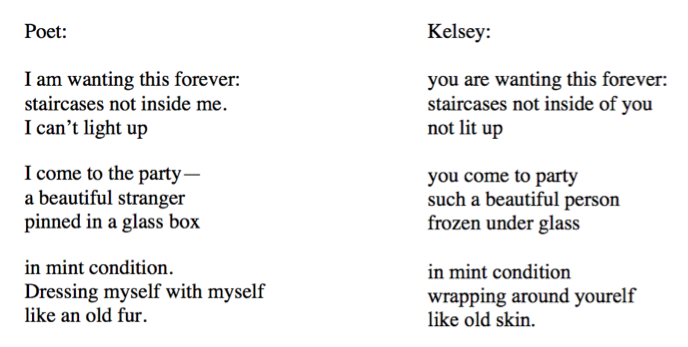
Kelsey’s poems, my comments all over the page: “I love these images, so haunting and unusual.” I read the rest of the book and the portfolio, side by side. They’re everywhere, the images plucked and tweaked, almost identical in structure, tone, voice. At 5 am, I force myself to sleep, leave the lamps on all night.
* * *
A conversation on Facebook chat, the following morning:
Kels! this is crazy! I just read this book by — — — — — — — — and she has all these images that feel similar to yours! have you heard of her? if not, this book is super cool, you should check it out!
The benefit of the doubt. Perhaps there is an explanation — maybe it was a writing prompt. Yes, an experiment, borrowing from other sources to compose poems? As the day ticked onward, no reply. John took me to the movies, but I couldn’t concentrate, hardly touched the popcorn. An incantation: she knows, she knows, she knows I know.
An incantation: she knows, she knows, she knows I know.
That night, still no message. Surely, it can’t be that bad, right? The longer I wait for messages, for anything, the more my hands shake up, paranoia running across me. A sinking feeling. I block Kelsey on Facebook, on email, block her number on my phone. She knows I know, oh god, I want her gone, please disappear.
* * *
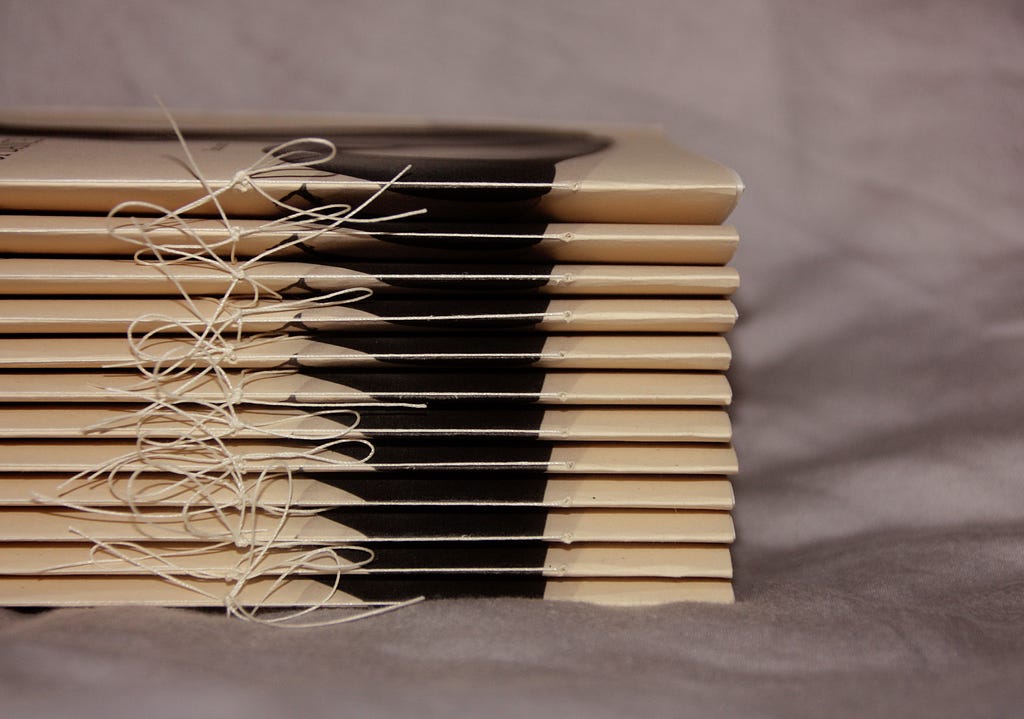
Kelsey, in a black babydoll dress, in septum piercing, in long eyelashes, her blush and cigarettes. Kelsey, blue hair, gray hair, black hair, always fragrant, always parsley and incense, tattoo of The High Priestess on her arm. It was her favorite tarot card and it was mine. Kelsey, the most talented writer in our class, the coolest girl I knew. Kelsey with oxblood Doc Martens, Kelsey with a chapbook press, with a poetry tour in the spring, with MFA applications out, these haunting poems inside. Just last month, she gave me a belated birthday gift — a small notebook she had hand-sewn, on the cover an image of two hands clasped. It’s a symbol of our friendship, she said. We’ll always be writing friends, long after we’re done here.
* * *
A few weeks after, I took myself home to Michigan, eight pounds lighter from illness and stress. I had lost my appetite, really. For those weeks, very little appealed to me. It was like recovering from a break-up, and in a sense, it was a break-up, the severing of a relationship. I was betrayed, yes betrayal was the word. I enlisted the help of another girl in the workshop, showed her my evidence, and we found the rest of it. We spent three days collecting, plugging Kelsey’s poems into Google, looking for the next clue. The images were thieved from everywhere — published books and magazines, mostly from young, up-and-coming poets that you probably wouldn’t find unless you were really looking, like we were. The final document of evidence was fifteen pages long. Nine different poets plagiarized in bits and chunks, images that I had once found so poignant, so unique, the magic gone now. I was horrified and I was proud. She almost tricked me, almost.
I enlisted the help of another girl in the workshop, showed her my evidence, and we found the rest of it.
We sent the email on a Monday morning, the evidence attached, sent it only to our workshop leader, although we wanted to tell everyone we knew. We were asked not to speak about it until after “the hearing,” which would take place in January when the semester resumed. I did tell my boyfriend, John and I told my family — we gossiped amongst each other and theorized what would become of Kelsey. I had my own ideas: Kelsey should be expelled from the Master’s program and excommunicated from all social circles. This is what I believed. It seemed fitting for the gravity of her crimes, her deceitfulness, her duplicity. Nothing had seemed amiss that semester, nothing “off” in her behavior. The Kelsey I knew, girl sitting across from me in a coffee shop, girl spending the night on my couch, girl with the velvet skirts and warmth, always thoughtful, bold, cool as hell. Henceforth, she was not to be trusted, everything false false false.
* * *
Email excerpt:
We regret to inform you of an unfortunate discovery made with regard to Kelsey’s work this semester. Attached is a document that highlights the similarities between Kelsey’s poetry and work by the poet
— — — — — — as well as poems written by — — — — — — , — — — — — — -, — — — — — — , — — — — — — , — — — — — — , — — — — — — , — — — — — — , and — — — — — — .
The closeness of the paraphrasing, in terms of syntax and content, as well as the extensiveness of the paraphrasing, leads us to believe that this is a case of plagiarism. It is an understood trust that all work submitted for the workshop is original or acknowledges credit where it is due. We feel Kelsey has breached this trust.
* * *
A September — almost a year later after the Kelsey incident — in Bloomington, Indiana. A poetry slam, a girl at the microphone with bracelets, high cheek bones, a lipstick one shade too dark. I’m sipping on a beer, a little thrill in my body, everything glimmering with newness, having just moved here. The girl begins performing. She does it so well, articulating each syllable, a momentum in her voice, everyone is snapping and going mmhmmm.
Again, a feeling like déjà vu. Something about her images, something too close for comfort. “A letter to my future daughter” — isn’t that what she called this piece? I know of a poem, a spoken word poem in fact, a poem so similar in its title, framework, cadence, it’s uncanny. The girl wins second place and a Barnes & Noble Gift Card. I can’t not say something. She has to know, she has to know I know. Surrounded by admirers, I make my way to this girl, tap her skinny shoulder, say as sweetly as possible: “I loved your poem! Have you heard of “ — — — — — -” by — — — — — — ? I think you would really like her work.”
She grins, mauve lipstick and a trilling laugh. “Oh yes, I adore — — — — — — -! She is such an inspiration! I kept thinking about her when I wrote that last poem, she was just stuck in my head.”
* * *
Evidence Excerpt:
* * *
When is it plagiarism, when is it homage? Especially in creative writing, I get tripped up on this distinction. A trick for writer’s block: write an imitation, steal moves, learn by mimicry. For my own poem-writing, I turn to other texts all the time. I pull language, take a word I like, sometimes fragments of phrases and twist them. I get inspired, I want to model after poems I fell madly for.
But how much do I really “make it my own?” When have I changed it enough that the poem is now in my possession, my creative and intellectual property? One of my students recently noted, “You can do anything in poetry, can’t you?” I answered yes, but qualified the statement: “As long as you don’t appropriate without acknowledgment.” Certainly, there are ways to acknowledge, maybe include a footnote or put beneath the title: “after [insert poet’s name].” What is the best way to do this? What are the rules exactly? Where is “the line?” Was what Kelsey did so wrong?
* * *
Kelsey was allowed to stay and complete her degree. To me, this punishment did not seem sufficient, not at all, and I felt a great injustice had been done.
I relished telling everyone what had happened, this juicy gossip I revealed behind closed office doors and at the local bar. Framing myself as the hero, quiet and suffering, so selfless, so brave for “doing the right thing.” At first, my peers were disturbed by the situation. What made Kelsey think that was okay?
I relished telling everyone what had happened, this juicy gossip I revealed behind closed office doors and at the local bar.
But in the following months, most everyone forgot their anger. They conceded that Kelsey’s punishment was harsh enough. When we would go out for drinks, no one wanted to discuss it anymore — a tired topic. Old acquaintances began avoiding me, or so I thought, maybe they were too caught up in their thesis projects or job hunting or their relationships. But to me, ironically, I felt I was the “trouble-maker” now, making trouble because I could not forgive Kelsey, refused to move on.
And so she remained, a phantom, still sitting in my classes, now at the other end of the seminar table, not in the chair next to me. I pretended she was invisible, avoided speaking to her, blocked her entirely from my field of vision. I wanted to shame Kelsey, to the point where she would realize that she didn’t belong here, that she would decide to remove herself and vanish, just like that — poof.
I suppose, too, I avoided Kelsey because I was frightened of her, of what lurked there under the eyes. Surely she knew, from the Facebook message I had sent back in December, she must know that I was the one turned her in. And I grew panicked because Kelsey could be volatile, or so I had heard. I’d never seen her hurt anyone, but at parties I didn’t attend, she would drink too much, get upset, throw a punch. One time, or so she told me, during a party, she wandered into the woods behind her house, drunkenly tripped on a tree root and she fell, got scratched up on the way down. When I fell, I decided not to get up. I lay on my back and waited for someone to come find me. It felt like I was gone for hours. It got very cold outside and no one came. I got very angry — I can’t explain why.
Surely she knew, from the Facebook message I had sent back in December, she must know that I was the one turned her in.
She didn’t go into detail about what happened when she returned to the house, just that something violent had happened and “her roommates could not allow her to stay” that night. So I gave her tea and my couch for comfort. I couldn’t envision what she had done, certainly nothing that bad.
Now that I was her enemy, I expected a confrontation. She would stop me in the hallway, demand why I would do this to her. I imagined myself with a black eye. In office hours, I explained this concern to my advisor and she looked at me baffled, nearly giggling. “What? No, I don’t think Kelsey’s going to hurt you!?” Of course, the Kelsey I knew wouldn’t harm me, of course. But I didn’t really know her to begin with, did I? I made John walk with me to class, shielding myself with his tallness and muscle. Yet despite my precautions, Kelsey said and did nothing to me, only sat there, limp and sullen, in a daze.
* * *
Here, it is October in Indiana, the sky all gloom and pearly. The maples are looking especially autumnal, leaves blustering over the road. I am in a coffee shop, blogging about my poetry — publication news, trends I’m noticing in my work. A spike in my stats, my blog has gotten twenty-four views today — unusually high. The attention makes me flattered and uneasy at the same time. I change my settings, turn the site to “private.”
Suppose someone finds my blog and plagiarizes my writing?
Suppose I Google my own work and discover it in a magazine under another name? Suppose Kelsey is the one looking at my words?
Suppose she seeks revenge on me by stealing them?
Suppose she tweaks the poems, actually makes the writing better?
* * *
Yes, she stayed on like an old bruise that lingers. And worst of all, she proved herself to be capable of writing decent poetry (seemingly) without plagiarizing. Each week, after she passed her poem around the seminar table, I would go home, pull up a chair at my desk, and immediately start typing lines into Google. I refused to be fooled again, yet I found nothing. The poems, while they lacked the power that used to grip me, they were still beautiful and striking:
a blouse fell
from the sky
and i unstitched
the stitches
sometimes i nightmare
i turn everything off
every switch inside
and you, how you always
roll your eyes at me.
A flush of envy: how is she still able to write like this? I thought I had ruined her prospects at becoming a poet, ruined with that F on her transcript. But the girl could still write and write well. I no longer wanted her in my field, not one bit. Kelsey, the imposter, nemesis, a threat.
* * *
The moment of meeting. I sit next to her during orientation. She immediately sticks out her hand. “Hello, I’m Kelsey. I look forward to working with you.” So formal, maybe too formal? Artificial even? At a party later in the week, at her house: ginger beer, lentil soup, a record spinning, dim rooms and candle wax, so many faces to learn.
“You’re here!” Kelsey makes her way past bodies, a drink in hand. “I have a gift for you!” Following her to the bedroom and she gathers a bundle of chapbooks — paper that feels so good in your hands, saddle-stitch edge, stamped cover. I had never seen a chapbook in my life.
“You made these?” I ask, in awe, slightly tipsy. “These are for me?” How wonderful. I read them all that night before bed, keep them in my nightstand. Kelsey, the idol, the coolest girl I know, girl who knows so much more than I.
* * *
An acceptance letter from last week:
Thanks so much for sending us your poems! We would like to publish them!
Would you let us know if the poems are still available, and if so, send us a bio? Feel free to include links to where your work can be found online!
I browse through the archives of this magazine, a publication I have long admired. Feeling pleased with myself, I envision my own name printed here. Instead, her name arises — Kelsey in a back issue from the previous winter. Reading the poems, poems I knew from our classes together, I feel disgust rising in my belly. I consider sending an email back to the magazine: Did you know that you published the work of a plagiarist? I know I won’t actually do it, but the thought gives me satisfaction. Why do I still want to punish her? Haven’t I done enough?
* * *
Kelsey, reading a poem at the microphone, she growls and whispers, each word fully embodied, she is visceral. Kelsey, our birthdays a week apart. Kelsey in all black, Kelsey alone on the walk home. Why did she do it? I Google “plagiarism” and “poetry” together, just to see what would come up.
I consider sending an email back to the magazine: Did you know that you published the work of a plagiarist?
One of the first results is an essay, “Word Theft” by Ruth Graham, on the Poetry Foundation website. Graham notes recent cases of plagiarism in the poetry world — where poets such as Christian Ward, CJ Allen, Andrew Slattery were accused of stealing from newer poets as well as big names like Sylvia Plath and Emily Dickinson. These were cases where the plagiarists defended their work as “creative appropriation,” where repurposing was an “essential part” of their processes. Graham acknowledges that, of course, “writing is a dance that involves imitation, inspiration, and originality.” However, while “approaches to borrowing and attribution have shifted over time,” Graham asserts ultimately that “wholesale copying has never been kosher.” She also considers the question of why plagiarism occurs to begin with: “There’s never a satisfying answer, but there are at least lots of guesses, often somewhat at odds with each other: laziness or panic, narcissism or low self-esteem, ambition or deliberate self-sabotage.” Which was it? Which one, which one? Maybe all, maybe none?
In my search results, another essay: “Poetry Has A Plagiarism Problem” by Katy Evans-Bush, in which she questions why poets in particular would plagiarize, since with a career in poetry, “you’re not going to get famous, and you’re really not going to get rich.” Where is the gain when the stealing won’t pay off? Evans-Bush claims that, perhaps, plagiarism is really an issue of identity. When plagiarists present work that is not theirs, they are, essentially, not representing themselves. A disassociation, a splicing of the self. The girl I knew loved poetry, devoted her life to the practice of it, she wanted to write books and perform all over the country. She would never tarnish that love for anything.
* * *
Another poem of mine is accepted for publication, and upon acceptance, I suddenly recall: I wrote this poem in response to another, didn’t I? Which poem was that? What did I mimic exactly? I remember feeling stuck when I sat down to write it. Sometimes, I turn to an online text generator that offers scraps of poems, a starting place for writers. I imitated the anaphora, yes that was it, but how closely did I imitate? The content is totally different, but is the structure too similar? Maybe I could still change it? In a panic, I return to the text generator, search the archives for that poem, search for almost an hour, but no luck. My poem is published. I feel proud and I feel paranoid, half-expecting an angry email in my inbox, an accusation, a finger pointing my way: false false false.
* * *
This time of year, I always manage to become ill, late in the fall, when the night comes on early, smelling of cold and woodsmoke and spice, just on the hinge of snow. This time of year, I fall into illness and have trouble getting out. Last night, a fever dream:
I am sitting in a rocking chair, in a sequined dress, surrounded by every person I’ve been estranged from. They are waltzing around me and though we don’t speak directly to each other, I can tell they are glad and glad that I’m here, in my good dress, at the center of the room. The past is behind us, they seem to say, with their cocktails raised. And there she is, in dark velvet and warmth, a sincere laughter.
In the morning, I half-believe this really happened, I check my phone — her number still erased. There has been no forgiveness in the night. I go to her Instagram, I look on from afar, just to see how she’s doing. A childhood photo — Kelsey in buck-teeth, elfish nose and ears. A photo of her boyfriend, a trip to Kentucky. Photo of a dead monarch butterfly, wings orange and tattered on the sidewalk. Kelsey’s caption: “same here.” I tuck the phone under my pillow. I take medicine, make my tongue sour with cough drops.
* * *
Our workshop leader theorized that Kelsey had been stealing for a while, maybe all the way back to her application for the program. We tried looking for traces in her earlier work, from the previous semesters, but no dice. It’s possible she was lifting from chapbooks, from small presses, hand-stitched and unique items, poems not readily found online. I won’t probably ever know for sure — that bridge is burnt to a crisp.
Our workshop leader theorized that Kelsey had been stealing for a while, maybe all the way back to her application for the program.
And I still ask: why? Was Kelsey “stressed out?” Could she not “cope” with her classes, did she feel “intimidated” and that’s why she resorted to stealing words? No, that’s not right. In fact, she told me often how ineffective she found workshop. She was just waiting to finish her degree and be done with that place. She said these things to me on her back porch, as we sipped rum & cokes, talking gossip, talking MFA applications and what we were reading, all semester long. I saw what she meant — I couldn’t agree more. Kelsey was arguably the strongest poet in our bunch — her writing sharp and vibrant, that fierce sense of self. Perhaps her plagiarism was an act of rebellion, a “screw-you” to the program and that tiny Midwestern town. Maybe she wanted to see what she could get away with, to see how thirsty we were for her talent, how adoration made us oblivious.
* * *
She’s there now, finishing her last semester, serving out her punishment, in that place she scorned and so looked forward to leaving. In this sense, perhaps, the punishment was fitting — she could not get out, was forced to linger. Perhaps, now, this is the closest I will ever be to her. I live two hours away and there are days when I long to see her and days when I am terrified, imagining if she showed up here. Kelsey with her scratches from the wood, Kelsey in a fever dream, Kelsey at my doorstep with a peace offering, a notebook with two hands clasped in friendship, Kelsey with her spooky violins.
* * *
A July afternoon, a house where she lives. Before the book, blue with a soft cover, a woman’s face veiled. Before the ah ha moment, the email. Before, when Kelsey was a girl asleep on my couch, girl with blue hair, gray hair, black hair, always thoughtful, bold, cool as hell.
She is gone for the weekend, she asked me to come check on the house, left me with the key and a tight hug. Her roommates are home for the summer, so it’s just me, echoing as I step into the foyer. I feed the cat, I test the locks, I wander upstairs to Kelsey’s bedroom.
Although I know the room is vacant, I knock on the door anyway, a habit. Inside, a maple leaf pinned to the wall, a lighter, a photo of Kelsey with hibiscus in her hair, also records and notebooks, chapbooks in messy stacks, a writing desk, an old bouquet. I open her closet — there’s velvet and the Doc Martens, thrift-store sweaters, leggings, party dresses. I run my hands over the clothes — mmmm pretty.
A creak in the room, a rattle at the window glass. I turn my gaze to the mirror, full-length and speckled. I watch myself, being where I shouldn’t. It is electric, to be in her presence, girl that haunts, girl I want to become, to imitate, to steal from her — a little magic for my keeping.
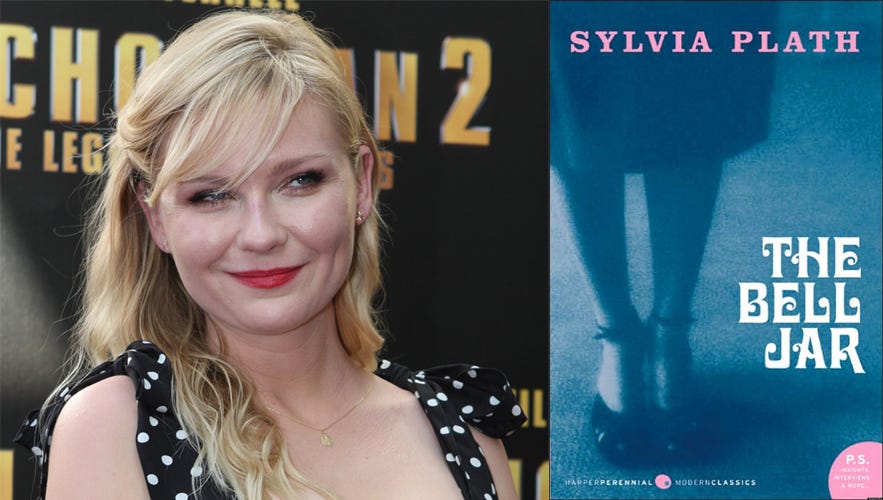
Of contemporary literary greats who’ve had their works (or lives) transposed for the big screen, Sylvia Plath has been comparatively unexplored. Aside from a 1979 adaptation of her most famous novel and the 2003 biopic Sylvia, The Bell Jar author has not been, nor have her works been, the subject of a movie. This is set to change with news, according to The Huffington Post, that Kirsten Dunst will head an adaptation of The Bell Jar as her feature-film directorial debut. Esther Greenwood, the book’s protagonist, will reportedly be played by Dakota Fanning. Greenwood is a young Bostonian who lands an NYC internship at a women’s magazine before moving back home and falling into a deep depression.
Tragic similarities between the author’s life and that of Esther Greenwood have long been drawn by critic and fan alike. In this way, it will certainly be difficult for the movie to replicate that experience of reading The Bell Jar: simultaneously suppressing, and taking heed of, the whispers of autobiographical veracity while following Esther. Perhaps it will help to know that Dunst already has experience with unique transposition of grief, depression, and melancholy to the silver screen: she starred in Lars von Trier’s strange and generally well-received film Melancholia.
I hope for the best, but maybe Plath has been avoided in adaptation for good reason. After all, if the movie was to get it wrong, she did once warn: “Out of the ash / I rise with my red hair / And I eat men like air.”
Sometime in my very early 20s there was a trend in a certain kind of “documentary” show, on channels like Animal Planet, the Discovery Channel, and (most bizarrely) the History Channel, all premised on predicting a personless future. These shows — The World Without Us, The Future is Wild, Life After People, and Aftermath: Population Zero — particularly delighted in imagining the destruction of everything we currently hold dear (how, exactly, would the Golden Gate Bridge crash into its ocean-bay perimeter, and might it crush any CGI whales along the way?). I’ll confess that I rarely watched any of them, but I did sustain a two-month-long relationship with an art school grad/bakery employee whose conversations, as I recall, almost exclusively consisted of him giving summaries to some of the episodes. I actually enjoyed his episode recaps (more than a few which featured old white scientists seemingly salivating at the thought that their research, on the accelerating rate of corrugated steel decay for instance, might land them on television) — not because of anything in the shows themselves, but for the underlying idea that our planet, once it had gotten rid of us, could come to exist under the control of, say, sentient forest-dwelling squids. There have always been those obsessed with trying to foresee the future, but in those days in particular it seemed as if the culture was experiencing a moment of reckoning. Chalk it up to the image of the Towers falling on September 11th, or a gradually dawning awareness of our global environmental impact. Whatever it was, it appears that the cultural critic Chuck Klosterman is ready for us to experience another time-displacing reckoning.
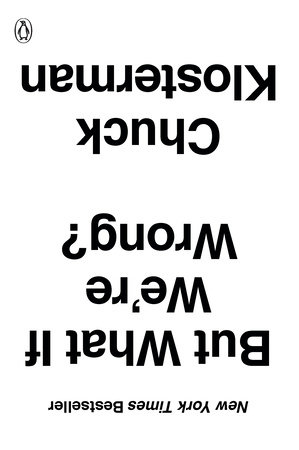
His new work of non-fiction, But What If We’re Wrong?, approaches predictions of the future from an anthropocentric stance. The book’s subtitle — Thinking About the Present As If It Were the Past — gives a hint to Klosterman’s wide-ranging analysis, in which he considers how future generations might look at ideas that are in vogue or simply unquestioned in our present. As Klosterman himself observes, while no one would quibble with his premise in the abstract (Do you agree there are things our culture highly esteems today that in two hundred years will barely be remembered? Umm, of course), the trouble really begins when we turn and consider the specific. What if the subject we’re talking about is Philip Roth? Or football? Or the U.S. Constitution?
“I just want people to internalize the core premise: that the history of ideas is the history of people being wrong.”
The idea of changing tides — of delayed appreciation on the one hand, or eventual obsolescence on the other — can be consoling and terrifying in equal parts. It took seventy years and a World War for Moby-Dick to be canonized, much less widely read. There may be ten writers in the present time who are household names (three of whom make a living off of their writing alone). Is it a comfort or a mind-numbingly bleak proposition to consider that in three hundred years there will be exactly one writer — probably even just one book — held up as the crowning example of what our culture in these late stages of the American empire had to offer? “Like all writers,” Klosterman confessed in a recent email interview, “I would like to be remembered after I die. But I know that won’t happen.” Even so, Klosterman acknowledges that it will happen for someone. And in his book, he has a lot of fun guessing who.

“I see this book as a way for someone to think about an abstract cultural problem within the limited window of 288 accessible pages, since most sensible people aren’t in a position to spend eighteen months wondering how yet-to-be born humans in some distant future will perceive the age we happen to be living through,” the author summarized. So how does Klosterman go about positioning himself “in some distant future,” looking back at our present? By consulting with a wide array of authorities — from Junot Diaz to Richard Linklater to Neil deGrasse Tyson (only Jennifer Egan and Jonathan Franzen turned him down) — admitting to his biases, and venturing a few guesses as to what these future consumers of culture might have chosen to keep around (Chuck Berry. Lit mags on the dark web that we don’t yet even know about. No sports, but maybe video games — though it must be said that Pokémon Go had not been launched at the time of the book’s publication).
But he also grounds his arguments with a degree of humility and cautious thinking — as much as one can be cautious about predicting the tastes of people whose great-great-grandparents are one hundred and fifty years from being born. In the end, as he writes, “I just want people to internalize the core premise: that the history of ideas is the history of people being wrong.”
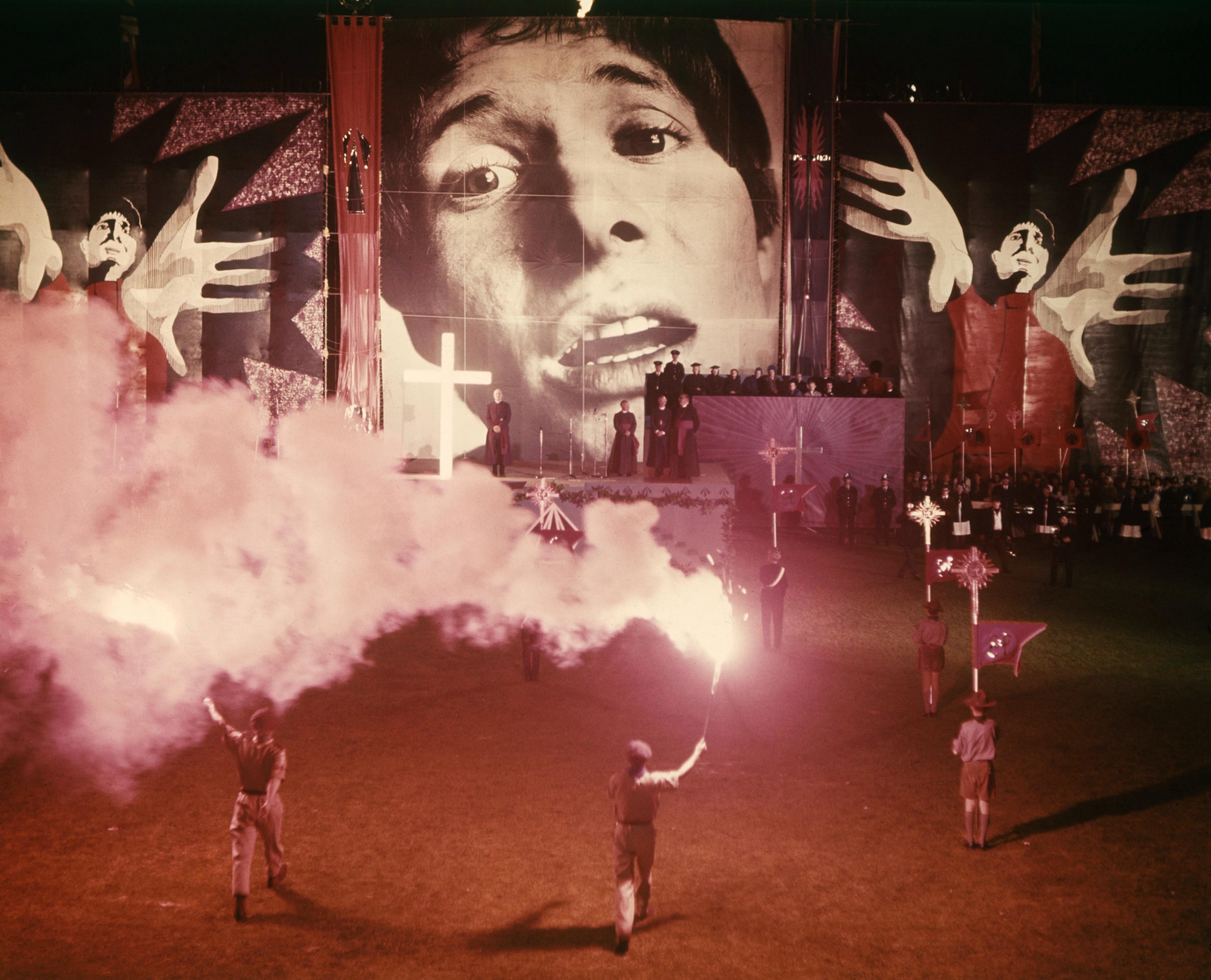
During a talk following a recent screening of Peter Watkins’ dystopic cult British film Privilege (1967) — put on by the Film Society of Lincoln Center as part of their regular author- and film-paired Print Screen series — I had the chance to hear Klosterman apply his premise to a complementary work not included in his book. “It’s a film which, when it was made, was set in the future,” Klosterman stated, “but that future is now our past.”
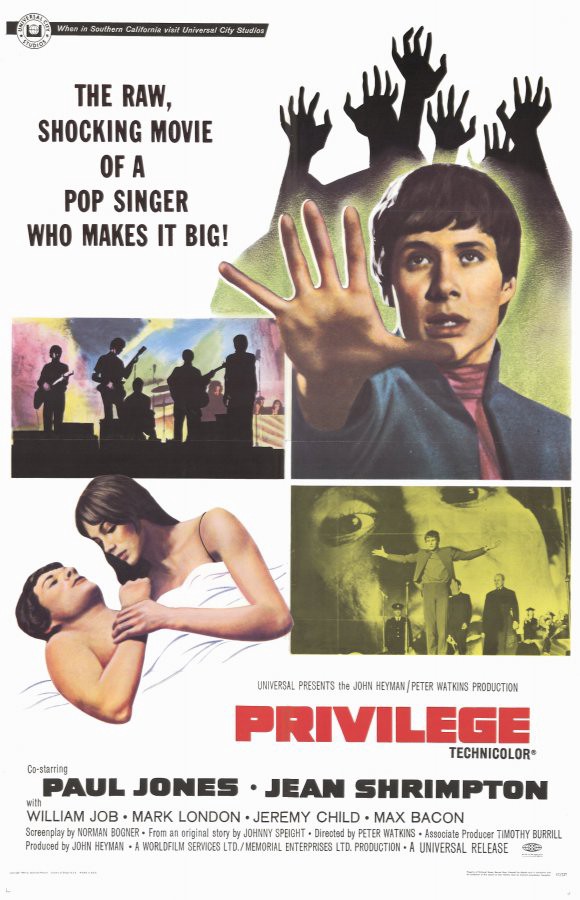
Steven Shorter, Privilege’s protagonist pop star (played by Manfred Mann singer Paul Jones), is locked in a cage, handcuffed, and beaten by the police — all while managing to warble out a tune. He is used by his dystopian government as a tool of control; the violent frenzy that ensues in the audience functions as a directed release, under the assumption that these energies will be prevented from taking on a political bent. The hysteria, the passionate anguish of his fans, brought to my mind another traumatic Brexit, which sent shock waves across the internet — that of Zayn Malik from the band One Direction. What Watkins’ film failed to predict was that our current investment in celebrity is one we take on voluntarily, rather than being an insidious plot hatched by an oppressive and authoritarian government. And while Steven is given what we assume to be a happy ending (his enforced celebrity, and presumably his physical abuse, end after a particularly un-managed acceptance speech), the film does not explicitly show us this. Instead, a narrated voice-over ominously informs us that after only a short while no one longer remembers Steven’s name, as if this cultural oblivion, rather than the physical beatings he endured, were the real horror.
Something commercially popular and critically panned might one day come to acquire unforeseen significance in the future. Meanings will change.
Klosterman, who has himself written a profile or two on a pop star, reflected during the post-screening Q&A that it was Britney Spears whom he felt most resembled the film’s protagonist, in terms of the lack of agency and control she appears to have had over her own career. Could he see a future in which a fascist government used a figure thusly? If so, he said, his money would be on the sports stars, with their dependence on live audiences, and perhaps also their willingness to become spokespersons for the highest bidder.
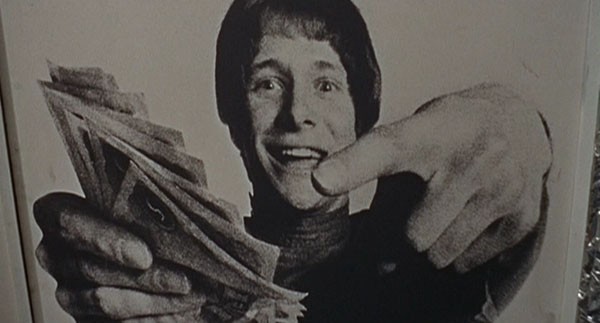
In the end, any guess we are educated enough to make is probably wrong simply because we’re able guess it. Just as likely, he argues, something commercially popular and critically panned might one day come to acquire unforeseen significance in the future. Meanings will change. Klosterman points out that The Matrix originally seemed revelatory for its technological and stoner-philosophical ideas. Its relevance now — as the portrayal of an emergent, awakening true identity and casting off of a false reality — comes from a contemporary reading of the film as a metaphor for the transitioning transgender experience. Is there a possible future waiting for us in which the only music from our time that still has currency turns out to be Britney Spears? Of course there is. And for all we know now, those listening in the future might have a very good, totally persuasive reason as to why.
Check out the Film Society of Lincoln Center’s schedule for future Print Screen author-curated screenings.
By the final third of Jade Sharma’s first novel Problems, Maya has lost her barely-there bookstore job, her husband Peter, her lover Ogden, and whatever control she had over her heroin habit. When Peter tells her he is leaving, she snorts two bags in front of him. “I told him I would kill myself, because no one was allowed to just leave someone like that. He didn’t respond. Was I actually going to have to kill myself to prove a point?”
She starts turning tricks for dope money. “People said women who did this kind of thing had no self-respect. I had no idea what that meant, because I got off on doing it […] When they handed me cash, I felt like a champ.”
Not much later she overdoses and is placed in a psych ward.
Problems is a novel about an over-educated member of the upper-middle class (or maybe just upper class? When her dad dies, she inherits a quarter-million dollars) and therapy comes up a lot. Maya tells a story about her mother throwing away her grade-school art project while sticking her brother’s A test onto the fridge. “A concise little story that played well in therapy.” At another point, Maya interrupts a scene and jumps forward to a therapy session where she explains to her therapist why she thinks she behaved the way she did, and how she felt about it.
She has reasons to complain. Insufferable people surround her. The longest stretch of the novel details a trip to her husband Peter’s childhood home for Thanksgiving. His parents are too thrifty and too religious and yell at Maya when she makes them watch a romantic comedy with sex in it. Peter is awful in his own way. “He would wake up early, go for a run, do sit-ups as he watched The Colbert Report.”
Maya has problems besides heroin but they never resolve in the way her addiction does. Binging and purging, a bad relationship with her MS-afflicted mother, a bad relationship with most people: Sharma smartly treats these as things to endure rather than as things to address.
The book skirts with equating the act of writing with redemption (Maya is in either an MFA or some kind of English grad program). I get wary when a character in a drug story has a talent that goes to waste. More chances for the story to get maudlin. Elizabeth, also an addict, tells Maya, “But you can write, you have a place you can put everything. I don’t know where to put things. You can make something out of all the ugliness.” Granted it’s a character talking, one who also says things like, “We can still get discovered, you know? We’re still young.” And Maya argues she doesn’t identify as a writer anymore. Still, by the end of the book she is sober and up all night writing poetry.
Maya is an intelligent, opinionated, insecure, hilarious personality. Her life is unstable in such a way that all the author has to do is pull one string (have Peter leave) to make her whole existence unravel. Finally Maya has no one left who isn’t an addict except her former lover Ogden. Barely. He emails from across the country. “Maybe it was easier for him to share stuff with me because I no longer matter.” He suggests she rent out her living room for extra money. Pretty soon: “I’m living with a person who has his shit together, and I go back to school. I never make the decision to clean up but change happens in these small ways.” A happy ending doesn’t seem right so let’s say Problems doesn’t wholly have one. Maya rebuilds her life but she isn’t there for it; in the final pages the narration switches to second-person present-tense. Not the first time Maya disappears from her own story, but it is the last.
What are the moments that matter to a person, and how do they have a ripple effect on who that person becomes? In Paula Whyman’s linked short story collection, You May See A Stranger, the author focuses on one woman as she moves through different phases of her life. Miranda Weber is a compelling character, one who is equally capable of knowing what she wants and, as she gets older, trying to move past personal disappointments. I recently had the opportunity to interview Paula in front of a live audience at Book Culture for her New York City launch. After the conversation, Paula answered the same questions again via email.
Michele Filgate: Did you set out to write a linked short story collection?
Paula Whyman: When the first story in the book, “Driver’s Education,” was published by The Hudson Review about 10 years ago, I visited a high school in Harlem through THR’s writers-in-schools program. The students were eager to know more about the girl in the story. What happened next for her? I’d had no plans to write more about her, but I filed that question away. Then, a few years ago, I noticed I was writing stories that could be about the same woman at different times in her life. I decided to approach it intentionally. I had a residency at Yaddo coming, and I spent it working only on stories about this girl. I wrote drafts of two stories that ended up in the book. After that, I devoted myself to the project. As I wrote more stories, the book evolved; I’d initially planned to have different people narrate the stories, but as I went along, writing them all in Miranda’s voice seemed compelling. I never set out to write a novel about Miranda; I always intended to tell her story in this way, dropping into her life at these liminal moments.
Filgate: And I love how you do that! You follow Miranda Weber from adolescence to middle age. Was one time of life harder to write about than the other?
Whyman: The time when Miranda has young children, perhaps because those years can be such a blur. One tends to be, necessarily, more outward-focused. There’s not as much time or energy for introspection. Part of what I examine in that period is the anxiety that something bad is going to happen to your kids, and you can’t protect them. I think that concern is shared by most parents.
Filgate: Some of the stories are written in the first person and others in third. Was that a deliberate decision?
Whyman: Yes, it was. Two of the stories set when Miranda has school-age kids are written in the third person. In those stories, I sense that Miranda is distanced from herself, grappling with the partial loss of self that occurs, temporarily I think, when one has children. I’m not sure she handles it in the best way… I wish she were more focused on her daughter, for instance, in “Self Report.” She’s flawed, but I hope in a way that makes her human.
Filgate: Absolutely. She’s a very believable character. What does it take to make Miranda happy? Is happiness possible?
Whyman: Is happiness possible for anyone? I think we’re most satisfied when we’re meaningfully engaged. Miranda needs to use her better judgment, for one thing — and I think by the end there’s hope that she’s moving in a more positive direction. She’s also underemployed; she’s a “content provider” for at least part of the book. That isn’t supposed to be an inside joke. Well, it’s sort of a joke.
Filgate: You write a lot about threats from the outside world. I’m thinking particularly of “Threat Potential,” where one of Miranda’s children wanders off on vacation at an ancient ruins in Mexico, but then later on one of her kids is injured at the vacation home. Or “Bad Side In,” where Miranda wants to build a fence around her house to ward off criminals. Do you think the threats in her life are more internal than external?
Whyman: Many of the external threats Miranda obsesses over are remote possibilities and also beyond her control. But, living in DC can feel like living in a “target” city. During 9/11, the anthrax attacks, and the sniper attacks, there was a pervasive feeling of fear around town. Especially during the sniper attacks, because they were so random, that wasn’t entirely unreasonable. It went on for weeks. People were shot coming out of school, pumping gas — people were literally hiding behind their cars while they pumped gas. I remember being out on the soccer field with one of my kids, and all the parents were scared. We didn’t know if we should refuse to let it change our behavior, if we should set that example, or if we should keep the kids indoors until it all passed.
As far as internal threats, later in life, Miranda has a lot of regrets. Although she’s experienced some indisputably major life events, if she could separate herself from them, “get past them,” she’d be better off emotionally. She needs to deal with her guilt. Her powers of denial are applied to the wrong things.
Filgate: One of the themes in your book is the desire for a neat resolution — but unfortunately, that isn’t how life usually goes. At one point you write “It was resolution I wanted, the kind that was only possible in stories.” But it’s ironic you write that, since even in your stories, the resolutions are sometimes not what Miranda wants. Her decisions have consequences — whether it’s choosing the wrong guy or not getting the job she wants. What do you think would be her ideal resolution?
Whyman: As much as Miranda insists she wants resolution, her own life repeatedly demonstrates the impossibility of that goal. Nothing’s as resolving as death, right? But no one sees that as an acceptable resolution. Who are we to expect resolution? Everything keeps going. I hope that’s conveyed by the circular nature of these stories.
Filgate: I want to talk about motherhood in your book. In “Transfigured Night,” Miranda’s husband says to her: “Only selfish people don’t want children.” She’s ambivalent, in that moment, after having an abortion earlier in the book. I feel like we don’t see a ton of fictional characters who aren’t in this black or white category of yes or no to having kids. Was it difficult to write about this aspect of Miranda? Because (spoiler) she does become a mother, and one of the things I absolutely love about this book is she isn’t defined by being a mom.
Whyman: If there’s a dearth of ambivalent mothers in fiction, maybe it arises from a reluctance among parents, especially mothers, to admit they ever experienced doubt about having children, as if this will somehow make them look bad or damage their kids. To me, this is almost delusional. Show me someone who never had doubts, and I’ll show you someone who is utterly unprepared for the reality of raising kids.
If there’s a dearth of ambivalent mothers in fiction, maybe it arises from a reluctance among parents, especially mothers, to admit they ever experienced doubt about having children
Then again, I think all parents are unprepared. For some reason we apply this romanticized polarization — you do or you don’t, you want, or you don’t want to enter into this lifelong contract of deep love and deep responsibility. Shouldn’t people think about that and have at least a moment of doubt about their ability to undertake it? Shouldn’t it be okay to say you’re not sure? If fiction is going to reflect the reality, I think it needs to allow for that uncertainty. Being a parent is an awesome, amazing thing, and difficult to do well. You learn on the job. When you screw up, you’re making mistakes with humans. Talk about a daunting prospect. My kids are teenagers, and I’m still learning. Luckily, they forgive me my imperfections!
Filgate: There’s a moment in “Threat Potential” when Miranda sees her daughter fully living in the moment, and you write that the mother “remembered a time when she’d been that way, when the ordinary world seemed packed with unexpected sources of delight.” Do you think Miranda lives vicariously through her children?
Whyman: Miranda has regret and maybe even sadness about her youth. I think she sees a second chance in her daughter. In that story, her daughter is brave and exuberant and hopeful in a different way than Miranda ever was, as far as we know. Watching her daughter pierces some of Miranda’s denial and points up her regret. Miranda, like most adults, knows what it’s like to have her options closed off. Her fierce protectiveness of her daughter seems tied in with this; her daughter’s at a stage when everything is still possible for her.
Filgate: The jacket copy describes Miranda as a “hot mess,” but I don’t see her that way. I see her as a full-dimensional, real woman. Who are some of your favorite female fictional characters, and did any of them inspire you as you were working on this book?
Whyman: I’m glad you see her that way! My favorite female protagonists are Isabel Archer in Portrait of a Lady; the tragic figure Lily Bart in The House of Mirth; Dorothea Brooke in Middlemarch; the young (I think unnamed) narrator in Alice McDermott’s That Night; Claudia Hampton in Moon Tiger — I could go on, but probably you see the pattern. I think Miranda owes a lot to Isabel Archer, whose lack of experience and impetuousness lead to bad decisions to which she stubbornly adheres. That’s an oversimplification, but there are commonalities. None of it’s intentional, just that these are stories I’ve read many times, and they’ve seeped into my unconscious. This is the kind of character I’m drawn to, so it makes sense that I would attempt to create a female protagonist somewhat in that image.
Filgate: Are you done with Miranda, or could you see yourself writing another book about her?
Whyman: Hard to say. After all, years ago, I thought I was done with her after writing one story! I’m devoted to a novel right now, a very different story. I won’t say never, though. Never say never… Meanwhile, there is one more Miranda story out there, published in McSweeney’s Quarterly #48. It takes place ten years after the end of the book. We had good reasons for not including it in the collection, but it’s one way I was thinking about going, regarding her future. In fact, it’s being recorded by Audible for an audio anthology of McSweeney’s stories.
Filgate: I love that Blake Bailey describes you as “a somewhat more erotic Lorrie Moore.” I think that’s the perfect description. Let’s talk about writing about sex. How difficult is it? What are the challenges?
Whyman: I’d like that quote on a T-shirt. I admit I don’t find it too difficult to write a sexy scene. To me, it seems tougher to move someone across a room than across a sofa. I automatically use humor in sex scenes, because to me, those situations are often naturally funny; that’s just how I think.
I admit I don’t find it too difficult to write a sexy scene. To me, it seems tougher to move someone across a room than across a sofa.
I ask myself the same questions I’d ask about anything a character is doing in a story: Is this how she would behave in this particular situation? Also: What’s important here? What does the reader need to see and understand? Less is more. Sometimes I think when writers approach a sex scene, there’s a tendency to become hyperaware and wake oneself out of the dream state that’s necessary to write. Instead, you’re going, Sex Scene Alert!! Be eloquent! Get serious! Describe body parts! Tab A into Slot B, here we go! I think we need to relax a little.
Filgate: In an interview with Largehearted Boy, you talked about dealing with a sudden hearing loss in one ear. Your hearing is now back to normal, but during that difficult time you realized music is crucial to your writing process — even though you don’t listen while writing. Why is music so important to you, and how has it influenced your work?
Whyman: That problem was a complete surprise to me. I was unable to write for three months, until my hearing returned to normal. Music not only sounded wrong, but it was painful at times. The high pitches were like an attack on my eardrums.
When I’m not writing, when I’m running, for instance, I’m often listening to music. My mind wanders, and I write in my head. The trance state induced by music encourages my process, the daydreaming that’s required for writing fiction. Radiohead is great for that… But so is anything, while I’m running. The steady motion of running paired with the rhythm of the music, heartbeat, breathing — it all comes together to get me into the right frame for letting my imagination go. I can run for blocks and not recall anything about how I got from point A to point B. Probably I should stay out of traffic at times like that…
Filgate: I saw on your website that a music theater piece of “Transfigured Night” is in development with the composer Scott Wheeler. Tell us about that!
Whyman: Scott’s a MacDowell Colony and Yaddo alum — we know each other through MacDowell. He read my stories and came to me about doing this project. I feel incredibly privileged to be working with him. He recently finished a song cycle in collaboration with the poet Paul Muldoon; it premiered in New York in May. Scott told me the only other fiction writer he ever collaborated with was William Maxwell.
The story “Transfigured Night” is set during the early days of Miranda’s marriage. A large part of it takes place at the symphony. The title is a music piece, a symphony by Schoenberg, which is thematically resonant. I’m adapting the text, which will be spoken, not sung, and Scott is writing the music. The music piece will be more dreamlike, less straight realism, than the original story. That’s often what happens when you tell part of a story through music. But also, there’s a dreamlike aspect to the original story that we’d like to develop.
We met recently with our director and playwright friend Austin Pendleton, who advised us on possible theaters to workshop the piece and suggested a couple of actors for the role of Miranda. I’m curious to know which actors readers might imagine as Miranda!
Filgate: Where do your story ideas come from? And what is your writing process like?
Whyman: I might begin with a sentence that occurs to me based on something I overheard (I encourage writers to eavesdrop!) or witnessed, or a tiny aspect of something I experienced, though just as often, it’s more like free-association. A phrase will pop into my head devoid of any origin that I can identify. By the time I’m done writing a story, often I can’t even identify what the original impulse was. So much of this process is unconscious. I start with a phrase — I ask who’s saying this, or who is this about? In the case of these stories, because I was writing stories that followed Miranda through time, I started with a kernel like that, but then I had an intention, like, let’s see what happens when Miranda hangs out with a guy she can only be friends with…
I used to think I had frequent bouts of writer’s block, but it turned out it was an actual stage in my work. I write like mad on a draft, reach the middle-ish part, and stall in a big way, no idea where to go next. I stop and flail around for days…or weeks… I get very grouchy during that time, feel like I’ll never get going again. And then — if I were a cartoon, you’d see a light bulb pop up above my head. Oh yeah, of course, that’s what happens. Once I make it through that stall-out, it’s as if it never occurred.
I need the just-right ending, too; those closing lines are crucial. Some stories fizzle out, and I’m strict with myself about that. When I stop trying too hard to think about a specific problem in a story, that’s usually when the solution comes. I’ve had to accept that uncertainty is in fact a good thing, that flailing is part of my process.
Paula Whyman’s writing has appeared in McSweeney’s Quarterly, Ploughshares, Virginia Quarterly Review, The Washington Post, The Rumpus, and on NPR’s All Things Considered. She is a member of The MacDowell Colony Fellows Executive Committee. A music theater piece, “Transfigured Night,” based on a story in this collection, is in development with composer Scott Wheeler. A native of Washington, DC, she now lives in Maryland.
Michele Filgate is a contributing editor at Literary Hub and VP/Awards for the National Book Critics Circle. She teaches creative nonfiction for The Sackett Street Writers’ Workshop and Catapult and curates a quarterly series on women writers called Red Ink. Brooklyn Magazine recently selected her as one of the “100 Most Influential People in Brooklyn Culture.”
 Thank You!