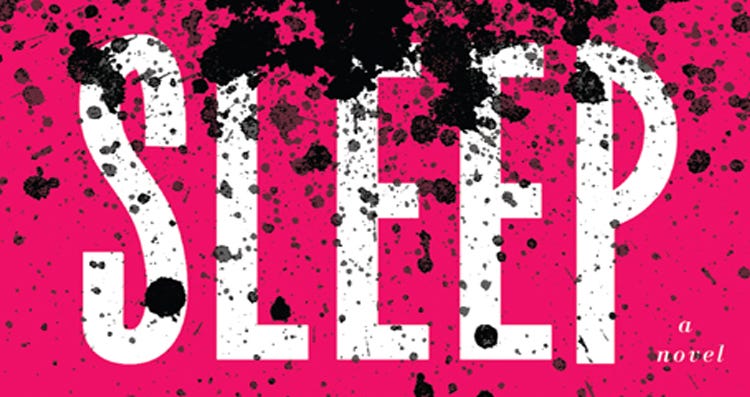
Broken Sleep, Bauman’s second novel from Other Press (after 2006’s And the Word Was), encompasses the disparate concepts of art, Nazi history, musical fame, politics, DNA time travel, and insanity. This twisted, canny tale spans the decades between the 1950s and 2000s. Moses Teumer, a professor suffering from leukemia, goes looking for his real parents to find a bone marrow match. He discovers his mother, Salome Savant, was a young artist impregnated by a rumored Nazi; Salome was told after Moses’ birth that he was dead while he was skirted away in a quick adoption. When Moses finds Salome, he also discovers he has a half-brother, Alchemy Savant, who is a star in the most famous band in the world, The Insatiables.
But this is as far as any linear summary of the story should go. This witty, irreverent tome subverts both reader expectations and ideas of traditional linear storytelling. Salome, artist and — by name — Savant, believes herself to be living outside of normal time. She believes she can time travel through her DNA. She also believes that people die of Gravity Disease, a mysterious affliction that recalls Wordsworth’s words about the world being “too much with us.” As Moses, Salome, and Alchemy navigate the worlds of art, music, and politics, Bauman shows us how little truth matters — and how much what we believe to be true has taken truth’s place.
Most notable in Bauman’s exploration of how perception affects lives is his carefully tuned sense of voice. His characters’ voices, as Bauman said in a recent panel at the L.A. Times Festival of Books, drive the action of the story. In distinctly articulated chapters that alternate points of view, Bauman establishes sympathy for each character through his or her complex back story and motivation. Salome, for example, lives by an unusual, yet highly codified, bizarre set of beliefs. She explains,
Each morning I exhale the decomposing cells of my face and my body. And time, the human definition of time, that hobgoblin of impending bodydeath, is my earthly enemy. Disintegration has spoiled my external eyesight, and the new surgeries have failed. Everything outside of me appears foggy. My eyes were always so light sensitive. I have always seen, and still do see, the past and the future. Not seeing is humbling and mortifying, but seeing was often more humbling and mortifying. Others have defined me as a visual artist, but I am really a sensate morphologist — all of my senses, especially smell, are hyperacute. Even now, I can inhale the pulse of the moon.
Salome’s theories are not merely the quirks of an artist or the ravings of a madwoman. Over all of Bauman’s work in Broken Sleep is a classical idea of the Weird as a prescient, driving force. By modern conventions, Bauman spoils his ending, but it becomes clear that the ending is not the thing — how we get to the ending is the thing, and we turn pages to see how the prophecy comes true. Bauman’s prose works on a level that shows both years of careful weaving, and the writer’s singular, defining style.
Though Broken Sleep took Bauman years to write, one can’t help but draw synchronistic parallels between current political news and the political world of the book. Alchemy, Salome’s son, has an otherworldly understanding of the ebb and flow of human angst. The American dream is as different as each character, and yet, it is marred by the unrest of man.
At a fairly young age, Alchemy had determined that those rules and those tired or monumental edifices contained the foul dust of the American dream. Under the surface seethed resentment and paranoia — sentiments that alternately exploded and imploded in a needful catharsis every few generations, often in wars with far-off countries — and at that moment, unbeknownst to either Alchemy or Moses, was about to explode again. But even before a new screaming comes across the sky, both had their own explanations for the complexities of their America.
Thoughtful fiction such as Broken Sleep always seems to touch a nerve and reflect the current political cycle. The depth of Broken Sleep makes it believable as a slightly alternate history. Like ours, the world of Bauman’s characters is cyclical. Through the eyes of such different people — the schizophrenic mother, the rock-star son, the abandoned brother, and the faithful friend, we see that man has always dreamed, endured until a breaking point, and then fought. Bauman manages to capture both the insatiable drive for fame and success, and the harsh reality of unrealized dreams that seem distinctly American.
“I’ve made an effort to tell my story in a linear fashion,” says Salome. Only not really. Or more accurately, she can’t tell a story in a linear fashion, because she’s lost to time and her own mind. Salome is as unreliable a narrator as there ever was, but Bauman writes her crazy with purpose. She is wild and strange, and probably his most compelling character.
Broken Sleep is a byzantine novel. Bauman’s complex plot lines, multi-layered syntax and allusions to all areas of human interest make this dramatic undertaking a heady investment for readers. Bauman’s character names, chapter titles, background information, and references operate on a level of complexity that’s rare. At times, Bauman sacrifices a bit of clarity to serve his characters’ mentally ill, elusory, or drug-affected lifestyles, but the overall message of the novel is one of cohesive destiny. Broken Sleep is a trip.
TedEd Writer Noah Tavlin Defines the Often Misused Term
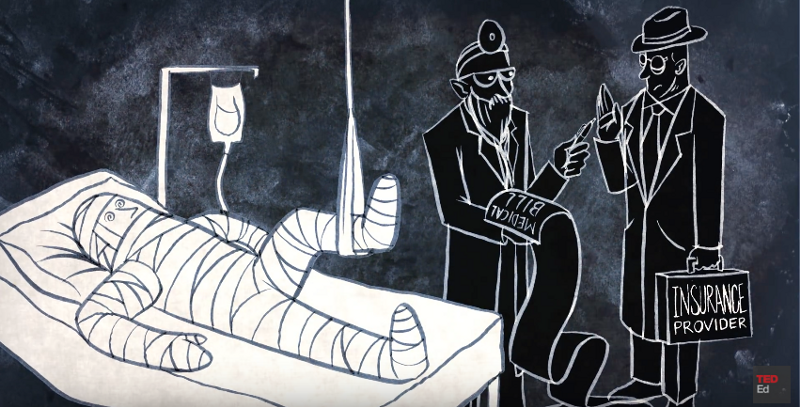
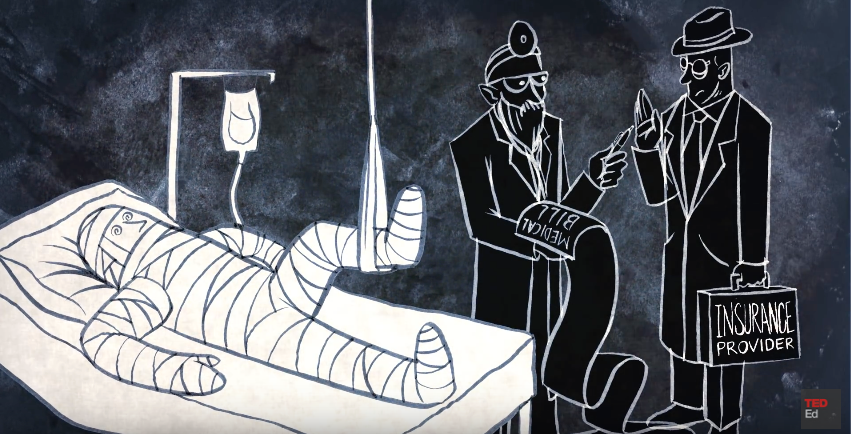
Last year, TedEd writer Noah Tavlin helped clear up what — precisely — the term “Orwellian” meant. Now he has set his sights on illuminating what we mean, or what we should mean, when we say “Kafkaesque.”
Pulling from the stories “The Trial,” “Poseidon,” “The Hunger Artist,” and Kafka’s most famous work The Metamorphosis, Tavlin first lays out what most of us have come to understand as Kafkaesque (aside from the literal “like Kafka”): “[It] has entered the vernacular to describe unnecessarily complicated and frustrating experiences, like being forced to navigate labyrinths of bureaucracy.”
As an employee at an insurance company, Kafka saw all the inglorious nooks and crannies of the modern, absurd, burgeoning bureaucracy and often thrust his characters into it — consistently to tragicomic effect. But, the word is more complicated than a mere invocation of bureaucracy’s byzantine tendencies.
Tavlin refers us to Kafka’s story “Poseidon” where, humorously enough, the God of the Sea is an executive buried in an endless pile of paperwork, unable to explore his own underwater kingdom. However, the reason why he’s buried in paperwork is because “he’s unwilling to delegate any of the work…he deems everyone else unworthy of the task. Kafka’s Poseidon is a prisoner of his own ego.”
Physical injury is not necessarily “kafkaesque”
The issue “Kafkaesque” presents is thus not only due to the bureaucracy, but also to “the irony of the character’s circular reasoning in reaction to it…[Kafka’s] tragicomic stories act as a form of mythology for the modern industrial age, employing dream logic to explore the relationships between systems of arbitrary power and the individuals caught up in them.”
It is telling of an author’s popularity when their name enters the language as an adjective; even more telling when there are videos made and articles written to clear up the misuse of their metamorphosed name-adjective. Long live Kafka(esque)!
When English professor Kevin Griffith and his eleven-year-old son Sebastian uploaded pictures from their work Brickjest — a Lego toy adaptation in the form of discrete dioramas, each representing a scene from David Foster Wallace’s novel Infinite Jest — their collaborative project quickly went viral. In the articles that followed the focus was not on their fealty to Wallace’s text but, in part, on their ability to make us consider what it means for textual characters to become tactile and occupy a physical space, in an age of adaptations when such characters increasingly seem to be stepping off the page and becoming fodder for digital screens.
In an instance where an adaptation represents such a radical act of transformation, the resulting conversation seems to work both ways, to also look at the new meanings that might be found in the source text because of this other, highly divergent form in which it now exists. But when it comes to cinematic adaptions the criticism still tends to work in only one direction, obsessed with the adaptation’s fidelity to its source.
“p. 301. It was the incontinence plus the prospect of 11/4’s monthly Social Assistance checks that drove Poor Tony out for a mad scampering relocation to an obscure Armenian Foundation Library men’s room in Watertown Center . . .” (Left). “p. 409. Clipperton plays tennis with the Glock 17 held steadily to his left temple.” (Right).“p. 69. Kate Gompert was on specials . . . Fourth hospitalization in three years, all clinical depression, unipolar.” (Left). “p. 64. The tall, ungainly, socially challenged and hard-drinking Dr. Incandenza’s May–December marriage to one of the few bona-fide bombshell-type females in North American Academia, the extremely tall and high-strung . . . Avril Mondragon . . .” (Right).
For a long time film was — and perhaps still is — considered not to be on equal footing with other forms of art. The filmmaker Andrei Tarkovsky, explaining the abundant presence of other art forms in his work (the music of Bach, paintings by Bruegel, his own father Arseny Tarkovsky’s poetry), suggested that because cinema was relatively young, the presence of older art forms lent it a temporal weight, and an authority that would cement its place among the arts. That not much has changed in the status of cinema-as-art over the years––as if film were perpetually young––is most apparent when it comes to adaptations, about which one invariably hears that the book was better than the film. It’s this sort of default reaction that even avid film buffs seem conditioned to believe, a statement sometimes made before due reflection. It is only partly thanks to a subliminal belief that literature is the superior form of art; the other part of it comes from the light in which critical conversations about adaptations actually take place.
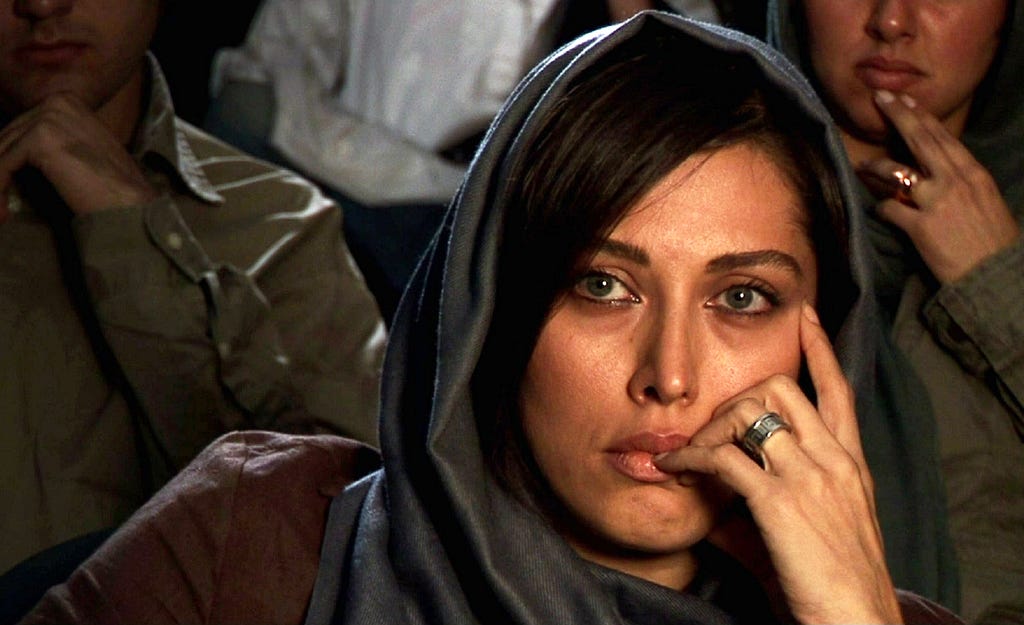
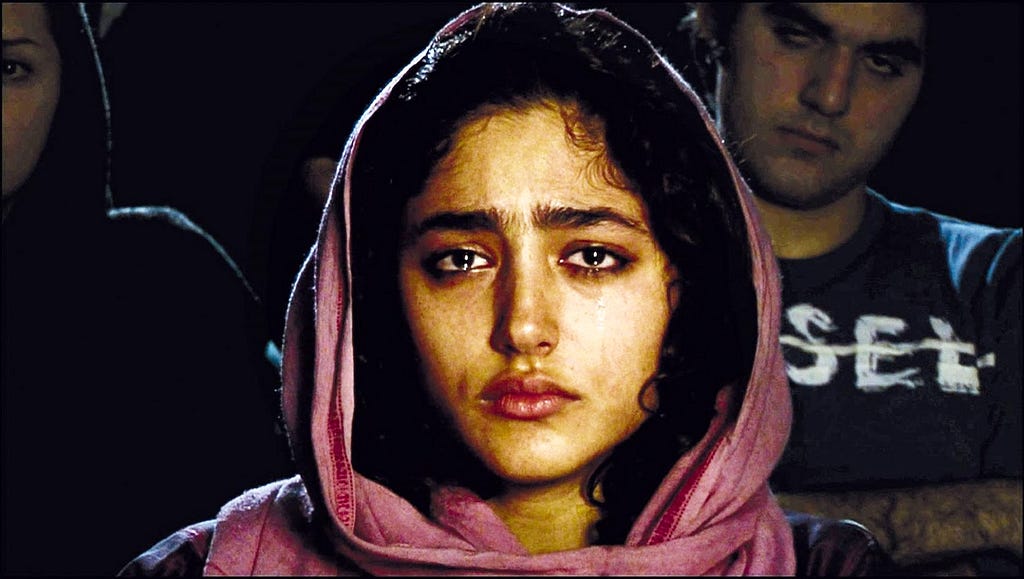
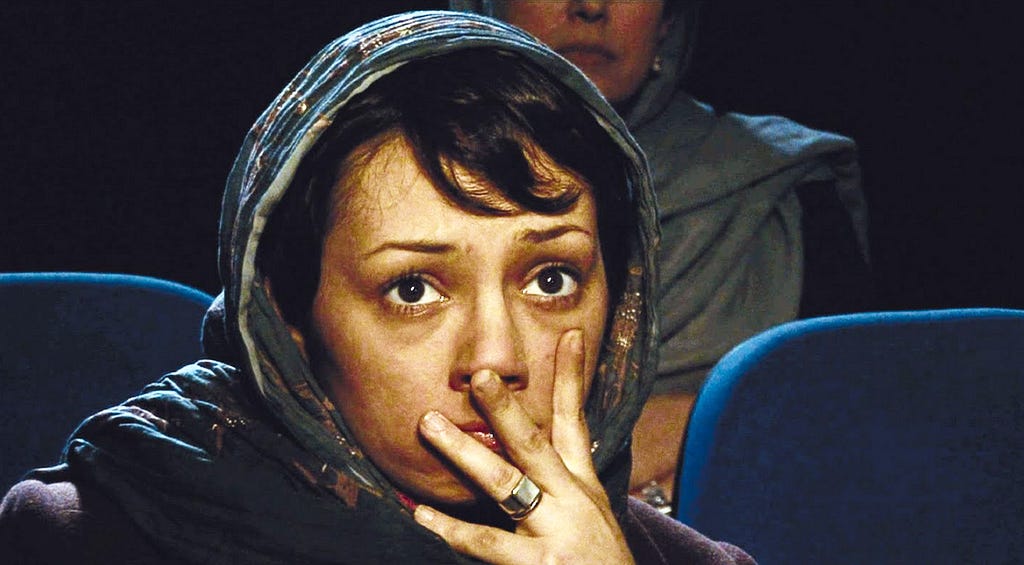
In his book Concepts in Film Theory, the renowned film critic Dudley Andrew proposed three models that, in total, describe the ways in which a screenplay can draw from its source. When a film borrows from another text, the source doesn’t necessarily share a storyline with the resulting work — it merely serves to inform the film’s subtext and essential emotion. In Abbas Kiarostami’s film Shirin (2008), for example, an audience — composed almost entirely of women — sits watching a film based on the tragic Persian romance “Khosrow and Shirin.” We only ever see the women’s faces and never the film they’re watching, which exists solely for us as an aural presence: an amalgam of dialogue, song, and dramatic sound effects. (Incidentally, these were added in editing; Kiarostami filmed each of his actors individually in his living room, a blinking light falling on their faces to simulate the effect of being in a movie theater). But the knowledge that the film these women are watching is a classic romantic tragedy inevitably informs the way we read their expressions.
Three stills from Abbas Kiarostami’s ‘Shirin’ (2008)
The second of Andrew’s adaptation models describes films that intersect with their source text, in which a text is preserved wholesale when rendered into cinematic form. In Ritwik Ghatak’s 1961 film about the aftermath of the Indian partition, Komal Gandhar (“A Soft Note on a Sharp Scale”), a group of East Bengal migrant artists find themselves stuck on the wrong side of the border. On the one hand we see the characters preparing to stage a classic Bengali play, and on the other we get to see the play itself as it’s performed. The abrupt shift between these two registers proves to be a clever formal device, recreating the displacement being experienced by the characters themselves.
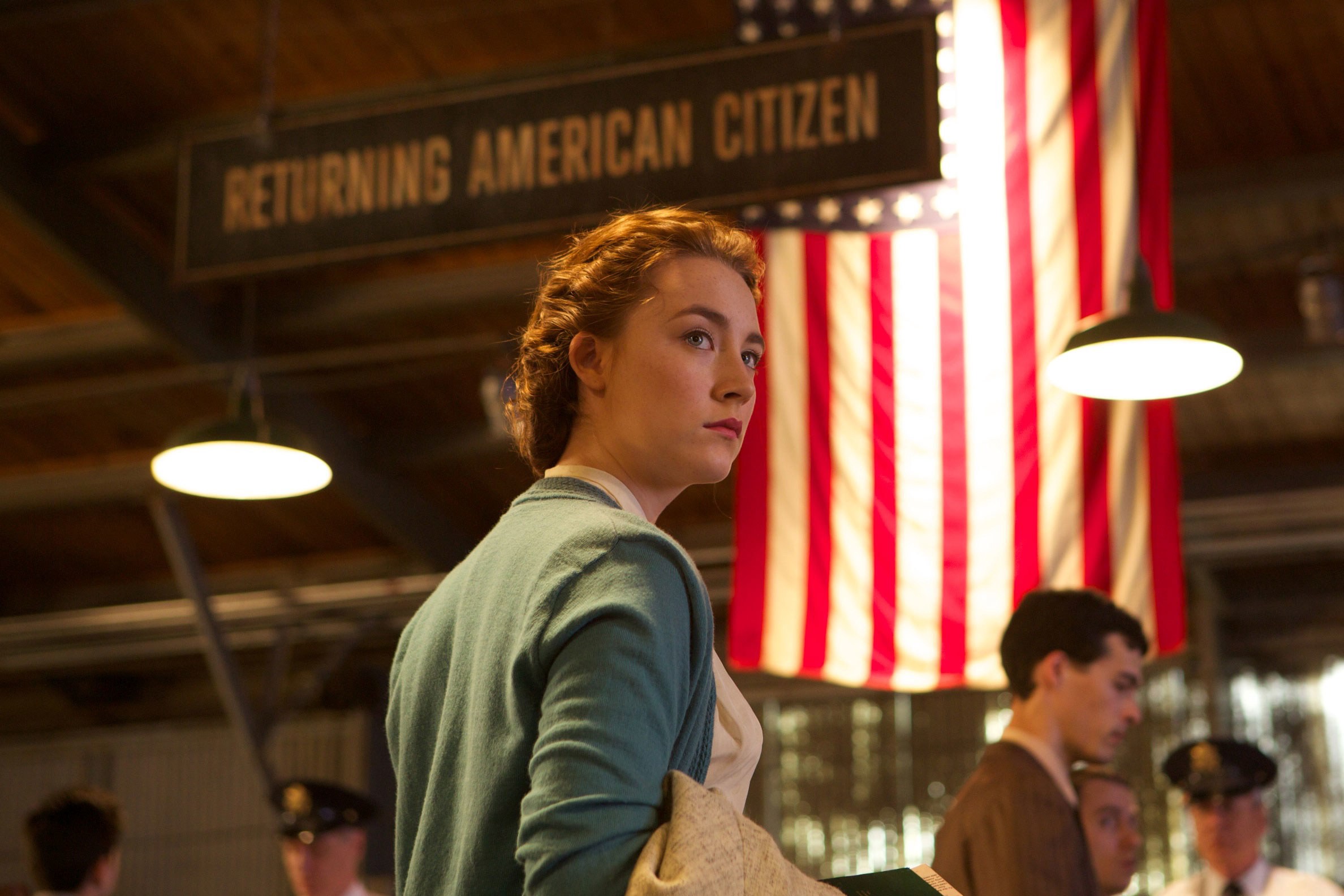
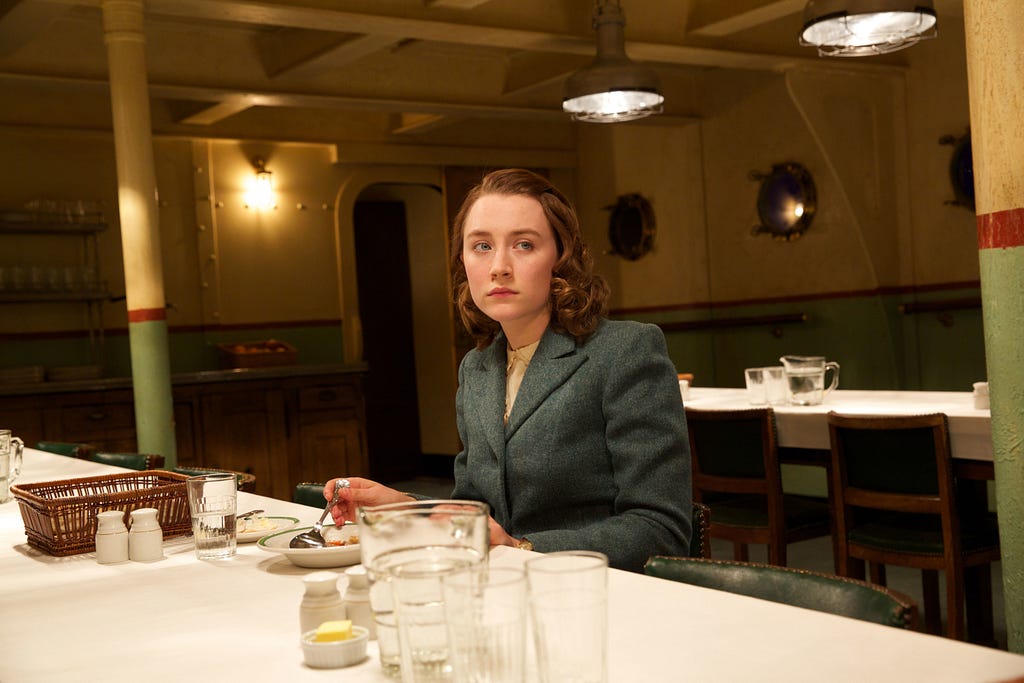
The most common form of adaptation Andrew calls transportation, in which the cinematic version retains the essence of its source text. Among many contemporary examples is the 2015 film Brooklyn (John Crowley). Based on the book by Colm Tóibín, and adapted by the novelist Nick Hornsby, Brooklyn the film makes significant departures from its novelistic source. The first third of the book, approaching sixty pages, shows the central character, Eilis Lacey, at home in Enniscorthy, Ireland. She lands a job at the town’s provisions store, run by Miss “Nettles” Kelly, then moves into the room of one of her brothers. In the film, Eilis (played by Saoirse Ronan) boards the New York-bound ship about ten minutes in, her time in Ireland occupying less than one-tenth of the movie’s total running time.
Among other things, the book intends to critique the Ireland of that time period (the 1950s), which had little to offer the young, compelling them to make Westbound oceanic journeys in search of better prospects. The film’s predominant concern is to focus on Eilis’s more positive experience after moving to the New World. Her less than ideal Irish work life is captured in a three-minute long scene, her personal life — she has no one to date! — reduced to and represented by a single dance room scene, which lasts only two minutes. Both of these scenes serve a metonymic function, allowing the audience to infer an accumulation of other moments similar to these that have led Eilis to make the decision to leave.
Saoirse Ronan, Brooklyn-bound, in ‘Brooklyn’ (2015)
While Eilis in the book is possessed of three brothers and a sister, in the film these characters are collapsed into a single sister, Rose (Fiona Glascott), after whose death Eilis comes back to Ireland. In both texts the factor keeping Eilis from returning to Brooklyn — the fact that her mother will now be alone — gives rise to a central question: should Eilis choose her homeland, or the new home she’s made for herself in Brooklyn? Hornby’s thoughtful choice increases the stakes of the narrative in the film, less giving way to more.
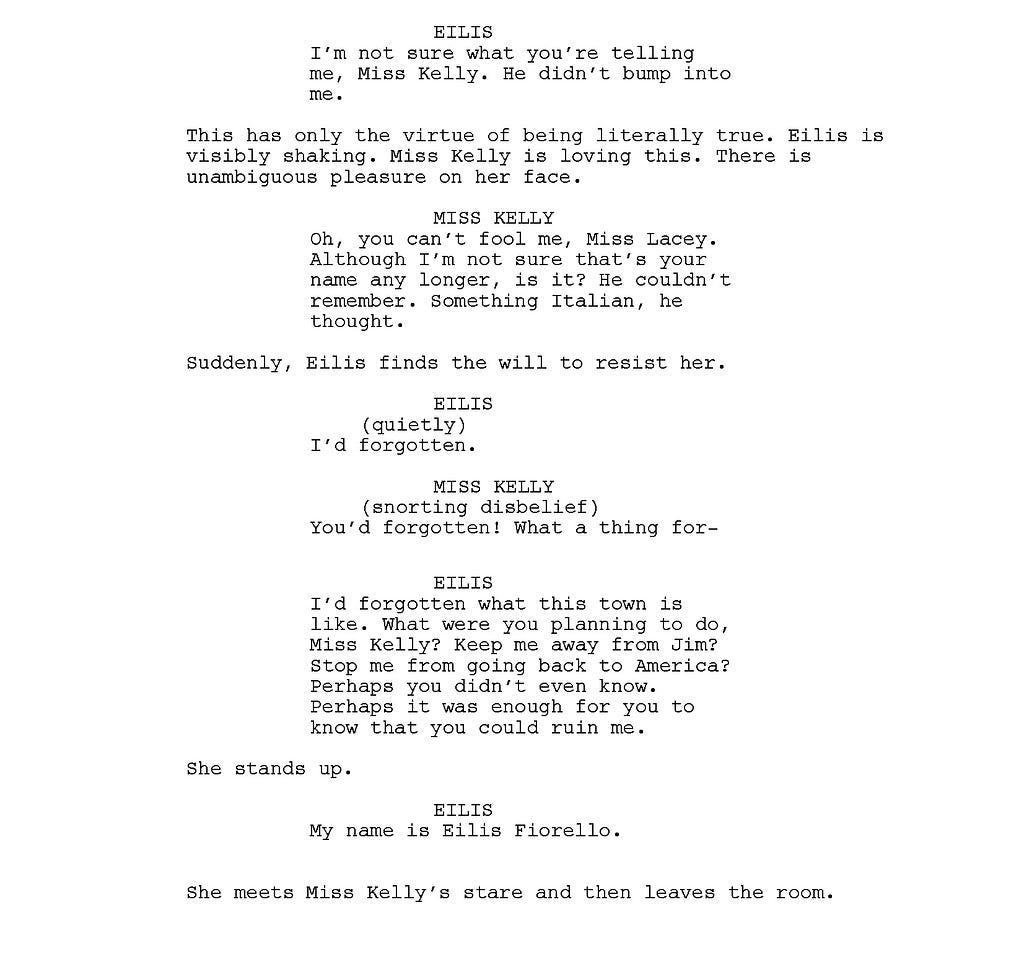
Most notably, however, it is a vital scene towards the end of the film that proves to be a significant departure from Tóibín’s novel. Unexpectedly making roots in Ireland after her return — this time she has a reputable job, and a love interest, Jim Farrell (Domhnall Gleeson) fixing to marry her — Eilis’s former employer Miss Kelly (Bríd Brennan) confronts her with the procured knowledge that Eilis is already secretly married to someone in America, a man named Tony Fiorello (Emory Cohen). In the book Eilis responds to this indictment with fear, and decides once again to leave Ireland. The film gives Eilis more agency in her decision to leave: she stands up to Miss Kelly, critical of her small-minded nature — and, by extension, that of others in the town, where everyone appears overly concerned with everyone else’s business.
Here is the scene as it appears in Tóibín’s novel:
In her tone, Eilis tried to equal Miss Kelly’s air of disdain.
“Oh, don’t try and fool me!” Miss Kelly said. “You can fool most people, but you can’t fool me.”
“I am sure I would not like to fool anyone,” Eilis said.
“Is that right, Miss Lacey? If that’s what your name is now.”
“What do you mean?”
“She told me the whole thing. The world, as the man says, is a very small place.”
Eilis knew from the gloating expression on Miss Kelly’s face that she herself had not been able to disguise her alarm. A shiver went through her … She stood up. “Is that all you have to say, Miss Kelly?”
“It is, but I’ll be phoning Madge again and I’ll tell her I met you. How is your mother?”
“She’s very well, Miss Kelly.”
Eilis was shaking.
“I saw you after that Byrne one’s wedding getting into the car with Jim Farrell. Your mother looked well …”
“She’ll be glad to hear that,” Eilis said.
“Oh, now, I’m sure,” Miss Kelly replied.
“So is that all, Miss Kelly?”
“It is,” Miss Kelly said and smiled grimly at her as she stood up. “Except don’t forget your umbrella.”
And the same scene in Hornby’s adapted screenplay:
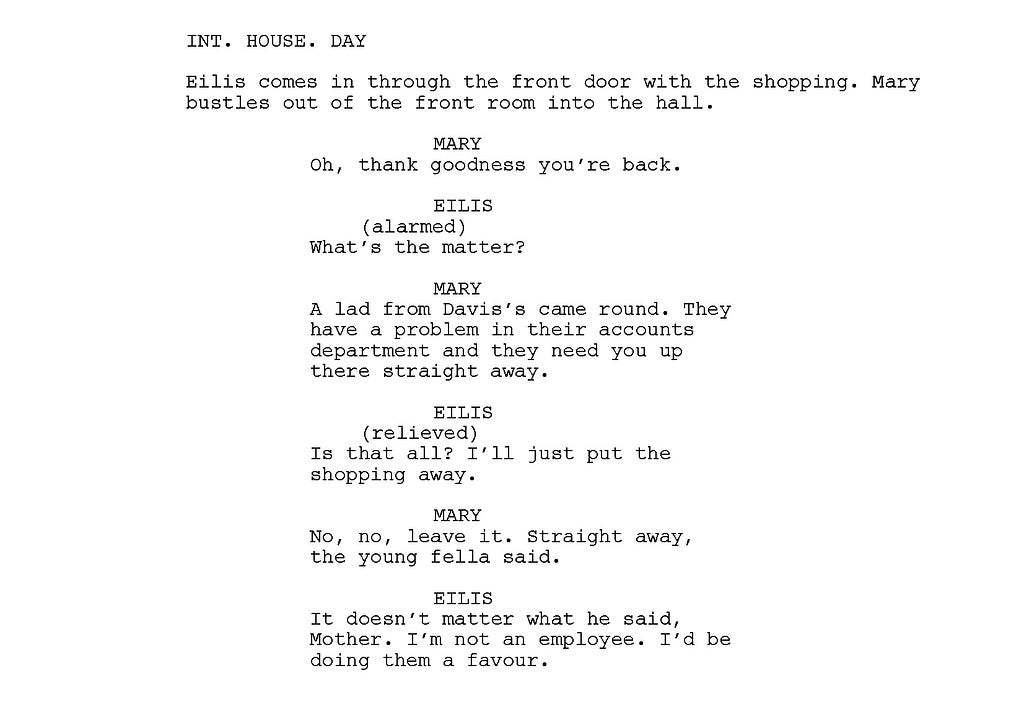
The intention of both the book and film is to show Eilis’s character arc. But in the film Eilis’s response to Miss Kelly is a consequence of her change, while in the book the scene triggers a change in her.
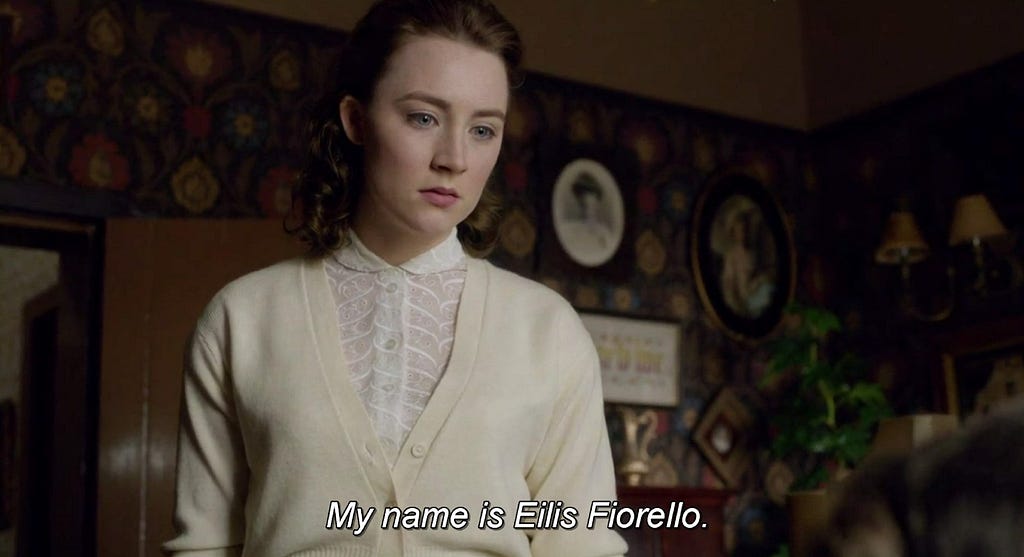
Saoirse Ronan standing up to Bríd Brennan in ‘Brooklyn’ (2015)
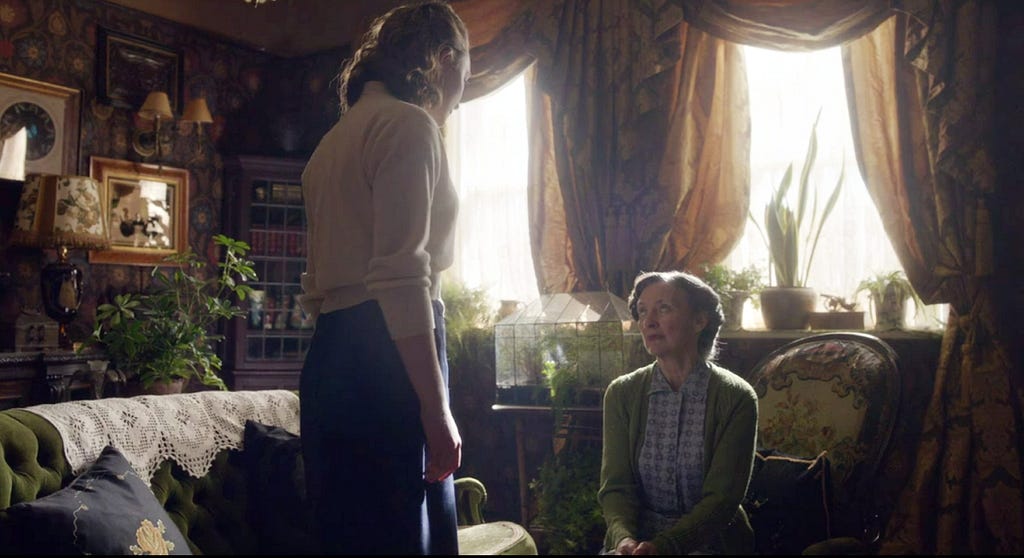
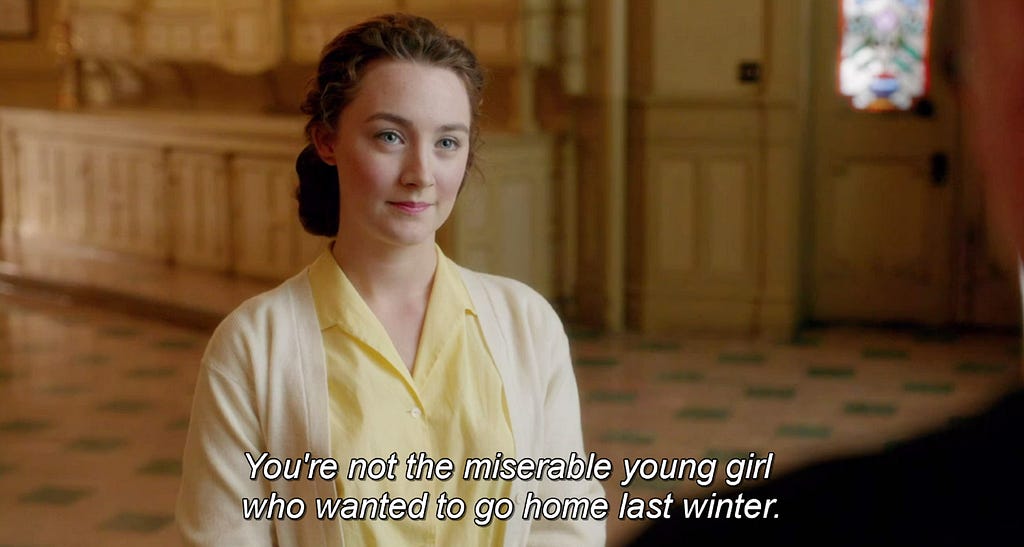
The cinematic narrative spends a lot of time showing Eilis gaining validation in Brooklyn — receiving acceptance and friendship in the boarding house where she resides, achieving fulfilment at work and in college, finding love. “Think like an American,” urged a woman who befriended her on the ship from Ireland. In one particular scene, following Eilis’s confrontation with Miss Kelly, we see how living in America has shaped her:
Eilis shows her understanding that she has the choice to not honor what’s being asked of her. In this light, the depiction of Eilis standing her ground against Miss Kelly — whom she’d been intimidated by at the beginning of the film — can be seen as an actualization of her sense of self, constructed over time while living away in Brooklyn.
Saoirse Ronan in ‘Brooklyn’ (2015)
Tóibín concludes her arc through precisely crafted and meticulously paced sentences, in which Eilis reflects on her decision to return to Brooklyn, moving from fear to a certainty that the path she’s chosen serves her interests best. The moment of this realization comes in the book’s final paragraph, as Eilis once again leaves her hometown:
“She has gone back to Brooklyn,” her mother would [tell Jim Farrell]. And, as the train rolled past Macmine Bridge on its way towards Wexford, Eilis imagined the years ahead, when these words would come to mean less and less to the man who heard them and would come to mean more and more to herself. She almost smiled at the thought of it, then closed her eyes and tried to imagine nothing more.
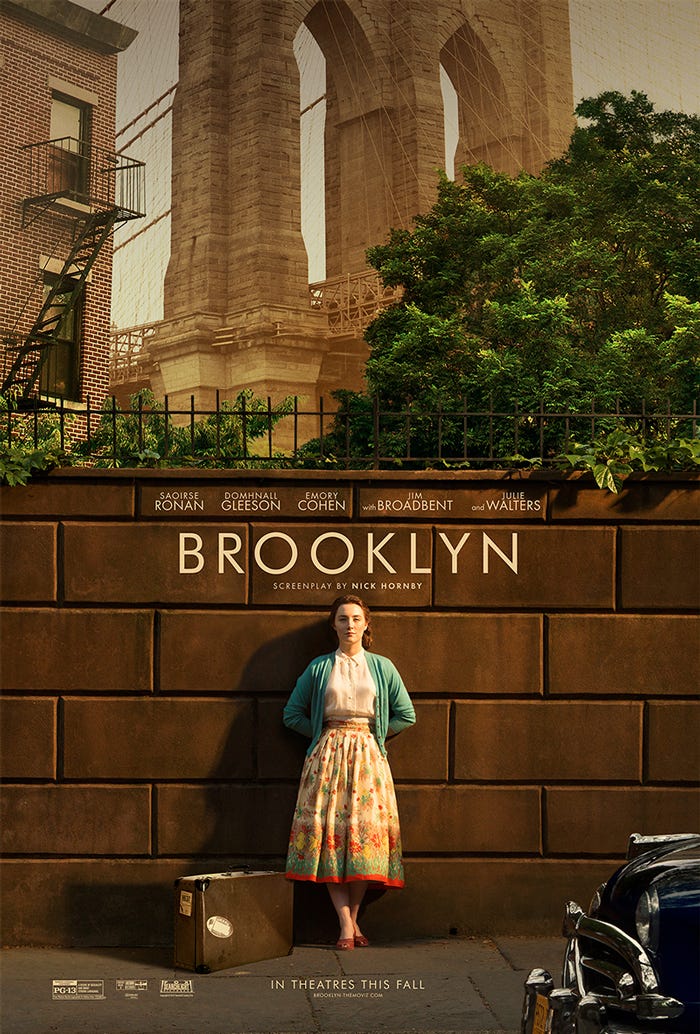
‘Brooklyn’ theatrical release poster (2015)
Where the book uses interiority, the film relies on dialogue and image, thereby changing the texture of the moment that completes Eilis’s arc. The final paragraphs of the book contain a litany of Irish landmarks and towns, while the film shows Eilis wordlessly reuniting with her husband Tony, the iconic Brooklyn Bridge evident in the background. In discussing his adaptation process, Hornby (quoting Michael Ondaatje) suggests that a good film adaptation finds the short story within the novel, serving to underscore both the economy needed for a film’s brief runtime, as well as the audience’s capacity to measure change in a character across the tight temporal framework of a film.
The author Joseph Conrad wrote that “the power of the written word … is, before all, to make you see,” a sentiment almost exactly echoed by filmmaker D.W. Griffith, when he suggested that his purpose was “[a]bove all … to make you see.” An obvious difference between books and films is in the way they promote seeing. Whereas books conjure up mental images, the filmic image has a quality of given-ness to it. But another, less frequently discussed point of comparison is made manifest in Conrad’s and Griffith’s twin statements, not in the word “see” but from another shared word––you, the intended audience. And it is this ‘you’ that should be the kernel of all discussions concerning adaptations.
The choices by which Brooklyn the film departed from its literary counterpart were meant to etch a particular version of Eilis in the minds of viewers, within the tight timeframe of a film. Komal Gandhar staged a play inside a film in order for the audience to gain a better grasp of the experience of displacement. When it comes to discussing adaptations in general, the focus should be on their fidelity to the audience, rather than to the source text. The audience remains the focal point when a screenwriter reshapes their source text with the intention of bringing it to the screen — to bring it from one kind of readership to just another kind of viewership.
Publishing is the business of creating books and selling them to readers. And yet, for some reason we aren’t supposed to talk about the latter. Most literary writers consider book sales a half-crass / half-mythological subject that is taboo to discuss.
Most literary writers consider book sales a half-crass / half-mythological subject that is taboo to discuss.
While authors avoid the topic, every now and then the media brings up book sales — normally to either proclaim, yet again, the death of the novel, or to make sweeping generalizations about the attention spans of different generations. But even then, the data we are given is almost completely useless for anyone interested in fiction and literature. Earlier this year, there was a round of excited editorials about how print is back, baby after industry reports showed print sales increasing for the second consecutive year. However, the growth was driven almost entirely by non-fiction sales… more specifically adult coloring books and YouTube celebrity memoirs. As great as adult coloring books may be, their sales figures tell us nothing about the sales of, say, literary fiction.
This is literally the sixth best-selling book of 2016
This lack of knowledge leads to plenty of confusion for writers when they do sell a book. Are they selling well? What constitutes good sales? Should they start freaking out when their first $0.00 royalty check comes in? Writers should absolutely write with an eye toward art, not markets. Thinking about sales while creating art rarely produces anything good. But I’m still naïve enough to think that knowledge is always better than ignorance, and that after the book is written, writers should come to publishing with a basic understanding of what is going on. Personally speaking, my knowledge of the fundamentals of publishing helped me not even think or worry about book sales when my own book was published last year. And since I need a reason to justify the time I’ve spent dicking around on BookScan, here is my guide to everything you wanted to know about book* sales (but were afraid to ask).
*Because “books” is an impossibly large category covering everything from Sudoku puzzles to C++ guides, I’m going to focus on traditionally published fiction books in this article.
THE BASICS
What is a book sale?
Wait, you say, everyone knows what a book sale is. Ah, yes, but, what this section presupposes is… maybe you don’t? Actually, one of the things that makes the conversation about book sales so confusing is that there are several different numbers thrown around, and often even people in the publishing industry completely confuse them. Here are four different numbers that are frequently conflated:
1) The number of copies of the book that are printed.
2) The number of copies that have been shipped to stores or other markets like libraries.
3) The number of copies that have been sold to readers.
4) The Nielsen BookScan number.
These numbers can all be wildly different. It’s not uncommon at all for a publisher to, say, print 5,000 copies, but only sell 3,000 copies to bookstores/other markets, of which, 2,000 copies are actually sold to customers. Meanwhile, BookScan shows 600 copies sold. And we haven’t even gotten into ebooks yet (more on that later).
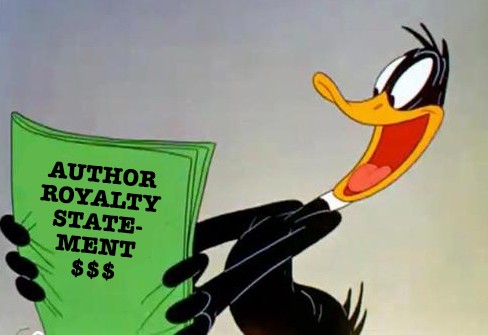
A publishing employee calculating a royalty statement
What’s the actual number of books sold? Well… basically a combo of 2 and 3, plus ebook and audiobook sales. A publisher sells books to retailers like bookstores, but also to some institutions like libraries. However, retailers normally (though not always) have the right to return unsold copies. So some copies that are “sold” will eventually be unsold. (On author royalty statements, a certain amount of money is always withheld as “reserve against returns.”)
While this is basic, it’s surprisingly common for authors and publishers to either intentionally or unintentionally confuse these numbers: brag about their sales while citing the print run, for example. On the other hand, the media almost always references the BookScan number without any context about how wrong that number can be.
What Is BookScan and Why Should We Care?
In my hypothetical above, the Nielsen BookScan number, is the least accurate. It’s the furthest away from the “true” sales of the book. And yet, if you read any articles on book sales it is precisely the BookScan number you will see. This is because while publishers and authors (via royalty statements) have access to the real numbers, they are almost never released to the public or to rival publishers. Thankfully, there is Nielsen BookScan, an industry tracking tool that records point of sales based on ISBNs. (Yes, this is the same Nielsen of TV’s Nielsen ratings.) People in publishing can use BookScan to get a general sense of what books are selling, the health of the industry, or tear their hair out in frustration while looking up the sales of their rivals.
So Why Can BookScan Be So Inaccurate?
Nielsen BookScan counts cash register sales of books by tracking ISBNs. A clerk scans the barcode, and the sale is recorded. Pretty simple.
Bookstore employees scanning ISBNs
So why can it be inaccurate? To begin with, BookScan only tracks print book sales. Amazon and other major ebook vendors do not release ebook sales, so basically no one has any idea how those are selling (outside of publishers tracking their own sales). Ebook sales vary wildly from book to book (and genre to genre), but are typically less than 1/3rd of sales. For certain genres, especially science fiction and romance, ebooks can be as much as 50% or more.
Even for print books, BookScan can only do so much. BookScan gets data from most big bookstores (including Amazon and Barnes & Noble), but it doesn’t get all of them. It also doesn’t track library sales — which can be significant — or any sales that don’t go through a bookstore. BookScan itself claims to track 75% of print sales, and that may be true overall. For a popular literary fiction title, for which library sales or hand sales are a tiny percentage, BookScan is probably getting at least 75% or more of print sales. For other types of books, BookScan might record as little as 25% of print sales. Small press books, for example, can sell most of their copies at conferences, book festivals, and direct sales on the publisher’s website or at readings. BookScan misses all of that.
Lastly, BookScan was only introduced in 2001, so numbers for any books published before this millennium are completely inaccurate. (I’ve seen people bemoan the small sales of, say, Infinite Jest compared to some recent bestseller without realizing that.) All that said, BookScan does a good job showing general trends in the industry and seeing which books are doing better than others. But you should keep in mind that total book sales are perhaps twice that of every number listed.
A young author ready to publish his first novel
How Much Does an Author Make Per Sale?
So let’s say you bought a book (like, oh, how about Upright Beasts by Lincoln Michel), how much would the author make? Author royalty rates vary, but the industry standard is about 8% of the cover price for paperbacks and 10% for hardcovers (escalating to 15% if sales go well). Ebooks, which have variable pricing, are 25% of the publisher’s take. Now, as an author I’d love for those rates to be higher, but I do think it is important for authors to understand that the majority of the cover price doesn’t go to the publisher. Well over 50% of the cover price goes to the retailer that sells books to customers and the distributor who gets the books to retailers. There is plenty to be said about whether the publishing model could be more efficient, if middlemen could be cut out, etc. etc. But when certain corners of the writing world — such as certain self-publishing ideologues — scream about how publishers are ripping off authors and taking 90% of the pie for themselves, that isn’t really accurate.
A young author opening his first royalty statement
Don’t Most Authors Make No Money From Sales?
Correct. Most authors do not make any money off of actual book sales because most books do not “earn out” their “advance.” Traditionally published authors are paid money up front, before a book is released. This “advance” is money given up front to the author out of future royalties so that the author can buy ramen and pay the overdue electricity bill. “Earning out” means the book has sold enough copies that the total royalties (not the total sales) match up to the advance, thus providing a (most likely tiny) trickle of royalty money to authors for all sales thereafter.
This ‘advance’ is money given up front to the author out of future royalties so that the author can buy ramen and pay the overdue electricity bill.
Here’s an example: Writer von Author writes My Big Literary Novel and Big Publishing House Press pays her $50,000 dollars as an advance. The cover price of the book is $20 dollars and her royalty rate is 10%. (In reality it would be more like a ~$25 hardcover at 10–15% followed by a ~$15 paperback at 7–10%, but I’m simplifying.) If the publisher sells 10,000 copies of the book, the total sales are $200,000 and the author has earned $20,000 from royalties… except that she was already paid $50,000 so she is actually at negative $30,000. She doesn’t have to pay anyone back either though, the publisher takes the loss. However, if the book sells 25,000 copies, then the author would earn back her advance and at copy twenty-five thousand and one, she would start earning $2 per book sold.
A young author after reading his first royalty statement
How Does Publishing Survive If Most Books Don’t Earn Out?
To begin with, publishers survive on a handful of hits. A 50 Shades of Grey here or a Gone Girl there make up for a lot of low-advance books that don’t sell well. This is similar to how movie studios survive on a few massive blockbusters to offset the costs of movies that don’t earn what is expected at the box office. Additionally, the publisher makes money before the author does. Even if the distributor and retailer take, say, 65% of the sale price (and it can be as much as 75%), the publisher is getting 25% to the author’s 10%.
When an article talks about how some huge advance given to a debut author and/or celebrity author won’t earn out, that doesn’t actually mean the publisher won’t make money. (Here’s a blog post breaking down the example of Lena Dunham’s huge advance.) In fact, publishers may give huge author advances on books they know won’t earn out as a way of paying a de facto higher royalty rate.
Take our example above. If My Big Literary Novel sells 20k copies, the author still hasn’t earned back her advance yet the press is taking in $90,000 (35% of cover price minus 50k advance). Of course, the press also has to pay for the printing costs of the book as well as any marketing costs or money spent on cover art before it can even pay the various employees that worked on the book… but you get the general idea.
WHAT DO BOOKS ACTUALLY SELL?
Two authors gossiping about their friends’ book sales
Okay, Let’s Get to the Dirt: What Does an Average Book Sell?
Probably not surprisingly, the answer is… it really depends. The first thing that writers need to understand is that book sales — like advances — are all over the place. This is true even for individual authors. It’s not unheard of for an author to get roughly similar critical acclaim for their first three novels, yet have them sell 10k, 100k, and 10k respectively. Publishing is full of luck, timing, and unpredictable trends. (I mean, adult coloring books? Really?) And even then, publishers give dramatically different amounts of support and marketing even to books published by the same imprint.
That qualification aside, most fiction books published by a traditional publisher garner somewhere between 500 and 500,000 sales. Sometimes less, sometimes more.
Can You… Narrow that Down a Little?
Ignoring the outlier megastars like Stephen King or runaway hits like Anthony Doerr’s All the Light We Cannot See, most novels published by a big publisher BookScan somewhere between 2,000 and 40,000 books. Most short story collections issued by big publishers get about half that: between 1,000 and 20,000.
People really really really love this book
You can scale this down for publisher size. An independent small press is averaging more like 500 to 10,000 for novels and 300 to 2,000 for story collections. A micro press is more like 75 to 2,000 regardless of book type — at this level, the author’s “platform” and fan base matter more than if the book is a novel, story collection, or poems — with outside successes getting above 5k.
For debut books, you could cut all those numbers in half. Do keep in mind that this is after at least a year of sales. If your book just came out this month, don’t panic yet (and don’t check BookScan for a long time, if ever).
So the Average Novel Sells 20,000?
Well… no. Like baseball salaries or box office returns, book sales are heavily skewed by the minority of books that do really well. If you go into your local bookstore and look at all the books on the various tables, most of those will BookScan between 2,000 and 40,000 after a couple years of sales. The big books by the big names on the tables will get between 100,000 and a couple million.
However, most books struggle to find adequate distribution, much less coverage. Most books do not get placement on tables, and many do not even get to many bookstores at all. The majority of traditionally published novels sell only a couple thousand, if that, over their lifetime.
What Constitutes “Good” Sales?
As with anything here, we need qualifications. What constitutes “good” sales is entirely dependent on what type of book you are publishing, what size your publisher is, and what your advance was. 5,000 copies of a short story collection on a small press is a huge hit. 5,000 copies of a novel from a big publisher that paid a $100,000 advance is a huge disaster.
You also need to factor in the format. Selling 10,000 hardcover is worth more than 10,000 paperbacks. For ebooks, prices can be all over the place, even from a major publisher.
Qualifications aside, if you are a new writer at a big publisher and you’ve sold more than 10,000 copies of a novel you are in very good shape — as long as you didn’t have a large advance. It should be easy for you to get another book contract. If you sold more than 5,000, you are doing pretty well. You’ll probably sell your next book somewhere. If you sold less than 5,000, then you could be in trouble with the next book. (Although it is, as always, dependent on the project. If a publisher loves your next book, they may not care about previous sales.)
The smaller the press, the more you can scale down. One publisher of an independent press told me that most indie press books sell — not BookScan — about 1,500 copies, with 3,000 being good sales. Even then, the publisher stressed, an author selling 3,000 is really just paying for themselves. To be contributing to the operations of the press, they’d need to sell over 5,000.
An author (right) begging an editor (left) for a second chance
What Do Acclaimed, Buzzed-About Literary Books Sell?
So let’s say you jump through the hurdles of writing a book, getting an agent, and selling it to a respected press, AND you become one of the handful of books that is well-reviewed in big outlets and buzzed about in the literary world. How many books will you sell?
Most people would be surprised at the drastic range of book sales even among the books that people are buzzing about. If you took the ten literary fiction books that all the critics, Twitter literati, and well-read friends are discussing, their BookScan numbers might range from a couple thousand to 100k. Last year, NPR looked at the book sales of the Pulitzer Prize finalists and found the books ranged from under 3,000 to low six figures.
If you took the ten literary fiction books that all the critics, Twitter literati, and well-read friends are discussing, their BookScan numbers might range from a couple thousand to 100k.
That’s a small sample though, so I went through the BookScan numbers for every fiction book listed on the New York Times 100 Notable Books of 2014. I used 2014 instead of 2015 to make sure each book had at least 12 months of sales. No list is perfect, but the NYT list includes story collections and small press books alongside the big name literary authors and award contenders. 2014’s list includes names like Haruki Murakami, Lydia Davis, Marlon James, and David Mitchell as well as small press debuts by Nell Zink and Eimear McBride. It’s a good sampling of the “books that people are talking about” in the literary world.
The BookScan sales of those books literally ranged from 1,000 to 1.5 million, with an average (mean) of just over 75,000 copies sold per book. That 75k number is pretty skewed by the existence of Anthony Doerr’s runaway literary hit, All the Light We Cannot See, which sold over 1.5 millions of copies. (The next highest book was about 270,000.) If we remove the best and worst selling books on the list, we get a mean of 46,550 copies and a median of 25,000 copies.
(Once again, I’ll remind you that these are BookScan numbers for books published in 2014. The actual sales totals will be moderately to significantly higher depending on the book, and all of these books should continue to sell copies over the years.)
A photo of Stephen King reading this article
What If You Are a Finalist for a Major Award?
Let’s say you really hit the jackpot and are a finalist for the Pulitzer, what kind of sales would you get? Again, the range is huge. I looked up five years of nominees (from 2011 to 2015) and the range was 5,600 to over 1.5 million (yes, All the Light We Cannot See again). The mean was 250,100 and the median was 72,300. For the National Book Award, the mean was 178,600 and the median was 91,318
For comparison sake, I checked the finalists for science fiction’s prestigious Nebula awards. They ranged from 2,100 to 387,900 with a mean of 35,600 and a median of 12,300. That’s surprisingly less than the major literary awards, despite the frequently heard claim that genre fiction is more popular than literary fiction. (Although keep in mind that science fiction ebooks typically sell better as a percentage of total sales than literary fiction ebooks do.)
A famous author being awarded the National Book Award
What Does a #1 Bestseller Sell?
On average, a lot more. I checked the BookScan sales for all the books that hit the #1 spot on the New York Times list in 2014 and the mean sales were 737,000 with a median of 303,000. The top selling book was, as you can probably guess, 50 Shades of Grey at nearly 8 million. But the lowest was only 62,700, meaning more than 50% of NBA or Pulitzer finalists sold better than it. In fact, a whole lot of the 2014 literary award finalists sold better than bottom 2014 best sellers. If that’s confusing, remember that this is the list of books that were the best selling book in the country for one week, not for the whole year. Sales of commercial fiction books are often far more concentrated than the sales of popular literary fiction books, the latter of which can have very long tails.
Once again, I want to stress that these totals are perhaps 75% of book sales and do not include ebook or audiobook sales.
What About Short Story Collections? No One Buys Those, Right?
It’s a truism in the literary world that no one buys short story collections, and that even when you sell a collection a publisher will only buy it so that your future novel will do better. I myself have always believed this to be honest, even though I wrote and published a short story collection. However, looking at the data it actually seems that while fewer story collections sell, the ones that do can sell almost as well as novels. The seven story collections on the NYT 2014 list had a median of 23,000 BookScan sales… only 2k less than the median novel. When I expanded the data to include short story collections from the 2013 and 2012 list, the average sales were 53k and a median of 22.5k.
Tom Gauld nailing it
So All the Publishers that Rejected My Collection Are Fools!
Well, no. Those are mostly collections by buzzed about debut authors or established older writers. As I said, fewer story collections sell (although fewer are also published) and the ones that don’t sell fail harder than novels. And there’s a cap on story collections. No story collection is going to sell millions of copies like the biggest novels. All of the authors whose collections I counted in the last section sold better as novelists if they had novels out. Since big publishers survive on the few break-out books, it makes more business sense to bet on novels or push authors to write novels instead of stories. Whether that’s good for the culture or the art of literature is another question…
Still, it was heartening for me, as a lover of short stories, to see that collections from authors like Junot Diaz, Alice Munro, and George Saunders can BookScan over 100k, and a collection by someone like Stephen King can reach a million. (In fact, having looked at a lot of sales data I’m convinced Stephen King is the best-selling living short story author in America and probably the world). More importantly, great short story authors like Kelly Link, Lydia Davis, Aimee Bender, Jim Shepard, and so on will BookScan between 10 and 50k… which is comfortably in the range of what acclaimed literary novels sell.
How Does Genre Fiction Compare?
I’ve talked before about how the idea that literary fiction is a tiny niche market and that the various genres sell more is largely a myth. “Commercial fiction” — which is not a synonym for genre — can sell a lot more, especially when we are talking brand name like John Grisham, James Patterson, or Danielle Steel. YA fiction is also having a much-discussed boom these days. But for most writers of adult science fiction, romance, fantasy, and the like, the numbers will be roughly what I’ve listed in this article.
A ravenous genre fan
How Does Non-Fiction Compare?
Non-fiction is an insanely huge category that encompasses everything from craft books and joke books to travel guides and memoirs. While there is some variation in average sales between different types of novels, non-fiction sales are entirely dependent on which of the 1,000 types of non-fiction books you are talking about. I’m afraid I just can’t help there, except to say that what you might think of as literary non-fiction — lyric essay collections, memoirs, etc. — will be roughly similar to the numbers listed here.
What About Self-Publishing?
Like non-fiction, self-published books vary so wildly that they can’t really be generalized. If you publish your book through an established press, you can most likely guarantee a certain level of professionalism, distribution, and hopefully coverage for your book. Self-publishing, on the other hand, contains both professional full-time authors who spend time and money marketing their books as well as people who just think it would be fun to put an ebook up on Amazon and never spend any time marketing. Overall, self-published books sell far far less (in part because the majority of the market is still print, and it’s near impossible for self-published print books to get a foothold in stores), but of course their cut of each sale is much higher.
Which Sells More: Hardcover, Paperback, or Ebook?
Another surprising (to me at least) fact from the data I looked at is that books quite often sell the same amount in hardcover and paperback editions. If a book truly takes off, the paperback sales will eclipse the hardcover many times over. But for most books that are published in hardcover first, the paperback sales will be close to the same. Perhaps that’s a feature of the ebook era where readers who prioritize an affordable option will often choose the ebook?
As for ebooks themselves, the sales aren’t available publicly anywhere so it is impossible to say. According to a recent survey, ebooks account for about 20% of the total book market. From talking to publishers and authors, it seems ebook sales are erratic and — as a percentage of overall sales — vary wildly from book to book, publisher to publisher, and genre to genre. To add even more confusion, ebook prices fluctuate a lot more than paperback or hardcover. It is simply hard to pin down. For most traditionally published books, the percentage of sales that are ebook instead of print is somewhere between 10% and 50%.
A writer debating writing working on a novel or going back to dental school
So What Does All This Meeeaaan, Man?
I often hear that fiction is basically just an irrelevant niche and no one reads books at all. Now that we’ve looked at the numbers, well… I guess it depends on your point of view. If the average well-distributed novel is BookScanning only 10,000 copies, that seems pretty niche. Then again, there are plenty of industries where sales of 10k per product would be respectable. And we have to remember that the actual number of sales might be 20,000, and then maybe 30,000 people have read the book since plenty of people use libraries, pirate, or borrow books from friends. Every year, dozens of new books sell 100k copies on BookScan, and a couple sell a million. A recent Author Earnings report suggested maybe 4,600 writers earn 50k a year off of book sales alone. Not so shabby, maybe, until you realize that about that many MFA students graduate each year. Then again, that’s just looking at book sales, and not money made from freelance writing, speaking engagements, teaching classes, or other author income streams. And honestly, even getting a thousand strangers to read something you poured your heart and soul is pretty okay. Bottom line; who knows what any of this means, but at the very least if you are a newly published or aspiring author you now know the world you’re going into.
As for me, I’m going to get back to work on a weird novel that will never sell, but, hell, is damn fun to write.
There is a strange assertion going around the news dealing with the Orlando, Florida hate crime that took place at Pulse, a gay nightclub, in the early morning of June 12, during the club’s Latin night line. This assertion is repeated over and over again by various lawmakers and pundits, and paraphrased, it seems to be something like this: the victims weren’t just gay, they were Americans. A friend of mine wondered aloud on Facebook a few days ago how long it would be before us “gays,” meaning the LGBTQ community at large, would be demoted from the grand AMERICANS (which, by the way, not all of the victims were — there were several who were in the country illegally and the US oh-so-kindly agreed to give their families a whole week in our glorified country in order to attend to the wonderful task of funeral planning and body transporting) to being just “gays” again.
In that spirit, and directly after the massacre, I had the great pleasure of reading Arcade, by Drew Nellins Smith, a book that is both incredibly American and incredibly gay, and I’m pretty sure the latter trumps the former in this case when describing quality. It is also a book that very clearly sees and discusses the feeling of otherness that’s instilled in people questioning their sexuality and acting upon any deviant desires — that is, desires that aren’t het and cis.
Arcade, according to an interview with Smith in the LA Times, had some interest from one of the major publishers, but even after an editor told him to take out all the sex, the book still didn’t get out of the acquisitions process and was eventually turned down. When Olivia Smith — no relation to the author — editor at the excellent Unnamed Press, took on the book, her first editorial request was that the author put all the sex back in. And thank goodness, because without it, Arcade wouldn’t be what it is: a landscape of several months in which the importance of seemingly gratuitous sex scenes and the obsessions of a lovelorn man come together and are made equal, neither more important than the other.
[A] book that very clearly sees and discusses the feeling of otherness that’s instilled in people questioning their sexuality
The novel’s plot is not what the novel is really about, but in brief, it follows an unnamed narrator who occasionally goes by the false name Sam, as he very slowly overcomes an unhealthy obsession with “the cop” he was involved in (also never named) and the cop’s new boyfriend, “the kid,” who is 19, almost ten years younger than the narrator, and has replaced the narrator in the cop’s affections. It also follows the narrator’s discovery of a hookup spot whose front is an adult video store on the outskirts of the Texas town he lives in. And, finally, it follows his friendship with a gay man named Malcolm with whom he talks regularly and jerks off with.
The sex in the novel is nothing short of splendiferous — deserving of the word in that it is varied, fascinatingly intimate at times and completely detached at others, and unflinching to the point where some readers may be uncomfortable. Personally, I found it rather steamy. The arcade, which is really a series of booths in two corridors — one smoking and one non-smoking, very civilized — in which mostly men come together in various configurations and according to various codes is where the narrator spends much of the book. Though not meant as a manifesto by which to force readers to look at queer sex close up and accept it without flinching, it does have that unintentional side effect of presenting sex as both neurotic, which it is for many of us, and completely normal, as it is for many of the characters grazing at the narrator’s body and its outskirts (because the narrator doesn’t always participate directly but often watches from the corner).
There is something essentially satisfying about passages in books that present, intentionally or not, a metaphor for the novel as a whole. About halfway through Arcade there is one such:
One of the great gifts of the arcade was the way it put us all on the same level. Of course I could tell which men were rich or poor or middle class, but it didn’t matter out there. After the three dollar threshold, we were all the same. I went to the arcade when I was flush with cash, and at other times when I was so hard up for money I debated whether or not I could really drop a fiver on the venture. It didn’t change anything. It didn’t change my luck. It was the first and only level playing field I’d ever been on. I liked the idea that most of us never would have met or interacted if it hadn’t been for that place, divided as we were by our jobs and incomes.
This closes a chapter in which the narrator presents the arcade as incredibly different from his workplace (he’s a clerk at a motel, down on his luck after a career in real estate that ended with the crash of the housing market), and the next chapter begins with what struck me as a laughably apt continuation of this metaphor: “I drove to the cop’s house almost an hour away.” That is, chapters describing sex, chapters describing the narrator’s job, chapters describing his philosophy of the arcade, and chapters describing his outright obsession with his former lover — they are all presented as an equal playing field, none made more particularly important than others, even if we, as a society, would like to put some sort of claim on the importance of the narrator’s fascination with sex with other men, still a taboo subject in many parts of our society (and the novel is set, remember, in Texas, a red state with blue spots, but a red one nonetheless). The novel’s structure simply doesn’t allow that.
Another remarkable thing about Arcade is its refusal to be a coming-out novel. From its start, it’s clear that the narrator is interested in sex and romance with men, though at first he tries to explain to himself that it is just about the cop. He uses the philosophy of “I’m not into men, I’m into one man.” His actions belie this, of course, and he describes in passing how his coming out happened accidentally as he began to fall apart and cry obsessively about the cop whenever he was with friends or family. But that’s not what the novel is about; the narrator’s coming out is a byproduct of his personal realization that he’s gay, and even that isn’t what the novel is about. It almost doesn’t matter, except that it matters hugely because of the culture of the arcade (that of LGBTQ spaces historically occupied by gay men, spaces like bathhouses and other cruising spots) that the narrator becomes embroiled in and as obsessed with as he is with the cop.
Yet even so, it’s impossible to wrap the novel in any sort of simple “this is what it is about” narrative. As it’s a book in which both almost nothing and a great deal happens — both externally and internally for the narrator — it defies the notion of how we think of many novels. Still, there is a journey of sorts, and it is one that is worth following from its bitterly beautiful start to its bitterly wonderful end. The narrator’s frantic obsessiveness may be uncomfortable or overly familiar to readers depending on the state of each individual’s anxiety levels, but what is almost guaranteed is that the bafflement of the narrator’s actions, his difficulty in understanding himself even as he parses and analyzes every tiny thing he does, will be discomfiting because we’ve all been confused and lost and exactly where we’re supposed to be at one point or another.
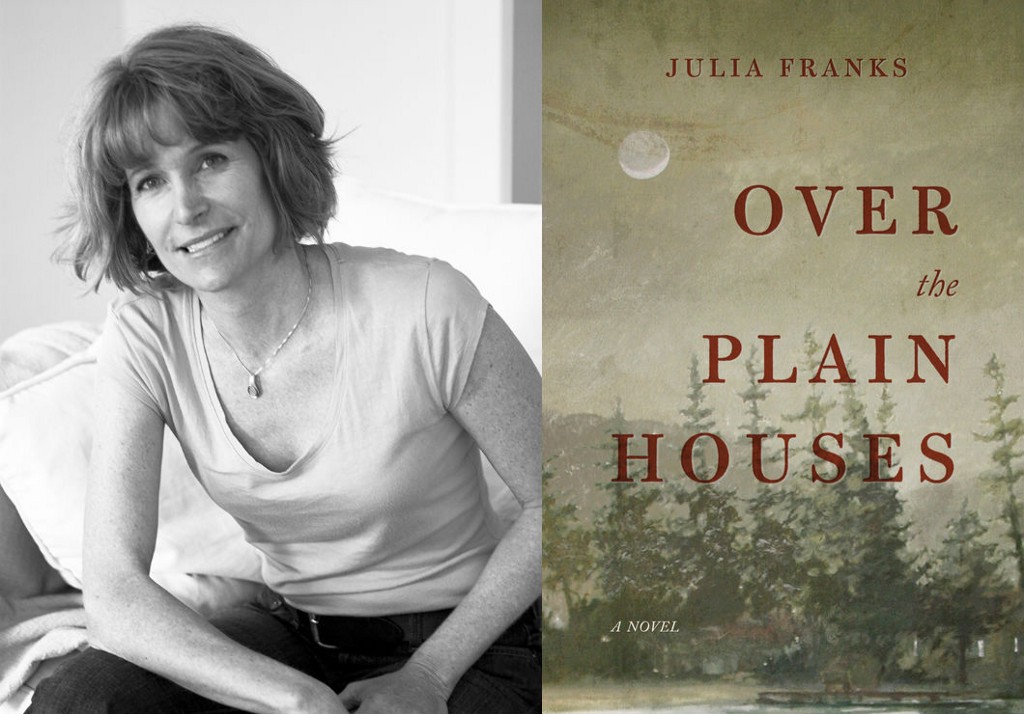
Set in a small Appalachian village in 1939, Julia Franks’ debut Novel Over the Plain Houses (Hub City, 2016) tells the story of preacher Brodis Lambey and his wife Irenie, who struggle with the forces of modernization that arrive unbidden into their sheltered mountain community and drive a wedge into their marriage. Dealing with such issues as the government’s role in the lives of individuals, the responsibility of humans toward the environment, and the place of women within their communities, the book feels at times remarkably contemporary. With careful attention given to the Appalachian landscape and an intimate feel for the tensions of society played out within a single family, the novel is a striking portrait of a place in transition, told by a gifted storyteller. I sat down with Julia recently in Atlanta to discuss her love of the outdoors, her literary influences, and her role as an educator.
Bronwyn Averett: The first thing I noticed about your novel was its incredibly vivid portrayal of the Appalachian landscape. Can you talk about your background a little, and what leads you to be so familiar with the mountains?
Julia Franks: I spent a lot of time outdoors growing up. And my parents are both very big outdoors people. So my dad was a Vietnam vet. Some vets come back and they go “Oh I never want to go camping again ever in my whole life.” And others, they want to be outside, you know, they want to be in the woods. My dad was the second kind, and my mom was pretty outdoorsy too. We just spent a lot of time in the woods. So other people would be going to Walt Disney World for their vacations and we would be going backpacking. You don’t really realize it’s weird until about middle school. But I was very comfortable going outside from a very young age.
Averett: Irenie is very much the figure of the Appalachian woman. She knows the woods so well she can walk them in the middle of the night. She knows how to go out and collect plants that have medicinal uses. She knows how to preserve all the food she needs. When I read her I was reminded of these Tennessee mountain women who are sort of legendary on my Dad’s side of the family. Was Irenie based on any women in your family, or anyone you know?
Franks: She is based on a person I never met. In 2008, my husband and I — I was married at the time — we bought a property in Western North Carolina, on the backside of Tennessee. And it’s a very long story but it was one of these homesteads that had been there since the middle of the 19th century. And the husband had died and the wife had lived there basically until her grandkids had taken her to a facility. And they never cleaned out the house.
So we get to this house that’s built in 1865 and it’s full of stuff. She collected stuff and she would save things in jars and she would label them. The house was full of these containers with these labels, and she saved weird things like teeth and fingernails. I never met her. But if you’re a novelist and somebody leaves you a house full of stuff that’s labelled, and boxes of letters and diaries, you’re gonna ask yourself: what were these people like? What were their lives like? So I guess you could say Irenie is based on how I imagined this woman. And her husband was a circuit preacher. They were both eccentric, and people told us a lot of stories about them. In fact, the story of the hawk is a true story. I wish it weren’t, but it is.
Averett: This is the moment in the book where Brodis traps a hawk because it is killing their chickens. And Irenie protests, saying that no one in her family has resorted to that kind of violence in the past. Between them, there seem to be conflicting ideas of how to run the land. Brodis wants to control it, and Irenie wants to live with it. Are these different ideas of stewardship?
Franks: Brodis has a very Old Testament view. He uses the word “shepherd” — that it’s his job, to shepherd his family and shepherd the land, and he has his way of doing it. And it’s not out of the question if you’re a farmer to kill hawks, to kill foxes. But really Irenie is the exception, saying that she doesn’t want to kill these predators, who are preying on their livelihood. If you take a step back, you can see where Brodis is coming from. It’s just that even he questions if that’s the right way to do things.
Averett: The conflict here is also indicative of Irenie being more connected to the land than Brodis. And it’s partly from her familiarity with the land that he starts to think she is a witch. Where did that come from?
Franks: I don’t know where the witch idea came from. It was very early part of the story. If I had to guess, I think it just comes from being a woman in this culture. This is what we do. When women don’t behave the way we want, we demonize them. Look at the upcoming election. There’s a certain demonizing that can happen when you’re strong. We might not call a woman a witch, but we find other ways to demonize her. If you’re fearless, you’re demonized. It’s a way of making you not as human. It’s a kind of marginalization.
When women don’t behave the way we want, we demonize them.
Also, Irenie is doing things she wants to keep from her husband. She has her own interior life that she keeps from him, which is the real thing that he senses, that she has this life that she has not shared with him. So Irenie is ascribed these powers that she doesn’t have. She’s just struggling with these really basic things, like how not to have a baby.
Averett: And that’s something that she finds help with through her friendship with the USDA agent. Why did you choose to focus on the story of a figure from the government who comes in and tries to modernize this “backwards” village?
Franks: It was a thing that happened in that area of the country. There were a lot of government agencies and charity agencies and church groups that came in and wanted to help, with good intentions, that sometimes went awry. The traditional way of farming was sustainable, in the sense that you’re growing everything you eat, and most of the things you use. So barely sustainable, subsistence farming. But it worked, and it was a model that had some advantages. And when the Depression came along, those people who were growing everything they ate were not that effected. They were already poor, and they weren’t as effected by the outside economy, because they weren’t interacting with the outside economy.
Averett: Did these conflicts, especially the distrust of the government, feel contemporary to you when you were writing?
Franks: We’re in this moment right now, where angry, rural, white men are in the spotlight. When I wrote this they were not. But now it does feel very contemporary. But Brodis does have reason to be angry. His wife left him and his economic livelihood is lost. And this profession that he used to love he no longer has access to. But what do you do with that anger? And this is the question that feels relevant right now — what do you do with this anger and frustration?
Averett: There is a certain timelessness to the theme of anger caused by a changing world. It’s something that all writers deal with in different ways, but it does strike me as something that Southern writers have been particularly attentive to. Were you influenced by certain voices as you began writing?
Franks: Well, Flannery O’Connor is a pretty clear influence. And Faulkner and McCarthy. And you can almost put Martin Luther King in the same pocket as them, in terms of syntax. They all use a lot of King Jamesian syntax. And then I have to say Charles Frazier, because he’s a personal favorite. His constructed linguistic world is wonderful.
Averett: Do you situate yourself in a particular Southern tradition? The South is composed of so many different communities, and there are so many different styles and concerns in the literature. Do you find yourself somewhere specific in all of that?
Franks: Now I’m being called an Appalachian writer. And my aunt is actually Mary Lee Settle — an Appalachian writer who won the National Book Award, which I’m hoping is a gene that can be passed down! So in terms of my roots, that’s the area I most identify with in the South, even though I live in Atlanta.
Averett: Does living in Atlanta at all influence the kinds of things that you think about and want to write about?
Franks: Yes, just because this is a lot more racially diverse than Appalachia. And that reminds me of another Southern writer I admire: Zora Neale Hurston. Everyone got so irritated by what she did with dialogue. But if you look at a huge percentage of Southern literature, white people speak in non-dialect, and black people speak in dialect, these ways that have been phonetically modified. White people drop their g’s. And white people don’t pronounce the “t” in Atlanta. But we never see it rendered phonetically on the page if the person is white. And I’ve seen it that way in history books too! It’s incredibly patronizing. So even though people didn’t like how Hurston rendered dialogue, at least it was even-handed.
Averett: I’m sure you find a lot of opportunity to discuss these kinds of things in the classroom. Would you mind saying a bit a bit about how you see your role as a teacher?
Franks: Some people teach because they want to write, but I’m actually very much an educator. One of the things I’m working on is to change the way we teach literature in secondary schools. I think what needs to happen is that kids need to have more choice. This is a bit of a crusade for me. I started a web-based business, Loose Canon, which is a resource for teachers to manage free choice in the classroom.
When you give them choice, the difference is crazy. I had all these seniors, a bunch of boys, and I could tell they weren’t reading. So I said at the beginning of the second semester: you can either read the books here on the syllabus, or you can read twice as many books that you choose. Of fifty kids, every single one of them chose to read twice as many books. And yeah, some of the books were lightweight, but a bunch of these boys got on a Cormac McCarthy tear. And really they’re these Cormac McCarthy experts now!
Averett: So how is that different than what the “powers that be” in education want for students and reading? What do you want?
Franks: They want kids to be reading books that are too hard. Fewer books that are harder. But we need volume. We need inundation. We need a firehose of books. And some of them will be powerful and some of them will be part of the water.
Averett: Here’s the hard question for you though. It’s obvious for people like us who love books, but for much of the world it isn’t. Why is it so important that young people read? Why shouldn’t they take more math classes?
Franks: To paraphrase Tim O’Brien, when you’re reading literature, it’s the only time you’re in somebody else’s head. It’s the only time you’re going to be inside the head of a 16-year-old cowboy. It’s the only time you’re going to be inside the head of a soldier in Vietnam. Narrative will always live on in these other forms, movies and video games. But nothing is like reading. People who read literary fiction have a different level of empathy.
Cormac McCarthy Is Dead. Long Live Cormac McCarthy
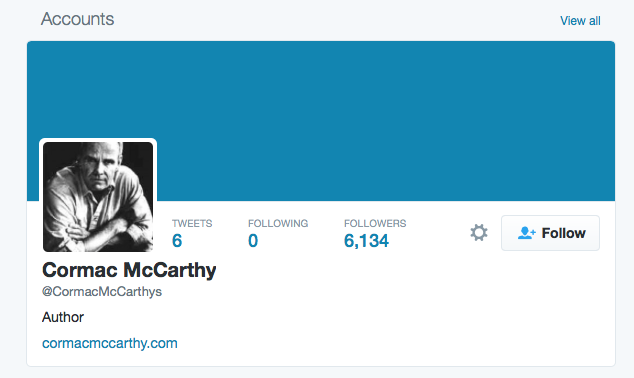
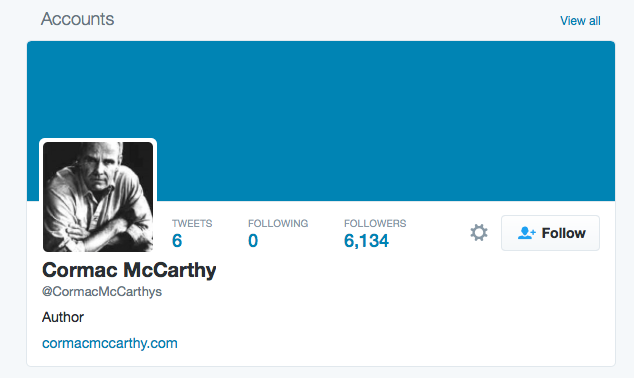
Cormac McCarthy’s fake twitter page
Yesterday, a fake Twitter account designed to look like Knopf (@aknopfnews) announced that Cormac McCarthy had died at age 81 from a stroke. USA Today quickly picked up on the news and retweeted it, leading to a frenzy of concern that the author of novels like The Road and No Country For Old Men had passed away.
It was soon revealed that the news was a hoax by Italian journalist Tommasso Debenedetti. Debenedetti has created fake accounts for authors in the past (DeLillo, Marquez, Munro) but Twitter seemed to enjoy the idea that McCarthy, he of guns, blood, and apocalypse, had survived death (or maybe as McCarthy would put it, survived being buried alive.)
Cormac McCarthy is alive and well and still doesn't care about Twitter.
The gods of Asgard are coming, courtesy of the author of Coraline
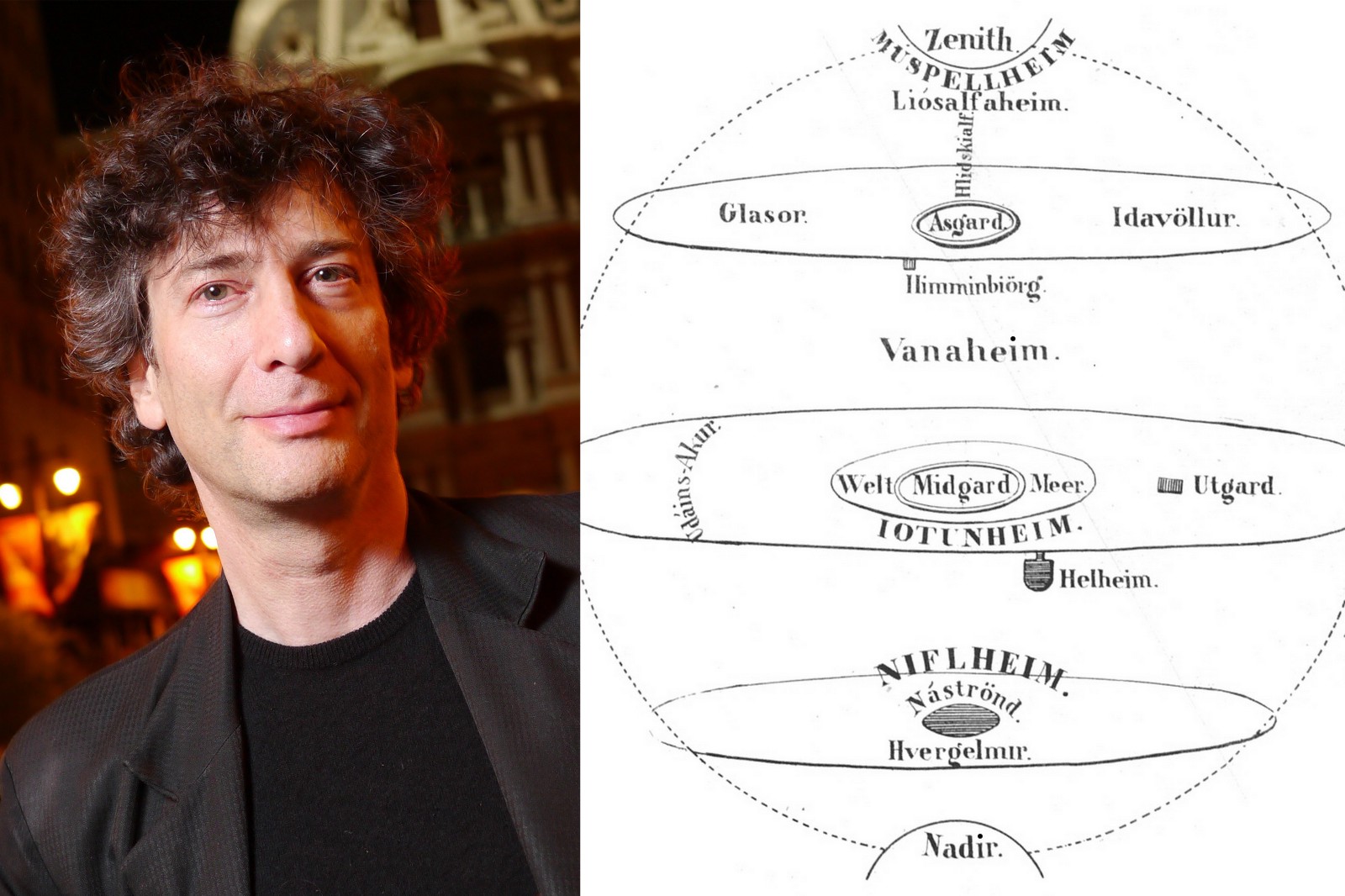
8Author Neil Gaiman, The Nine Worlds of Norse Mythology
Neil Gaiman, author of Coraline and The Sandmanseries of graphic novels, has written a novelistic retelling of the Norse myths to be published by W.W. Norton in February. Gaiman has been interested in Norse mythology since he was a child and their influence is stamped on much of his writing, from the appearance of the Loki and Odin in his children’s book Odd and the Frost Giants to his fantasy novel American Gods.
The new book, Norse Mythology, will begin with the genesis of the nine worlds and continue through the tales of Odin, Thor, Loki, and the rest of the gods on Asgard.
Gaiman told his publisher, “To get the opportunity to retell the myths and poems we have inherited from the Norse was almost too good to be true. I hope the scholarship is good, but much more than that, I hope that I have retold stories that read like the real thing: sometimes profound, sometimes funny, sometimes heroic, sometimes dark, and always inevitable.”
The Fourth of July is just a few days away. What better weekend to do some revolutionary reading? There are thousands of books about the American Revolution you could pick up on your way to the beach or to that backyard cookout, from schooldays favorite Johnny Tremain to David McCullough’s monumental 1776. But the American colonists were hardly the first, or the last group of rebels to band together to fight for their independence.
This year, why not look abroad for your Independence Day fix?
The desire for independence seems to unite cultures around the globe. The Merriam-Webster Dictionary defines independence as the time when a country or region gains political freedom from outside control. Dictionary definitions can only go so far in the best of times, and here it falls far short of encompassing all that independence means. Fortunately, there is literature.
The novels on this list encompass the many aspects of the struggle for independence: the spark of freedom, the violence (often terrible), the loss of life, the stress of self-realization and the questions of identity that follow.
Revolution isn’t pretty, but the stories that emerge are always compelling.
It’s hard not to love the set-up for Rushdie’s Booker’s-prize winning novel: 1,001 babies are born at the stroke of midnight on the eve of India’s independence from Britain, each imbued with special powers. The book follows one baby in particular, Saleem Sinai, as he grows up and his family migrates around the subcontinent. Using a blend of allegory, magical realism, and historical fiction, Rushdie intertwines Salem’s growing pains with the growing pains of a new nation, and a country newly divided.
Like Ireland herself at the turn of the century, Henry Smart is born without status or privilege. Surviving the slums of Dublin with an alcoholic teenage mother and a one-legged, whore-house bouncer of a father prepares Henry to fight, and fight he does. Henry becomes a soldier and hit man for the (real life) leader of the Irish Citizens Army, Michael Collins. What makes Doyle’s novel such an interesting read is his ear for voices and setting. Lest you forget, the Irish revolution didn’t take place in a vacuum, it took place on the rowdy, rumbling streets of Dublin.
Set in the mid 1970s, Gordimer’s novel follows Rosa, a white Afrikaner whose parents are anti-apartheid activists in South Africa. Rosa’s parents are imprisoned for wanting to overthrow the South African government and, after they die there, Rosa is left to deal with their legacy. Gordimer’s book, which was banned in South Africa, asks some difficult questions about the fractured struggle for independence and how a multiracial society could come together after Apartheid fell.
The Iranian Revolution: Persepolisby Marjane Satrapi
Satrapi’s story of growing up in Iran during the Islamic revolution makes for a powerful graphic novel. The revolution occured in 1980, when Satrapi was six, and she details how her life changed under Islamic law, from wearing a veil to a sudden segregation from the boys at her school. Satrapi’s memoir reminds us that revolutions bring change, whether its welcomed or not.
The Mexican Revolution began in 1910 when President Porfirio Díaz was ousted from power. Fuente’s dreamlike novel begins years later, when ruthless ex-soldier and businessman Artemio Cruz is on his deathbed. The novel is a series of flashbacks recalling Cruz’s life and how he capitalized on the time of war to kill, blackmail, and bribe his way to power.
The October Revolution of Russia: Doctor Zhivagoby Boris Pasternak
This epic novel traces Dr. Yury Zhivago from his childhood in czarist Russia through the October revolution and the Russian Civil War, ending during Stalin’s regime in World War Two. As the revolution unfolds, it becomes clear to Zhivago that there’s more than one way to be a dangerous citizen: through violence, or by becoming a stooge of the revolution. It’s a sad revelation that after fighting for independence from the Czar, independent thought is crushed in the name of Mother Russia.
The American War in Vietnam: The Sympathizerby Viet Thanh Nguyen
In English-language literature and film, the story of the Vietnam War has mostly been told though the eyes of Americans. In his Pulitzer Prize-winning novel, Viet Thanh Nguyen gives us the view from the other side, namely a Vietnamese army captain who’s living in the US as a spy. This is a story of a war for independence; Vietnam had just freed itself from the shackles of French imperialism when it came under the American sphere of influence. But for the captain, as for most Vietnamese, there is an added layer of misery, because as North fought South, it was a civil war as well.
This novel by Dai Sijie takes on a different kind of war of independence. During Mao’s Cultural Revolution, two teenage boys are sent from their home in Chengdu to a mountain village to be “re-educated.” During their time in the village, they meet the “Little Seamstress” and all three become romantically involved. Love triangle aside, this novel is motivated by the boys’ relentless quest for the art and culture they’ve been forced to abandon. Mao’s forbidden music, literature, and films are a defining part of the boys’ identities and they risk everything to keep them.
Yusuf Idris set his award-winning novel in a specific time and place: Cairo, January 1952. The proceeding months saw the demise of the Egyptain monarchy under King Farouk, a puppet government controlled by the British. City of Love and Ashes is the love story of two young rebels, Hamza and Fawziya, as they fight for Egypt’s freedom and grapple with the question of how to shape a post-colonial identity.
A Tale of Two Cities is one of the most famous novels about the French Revolution (and has one of the most quotable opening lines). The novel jumps back and forth between London and Paris and a wide cast of characters, first exposing the brutal life of French peasants — and the British poor — in the years before the Revolution. As the French Revolution unfolds, the violence, unwarranted imprisonment, and general misery ramps up. The final scenes point to a hopeful future for France, but as with most revolutions, Dickens underscores that the cost to human life is high.
DON’T MISS OUT
Sign up for our newsletter to get submission announcements and stay on top of our best work.
YOUR INBOX IS LIT
Enjoy strange, diverting work from The Commuter on Mondays, absorbing fiction from Recommended Reading on Wednesdays, and a roundup of our best work of the week on Fridays. Personalize your subscription preferences here.