The Last Station: Gentrification, Fire and Protest in Istanbul

I was seventeen years old when I arrived at Haydar Pasha Station in Istanbul. I got off the train and walked down the marble steps where the Station met the sea. Instead of admiring the Station’s magnificent facade, I stared at the old city across the Bosphorus. I saw Istanbul for the first time then.

I had taken the Blue Train the night before at eleven o’clocks and reached the last stop at eight in the morning. Haydar Pasha Station was the end of the railway line on the Asian continent. There began the sea, then Europe. I came to Istanbul to study law but I was more excited with the city itself than studying at the university. It was a warm day. I could see historical buildings through a thin fog: the city walls, the roofs of Topkapi Palace, the dome of Hagia Sophia Church and the minarets of the Blue Mosque.

Whenever I recall that moment I think of what Herman Melville wrote about his visit to Istanbul in 1856. It was a few years after the publication of Moby-Dick. He was an unsuccessful writer despite his great books and was still floating from one sea to another. He wrote in his diary:

“The fog lifted from about the skirts of the city. It was a coy disclosure, a kind of coquetting, leaving room for the imagination and heightening the scene.”

I sensed on the first day that Istanbul would always embrace me with a light curtain of fog. Any time I would return to Haydar Pasha after school holidays I would meet Istanbul through that curtain. As the years roll on I now realise that my past has become more distant, the fog of my old days are denser, and the Station’s vivid times are vague.

Istanbul Fog, by Aviad 2001

Haydar Pasha Station was designed as the beginning point of a railway line towards Asia-minor and improved to accommodate the northern terminus of the Baghdad Railway line in 1904. Because of increased traffic, a larger building was needed, and two German architects, Otto Ritter and Helmut Conu, were appointed to carry out the job. They chose a neo-classical style to build the new station. The origin of the Station’s name is not certain but it is assumed that it was given in honor of a high ranking Ottoman officer, Haydar Pasha, who had served to the Sultan Selim III.

It is rather a gate opening to a great city than a mere station. As you come out of it you see a few steps going down to the pier where a ferry takes you to the city. It is the spot where Istanbul and the rest of the country unite. Trains carry people from small towns in the provinces to that picturesque spot by the Bosphorus.

The poetry book of Human Landscapes From My Country by Nazım Hikmet begins there, in front of the Station:

“Haydar Pasha Station,

spring 1941,

3 p.m.

On the steps, sun

fatigue

and confusion.

A man

stops on the steps,

thinking about something.

Thin.

Scared.”

It is not a coincidence that Nazım Hikmet picked Haydar Pasha Station for the opening of his grand book. It is a kind of verse-novel: 17,000 lines describing different people, through whom a whole picture of a country can be seen. Hikmet (1902–1963) is regarded as the greatest poet of modern Turkish literature. He began to write Human Landscapes during the Second World War, while in prison, serving a twenty-eight-year sentence for his communist beliefs. He gave the stories of the people on the train — in its cars, its restaurant, in the locomotive — and talked about their past and their dreams. He used his pen in a cinematographic way and presented the collective memory of a nation, alongside its fears and hopes, in an epic style.

If you are an author in Turkey you are destined to write about Istanbul sooner or later. I have come to that point in my third novel, Istanbul Istanbul. When I was working on it, my mother — my lifelong advisor — asked me what I was writing about. “About Istanbul,” I said. There was a pause on the other end of the telephone line. “The train station,” she said with a tender and confident voice, “you should not forget to mention the train station.” I scanned my mind to recollect what I had been covering in my novel. Writing about Istanbul required plenty of work. I had done my research, taken notes down and formed stories. But on hearing my mother’s words, I realized that I didn’t have a story taking place around Haydar Pasha Station. She, an illiterate Kurdish woman from rural Anatolia, opened a crack in my mind, as she had always done with her fairytales when I was a little child. She had fed me not only with milk but also with stories about rascal jinnies, faraway seas and invisible cities. And now she once again blew her breath into my chest and led me to put some ornaments of her mind into my novel. In Istanbul Istanbul there are some pages, like the opening story of chapter nine, written and designed in line with her wish. It is a story that takes place on the steps of Haydar Pasha Station, where helpless lovers fall in despair and at the same time find a glimpse of light. They are the same steps where Hikmet’s Human Landscapes began.

There are some cities you don’t need to see in order to fall in love with. Istanbul is one of them. I had fallen for her before I arrived at Haydar Pasha Station. I knew her through stories, novels, paintings and songs. But meeting her was not easy for a boy of seventeen like me. The speed, the enormity, the finely tuned chaos of the city was a world away from where I grew up, a small town in the middle of the plains. And the times were not easy for the people of Turkey either. There had been a military coup a couple of years before, in 1980. A heavy atmosphere was hanging over the city. Curfews, prohibitions, tortures, and book burnings were part of daily life. But despite all this, we had dreams in our hearts. We had an imagination of another way of life. We knew Istanbul was not a calm city to live in. The cost of living was high, and there were unemployment, traffic, crime, and intolerance. But it has always left room for the imagination as Herman Melville wrote: “The fog lifted… leaving room for the imagination.

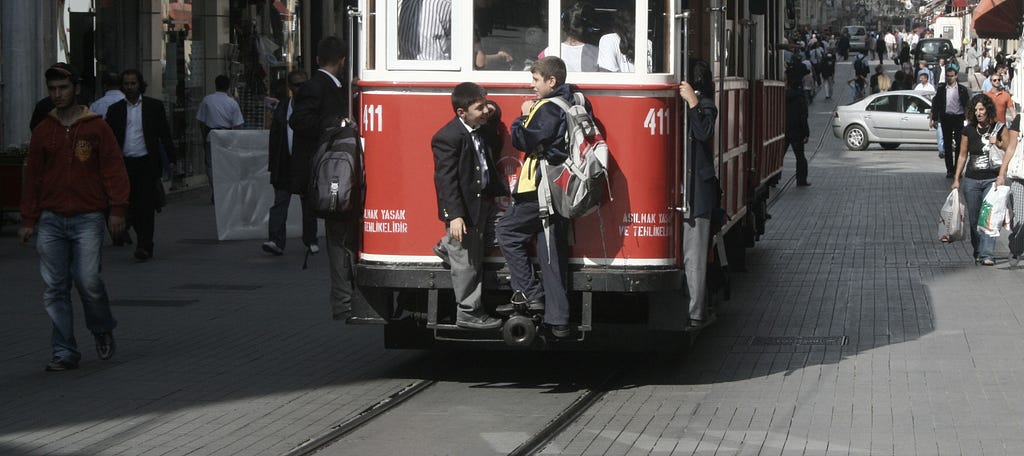
İstiklal Caddesi Tram

In France they say, “All poets are born in the countryside but die in Paris.” Istanbul has the same essence. Our poets and writers pen shady lines or lively scenes and indicate through them where they should be buried. Some acknowledge Istanbul as the junction of historical geographies, the meeting point of East and West. Some see it as a land of desire and mysticism and relate it to past eras. The Turkish poet Yahya Kemal, the short-story writer Sait Faik, and the novelists Ahmet Hamdi Tanpınar and Orhan Pamuk have approached Istanbul from different perspectives. Each of them has created his own city, unlike the others in its literature.

When you are underground there is only one direction that matters: upwards, toward the sky.

In Istanbul Istanbul, I wanted to portray the city as the unification point of time and space and the melting pot of opposing tendencies in life. I preferred not to talk about past golden ages. That approach has already been used up in our literature. In my novel, space and time converge on a prison cell three floors underground. When you are underground there is only one direction that matters: upwards, toward the sky. Time moves differently underground. On the surface, time is linear — past and future eclipse all else, and what matters is less where are you than where you’re going. Underground, past and future mean nothing. There is only the eternal, often agonising, now. By focusing my novel on prisoners in a subterranean cell, discussing the city above, I wanted to unite time and space, hope and hopelessness, darkness and brightness. They are all together and one. Istanbul is the name of that wholeness. Wherever you were born, you come to Istanbul to be part of its wholeness.

Istanbul is too real and at the same time too ambiguous. It makes possible both good and bad. When I was in one of those interrogation cells I felt the underground was the place for evil, while aboveground seemed to be the place for good. But instead of writing about good and evil, I wanted to explore the shades between them and to show how they exchange places.

Istanbul as a metropolis is not only the heart of this country but also the future of it. The beautiful and the ugly in Istanbul reflect the future of our people. That’s why it is now also the heart of our politics.

The Conservative bodies believe in the past. They think the best days are behind us. With passed utopias before their eyes, they don’t hesitate to ruin the present. They are wiping out the city’s green areas and constructing tall buildings. They call it progress. That’s why people feel obliged to defend this city against greediness. And now the word ‘beauty’ is not only an aesthetic word but a political word, too. When people call for beauty in Istanbul, the responses they get are police, tear-gas and the rise of construction firms in the stock market.

And now the word ‘beauty’ is not only an aesthetic word but a political word, too.

In the tales of my childhood there was always a place for heroes to suffer and then emancipate. Istanbul is now the place of both suffering and emancipation in our contemporary writing. We write about Istanbul with the hope that its beauty will shape our future.

After having witnessed two world wars, the invasion of the British army and the exile of Armenian intellectuals, the Haydar Pasha Station met its latest disaster on 28 November 2010, when a fire began on top of the roof. The fire was stopped before it was too late, but following the fire the station was closed down.

It was a suspicious fire. It came about the same time as legal debates were being held regarding Haydar Pasha Station and its surroundings. The government wanted a new development in the area, turning Haydar Pasha’s castle-like building into a fancy hotel. But the public opposed it and the legislative charter for the development was suspended by the court. Various international institutions, like the New York-based World Monument Fund, have added Haydar Pasha to their agenda, emphasising the uncertain future of the railway.

Haydar Pasha solidarity defending the station

Local authorities promised to renew railway lines and resume train journeys again by the end of 2015. But not a single rail line has been renewed so far, nor has there been any sign of reopening the Station. Istanbul dwellers are aware that Haydar Pasha might be another victim of urban gentrification. That’s why they have formed a new civic organization under the name “Haydar Pasha Solidarity” and launched an effort to save the Station, organizing concerts, exhibitions, and demonstrations. They also read out some lines from Human Landscapes, where Nazım Hikmet, many years ago, pointed out the merciless face of urban gentrification, which tears apart past and present:

“Concrete villas.

Lined up all the way to Pendik.

The trees are mere saplings,

the grapevines just greening.

The 3:45 train goes screaming past.

Concrete villas.

The Secretary Pasha’s summer house,

a forty-room marvel,

has been torn down.

Now it’s concrete villas,

concrete villas

all the way to Pendik.”

About the Author

Burhan Sönmez is the author of Istanbul, Istanbul (2015), Sins & Innocents (2011), and North (2009). He was born in Turkey and grew up speaking Turkish and Kurdish. He worked as a lawyer in Istanbul and was a founder of the social-activist culture organisation TAKSAV (Foundation for Social Research, Culture and Art). He has written in various newspapers and magazines on literature, culture and politics. He was seriously injured following an assault by police in Turkey and had to move to Britain to receive treatment with the support of Freedom from Torture in London. He now lives in Cambridge and Istanbul.

It Is Strange to Be a Human: an Interview with Author Chelsea Martin

I think of Chelsea Martin’s work — her chapbooks Dream Date and What I Want and What I Want, her book Even Though I Don’t Miss You, and her most recent project, Mickey — as a body of writing that resists categorization, resists genre, and — to some extent — resists interpretation. They feel more like experiences than books, though one is always cognizant of the fact that they’re of course both. She’s a master of tonal management and a sentence-level stunner, packing big wallops of feeling in small sections of text. I envy the way she writes about the gestures both large and small that constitute a togetherness between two people; the ways in which even the most seemingly benign of these gestures can be extremely fraught and consequential, and the way the seemingly grand gestures can land wholly misperceived, or else unnoticed altogether. She writes that element, that dynamic of disconnect and contradiction in relationships, especially the relationship one has with oneself, unlike anyone else I’ve ever read, and I am forever in anticipation of what she puts out into the world next.

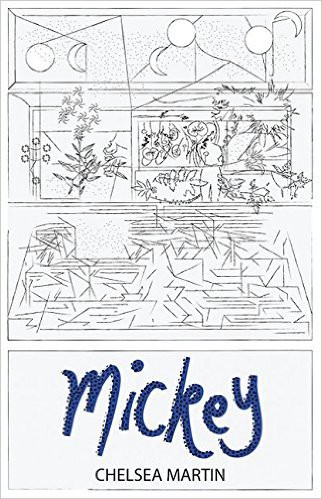
It was a pleasure to speak with Martin about her work — specifically her latest project, Mickey, a novel out now from Curbside Splendor Publishing.

Vincent Scarpa: I know that poets and fiction writers alike often have to face the presumption that the “I” in the work is the writer herself. Reading interviews with you, though, it appears you face that presumption more than most. It seems like this happens more often to women writers, for reasons I don’t claim to have a full understanding of but which I suspect have something to do with power relations. In your chapbook What I Want and What I Want, the disclaimer in the beginning reads, “Some of these pieces originally appeared as fragments of real life conversations, but don’t worry, I’m perfectly stable and particularly non-crazy. Ask almost anyone.” Which seemed to me a rebuke — or, at the very least, a tongue-in-cheek acknowledgment — of this presumption. It reminded me of something Grace Paley said about her character Faith, from whose perspective she wrote many stories. When asked if she was in fact Faith, Paley responded, “No, she works for me.” I wonder how all of this affects your writing, if at all, and if you’re setting out to blur the line between fact and fiction in your work, specifically with Mickey, your latest.

Chelsea Martin: I do get asked about this a lot, and I don’t understand why. Creating a character that feels real is a pretty standard thing to try to accomplish. The fact that I am creating characters that are not entirely different from myself also doesn’t seem original. And what if my narrator was based in part or entirely on myself? Is that… interesting? I mean… how would it be more or less interesting to a reader? That’s what I keep wondering when I’m asked about this.

I wouldn’t say I was setting out to blur the line between fact and fiction while writing Mickey. (Maybe I was doing that in my last book, Even Though I Don’t Miss You, by naming the protagonist Chelsea.) I think I would say it was closer to trying to “become” the narrator while writing her. I wanted it to feel like her book, and not a book that had been written about her. I assumed readers would believe that she was me, or at least a version of me, and I was fine with that because I think this closeness allows the reader to trust/believe in the character more. I also have my own sense of humor that I work into most of my work. So that probably takes away from the characters feeling different from one another/fuels the presumption that they are all me and not characters. I’m fine with that.

I also tend to write things that are personal and meaningful to me. Not personal as in these are exactly my experiences, but they are experiences I care about for one reason or another. There are a few real conversations I’ve had that ended up in the book. A few details and things that are based in reality or on people I know. I don’t think writing from your experiences is that unusual in fiction.

VS: One of the things I admire most about your writing is its distinctive syntax, a word I use a fair amount which I suppose really just means I like the way the sentences sound. They feel simultaneously organic and worked, scored. It’s hard to pick just one, but this one feels exemplary of what I’m getting at: “I keep telling myself that what I am going through now could be compared to a breakup, even though what I am going through is precisely a breakup.” (Or, as an alternate, “The music was almost as boring as the company.”) I sense, reading your work, the way I do reading someone like Jo Ann Beard or Mary Robison, a voice on the page that is unmistakably unique to the writer. Do you read your work aloud in drafting? Is there much tweaking from line to line in revision? Or do the sentences just come out this way — endearingly caustic, sometimes biting, sometimes quietly devastating. It’s a trademark of your work, I think: this mastery over tone at the level of the line.

CM: Thank you. No, I don’t read aloud while writing. I am obsessed with privacy in early stages of writing and would never risk anyone hearing me. Sometimes sentences come out pretty good the first time I write them, but mostly, yeah, there is a lot of tweaking.

VS: Reading the novel, I was reminded of a sentence from a Lydia Davis story in which she says, “As soon as there is less in a story, more of it must be in the center.” Mickey, like so much of your work, feels stripped not just of excess, but of certain kinds of narrative conventions altogether, thereby placing the voice and the observations it makes in the center, as the engine of the text. What attracts you to this kind of form, this modality of writing? Or is it inverted — is it the form and style that found you?

CM: Mickey is an emotional book, and short fragments are the most natural way to express an emotional mindset. I think the fragmentary style works well for capturing these disjointed or contradictory thoughts without having to address the disjointedness. Each thought gets its own page, space to be its own thing, without having to directly reflect all the other competing fragments.

That’s the value I see in the style as I see it now, having mostly finished writing it over a year ago. I don’t like to think a lot about why I’m making artistic choices while I’m working. One thing I learned in art school is that if you’re analyzing the meaning of your work as you’re making it, you’re going to find a lot of things to be critical of, and you’re going to want to change what you’re doing so that you’ll be able to talk about why you did it this certain way. I think art that has all these reasons for existing and being a certain way tends to be boring or flat. I like art that explores something that isn’t figured out yet, an exploration of a feeling that is trying to surface, however messy.

Original artwork by Chelsea Martin for Recommended Reading’s 200th issue.

VS: In many ways, Mickey seems to me to be a book about indecisiveness, about diametrical opposition of mood, thought, and action. I can imagine someone in a creative writing workshop saying that the narrator is “unlikable” or “difficult to understand” for this reason, and perhaps it’s because I’m either or both, but I find her all the more realistic precisely because of how mealy-mouthed she can be; precisely because of her dithering. She feels the most human to me, the most alive, when she’s pursuing something or someone she knows she doesn’t want, or won’t want for very long. Isn’t contradiction the most honest way to report one’s state? There’s a passage toward the beginning where the narrator seems to address this: “It shouldn’t be assumed that I want to be a sympathetic character in the story of my life, because that would imply that my actions are designed to convey something that other people might find attractive or relatable instead of my actions having their own meaning, separate from others’ interpretations.” I wonder if you could speak to this a bit.

CM: I didn’t intend for her to be likable, but I don’t find her unlikeable, either. I like her. I agree that she might seem difficult to understand, but I don’t know why that would take away from her likability. Most people are difficult to understand. I find myself difficult for me to understand. Part of what makes me interested in being alive is trying to understand why or how I make the choices I make. That’s what makes me interested in other people as well.

It seems like people really shy away from their own contradictions.

It seems like people really shy away from their own contradictions. They don’t want to admit they’re contradicting themselves, or they try to reframe things so that it seems like there are no contradictions. I think people do this so that they seem reliable or logical to other people, so that those people will trust them, but they are actually deceiving people, making themselves less trustworthy, and the whole situation becomes yet another human contradiction.

VS: The narrator makes a few observations about “evolutionary sense” and “evolutionary adaptations,” which is something that showed up a bit in Even Though I Don’t Miss You. I love these moments, because they seem to point to what I think of as the existential question in the margin of your work: For what are we equipped? And what happens when we endeavor to do that for which we have no instinct? If I’ve identified these interests correctly, or if I’ve come close enough, I’d love to hear you talk a bit about why you find these interests so generative in writing.

CM: It is strange to be a human. We are animals, but we don’t act like animals. We live in houses and we stare at screens all day and we express our personalities through clothing and we keep useless objects around for sentimental reasons and we spend most of our lives taking part in a system of currency that makes most people unhappy and we criticize other people for the way they do or do not do these things.

What happened in our evolutionary history that made us, as a people, so quick to get political in YouTube comment threads?

Evolution is an amusing context for these kinds of thoughts because our behavior doesn’t have any meaning when I think of us as animals, as a set of genes struggling to survive to the next generation. What happened in our evolutionary history that made us, as a people, so quick to get political in YouTube comment threads? Are people who closely follow the lives of the Kardashians going to be more or less likely to pass on their genes? And if closely following their lives isn’t going to have any effect on gene duplication, what is it for? What are the Kardashians even for?

Midweek Links: Literary Links from Around the Web (July 13th)

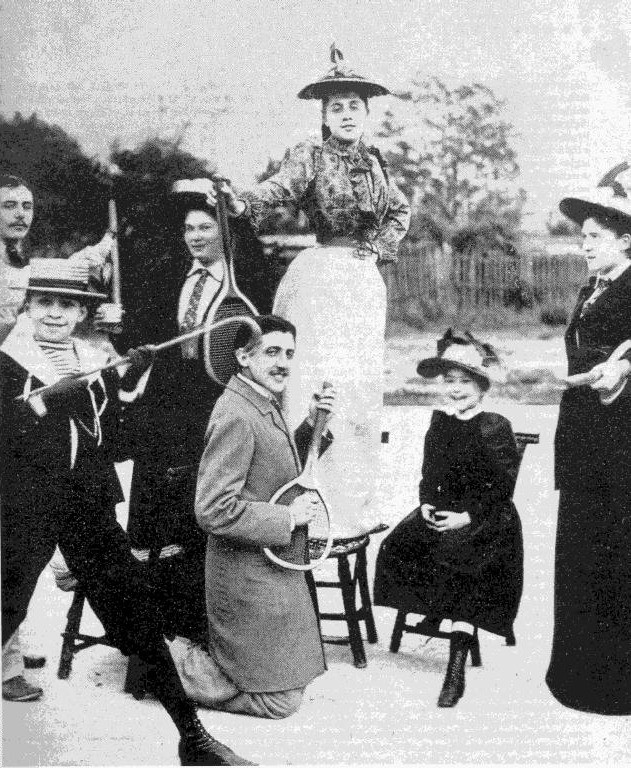
Six writers celebrate the genius of Proust

Five anthologies that are as good as any novel

Apparently Saddam Hussein has a Game of Thrones-style novel coming out soon

Rereading Infinite Jest in the age of addiction

On the history of spiritualism in American fiction and culture

Barnes & Noble will start selling self-published books in their physical stores

A look at what books get nominated for the Man Booker

E. B. White on why he wrote Charlotte’s Web

Celebrating the work of Colson Whitehead

We Are Persistence Runners by Jenniey Tallman

The carnivores are walking single file through the forest and the boars are digging up the potatoes. We fear strangers here, not wild animals. The lanky man is telling me to Run-Run-Run; I tell him I need water and rest, so he can piss off. He is our leader and I love him, but I get ornery when I cannot breathe.

Lilibet and Jorge are hoarding things. I have seen them. We are not to keep anything here but they have a collection. Lilibet has bird bones mostly, but also antlers, skulls, and butterflies. She pierces barberry spines through their gauzy bodies to keep them flat on a sheet of birch bark. It is one of the only rules we have: No Hoarding. Jorge has dug a pit for Lilibet and she stays back when we go hunting. Our leader has yet to find out. He will catch on soon enough.

We are all skinny here, long and tall, and we run barefoot. I can only run for a few miles before my breath starts catching. Shortly after that, I will pass out if I do not slow down and walk, but we are persistence runners and our leader has little tolerance for whatever ails me. He bullies, tells me to Push Harder, and recommends a change of diet. He says we are all weakening and he is disgusted.

Memories slip back in sleep and rush away with the light. I was a sex worker before. It was my livelihood and my passion. I was married. I had a dog, a cat, a child named Max. Some days I took the boy to work and hoped he wouldn’t sneak a peek around the curtain. At night my husband and I laughed at the prospect: What would Max think, to see that? How would we ever explain it?

We are slow here in the valley. Though our run is not fast, by running single file and never stopping we can outlast all sorts. The lions do not even try to get us now. They look at us as though we were a hedge and what does a lion care for a hedge? Sometimes they remember their own histories and grumble about us because they are not our rulers. They know better than to start an upheaval about it. Our leader will stomp them down quick. He runs the children hardest: through the forest every morning and some struggle to keep up. It is for the best. The sight of them running slow and quiet through the trees, leaping over rocks, fatigued but persistent, is enough to remind us.

In my previous life, I pushed carrots into women. That is what I did. I did not touch the women, did not kiss them, did not want them. I peeled the carrots carefully, shaped them just right, pushed them in gently, and maneuvered them just so. The women bent over holding onto the back of a chair. Relax for me, I’d say, breathe out. Okay, here we go. I was good at my job. All the women came to me.

“Orla! Run. Pace yourself. Breathe,” our leader orders me.

My cheeks grow red and my breath catches. There is a name for this weakness I cannot recall. Soon I will vomit and then pass out.

“Orla! Get up. Stop moping there on the ground. Stop being a crybaby.”

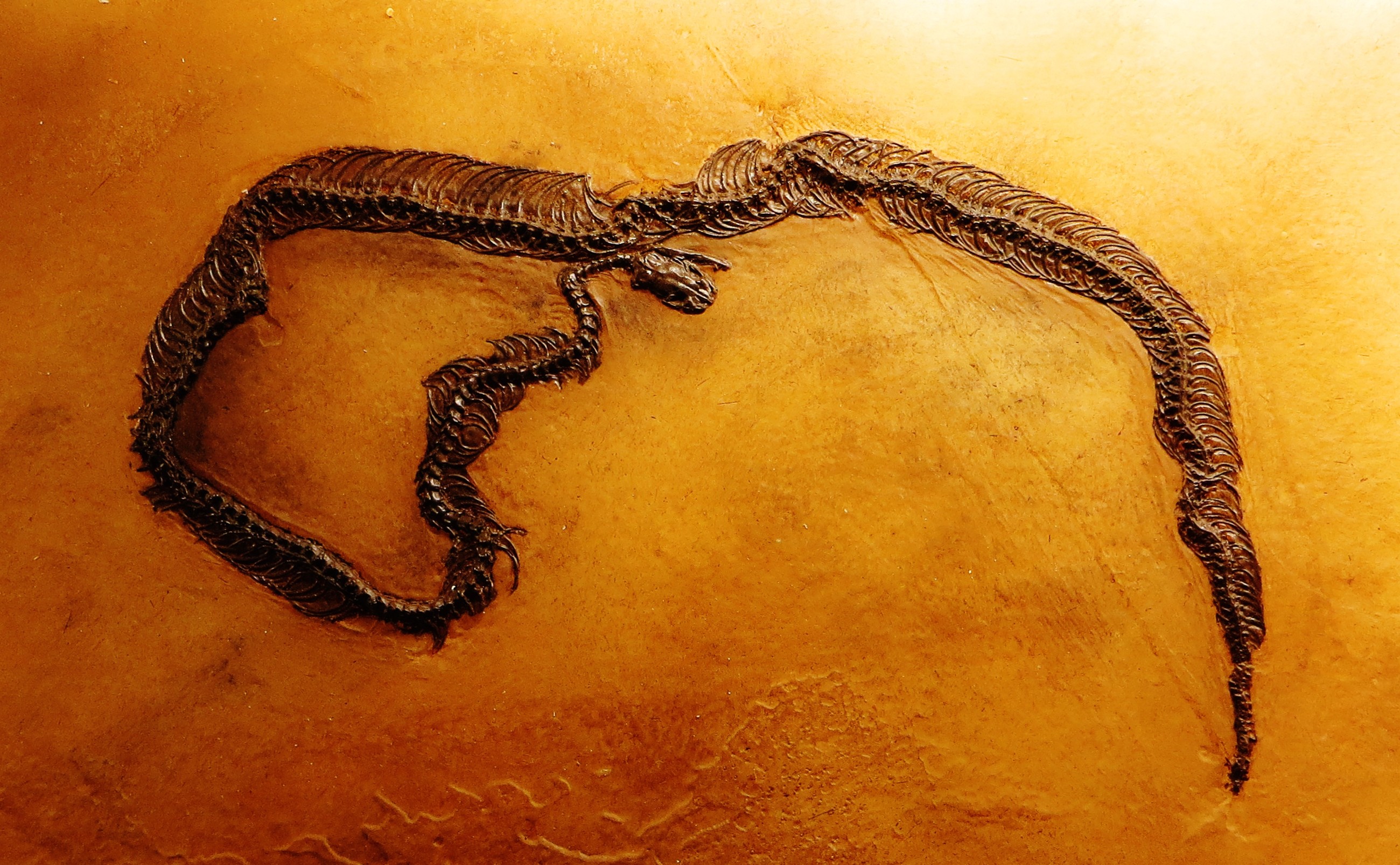
He never touches me when I fall. He never picks me up or offers comfort. Lilibet helps me though. She bandages my wrist, my ankle, my knee. She massages my shoulders, offers me water. Lilibet looks around cautiously before pulling a package out of the ornate leather pouch she keeps tied to her waist. She smiles at me as she gently peels many layers of fresh leaves from the parcel to reveal a snake skeleton, which she dangles up in the light.

“Why do you have that?” I whisper, avoiding eye contact.

She ignores me. “Look at all the tiny bones,” she says. “Isn’t it wonderful?”

I worry what will happen to Lilibet. She is not good at following the rules. “You’ll get in trouble,” I remind her quietly.

She holds the skeleton out to me, nodding for me to take it. It looks so delicate that I think it will fall apart; it is far stronger than I’d imagined. Hundreds of tiny curved bones repeat and narrow until they are nothing larger than a pine needle.

“It’s beautiful,” I tell her, testing the sharpness of the fangs against my finger.

“You should keep it,” she says. “I want you to have it.”

I wrap it carefully in the leaves and store it in a hole I dig beside my sleeping tree. At night, I lie under it and try to guess the name of our leader. Nothing seems to fit. There is a sound that’s just about right, but it’s hardly a name, just a noise. It is the noise his feet make when they thump along, running. Actually, it’s not the noise of his feet. It’s the noise between his feet hitting the ground and the silence that follows. Owing to this, I think of him as Pluh.

I have been in the valley for at least three years, long enough to have come to love this place but not so long I’ve forgotten my family. There are more women than men in our tribe, but it isn’t so easy to tell the difference, especially with the young. They speak to each other in a language barely recognizable, more of a low birdsong than words. When Max was a baby, our language was similar. We spent endless hours chirping and murmuring away at one another and when he was upset, the smallest croak was all it took to alert me to his needs. Some mothers spoke to their babies in words and sentences, urging them to try Mama, yes, and ouch, but I cherished our freedom from language. I turn my eyes from the children, terrified of seeing my son among them.

Men and women are not treated differently here. We do not have separate tasks and procreation is forbidden, as it is everywhere. The children come in ample numbers from the cities to be initiated into the tribe when they reach puberty. We run a pair of them across the river, to the farthest edge of the valley, and leave them there. They are to spend the night alone and then run back to the clearing at first light. Less than half ever return. I was never asked to complete the initiation and Lilibet would never have passed it without help. Pluh prefers the children to us. He says they are Stronger. More Skilled. Devoted.

Lilibet and Jorge arrived out of nowhere with the snow last year and I was sent by Pluh to run Lilibet and a girl he had collected from the cities across the river. He was testing me — testing my perseverance as well as my devotion. Lilibet was much older than most who come here and the girl she was paired with was too young. Leaving them in the snow was not a good idea and I gave them each a ration of jerky out of pity. As I was leaving I felt Lilibet’s eyes on me, pleading. I knew they would never make it back to the clearing. I gave them the rest of the jerky and healing plants I had in my pouch. Jorge snuck out three nights later and returned with Lilibet. The younger girl did not return.

Late at night, gathered around a fire with the other women, histories slip out. One was a lawyer, one was a housewife, one was an evangelical who went door-to-door handing out salvation. Lilibet is an artist and my only friend. Unlike the others here, we still speak of ourselves in the present tense. I don’t think Pluh was ever the leader he is now — most of the tribespeople miss their former selves, but Pluh wears his leadership as if it is his destiny.

Pluh encourages selective disregard for certain undesirable people. A person unfit to run for twenty miles or to climb a steep mountain, to go without food for three days and survive in the harshest of weather will perish and Pluh says it is for the best. He does not see color or gender or age. We should all be Equally Strong, he says. Some would call him a fair leader. I am drawn to his aloof nature, to his charismatic speeches, to his brilliant blue eyes. I wonder whether the other women feel the same.

The first time I passed out, I did not know what was happening. Pluh had been yelling at me to keep up, and though my lungs ached and my knees felt like rubber, I was trying. I stopped to cough and then I was on the ground, below our leader, who wore an expression of confusion — as though my inability to stay conscious was insulting. He soon pulled himself together to begin yelling, “Orla! Get up! What are you doing there on the ground?”

So, I got up. I walked a while. I sat down whenever my head began to feel clouded.

When we are on the hunt, we run alongside the animals. At first, the herd is in front of us. In time we single out a fatigued animal, which one of us will chase for hours. Each of us has two strong legs to run on; we carry water; we sweat through our whole bodies. The animals are helpless to our persistence. Pluh tells us if we do it right, if we run at a pace to make our bodies numb, we will enter a trance and forget where we are and what we are doing. Whenever I believe myself to be reaching this state, I always wake up to realize I have simply passed out again. This sounds funny, when I think of it. It is not really so funny. Our life is very serious. Running is serious. That I cannot run is a grave flaw.

The entire tribe follows the runner’s tracks to where the animal has been overtaken and together we make camp, skin the beast, and make a fire to smoke the meat. We empty the stomach and use it like a canteen. We like the metallic taste it leaves there.

The arrival of Jorge and Lilibet caused a disturbance within our tribe. Most of us wanted to turn them away. We held a council and were only one vote away from shunning them. It had been a hungry year and the winter was only beginning. Many women still resent Jorge’s presence among us. He is too affectionate with Lilibet, too singularly devoted. This takes away from his usefulness to the tribe. I agree with the women. He should learn to work for us all.

The carrots I used with the women were parboiled for sterility, peeled with a sterile peeler, and, of course, used only once. A client was free to take the carrot home if she liked. Cooked, they were delicious. I grew the carrots myself, in a special bed of muck and sand. I grew marigolds, ginger, and Echinacea in the same bed. I was very proud of my gardening skills.

I remember pushing a carrot into a tall woman. She is pretty in a quiet way. Her face shows a trace of makeup and her short hair is styled and dyed whitish-blonde. She is comfortable with me and does not make any noise until the end when she calls out a little, which startles me. When I am done, we joke with one another as she hands me the money: $100 for the first visit, and $50 thereafter. Her face is open and her eyes shine. I ask about her daughters; she has two young girls. I don’t wonder about her husband, who she says has become disinterested in sex. By now this is a familiar story; the woman and I joke that they are putting something in the water — perhaps some chemical to dampen the urge. But it is not really such a joke and we both know it.

I have never felt a carrot inside of me. It wasn’t necessary, and my husband did not suggest it. Which is not to say we never thought of it. Had we spoken about it? Yes, in the early days, we did. In the early days we spoke of many things that are now only distant memories.

Some mornings, before the sun has fully broken, I yield to the past. Certain moments return with such clarity I cannot even turn my head a little to the left, because my old black alarm clock might be sitting on the night-table. Soon I’ll hear my husband clattering dishes in the kitchen downstairs and Max yammering away about breakfast. I have to touch the dirt beneath me to remind myself of where I now lie, staring at the woven branches above. This is a dangerous game. Staying strong requires I do not remember too much. But I must remember the carrots to stay strong.

Lilibet and I go out gathering. We collect the ergot that infects the rye and use it for poisoning our arrowheads. We collect it for ourselves as well, to ingest around the fire at night. Only a little, though — too much will kill you, one way or the other. During the trials that took place, as our society fell apart, ergot was accused of causing “The Hysteria”: young girls, running wild through the streets, ripping off clothing, and grabbing anything in sight. So many girls were imprisoned for the crime of hyper-sexuality, only to wither in the camps. I had heard the stories of self-mutilation that went on there. But, until I saw it myself I did not believe them.

The girls who come to us now, the girls Pluh collects from the camps, they are not wild things. The cages had a way of taming them. Less than a month in the cages and they stopped seeking the light and instead hid in shadow. Two months and they stopped resisting the beatings, the degradations, they became grateful for the food scraps. But though the girls may be tame, they are not normal. Some had pulled nearly all the hair from their bodies, others bit themselves relentlessly, one girl held her breath until she passed out. We do our best to heal them all.

Lilibet was never in the cages. I do not think she and Jorge were from the cities at all; they didn’t have the stink of it on them. When Lilibet and I go out together, she finds things, little things for keeping. She crouches close to the ground to examine shells and colorful dead bugs. She picks them up and holds them to the light and usually puts them back but sometimes stuffs them into her pouch. I try not to notice. Sometimes her flouting of our rules is just too arrogant.

“You know you can’t take those things back,” I say to her. “What if he finds out?”

Lilibet looks down at a small snail shell she has cupped in her palm. For a moment I think she will tip her hand to allow the shell to fall back to the ground. Instead, she stares defiantly into my eyes and drops the shell into her pouch.

“Who do you think you are,” I yell, grabbing her pouch away and dumping its contents to the ground. “Taking all these things?”

Lilibet laughs. “Just one more,” she says, and calmly kneels to clean the mess I’ve made. She dusts each trinket, shell, and bone off before replacing it in her pouch.

The way she hums and turns her back to me reminds me of Max. He was always begging me for small items from the shops in town. Marbles with swirling colors, bouncy balls, stickers, and jawbreakers — which he said were too beautiful to eat. I’d have to bargain with him to get out of the store without a fight: one marble, no more. But this one is for you, he’d say, knowing it would win me over. Sometimes, everything reminds me of him.

A small animal overhead, angry at our presence, throws tree nuts down on us. I yell up at him, trying to forget about Max.

“Did you ever have any children?” I ask Lilibet.

“No,” she says, “I couldn’t get pregnant. Who could?” She laughs. “What about you?”

“No,” I lie. Then I change my mind. “Yes. I had a son. His name was Max. He was six when I last saw him.”

Lilibet puts her hand on mine. “What color was his hair?”

“Brown? No,” I shake my head, “it is blond, it was blond. Who knows; what is blond, anyway? It was soft.”

Lilibet sighs. I cannot look at her. The creature in the branches above throws a nut hard against my head. I stand quickly and roar up at the trees to scare him away.

Pluh tells us People Were Made For Running. It is our Natural State, he says. “We stand tall on strong knees. We are meant to run barefoot on a soft forest floor.” Pluh says that we are going back to an original state by living this lifestyle. I often wonder who he was before the cities went dark. He has little body hair and no facial hair at all. The hair on his head is long and matted together in ropes.

Natural. It is a word Pluh uses often. He believes if we do these things, if we hunt and gather and own nothing, we will remember somehow. He says someday it will just be there again — our humanity. I don’t know what I think, about humanity. Lately, I doubt it more and more. Strange men periodically come from the cities, demanding allegiance. Allegiance to what? They take our meat and search our bodies. When they find a girl here, a girl who should not be here, they tie her to a tree in the clearing and the lions get her at nightfall. I can still remember far enough back to when she would have been raped instead. Before the men lost their sexuality, and with that the women lost all hope of babies, I counseled girls in my clinic about how to be safe in a crowd at night, how to avoid unwanted pregnancy, how to report date rape. The strangers wait and watch, as if it is a show. It is an awful sound. Pluh blames himself. When he cries, I am convinced he was never one of them.

In the cities, I had an office just like any counselor. A waiting room, music, magazines, toys for children, a guest book. I dressed conservatively and conducted cursory interviews with clients beforehand. My forms were simple and to the point. There was no box for gender: I only served women. Occasionally a man would attempt to sneak in. It was just part of the job. They left when I walked briskly away into the other room, ordering them to get dressed. I did not know why they came to my office. We were all looking for answers; maybe they thought I had them. Maybe some memory of lust lured them to me.

On cold nights, the tribe gathers around a fire. I sit next to Pluh, hoping he will notice my closeness. He does not. I become agitated and move closer to him, pressing my arm against his side and feeling for warmth. He shifts away from me.

“Orla, are you feeling all right? Have you had too much ergot?” He asks this as if I were nothing but a careless girl.

Back to nature. Back to nature. It is his mantra, and yet, when it comes to the most natural thing of all he is as stunted as every man in the cities.

“Fine,” I shake my head. “Fine, I feel just fine. Yes, maybe I have had too much.”

I miss my husband. I miss my son. I miss touch and am so lonely I might as well be back in the cages. The other women must feel the same.

In early spring Lilibet and I go walking in a quiet section of forest by the river. Lilibet is talking about leaving, making off for another tribe.

“Are there other tribes?” I ask.

She shrugs at me. “Maybe. Before I came here, I heard things. A chanting sound. Maybe voices. Maybe birds.”

We walk toward a clearing near the river where the droughts have begun to move the baked plains into the forest. The ground we walk on is red and cracked, bumpy and dry, with no way of getting to the water. The water rushes wildly below, dirt red and crashing. We stand quietly, looking, listening.

“I’m pregnant.” Lilibet says.

“No,” I say quietly. Then, “No,” again, louder. “That isn’t possible, Lilibet, no.”

“I have been gaining,” she says, pulling up her shirt to show me the tightness of the strap around her waist.

The sight deflates me. It has been so long. Surely, they will believe she has powers. It simply doesn’t happen like this. “I can give you herbs,” I say. “Herbs and roots — to get rid of it. I know the ones to use.”

I notice a patch of wild carrot growing by a tree and point it out to Lilibet. “There. Look, just there.”

I stoop close to the plant and finger its strong white flowers, remembering the time I spent in the library as a young woman, learning everything I could about the carrot family, Umbelliferae. The Umbrella Family, as Max used to call it. A heaviness takes hold of my chest.

“Lilibet, I can make a tea from these seeds. We won’t have to worry about this thing.”

She looks at me and shakes her head no.

“You are planning to keep it?” I ask.

Lilibet says nothing.

I stand up and say we should get back.

She grabs my arm. “Orla? Will you tell on me?”

“Lilibet, we really have to get back now. The light is fading.”

“Not until you promise,” she says.

“We cannot stay here. The lions. We have to get back.”

“Why won’t you promise?”

The lions will not hunt our tribe, so long as we are in pairs — it is a tenuous arrangement that we all honor. But once the light goes down, it is best we are not out in the open. We have no way of knowing where missing people go. They may well be responsible.

“If they do not patrol tonight, we will pay tomorrow,” I remind her. She still will not budge.

“Not now,” she says. “I am too tired from the walking. I have to rest.”

So, we wait a while. As the light falls deeper I hear the presence of hungry beasts among us. Bugs begin to emerge from the cracks in the red earth. Pluh is nowhere near and Lilibet calls for Jorge who is too far away to hear.

“Lilibet, just walk. You can walk.”

“I can’t,” she says, “I am too tired.”

Lilibet is always too tired. Too tired to help skin the animals, too tired to gather ergot, too tired to run, too tired to do anything except collect useless trinkets. I consider leaving her there alone with her pretty little pouch. I have her climb onto my back and her weight on me convinces me that Pluh is right. The weak have no place in our tribe.

I carry her all the way to where Jorge has dug a pit and I drop her in and scowl at him. I can feel the heat in my face, and my chest is tightening; my own weakness angers me more.

“I will not do it again,” I say. “Next time I will leave her to the lions. You and Lilibet are on your own.”

Jorge does not like to hear this and pleads with me. I tell him to beg all he wants; it will change nothing. I look down at Jorge and he looks so pitiful.

“I came looking,” he says. “I worried, when it got dark. I didn’t know what to do.”

I had not considered Lilibet’s weight on him until then. The truth is uncomfortable. Here in the valley we make deals with the strong and devour the weak. We make sacrifices.

“Don’t worry,” I tell Jorge. “Everything will be fine.”

Because of the time Lilibet and I spent in the clearing, the lions hold a council and so does Pluh. When the lions begin to grumble angrily, our leader knows that something has happened and goes to everyone in the tribe to find out who started it.

When he comes to me, I choose my words carefully. “Well, if Lilibet had not been picking up rocks by the river, we would not have been late.”

“Why should she be picking up rocks?”

I set my gaze to the ground. “I wouldn’t know. You know how Lilibet is.”

“No, Orla, I don’t. How is Lilibet?”

“She is slow. She is careless.” I meet his eyes, “She is gaining.”

Pluh looks carefully at me and raises an eyebrow. I nod.

When Pluh finds Lilibet he is furious. He throws her collections to the ground, crushes her skeletons, and tears apart her butterflies. Lilibet is yelling for him to stop. It is no use — Pluh’s mind is made up. He goes to Lilibet and holds his hands on her stomach. She stares at me.

“Get rid of it.” He turns away.

Lilibet lets out an awful sound. She falls to her knees and grabs at his arm. Pluh shakes her off and turns to the group that has gathered around.

“She will get rid of THIS THING or she will leave,” Pluh announces.

Jorge is killed in the night. We do not speak of it.

Since the uproar, Pluh is becoming harder on all of us and I fear for my place in the tribe. I pass out while we are chasing antelope and he does not stand over me yelling: Orla! Orla, Get Up! What Is The Matter With You? I wait for him and I listen for him and I miss the sound of his voice but only hear the rhythm of his feet heading off without me: pluh, pluh, pluh.

If I do not make myself useful I will soon find myself outcast, again. In the cities, before I came into the tribe, my house was raided and my office torn apart. A chunk of my hair was pulled out and my scalp bled for days. A husband of one of my client’s led them to me. He had come to my office without even trying to disguise his gender and insisted that I show him what I did. His lips twisted into a crooked smile when I refused.

By then, nearly all the men had become suspicious of sex and pleasure. Even my own husband preferred almost anything to my touch. When I tried to initiate contact, he’d look at me as if I’d suggested smearing ourselves with feces. It is no wonder I was pushing carrots into women.

We all want to know why this happened, how we came to be this way. In time, it was not just me who thought chemicals were added to the water, but why we had been systematically poisoned was harder to understand. It may have been to counter the population explosion that nobody wanted to talk about, perhaps it was an experiment that got out of hand, some believed it may have been part of a more sinister plot to take away women’s innate power. We all resisted these theories. Some of us wondered if it is not so easily explained. Must everything have an answer? What mattered most was that those of us who saw it coming were ridiculed and imprisoned. By the time the full effects were felt — men not only lacking lust but virility too and women going insane from unfulfilled desires — we could do nothing about it. It was simply too late. We had to watch it all fall apart and hope that something would save us. For many of us now, Pluh is that hope.

The man with the crooked smile threw me against the wall of my office.

“Show me!” he yelled, and grabbed me around my neck. “Show me. Show me,” he chanted, banging my head into the wall. I was just about to lose consciousness when the door rang, and a client came in. He dropped me to the floor and left quickly. I knew he’d be back.

“Orla? Orla?” she asked me. “Orla? Are you all right?”

I sat stunned on the floor holding my neck while the woman said my name and tried to offer me water. Sometimes I can still feel those hands on my neck and when I run my finger gently along the surface of my skin, I can feel the raised scars where his fingers dug into me.

I went home directly and told my husband what had happened. I told him I was going to shut down the office and we agreed to leave the cities together. We should have left right then. We should have abandoned the cat and dog, packed Max into the car, and driven as fast as we could. But we delayed: it was late, the car’s tank wasn’t full, and we foolishly thought we should be well rested for whatever was to come. They came in the night. For months I curled up in my cage mourning the loss of my son, my husband, and my life. Then Pluh was there and he was walking me down a long snowy road away from the cages, away from hunger, away from grief.

The women all talk in hushed voices about the baby and about Lilibet. No one wants to see her go. They are too busy remembering their own pleasure and nurturing, and believe Lilibet is the answer they forgot to look for. Some of the women begin slicking oil into their hair and drawing intricate designs onto their bodies to entice the men, but it is the lions who notice. The air grows heavy with ergot and lust. Lilibet sits on the ground where Jorge was buried, refusing to eat or speak. The women want to believe in whatever this devotion represents. Her act of mourning is soon seen as an act of hope.

Pluh is pushing the children extraordinarily hard and we have lost four of them across the river. The carnivores sense the unrest and begin circling closer and closer to our camp. In time, we will be reduced to living in cardboard boxes on the sidewalks of a ruined city. I do not want to return to that life. Cannot return to those horrible people with their anger and hatred, with their quiet — and not so quiet — violence. I am a part of this tribe now and I will only fight to remain such, and who could blame me? After the loneliness I have known, how good it feels to say WE.

Our tribe requires strong leadership from people unafraid of sacrifice. We are two of a kind, Pluh and me. I go to him. I tell him what I can do for our tribe.

“I can stop what is surely coming,” I say.

“What are we to do?” he asks, and his voice does not sound so strong, and his eyes are not so brilliantly blue. “They will find out. They will come from the cities and destroy everything we’ve built here. She has to go; the baby has to go.”

“I understand,” I tell him. “A time will come for babies. This is not that time.”

I knew of women, before the cities went dark, women who talked to men in this way. I was never one of those women and am ashamed to find these cooing sounds coming from between my own lips. But it works. Pluh nods enthusiastically, glad for my understanding.

“One will only lead to more,” he says. “We will be back where we started. If Lilibet leaves the other women will never accept it. Jorge was nothing. She? Orla, how did this happen? She is not nothing.”

“I know.” I say, waiting for him to look me in the eye. “I can persuade Lilibet to do what is right. I can fix this.”

He jerks his head up and stares at me.

I hold his gaze and nod. “You will have to do something for me.” He listens while I tell him of my new role in our tribe. A role that will not require running.

I bring Lilibet a cup of tea laced with black cohosh and a double dose of ergot. At first she refuses to drink it, so I say, “Lilibet, the baby needs fluid.”

Lilibet is not a stupid girl, but she is weak. I look at her sitting in front of me, and say, “You know I can force you to drink this. I will not hesitate.”

She does not answer or look at me, but she takes the tea. The cramps come quickly; Lilibet was not so far along. I tend to her. I do not comfort her. It is not my place.

For the first time since Lilibet gave it to me, I unearth the buried snake skeleton. It is just where I left it. The leaves it is wrapped in crumble when I disturb them, though the skeleton has held up well. I take it to Lilibet, thinking she will be pleased to have something, since she lost everything else. Lilibet holds it carefully and presses her finger against one of the fangs.

“You are lucky you aren’t dead too,” I say to her.

“I’d rather.”

“If it happens again?” I gesture to her stomach, “You will get your wish. He’ll send you away. He never wanted to accept you into the tribe in the first place.”

Lilibet did not know this; her face shows it. I tell her she will either be eaten or lost out there. “If you are found by the strangers, they will tear you apart.”

She drops the skeleton to the ground and looks me in the eye. “You are not the most treacherous one,” she says, crushing the skeleton into the forest floor. “I left that girl by the river and I’d do it again. Jorge wanted to bring her. I wouldn’t let him. Don’t you forget that, Orla.”

When she is gone, I examine the bones. Her foot has bled onto them. I touch the blood to my lips, spit it out. I find one of the fangs and take it with me.

Pluh goes running into the cities and brings more and more children and girls back, an endless supply of recruits. He is not happy about the carrot garden I have started, but my skill with the women is a useful tool and he is now forced to recognize it. In time I will ask him for a child of my own — a daughter, an apprentice. Lilibet is learning to run. Her face is not so bright anymore, but none of our faces are.

When the lions start an uproar, it begins low and quiet and at first you think it might be your own stomach — you cannot tell where it comes from or if it is really there at all. Once they get going there is nothing but that sound: a fierce guttural vibration which rattles the very center of all things and rumbles off the trees, the water, the darkened buildings of the city in the distance. It booms off the sky itself. It is a beautiful and terrifying sound; a sound that says, I’m hungry and you are food. A sound to remind you of your place in the forest.

The Center for Fiction Announces the 2016 First Novel Prize Long List

The Center for Fiction has announced the long list for the 2016 First Novel Prize. The winner of the prize will receive $10,000. Previous winners include Junot Díaz for The Brief Wondrous Life of Oscar Wao (Riverhead/Penguin), Ben Fountain for Billy Lynn’s Long Halftime Walk (Ecco/HarperCollins), and most recently, Viet Thanh Nguyen for The Sympathizer (Grove Press).This year’s list is:

The Alaskan Laundry by Brendan Jones (Mariner Books)

All Joe Knight by Kevin Morris (Grove Press)

Another Place You’ve Never Been by Rebecca Kauffman (Soft Skull Press)

As Close to Us as Breathing by Elizabeth Poliner (Lee Boudreaux Books)

The Castle Cross the Magnet Carter by Kia Corthron (Seven Stories Press)

Dodgers by Bill Beverly (Crown)

Girl Through Glass by Sari Wilson (Harper)

The Girls by Emma Cline (Random House)

Here Comes the Sun by Nicole Dennis-Benn (Liveright)

Homegoing by Yaa Gyasi (Alfred A. Knopf)

How I Became a North Korean by Krys Lee (Viking)

Hurt People by Cote Smith (FSG Originals)

The Lightkeepers by Abby Geni (Counterpoint)

The Longest Night by Andria Williams (Random House)

The Mirror Thief by Martin Seay (Melville House)

The Regional Office is Under Attack! by Manuel Gonzales (Riverhead Books)

Shelter by Jung Yun (Picador USA)

Stork Mountain by Miroslav Penkov (Farrar, Straus & Giroux)

Sweetgirl by Travis Mulhauser (Ecco)

Thomas Jefferson Dreams of Sally Hemings by Stephen O’Connor (Viking)

Tuesday Nights in 1980 by Molly Prentiss (Scout Press)

We Love You, Charlie Freeman by Kaitlyn Greenidge (Algonquin Books)

What Belongs to You by Garth Greenwell (Farrar, Straus & Giroux)

Work Like Any Other by Virginia Reeves (Scribner)

Wreck and Order by Hannah Tennant-Moore (Hogarth)

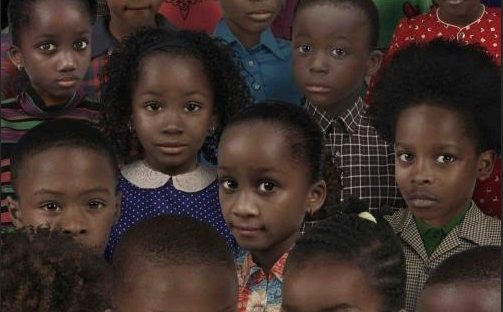
Innocence Is a Privilege: Black Children Are Not Allowed to Be Innocent in America

Days ago an interviewer asked me how Delores — one of the main characters in my debut novel, Here Comes the Sun — could be so cruel and unapologetic in how she treats her daughters, Margot and Thandi. It wasn’t the first time I’ve heard the question. The same question was posed in front of an audience of librarians in Chicago a month earlier. Had I listened closely, I might have heard the rapid blinking of eyes in the pause before I answered. Faces were drawn into contemplative lines as each person seemed intent on knowing how a mother could relay to her daughter that no one loves a black girl, a black body. Not even herself. Truth is Delores loves her daughters so much that she will be the first to break them.

As I reflect on the recent killings of Alton Sterling and Philando Castile — the latter who was shot and killed inside his car; his girlfriend Diamond Reynold’s four-year-old daughter bearing witness — I grapple with the loss of the cloak of protection we have as children called innocence. For black children, innocence is snatched away too soon, a brutal initiation into a frigid world.

Innocence, like freedom, is a privilege.

In his memoir, Between the World and Me, Ta-Nehisi Coates ruminates over the loss of his son’s innocence as his son becomes more aware of racial inequalities in his own country. He laments, I write to you in your fifteenth year. I am writing you because this was the year you saw Eric Garner choked to death for selling cigarettes…”

Innocence, like freedom, is a privilege.

Many black parents tell black children to strive; to seize opportunities that will enable upward mobility. However, they also give their children a poison capable of eroding black children’s innocence. They tell them to be twice as good; that there is no room for failure or mistakes. What settles at the base of their throats is the weighted truth that inevitably begins with, “No matter how hard…” It’s understandable that parents would rather have this poison — this “No matter how hard you try; you will never be seen as equal” — settle at the base of their throats or get lodged like a calcified stone in the left side of their chest than to see the healthy light dim in their children’s eyes. Had this poison been exchanged in every kiss goodnight, every night-time prayer, perhaps black children would be more guarded; our hopes and dreams placed in the hands of a god we’re told will have mercy. But we can’t have mercy. Not with history constantly chasing us and pulling us under, yanking us out of our dreams and into the mouths of hatred.

In Jamaica, my mother and grandmother taught me and my siblings to say “God willing” whenever we uttered future plans since no day is promised. I’ve been using this term more and more lately with everything that has been going on — from the recent Orlando shooting and last year’s massacre at the AME church in South Carolina to Sandra Bland, Mike Brown, Eric Garner, and more. I once resented the term, “God willing,” always shrugging my shoulders at my grandmother, though she was a woman who knew defeat like the life lines in the middle of her hand.

When we consider the social atmosphere thick with violence, racism, sexism, classism, xenophobia, and homophobia, we begin to understand that our parents’ warnings are for our own survival. But at what cost? Those moments of suspended play are unforgettable given the traumatizing way in which our innocence was snatched. They become indelible memories of bliss marred by looming shadows of reality. Something as simple as overhearing the news reports or catching a glimpse of worry creasing our parents’ faces could trigger the first blow. Some of us were called in after a game of soccer, the lone ball left to the elements outside, partially deflated, as our mother or father or grandparent — finally finding the courage to explain what we saw or heard — lowered their voices, which would forever resonate within us. Some of us were in the middle of playing dress-up, barely standing upright in high heels — a testament that we were way too small to walk in our mothers’ shoes much less carry the weight of her burdens. In James Baldwin’s story, Sonny’s Blues, this sentiment is apparent as the narrator recalls the moment in his childhood when he lost his innocence:

[My mother] would be sitting on the sofa. And my father would be sitting on the easy chair, not far from her. And the living room would be filled with church folks and relatives. There they sit in chairs, all around in the living room, and the night is creeping up outside, but nobody knows it yet…for a moment nobody is talking, but every face looks darkening like the sky outside…Everyone is looking at something a child can’t see. For a minute they have forgotten the children…the darkness in the faces frightens the child obscurely…something deep and watchful in the child knows…And when light fills the room, the child is left with darkness.

In Toni Morrison’s Beloved, the protagonist Sethe kills her baby girl by slitting her throat with a cutlass before the slave owners could get to her. Seth explains, My love was too thick…I felt what [slavery] felt like and nobody walking or stretched out is going to make you feel it too.” If that’s not mercy, then I don’t know what mercy is. As gruesome as this act may seem, it is the very same act performed over and over again by black parents each time they have to sit and disclose to their children that the world hates them for the color of their skin. That they will never be seen as equal to their white playmates on the playground. That the neighbor might call the police if they ever sneak in the window after curfew. Or, god forbid, leave the house in a hoody to buy skittles and a soda at the corner store.

It goes without saying that black parents and parents of black children see the world their children exist in as a dubious one. In order to control their circumstances, they use caution. Some — like my character Delores — use cruelty. They each have the same goal: to protect.

In Jamaica my mother and grandmother used flogging as a way to discipline me and my siblings. Not out of hate but out of love twisted with fear — fear that if they didn’t do it, society’s punishment for bad behavior would be worse. And though flogging is rooted in the bloodied history of slavery, my guardians saw it as redeeming.

It goes without saying that black parents and parents of black children see the world their children exist in as a dubious one.

Truth is, there is nothing parents can do. There is nothing black parents can do to protect their children and their children’s innocence. Diamond Reynold’s four-year-old daughter can attest to this as she watched Philando Castile take his last breath. The scene, in her eyes, will forever be painted red, the sound a resonating firecracker — like those fireworks, fleet and bright, during the fourth of July weekend — the last time she would ever see her step-father-to-be’s smile, the sun and moon in his eyes. Even as her distraught mother leaned in to wake him up, blood soaked and lifeless, the little girl already knew he was gone. Something — that inkling one gets when innocence no longer masks the sharp edge of reality — nudged her; and she in turn comforted her mother.

The breaking of innocence should not only be black parents’ responsibility. It should be the responsibility of white parents as well. At what point should white children be made aware of their privilege? Their innocence might not be as mangled as that of black children within the context of racism, but a conversation would surely save a life someday.

At what point should white children be made aware of their privilege?

Currently, the black body count is building, mounting into an insurmountable pile. Claudia Rankine illustrates this best in her book Citizen, documenting an ever growing list of names of black men and black women killed by the police. Surely black parents aren’t wrong for trying their very best to preserve the hopes and dreams and innocence of their children. But what good does it do when we hide the truth? We have lost too many dreamers that way. A black child cannot afford to be fooled. Delores knew this in Here Comes the Sun. She knew that her daughters would not fare well in a society that despises them. Diamond Reynold’s four-year-old daughter now knows that no one loves a black girl enough to spare her innocence.

Saddam Hussein Novella Coming Soon

The Novella Was Completed on the Eve of the 2003 Invasion

This December, if you’re in the UK and decide to do a little holiday shopping at your favorite local bookstore, you may very well come across one particularly shocking author in the new fiction section: Saddam Hussein.

Believe it or not, the former Iraqi dictator and war criminal wrote fiction, often under the pen name “the author.” The last of his known works — a novella alternately translated as Begone, Demons and Get Out, You Damned One — is set to be published in English this December by indie UK press Hesperus, which specializes in translated and out-of-print works. (The press gained notoriety last year for failing to pay royalties to Jonas Jonasson.)

According to The Guardian, Hussein’s novella “focuses on a tribe living by the Euphrates river 1,500 years ago which ousts an invading force.” A spokesperson for Hesperus subsequently described it as “a mix between Game of Thrones and the UK House of Cards-style fiction.”

In the past, Hussein’s work has not been received kindly by critics. In 2005, Hassan M. Fattah, a New York Times correspondent, described his novella as “a forgettable piece of pulp.” A 2011 Guardian review of another one of Hussein’s titles, Zabiba and the King, concluded: “Some critics have suggested that Zabiba and the King was ghostwritten. I doubt that: it is so poorly structured and dull that it has the whiff of dictatorial authenticity.”

The new book will be come out this December in order to “mark the 10th anniversary of [Hussein’s] execution.” So, if you’re looking for the strangest, most chilling stocking stuffer imaginable for that book lover in your life…

5 Emerging Women Authors Intimately Explore Place

Kristen Radtke illustrates five women writers whose work explores setting in powerful ways

Portraits by Kristen Radtke

While literature has long been prized for its ability to transport us, there are certain narratives that are rooted so firmly in specific places that setting becomes as much a character as the people who inhabit those places. There are the classic examples: F. Scott Fitzgerald’s gilded West Egg, Steinbeck’s depression-era Monterey, and Joyce’s Dublin; and contemporary favorites like Teju Cole’s New York in Open City, Richard McGuire’s graphic novel Here (which visually tells the story of a single corner of a room over hundreds of thousands of years), and pretty much anything Joan Didion has ever written. From the contrived paradise of a Jamaican resort to a volatile arctic tundra, here are five new books by emerging women writers who’ve exquisitely captured the intricacies, beauty, and complications of their settings. Most compellingly, they explore the emotional and psychological landscape of the spaces their narrators and characters occupy.

— Kristen Radtke

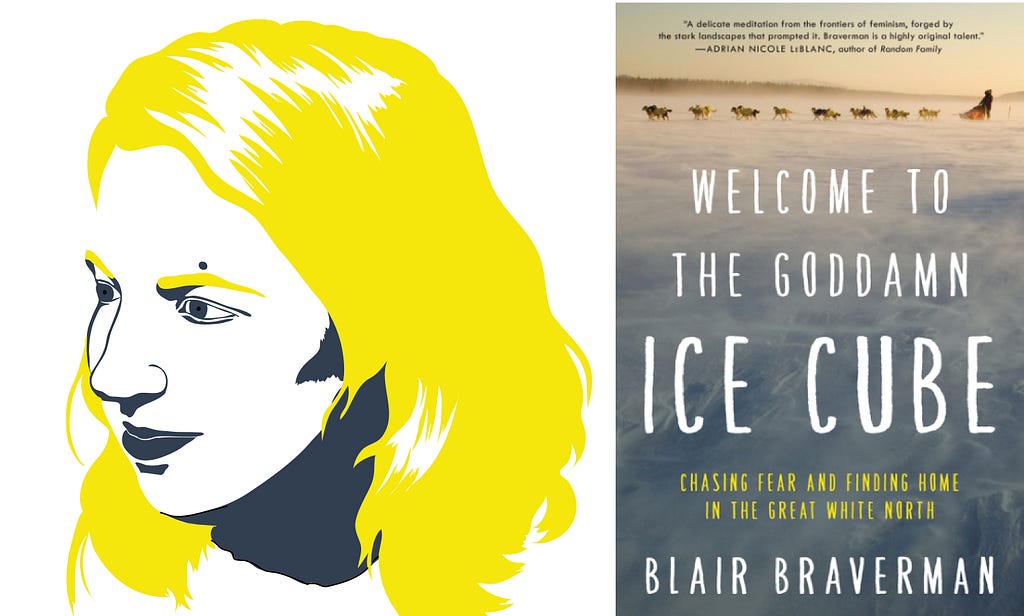
1. Blair Braverman, Welcome to the Goddamn Ice Cube

Blair Braverman’s compulsively-readable memoir Welcome to the Goddamn Ice Cube moves between her time spent as a high school exchange student in Norway, bullishly determined to adopt a new language and culture as her own, and the life she builds over the next decade in the north. Braverman draws characters with precision and tenderness, from the stubborn owner of the village general store, whom she slowly befriends, to the ailing man who makes furious and cutting verbal advances while she warms herself by the bonfire. Braverman’s debut beautifully portrays what it’s like to be a woman in an unwelcoming climate.

2. Nicole Dennis-Benn, Here Comes the Sun

Rivaling Walker’s Celie and Tolstoy’s Anna, Nicole Dennis-Benn has created in her debut novel an exquisitely-realized cast of heroines. From Margot, who services white male tourists after-hours at an upscale Jamaican hotel standing fortresslike over the cracked, aging streets of River Bank, to her younger sister Thandi who endures skin-lightening chemical rubs and a body wrapped tightly in plastic wrap beneath the anxiety of an education Margot pays for, Here Comes the Sun is rooted deeply in the sacrifices these women make — or can’t make — for each other.

3. Anna Noyes, Goodnight, Beautiful Women

The central events of Goodnight, Beautiful Women are often catastrophic or extreme, but the real heart of these stories is Anna Noyes’s achingly rendered murky-blue New England landscape. From a suicide to a failing marriage to a confused sexual awakening, her character’s reactions to trauma are deeply internal yet somehow detached, as if they’re watching a world unfold around them that they can’t quite access. It seems Noyes knows everything about these women, and they’re staged within a dreamlike-turned-nightmarish Northeast with tactile precision.

4. Leigh Stein, The Land of Enchantment

Leigh Stein’s third book, The Land of Enchantment, is an intimate and often intensely vulnerable examination of what it means to love, leave, and mourn an abusive person. Stein’s memoir is principally concerned with the struggle to reclaim a sense of self and ownership over a place — in this case, New Mexico, the state she and her now-deceased ex-boyfriend shared, and after which the book is titled. Stein’s narrative is most compelling when it confronts head-on the ambiguity between grief, indifference, and relief, and forsakes redemption for an ultimately more painful exploration.

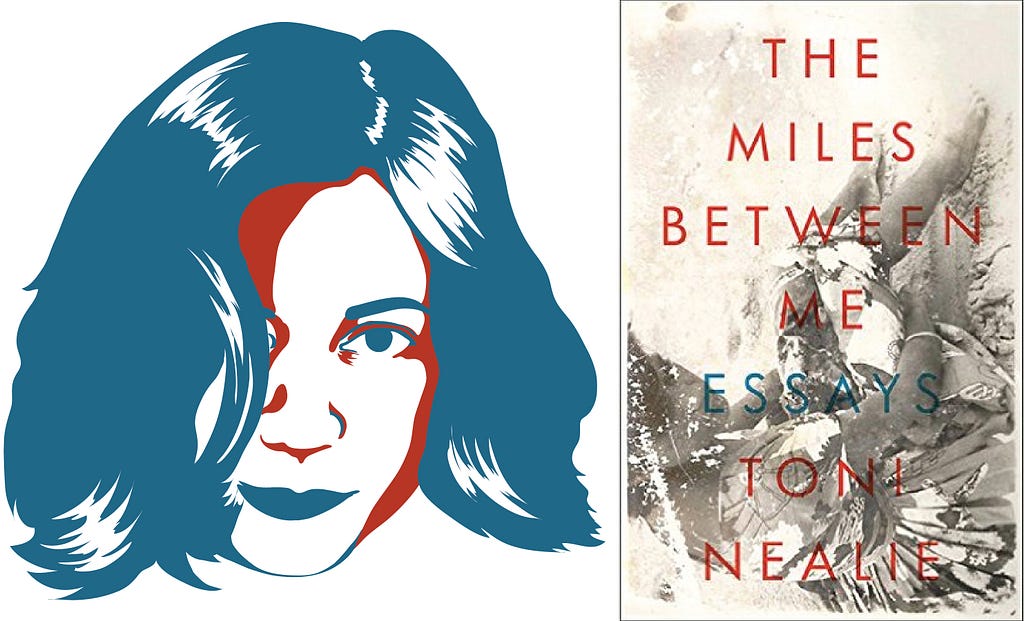
5. Toni Nealie, The Miles Between Me

“Why do we still call the South Pacific down and Europe up?” Toni Nealie asks early in her essay collection The Miles Between Me, and it’s a question that lends itself to her examination of how desperately one may try to chart a life in limited (or even arbitrary) terms. These essays are concerned not only with place, but also the roles we play within those spaces, and what it means to be defined — or to define oneself — as “an other.”

About the Author

Kristen Radtke is a writer and illustrator based in Brooklyn. Her graphic memoir, Imagine Wanting Only This, is forthcoming from Pantheon Books.She is the managing editor of Sarabande Books and the film & video editor of TriQuarterly magazine. She has an MFA from the University of Iowa’s Nonfiction Writing Program. Find her on Twitter @kristenradtke.

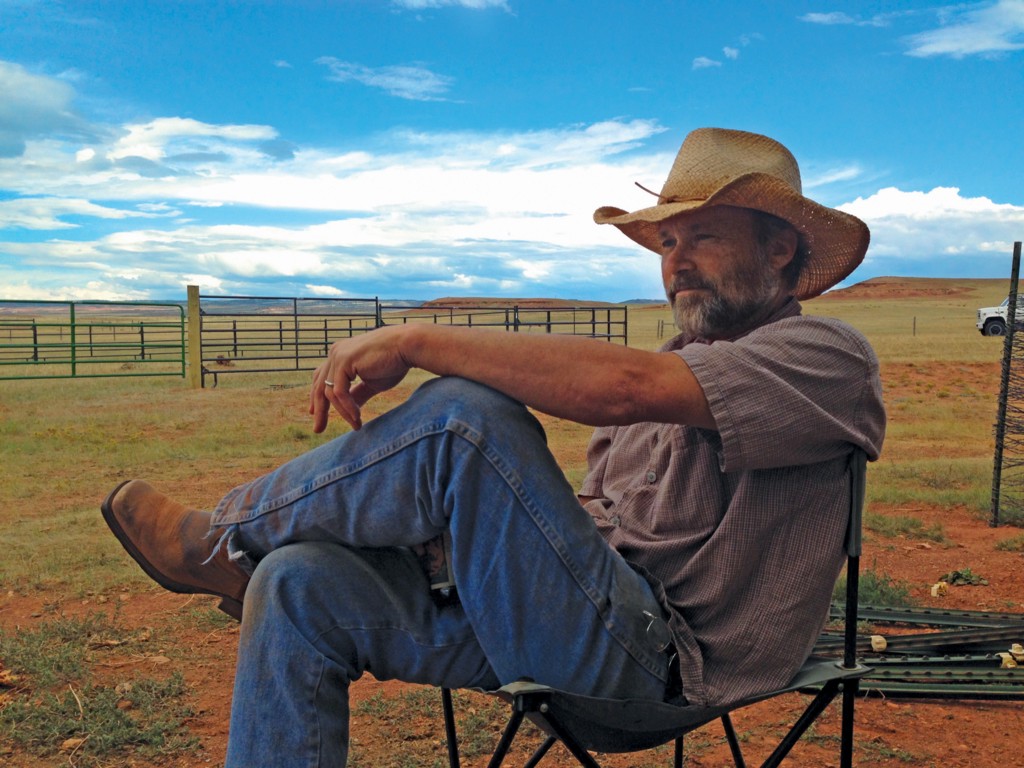
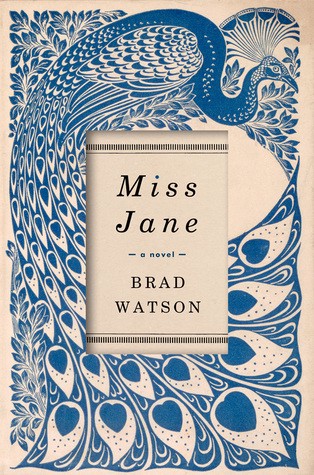
Brad Watson on Scoundrels, Medical Mysteries & Building His New Novel out of a Family Secret

I first read Brad Watson’s debut Last Days of the Dog-Men while riding in a screaming box (the DC Metro), wearing an outlet mall tie. The book, full of men and women at the end of their tether, was a welcome counterpoint to the scene at hand, with long musical lines of prose that were just as lush and image-rich as the hot green Mississippi they described. A shining book. I was happy to open the newly-released Miss Jane (W.W. Norton & Co, 2016) and find the qualities I’ve long admired in Watson’s work. The novel is the story of Miss Jane Chisolm, “born in rural, early-twentieth century Mississippi with a genital birth defect that would stand in the way of the central ‘uses’ for a woman in that time and place — namely, sex and marriage,” according to the jacket copy. The novel traces her long life on the margins of that society, where neighbors whisper about her condition but never speak of it directly. In that silence she cultivates — is forced to cultivate? — a rich inner life.

The central paradox, for me, is that Miss Jane is surrounded by the fecund, sexualized natural world of her parents’ farm, a pageant of birth and death, as when she discovers a tomato worm eating her best plant in this stunning passage: “The worm’s fat, segmented body was studded with the rows of pure white cocoons that had grown from wasp eggs laid under its skin. They looked like embedded teardrop pearls or beautiful tiny onion bulbs growing out of its bright green skin. Inside the cocoons, wasp larvae sucked away the worm’s soft tissue as casually as a child drawing malt through a straw. The worm seemed entirely unperturbed. No doubt a tomato worm is born expecting this particular method of slow death, a part of the pattern of its making somehow, something its brain or nerve center, whatever it has, is naturally conditioned to recognize and accept. Just as a person hardly registers, until near the end, the long slow decadence of death.”

In addition to Miss Jane, Brad Watson is also the author of the novel The Heaven of Mercury, a finalist for the National Book Award, and two collections of stories: Last Days of the Dog-Men, winner of the Sue Kaufman Award for First Fiction from the American Academy of Arts & Letters, and Aliens in the Prime of Their Lives, a finalist for the PEN/Faulkner Award. His short fiction has appeared in The New Yorker, Granta, Oxford American, and Ecotone, among other journals. A two-time winner of the O. Henry Award, he teaches creative writing at the University of Wyoming.

— Matthew Neill Null

Matthew Neill Null: As a fellow product of rural WASPs, I still struggle to understand why we were so tight-lipped about sex — like Miss Jane, my first inkling came from seeing animals fuck, a common farm occurrence, though you got hushed for pointing it out. I would guess that many people of Miss Jane’s era, both male and female, would describe her as “chaste” (their compliment) or “barren” (their pejorative), but she has an erotic inner life, she masturbates, she fantasizes, she falls in love. I love that balance of external silence and internal symphony. Could you speak to this aspect of creating the character? Was it there in the first draft, or did it develop over time?

Brad Watson: My introduction was my neighborhood’s alpha dog, a big collie named Lonesome, and a tiny little mutt named Honey. He curled over that little dog in a way that was fascinating and obscene. All the lesser dogs stood around them in a circle, watching mournfully, and all the children stood around behind the dogs, in some state of enrapture, I suppose.

This book went through more than the usual number of drafts. I began with a dual story, first-person of a man in the present, who tells the story of his great-aunt, Jane. There was something in that guy’s narration, his story, but it did not belong in Miss Jane. Truth is, I was afraid I wouldn’t be able to fully imagine this character, Jane Chisolm, so I was looking for a prop of some kind. Cowardice never gets a novel written.

Cowardice never gets a novel written.

Everything that’s in the novel developed over time. Everyone says first and even early drafts are awful, but the problem with mine, this time, was just how far off the mark they were, how far they fell short of realizing the character Jane. I had to keep turning it on again, recycling my imagination, layering things in (even while I kept throwing a lot out). It was like a very slowly developing photographic world and person. I’d re-read a scene, a moment, and try, like a painter I suppose is the better analogy, to add just the thing that would make it richer, more real in the mind. She, Jane, was very hard for me to get at. A life and mind hard for me to imagine. And so it just required a lot of patience and tenacity, a willingness to start over more times than you’d like.

MNN: Jane is partly inspired by your great-aunt’s medical condition. I’m curious, did your family speak openly about this? Or did you have to piece it together? You mentioned doing an incredible amount of urological detective work.

BW: No one still living knew anything specific about the nature of my aunt’s condition beyond her incontinence. And then, before the real Jane died (one of my clues to work with was that Great-Aunt Jane lived a long and, under the circumstances, healthy life, from 1888–1975), my mom’s sister got it out of her that she had just one opening — for everything, it seemed. But you’re right in assuming that they really just didn’t talk about it. In those days, especially among Southerners, especially among Southern country folk, you did not talk about such private matters. It would have been disrespectful. They loved Aunt Jane and were not ashamed of her, nor was she apparently ashamed of herself — though I wondered how much of that was the family’s tendency toward stoicism.

I talked to my great-aunt’s oldest surviving nephew, who was by then old and in bad shape (and, ironically, in Depends and a tee shirt, in a trailer home under which two dogs were shaking the whole dwelling with their blissfully ironic humping) and all he could say was, Well, yes, Aunt Jane had a problem. I could find no medical records (they destroy them after a certain number of years, or used to, anyway). The nursing home she’d lived her last years in was gone. I combed through Dr. Hugh Young’s pioneering 1937 book, Genital Abnormalities, Hermaphrodism & Related Adrenal Diseases, a 600-plus-page tome with all hundreds of images of bodies and body parts and genital abnormality close-ups and drawings of dissections and surgeries and logs, etc., but nothing seemed to echo my aunt’s condition. It possibly sounded like “vaginal agenesis with cloacal anomaly.” That did not work out. There were other conditions with a single opening, but they involved complications that my aunt seemed not to have suffered. It was a long process of considering various conditions and discounting them before I finally saw something on “persistent cloaca.” Very little research on it for the longest time because of its rareness: something like one in 20,000–25,000 births. So Young probably had not even seen a case of it. I found it on the web, and given that a) there is incontinence, hard to repair, and b) it is possible to endure it without a constant infection(s), and c) there was no real ability to repair the condition surgically until several years after my aunt died, I thought, “This must be it.” The one urologist I got to talk to me didn’t know anything about it, said I’d need to talk to a pediatric urologist. I talked instead to a student’s father, an OB-GYN, an energetic guy who often collaborates with various colleagues in surgery, and he knew about it, and confirmed some things I wasn’t sure about, being an amateur net-surfer pretty confused, by that time, over the incredible variety of ways the urological system can go awry from the “normal” in the process of bodily formation. I could not really imagine Jane’s story until I could be reasonably certain of what her condition was. And that’s just one reason it took me a long time to figure out what, in the end, is a pretty simple book. Other things I knew that helped imagine a fictional Jane were the real Jane’s extremely thin physique — which helped me to imagine the parts about her habit of starving and dehydrating herself in order to be “safe” in public — and a tidbit an older cousin gave me late in the game: Jane took to wearing several petticoats beneath her skirts, and a little bit of perfume, in what was no doubt a futile effort to disguise the scent of a urological “accident.” And my mother remembered that, as children, they had giggled because Aunt Jane “squeaked when she walked,” because she had to wear rubber undergarments over her diapers.

Why the hell did I decide to write this book? I was fascinated by my great-aunt’s “secret.”

Why the hell did I decide to write this book? I was fascinated by my great-aunt’s “secret.” And, I thought, no one else is going to write it. She must have lived an extraordinary life (she did get out, and often traveled by bus to see her siblings and nieces and nephews who’d moved to east Texas), and she was very much on the verge of being forgotten. She was a family legend, a mysterious one, and — I thought — a noble character. That’s how I got caught up in the idea of writing a novel about her. I didn’t know what I was getting into.

MNN: I’ve always admired that, in a world obsessed with “likeable” characters, you aren’t afraid to write about scoundrels. Miss Jane’s father is a taciturn drinker, and her mother is a scold and a bit “flighty” as we’d say in West Virginia, but my favorite is her older sister Grace, who is sexually malevolent in such a marvelous way. Without giving away too much of the book, I will say she uses sex as a bargaining chip, all while throwing it in the face of a sister who is denied access to the erotic world that is such a part of the human experience. So Brad, do you have any practical advice for those of us who want to write about scoundrels? What do you tell your rising talents out in Wyoming?

BW: One of the difficulties I faced as a newspaper reporter (beyond the fact that my professional competence was minimal — I wrote well, but had little real training as a journalist) was the degree of empathy I carried into any story involving people who appeared to be crooks or scoundrels. I didn’t like the idea of ruining someone’s life if I couldn’t be one hundred and ten percent sure of my case. Of course, some people were so obviously (not at all subjective, there, right?) slime-balls that it felt good to uncover their misbehavior or criminal activity. But other people were apparently just people who screwed up, made a mistake, a poor judgment, or reacted to a situation improperly out of fear or incomprehension. I had newsroom colleagues who were ready to nail anyone who got into trouble. There was an uncomfortable level of self-righteousness, in some cases, it seemed to me. Unlike them, I had not come roaring into journalism with a beat-up copy of All the President’s Men bound over my heart with duct tape. I had come from a frigging MFA program in creative writing, for Christ sake. Writing fiction, in terms of dealing with your characters, is all about empathy. All about figuring out this or that person’s humanity, her or his human-ness. A scoundrel in fiction had better be just as interesting if not more interesting than the good folks. A scoundrel might believe she has very good reason for her actions. She or he had better be a complex character who can’t be summed up in the simple language of good versus evil. If you don’t understand that, you should be writing propaganda for some extremist group or another. You shouldn’t be writing fiction. You shouldn’t be your newspaper’s crime reporter. A writer friend has said that the notion of a writer loving or even liking her characters is ridiculous. It’s not at all about them being likeable or loveable. It’s about whether or not they’re interesting. So, in short, your scoundrels should be among your most interesting characters. They, like inherently good people, face the greatest risk of being oversimplified, two-dimensional, unrealistic, sentimental, or laughably sinister creatures.

MNN: You have an epigraph from the phenomenal Swedish writer Lars Gustafsson, and I feel I detect a strain of Gustafsson in here, particularly in the opening pages, which are just this phenomenal willing up of a world — a corrective to anyone who thinks exposition hinders narrative. I’m thinking of this passage: “You would not think someone so afflicted would or could be cheerful, not prone to melancholy or the miseries. Early on she acquired ways of dealing with her life, with life in general. And as she grew older it became evident that she feared almost nothing — perhaps only horses and something she couldn’t quite name, a strange presence of danger not quite or not really a part of the world.” You make a statement, then qualify it, with “perhaps only horses” and similar emendations, like you’re going back to darn a stitch. Her inner life is given nuance, complication. Out of curiosity, I went back to your 1996 debut, Last Days of the Dog-Men, and found the different style I remembered: these swaggering, musical, image-rich sentences that remind me of Barry Hannah (who said of your work, “Only the Irish geniuses wrote like this,” a blurb to beat all blurbs), with more of a focus on the outside world. While the old music is still here in Miss Jane, there’s more of a meditative quality to your prose, exploring the inner emotional topography of your characters. Do you see this evolution yourself? Or am I making it up?

BW: First, I suppose you can get away with expository writing in something that is, effectively, a prologue. So I took advantage.

I re-read that amazing short story by Lars Gustafsson [“Greatness Strikes Where It Pleases” from Stories of Happy People] more than once while I was working on Miss Jane, hoping to capture at least something like the cool wonder and patience that works so powerfully for Gustafsson there and in other works of his. I thought it appropriate, also, to study that story for the way in which Gustafsson manages to write about a character who is essentially inaccessible to most (if not all) of us — a great, beautiful mystery of a human being who eventually finds his own version of greatness. Of course my character is not nearly so closed off from the world, from “reality” as most of us know it, as is the boy-then-man in “Greatness.” But it served as much-needed inspiration, in that I tried to learn from his ability to get at that deeply profound sense of (in his case) inarticulate wonder.

As for the prose in this book — yes, I did not want to write a book that indulged so much in stylistic flourishes as my previous work (although I’d already begun to draw back from that a bit in Aliens in the Prime of Their Lives). Not only was I a little tired of that voice, that self-indulgent fun, I also did not think it appropriate for this story. I thought Jane should be center-stage, and that the language should only support her, not embellish her. I wanted whatever strangeness there is there to come from Jane’s condition, her awareness of it, not from forcing the language. At one point, my editor (and my agent) said I was holding back too much, so I loosened up a bit. But I was cautious, even then. I didn’t want to muck up the reader’s sense of Jane. I wanted there to be as clean a sense of her on the page as possible.

MNN: Much of the book hinges on Jane’s lifelong friendship with Dr. Thompson, the traveling country doctor who delivered her and discovered her condition, a bond perhaps informed by his own status as an outsider in that place as a highly-educated and childless widower. Could you talk about the genesis of that character? While reading the novel, I kept thinking of William Carlos Williams’s fabulous and overlooked story “Old Doc Rivers,” about a drug-addicted country doctor of great skill and great unpredictability, so I was pleasantly surprised to see you mention that story in the acknowledgements.

BW: In earlier drafts he was different, physically and temperamentally. In fact, he was a lot more like Old Doc Rivers than now. I can’t recall when I read the Williams story but it was early-on enough that Thompson had a more rascally side and leaned more heavily on the cocaine and drink than the man he turned out to be. I wanted Dr. Thompson to be kind of romantically mysterious, I guess — and handsome in a refined sort of way — and started to work on another figure in my head. Since I’d once met Dr. E.O. Wilson, and was so in awe of him, admiring him as a person as well as a scientist and writer, he (or my impression of him from c. 1988 and his public persona) found his way into being a kind of very basic model for my doctor. So you can see there was quite a transformation from the original portly, bearded, rather boisterous figure into the more genial man with a sly sense of humor and a great capacity for empathy and love for his fellow human beings — as well as birds, especially his peacocks.

MNN: You’re a master of writing hell-raising children. I’m not only thinking of Grace Chisolm, but of the roving brothers in stories like “Eykelboom” and “Vacuum,” which first appeared in the New Yorker. Were you a hell-raising child? Or do you have them? I sense hard-won knowledge.

BW: It’s funny, because when I was the age of the boys in those two stories, I was “the good boy,” just like the middle brother in the stories. But in the South when and where I grew up, being timid (as a boy) was suspect, as if you might not be “all boy.” My older brother was an anti-authority hell-raiser from the get-go, and my younger brother was plain trouble. And there I was, the middle brother, a goody-goody. My older brother teased me about it. Others teased me. I very much admired tough kids, and wanted to be one. So, I determined to change, to get tough, to transform myself from the pale, timid weakling into something else. I did it with a vengeance, first with honest sports, and soon enough with cars, alcohol, violence, trouble with the police (arrests) — being an all-around wanna-be-asshole who secretly had a good heart. Being sensitive was not safe. So, yeah, I ended up married between junior and senior years of high school, out on my own with a family. It was an extended rebellion that did not end well, although all is well enough with that, now. That is to say, we all survived it. But I deal with the effects or consequences, even now, and enough said on that.

MNN: Could you imagine your aunt reading this book?

BW: First, I don’t know if my great-aunt was a reader, or not. Although I suspect, for some reason, that she was not much of one. Maybe that’s because most people on that side of my family, in the generation before mine, were not big readers as far as I know. Second, given her time and place (Mississippi, 1888–1975 — my Jane Chisolm was born later, in 1915), what and where she came from, it might’ve horrified her. But I like to think that whatever is left of her in the world, physical or metaphysical, would absorb it now in the spirit it was intended. A song of praise and admiration — and of wonder, as well.

About the Interviewer

Matthew Neill Null is a writer from West Virginia, a graduate of the Iowa Writers’ Workshop, and a winner of the O. Henry Award, the Mary McCarthy Prize, and the Joseph Brodsky Rome Prize from the American Academy of Arts and Letters. He is author of the novel Honey from the Lion (Lookout Books) and the story collection Allegheny Front (Sarabande). Next year he’ll be in residence at the American Academy in Rome.

How to Set a Fire and Why We Watch It Burn

Summoning the literary spirits of Salinger, Alcott, and Twain, Jesse Ball, in his sixth and best novel, How to Set a Fire and Why, creates a literary figure who stands as one of the great angst-ridden and misfit teenagers in contemporary American literature. She is callous and destructive. She is loving and sentimental. She’s a contradiction of impossibilities, simultaneously exploding with boldness and hiding in fear. While she could just as easily be referred to as Holden Jo Finn, Ball names his mesmerizingly misanthropic protagonist Lucia Stanton.

Lucia Stanton is not a good person. Wait, I take that back. The truth is that Lucia actually is a fairly decent human being. She just has an odd way in presenting herself. When readers first encounter Lucia, it’s inside her high school’s principal’s office. Yes, Lucia is that girl. The reason she’s there: she tried to kill the school’s “little prince basketball hero” because he touched her dead dad’s zippo lighter. What Ball quickly informs his readers of is that Lucia, before stabbing her pompous classmate in the neck with a pencil, cautioned him: “Don’t touch this lighter or I will kill you.” Is it really bad that she attempts to follow through on her threat?

Lucia is a teenager teetering on the edge of a cliff that oversees two vastly different valleys.

Lucia’s not the kind of girl who can join the everyday teenage brigade and simply “hang out.” She’s too adult for such trivial nonsense. And Lucia certainly isn’t the kind of person to become entangled in the addicting, fantastical world of teenage consumerism. In fact, she’s rather immune to any ploys of materialism. She only really cares about her lighter, licorice, and books. Lucia is a teenager teetering on the edge of a cliff that oversees two vastly different valleys — one of total destruction and the other of learned responsibility. Like I said, she’s a contradiction.

Much of Ball’s novel’s plot unfolds around Lucia trying to find something — anything really — in which she can invest her time and energy. With a dead father, a mother who is so emotionally and mentally damaged that she can’t remember her daughter, an aunt who is failing to recover from a stroke, and zero friends, Lucia is totally lost until she stumbles across her ultimate savior: an arsonist club.

Lucia, the “quiet person who minds her own business,” finds her calling in the destruction that fire promises: “With this little lick of flame in your pocket, with this little gift of Prometheus, you can reduce everyone to a sort of grim equality.” She discovers personal satisfaction in the deluded fantasy of destroying those around her who deem themselves as superiors. This is a girl whose top rule is not to do things that she isn’t proud of. Confidently, she enters her new world determined to right the wrongs she’s witnessed.

With a renewed interest in life and a promise of connecting with others through fire, Lucia gradually finds her path. And her new trail seems possibly even more troubling than when she was totally directionless. Lucia declares philosophical wisdom: “We’re just not permanent at all, not the way we want to be” and “You should believe in inevitable things. Anything else is frippery.” She prepares a pamphlet about how to set fires for others like her — those lost and seeking a way to connect. At least for now, Lucia, nihilistically, believes that her way is the right one.

We can fade into Lucia’s life and see her struggling, but we are never in one scene long enough to truly get angry with her or to give up on her.

Ball constructs How to Set a Fire and Why in short chapters that rarely exceed a couple of pages. This segmented orchestration allows readers to fall into Lucia’s world, but it also prevents us from seeing too much of it. We can fade into Lucia’s life and see her struggling, but we are never in one scene long enough to truly get angry with her or to give up on her.

Ball’s portrait of a helplessly reckless teenager is beautiful to behold. Amidst all of her fury and her detachment to reality, Lucia maintains a likeability that can’t fade. Perhaps it is her will to survive for herself — and really only herself. Maybe it’s her ordinary (and tragic) luck. It could even be her deep down and hidden sentimentally toward her father’s lighter. Why it is that we can’t help but want Lucia to succeed lies in the sole, meticulous hands of Ball, who gives his icy protagonist a dimensionality that transcends teenage angst or even new adult curiosity.

There’s a feeling of defeat in How to Set a Fire and Why that feels oddly comforting. It serves as a reminder that life isn’t always good, and the future might be worse than the present. Lucia admits, “When I thing about what my future holds, it is a bit like looking into the sun. I flinch away, or I don’t and my eyes get burned down a bit, like candles, and then I can’t see for a while.” And there’s always another fire on the horizon.