My Summer of Slam: Poetry, Tom Waits, and What Stays With You

I owned an expensive suit that summer — the gift of a hopeful father — and I had a few practiced skills. I could open a matchbook and light one of the matches using only one hand, and without detaching the match in question from the pack (what you do is bend it around back with your thumb — note that you can burn your thumb this way). I could also recite big swaths of Shakespeare and improvise convincingly when I missed a line or flubbed it. That brace of talents, along with how to mix a proper stinger (two parts brandy, one part crème-de-menthe, highball glass, rocks) were about all I knew of the bigger world. I certainly knew almost nothing about the world that came to life at first light and hummed till 5 pm.

I was mistaken for a bike messenger at my first corporate interview (“Who sent you?”) and turned away with instructions to get a haircut and lose the earrings before I rescheduled. When I did land a job — in the mail room of a sleepy monolith — I found the sorting so numbing I often took a puff of marijuana at lunch and spent the next hour casing nooks where I might curl up to sleep. One afternoon it came to light that an exceptionally thin woman who worked alongside me had shined for a year as a tap dancer in New York.

I was mistaken for a bike messenger at my first corporate interview (“Who sent you?”) and turned away with instructions to get a haircut and lose the earrings before I rescheduled.

“You were a dancer in New York?” asked our boss, a shifty man who carried no bag or briefcase (“I like to travel light”).

“Oh sure, I was in shows. I danced off-Broadway.”

The copier washed us green.

“Why’d you quit? You’re still young enough.”

“Well,” her mien was blasé. “I just gave up and faced reality and got a real job. Like John did, right John?”

: : :

The basement of the Cantab Lounge in Boston was hosting the 1999 National Poetry Slam finals and it was lousy with audience. Some of the seats were filled with kids and some with ghosts who were still alive. A sly old devil with a handshake that could castrate bulls took my three dollars at the door and welcomed me as though I were a prodigal son. It was my first time there and I’d never recited a poem of my own in public. When I stood up to read the folded pages I’d brought along — some piece of surrealist nonsense with “a basket of rain” inside it — somehow the crowd stayed with me. When they clapped at the end the host said they’d like to see me back the next week. “And bring a basket of rain!” It was the doorman with the ordnance-grip. I’d found an audience.

It was my first time there and I’d never recited a poem of my own in public.

College had ended that spring, and until that night I hadn’t known there was a club around the corner. A friend from class had invited me out dancing and I’d taken philanthropic drugs and made some friends. 6’4’’, black leather and slicked hair, right side of my fa­ce obscured by a maze drawn with eye-liner in the dark, I was getting on well. I’d been kissed by a few strangers and the night was young.

I wasn’t a gifted dancer. A friend on the floor with me said, “No, not like that. Try to imagine you’re making love.” Seconds later: “Oh wait, no, don’t do that.” Later, by the bar, it came out that I’d been writing some poems, inspired then by my former teacher Bill Knott. “You’ve got to go to the Cantab,” my class friend said. “It’s practically next door. Let’s go now and come back in an hour.”
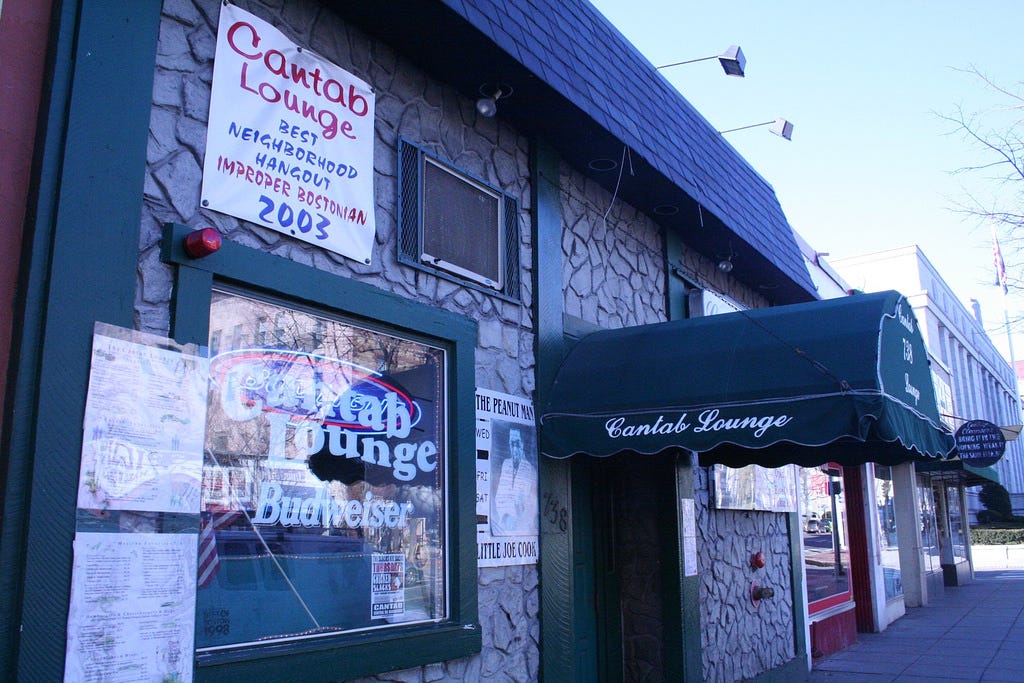
So we wandered down the steps of a dive bar filled with Cambridge locals (people who actually worked, as distinct from Harvard types) and into a room where I’d come to spend two years’ worth of Wednesday nights. Folding chairs and small Formica tables would always wait around a slightly raised black stage with a single microphone. The sign-up list would always fill up fast. Judy at the bar would always pour the well drinks strong.

That night, a woman my age — I’ll call her Vanessa — sat at a corner table with what I remember as two separate binders full of poems. They were her own poems and she and I started to flip through them and read them to each other, oblivious of the competition from the stage.

There are times when you feel attracted to a stranger simply because they’re attracted to you. That was Vanessa and me, both of us. We looked good together and people were good enough to note it. They’d tell us to get a room. But if they got a room, we decided, they wouldn’t have to watch us. Later that summer we’d go night swimming at Walden Pond, dance close at clubs, and talk about the real world not at all.

I’d only just met her — she’d just moved back to Boston from Cornell — but Vanessa made me proud when she reached the microphone that night. She looked at her notes and led us through our breathing by breathing herself, slowly. She backed away from the mic. The room settled back. She had that marvelous capacity to wave the room away and lure us into a kind of trance. How much of this was a put-on? And, in the context of performance poetry, does that question mean anything?

“Hush,” she said. The title? It seemed to be a known poem among the construction-job kids in the back rows and big-heeled barflies — they hooted. There were nods and hums. “Alright.” “Mmm.” Like some slam poets can do, she assumed authority by setting her shoulders, conjured the atmosphere of a Sunday service. We waited in attendance.

we children watch …

waiting for the marked to hum
for lips to leak and for the evening

to shadow to hover …

It wasn’t a revolutionary story and it was far from being, I’d later learn, Vanessa’s strongest work, but the manner in which she told it — the pauses, the casual leap that drops itself into sacerdotal water — allowed her to make something marvelous of it. The poem wasn’t something from the page but something from the air, a song, almost:

We knew the white folks and their kitchens

and bathrooms and broom-closets and their money.
We knew how to hold onto one another

“Hush,” she said again, and she held the hush. Slam poetry, then thoroughly derided in academic circles, is about as close as our culture comes to the kind of pre-literate half-chant of epics that Homer’s listeners would have known, or that Parry and Lord found in the Serbo-Croatian Folk Songs of the 1930s. Done well, it can have the same effect — like the best music, it makes us complicit in its progress; like the best stories, it moves quick and bright.

“And we hush.”

Applause.

: : :

“Hush your wild violet,” begins Tom Waits’ 1985 song “Hang Down Your Head.” Then: “Hush a band of gold.” I heard it nearly every day that year, and each time the story came fast: a gorgeous courtship, a marriage, but hush. He rumbles on: “Hush you’re in a story / That I heard somebody told.”

Has she been unfaithful? She has. “Tear the promise from my heart,” he whispers. There’s someone new in her life. He has to go and he’s broken about it. “Hush my love a train now …”

It’s standard ballad stuff, and you figure a ballad would be what he made of it, but he doesn’t. Instead he turns it into something that sounds like a pop song, maybe the Beatles. There’s syncopated drums, like Ringo’s in “Drive My Car. The beat advances with a kind of lopsided rhythm. The baseline is tart and upbeat; the guitar is warm.

But because Waits is Waits, the parts don’t mesh, and therein lies the allure. A pump organ blankets the back with chords and harmonies, but from time to time it strays off-key. The lyrics resemble a Beatles song not at all. This is a song about shame: “Hang down your head for sorrow / Hang down your head for me.” The singer’s ashamed himself and yearns for the person who betrayed him to feel it too.

If anything, I dismissed the song completely when I first heard it on Rain Dogs, Waits’ masterpiece of 1985, because there was so much else there too. “Jockey Full of Bourbon” is the rocker, “Downtown Train” is the hit, and “Time” is the weeper (if you could watch Tori Amos sing the latter on Letterman right after September 11th and not choke up, then you were in a better place than the room full of people who saw it with me).

No, the first time I heard it, “Hang Down Your Head” head felt purely functional — something to transition the listener from what Waits calls a brawler to what he calls a bawler. In that capacity, it does its job, easing us into something more reflective while maintaining the drums and the electric guitar we’ve grown used to. But I didn’t see what else it did.

: : :

At the gig that succeeded my time in the mail room, I drummed out ad copy for Compaq’s high-end servers. It was regular work and I swallowed Vicodin and downloaded music from Napster to make the time pass. This until Carly Fiorina bought the company and disbanded it. Until then, for about two years, I made good money compiling booster pieces lauding the ProLiant DL380 and I did so to the sound of Rain Dogs, composing poems in my head that would sound good out loud.

And I read those poems out loud every Wednesday night. I was cocky at the Cantab, more so than I’d been before or have been since. I made friends at a heady clip. The kinds of verse they recited weren’t like the kind of verse I’d read on the page, and I liked that about them. Today, a settled snob, if I encountered that kind of poem-making, I’d call it bad poetry. But this is unhappy snobbishness and I didn’t hold it then.

Today, a settled snob, if I encountered that kind of poem-making, I’d call it bad poetry. But this is unhappy snobbishness and I didn’t hold it then.

Relying not on scansion or lexical delicacy but on the musicality of their delivery, the readers at the Cantab hummed and barreled their poems. I mentioned a church service above and I did so for a reason: slams and open mics and (some) featured guests at the Cantab felt more like such a ritual than anything I’ve experienced at a reading since — much more.

One night that February I sat between Vanessa and a woman I’ll call Ellen, a theater teacher from New York I’d dragged along. Ellen was skeptical, a mood that only deepened when it was revealed that the featured reader that night would be a towering and muscular poet named Zeus.

“Huh?” Ellen quietly scoffed. “Imagine if I started calling myself Zeus at school. Oh, here’s your professor this semester, Zeus.”

When Zeus himself appeared and it became apparent he was black (which Ellen and I are not) she waited until Vanessa had stepped out to smoke then added, “Does he realize ‘Zeus’ was the kind of thing slave masters used to call their property? It’s like what you’d name a mastiff. I just feel like … I don’t know his issues so maybe he knows and doesn’t care.”

Ellen was later described by a Wall Street friend we had in common as “a very unhappy young woman.” Probably because she rejected him. But there was something to it. She would change her identity periodically — her name, affect, milieu. There’s a book to be made about Ellen but she needs to write it. Suffice it to say I knew her in the drug-addled haze between her difficult girlhood in Appalachia and her suburbanite 40s as a mom. I loved her a little, and she loaned me good books. And we both loved Tom Waits more than we loved anything.

I loved her a little, and she loaned me good books. And we both loved Tom Waits more than we loved anything.

I don’t recall what Zeus read that night, probably the same sorts of pain and suffering every poet writes about. But his performance — his convincing, possibly authentic performance of sincerity — made Ellen bashful enough to quiet her. When Vanessa said, “That Zeus reading … I can still feel my skin tingling,” Ellen offered no retort. We made our way to my apartment in silence. Before that night I’d only seen Ellen that quiet when she was angry. But she wasn’t angry. I doubt she knew how she felt. That was me too.

: : :

On the uptown C to 81st Ellen and I sniggered over the college kid with the big grin at the end of our car. He was dressed in pointy buckled shoes with silver toes, a secondhand suit in carefully rumpled brown, and a porkpie hat. So of course we knew where he was going.

“It’s not a Tom Waits concert,” Ellen said, “it’s a Tom Waits lookalike contest.”

We thought ourselves superior out of habit but also, we reasoned, with cause. We both loved Tom Waits, and we were just as excited as the kid about the concert we were speeding toward, but we wouldn’t have imagined going so far as to dress like the guy. Was it cosplay or delusion? Surely he knew we were the only two to whom the mysteries had been revealed.

But then who had I pictured the audience would be made out of? Truckers on their final livers? Actual hobos from the ‘30s? You can sing all you want about Bowery bums — if you’re playing uptown, they can’t spring for tickets.

At the theater, we were incensed to discover that kid wasn’t the exception but the rule.
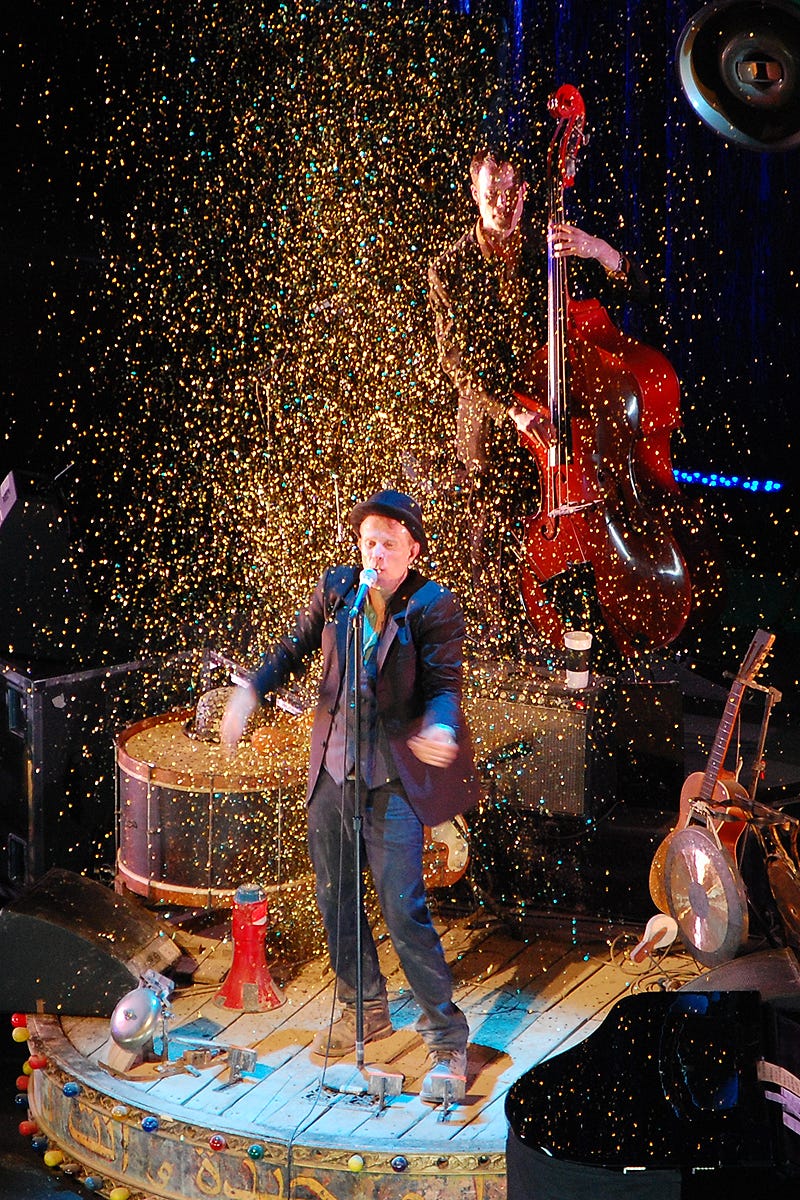
Even the old guys wore Tom costumes: fedoras and Cuban shoes and skinny ties. One especially dense example by the bar revealed himself only after a second glance to be Elvis Costello. Fellow lookalikes approached him for autographs. So this is what show business was: show, the careful re-creation of a slippery authenticity. Two or three years later the word hipster would be loaded with new carriage. So I had stepped away just in time, or just too late.

Once the show began, Tom was small onstage and he shouted through the first songs. He wore a bowler made of tiny mirrors, which I thought unbecoming. Cheering was compulsive and felt that way, as though there were Applause signs and points for the loudest. I was settling in for more disappointment when the lights dimmed and he sat at the piano for his solo set.

So this is what show business was: show, the careful re-creation of a slippery authenticity.

He began it with “Hang Down Your Head,” acoustic: Tom on upright piano and Greg Cohen on upright bass. All at once, the song opened up as it hadn’t before. I quit feeling critical of the dream, apart from it, and fell back into it. I was one with the song.

Tom only touched the keys as he sang — In pauses between verses the keys were quiet. Like Johnny Cash and Patsy Cline can do, he filled every word to capacity. “Hush, my love the rain now / Hush my love was so true.” I heard the trochees at the start of the lines, the spondees at the ends. Then in the chorus, everything’s stressed: “Hang down your head for me.” I’m ashamed, it says, I’m lost. Show me I still mean something to you. It’s please and sorry in the same breath.

It’s that moment of misfortune when you’re as humbled by the wrong that’s been done you as you are incensed at your betrayer. A fight with a love where you want her to be quiet and you also want to stop time, hush the clock. The one who says hush is both the betrayed and the betrayer who strays. The one who pleads hush can’t say more.

The one who says hush is both the betrayed and the betrayer who strays. The one who pleads hush can’t say more.

The act of empathy for fellow sufferers this slowed song evoked in me began in self-pity but didn’t finish there. Feeling sorry for one’s self is the mechanism by which we learn to feel sorry for others. I do you no harm because I know what harm is, how it feels. I’ll hang down my head, you hang down yours.

: : :

The doorman at the Cantab had bad lungs, so we smokers were advised to “please step outdoors.” We understood step as clamber and outdoors as the back stairway by the bar, within easy hearing of the stage. The steps wound up to an alley we never used and I was happy just to be hanging out on them with other poets in Cambridge. Vanessa was smoking Camel Reds that year but I’d wake up sore from them. Instead I’d share Dunhill’s and sips from flasks with the crowd Vanessa formed around her.

We were the hot shit that year, and we were fast becoming superior, chuckling over the bad poems, chuckling at anything. Vanessa sometimes joined the laughter, but more often remained serene, like the old woman in her poem, the one who chided hush. The rest of us, meanwhile, made fun of the way the worst of the open mic poets seemed more concerned with cataloguing their hardships than sculpting objets d’art.

We were the hot shit that year, and we were fast becoming superior, chuckling over the bad poems, chuckling at anything.

Probably, I ought to have regarded the least euphonious of the Cantab crew as the sort of writers Randall Jarrell described in Poetry and the Age, when he said, of bad print poets, “it is as if the writers had sent you their ripped-out arms and legs, with ‘This is a poem’ scrawled on them in lipstick.”

But if there’s a way to be a sophisticate and remain aesthetically egalitarian at the same time, I still haven’t found it. There’s a reason only magicians can make Shakespeare live out loud. The poets I wanted to read wrote about things that couldn’t be communicated simply, at exactly three and a half minutes in length, and onstage. My best poems were getting shorter and shorter as I pared my language down, cut out anything that seemed showy for its own sake, or that repeated itself, or that seemed too wordy. You can write a brilliant poem that’s both simple and short, but I couldn’t do it, and neither could 99 percent of the readers in Cambridge. Increasing sophistication narrows the spectrum of what we’re able to appreciate, or at least it did for me. To confirm I wasn’t misreading things, I’d read John Ashbery poems or Lyn Hejinian poems at the mic — I’d read them well — and all I saw greet them on listeners’ faces was apologetic confusion.

I’d read John Ashbery poems or Lyn Hejinian poems at the mic — I’d read them well — and all I saw greet them on listeners’ faces was apologetic confusion.

During the slam competitions (as opposed to the open mics) various audience members were deputized as scorekeepers. No special qualifications were required — democracy reigned. And in that reign it practiced every vice Polybius and Montesquieu warned us on and on it might.

: : :

The polity at the Cantab consisted of more-or-less the same audience every night; as a result, that polity developed relationships with one another and, when they were appointed judges, felt free to pursue any personal grievance that suggested itself.

More obviously, the listenership at the Cantab was generally unschooled. They didn’t read poems by people they didn’t know and they could have been a lot more critical of their own craft. Often, when a given poet didn’t have any new material to read that night, they’d read the same poem they’d read many nights before. This was encouraged as a way to perfect those poems. In all but a very few cases, I found it tedious. It reminded me of all the wrong parts of church, the parts I couldn’t stay awake through.

It reminded me of all the wrong parts of church, the parts I couldn’t stay awake through.

I did stay awake through the sex poems, mostly. Slam poetry remains the one medium outside of formal pornography in which I’ve seen the most naked expressions of human desire. There’s plenty of desire in music, of course, but it’s always more abstract. The sounds that go along with the words surround the performer and protect them, so do their instruments and the other musicians around them. The standard meter and rhyme of a pop song makes it seem less of a personal statement and more public, more of a ritual. The bodies of performers aren’t just bodies, they’re symbols.

The best songs immerse; the best slam dazzles. The simplicity, even anonymity of “Hang Down Your Head” remains with me in a way Vanessa’s “Hush,” much as I loved it then, does not. When I hear great slam I’m swept up, yes, but always with an eye on the performer. There’s a reason slam readings are judged — everyone without a scorecard is judging them too: judging the character of the reader, their looks, their right to brag or lament, the sincerity in their tone. Slam is confrontational, from reader to listener and vice versa.

Slam is confrontational, from reader to listener and vice versa.

The slam I admire doesn’t aim to comfort me. But the songs I admire do. Tom Waits, too, is just another white boy, but it doesn’t matter. I love his songs because they’re polymorphous. When a girlfriend strayed and I felt both angry and ashamed, it was “Hang Down Your Head” I played in the car. Likewise, when I began to lose my hearing — I’ll never again hear the song the way it sounded in my 20s — it was “Hang Down Your Head” that ran through me like a wound. Hush, I’d whisper to myself in loud restaurants. Hush I’d shout at the roaring tinnitus in my ears. “…the rain now … “ “ … because it takes me away … “ All I wanted was an echo of the sadness and beauty of the world, and I found it there.

Slam lives in the body, but it’s the performer’s body. You may admire them, or pity them, or desire them, but you won’t be them. When you hear a song you love, on the other hand, you’re both listener and speaker. Music has the ability, somehow, to do that. Both arts are necessary and both have their place: the one provokes empathy, the other sympathy.

I’ve grown more compassionate since 1999; a good deal of that was picked up from the hardship stories I heard at the Cantab Lounge, an apprenticeship that started in 1999 when the left side of my face was drawn with flowers, but a good deal also came from the practice of sympathy music can evoke, the spell it casts, the words and sounds that can bear your weight.

After an afternoon at a bad job lying for Silicon Valley, on my walk home through the Back Bay, the old money houses and the busy cars on Mass Ave and their Masshole horns, the word hush felt like the distillation of what I wanted the world to understand, to be for me and for anyone who needed it.

The Many Reflections of Venice: An Interview with Martin Seay, Author of The Mirror Thief

Martin Seay’s sprawling debut novel, The Mirror Thief (Melville House, 2016), has been described, and rightfully so, as a big novel with big ideas, clocking in at close to six hundred pages, and taking us as far back as 16th century Venice. Many are comparing the book to the works of David Mitchell, Thomas Pynchon, and Umberto Eco — but, really, The Mirror Thief is hard to pin down for comparison, and equally hard to summarize in just a few words. Via the miracle of email, I had the great honor of discussing the book with Martin, as well as the long road to publication, his process, the three Venices, and, of course, the mirror.

— Timothy Moore

Timothy Moore: There’s a lot to unpack here and a lot of different ways we could go with these questions, Martin, but I want to start with something small here, or, rather, something those of us not named Martin Seay often take for granted. To paraphrase a character in your book, I must first ask, why should we consider the mirror? And why did you?

Martin Seay: Thanks for asking! I have to admit that I myself started considering the mirror somewhat arbitrarily: I really just wanted to write about Venice, but I was lacking certain elements — e.g. characters, a story, yadda yadda — that would make it possible to do so.

Then I stumbled across a book by Sabine Melchior-Bonnet (The Mirror: A History) from which I learned about the two-hundred-ish-year monopoly that Venice had on the manufacture of flat glass mirrors, about the intrigues that resulted from the efforts of various foreign powers to steal the technology for themselves, and about the draconian measures that the city-state of Venice took to thwart them. That, I figured, was enough plot to hang a book on; it also led pretty naturally to themes of reflection and iteration, which allowed me to play with the idea of Venice as a city that keeps getting duplicated: versions of it have reappeared, for instance, in Southern California and in Las Vegas, to name only the two instances that are pertinent to my book.

But the idea of the mirror — its physical attributes, its role in culture, and so forth — quickly asserted itself as more than just a McGuffin and a motif. I started to think about what a big deal it must have been to see a flat glass mirror for the first time. People had had mirrors in their everyday lives for centuries, including large ones and flat ones, but the new methods of the Venetian mirror-makers yielded products that were both large and flat, and as such enabled people to see themselves for the first time as they appeared to others in social spaces: the way they moved, the way they took up space in a room. A flat glass mirror is not only a cosmetic tool, but also a tool for fashioning and rehearsing a public self; it becomes widespread in the culture at about the same time that we see the early-modern obsession with the public self and the private self — a distinction that hadn’t been firmly established before — really take off. (Think of all the Shakespeare soliloquies in which a character walks the audience through some elaborate strategy for deceit.)

It also occurred to me that in many ways the mirror is the first screen: a featureless surface that we look at to receive illusions that (in theory, and/or up to a point) help us better understand ourselves. There are, obviously, a bunch of other screen-based technologies that have succeeded it.

Plus, mirrors are just really weird. Right? They’re tremendously strange, disorienting objects. They have a defining property that’s very close to invisibility, in that we don’t really ever see them: we know them from their effects more than their appearance. You can easily understand why they came to carry so much mystical and superstitious baggage, to be the occasion for so many metaphors and anxieties. Encountering one must have been a deeply unsettling experience for somebody in the sixteenth century. It must have seemed like a gap in the fabric of reality: something their brains could barely navigate.

10 Books About the Paradox & Mystery of Venice

Moore: I love that you said “gap in the fabric of reality” here — for one, it’s a great point! But also, it allows me the opportunity to make a clumsy segue, as gaps in the fabric of reality really run throughout your book. Take, for instance, one of your main characters, con man Stanley Glass. A big thrust of his personal journey is, of all things, his obsession with a book of poetry. Not so much for its literary merits. Instead, he believes the book to be some type of map that will open him to another world — one that he suspects he belongs to. Would it be fair to say that your own obsessions may lie in these strange corners — at the edge of the real — call it mysticism, call it the occult — something just at the peripheral of the everyday?

Seay: It would probably be fair to say that, yes! But I’m not sure it would be a hundred percent accurate. I am very sympathetic to this kind of radical, gnostic sensibility — a punkish attitude memorably summarized by Greil Marcus as the belief that “the whole of received hegemonic propositions about the way the world was supposed to work comprised a fraud so complete and venal that it demanded to be destroyed beyond the powers of memory to recall its existence” — but ultimately I’m not sold on it. This attitude sometimes picks good targets and often reveals hidden injustices, but I think it generally proceeds from a place of unexamined privilege, and it’s pretty much always deeply irresponsible. (Stanley’s behavior as he pursues this aim is ultimately not super-admirable.) Lately I feel myself more touched and compelled by the beautiful, barely-effectual mess of small-scale democratic exchanges, where dissimilar individuals trip over each other, work through their shit, and build something genuine and earned.

I know it’s obnoxious to quote my own characters, but at one point Veronica, the art-historian-turned-professional-gambler, says something along the lines of: I don’t believe any of that mystical mumbo-jumbo, but I am very interested in what happens when other people believe it. That’s pretty close to where I’m coming from.

Moore: It’s interesting too — what happens to people who believe, but also what pushes them to believe, isn’t it? I’d like to talk about these rich characters you’ve developed here, but first I feel it’s necessary to bring up these three periods in your book — 16th century Venice, late 1950’s Venice Beach, and the Venetian Casino circa Las Vegas on the eve of America’s second war with Iraq. I feel like the characters in The Mirror Thief are shaped by their personal histories, but also by the traumas of history itself. I know that you started with wanting to write about Venice, but how did you decide on these periods in history? Did your characters develop after you figured out the setting?

Seay: I’m glad you asked, because this is something that I had honestly almost forgotten about: how I picked the specific settings, particularly in terms of their historical circumstances. From Melchior-Bonnet’s book I knew I wanted my Venice sections to fall somewhere between about 1500 and about 1700, during the period when the Venetian flat-mirror monopoly was in place. From my early reading on the topic, I learned that many written accounts of the mirror-making process are by alchemists; that in turn led me to cursorily investigate alchemy as it would have been practiced at the time, which quickly led me to learn a little something about the intellectual tradition that alchemy came out of: a counter-tradition to Thomist scholasticism that emphasized the value of pre-Christian “secret knowledge.” Dabbling in such stuff could get somebody in big trouble, even in a comparatively liberal city like Venice; I ended up deciding to set this portion of the story in 1592 because that’s when the poet-philosopher Giordano Bruno was arrested by the Venetian Inquisition. (He was ultimately burned at the stake in Rome in 1600.) Bruno ended up being more of an event than a character in the book, but I’m happy with the result.

…if you have a legitimate excuse to write something set in Vegas, you pretty much have to do it.

Once I’d decided to set the other two thirds of the story in copies of Venice, it was pretty easy to decide to make one of those a Venice-themed casino on the Las Vegas Strip — because, I mean, come on: if you have a legitimate excuse to write something set in Vegas, you pretty much have to do it. It’s a narrative-rich environment. (My decision was very swiftly reinforced when I learned that the world’s first mercantile casino, of the sort that now lines the Strip, opened in Venice in 1638.) The decision to set the Vegas sections in 2003 is one that I kind of backed into; I actually started sketching out the book in 2002 — with the notion that the Vegas sections would just be “the present day” — but I was writing slower than history was happening, so these sections too ended up being a period piece.

I very clearly remember working on outlines of the plot of the Las Vegas narrative and the various backstories of its characters while watching U.S. Marines pull down the Saddam Hussein statue in Firdos Square, and a lot about that moment — the anger and despair that I (and, of course, a lot of other people) felt about the invasion, and the untrustworthiness of the images that were being used to explain and justify the war — ended up being very important to the book.

It was slightly trickier to settle on Venice, California as my third Venice, but here again I let myself be guided by what seemed like richness of narrative possibility: I knew it had been a colorful place for a long time — a somewhat shady entertainment destination in the 1930s and 40s, a major flashpoint in the development of Beat culture in the 1950s, and a site for the flying of many a freak-flag ever since — so I figured it was a safe bet. Significantly, like the Venetian casino, it was also a place that was built to emulate the original Venice, and not just named because of a perceived similarity to it (which is, for instance, how Venezuela got its name): when developer Abbot Kinney built it in about 1905 he very deliberately sought to copy Venice, putting in copious ersatz Byzantine and Gothic architecture, as well as a bunch of canals, most of which were filled in after Los Angeles annexed the community in 1926. So far as the timeframe goes, I picked 1958 because it’s the year before the publication of The Holy Barbarians, Lawrence Lipton’s sensationalistic bestseller that made Venice nationally infamous as a hotbed of crazy Beat culture; it’s also the year that Ezra Pound — who wrote memorably about Venice in the Cantos, who’s buried there on the cemetery island of San Michele, who cast a huge shadow over midcentury poetry, and who provides a troubling case study of the role of a poet in wartime — was released from confinement in St. Elizabeth’s Hospital. I figured I might be able to use that.

And yes, I picked those times and places first, looked for things that linked them or were common to them, and then developed scenes and other plot elements from that. The characters showed up last of all.

Moore: Did your characters take shape organically from there? Or was there a struggle? It’s interesting because, while your central characters are shaped by their times and the events surrounding them, your book peers very closely into their interior lives — in a close third person perspective. We see what your main characters see, what they hear, feel, and fear. To sharpen my question a bit: was it difficult to balance these big ideas and settings with a sharp focus on your characters as well?

Seay: That’s an interesting question! As you mention, the narration is mostly presented in close — very close — third, and also (mostly) in the present tense; as it happens, my reasons for doing that were totally conceptual, at least in the beginning. I knew the book was at some level going to be about the not-so-great things that happen when a culture disproportionately privileges visual information and image-based ways of knowing stuff, and I wanted the narration to reinforce that and to function analogously: giving the impression that we’re always peeking over the three protagonists’ shoulders, and then gradually making it clear that that very closeness is hiding things even as it reveals them.

But for that point of view to work — for it to be honest and play fair — it had to be more than just conceptual, which meant that I had to really immerse myself in my made-up people’s embodied experience of my made-up world. For a couple of years after I started the project, I had to pretty much stop writing and just try to imaginatively inhabit the situations and circumstances that I planned to put my characters in, to think hard about their sensory experience . . . and not just somebody’s sensory experience, but theirs. Trying to understand them as physical presences helped me figure out their personal histories, which in turn helped me figure out what memories and anxieties and desires might be triggered by things they see and people they encounter.

…no real magic happens while I’m writing, but only when somebody reads what I’ve written…

This was a time-consuming process, and one that does not come naturally to me: I’m an idea-driven writer, not a character-driven writer. I’ve known a bunch of people over the years, many of them very accomplished novelists, who describe their creative process in terms of “hearing voices”: a character pops into their heads and starts talking, and a story takes shape from there. I’ve never been able to do that, or to convince myself that I’m doing it. Consequently my process never really feels organic — it feels more like growing crystals than growing beanstalks — and I never have the experience that many writers describe of “fighting” characters that seemingly develop their own agency and want do their own thing. I’m always very aware that I’m just building something out of language — in Aspects of the Novel, E.M. Forster refers to characters as “word-masses” — and that no real magic happens while I’m writing, but only when somebody reads what I’ve written and brings their own imaginative and interpretive stuff into play. That, for me, is when things get cool.

Moore: I’m sure that it must be such a rewarding experience then to have this book finally out there! From what I understand, you’ve been working on The Mirror Thief for nearly ten years, isn’t that right? And now it’s been released to enthusiastic acclaim from some really MAJOR publications (like the New York Times!). I’m sure all these readings and interviews have been a whirlwind — but can you talk a little bit about what it’s been like to jump into this new limelight, and having your work reviewed, scrutinized, and discussed after having such a long journey to publication?

Seay: It’s been pretty great! It’s very gratifying that people seem to be enjoying it; it’s even more gratifying that they also seem to be reading the book that I think I wrote: catching what I wanted them to catch, getting what I hoped they would get.

If I’m remembering (and doing math) correctly, it took me about five and a half years to write the book, and then an additional seven and a half to find a publisher — Melville House — that was willing to send it out into the world. Tack on another year for the publication process, and it makes a total of fourteen years between the release date and the day I first started working on it.

I definitely didn’t plan on that long gap between finishing the book and its publication, and I can’t honestly tell you that I’m glad it took as long as it did, but there are a few silver linings. One of them is that it gave me an opportunity to increase my critical distance from the book: I can go back to it now as a reader to a much greater extent than I was able to before, which is nice. I can also handle negative comments better than I imagine I could have back in 2007: it’s easier for me to think, “Well, I can understand why someone might make that complaint,” rather than feeling personally wounded or judged or whatever. I’m certainly no less enthusiastic about the book than I was when I finished it, but it’s easier for me now to separate myself from it, and to understand it as something that is finally able go about on its own legs.

About the Interviewer

Timothy Moore has been published in McSweeney’s Internet Tendency, the Chicago Reader, and Entropy. He lives, writes, and sells books in Chicago.

The Soundtrack for NYC in Your Twenties

Remember the music that made you an adult? And the city that served as your backdrop? And all the songs that spoke uniquely to you, and the experiences that felt singular and unrepeatable? I remember being twenty-two and moving to New York City. I wrote a novel about it.

I knew nothing about music back then, and I know nothing now. I latch onto Top 40 songs like your average pop junkie. Any decent musical taste I have was bestowed on me by one of the musicians I’ve been in love with, or by one of my esoteric, vinyl-collecting friends. I have always been happy to be educated.

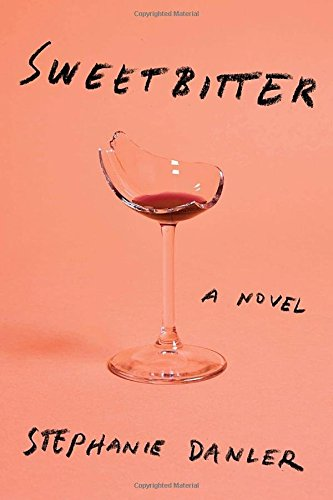
Sweetbitter is a sonic novel — the traffic and murmurs of New York City, the clanging of the kitchen, the cacophony of voices during dinner service, and the ambient jukebox of every dive bar in the city — these are the true soundtrack of the novel. But there is also a lot of music. Tess, the fictional narrator of the novel, inherited my age when I moved to New York City, my old apartment on Roebling Street in Williamsburg, and some of the songs that shaped me in 2006. Beyond that she is a sincere, naive, confused twenty-two-year old, and will always be so much cooler than me.

1. “All My Friends” — LCD Soundsystem

— “It was our song when we were heading out into the night — the manic, dizzy piano introduction stretching us. The song was all promise — that this night would be different, or different enough.” Pg. 281

When I got to the city it felt like I was the last one on the LCD train, but I was there with my usual enthusiasm (fwiw the actual last ones were the ones that joined in 2010 with “This is Happening”). Their music haunts the whole novel, that blend of dance and pop and disco, with James Murphy’s speaking/singing, and sarcastic yet sentimental lyrics. In 2006 and 2007 they were still somewhat an NYC band, a discovery that you made when you came to the city. My fandom never wavered. Many years later I worked a wine store in Williamsburg, Uva, and James Murphy used to come in to shop and I would be blasting Sounds of Silver. Awkward.

2. “Maps” — The Yeah Yeah Yeahs

— “I woke in the mornings inwardly hysterical at the possibility of seeing him. I took great pleasure in subduing it. I practiced composure. He was teaching me a previously unknown patience. It was about him, but it was also not him. I longed for satiation but was terrified of it. I wanted to live in this queasy moment of fantasy for as long as possible.” Pg. 149

Is there a live performer as compelling as Karen O? I don’t know if you can convince me. I often say that Roland Barthes’ A Lover’s Discourse is the single greatest meditation on desire, and I think that Maps is the single greatest song about desire. About living in the bubble of longing that barely even requires the beloved’s presence. There are barely any lyrics, just Karen engaged in the act of watching the Beloved from an impossible distance, and being in pain, but not trying to close the distance. Instead we linger in it.

3. “Ceremony” — New Order

— “Who’s Joy Divison?” Pg. 256

If Tess and her love interest Jake ever got married, they would walk down the aisle to “Ceremony.” But Tess is a girl who doesn’t know that New Order was Joy Division’s successor, or who Ian Curtis is, or about his tragic suicide, or anything about British New Wave — that is one of many reasons that she and Jake are not meant to be. I think every hot guy I idolized in my twenties was obsessed with Joy Division. I haven’t figured out what that means yet.

4. “Heartbeats” — The Knife

— See ​Park Bar, on pg. 178

“One night to be confused
One night to speed up truth
We had a promise made
Four hands and then away
Both under influence
We had divine sense
To know what to say
Mind is a razorblade”

Is this not the song about being young and buoyant? Benchmark electro-pop music by a pair of masked, reclusive siblings — Deep Cuts in 2006 was their breakout, but still such an overtly strange and sexual album. “Heartbeats” was everywhere thanks to the José González cover, but in NYC the synthed-up original version was blasting in the all the bars like an anthem.

Author Stephanie Danler, credit Nick Vorderman

5. “Abbey Road” — The Beatles

— See Park Bar on pg. 67

This is a true story: I didn’t listen to anything but the Beatles until I was twelve. As a child I could identify each of their individual voices, knew which lyrics — down to the line — John Lennon had written. I listened to my mom’s records on repeat, gathered trivia about them obsessively. I do not know much about music, but I know everything about The Beatles. I know that Polythene Pam into Bathroom Window into Golden Slumbers into Carry that Weight is miraculous. So when Tess is in Park Bar, and someone puts on Abbey Road — the entire album, which I love when bars or restaurants do — and she’s blown out on cocaine, it’s the perfect vehicle for the only hint of a flashback about her past, in which a very young Tess leaves a birthday party invitation for God to take to John Lennon.

6. “Sweet Thing” — Van Morrison

— “I put on Astral Weeks and when “Sweet Thing” came on he said, This one deserves a dance. We danced, him bare chested in stretched-out underwear, me in his shirt with no pants on, moving in circles on the carpets under the gauze of cigarette smoke. That was the morning I committed the first sin of love, which was to confuse beauty and a good soundtrack with knowledge.” Pg. 332

Van Morrison is too easy right? Until you are in the process of losing yourself, falling in love in some dingy apartment, and you realize that every song, particularly “Sweet Thing,” was written for you.

7. “Blue in Green” — Miles Davis

— “She dropped a record-player needle into place, and jazz startled the room into the present tense.” Pg. 138

Kind of Blue, a glass of fino sherry, a fire escape, a sunset over the Hudson. I never understood jazz until I lived in a city.

8. “With Every Heartbeat” — Robyn

— “Sasha was a tough nut to crack. He loved watermelon-flavored Smirnoff, Jake, cocaine, and pop music. Those subjects provided just enough overlap between us for me to occasionally warrant his attention.” Pg. 112

Robyn doesn’t get enough credit for making intelligent, danceable pop music, paving the way for Lady Gaga and Sia. She has been consistently making great music since the ’90s and is still relevant. Her dance moves, her hair, her weird shoes. This woman gives zero fucks about the pop music media circus. This is a song you forgot about but love, it’s a keeper.

9. “Fake Plastic Trees” — Radiohead

— “I realized that Fake Plastic Trees was playing over the speakers. I hadn’t listened to it in years and when I had, on repeat, in the bathtub, I hadn’t really understood what it meant to be worn out. I couldn’t shrug the song off. So I sighed and said to Georgie, with my face in my hands, “Misery. Will you just turn it up?” — pg. 329

There was my life before a boy gave me The Bends, and my life after. I often wonder, How do you protect the fierceness of angst, without falling into cliché? How do you make something universal out of your private pains? Radiohead does it. This album coincided with learning to drive, learning to write, learning to read poems, and learning to stare out the window and not run away from sadness. When I re-read some novels I feel like I couldn’t have possibly understood them the first time, they were so meant for this moment in my life. When Tess hears “Fake Plastic Trees” at the end of the novel it feels like a coda for everything she’s gained and lost. She had to have those experiences to understand the song better.

About the Author

Stephanie Danler is the author of Sweetbitter (Knopf 2016). She’s based in Brooklyn, New York and holds an MFA in creative writing from the New School.

A Dystopian Ukrainian Facebook Novel Is Being Published in English

The Ukrainian Satirical Novel Kaharlyk Was Written on Social Media During Protests

Maidan Nezalezhnosti, Kiev, Ukraine (December 1st, 2013)

Oleh Shynkarenko’s novel Kaharlyk features a man with no memory, a town frozen by experimental weaponry, and a journey plunging into the past. As strange as that sounds, the creation of the novel might be even stranger. In 2014, Shynkarenko began posting 100-word bulletins on Facebook from an alternate reality set in a post-apocalyptic future. Previously he’d written versions of these fictive snippets (vaguely criticizing then-Ukrainian President Victor Yanukovych) as entries on his blog, but after being interrogated by Ukrainian security services, the author took to the safer webspace of Facebook. According to the novel’s translator, Steve Komarnyckyj, Shynkarenko created in addition to the text, “fragments of concrete music, mixing sounds, such as Serbian liturgical melodies, washing machines, and cows mooing, to develop a soundscape for his world.”

The novel transparently echoes the violence, corruption, and censorship at the heart of the 2013–14 Euromaidan protests in Kiev. In this way, the endless series of 100-word fragments feels especially fitting; how else can one recover the shards of a splintered world but by the knitting together of its constituent parts? Fellow Ukrainian author Andrei Kurkov called its structure “hologrammatic,” with the inner architecture of the novel consisting of, “beautifully crafted puzzles.”

Shynkarenko’s novel will be published in English by Kalyna Language Press. According to The Guardian, a first look at the English text is available via the Index on Censorship. The extract begins: “The wind blows listlessly through every cranny. Travelling to Kiev on the main highway, two identical 26-storey buildings are visible by the road in the distance. They stick out, the last two teeth in a jawbone. Thus the city’s corpse lays, its head southwards. Their sole inhabitant is a mummified 45-year-old wearing elegant spectacles.”

Ever Wanted to Walk around Westeros?

This infographic shows the real-life locations of Game of Thrones sets

Game of Thrones finished its sixth season with a bang last night. Fans will have to wait a year to see what happens next in the wild world of Westeros, although George R. R. Martin’s next A Song of Ice and Fire novel (from which the TV show is adapted) may come out before then.

If you wish you could see the world of Game of Thrones yourself, well, you kinda can. This infographic from Walks Worldwide shows you the real world locations used as the castles, fields, and cities of Game of Thones.

Allison Amend’s Enchanted Islands Is a Gripping Demonstration of Introversion

Allison Amend’s Enchanted Islands is as bewitching as the title suggests; this lush and captivating tale of friendship, marriage, and espionage follows Frances Frankowski, born to Polish immigrant parents in the 1880s in the Midwest, from Milwaukee to San Francisco, and eventually to Galapágos, where she acts as a government spy in the years preceding World War II. Amend’s writing is spellbinding, and her characters are complicated and richly conceived. Whether in Frances’ relationship with her best friend, Rosalie, or with her husband, Ainslie, Amend captures the nature of intimate relationships, their beautiful complexity and tragedy together. Amend’s work is based on the real life memoirs of Frances Conway, and her relationship with her husband, Ainslie. Amend’s characters’ deepest connections include profound hurt, and yet the island becomes a catalyst for Frances’ growth — she must learn to accept that pain and risk come with companionship. In this tale that touches many genres, Frances comes of age, befriends a complicated girl with her own problems, escapes both poverty and hard circumstances, earns an education and a living, finds purpose and adventure on a deserted island — in her fifties — and learns that love doesn’t always feel happy. Amend tells a good story, and she tells it beautifully.

Amend’s characters’ deepest connections include profound hurt.

“Friendship between women is complicated,” Frances tells us early, as Amend establishes the frame of a best-friend story that will enclose Enchanted Islands’ lengthy flashback. When we meet Frances, she is living with Rosalie in an assisted living facility. Frances has held her secret for decades about her life on the island with Ainsley. Even at their advanced age, we see the tension and competition between friends:

A belch of jealousy burbles up inside of me. Rosalie is to be honored. It was always thus, that Rosalie was in the spotlight while I sat in the wings, but this in particular galls me. I am the one who truly served my country during the war. I am the one who stayed in a marriage for the sake of my country, who came close to losing my life for it. And I can tell no one.

Early in the story, Amend allows Frances the complexity of both negative and positive feelings toward the same thing. Rosalie is as close as a sister, and yet Frances resents her. This sets the tone for what become the two intertwining threads of the story: Frances’ relationship with Rosalie, forged in youth and built upon an early betrayal, and Frances’ marriage to Ainsley, who turned out not to be who Frances thought he was. Each of these relationships mirrors the other. Frances’ life is told in reaction to a series of shocks; early on she is not an observant character, and this allows those close to her to use her trusting nature to act on their own demons. But Frances’ growth comes not from learning to notice all that is around her; instead, Amend helps her to realize that it is her choice of reaction that will dictate what comfort she is allowed. And in Enchanted Islands, Frances learns to value friendship that matters more than betrayal.

Frances’ complication makes her one of the best introverts in recent fiction.

The first third of Enchanted Islands is about Frances’ desire to flee. Frances helps Rosalie escape a situation where she’s being sexually exploited, but as the two try to build their life together, Rosalie hurts Frances deeply, and Frances leaves. Thus begins her pattern of running as far as she can get, and it is therefore not a surprise when she accepts the opportunity to create a false life on the other side of the world. “[W]e’ve rescued ourselves,” the girls contend when they first run, and yet Frances has to learn not just to run, but to be alone, to accept what is and let go of what could be. It is not until she takes on a marriage proposed by the government that she learns to rely on herself. Frances sees herself from the beginning as an observer. “I have always been a rather quiet person,” she says, “content to observe rather than participate, and my reticence grew with age so that by the time I reached my early fifties, an age at which women stopped being noticed, I blended into the scenery as neatly as a camouflaged iguana.” And yet, her inability or unwillingness to realize the truth about those around her is both a major theme and a stumbling block to her happiness. Frances’ complication makes her one of the best introverts in recent fiction. Amend’s characterization of the protagonist feels as rich and vibrant as her descriptions of the island. It is worth mentioning here, too, that female protagonists over 35 are rare in contemporary fiction, especially women over 35 whose lives have purpose beyond stereotypes or saccharine conclusions; that Frances is over 50 for the bulk of the story and is rich with complication makes this vital tale even more of an enjoyable read.

The uncertainty of spying allows Amend to push her characters’ comfort with truth. When Frances learns a secret about her husband — on the island, after they have been married for some time — she questions how she has allowed herself to accept a false version of the man who is, ostensibly, her best friend. The Conways are spies, yet Amend uses them to show how we all construct a version of the truth. Frances asks herself:

Should I have known or guessed? Probably. But do not forget I was lying to myself about so many things. Lies were my entire life at that point. I had lied about my real name, my religion. I lied about being ready to travel halfway around the world to an island on the edge of nowhere. Ainsley and I lied to everyone we met, and when there was no one to meet, we lied to ourselves.

If this were a tale told by a lesser author, it would end with reflections about betrayal, and Frances would get what she deserves in the way of a happy resolution. Yet Amend allows her not to see betrayal as the end; this feels more representative of what true love is in relationships — a choice, even in the face of disappointment. Ainslie tells Frances: “We don’t get what we deserve,” and yet that’s not an admonition or a command to give up. Ainslie, too, suffers in a world where he cannot be who he really is, and he understands that disappointment isn’t limited to any one group of people. Characters in Enchanted Islands choose companionship over the idea of perfection, and Amend renders this over and over with aplomb.

Amend’s work in Enchanted Islands is never syrupy-sweet or didactic, and yet it becomes a tale of self-reliance and hard work. Amend’s work sings on a syntactic level, and she imagines lush detail into the lacunae of Conway’s memoir. Frances educates herself, lives alone in a time when it was rare to do so, and takes on a completely foreign lifestyle. “It seems that with enough practice, we can get to know just about anything,” she says. These are fully conceived characters who will stick with you long after you finish the book. Amend shows how friendships change over decades, and how much we need other people. Frances and Ainsley forge a life on the island from nothing — both in their habitat and in their relationship. Amend’s characterization of their marriage, though conceived and arranged by the government as a means to an end, becomes an honest and mature take on companionship. “I loved him,” she says, “I knew him better than any other being, and he me. This was intimacy, the like of which I’d never known except with Rosalie, and even that relationship was fraught with secrets. We can know each other deeper than mere facts. We can love each other deeper than our actions.”

Poppies — Fiction by Kit Haggard

On June twenty-first, I woke up in my familiar twin-sized bed with poppies sprouting from my knees. It was the day after the bomb fell and destroyed most of the city I had lived in my whole life. I was not, at first, sure which of these things was real, and which was the dream: would I have to continue on, knowing that nearly everyone I had ever met was now dead, or was it the pain of new shoots pushing up through my pores that was real, and that other, larger pain that was the dream. Like a child, I lay on my back, staring at the grey ceiling of my room, listening to the low rustle of the poppies, pretending that none of it — not even I — existed. Then I called 911.

After automated directions about fallout shelters, a woman with a cool, dispassionate voice came on the line and asked about my emergency.

“There are poppies growing out of my legs,” I said, watching the clean stalk of another seedling press against the inside of my skin. It was green and coiled in on itself like a fetus.

“Is this an emergency?”

“I don’t think I can walk,” I said.

“Unless you’re in critical condition, I advise you to seek home care. There are people dying in all the hospitals.”

“I’m sorry, I know, of course,” I said, and hung up the phone. As an experiment, I pinched off the red budding head of a stalk, which began to drip blood onto my sheets, and then onto the floor. Wherever the stain touched, more poppies pressed up, blooming out of the carpet, the exposed edge of the mattress, my shins and the torn-up beds of my fingernails. I wondered if I was anaesthetized, or dead. I called you, but the landline was disconnected.

After that, I slept for a while, and dreamt that a boy with sticks for hands came into the bedroom to say that we were all going back to where we came from, and as he said so, turned into a tree, tearing up the floor by the window with his roots. When I woke again, I could not be sure it was a dream. The face of my building had collapsed, and the remaining rubble and brick was threaded with branches. I had thrashed in my sleep, and the poppies covered the mattress, my legs, the bottom halves of my arms. I lifted my hand to look at the thick clusters of flowers there, so dense, it was like I didn’t have hands at all. As I stood, I could hear the stalks breaking and the faint, spry sounds of growth everywhere I walked.

In the kitchen, I ate fumblingly, surprised that my body still required the same things that it had before. Shouldn’t things be different now (outside, a woman passed with hundreds of mice in her hair; one of her legs had been broken, and she cried to drag it under the weight of all them) shouldn’t it be that my living skin might subsist on sunlight? I lay on the kitchen floor, made heavy, and watched the changing clouds or smoke drift over through a hole in the roof. If I slept, it was only momentary, churned briefly through the terrible machinery of dreams. The pain was dull and thin now, like humidity, like a blunt object.

In the evening — if it could be called evening, with a sulfuric lump of light rising up out of the east — the radio came on. It did this by itself. The stalks growing from my arms had become so entangled with those growing out of the floorboards that I could hardly move at all. It only hissed, and began playing one pop song over and over. I knew it from somewhere, and was made instinctively sad, but could not remember why. When the wind came in through the missing wall of the apartment, the sound of the flowers brushing up against one another was so loud it drowned out the music.

Around three a.m., the song stopped playing. “Hello?” said my mother’s voice from the radio. “Hello?”

“Mamma,” I said. “I’m here.”

“Hello? Can you hear me?”

“I’m here, I’m here. Please don’t hang up.”

“You’re so quiet.”

“I can’t move.”

And she said, “Where are you?” and I thought that something very terrible must have happened to her, and that she was standing somewhere as a field of wheat, or a rosebush, and could not remember the things that had come before.

“I’m at home. My apartment — ”

“Your apartment,” she said, and her voice began to crumble into static; great chunks of it simply broke off and fell into the sea of white noise. The sound hissed for a while, ebbing in, and then cut out. Everything was very quiet in its wake. I could hear the shoots spreading, budding out of places I had touched all across the room. They were a part of me, so I could feel the tiny winged creatures hatching and nosing blindly into stalks beside the fridge, and the colony of ants that had come up out of the exposed floor. I no longer felt the pain of them at all. Instead, the sturdy blooms at my back lifted me slightly, and I was pillowed. One seed began to unfurl ever so precisely in the cool bed of my right eye, then the same in my left, and I was blind. There was very little of me left. I could not remember things, like the bomb that had destroyed the city, or that nearly everyone was dead, perhaps even my mother, perhaps even me. The roots of the poppies reached back through the channels behind my eyes and dug their pale fingers into my brain. It was not bad to be a field of poppies, even if we were inside an apartment building. Eventually, a little rain began to fall through the hole in the roof, and all we could know was the absolute pleasure of growth under this fine mist.

I thought that would be the end, but we woke later, all unsettled. Without eyes, we looked up. I could not be sure where we were, only that it was dark, and something was moving through the poppies toward me, at its center, though really there was very little of me left. I thought of the roots of a sapling, breaking a clay pot but holding the soil’s shape; perhaps this had happened to my body. Someone continued forward through the shoots, stepping carefully around us, and without seeing, I knew it was you. For a moment, I thought that you had come back, and sat beside the bed where I was dying, but instead, I was not dying, and the bed was not my own, but a bed we had shared once, and there had been no bomb, but only some slight sound in the night, and I had rolled over, and you were asleep.

Ted Wilson Reviews the World: A Tunnel

★☆☆☆☆ (1 out of 5)

Hello, and welcome to my week-by-week review of the world. Today I am reviewing a tunnel.

If a tunnel only has one end, is it really just a long hole? What if the tunnel loops around to itself like the number six? What is it then? A tube? A very simple maze?

I found what I think is a tunnel last week while exploring the woods. It was a small, dark hole that I could only fit into by getting down on my hands and knees. As I made my way, I was overcome with excitement thinking of all the things the tunnel might lead me to. A treasure seemed like the most obvious outcome, but an isolated world where dinosaurs and megafauna still roamed freely didn’t seem impossible. This tunnel could be my key to a new life.

Being only 500 miles from Toronto, the drug capital of Canada, I crossed my fingers I wasn’t crawling through a drug tunnel. Crossing my fingers made it harder to crawl, and after a while they had cramped up in that position, but I was too excited to stop.

After about six hours (I counted out loud to keep track of the time) of crawling in complete darkness, I took a nap. Unfortunately I couldn’t count out loud while sleeping, so I have no idea how long I was in there. Judging by the number of bugs on me when I woke up, assuming one bug crawled on me per hour, I was probably asleep for a few hundred hours.

Being deprived of light, time, sound, friendship, and water left my mind in a strange state. I began to question everything. Where was I going? Why did this tunnel exist? If I ever got out of the tunnel, would life be too overwhelming and would I find myself needing to return to the tunnel for true comfort? Had I become a tunnel person?

I made myself a promise: If after six more hours of crawling, I didn’t find anything, I would slowly crawl backwards until I got out. But after crawling forward for only another minute I hit a wall. It was the end of the tunnel and there was nothing there. There never had been. The tunnel was an illusion. It promised me things it couldn’t deliver and at the end was just nothingness. I had never asked for this tunnel but it was thrust upon me due to poor decision making.

When I finally emerged into the real world again, I heard someone yell, “There he is!” At first I assumed someone had spotted a celebrity, because that’s what I always yell when I spot one. (The only one I’ve ever spotted was Alan Alda.) I looked around and pulled out my autograph book. It turned out to be a search party looking for me. I had never felt so important! Not important enough for anyone to ask for my autograph, apparently, but import to be mentioned on the news as “a confused senior citizen.”

That tunnel stripped me down to nothing, only to build me up again. I was refreshed, renewed, and determined to never hope for anything again.

BEST FEATURE: The guttural screams I released on more than one occasion echoed in a really neat way.
WORST FEATURE: When making my way backwards out of the tunnel, I had to crawl through the spot where I had defecated earlier. That was really my fault more than the tunnel’s, I guess.

Please join me next week when I’ll be reviewing a rug.

Debbie Graber Proves Why the Office Is as Much a Battleground as It Is a Place of Work

Debbie Graber’s short story collection Kevin Kramer Starts on Monday mines a rich tradition of office-set literature. One might point to such antecedents as Ed Park’s Personal Days or Nicholson Baker’s The Mezzanine, but the roots probably lie all the way back in “Bartleby the Scrivener.” In Herman Melville’s existential tale of the absurdity of bureaucracy, the titular scribe repeatedly refuses to work, offering only the gentle reasoning that he “would prefer not to.” There are more than a few Bartleby-types in Graber’s book, office drones and social losers who, in small but significant ways, push against the idea that their job titles define their identities even as they dutifully show up to work. These include Gregg Fisher, a martyr to mean-spirited company gossip whose disappearance foments his coworkers’ angst; the second-person protagonist of “What do you think is wrong with you?”, a call center representative whose vulgar outburst will probably get him fired; Kyle, a fundamentalist Christian who alternately lusts after and despises his nonbelieving co-worker; and Kevin Kramer himself, a sadistic senior vice president who ruins his own company for no reason other than that he can. Their rebellions, like Bartleby’s, are ultimately self-destructive, demonstrating that alienation is often the price of independence.

There are more than a few Bartleby-types in Graber’s book, office drones and social losers who […] push against the idea that their job titles define their identities even as they dutifully show up to work.

Graber is especially interested the tension between the collective and the individual in the workplace. To that end, a few of the stories are structured around disembodied narrators/protagonists — not quite the first-person plural We but nonetheless suggestive of groupthink. The title character in “Gregg Fisher’s Pontiac Vibe” never actually appears in-scene. Instead, the story relates the escalating gossip that surrounds him, the refrain “Someone said” filling in for co-workers who prefer to remain nameless, e.g. “Someone at the company was seriously afraid that Gregg Fisher was a carrier of the Black Death, and wrote an anonymous note to HR.” It’s the kind of device seen in the work of Stephen Millhauser, but Graber’s application of it to the office setting is innovative and insightful. Our sympathy is with the pariah; Fisher is a tragic character, a scapegoat probably conscious of his status but unwilling or unable to confront his accusers. Similarly, “New Directions” takes the form of a series of unsigned memos from the executives of Production Solutions, a company whose programming staff has apparently vanished rapture-style. The office’s gradual descent into chaos is juxtaposed with the matter-of-fact tone of professional discourse:

Employees:

Some of you may have heard that the clothes the software department members were wearing at the time of their mass disappearance were found in the dumpster near the facilities shed across the street. This is unsubstantiated. No clothes were found in or around the dumpster.

Graber has performed at Second City and the collection’s first-person stories betray that influence, reading like comedic monologues ideal for live performance. She is masterful at crafting a certain loquacious brand of narrator whose desperation for an attentive audience leads to inadvertent confessions.

In “Northanger Abbey,” a Coover-esque piece of metafiction, the narrator describes the novel he intends to write, and it soon becomes apparent that his book is little more than a feeble revenge fantasy. “Back to Me,” a one-sided conversation between the narrator and her psychiatrist, is rife with moments in which the reader is much more aware of what the narrator has let on than the narrator herself; when she says that her self-appointed boyfriend Bret took her on dates to places like “his parking garage or the alley behind Duffy’s” the dramatic irony makes the narrator’s delusion pathetically and hilariously clear. Perhaps Graber’s monologists talk so much to distract themselves from past traumas and transgressions. As they vacillate between neurotic self-absorption and wounded compassion, they call to mind the narrator of another office lit classic, Bob Slocum of Joseph Heller’s Something Happened.

The two best stories are about the least likable characters. “Winners and Losers” features an aspiring screenwriter referred to only as “the winner,” a despicable guy who separates people into the two titular categories. He is pickup artist philosophy incarnate. Throughout most of the story the only thing that demarcates him as a winner is his artificially inflated self-esteem. He’s broke, his family has cut him off, and he spends all the money he has left on a screenwriting class. But the problem, the narrative insists, is us; we don’t see the big picture. “Losers might find it concerning to blow their entire savings on Robert McKee’s Story Seminar at the LAX Embassy Suites, but winners keep their eyes directly on the prize.” But Graber resists an easy ending in which the winner earns his comeuppance or continues to toil in failure the rest of his life. Instead, the winner wins: He gets an agent. He embarks on a lucrative screenwriting career and gets everything he’s ever wanted. And success doesn’t change him; he remains as nasty and self-absorbed as ever. What begins as yet another fictional ethnography of a sad sack loser becomes a refreshingly cynical meditation on the arbitrary nature of success. Likewise, Kevin Kramer is a loser who transforms himself through sheer force of will into a winner. A sociopath in pursuit of power for its own sake, his impressive (though made-up) resume and facility for con jobs has snagged him a senior VP position at Entertainment Solutions. His demanding, can-do demeanor earns him the admiration of the executives even as his erratic approach to management sabotages the company. He fires valuable employees on a whim, is profligate with company funds, alienates peers and clients alike. The only sign of any human tenderness he exhibits is when he browses the internet for “online photos of narwhals, the rare unicorn whales he remembers reading about as a child.”

Kevin Kramer Starts on Monday is at its best in moments like this, when Graber probes the surface impersonality of office culture and reveals it to be the grounds of a unique vulnerability. After all, our co-workers, though we may not know them well and they may be sociopathic bastards, are the people we spend as much time with as our closest loved ones. Insightfully utilizing the tools of the institution itself — business jargon, circular speech, memorandums, emails, gossip, confession — in Graber’s hands the office is a microcosm of life itself.