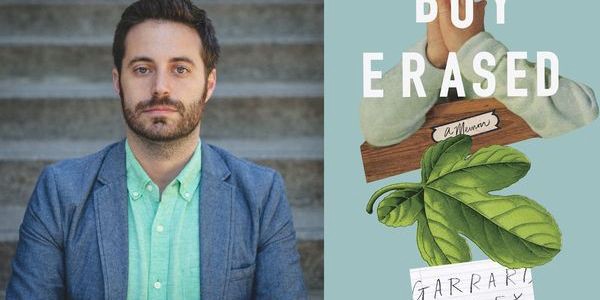
Garrard Conley on ‘Ex Gay’ Therapy, the Church and His New Memoir, Boy Erased

Garrard Conley’s new memoir Boy Erased (Riverhead, 2016) is a coming out story that involves rape, condemnation, loss and love. Conley was outed as gay during his freshman year of college to his mother and his father, a Christian Baptist minister in small-town Arkansas. The story interweaves Conley’s experiences with a high school girlfriend who hoped they would marry, the abuse he suffered by another boy in college, and the trauma of a church-supported conversion therapy program that promised to “cure” him of homosexuality. In 2004, he volunteered to attend Love In Action, an ‘ex-gay’ therapy facility, in order to save his family, but he eventually fled the facility in order to save himself from committing suicide. In spite of the struggles he faced growing up gay he has emerged triumphant, which is why Boy Erased will have a strong and positive impact on readers tackling similar issues concerning faith, family and community.

I met Garrard at the Bread Loaf Writers’ Conference in 2015 and liked him immediately. He’s the guy you tell all your problems to and take home for Thanksgiving. He is amiable, sincere and compassionate. He’s also fun on a dance floor. We met again at the AWP conference in Los Angeles, but it wasn’t until he was home in Sofia, Bulgaria, where he lives with his boyfriend and teaches English to high school students at the American College of Sofia, that I had the opportunity to phone him for this interview about Boy Erased.

Andrea Arnold: Anyone would find it difficult to be forthright in a book about his or her early sexual experiences and yours were heartbreaking and traumatic. As someone who also writes fiction, why did you choose to write Boy Erased as a memoir instead of a novel, where an author can hide behind fictional characters?

Garrard Conley: I started writing the first essay for the book in a nonfiction class at UNC-Wilmington. The professor asked all of us what part of our lives we would be writing about in his class. Before that moment I had never considered writing about ‘ex-gay’ therapy or my childhood, but I blurted out some details of my life and everyone in the room leaned forward to listen. The interest was palpable. One girl said, “How is it even possible that this still happens in 2004?” Her words were my first indication that the story might be more important as a memoir than as a novel.

I worried that as a piece of fiction the story might seem exaggerated. In fiction you can get away with covering up the nasty parts of an autobiographical story or making the prose subtle. In nonfiction, however, you have the chance be explicit and say, ‘This stuff actually happened to me.’

…one person asked, “How can a parent do that to a child?” That question has followed me throughout the entire process of writing the book.

The other indication that this might turn out as nonfiction came from a conversation I had at a café with friends at Columbia University in New York. I was visiting a friend, and someone asked about Arkansas, so I told the group a bit about my childhood. People at the table leaned forward just as they had at UNCW, and one person asked, “How can a parent do that to a child?” That question has followed me throughout the entire process of writing the book. My mom has also been asked this question many times, and she almost always cries and says something along the lines of, “I don’t know how we did this to you.” But the truth is, almost everyone in the church thought sending me to ‘ex-gay’ therapy was the right thing to do. Love in Action came highly recommended. And the more I started focusing on the question, this totally reasonable question of how it could happen and how any parent could do this to his or her child, I began to see that only memoir could begin to address the question.

AA: You were nineteen-years-old in 2004 when your parents encouraged you to go to ‘ex-gay’ therapy. Has the church changed or become more sympathetic about members coming out since then?

GC: The church changed right after I left. But you have to keep in mind that when we talk about ‘the church’ we are really talking about a lot of different dominations in the area I grew up in. There was the Assembly of God and the Church of Christ, which I honestly don’t know that much about, but my Missionary Baptist church was very plugged into the ‘ex-gay’ movement at the time. Church leaders considered it the best option if your kid turned out to be gay. But right after my experience in 2004, this sixteen-year-old kid Zack Stark posted all the rules of ‘ex-gay’ therapy at Love In Action on his blog, and this act caused a huge protest. There’s also a This American Life piece about it featuring John Smid, the former director of Love In Action, that explains why Smid decided to put an end to the facility. The documentarian Morgan John Fox even made a documentary about Love In Action called “This Is What Love In Action Looks Like,” which talks about how those protests raised awareness and caused even the ‘ex-gay’ counselors to reconsider their stance.

AA: Do you have a relationship with God today?

GC: My relationship with God is highly in flux. Like I said in the memoir, prayer for me was really a place of comfort. Like I could just speak into my head and order the world in some way. Even when I thought I was speaking to God, I was really speaking into my head and making a litany of the important things of the day or the things I wished would happen in my life. I sometimes still pray, but I wouldn’t say that I have a direct relationship with a knowable god.

AA: What about your parents? Do they?

GC: Yes. My father is still a preacher. His congregation is growing. He has a soup kitchen now and it’s pretty successful. And my mom is still a preacher’s wife, but she is very much in support of me. She’s stuck in the middle.

AA: It seemed like those recorded conversations highlighted in Part Two of Boy Erased were very difficult to have with your mother and that she was overwhelmed with guilt.

GC: It’s getting a little easier now, but we almost can’t go a full conversation without apologies and crying.

AA: The end made me cry openly like a baby. I think a lot of people can relate to having a parent who wants him or her to be something else. What is your relationship with your father like today? Has he read the manuscript?

GC: My dad was really worried about his congregation finding out about the book. As you know from reading it, there’s an idea in the church that says that the sins of the father are passed down to the son, or that whatever is reflected in the son’s behavior must be some fault of the parents. Because of this idea, my dad was worried that the church would turn against him and vote him out. His church has to be a self-sufficient by next year. Up until this year the Baptist Missionary Association has funded his church, but this funding will be cut off next year when his church becomes a fully-functioning, self-sufficient organization.

My father and I had this fruitful phone call about his fear. I said, “I know you don’t want to talk about the book, and ‘ex-gay’ therapy is not something we have talked about much in the past, but I want you to know that I didn’t write any of this to make you feel bad or to paint you as a villain.” I said, “I tried to make you into a three-dimensional human being.” He didn’t really respond this, but my mom said he went into his office, closed the door, and cried for about an hour. That night, he got behind the pulpit and said, “My son has this book coming out that’s about gay stuff. If you need to leave the church I’ll understand, but I’m staying here.” That was a really big deal in our family because he had not yet acknowledged the book, though there were certainly plenty of rumors.

Recently, some weirdo at my dad’s church saw my Twitter account and told my dad that he really needed to read what was going on. My dad got on there. I think he might’ve read the Virginia Quarterly Review excerpt. I think he read more of what the book was about, and my mom said he was really upset and wondering if I was going to Hell again. Even so, we just talked right before this interview and he seems to be okay. We’re no longer at a stalemate. I would say we’re just at a really awkward phase.

AA: What happened to the girl that you call “Chloe,” your high school girlfriend? Does she know about the book?

GC: I contacted her on Facebook right before I was about to write about her, because I didn’t want her to be mad at me. She was nice for a couple of days and then she blocked me! I guess my posts were too gay! [Laughs] But her brother, “Brandon” in the book, is openly gay and lives in California somewhere. He’s always posting these cute drinking pictures with his gay friends. She’s also cut him off a little bit. She’s married to a guy who in every photo on Facebook has camo on and her two children are carrying guns. So that’s a lost cause. [Laughs]

AA: You also wrote about how literature saved your life. What were your favorite books and authors growing up?

GC: The electric ‘ah-ha’ moment for me was when I read The Scarlet Letter for the first time. It was both the literal and metaphorical value of that scarlet letter that made me think: Okay, people hate her based on what she looks like and who she is, and everyone in this town is wrong! It was amazing: Someone took the time to craft this narrative that lets me know that everyone in a town can be wrong about an issue. Also, Hawthorne is obsessed with his family history, as I am. In the beginning of The Scarlet Letter he talks about how he discovered an embroidered scarlet letter in the file room where he was working this government job. He learned that his family was part of the Salem Witch Trials. Their family name was actually Hathorne but he changed his name to Hawthorne so he wouldn’t be associated with the Hathornes, who were some of the people that killed all those women. He felt like he had a moral duty to write about what his family had done and what people like that can do. I only found this info out later when I became obsessed with the book, but there’s also a more literal connection to the genogram. Hester Prynne had an A on her chest for adultery, and they (Love In Action) made me write an A on my family tree as part of a “Moral Inventory.” It’s really obvious why I would love that book, though at the time it just came as a shock of recognition.

AA: You got your masters from Auburn and then went to University of North Carolina — Wilmington for an MFA. You could have attended grad school in a liberal city like New York or Los Angeles. Why did you choose to stay in the South?

There are people living in North Carolina who aren’t privileged and mobile, who can’t leave the state, so we decided, Fuck it! Let’s go!

GC: One reason is that Auburn paid for everything [Laughs]. The other is that the South is what I have always known. I guess in some ways it’s easier to exist in a liminal space. I’ve since lived in Ukraine and Bulgaria, both of which are not progressive in terms of civil rights. The South is familiar to me, and I feel like I know my purpose there. Part of my upcoming book tour is with Garth Greenwell, and we’re booked for three different dates in North Carolina back to back. Bruce Springsteen recently canceled a concert in protest of the North Carolina Anti-LGBT Bill, but Garth and I are both Southern boys and we both feel like our best work will be to go to the places that hate us and shove it in their faces. [Laughs] We actually agreed to book two more dates together in North Carolina after the law passed. Publisher’s Weekly recently published an article about how the laws are harming bookstores. There are people living in North Carolina who aren’t privileged and mobile, who can’t leave the state, so we decided, Fuck it! Let’s go!

AA: Why did you move to Sofia, Bulgaria?

GC: I moved to Bulgaria because I fell in love with a Bulgarian man. We met at a writer’s conference called the Elizabeth Kostova Foundation. She wrote The Historian, which was a big book about seven years ago. She uses her money to fund five English-speaking writers and five Bulgarian writers to go to the Black Sea and do a workshop. While I was there I met my boyfriend, but then we lived apart for a year while I was at UNCW. After I sold my book and it was under contract that first year, I moved to Sofia to be with him while writing the book and teaching English.

AA: I read your Acknowledgments page. You said that you sold your memoir before you had even written it. What was the publishing process like for you?

GC: That was so crazy. The publishing process for this book is something that infuriates people if I just tell it to them while they’re in the process of trying to publish something. I try not to talk about it often. It was one of those fairy tale stories. I was at AWP in Boston and had been invited to this dinner by a great short story writer named Kathy Flann. This was during the mini-blizzard, and we were getting snowed in. Some guy was holding court at the head of the table, mansplaining something, and I turned to the woman next to me and said, “What is with this guy?” She said, “Thanks for saying that!” She turned out to be Maud Newton, who writes these great book reviews and has a book on ancestry coming out soon and has a blog that’s been very popular. She has so many connections. She asked me what I was writing, and I told her about my essay. Then she asked me if I would like to go to an agent party with her to meet Julie Barer. I was like sure! I drank too much because it was open bar. Julie spoke to me, and very soon afterwards I sent one of the agents at Barer Literary a query letter, not knowing at all what I was doing. They asked to see more. I had like eighteen pages. I said I had everything basically written but I just needed to revise. [Laughs] I spent the next two weeks at UNCW not sleeping and writing what became the second chapter, The Plain Dealers, on their computers, sort of stealing my way into the computer building at night. I sent the chapter in, and right after that I signed with Julie. I wrote a proposal that summer on one hundred pages, which was then rejected by every house except Riverhead. It was sent to like thirty people!

AA: Do you think they were just afraid of it? I mean, I see this as a big deal book.

GC: I don’t know. Several big name editors like Lee Boudreaux were interested, but I guess they couldn’t sell it to the whole house. I have a different editor at Riverhead now, the fantastic Laura Perciasepe, but the editor who called was Megan Lynch. She’s great! She bought it on the proposal and two chapters, along with an experimental part, which is now Part Two, with my mom in it. I feel like I’m still very lucky!

AA: I was raised without a formal religion. My mother grew up Catholic, my father Jewish. We didn’t go to services regularly and holidays were for fun. Before I read Boy Erased, the concept of ‘ex-gay’ therapy was almost unfathomable. Why do readers like me need to buy your book and read it?

GC: There are two points I would like to make about that. I was thinking about why people should read my book when Riverhead was picking up the proposal, because I was worried that an editor might want to sand off the edges and make my story more palatable to readers. I wanted this memoir to be an odd document of that particular period of time in that particular version of America, an America that I believed was out to get me and the rest of the world. I thought that if this ‘ex-gay’ experience happened to me then the event wasn’t necessarily an isolated one. You can see this in current politics. Look at the North Carolina bill that just passed. Look at Tennessee. Look at Mississippi. This stuff is coming back. One of the things I say to my students when I’m teaching about civil rights issues is that it’s never a straight line of progression. In fact, these bizarre happenings are an essential part of our culture. It wasn’t so long ago that we had George W. Bush. It feels like it but it wasn’t. Even today crazy thinking controls a lot of legislature that gets passed in our country. I don’t want to sound inflated, but firstly I wanted my memoir to be a true document and secondly that if anyone found it ten or twenty years from now hopefully they would say, “What the fuck were they thinking?” [Laughs]

I’m tired of the type of memoir that just shows you its scars and wants you to feel sympathy for it. This is not that kind of memoir.

I started teaching The Crucible while I was writing the second half of Boy Erased, and I believe we’re still interested in that story and obsessed with witch trials because this is a strand of American history that’s still alive. What I didn’t want was for my book to become a trauma narrative or a healing narrative that would be touted as merely a testament to love. It’s not meant to be only an uplifting and inspirational piece of literature. I’m tired of the type of memoir that just shows you its scars and wants you to feel sympathy for it. This is not that kind of memoir. I wanted it to be a little scary.

Midweek Links: Literary Links from Around the Web (May 11th)

Looking for some interesting reading to get you through the week? Here are some literary links from around the web to check out:

Sorry, writers, but science says you are probably a psychopath

A celebration of the incomparable Love and Rockets graphic novels

It was SF legend Gene Wolfe’s birthday this week

You think George R.R. Martin is bad, check out these authors who took forever to write a sequel

A short guide to the far-out world of Afrofuturism

The fine art of literary hate mail

David Ulin on the literary bond he had with his father

FSG is starting a new experimental imprint

James Franco won’t make a Blood Meridian movie after all

How a weird porn author trolled the Rapid Puppies’ Hugo campaign

Horrible mothers in fiction who will make you happy for yours

Study Writing with Contemporary Masters in New York City!

Announcing Catapult’s Summer 2016 Classes!

Always dreamed of studying writing with the most exciting debut and established literary authors in New York City?

Catapult is pleased to present a series of writing classes, workshops, and intensive bootcamps, co-presented by Electric Literature. Spend your summer workshopping your writing in courses that past students have called “a significant life experience” and “everything I could have hoped to expect and more.”

All classes are held in our New York City offices and are open to writers of all levels looking to join a community of like-minded and talented individuals.

All classes are accepting applications now. And if you’re looking to win a free class, make sure to enter our monthly giveaway.

Fiction workshops include Tanwi Islam’s “This Must be the Place,” Sophie McManus’s “Discovery through Revision,” Kathleen Alcott’s “Choices and Concision in Short Fiction,” and Kristopher Jansma’s “The Three Layers of Character.”

Nonfiction workshops include Leigh Stein’s “Obsession as Engine,” Eleanor Kriseman’s “Self-Editing,” and Chelsea Hodson’s “The World According to Me.”

This summer’s bootcamp lineup features the return of Lena Valencia’s “Lit Mag Submission Process,” Seth Kaufman’s “How to Produce a Book and Sell It,” Daniel José Older’s “The Street is a Book,” and “Nailing Your Narrative,” co-taught by Chloe Caldwell and Ashley C. Ford.

Gauley Season

Gauley by Matthew Neill Null

Labor Day. We could hear the bellow and grind from the Route 19 overpass. Below, the river gleamed like a flaw in metal. Leaving the parking lot behind, we billy-goated down the fisherman’s trail, one by one, the way all mountain people do. Loud clumps of bees clustered in the fireweed and boneset, and the trail crunched underfoot with cans, condom wrappers, worm containers. A half-buried coal bucket rose from the dirt with a galvanized grin. The laurel hell wove itself into a tunnel, hazy with gnats. There, a busted railroad spike. The smell of river water filled our noses.

Finally, sun spilled through the trees, and we saw Pillow Rock rise as big as a church from the waters. A gaudy lichen of beach towels and bikini tops coated it over. Local women shouted our names. “Happy Labor Day!” When we set foot upon it, the granite seemed to curve to our bare soles, radiating an animal heat. Wolf spiders raced off. We made the top, where Pillow Rock flattened. The river nipped at its base. So much water. The Army Corps of Engineers had uncorked the dam below Summersville Lake. The water churned and gouged at the canyon walls. The Gauley had the reputation of a drowning river, even before the Army Corps wrestled it out of God’s control and gave it power.

Upriver, scraps of neon: rafters. Dyes like that don’t appear in nature. Their paddles flashed like pikes in the sun.

Rafting brings in millions of taxable dollars a year. The commissioner says it’s the best thing to happen to Nicholas County since the Coal Severance Tax. “Coal was king,” he says. “Coal was king.” Men in their twenties and thirties and forties shouldn’t stand idle. We who’d lost our mining jobs would work in whitewater, plow that wet furrow. Nice thoughts. Invigorating lies. For our bread, we worked filling stations, timber outfits, hospice care, county schools. The two big successes among us, Chet Mason and Reed Judy, started a welding outfit out of Reed’s old, echoing barn. The rafting operators — from Pennsylvania, Oregon, Croatia — brought their own people and did little hiring, until Kelly Bischoff started Class Five. He hired locals. The papers gushed over Kelly. He’d graduated from Panther Creek High School. One of us. Ex-miner. He looked rugged-good and dusky on a brochure, glossy and smiling, holding a paddle. His mother’s from Gad.

On Pillow Rock, men and women spoke to one another, casual and cunning. Someone fiddled with a portable radio: white jags of static, the silver keen of a steel guitar. We pried open prescription bottles that carried names other than our own.

Too late for trout fishing, too early for squirrel season — time to sun ourselves like happy rattlesnakes and watch the frolic. Five weeks running in the fall, we did, every Saturday, every Sunday. Opening day was always best. Every few minutes, another raft tumbled over Sweet’s Falls and crashed in the shredding whirlpool. After a tense moment, the raft popped up like a cork in a sudsy bucket of beer. We cheered. Agonized faces glanced back, blooming with smiles. They loved us, or the sight of us. They held paddles aloft in pale, white arms and their orange helmets shined. Some claim we don’t care about those people, we just take their commerce. Not true. We wonder about their jobs, their towns, their faces, their names.

Kelly Bischoff swore he heard a cash register chime every time they tipped over the falls. I love clientele, he liked to say. Kelly moved between the two worlds, sleek as an otter. He knew us. He knew the rafters. Their names, their faces. He had everything you could want.

“Look, that one’s so scared he keeps paddling, not even hitting the water.”

Laughter tumbled down the rock. “What a jackass.”

“A happy jackass.”

“Would you do that?” Chet Mason asked a woman. “Go over the falls?”

“I’d love to scream like that. I never scream like that.”

“You hear that, Jason? Sounds like you’re not taking care of your husbandly duties.”

Reed Judy said, “You pay big money to holler like that. Old Kelly gets two hundred dollars a head. You got to come with a full raft, too. He got plenty of rafts.”

“How many heads is that?”

“Six in that one, not counting the guide,” Chet Mason said. “Slick as a hound’s tooth, Kelly is. Course, fall’s got to pay for winter, spring, and summer — that’s awful heavy math. There he is. That’s Class Five, that’s Kelly’s.”

The forty-seventh raft that day. Class Five River-Runners had blue-and-yellow rafts, same colors as the Mountaineers’ football team. We were proud of Kelly. After they sealed the Haymaker Mine, he mortgaged his house to start the outfit. Kelly punched out Mayor Cline last year at the festival. Wasn’t even drunk.

“Hey, Kelly boy!” We cupped hands around our mouths. “Hey, Kelly!”

He didn’t wave back, riding closer on the careening swell. The raft hit at a bad angle. Rocks scraped the wet, blubbery rubber. As it made the lip of the falls — in our bellies, we felt a feathery sympathetic tickle — the raft toppled and shook out bodies.

Quiet. Then the screaming. We bounded down to the water’s jagged edge, we tried to tally them, keep the numbers right. Neon tumbling in that gullet of foam, and one frail arm. We reached and missed and cussed ourselves. Reed managed to hook a belt and flopped a man onto the rock.

One disappeared under a boulder for a few sickening moments and shot out the other side. His mouth a hard circle.

With a strong crawl, Kelly led some into a backwater that bristled with logjams and lost paddles. Their heads broke the surface. The current sucked them back.

Kelly and the girl reached up at the same time. Chet Mason was closest. He had one set of hands. He hesitated for a millisecond. He reached for Kelly. “Got you.”

A sharp little yelp cut the noise. The girl’s helmet disappeared downriver. She was gone.

Young boys slid off the rocks like seals. Tethered with rope, they felt for corpses with their feet; we fished for the dead and walked the living — Kelly and four rafters — up Pillow Rock.

Like nothing had happened, another raft came tippling over the falls. The rafters looked surprised when no one waved. Supplicants, we circled the rock with prepaid cell phones raised in hand, trying for the best reception. Soon an ambulance squalled onto the overpass.

The rescued were quiet now. Hard to believe they’d been wailing, keening, moaning just moments ago. Flogged by the water, they looked haggard — pilgrims who’d been turned back from the country of the drowned. We sat them on beach towels and tried to give them sandwiches. They wore mere bruises and abrasions, but the paramedics nursed them just the same. One kept trying to slip a blood pressure cuff onto them. A blond woman with a tank top and a little too much sun wept and cussed in alternating jags. She did this while wringing water from her hair. She had a stiff, shocked look, like a cat you just threw in a rain barrel.

All the while, more rafts going over.

The survivors sat a ways from Kelly Bischoff. He shivered under a towel, smoking a damp cigarette. He’d stripped off his life jacket and spread it in the sun to dry. His hair, gone gray in patches, had grown out like a hippie’s. “Of all the goddamn things,” he kept saying.

“How many times you been over the falls?” Reed Judy asked him.

“Three hundred and thirty-one.”

“How many times you roll it over on you?”

“Three,” he said, pulling on the cigarette. “This was the third. My line was right.”

“Looked like you hit it funny.”

“My line was right. They let out 3,800 c.f.s. today. Too much river. That,” said Kelly, “is God’s honest truth.” He pressed his ear against the warm granite to draw out the water. He was shaking.

Deputies arrived. They were locals, Hunter Sales and Austin Cogar, young, crewcut, sweating from the hike. Austin stood by the survivors and jotted on a pad. “How old you say she was?”

“I don’t know exactly,” a rafter said. He was half of a whisper-thin couple who were holding hands on the rock. “She’s my friend’s daughter. She’s in high school.”

“Her name’s Amanda,” Kelly cried. It was sudden, like the fury of a wasp.

Everyone turned to him. Hunter took his arm and tried to lead him aside.

“I know all my clients,” Kelly said. He liked calling them by their names. It set things in motion, the tumbling of keys in locks. It made us feel unprivileged.

Hunter asked, “How you doing, Kelly?”

“I been better.”

“Turn a boat over, did you?” “Looks like.” Kelly flicked the cigarette into the waters.

“Got good insurance?”

“Damn good. The best.”

Hunter told us to give them some room. He lowered his voice and began to question.

“I had one beer,” Kelly said, more loudly than he should have. “Washed down my sandwich at lunch. Ask anybody.”

The blond woman who’d been wringing her hair spoke up. “You drank three of them,” she said, putting a nice little snap on her words. “You put them away fast.” She turned to Austin. “He had at least two. Then he sneaked off at lunch with them and — ”

Kelly said, “Christina, this is between me and the police. You’ll get your turn.”

We blushed at the mention of her name, like they’d admitted something sexual. Austin’s pen quit scratching.

The blond woman walked over to Kelly. “I have something to say and it’s my right.”

“Aw, shut up.” Then he called her something that made us cringe, even the deputies.

“I’d like to speak to you in private,” Austin told her. “All you people go. Come on, get.”

She spoke in low tones, her hands fluttering in a crippled-dove dance.

Slowly, we folded our towels but didn’t stray far. Kelly sat off to the side like the condemned. Austin talked into a radio pinned to his shirt. “Blond teenager, female, fifteen years of age. Male, forty-three years of age, scar through his eyebrow.”

The sun weakened. As the temperature fell, the air began to smell like rain. Deputies said go on home, they didn’t need no more statements, though we’d have been proud to give them. The coolers pissed final streams of melt-water, and we made our exodus, one by one. A drizzle fell. Kelly sat in the back of a Crown Vic cruiser on the overpass, head bowed against the seat in front of him. The drizzle turned to nickel-hard rain, and we heard the blades whapping long before we saw. The helicopter dipped into view. Pterodactyl-ugly, it switched on a searchlight and circled many times. Then it swooped away, called back wherever it came from. The rain turned to roaring curtains. Faintly, the music of rescue disappeared over the ridge.

We found the dead girl wrapped around a bridge abutment at the mouth of Meadow Creek. Her skin was bleached canvas-white by the waters, her eyes pressed shut. For that we were thankful. The rafters aren’t supposed to see this stretch of river. It’s a world away from Pillow Rock. Here, Meadow Creek sloughed mine-acid into the Gauley after any good rain. It streaked rocks orange and sent a cadmium ribbon of yellowboy unspooling downriver. No fish, no life. The sight of it could make you cry.

“You guys ought to pull on gloves.”

We waved off the sheriff and waded in. Hadn’t we been raised to treat our hands like tools, our tools like hands? Blue jeans drank up water and darkened.

We built a chain of ourselves then pulled her from the shallows, her hair tangling like eelgrass around hands and arms, refusing to let go. On the green table of pasture, we laid the dead girl’s body: coltish, young, trim as a cliff-diver’s. An athlete. Her hair twisted into a wet question mark. One leg tucked under her at a funny angle. We pulled down her shirt where it had ridden over her small breasts. Leaves in her hair. “Walnut leaves,” someone said.

She looked okay for someone who’d been traveling all night. We wrapped her in plastic and carried her to the road. Sheriff said, “Sure glad Kelly ain’t here to see this.”

Everyone nodded. It was a solemn occasion. It felt almost holy, to carry a visitor’s body in the morning light. None of us had touched one before.

The dead girl’s picture found its way into the newspaper, pixilated and gray. She was a high schooler from Bethesda, Maryland, her father a midlevel administrator at the Federal Department of Labor. The mother an ex-wife. Her father was Greg Stallings. We never found his body. We learned the things we did not know. Amanda.

You couldn’t have gotten all the leaves out of the dead girl’s hair. Not even if you’d sheared it off.

With her death, life changed, a little. Insurance payments were made, rumor and accusation leveled, a dram of ink spilled in the papers. Kelly Bischoff sold his company to a fellow from Connellsville, Pennsylvania, who owned a northern operation on the Youghiogheny and the Cheat. Seventeen of Kelly’s people went on unemployment and COBRA, drawing as long as they could. Connellsville had his own guys. No one made big lawsuit money off her death; rafters sign risk papers beforehand, absolving companies of blame. So earth turned, bears scouted their dens, the Army Corps eased their levers down. The river returned to its bed.

We have a tenth of the mining jobs our fathers had.

But Kelly had connections. He found work running a dozer at a strip mine — a fitting job, where he dumped blasted rock into the valley, staunching creeks and gullies with tons of shattered mountaintop. He crafted a featureless flatland where the governor promised malls, industrial parks, golf, chain restaurants. A new round of permits cleared the EPA.

It hurt to see Kelly out of the rafting game. And yes, maybe we’re guilty of feeling something special for Kelly, of yoking our fortunes to his. We rooted for him. He showed what our kind could accomplish, if given the chance, in this sly, new world. We could go toe-to-toe, guide with skill, make that money. We were just as good as outsiders, almost equals, we weren’t just white mountain trash. The sting of the rafters’ uneasy looks when we pumped their gas or offered directions — with a few more Kelly Bischoffs, why, all that would end. Now, nothing.

Then, December. Reed Judy was driving the overpass, making for the tavern at Clendenin Mill, the one that burned last year. A lone figure was washed in the spastic glow of headlights and sucked back into the darkness. Reed pulled over, grit and snow popping under his tires. The man walked up to meet him.

“Can I give you a lift?” Reed asked.

“No, bud. Just taking a look at the river.”

Reed heard the Gauley muttering in its dumb winter tongue, but the canyon was black, no river there. He could see the distant warning lights, like foundered stars, where the dam stood low in the sky. Where it divided river from lake. He asked, “You sure? It’s blue-cold out.”

“Oh, I’m parked down at the turnaround.”

It was Kelly.

“Suit yourself,” Reed said.

“You Steve’s boy? The welder?”

“Yeah.”

“You don’t look like your mother.” Kelly pinned him down with a stare. “Say, you was down there that day. You drug the river. I know you did. Down to Meadow Creek.”

Reed panicked, lied. “No,” he said. “I don’t know what you’re talking about.”

“Yes, you do. You seen her. Amanda Stallings.” Kelly winced. “Did she look okay? God, she was a good girl. She wasn’t tore up too bad, was she?”

When Reed didn’t answer, Kelly said, “I didn’t mean to drown her.”

“Course you didn’t! Nobody said you did! You don’t have to say that.”

Kelly said mournfully, “I don’t think you understand,” and said no more.

Telling it around, Reed itched a particular place on the back of his hand. “Looks like he’s aged twenty years, he does.”

A month later, Chet saw Kelly on the overpass, hands clamped on the rail. When Chet told the story, he fidgeted and blushed. The sight had shaken him. “I thought about hitting him with the truck and saving the poor son of a bitch from, from — I don’t know.”

And this was something to say, because in a place with so few people, each life was held precious, everyone was necessary. We saw Kelly again and again that winter. State troopers made him walk the line. He was not drunk. “Kiss my red ass,” he cried. “Public right-of-way.”

We waited for him to jump.

Every night the dam drew Kelly there. To avoid Route 19, we looped far out of our way, over the crookedy mountain cuts. It hurt too much to see him. But others were vigilant. Every morning, the dam operators of the Army Corps — three lonesome, demoted engineers — scanned the banks and the tailrace with binoculars. They had a pool going as to when Kelly’s lifeless body would finally wash up. That sortie out of the powerhouse was the high point of their day. This, after all, was a backwater post among backwaters.

Lyndon Johnson, a president we loved, dedicated Summersville Dam in 1966. Before cutting the ribbon, he made a joke about losing his pocketknife on the way and maybe hav- ing the Secret Service throw up a roadblock at the Nicholas County line to find whoever had pocketed his Schrade — too fine a thing to leave just laying around — since he reckoned all West Virginia boys come out of the womb knowing a good knife when they see one. We laughed, and Lyndon took out a bandanna and swabbed at his brow, looking like any worried man.

Acres of virgin concrete. Smooth, vertical. The dam was tall as the face of God. There was nothing else to compare it to. Nothing of such stability, such mass.

The rising waters flooded the village of Gad, home to a store, a filling station, and three hundred people. Eminent domain moved them, even the dead from their graves. (When Kelly stood on the overpass, was he trying to see his mother’s village through ninety feet of water? No. He thought only of the girl.) Quietly, later, Gauley Season was created in 1986 by an act of Congress. We had no idea how life would change.

Over unruly rivers and hogbacks, the rectangular Gauley River National Recreation Area was placed like a stencil. It’s shaded aquamarine on the maps. Lord — maps and new maps. The rapids had names before the rafters came: Glenmorgan Crossing and Mink Shoals, Gooseneck, Musselshell. They brought a new language: cubic feet per second, high side and chicken line, hydraulic and haystack. They renamed the rapids: Insignificant, Pure Screaming Hell, Junkyard, the Devil’s Asshole. Unwritten, our names flew away like thistledown on the wind. Except for Pillow Rock. Our fathers named the rock for the river drivers napping there in the sun, after a punishing morning of busting jams and poling logs downriver. Chet snuck to the foot of the overpass and spray-painted in green neon, Pillow Rock Ahead!!! The last thing a rafter sees before tipping over the falls.

True, the release goes against nature. Gauley Season scours the river, blasting fish from their lies, eyes agog, air bladders ruptured. Even so, Gauley Season brings certain benefits. To atone for the fishery’s death, the Department of Natural Resources grows California rainbow trout in hatcheries and drops ten thousand pounds into the canyon by helicopter. The fish have nubby snouts, open ulcers, and tattered fins from rubbing against the concrete raceways. Gray trout, we call them. They taste like they’ve been stamped out of cat food, but they’re free. Come spring, we watch them rain and smack the waters. We cast hooks until every last one’s caught and creeled. Sometimes the fish hit the rocks as the helicopter swoops away. Raccoons revel in the blood. They lick their wiry hands, fumbling them in an attitude just like prayer. They rejoice.

“There he is!” an engineer cried. “You win, Sully! He jumped! He finally jumped!”

The others ran out of the powerhouse. He adjusted the parallax of his binoculars in a gloved fist. “Shit. False alarm.” What he thought was Kelly was a dead deer twisted — twisting — in sunken willows.

A year passed as they do, quickly, as if in a dream or a coma. We thought of the dead girl and her father less and less, or tried to.

Snow and thaw and rain. Hay was cut in the fields, sallies hatched off the river in lime-and-sulfur clouds, deer grew their velvet crowns. September gleaned a cool wind from the Alleghenies. Labor Day weekend, Pillow Rock gathered its people. We hollered as the Army Corps opened up the gates. Upriver, the beating of ten thousand hooves. We inhaled the water’s breath of iron and cedar.

A standing wave broke over Sweet’s Falls. The river augered and torqued, a muscular green. Shards of flotsam and jetsam: broken sycamores and garbage bags, bleached timber, a child’s tricycle. A water-bloated calf wheeled downriver, eyes blue as heaven.

The air crackled with anticipation. Gas stations and hotels and campgrounds had pitched their banners early: Rafters Welcome, Cold Beer Hot Showers, Ask About Our Group Rates. This would be a record-breaking season. The Washington Post had featured us in their Sunday magazine. The headline read Montani Semper Liberi. West Virginia’s secret is out: the number two river in America, number seven in the world. One question remains. Can the whitewater industry save this place? With the glee of discoverers, they told of the spine-rattling, third-world pike that is Route 19. That wasn’t so bad — maybe the Department of Highways would be embarrassed and put in for federal money. What nettled most were the things they plucked out to describe: junk cars in the river, raggedy bear-hounds jumping in their kennels, crosses at Carnifex Ferry that say Get Right with God and There Is No Water In Hell. All eye-battering, all to be laughed at. Didn’t talk about the landing we poured, the oil-and-chip road we laid for their wobbling, overburdened shuttles. “Relax,” Mayor Cline said. “Sometimes the fire that cooks your food burns your fingers — you can’t bitch.” It’s dog Latin, the state slogan. We are, it says, always free.

Kelly Bischoff walked in long pants down the fisherman’s trail, with a ragged red backpack on.

Pillow Rock went silent.

Work-blackened jeans, dirt in his hair. He peeled off his shirt, shook it of coal dust, and folded it with care. The words Sweet and Sour were inked in cursive blue over his nipples, with arrows offering up directions. A black panther climbed his bicep, claws drawing stylized blood. A Vietnam mark. He shucked his boots and tucked his cigarettes, wallet, and keys into them. Finally, he pulled out a penknife and snagged off his work pants to the knee.

“You’re back among the fold,” Reed said to him.

Kelly smiled. “Good to see you all.”

“You working that strip job?”

“Yes I am,” Kelly said, looking side to side, daring anyone to say a word against it.

“Jesus Was Our Savior, Coal Was Our King. Say, you probably ain’t watched from this angle.”

Kelly said, “I seen them go over. 1979, it was. Fishing here. Seen Philadelphy Pete Dragan go over Sweet’s, back in them too-big green army rafts. Said, Hell, I can do that.”

Kelly watched the falls, apart from the rest. What could he read there? The water herded yellow foam into the backwater, a rancid butterfat color, thick enough you could draw your name in it with a fish pole. Where we’d saved four lives last year. Five if we counted Kelly’s. If Kelly longed for his old life, he did not say. He just watched the water’s horseplay like he could augur it. Maybe he could.

Rafters! We waved and hollered as usual, but Kelly radiated a complex silence. So we grew quiet, not so joyful, and the day grew old. Shadows slithered on the rock. One hundred ninety-seven rafts. Not a one drowned. Clouds came and snuffed our shadows. The air had a little bite to it, so we pulled on sweaters and packed to leave. Slush tipped from coolers, the last orphan beer cracked and drained. Kelly just sat there.

“Them are your people,” we said, waving at the last raft.

Kelly shrugged. We gave Reed Judy some hopeful looks, so he hunkered down next to our fallen idol. “You coming? We’re going to Bud Shreve’s, grill some food. Be fun.”

“No, I’ll set here awhile.” Kelly rummaged around his backpack and found a gray army-surplus blanket. Was he too good for us?

“Alright, bud. You hear about the blind kid up here got bit by the rattlesnake?”

“No, I didn’t.”

“Least he didn’t see it coming.”

Kelly smiled and looked at the ground. “That’s a good one,” he said. Didn’t even flinch; there was hope for him yet. But then he whispered something that turned Reed pale and bloodless — and that Reed wouldn’t tell about till years later. “You’re the one lied about Meadow Creek,” Kelly said. “Lied about finding her. Why would you do that to me?”

We left him there as the drawknife of dusk peeled back the world.

In heirloom, fifteen-verse ballads, lovers of the drowned flung themselves in, so their bones could frolic and mingle. But Kelly never trucked in old ways. Instead he sat with us.

For the rest of the season, Kelly was the first on Pillow Rock and last to go. Word went round he’d slept there through the weekends, under a ragged tent of laurel. “But he looks to be shaving,” someone said. Sure enough, he never missed a single raft. He perched there like an osprey. When the maples flared, he began telling stories of the dead girl.

It was hard not to listen. He’d sidle up if you broke away to piss or get another beer. She wanted to be an environmental lawyer, he said. She was an athlete. Once she ran a mile in five minutes and thirty-two seconds, a fluke — her average was six-fifteen. She stayed with her father weekends and summer. She loved dogs. “Oh, who don’t?” Chet asked him.

On a coolish day in October, for the first and only time, he spoke to us as a group. Our numbers had trickled, as they do at season’s end. Kelly chewed his fingernails, his thumbnail. Sucking the taste from them. Then he spoke.

In Bethesda, the dead girl’s home was the size of — he struggled for comparison — of the county courthouse, the one with the statue of Nancy Hart, who seduced her jailer, shot him in his stupid mouth, and brought back a Confederate cavalry to burn the town. Why did our forefathers raise a statue to someone who destroyed them? Our people fought at Carnifex Ferry. Left the trees full of minié balls, as much lead as wood, so they grew hunched and buzzardy under their mineral burden. We sparred and set the boats on fire. They whirled like burning flags in the night and snuffed themselves hissing in the Gauley. Why not a statue to that?

“That’s history,” Kelly said. “Pull your head out your ass.”

“Nothing happens no more. Day in, day out.”

He said, “You got no idea.”

Well, maybe not. “Idea of what?”

To prove us wrong, Kelly plucked up and spoke — confident now. He explained the last day of his rafting career.

When they broke for lunch in the canyon, Kelly offered to lead any stouthearted rafter up Barranshe Run to see the five falls, a stairstep of cataracts up the mountainside.

Hours from drowning, Greg Stallings asked, “Is it far?”

“Little bit. Just follow me, Greg. Anybody else?”

The group sat at a table made of the raft turned turtle. One stood up: the dead girl. Kelly kicked his accent up a notch. “A young thing. Great. You’ll lead the pack, Amanda.”

“I can take it,” she said, with a measure of pluck.

Kelly looked the dead girl over: strong legs, sleek lines. “You can carry her up there on your back,” he said to her father, appraising her like a foreign coin. “She still your little girl, right?”

Greg smiled. The others waved them on, faces full of sandwiches and potato salad, bright and ridiculous in their water-sport clothes — chartreuse and pylon orange, same color as the Powerbait we sling to the government trout.

Ascent. The two of them did what Kelly did, clutching the same wet points of rock, the same dry patches of moss for footholds. The trail stitched itself in and out of the creek, where trout danced like Salome in the tannic water. Smell of rotting wood. Squelch and rasp of wet tennis shoes on rock. Kelly explained Barranshe Run was named for a sow black bear that never whelped a single cub. “No one ran their dogs on her, ever, even when she was reelfoot and gray. Don’t know why. We kill lots of bears here.”

Greg said, “That sounds like a story to me.”

“It’s just what they say.” Kelly knew the rafters were obsessed with fact. They paraded it at him again and again. “Would have been a mercy to kill her.”

“That’s so callous,” the dead girl said.

“Here, you need to stay hydrated. You forget that out here.”

She unscrewed the water bottle and took a drink. She wiped her mouth, cocked her head at him.

The trail narrowed. She kept flicking him little looks.

Hands scrabbled for holds. Calves burned with acid. “One more bend,” Kelly hollered. There, Great Swallow Falls, thirty foot tall. It sluiced over a mossy lip of stone and sent a misty perpetual rainbow into the air: a fisherman’s cast-net frozen mid-throw. The world smelled of cold, rich limestone. Swallows nipped stoneflies. The colored hoop shimmered.

The dead girl showed Kelly how to work the switches on her camera. “Wait, show me again,” he said, grinning. She slapped his arm. “Pay attention.”

Kelly snapped a picture of father and daughter, perfect for the Internet. “Think that’s nice, you ought to see the next one.” Each falls more riveting than the last: deeper drop, darker hues, emerald, topaz, Prussian. The swallows piping like bone flutes.

Panting now, Greg said he couldn’t go on. He sat on a log, nursing warm spots that promised to blister.

“But the last one’s the best,” Kelly said, pointing ahead. Now the trail ran vertical, just a thin trough of root and rubble through jagged stone. A deer couldn’t run it. The ground called for a more agile animal, say a bobcat, a lean leaping ghost with splayed pads and tight haunches.

The dead girl wanted to try it. Kelly promised to bring her right back.

Greg hesitated. “It looks dangerous to me.”

“We take people every day. Amanda be fine.”

“Take your camera,” her father called after.

Kelly led her around the bend. “You got to climb up this little rise to get there.”

Her face went slack. “Are you serious?”

“Grab hold of that laurel, Amanda. That plant there. There you go. Give you a boost.”

Kelly gave it — touching her! — and she pulled herself up. Over the rise, she saw the last waterfall. It was nothing more than a tiny gurgling delta. She began to laugh.

She turned around and found Kelly there. He had a dusky look, shards of coal dust imbedded in his face. Nine years in the Haymaker Mine, riding the mantrip into the belly of the mountain. At night, his skin leaked metal. He woke to blue slivers on the pillow. He kissed her open mouth. She felt his beard and its pleasant rasp on her skin. Swallows singing through the air, soft blue sickles. And the two worlds touch, in a way we always hoped they could. Kelly jumped the wall. He became one of them.

“I turned that raft over,” Kelly said. “I turned it over on purpose.”

“My God,” said Reed, “them people trusted you. My God, that’s fucking awful, that’s terrible.”

The air crackled with alarm. Kelly stared at the river, the sculpted earth and water.

“’Deed I did. Her dad was looking at us,” Kelly said. “He come up behind and saw.”

Reed went on mindlessly, “No, no, no.”

“I know these falls. Think I’d make a mistake right here? These falls is my bread and butter. Been over a thousand times. Been over them blindfolded.”

Everyone yelling, “What’d he see? What was he gone do?” Frenzied and shouting just anything that came to mind.

“I had to. I didn’t mean to drown her,” Kelly said. “Just her dad.”

That settled in. Chet was saying, “Hold on! Kelly, you did it because he seen you and her?”

“She wanted me to get rid of him.”

“Wait — ”

“She hated her dad. She didn’t care if he seen us. He wasn’t her kind. He wasn’t like us.”

We took in his words.

“She told you that?”

“Listen,” he said. “Listen to the water.”

“What?”

“She told me yesterday,” Kelly said.

It started with cursing. You could taste anger in the air, taste it on your tongue. We’d been had. Kelly didn’t have two worlds. He had one, ours, the lesser. “You evil liar,” Chet Mason told him. Kelly babbled on. Everyone howled at him to quit.

“She told me today.”

We shut him up the only way we could. He slid and danced under our hands. Reed had to take off his belt and hit him with the buckle. Grabbing hold of crazy arms and kicking legs, we flung Kelly into that blind, sucking roar. He flopped in with a smack.

Raw white noise. Kelly was gone. Had we really done it? The Gauley took him under. We blinked wildly at one another. No one said a thing. Let it drag him to the ocean.

The river made a shushing sound. We hadn’t kept track of the days. Sweet’s Falls trickled down to nothing. The Army Corps had lowered its levers. The water was placid. A carnival ride unplugged. Kelly floated to the surface, sputtering, blinking at the sky.

Gauley Season was over. He paddled to the riverbank and pulled himself ashore with fistfuls of cattail. Bloody, he managed a grin and gave us a thumbs-up.

Nothing’s painful as embarrassment. Our credulousness stung like bedsores. Even now we nurse those wounds.

Outlandish as it was, Kelly’s story nagged at you. There were three witnesses: two dead, the other lost in that white country of madness. Could it be true? Part of you wanted to believe Kelly flipped the raft on purpose. Kelly and the girl — rafters and locals, one people — a beautiful story. That is, a mawkish lie. If Kelly Bischoff can’t equal them — to know their names, brush their lips, be loved, respected — no one on Pillow Rock can. Once again, the world let us know what we are. Swallows in flight. The rasp of shoes. Kelly built himself a legend on that. He believed. Maybe he’d come to cherish the girl out of a terrible guilt, which can midwife the strongest, most wretched kind of love into the world. Those cold nights on the Route 19 overpass, he believed. For a man like him, like us, one mistake — one botched run over the falls — could ruin him forever. It wasn’t entirely his fault. When they signed the papers, the rafters delivered their lives into Kelly’s hand, they bought the thrill of giving yourself over to a stranger, and the bill came due. And we were the ones who chose Kelly, after all, one of ours. We let the girl die. When Chet Mason reached for Kelly’s hand, we damned him to his own true life. A life with us. But Kelly couldn’t let go of the dream. He couldn’t join in our quiet decline.

Soured by it all, we gave Pillow Rock back to the rattlesnakes. Now, we let them lie coiled to soak up the heat like powerful conductors.

We found ways to occupy our time: machining engines, welding catch-gates, jacklighting deer. The lesser waters no one coveted, so we dove off the cliffs at Summersville Lake till the state fenced it off. Then we cut the wire with bolt cutters — the West Virginia credit card — and dove at night, our jacklights trained on green water, attracting a fine mist of moths and mayflies.

Yet Gauley Season never ceased to be part of our year. The rafters buy potato chips and high-test, they flag us down for directions, but they don’t miss us, our catcalls from the rock. They palm tips into knowing hands, book next season’s trip, tighten luggage racks on foreign cars. As we do our chores, we imagine the shredding water, the cry of clients, the slur of rubber on stone. They slalom down Sweet’s Falls with nothing but the growl of water in their ears. We hate them. We hate them with the fury that is the same as love.

The rafters notice a single man perched on the granite. Shirtless, Kelly Bischoff raises a hand or touches a hat brim. A wise, gray-bearded fisherman gone down to ply the waters. Hair lank, skin mottled like a Plott hound’s. Bedraggled, harried by weather and briar, the river guide has earned this lonesome place by great effort, by true compass. Stalwart, wiry, keen of limb. A true mountaineer, rifle-true. But they know no better. The river guide has made good on his mortgage. With the yellow tusks of a bulldozer, he breaks the mountain. He draglines the coal.

The river guide cups his hands and calls to the rafters, but they can’t hear, they tip over the falls and lose sight of him in a joyous crush.

The nude crag of Pillow Rock, stripped of its people, scrawled and scrimshawed in the shit of swallows. They don’t know that we — the true fishermen — will not return until season’s end, rods ready, faces hard, when the heavens part, the rotors of helicopters mutter their staccato hymn, and we receive the silver benediction of government fish.

If You’re a Writer You May Be a Psychopath

Authoring a gory murder mystery novel doesn’t make you a psycho, right? According to the findings of researchers in the Philippines, the answer is… maybe. Led by psychologist Adrianne John R. Galang, the researchers conducted a three-part study and found that creative people have psychopathic personality traits.

In the first study, male and female participants, many of whom were college-aged, took two surveys. The first measured the extent to which they exhibit personality traits known as the “Dark Triad” (new title for a dystopian YA series?) — Machiavellianism, Narcissism, and Psychopathy — and the second assessed their levels of creative achievement in ten domains: visual arts, music, creative writing, dance, drama, architecture, humor, scientific discovery, invention, and culinary. Ratings ranged from “mundane” (“I have taken lessons in this area”) to “eminent” (“My work has been critiqued in national publications”). Since answers were self-reported, the researchers statistically corrected for “skewedness” (i.e., overestimating or underestimating proficiency).

The psychologists found that both Narcissism and Psychopathy were positively correlated with levels of creative achievement. Since Narcissists exhibit “self-enhancing tendencies,” however, it’s tricky to say for sure whether they actually perform better creatively or simply rank themselves more highly.

In the second study, the researchers gave another set of participants surveys to assess the relationship between creative achievement and three psychopathic traits: Boldness (“the tendency to be less vulnerable to fear or stress”), Meanness (“the capacity for aggression and being unempathetic”), and Disinhibiton (a trait that “captures the impulsive behavior of psychopaths”). Participants indicated the extent to which they agreed with items like “I enjoy pushing people around” (Meanness) and “I can get over things that would traumatize others” (Boldness).

Participants’ levels of creative achievement were positively correlated with their levels of “psychopathic Boldness.” Achievement in the humor domain was linked with both Boldness and Meanness. Creative writers, on the other hand, are nice people: achievement in creative writing was negatively correlated with Meanness. In other words, good writers don’t like pushing people around… well, except their characters.

Finally, the researchers investigated the link between psychopathy and one’s capacity for divergent thinking — coming up with clever, uncommon, and unexpected solutions to problems and uses for objects. They measured the electrical conductivity of participants’ skin (a measure of anxiety) while participants “engaged in a gambling task.” Participants who showed themselves to be divergent thinkers also tended to exhibit the physiological calmness, or emotional disinhibition, characteristic of psychopaths.

These results, though, don’t suggest that artists are closeted serial killers who might come unhinged at any second. The researchers’ main takeaway is that Boldness, which relates to “high stress-tolerance and low anxiety,” is a key component of the independent, risky thinking that creativity involves. They recommend that we foster “creativity in both educational and professional settings” by encouraging Boldness “while seeking to mitigate the more harmful forms of Disinhibition.” This seems like good advice for writers, and other creatives, to apply on a personal level: when in doubt, stay bold.

Unforgettable: Becoming an Amnesiac’s Memory

by Caitlin Myer

In the fall of 2013, my beloved lost his memory. This was not a slow decline. It was a sudden disaster, like losing control of your car on an icy road.

Memory loss! What a story!

I had just arrived in New Orleans, Beloved was in the Bay Area. I was traveling. I am always traveling, always between one place and another, always my suitcase at the ready, no apartment, no home, my mail gathered by colleagues at an office in San Francisco.

***

You begin telling a story, a small one with a beginning, middle, end. But then you realize you have to expand on one of the characters, explain another, tell how everybody got here in the first place. The story grows out on all sides.

This is part of the story: I was once a wife, wannabe mother, faithful employee. Struggled to make monthly bills. Loved waking up next to my husband. Defeated by housework. Then I got sick. Nearly died. Three surgeries later, it was final, no babies would ever be housed in this body. And still I kept getting sick.

I told the woman, “I don’t want a boyfriend or a husband. I want lovers.” She said, “Be careful what you wish for.”

The story also needs this: my mother was sick my whole life, hammered into her bed for years at a time, and then she died.

And then the turn: my way out of sickness was to go. I took up my bed, left my husband. Over the next few years I quit my job, gave away or sold or packed up almost everything I owned, and became a nomad. Freelanced for the company whose employee I used to be. Today I make half what I made before, still white-knuckling it between checks, like you, like most of us, but in the meantime I get to live in Montevideo, Istanbul, Kathmandu, New Orleans.

“Took up my bed” is Beloved’s phrase.

Picture this moment: in the middle of all this packing up and shucking off, on a nighttime bus in San Francisco, only me and an elegant white-haired woman in a black turtleneck, silver pendant. One of those unexpected conversations, night creating an intimate space in the back of a city bus.

I told the woman, “I don’t want a boyfriend or a husband. I want lovers.”

She said, “Be careful what you wish for.”

***

In the fall of 2013, I had what I wished for. I had lived in many places, had work I could do from anywhere, just enough to keep me in plane tickets and food, and Beloved. Beloved, who gave great email, words that zipped through my veins, who talked to me on the phone almost every day, long absorbing talks about writing and ethics and fucking me blue. Beloved, who called himself Brandi from the song, you know the one, You’re a fine girl, what a good wife you would be, this man who knew how to walk like a thug, who intimidated violent men, he called himself Brandi. Identified with the woman waiting at home for the sailor, the sailor with a woman in every port. Let’s follow that all the way back to the earliest of stories: I was Odysseus, he the faithful Penelope. I loved the silliness of this, but there was a serious foundation. My life, he was telling me, was my voyage, and my work.

A love story.

In this story, I was staying with friends in Chicago. I had spoken with Beloved on Monday. On Tuesday I spent the afternoon reading Curious George to my friends’ five-year-old son, and no call. I did not permit myself to worry, it sometimes happened, he couldn’t always call. He would call on Wednesday, or email; he always sent a traveling mercies message.

Nothing on Wednesday. I got on the plane. I told myself not to worry. Worried anyway. Maybe something had happened. In my little notebook I wrote, What is the point of loving someone if you aren’t with them in extremis? On the plane, I imagined him in the hospital, and felt that I must be with him, no matter what. Was it a premonition? Or just the dark way my mind turns.

I’d told the woman on the bus that I wanted lovers, and now I had lovers.

I landed in New Orleans. I’d told the woman on the bus that I wanted lovers, and now I had lovers. Nola met me at the curb outside the airport, in his new little blue car. The last time I’d seen him he was too thin. His hair thin, the veins on his hands stood out. He’d looked like a college kid when I met him three years before, but between one visit and the next, he got clobbered by old man.

In the fall of 2013 he looked better, healthier. He opened the trunk for my suitcase, kissed me.

I was in New Orleans with the intention of gently disentangling from Nola. Seemed simple enough, we were never all that entangled to begin with. We saw each other maybe once a year, never longer than a couple of weeks. Early on he wrote me that he preferred to float. Float was the word he used. I was never sure what to call him. He wasn’t a boyfriend. He laughed at the word lover. Lovah, he said, turning it purple. Your lovah.

I opened my purse, kept the phone inside to look. It was a text from Beloved. Call me when you can.

We stopped for lunch, and Nola took my picture. My elbows are on the table and I’m smiling at him. At that moment, the phone dinged in my purse. I opened my purse, kept the phone inside to look. It was a text from Beloved. Call me when you can. My phone rang then, and I sent it to voice mail. Beloved, again. I got up from the table, went to the bathroom, listened to his voice mail:

“I have something to share with you. Give me a call.”

The diction of this sentence stuck in my brain oddly. Something to share with you. What a therapist might say, or an elementary school teacher. Do you have something to share with the class?

I sat down across from Nola, finished lunch. Beloved was why I planned to disengage from Nola. There was no expectation of fidelity with either of them, but my connection with Beloved was waking me up to the realization that maybe I wasn’t suited to this floating thing. Nola and I got back in the car and drove to his uptown railroad apartment. We brought in my bags and then I told him I was going out for a walk, I needed to make a call. My brother called, I lied, and I need to call him back.

Maybe you’ve been here, been divided. You muddle through the best you can, your heart lost in the moment.

I walked outside, turned the corner, remembered my way to the backside of Audubon Park. There is a tree at the edge of the park whose roots break up the pavement underfoot, where cement peters out to dirt and grass and those roots pushing up, a giant’s knuckles.

I called Beloved.

“Hi.” The word was empty. No joking: Who may I say is calling? No Hello youngster. Just, Hi.

“I have some bad news,” he said.

I looked at the low branches of the tree spreading out all around me. It started to rain, and I watched raindrops slap into leaves, no sound but rain and Beloved’s voice.

“I’ve lost my memory,” he said.

Here we go.

***

When I first met Beloved, I told him I was looking for a Rilkean connection, someone to protect my solitude. Someone who wouldn’t make a claim on me. Beloved seemed perfectly suited. He was already married. He and his wife were friends and co-parents, the romance long over. A shared house but separate bedrooms, private lives. The wish I’d made to the woman on the bus made real.

***

Three, four days are gone, he told me. The first thing I remember was when I went to pick my son up at school. This was yesterday? Yesterday. The principal took one look at me and told me I wasn’t driving anywhere. She took me back to her office and called the doctor. I started to remember things about myself. I said to her, I used to be smart! I used to be a writer!

“I’m a memoirist with no memory!”

“I’m a memoirist,” he said to me on the phone. “I’m a memoirist with no memory!”

He told me that he remembered facts, but couldn’t visualize his memories, couldn’t connect to them emotionally.

“I’ve been going down the list of people in my phone, my recent calls,” he said. “You’re in my phone, so I called you.”

“Do you remember us,” I asked. I was conscious of my voice. It failed, just a bit, on that “us,” but I was trying to keep the terror to myself.

“Technically, yes,” he said.

He said technically, and it was a slow hit. A slow, blunt blow. I did not freak out. He did not need me to freak out. I kept my voice light.

“I’ve been going down the list of people in my phone, my recent calls,” he said. “You’re in my phone, so I called you.”

We talked, I walked. He sounded fine, but skittering along the surface. I was going to say like he was playing a part, but that’s not it. Like he’d been emptied out. A big clean space in his head gave him room to breathe. Still, he didn’t quite know how peaceful it was, he had no basis for comparison.

“Plot is a trick to keep you interested,” said David Byrne. Beloved had lost the plot.

***

Nola cured me of my aversion to being called Baby. “Everybody in New Orleans,” said Nola, “calls everybody else Baby, Baby.”

When I got back to the house, I told him that a friend had lost his memory, that I was terrified for him. Nola said, “I thought it was your brother, Baby.”

“So did I. I thought that was who called. They have the same name,” I said.

This was a lie.

***

Was it the next day? Two days later? Walking through Audubon Park, again, talking to Beloved. He told me he was getting some memories back.

“Just pictures, they don’t move. Snapshots. I have all these pornographic pictures of us, like, wow! Really pornographic. We really did all that.”

I imagined this as he said it, flash pictures of us naked, his brown skin against my white skin.

“Right on,” he said. “I don’t say that, do I? Do I say that?”

He doesn’t.

I didn’t know how to tell him about this, the in-between moment that inspired me to borrow words from religion: sacred. Holy.

The pictures in my head moved on, alive with the sound of his voice beside me in bed, telling me a story about when he was a kid. I scratched his back the way I scratched my brother’s back when we were little, and I could see the narrative arc from birth to that moment, my nails on his back, the rest of the world dropping away, nothing in the whole wheeling universe but we two. I didn’t know how to tell him about this, the in-between moment that inspired me to borrow words from religion: sacred. Holy.

He sent me a text message, and it read like something from a fourteen-year-old boy.

You’re cool, he texted. A cool girl.

I think he was grateful that he could talk with me.

I don’t think I write this way, he texted. I spent a lot of time alone. I walked all over the neighborhood, into other neighborhoods. I watched my feet tread on cracks, tried to sense the crack in the arch of my foot. Then I avoided the cracks and felt myself sink into the middle of the square of concrete. I wanted to sink in. I wanted the sidewalk to pull me under.

The love of my life had lost his memory.

***

This is also part of the story: one month before, while still in the Bay Area, I had been sexually assaulted, in the apartment where I was staying. Beloved was the first person I told about it. He found me another place to stay. I thought I was fine, but I was like the cartoon character who is shattered and doesn’t realize it right away, not until he shivers into a thousand pieces. Beloved talked me through all of it, through black despair and a sense of fundamental unworthiness, a moral sickness that surely oozed from my pores and invited this violence.

I was like the cartoon character who is shattered and doesn’t realize it right away, not until he shivers into a thousand pieces.

Since the assault, I’d fallen back into an old way of magical thinking, a superstition, fed by religion plus novels. I was raised a Mormon girl, that most American of religions, a striving would-be intellectual who wished for sexy mystical Catholic signs and portents — I regressed, is what I’m saying. Since I handed my power so baldly to a man who so baldly used it, I fell back into that old feeling of powerlessness, unloveliness, and though I wasn’t getting tarot readings or scrutinizing horoscopes like I had when I was younger, I still invested symbolic power in jumbled thriftshop actions. If I said the right words, if I held my body in precisely the perfect attitude of love and release, providing comfort but never restraint, I would be rewarded. I could, by my faithfulness to the idea of emancipation, receive my dream of easy togetherness, a picture Beloved had described and that now lived in my heart: me living a block or two from him, morning walks and long afternoon sex and movies and breakfasts with his son.

I knew that he felt a certain pressure from me, knew that he, like me, didn’t want to be imprisoned in a traditional relationship. And so I left spaces between us, became a devotee of freedom, hoping to bring about a settled domestic future.

Odysseus ready at last to come home to Penelope, easier said than done, monsters between here and there.

***

Beloved asked me on the phone when we’d spoken last.

“Monday,” I said. He wanted to know what we talked about. I was embarrassed to say.

“We talked dirty,” I said. His memoryless self was so kidlike, so awed by the fact of sex, it didn’t seem right to tell him that he’d described my face when I came, the way I slapped my head with my hands. We’d laughed loud on the phone while he described fucking me into head-slapping delirium.

“I don’t remember that,” he said. He was quiet for a minute. “I remember having lunch with James Gandolfini.”

This wasn’t so far-fetched. Beloved had Hollywood friends, except:

“James Gandolfini is dead,” I said.

“I know,” he said. “I don’t think I knew him in real life.”

“No,” I said, “You didn’t.”

I sat on the curb, the phone at my ear.

“I’m coming to you. I should be with you. I can get on a plane and be there tomorrow,” I said.

“No,” he said. Unequivocal. “I need you there. Do not come here. I have people to take care of me. That isn’t your job,” he said.

I wasn’t a mistress, I was unkept.

He had a community, first among them his wife and son. A family of people who recognized his wife’s connection to him, her right to worry, and if the worst happened, her right to mourn. I’d placed myself outside community. First by packing my bag and stepping on the road, and second by making myself — I wasn’t sure what. I wasn’t a mistress, I was unkept. “Other woman” was inaccurate. His wife was not my rival. I was almost sure of that.

I didn’t want to be claimed.

***

When I talked to Beloved on the phone, his high infected me. The release from responsibility. I remembered this feeling from the year I was rolling through hospitals and surgeries, nothing to do but watch the scenery.

I called a friend in California, the kind of friend I can talk to about anything. We talked and I walked through the neighborhoods. I told her that I needed to tell Nola the truth.

Not just Nola. The story grows complications, tentacles. There was another person in New Orleans. Nola introduced me to her on my last visit. We met at an art museum, and I remember her in a suit, although she was likely in jeans; still, in my head she was in a suit, slim and laughing at a sculpture of a giant chair, the trail of an accent in her voice, Iron Curtain childhood slipping off her tongue. Giraffe was an almost-love, a could-have-been. A single evening drinking wine and making costumes, a single day beside her in a phantasmagoric Mardi Gras parade. Nola almost too avid to see something bloom with Giraffe; she was not interested in men, but he could dream. Giraffe and I realized early that it couldn’t work. She needed and deserved someone who would be only hers, and that trip was when I began to understand this division, this scattered attention, would eat my heart until nothing was left. Since then, we’d exchanged tender messages, for my birthday she drew me a cartoon of Audubon Park giraffes, their faces open and trusting.

There was another person in New Orleans. Nola introduced me to her on my last visit.

I had to let her know. Couldn’t appear at her door brimful of grief and no explanation.

I told Giraffe, and her face went unfocused for only a second. Her cheeks pinked up. She put her feet up on her couch and asked me about Beloved. We told each other stories, killed a bottle of wine — Ménage à Trois, our little joke.

***

I am scraping up against some idealized picture of romance in my head. A togetherness collage, but Beloved and I only ever met in bedrooms.

My parents had a great love, passionate connection that persisted for fifty years, through too many kids, an affair, depression, addiction, psychosis. They adored each other to the last moment of Mom’s life.

***

I wondered if Beloved had that creepy feeling of not knowing what you’ve done, like the morning after a bad drunk. But his missing days must have been typical, normal. He must have made breakfast for his son, dropped him off at school, picked him up — at least this. He talked to me on the phone on Monday, one of the missing days, and I try to remember our conversation, try to remember if he sounded strange. But memory loss happens after the fact. He was aware of himself while he was doing these things, one assumes, it’s only that the days have been wiped from his hard drive. Or maybe he was absent in some sense for part of that time. I know he didn’t call me after Monday. And then, he “came to” when picking up his son from school. Returned to himself, but imperfectly, wearing his life like a stranger’s jacket.

***

I told Nola.

“You loved him before you came here?” he said. “And you came anyway? What did you think would happen?”

He didn’t ask this in an angry way. He was curious, gentle as a soft-hearted boy.

“I was always free,” I said. This was true. Nola’s life turned on the fulcrum of the day he walked away from his good boy college life and decided to wander. He got on a ship to South America, and though he had lived in New Orleans for more than twenty years, he was still floating. I heard it in his rare emails, a distant melancholy but unrisked, unbloodied. Early loss drove him to hold nothing, love was light to him, seen from a distance, down there beneath the clouds.

“We’re both free. I always assumed you have other women.”

He had told me stories of one woman walking in the front door of a café while he escaped out the back door with another.

I had no clear plan, coming to New Orleans. Only, I knew I didn’t want to be divided anymore. Beloved may have been married, but he was still the love of my life.

I told him I could find another place to stay.

“Don’t be silly,” he said. Nola is easy, like his city.

***

Beloved told me on the phone that his sense of humor was returning. His vulgarity. He made a fatly vulgar joke with another friend and realized it was back. I was oddly, briefly jealous of this other friend, a man, because I love Beloved’s humor. I love his untethered, rich, gutter hilarity.

He wrote to me once:

“When I fuck you I feel like I have the biggest dick in three counties. I clearly don’t. But my heart’s dick is the one that’s really fucking you and that one is huge. The biggest in thirteen counties.”

That’s the man I love!

***

It was hot in New Orleans. I walked and sweat ran down the center of my back. It gathered in my crotch. I walked down Magazine Street from coffee shop to restaurant to park bench to coffee shop and back.

Maybe it wasn’t hot after all. Maybe I’ve created heat in my memory, to fit the story.

At the coffee shop, the man at the counter asked, “Can I help you?”

The love of my life has lost his memory, I wanted to say. He’s lost his memory and doesn’t remember how it feels to love me.

Instead I asked for coffee.

***

A love story is a myth that lovers tell each other. A creation myth, How We Met, the falling-in-love myth, the hardship-overcome-in-order-to-stay-together myth.

I told Beloved early on that I hated talking on the phone, but his voice compelled me, he would ask a question nobody else would think to ask and then wait while my thoughts slugged through gray matter and I’d stutter, stop, reformulate, stutter, and then find my thread. He loved my voice, the voice that knew more than I believed it did, that had its own opinions, he coaxed it from hiding and cheered when it emerged, I never talked more fluently on the phone than I did with him.

I came late to my voice, my writer’s voice, forty-six and only now beginning to claim it, now in my second life, the life after the wife life, the life after the belief that I would be a mother, after the grief of my body giving all of that up.

Was ready for mothering, might have been a good one, but there’s something in me that wants to go, chafes at what Rilke called hemming-in, romantic though I’ve always been, I’m not made for the flowering cage of marriage, for the meat-circling of arms holding me in and back, admit it now, I was never meant for it.

I took the path clearly marked HAZARD. My eyes were open, is what I’m saying.

Well, I’m not convinced. I write down what sort of person I am but a person is fluid. Now, in my mid-forties, I’m supposed to be able to say, I am this sort of person, but it seems I know less and less, lucky to have a second and third life to try on different sorts of person-ness.

This is the life I chose, the life I wished into existence, and while I could never have imagined that one day the man I love would tell me that he doesn’t remember how it feels to love me, still, I took the path clearly marked HAZARD. My eyes were open, is what I’m saying.

***

My own memory folds in on itself. I might think all I did was walk, but I see in my journal that I did other things. I went out for live music with Nola and friends, but grief rose in me. I took a cab home early. The cabbie told me about another cabbie, a friend, who was killed on the job, just two days before. How do we go on living, I wondered. I watched out the window, and when I got home I climbed into bed.

***

Beloved and I had a thing we did. Tell me something beautiful, one would say. And the other took time, thought carefully, said something genuinely thoughtful about the other.

This was my inspiration. I found a coffee shop with wifi, and wrote Beloved an email. I told him I loved him, even if he fell in love with his wife all over again, even if he fell in love with his nurse, even if our love was at an end, I was happy I got to know him. I sent him at least one of these every day.

I read things in my journal that I’ve forgotten. I’d forgotten this: two days after he told me his news, he told me again — he can’t access the love.

The heart doesn’t break just once. It breaks a thousand times.

***

Plot is a trick, sure — a trick that moves every one of us through our days.

Our love had no past because it had been forgotten. No future, either, that could be seen or planned for. It lived and breathed in me, in the now, made up of long walking phone calls and small sensitivities to him.

Beloved told me that he had lunch with a friend. The friend got up to hug him after lunch. Beloved was slow to respond.

“We hug?” he said to me, about this friend. “We do that?”

I laughed. His hugs were well known. I mean, literally. His hug was described in the foreword to his book.

I didn’t ask if his inability to access emotional connections extended to his son. His son’s humor is the kid version of Beloved’s. A handful. Beloved adores the kid and makes a practice of being mindful with him, being present.

I didn’t ask, because I didn’t know which answer would hurt more.

I didn’t ask, because I didn’t know which answer would hurt more. That he still had access to that love and no other, my ego shrinking me down to a hard and shining surface: he can still love, just not me. Or that he didn’t, that he couldn’t even connect to the love for his son, and here my heart expands with despair at this terrible shock, this mutilation.

One of the few times in my life I didn’t want to know.

“Take notes,” he said. “Take notes. You’re smart,” he said, in his strange new boylike diction. “You’re a writer, and I don’t know if I’ll get my brain back. Write about this.”

This was a gift. I had a purpose. More than just the secret lover, far away, the one he didn’t want by his bedside. I would have been a complication for him there. Here I had a job. I could write. I could remember. I could tell him things I remembered about him. We both thought it would be good for him, to hear details, stories about himself.

***

I pictured some future perfect state where Beloved will have left his wife and I live down the street with occasional trips abroad, where we could hold hands in daylight and our story could be told and told again, but that perfection never arrives, just like the future itself. It’s always running ahead; all you have is the mess of your now plus the glorious wreckage of the colliding stories that brought you here.

That tender future was where I imagined writing about this, but I may never reach it. All I have is this loose pile of moments, bits I’ve picked up along my road.

***

I wrote to him about the night we met. We knew each other on Facebook before then, had been introduced by a mutual friend, and for several months I’d paid attention to his updates, we’d exchanged a message or two. On one of my stops in the Bay Area, I learned he was speaking in my neighborhood, decided to go. I was early for the speech, the first audience member in the tiny theater. I had to go to the bathroom, which required passing the green room, backstage. I was embarrassed to be so early, to be going to the bathroom, so I walked quickly as possible past the green room, head down, doing my best to be invisible. On the way back to my seat, my not-yet-Beloved said from the green room, “Is that Caitlin Myer?”

I wrote to him how it amazed me, that he was able to assemble Facebook pictures of me into enough of a whole that he recognized me as I flashed by. His brain was capable of making those connections, I told him. It will be able to make itself whole again.

***

Imagine the one person you love most in the world — your child, your spouse, your parent — no longer recognizes you. Or, they know who you are: your daughter, say, knows you are her father, but the life of your connection, the tenderness of every goodnight kiss, the memory glow of her small hand slipping into yours, has disappeared. She looks at you and sees some guy, nice enough.

Maybe you don’t need to imagine it. In the last few years of her life, Mom started calling my dad “the man downstairs.” She didn’t have Alzheimer’s, she got there through her inhumanly vast pharmacopeia plus electroshock treatments, but the effects are familiar enough. Dad had a whole community around him, he had us to validate his grand love with Mom, we all knew and could repeat their story. But when the person you love looks at you like you’re some creep on the subway, that doesn’t give you much solace.

***

A stroke was suspected at first, but an MRI showed no damage. Beloved was instead diagnosed with TGA, Transient Global Amnesia. My internet searches turned up little. They don’t really know what it is. They have a name for it, can group together the experiences of different people to give it an acronym and classic symptoms, and a suspected culprit: stress. Not just stress. According to the Mayo Clinic, “Acute emotional distress, as might be provoked by bad news, conflict or overwork.”

Oh. Like having a relationship while married and raising a young child. Like loving a woman who keeps leaving, over and over. Like hustling and pushing for enough money to move out but still stay near enough to be as integral in the child’s life as before, enough money to keep him in private school, money the great stressor.

***

Can you love without memory, without a narrative?

I read the story of Clive Wearing, who, though he could not make new memories, never lost his passion for his wife: “Every time — every single time — she visits him at his nursing home, he erupts in joy. If she steps out to the ladies’ room, he crumbles — then erupts again when she returns.” (Sam Kean, The Tale of the Dueling Neurosurgeons.)

The man’s wife confessed to sometimes feeling “smothered,” but I wanted to know what she did every day, what she thought about, how she felt this experience in her body. Some days, I wished I could trade places with her. Still, I knew how it felt to be smothered. This was why I chose to love a man who had his own family.

I used to think about some disaster hitting him. Because I was secret, if he were to die, that part of myself would disintegrate. His wife would be the widow, and I would be some stranger who wandered into the funeral. I was aware this was narcissistic. I was glad, this time, for my phone number in his recent calls. My existence in his life hung on that slim fact.

***

Sometimes I was unsure who I was. All I could do was walk.

I came back into existence for a short time on Giraffe’s couch, telling stories, drinking wine. On the phone with my California friend. I was alive in those moments, blanked out again when my thumb hit the “End” button.

What we had was email, the phone. I was walking neighborhood streets in the dark, and he told me about a tall woman he saw walking in his own neighborhood. He described her as a broken-down dinosaur, and I chose to hear in this that his writing self would come back.

Still, I could not allow myself to fantasize about the moment his memory, and all his love for me, returned.

***

There are trees in New Orleans that drip with beads. Decades of bead necklaces hang from the trunk, branches, yet still the tree can breathe it seems, the lower layers faded to nothing, to tree-color. It looks as though beads are what this tree grows.

Beloved was free of all those layers of yesterday, free of conflict, free of regret, guilt, responsibility. We both went looking for emancipation, but he had stepped into whole new dimension of freedom.

You might imagine New Orleans lives in its own perpetual now, but it’s a now built on layers of yesterday. Like Nola, who watches Twilight Zone and Hitchcock Presents on his black and white TV, he swims in a gone place. Gone, Baby, gone.

Beloved was free of all those layers of yesterday, free of conflict, free of regret, guilt, responsibility. We both went looking for emancipation, but he had stepped into whole new dimension of freedom. Free, ultimately, of himself.

I was, shamefully, jealous. How many times have I wished my mind would crack under strain, responsibility leaking out through the breach. Still, my mind stays whole, stays aware at every moment.

***

One morning, his memory came back, all in a vicious heap. He wrote to me: “Never before have I understood more clearly Paul Valery’s maxim that illumination is associated with sorrow.”

All the memories crashed into his head without organization, without priority, and the weight was a horror. I felt the pain twanging out from his email, Adam ejected from the Garden. When he was memoryless, he didn’t know how free he was. Now, the chains were heavier than ever, and he longed for that pristine, blameless state. This was what I wished, what I’d longed for, but I never meant to call hell down onto his head.

All the memories crashed into his head without organization, without priority, and the weight was a horror.

When he was memoryless, he didn’t know how free he was. Now, the chains were heavier than ever.

The Perpetual Now, he called it. A state of bliss.

He went back to sleep. When he woke again, he was better able to organize his thoughts. His memory was back, and with it the understanding that there was a reason his mind had cracked. His brain was protecting itself.

Still, the love was inaccessible.

I don’t remember this day, I don’t remember what I did after he emailed me to say his memory was back. The day is blank, an empty space, suspended.

The next day, he called me. I was in a coffee shop.

“I remember,” he said. “I remember that you had been assaulted, and I found you a place to stay with friends,” he said.

“Because I love you.”

I put a space around the words.

“Say that again,” I said, very quietly.

“I love you,” he said.

***

Look at that: he told me a story.

What happened? You were assaulted.

And then? I found you a place to stay.

What does it mean? I love you.

You want to know what happened next. You want to hear And so they lived happily ever after, or even, And then they died.

I don’t have it. My story has no ending. I want to run ahead of myself and peer around the back of my future, find the message. We make stories so we can understand, but here is where my understanding stops short, shattered into fragments, each one reflecting back a dumb, disjointed image. Beloved and I fit together because of who we are, but because of who we are, we cannot be together, and there is no sense, no message in that.

How about this, then, the one truthful thing I can write:

And she went on loving him, and went on leaving.

10 Books About the Paradox & Mystery of Venice

Like many people, I have written a novel about Venice. (Ed. note — The Mirror Thief, out this week from Melville House.) It’s a place that somehow in its very uniqueness seems to demand to be copied: described in poetry or prose, captured in images — a tradition that connects Canaletto’s camera obscura to the mobile phones of contemporary Instagrammers — and in some cases literally built again, in locales far from the Adriatic Sea.

I should mention that while my book is about Venice, only a third of it is set there; the rest splits evenly between Las Vegas and Southern California, the sites of two elaborate recreations of the original. I wanted to write about Venice not only as a location but as an idea, capable of slipping free of its geographical particulars to become a spirit, or a metaphor. Slipperiness — an energized ambiguity — may be the quality that best defines the city: a location where apparent opposites intersect, commingle, and trade places; simultaneously aquatic and terrestrial, past and present, east and west, spiritual and carnal, pure and corrupt, orderly and chaotic, imaginary and real.

Here, then, is a list of fictional works that I think make use of the city as more than a setting, and engage in interesting ways with the idea of Venice.

  1. Invisible Cities by Italo Calvino

Although Venice is barely mentioned in Calvino’s 1972 work, it haunts every page. Invisible Cities consists of fifty-five descriptions by Marco Polo of cities that he has ostensibly visited, as told to Kublai Khan; all of the cities are imaginary, and all of them are Venice. Written during Calvino’s association with the Oulipo, the descriptions are partly generated through a lattice of intersecting concepts — memory, desire, signs, trade, death, etc. — which gives the text the spooky mechanical inevitability of a sestina. The result is mysterious, lulling, and oddly moving. I’m not sure why it works, but it does.

2. The Flame by Gabriele D’Annunzio

D’Annunzio is a fascinating and ultimately rather sinister figure: a precocious writer associated with the Decadent movement who later led a paramilitary force to occupy the city of Fiume, briefly establishing an independent state with “music” as its organizing principle. This autobiographical novel dates from 1900, well prior to that adventure; in it, D’Annunzio delivers a scandalous account of the end of his relationship with the great actress Eleonora Duse, portraying his fictional alter ego as a Nietzschean Übermensch who shirks conventional morality to realize his artistic vision. For all its proto-fascist posturing, The Flame is an extraordinary, almost delirious evocation of Venice as a peak achievement of human artifice. Highly recommended for fans of Ayn Rand.

3. Death in Venice by Thomas Mann

The 1883 death of Richard Wagner provides a major subplot to D’Annunzio’s novel, and more generally kicked off an odd fetishization of Venice as a place where great artists go to meet their ends. Mann’s 1912 novella is by far the high-water-mark of this morbid mini-genre: the tale of the distinguished writer Aschenbach, his chance encounter and subsequent infatuation with the boy Tadzio, and the rapid dissolution of his dignity, his values, and his selfhood by the force of his desire. Many elements that recur often in fiction on Venice — contagious disease as a metaphor for the body’s usurpation of the intellect, a pursuit through labyrinthine streets that seems to unravel the psyche of the pursuer, and so forth — appear here with unsurpassed vividness and sophistication.

4. The Marriage of the Sea by Jane Alison

Full disclosure: Jane was my advisor for my grad school thesis, and is the writer who has taught me the most, through both her good counsel and the example of her own writing, all of which is brilliant and quite unlike anyone else’s work. Her 2003 novel The Marriage of the Sea tracks the intersections and divergences of seven characters split between two morbid and sensual sinking cities, Venice and New Orleans. The book comes closer than anything else I’ve ever read to matching the humor, elegance, and eerie enchantment of A Midsummer Night’s Dream, which is about the strongest endorsement I can think of.

5. Jeff in Venice, Death in Varanasi by Geoff Dyer

Like The Marriage of the Sea, Dyer’s strange diptych of a novel from 2009 is built on a parallel between watery cities; in this case the other one is Varanasi, where Hindu pilgrims bathe and cremate their dead on the banks of the Ganges. The novel seems to present itself as a parody of Death in Venice — with the joke being that instead of an eminence like Aschenbach, Jeff/Death takes as its protagonist a dissipated freelance journalist who bears a more-than-passing resemblance to Geoff Dyer — but it’s never quite reducible to that. The reader is finally left with a very funny book with an unsettling void at its heart, a result that’s frustrating, intriguing, and sneakily profound.

6. The Bravo: a Tale by James Fenimore Cooper

In this context a “bravo” is a professional thug, not something that one shouts at a tenor. Although this 1831 novel was largely ignored by Cooper’s fellow Americans, who much preferred his tales of adventure on the frontier, it was a big hit in Europe, where readers were receptive to its depiction of the byzantine workings of the Venetian Republic, and to its warning that ostensible democracies can be just as corrupt and unjust as any other form of government. The Bravo is particularly prescient in its recognition that a bureaucratic intelligence apparatus inevitably requires the services of heavies, operating within the realm of state power but outside the law: the bravi of Venice anticipate successors that include fascist paramilitaries, the Watergate burglars, and the CIA’s extraordinary rendition program.

7. The Passion by Jeanette Winterson

Winterson’s 1987 novel drinks deeply of the magical-realist brew of its era — among its main characters, for instance, we find a bisexual web-footed gondolier’s daughter named Villanelle — but its fancies seem earned: not so much derivative of García Márquez as building on a queer fabulist tradition that originates in Woolf’s Orlando. Its engagement with Venice is also considered and complex, evoking gambling (and the city’s long historical association with it) as a means of confronting and navigating life’s ambiguities, and also using the great disappointment of Napoleon’s overthrow of the Republic as a backdrop for its characters’ smaller-scale disappointments.

8. Don’t Look Now by Daphne du Maurier

Ghosts are by definition both present and absent, visible and invisible; thus ghost stories are inevitably stories about uneasy ambiguities. The sensory experience of Venice — winding streets, fog and mist, decaying buildings, the white noise of lapping waves — makes it a perfect locale for such stories, and indeed many are set there. Du Maurier’s “long short story” from 1971 — best known as the source material for Nicholas Roeg’s great 1973 film — may be the best of the bunch, even though (or maybe because) it doesn’t have a ghost in it, or not exactly. In addition to being an achievement in sustained creepiness, it also advances the post-Thomas-Mann tradition of depicting Venice as a site of psychic unraveling and ineluctable doom.

9.Watteau in Venice by Philippe Sollers

A founder of the legendary journal Tel Quel, the spouse of poststructuralist theorist Julia Kristeva, and the subject of a critical study by Roland Barthes, Philippe Sollers is practically the living embodiment of “French theory” as it is commonly understood (or not understood, as the case may be). As you’d expect, his 1991 novel is dense, learned, essayistic, and heavily citational; it’s also witty, trashy, and surprisingly fun, not entirely dissimilar to Renata Adler’s Speedboat. The discursive tale of a philandering writer holed up in a Venetian palazzo with his American astrophysicist girlfriend while waiting to assist the sale of a stolen Watteau painting, Sollers’ novel was written at the height of art-market craziness, and uses Venice as an effective vantage point from which to consider art, commerce, and the nature of reality.

10. Suite Venitienne by Sophie Calle

I’m bending the rules a little here, but not by much. In early 1980, conceptual artist Sophie Calle met a man at a party in Paris, learned that he was about to travel to Venice, and decided to follow him, taking surreptitious photographs; Suite Venitienne is the result. The fact that the project apparently happened the way Calle said it did suggests that it’s not fiction; I’d argue that the arbitrary qualities of her decision and of the rules governing her process suggest that it is, in the same fundamental sense that children’s make-believe games are fiction. In any event, the undertaking is perfectly Venetian: an opportunity to dissolve definitions in a winding pursuit through ancient streets.

About the Author

Martin Seay is the author of The Mirror Thief. His writing has appeared in MAKE, Joyland, Gargoyle, the Believer, and the Gettysburg Review; he also maintains the blog New Strategies for Invisibility. Originally from Texas, he lives in Chicago with his spouse, the writer Kathleen Rooney.

Christopher Boucher’s Golden Delicious Proves That Sentences Make the Best Pets

There’s an episode of Adult Swim’s wildly successful animated romp, Rick and Morty, where the eponymous duo is chased across the multiverse by a gaggle of alternate dimension Ricks. (Don’t ask.) Hopping from ‘verse to ‘verse, a running gag emerges where one world’s inanimate objects are another world’s animate inhabitants. In one, a slice of olive and mushroom pizza calls for takeout: “Yeah, I’d like to order one large person with extra people, please.” His companion, a pepperoni slice, interjects: “White people. Nononono — black people. And Hispanic on half.” After a few iterations, Rick and Morty settle down at a restaurant called La Poltrona Fame (The Hungry Armchair) in a universe where chairs sit on people. They order phones à la clams and phonesgetti with phoneballs.

Christopher Boucher’s Golden Delicious takes a concept similar to this and runs with it for three hundred pages. This is a world where humans date vending machines and traffic cones run society, where houses chat and move and sentences are kept as pets. It’s bonkers, in the best way.

Our hero, _____ (yes, an underline is his name), is a pudgy, bald, and lonely teen whose only close friend is the Reader (that’s you), and he’s the disappointment of his family. His father, Ralph, is a down-on-his-luck landlord, and the only one who takes much of a liking to _____. His quick-tempered mother, Diane, certainly does not, even when she’s around; for the bulk of the book, she’s either off with a group of flying Amazonian-type dictatorial matriarchal warriors called the Mothers, or training to become one of them. _____’s sister, Briana (later the Auctioneer) barely gives him the time of day.

_____ and his family live in Appleseed, Massachussets, a town filled with prosperous apple groves and rich in meaning. And by meaning, Boucher means money. Here, meaning is currency — truths and theories each have their worth. And with that meaning, _____ and his family can buy all sorts of things — like chips, or questions.

The book’s central conceit is that it is, in fact, a book. The earth beneath _____’s feet is not soil, but pages, and his family originally hailed from “the margins.” Language is grown, and sometimes sentient, like _____’s pet sentence, “I am.” Thoughts are sentient, occasionally leaving characters’ heads or influencing their behavior unduly, and prayers are words shot out of the head and sent toward the intended recipient. At one point, _____ leaves the story and heads to another novel. In any other book, this would be a Fourth Wall break, but here, the idea that life is a story is par for the course.

The town is quaint and lovely, in spite of its oddities. Named after the famed Johnny Appleseed, its legendary founder, Appleseed makes due with his Memory, who wanders about planting and harvesting language and ideas. But as the book progresses, it becomes apparent that Appleseed is in crisis. Bookworms begin to appear in the shapes of letters or sentences, digging holes throughout the town and, eventually, even its residents. As the plague grows and things get worse, _____ gets more and more depressed — or maybe it’s the other way around. His mother abandons his family, his sister runs off in the middle of the night to go to auctioneer’s school, and his father, utterly meaningless and in debt to a few imposing banks (which, yes, are sentient), abandons his buildings and goes to work at a factory where work and toil are produced. _____ is left alone with no one but “I am.” and the reader. Then the reader leaves, and the sky darkens.

The beauty of Boucher’s concept is that Golden Delicious can afford to be an utter hodgepodge peppered with nearly inexplicable happenings and still make an elegant sort of sense. Once the reader — uh, that is, the Reader — accepts the book’s internal [il]logic, parsing the wending tendencies of the plot becomes relatively intuitive. And hodgepodge it is: part bildungsroman, part picaresque, and part meta-commentary on reading, living, and meta-commentaries themselves.

It’s in the area of meta-meta-commentary, an admittedly complicated trick, that the book occasionally falters. In one of its rare fumbled moments, the Reader is forced into a position where her presence is required to put the story back on track. It feels a bit like a Breakfast of Champions sort of deus ex machina, as she literally revises the story to end in a manner that satisfies the reader. Or the Reader. Or both?

But isn’t that right, in the end? Don’t we, the readers, fill in the shadow between dead words on the page and the mind in which they spring to life? Is that not, in a sense, revision? Boucher, thankfully, doesn’t say — nor does the Reader. Only the reader can do that. Meaning is, in the end, our true currency.

“Discarded Hashtags Are Filling Up the Ocean”: Poems by Elizabeth Scanlon

POETRY: THREE BY ELIZABETH SCANLON

Advice

Don’t die on the toilet;
it’s really the worst way to go.

Even Elvis never lived it down,
and he got away (for a while) with fake kung fu,

white jumpsuits, dyed eyelashes,
using the word “ghetto” in a ballad,

and fluffer-nutters.
You’re no Elvis.

Also, don’t die in the driveway:
the likelihood of being backed over.

Don’t die on the subway platform or you’ll be cursed
by thousands for fucking up their commute

before they even scrape you up.
Oh the eight thousand inconveniences.


Deadheading

Have I become already the person writing about flowers?
And yet you have to tear the dead things away, in order
for more to come. They say you have to.

Though of course in the wild there’s no one
keeping track of when the begonia stopped blooming,
no deer with a clipboard shaking his tender head

and measuring soil acidity, his blackish tongue
probing the roots for diggers. The conditions
are always changing.


Way Down Deep

Discarded hashtags are filling up the ocean,
fishnet throwaway comments winding around legs and fins;
years from now we will see misshapen coral
and tiny-waisted turtles who ran afoul of Kim K’s latest craze
or the weighted-down corpses of things we tried to say without saying.

Love Song: an Excerpt from The Song Poet

by Kao Kalia Yang

I learned how to sing love songs long before I learned how to love. I knew the love of a mother, of brothers and sisters, and the continual turns that good friends take through years of being together. When I married Chue Moua I was bathed in a torrent of desire to love and be loved by her. Throughout our nearly thirty-seven years of marriage, I have told her many times of my love for her, but I have never spoken of the moments in which love bloomed in my heart.

I sang songs of finding love, of losing love, of loving through the ages, of loving through different lifetimes. I have been unable to sing the one song of how love found me, how love never lost hope in me, of how love taught me to grow up, and how love is helping me grow old, Chue.

This much, you know. I’ve yet to tell you all the things that you don’t know.

When we were young, it was the narrowness of your waist, the rise of your breast, the smooth strands of your long, black hair, the clean curve of your cheek, the gentle turn of your head, the feel of your small, soft hand in my own that pulled me, one day at a time, toward the possibility of us. This much, you know. I’ve yet to tell you all the things that you don’t know.

***

I loved you when the Pathet Lao soldiers came into the jungles of Laos with their guns and their shouts, their threats and their warnings. We had been married for just six months. To save the women and children, the men had to run. We couldn’t afford open gunfire. There was no time for goodbye in the hustle to part. You and I stood beside a stand of bamboo trees. The wind blew through the fine leaves. We stood beside each other, holding hands beside a big bamboo truck. You were carrying my child in your belly. You were wearing my one spare shirt. You would not let go of my hand even as the sound of the soldiers approached us from all sides.

You would not let go of my hand even as the sound of the soldiers approached us from all sides.

I loved you when I pulled my hand free and saw the look of hurt on your face, to be replaced by fear because the soldiers had discovered we were there. I will never forget running away from you into the jungle after my brothers, leaving you behind with my mother and my sisters-in-law and their children, and those soldiers running toward you with their guns high in their hands. You looked young. You looked lost. You looked so brave. You placed both your hands on top of your belly, spread your fingers wide to protect our child; and you watched me run for a moment, and then you turned toward the soldiers and you faced them.

I loved you when I found you again, thin and pale, with our child strapped to your chest, your hand curved around the small globe of her dark hair, supporting the fragile neck. When I stood in the mouth of that mountain cave and I took our child into my arms for the first time, unburdened you from the weight of her during the months of your captivity, I felt her warmth and smelled her breath against my cheek, felt softness I had never known, and held something I could never own, I knew I loved you. You, who had carried her so far, to share her with me. You had given her a name to live by, Dawb. Her name was the color of white in our language, white like the clouds on the mountaintops or the flowers that perfumed the air in the cool months of the New Year.

I loved you when I heard you cry in the middle of the Mekong River because the silver necklace your mother had given you had slipped from your neck and you could not free your arms from our child to grab it in the strong current. I heard you cry on the banks of the Mekong River with the baby in your arms. In the months it took to get to the river, she had turned from a chubby baby into a small burlap sack of skin and bones. In the crossing of the river, her head had fallen beneath the surface of the water. She had stopped breathing. Her arms and legs dangled limply from her small, bloated belly. You clutched her close to your body, you rocked on your heels, and you stared not at the dawn or the new world around us but at the world in your hands. I watched your chest rise and fall, and your heart hammer in your throat, as you breathed life into our child, one breath at a time, your body swaying with the weight of a war lost, a country left behind, the future at its end.

I watched your chest rise and fall, and your heart hammer in your throat, as you breathed life into our child…

I loved you during our first night in Thailand, sitting beneath the United Nations compound, our child strapped to your chest, when I heard you whisper, “When we get to the refugee camp, I want papaya salad. I want the taste of spicy and sweet, of sour and bitter in my mouth. I want papaya salad when we get to the camp. I want the taste on my tongue.” I saw you shaking with hunger. I watched as your thin frame bent over our baby, our baby who hung on to life only because you refused to let her go. Your breast was infected and you were so thin, you had no milk for the baby. You extended your hand out of the shed overhang, your fragile wrist white and delicate, the thin blue vein throbbing with the beat of your heart, so you could catch the rain drizzle. You dipped your wet fingers into the mouth of our little baby, again and again, the long night through.

I loved you when we walked into Ban Vinai Refugee Camp and all you owned was the sarong around your waist, the torn shirt on your body. You walked with a limp because your little feet were so badly torn. The infection in your breast hadn’t gone away. You couldn’t hold the baby close to your breast because of the pain. You held our little baby strapped to your back. Your hair was swept away from your face, tied back. Your spine was straight. You held your chin parallel to the ground, the way I will always remember you in our weakest moments. Your eyes were trained ahead even as mine swerved to look behind, tried to find the mountains that had been our home, the country across the river, the family you left behind so you could be with me and mine.

You held your chin parallel to the ground, the way I will always remember you in our weakest moments.

I loved you when we had our second daughter, Kalia, in Ban Vinai Refugee Camp and you were scared of her because the night of her birth she cried each time one of us made a move to turn off the precious oil lamp. You were so exhausted, your head against the shirt we used as a pillow, but you looked at her the whole time, the small bundle of red and white in your arms. I couldn’t sleep the night through because our older daughter, Dawb, was only a year and nine months old and she had never been separated from your warm embrace in the dark of night. I remember her reaching for my breast, pulling at my nipple, on the brink of sleep, whimpering. I saw you looking at me as I offered her my breast, a poor substitution for yours, and allowed her time to suckle, held her in my arms so that she could find sleep in a night that offered no rest.

I loved you when you had your first miscarriage. We were so excited about the pregnancy, about the possibility of a son. You woke up in the early morning. You left the door open so the dawn could stream in on us. I was holding the girls close against the morning chill. You were on your way to the garden, to till the rows of green onions you had nurtured in the dry, hard soil. You wanted to haul water from the well so you could water the few rows of cilantro before the hot sun grew strong. You were four months pregnant. Instead of getting up and going with you, or telling you to stay with the girls while I attended to the chore on my own, I allowed my eyes to grow heavy and the warm breath of our daughters to lure me to sleep. I can still hear the screams of the women, the sisters-in-law, each in turn, as they called out to me to run fast. You were at the garden. You said you felt cramps. You were on your way to the toilet sheds when you fell. Blood seeped through your sarong and pooled in the uneven earth. You cried for help. You reached for the women who ran toward you. Your first words were for me.

I can still hear the screams of the women, the sisters-in-law, each in turn, as they called out to me to run fast.

I loved you during the second miscarriage. I heard you poke me in the night, and the shortness in your breath as you whispered, “The bleeding won’t stop.” I felt the thick wetness of warm blood between us. The girls slept their deep sleep by the wall. You said, “I don’t want to die on the bed with my girls.” Your voice broke. I grappled in the dark for you. I felt the tremor in my legs as I lifted you up from the bed. Your head went limp on my shoulder. I started screaming for help. Voices from the sleeping quarters around us: “What’s wrong? What’s happening, Bee?” Footsteps rushing our way. The door into our room rammed against the split bamboo wall as lanterns were raised. I saw you in my arms, your pale face, your eyes closed. I heard your labored breathing. I heard my mother say, “Bee, you are covered in blood.” My heart jerked, and I ran with you to the water wagon. I pushed you the distance to the camp hospital. I stumbled on rocks I couldn’t see. I lifted the wagon across the sewage canal, and my heart was hammering so hard against my chest, all I felt was its beat, not the water, the waste, the cold of both in the night.

I loved you during the third miscarriage when I stood beside you on the single bamboo bed and watched as the doctor and nurses circled us. I was helpless as I saw you wince in pain when the needle went into your arm. The nurses struggled to find your small veins. The doctor yelled, “She needs an IV. Now!” Your gaze was trained on the bedpan on the tray. Our baby was laid on the cool metal, on his side, six inches long, eyes closed, mouth open slightly, thin arms and legs, little red fingers and toes. You looked without blinking. I wanted to put my hands over your eyes, to block what you were seeing, to stop the gasps that you expelled. Your eyes did not blink and your gaze did not waver until one of the nurses noticed and took the baby away. You blinked. You blinked again as if you were in a dream, waking up for the first time. You turned toward me, you raised your hand a little, but it fell back on the bed. I saw your hands fisted tight, your knuckles white against the hospital sheet.

Our baby was laid on the cool metal, on his side, six inches long, eyes closed, mouth open slightly, thin arms and legs, little red fingers and toes.

I loved you during our fourth miscarriage when I helped you home along the dirt road, your light weight against mine, your feet directionless, your eyes on my face, and the words you kept on saying: “I’m so sorry, Bee. I know how much you wanted this baby. I tried to be so careful. No matter what I did, I felt the baby slipping away. I tried not to open my legs. I tried not to squat. I tried everything, Bee. I’m so, so sorry.” All I wanted you to do was be quiet. All I wanted you to do was stop apologizing to me for the pain you just went through. All I wanted was to be the person for you to rest on, to trust to lead you home again.

I loved you during our fifth miscarriage when the little baby was the size of a Coke bottle, its head round and pink, and you kept on screaming and screaming, and crying like you had never done before, deep from your belly, bellows up to the sky. I tried to hold you still but you fought me, in your wash of blood, you struggled away from my arms, moved toward the corner, put your knees up, and put your arms around your knees, shaking so hard. You would get tired, and when I thought you’d given up, you’d start again until your voice grew raspy and your screams were just muscles of the mouth and throat moving. I told you then, “We stop trying. This is our last time. I don’t want you to have to go through this again. We have two girls. We will be fine.” I told you, again and again, “This is our last time” — until my voice grew hoarse and I lost the energy for words.

I loved you during our sixth miscarriage when we thought it would be our last, and all I could do was bury my head in my hands and cry by your side at the camp hospital.

I loved you during our sixth miscarriage when we thought it would be our last, and all I could do was bury my head in my hands and cry by your side at the camp hospital. I heard the scream of a mother in pain and then the cries of her baby being born. All I wanted you to do was reach your hand for mine, but your hands were cold and they held your belly, and your eyes looked up at the ceiling fan, and the only reason I knew you were in the room was because streams of liquid flowed down either side of your cheeks. It was you, then, who said, “This is our last time, Bee. I’m not going to try again. I can’t make it through this again.”

I loved you in the early morning when you got up to stoke the embers from the night fire, blow into the red lines in the burnt wood, and wave your hand in front of your face to ward off the smoke.

I loved you late at night when the sound of the crickets grew fierce and unafraid, and we could hear the scurrying of mice along the floor, but your head was on my shoulder, your hand was on my heart, and the smell of your green Parrot soap wafted up to my nose and invited me to play in a garden of fresh flowers lush with rain, to swim in streams warmed by the day’s hot sun.

I loved you when you set aside the thigh of a chicken for my mother at dinner, spooned the softest part of the rice from the metal pot onto her plate, and made sure she had a bowl of broth by her side to help her swallow down the food we shared.

I loved you when you bathed our girls at the small well on our side of the camp. You hauled buckets of cold water up from the dark depths. You told the girls to close their eyes. You poured the water over their heads. You used your hands to create suds from our soap. You washed their hair, made them giggle with the tickle of your soft hands on their scalps. Your gentle hands ran over their arms and legs, brushed the expanse of their bare backs, slapped at their bottoms. You washed inside their ears, under their necks, in their armpits, everywhere, the crooks of elbows and knees, in between fingers and toes. You held the bowl of water high over their heads and you created a fountain of love for their growth.

I loved you when you refused to let me sleep so that we could talk about a journey to America.

I loved you when you refused to let me sleep so that we could talk about a journey to America. I told you that my mother wanted us to stay together in Thailand, that losing Shong in the jungles of Laos was too much already, that we couldn’t lose each other in a journey to a country whose language we didn’t speak, whose people we didn’t know, whose work we probably wouldn’t be qualified to do. But you just kept on shaking your head; you said if we left, then so would the others and eventually my mother would have to agree. You said what happened to Shong was a consequence of war, and that we would lose our children to poverty and a life of fear if we didn’t take this chance with our fate. You said we were young, still, and that in America even if we never mastered the language, we would learn enough to survive. You said if we never got good jobs in America, at least we could get jobs that allowed us a chance to educate and raise our children so they might one day find good work. You said so many things that when I closed my eyes and my breathing evened out, your words led me into dream worlds where you and I ventured far and grew brave and fearless, we went to a place where buildings shone and walkways were paved, lived a life where there was food on the table the long week through and cars to drive whole families from one place to the next.

I loved you when you did not cry as we boarded the orange bus for America. You sat straight in the seat and you held Dawb in your arms, and when you looked at me there was no fear in your gaze, only a determined focus on the future. You showed me in that moment the heart and the hope that allowed you to walk away from your own mother to be with me, the courage that I lacked but have always loved.

I loved you when we arrived in Phanat Nikhom Transition Camp to America to find ourselves encircled by barbed wire fences taller than grown men, beneath watchtowers guarded by men with guns. You held the hands of our daughters and stood by my side as we both turned toward the gray peaks far away and breathed our last breath of captivity in a country that could never be ours. Late at night, on the hard cement floor with just a cloth spread on the ground to buffer the cold, we slept with our girls between us. The cloth walls that separated our sleeping compartment from other families’ billowed in the night wind. The open entryway beckoned our eyes to the stars in the black distance. Our feet touched in the night and I felt the cool softness of your skin. I knew we would walk from this long night together.

Our feet touched in the night and I felt the cool softness of your skin. I knew we would walk from this long night together.

I loved you during the hot, endless days of preparing for life in America in classrooms of people our age, men and women, with hands covering mouths, practicing American words slowly with stiff tongues: “Hello. How are you? I am fine. Thank you. Goodbye.” We said the words again and again to ourselves before taking away our hands and slowly repeating the words to each other. Your eyes glittered with fearless mirth as you said the words while I struggled to find the laughter in our situation.

I loved you on the plane to America when your new shirt from Thailand began soaking up the blood of our youngest, Kalia. She leaned into you on the seat, across the hand rest that separated you two. Her head rested against your side, the tail of your shirt clutched in her hands, as she wiped at the blood that dribbled from her nose. I took her from you so you could rest. In my arms, her eyes grew heavy with sleep. The red on your shirt dried to the color of rust, and in the dark chamber of our flight across the heavens I watched your fingers scratch at the dried blood, trying futilely to remove the stain. I watched you hide the stain in the fold of your fingers.

I loved you when we stood up on the bridge, overlooking Highway 94, side by side, in our American clothes. We wore jeans from the thrift store. We had on sweaters whose sleeves bunched at our wrists. The church basement jackets were too big and too long. We stood without words, looking at the cars that rushed below on the fast highway. The sky was a layering of dark clouds. The rain drizzled lightly. Half the trees that rose high from the walls on either side of the highway were bare without leaves, arms reaching hungrily toward the gray. The other half carried brightly colored leaves in yellow, orange, crispy brown, shades of pink, some of them still clinging to the last of the summer green, all a sharp contrast against the day. A brisk breeze blew. We had no words for each other or our new lives. You kept both your hands in your pockets. Strands of your long hair flew across your face, and I knew you would cut it soon, and I could not ask you to stand young beside me for longer than I could stand young beside you. We knew we would age in America.

I could not ask you to stand young beside me for longer than I could stand young beside you. We knew we would age in America.

I loved you when you asked me, “When are we going to get a washing machine now that we are in America?” I hadn’t expected the question. We’d walked through Sears and I had seen you touch the tops of the washing machines with their matching dryers. I had seen you flip price tags and look at numbers. I hadn’t expected you to ask me that question in the car. The children were loud. They grew quiet. I tried to focus on the road but everything was blurry for a moment. My throat grew tight. Words were hard. All I could do was swallow my hurt and my pride and tell you what you already knew to be true: “I am sorry I cannot get you a washing machine, even now that we are in America.”

I loved you when you were pregnant with our little boy, Xue. Your stomach hadn’t been growing much. You had been bleeding. You felt pain. I couldn’t believe we would have a baby and I chose not to believe it even after the ultrasound. I loved you when you gave birth to Xue. I couldn’t believe he would be in our life until the moment he cried up at me, his head all bruised from the vacuum, his little face suffused with purple. His hands were in fists and he punched up at my unbelieving eyes. He was angry because I had not dared to accept him as part of my reality. He was angry because the journey to us was so long. The look in his brown eyes, so fierce and focused, worried me. For the first time, I wondered if I could be a good father to a son. I felt my own reservation and fear in the wrestling of his fist against my hold, the soft fragility of fingers I wanted to fold into my own. I looked at you, exhausted, hair mussed, eyes closed, sinking into the hospital’s pillows, and I knew you would leave this for me to figure out, my son and my relationship, leave it to our own making. Your trust in me then and now scares and reassures me.

For the first time, I wondered if I could be a good father to a son.

I loved you all those years we worked every hour we could to feed our children and clothe them and the young ones kept on coming, and our hearts were full of love but our heads hurt trying to work around budgets that never balanced. I loved you on the cold dawns when we dropped off the younger children at my brother Chue’s house. We scurried in the dark, up their icy walkway, tinkered with the lock — all in the shadows of night. We sat the children down and took off their jackets and snowsuits. We turned on the television set and placed them in front of the flickering screen. We propped bottles nearby. We watched Xue hold Hlub as Hlub sat close to sleeping Shell, as they waited for their cousins to awaken into the day, for their aunt and their uncle to gather them close in the morning light. Each day you whispered to the children that it was your last day of work, of leaving them. I had to nudge your arm to get you to move. I had to be the one to open and close the old brown door. I had to watch as the Minnesota cold stung your eyes and its icy wind bit into your face, as you tried not to cry for the three little ones and yourself. Each and every day, those long years through, feeling but unable to do a thing to alleviate or help the sorrow that grew and grew inside of you for the time you could not give the children, the gift you could not give yourself, my love for you grew.

I loved you when you said we couldn’t get up at three in the morning anymore to go to work away from our youngest children, and you wanted me to change jobs, to get work that would allow me to take care of the children during the day. I wanted to tell you that we were assemblers who did not speak much English in this country. I wanted to ask you who would drive you to work in the mornings and back home again when the shift is through. We only had one car. You were afraid of cars. I wanted to tell you that I was scared to go looking for a job and come home without one. I wanted to tell you that I was scared to go to work without you in the same place with me. Who was going to help you move the heavy boxes of machine parts to the stacks when you’d filled them? What if something went wrong in the factory? Who would hold your hand and run with you outside? How would I ever work in this country, raise the children, without knowing that you were beside me? You were the only reason I felt we had a chance going forward as a family and you were asking us to part our days for our children. I loved them too much to speak to you of my fears, so I said I would look for a job, even at lesser pay, on a different shift, so that I could take care of the children, and we wouldn’t have to part with them each morning for work before the light of the sun could comfort them from the dark.

I wanted to tell you that I was scared to go looking for a job and come home without one.

I loved you through all the years when we couldn’t be together because we worked different shifts in different places. Each day, you continued our old routine. You woke up at three in the morning. You brushed your teeth, cooked food, and then dressed. You pulled the front door behind you and the key turned in the lock by four. By five you were at Phillips & Temro Industries in Eden Prairie. I took care of the children until you got home at two in the afternoon. My shift at the new company started at three. We had the minutes in between to say hello and goodbye. I didn’t get home until midnight. The only light in the house that was on each night I came home was in the kitchen. The small, moldy house was fogged up by winter and our efforts to stay warm. The house was quiet because you and the younger children were already asleep. The older girls looked up from their homework at the small dining table, called out greetings, made an effort to get up and come give me hugs, but I always thought about their safety first, I always told them not to come close. I was working as a polisher in a machine factory and I didn’t want the residue of the chemicals and steel particles I worked with to get on them. I knew that it could cause cancer. I said, “After I shower, I’ll give you hugs.” Each night, I showered and then I kissed my older girls good night, and then I made my way to our room, where I clung to my edge of the mattress, the three younger ones in between us, their even breathing my song in the night. Rest never came until you woke at up at three again, and I could scoot the children over, closer to your vacant place by the wall, and sleep on my back.

In those years, it was only in my dreams that we were together.

In those years, it was only in my dreams that we were together. There, you reached out to me and you held my hand across the heads of our children. There, you spoke softly and asked me how I was doing with my new work. There, you held me close and told me that I was doing a good job right alongside you, but our life wasn’t like my dreams. I never asked you what your dreams were. I was scared of them, as you were of mine. On the weekends, we were shy and angry, tired and exhausted, too happy only to be with the children, unsure of how to be with each other, our voices colliding, crashing, silencing, pleading on the weekends when we shared the same house, the same children, the same life.

I loved you when you said we had to move because our little girl Taylor had gotten lead poisoning in the small, moldy house, and there was no room to breathe. You pushed the air from my chest with your fervor and your fearlessness. Financially, nothing added up. We were barely making ends meet. The house we lived in we bought for $36,500. We were on a thirty-year mortgage. You said we had been in America for sixteen years. You said we had lived in the McDonough Housing Project, in a haunted Section 8 house, in a two-bedroom apartment, and in this rotten house for eight long years. You said you wanted more than nine hundred square feet. You wanted more than one bathroom. You wanted more than two and a half bedrooms. You wanted more for your six children and yourself. You wanted more for me. I looked at you, chest heaving, your short hair touched by gray, and for the first time since we came to America, I saw what our life here had done to you.

I looked at you, chest heaving, your short hair touched by gray, and for the first time since we came to America, I saw what our life here had done to you.

I saw your trembling hands, hurt by carpal tunnel. I saw the turn of your head, ear angled toward me, your loss of hearing because of the loud machines. I saw the heavy curve of your shoulders, once clean lines of flesh and bone, muscled and toned. I saw the force of poverty that pulled you down, the gravity that sucked you close to the ground. I saw you trying to rise up in life, one more time, perhaps the last time. I worried about you, and I said, “I want a house like the one you want. I want a house with a big yard where my children can run and I can have chickens.” Then, we began smiling, tight at first, rigid with fear, and then we began laughing, crazy and loud, and the children noticed, and the young ones danced around us in joy and celebration. But they said, “We don’t want to move. We love this house. We want to stay here.” We turned to each other, perplexed by their love of a house that had destroyed so much of our health, and we called in our crazy laughter and reined in our fear, and we said, “We are moving to a better place where we can be together more often. We don’t know how we are going to do it, but we will figure it out as it is being done.”

I loved you in 2003. In 2003, our oldest daughter was at Hamline School of Law. In 2003, our second oldest graduated from Carleton College and was on her way to Columbia University in New York City. In 2003, my mother died.

In 2003, I realized you stood with our children in the place my mother had stood with me. She was alone in the fight to feed and clothe us. I started worrying that I had left you alone for stretches of the fight, that you alone had been the engine for the journeys of our family ship, as my mother had been in a life without a husband to help.

In 2003, I lost all the songs inside me because I had not written them down, and when my mother died, my heart grew weak and could no longer hold the songs intact.

In 2003, I lost all the songs inside me because I had not written them down, and when my mother died, my heart grew weak and could no longer hold the songs intact. For the first time in my life, I had become an orphan, this person I had always felt I was but had never really been. I looked at our children and you and I knew that even without me, you would raise them to adulthood.

In 2003, I realized what I had done to your life. I married you when you were only sixteen years old. I took you far away from your family. You never saw your own mother die. You had been an orphan for a long, long time. As we buried my mother in the frozen earth, all I could feel was the empty space inside where once my songs had been. My mother had told me to bow down toward the rising sun on the morning of her burial. She said what I needed would come. My mother died on February 18, 2003.

On November 26, 2003, nine months after my mother died, you gave birth to Max, a little boy with an American name, a little boy I didn’t think we could handle and had said maybe we should consider not having, a little boy who looked up at me with almond eyes, who smiled my smile. Max was a surprise. Nearly nine years after our youngest daughter had been born, long after we said we were done having children, long after I had tried my hand at being a father to a son and was beginning to feel I had failed, out of the blue, cloudless sky a little boy traveled into our life on the wings of my mother’s death.

In 2003, I realized I had never written you a love song.