Translated by Jennifer Early

Professor F.G. had spent thirty years teaching at Sophia University in Tokyo. He had the sharpest mind I have ever known, and he was the one who recommended I visit Japan before my relationship with Hiroo became too serious, hoping to hasten the break-up he knew was bound to happen. But I worked in reverse. First, I lived with Hiroo for four years in Port Jefferson, New York, and then we planned the trip that would, in fact, break us up. In order to be accepted by his family, I had to start by rediscovering my distant Japanese heritage. I packed a few photos of my cousins, whose oriental roots are obvious, and a couple of my father, too. Of course, I stopped myself from explaining that this was the side of my family I didn’t actually want to resemble. Hiroo had told me to speak as little as possible, and in any case he translated my words as he thought best.
We began our three months in Utsunomiya, in the prefecture of Tochigi, and this was how we first started living together in his home country. Our apartment was tiny. The entire bathroom fit inside the shower, and the oven was just another sort of kitchen drawer. When we woke up we had to put the futon out to air, and put it back carefully so it wouldn’t get in the way during the day. We had to rest it horizontally against the wall, because it was a futon made especially for Hiroo, who was so unusually tall that he had to walk around the apartment stooped over. He had never mentioned how cramped our living space would be. The first house I encountered when I arrived was his parents’ simple yet spacious home, facing the rice field that they cultivated themselves. So, when I saw the apartment Hiroo had rented, I assumed it was a temporary arrangement, and after a few days I began to think that nobody could live there for more than a couple of months. But in my second week, I met a woman who lived in a neighboring apartment. She lived alone in a space the same size and shape as ours and, despite what I had previously thought, she had lived there for ten years.
Because Hiroo was at University every morning, I often waited for him in our neighbor’s apartment. I shall call her H. I never asked her age, but I worked it out. It was 2008, and she had told me that in 1945 she was thirteen years old. She spoke English because, apart from the first fourteen years of her life, and the last ten, she had always lived in the United States. Ten weeks went by between the coolness of our first meeting and the tremor of what I finally discovered.
H. started her story with the same phrase that she would come to repeat so often: ‘Those who weren’t there can’t imagine what happened’. Reading that phrase in the small notebook in which I recorded what she had confided in me, I think perhaps that is why it has taken me several years to start writing her story down. How to explain something that can’t be imagined? How to describe that which, even for those who were actually there, defies being put into words? But there is always an atom of simplicity in difficult things, and I hope to grasp that here. In this case, it is something that, as a woman, I can understand, and something that marked H.’s existence more than the explosion itself. I will cling to this core as I spin around the reactor of memories and notes that I wrote down throughout our conversations.
Those who weren’t there can’t imagine what happened. Even H., who indeed had been there, didn’t know how to go about telling the story — she would sometimes explain this to me, as if excusing herself. She also used to say that she would have preferred to project her memories directly onto a screen. That way, she explained (and here her features would relax a little), she wouldn’t have to talk anymore. Her film would come out, showing those images that never left (leave?) her alone; those images that led day by day into the same place, which I could never have suspected until our last conversation.
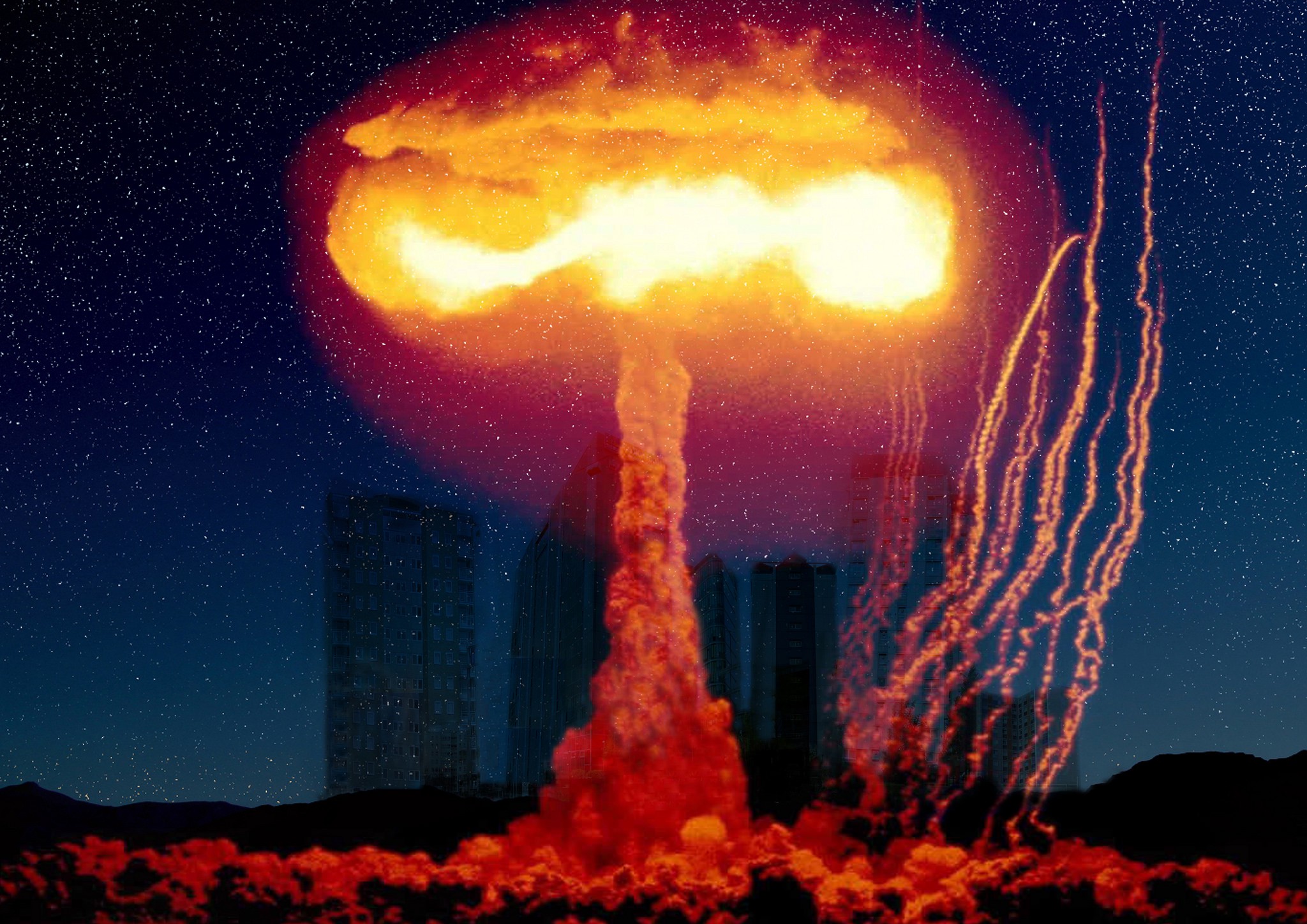
I think about the film H. would have liked to project, bearing in mind what she told me. Imagining frames depicting all this helps me to sew together the frayed edges of her story. H.’s film would start with her lying in bed, a thermometer in her mouth. She had a fever, and she should have stayed at home. She was only thirteen years old and she should have listened to her mother, who didn’t want to take her to school. But H. was so insistent that at 8 o’clock exactly, after an hour in the car, she was sitting at her desk. This disobedience will mark her until the final credits roll. Exactly fifteen minutes and seventeen seconds later, William Sterling Parsons, captain of the Enola Gay, let the bomb drop and began to count on his monitors the seconds that it would take to fall from the plane’s altitude of 9,470 meters to the 600 meters at which it was set to explode. The crew had predicted that the explosion would happen after 42 seconds. After 43, they started getting nervous. As the tension grew, they silently followed their instruments as they counted on. Three seconds later than expected, the experiment worked: the precise instant at which they reached 45 seconds, H. was thrown into another classroom. Coming to her senses, H. looked around to see that there was nothing left standing, not even the walls. The entire school had become a playground, a playground free of any games, opened up to a city that itself had been opened wide. H. came to learn afterwards that, of the two hundred and fifty pupils, she was the only one to walk out. From what used to be a bathroom, she saw a naked lump walking towards her, asking her for water. It frightened her. Its head was so swollen it had tripled in size. Only when the lump said its name did she realize it was her teacher. She ran.
After the drop, Enola Gay started its escape, executing a 155° turn to the northeast. The crew put on dark glasses while they waited for the shockwaves which reached them one minute later, when they were already nine miles away. For H., the details were a lot less precise. She did not know how much time she spent unconscious, nor when she left the school. She remembered that all of the clocks she saw on the way had stopped at the same time: 8:16. But she couldn’t explain how she had ended up at the hospital. Maybe she was taken there by somebody, but she could not remember. The weeks that followed, spent piled alongside the other victims, were also unclear. Later, it was revealed that during the first few days, there was only one doctor for every three thousand victims. Although she didn’t know it at the time, she had burns over seventy percent of her body. After a few days her eyes sealed shut. She could not open them. She thought she had gone blind. There was no medicine, nor any sedatives for the pain. The only medication that they could give her was to change the position in which she lay. Every now and again somebody came to move her. But the pain was so intense that when they turned her she did not know whether she was facing up or down. Her entire body burned equally, and nothing could relieve her suffering. Her chest, her stomach and her knees felt like they were all part of the same burning metal sheet as her shoulders, her buttocks and the backs of her legs. H. felt as if she had lost all shape and form. Crushed by the pain, her front and back had been pressed together, a single dimension of equal burning agony. On the first day that she felt the wetness of her own urine, she realized she had started to recover. From then on, she was able to determine how she was lying. If her urine flowed downwards, she was lying facing upwards. If it immediately formed a puddle, she was lying face down. When they cleaned her eyes, she found she could open them, and when the pain decreased enough to let her move, she lifted her head to look at her raw flesh. She found that, although her extremities retained their original shape, the area between the bottom of her stomach and the tops of her thighs was an unrecognizable mass. The swelling was so great that she couldn’t be sure, but everything suggested that the bomb had specifically targeted her genitals.
From time to time, I would tell Hiroo about my conversations with our neighbor. He never said anything in response, but when he returned home, drenched in sweat, having just tied up his horse (as he used to call his bicycle), he would leave a few pieces of paper on the table for me, printed while he was at University. They ranged from John Hersey’s work for the New Yorker to extracts from archival documents and anonymous testimonies. That’s how I knew that the description of unrecognisable lumps that needed to say their name in order to be identified was not simply one of H.’s own expressions. The most potent, concrete imagery I believed to be of her own creation was repeated throughout other people’s testimonies. At that time, I explained this in the only way that seemed logical. I thought that the unspeakable nature of what they had been through could be the reason that all of these survivors exchanged the most effective expressions, creating, as they did, a language of horror: the latest language, learned all at once, transmitted not from parent to child, but from witness to witness. In this language, ‘a lump with a head so swollen it had tripled in size’ could only ever be expressed as ‘a lump with a head so swollen it had tripled in size’. No equivalent expression exists. It is a language without synonyms.
In H.’s film, the injured walk amongst the dead asking for forgiveness. This is how she grew up, apologizing for having survived. In the papers, they suppressed the words ‘atomic attack’ and ‘radioactivity’, and the Government avoided the word ‘survivor’ out of respect for the more than two hundred thousand dead. In the essay by Hersey I read that Hibakusha literally means ‘explosion-affected people’. In this way, the term leaves out not only the pain, but also the miracle of survival. Altering the grammar of this phrase slightly would change everything: ‘people affected by the explosion’. The phrase ‘explosion-affected people’ can refer to any explosion at all, like when a piece of squid hits the overheated oil in a pan, or a firecracker goes off in somebody’s hand at a birthday party. I tried to figure out, by asking H., how much of a difference was actually made by adding this extra article, but either I didn’t understand her response, or she didn’t understand my question. What I did learn was that the term disgusted her. ‘If I had to give us a name’, I read in my notes, ‘I would call us those who carry the bomb within us, because the morning the B-29 bomber dropped Little Boy was only the start of the explosion’. It makes me think of an inverted Big Bang that, hour by hour, shrunk (shrinks?) one more piece of the universe inside of H., until one day, nobody knows exactly when, it finally explodes.
After the end of the war, twenty-five girls were selected to travel to the United States to undergo a course of plastic surgery that would lessen the marks left by the bomb. They were known as the ‘Hiroshima Maidens’. H. envied them. She followed their journey on television, saw them descending from the airplane, timid, heads bowed, received with bunches of flowers into the country that would attempt to reconstruct the smiles it had also disfigured. H. wanted to be a part of that group but, for reasons I did not yet know, she would never have been selected. Nevertheless, the image of the twenty-five maidens prompted her to start saving. She saved all of the money she was given, and when she was old enough to work she did so for as many hours as she was allowed, always mindful of the operations that she herself would finance: a few fundamental changes to her face, and more importantly, the reconstruction of her genitals.
All those years later, H. still had some of her scars. She wore them without make-up. One of her cheeks was covered by a keloid that was the shape of Africa and the texture of resin. For a long time in Japan these scars were unmistakable. Because of them, the survivors became outcasts, shunned by those who feared the effects of radiation. They could not find work, and the specialized agencies that, back then, helped to arrange most marriages started to reject survivors who wanted to marry, assuming that their children would be born with deformities. In H.’s movie, her pregnant cousin appears on screen. Her stomach, instead of growing, starts to shrink after the sixth month of pregnancy. Her womb, as if in regret, retraces the steps from fetus to sperm, reaching the desirable flatness preceding pregnancy.
I return to that atom of simplicity that allows me to really grasp H.’s story, something that affects me much more than the bomb I never experienced. The moment of clarity came about on the last day we saw each other. That day is like a suction pad in my mind, sucking out my memories of H., holding them for me through the same means by which the suction pads on the feet of a small animal save him from falling: a vacuum.
But in order to speak of that atom, I have to go back to the founding of a peculiar organization, whose members did not know H.’s story. When H. created this organization, it had been twenty years since she had left her home country, and the only thing she would admit at first was that she was, like them, a Hibakusha. She had turned fifteen when, having been adopted by a new family, she landed in the enemy land, as if she and the bomb were two arms of the same boomerang, coming back into the hand that had cast it out. She told me that in her new school her classmates wanted to be soccer players, astronauts, teachers. All she wanted to be was a grandmother, because the doctors always said that the radiation would start to take effect sooner rather than later. On top of the voluntary plastic surgery, she had to undergo many other urgent, obligatory operations, matters of life and death, and when I met her she continued to suffer from new illnesses. She had learned to let them in silently, as she had done with me, with a cup of tea, calmly, as if each one would be the last. All of the illnesses had been well received, except one: the loss of her son. An atomic son may be difficult to understand, but its loss can be felt by anyone. It is a loss as real as the iron I lose every twenty-eight days. Even today, from time to time, the memory of H. appears to me from between my legs, in a wet, red sanitary towel, thrown into the stygian drain that dissolves the dead as well as those who were never born.
As the years went by, this loss corroded H., and one day she thought that perhaps contacting other mothers in a similar situation would relieve her, sharing the heat of those who, in an enemy camp, mourned the death of a child. That is how she got the idea. H. told me that when she was looking for a name for this group, nothing seemed more appropriate than what the Americans had baptized the bomb, and so that is what she named it: Little Boy.
On the only day I ever went out with H., we went to my favorite place: the Tsukiji Fish Market. We had to go very early. It was still dark when I started to dress myself, silently, so as not to wake Hiroo. This market is still the first place I would go if I ever went back to Tokyo. The fish were set out in sections, according to species. Needlefish in one direction, salmon in another. There were large, green areas full of algae. Sometimes, a whale would go by on the back of a truck. Because of the layout of the merchandise, the Tsukiji Fish Market is a museum that organizes things in a way that would make any other fishmonger look like a bazaar. I remember on that day an English tourist came up to me to ask something, obviously encouraged by my western features. Before he went away, he told me that he had heard me talking to H., and congratulated me for having such a good grasp of Japanese. It wasn’t the first time this had happened. I laughed, because H. and I communicated in what I believed to be English. I had learned English with Hiroo, who could not speak it either, and for a long time speaking that language was a half-hearted attempt that allowed me to communicate properly only with the Japanese. I stopped laughing when I realized that this half-language was a reflection of the conceptual limbo that surrounded Hiroo and me. We didn’t understand each other. It’s not that we didn’t get on well, and it also had nothing to do with cultural differences; it was just that our minds seemed to move at the same level of evolution, but on different planets. With H. I had the same feeling, and I didn’t understand a lot of what she was saying to me. What I could interpret, if badly, I would write down in my little notebook. But what may have been a conversation or a discussion with somebody else became with her, as it was with Hiroo, a barrier, a respectful bow towards another type of intelligence and, finally, to resigned isolation.
On the same day that I found out the organization ended up disbanding, H. told me that on many occasions she had toyed with the idea of telling the other women about her experience, but would justify herself by explaining that it wasn’t that easy. She worried that they would cast her out, expel her from the group that she herself had created, and banish her from the project in which she had invested the little energy she had left, not only for herself, but also for the others. I imagine that she held her story back from me for the same reason. But, before all this, she described how Little Boy grew. It was more successful than she had thought it would be because mothers started to get in touch with her sooner than she expected.
I look at my notebook. On the cover, I’ve stuck a photo of a painting from the Edo period. It is a whale hunt. The water should be red, but red in the sea would clash with the ochre tones of the coast. Aesthetics are the backbone of Japan. Looking at this painting, I am reminded of something H. often repeated: in Japan, the beauty of the lacquer that decorates the houses masks the rotten wood it covers. But H. wasn’t covered by any varnish at all. Her face showed who she was. There is no greater sincerity than that left behind by the bomb. The bomb revealed the hidden blood of the whales that should color the sea red, as if saying: I am the true paintbrush, the brush with the uranium bristles.
H. paid great attention to other people’s voices. She would say that the explosion may not have marked a Hibakusha’s skin, but it would always mark their voice. The description she gave me of the first mother to contact her started with how she sounded. Musical, but irregular, trying to avoid showing the real emotion of their first exchange. H. told me that when she heard J. speak, she couldn’t believe that such a voice had spoken to her. In that moment she was linked through the telephone line to a mother just like herself, to the first mouth that moved like her own, that breathed a breath that may have smelled just like hers. I smelled H.’s breath and noted down: a mixture of roots and molars, the breath of the living dead. I remember that H. once told me that in the days following the explosion, people walked with their arms stretched out in front of them. Those who had been blinded did so to avoid bumping in to other survivors, but those who could still see also held out their burnt arms so that the viscous skin wouldn’t stick to their bodies.
J. had not been affected by Little Boy, but by a different bomb: the rain — a thick, black liquid that followed the explosion. People allowed the rain to fall on them and J., like so many others, did not protect her child. Many people even drank the oily liquid, and she wasn’t to know that it carried a bomb in each droplet, a hail of ulcers and cancers that was invisible at first but, day after day, sprouted strong and firm, like potatoes. I was shocked by this capacity for recycling that H. described. People were healthy. People were, and then all of a sudden they were not. It was like that for many years. In that way, the bomb wasn’t all that sincere: appearances and the ability to move didn’t yet distinguish the living from the dead, and J.’s child spent the next six months visibly healthy, although silently dead.
J. and H. first met on a park bench. In H.’s movie, there is not a single leaf on the trees. At the point of impact, the temperature on the ground reached 4000°C. The maximum temperature of the surface of the sun is 5800°C; iron melts at 1500°C. Just like the lumps with heads so swollen they tripled in size, there are other recurring characters that enter into the eyewitness accounts. There are those who watched the sky as the bomb fell, and who are described in very certain terms: a verb — to hold, a plural noun — eyes, a phrasal verb — to fall out, and another noun — sockets. After leaving school on the day of the explosion, H. remembers having come across men and women stumbling about, holding their eyes with their hands so they didn’t fall out of their sockets. H.’s eyes were so blackened that they looked hollow.
Little Boy became clearer and clearer with each visit to H. Seeing as what H. was telling me took place between 1945 and 1963, it often pained me to think that I was seeing something that no longer existed, the light from an extinguished sun. At that time, I still didn’t know that the explosion had utterly destroyed any risk of humanity living in darkness. The father of the atomic bomb brought with him the promise of the most radical light; he was the last messiah, a major god of Theoretical Physics, giving us an indelible formula, a weapon that did not end with its detonation, but instead inseminated the rest of the world with the speed of mating rabbits. Today, there are more than twenty thousand bombs like the one dropped on Hiroshima. More than twenty thousand rampant, pyromaniacal bunnies that, at the moment of climax, could start a worldwide blaze big enough to bind us all together in the heat of a single sun.
H. showed me a few photos from over the years, but they were all taken after the day of the attack. It surprised me that she used to say the bomb had had a positive effect on her appearance, and she couldn’t recognize herself in photos taken before that Monday, 6th August. She told me that the bomb had dared to change parts of her body that disgusted her, had sketched out new features that she later made permanent through surgery. This had seemed like a harsh statement, but at that point I still didn’t know that, before the attack, H. was already a victim, and out of all of those close to her, the bomb was the only one who could see her as she really was.
In the photos, H. looked beautiful. She still did. I don’t remember when in our relationship I dared to ask the first intimate question, but I know that the response surprised me, because she opened up far more than I had allowed myself to. I asked her if she had continued to have sexual relations. She told me that she had been with two men, but they must have seen something that frightened them. She couldn’t say for certain, because she had never seen another vagina, but she thought that the operations had not been as successful as they had promised they would be. From then on, it was the only part of her she wouldn’t let anybody see, not even her doctors. And so, I thought, none of her illnesses could have entered that way. H.’s legs had been as firmly sealed as an atomic bomb shelter, although, sadly, nobody was trying to get in.
The desire to set up Little Boy stemmed from a natural empathy between H. and J. H. told me that, out of all the mothers she met, J. was the one who inspired her with the most confidence, and it was for that reason she found it so hard to hide her situation from her. Despite going through her own tragedy, J. wanted to live, and forced herself to contact other mothers, women who lived hidden away, buried behind walls, wardrobes, old-fashioned toys; invisible women who chased a specter to cling to, mourning the absence of a fleeting apparition as if they were mourning a second loss.
S. was the third woman to join the group. H. and J. visited her at her home. It was a normal house. When a death has recently occurred, an aura of sadness covers everybody, acutely felt by some and imposed upon those who were not as close to the deceased, or who perhaps are too young to understand. It is generally accepted that this is how things should be. In houses that suffered a loss long ago, everything returns to normal except for one piece of furniture: the mother. H. used to say that S. was not anxious, but rather she was stoic, serious. Perhaps she was unconvinced that Little Boy could change her day-to-day existence, a sack full of time she hauled around on her back with as much thought as one gives to swatting flies. Her living room smelled of roasted pumpkin. H. told me that when she was in the hospital, she heard that people had been to what had once been farms, digging up the unripe pumpkins that had been cooked by the blast.
H. heard a lot of things in the hospital. She remembered one man had said that, on returning home a week after the explosion, he found his wife’s pelvis lying in the empty space that had once been his house. The man added that it was not this image that disturbed him. What kept him up at night was reliving the moment in which, picking up the pelvis to put it in a bin, it burned his hand. After seven days, it was still hot. As H. started to get better, her pelvis continued to burn, and she thought that for some reason this part of the body must retain more heat than others. However, she told me that from the explosion onwards, she lost all desire for sexual contact. She was young, and had only responded to her instincts through masturbation, but the final burning in her genitals was not sexual but feverish. Even in the first days of semi-consciousness, when her mind did not yet know what her body knew, she experienced moments of delirium, into which seeped the fear of the consequences of her new state, and as she recovered, she realized that although she was still attracted to boys and those feelings had not changed, her libido had disappeared. It was as if she had lost a leg. She had heard of cases of amputees feeling, after a certain amount of time, some sensation in their amputated limb, and she too was waiting for this phantom limb syndrome. She waited for years, without wanting to understand that the feeling of a phantom limb usually comes about soon after the loss. She preferred to continue believing herself to be lucky, at least in that one sense. Having feeling in a leg that doesn’t exist serves no purpose, it could never walk or accompany the other leg: and yet — she believed, hopefully — having feeling in amputated genitalia would be enough to raise the tickle of an orgasm. When she finally said goodbye to that hope, she longed to feel this sensation at least once more. She suffered from many syndromes, but never that one. She was absolutely amputated, like a Greek sculpture who carries, in her own beauty, her penance: the impossible embrace of the Venus de Milo.
I don’t remember exactly when I began to understand what H. was not telling me. I suppose it was something that happened over time, something that I picked up imperceptibly until it came to me naturally. I do remember that I understood everything in an instant and, despite the fact that she had never mentioned it, I felt as if we had never stopped talking about it. H.’s restraint on that front meant that she had spoken with her most eloquent organ: her silence. I will retrace my steps and correct myself. If H.’s loss was to be found anywhere, it was not in the impossible embrace of the Greek Venus, but rather in the lost penis of the Apollo Belvedere. Except for one detail: what would have been a source of grief for another man was a great relief for H. The day that H. was finally able to tell me, I already knew. There were no surprises or drama on my part, only a stream of questions that had built up in my head, to which she would respond by confirming a few details. That was when she let me into her most intimate world, and I entered into it without any of the reserve I had shown when first asking about her sexual relations.
H. was always very conscious of being a girl, but she had been brought up as a boy because she was born with a penis that, in accordance with her consciousness rather than her surroundings, never actually developed. H. was born with a sex differentiation disorder. She belonged to what would later be named a third sex. When she was born, the doctors and her parents decided that she was a boy, ignoring a few ambiguous features and a female organ that could not be seen from the outside: a half-formed uterus. They sent her to a school for boys, and as she grew up they hid from her the fact that her sex was the subject of confusion during those first few weeks. Until she was twelve, H.’s difficult situation was disguised by her haircut, her uniform, her teachers’ predictions for her future as a young man. But as she developed, her conflicts progressed from her clothing and the style of her hair to other, more internal, changes. Although her testosterone levels were weak, they were still strong enough to allow her to start sprouting a beard during puberty like the rest of her schoolmates, and she went through other visible changes that ran parallel to the production of semen in her testicles. What had until then been mere dress-up started to become ingrained in her, inherent, and one morning she woke up in a uniform she could not remove. H. used to say that the most traumatic thing was not being able to take off the costume other people forced her to wear. External impositions, like a spider’s abdomen spilling its thread, had trapped her like prey. And, inside this web, a little space for movement: her small penis responding to the touch of her left hand. The little masturbating bug exploring the advantages of its new machine. But as soon as the thick milk turned her fingers into the webbed feet of a water bird, H. asked herself if such a climax would be enough to compensate her.
H. started to think more and more frequently of self-mutilation. During our conversations, she acknowledged that those thoughts could have remained a comforting fantasy toying with her mind, an escape. For that very reason, she was happy that the bomb had touched her, making her thoughts a reality. But to look at her own scar was not easy, and she spent weeks mourning the penis that she had always hated, that she still hated. For a long time, she slept on her back because she missed the friction between her little appendage and the futon. She thought of it like a lizard’s tail that, separated from its body, spends its last movements trying to reattach itself. It would have been less painful to imagine her penis burnt, dead, pulverized; but instead she imagined it thrashing around, looking for her amongst the ruins of Hiroshima like a lizard without eyes.
For ten years, H. felt the helplessness of a reptile pining for the movement of the tail it rejects. Her spirit wavered between the relief of that loss and the pain of castration, in the uncertain space between mutilation and the desire to see her tail regenerate as another organ. And, on the outside, she had the genitalia of a doll. Neither a penis nor a vagina. The explosion had also affected her testicles, reduced in their scrotum to half their original size.
That is when she first felt the desire to be a mother. She read in the news that some of the Hiroshima Maidens announced that after their operations they were thinking about getting pregnant, as their scars faded and they rediscovered parts of their previous forms under the social and economic protection of a country that had become, all of a sudden, good humored. The Hiroshima Maidens were received with ceremony, with balloons, with applause. H. remembered a television show called ‘This is Your Life’, featuring the Reverend Tanimoto who was visiting the United States with the young girls at that time. The presenter, wearing an unchanging smile, ran through the reverend’s life, starting at his childhood. H. knew that Mr. Tanimoto was there to speak as a Hibakusha and, like everybody else, she was waiting impatiently for his story. But the presenter was playing with his audience, keeping them in suspense, and between the different sections of the show, they played an advertisement for a nail polish whose name echoed the reverend’s ecclesiastical nature: ‘Hazel Bishop’. Stunned, the reverend waited until a young woman stopped using a scourer to scrape the surface of her nails, painted with the latest polish that was impossible to scratch. On top of the suspense and the nail polish, they added intrigue to Tanimoto’s story: a few minutes into the show, the silhouette of a man appeared on set, behind a translucent screen, and started to talk. The presenter readied the reverend for this surprise, telling him he was about to meet a man he had never seen before. Before coming out from behind the panel, the silhouette spoke: ‘On the 6th August, 1945, I was in a B-29 bomber flying over the Pacific. Destination: Hiroshima’. It was Robert Lewis, the co-pilot of the Enola Gay who, the presenter explained, had taken to the same stage as the reverend, in front of an audience of thousands, to shake his hand in a gesture of friendship. Despite these humiliations, H. could not stop envying the Hiroshima Maidens. After leaving the family that had taken her in, she started with the most affordable steps: breast implants and a strong course of hormones to make her features more feminine. She would have to wait another ten years, once she had saved enough money, to decide whether or not to have a vaginoplasty to permanently fix the sentence handed down to her by the bomb.
When H. formed Little Boy, she had already recovered from the final operations. She had spent all her savings on travel to and procedures in Sweden, because at that time the United States was still reluctant to perform the operations she needed. As Little Boy began, every mother told her story, everyone except H. who, as the founding member, reserved her right to silence. I knew that she also had her reservations about talking to me, and that the chapter she had told me was, in spite of its complexity, only the gentle side of a tough story. I had a feeling that the worst pain of all was caused by the very nature of the son that H. had lost, a nature I could not understand at that time. And so, I kept listening to the stories that she would tell me about the other mothers, all the while trying to figure out in which direction she was trying to lead me.
Twenty-one years earlier, S. stood on the bank of the river, watching her twenty-two month old son as he walked over the pebbles. She was talking to a friend at the same time, and the next thing she saw was an image that would define her life from that day onwards. The darkness of night had fallen at quarter past eight in the morning and, in front of her, there was the intense light of a small sun: her son burning a meter above the ground. But, of all the experiences that H. described, there is one that is so graphic that I don’t need my notes to help me remember: K.’s testimony. She lived in one of the few cement buildings in Hiroshima. While cleaning the windows of her third floor apartment, she watched her mother push her son on the swing in the park below. She dipped the cloth into the bucket, keeping her eye on the movement of the swing. The child seemed to be coming towards her, pushed by his grandmother, only to quickly retreat backwards, stubbornly playing the game. She said that with the explosion the child pitched forwards, swinging upwards one last time. Through the splintering glass she witnessed the transformation of her son as he fell through the air and towards the ground. Without changing shape, his entire body turned black in mid-flight. It was no longer flesh that flew through the air, but rather dust, compressed into the shape of a human, that started to fall like a rain of ash. H. told me the same thing about the birds that were flying over Hiroshima at that moment. As their wings were beating, they changed from birds into carbon molecules. Without catching fire, without sustaining any injury, the birds underwent the most logical of metamorphoses: perpetual weightlessness; the lightest, effortless, wingless flight.
On the ground, those closest to the point of impact vanished, leaving behind only an indication of their form in the so-called atomic shadows. Their silhouettes remained on the walls they had been leaning on, the steps they had been sitting on, because radiation reacts differently, depending on the material it strikes. If the radiation had to go through a person, the space they occupied retained their shadow. H. used to tell me that one of the mothers believed she had recognized the shadow of her daughter on the wall of her school. For months, she was determined to preserve that marking. She protected it from the wind and rain, like an archaeological dig, trying to conserve her daughter’s final image. When they started to reconstruct Hiroshima and the wall was pulled down, the mother left Japan.
I think that one of the testimonies that Hiroo left for me to read can be explained by the differing effects of radiation on the human body depending on the surfaces it encounters. A man expressed his surprise at seeing a woman wearing a close-fitting kimono. When he looked closer, he saw that the woman was, in reality, naked, so naked that she wasn’t even covered by her skin. However, the colors of her kimono, having absorbed and reflected the heat of the bomb in different ways, had left the floral pattern of her clothing imprinted on her body. The Reverend Tanimoto had also spoken of the nakedness of the victims. At first, it seemed as if they were wearing rags, but in reality these were pieces of flesh, hanging from them like pieces of fabric. H. told me that one of the last things she saw before her weeks of blindness was her doctor taking off her shoe and bringing with it all of the skin from her leg, as if it were a stocking. The doctors still did not know how to treat the wounded. Even the attackers did not yet know the physical effects of the bomb.
H.’s vaginoplasty was as successful as that type of operation could be at the time, although the resulting vagina was doubtless not good enough to be penetrated by a penis from that age. These were Paleolithic penises that wanted standard vaginas, holes with similar textures and dimensions. But H. was still satisfied. She was unorgasmically satisfied, because the loss of her glans meant that they could not construct a clitoris, but in the end this became less psychologically damaging than an orgasm brought about by a member she refused to acknowledge. Nevertheless, with time and with age, she had to accept that the bomb had come too soon. She used to say that if it had exploded ten years later, her life might have been enhanced by the existence of her son.
After J., S. and K., the first three women to join Little Boy, six more came along. Eventually, there were ten mothers in total. Ten mothers who were no longer mothers. Ten dismembered fingers, waiting to be of some use once again. H. used to say that she noticed the mothers were each hoping to hope once more, and they acted upon a desire to turn their sisterhood into one giant mother, mourning the death of one single child. It seemed as if, in their coming together, they could finally start to conjugate a verb that had so often been rejected as absurd–to recover. Seeing as H. was thirteen at the time of the attack, the other women were impatient to hear her story as the youngest mother. But she would always keep quiet, and for months the others respected her silence. Then, when she was left alone, she would search for the words to tell her story. She would explain, apologetically, that her movie was not only silent, but also silencing. H.’s tongue was held firm by the same images she wished could be projected to help everybody understand. And so she would evoke the absolute silence of the devastated city in the days that followed the explosion. In the hospital in which she lay, the wounded stopped groaning. Even the children stopped crying. The only thing she could hear was the whispering of names, coming from those who were looking for people they knew among the devastated faces. It was a strange experience, because identification depended less on those searching than on the victims themselves. If the injured didn’t have the energy or the desire to respond ‘I’m here’ to the mouth that whispered to them, then their parent, their child, would have to continue whispering indefinitely into the wrong ears.
H. told me that there was one masculine feature that the hormone treatment could not change: her baldness. At the age of thirty, she started to wear a wig. In reality, she didn’t know if her hair loss stemmed from a premature baldness due to her male biology, or from the effects of radiation. In my notebook, next to the word ‘wig’, I have a drawing of a bridge that connects the words ‘hormones’ and ‘radioactivity’. It makes me think of the way Japanese bridges are built. Because of the way in which they arc, whoever crosses can see the landscape from several different levels. Crossing is, therefore, not just the act of getting from one side to the other, but rather it is a way of seeing just how many different perspectives can be contained in one single landscape. H. was the bridge between man and woman, recognizing, as it curves, all of the genders that exist between these two shores. H. was also the link between biological and atomic trauma at a time in which young people of my age in Japan no longer knew what had happened to their country on the 6th August, 1945.
I started to alternate my research into the books and papers about Hiroshima, given to me by Hiroo, with my first steps towards understanding intersexuality. There was one piece of reading that interested me in particular, but I’m not sure how I came across it. It was a manga series by Chiyo Rokuhana. Its name — ‘IS (Aiesu)’ — is a reference to the word ‘intersexual’, reduced to the initials ‘IS’. The seventeen-volume comic was first published in Japan in 2003, and although it was later translated into English, I didn’t have access to the translation at that time. I couldn’t understand a lot of the dialogue, but some of the drawings were enough to illustrate the characters’ inner conflicts. In one of the cartoons, there was a teacher directing her female pupils’ attention to a projected image of a vagina. In the next one, the students are blushing with the black, striped shadowing that is used to show blushes in black and white comics. Everyone is blushing except for the main character of the first part of the first volume, Hiromi, an intersexual who was brought up as a girl despite the masculine genitals she had learned to hide. In the cartoon, Hiromi is the only one with clear cheeks, because they refuse to redden at the thought of a vagina she does not have.
When she founded Little Boy, it wasn’t her sex differentiation disorder that H. found hard to explain. Not only had her identity as a woman never been in doubt for her, but also the hormone treatment and the operations meant that there could be no ambiguity for anybody else either. What H. struggled to explain was something else indeed. It was a feeling she feared that the others would not understand, a feeling she believed came from her half-formed uterus, the organ whose dysfunctional destiny was decided from the very first weeks of gestation. The hermaphroditic embryo that every human being is at conception remained, for H., in this state of uncertainty. Neither male nor female. Male and female. But, no matter what her biology suggested, she was herself, firstly, as a woman. A few years after the explosion, H. began to feel the desire to have a child. What started out as a mere wish became, after a few more years, an urgent need to get pregnant, a need so strong that she would have tried everything she could to do so. She remembered those days when, as an adolescent without a clitoris, she would masturbate with her penis, and she thought that, as she didn’t have ovaries, she could at least have fathered the very child she desired. Her testicles, lack of menstruation, undeveloped breasts, and the presence of seminal vesicles all suggested that she was meant to be a father. But the bomb exploded too soon, when she was too young to want to be either a mother or a father.
H. and J. set up fortnightly meetings of Little Boy. Transport costs for those who lived further away were split between the group. They met in a room they had hired specifically for that purpose, which H. spent days cleaning because it must have been years since anybody had been in there. Then they started to talk. H. acted as chairwoman while the others, one by one, would tell their stories. The fact that H. was thirteen when the attack happened always fascinated the other mothers, and each time she opened her mouth they followed the movement of her lips as if wanting to pull the words out.
H. was preparing how she would eventually speak. Meanwhile, she was enjoying the possibility that these unmade mothers could be her best, perhaps her only, listeners. She said that the big, rectangular space they had hired changed according to the story being told. It was skin, river, nails, asphalt, it was full of children with blackened mouths, but also children running about, laughing, being lulled to sleep as they were passed from one mother to the next.
During my time in Japan, I only once went to the cinema with Hiroo. We saw a movie by Yojiro Takita: Okuribito. There were no subtitles, but I believe that my poor grasp of Japanese had blessed me with the sort of hypersensitivity that allows us to read beyond the scope of words: gestures, colors, the intuition of onomatopoeia. On the other hand, just as with Rokuhana´s comic, many of the images used in Okuribito sufficiently illustrated the plot. And, in one of the opening scenes, I noticed something that struck me as an enormous coincidence. All of a sudden, the young protagonist finds himself faced with performing his first ceremony as a nokanshi, alongside his mentor. In Japan, the nokanshi is in charge of preparing the body of the deceased according to the Nokan ceremony, in which the body is gently touched, massaged, and washed with a warm, gentle sponge, a sponge that is doubly kind: a goodbye that is, at the same time, a greeting. In this scene, the apprentice was preparing the body of a young and beautiful girl in front of her family. As I watched the nokanshi admire the cadaver’s face, I thought that she looked as if she were alive, and Hiroo translated that this was because of the gentle nature of suicide by carbon monoxide poisoning. The nokanshi started by caressing her face. But these weren’t ordinary caresses. He lightly pressed her eyelids, her cheekbones, and her chin, as if he wanted to relax even the smallest muscles. Then he took hold of a wrist, and held it so that he could push the rigid palm backwards, like a stretch in preparing for exercise. The body seemed to be stretching out, and it was difficult to believe that his touch was working towards an absolute ending, rather than towards a new awakening. It was the beginning of death that closely resembles the beginning of life. And it was exactly how Hiroo used to wake me up before I opened my eyes in the morning. The caresses that wake a drowsy body from sleep were the same caresses that nudged a rigid body towards death. And yet the coincidence that struck me the most was not this, but the second part of this scene, because it reminded me of a precise moment in the story H. was telling me. The nokanshi covered the body in a sort of quilt and, still under the gaze of the family, removed the young girl’s kimono from under it. Once he had taken off this kimono, he placed it over the quilt, which he then pulled back, leaving the girl naked underneath. This allowed him to place his hand underneath the cloth, and to start to clean her skin without needing to see her naked body. By the girl’s head, there was a steaming bowl of water, which the nokanshi used to wet the small towel he then placed under the material, starting from the top of her chest. He started to wash the body. Underneath the kimono you could follow the movement of his tender fingers, like the legs of a small animal furtively digging a tunnel. But the hand stops a little below her stomach. The little animal has found something, touches it, tries to identify it. Without a doubt, it is a penis. This penis between his fingers surprises the nokanshi, who looks, stupefied, at what is undeniably the face of a young girl — her feminine features, her long hair — and understands, in an instant, her suicide.
I believe that understanding a stranger’s suicide instantly, without words, simply through touching their body, was the kind of understanding H. needed. It is a mute communication that, in her case, could be best explained by an endoscopy. I’m thinking of a camera at the end of a surgical tube, which enters into H.’s fornix and leads to her uterus. Everybody she wishes could understand her, including myself, is sitting together in one room. The tiny camera that passes through her cervix projects the image onto the screen that surrounds us. We are the camera. At the moment all we see is pink. A pink tunnel. At the end of the tunnel is the resolution, the comprehension of H.’s conflict. But, at the moment, we wait. We wait, suspended from an umbilical cord that hangs from high above, from the sky, from a bomb that is getting closer and that, in its free-fall, starts to make out a grid of irregular streets; it starts, as it plummets towards the earth, to understand Hiroshima.
In Rokuhana’s manga, after discovering on the Internet that there are other IS like herself, Hiromi decides to have sexual reassignment surgery so she doesn’t lose the boy she likes. She would undergo an orchidectomy — commonly known as castration — and have her penis removed, recycled and used to construct her new vagina. During her first visit to the doctor, Hiromi is placed on a gynecology chair. In this hospital, they have never used such a chair in order to examine a penis up close, and Hiromi notices that, between her legs, there are more and more people joining the team of doctors. She feels herself being touched by more fingers than any one doctor can have. She also notices the flashes coming from the cameras photographing her, like some scientific discovery, and she listens to the voices of admiration coming from those who are examining her. She is not being treated as a patient, but as an object to be studied. Naturally, this led me to think about H.’s first contact with the occupying American doctors. They were there simply to observe, not to intervene, even when it came to simple cases of vomiting or infant diarrhea. Some victims, without knowing it, were still contributing to the development of the Manhattan Project. Later on, I read that the project’s human experiments didn’t start with the Japanese, but in fact went back a few months before the explosion. Specifically, to 10th April 1945, when they injected the first human with a dose of plutonium that was 41 times higher than a person receives in an entire lifetime. The subject was Ebb Cade, a fifty-three year old black man who was wounded in a traffic accident and then taken to the U.S. Army Manhattan Engineer District Hospital, in Oak Ridge, Tennessee. Cade was the first of 18 patients to receive a lethal injection of plutonium.
Little Boy continued to meet for a long time. Because she couldn’t find the right way to explain her situation, H. ended up lying so as not to break the ties that had united her with the other mothers. She told everybody that her son died of radiotoxemia. H. envied those who mourned one particular death. It seemed to her that describing the loss of something that had once existed was much easier than expressing the real loss: the loss of something that, despite being written in the nucleus of her cells, never came into being, the son she could never conceive. That is why she lied. She had to lie in order to say something.
H. was called a Hibakusha, but she told me in our last conversation that if she had to give herself a name she would use ‘the nuclear mother’, because on the morning that the B-29 bomber dropped Little Boy, she was impregnated with an atomic baby that she could feel but not see, in a nightmare of a pregnancy that turned the nine months of gestation into an entire lifetime.
Let’s come back to Hiromi’s story. She has a sore testicle. She adjusts herself through her skirt. Hiromi finds her mother’s diary. The writing tells her that she was called Hiromi because, if she had a sex change, she wouldn’t have to change her name. She decides to have the operation. She dreams of an artificial vagina. But Hiromi also dreams of children. Children that are a part of her. And so she then decides not to have the operation after all. I think that H. would have liked to be Hiromi. To be a father is better than being neither father nor mother. To be a father, and then to be a mother. But the bomb came too early and took her son away along with her penis. She never explained this in words. I am struggling to explain it in words. I saw it all through another endoscopy. This is not a metaphor, it is an endoscopy. H. opened her legs and spoke with her mouth closed. The camera, once again, entered her uterus. A heartbeat was beating louder and louder. The sound wasn’t coming from her genitals, and it wasn’t coming from the monitor through which I could see the pink tunnel walls. Rather, it was coming from somewhere high above, from the bomb that would slice through the air as it fell. I saw that it had its weight written on it in small numbers — more than four tons. I knew that the B-29 had problems during takeoff, and the crew had to arm the bomb in mid-flight, so I saw the hand of Morris R. Jeppson, the last man to touch it. He wasn’t shaking, but he was scared. It’s likely that Jeppson did not know that the bomb was attached to an umbilical cord. I looked upwards, following this cord. It was a very long cord — 9,479 meters. It brushes against H.’s abdomen. At one end of the cord, the bomb was about to drop and at the other, H. was waiting. I, too, was waiting for the cord to attach itself to her uterus. But H. only had half a uterus, and the cord planted itself outside of this, firmly rooted in the half that did not exist. I saw the hypocenter of the explosion and I understood the sudden incineration of the void: a baby’s backbone that drains its surroundings in circular, climbing waves. It was a spine without marrow. Empty. In an instant I understood the emasculating force of the bomb, dropped to cut off her penis, to burn her testicles, her desire, her son. It was early on Monday 6th August, and the bomb was falling fast through the sun soaked clouds. It was exactly 8:16:43 in the morning, and H.’s unborn son started to cry.