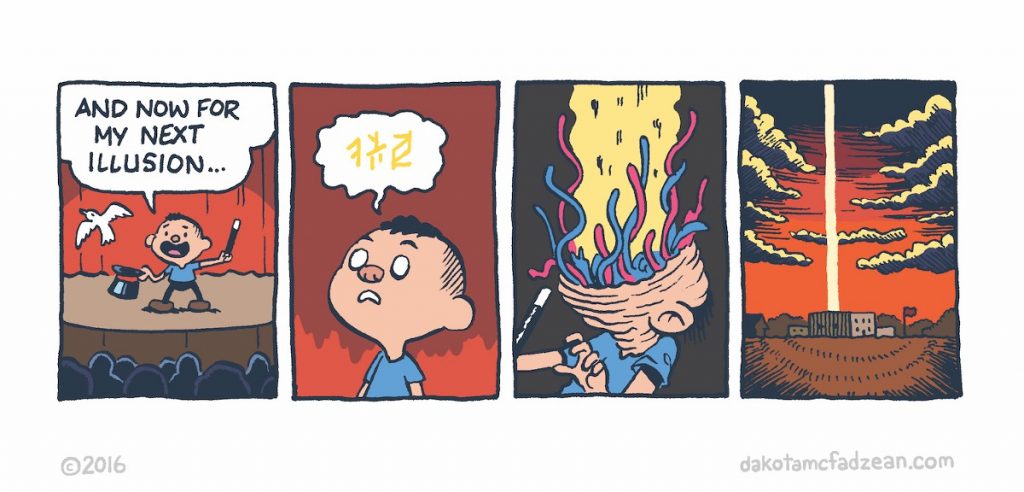

Check back every Monday for the rest of June for more new Dakota McFadzean comics!



Check back every Monday for the rest of June for more new Dakota McFadzean comics!
by Nick Politan
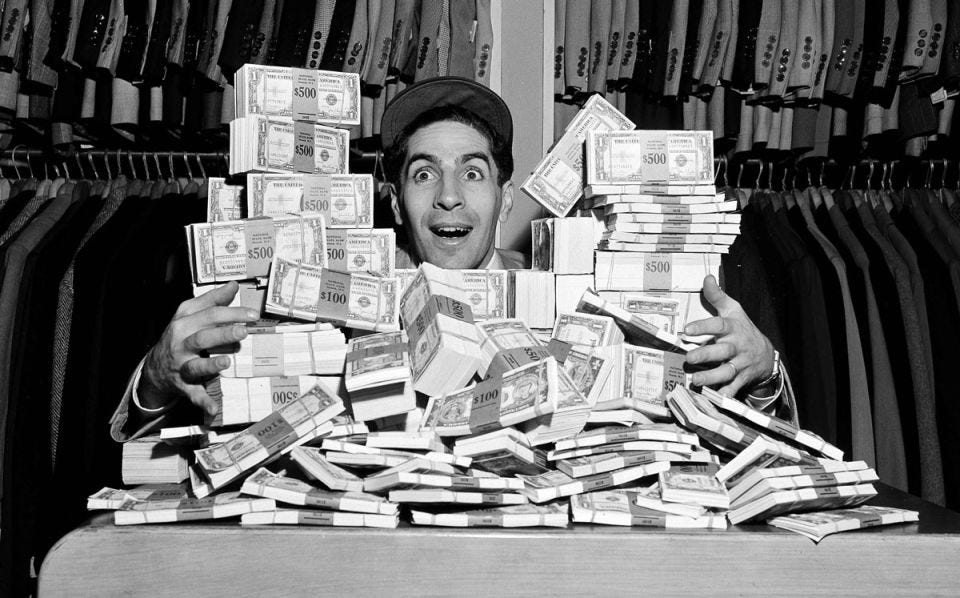
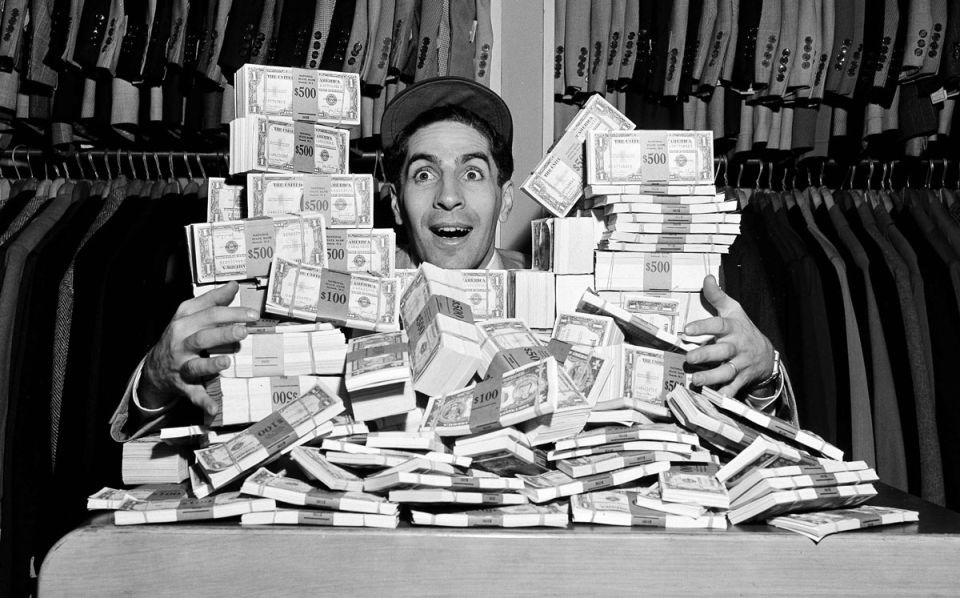
As readers, we like to think that literature has this higher calling, that it is transportive to the nth degree, that it — cue existential slow jamz — massages the brain into a deep empathy and thus makes us better people. Well, we can add another positive to the list! A new study has delineated the long-term financial payoff from childhood reading. The study — pulling from 5,280 men from Austria, Belgium, the Czech Republic, Denmark, France, Germany, Italy, the Netherlands and Sweden all of whom were born between the years 1920 and 1956 — indicates that those who read at least 10 non-compulsory-school-reading books ended up with 21% more income. The study also concluded, however, that after this number of books (10), there was no significant correlation between higher numbers of freely read books and higher additional incomes. 10 seemed to be the (relatively arbitrary) correlative cap.
On the bottom-line Capitalist value of books, Quartz has published an article running some quotes from one of the lead researchers on the study, Guglielmo Weber. Weber, like the study, boils literature down to lowest-common-financial denominators, not getting much further than the presence of books in a household as an indication of “families with stronger cultural and socioeconomic backgrounds.” He goes on, “Even nowadays, books capture something” (my emphasis). This is part of the problem: can “books” not be something(s) — at least for a reader — positively stripped of their economic jackets? That we don’t anticipate a paycheck at the end of a novel should be something intuitive; do we not get enough from the words alone?
Finally, too often in mass popular culture, we do exactly this: we throw around “books” as a huge unnamed thing. Books are wonderful; they are multivarious; they have genres and names and, if we are lucky, resist and challenge and blur those genres and names. I wonder what a long-term-earnings study of those who read Maggie Nelson, for instance, would illuminate for us.
But then again, of course, I do not wonder.

by Michael Tager
We live in a world where an onslaught of information is a phone swipe away, where in order to run for government, residents have to start the campaign years before it officially begins. We live in a world where the majority of an entire continent uses the same currency, has lowered its borders and accepts many of the same laws. In this world, we can travel just about anywhere in under a day. Even fifty years ago, any depiction of our current living situation would be scoffed at and termed “science fiction.”
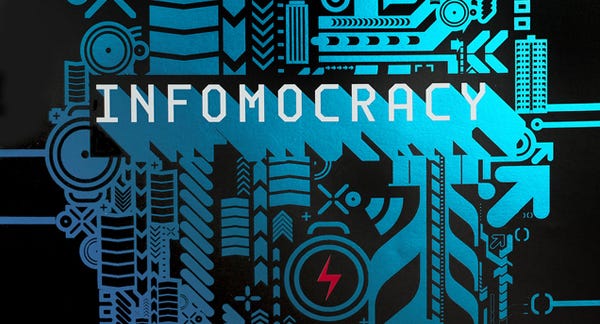
Infomocracy, the debut novel of both Malka Older and the first publication of Tor.com, is certainly science fiction, but it sets its sights on a slew of newly arrived realities, through a speculative lens. Their Information is with them at all times and accessible with an eye flick, but it’s not so different from our phone. Their world is both border-free and border-intensive, again, sharing similarities with us today. And while the modern world has no plans for a new transportation system through the Earth’s core (that I know of), fracking, Big Digs and waste concerns are no less a concern. It’s as if Older took the concerns of 2016 and turned the dial past 11, into science fiction.
At its heart, Infomocracy is politics meeting cyber-punk, when the movers and shakers behind the power investigate crimes and shady goings-on. With roots in noir and heels firmly planted in the present, it shows a world that really isn’t too different from today. Malka Older has created a thrilling, breakneck novel with fully human characters. And it asks tough questions.
Science fiction works best when it uses technological hypotheses as a fulcrum to explore humanity. As a genre, SF is uniquely suited to look at “today” and posit questions and then go about answering those questions. Infomocracy asks those questions directly: what would happen with news cycles when the world is voting for government? What will happen when the internet is so ubiquitous we’re never separated?
In Infomocracy, geopolitical borders are blurred. No longer is the world filled with disparate nations and coalitions. Instead, the world is split (to a large degree, anyway) into micro-governments with borders splitting down lawns and sidewalks. A “centenal” of Philip-Morris may lay between two “centenals” of Policy1st, on the way to Heritage or Liberty, discrete governing bodies that vie against one another in constant news streams and election maneuvers. Former countries are broken up into these micro-governments and one city could contain hundreds or thousands of these little districts. Some of the governments are corporate, some are for the people, some are frighteningly jingoistic.
He’s managed to find a centenal where alcohol and marijuana are legal but tobacco and pop-out advertisements are not. As Ken waited for the debate to start, he checked out this government’s broader policies. They’re called Free2B, which sounds like they might promulgate that kind of individualism that gets annoying quick once your neighbor starts playing gronkytonk at top volume at five a.m. or refuses to donate to the volunteer fire department until their house is burning down, but when he scans their policies, he sees they’re reasonably socially conscious. If they’ve got anything in a more temperate climate, he’s seriously considering moving there once the election is over.
Built on the bones of cyber-punk mainstays like Neuromancer and Snow Crash, the protagonists of Infomocracy are smart, driven, tech-savvy and resourceful. The world is dangerous and vaguely dystopian, but not outside the realm of possibility. While the characters — not all nice, not all good, but all intelligent, resourceful and amusing — obviously don’t dwell on the metaphors and parallels to today’s world, they’re all there. They recognize that resources are dwindling and that an era of plenty is ending, but they look beyond,
She takes a look at the menu and checks her body stats. The endive-prosciutto salad mostly closely matches her nutritional needs, but that’s hardly portable. Mishima decides to splurge on the peanut butter–banana–honey sandwich instead, a true luxury given the rarity of both bananas and honey. When it arrives, she waits until the waiter walks away, then wraps the sandwich in the linen napkin and heads back to her room. She doesn’t feel like making small talk with anyone right now, and they should understand. It’s election season.
It might seem like Infomocracy is too heavy on symbolism and words of warning. It’s not the case, far from it. Mostly it’s engrossing and thought-provoking, moving quickly and jaunting from one point of view to another, from the Middle East to Japan and back. The tidbits of heavy-handedness are sparsely laid out, easily to forgive in the moment. And they serve another function, as anchors. Infomocracy is fun and clever and it’s easy to get so distracted by the plot, the characters and the fascinating world that the larger picture is missing. While that’s forgiven in the point of view of the story, it’s not forgivable in the reader. We need a way to contextualize.
Science fiction is a way to think beyond the constraints of our time. It looks into the future and constructs a possible outcome and straps a story onto a construct. It’s about ideas and reactions to those ideas. What happens when our corporations start running for government, or constructing their own? How do pundits and campaign staffers react to new and powerful modes of media? These aren’t out-of-left-field questions and they require thought experiments to interpret.
That this particular thought experiment is delightfully well written and engrossing is quite beneficial. Nothing is worse than stodgy, high-minded sci-fi. Thankfully, that’s not a worry.
New publisher Tor(.com) and Ms. Older chose a good time to debut, when the election in our own country has started to reach a saturation point and the blurring of lines between fantasy and reality is in high-gear. I’m not sure if the world proposed in Infomocracy is better or worse than the endless stream of articles, essays, videos and talking heads we have now, but it’s certainly engrossing enough to distract us from our own disquieting present.
Electric Literature is committed to publishing work that is intelligent and unpretentious, paying all our writers, and offering our content for free. Members of Electric Literature are essential to supporting our mission of making literature relevant, exciting, and inclusive.
Click here to become a member today!

Electric Lit, Inc. is 501(c)3 nonprofit, and membership fees are tax-deductible to the extent permitted by law.
Have questions about the recent changes to our membership platform? Read more here, or email editors [at] electricliterature.com.

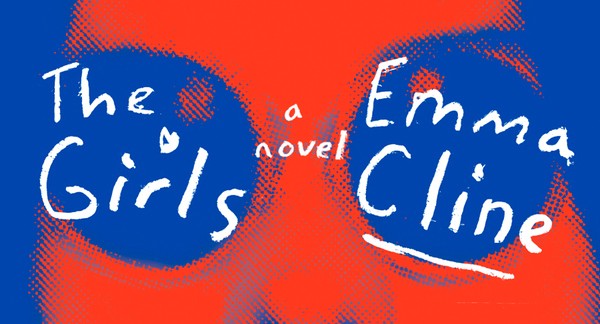
“Don’t read the comments” is the cardinal rule of the Internet, but if you make an exception for anything concerning Emma Cline, you’ll start to see a pattern. “Really, ANOTHER Manson book? Noooooo! Say it ain’t so!” one reader among many bemoans in the comments of Cline’s 2014 Paris Review essay about her correspondence with Rodney Bingenheimer, published long before her debut novel ever hit shelves.
But keen eyes would have caught in the section just before comments her short biographical note, which explains that Cline is working on a book inspired by the Manson murders — a book that eventually became 2016’s The Girls. And while it is true that The Girls is technically “another” Manson book, it is also liberally fictionalized — “Russell” replacing Charles, “Mitch” a stand-in for Dennis Wilson.
You might go as far as to consider that the protagonist Evie is, in some parallel universe, Cline herself, as the author confesses in her Paris Review piece that, “In the photographs I saw of the [Manson] girls… I recognized something of myself at thirteen, the same blip of longing in their eyes.”
But might all women find their teenage selves in that blip? It’s a question The Girls raises, as longing and desire are the twin forces ricocheting in Cline’s beast of a debut. Only clumsily might it be categorized as “Manson fiction,” though; more centrally, it is one of the darkest and most alluring coming-of-age novels to drop in a good while. A sharp-nosed publisher picked up on this too, as Cline stunned the literary world when The Girls sold for a $2 million advance almost two years ago.
Still, we must be patient with the grumpy internet commenter; in a cattish sort of way, one wants very, very badly to find something to tear down in The Girls. Her hefty advance aside, Cline is still somehow only 26 — a fact that has prompted corners of the internet to mutter, “She didn’t live through the 60s. So what does she really know? This all sounds like hype.” (This garnered a sharp reply: “Really? You really just sound envious.” “WHO WOULDN’T BE ENVIOUS; THIS IS COMPLETELY INSANE,” another commenter rightfully points out.)
So yes, there is a lot that makes one want to secretly see Cline fail — her age, her subject, her hype, her advance. Unfortunately for comment sections everywhere, The Girls will not give those seeking to eviscerate it much ammunition.
At the center of the story is Evie Boyd, who is doomed to be shipped off to boarding school at the end of the summer, has newly been scorned by her best friend, and is just beginning to understand the complicated power dynamics of sex. Being fourteen, Evie is at the height of that tender and treacherous age where one wants so badly to be wanted, and it doesn’t matter by whom.
We were like conspiracy theorists […] seeing portent and intention in every detail, wishing desperately that we mattered enough to be the object of planning and speculation. But they were just boys. Silly and young and straightforward; they weren’t hiding anything.
It is an observation made only after much reflection, as a present-day Evie recalls the final years of the 1960s and her brush with history. But later her words gain a double meaning as her fourteen-year-old self draws closer and closer to a new sort of family — a group of girls that live on a dirty farm in the hills of Northern California. On the ranch, “the girls” all but worship a mysterious, charismatic man named Russell, whose every word, gesture, and affection is cherished and hungered for. “Portent and intention in every detail,” indeed.
But even on the farm, far from the reaches of society, the girls cannot escape the suffocating yoke placed on women — the pressure to please. Even while Evie begins to navigate her budding independence, she is like putty in the hands of an older girl named Suzanne, whose affections are as brief and fleeting — and coveted — as Russell’s.
At times, The Girls can threaten to be oppressing in its single-minded vision of the world and of girlhood — Cline imbues a kind of helplessness in her characters that are caught in the web of an inescapable system. So too is it true that pop culture is saturated with stories about “dangerous” teen girls: Carrie, Jennifer’s Body, Heathers.
But what makes The Girls different is how muted the violence is: here, the monster is not women but expectation. The girls ultimately succumb to being who they are wanted to be.
For Cline, though, women are not to be blamed for weakness or for seeking to please. The red hands instead belong to society itself — a churning, unnamed force that pushes everyone toward their end even as the novel draws inevitably closer to the only finale it could have: murder.
The true evil in The Girls is greater than any one individual, and so much more powerful than a single time or place. It doesn’t take living through the 1960s to understand that as a girl, you have a role you are expected to play and it is so very hard to deny that part when it is, at long last, your turn to step into the light:
That was part of being a girl — you were resigned to whatever feedback you’d get. If you got mad, you were crazy, and if you didn’t react, you were a bitch. The only thing you could do was smile from the corner they’d backed you into. Implicate yourself in the joke even if the joke was always on you.
The Girls revels in how deliriously intoxicating — and dangerous — it is to find oneself desired, and Cline is an enviable talent right out of the starting gate. Even the crankiest among us will be forced to admit that being jealous has never been quite this much of a pleasure.
by Manuel Betancourt
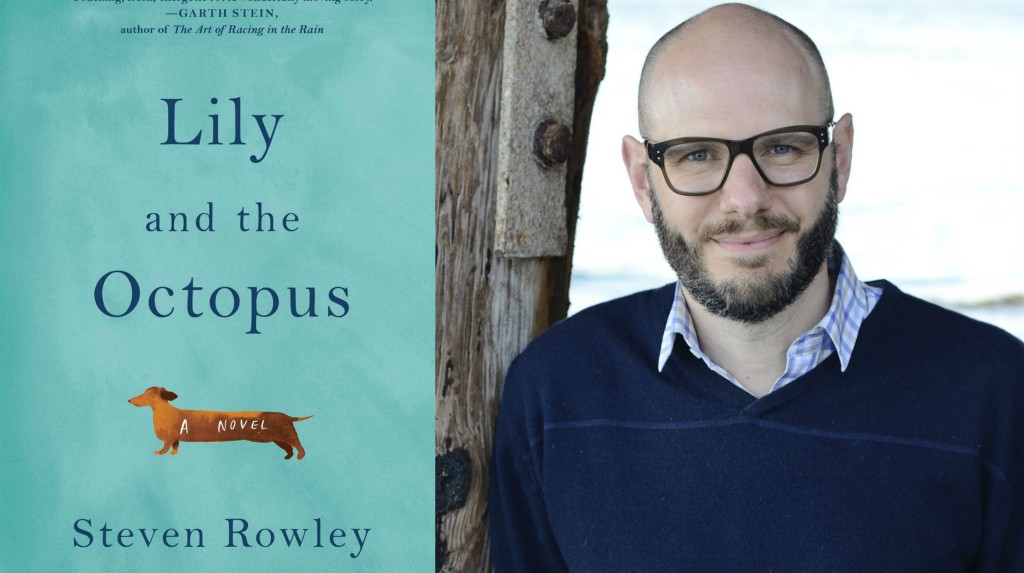
Steven Rowley’s charming debut novel, Lily and the Octopus (Simon & Schuster, 2016), has a rather incongruous central image. Lily, Ted’s aging dachshund, he’s recently discovered, has an octopus on her head. What might this interloping cephalopod be doing on Lily’s head? “‘I don’t want to talk about it,’ she says, tucking her head to gnaw at an itch on her stomach.” Ted can sense, though, that the octopus is hungry and that he’s about to take his most devoted companion away from him. It’s a setup, Rowley will readily admit, that’s hard to pitch (he never did understand why literary agents didn’t immediately want to read his manuscript, which he’d half-jokingly referred to as a cross between Joan Didion’s The Year of Magical Thinking and Melville’s Moby Dick). At its heart, Lily and the Octopus is an all too rare portrait of grief over the loss of man’s best friend. That it’s also a riotous take on growing older as a gay man in Los Angeles as well as a thrilling adventure tale at sea, is a testament to Rowley’s imagination. Lest you think the fanciful conceit is treated with cloying preciousness, know that the first page features an all too serious conversation about which Ryan Ted and Lily fancy the most (he’s a Gosling man, whereas she’s a Reynolds gal).
Wanting to talk to the mind behind this touching story, I contacted Rowley, a Los Angeles based screenwriter-turned-novelist, and ended up arranging a bicoastal Skype meeting where we touched on Lily’s autobiographical origins, discussed almost going the self-publishing route, and dished on the novel’s unmissable gay sensibility.
Manuel Betancourt: So maybe we can start with the obvious autobiographical aspects of the novel. You had a dog named Lily that passed away and that serves as the inspiration behind the book.
Steven Rowley: Well, the official party line is, “any resemblance to people living or dead is purely coincidental.” But I don’t think there’s denying that there’s a lot of me in the narrator because there is. In fact, the last thing I added to the book was something my editor sort of insisted on: giving the narrator a name. He didn’t have a name. And I sort of liked him being sort of mysteriously between me and not-me. But they were like, “It’s very hard to write marketing copy when you’re writing, ‘A forty-something uh… man’ — it’s a little less interesting for someone to pick up.”
I did have a dog named Lily. She passed away from a brain tumor in 2013. I was really shocked and not prepared for how I was sidelined by the grief that I was feeling. I grew up with dogs, maybe six different dogs growing up. But this was a different relationship entirely. Sometimes, people who have dogs — or other animals; we don’t have to be so divided in this world between cats and dogs! — sometimes there’s one dog that leaves a special imprint on your soul and that was Lily for me. So, not really knowing what to do, I did sit down one day after about six months of feeling in a funk. I was not writing at all, I had been mostly screenwriting before this, and I did pretty much sat down and just wrote a few thoughts and some memories I had about our relationship together. And they formed a short story. I showed it to someone that I had just started dating. And he said, “This is exactly what you should be working on!” And added, “Don’t talk to me again until you write chapter two!”
It was a lot of fun to take off my screenwriter’s hat and just run with the craziness.
And I was just thinking, “Chapter two? But, it’s kind of done! If I write a chapter two, there’ll be a chapter three and a chapter four, five, six… where does it end?” But, you know, I was still trying to impress him so I wrote chapter two and it snowballed from there. I don’t even know why I wrote a short story or a novel, as opposed to trying to write a screenplay or something. But I did. It was a lot of fun to take off my screenwriter’s hat and just run with the craziness. It was very freeing. I was sort of stuck in screenwriting and really uninspired after a while. And this was really… Not only did it help me heal but it actually inspired my writing.
MB: You say the first chapter began as this short story, and in a way it does feel like an iron-tight conceit that gets stretched and teased out until, of course, it basically snaps us back into reality. There’s this crescendo as the fantasy aspects sort of take over the narrative. I was curious about the kinds of conversations you had with yourself about how much you could push that before reeling us back in.
SR: The challenge for me was letting go of the autobiographical constraints and really letting it be a novel. Letting it be a whole story of itself. I think I knew right from the beginning, if I’m gonna write more, it’s an octopus so the book is written in eight parts. That helped give it a little structure. And I gave each part an octopus theme [“Camouflage,” “Suction”] and it’s when I got halfway through the book — the fourth section is called “Ink” that’s about the tattoo and the Rorschach test and all that, the blinding her — that I gave myself the freedom to just… you know, it’s ink. The idea of ink gave me the permission to just write where the story wanted to go. And to let go. It’s the part where it verges past the realism and where the magical realism becomes more magical. And that was really freeing. Where I got to the point where I could write whatever the story wanted to be. My goal was always was for it to be some core emotional truths. It had to stay parallel to how I actually felt, even if the actions were not quite the same.
MB: In talking about that blurring of the fantasy and the realism, how does one come up with a voice for a dog? Lily has a specific way of talking and I wondered how hard that was to arrive at and sustain throughout the book.
SR: Well, she speaks in two ways in the books. One is that sort of punctuated way [“LOOK! AT! THIS! IT! IS! THE! MOST! AMAZING! THING! I’VE! EVER! SEEN!”]. And that was me trying to assign an English translation to her actual barking. Those are her actual contributions. And all of those words in lowercase quotation marks [“Tell me again about my mother.”], that’s the imagined conversation. That could take sort of any tone and it more matches Ted’s way of speaking, because of course he’s carrying both sides of the conversation in his head. I did try to walk a line between, what would she actually be saying and what kind of personality do we assign to our pets?
MB: I particularly enjoyed their pop culture conversations, especially their running joke on mimicking that one line from Elizabeth: The Golden Age — “I, too, can command the wind, sir! I have a hurricane in me that will strip Spain bare is you dare to try me!” — that line is so ingrained in my head and I haven’t even seen the film!
SR: I’ve never seen the movie either! But it left an impression. And the truth of the matter is I used to make myself laugh when I saw that with Lily because I had — me personally, this nutty-dog person — I would have a very high-pitched character voice that I would do for Lily that I would use when I was having conversations out loud. A sort of party trick. But then I would actually do it by myself. It just sort of became a thing. But bellowing as Elizabeth I in this high-pitched, squeaky, made-up dachshund voice was just something that amused me to no end.
What’s interesting is that to make the relationship with the dog as powerful as I wanted it to be, I stripped off all of the people out of the story. So Ted has one friend, he has one sibling, he has one parent, he has one therapist. In real life I come from a very big family, and I have many many friends, and an army of therapists. [laughs] I actually don’t have any therapists. So in terms of adding conversations to Lily, the character in the book has really isolated himself a little bit. That’s why there’s a lot of imagined conversations. Because he’s lonely.
MB: In talking of this larger world that gets pushed to the background, I’m going to read you one of my favorite lines and use it as a way of talking about this funny if bleak look at the dating situation in the West Coast: “Los Angeles is a Neverland of Lost Boys who preen and crow far too often and demonstrate substance far too seldom.”
SR: [laughs] You know, I’ve made my peace with Los Angeles. And there’s really wonderful people here — largely because most everyone is a transplant of some sort. I’m an East Coaster and a lot of my friends are East Coasters here. So you can find substance, but there is something very odd about LA. And it comes from the weather, a little bit. That I was surprised when I moved here. I had probably lived here for five years before it occurred to me, “Oh, winter never came!” I didn’t realize I was five years older. I thought it was this really long summer and life had slowed down. It’s sort of tied into that, I think: people don’t realize that time passes in quite the same way. It lends to people not really understanding that time is passing, that they are aging. And there’s this desire to keep up sameness, always. It can get frustrating at times.
MB: In talking about this idea of aging: that struck me as being at the heart of the novel. We meet Ted when he’s sort of realized that this decade has passed him by. I wanted to ask if you learnt anything in terms of coming to terms with that or whether that was something that you were bringing into the novel yourself.
It is a particularly brave thing that dog owners (or pet owners in general) do. We sort of sign up for a lifetime.
SR: That’s a good question. I’m trying to think about how to answer that. You know, I got Lily on my 30th birthday, just as it was in the book. And it was really weird… I think this is sort of why the impact of having this dog was so strong. I’d never gotten a dog when it was a puppy before. So to be responsible for something from the beginning of its life through the very end, and watching a whole lifetime take place, is not something that I had ever done before. It did make me realize how much I had grown up over the same amount of time. It is a particularly brave thing that dog owners (or pet owners in general) do. We sort of sign up for a lifetime. And of course, animal lifespans are not as long as ours, and we know we’re going to lose them and we sign up for this anyway. And we do grieve and hopefully move on — I’m watching another dog over just off-camera licking herself! — and then we sign up for it again. We get to the back of the line and say, “Let’s do it all over again.” I think what I learned was that I wasn’t as fragile, maybe, as I thought I was. I learnt about a certain toughness. And some of it comes from knowing that it’s okay to be emotionally vulnerable, too.
MB: I also know that you said you almost self-published the book. Can we talk a bit about the road to getting Lily and the Octopus published?
SR: I don’t even know when I started writing. And I think that maybe that’s a lesson right there. I was writing because I was in a bad place and I was doing what writers do sometimes which is just sit down and try to write your way out of it. Or write some sense to it. Even when I was thinking, “Okay, this is going to be a novel,” I still wasn’t writing it for anybody. I had no vision of it being out there. I was just writing it because it felt like it needed to be written. And when I finished it, I was proud of it as a piece of writing but I had no vision that it would connect with people the way that it does seem to be connecting with early readers. And that’s deeply humbling. But since I’d written a book I was like, well I don’t want to put it on the shelf, so I reached out to a number of literary agents. But it’s a weird book to pitch. I will say that reaching out to all these agents I was met with resounding… crickets. In their defense I don’t think I was really good, at the time, of saying what the book was really about. Because if you say, “Hey, do you want to read a book about a dog with an octopus on its head?” Well…
I was joking with a friend at the time: here in Hollywood everything is all “This meets this,” or “This meets that,” and I was like, “Well it’s sort of like a cross between Joan Didion’s The Year of Magical Thinking… and Moby Dick” — don’t ever describe your book that way! [laughs] So when no one would write back to me I was like, “Are you sure you don’t want to read my book? It’s like a cross between Didion and Melville!” So pretty quickly after that I said, you know, I’m proud of this writing. I want it out there. If only for a sense of self-pride and satisfaction.
So I decided to self-publish it. My boyfriend was like, “I totally support you doing this but let me give you this piece of advice: I would say, pay to have a freelance editor take a look at it. Hire somebody.” So I did that. I found someone in New York and she did a great job. I paid her and I never expected to hear from her again. There’s no reason I would have — our business transaction was done. And so I hired a typesetter. I got an ISBN number. I was researching printers, and how to convert it into an e-file. I was all ready to put it up on Amazon when I got a call from that freelance editor and she said, “I haven’t been able to stop thinking about your book! Do you mind if I send it to an editor friend that I have at Simon & Schuster?” I thought that no harm can come of that. “But whatever she might have on her desk,” she told me, “it’s not out of bounds for it to take her a month or two to get to you.” And in the back of my head I kept thinking, “Well in a month or two this is gonna be for sale on Amazon… but okay, we’ll see what happens.” So that was on a Friday and because of the time difference, I woke up Monday morning to my phone ringing and it was Simon & Schuster and it pretty much happened that quickly. Within a week we closed the deal. I didn’t even have a publishing agent so I had to get an agent. (Pro tip for aspiring writers out there: it’s very easy to get an agent if you have an offer for publication!)
MB: It almost sounds like a Cinderella-type story. That sort of fairy tale version of getting published that we keep being told never happens.
…I’m so grateful that the most personal thing that I’ve ever written is the one that is breaking through and connecting.
SR: Well, you know, I think everyone knows that this is not how it happens. There is a sort of a Cinderella story, except, well… I blanche at that a little bit — everyone who sees an “overnight success” doesn’t really see the work that went behind getting you to that point where you’re an overnight success. But there’s no denying that there’s a charmed story behind this book. I’m excited and I’m so grateful that the most personal thing that I’ve ever written is the one that is breaking through and connecting. That’s very gratifying.
Simon & Schuster is doing right by me and this book. It’s their lead summer title and there’s a huge first-printing. I don’t think it’s even sunk in what’s coming down the pipeline. Hopefully it doesn’t land with a thud.
The people on Goodreads — I have to admit that I’ve been reading their little reviews and stuff like that — it’s hard not to obsess. But there was one woman who wrote that everyone needs to know that this book is about an “f-bomb dropping gay!”: One star. I was just like, “Okay, Shirley or whatever-her-name-was from Nevada.” But the man and his dog literary trope is a very heterosexual one, which is weird because of the extra importance that gay people have in their relationship with their pets, in terms of becoming surrogate children, sometimes. And well, you know, it’s gay on the first page! You gotta be along for the ride.
MB: It is sort of refreshingly and aggressively gay on the first page — you start off talking about male celebs you like, and then, of course, the Blanchett lines. But you have to wonder if Shirley from Nevada…
I wanted to be unapologetically me right from the beginning.
SR: She probably never saw Elizabeth: The Golden Age! Cate Blanchett never made it to Pahrump, Nevada, where I imagine Shirley living. You know that was the thing. I wanted to be unapologetically me right from the beginning. When I had a conversation with Simon & Schuster, they asked, “Do you have any dealbreakers?” And I said, “Well, it needs to be an octopus! If you say, make it a hippopotamus or a giraffe, that’s not gonna work. It can’t be that.” And I told them that I didn’t want to de-gay the book, which I was a little bit afraid of. Because when they were talking about doing this in a major way, I was thinking that I didn’t know whether there was a big beach read from a big corporate publisher that has a gay male lead. Usually that would be relegated to a smaller imprint or a University Press, or something like that. I told them, I can’t de-gay the book. And they were fantastic about that. In fact, my editor almost teared up, she told me that she couldn’t believe that that could even enter my mind that they would do that. So we’ll see what happens.

Looking for some interesting reading to get you through the week? Here are some literary links from around the web to check out:
SF authors on the past and future of cyberpunk
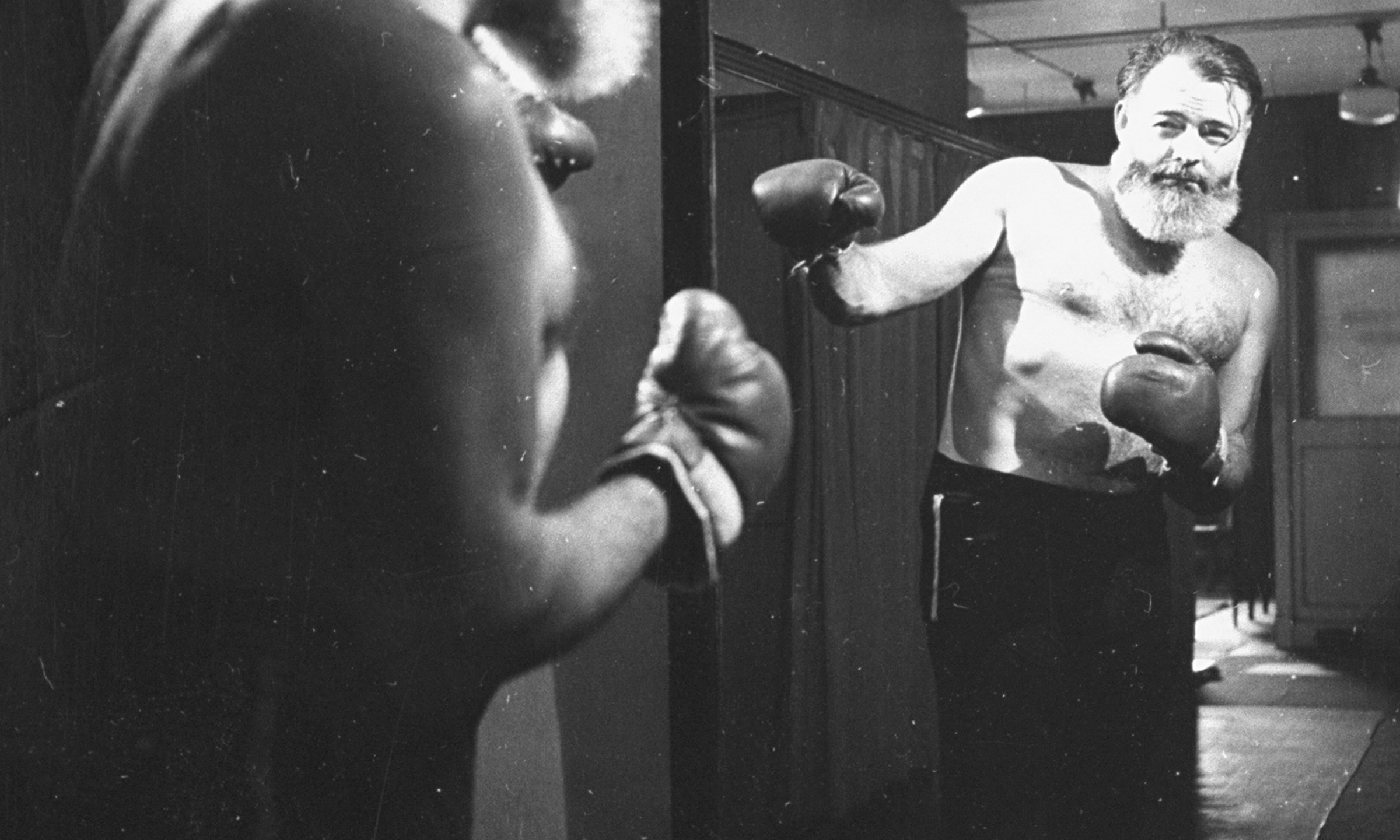
How Hemingway inspired a generation of badly behaving authors
How many writers earn a living by writing books? Not very many…
Lit Hub launched a “Rotten Tomatoes for books” site
Essential William Gibson reads
New Republic wonders if literary fiction has a grade inflation problem
The Toast on every modernist novel ever
Self-publishing has a major plagiarism problem
Max Porter’s Grief is the Thing with Feathers is one of those projects that makes you grateful for the people in publishing willing to take risks. It is a gorgeously weird project — almost clinically ballsy — a hybrid novel-in-verse with rotating points-of-view, quizzes, dreams, lots of white space, nonsense words, impossible sounds, two rambunctious boys, a grieving father, a dead mother, and a filthy, stinking, cruel, gentle, crass, hilarious, monstrous crow: a simultaneously ancient and postmodern trickster with origins in Ted Hughes’ poetry but with “thirty years hindsight.”
But it isn’t just Feathers’ form that walks a dodgy path. It’s a project about grief — a topic oft-explored in the literary world, a potential minefield of sentimentality and prose deadened with cliché. But Porter skips through the novel with unabashed pleasure, avoiding the obvious mines while setting off many of his own — some funny, some surprising, and some devastating.
Max Porter is the senior editor at Granta Books in the UK. Grief is a Thing with Feathers, his debut novel, was shortlisted the Guardian First Book Award. He answered my questions and talked about sentimentality, fanfiction, homage, and the pleasure of liminal space in May 2016.
[Ed. note — Read an excerpt from Grief is the Thing with Feathers on EL’s Recommended Reading.]
Carmen Machado: You use splintered form (fragmentation), shifting imagery (Crow’s changing size), and onomatopoeic sound throughout Feathers. Do you believe that grief is inherently fragmented? Distortive? Sonorous? Nonsensical? Lyrical?
Max Porter: I think it’s as individual as a thumbprint, and one’s expectations should be as bespoke as one’s behavior, nothing comparative, nothing marketed. Hence my disdain for sickly sweet notions of ‘moving on’. But yes, this particular grief needed a form equal to the shock of the trauma, the chaos of the boys’ imaginations, the disorder of the father’s emotional architecture. Shock is different, anyway. A book in which someone is slowly dying, preparing to die, even investigating the possibility of preparedness — that would have demanded something quite different I think.
But ultimately, to answer your question, yes. Fragmentary seemed the truest way of getting at what I wanted to get at. I’d even call it realistic, which is odd given the giant crow entering on page three. That switch from lush sentimentality to crushing domestic drudgery; from unfathomably deep depression to the wicked resilience of kid’s humor, those are the switches that the fragmentary form allowed that seemed to me to be truthful and recognizable, and possibly generative.
CM: So you think the trauma of the mother’s loss — the suddenness of it — shattered the novel, in a way? Can you talk more about that?
MP: The suddenness shattered the possibility of a smooth prose style, I think. We begin with a situation where the architecture of a family unit has been shockingly smashed, and therefore the architecture of conventional novelistic form needs to be comparably shattered. Otherwise a translation has already occurred, a neatening, an ordering, and that would already be a loss of truth, a loss of energy. I was also slightly borrowing from fables and fairy tales where there’s no prettying. There’s no three-hundred page contextual build-up to the death of the character, the character is dead on page one and everything begins from the pain, rather than building pain against an established normality.
CM: The title of your book comes from an Emily Dickinson poem, and the character of Crow comes from Ted Hughes’ Crow. What drew you to adapting and integrating Crow into Feathers? What is your relationship to the concept of fanfiction? Besides Crow, what would you consider the texts or authors that have been the most influential on this project?
MP: I wanted a heavy baggage-laden center to the triptych, and I wanted to say something about the possibility of affectionate critical homage. Dead poets being nudged, being read on our terms, being vandalized with a loving energy. I thought if I was going to bring a poetic obsession alive, it would be cruel and pointless to not give him his own identity. So fanfiction is a really helpful concept here. He isn’t Ted Hughes’ Crow because he has thirty years hindsight, he’s drunker on language, he takes himself a lot less seriously, he’s guiltier, sillier, he’s aware of the almost endless other Crows he can be, he can perform or channel or mock. He has much more in common with a spank-fetish Harry Potter in fanfiction than he does with any officially endorsed Harry Potter tie-in, and that’s partly my way of saying that poetry belongs to the reader, not to the canon, not to the textbooks.
Dickinson is the ultimate permission giver. I think she will hang over anything I do just because of the inexplicable, singular, genius of her language, and the vast complexity of her thinking about faith and love. But I don’t think I would ever interrogate her as I have done Hughes. She is too big, too special. Ecstatic admiration is enough.
Other important texts were the Russian Fairytales, various books about crows (real and mythical), David Jones, Basil Bunting, Anne Carson, Alice Oswald, Beckett. Always Beckett, but especially his translations, his other-people’s-poems.
CM: The brothers’ sections are mostly told in the plural first — a chorus of “we” — that sometimes break apart into “I.” (“I’m either brother.”) It made me think of Justin Torres’ We the Animals, and how trauma shapes and then shatters the “we.” Can you talk about the decision to include their voices in the narrative, and integrate them together as one?
MP: I loved that book and I ought to re-read it. I remember a scene in a lake, swimming, and leaves on the father’s back? But I’ve forgotten a lot. I remember arguing with myself and others about the ending of that book but now I can’t remember how it ends!
Have you read Agata Kristoff’s The Notebook? Holy shit. The kids in that destroyed me.
I thought for a long time about how to write a sibling relationship as a character, something fluid and changeable outside of two distinct identities.
The boys were my first aim. I thought for a long time about how to write a sibling relationship as a character, something fluid and changeable outside of two distinct identities. This comes from closeness with my brother, and a bit of gamesmanship between us as regards the unreliability of memory. We swapped things, borrowed things, took it in turns to be affected by certain things. And I think that the circumstances of our childhood (we were two brothers in an expanding and happy family of step-siblings) gave our brotherliness a solidity, almost like whatever other roles we had (son, husband, lover, uncle) we were brothers first and foremost. It was the identity against which all other functions were played out. I don’t know why I’m using the past-tense, it’s still happening.
CM: In Feathers, the widower struggles mightily with the contrast between the legitimate enormity of his grief and the cliché of it. (“Eugh, said Crow, you sound like a fridge magnet.”) Is this an in-text acknowledgement of your own concerns about writing about a topic like grieving, which can so easily veer into sentimentality? How do you go about walking this very fine line?
MP: Crow is devised precisely to check it, to interrogate it. He allows it, even encourages it, and then reminds them of its toxic potential. He recognizes it is a medicine these people will need, but also warns against it. It’s a tricky one for me, because I am deeply sentimental. I fall into it like it’s a warm bath, as a retreat from a cold, broken world, as a luxury, but I know it isn’t serving me well in the long-term. Perhaps it’s tied again to my dislike of the moving on concepts. Like, I should move on from missing my glorious wise bossy stubborn Welsh Grandmother? Fuck that, I want to wallow in the perfumed loveliness of her memory for as long as possible. I want that wallowing roped into how I live, work and parent. I’m being deliberately sentimental about her, putting her on a pedestal, being nostalgic, exploiting her memory to bolster my dislike of many things about the modern world and modern people, so be it. My crow would hop in here and say, “Sorry, sorry about this guy, he’s losing it.”
…there’s a lot of real shit written about grief under the shammy guise of self-help.
But yes, there’s a lot of real shit written about grief under the shammy guise of self-help. Most of it cliché, much of it is actively dangerous as it presupposes a state of normality, a fixedness, which is not only unattainable but also unhealthy. But there is also the need to investigate, to be exacting, to expose and investigate the emotional chaos of grief, and that has given us some incredible books, which we can all lean on or challenge or believe in. We can use them, if we want.
CM: You say “my crow.” If it’s not too personal to ask — what else would your crow say? What would he look like? Smell like? Sound like? How is he different than Feathers’ Crow? (Needless to say, I am also now thinking about my Crow.)
MP: Ah, this is me not being clear enough, I think. I meant the crow in my book. Who I’m keen to distinguish from Hughes’ Crow.
But to answer the question, he’s all my favorite things. He’s the friend who lets you say the unspeakable things, checks you when you go too far, pops your bubble when it needs popping. As a character he combines some of the things I most love about children (freshness of observation, eccentricity of outlook, relentless play, sudden dreadful rage, bum jokes) with things I most love about my friends and family (sarcasm, tenderness, mischief).
CM: There are many embedded narratives within Feathers: stories and lies being told by Crow, Dad, and the Boys alike. They seem to serve as load-bearing walls that lift the rest of the novel — reality, or something like it — aloft. Why tell a story with other stories? Why did you choose to make storytelling part of the language of grief?
Storytelling is the medicine.
MP: I love the idea of them as load-bearing walls. Storytelling is the medicine. It’s what he brings in his toolbox. I suppose because with the archetypes of myth, with the deftness of touch and speed of narrative stripped back to its cleanest form you’re offering an unlimited range of interpretive avenues. Upon these wipe-clean templates which have done us well for thousands of years and don’t seem to be going anywhere, you can kick open all the doors, sexual, moral, political. I hoped the fables in this book would act a bit like blank space titillation, an invitation in. That invitation can be quite simple (Boys will be boys; that’s a story I can relate to the terrible war-hungry men of this world and my love and fear for those boys) or quite complex (what are my own symbolic associations, what archetypes have I employed or manipulated in order to firm up my own narrative, justify my own character).
Also, it’s a love letter to freedom of reading, to moving loosely and joyously between forms. It’s a celebration of the electric tingle I get when I go from, say, Sendak to Solnit. I love them both, I like what happens when they’re both knocking about in my head. All the stories.
CM: In this novel, Crow occupies a porous, interstitial territory between real and not real. He is deeply physical, and also a metaphor, and also possibly a hallucination of grief. This liminality seems to sync up beautifully with the project’s hybrid nature. Can you talk a little about the process of deciding upon and creating its form? Do you think this story would be possible without its shape?
MP: Deciding on a triptych was the crucial thing. Three voices, three collage boxes, three wooden bowls. Any truth I was hoping to get down about childhood, mourning, birds, relies on this play between the three. I would have been completely immobilized without the musicality of that play. I don’t think I’m cut out for prolonged prose. I had some in there (the mother had a voice, which was prose) and it violated the whole thing. It robbed the boys and the Dad of the chance to create her in absentia, and it felt sludgy and familiar and disingenuous.
CM: So you used to have sections in the mother’s voice, in prose? Can you talk more about the process of writing and then discarding that material?
MP: She wrote about her dying. But as I was doing it, I felt the triptych being unbalanced. Like I was cooking a risotto and I put so much white wine in suddenly that all the other flavours that I’d been careful to create were drowned. (Wow, a risotto analogy. What’s happening to me?)
And then I was edited, very beautifully by Hannah [Griffiths] in the UK and Ethan [Nosowsky] in the US, and they were very good at pointing out moments where Mum came back, or slipped away, and how best to evenly (or unevenly) distribute her memory, her presence, her ghost, between the remaining characters.
I discarded a lot, because I felt the movement between voices was asking a lot, and if I had too much it would run thin, or be wearying for the reader. And removing Mum was painful, it hurt me, and I recognised this hurt was a generative thing, was related to what I was trying to get at, so I let it spill into the way the boys think about their parents.
CM: But back to liminality…
I’d hate to be dragged back from the liminal space you describe and told to join the real world. I don’t really believe in it.
MP: I’ll be honest though, the porous territory between real and not real (again, thanks!) is simply a place that interests me and calls to me. I believe it is the good place, the true place. A place where the wide plains of dream and fantasy can be explored without denying the body world of eating, fucking, shitting, paying bills, catching buses. I’m not going full-out Martian school, but I am fairly committed to writing about a space that is simultaneously lushly imaginary and instructively mundane. The chitchat of children; the wisdom of old women; the brutal truth-snap of fables, these things seem true and magic and necessary. I’d hate to be dragged back from the liminal space you describe and told to join the real world. I don’t really believe in it.
There isn’t any good place to start. I have a picture. In the picture two women share a kitchen. Checkered floor. Wire basket of lemons. One of the women is Ruth. I am the other. The men, hers and mine, are not in the picture. Ruth squeezes lemon juice into a blue bowl. I remember her hands were covered with paper cuts. How could a person get so many paper cuts? I didn’t do anything when her hands started burning but watch her rinse them with cold water. In my mind Ruth will always be wincing in the kitchen, squeezing lemons. I will always be watching.
The picture was taken on the night before our trip to Florida. Jay, Ruth’s husband, snapped it with my camera. Their son Luke was my boyfriend. We’d only been together a few months but he’d invited me to join their family vacation. The vacation was a reunion so that Ruth could see her sisters.
“Get good sleep,” Jay said. Luke’s childhood bed was short; our feet hung off the end. Luke made too much noise when he pushed himself inside me. The fitted sheet came loose and bunched under my back. My necklace clasp kept snagging on the pilled polyester of the mattress.
Afterward Luke fell asleep with his fingers strumming between my legs and I moved his hand away, spread the sheet over my lap and touched myself. My finger circled a flickering pleasure, but the pleasure kept coming and going.
When I opened my eyes Luke’s eyes were open and on me. Play dead. My pulse kicked in my ears. The sheet was a coil of heat in my lap, and the room was laced with the smell of our dirty sleep, like strawberry yogurt, I’ve always thought, never sure if it was his smell or mine. He closed his eyes again, went back to snoring. Ruth was pacing in the hallway. I knew it was Ruth because of her soft footfalls.
Later when I got up to pee she was a dark shape standing by the window at the top of the staircase. I tried to turn her into something else, coats on a coat rack or a curtain, a trick of the eye, but then her weight shifted. I hurried into the bathroom.
There was a twinge when I went pee. A hook at the end. It almost felt good.
I’d been warned about this feeling before. Urinary Tract Infection. This was the latest in a long list of incidents in this place I couldn’t see or tend. When I put my fingers inside I felt nothing but a little pressure, like it wasn’t really me I was touching. My insides were a collection of happenings: the first, the cyst on my left ovary. I was eleven, sleeping over in a summer girl’s guest bedroom. I woke up at sunrise to a mouthful of spit, and stayed awake swallowing. That morning I went with her family to the Children’s Relay at the town pool. In the deep end, the lifeguard floated saltines on the surface of the water. We were meant to swim to the crackers before they dissolved, eat the pulpy mush, and race each other back to the shallows. At the finish line all cracker was to be swallowed; they would check our mouths. I threw up in the water. The gynecologist’s fingers were the first I had inside me, and then her jellied speculum.
A second cyst, so rare three interns were brought in to look. Before babies are male or female they have a duct, explained the doctor. For girls it disappears but when some vestige stays it forms a pouch. I had just read a book about a tall girl with internal male sex organs, undiscovered until a tractor accident at age fourteen. The book troubled me — the incubating clutch with its invisible hunger and hormones, and the doctor reaching inside like a magician performing a hat trick. No, nothing like that, said the doctor. You’re perfectly normal.
Left ovary, said the psychic. Be careful. You might get to keep it, but it’s probably best if you don’t.
Twins in your family? she said.
No.
All right, she said. But there will be twins.
Bacteria. Spreading from urethra to bladder, my first UTI. The feeling was unsettling, but my mind was on Ruth, waiting by the window in the shared silence of a house put to bed. I was afraid to open the bathroom door and when I did she was gone.
My two previous boyfriends’ mothers were also named Ruth. Luke’s Ruth stood out in the lineup; the others had gray wiry hair, thick socks over thick ankles, bucket-like wool hats that they crocheted themselves. Both walked a large number of dogs, cleaned counters with disinfectant wipes, and made large bland batches of scrambled eggs. Of course there were differences, but these were the ways in which they were the same.
Luke’s Ruth was tiny, powdered pale, with dark, tailored jackets and pants hemmed to expose a whittled inch of wrist or ankle. Her hair was a silky black tussle, and often she fixed it during conversation, her lips pursing bobby pins. I never saw her mouth without red lipstick. She wore her collarbones like jewelry.
Luke showed me postcards of her paintings, black ink swiped across huge blank canvases. Their home was full of art, but none of it was hers: sailboats on the lake, pink dabs for sailors’ faces; children kicking their feet at the end of a dock; a spaniel chasing down a flock of grouse.
Luke left me alone with Ruth in the hotel room while he and Jay played a game of tennis. She poured wine into two paper cups.
“I feel slightly deranged,” she said, holding her hand over her smile. There was a small gap between her front teeth. “Too many miles of yellow lines.” Our paper cups pressed together in a silent cheers. We sat on the bed and sipped.
I thought maybe I would tell her about my infection, but I didn’t. My discomfort stayed in the background during the first leg of the car ride. What I’d expected as we pulled onto the eight-hour stretch of highway was a repeat of my mother’s lore: fifteen, she had a UTI on a road trip to drop my aunt at a psychiatric hospital. My grandmother was behind the wheel. They were driving from Maine to Virginia with cold cloths tied around their foreheads, and Chinese fans in hand. My aunt was in the passenger seat, reeling from a nervous breakdown, afraid of the radio. My grandmother drove all day and night — she would not stop. My mother’s urge to pee was a plague, and the idea of relief was false, just a searing trickle. She crouched in the backseat and peed into a pickle jar. “Don’t come crying to me,” said my grandmother. “I know you’ve been sleeping around.”
“I think they left us here to bond,” said Ruth. “Either that or they’re trying to bond. One of us will. I think we have a good chance at beating them.”
But we were nervous together. The wax on my cup had softened by the second use. The paper warped beneath my fingers.
“What do you see in Luke?” she asked, just as our silence was starting to feel comfortable. I was starving, the wine slippery in my stomach.
I said he was generous, or open. Or sweet.
“I don’t have an answer,” I said at the end of my answer. “I just love him. I don’t know why.”
Another cup of wine.
“That’s right,” she said. “He is sweet. He’s young. We all love him.” She drank from the bottle and handed it to me. It was nearly empty. I put my mouth over the blot from her lipstick.
“I hope you take good care of each other.”
“We will,” I said. “We do.”
“Lovely ladies,” Jay called down the hallway. Ruth and I were punching numbers at the vending machine. Ruth kept punching DD instead of D7. She kicked the machine when it didn’t release her Hershey bar.
“Easy,” Jay said. “My wife the sugar junkie.” His smile was seamless porcelain. He scooped her up.
“I’m famished!” she yelled. She kicked at his thighs. He opened the door and threw her on the bed.
Luke was wearing a new white Sheraton Hotel visor, and so was Jay. I wanted to make a joking gesture toward the visor, and with the same look reprimand him for leaving me alone too long, but he wouldn’t look back at me. He spun the racket handle inside his palm and watched Ruth.
Jay pulled her feet into his lap and rubbed them.
“Be gentle. I broke it kicking the machine.” His hands cupped her foot. Between his fingers I could see her toes wiggling.
“Here, Mom,” said Luke. “Consolation prize.” He pulled another matching visor from a paper bag and fit it over her delicate twist of hair. Her ears stuck out, folded by the weight of the wide white brim.
“So good to me,” she said. When she tried to take it off the Velcro on the band snagged her hair. Her hands struggled at the back of her head.
“Let me,” Jay said, but she yanked free before he could help and tossed the visor into my lap. “We can share it.”
Strands of her hair hung from the Velcro, and I covered them with my hand.
Luke was a generous man, and a sweet man, but I do not remember much. There are still frames I can explore, with their own smells and sounds, and he prowls and paces my memory like its borders cage him.
We went back to our hotel room, adjacent to Ruth and Jay’s, after dinner.
Maybe this night we stood in the shower and soaped each other’s backs and chests, and when I looked at him I said in my head, here I am, here I am, here I am, but mostly I looked at my hand as it soaped and thought about some other thing, like when would he move aside so I could have the hot water.
Or the hotel sheets were shiny and smooth, my legs feeling wonderful because I’d shaved them and the sheets were satin.
Or that was the night he went to the bathroom and drank three glasses of water in a row, his Adam’s apple bobbing up and down in his throat, and said “Will you watch it around my mom?”
I said, “What do you mean?”
“Just take it easy around her.”
“What, I like her.”
“Like drinking. Drinking with her.”
“Why’d you never mention it before? If it worries you?”
“She never drank before,” he said.
Or that night was the first night on the trip I was nauseous. I ran for the bathroom in the middle of fighting. He crouched beside me while I dry heaved, brushed one strand of hair out of my face and then another, never grabbing the whole bunch.
Because I felt sick sex that night would be off the table, and maybe that’s why we curled into each other, the heat of him wrapped around me itchy as wool, my eyes on the shadowy hotel wall and its green and white stripes. We held hands and he worked his nails against my palm. The feeling gave me goose bumps at first, but his nails lost track of me, got stuck in their own rhythmic rut of scratching. And then he told me that Ruth had cancer, that she needed a hysterectomy. It did not look good, but she had time. Enough time to drink and paint all day, and to see her sisters.
Ruth didn’t talk during the drive the next day. I wiped the thread of drool that hung from Luke’s mouth. I listened to the brassy tap of Jay’s class ring on the wheel. In Georgia, we pulled toward a sign with a painted peach. I pretended to be asleep as Jay paid for a bushel. Ruth had her head tipped to the side as though she were also asleep, but when I glanced over I could see the whites of her eyes through her dark glasses.
“For you, my Georgia peach,” Jay said to her, passing the hard peaches around. Jay and I gnawed their woody white flesh, working them down to their pits. We threw the stones out the windows. Ruth nibbled hers, then peeled at its skin. Luke put his peach between us and it rolled onto the floor, where it would pinball around for days before lodging under the seat to fill the car with sweet ripening, then rotting.
The thruway to the beach house had ocean on either side. Luke woke and begged Jay to pull over. The sedan jittered onto the rumble strip. Luke pulled me out to the breezy breakdown lane.
He dashed across the street and his head dipped out of view below a mound of blown sand. I slid sideways down the plunging dune, but he was already yards ahead, tacking toward the water, so I stopped chasing and gathered his trail of stripped clothes. There were crabs everywhere, skittering in my peripheral vision, tiny curls of quicksand where they burrowed. He ran into the water and swells washed over him.
“Get in here!” he cried. My pain had returned and morphed into a diffuse throb in my pelvis, stretching awake now that we were out of the car.
I was in up to my ankles when Ruth came running from behind me, and teetered into the surf with a wild crashing and laughter, too recklessly, I worried, and she was too small, the white froth at her knees.
“Watch it, Mom!” Luke yelled. He was way out in the water, bobbing like a blond buoy. A wave was coming for her.
She was in up to her chest. It took me so long to run for her, through the water. I wrapped my arms around her waist and held tight. Her hands went up against the wall of the wave before it slammed down, pitching us apart. When I surfaced she was back in the shallows, still lipsticked, smiling loose and wide.
The beach house was crowded with aunts. They came at me with flabby arms to fold me into hugs. They had the pillowy busts of nurses. With her clothes slicked to her skin, Ruth looked like a little boy beside them, all ribs and hip bones and her tiny breasts. She flapped her collar, trying to hide the sheerness of her wet blouse. Jay squeezed her neck as though he were scruffing a kitten. My little mermaid, he called her. The aunts brought her a satin robe and she sat draped on the arm of the couch, her glass fogged by chilled white wine.
Ruth’s sisters arranged that Luke and I sleep in separate beds. I stayed on the first floor, on a pullout couch in front of a television and video console. On the days it rained Luke’s little cousins lay on my bed all afternoon. They left behind a dusting of sand, peeled sunburn, and chips that I’d shake from my sheet before sleeping.
Luke’s bedroom was on the fourth floor. He swam in the ocean, or he tossed a Frisbee, dashing back and forth on the hot sand. He was a fast runner, and he tanned, and grew a patchy beard while I watched from the shore, achy and overwarm, my body shaded by an umbrella and wrapped in a towel. Ruth sat with me and watched the swimmers and the water.
Luke and I had sex once, in the outdoor shower while the aunts and cousins beat each other with bright foam noodles in the pool. The shower stall walls were made out of splintery compressed woodchips. It smelled the way my gerbil’s cage used to smell. The water, from inside the sunning garden hose, was only warm for the first few moments. When I made a noise he put his hand over my mouth. Someone had left a hot water bottle full of sweet tea to brew on the edge of the bench inside the shower, and when I knocked the bench it flopped to the ground and wiggled there.
Lying on the couch reading with him end to end, I reached out and found his earlobe with my toes and held it. When I was little I used to thread my blanket between my toes so I could fall asleep.
We ate Cajun shrimps. Ruth sat across from me at the dinner table, picking apart her shrimp carefully while the rest of them got sauce all over their bibs.
The aunts cackled around us, stirring up bowls of different sour cream–based dips. A projector whirred overhead. Luke held me between his legs, and Jay took a picture. I still have that picture, his sunburned face next to my pallid face. Someone switched the lights off and a hazy old film began to play on the wall. The film was sped up, and the family was rushing around the campfire, storming into the lake, the teeter totter moving frantically up and down, and everywhere the aunts, as girls, in stripes and bobs, flashing smiles.
The movie was silent, but a chorus rose in the room each time a new girl stepped into the frame.
“That’s me!” one aunt shrieked, and another said, “No, that’s cousin Wanda, what an awful haircut. She was with us that summer. That’s that yellow bathing suit, remember?” Wanda, her face a blur, dashed from the camera into the lake and dove under, but before she could surface the camera swung away. The older girls scattered and the little girls hammed into the lens, and in the distance was dark-haired, smudge-eyed Ruth in a pastel-green shirt worn as a dress. First she was leaning against the trunk of a tree with big leaves and later I caught her behind the crowded campfire, dipping plates from a white stack into a basin of water.
“Where’s Ruth?” yelled the aunt who had mistaken herself for Wanda. “Ruth, do you see yourself?” But Ruth wasn’t sitting on the couch where she had been. I didn’t know where she had gone, and I didn’t say anything about recognizing her because maybe it wasn’t her after all, though I knew how she leaned into her hips and how her hair must have fallen then, limp and wavy, over one shoulder.
The film stuttered and the yellow tinge and quiet of the sixties clicked to a different reel with a downpour that sounded like a swarm of wasps. A man with a big red beard walked on-screen carrying a blond baby in a slicker, and the man was Jay, though his face was fatter, and the baby was Luke, probably two years old. Jay sat Luke on an inflatable raft inside a thin, swift stream of rainwater that ran through a flooded lawn. The baby laughed as the raft bounced on the water, away from the camera, and Ruth’s voice off-screen said, “Please, don’t hurt my baby, don’t hurt my baby.” Whoever was behind the camera had a low laugh that shook everything.
And then the scenes kept changing. In one there was cake, and dated poufs of hair in scrunchies, a woman with acid-washed jeans scooping ice cream. I realized I was going to be sick.
The upstairs hallway was carpeted and dark, and, away from the shrieking family, I could hear the waves coming in. Outside it was raining, harder and harder against the window. I put my hand to my mouth and bolted for the bathroom and there was Ruth, sloshing to cover herself in the tub.
“Oh my dear,” she said as I retched. “Oh my dear heart.”
The shrimp, I tried to say, but I couldn’t. I breathed and breathed the green smell of her bath’s steam. Ruth climbed from the tub to hold back my hair, her nails circling my shoulder blade. When I stood the knees of my jeans were wet. “Take my bathwater,” she said, toweling. “While it’s still hot.”
The pain nested inside my pelvis, an unrelenting ache, throbbing and tunneling. When I got into the warm water it felt better.
“You going to make it?” Her cheeks were swollen and stippled red. She was an ugly crier, like me.
“Yeah.”
“Splash your face,” she said. Her eyes were bright with mothering.
“I don’t know why I didn’t tell you before,” I said between splashes. “I knew I had a UTI. But then it went away.”
“Is there pain now?”
I nodded.
She sat on the edge of the tub, brushing off the sole of one foot and then the other before putting them in the water beside my legs. Scars webbed her knees and she caught me looking.
“When you’re pregnant, your center of gravity keeps changing. I didn’t know that, they don’t tell you that, unless you’re an athlete or something. I was working in the city, and the sidewalk between our apartment and my studio was uneven, and I tripped almost every day. All my tights had holes at the knees and Jay would dress my knees with Band-Aids. I was like an eight-year-old boy.”
I pictured Ruth at my age, hurrying in a trench coat and French twist, scabs under her tights, the sidewalk invisible beneath the dome of her belly. It was a comfort to picture her.
I found Luke under the blankets on my pullout bed, and climbed in with him to tell him about the UTI. I could feel that he hadn’t wiped the sand and crumbs from the sheet before getting under. He was sad, and he didn’t know why.
“I’m sorry you’re sick.” He put his head on my stomach.
“You stay,” Ruth said to Luke, as she bundled me in her scarf before we left for the hospital. It was ninety degrees out but my teeth chattered. “No offense, sweetie, but you’ll get in the way.” She kissed the top of his head.
Nothing went like it was supposed to. I was trying to be in love with Luke, but we were stranger and stranger, like the smoothly twirling top that begins to lurch and wobble in loose circles.
When the doctor saw me he said, “Are you sexually active?”
“Yes,” I said.
“Within the past week?”
“Yes.”
“With the same partner?”
“Well, there was that one wild night,” I said, and listened to my laugh trail off. “No, no, just the one partner.” Maybe it was the fever that made me joke. The only other man on the vacation was Jay. Ruth’s hands folded one way and then another, an arrangement in her lap. She had followed me from the waiting room without asking, and stayed quiet and small in the corner. I had thought maybe she would hold my hand.
The hospital rooms were overflowing, so after the doctor saw me they wheeled my gurney into the hall and Ruth trailed alongside, her arm linking my IV stand. My teeth were still chattering, and my whole body ached. They gave me antinausea medication and an IV of saline, which was cold as it flowed into my arm.
Somehow between the fever peaking, the doctor, and the gurney, I think, I’m not certain, that Ruth got drunk and sad. My hospital gown was open at the back. When I fell asleep, I turned onto my side, and woke in fear of the hallway’s drifters spying my underpants with no Ruth to guard me. I didn’t know where she’d gone. An old man with deflated nakedness under his gown shuffled past wailing, “Martha!” The IV leashing him tugged from his arm and he weaved untethered, trailing neat drops of blood into the hallway’s crowd.
Far away down the hall was Ruth, tiny inside her tailored clothes, their crisp lines wilting in the heat, purse strap slipping from her shoulder, her hair wispy and undone. Compared to her I felt moonfaced, wide-palmed, a sturdy girl, and a plain one with plain sadness. The doctor was walking toward me, and he reached me before Ruth did. His drawl made him sound amused. His big, soft hand patted mine. He drawled slow, but Ruth moved slow, and he fit it all in before she could reach me. Click, a key turned inside me as he mouthed about the baby, dumbly obvious as he spoke it aloud, growing inside me. The kidney infection and the baby, and the one could hurt the other, but we caught it in time, he said, and it was so early in my pregnancy that the risk was very low with a course of antibiotics.
“Don’t you worry. Your baby’ll be just fine,” he said, rushing elsewhere.
Ruth was so small in the breeze of her drunkenness. It swayed her.
“Can’t keep secrets in this place,” she said. Each syllable dragged. “I see big news all over your face. Let me up.”
She climbed onto my gurney. I tried to rearrange my expression but it was no use, I felt it telling things to Ruth. In hindsight I was feverish, but I knew then that she was like a psychic, seeing it all, my bumps and hollows and innards and growths. I told her I was pregnant.
She curled against me. Her sigh was warm and wet, sharp-smelling. Her head was a nice weight on my shoulder.
“Luke had a twin who died,” she said. “In utero. I was still pregnant with him for three more weeks, waiting for Luke to be born.”
I smoothed her hair, trailing my IV cord.
“I spoke to my belly like that baby was still alive. I couldn’t picture him gone inside me. I thought the sadness would kill me.” Everyone was fast, wheeling around us. No time to stare, they had spills to mop. “But then my beautiful Luke was born.”
A long time later she said, “Luke’s a wonderful boy, but he’s a baby. He’s not at all ready to be a dad.” It was advice, and I needed a woman’s advice. She put her hand into her purse and worked it around in there for a minute, two minutes, fishing for lipstick. She drew the red bow of her mouth perfectly, but capped the lipstick without screwing it back down. “Fuck,” she said. Our bodies made little noises on the sheath of tissue paper that lined the gurney.
I was supposed to crave pickles, and sauerkraut, and have the kind of husband who would pick up jars of these things at the corner store in the middle of the night, and stay up with me while I ate, rubbing my stomach with cool lotion. I was supposed to have long hair, and a wide, wise mouth, and to have read many more books, traveled, married with a flower garland and a backless silk dress, taught in tweed coats with elbow patches, spooned my husband and taken long baths with him, and I was supposed to have seen my own mother, frail and stooped, through many years of sickness with grace and patience, and be cauterized by the pain of losing her, and turned bright and still and steady inside, like a mother should be, and then I’d be a mother.
I’ve imagined Ruth and me together, in Maine, in a cabin by the bay. Ruth, pacing the floor in a painter’s shirt, like the one I took from my grandmother’s bureau after she died, long and pilled, stiff where the paint streaked. Ruth’s smile, too wide, a baby bouncing on her shoulder. Her clear steady voice rings through my vision, guides the baby into sleep.
I left Florida the next day. I told Luke I was too sick to stay, and this was true. They had me on all kinds of antibiotics. Ruth hugged me at the airport and she didn’t say anything, or look at me in any special kind of way, which made me wonder if it was possible she was so out of it at the hospital that she’d forgotten I was pregnant. Luke and I didn’t make the effort to see each other again that summer. Whatever we had slipped away easily, just a summer fling. Luke phoned a couple times but I didn’t return his calls, and I didn’t go back to school in the fall. Rumor never got around to Luke as it might have if I lived in a town that was closer to our college, but I don’t, and it didn’t.
The three women I knew who killed themselves were all grandmothers.
The first, a ketchup heiress who lived in a yellow mansion with a wraparound porch. On warm nights her grandchildren slept outside in hammocks.
The second, a middle school Spanish teacher. She ate homemade granola for breakfast, coiled a braid around her head, fell in love late in life, and married in the entryway of her barn. She was bustling and red cheeked, always dancing.
And Ruth, with her lipstick and elegant tapered fingers and the scars on her knees, who walked into the water.
I stayed at home and lay in bed in the room above my parents’ garage, waiting for my stomach to grow. It didn’t for the longest time, and then it was enormous.
My center of gravity changed every day, and I fell on the way to the post office. My mom dressed my bloody knee.
All winter I lay on my back and watched the dead spider with her egg sack and her scrap of web blowing between the panes in the storm window, and in the spring her front legs began to squirm and my two gentle girls were born.
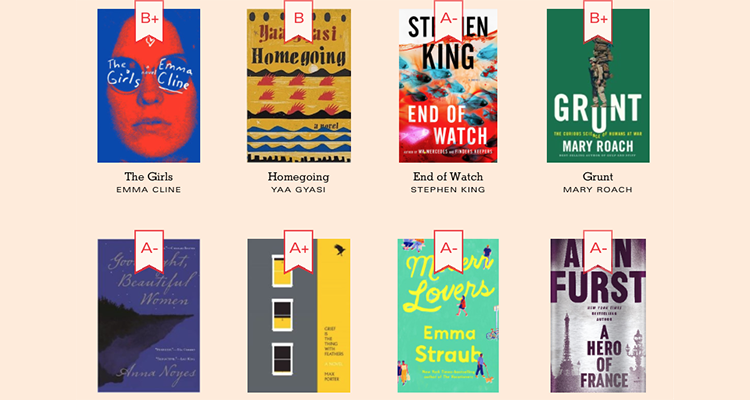
Lit Hub has announced the launch of Book Marks, its “Rotten Tomatoes for books.” Like the popular movie website, Book Marks aggregates reviews from over 70 newspapers, websites, and magazines, and assigns each review a letter grade. Once a book has three or more reviews, Book Marks averages them into a single grade ranging from A to F. The site is divided into sections for fiction and non-fiction, most reviewed, best reviewed, and new books. Lit Hub staff are responsible for ascribing each review a letter grade, though critics are allowed to assign letter grades to their own reviews.
Lit Hub explained that “The grade is not meant to be an end, but an entry point” and a way to increase the readership of literary criticism and professional book reviews. All the original reviews are available and that Book Mark readers are encouraged to read them.
Right now Book Marks includes the prizewinning and notable books of 2016 and 2015; Lit Hub plans to add older books over time. Check out the whole site here.
 Thank You!