It’s only April, but already it seems as though we can’t go a week in 2016 without some musical idol receiving his or her final curtain. First it was David Bowie, then Glenn Frey of the Eagles, then Paul Kantner of Jefferson Airplane/Starship, then Maurice White of Earth, Wind & Fire, then L.C. Ulmer, then George Martin, Phife Dawg from A Tribe Called Quest, and then Prince. As a collective, we felt these losses so keenly not simply because they deprived us of our musical icons, but because they deprived us of our icons: that is, of the symbols and representations of our own selves. It’d been through these figures that we’d come to discover just who we are and construct parts if not entire segments of our personae, so when the news came that they’d taken their last bows, we understandably felt as though we’d lost a link or opening to corresponding parts of our identities.
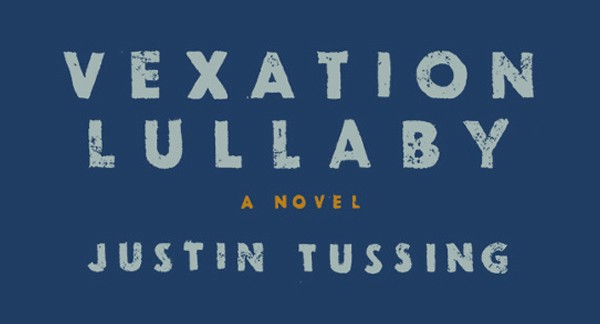
It’s precisely this role musicians play in defining and preserving who we are that receives the attention in Justin Tussing’s inviting second novel, Vexation Lullaby. Introducing us to the affable if slightly aimless Peter Silver, it follows the young doctor as he’s invited to join the American tour of a one Jimmy Cross, a kind of enigmatic David Bowie/Bob Dylan/Scott Walker figure who responds to his own legend by keeping a low, self-effacing profile. Persuaded by the knowledge that this Mr Cross shares some history with his own mother, Peter boards the proverbial tour bus, hoping to understand himself a little better by the time of the tour’s final extravaganza.
Cue road trips and rabble rousing, which Tussing lovingly captures with much attention-to-detail. Clearly, he’s a music aficionado himself, since his translation of the often chaotic world of rock into a vibrant idiom betrays a passion usually reserved for the most obsessive of anoraks. In one memorable paragraph, he runs through a whole lexicon of terms for musical paraphernalia: “The band rides in the Toolshed. An acoustic guitar is a Thick One. A keyboard is a Zebra. Cords are Snakes.” Likewise, the entourage surrounding Cross exhibit all the quirks you’d come to expect from roadies and musicians, with bodyguards suddenly breaking out of their dour seriousness to ask, “You don’t know how to play mah-jongg, do you?” and Cross’ son, Alistair, often liable to sit “naked, in a pool of urine; his sodden clothes scattered across the floor.”
Of course, Vexation Lullaby isn’t simply an orgy of guitar feedback and debauched inebriation. For starters, the novel introduces subtlety into its narrative arc via its alternating structure, which switches from chapter to chapter between Peter’s story and that of an Arthur Pennyman, a monomaniacal super-fan who since July 27, 1988 has “attended every one of Jim Cross’s public performances.” It’s because of Pennyman’s life-negating, divorce-provoking dedication that he’s known as “The Restless One,” and it’s primarily through his shadowing of Cross’ tour that the novel offers its insight into how people often rely on musicians more for their senses of identity and self than for any actual music. As Pennyman himself admits, “on balance I find the band to be a tolerable distraction. I’d much prefer Jimmy appear on stage alone.”
Not only that, but it’s through the recurring contrast between what is actually happening on the tour and what Pennyman believes is happening on it that Vexation Lullaby reveals how fans are sometimes inclined to read far too much into their pop stars, looking for meaning where perhaps there isn’t that much to find. For instance, much of the novel’s intrigue revolves around a fabled song called “Purple River Serenade” that was cut from one of Cross’ most celebrated albums, a “theoretical song” that, for the singer’s devotees, “represents some Platonic ideal of music.” Prior to the events of the book, the song had never been played in public or heard in private, and the fact that these devotees get more excited about it than any other song by Cross implies that the musician’s fascination resides not so much in what he actually performs, but in what he hypothetically symbolizes for them.
As for what it means in particular to Pennyman, the novel approaches something of a crescendo in parallel with him developing a theory as to its significance. Almost needless to say, this theory isn’t quite as accurate as he’d like to think it is, but it’s perhaps in the revelation of its misalignment with Cross’s actuality that he and also Silver finally learn not to stake too much of their respective identities in Cross. Pennyman begins to intuit this fruitlessness for the first time at the end of an especially good concert in Columbus, when he reflects on Cross’s ‘true’ identity: “Really, he’s a stranger. Really, we’re all strangers […] Who is Arthur Jacob Pennyman? A person could follow me for years and never find an answer.”
It’s in this realization of how following a musician so ardently has ultimately made him a stranger to himself that Pennyman begins to pull away a little from Cross. The same thing could be said for Silver, yet it’s never entirely clear from the get-go as to what attraction Cross really has for him or why exactly he’d set off on tour with the musician. This uncertainty partly arises because he’s just too passive and accepting for his own good, waiting docilely in dressing rooms for people who never return and occasionally becoming the object of such questions as, “How much of who he was had he cribbed from other people?” As such, it’s sometimes hard to gain a clear sense of his character and motivations, and in turn this makes it difficult to sympathize with him.
This, however, is in contrast to the offbeat Pennyman, who for all his unsavory fixations is a well-rounded and surprisingly believable character with a rich backstory and a more definite trajectory. In fact, given that it’s he who appears to undergo the most notable transformations over the course of Vexation Lullaby, it’s very tempting to declare that the novel is more his than Silver’s. He’s the one who functions as the mouthpiece for most of its themes, pronouncing such aphorisms as “change is the only constant,” “I consider following Cross to be an artistic performance,” and “everyday Pittsburgh looks more like a fantasy of the past.” With such pronouncements, he contributes most of the shape to a novel that reminds us that looking to celebrities and mass culture for the answers to the all-important questions of who we are will, in the end, only ever lead us astray. Still, we can always look to Justin Tussing.
TIME magazine’s yearly 100 Most Influential People list is here, and three great writers have been named to the list: Ta-Nehisi Coates, Elena Ferrante, and Marilynne Robinson. (Frankly, three seems pretty skimpy for the entire field of literature, but at least all three picks are well-deserved.)
When his best-selling second book was released last summer, it seemed everyone came to understand that he is the real deal. Between the World and Me is brilliantly structured, insightful and forcefully argued. He navigates the complexities and burdens of race in America compassed by a father’s love for his son.
The story we hear most often about the Italian author Elena Ferrante is the story of her absence: her pseudonym and the deliberate choice to disengage from the world as an author. It’s odd, though, to imagine that a photo or biography could tell us more about Ferrante than her astonishing books, translated fluidly into English by the great Ann Goldstein, which together form a topographical map of an extraordinary mind.
Marilynne Robinson’s novels and essays manage to be serious without being solemn. They exude a sense of sensuous feeling but also rigorous thinking. She is concerned with how we should live, with the idea of the world as a sort of gift to us, which requires us to notice what we have been offered, and to study it, to appreciate it and to dramatize its textures and contours.
See the full list here, and go out and buy the works of Coates, Ferrante, and Robinson if you want to be, well, influenced.
Hello, and welcome to my week-by-week review of the world. Today I am reviewing kangaroo rides.
Earlier this year I won a free trip to Australia. Unfortunately when I arrived at the airport with all my bags, I learned that the $350 processing fee I’d paid for my free trip was part of a scam and there was no free trip. But that didn’t mean I couldn’t take a trip of my own, and since I was already at the airport, I figured why not.
When I landed in Sydney I went straight to the zoo and asked about the Kangaroo rides. It turns out that was also part of the scam. The zoo said there is no such thing. What a disappointment. I thought I could just capture and ride a kangaroo myself but there are no wild kangaroos in downtown Sydney. I did find their version of the pigeon which is much prettier than America’s. Theirs is a white ibis. Ours just has stumps for feet.
I went to the suburbs to look for kangaroos to ride. In addition to buses, Sydney also has boats. In Boston the only boats are ones you have to peddle yourself and they only go in circles in a pond. In Sydney they go all over, so I took one to Balmain. I found a dead possum and lots of adorable little streets, but couldn’t find any kangaroos. Not even with the kangaroo caller I’d paid that scam artist $49.99 for. The only thing it seemed to call was giant spiders. They were everywhere.
All this searching made me so tired and I worried that once I found a kangaroo, I wouldn’t have the physical stamina to ride it. I decided to sign up for some Zumba classes to get some exercise. In Sydney, their Zumba classes are a pastry shop called Zumbo, and instead of exercising you eat lots of incredibly delicious pastries. It was the best exercise class I’ve ever taken. I exercised on the bench outside their shop for over an hour.
The clerk at the Zumbo class told me the best place to look for kangaroos was out in the wild, not in Sydney. She also told me there was no way I could ride a kangaroo. I wasn’t sure if that was a comment about my age or a dare. I took that as a challenge and booked a ticket as far away as I could to Darwin.
Darwin is about 80 degrees sweatier than Sydney, so I bought a pair of shorts, a tank top, didn’t bother with underwear, and took a bus out to the woods to begin my kangaroo search. I positioned myself behind a mound of dirt and waited patiently for a kangaroo to show up. The heat made me drowsy and after drifting off I woke up to find that the mound of dirt was a termite mound, and that the termites were now all over me.
I screamed and ran so fast through the woods that I was quickly lost. Being lost in the Australian wild is not very much fun. Even if I found a kangaroo and rode it, I would have still been too anxious about getting home to enjoy the ride.
Out of desperation, I began eating ants. It turns out Australian ants have delicious, citrus-flavored, lime green butts. I don’t know if ants poop out of their butts like most animals, but I didn’t care.
The authorities eventually picked me up after a friendly Aboriginal family found me, gave me water, and fed me a goose. On the ride back to the airport I saw a kangaroo off in the distance and I asked the police officer to pull over so I could ride it. She told me that was not a kangaroo in the distance but a wallaby close up. A wallaby is a miniature kangaroo. I remembered that from the wallaby burger I’d eaten in Sydney.
BEST FEATURE: Kangaroo rides leave a lot to the imagination. WORST FEATURE: Kangaroo rides are impossible.
Please join me next week when I’ll be reviewing spider bites.
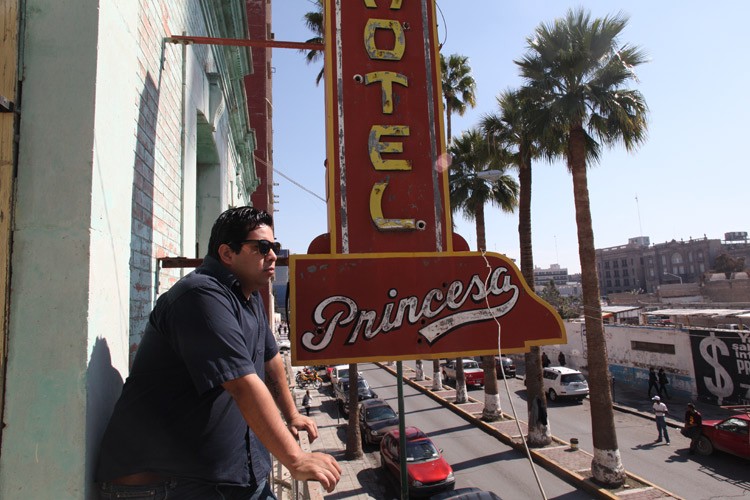
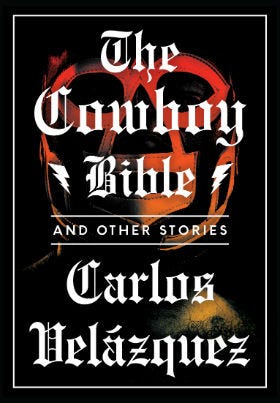
Reading Carlos Velázquez’s collection The Cowboy Bible and Other Stories (Restless Books, 2016) is a constantly shifting experience, moving through everything from absurdist realism to scenes that border on the mythic. His characters encounter everything from contemporary media culture to personifications of evil to intensely strong drinks. Throughout it all is the title phrase, which refers to everything from characters to objects in the stories contained within the book. Via email, I asked Velázquez about the origins of the book, the storytelling choices made within, and the region in which the book is set. His answers touched on perceptions of norteño culture, along with the works that influenced The Cowboy Bible, which includes everything from John Coltrane to Todd Solondz to Richard Brautigan.
Tobias Carroll: Where, for you, did The Cowboy Bible begin? Was it with the location, with the concept of running one name through a number of permutations, or something else entirely?
Carlos Velázquez: I’m atheist, but my favorite writer was Catholic: Kerouac. That’s what keeps me attuned to religious issues. The Cowboy Bible was born one afternoon when I saw a bible lined with bits of old blue jeans in a shop window, a practice that’s common. To protect their bibles, people have stopped covering them with paper and started using old jeans instead. This simple act encompasses the entirety of norteño culture. In the north, there’s a compulsive need to make everything norteño. From reality to the abstract, we reappropriate everything until it becomes our own. Covering a bible with jeans is the reappropriation of symbols that characterize the north. It’s not a completely innocent act, nor is it chance, it’s a subconscious impulse. If we could, we would put cowboy boots on the crucifix. It’s this exact idea that I had in mind when I wrote the story “The Post-Norteño Condition.” It’s a joke, but at the same time it’s an homage, to Lyotard’s postmodern condition. The way I see the world, if Lyotard had been born in the north, he would have suffered the anguish of being post-norteño.
…I needed a Los Angeles of the mind.
The fact that the bible is reincarnated in story after story follows one of the models I used while writing the book. In Trout Fishing in America, the book by Brautigan, all of the stories share the same protagonist. I chose two elements to appear throughout the book, the mix of classic mythology with popular mythology. For example, Los Cadetes de Linares with the Ipod. In this case I mixed Brautigan with David Lynch. Between Lost Highway and Mullholland Drive there are various reincarnations. I should clarify that for me classic mythology doesn’t mean the Greeks or even the Spanish Golden Age. It’s Leonard Cohen and Piporro. David Lynch sets his stories in Los Angeles because it’s a city where everything that’s unimaginable could happen. But I needed a Los Angeles of the mind. A territory that could fit Brautigan, Lynch, Burroughs, and that’s not something my geography could give me, or at least not directly. PopSTock!, where all of the stories take place, is similar to my town. But it’s just a representation, a product, that is, of the area where I live, which is one of the most interesting social laboratories in contemporary Mexico.
TC: On the second page of the collection, a footnote reveals that The Cowboy Bible is also known as The Country Bible; elsewhere, there’s a reference to The Country Bible also being known as The Western Bible. As you were writing this, how did one come to take precedence over the others?
Norteño culture is a product of identity that doesn’t belong to Mexico or the United States.
CV: It’s an exercise in Luddism. Although Mexico is part of the west, it’s always seen itself as part of Latin America, not to say that Latin America isn’t part of the west. Mexicans don’t think of themselves as westerners, but instead as Latinos, Hispanics, and Mexicans. In the north, where I live, the people don’t consider themselves Mexican. They are just norteño. Norteño culture is a product of identity that doesn’t belong to Mexico or the United States. It’s caught between the two, and it forms a symbolic third nation whose language is its nationality. There’s a misunderstanding in the center of the country with regards to the way we use language in the north. They think that to include anglicisms in literature is Spanglish, but Spanglish is a mix of languages that belongs to the children of Mexicans born in the United States. And that’s how the project of Chicano culture failed. That is to say that those kids aren’t completely gringo, but they are more so than they want to be Mexican. Therefore the literature that’s written in the north, and is sprinkled with English words, isn’t a hybrid between two languages. It’s the result of that limbo in which norteño culture is suspended and which is still being built. It’s because of the dynamic of language in this region. It’s alive and constantly changing in contrast to the Spanish that’s spoken in the capital, which is dead and hasn’t changed in decades. They speak the same Spanish there now as they spoke in the ’50s. The permutation of the bible is western, cowboy, cowgirl. It’s a way of responding to the notion that overwhelms us and pushes us to be western. It’s the feeling that we are in our own identity project and that we don’t yet know how to define ourselves, but as soon as we do, we’re sure we’ll belong to the west, and not to Mexico, the United States, or Latin America.
TC: One of the highlights of reading the collection is in seeing what form The Cowboy Bible would take from story to story. When you were writing these stories, did you figure out the placement of The Cowboy Bible intuitively, or did you write the stories without it and see where it would fit in the best?
CV: Although the book grew out of the premise that the bible would serve as the protagonist of all of the stories, each incarnation of it was not deliberate. The first story of the collection was the one that gave the book its name and the bible is a talisman. When I finished that story, each plot grew out of the next and everything came out intuitively. There was a lot of improvisation. While I was writing the book I sustained an impassioned romance with Coltrane. Thinking about it now, with some distance, it’s possible that was the inspiration for all of the reincarnations of the bible. I really like what I’ve written under the influence of Coltrane, but in particular the things that I’ve written impulsively. I see the bible as a record. For example, “Meditations” contains “The Father and the Son and the Holy Ghost,” “Compassion,” “Love,” “Consequences,” and “Serenity.” For me, the bible in each one of its transformations is like a track on a record. The same criteria is used to connect songs as with the bible. My obsession with Coltrane diminished after a few years, but I can tell that my best pages were written under the influence of his music. In fact, now that I am finishing a novel that is linked to The Cowboy Bible, I’ve had to go back and study it again in order to figure out the keys to my own writing.
TC: What inspired the creation of PopSTock! as a setting for these stories, rather than using an existing location?
CV: PopSTock! originated from the section by the same name of the Spanish rock magazine Rock de Luxe. There wasn’t a single place that could represent the territory that I was imagining in my head with all of its norteño characteristics, and there also wasn’t a name that defined it better than the stock of pop. Because above all, The Cowboy Bible is a pop artifact. For the writers of my generation, literary influences are longer the only thing that we base our books on. There are other platforms, like TV series, comics, etc. In my case, music is one of the principle tools for creating my work. Understanding that pop culture, references, premises, and music all form a narrative layer that’s found on the surface and whose individual parts don’t mean anything at all is essential. Below the hypertext there’s a story. All of this is due to Joyce. Including PopSTock! itself. It’s my personal Dublin. I once read that all of the references mentioned in Ulysses would form a book as thick as Ulysses itself. I didn’t write a voluminous book but I set out to create a book formed on references that would tell a story. Without intending to, during my youth, I read authors who used reincarnation in their work. Characters are not the only part of literature capable of reincarnation. Territories and places where stories develop can also be reincarnated. San Pedro Amaro, San Perdosburgo, San Perdoslavia — they’re nothing more than what I saw in the work of Kerouac. In each book they take on a distinct alter ego — Sal Paradise, Jack Duluoz, Leo Percepied.
TC: Kevin Ayers appears in a footnote, a Manic Street Preachers quote serves as the epigraph to one story. How would you describe music’s relationship to your writing?
I was born in an unknown town in the north of Mexico that was a hotbed for postmodernism.
CV: I was born in an unknown town in the north of Mexico that was a hotbed for postmodernism. I dedicated myself to literature accidentally. In reality I wanted to be a rock critic, but in a town like mine it was a ridiculous idea. There weren’t many books to read, few things arrived from the capitol. While my contemporaries read the Latin American Boom authors, I devoured rock magazines, which all curiously made their way to my town: Rolling Stone, Kerrang!, Uncut, La Mosca, Conecte, etc. That’s what I grew up on. The book that got me into literature was Tropic of Cancer by Henry Miller. I read it in high school when I was 15. Because of my interest in rock magazines, I’m unable to separate music from my narratives. It’s possible that I never would have become a writer if I hadn’t met my friend José Ramírez when I was 17. He was my brother and my teacher. He’s ten years older than I am and had already traveled around the country by the time I met him. When I discovered his well-stocked library, I moved into his attic and didn’t leave until I had read all of Bukowski and Paul Auster. That’s also where I discovered Pasto verde by Parménides García Saldaña, a work that was very important during my formative years. José was also a huge music-lover. During drunken evenings at his house I listened to many musicians for the first time including John Adams, Terry Riley, Luigi Nono, Mario Lavista, and Steve Reich.
TC: Your book is divided into three sections, “Fiction,” “Non-Fiction,” and “Neither Fiction Nor Non-Fiction.” What prompted this as a structure for the collection?
CV: I’m a fan of the films of Todd Solondz. Storytelling is traditionally divided into two parts: fiction and nonfiction. That was my model for breaking up The Cowboy Bible. In his films, Solondz plays a game. I repeated it, obviously with the same irony. Which stories could actually happen and which couldn’t, but I went beyond that. I created a category for stories that I believe don’t belong to fiction or nonfiction. So where do they belong? To a new way of telling a story. And just like with the references, they have value beyond their categorization. Stories that aren’t fiction or nonfiction border the supernatural, which is an important part of my culture. I don’t believe in witches, but in my region there are those who believe in them. What interests me is how stories can grow out of superstition. Above all it’s a lesson. It shows us how to tell a story. It’s a model. When I wrote the final stories in the Bible I was worried that I would be labeled a horror story writer. Or a science fiction writer, even though it’s clear that my stories don’t fit into that genre. So creating the section that was neither was what worked best for the book. It’s the only category that could fit some of my stories. Nobody would imagine that writing about a corrido singer who wants to sell his soul to the devil, or a singer who wants to become viper would be considered paying homage to Solondz, but it is.
TC: Early on in “Cooler Burritos,” you describe a bar that’s known for its “special brew.” Was there a real-life inspiration for that drink?
CV: There’s a very powerful drink in the north: sotol. It’s distilled from agave and from the same family as tequila. Historically, the Rarámuri people drank it, but it’s commercialized now. There’s a verse in “A Season in Hell” that says “to drink liquor like burning metal.” Ever since I read that line I’ve been obsessed with sotol. To cut its consistency of “burning metal,” many bars in my town serve it curándolo. They cut the intensity of it by mixing it with spices, fruit, and even cured meat. When I was writing The Cowboy Bible, I frequented a cantina called The Other Paradise. They sold sotol like this, known as grass, or crazy water. It was my inspiration for “Cooler Burritos.” For the people in my town, a good night of drinking can only end with cooler burritos. That’s why both of those things are part of the story. It’s also an homage to two symbols that contribute to our norteño identity, like carne asada or cabrito.
TC: Do you have a particular favorite of these stories?
CV: No. They are all equally important to me. Though I do have a favorite from my second story collection: “El club de las vestidas embarazadas.”
TC: The Cowboy Bible was first released in Mexico several years ago. What was the reaction to it like there as opposed to the reaction to it from readers in the United States?
CV: That’s a hard question for me. I don’t really know what the reaction was like in the U.S. In Mexico the book received great critical attention. What could have added to that is the fact that norteños came to North American writers through the work of Roberto Bolaño. But Bolaño wrote based on speculation, The Cowboy Bible and the work of Élmer Mendoza (which is already translated into English) is the real literature of the north. It’s written from the north, not just about it. It comes from the same culture. It’s not a simple phenomenology based on the femicides of Juárez. It’s built on the language of the north.
— Translation between Spanish and English by Nina Arazoza
Certain songs seem to be addressing the future while also casting an eye back into some deep, strange history; other songs — for me — seem to be about not only the soundscape but also the landscape around the song as it relates to time and history.
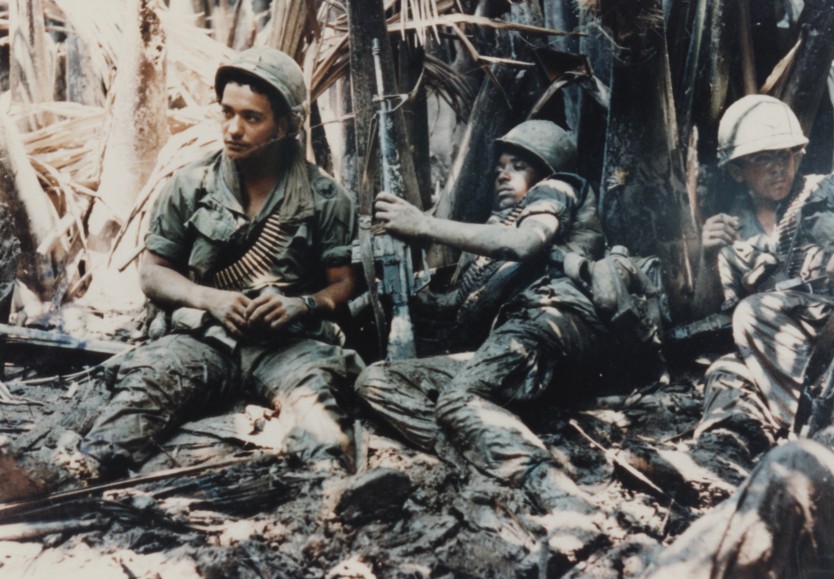
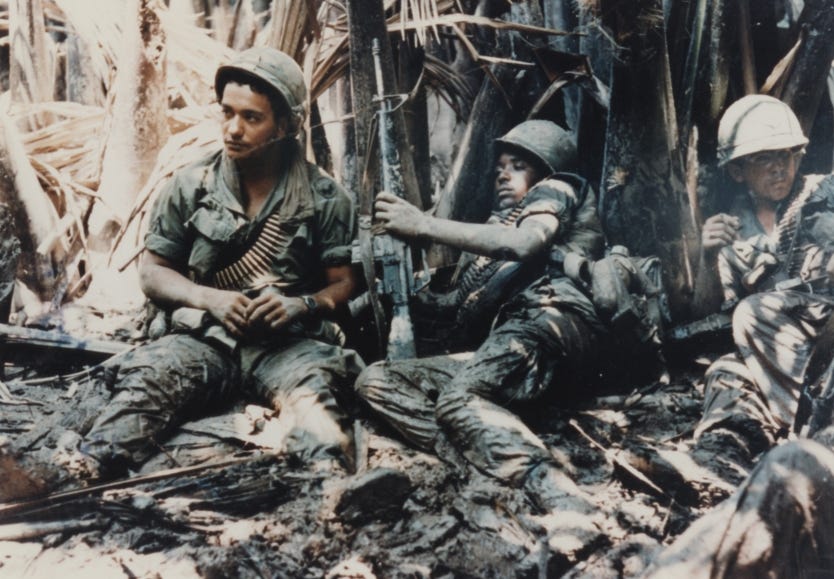
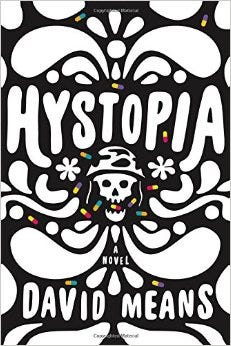
Hystopia, set in my home state, Michigan, is partly a Vietnam War novel, but it’s also about the nature of memory, of trying to reclaim memory. When I was researching the novel, I became interested not only in music from the era, which I grew up on and loved anyway, but on something else — a cultural feedback loop that formed during the Vietnam War. The troops in the field listened to music, The Doors, The Rolling Stones, James Brown, and heard, somehow, a response to the war they were fighting. Then when they got home, if they were lucky enough to go home quickly, when tours of duty were finished, without transition — via airline flights — some of them fed language and intensity back into the loop. There’s an interesting book, just published, called We Gotta Get out of This Place: The Soundtrack of the Vietnam Era, in which vets write about their musical experiences in Nam. One essay in the book was written by a friend of mine, Gerald McCarthy, whom I interviewed when I was researching. He’s also a character in the book. The playlist below is relatively arbitrary, songs that that seem–sometimes retroactively–to provide foreground, or perhaps background to the work, along with songs that somehow magically touch some aspect of the thing I created.
Iggy Pop is a pure Michigan product — gritty, smart, but not afraid of looking stupid or foolish. His father was once a high school English teacher. I love Iggy as a physical entity, sinewy, twisty — even in old age — an embodiment of rock and roll history. This song has all kinds of military lingo — references to napalm and a-bombs — and it seems to be, to me at least, taking command of the violence of combat and transmuting it into the hope that only music can bring. The churning chug along with the guitar riffs twisting around slightly off-beat somehow — for a fraction of a second here, a fraction there–disjoints time and opens up to the glory of forever.
2. “Subterranean Homesick Blues,” Bob Dylan
Dylan’s voice comes out of the hinterlands. Raised in Hibbings but born in Duluth, a city that plays a role in Hystopia. In Michigan, back in the day, there were neat little roadside rest stops with water pumps — painted deep green. (“The pump don’t work/cause the vandals took the handles”) I heard Dylan’s voice — long before I heard Dylan — in the folks around me in Michigan, working people who spoke somehow in the same way, up through the nose with weird diction.
3. “Eyes to the Wind,” The War on Drugs
There’s this isolation inside the mix, a sense of space and forward movement — rolling along in a car, the fields and snow and trees swinging past. “There’s a cold wind blowing down my old road/down the backstreets where the pines grow.” I think Adam Granduciel recorded this in a lonely old house, mostly alone, and you can feel his isolation. When I listened to this song, over and over, I saw some of the landscape I was exploring — those Michigan Upper Peninsula forests — and felt that longing to return, to find the point of origination, the place where it all settles back down.
4. “The Idea of North,” Glenn Gould
What you’re doing as a fiction writer is working the other way around; you’re trying to find music in language, to develop some kind of sound via words.
Gould recorded voices in a café in Canada and created a counter-punctual piece, weaving voices in and out to form a space between them. There is this idea of north, and if you’re from Michigan and you wandered the Upper Peninsula you know what it feels like. The sky has a particular vibe, a coldness, stretching into the upper reaches of Canada. Gould is a hero to many writers because of his persistence and his desire to work on his own terms, but there’s a deeper relationship, somehow, in his ability to speak about music, to put into words some of the mystery. What you’re doing as a fiction writer is working the other way around; you’re trying to find music in language, to develop some kind of sound via words.
5. — 10. “Bach, French Suite No. 2 in C Minor, BWV 813,” Glenn Gould
OK, picking two Gould pieces might seem like overkill, but listen to his Bach–the precision of his pointed notes, a technique he got from an early piano teacher; the persnickety, precise, but wildly emotional playing, while he rocked and moaned on his personal piano bench. To me the sense of time is inside the music between the two themes, weaving around in the space between stories. In fiction you’re looking for that space — the narrative that lies between the lines, the words, the unspoken quiet. History is like that too; it’s the place where the forward progress into the future meets things gone, vaporized, clutching to memory in the present moment.
11. “Gimme Shelter,” The Rolling Stones
In America, there’s always around us this sense of danger and potential violence, luring in the dark woods, in the shadows.
Violence is a just a shot away and a just kiss away. A kiss is often about the future and the past. A lost dream, about the discretion of the idealism. The Vietnam War tore the future out from under not only those in combat but those at home, and it tore something out from under America for years and years When Mary Clayton sings her riff — she came late at night into the studio — “rape, murder, it’s just a step away,” the song deepens and becomes something altogether otherworldly, a lament of fear and criminal potential all around. That soul voice turns towards America. In America, there’s always around us this sense of danger and potential violence, luring in the dark woods, in the shadows. Shelter is what we seek, and it’s eternal and universal, yet somehow this is a deeply American song to me. My characters — no, make that most characters — are seeking the shelter of narrative resolution, a place of quiet and grace.
12. “The River,” Bruce Springsteen
Of course superstars become — eventually — a cliché of a cliché of an original idea, which is sad but inevitable. But there is always a sense, around a great performance, of the future, of someone looking back and listening — on some future technology. And Springsteen might be to future generations like Woody Guthrie is to us now, someone who captured a particular vibe of a particular period in time using particular stories. (As someone who grew up near a paper mill, with a few union families around, this song strikes a personal chord.) “And for my nineteenth birthday I got a union card and a wedding coat.” It’s easy to judge the poor soul in this song, but he’s caught up in his particular class history, all of the unseen forces around him at the moment, the way we all are, often unknowingly. It’s paradoxically an incredibly tender and yet brutal song…because the water in that river, flowing eternally, a poor, awkward symbol, is extremely cold.
13. “Don’t Stop,” Fleetwood Mac
I never liked Fleetwood Mac much, but this song became an earworm for me in the last days of editing Hystopia, partly because what it’s saying seems so seductively delusional — don’t stop thinking about tomorrow…yesterday’s gone. Yesterday’s gone.” Wishful thinking was the power of post-Vietnam pop. Just put aside the vicious war, the upheaval and blood on the streets, and move, fucking on! Pop culture and politics tapped quickly into that desire to forget and march forward. Hip-hop and punk struggled to bring us back around to the realities at hand, but when I listened to this in my headphones I heard the warm tubes in the studio and the analog wires in the mixing console keeping the sound as far away from the brutal truth of history as possible.
14. “Slow Show,” The National
History and time and the relation of both to love, to someone you fall in love with but feel you’ve known forever. This is the nature of history as it relates to the self; you can feel perfectly, clearly, that you’ve known someone your entire life when you just met them. I get a sense of the desolation of the Midwest in Matt Berninger’s Ohio-born voice in the early part (set in New York), but everything in this beautiful song — all of it — moves towards the sudden break, the shift in tone leading to the heartbreaking line: “You know I dreamed about you for 29 years before I saw you.” That moment — not just the words, but the lamenting sound — is where time twists and maybe even stops, because love is such a forward moving force; the elation and glory is that the past is going to be reclaimed in the future. That’s the nature of grace. This song is a diptych: two parts forming a whole.
15. — 17. “Howl, USA,” The Kronos Quartet
The Vietnam War was the ultimate Moloch, a technological war machine eating America.
This is a little bit of a cop out because it’s Ginsberg reading his poem set to music, but it makes sense to me because the strings working around voice are the present moment and the voice is history. “Howl” works in stages — and it’s a lament to a particular soul, Carl Solomon, in a mental institution, someone mad. The paradox of the holy (“The asshole is Holy) and rejoicing — Holy, Holy — combined with loss, with the madness of a generation consumed by Moloch. The Vietnam War was the ultimate Moloch, a technological war machine eating America. The Beats informed the Hippies, of course, and to me it’s yet another example of how history flows forwards and back in a way that makes it impossible to see it as something Newtonian; cause and effect. Instead it’s quantum, one thing being in two places at once — Borgesian, Nabokovian. The poet can capture in images the flux and wane of time — or at least seem to capture it. The reader can hold both at once — Whitman’s deep claiming of contradiction (do I contradict myself, fuck it, I’m American). Ginsberg understood that trauma — personal trauma, a mentally ill mother — and history are entwined.
18. — 19. “Maidenhead” and “Ain’t so Simple,” Protomartyr
The banality and glory of wasting time cutting in a loud, noisy way through a static sense of non-forward time movement. Not boredom (boredom has too much awareness of time) but simply a suspension in the tedium of waiting for something, anything. “Shade goes up, shade goes down.” I had to stick this Michigan band in there because they reclaim a certain Detroit aesthetic — casting an ear back to noisy machine tooling shops and factory floors, while also forward to some high tech future. And one of the band members, Alex Leonard, is the grandson of Elmore Leonard, who was the Iggy Pop of crime fiction. Leonard knew that talk was a way around anxiety and tedium and, for his characters, the wicked judge of morality itself: speak long enough and you can get away with just about anything — until you’re caught.
20. “Hold On, Hold On,” Neko Case
“The most tender place in my heart is for strangers./I know it’s unkind but my own blood is dangerous.” For complex reasons that line gets to the heart of some something for me — a sense that at a certain point, in certain situations, begging to be left alone, to get away, to find a tender heart for strangers is a survival against blood history, the painful relationships left behind. Trauma does that; it causes a flight mechanism to kick in, and one way to flee is to try to simply forget, which of course is impossible for most of us.
A recent study confirms that your Facebook friend who’s always pointing out grammatical errors is probably a jerk. Julie E. Boland and Robin Queen, researchers from the University of Michigan, found that personality traits, including levels of agreeability, influence how sensitive a person is to written errors.
After giving 83 participants personality tests, the researchers asked them to read simulated email responses — the responses were attributed to senders with unisex names in order to avoid gender stereotyping — to an ad for a housemate. Boland and Queen used three versions of each email: one that contained grammatical errors (“grammos”) only, one that contained typos only, and one that didn’t contain any errors. Grammos included mistakes like mixing up “their” and “there,” or “your” and “you’re.”
The participants, who were asked to evaluate the email writers on “social and academic criteria” like friendliness and intelligence, had a more negative view of people whose emails contained errors. Overall, those who tested as “more agreeable” on the personality inventory tended to give more positive ratings than less agreeable participants, regardless of whether or not an email contained mistakes. The age, gender, and education of the participants did not appear to impact the responses.
While agreeability did not affect the way participants responded to typos, less agreeable people showed “more sensitivity to grammos” than agreeable ones. Conscientious people, on the other hand, tended to be more bothered by typos. As for introversion and extroversion, extroverts were “likely to overlook written errors that would cause introverted people to judge the person who makes such errors more negatively.”
It’s somewhat surprising that typos and grammatical errors hold this much power given the speed and frequency of written communication that characterizes the digital age. Despite our “sent from my iPhone” disclaimers, it appears we should still be diligent about avoiding written mistakes. Especially if were writing to a conscientious introvert whose not very agreeable. Their the wrst.
Jane Mixer was twenty-three years old when she was found dead one morning in a small rural cemetery at the end of a gravel road. Mixer was murdered in 1969. She was a graduate student at the University of Michigan, and she was trying to hitch a ride home from school to tell her parents that she had just gotten engaged.
For decades, Mixer’s murder had been thought to be the work of an infamous Michigan serial killer, but there were discrepancies between her homicide and those of the other six victims. For one, Mixer’s body hadn’t been mutilated like the others; her arms had been arranged across her chest and her belongings set beside her body, but she had still been shot and strangled — she still had her underclothes pulled down “in a final stroke of debasement.”
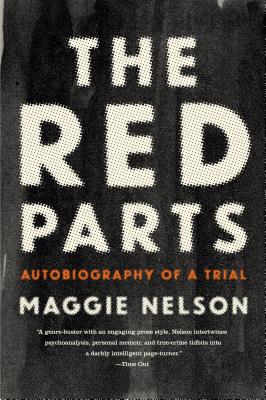
Jane Mixer was the aunt of Maggie Nelson, poet, critic, nonfiction writer, and author of the 2015 award winning, genre-defying, The Argonauts. Back in 2007, a then lesser-known Nelson published The Red Parts: Autobiography of a Trial, a lyric meditation on the psychic consequences of considering her aunt’s life and death. Last year, it was difficult to get even a used copy of that book. Graywolf Press has done a great service to readers by re-publishing The Red Parts in 2016.
“In all desire to know there is already a drop of cruelty,” is the Nietzsche epigraph that opens this visceral meditation that’s part true crime, part memoir. In a cultural moment in which true crime narrative — Serial, Making a Murderer, The Jynx, etc. — has reached an especially hypnotizing level, Nelson’s book powerfully reminds us of the wrecked lives that violence leaves in its wake.
The Red Parts interrogates our cultural fascination with true-crime drama without easily condemning it. Nelson’s prose is cuttingly self-aware. As she works to make sense of her own morbid fixation on Jane’s murder, she finds that the more that anyone tries to tell a coherent story about meaningless loss, the more they misrepresent it. Nelson takes issue with Joan Didion’s idea that, “We tell ourselves stories in order to live.” Nelson writes, “Stories may enable us to live, but they also trap us, bring us spectacular pain. In their scramble to make sense of nonsensical things, they distort, codify, blame, aggrandize, restrict, omit, betray, mythologize, you name it.” Nelson’s story flirts with these perceived sins, yet it does it in a way that’s packed with self-conscious insight and grief.
The Red Parts interrogates our cultural fascination with true-crime drama without easily condemning it.
Jane Mixer’s case was reopened in 2004, after a “motherload” of DNA evidence was discovered on the pantyhose Jane was wearing the night of her murder. Those pantyhose linked her murder to Gary Leiterman, a retired nurse who lived with his wife and two adopted Philippine children in a lakeside home in Michigan. More enigmatically, there was another DNA hit — to a John David Ruelas, four years old on the night of Mixer’s death — no relationship to Leiterman. The details of the trial are twisted and stranger than fiction, and they appropriately thwart clear explanations for what happened that night.
Whenever Nelson stops to ponder a defense of her family’s collective behavior, she just as quickly complicates it. Most palpably, Nelson continually remembers that Jane doesn’t care whether any of them attend her re-trial; she’s dead. None of them need to consider gruesome autopsy photos — or Leiterman and his family — or stop their lives to attend a months-long trial in Ann Arbor, Michigan. Nelson knows that, at best, she and her mother are there to “bear witness,” but she forsakes the naïve idea that they are helping toward “justice.” Nelson writes:
I find the grammar of justice maddening. It’s always “rendered,” “served,” or “done.” It always swoops down from on high — from God, from the state — like a bolt of lightning, a flaming sword come to separate the righteous from the wicked in Earth’s final hour. It is not, apparently, something we can give to one other, something we can make happen, something we can create together down here in the muck. The problem may also lie in the word itself, as for millennia “justice” has meant both “retribution” and “equality,” as if a gaping chasm did not separate the two.
Late in the book, Mixer and Leiterman’s families wait for the verdict and the jury returns to the courtroom after a four-hour deliberation. The foreman of the jury rises and says the find the defendant, Gary Leiterman, guilty of murder, first-degree. The judge thanks the jury, and the jury neatly files out of the room. “As soon as the door shuts behind them, my family erupts in a greater outburst of emotion than I ever imagined possible,” Nelson writes. “‘Justice’ may have been done, but at this moment the courtroom is simply a room full of broken people, each racked with his or her particular grief, and the air heavy with them all.”
Nelson wonders why she writes about Jane, why she relents to some of the narrative impulse that makes her weary. She wants Jane’s life to matter, but not more than any other. She wants her own life to matter, but not more than others. She writes, “I want to remember, or to learn, how to live as if it matters, as if they all matter, even if they don’t.” In the aftermath of the trial, Nelson set up shop in a city that was alien to her, and started writing.
There’s something wrong here, there can be no denying.
— Carole King
It’s 1999 and I’m living in California; I’ve just started a new, serious relationship and I’m about to finish my PhD in English. There is a lot going on — on the one hand, I’ve discovered that my relationship with my mother is not just personally tragic, but systematically dysfunctional. I’ve also got two new friends, a couple, we’ll call them Martha and Franklin (not their names), and I sit in open admiration of their relationship, which seems to me to be wonderful.
They live about an hour from where I do, in a very cute little house in Pomona. They have planted the small little patch out back with vegetables. Martha is an artist, and spends most of her days making large, painted canvases. Franklin is a writer; they both have square jobs to pay the rent. They hold elaborate parties where vegetarian food is served and where people are asked to put their handprint on the wall in paint or make improvisational music on any of the instruments they have just lying around. They are both incredibly good-looking people, stylish and sophisticated.
For several months, I spent almost all of my free time with them.
But then something happened. One day, while we are all at some Southern California street fair, we meet a young man (whose name I forget). He seems cool; he quickly becomes part of our social group. In the flash of an eye, he and Martha have an affair and the experience nearly rips Martha and Franklin apart. I watch from afar while my two friends, who I saw as so perfect for each other, begin to unravel. Somehow, they manage to stay together but Martha is never the same after that — the mischievous spark in her eye is gone; her skin goes gray and she seems perpetually guilty and tragic, as if she has discovered a horrible secret about herself that was hiding there all along. Franklin stops writing and becomes loopy; on one visit to my house, he arrives at the door and informs me he’s soiled himself in the car because he was unable to hold his bladder and didn’t know where to go to use the bathroom. When I tell him he could have gone to any McDonald’s, he just shrugs.
I was fascinated by Martha and Franklin during this time — in part because they seemed to be doing what I saw so little of in others: holding it together in art, in love, and in life.
Eventually, they have a child — and despite the child’s beauty and light, they remain locked in separate territories of pain, anger, abandonment, and blame. The lively, artistic, and humorous people I once knew have literally fallen apart, no longer whole, just fragments of their former selves. Martha moves to the East Coast and volunteers at an organic farm, making line drawings, which she sells sporadically on the internet. Franklin raises their daughter, in California, with the aid of his family and never falls in love again. (At least not as of this writing.)
I was fascinated by Martha and Franklin during this time — in part because they seemed to be doing what I saw so little of in others: holding it together in art, in love, and in life. Later I was horrifically fascinated by their decline; I couldn’t understand how this could happen — what where the invisible stress fractures in the foundation of their relationship that could make it go so horribly, so irrevocably wrong? Their downfall was not just the end of a relationship, it was the end of who they were, as people. At the same time that this drama was unfolding between Martha and Franklin, I was reading Another Country by James Baldwin. This book captivated me in the same way that the decline of Martha and Franklin had; it forced me to ask a fundamental question — why do things fall apart? Why do people end up in such life-threatening places, all over that thing we call “love?”
I wrote about Another Country and this led to my first major academic publication and eventually became the first chapter of my first book — but my interest in Baldwin’s work wasn’t really so much about the politics of it — its blackness, its queerness — it was more about the complicated process of the human condition, about the way people undo themselves. This is what happens to Rufus, who was undoubtedly interesting to me because he commits suicide but also because he is an optimistic boundary crosser like myself. He’s bisexual and bi-cultural, a kind of “cultural mulatto,” who traverses Greenwich Village and Harlem with equal ease. He is equally at home with his best friend Vivaldo and his sister Ida. He walks between the black and white world with little friction, that is until he falls in love with Leona.
…my interest in Baldwin’s work wasn’t really so much about the politics of it — its blackness, its queerness — it was more about the complicated process of the human condition, about the way people undo themselves.
And is it really love? For Rufus Leona is a white, naive Southerner and her appeal is mostly that she seems willing to be brutalized — to be fucked, mercilessly and hard — and to stick around this nonchalant guy the day after because in her loneliness, his rough touch is a better reminder that she is no longer alone than a soft one would be. For Rufus, this white woman who clings to him becomes evidence of his worth and validity in a society that reduces him to his cock and his ability to blow a horn. It’s not really a good start to a relationship — but what does a good start look like? And during all those parties, and dinners, and drinks after work — did anyone ask Rufus or Leona, “So what were you thinking when you got together? What was your psychological landscape?”
Well if they had, Rufus probably would have belted them. But people probably just looked at them, their friends anyway, as a young couple in love. Strangers looked at them with judgment because Leona was white and Rufus black; this very fact drove Rufus crazy. The idea that society didn’t see their relationship as legitimate tore Rufus up inside — but the truly crazy thing is that despite the presumption of onlookers and the insinuated judgment of friends, Rufus’ relationship with Leona wasn’t on the level, wasn’t on the up and up, wasn’t an act of pure love, passion, and mutual need. From the beginning the relationship is about her whiteness and his blackness and it is the inability to transcend those labels that tear Rufus, and ultimately, Leona apart.
The impetus for so much of what puts many of us on an inevitable path to falling apart is captured by Baldwin not so much when he ruminates about soul-killing racism, but when he writes about loneliness.
I couldn’t help but note at the time how like Rufus and Leona my friends Martha and Franklin were, without the racial and sexual dynamics. Despite their normativities, their racial “same-ness,” and their heterosexual appropriateness, they fell apart as much as Rufus and Leona did, with one of them metaphorically committing suicide if not literally, and the other living as a hollow shell of his former self. The life they once had disappeared and withered as surely as old salad in the fridge, the evidence of their gay and creative season now little more than a ghost that haunts me and, for all I know, haunts them too.
I wanted to explore Another Country because it captured something about people, and about relationships, that is so unspeakable and so hard to understand until you’ve seen it in action. And the impetus for so much of what puts many of us on an inevitable path to falling apart is captured by Baldwin not so much when he ruminates about soul-killing racism, but when he writes about loneliness:
He had often thought of his loneliness, for example, as a condition which testified to his superiority. But people who were not superior were, nevertheless, extremely lonely — and unable to break out of their solitude precisely because they had no equipment with which to enter it. His own loneliness, magnified so many million times, made the night air colder. He remembered to what excesses, into what traps and nightmares, his loneliness had driven him; and he wondered where such a violent emptiness might drive an entire city. (Baldwin 60)
This loneliness is so acute that it contours and shapes everything that follows in its wake; it is the motivating factor in most relationships and yet it also plays a role in the downfall of those same relationships — the cheating partner, the cruel partner, is a harbinger of a loneliness that has never been banished but only gone into remission. Fleeing loneliness Rufus and Leona cling to one another; furious at abiding loneliness, they tear each other apart.
Rufus asks Vivaldo, “What do two people want from each other…when they get together? Do you know?”
It is an existential question, not a pragmatic one — and any examination of it inexorably leads one to the conclusion that typically what one wants from the other cannot be provided. To stay that loneliness is an impossible task for one small person or even for two (one’s self and one’s lover) is perhaps an understatement, and yet we try, we try, and we try again to make what we call love the answer.
But there are rings and degrees of awareness of this loneliness — as Baldwin narrates above — some people are unable to break out of their loneliness because they cannot enter it; or, to put it another way, some people are scarcely aware that the loneliness they feel cannot be cured by another person, hence the isolation, alienation, and tragedy which can so often attend the romantic involvement, long or short term, is not the sign of a failing relationship, but the sign of a failing idea about relationships in general.
Like a detective I was looking for the model of the ideal relationship because I needed to believe that one’s loneliness could be solved by the experience of a safe and enduring love.
Like a child who wants her parents to stay together, I wanted Martha and Franklin to work it out; I wanted to imagine a scenario where Rufus would live and he and Leona would learn how to be together without ripping each other to shreds. Like a detective I was looking for the model of the ideal relationship because I needed to believe that one’s loneliness could be solved by the experience of a safe and enduring love.
II. I Kind of Always Knew I’d End Up Your Ex-girlfriend
You say you’re gonna burn before you mellow, I will be the one to burn you. Why’d you have to go and pick me? When you knew that we were different, completely?
— No Doubt Though I wouldn’t have admitted it at the time, I was most like Cass from Baldwin’s novel — a woman who had stayed way past closing time in a relationship. Cass is a smart, but timid character who has settled into predictable respectability with a taciturn bore, who despite all his assholery remains somewhat sympathetic — at least to Cass — because she alone can see his vulnerabilities. The 11th hour, for my long term relationship which eventually became a marriage, had come and gone but I’d closed my eyes to it, precisely because the burden of loneliness and the sense of failure a break-up engendered seemed a worse fate than living my life with someone with whom I was not compatible and who, with few resources to do otherwise, would turn on me in times of stress. Being in a new relationship myself at the time that my friends were unraveling, I clung to my partner tightly, hoping that we could accumulate years of time together as a testament to security and the possibility of anti-loneliness. I remember telling Franklin, on one of our long walks where we talked about relationships, that I thought relationships needed to be like Tupperware — able to be banged around a lot but still bounce back. He thought this was funny, but it didn’t keep him from losing his mind.
I remember telling Franklin, on one of our long walks where we talked about relationships, that I thought relationships needed to be like Tupperware — able to be banged around a lot but still bounce back.
Unlike Cass, I never agreed to the typical monogamous marriage, but the official “open-ness” of my marriage really didn’t mean anything when after 12 years together I fell in love with someone else. Though, technically, I was allowed to love other people, he still reacted as if he’d been stung. Like the tragic scene where Richard confronts Cass, I felt the difficulty of explaining to anyone what led to the moment when I was being yelled at and called names while my child slept, unaware, in another part of the house. My partner’s words could have come straight from Richard, straight from the pages of Baldwin’s novel:
Suddenly, for no reason, just when it begins to seem that things are really going to work out for us — all of a sudden — you begin to make me feel that I’m something that stinks, that I ought to be out of doors. I didn’t know what had happened, I didn’t know where you’d gone — all of a sudden. (Baldwin 375)
For no reason. All of a sudden. This is how it feels to the other, as if everything that they thought they could count on has suddenly become unstable, for reasons they cannot fathom. They think that you are bored, that you are getting revenge for things they did wrong, or that you’re crazy. Yet in the stranglehold of propriety, sometimes the only way out is to blow the building. It is not enough to say — and I know, because I tried — I want out, I am unhappy. There is the inevitable “why,” as if one can explain, quickly and cogently, the terrifying and stunning revelation that this relationship, meant to ward off an infinite and universal loneliness, can never do that. And if the relationship is dysfunctional in any way, it only serves as a daily reminder of how alone one actually is; it fails at even providing the fiction of absolute togetherness.
Why, then? Did you get bored with me? Does he make love to you better than I; does he know tricks I don’t know? Is that it? Is that it? Answer me! (Baldwin 375)
The “whys” are myriad and crushingly identifiable. The mundane cruelty that so many people call “normal marriage” is the biggest why. I conceal the details of those “whys” in poetic language because even now, because I don’t want to harm you.
Plus there is always the chance that my “whys” won’t count in the eyes others. Are my “whys” grounds for relationship termination in most people’s eyes? Maybe not. But having sex with someone else is, and in some cases, it might be the only way to end what is killing you, before, like Rufus, like my father, you end up killing yourself. And while it is true that some people endure these “whys” and even more, and remain married, respectful, stable — I can only imagine that they are able to do so because they have, either through practice or unintentionally, failed to develop the equipment to know their own loneliness.
III. I Want Your Bad Romance
J’veux ton amour, Et je veux ta revanche. J’veux ton amour, I don’t wanna be friends!
— Lady GaGa
Once again, we find ourselves in some uncomfortable territory, especially when it becomes clear that while as readers we understand the complexity of the affair and of love, as real life people we don’t get down with that shit. We read Baldwin and we don’t judge Cass, or Eric her lover, we see it as a consequence of the narrative tension and societal failings that Baldwin so adroitly highlights — but that is not how we engage these things when they happen to us. Textually, it’s cutting edge. It provides an excellent opportunity for liberal posturing at high brow dinner parties, where wine flows and people debate passionately about Zizek’s take on Kung Fu Panda. But in real life, when we are cheated on, we are all Richard (minus the physical violence) — victimized, traumatized, jilted. And all cheaters are Cass, irresponsible and inexplicably cruel.
It stuns me that people love authors such a Jeanette Winterson, James Baldwin, and Toni Morrison so much — but essentially dismiss any of the wisdom in those works when their own lives take a rather literary turn. In Sula, Morrison has her heroine, and the novel’s namesake, fuck her best friend’s husband, and Nel (the best friend) catches them together naked. We are invited, of course, to see Sula as a revolutionary, as someone who cannot live inside the box, a free thinker and a free feeler, a spirit too transcendent to be claimed by the petty rules of proprietary society. We think Morrison is a genius of the word and of human nature; and yet, what she writes about is not fiction — it happens every day, but our appreciation for the text is disingenuous given our outrage for the ways in which life is just like a book. I’d love to hear a devoted reader or academic say that they don’t like Morrison because her works subvert discourses of monogamy. Such a comment would seem almost tenderfoot at best and philistine at worst; yet it is a more accurate picture of most people’s psychological landscape around the very issues that these authors, and many others, represent with startling frequency.
When I first read Winterson’s Written On The Body, I was struck by its nameless protagonist since it parallels, in my mind, textual conceits used by both Ralph Ellison and Samuel Delany — but the serial home wrecker protagonist hardly garnered any actual attention from me; at the time I’d yet to commit my own similar transgressions but never thought that they were actually transgressions. I didn’t realize how seriously my society would take such transgressions until I’d crossed that line — but after I crossed that line, I became intensely interested in the novel because, I thought, that protagonist could be me.
I didn’t realize how seriously my society would take such transgressions until I’d crossed that line — but after I crossed that line, I became intensely interested in the novel because, I thought, that protagonist could be me.
The gender of the main character of Jeanette Winterson’s novel Written On the Body is not the only aspect of the “unsaid” that operates within this careful and provocative text. Anyone who has taught this book knows that a central point of discussion among students is the intentional omission of the gender identity of the protagonist. Like textual detectives, I have often witnessed students use the unreliable magnifying lens of “gender clues” to attempt to “figure out” if the protagonist is male or female. Like the deranged characters in SNL’s 90’s skit “Pat,” they often obsessively claim one or another gendered identity for the protagonist of Winterson’s tome on love. Scholarship on the book has also been particularly concerned with this genderless character and what the implications of this omission might mean, and what revolutionary possibilities such non-naming enables. But whether or not the protagonist identifies as male or female is not the only empty category of identity in Winterson’s text. I’d like to make the perhaps startling claim that the reader also doesn’t know what race the protagonist is.
If we were to mimic the treasure hunt for identity I have often witnessed in my classes when teaching Written On the Body, then we could perform the same compulsive search for racial or ethnic markers since, like the protagonist’s gender, the racial identity of the first person character is never revealed. On the very first page of the text, the protagonist references Caliban, casting his/her identity as a “savage:” “You did not say it [I love you] first and neither did I, yet when you say it and when I say it we speak like savages who have found three words and worship them. I did worship them but now I am alone on a rock hewn out of my own body.” Winterson then alludes to end of the Tempest when Caliban watches, as Prospero and Miranda sail back to Italy. Like Caliban, our protagonist is alone and loveless, caught in the angst of linguistic ennui and wondering how to negotiate the ambivalent loneliness of the colonized.
But whether or not the protagonist identifies as male or female is not the only empty category of identity in Winterson’s text.
It seems brusque and perhaps intellectually dull to suggest that this early reference to one of English literature’s most famous “others” is indicative of the protagonist’s racial identity — but it does raise an interesting question, which is namely this: why is it that the protagonist’s racial identity is taken for granted in a way that her/his gendered identity is not? The protagonist’s racial identity is also unnamed and cloaked in obscurity; yet I have never actually heard anyone ask the question — what race is she/he? Furthermore, if the textual sleuthing that occurs around the question of the protagonist’s gender is a worthy intellectual pursuit, surely we could stop to consider that perhaps the protagonist isn’t white, because that is really the crux of the assumption. The relatively invisible and seamless way in which the presumed whiteness of the protagonist remains unquestioned illuminates all sorts of already sufficiently theorized conflicts between critical race theory, queer theory, and feminist theory.
The protagonist’s racial identity is also unnamed and cloaked in obscurity; yet I have never actually heard anyone ask the question — what race is she/he?
Like the gender ambiguity of the protagonist, considering the question of race tells us more about our own analytical methods and biases than it does about the text itself. And here the difficulty of “the author is dead” post-structuralism makes itself plain: perhaps we assume that the protagonist is both female and white, in large part because Jeanette Winterson herself is understood to be both female and white. But if we put aside that almost instinctual desire to align protagonist and author — indeed ignore whatever “real life” information we think we have to support such a reading — then the text changes dramatically. If we consider that not only might this be a text about two women in love with one another — which in the context of Winterson’s oeuvre would hardly be breaking new ground — but also about an interracial love affair, then the suppression of the protagonist’s name takes on a somewhat new light.
I am not suggesting that doing such would make the text “more radical,” because clearly the point — or at least part of the point of Written On the Body — is to consider love without also considering the restraints of gender and race. To the contrary — there is nothing new about either same sex or interracial love (implied or “real”) as the early allusion to Caliban makes clear. The English were thinking about it quite a lot going all the way back to Shakespeare who imagined interracial desire in both Othello and Caliban. It would be thrilling, however, if we were to see this early reference to Caliban as Winterson’s trick on her readership, as a way to expose the racialized dimensions of how we imagine gender contestations occurring. In other words, the very fact that the racial identity of the protagonist is never brought up, never questioned, never considered to be in question though it is never stated, demonstrates the extent to which whiteness still functions very much as an invisible and unnamed identity which is assumed to be the basic cultural position of a racially unmarked character. I would like to chip away at that a little bit by simply pointing out the protagonist could be any race. In other words, my intention isn’t to substitute an assumption of whiteness for an assumption of blackness or any other racialized identity; my point is to show how this open question in the text is not understood to be open when it fact, it is. The only reason we wouldn’t wonder about the protagonist’s race is that we assume that if it is not indicated, it must mean that the protagonist is white. If we were to transpose that to the gendered argument, we’d have to argue that lack of naming of gender automatically makes the protagonist male; and any cursory review of the scholarship on this novel will reveal tremendous reluctance at assigning a masculine identity to the protagonist of Written on the Body.
The only reason we wouldn’t wonder about the protagonist’s race is that we assume that if it is not indicated, it must mean that the protagonist is white.
There is perhaps equal reluctance in assigning the protagonist a non-white identity. It certainly isn’t about the text because if the text ever gives a wink towards gender, it certainly gives several winks towards race as well. When Winterson writes, “We shall cross one another’s boundaries and make ourselves one nation,” it is very easy to read this merely as a metaphor of individual difference and not at all of racialized difference — but if we knew for a fact that the protagonist were not white, this statement would make us groan under the weight of its racial sentimentality; it would simply fit too well. Indeed, the trope of the nation as a metaphor for interracial love is plentiful and as well known as Baldwin’s Another Country. My goal here, however, is not really to determine the protagonist’s race. The point, actually, is to ask why no one has ever tried to and what that interrogative failure reveals about the desires of its readers. If we could be so bold as to imagine that the protagonist of Written On the Body were a black woman (or man, for that matter), how would that disquiet and tease out all the various assumptions operating as we read this text? Furthermore, does the seeming counter-intuitiveness of such a move illustrate the problem of silence diagnosed so aptly by Evelyn Hammonds and others so long ago?
My goal in making this point is to demonstrate that the question of both gender and race can be understood as open in Winterson’s text and this openness makes way for love. J. Krishnamurti argues that where there is ambition, there can be no love. It seems to me that the point of the exclusions, of both gender and race, in Winterson’s novel operate to evacuate ambition from the narrative so that we can actually contemplate the real subject here, which is not identity, but is, indeed, love.
And what ambition do I speak of here? If Winterson had included biographical information regarding the race and gender of her protagonist, the novel would necessarily become political; would automatically have an aim, a goal. Regardless of where we locate ourselves on the political spectrum, which in the case of this writer would be to cast an identificatory eye upon an interracial, same sex romance, the ambition of the politically motivated narrative immediately obscures a narrative about love, making it less about what happens between two individuals and more about what happens between two individuals as a symbol of a larger cultural and historical context. I am well aware that many readers of this would argue that love can never be separated from a cultural and historical context; but I’d like to make the radical claim that Winterson’s novel asks us to give it a try, as one (though not the only) avenue for understanding love. This is a controversial claim to make from the theoretical position and point of view of cultural studies, post-structuralism and the like, where one’s identity is always already the defining aspect of experience which can never be transcended.
By making it “not there,” in the text, Winterson is able to highlight what she is really interested in — which is love and the ways in which the protagonist is colonized by it, while at the same time, using the device of absence to illuminate how we, as readers, respond to all representations of love.
I hope to avoid the implication that talking about race and gender is obscuring, or that representing them is; rather, I am attempting to show that circumvention of such considerations leaves love bare and hence produces a different set of textual outcomes. I am not at all suggesting that Winterson’s text transcends gendered or racial aspects of identity by simply omitting them; I am arguing instead that the absence of what we know must be there — which is not a particular identity, but there is some identity — does two things at once. By making it “not there,” in the text, Winterson is able to highlight what she is really interested in — which is love and the ways in which the protagonist is colonized by it, while at the same time, using the device of absence to illuminate how we, as readers, respond to all representations of love.
This is an important question, I think, because it asks us if our desire is structured by identity, is it really love? We can also turn that question around and ask do we love identity to the extent that we cannot imagine love without it? Isn’t this precisely, to some extent, what destroys the possibility of any real connection between Rufus and Leona and between Richard and Cass? Operating as they do within the constructs of identity, the experience of self-ness without the social constructions attached to it becomes an impossibility, returning us, once again, to loneliness. For if what we are doing is engaging our set of constructions with another person’s set of constructions, can we ever really get to the person at all? And if the answer is yes, doesn’t this return us to essentialism, for who exactly is the person if not those social constructions? So again we find ourselves at loneliness. As I write this I am utterly aware that writing about love — as a process which transcends identity — may seem to some to be theoretically milquetoast; but I think this is exactly the question Written On the Body seriously considers.
And what we can conclude, based on the way people talk about and respond to this text, reading it obsessively through a lens of identity politics, is that we impose upon narratives of love a set of predictable readings, even when the author attempts to circumvent such readings by figuring identity as an absence. I am quite guilty of this myself. But whether we believe that the representation of love as a project to defy the conservative and normative values of our society is a worthy goal (which it often is) or whether we think that there is a “liberal agenda” (an oft heard accusation from students of conservative ilk) behind any representation of love, the fact remains, we end up not talking about love at all and instead, we are once again talking about the things that have historically separated us, which seems to be the opposite of love. It isn’t that it is “wrong” to think the protagonist is any specific race or gender; rather, it is simply that the protagonist is every race and every gender. This means that the central couple in Written On the Body is at once interracial, heterosexual, same sex, and same raced. It opens itself to all identifications and every reading; its ambiguity subversively uses over-determination, through the conceit of non-naming, in order to destabilize any one particular reading. Hence it is subject to every political and cultural reading of desire and coupling and also subject to none. The unique power of this text is its ambiguity and the multiple readings it allows along these political lines. This, to me, reads as an act of love.
This means that the central couple in Written On the Body is at once interracial, heterosexual, same sex, and same raced.
But Written on the Body performs love not as a coming together, but as a falling apart. I used to loathe the section of Written On the Body titled “The Cells, Tissues, Systems and Cavities of the Body.” It was really more than I ever wanted to know about Louise, or of any of my lovers, or even frankly, of myself. With its poetic, anatomical details and slow, painstaking emphasis on each aspect of the body I found it not only slightly repulsive, but also boring. I realized eventually, however, that what I was pulling away from wasn’t really the representation of the surgical details of the body, of the associative breaking down of Louise into her constituent parts — but rather I was turned off by the deliberate exercise of love entailed in treasuring even the goriest parts of the lover’s body.
We are thankful for skin, and cherish it, precisely because it hides the skull and all thirteen bones of the face: “Your face gores me. I am run through. Into the holes I pack splinters of hope but hope does not heal me. Should I pad my eyes with forgetfulness, eyes grown thin through looking? Frontal bone, palatine bones, nasal bones, lacrimal bones, cheek bones, maxilla, vomer, inferior conchae, mandible.”
To pull back the thin skin of the face, to lift out a sharp cheek bone, and to ram it through one’s eye — this is the kind of love that made Van Gogh cut off his ear and is of the sort that is almost unimaginable; it is what Sula imagines doing to Jude, digging for loam beneath the lacework of skin and muscle. Under skin deep is where all the inner workings, in their wet, red, wiggly, striated, plastic ligament and rocky bone are, safely tucked away till surgery or death. And if one could experience their lover’s innards, what would race and gender have to do with that? The collarbone has no name, the cartilage of ear and nose are orphaned from identity when considered from within. Have you ever loved someone so much that you’d kiss their pulpy intestines should they have the tremendous misfortune of being disemboweled?
And if one could experience their lover’s innards, what would race and gender have to do with that? The collarbone has no name, the cartilage of ear and nose are orphaned from identity when considered from within.
I did. I sat in my shrink’s office and said this very thing — that I’d even kiss her intestines if I had to — that no part of her, inside or out, was disgusting to me. And though thankfully this was never tested, the fact that I had to choose to love her, against all odds, and that it cost me so much to do so — I was, metaphorically anyway, kissing the guts of our beingness because while it came with transcendent pleasure and fun, it also entailed social exclusion, domestic upheaval, and a complete but expected impermanence. It was a love with no ambition; from itself, there was nothing to gain besides the experience. It was outside of social structure, propriety, or even the usual narrative of love, which presumes that such feeling goes hand in hand with contracts, ownership, and child-rearing. Like the characters in Winterson’s book, we entered outlaw territory with no plan. Things fell apart, at multiple sites; we became undone, broken down as we were by the experience of love, by the identification of ourselves as lonely on the same wavelength, into heart muscle and nostril cilia, mandible and kneecap.
This changed how I read and understood this section in Winterson’s book and upon re-reading the section, Winterson’s dissection of her lover’s body changed how I felt about any scenario where I’d be caressing a lover’s chitterlings. For Winterson this is a meditation on the body, and though it is prompted by Louise’s body, it is not a special body in the sense that her anatomical approach in this section is about the human body, largely writ. Particular details — like Louise’s scars, for example — add specificity to the universality of the interior human body that Winterson explores, but the body described for the most part is the human body. Though the protagonist says that she becomes obsessed with anatomy as a way to “go on knowing her,” the effect of taking Louise apart is to undo her. But this undoing is perhaps the only way to really know what it means to love anyone, or rather, to attempt love.
What we have here is a complicated negotiation from the outside to the inside of the body in this particular section. As the protagonist dissects and “goes inside” the human body, s/he moves further away from the particularities of Louise’s identity, which are known to the reader. In this way, the protagonist and Louise come closer together, metaphorically speaking, as Louise becomes known not simply as the red-headed, white, female lover of the protagonist, but as basically human — made up of blood, bone, cartilage, and muscle — which is essentially the only knowledge we have of the protagonist. So by the end they are both “stripped” down of socially constructed markers, reduced (or elevated, depending on your perspective) to being simply human creatures, organisms with identical processes and inner workings. This consideration, I argue, clears the space for a prismatic love experience that at once invokes and excludes every way we might approach the irresistible and uncontainable phenomenon known as love.
I use the world “attempt” in the previous paragraph because what is it we love when we love “someone?” Where is this someone we love, where is she located? Is she “the lining of [her] mouth,” or “aqueous halls of womb, gut, and brain?” Winterson puts it another way a page later when she asks, “Womb, gut, and brain, neatly labeled and returned. Is that how to know another human being?” How do we know another human being, especially if there is no essence, nothing that endures when the body is gone — what then is the element we love if not a collection of parts? These questions will be much easier to answer if you believe in an essence, or if you believe in a soul, in which case it is that which you love, though of course it is something you can never touch, or hold, or kiss. (You have a better chance of keeping your lover’s actual lips after death than keeping their soul.) I am reminded of a comment Michael Cobb made recently while guest lecturing in my graduate seminar when he pointed out that marriage vows have changed from “til death do us part” to “forever and ever.” Contemporary love rhetoric suggests then that marriage is not only for this life, but every life (or the afterlife) after this one as well — giving the spouse possession not only of the body, but also of a soul, implied in the term “forever and ever.” But of course, without the body, you cannot experience anyone’s soul or essence — so we are back to the body, back to the cells, the tissues, systems and cavities of the body.
Once I embraced Winterson’s painstaking catalogue of the human body, I was struck by its textual similarity to sutras from the Pali canon, in which Siddhartha Gautama, also known as the Buddha, uses the body as a tool to help monks become enlightened. If considerations of love are complicated by the inability to precisely locate its transcendent possibility and appeal, then it bears a striking ideological relationship to enlightenment discourses, which also needed to account for the body in an attempt to mediate the inside/outside experience of transcendence. One of the meditative contemplations that the Buddha instructs his monks to consider is that of the body. In the Satipattana Sutta, the Buddha guides his monks to consider “the repulsiveness of the body:”
And further, O bhikkhus, a bhikkhu reflects on just this body hemmed by the skin and full of manifold impurity from the soles up, and from the top of the hair down, thinking thus: ‘There are in this body hair of the head, hair of the body, nails, teeth, skin, flesh, fibrous threads (veins, nerves, sinews, tendons), bones, marrow, kidneys, heart, liver, pleura, spleen, lungs, contents of stomach, intestines, mesentery, feces, bile, phlegm, pus, blood, sweat, solid fat, tars, fat dissolved, saliva, mucus, synovic fluid, urine.’
Thus he lives contemplating the body in the body, internally… and clings to naught in the world.”
This consideration of the body assaults the notion of the body as a unitary, enclosed whole and undermines any aesthetic value we might ascribe to it. This kind of meditation on the body also collapses the distinction between self and other, so that the human body is revealed not as a specific object of ownership, where a person by the name X is in possession of a particular set of intestines, internal organs, vital fluids and connective tissue, but rather illuminates the structural similarity between one body and another. The point of the meditation is to know, as the observing monk, that corpse is me, to the extent that the corpse represents a common human destiny.
This is destiny that the protagonist in Written On the Body considers through Louise’s body, for it is that common human destiny that awaits, sooner rather than later, Louise. The aim is for the monk is to “undo clinging,” and likewise, the protagonist goes into Louise’s body to investigate her attachment to it, in much the same way the Buddha instructs his monks to contemplate the body in order to banish attachment to it. One aspect of enlightenment, in the Buddhist tradition, is realizing this lack of distinction between one’s self and others; the body is a vehicle for realizing this, not an obstacle to it. In other words, while contemporary discourse about the body constructs its “difference” as a something to be understood and reclaimed, deconstructing the body — as Winterson and as the Buddha in the Satipattana Sutta do — actually reveals that through a full consideration of all the constituent parts of the body, distinction between human beings collapses. Though Buddhism seizes upon the repulsiveness of the body as an antidote to attachment to it, Winterson treasures the grotesque body as an act of love. Both approaches accomplish the same thing, in one sense, because in each case the person considering the body must give up the notion that their body is particular, separate, and special. As the protagonist dissects Louise, he finds only herself there. As the monk contemplates decaying bodies in the cemetery, he is instructed to understand that this too will be his fate; he must understand that he is not the opposite of the corpse, but rather he is just an unrealized corpse.
Though Buddhism seizes upon the repulsiveness of the body as an antidote to attachment to it, Winterson treasures the grotesque body as an act of love.
The protagonist’s contemplation of Louise is an erotic autopsy, which merges the living and the dead body. As Barthes notes, to gaze upon the body of the lover is to fetishize a corpse. Louise may be dying, but it is the protagonist that is the ghost of this text, that is an entity without a body. Hence Winterson pushes the limits of love and the body beyond the grave, by staging the ephemeral through her genderless, raceless protagonist. The protagonist’s dissection of the loved one’s body is not only an adoration of that body, but also a staging of the body’s precarious fragility. The deeper the protagonist goes into Louise’s imagined body, the less stable the boundary between the two of them is, between loved and lover. Winterson writes:
“I dropped into the mass of you and I cannot find the way out. Sometimes I think I’m free, coughed up like Jonah from the whale, but then I turn a corner and recognize myself again. Myself in your skin, myself lodged in your bones, myself floating in the cavities that decorate every surgeon’s wall. That is how I know you. You are what I know.”
The lover then, is always a memory, experienced in the moment yet understood after the fact. The protagonist only truly comes to “know” Louise after she has fled and when there is no actual body for her to touch. When she wants to touch Louise, she must touch herself: “To remember you it’s my own body I touch. Thus she was, here and here.” Which raises an important question: when the lover touches you, is it the lover you know, or is it yourself? Is it the lover’s hand you feel, or does the lover’s hand bring into relief the contours and sensations of your own body? If the answer to the former question is yes it might seem a horrible, egocentric truth to grant it. But in fact the opposite is true; the very separateness that romantic love itself tries to solve doesn’t really exist. Luce Irigaray implies this through her comparison of gendered love when she writes, “When you say I love you — staying right here, close to you, close to me — you’re saying I love myself.”
Which raises an important question: when the lover touches you, is it the lover you know, or is it yourself?
There is no pure way to experience the lover, the other, without actually having a body of your own. And your body is intelligible to another only because of the similarity of one human body to another, without respect to any differences we socially construct. Hence to know and adore a lover’s body is to implicitly know and adore your own. It is through Louise’s absence that the protagonist learns this and realizes that “it was a game, fitting bone to bone. I thought difference was rated to be the largest part of sexual attraction but there are so many things about us that are the same. Bone of my bone. Flesh of my flesh.”
A startling revelation arises from the protagonist’s musings on love, namely that to reject another’s body is always already to reject your own. This is evident in the protagonist’s relationship with Gail, who arouses revulsion in him/her. After spending the night with Gail, the protagonist vomits after watching the zaftig Gail eat a bacon sandwich. But as she vomits, it is not Gail or her soft, voluminous body he is thinking of — it is of her desertion of Louise. Gail’s excessive body actually stands in for Louise’s cancerous one which, as the author notes in the beginning of the section I discuss above, “In the secret places of her thymus gland Louise is making too much of herself.” The protagonist’s rejection of Gail parallels his criticism and disgust with herself, for leaving Louise, for hiding out in a small town, and for teasing Gail “whose only fault is to like you and whose only quality is to be larger than life.” Gail facilitates Louise’s return, because she articulates what the protagonist already knows, namely that it was a mistake to leave Louise, regardless of the reason. In the case of both Louise and Gail, the two women mirror the protagonist’s state of mind in relation to his/herself.
A startling revelation arises from the protagonist’s musings on love, namely that to reject another’s body is always already to reject your own
The undoing of Louise in “The Cells, Tissues, Systems and Cavities of the Body” section parallels the deconstruction of the subject that is present from the beginning of the novel in relation to the protagonist. During the first half of the novel, it is Louise who is known, who is described, who has a specific cultural, racial, and class history, who is a socially constructed body. It is the protagonist who exists primarily as an unspecified body, about which all we know is he/she has a proclivity for getting involved with married women and that she/he is a translator of texts. Without the typically supplied details, those larger aspects of identity that bracket all else about a person, the reader is compelled to notice the work that knowing a subject’s race and gender does in relation to how we understand ourselves and others. In this sense there is gross unevenness between Louise and the protagonist, as Louise exists in all the ways we understand “being,” and the protagonist exists only through a series of events, as a body acting in time and space, as it where. By the end of the novel, however, Louise too has been deconstructed and pulled apart, she has been undone as the protagonist invades and colonizes every single system of her body, albeit symbolically.
What is there to see, on the body, if not all those external markers that determine so much of how we experience the world? Seeing on the body, though, is the smallest aspect of insight. As Winterson notes in the chapter on skin, it is what we “know best” about others, and yet it is also dead, unlike what the skin keeps us from experiencing: blood, heart, muscle, bone. It is the body that separates Louise and the protagonist, literally and figuratively. At the very outset of the novel, the protagonist has no intelligible body to speak of, deconstructed as it were through lack of naming. As the novel progresses, Louise’s body also gets deconstructed, but in a different way. Both deconstructions have the same effect, which is that they foreground the idea of love, which has no body and also has every (body). Or rather, love is a repetition of bodies — an endlessly repeating body of blood, of mucus, of gut, of brain. Louise and the protagonist reunite in the end, equally undone and unarticulated, “let loose in open fields.” By peeling back the superficial layer of skin, and probing deep into the crevices and cavities of the body, the protagonist closes the gap between Louise and herself.
Take a thigh, any thigh. Scale back the skin and see the layer of fat; then, see the muscle beneath. And now fondle the bone and all the connective ligaments. And if you can bear to look without averting your eyes, if you can feel the warmth of the body’s interior without flinching, there you will find yourself. It is through this operation of probing deeply, of bravely confronting the mucus, pus, and cartilage of the human body, of investigation, that the protagonist ultimately comes to know, and hence to love, Louise.
III. A Mean Sleep
What can we scrap together from our love-worn emotions?
How could clouds tease us into thinking it might rain? How could the need deceive us into thinking things might change?
I am lost to the longing, I am molded by the memory. Had to shut down half my mind just to fill the space you left behind. ’Cause I am moving cobwebs, and I’m folding into myself. Who will find me under this mean sleep?
— Lenny Kravitz
As it began, our love ended in blood and fire. Ultimately it all came to lies: she couldn’t say what the “why,” was — but the “why” was quite simply, I don’t want you anymore, and it was as simple as that. Realizing I could never be other than myself, I cast her out. She may have wanted to play it out to an even bloodier and tragic end (nobody likes to be quitter), but I could see, because it had once been me on the other side; I could see that whatever road we had walked together, had come to a fork and we were going in different directions.
I am in my apartment, alone, my daughter is at my ex-spouse’s house, the house I used to live in too, and I can think of nothing to do to excise this pain except cut myself — so I take a lime green knife and make a long red line across my thigh, a shallow river of tiny crimson beads, bubbling up slowly. It is an old habit, abandoned since adolescence, but I’ve never felt so utterly alone, never so aware of my singularity. I was undone, I’d fallen apart, but somehow my skin kept living the lie of cohesiveness, as if I was one thing, one thing that could be seen to begin here, and to end there. Now I understood — I understood the hollowness of Franklin’s gaze; I understood Martha’s retreat to plants and another coast; I understood Rufus’ inability to live another day; I understood Leona’s decay; I understood Cass’ transgression, I understood Richard’s anger.
Then I realized that I’d fallen apart because I’d always been trying to fall together. I was not broken, as I thought I was, I was me. Like Morrison’s Nel, who comes back from a humiliating trip down South to discover herself, I began to see that all the ideas I’d had, about my loneliness, about love, about what I wanted, were not me and it was those things which were always falling apart.
“I’m me,” she whispered. “Me.” Nel didn’t know quite what she meant, but on the other hand she knew exactly what she meant. “I’m me. I’m not their daughter. I’m not Nel. I’m me. Me.” Each time she said the word me there was a gathering in her like power, like joy, like fear. Back in bed with her discovery, she stared out the window at the dark leaves of the horse chestnut. “Me,” she murmured. And then, sinking deeper into the quilts, “I want..I want to be..wonderful. Oh, Jesus, make me wonderful.”
Nel’s prayer is a wish that she be wonderful for herself, not for her mother. In that space of daughter, Nel would always be lacking; in the space of me, Nel is always perfect. So I gathered myself up, cleaned my self-inflicted wounds, and I sat on my porch and watched the world turn orange as the sun set. I thought of Julie Dash, of Daughters of the Dust. I thought of Yellow Mary’s declaration:
I am the first and the last. I am the honored one and the scorned one. I am the whore and the holy one. I am the wife and the virgin. I am the barren one and many are my daughters. I am the silence you cannot understand. I am the utterance of my name.
This line in the movie is taken from a Gnostic text, the Nag Hammadi, and is a declaration of a powerful and uniquely feminine force. It uses the idea of opposites, of the paradox, to represent an experience of wholeness in a way that doesn’t reify the notion of subjectivity which has gotten us into so much trouble, which intensifies loneliness, which makes it harder for us to see and understand where we really are and what we are really doing. So instead of pulling my insides out, I let everything that was undone float around me in its own chaotic harmony and I waited. I waited for the events to recede into history. I waited for the pain to run its course and cease. Turns out the anecdote for loneliness is alone-ness. And then, one day, like the scar on my leg, the suffering, and the loneliness, was quite simply gone.
It seems like there should be more to say about the vanishing of loneliness, a method, a technique, some intense therapy — but the fascinating thing is that while the loneliness and the suffering is intense, complicated, and there is much fictional recourse for the pain; the release of all that is quieter, simpler, brief. Like Sula’s death, the cessation of suffering is a whisper, not a shout:
Then she realized, or rather she sensed, that there was not going to be any pain. She was not breathing because she didn’t have to. Her body didn’t need oxygen. She was dead. Sula felt her face smiling. “Well I’ll be damned,” she thought, “It didn’t even hurt. Wait’ll I tell Nel.”
So as Sula tells Nel, I tell you: all of you seeking a cure in the broken circle of another’s arms, you are the answer. You, as someone tells Sethe, are your own best thing.
Writers have always been known to seek… inspiration where they can find it. For 4/20, here are 15 writers from William Shakespeare to Zadie Smith who have been known to puff some trees:
* Maya Angelou wasn’t quoted talking about weed use, but her biography by Cindy Dyson says, “Angelou settled into a job as a waitress and began smoking marijuana with abandon.”
DON’T MISS OUT
Sign up for our newsletter to get submission announcements and stay on top of our best work.
YOUR INBOX IS LIT
Enjoy strange, diverting work from The Commuter on Mondays, absorbing fiction from Recommended Reading on Wednesdays, and a roundup of our best work of the week on Fridays. Personalize your subscription preferences here.