9 Books Coming To TV In 2016

In 2016, as Hollywood steels itself for the era of Peak TV, studio green-lighters are looking to an old friend: the book adaptation. What better match, after all, for a medium that finds itself specializing in ambitious, serialized storytelling? There are so many books (novels, comics, graphic novels, historical epics…) being adapted for the screen, so many novelists cashing those sweet HBO checks for a season or two, it can be hard to keep track. Your favorite Elena Ferrante volume could be debuting on Netflix this summer, and you might not know. (A reader can dream.) Don’t worry, we’ve got you covered. Here’s a handy list so that you won’t miss any of the literary action coming to TV this year. (Ed. Note — This article was originally published on February 3, 2016 and has been updated where available.)

1. The Magicians, Syfy

The Magicians, based on Lev Grossman’s 2009 fantasy hit, premiered on Syfy late last year. The remainder of the episodes will run in 2016. (New episodes started on the January 25th, with “The Source of Magic.”) The story, if you’re not familiar, is set amongst the student body at New York’s Brakebills College for Magical Pedagogy. If that doesn’t entice you to watch, what will? Where is your damn sense of wonder?

2. 11.22.63, Hulu

The Hulu Originals adaptation of Stephen King’s 11.22.63 (JFK, portals, time travel) has some pretty big names attached, including executive producer J.J. Abrams and star James Franco. The production is billed as a limited-series, meaning a fixed run of eight episodes (streaming started on February 15th). It’s about time Hollywood took some notice of this talented, emerging novelist plugging away in the woods of Maine. The man needs to eat.

3. Lucifer, FOX

Lucifer, the latest supernatural police procedural from FOX, premiered last month to rave reviews…Nah, not really. This is a network show. Nobody raves about network shows. In fact, the NYT published a pretty brutal takedown. But fans of Neil Gaiman’s Sandman series or Mike Carey’s Lucifer spin-off may want to tune in anyway. (Update: Lucifer was recently renewed for a second season.)

4. American Gods, Starz

Neil Gaiman is making it rain. His novel, American Gods, long-rumored to be a prime candidate for adaptation, looks like it’s finally coming to TV this year. Gaiman himself is serving as an executive producer on this one, alongside showrunners Bryan Fuller (known for creating Hannibal, among others) and Michael Green. There’s no premiere date scheduled yet, but Starz announced last year that it gave production a green light and was expecting a late 2016 debut.

5. The Night Manager, BBC One/AMC

The BBC & AMC are bringing John Le Carré’s 1993 novel to the small screen this year, with a six-part miniseries starring Tom Hiddleston, Olivia Colman, Hugh Laurie, and Elizabeth Debicki. The novel was Le Carré’s first post-Cold War book, shifting focus from cat-and-mouse anti-communist spycraft to the world of international arms dealing (and drugs and mercenaries). Like any novel worth its salt, it begins in a grand hotel in Cairo. Presumably the show will do the same. It’s set to premiere on April 19th.

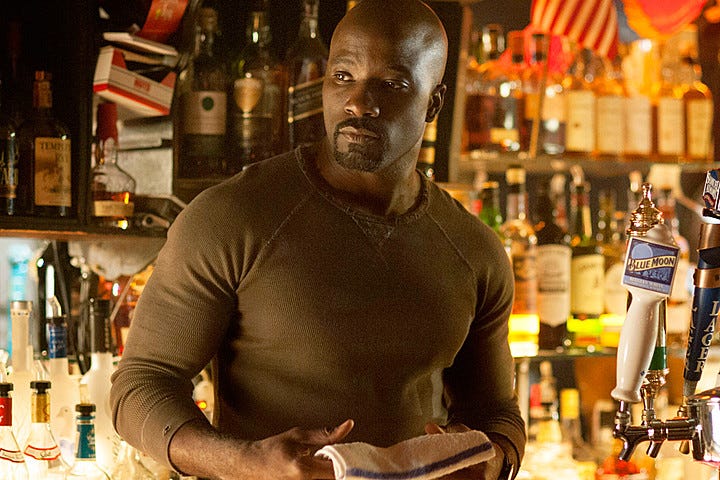
6. Luke Cage, Netflix

After receiving solid reviews for its first two Netflix productions, Marvel is back in 2016 with Luke Cage, set in the same comic book Hell’s Kitchen as Daredevil and Jessica Jones. There’s plenty to like about the new series’ prospects (and about its showrunner, Cheo Hodari Coker, previously on staff at SouthLAnd & Ray Donovan), but really there’s just one thing you need to know: it stars Mike Colter. The man is a damn star. A question remains, though: how many episodes before Rosario Dawson shows up?

7. War & Peace, BBC/A&E/Lifetime/History

The BBC is always good for at least one epic adaptation, so long as costumes are involved. This year’s headliner is War & Peace, a four-part miniseries which will be simulcast in the US by that classic TV alliance: A&E, Lifetime, and the History Channel. The series stars Paul Dano, Lily James, and a whole lotta fur. We’re talking Zhivago-levels of fur. So go ahead, splurge on that old doorstop classic you always meant to get around to. Just make sure it’s the Pevear & Volokhonsky translation. Constance Garnett will get your ass laughed out of book club.

8. Preacher, AMC

The DC Vertigo comic book (created by Garth Ennis & Steve Dillon) is finally coming to TV. The show, set to premiere later this year on AMC, is helmed by the team from Superbad (Evan Goldberg & Seth Rogen), along with Breaking Bad vet Sam Catlin. Dominic Cooper, of Mamma Mia! fame (and probably other fame, too, but who’s to say?), will star. The plot, which pretty much defies summary, involves a Texas preacher, an Irish vampire, and a quest in search of God.

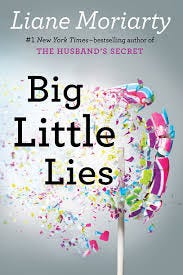
9. Big Little Lies, HBO

You thought we were going to have a TV books list without an HBO show? Granted, HBO often goes the route of signing novelists to work on its original material (see R. Price, G. Pelecanos, G. Flynn, et al), but it also knows how to do a hell of an adaptation. This year, they have David E. Kelley (creator of just about every popular drama in the 90’s) adapting Liane Moriarty’s 2014 novel about a group of mothers driven to violence. HBO is, of course, bringing the A-list talent: Nicole Kidman, Reese Witherspoon, Shailene Woodley, Laura Dern, and more. Will it air in 2016? Who knows. It still makes the list.

The Stories in Diane Williams’ Latest Collection, Fine, Fine, Fine, Fine, Fine Don’t Resemble The…

What to make of a Diane Williams story? They don’t resemble other stories, though some of the ones in NOON come close. NOON is a literary annual that regularly features a cabal of out-there authors; contributors include Lydia Davis, Rebecca Curtis, Tao Lin, and Sam Lipsyte. Williams just so happens to be NOON’s architect, purportedly editing each issue with slicing-dicing verve. (“Clancy Martin and I now laugh about how she will take forty pages of writing and slash it down to two pages,” Deb Olin Unferth has said, sounding like every other NOON writer. Unsurprisingly, Williams was a student of Gordon Lish.) The result makes NOON one of the only lit mags whose every issue is worth reading cover-to-cover.

The stories — NOON’s and Williams’ own — are weird, elliptical little gems. They — Williams’ especially — seem designed to confound. So yes, the stories in Williams’ new collection, Fine, Fine, Fine, Fine, Fine don’t resemble other stories. They are governed by a free-associative logic. They are replete with non-sequiturs and ungainly phrasing, and they revel in uncanny banalities. Of the 40, three or four edge close to 1000 words; most are half that, or shorter. They eschew the conventional pleasures of literature: narrative and character development, as well as the insights they provide.

And I must confess, though I just finished the book, I don’t recall much of what happens in it, nor. The stories take the form of a fleeting thought, and who remembers each thought that passes by? What sticks in the mind are the sentences.

Williams’ sentences have an unpremeditated quality, the kind indicative of laborious craft. Look at the harried opening of “Cinch.”

My back started killing me and Tamara asked what else did I want and why?

Oddly, she was suddenly unenthusiastic about me and she revealed resentment, of all things, and possibilities for her revenge.

But how busy I was! — building the twelve-by-sixteen rec room at the rear of the house.

Punctuation’s deployed in manner akin to musical notation, rather than as a tool for syntactic clarity. The first sentence does not have commas and periods where it should; there’s just that incorrect question mark at the end. It disorients but still gives the sentence a rather clear tempo. And the second and third lines defy the half-baked dictums everyone hears in freshman writing seminars: instead of using adverbs and exclamation points sparingly, she puts two adverbs at the front of one sentence and an exclamation point in the middle of the other. When the style works, as I think it does here, it’s sort of brilliantly awkward. It sounds like someone thinking to herself.

Often these stories are awkward in another way. Williams excels at the comedy of inconsequence, uncovering humor in the inane not through exaggeration or cloying commentary, but by mere presentation, as in the drolly repetitive party dialogue in “People of the Week.”

“I didn’t think you even knew what Ethelind looked like.”

“I saw her up front. I thought you saw her. Let’s go see Tim.”

“I don’t want to see Tim. Why would I want to see Tim? Who is Anita? I want to thank Anita.”

“Dale, is that you?” a woman called. It was Tim who turned, thinking someone had mistaken him for Dale.

The damage from that misunderstanding was irremeable…

Many acolytes of Williams are aficionados of the sentence. Indeed, she has cultivated a singular style, and the brevity of her stories serves to highlight that style, but it is so potent that it might distract a reader from what she’s doing to narrative.

A Diane Williams story resembles a story as it exists in the mind at the moment it reifies from abstract brain activity into concrete language. Her stories — events, “slices of life,” human things — are free from the interlocutor of literary convention. They are just being, and they are about just being. Williams shows what it is to be a woman, to be a wife, to be bored in a roomful of strangers, to be bowled over by despair. If I asked you, “What is it to be walking down the street?” something like the story “Personal Details” might roil in your mind before you can spit out an answer.

This is an interesting narrative project, and when it’s paired with the unwieldy precision of her sentences, along with volume after excellent volume of NOON, you begin to apprehend the unique contours of the space in literature Diane Williams has carved out for herself.

Art is, among other things, an expression of individuality. It is a stepping forth from the crowd. And one of the hallmarks of a great artist is that you sense no one could else could’ve produced her work. This admirable idiosyncrasy is how Williams gets away with something like “The Skol,” my favorite story in the book, reproduced below in its entirety.

In the ocean, Mrs. Clavey decided to advance on foot at shoulder-high depth. A tiny swallow of the water coincided with her deliberation. It tasted like a cold, salted variety of her favorite payang congou tea. She didn’t intend to drink more, but she did drink — more.

Who else would have chosen such an unsettlingly formal tone? Rather rather than telling a story, she relays information.

Who else would have compared the ocean’s taste to payang congou tea, the soothing stillness of the drink at odds with the force of the ocean, the Chinese words at odds with the English, all dissonance?

Who else would have used that dash there at the end, an awful final flourish, stuck in like a pin between your ribs?

Click here to read a story, “To Revive a Person Is No Slight Thing,” from Diane Williams’ collection as part of Electric Literature’s Recommended Reading.

The Wooden Miles: Poems by Kevin Craft

Matinee

She is one moving over the boardwalk — 
my mother in Ocean City — crossbeam
hammered and hovering above the dune
line, boardwalk cracking like an exhumed spine.
So much love does she have for it, walking
the boards has become her life’s work,
measuring out the wooden miles like stalking
her own horizon, summer after summer
climbing down the gray-green ladder of the Atlantic
only to climb back up again, every plank a sleeper,
every nail a fraction of that solitude
named for the beach end of the road — 12th Street,
13th — the music pier floating over breakers
like an ark. But who is alone walking
on a boardwalk if not my mother in winter
gauging the distance between storms
and the hours she has to make it through
childhood and back again, hers awash in
sistering, the small tasks of being eldest
among six, three in a room, one big bed,
born into a boom she can’t escape.
I know her by the broad-brimmed hat,
the trail of gulls and the easy way
she lifts me from the splinter in my foot
or finds me somewhere in her twenties
sitting on a bench, waiting if not wailing through
a blank day lost and found. What do I know
about difficulty then except what I glean
from late night arguments in the kitchen,
my mother driving to work and my father
chain smoking at the end of the driveway,
never mind the hopeless weeping
she all but buries herself inside that summer
Christopher was lifted, blue and lifeless,
from the bottom of the pool. The Atlantic
has nothing on her, pounding out its names
for erasure, emptiness and fullness the same
calamity underwriting now the doo-wop band,
now the high school prom and string quartet,
drawing the sanderlings into its sheen,
chasing them aside. Through cold war backwash
and every season of the Ferris wheel
she walks as if the boards depended on it,
the hardwood opening to her tender instep,
so many breaks collected in her stride.

Carousel

I am sitting
on the grassy shore
of Alcyon Lake

fishing for lazy carp
or waiting for fireworks
to embellish

twilight in July,
the bicentennial
darkness warming

to history like a shy
friend I am following
now to the train tracks,

drawn by the distant
clatter and whistle
with a fistful of pennies

to smash into medallions,
ovoid and weighty
as a lie. From the tire

swing my brother
falls and cuts himself
in the rusty creek,

a little bloodletting
we survive by leaping
from sand bank to gravel bar

running from the stones
I throw at yellow jacket
nests for no good

reason, the heat of summer
coiling in our brains.
Soon they will drain

the lake, cup by cup
of poison leaching out of
the lakebed until

the mallards flee
the carp disappear
the geese grow oblong

lumpy like clumsy
lovers with no better
place to make

love memorable, never mind
where a duck goes
when the water’s gone,

when the decade
evaporates
like gasoline in sunshine

billowing
out of both arms
open like the whitewash

glare of a missed slide
out of which a man
comes walking all over

again, brushing his sideburns,
holding up a fish
that glitters like the only
life he knows.

The Girl in the Cabinet (I Read What You Wrote and I Hate You)

by Melissa Chadburn

Last summer a friend sat on my kitchen counter and said, “You just always make things about you.” The feelings that followed…I so hated myself at that moment. I was ashamed to be there, taking up space, too much space in a friendship, in a workspace, at a meeting, in the board room, in the classroom, in the bedroom, at the party. A montage of myself just talking and talking and talking surrounded by a sea of blank faces. Thought clouds above everyone’s heads as they leave the place with the people, God, she sure does talk about herself.

What I should have done is seen this as progress. I should have jumped up for joy and said, “Fuck yeah!” In 1994 I went with my foster brother to visit his mom, my former foster mother, and her new partner at work. They worked in an ad agency; we entered the board room he and I, and I gave a presentation on why they ought to take me back in. The presentation included ways I would contribute financially, and to the daily household tasks, and how I would be invisible.

The presentation included ways I would contribute financially, and to the daily household tasks, and how I would be invisible.

Now, to their credit, they never held me to that last promise, but invisibility is definitely a thing I’ve aspired to. Which absolutely contradicts all the personal essays I write. I guess in person I strive to be invisible, no problem, and on the page, I aspire to BOOM!

I recently read Meredith Maran’s, Why We Write About Ourselves. It’s a lovely compilation of interviews with twenty memoirists on why they choose to write about themselves. In it Edwidge Danticat says, “Welcome to my bathroom. I’m naked.” This is the shame part I was thinking of. Then she writes, “It feels to me as though there are people waiting around with knives, waiting to skewer me.”

***

I tried to kill myself once. At the time my brother was sending me letters about his stepmother calling him bakla, (“fag” in Tagalog). He said if he wanted to be called a fag he would’ve just stayed walking the halls of school. Until then I imagined my two brothers were living a life of snow and hot cocoa and fresh baked cookies, a life of sledding, and two parents in one warm cherished home. But there it was in my hands, proof of us on separate coasts, filling with hurt. I swallowed a half a bottle of Tylenol, and disappointingly awoke the next morning with absolutely no side effects. I felt every bit of every thing. Despite this sensitivity, like a dog or like a man who’d been shipped off to war, I was most known for being compliant and every moment I swallowed my opinion — something in me was blushing with anger and fear.

I swallowed a half a bottle of Tylenol, and disappointingly awoke the next morning with absolutely no side effects.

When I consider the difference between my experience in writing fiction and that of nonfiction I feel I have more freedom to be honest in my fiction. By that I mean there is no swallowing of my opinion in fiction. There is no me and there is no you. It’s just a world of words — a bridge from my imagination to yours.

I am in search of what Sue Monk Kidd refers to as “the common heart.” A phrase she originally learned from reading Ralph Waldo Emerson. “He described it as a place inside of us where we share an intrinsic unity with all humanity.” This is a thing I long for and seek to accomplish in my writing but sometimes I’m met with controversy.

When it comes to my essays, part of what I do is share ideas. I go places and tell people my ideas, or people read about them and they hate that. Because ideas are very very dangerous and should be limited to only a few people. Male people and wealthy people and white people, preferably. So these people who are dead set on hating me, they go to a reading and when I say, “Question gobbledygook!” There are people who come to see me with angry eyes and they raise their hand and they say, “You are an idiot! Goobledygook is what is good about this country and if you don’t like gobbledygook you should just leave!”

There is no swallowing of my opinion in fiction. There is no me and there is no you.

And then sometimes when I get home there will be emails written to me:

Dear Resting Bitch Face,

I read what you wrote about gobbledygook and I hate you. I hope you die in hell. I want to rape you.

This might sound extreme but, in Why We Write About Ourselves, Ayelet Waldman talks of an experience she had in publishing an essay about loving her partner more than her kids and getting hundreds and hundreds of emails. Some of them threatening, some saying she should “be shot” or deserved to die. Someone actually taped a note to their household gate that said, “Your children should be taken away from you.”

And just last year Amanda Hess, a journalist who writes about sex, published a piece, “Women Aren’t Welcome Here,” in Pacific Standard about a man who opened up a twitter account just to send death threats to her. One tweet read: “Happy to see we live in the same state. Im looking you up, and when I find you, im going to rape you and remove your head.”

Back in my life, I will get another email, an email from a magazine that I like with really smart people in it. It will be a rejection in response to my query on a piece I wrote about gobbledygook. A form rejection like: We appreciate the opportunity to read “The Secrets of Goobledy Gook,” but we feel it is not a good fit for Top Tier Journal 100 at this time.

And then I might scroll through Facebook and see all these cash and prizes being thrown at people. Small island awarded to Chief Operation Officer of Gobbledy Gook. Author of 101 Benefits of Gobbledy Gook receives MacArthur ‘Genius Grant.’ By this time I will be very tired and go to bed. My lover and I won’t have sex that night and I’ll think maybe it’s because I’m fat or smell funny, which will prompt me to stay up and wonder about all the ways I’m unlovable.

My lover and I won’t have sex that night and I’ll think maybe it’s because I’m fat or smell funny, which will prompt me to stay up and wonder about all the ways I’m unlovable.

Encouraging people to fight for what they believe in is an easy enough task. Having an unpopular opinion is a completely different thing. People don’t like you for it and when people don’t like you, you see their ugliest sides. Sometimes this side stares you in the face. Sometimes it’s a dozen quick sharp slashes — being shunned. People think this opinion dealing could be contagious. People who are your friends may not invite you places. People may stop calling you.

In WWWAO, Jesmyn Ward writes about a scene in her memoir in a cellar in the woods. Her editor kept pushing her, dig deeper. Of this experience she writes, “I finally realized what that cellar had taken on for me. All the feelings of self-loathing and worthlessness I had at that age were embodied in that cellar. It symbolized all the dark things that happened to me, things I thought I deserved because of the way I thought of myself at that time: as a young black woman in the South.”

There’s many reasons I love what she says here. The cellar reminds me of the child in the basement in Ursula Le Guin’s story “Omelas.” It also reminds me of an essay Ursula Le Guin once wrote called “The Writer on, and at, Her Work.” In it she writes:

And I found myself
in the dark forest, in silence.

You maybe have to find yourself,
yourselves,
in the dark forest.
Anyhow, I did then. And still now,
always. At the bad time.

When you find the hidden catch
in the secret drawer
behind the false panel
inside the concealed compartment
in the desk in the attic
of the house in the dark forest,
and press the spring firmly,
a door flies open to reveal
a bundle of old letters,
and in one of them is a map
of the forest
that you drew yourself
before you ever went there.

Aside from the experience of writing and existing, there is only one true reward and this too is an idea or more of a hope and the idea is this: For every doo doo ca ca angry face, for every email seething with hatred, for every gala or shindig to which you are not invited there is a child somewhere — a girl — and maybe she will pick up a book or peruse the internet and she will find your words. And in your words she will discover a world of the possible and she will climb out of the cabinet and she will put down the razor.

Victor LaValle Talks About Horror Fiction, Imaginative Illiteracy, and Lovecraft’s Complicated Legacy

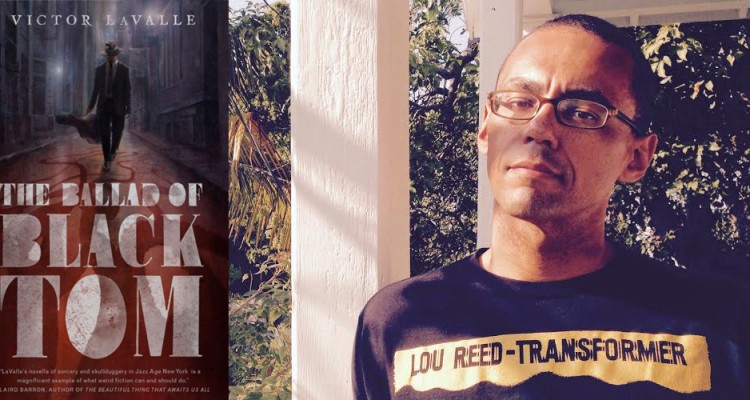
Earlier this month, I had the pleasure of talking to literary horror writer extraordinaire, Victor LaValle, for Vice about his new Lovecraft-by-way-of-#BlackLivesMatter novel The Ballad of Black Tom. Our conversation went on so long, we decided to split it in two, with the second half appearing here, in Electric Literature.

LaValle, who straddles the border of genre and literary fiction as well as any contemporary writer, is the author of several books, including The Devil in Silver and Big Machine. The Ballad of Black Tom, is a tightly-written horror thriller that works as both an homage and a rebuttal to H. P. Lovecraft. You can read our Electric Literature review, by Tobias Carroll, here.

In this interview, I talked to LaValle about the status of horror fiction, the different legacies of Lovecraft and Tolkien, and the “imaginative illiteracy” of people who don’t read genre fiction.


Lincoln Michel: First off, I really enjoyed the book, and I’m excited about it coming out. What was the genesis of the project?

Victor LaValle: I’m still in shock over the life that this book is having. It started out as just an itch I wanted to scratch last summer. I had turned in the edits for my novel and was waiting to hear back from the editor, and I was just itching to write something. So I knocked this thing out in that month. Like the first draft. I went to my wife and I said, “Nobody’s going to want this shit. Who wants a literary mashup of H.P. Lovecraft with a black lives matter undercurrent?” She was just like, “Well, don’t delete it.” And I really just thought that it wouldn’t find anybody who would think this combination is as interesting as I do. When I wrote it, I really thought, “Well, maybe I could post this online somewhere for free, people could just check it out?” But over time, people kept saying, “Oh, I like this! We should publish this.” I said, “Okay, that sounds great.”

LM: You’ve said you wrote the book during “the last round of arguments about H.P. Lovecraft’s legacy as both a great writer and a prejudiced man.” This includes the fight over having his bust removed as the trophy for the World Fantasy Awards, which they just decided to do.

VL: Smartly, it seems like they are going to go with a choice that’s not a specific person. I hope that’s what they do. Because any person’s legacy is going to age and potentially sour. But an idea or an image or something like that is much better. Like Cthulhu, I think, has much more of a lasting life than Lovecraft. Or could mean more for longer than Lovecraft personified.

LM: Right, because that references the work as opposed to the man. Lovecraft wasn’t all that popular in his day, yet he’s grown to be this huge influence not just in horror, but in the culture at large. In an interview in Dirge magazine, you attributed that in part to what you called the “open code” nature of his work. Why do you think that that made it so enduring?

VL: If you read his stories over time, he himself didn’t have a singular idea about what the Old Gods were, who all the Old Gods were, what all the conspiracies in his universe were. It was constantly changing, and so as a result, you as a reader can feel like, okay, this is constantly evolving and shifting, it never feels fixed. Then he dies and one of his confidantes, August Derleth, goes on to publish Lovecraft’s work partly in an effort to make people know and remember how great Lovecraft was. Then he starts writing these Lovecraft Universe stories, but Derleth starts shaping things into much more of a Judeo-Christian narrative. And that’s not really something that Lovecraft seemed to be pushing. That’s Derleth. And so it was almost like right at the beginning of his legacy building you have people saying, “I’m gonna try my hand at this.” And if one of his closest friends, the one who’s trying to get his legacy out there, feels the right to do that…well, why not everybody else?

LM: And even in Lovecraft’s day, he had a circle of friends including Robert E. Howard, who wrote the Conan the Barbarian stories, that would share elements and borrow names from each other. So even in his day, he had a collaborative process.

VL: I think that’s right.

LM: It’s very different from the modern geek culture notion of pure canon, and how everyone worries about what’s “true” or what “counts” in fiction.

I wonder too if there’s a way that the spirit of the creator telegraphs how we’ll take things.

VL: I wonder too if there’s a way that the spirit of the creator telegraphs how we’ll take things. A fine example would be Tolkien. It seems to me that the point of his output was to be definitive about his worlds, and it didn’t seem like he was in collaboration with anybody. Tolkien was simply producing and creating that really huge world of his. I might be wrong about that, because I don’t know that much about Tolkien, but that spirit seems very different than Lovecraft’s. I wonder if it even comes down to how someone like Tolkien was this Oxford don who’s very used to authority and what I say goes and being left to his own devices, and then you have Lovecraft not coming up through this system where he is taught that he is somehow the authority or the final word on anything. And as a result maybe lives and dies by those collaborations. He does live and die by his letter-writing to all his friends. And so maybe that makes for a much more relaxed way with your work and conversational letters about your work.

LM: That seems right about Tolkien. He doesn’t really leave many gaps, and even when there are bits of mystery in the Lord of the Rings, he has The Silmarillion, which is an encyclopedia that fills out every detail.

Lovecraft is typically classified as Weird Fiction, a genre that’s having a moment right now with Jeff VanderMeer’s Southern Reach trilogy, Penguin Classics reissuing those Thomas Ligotti books and several other Weird Fiction writers seem to be getting a lot of attention. You’ve said Weird Fiction was the first genre of literature you fell in love with. Can you talk about its influence on you?

VL: When I was younger, I didn’t understand that I was falling for Weird Fiction, but I gravitated towards Lovecraft, Arthur Machen, Algernon Blackwood, Shirley Jackson, Angela Carter — folks whose work was not about necessarily here are all the answers to how the world works or what these horrors are. They were much more about a sort of mood and a suggestion. I liked the stuff that suggested things are beyond our reckoning, human beings are limited beings and we can’t grasp or fathom everything that this universe has to offer. I just was drawn to that. It’s how I still view existence. One writer not in that list above is Stephen King, who was also a formative influence on me, but he can do the whole spectrum from splatter to realism to the genuinely weird.

LM: Yeah, because Lovecraft was a big influence on King too, right?

VL: I think he’s said that’s so, more than a few times. One of the greatest books that he ever produced was It, and that seems to be his great Lovecraftian/Weird book. At the end, when he starts explaining how there’s turtles and there’s stacks of turtles and the way we stack cosmic turtles is that all the boys have sex with this one girl, it was like…what in the fuck am I reading? This is just nuts, this is so weird.

LM: [Laughing] That’s definitely one of his weirdest endings.

VL: But nobody I know who has read and loved that book, or even read and hated that book, has ever forgotten the feeling of that last confrontation down in the caves. There’s the sex, but also the cosmic turtles and the deadlights. It doesn’t make sense, but it isn’t nonsense.

LM: Speaking of genres and moving between genres, it seems like it’s kind of popular wisdom that all of these genre barriers have come down in the last ten years and you almost expect big literary writers like Ishiguro or David Mitchell or Cormac McCarthy or whoever to write genre crossover books. That said, I get the impression that it’s still a lot easier to crossover writing literary science fiction or literary detective fiction than literary horror. Does that seem right to you and if so, why do you think horror has such a bad rap in the literary world?

I’ve told some folks I’m a literary writer trying his best to become a horror writer and they’ve practically shaken me to stop me from saying such a thing.

VL: It may be as simple as a lot of the people who are in the literary world read science fiction when they were young. If they dabbled in a genre it was that one. And if they liked it then, well, it can’t be entirely bad. That kind of self-centeredness. I just feel I talk to people sometimes and they’ll say, oh you know I read Ursula K Le Guin or Atwood or whoever you wanna name and they’ll say that at a certain stage those people really spoke to them so now they can still appreciate it and even applaud it. But the horror genre’s reputation precedes it. Even just the term “horror” creates a sense of revulsion in many people. I’ve told some folks I’m a literary writer trying his best to become a horror writer and they’ve practically shaken me to stop me from saying such a thing. “Don’t talk like that!” But since I’ve loved the stuff since a young age — and since I know a great many works of high literature are actually works of horror — I never understand this reaction.

LM: It’s interesting to me, because — and I also obviously love horror — there’s a certain way in which horror is almost the most literary of the genres. It comes from like Gothic fiction like the Brontës and down through Edgar Allan Poe. Its lineage is all these people who are firmly in the literary canon. I’ll probably get flack for saying this, and using “literary” is always problematic, but I feel like a lot of horror writers are just more literary in the sense that they tend to pay more attention to language. Because so much of the horror itself comes from the style and the atmosphere, and I feel like there’s a much greater focus on that, at least historically, than in a lot of old fantasy and sci-fi.

VL: Sometimes I wonder about what people come to a book for. If you’re not trained to love all that world-building that they do in fantasy or sci-fi then you might not find all that much to embrace or enjoy. Similarly, if you don’t want to immerse yourself in that mood then quite a bit of horror simply won’t be interesting because you can’t read horror for the explanations. Most horror makes no fucking sense at the conclusion. But if you love that mood, that language, then you shrug that stuff off. It’s like how people who love literary realism don’t mind the characters just sitting around introspecting for four hundred pages.

LM: [laughing] Yeah, I mean that’s one thing that’s kind of interesting about the genre discussions, is that people forget that genres are not like fixed immutable things that have always existed. They live and die and get absorbed by other genres. There was a time when the Southern Gothic was a real genre, even with its own pulpy covers and readership, but it died out and only a few really great ones — like O’Connor and Faulkner — got absorbed by the literary world. Then they just got a new label.

VL: Right, once they get taught, they get the stamp.

LM: Well, speaking of that divide, you know one thing that I’ve seen you do a lot, especially on Twitter, is you talk about the literary world’s inattention to plot. I remember there was one tweet I looked up. This was around Christmas, you said the greatest gift Santa could have given any literary writers this year is plots. Why do you think that literary writers don’t see plot as as essential a tool as voice or character or anything else?

I’m convinced the main reason literary writers are somewhat averse to plot is because most don’t know how to write one.

VL: You know, I’ve been teaching for going on fifteen years and I’m convinced the main reason literary writers are somewhat averse to plot is because most don’t know how to write one. It’s actually as simple as that. Maybe a more generous way to put it is that they have less interest in such things. Instead their focus is on the sentence level. A beautiful sentence may matter more than a memorable plot. But if we’re going to give shit to writers in other genres about their lackluster language or their wooden characters then why wouldn’t we tell the literary realists to get these human beings out in the world and do something?

LM: I mean, I love a lot of writers like that, but they’re normally short story writers.

VL: Maybe the true form of literary fiction is the short story. Because you can manage that over the course of a story, and have it be transcendent. Over the course of a novel, it can become deadly. And in fact a novel that’s only an accumulation of beautiful sentences risks becoming incoherent. You read along thinking, “This is an amazing two page description of a tree, but what the hell are we doing at the park again?”

LM: Especially if your goal is to create this powerful feeling or atmosphere, that’s going to get diffused after a while if that’s the only thing going on in the text.

VL: That’s right, and even the idea that one would modulate your tone and change the mood, then you have to pay attention to more than just sentences because you have to think in blocks, paragraph by paragraph, how to modulate things. Then section by section, and if you talk about novels, chapter by chapter. And that’s where the literary mind can stumble. Because they don’t seem to think bigger than that single block of pages, and that’s the whole point of plot. It’s the tether that you use four yourself and for the reader. It’s how you don’t get lost wandering in all those perfect sentences.

LM: I wonder if part of that is, you know you’re talking about teaching and you know like the way literary fiction is taught is so geared towards the short story, just because it’s easier to read and critique in a workshop. And then like we just don’t talk about the novel structure as much, at least in my experience.

VL: This is the second time I’ve been doing a year-long novel at Columbia, and I’ve been really happy that the department agreed with me that this was a need. It’s not for everyone, but for some of the students it’s been vital. And there is something powerful about reading 200 pages, 300 pages over the course of a year, reading that together as a group, and when you look at it in full, you really can think broadly about the book as a book. Bigger conversations than you can achieve reading 25 page submissions three times in a semester.

LM: I don’t know if this is a weird question, but a lot of people will just say that genres are purely artificial labels, that are just there for marketing and they don’t mean anything, and then a lot of other people will say that you know, genre snobbery is something that we should do away with, but the genres themselves are kind of important and distinct traditions and they’re not just artificial boundaries. Do you agree with one of those, or both?

Most people don’t want to bother, but they blame the genre categories rather than themselves.

VL: There’s this great term called “imaginative illiteracy.” It was coined by an academic named Northrop Frye. He explains that people are trained to read the genre they’re introduced to and lack training in the genre to which they’re not exposed. It seems simple but it isn’t. Every genre contains a great deal of complicated signs and symbols but if we read them for long enough we learn to become literate in those signs and symbols. As a result we can more easily enter into these genres and enjoy the stories inside. This holds true for realism, horror, romance, historical fiction, everything, since reading any kind of story is an act of imagination. Even the most plainspoken realist is still just making a bunch of shit up and trying to get you to picture all of it in your head. If you’re well read in a certain genre then you no longer notice how much imaginative literacy you’ve mastered. You’ve become a native speaker. But it isn’t automatic, it wasn’t effortless. So I don’t know if the genre labels are meaningless or aimed solely at commercial concerns, but I do know that you have to learn how to read different stories differently. This might be why so many people fall in love with certain genres when they’re younger and then don’t really leave those lanes. Even if the level of sophistication in the books increases the literacy required doesn’t and that’s fine for many. The problem is when such a reader is given something entirely different. Then it’s like being introduced to a foreign language. I can’t imagine someone saying, “Portugese just isn’t for me.” Or, “I don’t know why, but I never liked Mandarin.” Instead a person would say, “I don’t know how to speak Portugese.” Then they would either learn it or not. “Imaginative illiteracy” is a way to approach the same idea across genres. I like that explanation for genre divides much more than any other because a person can learn a new language if s/he wants to work at it, and a reader can learn how to be literate in other genres if they want to go to the trouble to become proficient. Most people don’t want to bother, but they blame the genre categories rather than themselves.

LM: I like that phrase, “imaginatively illiterate.” That makes a lot of sense to me. I remember when I was in workshop, often if I wrote something that was kind of in the tradition of weird fiction in some general sense and the tradition of weird fiction or the tradition of Kafka or Kobo Abe, there would always be a few students who could only understand it as “satire.” If it wasn’t realist fiction, but it wasn’t fantasy or SF, it had to be satire. And I also feel like I see genre people who really come from like the fantasy and sci-fi world are often baffled by writers who kind of have some of those elements but don’t really care about world-building. They’ll always ask questions like, “What are the rules to this world?” and the write is often like, “It’s like a four-page story, there’s not really a world or rules…”

VL: [Laughing] Right. And what I like about that imaginative illiteracy term is that it basically lets no type of reader off the hook. I mean lots of stuff is just bad, but if you’re imaginatively literate in that genre you can explain why rather than dismissing it because of its genre. You can see this even in professional criticism or book reviews. A book is crossing between literary realism and some other genre, and the reviewer’s intro is essentially saying, “Now this is a little outside my wheelhouse, but this person is pretty famous, so I guess gotta review it.” Then they write, “I just didn’t get why Ishiguro had to talk about dragons. He should stick to butlers.” Or something, you know what I mean? That’s not a review! You did not review his book. You just said you don’t like reading about dragons.

LM: Yeah, and then whenever those kinds of books come out you get like, the opposite, you know the one reviewer will be like all the literary elements worked in the fantasy don’t and the next reviewer is like all the fantasy worked because I really like fantasy, but didn’t like the literary stuff.

VL: “Why did Ishiguro have spend so much time talking about this old couple? Couldn’t they just go fight the dragon right away?” No! No they could not. Maybe in the end the real point is that each of those sides, all of the sides, is often saying, “Can’t you just give me something simple?” And the right answer to that is, “No fucking way.”

TED WILSON REVIEWS THE WORLD: THE BELLHOP AT THE HOLIDAY INN

★★☆☆☆

Hello, and welcome to my week-by-week review of the world. Today I am reviewing the bellhop at the Holiday Inn.

I recently stayed at a Holiday Inn because I thought there was a burglar in my house and I figured it would be best to just stay out of his way. I learned later that the burglar was just a brick someone had thrown through my window.

When I checked into the Holiday Inn, the woman at the front desk handed me my key and said, “Arthur will help you with your bags.” I turned around and saw Arthur, a young man with a big smile, excited to carry my bags for me. Unfortunately, because I had left my house in a hurry, all I brought with me was the clothes I was wearing and a head of lettuce I’d grabbed off the counter on the way out.

Arthur looked so excited to have a purpose, so I handed him the lettuce. He asked if that was all I had and his eyes looked so pleading that I unbuttoned my shirt and handed him that as well.

I liked his enthusiasm, although I didn’t care for the guilt it made me feel. I always resent doing things out of guilt and I didn’t like the idea of resenting Arthur because he was just being himself.

He wasn’t very good at conversation. The walk to my room took less than two minutes and in that short amount of time he didn’t ask me anything about where I’m from or if I like the weather or anything like that. The only thing he said was, “Hey look, a pencil” because there was a pencil on the ground. I asked him what he thought about pencils in the hopes to get the conversation started but he just shrugged.

When we reached my room I immediately put my shirt back on and I think while I was doing that, he peeled a couple of leaves off the head of lettuce and shoved them in his pocket. I’m not 100% certain he did, and I would hate to accuse him if he’s innocent, but the lettuce felt a little lighter and he had this strange grin on his face as if he’d just pulled the wool over my eyes.

He was clearly angling for a tip but I felt like the lettuce leaves he stole were tip enough. So I used my eyes to say, “Didn’t you already get a tip?” Then he completely ignored my question and used his mouth to tell me to have a nice stay.

Knowing there was a possible thief with a key to my room made me feel even less safe than with the burglar in my house. I locked the door and climbed out the window and just slept in my car instead.

BEST FEATURE: Arthur has some great teeth. They’re a little yellow but the size and shape is perfect!
WORST FEATURE: When he walked, there was this strange noise his feet would make, as if there was water in his shoes.

Please join me next week when I’ll be reviewing a straw.

In Praise of the Messed Up Mind: Synesthesia, Substances, and the World Anew and Askew

by Molly Prentiss

Last night I was sitting at a restaurant with a writer friend — let’s call him Ed because his name is Ed — arguing over the colors of the days of the week.

Mondays are blue, he said.

No Mondays are bright red, I said.

Fridays are black, he said.

No Fridays are blue, I said.

We disagreed on all the days with the exception of Thursday, which we both agreed was brown. We also agreed it was strange that Thursdays were brown because Thursdays are always the most fun and brown is the least fun color.

We were having this conversation because moments earlier I’d busted out one of my favorite bar tricks, which is listing off famous people who have synesthesia. Synesthesia is a neurological condition in which the cognitive pathways that relate to one’s senses — sight, smell, touch, sound, etc. — are swapped, and I’m mildly obsessed with it. A synesthete might see the color red when he hears the sound of bells, for example. Or smell roasted peanuts when he reads the word dog. The sensations are automatic and involuntary. Many synesthetes describe its visual manifestation as a sort of screen in their minds eye, the colors or images floating atop whatever is in their sightline — a scrim of sensation between them and the rest of the world.

Mary J. Blige! I had been yelling happily to Ed. David Hockney! Nabokov! PHARELL. Kanye says he does, but does he? You never know with Kanye. And Jewel, and Jimi Hendrix, and Van Gogh…Isn’t it fascinating?

Ed was moderately fascinated. Makes sense to me, he said. A brain that misfires to connect colors and sounds and smells? I’d say they’ve got an edge on the rest of us — their brains doing all this linking automatically, and we’re busting our asses trying to write our fussy similes. Don’t you think?

I’d say they’ve got an edge on the rest of us — their brains doing all this linking automatically, and we’re busting our asses trying to write our fussy similes.

I did think. In fact, it was one of the things I thought about a lot. I coveted the synesthete’s highly specific associations and heightened sensations — things I thought would most definitely be benefits in making art or writing. I’d dreamed of that sexy screen of elaborate colors and sounds that coordinated themselves into my daily life, allowing me to feel more than I ever knew was possible. I craved that portal into a new way of seeing, that provocative sensory shift, that messed up, magnificent mind.

***

When I am writing, I often find myself grasping for some altered state. I drink many cups of coffee, until my hands and mind feel shaky and shaken. I take any low-key leftover drugs friends offer — Adderall, dusty pot, vague pills from Mexico, given to me by an ex-boyfriend, that make me feel simultaneously focused and twisted. If it’s evening enough, I drink wine. For whatever reason, I find its easier to say what I think if my thinking is a little skewed.

Occasionally, though, I can enter a specific mental freedom without such moderate substance abuse, and I credit this state for most of writing I’ve done that I consider good. When I am in it, words whistle out of my fingertips, sentences sail onto the screen — it is as if the writing was already fully formed, as if I were simply seeing or feeling something and describing it: that easy. I feel unbridled in my thoughts and limber in my execution of them. Obscure and sometimes seemingly absurd connections come freely and unexpectedly, surprising even me. This writing state feels so far removed from the everyday toiling I do, the wrenching of words into their place, the tough, sticky metaphors, the scratched up outlines. It is as if, in these moments, the barrier between my mind and the page is lifted, the distance between me and my ideas shortened. It is inside these moments that the writing dances and sings.

But these sprees are fleeting. They abandon me, leave me alone with glaring blank screens and unfinished sentences. The distance between me and the work widens and sprawls again, until I am inhabiting a different island than my art, and between us is a large black sea.

Is a synesthetic brain naturally better equipped to create — like a music prodigy, in whom notes and songs seem to be engrained at birth? And as such, does a creative outlet become practically necessary?

But what would it be like if the metaphor I was searching for was not a metaphor at all, but my reality? What if I could simply write down what was happening in my body, or in front of my eyes, and that would be that? It makes me wonder if the workings of a synesthetic mind make art feel more available, the distance from it lessened. Is a synesthetic brain naturally better equipped to create — like a music prodigy, in whom notes and songs seem to be engrained at birth? And as such, does a creative outlet become practically necessary? Is the very nature of the condition — the connections between unlikely things — the essence of creative thought? Which leads me to the question: If a synesthte creates a work of art based directly on the associations in his or her brain, does that mean that the synesthetic mind is a work of art in itself?

***

Richard Cytowick and David Eagleman, co-authors of Wednesday is Indigo Blue: Discovering the Brain of Synesthesia, write:“…synesthetes have more abundant connections among conceptual maps and accordingly are more facile at linking superficially unrelated concepts and seeing deep similarities in seemingly unrelated realms. Likewise, they have a higher aptitude than nonsynesthetes for figurative speech.” So it is true; a synesthetic brain — specifically its “angular gyrus at the junction of the temporal, parietal and occiputal cortices” — is hardwired for the type of thought that creative people count on: connecting the unconnected.

Kandinsky described listening to Wagner like this: “I saw all my colours in my mind; they stood out before my eyes. Wild, almost crazy lines were sketched in front of me.” Kandinsky’s wild lines: not imagined or dreamed, but seen, witnessed.

Juxtaposition is the natural work of the synesthtetic mind; metaphor is a synesthete’s mental currency.

Hockney seeing the trees on the side of the road as purple, painting straight from what he knows as life.

Jewel blinking in orange flashes when she hits one of her famous guttural low notes.

“All art is juxtaposition,” wrote British poet and academic Robin Skelkin. “Placing images beside each other in such a way as to suggest previously unnoticed or unimagined relationships.” Juxtaposition is the natural work of the synesthtetic mind; metaphor is a synesthete’s mental currency. Whereas I can sit for hours searching for the perfect way to describe the color of a certain dusky sky, a synesthete might simply explain the things he experienced while looking at that sky: the taste of papaya, maybe, or a heat in his hands. This description, for him, is not a metaphor but a reality. Where as my metaphor might be more direct — a sky that was as purple as a bruise, say — it would also be, by definition, less true. My metaphor is a fabrication, a fiction. I did not feel my skin bruising as I searched the sky.

***

Of course, synesthesia isn’t all rose colored glasses and invisible rainbows. Biologically, the condition is actually considered “useless”; it doesn’t increase someone’s chances for survival, make the more attractive to a mate. In fact, it has been known to do the opposite; many synesthetes speak of being ostracized for their condition, especially in their early lives. No one around them can understand why their perception of the world is so different than everyone else’s, why they are so affected by their surroundings, why they might answer a math problem with the word beige. (This was common especially for those born before the advent of MRIs, which could validate the cross firing of their synapses and legitimize their uncommon perceptions.) Because their way of seeing is unrecognizable to others, they are often considered crazy or wacky or out of touch; their opinions are cast aside.

No one around them can understand why their perception of the world is so different than everyone else’s, why they are so affected by their surroundings, why they might answer a math problem with the word beige.

This, of course, is a common theme among many artists, even those without quirky neural conditions. An artist, to my mind, is anyone who has a fresh or particular or nuanced way of seeing the world around them, and who can translate that way of seeing into a work or idea that others can explore or inhabit. These perspectives are often read as problems, dubbed as illegitimate. Part of the artist’s lot is to persevere with her way of seeing and with her work, despite being, by nature, differently-minded than most. It is lucky when the world changes its mind to accommodate or appreciate hers, but this does not always happen. Often, genius isn’t recognized until death, until it’s left this world for another more expansive one.

Sidelining the mistrust of the outside world is the problem of mistrusting oneself, the constant questioning and self doubt that is so routine in the inner life of any artist. The fear that the connections one is making in their work might not be valid or real, that what one has to say is unimportant or unintelligent. This questioning erects a thin, nearly invisible wall, creates a distance that separates you the oddest depths of your own mind, and therefore from you work. The artist’s job, then, is to learn to distrust that wall, to see through it in order to get closer to her original mind, her original mental mode. In many cases, seeing through it isn’t enough; she’ll have to rip down the whole thing of the wall, trust that the structure will hold, relish in the new view through the gaping hole they just made.

Synesthetic poet Arthur Rimbaud said: “The poet makes himself a voyant through a long, immense reasoned deranging of all his senses. All the forms of love, of suffering, of madness; he tries to find himself, he exhausts in himself all the poisons, to keep only their quintessences.” In other words, the artist must actively pursue skewed perception, chase demons into dark corners, obtain insanity. She must actively pursue the mess of her own mind.

***

There is a long history of artists and writers using drugs or alcohol when they work. Susan Sontag has spoken fairly freely about her use of speed, claiming it allowed her to be less constrained as she wrote, to be loose, to unlock a river of fast, new ideas. Ditto Sartre, ditto the Beats. Cocaine fueled Robert Louis Stevenson’s creation of Dr. Jekyll, not to mention the inventions of Thomas Edison or the drastic conclusions of Sigmund Freud. Dickens did opium. Then there are the classic alcoholics: Hemingway, Van Gogh — the list goes on.

Why do so many creative people, people whose minds are arguably the sharpest or most brilliant, want to alter those minds, fuck them up? What is it about the jostle of the drug or the blur of the alcohol that is attractive, specifically, to the artist?

Sure, there is an element of personality involved; artists have the reputation of being depressed, sensual, open, needy…all traits that can lead them to inebriation. But one also has to believe, as Sontag suggests, that something of it has to do with fueling their creative work — a desire to twist their perception for the sake of creative vision, the need to feel and see things differently in order to crack a creative code. (Artists seek escape from many tyrannies, one being their own innate sense of things.)

What is it about the jostle of the drug or the blur of the alcohol that is attractive, specifically, to the artist?

The mess of one’s mind is terrifying, and culling one’s layers of rational and regular thought to get there is some of the hardest work an artist must do. It is painful, not only to touch at one’s own soft core, but to recognize one’s own inner madness, one’s weird way of working, one’s anomalous way of being. Again and again, the artist must remind himself that he is different, and that even when this is working in his favor, he will never be like anyone else. Often, one needs to be in an altered state to allow themselves to get to their original altered state, make themselves feel different to allow themselves to be different.

It seems to me that when one is drunk or high, that distance — between one’s actual experience of the world and what they allow themselves to create — shortens a bit. As the brain becomes altered — dopamine increases, new cortexes light up, inhibitions dwindle — the cloak of perpetual fear can be lifted, perhaps even removed. Sight is blurry or tilted, maybe, thoughts slide outside their normal boxes. A room becomes a boat, and suddenly you are sailing toward a very slightly different world. A world you could write about, and in which you can write.

***

Apparently, we are all a little bit synesthetic. Cytowik, in 2009 interview, stated: “…cross-talk among the senses is the rule rather than the exception — we are all inward synesthetes who are outwardly unaware of sensory couplings happening all the time.” He sites dancing as an example: our bodies moving naturally to rhythms produced by sound. And watching a movie: our eyes seeing a screen and our ears hearing speakers, our brains doing the work to merge the two senses together so that we believe the actor is actually speaking to us. In other words, we may not all see fireworks behind our eyelids when we hear orchestra music, but our brains are still cross-pollinating in ways we don’t even notice or acknowledge, all the time.

In extrapolation, we are all natural metaphor makers and understanders. Cytowick sites our collective association of dark colors with lower sounds, for example, and deeper smells. Light colors with higher sounds and brighter, fresher smells. When we describe wine, we might very well sound synesthetic. It’s deep and round, we might say about a lush red. Or for a white: it tastes like a day at the park. It’s bright. It skips across the tongue.

This makes me wonder about my conversation with Ed. Neither of us have synesthesia, and yet we were so adamant about the colors of the days. Sure, our associations were probably left over from kindergarten color wheels or the calendar on our mom’s fridge when we were growing up. Or perhaps they were just based on how we felt about a day — Ed said Monday was blue because it felt fresh, like a new start. But for whatever reason, they are there in our mind like imprints, old memories or mental links that linger like stains. Though we can’t see them, they are defined and strong, perhaps even fixed. If this is the case, our only job as writers is to travel the distance between the thought and the page.

The unexpected is scary; not everyone allows for it.

Modernist sculptor Constantin Brancusi said: “To see far is one thing: going there is another.” What exists in the space between seeing and going? What dark mess lies there that makes it so difficult to traverse? It is within this space that anything can happen, where truth can emerge, where messes are made. The unexpected is scary; not everyone allows for it.

Perhaps what separates an artist out from the rest is not simply an innate ability or built-in way of seeing. Perhaps it is also her willingness to travel through this bog of truth, and to come out the other side with the hinge that connects vision and reality. She might have to get miserable for a moment, in the aching heat of her own sensations. She might have to wallow in Monday’s blue, or she may have to invent a color she’s never seen. Most importantly, she’ll have to hop into the messy ship of her own mind, trust it to get her where she wants to go, or even where she doesn’t.

In Everything I Found on the Beach, Cynan Jones’ Writing Is Rapid-fire Perfection

The Welsh writer Cynan Jones’s novels are short in length but weighty in their content, bald and yet redolent with complex emotions. Everything I Found on the Beach prefigures the tautness of The Dig with a story of men whose lives intersect less immediately but with as much force and wider repercussions. This earlier work — originally published in the UK in 2011 and now in an American edition — tells the parallel stories of men who are looking for a chance of a better life. The pivotal character in the book is Hold, a Welsh fisherman; he carries lingering sorrow for the death three years previously of his childhood friend and workmate Danny, and strong feelings for Danny’s widow Cara and son Jake. Both Hold and Cara acknowledge to themselves the great care they have for one another, but the notion of romance has no place in this narrative.

Cynan Jones has spoken of writing about “men getting through things, often physically.” For the characters in Everything I Found on the Beach, this brings them into contact with nature, with the wild, in powerful ways. The descriptions in the novel of Hold rhythmically filleting the fish he catches and cleaning the rabbits he shoots are visceral, but Hold’s actions are governed by his sense of what he calls the rightness of things, not a love of killing or sport, and these descriptions are beautiful, purposeful and never gratuitous.

Events in Hold’s childhood have taught him how to make choices and to develop the capacity to live with them. He took the fall for something Danny did at the fish factory and was fired. But Danny died without insurance cover. Without a sum of money which Hold cannot raise, the old family house which he had worked on with his friend will be lost. One night as he gathers the fish caught in the nets on the beach, he is presented with a chance opportunity as something of great value is washed ashore. Danny had loved presenting his son with opportunities to hunt for treasure. Hold has the old newspaper cutting which his friend had kept about a rare find of ambergris, so-called floating gold, washed up on a beach. What Hold finds on his beach is a substance which is also compared to gold, but one accompanied by great danger: cocaine.

This is where Hold’s story collides with that of Grzegorz, a farmer who has left his native Poland and come to Wales with his family for the chance of a better life. Instead, he finds himself stuck in a no-man’s-land facing “Polish out” graffiti on walls, and a new baby comes “not with celebration but as an extra weight.” In his own life he shares Hold’s respect for animals and is sickened by the passivity of cows and lambs with “stubborn, incomprehensible eyes” as they face death in the slaughterhouse where he works. Punished with a reduction in his hours for taking home for food parts of the meat which would otherwise go to waste, he seizes the chance to dig for cockles on the beach and then the even more hazardous one to bring a consignment of cocaine ashore.

Both Grzegorz and Hold face desperate circumstances, but they are not portrayed as victims. They make their choices in full knowledge of the dangers they face because of the responsibilities they have undertaken–Hold to Cara and Jake; Grzegorz to his wife Ani and two young children.

“‘Why? Why did I make this choice?’ Grzegorz thought. But he knew. ‘I know why I made this choice. You always have to wait in line. All my life I’ve been waiting in line. Wait your turn, know your place. That’s all there is. I wanted to change something.’”

Cynan Jones’s taut prose conveys most powerfully the complexities of the men’s feelings. He employs all the senses to do so — Hold’s response to the talismanic sight and sound of a herd of curlew flying over the beach, ghostly in the moonlight; the lingering odor of tripe cooking which Grzegorz calls “the smell of poorness”; the taste for Hold of the raw fish and the feel of the splinter of brick in his finger. Cynan Jones builds a sense of solidity and amplifies it by his exploration of the men’s thoughts, turn by turn, back and forth like the tides washing waves onto the shore.

The core strength of this book, for me, is in its depiction of Hold and of his integrity. He is a good man. Good men can make bad choices with the best of intentions. Hold makes the choice to take the cocaine from the beach because he wants to honour his friend’s memory and provide for Cara and Jake. And when he begins to piece together Grzegorz’s story he wants to help his family too. Many times on his journey north to the town where the end of the story will be played out he has other chances, chances to pull back. But he compares his decision to continue to pulling the trigger of a gun:

“Once you pull the trigger, you are responsible for everything that happens in the path of that bullet. You can get all the way to having something in your sights and you can still back out. But if you do pull the trigger, you’re up. You follow it through. You can’t call the bullet back.”

At the end of the road Hold waits for an appointment. It is with men who have come across on the ferry from Northern Ireland, from the place of the Troubles, taking a chance to try and get away from their personal troubles and sorrows. Their chance involves doing the dirty work of others whose choice is to remain anonymous. When the waiting is over events tumble fast and it is those people who keep away from the action who win out in this story, if indeed anyone can be described as a winner. But the book did not, for me, engender despair. It portrays harsh realities of life on the edge and conveys the complexity and subtlety of life for men in those situations. The realities for the women concerned are seen too, but only in vignettes — there is another story, a longer story, to be told from their perspectives.

The beach is a powerful metaphor in this book, representing a threshold in life for both Grzegorz and Hold as well as being the place where events are played out, first and last.

For those of us who write, tell and read stories to make sense of the world, I feel this short novel is a work of great insight. It does that all-too-rare thing which is to spool on in your mind after you’ve read it. This is not merely because the author leaves some things in the story unexplained or ambiguous. It is also because he opens up moral dilemmas for our inspection and us to ponder long after we have turned the last page.

Rob Spillman on Finding Your Community, Joining the Conversation, and All Tomorrow’s Parties

Rob Spillman’s childhood was split between Berlin and the States, between living with his father, a concert pianist, and his mother, an opera singer who became an arts administrator. Spillman found himself in the battered paperbacks of Kerouac, Kesey, and Hunter S. Thompson, and in music, particularly punk, his portal to another world. In his memoir, All Tomorrow’s Parties (Grove Press, 2016), Spillman traces his journey as a young man, crossing cultures and continents to find his place in the world and the arts.

Spillman is the editor of Tin House and the editorial advisor of Tin House Books, among other endeavors. He and I discussed the challenges of writing memoir, his musical and literary influences, and why it’s crucial to contribute to the literary ecosystem.

Deirdre Sugiuchi: A major theme of this book is the conflict one has between being responsible and devoting your life to your art. Your mother wanted you to have a career and play it safe with a job. Your father devoted his life to his art. It’s a conflict many of us struggle with.

Rob Spillman: It’s a constant struggle, I think, for many artists, who long for ultimate creative freedom but also struggle with the need to feed themselves. And the dueling desires for unlimited freedom and security. Especially when you are young. And for me, that was exacerbated by not having any real roots, so I felt no real attachment to place except for Berlin, which was more nostalgic. After I left I didn’t know anybody there, so it wasn’t like I had family ties or a family legacy there, so that all combined to exacerbate my wanderlust.

DS: You write about your growing awareness of your talent for assemblage, of bringing together people from all walks of life. Can you discuss how this is manifested in your life now, particularly with your involvement with Tin House?

RS: I kind of recognized this talent, at the time when the book ends, but I didn’t know I could do this as a life. I didn’t know that I could actually use what I describe as a talent for assemblage to run a literary magazine, and also to be out and about in the literary world and bringing people together, forming community through Tin House workshops and the magazine. And now I’m the chair of the PEN membership committee and on the board of the Community of Literary Magazines and Presses, and on the board of Narrative 4. All these organizations are about creating community and bringing people together. I feel lucky I was able to figure that out and was able to channel what was — I didn’t understand at the time — a talent.

DS: One of the ways you began to discover yourself was in music, particularly in punk. You have this playlist on Spotify; you quote lyrics throughout the book. Can you discuss the development of that?

RS: One of the themes of the book is the idea of influence and being constructed by my influences and trying to find my own voice and sense of self in others. I failed in this book in many different ways — it took me ten years to write and I failed. I tried to write it straight-chronological-linear, and then I figured this format out. I wanted the influences to be really explicit. That’s why I have the songs and the quotes at the beginning of each chapter — to create a soundtrack and kind of a Greek chorus of the pressures I was feeling and the influences I was feeling at the time. It’s still that way. I’m still influenced by this music and these feelings, but I wanted to be explicit.

DS: So was the format of All Tomorrow’s Parties ultimately plotted out, or did you go on instinct?

RS: Originally I had written it in that linear, chronological time, but I decided to break it up. The focal point of the book is Berlin. I wanted the two parts — me growing up in the shadow of Berlin, and me going back to Berlin — to reflect on one another. And when I wrote them straight chronological, those two parts were kind of far apart and they weren’t playing off of each other. When I decided to intersperse them, I felt there was more tension and torque. I was also able to put things and to play around with where information was dropped, so that you could find things out of chronological order and refer to the other section. I was able to get away with sleights of hand. My hope is that it creates a tension to find out how the plot is going to come together.

DS: There’s so much pressure to do everything quickly nowadays. Do you want to talk about taking ten years to write this book?

RS: It wasn’t straight linear work. I would work on this for a few years, put it down and think, ‘oh this is just not working at all,’ and then I would start over and just bash my head against the wall again and again. I did multiple drafts. It wasn’t until I figured out the structure that it came alive to me, and then it came along a lot more quickly. The challenge with memoir is that the goalposts are always moving and every single day you change and your relationship to the material changes and you have to come up with a fixed persona where you’re writing from, so you can kind of fix the material. Otherwise you will drive yourself totally crazy. A real pivotal book for me was Vivian Gornick’s The Situation and the Story. She’s so good at articulating the challenges of writing about the self, and the need to get a certain perspective on yourself. It sort of clicked into place after I read her book.

DS: What other books impacted you?

RS: My influences are many. I felt liberated by reading people like Maggie Nelson. Bluets was very influential for me. The sort of freedom to mess with form, that really impacted me. Also, strangely, Mary Ruefle’s essays in poetry — the way she was able to fearlessly leap around and make autobiographical jumps — “Wait, you were just here, and you tripped over there. How did you do that?” But it’s working.

DS: Recently Tin House published Clare Vaye Watkins’ On Pandering, an essay so popular it crashed your website. Could you talk about how you came to publish that?

RS: Yes. I’m super proud of that essay. Claire delivered that as a lecture at the summer workshop in July. And during the middle of it, the room was completely electric. You felt like you were in the presence of something really important. She was articulating something that a lot of us were feeling. Particularly every single woman in the room was resonating with what she was talking about. I thought it was really important to get that out into the world, and I worked with her to turn the lecture into an essay. We just tweaked things a little bit to turn it into an essay, and then I really wanted to make sure it got out there far and wide, so we posted it for free right before the issue came out. I was actually in Jerusalem when it hit, and it was trending there at two in the morning. I saw the website crash and I was like, “Oh, great.” It was amazing to see it resonate. I think we had 30,000 views the first four hours it was posted so it obviously struck a nerve.

It’s still resonating. She and Marlon James were on NPR’s morning edition yesterday talking about it. When I can do something like that it’s a great feeling, when you can contribute to the cultural conversation like that.

DS: This is kind of coming out of left field, but thinking of the recent terrorist attacks and other incidences of extremism, do you think that people commit these acts because of a lack of art in their life?

RS: I don’t know if it’s a lack of art. It’s a lack of empathy, which may come around to a lack of the arts. Being open to art and culture from around the world means that you have to be empathetic, that you have to listen to what the other listens to or sees.

When I was traveling around Palestine and Israel, 99% of the people I met wanted peace and wanted dialogue, but there are barriers there — explicit barriers, walls up everywhere and sniper towers — so it’s really hard for them to have a conversation. And there’s this distrust. People like Trump are not helping the world at all with their demagoguery, which furthers the talk of ‘otherness.’ So I don’t think it’s a lack of art, it’s a lack of meaningful conversation with people different from yourself. Social media does not help. We tend to talk only to each other, with like-minded people. It’s hard to have an honest conversation with someone who has different views from you.

A couple of months ago I wrote this snarky piece on Salon about how short-sighted self-published authors are on Amazon. They’re getting money but they’re not contributing to the literary ecosystem or the general ecosystem, because Amazon doesn’t pay local taxes, and so on. One of the main self-published writers on Amazon wrote a really funny, kind of flaming piece on his blog about my post. And I actually reached out to him and started a dialogue and said, “That was a funny piece. Why don’t we have a conversation on Salon where we actually talk to each other?”

And he was so shocked. He said, “Salon never airs our views. We just don’t have these kinds of conversations.”

So we actually did have an honest back-and-forth, minus the usual name calling. It’s so hard to have a real dialogue.

DS: At the Tin House workshop, you talk a lot about being a good literary citizen. Could you expound on that?

RS: I feel that if you want to be a member of the ecosystem you have to contribute to it. And that means actually buying books, supporting other people, reading other people. You can’t just take from the ecosystem. It won’t work. We all have to contribute to the vitality of the ecosystem and this goes for all ecosystems. It’s a general problem for the world — this selfishness — that I think everybody is waking up to.

It’s going to be interesting to see. The pendulum is swinging back now. It’s interesting to see because you know digital book sales are down across the board for early adopters. Now people want actual books and they like real curation from independent bookstores, and independent bookstores are thriving. And SPD, Small Press Distribution — they’re the biggest distributors of poetry in the country — they developed software to digitize poetry titles, and no one wanted them. They got out of the business of making poetry eBooks. People wanted their poetry, in the physical form. All these signs are intriguing to me.

Kevin Kramer Starts on Monday

by Debbie Graber

Kevin Kramer starts his new job on Monday. The executive team counts down the minutes to his arrival. The executive team is made up of four white men, one woman, and one man who claims to be a “Pacific Islander” on tax forms, but everyone knows he’s Armenian.

Kevin Kramer is exactly what the Products Profit Center needs in a senior vice president. He was groomed in corporate. According to Kevin Kramer’s impressive résumé, he worked previously for Procter and Gamble, Hewlett-Packard, and Mrs. Fields. According to the transcripts from his breakfast interviews, Kevin Kramer lives and breathes corporate.

Kevin Kramer speaks in a low baritone, softly but with authority. He talks about concepts like “tonnage” and “low-hanging fruit.” Even though 85 percent of the executives surveyed had no idea what Kevin Kramer was talking about, 100 percent of them fell in love with Kevin Kramer from his first interview.

Kevin Kramer is a pro. He always maintains eye contact. His handshake is firm, but not too firm. His hands are supple and moisture-free. One executive, after shaking Kevin Kramer’s hand, thought his fingers felt a bit rough. It turned out that Kevin Kramer played bass for years with his band, the Butt Gerbils. When they couldn’t get any gigs, they changed their name to Punkster. That executive later fantasized about Kevin Kramer playing “Stairway to Heaven” onstage with Robert Plant. She thought about Kevin Kramer touching her with his rough, bass-hardened fingertips, and she came harder than she had in months.

Kevin Kramer says, “Leaders aren’t afraid to hurt people’s feelings in the best interests of the company. Leaders have no problems dispensing justice swiftly. Leaders never lose sleep at night. I sleep like a baby.” This is why Kevin Kramer starts on Monday.

The executive team cheers when they see Kevin Kramer drive his navy-blue BMW into the parking lot Monday morning. One executive says, “Let the hammer fall. Godspeed.”

This executive never washes his hands after visiting the men’s room. He also refuses to say thank you when someone holds the door to the patio open for him, unless that person is another executive or that sexy Indian girl in software.

When Kevin Kramer starts on Monday, he parks in his own parking space, with his name in bold on a placard. No one else in the company has ever had their own personally designated parking space, not even the CEO. Eighty percent of employees surveyed complained about the lack of parking. Kevin Kramer realizes that many in the company will be angered by this change to the parking space policy.

But Kevin Kramer refused to take the position of senior vice president unless he could be assured of his own parking space, and the executives agreed to his demand, provided that they too would receive their own parking spaces. The executives also tabled the plan to build a new parking garage for everyone else until 2020.

On Monday, HR sends out an e-mail explaining the new parking space policy. So as not to single out Kevin Kramer, the e-mail mentions the others who are important enough to get their own spaces. One executive says, “It’s about fucking time!”

This executive used the word fuck as much as possible, because he liked to think of himself as Tony Soprano, if Tony Soprano had been born in St. Louis and became a CPA.

Kevin Kramer has been hired to put new corporate efficiencies into place. Kevin Kramer makes these efficiencies up during meetings. He does his best work under pressure.
Kevin Kramer starts on Monday because the executives decided the company needed a paradigm shift. The CEO Jon Goldfarb had become too involved with everyday operations. He was a nice guy, but an egghead. He was socially awkward with clients at hockey games and other events that were supposed to be fun, not painful.

According to a survey, 72 percent of clients characterized Jon Goldfarb as “annoying.” One client wrote on the comment section of the survey, “Can someone please teach Jon Goldfarb the fundamentals of baseball so he can stop quoting actuarial tables when the bases are loaded in the bottom of the ninth?”

The executives also decided that Jon Goldfarb was too big of a softie to get rid of dead weight, and as a result, unproductive employees had been hanging on to their jobs for years. These employees did zero work while gobbling up health benefits and overtime and accumulated paid time off. The executives hoped that the new senior vice president would fire the employees doing their jobs poorly. The executives also wanted the senior vice president to bring a hipper vibe to the company, making it more “relevant” and “twenty-first century,” which 56 percent of surveyed clients indicated were desirable traits for their payroll company to have.

Kevin Kramer is a tough negotiator. He told Jon Goldfarb during his breakfast interview, “Your company is in the toilet. The competition wants to bury you, and while you waver trying to make a decision, they will hire me. And then I will bury you.”

Jon Goldfarb sipped his coffee and pushed his eggs around his plate. He personally found Kevin Kramer to be kind of an asshole, but he had read the survey that indicated 100 percent of the executives believed he was “the guy,” so he offered him the job. This is why Kevin Kramer gets whatever he desires.

Kevin Kramer’s office is new. Architects were hired to build his new office out of a corner office and a neighboring file room. The burliest members of the facilities department were offered overtime to spend a weekend moving the files out of the file room. When a few smaller employees complained that they were being discriminated against due to their size, HR arranged for everyone in facilities to receive Subway coupons. That shut everyone up.

Kevin Kramer is introduced around the Products Profit Center on Monday morning. He meets Judy, a hefty woman with white hair who is in charge of user acceptance testing. Judy has been an employee at the company for twenty years. Her passion is not user acceptance testing, but “Judy’s Corner,” a column in the company newsletter. “Judy’s Corner” is filled with employee anecdotes and upbeat sayings that allude to Jesus Christ.

It is company policy that all religions are tolerated, even religions that 79 percent of surveyed employees considered “weird.” Because of this and because of all the new employees in software development recently outsourced from a company in India, Judy has been told to steer clear of Jesus in her column. She sometimes reprints Family Circus cartoons when she’s out of ideas.

Kevin Kramer says, “It’s a pleasure to meet the famous Judy.” He was given the latest issue of the newsletter at his breakfast interview. He read it while taking a dump that Monday morning at home.

Judy beams, saying, “Kevin, I want to include a personal story from you for the ‘Corner’ this month,” to which Kevin Kramer replies, “I’d be happy to.” But later that Monday, Judy receives an e-mail from HR, telling her that unless she takes the early retirement package offered her, she risks losing all her benefits. By the end of the day, she is gone.

Forty-seven percent of employees surveyed thought the company newsletter was “pointless.” Thirty-six percent thought it was “heartwarming,” “a great way to stay abreast of employee happenings,” and “the only way to find out if any retired employees had died.”

The executive team had plans to revamp the newsletter into an interactive website, but they never got to that item on the agenda during their offsite planning session at the Beverly Hills Hotel.

Getting rid of Judy is just another reason the executives are happy to see Kevin Kramer in his new corner office, standing on his eight-hundred-dollar Aeron chair.

After Kevin Kramer starts on Monday, the old guard starts to get nervous. The old guard are those employees who, when surveyed, thought it was okay to wear their pajamas to work. Some of the new guard will also be nervous, but only those who had gotten comfortable wearing shower shoes to work. The new guard figures that the old guard will have to go first, before Kevin Kramer sets his sights on them. But Kevin Kramer is unpredictable. For example, while he did away with the company newsletter, he inexplicably kept the interdepartmental potlucks going for a time. He even contributed a crockpot of chili that he claimed came from a family recipe.

If any of the employees who chowed down on Kevin Kramer’s chili thought it tasted off, or maybe that it smelled like dog food, they will never tell each other, let alone Kevin Kramer. No one will ever tell Kevin Kramer the truth, and no one knows this better than Kevin Kramer himself.

For a few months, Kevin Kramer does little work. He observes the Products Profit Center’s workflow. He attends meetings but says nothing. He spends most of the time looking out his office window, watching the employees smoke in the courtyard or slurp their 7-Eleven Slurpees.

He wanders the floor of the call center, and, hiding behind the potted ficus trees, listens to the representatives answer client calls. He refuses invitations to lunch from other executives, which makes them squirm. He spends hours in the break room, buying up all the strawberry Pop-Tarts.

He chats with Doc, the security guard, about Doc’s years in the Marine Corps. Kevin Kramer doesn’t understand a word of what Doc says, because no one understands a word of what Doc says. In that regard, Kevin Kramer is no different from anyone else in the company.

Finally, Kevin Kramer devises a plan. He doesn’t create a spreadsheet or a PowerPoint presentation. He doesn’t tell Jon Goldfarb, even though Jon Goldfarb has been asking for a status report for weeks. This type of behavior solidifies Jon Goldfarb’s opinion that Kevin Kramer is a big douchebag. But Kevin Kramer’s survey numbers have been rising every week since he started, so Jon Goldfarb keeps his mouth shut.

At this point, Kevin Kramer hires an assistant. It is Kevin Kramer’s practice to watch his workload pile up until it appears he will never be able to get on track. Then he hires an assistant whom he has already chosen in his mind. Kevin Kramer calls Debi Baker in human resources to let her know whom he has decided on.

“Kevin, the way it works around here is that HR hires all new employees. We need to interview candidates and see résumés,” Debi says.

“Debi, you have intimate knowledge of my new assistant, because you will be my new assistant,” Kevin Kramer says.

Debi pauses and finally says, “Kevin, I’m not an assistant; I’ve been in human resources for twenty-five years, so . . .”

“Do you accept your new position as my assistant, or will you leave the company of your own volition?” Kevin Kramer says, munching on a Twizzler.

Debi says nothing.

Kevin Kramer waits on the line, listening to Debi wheeze. Debi mentioned during Kevin Kramer’s employee orientation that she has terrible asthma that acts up when she’s stressed out. Asthma was the only thing Debi talked about during the new-employee orientation. She told the new employees, “Just read the handbook to learn about your benefits. It’s the standard crap you’ve seen a thousand times.”

“Okay,” she says finally. Then she hangs up.

Kevin Kramer estimates that Debi will last five weeks as his assistant. Kevin Kramer is always right about these things. As he suspects, she is a terrible assistant. Kevin enjoys asking her to stay late to research special paint that can turn his office walls into giant white boards. He makes Debi come in at six in the morning to answer support calls from international clients. He offers her services to whatever area of the Products Profit Center is short-staffed during the workday, and then asks her to do his work after six or on weekends.

Kevin Kramer listens to Debi wheeze in her cubicle, listens to her weep, until HR informs him that she has gone out on stress leave. Then he replaces her with Jenna, a support representative from the call center. Jenna seems eager to move up in the company. She has a golden tan and wears short skirts. Kevin Kramer noticed her right away during one of his secret excursions to the call center, her headset slightly askew on her head due to a clump of hair extensions.

Kevin Kramer has a thin, pretty wife and two adorable children with wide-set eyes just like him. But like any executive groomed in corporate, he does not mind a little eye candy around the office. He does not mind an office flirtation and, if the situation calls for it, a quickie on his antique desk.

The first quarterly meeting where Kevin Kramer is in attendance is a happening. He is treated like a rock star. The executives surround him, hoping to get into his good graces by complimenting his Brooks Brothers shirt. Most lower-tier employees are too shy to approach him, but a few brave or stupid ones try unsuccessfully to chat him up before one of the executives shoos them away. Jenna is one of the few who is allowed to approach Kevin Kramer at the meeting.

Forty-eight percent of employees surveyed called the quarterly meetings “thinly veiled attempts to spin lousy performance numbers into gold.” One person commented, “One would find more truth in a North Korean radio broadcast.” Twenty-four percent wrote that they “wished there were more variety in the breakfast offerings, including some gluten-free options.”

Kevin Kramer samples the muffins and the low-pulp orange juice, and sits in the front row. Many significant issues are discussed during the meeting, such as client survey results and the company’s plan to rearrange the lobby furniture. Kevin Kramer’s mind wanders to Jenna’s firm ass. He doesn’t pay attention in the meeting, because once his plan is implemented, all client survey results will be shredded. Also, to increase sagging revenues, the lobby will be rented out to an H&R Block franchise, and it will bring in its own furniture.

One executive presenting at the meeting says, “Our company employs some of the smartest people I’ve ever known. And we’ve just gotten ten IQ points smarter with the addition of Kevin Kramer!”

Everyone applauds, and Kevin Kramer is jolted out of his reverie. He realizes that people are clapping for him. He stands up and waves. Afterward, every other executive makes a point to say how smart everyone in the Products Profit Center is, even though 100 percent of the executives surveyed indicated that “trained chimps could do a better job than most of the employees.”

Kevin Kramer was born in Skokie, Illinois, to educator parents. Kevin’s mother remembers Kevin helping her load the dishwasher every night after dinner. Kevin’s father remembers that Kevin had an avid interest in marine biology when he was a kid.

Kevin Kramer was a decent student, but did not distinguish himself in any way. He applied to the University of Michigan and Northwestern and was rejected by both.

After two semesters at Oakton Community College, he was able to transfer to the University of Illinois at Urbana-Champaign, where he dropped out after his junior year. Kevin’s parents, when surveyed, cited that he “seemed to lag socially behind the other students.”

Kevin Kramer’s résumé lists his alma maters as Northwestern University for undergrad and the University of Michigan for his MBA.

Kevin Kramer puts his efficiencies into place slowly. Initially, every other garbage can disappears from the Products Profit Center floor. Employees are told that they must share garbage cans with their neighbors. A few grumble, but most accept the change without incident.

Then employees realize the fluorescent overhead lights seem dimmer than they used to be. Under Kevin Kramer’s cost-cutting plan, every other lightbulb is taken out of the fixtures. Some employees with astigmatism complain, and a few get doctors’ notes and go out on stress leave.

When Kevin Kramer started working in the corporate world years ago, he was paunchy and always seemed to be sweating. But after carefully studying the executives he worked under, Kevin Kramer wised up. He hired a personal trainer and got his teeth whitened and started smiling more, so that his sweatiness seemed less gross. It’s gotten to the point now where no one even notices the sweat circles under the armpits of Kevin Kramer’s faintly checkered Brooks Brothers shirts. People instead are fixated on his poker face, looking for signs. Since a meeting during second quarter that 45 percent of the attendees found “worthwhile, for once,” only to learn two hours later that they had all been terminated, no one knows what to make of anything that Kevin Kramer says. They only know to fear him, which is exactly what Kevin Kramer depends on.

Kevin Kramer demands information on a constant basis. He makes managers compile data on customer complaints into five spreadsheets separated out by product and complaint, only to demand the same information in a graph format and also as a PowerPoint. He halts all development of software, telling the executives, “We’re not in the business of software development; we’re in the business of people development.” He contracts with an expensive life coach to help oversee the department, and then fires her after a week.

Kevin Kramer personally writes phone scripts for the call center representatives to use when speaking to clients. The scripts begin, “Thank you for calling Entertainment Solutions. We’re people who get it!” He demands that managers write up any representative who does not stick to the script. He fires several representatives who, while sticking to the script, do not comply with his new “no shower shoes at work” edict.

Kevin Kramer demands new budgets from each department that must be 30 percent lower than the old budgets. Kevin Kramer will never look at all the information painstakingly collected and delivered to him on schedule. He asks Jenna to shred every document on his desk. He enjoys watching Jenna, wearing a fitted pantsuit, bending over the shredder, feeding in each piece of paper one by one.

Kevin takes Jenna to lunch for her performance review. During the meal, Jenna peppers him with questions:

“So how did you get started in business?” she asks. “What advice can you give to a young go-getter like me?”

Kevin Kramer orders a glass of Zinfandel. He tells Jenna that he got his first job at a commercial real estate company in downtown Chicago. He started watching the executives, and figured out quickly it was the way he wanted his career path to go. He neglects to tell Jenna that most of the executives he studied did nothing except take meetings, go to lunches, and play golf. After a while, Kevin Kramer began to sell a lot of commercial real estate to start-up companies — companies that had no real product but lots of money due to the dot-com boom. Kevin Kramer was savvy enough to know that he needed to get out quickly if he wanted to make a huge profit.

After a few more glasses of wine, Kevin Kramer tells Jenna that he lived with his parents for a long time, into his late twenties, because he was saving his money. He never wanted to have a starter home, or car, or wife. Kevin Kramer wanted only the best for himself, so he waited, patiently, honing his business acumen. Even though Kevin Kramer is a little drunk, he knew better than to tell Jenna that he owed much of his success in business to teeth-whitening treatments.

After several hours, Jenna tells Kevin that she has to go home to feed her cat.

“I’ll let you drive back to the office,” he says, throwing her the keys to his Beemer.

Kevin Kramer wants to hold Jenna’s hand while she drives, but he can’t figure out the best way to position himself.

“Thank you for lunch,” Jenna says after pulling into his space. “It was neat hearing all your stories.” Then she hops out before Kevin Kramer can attempt to kiss her.

Kevin realizes that he didn’t give Jenna any feedback on her job performance. When he is surveyed, he calls her “a flawless worker” and says that she makes “everything seem effortless.”

Kevin Kramer sends out an e-mail to everyone in the Products Profit Center, explaining that for the financial health of the company, the department is to be reorganized. He makes everyone change cubicles twice in a two-week period, citing “productivity principles” and “agile business units.” He dismantles the break room and turns it into a storage area, saying, “A new and improved Zen break room will be built by fourth quarter, or whenever the funds become available.” He merges the software developers with the IT department, claiming, “They all do the same thing anyway.”

Kevin Kramer has facilities change the toilet paper in the restrooms to cheaper one-ply sheets. These sheets emit a thin layer of toilet paper dust as sheets are pulled off the roll. The employee suggestion box is flooded with complaints about the toilet paper, but Kevin Kramer isn’t concerned. This kind of reaction is to be expected from employees who realize on a subconscious level they are about to be purged.

The executives are also not concerned. After all, Kevin Kramer had done wonders for the other companies listed on his impressive résumé. It was just a matter of time until his unorthodox magic worked. One executive said, “Kramer is either a genius or a madman. Either way, when he leaves, I’m taking his chair.”

This executive later received an e-mail from Kevin Kramer with nothing in it except for a photo of Kim Kardashian and the words “Isn’t she your cousin?”

During this period, the suggestion box is dismantled. An e-mail goes out to employees, saying to forward all suggestions to kkrocks@gmail.com. Only a few employees are foolish enough to send their suggestions, and soon afterward they are reassigned to part-time status. Kevin Kramer is certain these are the employees whom the executives, when surveyed, called “dumber than dirt.”

Kevin Kramer likes to work as late as he can into the evening. He often misses dinner with his family, and spends hours online shopping for presents for his wife to make up for never being home. He pauses on the engagement ring section of the Tiffany website. He sometimes watches Jenna working diligently at her desk, and wonders what she would say if presented with a three-carat solitaire engagement ring in a Tiffany-blue box. He imagines her eyes widening, and can envision her jumping up and down with excitement. He can practically see the tears running down her soft, young, tanned face, smearing her perfectly applied Maybelline mascara.

Occasionally, Kevin Kramer will look at online photos of narwhals, the rare unicorn whales he remembers reading about as a child.

People have begun parking illegally in Kevin Kramer’s parking space. Initially, HR sent out e-mails telling employees to move their cars, but they went unheeded. Kevin Kramer started calling the towing company himself to remove the offending vehicles.

Kevin Kramer hires expensive consultants as “usability experts.” He explains to the executives that before any of the company’s software goes out to the marketplace, it will have to pass muster with the usability experts. Some in the executive team argue that all the software is by definition supposed to be usable, but because they fear Kevin Kramer’s wrath, they back down. Kevin Kramer hires his neighbor Karl, an unemployed soap opera actor, and Karl’s brother-in-law Jay to be the usability experts. Kevin Kramer broached the subject to Karl at a neighborhood Fourth of July party.

“How much are you paying?” Karl asked.

“I don’t know, like two hundred dollars an hour? That seems right to me,” said Kevin.

“Can my brother-in-law Jay get in on the action? He’s not too popular with my sister lately since she found out he’s been spending seven hundred dollars a month on porn sites.”

“Sure, the more the merrier,” Kevin said, taking a swig of his Miller Lite. Kevin Kramer only drinks light beer when he drinks beer at all.

By the end of the third quarter, Jon Goldfarb is unhappy with the Products Profit Center’s performance. Seventy-five percent of clients surveyed indicated that customer service has gone downhill, and 80 percent say that they planned on using a competitor in the next twelve months. He meets Kevin Kramer over steaks to discuss the situation.

“As much as we can’t stand our employees and, for that matter, our clients, it is our job to take care of them,” Jon Goldfarb says. “It’s nothing personal; it’s business.”

“People need to learn to take care of themselves,” Kevin Kramer says. “It’s our job to take care of the company. We can’t be enablers.”

“But we’re a service company,” Jon Goldfarb says.

“We need to take care of the company, in spite of the service,” Kevin Kramer says, taking a bite of his porterhouse.

Kevin Kramer realizes that his time at the company is drawing to a close. His ideas have gone mostly unappreciated. His cost-cutting measures, while having worked a little, have created poor morale among the employees. The walls of the Products Profit Center are banged up, given that employees have moved desks a number of times. Someone spray-painted a pentagram on Kevin Kramer’s parking space placard.

Kevin Kramer decides it’s time for a game changer. He gathers all the managers into the conference room and demands that each one of them give an extemporaneous two-minute speech on why they should be allowed to keep their jobs. A few break down in tears. More than one asks what “extemporaneous” means. Some beg for Kevin Kramer not to fire them, citing family problems and undiagnosed bipolar disorder. Several walk out in disgust and tender their resignations. Overnight, someone spray-paints the word pussy on the desks of those former employees. Thirty-two percent suspect it is Kevin Kramer, but 43 percent think that Kevin Kramer put one of the usability experts up to it.
Kevin Kramer receives this message on his voice mail: “Hi Kevin Kramer! You’re a wanker!” Kevin Kramer will have a sneaking suspicion that it is his former assistant Debi, faking a British accent.

One morning, Kevin Kramer arrives early to work to find that someone left a poop on his desk. Twenty-eight percent of employees surveyed believed that the person, whomever it was, squatted on Kevin Kramer’s desk and pooped, while 35 percent believed the person brought the poop in from a separate location.

HR sends out a memo to remaining employees, requesting that they please refrain from pooping on Kevin Kramer’s desk. They will have to send out a subsequent e-mail a few days later, requesting that employees refrain from pooping on Kevin Kramer’s Beemer.

Jon Goldfarb takes an extended leave of absence, leaving Kevin Kramer to deal with day-to-day company operations. By this time, Kevin Kramer has let go of most of the Products Profit Center staff and has not hired any new people. He turns on his computer only to surf the Internet for gifts for his family. He realizes his son will turn eleven soon, eleven being the age that Kevin Kramer’s parents bought him his first Time Life book about marine mammals.

Kevin Kramer wonders what would have happened if he had followed his first love. Would he be a captain on a research boat, jetting out to the warm waters of Baja, California, to study humpback whales? Would he be saving the endangered right whales found in the Atlantic and off the coast of Australia? Kevin Kramer refrains from asking himself why he has so much compassion for marine life and none for his colleagues.
Kevin Kramer quietly contacts corporate headhunters, letting them know he is looking for a new job. He lines up a few breakfast interviews for after the holidays. Kevin tells his wife he’s thinking about leaving the company, but that she shouldn’t worry. He will find something within a matter of weeks, as he always does. Kevin then uncharacteristically spends an hour playing Barbies with his daughter, saying in a high-pitched Barbie voice, “I hope Ken asks me to the prom!”

Kevin Kramer’s wife watches her husband and daughter playing together. She hopes the children won’t be too upset when they leave Kevin Kramer home while they visit her parents in Florida for the holidays. Kevin Kramer said he had too much work to do and needed to stay in town this year. Every year, Kevin Kramer says he needs to stay in town due to too much work. His son surprises him this year by saying, “Have a nice Christmas, Dad,” before he can even tell the kids the news.

The day before Christmas Eve, Jenna tells Kevin Kramer that she’d like a word with him. She sits on the edge of his antique desk and tells him she’s leaving the company.

“My boyfriend and I are moving to Portland,” she says. “It’s a lot more relaxed in Portland; the people are cooler and not so judgmental.”

“I didn’t know you had a boyfriend,” Kevin Kramer says. “You only mentioned a cat.”

“I really liked working for you,” Jenna says. “If you don’t mind me saying so, a lot of people here thought you were an idiot, but I think you’re an expert in business. Business is a freak show, right? You do whatever you need to do in order to survive. It’s like evolution — survival of the fittest.”

“It can be,” Kevin Kramer says.

“I’m sure you will make this company great, eventually, maybe,” Jenna says. “I can’t wait to apply the principles I’ve learned here. I bet I’ll be a big success in Portland.”

“I’m sure you’ll knock ’em dead,” Kevin Kramer says.

Jenna slides off the desk and retires to her cubicle. After she leaves for the night, Kevin Kramer walks aimlessly through the empty Products Profit Center. The ficus trees have been dead for a while, as everyone in facilities was let go and no one else bothered to water the plants.

Kevin Kramer wonders for not the first time in his long, esteemed career if he could grow fins out of his hands and feet, and sprout a tail. He would drive his BMW to the beach and shimmy his way into the cold water. Only then could he imagine his best life, frolicking in the waves off the Pacific coast — careless, happy, and free.