Fantasy fans rejoice: Neil Gaiman is writing a script for a six-part TV adaptation of the fantasy novel he co-wrote with the late, great Terry Pratchett, Good Omens. And according to his blog, he’s “about 72% of the way through.” The news that Gaiman would write the adaptation was announced last week at a memorial event for Pratchett in London.
Although Good Omens, which was originally published in 1990 and was nominated for a World Fantasy Award, was once adapted for a BBC radio series, it has never appeared onscreen. In the early 2000s, a film adaptation — rumored to be directed by Terry Gilliam and star Robin Williams and Johnny Depp — was reportedly in the works, but it didn’t materialize.
As the Independent reports, Gaiman’s decision to write the Good Omens script was a difficult one, since he and Pratchett initially agreed to “only work on Good Omens things together.” But, before he died, Pratchett gave Gaiman his blessing to adapt the novel by himself. After hearing that Gaiman would go ahead with the adaptation, Pratchett wrote to Gaiman to express his approval:
“I would very much like this to happen, and I know, Neil, that you’re very very busy, but no one else could ever do it with the passion that we share for the old girl. I wish I could be more involved and I will help in any way I can.”
Gaiman, who’s been working on the script for about a year now, writes that he often wishes his friend and co-author Pratchett, who died in March of 2015, was still here to collaborate with him. When he comes up with something “clever or funny that’s new,” Gaiman says, he wants to “call him up and read it to him, and make him laugh or hear him point out something I’d missed.”
I sometimes hear that the literary world is too focused on short stories. We venerate obscure story authors the public doesn’t read, and our MFAs workshop fiction in 3,000 word chunks while failing to teach young writers how to structure novels. And yet when it comes to literary awards, short stories get the short end of the stick.
The major literary awards are either restricted to novels (e.g., Man Booker) or lump all adult fiction together in one category (e.g., the National Book Award, the Pulitzer Prize, and National Book Critics Circle award). None of these has a separate category for short fiction, despite the form being a very different beast. In theory, it is nice to have short story collections compete with novels in these awards. It puts them on the same level and tells readers that they are equally important. But in reality, they rarely win. In the last 15 years, no story collection has won a Pulitzer Prize — unless you count the novel in linked stories Olive Kitteridge — only one has won an NBCC award (Edith Pearlman’s Binocular Vision in 2011), and only two have won an NBA (Adam Johnson’s Fortune Smiles in 2015, and Phil Klay’s Redeployment in 2014.) If these awards naturally favor novels, why don’t we have a separate category for short fiction?
This is actually how most genre prizes operate. The major awards of science fiction (Hugo and Nebula), fantasy (World Fantasy Award), mystery (Edgars), romance (RITA) and horror (Bram Stoker and Shirley Jackson Awards), all have an award category for short stories. All of them except the Edgars also have awards for novellas, and most have awards for novelettes (long short stories), story collections, and story anthologies. Every year these awards give recognition to multiple short stories and collections in their genres, recognition that is mostly absent in the literary world.
Some people might say that this doesn’t matter, since no one reads short stories anyway. But if we only gave awards to popular categories we’d scrap the Pulitzer Prize in Poetry in favor of the Pulitzer Prize in Adult Coloring Books. We give awards to poetry because the literary world thinks it is important to promote poetry. And short stories do get read. Short story-publishing magazines like the New Yorker and Harper’s have circulations that dwarf the sales of most literary novels, and two of the best-selling books of last year were collections by Stephen King and George R. R. Martin. Sure, short stories are not as popular as novels and it is rare for a short story collection to be a bestseller, but it is worth asking to what degree this is due to audience preference, and to what degree the literary world’s lack of story promotion hurts the sales. Prizes like the Booker and Pulitzer can provide very real boosts in sales, especially for obscure books. Paul Harding’s Tinkers had only sold a little over 1,000 print copies before winning a Pulitzer. It went on to sell hundreds of thousands. Giving Pulitzers and NBAs to story writers each year likely wouldn’t cause that dramatic of an increase, but it would boost sales to some degree. And the attending money awards — which range from $10,000 to $70,000 — would certainly help short story writers continue writing stories. (My landlord is constantly reminding me I can’t pay my rent with contributor’s copies.)
Giving multiple awards for fiction already fits perfectly into how most awards operate, at least when it comes to non-fiction. While each gives only one award for fiction, the NBCC gives non-fiction awards in four categories (General Nonfiction, Biography, Memoir, Criticism) and the Pulitzer Prize — in addition to many prizes for journalism and reporting — gives three categories of non-fiction awards (History, Biography or Autobiography, and General Nonfiction). Granted, I’m a fiction lover who writes fiction and works at a literary magazine that publishes short stories, but I certainly think fiction covers at least as much terrain as non-fiction. If even memoirs and biographies deserve separate categories, I have a hard time seeing why every form of fiction in every single genre could be lumped together in one gigantic amorphous fiction ball.
Lorrie Moore once said, “A short story is a love affair, a novel is a marriage. A short story is a photograph; a novel is a film.” Although novels and stories are both fiction, they really are different forms that occupy different places in the literary ecosystem. It’s a cliché that some writers are naturally built for either short stories or novels and many famous writers only really succeeded in one form or the other. The constraints and freedoms are different, and readers typical encounter the work in different ways. Categories are always porous — many books combine fiction and nonfiction or poetry and fiction — but short stories are unique and prominent enough of a form to deserve their own awards.
Short stories will always have a hard time competing with novels because novels are more easily viewed as being about one thing. They can be simplified in a way that satisfies critics and allows awards to say, “This is the big important book about X!” (for similar reasons, even short novels have a hard time competing against tomes). Story collections typically cover a wider variety of topics, characters, themes, and modes. What makes a great collection is very different from what makes a great novel. It’s no surprise that when story collections do win awards, they are often more like novels (e.g., the linked short stories of Olive Kitteridge or the unifying subject matter of Redeployment) or else function as a lifetime achievement for authors publishing a new and selected collection later in their careers (e.g., Binocular Vision).
I do need to celebrate the excellent The Story Prize, which was founded in 2004 and gives an award of $20,000. There are also several year-end prize anthologies (the Pushcart, Best American Short Stories, and the O. Henry Prize Stories) that do important work promoting short stories.
Still, the lack of short story awards from the major literary prizes is unique to the literary world bubble. As noted, the major genre prizes all include multiple categories for short fiction. The result is that genre readers are more familiar with short stories, and story writing is a more lucrative pursuit for genre writers. This is especially true as the genre world always pays for fiction, both in magazine form and in the robust reprint anthologies, while the literary world far too often tells story writers they are just lucky to be getting published at all.
If we want literary writers to continue writing short stories and readers to buy more of them, maybe it’s time to follow the genre world’s lead.
I made a couple attempts at historical novels throughout my twenties. The first of these was called The Immaculate Birth of Concepta Obregon, a magical realist epistolary novel set alternately in present day Buenos Aires and in that same city thirty years previous in the midst of the Dirty War. Though there is no elevator pitch for the novel sufficient to its fundamental preposterousness, I do remember that it involved a haunted yet cheeky academic, the psychosexual mingling of a fallen noblewoman, a murderous junta general and an Argentine ragamuffin who is also a were-cat. My second attempt called The Skeleton Key — featuring a haunted yet cheeky Jewish blacksmith, a fallen noblewoman with five twin sisters, and a mustache-twirling lothario whose serial date rapes throughout the narrative are depicted with alarming coyness — was no rose either.
Yet apart from these books’ narrative flaws, they were moreover flawed as historical novels. They invoked history with a capital H. You know the kind of book I mean? Like that one you read set in the French Revolution which begins in the following thundering way: “It was summer of 1789 and the peasants were rioting in the warrens…” The cardinal sin of my novels was this: they were not about history, they were of it; their modern-day privilege of hindsight was nil. And in a world that has books like Wolf Hall by Hilary Mantel, Beloved by Toni Morrison, and C by Tom McCarthy, it doesn’t pay to dredge the past unless you can bring up fresh fish in your net.
In that spirit, here are 10 Gothic historical stories and novels that interrogate history but aren’t subject to it:
“Ovando” by Jamaica Kincaid (1989)
Unimpeachably kicking off Bradford Morrow’s 1991 anthology The New Gothic — which also features Robert Coover, Angela Carter, Jeanette Winterson and Peter Straub — Kincaid’s allegory of the horrors of colonialism takes place in a conceptually abstract space somewhat resembling a house. In the story, Kincaid’s unnamed and “exhausted” narrator is paid a nocturnal visit by a specter who goes by the name Frey Nicolas de Ovando (real-life 16th century Spanish Governor of the Indies and scourge of the Taino population of Hispanola), whose grotesque physical properties morph throughout the story, and throughout history, on a scale with the “endless suffering he [can] cause whenever he [wishes].” “Not a shred of flesh was left on his bones,” Kincaid writes. “He was a complete skeleton except for his brain, which remained, and was growing smaller by the millennium.” It quickly becomes clear whom Ovando and the narrator are meant to represent collectively and respectively: colonizers, colonized. As the “innocent” Ovando seeks to justify his blood-crimes, the narrator, too, finds herself at an impasse. “Who will judge Ovando?” she ponders. “Who can judge Ovando? A true and just sentence would be imbued with love for Ovando.” This is a story that washes its hands in the slippery offal of history itself.
2. Jack Maggs by Peter Carey (1997)
Australian novelist Peter Carey’s shadowy appropriation of Charles Dickens’ Great Expectations is equal parts meta-fictional puzzle box, sinister murder mystery, and a gaslight panorama of Victorian London. The central character, Jack Maggs, is a literary double for Dicken’s Magwitch. The monstrously self-absorbed, second-rate writer he befriends in the course of the novel, Tobias Oates, is a lackluster double for Dickens himself. Jack Maggs, a fugitive of New South Wales missing two fingers from his left hand, sets things in motion when he comes to London to see to the fortunes of his erstwhile charge, Henry Phipps (see: Pip) whom he raised from a boy. Oates, a lay metaphysician, imprisons Maggs inside a mesmeric rapport in exchange for good info to help him find Phipps, seeking to decipher in the process the “[cartography]” of the “Criminal Mind.” If this sounds cheeky, never fear. Carey subverts the posturing of Victorian melodrama and channels it steeply toward moody despair. Caryn James, writing for the New York Times, wrote: “In Jack Maggs, the bright 19th-century surface masks a world-weary 20th-century heart.”
3. “The Lady of the House of Love” by Angela Carter (1979)
An excerpt from Angela Carter’s groundbreaking collection The Bloody Chamber, this story reimagines Sleeping Beauty at the Queen of the Vampires, deliquescing in her castle. In fact, Kelly Link recommended it here. Like all of the stories in The Bloody Chamber, which aren’t retellings so much as wholesale re-imaginings of popular fairy tales — in Carter’s words she sought to “extract the latent content from traditional stories” — the tale has an elegant feminist lens; it examines history by way of the history of narrative itself and, in due course, the shockingly little degree to which the female protagonists of popular myth have been granted agency in its unfolding. In “The Lady of the House of Love,” set among the medieval ruins of the Queen’s castle, a young soldier of the WWI variety arrives one day at the gate to find the child-bride Queen wasting away with in her boudoir, ceaselessly laying her “inevitable” Tarot and strumming the bars of the cage “in which her pet lark sings, striking a plangent twang like that of the plucked heartstrings of a woman of metal.” Here, the Queen and her sumptuous male bimbo engage in a game of cat and mouse. About the victor, who can say, except it’s not whom you might think.
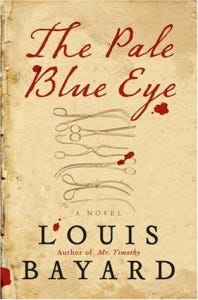
4. The Pale Blue Eye by Louis Bayard (2007)
Much like Carey’s Jack Maggs and Carter’s “The Lady of the House of Love,” Bayard’s novel The Pale Blue Eye pays tribute to another popular literary figure, but this time in his own life and times: Edgar Allan Poe. Set amidst the depredated austerity of West Point in the 1830’s, where Poe saw a short-lived career as cadet, Bayard’s novel showcases the relationship between Poe and New York City constable Gus Landor as they seek to decipher the riddle of another young cadet’s murder; the boy in question has been found hanged and, in a gruesome turn reminiscent of Poe, had his heart carved from his chest. Vacillating between Landor’s hardboiled-Victorian POV — he’s the Continental Op by way of the Brontes — and Poe’s own grandiloquent epistolary output, The Pale Blue Eye accomplishes the tricky business of seeming like a lost classic of the macabre while also interrogating the myth that has accrued around one of America’s most cherished literary personalities. The Gothic trappings liberate, allowing Bayard to navigate the past with one eye — “a pale blue eye, with a film over it” “[resembling] that of a vulture” — forever on the present moment.
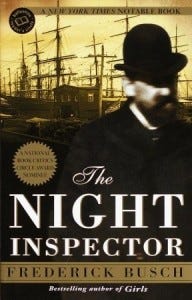
5. The Night Inspector by Frederick Busch (1999)
Busch invigorates the life of another famous literary American in The Night Inspector, set in the Five Points neighborhood of 1870’s New York City. This particular American works at the Customs House nights. He’s written books nobody reads — not during the time that he lived, anyway. At one point in the book he says: “I am my darkest, best-held secret. Do I wish to be? I would prefer not to.” His name is “M.” Can you guess who? Yet the more immediate poignancy to be found in Busch’s novel lies not in his dourly witty characterization of Herman Melville, but in the narrator William Bartholomew, a Union sharpshooter in the Civil War, which, as the novel begins, has ended only a few years previous. Disfigured in the conflict, he wears a papier-mâché mask; he collects standing debts from unsavory persons. In the world of the novel, Bartholomew is the sharpshooter, in fact, whom Winslow Homer sketched for his 1862 Harper’s print: “The Sharpshooter on Picket Duty.” Here, Bartholomew describes the aftermath of a massacre of women and children, which he comes upon in an abandoned barn during a reconnaissance mission for the Union Army: “It was their faces I wished not to look upon. I had seen men killed and I had killed them. I had smelled their corpses and the corpses other men had made… Here, however, I saw fury and despair, deep fright, and I sensed in them a dimunition — that they had understood, ultimately, that to someone in the world with the power to enforce his conviction, they had not mattered at all.” And so you can see that for a novel of the Civil War and its aftermath, Busch’s is as rigorously unromantic as you’re likely to find, pivoting between Bartholomew’s traumatized recollections of those he killed and saw killed, and his relationship with Melville. Together, the weary gentlemen aid former slave Jessie in shepherding a boatload of children still enslaved in Florida to freedom in New York. Much like Jack Maggs and The Pale Blue Eye, The Night Inspector’s portrait of 19th-century America is shot through with the juxtaposition of mythmaking and skepticism. Through a stereoscope, darkly, the world is made new.
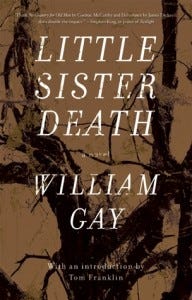
6. Little Sister Death by William Gay (2015)
Gay was long interested in the terrifying ways that the past informs the present, yet nowhere is this more apparent than in his posthumously published novel, Little Sister Death, a riff on the Bell Witch legend which rattled the bones of Gay’s native Tennessee. Little Sister Death, as with much of Gay, is above all a showcase for the jasmine-scented chiaroscuro of his sentences: “For no reason [Binder] could name he found himself watching the old toolshed, a leaning structure of gray planking set against the base of the hill. Above it the hill undulated eastward, cold and silverlooking in the moonlight, broken only by the dark stain of the cedars. He found himself waiting, staring intently at the doorway of the toolshed, a rectangle of Cimmerian darkness that seemed beyond darkness, darkness multiplied by itself, and he was thinking, Something is going to happen.” But Little Sister Death is also notable for its structure, which, much like The Night Inspector, moves sinuously among characters and time periods. In the foreground is David Binder, a successful Chicago novelist who moves with his pregnant wife and young daughter out to the maleficent Beale Homestead in Robertson County, Tennessee, where he hopes to write a commercial horror novel on the Curse of the Bell Witch. Woven into Binder’s story are scraps of historical narrative from as early as 1785 that become a living document of the Beale haunting as Binder researches it in the real-time of the novel. All this adds up to something downright meta-fictional, uncharacteristic territory for Gay, yet one that he manages to explore with his trademark elemental menace. There’s also a really freaking beautiful introduction to the novel and tribute to Gay’s life by friend and fellow writer, Tom Franklin, in case you were looking for extra incentive.
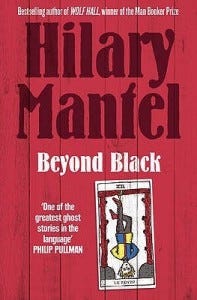
7. Beyond Black by Hilary Mantel (2005)
Mantel’s 9th novel, Beyond Black, is more than adequate proof that a story need not be set in the past to be historical. More so for the fact that Mantel, perhaps best known for her trilogy in-the-offing about Thomas Cromwell and Henry VIII (Mantel won a Booker Prize for the first volume, Wolf Hall, in 2009, and then again for the second, Bring up the Bodies, in 2012), brings a historical novelist’s knack for period detail and depicting larger-than-life characters with startling intimacy to the vaudevillian world of New-Age-y spiritualism in contemporary suburban England. At the center of Mantel’s novel is Alison, an obese and perfume-redolent medium who works the psychic fair-and-festival circuit, delivering bathetic condolences from beyond the grave to crystal-wielding, aura-photographing, principally female audiences. As an antidote to grief, Alison prescribes “closure” and “a cycle of caring,” constructing an Elysian vision of the afterlife in the minds of her sitters which the reader soon discovers is a merciful lie. Alison alone of all the novel’s players is privy to the truth of life after death, which amounts to a graceless confusion in the lost souls that people the novel, chief among them the figure of Morris, a louche pervert from Alison’s girlhood. The rub, of course, is that truth is an entirely subjective construct in Alison’s POV, a tension in the novel mediated by the entrance of Colette, a spiritual seeker whom Alison meets on the circuit and quickly makes her right-hand woman. What ultimately renders Beyond Black a historical novel apart from its immersive and unromantic depiction of modern England’s psychic set is the implicit juxtaposition of this milieu with that of toe-rapping, table-tipping Golden Age-spiritualism, which had been widely debunked over a hundred years previous to when Mantel’s novel takes place. We don’t learn from our past mistakes. The players change, the game endures.
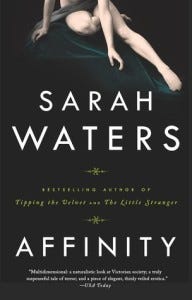
8. Affinity by Sarah Waters (1999)
Waters’ sophomore novel of socialites and spirit mediums in 1870’s England is a wonderful complement to Mantel’s Beyond Black in that it depicts the world of mediumism in its Golden Age with a studious commitment. On the surface, then, it has more in common with Bayard’s The Pale Blue Eye, seeking as it does to critique the 19th century from the inside out. The plot of Affinity creeps around protagonist Margaret Prior, a depressed aristocrat who visits Millbank Prison for Women on a service trip only to fall under the spell of a spiritualist medium imprisoned for fraud, Selina Dawes. In the cloistered realm of Millbank, overseen by a vividly imagined phalanx of prison matrons, the two women embark upon a friendship that becomes, for Margaret Prior, a dangerous obsession. If you’ve read Fingersmith,The Little Stranger or really anything by Waters then the revelation that everything with Selina isn’t as it seems is a given. It’s Margaret’s desire for Selina that burns, and drives the novel to its finish. Here, Margaret reflects on one-time love object Helen, mapped to lead her toward Selina: “I saw Helen watching us,” Waters writes. “There were pearls at her ears — they looked like drops of wax, I remember seeing them upon her in the old days and imagining them melting with the heat of her throat.”
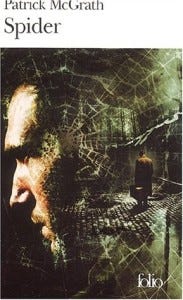
9. Spider by Patrick McGrath (1990)
For another psychological slow burn of a sophomore novel look no further than McGrath’s Spider, which was also adapted into a very good film by body horror-auteur David Cronenberg in 2002. Like many other books on this list, the novel feints between past and present timeframes, with its cerebrally dysfunctional and colossally unreliable anti-hero Spider (aka Dennis Clegg) narrating the goings-on in entropic, 19th-century inflected prose. Threadbare, muttering, coated in a body armor of cast-off newspapers and twine, and hounded by some undefined trauma, Spider walks the reader gingerly among the shattered bits of his boyhood with deadbeat dad Horace and mercenary prostitute stepmother Hilda Wilkinson intermingled with those of his present, living in a halfway house run by stepmother-doppelganger Mrs. Wilkinson after being released from a lunatic asylum where he spent the last 20 years. While McGrath isn’t a subtle writer, he is resoundingly self-aware. Spider’s references to 19th-century forebears like Poe and Maupassant give it the obfuscating sepia-cast of a historical novel while also allowing it to remain rooted in the late-late modernism of Beckett and Paul Bowles. Like Bayard and Waters, McGrath commits and the product, though it mightn’t be, is utterly convincing. It’s all right there in the novel’s playful opening in which Spider, a hot mess, reveals to the reader: “I’ve always found it odd that I can recall incidents from my boyhood with clarify and precision, and yet events that happened yesterday are blurred, and I have no confidence in my ability to remember them accurately at all…All I can tell you for certain — about yesterday, that is — is that there were people in the attic again, Mrs. Wilkinson’s people…”
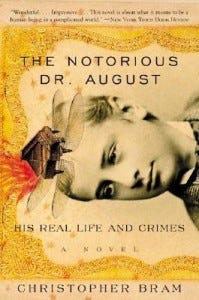
10. The Notorious Doctor August: His Life & Crimes by Christopher Bram (2000)
Bram, author of the melancholy masterpiece Father of Frankenstein about Frankenstein-director James Whale, works a vein of historical fiction somewhere in between Waters’ Affinity and Busch’s The Night Inspector in his Civil War-era novel about clairvoyant pianist Augustus Fitzwilliam Boyd (the “Doctor August” of the title, who also happens to be gay), former slave Isaac, and no-frills governess Alice Pangborn. Simultaneously interrogating the vicissitudes of being queer in the 19th-century and the emotional complexities of the Spiritualist movement, Doctor August takes readers from the American South, to New York City, to Europe, much of it in pursuit of Fitz’s main chance of contacting spirits (and gaining lucre) through his piano music of the spheres, ambiguously evidential. Meanwhile, Fitz, Isaac and Alice form a ruinous love-triangle that serves as the novel’s devastating and all-too-human emotional core. As Paul Quarrington wrote in his review for The New York Times, “It is the novel’s sly contention that Dr. August was the bridge from the Romantic to the Modern periods…” which elevates it above the problematic quagmire of being a 19th-century nostalgia-trip. Like all of these winning historical tales, Bram’s novel subverts a seemingly uncritical indulgence of the past by training upon it a critical eye.
About the Author
Adrian Van Young’s historical gothic novel Shadows in Summerland will be published by ChiZine this Spring.
Do you have any tips for handling an endless cycle of rejection … emotionally? I’m a 26-year-old fiction writer and I’ve barely ever been published; I’ve been rejected from MFA programs, lit journals, websites, contests, etc. And I feel sad about it every time. I’m not going to give up, but I think it would be fun and motivating to get some kind of validation every once in a while. I wonder if you have any tough advice that’s more specific than just, “toughen up”?
Thanks,
Rejected in Rejectsville
Hi Rejected,
Rather than “toughening up,” I’d focus on gaining perspective. Feeling sad about every rejection you get isn’t going to accomplish anything, but more importantly it’s usually misplaced sadness. Most of the time, rejection is not even about you. Editors reject work for all kinds of reasons — it just doesn’t speak to them on the hour of the day they happen to read it, they already have a similar story slated for the issue, they don’t spend enough time with it to get what you’re trying to do, they don’t like your name or the font you use, et cetera et cetera. You’re also just up against difficult math: Most publications only publish a small fraction of what they receive — the acceptance rate at top-tier journals is less than 1%. Good stuff gets rejected all the time. (And bad stuff gets published! “Good” and “bad” are relative anyway!) When making decisions, editors may end up choosing writers who already have name recognition or a publishing record over relative unknowns, all other things being equal. For these reasons, even if you send out lots of work, it’s not that surprising that you’re getting lots of rejections when you’re only 26.
Most of the time, rejection is not even about you.
You may know all this intellectually, but have trouble accepting it on an emotional level. If that’s the case, I strongly recommend that you do some editing work. Journals are always looking for help with reading submissions. Being on the other side of the desk for a while will give you a much stronger sense of the numbers involved, how much time editors (usually working for little to no pay) are able to spend on each submission, and the heuristics editors need to use to get through the submissions queue and figure out what to pass on and what to reject. In my other career as a manager in a corporate job, I’ve reviewed hundreds of resumes, and it’s given me a fundamentally different view of what should go in a cover letter and resume, as well as what kinds of jobs are even worth applying for given the candidate’s experience level. Doing some editorial work will give you the same kind of perspective, helping you see what editors do and don’t care about and just how much of the decision process isn’t personal.
It’s also important to keep in mind that every writer at every level experiences rejection. I know of no level of success where writers stop getting rejected (and stop at least occasionally feeling bummed about it). People generally make more noise about publications than rejections, the same way people mostly share pictures of happy moments on Facebook, making their sad moments invisible. So if you spend much time on social media, you might start to feel like you’re the only one fielding rejection slips. You just have to remember that’s not the case; the math assures you rejections are the rule, acceptances the exception. (And if other writers’ good news really gets to you, consider spending less time on social media.)
So, perspective. That’s step 1. But you are completely right when you say that occasional validation is fun and motivating. So how do you make sure you’re getting validation from time to time?
First, find a community of other writers to share work with so you can get readership and feedback without having to wait for publication. It’s so helpful to have at least one or two friends who are “good readers” of your work — meaning they understand what you’re trying to do and can help you achieve it. Generous but honest readers will help you figure out if your work is actually ready to send out, which is something you probably won’t get from editors. (Lots of rejections don’t necessarily mean there’s anything wrong with your story! I’ve found that some of my best poems have been the hardest to get published, probably because they are riskier.) I’ve talked more about the importance of finding a community here, here, and here.
It’s so helpful to have at least one or two friends who are “good readers” of your work — meaning they understand what you’re trying to do and can help you achieve it.
Second, ask yourself if you’re aiming too high with your current submissions. Every now and then a writer gets her first story or poem published in The New Yorker or whatever, but that’s just crazy luck. Most people have to work their way up to some extent. Your first publication will likely be a smaller, less selective magazine or journal. So if you have zero or few publication credits to your name, start out by trying to place some stories in small mags that take most of their work from the “slush” (some top-tier journals accept slush but give a lot of space to solicited work). There are so many journals out there, you should be able to find something small that also publishes work you genuinely like. (Maintain standards, obviously; you don’t want to end up actually disappointed by any acceptances.) And don’t “save” your best story for The New Yorker; by the time you have an editor or agent who can help you place it there, you’ll have written better stories.
*
Hi Elisa,
I’m in the final months of a Creative Writing MA. I also spend — outside of the course (I commute long-distance) — all my time with novelists and journalists. There’s a lot of talk about the tortures of publishing — agents, publicity, money, etc.
The course is almost like downtime. It’s a total joy working out the mechanics of writing with other writers. Discussing the publishing process is seen as a little forward. I know that’s not going to last forever, and anyone who denies getting published would be great is probably lying. Also, the downtime is pretty short, as much as they tell you the MA is for “experimenting” and “finding your voice.” The course culminates in a massive agent hoopla where lots of the best writers get picked off.
Maybe it’s anxiety, a lack of confidence, I don’t know, but all this stuff is demotivating (and I already procrastinate like hell). How I do I get back into my er, special place and just write without fear of what might happen after (or what might not?)
Thank you!
Please can this be anonymous…
Dear Please,
I’m going to use a dumb analogy to try to help you, and here it is: The holidays are not a good time to try to lose weight. If you roll into December with an extra ten pounds to lose, you’ll very likely still going to be wearing at least those ten pounds by January. Accepting this should take the pressure off and allow you to enjoy a bit of fudge, for pete’s sake, then re-motivate when there isn’t fudge everywhere you turn.
Why not give yourself this time to focus on the joyful part?
Similarly, writing the first draft of a novel is a time to be permissive and a little self-indulgent. You are going to have to worry about getting it in shape to be published, finding an agent and all that other anxious-making stuff later, if and when you finish the draft, so why not give yourself this time to focus on the joyful part? In fact, working on a project that brings you joy is the absolute best way to ensure you finish the project.
Basically, I’m giving you permission to procrastinate, but only put off the stuff that’s actually better to worry about later on. Thinking about what agents want, what publishers can market and so forth during the drafting stage is going to stifle you and lead you to make bad writing decisions. You can always revise later.
So next time you’re hanging out with your writer friends and the topic of agents/publicity/money comes up, try saying something like, “I decided to stop worrying about all that shit until I finish my novel and I’ve been much happier and more productive ever since.” Maybe you’ll inspire them!
Septimania (The Overlook Press, 2016) is a relatively compact yet sprawling novel. In just 336 pages, author Jonathan Levi, a founding editor of Granta magazine, traverses over 1300 years and several countries in the story of organ tuner Malory and his relationship with mathematical genius Louiza, as well as Malory’s connection to Isaac Newton and his own recently discovered lineage within the powerful kingdom of Septimania.
Septimania, which was largely inspired by Levi’s fascination with Rome, is his first published novel in over twenty years, since A Guide for the Perplexed (1992). It was conceived over many years, during which Levi worked a number of high-profile jobs in theater and festival production, and with the New York City Board of Education, among other pursuits.
I met with Levi for a leisurely conversation at a café not far from Columbia University. Though Levi has lived in Rome for several years, he still keeps a home in New York City and travels often for his various projects in theater, music, and journalism. We talked about his many interests and his multi-faceted career, and how it all comes into play in his writing practice and in the themes of Septimania.
Catherine LaSota:You live in Rome now?
Jonathan Levi: Yes, but I still have an apartment on the Upper West Side, and my kids all grew up here. We moved to Rome about 12 years ago for one year, to have the kids see what another culture was like, another language. It was equally foreign to all of us. (My wife) Stephanie and I sort of knew Rome, but we didn’t speak Italian.
CL:Why Rome?
JL: We wanted a big city, because the kids had grown up in New York, and we didn’t want somewhere cold, so we didn’t want Berlin, which would have been exciting.
So we went for one year, and then we came back here for two years, and when I went back again, 12 years ago, that’s when I decided to get back to writing again.
CL: What was it about going to Rome that made you feel that it was time to get back to writing?
JL: Well, it was sort of…I had been ootchity.
CL:Ootchity?
JL: You know, I had been uncomfortable, as though I’d had a marble in some uncomfortable place, because I’d been doing a whole bunch of other things, and I really wanted to get back into writing. I was just finishing up a three-year stint running a performing arts center up at Bard College — I had promised that I would give it three years.
CL:And you gave it exactly three years?
JL: I was counting the last hundred days…
CL:Because you really wanted to write!
JL: I really wanted to write. I went off (to Rome) and had a great year there, and came back here, but I found New York just impossible to write in, because there were so many tempting things.
CL:Tempting how?
JL: In this case, because I had opened this performing arts center — Frank Gehry had designed it — and there was talk about opening a Frank Gehry-designed art center down at Ground Zero, and so I was being wooed for that, which meant that I was wasting a lot of time going down and talking with people.
CL:That sounds exciting!
JL: It is! That’s what I’m saying, that it’s tempting. Because, you know, I have had jobs where there were cars, with drivers…and that’s kind of a nice way to get around New York City.
CL:I hear you.
JL: And you get caught up in that sense of self-importance, and it took over, and it was hard to say no. I remember at one point, after we’d been here for two years — our youngest daughter had done her first two years of high school by that point, our son was off to university — we just sort of turned to each other and said, why not go back? So we went back to Rome. That was 2007, and we’ve been there since. Just stayed and love it.
CL:Much of your novel Septimania takes place in Rome.
JL: People say, “Why did you write about Rome?” Well, I know writers who like to write about other places, but I really prefer doing research in Rome!
CL: Speaking of research, you clearly needed to have a grasp on so much background material to create this novel. I’m curious when you started this project.
JL: There were a couple of points at which I started. One point was probably the mid ’90s. That’s when I had the first idea for this character Malory. It came out of this dinner party I’d been to when I was a student at Cambridge University.
A friend of mine was this wild and wacky historian of science, and his specialty was Isaac Newton, and he grew up as a red diaper baby over there. He had a house that he inherited from his parents, and he painted the lions red, and he had all kinds of people living there, including my girlfriend at the time, and I was at a dinner party there one night. He was doing some work for a BBC series called Omnibus, which was using the guys who wrote the book Holy Blood, Holy Grail. It was a big series on the BBC, and the thrust of it was that they had discovered a secret society in France that was dedicated to rebuilding the Temple of Solomon in Jerusalem, and bringing back the Moravian Kings. Well, that sounds like a harmless bunch of nutcases, but, the trail of this secret society led to this little strange village in the south of France, in which all kinds of odd things were going on, and a huge treasure, perhaps the treasure of the Cathars (a sort of hermetic sect of Catholics, knights who didn’t marry), had been put down there, and the question was why? The question was, where did things all add up? And they traced it back to the theory that Mary was pregnant with Jesus’s child when she left Palestine, and she wound up in the south of France, where there’s a big cult to Mary, and gave birth, and so that the holy blood — the Sangue Grail, as in Holy Grail, the line of Jesus — continued through the Moravian Kings, and this turned into a French secret society. At one point, Isaac Newton was the president of this secret society. Since this friend, Simon, was an expert on Newtown, he was helping these guys at Omnibus.
So we’re at dinner one night with a bunch of people, drinking and laughing, and a phone call comes through, and Simon goes, “Hello? Oui…oui…oui…oui.” And hangs up the phone. And we say, “What was that?” And he said, somebody called me in French and said, “Stop working on this series, or else.”
CL:Whoa.
JL: So this gave me the idea to start working on a book. I went down to the south of France, and I did some research, and I came back…
CL:Were you writing during this time of research?
JL: Well, I had written one novel, A Guide for the Perplexed, which was published in ’92. I then wrote two more novels, both of them set in South America, and couldn’t get a publisher for them. At that point, I was getting going on this novel, but I was getting offers from other places. There was a project I was offered at the 92nd St Y to produce Dante’s Inferno, and so I figured, this writing thing isn’t maybe working right now — let me put it aside for a bit. So I went off and did this thing for the 92nd St Y, with Dante’s Inferno, and toured the production around the United States, came back, and was offered a great job with the Chancellor of the Board of Education. I did arts and culture for the city, and then that led to the job up at Bard. And that’s why, when you ask why I was “ootchity” to get back to writing…
CL:Well, it’s interesting that you say maybe something else was working better for you than writing during that time, but it sounds like the writing was still gnawing at you.
JL: Oh, very much. Because, you know, when you’re doing these other things, you’re enabling a lot of people. And you’re enabling good people, and nice people. One of my philosophies was, there’s a lot of talented people out there, so work with the nice ones, leave the jerks alone. But at a certain point you want to do your own thing.
Well, meanwhile, this guy Dan Brown came along and ran with this idea from Holy Blood, Holy Grail, and turned it into The Da Vinci Code. So I went, ah, I have to rethink this idea! So that’s what I did. I really restarted (my book) when we returned to Rome in 2007, that’s when I got going on it.
CL: So you returned to Rome in 2007 with the express purpose of working on this novel?
JL: Yes. Now, of course, prior to that, I had done a lot of research. The basic premise, that there was this kingdom of Septimania that was in fact a kingdom of Jews given by Charlemagne, was taken from a book that I saw back in the ’90s in the Columbia University library.
CL:Such a great library. I used to just spend time there.
JL: Isn’t it? And open stack libraries, which are disappearing. A friend of mine did a dissertation years ago on Thomas Pynchon. His thesis was based on the fact that years ago, Pynchon went looking for this one book in the New York Public Library, and shelved next to it, because the books were shelved according to when they came in, was a pamphlet on two other subplots that then became essential to his novel V.
CL:You never know what you’ll happen upon in open stacks libraries. That’s the argument for brick and mortar bookstores, too.
JL: Yeah, you just never know what’s going to hit. So I had done a lot of that, and I had notes and I had thoughts, but it was great to go away (and write). I wrote the first 150 pages of the book in a month in Bellagio.
CL:Did many of those first 150 pages change? This is a very complicated novel.
JL: Yes, huge amounts changed. I think there’s probably three times the amount of material somewhere. I wrote the novel in a couple years, and sent it off. I got a terrific new agent here, and I showed her the novel, and she said, “Jon, it’s a great novel. Ten years ago I could’ve sold it, but not in this literary climate, with literary novels. But if you want to take some notes…”
CL:What year would this have been?
JL: That was maybe 2010. So I took her notes, and two years later I came back to her with a rewrite. There are huge parts that changed, reformatted, whole characters appeared.
CL:Major characters?
JL: Major characters. Antonella had a very small part in the original. The point is, one can always learn. It’s not just a question of being marketable, but I think it’s a better novel because of her notes. There are very few agents you find these days who can do that kind of analysis and push you in the right direction.
CL:Who’s your agent?
JL: Her name’s Ayesha Pande. One of the reasons I went after her is she’s half German and half Indian. I was reviewing fiction for the Los Angeles Times for about five years in the late ’90s, early 2000s, and I just found myself drawn to international fiction much more than American fiction during that time. Part of it that is just a self-sifting process that happens when publishing houses here decide they want to publish a foreign author, because there is so little that is published in translation. I sort of felt that there’s this international consciousness that feels much more like where I want to be.
CL: I was going to ask what you were reading when you were working on your novel — you mention that were interested in international literature.
JL: Well, I was just down in Argentina for the first time. I had been talking to my wife about Borges while we were down there, and she had never read any Borges. I pulled out the beginning of “Tlön, Uqbar, Orbis Tertius.” The set up for the story is, he’s having coffee or a drink with his friend Bioy Casares, another Argentinian author, and Bioy Casares mentions a great thinker from Tlön, and Borges says, what’s Tlön? Bioy Casares says it’s mentioned in the Anglo-American Encyclopedia of 1923 or something…so they go look for it, and they can’t find it, but then Bioy Casares gets home and finds his copy (of the encyclopedia), and it’s only in Bioy Casares’s copy that they’ve got an article about Tlön. I hadn’t thought about that until I read it to Stephanie last night, but it’s that kind of thing of trying to remember what’s real and what’s invented. I mean, people sometimes ask me about Septimania, is this really true? And I can’t remember…
CL:The answer is yes, and no.
JL: Well, there’s this Charlemagne expert at the American Academy. At one point I figured, ok, I’ll take her out to lunch and ask her about the things in my book. I asked, do you think this could’ve happened? “No.” What about…? “No.” And…? “No.” And I figured, ok, I’m doing the right thing. But, yeah, (some events in my book were) a little while ago, you know, 1300 years ago…
CL:…and people’s versions of the truth change from person to person and year to year.
JL: Well, there’s another Borges story, “Pierre Menard, Author of the Quixote,” in which he does a fake review where he’s comparing Cervantes’s Don Quixote with a new book Don Quixote written by Frenchman Pierre Menard. He says in Cervantes’s version, it starts off with this epigram: “History, the mother of truth.” And he says in Cervantes’s mouth this is just some quasi-chivalrous nonsense that he picks up all over the place, but Pierre Menard writing after the second World War writes “History, the mother of truth,” and, my god, what a revolutionary concept!
I was in Mexico, teaching, in January, having lunch with a poet down there, a guy in his 70s, and I said to him, “Homero, you know Borges’s ‘History is the mother of truth?’ If history is the mother, who’s the father?” And he said, “Fiction, of course.” So I think that’s the answer.
CL:History is the mother of truth, and fiction is the father.
JL: Fiction is the father of truth, yeah.
CL:I noticed that there is a lot about writing and about books in Septimania. Your character Settimio, a librarian of sorts, takes great stock in books. And your character Louiza talks about how words only started making sense to her when she could visualize them as imaginary numbers. But it’s not just the power of reading and writing that plays a major role in Septimania. Your novel is about so much. It’s also about this intersection of Christianity and Judaism and Islam and physics…
JL: These are all my pet obsessions, and the book gave me a chance to explore them. I suppose this is where rewriting comes through — it gives you a chance to worry them a little bit the way a dog does with a bone, until you finally get the meat off in a certain kind of way.
CL:So, in gnawing the meat off the bone of these obsessions, did you surprise yourself at all? Did you find yourself drawn to certain obsessions more than others? And what were those?
One versus the many. Monomania versus septimania.
JL: Absolutely. One of the obsessions was the question of whether things can be boiled down to “one.” One versus the many. Monomania versus septimania. There’s something so enticing about the idea of one, about finding that kind of unified theory, about finding one love for life and possibly even one god; on the other hand, there’s that huge pull towards complexity, in which you sort of say, not just that it’s fun to play the field, but that the world is such a marvelously intricate and colorful place, that why do you just have bring all the color down to white light? Why can’t it just exist out there?
CL:It’s a huge question!
JL: And that’s what I’m saying, there’s a lot of meat on that bone to play with, and how do you play with it in such a way that it doesn’t become just, you know, either a Frank Zappa song or a dry treatise on something? How do you do it in such a way that it’s going to lead a reader along?
CL:And how do you write about it and not drive yourself insane?
JL: I had hair before I started! (laughs) No, there’s something that’s a lot of fun about writing a novel. It’s like a juggler with a lot of balls in the air. It’s a lot of stuff to keep in your mind, and that’s why things like writing retreats to just get away and have that quiet time where you don’t have to listen to anybody else, and you can just drive yourself insane a little bit for a month at a time, is necessary. Because it’s a lot of stuff to keep going on up there.
When you hear stories about people who have incredible memories, and how they build these memory palaces and put bits of information in different rooms? I think we do that while writing a novel. You put themes into characters and into interactions between characters. If the interaction between Malory and Tibor, let’s say, is one between a character who is committed to “one” (Malory), and a character like Tibor who is committed to “many”– that’s where that theme goes.
CL:Between character interactions.
JL: Between character interactions. Between Malory and Louiza, there are other things, there are things that have to do with language. How do we communicate, how do we make sense of the world?
CL:Let’s talk a bit about your time with the journal Granta. Can you describe briefly what the publishing industry felt like when you started editing Granta, the things that were distinctly of that time? Is it primarily the Internet that makes the publishing industry so different now than when you started Granta?
JL: I’m not sure, because, you know, I’m seeing it still a little bit from a distance. I’m not interacting with it in that kind of way. Part of that is just, as an old guy, it’s just too hard to look at a telephone and read it. I see people reading stuff on the subways, and I just can’t do that. I go on the subway with a book. But, on the other hand, when I’m at home on my computer, to be able to buzz around and get here and there and find things on the internet, more than when I’m searching for something that’s there and digitized, and I can just… I can get it. That’s fantastic.
When we started Granta we were trying to decide whether we should be a non-profit, and we just decided that our personalities were for-profit personalities.
CL:What is a for-profit personality?
JL: It means you want to make money! (laughs) It means you’re in you’re in your early 20s and you want to live better than you’re living now. Plus in those days when we were looking at Granta, we saw these new redone magazines like Esquire and Vanity Fair that were just coming out, and they were selling millions of copies, and we thought, well, if we can just get a small portion of that, we think those are our readers, too.
CL: Vanity Fair and Esquire? You considered those your readers?
JL: Oh, we went after those readers. I mean, when I left Granta in ’87, we were selling 100,000 copies. Selling 100,000 copies.
CL:In stores?
JL: In stores and by subscription. But that was 30 years ago. The world has changed. Back then, it cost nothing to go to the Fillmore East and see Jethro Tull or Emerson, Lake and Palmer, because they made all their money through selling records. Now nobody makes any money through selling records and they make it through concert tickets. Things change. You know?
CL: It’s a different era.
JL: A very different era. I had a cup of coffee with Sigrid Rausing, who owns Granta now, when she bought Granta 15 years ago. I gave her two pieces of advice, because she asked for advice. Number one, I said, just rip up the magazine. We always wanted to do that, and reformat it, and do it a different kind of way. And now I would do that, and I’d have a huge online presence. And the other thing was, I would get an American editor. Granta hadn’t had an American editor since I left in ’87. John Freeman came on as the American editor, and six years later he became Editor-in-Chief, and I think did a fabulous job in giving the thing life again, because it was not in its adolescence anymore.
CL:In addition to your experience being an editor and a theater producer, you also have a background in violin?
JL: Yeah, I still play. I play on the book trailer. I mean, I didn’t want to be a violinist — I wanted to learn violin well enough that I could have fun with it. I still play jazz violin with friends and old bands that I used to play with. The guy that produced the music for the book trailer, Andy Metcalfe, used to play with a band called Squeeze. He and I played together back when I was I was at Cambridge. He was in a group called The Soft Boys, and Robin Hitchcock and the Egyptians. I sat in with all those guys back in the days. Now Andy still has a pick up band, and when I go back to London I play with them — we do Django Reinhardt and that stuff. So, you know, I sort of keep my hand in doing that sort of thing.
CL:And you’ve also written a bunch of libretti, right?
JL: Yeah, and that’s part of, you stop beating your head against one brick wall and you start beating it against another.
CL:Wait — is that how you’re describing doing something creative, as beating your head against a brick wall?
JL: Well, when I realized the books weren’t happening, when I wasn’t getting the novels published, no matter how hard I beat my head against that wall, I went and found these other opportunities.
CL:Have you kept all these fires burning simultaneously? Music, writing, etc.? You said you still play violin.
JL: Yeah, it goes on. This guy Mel Marvin, whose grandfather fought in the Civil War, has had, like, six shows on Broadway — he and I have written two operas together, and one musical, and we’re still trying to get the musical put on. It’s about a really happy musical subject: Hurricane Katrina and the War in Iraq. So you can imagine that’s beating your head against another wall. But we just talked to a producer who’s interested in doing a second production of one of our operas that was premiered in Holland. It’s hard to say no to a lot of these fun distractions.
CL:So when you were working on Septimania, how did you actually get the novel written, amidst all these other interests you were pursuing? Did you have writing days?
JL: I’d like to think that I did. If my wife were sitting here and you asked that question, she’d just start laughing. It’s just (writing) all the time. The nice thing is that, when I finally finished at the Board of Education in 2000, after two years, and they came to me with the tax forms to fill out, I said, what are these? I’d been lucky in that I’d been able to cobble together jobs in certain ways so that I’d never had a nine to five job in my entire life before that. The various projects I’ve done through time, have been projects when I set my own hours, my own time.
CL:And you’re good about compartmentalizing, about setting boundaries?
JL: Well, I like to think that, essentially, I live in a world of serial procrastination, that I avoid one project by working on another one. And eventually I come around to everything I’m doing.
CL:Well, in that way, you get many different projects done, right?
JL: That’s the theory of it. Right now I’m putting to bed a project I do every year. I’m a consultant for a Russian music festival in Lucerne. It’s something I started with a guy in Switzerland five years ago. It’s a lot of fun; it’s great. I learn something every day.
CL:What kind of Russian music?
JL: Russian classical music mostly, but we’ve got Russian gypsy music this year. We’re doing an evening on the poetry of Pushkin and Lermontov, with these two great women, the Russian actress Kseniya Rappoport and a great Latvian accordion player named Ksenija Sidorova. So we’ve got these two Kseniyas with Pushkin and Lermontov…
CL:Hearing you talk about this, about all these different projects and your interests in different areas of the world, it makes sense that there’s such an expansive range to what you’re covering in your novel, too.
JL: Well, everything feeds everything else. That’s the nice thing. To say, therefore, I’ll put a stop to one thing while I’m doing another would be dishonest.
I think part of it is being outside, being away from New York, it’s easy to detach. And Rome is a wonderful, wonderful place to live.
CL: Because of the history, or…?
JL: It’s beautiful. You walk outside, and when you look at all those pre-War buildings, well, that one’s before the Venetian War, that one’s the Ottomans — you know, it’s not just pre-Civil War, it’s 17th century, 16th century, 15th century.
CL:But what is it about being around those buildings that’s so inspiring? Is it being around something that’s been there so long? Is it the physical beauty of buildings that are that old?
JL: I think it’s both. I think that initially it’s just the physical beauty, that’s what hits you for the first couple of years. As you start to get to know it, Italians trust that you’re going to be there, and that it’s worth spending time with you…then you start to get more into it. I’ll give you one example: in Argentina I was visiting a friend whose family goes way back in Italy as well as Argentina, and so he had a friend down there from a famous Italian family, and his wife was French, and she was asking me about Septimania. I was describing to her how it took place in Rome at various points, including 1666 with Bernini, etc. And she turned to her husband and said, “Francesco, when was your Pope?” Their family had a Pope, in 1667 — he was a patron of Bernini and everything.
CL:What. How amazing was that for you?
JL: This is what I’m saying. It’s not just the buildings. Francesco, he’s a really nice guy, he lives on a sailboat most of the year and doesn’t have a lot of money, but his family has a Pope. And not only that, but it’s as if Bernini therefore was the house painter.
CL:Right.
JL: You know, he was the local artist that the family used to hire, “oh yeah, they had him do, uh, those statues up in front of St Peter’s…”
CL:Wow.
JL: So that starts to seep into it, not only at that level, but in the histories of the people that you see. I go running in Rome, and I got into running with a running club because of this waiter Umberto at our local restaurant. He and I go running most Sundays together, and we do these races. And so I knew the history of his family — it’s not like here, where you’re a waiter or a waitress while being an actor or waiting to get on Broadway. It’s four or five generations (of waiters), and I’d hear the stories of what it was like to be a waiter 70 years ago, when his grandfather was a waiter.
CL:That must be interesting because of the identity that carries through generations, much like in your book, where you think Newton is maybe this person, and he’s also that person…
JL: That’s what I’m saying, is that there’s a sense of layering that’s very serious in Rome. And it’s digging through those layers. Not just in seeing how much further down the stream goes, but that underneath each layer, you know, under the layer of this church, there was a Roman temple, and under that there was a Mithraic temple, and under that there were other secret things that went way, way back.
CL: Right. And then all of those secrets create a kind of magic where all these things were piled.
JL: Without a doubt. When we first went to Rome in 2004, we lived on the hill of the Aventino, where I imagine that the real Septimania actually is — it doesn’t take much imagination when you’re up there to think that that’s where it is. In my book, there is a picture of a door in the back of the Pantheon, but up on the Aventino there are a lot of doors like this, locked up doorways in the middle of the hill, and you don’t know what they go to, but at some point people went through them, and they had lives like you and me, and they got pregnant and they had children, and they beat their heads against brick walls.
CL:I love what you said about all these different themes you’re working on, working out different ideas between different characters. It makes me think, well, here’s something that fiction can do that other writing forms can’t do. Like, you could write this story as nonfiction, but you have the unique opportunity to explore these different themes via character interactions in fiction.
JL: That’s absolutely true. Because you’ve got the freedom to push your characters in certain kinds of ways. You know, I think that writers who say they listen to their characters and let their characters lead them…I’m not sure, I don’t really know what that means, unless they’re downright crazy. But I think what they’re saying is that they’ve sort of melded enough with their characters, that when they want them to go a certain way, they know enough of their characters to know how to do that, and how that character would talk were that character to do it, in a very specific way.
I think that’s one of the things, that when you go back and you’re rewriting, you sort of say, eh, you know, I don’t think this quite works, I don’t think she would’ve done this.
CL:But your characters are still a piece of your imagination, and not a physical person out in the world whom you’re following.
JL: That’s right.
CL:So now that you’ve banged your head against the wall with so many different other projects, and you’ve published a second novel, are you going to keep writing?
JL: Oh, yeah.
CL:Are you working on something currently?
JL: Yeah, in the sense that I was working on something pretty hard until January, which is when we left Rome. I’ve been doing a bunch of teaching in Mexico and Colombia, and I was here, doing some stuff for this (the Septimania release). And we were just in Argentina, so it’s one of those things, when I get back to Rome in May, then I get back to it.
CL: Rome is your writing place.
JL: Without a doubt. I’ll get the thing finished by November. The new novel will be finished by November.
CL:How long have you been working on that one now?
JL: Well, again, it’s something I had an idea for about three or four years ago, and a lot of it takes place in Russia. I got a fellowship from a Russian organization to go and do research in St Petersburg, and…well, you can see that I’m a big fan of the idea that writing pulls all of these things together, or it can. The torture is doing it in such a way that you can communicate that to other people (and not just yourself the whole time)!
CL:There’s music in your novel Septimania, and there’s theater in your novel — all of your interests are in there.
JL: Yeah. But I never thought, I want to pull all these threads together, and that’s why I’m writing a novel. This is how I live. And these things are there. The challenge is, how do you communicate them to people who don’t know mathematics, who don’t know theater, in a way that doesn’t feel didactic or in a way that makes it feel like you’re making them feel stupid.
CL: Did you share the work along the way with other people?
JL: Mostly with my wife, who is very good and straightforward and couldn’t possibly lie to me if she wanted to, which is exactly want you don’t want at times, but really want you need. I also showed it to my parents. My father is a philosopher of science, and since there is some science in there I was curious (what he thought). And I think — I don’t know whether you feel like this with your own history, but — while your parents are alive, you still have a good bit of that super ego in which you want to prove (something) to them. I mean, my father wanted me to be a physicist. And…
CL: Here, I wrote about physics, read this!
JL: Yeah, exactly, (to show) that writing can be just as intellectually challenging and demanding as physics. But it was actually very helpful to get their perspectives, because I knew they would understand. My mother has an MA in English, and I knew that they would get it. The question was, where would their eyes glaze over, where would they put it down because they’d had enough? And that was very helpful as well. But I think ultimately, the best editor, the best reader I had, was my agent, and I was just very fortunate to find an agent — her background was at Farrar Straus as an editor — who is just terrific, because it’s not just a question of seeing what’s right or wrong, but saying it to the writer in a way that they’re going to get it, and make it better.
CL:A good editor makes a huge difference in any writing capacity, and actually can help you see what you’re doing sometimes, right?
JL: Yeah, exactly. Or at least can put you in a place where you may be more likely to see that.
CL:Right.
JL: I remember one time with A Guide for the Perplexed, that I had written one chapter towards the end that I thought was going to revolutionize English letters. I thought, people are going to write dissertations about this chapter…
CL:That’s a good amount of ego for a writer.
JL: I think I was between writing drafts of my Nobel Prize acceptance speech at that point.
As I showed the novel to my wife, and she got to that chapter, she threw it across the room and said, “I don’t like it.” I showed it to my parents, and they said, “I don’t know, Jon, about this one chapter.” Well, my ideal reader was coming back to town. I showed her the book, and I said, “How’d you like the end?” She said, “Oh, the end is wonderful!” I said, “You mean this chapter?” She said, “No, no I didn’t know what you were doing there. But I loved the end!” In any case, I sold the book like that, and when my editor got around to that chapter and doing the line editing, which was done on paper in those days, she got to that and wrote me this one note saying, you know, John, I think you’re missing a big opportunity here to do this. Like one sentence. It was a Friday I got that (note). Monday I had a new chapter for her. Because she said it in the right way. Instead of saying what’s wrong with it, or “I can’t read it,” she said, you’re missing an opportunity to do this.
CL:Giving the right push to an author but also not shutting him down, it’s such a delicate balance…it’s a skill.
JL: Yeah, as they say in Spinal Tap, there’s a fine line between stupidity and genius.
CL:So what are you reading these days?
JL: There are two great books I’ve just finished reading. One is Valeria Luiselli’s The Story of My Teeth. And I just finished her husband (Álvaro Enrigue)’s recent novel published in English, called Sudden Death, about a tennis match between Caravaggio and the Spanish poet Quevedo, using a ball made out of the hair of Anne Boleyn. Wacky Mexicans.
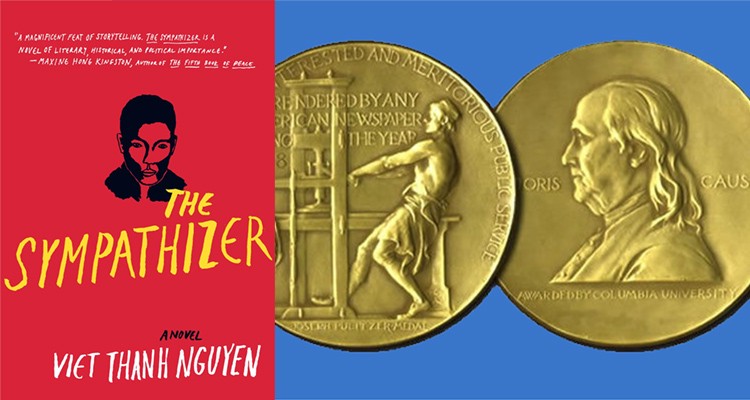
The Sympathizer by Viet Thanh Nguyen has won the 2016 Pulitzer Prize for Fiction, beating out such contenders as Hanya Yanagihara’s A Little Life, Lauren Groff’s Fates and Furies, Nell Zink’s Mislaid, and Paul Beatty’s The Sellout. The Sympathizer, which was published by Grove Press, “is the story of a man of two minds, someone whose political beliefs clash with his individual loyalties. In dialogue with but diametrically opposed to the narratives of the Vietnam War that have preceded it, this novel offers an important and unfamiliar new perspective on the war: that of a conflicted communist sympathizer.” The fiction jury was composed of Edward P. Jones, Art Winslow, and Leah Price.
The two finalists in fiction were Get in Trouble by Kelly Link and Maud’s Line by Margaret Verble.
This year was the 100th awarding of the Pulitzer Prizes, although a prize for fiction was not given out the first year. The first award for fiction went to Ernest Poole’s His Family in 1918.
Here are the winners for the other writing (non-journalism) categories:
Drama — Hamilton by Lin-Manuel Miranda
History — Custer’s Trials: A Life on the Frontier of a New America by T.J. Stiles (Alfred A. Knopf)
Biography — Barbarian Days: A Surfing Life by William Finnegan (Penguin Press)
Poetry — Ozone Journal by Peter Balakian (University of Chicago Press)
Nonfiction — Black Flags: The Rise of ISIS by Joby Warrick (Doubleday)
This mixtape is an instruction manual, How to Be a Deranged Cult Leader. My novel, Mr. Splitfoot, is two novels, fraternal twins. One is a walk through haunted places: the odd jewels of a backwater, the late Erie Canal or the verge of motherhood. The second exhumes the ghosts of American huckster faiths. In a fundamentalist group home, child con men talk to the dead. While writing Mr. Splitfoot, I built my own religion to understand how it’s done. I collected the things I love like outer space, geology, mountains, and vinyl records. I came up with the Etherists. Their holy texts sample the Bible, the Book of Mormon, a classic rock radio station at 2 AM in Troy, New York circa 1978 and Carl Sagan’s Cosmos. And while I like many things about the Etherists, their leader is a bad, bad man. Power corrupts, power corrodes a person’s insides. This mixtape examines that corruption. It is a soundtrack to carry one through each stage of creepy cult life.
1. Have You Never Been Mellow?, Olivia Newton John
The lyrics to this song could be printed in a recruitment brochure and your job would be done. “There was a time when I was in a hurry as you are. I was like you. I don’t mean to make you frown. I just want you to slow down.” But the part of this track that seals the deal (other than ONJ’s ethereal, hypnotic vocals) is the series of questions posed in the chorus, questions that any tired soul will be so grateful to hear asked. “Have you never been mellow? Have you never tried to find a comfort from inside? Have you never been happy just to hear your song? Have you never let someone else be strong?” While it’s unusual to acknowledge submission is beneficial, you, as a cult leader, might want to make it the first thing you say in the morning, the last words you whisper at night. Even if you don’t mean it.
2. Trafalgar, The Bee Gees
A song both triumphant and melancholy that says, without us, you are lost and here is brotherly harmony in the form of Barry, Maurice and Robin. “I need someone to know me and to show me” is the hole each potential cult member strives to fill, while the refrain, “Trafalgar, Trafalgar, please don’t let me down” focuses on a word that makes no sense to an American cult member and so can be used in a mantra-like way, in accordance with the best cult-building advice: keep it vague, keep it mysterious. Stop making sense. Trafalgar. Trafalgar. Trafalgar. Trafalgar. Trafalgar.
Brainwashing/Hypnosis
3. Love Letters, Ketty Lester
Nothing has the power to brainwash quite as effectively as love.
Nothing has the power to brainwash quite as effectively as love. Consider the teenage crush and attempt to harness this wild force. Ketty Lester, the most beautiful woman in the world, with a voice as powerful, will assist you. The repetition and modulation of doo wop is the essence of hypnosis and Lester casts a spell with the lyric, “I’ll memorize every line and I’ll kiss the name that you sign.” That’s witchcraft. That’s good. Here’s an idea: you could spend an entire day playing all the versions of this song for your new recruit/convert. They are many and various: Dick Haymes, Joni James, Cilla Black, Bobby Darin, Peggy Lee, Elvis Presley, Billy Thorpe and The Aztecs, Joe Walsh, Alison Moyet, Boz Scaggs, Frankie Miller, Ketty Lester. After that the new recruit will either be in love with you or will have gone insane, which might be just as effective.
4. Rocket Man, Elton John
As this is the period of induction and conversion for your followers, think in terms of electricity. Think scientifically or, even better, scientifical as, in a cult, it’s best to use words that only kind of make sense. John’s Rocket Man is well suited to welcome new members to your fold as it is both familiar and completely strange. The lyrics are creepy. We’re told he misses the Earth so much, yet, it’s going to be a long, long time before he returns. Why? “I’m not the man they think I am at home.” Then who are you? “All this science I don’t understand.” No, of course you don’t. Good thing I’m here.
Take Control
5. Oh, Daddy, Fleetwood Mac
Here’s where the power dynamic really shifts. Now’s the time to exploit your followers’ self-hatred. Everyone’s got some and your job is to turn it up. “Oh, Daddy. How can you love me? I don’t understand why?” Once you explain how you have special powers to love even people as lowly and underserving and lost as your followers, you can expect to hear Christie McVie’s refrain in response. “Why are you right when I’m so wrong? I’m so weak and you’re so strong.” I know, might be an appropriate answer.
6. Into the Night, Benny Mardones
This is also the time to begin planting ideas such as, God wants me to have a harem.
This is also the time to begin planting ideas such as, God wants me to have a harem. Really, that’s what God said and for this Benny Mardones could come in handy. “She’s just sixteen years old…but if I could fly I’d take you up, I’d take you into the night and show you love.” Which brings me to…
The Spiritual Honeymoon
7. Baby Give it Up, KC and the Sunshine Band
What works better than a pop-fueled dance track to convey the message, You are awesome! No one belongs here more than you! Just keep doing what you do (especially if that involves swallowing lots of drugs and signing over your bank account to me!) This song is pure affirmation. “Everybody wants you. Everybody wants your love.” And who can forget the mysterious album cover art? KC, in his bright blue jazz shoes, has caught a woman in his arms. While her shapely gams are exposed, her entire head is covered by a magenta scarf sending an important message, You can dance but try not to think too much.
Sex
8. Sex Planet, R. Kelly
Up next, freaky orgy. “Jupiter, Pluto, Venus and Saturn…I’ve got the control…once I enter your black hole…We’ll be gone for hours. I won’t stop until I give you meteor showers.” I appreciate how Kelly, like my cult in Mr. Splitfoot, exploits the mysteries of outer space in his pursuit of pleasure. Remember, followers like to feel they are doing something more important than just getting the leader off. They are on a mission.
Thorns
9. Walking on A Wire, Richard and Linda Thompson
Whether it’s selling roses by the side of the road or producing toxic gases in your chemistry lab, everyone must suffer for progress. Except you.
Linda Thompson is one of the reasons I wrote Mr. Splitfoot. I love her. She survived life in a cultish sect of mystical Sufis where all the food was prepared by women. She built a family and a career only to lose her voice as her marriage dissolved and she still has a great sense of humor and love. I am very interested in what it means for women to be silent. Cults are excellent places to study this and this song raise questions about the boundary of the self. So, now that you have followers, it’s time to put them to work. Whether it’s selling roses by the side of the road or producing toxic gases in your chemistry lab, everyone must suffer for progress. Except you. And this song’s lyrics, “This grindstone’s wearing me. Your claws are tearing me. Don’t use me endlessly,” could be helpful in realigning any followers who might wonder why they are doing all the work.
Disguising your income
10. Arab Money, Busta Rhymes
A perfectly confusing song for cult life. BR raps parts of the Qur’an. “Alhamdulillah” (all Praises to God) rhymes with: “My billions piling.” Could be a helpful piece when obscuring the source of your wealth, especially if you are, say, drugging your followers, removing their kidneys and selling the organs on the black market.
Spiritual Zombie/Divine Madness/Paranoia
11. Moon Maiden, Duke Ellington
Just Duke and a celeste. Duke’s vocal debut, on the occasion of the Apollo 11, is accompanied by an instrument that sounds like a fairy tale gone deeply dark and twisted. Just like you. So this is where things start to fall apart. Did you take too many drugs? Probably. And even if you didn’t, all this power-tripping has pickled your brain. Aliens are all around. No one can be trusted and there are girls on the moon. But, they might want to kill you.
12. Le Goudron, Brigitte Fontaine
Playing her records, you can pretend you are equally interested in hearing women’s voices speak, women’s thoughts, while the whole time you’re actually keeping dangerous female ideas trapped in a vinyl groove.
Really you should have been playing Fontaine’s records right from the start. She’s hypnotic and her lyrics only kind of make sense. “Time is a boat and the world is a cake.” Plus, she’s French anyway so likely no one will understand. Playing her records, you can pretend you are equally interested in hearing women’s voices speak, women’s thoughts, while the whole time you’re actually keeping dangerous female ideas trapped in a vinyl groove. This helps to convince your female cult members of their great value in your harem because who else is going to do all the cooking and cleaning? You? No, I didn’t think so and speaking of cooking…
Destruction
13. Cooking With Satan, Sun City Girls
The ATF is at your door or else you’re stirring up the cyanide Flavor-aid. It is important to invent an enemy so that your followers don’t realize the enemy is you.
The Ashes
14. Temps de Vivre, George Moustaki
15. Dream Baby Dream, Suicide
Years later when you are sitting alone in a Stewart’s convenience store, sipping fifty cent coffee and a microwaved hamburger, waiting for your sentencing hearing to begin, these songs will be playing on the satellite radio specifically tuned to crush what is left of your sorry, sorry soul.
About the Author
Samantha Hunt is the author of Mr. Splitfoot, a ghost story. Her novel, The Invention of Everything Else, won the Bard Fiction Prize and was a finalist for the Orange Prize. Her novel, The Seas, won a National Book Foundation award for writers under thirty-five. Hunt’s writing has been published in The New Yorker, The New York Times, McSweeney’s, A Public Space, Tin House, Cabinet, and a number of other fine publications.
With The Association of Small Bombs, Karan Mahajan succeeds in the difficult task of describing the immense, unbearable consequences of a terrorist act. The novel begins with a small bombing, it kills “only” about 50 people, at the Lajpat Nagar market in Delhi, in 1996. Mahajan’s prose is well-measured, his descriptions visceral and tactile, as he develops his story in short chapters that bring out the inner life of each character. In these characters’ humanity and fullness Mahajan displays his control of his craft, his artistry and brilliance.
Two of the people who die in the initial blast are Nakul and Tushar, 11 and 13, the sons of Vikas and Deepa Khurana. They go to the market to repair a TV with their friend Mansoor, who survives the blast, but suffers mentally and physically for years to come. The repair of a TV is a meaningless reason to die, which is among the first things we learn from this novel: all bombings are meaningless, except to the people that set them off. That must be why we are introduced to Shockie, the bomb maker, right after meeting the Khuranas and Mansoor’s family. Shockie has killed dozens of Indians in revenge for the military oppression of Kashmir, but we first encounter him when he is performing his pre-mission ritual of calling home to his sick mother.
Shockie’s character is as developed and human as any. He is full of anger and hate, but he has remorse for his actions when he gets to know some of his victims, and after his friend Malik is imprisoned for the mission he completed, he is plagued by guilt. Mahajan does not make it easy for his readers to apply to the perpetrators in his book any preconceived notions, instead he confronts us with their reasoning, their dreams and their friendships.
All though the terrorists in The Association of Small Bombs are well created and interesting, with motivations all grounded in political activism and not radical Islam (as one might expect), it is in the description of their victims that Mahajan truly devastates. The first thing that struck me about his writing is how brilliantly he describes the unexplainable experience of Vikas and Deepa’s loss. Their chapters are the most tender and relatable. The opening of the novel, “Blast,” immediately connects the reader to their story, and shows off Mahajan’s prose. Already on page five, we are placed in Vikas’ post bombing dream, where he becomes the bomb that killed his children:
The best way to describe what he felt would be to say that first he was blind, then he could see everything. This is what it felt like to be a bomb. You were coiled up, majestic with blackness, unaware that the universe outside you existed, and then a wire snapped and ripped open your eyelids all the way around and you had a vision of the world that was 360 degrees, and everything in your purview had been doomed by seeing.
Here, Mahajan describes the ruinous impact of the bomb through the eyes of the man it affected most of all. Choices like this one throughout the novel impressed me. Mahajan has an unfaltering ability to get at each event he describes from interesting, unexpected angles. The description of the bomb is also a great image for how the novel works. Like Vikas and the bomb, so do Mahajan’s readers experience the doom by seeing all angles and perspectives, everything that went into the act of the blast, and everything that came out of it.
As the book unfolds, we get to know young Mansoor as a timid, overprotected adult, who is finally safe from fear and terror when he arrives for his studies in California. Then 9/11 happens, and he immediately feels the impact of being a Muslim in a country that develops a sudden and all-consuming fear for his religion. Not to speak of the fact that Mansoor dreams of being a programmer, but during his time in America suffers a relapse to the pain he had in his wrists after the blast. He has carpal tunnel syndrome, which means he can never work with programming, and he returns home to find solace in the religion he didn’t practice much growing up, and a group of activist friends. Their group attempts to gain fair treatment of jailed Muslims, one of them Shockie’s friend, Malik, who is in prison for the bombing that Mansoor can blame for his suffering, and his recent return to India.
Mansoor has an impressionable nature, after having spent his childhood mostly “protected” in his parents’ house, dreading anything else that might happen to him out in the world. Therefore, it is no surprise that he seeks something to fill him with belief and meaning. Mahajan’s writing is sensitive and intelligent when he describes Mansoor’s new devoutness and engagement with politics. We are shown that this, arguably like most of what happens in the life of a young person, is more than anything about the friends he connects with and the community he finds. This realization makes Mansoor’s chapters all the more powerful and heartbreaking, the closer we get to the unavoidable tragic end of the novel. Finally, we understand just how fatalistic Mahajan’s story is; none of the victims of the small bomb at Lajpat Nagar will ever escape its consequences.
I’ve retreated to nonfiction and global literature to avoid the fate of leaving half-read books around my apartment. The title alone told me that Blackass was going to be irreverent and the fact that it was a satire sold me on the novel. This was a book that wasn’t going to be sanctimonious, but it would be serious. One of the the joys of reading world literature is that beyond the convention and obsessions of our own culture, we tap into a new perspective. Through it, we are exposed to different challenges that help us reframe the way in which we engage with our everyday frictions and larger societal issues. By erasing our ability to cozily make ourselves at home in the familiar postures and shorthand of a novel, are we opening ourselves up to the possibility of more incisive, thoughtful connections in the world?
In Blackass, no character is free from the engagement of escaping their prescribed lives. Some characters have more surreal exit strategies than others. On the morning of a crucial job interview, Furo Wariboko wakes up to find that he is no longer a black Nigerian. He’s confronted with a white body that alienates himself from himself, his family, and pretty much everyone he encounters. No one knows what to make of an oyibo, Nigerian slang for a white person, who speaks and acts with the fluency of a native black Nigerian.
Furo chafed under his father’s passive, unsuccessful career. His mother’s hard-earned success kept the family afloat and provided her two children with their education. Not only emasculated by living at home as an unemployed man in his thirties, Furo finds that he must turn to his savvy younger sister even for help with social media. He’s adrift and in search of an anchor. There is nothing cozy about the inertia he’s experiencing.
The condition of his status quo vanishes overnight. The morning that he wakes up as a white man, Furo flees his home, leaving behind his phone and all possessions to in order to sneak out, unnoticed. Even if he had managed to remember his wallet, he didn’t have any money and had planned to borrow some from his family in order to make it to the interview. Without thinking twice, he knows that he can’t expect his family to believe this white man is their Furo.
Despite these challenges, Furo still manages to charm his way into cash and a ride. And in spite of the stress of scrambling to make it to said interview, he was offered a different, better job with higher pay, a laptop, and company car. Within twenty-four hours of living as a white man, a series of absurd encounters leaves Furo with money in his pocket, a lucrative job, a new roof over his head, and, along with that new bed, an attractive, ambitious girlfriend. Why look back?
Unlike Kafka’s Gregor Samsa, Furo embraces his metamorphosis.
Meanwhile, Furo’s family struggles to make sense of his disappearance. As his parents mourn, his sister draws on her fluency in social media to cope. Through Twitter, her initial cries for help morph into the tweets of an outspoken self-marketer. Mastering the art of googling search engine optimization tips, she revels in her new followers, engages in Twitter feuds, and develops a new, assertive persona. While Furo could not be two people at once, his sister taps into the means of juggling various personalities. Barrett recognizes that what society can’t handle in person, it somehow accepts through the conduit of the internet. Twitter’s platform allows Tekena/@pweetychic_tk to make herself so visible that she attracts the attention of another transitional figure — Igoni, an author who meets Furo on the first day of his new life.
Complicating Barrett’s identity puzzle further, Igoni, who shares his name with the author but also refers to himself as Morpheus, transitions from living life a man to an existence as a woman. It’s through this new identity that she reaches out to Tekana/@pweetychic_tk over Twitter. Fascinated by a brief encounter with Furo, Igoni/Morpheus wants to follow the progress of a fellow traveler, treading between worlds.
While both Furo and Igoni transition into their new selves with incredible ease, the reader has to flip back to see when the switch occurs for Igoni/Morpheus. Her change is just that slippery. It feels problematic, even in a deliberately Kafkaesque novel, to move from one race or gender to another, but through this seamless transition, Barrett exposes the way in which life truly can be radically different in another skin.
Larger questions loom regarding the complications of adapting a different race or gender. How do we come to know our true selves? Would life be so different if we could simply swap out specific circumstances such as gender, race, class, religion, ethnicity, nationality? Is this the appeal of the internet: it’s ability to offer amnesty to those in need of community? What does it take for us to shake off the confines of various prescribed conditions? And in the end, where do we feel most “at home?”
In spite of the advantages he enjoys as a white man, Furo faces the skepticism of Nigerians who distrust the very details of his background. Through their inability to believe he is indeed a Nigerian, the ways in which one’s race determines one’s neighborhood, education, vernacular language, name, ethnicity, and sense of comfort with one’s self become excruciatingly clear. One begins to wonder: Is this a nightmare or a satirical look at the barriers built by racial difference?
Barrett’s fascination with social media begs another question: Can social media work to break through these barriers? Through Twitter, despite the fact that, throughout the course of the novel, she remains a Nigerian black woman, Tekana/@pweetychic_tk quickly acquires a powerful sense of agency. Through the experience of Furo’s new girlfriend Syreeta, the reader is keenly aware of the challenges inherent in being an independent woman in Lagos. Syreeta has a university education, but she is a kept woman relying upon a sugar daddy for her car, apartment, and income. Tekana/@pweetychic_tk represents a more mobile, fearless younger generation, eager to adapt and navigate independence on her own terms.
Absurdity provides Barrett with the ability to tease out these fraught issues across a tangled and loaded landscape. My frustration with the humorless novels I’d been reading may not be that their seriousness lacks amusement. Rather than accepting realism in fiction as a means of empathizing with the world, I’ve been aching for the higher stakes and more rigorous engagement with social issues that find a more fertile home in satirical, surreal fiction.
Barrett’s frenetic plot and pacing takes his characters to uncomfortable places that seem unbelievable and yet, in the moment of this novel, feel entirely plausible. When faced with the question of abandoning his personal history and family for his new life, Furo makes what seems like a shocking decision. For better or worse, his call speaks to the world we live in. Sometimes it’s only through the looking glass that we can honestly see the true extent of the damage inflicted by the world we live in.
Click here to read an excerpt from Blackass as part of Electric Literature’s Recommended Reading. Also, click here to read about A. Igoni Barrett’s writing life in Nigeria, part of Electric Literature’s series, The Writing Life Around the World.
DON’T MISS OUT
Sign up for our newsletter to get submission announcements and stay on top of our best work.
YOUR INBOX IS LIT
Enjoy absorbing fiction from Recommended Reading on Mondays, strange, diverting work from The Commuter on Wednesdays, and a roundup of our best work of the week on Fridays. Personalize your subscription preferences here.