On a cool spring day, in the midst of a half-hearted organizational venture through the citadel of cardboard boxes in my mother’s basement, I watch my brother unearth a 1999 Sony Discman. It’s mine, of course — or it was, once. I haven’t seen or thought of it since at least 2005, but I’m stunned by the clarity with which I can recall the texture of its buttons; the thwap of the clamshell lid dropping into place; the buzz of the gears; the Nero-days terror of not knowing whether the display would flash the digital timer, or that soul-crushing admonition: NO DISC. I’m pretty sure I could easily have gone the rest of my life without revisiting whatever sensory archive has just flown open, and I don’t know whether to feel grateful for my brother’s find. He’s examining the Discman gravely.
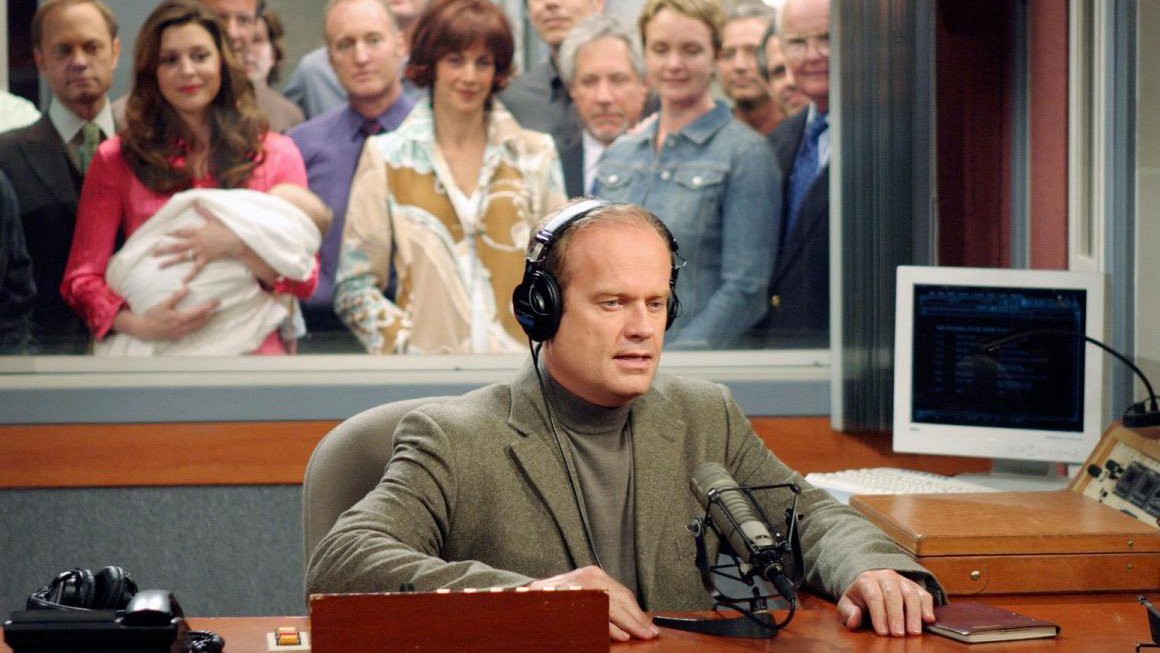
At fifteen, my brother is a walking affirmation of his Slavic heritage: six-two, well on his way to a goatee, so broad-shouldered and self-possessed and devoid of gangly teenaged awkwardness that his refusal to accept congratulatory pints at my wedding last year stupefied the bartender. From the other room, a familiar laugh track has reached the kind of pitch that indicates Niles Crane is talking, a reminder of my only condition for helping with my brother’s chores: that I be allowed to work as I do at home, with Frasier in the background. I’ve told myself that I’m doing this partly for the satisfaction of irritating a teenager who thinks he’s too cool; but that’s not true. I love Frasier, and I want him to love it, too, though I suspect he’s a good few years from being able to. He’s been a good sport about it so far. He thinks the curmudgeonly dad and the little dog are funny enough. He chuckles every once in a while, but his sufferance has done little to hide that he considers it a show for old people. Now, he holds up the Discman and says, “what’s this?”
I want to tell him that I probably smuggled it into the hospital the day he was born to remedy the solitude of the waiting room.
Before I answer, before I’ve even held out my hand, I am thinking of the irretrievable: the fragility of all those homemade mixes, labored over by lamplight, shattered in moving boxes. Or the VHS tape chronicling four years of college ballroom performances, obliterated by the premature declaration that I’d checked my TV/VCR two-in-one, and yes it was ready for the yard sale. And what about all those yards of waterlogged tape, that video of my brother in his first walker, awestruck by the huge, pink bubblegum orbs I’m inflating for him? I know that video is real, I remember it — but he’s never seen it, so he’ll never have any sense of this moment we shared when he was too small to stand.
I dole out some absolute diamond of sisterly wisdom: “You see, you belong to an era wherein the mere jolt of memory can prompt physical retrieval: all the pictures and songs of your youth are there, somewhere, in a perpetually accessible space that obliterates the need for reliquaries.”
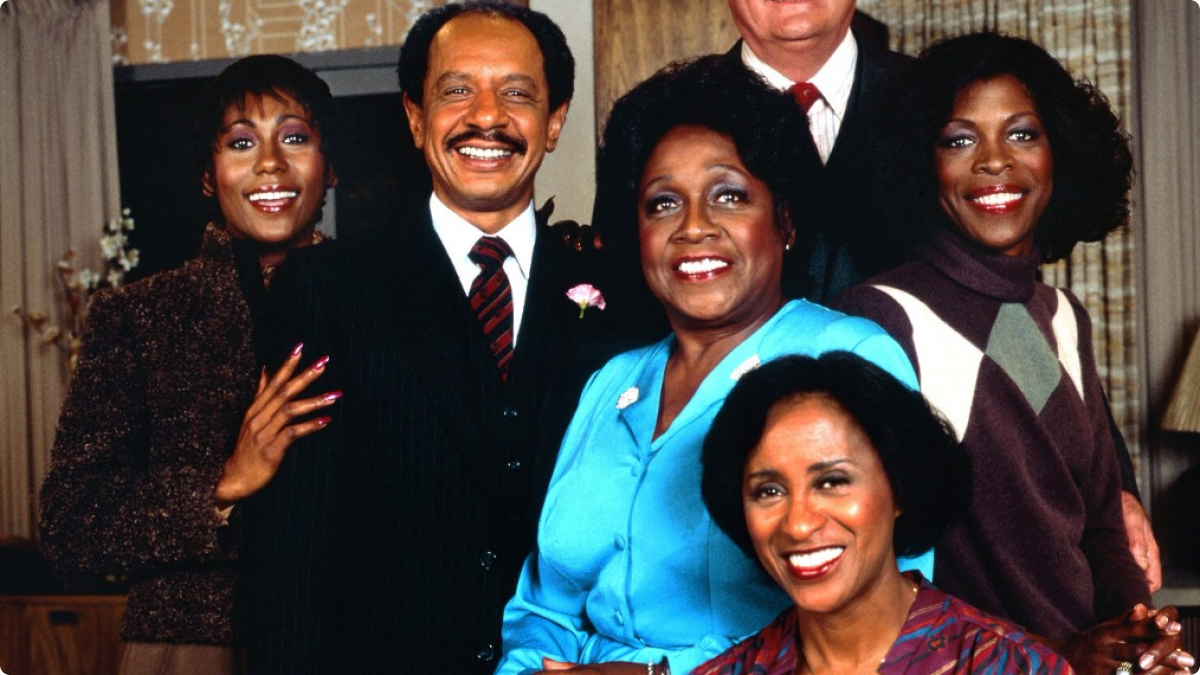
I want him to understand that, when these things went missing in my day, their disappearance was absolute. Only now it’s a lecture about his generation; now, it’s worse than making him watch Frasier. “But no, not really,” I want to say, “it’s actually just like that time on Frasier” — which is something loved ones hear from me often. And it’s true, it is just like that time Frasier can’t celebrate his 200th show on KACL because Daphne has ruined the irreplaceable tape of June 14th 1996’s show — or rather, Daphne’s new boom box has ruined it — and Daphne’s ruse to replace the tape with The Best of Hall and Oates has failed, taking with it the possibility of his ever having a complete collection of The Doctor Frasier Crane Show. “Oh, all his crap is treasured!” Martin says, and I laugh every time, because I know how the episode ends — but I feel for him. Frasier is gutted by the disappearance of something he admits to Niles he probably never intends to replay, because he couldn’t now, even if he wanted to.
In Patrick McCabe’s dark phantasmagoria set in early 60s small-town Ireland The Butcher Boy, probably the most pitch-black Irish “comedy” you’re ever likely to read, the young, psychologically disturbed protagonist, Francie Brady, becomes somewhat obsessed with an outdated songbook owned by his father — a former trumpet player who drank his talent away — entitled Emerald Gems of Ireland. For Francie, neglected by his father, ridiculed by his rubbernecking neighbors and teetering on the edge of full-blown madness, these “emerald gems” are the treasured relics of an imagined past: a bucolic idyll still peopled by square-jawed revolutionaries and sober romantics, what Taoiseach (Prime Minister) Éamon de Valera, the High King of Gaelic Catholic fantasy, referred to in his 1943 St. Patrick’s Day radio address as “the Ireland that we dreamed of.” An Ireland long gone, if it ever really existed in the first place.
Thankfully then, in celebration of St. Patrick’s Day, we’re looking not to Emerald gems — the rose-tinted fool’s gold of Ireland’s wilderness years — but to hidden ones. More specifically, those works of Irish literature that may not have the global name recognition of, say, Ulysses or Dorian Grey, The Commitments or Brooklyn, but which have nevertheless made an indelible mark on the landscape of the country’s fiction.
Before we begin, a few ground rules:
— Nothing published in the last five years; poking out from underneath a thin layer of topsoil doesn’t count as hidden, according to the arbitrary rules I am making up as I go.
— If the book has been adapted into a feature length film seen by at least one non-Irish person, sorry but you (yes, you, newly anthropomorphized book) are also excused from duty (the court wishes to thank the aforementioned The Butcher Boy, as well as Breakfast on Pluto, Cal, The Dead, Darby O’Gill and the Little People, and, of course, the source material for the 2007 Gerard Butler-helmed tour de force: P.S. I Love You).
— The books must be, in some way, shape or form, about Ireland. It’s not sufficient to merely be an Irish author; if the work in question is set in an objectively less important place, like America or the UK or outer space or the afterlife, then the author is a traitor who thinks he’s too good for the old sod and his book is not getting near my list (I’m looking at you, Dracula).
All that firmly in mind, here, in no particular order, are my ten hidden gems of Irish literature:
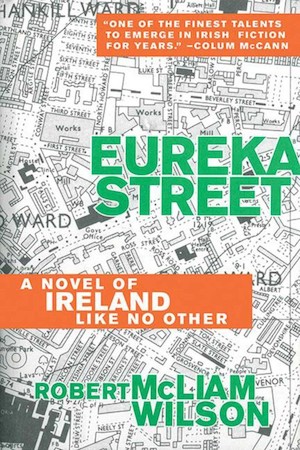
Set in 1990’s Belfast, amid peace negotiations and the prospect of a ceasefire, Eureka Street is a sometimes madcap, often biting and consistently hilarious story of two working-class Belfast friends — one Protestant and one Catholic — trying to find love and stability in their bomb-scarred city.
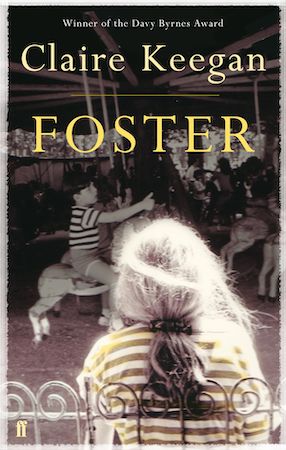
Keegan’s superb short story collections, Antarctica (1999) and Walk the Blue Fields (2007) are well worth tracking down, but for those of you looking for a lazier route into the author’s best work, Foster, a quietly powerful 88-page story about a young girl sent away from her dysfunctional home to live with a kindly older couple in County Wexford, published as a stand-alone book by Faber in 2010 and condensed to publishable length in The New Yorker, is the place to start.
An Béal Bocht(The Poor Mouth) by Myles na gCopaleen (Flann O’Brien)
Flann O’Brien is perhaps the preeminent Irish satirist of the 20thcentury, albeit one who had the misfortune to be plying his trade during one of the most depressingly stagnant, conservative and deadening artistic climates in the history of the Irish state. Written in Irish in 1941, under O’Brien’s newspaper column pseudonym Myles na gCopaleen (Myles of the Little Horses), An Béal Bocht — a parody of the misery lit Gaeltacht memoirs which were a cornerstone of the Irish language school syllabus — recounts the adventures of Bonaparte O’Coonassa, a native of one of these west of Ireland regions where abject poverty and the “sky crucifyings” of constant rain are the order of the day, every day.
McCann’s first book of short stories— depicting protagonists old and young, straight and gay, anchored to home and far-flung —deservedly put him on the map back in 1994. Two magical realist tales in particular, “Cathal’s Lake” (in which the souls of victims killed in Northern Ireland are reborn as swans, unearthed from the ground by a stoic farmer) and the collection’s title story (26 middle-aged women line up on the water’s edge of a dying midlands town to fish for their emigrated sons) are as haunting and poetic a response to two of Ireland’s most debilitating socio-political issues as you’ll find in contemporary literature.
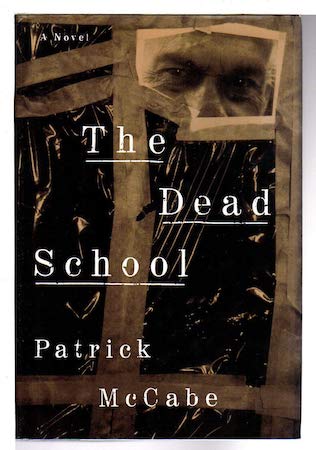
Not one for the faint of heart, McCabe’s 1995 novel about the intertwining careers, and psychological breakdowns, of a young, ill-equipped school teacher and his pious, Old Ireland boss at a prestigious Dublin boarding school is a classic of the “Bog Gothic” subgenre (in itself pretty much created by McCabe). Children drown, people hang, muscular Catholicism crumbles and ghost pupils abound.
Though perhaps less well-known on this side of the Atlantic, Ní Dhuibhne, who received the Irish PEN Award for outstanding contribution to literature last year, is one of Ireland’s great short story writers. Her work often marries Celtic folklore with a subtle, probing insight into the lives of contemporary Irish women and nowhere is this better illustrated than in the title story of this collection, in which a disillusioned young midwife is called out, late at night, to assist in the birth of an unwanted child.
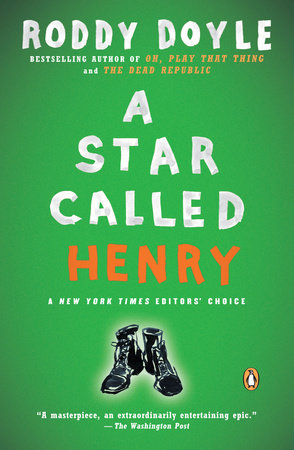
In contrast to some of the bleaker entries on this list, the first installment in Doyle’s “Last Roundup” trilogy — following the life and travails of young Dubliner Henry Smart as he flees from Ireland to America and back again over the course of the 20thcentury, interacting with historical titans along the way — is a warm, comic joy, as well as a stained glass window into the Irish Republic’s revolutionary beginnings. Henry escapes the Dublin tenements, leads guerrilla battalions in the War of Independence, wrestles with Michael Collins and elopes with a feisty schoolteacher, all before his twenty-first birthday.
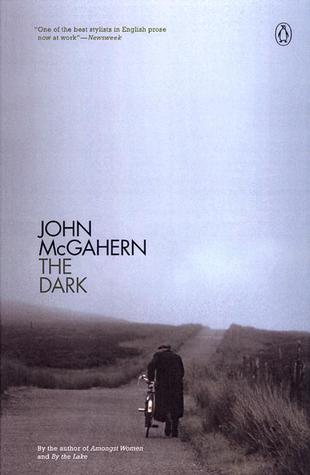
Before his death in 2006, McGahern was hailed by many as “the greatest living Irish novelist.” In quiet, restrained prose his novels and short stories explore the constricting nature of post-independence rural Ireland, and the younger generation’s desire to break free from its shackles. Though 1990’s Amongst Women is considered his masterpiece, The Dark — a bleak coming-of-age story about the consequences of parental and clerical child abuse — is perhaps his most painful, emotionally charged work. Not only was the novel banned in Ireland in 1965 for its “obscene and indecent” content, but McGahern was also fired from his Catholic school teaching job because of it.
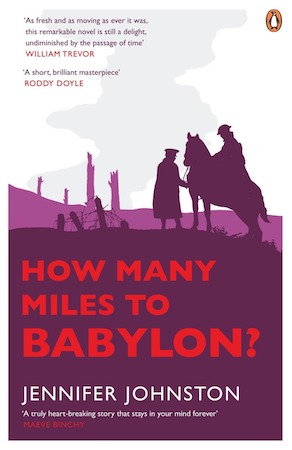
Short, lyrical and devastating, Johnston’s 1974 novel about two young Irish men from markedly different class backgrounds, brought together by their shared passion for horses but forced to conduct their adolescent friendship in secret before being divided once again, this time by rank, in the anarchic hellscape of the first World War.
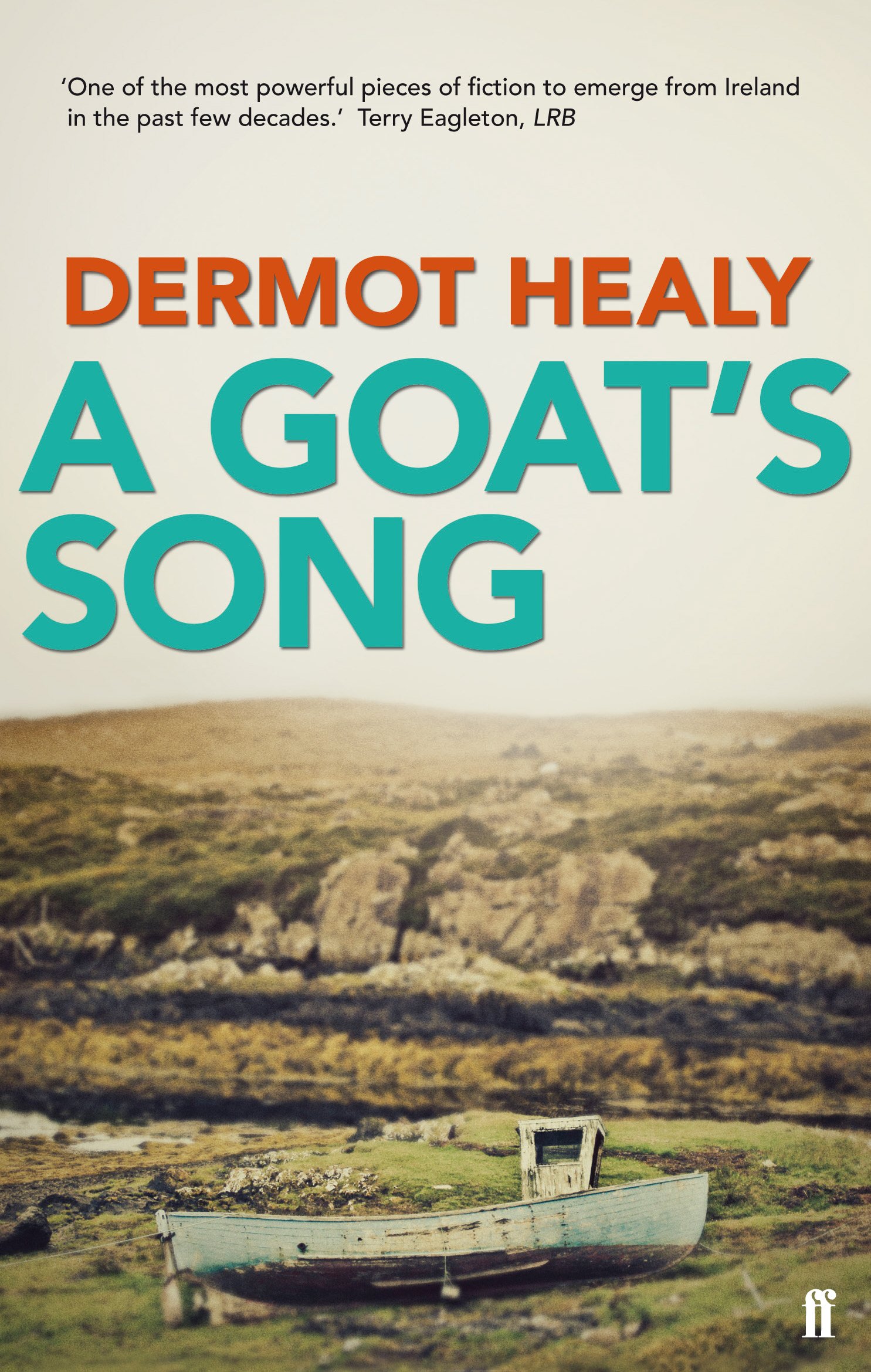
Making a strong case for the most overlooked, under-appreciated writer on this list, both at home and abroad, Dermot Healy began his writing career as a sort of vagabond, living a nomadic emigrant’s life in London for 15 years before his first book was published in 1982. To say that his 1994 existential opus A Goat’s Song is ambitious in scope would be a pretty significant understatement. Ostensibly the story of a doomed love affair, the novel is also about the violence of the Troubles in Northern Ireland, the myths of the rural West, Ireland’s religious divisions, the weight of lineage and the ache of the outsider. There’s a lot going on, but it’s well worth the investment.
Electric Literature is pleased to announce we are appointing Halimah Marcus as our first Executive Director. Halimah began at Electric Literature in 2010 as a volunteer, and has since become a leader in our organization. She was integral in launching our critically acclaimed weekly fiction magazine, Recommended Reading, and establishing Electric Literature as a successful arts non-profit.
“I’m looking forward to making bold new strides to present literature as a public art form, and firmly establishing its place in the popular conversation,” says Halimah.
Halimah will continue as Editor-in-Chief of Recommended Reading, which published a special four-part 200th issue this week, with sitcom-inspired fiction from J. Robert Lennon, Téa Obreht, Rob McCleary, and Morgan Parker.
The full press release is below.
For Immediate Release CONTACT: editors@electricliterature.com
Electric Literature Appoints Halimah Marcus as Executive Director
New York, NY (March 16, 2016): The Board of Directors of Electric Literature has appointed Halimah Marcus to be the first Executive Director of the organization, whose mission is to use digital innovation to keep literature a vital part of popular culture.
Since launching in 2009, Electric Literature has established a reputation as a digital innovator, having created the first literary magazine mobile app and pioneered a publishing model that is widely used today. Their ability to embrace new technologies and quickly adapt to the changing publishing landscape has earned them a large and devoted readership, including a strong and growing social media presence.
“Halimah has been essential to our organization as we’ve grown and flourished over the past six years,” said Andy Hunter, Electric Literature’s founder and board chairman. “She’s a brilliant writer and editor, an innovative thinker, and the perfect person to lead Electric Literature into the future.”
Electric Literature operates electricliterature.com, a daily destination for book lovers with more than 4 million visitors in 2015, and two weekly literary magazines: Okey-Panky, which publishes brief, strange writings, and Recommended Reading, which presents fiction with personal recommendations by top writers and editors. Electric Literature also hosts free public events throughout the year and has commissioned and distributed several multimedia pieces such as apps, art installations, annotated fiction, and twitter fiction.
The appointment of an Executive Director marks Electric Literature’s commitment to their mission and to growth as a non-profit. “At Electric Literature, we believe literature should be accessible to everyone, which is why we are so proud of our large and engaged audience,” said Halimah Marcus. “I’m looking forward to making bold new strides to present literature as a public art form, and firmly establishing its place in the popular conversation.”
Halimah Marcus joined Electric Literature in 2010 as a volunteer, and was quickly hired as Managing Editor. In 2012 she was integral in launching Recommended Reading, which has over 116,000 subscribers, later becoming its Editor-in-Chief. Today, Recommended Reading publishes its 200th issue, which can be found here, and Marcus will continue to serve as Editor-in-Chief. Recommended Reading has published critically acclaimed, prize-winning authors such as Jim Shepard, Charles Yu, James Hannaham, A.M. Homes, and Ben Marcus, alongside hundreds of debut and emerging writers, and has featured recommendations from literary luminaries such as Hari Kunzru, Chinelo Okparanta, Karen Russell, Michael Cunningham, Jennifer Egan, and Kelly Link.
In 2014 Marcus spearheaded Electric Literature’s transition to a non-profit, and has since secured support from the National Endowment for the Arts, the New York State Council on the Arts, and the Amazon Literary Partnership. Before joining Electric Literature, Marcus worked in programming and development for the Free Library of Philadelphia Foundation and the community radio non-profit The Prometheus Radio Project.
Electric Literature has grown significantly in the past two years, quadrupling its audience, launching a second weekly magazine, Okey-Panky, and an original series which features international authors writing about their home cities, “The Writing Life Around the World”.
“Halimah Marcus is one of the finest fiction editors I’ve had the pleasure of working with, and she’s proved an exemplary colleague under the EL umbrella as well,” said J. Robert Lennon, a novelist and the Editor-in-Chief of Okey-Panky. “No one is more qualified to sail this ship than she is.”
Original Poetry for “The 200 Episode Club” by Morgan Parker
Privilege is asking other people to look at you. I like everything in my apartment except me. What is the point of something that only does one thing. I mean I need to buy a toaster. My life is a kind of reality. When I get bored, I close the window. By the way what is a yuppie. Here I am, two landscapes. My tattoo artist says I’m a warrior with pain. I tell her we can manifest this new moon in six months. When I’m rich I will still be Black. You can’t take the girl out of the ghetto ever. It’s too much to ask to be satisfied. Of course I sing through the struggle. My problem is I’m too glamorous to be seen. How will I know when I’ve made it. In the mirror will I have a face. How long does a good thing last. Sometimes eating a guilty salad I become a wife. Let me be the woman who takes care of you. Weezy and George in drapes and crystal silverware. By the way predominantly white means white. I want to be the first Black woman to live her life exclusively from the bathtub. Making toast, enjoying success despite my cultural and systemic setbacks. I was raised to be a nigger you can trust. I was raised to be better than my parents. In a small house with a swamp cooler I touched myself. I wanted to be in the white mom’s carpool. My cheek against something new and clean. I clean my apartment when I am afraid of being the only noise. Everyone I know is a Black man. Me I’m a Black man too. Tragically, I win. It is a joke. I always require explanation: Life, Dope. I am so lucky to be you. When something dies, I buy a new one.
“In early use an exile was a banished man, a wanderer or roamer: exul.”
As I stroll under a canopy of trees on a wide clean path that leads to the rocky shores of the Trail of Tears river crossing in Chattanooga, I listen for the Native American ghosts, exiled. I want to hear the wind wail. I want to hear the leaves crying. I want to be haunted by their eternal longing for home.
The exile waits to return, sometimes forever. McCarthy writes, “This condition of waiting means that the exile’s whole being is concentrated on the land he left behind, in memories and hopes.” Yet, for the Cherokee tribes forced onto the Trail of Tears from Ross’ Landing in Chattanooga in 1838, there is no “there” to return to, for their home has been erased.
“But in recent times it is worth noticing, a new word, ‘refugee’ describes a person fleeing from persecution because of his category.”
These are some of Chattanooga’s refugees: an elderly Cuban man I drive to the clinic because his knee hurts and his blood pressure is high; a young woman from Columbia, hair still wet from her shower, I drive to the woman’s clinic for her annual exam, a silent woman from Somalia, buried in layers of sweaters and scarves, who looks as if she is sixty, but whose refugee card states her date of birth as five years before mine; an ambitious Iraqi Kurd, who I drive to take his GED so he can begin college classes; another young man, a Sudanese, who wants to resume his career as a pharmacist.
These refugees have one thing in common: they fled their countries because their lives were in danger.
“The exile is a singular, whereas refugees tend to be thought of in mass.”
The artist as exile represents a significant contribution to the Western literary canon, starting with Dante and Ovid and continuing with writers such as Vladimir Nabokov, Herta Muller, Milan Kundera, and James Baldwin. In Portrait of an Artist as a Young Man, James Joyce writes that the three conditions for an artist are “silence, exile, and cunning.” Joyce himself chose a self-imposed exile from Ireland because he believed his own country would stifle his work.
Joyce himself chose a self-imposed exile from Ireland because he believed his own country would stifle his work.
Czeslaw Milosz, the Nobel Prize winning poet, considers the personal exile of an artist like himself, who emigrated from Poland to the US in 1960. In his essay, “Notes on Exile,” he writes, “Exile accepted as destiny, in the way we accept an incurable illness, should help us see through our self-delusions.” In this sense, exile is a type of destiny, because one’s personal life is dependent on larger historical forces. Yet, being separated from one’s culture presents its own problems. As Milosz says, “Now where he lives he is free to speak but nobody listens, and moreover, he forgot what he had to say.”
“An expatriate is almost the reverse. His main aim is never to go back to his native land, or failing that, to stay away as long as possible. His departure is wholly voluntary.”
In contrast to exiles who are unwillingly separated from their culture, expatriates often want to flee theirs. Now more than forty years after McCarthy’s 1972 essay was published, the term expatriate sounds distastefully antiquated and colonialist. Today, as people voluntarily between and among countries and whose values connect them to ways of living rather than nation states’ terms more often call themselves transnationals, global citizens, and third cultures than expatriates. Even in the 1960s, Baldwin, who spent much of his adult life in France, referred to himself not as an expatriate or an exile, but a “transatlantic commuter.”
Today, as people voluntarily between and among countries and whose values connect them to ways of living rather than nation states’ terms more often call themselves transnationals, global citizens, and third cultures than expatriates.
When I moved to South Korea in 1995, I half-consciously had some romantic notions of being an expatriate writer living in self-imposed exile in order to write. My plan to live there for a year turned into twelve, and this changed the course of my life in ways I could not have imagined. Before I moved to South Korea, I was 31, married, and working as a technical writer, living in Arlington, Virginia with my husband, who had a solid job at Georgetown Library. Life was good enough, and our next logical moves were to buy a house and have a child or two and raise a family. The problem was, I’d grown up in Fairfax, Virginia, and hated these very suburbs I was about to commit my future to. For many people, the suburbs are a place of comfort, stability, and, if they are lucky, community. I found them stifling, alienating, and oppressive. If I’d kept my respectable job and bought a house in the suburbs, I’m sure my feelings would not have diminished. I would have lived one of those lives of Thoreau’s “quiet desperation.” I felt that quiet desperation already beginning to fall on me, heavy and inevitable. Only some radical changes — our decision to not have children and to live abroad instead — threw me off that looming trajectory.
That first year in Daegu, South Korea, was not one of glorious expatriation or creativity. The Confucian culture was too different from mine, and I missed many material comforts of home, which seemed superficial but were so much a part of my life: live music and art museums and decent wine and cheese. Popcorn. Before I left for South Korea, I was taking advantage of the cultural benefits of living in the DC area. For the two years before we moved to Korea, I was at one Smithsonian museum or another almost every weekend, catching a new art opening or historical exhibit. I went to Ethiopian restaurants and French bistros and coffee-shop/bookstores and drank microbrews. I went to wine tastings and outdoor concerts and dive bars and music clubs that no longer exist.
That life disappeared when I moved to South Korea in 1995. Instead, I ate Korean food and tried to teach a difficult language to a people who had just emerged from decades of poverty and dictatorship. I drank instant coffee and watched bad Hollywood movies on our VCR and drank watery beer and listened to the same music from a dozen CDs and mixed tapes. I searched for beauty and rarely found it that first year — I saw dirt and concrete and shorn trees and shabbiness. I smelled sewage and kimchi and garlic thick in summer heat. I did not love Korea, and I reluctantly missed home.
I searched for beauty and rarely found it that first year — I saw dirt and concrete and shorn trees and shabbiness.
That first year was long and exhausting, and I counted the days until we could return to the States. But then, a fellow American suggested I apply for a university job in Korea. I would work fewer hours, get more pay, and have long paid vacations in the summer and winter. I would have time to write and travel, things I wouldn’t have if I began working again in the States. I got a job at a university in Ansan, and my husband and I agreed to stick it out for another year.
After that first year, I took a few trips around Korea and in Asia, and I began to see the beauty I’d looked for that had always been in front of me. Persimmons growing on trees, flames of red leaves lining the streets, the traditional songs like some kind of ancient blues, the serenity of the temples, the smell of meat grilling, of incense. The wonder of walking to work, of getting around a country without a car. And when I went back to the States to visit, I saw some of the ugliness there — the myopic, insular conversations, the solipsism, the commercials on TV aimed at every kind of imagined ailment begging viewers to call their doctor and ask if brand x is right for you. I saw the larger and larger houses and wondered why people would want to live in them. I saw everyone driving into work, chained to desultory desk jobs.
I began to see the beauty I’d looked for that had always been in front of me.
The US was a country with faults, like many others. It was not the best place to live in the world, nor the worst. I loved my visits, but I was happy to get back to my two-room apartment with its heated floors and ovenless kitchen and my earnest, sweet students. Even more, I was eager for my next month-long trip to Mongolia or Burma or Indonesia.
One of Chattanooga’s most famous expatriates in exile is Bessie Smith, who left Chattanooga to join a showbiz troop as a singer in 1912, and never looked back. Just as Baldwin had to leave America to thrive, Smith, who lived in poverty in segregated Chattanooga, had to leave the small, restrictive town to become one of the most revered (and wealthiest) blues singers of all time. In some ways Smith helped Baldwin finish Go Tell It On The Mountain, which he wrote as an expatriate in exile. In a Paris Review interview, Baldwin says of writing the novel,
After ten years of carrying that book around, I finally finished it in Switzerland in three months. I remember playing Bessie Smith all the time while I was in the mountains, and playing her till I fell asleep.
For writers like Baldwin, a gay African American in post-World War II America, leaving or staying in the US was to him choosing between life and death. After he witnessed his friends either going to jail or committing suicide, Baldwin realized he could not become “a man” if he stayed.
In my case, I think my exile saved my life, for it inexorably confirmed something which Americans appear to have great difficulty accepting. Which is, simply, this: a man is not a man until he is able and willing to accept his own vision of the world, no matter how radically this vision departs from others.
Leaving the States did not save my life as it did Baldwin’s, but in a way it gave me one. I guess I should consider my twelve years in Korea as more of a time of voluntary expatriation rather than chosen exile. I was not escaping anything specific, but felt more that I was running toward something — a larger way of seeing the world and myself. Not so much a place, but toward a space that allowed me to expand my own vision, as a writer and as a human. What living abroad did for me was allow me to live as an outsider and to see the world, forever, in broader terms. It saved me from despair.
Frances Cannon recently put Etgar Keret’s shortest story ever, “Asthma,” into graphic form, and we have the fantastic results for you here, courtesy of the author and the artist. Enjoy.
About the Story: “Asthma” first appeared in Etgar Keret’s collection,The Girl on the Fridge.
About the Illustrator: Frances Cannon is a writer and artist currently pursuing a master’s degree in nonfiction and book arts at the Iowa Writer’s Workshop, teaching literature and creative writing, and working as an editorial assistant to The Iowa Review. She was born in Utah and since then has bounced around living, making artwork, and writing, in Oregon, Maine, Montana, Vermont, California, France, Italy, and Guatemala. She received her bachelor’s in poetry and printmaking at the University of Vermont, where she self-published several chapbooks of silkscreened prints and poems. She has also worked as an editorial intern and contributor at McSweeney’s quarterly, The Believer, and The Lucky Peach. She has recently been published in Vice, The Examined Life Journal, Edible magazine, and Vol. 1 Brooklyn.
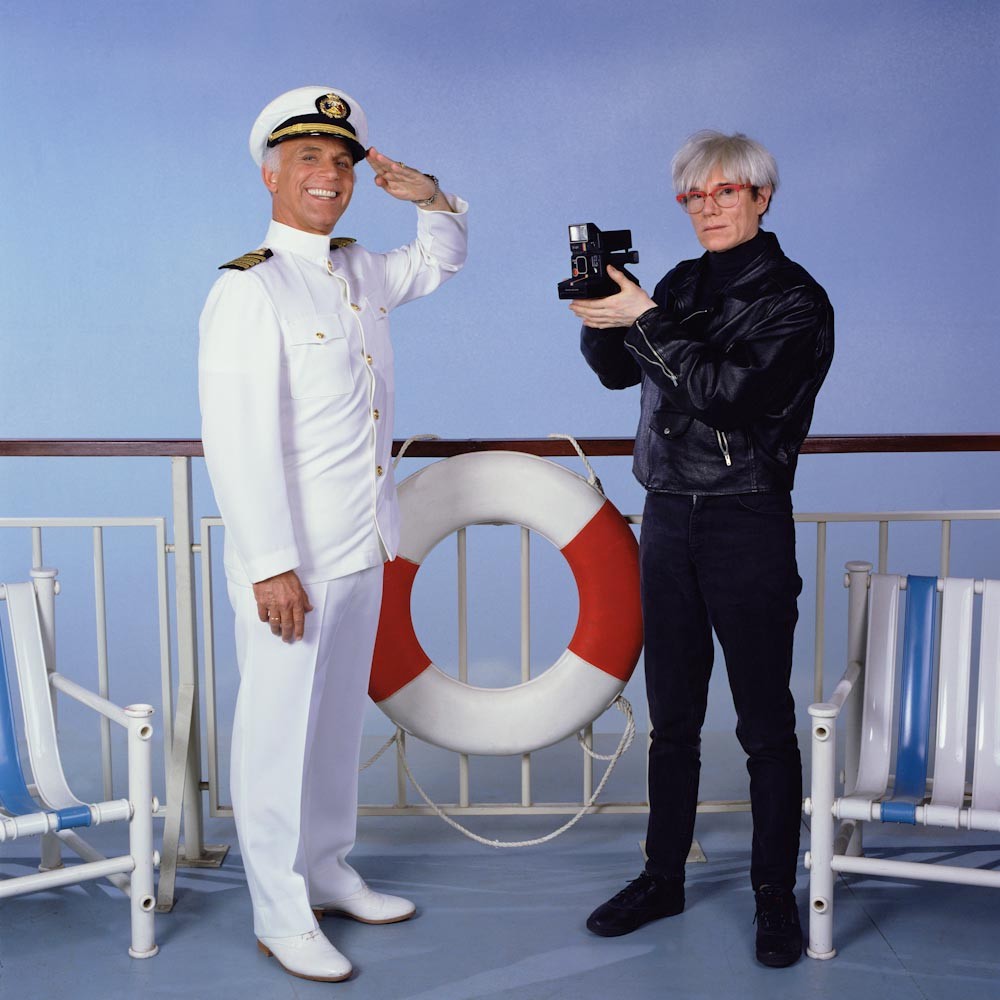
Lana Turner dumps Frank Sinatra then Ava Gardner dumps Frank Sinatra then Mia Farrow dumps Frank Sinatra so Frank sits at home watching Lana Turner on the 200th episode of The Love Boat with the sound turned off snarling the incandescent rage that is the home field advantage of the late-stage alcoholic.
The records no longer sell.
Frank Sinatra does not know why the Frank Sinatra records do not sell.
He rises unsteadily from the tattered recliner on skinny, old man legs. Bright yellow, old man pee spots the front of his tighty-whities.
Frank Sinatra does not know why the Frank Sinatra records no longer sell. Frank Sinatra cannot fathom why Lana Turner is on the 200th episode of The Love Boat. Frank Sinatra is not even sure what the fuck “The Love Boat” even is.
Or what the fuck “Menudo” is.
Frank Sinatra knows one undeniable fact: Lana Turner and Menudo are on the 200th episode of The Love Boat, and Frank Sinatra is not. He flails his skinny old man arms, knocking over the lamp and plunging the room into darkness, and his soul into a Dostoevsky midnight.
Frank Sinatra has collapsed.
With his appearance on the 200th episode of The Love Boat Andy Warhol’s life is now a closed circle. A fact he does not understand consciously, but with the unwavering intuition of the true artist.
That’s him on the gangplank. A two shot with his first true love, Blotted Line (Candy Darling in an ill-fitting and hastily made costume of styrofoam and pasteboard). Warhol accepts the parameters of this reality: a small, angry lesbian with a .32 has been released into the labyrinth interior of the Pacific Princess.
Andy Warhol has had it with the flunkies at The Factory.
The itchy fright wig.
Silk screening Mick Jagger.
Andy Warhol has had enough. A touching scene where Blotted Line begs him not to go out into the ship.
Silk screening Mick fucking Jagger.
Andy Warhol has had enough of life. Andy Warhol has had enough of Andy Warhol.
Valerie Solanas finds him in the strange nightclub where Menudo performs before a packed crowd of predatory pedophiles and Lana Turner. Menudo, rehearsed and drilled to the point of dissociation by their manager, barely flinch when the shots rings out. Andy has been begging Lana Turner to let him make a silk screen of her. He is shot through both lungs, spleen, and liver, collapsing in an enormous pool of blood. Lana Turner sees the enormous pool of blood and swoons. Andy Warhol changes the channel. Now he is Andrew Warhola, the frightened boy from Pennsylvania, and this is his greatest work.
Lana Turner has been to lots of parties. And acted perfectly disgraceful. But she has never collapsed.
On the 200th episode of The Love Boat, Lana Turner collapses.
The 200th episode of The Love Boat has taken Captain Stubing to a bad place. He has been drinking heavily since the day they put out of port.
Flashbacks.
Nightmares.
Captain Stubing hasn’t spent his entire fucking life on the fucking Love Boat. Captain Stubing has been in the shit. Captain Stubing has hosed what’s left of his buddies off carrier decks. For 199 episodes he has hoped to become famous for a mysterious vacancy. But the fucking white shorts, white knee socks, and white shoes have killed the dream. No one ever becomes famous for a mysterious vacancy in white shorts, white knee socks, and white shoes.
“My life is a final chapter no one reads because the plot is over,” he announces over the p.a. system, his wracking sobs a maudlin echo down the hallways and decks. The hallways are empty. The .32 toting lesbian still at large. Still angry. The All You Can Eat Seafood Buffet is untouched. The whirlpool unused.
Frank Sinatra has collapsed.
Andy Warhol has collapsed.
Lana Turner has collapsed.
Captain Stubing has collapsed. Oh Captain Stubing we love you get up.
I will only tell you that it’s a small bet with myself, with my convictions. I believe that books, once they are written, have no need of their authors. If they have something to say, they will sooner or later find readers; if not, they won’t.
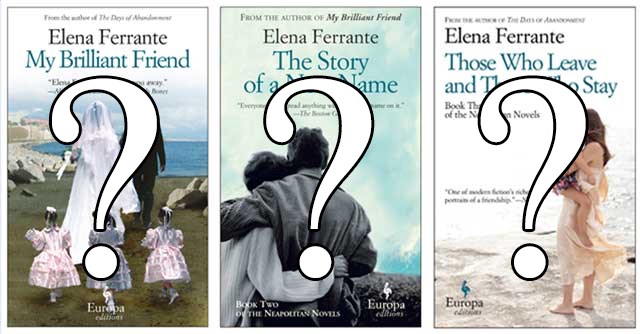
Of course, Ferrante’s own desires matter little to fans and critics who have tossed out different theories of her true identity for years. The latest literary Sherlock is the Italian professor Marco Santagata who has determined the most likely candidate is Marcella Marmo. “I did philological work, as if I were studying the attribution of an ancient text, even though it’s a modern text,” Santagata said, sounding a bit like someone with too much time on his hands.
What’s evidence did he find? Well, Marmo is a history professor in Naples who, like the character Elena Greco, went to school in Pisa. So she fits the rough outline of the Elena… at least if you assume the books are autobiographical:
“I did something simple. I took the yearbook of the (Scuola Normale Superiore di Pisa) students in the 60s and I looked at which names could respond to all of these requirements,” Santagata explained. “Marcella Marmo corresponds to my identikit.”
Santagata also claims Ferrante refers to a bar in Pisa that was popular among 60s students. There doesn’t seem to be too much other evidence. Ferrante’s Italian publisher, Edizioni E/O, called the idea “nonsense.” Marmo, like every Ferrante candidate, denied being the author, saying she has only even read one of the novels. Then she suggested yet another possibility: Silvio Perrella.
I have to admit that Marmo sounds almost like Ferrante in some of her quotes: “Notoriety has no upside. It’s never pleasant. Thank you to everyone who thought that I could be a happy bestseller writer, but as I’ve already tried in vain to say in recent days, I am not Elena Ferrante.”
Still, the greater question is why anyone cares? The obsession with Ferrante’s identity seems particularly odd among American audiences, who are unlikely to even be able to name another living Italian author much less have the “real” identity mean anything to them. Does it really add anything to the experience of Ferrante’s novels to know she is (or isn’t) an Italian professor you’ve never heard of before?
The public has always hounded famous authors who wished to be even somewhat private. (As Thomas Pynchon once quipped, “My belief is that ‘recluse’ is a code word generated by journalists… meaning, doesn’t like to talk to reporters.”) But it also feels like we live in an age where fans feel almost offended if anything is withheld from them. We demand 24-hour interaction from artists and entertainers on social media, declare artists “greedy” if they don’t want to stream their work for free, and even hurl abuse at authors who don’t produce work as quickly as we’d like. That Ferrante continues to publish anonymously is taken at best as a challenge and at worst as a betrayal of the contemporary author-reader relationship.
But Ferrante claims that the anonymity helps her write. Speaking to the Guardian, she said she wrote with a pen name not only for the privacy, but for the “wish to remove oneself from all forms of social pressure or obligation. Not to feel tied down to what could become one’s public image. To concentrate exclusively and with complete freedom on writing and its strategies.”
If anonymity helps Ferrante create the books you love, maybe that’s reason enough to let her be.
The stars above us ask so little, despite our cells, coursing with their dust. To err is constant — someday, all the things we believe will seem ancient. Perhaps, we’ll live more times than once. Eventually, we will all flee toward the coastline. The world we ignore most and understand least will call us back to give up our toenails for tails, cover our breasts with starfish and numinous scales. Tell me, how will a cellist sound beneath the sea?
Desire
after Terrance Hayes
Turn your face. Face the horizon from another side to watch the line between land and sky, upend and rise: a schism slit view, red and swollen. I speak of something like ire — a sweetness that resides, sings in the body like the reed born from runnel, given second life in the mouth. Ser, to be. Tu eres mi amor: one seed born from need, clear and dire.
I’ve always thought of the mixtape as one of the quintessential American art forms. Songs arranged with care and trepidation; the boy’s heart laid bare on an audio cassette; an object of intimacy and vulnerability, which the girl could embrace or crush on a whim. In Bulgaria, it was the Communist Party that did the crushing. How absurd it seems to me now, the idea that getting caught listening to “Smoke on the Water” could get you in serious trouble. The idea that you had to mix your tapes in secret, like bombs. Then in the ’90s, when the Party had already fallen, the mixtape, like our people, grew savage, ruthless, unapologetic. You could go to the market and next to the crates of tomatoes, cucumbers and potatoes find others packed with bootleg cassettes– Serbian Turbofolk, or Scandinavian Death Metal? American rap, or British pop? A cornucopia of choices in a world where “copy right” signified, and still does, one’s immutable right to make copies completely unimpeded.
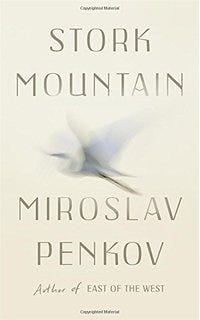
In my novel Stork Mountain (FSG, 2016), a young immigrant returns to Bulgaria and searches for his disappeared grandfather, ending up in a village on the border with Turkey, a stone’s throw away from Greece, up in the Strandja Mountains. This is a place of pagan mysteries and storks nesting in giant oaks; a place where every spring, possessed by Christian saints, men and women dance barefoot across live coals and seek rebirth. There in the village, the boy reconnects with the old man, falls in love with the rebellious daughter of the local imam and gets drawn in a maze of insanity and half-truths.
I wrote the novel over the course of five years, first in English, and then in Bulgarian. And while I wrote, I listened obsessively to the same musical composition, over and over, and over again. “Ipostas” by the Bulgarian band Isihia. Here, underneath the music, there lie the mountains of my book, with their hills and rivers, mists and rains, the fires and their walkers, the storks nesting in the giant oaks. In Hellenic philosophy “ipostas” or “hypostasis” is taken to signify the underlining, inner reality of things. In Orthodox Christianity the Trinity is viewed as one God existing in three distinct hypostases. A fitting name then for a song, which at least in my mind, is now one with the book, or maybe has always been.
2. March of the Black Queen, Queen
Elif, daughter of the local imam, stepped out of the dark faceless, but driven by a single, simple desire– to be allowed to wear jeans in a world where other women were made to wear shalwars.
“Everything you do,” sings Freddie Mercury in this strange song, “bears a will and a why and a wherefore.” The character of Elif, daughter of the local imam, stepped out of the dark faceless, but driven by a single, simple desire– to be allowed to wear jeans in a world where other women were made to wear shalwars. This desire fueled her will, gave her the “why,” illuminated her face so I could see it better. Elif, the daughter of the imam, who cut herself before he let her buy those jeans; who starved herself until he let her go to college; who smokes pot in a stork nest, up a giant walnut, her safe and sacred place; who whispers all her troubles into a human skull buried in the branches two centuries before. “I reign with my left hand,” the Black Queen sings with Freddie’s voice, “I rule with my right. I’m lord of all darkness. I’m Queen of the night. I’ve got the power — Now do the march of the black queen.”
3. Feuer und Wasser, Rammstein
I don’t speak a word of German, but I chose Rammstein’s “Feuer und Wasser” because it exemplifies a basic alchemical principle which helped me conceive of two of the novel’s main characters– the narrator and Elif. In alchemy, “coincidentia oppositorum” is the sacred marriage of opposites, the coniunctio which makes two opposing forces (fire and water) into a single unified one.
“Feuer und Wasser kommt nicht zusammen,” sings Till Lindemann. “Fire and water don’t come together. Can’t be bound, aren’t related. Sunken in sparks, I am aflame. And I’m burned in the water.”
Coincidentia oppositorum. Beyond the duality, there is unity. Water that burns. I like the idea of beginning a character with a stereotype, or in the case of this novel, an archetype. The boy, the novel’s hero. Grandpa, the figure of the Old Man, the mentor, the guide through the shadowy realm. Elif, the shapeshifter, the hero’s opposite. Her father, a shadowy villain, there not simply to oppress, but also to tempt the hero to “the dark side.” And then these archetypes begin to make their own decisions, to act freely and evolve until in the end, I hope, they break liberated from the mold.
What a surprise it was for me, and everyone in the book, to discover towards its end that the boy, this fish out of water, the weakling who everyone thought could manipulate and use for personal gains, was in fact the force of change in everyone’s life, the fire that had come to the mountain to cleanse it through its flame.
4. Enter Vryl-Ya, Therion
Elif has stolen her father’s car; she’s picked up the boy and taken him as far up the mountain as the road allows. They’ve hiked the hills, crawled under a fence in the forest and crossed, under cover of darkness, into Turkey. Or so the boy believes. What follows next is a drunken night by the ruins of an ancient Thracian temple, a site where millennia ago the maenads, the crazy priestesses of Dionysus, consumed their doctored wine, danced madly and tore to pieces their sacrificial goats.
I made up many wild tales in this novel– Attila is a character and so is the Slavic goddess Lada; Murad the Godlike One, the first Ottoman sultan; Captain Kosta, a fictional rebel who fought the Turks and ended his life alone and forgotten. But perhaps the wildest story is one that actually unfolded, the only real story I allowed myself to use.
In the early ’80s the Communist Party began excavations in the Strandja Mountains at a site where they believed was buried Bastet, the Egyptian cat goddess. They were guided by an ancient map and the word of a venerated Bulgarian psychic.
In 1871 Edward Bulwer-Lytton published The Coming Race, a novel in which a young traveler accidentally stumbles upon a subterranean world inhabited by powerful beings, descendants of a lost civilization and masters of a great force called “Vril” (think Star Wars); a force both of healing and destruction. For a while The Coming Race was enormously popular in England and so convincing in its narrative that certain prominent theosophists of the day (like Helena Blavatsky and Rudolf Steiner) believed it to be grounded in deep occult truth.
“Enter the underworld,” sing Therion in this bizarre song, “Enter Vril-Ya. A step down the stairway… In this world they got the key to time and space. And to forces too strong for mankind to know.” I just love imagining the Communist Party, in all its atheist godlessness, digging in hopes of finding the remains of a lioness goddess, buried in the hills of the Strandja alongside scrolls supposed to hold great knowledge of past and future. And who knows what the Party really found?
5. July Morning, Uriah Heep
This tradition takes its name from Uriah Heep’s cult song “July Morning,” so beloved in our country that John Lawton…has now been given “honorary citizenship” to Kavarna…
For decades now people in Bulgaria gather on the Black Sea coast to meet the first rays of the sun on the first day of July. They build fires, play songs all night and wait for sunrise. This tradition takes its name from Uriah Heep’s cult song “July Morning,” so beloved in our country that John Lawton, one of the band’s later frontmen (“July Morning” was originally sung by David Byron) has now been given “honorary citizenship” to Kavarna, a small town on the Black Sea, which boasts a famous mussel farm, a statue of Ronnie James Dio, and an annual rock fest that has seen performances from the likes of Deep Purple, Scorpions and Motorhead.
“July Morning” may not be explicitly mentioned in my novel, but there is a trip to the Black Sea (no more than twenty miles away from the Strandja) and the general sense of waiting for the sun and for its fire, and through them, for rebirth.
6. Sweet Dreams, Marilyn Manson
Annie Lennox is great and who am I to disagree? But there is something magnetically macabre, impossibly irresistible about Marilyn Manson’s cover. In 2001 I moved to the US to study at the University of Arkansas and quickly felt the inescapable pull of Southern Literature. Faulkner’s adage that the past is never dead, that it’s not even past, alongside Katherine Anne Porter’s brilliant long story “Old Mortality” changed the way I think of life, of familial bonds, of the tales we tell each other and of the myths we create so as to face the faceless void. But the line between past and present is not the only line that blurs. “Oh, who can divide dream from reality, day from night, night from dawn, memory from illusion?” writes Danilo Kis in his story “The Legend of the Sleepers.” “Who can draw a sharp line between sleep and death?” What more can we do then, but “travel the world and the seven seas… looking for something?”
7. Exit Music (For a Film), Radiohead
I didn’t speak a word of English until I was fourteen. So used am I to the idea of not understanding the lyrics to a song that even today, unless I purposefully focus, the words flow by me unintelligible, like a great river. And when Thom Yorke sings, even if I do focus, the words are still, for the most part, a mystery. Except in “Exit Music (For a Film).” This song I understand. “Today we escape,” Yorke sings. “Pack and get dressed. Before your father hears us. Before all hell breaks loose.” And I can’t help but think of the boy in my novel and of Elif, of the world which holds them trapped, yet makes them terribly hungry for freedom; and of the boy’s grandfather and of the Greek girl, that sad, beautiful fire walker, he loved, many years before. “Return where you have failed,” Nikos Kazantzakis writes, an old Cretan proverb, “leave where you have succeeded.” There in the mountains where the grandfather once failed, the grandson now returns. And when at last the grandson triumphs, in his victory, the grandfather finds the strength to move on. “Now we are one,” Thom Yorke sings, “in everlasting peace.”
DON’T MISS OUT
Sign up for our newsletter to get submission announcements and stay on top of our best work.
YOUR INBOX IS LIT
Enjoy strange, diverting work from The Commuter on Mondays, absorbing fiction from Recommended Reading on Wednesdays, and a roundup of our best work of the week on Fridays. Personalize your subscription preferences here.