Matt Gallagher & Phil Klay Discuss the War in Iraq and Finding Purpose at Home

by Phil Klay

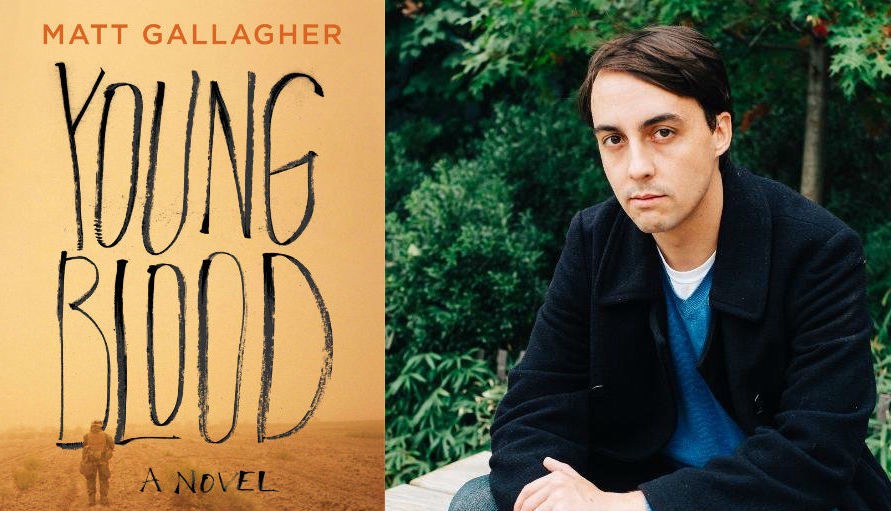
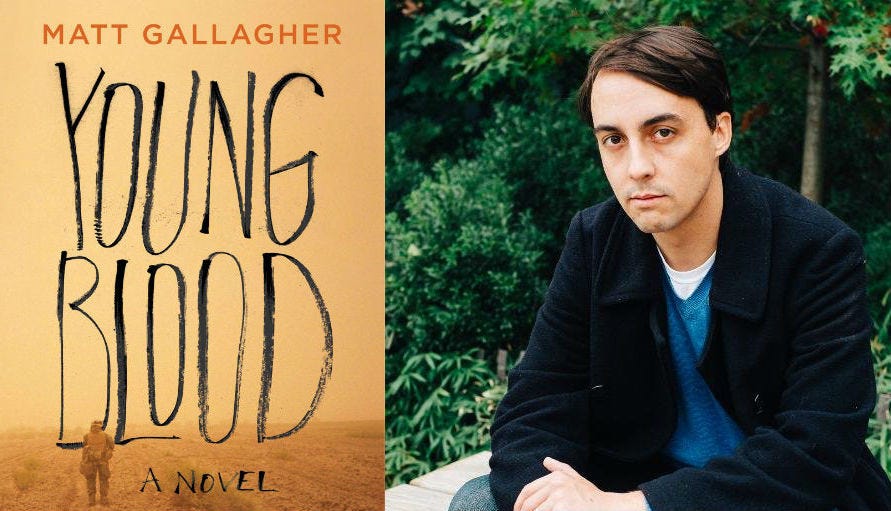
If you’d like to understand the modern American way of war, there aren’t many books that rise to the level of Matt Gallagher’s Youngblood (Atria Books, 2016). A war novel wrapped around a murder mystery and wedded to a Bildungsroman, the book dramatizes in ways no one else has the conflicting strategies that characterized the American effort in Iraq. Gallagher, an Army officer who served in Iraq, has long been a fixture on the veteran writing scene. He maintained a popular military blog while in Iraq, only to have it shut down by the U.S. military, and later wrote the memoir Kaboom, a smart and funny and irreverent look at his 16-month deployment.

In addition to writing fiction, he’s one of the smartest essayists and commentators on veteran’s issues, whether it’s on the members of my generation becoming ‘professional veterans,’ his meta-hot take on the hot takes on American Sniper, or what it’s like to compete in the world championship for the bar arcade game Big Buck Hunter (which, yes, counts as ‘veteran’s issues’). It’s fair to say many of us in the veteran writer community have been looking forward to his first novel for a long time, and Youngblood does not disappoint.

I sat down with him to discuss the novel, the various phases of the conflict in Iraq, and the modern American way of war.

Phil Klay: It seems like one of the challenges veterans have, when talking about the Iraq war, is of getting across the incredible complexities of a war that stretched across years.

The most vivid description of COIN I ever got as a young lieutenant was, “You know, like British imperial occupation.”

Matt Gallagher: The general public thinks of the Iraq war as one cohesive event, and the truth is there are so many parts of it, both from the American side and the Iraqi. There’s the invasion, of course, in 2003, which occurred over the course of three weeks and that was it. Mission accomplished. The Iraqis view that very differently. They call it “the collapse.” Their entire infrastructure, their entire way of life was totally upended. And then there are different phases: the sectarian war, the rise of the insurgency, from 2004–2006, then the shift to counterinsurgency, which took place in 2007. The most vivid description of COIN I ever got as a young lieutenant was, “You know, like British imperial occupation.” That’s not totally exact but it ain’t wrong, either. It’s about the long-game, being a jack of all trades immersed with the people, being beat cops and conducting electricity surveys and dealing with roadside bombs and snipers all at the same time. Obviously that conflicts with the popular American understanding of what war is, or at least what our wars “should” be. We push back fascist onslaughts! But the reality is that it’s much more likely that America will conduct another counterinsurgency campaign in the 21st century than we will fight another standard force-on-force war.

PK: Except that’s not really what we’re doing now. If counter-insurgency was the dominant philosophy of the second term of the Bush Administration, counter-terrorism has clearly been the dominant philosophy of the Obama Administration, with an emphasis on maintaining a light footprint, avoiding boots-on-the-ground, and a heavy reliance on drone strikes and kill/capture missions doing high value targeting.

MG: Counterinsurgency has an end-goal of a stable, self-sustaining local government. You can argue about its effectiveness, since the case studies that worked out pale in comparison to the case studies that didn’t. But at least it has a clear end-goal. The “counter-terror” approach, or whatever we’re doing now, doesn’t even have that as far as I can tell. It’s a low burn — but a constant low burn. It puts a heavy, heavy burden on special operations, and keeps the perpetual warfare machine going. It’s not about bringing the peace over there, or anywhere. It’s about keeping things calm back here. I can understand that approach, even appreciate it. But I find it deeply cynical and deeply disturbing, not so much as a veteran, but as a citizen of a republic.

PK: Your novel is set toward the end of our “boots-on-the-ground” phase in Iraq…the end of the era of counter-insurgency. And the different approaches to warfare that characterize different stages of the war come up in the novel, most clearly through the tension between Lieutenant Jack Porter and Sergeant Chambers. Jack is a young, untested platoon commander trying to do counter-insurgency, and Chambers is an experienced noncommissioned officer who learned how to be a soldier in a part of the war that was a lot more violent, and there’s a tug of war between these two for the soul of the platoon.

MG: I think the tension between Jack and Sgt Chambers is a natural one, in terms of their ranks and backgrounds — junior officer, just out of college, probably comes from a much more privileged background than most of his soldiers, and then there’s the battle hardened noncom who has been there and done that, walked the walk, who comes from a more blue collar background. Chambers is a product of his environment. He’s done what it takes to survive and bring his men home. There’s a Machiavellian aspect to Chambers that I found myself drawn to as I was writing him, and I hope readers find intriguing, as well. Say what you will about the man and his worldview, he gets things done. But his ‘war-is-war’ philosophy and approach comes with consequences, both physical and moral. And often enough, those physical and moral consequences are not the expected ones.

PK: And though Jack starts out wanting to get rid of him, once the tensions flare up in the town and there’s a lot more violence, Jack second-guesses himself because, brutal or not, too aggressive or not, Chambers knows what to do when the bullets start flying and Porter doesn’t.

MG: Absolutely. Combat is a lot more, as Jack learns, than theory and strategy and tactics. There’s a real raw, visceral leadership style that Chambers has, and not only do the men start gravitating toward him but Jack starts gravitating towards him too. The Army and the Marine Corps, frankly, need more Chambers than they need Lieutenant Porters. But they need Porters too, and they need them to stand up and say something when these morally questionable dilemmas are posed.

PK: Chambers exemplifies a particular type of physical courage, one that is admirable and clearly necessary in the Corps. Jack, as a young man at war, wants to live up to that standard of physical courage that we think of most readily when we think of warfare, but his true trials test his moral courage far more than his physical courage.

Moral acts of courage tend to come from a different place. They don’t happen in a moment, with a burst of adrenaline. They requires thoughtfulness, time.

MG: Moral acts of courage tend to come from a different place. They don’t happen in a moment, with a burst of adrenaline. They requires thoughtfulness, time. And then you make a decision and keep going. There are many cases where he maybe made the wrong decision, and that’s going to carry consequences, for him, for the Iraqi townspeople, for his soldiers, for the war effort as a whole. It’s so easy, in our culture, to criticize after the fact. But it’s never so easy in the moment, when everything is confounding. You think the only thing you can trust is yourself, but after 48 hours of no sleep, three different conflicting stories, and a subordinate that you want to trust but cant, how do you figure out what right even looks like. Often there are no clear answers. And that is such an inherent part of counter-insurgency, both for the occupiers and for the occupied. I think that’s true even for Chambers, who is the ultimate consequence of sending young men and women to war over and over again. He has done everything in his power to bring his men home — what more could you want from an NCO? But that kind of attitude can prove very dangerous, especially in a Wild West environment like the fictional town of Ashuriyah in Youngblood. Ashuriyah’s right on the sectarian fault line between Baghdad and Anbar Province, so these questions and consequences are happening in a potent, dynamic environment that’s difficult for any stranger–no matter how smart or accomplished–to grasp. Even Chambers seems baffled by it at times, and he’s been there before.

PK: Reading the novel, you understand why Chambers provokes both love and awe in his men. Jack may be essential for keeping them on mission, but Chambers is the one that really bonds them together as a unit. In the scenes with him, you can seen some of the deep satisfactions someone can get from time at war.

MG: War can be hell, but if war was nothing but hell it wouldn’t perpetuate. War nostalgia is a very old, time-honored tradition. It’s what led to the Red Badge of Courage, Crane interviewing these Civil War veterans who were dying off, wanting to tell their stories. Our friend Elliot Ackerman has written about nostalgia for war, about the type of veteran who is gravitating toward the Middle East now, to be closer to it. Jen Percy just wrote about veterans fighting ISIS, trying to respark something.

PK: Respark what?

It’s not just the adrenaline or the thrill that keeps drawing people back to war. It’s that clarity of being. It’s intoxicating.

MG: That sense of purpose, that clarity of being. It’s a common refrain for vets of Iraq and Afghanistan. America is this great, moneymaking empire that does a lot of good things but can be confusing and messy. Going through combat with good individuals on either side of you, doing that patrol, accomplishing that mission. Doing that every day, every night, with a tribe of like-minded souls who have your back, literally and figuratively … It’s not just the adrenaline or the thrill that keeps drawing people back to war. It’s that clarity of being. It’s intoxicating. I know I have not experienced anything like it since I got out. And I love writing. I found a sense of purpose back here at home that some of my peers are still looking for. But I think it’s a natural thing. It’s also something easy to say when you come back with all your limbs, all your faculties. I imagine some conversation down at Bethesda my have a darker tinge to it.

PK: And that purpose is part of why we joined in the first place.

MG: Looking back at it later it almost seems quaint, but people who joined after 9/11, it very much felt like a calling. We were attacked. Innocent civilians in our home were attacked and killed. Joining is something I’m proud of, as an individual, and it’s something I feel pride for in anyone who signed up. But fast forward a few years later and you’re occupying a country, wearing fifty pounds of body armor, wearing black Oakley sunglasses, realizing that the Iraqis are looking at you like what you are…a martial occupier…

PK: Those Iraqis get a lot more of a say in this book than they do in most American novels about the war.

MG: When I set out to write Youngblood. I kept thinking about inheritance. A cumulative inheritance. I wanted to write a book that, if it didn’t cover the entirety of the Iraq war, covered a large swath of it, something that was more than a slice of life. I’d already written a slice of life story with Kaboom. And as I figured out a way to do that larger story, the idea for a bi-level narrative came to mind. Setting it near the withdrawal made a lot of sense, so I could reference the entirety of the war. But also having that mystery part set during the height of the sectarian war made a lot of sense, too, because in many ways that was the fulcrum of the American experience in Iraq in 2003 to 2007, where everything changed and didn’t change simultaneously. Having that mystery set there, and having Jack and his soldiers encounter what had happened a few years earlier, felt important.

It wasn’t a possibility for me to reconcile all those things and form a coherent narrative without prominent Iraqi characters.

Also, the one continuity in these towns, in these villages, as the insurgency and the counterinsurgents were playing out against each other, was the Iraqi civilians. Every year units would rotate in and out. There’d be new commanders. New power players. New American moneymen. But the sheiks didn’t change. The imams didn’t change. The guy that sold ice at the corner didn’t change. The insurgents, unless they were captured or killed, didn’t change. So having them be an important part of the narrative was not just vital, it was inevitable. They’d been there through the duration. They’re still there, dealing with what we wrought in 2003. It wasn’t a possibility for me to reconcile all those things and form a coherent narrative without prominent Iraqi characters.

PK: You’ve been heavily involved with the veteran community — you worked for Iraq and Afghanistan Veterans of America, you co-edited an anthology of veteran writers called Fire and Forget, and now you’re working at Words After War, which is a writing NGO specifically designed to address the civilian-military divide. I wonder what your sense is of the current civilian-military divide. Are we getting better? Are we backsliding?

MG: It’s tough to say. In some ways, in the center of the storm, I want to say we’re getting incrementally better. Certainly that’s what I see every week at the Words After War writing workshops, where vets and civilians wrestle over issues of war and conflict in literature. They learn from each other, they better one another’s work, they argue and debate and find common ground. It’s fucking inspiring. Then I go home and see polls like the one about Millennials being pro-Syria invasion as long as they don’t have to fight themselves, and wonder if we’re all just pissing into the wind, to use that beautifully poetic Irish phrase.

PK: Watching the course of the war, the sheer horror of what is happening to the Iraqi people, and contrasting that with the level of the political dialogue about war here can certainly be intensely frustrating. In the book, you describe one character, saying, “A broken nobility was all that he had left.” What’s the state of your nobility these days?

My understanding of our generation of vets is that we were idealists. And for many of us, that idealism has been broken…

MG: Personally? I just wrote a book, and I think once you finish a book you have nothing left, to include nobility. Good bad or indifferent, that just matters to me less now. I think, writing, finding a new purpose was immensely helpful in that way. I know it’s something a lot of veterans of our generation are trying to reconcile with. My understanding of our generation of vets is that we were idealists. And for many of us, that idealism has been broken, not just by the rigors of war but by the ways these wars have been carried out, the immensely complex moral ambiguities of these wars, and just growing up. That broken nobility of Chambers reminded me of a lot of people I know, and have great admiration for. Both for their service, and for their capability, when they were in that service. But I think a lot of us, when Chambers is having that moment, it’s a reckoning. It’s something I wish more of us were talking about, I think America as a whole needs to have a reckoning with how Iraq played out. To see that reckoning largely being dealt with largely by twenty and thirty year olds who gave the best years of the lives to this effort is largely dispiriting. To see that reckoning still being dealt with in an incredibly brutal way by the Iraqis, over ten years after we told them we’d bring democracy, it’s tremendously dispiriting. Both of those things were part of the drive for me to keep rewriting Youngblood, even when it wasn’t very good, the desire to get a larger share of the country to deal with it. Because we didn’t just wear our unit patches out there, we wore the American flag. If you paid your taxes, we were representing you, even if you don’t feel like you were.

Literary Mixtape: Alexander Chee Finds A Heroine

by Alexander Chee

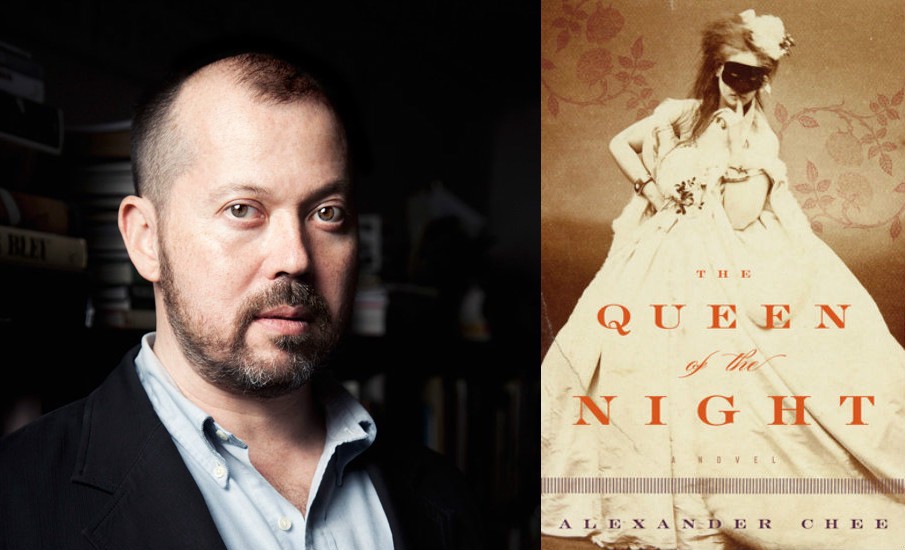
We’ve asked some of our favorite authors to make us a mixtape. This month’s installment is from Alexander Chee, whose new novel, Queen of the Night (Houghton Mifflin Harcourt) comes out this week. It’s a novel about “one woman’s rise from pioneer girl to circus rider to courtesan to world-renowned diva in 19th Century Paris,” so yes, Chee’s mixtape includes a healthy dose of both Beyoncé and The Runaways. Put on your headphones, turn up the volume, and read on.

Writing a novel about the Second Empire in France, I was wary of being too precious, of being the wide-eyed American who is too romantic about the history and the legends. I wanted to strip off the layers of schtick and false formality that I felt had covered the era in recent popular entertainments. And I wanted to forget the weak cinema courtesans I had seen and to try and imagine the women I was sure had existed, had found in my sources — confident, bold, hilarious and sexy, these women who began with very few gifts but knew that some of those gifts were so very very valuable to others. As long as they lasted.

The novel poses as something of a 19th Century tall tale autobiography — the confessions of a celebrity, who knew everyone and went everywhere, that becomes a picaresque with a woman in the place where a man usually is. She adopts and abandons identities, one after the other, in pursuit of a life where she can just live as she wants. Parts of it are true and parts, maybe less true, but it seems she believes it all, and the fun is in figuring out what is what or maybe the fun is just being along for the ride.

My heroine, Lilliet Berne, arrived fully formed but still was elusive, and the music here is some of what I used to get closer to her and to the other characters as I wrote the novel.

1. In Da Club (aka Sexy Lil’ Thug), covered by Beyoncé

When you hear this, just forget 50-Cent. This is the version that matters. In Beyoncé’s hands — “my hair my nails my diamond rings” — becomes a courtesan’s anthem, proud and loud. And the descant she sings against her own voice in the recording is perfect. For summoning the air of beauty that knows itself, knows what it can make men and women do, there’s little better.

[ed. note — This track isn’t on Spotify. Just watch the video; you were going to anyway.]

2. Check On It, Beyoncé

La Paiva, the famous courtesan who once told a young man to come to her with 40,000 francs and to set it on fire, and that he could have her “as long as it burns”…

More of the same as above. This is sort of a call-and-response song with Beyonce’s narrator essentially calling out the men looking at her. La Paiva, the famous courtesan who once told a young man to come to her with 40,000 francs and to set it on fire, and that he could have her “as long as it burns,” well, if I were writing some as yet unwritten musical about her life, this is what she’d sing to him.

3. Waitin’ For The Night, The Runaways

There’s a night Lilliet runs away with her best friend Euphrosyne, after they think they’ve killed a man, and they stay up all night drunk waiting to leave on the train. It starts out in high spirits and ends in their decision to be friends no matter what — and to run away together. This is the soundtrack of them.

4. When I’m Small, Phantogram

Lilliet wears a wig and a disguise when she leaves the theater to escape her fans. I can imagine this playing as she walks away unknown, headed off to supper with the Verdis.

5. Deceptacon, Le Tigre

Daring isn’t something you just have lying around — you have to bring it.

This song, quite simply, just kicks so much ass. During the hardest parts of writing this novel, I would put it on and immediately feel like I was brave enough to do anything I had to — and the boldest parts of the novel come in part from writing while, or after, listening to it. Daring isn’t something you just have lying around — you have to bring it.

6. The 212, Azealia Banks

This song makes me think of Euphrosyne, Lilliet’s troublemaking best friend — laughing in the face of danger, a perfect mix of “seen it all”, profanity and hilariousness. And to be honest, I’d love to see Azealia do a cancan. I feel sure she’d kill it and then bring it back to life.

7. Nightcall, by Kavinsky

…the idea of not knowing where you’re going, and remember the incredible power of the beauty queen, so beautiful it was almost supernatural.

I was on an assignment for Departures, in Shanghai. I had been sent to profile the restaurant Ultraviolet, an avant garde French restaurant with 14 seats and two seatings per night. To get there, you met the driver at a meet point and he took your whole party to the secret locaton. There was a former beauty queen in the group with two men — she seemed to be escorting them or they her, it wasn’t clear — but she was so beautiful she was like a race apart from everyone else. This song was playing as we drove through the Bund, which is like this lost arrondissement in Shanghai, and so the song forever has for me the night, the idea of not knowing where you’re going, and remember the incredible power of the beauty queen, so beautiful it was almost supernatural.

8. Disparate Youth, Santigold

I love Santigold, she just gives me life. But this song in particular, the sly snare line, the keyboard, the spy movie guitar vamps — the light melancholy mixed with deep joy in her voice, and that line, “a life worth fighting for” — that’s my main character, pure Lilliet.

9. Pass This On, The Knife

There aren’t so many story-songs now in pop that make any sense, but this is one, all forbidden desire and not knowing who is seducing who, and the keyboards that are like Jamaican tin drums alongside the bass line…Once you see the video, you can never forget it — I watched it to cast a spell on myself and the spell wakes up again each time it plays. And I decided it was part of the spell I wanted to cast over the whole novel.

Writer Horoscopes for February 2016: Metaphor in Retrograde

by Apostrodamus

Aquarius (January 20 — February 18)
Aquarians may find themselves in a rut after the rush of optimism at the start of the new year. For those working on long-term projects, it may be a good time to take a break, switch genres completely, and play a little in the unfamiliar to gain strength in unused writing muscles. Get yourself freaky and limber is what I (and the floating orbs) are saying. If you write historical fiction, read some flash sci-fi. If you’re a poet, read some financial documents. Everyone should read more erotica, and write more too. Get out of your comfort zone. This is a good month for trying your hand at Oulipo exercises, Oblique Strategies and the like. Get kinky. The word of the month is play.

Lucky genre: Theoretical Extraterrestrial Erotica
Lucky punctuation: ¿

Pisces (February 19 — March 20)
Fiction-writing fish will be swimming with the current this February. Whether looking for a place to spawn or an underwater nook for literary idea-fertilization, it should be an auspicious month for Pisces. But that doesn’t mean literary Pisces should thrash about in self-congratulatory excitement. Your waves may upset others and cause turbulence downstream. Be instead like the gender-switching cuttlefish that Victor Victoria’s its way to success by assessing the needs of the situation. If you’re a big fish in a small pond, it might be good to consider mentoring a younger writer. If you’re a small fish in a big pond, consider strengthening your community. Poets may experience intense visions this month, perhaps even premonitions. Sources say you should listen to your witchy night wishes, keep a dream diary, and mine that isht for gold.

Lucky genre: Aquatic Slipstream
Lucky punctuation: ~

Aries (March 21 — April 19)
I know, I know: new year, new novel, new and novel lover. But while February’s love bug may have you curled over your laptop writing novella-length love letters to future readers, dead poets, and current suitors, you can’t just ram (ahem) your way through every door — creative or otherwise. Take it slow this month…in the sack and on the page. Your mental and physical health need some attention (especially your joints and segues), so step away from the desk, stretch that back out, and stare at the birds for a second before hunching back over your magnum opus. If you’re a gainfully employed writer (ha!), sources say single Aries may find love in the office (perhaps while photocopying your manuscript for revision?).

Lucky genre: Self-Help for the Impatient
Lucky punctuation: —

Taurus (April 20 — May 20)
For the Taurus with a manuscript in their back pocket, this could be a banner month. Think big. That’s right. Send those manuscripts out, contact those agents, show up at the stupid industry party and charm the socks off the gatekeepers and the gatekeepers’ gatekeepers while sipping cheap wine and nibbling on stale cheese. If you’re a freelance writer, up your rate or pitch that big piece you’ve been dreaming about. All signs point to strength in networking, career, and finances this month, so leave the laundry and grocery buying until next month, February is for Seamless and making moves, Taurus!!

Lucky genre: Rags to Riches
Lucky punctuation: $$$

Gemini (May 21 — June 20)
For Geminis who have been trying to get their work published through traditional avenues, this month is a good time to explore other, more creative paths. Consider self-publishing that epic poem cycle, adapting your novel in a series of six-second Vines, or simply ghostwriting that memoir your Uncle’s always bugging you about. This month, reassess and recommit yourself to your writing goals. If you’re not writing the kinds of things you want to, now’s the time to adjust your trajectory. Been thinking of ditching your historical novel about depressed 16th-century butter churners in favor of your TV pilot about adjunct vampires? Now’s the time! If there is one thing for Gemini to remember this February it’s this: You are not dependent on others to achieve your goals. This is especially important to remember after the 19th, when work strain has the potential to get the better of you. Also, there are whispers of romance in store for Geminis this month, so brush your teeth before heading out to that publishing party.

Lucky genre: Experimental Self-Help
Lucky punctuation: …

Cancer (June 21 — July 22)
Be grateful that you have surrounded yourself with friends and lovers who understand that sometimes YOU CANNOT FUCKING DEAL WITH ANYTHING UNTIL THIS CHAPTER IS FINISHED. Thankfully, you’ll have a stress-free writing month, so rack up some pages instead of messing around on social media. And speaking of social media, sources say your grace game needs to be on point this month, so beware of accidentally (or intentionally) insulting colleagues. No subtweets this month, ok? Unemployed writers have a better chance of landing a job this month, though we can’t promise that said job will pay a living wage. The finance fairy says unpaid invoices from “unexpected sources” will start trickling in the second week of the month. And if they don’t, sigh, there’s always next month.

Lucky genre: Social Media for Writers
(un)Lucky punctuation: @

Leo (July 23 — August 22)
Folks often think that writing and shepherding a book into the world is a solitary act, but we all know that’s not true. This month you will have to rely on your community and connections, old and new. Leos with manuscripts out to agents and publishers will have stiff competition this month, and breaking through the fray will be a matter of hard work and a healthy dose of luck and nepotism (but isn’t it always?). Thankfully, your community is in your corner, and you will feel both the strain of competition and the bounty of support this month in equal measure. For the lovelorn Gemini, these same supportive colleagues may also be your best match-makers so ask them if they have any single friends, especially after the 19th when the V-day mania has died down and Tinder accounts have been fired back up.

Lucky genre: Writer’s Market, Fantasy Edition
Lucky punctuation: *

Virgo (August 23 — September 22)
This month is a rollercoaster of writerly feels for the literary Virgo. Virgo writers will start the month off puffed up like an overpriced jacket made of dog fur, but those bloviated egos will get in the way of good revision (or hearing notes from others) the 18th to the 29th when the sun is opposite your decan. And pesky Neptune is making you so sensitive you may cry/murder/burn this motherfucker down if someone suggests a semicolon — A FUCKING SEMICOLON!!!!! Let’s just say it’s an inauspicious month for starting a new workshop, getting notes on that novel/story collection/life goal you’re feeling really insecure about, revision, or just about anything.

Lucky genre: How to Meditate While Multi-tasking
Lucky punctuation: Anything but a semicolon

Libra (September 23 — October 22)
Dear Libras and Libros and Librxs, the word of the month is collaboration. Yes, that’s right. Stop being so selfish. Your best bet is to work with others this month, be it finding employment or publishing opportunities. Long story short: whether you’re collaborating in bed or on the page, the only acronym you need is GGG. In fact, when revising your work this month, ask yourself, is this line GGG? Or is this a selfish line that wants to take but doesn’t give? If the line isn’t getting you off as much as it’s getting itself off, kill that darling. Sources say you will have many opportunities to use your “creative talent” this month, especially with the academic crowd. Make sure you’re not the only one enjoying your work, if you know what I mean.

Lucky genre: 69
Lucky punctuation: &

Scorpio (October 23 — November 21)
This month is all about the personal essay, ese. Don’t write personal essays? Hate memoirs? Then call it semi-autobiographical fiction or just fiction and STFU. And by STFU, I mean sit back with a notepad, that unique interpretative device you call your brain, and enjoy the wackadoo manifestation of humanity around you. February gives good fodder. Hot hookups, writerly and otherwise, are in the cards, but long-term projects in love and literature take a backseat this month.

Lucky genre: Personal Ese
Lucky punctuation: !!!

Sagittarius (November 22 — December 21)
This month you are blessed with the gift of song and intuition. If your work isn’t making the reader vibrate, what is it doing? Instead of the left-brain list-making of outlines, the heavy-lifting of major plot holes, and the soul-killing work of freelance invoicing, spend this month revising your work with an ear for sound. Poets will be especially productive this month, and proseists who unshackle themselves from sense and cuddle up to sound will experience delights never experienced before. If you didn’t yawp in January, make sure you yawp in February. Go ahead, do it, just yawp (I know you want to). Outside pressures may vie for your time, but leave the estate planning to someone else. You’re too busy making the world vibrate.

Lucky genre: Vibrational Poetics
Lucky punctuation: ((()))

Capricorn (December 22 — January 19)
This month, you’re like an old book with a fancy new cover. Sexy sea goats will have no dearth of literary lovers this month. Enter a room and bidding wars commence just to see what’s between your pages. You may feel like the next Garth Risk Hallberg, but be sure to discuss with confidantes before settling on an, er, publisher. Underpaid writers living in over-priced metropolises may find themselves moved to tears from financial hardship in the first half of the month but both freelance and full-time job prospects start to look up in the second half of the month. As for actual writing, well, you may get some of that done this month between all the strutting and catting about; we’ll see.

Lucky genre: Literary Romance
Lucky punctuation: ♥

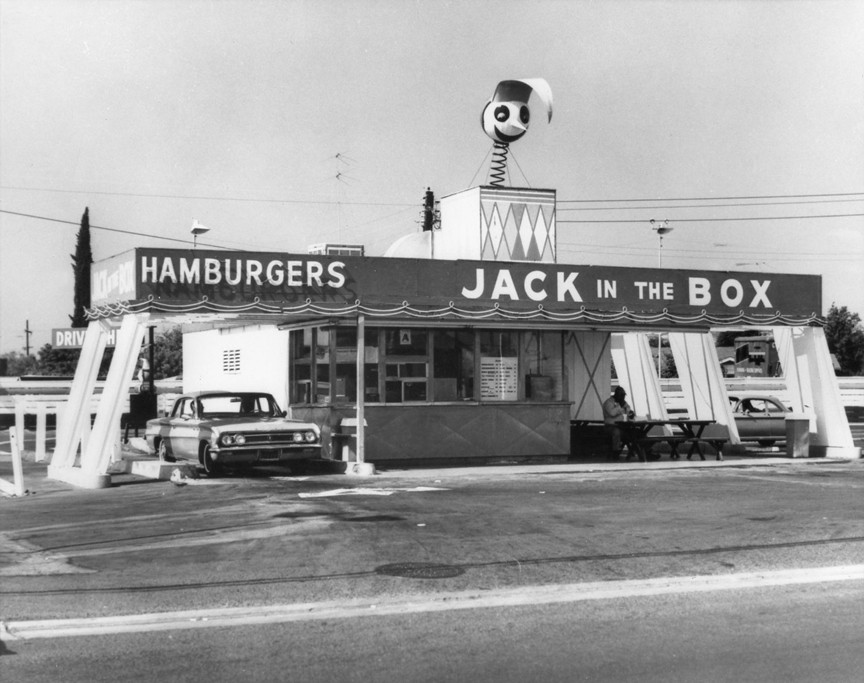
Burgers and Boys at Jack in the Box

Fast Food

1.
When I was seventeen, I swapped my cap and gown for a fake-denim visor and pocketless polyester jeans that would help pay my way to college. My best friend Annette’s summers had paralleled mine since we were twelve, but that year, she preened in an air-conditioned office while I donned the female species of Jack in the Box uniform, with puffed sleeves and a Peter Pan collar to mark us as bait. Rules supposedly protected us: no more than one open button could titillate from the placket. But a construction worker flexed his forearm at me to shimmy his naked-lady tattoo. Which burger has the best meat? I told him, I don’t know, I’m a vegetarian.

2.
My graduation party was Annette driving us girls around in her 1968 Plymouth Belvedere wagon. We ordered drive-through fries and Whopper Juniors, hold the beef, and parked to eat. Strange boys parked beside us. Annette and I slithered from the car to flick off the light switch that powered the Burger King sign. Back in the Belvedere, we watched, dipping in ketchup, chewing, while the BK employee trudged out to switch the sign on again. When Mom grounded me for missing curfew, I said, In a month I’ll be in New York. You’ll never know when I come in. Her shoulders twitched. That may be, missy, but for now you live under my roof. She was uncaged, too, a freshly single parent, wings still wet.

3.
As we walked in the dark to Mr. Steak to see a boy, I reported that on my day off from Jack in the Box, the assistant manager had squeezed between the counter and the shake machine, grinding against a girl named Pepper, who’d worked at every fast-food chain there was. She punched him in the face. Knocked him down. I was sorry I’d missed it, I told my friends as we passed a doorway flickering with blue TV light. A man stood there, naked, his penis a soft white threat in dark fur. He smiled. We walked faster, but we were such nice girls, we almost smiled back. At Mr. Steak, the boy had clocked out. We forgot to use the restroom, or so we said, and so we squatted in the shadows outside Denver Christian School and bared our flanks. (We peed outside that whole summer, every time we got drunk, like we’d taken a vow.)

4.
We fled to the Great Sand Dunes one weekend to let sun and sand slough the grease. In Taos, skater boys circled like ravens, lured by our silver earrings, burnt skin, clove cigarettes. We lied and said we would attend their party, but we didn’t want to be collected. When Shelley flashed her dimples and faked a Southern accent, two men in a muraled van bought us beer. It was two hours back to our campsite, but Shelley drove 90 mph to save time, so we could sooner pyramid our empty Keystone cans on the picnic table and cackle when we knocked them down. In the tent I fluttered, awake — what was loneliness? I asked the stars, what was freedom? — until I pressed my back against Annette’s and slept.

5.
By day, I handed a drive-through order to a man whose testicles lay outside his nylon running shorts, like a small bald rodent. By night, my friends and I smoked in the stands at Red Rocks, exhaling through a bubble wand while we waited for Depeche Mode to stride out and wave, gleaming in the light, new and rich and leather-shining like freedom. Our feathers were already starting to tatter. A Goth girl I used to know had grown slack, scabby pink scalp showing through her black-dyed hair, and her boyfriend had the staggered teeth of a junkie. My shins were brown-pocked from standing on Jack in the Box tile. Waiting for the concert, every popped bubble burst smoke, like magic, a dirty surprise. I wanted to think the man in the drive-through hadn’t meant to flash me. I preferred to imagine he had been embarrassed.

6.
August afternoons, the monsoon rains washed the Jack in the Box parking lot. The hail ping-ponged, the streets emptied, and the fryer fell silent. With the managers gone, I sat on the greasy office steps with Kwesi, a boy who also only migrated to Jack in the Box for a season, unlike Hakim who unfurled his prayer mat in the room where we scooped guacamole, unlike Sancho whose clients ordered Jumbo Jacks with a side of weed. Kwesi carried a notepad in his hip pocket to write the titles of the books I was reading. I memorized his white smile. We were both going places, college places, and grinning our plans at each other helped to beat down our fear.

7.
My last night at home, Annette and I idled in the alley in her Belvedere. My mother’s bedroom window went dark. Moulting, I no longer remembered what she knew of me. Annette and I cried so my tears were on her face, and I tasted hers while I clutched her narrow shoulders in her white men’s T-shirt, and we laughed through the crying, I love you, no really, as we tried to imagine living apart. We were damp, feathered things. We were working at being wild. All we trusted was each other.

Image via Flickr

Against All Odds: The Bazaar of Bad Dreams by Stephen King

In the introduction to his sixth collection of short stories, Stephen King, one of the most recognizable and successful authors to have ever walked the earth, emphasizes the “handcrafted” nature of his creations. It’s an engaging notion. Here, the man who has published more than 50 novels, all of them bestsellers, lays bare his feelings of inadequacy as a short story writer before ultimately declaring that his newest batch is something even he can be proud of. It’s classic King: endearing, direct, and more than a little folksy. He is the seller of goods, and you, the constant reader, are his consumer.

It’s also a rather disquieting way to kick off a book, more often coming off as defensive rather than relatable. At this point in his career, King has proven that he can do a little bit of everything — no one could argue otherwise — though he is perhaps still best known as a writer of supernatural horror and dark fantasy. Still, there’s this nagging sense that he feels the need to remind readers that yes, he’s perfectly capable of telling a straight story. In other words, if King’s introduction paints him as the seller of goods, he does so by positioning himself beneath a sign that proclaims “buyer beware.”

With this in mind, The Bazaar of Bad Dreams functions as something of a career retrospective, a showcase of his various (and very demonstrable) talents. There are stories that exemplify the macabre and fantastic tendencies that first made King a household name (“Mile 81,” “Bad Little Kid,” “The Little Green God of Agony,” “Obits”), and others that successfully demonstrate a more literary quality, indicative of his more subdued and reflective later years (“Premium Harmony,” “Batman and Robin Have an Altercation,” “A Death,” “Herman Wouk is Still Alive”). All of these stories are pretty good, if not very good, though not everything included here is quite so successful. The two long poems, “The Bone Church” and “Tommy,” are largely forgettable. And a few of the other stories feel like sketches at best, or, at worst, like they’re mere exercises in building up to a punchline (“The Dune,” “Afterlife,” “Under the Weather,” “Mister Yummy”).

The best of the bunch, however, are as good as anything King has written. The novella “Blockade Billy,” which initially feels like the generic story of a simple-minded baseball phenom, is actually a great piece of historical sports writing — with an unexpected, and wholly fitting ending. “Morality” is a tightly wound, deep-cutting story about the dangers of compromising one’s — you guessed it — morals. The whole thing is harrowing, and told with the psychological complexity of a Polanski film. And, finally, despite loathing the idea of a story that was written as a promotional vehicle for Amazon’s Kindle, I have to admit that “Ur” quickly pulled me in with its peculiar logic and brilliant pacing. It’s a silly story, somewhat in the same vein as King’s much, much longer novel, 11/22/63. Against all odds, King makes it work. And then there’s “Summer Thunder,” the collection’s final story, which is a simmering, quiet take on the end of the world that is absolutely gut wrenching.

King’s recent work has been largely consistent in terms of quality. Sure, the man still occasionally writes weirdly anachronistic dialogue, and okay, some of the stories feel a bit predictable, like retreads from an especially lengthy and visible bibliography. But The Bazaar of Bad Dreams is every bit as deserving of your time as King’s other great, late-career collection, Just After Sunset. Here’s hoping the bazaar remains open for many more years to come.

Member of the Crowd: Vertigo by Joanna Walsh

A flâneur is a member of the crowd, as well as a detached observer. This French word — literally meaning a “stroller” or “idler” — indicates, at least in the 19th-century-literary-sense, a person who wanders the urban streets, silently observing. The flâneur is inconspicuous as both participant and spectator, and he thrived in the hustle, bustle, and high commerce of 19th century Paris. Walter Benjamin wrote, “It suited [the flâneur] well to see his indolence presented as a plausible front, behind which, in reality, hides the riveted attention of an observer who will not let the unsuspecting malefactor out of his sight.”

Touching on a flâneur tradition set forth by writers like Charles Baudelaire, Rainer Marie Rilke, and Walter Benjamin, it’s fitting that Joanna Walsh’s new book, Vertigo, opens in Paris. In the spirit of those writers, Walsh conveys the Parisian streets in a manner that’s both surreal and razor-sharp. In the opening story, for example, the narrator strolls, reflecting:

“Even to be static in Saint Germain requires money. The white stone hotels charge so much a night just to stay still. So much is displayed in the windows: so little bought and sold. The women of the quarter are all over forty and smell of new shoe leather. I walk the streets with them.”

There’s an end-of-a-marriage at the center of this 4-page opening story, yet that loss is primarily rendered through the narrator’s experience of a Parisian department store. Instead of particulars on the philandering husband, we get observations on Chanel, Balzac, and department store design. Just as the store makes its mark on the narrator’s interior experience, the reverse is also true. There’s a gorgeously hazy line between the aisles of Le Bon Marché, and the passages of her contemplation.

Baudelaire thought that the human attempt to articulate feeling was weak compared to, “this ineffable orgy, this holy prostitution of the soul which gives itself entirely, poetry and charity, to the unforeseen that reveals itself, to the unknown that happens along.” In the case of Walsh’s story, the end of this marriage is represented by a sought-after red dress. So, we look at the clothes.

Walsh’s narrative method is more dynamic than straight flânerie, though, or it at least carries its own obsessions. Walsh, for example, is interested in turning this investigative impulse inward. When Walsh does reflect the internal trauma, she — sparingly, powerfully — captures it with precision. “I can’t be friends with your friends,” the narrator quickly imagines saying to her husband in the opening story. “I can’t go to dinner with you, don’t even want to.” In a manner that’s nearly as distant as her gaze on the streets, the narrator observes her own devastation.

Walsh’s stories contain many instances of flâneur-like investigations yielding moments of emotional revelation. In “New Year’s Day,” Walsh’s narrator reflects on the prior night’s party: “Everyone at the party was so lovely. Everyone was so happy. Everyone’s websites were now in color with hand-drawn lettering…” There’s a disappointing, one-night liaison at the core of this story, but it’s only circuitously remarked upon. Remembering the amorphous crowd, the narrator thinks, “Everyone liked looking at things that were pretty. I can still make things that are pretty, but I don’t now, and, as for the things I made in the past, I don’t even like to look at them anymore.”

Maybe one of the most brilliant moves Walsh makes is turning her flânerie on her experience of gender itself. In “Drowning,” a mother on a beach savagely observes that her husband never has to choose to be neglectful of the kids, because he knows if he does not pay attention to them, she will have to. She must also achieve the pretense of having fun doing this, otherwise “the holiday itself tips over.”

Or, in the title story, a mother sees her twelve-year-old daughter toss her hair. “It is the same gesture she used at nine, at ten,” Walsh writes. “One day it will become sexual. Is it yet? I don’t know. Why am I frightened by this progress? It will happen. It must happen.”

It’s notable that Walsh’s Vertigo was published by Dorothy, a press “dedicated to works of fiction or near fiction or about fiction, mostly by women;” Both their stars seem to be rising at once. Last year, Dorothy published Nell Zink’s Wallcreeper, and they continue to build attention and momentum for their stunning catalog of books. Walsh, meanwhile, had three books come out this Fall: in addition to this one, a memoir/essay collection called Hotel (published by Bloomsbury), and Grow a Pair: 9 ½ Fairytales About Sex (by Readux Books, a small European press).

The stories in Walsh’s Vertigo are equally strange and edgy. She’s a flâneur who’s just as capable of representing the exterior and interior wreckage with equal precision. She takes on big ideas — partnership, loneliness, femininity, etc. — through the vibrant minutiae of contemporary experience.

Walsh excels as an inconspicuous observer, demonstrating the Benjamin assertion that, “The space winks at the flâneur: What do you think may have gone on here?”

Click here to read a story from Vertigo — “Option” — as part of Electric Literature’s Recommended Reading.

Are There Bookshelves in the Future? Seven Science Fiction Libraries

If science fiction is any indication, we see the future as cold, bleak, dystopian, and nihilistic — a place where computers are king and androids abound. The future, as we tend to imagine it, rarely contains printed books, let alone bookshelves. In Ray Bradbury’s Fahrenheit 451 and Ayn Rand’s Anthem, books-on-bookshelves is actually a forbidden scenario. Even in the campy sci-fi universe of Star Trek, the twenty-fourth century boasts digital books stored on tablets; the Enterprise doesn’t waste space with something as antiquarian as a bookshelf.

In those sci-fi futures, bookshelves symbolize past life on earth — they are artifacts that boasts a connection to long cultural history.

So when books on bookshelves do pop up in science fiction, they’re the cultural exceptions, rather than the rule. In those sci-fi futures, bookshelves symbolize past life on earth — they are artifacts that boasts a connection to long cultural history.

1. Bookshelves from Unmentionable Times, Anthem

In Ayn Rand’s dystopian novella, the character Equality 7–2521 runs away from his society where learning philosophy and science from Earth’s history is banned. The bookshelves he encounters on his journey signify this old knowledge — to him, rediscovered.

“What kind of world did they have, the men of the Unmentionable Times? . . . We found a room with walls made of shelves, which held rows of manuscripts, from the floor to the ceiling. Never had we seen such a number of them, nor of such strange shape. They were not soft and rolled, they had hard shells of cloth and leather; and the letters on their pages were so small and so even that we wondered at the men who had such handwriting. We glanced through the pages, and we saw that they were written in our language, but we found many words which we could not understand. Tomorrow, we shall begin to read these scripts.” (Ayn Rand, Anthem)

2. The Banned Bookshelves of Fahrenheit 451

The hiddenness of books and, thus, bookshelves, permeates Ray Bradbury’s 1953 novel Fahrenheit 451, where books and bookshelves are dangerous, illicit objects. The bookshelves that show up are impromptu shelves are found in secret places, like air ducts.

“A fountain of books sprang down upon Montag as he climbed shuddering up the sheer stairwell. How inconvenient! Always before it had been like snuffing a candle. The police went first and adhesive-taped the victim’s mouth and bandaged him off into their glittering beetle cars, so when you arrived you found an empty house. You weren’t hurting anyone, you were hurting only things! And since things really couldn’t be hurt, since things felt nothing, and things don’t scream or whimper; as this moan might begin to scream and cry out, there was nothing to tease your conscience later. You were simply cleaning up. Janitorial work, essentially. Everything to its proper place. Quick with the kerosene! Who’s got a match!” (Ray Bradbury, Fahrenheit 451)

3. In the high-tech cybernetic society of Neuromancer, Neo-Aztec bookshelves are analog symbols of wealth, power, and prestige. Protagonist Henry Dorsett Case meets with his shadowy employer, Julius Deane, in Deane’s office where they are surrounded by Neo-Aztec bookshelves.

“His offices were located in a warehouse behind Ninsei, part of which seemed to have been sparsely decorated, years before, with a random collection of European furniture…Neo-Aztec bookcases gathered dust against one wall of the room. If the furniture scattered in Deane’s makeshift foyer suggested the end of the past century, the office itself seemed to belong to its start,” explains the narrator of William Gibson’s Neuromancer. (William Gibson, Neuromancer)

4. Jedi Archives, Star Wars

The Jedi Archives were part of a vast library put together by the Jedi Order, cataloging thousands of years of knowledge. The bookshelves in the Archives were easily identifiable wooden shelves, but the books on the shelves were digital. The Jedi Archives show a brilliant juxtaposition of “new” book technology with “old” bookshelf design.

5. Khan’s Bookshelf on the Botany Bay, The Wrath of Khan

On the desolate plant Ceti Alpha 5, the genetically engineered Khan has a shelf full of books from Botany Bay’s cargo hold that contains the Bible, Paradise Lost, Moby Dick, The Inferno, and King Lear.

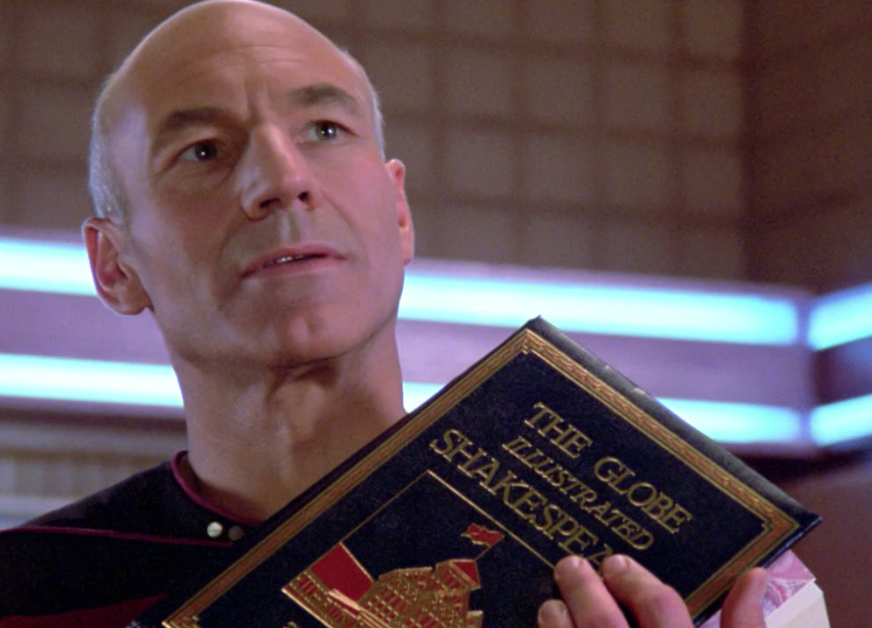
6. Captain Picard’s Elusive Bookshelf, Star Trek (The Next Generation Season 4; episode 2)

At 2:05 minutes into the episode, viewers glimpse a bookshelf in Captain Picard’s personal quarters. (The shelf isn’t included in past episodes and it doesn’t make another appearance.) But this particular TNG episode is about the starship crew connecting to family on Earth, and a bookshelf brilliantly captures the nostalgia for Earth of the past that so saturates this episode.

7. Captain Adama’s office, Battlestar Galactica

In Battlestar Galactica, the few bookshelves that do appear show up in Admiral Adama’s office on the old, archaic battleship Galactica. The shelves are wooden ones with books facing every which-way. The bookshelves remind the audience of the age of both the admiral and the ship.

These seven are by no means the entirety of science fiction’s bookshelves. These are props, McGuffins, set pieces, plot devices. But, more significantly, they are rare objects in our collective imagined futures — because we don’t expect to see bookshelves, they take us by surprise.

TED WILSON REVIEWS THE WORLD: INVASIVE PASSION

★★★★★

Hello, and welcome to my week-by-week review of the world. Today I am reviewing Invasive Passion.

Author Sasha Fabien recently released Invasive Passion: Book 1: Dark Trust, one of the hottest new erotic novels on the market today. It has everything you could want from an erotic novel including but not limited to car chases, dolphin dances, dead children, prison, and of course a lot of orgasms (male and female).

Full disclosure: I am Sasha’s agent, but I can assure you my review is unbiased. As evidence, I will admit that reading portions of her novel gave me an erection. Unfortunately I was sitting on a bench at the mall and unable to stand up for fear of someone seeing. Everyone passing knew I had a penis, but none would have guessed what it was doing.

As the agent for this book, it was my job to help promote it. I had expected the book would promote itself because of its fresh take on the genre, but it turns out no matter how good a book is, no one will be interested unless the author is famous or Oprah talks about it. And Oprah never returned any of my calls. If you’re thinking I had the wrong number, I didn’t. I called all the Oprahs in the phone book and even dialed some random numbers just in case. One of them must have been right.

Oprah, if you’re reading this, here are a few excerpts from the book to show you what you’re missing:

Cheryl awoke the next day feeling refreshed. Her old life was behind her and she could begin anew. Whoever she wanted to be, whatever she wanted to do, any of it could happen now. She could become a nurse, or a vegetarian. She could learn to play chess or build a website. Anything was possible.

* * *

They laughed and swam, and only a few meters off shore they met the family of dolphins, who immediately encircled them.

Cheryl reached out and felt the smooth, firm muscle of the man dolphin as it swam past. The dolphins welcomed them as if they were not humans, but fellow dolphins. Bruce climbed onto the back of one and pulled Cheryl up with him. Their soaking wet bodies glistened atop the dolphin as it swam up and down, undulating in front of the sunset.

Bruce took Cheryl hard and kissed her with both hands grabbing her head. She ran her hands down his back, digging her nails in and leaving scratch marks. The salt water burned him but he did not care.

* * *

He reached down and picked up a pheasant leg and began to gnaw at it as he continued pounding away. His mouth was dripping with flesh and sauce. He let Cheryl have a bite and she sucked and licked the delicious pheasant, sauce dripping all over her lips. It was even more erotic than the breakfast they had enjoyed at Hooters.

invasive passion

Because children may read this website I have omitted the more graphic passages, but you can rest assured they are hot and heavy. There is a lot of stuff described in Invasive Passion that even I never tried and I’m in my eighties!

I’ve tried to hard to make this book a success. I even bought a billboard with my own money. It cost $12,000 but has yielded little interest. Most people seem to think it’s an ad for that infidelity website.

I just hope my failure as an agent doesn’t ruin my friendship with Sasha or her career. If you’re an agent and would like to take over my duties, please call me immediately at (617) 379–2576. Again, that number is (617) 379–2576.

Invasive Passion is available for download here.

BEST FEATURE: Literally everything. Just trust me on this.
WORST FEATURE: The book is currently only available in digital format. I wish there were a hardcover available.

Please join me next week when I’ll be reviewing a cricket.

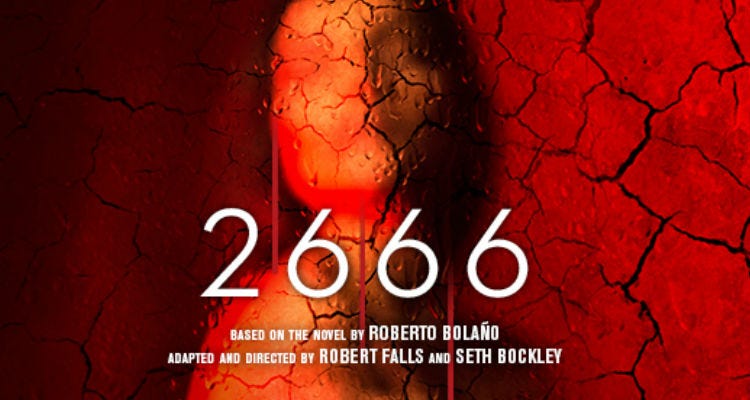
Robert Bolaño’s Epic 2666 Is Now a Five-Hour Play

by Melissa Ragsdale

In a surprising move, Chilean author Robert Bolaño’s mind-bending masterpiece 2666 has been adapted for the stage and will be premiering in Chicago at the Goodman Theater this February. If that’s not enough to ignite your curiosity, the project is being funded entirely by a fund actor Roy Cockrum created after winning $153 million dollars from Powerball.

At a whopping 898 pages, 2666 is a behemoth of a novel, encasing so many dimensions that just summarizing it is a challenge, let alone adapting it into a full play. Any lover of long, difficult literature will empathize with the play’s director, Robert Falls, who became “weirdly obsessed” with the novel years ago. “The process of staging it is part of trying to figure out what it is I personally respond to,” he told The New York Times. “I still don’t quite know.”

Published posthumously in 2004 and then translated to English in 2008, the novel is a resounding exploration of the 20th century, with a narrative that spans nearly 80 years, dipping in and out of internal stories. Centered around the city Santa Teresa, the plot includes academics searching for a reclusive German author, a New York reporter on his first Mexican assignment, and the unsolved murders of 300 women in Juarez.

The play adaptation is (as one would expect) epically long, spanning five hours total, with five distinct parts and three intermissions. A cast of 15 actors play nearly 80 roles. The production also features video projections and even a full-fledged movie, projected on a screen that lowers over the entire stage. Director and playwright Seth Bockley (who’s partnered on the project with Falls) has compared the play to “binge-watching” Bolaño.

“The challenge we took on wasn’t to be confusing and experimental and wild,” said Bockley, “but to ask, how do we do what Bolaño did, only in the time-based, 3-D, actor-driven medium of theater?”

Falls and Bockley narrowed the content down to its essential characters and plot lines, though they do occasionally foray into the stories within stories that make 2666 such an intense read. Each part was designed with its own distinct style, meant to compare to the literary genres Bolaño drew from: fairy tale, hard-boiled crime novel, academic satire, lyrical short story, and “Don Quixote”-style picaresque.

An ambitious project for sure, fans of Bolaño, literature, and theatre have plenty of reasons to be excited about this new way to experience 2666. For me, the project has awakened a hopeful question: if Falls and Bockley can successfully adapt 2666, what can’t we adapt? Infinite Jest? Gravity’s Rainbow? Anything seems to be possible.

A Cabinet of Curiosities: The Unfinished World by Amber Sparks

Amber Sparks’ work in her collection, The Unfinished World, is an imaginative exploration of what-ifs. What if Lancelot was lost in a jungle? What if we could time travel, but we did more harm than good? What if a couple’s romance was linked in some way to a cabinet of curiosities? What if a builder of Leichenhausen, German waiting mortuaries, was trying in some way to bring back his dead wife? Sparks’ work brings together ideas of time travel and dreams with historical oddities: her stories look into the dinosaur “bone wars,” historical atrocities and collections of every kind. The Unfinished World is slightly unbalanced, but offers more than it leaves the reader desiring. What Sparks presents — especially in the first stories of the collection — is a flair for the shorter short story. Sparks understands timing, juxtaposition, and how to create original characters within the confines of a short work.

The Unfinished World excels when it’s about the people behind the scenes, the ones who keep things moving. The first story of the collection is one of these, and one of Sparks’ strongest. In “The Janitor in Space,” a janitor at the space station comes to terms with her criminal past.

The janitor knows that being good is not the same as being clean. She, for instance, is very clean, but she is not very good. She is still traveling on her way toward that. She told her pastor that she was coming up here to be closer to God, but really she just wanted to get away from Earth She was tired of waiting to be recognized, waiting for someone to hear her name and turn, eyes too big, full of questions and dangerous curiosity.

Sparks’ character, who “doesn’t know about metaphors,” is a blue-collar worker in an ethereal world, a shadow who doesn’t want to be seen by the astronauts she’s supporting. But it’s her incredible pain, which comes to light as she’s scrubbing the surfaces of the capsule, that makes “Janitor” such a compelling story. The janitor, as all of Sparks’ characters, “knows that even the smallest human vessel has boundless storage for sorrow.”

Sparks’ short works get to the heart of what motivates character; in “The Cemetery for Lost Faces,” brother and sister taxidermists remake animals into death masks of their parents. “Clarence and Louise are trapping death in amber,” the author says. “They are learning how to make time stop.” “Lost Faces” is also a prime example of Sparks’ pithy observations of character. Tessa, Louise’s romantic rival, “is one of those people who substitute scarves for personality.” While Clarence and Louise’s opposite personalities mean they are suited to different aspects of the taxidermy business, it also means they grieve their parents’ death differently, trying with each animal they create beauty and preserve their bodies in beautiful repose. Sparks writes a different kind of seeker in “Lancelot in the Jungle,” but he is written with the same deep yearning that drives the taxidermist siblings. “There are only the seekers,” the author writes, “and the lost places they drive toward, always just out of reach.”

Sparks’ characters are often ironically close to the thing that hurts them most. In “For These Humans Who Cannot Fly,” a builder of waiting mortuaries obsesses over the beauty of the buildings, when it is his lost wife he mourns. His constant proximity to death only drives home the idea that “[N]o one really comes back from the dead. Even in [his] beautiful, carefully built Leichenhausen. Even when the sun pours from the Kingdom of Heaven through St. Michael’s stained glass robes and shines on the faces of the dead like rubies, like wine, like blood.” His wife is gone, and each beautiful new mortuary underscores his pain.

Another of the brilliant service worker stories is Sparks’ “The Men and Women Like Him,” which details the lives of the people who have to clean up history after the creation of time machines. Illegal time machines are created by would-be agents of time, and people go back to try to stop the big tragedies of history. Those workers who have to right the wrongs are subject to the daily influence of history’s worst events, over and over again. One of the workers “wonders if it would really be so bad, letting people flood into history like a tidal wave, and sweep away the worst of it.” Yet every day they punch the clock, shake off the misery, and go on. Sparks’ ability to celebrate the blue-collar aspects of fantastic and futuristic worlds makes “The Men and Women Like Him” a little reminiscent of stories like Bradbury’s “A Sound of Thunder.” Sparks proves that often what is most compelling in fantasy situations is their normalcy; we can’t out-invent our baser desires, even in fiction.

“Ancient dreams cling like crumbs to the mouths of the sleepers,” Sparks writes in her final story, “The Sleepers.” Though a longer work — almost a novella, not quite a short story — the title story is Sparks’ only misstep. Too much happens in too short a space, or perhaps it is that the author never really finds a foothold because the story isn’t long enough. “The Unfinished World” doesn’t have the same pith as the rest of this strong collection. When Sparks works short, she works best. There are many remarkable stories in The Unfinished World, and Sparks’ career as a short story writer is guaranteed to continue, if this collection is any indication of her talent. The Unfinished World is uneven, yet a delight. It shows how often we obsess over the things we fear; it also makes us consider the people who make it possible for us to live our fabulous, fantastic lives.