Morrisey, Lauren Groff, and Erica Jong Among Finalists for 2015 Bad Sex in Fiction Award

It’s that time of the year again, when British magazine Literary Review do their best “to draw attention to poorly written, perfunctory or redundant passages of sexual description in modern fiction, and to discourage them.” The award has been around for 23 years, and past winners include Norman Mailer, Tom Wolfe, and John Updike (who won the Bad Sex in Fiction lifetime achievement award).

This year marks the first time a book published by the distinguished Penguin Classics makes the list, namely Morrisey’s List of the Lost, which judge Frank Brinkley claims is “a very strong contender.” The book was thoroughly mocked when it came out earlier this fall, with critics paying special attention to its sex scenes. Who can blame them with excerpts like this:

Eliza and Ezra rolled together into one giggling snowball of full-figured copulation …with Eliza’s breasts barrel-rolled across Ezra’s howling mouth and the pained frenzy of his bulbous salutation extenuating his excitement as it whacked and smacked its way into every muscle of Eliza’s body except for the otherwise central zone.

Other candidates for this year’s award include Before, During, After by Richard Bausch, Book of Numbers by Joshua Cohen, Against Nature by Tomas Espedal, Fates and Furies by Lauren Groff, The Making of Zombie Wars by Aleksandar Hemon, Fear of Dying by Erica Jong, and The Martini Shot by George Pelecanos.

Literary Review said this about the candidates: “The books in question demonstrate the rude health of modern fiction.” One book that didn’t make the list was Michael Ashcroft and Isabel Oakeshott’s Call Me Dave, which included a description of the British Prime Minister’s famed sexual interaction with an animal. The judges reported with regret thatthe biographers displayed insufficient literary brio to merit serious consideration.” In other words, the passage was too bad for the Bad Sex Awards. The winner of this year’s award will be announced on December 1.

Below are excerpts from some of this year’s candidates. Excerpts from all of the candidates may be found here. If you can handle it, check out more bad sex quotes at Literary Review’s Twitter account.

Before, During, After by Richard Bausch:

She reached up and brought him to her, then rolled over on top of him and began softly to move down. When she took him, still a little flaccid, into her mouth, he moaned, ‘Oh, lover.’

Against Nature by Thomas Espedal

Héloïse has lost all sense of how she ought to behave, she practically throws herself at Abélard, pulls him to the floor and straddles him as if they’re two boys fighting. … She whips his face with her hair. She rides above him the way she’d imagined that one day she’d ride a boy, a man, a beast…

Fates and Furies by Lauren Groff

He shut his eyes and thought of mangoes, split papayas, fruits tart and sweet and dripping with juice, and then it was off, and he groaned and his whole body turned sweet …

Midweek Links: Literary Links from Around the Web (November 18th)

Looking for some interesting reading to get you through the week? Here are some literary links from around the web to check out:

For #NaNoWriMo, a list of books that will make you a better writer

David Mitchell offers some advice to young writers

This year’s “Word of the Year” isn’t actually a word

Valeria Luiselli on how every book dictates its own laws

Neil Gaiman talks about storytelling in the internet age

A look at the utopian visions of Mars in science fiction

The Paris Review’s editor Lorin Stein talks about the power of ambiguity in fiction

A guide to Hunger Games rip-off books

The Millions on marginalia

Lastly, make sure to stretch out your plot twists during #NaNoWriMo with Yoga For Writers

Watch This: Animated Video With Hunter S. Thompson Speaking About Hells Angels

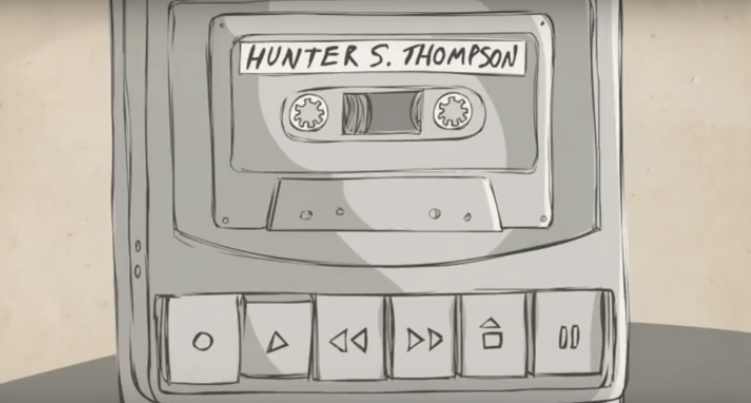
This short video is an animated interview with Hunter S. Thompson, and comes from Studs Terkel Radio Archive. It originally aired on WFMT-FM in Chicago. Thompson speaks about the year he spent riding, living and drinking with the Oakland and San Francisco Chapters of Hells Angels, gathering material for Hell’s Angels: A Strange and Terrible Saga. In the end, he wore out his welcome when he allegedly approached a member about beating his wife, and received a “stomping.”

On dirty bums:

“It takes a while to cultivate that kind of bitterness, where when somebody calls you ‘a dirty bum’ you don’t look in the mirror and think, ‘well maybe I should wash my face,’ you go out and rub scum on you and get dirtier. Then you go back in and punch him and break a bottle and stick it in his gut.”

On the Hells Angels uniform:

“Angels bring out this violence in other people because they are dressed adversely, bearded, long hair, earring in ear perhaps, a swastika helmet or a Confederate flag, which some of the locals would like very much. Something occurred to me. They bring something out.”

This interview is taken from Blank on Blank, a project meant to “preserve and re-imagine the American interview.” The website features rare interviews from famous speakers, each complete with an illustration to go along with the video. More interviews can be found here.

Anything for Money

by Karen E. Bender

Each Monday at eleven o’clock, Lenny Weiss performed his favorite duty as executive producer of his hit game show, Anything for Money: he selected the contestants for that week’s show. He walked briskly across the stage set, the studio lights so white and glaring as to make the stage resemble the surface of the moon. In his silk navy suit, the man appeared to be a lone figure on the set, for his staff knew not to speak to him or even look at him. He had become the king of syndicated game shows for his skill in finding the people who would do anything for money, people that viewers would both envy and despise.

The assistants were in the holding room with the prospective contestants, telling them the rules: No one was allowed to touch Mr. Weiss. Mr. Weiss required a five-foot perimeter around his person. No one was allowed to call him by his first name. No one was to be drinking Pepsi, as the taste offended Mr. Weiss. Gold jewelry reminded him of his former wife, so anyone wearing such jewelry was advised to take it off.

He stood by the door for a moment before he walked in, imagining how the losers would walk, dazed, to their cars, looking up at the arid sky. They would try to figure out what they had done wrong. They would look at their hands and wonder.

Then he walked in, and they screamed.

He loved to hear them scream. They had tried to dress up, garishly; polyester suits in pale colors, iridescent high heels. The air reeked of greed and strong perfume. Some of the women had their hair done especially for the occasion, and it shimmered oddly, hardened with spray.

“Pick me!”

“We love you, man!”

“We’ve been watching forever!”

A woman in a rhinestone-studded T-shirt that said Dallas Cowboys Forever lunged forward, grabbed his arm, and yelled, “Lenny!”

“Hands OFF Mr. Weiss!” shouted the security guard.

There was always one who was a lesson for the others. The door slammed, and the woman was marched back to her life. They all listened to her heels clicking against the floor, first sharp and declarative, then fading. The others stood, solemnly, in the silence, as though listening to the future sound of their own deaths.

They were all on this earth briefly; for Lenny, that meant he had the burning desire to be the king of syndicated game shows, one of the ten most powerful men in Hollywood. He did not know what the others’ lives meant to them, just that they wanted what he had. Money.

Now he needed to choose his contestants. They would be the ones with particularly acute expressions of desire and sadness; they would also have to photograph well under the brilliant lights.

“All right!” He clapped his hands. “You want to be rich? You want other people to kiss your ass? Well, listen. You’re going to have to work for it. Everyone!” He knew to change his requests for each new group; he did not want any of them to come prepared from rumors off the street.

“Unbutton your shirts!”

He knew this one was more difficult for the women, but that was not a concern to him. Some of the people stiffened, pawed gingerly at their buttons. Others tore through their buttons and stood before him, shirts loose.

“Take off your shirts!”

He lost a few more with this request. Others removed their shirts as though they had been moving through their lives waiting for such an order. They stood before him, men and women, in bras and bare chests, some pale, some dark, some thin-shouldered, others fat.

“Repeat after me. Say: I am a fool.”

He heard the chorus of voices start, softly.

“Louder! Again!”

Their seats had numbers on the bottoms; he knew immediately whom he would call back. He would call Number 25, the woman with the lustrous blonde hair, and Number 6, the man with the compulsive, bright smile. Lenny clapped his hands.

“Thank you. My assistant will contact those who have been chosen.” Lenny turned, almost running down the hallway. He walked around for fifteen minutes before he could get back to work.


He had grown up in Chicago in the 1940s, the only child of parents who had married impulsively and then learned that neither understood the other; Lenny dangled, suspended, in the harsh, disappointed sounds of the house. His father died when Lenny was eight. Lenny’s mother moved them to Los Angeles and got a job as a secretary at one of the movie studios. The boy was shocked by the desert light, the way it made everything — the lawns, flowers, cars — appear stark and inevitable. His mother was the only person he knew in this world, and at first, when she left him at school, he was wild with fear that she also had disappeared. He pretended he was collecting clouds to make a wall around her, and when the sky was cloudless, he pretended he was sick. Then his mother brought him to the place where she worked. He sat on the floor watching her, and then everything else going on around her, too.

When he graduated high school, he became an errand boy on a soap opera, then a writer. He enjoyed making bad things happen to other people: troubled marriages, sudden illnesses, kidnappings. He married a woman who was impressed by his job and his descriptions of various actresses on the set. They had a child, a girl. Then one day the producers gathered all the employees into a windowless conference room. “There’s no more show,” they said.

It was the recession of the early 1970s, a bad time for hiring in any field, and he and his wife had little savings. He looked for work for six months without luck, setting his sights lower and lower, but already there was an odor of desperation on him. One night, his daughter was screaming in pain from an ear infection, but he was afraid to take her to a doctor for what it would cost. The child’s pain so horrified him that he bolted out of the house.

He did not stop running for several blocks. Strangers walked down the street, their wallets bulging with money he wanted. The money was so close to him, he could almost smell its dusky green scent. His jaw hurt. Suddenly, he had an idea: he could rob a liquor store. He had thought about how to do this when he wrote his soap operas. The simplicity of this idea made him stop in astonishment. He could wear a stocking over his face and stuff a bottle in his jacket pocket as a gun.

There was a liquor store a few blocks away, and he stumbled toward it. Lenny stood outside the liquor store for a long time. He sobbed softly. His tongue tasted like a dry, bitter leaf. The other customers entered the store, noble in their morality and their innocence. He had become this: a man who would do anything for money.

Later, he would tell people that this was the moment he became God — for he had saved himself. Anything for Money could be a show in which contestants would do terrible, absurd things to receive vast amounts of money.

The next day, he sat for ten hours in the waiting room of his former employer. When Lenny saw the head of programming, Mr. Tom Lawrence, come out, he hurtled toward him, thrusting out a proposal. “Read this,” he told Mr. Lawrence. Lenny did not know why the man decided to listen to him, though he understood, in an honest part of himself, that it was simply a grand moment of luck. Later, he chose to describe this as a sign of his own inherent glory. Mr. Lawrence took the thin sheet of paper, folded it in half, and stuck it in the pocket of his blazer. Lenny watched him walk off. A month later, Mr. Lawrence bought the idea for the show.


Now he was sixty-five, the show’s executive producer, and his limousine took him from his studios to his home in the hills above Los Angeles. As a young man, he had never quite believed the success of Anything for Money, the way his longing formed itself physically into homes, boats, cars. He used to wake up with his heart pounding as though he were running an immense race. His daughter and wife were mere shadows to him, for he needed to get to the studio with a breathless craving. He was there from eight in the morning until eleven at night.

Thirty years ago, his wife, Lola, left. He blamed his wife’s leaving on her excessive demands; many of his colleagues’ wives had left them, too. The few times he had seen her since she left, she looked entirely unfamiliar to him. It seemed that he had not been married to her but to a lookalike who resembled her. She had come up to him at a party and said softly, “You never knew anything true about me.” When she said this, he felt deeply wounded, felt his honest attempts at goodness had been misunderstood. All his attempts at romance had been clichéd — he bought her diamonds, midnight cruises, silk gowns. “All I wanted,” she said, “was a poem written about my eyes.” He stood before her like a little boy. Did this mean they had not loved each other?

His memories of his daughter were glazed with exhaustion. Charlene stood, naked in the bathtub, water streaming down her tiny body, a pale angel absolutely convinced of her own glory; he could not believe she had come from him. Sometimes Charlene clung to him with such fierceness, such pure trust, he felt himself crumble inside. He was afraid she would see in his eyes the weakness of a lame dog and laugh at him. She was a toddler running, stiff-legged, across the lawn, then she was six and running, legs outstretched, like a small antelope, in gaudy, colorful clothing; then his wife left and he could not see his daughter running.


Charlene believed that he had kicked them out of the house. That was what Lola had told her. He tried to explain to her that this was not the truth, but she said, bluntly, “Mom said she asked you thirty times to stay at home for my fifth birthday. And you did not.” He did not remember any of these requests. He had thought he belonged to a family, but suddenly they accused him of misdeeds and crimes that made him — and them — unknowable.

Charlene called him only to request money, which he always gave her. He once heard her on a talk show denigrating him with a fictional story: “My father was so self-centered he had a special mirror only he could look into. If anyone else did, he’d tell us it would crack.” Much audience laughter. Lenny would not hear from her for months, and then he’d get a long letter, dissecting injuries done during her childhood; she had been arguing with him in her mind the whole time. Then, when he called her to discuss the letter, she would hang up on him.

The calls came more frequently immediately after Lola’s death. His ex-wife had died in a car accident fifteen years ago; she was gone, and his remnant feelings for her were interrupted — he still had not divined whether they had loved each other or not. Charlene seemed to hope that, as her only living parent, he would have the capacity to read her thoughts. He sensed then how remote she felt from other people. When he could not read her thoughts, she reacted with anger so forceful it was as though he had told her he hated her.

Over the last fifteen years, he heard about her mostly through gossip items in the paper: Charlene Weiss sub eatery sinks. Charlene Weiss briefly hospitalized for alcohol abuse. Charlene Weiss has fling with Vance Harley, sitcom star. Charlene Weiss has daughter, Aurora Persephone Diamantina Weiss. A quote from the happy new mom: “I have reached a pinnacle of joy.”

She did tell him about Aurora. She had become pregnant from one of her many suitors and decided to have a child on her own. He received an elaborate birth announcement, a silver card with a photo of the baby girl swathed in white robes like a tiny emperor. The inscription below the picture said: Aurora: A Child Who Will Be Loved.

For thirty years, he lived alone in his mansion on top of the Santa Monica Mountains; he had told his architect that he wanted to feel he could put his hands on the entire city. He could see all the way to the Pacific Ocean, the expanse of ocean like black glass, all the way to the luminous blocks of downtown, to the cars pouring, twin rivers of red and white lights moving east and west, north and south. His loneliness had buried itself deep within him, and he experienced it as the desire to be in the seat of every car. The architect had set his living room at the edge of a hill, so that when Lenny looked out his twenty-foot-high glass windows, he almost believed he could fall into the trembling party of lights. He stood there many nights, full of longing so deep he could not name it; he was aware only of his quiet desire to thrust himself into the dark air.


The call came in his limousine following a meeting with the producer of the talk show Confess! His maid’s voice floated over the speakers.

“Mr. Weiss,” Rosita said. “Come home.”

“Why?” he said to the air.

“A child is here.”

“I don’t know any child.”

“Her name is Aurora.”

He stared at the speaker.

“Yes,” he said. “I know her.”

When they reached his house, Lenny stepped out of his limo. His home was made of pale marble, and clear white wavelets from the swimming pool shimmered on its empty walls. Black palms, bathed in blue light, swayed in the warm wind. The bushes in his gardens had been trimmed to the shapes of elephants, giraffes, bears, and they made a silent, regal procession through the darkness. He stood for a moment, in the quiet he had made, before he went inside.

The girl stood at the top of the stairs. He would not have been aware of her but for the ferocity with which she stood there, as though she had dreamed herself in this position for years. She was gripping the railing, staring at him. Her face was dim, but he could see her fingernails holding the rail — they were an absurdly bright gold. She ran down the stairs so fast he thought she might fall.

“Hello,” she said.

His legs felt as insubstantial as water. He looked at Aurora. He believed she had to be about twelve years old. Her face had the hard, polite quality of someone who had been scheming quietly and fervently for a long time. Her auburn hair reached halfway down her back. She had Lola’s eyebrows, two arched Us that gave her an alert, surprised expression. She had Charlene’s navy blue eyes. They were the color of steel and moved around restlessly, but they had a hard gaze when they settled on something. He knew because they were also his eyes.

“Hello,” he said. He offered his hand. She grabbed it. He still wore the Bluetooth headset he usually wore so as not to miss any calls.

“What are you doing here?” he asked.

“I was sent.”

“By who?”

“My mother.”

She handed him a letter. The letterhead said:

BUENA VISTA REHABILITATION CLINIC
Your secrets are ours.

Dad —

I am here for the next three months.

Take care of Aurora.

She likes chocolate.

I’m so tired.

Charlene’s signature resembled a tiny knot.

The letter’s tone was so polite he knew that she had been trying to please someone watching her as she wrote it.

“Is this where your mother is?”

She nodded and stepped carefully toward the enormous living room windows. “This was in a magazine,” she said.

House and Garden,” he said.

She nodded. “It’s bigger in real life.”

He wanted to stop her. She was standing against the window, pressing her fingers against the glass. He saw her make a breath on the glass, a pale oval, and the intimacy of the action made him want to walk away.

Two large suitcases sat in the foyer. He gestured to them and said, “Carlos can take them up for you.”

Aurora rushed up to one and grabbed the handle. “No!” she said. “I want to do this one myself.”

The bag was not actually a suitcase, but a large green canvas sack. It bulged, oddly, with unidentifiable objects.

“You can’t carry that yourself,” he said.

She looked pleased, as if she’d predicted he would say this. “Then you help me.”

He could not even remember the last time he’d carried anyone’s bag, including his own. “Rosita, call Carlos,” said Lenny.

“No,” said Aurora. “You.”

Rosita brought him a dolly, and he pushed the bag into the elevator. The girl walked beside him, fiercely gripping the bag handle. The elevator rose to the second floor. When they got to the guest room, he stopped.

“You can stay here,” he said.

She walked in, dragged the bag into a corner. “Thank you,” she said.

“Good night now,” he said.

Her eyelids twitched. “I’m not sleepy.”

He began to back away. “Hey, look,” he said. “I’m sorry. You’ll
have to entertain yourself. You know.” He lifted his hands helplessly. “Sweeps. Nielsens. I don’t have time for babysitting. Rosita,” he said. “Aurora will be visiting us. Bring her hot chocolate.”

Aurora stepped back and stared at the floor. She looked as though she had fallen from the sky.

He felt he should say something more to her, but did not know what.

“Rosita, put some whipped cream on her hot chocolate,” he said, and he fled.


Lenny woke with a shudder in the middle of the night. He sat, his heart marching, in his bed. Then he got up and went to the kitchen. He sat in the blue midnight and drank a glass of milk.

He heard footsteps — peering through the doorway, he saw Aurora in the foyer. The girl was walking barefoot, in her pajamas, through the enormous room. She made almost no sound and moved through the darkness in a careful, fevered way. She went up to the statues, lamps, couches and touched them tenderly. She walked quickly, from room to room.

He fled back into his room. He was shaken, furious, wondering if he should wake Rosita, call the police. The girl was walking through his home. Now it seemed that anything could happen — the clock could walk off, the curtain could burst into flames. He lay awake for a long time.


He woke up at six, far earlier than he believed the girl would be up. After he made his way down the stairs, he realized that his headset was gone. He had left it on the kitchen table after his midnight glass of milk, and its absence made him feel anxious, excluded from the news of the day. He ran to Rosita and asked her to look for it. He would give himself twenty-five minutes for breakfast. About ten minutes into his food, Aurora walked in. She stood, a little tentatively, in the doorway; her face was carefully blank.

“Hello, Grandfather,” she said. She said this title loudly, as though they both should know what it meant.

“Hello.”

Her face was heavy with exhaustion. She sat at the other end of the table. Before she did this, she moved a large crystal urn of flowers to the floor.

“What are you doing?” he asked.

“I want to be able to see you when we talk.”

He eyed her and ate a forkful of eggs. Rosita placed a croissant before her. Aurora was staring at him, drumming her fingers on the tablecloth.

“I have a question.”

“Yes?”

“How does it feel to be syndicated in forty-three countries?”

“Forty-four. Somalia just signed on.”

“Forty-four.”

“Very good.”

“Your first episode of Anything for Money had the biggest television audience ever.”

“That is true.”

“How did you get Ringo Starr to do a guest spot?”

“He asked to come on.” He looked up. “Is this an interview?”

“I’ve read 127 articles about you. In all the major magazines. More on the Internet. On the authorized sites.” She went through four slices of bacon. “Is it true that you only stock water in the back of the set so that contestants will get hungry and meaner?”

“No.” He lifted the paper in front of his face. “Anything you need, ask Rosita.”

“I would like an office.”

He lowered the paper. “For what purpose?”

“The production of my feature film.”

He folded the paper.

“I am currently in preproduction.”

“You are twelve years old,” he said.

“I know,” she said, as though that were a compliment. “I have read many books on the subject. I am writing a script. If you want to know the title, I can — ”

He marched out of the dining room; she followed. He was not used to waiting for another person, and he could sense her trailing behind him, trying to catch up.

He pushed open two doors embossed with a gold pattern identical to the doors of Il Duomo in Florence. The room overlooked the rose gardens.

“Your office,” he said.

She seemed surprised that her request had been obeyed so swiftly; then she walked in, hands clasped behind her back like Napoleon inspecting the troops. She went to the windows and looked outside. The morning sun fell in wide bright strips across the lawn, so that the pink- and cream-colored roses gleamed like satin.

“Do you require use of a phone?”

“No,” she said.

“A fax machine?”

“No, thank you.”

She rose up on half-toe and then down again — later, he realized this was the gesture she used when she had more on her mind that she wanted to talk about, trying to make herself physically taller to give herself stature to ask for what she wanted.

“Your office,” he said. “Now. My headset.”

“Your what?”

“My headset. I need it.” He tried to smile, attempting to appear more relaxed than he felt. “Now.”

“I don’t know what you’re talking about,” she said, curtly, so like her mother in fact it confirmed she knew where it was. She sat in the dark vinyl chair and leaned back in it. “Now. Tell me your opinion. I want to describe the sky over a new planet that has been created by the explosion of a supernova. Should it be pink or yellow or blue or a combination?”

“I don’t know,” he said.

“Pick.”

Her stubbornness made it hard for him to think. “Blue,” he said, helplessly.

She spun the chair.

“Thank you. I have to get to work.”


Lenny drifted through his day at work, listening to his writers knock around ideas: How about having contestants drink a concoction made by a four-year-old out of items he found in the refrigerator and medicine cabinet? What about telling people they had to walk down the street dressed like a chicken, slapping every third person on the face? That’s Anything for Money! When he left, the sky was dark and furred with purple clouds. He told the chauffeur not to drive him home immediately. He was glad for the sensation of motion as the car floated over Beverly Hills, West Hollywood, Silver Lake; he did not want to be still.

When he got home, he found the staff assembled in the living room. They were clutching pieces of paper. Rosita was wearing a large pot holder on her head. Carlos was wearing a cape. He saw other employees, whose names he did not remember: a gardener wearing a chiffon scarf around his neck, the pool man. Aurora was standing on a chair in front of them. They were listening to her.

“Rosita!” Aurora commanded. “Your turn!”

“You! You have cursed me!”

“It is what the forces said to do,” Carlos said, in an eerie voice.

“Hello,” Lenny said.

There was a silence. Rosita took the pot holder from her head. Carlos removed his cape and smiled brightly.

“What is going on?” asked Lenny.

“We’re rehearsing,” said Aurora.

“For what?”

“My movie.” She smiled. “They’re all good in their parts. I didn’t know they all wanted to be actors!”

He had not known that they had any other aspirations at all. He studied them. They looked away, trying to erase the animation in their faces.

“Thank you all,” she said. “We’re done.”

Carlos picked up Lenny’s briefcase and walked, stiffly, up the stairs.

“Rosita! My dinner,” Lenny ordered.

“Can I have mine, too?” Aurora asked.

“You haven’t had dinner?”

“I wanted to wait.”

“Children shouldn’t eat at nine o’clock,” he said. It occurred to him that he had no idea when a child should eat dinner.

“I always wait for my mom to come home.”

“When is that?”

“Six. Nine. Never.”

“What do you eat when it’s never?”

“Whatever’s around. Yogurt. Ritz Crackers. Raisins. Chips.”

“Rosita, give her some dinner,” he said. He went to his room.


He entered his bedroom and changed into his silk sweat suit. Then he looked for his favorite comb. It was not in his bathroom or his bedroom; nor could he locate his cologne. Standing in the middle of his bedroom, he wondered what the hell was going on. He went to the balcony and listened; he heard the clatter of a fork and knife; she was eating. He went down the hall to Aurora’s room and opened the door. The large green sack was on the floor; he unzipped it. It was full of small brown paper bags. One was marked MY GRANDFATHER LENNY; inside was his headset and his comb and cologne. He peered into the other bags. One was marked MADAME FOURROUT, and inside was a postcard of Paris, a snapshot of a friendly baker, and a wooden spoon. Another bag said SAM FROM OXFORD, and inside was a snapshot of a college student and a silver pen engraved with the initials SNE. There were men and women of all ages and nationalities, and their toothbrushes, cosmetics, office supplies. The people represented in the bags were from Paris, Milan, Athens, Buenos Aires, everywhere that Charlene and Aurora had lived.

He zipped up the sack and walked out of the room, embarrassed by what he had just done. Embarrassment was an unusual feeling for him — he mostly encountered others experiencing it — and he did not know what to do. His chest felt empty, and he had to sit down, waiting for the feeling to go away. He did not know why she had taken these objects from these people, but he believed he understood in some way as well.

Lenny did not come to the table for another half hour. He was shaken and did not want her to see him. But when he came into the room, she was still there, waiting for him.

She was eating very slowly, scraping the sauce from the poached salmon off the plate. He was not used to anyone waiting for him at the dinner table. He was used to the mobs surging, gray-faced, in the holding room, staffers pacing, tense, outside his office. She was spelling her name in the sauce: AURORA.

He strode in quickly and took his seat. She had removed the urn again.

“I was a little hungry,” she said.

He could see now that she was enormously tired, that she had spent her life keeping herself awake far longer than she should have.

“So,” he said. “Time to get to know each other.” His laughter fell into the room. Rosita brought out a tray filled with glistening pieces of sushi. “Where were you and Charlene most recently?”

“Paris. Vienna. Argentina. We had a fine time — ”

“What do you do there?”

“I hang around. I’m sociable.”

“What does your mother do?”

“She is busy.” She shook much more salt on her dinner than was necessary.

“Doing what?”

“Many people want to know her.” Her hand gestured grandly in the air. “You know, she started her own line of baby clothes. Le Petit Angel. She was going to work with Christian Dior — ”

“Before she got thrown into rehab?”

“No!” she cried out, and her voice curved, suddenly, into a wail. She looked into her lap and pressed her hands against her face. Then she glanced past him and said, quickly, “I want to talk about success. I want to be a success. I have my own theory — ”

“What is that?” he asked.

She sat up. “Success is about keeping your eyes open. Being organized. Having a plan. Getting to know people — ”

“Success is luck,” he said. “Some people are winners. Some are not.”

She gazed at him with an expression that straddled, equally, opportunism and love.

“I have created the most successful show on television. One quarter of the world watches my show.” His voice was husky, honeyed; he wanted to convince her of something. “The ones who win, they’re lucky. They get the question they know how to answer, or they called the office the moment we needed to fill a show.”

“What about the unlucky ones?” she asked.

“We need them, too. So people are grateful not to be them.”

She was listening.

“We’re choosing contestants tomorrow in Las Vegas for a special episode there. To be broadcast opposite the Super Bowl.” He punched the air enthusiastically. “Why don’t you come see how I do it?”

He could not look directly at the joy in her face; it blazed with a terrible brightness.


He took her in his private jet, the jet that he had Lockheed build for him on a special commission. The earth fell away, the ocean a swath of silver, Southern California suddenly silent and remote; he looked out the window, and he felt a sweet relief blow through him.

He took a break from the planning session and grandly walked her around the plane, making sure the staff was watching. “This is my granddaughter Aurora — I’m telling her how to become a success. Aurora, here is the plane sauna. My staff tells me that anyone of any stature must have one of these on a plane. Over here, the plane game room, this is the biggest pool table in the sky… ”

They landed in Las Vegas and set up their camp on a full floor in the MGM Grand. On the show, the contestants were going to run naked through a large, slippery pit filled with bills, trying to grab as many as they could. However, they would be allowed to use only their teeth. Some of the bills would be ones, but some would be thousand-dollar bills. Most of the plane trip had been consumed with discussion of whether to use olive oil or Crisco for the pit. The contestants would have to look good naked, be adept at sliding on curved surfaces, and have large mouths. Hundreds of people showed up and were funneled into a large conference room, where they were instructed to wait until Lenny arrived. He told Aurora to sit in the room with the contestants so that she could hear his staff prepare them.

The group looked like they’d been up late for too many nights — their eyes were rimmed violet, their hair desert-burned. They had been around the prospect of instant luck for too long, and they looked worn but grimly entitled.

Lenny walked in. “All right!” he shouted. “You want to do Anything for Money? Show me!” Their eyes were set on him. “You, what’s your name?”

“Betty Valentine.”

A slight woman came up. She had the blank, watery expression that meant she had been dragged here by a friend; she was in her forties, with short pink-blonde hair.

“What are you worth, Betty Valentine?” He pulled a wad of bills from his pocket. “Five dollars? Ten? A hundred?” He flicked the bill against her nose; she blinked. “A thousand?” He let the bill fall to the floor. Everyone regarded it with interest.

“Two of those are yours. If you can sing ‘The Star-Spangled Banner.’”

Betty smiled slightly: this was easy.

“In here.”

He snapped his fingers. An assistant rolled over a ten-foot-high wooden box. He opened a door. Inside, a hundred cockroaches were crawling on the walls. Betty’s face was still.

“Come on, Betty.”

Betty looked around at the others; putting her hands over her face, she slowly stepped inside the box. Her arms were shaking. Cockroaches crawled all over the insides of the box, onto her arms. She covered her face with her hands and began to make a high-pitched sound.

“Sing it!” he said.

Betty coughed. “Ohhh, say…” her voice trailed off.

“We’re waiting,” he said.

“Oh, say.” She stopped and ran out of the box.

“Stop!” he said. An aide nimbly scooped the thousand-dollar bill off the floor. “You call that singing? Are you winners or losers?” Lenny shouted at the group. “What are you worth?” His voice boomed. “Betty couldn’t take it, could you?”

There was the sound of someone running behind him; he was appalled that anyone had moved. He whirled around to see Aurora standing up, her hands balled into fists.

“STOP!” Aurora yelled at him, and she ran out of the room.

The room went still; Lenny lunged through the doors. She was walking with stiff steps down the hotel hallway.

“Aurora!” he yelled. “Why did you do that?”

She spun around. Her face was pale. “You were a jerk.”

“Hey,” he said, lightly, “this is my job.”

She began to run away from him.

“Wait,” he said. The sight of her running away — from him — made him start, quickly, to follow her. “Aurora. Stop.”

He remembered how, as a toddler, Charlene would run around the garden, talking to the flowers. “You are Astasia,” she once said. “You are Petunee. You are Clarabell.” Her innocence was so pure it was almost grotesque. He remembered how she would run up and kiss him, her mouth wide open, as though she were trying to consume his entire cheek.

“Aurora. Why did your mother send you to me?”

Aurora stopped. She scratched her leg. “I don’t know.”

“Why?”

“There was nowhere else to go.”

He stood, dizzy, watching her run from him; then he told his staff to take over for the afternoon. He walked through the hotel, past the slot machines, where the sounds of people hoping to change their lives were as loud as a thousand bees. He continued through the cocktail lounge, the cigarette smoke a silver fog. He pushed through the hotel exit and stared, trembling, at the pure blue sky. He, too, believed he had nowhere to go.


It was dusk when he finally found her. She was sitting on a bench, staring at a fountain surrounded by arcs of blue light. He approached her slowly. He did not know what he wanted, but he felt just as he had many years before, when he was about to rob the liquor store — as though he wanted to grab hold of the universe and change it. Then what he had wanted was practical. This universe he wanted to change with Aurora was different; it was abstract, constructed of feelings, and he did not know how to live within it.

“Aurora,” he said.

“What do you want?”

He stood before the girl, an expensively dressed man, worn down, sweaty, against the dark Las Vegas sky. “I’d like to talk to you,” he said.

She shrugged.

He sat down and leaned forward, clasping his hands. “What’s the title of your movie?”

“Why?”

He shrugged. He did not know what else to ask.

Danger,” she said, a thrilled edge to her voice. “This is the poster. It’ll have a picture of an exploding world. There will be huge clouds of smoke. People from other planets will pick up stranded earthlings in their rockets. The saucers will fly through violet rain…”

Danger,” Lenny said, slowly; it seemed a beautiful word. “It is a great idea.”


The next day, the jet took them back to the mansion. They walked the grounds together, and Lenny showed Aurora the whole estate, but mostly he listened to her tell him about her film. The girl spoke quickly, desperately. The plot of Danger was unclear but enthusiastic. It involved runaway missiles, a child army, aunts possessed by aliens, and other complex subplots. Lenny’s contribution to the conversation was to not interrupt. If he did, the girl became furious. Aurora had thought through many of the marketing elements: the poster, the commercial. She wrote the title of the movie on a piece of poster board, decorated it with pieces of red velvet. She became so passionate during her description of the trailer for Danger that she got tears in her eyes.


He was not sure what they should do together. His jet took them to Hawaii one weekend where she could swim with dolphins, and to London the next for a lavish tea. He imagined that intimacy would feel like the sensation he had when the jet swung up into the sky, a feeling of airiness, of vastness; but she was not interested in the green sea around Hawaii, the heavy, sweet cream spooned around a scone. Instead, she wanted, strangely, to talk. She wanted to know the smallest, most peculiar details about him. What was his favorite color? What was his favorite vegetable? What kind of haircuts did he have as a child?

One day, she asked him what he was most afraid of in the world.

“You first,” he said.

“Spiders,” she said.

“Snakes,” he said.

She looked dissatisfied. “Something better,” she said.

“Earthquakes.”

These were lies; he really had no idea.

“Ticking clocks,” she said.

“Why?”

“When my mother doesn’t come home,” she said, “I listen for ticking clocks. I can hear them through walls.”

“When does she not come home?”

“I hear them everywhere — in the walls, down the street.”

She covered her face with her hands in a small, violent motion and held them there a moment. When she lowered them, her face was composed. “What are you afraid of?” she asked him.

“Nothing,” he said.

“You have to say something.”

“Let me think,” he said, for no one had ever asked him this before.


That night, Lenny could not sleep. He went to the kitchen at 2:00 am for a glass of milk; again, he heard the girl’s footsteps. He watched her walk lightly through the foyer again. He waited until she had left and then followed her through the silent house. Aurora padded across the cold tile until she reached one of his coat closets. She picked up some of the favorite pieces in his wardrobe — his Armani loafers, his Yves Saint Laurent gloves. She did this quickly, efficiently, plucking up items and dropping them. She picked out two shoes and a glove, and lightly, like a ghost, she ran back to her room.

He did not move. He wanted her to take everything.


He still had not figured out what he was most afraid of when, about a month later, she did not come to breakfast. He was surprised by her absence but thought she was just sleeping late. He called from work to check in.

“She has the flu,” said Rosita. “She’s sleeping. Children get sick.”

He found it difficult to concentrate on his work and came home early to see her. She was groggy with fever, but mostly she slept. Her fever was 105. The pediatrician told him to take the girl to the emergency room.

They were borne together on a stale, glaring current of fear. The children’s wing of the hospital was like a haunted house: babies screamed as nurses held them down to take blood from their arms, children were wheeled out from operations, tubes rising out of their mouths. The parents walked slowly, like ghouls, beside the gurneys rolling their children out of surgery.

Aurora was with him, and then she was in the pediatric intensive care unit. The flu had developed into myocarditis, an illness of the heart. The doctor brought the residents around to discuss Aurora’s condition, for it was so rare it had never happened in the hospital before. They stared at her with smug, glazed eyes. Lenny tried over and over to reach Charlene at the clinic, but finally an administrator got on line and said, primly, “She left. She ran away two days ago with another patient.”

“Ran away?” he said. “Why didn’t you call me?”

“We were waiting to see if she called us.” She paused. “We assume no responsibility once they leave the premises. There were mutterings about South America.”

“Find her,” he said, “Or I’m suing you for so much money your head will spin.”

“What do you propose we do, Mr. Weiss? Send our counselors to South America? She wasn’t ready. We can’t force her. We’ll let you know if she contacts us.”

During his life, he had commanded budgets of millions of dollars, negotiated with businessmen on every continent on the globe. Now he had to act as Aurora’s guardian, and he stumbled wildly across the hospital linoleum. He tried to make sure Aurora would get good care from the nurses by offering them spots on his show. “We’re having a special episode. Pot of $500,000. You’d have a one-in-three chance.” Standing at the large, smoky windows of the waiting area, he gazed at the cars moving down the freeways. Closing his eyes, he tried to will them to go backward, to change the course of this day and the next, but they pressed ahead, silver backs flashing.


When Aurora had stabilized a week later, the doctor called him into his office. The office was filled with diplomas and drab orange chairs. Lenny perched on the edge of the chair while the doctor read the chart that Aurora’s pediatrician had sent him. “She was in Thailand two years ago,” he said.

“Her mother took her there.”

The doctor read the name of a disease Lenny did not know.

“She wasn’t treated properly. You shouldn’t drag children around on these treks to developing countries. Her heart suffered some damage then. This flu did more harm.”

Lenny remembered a postcard Charlene had sent from Bangkok:

Having a super time. Aurora loves curry. River rafting next week.

He closed his eyes.

“Well, there’s no good way to put this,” said the doctor. “She needs a new heart.”

Lenny could not breathe. A sharp pain went through him, immense and shocking because its source was wholly emotional.

“We’ll put her on the transplant list,” the doctor said.

“List?”

“She has to wait.”

He had not waited on any list for over thirty years. Lenny stood up. His hair was uncombed and his face gray with exhaustion, but he felt the large, powerful weight of his body in his expensive suit. “What’s your job here, doctor?”

“I am the head of pediatric cardiology.” He was a slight man; his hair was thin. His eyelashes were feminine and curling. His desk glimmered with crystal paperweights.

Lenny put his hands on the man’s desk. “What do you need in your wing?”

“Pardon me?”

“Let me tell you how I see the new wing of the hospital,” said Lenny, glancing at the doctor’s nametag. “The Alfred A. Johnson wing. Twenty million dollars. A children’s playroom. Top equipment. A research lab. Endowed chairs.” He listened to the hoarse, meaty sound of his voice. “I am the producer of Anything for Money. Look at me.”


The hospital sent Aurora home. She was weak but did not know how ill she was, and Lenny did not tell her. He did not allow himself to think about her physical state. Instead, he indulged in feelings of pride at his wealth and its ability to bend the rules. When he received the letter from the hospital a few days later, he almost wanted to frame it, for it seemed to reflect some magnificence in his soul. The letter said: Aurora Weiss is number one on the list for transplants of the heart.

Lenny called the doctor once, twice a day. He awaited the ghoulish harvest reports: a young boy killed in a car accident, a teen stabbed to death in a fight. But none of these hearts had the right antigens that would match Aurora’s; they had to wait for the correct heart.

Waiting was what fools did; he decided to take things into his own hands. He stayed up all night, making calls. He spoke into a phone that did automatic translating to doctors in Germany, Sweden, France. His price soared. Thirty million dollars. New wings. Top equipment. Huge salaries. High-tech playrooms. He shouted these offers into the phone at 2:00 am, floating on the imagined gratitude of others. They would all talk about how Lenny Weiss had saved his granddaughter by calling every doctor in the world.


Aurora came into the room one night when Lenny was making his calls. She stood in her pajamas, staring, as he shouted into the phone.

“What’s wrong?” she asked.

He put down the phone.

He told her that her heart was not well and, in more detail, how he was going to help her. “I’m going to find one,” he said. “People know me and they want to help — ”

She saw through this immediately.

“I’m sorry!” she cried out. “Sorry, sorry — ”

He saw, at once, how his daughter had behaved as a mother.

“Aurora. I’ll save you,” he said; the sound of these words comforted him. “I swear it.”

But she did not let him touch her — she backed away from him with a dim expression. She was already disappearing and believed this was what people had truly wanted from her all along.


He skipped work. He did not sleep. The right heart was not appearing. He tried to think about who would give up their heart for millions of dollars. Drug addicts, the terminally ill — but their hearts would be in poor shape. He sat behind the dark glass of his limo, grimly watching girls play soccer, wishing one of them would trip. He imagined his Mercedes plowing into a group of teenage boys running on the sidewalk, killing enough of them to give Aurora more of a chance.

He proposed to his staff a special episode: “Who Will Die For Money.” They would audition people willing to give up their hearts for a staggering pot of $5 million. His staff thought it was a PR stunt and called an audition. The holding room filled with an assortment of the homeless, individuals not in the best health, and well-dressed, shifty types who seemed to think there was some way to obtain the money without dying.

They were all busily filling out their names and addresses when he got a call from Rosita.

“A heart has arrived on the doorstep,” she said.

He rushed home.

A man identified himself as a cardiac surgeon and a purveyor of black-market hearts. He was from Ukraine. Dr. Stoly Michavcezek sat in Lenny’s living room, holding a Styrofoam ice chest on his lap.

“Whose heart was this?” asked Lenny.

“A man. Olympic gymnast. Fell on mat and dead. Few hours. Payment up front.”

They transferred the heart, quickly, to Lenny’s enormous Sub-Zero freezer; then Lenny brought in a specialist from Cedars-Sinai to look at the heart.

“This isn’t a human heart,” said the doctor. “This is the heart of a chimp.”

When he returned to the studio, the prospective contestants had all been dismissed, and black-suited men from the legal department were waiting in his office.

“Lenny,” said one. “This has got to stop.”


Aurora worked on her movie obsessively; she spent much of her time in her room. When they had a meal together, he did most of the talking; he lied about his closeness to saving her. “There’s a doctor in Mexico,” he’d say, “a small hospital. International laws, they’re all we have to get around…” She ate very little and watched him like a child who had disbelieved adults her whole life.

One night, she burst out of her room and hurried to her seat at the table. “My plot has changed,” she said. “Listen. There are seventeen aliens from the planet of Eyahoo. They have legs in the shape of wheels and heads like potatoes. Their planet is very slippery, and they move very fast on their wheels. Often they bump into each other. Their heads are getting sore.”

He listened.

“They need a new cousin who can make their planet less slippery. Their cousin is named Yabonda, and she lives on a neighboring planet. She has long legs with huge feet that are very absorbent, like paper towels. They want to learn how to have feet like her. Now. Do you think they should maybe invite her to Eyahoo for dinner or just come and kidnap her?”

She leaned back in her chair, clasped her hands tightly, and watched him.

“What would happen with each?” he asked.

“If they asked her to dinner, she would be transported in a glamorous carriage made of starlight.”

“Uh-huh.”

“If they kidnapped her, it would hurt.” She stretched out her fingers, as though trying to hold everything. “Tell me,” she said, sharply.


When Aurora had learned about her condition, she stopped stealing. Lenny began leaving things out for her — his cell phone and toothbrush and car keys — in the hope that she would take them, but in the morning, they remained where he had left them. He missed her midnight rambling through the mansion, waking up to see which objects of his she would find precious.

One night, he heard her footsteps padding down the hall.

Lenny jumped out of bed and followed her. This time, Aurora seemed to have no particular direction, but went around the foyer like a floating, circling bird. Then she saw Lenny. They stared at each other in the dusk of the hallway, and the shocked quiet around them made Lenny feel that they were meeting for the first time.

Aurora began to cry. “I don’t know what to take.”

The girl knelt to the floor and threw up. The child’s distress made Lenny feel as though he himself were dissolving.

“Take me,” said Lenny.

The girl stared at him.

“I’ll go with you,” said Lenny.

“Where?”

“Wherever. I’ll go too.”

“How?”

“I can find a way to do it.”

He did not know how to stop these words, did not know if they were lies or the truth — they simply came out of him.

“I don’t want to be by myself,” said Aurora.

He closed his eyes and said, “I’ll be there, too.”

When the dawn came, he was sleeping on the floor beside Aurora’s bed. He woke up, his promise an inchoate, cold feeling in his body; then he remembered what he had said.

He got up quietly and left the room.


It was just six in the morning. Lenny went to his garage and got into his red Ferrari convertible. He shot up the Pacific Coast Highway, feeling the engine’s force vibrate through his body. The highway stretched, a ribbon reaching through the blue haze to the rest of the world. He felt poisoned by the girl’s presence in himself and wanted to get her out.

By eight o’clock, he had hit Santa Barbara. The main street was filled with a clear golden light, and the people strolling the sidewalks looked so contented and purposeful he wished they were all dead. He thought of the way Aurora stood on half-toe when she wanted something, the sweet, terrible optimism in the girl’s walk when she headed down the hallway. He wanted to stop his car and rush out among the strangers and find a woman, proposition her, and have sex with her in an alley. He wanted to strip naked and run into the ocean. He wanted to drive his car into the glass windows of a restaurant and be put in jail. He drove back and forth down the main street for a while, hands trembling on the steering wheel.

He turned the car and roared toward where people knew him best: the studio. At 11:00 am, he walked through the doors and stood in the shadows, watching. Eight contestants were white-lit, hitting buzzers, shouting out answers to questions, and the producers and crew were scrambling noisily in the dark around the stage.

Lenny stared at the brilliant stage set. On this stage, he had seen parents allow their children to walk them on a leash, like dogs, for five hundred bucks. He had seen teens who agreed to twerk in front of their grandparents for a thousand. He had stood in this brightness, watching others fall dimly around him.

“Lenny,” he heard. “Hey, Lenny — ”

Now he stood in this corridor, a strange, familiar fear in his mouth. He knew what would be unbearable.

He turned around several times before he saw the exit. Pushing the metal doors, he ran into the parking lot, jumped into his car, and drove home.

When the Ferrari drove up to the mansion, Aurora was sitting on the stairs. The girl was still, as though she had been sitting there for a hundred years. Her blue eyes were fixed on Lenny as he began to walk up the stairs.

“I thought you weren’t coming back,” said Aurora.

“I had to do an errand,” said Lenny.

He sat beside Aurora on the stair.

“I have a new plot idea,” she said. “To help Yabonda.”

“What do you mean?”

“Her paper towel feet have dried out,” she said. “Whenever she lifts her feet, they make a weird crackling sound. Everyone on the planet wants her to go away. They can’t stand the noise her feet make. It keeps them all awake. There is mayhem and murder.” She looked right at him; her gaze was stern. “She meets Glungluck, a kindly alien who was kicked off her planet because her ears, which resemble long straws, suck up everything around them, and people were losing their purses and keys.”

“Go on,” he said.

“They make a neighborhood,” she said. “They add other sad aliens, Kogo and Zarooom. They build big walls around their neighborhood made of glass roses. The only aliens who can move in are other losers. They all have had bad luck. In their neighborhood, they can talk to each other. They make up songs and have contests. Nobody wins. When the good-luck aliens try to see through the wall of roses, they are jealous and lonely.”

He looked at her face. Her forehead was gray and creased, like an old person’s.

“I’ll produce,” he said.


He did not stop looking. He had kept the audition slips of the people who had been willing to give up their hearts for $5 million and was meeting one, Wayne Olden, secretly, for lunch at a Fatburger in Hollywood to check him out. He was planning to take him in for a full medical exam; after that he would hand over the organ donation forms. Lenny had not figured out how he would kill the man, particularly to maintain the integrity of his organs. They were finishing up a hot dog when he received a call.

“I’m not feeling good,” said Aurora.

“What’s wrong?”

“I don’t know.”

Lenny jumped up.

“I have to go,” he said to the man.

“You’re kidding,” said the man.

“Here,” said Lenny, throwing him a thousand-dollar bill. “That’s for lunch.”


The man looked disappointed. “I thought I was going to get five million bucks!”


Lenny’s Mercedes raced home. It was late afternoon, the shadows long and dark across the grass. Aurora was sitting on the lawn by the pool. She had brought out the sack of stolen items and had set out everything that she had taken. There were pens, staplers, shoes, caps, some loose change, postcards, a spoon, a sock, paper clips, some crumpled Kleenex. The brown paper bags that held them were crumpled up, a pile of small paper balls. All of this surrounded her; the late sun made her face look gold.

“What’s wrong?” he asked.

“I don’t have enough,” she said.

He sat down beside her. His throat was stiff, tense. He said, “Tell me about them.”

She looked at the many items spread out in front of her. She picked up an aluminum cupcake tin. “Sharon Eastman. Cook in the Ambassador Hotel in Chicago, asked me about my favorite foods and showed me how to make cupcakes with buttercream frosting. She made one for me with a rose on it, as I said I wanted one.”

She picked up a coat hanger and said, “This was Greg Mixon’s, who was the coat-check man at the Century 100 Restaurant in Miami, where we went every night for dinner for a month, and who let me sit and read in a corner in the coat closet and gave me a new button for my coat and said this coat hanger would hold it…”

He listened to her talk and talk, her words coming fast, as though she were in a rush to get everything out. She remembered so much that the others had said, as though she had stored each sentence up when she had been told it. She leaned softly against his shoulder, and he put his arm around her. He was aware of the way his hands fell open by his sides, the way they could hold absolutely nothing.

“Aurora,” he said. “Wait.”

She stopped. Her face was flushed.

“Give me something.”

“What?”

“Give me something of yours. I need it.”

“What thing?”

“Anything.”

“You want something of mine?” she whispered, surprised.

“Yes. Now.”

She shrugged and dug into her pocket. There she had a small piece of red velvet that she had used on her poster for Danger. She handed it to him.

“Here,” she said.

He took the scrap of velvet, closed his fingers around it.
She sat up very straight and looked right at him. Her gaze was sharp. He froze. His skin was as thin as silk. He wondered what she could see, what the light of her gaze detected. He was aware of the palm trees moving gently in the warm wind; he believed he had stopped breathing.

He waited.

Around them, the night sky pressed down like a lid, the stars faint nicks of light in the darkness.

She sat back down; she didn’t say anything. It was a flat, immense silence, and it frightened him. He didn’t know what she saw, and he never would. He sat, not knowing what to say.

She picked up a paper clip off the lawn. She cupped it protectively in her hand.

“This was from Jennifer Macon in Washington, D.C.,” she said. He listened as she told about the paper clip and the rose barrette and the jar of lip balm. She talked, her voice softly piercing the air. The city lit up, a bright, glimmering plain, below them as the sky drained from orange to blue to black. Together, they sat, looking into the dim green exuberance of the garden.

The Oxford Dictionaries Word of the Year is an Emoji

The Oxford Dictionaries is having a laugh about this year’s word of the year, which Oxford University Press chose in collaboration with mobile technology business Swiftkey. They agreed on naming the “Face With Tears of Joy” emoji (perhaps better known as the “LOL” emoji) as the word of the year, after learning that since 2014, the emoji’s use has increased from 4% to 20% in the UK, and made up 17% of the emoji used in the US.

Each year, Oxford’s selection team, comprised of lexicographers and consultants to the dictionary team, choose the “word” that best reflected the ethos, mood, and preoccupations of that year. They explain on their website that the choice of an emoji this year was natural, as emoji culture has become mainstream in 2015, and is no longer “the preserve of texting teens.” In fact, these days you can even use emoji to reach out to Hilary Clinton or to order Dominos.

Emoji have been gaining popularity since 1999, when Japanese telecommunications planner Shigetaka Kurita invented them, and named them after the Japanese word for pictures “e-” and the word for character “moji.” Although Oxford Dictioniaries have chosen the “Face With Tears of Joy” emoji as their word of the year, they will not be adding any emoji to their databases. The word emoji has been in both Oxford Dictionaries and the Oxford English Dictionary since 2013.

Casper Grathwohl, president of the Oxford Dictionaries, said about their choice: “You can see how traditional alphabet scripts have been struggling to meet the rapid-fire, visually focused demands of 21st century communication. … As a result, emoji are becoming an increasingly rich form of communication, one that transcends linguistic borders. They can serve as insightful windows through which to view our cultural preoccupations, so it seemed appropriate [to select] one as this year’s ‘word’ of the year.”

This years shortlist for the word of the year included the following:

DarkWeb, noun: The part of the World Wide Web that is only accessible by means of special software, allowing users and website operators to remain anonymous or untraceable.

lumbersexual, noun: a young urban man who cultivates an appearance and style of dress (typified by a beard and checked shirt) suggestive of a rugged outdoor lifestyle.

on fleek, adjective (usually in phrase on fleek): extremely good, attractive or stylish.

Taylor Swift Donates 25,000 Books to New York City Schools

by Melissa Ragsdale

Singer and songwriter Taylor Swift has partnered with Scholastic’s Possible Fund to donate 25,000 books to New York City schools in need. 25 schools will receive donations of 1,000 books — a game changer for any school’s students.

The “Open a World of Possible” initiative aims to encourage independent reading in young readers. According to their mission statement, “The right book is a key. It opens a world of greater understanding, self-motivation, and joy. It opens up a world of possible.” The initiative also stresses the importance of children being able to pick out books for themselves, making a vast selection of material all the more critical.

These values are supported by the most recent Scholastic Kids and Family Reading Report, which found that “children from lower-income households are more likely to read books for fun in school and far less likely to read books outside of school than their higher-income peers…Nine in ten kids agree their favorite books — and the ones they are the most likely to finish — are the ones they pick out themselves.”

Swift has previously supported the initiative with this webcast she filmed for classrooms in 2014, in which she discusses how reading and writing have opened up a world for her.

“I wouldn’t be a songwriter if it wasn’t for the books I read as a kid,” Swift tells students in the webcast, “and I think that…when you can escape into a book it trains your imagination to think big and to think that more can exist than what you see.”

The Cricket Sings with its Knees: on Writing Fiction

I want to talk a little about talk, how talk and the filling of pages, the steady application of reasonably steady sentences, can be anathema to art. Is. How killing communication is: the success of seeing what one looks for.

We write fiction. Which is to say we hope to employ, or deploy, words that reveal or: words and constructions that are obedient to (serve as vehicles for) the revelations we intend. We choose these deliberately, and depend on them utterly, to be codified before we touch them: they are the ground held in common by seer and seen; by painter and viewer; reader and writer. They are communicative, melodic, narrative, perhaps pleasing.

But what of the elements one stumbles upon which are at once revelatory and dis-pleasing? Disruptive? Tempting to ignore? I mean not the words intended to reveal, but the words which reveal themselves to us, which stand on the stoop with their mouths sprung wide, uninvited (so we insist) and feisty, bound lustily, feistily, to nothing we hoped to say? These accidents, these unruly, unsummoned cousins, wreck, at best (at least belittle) our little chicken-hearted hopes of achieving the intelligently lucid. Pellucid, I want to say, having come upon so few chances to say it.

These forms — the form of the list, for instance, in Susan Steinberg’s “Isla”, or the coherent, titled fragments of William Gass’ “In the Heart of the Heart of the Country” — these linguistic accidents (they run the gamut: flirt, seduce, alarm) — they are like lovers, dead, asleep on a train; like watching the fire engine pull up at your door. You pass a wreck on the highway someone is pulling your children from: they’re like that. You hope they are somebody else’s. But they’re yours.

You meant to say father and instead said child. You meant to say girl and said me.

What to do? Drive on? Look away? Throw the bolt on the door?

Look away, and you stop the mess happening. True. It is your art, not your life; you make it, and so can choose sensibly against it. Insist: it is not my house on fire; that is no child I made. Let it pass; give it time, and things feel normal again. You can let the story proceed in keeping with your expectations. You can, in other words, pursue the way away from the trouble that is in you. You will likely save yourself the embarrassment of watching a high school friend raise her hand after a reading and ask: “Why did you write that book? You used to be such a nice person.” Reviewers will likely read you without resorting to the bewildered assertion that you distance through affect; that you are more poet than storyteller; that you have let your want to fuck around lead you off from the real and the humane.

But for any art to matter, it has to manifest resistance to something more than convention.

But who is to say what is real, after all? To whose authority, whose code of conduct, must we defer? Is my reality yours? What gets called experimental fiction, as we know, manifests resistance to this authority. It resists convention, thwarts the code. But for any art to matter, it has to manifest resistance to something more than convention. Else it is frivolous, petulant, unnecessary, false.

Experimental fiction. How can we keep calling it this? Imagine somebody saying to you, Let’s experiment with being in love. Let’s experiment with building a bridge. The term is absurdly provisional. It is a flimsy sack into which a thousand unlike things have been thrown. That we have labeled it at all, or tolerated a label, is unfortunate, maybe dangerous. The label provokes argument; it corrals us into resisting the other, and draws us away from resisting, sufficiently, ourselves. Am I mouthing off, I have to ask myself — clinging to, discarding, out of habit? Am I coercing? Fishing for words that serve to reveal, but looking askance and fuzzily at revelations that run counter to my intentions? Am I finding what I am looking for or looking for what is there?

A label, a gathering of writers under any one awning, muddies the reckless inner need from which art issues.

Art has to resist itself. And allow itself, naturally. We uncover — through long scrutiny — an imperative that nudges us forward, allows the language we mangle daily to be foreign to the ear again. We find a form at once in keeping and radically at odds: the methodical list of Susan Steinberg’s “Isla”, let’s return to, which orders the unorderable mess of a pitiful, monstrous father, a daughter hoping for love. 1. Never tuck the napkin. 30. I can still get a young girl. 56. Cut smaller pieces. Do you want to choke? 64. I’ll never let you starve. 97. The only good German is a what, sweetie? The only good German is a what German? Come on, sweetie. 130. I love you sweetie. How about that?

The list frees Steinberg (releases her) requires her (holds her) to the task of saying the unsayable. The list, inherently static, is what keeps driving her forward.

We hold to and release; fight and flee, as we wish to, as we must.

My boy, when his papa left for a two-month road trip, said, “I wish there were a robot of you and you could just stay here with us, Papa. Robo-Pop could go and he would see everything and bring back pictures. Then the real you could stay with us.”

Go on, go on, we say: Stay.

We depart and we remain; seek at once to be purposive and disruptive.

Steinberg’s list is a means of progressing, and of mustering resistance. The crazy tube costume of Martha Graham’s “Lamentation” is a means of remaining, of embodying what cannot be shaken. Dance is movement. It exults in the freedom of movement. But here is Martha Graham who sits her dancer on a bench, confined head to toe by an elastic sleeve. The dancer is never going to get out of that thing, but look at her, look at her move.

We want to move. My girl says to me, “Mama, pretend you are the mama and I am your little girl and you are cooking dinner.”

I am the mother cooking dinner, but I have been asked, haven’t I, to go? To be elsewhere and other? Wind? To be a tree that she comes home to?

We begin early in life to accommodate the pull of the strange and the familiar; we experiment, fluently, because so much of what we know and feel comes to us unworded. We say things, as children, for the first time; language is plastic, its usage unsanctioned. “I don’t know,” says my boy, “if I can eat this pizza. The cheese looks a little awkward.”

Awkward? Write it once and you are obliged to recur to the error elsewhere; the recursion makes a bound world. Even the associative leap — handiest to poets — is not a departure, but a movement between things. It is bungee jumping from a trestle bridge; it is Molloy’s hat, sprung back at him, from the elastic limits of its tether.

Those writers I am hungriest to read sacrifice ease and fluency — forego the temptation to add, resist the lure of convention, are wary of the strength of the will; they believe in affect, the work the word does on the body. They apprentice to William Gass’ Iron Law of Composition, to a shared desire for a story to seem to “have leaked like a blot from the single shake of a pen.” Gass writes of “the exasperatingly slow search among the words I had already written for the words which were to come, and the necessity for continuous revision, so that each work would seem simply the first paragraph rewritten, swollen with sometimes years of scrutiny around that initial verbal wound…”

The reading public says, for the most part, move on. Entertain us. Make it flashy. Tell us how to feel.

It is hard to want to seek it, this swelling around a wound. The reading public says, for the most part, move on. Entertain us. Make it flashy. Tell us how to feel. Readers are early on schooled away from the susceptibility, the nimbleness a writer hopes for. They are satisfied with the code, with claims of feeling passively received, with the glibness of the funeral oratory. They want the sensational, not the sensation, not the thing written from the inside out. Catastrophe, awe, sexual ecstasy, the deliriums of the spirit — these are garbled states, else we go speechless. Inherent to Gass’ law of composition is the recognition that a word is utterance — that a growl a shriek keening might well say it better.

William Gass, like the amazing Tuvans, exults in the marriage of the animal and the sublime. In an age given to the next new thing — a new technology, a fresh musical instrument — the Tuvans’ fealty to creaturely limits is ever more remarkable. They move inward, explore the sounds they can embody given the bodies they inhabit. Given the anatomy of the human voice: the pouches and apertures; the vestibules and chinks; the nine lubricated cartilages of the larynx. The Tuvans create a sound that sounds like something turned clean inside out: something in which the qualities of remaining and departing, of dissonance and melody, mystery and order, are mightily infused. The throat-singing the Tuvans preserve narrates the world they know; it describes the contour of valley and mountain, enacts the mood and movement of the wild and of the shepherded animal. A song is a tree exploding in winter. It is unaccomodated man, standing on a ridge, famished.

Listen for the voice, I say, that escapes, and comes around behind you.

Whether we are talking about the Tuvans, Pavarotti or Axel Rose, it is clear that the voice, the audible expression of the life force, is being pressed through a channel considerably smaller than it is. That constriction, that swollen restraint, requires that we give our attention to the here and now, to the timber and pulse of each syllable. This remaining within is the source and consolation of art. We have one life which, no matter how messy it is, is daily fined down, is one narrow band strung through a dazzle of possibilities. One life, says art: Go to it.

Madness At The Edges: A Conversation With Kevin Barry, Author of Beatlebone

by Dan Sheehan

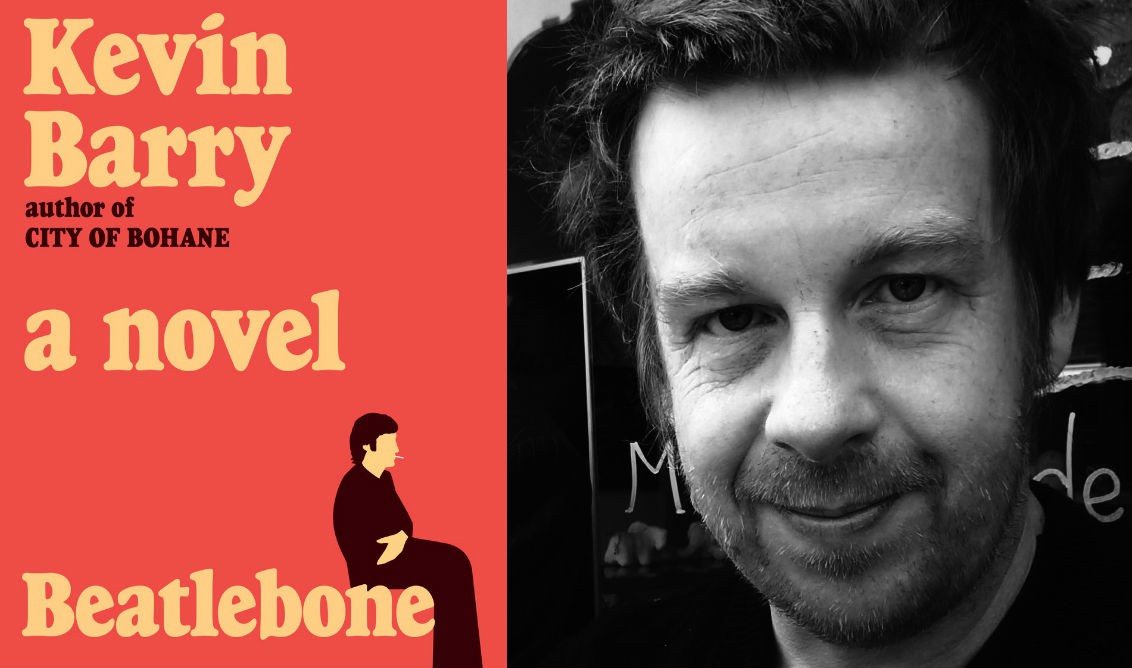
Kevin Barry is an Irish novelist and short story writer whose linguistically dextrous, darkly comic, and sometimes phantasmagorical style has produced some of the most critically lauded and cultishly followed fiction of recent years. The impact of his Rooney Prize-winning collection of short stories, There Are Little Kingdoms, has been credited by many as the first major catalyst for the recent post-Celtic Tiger fiction boom in Ireland. The success of his debut novel — the futuristic west of Ireland gang saga City of Bohane, which received the IMPAC Dublin Literary Award in 2011 — was instrumental in introducing Barry to a wider American readership. The New York Times called it “an extraordinary first novel…full of marvels…as true as the Macondo of Gabriel Garcia Marquez [or] the Yoknapatawpha County of William Faulkner.” In 2012, “Beer Trip to Llandudno,” a story from his latest collection, Dark Lies the Island, won the Sunday Times EFG Short Story Award, the largest monetary prize in the world for a single short story.

Barry’s new novel, Beatlebone (Doubleday 2015), tracks an imagined excursion taken by John Lennon in 1978 to Dorinish, his uber-remote private island off the Mayo coast. With the help of a philosophical local fixer named Cornelius, John evades the British tabloid press; falls down a psychological rabbit hole with a sinister communal trio of Primal Screamers inside an abandoned hotel; and considers his relationship with his wife and parents, his music and memory. All of this while trying desperately to make it to a gnarled, inhospitable piece of rock in the stormy Atlantic, where he can finally be alone with his thoughts.

Barry spoke to me over the phone from his house — a former police barracks in rural Sligo, on the west of Ireland coast. Warm, candid, and prone to excited bursts of expletive-heavy remembrance, he talked about Lennon’s real life interactions with the Irish communes and crazies of the 1970’s; his fascination with the idea that “human feeling settles into places”; the importance of a varied writing life; and his impending return to the anarchic world of Bohane.

— Kevin Barry will be in Brooklyn launching Beatlebone at Greenlight Bookstore, co-hosted by Electric Literature, on Tuesday, November 17th, at 7:30 pm. RSVP here. You can find his story, “Wifey Redux,” in Electric Literature’s Recommended Reading.

Dan Sheehan: Beatlebone is somewhat of a departure from what you’ve done in the past. Why did you choose a real historical figure as the focus for this novel? Why someone as iconic as John Lennon?

…it’s a tall tale, and that’s the area I’m always interested in bringing the reader out toward. That edge of believability, where the reader is thinking to themselves “ah c’mon, no fucking way…but maybe.”

Kevin Barry: Without wanting to sound too Flann O’Brien about it, my bicycle brought me to this one. I go out cycling around Mayo and Galway in the summer and since we moved to Sligo I’ve been doing that every day or two. I’d be looking down at Clew Bay and all the tiny islands, and I had this weird little piece of information in the back of my brain: that John Lennon used to own one of those islands. So I starting Googling this — research would be too fancy a term for it — but I didn’t really know what I was up to. I thought that maybe I could make a little radio documentary about all this or maybe I could write an essay about it. But then I found myself scratching down lines of dialogue and I thought “uh oh, I’m in trouble here” because I was obviously going to start doing this as a piece of fiction. It’s a very risky thing to take such an extraordinarily iconic and important figure and just land him into one of your stories, unasked (laughs). This one took an enormous amount of work in terms of drafts, and the sheer amount of words written out in my shed, just to get the voice to a place I was happy with. I went through lots of variations of voice for him in the book; I tried first person, second person, third person, past tense, present tense, future tense and eventually I just decided to fuck it all in there. I guess what I wanted to do, to use the Joycean term, was to give a portrait of the artist. I wanted the reader to be lowered down into a kind of cauldron of a creative brain and see what that would be like. It was on my desk for about four years. The last year of that was great fun, when I had the voice for the book that I was happy with, but to get to that point took a lot of heavy lifting. Endless drafts and cutting and cutting and cutting until it sounded like it could almost be him. I guess where it’s similar to my stories and my previous novel, City of Bohane, is that it’s a tall tale, and that’s the area I’m always interested in bringing the reader out toward. That edge of believability, where the reader is thinking to themselves “ah c’mon, no fucking way…but maybe.” Very often, with the stories, I find that on the surface they’ll be presented as a kind of realism but then very quickly that starts to fade away at the edges and you realize that you’re in a different kind of world altogether.

DS: That was one of the aspects of the book that I found most interesting: that this is recognisably John Lennon, but he’s also very much embedded in your world, he’s playing around in your wheelhouse. How did research play into to this approach? I mean, there must be hundreds of books written about Lennon and the Beatles but they probably didn’t do you much good.

KB: I was actually very keen not to do any traditional research because, as you say, there’s just so much stuff out there on Lennon and The Beatles that if you open that cupboard door the whole world falls out on top of you. The only real research I did, and I mention this in the essay in the middle of the book, was watching YouTube clips, a lot, and trying to get the rhythm of his spoken voice right. That was really difficult because he’s very changeable in tone; even in the course of a single sentence he’ll go from fluffy to very spiky and thorny and it’s hard to get that down on the page. I developed this weird psychological tic while I was working on it as well where if I saw something on the TV about him, or something in a magazine, I would have to look away. I didn’t want the real world to intrude too much on the fiction. I wanted to have it as a very separate, alternative universe, a might-have-been story. It was interesting for me later on, toward the end of the book, when I did look at a couple of things here and there. I found a book written by a photographer who had been quite close to him who said that late in life Lennon had started to make these odd little solo trips. He went to Japan and he went to South Africa, and it was really nice to find out that my nutty little story was something that really could have happened. And of course underpinning all of it was the connection to county Mayo and how he had been talking about renewing the planning permission with Mayo County Council. There’s just something delicious about the idea of John Lennon and Mayo County Council having dealings with each other, you know (laughs)? I just couldn’t leave that alone.

DS: When worlds collide.

KB: And I think the book started sitting up and coming to life on the desk when I gave him his sidekick, Cornelius. That was a very important thing for the story. It made me discover that John was on this quest and he had this sidekick and so this was the most old-fashioned book on the planet really. It’s essentially Don Quixote. It’s tilting at windmills. There’s nothing new under the sun in the novel, as we know. It’s just what you can do within that, what you can do with the sentences. What I’m interested in is trying to get as much intensity as I possibly can into the sentences, whatever form that may take, whether it’s a comic intensity or whether it’s about getting other emotions down onto the page. I’m rambling spectacularly here, Dan, as always.

DS: Ramble away, Kevin. This is good stuff. But now that you mention it, did that approach, that focus on the intensity of the sentence, factor into your decision to mix writing styles in this novel? I remember hearing a podcast interview you did recently where you said that you love to read your work aloud and collaborate with people in other literary disciplines, describing how one form can aid in enhancing the power of another. In Beatlebone you have stream-of-consciousness sections, you have an essay, you have an intense passage in the Amethyst Hotel that’s almost like a play. How did you decide on what mode to use and where?

We still love to hear stories told to us. We’re all fundamentally children at heart in that regard…

KB: I kind of threw the fucking kitchen sink at it to be honest! (laughs) What the book seems to be like, more than anything, is kind of like a radio play of a novel. It’s a story for voices that primarily works on these kinds of dialogues and monologues. It goes back, I suppose, to the way we take in our stories now and the way that we process narratives and fiction. We’ve all clearly become much more impatient as readers because we’re online all the time and we’re much more inclined to flit around from one thing to another. But I do think that one thing which can still stop us and arrest us, that can slow us down, is the human voice. When we hear voices aloud. This explains why podcasts have become so popular, it explains why there are so many literary festivals now. We still love to hear stories told to us. We’re all fundamentally children at heart in that regard, and I think I’m trying to get that down on the page. This book is supposed to have an oral feeling to it. One of the literary references that’s constantly made in the novel is to Dylan Thomas, who John was apparently obsessed with as a teenager, as all teenagers should be. I found in places that the world of the book was moving toward a kind of Under Milk Wood world. It seemed suitable because there was that link, he had loved Thomas’ work. The main thing for me, always, is to give myself a good time at the desk. It’s based on the very straightforward assumption that if I’m having a good time, the beloved reader at the end of the process will be having a good time too. And what I love about the novel as a form is that it is so capacious; you can kind of do anything as long as the reader is having a good time. You can throw in a play and you can throw in an essay and you can put in a crazy five-page stream-of-consciousness monologue, or whatever, and if the reader is having a good time line-by-line-by-line, they’re happy to go with you to the ends of the earth. Which is great because even though there’s nothing new about the novel and even though it has all been done before, it’s infinitely adaptable. You can try anything inside it, which is why it’ll never go away.

DS: I love that idea of the big, meaty, anarchic novel where you can find space to fit in little nuggets and gems of writing that would otherwise have to be reluctantly discarded. Do you squirrel away bits of abandoned projects to reuse when you find a suitable opening?

But I love for nutty things to happen in books, for mad things to happen around the edges, because it’s not a rational or sane way to proceed with your days or to proceed with your adult life, so why not have a bit of fun with it, you know?

KB: For sure. It’s a sort of authorial thrift. Actually, I got the opening lines for this novel very late on, literally in the last couple of weeks. It’s interesting, sometimes you have a novel on the desk for four years and then it’s only in the last few months and weeks that you can suddenly make big improvements very quickly, because you finally have the tune of it, the melody of it, right. For example, on the last morning before I sent the novel off to its various editors, I wrote in a whole new character: a one hundred and twelve year old woman named Margaret who shows up toward the end, just for a page or two, and kind of talks to John about life. I did call my wife out to the shed that morning to tell her that I’d just put a new character into the book and she went “ah fuck, you’re sending it off at three o’clock!” (laughs). So I showed her the pages and asked if she seemed ok and my wife said “yeah, she’s good. Leave her in.” So I did, and nobody has complained so far. Everyone seems to be very fond of the one hundred and twelve year old woman who shows up at the end of the book. But I love for nutty things to happen in books, for mad things to happen around the edges, because it’s not a rational or sane way to proceed with your days or to proceed with your adult life, so why not have a bit of fun with it, you know?

DS: Absolutely. The hundred and twelve year old woman chastises John for swearing, if I’m remembering correctly?

KB: She does yeah, and she says “the other boy was lovely, the other young fella in the band.” Something like that. She’s a Paul fan obviously.

DS: John would have loved hearing that in the mid-to-late 70s I’m sure.

KB: He would have I’d say.

DS: But even though the book’s incidents are outlandish, they’re also grounded in an historical reality, aren’t they? There were primal screamers and hippie colonies living out in the west of Ireland during that period.

KB: It’s funny, Dan, when you read back through Irish literature of that era — of the 60’s and 70’s and 80’s — it’s all small town stuff, stuff about the farm. And that’s brilliant, fine, but there’s no reference to the fact that the west of Ireland was full of freaks as well at that time (laughs). When I was growing up in Limerick and being around the west of Ireland on holidays, there were always fucking gangs of hippies and primal screamers wandering about. I remember there being a commune of streakers around the corner from our house in Limerick. Crazy stuff going on. It was the end of the hippie trail. It was cheap to come and settle in the west of Ireland so it became full of nuts, who really improved the place. Anything good that happened in the west of Ireland in the last fifty years has been because the freaks moved in and changed the nature of the society there. It used to be this catholic monolith, and it’s fucking not now, because all the crazies started to arrive. It was fantastic and it saved the place. But it struck me that this whole thing had never really shown up in Irish literature, not to any significant degree. You’d see some bits of film here and there — like a Bob Quinn picture or a documentary — but that was about it. So I thought it was very sweet to come across the fact that John Lennon actually had a very real, concrete role in that period of history. When he gave his island to the Diggers, that was really the first organized commune in the west of Ireland as far as we know. So it was really nice that this person, who apparently considered himself to be very Irish, played a role in freaking-up the west of the country!

DS: A much-needed freaking-up.

KB: A much-needed freaking-up of the western zones, yeah.

DS: It is strange to me that writers, for so long, refused to embrace this idea of the west of Ireland as a weird, mythic, psychologically potent place — something which appears time and again in your fiction, whether it’s the Ox Bow Mountains, or Clew Bay, or Bohane.

KB: Well I think that if you go back far enough it’s there. I reviewed a book over the summer called cré na cille, or The Dirty Dust. It’s a Máirtín Ó Cadhain book, an Irish language classic from the 1940’s, just translated into English, and it’s fucking crazy stuff. So if you go back through Irish language literature and through Flann O’Brien and Laurence Sterne and all of that, there was some fucking mad stuff being written. I think the country tried to appear to be in some ways more sophisticated than it was in its literature for a while, as a sort of post-colonial hangover, and we lost any sense of connection with the fact that the place is tuned in to some very weird frequencies. It is nice to think that there is another world out there when you’re writing about the west of Ireland. I’ll get some really strange buzzes off parts of it when I cycle around on my bike. You mentioned the Ox Mountains; fucking hell, man, that place. Whenever I’ve cycled over there I’ve always gotten this deeply weird malevolent fucking vibration of the place, and I knew I was going set a story out there eventually. I think, for me, that’s where stories come from initially. They almost always come from a geographic inspiration. It’s always a place. I pick up on some weird energy and start to write something for that. I used to think that my stories came in with dialogue and started with the ear, but I think the truth is that it’s places more than anything. And I’ve found that to be a very good reason to get out of the house, not to just sit in my cosy little writing shed all the time. Because if I do that I’ll inevitably start writing the novel about a guy sitting in his shed. You have to get out, and you have to listen to people, and you have to tune in to weird energies so see what comes up.

DS: Is there anywhere you’ve been outside of the west of Ireland that can compare to it in terms of that weird, psychic energy?

KB: Well I travel quite a bit and I’ve lived abroad quite a bit. There was guy down in Kerry — a philosopher who died in 2007 named John Moriarty. I saw a very interesting interview with him recently where he talked about how, depending on where you are and what kind of landscape you’re in, your brain feels a different size. He described spending time in Canada, and how his brain felt like a little pea when he was out in that vast landscape. But then when he was back in Kerry it felt like a huge melon! The odd thing is that one of the most important decisions you can make in your writing life has nothing directly to do with the writing. It’s the decision of where to put yourself, where to locate yourself, because that’s going to start feeding into the work, inevitably and very strongly. I mean, I didn’t move to rural county Sligo for literary reasons. We moved here because it was one of the last affordable places to buy a house during the Celtic Tiger, but it ended up working out very well for me because it’s brought me back to the west of Ireland again, and to a part of it that I didn’t know all that well, so it’s fresh to me. I didn’t know Mayo, I didn’t know Sligo, I didn’t know Donegal. So it’s definitely opened up new and strange worlds to me. Wild, elemental places.

I’ve always had this belief that human feeling settles into places — into the hills and into the stones and into the streets and into the buildings — and it lingers there.

You realize how sparse the country is, in terms of population. There’s a kind of eeriness to it, a hauntedness. I read an article in the newspaper last weekend about how Ireland at one point had eight and a half million people in it, and now we have about four and a half. It was a busier place in times gone by, and there is a haunted air to it sometimes. I’ve always had this belief that human feeling settles into places — into the hills and into the stones and into the streets and into the buildings — and it lingers there. In Beatlebone John and Cornelius are constantly tuning into these vibrations as they drift around.

DS: You actually drifted around these places yourself, right? The island, and the old hotel, and the remote coastal caves?

KB: Yeah, all of that stuff from the essay in the middle of the book is more or less true. I went out to the island and I did scream and I did have a look around the Amethyst Hotel. Actually, it was something that started with that Ox Mountain short story I wrote. I said that I would try to write a story on location in the actual place where it’s set; and then I adapted that for Beatlebone. So I was going out on these trips with a load of tape recorders and note books and jotting stuff down very directly on the page as I drifted around. Literally cycling around, stopping the bike and writing things down, almost like reportage. What I love about this book as well is that it’s opened up new areas of interest for me. I’m now very interested in essays having only done a few in the past while — and also in writing plays. So the book is prodding me in unexpected directions, which is really cool. It’s a nice to have new possibilities open up for your writing. I have a lot of friends who are visual artists and they’re much less set in their ways than writers; they’re much more inclined to try new things all the time and to investigate their practice, the way they go about things, their methods. And I get inspiration from that. I think you should always be trying to change. I really hate this idea of the writer who finds a voice, and then writes in that voice for forty years.

DS: Until no one wants to hear it anymore.

KB: It just seems like utter tedium to me. I much prefer the idea of letting the story, or letting the project, dictate the voice and the style.

DS: I remember reading recently about novelists like Alex Garland who, having dipped a toe into a more collaborative literary field like Hollywood screenwriting, found it to be so exciting and addictive that they ended up moving away completely from where they originally started. Can you see something similar happening in your own career, or will you always return to prose fiction?

KB: Well I’ve done bits of everything over the years; I’ve had a couple of short films made and I’ve written longer, feature-length scripts and plays. I guess by nature I’m quite sociable. I like getting out of the house and I like having colleagues. When it’s prose fiction it’s just you and the four walls, so increasingly, when I open the laptop I have two folders: one says ‘scripts’ and one says ‘stories.’ I’m in a weird situation lately in that whatever I’m working on, I’m not sure what folder it’s supposed to go into. The stories are turning into monologues and the scripts are turning into stories. But I’m definitely drawn to actors, I’m very sympathetic to their plight, because it’s a real, vocational thing that they do and I increasingly find myself writing for them, in whatever form that might take.

I also think that, pragmatically, in a writing life it’s a good idea to be doing a lot of different things, because you’re certainly not going to make a living as a short story writer. Very few people can even make a living as a novelist these days so having plenty of pokers in the fire is a good thing.

Over the last while I keep making attempts at plays, and they’re fucking hard. With a dramatic piece you can’t just tell a story, you also have to build a little machine with all its component parts that’s going to work in a room forever. It’s slow work. I slide through the dialogue but then what’s around the edges of that takes a lot of thought and a lot of drafts.

DS: I suppose you’re also put in a new position where people are telling you what you can’t do. You’ve spoken about City of Bohane and the planned adaptation; how in the writing of the story you could create this gigantic, labyrinthine world full of battles and costumes, and it didn’t matter because you and the reader were doing the work, but once that moves medium to theatre or TV or film, budgets come into play.

KB: That’s the glorious thing about writing short stories or novels: you can do whatever you want. All that’s holding you back is your own imagination. It is interesting though, how working in one form can benefit you in another, and I think you learn a lot about yourself, as a short story writer say, by writing a play, and visa versa. Only positive stuff can come out of trying new things and finding what’s right for you. Everyone is going to change as they move through a writing career as well. I look at someone like Gore Vidal and I really admire a career like that, because he did fucking everything! He had a long period where he was a screenwriter, he had a long period where he was a Broadway playwright, later in life he became a renowned essayist, he was an historical novelist. He just did the lot, and I love that polymath approach. I guess I have a kind of impatience as well; I’d go nuts if I was only writing short stories or if I was only writing novels.

DS: And why not? If you can combine forms in a book and that book becomes successful, why not use that as a springboard? Who sets the rules for what type of writing you’re supposed to do going forward?

KB: Right. I want to be unpredictable to myself as much as to a reader. I want to surprise myself as a means of keeping myself interested. I want to present stuff that people don’t expect. There’s a great quote from Harold Pinter, who said once “don’t ever give them what they think they want,” which I think is kind of heroic. When I published my first book of stories it went down well; they were quirky, funny stories often with small town settings, and I guess then when I was about to publish a novel I would have been expected to create a similar world, and I didn’t do that. And sometimes people can be a little tetchy when you do something that they’re not expecting, but fundamentally it’s just about trying to keep myself engaged with what’s going on on the desk.

DS: Do you think you had that impulse even before you started writing? I know you worked a number of different jobs when you were younger including being a court reporter in Limerick, where you were able to just observe this array of darkly comic, verbose, grotesques.

KB: Yeah, my first job was as a cub reporter when I was a nineteen year old in 1989. And it was really weird, starting to write a novel nineteen years later and having no idea that those two or three years spent in court houses and council meetings in Limerick would serve as large part of the research that was needed for City of Bohane. I didn’t even realise that when I was writing the book, but when I look back on it now with a little bit of perspective it’s clear that while the book is a fantasia set in an alternate future, it comes from growing up in Limerick and Cork in my twenties and it’s really about how small cities operate. The interconnections and the sense that, even though the rest of the world is out there, really it’s just a kind of rumour. Nothing really matters unless it’s happening on O’Connell Street in Cork or on Patrick Street in Limerick, or on De Valera Street, as it is in Bohane. Where you are is the center of the universe and anywhere beyond city borders is Big Nothin’. But all the research for that, unbeknownst to me, was sitting in court houses in Limerick City, which as you can imagine is a ripe education. Sometimes the best research happens when you don’t even know you’re doing it, when you’re just going through your day-to-day life. But it can take a long, long time for it to filter into the fiction. I regularly look back at my short stories and ask myself “where did that come from?” Often it comes from periods of your life, feelings or emotions, that happened ten, eleven, twelve years ago, and it takes that long to hang around at the back of the mind, in the subconscious, where all fiction begins, before it’s ready to be transmuted. Maybe it needs to embitter you (laughs) for a few years before you can use it in that way. I don’t do any teaching but I sometimes give talks in colleges to young and emerging writers and the one thing I always say is that it’s really hard to write about what happened to you last week or even last year. It can just be too soon. It needs time to compost, to get murky, before it’s ready to come into your work.

DS: I wanted to ask you, Kevin, about whether or not there is a sequel to City of Bohane in the works. You built such a detailed, kinetic world in the novel, it seemed to me that any one of those main characters could have their own spin-off.

I’m going back out to the quare place…Because when you build a city it feels like real estate, and you might as well use the fucking place.

KB: I am definitely going back. I’m going back out to the quare place. I wouldn’t be promising trilogies or anything like that, but I did feel, even when I was in the middle of writing the first one, that I was going to do at least one more. Because when you build a city it feels like real estate, and you might as well use the fucking place. About two years after I wrote it I was recording the audio book, and I noticed that I was having great fun whenever the characters Jinni Ching or Girly Hartnett appeared. The thing I felt was most lacking in the book was that these two main female characters weren’t in it enough, so I can’t wait to go back to Bohane to see what they’re up to. Nothing good I expect. The plan is to head back out there on the Winter Solstice, December 21st, and to return on the Summer Solstice, with the tablets of stone!

DS: Ready to greet the world again.

KB: I definitely don’t intend to spend fucking four years on this one. I wrote the first Bohane novel inside a year, and I have the language for it now, I have the world, so I think I can get the second one down pretty quick. I’m curious myself, in a weird way, to find out what’s going on out there and the only way to do that is to sit with it in the shed for at least six months. I wrote City of Bohane in 09/10 so I’ll be going back to it six or seven years later with more experience as a writer, and probably with more technique in some ways. But what I’ll be really interested in is to see if I can get the same vitality into the sentences, if I can make the sentences pop, because that’s what elevated the first book, that’s what I was happy with. And I have no idea what’s going to happen. Maybe it’s going to be a really quiet Bohane book, a subtle novel with no gang fights or brash fashion descriptions (laughs) or love triangles. It could just be pure kitchen sink realism.

Are We Alone?

VanderMeer presented a version of this essay as the keynote speech for the Arthur C. Clarke Center for the Human Imagination’s “Are We Alone?” conference in early June of this year.

1. The Meaning of A Question

Are we alone? There are so many possible ways to begin to answer this question, confirmed by even a quick glance at the long, comprehensive wiki entry for “Fermi Paradox.” The back-story on the “Fermi Paradox” — why haven’t we encountered aliens yet — reads like science fiction. Certainly, the scenarios it sets out are all consigned to the realm of storytelling for now and even the most logical speculation may turn out to be wildly inaccurate. For this reason the science of alien contact and the fiction of it dovetail in interesting ways and explains why speculation on the subject is sometimes more powerful and useful than empirical approaches. How and why speculation is sometimes more logical than science is also interesting, as the question begins to turn to issues of human interpretation and bias.

Delving into the topic of alien life through the lens of science fiction makes more sense than in perhaps any other field of scientific inquiry. There are hundreds of stories and novels devoted to this question — and some of the most well-known “answers” come to us from one of the most famous SF writers of all time, Arthur C. Clarke. Clarke gave us several glimpses into possible alien intelligence in his work, including The Sentinel, which inspired Stanley Kubrick’s movie 2001. That might seem to be an obvious jumping off point for the subject, but I find a lesser-known story by Clarke even more relevant because it is more complex and more human.

Clarke’s “The Star” (1955) tells of a spaceship expedition that encounters the ruins of an extinct alien civilization whose star supernovaed. In the twist at the end, the expedition discovers that the light from the supernova reached Earth around zero A.D., manifesting as the star seen over Bethlehem in the Christian Bible.

Clarke’s story is powerful not just because of the juxtaposition of life and death, death and rebirth, but also because it mercilessly interrogates human ideas of meaning about the universe. Some readers take the story as a critique of organized religion, but it is more complex and empathetic than that. The story is very much about the human need to create story out of what we observe around us — to, in any context and by whatever means, make sense of the unknown or the unknowable. Creating a fiction out of reality.

It’s telling that the priest narrator points out “my order has long been famous for its scientific works” but that the scientists on board the spaceship dismiss the priest despite these bona fides. “It amused them to have a Jesuit as chief astrophysicist[; they] could never get over it.” Whether intended by Clarke or not, there’s an indictment in that dismissal, that lack of an attempt to understand another’s point of view. That dismissal is especially ironic given that the need to create narrative and purpose is prevalent even in so-called empirical scientific endeavors.

“The Star” also subverts a related science-fictional theme: the desire to reach beyond, to go farther, to experience more: “No other survey ship has been so far from Earth; we are at the very frontiers of the explored universe.” The expedition in “The Star” and their space craft could be said to be the physicality of a thought expressed first in the imagination and then made manifest. Creating reality out of fiction. Sometimes this thought first occurs in the form of a simple question. Sometimes the answer is perilous. Sometimes the question answered is not the question you asked. Are we alone?

Who are “we” and thus who are “they”? Which “we” and which “they”? Are we not alone if we find microorganisms on Mars? Or is that somehow anticlimactic. Are we not alone if we find a random mammal contentedly munching on some form of vegetation on a planet orbiting a distant star? Or, are we only not alone if we find some form of life we deem truly intelligent?

Or, must we find intelligence that’s “relatable” in the sense that we as humans recognize in this intelligent life-form traits we ourselves possess? “Even if they had not been so disturbingly human…we could not have helped admiring them,” the priest in “The Star” writes. At what point is the switch flipped from “alone” to “not alone”? Would a satisfactory answer differ for the alien we might someday meet? Would the very idea of the question mean something radically different?

Clearly, for human beings, the question wasn’t answered at the point at which we realized the sky was full of stars and that they did not revolve around the Earth. The question at that point was complicated by the fact that those who did not want the answer killed or imprisoned those who began to suggest its outline. Nor was the question answered, nor did it become a different question, when we trained powerful telescopes on those stars and began to discover the planets that orbit them.

The hidden insatiability at the heart of the question speaks to a need for meaning through connection, which made me think immediately “are we just trying to avoid some other question?” And what would replace the question if we ever answered it in the affirmative? Would that answer be sufficient?

If I’m not sure, it’s because I’m not sure how de-linked the question is from rationalizations to continue the Western drive for limitless expansion. How much in locked step our need to find other life marches beside some other impulse. In tackling the issue in “Colonize Mars? Not until we learn some lessons here on earth,” an essay published at Fusion.net, Dr. Danielle N. Lee asks the question, “Is it right to think about the galaxy as a playground that is ours for the taking?”

She quotes NASA Space Communicator and space policy analyst Dr. Linda Billings, who notes the language used by astrophysicists of “frontier pioneering, continual progress, manifest destiny, free enterprise, rugged individualism, and a right to a life without limits.” As Lee puts it, “Within astrophysics circles, the idea that it is our right and imperative to conquer other planets is presented as natural.”

I would hope that “Are we alone?” isn’t just the booster rocket for Manifest Destiny transformed. I’d hope that it’s also, or instead, an expression of a genuine empathy and desire for discovery. A genuine reaching out. Yet even empathy, like a telescope, can be directed on one place and ignore another entirely. And discovery, for human beings, has rarely meant anything as selfless as quenching a desire for contact and for pure knowledge. The famous “sense of wonder” in science fiction has often been achieved by ignoring flawed assumptions or simplifications embedded in the foundations of the story. In thinking of first contact, we sometimes forget the tragedy and genocide of first contact between different groups of humans on Earth — usually at the expense of indigenous populations.

A question, then, that makes us look outward, can carry with it perilous assumptions about our place in the universe and our place on Earth.

2. Aliens From Beyond

This looking out, the searching of the wider expanse beyond our own planet, whether fact-born or fiction-born, is in some sense equally speculative — the idea of a confluence between science and fiction interesting, too, because it has historical underpinnings. Early scientific papers in the West by the likes of Francis Bacon and Johannes Kepler took the form of “contes philosophiques” or “philosophical tales,” in which the fictional framework of an imaginary or dream journey surrounded some sort of scientific speculation. In the late 1800s, some scientists even presented their findings in the form of poetry.

If the boundary between fact and fiction is at times porous — if its delivery systems sometimes resemble each other — it’s certainly so in talking about extraterrestrial life. In part for this reason, when we finally do encounter intelligent alien life it’s likely that most or all of our fictional and scientific speculation will be rendered obsolete. That everything you’ve read on the subject will be like the supposed canals on Mars in fiction from days of yore or the jetpack future of the 1950s we were all promised. Making this even more certain is the constant dilemma of the human condition, which is its subjectivity, so that even a seemingly simple concept like “scientific accuracy” can become unmoored in unexpected ways. Often, in looking outward, we are receiving back what we want to perceive. In areas like physics, the New York Times reports, there’s even a clash between empiricists and those who are willing to accept “sufficiently elegant and explanatory” theories.

Thus, any methodology applied to the subject of aliens must factor in the limitations of the human gaze — which is often illogical and unaware of its own bias. Part of the problem is the obvious one: we have only five senses (so far — that may change) and no matter how we augment those senses with hard tech, it is still difficult for our imaginations to extrapolate beyond those senses. We see this daily in how we continue to behave in self-destructive ways, stand behind terrible policies, because some of the consequences are hidden from our direct view or occur in a realm invisible to us. Nor is this lack a problem for the layperson only. Dedicated scientists experience it as well.

Our brains also constantly work to convert the world into metaphors and similes — into comparisons that help us to navigate our way through life. Some of this is instinctual, some specific to culture, as explored in Hofstadter & Sander’s fascinating book Surfaces and Essences: Analogy as the Fuel and Fire of Thinking. In trying to reach beyond, our limitation is that if we’re not diligent and on guard our conceptualizations default to the wrong things.

A recent example of this limitation comes directly from SETI — in a New York Times op-ed piece by Seth Shostak, director for the Center of SETI research at the SETI Institute. In talking about the risk of proactively sending out signals that might be picked up by a hostile presence, he speculates about how aliens might perceive the injustices we’ve perpetrated on one another.

Personally, I think this concern is overwrought. Any society that can pick up our radio messages will be at a level of development at least centuries beyond our own. They would be no more incensed by our bad behavior than historians who learned that Babylonians attacked one another with spears. It seems naïve to imagine that, by shielding aliens from the less flattering aspects of humanity, we would somehow lessen any incentive to do us harm.

I find this comparison disappointing at best. No more incensed…than historians who learned that Babylonians attacked one another with spears.” What belief is Shostak invoking? What leap of faith? Faith does not have to include a star in the heavens. Because the star is a symbol, we will always supply the star in some form.

Perhaps Shostak is trying to be relatable for a general audience. But even so, if the director of SETI can conceptualize aliens in such an unimaginative way, it exposes a possible flaw at the heart of our endeavors because such comparisons are meaningless — the words have no actual meaning at the coordinates they have been given.

It’s important not to over-deify scientists and scientific organizations in general, especially in areas that require rather more speculation than others — especially since scientists need to have the freedom to fall on their faces like everybody else. So I say with not too much judgment that the same day I read the SETI editorial, I also read an article about a professor from the University of Barcelona who thought about aliens in the context of Bayesian Statistics and some generalizations about Earth that probably needed more rigorous interdisciplinary analysis. His conclusion? That most likely “Aliens Will Be Bear-Sized Because: Math,” and, specifically, a planet of about 50-million intelligent bear-sized aliens.

With rather more judgment, I can tell you that the same week I listened to Freeman Dyson on NPR saying that global warming is not a big problem, as well as other ignorant things. I also read an article on how gender bias among scientists led to the assumption that the planet represented by the human egg played a passive role in relation to the expedition known as sperm — an assumption now known to be wrong.

If I self-identify as an absurdist in thinking about this weird world of ours, it is to remind myself that, again, life often only forms a coherent narrative because we impose that narrative upon it. If I want to always be aware of the irrational behavior of human beings and of human institutions, it is to, as a novelist, not operate from the same old defaults.

All of this has a point — leading back to SETI, for example. The constraint was put on the question “Are we alone?” by SETI, in its decision to monitor radio waves, and focus mostly on a certain range of radio waves. A default assumption was made because it had to be made, because sometimes science is just a best guess. But are alien super civilizations really “absent from 100,000 nearby galaxies” as reported in a Scientific American article or are we just too primitive or bound by our own stance and perspective to see them? One imagines some alien culture with its own version of SETI based on a completely different set of assumptions.

What, then, does it really mean to be alone or not alone? If you are alone, are you by definition lonely — with the yearning that implies? What does yearning — desire — do to warp the results of an inquiry? And wouldn’t it be reasonable to assume that many forms of alien intelligent life out in the cosmos do not suffer a similar angst about “being alone”? And is our angst about it healthy or somewhat unhealthy?

In such a context, where so much is speculative anyway, I’m reminded of the mind-blowing stories of R.A. Lafferty, which do not strive for realism but in their surreal approach are perhaps more useful than “hard science fiction” in expanding possibilities about alien life. In one of Lafferty’s tales, “Nine Hundred Grandmothers,” an expedition discovers that the intelligent aliens on the planet they’re exploring are matriarchal, and that every female member of this alien species is still alive. In a remarkable scene, the protagonist passes through ever-smaller subterranean caverns to meet the original alien matriarch. Whether this is a plausible real-world scenario, it definitely trumps and is more useful than a prediction of “bear-sized” aliens or comparisons to the ancient Babylonians.

In another Lafferty story, “Thieving Bear Planet,” the aliens are portrayed as capricious and erratic because their ultimate motivations cannot be grokked by human beings. The human expedition encounters weird gaps in time, small replicas of themselves, and hauntings that only make sense as part of an alien methodology. Lafferty’s genius is to show only glimpses of that methodology, thus giving a true sense of what alien contact might be like.

Ursula K. Le Guin’s classic “Vaster Than Empires, and More Slow” extrapolates in a different direction, telling the story of an expedition to a distant planet where sentience takes the form of plant life. Only one member of the expedition recognizes this sentience because to the others the context in which it exists is faulty, not the usual, forms a different pattern.

Similarly, in Dmitri Bilenkin’s “Crossing of the Paths,” a 1970s story from the Soviet Union, the divide between the alien and human is extreme. Bilenkin’s story describes an encounter on a distant planet between a human expedition in a vehicle sent out from a space ship and an alien species known as the mangr. The mangr looks like a huge thicket of bushes across a hillside. In fact, it’s an intelligent collective and nomadic to avoid the giant electrical storms that plague the landscape. The humans in their crawler try to drive right through the mangr but become trapped because of a series of mistakes based on the standard assumptions one might make about the Earth version of a thicket. During what follows, the crew never fully figures out that they’ve encountered intelligent alien life because the aims of the humans and of the aliens are so different. Nor do the aliens recognize that they’ve encountered intelligent life, either.

Nor, in their alien context, would they care if they did. Each reacts as to their nature and their precepts and each is thus unaware of one another.

A circle looks at a square and sees a badly made circle.

3. The Aliens That Live Among Us

Recognition, then, is an essential step in asking the question “Are we alone?” Recognition of intent, perhaps. Recognition of something not ourselves, not acting like ourselves, that yet has some form of sentience. But if our own recognition of intelligence is incomplete, how do we know that “we” constitute the kind of intelligence that another intelligence might recognize? In other words, do we fulfill the very requirements we ask of “others”?

Frankly, I am not sure we have proven we can recognize intelligence when we encounter it. I would argue that for the longest time we have denied that intelligence exists all around us, in the animal world. Almost all of our cultures, societies, our national identities, and our day-to-day habits tell us that this is our default position. It may be true that some of us exist more in harmony with our surroundings and leave less of a “mess” for the Earth to deal with, but that’s a different issue.

Only in recent campaigns to grant personhood to apes, dolphins, and other species, do we see the beginning of the recognition that we have never been alone. Certain laws begin to acknowledge interdependence too. In 2010, Bolivia passed a law establishing the Rights of Mother Earth and acknowledged the “dynamic living system formed by the indivisible community of all life systems and living beings whom are interrelated, interdependent, and complementary.” A law passed in New Zealand this year which declared animals “sentient,” taking sentience to mean able to “experience positive and negative emotions.” (This is rather less than what’s needed, but still a step toward recognition.)

Recognition has been difficult for a number of reasons — our limited senses and very particular ways of categorizing the world are further stymied by encounters with very different types of life that surround us. We’re only now beginning to realize that not all sharks are solitary, for example. Some sharks have complex social networks, which hints at a sophistication we’ve longed denied them. “Even” fish, which we tend to see as inert objects, incapable of feeling pain, we now know interact in sophisticated ways. According to an article in Nature titled “Inside the cunning, caring and greedy minds of fish,” they can, among other things, “cooperate, cheat, and punish.” These findings are changing how we view brain evolution.

Philosopher Timothy Morton in his essay “Human Thought at Earth Magnitude” published earlier this year in the Sonic Acts Geologic Imagination conference book even makes a compelling argument for the thought-experiment of mapping similarities between the imagination of bees and the human imagination — that animals like bees may make more decisions than we think while at the same time we humans put too much of what we do in the category of requiring conscious thought. Given confirmation bias we can no longer be certain aspects of the human imagination are not actually a series of set operating protocols and automated systems.

That may seem like a radical idea, and perhaps hard for some to believe. But it’s harder to discount examples of “alien” higher-order intelligence on our planet. Sy Montgomery’s recent The Soul of an Octopus: A Surprising Exploration into the Wonder of Consciousness provides anecdotal evidence of not just octopus smarts, but also evidence of how different that intelligence is. An animal that sees through its skin and has a brain that may in part reside in its tentacles will not think like us — would never think like us. Neither would an alien from outer space that evolved in a similar way.

How horrific would it be if humankind reached the stars, landed on a planet, and wound up eating sentient life-forms without realizing it? What if aliens arriving on Earth were so different from us they couldn’t recognize our intelligence and only saw us as succulent protein?

But there’s another reason we haven’t recognized these aliens amongst us. Today’s world contains so many examples, on a daily basis, of casual cruelty and thoughtlessness toward animals codified as practicality or reasonable behavior or even, in the worst examples, a twisted kind of empathy regarding aspects of the environment and the animals that populate that environment. These unexamined assumptions become agitprop for status quo.

This agitprop is a kind of a kind of slurry or run-off from our online experience, which is not only becoming close to the totality of the Western experience, but is full of animals pushing slogans of universal truth or some humorous saying. Wise owls, “otter nonsense,” smiling dolphins. Because we love animals. We usually love them as long as they’re funny or cute or in some other way reduced down to a meme. We breathe life into them using carelessly corrosive received ideas, each iteration farther from any kind of true seeing. If sharks looked friendly to us, like dolphins, we would probably view them at least a little differently. (In a context in which dolphins are known to be stone-cold bastards.)

Still worse are images like a popular “cute” one of an otter in a glass cage. Holes in the cage allow people who come to the zoo to shake hands with the otter. This image is shared and re-shared with seemingly little realization that if the image showed a human being in a glass cage, trained to shake hands with visitors, no one would be calling it “cute.” Perhaps that view — and John Crowley’s recent hoary rumination that animals can’t foresee their own deaths — would be revisited after reading “Aid to a Declining Matriarch in the Giant Otter,” with its useful thoughts on otter cooperation and “human exceptionalism.” Or perhaps an otter isn’t the right meme to flip the right switches in the human brain — perhaps you need to substitute an orca in a tank instead. (Even the usually reliable Ted Chiang in trying to create a parrot’s point of view ultimately gives humanity a pass in a way that makes it clear he’s trapped in the human gaze.)

Rejecting false information and finding a new path is incredibly relevant to human survival because our current crises are in part fueled by mindsets that see animals and our environment as disposable. But it is also relevant to our search for alien life, and our expectations and assumptions about that life. Because ultimately we must come to terms with the fact that other forms of intelligence always lived among us and that we ignored these forms and have also terribly abused them. Because this may help us to understand more clearly that ideas like Manifest Destiny that still permeate our society, sublimated in a devotion to unsustainable and endless growth and, yes, a reaching for the stars, also pertain to how we might treat aliens from far-distant places.

To become more, we must become less. To answer the question “Are we alone?” we must be receptive enough and humble enough to actually see what is around us on this planet. We must learn to live within limits.

4. Tech and AI

Perhaps, too, if we had paid more attention to the localized answer to “Are we alone?” we would already have cities that take as inspiration the complex ecosystems found at the top of redwoods. Maybe we’d be able to see that a smart phone is fairly crude next to the ways plants and trees communicate with one another through fungal thoroughfares, that the symbiotic relationship between the albatross and the sunfish reveals a startling and unexpected complexity.

In such a context, I don’t think I’m a luddite to wonder if we’re not often using primitive modern tech like our phones and even GoogleGlass to build an inaccurate, blinkered prism of the world around us. One that walls out not being alone with shiny reflective surfaces and fragmentation of our attention spans. This isn’t at all to say that modern technology can’t engage in a meaningful way with these issues. Modern tech is incredibly useful to a wide variety of scientists — and in the area of renewable energy may be human civilization’s last hope. In many fields, specialists have begun to invest our human world with products that mimic the best of animal efficiencies and complexities, regardless of the issue of consciousness. In terms of space travel, technology developed by NASA has proven very useful to those of us on Earth, as well.

But much of our every-day tech, the systems that shape our thoughts and thus our consciousness, comes with an underlying assumption: that it is logical and forward-thinking. And if that is true, surely the creators of seamless tech are themselves logical and forward-thinking. If you want another view, a very dystopian one, read the article “Come With Us If You Want To Live: Among the Apocalyptic Libertarians of Silicon Valley” by Sam Frank in the January 2015 issue of Harper’s Magazine. There you will find manifestations of the absurd that will make you wonder what an intelligent alien from another planet would think of our intelligence — from a commitment to cryogenics to things far more outlandish, disguised as part of “the new enlightenment.” You will also find odd statements that include the assertion that AI is much more complicated than natural ecosystems. Yet as far as I know, human beings have never created a complex natural ecosystem from scratch.

In talking about this issue on social media, Skyler Nelson, who works for an AI company, told me he sees this point of view among tech elites as a barrier to advances in his field. I quote him at length because it shows that people are beginning to get the message.

The funny thing is that we’ll go out of our way to attribute agency to things — we’ll ascribe a purpose to any movement we think we can discern a pattern in (and we’re overzealous pattern recognizers — we’ll infamously become convinced of patterns where none exist). But we have this over-specific anthropomorphic concept of intelligence that we’re extremely hesitant to apply. We don’t recognize other forms of intelligent behavior in animals and we’re unfortunately hesitant to even see intelligence in the behavior of people who differ from us significantly.

And the really funny thing is of course that the sort of logical, sequential reasoning that many of us take to be the hallmark feature of intelligence is something that we humans rarely actually do — there’s an increasing amount of evidence from the neurosciences that most of our decision-making processes occur at the instinctual level and are sort of retroactively justified by reasoning processes when necessary.

What is intelligence? If we’re still figuring that out — and if science eventually shortens the distance between, say, a bee and a human — then it’s likely our quest to answer the question “Are we alone?” will change radically in the next century.

All of this hopefully chips away at the fallacy that we have already discovered everything about this world we live on, which gives most of us the idea that somehow we have more positive control over our environment than we do.

All of this would get us closer to being better prepared if, at some point in the future, the question of “Are we alone?” is answered in the affirmative by visitors from some distant planet.

All of this makes less likely that when that day occurs we bring with us all the old baggage, all the old assumptions. All the useless things we don’t need, and haven’t needed for a long time.

5. The Next Step

In the end, to answer the question “Are we alone?” we cannot look outward without a better awareness of our surroundings on Earth — and without looking inward. To be complex in our thinking but clear in our expression. To not reduce down to binaries or generalities but not get lost in the details, either. What will we encounter out there but ecosystems? What will life be but different?

To think in positive terms — about our human systems, about our tech — perhaps re-purposings can help us too. Imagine what could be accomplished in seeing the miraculous in the every-day if someone invested in a virtual reality experience that showed us the hidden underpinnings of the world, the world we have so much trouble seeing.

The process would start with biologists and chemists and environmental scientists and a host of other experts in various fields coming to your neighborhood, to pre-map the world beyond the world. Afterwards, you’d put on the device and walk down your street. Everything would be identical to what you’d see with your own eyes…except you’d also see the chemical signals in the air from beetles and plants, pheromone trails laid down by ants, and every other bit of the natural world’s communications invisible to our primitive five senses. You’d also see every trace of pesticide and run-off and carcinogens and other human-made intercession on the landscape. It would be overwhelming at first.
But once you got used to it, more advanced settings might be possible. You’d look at the ground and it’d open up its layers, past topsoil and earthworms down into the deeper epidermis, so to speak, until you’re overcoming a sense of vertigo, because even though you’re standing right there, not falling at all, below you everything is revealing itself to you super-fast. And maybe then, while still staring at the ground, you’d have an option to regress to simulations of the same spot five years, ten years, fifty years, two hundred years ago…until when you look up again there’s no street at all and you’re in the middle of a forest and there are more birds and animals than you could ever imagine because you’ve never seen that many in one place. You’ve never even seen this many old-growth trees before. You’ve never known that the world was once like this except in the abstract.

You’re, in fact, standing on an alien planet. And once you got used to that, maybe then…only then…you’d be able to “play the game” at a level in which you inhabit the consciousness of an animal — something less advanced at first, like a tortoise or squirrel, and then work your way up to something “fairly” intelligent like a wild boar or a raccoon.

And once you’d worked your way “up” to human or sideways to human or down to human…whatever that looks like…then and only then would you be allowed to look at the stars, to imagine the cosmos, and to encounter the alien life that might exist there.

If enough people play the “game” right and understand what it means, you, your children, your grandchildren, and your great grandchildren live long lives and everybody continues to have things like electricity, which makes using virtual devices a lot easier.

***

In Clarke’s “The Star,” the expedition discovers the alien ruins on a planet at the edge of their solar system, farthest from the supernova’s impact. These aliens, too, had reached out for contact, building a Vault meant to contain “everything they wished to preserve, all the fruit of their genius.” The purpose is to preserve these things for anyone who might arrive long after the aliens are dead. “Would we have done as well,” Clarke’s narrator muses, “or would we have been too lost in our misery to give thought to a future we could never see or share?”

Earth faces not an impending supernova but instead a slow apocalypse that is beginning to move faster and faster. Are we alone? We will be soon, if we don’t change our ways. Despite pockets of enlightenment, we often act as if we’re settlers on an alien planet. But we don’t live on an alien planet. We have no home world to go back to if things fail here. We were born here, and we will die here, no matter how many new planets astronomers discover. This is the place we must pay attention to, and re-learn how to live in — to find a good answer to the question of what we contribute to the global biosphere.

In the end, then, we are still on an expedition in the middle of the unknown — on a wondrous and complex planet that we are only beginning to understand — that manifests in beautifully interconnected ways even in a patch of weeds springing out from a piece of cracked pavement. And we are, as ever, in existence in the moment and no more. This is where we’ve always been even if we haven’t always realized it. We can never totally discard the human gaze because we are human, but we can imagine our way past it.

Fully living within and thinking deeply about a question like “Are we alone?” is an important part of that experience.

In altered form, two paragraphs about animals in this essay also appear in “The Slow Apocalypse and Fiction.” The ruminations on a virtual reality experiment took nascent form on the author’s personal blog.

A short version of this essay focusing on part 2 appeared on the Guardian website earlier this year.

Boundaries Of Empathy & Identity: Olufemi Terry On Cape Town And Coetzee’s Long Shadow

We’ve asked some of our favorite international authors to write about literary communities and cultures around the globe. We’re bringing you their essays in a new series: The Writing Life Around the World. The next installment is by the Sierra Leone-born author Olufemi Terry, on the writing life in Cape Town, South Africa.

In February 2008, a few days before I began my M.A in creative writing, an administrator in University of Cape Town’s English department asked me if there were any particular writer I wished to have for my advisor. The one I had been originally assigned, an American, had been let go, apparently so that the department could make a quota hire. Rumor said a Zambian poet had been taken on but I never learned the truth of this, nor ever met the poet. It was an incident of significance: Apartheid was not yet fifteen years dead and Black Economic Empowerment (BEE), South Africa’s affirmative action program, was a contentious issue in the worlds of sport, academia, and business.

While inquiries went out to a novelist I admired, an interim advisor was named for me, a well-established Afrikaans-language writer who warned, on meeting me for the first time, that I should not expect much in the way of friendliness from Capetonians. He may have said something about Table Mountain having something to do with this, about nature exerting an influence on the temperament of locals but it may be a false memory.

A month earlier, with post-election violence breaking out in Kenya, I’d left Nairobi for Cape Town. I chose UCT for its affordable tuition and because I had a vague idea J.M. Coetzee taught there.

Coetzee of course decamped to Australia — to Adelaide — in 2002, a few years after the publication of his novel Disgrace.

Another Cape Town novel influenced my decision to relocate, K. Sello Duiker’s Quiet Violence of Dreams. I’d read Quiet Violence, in the nights, while working on a short project at Gulu in Northern Uganda (the brutality conveyed in one particular chapter is as persistent in memory as what I observed in the child-soldier rehabilitation camps). The lurid Cape Town Duiker depicted in Quiet Violence scarcely resembled the bright and glinting place I had visited on holiday. Now I intended it as an escape from Nairobi, which was itself a refuge from New York, the city where I’ve lived longest. In Nairobi there was a divide between expatriate and Kenyan, and after three years I’d wearied of straddling it and of being unable to go about on foot. Cape Town, as it seemed, promised something intermediate between New York and Nairobi.

I was going there with no other occupation but I did not yet think of myself as a writer. I had produced two short stories, neither of which had been published. I’d attended one or two Kwani sessions in Nairobi but I did not see my own likeness in the young Kenyans giving earnest readings of poetry and fiction; they took care to set themselves apart in dress and manner.

Perhaps my placeholder M.A advisor was hinting in that first meeting that he would offer little in the way of literary guidance. Each of us had been saddled with the other: I was writing a novel about Africans in New York; a powerful short story of his that I read in translation was set in the Karoo. We were no natural match

And in South Africa, where the roles of transgressor and aggrieved seemed so fluid, so exchangeable, the boundaries of identity and empathy are stark.

He wrote what he knew. And in South Africa, where the roles of transgressor and aggrieved seemed so fluid, so exchangeable, the boundaries of identity and empathy are stark. Marketing concerns deterred some writers from devising characters outside their own demographic but it was also about appropriation and the fear of committing new forms of imperialism. Much later I understood these things.

Cities contain paradoxes within them but none I have lived in had so many as Cape Town. The environment — land and sea — is romantic in a German, Sturm und Drang sense. Table Mountain looms like a panopticon tower over semi-desert; the rocky Atlantic “wild sea” throws up high, cold waves.

And yet Cape Town has a European look, and its suburbs and wilderness areas contain little wildlife. Looking up from the shoreline, one sees bare, sere slopes on which nothing stirs.

Nor was I easy in mind about whether this was a city, or just a downtown of a few blocks surrounded by suburbs. There’s a nickname for the city, Slaapstaad, which plays on its Afrikaans name, Kaapstad. Slaapstad means sleepy city, a reference to the comparatively short workday but also to a general complaisance.

Cape Town stood apart, its citizens were aware of how far away Johannesburg was. Durban was also remote but Cape Town’s distinction was geographic and political: the Western Cape was the sole provincial government in South Africa not controlled by the ANC. During apartheid the city had a reputation as the most liberal in the country. That aura of exceptionalism persisted after 1994, but Johannesburg, larger and more commercially focused, has become better integrated. In Cape Town, there are currencies other than money.

Cape Town’s writers reflected the wider community. And UCT, with its writing program and the bright names attached to it, Coetzee and Andre Brink foremost, carried an outsize literary prestige. In Johannesburg there was Nadine Gordimer but she did not quite loom over that city in the same way.

It seemed the mark of an excellent novel that it should piss off black and white alike in this fractured country.

Of Coetzee, I learned from those he had taught that he was laconic in the extreme, had rarely been seen to laugh. White South Africans in publishing circles, seemed not to like Disgrace. The novel — and Coetzee himself — had come in for criticism also from black politicians, including Thabo Mbeki. It seemed the mark of an excellent novel that it should piss off black and white alike in this fractured country.

Coetzee had gone but Brink remained at UCT — I’d see him at readings, the beaky face — and other writers besides that were less well known. By and by, I met them, writers of poetry, crime novels, memoir, literary fiction of a pastoral nature.

The community of writers and poets in Coetzee’s long shadow seemed small, a little incestuous but I have no point of comparison; perhaps literary Brooklyn is the same. Spats flared, also feuds and there were accusations of plagiarism and bad faith. In such a close environment having no opinion seemed most politic and I did not try to ingratiate myself.

There were two English-language literary poles in Cape Town. There was a mainstream centered more or less on UCT but taking in also the local publishing houses like Umuzi and Straik, which is now part of Random House. Members read from their work in Kalk Bay or at the Franschhoek Literary Festival.

The other sphere had at its center Chimurenga magazine and its founder Ntone Edjabe. Edjabe had strong ties to thinkers at University of the Western Cape, a stalwart in the Apartheid struggle. Chimurenga thrived in Cape Town’s insular and cagey cultural arena precisely because it was eclectic and unafraid of esotericism; Edjabe seemed to have noticed before anyone else that Cape Town was an excellent place, because cloistered, from which to survey and probe the world.

Edjabe seemed to have noticed before anyone else that Cape Town was an excellent place, because cloistered, from which to survey and probe the world.

I was drawn to both of these as I tried to teach myself to write, and to live in a new way. There was little traffic between the two. You had to “get” Chimurenga to appreciate its value and influence in the city and not many were knowledgeable or even curious about the phenomenon of farotage, or the footballer El Negro Jefe. But Chimurenga was also a refutation of Cape Town’s major tropes — romantic isolation, exceptionalism, sacred nature.

Equally, Coetzee’s austere rectitude colored my aspiration, as it did many local writers, and I hoped to emulate not only his writing but his evident unwillingness to perform the subterfuges that are part of the human game. Although in Coetzee’s case it was perhaps inability rather than reluctance. I found it easy to connect the region’s history and geography with Coetzee’s temperament and to convince myself that seclusion and a curt manner were necessary conditions for advancement as a writer.

At no time were my feelings of sacrifice to a craft stronger than in the damp low season when the city acquired an abandoned, dispirited character. During that first Cape winter I hunkered for four or five hours each day over my computer drinking cups of tea, an electric oil heater by my knee.

In June — summer in the Northern hemisphere — holiday quarters in the city were more or less shuttered and rather than taking a sundowner drink as in the Cape summer, I escaped for long shivering walks with a friend along the misted strand near Cape Point. By such rituals I prolonged the romance of the city.

While it did not seem strange to be engaged in writing fiction about West Africans in New York at the austral tip of the continent, I became impatient with that manuscript. I had been at work on it, off and on, for too long. But there was more: I was eager to write about Cape Town. I’d arrived with honeymoon ideas of the place after one or two previous holiday visits, and been disabused within a few months.

But my impressions of the city, of my own place in it did not stay still. By coincidence I was writing about New York and thinking about that city over many months in Cape Town. Coincidence because it was in Cape Town that the last vestige of New York went out of me, that I ceased to be a New Yorker although I had already ceased to think of myself as one.

I did not become a Capetonian, nor do I believe this was possible even had I wished it…

I did not become a Capetonian, nor do I believe this was possible even had I wished it, in the way an outsider who’s lived in a Spanish village for twenty years knows he will never belong. But I’d found in Cape Town a city more vexing, slippery and contested than even the fast-gentrifying New York I fled in 2003. And I, a longtime student of tribe and social class, became somehow more and less conscious of both.

Eventually, and after very nearly the same interval of time I spent in Nairobi, I left Cape Town. The reasons had little to do with writing, nor was there the urgency I had known in quitting Nairobi. I had published a bit more than on my arrival, including a short story set in Cape Town. I had eked out a space for myself but there was a familiar listlessness and claustrophobia.

When I moved to Germany, I was no closer to publishing the New York novel. And at last a moment came when a choice presented itself: rework it further — just one more rewrite — or start something entirely fresh: a narrative that had been working in my head for a year, the Cape Town novel I’d wished to read since Quiet Violence and Disgrace but had never discovered. And I set the New York novel to one side.

About the Author

Olufemi Terry, essayist and fiction writer, has published in African, American and European publications, among them Chimurenga, Los Angeles Review of Books and Guernica. In 2013, he produced with Marco Lachi how does it feel to be leaving the most beautiful city in the world, a collaborative book of text and photographs about Cape Town. He lives in Washington, DC.

You can find all the essays from The Writing Life Around the World at Electric Literature.

Writing Life Around the World

The Writing Life Around the World is supported by a grant from the Council of Literary Magazines and Presses and the New York State Council on the Arts.

CLMP-narrow
NYSCA