Boundaries Of Empathy & Identity: Olufemi Terry On Cape Town And Coetzee’s Long Shadow

We’ve asked some of our favorite international authors to write about literary communities and cultures around the globe. We’re bringing you their essays in a new series: The Writing Life Around the World. The next installment is by the Sierra Leone-born author Olufemi Terry, on the writing life in Cape Town, South Africa.

In February 2008, a few days before I began my M.A in creative writing, an administrator in University of Cape Town’s English department asked me if there were any particular writer I wished to have for my advisor. The one I had been originally assigned, an American, had been let go, apparently so that the department could make a quota hire. Rumor said a Zambian poet had been taken on but I never learned the truth of this, nor ever met the poet. It was an incident of significance: Apartheid was not yet fifteen years dead and Black Economic Empowerment (BEE), South Africa’s affirmative action program, was a contentious issue in the worlds of sport, academia, and business.

While inquiries went out to a novelist I admired, an interim advisor was named for me, a well-established Afrikaans-language writer who warned, on meeting me for the first time, that I should not expect much in the way of friendliness from Capetonians. He may have said something about Table Mountain having something to do with this, about nature exerting an influence on the temperament of locals but it may be a false memory.

A month earlier, with post-election violence breaking out in Kenya, I’d left Nairobi for Cape Town. I chose UCT for its affordable tuition and because I had a vague idea J.M. Coetzee taught there.

Coetzee of course decamped to Australia — to Adelaide — in 2002, a few years after the publication of his novel Disgrace.

Another Cape Town novel influenced my decision to relocate, K. Sello Duiker’s Quiet Violence of Dreams. I’d read Quiet Violence, in the nights, while working on a short project at Gulu in Northern Uganda (the brutality conveyed in one particular chapter is as persistent in memory as what I observed in the child-soldier rehabilitation camps). The lurid Cape Town Duiker depicted in Quiet Violence scarcely resembled the bright and glinting place I had visited on holiday. Now I intended it as an escape from Nairobi, which was itself a refuge from New York, the city where I’ve lived longest. In Nairobi there was a divide between expatriate and Kenyan, and after three years I’d wearied of straddling it and of being unable to go about on foot. Cape Town, as it seemed, promised something intermediate between New York and Nairobi.

I was going there with no other occupation but I did not yet think of myself as a writer. I had produced two short stories, neither of which had been published. I’d attended one or two Kwani sessions in Nairobi but I did not see my own likeness in the young Kenyans giving earnest readings of poetry and fiction; they took care to set themselves apart in dress and manner.

Perhaps my placeholder M.A advisor was hinting in that first meeting that he would offer little in the way of literary guidance. Each of us had been saddled with the other: I was writing a novel about Africans in New York; a powerful short story of his that I read in translation was set in the Karoo. We were no natural match

And in South Africa, where the roles of transgressor and aggrieved seemed so fluid, so exchangeable, the boundaries of identity and empathy are stark.

He wrote what he knew. And in South Africa, where the roles of transgressor and aggrieved seemed so fluid, so exchangeable, the boundaries of identity and empathy are stark. Marketing concerns deterred some writers from devising characters outside their own demographic but it was also about appropriation and the fear of committing new forms of imperialism. Much later I understood these things.

Cities contain paradoxes within them but none I have lived in had so many as Cape Town. The environment — land and sea — is romantic in a German, Sturm und Drang sense. Table Mountain looms like a panopticon tower over semi-desert; the rocky Atlantic “wild sea” throws up high, cold waves.

And yet Cape Town has a European look, and its suburbs and wilderness areas contain little wildlife. Looking up from the shoreline, one sees bare, sere slopes on which nothing stirs.

Nor was I easy in mind about whether this was a city, or just a downtown of a few blocks surrounded by suburbs. There’s a nickname for the city, Slaapstaad, which plays on its Afrikaans name, Kaapstad. Slaapstad means sleepy city, a reference to the comparatively short workday but also to a general complaisance.

Cape Town stood apart, its citizens were aware of how far away Johannesburg was. Durban was also remote but Cape Town’s distinction was geographic and political: the Western Cape was the sole provincial government in South Africa not controlled by the ANC. During apartheid the city had a reputation as the most liberal in the country. That aura of exceptionalism persisted after 1994, but Johannesburg, larger and more commercially focused, has become better integrated. In Cape Town, there are currencies other than money.

Cape Town’s writers reflected the wider community. And UCT, with its writing program and the bright names attached to it, Coetzee and Andre Brink foremost, carried an outsize literary prestige. In Johannesburg there was Nadine Gordimer but she did not quite loom over that city in the same way.

It seemed the mark of an excellent novel that it should piss off black and white alike in this fractured country.

Of Coetzee, I learned from those he had taught that he was laconic in the extreme, had rarely been seen to laugh. White South Africans in publishing circles, seemed not to like Disgrace. The novel — and Coetzee himself — had come in for criticism also from black politicians, including Thabo Mbeki. It seemed the mark of an excellent novel that it should piss off black and white alike in this fractured country.

Coetzee had gone but Brink remained at UCT — I’d see him at readings, the beaky face — and other writers besides that were less well known. By and by, I met them, writers of poetry, crime novels, memoir, literary fiction of a pastoral nature.

The community of writers and poets in Coetzee’s long shadow seemed small, a little incestuous but I have no point of comparison; perhaps literary Brooklyn is the same. Spats flared, also feuds and there were accusations of plagiarism and bad faith. In such a close environment having no opinion seemed most politic and I did not try to ingratiate myself.

There were two English-language literary poles in Cape Town. There was a mainstream centered more or less on UCT but taking in also the local publishing houses like Umuzi and Straik, which is now part of Random House. Members read from their work in Kalk Bay or at the Franschhoek Literary Festival.

The other sphere had at its center Chimurenga magazine and its founder Ntone Edjabe. Edjabe had strong ties to thinkers at University of the Western Cape, a stalwart in the Apartheid struggle. Chimurenga thrived in Cape Town’s insular and cagey cultural arena precisely because it was eclectic and unafraid of esotericism; Edjabe seemed to have noticed before anyone else that Cape Town was an excellent place, because cloistered, from which to survey and probe the world.

Edjabe seemed to have noticed before anyone else that Cape Town was an excellent place, because cloistered, from which to survey and probe the world.

I was drawn to both of these as I tried to teach myself to write, and to live in a new way. There was little traffic between the two. You had to “get” Chimurenga to appreciate its value and influence in the city and not many were knowledgeable or even curious about the phenomenon of farotage, or the footballer El Negro Jefe. But Chimurenga was also a refutation of Cape Town’s major tropes — romantic isolation, exceptionalism, sacred nature.

Equally, Coetzee’s austere rectitude colored my aspiration, as it did many local writers, and I hoped to emulate not only his writing but his evident unwillingness to perform the subterfuges that are part of the human game. Although in Coetzee’s case it was perhaps inability rather than reluctance. I found it easy to connect the region’s history and geography with Coetzee’s temperament and to convince myself that seclusion and a curt manner were necessary conditions for advancement as a writer.

At no time were my feelings of sacrifice to a craft stronger than in the damp low season when the city acquired an abandoned, dispirited character. During that first Cape winter I hunkered for four or five hours each day over my computer drinking cups of tea, an electric oil heater by my knee.

In June — summer in the Northern hemisphere — holiday quarters in the city were more or less shuttered and rather than taking a sundowner drink as in the Cape summer, I escaped for long shivering walks with a friend along the misted strand near Cape Point. By such rituals I prolonged the romance of the city.

While it did not seem strange to be engaged in writing fiction about West Africans in New York at the austral tip of the continent, I became impatient with that manuscript. I had been at work on it, off and on, for too long. But there was more: I was eager to write about Cape Town. I’d arrived with honeymoon ideas of the place after one or two previous holiday visits, and been disabused within a few months.

But my impressions of the city, of my own place in it did not stay still. By coincidence I was writing about New York and thinking about that city over many months in Cape Town. Coincidence because it was in Cape Town that the last vestige of New York went out of me, that I ceased to be a New Yorker although I had already ceased to think of myself as one.

I did not become a Capetonian, nor do I believe this was possible even had I wished it…

I did not become a Capetonian, nor do I believe this was possible even had I wished it, in the way an outsider who’s lived in a Spanish village for twenty years knows he will never belong. But I’d found in Cape Town a city more vexing, slippery and contested than even the fast-gentrifying New York I fled in 2003. And I, a longtime student of tribe and social class, became somehow more and less conscious of both.

Eventually, and after very nearly the same interval of time I spent in Nairobi, I left Cape Town. The reasons had little to do with writing, nor was there the urgency I had known in quitting Nairobi. I had published a bit more than on my arrival, including a short story set in Cape Town. I had eked out a space for myself but there was a familiar listlessness and claustrophobia.

When I moved to Germany, I was no closer to publishing the New York novel. And at last a moment came when a choice presented itself: rework it further — just one more rewrite — or start something entirely fresh: a narrative that had been working in my head for a year, the Cape Town novel I’d wished to read since Quiet Violence and Disgrace but had never discovered. And I set the New York novel to one side.

About the Author

Olufemi Terry, essayist and fiction writer, has published in African, American and European publications, among them Chimurenga, Los Angeles Review of Books and Guernica. In 2013, he produced with Marco Lachi how does it feel to be leaving the most beautiful city in the world, a collaborative book of text and photographs about Cape Town. He lives in Washington, DC.

You can find all the essays from The Writing Life Around the World at Electric Literature.
Writing Life Around the World

The Writing Life Around the World is supported by a grant from the Council of Literary Magazines and Presses and the New York State Council on the Arts.

CLMP-narrow
NYSCA

The Rest of the World: Hotels of North America by Rick Moody

Rick Moody is a sly one. His Hotels of North America comprises a series of fictitious hotel reviews by a one Reginald Morse, and in its depiction of Mr. Morse’s tendency to talk more about himself than the subject of his “criticism,” it’s conceivably part-intended as a preemptive strike against any book reviewer who would denounce the American writer’s sixth novel. It has Mr. Morse reducing the motels and inns he complains about for RateYourLodging.com to mere reflections of his own troubled life and self, and in so doing it insinuates that this is what all criticism fundamentally entails. Hence, the task of appraising Hotels of North America becomes one fraught with difficulties and pitfalls, since the novel itself suggests that the person who belittles questionable furnishings or, in this case, questionable prose is very often simply giving vent to a frustrated career, a comatose love life, or a stubbed toe.

However, this is already to render a disservice unto the novel, since its anthology of online hatchet-jobs encompasses much more than the egotism and solipsism inherent to criticism. To begin with, its premise — as witnessed by the book’s “preface” — is that the North American Society of Hoteliers and Innkeepers (NASHI) have latched onto Reginald Morse’s quirky reviews and assembled them into a compilation. The purpose of this collection is not only to encourage the reader “to book another room,” but also to aid NASHI in their “ambitious plan to improve hotel service in this country.” The thing is, from the very first entry in Morse’s series, we realize that this enterprise is fatally flawed, since no matter how much the Hotels of North America improve their services and listen to (the rationalizations of) such customers as Morse, these customers are always going to bring their “baggage” to their otherwise spotless rooms.

For example, in this first entry, Morse gripes that the “[t]oo much mustard and brown” in his bedroom provides an unwanted reminder of his “alcoholic grandmother back in Westport.” Accordingly, he awards the Dupont Embassy Row hotel two stars out of five, and from there he commences an achronological tour through America and beyond, which as could be imagined, winds up being more an achronological tour through his past and present. As such, he inadvertently refutes NASHI’s belief that the quality of a hotel alone is sufficient to ensure the quality of its reviews, because every hotel, B&B and IKEA parking lot (yes) he evaluates becomes little more than opportunity to dimly yet acerbically take stock of his failings, failures and uncertain future.

Luckily, Morse proves an amusing and articulate guide to his own life, even if the format in which he chooses to write his autobiography exposes him as self-important, if not downright egomaniacal. His various exploits are chock with dry observations and witty self-deprecations, Moody’s crisp stylings bringing him to life as an embittered yet resiliently spirited individual. During one stay in an abandoned hardware store — just after he separates with his wife — the “top-ten online hotel reviewer” exhibits his arch drollness when he rhetorically asks his readers, “what was keeping me from running loose across state lines with a one-legged prostitute and some open containers, plotting embezzlement and get-rich-quick schemes, insider trading and arms dealing?” In an earlier ‘review’ he recounts an episode involving an exposed “portion of the intimate area of my own person”, while in another he admits to being excited by the presence of a Pet Shop Boy in his London hotel despite the fact that he “understood only vaguely what a Pet Shop Boy was.”

For all his ornery charm, there’s nonetheless something indelibly pompous and self-absorbed about Morse’s need to frame all of these picaresque anecdotes and biographical vignettes within the format of criticism. When he praises the Equinox hotel in Vermont and prizes the establishment with four stars, it’s clear that this adulation is less for the “extremely white sheets” that were “probably labored over at great length by a crew of teenagers,” and more for his successful “illicit liason,” in which he “assumed some highly combative positions” on these same sheets. Accordingly, it soon emerges that almost every “bad” hotel in the novel is attached to a bad experience, and that almost every “good” hotel is attached to a good one. Therefore, when he lauds the Davenport Hotel and Tower in Spokane with a maximum of five stars, the accompanying tale of romance makes it hard to shake the suspicion that he’s merely lauding his own life and personage with five stars, egocentrically brandishing both before his modest readership in order that they join in with and validate his narcissism.

In other words, the setup of Hotels of North America militates against liking or caring for its protagonist to any significant degree. That said, it’s precisely this setup that lends the novel its wider significance and relevance, that qualifies Morse as a representative of the kind of consumerist individual who scapegoats “the dismal Presidents’ City Hotel” so as to save himself from taking responsibility for the dissatisfaction and misery that is his own life. He focuses his unhappiness on inns that serve “only cheese grits” and expects life-satisfaction from such “amenities” as “towel warmers” and “onsite e-book readers,” hoping that such distractions will spare him the need to do anything to confront his past or improve his present.

To take another example, in a Tuscaloosa joint called La Quinta, he unhappily and needlessly swallows down some Ambien, a drug that may cause “profound personality change.” However, when “attempting to isolate possible causes of [the] profound personality change” he later experiences, he unbelievably asserts that La Quinta’s “earth tones, at least for me, certainly brought about profound personality change.” As unsavory and borderline shocking as this denial and self-delusion is, it’s with such a passage that the book transforms itself into a critique of consumerist society, of a society which believes that the consumption of hotel rooms, hats and handbags is enough to compensate for the alienation, estrangement and unhappiness this consumption helps to perpetuate.

As for this unhappiness, the medium of the hotel review conveniently permits Morse to retreat from himself just enough to evade its sources, even though he’s at least marginally aware of this evasion. At one point he addresses his fellow users of the RateYourLodging website, posting that some of these users “will imagine that the great number of hotel reviews I write are due to some desire to avoid the child.” Here, “the child” refers to his only daughter, the daughter he can no longer see frequently due to his divorce, and the daughter whose absence represents an absent future he vainly tries to fill with consumption and consumer reviews. He has other grievances as well — a stalled career as a motivational speaker, a father who abandoned him when he was a child — but these are touched upon only in passing, only as devices for underscoring how his present, itinerant lifestyle is just an excuse not to be alone with himself and his problems for too long.

As essential as it is to the main concerns of Hotels of North America, this habit of mentioning his backstory only in momentary fragments can be something of an irk at times. Unsurprisingly, Morse acknowledges his own ‘oversights in the only way he can: by criticizing someone else for the same fault. During one appraisal he derides another reviewer for publishing such incomplete haiku as “Hotel room not clean services bad,” carping that it barely “conveys the specifics of your dissatisfaction.” This is somewhat rich coming from him, insofar as he spends the entire novel disguising existential wounds and frustrations as issues with “moldy curtains” and workers “yelling in Spanish”, and insofar as, when he does fleetingly broach such wounds and frustrations, he does so chiefly to underline his unwillingness to broach them in any depth. On the one hand, this is a slight annoyance that proves to be the novel’s main weakness. On the other, it galvanizes one of its main strengths, which is that it encapsulates a society, which, somewhat ironically, is increasingly participating in a simulacrum of “communication” (e.g. hotel reviews, social media) so as to prevent itself from having to communicate with any intimacy, consciousness or depth.

In the end, this withholding of information also helps Moody to bolster the overarching theme of Hotels of North America in another way. Specifically, omissions like his girlfriend’s name (known only as “K.”), the underlying reasons for his marital infidelities, and why he suddenly “vanished not long after posting a final review” compel the reader to project her own narrative, ideas and self onto the novel, in much the same way that Morse projects his self onto the numerous lodgings in which he stays. Because of this compulsion, the book accedes to the level of meta-literature, self-consciously questioning the extent to which a writer can provide anything beyond a ‘novel’ way for the reader to experience herself again and again, through the prism of the language which has been arranged on the page before her.

This accession and this self-consciousness are both cemented by an “afterword” written by Rick Moody himself, who goes off in search of the character he himself has purportedly given birth to and defined. It’s as if he’s tacitly confessing that he has no idea who this “Reginald Morse” person is, that the latter is more the creation of his audience than of his own ‘pen’. If we take such a confession to its logical conclusion, it’s also as if he’s tacitly confessing that Hotels of North America is about whatever his audience thinks it’s about, and is only as good as this same audience thinks it is. Put differently, he once again strikes preemptively against the book critic, affirming in advance that even this critic’s recommendation of a sharp, clever yet occasionally bleak novel with a generally unsympathetic lead is little more than an expression of the critic’s own subjectivity, and is therefore no reliable indicator of how the rest of the world will receive his sixth work. So, once again, he proves that he’s a sly one, and simultaneously urges each potential reader to go discover the trenchant social criticism of Hotels of North America for themselves.

My Time at the International Boarding School for the Fostering of Excellence

New Fiction by Etgar Keret

When I was little, my Mom had only one fear — that I’d grow up to be ordinary.

Our family, as everyone knows, has been ordinary going back four generations. Really nice, but so normal you could die.

And my Mom wasn’t going to let me end up like that too.

That’s why, from the day I was born, she and my Dad saved their pennies, and when I was 12, they sent me to the International Boarding School for the Fostering of Excellence in Switzerland.

The International Boarding School placed a very strong emphasis on achievement and uniqueness, and its graduates were known the world over for excellence in their fields. The fields themselves didn’t matter to the administration as long as the child excelled at them. In my class, for example, Caroline was studying to be the most beautiful, and Raul was already the most obnoxious and constantly hassled Yu-Lin, who was the most pathetic.

The teacher seated me at a desk with someone whose name nobody knew, but one quick look at him was enough to see that he was the kid who wanted the most. No one knew what he wanted, because he never spoke. But his eyes were open really wide, trying to see, and his tongue was always waving around in his mouth, as if it was tasting something not there, and that golf ball in his throat went up and down every few seconds the way it does when you swallow.

If I’d known what that kid wanted, I would have killed for him to have it. But I didn’t and neither did the teachers. They didn’t even try to find out — it was enough that he excelled at wanting it.

So I spent a whole year staring at the kid without a name. A year during which Caroline had a cheekbone transplant and Yu-Lin tried to kill herself twice.

We were considered a very successful class, except for me and maybe Raul, who occasionally disappointed with uncontrollable displays of niceness. In a desperate attempt to show his commitment, Raul killed our biology teacher. But as the pedagogical advisors told his parents, it was too little too late, and we were both expelled.

The charter flight home was unpleasant. I knew my parents would still love me, but I was afraid of their disappointment when they found out what I always knew — that I was just like everyone else.

No one spoke on the way home from the airport, and when we arrived, it was already dark. Mom looked at the bags of frozen vegetables in the fridge and asked in a choked voice whether I wanted anything. I closed my eyes and knew I wanted. I wanted something. Without a name, but with a smell and a taste. I didn’t want it the most, not half as much as that kid who sat next to me at school, but for me, it was somehow enough.

Translated by Sondra Silverston

÷ fl ÷ fl ± Ω ∞ Ω ± fl ÷ fl ÷

Born in Ramat Gan in 1967, Etgar Keret has been published in The New York Times, The New Yorker, The Paris Review, and Zoetrope. Keret resides in Tel Aviv and lectures at Ben-Gurion University of the Negev. In 2007, Keret and Shira Geffen won the Cannes Film Festival’s “Camera d’Or” Award for their movie Jellyfish, and Best Director Award of the French Artists and Writers’ Guild. In 2010, Keret was honored in France with the decoration of Chevalier de l’Ordre des Arts et des Lettres. His books have been published abroad in 37 languages in 40 countries. His latest book, The Seven Good Years, a memoir, was published in the U.S. in June.

Originally published at electricliterature.com on November 16, 2015.

My Time at the International Boarding School for the Fostering of Excellence

FICTION: THE MOST, BY ETGAR KERET

When I was little, my Mom had only one fear — that I’d grow up to be ordinary.

Our family, as everyone knows, has been ordinary going back four generations. Really nice, but so normal you could die.

And my Mom wasn’t going to let me end up like that too.

That’s why, from the day I was born, she and my Dad saved their pennies, and when I was 12, they sent me to the International Boarding School for the Fostering of Excellence in Switzerland.

The International Boarding School placed a very strong emphasis on achievement and uniqueness, and its graduates were known the world over for excellence in their fields. The fields themselves didn’t matter to the administration as long as the child excelled at them. In my class, for example, Caroline was studying to be the most beautiful, and Raul was already the most obnoxious and constantly hassled Yu-Lin, who was the most pathetic.

The teacher seated me at a desk with someone whose name nobody knew, but one quick look at him was enough to see that he was the kid who wanted the most. No one knew what he wanted, because he never spoke. But his eyes were open really wide, trying to see, and his tongue was always waving around in his mouth, as if it was tasting something not there, and that golf ball in his throat went up and down every few seconds the way it does when you swallow.

If I’d known what that kid wanted, I would have killed for him to have it. But I didn’t and neither did the teachers. They didn’t even try to find out — it was enough that he excelled at wanting it.

So I spent a whole year staring at the kid without a name. A year during which Caroline had a cheekbone transplant and Yu-Lin tried to kill herself twice.

We were considered a very successful class, except for me and maybe Raul, who occasionally disappointed with uncontrollable displays of niceness. In a desperate attempt to show his commitment, Raul killed our biology teacher. But as the pedagogical advisors told his parents, it was too little too late, and we were both expelled.

The charter flight home was unpleasant. I knew my parents would still love me, but I was afraid of their disappointment when they found out what I always knew — that I was just like everyone else.

No one spoke on the way home from the airport, and when we arrived, it was already dark. Mom looked at the bags of frozen vegetables in the fridge and asked in a choked voice whether I wanted anything. I closed my eyes and knew I wanted. I wanted something. Without a name, but with a smell and a taste. I didn’t want it the most, not half as much as that kid who sat next to me at school, but for me, it was somehow enough.

Translated by Sondra Silverston

We Must Be Alive: Among the Wild Mulattos & Other Tales by Tom Williams

In his 1991 hit song, Black or White, Michael Jackson meditates on racial equality, singing, “I’m not going to spend/My life being a color.” However, Jackson’s well-documented, complicated relationship with his African American appearance speaks to the contrary. In a way, Jackson’s transformation from his natural skin tone to an eerie, bleached white speaks not just of his profound personal battle with identity, but a broader problem in America as a whole. The simple fact is, that as a result of systematic white supremacy, many African Americans do spend their lives “being a color.” This troubling issue forms the central motif of Kentucky-born writer and academic Tom Williams’ short story collection, Among the Wild Mulattos & Other Tales.

The burdens of oppression, violence, and inequality shouldered by black Americans weigh heavy. But how are bi or multiracial people affected — the shades of grey, if you will, in the simplified divisions of ‘black’ and ‘white’ — and how are they recognized and represented in cultural phenomena like literature? Here, Williams attempts to address these matters in their multifarious forms.

Almost 7% of American adults — around 9 million as of the 2013 Census — are genetically comprised of more than one race. In June, the Pew Research Center published Multiracial in America: Proud, Diverse and Growing in Numbers. Of the 1,555 participants of Pew’s survey, only 60% claimed to feel proud of their multiracial heritage, and 55% reported experiencing racist slurs, jokes, and threats due to their mixed parentage.

The findings of the PRC study demonstrate the complexity of racial identity, and how the degree to which people struggle depends in no small part on the race to which they most identify. Participants with a biracial black and white background reported receiving a notable quantity of racial profiling and discrimination, aligning with the many prejudices targeted against black Americans. However, despite such a parallel, many multiracial individuals do not report a sense of connection with people of the same racial mix, indicating a lack of strong shared biracial identity.

Author of The Mimic’s Own Voice and Don’t Start Me Talkin’, and currently Chair of English at Kentucky’s Morehead State University, Williams explores in detail the experience of biracial Americans in a contemporary environment that claims, albeit falsely, to be ‘post-racial.’ The eponymous ‘mulatto’ is a term traditionally denoting a person with one black and one white parent, or sometimes referring to someone with mixed black and white ancestry. Not commonly used today, mulatto is regarded as at best archaic and at worst a racial slur, which is reasonable considering the etymology of the word is based in the Latin mūlus, or mule, the infertile offspring of a horse and donkey.

Perhaps unsurprising given his own mixed race heritage, Williams is explicitly concerned with representations of biracial identity, using fiction to consider the ways in which biracial individuals navigate a world that is unsure whether to treat them as black or white. The majority of these stories are located in the Southern and Midwestern states, where racism remains rife, and racial tension is high. One character, in ‘Who Among Us Knows the Route to Heaven?,’ describes his reception as a biracial child in 1970s Ohio as “(o)dder than two-headed calves, stranger than Uri Geller,” and when watching TV at that time, that “(n)ever once did I see a face or family that looked like mine.” It is this alienation that Williams is most curious about, and the steps some biracial people feel forced to take to in order to counteract it.

Thematically, the collection ranges from a twist on the tortured writer trope in the opener, ‘The Story of My Novel: Three Piece Combo With Drink,’ to Doestoyevskian doubling in ‘The Lessons of Effacement,’ and the relationship between image and identity in ‘Movie Star Entrances’ and ‘The Finest Writers in the World Today.’ The cord tying these narratives together is identity; a notion encompassing our sense of self, how we are perceived, our manipulations of these perceptions, and those aspects beyond our control.

Despite Williams’ concentration on representing biracial characters, his stories share a universality that prevents them from alienating readers of other races. ‘The Finest Writers in the World Today’ focuses less on race, exploring the strange phenomenon of celebrity impersonators. Williams humorously imagines the consequences of a lookalike agency — ’Cause Celebs’ — introducing the doubles of famous writers; a group not traditionally celebrated for their appearance, but for their talent. It is discovered that the popularity of these doubles comes not from their ability to imitate, but from the ability to represent an author without all the troublesome drinking, arrogance, or ridiculous demands. Dead writer? No problem, a “plain creepy” William Burroughs, or Gabriel Garcia Marquez (“the manager of a Mexican restaurant near Clintonville”) double can step in. As authors do experience a huge amount of celebrity — recent examples include Karl Ove Knausgaard, Elena Ferrante, and Chimamanda Ngozi Adichie — Williams’ satire cuts close to the bone.

Another particularly strong story, ‘Movie Star Entrances,’ scrutinizes our obsession with how we are perceived, and is accordingly one of the most relatable narratives. The protagonist, Curtis, is a shy and timid employee of Houston’s Museum of Fine Arts; a self-described “biracial suburbanite,” whose childhood in Des Moines left him desperate to “find a place where his presence was not so spectacular, where he might be among others like him.” With a work party looming, and a special lady’s attention to attract, the self-conscious Curtis turns to a very odd agency to re-invent himself.

Run by Ramon and Miriam, an entertainingly odd couple, Movie Star Entrances promises an extreme makeover, which thoroughly convinces the bashful Curtis. However, despite their extraordinary efforts at transforming him, he finds that his brief moment in the spotlight is not enough to change his perception of himself, and “his tawny…undistinguished skin.” Williams hits the right balance between humor and melancholy, the story a reminder of the sadness and frustration that can arise from growing up without a sense of place — in this case due to race, but applicable to anyone that has struggled with identification or self-confidence.

Williams’ shines when he allows his characters to interact with the uncanny, absurd, troubling, and bizarre, epitomized in the disturbing ‘Ethnic Studies’. A group of men — Javier, Teng Lo, Amos, and our unnamed narrator, all in “the general family of brown” — are offered $500 a pop by a university professor to engage in a highly problematic demonstration of racial variety that is reminiscent of the 19th and 20th century ‘human zoos;’ degrading exhibitions emphasising the differences between ‘primitive’ peoples and white Europeans and Americans. Feeling increasingly uncomfortable and exploited, the men retaliate, putting on a display of racial stereotypes that highlight the absurdity and racism of objectifying of people of color. As thus still, unfortunately, all too common — whether the use of black backing dancers by a white performer, or the wearing of traditional native American headdresses by white teenagers at music festivals — Williams brings us uncomfortably close to how little we’ve advanced from the abhorrent racist practices of our white predecessors.

While Williams’ characterization is generally strong, and he generates authentic, engaging personas, what is glaringly absent is positive female representation. Frequently, the women in these stories are background props, or fulfil an archaic, rather sexist role, such as object of desire, lover, or girlfriend. Only once, in ‘The Finest Writers in the World Today’ does a woman take a vaguely central role, but rather than being celebrated, her confidence and drive to succeed are portrayed as arrogance and obsession. More bothersome is the puzzling vignette ‘A Public Service,’ which takes the form of a kind of marketing spiel for a pornographic website focusing on larger women’s bottoms, imaginatively named ‘rearview.com.’ While it’s clear that Williams’ is attempting to engage in a commentary on the objectification of women:

Denigrating women. Invading their privacy. Who told you that shit? We’re showing women, real women single moms, widows, divorcees…But we’re respectful, We don’t show faces so nobody knows just who it is who’s carrying around all that sugar.

What he produces instead is a rather uninspired, directionless vignette. For female readers, the story serves no purpose aside from an unnecessary reminder of the misogynistic, patriarchal society we must live in.

Although the thorough exploration of this collection is enlightening, at times entertaining, and often disquieting, Williams’ explicit repetition of the biracial motif becomes somewhat tiresome, with almost all of the stories mentioning that the protagonist is ‘biracial,’ in no varying terms, within the first few pages. This degree of exposition leaves the reader feeling vaguely patronized, as if their powers of deduction would be too weak to figure this out without guidance. However, the closing story — the eponymous ‘Among the Wild Mulattos’ — with its depiction of an isolated, biracial utopia for those desiring to escape the whitewashed landscape of America, provides some reinvigoration.

Despite its flaws, this collection forms a fairly vital function: enriching and positive representation of biracial Americans in contemporary literature. What it lacks in gender and geographical diversity, it makes up for in diligence and unwavering focus. While Williams’ reiteration of biracial protagonists can appear excessive, this does, in fact, remind us of the need for such attention; it is not just our society that is dominated by white people and culture, but art and literature, too.

Watch This: Animated Video of Rare Kurt Vonnegut Lecture

This short video is taken from a guest lecture Kurt Vonnegut held at NYU in 1970. Blank on Blank, who created the video, describes the lecture: “In November 1970, Kurt Vonnegut walked into a class room at NYU. He was a guest speaker that day. He’d prepared some handwritten notes on what he wanted to say: there were his thoughts on the art of writing, his childhood, the death of his parents. He jumped from topic to topic as he shuffled through his papers. Sometimes his voice trailed off. He delivered punchlines with perfect timing.”

On writing:

“I’ve heard that a writer is lucky because he cures himself every day with his work. What everybody is well advised to do is to not write about your own life, this is if you want to write fast. You will be writing about your own life anyway but you won’t know it.”

On the importance of his books:

“How important my books are or anybody’s books are, I don’t know. I don’t think they are terribly important. I think that they make people contented during the period they are reading them and this is worth something is to take care of somebody for a couple of hours.”

This interview is taken from Blank on Blank, a project meant to “preserve and re-imagine the American interview.” The website features rare interviews from famous speakers, each complete with an illustration to go along with the video. More interviews can be found here.

In Defense of the Invisible: Eyes: Novellas and Stories by William H. Gass

“There are no magic words,” said William Gass in his seminal collection The World Within the Word. “To say the words is magical enough.” Gass, no stranger to such conjuration, has practiced his own brand of experimental, decadent, and richly complex literary bewitchment for nearly half a century. From the tangled beauty of his debut Omensetter’s Luck (1966) to the sui generis meditation On Being Blue (1975) to his American Book Award-winning magnum opus The Tunnel (1995), the 91-year old belle-lettrist has indelibly marked American letters with a luxuriant, lavishly jeweled prose style whose gorgeous obscenities landed him in one of the great literary grudge matches of the last century, facing off against the arch-moralist John Gardner. In one of their more legendary exchanges, Gardner, a fine novelist in his own right, claimed that the difference between them was “my 707 will fly while [Gass’] is too encrusted with gold to get off the ground.” To which Gass famously responded: “There is always that danger. But what I really want is to have it sit there solid as a rock and have everybody think it is flying.”

That extraordinary mimesis is once again marshalled for Gass’ newest collection Eyes: Novellas and Stories, his first work since 2013’s Middle C. Comprised of two novellas and a handful of short stories, Eyes circles familiar Gassian material — isolation, meanness, obsession, and the wonder and terror of representation — while packing enough formal inventiveness and lyrical sleights-of-hand to keep even the most seasoned Gass acolyte pleasantly off-balance. As might be expected from its title, Eyes is concerned with the implications of sight; more precisely, it is the inverted capacity of seeing — what Jan DeBlieu calls “a glimpse of all that happens out of the realm of human vision” in the book’s epigraph — that especially grips Gass here. These stories strive to tease out the invisible relations required of our existences in order for something — anything — to be seen. “Only once had the world realized these relations; they would never exist again; they had come and gone like a breath,” one of his characters says early on, and the mystery of these words hangs on a wire above the entire collection. What comprises our vision of ourselves? Of others? Of objects? What unseen metaphysical scaffolding — like a photographic negative — can be intimated from the limited world of the visible?

Nowhere are these questions handled with more grace, verve, and surprisingly un-Gassian gentleness than in the opening novella, “In Camera”, which tells the story of Mr. Gab, a greedy (and possibly criminal) aesthete whose love of photography supersedes any moral framework, and his orphan assistant Mr. Stu (a diminutive of “You Stupid Kid”) whose physical deformities and feigned ignorance belie the development of his interior life. Mr. Gab, owner of a drab photography print shop possessed of a suspiciously fine library of images, has found life to pale in comparison to his beloved photos. In the idealized image he sees —

a testimony to the unerring fineness of the photographer’s eye; an eye unlike the painter’s, he claimed, because the painter constructed; the painter made up his image as if the canvas were a face; while the photographer sought his composition like a hunter his prey, and took it away clean, when it was found, to present in its purity, as the result of an act of vision, the sort of seeing no one else employed.

Through the mouthpiece of Mr. Gab, Gass uses the language of photography throughout in order to complicate and, at times, ennoble the act of seeing. “The right click demonstrates how, in an instant, we, or our burro, or our shovel, or our eye or nose or nipple, were notes in a majestic symphony,” says Gab. In the surprisingly tender denouement, a crisis enables Mr. Stu to help Mr. Gab see that “a whole world made of fragility and levitation” can, perhaps, exist among and between us outside the frame. There is subtle, nuanced mercy and heart in what develops between the two, like a photograph years in development finally presenting its richness.

The collection’s other novella, “Charity”, is vintage Gass, a remarkably complex exploration of shame, privacy, pride, and the ambiguous motivations inherent to the act of giving. It follows a young lawyer, Hugh Hamilton Hardy, whose self-loathing arises from his status as “an EZ mark” among panhandlers, schemers, and beggars. A rejected act of charity haunts him from his childhood:

having known both sorts of shame — having inflicted shame and suffered it — shame searing his soul so its skin smoked — Hardy knew the difference between a guilty conscience and crushed pride, between — in a shameless world — getting caught and being defiled.

Gass interweaves sexual memory and dialogue from Hardy’s most recent relationship, adroitly calling into question the ways we use (and abuse) our own sexual currency as charitable gesture. The increasingly blurred lines between shame, need and generosity underpin a surprising exchange at the story’s end that echoes the charitable trauma of his youth. Gass calls into question how we curate the objects of our charity, and what we choose to ignore out of shame or self-interest. In “Charity”, the empathetic offering is as likely as not a desire in disguise: an inverted way for Hardy to coerce others to “feel sorry at him, for a change, all night long.”

The short stories featured in the collection are, by and large, about objects rather than people. “Don’t Even Try, Sam” allows the battered and forgotten piano Dooley Wilson plays in Casablanca to air its grievances in a one-sided interview about old Hollywood, artifice, and memory. It isn’t clear if the piano is even functional (as its keys seemingly refuse to plink), but that is largely beside the point as this funnily eccentric one-off — the literary equivalent of a ditty — ponders the ways in which storytelling provides meaning and, even if only briefly, wards off obscurity. “Soliloquy For an Empty Chair”, meanwhile, gives voice to a foldable metal chair in a barber shop that somehow becomes a melancholic rumination on the inevitability of disintegration. “We die through use…when rust’s slow debilitations pick at what we are and what sustains us with more repetition and determination than the woodworm,” says the chair. In these stories, the oft-ignored life of objects is brought to the fore, vignettes whose psychosis, humor, wit, and absurdity are both a joy in their own right while also a subtle interrogation of how, where, and why we spend our attention.

Returning to Jan DeBlieu’s lovely epigraph, “eyes”, beyond being receptacles of vision, are also geographic features “where an underground spring suddenly bursts to the surface.” These places of mystery — “where dry ground becomes soaked with life-giving water” — are pitch-perfect allegories of Gass’ fiction. In his more than capable hands, our condition is slandered, complicated, buffed, broken open — and, finally, illuminated. It is perhaps an irony that Eyes: Novellas and Stories, a collection written near the end of his career, makes for a wonderful entry point into the Gassian literary cosmos. In these strange, piercing stories we read of ourselves hungrily and with a growing awareness. We read for the inimitable prose style, of course, and the brilliant narrative gambits — but we also read to see what he sees. Mr. Gab, when rhapsodizing over his photographs, professes that our lives “are lifted up and given grace when touched by such lenses”; so, too, are Gass’ stories “such lenses” in which life and literature shimmer and intensify. May we all learn to see with such eyes.

TED WILSON REVIEWS THE WORLD: MORSE CODE

★☆☆☆☆

Hello, and welcome to my week-by-week review of the world. Today I am reviewing Morse code.

Of all the codes, Morse code is so easy to decipher that it barely counts as a code. You’d have to be at a real loss for codes to end up using it. I bet the inventor, Samuel Morse, was really disappointed when his code was deciphered so quickly. He probably regretted naming it after himself, because now the most useless code in the world is associated with him.

Just to show you how easy Morse code is to decipher, I’m going to reveal to you my deepest, darkest secret. If you decide you want to know it, you can decode it in about 45 minutes. I tested it on my paperboy and that’s how long it took him to decode it before he ran away.

— — -. -.-. . .. .-.. . — .- — .-. .- …- . .-.. .. -. — . …. .. . — . . — . .. . .-.. .. …- . .. -. — -. — — . .- .-. .- — . . .- -. -.. .. ..-. . -.. …. .. — -.-. .- — ..-. — — — — -.. .- … .- . — . .-. .- -. -.- .- -. -.. — …. . -. . -..- — -.. .- -. — …. . …- .- -. .. … …. . -.. .- -. -.. .. . — .- … . — — — .-. .-. .. . -.. — …. . ..-. — — — — -.. — .- -.. . …. .. — … .. -.-. -.- .- -. -.. …. . -.-. .-. .- . — .-.. . -.. — — ..-. ..-. … — — — . . — …. . .-. . — — — -.. .. . .. -.-. …. . -.-. -.- . -.. .- .-.. .-.. — -. — -. . .. — . …. -… — — .-. … — . .- .-. .- — . . … .- -. -.. ..- -. -.. . .-. — …. . .. .-. . — . — — .-. -.-. …. . … -… ..- — — …. . …. .. . — . . — . .. . . — .- … -. — .- -. -. — . — …. . .-. . .. ..-. …. . . — .- … -.. . .- -.. … — — — . . — …. . .-. . .- -. -.. — …. . -. — .-. .- -. .- -. .- ..- — — — . — . … -. — .- -. -.. ..-. — — ..- -. -.. …. . -.. -… . . -. ..-. . -.. -.-. .- — ..-. — — — — -.. .. — -.-. — — ..- .-.. -.. -… . — .-. .- -.-. . -.. -… .- -.-. -.- — — — — . … — — .. . — — ..- … — — — — …- . -.. — — — .- -. . . — — — — . — -. .. -. . …- . .-. …. . .- .-. -.. .- -. -. — — …. .. -. — . .- -… — — ..- — — …. .- — …. .. . — . . — . .. . .- — . .- .. -. . …- . .-. … .. -. -.-. . .- .-.. .-.. — …. .. … …. .- . — . . — . . -. . -.. .. — .- ..-. .-. .- .. -.. — — — — .- .-.. -.- — — — …. .. . — . . — . .. . … ..-. — — .-. ..-. . .- .-. — …. .- — .. — .. — . …. — . -. -.. ..- . — . .. -. — …. . … .- — . … .. — ..- .- — .. — — -. .. -.-. .- -. — -.- . . . — . — — — …- .. -. — . ..-. .-. — — — — — — . — -. — — — — — — . — -.

I’ve never heard anyone talk in morse code before although one easily could. Each line is represented by a long sound, and each dot represents a short sound. It’s one of the only codes that can be written and spoken.

After going back through all the newspapers in my town for the past 50 years, I could find no record of Morse code being used. No Morse code festivals, no Morse code stores. Nothing. It is clearly on the verge of extinction, which I’m sure must frighten Samuel Morse’s heirs who are likely still receiving royalties. This is exactly the type of reason why I didn’t want royalties for my work on Melrose Place — because I didn’t want to become dependent on it.

BEST FEATURE: If you turn the M in Morse upside down it says Worse code.
WORST FEATURE: There are no other shapes besides lines and dots. At least throw in a star or something. Pretty boring, if you ask me.

Please join me next week when I’ll be reviewing Hydrox.

Unpublished Short Story by Edith Wharton Discovered at Yale University

Hidden between a number of other drafts and short stories by Edith Wharton, an unknown story titled “The Field of Honour” was recently discovered in Yale’s Beinecke Rare Book and Manuscript Library. The story, nine pages in all, is composed of six typeset pages, one page of strips of paper cut and pasted together, and two final pages of fragments. All of the pages are covered in edits and annotations in pencil and ink, but together they form a coherent story. It is clear that the author is Edith Wharton, from the handwriting, as well as the fact that a section of one of her published stories, “The Refugees” is written on the back of one of the fragmented pages.

The woman who found the story, Dr Alice Kelly, Postdoctoral Writing Fellow at Oxford, was doing research for her book on modernism and the First World War at Yale University when she made the discovery. She claims the cut and paste nature of some of the pages, as well as the scribbles and edits on all of the pages, is typical of Wharton. She says of the find: “Working in the marble-clad Beinecke Library in the Wharton papers was the highlight of my time at Yale, and led to my discovery of this unknown First World War story and its significance in terms of Wharton’s war writings.”

“The Field of Honour,” is set during the First World War and reflects on the time Wharton spent in France during that time. Wharton was very much engaged with the war, she worked for a time as a war reporter, and in her fiction she wanted to write about the war’s effects, the losses and the changes it brought on for those who survived. In “Field of Honour” she describes women who are gaining power and freedom in a society where the men are gone. At one point the narrator, who is probably female, and ambivalent about the advanced position of women in wartime society, is describing the beauty of the character Rose as a direct result of the absence of her husband, and feels the need to put a stop to her progress: “Now I knew why she looked so pretty. I felt at that moment as if she were a venomous insect that one ought to smash under one’s heel.”

Kelly explains her fascination with the plot of “The Field of Honour”: “Where this story differs from Wharton’s other war fiction — and what makes it particularly interesting — is its depiction of a common wartime fear: that women were profiting socially, professionally, even sexually from the wartime economy that privileged their lives over male lives.”

The idea for the story was possibly born in 1915, when Wharton wrote her editor explaining that she was unable to finish her novel draft by the time they had agreed upon, and asked whether he would take a handful of short stories in the meantime, which she had plans to write, on subjects “suggested by the war.” Kelly believes “The Field of Honour” could have been one of these stories, as it is certainly concerned with issues related to the war. It is unknown why “The Field of Honour” never made it to publication, Wharton may have simply abandoned it to focus on other projects, like the Age of Innocence, her Pulitzer Prize winning novel. Kelly’s full article and reproduction of the story can be read here.

War Is Beautiful: An Interview With David Shields

David Shields is the author of international bestsellers and critically acclaimed books, including The Thing About Life Is That One Day You’ll Be Dead (Knopf 2008), Black Planet (Three Rivers Press 2009), and Reality Hunger: A Manifesto (Knopf 2010), which argued for the obliteration of the distinction between fiction and nonfiction, the overturning of laws regarding appropriation, and the creation of new forms for a new century. Over the past several years, Shields’s work has become increasingly political.

David Shields

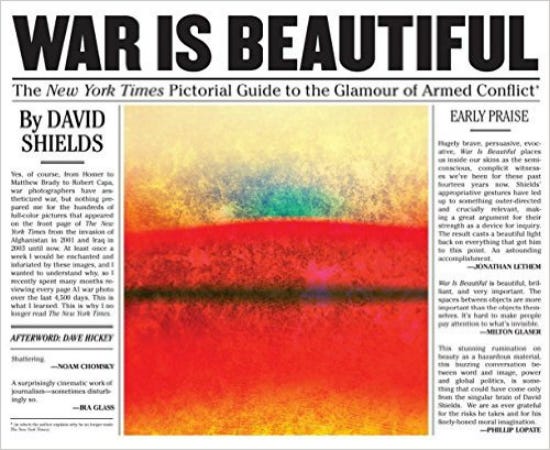
Earlier this month, I sat down with Shields to interview him about his new book, War Is Beautiful: The New York Times Pictorial Guide to the Glamour of Armed Conflict (powerHouse Books 2015). During our conversation, Shields spoke about the New York Times’s use of sanitized, sensually inviting front-page photography to glamorize the wars in Afghanistan and Iraq; these photos — in Shields’s view — desensitize readers to the cruelty and violence of these wars.

Rita Banerjee: The images of war in the book are very provocative. For example, in the Nature section, in the photo where you’re looking at a beautiful field of flowers and then you see the helmet of a soldier, it’s shocking. It grabs you. And even in the “Paintings” section, many of the images are so aesthetically inviting.

David Shields: They look like Abstract Expressionist paintings. They might as well have been painted by Rothko or Pollock.

RB: Reading War is Beautiful, you realize how cleaned up American media is. It’s weirdly Puritan, weirdly sanitized.

DS: It’s quite striking how this process happened over the last couple of decades. First of all, the rise of digital culture so that a picture could be sent instantaneously from the battlefield to the Times. Second of all, the advent of color photography on page A1 (starting in October 1997).

In the book’s afterword, Dave Hickey points out how serious and great war photography was from Mathew Brady in the Civil War all the way through Robert Capa during World War II and, say, Tim Page in Vietnam. And basically what happened during World War II was the rise of something he calls the “swipe photograph” — the quick photograph that conveys a quick, blurry image; for example, Capa, with his famous picture of a fallen Spanish soldier during the Spanish Civil War. And then what Hickey argues is that with the rise of Abstract Expressionism, people like Diebenkorn, Rothko, Pollock, Gerhard Richter, the swipe image became a huge part of Abstract Expressionism. And now war photographs are not based on what the war photographer is actually seeing in war. Rather, he or she is trying to reproduce Abstract Expressionist tropes — swipe-image gorgeousness.

All of these pictures from the New York Times are remarkably hollow and bloodless, composed, and abstract. All of these photographs have come, to a staggering degree, from art history.

…they’re looking for perfect composition; there’s nothing of lived life in these pictures…

These pictures are beautiful but dead, all 64 pictures (and I have 700 more cached that I could have used, though we couldn’t print all 700, of course; they are basically dead because, I would argue (as does Dave Hickey) that the photo editors, the photographers, page designers at the Times have all gone to school over the last fifty years on Abstract Expressionism and art movements afterward (photo realism, neo-realism, Pop Art). And so they’re looking for perfect composition; there’s nothing of lived life in these pictures, there’s only stylized —

RB: Framing, posturing.

DS: These pictures belong in an art gallery. They don’t belong on a front page of a newspaper, covering a war that’s created hundreds of thousands of civilian and soldier deaths. This is how war gets sold: war is portrayed not as hell but as heck, or even as heaven.

RB: I was really struck by your commentary in the beginning of War Is Beautiful. You raise the point, Is the Times complicit in selling a certain kind of narrative to the United States? That is, the Times promotes its institutional power as a protector or curator of a death-dealing democracy. Who is responsible for it? We all are. We are all inscribed in that death-dealing democracy.

Maybe that’s why we’re so accepting of capitalism as well. We don’t see the devastation. If people are dying of chemical poisoning in an Apple factory in China, how much do we care? The same with Iraq or Afghanistan. As Americans, we’re so used to the idea of distance. When the political world is distant from us, not only are we desensitized and numb to it but it’s almost as if we’re watching cinema or playing in a video game; there’s even a certain aspect of pleasure in a weird way. We have power and yet we’re at such a great distance from what’s going on and what’s going down.

Capitalism, distance, aesthetic pleasure, drone voyeurism are all part of one complicated cocktail.

DS: I try to make this emphatically clear via the book’s opening epigraph from Edmund Burke: “When danger or pain press too nearly, they are incapable of giving any delight, and are simply terrible; but at certain distances and with certain modifications, they may be, and they are delightful, as we every day experience. The cause of this I shall endeavour to investigate further.” Capitalism, distance, aesthetic pleasure, drone voyeurism are all part of one complicated cocktail. You’ve summarized it very well; it’s clearly capital that’s driving all this. We take pleasure in the privileged distance that capitalism buys.

RB: When examining the front page of the Times, did you encounter images that were slightly unframed or perhaps out-of-focus or hurried or not composed? All of these images, whether in the section “Beauty” or elsewhere, look like complete portraits, or they look like stills from a video game or movie. It begs the question, Is this war? Is this Hollywood? Does it matter?

DS: I know. That one photo: one chair and several water bottles, with gorgeous colors bouncing into the ether. [laughs] What is that?

RB: I wrote next to that image, “Almost innocent.”

DS: Because what does that have to do with — ? Why is that the front page of — ?

RB: Well, you know, David, by the time I got up to that image, I was thinking to myself, if you took out the New York Times from the text, or even the word “war” and you put it in a gallery and just did this as an art installation, how would people react? Would they even realize these are war images or would they not? They may not. If you decontextualize the imagery, I think some people might even buy a postcard of some of these images. Like the one with the piano.

DS: That’s an excellent, alternative, and even more depressing version of the book.

RB: You could just sell this as a postcard book.

DS: We have to admit that the pictures are beautiful, aren’t they?

RB: They are. I was thinking to myself, as I was looking at some of these images, if I didn’t know that this was about Afghanistan or Iraq, unless there was someone like Bush in the picture, I don’t know if I would find them viscerally shocking. I would probably think, “Oh, what a great shot,” “What great lighting,” or “What great color and composition.”

DS: That’s one of the main ironies of the book.

RB: So you don’t read the New York Times anymore, right?

DS: No.

RB: Really?

DS: After writing Black Planet and becoming very aware of the ways in which sports fandom operates, I could no longer keep being a fan of the games; it seemed too weird, too sad, too wrong. And so, too, having looked at 9,000 photographs on the front page of The Times over twenty years, I just found myself incapable of continuing. Occasionally, someone will send me a link to an article.

RB: I think I do that sometimes. Sorry! [laughs] I’ll try not to do that.

DS: I definitely don’t subscribe to it, either digitally or physically.

RB: I actually don’t subscribe to it at all, in the sense that once they put up the pay-wall, I tried so many avenues to subvert it, and I refuse to pay for the New York Times. It’s such a capitalist endeavor. They want to be the ultimate authority in terms of history; that is, writing the front page of history in the United States and throughout the world.

DS: As Seymour Krim once called the Times: the “commissar of the real.” The book is an attempt to show the undergirding, fictional framework of the commissariat.

RB: And yet the very fact that you have to pay for this type of information begs the question, Do you not want the public to have knowledge? The purposes of the Times have become indistinguishable from the purposes of the government.

DS: I think that is what is dangerous about the book, and why I’m proud of it. It does try to unravel this very complicated mixed message that the Times sends. The Times, I think, has a very confused and confusing role in our culture. On the one hand, it pretends to be a paragon of the Fourth Estate; people say all the time that it’s the best English-language newspaper in the world. The first draft of history. “The Paper of Record”. “All the News That’s Fit to Print.” Etc.

…that is, the Times, on the one hand, pretends to be covering war but is essentially promoting it.

On the other hand, it’s hugely obeisant to the United States government and is hugely intertwined with the US government’s imperialist ambitions. I’m interested in the ways in which those photographs are a switching station between that very mixing of messages; that is, the Times, on the one hand, pretends to be covering war but is essentially promoting it.

In the introduction, I explain that this has historical and cultural and familial roots in the Times, namely, that although the paper was founded by a German-Jewish family, the Times was notably silent on the extent of the Holocaust. They didn’t want to be perceived as either too German or too Jewish. The Times was criticized for not reporting the depth of atrocity of the concentration camps.

And ever since, I argue in the introduction, over the last seventy years, essentially, the Times has overcorrected in this rather grotesque way. It has been hugely supportive of every military adventure of the US government with very few minor exceptions (that prove the rule). The pictures, in my view, are the exact emblem of The Times’ profound hypocrisy.

RB: I’ve read sections from Other People (forthcoming next year from Knopf), in which you talk about your parents, your father and your mother, and their influence and their roles as activists and journalists in your art and life. And on the cover of War Is Beautiful is a quote from Phillip Lopate, who says, “This stunning rumination on beauty as a hazardous material, this buzzing conversation between word and image, power and global politics, is something that could have come only from the singular brain of David Shields. We’re ever grateful for the risks he takes and for his finely honed moral imagination.” I’m not sure if I would ever use the term “moral imagination” to describe your work. It seems to try to do the opposite. It destabilizes what is considered moral. It definitely plays with the imagination, but it almost breaks the illusion of imagination to get at something heartier and trickier and more uncomfortable. Both of those terms in your work are always questioned. And I want to know, since this is on the front cover of your book, do you agree with Philip Lopate?

DS: Well, it’s very generous praise from Philip Lopate, a writer whom I greatly admire and who has hugely influenced and inspired me. Your point is well taken — I’m attempting to be not pietistic but to explore epistemological and psychic complexities when it comes to moral questions — but, yes, I do agree with you that War Is Beautiful would not be the work that you might expect from me, based on my previous books, because it’s pretty overtly political. As I wrote to you once, in a sort of kidding way, “See, I am Chomsky.”

I think of my work as indeed profoundly moral, just not in the way that term is usually used (see above). I think of my work as imaginative, too, again, not in the standard imaginative way in the sense that I’m not creating a work in which I’m making up “imaginary beings,” but I’m trying to deeply imagine what it’s like to live in someone else’s skin.

As Jonathan Lethem says in another quote on the cover, this book casts light back on previous works of mine, Black Planet, Reality Hunger, I Think You’re Totally Wrong, or even That Thing You Do With Your Mouth. Those works are meant to seriously but implicitly and complicitly engage moral questions regarding race, sexuality, violence, celebrity, mortality, etc.

RB: There’s also this idea in the book that war is somehow a masculine desire, or that it’s somehow an inherently male preoccupation. The book argues that women can generate life, whereas the male body, in order to compensate for that, goes to war. So I wanted to ask you, If war is inherently a masculine desire, what is female desire?

DS: I’m not sure if the book specifically says that war is exclusively a male provenance, though, does it? One quotation goes to that idea.

RB: Well, I was looking at the photographs. And I think there are very few female soldiers. There’s one of an injured, female soldier playing basketball with a male soldier.

DS: I tried to find glamorizing, color, front-page photos of female soldiers, and there were few if any.

RB: I would say the gender dynamics of the book are left unquestioned. If we take out these rather traditional gender dynamics, who creates war? Is it men fighting to dominate and have authority over other men and other countries and other peoples in order to exploit them, to colonize them, to take advantage of them? Or if you remove the male figure, what would the female figure do? Would she do the opposite? A lot of people theorize rather rhapsodically that women are very community-oriented and that they would bring peace if they were the world leaders. But then you have rulers like Indira Gandhi, who was one of the most divisive prime ministers in India, and she caused a lot of bloodshed.

DS: Margaret Thatcher. Golda Meir.

RB: So women in power aren’t exactly the mother figure once they assume that role.

DS: Right.

RB: Get a bunch of women together — get twelve or fifteen together — and that is war. It’s absolute war.

DS: I guess I’d say masculine aggression often takes the form of violence, whereas female aggression is usually subtler, more psychological — something like that?

RB: In a weird way, the whole idea of the father in the book is very phallocentric. Such as in the Pietà section, where the fallen figure evoked is that of Jesus Christ and the figure who should be embracing him is that of Mary. But the mother figure in these images is always replaced by a man. It’s fascinating, because just a few images of women are featured. There are some images of women in hijabs. Overwhelmingly, though, the imagery is that of men embracing other men or men destroying other men. Only in the “Love” section do women finally come back.

DS: And in the Beauty section.

RB: Again, it’s the male gaze.

DS: I had a number of photo assistants who helped me pull the digital images. And many of them are women — undergraduates and graduate students. And some of them said, Can’t we bring in more pictures of women? And I said, “Find them.”

RB: Interesting.

DS: They’re not there.

RB: As you were looking at the front-page images of the New York Times, did you see images that were grotesque or repulsive or not beautiful? Is this something that you encountered as you reviewed all of these thousands of images?

DS: I was very open to being course-corrected, to my original impression (accumulated over many years) being proven wrong, but there were no, or nearly no, color images on page A1 that come close to conveying the horror of war.

Elizabeth Cooperman co-edited with me a book called Life Is Short — Art Is Shorter: In Praise of Brevity. She’s working on her own book about impasse, and I found myself texting her a note in which I said, “You have to be opportunistic. You’re not solving for X. Symptoms, not cures.”

…I’m not a political scientist. I’m trying to create provocative metaphors.

And I don’t know if you agree with that, but in a way it’s kind of an acknowledgement that finally I’m not a political scientist. I’m trying to create provocative metaphors. Okay, here are 64 images. Can one shoot possible holes in it? Go ahead and try. In a way it goes back to your question about moral imagination. I do think that if I have imagination, it lies in finding a metaphor that gathers and generates energy: the metaphors underlying Reality Hunger or Remote or Black Planet or War Is Beautiful.

RB: Well, I think that’s the intrigue of reportage: that we pretend to be objective. If you try to describe a phenomenon, maybe you are allowing it to have a chance to speak for itself, in the sense that it’s not totally overwhelmed by your persona or your ego or your desire to get a certain kind of reading or data out of it. How can you be fair and still be a challenger?

DS: “How can you be fair”? There’s no such thing as fairness. All is fair in love and war and art. The value of a work of art can be measured by the harm spoken of it, as Flaubert said. On some level, you’ve ultimately just got to go with your intuition. These images, I just know, are glamorizing war.