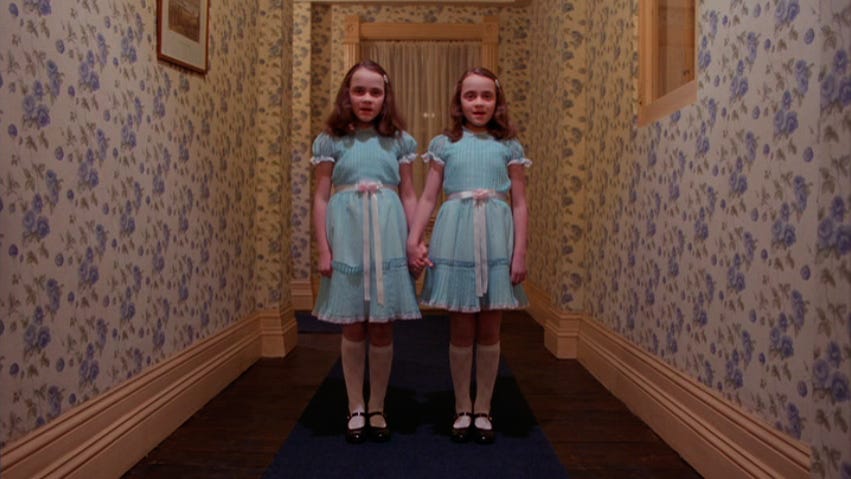
Electric Literature’s Inaugural Genre Ball: Writers, Cocktails, and Zombies

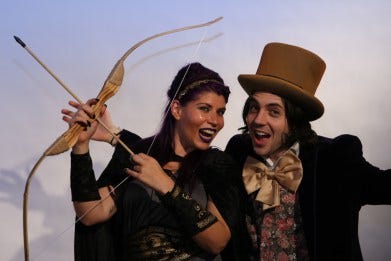
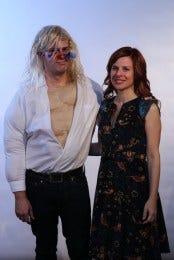
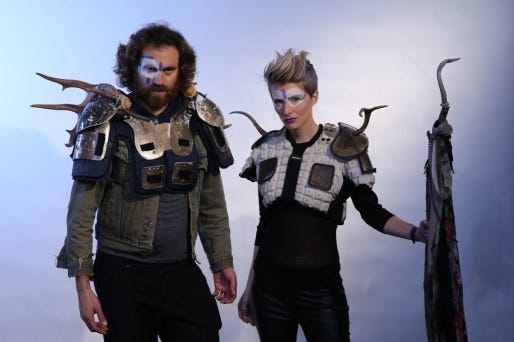
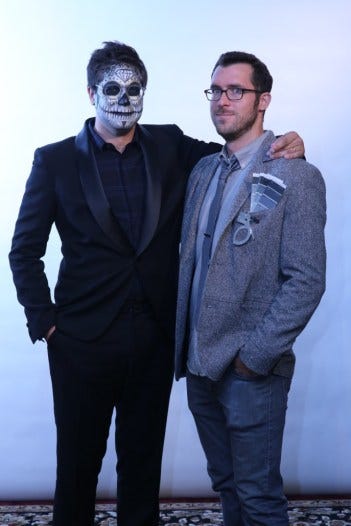
Thanks to everyone who came out to Electric Literature’s inaugural Genre Ball! If you missed it, writers, readers, and book lovers of all sorts gathered in Liberty Hall at Ace Hotel New York for a night of drinks, dancing, and zombie face painting (sponsored by Quirk Books). Attendees were encouraged to come in costume, and authors such as Matt Sumell and Donna Tartt came out in their genre-inspired duds.

Deer Hunter S. Thompson (Paul Morris) and Apocalyptic Disco (Amy Brill) were just a couple of the many creative costumes on display, but it was author Helen Phillips, with her Phrenology Bust as Surrealism outfit, who won the costume contest, judged by Michael Cunningham, Lev Grossman, and Mary Gaitskill (who donned elf ears). The Grand prize was a coveted night at the Ace Hotel.

Even partigoers who opted out of wearing a costume walked away with some great prizes: stacks of our hosts’ books were displayed throughout the Ball, free for the taking. Our heartfelt thanks go to all of the publishers who donated books (FSG, Bellevue Literary Press, Graywolf Press, Knopf, Penguin, Plume, and Pantheon). Some lucky people even got their hands on as-yet unreleased copies of Gaitskill’s The Mare and Cunningham’s book of adult fairytales, A Wild Swan.

This inaugural Genre Ball fundraiser was made possible by the support of generous ticket buyers and by our sponsors Farrar, Straus and Giroux, Grove Atlantic, and Sara Nelson and Sam Radin. The event was hosted by our eleven talented author hosts: Mia Alvar, Alexander Chee, Sloane Crosley, Michael Cunningham, Mary Gaitskill, Lev Grossman, Eduardo Halfon, A.M. Homes, Tanwi Nandini Islam, J. Robert Lennon, and Paul Murray.

Check out the pictures below! And we will see you all next year!

Helen Phillips and Paul W. Morris

Helen Phillips and Paul W. Morris

Zombie Lincoln Michel MCs the costume contest

Zombie Lincoln Michel MCs the costume contest

right
Rachel Fershleiser, Julie Buntin and Maris Kreizman

Rachel Fershleiser, Julie Buntin and Maris Kreizman

Emily Firetog, Jarry Lee and Andrew Lloyd-Jones

Emily Firetog, Jarry Lee and Andrew Lloyd-Jones

Lincoln Michel, Alexander Chee and Benjamin Samuel

Lincoln Michel, Alexander Chee and Benjamin Samuel

Melissa Ximena and Jim McKenzie

Melissa Ximena and Jim McKenzie

Donna Tartt with Neal Guma

Donna Tartt with Neal Guma

David Greenwood

David Greenwood

Halimah Marcus, Matt Sumell and Carmiel Banasky

Halimah Marcus, Matt Sumell and Carmiel Banasky

Vivian Lee, Morgan Jerkins and Morgan Parker

Vivian Lee, Morgan Jerkins and Morgan Parker

Catherine LaSota, Ryan Chapman, Nathan Rostron, Paul W. Morris and Benjamin Samuel

Catherine LaSota, Ryan Chapman, Nathan Rostron, Paul W. Morris and Benjamin Samuel

Andy Hunter and Alison Elizabeth Taylor

Andy Hunter and Alison Elizabeth Taylor

Amanda Faraone, Hannah Tinti and Adina Talve-Goodman

Amanda Faraone, Hannah Tinti and Adina Talve-Goodman

J. Robert Lennon

J. Robert Lennon

Alexander Chee

Alexander Chee

Catherine LaSota and Karl Jacob

Catherine LaSota and Karl Jacob

Ryan Chapman and Benjamin Samuel

Ryan Chapman and Benjamin Samuel

Tanwi Nandini Islam and Mia Alvar

Tanwi Nandini Islam and Mia Alvar

Michael Cunningham, Lev Grossman, and Mary Gaitskill

Michael Cunningham, Lev Grossman, and Mary Gaitskill judge the costume contest

Midweek Links: Literary Links from Around the Web (October 28th)

Boo! It’s almost Halloween, so spook yourself out with these spine-chilling literary links!

A survey of the haunted house in literature

David Mitchell, who has a new literary horror novel out, is sick of the genre wars

An interview with the creators of Welcome to Night Vale, the cosmic horror satire podcast turned novel (read our review of the novel here)

12 amazing horror novels that you likely haven’t read yet

Syreeta McFadden on how dystopian stories used to reflect our fears and now reflect our reality

On the ecological horror of Jeff VanderMeer’s Southern Reach trilogy

Gregor Samsa turned 100 a couple days ago

10 books that will give you nightmares

Spooky fiction prompts culled from the news

Ray Bradbury’s great horror collection turned 60

Vampires are out, ghosts are in this year

“Ball” by Tara Ison

“Ball”
by Tara Ison

My sweet little dog, Tess, is what they call “apricot.” She has tiny blue eyes, almond-shaped and set close together like Barbra Streisand’s, and the prettiest little dog vagina. I spent twenty minutes examining and marveling at it once with my best friend, Dayna, before she had a boyfriend and we spent a lot of our time together appreciating Tess. Dayna is a biologist, which gave the experience a legitimizingly clinical spirit. It’s a tidy, quarter-inch slit in a pinky-tip protuberance of skin, delicate and irrelevant and veiled with fine, apricot hair. Tess rolled over and spread out happily, trustingly, for us; she lives almost pathetically for love, for attention, like a quivering heroine from some fifties romance novel. She also lives for food and naps, but mostly for Ball. Tennis balls, squishy rubber ones with bells inside, any spherical object to love will do. I’ve learned hard
rubber balls are the best — the last time she had a flimsy plastic one she worked it down to bits, chewed it with such passion there was almost nothing left.

She came with a ball. I’d been living alone in my big new house with a fireplace for six days, came home on a Thursday evening to the still-lingering smell of paint and spackle and fresh-sliced carpet fibers and realized I can have a dog here. Apartment living hadn’t allowed for that, but now I had my own house with a fireplace and a small fiberglass jacuzzi in a small chlorine-scented backyard, all to myself. I was only twenty-five and very proud of having my own house. I walked around and around, and my heels clacked resoundingly on the hardwood floors. Dayna had mentioned maybe coming over, but we’d hung out together the last five nights out of six, she was in a needy, boyfriend-less phase, and her presence was becoming a cloying and oppressive force. She hated sleeping alone — she’s always scared of an earthquake, a fire combusting out of nowhere, a serial-killer-rapist-burglar breaking in — but I wanted my big, new house all to myself, and a dog, and a fire in the fireplace. I went right back out and bought a newspaper and called the first ad for a cockapoo: eleven mos, shots, fxd, hsbrkn, plyful. A cockapoo, to me, meant the large dark eyes of a baby harp seal and a silky spaniel coat, a body thick-limbed but compact and floppy. The true, Platonic image of a cockapoo. I drove to an apartment complex in Northridge. The dog was hideous, at first sight, more blurred, cross-bred terrier and toy poodle than anything else, with skinny, crooked legs that needed to be broken and reset, and those creepy blue eyes. A brown nose, faded like over-creamed coffee. And she was covered with fleas, little dark leaping specks visible through her beige fur. I made polite chat with the owner, a heavy sixtyish black woman named Gloria — That isn’t beige, dear, they call that color “apricot” on a poodle — who couldn’t be bothered with the dog anymore, and then told her that Yes, I knew the ad said she’d be eleven months, but I really did want a puppy. The dog dropped a soiled, shreddy, lime-colored tennis ball in front of me and looked up, her tiny eyes squinting with hope and expectation: You want to play with my ball? Here, look, here’s a ball! You want to play? Please, please! When I ignored her she pounced on the ball with her skinny front legs, her paws shoving it toward me — Ball! Ball! Ball! — until I gave in and threw it for her. But when I got up to leave, I suddenly realized that if I didn’t take her, it meant I would have to keep interviewing dogs. This seemed like an exhausting prospect: continuing to call deceptive ads, inquire about worms, meet imperfect dogs, choose. Also, it meant that I would be going home that night to my big house alone. I told Gloria I would take the dog, figuring that if it didn’t work out I would just get rid of it somehow. I wrote Gloria a check for seventy-five dollars — the cost of getting the dog fixed at five months, and the shots — and she gave me a leash, a quarter of a bag of Puppy Chow, and the dog. At the last moment, Gloria put the soiled tennis ball in the Puppy Chow bag, like a parting gift. The dog’s gotta have that ball, she said, or any kind of ball, you’ll see. I stopped at the drugstore on the way home with the dog, to buy flea shampoo and dog treats, and I dumped the dirty, lime-hairy ball in a dumpster. Through the window of the car the dog watched me do this, anxious, her squinty little eyes made wide and round by alarm.

At home she suffered submissively, mournfully, through the kitchen-sink flea bath and a towel-drying in front of a fire in the fireplace, then curled up tight as a snail shell at the foot of my bed, looking orphaned and weepy. She wouldn’t touch the doggy rag tug thing I’d bought, nor the faux-bone treats, nor the plastic squeaky toy shaped like a garish hamburger with the works. I went to bed wondering how to unload an ugly and sentient animal. Several hours later I heard a light thud sound, then a thump-roll, thump-roll, and I looked across my room to see the little dog trotting happily toward the bed with a Granny Smith apple in her mouth. She jumped up on the bed with it, dropped it, peered up squintily with hope and expectation, and shoved it toward me with her crooked apricot paws. I knew I’d bought apples during the week, but how she’d found one I had no idea — some desperate, biologically driven search for Ball. I threw the apple across the room for her for a while, and each time she brought it back to me, thrilled, suffused with intimate joy at our connection. She finally tired, snail-curled on the empty pillow next to me, and went to sleep. When I awoke in the morning her brown nose was breathing in my face and her almond-shaped blue eyes blinked at me with drowsy adoration, and I was abruptly slapped swollen with love. I went out first thing and bought her a real ball, periwinkle blue, hard rubber, just the right size and with a solid, stable bounce.

Now it isn’t just my echoing footsteps in the house, it’s her happy, scratchy nail-scrambles, the thud and roll of a ball that I hear.

I loved her so much it was numbing, and sometimes, to jab a feeling at myself, I fantasized about her dying. Getting hit by a car, drinking from a contaminated puddle of water when we went on walks (how my accountant Sue’s dog died), or succumbing to an attack of bloat (some disease my friend Lesley’s dog almost died of, when the intestines bunch up out of nowhere). Or I would whet the fantasy by imagining that I had to sacrifice her for some reason. Put her out of some misery. I’d have her dying of encroaching cancers, where I forced myself to give her a mercifully quick and lethal shot of morphine because keeping her alive and in pain would only fulfill my own selfish needs. This usually made me cry, and once, picturing that and crying, I called Dayna and made her promise me if Tess ever did get sick she’d get drugs and a syringe from the lab, and we’d take care of it so Tess would never suffer. Or I’d think about an epic disaster, a nuclear bomb or a 9-point earthquake that somehow destroyed all the food and left me with nothing but Tess, and would I be willing to starve to death instead of eat her. How bad something would have to get to force me to do such a thing. I wondered what Tess would taste like. I imagined her flesh was tender and sweet. Her paw pads were the color of cracked, grayish charcoal and smelled of burned popcorn. When she yawned I poked my nose into the gap of her jaw and inhaled. I ran my hands over the wiry pubic-like hairs at the base of her spine, the fine, clumped curls at her throat. She let her head fall all the way back when I did this, so trusting, her throat stretched to a soft, defenseless, apricot sweep. I just wanted to crawl inside of her sometimes, or have her crawl inside of me, keep her safe there forever.

In hindsight, Gloria’s ad was accurate; Tess was indeed fxd — you could still feel the barbed wire of subcutaneous stitches in her belly, another thing Dayna and I always marveled at, or used to, before Dayna met her boyfriend, back when hanging out meant admiring and playing Ball with Tess for hours at a time — and hsbrkn, and I was spared all the yipping, newspaper-thwacking, stick-her-nose-in-it hassles of a puppy. The idea of disciplining her horrified me, and I was glad I didn’t have to. Her one unfortunate habit was her way of hurtling herself at people to greet them when they came in the door, invariably impacting at ovarian- or testicular-crushing height. Dayna encouraged this, finding the hurtling a consistent and unconditional show of love; she’d catch Tess in mid-leap, grab her at each side’s delicate, curving haunch, and swoop her around the living room or the backyard like a clumsy, older puppy-sister. Tess’s exuberance, her insistence on playing Ball, worked as sort of a litmus test for other people — how much grace they mustered up told me a lot about who they were. But most people adored her. Some friends perfected a knee-dip-and-swivel, so that Tess landed smack against a fleshy mid-thigh. Eric showed a congenial grace about it the first time he came over to my house, but after that it became his means to set the evening’s tone; if he was feeling generous he petted her, threw the ball for her, and we had a stressless, fun, prurient kind of time together, but if he wasn’t in the mood or thought I was paying too much attention to her, he got nasty. Sometimes there was a faintly sinister quality to it, especially when she wanted to play Ball and he didn’t. Sometimes it became an enraging, bitter thing. He’d hide the ball, laughing as she searched the house in a growing panic. Or he’d pretend to throw it but then hide it behind his back and smirk at her bewilderment. If she shoved the ball at him once too often — and she could be relentless, needy, You want to play with my ball? Here, look, here’s a ball! You want to play? Please, please! — his annoyance built to the point where I got very nervous and protective, almost scared he was going to explode and hurt her. I’d try to distract him with food or sex. Sometimes I think he hated her, but then he’d be so sweet and loving I’d figure it would all be okay. He liked coming to my place because of the fireplace and the jacuzzi, but it still usually felt safer to me if I just went alone to his.

I met Eric two years ago, when Dayna had a big party to celebrate getting a promotion at her lab, something that involved a bonus and increased time with rabbits. She told me she’d invited a couple of young guys who’d moved in across the street; one of them had a girlfriend but the other was exactly my type, and also the type who probably wouldn’t go for her, anyway. Dayna is very beautiful, she just has a way of thrusting herself at men, emotionally stripping for them on a first date. She assumes men prefer me because I’m smaller — she’s six feet tall, stunning, but six feet tall — while I think it’s just because she tries too hard, opens up too massively. She drowns you with all of herself, with a flood of vulnerability, trust, need, and I know that the success of sex depends on contrivance, in holding yourself back. It’s the tease, not the strip. You offer up your soul for a taste; it’s like an invitation to feed.

Eric turned out to be twenty-three, six years younger than Dayna and me, and striking, a wonderfully alpine six feet four, which was certainly tall enough for Dayna, but I saw what she meant by my type — tall and bold men always make me feel sexual, nymphetish — and also what she meant by he probably wouldn’t go for her, anyway. He didn’t want a drowning torrent of intimacy; he wanted to get laid. We sat on the floor of Dayna’s apartment for an hour at the party’s wane, drinking beer and making suggestive, clever comments to each other while he played Ball with Tess. He petted her and scratched her tummy, not realizing that being sweet to my sweet little dog was a litmus test of sexual acceptability, a wildly effective and endearing form of foreplay. She adored him, draped herself trustingly across his lap, her little almond eyes slanted closed in bliss. But that wasn’t why I wanted him, badly, really; it was the adamant and unabashed sex look of him, his way of dirty, lustful regard. His look said Sex, said Fuck, suck me, I’m hard, said It’s specifically, singularly, because of you. I suddenly realized I hadn’t been fully looked at that way in a while, maybe a long while. It used to happen all the time, but not so often anymore. Eric looked at me that way, and I wanted to get his cock inside me, fast, to hold on to that look. His hands stroking Tess’s tummy — I wanted them on me, working me, shoving my thighs apart, pressing me face down by my shoulders or the back of my neck into a pillow, raising my hips high from behind, guiding my head. I wanted to leave with him that second, but I knew Dayna would be upset. So I waited another half hour to suggest he show me his new place across the street, and in answer he circled me hard around the waist, leaned over, and kissed me — more gently than I’d expected, but still his arm was firm, ruling — and then we left. I took Tess with me, and her latest in the series of hard rubber periwinkle blue balls; Dayna had wanted us to sleep over, but hey, she was the one who’d tossed me this guy in the first place.

I hate fucking men who get moony or coy about it, who act as if there’s an element of accident that you’re here, doing this, as if you both tripped and wound up landing naked in bed. Eric was brusque and unsheepish, as fearless of sex as a porn star. He had the hard, tapered male torso I like, skin so fluid and seamless your hand slides, slides. My own skin is starting to dry, slightly — I shouldn’t go in the jacuzzi too often — I’ve noticed fine, thin wrinkles when I twist the loosening flesh of my upper arms, I’ve grown a little self-conscious of my babyish pout of belly. But the sex was an endlessly wet, vehement, pounded smooth kind of sex that wiped out doubt.

During the first surge of it, on Eric’s living room sofa — a velour playpen-style couch still smelling faintly of frat house joints and beer — Tess had stretched out drowsily at the far end, behind Eric’s hunching, jarring back, out of his view. We reeled to his bed afterward, while he was still solid and driven and I could still jolt at a slightest touch of his tongue, to start all over. She picked up her ball and padded after us, climbed upon a bolster we’d thrown on the floor, and went back to sleep. I’d had Tess for a little over four years by then but had never fucked anyone with her in the room before; I typically went to the guy’s house and left afterward, because, after all, Tess would be home, waiting for me, needing to go out. I liked my bed all to ourselves. After the second time, I got up, awkwardly — my legs felt permanently locked apart at the hips, hinged wide — and fumbled for clothing, but Eric grabbed an ankle and pulled me back onto the quilted bedspread. Mock-wrestle, mock-struggle, and Tess jumped up on the bed with us to play, her mouth full of periwinkle ball. He had me pinned on my side, was fumbling with himself, aiming, when Tess dropped and shoved her ball at him — Get out of here, dog, go on, he said — wedging it under his thigh — You want to play with my ball? Here, look, here’s a ball! You want to play? Please, please! — and kept shoving, desperate for his attention, his affirming and engaged throw of the ball. I tried squirming upward, trying to glide, grasp him inside me, distract him, but one more ball-shove from Tess — Would you get her the fuck out of here? he snapped at me — and he jerked out a leg, catching her just at her midsection’s arching curve, and hurled her off the bed. She yelped, I saw in the streetlamp’s light through the window an apricot blur, and heard her smack the wall, heard her flurry slide to the ground.

I was up and to her in a second — Hey, I’m sorry, I didn’t mean to do that, okay? — and she was fine, just bewildered. She poked her damp pink tongue in my ear and hiccupped like a little human baby, and I cradled her, rubbing her tummy. She was fine, but I wanted to cry. Eric kept apologizing, coaxing me back, and when I looked at him in disgust he finally said I was overreacting, just being neurotic, I shouldn’t indulge her so much, I was probably going to wind up some weird old lady living alone with forty-seven poodles. I carried her out of the bedroom, slamming the door behind us. Then I didn’t know what to do. It was almost three, I knew Dayna was asleep, and I didn’t want to go wake her up, explain what had happened. She’d be furious; worse, she’d be smug. And Tess’s ball was still in the bedroom with Eric; I wasn’t leaving without it. I wasn’t going to leave her without a ball.

I carried her into Eric’s roommate’s bedroom — he was staying at his girlfriend’s, Eric had told me — and crawled with her into the unmade bed, into unwashed sheets with that odor of careless, straight, young bachelor guys. She dozed on the greasy pillow next to me, in her spine-defying, shell-curled way, her nose in my face. I tried to go to sleep. My jaw ached; I scratched away some flakes of dried semen on my cheek, craved a drink of water, but didn’t want to get up. My insides still felt stretched open, rooted out. My hips kept twitching in the rhythm I’d found sent him over. I’d already gotten to know the thick vein in bas-relief on the left side of his cock, and the exact, utmost length within me his fingers could go, and I wanted all of that back. I wanted that obliterating lust, heated and direct and unrefracted as rays of light through a magnifying glass, focused to burn you down to death. I heard Tess yawn, and I craned to face her, needing the comforting, starfish scent of her breath.

I waited until she was asleep, then got up, stealthily closed the roommate’s door behind me, and crept back into Eric’s room. He’d thrown half the bedspread over himself and lay sleeping, sprawled out and mammoth and lustrous. I molded myself small up against the length of him and felt a flutter of pulse down his arm; I crawled on top of him and slid myself around until he grew big and hard and I could grip at that vivid, affirming burn one more time.

In the morning we glanced disdainfully at each other and rolled quickly out of opposite sides of the bed. I retrieved Tess’s ball and hurried to free her from the other room; she kissed me wildly, whimpering, as though she’d feared something had happened to me in the night, that I’d left her forever. He watched me nuzzle her for a moment — I guess that’s the deal breaker, huh? he said — then shrugged and went back into his room. Dayna looked at me like a resigned, just slightly reproachful good loser when I came in, then shrieked a greeting to Tess, whipped her up to a leaping, hurtling frenzy, and swooped around the room with her. We spent the rest of the morning cleaning up the party’s dismal mess and playing Ball. Eric called me at home the next day, and I invited him over for the following Saturday night; he came bearing a single iris for me and a bag of pricey lamb-and-rice treats for Tess. He let her climb onto his lap, and she spread herself out happily for him, unguarded, unself-conscious, arching her head and exposing her throat to his fondling, stroking hand. He threw the ball for her that night, again and again. But after that I usually insisted on going to his place and leaving Tess with Dayna, where it was safe.

I was careful never to sleep with him again, even after a year. I didn’t want to get slack, or too accessible, and actually sleeping together was hardly the point. The only time I did fall asleep, after that first grotesque night and morning, was just an accident, a slip. Tess was across the street with Dayna, and the plan, as always, was the requisite dinner with Eric while we watched a movie or a rerun of The Simpsons, then sex, and then I would leave. I just wanted pizza or Chinese delivered, something quick, because the dinner was not the point either, just a feature he liked to insist on, but I got to his apartment and smelled onions cooking, mushrooms, the acrid snap of garlic. He was making dinner. His roommate was out, and he was making an evening, trying to, out of a Lyle Lovett CD and a head of romaine lettuce and a jar of Ragú sauce spiffed up with fresh onions and mushrooms — Hey, come on, I really like to cook, my mom told me to add all these veggies, he said, nodding — and a gleaming bottle of red zinfandel. A boiling pot of spaghetti fogged the kitchen with starch; the table was set with melamine plates and paper towel napkins folded in big squares. Fine, okay. I started on the wine, had half the bottle down by the end of salad, and listened to him talk about some old college girlfriend, some Shannon or Nicole, whom he’d been with for a couple of years and really cared about but just was never ready to commit to and how he’d heard the other day she was getting married and he really did hope she was happy but it still really hurt, you know, and it was probably time he started really thinking about what he was going to do with his life, about what he wanted in life, and what did I think about all that? And what I was thinking was that it was getting late and we’d never had sex yet on his kitchen table and can we get going? And that Tess was waiting for me over at Dayna’s and I’ve finished my spaghetti and can we get going? I tipped the last of the wine into my mouth, got up, slid off my underwear from under my skirt, and he shut up. I sat on his lap, straddling him, pushed his hand down in the crotch of space between us, used my hand against the buttons on his jeans, and his breathing quickened. I traced the rim of his ear with my tongue, worked myself against his fingers, everything I knew would do it, and it did, his cock jutting out from his split-open fly and the table edge gouging my spine when he lunged forward at me. I leaned back with my elbows on the table, skirt raised and legs open, for him to get me up and onto it, but instead he picked me up — Uh uh, not here, he mumbled — clutching and carrying me like a sack of fragile groceries, kissing me before we even got to his room. He fell with me on the bed, fell onto me with a great, weighted crush, but when I squirmed to get up on my hands and knees for him he gently pushed me flat again, face down, nudging my legs apart, Good, I like that, I said, do that, and then twisted my shoulders around so that while he thrust into me from behind, lying on me, he had my face against his, or his face in my neck, still kissing me. That kind of twist was a strain, everything went taut and seized up until it hurt so I couldn’t stand it anymore; I finally had to pull back away from him, turn away. I pressed my face down into the pillow but he wouldn’t let me do that, wanted my arm around his shoulders or his neck, holding on, wanted me facing him, and twisted me back. It took a long time. He kept slowing down and every time I was about to come he wouldn’t let me, he’d just stop, still looking at me, and when we both finally came in the middle of a kiss that was like breathing straight into each other’s lungs we stayed like that, still, all twisted up around each other. When my spine and the rest of me finally relaxed, went aimless, all of my muscles eased into place and I strayed off to sleep. Eric still on top of me, holding me. A branch hitting the window lurched me awake well after midnight, and my first aware thought was a glad one, Thank God that woke me up so I can get out of here.

I pulled away from Eric and called Dayna — Yeah, Tess was okay, she was right there on the pillow next to her. I told Dayna I was coming over, I’d be there soon. Proof I was a good friend, always there for her, this guy doesn’t mean anything to me, see, and she wasn’t just a babysitter. Eric tugged on the phone in my hand, No, come on, don’t leave, she’s fine, but I shook my head at him until he let go. He was angry, I could see in the light from the streetlamp through the window, and that pleased me. I could imagine him thinking there was something wrong with me that I’d leave him to go running off to my dog. He rolled over to the other side of the bed, a big, spoiled baby, Fine, go, his back to me; I got up and straightened out my clothes and left without saying good-bye. He needed to learn, I thought, that he can’t have everything he wants. That he was only there to fuck, I’d never be lulled, and in the end, if he ever pushed me, I would always choose my sweet little dog.

When I went to Sausalito, Tess stayed with my mother. An artist friend asked me to house-sit for six weeks while he went to Eastern Europe to study iconography; I decided leaving town would wave a giant Fuck You flag at Eric, a banner of my insusceptibility. I decided it was time for a more sporadic arrangement, that it would keep everything fervent and honed. I told my artist friend I’d love to get out of town for a while. The only problem: no dogs. He was wildly allergic. I insisted to him that poodles don’t shed, and that Tess was mostly poodle, I thought, but he wasn’t about to come home to dander and tracked-in spores. He was apologetic, but that was the deal. I decided it was worth it, that Eric needed to be reminded what this was, and I reminded myself that contrivance works. It does, I’m telling you. Dayna was hurt and upset, as if I were abandoning her. She was also upset she couldn’t take Tess — her hours at the lab made it impossible. So I packed up Tess’s food and water dishes, her special high-quality food the vet had recommended, her leash, her blue rubber ball, and drove her over to my mom’s. I started crying when I hugged Tess good-bye — Don’t worry, honey, she’s my grandchild, isn’t she? I’ll take very, very good care of her — and she burrowed her face in the crook of my neck. I was a terrible mother, to do this to her, and for what, for him? I pushed my nose into her charcoal-colored paw pads to breathe in the salty, furry, puppy-sweat smell, then forced myself to leave. I cried for a few hours afterward, choked with guilt, still seeing her forlorn, confused face as I drove off without her.

Not waking up to Tess was awful. I walked through Sausalito two or three times a day — gift shop, gallery, gift shop, gallery, driftwood seagulls everywhere — and when I found people with dogs, I would befriend them. Guys with dogs thought I was coming on to them, but I just wanted the dogs. One Sunday I met a retired policeman from Oakland, walking a docile, regal borzoi. This was an odd dog for a policeman to have, a guy with a movie cop’s burly swagger and black kangaroo-leather shoes. Long before Tess, I’d thought of having a borzoi one day; they’re hugely magnificent Art Deco dogs with dear, shy temperaments, but they’re also congenitally stupid. This one was skittish, too, and pulled nervously from my greeting — the guy told me she’d been part of a case he’d investigated, that she’d been abused and abandoned by some volatile, coked-up perp, and afterward he’d adopted her. Cynthia. He said abused dogs broke his heart, even more than abused kids, because dogs are even more vulnerable and trusting, their lives are in our hands and they know it. And they are like kids; they even love the people who abuse them, you know? There’s that innate instinct to adapt, adjust. He’d like to see animal abuse laws toughened up. Cynthia was his baby now, Yeah, my precious little girl, Daddy’s always gonna take good, fine care of you, uh huh. She bumped her long muzzle into his stomach, leaned against him so fully and hard he almost lost his balance. She trusted me to pet her for a while then, and I ran my fingers through her long, sheening white coat, wishing for Tess. The guy looked like he maybe wanted to keep talking, or go for coffee, but I just wanted to pet Cynthia. Yeah, I told him, because animals had purer souls than human beings — everybody has his own agenda and wants something from you, even friends, even lovers, even your mother, and you can’t let your guard down, ever, that’s when they get you, hurt you — and so animals were more honest, more deserving of love and care. I told him I had a little apricot cockapoo I just loved to death, who was everything pure and innocent and sweet in the world, whom I’d do anything for, and the idea of actually getting married and having actual children was revolting to me, because you couldn’t fully ever trust a human being, a friend, a parent, a lover, they love you, they hurt you, you can’t even trust yourself, whereas a dog like Tess would be there for you, always. I told him I shouldn’t even be away from her here in Sausalito, I should hurry home, because I was just wasting six weeks of her life — she wasn’t a puppy anymore, she was a grown-up dog, and I’d sacrificed six precious weeks of her life away from her, just to be here alone, a big, gaping crater of a person with nothing to hold inside. I told him I felt I could never get close enough to her, keep her safe enough from harm, because I wasn’t really worthy of her, and because the world and everyone in it was so profoundly fucked. I asked him if he wanted to go get coffee or a drink or something, but he tugged a little on Cynthia’s leash, and said it was nice meeting me, but they had to get going.

My mother always apologized on the phone that she couldn’t possibly give Tess the kind of attention I gave her — she just couldn’t play Ball all the time, it was too much. It was like having a child in the house again, Like when you were little, honey, she’d say, Always wanting attention, so needy, a person could go nuts from it, from the constant demand, a person can’t help losing her patience. A person can’t help losing it, now and then. Sometimes something just snaps, she would say, her voice a remembered echo, a long-lost refrain. And you can’t give in to giving them love all the time, the real world’s not like that, and they have to learn. If you do, it just spoils a child, they learn how to be manipulative, and Tess, well, she is a little spoiled, honey, she could use some discipline. And she was acting maybe a little depressed.

I assured my mother that Tess loved being at her house and I knew she was taking very good care of her, doing the best she could, but part of me felt a little nervous and protective. I drove home a week early; I sort of expected to find Tess ragged and thin and hungry, like the orphans at the beginning of Oliver, and my mother snapping, clutching the hairbrush, a spatula, a coiled fistful of telephone cord. But Tess was fine, hurtling herself at me in joy, whimpering when I clutched her, quivering with unrestrained love. On the way home in the car she lay down with a happy exhalation and put her head in my lap.

Her ball, however, was on its last gasp. Somehow the hard rubber ball I’d left her when I went to Sausalito had gotten lost, and my mother had bought her a flimsy yellow plastic one with fake, porcupiney spikes. I’d been so clear with my mother about this, very specific about what Tess needed in a ball, but of course she hadn’t listened, my mother. I should never have trusted her. The plastic had split under Tess’s vehement play, and only an inch or so of its circumference seam held the ball together — it wasn’t even really a ball anymore, it was an asymmetrical yellow plastic flap. But for some reason, Tess was madly in love with it. When we got home and I gave it to her, she ran around and around with it, the chewed yellow plastic flapping from either side of her mouth.

I checked my voicemail messages, something I’d airily refrained from doing the entire time I was away. One, from Dayna, of course, welcoming me home. I hadn’t called Eric to tell him I was leaving, but Dayna had mentioned to him where I was. I assumed he’d learn I was back, or when I was coming back, in the same way. I’d assumed he’d call, want us to get together. Maybe he’d call later. Call me, call me, call me, I chanted to the phone. I dialed his number. His roommate’s voice answered, and I hung up. Tess perked her ears and hopefully dropped the plastic flap in front of me, expecting it to roll like a ball. When it wouldn’t, she just made do, picked it up again, dropped it closer so I could reach, and shoved it my way. But my spine was petrified from the long drive home, and I decided to go in the jacuzzi; that way, when Eric called, I wouldn’t be just sitting there, waiting for him.

The hot water sent up pungent steam; I’d poured in way too much chlorine before leaving for Sausalito, and it was now like boiling myself in disinfectant. It felt good; I let the jets pound on my back. Tess trotted up, dropped the yellow ball-flap at the jacuzzi’s lip — No, honey, not now, I said — and then shoved it into the bubbling water; it swirled around then flapped closed, trapping in the water’s weight, and sank slowly to the bottom. I ignored it, but Tess went wild, whining desperately to have it back. I had to dive under to retrieve it, the heat and the chlorine searing my eyes, then tossed it back to her with a firm admonition — That’s it, Tess, no more Ball, not now — but she did it again, then again, in that relentless, needy Ball! Ball! Ball! way, just when I needed something, to relax — Stop it, just stop it! I snapped — then again, just to get me, I knew it, until finally I came up with it, burning, just in time to hear a phone ring’s trill. Or, I thought, listening for it. The jets were loud and I wasn’t sure I heard a ring, but then I was sure I did, but then Tess barked at me, crying for the ball I still held, and so then I wasn’t sure. But then there was nothing. She began to whine and whine — All right, you want it, you want the fucking ball? — and I threw it as far as I could over the backyard fence, probably into a neighbor’s yard or garage space. Go get it, go! She whimpered pitifully, and I hated her, suddenly, wanted to punish her for all the obsessive, manipulative Ball bullshit, her pathetic, obvious need for love that I’d always given in to and had made me such an idiot, had cost me so much. I shoved her hard away from the edge of the jacuzzi, ready to snap her spine, ready to make it all stop. She just looked at me, bewildered and wounded, and meekly rolled over on her back on the jacuzzi-splashed concrete, her crooked little paws raised in supplication.

The only message on the machine was the old one from Dayna. I hurriedly got dressed, got Tess back in the car — she crept into the backseat this time, burrowed herself down behind my seat like she’d done a horrible, inexcusable thing — and drove over to Dayna’s. Eric’s car was parked in front of his place, but if he saw me, hey, I was just there to see my friend Dayna. But she had someone over, a guy, some short, rabbity fellow biologist from the lab, who smiled and poured me a glass of wine but kept gazing at her with a moony, indulgent expression. She didn’t even marvel at Tess, just let her jump up once or twice, then told her nicely to get down. I waited an hour to ask her if she’d seen or talked to Eric recently, and she mentioned something about their going to the grocery store together a few times, a jog in the park. He’d taken a weekend trip to La Jolla with some buddies, but that was a few weeks ago; he’d told her the trip was great, they’d all gotten laid. And she’d seen him a few times since with some really cute girl, coming or going from his building. She looked at me, smugly, I thought, maybe sort of challengingly. As if I’d tell her anything. As if I’d tell her I pictured him fucking some moist-skinned twenty-two-year-old, spreading her legs and eating her on the velour playpen couch or the kitchen table, telling her Fuck me, his look saying Suck me, I’m hard, and It’s specifically, singularly, because of you, and how it made me want to drive nails into both of them, all of them. It was pretty late, and obvious Dayna and her biologist wanted to be alone, so I picked up Tess and we left. I was glad Dayna had found someone, but it seemed just a little sad to me, pathetic, that she’d grabbed at the first guy not smashed flat by the plunging, falling safe of her need.

Outside Tess started pulling on her leash. As if to get away from me. I apologized, I bent over and tried to rub her tummy, It was my fault, I told her, I was the one who took away your ball, I’m sorry, I just lost it for a minute, but she wouldn’t even look at me. Even if she did, I suddenly knew I’d see hate in her little blue eyes, betrayal, distrust, disgust, and that made me want to bawl, crumple up, just die. Pound her into loving me again. She seemed to want to cross the street, or I thought she did, so I let out the leash a few feet and let her go. She trotted directly across to where the streetlight was in front of Eric’s apartment house, the one that always shone through the tree branches into his bedroom window. She sniffed around the grass, squatted and peed, but then still tugged me, really, she did, across the patch of landscaping, toward the dark window at the side of the building. And I looked through the window, knowing what I was going to see, the heat and the wet, the feral rocking, a thing to draw blood, flaming and lethal as love. But all I could see, I thought, was a still, dull gleam of torso, and then a curve, maybe, of breast, a rumple of long dark hair, a girl sleeping curled up inside his arms, the quilted bedspread half thrown over both of them, all of it, both of them, still. I looked over at Tess; she gazed at me with innocence, the light from the streetlamp making a nimbus of her fine apricot fur.

She would have been seven on her next birthday, and that’s starting to get old, sort of, for a dog. She would have gotten arthritis, or canine diabetes, and I couldn’t do that to her. I wouldn’t be able to bear seeing her in any pain, or seeing her hurt, and I bet Dayna would be just too busy with her drooly boyfriend when the time came to help. I got a fire going in the fireplace, and I brought her onto my lap and held her for a while. I felt the tiny staple-stitches inside her belly where she’d been fxd, and admired her trim, unused vulva that always kept her sort of a puppy, and inhaled her furry, spongy tartar smell. I rubbed her tummy until she relaxed and went limp and trusting the way she used to, with me, her little almond-shaped eyes closing in warm, sleepy peace, and I knew she loved me again and she knew how much I loved her. She let her head drop back, and the soft, clumped curls along her throat weren’t any problem at all, because I’d been very, very careful to sharpen the blade.

I’d bought a new ball to put in with her, but afterward I realized the rubber wouldn’t burn, it would just melt to a smoky, periwinkle-blue lump in the fireplace. And the aroma of her was so good, like rich, roasting, crackling kernels of popcorn. So I just buried the ball in the backyard. Sometimes now I awake alone in the middle of the night, thinking I hear its thump-roll, or feel her shove it under my thigh: You want to play with my ball? Here, look, here’s a ball! You want to play? Please, please! Please, please, love me love me love me. Sometimes I hear her nail-scrambles on the floor.

I just wish I’d tasted her before she burned all away. I’m sure she would have tasted so sweet. Like apricots.

For more, read Electric Literature’s interview with Tara Ison.

J. R. R. Tolkien Annotated Map of Middle-Earth Discovered

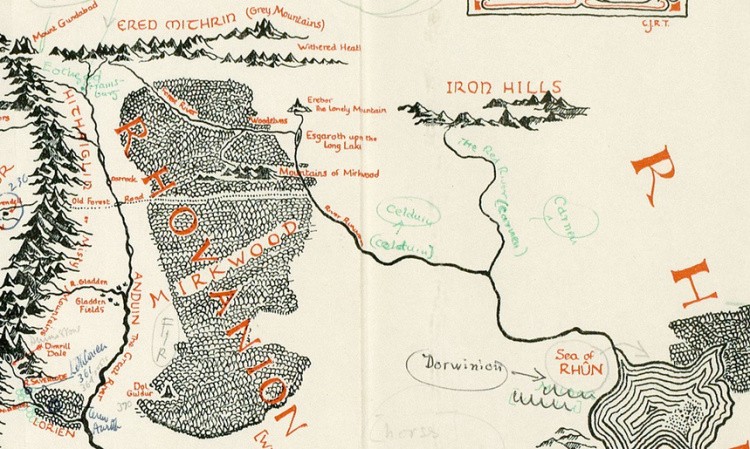
A Tolkien annotated map of Middle-earth was recently discovered when Blackwell’s Rare Books acquired acclaimed illustrator Pauline Baynes’ copy of Lord of the Rings. The map was used by Baynes when she began work on her own color map of Middle-earth, and was found loose in her book, full of annotations by Tolkien.

The map reveals just how particular Tolkien was in his vision, with details on how Hobbiton is at the same latitude as Oxford, and that Minas Tirith was inspired by the Italian city Ravenna, the capital of the Western Roman Empire in the 5th Century.

Pauline Baynes is known for her work illustrating the Narnia books for C.S. Lewis as well as her close collaboration with Tolkien. Correspondence between Baynes and Tolkien indicates that Tolkien’s vision sometimes made him difficult to work with, however it seems that once the illustrations were finished, Tolkien was very happy with them.

Henry Gott, modern first editions specialist at Blackwell’s Rare Books, explains that discovering just how involved Tolkien was in these illustrations is the most exciting part of finding this annotated map, saying: “The degree to which it is properly collaborative was not previously apparent, and couldn’t be without a document like this. Its importance is mostly to do with the insight it gives into that process.”

Blackwell’s is planning on featuring the map in their next catalogue, and is selling the annotated map for £60,000, among other works by Baynes. Baynes passed away in 2008.

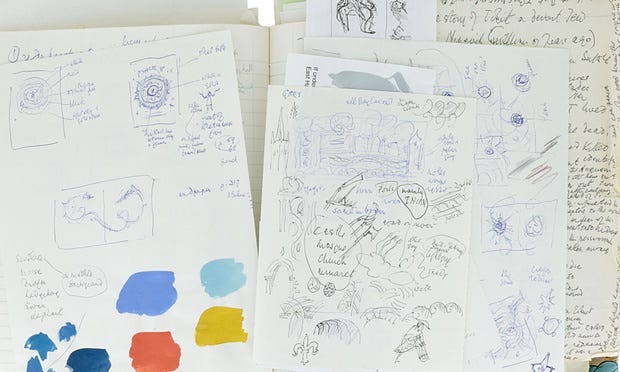
Pauline Baynes notes, Tolkien illustrations

Image via Blackwell’s Rare Books

A Sense Of The Music: An Interview With Anthony Marra, Author Of The Tsar of Love and Techno

The novelist Anthony Marra grew up in Washington, D.C., a more literary city than you might have heard. As a D.C. native and current resident, I wanted to ask him about the time he spent reading and writing here, but as it turned out, we had too many other places to discuss. Marra is now a resident at the American Academy in Berlin, and he’s spent the past several years writing about the Chechen conflict, first from the Chechen perspective in his debut novel A Constellation of Vital Phenomena and now from the Russian perspective in The Tsar of Love and Techno (Hogarth 2015). Our conversation started in Berlin, moved east to Russia, and somehow got all the way to Northern California and the punk band Screeching Weasel.

LM: Thank you for talking to us from Berlin! I have to ask: are you working on something set in Europe right now?

AM: I’m working on a new novel, which is set in Los Angeles and in Italy. I’ve decided that I’ve reached the end of my time with the Russian world, and I’m not working on anything too German, either.

LM: So you went from living in California, where you were writing a book set in Eastern Europe, to living Eastern Europe, where you’re writing a book set in California.

AM: Right. I have to be ten time zones away from my setting or it just doesn’t work.

LM: Did you visit Russia or Chechnya when you were working on The Tsar of Love and Techno?

AM: I did. Toward the tail end of working on A Constellation of Vital Phenomena, I spent a month traveling from Chechyna to the Russian Arctic. I was working on Constellation and Tsar simultaneously then, and I wanted to travel the geographical span of Tsar, which was quite useful in terms of orienting myself fictionally in this place.

LM: It’s amazing that you could work simultaneously on Constellation and Tsar, which are both big, complex books. How did you keep them apart in your head?

We tend to think that short stories are a bit of the minor leagues, but I began to realize that short stories give you a much broader canvas…

AM: Well, Tsar began as a series of unconnected short stories. I only began to put pressure on myself to make it big and ambitious when Constellation was published. I wanted to fulfill readers’ expectations, and so I decided that I was going to try to take these completely unconnected stories and find a way of making them feel so intertwined that if you lost one, the whole structure of the book would collapse. We tend to think that short stories are a bit of the minor leagues, but I began to realize that short stories give you a much broader canvas, and that I could traverse almost a century in this book, which would be virtually impossible in a novel. So I began finding ways of connecting these nine stories, and wound up losing a third of them, writing three new ones, collapsing scenes and characters. And it was really right up to the wire, figuring out how all of it would piece together.

LM: Speaking of minor leagues, your epigraph is the phrase “It’s a minor work.” You’re quoting Piotr Zakharov on the landscape painting that links the stories in Tsar, but it’s a bold move. Can you talk to me about that choice of epigraph?

AM: [laughing] You can’t take yourself too seriously. Plus, like I was saying, short stories are often seen as minor works, and so is Zakharov’s canvas — it’s the least important painting in his body of work, and yet it’s so significant to the lives of these various characters. My girlfriend is an art historian, and when we go to a museum she’ll go to the corner of the room, find a painting by an obscure artist, and be able to tell an amazing story about it, and it got me thinking about the hidden histories of these works, which rival, in terms of drama and emotion, anything that actually could be depicted.

LM: The stories in Tsar are so full of art, and all kinds of art. You’ve got art restorers, painters, a ballet dancer, and a movie star. Was that part of the linking, or were you always writing about art and artists?

AM: It was a little bit of both. When I was beginning to link the stories I was searching for moments of echo between them, where theme or idea or image were repeating. So blindness, for instance, comes up in a number of stories. And I suppose I see Tsar and Constellation as two sides of the same coin — the Chechen conflict, with Constellation on the Chechen side and Tsar on the Russian side. And I think they have a lot of overlap in terms of idea as well as subject matter, and one of the overlapping ideas is that art has the potential for rescue and restoration, but also to be used as a means of coercion, for propaganda.

LM: Let’s talk about Galina, the movie star. Every other character in the novel is, in his or her life, a sort of minor work — and Galina’s face is on billboards. She has this meteoric rise to and fall from fame. How did you come to create a character whose life happens on such a different plane than the rest?

AM: She was a product of voice. The story that focuses on her, “Granddaughters,” is told in the first person plural, and I loved the idea of having a story that is told in a collective voice — it seemed to belong to the place and period. And one of the ways to focus a story told in the plural is to tell the story of a specific figure, and use the plural as this gossipy voice discussing that figure.

LM: So let’s move from voice to structure. I’ve read novels that were built from short stories before, but never a novel built as a mixtape. Where did that come from?

You want the mixtape to become something much larger than the sum of its parts — not just a bunch of love songs.

AM: Well, in high school, I’d make mixtapes for people I had crushes on, and in hindsight I think that was my first attempt at narrative-making. You want the mixtape to become something much larger than the sum of its parts — not just a bunch of love songs. That was the guiding principle of this book. I wanted it to have the cohesiveness of a very good mixtape. Plus, it’s self-referential in that one of the characters, Alexei, becomes obsessed with techno in his adolescence and makes all these mixtapes. He gives one to his brother Kolya, and it becomes a symbol of everything that Kolya loves and everything that he fears losing. He doesn’t listen to it, so it becomes a line of tension until the very end of the book — what’s on the mixtape?

LM: Did you always plan for the book to end with the reader finding out what’s on the mixtape?

AM: Yeah. Giving the level of complexity of the book, it seemed like a good way to bring the book down to earth a bit.

LM: Who did you read while you were writing this book, and who are your big literary influences overall?

AM: Ann Patchett. There’s just this incredible humanity in her work. The writers who have meant a lot to me tend to be comic writers who write about tragedy, I suppose. José Saramago, and this Czech writer, Bohumil Hrabal, who no one in the United States seems to know. He’s able to move from these beautiful and hilarious moments to something completely crushing, and then swing back again. One of his best books is called Too Loud a Solitude, and it ends with a body being put in the ground and a kite flown in the same paragraph, and the way he manages to hit both ends of the keyboard is something that I’ve been deeply influenced by. If you can laugh with a character, you invest in them in a way that makes the story more emotionally impactful when it gets serious.

LM: And now the same question about music. The Tsar of Love and Techno did not feel techno-ey, which is a compliment, but did you have to listen to techno when you were writing?

AM: A little. I did find some wonderfully cheesy Russian club music on Spotify, but I ended up listening to a lot more Tchaikovsky. That, more than techno, is the musical melody that moves through several of these stories.

LM: Two final questions. First, what’s the best mixtape you’ve ever made, barring this book?

People always say that smell is the sense most closely tied to memory, but I would guess that hearing will bring you back just as well, even if what you’re hearing is Screeching Weasel.

AM: When I was in high school I was really into pop-punk — you know, bands like the Mr. T. Experience and Screeching Weasel, cheesy, infectious Northern California punk bands from the ’80s and ’90s. A couple years ago I was trying to give someone a sense of that music, which I hadn’t listened to in years, and I spent a week going through all my old CDs and being brought back to all those teenage memories and places. People always say that smell is the sense most closely tied to memory, but I would guess that hearing will bring you back just as well, even if what you’re hearing is Screeching Weasel.

LM: I think so. Second, if you were going to make a mixtape for the reader of this book — not a soundtrack, but the right music to go along with it — what songs would have to be on it?

AM: I made one, actually. If you go to Spotify and type in “tsar of love and techno,” there’s a playlist that follows the emotional contours of the novel. It’s got a crazy techno remix of the march from the Nutcracker, and a dance track called “Outer Space Pilot.” So you can in fact listen to the mixtape version of The Tsar of Love and Techno.

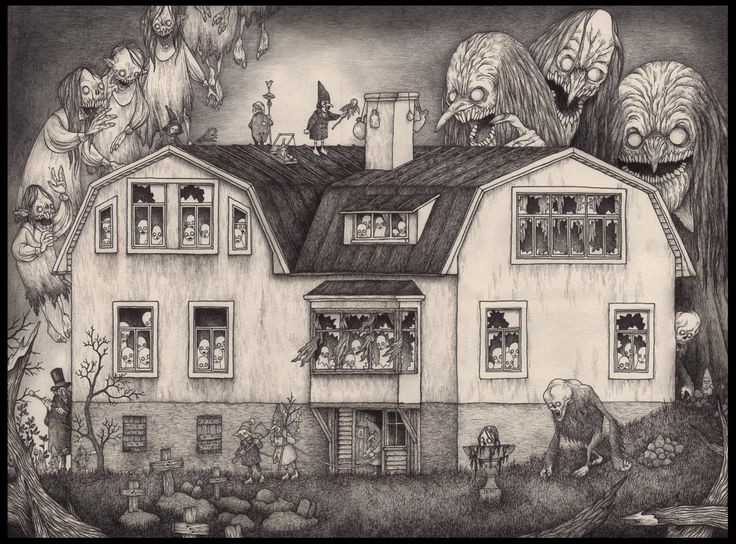
Winding Up the Dark Staircase: A Brief Survey of Haunted Houses

Edgar Allan Poe’s 1839 story “The Fall of the House of Usher” opens where haunted house stories should open — on the blighted prospects of the mansion itself. “I looked upon the scene before me,” Poe’s clinically observant narrator reports, “–upon the mere house, and the simple landscape features of the domain — upon the bleak walls — upon the vacant eye-like windows — upon a few rank sedges — and upon a few white trunks of decayed trees — with an utter depression of soul which I can compare to no earthly sensation more properly than to the after-dream of the reveler upon opium — the bitter lapse into every-day life — the hideous dropping off of the veil. There was an iciness, a sinking, a sickening of the heart — an unredeemed dreariness of thought which no goading of the imagination could torture into aught of the sublime. What was it — I paused to think — what was it that so unnerved me in the contemplation of the House of Usher?”

He does not tarry long in doubt.

By the end of the story, you’re left with two choices: Roderick Usher is either this nut who committed his sister a couple days early to the ancestral tomb lying under the house, only to have her return with a vengeance. Or Madeleine Usher, Roderick’s sister, really is the walking dead come back to claim Roderick for incest-y reasons, or maybe just the family curse. After Madeleine tackles her brother headlong, “[bearing] him to the floor a corpse,” the Usher House comes down around them. Then it vanishes into an infernal chasm.

Whichever way you look at “Usher,” it isn’t a haunted house story — not really. There are no ghosts among the halls; if anything, Madeleine Usher’s a zombie. No suits of armor muster out. No ancestral portraits track women in nightgowns. Yet the story, in essence, can be nothing but. One need only look to those opening lines to see how “Usher” fits the bill: a tale in which setting — in this case a house — exacts baleful returns on the fates of the players. Setting is a character that bodes nobody any good. Haunted house stories are stories, at last, in which spaces and places of brooding aspect exert wounding influence on the souls that traverse them.

The listicle below names 10. Not all of them involve a house.

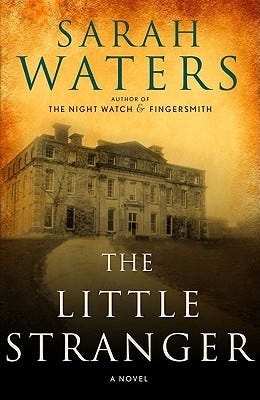
The Little Stranger by Sarah Waters (2009)

littlestranger

One of the more traditional haunted house stories you’ll find on this list, Waters’ novel groans into action when country-doctor Faraday arrives on a sick-call at Hundreds Hall, the rambling estate where his mother formerly served as a maid, to find the inhabitants living in a state of squeamish anomie, the mansion itself having fallen into magnificent disrepair around them. The patient in question is Roderick Ayres — that’s right, you heard me, dude’s named Roderick — who seems to be coming apart at the seams due to stressors far more than just keeping up Hundreds with only his mother and sister to help him. Given Waters’ previous forays into twisty Gothicism (Affinity and Fingersmith), which conclusively prove she’s the best writer ever, when the supernatural element comes into play you’ll neither be too much surprised, nor again when the phantoms are not what they seem. There’s also a really great dog-mauling scene. I should ask: what’s a Gothic ghost story without one?

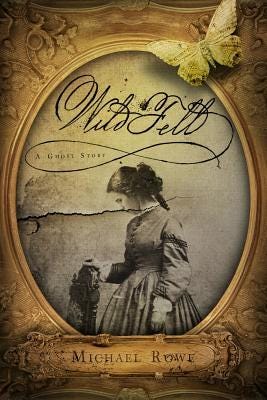
Wild Fell by Michael Rowe (2014)

wildfell

Following in Waters’ classical footsteps, this 2nd novel by Canadian author Michael Rowe fulfills the Hobbesian ideal of a haunted house novel: nasty, brutish and short. Also, elegant. With more than a little meta-fictional self-awareness — another trope of the haunted house novel post-1820, when the genre was already centuries old — Rowe tells the story of damaged ingénue Jameson Browning, who purchases the titular mansion on a lake-locked outcropping called Blackmore Island after an accident which puts him in possession of a sizable cash settlement. The ghosts are also real in Rowe, this time in the visage of Rosa Blackmore, a spectral teenager who makes known her presence in grim, strobic flashes around the estate. And yet, as in all the best haunted house stories, the specter in Wild Fell is more than just that; it’s a powerful human emotion made flesh — or un-flesh, as the case may be. While over it all loom the spires of Wild Fell: dwelt in by Jameson, dwelling in him.

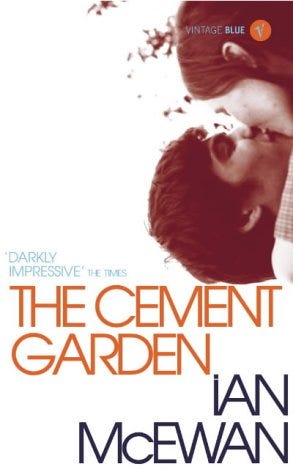
The Cement Garden by Ian McEwan (1978)

cementgarden

The specters of lust, trauma and grief more concretely — ahem — haunt the pages of this early offering from McEwan, who is best known for stuffier, more novel-y novels like Atonement and Saturday. Shorter even than Wild Fell and possessed of a Freudian unsavoriness all its own, The Cement Garden reads like the kind of nightmare you can’t even bear to recount to yourself, wherein four siblings in a middle-class British family conceal the death of their mother in order to avoid being thrown into foster care by doing what anyone else would do in the same situation, of course: encasing her body in wet cement in the cellar of the house. They then proceed to run amuck, giving William Golding’s castaways a run for their money in their penchant for shattering incest taboos — a recurrent horror in early McEwan. All the while they’re contained by the space of the house, filling up with their mother’s putrescent perfume. Though the house isn’t haunted so much by mom’s ghost as the ghosts of the children they thought that they were.

In Evil Hour by Gabriel Garcia Marquez (1962)

inevilhour

Livelier and more precise than Juan Rulfo’s Pedro Paramo, and less lugubrious than Isabelle Alende’s House of the Spirits, Garcia Marquez’s immediate precursor to One Hundred Years of Solitude concerns itself with a fictional river-town (a proto-Macondo) possessed by evil. Just like Wild Fell and The Cement Garden, In Evil Hour is uncharacteristically slim for a haunted house story; the novel is not even set in a house. Rather, it’s the town itself that cultivates maliciousness in all those who live there, first in the form of concerted lampoonings (Gabo calls them pasquinades) that air the citizenry’s secrets, and then later on as a government coup which subjugates the populace. Latin America’s answer to Needful Things, the novel also contains one of the tensest and most dislocating openings in the history of dark literature in which Cesar Montero, one rainy morning, goes to murder his wife’s lover Pastor as though in a trance, “[throwing] back the head of his raincoat, [releasing] the safety catch of the shotgun by feel, and with a calm, almost friendly voice [calling]: ‘Pastor.’” Afterward, the dying man drags himself across the floor with “the undulation of a worm along a furrow of tiny blood feathers.”

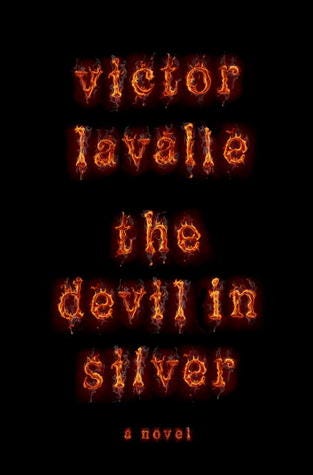
The Devil in Silver by Victor LaValle (2012)

devilinsilver

“They brought the big man in on a winter night when the moon looked as hazy as the heart of an ice cube,” proceeds the riveting opening to LaValle’s third novel, in which Pepper, lummox-y furniture-mover, gets arrested and committed to down-at-heel New Hyde Hopsital after the romantic overture he makes toward a neighbor turns violent and humiliating. At New Hyde, when he’s not getting stalked by a hideous phantom with the body of an old man and the head of a bison which moves through the hospital’s air vents not unlike the xenomorph from Ridley Scott’s Alien, Pepper mixes with the patients — by turns terrifying and charmingly batty. Just like In Evil Hour, The Devil is Silver isn’t set in a house; instead, a psychiatric ward where papers are “lost” and where patients go “missing.” Yet the bureaucratic cluster-fuck of New Hyde Hospital comes to assert an uncanny and implacable influence over the fates of the characters. Pray they make it out alive.

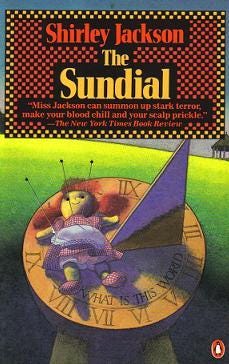
The Sundial by Shirley Jackson (1958)

sundial

Meanwhile, in Victor LaValle’s eerie forward to Shirley Jackson’s The Sundial, he writes: “[the novel] shares some of the characteristics of Shirley Jackson’s most famous works of fiction. There’s the enormous, imposing estate, as in The Haunting of Hill House; the once great but now diminished family, as We Have Always Lived in the Castle, and even the doom-laden atmosphere of her classic short story “The Lottery.” So what makes The Sundial stand out? Why is it worth reading? Because The Sundial is funny as hell.” He’s right. Opening with the Halloran family’s return from laying to rest scion Lionel, pushed down the stairs by his very own mother — Mr. Halloran, a senile echo of Uncle Julian from We Have Always Lived in the Castle, continually relives his heartbreak: “Do you remember… we rang the bells over the carriage house when he was born?” — the novel then corrals its considerable cast of characters on the grounds of the estate for the duration where, amidst an atmosphere of growing claustrophobia and existential doom, melancholy seeress Aunt Fanny begins to receive messages from Beyond that presage the end of the world. As in much of Jackson, The Sundial draws its power not only from the terrifying isolation of the house itself but that very isolation juxtaposed against the threat of invading forces — the riffraff of the town below. It’s one thing to wallow in madness together; quite another for others, not mad, to bear witness.
Northanger Abbey by Jane Austen (1817)

northangerabbey

Supposedly the first novel Austen ever wrote — though it was published posthumously — Northanger Abbey, like The Sundial, is a spooky comedy of sorts, as well as an early example of meta-narrative blending between genre and literary fiction. In it, plucky heroine Catherine, obsessed with all things Gothic (prominently among them Ann Radcliffe’s novel Mysteries of Udolpho), gets invited by her prospective in-laws, the Tinley’s, to pass a few weeks with them at their ancestral home Northanger Abbey, which boasts a mysterious suite of rooms into which no one ever ventures, and a set of equally mysterious circumstances surrounding the death of the elder Mrs. Tinley, much to our heroine’s morbid delight. Suffice to say that Austen’s treatment of the haunted house novel is more send-up than spook-show, though no less weighty for that fact. Northanger Abbey brilliantly sets up the terrors of being imprisoned in a haunted mansion as a foil for the terrors of being imprisoned by youthful uncertainty. Catherine, like all Austen’s heroines, blazes, like the lone candle flame in a poorly lit parlor.

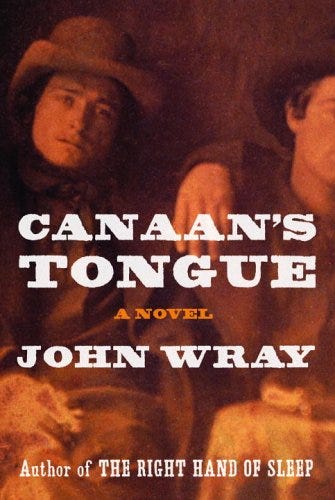
Canaan’s Tongue by John Wray (2005)

canaanstongue

Like Northanger Abbey, Wray’s curious and curiously underrated second novel of dastardly slave-stealers in the Civil War sets itself up as another meta-fictional satire of sorts, this time of the Samuel Clemens-variety, before hauling off into regions much darker. The novel begins: “There is a house…There is a river”; the house is Geburah Plantation, surrounded by a “finger-bowl of bare red clay,” while the river, of course, is the Ol’ Mississip’. Together, they harbor and nourish the nefarious mercenary aims of the Island 37 gang, a cabal of miscreants led by a messianic dwarf-preacher known as the Redeemer whose fortunes are dictated by the blighted eye of the closest thing the novel has to a protagonist, Virgil Ball. Narrated through a mash-up of shifting first-person POV’s, dime-store novel excerpts and enigmatic poetry, the novel begins and concludes in the house with American history, writ large, in-between. That Geburah Plantation itself may or may not harbor the wandering spirit of the Redeemer, who Virgil admits he has murdered in the novel’s opening pages, certifies Canaan’s Tongue as a haunted house story in which supernatural horrors and the horrors of slavery are always, grimly, neck and neck.

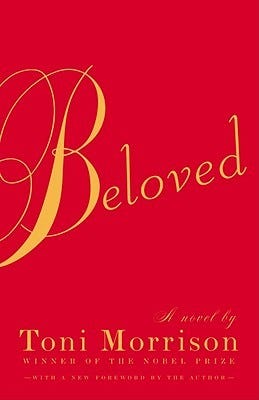
Beloved by Toni Morrison (1987)

beloved

That one of the best novels ever written in English is also a haunted house story will serve as a boon to the Halloween reader, although please, for your own sake, don’t enter Beloved expecting any kind of romp. The novel, set alternately in pre and post-Bellum Ohio and Kentucky, begins: “124 was spiteful. Full of baby’s venom.” “124,” we soon learn, is a house haunted by the ghost of the daughter of the novel’s protagonist, former slave Sethe, who mercy-killed her years before rather than see her re-enslaved. If you’re worried, be worried, the novel gets grimmer but also, progressively, less realistic; the natural world, de-naturalized, begins to adopt a Macbethian role in deciding the fates of the narrative’s players, and the ghost conceit morphs into something vampiric. Much like Canaan’s Tongue, which was I’m guessing was influenced by Morrison’s book, the novel’s chronology shifts and evolves between Sethe’s PTSD-beset present and past, evoking the horrors of slavery, sure, but also its legacy, here, in the now (a wonderful companion piece is Jamaica Kindcaid’s short story “Ovando”). Not to mention it ends in the place it began, the venomous property 124, where Sethe and her teen daughter Denver still live, although now with a newly material presence. When the book’s Gothic horror approaches its zenith, “haunted house” shows itself as a relative term.

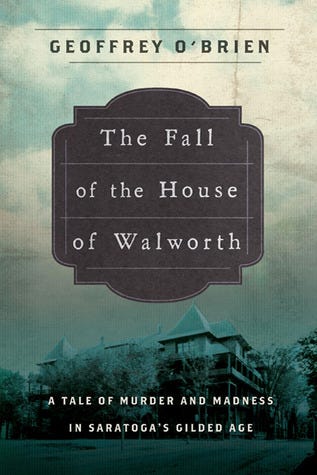
The Fall of the House of Walworth: A Tale of Madness and Murder in Gilded Age America by Geoffrey O’Brien (2010)

FallofHouseofWalworth

Rounding out our host of 19th-century-inflected haunted house stories while hearkening back to Poe’s seminal tale, Library of America editor O’Brien’s non-fictional account of the high tragic flameout of a prominent Saratoga Springs family evokes the ballroom shade-casting of the best of Edith Wharton alongside other contemporaneous works of historical true crime such as Erik Larson’s The Devil in the White City and Simon Winchester’s The Professor and the Madman. As it first did in Poe and now, too, in O’Brien, the “House” here has a double-meaning: on the one hand, it’s the great “Pine Grove,” seat of the family’s paterfamilias, Rueben Hyde Walworth, a NY-circuit judge; on the other, it’s the crumbling of the Walworth dynasty with enough castle intrigue to rival the Sutpens, when bloviating no-name novelist Mansfield, Rueben’s son, shot his father to death for unspecified reasons in his fancy NYC hotel room in 1867. The byzantine unraveling of those reasons, which involve a bitter boyhood, bloody pillows and a long, unnerving epistolary descent into madness, are both frightening and heartbreaking. If all of these stories have taught us one thing: a house, once haunted, cannot stand.

And wander these dark, branching halls, if you dare:

The Castle of Otranto by Horace Walpole (1764)

The Turn of the Screw by Henry James (1898)

Absalom, Absalom by William Faulkner (1936)

A Haunted House and Other Stories by Virginia Woolf (1944)

The Haunting of Hill House by Shirley Jackson (1959)

The House of Sleeping Beauties by Yasunari Kawabata (1961)

The Woman in the Dunes by Kobo Abe (1962)

We Have Always Lived in the Castle by Shirley Jackson (1962)

The Limeworks by Thomas Bernhard (1970)

Hell House by Richard Matheson (1971)

The Amityville Horror by Jay Anson (1977)

The Shining by Stephen King (1977)

Ghost Story by Peter Straub (1979)

House of Leaves by Mark Z. Danielewski (2000)

The Diary of Ellen Rimbauer: My Life at Rose Red by Ridley Pearson (2001)

The Keep by Jennifer Eagan (2006)

Audrey’s Door by Sarah Langan (2009)

Every House is Haunted by Ian Rogers (2012)

In the House Upon the Dirt Between the Lake and the Woods by Matt Bell (2013)

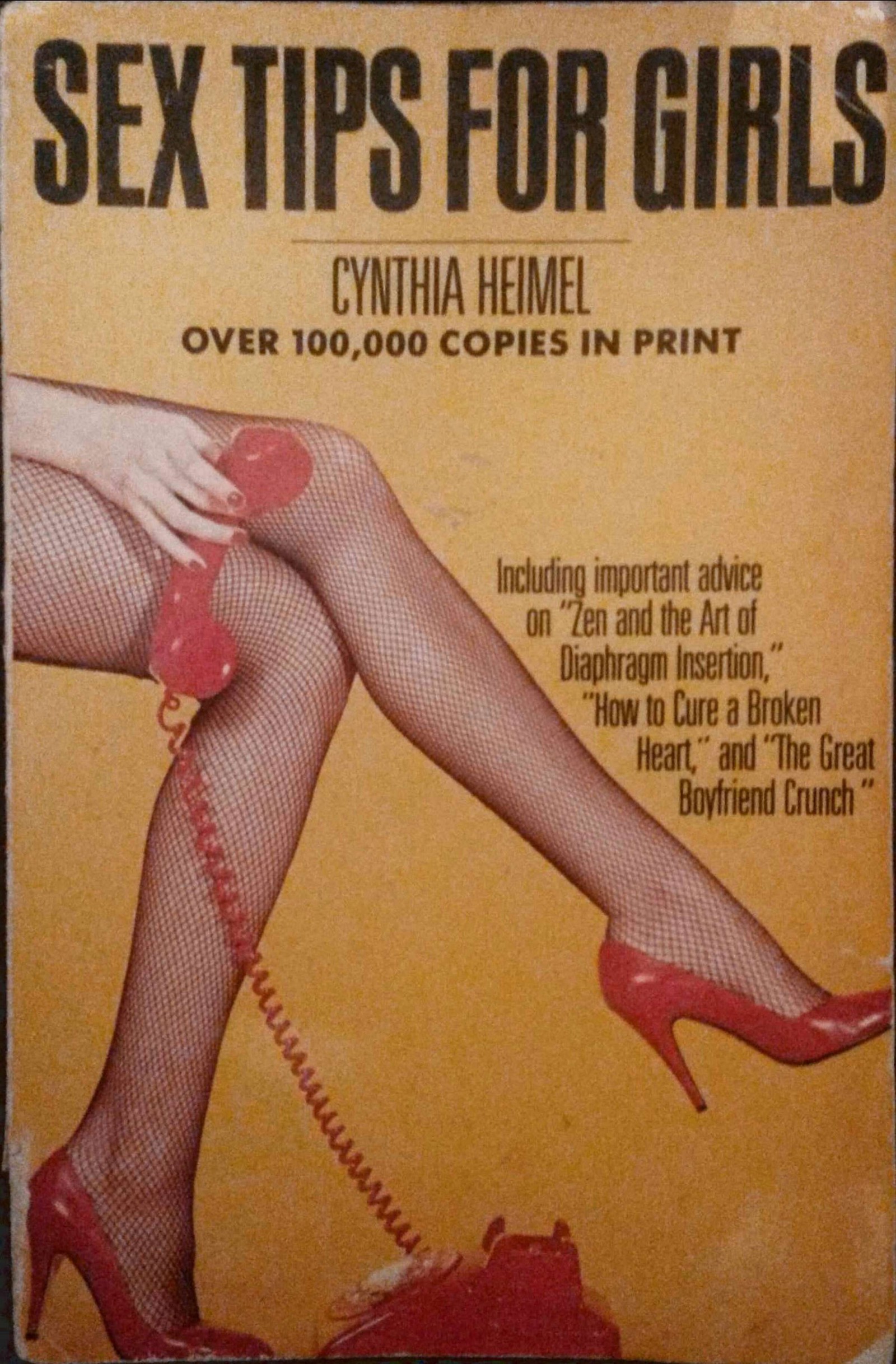
Weird Old Books: Sex Tips for Girls

by Emily Darrell

One of the sadder parts of getting older — besides, of course, the decaying of the flesh and the knowledge that you are, each day, just that much closer to death — is when things that thrilled your younger self lose their ability to captivate. It can be downright depressing. For me this includes planetariums, Halloween, reckless driving, and drinking until I can’t stand up.

So when I bit the bullet recently and spent four bucks (one cent plus $3.99 in shipping and handling) to purchase a used copy of Sex Tips for Girls off Amazon, I was apprehensive. Would it measure up? Would the section titled “Sex on Drugs” still make me die with laughter, as it had at age 13? Would it seem as witty and worldly and wise as it had back then, and would Cynthia Heimel still seem like the best friend I hadn’t met yet?

The answers to these questions are, mercifully, “Yeses” all around.

I’m not sure what drove me to seek this book out, fifteen years after losing track of it. Maybe it was one of the small attacks of nostalgia that overtake us all from time to time, prompting us to recover something we’ve lost. Maybe I needed a good laugh. Maybe it was finding myself on the cusp of thirty, newly single, ready to move on from the small-town newspaper where I’d been working for almost two years, and considering a move to a new city. In particular, I hoped Heimel’s brand of cheerful, optimistic, grab-the-bull-by-the-horns brand of feminism could provide the push I needed to turn my life into what I dreamt it could be.

All this from a book of sex tips?

Sex Tips for Girls was published in 1983 and made its way into my hot little hands sometime in the mid-90’s. I won it during a game of Thieves Gift played one Christmas morning at one of the large family gatherings that used to take place at my grandparents’ house, in between sessions of eating country ham and listening to my elders discuss their physical ailments. I remember trying to look disappointed, or at least indifferent, to the fact that I, among all my other relatives, had, from a random assortment of unmarked packages, picked a book with the word “sex” in the title. In truth, I was a) embarrassed; b) terrified that someone would “steal” my gift and; and c) eager as all get-out to get home and read it.

Little did I know that my gag gift would turn out to be not merely a Cosmo-like list of ways to please a man, but rather a life and love-affirming masterpiece of comic literature.

Heimel, a one-time columnist at both the Village Voice and Playboy, was the real-life Carrie Bradshaw before there was a Carrie Bradshaw, and her first and most well-known book is every bit as laugh-out-loud as a classic Sex in the City episode — but with a lot more depth. The book, if you want to be all negative about it, is a little dated. Heimel gives advice on how to bribe “operators” at “answering services” into taking good messages. “Sometimes if an operator is feeling downright sadistic,” she writes, “she’ll make things up. Answering service operators have been known to tell an unsuspecting girl that her gynecologist called and said she’s got the clap, or that Richard called and never wants to see her again.

Heimel assumes that everybody takes Quaaludes, which she sometimes refers to as “ludes” (although she cautions women to steer clear of any man who calls them “disco biscuits.”) She also takes it as a given that Nick Nolte is every woman’s ideal dream hunk, and believes that condoms are a scourge of the earth and that no one should ever use them.

However, none of this matters because above all else Sex Tips for Girls is book with heart and soul. Heimel neither embraces nor condemns promiscuity, but offers the sage advice that “sleeping with a man you barely know is like licking the salty rim of the glass but forgetting to drink the margarita.” She makes a convincing argument that the best way to stay young and beautiful forever is to have a sense of humor and a taste for adventure — hundred dollar creams and potions can go to hell. She quotes, with equal aplomb, Richard Pryor, William Blake, and George Jones.

Heimel implores us to “eschew anything trivial” and “embrace all that is frivolous.” Her list of the trivial includes conceptual art, international politics, and Volvo station wagons; on the frivolous side we have dancing, kissing, planting tomatoes, lying on the beach, and drinking champagne. “All things trivial are objects,” she writes, “and all things frivolous are actions.”

When you read Sex Tips you are transported into another world: a magical, mythical New York of days-gone-by, a place where you can dance in honky-tonks to jukeboxes stocked with Merle Haggard and Hank Williams (perhaps my over-the-top admiration for Heimel is furthered by our mutual love for classic country) and where each day holds the possibility of running into Joey Ramone on a street corner. Her friends, who chime in frequently with their own wisdom, are the kind of friends any girl would want: Rita, a six-foot, redheaded Texan “who can spot a fool from a thousand paces,” Cleo, a petite, witty journalist, and Marta, a “seductive” clothing designer.

One of the most attractive aspects of Heimel’s voice is that despite her wonderfully upbeat attitude, you feel her optimism is hard-won. We don’t get the sense that she has famous parentage or a hefty trust fund. She’s never, so far as we can tell, worked as a model. She’s a divorced mom raising a son on her own who once gained forty pounds in an unhappy relationship and who knows the feeling of true heartbreak.

So many of the passages in this book have stuck with me for years and years, even the pieces of advice I’d never follow (that a woman needs only three pairs of shoes: black boots, red high heels, and white sneakers) and the facts I find suspect (that a woman only has nerve endings in the first three inches of her vagina.). In the chapter, “The Perils of Obsession,” Heimel writes that “obsessed people are notoriously thirsty” — it’s a beautiful, throwaway line, the sort where you both know exactly what the author talking about, and yet realize that it makes no sense. In her chapter, “Why Exercise?,” Heimel explains that “imitating Mick Jagger is the most sophisticated form of aerobics. To do it properly, you must be very careful not to lapse into being Keith Richards. Keith, although often more compelling than Mick, is not aerobically sound, since he mainly just stumbles.”

For the last couple of years, Sex Tips for Girls has re-earned its place in my library as one of a dozen or so books that I can pick up at any old time, flip to any old page, and find myself immediately engrossed — the true test of a personal classic. I won’t claim that re-discovering this book changed my life, or that it gave me the courage to make some bold but necessary changes in my life — reconnecting with (and marrying) a lost love, moving to a new continent, changing careers, setting about learning an excruciatingly difficult East European language — because I almost certainly would have done these things anyhow. Nevertheless, the book has become a trusted friend that never fails to cheer me up. After reading a few passages, I’m in a better mood, more energized, and feel somehow more attractive. I feel ready to go out and fulfill what Heimel calls the primary goal of humanity: “that of having a good time.”

The Messiness of Desire: An Interview with Suzanne Scanlon

“The Rape Essay (Or Mutilated Pages)” by Suzanne Scanlon is featured in Electric Literature’s Recommended Reading with an introduction from Belinda McKeon. Scanlon’s’s collection, Her 37th Year, An Index is available from Noemi Press.

Julia Tolo: It seems to me that the use of Mary Gaitskill’s “On Not Being A Victim” in”The Rape Essay (Or Mutilated Pages)” emphasizes the confusing nature of relationships between men and women, and, as Gaitskill writes, how it is hard to create rules of conduct or even interpretation. May I ask, what came first: did you read Gaitskill’s essay and decide to write this story, or did you begin to write the story and then realize that Gaitskill’s essay was a good fit?

Suzanne Scanlon: Mary Gaitskill is one of my favorite writers, one of the first contemporary women writers who inspired me to be a writer. I read this essay long ago,in the nineties and have been thinking about it occasionally over the past few years. I wanted to engage with it somehow, and it made sense to do so in this story (which is part of a larger book). It’s such a complicated discussion to have, and Gaitskill is able to address nuances and subtleties that get ignored.

JT: Could you talk about to what extent Esther’s interpretation of essay is influenced by circumstance and the context in which she reads it (that Harold gives it to her)? Would you say your interpretation of the essay differs from hers?

SS: I wanted the story to contain the conversation, the dialectic. Esther reads it according to the context, but can’t fully deal with it. She’s given the essay by a teacher who is seducing her. She has her own mind, but she’s also totally in love with this guy, so.

I would say that my interpretation of the essay now is that Gaitskill is right on. It was a difficult argument to make. There is something about learned helplessness and the messiness of desire that Gaitskill takes on, and that has been very hard for me to admit, personally speaking. Also, the essay is impossible to reduce to a soundbite or a rule. Which is why I admire it.If my story only gets people to go read that essay, I’m totally happy.

JT: In her introduction to the story, Belinda McKeon discusses how she found the dialogue confusing in her initial read. Is this a reaction you expected? Or, in other words, did you intentionally decide to leave your reader wondering (at times) about who is speaking?

SS: Yes. I get tired of tags — he said/she said — and I like fiction which is more like theater, where the voices overlap, and the rhythm or sound of the conversation creates its own life. To me this is more important than our sense of who said what. It’s meant to link to represent the way voices often merge, or echo or mimic.

But this isn’t the most unusual thing, either — lots of fiction writers do this — Manuel Puig, for one.

JT: “The Rape Essay (Or Mutilated Pages)” is part of A Kind of Compass: Stories on Distance, an anthology edited by Belinda McKeon. Did you write this story to the theme of the anthology? How do you think about the concept of distance in the story? For me, the concept of boundaries — though not expressly about distance, is the strongest connection to the theme.When Esther’s doctor says to her, “It would be, as your professor, an act of love to maintain boundaries,” he is noting that Harold has become too close.

SS: Yes. I like that. I was thinking more of the distance from the past to the present, the reconstruction of memory. But I wrote this story as part of a larger book I’m writing, and shaped it a bit to fit in the anthology.

JT: I read “All That You Aren’t But Might Possibly Be” in BOMB, and there as well as in “The Rape Essay (Or Mutilated Pages),” the saint of insanity, Dymphna comes up. How did you become interested in Dymphna, and what has she meant to your writing?

SS: I was raised Catholic, and then became depressed in college, which happened to coincide with my discovery of feminism. I think one of the most important things I learned through feminism was that women’s suffering and women’s experience was sacrificed — that women’s voices were left out of larger conversations. Dymphna’s mother died when she was young, which was my story, and something that I never felt I could “get over” — not in the way that I was supposed to, anyway — I could not stop a certain obsession with my mother’s death, this loss, and I knew this was the crux of my depression… but that didn’t mean I could change it. I needed to suffer, at least, for a time, I did. At the same time, I met a number of women whose depression stemmed from violent trauma — specifically, the trauma of rape or sexual abuse — and that was often left out of conversations, where the women were considered sick or “crazy” — like Dymphna. That was the cultural narrative — women are crazy — instead of what these women had suffered are bore. Why is Dymphna the patron saint of “nervous illness”? Because she was raped/abused, etc. I grew horrified at the way the Catholic church, like all of patriarchy, would scapegoat women (and other outsiders) under the guise of mental illness (which of course further disenfranchised them, and still does, as I discovered). I still can’t believe the story of Dymphna, and I wish I had been taught this in Catholic school. Maybe I keep bringing her up in my writing because I want others to know this — the way women’s “nervous illness” has been a construction, perpetrated by the Catholic church and other power structures.

JT: Similarly, I’ve found an interest in the experiences of the mentally ill and mental institutions in your fiction. You touch on this in your interview with Kate Zambreno for BOMB, as well as the act of portraying the “mess of life.” I love this idea of mess as virtue, and I was hoping you could say something about your fascination with mental illness and perhaps how it pertains to the idea of showing the messiness of life in your writing?

SS: I’m not fascinated by mental illness. I’m interested in people and suffering and the way people survive trauma and cope and heal or don’t heal. I’m often bothered by the way very complicated experiences get reduced to”mental illness.” Which is not to say it isn’t real, and that people don’t need care (which is less and less available, of course) — but, my interest is linked to what I said above, and to my experience of having been misdiagnosed, and over-medicated. I know many who have been helped by therapy and medication, but I worry a bit when an otherwise critically thinking person accepts a diagnosis without some critical or contextual engagement with the structures (medical/pharmaceutical/political) that have created these categories (which are always shifting, and often gendered). Kate Zambreno writes brilliantly about this — her writing is endlessly inspiring to me, and we have bonded around this interest, as well as around our need to find and create alternate spaces. Fiction is one space, one of the best alterna-spaces. Kate noted once that she and I are in the “Dead Moms Club” and that was important to me. That’s not necessarily mental illness — or it doesn’t have to be — but to lose your mother as a young girl or a young woman is a trauma that I don’t think we have words or space for in this culture where one is meant to be contained and self-actualized — not needy or longing or devastated or just totally lost. Which is how I’ve felt much of my adult life.

***

Suzanne Scanlon is the author of Promising Young Women (Dorothy, a publishing project, 2012), and Her 37th Year, An Index (Noemi Press, 2015). She lives in Chicago.

Hotel That Inspired Stephen King’s The Shining to Become Horror Museum

by Melissa Ragsdale

The Stanley Hotel in Estes Park, Colorado — famous for inspiring The Overlook Hotel in classic horror novel The Shining — has announced plans to develop the world’s first horror museum, film production studio, and film archive.

Known as The Stanley Film Center, the project would include a 30,000 square-foot interactive museum, a 500-seat auditorium, traveling exhibits (including “The Walking Dead” based on the film work of Charlie Adlard), a sound stage, and a post-production studio. Partnering with the Colorado Film School, the center aims to create an educational platform for both students and the public. It would be a non-profit, private-public partnership, with a founding board that includes George Romero, Simon Pegg, Elijah Wood, Mick Garris, Josh Waller and Daniel Noah.

The Stanley Hotel

The Stanley Hotel

In order to launch the center, The Stanley Hotel estimates a total cost of $24 million. They’re asking for $11.5 million from the state of Colorado’s tourism fund, which is currently pending approval.

In 1974, Stephen King and his wife were the only guests at The Stanley Hotel, staying the night in Room 217. After a disquieting evening roaming the empty hallways, King went to bed and had a nightmare:

“I dreamed of my three-year-old son running through the corridors, looking back over his shoulder, eyes wide, screaming. He was being chased by a fire hose. I woke up with a tremendous jerk, sweating all over, within an inch of falling out of bed. I got up, lit a cigarette, sat in a chair looking out the window at the Rockies, and by the time the cigarette was done, I had the bones of the book firmly set in my mind. “

After the book was published in 1977, The Shining was adapted for film by Stanley Kubrick, becoming a classic of the genre.

“There’s really no better place for there to be a permanent home for the celebration of horror as an art form than the Stanley Hotel,” says Elijah Wood. “It was practically built for it.”

October Fiction Prompts Culled from the News

Each month we gather some news headlines that are strange enough to be fiction. Here’s yet another batch of headlines to get your creative juices flowing along with suggested genres — this time a special all-horror October edition:

Evil Clown Horror: Creepy clowns stalk and allegedly try to abduct UK children

Mommy-Monster Fiction: Mother duct tapes children to chairs to force them to watch Mommie Dearest

Novel of Creepily Bad Manners: Neighbor sends notes saying “children look delicious” and asking politely for a taste

Urban Planning Arachnophobia: Important Ohio bridge infested with thousands of spiders

Happy Loving Child Horror: Woman sues 12-year-old nephew for happily hugging her until her wrist broke

Body Horror: Woman mixes up eye drops and glue, glues friend’s eyes shut

Rampaging Moose Monster Fiction: Epic moose battle rages in suburb

Produce Crime: Violent (yet healthy-eating) teen charged with assaulting teacher with a carrot

Devil Dog Horror: Man’s dog gets him drunk, drives him in car (or so he claims when arrested)

Mini-Kaiju Monster Battle: Pigeon and rat battle in NYC park