Ask a stone. Ask the hollow part of the anklebone.
•
When My Daughter Asked
how Martin Luther King died, I had to say, “He was shot.”
Or not.
I could have said, “He rode off, real loud, on a cloud.”
•
Keep Your Feet on the Ground and Keep Reaching for the Stars
say the police, who shoot anyway, from the protection of their police cars.
•
OK, a Dude’s Dead, But You Can Go
It looked like a gang sign —
and I work hard for what’s mine.
I hate to involve her, but it was my grandma’s revolver.
I shot, like, one round. (I was standing my ground.)
•
Counting Song
One Ayatollah, two samples of Ebola, three “Yo man I’m down on my luck”s, Four fucks, Five hats that don’t fit, Six cigarettes that won’t stay lit, Seven personae, Eight diamonds deemed phony, Nine bottles of wine, Ten bottles of wine.
•
Trades I Wouldn’t Make
Ragtime lessons for a bag of Smith & Wessons. A crisis at the Presidio for that ISIS video. My looks-cute-in-a-Bengals-cap daughter for tap water. My other daughter (also cute) for, whoa, Beirut.
•
Questions, Questions
Is “Behind Blue Eyes” the meanest pop song ever written?
Or is it “Beth”?
And would anyone mind if I stomped this kitten to death?
In fiction, magic usually emerges unexpectedly from the ordinary world, or at least from ordinary circumstances. Take, for example, the four average children who found the doorway into a pocket universe which also happened to be a religious allegory; or consider the group of humble scientists who discovered something ancient and weird living beneath the Antarctic; or maybe you remember that time your friend showed you a particular spot in his basement where, from a certain angle, you could see all of space and time compressed into a single point. The list goes on, but, fundamentally, it all functions the same way.
This is how magic works: a writer changes something familiar into something strange and leaves the rest of the world looking pretty much normal. Magic needs contrast, otherwise it wouldn’t be wondrous — it’s that moment when The Wizard of Oz switches into Technicolor.
The rule of thumb with a supernatural element in fiction is that all the other details in the story need to be proportionally normal to highlight the weird. But in Welcome to Night Vale, Joseph Fink and Jeffrey Cranor throw that idea out the window. Everything is weird in Night Vale. There is no contrast between strange and normal because “normal” does not exist in Night Vale. Magic has one rule and they broke it. But for all that, Welcome to Night Vale somehow works. In fact, it’s amazing.
In the town of Night Vale, supernatural events occur in bulk. It’s like being at a Halloween Store for surreal plot devices. Each paragraph could furnish an entire Murakami novel, Kelly Link story, or X-Files episode. In Night Vale, you die and come back to life (but sometimes you don’t); people inexplicably disappear and reappear changed (but sometimes they don’t) — angels exist and they are all named Erika, though no one can acknowledge them legally because a sinister yet vague shadow government looms over everything and is never explained. It isn’t very important to the plot so don’t worry about it — lights hover over the Arby’s, and your house has thoughts, but those thoughts (like the nature of the shadow government) aren’t very important:
While a person sleeps, the house might suddenly have a thought: Taupe is not an emotional catalyst. It’s practical and bland. No one cries at any shade of taupe. Or another thought like OMG time! What is time even?
It’s worth mentioning that this world isn’t entirely new. The town of Night Vale has existed on Fink and Cranor’s podcast of the same title since 2012. According to an NPR interview, the idea was to create a town in the desert “where all conspiracy theories were real.” That makes sense here, but also it doesn’t: There are lots of things in this book that don’t resemble conspiracy theories at all. Some of it is just strange, nonsensical, and funny — plastic pink flamingos that transport you to a different parallel reality, for example.
But it’s alienating, all this weirdness. This is why writers are only supposed to transform one thing at a time — that’s why the rule of contrast is important for surreal fiction. Transform a bunch of things simultaneously, and you risk confusing people. They won’t know where to look for the next trick or what any of it means or why it matters. It’s overwhelming. That’s the big problem with Welcome to Night Vale; there’s too much weirdness to know if any of it really means anything, and while I’m sure an undergraduate English major could make hay deconstructing the post-9/11 American cultural mythos presented here, establishing “meaning,” in the conventional sense, sounds like the opposite of fun, and if there is one thing Welcome to Night Vale wants you to do, it is have fun.
Welcome to Night Vale is all about having a fun. It’s goofy and weird and it doesn’t take itself too seriously — which would be fine; it would be pretty funny, actually, if Fink and Cranor had just embraced that — it works pretty well in the podcast, but, of course, the medium is completely different here. The podcast episodes are twenty minutes long, and this is a 400-page novel, which I guess means that this book supposed to be more than just a fun time.
In what seems like an attempt to simultaneously organize all of this madness and impose some gravitas upon the story, Fink and Cranor created a simple plot, lifted straight from Joseph Campbell. The bones of the story here are familiar — the search for a lost father and the long road to self-discovery — but the plot exists not so much to tell a story as is does to shuffle the reader through the aforementioned parade of weirdoes.
The mechanisms of plot eat up the second half of the novel, which is unfortunate because it means less fun and more clunky explanations about why things are happening and which of those things matter and how those things can be resolved, but the idea of resolution seems counter to the premise of Night Vale in the first place. The characters keep saying that Night Vale is a town that doesn’t make sense, so why should this story make sense? Why does it need to rigidly follow the conventions of a totally uninspired plot? Welcome to Night Vale is at its best when nothing important is happening — like here:
Saturday is a softball game between Night Vale Community Radio and Night Vale Local News TV. I don’t mind telling you, this is not a game I enjoy. The creatures that work in television news, because of the shape and quantity of their appendages, often hold the bat in ways that are unsettling to the human eye.
Welcome to Night Vale is a powerfully imaginative work, and you’d think Fink and Cranor could have invented a more engaging alternative to a conventional story structure. The world presents itself as something new, exciting and fresh — I don’t think it’s unfair to expect the events holding this book together to be equally novel.
But beneath the moments of confusion and the throwaway jokes, beneath the phoned in plot and the general alien-like quality of everything in this book, there is a sincere and compassionate heart beating. The residents of Night Vale love their town; they celebrate its bizarre diversity, and that’s what makes the book great.
What’s magnificent here is the way in which, over the course of the novel, the reader comes to feel a certain kinship with this fictional desert community, proof that even a weirdo-infested town can become welcoming in the right hands. In this way, the book itself is a magic trick in reverse — by the end of the novel, the strange has somehow transformed into the familiar. Welcome to Night Vale presents readers a place where anyone can belong, and that’s the real power of this book. It’s one of those fictional places you miss as soon as you finish the last page. You’ll pine for Night Vale when it is gone. And that’s something else magic does exceptionally well: it leaves you wanting more.
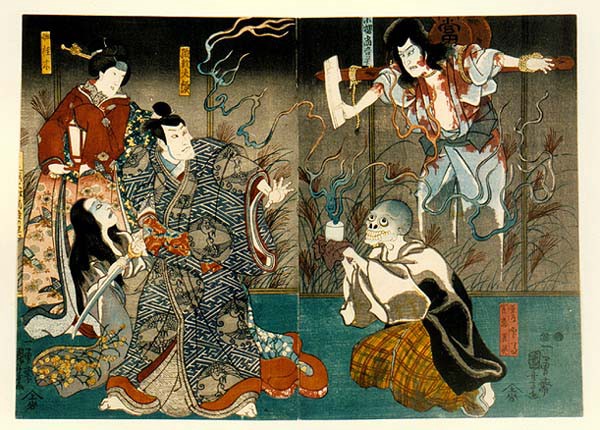
When Lafcadio Hearn stepped onto the shores of Japan in 1890, he began writing ghost stories. On assignment from Harper’s Magazine, Hearn was charged to explore and explain this undiscovered country to eager Americans. That his answer was to write about Japan’s spirits should have surprised no one; Hearn had a predilection for the macabre and uncanny. But while a previous sojourn in New Orleans had supplied him with ore for his imagination, in his new home he struck the mother lode. Japan is the most haunted country on Earth.
A Religion of Ghosts
Japan lives with its ghosts like few other cultures. Since ancient times, Japan’s religion and culture has been deeply bound with ghosts, called yūrei. Both feared and revered, yūrei are part of the deep magic; a foundational belief that humans have a god inside of them. This powerful, supernatural entity — called reikon or tamashi — is held in check only by the meat-cocoon of the body. On death, the spirit is unleashed. For good or ill.
This powerful, supernatural entity…is held in check only by the meat-cocoon of the body. On death, the spirit is unleashed. For good or ill.
Edo period scholar Hirata Atsutane wrote, “The spirits of the dead continue to exist in the unseen world which is everywhere about us; and they all become gods of varying character and degrees of influence.” If properly respected with the correct rituals, a person’s spirit becomes a protective ancestor deity — called kami or sōrei. But if something goes wrong — if the spirit has some lingering business, or if death rites are not properly performed — then a yūrei is born.
Yūrei can never be destroyed, only sated. Desire is the key to yūrei — they want something. This drives them, gives them purpose. Their manifestation can be as benign as delivering a final “thank you” never said while alive, to as terrifying as shattering the earth with rage. Since ancient times, natural disasters were said to be the result of yūrei. Wielders of fire, flood, and earthquake, there is nothing more fearsome than an angry Japanese ghost.
The pacification and transformation of yūrei has dominated Japanese religion and politics for millennia. Controversial author Umehara Takeshi calls it the consistent theme through the history of Japanese civilization.
During the Heian period the government bowed to practitioners of Goryō Shinko — the Religion of Ghosts. To calm spirits, official rituals were performed to posthumously raise the dead in rank and title before they were enshrined as kami, protector spirits in Shinto shrines. This belief system was so pervasive that a ceremony to welcome the dead into the ranks of protective spirits was even established and observed in the Imperial Court.
Lafcadio Hearn said Japan lay under The Rule of the Dead. In his landmark 1903 book Japan: An Attempt at Interpretation, he described a relationship where the living must pacify the dead, and in return the dead watch over the living. “And the hand of the dead was heavy;” Hearn wrote, “it is heavy on the living even today.”
Yūrei and Storytelling
Most people know that Japan is particularly good at ghost stories. As they should be; they have been working at it for some time. Theater, literature, art, or film — Japan’s storytelling is inherently haunted. Indeed, a history of Japanese literature is a history of ghost stories.
Japan’s storytelling is inherently haunted. Indeed, a history of Japanese literature is a history of ghost stories.
Two of Japan’s oldest known books, the 12th century Genji Monogatari (Tale of Genji) and Konjaku Monogatari (Tales of Times Now Past) are bursting with yūrei. In Genji Monogatari, shining Prince Genji is haunted by the Lady Rokujō, whose love he spurned. She brings ghostly wrath down upon three of Genji’s lovers. Rokujō is a foundational character of Japanese storytelling — the woman of vengeance who uses her supernatural powers. Konjaku Monogatari is a famed collection of supernatural tales that have inspired Japan’s writers since its publication.
In 1776, Ueda Akinari adapted stories from Konjaku Monogatari as well as other classic supernatural tales into one of the greatest works of world literature, Ugetsu Monogatari — Tales of Moonlight and Rain. A profound book, Ugestu Monogatari is a virtuoso performance as well as a vehicle of transformation. Written by a man born in the mud to a nameless prostitute, Ueda used Ugetsu Monogatari to raise himself into a world of literati and respect denied to him by his birth.
Many of Japan’s talented writers have turned their skills towards yūrei. Just as everyone is said to have at least one novel in them, every Japanese author has at least one yūrei story to tell. Kawabata Yasunari, the first Japanese person to win the Nobel Prize for literature, wrote several yūrei stories, including the Palm-of-the-Hand story, “Fushi.” In the story, a beautiful young yūrei and an old man, her former lover, take a walk together, recounting their past and the situations that separated them and led to the girl’s suicide. Modern novelists like Yoshimoto Banana and Murakami Haruki have spun their own yūrei tales. And popular author Miyuki Miyabe’s 2013 book Apparitions: Ghosts of Old Edo showed that Japan’s old ghosts still have life left in them.
Folklorist Yanagita Kunio attributed this to what he called involuntary tradition — whether they believe in them or not, the Japanese people grow up simmering in a pot of ghost lore and culture, until it seeps down to the bones.
Yūrei in Modern Japan
It’s been a good century and some change since Hearn walked Japan, but modernity has not altered this dynamic or shaken Japan’s beliefs. The dead still rule.
In the middle of Tokyo, a small section of prime real estate lies undeveloped out of fear of arousing the wrath of the samurai Taira no Masakado. After Masakado’s execution in 940 CE his severed head was said to have flown from his body, bent on wrath. His head finally landed in a tiny fishing village where the locals enshrined it in order to appease his anger. That little village grew up to be the major metropolis of Tokyo, but the shrine remains undisturbed. In fact, in 1940 the Ministry of Finance paid for an extravagant ceremony to rededicate the shrine after a particularly fierce bolt of lightning struck their offices near Masakado’s shrine. After WWII, when the American occupying forces tried to demolish the shrine, their bulldozer suddenly flipped over, killing the driver. Today, no one will touch it.
Similar shrines with similar stories can be found all over the country. Every stone shrine tucked inside the bushes along the side of the road or tiny statue of Jizo at a temple is dedicated to some spirit. A beautiful statue of a young girl staring at the sea in Mie prefecture is actually there to pacify an angry gang of yūrei that drowned a group of schoolgirls in 1955. The picturesque Himeji Castle, an UNESCO heritage site, boasts the Well of Okiku that figures in one of Japan’s most famous yūrei legends.
In 2013, no one batted an eye when Prime Minister Shinzo Abe was reluctant to move into his official residence because he felt it was haunted. While this would have stirred the media into a frenzy in the US, Japan considered it perfectly sensible. All you have to do is look at the news to see what arises from a state visit to Yasukuni Shrine — the modern incarnation of Japan’s ghost religion Goryō Shinko. Home to Japan’s honored war dead who have been elevated to kami spirts, including many Class A war criminals from WWII, Yasukuni Shrine it a controversial house of worship to say the least.
Because what Hearn wrote about Japan more than a century ago still holds true: the hand of the dead was heavy; it is heavy on the living even today.
When William Gay died suddenly in 2012 he left behind a modest but powerful oeuvre of some of his generation’s most striking, original, and funny Southern gothic fiction: three novels, two books of stories and assorted prose, a chapbook, and rumors of (at least one) more work. By now, his unusual biography (by typical literary standards) and tales of personal eccentricity are the stuff of near-myth — but, just briefly, since Gay’s depiction of Southern life seems dredged as much from personal history as from a distinct literary tradition: as William Giraldi notes in his excellent survey of the author’s work, Gay was born in Hohenwald, Tennessee, served in Vietnam, returned home where he worked to support his family as a carpenter and dry-wall hanger, all the while secretly, or at least anonymously, slaving away at his stories and novels and facing years of literary rejection before being discovered, finally, in 1998 when he was 55, by The Georgia Review.
It’s a remarkable and inspiring tale — the backwoods artist toiling in obscurity until fortune allows that first break — but what is more surprising, almost unprecedented, is the quality of the work that appeared in such quick succession. First came The Long Home (1999) where, though it was his debut novel, Gay introduced us to the hallmarks of his narrative vision: the young men coming of age in the rural Tennessee setting, the potent tension between humor and grotesquerie, and the great narrative engine of a terrifying nemesis — all rendered in a distinct and exciting prose capable of making the most graceful register shifts between the biblically ornate and the Appalachian colloquial. It was a voice both bard-like and wry, fluent in prophetic declaration, slapstick hilarity, and classical irony.
Next came his most fully realized and profoundly comic novel, Provinces of the Night (2000), followed by Twilight (2006) — a dark, Southern gothic exaggerated into comic book proportions. Twilight reveled in sexual perversion, elements of the grotesque, the fantastic and the gothic intersection of the haunted present with the ghosts of the past, all bludgeoned with an over-the-top dose of macabre violence set against a wild and surreal Tennessee backdrop. For all its wild derangements, Twilight was not as accomplished a novel as Provinces of the Night, but it was a more interesting one. With its deft movement between picaresque and fairytale, between human and supernatural horror, in the way it took the gothic tropes that usually remained as subtext or set piece and vivified them as narrative devices (the wood is actually haunted, etc.), it represented the work of an author ready to revitalize conventions he’d so clearly mastered.
And then Gay went silent. After Twilight’s release, there were rumors of more books in the works, followed by rumors of why those books had yet to appear, but one way or another, Gay’s torrid pace had halted and he did not publish another novel in his lifetime.
Despite my suggestion that Gay’s last novel represented a formal redirection, he does not try to hide his influences, and it’s rare to find a discussion of Gay’s work without a reference to those other lions of the form — Faulkner, O’Connor, Crews, and of course, and most notably, McCarthy. (Although he is usually discussed solely in this southern company, Gay’s work, the way he combines rural and historical tropes with fairy tale motifs, has seeded some of the more recent iterations of the hardscrabble American Fantastic, as represented by Benjamin Percy, Matt Bell, and William Giraldi). Still, Gay was an open admirer of McCarthy, and in his novels, he seemed to pick up right where McCarthy left off after he published Suttree, abandoned his own Tennessee roots, and set out west. Indeed, several moments in Twilight read like dramatizations of, or conversations with, Suttree’s haunting final paragraph.
Suttree: Somewhere in the gray wood by the river is the huntsman and in the brooming corn and the castellated press of cities. His work lies all wheres and his hounds tire not. I have seen them in a dream, slaverous and wild and their eyes crazed with ravening for souls in this world. Fly them.
Twilight: Sometime in the night he met a horseman…He didn’t know if it was Sutter or not, and he didn’t know if it was real or he had dreamed it, but he knew that something dread had passed over him in the night and gone on.
Both passages provide similar depictions of a sinister figure harrowing the roads of the world, and yet, where McCarthy’s huntsman — visible only in the narrator’s dream — is clearly metaphorical, Gay’s may well be actual: Gay’s protagonist, Tyler, is unsure whether the rider was Sutter, the villain on his heels, or a supernatural presence. In this moment, the boundary between dream and reality collapses — in Gay’s scene, whether the rider was real or dreamed does not affect his potency, his ability to do harm, or even, really, his presence upon the landscape. (Either way, Tyler knows the rider passed him on the road). While McCarthy’s passage perfectly exposes his grand vision of American apocalypse unfurling with the stylized iconography of a Holbein design, Gay strips the moment of its mythology in favor of a porous, fairy tale world of lived nightmare. The horror in this moment is much smaller than McCarthy’s, much less grand, but in its possible, even likely root in human action, so much more unsettling.
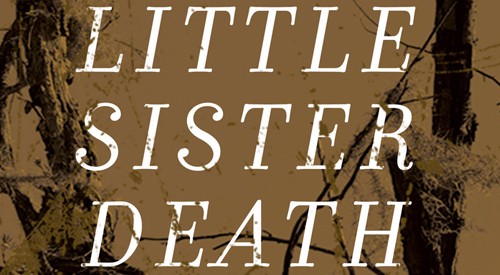
Little Sister Death — Gay’s first of at least two posthumous novels (discovered in multiple notebooks and acquired last summer by Dzanc Books) continues the development initiated in Twilight of literalizing the horrific elements of the Southern gothic. Certainly, Little Sister Death represents, in form and direct subject, something of a departure for Gay — it does not adhere to a strict chronology but rather jumps around between 1785, 1982, and several points in between; its protagonist is a struggling writer; and while it still, in style and subtext, pays homage to McCarthy and Faulkner, it also riffs on Stephen King. Nonetheless, any reader of Gay will easily recognize his distinctive prose, worldview, and grim humor, and honestly — although this is an ostensibly plot-heavy novel — the plot of Little Sister Death, the site of much of the deviation from his past works, feels almost incidental. To summarize: David Binder, a displaced southerner living with his wife in Chicago, is struggling to write his second novel. More accurately, he has, following the success of his first novel, written a second novel that he finds lifeless and dull, a book without anything to say. He decides to quit on it, but needs money, so his agent suggests that since both of his novels have had “those overtones to them anyway” he should write a horror novel to sell to the paperback houses. Binder’s not sure if he can write a potboiler, but he goes to a used bookstore to research the occult and finds “that fate, coincidence, and synchronicity had played into his hands” in the form of a book on Virginia Beale, Faery Queen of the Haunted Dell, the notorious “haunt” of a Tennessee homestead that had fascinated him as a child. Binder is quickly captivated (“[h]e had to write a book about it”) and in keeping with the terrible choices the genre demands, decides to move down to Beale Station, Tennessee with his wife and young daughter to spend the summer researching and writing the book, while living, of course, in the recently abandoned, unsurprisingly cheap, and abundantly haunted Beale house.
As my quotations might suggest, Gay dispenses with these plot mechanics breezily and we can feel his interest perk up when the Binders get to Tennessee. The generic machine set, he relaxes into a voice dredged right out of Twilight. Here’s Binder’s first trip to the house:
The road kept branching off, steadily deteriorating until the Jeep seemed to be leaping from one raincut gully to the next, steadily ascending, the red road winding through a field promiscuous with wildflowers and goldenrod, leveling out when the cedar row began. He began to smell the cedar, faintly nostalgic, the road straightening and moving between their trunks, and then in the distance he could see the house…it seemed to have grown at all angles like something organic turned malignant and perverse before ultimately dying, for Binder saw death in its eyes…The house seemed mantled with an almost indefinable sense of dissolution, profoundly abandoned, unwanted, shunned.
This is Gay at his most comfortable, blending beauty with dread as he juxtaposes naturalism against oversaturated psychological gloom. While Gay describes the pastoral setting as an external reality, he mediates the house’s wickedness through Binder’s perceptions — its perversion and malignancy are referents of the word seemed. Beneath the usual generic set piece we glimpse Gay’s subversion: the source of the horror may well be Binder himself.
From this potent set-up, things begin to go badly for the Binders. Their world is haunted in the usual ways: knocks in the night, the appearance of fey apparitions and phantom dogs, cryptic conversations with old timers whose warnings go unheeded and serve ultimately as a commentary on the real nature of the haunting (“somebody start beatin on your door in the middle of the night you don’t have to get up and open the door, do ye?…What I’m tellin you is you let stuff like that in”). Interspersed through all this, Gay inserts the stories of the families who previously lived in the house — the nineteenth-century Beales driven out by a chatty poltergeist, and Owen Swaw, a tenant farmer from the 1930s, who, like Binder, moves into the doomed house with his family before, driven mad by the hauntings, he murders them all with axe and shotgun in a giddy eruption of violence where it’s like Gay has taken The Shining — though certainly Kubrick’s version — and given it the ending it always should have had.
Gay handles all this deftly, summoning visions both beautiful and horrifying, while also having fun. This early description of Swaw, bounces with the wry, off-kilter comedy of his earlier novels:
Swaw was used to hard times. He had known no other. He was used to field peas and cornbread when he had them and he was used to not having it too. He was used to shotgun shacks you could have thrown a good-sized housecat through and floors through whose cracks a man could watch his chickens scratching for worms, if he was lucky enough to possess any chickens. In 1933 a man on Swaw’s status level was a good deal more likely to possess a housecat than he was a chicken, and Swaw was no exception.
Here we find Gay wryly performing a narrator who, like the title character from his story “The Paperhanger,” watches over the carnival of horror he himself has wrought with a bemused and “dispassionate eye.” Still, Gay can play it straight too, and while he sometimes doesn’t seem entirely comfortable writing about the supernatural (the word “evil” appears six times on one page), his lyrical descriptions imbue his landscape with a pulsing rot: “wild apricots ripened on their dying vines…withered globes of dusty gold, and the air was heavy with their musky perfume.” To this this fetid world he adds tone-perfect depictions of a mind in torment — and the effect is a stark, claustrophobic horror: “He hunkered to the wet earth. With his hand he parted the tall grass, saw only the rainwashed black loam. Hunkered there in the darkness, he felt before himself a door, madness already raising a hand to knock.”
In Sanctuary’s most famous moment, the scene where Popeye rapes Temple Drake with a corncob, Faulkner highlights Temple’s loss of agency. As Popeye enters the corn crib where she’s hiding, Temple says, “Something is going to happen to me” but — as if it’s occurring only in her head — her cry goes unsignaled by quotation marks and the whole terrible moment is vacuumed of any sound: Popeye’s gunshot, his footsteps, even the creaking door are silent. For Temple “it was as though sound and silence had been inverted” and when, during the rape, her screams do, finally break into quotation marks, the cries still vanish into the dense atmosphere of nightmare: “she screamed, voiding the words like hot silent bubbles into the bright silence about them…” Popeye, the murderer and rapist, is almost absent from this scene; instead Faulkner uses Temple’s loss of agency to express his larger gothic project: the inevitability of corruption in this fundamentally degraded Southern society. In Faulkner’s gothic universe, so great are the sins of the past that personal agency — whether as victim or victimizer — evaporates before the inexorable reckoning. (Joe Christmas, perhaps about to commit murder in Light in August thinks the exact same thing as Temple does here: “Something is going to happen. Something is going to happen to me”). Gay mirrors this moment from Sanctuary during Binder’s first apprehension of the Beale ghost, where he replicates both Temple’s notion of impending doom and the voided agency signaled by a sudden, impossible silence:
He found himself waiting, staring intently at the doorway of the toolshed… and he was thinking, Something is going to happen. He sensed a change in the air. It had grown denser yet, so that even the crying of the nightbirds could not pierce it. He seemed locked in a void of silence…He had fallen into a helpless, volitionless state, no longer a participant, but an observer, a person things happen to…
Gay’s homage to Sanctuary, Faulkner’s famous attempt to write a lurid potboiler for fast cash, makes it tempting to read Little Sister Death, with its blatant depiction of a struggling Southern writer slumming in the horror trenches, as a meta nod at a similar case of hack work — but this would be a mistake.
Instead, Little Sister Death provides Gay’s most experimental rendering of the gothic vision first expressed in Twilight: by highlighting the horror tropes usually relegated to subtext and intimation, the things his early books had “overtones” of, and then allowing them no narrative consequences, he privileges human action and human choice. In the novel’s stunning conclusion, Gay forsakes the ghouls to expose, instead, Binder’s own strange and ambiguous violence. By making Binder’s choices the real threat to this family, Gay presents a vision in stark opposition to Faulkner and the traditional gothic mode. Ultimately, then, Little Sister Death is not the glib meta-commentary on horror it pretends to be, but a personal glimpse at Gay’s own life, at the way a dedicated artist does not exorcise his demons — but seeks them out, and invites them in.
Hello, and welcome to my week-by-week review of the world. Today I am reviewing the Star Wars trailer.
Did you see the Star Wars trailer? I did! The little green goblin guy wasn’t in it, which was a pretty big disappointment. He’s the only character I like. I do a pretty good impression of him if you want to hear it.
Apparently some people somewhere are mad because the trailer features an African-American Stormtrooper too prominently. I don’t know who these angry people are or why anyone is paying attention to anonymous voices that say stupid things, but that Stormtrooper isn’t African-American. Star Wars is on a different planet with different countries and continents. I don’t think that Stormtrooper is even human. Are any of the characters in Star Wars from earth?
The trailer looks VERY professional — unlike the first seven Star Wars movies. It will be nice to see if a Star Wars movie can be made that is worthy of all the enthusiasm fans seem to have for a franchise based on poor dialogue and 70’s haircuts. Fans have been very forgiving for so long. I’m not sure why. It’s hard to know what people will forgive sometimes. Mike Tyson is a convicted rapist who gets to be in movies and cartoons, but my neighbor stopped saying hello after I spilled a can of paint all over his driveway.
The only Star Wars movie worth watching is the Holiday Special. It also doesn’t have the little green goblin but it does feature Bea Arthur and Art Carney. Go ahead and watch it:
I still won’t see the movie even though the trailer looks good, because I’ve always been scared of spaceships. They offer only a thin shield between life and the dark, vacuum of space. It’s too much for me to handle and really stresses me out.
BEST FEATURE: Getting to see Harrison Ford. I thought he was dead, so that was a big relief. WORST FEATURE: One of the spaceships startled me and I jumped backwards and hit my head on the wall.
Please join me next week when I’ll be reviewing a parrot.
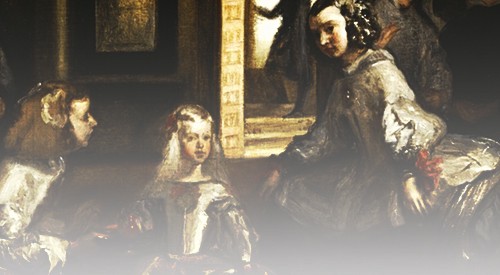
Near the end of his life, travel writer and art historian Michael Jacobs received a mysterious envelope in the mail — inside he found nothing but the pieces of a jigsaw puzzle. Even in pieces, he recognized it to be Velázquez’s Las Meninas. He assembled the familiar figures — “I knew the painting so well that I felt now almost extraneous to its reassembly. As if I was just a spectator watching a group of actors silently taking up their positions at the start of a play: the painter behind his easel, the child princess center stage…” With the puzzle put together, he recognized the signature of the sender. It was from a man he had known when they were boys at school. At that time, the other boy had teased Jacobs about his passion for Velázquez’s masterpiece and suggested he should go get a girlfriend, get out into the sunlight and enjoy life. Jacobs ultimately took plenty of that advice, though he also studied art history at the Courtauld Institute in London. He made his career writing about both art and travel. In declining health, the old friend had gotten back in touch to say he had become obsessed with Las Meninas himself, lived in an apartment near the Prado and visited it most days. He wanted to meet Jacobs again and discuss the painting.
Why this painting? Why did it matter so much to them? Jacobs set out to write Everything is Happening to share his life-long attachment to Las Meninas in anecdotes like puzzle pieces that are intended to bring us into the painting’s mystery ourselves.
He uses the word “mystery” and occasionally “magic” but those words are not quite right. They only make sense if you already see what he’s describing. It’s the paradoxical sense of excitement, pleasure and ignorance found in art the viewer understands well, but not to the point of boredom — at one point he calls the Mona Lisa “a desiccated mummy” for having exhausted all the mystery he ever found in it.
Jacobs acknowledges that real ignorance is no help to mystery either. He is cross about viewing his favorite painting alongside “the school children who were wondering when their ordeal would be over” — however much artists praise the innocent eye of a child, most of them also know that children’s taste is often terrible. They like simple and obvious stuff because they haven’t had enough experience to know better. If a viewer looks at a painting knowing nothing about it, having no education in its culture or tradition — she almost isn’t seeing it as art at all, but just as a thing, an artifact. There’s something more we need to know before we can make an aesthetic judgment, and beyond that, find the unexplainable. That’s the question behind the “mystery” — what do we need to know to hear the distant bell inside the image?
Jacobs spends some of his memoir on the technical details — how Velázquez has constructed the illusion of space inside the painting with a mixture of perspective lines. Some of the people are painted very precisely and others, particularly the man climbing the stairs in the back of the room, are painted with expressive departures from realism and almost slapdash brushwork. Jacobs goes into the most detail with the painting’s greatest formal puzzle: the mirror.
Near the center of Las Meninas, a painted mirror reflects the people who would be standing exactly in the space the viewer occupies. In the mirror, those appear to be the King and Queen of Spain — Phillip IV and Mariana of Austria — the parents of Infanta Margaret Theresa, who is the ostensible subject of the portrait. All the figures in the painting are looking at, or covertly reacting to, these reflected people. We viewers are not only having a moment’s eye contact with people from the distant past, we are playing the role of the parents in an active family drama.
Jacobs died of liver cancer when he had only written half the book, so what we have is sadly filled with absences. He never does meet the friend who sent the puzzle in the mail — they come very close but a small accident of health is enough for them both to apparently give up trying. After a long digression about train tickets and weather, Jacobs writes that Foucault cites Borges’s writing on Las Meninas. What did Borges say? What’s the connection to Foucault? Presumably Jacobs would have filled us in more thoroughly if he had been strong enough to do so.
I found the passage he’s talking about — it’s from an essay called “When Fiction Lives in Fiction” in which Borges gathers examples of infinite regression in art — the tales of Arabian Nights, the play within a play in Hamlet, and Las Meninas. There isn’t an explicit regression in the painting; the observation is about how the painting was hung in the Prado. Across from the painting, the Prado had a real mirror to match the painted mirror, so the viewer could see himself reflected back inside the painting, which has the mirror image of the King and Queen inside it. This is the regression that interested Borges: “Arthur Schopenhauer wrote that dreaming and wakefulness are the pages of a single book, and that to read them in order is to live, and to leave through them at random, to dream. Paintings within paintings and books that branch into other books help us sense this oneness.” — a koan-like description of the mystery that interested Foucault and Jacobs as well.
Jacobs’s work ends on a cliffhanger. His friend Ed Vuillamy takes over: “We will never know what Michael Jacobs found when he returned — as he prepares to do in the last paragraph he ever wrote — to the room in the Royal Palace of Madrid in which Las Meninas had been ‘propped up against a wall for more than seventy-five years.’”
Vuillamy has a stab at describing Jacobs’s quest for the mystery of the painting — but the closer he gets to the center, the shorter his words fall. “The painting which to Michael represented not only an allegory of life, but also its essence.” This kind of description, like mine with the sound of a distant bell, is only helpful if you already feel it. It doesn’t teach us how to find it for the first time. Otherwise, Vuillamy’s introduction and coda ably fill in many of the gaps Jacobs left, and his tributes to his friend are moving. He describes the passages from Foucault’s Order of Things that informed Jacobs’s views the most — how Foucault saw Las Meninas as a shift from the values of the Renaissance — a single point of perspective and a single idealized imitation of nature — to the modern era where the lines of perspective and human nature itself may be mixed up and uncertain.
True to its title, Everything is Happening is rambling and untidy. The book is full of anecdotes — about the painting being dragged across a muddy bridge during the Spanish Civil War, and descriptions of Jacobs’s train trips and big lunches. Jacobs is vociferous in his dislike of art historians who obsess over evidence for claims and fail to look with the eyes of love. At the age of seventy-six, Picasso painted fifty-eight interpretations of Las Meninas from memory. He hadn’t seen the painting in decades. Jacobs notices that in Picasso’s work, the images have a strong bright light coming from the lefthand side, unlike in Velazquez’s original. In the course of his conversations in Everything is Happening, Jacobs discovers that the painting was displayed in a room with bright natural light shining from the right side when Picasso was young, an impression the painter had carried with him through decades of exile. This kind of insight and discovery is where Jacobs succeeds most sublimely.
At the opposite pole from Jacobs’s and Vuillamy’s expansive anecdotal style is Baxandall’s Painting and Experience in 15th Century Italy, which has been in print since 1972 — a small, precise book that never claims more than is richly supported in evidence. Instead of the far-reaching personal journey, Baxandall focuses on the question of what changed in the culture of fifteenth century Italy such that there was an audience for a Renaissance. What did the great early Renaissance paintings look like to the people who first saw them? Every page is full of neatly explained circumstances that show not only how the artists would have had the education in, say, geometry to make lines of perspective, but how they could have been supported and appreciated by their contemporaries when the techniques of perspective and naturalism were so new.
For example — the receipts artists wrote up for patrons detailing commissions show a change as a generation of merchants began to consider themselves Old Money and wanted to differentiate themselves from the newly successful. The patrons slowly stopped asking artists to display wealth and piety by painting with the most expensive colors, gold leaf and ultramarine blue, in the center of the paintings — on Jesus’s halo and his sleeve or on Mary’s mantle. The receipts show that the patrons began to haggle for certain figures to be painted by the top artists, to show the subtlety of the patrons’ taste. The lesser figures and backgrounds would be painted by apprentices. As more people could afford a painting set with jewels and gold leaf, the status indicator was hiring Botticelli to paint the figure of Christ on the altar piece.
Baxandall shows how the religious texts of the time taught the emotions Mary felt at the annunciation. As a metaphor for every Christian’s accepting Christ into his heart, the moment had special spiritual significance. The five emotions she felt are called the Five Laudable Conditions of the Blessed Virgin: 1. Disquiet, 2. Reflection, 3. Inquiry, 4. Submission, and 5. Merit. The painters would be rated according to the subtlety of these expressions. The audiences were adept at interpreting the painted faces and postures. A Mary could be painted mostly 2 and somewhat 4 and 5, which would be as significant to the audience as the details of modern comic book movies are to modern viewers.
Baxandall isn’t explicitly guiding us toward a mystery inside these paintings, but while I was taking long looks at Mary’s face and hands in familiar works, the images were fresh to me the way Jacobs describes, going back to Las Meninas. There’s something new to see. Even though Baxandall mostly describes concrete things; the position of the hands that mime “shame,” “blessing” and “welcome,” the reader can find a new connection to something just outside comprehension: the beauty of the work, the mystery.
Both Jacobs and Baxandall have an undercurrent of real bile against the people who approach paintings the wrong way. Jacobs rages against the sunless rooms of academia where paintings are either taken without context or dissected for Marxist significance of Spain’s colonial wealth — he will quote the findings but is often frustrated with their limitations. The fact that even Baxandall audibly grinds his teeth about people expecting a code in the colors of Italian paintings shows how important it is to both authors that we viewers bring the right knowledge or attitude to the paintings. The stakes are high, and each author believes it’s possible to get it very wrong.
The mystery eludes the direct descriptions of Jacobs, Vuillamy, and even Borges, so it’s possible that the antagonism is necessary and each author is defending a unique aesthetic connection — that we really will see a different beauty in a painting while we’re thinking about it being dragged across a bridge, or while we’re reading disquiet and inquiry in Mary’s face. The lens of each author may introduce us to a different painting, in a way. I think I understand why they each defend their specific ground, but I am glad to have access to both. Both of these books brought me back to paintings so familiar I am rarely able to really see them anymore.
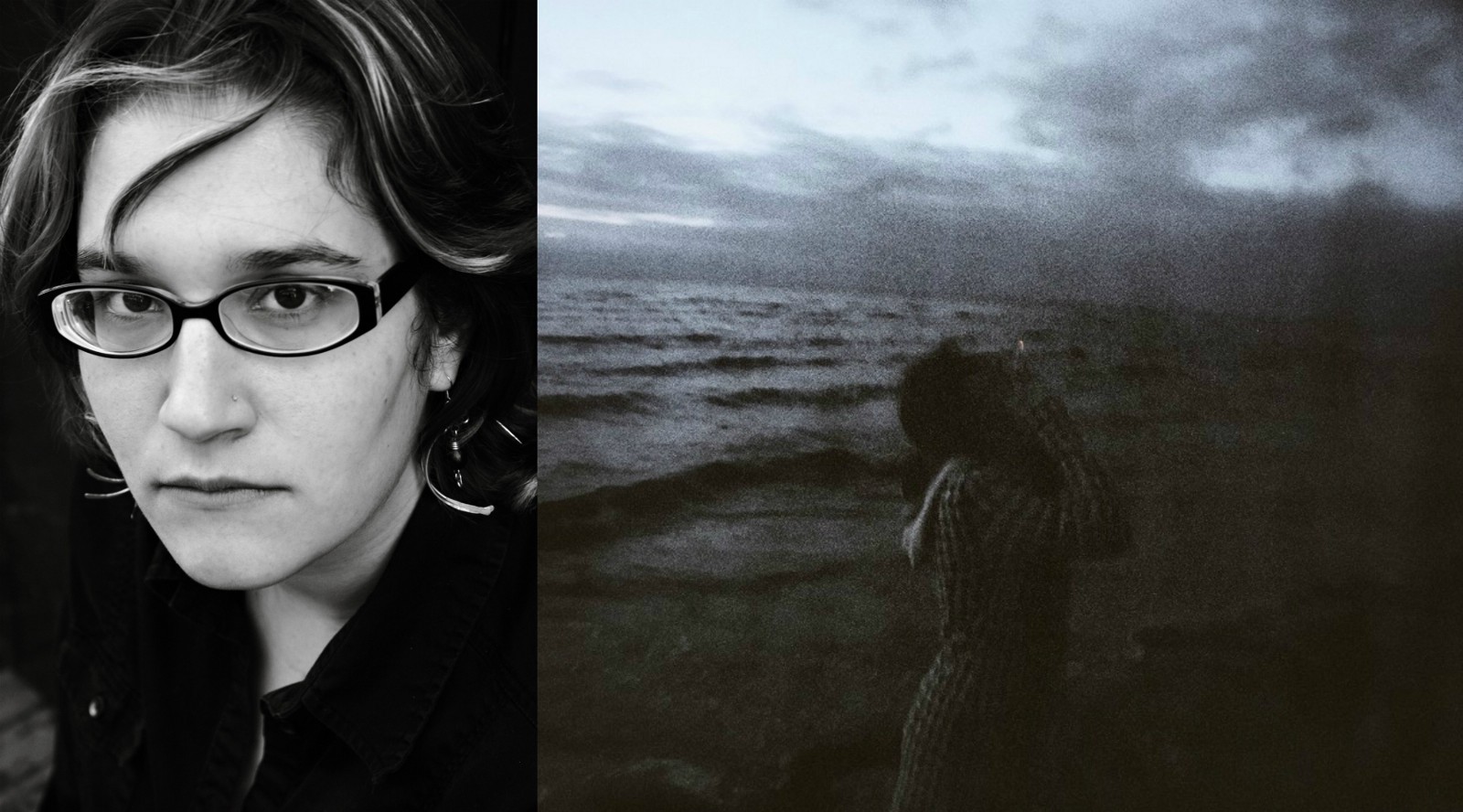
Carmen Maria Machado is the author of the novella Especially Heinous: 272 Views of Law & Order SVU, published in The American Reader. Reimagining the popular television show entering its 17th season, the novella is the perfect introduction to Carmen and her work. Especially Heinous is structured like TV listings and is part ghost story, part urban fantasy. Its true horror, however, does not lie in the beating heart of the city or the dead girls with bells for eyes; it lies instead in the violence and voyeurism that connect this fictionalized fiction to our own, very real world.
A graduate of the Iowa Writers’ Workshop and the Clarion Science Fiction & Fantasy Workshop, Carmen Maria Machado has been nominated for a Nebula Award, a Shirley Jackson Award and was long-listed for a Hugo Award this year. Her work is a powerful antidote to the Sad Puppies, who have tried to uphold strict guidelines for what fantasy and science fiction cannot be and do — namely, include diverse perspectives and experiences. Bleeding the real into the fantastic and experimenting with unconventional form, her stories stand alone to prove them wrong.
In a series of conversations over e-mail and in-person, I spoke with Carmen Maria Machado about the uses of form, fantasy, and sexuality in literature.
Rebekah Bergman: In your short story “Inventory,” you itemize the protagonist’s memories while her present situation remains in the background. In this way, you foreground the more “realistic” elements of the narrative. How does your work as a photographer influence your fiction? How do the “real” and the “unreal” relate and/or intersect in this story and in your work in general?
Carmen Maria Machado: I love it when writers permit the reader to see behind the foreground, or to be able to look around the narrator. This is especially true with stories with unreliable narrators; Lolita is a great example. A careful reader can see around Humbert Humbert and recognize the horror of what is happening to Dolores. But the horror of what is happening to her is heightened by his arch, academic register and his tendency toward bloviating and euphemism. (I think this is where some types of horror writing fail for me: the writer isn’t interested in these kinds of contrasts, or using realistic elements to heighten the horror.) So when it comes to non-realism, I like to use the real to access the unreal — the foreground as a frame for the background — and the unreal to access the real — the background as a frame for the foreground.
I don’t doubt that this interest stems from my background as a photographer. I’ve always been surprised and intrigued by how much the visual medium can get away with in the background. Children of Men–one of my favorite films in the whole world–has so much gorgeous worldbuilding going on behind the main action. The whole movie is about what details are being foregrounded and backgrounded in turn, like a photographer is adjusting her focus or depth of field…This visual effect can happen unintentionally, too. The crudest examples I can think of are those memes online where the intended effect is to give one immediate impression and then a second shock or surprise. For example, there’s one that’s a selfie of a sexy woman, but after you stare at it for a moment, you realize there’s poop in the toilet behind her. Or the creepy version, where there’s a photo of a bunch of women in a hot tub, and after you examine the image more closely, you see glinting eyes in the darkness of the window behind their smiling faces. Whether the effect is “Ha ha!” or “Oh, shit,” the background informs the foreground, and the interplay between them is either comical or terrifying (or both).
One nightmare in the midst of a thousand nightmares feels less important, somehow; a nightmare on a day when everything was otherwise fine…stands out.
So with “Inventory,” yes, it’s possible for a person to be living her life parallel to a deadly outbreak until it’s right up at her door — hell, this happens every day. As a recent example: weren’t you just living your life while Ebola killed thousands of people? And doesn’t everyone love to talk about where they were when 9/11 happened? I think people do this this because they (subconsciously, mostly) understand that the mundane details of their life contrast spectacularly with the horror of that event. One nightmare in the midst of a thousand nightmares feels less important, somehow; a nightmare on a day when everything was otherwise “fine” or “normal” (from the speaker’s frame of reference, anyway) stands out.
RB: Behind that list in “Inventory,” a woman is fleeing a deadly outbreak. There have been several recent books that follow the last women of the apocalypse. I recently read Laura van den Berg’s novel Find Me, for example. Then there’s Emily St. John Mandel’s Station Eleven. “Inventory” fits this too. What do you think is drawing readers and writers to the post-apocalyptic woman?
CMM: For me, part of it probably has to do with the fact that I really love science fiction and horror movies. But when I go to the movies, I don’t expect to see a female character central to the story or even represented in a non-tangential way. It’s just so rare. When it does happen, it’s a shock. Recently I saw The Babadook and It Follows. They were so refreshing because they were about women and women’s experiences and that’s such a rarity. In science fiction films too, there’s only a handful with women at their center…So it’s a real pleasure and treat when it happens. In fiction, the last man on earth idea has been done a million times. Possibly with a female author at the helm, they think, “Well I’m going to tell this story the way I want to tell it.”
I initially started “Inventory” because I wanted to write an essay about my own lovers, but I didn’t feel ready to do that yet. I started writing down fictional and nonfictional experiences. Then I realized I could tell a story this way, and it occurred to me that something else could be happening in the background. Maybe something really huge is happening that we’re only seeing through these little lenses. And you know, she’s not really the last woman on earth but it feels that way by the end. She’s just alone and at the edge of everything.
RB: A lot of these post-apocalyptic woman’s narratives also feature lists and list-making. In Find Me, the protagonist is constantly coming up with lists. They’re not formatted with bullets, but she’ll say something like, “Here’s everything I know about Tennessee.” This isn’t a new trend either. There’s David Markson’s Wittgenstein’s Mistress, which is basically a catalogue of culture written by a woman who might be the last person on the planet. Your story “Inventory” is an actual inventory. Why do you think the list is used in these end-of-the-world scenarios?
CMM: Lists give order to things. It makes sense that somebody who experiences great trauma would try to put order to that trauma. Lists are a way of trying to regain control, organizing these fragments to make sense in some way to you. The irony is that it’s an illusion of control. If you’re really the last person left on earth, you’re fucked. The world is over. You’re alone. But there’s a fragment of your psyche that can be put into these lists.
I find list-making very pleasurable myself. I handwrite my lists even though I do most things on the computer. I don’t even handwrite my stories, but I handwrite lists. It just helps. And that’s true of my own ordinary life, which is not apocalyptic in any way. But if it was apocalyptic, I imagine that’s exactly what I would be doing — creating an artifact, creating a memory. Maybe if the world is ending, I’d think, “Well, if I’m the last person to know anything about Pennsylvania. I might as well write it down because who else is going to remember it?”
RB: There are a lot of writers who are working in and with the blurred space between realism and fantasy or science fiction right now. You’ve cited Kelly Link and Karen Russell as two influences, and I see something similar happening in your fiction as in theirs. It seems — to me, anyway — different from what is happening with many of the male writers working in this space. I wondered if you could speak to that. Do you see a similar motive or method in your work and the work of Link, Russell, and other women? Where does that come from?
CMM: I have a theory about why many women might turn to this kind of fantasy. It’s just a theory. But we live in a society where women’s experiences are devalued. I think, because of that devaluing, it’s possible that female writers seek ways to represent their experiences that are more subtle or less easy to pin reality on. So if a woman writes a mimetic story about sexism that she’s experienced, people might be like, “Okay, this is a woman writing about sexism.” But if she approaches it in an unreal way or in a metaphorical way, it’s going to fly under the radar a little more.
…it’s about that process of rediscovering your own interiority after trauma. That was the way I did it, the only way I knew how to do it.
In a lot of my fiction I’m talking about sexual violence, sexuality, women’s experiences and my experiences as a woman. The first story — the story that I consider the one that started the way I write now — is called “Difficult at Parties.” It’s about a woman who is recovering from a rape and she discovers she can hear the thoughts of actors in porn movies. I was trying to approach a story about survival after sexual violence and how that process can look. But I felt like I didn’t know how to address it in any way that wouldn’t feel cheesy or saccharine or obvious except in this way where it becomes about interiority versus exteriority. After her assault, she can’t hear her own interiority, but she can hear the interiority of the people she’s watching. At the end of the story she films herself having sex with her boyfriend and then watches the tape of herself. So it’s about that process of rediscovering your own interiority after trauma. That was the way I did it, the only way I knew how to do it.
RB: So approaching a story with or through the fantastic can be a way to address a real experience without it becoming “just a women thing.”
CMM: Right. I suppose there is a whole range of people and experiences that would be true for. Certainly people of color may have a similar approach or queer folks. It sucks that we live in this world where an artist whose identity resides outside of traditional structures of power often have their work reduced to “just a [insert identity here] thing,” but it’s the reality.
RB: It might not even necessarily be a woman’s experience or a queer experience though. I’m thinking of Aimee Bender’s story “The Rememberer,” where it’s just an emotional experience — a fairly common one — that becomes embedded in a complex and surreal metaphor. She puts that emotion in a different place so that it resonates in a new way.
CMM: I think that’s also true of experimentally formed fiction. Experiments with form can cut sentimentality in half. Matt Bell has a story called “An Index of How Our Family Was Killed” that I teach to my students. You can read it online. It’s excellent. It’s a story about a man whose mother, father, and brother were all killed in separate instances. It’s realism, but it’s written in sentences that are alphabetized like an index. You can imagine that if it were traditionally formatted, it would be just a guy who’s experienced all this loss and is falling apart and could become tiring very quickly. But by putting it in that form, it’s a fresh way of approaching the material. Suddenly this story becomes immediate and tragic but not sappy and not overly sentimental. So you’re right, I think. Re-approaching the material gives it a new shape. It’s a way of going at it differently, and it can do some work in terms of how the material comes across.
RB: Going back to the idea of women using the fantastic or the unreal to tell a story about sex and sexuality. I’m thinking of the more conventional ways to approach that material now and Phillip Roth comes to mind. He’s often dealing with sex so overtly on the level of realism. There’s a wide range of where and how sexuality can exist in a story — perhaps depending on who wrote it. Are there male writers who are approaching these themes in that same subtle way you described? Are there women writers who approach them more overtly?
CMM: I’ve been wondering about that. When I first read Roth, I asked all my friends who liked him if they knew of any female authors who wrote about sex the way Roth did. They had no answer. Sabbath’s Theater — of all the books of his that I’ve read, that was the only one I liked — has a really interesting, very sexual female character in it. But, she’s dead, so there’s that. That book is so raw and sexual the whole way through, and as I read it I wondered, “Where are the women writing books like this?” I mean, where are the women writing and publishing novels and stories that are full of explicit sex that aren’t being marketed as erotica or woman’s fiction or romance — not that there’s anything wrong with those genres, they’re just not what I’m looking for — where women and their bodies and stories are centered and, you know, alive? I want to read about that. I also want to write about that.
There’s no doubt that we’re culturally more comfortable with men writing explicitly about sex than women…
Nicholson Baker, who I adore, also has books that are all about sex. His novels fall into these loose categories, and some of these are his “sex books,” like Vox and House of Holes. And they’re really awesome — funny and tender and sexy and weird and beautiful and great. I just want to know where are the women who are writing about sex in that way? Or writing about it in ways that are uncomfortable or disturbing? I know they exist, I just don’t run into them as often as I’d like. There’s no doubt that we’re culturally more comfortable with men writing explicitly about sex than women, and I think that this selectively sexist prudishness has probably resulted in a lot of unwritten or unsold or unpublished or mislabeled female-authored literary fiction about sex and that makes me so sad and angry.
RB: Does anyone have an answer?
CMM: Not yet. I’m sure I’m missing some of them — I mean, I know I am — because they don’t get nearly the same amount of publicity and cultural clout and literary cred, and I think often they get filed away as “romance” or “erotica” or other genres. But I’m always on the lookout for contemporary female literary authors with whole novels that are dedicated to discussions of sex like Roth or Baker. . .
The only author I can think of off the top of my head who I’ve read recently is Alissa Nutting. She’s so good, I love her work. She’s only published two books so far, so I don’t know if explicit sex is going to continue to be part of her body of work…But her novel Tampa is a good example. It’s very sexually explicit, and because it’s about a female ephebophiliac, very discomforting. When it came out, I heard Tampa described as the female version of Lolita, but it isn’t exactly Lolita because in Lolita, everything is so understated. Tampa is more explicit in every way. Sexually explicit, and also the protagonist is just so much more nakedly evil, though still complex. But she doesn’t try to justify what she’s doing with florid language. It’s a novel about power — really interesting. Upsetting, but interesting.
RB: So we can name one book by a woman that has explicit sexuality without making the woman the object of desire or being considered erotica…I can’t think of any others.
CMM: I’m always looking for them. When you find any, let me know.
A new survey from Pew Research Center found that Americans are reading less than before, with a seven percent drop since 2011. Pew polled a total of 1,907 Americans, finding that although there is a slight dip from the previous year, most Americans still read. The survey found that 72 percent of Americans have read a book in the last year, with over half of them reading four or more books. The average number of books read in the past year was 14.
When it comes to print books, numbers have dropped as much as six percent in the last year. An impulse to blame this on digital readership might be correct, as there has been a ten percent increase in readers of digital books since 2011. However, there is little to no difference between the amount of Americans who claimed to have read a digital book in 2014 and 2015.
Another interesting detail is that people between 18 and 29 are more likely to read than their elders, with as much as 80 percent claiming to have read a book in the last year. Women are also more avid readers than men, according to the survey, which also found that high education and a high average household income are factors that make Americans read more. One might deduce that our literary future lays in the hands of young, well-educated women with high incomes.
In order to cure someone who has “fallen away” (i.e. forsaken their Christian faith), John George Hohman suggested catching rain in a pot before sunrise. He wrote, “Boil an egg in this; bore three small holes in this egg with a needle, and carry it to an ant-hill made by big ants… the person will feel relieved as soon as the egg is devoured.”
Hohman was a printer and a bookseller. In 1802, he emigrated from Germany and settled in the Pennsylvania Dutch community of Reading — the same town where John Updike was born a hundred thirty years later. Hohman is best known as the author of Pow-Wows, or Long Lost Friend, published in German in 1820, and translated into English in 1846. Long Lost Friend is a rambling jumble of hexes and household advice. It’s part grimoire, part recipe book and includes everything from spells “to protect cattle against witchcraft,” to recipes for beer and molasses (“Take pumpkins, boil them, press the juice out of them, and boil the juice to a proper consistence. There is nothing else necessary.”) Since its publication almost two hundred years ago, Long Lost Friend has never gone out of print.
Hohman was a hustler, and he had to be. He and his wife and son arrived in the United States with literally less than nothing; to pay for their passage from Hamburg to Philadelphia, they began their new lives as indentured servants. Hohman made money by publishing on the side — occult, religious, and medical books for the ethnic German population. Over time, his business grew. He put out storybooks, New Testament apocrypha, and a collection of hymns.
In 1820, Hohman published Long Lost Friend. In the opening to the book, Hohman wrote that this collection was “partly derived from a work published by a Gypsy, and partly from secret writings, collected with much pain and trouble.” In Grimoires: A History of Magic Books, historian Owen Davies says that large parts of Long Lost Friend are directly cribbed from Romanus-Büchlein, a German spell-book published in 1788. Items within the book can be traced back to dozens of disparate sources.
This helps explain the haphazard construction of Long Lost Friend — how on the same single page, the reader can find advice for catching fish, a remedy for ulcers, directions for healing inflammation, and a spell “to prevent wicked or malicious persons from doing you an injury.”
Hohman said that he opposed the publication of this collection. His wife opposed it, too. He wrote, “But my compassion for my suffering fellow-men was too strong, for I had seen many a one lose his entire sight by a wheal, and his life or limb by mortification… is it not to my everlasting praise that I have had such books printed? Do I not deserve the rewards of God for it?”
Hohman was bold in pitching his work. Among other sales strategies, Long Lost Friend begins with a list of take-Hohman’s-word-for-it testimonials (“ANDLIN GOTTWALD, formerly residing in Reading, had a severe pain in his one arm. In about 24 hours I cured his arm,” etc.).
But the most significant and resounding sales ploy used by Hohman appeared on the final page of the book, where in a short passage floating above three crosses, it reads: “Whoever carries this book with him is safe from all his enemies, visible or invisible; and whoever has this book with him cannot die without the holy corpse of Jesus Christ, nor drown in any water, nor burn up in any fire, nor can any unjust sentence be passed upon him. So help me.” As Davies points out, “People purchased the Long Lost Friend not only for its contents, but also for its inherent protective power.”
Davies writes about how this strategy demonstrably worked. In a 1928 interview, Charles D. Lewis explained that he had carried the book with him for sixteen years — working as a fireman on steamships — and had evaded physical injury. Lewis said he lost his book when the British seized his liner, and soon after, suffered a life-threatening accident. Frantic, Lewis secured a new copy of Long Lost Friend as soon as he possibly could.
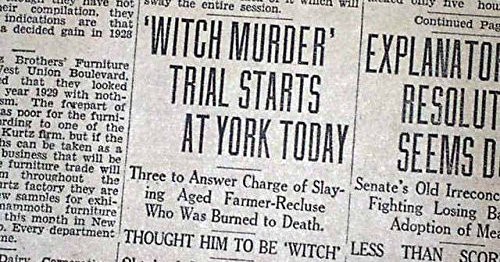
The best example of the haunting impact of Hohman’s final page is demonstrated in the 1928 murder at Hex Hollow. Central Pennsylvania ruffian John Blymire was a man with terrible health and fortune. Blymire suffered from malnutrition, and his first two children died within days of their birth. When he was thirty years old, he lost his job, his wife left him, and he was committed to a state mental hospital; forty-eight days later, he escaped by walking out the door.
On the lam and under the consultation of a witch named Nellie Noll (a.k.a. “The River Witch of Marietta”), Blymire came to believe that local pow-wow doctor Nelson Rehmeyer had hexed him. Blymire convinced a 14-year-old and an 18-year-old that Rehmeyer had hexed them, too; the three of them broke into Rehmeyer’s house at night with the explicit purpose of finding and destroying his copy of Long Lost Friend.
Instead they found Rehmeyer in his PJs. They beat and tied the pow-wow doctor up, and demanded he relinquish his copy of Hohman’s book. Rehmeyer played dumb; the 14-year-old picked up a block of wood, knocked Rehmeyer over the head and killed him. Blymire took a lock of Rehmeyer’s hair to bury under ground (The River Witch had told him to), and then the three of them unsuccessfully tried to burn down Rehmeyer’s house. A few days later they were arrested for murder. Blymire proudly confessed, bragging he had killed the witch who had hexed him.
For its sinister history, Pow-Wows, or Long Lost Friend is actually a pretty benign book. Its hexes are mostly designed to prevent or eliminate danger, rather than to create it. Hohman’s spell to stop bleeding demonstrates the oftentimes toothless nature of his trade: “Count backwards from fifty inclusive till you come down to three. As soon as you arrive at three, you will be done bleeding.” That’s time passing; that’s often how people stop bleeding. To make a buck, Hohman takes credit for it.
While Hohman was able to buy his way out of servitude and make a living for his family, he never achieved any great wealth. He died in 1856, before his book had achieved much beyond local distribution. But Davies writes that by the early twentieth century, numerous further editions of the Long Lost Friend “had ensured that it was firmly cemented in the medical tradition of ethnic Germans.”
Whether it was for pious or self-serving reasons, Hohman invested his soul into what he sold. He wrote that he knew the majority of sensible people believed in him. But he was a reasonable man, and he recognized that there were doubters. “This latter class I cannot help but pity,” Hohman wrote, “ and I earnestly pray everyone who might find it in his power, to bring them from their ways of error.”
You decide which camp you fall into. The full text of Long Lost Friend can be found online here, but Hohman would probably recommend getting a physical copy — for your own well-being.
DON’T MISS OUT
Sign up for our newsletter to get submission announcements and stay on top of our best work.
YOUR INBOX IS LIT
Enjoy strange, diverting work from The Commuter on Mondays, absorbing fiction from Recommended Reading on Wednesdays, and a roundup of our best work of the week on Fridays. Personalize your subscription preferences here.