Lulu

by Adrienne Celt, recommended by Tara Ison

Excerpted from The Daughters
Taking me to the opera was my mother’s last attempt to make me her own. Like everything she does, she went about it in a strange way: not many parents would choose to bring their daughters to witness a tragedy to which they are namesake. But whatever her insufficiencies, my mother understood my sense of pride. She knew that seeing the name Lulu on the tickets would thrill me more than the character’s death would undo me.

The show was a matinee on one of those magical Chicago days that are clear and bright, so the cold doesn’t seem so punishing. Walking outside reddened our noses, and my mother pinched mine with her gloved fingers — I could feel the faint pressure from her long manicured nails beneath the leather.

“Let’s pretend we’re orphans,” she said to me. “Only not really orphans. Children abandoned at birth who discover that they’re really royalty.”

“And magic?”

“Yes.” She smiled. “And magic. This will be our first time out in the world in our new clothes, and no one will recognize us. They’ll all be impressed with how pretty and fancy we are, and even people” — her face darkened — “who’ve been terrible to us and shunned us because of our orphanhood will love us and sing our praises. And we’ll be kind to them.” The darkness lifted from her like a cloud in the wind.

We took the O’Hare line to the Loop, then transferred to get to Washington and Wells — it was a long ride, but to us each train was a royal carriage. My mother and I pointed out all the special touches that had been left inside for us: the clean blue pair of seats in a beam of sun, the advertisements for a local jeweler showing pictures of a diamond-studded necklace and bracelet. We might consider getting our tiaras refitted there, we said. If the store had sufficient dignity upon inspection. The other passengers received our scrutinizing attention as well: there was the café owner who’d refused to sell us hot chocolate because the gold coin we’d found to pay with was dirty. Beside her, the spoiled twin girls we always saw in the park whose dresses and hair ribbons threw us into fits of jealousy, which we quelled thanks to our superior breeding.

A blind man with a cane and a threadbare hat sat in the handicapped seats a few feet away from us, and he rocked with the rhythm of the train, singing softly to himself.

“That,” my mother whispered to me, taking off her gloves, “is the royal madrigal. He recognized us for what we were long before anyone else, but he couldn’t tell us for fear of retribution from the evil queen. She wanted to keep us poor and wretched. But she couldn’t fool the madrigal: he sensed our greatness through the sound of our voices. He can tell a prince from a hog farmer by hearing them speak a single word.”

We were quiet, listening to the madrigal sing. He changed tunes after a minute or so, and my mother tilted her head to the side so her long hair fell away from the ear that faced him.

“Well, of course he’d want to honor us with a song.” She raised her eyebrows at me gravely. “Shouldn’t we honor him back?” My mother could be as great as I wanted her to be, sometimes. When she wanted it too.

I nodded, and she put a finger to her lips. Hush. She walked over to where the man sat and placed herself beside him while I watched. Silently. Hushed. At first I couldn’t distinguish the sounds she was making from the man’s singing, so low were the notes and so well intertwined with the music that was already in the air. But as the man raised his voice my mother made hers more audible, and they began to play together: his legato with her crisp stutters, his baritone with her alto-soprano.

The song was sad, but somehow between them it sounded triumphant. Like they’d found one another after a long search. Ended a long loneliness. She bobbed her head as they tossed lines back and forth, trading phrases from “Body and Soul.” I leaned my chin against the cold metal headrest on the back of my seat and watched. The grinding of the train against the tracks rumbled against my jaw as my mother and the man spun the air into an earthy, rasping exultation. They were harmonizing now, and my mother put her clean, beautiful hand on the man’s, which was thick with calluses. I loved her then.

Together, they sang about the spirit and the flesh. Together, until they ran out of words.

As the train pulled up to Washington and Wells, they hummed a few last bars together until the conductor made a scratchy announcement, breaking the spell. I held my mother’s hand and we hopped off onto the wooden platform. The blind man stayed where he was and smiled.

I almost broke into a run towards the front entrance of the Civic Opera House, home of the Chicago Lyric Opera, but my mother snagged the back collar of my dress and pulled me around the building. We approached a side entrance where a man stood smoking in a tuxedo and tails. My mother nudged me.

“The gatekeeper,” she whispered. I had the tickets.

“Hello,” I said to the man. He peered at me through a cloud of smoke that he puffed in and out of his mouth without removing the cigarette. Then he turned to my mother.

“You Jimmy’s friend?”

She nodded and I silently offered up the tickets in my palm. They were delicate slips of paper with careful calligraphy, unlike any theater stubs I’d seen before. The smoking man picked them up and inspected them, smirking.

“This all seems to be in order,” he said. With the gesture of a ringmaster, he extended his arm towards the door, then opened it just slightly so we would have to slip inside. I looked hesitantly at the tickets.

“Are you just going to keep them?” I asked.

I wanted to pin them to the wall beside my bed and teach myself how to write my name in similar sweeps and flourishes. I’d expected an usher to glance at them and hand them back, maybe adding a minuscule tear. But the man in the tuxedo had other plans.

“How right you are,” he said, and removed a lighter from the inside pocket of his jacket. The paper was extremely thin; they were gone almost as soon as the flint in the lighter struck metal.

“Come on, Lulu.” My mother pulled me through the slender entrance by my elbow.

“Oh, Lulu.” The man stayed outside and laughed. “This is the famous little Lulu. Well, it is an honor.” If he said anything else it was lost to me behind the steely slam of the door.

Inside we wound down a series of dark hallways before emerging in the empty lobby. We wove through the columns, clattering against the marble floor, and my mother explained to me that it’s the gatekeeper’s job to make your passage more difficult, so I shouldn’t be offended.

“Nothing worth doing should be easy.” She scanned the room for a sign that would point us to our seats, though I realized that without the tickets I had no idea what to even look for. “And nowhere worth going should be easy to get to.”

“Why is everything weird?” I asked. “Where is everybody? Baba took me to the opera before.”

My mother saw someone lean out of a doorway and wave to us a level above our heads. She put her hand on my shoulder.

“Not like this,” she said.

We walked out onto the first balcony, and the same woman motioned us towards the front. She was wearing a black gown, waves of loose fabric hanging off her arms like wisps of smoke. When she saw me, she put her hands over her mouth and giggled.

“Oh.” She stifled the laughter but still seemed electric and intense. “She is a young one. You’re sure about this?”

I mustered all my royal pride and raised an eyebrow at her.

“Who are you?”

She drew herself up. Her eye makeup was also black, and with a shadow across her face it looked almost as if she had no eyes at all.

“I’m Lulu,” she said.

I sucked in a little surprised air, but kept myself together and held out my hand.

“Me too.”

After making introductions, the adult Lulu led us to our seats: dead center, front row, so we could lean against the railing and see the entire stage below us. When I looked down I noticed that the ground floor was completely empty — after glancing around, it was clear that only a few other chairs in the audience were occupied, and no one was sitting near anyone else. Before I could ask Lulu about this, however, she disappeared out the door.

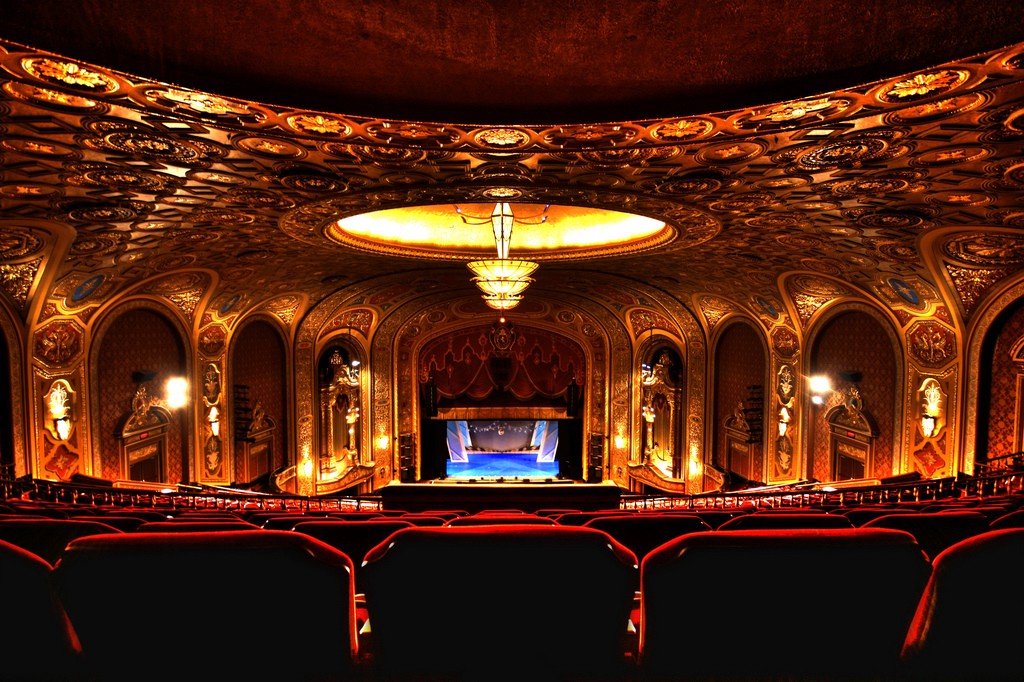
Sitting in the Civic theater is like sitting in a mouth full of gold teeth, red velvet tongues periodically unfurling into aisles. Though the theater was not bright, an occasional patch of warm light glimmered off the embellishments on the walls and hung around me like hot breath. I felt the theater’s mouth yawning out from the stage and leaned into it. I wanted to throw myself down the room’s golden throat.

Beside me my mother peeled off all her outer layers and laid them on the unoccupied velveteen chair next to her, tucking her gloves into the pockets of her coat. She smoothed out her dress: red, square at the neck so her collarbones emerged gracefully and created chasms whenever she swiveled her head. I had no idea what our “tickets” must have cost, the favors my mother would have had to call in to procure them — Jimmy’s friend, the man at the door called her. The house wasn’t full, but the audience, apparently, was selective. She scratched the back of my hand lightly, and I let her weave her fingers through mine. But I didn’t look up at her. The bells sounded and the remaining lights went down. Even in pitch-blackness my eyes didn’t leave the stage. My mother was magical, but this was more.

At the time, Lulu hadn’t been performed anywhere in the world in its entirety. Shows were gearing up in Paris and — oddly enough — New Mexico, rumors being murmured into the ears of the highest society. It was shocking, people said. Adultery and misused sexual power and love wielded like a whip. A woman so desirable she can only destroy herself. And the music is also a challenge: it plunges through discordancy into positive aggression; the orchestration calls for a vibraphone and requires an onstage jazz band in addition to a pit orchestra. The sound expresses a complex network of psychological wounds and perversions.

As most of the world chugged on blissfully unaware and most opera lovers waited in painful anticipation for the Paris premiere, a small subclass of aficionados surfaced and groped their way towards one another. These were people who couldn’t be satisfied by seeing the new opera — with its mysterious backstory and dead composer, in addition to its salacious libretto — performed on television in a foreign country. They wanted Lulu immediately, and they wanted to inhabit her.

Anything can be had for a price: at least, if the right person is willing to pay. Even a piece of music that is being held hostage for reasons of propriety, bereavement, and force of law. So musicians were assembled from Chicago’s jazz underground, singers invited through a series of secret handshakes and lucky misunderstandings. Costumes were borrowed from the mothballs of old shows — a dress here, a coat there. And though no one asked how she accomplished it, the soprano showed up at the very first rehearsal with copies of the complete score and libretto for every participant. They were to be kept secret on pain of death or humiliation.

Here is the thing you must understand: to know an opera you must be part of it. You must emerge into its world and lose yourself there with no hope of ever escaping completely. No matter where you go, the pitches and tones will follow you. The arias will pop up at inconvenient moments, and you’ll see the characters ducking into alleys years after you last met them onstage. Letting some other company have the world premiere of Lulu would’ve been, to the performers I saw in the darkened, near-empty Civic Opera House, like watching strangers parade around in their stolen skins. They didn’t care about having an audience; they cared about the thing itself.

My mother was not invited to be a part of the secret show. But she knew enough people to finagle two of the precious seats in the theater when almost no one was allowed in. She brought me there to show me what it meant to have real passion. What she didn’t anticipate was that perhaps I already knew.

In the first intermission the entire small audience crowded together in the hallway and passed around bottles of champagne: I was allowed two tastes myself and laughed to feel how strangely the bubbles sipped at my throat. Lulu’s second husband, The Painter, had committed suicide, and she had convinced Dr. Schön to throw off his fiancée and marry her instead. She looked dark and foreboding onstage, but throughout the first act had worn a red cloth heart pinned to the front of her dress, which was occasionally singled out in a lone slender spotlight.

My mother put her hands on my shoulders, leaned down, and gave me a quick kiss on each cheek. She was lightheaded from the champagne, like me. I could tell: she bobbed from foot to foot as though she was standing behind a microphone, and her expression was moony.

“What do you think?” she asked me.

I regarded her seriously.

“It feels real.”

“Yes.” My mother gave me a strange look. “It does.”

By the second intermission the champagne was all gone, but my mother procured a bottle of whiskey, which she shared out in nips amid the nervous laughter of the small crowd. Lulu had become heady with lovers in this act: lovers hiding in closets and spilling out from behind divans. Lovers accusing their own sons of treachery and emerging from under tables like ghosts rising from ill-dug graves. Dr. Schön, played by the tuxedoed gatekeeper who’d burned our tickets by the door, encouraged Lulu to shoot herself to atone for her perfidy, but she shot him instead. When Lulu was sentenced to life imprisonment, the jurors tore her red heart in half and left her with only the wound. She fell ill.

I had a new admiration for the gatekeeper after hearing him sing. In the hallway I tugged my mother’s arm to ask her who he really was, but she was busy laughing with a man whose face was completely hidden behind his beard. Without looking down, she offered me the bottle of whiskey, and I was so confused that I backed away and waited by the wall for the bells to direct us back to our seats.

At the end of the second act, Lulu escaped from prison by letting her lover, a beautiful countess, rot there in her place. She left for Paris with Dr. Schön’s son, Alwa, a strange and desperate look painting her face.

The third act was the real premiere: the composer had died before finishing it, leaving behind the sordid tale and a series of complex notes and ideas. His widow forbade anyone to complete the opera, then changed her mind, changed it back, and finally capitulated to a full production through the simple expedient of her death.

Sitting in the darkness waiting for the music to recommence, my mother mumbled that she was cold and started fumbling with her coat and scarf. One of the gloves fell out of her pocket and she swore, feeling past my feet for it and finally giving up.

“Shit,” she said. “Shit shit shit.” I bit back the urge to shush her.

The act opened with a scene of opulent destruction: the police continued to pursue Lulu as she and Alwa made toasts at a party. The smile on Lulu’s face was false and men tugged her from side to side, whispering items of blackmail into her ears until finally they pulled off the sleeves of her dress, leaving her shivering in the middle of the room. Everyone’s wealth was consumed by a stock market crash, and Lulu managed to escape only at the last moment by tricking the police into arresting a waiter instead.

My heart was beating so loudly in my ears that it nearly obscured the voices of the singers. With one exception: Lulu’s could always reach me. The notes she sang carved the room like a guillotine blade. I reached out and tried to hold my mother’s hand, but she’d thrust it into her pocket and refused to budge. She sniffed slightly, watching the jazz band onstage. The bassist was a man she sometimes worked with. She seemed to be sizing him up, her lip curled back with derision.

Finally, reduced to prostitution, Lulu took in a string of clients who eerily resembled each of her dead husbands. The loyal Countess Geschwitz reemerged with a portrait of the fallen beauty at the height of her glory, and Lulu and Alwa stared into it, hypnotized. There was a full round heart apparent on her painted breast.

But the spell didn’t hold. More clients tumbled forward: Lulu’s first husband, Dr. Goll, then The Painter, The Acrobat. Everyone she had abandoned or to whom she had done harm. She killed Alwa with a blow to the back of the head and then sat down in the dark, her hand to her chest. Again there came a single beam illuminating the broken red heart, with Lulu’s fingers trembling above it.

The doorbell rang. At first I was confused, thinking it was Dr. Schön, but my mother leaned down to me and whispered savagely: “Jack the Ripper.” Lulu didn’t seem to know the difference either, though, for she ran into his arms. The two left the stage together hand in hand, and her scream resounded from the darkness into the empty theater. Jack the Ripper returned, carefully wiping his fingers clean with a handkerchief, and casually stabbed the beautiful Countess as well. Then the red curtains fell, half of a giant black heart pinned to either side.

When the lights came up, I blinked in the sudden brilliance of the room. I’d focused so long and acutely on the stage that having a whole broad world to look at made me somewhat dizzy. I took a deep breath to clear my head and then sneezed. Turning, I saw my mother smoking a cigarette in her seat.

“I don’t think you can do that in here.” I rubbed my nose and looked at her accusingly, hoping nonetheless that her smoking would give me time to get my bearings.

“Oh, please,” she said. “You still don’t understand about being clandestine? It means you can do anything you want. Just like being a princess. So come off it.” She stubbed the cigarette out on the polished arm of her chair, leaving a black circle of singe and the poison odor of burning varnish.

“Come on.” My mother tugged on my hand, and I hurried to thrust my arms into the sleeves of my coat. Having outfitted herself for the chill winter air over an hour before, she didn’t seem to notice that I’d barely had time to stand up. I took a last look around the theater, which still seemed to throb with the opera’s final notes.

“Can we go see the orchestra?” I asked as I fumbled with my coat buttons. “Or say good-bye to the singers? I really want to see the singers.”

She rubbed her forehead, pinching the skin between her thumb and middle finger. Her wooziness had taken on new dimension during the show’s finale, and I could see her debating the wisdom of sitting back down and closing her eyes for a moment while I ran around and had my fun. Today was the first day I’d been able to identify her tang of maple syrup and wood smoke as whiskey: the bottle she’d waved towards me in the second intermission had solved the long mystery of my mother’s most peculiar perfume.

Lulu — her real name, I learned later, was Rosalind DeLaney — sashayed onto the balcony and, spotting me, threw her arms open wide. They were bare now that the sleeves had been torn off them, but five or six new cloth hearts had been pinned haphazardly all over her remaining strips of dress. I ran over and tucked myself into the crook of her neck and shoulder, smelling the tacky sweet makeup caked on her face, cut with the salt of her sweat.

“My understudy!” She picked me up and twirled me around in the air and I laughed, making the sound purposefully melodic so she would hug me tighter. Then she set me down. “You have some pipe organs in those lungs, I hear?”

I nodded and beamed.

“Well, you take care of them.” She put a hand over her mouth to stifle a giggle. “And someday you’ll be here too, singing secret shows for no money.”

“Do you think so?”

I had no reason to trust her encouragement and, having never heard me sing, she had no reason to give it. But still the moment glowed between us: she, shimmering with the light of her success, and me, burning brightly from the heart out.

“Lulu.”

We both looked up at the sharp sound, but it was clear that my mother was talking only to me. She had another cigarette between her fingers — this time, thankfully, unlit.

“Let’s go,” she said. “I have to get out of here.”

I gave Rosalind one more squeeze around the neck and then ran after my mother, who’d disappeared into the hallway. If Rosalind was confused about my mother’s behavior — ignoring her, absconding before the party I now know must have followed — she didn’t show it. There were other guests to greet and preen to.

We pushed out the back door into the alley and my mother immediately began flicking her lighter at the cigarette. She was talking to herself quietly — should’ve known, pretentious assholes — and couldn’t get a flame, so she threw the lighter against the side of the building opposite.

“Whoa, sunshine.” The gatekeeper pushed himself up from the wall against which he’d been leaning, puffing smoke into the sky. “Let me get that for you.”

I frowned at him, though I also had the urge to reach out and touch him as he casually ignited my mother’s cigarette and gave an ironic bow. The front of his tuxedo bore a bright red flower that had been used to simulate Dr. Schön’s gunshot wound.

“You shouldn’t smoke,” I scolded, thinking of his voice.

My mother rolled her eyes and tugged my arm again, waving vaguely at the man.

“What do you care?” She moved quickly towards the subway platform. The sun had disappeared behind a new head of clouds while we were hidden in the theater, and the cold felt less pure now, more invasive and wet. “He’s nobody.”

“He’s the gatekeeper,” I said, no longer sure.

Back at Washington and Wells, we waited for the train on the creaking cold boards of the platform. A sheet of newspaper blew around, never quite kicking off onto the tracks or down onto the street but tumbling up and back, shushing against the advertisements and occasionally tickling someone’s legs. Waiting for the train, I knew we wouldn’t be calling it a chariot or a royal carriage. But I couldn’t help feeling a shiver of hope, of electricity, as we retraced our footsteps.

The train slowed down, stopped, and lurched slightly forward again before the doors opened. My heart hiccupped into my throat and I hopped on board, accidentally pushing into a teenage boy, who told me to watch it. There was an old man sitting in the handicapped seats by the door clutching a cane with both hands. The madrigal, I thought; he would recognize us. The madrigal would wake my mother back up into the woman she had been that morning, putting a smudge of lipstick on my mouth before we left the apartment and entrusting me with the tickets, tucking them into the secret inner pocket of my coat.

I sat down in the pair of seats closest to the man, and my mother set herself beside me with a sigh.

“Shouldn’t we sing him a song?” I nudged her and indicated towards the man with the cane.

“What?” My mother followed my gaze and then looked up at the ceiling for a long moment. She said something that I couldn’t quite hear, using mostly the back of her throat.

“What?” I parroted. She closed her eyes.

“I said, can you give it a goddamn rest.”

She slept until we had to change trains, and I watched the blind man, studying him. He couldn’t possibly be the royal madrigal, I decided. His hat was different. He was no longer humming along with the train but just letting it throw him gently back and forth as it turned around the Loop. Anyway, I assured myself, it was too much of a coincidence.

When we reached our stop, I shook my mother gently by the shoulder and she blinked at me, then stood up and walked off without saying a word. I hesitated in front of the blind man.

“Good-bye,” I said.

He tilted his chin in my direction, and a mask of something approaching recognition came over his face. He sensed our greatness through the sound of our voices, my mother had said. The madrigal knew the orphans to be more than they appeared.

A metallic ding sounded and I ran through the doors of the train before they closed and locked me in. But when I looked through the window, I thought I saw the madrigal wink at me — wink, that is, at the ground on which I’d been standing before I ran after my mother into the world.

For more, read Electric Literature’s interview with Adrienne Celt.

Putin’s Plan for ‘Patriotic’ Books Concerns Russian Booksellers

Although 2015 was declared “The Year of Literature” in Russia, bookstores are closing around the nation due to unreasonably high rent. The sad irony of this turn of events is, somehow, unsurprising. Admittedly, many Americans do enjoy a good Russian punchline.

Putin came to the rescue — but not without his own political agenda. According to the UK’s Publishing Perspectives, Russia’s Minister of Science and Education, Dmitry Livanov, plans to implement a new Putin-approved program awarding rent and tax breaks to booksellers who “contribute to patriotic education of [the] local population.” In other words, the government will specify which books must be sold in bookstores, and reward them for following the rules. Fearing censorship, booksellers have been understandably concerned by this plan.

However, censorship attempts are still occurring in countries other than Russia. We recently reported on college student Tara Schultz’s attempt to remove certain offensive graphic novels from her syllabus. Her request was thankfully denied, but it definitely won’t be the last time someone attempts to ban all access to a book simply because they’ve been personally offended. Even in Australia, bookstores are still required to sell copies of American Psycho in a “sealed wrapper,” and only to legal adults. Police recently raided an Adelaide bookstore that unknowingly broke this law (it must have been a slow day at the station!).

Jonathon Sturgeon in Flavorwire reports that Putin’s favorite books imply a “tough guy” persona, evidenced by a preference for “macho literature” by Dostoevsky or Hemingway. Sturgeon also references an article from The New Yorker, in which Putin reportedly “places his sentiment with the somber and wounded” men in Hemingway’s work.

When (and if) the Ministry of Science and Education’s plan is implemented, Putin’s reading list will soon become all of Russia’s reading list, too.

What Makes a Trainwreck?

A woman wakes in an unfamiliar bed, unsure of who she’s with or how she got there. “Please don’t let this be a dorm room,” she chants to herself, only to find the truth is hardly better — she is on Staten Island.

Another woman comes to, mid-coitus, in an unfamiliar hotel room in Paris. She doesn’t recognize the man beneath her, but the intimate situation makes it inconceivable that she would ask for more information. “Excuse me, but who are you, and why are we fucking?” she wants to ask, but doesn’t. They keep fucking.

The first scene, which opens the new movie Trainwreck, written by Amy Schumer and directed by Judd Apatow, is played for laughs. The second, which begins Sarah Hepola’s memoir, Blackout: Remembering the Things I Drank to Forget, is written as a confession, appealing as much to her reader’s prurient rubbernecking as to her empathy. Though one achieves a laugh and the other a dropped-jaw, Blackout and Trainwreck are not on completely opposite ends of the comedy/drama spectrum. Hepola writes with a sense of humor — there’s a parallel universe in which this hotel scene is hilarious — and Trainwreck, for the most part, takes its characters seriously, allowing them to feel hurt and allowing them to grieve.

Both Hepola’s memoir and Schumer’s script tell stories about self-destructive women with habits that prevent them from leading healthy, fulfilling lives; although Schumer’s character, also named Amy, is actually pretty satisfied with her life. She’s not interested in commitment, and she excels at her job at a men’s magazine. Moral judgment might be placed on her personal life for being “unsettled,” or her professional life for being pandering and superficial, but she is not going to be the one to place it. Hepola, by contrast, knew for years that she would eventually have to quit drinking before she found the strength to follow through.

I am a fan of Amy Schumer and her TV show. Trainwreck made me, I will admit, both laugh very hard and cry just a little: the perfect combination. But reading Blackout before seeing Trainwreck ruined the movie for me — or, more accurately, ruined me for the movie. Hardened with a new understanding of the bitter cycle of pain, reward, and punishment that caused Hepola’s own trainwreck, it became difficult for me to accept the movie’s premise (Haha look at that trainwreck!) as either innately funny or poignant.

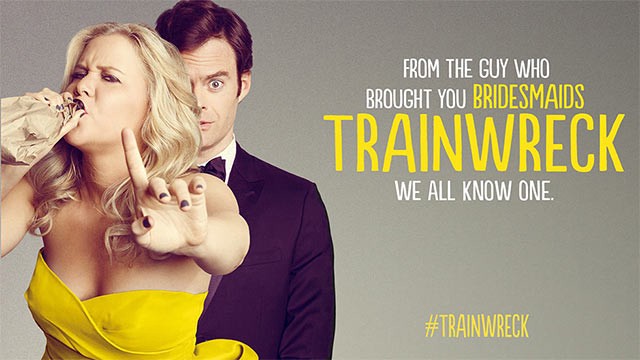
In the poster for Trainwreck, Schumer wears an evening gown as she chugs from a bottle sleeved in a paper bag, a tuxedo-ed Bill Hader standing behind her with a shocked expression. In the movie, however, Amy and Bill Hader’s character, Dr. Aaron Conners, do not attend a black tie event. Except on their first date when they both imbibe, Amy does not consume copious amounts of alcohol in front of him. Though he is annoyed when she smokes pot at an award luncheon in his honor, he is never shocked by her behavior. There is no stashing bottles in paper bags or holding back hair.

Beneath the title of the film are the words: “We all know one.”

To Hepola’s friends, she was once that one, the one that keeps drinking too much and more as all those around her age out of their 20s, enter their 30s, and inevitably ease up. One friend writes her a letter to say she can “no longer watch.” Another confronts her over dinner. Hepola writes, “Something was badly wrong between us. And it wasn’t some minor incident on the balcony, or a cab, but the long string of incidents that came before it.” Steadily, her friends pull away, or Hepola herself pulls away, not wanting to be held accountable to the promises she has made.

Indeed she does hold herself accountable, eventually. With this memoir, Hepola, now many years sober, conducts a fierce moral inventory of her life, an unblinking examination of the insecurities, the vanity, and the wounds that made her drink. Blackout is not without flaws. Hepola’s guilelessness means there will be no artistry in her prose, and too many pages are spent on her childhood in Dallas, where she experienced the usual feelings on preteen alienation and developed a preternatural taste for beer. Her life experiences may not be remarkable in that they are shared by many, but her hard-earned self-awareness is.

That sort of self-awareness is missing from Trainwreck, which doesn’t seem at all interested in why Amy drinks. Early in the movie, an explanation for Amy’s disinterest in committed relationships is given in the form of a flashback. Her father asks Amy and her sister, both small and blond and clutching their dolls, how they would feel if they could only play with one doll for the rest of their lives. Of course the girls are horrified by the idea, but the argument against monogamy affects only Amy. In present day, her younger sister Kim, played by Brie Larson, is happily married and expecting a child.

Though the flashback is a bit convenient, I’ll accept the overdetermined movie-logic as an explanation for Amy’s romantic outlook. In the world of Trainwreck, however, there is no such thing as sober, casual sex. There is only drunken promiscuity. (Amy’s friend at work is aghast to learn that Amy chose to spend the night at Aaron’s house, and didn’t just do it because she was too drunk to leave.) And thus the explanation for her preference for casual relationships slides into an explanation for her partying (aka drinking), behaviors that are often found together but are by no means interchangeable.

Hepola uses the prologue to Blackout to provide sociological context for her drinking. She explains the science behind a blackout (the hippocampus shuts down and can no longer form long term memories), and cites Sex and the City, Bridget Jones’s Diary and Are You There Vodka? It’s Me, Chelsea as examples of pop-culture touchstones in which women cannot be disentangled from their drinking, benignly social or otherwise — a list to which she might add Trainwreck. She also addresses what she describes as “the loaded minefield” of publically connecting binge-drinking and rape: “Women are never to be blamed for being raped,” she writes, “But… in my life, alcohol often made the issue of consent very murky.” And how could it not? To be unable to remember giving consent, as was the case in Paris, is akin to consenting through proxy: an authorized agent that’s not quite you. Consent is clear in Trainwreck, sometimes even enthusiastic, but to confuse non-monogamy or sexual liberation with excessive drinking is to replace desire and agency with impulse.

But does Amy have a drinking problem, or is calling her a “trainwreck” just a marketing strategy? In an early montage, as well as the official trailer, Schumer’s voice can be heard saying: “I’m just a modern chick who does what she wants. Last week, it was this guy. Before you judge, you should know, I’m doing fine. My friends are awesome, my apartment’s sick, and I have a great job at a men’s magazine.” The accompanying visuals subtly undermine, but do not obviously undercut, the voiceover. The resulting options presented to the audience here are grim: either disagree with Amy’s assessment of her own life, or accept the un-ironic assertion that a “trainwreck” is the equivalent of a “modern chick who does what she wants.”

Let’s return to my question then, confined to Schumer’s script and independent of its marketing materials: Is Amy a trainwreck? Below is a list of things Amy that may or may not be considered trainwreck behavior.

1. Wakes up in Staten Island after sleeping with someone while blackout drunk (pretty trainwreck, but not unheard of).

2. Drinks wine at the movies and smokes pot in front of the theater (sounds fun), which leads to a breakup with her hulky boyfriend, who is bad at sex and wants to make her into a crossfit breeder (good riddance).

3. Tells a dirty story at her sister’s baby shower while sipping white wine (thank god somebody did).

4. Smokes pot out the window of a fancy awards luncheon at which she feels uncomfortable (a reasonable solution to the problem).

5. Gets wasted after work and goes home with the intern, who turns out to be 16 (seriously trainwreck). Though they don’t have sex, she ends up punching him in the face (long story), his mother discovers them, and Amy is fired from her job (rock-bottom trainwreck).

Between the blacked-out hook-up on Staten Island and the final incident with the intern is an enormous gulf, populated only by innocent pot-smoking and reasonable wine-sipping. Though Amy is not blacked-out when she agrees to go home with the intern, it is implied that she agrees to it with a “fuck-it, I’m wasted” attitude. Am I supposed to be worried about this woman? I’ve heard a few female friends tell stories of hooking up with a guy only to find out he was much younger (not 16-younger, more like 19-to-24 range). When they told those stories, I cringed, I laughed, I told them maybe they should stay in and watch a movie instead of going out next weekend, but I didn’t plan an intervention, nor do I think I should have. And in the context of an outrageous sex comedy where exaggerated things happen for a laugh, where 19-to-24-year-olds are made 16, I would say no, Amy can take care of herself. Sometimes she parties too hard but she doesn’t drink alone, and she is not dependent on alcohol to get through her week.

On a recent episode of the Lit Up podcast, co-host Angela Ledgerwood asked Hepola when she hit rock bottom. Speaking of the evening in Paris, which becomes much worse when Hepola returns to it later in the book, Hepola says, “That night, I was like, This is it… I can’t drink anymore. This has got to be it. And I drank the next day. This is an experience that if you’ve been addicted to something you might be familiar with: You have a lot of rock bottom moments, and they have a very short shelf life. So the question becomes, which one is it going to be? Between the night that happened in Paris, and the day I quit drinking, five years passed.”

Rock bottom for Schumer’s character is actually much worse than Hepola’s. Although Hepola fears losing her job, she manages to achieve the minimal functionality required to avoid a pink slip. When she does finally decide to quit, it’s following a blackout after which she wakes up in her own bed, alone, without anything bad having happened. Amy, on the other hand, nearly commits statutory rape, and is unceremoniously fired. But Amy does not seem particularly remorseful or embarrassed about the incident, even when it becomes apparent that the entire staff at the magazine is aware of what happened. She bounces back quickly and parlays her firing into self-reinvention: in short order, she reworks the article she was writing about Dr. Aaron Conners, and sells it to Vanity Fair, which redeems her, gets rid of all of her half-empty liquor bottles (no word on what happen to that one-hitter), stages a big, klutzy-cute, romantic gesture, and wins back her man. For all intents and purposes, she is tidily reformed.

The generous way to read this ending is to say that the film applauds Amy both when she is a trainwreck and when she finds (monogamous) love. She can have it either way, and isn’t that what we feminists want? A less charitable read would be that the film mocks her while pretending to celebrate her, and holds, in the end and above all else, traditional rubrics for female behavior.

For a film that is really just designed to make people laugh, and is, by its own admission, a romantic comedy, it seems over-zealous to come down hard on either side of the argument. What I can’t shake, however, is the strong suspicion that this movie and its marketing have turned the term “trainwreck” into a contemporary cousin of “battle-axe”: pejorative, and reserved for women. A trainwreck is a woman to be gawked at, a woman you speak about behind her back. A trainwreck is what you call a person before you call her an alcoholic, when you don’t care enough to take her problem seriously. And what is the joke in that?

We All Assemble Families of Choice: An Interview With J.

kitchens

Los Angeles-based author J. Ryan Stradal is currently on hiatus from his post as fiction editor at The Nervous Breakdown, while promoting his debut novel, Kitchens of the Great Midwest. He is also the acquisitions editor at Unnamed Press. The story of Kitchens concerns Eva Thorvald, the world’s best chef. One ticket to her pop-up supper club costs five thousand dollars, but Eva wasn’t born with a proverbial silver spoon in her mouth. Her mother abandoned her at infancy, and soon after, her father died, leaving Eva with an aunt and uncle who hide her birthright. But they can’t preclude Eva from discovering her true calling. While intertwining the lives that touch Eva’s, Kitchens asks whether any of us have a choice of who we become.

Stradal is often first on-hand to support and promote other authors and their work. I met him at an event at 826LA in Mar Vista for the California Prose Directory, an anthology about life in the Golden State, which Stradal compiled and edited. We became friends over drinks at the 2015 AWP conference in Minnesota, which also happens to be his home state and the setting that influenced his novel. Over a whole-wheat apple muffin and almond milk latte at Sycamore Kitchen (he had a tuna sandwich), a foodie haven on La Brea, I had the opportunity to ask J. Ryan a few questions about Kitchens and our mutual loves of food, wine, and the craft of writing.

Andrea Arnold: I love your writing, its honesty, depth and sweetness. How did you come to the story?

J. Ryan Stradal: Thank you. I was thinking about this novel for years before I started writing it. While there is no shortage of Midwestern writers, I felt that the sort of people I knew growing up were underrepresented in fiction. I really wanted to write a story about the kind of people I grew up with, and I wanted to write a story set in the world of food. I’m intrigued by food and wanted to start something that I would wake up every morning and feel excited to write about. Every day I worked on this novel was wonderful.

AA: Who is Eva Thorvald to you?

JRS: Eva is someone I wish I was. She’s way more interesting than I am. She’s a dynamic person who faced a lot of difficult circumstances in her life and concentrated on the positive. She worked really hard and became successful in a world that didn’t give her many advantages.

AA: Why did you decide to write about a female protagonist, being a male author?

JRS: The two chefs I know the best both happen to be women, Patty Clark and Amy Shaffer Kovacs. They were big influences on my life as friends and as people, so when I think of a chef I think women, because I think of them. Amy is trained as a baker and now works in Minnesota and Patty is a private caterer in New York City.

AA: Secrets play a role in the novel. No one tells Eva who she really is. Why did you decide to play out this secret throughout the narrative?

Perhaps you’ve had someone in your life who inspired you to think, I just can’t have this person in my life anymore.

JRS: Jarl and Fiona are very different parents than Cynthia and Lars would have been. Lars would have been a lot more transparent. Fiona and Jarl live in a much smaller world and in order to live in a small world you need to close a lot of figurative doors and windows. The truth of Eva’s parentage was the most significant one they closed. For them to enforce their version of the world in their home, that was something they didn’t want to address. For starters, they had decided early on that they didn’t like Cynthia. They didn’t think that Cynthia deserved a role in Eva’s life so I think that by not even mentioning her it was like she never existed at all. I think that’s how they feel. They basically want to silence her out of existence, and as far as they know they’re successful at it. Cynthia doesn’t seem interested in engaging with her daughter anyway. Instead of raising Eva knowing she has a birth mother she would inevitably one day wish to seek out, they decided to spare her the pain and disappointment of having to deal with this woman. Perhaps you’ve had someone in your life who inspired you to think, I just can’t have this person in my life anymore.

AA: There have been many.

JRS: So that’s the choice they make for themselves as well as for this little girl. And I think they do their best as parents. They’re not the ideal parents for Eva but they love her and they do try. They don’t prevent her from achieving her dreams but they begrudgingly get out of the way and let her do what she wants. Overall, they don’t have any context for a child like her. They try to raise her just like a normal kid and she’s not a normal kid.

AA: Is that how you were raised? Left to your own devices?

JRS: Yes and I was really happy with that. I was extraordinarily happy being by myself. My entire childhood felt like a series of waiting for things to be over. I don’t remember having a lot of unpleasant experiences but there were so many things I thought were just humdrum and uninteresting. I had very strong interests and most of them involved reading and research. I never wanted to go to a water park. Most of the places where kids are supposed to have fun I found either harrowing or tedious. I had stuff I wanted to do.

AA: I love how all the minor characters come full circle. I found myself reading someone’s name, remembering it and having to page back to find out where I saw them last. How did you keep track of all your characters?

To me, it’s a story about a family that gets assembled by a woman that doesn’t have a nuclear family.

JRS: It was really easy. It was just like keeping track of the friends in your life or your relatives. To me, Eva intentionally curated this dinner. Essentially the story is told backwards. It’s the story of the guests at a dinner and where these guests came from and how they came into her life. That’s the umbrella handle and the spokes are the individual chapters, but the way people read the book obviously is the opposite. One reviewer on Goodreads called it a “coincidence party.” I don’t want to make a habit of commenting on reviewers, but I can see how by reading the story in order one can come to that conclusion. In my mind, I knew the ending before I even started writing. To me, it’s a story about a family that gets assembled by a woman that doesn’t have a nuclear family. We all assemble families of choice to varying extents, and particularly those of us who leave our family to move elsewhere. Often this doesn’t come at the exclusion of the family you are born into, but at the wider net of who your intimates are. Eva being an orphan I think it was very important to her to have a family and stay very close to her cousins, but then branch out to friends. When she meets Jordy, her heart really goes out to him. She knows what he’s going through. At that point in his life he’s not ready to accept what she has to offer, but she makes it clear to him that I’m here for you when you are and by giving him a job she might have saved his life. She knew enough about that kind of darkness to know how to respond to it and not be too forceful initially. The chapter that doesn’t exist but that could is where Eva and Adam, Eva’s boyfriend and Jordy’s brother, pull Jordy out of bed and take him to detox and make him sweat it out.

AA: When did you become a foodie?

JRS: Once I could drive I was going to all kinds of ethnic restaurants. My high school girlfriend and I would go to Ethiopian, Indian, Middle Eastern restaurants every weekend. I was really into traveling — or the idea of traveling. I hadn’t been anywhere. It seemed like the next closest possible thing of seeing the world is having the cuisine of the world, of course as represented by Minnesota restaurants.

AA: How did you choose the recipes for the novel?

JRS: Most of them are from my great-grandmother’s Lutheran church in Hunter, North Dakota. There was a recipe book they used to put out. Maybe they still do. I have two versions of it at home, the 1969 version and the 1984 version. Most of these recipes are from the ’84 version. The ’69 version is vague sometimes with its measurements and its time. It’ll say, “Cook until done.” These are recipes by women who’ve been doing them for decades and just know. A lot of it is very traditional Midwestern food, and when I decided to write a narrative set in that world I wanted to stick with the bread and butter of Midwestern cuisine.

AA: How did you get your hands on that cookbook?

JRS: I think I got it when my mom died. I was 29. Ten years ago. I’ve had it for that long but it was in our house before that. There are recipes in the ’84 edition from my great-grandmother and two of my grandmother’s sisters.

AA: Was there a constant dish served in your home while you were growing up?

JRS: I remember my mom experimenting with different kinds of casseroles a lot in the eighties. Different one-dish meals served with a side of frozen green beans or peas.

AA: Who made lutefisk? How did it get worked into the first chapter?

JRS: I remember having it as a kid thanks to the Norwegian-Swedish influence of my great-grandparents on my mom’s side. We’d go to church events where it would be served, sort of like how I characterized it in the book. During Advent in Minnesota there are some churches that will have a social night where things like lutefisk will be served. I recall my great-grandfather, his name was Gus — where Gustav came from — was into it, but when he died the family interest in seeking it out seemed to wane. I had it once as an adult a couple years ago, and my experience buying it was not unlike Lars’s experience buying it. The people who sell lutefisk these days are a self-selecting and passionate, peculiar lot. They’re a dying breed, I think. If someone gives it to me I’ll eat it, but I don’t think I’ll pay money for it again. (Laughs) It tastes like how an aquarium smells.

AA: LA has a big farmer’s market and pop-up restaurant scene. Did those things just fit into Eva’s story as you already envisioned it or did you want to write about LA’s food scene and then wrote Eva’s story around it? What came first?

JRS: There were a lot of things that were important for me in Eva’s evolution. For one, I wanted her to evolve into the time that we exist now. I felt the pop-up supper club seemed like the perfect realization of her dynamic, rootless personality. I also wanted Eva to have a goal that wasn’t a relationship and wasn’t achieved through a relationship. I didn’t want it to end with her getting married or for some guy to come in and be the difference-maker. I like that she has a boyfriend but he’s a supporting character. He’s along for the ride.

AA: You also write extensively about wine. I follow you on Instagram so I know you’re super into visiting my favorite place on Earth, Los Olivos.

JRS: I’m really into those big, bold, fruity, high-alcohol Southern California wines. (Laughs) They’re crowd-pleasers. Pinot noir is a connoisseur’s grape but I don’t drink a lot of Pinot. If I’m going to drink a lighter-bodied red, I’m probably going for Zweigelt or Corvina.

AA: So if you were going to throw a dinner party for your favorite people what kind of wine would you put on the table?

JRS: It depends what the food is, but I would probably choose the food to go with the wine. I would choose something like lamb chops that would go well with Grenache because I like it a lot. My favorite American Grenache winemaker is Beckmen. They do these big, complex, fruity Rhone-style blends and varietals. And they’re biodynamic. They’re very thoughtful, unpretentious and friendly. They’re very good at what they do and stick to it.

AA: The main character in my novel drinks a lot of Melville Pinot noir because that’s my favorite vineyard. What came first, your love of wine or the story and Cynthia’s interests? What was your research process like?

JRS: Wine came first. I have a friend who is a sommelier. I would ask her what pairings would go well with the coppa-style cured ham that’s served as the Amuse-bouche at the top of the menu. I’ve had that exactly once, years ago. I don’t remember what kind of wine I had with it at the time. Probably whatever kind of wine I felt like having. But what’s the ideal wine? We had a conversation about it and we decided on Lambrusco, which I wouldn’t have thought of on my own. So I had some really useful conversations with an extremely helpful friend. The others I paired on my own, but I still ran them by her.

AA: I read your Acknowledgments page. It’s really beautiful. Did you start writing this after your mom passed away?

JRS: Thanks. Well after. She never saw any of it. She didn’t even live to see my first published short story, which happened about a year after she died.

AA: Several of these characters have lost a parent. This is a hard question to ask, but were you finding your way through the loss of your mom in writing Kitchens?

JRS: That’s very insightful. It’s a running theme. I know totally what you’re getting at here and I’m glad you mentioned it, because that’s not a place a lot of interviewers and readers go when they talk to me about the book. But that’s absolutely true. This book was a conversation with my mom.

AA: How did your father influence the novel? Was he a particular character?

JRS: No. He gave me some good input about gardening and deer hunting, even though I got more specific details about deer hunting from my brother. Like in terms of the height of the deer stand, what time of day to go hunting, what characteristics you look for in the environment, and stuff like that for the Venison chapter came from him. My brother did once shoot a female deer that had a fawn and he didn’t see the fawn until after he shot the mom. I always wanted to write about it, so I worked that moment into Jordy’s chapter. I’ve been to where they hunt. I’ve seen the deer stands. I‘ve been on those grounds. It’s on an uncle’s farm, much like it is characterized in the book, but those characters are nothing like my uncles.

AA: Will Prager stood out for me. He’s a really strong character. Who is he?

JRS: Will’s me in high school. (Laughs) As a young man I scared off a number of women by falling for them too quickly.

AA: I loved his notion of having “a thing.” How did that come about?

JRS: He feels that, as a man, you have got to have some kind of specialty. You have to bring something specific to the table. He’s convinced himself that this is true, and for him it’s not just an opinion, it’s a lifestyle choice.

AA: So what’s J. Ryan’s thing?

JRS: Well, we’ll see if this writing thing works out. (Laughs)

AA: When did you start writing seriously?

JRS: In my late 20’s. I took classes with Rob Roberge and Lou Matthews, both at UCLA Extension. They really turned me on to being a fiction writer. Up until then I was sort a self-defeating screenwriter. What screenwriter isn’t to some degree? I had that quality in a much greater quotient than other people. In college, I was a creative writing for the media minor, which meant I was writing a lot of screenplays and plays, but I was writing stuff that no one would want to make. I even had a professor, David Tolchinsky, tell me that. He was absolutely right. I didn’t sell anything. I did get a job at one point writing an action movie screenplay but that didn’t get made. Then the writers’ strike happened. Could be it was for the best.

AA: Is that why you came to LA? To become a screenwriter?

JRS: I came to LA because I knew in my heart I wanted to be a writer, but I was too chicken to be a fiction writer yet. LA seemed to have a lot of interesting things you can do for money while you pursued some off-work creative endeavor. It just took me about ten years to get around to doing that seriously. In my first few years out here I worked at VH1 and MTV. I worked on parts of the first two seasons of The Bachelorette.

AA: That’s my favorite show!

JRS: Yeah, it’s fun. My mom really enjoyed it. If she was still alive I think she would call that the highlight of my career!

AA: Can you speak to emerging authors about what kinds of stories you look for at The Nervous Breakdown and Unnamed Press?

JRS: I would like more stories from women and people of color. I personally like stories that are funny, that have a lot of heart and are maybe a little weird or might be a little hard to characterize. For example, we just bought a book by Margaret Wappler, and I really like it because it has one pseudo-science fiction element to it, but it’s not a sci-fi book. It’s a family drama set in suburban Chicago. I think it’s absolutely wonderful, and it’s the right kind of weird. It has a lot of heart and is superbly well written.

AA: What else have you read and liked lately? Any recommendations?

JRS: There are a lot of great books coming out. I loved The Ghost Network by Catie Disabato. I loved Cate Dicharry’s The Fine Art of Fucking Up. That’s a little bit of self-promotion because it’s out on Unnamed, but I didn’t acquire it. It was there before I came aboard. I also really enjoyed the Book of Speculation by Erika Swyler. I got that in galley and read that in one sitting on a plane. At BEA, I also picked up the new books by Naomi Jackson and Gabriel Urza, which I can’t wait to read. I’m also reading my friend Meg Howrey’s novel-in-progress which is staggeringly good. It might be the best thing I’ve read this year.

AA: Can you discuss what you’re writing next?

JRS: I won’t say much about it other than it’s a novel also set in the Midwest.

AA: Maybe that’s your thing. You’re the guy who writes about the Midwest.

JRS: I don’t feel like writing about LA yet. Maybe I will someday. When I wake up I want to write about my home state and the people there. I think about them every day.

Lena Dunham’s Squad of Smart Female Editors Posts Book Recommendations

It’ll be a couple of months before the first issue of Lenny, the Lena Dunham e-newsletter, hits inboxes, bearing a freight of Dunham-curated content about “feminism, style, health, politics, friendship and everything else.” But in the meantime, the editors of Lenny have started hosting Lit Thursdays: a feature on the newsletter’s Facebook page and Instagram, where the women of Lenny (Dunham included) say what they’re reading and why they like it.

It’s a distinguished pool of recommenders to draw from. Editor-in-chief Jessica Grose is a novelist with two books under her belt (her latest, The Closest Marriage, comes out next year), and a former editor of Jezebel and Slate. Editor-at-large Doreen St. Felix writes for Hairpin, BuzzFeed, The Guardian, and n+1, and recently published the best essay about Rihanna you’ve ever read. Associate editor Laia Garcia is a stylist/writer, and a mainstay at the Tavi Gevinson e-zine Rookie.

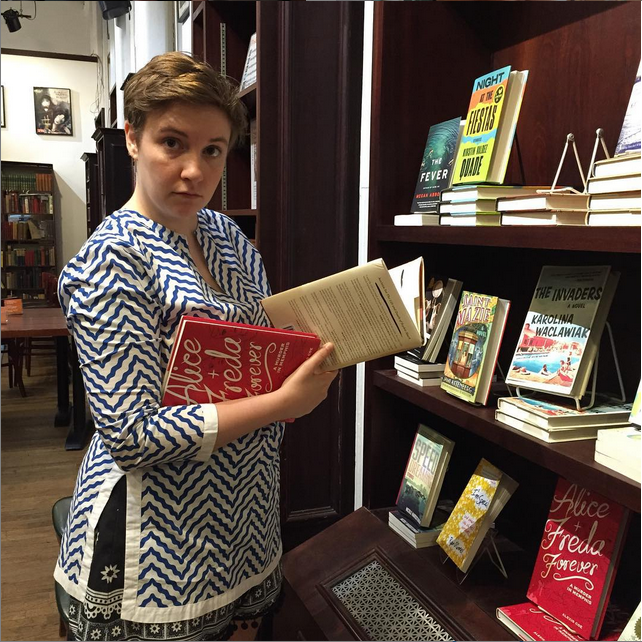
The posts started appearing on July 16, and since then, the editors have gifted their nod of approval to eight titles, including Elena Ferrante’s standalone novel about a painful divorce, The Days of Abandonment, Caroline Zancan’s Local Girls, and Maggie Nelson’s The Argonauts (which our reviewer liked too). Dunham said of her July 23 picks, “I am digging both Alice + Freda Forever: A Murder in Memphis by Alexis Coe, and The Life and Death of Sophie Stark, by Anna North, because they have gorgeous covers, glamorous women’s names in the title, and you can never go wrong with some fiction about a renegade woman!”

Wise words from the millennial guru whose resume, it seems, knows no bounds. We’re excited to read smart women recommend by smart women, with the pejorative term “chick lit” nowhere to be found.

The Eighty-Nine Secrets of Wendy C. Ortiz: A Review of Hollywood Notebook

“It’s not in my nature to ever stop digging,” Wendy C. Ortiz told Electric Literature during an interview for her debut memoir, Excavation. As it turns out, Ortiz hasn’t — her latest work, Hollywood Notebook, spills out in the form of eighty-nine autobiographical prose poems. Or perhaps it is better said that they are essays. Or memories. Or secrets. Or dreams.

Take, for example, “chapter” fourteen:

My body remembered yesterday how much it loves the ocean; the roll and tumble, the suspense of a solid set coming towards us; the weightlessness, as another mermaid pulled me along and I remembered what it was like to be five years old with her; the water so cold it transmits an ache to the feet until I just glide on in and my entire body is submerged; the second plunge under a wave we don’t have enough time to ride; the friendly swells that lift and fall underneath me; the slap of water to the head, the ocean reminding me who’s in charge —

Beautiful, to have spent much of that day with M., and the presence of her father who’s also known me since I was under four feet tall, and the ocean, who’s known me forever.

Regardless of exactly what they are, each page-or-two long section of Hollywood Notebook digs into Ortiz and the landscape she inhabits. “All of this, with a view of Los Angeles,” she writes at one point and while all of this refers literally to an art gallery, it could also be directed at the project of Hollywood Notebook itself — here is a life, lived in the shadow of a great desert city. And a life it is; Ortiz’s writing has a distinct quality of being not unedited, exactly, but uncensored — as if the reader is spying on Ortiz’s journaling over her shoulder. The tone is raw and confessional and wrought with lies, but the kind of lies one tells oneself in order to cope, to try to move on. The entire project becomes nearly reminiscent of the self-musings of Maggie Nelson, if Nelson were consulting astrological charts rather than philosophy.

Sometimes the experiments don’t pay off, as is the case with Ortiz’s long and heavy-handed rewriting of a George W. Bush speech on counterterrorism. Others do, though, like the simple inclusions of lists, or self-addresses:

Simple rules of August

  • Try to refrain from re-reading Sylvia Plath’s journals
  • Awake from the Tauren lap of naps and luxury to hike in the sun up the trail you fondly call your own.
  • Smell the air. Remember what August does to you. Remember what September, October, usually mean.

That’s it: nothing more, no additional explanation. A snippet, perhaps, from one of Ortiz’s many journals but without context for the reader who’s stumbled upon her memoir (or is it her poetry? Her confessions?). The culmination of sum of the chapters transforms into a found-document that the reader could even feel undeserving of, or uncomfortable by. Too often it seems as if we’ve discovered Ortiz’s diary and have taken the liberty of helping ourselves to its contents without permission. Yet, of course we have permission, even while the You of Hollywood Notebook is only meant for a specific individual, rather than the collected eyes who are privy to it with its publication.

Hollywood Notebook, then, is a sui generis gem, and one to take advantage of immediately. How often can we read a stranger’s journals so guiltlessly, and with such satisfaction? Ortiz inspires it — she’s laid herself bare, and in doing so dug deep in a way that so few memoirs can actually achieve.

There is no construction to Hollywood Notebook, no pretense: just a woman and a desert and a blank page. It is enough.

Hollywood Notebook

by Wendy C Ortiz

Powells.com

FICTION: Hospital Variations by William VanDenBerg

1

You were planting bulbs in the garden when your arm disappeared. “I can feel it,” you said, “but I can’t see it.” We’d gotten together the previous spring, and this year you wanted flowers. We lived in a house with many others. The disappearance wasn’t, strictly speaking, an emergency, so you decided against an ambulance. I drove us to a nearby hospital. In the waiting room, a man belted out selections from Hello Dolly, Les Mis, and the entirety of Cabaret. His left hand was missing several fingers. Seven mothers gave birth. Nurses called the singing man’s name during a yelping rendition of “Tomorrow.” They yelled, “Trevor!” and he sailed through the swinging formica doors. Even the newborns applauded him through. Through tall windows, we saw daylight run out. They called your name shortly after. Nurses sheeted in translucent plastic led us to your room. We tried to sleep. You in an exam chair, me on a naugahyde bench. When the doctor arrived, he took a long look at your not-arm. “Yeah, you’ve got dirt in your veins,” he said. “Dirt clogs the blood that allows it to be seen. It’s basic optics.” From inside his coat, he pulled out a jar of silver liquid. “Go home and chug this. Garden less, maybe. I don’t know.” When we returned home, you drank the whole jar and your arm came back. The sun threatened to rise and the morning was cold, just above freezing. We climbed into bed and pulled the covers high. We fell asleep just after dawn.

2

A decade passed. We moved to a small town by the sea, rented a rundown bungalow. The town clung to an inlet like food around a child’s mouth. We were swimming in the bay, and you suddenly couldn’t breathe. You flailed out of the water. You doubled over but refused to turn purple — your skin remained a pale blue. An ambulance took us to a regional hospital. Upon arrival, a woman in a formal nurse’s dress took your hand. She wore her red hair up and in curls. There was no wait. On the way to your room, we saw no other patients. The nurse stuck a breathing tube down your throat. When the tube met the water in your lungs, it made a splashing sound, as if off a diving board. You breathed better after. A doctor came in and snapped a polaroid of your chest. She handed me the picture and said, “Be of use and shake this.” A view of your insides developed. Your lungs looked like oval lakes. We saw white peaks on the open water. “You’ve been swimming in the ocean too much. It’s become part of you.” You told her that you didn’t understand. “It doesn’t matter,” she said. “Have you ever known water to stay the hell out?” A surgeon operated the next morning. When they finished, a nurse escorted me to your recovery room. An even row of stitches split your ribcage. You never swam after that — baths were your limit. They gave us a videotape of the surgery. Weeks later, we slid it into our VCR. We saw your open ribcage. Your lungs were twin pools. They drew the water out with cheap neon sponges. The surgeon inserted dry lungs and closed your ribs like a gate. You told me that the hardest part about illness was the lack of agency. Your scars? Anything that says “I’m alive” that loudly is a precious thing. Months later, we abandoned the sea.

3

Another decade passed. Winter deadlocked our northwestern town. Inches of ice enameled the outdoors. One evening, you said that your hearing was out in one ear. I found frost around your earlobe, ice crystals blocking the canal. We tried heating pads and hot water, but the ice wouldn’t melt. I was glad you couldn’t feel it. The cold mercifully numbed half your head. I drove us into the frozen wastes, slid our bald tires across the sheet ice. I watched the frost spread down your neck and drove faster. When we arrived, we shared the waiting room with space heaters. The nurses were duffled in black, puffy coats. They hustled us straight into the operating room. “We’ve dealt with this before,” said a nurse through a camo balaclava. The lightbulbs in the O.R. dribbled yellow light. If it wasn’t Christmas, then it was damn close. The doctor entered and announced a bold plan: “Fuck it, lets make it even colder!” He stuck your head into a red, ice-crammed cooler. Nurses packed more ice in as it melted. Within hours, your neck had turned deep blue, almost navy. “Colder, colder!” he yelled, throwing crumpled fives and tens around the room. You swore into the cooler. Finally the doctor was satisfied. He pulled your head out. Ice bloomed across half your face. When your teeth chattered, the crystals chimed. The doctor summoned a choir of nurses. He produced a small hammer from inside his sleeve. One end of the hammer was flat, the other sharp. The choir cycled through many octaves. When they hit the right frequency, your crystals vibrated, sang back. The room filled with sound. The doctor tapped the center crystal with the sharp end of his hammer. They all shattered off, fell to the ground and melted. The room silenced. We viewed your exposed pink skin. The choir applauded. In the years that followed, I could hold my ear up to any part of you and always hear the hum.

4

Another decade passed. We grew older but not old enough. We were on an “extended vacation,” which meant that we had no stable end date. We stayed in a minor Dutch city that overflowed with churches. In a taxi, your whole self started failing: memory, eyelids, logic, elbows, heart, and so on. You couldn’t speak. You gave me a look as if from a distance. Your pupils shrank to pinpoints then disappeared. The driver rushed us to the nearest hospital. It was a modern building built into a limestone cliff. Catholic mummies, bejeweled throughout the centuries, occupied most of the waiting area. Nurses clogged the hallways. In the O.R., ten of them formed a ring around you. They said in stilted English, “There is a fire. That fire is going out.” One of them left briefly, returned with iron gauntlets and steel pincers. The pincers grasped a burning coal. It exhaled sparks throughout the room. The other nine nurses turned away. The one with the coal wore a welder’s mask. The light seared my vision. I kissed you. I tried to tell you something, but my words seized up and I was unable. That is my chief regret — that I was never able to say anything of substance. Your irises faded out. The nurse placed the coal in your open mouth. I watched the fire inside you. I lost sight of your body in the billowing smoke. Soon it exhausted. The smoke cleared. You were nothing but ash and bone. Thick soot covered the operating room. A nurse said something that I don’t remember, but I think its aim was comfort. I stood there until they wheeled your remains away. I did not ask for them. I was not capable of asking for them. I walked an uncertain mileage back to our hotel and sleep didn’t come for weeks and weeks. When I returned to our home in America, a package was waiting for me. A cardboard box wrapped in butcher paper. The bone inside? I think it was your femur, thickly gilded and set with precious stones. A card informed me that I could view the embellished remains at a museum in The Hague. All vacations thereafter became pilgrimages.

5

Decades passed. I fell ill, so I boarded a regional train. I took it to its last stop, a hospital surrounded by golden wheat and nothing else. My car had been empty for stops and stops. The hospital? Brand new and relentlessly bright. “Or there’s something wrong with my eyes,” I said before collapsing in the lobby. They put me in a bed and kept me for days, maybe weeks. I never saw a doctor or a nurse. The hospital remained bright, so I kept my eyes shut. Finally I heard a voice in the hallway. I unplugged my cables and left the room. The hallway stretched before me. I opened my eyes, lifted my gaze from the floor. I was on the top level. I know this because it had no roof. A clear sky stretched above me. I looked into it. I heard the voice again. A clear sky stretched below me. The voice pushed against the other side of the sheltering blue. I could feel it like a pulse. I closed my eyes, went forward and met it there.

The End of the Tour: A Look at the Rapid-Pace Brains of Two Literary Greats

by Julie Buntin

David Lipsky’s interview with David Foster Wallace, the basis of the book Although Of Course You End Up Becoming Yourself and the inspiration for The End of the Tour, spanned five days. Because I’ve had the pleasure — and frustration — of sinking into a very long, very intense conversation with Lipsky, I felt, while watching the film, a hyperbolic kinship with Wallace. Poor guy, I kept thinking. He must be really tired.

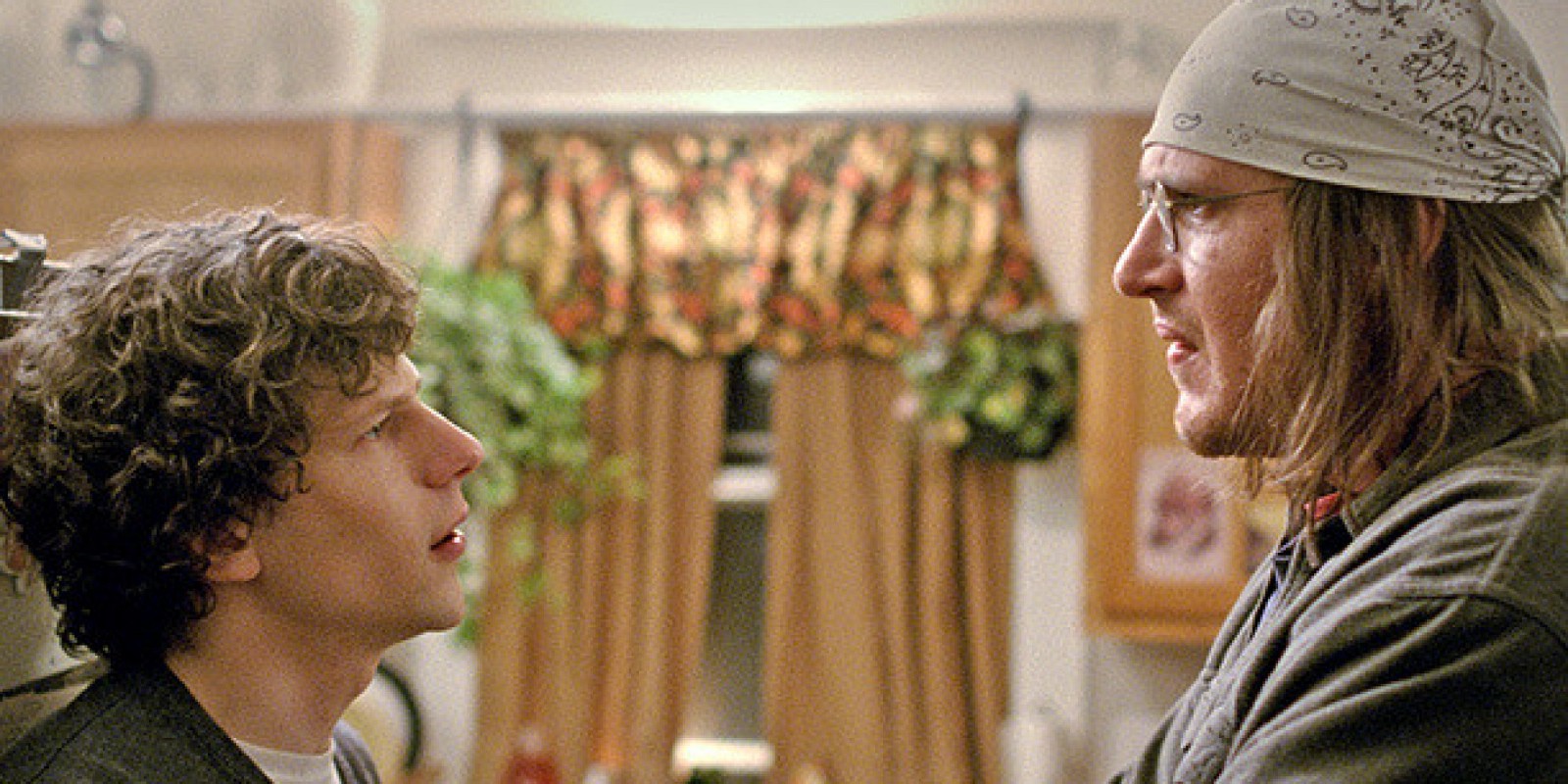
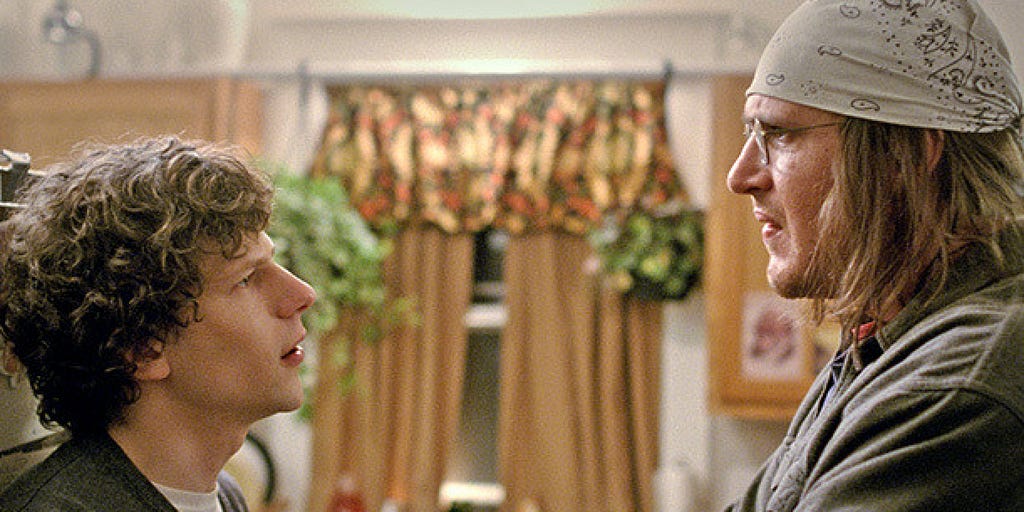
In the film, sort of as in life, David and David (as portrayed by Jesse Eisenberg and Jason Segel) drive around eating Twizzlers, talking about TV addiction and Alanis Morrisette and greatness and Infinite Jest. Out of the seams and silences of that conversation, riveting in its own merit and loaded with Wallace-esque brilliance, another dialogue elbows its way into the atmosphere between interviewer and subject, just-starting writer and more famous writer. David Lipsky, in probing David Wallace’s life, makes it clear that his motive isn’t only to write a definitive profile — it’s to absorb, via conversational osmosis, a kind of blueprint for becoming Wallace. Wallace — sweaty, painfully intelligent, his tragic death waiting on the film’s horizon — at first evades Lipsky’s prodding, then descends into a teenaged sulk, and then, after Lipsky’s worn him down, tries, vainly, to explain the bullshitty misguidedness of the desire for literary fame.

I took a class with Lipsky while I was an MFA candidate at NYU. Like most of his students, I loved him — even though it was halfway through the semester before he stopped confusing me with the other brunette Julie in the class. He wore a nicotine patch and smoked during every break. Most days he ate a yogurt or a banana as we all filed into our seats. Midway through a lecture he’d interrupt himself, point at someone, and ask them to tell the room what he’d been eating earlier — a pop quiz in paying writerly attention to one’s surroundings. It felt like a blessing to be chosen. Once, when Lipsky was teaching through a cold, I watched, stunned and a little nervous, as he drank an entire half gallon of orange juice in just over two hours. His brain isn’t just fast; it’s lightning, charged by some rare and electric sludge of verbal adrenaline and nicotine. He’s notably handsome, as Wallace points out in the movie, his good looks undermined by a frenetic twitchiness that Eisenberg captures well. I once heard two drunken classmates speculating over whether, in a romantic situation, Lipsky would be too busy thinking of literary comparisons to enjoy the moment.

The first time I saw the trailer for The End of the Tour, I cringed. I experienced a version of the queasy feeling I get when I hear my own voice recorded, except on Lipsky’s behalf — this was his life, his story, except, well, not. It was amazing and horrible to see him both reduced and exalted on the big screen. On a more basic level, I felt something like irritation at having to share my teacher and his relationship with DFW with all the weirdos who’d want to watch this movie. Segel and his bandanna, his affected speech — just because they made him look like Wallace didn’t mean he could pull it off. These movie producers had taken DFW, one of the book-world’s most sacred myths, and trimmed off the indigestible parts, transforming this story, these men, into a commodity for the masses. And that Eisenberg, with his spastic fingers, his freakishly zeroed-in gaze, was supposed to be David Lipsky, my David Lipsky — it just bothered me. I would never see it. And if I did, I knew I’d hate it. The End of the Tour was made by film people for culturally hip twenty-somethings more interested in Wallace as a legend and a product/martyr of the internet age than Wallace as a writer. In other words: phony.

Here’s where I say what you knew was coming: That I liked the movie. Really, really liked it. That it moved me. That at one point, I got honest-to-goodness chills. That David Foster Wallace’s voice, even siphoned through Jason Segel, is and will always be worth listening to. Is there a hackneyed attempt to force plot onto a story that’s about conversation, that most beautifully plotless of things? Yes. A few times. You can feel Eisenberg chafing against it. Halfway through there’s a scene in a hotel room where Eisenberg yells into the phone at his Rolling Stone editor that he won’t push DFW to clarify the rumors of his heroin use, goddamnit, because that isn’t the point! And it really isn’t the point — in general, the movie seems to understand that. Near the end, I cried a little, as Eisenberg/Lipsky races through Wallace’s house, listing visual details into his tape recorder, so he’ll remember them later. There are a handful of derpy moments — an argument between Davids in a kitchen over a girl, some stupid jokes about the culture of the midwest, a few very on-the-nose visual reminders of the difference between each man’s place in the literary world. (Lipsky sleeps in Wallace’s guest room — stacked floor-to-ceiling with copies of Infinite Jest.) But it turns out that it was a movie exactly right for me, and probably for most people, readers, wannabe writers, or not — straightforward, all-too-relatable, a film about people (Davids!), trying to figure out who they are and what they will become, how to be, and how to be together.

The real-life Lipsky and I shared what I’d guess was the longest phone conversation I’ve had in my adult life. It started a little after seven pm and ended at close to two in the morning. At 12:18am, my phone died, cutting off Lipsky mid-sentence. I connected my phone to the wall and sprinted to the bathroom, where I peed, dizzy with relief, as I’d needed to for hours. Back in my room, on my laptop, a new email:

I think your phone battery went out.

As soon as my phone came to life, I called him back, and we killed another hour or so, talking about Jane Eyre, about John Fowles, about Franzen and Lorrie Moore, Willa Cather and Nabokov and Martin Amis’s sentences and young writers with book deals and where I was from and why I write and why he does, Lipsky quoting Bellow verbatim, Updike, Alice Munro, a sound on his end of the line that made me imagine him pacing the room. As Eisenberg/Lipsky says at The End of the Tour: “It was the best conversation I ever had.” Lipsky is the only teacher who forced me to really and truly answer him, who asked a question and then followed it up with a question that cut into the first one a little deeper, until you simultaneously wanted to yell at him to knock it off but also to explain yourself, get it exactly right, give him a response that proved you were worth the searing attention of his intelligence.

I’m fairly certain Lipsky doesn’t remember that call.

In theory, the call’s purpose was to discuss the presentation I was giving in class the following week on Zadie Smith’s The Autograph Man. But actually, part of what I think Lipsky wanted was to have a good, long, conversation, one of those talks that lift you out of your regular life and into another mode of being, the way a really good book can. Lipsky’s calls were famous in my MFA program — we compared their durations after the fact, swapping stories of each other’s trials and successes like survivors of some great and noble war. Our six hour conversation was on the long side, but not the longest. My classmates and I judged each other based on such statistics. Like most good teachers, Lipsky inspired in us all a desire to achieve the position of favorite; like most good teachers, he made every one of us believe we’d be his pick.

Wallace, as a subject, is endlessly fascinating. But what I’d like to point out is that the conversation at the core of The End of the Tour — in which we’re given access to a version of Wallace that feels more intimate, real, than he does in almost anything else, even Wallace’s own personal writing — is only possible because Lipsky is the person asking the questions. Late in the film’s second half, Wallace complains that he can’t keep up with Lipsky. Eisenberg/Lipsky brushes it off, assuming it’s just Wallace doing his routine self-effacing box-step, but the audience knows that Wallace is telling the truth. Lipsky is a hell of writer; but he’s a hell of a talker too. Listening to the two of them spar in The End of the Tour is a reminder that conversation — our original, ephemeral method for banishing loneliness — can be art.

Okey-Panky Will Open for Submissions on August 1st

Attention writers: Okey-Panky will open for submissions next month!

The editors would love to see your short, darkly comic, ironic, and experimental fiction, essay, poetry, and graphic narrative. Okey-Panky publishes about half the magazine from slush, so your work will be read carefully. You may submit multiple pieces of up to 1500 words total, but please put them into one file and submit only once. There’s no submission fee, and we pay contributors $100. Your work will be published on Okey-Panky also be mirrored on Electric Literature.

Last time submissions filled up in almost a week, so get your best work ready and submit early in August!