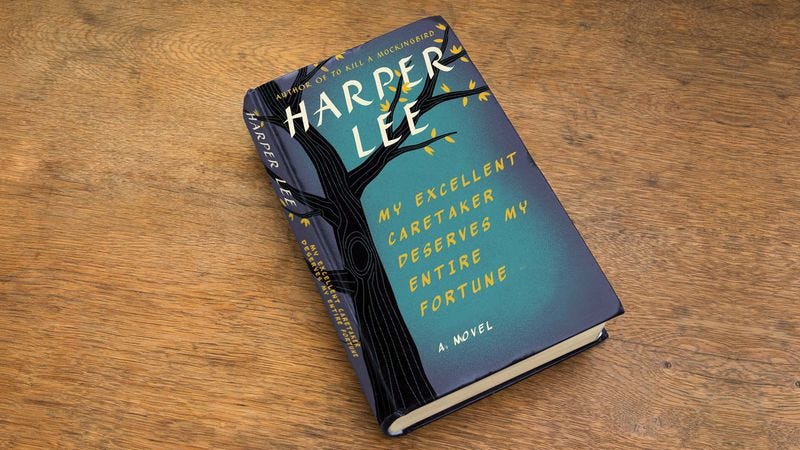
After a pre-publication press embargo, the reviews of Harper Lee’s Go Set a Watchman are finally rolling in.
Although it may seem like everyone you know has an opinion about the eagerly anticipated novel — your mother, your boss, your barista, your bartender — reviewers at The New Yorker, The New York Times,NPR, and The Guardian haveprovided plenty of material for further discussion.
Adam Gopnik of The New Yorkerdescribes the novel as a “failure” — especially compared to the widely-read To Kill a Mockingbird. And yet, he acknowledges that Lee’s magical evocation of the South, though veiled by clichés, is still undeniably appealing. He suggests that Lee’s descriptions allow readers to both re-experience and perhaps redefine the “Pastoral South” as it is represented in literary history.
The critical tone of Gopnik’s review appears to stem primarily from disappointment. Gopnik refers to Scout’s (or Jean Louise’s, as she is now called) and Atticus’s “static and prosy debates” about “integration” and “other fifties-era subjects” as mechanical “set pieces” which barely resemble dialogue. Due to these weaknesses, Gopnik argues that “the book falls apart as art — partly because today it is impossible to find the anti-civil-rights arguments anything but creepy, but more because any novel that depends for its action on prosy debates about contemporary politics will fail.”
In TheNew York Timesreview, Randall Kennedy also expresses his disappointment about Harper Lee’s missed opportunity to successfully “explore a dense, rich, complicated subject: How should you deal with someone who has loved you unstintingly when you find out that this same person harbors ugly, dangerous social prejudices?” Kennedy describes Lee’s response, and therefore the impact of the novel itself, as “uninspired,” as a mere rough “sketch.”
Maureen Corrigan, in her review for NPR, unapologetically describes the novel as a “mess.” Corrigan is similarly troubled by the novel’s “fishy origin story” (is it a sequel or a first draft?) as well as Atticus’s “bizarre transformation.” However, unlike the previews reviews, Corrigan praises the “poignant” and “moving” scenes involving Jean Louise’s “torment over not feeling like she has a place in the world.”
In The Guardian’s panelreview, Syreeta McFadden writes that while the novel aspires to complicate the concept of disillusionment with one’s parents, it ultimately fails to deliver on its “ambition to interrogate the character of so-called good, moral people.” Kiese Laymon, too, is frustrated by the idea that “white characters in this novel have simply gone about the business of becoming white women and white men, and unbecoming white girls and white boys, at the expense of terrorized black women and black men. All has been accepted, if not forgiven. White supremacy, though provoked by a curious white woman, has preserved itself.”
Beyond the literary merit of the novel, its provenance, and its politics, another hotly contested aspect is the characterization of Atticus Finch. Has our hero truly fallen from grace? Did Atticus become a racist, or has he always been racist? In To Kill a Mockingbird, is it possible that his abhorrent views were obscured by the nostalgic narrative of his devoted daughter?
In TheNew York Times review, Randall Kennedy introduces an anecdote about a law professor named Monroe Freedman, who once published an article asserting that Atticus Finch “ought not be lauded as a role model for attorneys.”
Kennedy notes that, in Freedman’s opinion, Finch’s “acts and omissions” throughout the trial and throughout To Kill a Mockingbird “defined a lawyer who lived his life as a “passive participant” in “pervasive injustice.”’
Gopnik of The New Yorker agrees with this assertion, stating in his review “that this is exactly the kind of bigot that Atticus has been all along.”
Kiese Laymon in The Guardian effectively challenges our more simplistic readings of race in Harper Lee’s novels: “The real revelation–if we can call it that–in this novel (and possibly in To Kill a Mockingbird) is that given the limited point of view, there is nothing to “declare”, nothing at all to “seeth” here other than hollow conceptions of blackness facilitating the moral and narrative development of white characters, over and over again.”
James Tate was one of our most celebrated and prolific writers, with over twenty collections of poetry, several works of prose, and awards ranging from the Yale Series of Younger Poets Prize and the Wallace Stevens Award to the National Book Award and the Pulitzer Prize. And he yet had good humor to spare.
Here, some of Tate’s fellow poets, former students, and friends remember the man and his work, in their own ways and in their own words. Scrolling over the image below will introduce you to some of the poet’s most memorable lines; clicking on those lines will bring you to the full text of each poem. Once there, you will notice links within each poem. These links offer personal memories of Tate, commentary about his work, and recordings of some of his most meaningful poems.
As Tate himself said, in “The Initiation,” “The piece is dedicated/ to me. How strange,/ I thought I was new here.”
Browsing among the zero hours, and where I went from there . . . diabolical? No. I went out of myself into . . . I did not go out of myself into the after-
noon of parrots; I did not go out of myself into the dew; I did not go out of myself into the bat-terrors. I did not say silence, I said nothing about the love I
did not go out of myself into. I said nothing fire, I said nothing water, I said nothing air. I went out of myself into no, into nowhere. I was not alone.
[Absences, 1972]
Close
×
Goodtime Jesus
Jesus got up one day a little later than usual. He had been dreaming so deep there was nothing left in his head. What was it? A nightmare, dead bodies walking all around him, eyes rolled back, skin falling off. But he wasn’t afraid of that. It was a beautiful day. How ’bout some coffee? Don’t mind if I do. Take a little ride on my donkey, I love that donkey. Hell, I love everybody.
[Riven Doggeries, 1979]
Close
×
Amy Newman
James Tate has said his autobiographical work is “based on a little truth and a lot of myth, or a lot of imagination.” Any writer interested in how the materials of life alchemize in poetry may consider his early poem ‘The Lost Pilot.” How deftly Tate navigates between what is real (a son’s desire to reunite with the lost father) and what he imagines (Tate would never know his father, who was shot down in WWII when Tate was an infant). In the poem, what is unseen by the human eye remains the most vivid of images. The son’s imagined father navigates both the sky and the son’s psyche, distant and ever-present and, in his absence, perfected to a god. The speaker tries, impossibly, to romance him back to the world with promises:
If I could cajole you to come back for an evening, down from your compulsive
orbiting, I would touch you, read your face as Dallas, your hoodlum gunner, now,
with the blistered eyes, reads his braille editions. I would touch your face as a disinterested
scholar touches an original page.
In such a gaze, in his desire to know the lost one who is dreamed of, longed for, and also feared, Tate’s speaker conjures the capacity for dread mingled with reverence that is the definition of awe.
Close
×
Sarah Blake
What I would call my first poetic voice came out of my love for James Tate, Mark Strand, and the prose poems of Charles Simic — three men who valued humor, image, action, and the absurd — men who prioritized the turns of language over the fluff of it. Every time I’m asked about my use of language in my own poems, I return to these men in my head. I think about tension, how a sentence pulls itself over the lines, how juxtaposition and pace work to elevate, work to surprise. Looking back, it surprises me that I started with these men, but I’m so glad I did. Because of them, I never felt unusual.
From “It Happens Like This,” by James Tate
I was outside St. Cecelia’s Rectory smoking a cigarette when a goat appeared beside me. It was mostly black and white, with a little reddish brown here and there. When I started to walk away, it followed. I was amused and delighted, but wondered what the laws were on this kind of thing. There’s a leash law for dogs, but what about goats? People smiled at me and admired the goat. “It’s not my goat,” I explained. “It’s the town’s goat. I’m just taking my turn caring for it.” “I didn’t know we had a goat,” one of them said. “I wonder when my turn is.” “Soon,” I said. “Be patient. Your time is coming.” The goat stayed by my side. It stopped when I stopped. It looked up at me and I stared into its eyes. I felt he knew everything essential about me. We walked on. A police- man on his beat looked us over. “That’s a mighty fine goat you got there,” he said, stopping to admire. “It’s the town’s goat,” I said. “His family goes back three-hundred years with us,” I said, “from the beginning.” The officer leaned forward to touch him, then stopped and looked up at me. “Mind if I pat him?” he asked. “Touching this goat will change your life,” I said. “It’s your decision.” He thought real hard for a minute, and then stood up and said, “What’s his name?” “He’s called the Prince of Peace,” I said. “God! This town is like a fairy tale. Everywhere you turn there’s mystery and wonder. And I’m just a child playing cops and robbers forever. Please forgive me if I cry.” “We forgive you, Officer,” I said. “And we understand why you, more than anybody, should never touch the Prince.” The goat and I walked on. It was getting dark and we were beginning to wonder where we would spend the night.
I destroy the living room furniture to prove I own nothing of value.
From “The World Doesn’t End,” by Charles Simic (dedicated to James Tate)
A dog with a soul, you’ve got that? You apes with heads of Socrates, false priests’ altar boys, retired professors of evil! I imagine cities so I can get lost in them. I meet other dogs with souls when I’m not lighting firecrackers in heads that are about to doze off.
Blood-and-guts firecrackers. In the dark to see, you ass-scratchers! In the dark to see.
I think this is a good one about poetry and faith, and trying to write something for strangers. Maybe even strangers who’ll read and love your work after you’re dead.
Look at all this poem’s tricks: burn snowflakes? Check. Open caskets, bringing the previously-only-imagined reader to life? Boom. End up both ecstatic and irritated? Sounds right.
Say we are the reader, wedged into a sudden aliveness with the writer. He’s willing to give up sleep to make us real, driving toward us all night in the sleet. It’s cold out there with the firmament and waters, lost in the coalescing matter making up this world. Let there be light, “a little fire.” Okay.
Then we are together, just us and Tate, all in, burning our identification papers for warmth. Who needs them? Who needs them once the poem is working, and we’re met there together? He doesn’t know. We don’t know. But here’s a poem about him tunneling toward us, working on faith, bringing us to life.
Close
×
Fady Joudah
I insist on return: I return you to me, you return me to you, or me to me and you to you: return is only to the stranger.
These lines came to me after I spent some time reading or rereading Tate’s earlier poems — before he fatigued from a certain form, and his mind and body fatigued along, before he went into the prose format and its allegorical inner world, its own semi-private logic that was always announcing the final disintegration, a return to being a root….dear James:
Close
×
Dorothea Lasky
“People read poems like newspapers, look at paintings as though they were excavations in the City Center, listen to music as if it were rush hour condensed. They don’t even know who’s invaded whom, what’s going to be built there (when, if ever). They get home. That’s all that matters to them. They get home. They get home alive.”
It’s true. Some people do and can have a tendency to read poems as if they are these things they can safely enter and leave at will. They want a sad poem to make you sniffle a little but not wail. They want a funny poem to make you say, “Ah, how clever,” but not belly laugh. They want a poem about sex to be erotic, but they don’t want to think about fucking towards an inevitable death. Tate knew that a poem will never let you have the will to do anything, except be. Because once you’re in a poem, you had better be ready to be changed — you will never get home alive no matter how much you claw back towards there. In a poem, home is already gone and you’re already a new person, ready to live a new life, do new things, make the world new again.
But in these past few days, I haven’t read this favorite poem as much, instead I have read this poem over and over, “Very Late, but Not Too Late.” I am not sure why I have focused on this one particularly, but it does represent particularly what Tate has taught us. In the poem, the speaker feels empty, but then he finds a purpose: this lonely woman who he can save or maybe she can save him. It’s a romantic/Romantic poem. Because it states that within the act of the journey there is always hope. Because it somehow insanely believes that even though (to quote my best friend) evil always wins, underneath this reality is the idea that life can start again, that a life has only begun on a night road traveled already so many times, that as my grandmother used to tell my mother “love is always right around the corner,” that we are never too late for a new beginning. These are good things to think about. Without these considerations, what is life.
James Tate was my teacher and he gave me immeasurable lessons both in and outside of the classroom, both in and outside the space of the poem. The past few days I have been remembering his feedback in class and how much he loved using the word, wild. When he used that word about your poem, you knew you had done something right. I remember distinctly the first time he used it on my poem. I had included the image of an ostrich and for some reason, he commented, just kind of matter-of-factly, “Wow, that’s pretty wild.” All the accolades of my nerdy youth fell away in that moment. Now this is what I want a poem to do, I thought. It’s a test I give myself with my work every day. Is this idea really wild, I ask myself. It’s a good question, because if you aren’t thinking about the wild in your work, if you are keeping your language and ideas purring methodically, then you aren’t really doing the right work at all. I mean, really, if the poem isn’t strong enough to bite you, then what’s the point.
It makes sense that the wild would have been important to his feedback, because his poems were certainly so. But it’s not as if they were all ragged edges and off beat staccato rhythm. He was an expert at regulated beat, his lines were perfectly constructed and paced. No it’s more that he was willing to let nihilism coexist with sincerity, to let his persona express the disagreement we all feel with ourselves and others. Not disagreement like there is one right answer, more that we will never come to a consensus about anything. We won’t ever really understand why we are here, what the point of our lives is, or if we were meant to meet the woman alone at night or if it were a random occurrence (a law of life that is one and the same). To be truly wild means to in spite of it all really believe that it’s never too late for life to begin. I don’t know about you, but I don’t want to ever forget that.
Last summer, I had the honor of teaching at the Juniper Summer Writing Institute and one of the days I went to a conversation between Dara Wier and James Tate. I wrote down so many things that Tate said, but one thing I have kept remembering all year is when he said, “I never know what is coming next. And that is the excitement of writing. And that is what keeps me glued to the poem.” It’s stuck with me because it really sums up what’s magical about creativity. I hope to always write and read poems where I can’t anticipate what’s coming next. And I hope in this life, when I am traveling the winding road full of dirt and bugs and people and trees, there is the answer to all my hopes and fears, just waiting there, ready to start me up again. If we can manage to live for this, then we can manage to live for anything.
Thank you, James Tate, for everything.
Close
×
Eduardo C. Corral
James Tate ruled the MFA program at Arizona State University in the late 90s. It seemed every poet in the program read him passionately. I was an interloper, an undergraduate student who’d just discovered poetry. I attended all the readings, I studied all the posters hung along the hallways of the English department, I crashed graduate-level workshops. In other words, I was a pest. The MFA students were, for the most part, kind to me. Some of the students could barely hide their dislike for me. I ignored those students. Instead, I reached out to the welcoming ones, the ones who remembered the fever, who remembered the thrill and anxiety of falling in love with poetry.
I was a nervous wreck among the MFA students. They were so worldly and so well-read. I was just starting out. I made it a point to ask each student to recommend a few books. Without fail, each student would mention one of James Tate’s books: The Worshipful Company of Fletchers, The Lost Pilot, and Distance from Loved Ones. Though each time I went to the library, I couldn’t locate his books. They were either checked out, misplaced, or stolen. One day I ran into Brandon Som on the first floor of the library. Brandon was an undergraduate student and a budding poet, like me. I noticed he was returning The Lost Pilot. After a few minutes of small talk, we walked to the circulation desk. He returned the book. I checked it out.
The poems in The Lost Pilot rattled me. Let me be more specific: the attitude of the speaker toward his parents rattled me. In the title poem the speaker says, “Your face did not rot.” In the poem “For Mother on Father’s Day,” the speaker confesses to his mother that he pitied her. These were instructive and challenging moments for me as a fledgling poet.
They forced me to rethink the way I wrote about my parents. My early poems viewed the familial through rose-colored glasses. My mother was a saint. My father was stoic, pure. The poems in The Lost Pilot showed me it was okay for a son to express anger, doubt, ambivalence, and a host of other emotions. James Tate was one of the poets who taught me a poem could be as complex as love.
Close
×
Brian Henry
Many of James Tate’s poems, particularly those from the past 20 years, enact mini-fictions in which he is generally the protagonist. By rendering the poetic fictive, Tate becomes both character and narrator as well as author. And he combines this narrative line (which frequently approaches the nonsensical, the hilarious, the enigmatic, and the profane) with both a prose vernacular and the kind of linguistic facility evident in his poems from the beginning. As with William Carlos Williams, his work attains the measure of speech without becoming prosaic or merely garrulous. And his use of dialogue seems reminiscent of the dialogue in Grimm’s fairy tales (at least as translated by Jack Zipes). Tate’s poems since Memoir of the Hawk and the fairy tale share more than absurdist, deadpan, economical dialogue: consider how the impossible is presented as absolutely normal, how the mundanity of violence is portrayed, how language both saves and fails.
Close
×
Joe Pan
We’ve all had those nights. It’s two or three AM, something has triggered an abrupt end to the seemingly banal reverie you’ve been inhabiting, & you look around to notice everything has gone still, hushed, & you are alone with yourself, more alone than usual. Your living room undergoes a subtle shift, in light, in balance. You are hyperconscious, almost predatory with your senses, & it all comes into relief — the wood of the bookshelves find their edges; objects slough off whatever personal meaning you’ve attached to them; & it’s like a film has slipped from the framing of your life as the dreamlike quality of your narrative expires & awaits reset, the true nature of your bodily existence now disinterred, & you find yourself imbued with the awful clarity of mortality. You are nothing more or less than an obvious statement of fact, an example — of the universe practicing consciousness, perhaps — & unless you are a Buddhist of the most devout practice, experience an overwhelming sense of dread. Strangely, though, a deep acceptance begins moving through you, hollowing new channels, until you arrive at a leveling, tired sadness that accompanies what feels like some ultimate spiritual acquiescence.
It is sobering. God help you if you have a child or partner sleeping on the couch. The curves & heft of my wife’s body transubstantiate to become the actual physical embodiment of loss & suffering, like during a lunar eclipse, when the moon sheds whatever poetic frivolity ascribed to it & greets you undressed as the floating orb it is, so close in its insurmountable distance that what lies beyond it, that anything could lie beyond it, seems impossible, induces panic.
The Germans must have some throaty word for this, something molecular & crushing. When Don DeLillo was asked by a friend what he should do to stave off this particular fear, the elder writer responded: “Watch more television.” Because cognitive distraction is not only how we’re able to drive a car while ruminating on our day’s to-do list, but also why we can shop for food at the grocery store without huddling crouched & weeping under the fruit table. Our brains must remind themselves not to be constantly reminded of certain facts. Entertainment is a readily available nostrum. In moderate doses, we are briefly relieved of ourselves & our problems. In large doses we forget our humanity, forget the suffering of others, forget our responsibilities to the political moment. But then, death. How are we supposed to combat daily reminders of the erasure of the self while retaining compassion & a belief in the meaningfulness of our actions?
The Private Intrigue of Melancholy
Hotels, hospitals, jails are homes in yourself you return to as some do to Garbo movies.
Cities become personal, particular buildings and addresses: fallen down every staircase someone lies dead.
Then the music from windows writes a lovenote-summons on the air. And you’re infested with angels!
This James Tate poem shows our insides for what they often are — returned-to waiting areas — while simultaneously performing what I love most about his work, that it can hold in its ephemeral hands both the struggles & the joys of life. The poem accounts for the sorrow, for the dead, for the forgetting, for the reemergence of ecstasy. It is entertaining, but also active, invested, & if you’re someone searching, instructive. In the darker periods of my life, Tate’s poems have become a welcomed infestation. In those moments of haunting self-discovery, in that essential aloneness, Tate’s humor can help hunt down what Rilke called the “the unity of dread and bliss” in order that we might “[take] possession of the full, ineffable power of our existence.”
The thing about anxiety over this kind of insufferable impermanence is that the feeling passes. The filmic nature of our narrative-inducing brains lays a fine layer of plastic over everything again, if only for a short while, & we’re back to being profoundly ignorant of our own impending deaths. Thank god for forgetfulness. But somewhere in our subconscious the feeling persists, & it’s nice, for some weird reason, to be reminded of the fact, so that we might laugh it off. This is where Tate’s poems really get going, for he was a master of macabre humor.
The Lack of Good Qualities
Granny sat drinking a bourbon and branch water by the picture window. It was early evening and she had finished the dinner dishes and put them away and now it was her time to do as she pleased. “All my children are going to hell, and my grandchildren, too,” she said to me, one of her children. She took a long slug of her drink and sighed. One of her eyes was all washed out, the result of some kind of dueling accident in her youth. That and the three black hairs on her chin which she refused to cut kept the grandchildren at a certain distance. “Be a sweetheart and get me another drink, would you, darling?” I make her a really strong one. “I miss the War, I really do. But your granddaddy was such a miserable little chickenshit he managed to come back alive. Can you imagine that? And him wearing all those medals, what a joke! And so I had to kill him, I had no choice. I poisoned the son of a bitch and got away with it. And so I ask you, who’s the real hero?” “You are, Granny,” I said, knowing I was going to hell if only to watch her turn to stone.
All humor is gallows humor, in a certain light; the heart of comedy is vulnerability. On a larger scale, the absurdity of the sublime arrives when we recognize that, trapped in the commanding breadth of its field, we are exposed as neither important nor unimportant, & that’s pretty funny, in a very tragic sort of way. Our laughter is the reaction to some true part of us being exposed. Humor makes light of important things, or makes seemingly inconsequential things suddenly important. It’s absurd that a tomato in a joke can become, though language, the absolute saddest thing on the planet for a moment. We chuckle. That release is possibly our grandest gesture of human vocalization. It’s contagious & provocative & social, & cuts through us like no words can.
Another thing literature can do is serve as mile markers, becoming intractable from the memory of a defining moment or era. As a young man who escaped the book-burning, gay-bashing, othering wilds of Florida & my Southern Baptist roots, this poem — the first I ever read of Tate’s — sent me back giddily on my heels:
Goodtime Jesus
Jesus got up one day a little later than usual. He had been dreaming so deep there was nothing left in his head. What was it? A nightmare, dead bodies walking all around him, eyes rolled back, skin falling off. But he wasn’t afraid of that. It was a beautiful day. How ‘bout some coffee? Don’t mind if I do. Take a little ride on my donkey, I love that donkey. Hell, I love everybody.
From the writer & humorist Finley Dunne — or H.L. Mencken, depending on who you ask — & delivered slightly altered by Gene Kelly in Inherit the Wind: “[It] is the duty of a newspaper to comfort the afflicted and afflict the comfortable.” The same thing can be said about literature — & has been.
In his seventy-one years, James Tate has afflicted & comforted many a poet, I’m sure.
Being funny is hard work. Living in all this pain & fear is hard work too. Camus said that we must believe that after all the hard work he did rolling his boulder up the hill, only to watch it fall back down, Sisyphus somehow managed to stay happy. & Sisyphus was happy, because the work of struggling in our humanness matters to us. We find unity in it. & besides, who doesn’t like to watch a boulder roll down a hill?
Close
×
Matthew Zapruder
I’ve been trying to write this little tribute to Jim for days. Every time I sit down to do it, I pick up one of his books, and just want to read, and also think about the many years I knew him, first as his student and then as the recipient of his gentle friendship, and also as a witness to his life as a true poet.
I had wanted to write something about “The Blue Booby,” one of my favorite poems by Jim. It’s an early poem, from his second book, which has the best title ever, The Oblivion Ha-Ha. I love the way the poem moves from actual information about the birds into unselfconscious projection and personification. It’s goofy and sweet, and also the end of the poem has always seemed scary and distant to me, the way the stars reflected in the blue foil are like the eyes of a “mild savior.” Those many eyes seem perfectly spooky and creepy and sublime, like we are being watched over by a giant beast, which probably we are. I asked my mom, when she was traveling down to the Galapagos a few years ago, to read the poem to the Blue Boobys, which she did, and then she brought back from there a piece of blue fabric that she sent to me and I brought to Jim in his house full of stacks of books and marvelous objects.
On my desk is the blue and white and black Selected Poems I bought at Cody’s Books in Berkeley, when I knew I was going to come to the MFA program at UMass Amherst to study with Jim. It became my constant companion. Now I am looking at my brown paperback of Distance from Loved Ones, which I bought as soon as I arrived in Amherst. “Quabbin Reservoir” is about the body of water created by a dam in the 1930’s, that covered over four small towns (don’t worry, the people were moved out first). It begins
All morning, skipping stones on the creamy lake, I thought I heard a lute being played, high up, in the birch trees, or a faun speaking French with a Brooklyn accent. A snowy owl watched me with half-closed eyes. “What have you done for me philately,” I wanted to ask it, licking the air. There was a village at the bottom of the lake, and I could just make out the old postoffice, and, occasionally, when the light struck it just right, I glimpsed several mailmen swimming in or out of it, letters and packages escaping randomly, 1938, 1937, it didn’t matter to them any longer. Void. No such address.
and then goes on. Talking to the owl, wanting to ask it, what have you done for me philately, that impossibly clever and naughty triple pun (lately, philately, fellately), the village under the lake with its mailmen still delivering lost packages. I knew I was in the right place when I read that poem. My friends and I learned more reading his poems and just being around him when he talked about poetry, and also knowing how he and Dara Wier worked, than we could easily absorb. While I was [at UMass Amherst] as a student he published Worshipful Company of Fletchers in 1994. Many of us remember being at a reading at tiny Wooton’s Books on the main street of Amherst for the release of that book: it was the single most antic, hilarious, heartbreaking, electric reading I have ever been to. There was a sense of being right in the middle of poetry. Our coffins had been pried open by the burning snowflake, and now we were alive.
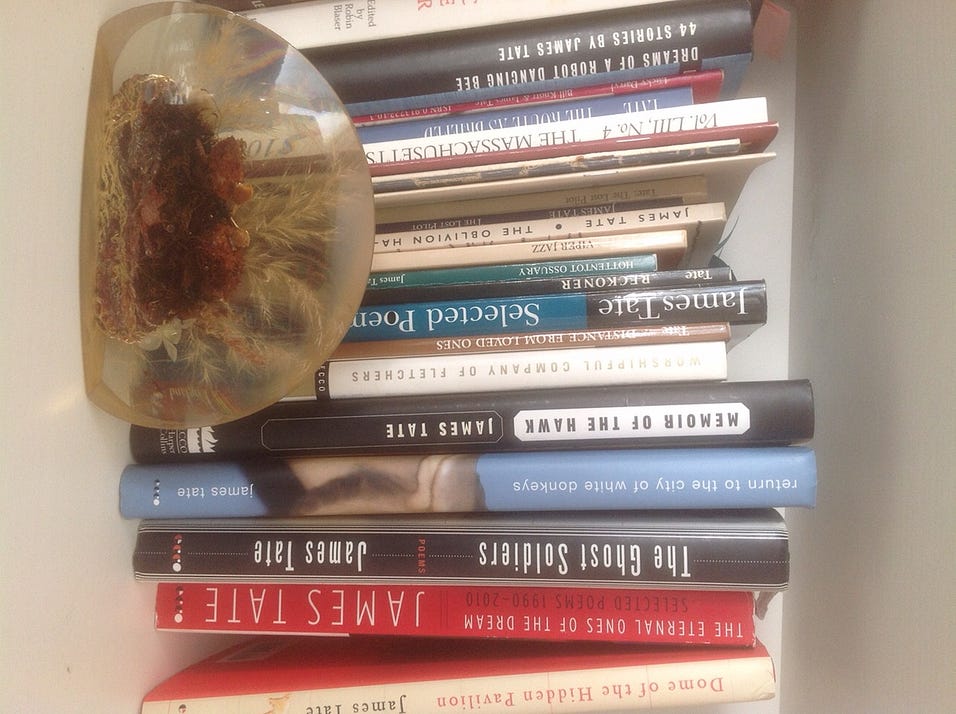
I can’t find my copy anywhere of maybe my favorite of his books, Shroud of the Gnome. Maybe I lent it to someone, a student. If so I hope they are reading it. Memoir of the Hawk has one of my favorites of Jim’s poems, the first one I read after I found out he had passed away, “Rapture,” with its blue antelopes. Return to the City of White Donkeys, The Ghost Soldiers, and the second volume of his selected poems, The Eternal Ones of the Dream, are right next to me too. And yesterday in the mail I just received his final volume, Dome of the Hidden Pavilion (no one will ever write better book titles). I just read the last poem in the book, “Plastic Story.” In it, he wrangles with a piece of plastic, tries to push it under a chair, because “Some things are not worth contemplating.” Eventually he goes to sleep and imagines he’s being strangled, and then discovers he is. “A piece of plastic had grabbed my throat and was strangling me./ I fought with all my might, but it was too late. I had never/ done a thing to hurt that plastic.” I can hear Jim saying it, like he’s here in the room. It’s not online, you’ll have to get the book to read it. Please do. And then get all his other books and read them too. You’ll be so happy and sad and grateful, like I am now.
James Tate is one of the greatest originals that American poetry has ever produced. Upon learning of his passing, my heart has remained full and sad because I know that for many in Amherst, and throughout this country, his family, many friends, as well as a massive network of former students throughout the years of his legendary teaching, he was their one true genie. He was also, it bears emphasizing, one hell of a sweet man.
Because Tate’s career was so long and prolific, so inexhaustibly inventive and imaginative, there will be many books to revisit and favorite poems to remember. For me, it will be the prose poetry of the last two decades, in particular Ghost Soldiers, where I felt he entered (and perfected) a zone of literary space only James Tate ever, and ever will have, entered. Not that his work is without its familiars — especially the wacky flash-sized prose worlds of Borges and Kafka.
As a creative writing teacher these last five years, I remind myself now and then of something David Foster Wallace once said on Charlie Rose’s program. That teachers — perhaps he meant especially writer/teachers, just like himself? — tend to burn out after a few years. Many an adjunct knows firsthand that the temptation to repeat sometimes overwhelms the desire to improvise. Yet there’s also a special kind of wisdom that only comes once you’ve taught certain texts for ten or twelve semesters straight, as I’ve done with but a few trusty authors in my classes of introductory creative writing. One of these wisdoms I cherish is that no matter the classroom, the university, the pedigree or limited interests of my students, I can — and have! — always relied on a packet of Tate’s prose poems early on in the semester to energize and awaken young writers to the joy of reading. This is, I suppose, because writing, whatever else it may be primally tied to, is about freedom. Freedom from obvious and bad choices; freedom to make new and surprising ones; freedom to reproduce reality, your own private world or the big unknowable one as you see it around you. And of course, writing is also about freedom to let things fuck up, spoil, break in half, collide and mutate. When I read “The Cowboy” or “Uneasy About the Sounds of Some Night-Wandering Animal,” that’s what I’m continually reminded about, the harrowing fertility of Tate’s genius.
So yeah that’s what James Tate means to me as a writer, reader, teacher. FREEDOM. It’s a word he would snicker at, I imagine, rightfully, since no poet demonstrated better than him how hollow and macabre our national pride is/was, its charming and combustible myths. He also captured our persistent small town paranoia, Main Street’s wry hubbub, workplace as absurdist purgatory. But the poems, like him, had a sweetness of spirit that always carried us through, you know, straight on through to the next lovable and treacherous bend in the road.
A few years ago, I did an interview with Jim that yielded a 20-plus-page document, which remains unpublished. From it:
Did you ever wonder to yourself, where did this all brilliant, mad poetry come from? Maybe someone far back in your family tree had a way with words, too?
James Tate: No, no, absolutely not. Nobody. I can almost remember when it clicked in my head. I was 17 at the time and I just left a very rich high school in which I was part of a pretty large gang, as we called ourselves. It was very social and fun; you know, drinking beer and carrying on at all hours of the night every night or just about every night. Then I went to college and this was a really shitty little college, it was nothing, but still, I don’t really know where it came from. I can remember sitting there at the table in the library with the advisor and he said, “What’s your major?” And I said, “Hmm. I don’t know. What’s my major? Geology,” I said. I did, I swear, I said geology. So that’s what he put down and that’s what I was listed as. Then about, I guess it was one month into my freshman year, everything went crazy in my head, and I just don’t know where it came from. I’m not maybe thinking clearly right now, but I really don’t know. It really wasn’t a teacher or any fellow students. I just suddenly said, “I want to be a poet and I want to be a poet for a life.” Of course, I had no idea what that meant. I mean, I thought it meant, literally, quite literally, I can remember thinking this, I thought it meant sitting up all night outside around the campfire and reciting your poems to other bums. That’s what I thought my life was going to be. I mean, I didn’t know anything about living poets or anything like that. I just was wildly in love with poetry and I don’t even remember what the first poem could have been. Whitman? I know, thanks to a good freshman teacher who gave me a paperback copy of the Selected Poems of Wallace Stevens, I know that was hugely important. But one thing led to another, I was instantly reading William Carlos Williams and Emily Dickinson. And I read a lot of foreign poets. Yes, yes. I mean, you know, the obvious things like Rilke and Rimbaud and Baudelaire and stuff like that. But I don’t think I really read living poets until I got to Iowa as a graduate student and then I went insane. I mean, I devoured everything the bookstore could offer in a couple months. I was just insane. During my undergraduate period I was very isolated. And then when I became a graduate student, the world just blew open like crazy. It went from I was going to be a vagabond to, ah, I’d like to publish something. I won the Yale award about five months later.
Close
×
Angela Ball
James Tate was a true eccentric — that is, someone outside the realm of the usual, by virtue not of affectation but imagination. J.D. McClatchy has said that his work demonstrates “the surrealism of everyday life” — I can’t agree more. His poetry is weird in its connection with fate and splendid in its connection to the ideal.
I first saw James Tate in 1972, when I was an undergraduate at Ohio University. Three young poets read together that night: Jon Anderson, William Matthews, and James Tate. I remember them being on stage all together. Tate read the very affecting “The Lost Pilot” and the hilarious “The Distant Orgasm.” I believe he also read “The Buddhists Have the Field.”
I was lucky enough to be in London one summer in the nineties when John Ashbery and James Tate read together at the South Bank Arts Centre. Afterwards, I complimented Tate on his reading style. “I didn’t know I had a style,” he said.
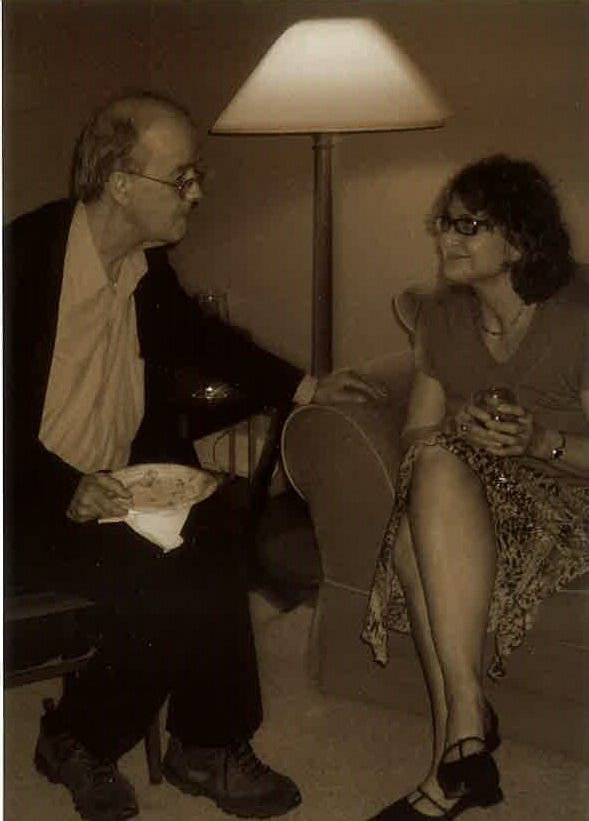
James Tate and Dara Wier visited the Center for Writers in 2006, only a few months after Katrina. Wier is a native of Louisiana. We ate together at Arnaud’s and had a lovely time, though the city was still stunned from the horrors of the manmade flood. In Hattiesburg we ate at Leatha’s, a wonderful barbeque joint housed in a doublewide trailer. The mayor of the city was also having lunch there. This could have happened in a James Tate poem. The reading given by James and Dara was extraordinary, with Dara’s and James’s work conversing back and forth, trading the ineluctable and the ordinary, the down-home and the far-fetched. The reception was at my house, and a picture was taken of James and me in earnest conversation. I imagine us talking of poetry, dogs, and pie.
Close
×
Tyler Mills
Though I never met him, James Tate influenced me a great deal during my MFA. In my last year of the program, I submitted a poem to a contest he was judging (the Third Coast Poetry Prize). I was totally shocked that it won, and I was on cloud nine when I realized that he was actually going to write something about it. He wrote, “The bats, in the end, are what one expects least, and yet they seem to bring the whole poem together” — which, to me, seemed like something I would dream James Tate would write about a poem that was doing what I wanted it to. Hearing this from him confirmed that wild leaps and play with image could work, that one doesn’t always have to close a poem with some kind of return. I wrote him a fan letter to thank him and spent the summer reading and re-reading The Ghost Soldiers. I’m very sad about his passing. The world of poetry still needs him.
Close
×
Contributors
Angela Ball is a professor at the University of Southern Mississippi’s Center for Writers. Her most recent collection is Night Clerk at the Hotel of Both Worlds.
Sarah Blake is the author of Mr. West, an unauthorized lyric biography of superstar Kanye West, out now from Wesleyan University Press.
Eduardo C. Corral is the author of Slow Lightning, winner of the Yale Younger Poets Prize.
Adam Fitzgerald is the author of The Late Parade (Liveright, 2013).
Brian Henry’s tenth book of poetry, Static & Snow, is forthcoming from Black Ocean.
Winner of the Yale Series of Younger Poets competition, Fady Joudah is a Palestinian American physician, poet, and translator. His most recent books are Alight and Textu, both published by Copper Canyon in 2013.
Dorothea Lasky is the author of four books of poetry and teaches at Columbia University’s School of the Arts.
Gail Mazur’s 6th collection of poetry is Figures in a Landscape. She is Senior Distinguished Writer in Residence at Emerson College and Founding Director of the Blacksmith House Poetry Series.
Three-time Pushcart prize winner Jill McDonough directs UMass-Boston’s MFA program and 24PearlStreet, the Fine Arts Work Center online. Her books include Habeas Corpus and Where You Live; Alice James will publish Reaper in 2017.
Tyler Mills is the author of the poetry collection Tongue Lyre. She is an assistant professor at New Mexico Highlands University.
Amy Newman is the author of five books, most recently Dear Editor (2011) and On This Day in Poetry History (forthcoming in 2015).
Joe Pan’s newest collection of poetry, Hiccups, is forthcoming from Augury Books in October 2015.
Matthew Zapruder lives in Oakland, CA., where he is Editor at Large at Wave Books, and teaches in the MFA at Saint Mary’s College. With special thanks to Rebecca Morgan Frank and Lana Lingbo Li. We are indebted to James Tate’s publishers: Ecco Press; Wesleyan University Press; Little, Brown & Co.; Halty Ferguson; and Yale University Press.
“Have you ever had real glow?” asks Raf, the 22-year-old male protagonist in Ned Beauman’s novel Glow. The title refers to a new party drug permeating London’s underground rave scene, an arrival that suspiciously coincides with a shortage of ecstasy in the city. Haunting the characters throughout Glow is the idea that nothing in their world is mere coincidence.
For example: Raf asks the above question to a young woman named Cherish, the morning after he rescues her from a group of masked men pulling her into a white van. Cherish only appears in Raf’s periphery because they had met the previous week — at a rave in a launderette — and Raf only recognizes the scene’s imminent danger because his friend Theo had been abducted in precisely the same way.
Page-by-page, such strange associations begin to pile up, infiltrating the world of South London. Even before these string of events, conspiracy colors Raf’s perception, invoking suspicion into otherwise mundane observations. In one early scene, he muses that a discarded pile of mattresses might be “the waste product of some secret industrial process.” When his life finally does intersect with “real” conspiracy, he barely hesitates before plunging deeper into the mystery.
Raf and his best friend, Isaac, search through online forums and chat rooms, buried news reports and company websites, noting suspicious names and charting the locations of different people on particular dates. Cherish gradually evolves from an innocent bystander, into an oddly useful source of relevant information, and eventually into a leading suspect in their investigation.
“The world is spinning and meshing all around [us],” she tells Raf, when asked about her enigmatic childhood in a small mining town near Burma. “Even the canniest adult has to accept that for every three parts of the machinery [he or she] has learned to follow there are seven or eight farther back that she’ll never even glimpse.”
Raf and Isaac avoid involving the police, partly to protect their own illegal activities (recreational drugs and a pirate radio station called Myth FM), but mostly because the clues they uncover hint at wide-reaching corruptions that not even legal apparatuses would be capable of correcting. Global corporations appear to be tapping into illegal markets and enslaving migrant workers in an effort to bolster profit margins. Intelligence-based startups are building Big Brother-like surveillance networks and selling that power back to governments and big business.
Despite his introverted background as a suburban-raised, college dropout, EDM-obsessed freelancer, Raf proves unusually adept at tracking down suspects and converting them into valuable accomplices. For individuals so attuned to the world’s darker forces, they are surprisingly keen on confiding in strangers. Backstories are bundled up into dense flashback sequences and dropped into the narrative upon each new encounter.
“I hoped you might be candid but I never expected you to be this candid,” one character says after enduring such a monologue.
The overall plot operates at the speed and logic of a rather conventional thriller, leaning on witty and self-aware one-liners to pardon the implausibility of too many sequences. The rapid shifts in tone, the procedural pacing of the investigation, and the numerous contrived “a-ha” moments at times resemble an episode of Law & Order SVU, where the stark transitions between scenes are underscored by that ominous, slightly cartoonish, “thump thump” refrain.
Rarely do Raf’s complicated stealth efforts encounter any serious logistical hiccups. Even in the harrowing moments that follow life-or-death confrontations, neither he nor any of his partners experience a nervous breakdown or true emotional reckoning. In one scene, seconds after watching a bootleg video of five foxes brutally attacking a group of men, Isaac jokes, “we should send this to Animals Do The Funniest Things.”
Psychological complexity is injected into the narrative through the characters’ eccentric and intensely technical mindsets. Raf suffers from an obscure chronic condition known as “non-24-hour sleep/wake syndrome,” and is obsessed with the various tempos of life and objects around him (including flowers, Muslim prayer times, and Maneki Neko cats). His friends and acquaintances, steeped in the world of recreational drugs — both supply-side and demand-side — cling to chemistry’s objective logic in order to make sense of their experiences. Minutes after a bout of physical intimacy, Cherish takes a swig of Raf’s cheap supermarket vodka, explaining that “if [she] drinks something neurotoxic right after [they] fuck, [she] won’t bond with [him] so much.”
Glimpses into these peculiar interior worlds illuminate the many invisible yet essential waves and frequencies on which the outside world operates: solar cycles, circadian rhythms, chemical reactions, light and radio wavelengths, the social rhythms of spiritual adherence, the flow of capital. “It seemed like a dip in the bandwidth of reality itself,” Raf says about one of his adventure’s more absurd chapters, providing a fair description for the book itself.
Glow’s corrupted reality is the grim result of technological capabilities and economic motives gone haywire. Weaved into the narrative are astute observations about the unrestrained capitalist engine, which is designed to exploit any and every arbitrage opportunity, regardless of moral considerations: “There is money to be made selling the same product at different prices to different ethnic groups according to their willingness to pay.”
In a culture born of paranoia, each person guards his or her own theory about how different parts of the world actually operate. Throughout his personal investigation, Raf uncovers a few layers of the conspiratorial forces at play, but many questions and shady characters remain lurking in the shadows. Hotly anticipated conflicts barely surface, their climactic action repressed back into an underground state, lying dormant until enough momentum is gained for another fresh upheaval.
By the book’s closing pages, the lines between “real” and “fake,” physical and virtual, nation and corporation, have all blurred so thoroughly, even the conspiracy’s central characters seem perplexed about the actual state of affairs, and what exactly has transpired. Dozens of pills later, Raf still hasn’t tried a taste of “real” glow, which grows ever more popular across the party capitals of Europe. He and Isaac continue swapping ideas and stories, speculating about what new developments might be mobilizing behind the scenes. Heeding the words of Cherish, they remain convinced there is something else going on, unseen parts spinning and meshing, somewhere farther back in the machinery.
Like a mythical quest to defeat an unvanquishable monster, many have tried to tackle the meaning of science fiction and fantasy. For our trouble we often end up scratching our heads, starting over, or desperately trying to come up with new terms to help understand why our culture seems to need science fiction. But sometimes the reminder of the importance of sci-fi isn’t found in texts which attempt to explain it, but rather in a work of pure passion itself.
Cuba has produced an author capable of understanding science fiction by writing it like it’s rock and roll. Yoss is a thoughtful author who simply seems to understand his work and science fiction better than many of us. We were lucky enough to score an interview with him, in which he talks about his first science fiction novel released in English, A Planet for Rent(Restless Books). In the following, Yoss covers everything from his influences, to his background as a member of a metal band, to why sci-fi is so necessary in all of our lives…
Ryan Britt: A Planet for Rent is very heavy on allegory, metaphor, and analogy. Is science fiction the best way to communicate “real world” issues?
Yoss: I like to say that Sci-Fi is a mirror we place in the future to understand our present better, and that this reflection is better than if we looked at our present directly. Actually, when we write stories about 24th-century characters facing problems that currently appear fantastical, these characters are often our contemporaries, fighting everyday dilemmas in disguise.
…Sci-Fi then becomes a code, not only to evade censorship, but also to try looking beyond the everyday.
In Cuba, on the other hand, it is normal that if one deals directly with the most critical points of the “real world,” the official response will be, in fact, intolerant: If one does not draw an optimistic panorama, one will be accused of being a defeatist, of siding with the enemy, etc. So Sci-Fi then becomes a code, not only to evade censorship, but also to try looking beyond the everyday. For example, writing about a future Cuba becoming the 51st state of the U.S. could now appear totally absurd (perhaps not so much after 12/17/2014) but dissecting that possible country could make us consider, much more carefully, the pros and cons of present politics. Of course, the politicians that decide Cuba’s destiny don’t read Sci-Fi — they prefer to make it come true. But is Sci-Fi their favorite genre? Or is it terror, which they love to nurture?
Britt: You’ve got alien art curators who “help out” human artists towards the end of the book. Are real artistic curators (editors, band managers, bookers, etc.) similarly alien to real artists?
Yoss: I think that the metalized xenoid manager Tutambiénbruto or Ettubrute, who appears in the story, “The Performance of Death,” later changes a lot to become nearly the protagonist of the last story, “The Platinum Card,” in which he becomes, one could wonder, more human? He practically represents the two sides of all the foreign curators, managers and marchands (above all Europeans) who flocked to the Cuban art scene in the ’90s: everyone from those who wanted profits and only profits, to those who became so emotionally invested that they surprised themselves. Some even got to understand life, how artists think, and that says a lot about the phrase, “the first rule to make money from art is not to understand it.” In general, most patrons and curators respect and praise artists, because they live off them… and at the same time they despise them, thinking that artists are people who don’t have their feet on the ground entirely, which is but a reflection of their secret envy. Personally, I suspect that many would give all the money they make off those creative madmen in order to have the ability to create like they do, even if it was for a brief moment. And I tried exploring that point of view in my novel.
Britt: How does your musical background [heavy metal] influence your writing?
Yoss: First of all, I want to clarify that I do not have a background in classical music, which I regret. I don’t have good pitch, nor can I read musical notation; I even have trouble telling C apart from D. I don’t have a good voice either, like those who can travel entire scales. But singing in my band Tenaz since 2007 has been one of the great experiences of my life. As every teenager who is a fan of heavy metal, I dreamed of doing it… and even though I was already 38 when they asked me to become their singer, I think it’s never too late to chase your dream, right? I’ve loved heavy metal since I was 11 because of its mix of symphonic sophistication and pure street energy… and I have also learned to appreciate the immediacy of the feedback you get onstage: when you write, you often have to wait months and even years to know what the public thinks of your creative effort. By contrast, with music that lapse is much shorter, almost immediate: You only need to play a song once to know if people like it or not.
I also have to highlight the importance of collaboration; in Tenaz, we all compose. The synergy is almost magical: Lesther, the guitar player, comes up with a riff, and then Aramis, the drummer and bandleader, plays a beat, Gaby the bass player joins the rhythm and suggests a couple of variations, and then I’m already writing the lyrics. Of course, sometimes I arrive with lyrics and an outline of the melody, or Aramis comes up with the lyrics and the basic rhythm… but finding the point in which we are all satisfied, not clinging to the absolute truth of your original version, is a true learning experience. In fact, many times during my writing career I have tried writing in tandem with other authors… and it is something similar: it requires patience, not boxing oneself in one’s own style, and trying new things. To sum it up, it’s something quite difficult, in general… but since 2007 I sincerely find it a bit easier.
Britt: In the novel, you give groups of optimistic science fiction writers a name- “futurologists.” Do you think there’s a place for optimistic science fiction in today’s world? Has there ever been? Would you describe this novel as optimistic?
Yoss: In every time period there must be a place for optimism. If we are here today, if the 21st century civilization still exists, even though it appeared that it would disappear during the 20th century because of nuclear war, overpopulation or environmental contamination… if we survived the terrible tensions of the Cold War without our world ending in an atomic holocaust, why not be a little optimistic? Things are never so good that they can’t get better.
Nor so bad that they can’t get worse. Because, objectively, many of the problems I just mentioned are still reasons to worry right now. If we add up global warming, terrorism, plagues, and total energy collapse if we run out of oil before discovering other energy sources, it nearly makes me want to go screaming that the Apocalypse is coming. Tomorrow.
It is true that Sci-Fi writers are often accused of these sinister predictions, of blowing up the planet once a week in our writings. But people forget that the genre’s function is to warn. Raising awareness of creating a system of anti-asteroid missiles so that we don’t end up like the dinosaurs 65 million years ago, for example. Or talking to the World Health Organization so that SARS, AIDS, or Ebola don’t become the pandemics that make humans an extinct species.
Of course, Cuban authors and readers, as well as all the citizens of the socialist world, so depleted since the ’90s, remember well the time in which, as a side effect of social realism, the Sci-Fi we were encouraged to write was methodically optimistic: Capitalism was about to fall in a definitive crisis, the world would be completely communist in a couple of decades, and if we bumped into another intelligent species they would be pacific and not a race of galactic conquerors whose only interest in humans would be the interest of a farmer in his livestock. Very pretty.
But, as you can see, what eventually disappeared was socialism, and Fermi’s paradox still holds true: if there are others out there, why don’t they answer back? It’s not about a lack of room for optimism, but like I just said (If I were religious I could very well believe that gods love humanity very much, given that despite all our stupidities we are still here), when this becomes, ideologically, the only option for representing the future, these futures turn false. And writers of these don’t believe much in them, nor do their readers.
That’s why A Planet for Rent has a load of pessimistic baggage: after our leaders promised us development for decades, the USSR fell, and it all ended up being a lie. But we were not even allowed to say that: so while the government opened up the country’s doors for foreign tourism… and while our women opened their legs to these tourists in order to survive, there was still talk about the inevitable victory of socialism, and of redundant values while we all looked desperately for dollars. The ’90s were all about hypocrisy being the government’s policy. In my novel the xenoids, owners of the Earth, always claim they are humanity’s friends, and hide the fact that they are its masters.
…leaders and their dictators, their paranoid repressions and their stupid policies fade away, but the people always remain.
However, Cuba survived the “Special Period” after all, and without giving up socialism… even if this happened by perverting all the socialist values we had been spoon fed before the ’90s. A very high price. So at the end of my novel, the last story, “The Platinum Card,” has a message that is optimistic for me, an homage to the Cuban people: You can betray us, you can lie to us, you can repress us, force us to emigrate, to sell ourselves… but we are here and we will still be here. Because no government is stronger than its people; leaders and their dictators, their paranoid repressions and their stupid policies fade away, but the people always remain. Maybe they remain only to suffer new repressions and dictatorships… but they remain, and that’s the important part.
Britt: Friga was an interesting character; you made someone who was tough and happened to be a woman into a sympathetic and formidable character. It doesn’t seem like it, but do you have challenges as a man writing female characters?
Yoss: Gustave Flaubert once rightly said: “Madame Bovary is myself.” Like him, I firmly believe that one of the main appeals of literary creation is that an author can get under the skin of many characters, become a woman, if he is a man, or a man, if she is a woman. And no one questions your sexual identity because of that… not even in a country as male-dominated and Leninist as Cuba.
Personally, I like developing female characters a lot, because beginning with genetics and ending with the different education that both sexes receive, men and women are so different from one another that, despite the current premium on gender equality, one could say that they are two separate species. But also important: one is not better than the other. And also, full of exceptions: feminists and male chauvinists forgive me if you can, but I don’t think that a man, for being a man, has to be physically stronger than all women, or that women have to be shy and prudish for having ovaries instead of testicles. All of us are, above all else, individuals.
Friga, enormous, physically powerful, resolute, a natural leader, is what many would call a tomboy… without leaving aside the fact that she is still a woman. As a contrasting character, Jowe is a sweet man with lots of femininity.
Of course, I am Friga… but also Jowe. And both are influenced by many men and many women whom I know or have known, in life as much as in literature, because literary feedback also helps in character development. The same as in watching films or even paintings.
By the way, I got the idea of Friga’s body while reading a magazine called Musclemag, in which a female bodybuilder (I think it was Kim Chizevsky) was dressed in street clothes instead of her competition bikini. And she looked so glorious and strange. I imagined how the everyday life of a woman of that build would look like, and from there I developed the character, with a lot of the inner strength of some women I’ve known, without so much muscle to back her up.
Britt: Who was the hardest character in this book to write?
Yoss: I hope I don’t sound careless if I say that all characters… all characters were easy. The prostitute in “Social Worker,” the player in “The Winning Team,” and the artist in “The Performance of Death” all came out in a stroke of the pen, as they say. So probably the character that was hardest to write was either the corrupt policeman of Planetary Security in “The Rules of the Game,” or the marginal little girl in “The Platinum Card.” Those two demanded a little bit more time to profile their personalities. Above all because I don’t know any corrupt cops (although I have known many players, prostitutes and scientists) and I had stopped being a kid some years ago.
Britt: What’s your favorite section of this novel?
Yoss: Once again, I would stick with two: “Escape Tunnel” and “Fitness Interview.” Those are the two stories in which I focused more on the style: one-phrase paragraphs in the former and the exchange of questions and answers in the latter. But I think that “Escape Tunnel” ended up being the best. Out of the seven endings in the book, that one is my favorite. Optimism despite disaster, triumph in defeat, not giving up on your dreams; a total statement of values.
Britt: Which (if any) English-language science fiction writers influenced you?
Yoss: Oh, there are many. Great Sci-Fi has many splendid figures in English and I am an ardent reader. I can mention my beloved Alfred Bester and Roger Zelazny, but also Philip José Farmer, Brian Aldiss, Ursula K. LeGuin, Dan Simmons and Joanna Rush. Without forgetting Orson Scott Card, Robert Heinlein and John T. Sladek. All those Sci-Fi authors.
Outside of the fantastical realm I can mention, of course, the legendary Ernest Hemingway, Aldous Huxley, Thomas Pynchon, John Updike, E.L. Doctorow and William Saroyan, nowadays unjustly forgotten.
I read a lot of Anglo-Saxon literature, most of it translated, I confess, but now more often in its original language. I think they are the masters of the short story, without a doubt. In any genre.
Britt: What was your first exposure to science fiction?
…this book lied, but… it was such an attractive lie!
Yoss: Ah, it was unforgettable: I was about five years old (I learned to read on my own when I was two, looking over my father’s shoulder as he read The Day of the Jackal, by Frederick Forsyth) when a neighbor lent me From the Earth to the Moon, by Jules Verne. I devoured it in a single stretch, in two days, and this despite it being a thick book, because the Cuban edition also included Around the Moon, the follow-up novel. It was the discovery of a new world: I already knew that we had reached the Moon by rocket, so this book lied, but… it was such an attractive lie! Not what had actually happened, but what it could have been. I started looking for other Verne novels, and my favorites were 20,000 Leagues Under the Sea, Facing the Flag, Master of the World… the ones that were the most in the Sci-Fi realm. Even the others that dealt with trips to the little known areas of the globe (little known in that time, of course) fascinated me because of their sense of wonder, even though I knew that the land there wasn’t uninhabitable anymore. Afterwards, I discovered that there were other novels and stories that talked about other worlds, of that final frontier that, since Star Trek, is and will always be outer space. I read a lot of Soviet Sci-Fi, the small amount of English-language novels that had been published in Cuba then (and this is not to say that many more have been published since, but now at least one can get many translations of the classics online, pirated, of course) and I had the good luck of having a neighbor, Arnoldo Aguila, who had some books of the Nova collection from Editorial Bruguera, with a prologue by Carlo Fabretti, and he lent them to me… it made me discover an infinite world, in time and space. So when I was fifteen I had already made up my mind: I would become a writer, and until I learned typing, I spent hours scrabbling with my horrible handwriting in thick booklets, trying to see if I could write stories like all those I liked to read so much… it was hard at first, but soon I learned that playing the demiurge and creating new worlds was even more fascinating than entering the worlds created by others. And I keep doing that till now…
Britt: Do you think science fiction writers have more of a responsibility or less of a responsibility than other “kinds” of writers to infuse activism into their writing?
Yoss: I suppose that answering in the affirmative would be something like putting more coal in my fire, trying to legitimize or privilege the genre I cultivate.
All literature has a great responsibility to its readers and its time. But Sci-Fi, to be honest, has a responsibility that goes beyond: a compromise with the future. This is not about Sci-Fi predicting the future, which many have done countless times to justify the entire genre, listing with notorious ingenuity the forecasts and gadgets it has gotten right. This is about the duty to show humankind the consequences that its own actions can have tomorrow. Of reminding us that we are not the masters of the Earth, because we only have it on a loan from our parents and must give it back to our children. And if possible, not merely intact, but improved.
Sci-Fi reminds us of something we like to forget: we are here because our ancestors thought a little about us. Because they believed that the human race was a concept that went beyond the nation state, and even beyond one’s generation. Or we are here despite they tried to think that only the present mattered, paying with their selfishness. Let’s not repeat their mistake! Let’s not transfer that debt to our descendants!
And dreams are not only an essential element to defy reality, but also the raw material with which to change it.
Also, many traditional critics without imagination, or lacking a basic knowledge of technology, bohemians but not geeks, before recognizing the literary or philosophical merits of Sci-Fi, prefer to label it as “escapist literature.” But who, besides jailers, could possibly care about escapism? Sci-Fi is about dreams filtered through logic. And dreams are not only an essential element to defy reality, but also the raw material with which to change it. That is the genre’s great responsibility.
Britt: Do other members of your band [Tenaz] read your books?
Yoss: Ha, I’d like to say yes… it would look nice in the interview without a doubt. But why fool myself? No, I don’t think they’ve read much of what I’ve written, even though in Cuba more than twenty books of mine have been published, among them novels, story collections, anthologies, works of scientific promotion and essay compilations. I’m not going to generalize and say that rock musicians do not usually read Sci-Fi… because, as every generalization, it is false: I have heartfelt admiration for how David Bowie, Brian May, Bruce Dickinson, Mick Jagger (who acted in the film Freejack), Steve Tyler and many others love the genre. But also: as a writer, I nearly always have the last say with regards to the lyrics of our songs… And not only mine. Something is something, right?
Britt: What are you working on now?
Yoss: I usually write many books at a time, and right now it’s not an exception. I’m finishing a work of popular science, 100 Question About Weapons, for a youth audience. I’m halfway done with a story-novel or fix-up (I like this format a lot, the same one I used in A Planet for Rent) of heroic fantasy, titled The Forgotten Names. Of the thirteen stories the book must have, I’ve already written eight, and from what I’ve heard in the literary workshop Espacio Abierto, in which I participate and assist regularly every other Sunday, it is turning up pretty well. I’m also revising a trilogy of heroic fantasy, Rain in the City of Salt… an ambitious project that I began more than twenty years ago, in 1993, although, of course, I haven’t been writing intermittently all this time, because if I had it would be longer than the Mahabharata by now. And I’m beginning to outline the first sheets of a short Sci-Fi novel, a space opera with the backdrop of a war that right now has the title of Wolves and Calves… I hope to send it next year to the La Edad de Oro prize, the only Cuban Sci-Fi award I have yet to win. And because the page limit is 110, I will have to restrain my hand quite a bit, like I did for many years when I would send, each summer, works to the UPC prize in Barcelona, until I won it in 2010 with Super Extra Grande, which will soon appear in the U.S. with Restless Books, in English and in a digital version.
This interview was made possible by a translation from English to Spanish and back again, courtesy of Restless Books.
Anthony Tognazzini’s short story “Neighbors” can be found in the newest issue of Recommended Reading. Tognazzini was kind enough to answer some questions about his writing process in the interview below.
Katie Barasch:“Neighbors” is written from the rarer ‘first-person plural’ perspective, which is often difficult to accomplish as successfully as you have here. I can’t imagine the story being told any other way. Did you always intend for “Neighbors” to be narrated from a collective ‘we’, or did this particular perspective reveal itself during a later revision? Are there specific characteristics of fiction that you believe operate best in first-person plural? Additionally, are there other stories or novels told in the collective voice that inspired you?
Anthony Tognazzini: The earliest draft of this story was written in 3rd person omniscient. It described the home life of a strong-willed single woman, and the tone was distant and weirdly evaluative. In subsequent drafts I tried to discover who was making those evaluations, and that’s when I settled on the idea of the town as narrator. The story began to see with the eyes of the town, to think with its collective mind, and the first person plural became a way to explore groupthink. The change in point of view also changed the main character from Sheila to the town. If the story’s working right, it’s the warped psychology of the town that’s put under the microscope, even as the town scrutinizes Sheila as if through a microscope.
The first person plural perspective only came to me after half the story was built, so that voice, or a specific example thereof, didn’t spark the process. But there are great examples of the point of view. I love The Virgin Suicides, for instance.
Barasch: There’s a wonderfully wrought, pervasive sense of dread and unrest in “Neighbors,” often humorously conveyed. I can’t help but pick up on themes such as surveillance in our modern age, as well as conformist vs. nonconformist tendencies. Was this story perhaps influenced by a particular concept or event? How was it initially conceived? To what extent do you consider this a feminist story?
Tognazzini: The story wasn’t influenced by a specific event, but I think it registers a range of fucked-up currents in our culture. Violations of civil liberties, serial rape, abuse of police power, racial hate crimes, the way that these practices have been institutionalized and affirmed. Recent news has been full of horrible, specific examples of each, and events, like Ferguson, that are still on everyone’s mind.
The dynamic in these events seems to involve someone in a position of social privilege — economic, racial, or gendered — trying to contain and control that which is different or perceived as threatening. The practice of profiling or “othering” recurs. When the townspeople became the narrator of “Neighbors,” it was immediately clear that they were speaking from this privileged, othering position, and also that they were afraid, so I tried to explore what that was about.
It’s a feminist story in that the thinking of the town, which includes women, is strictly patriarchal; the town expects certain behaviors, a performance of straight, subservient femininity. The townspeople are equally fascinated and repelled by Sheila’s difference. They fetishize and demonize it until the final scene when their obsession drives them to commit a violent act. It’s an act of desire, but the desire is for conquest and control.
Excuse me for interpreting my own story. I worked on it over four years, so I thought about it a lot. I believe stories should remain somewhat mysterious, and I didn’t set out to address these issues; they rose to the surface as I wrote. Agenda-driven writing is to be avoided, in my view, but we’re also living in a socio-political moment that needs the attention of every sensitive, awake individual. I considered myself apolitical when I was younger, but that’s just ignorant and foolish, especially for a writer. There’s no such thing as apolitical writing.
I’m reading Maggie Nelson’s The Argonauts right now, and it’s a patient, thoughtful call for freedom, for a plurality of social, personal, and sexual identities. Nelson votes for a world in which the binary of normative vs. transgressive is collapsed altogether. The idea is paradigm-cracking, and pushes against the resistance of most of the rest of the world. That’s a worthy uphill fight, in my view. Claudia Rankine’s Citizen has a similar effect. When books like these are published, I feel hopeful. It sustains my faith, however desperate, in the moral function of literature.
Barasch:One of the strengths of “Neighbors” is how little we know about our narrators. Readers see Sheila through this carefully constructed lens, and it’s a fascinating plot device. And yet, if you will, indulge me for a moment: how do you envision this ‘we’? Who are our narrators?
Tognazzini: They have small heads, wobbly bodies, crooked legs.
Barasch: Your bio for BOA Editions says that you’ve lived in a variety of locations including Texas, the Philippines, Spain, Germany, Indiana, the Czech Republic, and New York. How have your diverse travels affected your writing?
Tognazzini: I grew up in a military family so we moved around a lot. I’ve continued that itinerant lifestyle as an adult. Travel has changed me, and helped me see the U.S. from different perspectives, but I think its more direct effect on my writing is probably an imaginative restlessness and the use of different voices and styles.
This week, the town of Granbury in Hood County, Texas is the site of yetanothervictory for LGBT rights.
Earlier this month, dozens of Granbury residents signed challenge forms at Hood County Library, protesting the inclusion of titles that promote tolerance of the LGBT community–Cheryl Kilodavis’s My Princess Boy and Gayle E. Pitman’s This Day in June–in the children’s section. Some asked that the books be relocated to a different section; others asked that they be barred from the library.
Library Director Courtney Kincaid resisted, assenting to moving This Day in June–which focuses on a Pride parade and LGBT history to the nonfiction section, but refusing to move My Princess Boy. Said Kincaid, “The books have color drawings and have some rhymes. Lesbians and gays are in this community, and they deserve to have some items in this collection.”
And yesterday, the Hood County Commissioner’s Court declined to say differently. Following a nearly three-hour-long public meeting–at which one Hood County resident accused the library of “[hiding] their contempt for Judeo-Christian values behind the right of free speech”–the Commission chose not to vote on the issue. They cited the advice of the county attorney, who said previous cases indicated that “removing, relocating, or in any way restricting access to the books would likely constitute unlawful censorship.”
Kincaid had some advice for her thwarted neighbors: “If you don’t want your children to read these books, don’t check them out.” A reasoned response–though we’d like to compel all of the challenge form writers to take a leaf out of Pitman and Kilodavis’s books.
Pope Francis: spiritual leader, humanitarian, tango enthusiast, and now, indie press author.
An unlikely resume, perhaps, but one made possible by independent publisher, Melville House, which today acquired the rights to the Pope’s encyclical, On Care for our Common Home. The encyclical, released by Pope Francis in May, addresses climate control, with a particular focus on the consequences for poorer nations if greenhouse gas emissions are not reduced. (It also invoked the wrath of conservative pols across the nation. Quoth Rick Santorum: “leave science to the scientists.”) Though Melville House has published other institutional texts (last year’s CIA torture report was a big hit), this marks the first time that the Vatican has joined forces with a secular publisher.
Naomi Oreskes, the Harvard professor tapped to write an introduction for the book, views the encyclical as potentially momentous for global environmental policy. “Historians looking back often recognize turning points, but ordinary people living through them rarely do. Sometimes, however, a book catalyzes thought into action. Uncle Tom’s Cabin did this, and so did Rachel Carson’s Silent Spring. Like those works, Pope Francis’s Encyclical is a call to action.”
Those ready to heed the call will not have long to wait. Melville’s rush edition of the encyclical will be available August 4 — perfectly timed to anticipate the Pope’s visit to the United States this September, when he will address both houses of congress, and is expected to broach the topic of climate control.
Just after I published my first novel in Guatemala, in 2003, I had a beer with the Salvadoran writer Horacio Castellanos Moya, who was living there at the time. We met at an old bar called El Establo. As soon as he saw me walk in, he raised his bottle of beer, congratulated me, smiled a crazyman’s smile, and then warned me to leave the country as soon as possible.
* * *
My entrance into the literary world had been both unexpected and unplanned. I was thirty-two years old and had never before published anything, anywhere. Not only did I know very little about the Guatemalan literary scene, I knew even less about Guatemala in general. I had left the country in 1981 — on the day of my tenth birthday — with my parents and brother and sister, had grown up in Florida and then studied engineering in North Carolina. At school, I was always the math kid. Never read books. Never even liked them. I finally returned to Guatemala in 1993, after spending more than twelve years in the United States, to a country I barely knew anymore, and with a minimal grasp of Spanish. I started working as an engineer in my father’s construction company and slowly began finding my way back into the country, and into my mother tongue — but always marred by an extreme sense of frustration or displacement, a sense of not belonging. Today I understand that this existential angst is more or less normal at that age, right after college, but back then I felt like a man without a country, without a language, without a profession (I was, quite literally, in my father’s), without a sense of who I was or what I was supposed to do. This lasted for the next five years, and only got worse. Until I finally decided to seek help. But my definition of help, being a rational and methodical engineer, was to look for answers not in psychology or even religion, but in philosophy. I went to one of the local universities, Universidad Rafael Landívar, and asked if I could enroll in a couple of philosophy courses, thinking that maybe there I’d find some kind of answer. But in Guatemala, as in much of Latin America, it’s a joint degree: Letras y Filosofía, Literature and Philosophy. If you want to study one, you have to study the other. And so I did. Within weeks I was smitten with literature. Within a year I had quit my job as an engineer and was living off of my savings and reading fiction full time, a book every one or two days, like some sort of literature junkie.
I wanted to write a story before I could write one good sentence.
A year later I started working at the university — as an assistant, then as a professor of literature — while at the same time I shyly, and secretly, started to write my first stories. All very bad, of course, very poorly written. I wanted to write a story before I could write one good sentence. I didn’t yet understand that typing isn’t writing; that writing is much closer to music, to breathing, to walking on water. But I was hungry to learn, and I was lucky to find the right teachers, particularly two: Ernesto Loukota and Osvaldo Salazar, both philosophers and colleagues of mine at the university. Ernesto Loukota taught me the craft of language. He would ask me to write a line about something — a tree, a dog, a chair — and the following day we’d get together at the university and go over that line, its grammar and punctuation. He’d then assign me a line about something else for the next day. And so on. Only one line, every single day. Like our own daily zen ritual. It was at least a month before he allowed me to write two lines. Osvaldo Salazar taught to me be my own reader. Every so often, I’d give him something I’d written and we’d study it together, take it apart, edit not its language, but its structure, its development and themes and overall content. If Ernesto Loukota taught me the craft of language, Osvaldo Salazar taught me how to be my own most demanding reader.
I was spending my days teaching, and reading books like some kind of addict, and learning to write as if my life depended on it (maybe my life did depend on it?), and before I knew what was happening I published my first novel. Just like that. Almost by accident. I stumbled onto books, and then fell into writing. But something was finally starting to make sense, about myself, about my country. And now I was being warned by a crazy Salvadoran writer that I should leave.
* * *
For the past century, Guatemalan writers have been writing, and dying, in exile. Miguel Ángel Asturias, who received the Nobel Prize for Literature in 1967, wrote his books about Guatemala while living in exile, in South America and Europe. He died in Paris, and is buried at Père Lachaise. The great short-story writer Augusto Monterroso, after being detained by the military forces of dictator Jorge Ubico, was forced to leave the country in 1944. He fled first to Chile, then to Mexico, where he lived the rest of his life, and where he wrote most of his stories, and where he’s now buried. Luis Cardoza y Aragón, arguably Guatemala’s most important poet of the last century, suffered a similar fate — he was also forced into exile in Mexico in the 1930s, where he wrote his poetry and where he, too, died. Guatemala’s greatest playwright, Carlos Solórzano, fled the country in 1939 — first to Germany, then to Mexico — and never returned. The writer Mario Payeras, a guerrilla commander in the 1970s, also wrote while exiled in Mexico, where he suddenly and mysteriously died (his remains were buried in a cemetery in the southwest of the country, but have since vanished). One of the most important Guatemalan novels of the last few decades, El Tiempo Principia en Xibalbá (Time Commences in Xibalbá), was written by the indigenous writer Luis de Lión, who in 1984 was kidnapped by military forces, tortured during twenty days, and then disappeared. His murder wasn’t confirmed until fifteen years later, in 1999, when his name and number appeared in the now infamous “Military Diary”, a haunting military document that secretly listed the fate of all the Guatemalans disappeared by the military forces between August of 1983 and March of 1985. Luis de Lión, born José Luís de León Díaz, is number 135. His novel was published posthumously, that most extreme of exiles.
* * *
Guatemalan writers, and Guatemalans in general, have lived for almost a century now in a climate of fear. If anyone dared to speak out, they either disappeared into exile, or disappeared literally. This fear is still prevalent, woven deep into the subconscious of the Guatemalan people, who over time have been taught to be silent. To not speak out. To not say or write words that might kill you.
Certain things in Guatemala are simply not spoken or written about.
The first consequence of this, of course, is overall silence. Certain things in Guatemala are simply not spoken or written about. The indigenous genocide in the 1980s. The extreme racism. The overwhelming number of women being murdered. The impossibility of land reform and redistribution of wealth. The close ties between the government and the drug cartels. Although these are all subjects that almost define the country itself, they are only discussed and commented in whispers, or from the outside. But a second and perhaps more dangerous consequence of a culture of silence is a type of self-censorship: when speaking or writing, one mustn’t say anything that puts oneself or one’s family in peril. The censoring becomes automatic, unconscious. Because the danger is very real. Although the days of dictators are now gone, the military is still powerful, and political and military murders are all too common.
How can a journalist be a journalist, then, if his or her life is at the mercy of the articles he or she writes? How can a novelist or a poet say anything truthful about their own people, about the social inequality, about the intolerable levels of racism and poverty, if their very life hangs on the words of those novels or poems? They can’t. The journalist can’t be a journalist. The novelist can’t allow him or herself to be truthful. And the poet simply ceases to be a poet. Unless, as recent history shows, and as I was told by a Salvadoran writer, they leave.
* * *
I started being followed. Or so I thought. It was a few months after my novel came out. At first I dismissed it as a coincidence, the black sedan always parked too close to my house, constantly appearing in my rearview mirror. But after a few days, coincidence gave way to paranoia, and I started doing all the things Guatemalans do in their normal, everyday psychotic state: frequently altering my route to work, avoiding dead-end streets and dark alleys, never driving alone at night (I have a friend who even bought a mannequin, and would sit it next to her in the passenger’s seat and pretend they were having a conversation as she drove). I also remember that one morning, during that time, while I was teaching at the university, a couple of guys just stood outside the classroom, and stared in at me through the window. They looked like thugs or maybe bodyguards. I went on teaching, trying my best to ignore them in the window, and after a few minutes they left. When I finished, I made sure to walk out with my students, in a group.
Days later, I was approached.
It was at a bookstore called Sophos. I was browsing some books on the table when an elderly man came over and introduced himself. He was dressed in a coat and tie. He said he had read my novel, and talked for a few minutes about his impressions. He then shook my hand again and, still holding on to it, said it had been a pleasure to meet me, that I should take care, be careful. I asked him careful about what. He just smiled politely and went on his way. I considered it strange, but didn’t give it much thought. Maybe he was just being nice? Maybe I misinterpreted his greeting (usted cuídese, you take care)? Anyway, I had almost forgotten about it until several weeks later, when I received a phone call.
The voice on the phone said that I didn’t know him, but that he was calling as a friend, to warn me about my enemies. What enemies? I had no enemies.
It was late at night. The voice on the phone said that I didn’t know him, but that he was calling as a friend, to warn me about my enemies. What enemies? I had no enemies. I’ve never had any enemies. He ignored me and chatted on and I couldn’t understand what he was referring to. Was it something I’d written in my novel? Something I’d said in one of the recent interviews? Some critical comment about the country, or its politics, or about Guatemalans in general? I suddenly got so nervous on the phone that I almost stopped paying attention. I barely heard what followed. And I’ve now forgotten most of what the man said. But I distinctly remember three things. One, thinking that his voice sounded familiar, as if I’d heard it somewhere before. Two, the sudden mention of my parents and siblings. And three, the last words he said to me: Mejor no andar hablando demasiado. Better not go saying too much. And then he hung up.
The next day I changed my cellphone number. I even changed my provider. But I started sleeping less. I lost weight. I now left my house only when absolutely necessary. I even cancelled two radio interviews I had scheduled, giving them some excuse about my work or my health. I had no idea what was going on, what I’d done or said or written about, but something was definitely going on. Or was it? And then, late one afternoon, someone showed up at my house.
Still today, for safety reasons, I can’t give too many details. But I knew him from before. So when I opened the front door and saw him standing there, I didn’t think anything of it. I did think it was weird, though, him showing up at my house. I knew him, but only casually. I hadn’t seen him in years. And he’d never before been to my place. He smiled and shook my hand and even said he was sorry to bother me at home. But he walked in without being asked, and immediately, as he sat down on one of the sofas, took out a big black gun and placed it loudly on the living room table. I was speechless. I sat down on the other sofa, across from him. And there the gun lay in all its metallic blackness, between us. He was wearing cowboy boots and a thick vest lined with pockets, like the ones used by photographers. He made some small talk, asked if I’d seen this friend or that, and then remained silent for a few seconds, which to me seemed liked minutes, before he started to talk about Hitler. I was lost. My head was reeling. I remember feeling the sweat rolling down my back. I couldn’t keep my eyes off the gun, although I was trying my best to be discreet and not stare at it. And he just kept talking about Hitler — to me, a Jew. He said that Hitler was one of his heroes. He said that Hitler was one of the greatest of men. He said that he admired how Hitler always knew exactly how to dispose of his enemies. He said that we should all learn from Hitler. He then asked me if I understood and I managed to stutter that I did and he grabbed his gun from the table, got up, and walked silently out of my house.
About the Author
Eduardo Halfon writes only in Spanish (except when he’s asked by Electric Literature to write a piece in English). He has published twelve books of fiction, of which The Polish Boxer and Monastery have been translated into English (Bellevue Literary Press). Although he’s been living in Nebraska for the last five years, where he rehabilitates diabetic cats, this fall he’ll be writer-in-residence at Baruch College, New York.
We in town are not meddlesome, and as a rule we try not to gossip, but when someone new enters the community, we notice. It’s only natural to keep an eye out, to stay informed. We have jobs, wives, and husbands here.
Our first sighting was on Monday. She was coming out of the dry cleaner’s at a good clip, carrying a dress wrapped in plastic. She wore jeans and a black leather jacket, clothes that seemed strange to us. She got take-out from Thai Kitchen, and at the pet store bought what we assumed were tins of fancy cat food.
This woman looked different. She was tall, for one thing, with short hair and a flat, unflattering nose. Her walk was fluid, smooth, not harried and erratic like some of us in town. The way her heels clicked concrete was irksome. Even so, we offered the woman a smile, but she moved past without so much as a glance in our direction.
The police, who had stopped and questioned her as she waited for the bus, told us the woman’s name was Sheila. “Where do you live?” the police had asked. Sheila told them she lived on the outskirts of town, near the water tower. “You live alone?” the police had asked, and Sheila, in what the police informed us was a peevish tone, said yes. That Sheila chose to live alone on the outskirts seemed odd to us, when she might easily have chosen to live in town where the apartments are nicer, and where community areas encourage socializing.
We guessed that living alone in a one-bedroom apartment probably meant she was single, whereas most of us in town are married. “She might be a lesbian,” the police suggested. “Oh,” we said. The police added that Sheila got angry when they asked what she did for a living, and for how many hours a day, and when she finally told them, after repeated questioning, that she was an editor, they asked, “Which company?” and she said, “freelance.”
“Makes her own hours?” we said to each other. “Never goes to an office? Isn’t a team player?” We decided to go straight to her place of residence and investigate. The police told us we should respect Sheila’s privacy, then gave us her address. “Thanks,” we said. “Sure thing,” said the police.
That Sheila was able to afford an apartment by herself was impressive, and we wondered if she had received an inheritance or a private allowance, but we hadn’t ruled out the possibility that her job simply paid well and allowed her to be self-sufficient. These are modern times, after all, and independent women aren’t unusual, though they are unusual here in town.
The outskirts of town aren’t appealing, and we avoid them as a rule but we boarded the bus regardless and soon found ourselves milling around the sidewalk outside Sheila’s apartment. The building had five floors, and Sheila’s apartment was on the third, with front windows that were mostly blocked by trees, so we crept around to the back courtyard. We respect people’s freedom to do as they wish, but in the interest of the town’s collective wellbeing we peeked through her back window with binoculars.
We suspected she might be doing something inappropriate, something distasteful: she might be sprawled across the floor in a silk bathrobe, eating pineapple while masturbating to a lesbian fantasy. But through the binoculars we saw only a high-backed yellow armchair in which Sheila sat, fully clothed, reading. We felt relieved by this discovery, and strangely deflated.
Through the binoculars we also saw that the apartment had an eat-in kitchen, and was tastefully decorated with framed prints and objects that made her place seem fancier than any of our apartments in town. As the day wore on we noticed her apartment got excellent sun in the morning but none in the afternoon, which obstructed visibility and forced us to constantly change position in the courtyard. We climbed the trees to improve our view, but wind and the dangerous thinness of certain branches made our perches unstable, so we took the bus back to town and bought a ladder.
The ladder, it turned out, allowed us to remain concealed but to gain excellent vantage just below Sheila’s window. We saw her legs where the robe opened to reveal a caramel thigh, a sculptural ankle. We watched one foot slowly rub the other. Viewing was done in rotation: one of us stood on the top rung while the others waited below, holding the ladder in place.
We began then to study her in earnest, and record details in a log. She used a green emery board to file her nails. The tea she drank varied daily: vanilla jasmine, honey chamomile, Moroccan mint. Sometimes Sheila wore fuzzy slippers, and we wondered if this was part of some unspeakably perverted fetish.
Sheila did, in fact, have a cat: a gold tabby was curled in the armchair beside her. The presence of cats is rare enough in town, since we are dog people, plus Sheila’s cat was fat, lazy, and yawned a lot. We disliked it immediately, and recorded these feelings in the log.
With the help of the binoculars and the ladder we were able to more closely study Sheila’s face, which bore expressions that confounded us. Her mouth was full, and we sensed from the set of her jaw that she was driven by a purpose we couldn’t recognize or name. Sometimes if a thought amused her, or her tabby did something funny, she would smile, revealing bottom teeth that obviously had not been tended by a dentist. More often her face was thoughtful, preoccupied, as though she were thinking intently. We could not understand why she didn’t smile more, though we suspected it was, at least in part, because she did not have a husband and did not live in town.
The police pulled up outside Sheila’s apartment and asked us what we thought we were doing. When we told them, they offered to keep an eye on our encampment and help out any way they could. Our work began to feel important. We thought of ourselves as scientists, analyzing Sheila from a clinical distance, looking through her window as if through a microscope. We thought of ourselves as operatives, collecting intelligence for the sake of national security.
In the courtyard outside her building, we swapped ideas for alternate, healthier lives for Sheila. She might become a secretary in an office, we said, and learn to give delicate, professional handshakes. She might host Waffle Night at the rec center, and wear heels that allowed us to admire, at closer proximity, her supple calf muscles. We listed events we might invite her to — dog shows, fundraisers, parades — but could she put her past behind her?
As we set up tents in the courtyard, we talked among ourselves, assuring each other that the next day there’d be scenes with olive oil, restraints, and feathered costumes. We’re heterosexual, but we recited graphic fantasies about Sheila with another woman: their bodies smeared together, breath fogging the window, their hair a volcanic mess.
We became depressed, and complained to each other about Sheila’s behavior. “If you don’t like it, why don’t you just ignore her?” we said. “Why don’t you?” we said. We threw rocks at her building and ran.
The next morning, after rigging surveillance equipment along the window and feeding tiny microphones through lighting fixtures on snake tubes, we heard Sheila speak for the first time. Her voice was measured, confident, not grating or shrill like some of our voices in town. When Sheila spoke on the phone, she said things like, “I don’t think so,” and, “Goodbye, then,” which to us seemed odd. She also said, “Forget it,” and, “We’ll see about that.” We copied these words in the log, so we might study them later and learn.
Historically, things in our town have been harmonious. We’ve always mowed each other’s lawns, smiled incessantly, and been, by nature, cooperative. Even after Sheila arrived we helped each other on the ladder and cleared way so everyone could see, but soon we began to squabble about whose turn it was at the window, whose shift to watch the monitors. We pushed, and called each other names. “I don’t think so,” we tried saying out loud. “Forget it!”
The police escorted us back to our apartments. We struggled to stay calm, to breathe deeply on our sofas, but the next time Sheila came to town we couldn’t contain ourselves. We ran about jerkily, yelling, “She’s here! She’s here!”
She had on a sleeveless dress, blue high heels. Her black hair was cut close to her head. We were thrilled that she wasn’t behind glass, a creature in the zoo, that she was moving through our world now, one of us.
Standing in line behind her at the bank, we smelled her coconut shampoo. We followed her from the bank to the hardware store and there, in an aisle with hasps and ratchets, we approached, slowly. Her shoulder beckoned from her sleeveless dress, but we couldn’t bring ourselves to touch it. If we ever lost control and actually touched? No, we couldn’t let that happen.
We went into the street and cried. We shared Kleenex. We comforted each other because it was clear, finally, that Sheila would never move to the center of town, would never work in an office, would never marry a man. She had no intention of doing these things and her presence among us could only mean the worst. We understood that now.
Distraught, we punched each other hard, leaving welts. “I don’t think so!” we yelled, and, “Goodbye, then!”
An employee at the post office came by to inform us that a package had been delivered to Sheila’s apartment. Handguns? we wondered. Anthrax?
We took a bus to the outskirts, and scrambled up the ladder. Sheila was opening a box that contained dishtowels and cookies in Tupperware containers. We knew immediately the package was a decoy, and the real package, the one containing the materials with which Sheila intended to destroy us, was hidden in her apartment, in the closet maybe, or beneath the high-backed yellow armchair.
Clearly she was on to us, and knew she was being watched. We understood now that every move was a performance: the confident voice, the unsmiling mouth, the modesty thrown over her sexual threat like a sheet. We marveled at her genius. No outward sign of her mission, her intent to subvert, could be detected.
We stayed in the courtyard all night. We manned the surveillance feed, climbed up and down the ladder. We loved and resented her more than ever, jotting every detail in the log: mint tea, long hours at the computer, silk robe cinched tight, and beside her, purring contentedly, the fat, lazy tabby. We wanted to exterminate that cat. We wanted to dip that cat in boiling water.
We pushed each other off the chairs at the soundboard and multi-screen consoles, bitterly disappointed we’d never see bondage or leather whips now, wounds or humiliation; she was too smart for that. “Sheila,” we repeated to ourselves. “Sheila, Sheila, Sheila.”
What had to be done was clear, and we decided it would happen when she was next in town. We dismantled our equipment, and went home.
Two nights later word spread that Sheila had arrived and was outside the theater, buying a ticket to see Portrait of a Lady. We gathered in the street, astonished by her nonchalance. The police were with us, bus drivers, postal clerks. We bought tickets, followed her in, and sat three rows behind, fixated on the black outline of her hair. We hushed each other, and could barely catch our breath.
After the film, we trailed her to a bar, where she ordered a vodka martini. We ordered vodka martinis and studied her from across the room. The rim of Sheila’s cocktail glass was cloudy with lipstick prints, and by the time she set the glass on the bar, and walked through the front door toward the bus stop through the park, we were already hiding in the bushes, crouched low among the hydrangeas, sweating heavily.
Her heels clicked the concrete as she passed. Stealthily, at a distance, we followed. Leaves crunched underfoot. Sheila turned, saw us, and ran. We ran too, gaining on her.
When we reached out and grabbed, tackling her to the grass, Sheila’s face wrenched to the side, and her mouth, which we’d studied day after day like a difficult text, twitched with fear. “What do you want?” she whispered.
To our ears, her frightened voice was like a bell.
We put a hand over her mouth. We pushed our forehead into hers, pressing her against the earth. Our fingers traced cheekbones, lifted her skin, gripped her hips and throat. She tried to kick us off. A leg flailed. Teeth sank into our palm. Through shadows we saw her shoulder, the flash of her wide, dark eyes.
On the damp grass that receded toward darkness in every direction, we drew close to her ear and told her what we wanted:
We wanted her to leave town and take what she’d brought. We wanted to see her stripped bare in the circle of streetlight. We wanted fistfuls of her short, curly hair as she writhed under us, gasping. We wanted to go so deep inside that we disappeared, that we became her.
DON’T MISS OUT
Sign up for our newsletter to get submission announcements and stay on top of our best work.
YOUR INBOX IS LIT
Enjoy strange, diverting work from The Commuter on Mondays, absorbing fiction from Recommended Reading on Wednesdays, and a roundup of our best work of the week on Fridays. Personalize your subscription preferences here.