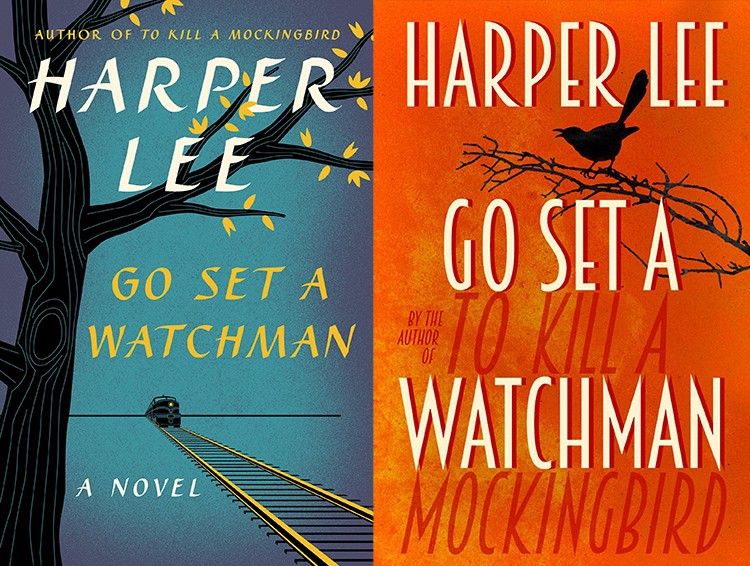
Despite a barrage of negative reviews, droves of loyal and enthusiastic readers are still purchasing Go Set a Watchman.
The New York Times reports the novel sold over 1.1 million copies in its first week; HarperCollins has 3.3 million copies currently circulating in print. And yet, it’s difficult to imagine anyone would be surprised by these large numbers. The buzz surrounding the novel’s release was louder than any other book this year. Sequels to beloved and influential novels are rarely (read: never) released 50+ years later, so novels rarely inspire this sort of large-scale media frenzy.
In the UK, The Guardian reports that Harper Lee’s Go Set a Watchman bumped E.L James’ Grey off its throne at the top of the UK book charts. Lee sold 168,455 print copies of her novel in five days, more than four times the number sold by Grey.
The LA Times explores the differences (and, somehow, the similarities) between 2015’s top-selling novels. Watchman investigates racism in the American South, while Grey focuses on erotic romance. Both novels, however, return to familiar characters while introducing new perspectives: Grey is told from Christian’s point of view, while Watchman propels Scout twenty years into the future.
I never thought those novels would appear in the same sentence. Surprises abound!
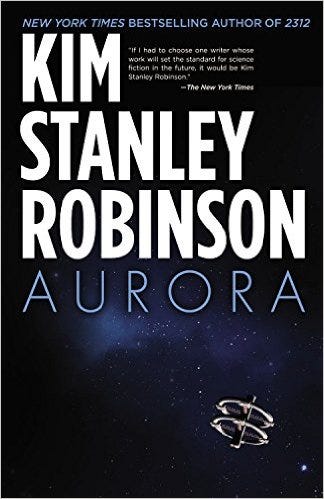
Is Kim Stanley Robinson our greatest political writer? That was the provocative question posed recently by a critic in The New Yorker. Science fiction writers rarely get that kind of serious attention, but Robinson’s visionary experiments in imagining a more just society have always been part of his fictional universe. In fact, he got his Ph.D. in English studying under the renowned Marxist theorist Fredric Jameson. The idea of utopia may seem discredited in today’s world, but not to Robinson. He believes we need more utopian thinking to create a better future.
And the future is where he takes us in his new novel Aurora. Set in the 26th century, it’s the story of a space voyage to colonize planets outside our Solar System. Robinson writes in the tradition of “hard science fiction,” using only existing or plausible technology for his interstellar journey. As much as he geeks out on the mechanics of space travel, his real interest is how people would handle a very long voyage trapped inside a starship. His futuristic themes won’t surprise longtime fans of Robinson, who’s best known for his Mars trilogy, published in the 1990s. To read KSR is to wonder how our species might survive and even thrive in the centuries ahead.
The author stopped by my radio studio before giving the keynote speech at a local science fiction conference. We talked about the existential angst of life on a starship, the future of artificial intelligence and the aesthetics of space travel. Our conversation will air on Public Radio International’s To the Best of Our Knowledge. You can subscribe to the TTBOOK podcast here.
Steve Paulson: How would you describe the story in Aurora?
Kim Stanley Robinson: It’s the story of humanity trying to go to other star systems. This may be an ancient idea, but for sure it’s a 19th century idea. The Russian space scientist Tsiolkovsky said Earth is humanity’s cradle but you’re not meant to stay in your cradle forever. This idea has been part of science fiction ever since — that humanity will spread through the stars, or at least through this galaxy.
SP: It’s a long way to travel to another star.
KSR: It is a long way. And the idea of going to the stars is getting not easier, but more difficult. So I decided to explore the difficulties. I tried to think about whether it’s really possible at all, or if we’re condemned — if you want to put it that way — to stay in this Solar System.
SP: What star are your space voyagers trying to get to?
KSR: Tau Ceti, which has often been the destination for science fiction voyagers. Ursula Le Guin’s Dispossessed takes place around Tau Ceti, and so does Isaac Asimov’s The Naked Sun. It’s about 12 light-years away. We now know it has three or four big planets the size of a small Neptune or a large Earth. They’ve got the mass of about five Earths. That’s too heavy for humans to be on, but those planets could have moons about the size of Earth. So it becomes the nearest viable target. Alpha Centauri, which is just four light-years away, only has tiny planets that are closer than Mercury is to our sun, so they won’t be habitable.
SP: Your story is set 500 years into the future. It takes a long time to get to this star.
KSR: Yes. My working principle was, what would it really be like? So no hyperspace, no warp drive, no magical thing about what isn’t really going to happen to get us there. That means sub-lightyear speeds. So I postulated that we could get spaceships going to about one-tenth the speed of light, which is extraordinarily fast. Then the problem becomes slowing down. You have to carry enough fuel to slow yourself down if you’ve accelerated to that kind of speed. The mass of the decelerant fuel will be about 90% of the weight of your ship. As you’re approaching your target, you have to get back down to the speed at which you can orbit your destination. The physics of this is a huge problem.
SP: You’re talking about a multi-generational voyage that will take a couple hundred years. That’s a fascinating idea. The people who start out will be dead by the time the starship gets there.
KSR: I guessed it would take four or five generations — say, 200 years. This is not my original idea. The multi-generational starship is an old science fiction idea started by Robert Heinlein and there may even be earlier precursors. One always finds forgotten precursors for every science fiction idea. Heinlein wrote Universe around 1940, Brian Aldiss wrote a book called Starship in 1958, and Gene Wolfe wrote a very great starship narrative in the 1990s, The Book of the Long Sun. So it’s not an original idea to me; it’s sort of a sub-genre within science fiction.
SP: But the whole idea of a project that takes generations is something we don’t do anymore. People did that when they built the pyramids in Egypt or the great cathedrals in Europe. I can’t think of a current project that will take generations to complete.
So it turned into a bit of a prison novel.
KSR: You really have to think of it as a mobile island or a vast zoo. It isn’t even a project so much as a city that you’ve shot off into space, and when the city gets to its destination, the people unpack themselves into the new place. You’re right, it could be compared to building the cathedrals. And it’s interesting to think about the people born on the starship who didn’t make the choice to be there. So it turned into a bit of a prison novel.
SP: Because you’re trapped there. You’re in this confined space for your whole life.
KSR: And for two or three generations, you’re born on the ship and you die on the ship. You’re just in between the stars. So it’s very existential. There are some wonderful thought stimulants to thinking about a starship as a closed ecology.
SP: How big is the starship in your story?
KSR: There’s something like a hundred kilometers of interior space.
SP: So this is big!
KSR: Yeah, two rings. You could imagine them as cylinders that have been linked until they make a circle, so twelve cylinders per circle. You’ve got 24 cylinders and each has a different Earth ecology in it and each one of them is about five kilometers long. It’s pretty big, but you need that much space to be viable at all because you have to take along a Noah’s Ark worth of genetic material, or else it isn’t going to work.
SP: What do you have to bring along?
KSR: You would want as much of everything as you can bring, but you certainly need a big bacterial load. You need to bring along a lot of soil. You need a lot of what would be effectively unidentified bacteria; you just need a big hunk of earth. And then all the animals that you can fit that would survive. Each one of these cylinders would be like a little zoo or aviary.
SP: As you were imagining this voyage, which part was most interesting to you? Was it the science — trying to figure out technically how we could get there? Or was it the personal dynamics of how people would get along when they’re trapped in space for so long?
KSR: I think it would be the latter. I’m an English major. The wing of science fiction that’s discussed this idea has been the physics guys, the hard SF guys. They’ve been concerned with propulsion, navigation, with slowing down, with all the things you would use physics to comprehend. But I’ve been thinking about the problem ecologically, sociologically, psychologically. These elements haven’t been fully explored and you get a new story when you explore them. It’s a rather awful story, which leads to some peculiar narrative choices.
SP: Why is it awful?
KSR: Because they’re trapped and the spaceship is a trillion times smaller than Earth’s surface. Even though it’s big, it’s small. And we didn’t evolve to live in one of these things. It’s like you spend your whole life in a Motel Six.
SP: Put that way, it does sound pretty awful.
KSR: Better than a prison, but you can’t get out. You can’t choose to do something else. I don’t think we’re meant for that even though we live in rooms all the time in modern society. I think the reason people volunteer for things like Mars One is they’re thinking, “How is that different from my ordinary life? I sit in a room in front of my laptop all day long. If I’m going to Mars, it’s more interesting.”
SP: Mars One is the project that’s trying to engineer one-way trips to Mars. You know you’re not going to come back. Frankly, it sounds like a suicide mission, and yet tens of thousands of people have signed up for this mission.
KSR: Yes, but they’ve made a category error. Their imaginations have not managed to catch up to the situation. They are in some kind of boring life and they want excitement. Maybe they’re young, maybe they’re worried about their economic prospects, maybe they want something different. They imagine it would be exciting if they got to Mars. But it was Ralph Waldo Emerson who said travel is stupid; wherever you go, you’re still stuck with yourself. I went to the South Pole once. I was only there for a week and it was the most boring place in Antarctica because we couldn’t really leave the rooms without getting into space suits.
SP: Is extended space travel like going to Antarctica?
KSR: It’s the best analogy you can get, especially for Mars. You would get to a landscape that’s beautiful and sublime and scientifically interesting and mind-boggling. Antarctica is all those things and so would Mars be. But I notice that nobody in the United States cares about what the Antarcticans are doing every November and December. There are a couple thousand people down there having a blast. If the same thing happened on Mars, it would be like, “Oh, cool. Some scientists are doing cool things,” but then you go back to your real life and you don’t care.
SP: So even though you write about these long space voyages, you wouldn’t want to be part of one?
KSR: Not at all. But I’ve only written about long space voyages once — in this book, Aurora.
SP: You also wrote a whole series of books about Mars. You still have to get there.
KSR: But there’s an important distinction. You can get to Mars in a year’s travel and then live there your whole life. And you’re on a planet, which has gravity and landscape. You can terraform it. It’s like a gardening project or building a cathedral. I think terraforming Mars is viable. Going to the stars, however, is completely different because you would be traveling in a spaceship for several generations where you’re in a room, not on a planet. It’s been such a techie thing in science fiction. But people haven’t de-stranded those two ideas. They said, “Well, if we can go to Mars, we can go to Tau Ceti.” It doesn’t follow. It’s not the same kind of effort.
SP: Would it be interesting to travel just through our own Solar System?
KSR: Yes, this Solar System is our neighborhood. We can get around it in human time scales. We can visit the moons of Saturn. We can visit Triton, the moon of Neptune. There are hundreds of thousands of asteroids on which we could set up bases. The moons of all the big planets are great. The four big moons of Jupiter — we couldn’t be on Io because it’s too radioactive or too impacted by the radio waves of Jupiter itself — but by and large, the Solar System is fascinating.
SP: Yet I imagine a lot of people would say, “Yeah, there’s a lot of cool stuff out there, but it’s all dead.”
KSR: Well, we have questions about Mars, Europa, Ganymede and Enceladus, a moon of Saturn. Wherever there’s liquid water in the Solar System, it might be dead or alive. It might be bacterially alive. It might have life that started independently. It might be cousin life that was blasted off of Mars on meteorites and landed on Earth and other places. We don’t know yet. And if it is dead, it’s still beautiful and interesting, so these would be sites of scientific interest. Antarctica is pretty dead, but we still go there.
SP: I’ve heard it’s incredibly beautiful.
I think Earth is the one and only crucial place for humanity. It will always be our only home.
KSR: It’s very beautiful. I think if you’re standing on the surface of Europa, looking around the ice-scape and looking up at Saturn in the sky overhead, it’s also going to be beautiful. I’m not sure if it’s beautiful enough to drive a gigantic effort to get there. The robots going there now are already a tremendous exploration for humanity. The photos sent back to us are a gigantic gift and a beautiful thing to look at. So humans going there will always be a kind of research project that a few scientists do. I’m not saying that the rest of the Solar System is crucial to us. I think Earth is the one and only crucial place for humanity. It will always be our only home.
SP: I wonder if we would develop a different sense of beauty if we went out into the Solar System. When we think of natural beauty, we tend to think of gorgeous landscapes like mountains or deserts. But out in the Solar System, on another planet or a moon, would our experience of awe and wonder be different?
KSR: You can go back to the 18th century when mountains were not regarded as beautiful. Edmund Burke and the other philosophers talked about the sublime. So the beautiful has to do with shapeliness and symmetry and with the human face and figure. Through the Middle Ages, mountains were seen as horrible wastelands where God had forgotten what to do. Then in the Romantic period, they became sublime, where you have not quite beauty but a combination of beauty and terror. Your senses are telling you, “This is dangerous,” and your rational mind is saying, “No, I’m on a ledge, but I’ve got a railing. It looks dangerous, but it’s not.” You get this thrilling sensation that is not beauty but is the sublime. The Solar System is a very sublime place.
SP: Because you could die at any moment if your oxygen support system goes out.
KSR: Exactly. It’s like being in a submarine or even in scuba gear — the feeling of being meters under the surface, with a machine keeping you alive and bubbles going up, as you’re looking at a coral reef. That’s sublimity. There’s an element of terror that’s suppressed because your rational mind is saying it’s okay. When you fly in an airplane and look down 30,000 feet to the surface of the earth, that’s the feeling of the sublime, even if you’re looking down at a beautiful landscape. But people can’t bear to look because after a while you’re thinking, “Boy, this machine sure has to work.”
SP: If you think long and hard about this…
KSR: You might never fly again.
SP: One thing that’s so interesting about your novel Aurora is that most of it is narrated by the ship itself. What was the idea here?
KSR: I do like the idea that my narrators are also characters, that they’re not me. I’m not interested in myself. I like to tell other people’s stories, so I don’t do memoir. I do novels. And for three or four novels now, it’s been an important game to me to imagine the narrators’ voices being different from mine. So Shaman’s was the Third Wind, this mystical spirit that knew the Paleolithic inside and out. That wasn’t me. And Cartophilus, the time traveler, tells Galileo’s story.
…a novel is not a natural act. It’s an art form that’s been built up over centuries and doesn’t have a good algorithm.
In Aurora, it made sense for the ship to need really powerful artificial intelligence, like a quantum computer. And once you get to quantum computers, you’ve got processing speeds that are equal to the processing speeds of human brains. But the methodologies would be completely different. They’d be algorithms that we programmed. Maybe it wouldn’t have consciousness, but when you get that much processing speed, who’s to say what consciousness really is? So I made the narrator out of this starship’s AI system. And he — she, it — has been instructed by the chief engineer to keep a narrative account of the voyage. When you think about it, writing novels is strange. We can tell most stories to each other in about 500 words, so a novel is not a natural act. It’s an art form that’s been built up over centuries and doesn’t have a good algorithm.
SP: I recently interviewed Stephen Wolfram, the computer theorist and software developer, and asked if he thought some future computer could write a great novel. He said yes.
KSR: Wolfram’s very important in theorizing what computers can do because he’s made a breakdown of activities from the simple to the complex. And at full complexity, the human brain or any other thinking machine that can get to that fourth level of complexity should be able to do it.
SP: So in the future, you think a computer or artificial intelligence system could write a modern “Ulysses”?
KSR: Well, this is an interesting question. At that point you would need a quantum computer. It would need to read a whole bunch of novels and try to abstract the rules of storytelling and then give it a shot. In my novel, the first chapter the computer writes is 18th century literature. It’s what we would call “camera-eye point of view.” It doesn’t guess what people are thinking; how can it? It just reports what it sees like a Hemingway short story. As the novel goes on, chapter by chapter, the computer is recapitulating the history of the novel, and by the end of the last chapter narrated by the computer, you’re getting full-on stream of consciousness. It’s kind of like Ulysses or Virginia Woolf where you’re inside the mind, although it’s the mind of the computer itself. The last chapter is in a kind of “flow state” of the computer’s thinking.
SP: At that point, does the computer have emotions?
KSR: It wonders about that. The computer can’t be sure. Actually, we’re all trapped in our own consciousness. What are other people thinking? What are other people feeling? You have to work by analogy to your own internal states. The computer only has access to its own internal states.
SP: Does the future of AI and technology more generally excite you?
KSR: Yes, AI in particular. I used to scoff at it. I’m a recent convert to the idea that AI computing is interesting. Mainly, it’s just an adding machine that can go really, really fast. There are no internal states. They’re not thinking. However, quantum computers push it to a new level. It isn’t clear yet that we can actually make quantum computers, so this is the speculative part. It might be science fiction that completely falls apart. There was science fiction about easy space travel, but that’s not going to work. There was science fiction about all of us living 10,000 years. That might or might not work, but it’s way speculative. Quantum computing is still in that category because you get all the weirdness of quantum mechanics. There are certain algorithms that might take a classical computer 20 billion years, while a quantum computer would take 20 minutes. But those are for very particular tasks, like factoring a thousand-digit number. We don’t know yet whether more complex tasks will be something that a quantum computer can handle better than a regular computer. But the potential for stupendous processing power, like a human brain’s processing power, seems to be there.
SP: As a science fiction writer, do you have a particular mission to imagine what our future might be like? Is that part of your job?
KSR: Yes, I think that’s central to the job. What science fiction is good at is doing scenarios. Science fiction may never predict what is really going to happen in the future because that’s too hard. Strange things, contingent things happen that can’t be predicted, but we can see trajectories. And at this moment, we can see futures that are complete catastrophes where we cause a mass extinction event, we cook the planet, 90% of humanity dies because we run out of food or we think we’re going to run out of food and then we fight over it. In other words, complete catastrophe. On the other hand, there’s another scenario where we get hold of our technologies, our social systems and our sense of law and justice and we make a kind of utopia — a positive future where we’re sustainable over the long haul. We could live on Earth in a permaculture that’s beautiful. From this moment in history, both scenarios are completely conceivable.
SP: Yet if we look at popular culture, dystopian and apocalyptic stories are everywhere. We don’t see many positive visions of the future.
KSR: I’ve always been involved with the positive visions of the future, so I would stubbornly insist that science fiction in general, and my work in particular, is about what could happen if we did things right. But right now, dystopia is big. It’s good for movies because there are a lot of car crashes and things blowing up.
SP: Is it a problem that we have so many negative visions of the future?
Fear is a very intense and dramatic emotion. Hope is more fragile, but it’s very stubborn and persistent.
KSR: Dystopias express our fears and utopias express our hopes. Fear is a very intense and dramatic emotion. Hope is more fragile, but it’s very stubborn and persistent. Hope is inherent in us getting up and eating breakfast every day. In the 1950s young people were thinking, “I’m going to live on the moon. I will go to Neptune.” Today it’s The Hunger Games, which is a very important science fiction story. I like that it’s science fiction, not fantasy. It’s not Lord of the Rings or Harry Potter. It’s a very surrealistic and unsustainable future, but it’s a vision of the fears of young people. They’re pitting us against each other and we have to hang together because there’s a rich elite, an oligarchy, that’s simply eating our lives for their own entertainment. So there’s a profound psychological and emotional truth in The Hunger Games.
There’s a feeling of fear and political apprehension that late global capitalism is not fair. My Mars books — although they’re not as famous and haven’t been turned into movies — are quite popular because they’re saying we could make a decent and beautiful civilization. I’ve been noticing with great pleasure that my Mars trilogy is selling better now than it ever has.
SP: Does our society need positive visions of the future? Do we need people to create scenarios of how things could go well?
If science fiction doesn’t provide those stories, people find them somewhere else. So Steve Jobs is a science fiction story we want.
KSR: Oh, yes. Ever since Thomas More’s Utopia, we’ve always had it. Edward Bellamy wrote a book called Looking Backward: 2000–1887. The progressive political movement that changed things around the time of Teddy Roosevelt came out of this novel. When people had to reconstruct the world’s social order after World War II, they turned to H.G. Wells and A Modern Utopia and Men Like Gods. We always need utopias. These days, people are fascinated by Steve Jobs or Bill Gates. It’s like those geeky 1950s science fiction stories where a kid in his backyard makes a rocket that goes to the moon. Now it’s in his garage, where he makes a computer that changes everything. We love these stories because they’re hopeful and they suggest that we could seize history and change it for the better. If science fiction doesn’t provide those stories, people find them somewhere else. So Steve Jobs is a science fiction story we want.
Is writing a bestseller as easy as adhering to a slew of trend-based guidelines? Perhaps not, but the folks at UK bookseller Waterstones are happy to help you try. Disclaimer: May lead to the production of horrifyingly bad prose.
Finally–after a decade that brought us Snapchat, Kim Kardashian: Hollywood, and Floating Miley Cyrus–comes an app capable of doing unequivocal good: a free digital book collection for students from low-income families.
The app, produced by the Obama administration in conjunction with the New York Public Library, will feature $250 million worth of contemporary titles–all from publishing houses that have agreed to take part in the project. Candlewick Press CEO Karen Lotz told NPR, “We really, really care about getting books to all kids. Kids who can’t afford them. Kids who are in rural areas and not near bookstores.” The app will also feature books from the public domain, which students of all income levels will be able to access.
Of course, taking advantage of a free digital library requires an Internet subscription–something over half of low-income households lack. But the White House hopes to get Internet into every public school and library 2018, and the rollout plan for the app includes emphasizing its accessibility outside of the home. Said chief technology officer Megan Smith: “If families don’t have access to devices at home, the children can get to the library and [get in] that habit.”
While coordinating libraries and schools and the schedules of tens of thousands of kids is undoubtedly easier said than done, you can’t argue with the stated goal of the project: “encouraging kids to become lifelong readers.”
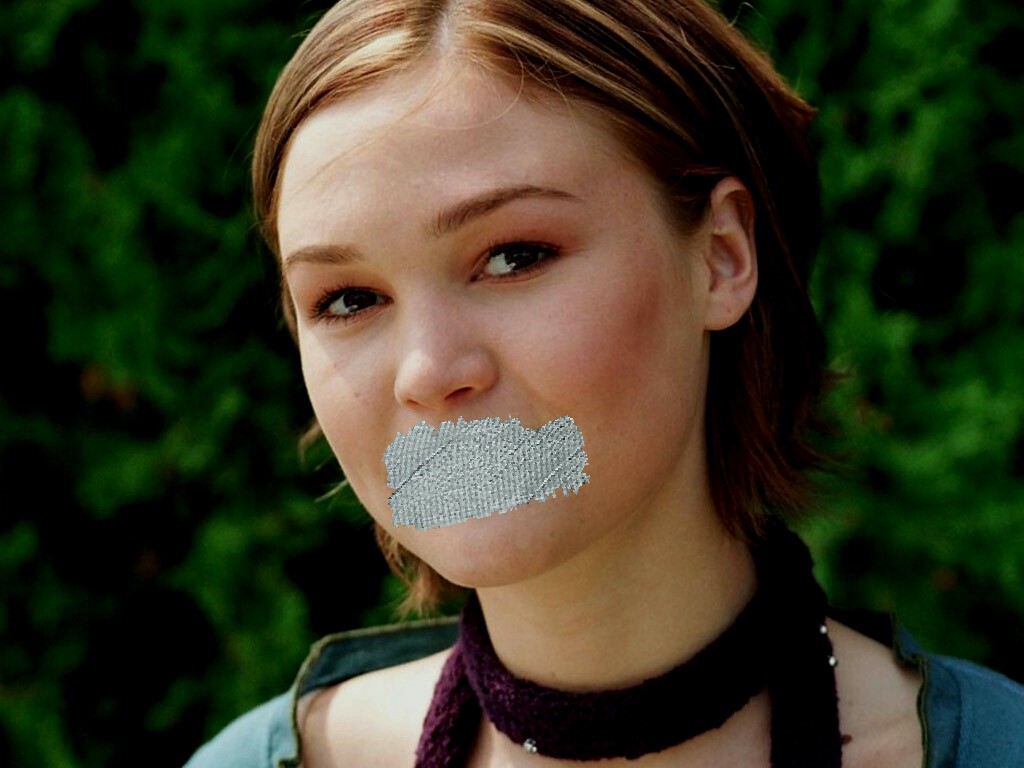
Julia Stiles was straight. But that didn’t stop me from thinking about kissing her pretty moon face, with its tiny mouth and nose, her cheeks smooth and delicately furred as an apricot.
We met at summer camp. Our summer camp was not the kind filled with campfires, canoes, and crudely woven friendship bracelets. Our camp offered workshops like “existential crises on the back porch,” zine-making, and creative writing led by a six and half foot tall Nick Cave lookalike named Dave, who gave us Rilke’s Letters to a Young Poet and said only one sentence all afternoon: “I hate white people.”
At our camp, we chain-smoked cigarettes, swam at a coed nude beach, shaved each other’s heads at 3 a.m., and traded mixtapes studded with Sonic Youth concert bootlegs. It was at camp that I had first heard all my favorite bands: The Pixies, The Cure, PJ Harvey. And in the summer of 1994, Julia introduced me to Bikini Kill.
She and I met in our first year at camp, and had traded letters ever since. Every time an envelope arrived in my mailbox with her SoHo address scrawled in the corner, I tore it open, basking in the parallels between my rural Cape Cod adolescent life and her cosmopolitan Manhattan one. (We BOTH hated everyone at our school! We BOTH thought meat was murder! We BOTH liked to cut the necks out of our thrift store t-shirts!).
Rock & Roll Day was an annual camp event. All day, teenagers plugged in on a tiny outdoor stage, and played covers of their favorite songs. Someone always played “I Wanna Be Sedated,” and somebody always sang “No Woman No Cry.” Though I was so obsessed with music that I’d developed an unpleasant ear condition by wearing my Walkman headphones even while sleeping, I had never considered performing.
I didn’t want to be a rock star, like everyone else at camp. I didn’t want to be a movie star, like Julia did, either. I wanted to be a writer. But I loved Billie Holiday’s voice, and I had a feeling in me that matched it. So I took secret voice lessons from a plump woman named Shirley who ran scales with me in the musty top floor of our local music shop, and I made her teach me “God Bless the Child,” “Summertime,” and “Don’t Explain.”
That year, on Rock and Roll Day’s eve, Julia grabbed me and said, “I signed us up.” We were a band, she informed me, with her on guitar and me on vocals. “We get two songs,” she said. “What’s your pick?”
Without thinking, I answered: “Gigantic.”
“Great,” she said. “Here’s our other song — go learn it.” She handed me a cassette tape.
For the next eight hours, I locked myself in the Rec Hall restroom, and listened to Kathleen Hanna sing “Feels Blind.” Singing was the only way I knew how to articulate my loneliness, but I hadn’t known it was also a way to articulate anger. Until I heard my own voice ricocheting off the tiled walls of that bathroom — what have you taught me, you’ve taught me fucking nothing — I hadn’t even known that I was angry.
On that stage in my torn jeans and Pixies t-shirt, I was so nervous that my voice cracked as I murmured, Hey Paul hey Paul hey Paul let’s have a ball, and I glanced across the stage at Julia in her torn slip and black lipstick. She nodded at me, and I kept going — What a big black mess, what a hunk of love.
But when I sang “Feels Blind,” I didn’t stutter, and I didn’t have to look at Julia, or the handful of dirty teenagers watching us from the grass — I closed my eyes, brought my lips to the cool microphone, and it was better than Billie, better even kissing Julia, which I never got to do.
A year later, I was supposed to go visit her in Manhattan, but instead, I met my first girlfriend, and blew Julia off because we were too busy kissing and fighting and dry humping to Kristin Hersh. The next time I wrote her, she wrote back to tell me that her career was taking off and she didn’t have much time anymore for letters.
We never spoke again, but if I wrote her one last letter, it would say this:
Dear Julia,
Thank you for Bikini Kill.
Love,
Melissa
P.S. Your solo at the end of Save The Last Dance killed.
“The Necropastoral is a political-aesthetic zone in which the fact of mankind’s depredations cannot be separated from an experience of ‘nature’ which is poisoned, mutated, aberrant, spectacular, full of ill effects and affects.” –Joyelle McSweeney
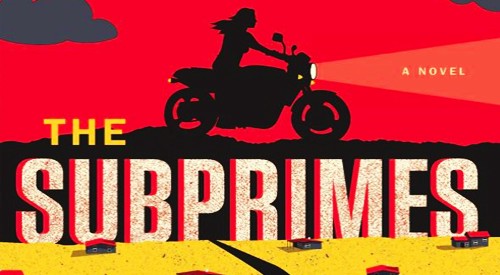
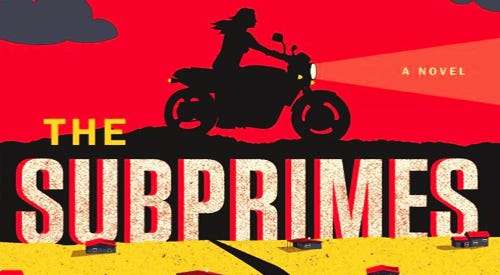
In our world, one in which images of impending environmental doom seem to simmer and bubble all around us — hapless polar bears on melting icebergs, seagulls slicked black with spilled oil, withering farmland and flooded cities — McSweeney’s concept of the necropastoral is at once intellectually vital and darkly comic. On its most basic level the term is ironic, a sort of Latinate, literary shorthand for man’s fundamentally flawed relationship with his planet, a marker for his simultaneous roles as victim and perpetrator, maker and reaper, of apocalypse. It’s also a term that seems uniquely descriptive of Karl Taro Greenfeld’s second novel, The Subprimes. Others would be infectious and breakneck, hilarious and profound.
The latest addition to the growing subgenre of cli-fi (or climate fiction), Greenfeld’s is one of, if not the best. Part satire, part preemptive elegy for a dying planet — and, really, who will be around to write (or read) an elegy if the unthinkable becomes reality? — The Subprimes may turn out to be one of 2015’s most-celebrated novels. With a language that splits the difference between Martin Amis’s slangy poetics and Vonnegut’s jabbing minimalism, more heart than any piece of comic writing I’ve ever read, and a narrative twist or three up its black little sleeves, The Subprimes is the work of a major, emerging talent in literary fiction.
I feel a little silly describing Greenfeld as an “emerging talent.” He’s published six books of nonfiction after all, written for The New York Times, GQ, and Vogue, and placed stories in the Best American Short Story series twice (2009 and 2013). Still, this is only his second novel. His first, Triburbia (2012), was a critical success Jay McInerney (writing for The New York Times) called “artful” and Publishers Weekly described as “absorbing.” So, I’ll stick with “emerging.” Fair is fair.
The subprimes are average Americans in a near future that may become our own, a growing class of people with bad credit and worse job prospects edged out by the unfeeling (often insidious) forces of killer technology and market economics run amok. In an America that’s fracked its way to energy independence (and become the world’s largest energy producer as a result), families of dispossessed subprimes roam the American countryside in their beat-up, gas-guzzling SUV’s, postmodern Bedouins trapped in an American Nightmare.
The book’s main character (and narrator) is Richie Schwab, a dope smoking, middle-aged hack journalist. Richie’s dual role as reporter and story reminds me of the great, vaguely meta-fictional narrators Martin Amis used in his best novels (the London Trilogy of Money, London Fields, and The Information). A stand-in for the author himself, Richie’s role in both first and third person narrations plays with notions of truth and story, the lines between fact and fiction.
In addition to Richie, the cast is made up primarily of families: one of subprimes (Bailey, her husband Jeb, and their children, Tom and Vanessa), another in danger of becoming subprimes (Gemma, estranged wife of fraudulent energy derivatives trader, Arthur Mack, and her daughters, Franny and Ginny), and Richie’s own (his ex-wife Anya and their kids, Ronin and Jinx). There are two notable exceptions, both spiritual leaders of a sort: Sargam, a young woman who eventually becomes the leader of the subprime community at the center of the book’s drama, and televangelist Pastor Roger, leader of the famed Freedom Prairie Church (and pawn of wealthy industrialists, the Pepper Sisters). Though this list of characters may seem dizzying in the abstract, there’s never trouble keeping them all straight. The book is a smooth speedy read, one that nonetheless has a lot to say.
As the power of government yields to that of the corporation, the subprimes find themselves constantly on the run, moving from one Ryanville (camps reminiscent of the Hoovervilles of the Great Depression) to the next. There, they work wage-unregulated jobs (the minimum wage having been outlawed) at job sites unpoliced by the Feds (OSHA and the EPA, too, have gone the way of big government). It’s not only humanity that suffers in Greenfeld’s world: from whales mysteriously (maybe suicidally) beaching themselves to roving packs of ravenous coyotes and the blasted vistas left by industry run rampant, nature is in open rebellion against humanity in general and America in particular. With global warming accelerating, the wealthy plot their escapes to sanctuary islands where they dream of living untouched by the death all around them. Though they never come out and call themselves “primes,” the derision we hear leveled at the jobless, credit-unworthy subprimes carries echoes of the alphabetic caste system of Huxley’s Brave New World.
At the heart of Greenfeld’s future America rests the abandoned town of Valence, Nevada, an arena in which good and evil (or, better put, life and death) will meet in the forms of Sargam, Pastor Roger, and their respective flocks. Under the cyanide gaze of network news drones (and unintentionally-embedded journalist, Richie Schwab), Pastor Roger’s quest to bless the Pepper Sisters’ latest tool of resource extraction, the massive Joshua machine, will come up against Sargam’s philosophies of nonviolence and “people helping people.”
There will be losses on both sides, the worst of them born by children, which is one of the central points Greenfeld posits: humanity’s relationship with its environment is so unsustainable that it amounts to the rejection of a future beyond that which we can see and, on some level, the rejection of life. Couple this with the role of the supernatural in the book’s conclusion (earned though it is throughout) and we have the final piece of Greenfeld’s satire. In a world so clearly stripped of magic — so obviously a result of the victory of technology over everything including man — the idea of humanity being saved by supernatural means is laughable, no matter how good it might feel dramatically. In the wake of Greenfeld’s last, and maybe his darkest joke, the reader is left with two choices — either stop laughing altogether or laugh loud enough to drown out the sounds of madness all around you.
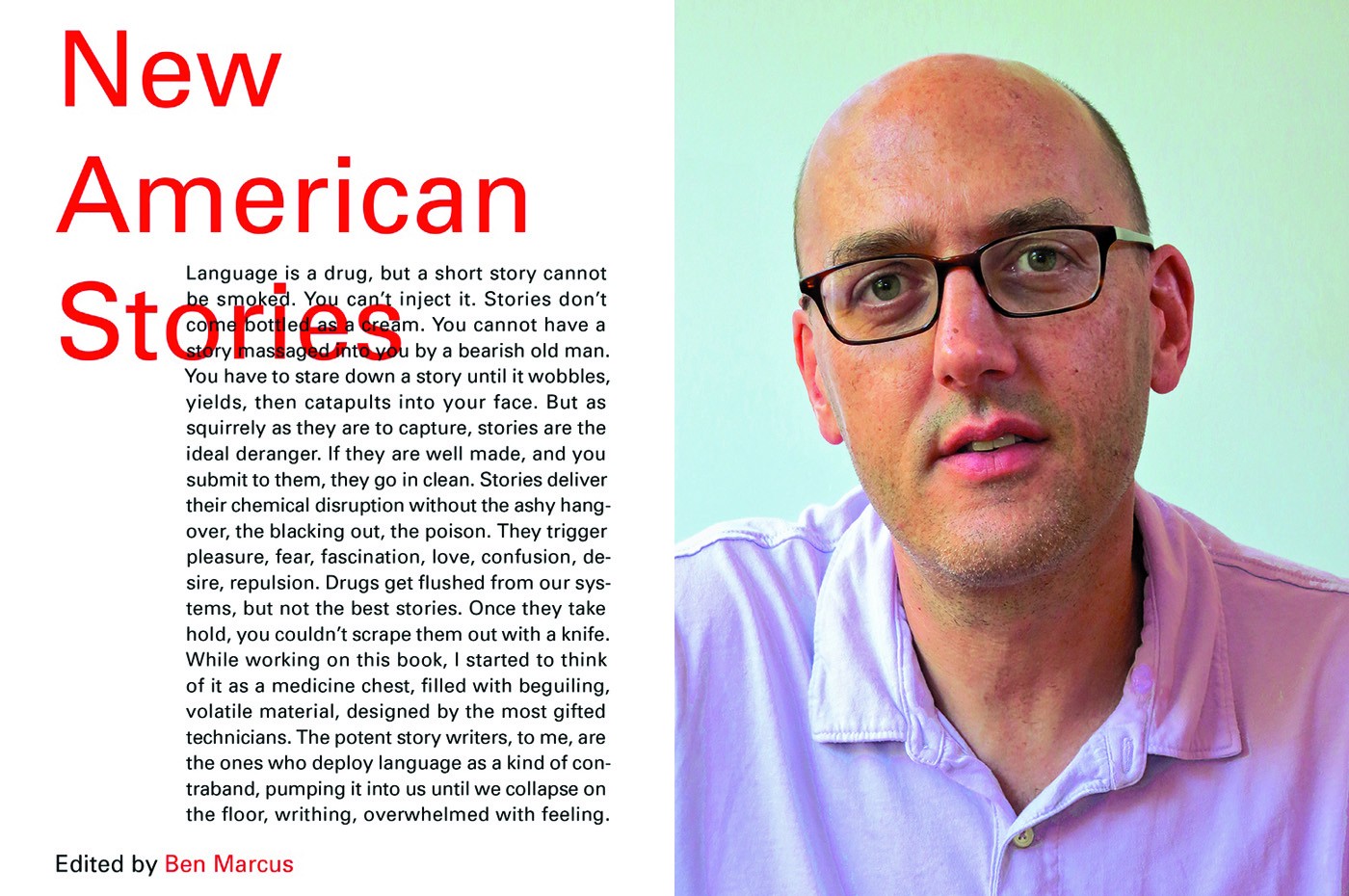
[Editor’s note: the following is the introduction to New American Stories, an anthology of contemporary American short stories edited by Ben Marcus. The anthology will be published by Vintage on July 21st.]
There is a game I play with my young son. He shuts his eyes while I sneak to the shadows with my weapon. On the dark side of a bookcase, concealed by a doorway, I stand and wait. I stifle my breathing, and the game begins.
My son does his best to avoid capture, even though he circles my hideout, risking the worst. He cannot yet play this game silently. He advertises his location with badly muffled squeals. He sprints through rooms, taking the corners too fast. He’ll stumble, wipe out, right himself, and charge again. I always hear him coming. Maybe he wants to be captured just as much as he dreads it, but you can hear the conflict thumping inside him. He produces frightening sounds, a pure bullet of feeling. How does one body hold so much? What will I do when he grows up and learns to conceal this feeling, or, worse, when the feeling stops rising up so strongly in the first place?
My son can’t be sure where or when the ambush is coming. But it always does. When he tears past me I roar from his blind spot, ensnaring him in a blanket. Down he goes, kicking and laughing, a thrashing little figure under cloth. I close the bundle, cinch it in my fist, and drag it from room to room.
My son is five now, as easy to lift as a pillow. I hoist him over my head, teeter on one leg for suspense, then plunge him onto the couch. He bounces high, still tucked inside the blanket. I hold on tight and swing until we’re spinning. His little voice drifts up from far away. Inside his trap he is in heaven, or so it sounds. I swing him and drag him and toss him until I’m ready to collapse. When I let him go he is red and sweaty and wild. Usually he glares at me. Why did I stop? What is wrong with me? He begs, begs, for us to play again. It’s all he wants to do. He promises not to peek, and I steal off to hide again.
My son would not put it this way, because he knows better than to try to dissect his own pleasure. But he is asking to be amazed and afraid in this situation we’ve contrived. He cannot really come to harm — the boy is so small that it is child’s play to keep him safe — but by surrendering control, submitting himself to the darkness, to the fast passage inside a careening world, he can take himself to the bursting point. He is looking to suddenly feel a great many things, and to feel them intensely, inside this fictional crisis. And I can’t blame him, because, more and more, I would like that very same thing.
When I want to be ambushed, captured, thrust into a strange and vivid world, and tossed aloft until I cannot stand it, until everything is at stake and life feels almost unbearably vivid, I do something simple. I read short stories. When I was young I read fiction because nothing much happened to me. As a reader I could fight a war, lose a father, be pushed from a bridge with a noose over my neck. I could grow up and grow old, turn angry and sad. I could love and hate and harm and get away with it. In stories I had children of my own, got divorced, worried, wondered, rode shotgun inside intellects far swifter than mine. My earliest reading was not just a romance with what was possible, but a romance with what was not. If something was never likely to happen in real life, I was doubly committed to live it in fiction. I think back to when I have had the most intense feelings, and most often those moments resulted not from cruising through a so-called real world of bodies and things, collecting actual experiences. Those feelings arose out of something invisible yet strangely more powerful: the language of others. Language has made some of the most durable feeling this world has seen. Not the functional kind of language we bleat at each other out in the world when we want something, or need to declare or deny something. Not the quotidian language that showers down everywhere around us to block us from our true thoughts. I’m thinking of the much more unusual and spell-like language of fiction, which generally does not occur out loud: razored, miraculously placed, set like stones into staggeringly complex patterns so that, somehow, life, or something more distilled and intense, more consistently moving, gets made.
I have been reading stories for forty-two years and I still find it astonishing that, by staring at skeletal marks on paper or a screen, we can invite such cyclones of feeling into our bodies. It is a kind of miracle. Our skin is never pierced and yet stories break the barrier and infect us regardless. We study these marks, move our finger along them, and they transmit worlds. If we could paint what happens between the page and our face, the signal channel saturated with color and shape, the imagery would be so tangled that the picture would blacken into pure noise, a dark architecture of everything that matters.
A story is simply a sequence of language that produces a chemical reaction in our bodies. When it’s done well, it causes sorrow, elation, awe, fascination. It makes us believe in what’s not there, but it also pours color over what is, so that we can feel and see the world anew. It fashions people, makes us care for them, then ladles them with conflict and disappointment. It erects towns, then razes them. A story switches on some unfathomably sophisticated machine inside us and we see, gloriously, what is not possible.
And yet language is a prickly delivery system. It requires attention, effort. It does not produce reliable results across the population. The same text that makes one person weep makes another blink with indifference or spit with contempt. By reading more, and more variously, we decimate our immunity, increase our vulnerability to this substance, but our private wiring does something profoundly subjective to this material that would seem unique from body to body. Language turns out to be the most unruly of medicines, the most unknowable, and yet, provided we collaborate with it, still among the most powerful.
Language is a drug, but a short story cannot be smoked. You can’t inject it. Stories don’t come bottled as a cream. You cannot have a story massaged into you by a bearish old man. You have to stare down a story until it wobbles, yields, then catapults into your face. And yet, as squirrely as they are to capture, stories are the ideal deranger. If they are well made, and you submit to them, they go in clean. Stories deliver their chemical disruption without the ashy hangover, the blacking out, the poison. They trigger pleasure, fear, fascination, love, confusion, desire, repulsion. Drugs get flushed from our systems, but not the best stories. Once they take hold, you couldn’t scrape them out with a knife. While working on this book, I started to think of a it as a medicine chest, filled with beguiling, volatile material, designed by the most gifted technicians. The potent story writers, to me, are the ones who deploy language as a kind of contraband, pumping it into us until we collapse on the floor, writhing, overwhelmed with feeling.
Imagine trying to assert the importance of water. Food. Love. The company of others. Shelter. There are some things that we need so innately that it feels awkward and difficult to explain why. To this list of crucial things, without which we might perish, I would add stories. A short story works to remind us that if we are not sometimes baffled and amazed and undone by the world around us, rendered speechless and stunned, perhaps we are not paying close enough attention.
In high school I made mix tapes for girls. The term for this now would be playlist. You can create one with a few clicks, and no one much cares. Back then a mix tape was an act of love, a plea, a Hail Mary, an aphrodisiac. In other words, it was an anthology, published in a limited edition of one copy. Then it was surrendered to an audience of one, a girl not even guaranteed to listen to it, because sometimes it must have seemed like it was made by a stalker, a creep, a card-carrying freak. To make a mix tape, before computers, you needed a mule cart, a bag of hair, and a padded suit. It seemed to take a whole year to produce, and I wasn’t even one of those kids who decorated the case with snakeskin and neon markers. I just dumped songs from one tape to another, pulling from the vast catalog of seventeen albums and twenty-four cassettes that I owned. And when I handed it off to some poor girl, she might regard it as a grim example of my biology, dropping it like medical waste into her bag. The tape needed to perform the charm and seduction that, with my own body and words, I could not. Not that I didn’t try. I wrote plenty of poetry in a literary tradition that never took off: the wrong words in the wrong order. And even though I hoped some handcrafted poems would reveal me as a person worth shucking one’s clothing for, my verse was embarrassing, far too easy to understand. I had yet to realize how easy it is to dismiss what comes to us with no thought, no struggle. If there is nothing left to think about, we stop thinking. I did not understand that my poetry needed to at least seem eligible for further reflection. It had no time-release feature, as do the stories in this anthology, to crack open in the body days later, bleeding out inside us until we start to glow. Obviousness was a clear turnoff. My poetry shut people down, maybe invited death into the home. I’m sure my fondness for rhyme didn’t help, either.
I also made a classic mistake. I confused the description of feelings with the creation of them. I wanted to cause feeling in others, but all I did was assert, somewhat grandiosely, that I had feelings myself. This is an unpleasant thing to announce. I had a lot to learn.
So I retreated from creation to curation. As with the stories in this anthology, I chose music that somehow, in ways I could not understand, came spring-loaded with insights about me, a youth from nowhere who knew no one, who had said and done precisely nothing that mattered. The songs I liked already intuited what I thought and felt, deep within my well-guarded interior. No doubt this wasn’t particularly difficult, because I had not thought and felt all that much yet. But this feeling — of being known, understood, seen, accounted for — seemed in urgent need of passing along. The songs, as fiction would later, worked a kind of excavation, breaking down resistance to reveal a territory that I otherwise did not have access to, fears and desires and mixed or half- formed feelings that had been hidden. When a song surfaced this stuff, I felt destroyed and remade, gifted with a new body, a weapon, a helmet. We don’t just have our feelings. Our feelings have us, and change us, and the endorphins triggered by this kind of change became compulsory. If a piece of noise, or later a string of words, could perform this kind of archaeology, I hoped to undergo such surgery as often as I could, and I looked for others who could enter the very same operating room. Life without it no longer seemed like life. To listen was to grow one’s inner self, to become more of a person, to see and feel more possibility. A sweet medication for solitude? Sounds as ointment for some impossible sorrow? Maybe, but those were the minor spoils up against the feeling of purifying one’s oxygen and sharpening the very air so that all I saw and felt leapt to a nearly unbearable resolution. It’s one reason we read, listen, and look at things made with exquisite skill. I’m sure I also thought that I would somehow get credit for these stirring songs — the sad and introspective ones, the punchy and danceable ones, the oddball ones that came out of nowhere with beeps and glitches and clicks. Certainly I thought that I’d be seen differently after the girl had listened to the tape. If she liked these songs, and if she felt similarly discovered by them, she would, if not disrobe, at least see I was no caveman. Or, more likely, she’d copy the tape and pass it on to whomever she wanted to impress, whoever was, for her, someone she wanted to show her true self to.
This anthology aims to present the range of what American short-story writers have been capable of in the last ten years or so, not as a museum piece but as a sampler of behaviors and feelings we can very nearly have only through reading. A sourcebook of required emotions. For months I collected books, stories, links, and names. I asked writers, readers, editors, friends, and strangers to alert me to strong stories, favorite writers. Who should I read? Who am I missing out on? What is the most memorable story you’ve read in the last ten years? What story has shaken you?
The range of work I encountered was staggering. I have sometimes wished for a bookstore organized not by genre but by feeling. You could shop by mood, by emotional complexity, by the amount of energy and attention that might be required. There’d be a special section for the kind of literature that holds your face to the fire. Until there is such a bookstore, we have anthologies.
Had I worked strictly from my passions, collecting the most intense and beautiful and memorable work I could find, stories exhibiting the highest degree of artistic mastery, this book would have grown so huge that you would have needed to carry it in a wagon.
I sought stylistic and formal variety in the stories not to be fair, but because there seem to be endless ways, in fiction, to make the world come alive, to reckon with our time, to fearlessly reveal what’s in front of us. To look to the past, to posit the future. To lean on language and bend and try to break it. To preserve and refine tradition, or to struggle otherwise. If writers can’t genuinely make it new, they probably can’t convincingly make it old, either. They are helpless but to make it now. But who we are now is impossible to fix, and impossible to generalize about. The minor labels that would scar our writers — realist and experimentalist would be the obvious ones — seem like someone else’s nicknames, sounds we use to call off a dog. We say these words out loud and we feel the instant shame of having told a lie in a language we hardly even speak.
The idea was to put together a book that shows just what the short story can do. Had I chosen thirty-two stories that showcase the exact same methods and make love to the same traditions, that would be too many hammer blows to the face, when a single one will do. Each story here is a different weapon, built to custom specifications. Let’s get bloodied and killed in thirty-two different ways.
Inside this book you’ll find language smooth and seamless, jagged and mean. The kind of language you use and hear every day, and the kind you never thought possible. If these stories were paintings, one might depict the human figure in angry detail while another might puncture the figure until it spills over its frame, leaking color down the wall.
Therefore there are stories of the past. Stories of the future. Stories set in some gummy mixture of the two. Stories rocketing inside a character’s head. Stories casting out into the world. Stories that burn out inside a few seconds. Stories that blanket a lifetime. Stories set here, stories set abroad. Stories set in some unsettling elsewhere. Speaking of which: stories that could happen, stories that couldn’t, stories that did, stories that didn’t. Stories that confirm our beliefs or assault them. Stories that hurt the mind. Stories that ate a poem. Stories that refute the dictionary. Stories pretty, strange, or plain. Stories so monstrously intimate I was often scared to reread them.
What resulted started to feel like a kind of Whole Earth Catalog. Not of things and goods, but of the strategies, in language, to attack our tendency — my own, anyway — to feel too little. I wanted to bring together stories I would not care to live without, a kind of atlas, or chemical pathway, to the sort of language-induced feelings that, to me, are no longer optional. The names of the moods and states and spirits these stories provoke, like the names of animals, or the names of people, are woefully inadequate.
When I could not shake a story, was kept up at night by it, and days or weeks later began to confuse the story with my own life, there was a sign that the story had taken seed. As I read, the stories I sided with were the ones that began to own me. They won’t relax their hold, and the more I read them the more this arrangement seems secure. I kept the stories that won’t unhand me. If I could forget a story then I suppose I did. And yet even then, the stories I forgot formed their own pile, where I revisited them each at least once, believing the defect to be mine.
In my reading I found stories that make us forget our troubles, and stories that rub our faces in them. The first kind of story relieves us of the burden of some basic truths: We are made of flesh, it often hurts to be alive, and we are in a constant state of decay. If we lived in relentless contemplation of these facts, we would burst. Some of us already have. Pleasure arises when we forget our fears. Relief, an illusory break from time. A break from ourselves. Such stories provided entertainment but left no residue. When I examined myself for evidence of them days or weeks later, I could find none. A respite from some basic emotional reality — the central predicament of being a finite, feeling thing — came to seem too much like a vacation I hadn’t earned. And didn’t really want.
A deeper pleasure arguably comes when our fears are admitted, revealed in full color, enlarged and even strengthened, in the world of language. It was this kind of story I favored, a story not in flight from something elemental and inescapable — we are going away soon. Meanwhile, what is worth noticing, what is crucial to feel and think before we do? Why is it pleasurable, deeply so, to read sorrowful, dark, often difficult stories? What need is being satisfied? It’s challenging to answer this without sounding like a glutton for end-times entertainment. When a story achieves a degree of moral honesty, not in its specific plot or its claims, not in its subject matter, necessarily, but in some of its deeper materials, its methods, language, style, and mood, in the emotional space it carves out within us, the result is eerily comforting, like being wrapped in a blanket and hurtled through space. In the end it is far more disturbing when our entertainment denies our fears, our mounting suspicions, estranging us with a version of the world that is too safe and easy to be real. A story seemed to find its place here when it did not look away from what was coming.
Cartridge Discount wants you to choose the typeface (and font) that’s right for you. It turns out Helvetica is not as all-purpose as Gary Hustwit would like us to believe…
The War Between the States, the War of Secession, the Lost Cause: the Civil War has as many names as stories to tell. Its battles and losses forced America to define itself, from Maine to Louisiana and into the West. Its causes and roots are as brutal as its casualties, and its epilogue is a celebrity publically committing assassination. In short, the Civil War continues to capture the imagination.
Battle Lines: A Graphic History of the Civil War, by Jonathan Fetter-Vorm (Trinity: A Graphic History of the First Atomic Bomb) and Ari Kelman (A River and Its City, A Misplaced Massacre), published just after the 150th anniversary of the Confederacy’s surrender, is a poignant and soulful retelling. It is an ambitious text, as in many ways a comic can only paint a broad picture of a complex theater. To widen this scope, Battle Lines relies on a human narrative of America’s bloodiest divide. Fifteen vignettes, each prefaced by brief, contextual articles typeset and designed as though from a newspaper from a previous era, carry readers through Reconstruction. The most powerful of these are the stories about individuals, including an escaped slave crossing Union Lines; two friends behind Confederate ramifications, one lost and one spared; a journal-keeper doomed to starve in the infamous Andersonville, Georgia POW camp. Each vignette follows a particular object of everyday life from that era: the Union flag is lowered at Fort Sumter and the banner of the Confederacy raised, a mother and son watch a battle through a pair of Opera Glasses, loose fibers weave together to form a noose through scenes portraying the postwar Deep South.
Through every scene, there are bodies. Bodies of soldiers. Bodies of freed people. Bodies of animals. There are limbs lost. There is disease.
Since it’s a graphic novel, the language in Battle Lines is concise. Every word counts. The best panels illustrate the unsaid. A long line of partially shoed Rebels, walking through the woods with rags tied around their feet, next shown stripping the surrounding dead, fallen from some previous encounter. An empty shell bag early in a skirmish. A husband who returns home to find his wife alone, the framed photograph of her holding their infant adorned with a pair of slippers but no child in sight. The destroyed hulls of Richmond and Atlanta. The tactics of some Confederate veterans keeping ballots out of freed men’s hands simply described as “terrorism” beneath an image of hooded Ku Klux Klan members on horseback, one holding a torch.
The Civil War, like most any violent confrontation, was a compendium of tragedies, spurred by slavery and soured by appalling racism in the North and South alike. Fetter-Vorm’s and Kelman’s account isn’t pandering; instead, Battle Lines beautifully and succinctly paints a full picture, challenging readers to confront ugly truths about the past and present.
As a person brought up and schooled in the Northeast, it is difficult to gauge how much of my prior knowledge of the Civil War fills in the gaps between historic overviews and the short impressions represented in the graphic novel. There’s no way of knowing how different my reading would be if I knew less or perhaps nothing of the issues and times. Knowing what I do, however, it is impressive how much information Battle Lines manages to include and get right.
The book itself is a collector’s piece, designed for print lovers. Longer than it is tall, like an old time photo album, its presentation is sophisticated and alluring. Washed earth tonesfurther communicate the grim realities of barren farms, trench warfare and lives lost. In short, it is a work of art, illuminating, in small and large swaths, the conflict surrounding the abolition of the heinous crime of slavery and its aftermath.
Hello, and welcome to my week-by-week review of the world. Today I am reviewing Uber.
Uber is a taxi business where the taxis look just like regular cars and the drivers look just like regular people. It’s pretty inventive. Last week I rode in my first one. It felt like I was in the back seat of a stranger’s car. Like hitchhiking but not for free.
My driver was named Ameer and his day job is as a regular taxi driver. We didn’t talk much because when I asked him questions he said, “No talking.” I guess he had a lot on his mind and wanted to focus on the road.
Unfortunately it was raining, so the 27-minute ride cost me $112.47. This is no different from regular taxis. Like the time I took a regular taxi and at the end of the trip the driver said, “It’s raining so give me an extra $80.” And I did, of course, because he made a good point. Then he asked me for all kinds of personal information just like Uber does.
What really sets Uber apart from other taxi businesses is how you can hail them with your cell phone instead of having to raise your hand. With a regular taxi you never know who the driver might be but with Uber’s taxi service you can choose your driver by their photo. That way you can be sure to select someone who looks like they probably won’t sexually assault you.
I had chosen Ameer because I liked the shirt he was wearing. He turned out not to be wearing it when he arrived five minutes after I hailed him, so I guess he stopped somewhere along the way to change. He must have spilled coffee on it or something. I liked that he cared about his appearance.
As I passed pedestrians I waved to them excitedly. “Look at me,” I screamed. “I’m in an irregular taxi!” No one looked, however, I think because to them it just looked like a car. And also I couldn’t figure out how to lower my window, so it was probably hard to hear me anyway. “Stop screaming, I can’t stand you,” screamed Ameer extra loudly so I could hear him over my own screaming. That was the most he said to me.
I cheered up slightly when he dropped me off because he stopped in the middle of an intersection blocking traffic. It made me feel important and powerful to make everyone have to wait for me, like I mattered.
BEST FEATURE: It’s hard to pick just one best feature when the whole experience is amazing! WORST FEATURE: No one can tell you’re in an Uber taxi unless you yell it at them.
Please join me next week when I’ll be reviewing Björk Guðmundsdóttir.
DON’T MISS OUT
Sign up for our newsletter to get submission announcements and stay on top of our best work.
YOUR INBOX IS LIT
Enjoy strange, diverting work from The Commuter on Mondays, absorbing fiction from Recommended Reading on Wednesdays, and a roundup of our best work of the week on Fridays. Personalize your subscription preferences here.