


“A masterpiece”: For a novel to receive such praise no doubt is a publicist’s dream and often enough an author’s too, yet the penchant among reviewers for dubbing a new release with the weighty honorific must raise an eyebrow. It’s a type of soothsaying, really, since who can know what the future will hold, how the ultimate context for the work will grow, except a visionary — and how, in our data-saturated moment, can anyone make claims of visionary insight without a pyramid of spreadsheets to rely on? By dint of overuse, ‘masterpiece’ begins to seem less a marker of gravitas or achievement and more a tired commercial nicety. So it becomes an art of its own, a sense for when, critically speaking, to make such a claim.
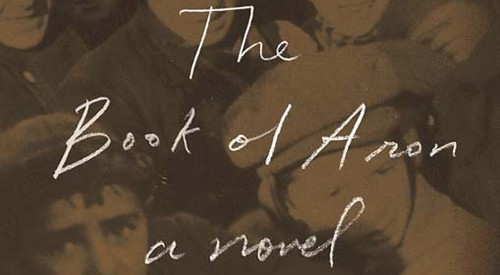
Jim Shepard’s seventh novel, The Book of Aron, arrives to just such praise. It’s right there on the jacket copy, a heralding trumpet. Furthermore, The Book of Aron figures as Holocaust fiction, that populous family of stories championed by awards-minded filmmakers and, on special occasion, the would-be literary memoirist. No pressure, but what could Shepard possibly add to the voluminous historical record?
The Book of Aron follows a less than devout Jewish country boy recently arrived in Warsaw. Early on, Shepard’s Aron speaks with comic pathos, the sort known to a middle child of a family doing more with less. A bookish loner, this boy’s emotional horizon is informed by the travails of a younger brother with bad lungs until one day “my father told me to get up because it was war and the Germans had invaded. I didn’t believe him, so he pointed at the neighbors’ apartment and said, ‘Come to the radio, you’ll hear it.’” The utter matter-of-factness of the arriving army is chilling for what we know it will bring. Yet Aron does not know, not right away; he has other things on his mind. The dynamic happens to be signature Shepard, tension between the personal and the political written large — or written close to home. Shepard’s brisk, laconic narratives tend to cleave to a protagonist participating in, but unable to fathom the full breadth of, a historical moment.
No doomy portentous cloud here, no melodramatic gestures at sweeping profundity. Nobody thanks an Oskar Schindler. Even as the real horrors encroach, Aron finds adventure and thrills as a smuggler among a gang of smugglers. Until even the last shred of normality is taken from him, he’s busy being a boy, doing what he needs to do to feed himself. To borrow from Jonathan Lethem’s Motherless Brooklyn, Aron tells his story walking.
Like Schindler’s List, The Book of Aron is haunted by a great man, in this case, Janusz Korczak, the pediatrician famous throughout Europe and appointed caretaker for a set of Jewish orphans. Central to the lives of saints, the act of bearing witness — to Korczak, to the struggles of friends and family — is performed by a boy who is not a model of moral purity, even as the occupiers’ crimes dwarf his own. Wracked by guilt, Aron needs to believe in Korczak. And Korczak knows it.
Shepard’s no sap, and his hunger for certified historic fact is voluminous, practically what underlies his entire literary career. As in another of his most impressive works-to-date, a short story titled “The Netherlands Lives with Water” set in Holland of a not-so-distant-future, inundated by relentlessly climbing ocean levels, the characters in The Book of Aron find themselves practicing “a sort of apocalyptic utilitarianism: on the one hand they were sure everything was going to hell in a handbasket, while on the other they continued to operate as if things could be turned around with a few practical measures.” In many ways, The Book of Aron is the wallop of a novella that could have brought story collection and previous Shepard work You Think That’s Bad to a close. (Call it ‘You Think There’s Anything Worse?’) The Holocaust is the Holocaust is the Holocaust, but Shepard’s interests have pointed him in its direction for some time now.
Counterpoised by, say, Primo Levi’s The Drowned and The Saved or Imre Ketesz’s Fatelessness, The Book of Aron brings narrative light to a historical chapter saturated by complete darkness. Save those who escaped before the last march, no recorded survivors emerged from Korczak’s orphanage. Out of consideration for his fame, the Germans repeatedly gave Dr. Korczak the chance to save himself by leaving his kids behind. He would not.
Marching to the train depot, the children perform a rendition of a song called “Though the Storm Howls Around Us.”
In place of the actual lyrics, Aron reports: “I started to sing my younger brother’s name.”

by Jim Shepard


Looking for some Sunday reading? Here are some literary links from around the web that you might have missed:
Is Amazon going overboard censoring book reviews?
In Harper Lee’s new novel, Atticus Finch is portrayed as a bigot
A look at writers like Tolkien and R. R. Martin who invent new languages
Are pen names going out of style?
On Oscar Wilde’s trial by fiction
This project is sending LGBT YA books to schools and shelters
A book list for Orange Is the New Black fans
Archie has been given a reboot
Oyster provides a literary guide to Florida
Want to feel better about your writing? Some established authors share their horrible writing
★★☆☆☆
Hello, and welcome to my week-by-week review of the world. Today I am reviewing hypnotism.
The first time I tried to hypnotize someone I thought it would be easy. I already owned a pocket watch and I’d seen people do it on TV. It turned out to be much harder than it looked. A big part of it is confidence, I think. Another big part is not hitting your subject in the face with a swinging watch.
My first few dozen attempts were failures. I did a number of things wrong. To compensate for a lack of confidence, I was too aggressive. I would raise my voice to sound more commanding or I would swing the watch much too fast. There were other missteps. I would say, “Look into my eyes,” but forget to take off my sunglasses. If it wasn’t working, I would get sweaty and nervous and sometimes laugh uncontrollably.
You know what the biggest thing I learned was? Don’t try to hypnotize anyone while standing on the street at night. Gold watches being dangled at arms length are likely to attract thieves. It can be interpreted as taunting them. And once they’ve got that watch, you have no tool with which to try and hypnotize them into giving it back. I lost so many watches that way.
Another thing I learned: the watches don’t have to actually be made of gold, just gold colored. The manufacturing process of the watch is completely unrelated to its ability to hypnotize. Knowing this can save you bundles.
Looking to step up my game, I picked up a copy of Dr. Viktor’s Hypno-guide to a Successful Career at Borders. It takes a very career-centric approach, but I figure hypnotizing is hypnotizing and just as easily as I could convince a subject that he or she is worthy of a promotion, I should be able to make that person cluck like a chicken.
I wanted to test out some of the tips I’d learned from the book, so I tried it on a police officer who pulled me over. At first, things were going smoothly. As her eyes slowly closed, mine opened wide with delight. I thought it was working until she made a fake snoring sound, popped her eyes open, and started laughing at me. Then she handed me a $300 ticket.
I started learning hypnotism to help people. To help them with dark moments they want to forget about. Maybe something they did and can never undo. That moment can disappear with my help. Or if the person witnessed something horrible…say, the murder of their parents. I could turn that into an island vacation. The killer could be a palm tree and the parent’s corpses could become piña coladas.
BEST FEATURE: Commanding people to do whatever you say just for entertainment.
WORST FEATURE: The murky legalities of commanding people to do whatever you say just for entertainment.
Please join me next week when I’ll be reviewing a pile of leaves.
The Blunt Instrument is a monthly advice column for writers. If you need tough advice for a writing problem, send your question to blunt@electricliterature.com.
Dear Blunt Instrument,
I finished my debut manuscript of poems about three years ago, and the poems in it have appeared in a number of well-regarded literary magazines. I am confident that it will be a good book, confident even that it might sell some copies. But — and here is my question — when?
Since its completion, I have sent my manuscript to over 35 first book contests and open reading periods, at all levels of competitiveness. It’s been a finalist for multiple big-deal contests, including the National Poetry Series, but has also been unkindly rejected from a number of smaller presses. I just can’t seem to find the right fit.
I have two main concerns: First, how do I know if the manuscript is actually as ready for publication as I think it is? Do I just keep trying until someone agrees with me? Do I put it away for a few years and hope either my sensibility or the universe’s changes?
Second: cost. I’ve been working at the best job I can find since graduating from my MFA, but it’s still barely enough to cover the essentials — never mind my student debt. For how long can a person justify spending $25, $30 a pop on submission fees to chase a dream? And — I don’t suppose — is there any chance those fees will one day be a thing of the past?
I believe in my work, in this manuscript, but how long should a person wait?
– Frazzled 28-Year-Old Poet
Dear Frazzled,
Because your manuscript has been named a finalist multiple times, and because most of the poems have been published, I suspect the book is ready or close to ready to be published; I suspect that your manuscript could be chosen for publication at any time. (This doesn’t mean you can’t continue to work on it, in the meantime, and make it better, but “ready” and “better” are both judgment calls.)
The problem is, “any time” could be this year or it could be a decade from now. There’s a lot of luck and random circumstance involved in who wins contests. It’s not like it’s a pure meritocracy; judges and editors have their own tastes and biases, and winning a contest is a matter of matching up with a judge or editor whose tastes align better with your manuscript than anyone else’s in the pool of probably hundreds of other manuscripts. That’s not easy. Editors are also looking for something that fits the aesthetic of the press, and are subject to whims. I know a poet who was sending out the same two manuscripts to contests and open reading periods, without luck, for about ten years before he won the National Poetry Series — two years in a row. Crazy, but true.
The other problem is, in the meantime you’re spending hundreds of dollars a year on contests. Whether or not you want to continue to do this — letting hundreds turn into thousands with no guarantee of a return — is really up to you. Do you feel it’s worth it? If, in five years, you win the National Poetry Series, will those hundreds in fees feel immaterial? If you think that’s the case, you could look at the entry fees as something analogous to dues — the cost required to remain a member of the poetry “club.” It’s unfortunate that there’s a cost involved, but most artistic endeavors do cost money — for writers, the cost of making the art itself is almost nothing, which is not the case for, say, a pianist or an oil painter.
As for whether submission fees will soon be a thing of the past, I strongly doubt it. Are they ethical? In the sense that they represent a class-based barrier to entry, no, they are not. (Lincoln Michel recently shared some interesting thoughts on the ethics of submission fees, but focusing more on literary journals than book contests per se.) But most poetry presses wouldn’t be able to survive without regular fundraising; the contest model basically fundraises through fees, versus, say, crowdfunding. Both models have problems, but again, most poetry presses don’t have the luxury of paying for their low-selling titles with a few big bestsellers.
Regardless, you don’t have to pay reading and entry fees if you don’t want to. You do have other options. I’m going to talk through three.
* One option is just to focus your efforts on open reading periods without a fee. Since this narrows down the number of presses you can send to, it could take longer to get a “yes,” and this may not be a viable option if you work in academia and are feeling pressure to publish as soon as possible.
* A second option is to self-publish. This option has plenty of disadvantages — many people will take your book less seriously; it will be harder to get reviews; publicity is entirely up to you; etc. But the advantage is, the money you spend will definitely result in a book, and you’ll have complete control over the timing, process, and outcome. I know multiple poets who have gone this route, some with surprising success.
* The third option is the one I would strongly recommend, not just to you but to poets everywhere, and that’s to try to develop a relationship with a publisher.
Years ago, before I had published any books or even a chapbook, I used to read a blog that featured a series of interviews with poets about their first books. The interviewer, Kate Greenstreet, asked each poet the same set of questions; one was to share the best advice they had received when trying to publish their first book. One poet said that a mentor had told her, “You already know who is going to publish your first book.” I have repeated this sentence, word for word, to many poets over the years: You already know who is going to publish your first book.
Being a known poet in the world takes more work than just writing poems. There’s a community aspect that you’re almost required to take part in, whether in person or online or both. This community work includes stuff like going to poetry readings, actively meeting and befriending other poets, reading other poets’ work and talking about it, and reading and writing poetry reviews. If you’re not doing at least some of these activities, it’s going to be harder and take longer for you to publish a book. The more of it you do, the more likely it is that you’re going to meet someone who might be interested in publishing your book (or someone who knows someone who might be interested in publishing your book).
One of the beautiful things about poetry is the proliferation of small presses. Because poetry books so infrequently make the author any money, there’s no compelling reason not to publish your book (especially your first book) with a small press. And small press editors are often more deeply involved with editing and promoting their books, since they are generally labor-of-love operations, compared to university presses, which usually have more funding and more staff turnover. (That funding is actually a double-edged sword; it means they can afford to be less invested in the outcome of any individual book.) Do some investigative work — what small presses are publishing books that you love? Avoid getting into the desperation mindset where you just want a book and don’t care who does it — your experience will be very different depending on who does the book. So who do you really want to publish it with? Having a “dream press” in mind may even help you figure out if your book is really “done” or not, since you’ll be editing toward a specific aesthetic rather than trying to please every possible editor/judge. Plus, if you work with an editor who knows you, you’ll likely decide together when it’s done.
Since you have an MFA and are actively publishing your poems, you’ve probably already met some people who run or work at poetry presses. Again, this is part of the work, so just keep at it. Read, write, build your community, and find your fans. Crucially, don’t get impatient. 28 is not old, and no one is entitled to a book. If there are people out there who would love to read your book, then eventually you’ll find the person (you might already know them!) who is going to publish it.
The Blunt Instrument

In the age of social media, interacting with our favorite authors has gotten much easier. Using platforms such as Twitter or Facebook, fans can pose direct questions, “like” recent status announcements, and even track where and when authors will hold their next public reading. And yet, even with all these new ways to connect, most fans still aren’t able to sit down at the dinner table with their literary idols.
Amazon, however, is being accused of determining through some sort of mysterious algorithm who is actually well-acquainted in real life. If we’ve interacted with authors online, the Guardian warns us that “Amazon might decide that you’re “friends” and ban you from leaving a review of their latest book.”
In a blog post, indie author Imy Santiago writes of being prevented from leaving a book review on the site because Amazon decided her “account activity indicates that you know the author.” In reality, Santiago only ever interacted with the author online; she considers Amazon’s decision “censorship at its finest.”
In response to the controversy, romance author Jas Ward created a petition which has already garnered 11,000 signatures as of Thursday morning.
Ward acknowledges that social media plays a critical part in promoting the latest works of emerging as well as established authors, and further states: “Your current process of removing reviews that a reader has created to show their honest and sincere opinion on a book is not fair and cripples the review process more than assists.”
Although Amazon’s customer review guidelines understandably ban family members from writing reviews (thanks anyway, Mom and Dad), their process of determining actual friendships is a bit shady. In a response email to Santiago, Amazon wrote: “Due to the proprietary nature of our business, we do not provide detailed information on how we determine that accounts are related.”
The nominees for the World Fantasy Awards have officially been announced! Established in 1975, the World Fantasy Awards are presented annually to writers, editors, or artists. The Award is known as one of the three most prestigious speculative fiction awards, alongside the Hugo and the Nebula.
This year’s nominees include some familiar faces, including Electric Literature contributor Jeff VanderMeer, Jo Walton, and Kelly Link, among others.
The full list of nominees is below:
WORLD FANTASY AWARDS NOMINEES
LIFE ACHIEVEMENT AWARDS
• Ramsey Campbell
• Sheri S. Tepper
NOVEL
• Katherine Addison, The Goblin Emperor (Tor Books)
• Robert Jackson Bennett, City of Stairs (Broadway Books/Jo Fletcher Books)
• David Mitchell, The Bone Clocks (Random House/Sceptre UK)
• Jeff VanderMeer, Area X: The Southern Reach Trilogy (Farrar, Straus and Giroux Originals)
• Jo Walton, My Real Children (Tor Books US/Corsair UK)
NOVELLA
• Daryl Gregory, We Are All Completely Fine (Tachyon Publications)
• Pasi Ilmari Jääskeläinen, “Where the Trains Turn” (Tor.com, Nov. 19, 2014)
• Michael Libling, “Hollywood North” (The Magazine of Fantasy & Science Fiction, Nov./Dec. 2014)
• Mary Rickert, “The Mothers of Voorhisville” (Tor.com, Apr. 30, 2014)
• Rachel Swirsky, “Grand Jeté (The Great Leap)” (Subterranean Press magazine, Summer 2014)
• Kai Ashante Wilson, “The Devil in America” (Tor.com, April 2, 2014)
SHORT FICTION
• Kelly Link, “I Can See Right Through You” (McSweeney’s 48)
• Scott Nicolay, Do You Like to Look at Monsters? (Fedogan & Bremer, chapbook)
• Kaaron Warren, “Death’s Door Café” (Shadows & Tall Trees 2014)
• Alyssa Wong, “The Fisher Queen,” (The Magazine of Fantasy & Science Fiction, May/June 2014)
ANTHOLOGY
• Ellen Datlow, ed., Fearful Symmetries (ChiZine Publications)
• George R. R. Martin and Gardner Dozois, eds., Rogues (Bantam Books/Titan Books)
• Rose Fox and Daniel José Older, eds., Long Hidden: Speculative Fiction from the Margins of History (Crossed Genres)
• Michael Kelly, ed. Shadows & Tall Trees 2014 (Undertow Publications)
• Kelly Link and Gavin J. Grant, eds., Monstrous Affections: An Anthology of Beastly Tales (Candlewick Press)
COLLECTION
• Rebecca Lloyd, Mercy and Other Stories (Tartarus Press)
• Helen Marshall, Gifts for the One Who Comes After (ChiZine Publications)
• Robert Shearman, They Do the Same Things Different There (ChiZine Publications)
• Angela Slatter, The Bitterwood Bible and Other Recountings (Tartarus Press)
• Janeen Webb, Death at the Blue Elephant (Ticonderoga Publications)
ARTIST
• Samuel Araya
• Galen Dara
• Jeffrey Alan Love
• Erik Mohr
• John Picacio
SPECIAL AWARD — -PROFESSIONAL
• John Joseph Adams, for editing anthologies and Lightspeed and Fantasy magazines
• Jeanne Cavelos, for Odyssey Writing workshops
• Sandra Kasturi and Brett Alexander Savory, for ChiZine Publications
• Gordon Van Gelder, for The Magazine of Fantasy & Science Fiction
• Jerad Walters, for Centipede Press
SPECIAL AWARD — -NON-PROFESSIONAL
• Scott H. Andrews, for Beneath Ceaseless Skies: Literary Adventure Fantasy
• Matt Cardin, for Born to Fear: Interviews with Thomas Ligotti (Subterranean Press)
• Stefan Fergus, for Civilian Reader
• Ray B. Russell and Rosalie Parker, for Tartarus Press
• Patrick Swenson, for Fairwood Press
The awards will be presented at the World Fantasy Convention Banquet on the Sunday afternoon.
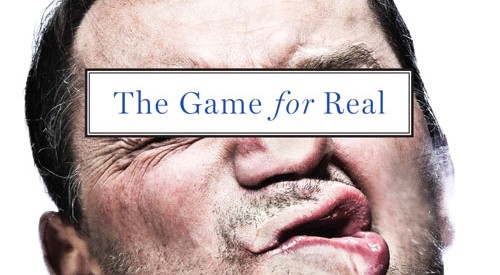
According to Benjamin Paloff, translator of Richard Weiner’s The Game for Real, “anyone who claims not to be a bit bewildered by writers like Richard Weiner is inherently untrustworthy.” Weiner, an early twentieth century Czech writer who spent the majority of his writing career in Paris, is a demanding stylist. His prose is densely imagistic, glutted with long sentences sutured together by flights into surreal dreamscapes. He uses this byzantine style to replicate interiority and explore our assumptions about the nature of identity. The Game for Real is filled with doppelgangers and strangers, with false accusations and staged conversations, and with characters who ceaselessly and vainly chase reality.
The book is split into two novellas. The first, “The Game for Quartering,” is a close-first person account of paranoia and inauthenticity. An unnamed bachelor and “hack” leaves a Paris Metro station and is followed home by the train’s only other passenger. This passenger might be an acclaimed Spanish dancer — or, he might merely resemble that dancer. It might be the narrator’s friend, Fuld. At home, things get even weirder: an unidentified woman waits at the narrator’s door. The ambiguities mount when the novella shifts to an earlier episode at a café, where the narrator and three friends sit at a table surrounded by “supernumeraries” watching them talk:
The supernumeraries — that is, the guests of this sanctuary, which is both a tavern and a knightly hall — won’t let us out of their sight for a moment . . . as far as I was concerned, that circumstance contributed decisively to the impression that we were acting before what one calls fate, which also likes to pretend that it’s a disinterested observer.
This short passage displays Weiner’s commitment to minutia. As the narrator qualifies his assertions about the venue — supernumeraries are generalized back to guests; the “sanctuary,” in the course of a clause, becomes a tavern and knightly hall — we feel the mind trying to make sense of the unfamiliar. Description, here, is an attempt to explain the inexplicable.
The presence of fate, at the café, contributes to the narrator’s growing sense of paranoia. The other characters all know more than he does, but what they know, exactly, remains unclear. Weiner uses playwriting techniques in these café scenes to further enhance the narrator’s feeling that they are acting before an audience, living up to preordained roles. The text adopts the look of script, and the repeated use of personal direction forces us to wonder who, exactly, is directing the characters. Is it Weiner, the writer? Or is that falsely disinterested observer, Fate, shaping the plot?
“The Game for the Honor of Payback,” the book’s second section, is an equally elliptical exploration of identity and psychology. Whereas “The Game for Quartering” progresses into the dreamlike world of the café, “The Game for the Honor of Payback” begins in a dream in which the protagonist swims through a “subterranean tunnel and against a foul current.” Things don’t get much better when he awakens. Staying at a small inn, the protagonist — the closest thing we get to a name is “Shame” — is accused of stealing a bracelet belonging to innkeeper’s wife.
After the innkeepers ask him to leave, what follows is an impressionistic account of an outsider’s excursion through Paris. As the novella progresses, it becomes increasingly difficult to parse out what is real and what is imagined. Like the narrator in “The Game for Quartering,” “Shame” is obsessively self-conscious:
Why does he [protagonist] say, “If I had pinched it,” “If I had chucked it” . . .? Why does he say this when he knows that in order for him to pinch, in order for him to chuck, he would have to be . . . precisely: not himself, but rather a fundamentally different person.
Weiner deconstructs language to question identity. How can we use language flexibly, hypothetically, when doing so puts language at odds with identity? In Weiner’s work, no phrase is taken for granted. Every image, every particle, every thought, and every shift in personality. Characters are split into temporary selves: “the sinister Zinaida; The Zinaida of early evening; the Zinaida shuffling toward the table . . . the Zinaida carrying a writing pad.” His world demands our attention: “Look! Don’t you hear the heads of their unfurled offensive lines twist suddenly, charmingly, skirting a kind of magnetic focal point, languidly and in vain?”
Though Weiner was highly influenced by the surrealists, his close readings of Marcel Proust, as a reviewer living in Paris, seems to have had a major impact on his depiction of life. Weiner understood, like many of the Moderns, that the future direction of literature was the fluctuation of thought. It is a testament to Weiner’s skill that the impressionistic dreamscapes of 1930s Paris remain as fresh today as they were when he wrote these novellas. And Paloff deserves a great deal of credit, too, for preserving the wit, complexity, and beauty of Weiner’s sentences: the nights are so dark they “stain clothes;” skies “crackle” with stars. It’s unfortunate that English readers had to wait eighty years for The Game for Real to appear. These novellas are intense, funny, and vivid explorations of selfhood and identity. Their publication was long overdue.

by Richard Weiner

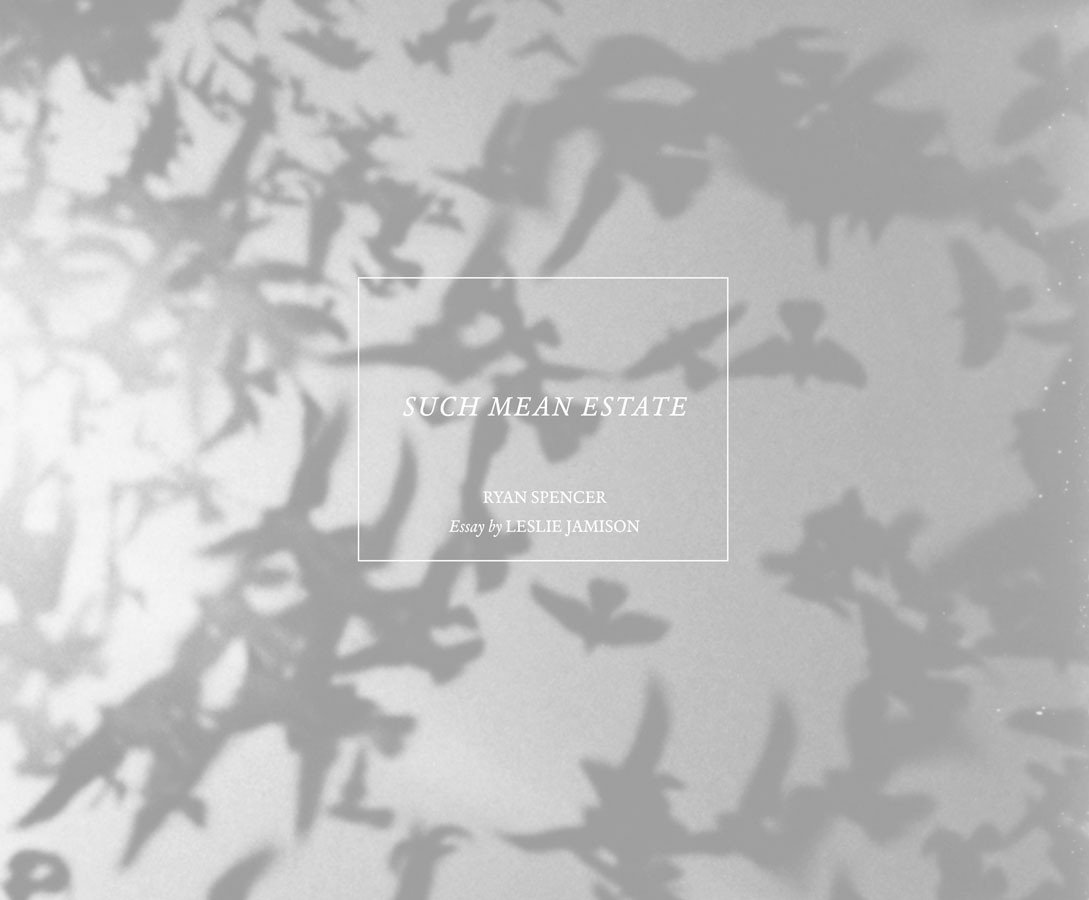
The end of the world as we know it isn’t just a popular topic for Margaret Atwood novels or Michael Stipe lyrics; there’s a whole film genre devoted to it too! From Dawn of the Dead, to Southland Tales, to 2012, to all the various Resident Evil flicks, cinema has long been obsessed with worst case scenarios. But are these movies high art? Or more compellingly, is there high art contained within these films? Photographer Ryan Spencer thinks so. His new photo-book — Such Mean Estate — consists of various self-captured Polaroid images; each taken from one frame of a disaster film. Accompanying this book-length photo essay on cinematic apocalypses is a prose essay by Leslie Jamison called “Catechism.” Both the images and the text combine to create unique experience not only in how we think about the end of times, but how we look at it, too.
For the launch of the book, I talked to both Spencer and Jamison about this unique project.
Ryan Britt: Thinking about the images contained in both the photographs and in the book; I wanted to talk to you guys about “cli-fi.” That type of science fiction that is about climate change. What are some influential cli-fi narratives for both of you?
Ryan Spencer: The quintessential — as far as entertainment value — would have to be The Day After Tomorrow. In that, you have family drama and every bad thing you can think of happening. And that is a film that I looked through a lot when I was doing this project. There are a few images from that film [in the book]. That’s a great one. I think 12 Monkeys is a good one too; a great film. It deals a lot with this issue of what would our response be if the climate were altered in a certain way. And when we look at these films that are kind of over the top and absurd, there’s still something terrifying in them. Something I was trying to do with these photos is to take images from these films and to make them terrifying again.
Britt: Because these films have to be consumed by mass culture, they might actually back off on some of the terror.
Leslie Jamison: I want to say a few more words about The Day After Tomorrow. I feel like it was one of the signs of early bonding [between us]. I mean, I don’t go around telling lots of people about my fascination with The Day After Tomorrow because there’s a weird shame associated with loving that film. There’s a line [in my essay] about sending L.A. to hell, and to me that film epitomizes that aesthetic. In these kinds of movies L.A. is always opening up with tiny fire chasms! I’m from L.A. so I feel defensive on L.A.’s behalf and when it comes to disaster movies there’s this weird fixation with just punishing L.A.! So that was one of those things I’ve just been waiting for a chance to talk about.
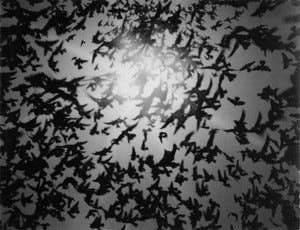
And I too feel like there is a way in which some of these genre films get sanitized. There’s a way we kind of use them to punish ourselves a little bit, but it’s a kind of inculcation. But this project I think takes away from that safety. I mean, there’s nothing safe about the world we live in right now.
Spencer: Right. And in looking at all of these films — science fiction films — inherently shows the future or some version of the future. For me, it’s interesting to look at the histories of past futures. What does looking at what we thought was going to happen to us twenty years ago feel like? Or what did 2010 look like in 1970? But yes. When this kind of thing is made into a film, there is a feeling of safety: this is the worst thing that could happen; all of the things people may have joked about — superstorms — when you see it actually happening in a movie, it’s somehow more real. For example: during hurricane Sandy, my girlfriend and I actually watched The Day After Tomorrow, not knowing how bad the real storm was going to turn out.
Britt: Ha! Meta. Let’s talk a little bit about the images themselves. Now, which Resident Evil film is the cover photo from? Full Throttle? Electric Boogaloo?
Spencer: Not sure. Resident Evil: Apocalypse? I don’t always remember which photos everything is from. [laughs]
Britt: This brings me to the shame Leslie mentioned earlier. There’s shame in loving the idea that the world is ending, but there’s also shame in loving cheesy disaster movies. What’s so interesting about this, is that here I’ve got a beautiful image from a film that I would have never known as the kind of movie that probably has like a 20% rating on Rotten Tomatoes.
Spencer: That’s a generous rating for a Resident Evil film.
Britt: Can you both talk about moving different aspects of creative art into different contexts? Has the respectability of these films been increased?
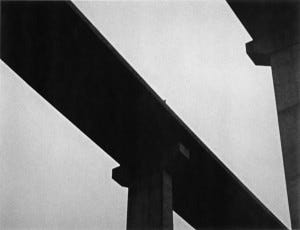
Spencer: There’s a lot of images of course here that are taken from movies that aren’t great films. I shouldn’t say that; it’s not that they’re not great films — they’re just not films that are easy to defend. Maybe I did this whole project to give myself some reason to sit and watch all of this garbage! But even when the script is horrible or there’s not a lot going for a movie, I found something — even once or twice — that is actually beautiful. But, you know I had to comb through to find some of that. A lot of these things happen so quickly. I had to look for some of the best frames in slow motion.
Britt: Is there an example of one of the photos that typifies what you’re talking about? In an instant, we wouldn’t have seen it in a regular viewing of the film, but when you slowed it down, there was then this amazing moment?
Spencer: I think a lot of the Resident Evil movies are like that. They have a video game pace. So you have to slow it down to find the good stuff. And there are great artisans working on those kinds of movies.
Britt: They’re not phoning it in!
So, let’s talk a little bit about some of the images in the photographs that pop up in Leslie’s essay. My takeaway of all of this — if I were to describe the book in one sentence — it would be to say “you know when people are looking at the horizon and it’s all about to go down.” That, to me is what this book is about. Can we speak a little bit about what kinds of people [protagonists] we see in this? What limitations were imposed on the human figures in these photographs?
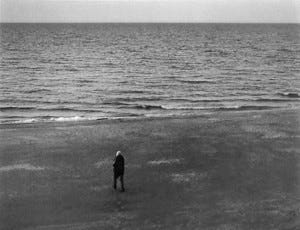
Spencer: Most of these films have very recognizable actors in them, so a lot of times I purposely didn’t include their faces. Because then I’m looking at a picture of The Rock! But when you show part of their face or a profile, and they’re looking toward something, then you become a spectator to what they’re looking at. And for me, that was important.
Jamison: One thing that kept me drawn to the images when I was responding [writing the essay] was the moment when figures in the images are looking outside the frame, looking at what’s about to go down, what’s just beyond the doorway. What’s the basic mystery of the narrative? What is this character seeing? What is about to happen? I think what happens is that when you re-contextualize these images out of a familiar situation — half the world gets saved, or only the two character we care about get saved — but once you get out of those familiar areas, it makes it scary again, but there’s also a lot more narrative mystery. And I loved that. I didn’t get one story about who these characters were and what was happening. In each frame there were like a thousand stories that could have been. And I loved that. This refused to be fixed into a single storyline.
Britt: In these kinds of movies, we’re dealing with the people in charge, or the people who are trying to fix it. Or at least half the time we are. It seemed like you were both thinking “what would a regular person” do in if the apocalypse were to occur? Is the love you both have of these kinds of narratives tied to thinking about it personally? Which kind of protagonist would you be in these narratives? The scientists in the lab trying to fix everything? Or the person grabbing enough baked beans to get by?
Jamison: I can confess one thing. I don’t think I’ve ever told anybody this. I did have a fantasy about this. Another seminal film for me was Deep Impact. While this may sound sick or petty…A trope you see in these films is that people are “the chosen” or the “saved ones.” And in a film like Deep Impact they had these arks, out in the middle of nowhere. And a certain number of people were going to be given space on these arks. Most of it was determined by lottery but other people were sort of declared to be a “living nation treasure.” I never thought I could be any kind of scientist, but I did have some fantasies that I’d been given a spot on the ark for other reason. “Oh, we really like your essays,” you can have a spot on the ark! (Laughs)
Britt: So, the main motivation to become a writer of any note is to get selected to live through the apocalypse. (Laughs)
I think there’s a million theories as to why these kinds of [disaster] narratives appeal to us generally, but Leslie just revealed why it appeals to her personally. [To Ryan Spencer] What you your role be?
Spencer: (laughs) I don’t really know what I would do. Haven’t really thought that far ahead!
This conversation occurred live on 6.22.155 at the powerHouse Arena in front of an audience for the launch of Such Mean Estate. It has been edited and condensed by the interviewer.
All photographs copyright Ryan Spencer, from Such Mean Estate, unique panchromatic instant prints, 2.9 x 3.7 inches.
Looking for some interesting reading to get you through the week? Here are some literary links from around the web to check out:
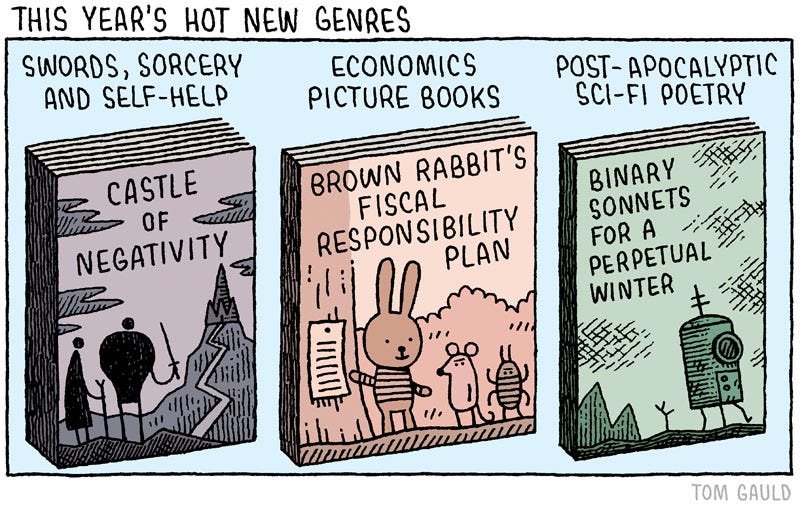
Tom Gauld premiers the hip new genres of 2015
One awesome group of teachers repainted the school’s lockers to look like famous books
New Yorker takes a look at the surprising persistence of literary magazines
“As human beings we’re all short-story enthusiasts” says writer Graham Swift
Michael Kimball wants to save you $50,000 on an MFA
Author Catherine Lacey eats a shit ton of hummus with Etgar Keret
Everything you’ve ever needed to know about the books of Jonathan Lethem
One woman is sick of dating men who don’t read women authors
Ottessa Moshfegh is “not comfortable with life on Earth”
Literary candles for book lovers
Is American fiction too dark and weird to be adapted for TV?
 Thank You!