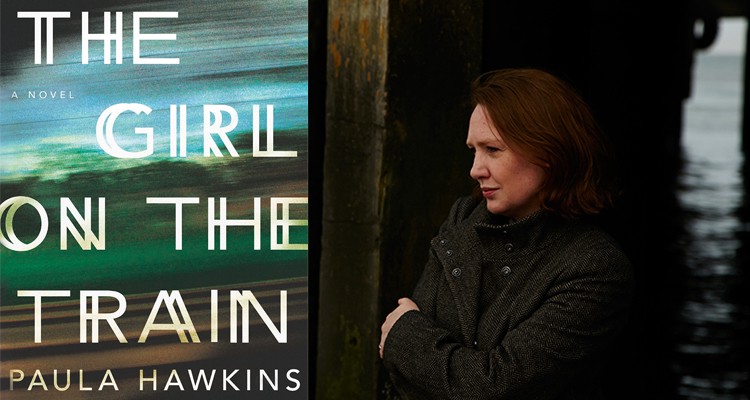
Brace yourselves, Dan Brown fans (we know you’re out there somewhere). After 20 weeks in the number one slot, Paula Hawkins’s thriller The Girl on the Train has broken the record for most weeks spent atop the UK hardback book chart — a record previously held by Brown’s The Lost Symbol.
Back in 2009, the follow up to The Da Vinci Code basked in #1 glory for 19 weeks. But Hawkins’s unprecedented run has ousted the sequel, solidifying claims that The Girl on the Train is indeed the spiritual successor to Gone Girl we’ve all been waiting for.
Train focuses on Rachel, an on-the-outs woman that takes comfort in admiring a seemingly perfect couple, whose idyllic breakfasts she witnesses daily while taking the train to work. When the wife vanishes, Rachel finds herself entangled in the mystery of her disappearance.
The book marks Hawkins’s first foray into the haute sub-genre of the literary thriller. Before writing Train, the Zimbabwe-born writer published a spate of romantic novels under a pseudonym. Hawkins told The Guardian, “The last one has loads of terrible things happening in it and ended up being rather tragic in a lot of ways. Nobody bought it.”
Lucky for us, Hawkins took that as her cue to change things up. Commuters of both genders, take heed: this might be the subway/train/bus read you’ve been waiting for.
This new infographic from Rayburn Tours walks us through the hallowed halls of fiction, television, and film’s most famous schools. Many of our favorite stories feature friendly classmates, challenging teachers, and flirtatious newcomers — offering both social and academic educations — all before the final bell rings!
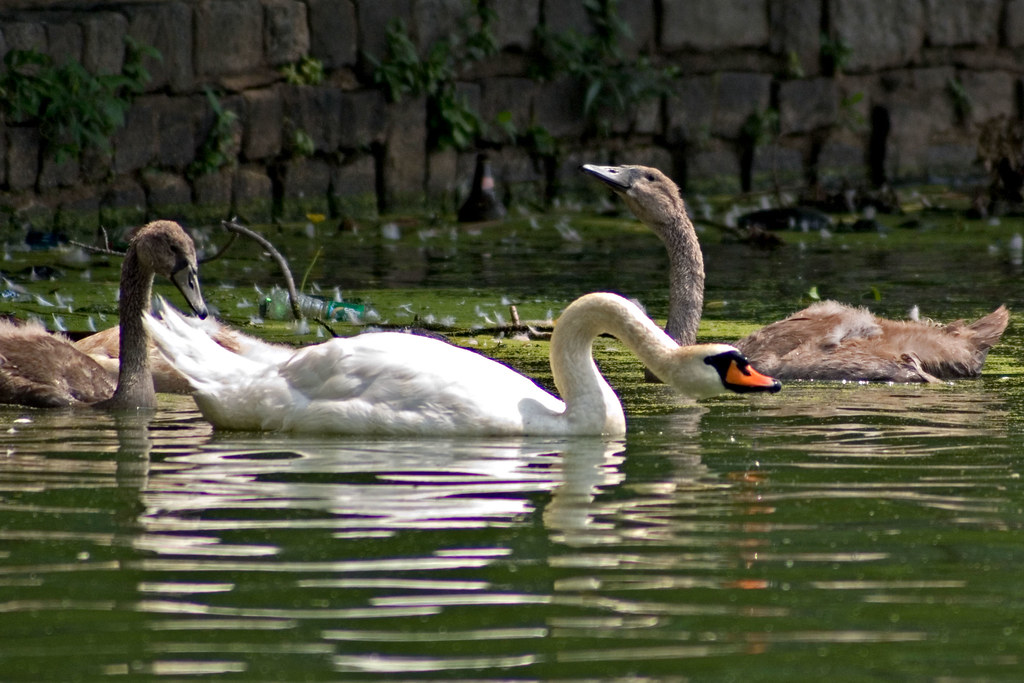
A swan’s foot, like a duck’s, is a webbed claw. In traversing swan shit and mud, these claws naturally gunk up and reek. Nobody in the history of the world, save another swan, has licked a swan’s foot while that foot was still attached to the swan. The feet resemble rabid bats in their sickly color and texture.
Moving north on the swan’s undercarriage, one will find an eroded civilization of swan shit and pond scum. This is a banal phrase, “pond scum,” one that is easily ignored, but look closer. Swans eat grasses, sedges, and pondweed, each teeming with murk. They will also eat insects, snails, and a fresh shrimp if they’re near one.
Pond scum is more of the same: swan shit, fish shit, frog shit, half a can of beer from some fuck teenager, plastic, photosynthetic residue, algae, permanent bubble, hexagon patch freed from its soccer ball, arthropod corpse. All attached to the swan in its idiot float through its stagnant little inland sea.
Swans eat tadpoles. A swan will slurp up entire schools of larval amphibians, process them, and shit them out, and then sometimes it will sit in the shit or walk through it, and here we are. Anyone who claims that a swan is a majestic and noble creature has never seen a swan up close.
Swans will attack you if you are nearing their young or their nest, if you are trying to have a conversation with their mate. They have jagged points on their beaks, which resemble teeth but more closely resemble a plumber’s saw, which plumbers call a Tiny Tim. If you try to take a swan’s picture he will strike you with his beak. Too much attention enrages a swan. The swan has a long neck and will strike at you. The swan will bite you and tear your flesh.
Swans mate for life, which is maybe ten or fifteen years. Someone found a swan once that was twenty-four years old and probably it was mating for life, which everyone made a big deal out of even though the swan was not even old enough to rent a car. The swan wasn’t yet acquainted with life enough to silently hyperventilate in its bed. The swan didn’t have a bed. The swan was too stupid to have a bed and if it did it would fill the bed with swan shit.
Starting in 2016, the Man Booker International Prize will merge with the Independent Foreign Fiction Prize, thus creating an annual “super-prize” rewarding both the writers and translators of foreign-language fiction. (The Man Booker International Prize was previously biennial, recognizing an author’s body of work published in English).
Novels as well as short story collections will be eligible. The prize money of £50,000 will be divided equally between the writer and the translator.
The last three winners of the Independent Foreign Fiction Prize were Jenny Erpenbeck, Hassan Blasim, and Gerbrand Bakker. The last three winners of the Man Booker International Prize were László Krasznahorkai, Lydia Davis, and Philip Roth.
Publishers Weekly quotes Jonathan Taylor, Chair of the Booker Prize Foundation: “We very much hope that this reconfiguration of the prize will encourage a greater interest and investment in translation.”
All too often, magnificent works of literature are lost in translation. Hopefully, with the introduction of this new prize, works of translated fiction will be published more often and read more widely.
Lemony Snicket’s A Series of Unfortunate Events — beloved by children and adults alike — will soon be developed into a Netflix original series. As if Netflix wasn’t already addicting enough, this will be yet another reason to plop down in front of your screen for hours on end.
As Entertainment Weeklyreports, Lemony Snicket released a statement in his famously ironic humor: “I can’t believe it. After years of providing top-quality entertainment on demand, Netflix is risking its reputation and its success by associating itself with my dismaying and upsetting books.”
Fans, upon hearing the news, were thrown into a frenzy of anticipation. But instead of just tweeting madly about the exciting announcement, The Guardian reports that a fan created an unauthorized and wholly convincing teaser trailer (watch it above) under the YouTube account Eleanora Poe, which has garnered over one million views (and counting!)
Netflix recently broke the news to disappointed fans that the YouTube trailer was a fake, but has not yet disclosed a premiere date for the series. The book series, which sold more than 65 million copies worldwide, was previously adapted into the 2004 film starring Jim Carrey, Jude Law, and Meryl Streep.
Over a decade later, it comes as no surprise that fans are itching for any hint, any preview, of the upcoming Netflix series — even if it’s a fake teaser trailer.
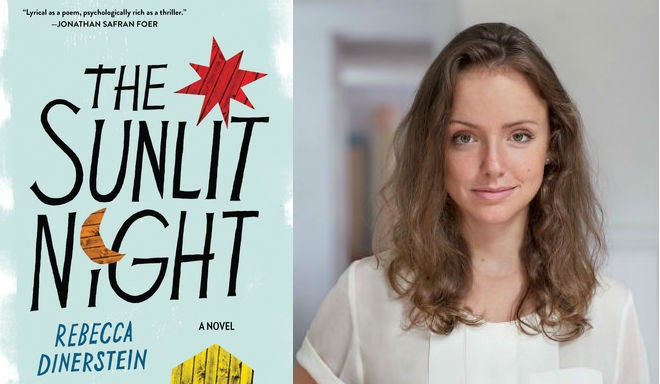
I’ve found myself on more than one occasion talking about Rebecca Dinerstein’s debut novel,The Sunlit Night. Although during each conversation the elements I decide to underscore may change — the love story plot or the silky language — I always come back to one word: warm. It’s hard to read The Sunlit Night without feeling as though you’re enveloped in warmth, swathed by the author’s lyricism and imagery. The sensation is one unique to Dinerstein’s hand — and perfectly matched for the sun-soaked Nordic tale of lives intersecting at the top of the world.
Two days after the launch of her book — a reception at Brooklyn’s PowerHouse Arena that also couldn’t be described as anything other than warm, not coincidentally — Dinerstein took off for book tour to promote The Sunlit Night. That morning, we kicked off an email conversation…
Meredith Turits: The book’s officially out — all of your anticipation is now actually diffused into real momentum as your title sits on shelves. What’s an emotion you felt that you didn’t necessarily anticipate as the book became less of a concept, and transitioned into a tangible object that people could hold, read, walk around with, ask you to sign, and associate with you?
Rebecca Dinerstein: To be honest, working on a book for six years drums up such a range of emotions, there aren’t many that catch me by surprise anymore. As Feist sings, “I feel it all!” Relief, shock, excitement, bashfulness, bewilderment. More than anything I feel gratitude.
MT: Speaking of gratitude, I know two of the people to whom you’re grateful are two of your closest friends from graduate school, Julia Pierpont and Julie Buntin, who’ve also sold their books. What’s it like to go through the process of releasing a book side by side with your best friends, and to have a support system that can identify with specific things you’ve felt? And, at the same time, did you learn anything from contrasting your experiences to theirs along the way?
RD: I don’t know how I could have gone through it without them. This process is so full of surprises, challenges, and emotional turbulence — we have helped each other stay sane. We have answered each other’s questions, supported each other through edits and rejections, accompanied each other to libraries and publishing parties and late night Indian restaurants and panels and bookstores and all the places along the hustle route. Comparing our experiences has relieved some of the natural alienation behind publishing and it’s also taught us about the full range of possible experiences. Their company and their wisdom have been invaluable.
MT: What have your first few days on the road been like? Has there been a transition for you to seeing yourself as an author?
RD: Dreamy! I’ve woken up in a different city every day. It’s such an electric experience of time and space. I can’t say I fully think of myself as an “author” yet, but when I meet people across the country who have read and enjoyed the book, I feel like a member of a wider community than I’ve ever known before, and it’s thrilling. Book tour is very social, but it comes with a lot of alone time — you become your own common denominator as everything else around you shifts. I love traveling alone, soaking up that solitude and the views out many windows, and then enjoying all the energy and friends I find at each destination.
MT: I would imagine that you have a somewhat solidified view of what your book is — how the story elapses and exists, and what it means — after spending so much time with it. Now that you’re beginning to interact with other people who’ve dug into it, have you started to find that they’ve taken different things away from it than perhaps you did, or maybe found things in your pages that you didn’t even expect?
RD: I’ve heard the book’s Norwegian landscape descriptions called “psychedelic,” which I couldn’t have expected but does ring true, and I’ve gotten a variety of reactions to Yasha’s mother: some enraged, some enchanted. One man in Seattle gave me a piece of feedback I cherish — he said the book presents a special understanding of what beauty is. If that’s true, the book has achieved its goal.
MT: I love that. I have this special experience with this book — whenever I so much as think about it, I have a synesthetic experience: I always envision the color yellow. Now, that may be for obvious reasons because of some of the content within the book, but something makes me feel like it’s beyond just the art — there’s a warmth that the book gives out, its own special aura that makes it incredibly unique. Have you ever had that strong associative experience with a book or a word?
RD: That’s so nice! I associate Virginia Woolf’s To The Lighthouse with foggy purple.
MT: I know when you were in Lofoten you had time and solitude to focus on writing as you pleased. How did your find your writing habits and processes change when you came back to New York and had to slide back into a schedule that demanded you balance between writing and the rest of life?
RD: In New York I had to be much more disciplined and ritualistic in order to get the same amount done. I’d wake up at a certain time, drink a cup of coffee, and work until I’d written a set number of words per day (in my case 1,000, but I was hurrying — I think any consistent daily output keeps things moving in a rewarding way). This was less “dreamy” than writing at 2 a.m. under the midnight sun, but it was also wonderful to be able to stop writing at 3 p.m. and go out into the Brooklyn afternoon, where I could find coffee shops and friends and the city’s many treats!
MT: How has your relationship to Norway evolved? You’ve written so much about it, but you also have some distance now.
RD: Great question. Norway has offered me many homes: it gave me a solitary getaway, a romantic relationship, my first publisher, a second language, the comfort of deep friendships, a summer job at a gorgeous rose garden (Baroniet Rosendal!), and a subject for both poetry and prose. I’m endlessly grateful for the variety of experiences it’s afforded me, and for the warm welcome and support I’ve felt from my Norwegian friends as I continue to adopt their country! Now that The Sunlit Night has come out, I do feel that a certain portion of the Norwegian adventure has ended. I’ve expressed my affection and admiration for that landscape, and now look forward to celebrating other subjects. But the next phase of the Norway relationship begins next spring, when the book comes out in Norwegian!
MT:I suppose this would be the best time to ask you what’s up next. I know there are rumblings of another novel — can you share some details? We’re on home shores this time, yeah?
RD: Home shores, I hope. I am working on another novel, and I’d like to focus more on psychology, relationships, and human drama this time, as opposed to travel. It’s in its early stages, and subject to change, but I’m exploring the history of poison, as it has been fatally discovered in berries and plants throughout the natural world. I hope to take the Adam and Eve story as my starting point, and investigate our relationship to the forbidden. I’m working out what “picking our poison” means. At the same time, some part of me wants to flip the Far North upside down and head out to Chilean Patagonia. Maybe that’s for novel number three.
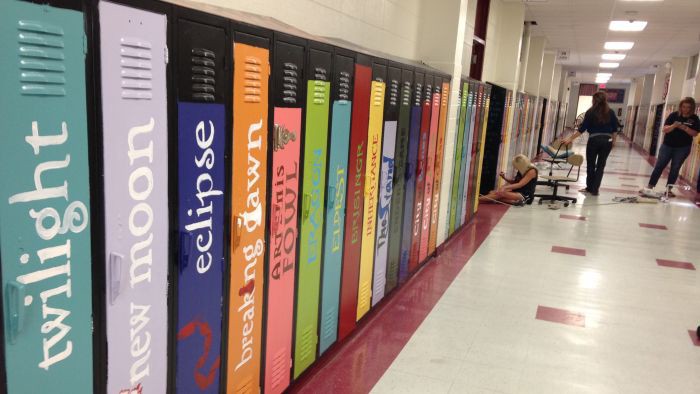
Envy the junior high students in Biloxi, Mississippi, who will return from summer vacation to find their English hallway transformed into a brightly colored Avenue of Literature. Each of the 189 lockers that line the hallway — unused for more than a decade — has been painted over to look like the spine of a popular book.
The project was spearheaded by a group of teachers, who decided to devote their summers to creating an environment more conducive to a love of learning than a procession of defunct storage units. Teacher Elizabeth Williams explained, “We want students to come back to school in August and walk on the hallway and be absolutely amazed with what we’ve done and be curious. We want that to be the driving spark for reading in our classrooms.”
In deciding which titles would earn a spot on the Avenue, the Biloxi teachers tried to draw on a wide range of genres, interests and reading levels. Each novel in the Twilight series is represented, but so are Watership Down and Johnny Tremain.
A ribbon cutting ceremony has already been planned to thank the painter-teachers, whose enthusiasm for the project seems not to have been dulled by the arguably arduous task of making over dozens of metal boxes. Said teacher Stacey Butera: “Now, when I look out, I’m going to see things that are fascinating, and I hope the students are going to be fascinated and try to read as well.”
As a child, I had nausea every time we drove back from a day of crabbing and fishing on the piers at Dauphin Island. The corn dogs I’d washed down with Fanta all day, the prickle of cracked vinyl on the back of my sunburned legs, the smell of Coppertone mingled with my parents’ cigarette smoke blowing with the salt breeze over me in the Rambler’s back seat — suddenly it would all turn my stomach upside down, in spite of the yellow Dramamine tablets my mother had given me.
Voyager 1 has now reached the heliopause. More accurately, as astronomers have learned from the data Voyager relayed, it has reached the “heliosheath depletion region,” a transitional place, still barely “in the sun’s magnetic embrace,” as the article tells me. Galactic particles from interstellar space bombard it as it makes its slow, plutonium-powered way where we will never go. I say all of this in present tense, although I am aware that by the time the data reached us, Voyager had long since moved on from where it had been. By now, it’s probably slipped, no, lurched free, unbound —
cold white sting of Solarcaine on sunburn: nothing could hurt us for long
The ashtray in my mother’s car is always full. When we leave for the store, she lights up in the driveway, the air-conditioner going full blast against the scorching central Texas heat.
All I remember of Büchner’s play Woyzeck: the grandmother’s black fairy tale about the orphan left all alone on the earth who went to the moon but it was rotten wood so he went to the sun but it was a withered sunflower and the stars were dead flies so he came back to the earth but it was an overturned pot so he sat down alone on it and cried and is crying still
every memory I’ve ever had: pulse from a dead star
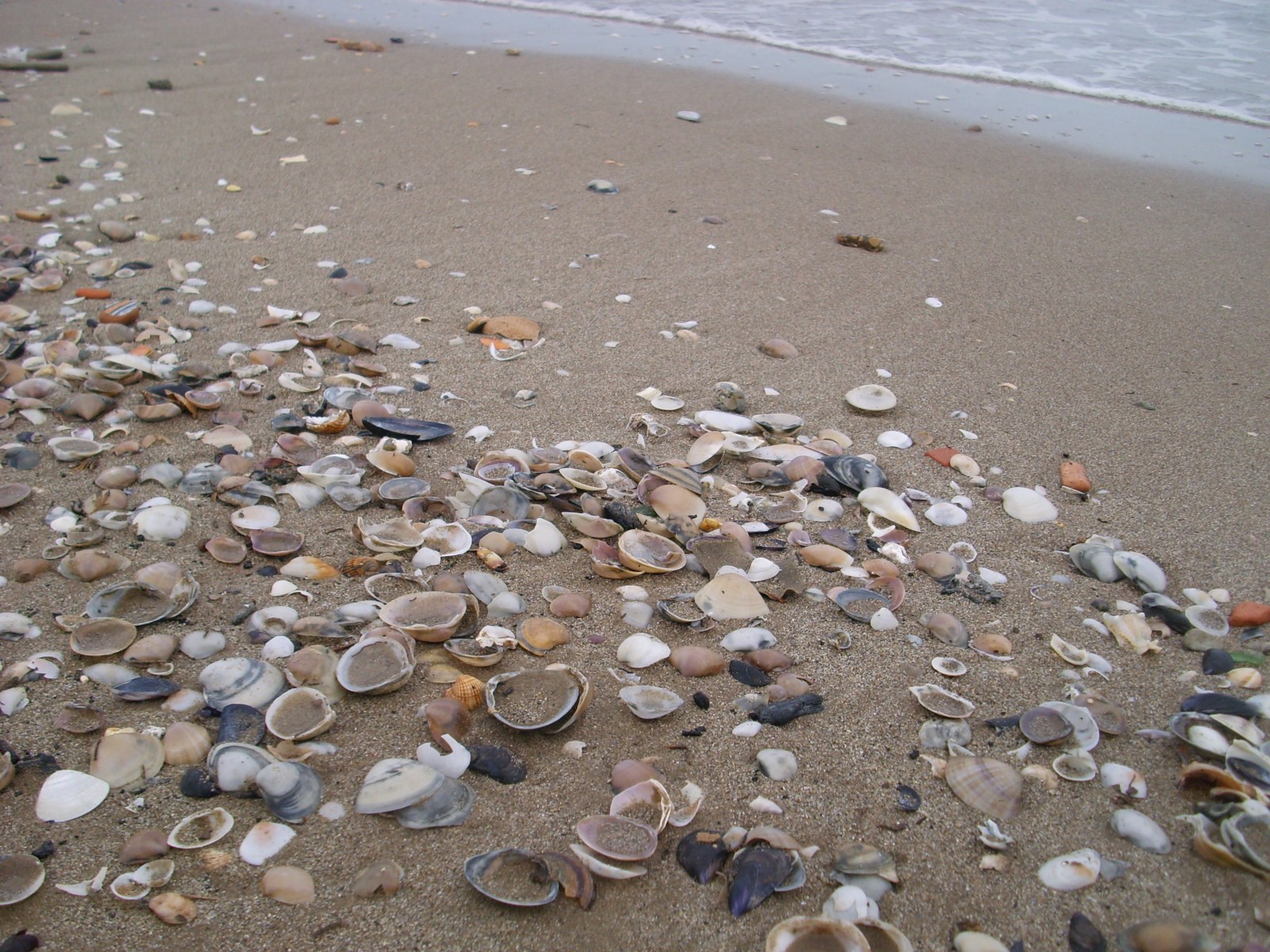
She and I would walk the beach while my father surf-fished for flounder. We gathered scallop shells and sand dollars, but what I most enjoyed bringing home were the worn slips of sea glass, their muted greens and blues. Back home, she dropped some in my bath so I could see them regain their luster.
In 2011, as Voyager began its heliosheath exploration phase, my mother was again diagnosed with breast cancer; her first cancer, in 1983, was successfully treated with chemotherapy and radiation. This time it was not a recurrence but a new, very slow-growing cancer, also present in her lymph nodes. Because she had received such high doses of radiation previously, that treatment was no longer an option. She elected to have a double mastectomy.
Voyager’s last step before entering the heliosheath was passage through the termination shock, “an environment controlled by the Sun’s magnetic field with the plasma particles being dominated by those contained in the expanding supersonic solar wind.”
My mother’s chemotherapy seems to have been successful. Her hair has grown back. She misses her breasts; I miss her breasts. She hasn’t yet had her reconstructive surgery, and I’m doubtful that she will quit smoking long enough for the doctors to clear her for the procedure and the long recovery. When I see her, I can’t help looking at the flat fall of her clothing across her chest. When I think of her, I see the shape her breasts made in her blouse.
the net hauled up at the pier’s edge: crabs gnawing on chicken parts
Right after the grandmother’s tale, Woyzeck returns and talks to his wife, Marie:
Woyzeck: We’ve got to go Marie, it’s time. Marie: Go where? Woyzeck: Does it matter. They go down the street.
My front porch is decorated with fossils my mother pulled from her yard, limestone trilobites and brachiopods slowly forced from the earth.
If Voyager 1 could feel, it would feel the interstellar winds.
Reruns & Premonitions of September, 1974
Hi-jinks and laugh-tracks afternoons after school in the den with Chris, my college student babysitter, snacking in the glow of his parents’ black & white TV:
Star Trek, Gilligan, Munsters, ghosts stranded in backlot galaxies, like me haunting this childhood scene.
Chris props a sketchpad on his lap, sketches unpeopled mountain landscapes, picks with a thumbnail at scabs of paint on his hands.
Slouched outside the sliding door: a shaggy mimosa frilled with frilly blooms, starburst-clustered gold-tipped stamens.
A game: we palm-roll slices of white bread into fleshy balls, see who can roll the biggest and pop the pale glob whole into his mouth.
I chew and fidget, stretch my hand to fumble in the bread bag between us: just a heel; my luck.
Sun low in the mimosa; glare sliding in; dim shapes creep across the screen, and turpentine and sweat drift from Chris’ body to my nose, my thigh
twitching near his — won’t he ever lean over and croon to me oh little buddy, little buddy — ?
Captain’s log: under the yard, the house, the day, a world ends: mimosa roots slo-mo strangling pipes, cracking slab…
My ship at warp speed vanishing, our bodies shimmying into vapor, I beam back to this abandoned den,
too late: nothing to eat, nothing on TV, just speckles of starlight (oh spectacles yet
unseen here). I’ll get by. I’ve gotten by on less.
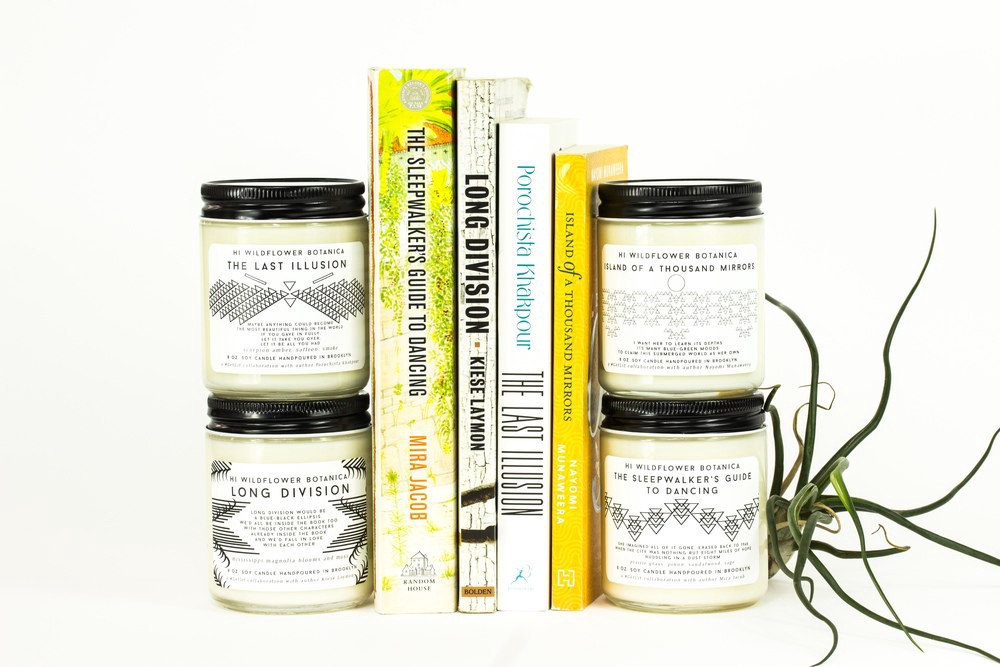
Tanwi Nandini Islam, writer and founder of Hi Wildflower Botanica, has introduced #GetLit: new scented candles inspired by some of her favorite authors.
Although readers may have different methods of consuming literature, perhaps what we all have in common is a desire for complete immersion. In her article for Elle, Tanwi recalls the conception of her project: “When you get lost in the imaginary world of a book you engage your sense of sight, touch, maybe even sound–so why not scent?”
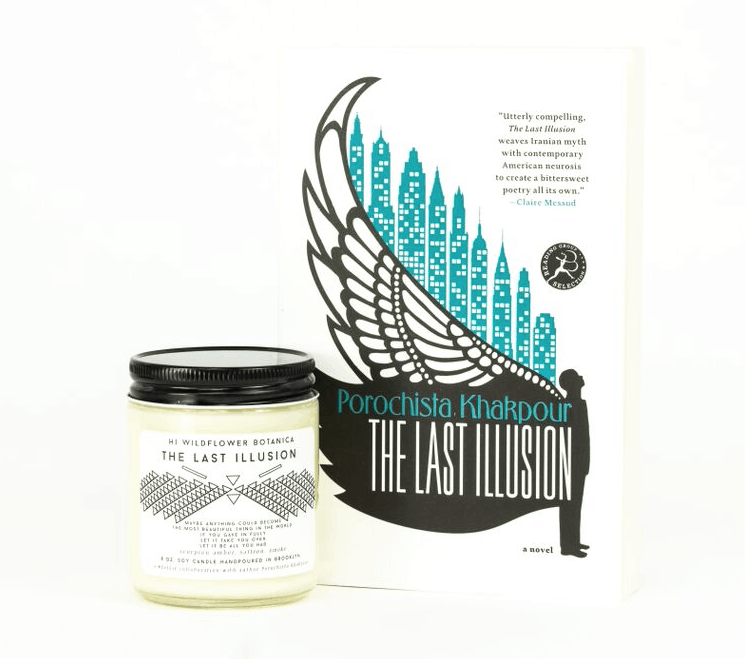
#GetLit candles successfully capture the defining scents of four contemporary novels. Kiese Laymon’s Long Division evokes an intoxicating blend of Mississippi’s magnolia and moss; Porochista Khakpour’s The Last Illusion provides a whiff of scorpion amber, Persian saffron, and smoke; Mira Jacob’s The Sleepwalker’s Guide to Dancing transports us to New Mexico and Kerala, India, using prairie grass, sandalwood, and sage; Nayomi Munaweera’s Island of a Thousand Mirrors smells of Sri Lankan vetiver and coconut.
A human’s most primitive sense — our sense of smell — is directly related to emotions, memories, and creativity. Curling up in an armchair with one of these four novels, its corresponding candle flickering, will allow us to travel to a place we’ve never been before, or return us to the place that matters most.
August 5, 2015: The title of this article has been changed to accommodate a request from the proprietor of the Etsy store Novel Scents.
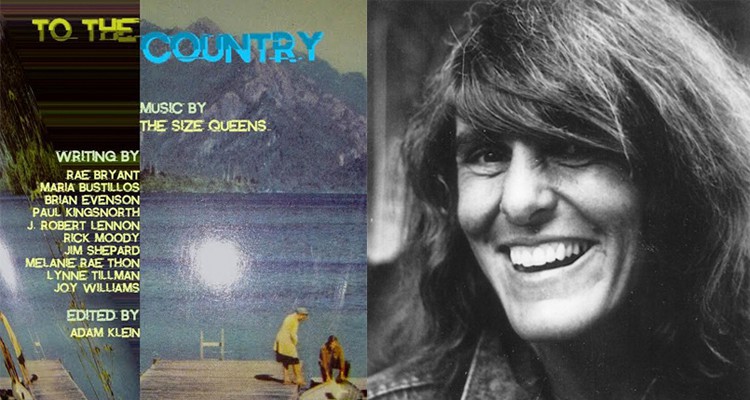
[Editor’s note: the following is an excerpt from To the Country by The Size Queens, an iBook that combines the music of The Size Queens (Adam Klein and Michael Mullen) with original, accompanying writings by authors such as Rick Moody, Lynne Tillman, and Jim Shepard. Play the song “Country Back” above and download the iBook here.]
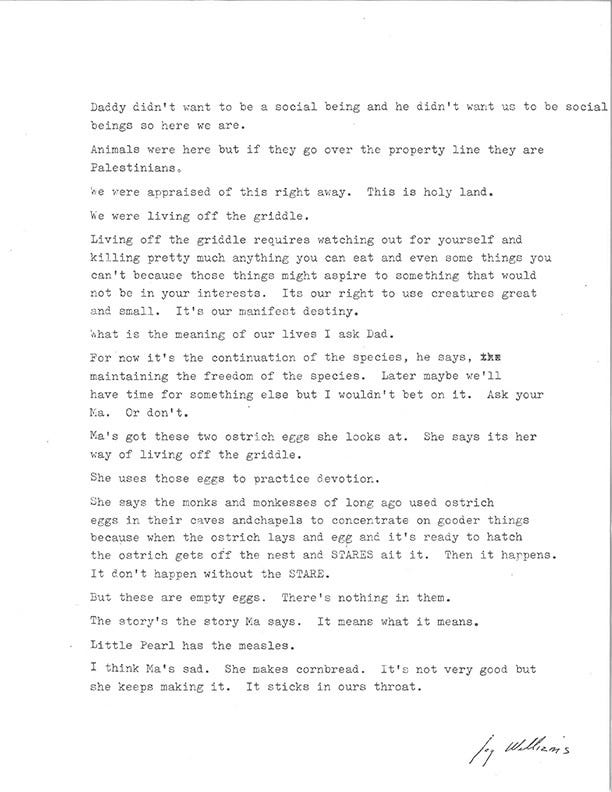
Joy Williams’s typed manuscript
Adam Klein: Last December, I began reaching out to writers, asking if they’d be interested in writing a response piece to songs from The Size Queens’ To The Country. The band’s manager (and co-conceptualist), Chuck Mobley, and I had discussed the idea of releasing something other than a traditional CD or vinyl record. The iBook presented the option of bringing in authors to collaborate with in the same way musicians, visual artists, and literary magazines had collaborated with us in the past. The writers “responses” were meant to augment the song in some way, and could be as strange as Brian Eno’s synthesizer solos on Roxy Music songs, or blend like a pedal steel on an Americana album. The texts could work as instruments or a spoken word element in — and apart from — the songs.
I had just reread Joy Williams’ The Quick and the Dead and knew, if I could get her onboard, that she would understand the screwball daddy/preacher voice in the song “Country Back,” a voice that deploys Tea Party platitudes and militia rhetoric and scrambles it up with a little of Ted Kacznski’s anti-industrial, anti-technology, and anti-leftist huff. I contacted the English department at the University of Wyoming, but I was soon informed that Joy Williams doesn’t use a computer. However, I was kindly assured that she thought it likely Ms. Williams could find a way to play it. Soon, I received the following typed letter. The entire interaction took three weeks. It was faster and more efficient than with any writers with whom I interfaced online. The postal trucks must have had snow tires, and to this day I imagine Joy with some Walkman, playing the song in a roadside hotel, approaching her Smith Corona, and jotting down her lines while the heaters whistled, the lamp cast its yellow light over the thin paper, and the white landscape made town after low town of truck stops and Denny’s, auto parts stores and dim, mall churches look celestial.
Joy Williams on “Country Back” by The Size Queens
Daddy didn’t want to be a social being and he didn’t want us to be social beings so here we are.
Animals were here but if they step over the property line they are Palestinians.
We were appraised of this right away. This is holy land.
We were living off the griddle.
Living off the griddle requires watching out for yourself and killing pretty much anything you can eat and even some things you can’t because those things might aspire to something that would not be in your interests. It’s our right to use creatures great and small. It’s our manifest destiny.
What is the meaning of our lives I ask Dad.
For now it’s the continuation of the species, he says, maintaining the freedom of the species. Later maybe we’ll have time for something else but I wouldn’t bet on it. Ask your Ma. Or don’t.
Ma’s got these two ostrich eggs she looks at. She says its her way of living off the griddle.
She uses those eggs to practice devotion.
She says the monks and monkesses of long ago used ostrich eggs in their caves and chapels to concentrate on gooder things because when the ostrich lays an egg and its ready to hatch the ostrich gets off the nest and STARES at it. Then it happens. It don’t happen without the STARE.
But these are empty eggs. There’s nothing in them.
The story’s the story Ma says. It means what it means.
Little pearl has the measles.
I think Ma’s sad. She makes cornbread. It’s not very good but She keeps making it. It sticks in our throats.
DON’T MISS OUT
Sign up for our newsletter to get submission announcements and stay on top of our best work.
YOUR INBOX IS LIT
Enjoy strange, diverting work from The Commuter on Mondays, absorbing fiction from Recommended Reading on Wednesdays, and a roundup of our best work of the week on Fridays. Personalize your subscription preferences here.