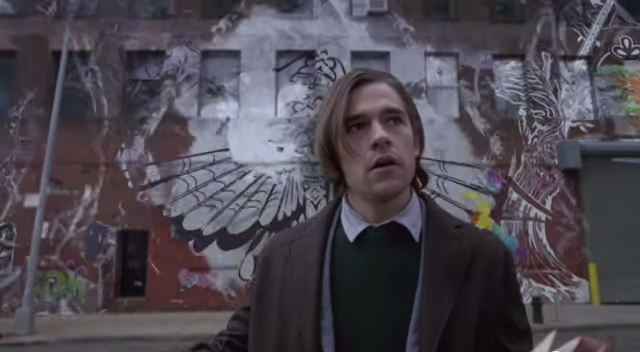
Lev Grossman’s best-selling Magicians trilogy is being adapted for a 12-episode television series, which will premiere on SyFy sometime in 2016. If you missed the first trailer, treat yourself to an enticing look into Quentin Coldwater’s world at the magical Brakebills Academy. Jason Ralph (A Most Violent Year, Aquarius) stars as Quentin.
After viewing this newest extended teaser — which premiered last weekend at San Diego Comic-Con — I can’t help but agree. It’s a suspenseful, exciting scene that left me drooling for more of Quentin’s magic.
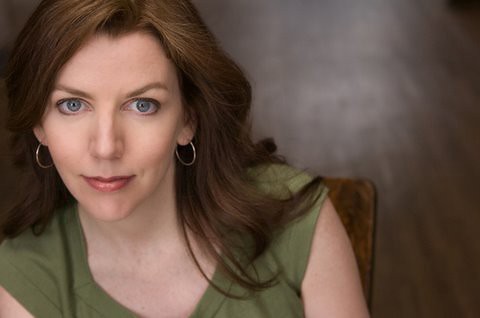
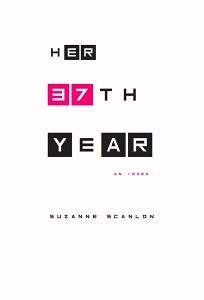
The form of a novel is the artifice used to give shape to life. Suzanne Scanlon’s Her 37th Year, An Index, uses the form of the index to give shape to a messy year of ruminations on marriage, child rearing, desire, teaching, therapy, and the life of the mind and the decay of the body. Full of footnotes and humorous dead ends, this slim volume is not slight, and it encourages you to flip back and forth, to read the authors she references. Scanlon and I corresponded through e-mail over a month and discussed form, memory, female sexuality, confessional writing, and writers: Marguerite Duras, Jill Talbot, Sharon Olds, and David Foster Wallace.
Adalena Kavanagh:As I read it, your book Her 37th Year is a novel in the form of an index. Is this accurate? How did you come to the form for this book? What were the limits and possibilities of writing this book in this form?
Suzanne Scanlon: It is accurate, yes — though it is a very loose index. I like using various forms to shape a story. For my grad school thesis, I wrote a story that was in the form of a long exam. It’s not original, but I’ve done this a lot; it helps me to impose an external structure. That’s what happened here. Once I started, I wanted to keep going — & I might have, if it hadn’t been accepted for publication by Noemi so swiftly. The form was fun, and as with using footnotes — the system takes over, drives the narrative, becomes addictive (from the writing standpoint). I didn’t really notice limitations to it! Though, of course, I began with a very focused idea of what I wanted — one year in one woman’s life. That constraint was liberating.
Kavanagh: In what way was it liberating to have that particular constraint?
Scanlon: I often write in a very digressive, sprawling way, at least thematically. That can make it easy to get overwhelmed, and hard to finish a project. So, the structure contained my ability to do that.
The other constraint I added later, while shaping the book, was to narrow and heighten the story of the affair, this “one man” as a through line, the “man in boots”. My editor, Amanda Goldblatt, helped me with this. I think the singular thread of a romance, or an affair, however subtle, helped to contain the rest of the story.
Kavanagh: Is there one narrator or two narrators? I ask this because as I read the book I felt sure that it was one narrator, but she switches at times from second person to first person. Why?
I rarely find one narrative voice sufficient.
Scanlon: One narrator, but I can’t help but switch voice. I rarely find one narrative voice sufficient. This is a book about the self as a shifting construct, and I think people often see themselves in the first/second/third person. If I wanted to be smart about it, I would say that the book is about the many-layered, contracted and expanded self, and therefore requires more than one voice, or perspective. But it is also about the self in a sacred solitude, which remains necessarily in communion with the Other — the fiction of the Other, but the necessity, too. The individual is a myth, as Tony Kushner says. So, that was my way of pushing that idea, engaging the selves and others who make this woman’s life.
Kavanagh: What does the second person do for you? What do you think it does for the reader? From my point of view, it seems to be a way of distancing yourself from the text, but it can also be a way of making the text more universal. What do you think of that idea?
Scanlon: Yes, I think second person can do both of those things, depending on the reader. I find it more intimate, when it works.
Kavanagh: The footnotes and quotes and acknowledgements act almost like a syllabus of writers and ideas in addition to the narrator’s “story”. Taking this concept further, what is the course title, and what is the overarching thesis?
Scanlon: Ah, I like that idea! I remember hearing Jill Talbot read a story she wrote that was structured as a syllabus. This was after I’d written 37th Year, but I quite liked it, and I think there is an affinity there. As writers and teachers, we are overwhelmingly engaged with books and writers and our sense of self bleeds into this. The course title for Her 37th Year could be: Darling, You Die Alone No Matter What: The Erotics of Grief. Or, to use the Duras line: Grief: The Most Important Thing in my Life
I think our culture has a weird superficial interest in death and suffering as a character trait, but it’s not something (art, in general) that people want to be true. But for some of us, it is true — grief is where we live or have lived, and that means that we write. It’s not so simple, not so reductive, but it’s also not a pose; it’s not cultivated in order to be, you know, hip. I don’t think any one would choose this life of perseveration, obsession, longing. But it is often the stuff of life and art. And as a writer, you can’t deny it.
There’s the thesis then, for my imaginary class: Writing must be about standing over the void.
Kavanagh: Is the void the inevitability of death? If so, why must writing address this?
Scanlon: Not exactly, no. I’m thinking of Marguerite Duras’ narrator in The Lover:
Sometimes, I realize that if writing isn’t all things, all contraries confounded, a quest for vanity and void, it’s nothing. That if it’s not, each time, all things confounded into one through some inexpressible essence, then writing is nothing but advertisement.
As I understand Duras, she was a writer who obsessively rewrote her life, her self, in her work, which was about memory and the self. That didn’t mean it was autobiography, but it was truth. It was a search for truth, which is never finished. What I mean by the void is facing the self honestly. Writing is often a process of peeling back layers, trying to get to truth, to uncover defenses and lies. That space is the void. It might be death, or emptiness, or it might be life itself.
Kavanagh: It’s true that we have a superficial interest in death, especially in the deaths of our beloved writers, particularly when they commit suicide. In this book you talk about David Foster Wallace. I don’t want to jump to conclusions so I will ask: is he the “teacher” referenced in this book?
Scanlon: The teacher in this book is a composite, inspired by many teachers I’ve known. But yes, he was my teacher, and an important one.
Kavanagh: What is your relationship to David Foster Wallace as a reader and writer? More specifically, how does he inform your writing, particularly this book?
Scanlon: I was/am a reader of his work, and then he became my teacher. And I continued to read him. His death informed this book, in that he died just after I had a baby. Of course, his death reverberated culturally, but it was personal and particular for me. As death can be. His death brought him back to life, in a way. I thought about him a lot more than I had in the years before, and so had to revisit how I knew him and what he’d taught me and what I understood of what it meant to be a writer and a depressed person. I really admired him, though he’d hurt me, and so his suicide was complicated, to say the least.
Kavanagh: You said: “I really admired him, though he’d hurt me, and so his suicide was complicated, to say the least.” Suicides are always complicated for survivors — something that might be hard to understand if they are outsiders who want to extend their empathy to the one who commits suicide. How did the public’s reaction to Wallace’s suicide and the canonization of his work affect how you present him in this book?
Scanlon: I wouldn’t call myself a survivor. No. His wife, his family, has to cope in a way I can’t imagine. By the time of his death, he existed for me more in the realm of memory. He was somebody I used to know. Our last letter exchange was in 2006, I think, a kind of detente. I didn’t reread his work much. But then, after his suicide in 2008, my sense of him and my relationship to him shifted; I reconsidered all I knew and thought I understood about him. Having been through intense treatment for depression, I’ve known other suicides, but this was different, of course.
The renewed interest in his work was strange, if understandable. But creepy, too, in the way that a dead writer is always more palatable. I understand that. I just didn’t want to see it with someone I knew. Suddenly all my students knew who he was, and many were reading him; which hadn’t been the case before.
The week after his death I was teaching Creative Nonfiction, the class he’d taught when I was a student; I’d assigned the Best American Essays edition that he edited. And the next month, I happened to be back in Normal, Illinois, where I’d known him. It was uncanny.
In a way, his death made him more present in my life. I reconnected with others who knew him when I did. I remember a friend there saying, “A good death brings people together,” when I saw him, and it offended me. But it is true. His death has done that, in an amplified way — and not just those of us who knew him, but for the many others now connected around his work, and his life. It’s one of those paradoxes, that in a way, his death was also a gift. “Suicide as a Sort of Present,” as he titled one of his stories.
Kavanagh: As I was reading the book I admired how you wrote about female sexuality in a raw, nonintellectual way (though your book is very intellectual and full of references to authors and theory). Women are always sexualized, but there’s this idea in popular culture that after a certain age — late 30s — or life change — childbirth — women become less sexual. Your narrator clearly is not feeling that, but also struggles with reconciling her sensual feelings with the culture’s perception of women as they age. Why do you think these ideas about women (diminished sexuality, diminished desirability) persist in our culture despite evidence to the contrary?
It’s a way to silence and distract women, to convince us that we are less valuable after a certain age.
Scanlon: It’s a way to silence and distract women, to convince us that we are less valuable after a certain age. And of course we can spend all of our time and energy trying not to look our age, trying to have unlined skin etc. There’s a huge industry there, right? Which, for years I didn’t see through a critical lens; it was simply the air I breathed. The water we swim in. And if you don’t apply a critical lens to it — and even when you do — you are totally hosed, to quote Mr. Wallace again.
But I do think there are a lot of women willing to speak out about it — as Frances McDormand recently did, wonderfully — or simply to ignore the absurd cultural pressures, to focus on artistic practice. That’s what Sontag did, and so many of my heroes.
Kavanagh: Why is this about her 37th year? Is there significance to that particular age?
Scanlon: It is a reference to the Marianne Faithful song, The Ballad of Lucy Jordan, with the line “at the age of 37, she realized she’d never ride, through Paris in a sports car with the warm wind in her hair.” It’s one of my favorite songs, and it was used in that stunning road trip scene in Thelma and Louise. So, the double resonance moved me: a woman realizing she is at the end of a certain moment of possibility, and two women subverting dominant structures, finding transcendence.
Also, I was probably around (closer to) 37 when I wrote this book. It could have been 38 or 39; but the number 37 felt right. It had to do with the anticipation of turning 40 — which was, of course, much worse than actually turning 40.
Kavanagh: This book is a novel written as an index. The term “confessional” writing is almost always applied in a gendered way to women’s writing. Having written a book that some might call “confessional” — if not in act (it is not a memoir or autobiography), then in narrative tone, how would you answer potential critics who would diminish the work as being merely “confessional”? What do we as readers gain from work that is personal and concerned with the body and mind?
Art that has most moved me is linked to body and mind.
Scanlon: I don’t think there is anything “mere” about confession. I think we are currently celebrating Ben Lerner and Knaussgaard, yes? both of whom use something of the confessional in their fiction. That’s part of the power. As is, say, Louis CK’s TV show, or Amy Schumer’s comedy; it comes from life, from the experience of living in a certain body, in a certain time and place. I don’t know if there are critics diminishing work that way, but if they are, I don’t care. Art that has most moved me is linked to body and mind. I wanted to represent that: a life of the mind that is necessarily embodied.
Kate Zambreno recently asked me if my confessional writing was linked at all to having been raised Catholic, going to confession regularly, well into my twenties; and, it’s interesting, but I don’t think of it that way. I don’t even think of myself as a confessional writer. I think Sharon Olds once noted that her writing was not “confessional” but personal. There’s a difference.
Kavanagh: Going back to the teacher in this book, you must know that readers will intentionally or unintentionally conflate the teacher with David Foster Wallace. There is a scene in the book where the narrator has a sexual encounter with the teacher. With examples like that one you seem to be playing with boundaries here — even when you say the teacher is a composite (and I believe you, I am not saying I do not) — those boundaries of “taste” regarding female sexuality, and discussing what we are told should be kept quiet, as well as the boundaries relating to the ownership of memories of public people. Why play with those boundaries? What are you saying about those invisible boundaries?
Scanlon: I can’t control how people read the book. I think the book is about dissolving boundaries: between people, between the past and the present, between the living and the dead. I think teachers and students have complicated relationships, and always have. I always learned the most when I had a crush on my teacher. I’m not saying that’s “appropriate” but it’s true: I used to call them “academic crushes”. It was linked to my passion as a student and as a writer, finding these teachers. I’m not saying I admire Allen Ginsberg or others who slept with their students, as a matter of course — I’m not saying this prescriptively — but in the book I’m describing a truth of a relationship.
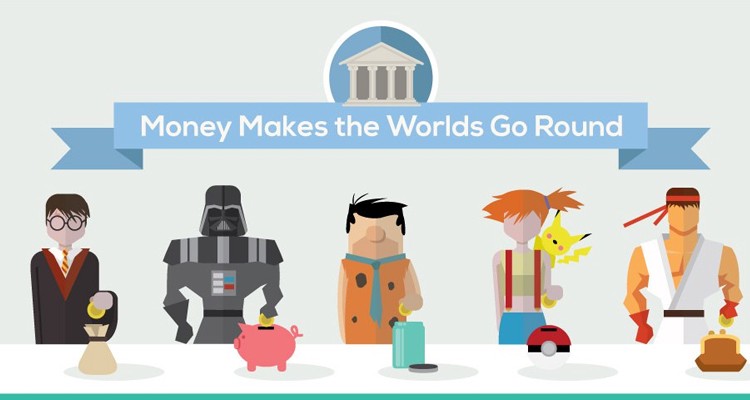
Thanks to Mobile Money for reminding us that fantasy literature might let us escape some things, but alas, not our reliance on money. See below if you ever find yourself needing to exchange Galleons for Solari.
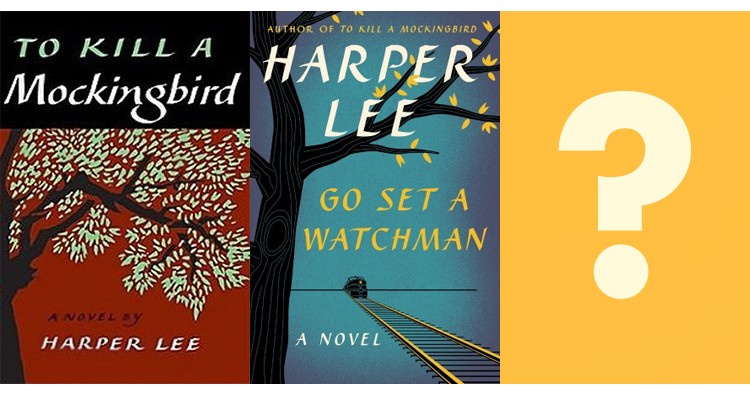
Go Set a Watchmanhas yet to commence its inevitable mass exodus from bookstore shelves, but the much-hyped To Kill A Mockingbird sequel is already in danger of being eclipsed by yet another long lost Lee manuscript.
Yesterday, the Wall Street Journalpublished a piece by Harper Lee’s lawyer Tonja Carter, in which she reveals that the manuscript for Watchman sits in a safety deposit box “underneath a stack of a significant number of pages of another typed text.”
Carter claims not to have perused these pages, but speculates that they might contain yet another tract on the life of Jean-Louise Finch. “Was it an earlier draft of ‘Watchman’, or of ‘Mockingbird’, or even, as early correspondence indicates it might be, a third book bridging the two? I don’t know.”
According to Carter, we might have an answer soon, once experts — given Lee’s blessing — “examine and authenticate” all of the documents in the safety deposit box.
An exciting prospect for TKAM fans who, this time tomorrow, will have finished tearing their way through Watchman. But given the ambivalence that has characterized most reviews of the book (a “lumpy tale,” says Michiko Kakutani), perhaps it’d be best if the documents turn out to be something less incendiary — like a list of Illuminati members, or a treasure map for the Holy Grail.
“A masterpiece”: For a novel to receive such praise no doubt is a publicist’s dream and often enough an author’s too, yet the penchant among reviewers for dubbing a new release with the weighty honorific must raise an eyebrow. It’s a type of soothsaying, really, since who can know what the future will hold, how the ultimate context for the work will grow, except a visionary — and how, in our data-saturated moment, can anyone make claims of visionary insight without a pyramid of spreadsheets to rely on? By dint of overuse, ‘masterpiece’ begins to seem less a marker of gravitas or achievement and more a tired commercial nicety. So it becomes an art of its own, a sense for when, critically speaking, to make such a claim.
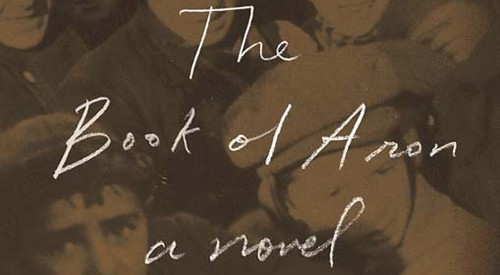
Jim Shepard’s seventh novel, The Book of Aron, arrives to just such praise. It’s right there on the jacket copy, a heralding trumpet. Furthermore, The Book of Aron figures as Holocaust fiction, that populous family of stories championed by awards-minded filmmakers and, on special occasion, the would-be literary memoirist. No pressure, but what could Shepard possibly add to the voluminous historical record?
The Book of Aron follows a less than devout Jewish country boy recently arrived in Warsaw. Early on, Shepard’s Aron speaks with comic pathos, the sort known to a middle child of a family doing more with less. A bookish loner, this boy’s emotional horizon is informed by the travails of a younger brother with bad lungs until one day “my father told me to get up because it was war and the Germans had invaded. I didn’t believe him, so he pointed at the neighbors’ apartment and said, ‘Come to the radio, you’ll hear it.’” The utter matter-of-factness of the arriving army is chilling for what we know it will bring. Yet Aron does not know, not right away; he has other things on his mind. The dynamic happens to be signature Shepard, tension between the personal and the political written large — or written close to home. Shepard’s brisk, laconic narratives tend to cleave to a protagonist participating in, but unable to fathom the full breadth of, a historical moment.
No doomy portentous cloud here, no melodramatic gestures at sweeping profundity. Nobody thanks an Oskar Schindler. Even as the real horrors encroach, Aron finds adventure and thrills as a smuggler among a gang of smugglers. Until even the last shred of normality is taken from him, he’s busy being a boy, doing what he needs to do to feed himself. To borrow from Jonathan Lethem’s Motherless Brooklyn, Aron tells his story walking.
Like Schindler’s List, The Book of Aron is haunted by a great man, in this case, Janusz Korczak, the pediatrician famous throughout Europe and appointed caretaker for a set of Jewish orphans. Central to the lives of saints, the act of bearing witness — to Korczak, to the struggles of friends and family — is performed by a boy who is not a model of moral purity, even as the occupiers’ crimes dwarf his own. Wracked by guilt, Aron needs to believe in Korczak. And Korczak knows it.
Shepard’s no sap, and his hunger for certified historic fact is voluminous, practically what underlies his entire literary career. As in another of his most impressive works-to-date, a short story titled “The Netherlands Lives with Water” set in Holland of a not-so-distant-future, inundated by relentlessly climbing ocean levels, the characters in The Book of Aron find themselves practicing “a sort of apocalyptic utilitarianism: on the one hand they were sure everything was going to hell in a handbasket, while on the other they continued to operate as if things could be turned around with a few practical measures.” In many ways, The Book of Aron is the wallop of a novella that could have brought story collection and previous Shepard work You Think That’s Bad to a close. (Call it ‘You Think There’s Anything Worse?’) The Holocaust is the Holocaust is the Holocaust, but Shepard’s interests have pointed him in its direction for some time now.
Counterpoised by, say, Primo Levi’s The Drowned and The Saved or Imre Ketesz’s Fatelessness, The Book of Aron brings narrative light to a historical chapter saturated by complete darkness. Save those who escaped before the last march, no recorded survivors emerged from Korczak’s orphanage. Out of consideration for his fame, the Germans repeatedly gave Dr. Korczak the chance to save himself by leaving his kids behind. He would not.
Marching to the train depot, the children perform a rendition of a song called “Though the Storm Howls Around Us.”
In place of the actual lyrics, Aron reports: “I started to sing my younger brother’s name.”
Hello, and welcome to my week-by-week review of the world. Today I am reviewing hypnotism.
The first time I tried to hypnotize someone I thought it would be easy. I already owned a pocket watch and I’d seen people do it on TV. It turned out to be much harder than it looked. A big part of it is confidence, I think. Another big part is not hitting your subject in the face with a swinging watch.
My first few dozen attempts were failures. I did a number of things wrong. To compensate for a lack of confidence, I was too aggressive. I would raise my voice to sound more commanding or I would swing the watch much too fast. There were other missteps. I would say, “Look into my eyes,” but forget to take off my sunglasses. If it wasn’t working, I would get sweaty and nervous and sometimes laugh uncontrollably.
You know what the biggest thing I learned was? Don’t try to hypnotize anyone while standing on the street at night. Gold watches being dangled at arms length are likely to attract thieves. It can be interpreted as taunting them. And once they’ve got that watch, you have no tool with which to try and hypnotize them into giving it back. I lost so many watches that way.
Another thing I learned: the watches don’t have to actually be made of gold, just gold colored. The manufacturing process of the watch is completely unrelated to its ability to hypnotize. Knowing this can save you bundles.
Looking to step up my game, I picked up a copy of Dr. Viktor’s Hypno-guide to a Successful Career at Borders. It takes a very career-centric approach, but I figure hypnotizing is hypnotizing and just as easily as I could convince a subject that he or she is worthy of a promotion, I should be able to make that person cluck like a chicken.
I wanted to test out some of the tips I’d learned from the book, so I tried it on a police officer who pulled me over. At first, things were going smoothly. As her eyes slowly closed, mine opened wide with delight. I thought it was working until she made a fake snoring sound, popped her eyes open, and started laughing at me. Then she handed me a $300 ticket.
I started learning hypnotism to help people. To help them with dark moments they want to forget about. Maybe something they did and can never undo. That moment can disappear with my help. Or if the person witnessed something horrible…say, the murder of their parents. I could turn that into an island vacation. The killer could be a palm tree and the parent’s corpses could become piña coladas.
BEST FEATURE: Commanding people to do whatever you say just for entertainment. WORST FEATURE: The murky legalities of commanding people to do whatever you say just for entertainment.
Please join me next week when I’ll be reviewing a pile of leaves.
I finished my debut manuscript of poems about three years ago, and the poems in it have appeared in a number of well-regarded literary magazines. I am confident that it will be a good book, confident even that it might sell some copies. But — and here is my question — when?
Since its completion, I have sent my manuscript to over 35 first book contests and open reading periods, at all levels of competitiveness. It’s been a finalist for multiple big-deal contests, including the National Poetry Series, but has also been unkindly rejected from a number of smaller presses. I just can’t seem to find the right fit.
I have two main concerns: First, how do I know if the manuscript is actually as ready for publication as I think it is? Do I just keep trying until someone agrees with me? Do I put it away for a few years and hope either my sensibility or the universe’s changes?
Second: cost. I’ve been working at the best job I can find since graduating from my MFA, but it’s still barely enough to cover the essentials — never mind my student debt. For how long can a person justify spending $25, $30 a pop on submission fees to chase a dream? And — I don’t suppose — is there any chance those fees will one day be a thing of the past?
I believe in my work, in this manuscript, but how long should a person wait?
– Frazzled 28-Year-Old Poet
Dear Frazzled,
Because your manuscript has been named a finalist multiple times, and because most of the poems have been published, I suspect the book is ready or close to ready to be published; I suspect that your manuscript could be chosen for publication at any time. (This doesn’t mean you can’t continue to work on it, in the meantime, and make it better, but “ready” and “better” are both judgment calls.)
The problem is, “any time” could be this year or it could be a decade from now. There’s a lot of luck and random circumstance involved in who wins contests. It’s not like it’s a pure meritocracy; judges and editors have their own tastes and biases, and winning a contest is a matter of matching up with a judge or editor whose tastes align better with your manuscript than anyone else’s in the pool of probably hundreds of other manuscripts. That’s not easy. Editors are also looking for something that fits the aesthetic of the press, and are subject to whims. I know a poet who was sending out the same two manuscripts to contests and open reading periods, without luck, for about ten years before he won the National Poetry Series — two years in a row. Crazy, but true.
The other problem is, in the meantime you’re spending hundreds of dollars a year on contests. Whether or not you want to continue to do this — letting hundreds turn into thousands with no guarantee of a return — is really up to you. Do you feel it’s worth it? If, in five years, you win the National Poetry Series, will those hundreds in fees feel immaterial? If you think that’s the case, you could look at the entry fees as something analogous to dues — the cost required to remain a member of the poetry “club.” It’s unfortunate that there’s a cost involved, but most artistic endeavors do cost money — for writers, the cost of making the art itself is almost nothing, which is not the case for, say, a pianist or an oil painter.
As for whether submission fees will soon be a thing of the past, I strongly doubt it. Are they ethical? In the sense that they represent a class-based barrier to entry, no, they are not. (Lincoln Michel recently shared some interesting thoughts on the ethics of submission fees, but focusing more on literary journals than book contests per se.) But most poetry presses wouldn’t be able to survive without regular fundraising; the contest model basically fundraises through fees, versus, say, crowdfunding. Both models have problems, but again, most poetry presses don’t have the luxury of paying for their low-selling titles with a few big bestsellers.
Regardless, you don’t have to pay reading and entry fees if you don’t want to. You do have other options. I’m going to talk through three.
* One option is just to focus your efforts on open reading periods without a fee. Since this narrows down the number of presses you can send to, it could take longer to get a “yes,” and this may not be a viable option if you work in academia and are feeling pressure to publish as soon as possible.
* A second option is to self-publish. This option has plenty of disadvantages — many people will take your book less seriously; it will be harder to get reviews; publicity is entirely up to you; etc. But the advantage is, the money you spend will definitely result in a book, and you’ll have complete control over the timing, process, and outcome. I know multiple poets who have gone this route, some with surprising success.
* The third option is the one I would strongly recommend, not just to you but to poets everywhere, and that’s to try to develop a relationship with a publisher.
Years ago, before I had published any books or even a chapbook, I used to read a blog that featured a series of interviews with poets about their first books. The interviewer, Kate Greenstreet, asked each poet the same set of questions; one was to share the best advice they had received when trying to publish their first book. One poet said that a mentor had told her, “You already know who is going to publish your first book.” I have repeated this sentence, word for word, to many poets over the years: You already know who is going to publish your first book.
Being a known poet in the world takes more work than just writing poems. There’s a community aspect that you’re almost required to take part in, whether in person or online or both. This community work includes stuff like going to poetry readings, actively meeting and befriending other poets, reading other poets’ work and talking about it, and reading and writing poetry reviews. If you’re not doing at least some of these activities, it’s going to be harder and take longer for you to publish a book. The more of it you do, the more likely it is that you’re going to meet someone who might be interested in publishing your book (or someone who knows someone who might be interested in publishing your book).
One of the beautiful things about poetry is the proliferation of small presses. Because poetry books so infrequently make the author any money, there’s no compelling reason not to publish your book (especially your first book) with a small press. And small press editors are often more deeply involved with editing and promoting their books, since they are generally labor-of-love operations, compared to university presses, which usually have more funding and more staff turnover. (That funding is actually a double-edged sword; it means they can afford to be less invested in the outcome of any individual book.) Do some investigative work — what small presses are publishing books that you love? Avoid getting into the desperation mindset where you just want a book and don’t care who does it — your experience will be very different depending on who does the book. So who do you really want to publish it with? Having a “dream press” in mind may even help you figure out if your book is really “done” or not, since you’ll be editing toward a specific aesthetic rather than trying to please every possible editor/judge. Plus, if you work with an editor who knows you, you’ll likely decide together when it’s done.
Since you have an MFA and are actively publishing your poems, you’ve probably already met some people who run or work at poetry presses. Again, this is part of the work, so just keep at it. Read, write, build your community, and find your fans. Crucially, don’t get impatient. 28 is not old, and no one is entitled to a book. If there are people out there who would love to read your book, then eventually you’ll find the person (you might already know them!) who is going to publish it.
The Blunt Instrument
DON’T MISS OUT
Sign up for our newsletter to get submission announcements and stay on top of our best work.
YOUR INBOX IS LIT
Enjoy strange, diverting work from The Commuter on Mondays, absorbing fiction from Recommended Reading on Wednesdays, and a roundup of our best work of the week on Fridays. Personalize your subscription preferences here.