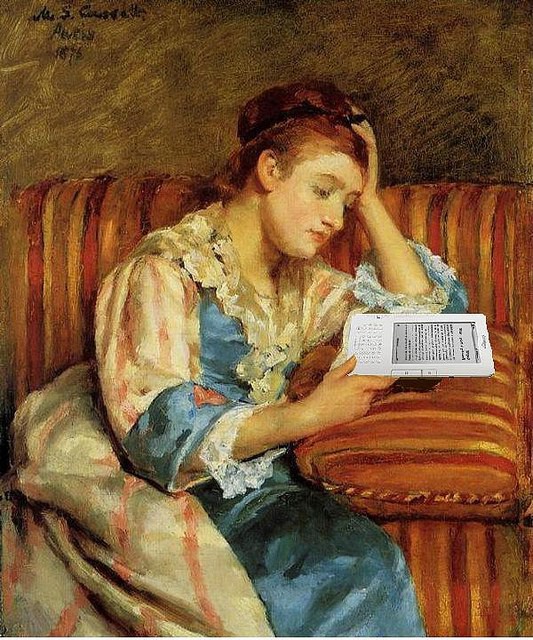
Are Romance and Erotica Fans Destroying Netflix for Books? Scribd To Cut Tons of Titles

Readers and publishers have long been hoping for a working “Netflix for books,” meaning a subscription service where users could pay a monthly fee for unlimited books. In the past couple years, a few strong contenders have emerged with Oyster, Scribd, and Amazon Unlimited being the most talked about. Amazon Unlimited has been undergoing a controversy recently after it announced that it would pay authors by “page read” instead of by book read. Today, Scribd caused it’s own controversy after the company announced it would drop a huge amount of romance and erotic titles… because too many people were reading them.

Scribd tried to put it in innocuous terms:

We’ve grown to a point where we are beginning to adjust the proportion of titles across genres to ensure that we can continue to expand the overall size and variety of our service. We will be making some adjustments, particularly to romance, and as a result some previously available titles may no longer be available.

But here’s how Mark Coker wrote on the popular self-publishing platform Smashwords that “effective immediately, I estimate 80–90% of Smashwords romance and erotica titles will be dropped by Scribd, including nearly all of our most popular romance titles.”

Why is readers reading a lot of books a bad thing for Scribd and why is Amazon Unlimited changing how they pay? So far, there have been two models for a “Netflix for books”: paying authors/publishers a percentage of a shared pot (Amazon Unlimited) and paying authors/publishers on a per book basis (Oyster and Scribd). Amazon Unlimited is mostly popular for self-published authors, but the shared pot payment model has it’s problems. Because there is a fixed amount of money (the amount is determined by Amazon without much transparency), it means that authors play a zero sum gain with each other. One author’s gain is another’s loss. And if the shared pot gets spread thin enough, authors make barely anything. Amazon’s plan to pay by the page is their attempt to stop authors rigging the system by publishing extremely short “books” and racking up per book totals.

Scribd, on the other hand, pays a retail rate to publishers each time a book is read. This model works really well if people read a couple books a month. Scribd’s service starts at $8.99 a month. Let’s say you are paying creators two bucks an ebook, and most people read two books a month, then you paying four bucks to publishers/authors and keeping 5 bucks yourself. Everybody is happy. Authors and publishers get a fair cut, readers get unlimited books, and Scribd makes a profit. But if a certain subset of readers — romance and erotica fans apparently — start reading five or ten or twenty books a month, then you are losing more money than you earn.

Apparently, readers in other genres are not nearly so voracious in their reader habits. Amazon Unlimited doesn’t have to worry about romance and erotica speed-readers, since fans of other genres will subsidize their payments. E.g., if 10 science fiction fans read 100,000 pages in a month, while 10 erotica readers read one million pages, then the subscription payments from the SF readers will simply (mostly) go to the erotica authors instead of the science fiction authors. (Whether that is fair or not to the science fiction authors that attracted those 10 readers is another question.)

It may seem counterintuitive to eliminate your most popular books, but purging erotica and romance titles may be the only way for Scribd model to survive.

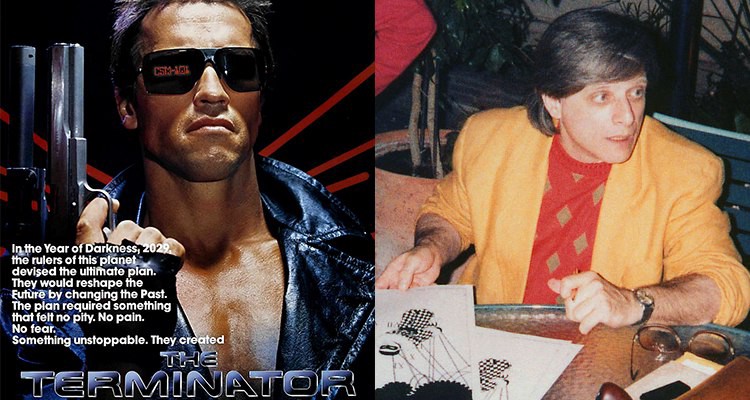
Was 1984’s The Terminator a Harlan Ellison Rip-Off?

In what can either be seen as calculated nostalgia or a desperate attempt at relevancy, old Arnold Schwarzenegger is all set to duke it out with young Arnold Schwarzenegger this weekend in Terminator: Genisys. Both time-travel and robot duplicates allow science fiction to rip itself off occasionally, but was The Terminator’s inception a rip-off, too?Depends on who you ask!

Understanding the old Terminator controversy requires a brief primer on one of the most talented and most prolific authors in the fields of various genre fiction: Harlan Ellison. He’s written for TV and film, but is probably most loved for his short stories, most of which read like little science fiction gut-punches. Most famously, Ellison wrote a bleak dystopian story called “‘Repent Harlequin’ Said the Tick-Tock Man” which shows up on pretty much every single “best sci-fi stories ever” list you can dream up. Robin Williams even did an audio version of it. Also notably, Ellison wrote perhaps the most famous (and best) episode of the original Star Trek; “City on the Edge of Forever.”

And yet, for all of his talent and accolades, Ellison is, arguably, equally well-known for his litigious trigger-finger. And if you’re watching the original Terminator this week to get yourself psyched for Terminator: Genisys, you might notice something funny about the final scene of the film when Linda Hamliton’s Sarah Connor drives off into the desert. Up on the screen, before any other credits, are the words “Acknowledgment to the works of Harlan Ellison.” This is not a direct credit explaining that what you’ve just seen was adapted from one of Ellison’s stories or scripts; instead, the film uses the weird state-of-being verb “acknowledgement.” So what gives?

The story goes like this: in or around 1984 someone tells Harlan Ellison that they think the script for The Terminator sounds similar to his script for an Outer Limits episode called “Soldier,” which Ellison had actually adapted from his own short story, “Soldier Out of Time.” And when we say “similar” we mean that the opening sequences of both The Terminator and “Soldier” are aesthetically close enough to give you pause. Both deal with a guy from the future who ends up on some contemporary 20th century streets. In Terminator, this is Reese; in “Soldier,” a guy named Qarlo. What happened next (according to Ellison almost exclusively) was that the production company in question — Hemdale — started avoiding Ellison’s inquires to see a script. Eventually, after sneaking into an advance screening of the film, Ellison determined that there were enough elements of Terminator similar to both “Solider” and to another Outer Limits he wrote, “Demon With a Glass Hand,” to make a case against Terminator director James Cameron and Hemdale Studios.

Most damning, though, was a quote from James Cameron — which was supposed to have appeared in a magazine called Starlog — in which the director gave an interview about The Terminator ahead of its release. When asked where he got the idea from, he said: “I ripped off a few Outer Limits segments.” This sentiment was apparently repeated when a friend of Ellison’s visited the set of the film and Cameron said that he’d “ripped off a few of Ellison’s short stories” to make the script for Terminator. Now, the quote above is NOT in the final interview (I have the physical issue, plus you can read it here), because purportedly, the editors of Starlog were asked (forced?) by one of James Cameron’s assistants to alter the piece before it went to print. Still, it’s widely acknowledged that the studio paid Ellison something in the range of 65,000 as a settlement.

This controversy can be quickly “explained” by watching the video at this link. Other than one or two blog posts (here and here), this is pretty much the only documentation you can find online, or at least the only one that anyone cites. The funny thing about this video is that it seems spliced together by a fan using footage taken from an old Canadian sci-fi commentary show. I’m not dismissing the validity of the information in the video (at all), but there is a tone to it that has a familiar conspiracy-theory vibe in which people with the “real story” are gleefully sticking it to the man. Personally, I’m more on Ellison’s side (full disclosure, I’ve interviewed him twice) but there’s still something about this dust-up that’s strangely compelling. Mostly, because it’s not and and dried. Ellison certainly didn’t own the simple idea of time-traveling soldiers, and if we think about art as appropriation for just a second in a David Shields kind-of-way, it seems like Terminator couldn’t possibly be a rip-off of these two scripts, or of one short story. Even by Ellison’s own admission, the problem wasn’t the intellectual property, but rather the hubris.

“He could have had it for free,” Ellison says, “if he’d asked me.” Whether this is true or not isn’t super relevant because we can’t visit that alternate dimension. But it does give one pause on all sides of the issue. Say you’ve written a classic short story, one which you think is awesome, and it gets published somewhere notable, and then twenty years later, Rian Johnson or J.J. Abrams is making a big budget movie which contains an opening scene similar to your short story. You’d probably be pissed.

At the same time, if you were James Cameron, why wouldn’t you have asked? Or perhaps all the smoking guns of Cameron saying the word “rip-off” were meant flippantly and he didn’t even know what he was using as source material. Indeed, in the printed Starlog interview, Cameron gushes about having read a ton of sci-fi when he was a kid and that making The Terminator allowed him to come back to sci-fi. It’s very possible Cameron didn’t have an encyclopedic knowledge of all the stuff he’d read when he and Gale Ann Hurd wrote The Terminator. Recently, when I interviewed Alex Garland about another robot movie — Ex Machina — I could distinctly tell that he wasn’t totally sure which specific old-school robot books were his favorites. But I did get the sense that they had seeped into the creative primordial soup from where his movie ideas came from.

Maybe something similar happened with Cameron. Maybe he wasn’t aware of what he was homaging and then when he started running his mouth, things got tricky. (In the printed interview Cameron describes coming up with The Terminator as a “fever dream.”) Or maybe (as the evidence available suggests) Ellison caught someone red-cyborg-handed trying to pass off aspects of his work as theirs. Meanwhile, it seems like neither of them can cop to whose idea it was to have time travel be something you do naked, nor if the phrase “I’ll be back,” will ever slip into the public domain.

So, when the credits roll on the new Terminator film this week, let’s all be on the look-out for the name of a favorite short story writer or two, while at the same time imagining armies of time-traveling writers spying on film directors for clues of flagrant or accidental ripping-off.

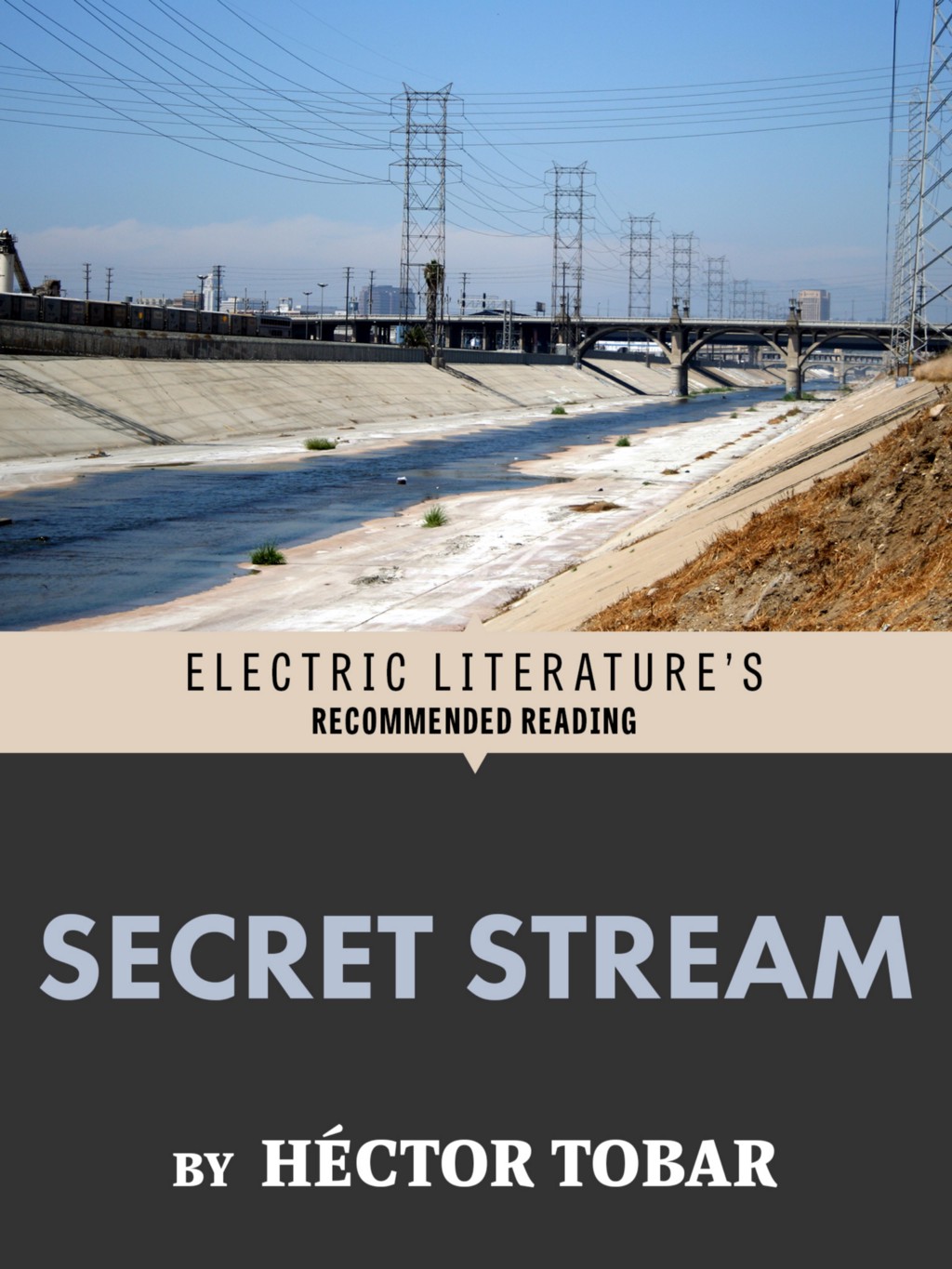
Secret Stream

by Héctor Tobar, Recommended by ZYZZYVA
Nathan was pedaling along on Third Street at a robust twenty-five miles per hour when he spotted her, a feminine mirage in black that forced him to stop. Even before his brakes had finished squealing he began to laugh and shout. “Hey, what are you doing up there?” The woman was stuck to the top of a chain-link fence, trying to reach the sidewalk on a stretch of Third Street where Nathan never saw anyone on foot. It’s a cliché about Los Angeles that no one walks, but on that shortcut to the Westside it’s actually true. There are no pedestrians on Third Street and thus no crosswalks. The resulting fast and free flow of traffic feels like a memory of the city’s unencumbered past, and Nathan biked that stretch like a guy driving a Porsche: he was in a hurry, he cut people off, and he didn’t stop to take in the sights, except in this special case when a lithe woman in need appeared before him, attached to the top of a fence.

The barrier in question sealed off the street and the public from the undulating, artificial pastures of a private golf course. A broken strand of the fence had hooked into the woman’s jeans: like a steel finger, it seemed to be pulling her down as she tried to free herself.

“You’re fleeing the golf course,” Nathan said.

She was about thirty years old, with lips glossed burnt umber, and the flat soles of her ankle-high black boots were caked in mud. On the other side of the fence two men in shorts were standing on the seventh green with clubs in hand, studying the geometry of their putts and squinting up at the noon sky. A thin layer of high clouds had drifted over the city,
weakening the sun into a yellow stain, and all the shadows had been erased from the world below, confusing the golfers as they tried to read the dips in the grass beneath their shoes. They were therefore oblivious to the fence climber nearby.

“It’s actually a country club,” she said.

“And you’re not a member.”

“I’m trapped.”

In the moment it took Nathan to get off his bike so that he could help her, she freed herself and leapt off. Her hair rose in a cloud of raven strands, and fell with a splash as she bounded onto the sidewalk. With a few quick swipes of her hands, she brushed some blades of grass and dried mud splashes from her jeans.

“Well, that was embarrassing,” she said.

She took a small nylon bag from her back and removed a notebook and pencil from it, and Nathan suddenly ceased to exist for her as she sat on the sidewalk, her back against the fence. Nathan watched her begin to draw and wondered which of the city’s arty tribes she belonged to.

“Hi,” Nathan said, insisting, because she was dark-skinned and pretty and he felt the need to know why she was trespassing on a golf course. “Excuse me, but… What are you doing?”

“I’m following the water.”

As soon as she said “water” Nathan heard it and felt it: the sound of liquid flowing, dripping, moving through the air, causing oxygen molecules to shift and cool. Looking behind her, on the other side of the fence, he saw a stream. About three feet wide and four inches deep, it curved around some bunkers near the seventh green, and then fell sharply, broadcasting a steady, metallic sound as it disappeared into a concrete orifice beneath Nathan’s feet.

“Fucking country club,” Nathan said. “They shouldn’t be wasting water like that.” It was the middle of August, after all. In the middle of drought-parched L.A.

“No,” the woman said. She stopped drawing and looked at the water again. “It’s not theirs. So they can’t be wasting it.”

“Well, who does it belong to then?”

The woman paused for a second and answered with an amused smile.“The underworld, I guess.”

Sofia was her name and she described herself as a “river geek.” She said she was mapping the creek that ran through the golf course. And also its “tributaries.” It was an ancient stream, she told him, born from a spring at the base of the Hollywood Hills, “bubbling up from the underworld.” She showed Nathan her map, a series of blue pencil lines over a street grid she had pasted into her notebook. “It’s groundwater,” she said. Before reaching the golf course, the stream flowed into downtrodden Hollywood proper, around assorted industrial buildings and parking lots, and also through a junior-high campus and the television studios of KTLA. Sofia described all these things with a reverence that Nathan found disturbing: he sensed that she’d been doing this mapping expedition of hers alone, for weeks, and had never talked to anyone else about it until this moment.

Nathan returned the map to Sofia. He saw that the water in the culvert moved quickly, and was crystalline, as if it were some sylvan stream. This can’t be, Nathan wanted to say. This supposedly natural body of water was trickling under his feet on Third Street, in a wealthy neighborhood called Hancock Park that was surrounded by low-slung, less-wealthy Korean, Filipino, and Salvadoran neighborhoods that were themselves near the geographic center of approximately five hundred square miles of asphalt and concrete.

“The flow never stops. Not even in the summer,” Sofia said. “This creek was here before the country club. Before everything around you.”

Sofia spoke these words and turned quiet, as if to allow the sound of the stream to make the truth of its presence clear to him. She was shy and a loner, like him, he thought. Nathan considered himself a loner, though none of his friends did, especially his women friends, all of whom were fervent cyclists: they thought he was charismatic and often very funny (when he was riding a bike), though clueless when it came to women. Clueless Nathan now concluded that Sofia’s lonesomeness was deeper and more interesting than his own, more attuned to the mysterious and the sublime. She wore a silver scarab clip in her hair, a jeweled stud in her nose, and looking at her made Nathan feel unkempt and underdressed, which is a ridiculous thing for a man on a bicycle to feel.

Nathan told her he was mapping something, too. He was scouting routes for a club of his that met at night and cycled to the most obscure L.A. landmarks they could think of. If she was a river geek, he was a bicycle geek, a map geek, a history geek.

“Our last one was ‘The Tour de Smells.’ We went to a meat-packing plant in Vernon, a garbage dump in the Valley. Our group is called ‘The Passage of a Few People Through a Rather Brief Moment in Time.’ We meet every two weeks.” Sofia wrinkled her brow in confusion as he explained this, as if he were describing some exotic cult. He removed a piece of paper from the bag on his back and gave it to her: it was a hand-drawn map of the route he was currently working on, marked with labels such as “Abandoned Synagogue” and “SDS Hangout.”

“You have beautiful penmanship,” she said.

“Maybe I can help you,” Nathan said. He was a teacher, and classes were out for summer. His days were free and he could follow the stream with her and take notes, he said. Awkwardly, he asked for her number.

“I don’t have a phone,” she said, and Nathan knew instantly that this was true, because she paused and her dark eyes shifted nervously when she was forced to reveal this private thing about herself.

“Let’s meet again at this same place, tomorrow,” he said. “At this same time.”

“OK, but without your bike,” she said. “Because we need to go places a bike can’t reach.”

When they met at the culvert the next day, Sofia was dressed in black again. Her fingernails were also painted black. She led him south, down a gently curving street of assertive mansions, her black boots gliding over the sidewalk with steps that felt like flowing water to Nathan. Sofia was carrying a new map covered with topographical lines and she studied it as they turned west and passed a buffet of overdone tributes to assorted architectural styles: a mini Monticello here, a bloated Tudor cottage there. “This street follows the old stream bed,” Sofia said. “The city buried it like a hundred years ago. But the water’s still flowing down there. In a big drain pipe.”

A block later they reached another fence, and stood above another culvert from which the stream emerged, moving slower, wider and shallower, flowing into a tangle of branches and bushes.

Without a word Sofia climbed the fence and landed with a splash in about an inch of water. “Technically, I’m pretty sure this is trespassing,” Nathan said as he followed her. Sofia marched along the water, pulling back branches for him. Where is this woman taking me? he wondered, and after a few paces he got his answer, as they entered an open space where the suddenly dry air seemed to vibrate under a liberated, ferocious sun. The space was a kind of meadow, framed by two mansions, each so abundant with backyard paraphernalia Nathan felt as if he’d entered the prop closet of a studio dedicated to making movies about suburban American excess. He saw competing steel barbecue machines with gauges and propane-tank attachments; one stood before a tiled-roofed Spanish-style mansion, the other at the base of a turret-topped Moorish castle, as if ready to prepare steaks and burgers for a medieval army. Next to the Spanish mansion a pathway of flat stones led to a child’s climbing structure made of fiery redwood. The Moorish castle’s domain included a marble dining table and a tennis court of emerald cement.

Sofia’s stream snaked through this gaudy landscape, making two gentle turns inside a channel sunken in crabgrass. “I just want to look at it for a while, if you don’t mind,” Sofia said, and she sat down on the grass with her sleeved arms wrapped around her knees. The water flowed in a smooth, flat current, like a bonsai-shrunken version of the Mississippi.

Nathan looked up at the windows of the multistoried mansions around them and wondered if the people inside would call the cops.

“Really, you just want to sit here?” Nathan said.

Sofia nodded with a gentle, wordless insistence. He joined her for a second, sitting on the grass. The water was silent here, and the houses were silent, too, though the birds in the trees around them were engaged in a jazz improv of tweets and hoots and cackles.

After five minutes Nathan mumbled, “I’m going to keep on exploring. I’ll meet you, uh, downstream, I guess.”

Sofia didn’t look up to acknowledge Nathan as he walked away. He was disturbed by the aching weirdness of what he was doing, trespassing amid fake backyard ecologies, the creek leading him on a midday sleepwalk past olive trees, a rose bush, assorted cacti, grapevines, and four cypress trees that loomed over him like monstrous green sentinels. He stepped over a low wooden fence and heard high-pitched yelling. Peering through a patch of ferns, he saw a swimming pool and two boys in bathing suits. One of the boys stopped at the edge of a diving board and stared at Nathan when he stepped out into the full sunlight. Nathan waved. The boy waved back and jumped into the pool with a percussive splash.

Nathan followed the stream into more backyards until he reached another culvert and climbed over it to the safety of a public street. As he waited for Sofia to appear, he looked back at the stream, admiring the way it trickled and whistled in the wind. The city tried to tame the water, but it still followed some pre-historic course through the subdivided and built-up land. The stream had a lifespan measured in geological time, and, looking at it, Nathan felt at one with the centuries, the millennia, and the epochs. Maybe that was why Sofia followed it, why she was back there in someone’s yard staring at it. When she looked into the stream, she was looking at timelessness.

Nathan waited forty minutes until Sofia finally appeared, her feet splashing in the water. She caught his eyes and raised the corner of her lips in what might have been a smirk. Or maybe just a smile. He reached out to help her climb up to the street, and she allowed him to keep his hand clasped to hers a moment longer than necessary.

“Thank you for waiting for me,” she said.

On the bus ride back home that afternoon Nathan thought about how smart and beautiful Sofia was, and how their private obsessions with public spaces matched, and he wondered if he’d finally found the ideal loner with whom to share his solitude. He wondered what he might say or do the next time they met, now that he’d clasped her hand.

When they met the following day, Sofia led him toward the southwest. “I’m glad you came back,” she said. “I thought I’d scared you off yesterday.” She gave him a playful look that caused a warm electricity to pass through his spine.

“Yeah, trespassing isn’t usually my thing,” he said. “But following a secret stream is pretty wild, pretty audacious, I must say.”

Sofia led him away from Hancock Park and the houses began to shrink, and the streets widened and filled with more cars that were driving faster, and the people inside these vehicles had darker skin tones that more closely matched hers.

“I think I know where this stream hits daylight again,” she said.

“Where?”

“You’ll see.”

As they walked past a sixth, seventh, and eighth block, Sofia told him about the river and its history. She’d spent many hours in the Central Library, she said, immersed in the accounts of California amateur geologists and naturalists of the nineteenth and twentieth centuries, looking for references to streams and groundwater. In Sofia’s universe, natural history was never erased, and water could still flow underneath the six lanes of Olympic Boulevard, and listening to her Nathan felt ashamed of the modern-day thoroughfare and the way he’d enjoyed its straightness, speeding toward the glass ghosts of downtown towers on the smoggy horizon. All these years in L.A., he’d been unaware that he was riding over a stream whose old Spanish name Sofia had just revealed to him.

“El Arroyo del Jardín de las Flores,” Nathan repeated.

“Correct.”

He wanted to walk alongside Sofia but she kept drifting one or two paces ahead. “What is it you do?” he asked finally, and the question caused her to slow down. “For a living?”

“Nothing, right now. I used to work in a museum no one ever visited,” she said. “A state park that got closed down. It was an old rancho with lots of beautiful and rusty old things inside.”

They reached a park surrounded by tall modernist office buildings whose painted cement skins were flaking in the sun. “I know this park,” Nathan said. “I always thought it felt like Manhattan in the desert.” A glass tower stood nearby, about eight stories tall, smothered in dust and slowly dying, its several hundred windows long unwashed. They climbed down a gentle, lawn-covered slope, to the spot where a large corrugated tube emerged from the grass. El Arroyo del Jardín de las Flores now resembled the flow from an oversized kitchen spigot, seeping into a crevice between the park’s lawns, trickling through foot-tall reeds.

“The stream used to flood every winter,” Sofia said. “That’s why there’s a park here. No one could build on this land.”

Sofia found a spot overlooking the creek and sat down. Nearby a
child of about seven was building a bridge over the creek with his father. They had fashioned a little roadway from pieces of eucalyptus bark, tree branches, and dried reeds. Nathan watched the boy and his father work with steady, playful purpose, bringing palmfuls of mud from the streambed and tufts of grass and more twigs, and using them to cover the surface of their roadway, until the bridge itself started to look like a specimen of jungle flora. The boy took three miniature cars from his pocket and put them on the roadway, and then he stepped back and watched the stream flow underneath.

The boy and his father and their bridge made Nathan feel content, nostalgic for his own boyhood, but they had no effect on Sofia. Sitting there, staring at the stream, she looked like a woman trying to imagine a world without civilization. Or like a woman straining to understand some ferocious and overwhelming idea contained in the water’s flow.

“You don’t have to stay here with me,” she said, suddenly. “I’m fine alone.”

“No, I don’t mind. It’s peaceful here,” Nathan said, though he was lying, because he knew he would never get used to the idea of sitting in one place, in the middle of summer, just to look at flowing water.

“My ex-wife got laid off, too,” he said, to make conversation. “She worked for the county. In social services.”

“How long were you married?”

“Sixteen months.”

“I was engaged,” Sofia said, keeping her eyes on the stream. Three sparrows fluttered over the water and landed nearby, and they began playing a game of hopscotch on the grass, bouncing into the stream and bouncing out. “He was a drummer,” she said. “He died four years ago this month. Of pneumonia, which is crazy.” For some reason the silence that followed was not filled with an overwhelming sense of tragedy. The sparrows disappeared and the water flowed. Sofia had been a loner before, Nathan concluded, and she would still have been following this stream, alone, even if her drummer had lived to marry her. A very faint breeze drifted over the grass and Nathan felt the glass skins of the modernist office buildings dissolving into sand in the sun.

“I just like to spend time with the water,” Sofia said. “You understand. Right?”

“What do you see?” he asked. “When you look at the stream?

“It’s not what I see. It’s what I feel.”

“What do you feel?”

“That it’s been waiting here for me to find it.”

Nathan did not know what to say to this. He didn’t believe in fate. When he discovered cool things on his cycling explorations, he didn’t think it was his destiny to find them. But he couldn’t say any of that, and instead he felt defeated at his inability to take their conversation to a place that didn’t feel so anchorless. Her communion with the stream was making him feel anxious. He needed to keep moving, and he looked at her pleadingly, as if to say, Can’t we just keep on exploring? But she didn’t notice or care about his discomfort. Instead, she took out a book to read.

“If you want, I could read this to you,” she said. “It’s poetry. This one is called ‘The Idea of Order at Key West.’”

The poem described a woman standing on the edge of the ocean, singing. Nathan listened for the argument of the poem, or the story it told, but there didn’t seem to be one. Eventually he began to focus on the sound of Sofia’s voice instead, the precise and slow whisper with which she read each line. The poem filled up her solitude with awe and wonder, especially when she read the line “The sky acutest at its vanishing.” But the poem itself made less sense to Nathan the longer it went on. When she finished he couldn’t think of anything to say other than the exceedingly lame comment, “It’s beautiful.”

“If you don’t mind, I’d like to wait here until the sun goes down,” she said finally. “I want to see the stream fade in the light.”

The summer sunset was at least five hours away. Nathan decided he couldn’t sit that long. He’d wished he’d brought his bicycle, instead of having to take the bus back home again.

“So,” he said. “At this same place, at the same time, tomorrow?”

“Sure.”

Before Nathan left for the bus stop, he walked over to examine the bridge the boy and his father had built an hour earlier. A line of ants was crawling over it. In their shuffle march, the ants were crossing the stream from north to south, as if they’d undertaken a mission of exploration to new, undiscovered lands.

On the bus ride back home, Nathan remembered the first line of the poem: She sang beyond the genius of the sea. He imagined a conversation in which Sofia talked about the poem and explained it to him. Nathan would then share his own introspective musings and talk about how he channeled his curiosity about the city into his riding, exploring on his bicycles (he owned three). He imagined sharing his passion for the city’s geography with Sofia, telling her about routes that led to destinations that the city’s haters called “nowhere,” though in Nathan’s mind each of those places was definitely somewhere. And finally, he imagined that Sofia would actually find all of this interesting and agree to go riding with him.

But when Nathan saw Sofia again at the park, he instantly understood the absurdity of his fantasy. Their eyes met and she said with a smile, “We’re almost done.”

Nathan followed her, silently. They left the park, and walked along Pico Boulevard for a mile until they reached a brick cube labeled “LIQUOR.” She led him around to the back, to a small parking lot of eroded asphalt, and a fence topped with barbed wire.

“Here it is,” she said. They walked up to the fence and looked ten feet down into a muddy slough littered with bottles, white plastic bags, and the desiccated corpse of a cat. At the bottom, a strip of tar-black water not more than four inches wide moved slowly westward.

“Bummer,” Nathan said.

“Yeah, it’s pretty ugly. Let’s keep going.”

The water advanced between rows of cinderblock buildings, and then it slipped under Venice Boulevard, a street so wide, flat, and long it swallowed up all the city around it, as if it were a corridor cut through time-space that would suck them up and spit them out in some other dimension. Venice Boulevard finally guided them to a concrete basin with vertical walls, the kind of domesticated “river” for which L.A. was infamous. El Arroyo del Jardín de las Flores fed into this channel from a rectangular hole in one of the sidewalls: like a slaughtered animal, it bled a black stain onto the concrete.

“That’s it?”

“Yes.”

Nathan looked at his watch: it was late, and he thought they should continue their trek tomorrow. “So,” he said. “At this same place, at the same time?”

“No,” Sofia said abruptly. “This is where our stream ends. Our stream is a tributary of this thing you see here, which used to be a real river.”

“Ballona Creek,” he said.

“It flows into the ocean, over by the Marina,” she said. “I’ve been there a dozen times.”

“Me, too.”

“So you know: Ballona Creek is a straight, man-made ditch going into the ocean,” she said. “It just makes me feel empty, going there. I don’t know why.”

“Maybe if I go there with you, you’ll feel different.”

Sofia shot him a skeptical look, and then studied him, as if she were measuring him somehow, or assessing the value of their incipient friendship.

“OK, then,” she said.

As he rode the bus home Nathan thought a lot about Sofia’s tepid “OK, then.” He quickly came to the conclusion that she wouldn’t be there to meet him the next day.

When he woke up the next morning, he was certain Sofia wouldn’t be there. If he wanted to see Sofia again, Nathan thought, the best strategy would be to seek out more streams and hope that his path crossed with hers again. For a moment Nathan imagined a life in which he pursued a river obsession as madly as Sofia did, following streams under skyscrapers, past football stadiums, factories, and tenements, selling off his bicycles as he surrendered himself completely to this new quest. He’d buy all sorts of river-hunting paraphernalia: divining rods, maybe, or waterproof shoes, and one day he’d run into Sofia at some hidden urban wetland and they’d resume their riparian wandering together.

The hour of their meeting came and went and Nathan didn’t leave home. It was the way he’d handled relationships with women since his wife left him: he preempted disappointment.

Instead, that afternoon, in the hours before sunset, he rode his mountain bike up the dirt paths that led to the top of Mount Hollywood. From that perch he took in the sprawl of the city, and imagined the aquifers percolating inside the mountain below his feet, and the water that escaped to follow secret channels through the city. Nathan thought about Sofia’s thin fingers drawing a map of the stream with colored pencils, and he thought about the sound of her voice reading the poem. He’d found a copy online and now he read it on his smartphone. The sea was not a mask/No more was she. The poem continued to perplex him, as if it were written in a code understood only by women who stared at streams.

A few days later Nathan returned to Ballona Creek on a road bike. He did not expect to find Sofia, and he glided quickly past the point where they had last spoken. He was going to follow Ballona Creek to the ocean. There was a bike path the last few miles.

Fed by several more tributaries, Ballona became a creek worthy of the name in its final stretch. He reached the beach, and then pedaled past it, because the path continued on a breakwater that jutted into the sea. When the path ended, Nathan stopped and took out his phone. He read more lines from the poem — The heaving speech of air, a summer sound/ Repeated in a summer without end. The meaningless plungings of water and the wind. The words unsettled him and he decided not to read them again.

Nathan preferred the certainty of maps, and he imagined the place where he was standing as represented on a map: the fixed, black line of the bike path, and a dot for the path’s terminus. Below his feet the cold Pacific swallowed up the freshwater from Ballona Creek. He thought of the thin flow of El Arroyo del Jardín de las Flores swirling and dissolving in the estuary, transformed into foam and green droplets laden with algae. When he looked up at the horizon, the sea was as big and blue and welcoming as he remembered it. The ocean swayed, it rose and fell, and it played with the light and the moving air. Nathan realized, suddenly, that he was seeing Sofia’s poem and its “plunging waves” and “gasping wind” come to life, and this thought caused him to laugh out loud. He felt surrounded by a presence that was feminine and circular, as if he were standing inside the warm and soothing whirlpool of a woman’s thoughts. Nathan stared at the water and allowed his mind to drift. When he looked down at his watch again, he realized he had been standing there, looking at the ocean, for an hour.

True Detective’s Lessons on How Not to Write Dialogue

True Detective, last year’s most talked about show — as well as one of TV’s most literary series — is back on the air. The new season ditches the unique combination of Southern Gothic setting, Lovecraftian horror overtones, and McConaughey-drawled nihilist speeches for a more straight-forward LA noir plot. The results have been disappointing, with critical takes ranging from tepid hopefulness to declaring it “the embarrassing television show we deserve.” (Here are my own thoughts on the new season.)

Even among fans of the new season, the most common complaint is the dialogue, while alternates between dull and accidentally ridiculous. While the existential monologues of Rust Cohle last season were sometimes critiqued for being pretentious, they were at least memorable and original. (They were also tempered by Woody Harrelson playing the straight man. This season, every character spouts dark and serious dialogue.) Rolling Stone described the dialogue this year as “sound[ing] cribbed from a video game cut scene.”

Although the dialogue problems weaken the TV show, they do provide some good examples of what not to do when writing. Not to pick on the show too much, but since I had already transcribed some of the dialogue for my review, I thought I might turn my review cuts into some craft thoughts. These are classic lessons, which are often illustrated by examples of successful writing. But it can also be useful to see when writing fails — even in highly popular TV shows.

** minor spoilers for the aired episodes ahead **

If You Are Going to Sound “Deep” or “Hard,” Be Original

True Detective’s second season follows in the hardboiled vein of Raymond Chandler, but you wouldn’t know that from the dialogue. Instead of resembling Chandler’s gritty wit, most lines feel cut and pasted from episodes of CSI and forgotten gangster flicks:

  • “I’m no good on the sidelines.”
  • “I welcome judgment.”
  • “Everybody gets touched.”
  • “Nobody muscles me.”
  • “I don’t distinguish between good and bad habits.”
  • “Sometimes not everybody’s always on the same side. Fine. It’s business. But this. No. Fuck that. Some things don’t stand.”

Most of these examples are — at least in context — weighty lines meant to have real emotional impact, or to show how deep, dark, or tough the characters are. However, lines that we’ve heard elsewhere a thousand times are ineffectual, especially with characters we’ve just met. (An additional problem is that every True Detective character talks in the same serious, faux-gangster way. The above lines are all from different characters, but you’d never be able to tell them apart from the script.)

If You Are Going to Be Original, Make Sense

Despite the above, True Detective does throw a few wacky curveball lines every episode. However, unlike the Ligotti-inspired memorable lines of season one, this season’s “time is a flat circle”-isms frequently just don’t make any sense.

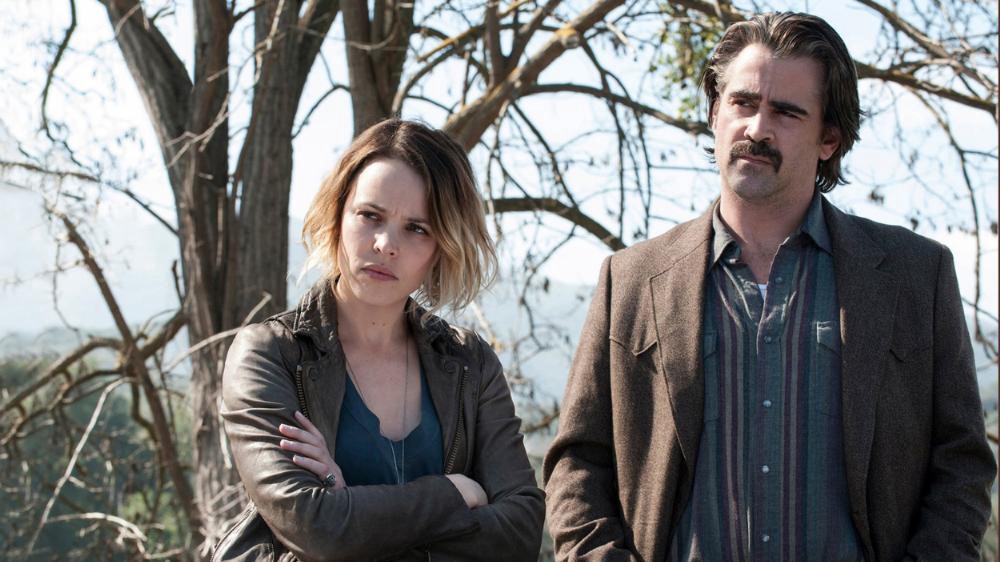
In episode one, officer Antigone Bezzerides’s (Rachel McAdams) sister Athena accuses her of being too uptight and sexually-repressed, then says, “When you walk, it’s like erasers clapping!” That’s original, but what on earth does it mean? Clouds of chalk fly out of her butt? Her feet are like schoolchildren being punished? (I’ve seen online commenters speculate this is a cocaine reference, but it’s unclear how that would relate to “walking” or being uptight.)

In the opening scene of episode two, Vince Vaughn’s gangster-trying-to-turn-straight character says, “It feels like everything is paper-maché.” Then he launches into a story about how his father locked him in a dark basement where rats ate his fingers. He closes the story by reiterating that everything “is paper maché.” So everything is paper maché because it is fragile and easily torn apart… I guess? But what does that have to do with being locked in a room you can’t escape from? As Christopher Orr at The Atlantic said: “I didn’t think the monologue’s central metaphor — comparing the decaying ceiling to imprisonment in the dark — even made sense. I mean, if that basement was ‘paper maché,’ six-year-old Frank could’ve just clawed his way out, right?”

Later in the same episode Ray Velcoro (Colin Farrell) and Bezzerides have this exchange:

Ray: “You know that expression about flies and honey?”

Ani: “The fuck do I want with a bunch of flies?”

Ray: “You don’t have any flies, you can’t fly fish.”

Without thinking about it, this makes sense in the context of police work — you might need to be nice to get some informants and info in order to catch your crooks. But the logic breaks down between the three lines as they become a mixed metaphor…unless Colin Farrell’s character is under the delusion that fly fishermen use actual living flies.

I could go on, but you get the point. Bottom line: your metaphors should actually make sense. Every time a metaphor breaks down, the reader gets taken out of the story.

Characters Should Respond to Each Other

One of the oddest things about the new season of True Detective is how frequently the characters seem to be engaged in separate conversations. Here’s another Farrell/McAdams exchange during a car ride:

Ray: “You pull off that e-cig. Not a lot of people do.”

Ani: “This place gets a day-today influx of 70 thousand people, right? Where do they live?”

Ray: “I tried once. It felt like it was smoking me. A real cigarette wouldn’t make you feel like that.”

Obviously there are times when this makes sense (showing how one character doesn’t listen, a post-modern talk on the breakdown of contemporary communication, etc.), but as a general rule characters should seem like they are able to hear one another.

Every Line Should Be Doing Work

Kurt Vonnegut once said, “Every sentence must do one of two things — reveal character or advance the action.” I think that’s a little narrow, as sentences can also add atmosphere, world-build, or do other things. But certainly in good writing every line should do something. This is especially true in the tighter narrative economy of a TV episode screenplay. My biggest personal gripe with True Detective is not the stock dialogue or even the nonsense dialogue, it’s the amount of functionless lines. A good example is the long break up scene between Paul Woodrugh (Taylor Kitsch) and his girlfriend in episode two. It goes on for some time — she thinks he is distant, he doesn’t want to talk — but here is how it ends:

Emily: “I can’t do this anymore. I tried.”

Paul: “It’s work. It’s a good thing, Em.”

Emily: “No. You barely talk. I don’t know your family. You don’t want to know mine. Who are you?”

Paul: “Oh fuck off! Who the fuck am I supposed to be?”

Emily: “I don’t know who you are supposed to be — ”

Paul: “Jesus Christ!”

Emily: “Yeah, fuck off! God, whatever happened to you I can’t fix it.”

Paul: “There’s nothing wrong with me. I’ll call you this weekend.”

Emily: “Don’t. I don’t want to hear from you, Paul. You can’t give me more than this. You’re not… you’re not right. Sometimes I’m with you and I can tell that…”

Paul: “Fuck it. I gotta go.”

Emily: “Don’t come back.”

Paul: “That’s on you, not me.”

Emily: “I can’t see you again, Paul. You hurt me seeing you.”

Paul: “You’re doing this. This isn’t me doing this. This isn’t me.”

We already know Paul is damaged and Emily doesn’t like how distant he is from their previous scene. Nothing above actually tells us anything new or unique about the characters. Reading for plot, the entire conversation could be clipped to just:

“Don’t come back.”

“That’s on you, not me.”

Everything else is basically just noise. It should be rewritten to convey something more.

None of the above is to say that True Detective is a horrible show. The acting is strong, the visuals are often arresting, and the plot seems like it is finally kicking into gear. It’s quite possible that the strong elements will make up for the lackluster dialogue by the end. I’ll keep watching. But when working on my next project, I’ll also try to avoid doing any of the above.

And remember, never do anything out of hunger… not even writing. Or something.

Zadie Smith to Make Screenwriting Debut with Claire Denis Sci-Fi Film

Although Zadie Smith doesn’t come immediately to mind when thinking about science fiction, famed director Claire Denis chose to collaborate with Smith on the screenplay of an upcoming sci-fi film. Plot details haven’t been announced yet, but according to Screen International it will take place “beyond the solar system” in a “future that seems like the present.” It will be both the novelist’s and the director’s first foray into science fiction.

Claire Denis has directed acclaimed films such as Chocolat, I Can’t Sleep, and Good Work. The last (Beau Travail in French) is loosely based on Herman Melville’s 1888 novel Billy Budd. Although she was born in Paris, France, Denis lived in West Africa during her childhood, including stints in Burkina Faso, Senegal, and Cameroon. These experiences are known to have influenced her films, which often deal with themes of colonial and post-colonial West Africa.

Zadie Smith is best known for novels such as White Teeth, NW, and On Beauty. The latter was shortlisted for the 2005 Man Booker Prize. None of them are set in outer space.

Smith’s husband, poet Nick Laird, will also co-write the film script. I can already picture the literary power couple rolling up to the red carpet looking fabulous (as per usual).

According to the A.V. Club, the screenplay will be Denis’ first English-language film, so it’s no surprise that she enlisted Zadie — one of England’s finest contemporary wordsmiths — to help craft it.

The Art of Persuasion, an Interview with Critic James Wood

There are book critics and bibliophiles — and then there’s James Wood. Often called the best critic of his generation, he first made his name as the young scourge at The Guardian while still in his twenties. In 1995, the British-born Wood moved to America and built his reputation with his lengthy, closely-argued reviews in The New Republic. Now a staff writer at The New Yorker, as well as Professor of the Practice of Literary Criticism at Harvard, he presides over the literary scene like no other book critic today. As a blogger at the Spectator put it, “Wood is arguably the most celebrated, possibly the most impugned, and definitely the most envied, literary journalist living.”

wood nearest thing

In some ways Wood is a throwback to the “man of letters” of previous generations. He brings a wide-ranging erudition and moral seriousness that’s rare in today’s magazine world. You see it in his slender new collection of essays, The Nearest Thing to Life. Part criticism and part memoir, the book reveals Wood’s lifelong fascination with religion and offers a glimpse into his childhood and the literary household he shares with his wife, novelist Claire Messud.

I talked with Wood about the art of book reviewing, why genre fiction makes him anxious, and his fantasy about publishing his own fiction under a pseudonym. Our conversation will air on Public Radio International’s To the Best of Our Knowledge. You can subscribe to the TTBOOK podcast here.

Steve Paulson: You say the task of writers is to “seriously notice the world.” Is it the critic’s job to seriously notice what’s in this fictional world?

James Wood: It would seem that there’s a virtuous loop here. I return again and again to detail and to seriously noticing what’s in the world, for a good reason. I don’t think I’m an especially observant person. Certainly not visually. I did a lot of music when I was a kid, so I have good ears and I’m always listening. But I’m one of those people who tends not to look hard enough at a tree that I walked past, or to notice what someone’s hands looked like twenty minutes after I said goodbye to them. By being so full of noticing itself, I’m aware that literature has helped me become a better noticer. Then as a professional reader, I’m continually training and tutoring that particular art and trying to notice things in texts.

SP: Is a critic basically a very good reader?

JW: I think so. There’s a pleasing amateurism about literary criticism despite the fact that it’s now enshrined in university programs. A professor of literature at some fancy university is not necessarily a better noticer than an ordinary reader. The advantage, of course, is that the professional reader has a broad scholarly knowledge. But there’s not much more that you can do as a critic than try to train your noticing, and to read a lot so you can do comparative reading.

SP: You quote from one of Henry James’ letters, where he said novels deal with the “palpable present-intimate.” What do you think he meant?

JW: This was a famous letter he wrote to the novelist Sarah Orne Jewett, who had sent him a historical novel she’d written. James writes back in that wonderfully ponderous, slightly patronizing mode that he reserved for people he didn’t think were quite as good as him. He said it’s all well and good, but steer away from the historical novel because consciousness is the thing that will be hard to get right. He suggests that we have an intimate understanding of modern consciousness, but we have to make a really huge leap to enter the consciousness of someone in the 17th century. So he says what fiction should do is concentrate on the “present palpable-intimate.” Ideally, the sort of fiction he was trying to work on is full of textures and details. It’s set in the present and is involved with people’s intimacies. It’s unafraid to deal with people’s interiorities.

SP: What you’re describing is along the lines of Buddhist contemplatives who talk about being fully in the present moment. Do you see any connections?

There’s something about slowing down and seeing the world that does seem to be one of our few modes of salvation if we’re not orthodox believers.

JW: I do. I think mindfulness is pretty interesting. For instance, there’s been quite a lot of Buddhist literary work on Virginia Woolf because her fiction is very much about slowing down and preserving moments of time, and examining them with great patience. She also seems to have a metaphysics which is almost Buddhist. In “Mrs. Dalloway,” she talks about how the dead return to us and are never separate from us. You can find something similar in Saul Bellow’s work. For a while Bellow got very interested in anthroposophy, which also talks about the community of the dead who are around us. Vladimir Nabokov also talks about the democracy of the dead. There’s something about slowing down and seeing the world that does seem to be one of our few modes of salvation if we’re not orthodox believers.

SP: All of those writers you mentioned had a great knowledge of literature. They didn’t just care about the present moment. They were also communing with dead writers and the history of literature.

JW: Absolutely. The three writers I just mentioned were profoundly well-read. That may be harder to sustain in contemporary letters. It’s amazing if you go back and look at something like the little primer that Edith Wharton wrote on writing fiction. When someone like Edith Wharton was writing about the novel, it was understood that you have the entire canon of novelistic history at your disposal, in several languages. So for Wharton, it’s completely normal to talk about the French novel, having read it in French, as well as the English novel. And for a long time that kind of intimate, non-academic scholarship was kept alive by writers and to some extent by literary journalists and critics who worked outside the academy. But it’s harder and harder to sustain. We seem to have less time to do the reading that we have to do.

SP: You draw various analogies between religion and literature. For one thing, creating a novel is kind of godlike.

JW: There’s the obvious analogy with the Creator. You can also see the novel as a secular form coming out of a tradition of religious narratives — say, the lives of saints or narratives like Plutarch’s lives that point out a historical judgment or moral truth. And out of these various forms, you get this distinctive genre which seems to be largely secular and written mostly by non-believers.

SP: Are you saying fiction has become a secular form of scripture?

JW: Essentially, I am. You can see certain aspects of religiosity hanging on. One example would be consciousness itself. The 19th century novel discovers what it means to plumb the depths of a character’s mind. It has a character thinking for three hours about the terrible marriage she’s made. And that’s related to the soliloquy. You can see it even in the verbs that are used, so writers like Charlotte Bronte and Thomas Hardy continue to say “she soliloquized to herself.” If you go back with the soliloquy, you go to Shakespeare. And further back, you go to Greek tragedy and perhaps ultimately to prayer. You go back to the Psalms, to David telling the Lord what he’s grateful for, what he intends to do, where he has disappointed his God. On the other hand, if you look at the novel — say, from “Don Quixote” onwards — it sets itself up as the slayer of superstitions. It often likes to make fun of religious people. Think of the minister Mr. Collins in “Pride and Prejudice.” There’s a lot of anti-clericalism in the novel, but more interestingly, it often takes blasphemous stances and imagines itself as a destroyer of superstition.

SP: Religion is supposed to bring you to some transcendental truth. Can the novel also do that?

The modern novelist — who can’t rest assured of cosmic governance — looks around in a more secular way and says, What will survive of us?

JW: That’s a very good question. (Laughs.) Yes, it certainly can. If you look at a novel like “To the Lighthouse” — one of my favorite of all books — it asks exactly the same question Psalm 90 asks: What will endure of us? What will last after we’re gone? Psalm 90 says, in effect, nothing, because we give it all up to God: “A thousand years in thy sight are but as yesterday.” The modern novelist — who can’t rest assured of cosmic governance — looks around in a more secular way and says, What will survive of us? Not houses. If left alone, they begin to fall apart very quickly. Perhaps children, except that they can be killed off in the First World War or die in childbirth, as happens in the middle of “To the Lighthouse.” Probably not works of art either, unless they’re very great works of art, like Shakespeare’s plays. So the answer is a very bleak one — without consolation, without transcendent truth of any kind. But remember that Chekhov said the writer’s job is not to provide the answers, but to ask the right questions.

SP: You grew up in a religious household. Your parents were evangelical Christians. Your father was a minister. I’m guessing you are no longer a religious believer yourself, but do you look for secular substitutes for religion?

JW: I do. If you grow up in a religious household with any modicum of religious belief and then lose it, you transfer it to the holiness of literature. That was going on in the 19th century as God begins to recede from European belief. It’s an obvious narrative to talk about transference and substitution, and I don’t think I can entirely escape it, but I try to resist it. The substitution narrative looks at how literature is like religion. I’m also interested in difference. One difference is that religious answers are absolute and — in their way — consoling, but awesome. Literature cannot offer this final answer or final command. I’m really interested in that. In the Gospels, Jesus’ command is to revolutionize your life. That command is absolute and life-changing and soul-shattering. If you don’t follow it, your eternal soul may be at risk. What is the command of literature? There is a command, I think, but it has much less authority. It’s about persuasion, it’s about asking you to put your trust or faith in something you know has been invented. At any moment, you can put the book down, walk away and refuse to continue believing in the invented reality you’ve just been inhabiting.

SP: You are married to a novelist and you’ve worked with some famous writers. Didn’t you once teach a college course with Saul Bellow?

JW: I did indeed. I was brought in because Mr. Bellow was in his eighties and was beginning to lose his memory. It seemed that it would be useful to have someone else in the class prompting him. So I had a lovely job. His deep memory was terrific, but his short term memory was full of lapses. So my job, really, was to nudge him and prod him. We did a Dostoevsky novella and Tolstoy’s “Death of Ivan Ilyich.” I would simply say, “Mr. Bellow, you grew up in Chicago in the 20s and 30s, when your relations to writers like Tolstoy and Dostoevsky were vital and sometimes you had to choose. You were either a Tolstoyan or a Dostoyevskian. Can you tell the class a bit about that?” And he was off. It was extraordinary. Right to the end of his life, I used to go to his house. I’d play the piano, he would play the recorder, and we would do simple things by Handel and so on. Once I brought my two-year-old daughter, and Bellow started singing French children’s songs, one after the other, in French, with all the stanzas and all the verses. I said, “This is extraordinary.” And he said, “I picked them up when I was in Paris writing ‘The Adventures of Augie March.’ I had a child and I was pushing the child around in the stroller, and I used to sing these songs.” That was 50 or 60 years ago. It was amazing to me.

SP: You are a big fan of Bellow’s writing. Did getting to know him change the way you thought about his art?

JW: Strangely, it didn’t. I still feel it was a splendid gift to meet him in his old age, albeit somewhat depleted. It tickled my vanity and was also a source of joy. But I would feel exactly the same way about the books if I hadn’t met him.

SP: Saul Bellow was a writer who strived for literary greatness. He was one of a handful of writers who wanted to be regarded as great. Are you also looking for greatness when you pick up a new book?

JW: This may be the wisdom of middle age — the reverse of the red sports car — but I’m less hung up on greatness than I used to be. And maybe correspondingly, I’m a less severe judge than I used to be.

SP: That’s interesting. You made your name in your twenties as the chief book reviewer for The Guardian, where you had a reputation for writing brutal reviews.

JW: Yeah, I did. I was always taking people to the cleaners. I still love that kind of sweeping judgment of, you know, “it’s all rubbish,” that nothing good has been written in England since 1945. It’s a sign to me that critics are taking the form deadly seriously. I do think the only way to produce really significant work, either as a writer or a critic, is really to be in love with the form to the exclusion of other forms. You can recognize that in certain critics who seem to passionately take the form seriously. Think of Helen Vendler’s lifelong devotion to poetry.

SP: But you seem to have become a more generous critic.

I’ve become much more interested in fugitive effects and quietness than I was.

JW: I think I have. I’m slightly put off by massive ambition, by the 600–700 page book that’s trying to do fifty things at once. There’s part of me that relishes smaller effects. It seems to me that one of the easier things in our culture now is to make a lot of noise. This can be aided and abetted by the publishing machinery that happily says, “You’re young, you’re making a lot of noise. We will anoint you as a noise maker — aka, ambitious.” Obviously, it’s still important to take note of those big attempts to write great literature, but I’m also interested in simplicity. I’ve become much more interested in fugitive effects and quietness than I was.

SP: In addition to being a book critic, you also teach a class at Harvard on the practice of literary criticism. What are you trying to teach?

JW: In practice, it doesn’t differ very much from an ordinary literature class. We have a syllabus of texts that are much the same as you’d have in any literature class. One of the classes I teach looks at fiction from Jane Austin to Virginia Woolf. It looks at the way different writers have tried to dramatize consciousness and how they get their heroes and heroines to think on the page. Because of what I do, I tend to attract students who themselves write either fiction or poetry, or write book reviews, and are interested in trying to take that further after university. So out of class, we think a lot about book reviewing and reading contemporary literature. It’s all well and good to do your 19th century stuff, but if you’re not alive to what’s being written right now — if you’re not going to the bookshop or the library and taking home five books and having judgments about them — you’re not really a literary person.

SP: So what is the art of being a good book critic?

JW: I think it’s the art of persuasion. You know, I get both institutional respect — a rather tiresome kind — and a fair amount of attack because of that institutional authority. It has to do with being at The New Yorker, and then when you square it with the Harvard job, you get a horrific kind of….

SP: …..the pedestal you’re standing on is quite tall.

There’s nothing worse or more corrupting to the soul than to think that by a stroke of the pen, I command this or that person’s career or reputation.

JW: Right. “Here’s your throne, and we’ll build an extra ten feet of gold for you to sit on.” That’s really tiresome to me, as is the whole thing about being this awful word — “gatekeeper” critic. There’s nothing worse or more corrupting to the soul than to think that by a stroke of the pen, I command this or that person’s career or reputation. It’s important to remind myself, and I try to do this, that my authority exists only in each piece and is rhetorical. So in each piece you’re making a case, and it’s a case like a speechmaker makes or a lawyer would make in a court. You have evidence, you have quotation, and of course it’s more interesting if you’re making the case for something rather than against.

SP: Is the ultimate goal to make the case for why you think this book is good or bad?

JW: I suppose it is either a good or bad judgment, though I think it’s perhaps more helpful to think in terms of a book you might seriously be interested in and here are the reasons why. And it’s often just a large amount of quotation. In that sense, my job’s easy. I remember the beginning of John Updike’s amazingly large and really impressive book of collected reviews, “Hugging the Shore.” He says, “Two thirds of the words in this book are not mine; they’re just quotations.” And he was a great quoter, a very generous one. So a lot of it is just trying to tell the reader this is something you could be interested in. It could change your life. It’s radiant, it’s full of beauty, it brought pleasure to me, it might bring pleasure to you. Or sometimes you get angry and say flagrantly, “This doesn’t work” or “this is fraudulent.” The last time I wrote about Tom Wolfe, there was a slightly moralistic fervor to my writing because it seemed important to tell readers, this is all fake. It’s noisy, coarse writing that one would mistakenly call Dickensian, and it’s worth separating what’s actually Dickensian from the fakery.

SP: Did you get any response from Tom Wolfe for that takedown?

JW: I never did.

SP: Do you hear back from writers after you write a negative review?

JW: No. Most of them have the good sense — one I’ve learned, by the way, when I’ve gotten a negative review — to stay silent. Fume in a Herzog-like way, write your mental letters, but don’t publish them.

SP: You’ve worked as a critic in both the U.S. and in England. Is there a difference between what readers and writers expect from a book review in those countries?

Pugilism was part of being in the literary world.

JW: Yes. Traditionally, the British scene is a bit more knockabout. And the newspaper scene in particular, where I started reviewing, was closer to what the online world is now like. You could get away with a larger degree of insult — basically, a wilder register. Pugilism was part of being in the literary world. It’s a little harder to do that in America. You see this in political writing, too. British political writing is full of insults. I love it for its refusal to take politicians seriously. The highbrow British newspapers have a paid political sketch writer, and that person’s job is to go to Parliament and watch debates from the public gallery, and write a kind of cartoon, a sketch in which it’s quite normal to say, “X was looking dreadful and seemed half-drunk anyway, and Y is possibly stupider today than yesterday.”

SP: So politics as theater.

JW: And why should there be any necessary respect for politicians? That’s the reigning assumption in British journalism. American political journalism strikes me as a little strange in that the punches are pulled. And maybe you get a bit of that in literary reviews, too — say, in the generally-nice atmosphere that prevails in The Times Book Review.

SP: Do you see literary criticism as fundamentally a creative act, perhaps on a par with fiction, or does the critic need to be more constrained?

JW: I’m in two minds about this. I wouldn’t claim creativity on the same level as the art maker. Obviously, I’ve put a lot of thought and work into sentences and phrases and metaphors. On the other hand, the form is very stable and known. It’s either a 2,000 or 4,000 word piece. I have a job to do and it doesn’t surprise, whereas anyone who’s written a poem or a piece of fiction knows that the most striking thing is the sense of the limitlessness of form. Henry James kept on thinking he was about to write a long short story and found that he was writing a novel. That keeping-going thing is what most writers are struck by. So I think there’s a real difference. But I also read essays — sometimes literary essays or non-fiction essays — in much the same way I read fiction or poetry. I don’t really distinguish between them. I get as much pleasure from Virginia Woolf’s essays as I do from her fiction. I get more pleasure from George Orwell’s essays and non-fiction than I do from his not-very-good novels.

SP: Are you a fan of the French critic Roland Barthes, who seemed to regard criticism as an art form in itself?

JW: Yes, I’m a great fan of his. I’m always slightly battling with him because he was very down on realism. He was a great skeptic of the codes of realism. I’m always struggling with him because I think he was secretly, guiltily, in love with realism and didn’t want to admit it….. in the way I might be secretly in love with really bad television or slick middlebrow filmmaking. And every time I denounced slick, middlebrow filmmaking, I was actually giving a public voice to my secret love of it. So I’m always struggling with Roland Barthes, but he seems to me a wonderful maker of sentences and insights. He’s someone I read with as much pleasure as I read a new novel.

SP: Can you still read purely for pleasure? If it’s a book you’re not reviewing, can you read without always having your critical hat on?

JW: I can’t read without my critical hat on, but I don’t think reading with my critical hat on is incompatible with pleasure. I understand what the phrase “pure pleasure” is getting at. People often ask me this, which would be some kind of surrendering to the text without much self-consciousness.

SP: But do you always feel compelled to evaluate it?

JW: I’m always evaluating it, but for me, pleasure is evaluative pleasure, as well as the pure enjoyment that I still experience, wanting to put an exclamation mark in the margin of the page because I’ve just been bowled over by something. The “wow” thing is very strong in me and I hope always will be. When I think back to when I was 15 or 16, I wanted to write, so I wrote very bad poems and very bad fiction. And I read everything in some greedy, appropriative and also critical way. I wanted to see how they do it, so I could try and mimic it. Why does this novel that I don’t enjoy not hang together or work properly? What can I learn for my own writing? So after adolescence, I don’t actually remember non-critical reading.

SP: You mentioned that one of your guilty pleasures is watching mainstream TV shows. Do you also have guilty literary pleasures?

JW: I don’t really have guilty literary pleasures. I don’t know what the explanation for it is, because I certainly have literary friends who love genre fiction, whether it’s science fiction or thrillers. I never read that stuff and never did. So sometimes I think that’s just me being slightly anxious.

SP: Anxious?

JW: I put it down to a sort of literary anxiety, that I don’t have time for it.

SP: It sounds like you don’t think it’s good enough.

JW: Right, I don’t think it’s good enough, but it’s not like I’m a man without guilty pleasures. We mentioned TV — that’s certainly one. I love cars. I absolutely love cars. So I read car magazines. It’s not exactly a sin to read a car magazine, but they are what they are. It’s essentially car porn. So I’m not without guilty pleasures. I know what it means to balance the high and the low, and to be relaxed around the low.

SP: You just don’t want that in your literature.

JW: I don’t want it. I actually think it might contaminate it in some way. That’s where I think I’m a little bit anxious.

SP: Who do you consider the greatest critics in history?

JW: I would have to put Coleridge there. Coleridge is wonderful, crazy, wild. For those listeners who haven’t read Coleridge, and you wouldn’t unless you encountered him at university, think an English Melville. He was an opium addict. He has the Melvillian craziness. He writes these huge, long sentences with wild metaphors and images, and he’s a brilliant reader. And in one book in particular, “Biographia Literaria,” he’s doing four or five things at once. He’s writing a memoir of his own reading, his travels to Germany, and his discovery of German philosophy. He’s also writing about his friend Wordsworth. Although Coleridge was himself a poet, he acknowledges that Wordsworth is by far the greater poet. He sets down a series of readings of Wordsworth’s poems — for posterity, really. He’s essentially saying, “I know this poet will last, and I’m going to do what I can to make the following readings of these eternal poems.” So Coleridge would be high up for me. We mentioned Virginia Woolf. I’ve always loved her essays — and for personal reasons. Woolf started writing for The Times Literary Supplement long before she wrote fiction. I think she did it for ten years before she published her first novel. She was earning her living as a hack, as they used to say in London. Although we have an image of Woolf as tremendously posh and upper-class, the reality is she was more like a slightly impoverished upper-middle class person. If you look at her diaries, she continued to need the income from literary reviews right to the end of her life.

SP: Wasn’t this also at a time when reviews were anonymous? So if you wanted to stand out, you had to do it through your style?

JW: Absolutely. Those TLS reviews were unsigned in those days. I love the idea of people slowly beginning to get used to a particular style. “Oh, that’s that person who writes this way.” And because it was a small literary world in London, enough people would have known it was Leslie Stephen’s daughter, Virginia Woolf, or rather Virginia Stephen as she was then, writing these reviews. These anonymous pieces are now collected in two volumes of her essays, The Common Reader. These essays appeared in the TLS and everyone knew by force of style who wrote them. For me it’s a tremendous image of what the literary essayist can do on the page.

SP: You wrote one novel yourself. Do you have a hankering to write more fiction?

And getting lost is crucially important for creativity, but it’s also a source of terror for me…

JW: I do. I’m actually working at a novel right now. And it’s why I was talking a minute ago about this limitlessness because my wife, who’s a novelist, will often say there’s no other form of activity quite as efficient in using up time. She’ll say, you sit down and think you’re just going to start writing, and you look up three-and-a-half hours later, and you don’t know where the time went. You got lost. And getting lost is crucially important for creativity, but it’s also a source of terror for me because I don’t know what I’m holding onto anymore. I don’t know where the thread is going, and I don’t quite know how to find it again.

SP: You must also figure that lots of writers out there are sharpening their daggers, waiting for your book to come out.

JW: Indeed, it’s a perpetual fantasy, as it was with my first novel, to publish it under a pseudonym. Of course it’s a bit of a wager: Will you get it published?

SP: Of course you’ll get it published!

JW: But if you did it under a pseudonym — if you just sent it in as a pseudonym, there’s a possibility it wouldn’t get published. Then if you continue the wager, there’s a possibility it wouldn’t get reviewed at all and would just disappear. You’re the sore loser. There’s no triumphal announcement a year later, “Ah, this book that everyone’s talking about is actually by James Wood.” In fact, it just disappeared under its pseudonym. I used to write pseudonymous things on occasion when I was first starting out, before I was at the Guardian. I have two middle names, Douglas and Graham, and I needed to earn a living writing paperback roundup reviews, little more than 50 words. I thought this hackwork should exist in a different realm from what I was trying to do as a fiction reviewer, so for a while I was writing under James Wood and Douglas Graham. So maybe that’s what I should do with the novel, although I’ve just blown my cover on radio. (Laughs)

Emma Watson to Star in Film of Dave Eggers’s The Circle

Harry Potter fans, recently beset by dispatches from the Potter-verse, have yet another thing to freak out about: Emma Watson has signed on to play the lead in the film adaption of Dave Eggers’s novel The Circle.

The novel’s title refers to a powerful tech company that combines the capabilities of Facebook, Google, et al, enabling users to forge one all-encompassing Internet identity. At the center of The Circle is Watson’s character, Mae Holland, a wide-eyed new hire who finds herself confronting the unpleasant realities of a digital epoch in which the notion of privacy becomes laughable.

Tom Hanks has been tapped to play one of three CEO characters, and James Ponsoldt (the auteur behind the upcoming DFW biopic) will direct. Ponsoldt said of Watson: “Emma Watson is one of my favorite actors, and her incredible talent, sensitivity and deep intelligence will bring an electric energy to The Circle.”

Watson’s latest role will follow a spate of post-Potter successes, most notably the film version of Stephen Chbosky’s The Perks of Being a Wallflower. Watson may yet succeed in eclipsing the role that made her famous, but if she continues to soar toward lifelong celebrity on the wings of novel adaptations, Potterheads can rest assured that Girl Whose Career Lived will not forget where her star ignited.

FICTION: Vertical Service Codes by Joseph Aguilar

*57: Malicious caller identification

If you receive a distressing landline call, perhaps someone trying to bully you for lies about the beloved, mark the call as malicious and trace data will be recorded. Trace data can only be accessed by law enforcement. Before activating malicious caller identification, consider whether the call merits police involvement. Since the incident in question appears to have resulted in a death, try to keep the police in mind.

*61: Priority call

The beloved needs you lately. Choose a unique ring for the beloved so you can quickly filter communication from the beloved from communication not from the beloved. Try a ring that signals “the beloved” and “high priority.” Think cheerful, hot, and urgent. Think plain and sharp. Think soft and sweetly painful.

*66: Continuous redial

Recently it has been difficult to connect with the beloved. The beloved’s line floods with calls from friends, relatives, parents, neighbors, angry anonymous locals, and small-time reporters posing as big-time reporters. Conserve your emotional energy by automating redial until your connection goes through. Hello? Hello! Hi.

*69: Last incoming call return

Remember that evening? The phone was ringing as you unlocked the door. You reached the phone right as it quit ringing. You later learned too late that the beloved had tried to call you to ask for assistance in extraction from the situation preceding the incident that led to the present dilemma. If you had known enough about vertical service codes, you could have reconnected with the beloved in time to help prevent the beloved’s proximity to the incident.

*77: Anonymous call rejection

Hidden callers cannot connect with you if you initiate anonymous call rejection. The anonymous caller hears a polite, crisp female voice say that the party the caller has dialed does not accept calls from blocked numbers and to please hang up and try again with Caller I.D. unblocked. Harassment will cease.

*100: Call erasure

The call erasure feature can retroactively expunge the last call received from your memory. You can choose, for example, not to have heard the mother of the beloved tell you tests have shown the blood from the body fits evidence taken from the beloved. You can select not to have heard the father of the beloved share with you that questioning of the beloved and witness testimony led to the search and seizure of the beloved’s property and the arrest and confinement of the beloved. You can decide not to have leveled invective at your delicate aging father for scolding you about your several years of involvement with the beloved despite your father’s many fatherly warnings that have finally proved prescient.

*105: Called party mouthpiece disabling

Your called party’s mouthpiece is rendered mute. You have a silent audience as long as the call stays active. You can tell the jailed beloved everything without interruption. You might reveal to the beloved that you are glad you were not able to extract the beloved from the situation preceding the incident that led up to the present dilemma because it appears the present dilemma would have inevitably arisen. You can declare to the beloved that you hope the beloved stays confined for the full term assigned. You can say you feel irrevocably betrayed by the beloved. You may reveal that you have seen that the beloved is no longer the beloved but the accursed. The accursed cannot respond. The accursed can only listen or hang up the telephone, and the accursed is lonely for you.

*120: Silent telephones

The calling party’s telephone’s earpiece and mouthpiece are rendered mute. The called party’s telephone’s earpiece and mouthpiece are rendered mute. The telephone empties of its power. You hold the shell to your ear.

To Set Something on Fire: War of the Foxes by Richard Siken

War of the Foxes, Richard Siken’s second collection of poems, begins where his debut collection Crush left off — the body. In “The Way the Light Reflects,” Siken writes, “I have my body and you have yours. / Believe it if you can. Negative space is silly.” Navigation of that space, both emotionally and physically, dominated the obsessive and hungry poems of Crush, which won the Yale Younger Poets competition in 2004. One of the recurring images in Crush was that of the poet’s empty hands, hands rendered vestigial by all they were not allowed to touch. In War of the Foxes, Siken puts those frustrated appendages to use by picking up a paintbrush. Gone is the savage sexuality of Crush, and in its place we find a painter alone in his studio; in fact, the few references to lovers in this collection describe them asleep in the next room, as if these poems were written in the quiet hours after Crush. And while the poems in War of the Foxes do sometimes read like entries from a painter’s notebook, they do, like the poems in Crush, refute the illusion of space, in this case the space between our bodies and the outside world. As Siken writes in the poem “Landscape with Fruit Rot and Millipede,” “The mind fights / the body and the body fights the land.”

If the poems in Crush were engaged in the metaphysics of alienation, the poems in War of the Foxes are engaged in the metaphysics of creation, an aesthetic theory in which the boundaries of the human mind has drastic consequences for the natural world. In this way, the relationship between a painter and a landscape is similar to the relationship between men and nature: as soon as we see it, we can’t help but change it, alter it, dominate it. In the poem “Landscape with a Blur of Conquerors,” Siken describes the process of painting a field, a field “empty, sloshed with gold, a hayfield thick / with sunshine.” This image, infused with all the beauty and innocence of the garden before the fall, appears again and again throughout the collection. But simply painting landscapes is not enough for Siken — he must introduce a figure, a man. And what happens when you place a man in an untouched field? We all know the answer to that: “Land a man in a / landscape and he’ll try to conquer it.” Siken doesn’t shirk responsibility for this state of affairs, and instead further implicates himself by painting more and more men until “they swarm the field and their painted flags unfurl.” The message is clear and it’s political: these men “those people,” aren’t “the enemy;” aren’t “Republicans;” rather, as Siken writes, “They look like me. I move them / around. I prefer to blame others, it’s easier.”

Siken continues this inquisition in the title poem “War of the Foxes.” Here, Siken moves away from the metaphorical into the allegorical, searching for the roots of war through a series of elliptical stories. In one story, two rabbits named Pip and Flip are chased by a fox into their warren, where, huddled together, Flip tells Pip to hide inside of him. In another story, a boy faces the wrath of an abusive father after he spills a glass of milk. In the final story, a fisherman’s son becomes a spy, and part of being a spy is waiting at a chain-link fence to share secrets with other spies. Siken writes, “It’s a blessing: every day someone shows up at the fence. / And when no one shows up, a different kind of bless- / ing. In the wrong light anyone can look like darkness.” This is another example of Siken implicating himself, and the reader, by showing us that we are responsible for creating the illusion of separation between “us” and “them,” and that this illusion has dire consequences. As Siken writes in the poem “Portrait of Fryderyk in Shifting Light,” “Everyone secretly wants / to collaborate with the enemy, to construct a truer / version of the self.”

If this all sounds very abstract, that’s because War of the Foxes is abstract. It’s challenging in a way that Crush was not; you read and re-read the poems in Crush just to savor the language, the images, but with War of the Foxes, you read and re-read the poems in an attempt to divine meaning. If Crush resembled the manic poems of Sylvia Plath, War of the Foxes resembles the cerebral mediations of Mary Ruefle. And like Crush, War of the Foxes is obsessive, relentless, but when the obsession was rough sex in motel rooms and cars speeding away into the night, the obsession felt like passion. In War of the Foxes, the obsession with painting, with representation, mimesis, and even mathematics and logic, makes the collection feel like a lecture. In one poem, Siken writes, “When you have nothing to say, / set something on fire. A blurry landscape is useless.” The reader can’t help but agree. We wanted to see the fire.

War of the Foxes

by Richard Siken

Powells.com