As a child, I had nausea every time we drove back from a day of crabbing and fishing on the piers at Dauphin Island. The corn dogs I’d washed down with Fanta all day, the prickle of cracked vinyl on the back of my sunburned legs, the smell of Coppertone mingled with my parents’ cigarette smoke blowing with the salt breeze over me in the Rambler’s back seat — suddenly it would all turn my stomach upside down, in spite of the yellow Dramamine tablets my mother had given me.
Voyager 1 has now reached the heliopause. More accurately, as astronomers have learned from the data Voyager relayed, it has reached the “heliosheath depletion region,” a transitional place, still barely “in the sun’s magnetic embrace,” as the article tells me. Galactic particles from interstellar space bombard it as it makes its slow, plutonium-powered way where we will never go. I say all of this in present tense, although I am aware that by the time the data reached us, Voyager had long since moved on from where it had been. By now, it’s probably slipped, no, lurched free, unbound —
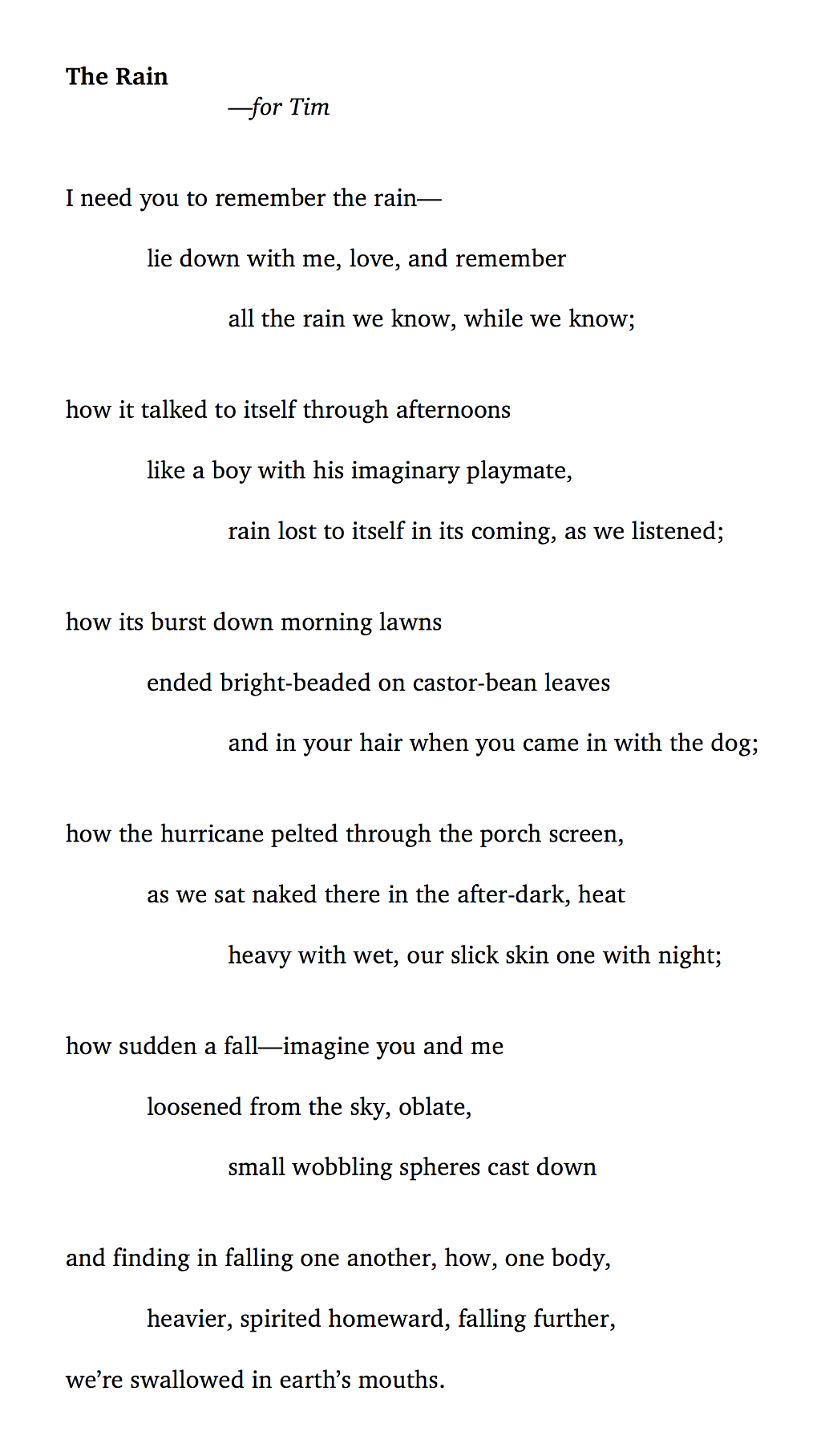
cold white sting of Solarcaine on sunburn: nothing could hurt us for long
The ashtray in my mother’s car is always full. When we leave for the store, she lights up in the driveway, the air-conditioner going full blast against the scorching central Texas heat.
All I remember of Büchner’s play Woyzeck: the grandmother’s black fairy tale about the orphan left all alone on the earth who went to the moon but it was rotten wood so he went to the sun but it was a withered sunflower and the stars were dead flies so he came back to the earth but it was an overturned pot so he sat down alone on it and cried and is crying still
every memory I’ve ever had: pulse from a dead star
She and I would walk the beach while my father surf-fished for flounder. We gathered scallop shells and sand dollars, but what I most enjoyed bringing home were the worn slips of sea glass, their muted greens and blues. Back home, she dropped some in my bath so I could see them regain their luster.
In 2011, as Voyager began its heliosheath exploration phase, my mother was again diagnosed with breast cancer; her first cancer, in 1983, was successfully treated with chemotherapy and radiation. This time it was not a recurrence but a new, very slow-growing cancer, also present in her lymph nodes. Because she had received such high doses of radiation previously, that treatment was no longer an option. She elected to have a double mastectomy.
Voyager’s last step before entering the heliosheath was passage through the termination shock, “an environment controlled by the Sun’s magnetic field with the plasma particles being dominated by those contained in the expanding supersonic solar wind.”
My mother’s chemotherapy seems to have been successful. Her hair has grown back. She misses her breasts; I miss her breasts. She hasn’t yet had her reconstructive surgery, and I’m doubtful that she will quit smoking long enough for the doctors to clear her for the procedure and the long recovery. When I see her, I can’t help looking at the flat fall of her clothing across her chest. When I think of her, I see the shape her breasts made in her blouse.
the net hauled up at the pier’s edge: crabs gnawing on chicken parts
Right after the grandmother’s tale, Woyzeck returns and talks to his wife, Marie:
Woyzeck: We’ve got to go Marie, it’s time. Marie: Go where? Woyzeck: Does it matter. They go down the street.
My front porch is decorated with fossils my mother pulled from her yard, limestone trilobites and brachiopods slowly forced from the earth.
If Voyager 1 could feel, it would feel the interstellar winds.
Reruns & Premonitions of September, 1974
Hi-jinks and laugh-tracks afternoons after school in the den with Chris, my college student babysitter, snacking in the glow of his parents’ black & white TV:
Star Trek, Gilligan, Munsters, ghosts stranded in backlot galaxies, like me haunting this childhood scene.
Chris props a sketchpad on his lap, sketches unpeopled mountain landscapes, picks with a thumbnail at scabs of paint on his hands.
Slouched outside the sliding door: a shaggy mimosa frilled with frilly blooms, starburst-clustered gold-tipped stamens.
A game: we palm-roll slices of white bread into fleshy balls, see who can roll the biggest and pop the pale glob whole into his mouth.
I chew and fidget, stretch my hand to fumble in the bread bag between us: just a heel; my luck.
Sun low in the mimosa; glare sliding in; dim shapes creep across the screen, and turpentine and sweat drift from Chris’ body to my nose, my thigh
twitching near his — won’t he ever lean over and croon to me oh little buddy, little buddy — ?
Captain’s log: under the yard, the house, the day, a world ends: mimosa roots slo-mo strangling pipes, cracking slab…
My ship at warp speed vanishing, our bodies shimmying into vapor, I beam back to this abandoned den,
too late: nothing to eat, nothing on TV, just speckles of starlight (oh spectacles yet
unseen here). I’ll get by. I’ve gotten by on less.
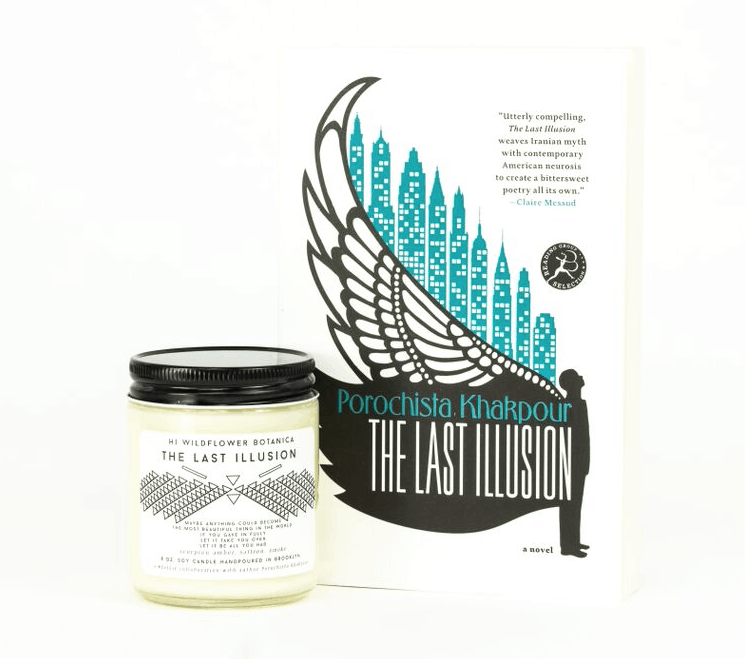
Tanwi Nandini Islam, writer and founder of Hi Wildflower Botanica, has introduced #GetLit: new scented candles inspired by some of her favorite authors.
Although readers may have different methods of consuming literature, perhaps what we all have in common is a desire for complete immersion. In her article for Elle, Tanwi recalls the conception of her project: “When you get lost in the imaginary world of a book you engage your sense of sight, touch, maybe even sound–so why not scent?”
#GetLit candles successfully capture the defining scents of four contemporary novels. Kiese Laymon’s Long Division evokes an intoxicating blend of Mississippi’s magnolia and moss; Porochista Khakpour’s The Last Illusion provides a whiff of scorpion amber, Persian saffron, and smoke; Mira Jacob’s The Sleepwalker’s Guide to Dancing transports us to New Mexico and Kerala, India, using prairie grass, sandalwood, and sage; Nayomi Munaweera’s Island of a Thousand Mirrors smells of Sri Lankan vetiver and coconut.
A human’s most primitive sense — our sense of smell — is directly related to emotions, memories, and creativity. Curling up in an armchair with one of these four novels, its corresponding candle flickering, will allow us to travel to a place we’ve never been before, or return us to the place that matters most.
August 5, 2015: The title of this article has been changed to accommodate a request from the proprietor of the Etsy store Novel Scents.
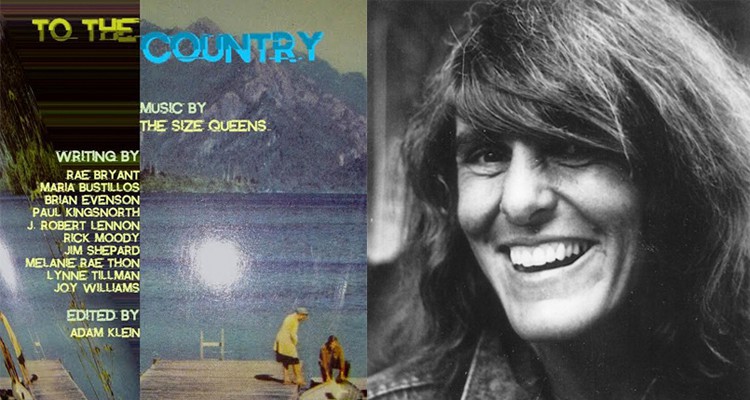
[Editor’s note: the following is an excerpt from To the Country by The Size Queens, an iBook that combines the music of The Size Queens (Adam Klein and Michael Mullen) with original, accompanying writings by authors such as Rick Moody, Lynne Tillman, and Jim Shepard. Play the song “Country Back” above and download the iBook here.]
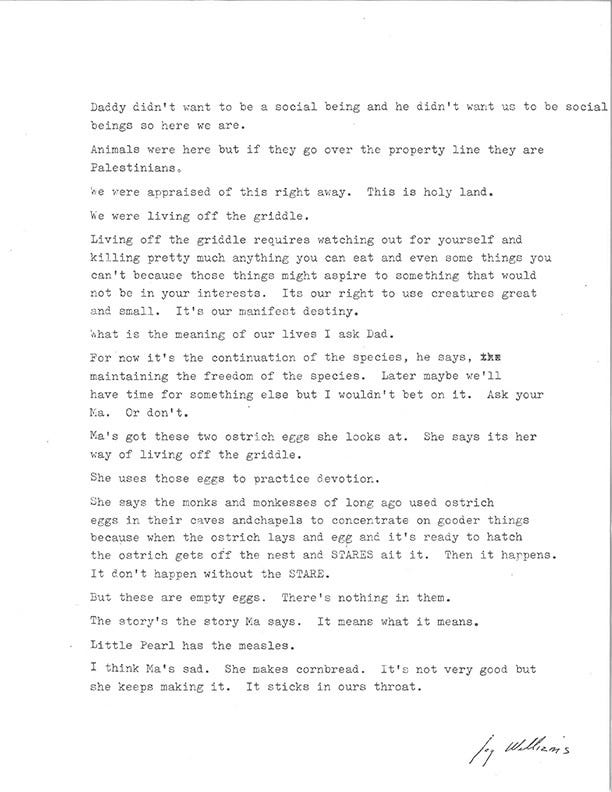
Joy Williams’s typed manuscript
Adam Klein: Last December, I began reaching out to writers, asking if they’d be interested in writing a response piece to songs from The Size Queens’ To The Country. The band’s manager (and co-conceptualist), Chuck Mobley, and I had discussed the idea of releasing something other than a traditional CD or vinyl record. The iBook presented the option of bringing in authors to collaborate with in the same way musicians, visual artists, and literary magazines had collaborated with us in the past. The writers “responses” were meant to augment the song in some way, and could be as strange as Brian Eno’s synthesizer solos on Roxy Music songs, or blend like a pedal steel on an Americana album. The texts could work as instruments or a spoken word element in — and apart from — the songs.
I had just reread Joy Williams’ The Quick and the Dead and knew, if I could get her onboard, that she would understand the screwball daddy/preacher voice in the song “Country Back,” a voice that deploys Tea Party platitudes and militia rhetoric and scrambles it up with a little of Ted Kacznski’s anti-industrial, anti-technology, and anti-leftist huff. I contacted the English department at the University of Wyoming, but I was soon informed that Joy Williams doesn’t use a computer. However, I was kindly assured that she thought it likely Ms. Williams could find a way to play it. Soon, I received the following typed letter. The entire interaction took three weeks. It was faster and more efficient than with any writers with whom I interfaced online. The postal trucks must have had snow tires, and to this day I imagine Joy with some Walkman, playing the song in a roadside hotel, approaching her Smith Corona, and jotting down her lines while the heaters whistled, the lamp cast its yellow light over the thin paper, and the white landscape made town after low town of truck stops and Denny’s, auto parts stores and dim, mall churches look celestial.
Joy Williams on “Country Back” by The Size Queens
Daddy didn’t want to be a social being and he didn’t want us to be social beings so here we are.
Animals were here but if they step over the property line they are Palestinians.
We were appraised of this right away. This is holy land.
We were living off the griddle.
Living off the griddle requires watching out for yourself and killing pretty much anything you can eat and even some things you can’t because those things might aspire to something that would not be in your interests. It’s our right to use creatures great and small. It’s our manifest destiny.
What is the meaning of our lives I ask Dad.
For now it’s the continuation of the species, he says, maintaining the freedom of the species. Later maybe we’ll have time for something else but I wouldn’t bet on it. Ask your Ma. Or don’t.
Ma’s got these two ostrich eggs she looks at. She says its her way of living off the griddle.
She uses those eggs to practice devotion.
She says the monks and monkesses of long ago used ostrich eggs in their caves and chapels to concentrate on gooder things because when the ostrich lays an egg and its ready to hatch the ostrich gets off the nest and STARES at it. Then it happens. It don’t happen without the STARE.
But these are empty eggs. There’s nothing in them.
The story’s the story Ma says. It means what it means.
Little pearl has the measles.
I think Ma’s sad. She makes cornbread. It’s not very good but She keeps making it. It sticks in our throats.
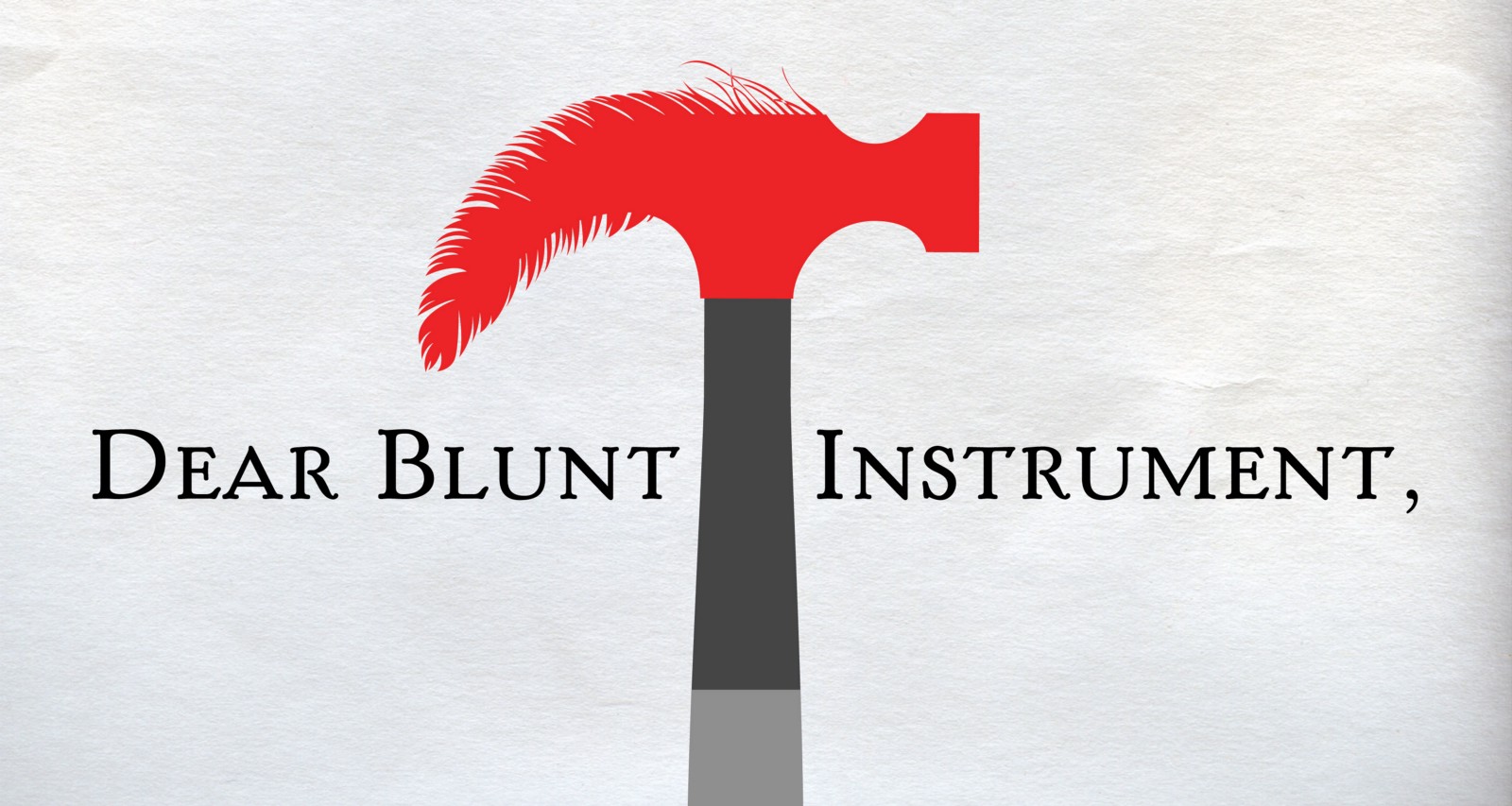
Earlier last month, poet and Electric Literature’s resident Blunt Instrument advice columnist Elisa Gabbert fielded a question from a white male poet who recognized his privilege as such and wanted to know how to continue writing and publishing ethically within a publishing system that lacks diverse representation. Unlike many in the publishing world who admit that there is a problem, but don’t put forth ideas for how to fix it, Gabbert made concrete suggestions which came down to: read more women, people of color, and LGBTQ writers, and don’t take up more than your fair share of time and space in the literary ecosystem. Many white male writers took this to mean that Gabbert wanted them to stop writing, period, so they unleashed their rage where it festers and boils best: the comments section.
As a bi-racial Asian American writer who interviews authors, and runs a library at a high school whose population is 94% people of color, the lack of diversity in publishing concerns me, so I was eager to discuss and analyze the reaction with Elisa. We conducted this conversation over Google Chat.
Wednesday, June 17, 2015:
Adalena Kavanagh — 8:25 PM Who do you think were more surprised by the reaction to your advice: men or women?
Elisa Gabbert — 8:26 PM Oh, men I assume. If anyone actually was surprised.
Adalena Kavanagh — 8:28 PM I wasn’t surprised by the comments on the actual piece, but there were several reaction pieces, one in the Atlantic (where the author didn’t bother naming you) and another piece in the National Review — did those surprise you? What did you think of those pieces?
Elisa Gabbert — 8:30 PM I was surprised at the magnitude of the coverage, yes. It’s an advice column! On a literature site! I admit I didn’t read them in full, for different reasons — the first (National Review) because it was so obviously absurd. (There is no way I’m going to have common ground on a social issue with a writer for the National Review.) The second (at The Atlantic) because I was on vacation with only my phone and it was so long-winded, and because I was irritated that the writer basically stole the letter without even mentioning me. He later wrote me an email apologizing for that, and added a note to the piece, but it felt somewhat disingenuous.
Adalena Kavanagh — 8:33 PM One thing that struck me about both is that they were more concerned about the possible future loss of “great literature” from white men, than the current silencing of women, people of color, and non-heterosexual writers.
Elisa Gabbert — 8:34 PM I mean, that’s it exactly. It’s horrifying that this even needs to be said. It’s a kind of racial narcissism.
Adalena Kavanagh — 8:36 PM Yes! When things are going in their favor they see it as a meritocracy, but when you call to change the system — to bring some diversity, all of a sudden there is this fear that opening the gates will dilute the quality.
Elisa Gabbert — 8:38 PM And they are crying “not fair” — it’s not fair to hold a white man back just because he’s a white man! But if you try to explain that the existing system is tragically unfair to women, POC, LGBTQ, etc., they either won’t accept it or don’t care. Only caring about “fairness” when it negatively affects you is just toddler behavior. And I use the word “tragic” because systemic racism goes way, way beyond these hypotheticals about what types of “suffering” would result if the next David Foster Wallace self-censored. Aside from the Charleston shooting, a particularly heart-breaking recent example is the story of Kalief Browder, who was arrested and thrown into jail for (allegedly) stealing a backpack. He insisted that he’d been wrongfully accused and refused to plead guilty, but could not afford bail. After three harrowing years in Rikers, he committed suicide. This is not an isolated incident. Racism denial is as real and important as climate change denial or Holocaust denial, but we don’t seem to have a codified concept of it — it doesn’t, like the other two, have its own Wikipedia page.
Adalena Kavanagh — 8:43 PM They misread the column. First off, they’re conflating writing with publishing. No one can stop you from writing, but a system that is racist/sexist/homophobic, etc. can prevent you from publishing. And the man who wrote to you wanted ideas for how to seek publication in an ethical way. Second, they changed the argument. All of a sudden you were attacking the imagination, and the right of white men to write from points of view other than their own.
Elisa Gabbert — 8:44 PM Yes. The second part I think was actually willful. They were just baiting their audience, telling them feminists are as bad as they want to believe we are.
Adalena Kavanagh How do you feel about white men (or white women for that matter) writing from points of view that are not their own?
Elisa Gabbert I’m not dead set against it, I just think it’s fraught territory. I mean, there is a long tradition of male novelists writing female characters, and that doesn’t feel *necessarily* problematic to me. But I’m squeamish about doing it with race. The risk for unexamined appropriation/exploitation seems SO high. Do you have this same sense? Why do you think that is? It must be connected to the feeling that a white woman “identifying as black” is NOTHING like a man identifying as a woman.
Adalena Kavanagh — 9:01 PM I’m willing to give individual writers the benefit of the doubt, and that goes for writers of all races/gender/sexual identities, but I’m going to be looking at the actual writing through a more critical lens for sure. This might be because I am bi-racial Asian (Irish and Taiwanese American specifically) and as I’ve gotten older I’ve realized that I don’t really know what it’s like to be Asian, or White for that matter. I can imagine it, sure, and I’ve written Asian, White, and bi-racial characters (and other races) but I’m very conscious of how my writing represents those characters. I ask myself if I’m stereotyping in any way. Sometimes I’ve looked at older writing I’ve done and seen where I did stereotype at times (and I think about this stuff so much! So imagine what people who don’t even think that it’s an issue are doing.)
Elisa Gabbert — 9:03 PM But on the other side, there’s the problem of requiring that these underrepresented groups only “write what they know,” as the poet Pedro Poitevin put it. In other words, we want Latino writers to write the Latino experience and nothing else. Another friend of mine pointed out that when black writers write for the New Yorker, it’s always to write about race issues. Almost as though editors are killing two birds with one stone — publishing people of color and “writing of color” too.
Adalena Kavanagh — 9:15 PM Yes, that’s a huge problem. I don’t want anyone to feel like they can’t write outside their experience. I just think people should be thoughtful about it. I have become frustrated because it seems like the only non-fiction I see published about Asian Americans has to do with racism faced by Asian Americans — and while that is an important topic, and valid point of view — it’s not the entire experience. When that’s all I see being published, I feel like I’m not learning anything new, and those pieces are published for a white audience (or non-Asian American audience). But this all also goes back to representation — not just in who is being published, but what they are allowed to publish. Before you wrote your column, did you talk to any non-white writers? What did they have to say?
Elisa Gabbert — 9:18 PM I talk to (and read) non-white readers on the regular, so I didn’t feel like I needed to do further “research” per se. (I did ask a black writer, Mensah Demary, to read the column before I published it and offer feedback; he suggested no changes.) I have been thinking about the submit more vs. submit less thing for years, though; I didn’t just come up with that this month. In spaces that have achieved better diversity, I think it’s partly achieved not just through women/POC “leaning in” but also the white men who are already in power leaning BACK.
Adalena Kavanagh — 9:23 PM And that’s what angered many white men. You suddenly placed the problem at their feet. It’s easy to tell others to submit more, especially if you subconsciously know you historically have a better shot at getting into certain publications (it’s like being a legacy at certain colleges) no matter who else submits. Some people suggested a blind submission process instead of having white men submit less. What’s your take on that?
Elisa Gabbert — 9:25 PM Good point about subconscious knowledge. I think a blind submission process would do some good! But there’s still the problem of “coding.”
Adalena Kavanagh — 9:26 PM Yes. I worry about the coding.
Elisa Gabbert — 9:26 PM Like the aforementioned Latino poet who writes what they know. Orchestras do blind auditions; it largely solved the problem of sexist orchestras.
Adalena Kavanagh — 9:27 PM I think writing has a different context, though.
Elisa Gabbert — 9:27 PM It’s not quite the same is it? A man playing a Mozart piece versus a woman playing a Mozart piece. It might be different if they were playing their own music. Maybe we’ve all been trained to hear the music men write as better? A question that has obsessed me for years is, “Why are there no great female composers?” So much to unpack there — who says there aren’t, for one???
Adalena Kavanagh — 9:30 PM
Regarding music: women aren’t encouraged to play music, or compose. I used to be a drummer in a rock band. It’s definitely still a boy’s club, even if many of them believe they are progressive or feminist.
Elisa Gabbert — 9:31 PM SUCH a boy’s club.
Adalena Kavanagh — 9:32 PM YEAH. Tell me about it. I often got asked which band I was there to see.
Elisa Gabbert — 9:32 PM Ugh.
Adalena Kavanagh — 9:33 PM It’s not for the self-conscious.
Elisa Gabbert — 9:33 PM I feel, especially now, that I’ve self-selected into a very progressive little enclave. But in the larger world, if we can take someplace like Reddit to be at all representative, women are the goddamn enemy.
Adalena Kavanagh — 9:37 PM Getting back to writing: a reader for a lit journal said that if a story has a non-white context, he checks to see the race of the writer — and this is coming from the best place. You can’t tell my background from my name, so I always include my ethnicity in my cover letter, but I resent it. I think: white writers never do this, but I also don’t want a reader at a journal to think I’m doing yellow-face and reject my story because I have an Irish last name. I want to get to a point where all of this is irrelevant! So, completely blind submissions in writing don’t seem like a complete solution now, because our contexts aren’t blind. What do you think of my argument?
Elisa Gabbert — 9:37 PM Yes, that’s a very good way to put it.
Adalena Kavanagh — 9:41 PM Going back to subconscious knowledge of power — I think with many of the men who were upset, they really do feel powerless, even though they as white men are in the most privileged group in our society. Individuals have a hard time seeing how they are part of a system — especially if they are white and poor. Class, like race and gender, is part of privilege. How do we get individuals to see that it’s not about them as individuals, while asking them to make small individual changes?
Elisa Gabbert — 9:44 PM I don’t know, man. All I can hope is that with more exposure some people will suddenly switch over and get it. Most of us, at one point, didn’t get it, so it does happen.
Adalena Kavanagh — 9:44 PM Maybe let’s shout out a few responses that “got it”?
Elisa Gabbert — 9:45 PM Yeah! Do you have any?
Adalena Kavanagh — 9:45 PM Ha ha. I could look! Here’s one :
Elisa Gabbert — 9:45 PM Yes, that really cheered me up. I got some great tweets along the lines of “I was annoyed by your column at first but then I thought about it, so thanks.”
Adalena Kavanagh — 9:46 PM But this makes me think about your comment on twitter — it’s hard to tell now if men’s comments online are parodies.
Elisa Gabbert — 9:46 PM Very hard to distinguish between the actual misogynist assholes and the men who are just mocking the misogynist assholes.
Adalena Kavanagh — 9:47 PM Yeah. And that’s some white knighting going on too, like — let the ladies have this, will you?
Elisa Gabbert — 9:47 PM I don’t necessarily mind it, it’s just fucking hard to tell the difference! Look at this conversation: https://twitter.com/ineffabilliken/status/611233877839851521 It seems like there was a lightbulb there — like “oh wait, people can’t tell if we’re satirizing or not.” You’re banking on people knowing your politics when you do that.
Adalena Kavanagh — 9:49 PM It’s so hard to tell tone from text!
Elisa Gabbert — 9:49 PM Especially with strangers.
Adalena Kavanagh — 9:52 PM I think the most difficult thing for people to accept was that if we truly achieve diversity in publishing, that means that some people who are currently being published, will not in the future (because the industry really cannot support diversity, and the current amount of white men and women being published). Scary thought for some!
Elisa Gabbert — 9:52 PM My position is, equality is more important than any one person’s success. But, there’s not really a hard limit on how many magazines there can be. It’s at the top where things get crowded.
Adalena Kavanagh — 9:56 PM “Equality is more important than any one person’s success.” I love that.
Here are six books by contemporary writers with roots in Kentucky, east Tennessee, West Virginia, and upstate South Carolina. Note that in the very act of reading the names of those places, as you have just done, you may inadvertently conjure in your mind a multitude of negative or simplified depictions. You may hear full-gallop banjo picking. You may visualize some skewed humanoid picture of “inbreeding,” whatever that term has come to mean. Note that the mainstream national media might be to blame for this conjuring, as it tends to function in a sensational and visually-jarring manner that homogenizes a people and misrepresents a region, thus perpetuating a cycle of wholesale cultural dismissal. The truth about the Appalachian South and its people, of course, is more complex, and it involves all that the rivers and roads and rails brought to us, and all that they took away. The truth is found here in fiction and in poetry, in the wise and funny and heart-breaking voices of those who have listened, of those who know not only their collective past, but also how to best sit you down and tell it to you, if only you will listen. These are six books you won’t soon forget.
Ohio University Press, 2015 Originally from Kingsport, Tennessee, Gipe has long lived in eastern Kentucky.
Trampoline is that rare kind of book, a first novel that feels like a fourth or fifth. It is about much more than the fight against strip mining and mountaintop removal. It is a classic yet utterly original coming-of-age story about love and family and violence and hills and hollows, told retrospectively and in five acts, each one bold and vivid, each one teeming with Gipe’s unique drawings. It is a roaring tale that knows when to tamp its own fire–which is another way of saying that it is funny as hell but will hurt you too. Certainly, you’ll never forget its illustrations or its narrator, Dawn Jewell.
Sample sentence: The skinned trees stood gray and clear like old people talking, no word wasted.
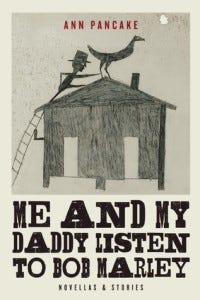
Counterpoint, 2015 Originally from Romney, West Virginia.
There is a rhythm that courses through the lines of these stories. I find myself regarding Pancake’s sentences with awe. In them you’ll find the remnants of real lives lived, the particular pain and beauty of working people, and the complexities they navigate with a dangerous ingenuity that matches Pancake’s own style. She makes a world that only she can name, and it is a world of mud and bone and blood and rust. It is somehow both beautiful and alarming, a rare a combination.
Sample sentence: Fangs are something everybody has four of, but Robbie Phillips’s fangs are the longest I’ve ever seen on a human, and then he has more than that.
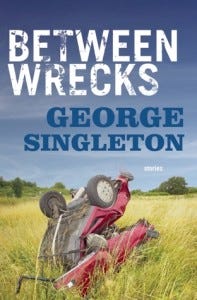
Dzanc Books, 2014 Originally from Anaheim, California, he grew up in Greenwood, South Carolina.
Singleton is undoubtedly one of the funniest contemporary writers anywhere. His ability to capture the absurd ways in which we conduct our days is remarkable, for it exposes us as altogether futile and honorable and pitiful and lovable creatures. Singleton’s characters reveal the modern South for what it is: new, old, stuck, and moving, all at once. River rocks and fake arrowheads and ancient car cigarette lighters and bourbon mark the path onward. Listen to the way people speak in these stories. There is truth in what they say, and there is life in how they wreck themselves.
Sample sentence: How many philosophers found themselves stuck at the back corner of a junkyard, drinking blind-worthy white lightning with a man destined to kill a tree farmer and a man without a kickstand?
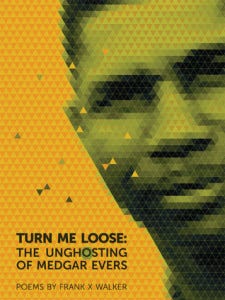
University of Georgia Press, 2013 Originally from Danville, Kentucky.
Walker’s Affrilachia is a book of poems I always find myself returning to, and with his latest, I was reminded why. He has once again put forth a collection of precise and bold verse to shake up the world of contemporary poetry, and he has also reanimated our shared and horrifying past. This is a brave and immeasurably important book told in the voices of Evers’s widow Myrlie, Evers’s brother, as well as in the voices of Evers’s murderer Byron De La Beckwith and his wives. Find out the meaning of the title, read the book, and never let any generation forget Medgar Evers.
Sample line:
Wove my spine to his so he could stand magnolia tall and blossom for all to see.
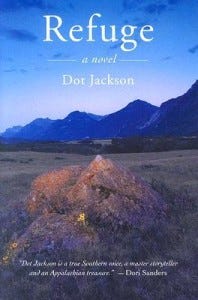
Novello Festival Press, 2006 Born in Miami, Florida, she has long lived in her ancestral upstate South Carolina.
Dot Jackson possesses a writing style that is pure and incantatory, as if spoken to the reader. It is as if the author has channeled this Mary Seneca Steele and we are lucky enough to listen. This is the best kind of journey tale, the kind that leaves behind “proper” coastal environs and heads for the hills, where life is elemental and violent yet full of loyalty and grace, where a woman such as Mary Seneca might finally be free.
Sample sentence: And songs the bees sang to me, in my sleep, and songs the wind would sing on the stove pipe, when I would doze off, in the rocking chair, sometimes.
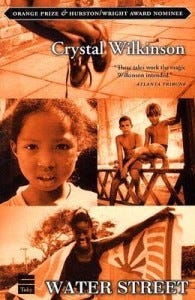
Toby Press, 2002 Born in Hamilton, Ohio, she grew up in Indian Creek, Kentucky.
In fiction writing workshops, I often use the opening chapter as a lesson in point of view. Wilkinson uses “we” in a manner that is so inviting and comfortable as to cast a spell upon the reader that lasts until the very last page. This is a communal book, and by that I mean that the we of the book’s people is ever-present, whether it is literally used as the voice of the teller or not. Water Street is memory, preserved and intact.
Sample sentence: There you can buy a hogshead cheese sandwich for a dollar and get chopped steak and pork chops on credit.
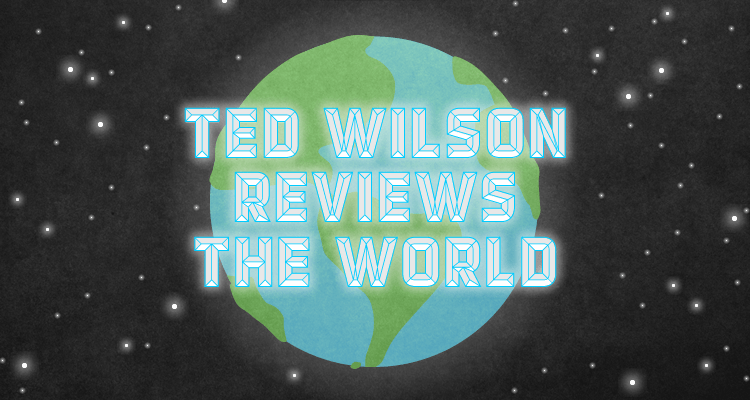
Hello, and welcome to my week-by-week review of everything in the world. Today I am reviewing vaccinations.
Recently, there’s been a lot of disagreement about vaccinations which I’ve learned about while researching the topic on Twitter.com. Twitter is like an encyclopedia that doesn’t take too long to read. It seems some people prefer to have their children vaccinated because they want to give them autism. Others avoid vaccinations because of Obama.
I never got vaccinated and except for the time I temporarily died from measles, I turned out fine. Those two minutes and ten seconds are gone forever though. Then again, my nephew got all kinds of vaccinations and he’s fine, too. So I don’t know, maybe vaccinations don’t really matter either way?
Jim Carrey would disagree. He’s not in favor of vaccinations at all. He’s so committed to this belief that he sent out a very stern tweet saying so. If that doesn’t show he cares, what does? And if there’s anyone who know’s about science, it’s a celebrity who quit school at age 15 and spent decades playing Stephen Hawking.
Who wants to get a needle stuck in their arm? I guess it depends on what’s being injected, but most people don’t. If vaccinations came in the form of a chewy candy, or a Paul Rudd doll you could just rub on your skin, I think a lot fewer people would object to them. Paul Rudd might object.
I’m excited for the day when genetic engineering is so prevalent that vaccinations are obsolete, and then people will stop arguing about them. Then we can argue about whether we should engineer our children to have bird wings. The pro-wing side will talk about the dangers of tiger attacks on land-dwelling children, and the anti-wing nuts will have something to gripe about I’m sure.
Vaccinations raise a lot of questions in my mind, but none of those questions are as pressing as one: Who stole my rake from my yard? I think it was there yesterday when I dozed off in my lawn chair but when I woke up I didn’t see it. Why would someone steal a rake in the summer? After I figure out the rake situation I can get back to vaccinations.
BEST FEATURE: Not contracting and/or spreading diseases to people. WORST FEATURE: If you tell the wrong person you got your kids vaccinated, you’re likely to get punched, or at the very least, not invited to a party.
Please join me next week when I’ll be reviewing Ted Bundy.
Electric Literature is happy to announce the launch of a new series: The Writing Life Around the World. We’ve asked some of our favorite international authors to tell us about their working lives and their literary communities. How do artists in Lagos make a living? What are people reading and writing about in Dhaka? What subjects are taboo in Guatemala City? We’ll be bringing you regular dispatches from established and emerging voices, writing from home and in exile. You’ll read about everyday life, publishing, political repression, and social change. Some worlds will be familiar, others less so; all of them will be bound by a shared pursuit: writing.
Check in with us twice a month, July to December, for new work from E.C. Osondu, Dorthe Nors, Romina Paula, Can Xue, K. Anis Ahmed, Yoss, Fazilhaq Hashimi, and others. The series kicks off on July 15th with a startling, rueful essay from Eduardo Halfon:
Just after I published my first novel in Guatemala, in 2003, I had a beer with the Salvadoran writer Horacio Castellanos Moya, who was living there at the time. We met at an old bar called El Establo. As soon as he saw me walk in, he raised his bottle of beer, congratulated me, smiled a crazyman’s smile, and then warned me to leave the country as soon as possible…
Eduardo Halfon, Better Not Go Saying Too Much (2015)
Join us for The Writing Life Around the World.
This series will be edited by Electric Literature’s Dwyer Murphy andsupported by a grant from the Council of Literary Magazines and Presses and the New York State Council on the Arts.
Early in Cult of Loretta, Nelson, the narrator, remembers getting high on household solvents with his friends under the gingko trees in a high school courtyard during lunch. “It was Nash’s turn to bring the drugs and he brought Comet,” Nelson says. “We took turns passing around that green cardboard tube full of powder, nobody quite courageous enough to shake some out onto a history book.” Nelson’s friend Tyson finally volunteers. “Here goes nothing,” Tyson says. He snorts the Comet and then he drops.
Nelson remembers, “We stood over Tyson, more or less watching him die, and then the school nurse arrived and then an ambulance.” But this is just one of many instances of deranged rebirth in Cult of Loretta. In the final lines of the chapter, Nelson reports, “When [Tyson] came back to school a few weeks later he was wearing a t-shirt with a black-and-white photograph of Sitting Bull on it. He said his name was Blackbird now, and after that, we called him Blackbird.”
Cult of Loretta — the fantastic debut novel from Portland, Oregon writer Kevin Maloney — takes place on the squalid underbelly of northwest towns like Aloha, Oregon and Helena, Montana. This is territory where kids snort household solvents, moms inflict burn wounds onto their crying babies, and musicians do so much “screw” they stop believing in the existence of their guitars. Over the course of 140-pages — with segments/chapters/stories that tend to run one to three pages — Maloney’s characters chase after money, drugs, and inner peace. Most of all, they chase after Loretta. “I understood that we were all bastards,” Nelson says, “that any man with blood in his veins who had a chance to sleep with Loretta would take that chance and gladly be destroyed.”
Loretta is less manic pixie dream girl and more manic pixie nightmare. She has sex with other men while Nelson watches. She snorts screw even when she’s pregnant. Even her physical appearance — her chest is permanently scorched from the hot soup poured on her as a baby — is part lurid. But, she also has a cult of aching and hypnotized drug addicts who will stop at almost nothing to win her heart.
Nelson remembers when, at nineteen years old, she was dancing for him to “Out on the Weekend” by Neil Young. He says, “…all I wanted was for her to hurry up and get in bed with me so I could take off that shirt, but all I want now eighteen years later is for her to slow down, to take her sweet time, to never quite reach me. Because when she finally crawled up on the bed and took off her shirt and I kissed her scalded left breast and her half-scalded right one, it felt like the best thing that had ever happened to me, but it was nearly over… I didn’t feel anything until three years later when I hit the ground.”
It goes terribly for each guy who pairs up with Loretta. Nash tries to kill himself by jumping out a third story window, fails, and then succeeds on the second attempt with pills. Hoyt — a devout follower of Ghandi — is nearly driven to murder. Nelson gets so high on screw that he tries to cut off his dick with the wrong side of a razor blade. In “Treasure,” after Nelson and Blackbird dump Nash’s remains over the Burnside Bridge, Blackbird says, “I’m worried.” “About what?” Nelson asks. “Loretta,” he says. “She’s plucking us off one by one.”
Cult of Loretta is devastatingly gorgeous and horrifying. It’s very much in the spirit of Denis Johnson’s linked, drug-fueled classic Jesus’ Son. Like Johnson, Maloney often works with serene and vulgar imagery simultaneously. Take the opening from “The Goat Farm”:
“We drove from Portland to Helena in Bennie’s 1964 Ford pickup, taking turns pissing into a Gatorade bottle, Loretta using a funnel rigged for the purpose. The green trees of Oregon gave way to yellow grass, high desert, and a sky like somebody cut off our eyelids.”
Maloney’s work also resembles Scott McClanahan’s, another fantastic Lazy Fascist Press author. Like McClanahan, Maloney writes lush, gritty, and compact vignettes that crescendo through bizarrely particular and hectic circumstances. Much like McClanahan, Maloney’s plot-points gracefully fade and reappear over the course of the book, and often his stories are broken into parts (“What Happened to Nash, Part I,” “Part II,” Part III,” etc.).
In a climactic Cult of Loretta chapter called “Tiny Toon Adventures,” Loretta overdoses again and falls and hits her head on a piece of stolen medical equipment. Her heart stops. Nelson snorts a line of screw so he can think more clearly and then tries to bring her back to life with a stolen defibrillator. It doesn’t work. He goes out to his car and prays to his Virgin Mary statue.
“I begged her and fell on the ground and sobbed and said that if she saved Loretta, I’d never do screw again and I’d become a tugboat captain and dedicate my life to helping homeless people, giving them polo shirts and tennis rackets, whatever they needed to not suffer so much.” When Nelson goes back in the house, Loretta is reborn. She’s calmly watching Tiny Toon Adventures on the couch. She asks if they have any more screw.
The novel builds toward the birth of Allie, the child of Loretta and the by-then-dead Nash. In one scene, Loretta says she’s sick of all this shit and just wants her baby to be normal and become an accountant. Nelson prays that he was right about what he told her: that all those drugs hadn’t already “microwaved” the baby’s brain. But despite their best efforts, Allie is taken from them after they accidentally leave her in a car in a hot parking lot.
“I was doing the very best I could,” Nelson says, “I was fully aware that my very best was still kind of shitty.” Things would improve for Nelson if he could free himself of his need for so much money, which comes from his need of so much screw, which comes from his need for Loretta. In one chapter, Nelson tells his co-worker, Sandy, about how his girlfriend is a stripper who has oral sex with her customers. “What’s so special about this Loretta?” Sandy asks him. “Everything,” Nelson says.
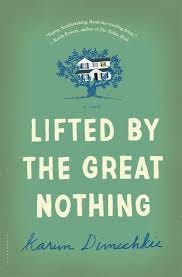
Last month, Karim Dimechkie published Lifted by the Great Nothing to wide acclaim, including high praise from The Paris Review Online and from Oprah.com, which named it one of the season’s best books. He spoke to us about his novel, what drew him to his themes, and just what the heck’s going on in that scene…
Jake Zucker: I’m always interested how a novelist — especially a first-timer — plots his work. In addition to the major motions in Max’s story, there are other more subtle wrinkles — I’m thinking specifically of Max’s relationships with students at school. It seems effortless to the reader, but was it difficult for you to conceive of that material, and how much revision and reworking did it take to space out all the digressions correctly?
…the spurts of hypnotized writing, where I’m virtually unconscious and just dreaming onto the page, are the only things I trust in the drafting process.
KD: It’s only when I’m not trying very hard that I believe I might be onto something. As long as the plot is more-or-less stitching itself together — even if it’s barely coherent — I don’t do any editing or re-plotting until the whole thing is down. Editing too early has proven to be a huge mistake for me in the past. I’ve ruined pretty much every project before this book by revising prematurely. I know not everyone works this way, but I learned that for me, the spurts of hypnotized writing, where I’m virtually unconscious and just dreaming onto the page, are the only things I trust in the drafting process. I don’t realize what I’m writing until I’ve reached the other side.
The subsequent steps are much more intentional — and that’s when I start weeding and reforming like mad. I initially wrote something closer to eight-hundred pages before snipping it down to two-hundred ninety. Relatively few digressions survived that slash-and-burn method. I made sure every deviation was thematically and emotionally important. I also wanted to leave enough space between those seeming detours for them to feel special and worthy of the reader’s investment.
And strangely, the digressions you mention, about Max’s relationships with other kids at school, are pretty much the only truly autobiographical elements in the book.
JZ: How long did that initial drafting take you, and how long did it take to winnow down the page-count? And is there a trick to getting into that hypnotized writing-zone?
KD: The initial drafting took about nine months and the culling and shaping took two years and change. The trick for me to getting into that hypnotized writing-zone is to spend all day with it, trying to get inside the world I’ve started making, letting my eyes glaze over, and literally just transcribing the voices in my head. It sounds loony because it is. I’m lucky if I get two or three of these spurts of hypnosis a day. The rest of the time I bang my head against the wall, try to get the perfect food-to-caffeine ratio going, and pace between the kitchen and my desk, talking myself into staying a writer.
JZ: You mentioned the autobiographical element. I won’t insult you by asking what in the novel is specifically autobiographical, but I will ask if there were real-life events or series of events that spurred you to take on these themes? You’re tackling heavy stuff: identity, sexuality, fatherhood, the Israeli-Palestinian conflict, the Muslim world…
I’m drawn to characters who aren’t solely defined by their national identity, color, gender, or sexuality.
KD: First let me say that I never set out to “represent” any cultural or sexual identities. When I write a character, I always start with a voice that appeals to me, and only later do I say to myself that it might be interesting if this person were gay or black or Muslim, et cetera (and in some cases I even decide whether they’re male or female after the fact). I’m drawn to characters who aren’t solely defined by their national identity, color, gender, or sexuality. Though those traits are obviously integral parts of a person’s experience, I want that to be one of five or six main traits that delineate a character, as opposed to the heart center of their being — or the reason they’re in my book. This allows me to have a person of color, for example, who has concerns and interests that are not uniquely rooted in race. It actually ends up being an effective way to have three-dimensional minorities that aren’t just functional “types” for plots sake. I feel like if I came to the page saying, Okay Karim, now you’re going to write a black character, the result would be something trite and stereotypical. Instead, I come to the page and just start recording the voice of a person and then slowly begin to imagine said person’s physical appearance.
As for fatherhood and the Muslim world, my father is a Lebanese non-practicing Muslim, and we did talk a lot about the Israeli-Palestinian conflict growing up. It’s an issue I’ve followed closely for many years with much compassion and bewilderment. Also, father-son power dynamics have been an obsession in my fiction from the beginning. My relationship with my dad has long been a central point of confusion and fascination.
JZ: Were you surprised at what you had to leave out? How painful was it to kill those darlings?
KD: I was surprised because, again, the stuff that I put the most effort into was almost invariably the weakest. So it was especially painful knowing that a passage I’d been working on for months had to get chopped. I also had to cut out a lot of jokes — and that stung.
JZ: In general, what surprised you about the process?
KD: The endless nature of it surprised me most. I can’t tell you the amount of times I thought the book was finished only to later realize how far away from the finish line I really was. It’s hard to get perspective on your own writing after having worked on it for so long. Space is essential and so is having a couple of kind and smart readers — though I always ended up feeling embarrassed by how obvious the problems they pointed out were and couldn’t believe I hadn’t seen them myself. It’s hard not to get increasingly myopic when you’re standing so close to your work for an extended period — and nearly impossible to imagine what it’s like for someone reading it for the first time.
JZ: You’ve written a novel about the Muslim world and specifically the outsider status that many Muslims experience and/or are believed to experience in the West, and a huge chunk of your story centers around Paris. Not being a psychic, of course, you couldn’t have predicted the Charlie Hedbo attacks as you were writing, but have you thought about where your work fits into the conversation thereof?
KD: I haven’t thought much about that, no. But I am pleased that my representation of Muslims in this book is pretty extremely far removed from such mindless violence. I think the main thing the book achieves on that front is in showing the variety of Muslim expressions — there is no monolith on the Muslim experience. It feels like that gets forgotten lately. I suspect there are very limited associations and images that come to mind when we hear the word Muslim. So I’m proud to have multi-dimensional believers in the novel. It’s important to increase the pool of associations we have with that word.
JZ: Right on. Switching gears: how hands-on was your editor with your manuscript, after you sold the book? Did that relationship unfold as you expected?
Not every element of your art needs an explanation that would hold up in a court of law. That’s not how art operates.
KD: The edits on the book as a whole were quite light. There were very few suggestions about the plot. Though, there was one sex scene early on in the novel that my editor thought I should cut, on account of it being supremely uncomfortable and nonessential. I also learned that certain publishing houses recanted their offers specifically because of this very scene. My editor was absolutely right about how uncomfortable it was — but also I felt it important, interesting, not at all gratuitous, and maybe even powerful. There’s something comical, only in retrospect, about having a very serious debate on whether a scene about “aided-masturbation” has the right to exist or not. In debates like this, both parties pretend to mount extremely rational arguments for or against the masturbation-scene. There’s this habit in the editing stage, and this holds true in writing workshops too, where we talk about what parts in the writing are “necessary” or “unnecessary.” I’m ultimately flummoxed by this thinking. If we’re being totally honest, virtually none of the book is “necessary.” The story could, ostensibly, be cut down to one sentence, instead of three-hundred pages. But then we lose the experience and art of the thing. So this talk of whether something is necessary or not is just a coded synonym for I liked it or I didn’t like it. Not every element of your art needs an explanation that would hold up in a court of law. That’s not how art operates.
Aside from that one moment, I took about ninety-nine percent of my editors line edits. She’s smart as a whip and was incredibly invested in making the book as smooth and clear and poignant as possible. I’m forever indebted to her for the life force she put into improving this debut. I think, together, we made it nearly twice as good as what they originally bought. A good editor is a lot like a savior.
JZ: That’s interesting. Without giving anything away to readers who haven’t come to your novel yet, was the idea that the relationship in question — between Max and the maturbation-aider — would appear as-is, just without the sex-scene-in-question? It’s hard for me to imagine that relationship without that scene. I’m inclined to think some other dramatic act would need to take its place.
KD: More or less. I think the idea was for the masturbation-aider to imply that Max should masturbate, thus breaking one kind of boundary, instead of obliterating that boundary by actually guiding him through the process.
Getting that inside view on a sexual exchange invariably makes for deep and visceral character revelations. And if nothing else, it’s exciting.
This reminds me of something author Allan Gurganus talks about: how so many literary fiction writers have this impulse to pull away from sex scenes. There seems to be a fear of appearing cheap or less literary if we actually show the sexual encounter instead of intimating it: i.e. the characters lean in for a kiss… and then we cut to the next morning with the shoes on the floor. There’s this convention that implying sex is somehow more profound than actually seeing it. This might sometimes be true, but more often than not, skipping over sex is a missed opportunity. Getting that inside view on a sexual exchange invariably makes for deep and visceral character revelations. And if nothing else, it’s exciting. There’s nothing inherently wrong with being entertaining. It’s hard to pull off sex writing, but if done correctly, I think it’s very interesting reading.
While writing the first draft of Cult of Loretta, I listened to Elliott Smith nonstop — on my drive to work, during my lunch break, on my drive home. I wanted to immerse myself in the dark beauty of Portland, Oregon in the late 90s, and Smith’s music is a time capsule of that era. Listening to Either/Or, you can picture him walking down Division St. in a black t-shirt and hoodie, the sky gray and gloomy, the storefronts not hipster coffee shops, but working class bars and strip clubs. That was the Portland of my youth, the Portland I tried to capture in my novella.
But a mixtape featuring nothing but Elliott Smith songs isn’t much of a mix. Instead I’ve put together a collection that taps into the emotional world of Cult of Loretta — a manic-depressive world where teenagers have unprotected sex, get high, hurt themselves and each other in a desperate attempt to find meaning in a meaningless world. Every one of these songs is important to me. I hope you enjoy them as much as I do.
Everything Means Nothing To Me — Elliott Smith
This song’s title sounds like it was stolen from a depressed teenager’s dream journal, but in the mouth of Elliott Smith it becomes a Buddhist mantra repeated over and over until it swells and explodes with the beauty of the universe.
Tonight — Iggy Pop
A song that begins with “I saw my baby / she was turning blue” shouldn’t make me so happy, but every time I hear this song, I become wildly elated and feel like life isn’t just a horrible random mess ending in death.
Going Inside — John Frusciante
I was really depressed my senior year of high school. Every day after my classes ended, I’d walk to a nearby forest, smoke pot out of an apple, put on my Walkman, and walk around the neighborhood listening to John Frusciante’s Niandra LaDes and Usually Just a T-Shirt. That album is the most fucked up, beautiful piece of music I’ve ever heard in my entire life. Unfortunately it isn’t on Spotify. This song is pretty good.
Venus in Furs — Velvet Underground
Lou Reed is the soul of Velvet Underground, but “Venus in Furs” is all about Maureen Tucker. I’m not even sure she knew how to play the drums. As far as I can tell, all she’s doing on this song is hitting a base drum with a mallet. But the effect is tribal and dark and sounds like your heart when the drugs kick in.
Sugar Mountain — Neil Young
Before my ex-wife and I were married, we spent a day at the beach. Afterwards we lay naked in bed covered in sand and sunburns, listening to Neil Young’s Decade. We were just kids. We barely knew each other. Two years later she was pregnant and our relationship was falling apart, but that day, for a few hours, we were totally in love.
Decades — Joy Division
On May 18, 1980, Ian Curtis watched Werner Herzog’s Stroszek, listened to Iggy Pop’s The Idiot, then hung himself. A few hours later Mt. St. Helens erupted. I was three years old. Our cul-de-sac was covered in ash. A fire engine came and cleared it away with a fire hose. I didn’t find out about Ian Curtis until college.
Too Close — Staple Singers
Between 4:55 and 5:07 of this song I fall on my knees and weep and beg Jesus to rip my pathetic soul from my sternum and shoot it like a bottle rocket to heaven.
Ancestors — Björk
I don’t know what this song is about, but when I listen to it, I imagine Björk giving birth to a goblin named Death.
Goodnight Irene — Lead Belly
When I was 25, my wife gave birth to our baby daughter in a tub of water in our living room. Almost immediately my daughter started crying. She didn’t stop for months. I’d walk her around the neighborhood singing to her. I didn’t know any lullabies, so I sang “Goodnight Irene.” She kept crying and crying. She’s 13 now. I just played this song for her and she said, “Oh man, I love this song.” So who knows? Everything’s a mystery.
The Crystal Ship — The Doors
Speaking of mysteries, I can’t tell if this is the corniest song of all time or the most amazing. I’m going with amazing. There’s a character in Cult of Loretta named Ken who abandons his pregnant wife to pursue his dream of smoking peyote in the desert with a shaman. He doesn’t make it, but I like to think that maybe in some alternative universe he did, and that he flew around in a Crystal Ship with diamonds floating out of his forehead. Ken’s a jackass and a bastard, but even bastards deserve to have their dreams come true.
True Love Will Find You in the End — Daniel Johnston
Cult of Loretta is about a lot of things, but mostly it’s about unrequited love. Nobody loved more unrequitedly than Daniel Johnston. This is probably the saddest song of all time because he genuinely believed this girl named Laurie would love him one day. But she didn’t. She married an undertaker and Johnston became schizophrenic. Years later Laurie divorced her husband and met Johnston at a screening of the movie The Devil and Daniel Johnston. He was still in love with her and she still wasn’t in love with him.
Monster — Y La Bamba
When I moved back to Portland after a decade in Vermont, I walked into a small music venue and heard a six-foot tall Hispanic woman singing the most incredible music. We became friends, and she started a band called Y La Bamba. This song makes the hair stand up on my arms. The first time I heard it I made a painting about it. Later I used it in my book trailer for Cult of Loretta. If the other songs on this mix represent the Portland of my youth, this represents the Portland of today. Despite the massive influx of people from out of state and reckless development of historic neighborhoods, there is still gut-wrenching beauty everywhere.
***
— Kevin Maloney is the author of Cult of Loretta (Lazy Fascist Press, 2015). His stories have appeared in Hobart, PANK, and Monkeybicycle. He lives in Portland, Oregon with his girlfriend and daughter.
DON’T MISS OUT
Sign up for our newsletter to get submission announcements and stay on top of our best work.
YOUR INBOX IS LIT
Enjoy strange, diverting work from The Commuter on Mondays, absorbing fiction from Recommended Reading on Wednesdays, and a roundup of our best work of the week on Fridays. Personalize your subscription preferences here.