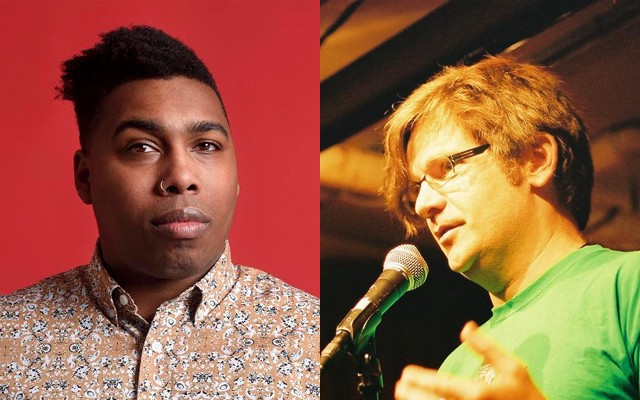
Sara Nović has an agenda. The violent conflicts in Croatia, where she has many friends and family, and the complicated history of that region have been obsessions of Sara’s for many years. Her powerful debut novel Girl at War (Random House, 2015) tells the story of Ana, a 10-year-old girl who is living in Zagreb when war breaks out in the early 1990s. In telling Ana’s story, Sara hopes to shed light on a time and a place about which many people still know very little.
Sara’s novel gives us familiar childhood settings of school and play and family life, as well as harrowing scenes of civilian war and make shift armies, of teenagers-turned-soldiers in abandoned buildings called “safe houses,” where the inhabitants are playing cards one minute and shooting their enemies the next. We travel through this world with Ana, at an age where she is just starting to make sense of the world around her, while the world keeps refusing to make sense.
I had the pleasure of chatting with Sara at the bustling Housingworks Bookstore Café in SoHo. We talked about her writing process, the big ideas and motives behind her debut novel, and why being deaf is so awesome (Sara has had progressive hearing loss since she was a child).
Catherine LaSota:You were born in New Jersey, and you went to Croatia after high school. Was that your first visit?
Sara Nović: Yes. And that was kind of the first time I started writing stuff down about Croatia, because I was talking with people. That was the point where war stories stuck on me. And everybody was quite eager to talk about the conflict, because people didn’t experience it outside of the region and people don’t really know about it here, and during the reconstructions, people in Croatia felt kind of disillusioned about that. People feel a little bit abandoned by the West in certain ways… Particularly in Croatia, nobody in the West even really knows what happened there. I think people are more familiar with Bosnia as the center of that war, because that’s where America got involved. And now Croatia is like a hot vacation spot.
CL:It seems like there is a lack of awareness about the history of Yugoslavia in general in America, and, this is a difficult question, but, I’m wondering if there is one major thing you hope people could understand about what happened there?
…it’s easy to sensationalize war and also to ignore an ethnic conflict where you just say, well these people just hate each other…
SN: Well, I think one thing to know is: as complicated as it was, it was actually even more complicated than that. I think the way it gets portrayed in the media was: Serbs are Christian Orthodox, and Croats are Catholics, and Bosnians are Muslim, and that’s why they’re all fighting each other. But it’s way bigger than that. And obviously nationalist stuff did fan the flames, but it was also a war about money and who gets to decide which directions the roads go! Like, the capital of Serbia is Belgrade, and they wanted to build roads to get to the capital, but then Croatia wouldn’t have any roads going the other direction…almost silly stuff, but, like, that’s important to know, because it’s easy to sensationalize war and also to ignore an ethnic conflict where you just say, well these people just hate each other or whatever. It’s kind of worse than that.
CL: I think America is very good at framing things in terms of religious conflict. It’s a narrative that Americans are familiar with.
SN: Sure. And because there are all these groups and it’s so confusing — this one had an army, but these people didn’t have an army but they made their own group, etc. — there are just so many things happening that it makes sense that you’d try to simplify it somehow, like how can I define these groups and comprehend this? Like, even, who is fighting with whom?
CL: Right. There is a scene at the United Nations in your book that I’m thinking of, where Ana is talking about having stayed up really late the night before trying to think of what to say to the UN council about her wartime experience, but she is having a hard time because she still doesn’t really have a narrative for herself about what had happened. So I’m wondering — how do you see fiction and narrative as ways of making sense out of situations?
SN: I think the value of fiction about something like this is that it’s a way for people to understand the story. Even though it’s not a perfect story or complete narrative, fiction does give you a capacity for empathy, especially if it’s a novel. In this novel, for example, you can kind of hang out with Ana for a while and feel more, I hope. So that’s maybe one way of understanding a story, even if you don’t exactly understand all the details.
CL: You sold your book to Random House before finishing your degree at Columbia, and then you published the short story “Notes on a War-Torn Childhood” with Recommended Reading here at Electric Literature. That story was written after you’d written the book, correct?
SN: Yeah, I mean, the book took a long time. I’m told these things happen! I wrote a short story when I was in undergrad that pretty much still exists as the end of Part One of Girl at War. It’s this very violent thing that happens. I gave it to a professor, and he was like, oh good, go write a book! (Laughs) And I’m like, thinking, what? But then I just started writing chunks, and I think you can kind of see that in the structure, how it was kind of vignettes, and there is different stuff in all directions. I was writing those for years, but not really figuring out the direction. The story I wrote while I was at Columbia that was published in Recommended Reading obviously uses similar characters, but I was playing with expanding and contracting the material.
CL: At what point did the structure of Girl at War become clear to you? You said you were working on it in different sections.
…what does it mean to make a story out of this material, and how does trauma and memory come into play in narratives of war in general?
SN: I always knew that I didn’t want it to be chronological, but I didn’t know what order it would be for a long time. At one point I had it switching back and forth much more than it does now. I had it at one point starting in the present, which made no sense, not even a little! (Laughs) And eventually I kind of came up with the way it is now, in part because I kind of felt like people needed a break after the end of Part One. But there was also this idea of what does it mean to make a story out of this material, and how does trauma and memory come into play in narratives of war in general? And I think they’re probably not straight narratives, you know?
CL: The question of memory and the fallibility of memory is something that comes up a lot in your book. Can you talk about that a bit?
SN: Yeah, it’s interesting because, the different people I talked to remember things differently. It also depends on what side are you on, or where you were. Even in Croatia, the war in Zagreb looks a lot different than the war in Vukovar or wherever. So that changes things. I had a couple friends who told this story that there used to be a McDonald’s in Zagreb, and after the first air raid happened it closed. And I was like, that’s amazing! And that was in the book. But then other friends were like, no, there was never any McDonalds in Zagreb. (Those friends said) McDonalds didn’t come until after the war, and it was the symbol of capitalism or independence or whatever. So I still don’t know what the answer is, and I couldn’t really work it out, and I ended up taking it out of the book.
CL: What kind of research did you do for Girl at War?
SN: Besides talking with and stalking my loved ones, I also did a lot of weird things like research the roads — so, which road existed at what time, etc. I was looking at a lot of old maps. Part of the reason (in Part One of the book) why Ana and her family end up down below where they’re going is because the roads were wonky then. And for some reason I became obsessed with what the weather was on certain days. And that information was really hard to find initially, when I started writing this book. Now there are websites that would make that pretty easy.
CL: Was the accuracy of the weather important because of the environment or feeling that weather can create?
SN: Well I think I just felt like a lot of good historical details were important for showing that this is a real place where things happened, even though the characters are fictional.
CL: You studied literary translation at Columbia with your MFA program there. How has that influenced your own writing?
SN: Just to be working on Croatia stuff, reading stuff, was an influence. The poems that I was translating, this guy Izet Sarajlić was writing them in his house during the first 30 days of the siege on Sarajevo. So that was quite intense. But also funny — that was interesting, to find humor in that situation, sometimes it’s the only thing you can do.
CL: Had you thought about writing a novel before that experience you had with your undergrad short story?
SN: No! I mean, I never really thought that writing was a thing that people did. It’s weird, because I was always an avid reader, but it never occurred to me that people were writing these books! (Laughs) And I was always writing stuff like terrible poetry or whatever — stories too — as a kid, but, like, hiding them under my bed. They weren’t things that I showed people. So I definitely didn’t think writing was something you could do for a career, or that writing was even a thing that adults did.
CL:Was your writing workshop the first time you’d shared your writing with somebody?
SN: Yeah, with the exception of my little sister, who has read everything I’ve written.
CL:Does she still read everything you write?
SN: Yeah. I actually live with her in Queens. So, she’s a live-in reader. She’s not a writer, but she’s smart, so it’s like, what does a human think of this? (Laughs) Which I think is nice to have in the earlier stages. And in the later stages. A person who’s going to read this book and not think of it the way I do.
CL: Have the family and friends you talked with in Croatia read the novel? What do they think?
SN: They like it. Which is great! I was really happy about that. I wasn’t that nervous about it because I had been talking with them about it so much that nothing in the book was really a surprise to them, but the fact that they like the finished product is great.
CL: I think one of the big strengths of the book is that we learn about the experience of a child in wartime, and that Ana, despite her environment, is still just a child. This environment of war is simply her frame of reference for what is normal. Was it difficult to write the story of someone whose childhood was very different from your own?
SN: Well, I mean, I kind of identify with Ana in a lot of ways, personality-wise.
CL: How so?
SN: Mostly her feeling generally weird in the world — but maybe that’s all writers, I‘m not sure. (Laughs) I don’t know, but writing about Ana didn’t feel hard for me, because I got to learn along with her. Because of the way the book is set up, she kind of has to work out, okay, what’s going on now, and what’s going on now, which is what I was doing as I wrote. I was also a giant tomboy as a kid, and I identify with a tomboy’s struggle with her mom, which comes up in the book a little bit. So that’s one thing. I don’t know, I think our general personalities are quite similar. But she’s smarter than I am!
CL: How do you write a character who is smarter than you are?
SN: I don’t know! Well, I guess you revise it, you know, it takes a lot of tries!
CL: Speaking of Ana’s parents, I was thinking: they are faced with some horrific decisions about safety and their family, and in the course of making decisions they are both showing their powerlessness and also some strength at the same time. I’m curious about your thoughts on characters that express strength, or characters that are seen as weak, and how do you write a character that is strong? What does that mean to you?
…in the landscape of war, you don’t have agency
SN: It’s particularly weird in this book, I think, because in the landscape of war, you don’t have agency. That’s something that I worried about when I was writing Ana, because first of all, she’s a kid, so she doesn’t have that much agency anyway. And then she’s in this war where the whole point of the war is you lose control over your life, and particularly this war where there is genocide involved, and the civilian is the target of this thing. So that question of agency — there has to be a way to show strength even when you don’t have control over your basic life, and I guess it’s a mental thing. Ana’s dad does it by being really good-natured — he’s kind of funny, not strong in a physical, violent way. And then there are those characters in the safe houses, who are strong in a very different way.
CL: Were there particular characters that were favorites for you to write?
SN: Sure. I mean I think Ana’s dad is a favorite of mine. I honestly had the most fun writing the safe house stuff, because it was exciting, and (the characters in the safe houses) are so bad-ass!
CL: The environment in those safe houses is SO masculine — images of oiled-up women on the walls, etc.
SN: Kind of — I mean, definitely in Croatia, but I think also in Europe in general, naked chicks are just more of a thing. Like if you buy a newspaper, there is a naked girl on the cover of the newspaper, etc. I think Ana is pretty unfazed by it because it’s just all around her all the time. But yeah, in most civilian or child soldier situations, you have to manufacture a certain kind of bravado to get people to kill people, and I think a lot of that will oftentimes be done with drugs, but in this case, it’s this feeling of being an action hero or a gangster or something.
CL: The people in the safe houses all have these action hero names. Were those names fun to come up with?
SN: Yes, it was super fun. And I think (choosing action hero names) was something that somebody told me had happened and maybe quite often, because, like, the whole Croatian army wasn’t really an army, and the whole Bosnian army wasn’t really an army. There were a lot of people who weren’t used to killing people who were all of a sudden killing people.
CL: One thing that Ana does to get away sometimes and gain perspective is to step outside and spend time on balconies. I’m wondering: New York can be a crazy place — what do you like to do yourself when you just need to step out of it for a while?
SN: I like to walk around. In Queens you can walk and no one will bother you — not so much in Manhattan. But when I lived in Brooklyn I used to just go to the river a lot. Just the smell of salty water takes it down a notch for me — it feels like an extreme change to me! So, yeah, if I can be near water then I feel a lot better. Luckily there is a lot of water around New York– if it’s dirty, it doesn’t matter.
CL: Where do you do your writing?
SN: I do a lot of my writing on the train. I find the train is conducive to writing. I think because you can’t get out. I wrote a lot of Girl at War on New Jersey Transit, because I was living in Philadelphia when I started going to Columbia, and I thought, if I’m going to be on this train for two hours, I’ll just sit here and write.
CL: Ana maintains a distant relationship with Sharon, a UN Peacekeeper who met Ana when she was 10 years old, in a time and place of war. In one scene when Ana is an adult, she realizes, “for Sharon, I would always be ten years old.” I love this scene, which made me think about how we are often stuck in the moment of our lives that define us for certain people. Do you think that we often define other people by certain moments in their lives, or do we also do this to ourselves? This seems like a theme that runs throughout Girl at War.
SN: Yeah, for sure, definitely, we do it to ourselves probably both by accident and on purpose in different ways, like when there is something that we can’t get over and then we define ourselves in a way that perpetuates that. And yes, of course, other people do it, too, like if you go home for Thanksgiving or something, the way you talk to your family is different than the way you talk with people you see in New York everyday, and part of that is because your family sees you in a different way or in a different time.
CL: What are you working on now, and is there anything you are reading that you particularly love?
SN: Right now I’m reading Heidi Julavits’s book (The Folded Clock), and it is awesome! I love it! Her book is lovely — it’s like having a sleepover with a friend who is way smarter than you telling you very smart things, because it’s really intimate but really intelligent. So I love that. What am I writing? Who knows! Deaf stuff mostly. I’ve been writing some stories about deaf characters. I’ve been writing something that I thought was a short story, but it keeps getting fatter and fatter, so I have no idea what that means!
SN: Yeah, not as much because I’ve been busy, but I always have something to say about it! The Redeafined blog started because there is this idea that if you have a kid who is deaf, you should implant them with a cochlear implant, and part of the stipulations of that is that you don’t teach them sign language, because — and this is insane to me — scientists and doctors tell parents that if you teach them sign language they won’t learn English as well. Would you ever say that about any other language (about a child’s capacity to be bilingual)? No, you wouldn’t. But that’s what happens. It is a ridiculous thing to say, and no one would ever say it about any other culture or language. But they say it to women who have just given birth, who are maybe not in the best emotional state. It’s crazy! So that’s the reason why I started the blog.
CL: What do you think is the biggest misconception that people have about deafness?
SN: There are so many! I mean the main one is that it’s bad, I guess! (Laughs) But I quite like it!
CL:What do you like about it?
SN: I love ASL (American Sign Language). And I like being able to turn my ears off. I don’t know how you guys don’t do that — I would freak out if I had to listen to things all day! It’s very overwhelming, particularly in New York.
CL: A lot of us wear earplugs!
Deaf culture is so lovely. It’s nice and open in a way that you don’t see so often.
SN: Deaf culture is so lovely. It’s nice and open in a way that you don’t see so often. This is a gross story but it’s true: in deaf culture or ASL culture, it’s really common if you’re sitting at a dinner table with people you don’t even know to be like, ok, I’m going to go to the bathroom and I’m going to take a shit. And that is not weird, and that is not a shameful thing to say, and that’s because you know you have to tell people where you are (going to be) at all times (or you will lose each other). You can’t talk to people through the bathroom wall! You need to be like, here’s where I’m going, here’s how long I’m going to be there, here’s what I’ll be doing. And this openness spills over into other areas. It’s a community where you get to talk about things. Actually the deaf community has been leagues ahead of the mainstream community with things like gay rights. I think that all stems out of this thing we share, that we become so open about everything else. So that’s nice, and I like it!
For some, the Mad Max movies set the tone for grungy, violent post-everything cinematic science fiction. For others, these movies might be remembered hazily as the butt of Mel Gibson jokes and the triumph of one really, really good Tina Turner song. Either way, Mad Max is back this weekend with the release of the new film (no one knows what to call it: Reboot? Recharge? Cash grab?) Mad Max: Fury Road. Like its predecessors — Mad Max, The Road Warrior, and Mad MaxBeyond Thunderdome — Mad Max: Fury Road is an original screenplay that is not based directly on any novel or short story. And yet, a dark and fantastical road trip is something that crops up in plenty of science fiction and fantasy novels. Here are eight fantastic road trip books to give your Mad Max diet a little more literary flavor.
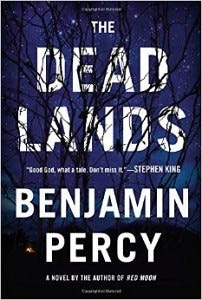
Set in a devastated future America, Ben Percy’s new novel might be the literary equivalent of a Mad Max-style narrative. The novel is a re-imagining of the path taken by Lewis & Clark, but plotted through a dystopian, bombed-out version of the West. Part political thriller, part survival story, Ben Percy has proven again (as he did with the werewolf novel Red Moon) that he is one of the best contemporary genre-benders out there.
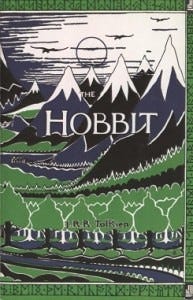
Tolkien is obsessed with road trips! If you don’t believe me think about this: the subtitle (or alternate title) to this book is actually “There and Back Again.” True, there’s some battles with various armies toward the end of this book, but what’s a magical road trip without some dwarf-war action? Tolkien liked this format so much that one could also argue that the entirety of the Lord of the Rings is a massive road trip too. Most of us wouldn’t want to take a road trip to a giant volcano where a certain Dark Lord was hanging out, but then again, maybe we would?
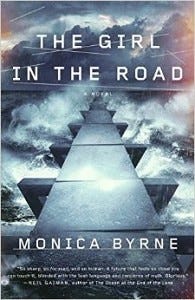
Definitely not a vision of the future that is apocalyptic (post or otherwise), Byrne’s 2014 novel bridges a futuristic India and Africa with a literal futuristic bridge. Told from two parallel narratives, occurring at different times, Byrne science fiction future is certainly dark, but it’s not exactly the same level of cynicism you might normally associate with a near-future novel.
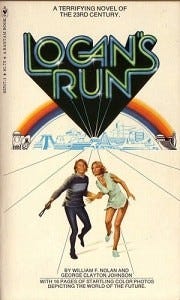
Logan’s Runby William F. Nolan and George Clayton Johnson
While the film adaptation of this book sees Logan and Jessica escaping an enclosed city to discover a decimated Washington D.C. around them, the novel is totally different. There is no enclosed city, but instead an entire futuristic and totally insane America which can be traversed by a high-powered underground subway. From the East Coast to North Dakota, and eventually even to the planet Mars, the 1967 book version of the iconic 1976 film is really, really BIG.
If you’re worried ever about superhero narratives just not being down-to-Earth enough, then check out this memorable storyline from the 70’s. Here, Green Arrow convinces Green Lantern and Green Lantern’s outer-space bosses that it’s time to see how America really lives. Everybody gets into a pick-up truck and drives across America discovering mostly economic and racially charged injustices. While reading a little clumsy and preachy today, it’s still hard to wrap your mind around the fact that DC even attempted this concept. The politics are super left and totally on the nose, which makes it not only a great historical comic artifact, but also a really compelling read.
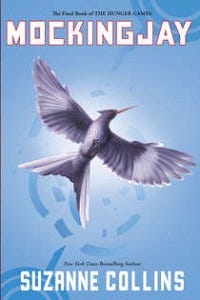
The last book in The Hunger Games trilogy is also a road trip of sorts. In an attempt to restore freedom to Panem, Katniss, Gale and her coterie of freedom fighters go on a variable tour of each of the “Districts” of this post-apocalyptic world. Though vaguely believed to some version of North America, Collins never tells us outright where and what Panem is specifically. Like a lot of great science fiction dystopias, the various cultural trappings of each of the 12 (well, sometimes 13) districts serves a political and sociological analog to real life problems. One-percenters are certainly a target of both Katniss’s arrows and Collins’s prose, but figuring out where they live versus everyone else is what makes this kind of world building a perfect blend of analogy and imagined reality.
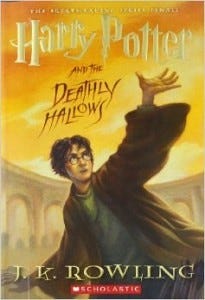
Whoa! Do the ends of popular “kid’s” series always result in a giant road trip? Breaking with the format of every single previous Harry Potter novel, Rowling sent Harry, Ron, and Hermione on a full-on quest across a England. Notably, a lot of this has the Hogwarts wizards chilling out in the “non-magical” world, trying to keep a lid on their wand-waving ways. But, the book is also a grand tour of all sorts of stuff that was mentioned in previous installments, including the house where Harry’s parents were murdered, a favorite pub in Hogsmeade, and more. My favorite part of reading Deathly Hollows when it first came out was thinking to myself “they’re not out of the woods yet,” and then realizing the characters were literally camping in the woods.
You knew this one was going to be on here. We couldn’t resist. You get one guess as to why this is a sci-fi/fantasy road trip that should remind you of Mad Max.
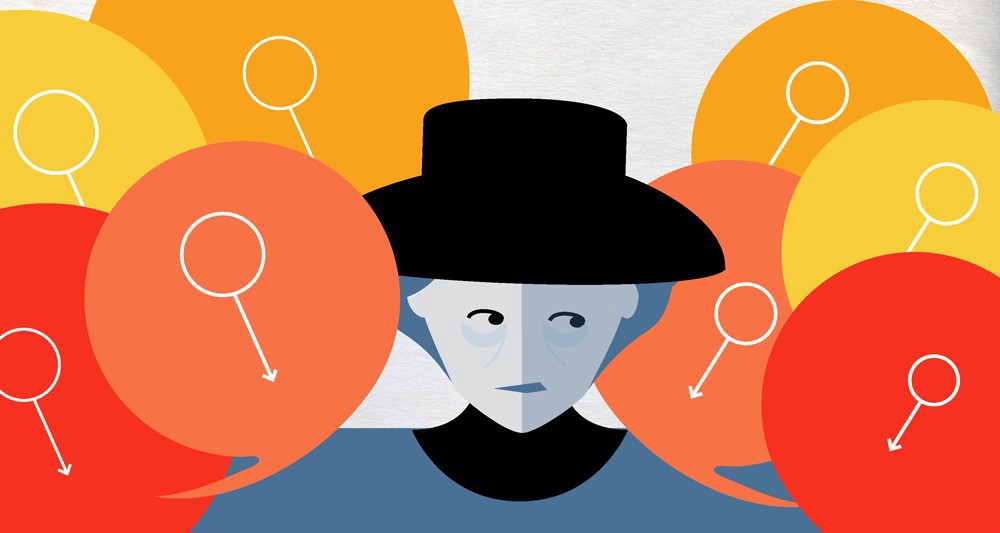
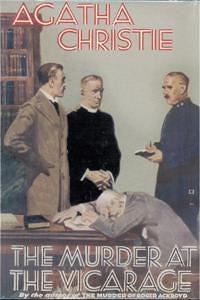
By 1960, Agatha Christie was apparently exhausted with male know-it-alls. She had grown to despise her most famous detective, Hercule Poirot, whom she described as “an egocentric creep.” But her readers had loved the high maintenance Poirot since his first appearance in 1920 — his perfectly groomed moustache, his patent leather shoes, his delicate stomach — so much that he was the only fictional character ever to receive an obituary in the New York Times. It must have been a relief for Christie, in novels starting with The Murder at the Vicarage in 1930, to write about Miss Marple, her little old lady heroine, whose quiet expertise in the comings and goings of village life and the universality of human nature made her an unlikely master detective. She said that Miss Marple and Poirot never solved a mystery together because “Poirot, a complete egoist, would not like being taught his business or having suggestions made to him by an elderly spinster lady.”
Most men don’t, but the twinkling irony with which Miss Marple nudges blustering, blowhard cops in the right direction demonstrates how the Queen of Crime inherited just as much from Jane Austen as Arthur Conan Doyle, employing the sly humor that is a hallmark of British domestic fiction. Christie’s Miss Marple mysteries are ones in which female news and knowledge are vindicated, throwing a smiling side eye at mansplanations and male authorities. Miss Marple’s wisdom is overtly feminine — she relies on her knowledge of the domestic sphere, of relationships — and her methods are equally so, as she exercises her keen women’s intuition. “Intuition,” she says, “is like reading a word without having to spell it out.”
Miss Marple nudges blustering, blowhard cops in the right direction, demonstrating how the Queen of Crime inherited just as much from Jane Austen as Arthur Conan Doyle
Miss Marple elevates the archetype of the spinster, which has been, as Kathy Mezei writes, “a recurring icon in British literature.” This phenomenon reflects a reality of British demographics, particularly after the traumas of two world wars: women outnumbered men, and single women were seen as “lonely, superfluous, and sexually frustrated.” Mezei’s wonderful article “Spinsters, Surveillance, and Speech: The Case of Miss Marple, Miss Mole, and Miss Jekyll” from the Journal of Modern Literature lays out the way that a spinster character has been used by Christie and others to accomplish feats of narrative misdirection, and, more importantly, to “covertly query power and gender relations while simultaneously upholding the status quo.”
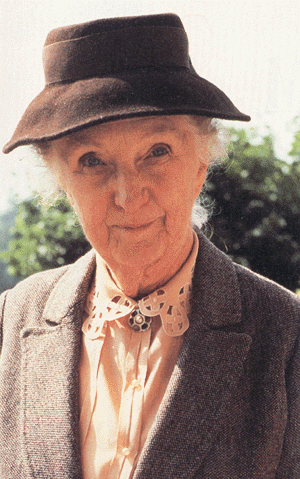
Joan Hickson as Miss Marple
The brilliance of Christie’s deployment of Miss Marple is that she does not turn away from the spinster stereotype. We all know it: old, unmarried women are lonely, nosy, and spend their days eavesdropping and passing judgment. And it is just her apparent superfluousness, the ease with which she may observe society, unnoticed and unimportant, that perfectly situates the spinster to pick up on clues and intrigue. Miss Marple’s ambiguous position in domestic life, neither completely inside or outside the village families she observes, is where she gains her peculiar power to steer Christie’s stories: as Mezei’s mindblower of a sentence puts it, “[the spinster’s] narrative function, in representing the dialectic between seeing and being seen, omniscience and invisibility, often mirrors the ambiguous and hidden role of the author/narrator in relation to his/her characters.”
In this way, Miss Marple is never our narrator, nor does she provide the primary point of view for any of Christie’s novels. Christie’s mysteries only work in so far as they, as Mezei writes, “adroitly distort the reader’s and the characters’ angle of perception” — casting suspicion in every direction, manufacturing red herrings, following dead ends. Like all great magicians, Christie’s skill was sleight of hand, controlling her readers’ attention by flourishing the left hand while manipulating the cards with the right. Miss Marple acts as a guide in the story, or even as a fairy godmother or deus ex machina, reappearing periodically to right the investigation’s course and “readjust the focus of our gaze.”
Like all great magicians, Christie’s skill was sleight of hand, controlling her readers’ attention by flourishing the left hand while manipulating the cards with the right.
Of course, this sleight of hand has always been what Christie’s critics have complained about: that she eliminates “human interest,” as Edmund Wilson wrote in 1944, in favor of “the puzzle.” Wilson’s companion pieces “Why Do People Read Mystery Novels” and “Who Cares Who Killed Roger Ackroyd?” are masterpieces of vintage trolling, baiting readers by writing of the mystery, “As a department of imaginative writing, it looks to me completely dead,” and claiming that he grew out of detective stories by the age of twelve.
These pieces also seem to be opportunities for Wilson to covertly criticize female writers and concerns. The few writers whom he mildly praises, like Rex Stout and John Dickson Carr, are men; he criticizes Dashiell Hammett but seems to reserve the height of his asperity for the women who were at the vanguard of “the Golden Age of Detective Fiction.” He writes that Ngaio Marsh’s writing is not “prose at all except in the sense that distinguishes prose from verse;” of Christie he writes, “Her writing is of a mawkishness and banality which seem to me literally impossible to read;” of Dorothy Sayers, “She does not write very well;” of Margery Allingham, “The story and the writing both showed a surface so wooden and dead that I could not keep my mind on the page.”
The legendary crime writer Raymond Chandler wrote a response to Wilson’s first piece with his essay “The Simple Art of Murder,” effectively a defense of Hammett and a further heaping on of scorn for traditional English detective novels. He expands on Wilson’s critique of “the puzzle,” writing that the skills that contribute to artful writing and those that create a clever mystery are incompatible. “The fellow who can write you a vivid and colorful prose simply won’t be bothered with the coolie labor of breaking down unbreakable alibis,” he writes. “The master of rare knowledge is living psychologically in the age of the hoop skirt.”
But buried in these criticisms is an implicit statement about what kind of human beings make authentic characters and which reality is worthy of realism. Wilson writes that he skipped many sections of “conversations between conventional English village characters” in the books of the writers he refers to as “these ladies,” while heralding Chandler’s Farewell, My Lovely as a “novel of adventure.” Chandler says of the jaunty amateur detective in a Dorothy Sayers novel, “The English police seem to endure him with their customary stoicism; but I shudder to think of what the boys down at the Homicide Bureau in my city would do to him.” The “domestication of crime” that came with the rise of Christie and her cohort was necessarily a feminization of crime, and that emasculation is what Wilson and Chandler are writing against — Wilson goes so far as to say that Chandler is not a detective novelist at all; his writing is more allied with the spy stories of Graham Greene.
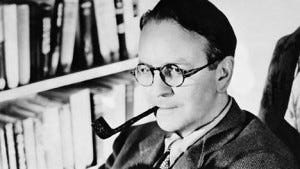
Raymond Chandler
Chandler’s essay blames the enfeebling gentility of the detective story on the genre’s readers: he repeatedly characterizes them as “old ladies” who “like their murders scented with magnolia blossoms and do not care to be reminded that murder is an act of infinite cruelty.” In Chandler’s scheme, what Hammett and his “tough-minded” ilk brought to the detective story was a bracing, and specifically masculine, morality. “Hammett gave murder back to the kind of people that commit it for reasons,” Chandler writes, “not just to provide a corpse.” Then the only valid crime writing is tough guys writing about tough guys killing other tough guys. But one forgets, as Miss Marple says, “One does see so much evil in a village.” Or more to the point, as Miss Marple also says, “Clever young men know so little of life.”
The noir stories of Chandler and Hammett are about the malignant effects of a decaying, corrupt institution: the American city. Village mysteries are about the same, but their focus is tighter: the traditional family and its domineering patriarch. “This apparent example of English nostalgia,” Mezei writes of the Golden Age mystery, “has exposed one odd and dysfunctional household after another.” The secret subversion in this genre comes, as Mezei points out, as these mysteries explore not a threat to the status quo from the outside — chaos invading the otherwise orderly home — but from the inside. Their focus is on what is hidden, on secret identities, on the disorder and resentment that already exists within every family. Mezei quotes from Alison Light that Christie was “an iconoclast whose monitoring of the plots of family life aims to upset the Victorian image of home, sweet home.”
This “Victorian” connection is an interesting one: Miss Marple is often characterized as a Victorian because of her conservatism and her views of good and evil, but also the darkness and suspicion of her mind. “A mind like a sink, I should think,” one character says of her. “A real Victorian type.” Christie was also a real Victorian type. She was engaged by Victorian crazes like the one for travel and exotica — she was one of the first British people to surf standing up on Waikiki. Her mother believed she could talk to the dead, and when Christie famously went missing for eleven days in 1926, Sir Arthur Conan Doyle used a medium to search for her, continuing the Victorian mania for spiritualism.
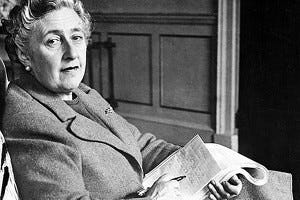
Agatha Christie
Conan Doyle and Wilkie Collins were her literary heroes, as well they might be; after all, Edmund Wilson made the bold declaration that “the detective story proper had borne all its finest fruits by the end of the nineteenth century.” Collins’ The Woman in White was one of the earliest “detective novels,” and when it became the most popular book in England in 1859, reviewers leveled similar criticisms at it as Wilson did at Christie. “Our curiosity once satisfied, the charm is gone,” one reviewer wrote of the mystery in Collins’ novel. Even in the embryo days of the detective story, critics were weary of the formula, the puzzle, the sleight of hand that twists and turns our attention. But The Woman in White was a novel which innovated by borrowing from journalism, playing on the British public’s growing fascination with lurid court cases, as they devoured accounts of poisoning, bigamy, and false imprisonment. We think of the Victorian era as a time of repression and suffocating tradition, but it was also the time of a steadily germinating modernity. A population with dual preoccupations with “home, sweet home” and with salacious crime stories: who else could that beget than Agatha Christie, and all her brothers and sisters writing what we sneeringly refer to as “popular” fiction, genre fiction, airport fiction?
All our criticisms of genre fiction — that it relies too much on the sensationalism of a shocking plot; that it is unwieldy and messy; that it is too contemporary, resisting the classic’s tight-lipped timelessness; that it appeals too much to its audience’s emotions — sidestep the fact that the novel began as a popular form, one as potentially mind-rotting as TV, comic books, or Candy Crush. And it was never more so than in the Victorian era, when Charles Dickens published his own and others’ novels (including The Woman in White) in serial form, swaying with his audience’s desires. Those writers were shocking and suspenseful and sentimental and funny — they gave the people what they wanted. And if popular fiction is too formulaic, then we should tell that to Shakespeare the next time he writes about a Duke disguising himself to entrap his evil brother.
the novel began as a popular form, one as potentially mind-rotting as TV, comic books, or Candy Crush.
Shakespeare is our most enduring example of English popular fiction, and in his weaker moments he was just as messy and repetitive and the rest. Christie was a Shakespeare devotee — her only daughter was named Rosalind, after the heroine of As You Like It. In the 1950 Miss Marple novel A Murder is Announced, an unexpectedly sensitive policeman muses to himself that one of the characters would make a good Rosalind, and this sets the tone for the madcap novel, with multiple cases of mistaken identity, twins separated at birth, and even, in proper Shakespearean style, ending with a wedding.
Framing Christie’s novels as Shakespearean comedies is a fun thought experiment — I suppose we shouldn’t be surprised that arguably the most popular novelist of all time (her books have sold two billion copies worldwide) is often funny. And she used comedic techniques passed down from Shakespeare and the Victorians — being too current, too meta, too cute — to sweetly barb back at her detractors. In A Murder is Announced, Miss Marple talks about reading Hammett’s stories. “I understand from my nephew Raymond that he is at the top of the tree in what is called the ‘tough’ style of literature,” she says, winkingly paraphrasing Chandler’s critique of the English mystery, of characters like herself. Miss Marple was Christie’s way of further feminizing an already feminine genre, of doubling down on her mysteries by old ladies about old ladies for old ladies.
Hello, and welcome to my week-by-week review of everything in the world. Today I am reviewing Game of Thrones.
You’ve probably heard of the TV show called Game of Thrones. I watched an episode the other day to see what all the fuss is about. I thought it was going to be a fun game show, like a modern twist on musical chairs. It wasn’t that at all. It’s basically like The Hobbit but with nudity. I’m glad the Hobbit didn’t have any nudity, because none of the characters were very attractive.
Game of Thrones fixes The Hobbit problem by hiring lots of attractive actresses and actors. I’ll be honest: I like seeing naked ladies, but I don’t like it when only the ladies are naked. I didn’t really see much male nudity. That seems unfair. If a wizard is uncomfortable being nude, there’s no reason they couldn’t give him a CGI penis.
In some ways the show is very accurate. For instance, a lot of the scenes are dark because they didn’t have electricity in England in the early 1800s. While it makes it hard for me to see what’s happening, I appreciate the commitment to authenticity.
However, some details, like the dragons, are completely inaccurate. Except for some religious extremists, there is not a single scientist who will say that man and dragons coexisted. Everyone knows that.
There are a lot of tough guys in this show but I didn’t recognize any of them. I’d like to see some big name, tough-guy actors like The Rock, Sean Penn, or Shia LaBeouf. And tough women, too. Katharine Hepburn was pretty tough but she’s dead. Whoever is the modern-day Katharine Hepburn. I like Amy Schumer a lot. I’d like to see her on Game of Thrones. I bet she’d ask for a CGI penis.
I have a lot of other ideas for the show, which I wrote down and mailed to George Martin, who is listed as the show’s creator. I hope he takes my ideas into consideration and implements some of them. George, if you’re reading this, I don’t need to be credited, I just want to make it a better show.
BEST FEATURE: Lots of candles everywhere. I think candles are romantic. WORST FEATURE: The dragons don’t talk.
Please join me next week when I’ll be reviewing The Honeymooners.
Perhaps most impressive about Nell Zink’s forthcoming Mislaid (May 19) is the author’s seemingly endless capacity for wit. When her protagonist, Peggy, gives birth to her gay husband’s son (Peggy herself is a lesbian), he proclaims that there won’t be any circumcision, believing that the practice was “dreamed up by moralists and lotion salesmen to make hand jobs chafe.” As a young man, the son asks his father, “Remember Antietam?” His father, Lee, replies, “sure, a lot of good men died,” and the son retorts, “no, I mean when I drove the car.” Zink peppers her story with clever one-liners and quick exchanges. Her characters think fast and speak even faster — about everything from circumcision to philosophy. When their marriage inevitably disintegrates, Peggy runs away from Lee and begins concealing her identity. She tells a “feminist encounter group” that her husband was an entomologist, “feeling that an intellectual in the family might make her butchering of Foucault seem less out of place.” It’s smart, sharp prose that invests the reader in the story.
The plot itself features a quirky, surprising series of comic adventures: Lee and his son, Byrdie, continue their lives in Stillwater, Virginia, where Lee is a poet and professor at an all-women’s university carrying on affairs with both men and women. Byrdie attends the University of Virginia where he’s tapped by a secret society and develops an interest in business administration, architecture, social work, and running for office. Peggy steals the identity of a black mother and daughter for herself and her daughter, Mireille. She begins hunting night crawlers and then collecting psychedelic mushrooms to support them. An alluring lesbian professor named Loredana, who goes by the name of Luke and is writing about a black lesbian playwright, comes into Peggy’s orbit.
“I didn’t want to join a fraternity anyway,” says Temple, Mereille’s boyfriend. “I was going to join a liberty first, and then an equality.” Sure, it’s a good joke, but it feels like something any of her characters, too smart for their own good, could have said. In fact, little emotion lurks beneath the surface throughout the novel. The omniscient narrator tells the reader what he or she should know, and there’s little to question. After Peggy abandons her husband and son and runs away with her daughter, the narrator states, “here a person might ask: Was Meg self-centered or what?” and answers that question explicitly: “Meg was self-centered. Early life spent fighting for chances to be herself, planning the cockeyed social suicide of manhood in the arm; weeks of unrequited lesbianism…” The narrator continues, listing all the events in the character’s life that have made her the way she is, or at least the way the narrator wants the reader to view her. There’s no subtext, no subtlety, no mystery for the reader to unpack. Thus, while the narrative touches on many loaded subjects — race, sexuality, affirmative action, welfare, drug trafficking, the feminist movement — the views come across without nuance since the injustices are blatant and occur to unreliable, underdeveloped characters.
Perhaps what’s most striking about Zink’s treatment is her insistence that her themes can be funny. She can crowd a novel full of the most contentious topics in our society and make it a pure comedy. This is a brave choice, an indication of Zink’s confidence in her own writing and humor to depict potentially troubling racial, sexual, and socioeconomic politics. Ultimately, Zink is able to pull off what Peggy, an aspiring playwright, can’t. As Peggy hones her craft, it’s “like honing a primitive tool, not a forged blade. Life with Lee had taught her to be laconic. She could quip. So her plays all ended on page two.” Zink, remarkably, turns her quips into a cohesive, full-length novel full of hijinks and clever remarks. It’s enjoyable, if not as thought provoking as it could be. There’s an unusual zest to her writing and in the zany situations she dreams up. It’s the voice of the narrator, and one might say Zink herself, that leaves the most lasting impression. And that, certainly, is admirable.
[Editor’s note: read “The Wallcreeper,” from Nell Zink’s previous novel of the same name, as recommended by Dorothy, a Publishing Project in Electric Literature’s Recommended Reading]
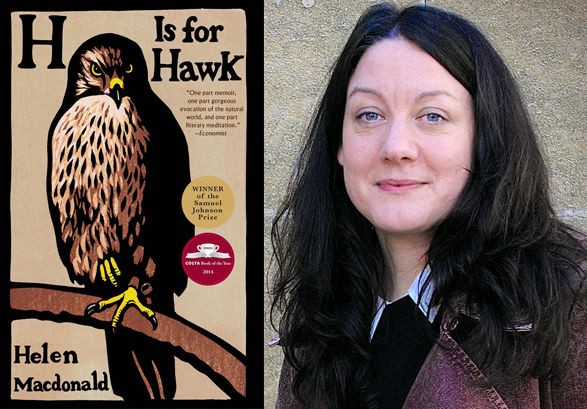
We can now add Helen Macdonald’s name to England’s celebrated tradition of nature writers — except that she would probably bristle at being labeled a “nature writer.” In her new book H is for Hawk, Macdonald tells the story of the goshawk she acquires and trains to help her cope with the grief from her father’s death. It’s a hybrid of a book — a blend of nature writing and memoir, as well as a mini-biography of another hawk enthusiast, the fantasy writer T.H. White.
H is for Hawk won Britain’s Samuel Johnson Prize for nonfiction, and it’s now landed on bestseller lists in America. A dazzling writer, Macdonald has an almost incantatory power to evoke wonder. “My head jumps sideways,” she writes of the first time she sees her hawk. “She is a conjuring trick. A reptile. A fallen angel. A griffon from the pages of an illuminated bestiary.” The goshawk is a feral creature who leads Macdonald into the depths of her own inner wildness. Part of the drama of this story is to see how she pulls herself back from the brink once she’s become “more hawk than human.”
I talked with Macdonald about falconry, wildness, and the dangers of cutting yourself off from the human world. Our conversation aired on Public Radio International’s To the Best of Our Knowledge. You can subscribe to the TTBOOK podcast here.
Steve Paulson: You were very close to your father, who died suddenly from a heart attack. You say it was devastating. Did you find yourself starting to slip into some sort of madness?
Helen Macdonald: Yes, I think after big losses the world really does fracture. I was a very, very good friend of my dad. He wasn’t just a great dad, we were really partners in crime. We both shared obsessions — he loved airplanes, I loved birds and we used to wander around with binoculars looking up at the sky. And he had a massive heart attack and was suddenly gone. We didn’t even know he had any heart problems. And I just struggled to accept it.
SP: You were living alone at the time and didn’t have a regular job. Did you feel isolated?
I came back from the funeral and started to dream about goshawks.
HM: I guess if I’d had a family around me and a regular job and a house I owned and stuff like that, the structure might have kept me in place. But instead, I did something very strange. I came back from the funeral and started to dream about goshawks. Every night I’d go to sleep and wake up with the image of a goshawk flying through my dreams and slipping through the air into nowhere.
SP: You’d actually been a falconer years earlier.
HM: I’d been really obsessed with hawks. I was a very strange child! But I hadn’t flown hawks for a while and I never wanted to fly a goshawk. They’re these legendary, difficult birds — incredibly high strung and nervous, so they’re very hard to tame. And they’re renowned for their murderousness. I had never wanted anything to do with them, but suddenly they were all I could think about.
SP: So you decided to get one.
HM: I did. To deal with the grief, I decided to train a goshawk, which I don’t recommend to anyone. It’s not a particularly good way to deal with loss. But they spoke to me. And this whole decision came on a level that was really beneath conscious examination. When you lose someone very dear to you, you stop thinking logically. What drives you are very deep emotions and needs, and I just needed this goshawk. So I bought one off the Internet.
SP: You drove up to Scotland to get your young goshawk and named her Mabel. But even though you’d had all this experience training falcons when you were young, I got the sense that you didn’t really know what to do with her.
HM: I knew the steps to train a hawk; I’d done it many times before. I knew it was all done with positive reinforcement — with gifts of raw steak. I knew you had to withdraw to a darkened room for the first few days to get the hawk used to you, and then slowly get her used to other people. She jumps to your fist, then flies to it, and eventually you fly her free. I knew all those steps, but I didn’t really know who I was anymore. Now, that sounds really overblown, but I was a mess. And the more I watched the hawk to try and understand what she was feeling so I wouldn’t scare her, the more I empathized with her. Slowly, I sort of forgot who I was. The whole world shrank to just the hawk.
SP: So you cut yourself off from your friends and the human world?
HM: I did — and I think the hawk was to some extent an excuse. You do have to withdraw from the human world when you start training a hawk. So I unplugged the phone, drew the curtains, and told my friends to leave me alone. That kind of radical isolation wasn’t just about training the hawk. I just didn’t want to know about the world anymore. I didn’t like it.
SP: What was the hardest part about training your hawk?
HM: There were some surprises. I didn’t expect my hawk to be quite so friendly and lovely. In many ways, she was much more well-adjusted than I was. The most difficult thing, I guess, was just that because I was so broken at that time, I would worry an awful lot about whether I was doing things right. One of the strange things about this book is that I’ve had a lot of letters from young mums, who’ve been sitting in their houses with their very young children — obviously nothing like hawks — but they’ve said the book reminds them of what it’s like to be in a room with a very young person who can’t speak and is incredibly precious, and you just worry that you’re doing things wrong. I had this desperate sense, am I messing up this hawk, am I upsetting it?
SP: But there’s one huge difference about dealing with a hawk. Everything about a hawk is tuned to hunt and kill, and yet you were living in the middle of Cambridge. Was it hard to go back and forth between city living and this kind of wildness?
HM: I had to take the bird outside to get it used to people. If this had been the 17th century, I would have been totally unremarkable. Everyone was walking around with hawks. But I was pretty unusual, and Cambridge is a pretty eccentric place. You can wander around and speak Latin and wear clothes with holes, and that’s fine. But you try walking around with a hawk on your fist and you do get some pretty weird stares. I was trying to get the hawk used to people, but at that point I myself was pretty much as scared of people as the hawk was. So it was a very weird experience to try to get her used to the human world at the same time as me wanting to refuse that world. I pretty much wanted to stay indoors!
SP: You write that there was a period when you were becoming more hawk than human.
I became this feral creature covered in mud and blood and thorn scratches. I didn’t wash my hair. I was a mess, but it was an incredibly good way of forgetting that I was miserable.
HM: By the time I left the house with the hawk, I started to see the city through her eyes. Obviously, this is all in my imagination. Hawks have a very different sensory world than us. They see more colors and they see polarized light, so I didn’t share her literal vision. But I would come out and stare at what was going on and it would baffle me. I’d wonder what a bus was. Why is that woman throwing a ball for her dog — why would you do that? The whole city became very odd. Later, when the hawk began to fly free and hunt her own food, I really felt that I wasn’t a person anymore. I ran around after her in the bright open hillsides around Cambridge and watched this great natural drama — the hunting behavior of a wild hawk — and really completely lost touch with who I was. I became this feral creature covered in mud and blood and thorn scratches. I didn’t wash my hair. I was a mess, but it was an incredibly good way of forgetting that I was miserable.
SP: You also participated in the kill. Your hawk, Mabel, would catch a rabbit and you’d pry it out of her talons and then snap its neck to quicken the death.
HM: Yeah, it’s ironic. I’m one of the most sentimental and soft people you can imagine. I get upset when people step on spiders! But goshawks in the wild are not particularly bothered….if they catch something, they just start eating and at some point the poor thing is going to die. So I had to get in there and put the poor things out of their misery. That was a really astonishingly strong and serious moment every time. As I ran around with the hawk, I felt like an animal, almost like I could fly. But every time I had to kneel down and administer the coup de grace to some poor rabbit, I felt intensely responsible and very human. It made me realize that we don’t really see death much anymore. It all takes place behind walls, with people often in hospitals, with animals in slaughterhouses. The great irony is that I was running away from death, and yet there it was every single day. It was a deeply educational experience.
SP: Did you ever feel bad about this — not just that you were killing rabbits, but you were putting the hawk out there to kill wild creatures?
One of the things I learned is that we often use nature as a mirror of ourselves, and we use nature to justify things that humans do.
HM: That never really bothered me. That’s what birds do, that’s how they live. I don’t think you can apply human morality to birds of prey. One of the things I learned is that we often use nature as a mirror of ourselves, and we use nature to justify things that humans do. And one of the most important things to remember about birds is they’re not us! I was privileged to be part of her world at that time, but she wasn’t a person. It was very fascinating, and it taught me a lot. But I was never bloodthirsty.
SP: You’re also talking about the nature of wildness. Have you figured out what it means to be wild?
HM: Well, the weird thing about hawks is that we see them as remote symbols of wildness. Of course, Mabel was very wild, but then I’d bring her home and she’d sit on my hand and we’d watch television in the evenings and we’d play. I’d throw her scrunched up bits of paper and she’d catch them in her beak and throw them back to me. So she was a much more complicated and bewitching and strange and interesting and contradictory creature than just something that was made of wildness. I think we’ve invented this category of what wild is. We know what it is when we encounter it, but it’s complicated.
SP: Is wildness what is not human?
HM: Ultimately, yes, but in that sense, a chicken is wild. I think pretty much everything that isn’t human is a wild thing. But now when we talk about wildness, we think of mountain tops and predators. There’s a dangerous element to wildness, a sense that humans are being tested against it. That’s the kind of wildness I turned away from at the end of the book.
SP: Most of us don’t have any encounters with wildness other than fleeting glimpses. I mean, you’re not talking about a loving relationship with a dog. A goshawk is wild in some primal way and will never be domesticated.
HM: One of the great things about living with a hawk that year, apart from the emotional effects it had on me as a grieving woman, was that it was a way of encountering a wild animal in a very intimate, domestic setting. Although we went out every day and flew, there were these hours when we just hung out together. There’s not much opportunity for people to have that kind of relationship with a wild animal anymore. I fervently believe that the environment’s in big trouble and we should fight to protect all the astonishing life that’s out there. But you don’t fight to protect things unless you know and love them. I loved falconry, and this bird in particular, for showing me that these things really are astonishing.
SP: You also seem to be talking about the experience of wonder.
HM: It’s what the poet Wordsworth would have called joy — joy and wonder. That’s at the heart of what I love about the natural world. If you’re receptive to it, it does something to human minds that nothing else can do. There’s a wonderful piece of writing in one of Iris Murdoch’s philosophical books about what it’s like when you’re sitting in a room feeling cast down by life and everything seems to be crowding in on you, and you look out the window and see a kestrel hovering, and you become so tied up with that sight. I think she says, “The world becomes all kestrel, and all your fears and cares fall away in that moment of concentration.” That wonderment and joy is always there if we look for it in the natural world. It’s incredibly important to give our life space for that.
SP: Another thread to this story is your fascination with The Goshawk by T.H. White, which was published in 1951. Of course, he’s best known for his Arthurian fantasy novel The Once and Future King. Why were you so interested in White’s experience with his own goshawk?
HM: Well, I read it when I was very young and obsessed with birds of prey, and I absolutely hated it. It was about a man who was trying to train a goshawk, and he didn’t seem to know what he was doing. The bird was clearly suffering as he tried to bend it to his will. I remember flinging the book down and shouting to my poor long-suffering mother that he was doing it all wrong. I didn’t understand why a grownup would write a book like that about something he didn’t know. Many years later I realized that it was a deeply tragic, melancholy book about an attempt to fix oneself through training a hawk, which is what I wound up doing myself.
SP: You describe White as a tortured man. His parents hated each other and they didn’t seem to care about him. He was beaten as a child. He was gay at a time when you had to hide your sexual orientation. He was pretty miserable for much of his life.
HM: And the very sad thing about White is that he was incredibly successful, and yet despite his fame was clearly never happy or contented. He really was broken by his childhood experiences. His story is tangled up with mine because I wanted to try to get inside his head in the same way I tried to get inside the goshawk’s head.
SP: Why was it important to White to have this encounter with a goshawk?
So when he was fighting the hawk, he was in a weird way trying to civilize himself.
HM: He saw the goshawk as a lot of the things that he wanted to be. Being gay, being broken in many ways, having had a horrendous education, he wanted to train this hawk in an enlightened way. You can’t punish hawks, you can’t even shout at them because they don’t respond to that, and he liked that idea. He thought he could educate the hawk in the way he himself should have been educated. But he also saw the hawk as something feral — slightly gay, slightly sadistic — all the things he felt himself inside to be. So when he was fighting the hawk, he was in a weird way trying to civilize himself. It became a battle with himself in the form of a bird. And of course the bird itself came out quite badly in that battle.
SP: You seemed to read everything written by and about T.H. White. Did he end up haunting you?
HM: In a strange way, he did. I went down to the literary archive at the Harry Ransom Center at the University of Texas, so I could go through all of White’s old journals and notebooks. Sometimes you look at a page and there are tear spots when he’s been crying — and you can see when he’s very drunk because his writing’s all over the place. And I’m holding and feeling these pages and outside it’s 90 degrees and there are vultures, and I’m reading about muddy winters in England, and I really did start to feel that he was somehow there.
SP: Coming back to this period when you felt you were becoming more hawk than human, how did you re-enter the human world?
HM: It got really bad. I started to do things that goshawks did. I’d either stuff my face with food and then not eat for days or I’d not eat at all. I’d literally hide behind the sofa if I saw people pass by the house. I got pretty nuts. It was at my dad’s memorial service in London when I realized I’d bought into that old chestnut that nature writing books tell you — that when you’re broken, running to the wild will heal you, it will be a place of solace and renewal. But I’d gone way too far and become seriously depressed. So I went to a local doctor and ended up going on anti-depressants, which were very helpful. I also made a big effort to see people again and negotiate that balance between wild and tame that I’d got very wrong. I managed to crawl back into the world slowly. I remember looking out the window one morning to check the weather and suddenly thinking the sky looked beautiful. At that moment, I knew that things were going to be okay.
SP: What eventually happened to your goshawk, Mabel?
HM: I flew her for many more years, in a much less feral, intense manner. We continued to watch television, and she continued to catch pheasants. But I had a life change. I couldn’t fly her every day for a while, so I lent her to someone in the north of England who was a very good falconer. Unfortunately, a couple of years ago she passed away very suddenly while she was in an aviary, from an airborne fungal infection called aspergillosis. It’s a horrible thing that attacks wild goshawks, and she just died overnight. We were all in pieces, anyone who’d known my goshawk. Mabel was a very unusual bird. I got this great email from this man saying she was the softest goshawk he’d ever known. And then he paused and put in brackets, “unless you were a rabbit.” So she’s much missed, but not by rabbits.
The first story in a short story collection should do two things:
1) Open strong to establish the writer’s authority
2) Prepare the reader for the rest of the collection
“The Sisters,” in James Joyce’s Dubliners, excels at both of these criteria. A young boy, watching from the dark street, tries to figure out whether an old priest is dead or not, based on the number of candles lit in a bedroom window. “Every night as I gazed up,” the narrator says, “I said softly to myself the word paralysis.”
As an opener, “The Sisters” does a couple of important things quickly. It establishes the narrative world as an ominous and oppressive place, and puts the narrator (and by extension the reader) in a state of overwhelmed inaction. In the spirit of T.S. Eliot’s Prufrock, we’re “like a patient etherized upon a table.” The story also introduces the stakes that will largely reign over the entire collection: the tension between the dullness of this existence and fear of any other, between staying and leaving, between sense and nonsense in life and death.
Sequencing a short story collection is pretty analogous to sequencing an album or a mix tape. The process largely depends on the balance between familiarity and change, of fulfilling the reader’s desires, while also challenging them. Flannery O’Connor’s A Good Man Is Hard To Find opens with a story about a serial killer, and transitions to a piece about a young boy’s river baptism. Miranda July’s No One Belongs Here More Than You begins with a love-fantasy on an apartment patio, followed by swim lessons in Belvedere, a middle-of-nowhere, pool-less town. Sequencing a story collection depends on mixing it up to keep things interesting, but not moving at a speed or in a manner that the reader can’t follow. This is how John Cusack’s character describes compilation-tape-making in the final scene of High Fidelity: “You gotta kick it off with a killer to grab attention. Then you gotta take it up a notch, but you don’t want to blow your wad. So, then you gotta cool it off a notch. There are a lot of rules…”
“The Lost Order,” the first story in Rivka Galchen’s 2014 collection American Innovations, shines as an opener in how effectively it establishes the collection’s narrative sensibility. The narrator in the story, after a stretch of unemployment, can’t start or finish anything, and has shifted her attention to not doing things. “I was at home, not making spaghetti,” she says. “I decided to not surf the internet. Then not to watch a television show.” A man calls with the wrong number and orders garlic chicken. He asks how long the wait will be; she gets flustered and says, “Thirty minutes?”
I had been reading most of the stories that eventually made up American Innovations as they were published, starting in 2008. Around that time, Galchen came to my college and read a frenzied, genre-bending story about time travel. I loved it. I read her first novel and I loved that, too. But when her stories appeared in The New Yorker and Harper’s, I tended to feel disappointed. I had a hard time finding their rhythm. I didn’t feel like I recognized her narrators, who behaved in ways that were at once ingratiating and infuriating.
Then the stories were released as a book and taken together, I understood them. “The Lost Order” effectively launches the sense of mental drifting that pervades over the entire collection. In one story, the narrator spends an hour and a half in a grocery store, not touching anything, pretending to be a ghost. In another, the narrator’s husband starts a blog about all the things he can’t stand about her. In the final story, the narrator’s furniture climbs out of her apartment window, away from her. The strange psychological trajectory that threads the collection together starts in that first story; the narrator hangs up the phone and obsesses over the chicken she accidentally promised to deliver. She notices it’s 11 AM and decides she better get dressed.
Scott McClanahan, a writer from West Virginia, is a contemporary master at story sequencing. McClanahan pays incredible attention to rhythm and musicality in his prose. He does the same thing in his performance: at his public readings, he whispers, shouts, and sings along to his audio tape recorder. The stories in his collections bleed and blend together. They start halfway through, and stop unexpectedly. Sometimes his stories have “second endings.” Sometimes they have the same titles, and continue where the last one left off. Especially in his most recent books — Crapalachia and Hill William — his stories crescendo, build toward twisted epiphanies, and then do it again. McClanahan’s books are fluid, brief, and conducive to a single feverish sitting.
Dorthe Nors’ Karate Chop, a recent translation from Denmark, is well-sequenced probably in large part because it emerged from the same burst of creative energy: Norse wrote the short collection in two weeks, while by herself in a cabin on the west coast of Denmark, and a hard-hitting yet tender sensibility anchors the fifteen tremendous stories. George Saunders’ books, meanwhile, are moored by his droll aw-shucksness, something that’s totally recognizable because there was a time when it was entirely unique. His books hang together, though. His whole catalog does.
Linked novels, or story cycles, seem to inherently have an easier time of story sequencing. The Things They Carried follows the same platoon of soldiers during and after Vietnam. Winesburg, Ohio, all takes place in its title town. In Olive Kittredge, Olive appears somewhere in every story. Sometimes she’s the narrator. Sometimes she’s just passing by. These books have continuity on the level of characters and place.
There are other short story collections that have an anchoring sensibility or perspective — any of Scott McClanahan’s books, for example — that might also be labeled linked novels. While a narrator is only sometimes named in Jesus’ Son, it’s presumable that all of the stories likely follow the same person, a drug addict nicknamed “Fuckhead”. In both of Junot Diaz’s collections, Drown and This Is How You Lose Her, Yunior narrates many of the stories. By strategically taking advantage of opportunities for continuity, these writers build rhythm on the level of the character, place and world-view, all of which adds up to a book that feels larger than the sum of its parts.
Collections suffer without a good strategy for organizing the content. The annual Best AmericanSeries — Best American Short Stories, Essays, Poems, etc. — for example, commits the story-sequencing sin of organizing its content by author last name. Neither the annual O. Henry Prize nor the Pushcart Prize series use this technique. Some Norton Anthologies do. When I read the annual Best American Short Stories, I always find it to be full of great stuff, but the collection struggles with rhythm. The 2014 story anthology, for example, opens with a piece by Charles Baxter that switches its narrative method and reveals a new narrator about halfway through. This might be a refreshing move once the reader has settled into the tempo of the collection, but it’s a jarring way to begin.
In the 2013 BASS, George Saunders and Jim Shepard appear immediately alongside each other, each with very long stories written in the form of diaries (“The Semplica-Girl Diaries” and “The World to Come,” respectively). If strategically distributed across the book, the stories might be able to engage in a dialogue, which could be an anthology highlight. With the stories right next to each other, the technique feels frustratingly redundant.
Book-size successes in story collections — a unified sensibility, an aesthetic wholeness, a desire in the reader to read more books by this writer — emerge from the innumerable interacting choices made in the process of writing. Story decisions are tangled together in ways that make it important for the writer to consider — when laying down a word, a scene, a story — how each piece interacts with everything that surrounds it. As Gary Lutz observes in his essay, “The Sentence Is A Lonely Place”: “words must be situated in relation to others to produce an enduring effect on a reader…there needs to be an intimacy between the words, a togetherness that has nothing to do with grammar or syntax but instead has to do with the very shapes and sounds, the forms and contours, of the gathered words.”
The same things can be said about sequencing a short story collection: each piece — linked or not — works in orchestration with the others to build a cumulative effect. Dubliners ends with Joyce’s most famous story, “The Dead.” In the final scene, Gabriel, unable to sleep, stares out his hotel window at the street. The collection begins out on the street, looking in; it ends inside, looking out. But we’re still paralyzed, still watching in fear and wonder. Joyce writes, “His soul swooned slowly as he heard the snow falling faintly through the universe and faintly falling, like the descent of their last end, upon all the living and the dead.”
Some stories are openers. Some provide ballast in the middle. Different stories help writers pursue all sorts of different internal rhythms as they arise. “The Dead,” though, in all its rich and climactic melancholy, is a definitive closer.
The PEN America Center has just announced several of the winners of this year’s PEN literary awards. Among the winners are Buzzfeed Literary Editor Saeed Jones for his poetry collection Prelude to Bruise, Tin House editor Rob Spillman for editing, and author Anna Whitelock for her biography The Queen’s Bed: An Intimate History of Elizabeth’s Court.
Not all of the award winners have been announced though. Several awards, such as PEN/Robert W. Bingham Prize for Debut Fiction and PEN/Fusion Emerging Writers Prize will only be publicly announced at the June 8th ceremony. The shortlists for those awards are listed below.
JUDGES: Sue Halpern, Marie Myung-Ok Lee, and Carl Zimmer
WINNER: War of the Whales: A True Story (Simon & Schuster), Joshua Horwitz
PEN/John Kenneth Galbraith Award for Nonfiction ($10,000): To an author of a distinguished book of general nonfiction possessing notable literary merit and critical perspective and illuminating important contemporary issues which has been published in 2013 or 2014.
JUDGES: Andrew Blechman, Paul Elie, Azadeh Moaveni, Rahna Reiko Rizzuto, and Paul Reyes
WINNER: Five Days at Memorial: Life and Death in a Storm-Ravaged Hospital (Crown), Sheri Fink
WINNER: I Am the Beggar of the World (Farrar, Straus and Giroux), translated from the Pashto by Eliza Griswold
PEN Translation Prize ($3,000): For a book-length translation of prose into English published in 2014.
JUDGES: Heather Cleary, Lucas Klein, Tess Lewis, and Allison Markin Powell
WINNER: Baboon by Naja Marie Aidt (Two Lines Press), translated from the Danish by Denise Newman
PEN/Laura Pels International Foundation for Theater Awards ($7,500 and $2,500): Three awards which honor a Master American Dramatist, American Playwright in Mid-Career, and Emerging American Playwright.
JUDGES: Kathleen Chalfant, Ellen McLaughlin, and Adam Rapp
PEN/Nora Magid Award for Editing ($2,500): For a magazine editor whose high literary taste has, throughout his or her career, contributed significantly to the excellence of the publication he or she edits.
JUDGES: Christopher Castellani, Carmela Ciuraru, and Bill Clegg
PEN/Robert W. Bingham Prize for Debut Fiction($25,000): To an author whose debut work — a first novel or collection of short stories published in 2014 — represents distinguished literary achievement and suggests great promise.
JUDGES: Caroline Fraser, Katie Kitamura, Paul La Farge, and Victor LaValle
The winner will be announced at the 2015 PEN Literary Awards Ceremony on June 8
SHORTLIST:
The UnAmericans (W. W. Norton & Company), Molly Antopol
JUDGES: Diane Johnson, Dahlia Lithwick, Vijay Seshadri, and Mark Slouka
The winner will be announced at the 2015 PEN Literary Awards Ceremony on June 8
SHORTLIST:
Moral Imagination (Princeton University Press), David Bromwich
Theater of Cruelty (New York Review Books), Ian Buruma
Loitering (Tin House Books), Charles D’Ambrosio
The Empathy Exams (Graywolf Press), Leslie Jamison
Limber (Sarabande Books), Angela Pelster
PEN/Fusion Emerging Writers Prize ($10,000): For a promising young writer under the age of 35 for an unpublished work of nonfiction that addresses a global and/or multicultural issue.
JUDGES: John Freeman, Roxane Gay, and Cristina Henríquez
WINNER: The winner will be announced later this month.
PEN Open Book Award ($5,000): For an exceptional book-length work of literature by an author of color published in 2014.
JUDGES: R. Erica Doyle, W. Ralph Eubanks, and Chinelo Okparanta
The winner will be announced at the 2015 PEN Literary Awards Ceremony on June 8
SHORTLIST:
An Unnecessary Woman (Grove Press), Rabih Alameddine
Every Day Is for the Thief (Random House), Teju Cole
An Untamed State (Black Cat/ Grove Atlantic), Roxane Gay
JUDGES: Esther Allen, Mitzi Angel, Peter Blackstock, Howard Goldblatt, Sara Khalili, Michael F. Moore*, Declan Spring, and Alex Zucker (*Voting Chair of the PEN/Heim Advisory Board)
WINNER: Grant recipients will be announced later this month.
Sign up for our newsletter to get submission announcements and stay on top of our best work.
YOUR INBOX IS LIT
Enjoy strange, diverting work from The Commuter on Mondays, absorbing fiction from Recommended Reading on Wednesdays, and a roundup of our best work of the week on Fridays. Personalize your subscription preferences here.