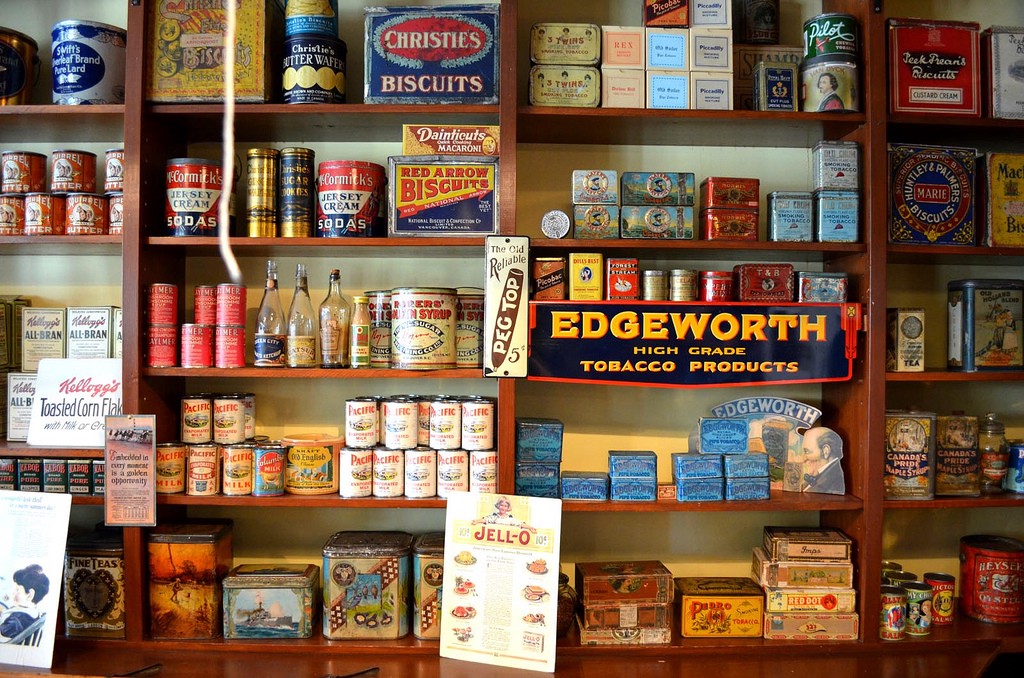
For the most part, you probably don’t want bugs in your books. However, if you find tiny scorpions in your old books you should be happy. Chelifer cancroides or book scorpions are a type of pseudoscorpion that eats the booklice that eat and destroy old books.
As a psuedoscorpion they are not real scorpions, but they do have pincers and live in dusty areas, especially those with old vintage books. They are too tiny hurt humans and indeed are small enough you probably won’t notice them unless you are looking.
If you don’t have book scorpions and want them, well, all you have to do is buy old books and don’t dust them too much.
The first description of book scorpions is thought to have been written by the philosopher Aristotle in De historia animalium:
There are also other minute animals, as I observed before, some of which occur in wool, and in woollen goods […] Others also are found in books, some of which are like those which occur in garments; others are like scorpions; they have no tails, and are very small.
The other day I got into a minor Twitter spat with the culture writer of a major magazine. He was complaining about “the Knausgaarding of Literature” — the trend of plotless, “boring” novels.
Why do people love to hate the Norwegian writer Karl Ove Knausgaard? As the six-volume, three thousand plus page, Hitlerian-titled, autobiographical novel passes the midpoint of its publication, has Knausgaard fatigue set in? Who has time to read a book that long, even in serial form?
For the uninitiated, My Struggle is, at its root, an examination of a single man’s life — that of Karl Ove Knausgaard. Book One focuses on the death of Knausgaard’s alcoholic father, weaving from the present back through early teenhood. Book Two takes on his early adult life, marriage and birth of his children. Book Three jumps back to his early childhood in rural Norway. And being published in English this week, Book Four, focuses on Karl Ove’s year spent teaching in northern Norway as an 18 year old and his epic quest to get laid (or more aptly his epic quest to not prematurely ejaculate).
Hating Knausgaard, or more circumspectly, hating his novels for their alleged boring nature where nothing ever happens is to completely miss what Knausgaard sets out to accomplish. His themes — the mundanity of life, the exploration of shame, the circular nature of family and time — are written in contrast to the modern desire for literature that provides a mindless reading experience, aka books like television.
“…nothing ever happened! Nothing happened. It was always the same. Day in, day out! Wind and rain, sleet and snow, sun and storm, we did the same…
What was it all about?
We were friends, there was no more than that!
And the waiting, that was life.” [Pg. 180, Book Four]
Of course, people can take Knausgaard as they like. But to simply write him off as boring is a mistake. His books are filled with moments of drama, the drama of daily life, of a boy in love with a girl in his class, of a father preoccupied with his daughter making friends at a child’s birthday party. Book One opens with an audacious seven page meditation on death:
“For the heart, life is simple: it beats for as long as it can. Then it stops. Sooner or later, one day, this pounding action will cease of its own accord, and the blood will begin to run toward the body’s lowest point, where it will collect in a small pool, visible from outside as a dark, soft patch on ever whitening skin, as the temperature sinks, the limbs stiffen and the intestines drain.” [Pg. 1 Book One]
I met Knausgaard once, briefly, last year in New York City at the restaurant where I worked. He came in for dinner after a reading and conversation with the British author Zadie Smith to promote Book Three. He was tall, grey-bearded, yet hunched over, as he describes himself, always trying to hide the fact that he is much taller than others around him. Surrounded by Zadie Smith, Hari Kunzru and a veritable Algonquin table of prominent authors and artists, he barely spoke a word the whole evening. Only in a quiet, shy voice from time to time would he ask me for another beer. When ordering, he politely nodded and ordered the first things I pointed out to him on the menu. He truly is shy in public, as attested to by author Jeffrey Eugenides, in his recent review of Book Four in the New York Times Book Review, where he recounts the silence that befell the two prominent authors when they met for lunch.
At the end of the evening I leaned in to Knausgaard and told him how much his work meant to me as a young writer. His eyes came alive as the others at the table laughed in shock that even their waiter had read his books. He asked if I’d read the new volume yet and when I said no, pulled out a copy and personalized it to me.
There is a passage in Book Four that stands out, as Karl Ove struggles to describe and understand how one transfers internal thoughts to external words. He says:
“I moved to the sofa and started writing my diary instead. ‘Have to work on transferring the moods from inside to outside,’ I wrote. ‘But how? Easier to describe people’s actions, but that’s not enough, I don’t think. On the other hand, Hemingway did it.’” [Pg. 360 Book Four]
And later on:
“When I washed my hands I stared at my reflection in the mirror. The singular feeling that arose when you looked at your own eyes, which so purely and unambiguously expressed your inner state of being both inside and outside, filled me to the hilt for a few intense seconds, but was forgotten the moment I left the room…” [Pg. 372 Book Four]
And also:
“Perhaps the gulf between the person I usually was and the one I became when I drank was too great. Perhaps it was impossible for a man to have such a wide gulf inside himself. For what happened was that the person I usually was began to draw in the person I became when I was drinking, the two halves slowly but surely became sewn together and the thread that joined them was shame.” [Pg. 360 Book Four]
And this, ultimately, is the point of My Struggle: To stare into the depths of our internal humanity and dissect it to its very core. Interest in Knausgaard has perhaps waned. To be honest the first two Books of My Struggle seem to hold a greater urgency than the next two. One can only look so far into the past for so many pages without a bit of fatigue setting in. But fatigue, in literature, as in life, is just a part of the struggle. What I am curious to see, what keeps me reading Knausgaard’s My Struggle, is what keeps us all going: the desire to see what will come to pass, what is possible, before the final sip of pumping bloods, stasis, unbound, finally comes to rest.
Overall, I agree with Mamatas that there’s an ethical issue in charging submission fees. We never instituted them at Electric Literature for Recommended Reading,Gigantic, or any other magazine I’ve worked on. Plenty of journals barely take any work from the slush, but even a magazine that only publishes slush is likely only taking 1–2% of submissions. So the majority of unpublished writers are funding the minority of published, which isn’t a great foundation. Imagine if every worker had to pay to get a job interview? (Or, since most magazines don’t pay, maybe the analogy is paying to get an unpaid internship.) The defense of submission fees is that the fee is pretty small, perhaps only as costly as snail mail postage. But $3 adds up quickly. I’ve often heard the average story gets rejected twenty times before an acceptance. 21 x 3 = $63. The Offing pays $20–50, meaning you’d expect to lose between 13 and 43 bucks per story. Literary writers can’t expect to make much money from quiet short stories about cancer and obscure poems about birds, but surely we don’t need to actively lose money to get published!
I’d like to note here that The Offing is hardly the only magazine to charge a fee. Missouri Review, Sonora Review, Crazyhorse and so many others charge that when I asked about this on Twitter, I was told it would be easier to make a list of those who don’t. And the fact that The Offing pays $20–50 already puts them ahead of the vast majority of lit mags who pay nothing at all.
As an editor, I do understand why magazines want to charge fees. Lit mag editors are typically volunteering their labor, and even with fees nobody is getting paid. The Offing said the fees would go to contributors and I have no reason to doubt them. So it’s hard to feel like you are exploiting anyone when you don’t get any money from the exploitation. (My counter would be that small fees, magazines that don’t pay, and the like all have ripple effects that combine to help devalue writing and make it easier and easier for even big corporations to not pay artists for their labor.) Sticking to lit mags though, much of the problem stems from the fact that lit mags all have two major problems: 1) no money and 2) far too much slush.
Here’s why The Offing initially closed submissions and reopened with a fee:
Re: submissions. We like you too, a LOT. But we got almost 1000 submissions in a week, so we're closing for just now to catch up.
1,000 submissions in a week! If you’ve ever grumbled about lit mags taking too long to respond to your submission, here’s why.
Let’s be honest about the situation at lit mags: most are funded out of the editors’ pockets or else given a small budget from a university, most have unpaid editors (often MFA students getting a year’s experience), and most receive far more submissions than the editors could ever read. And if we are being really, really honest, most magazines don’t even have much of a readership, so no real way to raise money by charging readers. I’m not talking about the top magazines like The Paris Review or Tin House, but the above holds true for your average [City/Animal] Review or [Random_Phrase].tumblr.com journal.
When talking about these issues, I think we have to separate them into two categories:
a) the question of funding a magazine (and the related question of finding readers)
b) the question of the slush pile (and the related question of overworked editors)
a) is a topic for another day, but this discussion has made me wonder if it’s time for literary magazines to rethink how we do slush.
Most magazines work like this: submissions are always open, the magazines gets carpet-bombed with work, the pieces are read — likely skimmed — by inexperienced undergrads/MFA students/volunteer readers, and writers get their rejection six months later. The problems here snowball quickly. Writers understandably can’t wait six months to hear back, so they submit to as many places as possible simultaneously. This leads to more slush at every magazine, which leads to longer wait times, and so on. (It doesn’t help that writers submit to magazines without even the briefest skimming of the magazine’s website, leading to science fiction poems in the queue of the Personal Essay Review and romance novellas in Crime Poems Weekly.)
So if an always-open, always-growing slush pile is bad for both writers and editors, what can be changed? Here are a few thoughts:
Reduce Slush Without Charging
First off, there are ways to limit submissions that aren’t monetarily exploitative. You can shorten the submission window drastically (Electric Literature’s Recommended Readingdoes one month, but I’ve seen even shorter windows at some magazines). This helps narrow your slush to writers who actually read — or at least pay some attention to — your magazine. Some magazines also limit the number of submissions a writer can submit, even to one or two a year. That helps force writers to target their subs, sending only the work most appropriate to the journal in question if they want to get in. When I was a young writer, I always grumbled about the magazines with short windows or other restrictions, but it did force me to send my best work to those magazines when the windows opened.
Solicit Emerging Writers
I also think there is a problem in relying so much on random submissions. Most magazines spend their soliciting efforts on big name writers, which makes sense, but very few bother to solicit emerging writers. Why not? It would likely be more fruitful to read a dozen small magazines and find new writers who excite you than to read 1,000 slush submissions. Or email other editors, reading series curators, and professors whose tastes you trust and ask for the best emerging writers they’ve seen. If editors had less slush (see above), they’d have more time to search for new voices elsewhere. Worried the above would make you miss out on completely unpublished writers? Have a sub period for unpublished writers only. The great One Story magazine ensures a diverse range of writers by never publishing a writer twice.
I would also add that soliciting young writers might go a long way towards fixing the gender imbalance in lit mags. Every time VIDA counts come up, there is talk about the gender imbalance in submissions. Part of that is men submitting way too much — every magazine has had their man-subbers who send a new piece within minutes of rejection — and part of that is that women writers perhaps not submitting as much as they should. Editors tend to fix the imbalance by soliciting big name women writers, but that doesn’t help emerging women writers. (Editors would similarly have less excuses for painfully white contributor lists.)
Define Your Tastes
Lastly, if we want writers to be more thoughtful in where they submit a piece, editors have to be up front about what they want. Most lit mags just say “send your best work!” and “we’re open to everything as long as it’s great!” Those guidelines may even be true since many lit journals have not defined their aesthetic vision, even for themselves. Too many lit mags are totally interchangeable in content. As a reader, I vastly prefer magazines that try to publish a unique collection of work instead of the same stories and poems that could fit anywhere. And as a writer, I actually know what work to send where.
Admittedly, some of the above suggestions run the risk of favoring already published writers or writers with MFA/lit world connections… but, then again, that is already the case. And if none of those suggestions work, well:
Sara Nović has an agenda. The violent conflicts in Croatia, where she has many friends and family, and the complicated history of that region have been obsessions of Sara’s for many years. Her powerful debut novel Girl at War (Random House, 2015) tells the story of Ana, a 10-year-old girl who is living in Zagreb when war breaks out in the early 1990s. In telling Ana’s story, Sara hopes to shed light on a time and a place about which many people still know very little.
Sara’s novel gives us familiar childhood settings of school and play and family life, as well as harrowing scenes of civilian war and make shift armies, of teenagers-turned-soldiers in abandoned buildings called “safe houses,” where the inhabitants are playing cards one minute and shooting their enemies the next. We travel through this world with Ana, at an age where she is just starting to make sense of the world around her, while the world keeps refusing to make sense.
I had the pleasure of chatting with Sara at the bustling Housingworks Bookstore Café in SoHo. We talked about her writing process, the big ideas and motives behind her debut novel, and why being deaf is so awesome (Sara has had progressive hearing loss since she was a child).
Catherine LaSota:You were born in New Jersey, and you went to Croatia after high school. Was that your first visit?
Sara Nović: Yes. And that was kind of the first time I started writing stuff down about Croatia, because I was talking with people. That was the point where war stories stuck on me. And everybody was quite eager to talk about the conflict, because people didn’t experience it outside of the region and people don’t really know about it here, and during the reconstructions, people in Croatia felt kind of disillusioned about that. People feel a little bit abandoned by the West in certain ways… Particularly in Croatia, nobody in the West even really knows what happened there. I think people are more familiar with Bosnia as the center of that war, because that’s where America got involved. And now Croatia is like a hot vacation spot.
CL:It seems like there is a lack of awareness about the history of Yugoslavia in general in America, and, this is a difficult question, but, I’m wondering if there is one major thing you hope people could understand about what happened there?
…it’s easy to sensationalize war and also to ignore an ethnic conflict where you just say, well these people just hate each other…
SN: Well, I think one thing to know is: as complicated as it was, it was actually even more complicated than that. I think the way it gets portrayed in the media was: Serbs are Christian Orthodox, and Croats are Catholics, and Bosnians are Muslim, and that’s why they’re all fighting each other. But it’s way bigger than that. And obviously nationalist stuff did fan the flames, but it was also a war about money and who gets to decide which directions the roads go! Like, the capital of Serbia is Belgrade, and they wanted to build roads to get to the capital, but then Croatia wouldn’t have any roads going the other direction…almost silly stuff, but, like, that’s important to know, because it’s easy to sensationalize war and also to ignore an ethnic conflict where you just say, well these people just hate each other or whatever. It’s kind of worse than that.
CL: I think America is very good at framing things in terms of religious conflict. It’s a narrative that Americans are familiar with.
SN: Sure. And because there are all these groups and it’s so confusing — this one had an army, but these people didn’t have an army but they made their own group, etc. — there are just so many things happening that it makes sense that you’d try to simplify it somehow, like how can I define these groups and comprehend this? Like, even, who is fighting with whom?
CL: Right. There is a scene at the United Nations in your book that I’m thinking of, where Ana is talking about having stayed up really late the night before trying to think of what to say to the UN council about her wartime experience, but she is having a hard time because she still doesn’t really have a narrative for herself about what had happened. So I’m wondering — how do you see fiction and narrative as ways of making sense out of situations?
SN: I think the value of fiction about something like this is that it’s a way for people to understand the story. Even though it’s not a perfect story or complete narrative, fiction does give you a capacity for empathy, especially if it’s a novel. In this novel, for example, you can kind of hang out with Ana for a while and feel more, I hope. So that’s maybe one way of understanding a story, even if you don’t exactly understand all the details.
CL: You sold your book to Random House before finishing your degree at Columbia, and then you published the short story “Notes on a War-Torn Childhood” with Recommended Reading here at Electric Literature. That story was written after you’d written the book, correct?
SN: Yeah, I mean, the book took a long time. I’m told these things happen! I wrote a short story when I was in undergrad that pretty much still exists as the end of Part One of Girl at War. It’s this very violent thing that happens. I gave it to a professor, and he was like, oh good, go write a book! (Laughs) And I’m like, thinking, what? But then I just started writing chunks, and I think you can kind of see that in the structure, how it was kind of vignettes, and there is different stuff in all directions. I was writing those for years, but not really figuring out the direction. The story I wrote while I was at Columbia that was published in Recommended Reading obviously uses similar characters, but I was playing with expanding and contracting the material.
CL: At what point did the structure of Girl at War become clear to you? You said you were working on it in different sections.
…what does it mean to make a story out of this material, and how does trauma and memory come into play in narratives of war in general?
SN: I always knew that I didn’t want it to be chronological, but I didn’t know what order it would be for a long time. At one point I had it switching back and forth much more than it does now. I had it at one point starting in the present, which made no sense, not even a little! (Laughs) And eventually I kind of came up with the way it is now, in part because I kind of felt like people needed a break after the end of Part One. But there was also this idea of what does it mean to make a story out of this material, and how does trauma and memory come into play in narratives of war in general? And I think they’re probably not straight narratives, you know?
CL: The question of memory and the fallibility of memory is something that comes up a lot in your book. Can you talk about that a bit?
SN: Yeah, it’s interesting because, the different people I talked to remember things differently. It also depends on what side are you on, or where you were. Even in Croatia, the war in Zagreb looks a lot different than the war in Vukovar or wherever. So that changes things. I had a couple friends who told this story that there used to be a McDonald’s in Zagreb, and after the first air raid happened it closed. And I was like, that’s amazing! And that was in the book. But then other friends were like, no, there was never any McDonalds in Zagreb. (Those friends said) McDonalds didn’t come until after the war, and it was the symbol of capitalism or independence or whatever. So I still don’t know what the answer is, and I couldn’t really work it out, and I ended up taking it out of the book.
CL: What kind of research did you do for Girl at War?
SN: Besides talking with and stalking my loved ones, I also did a lot of weird things like research the roads — so, which road existed at what time, etc. I was looking at a lot of old maps. Part of the reason (in Part One of the book) why Ana and her family end up down below where they’re going is because the roads were wonky then. And for some reason I became obsessed with what the weather was on certain days. And that information was really hard to find initially, when I started writing this book. Now there are websites that would make that pretty easy.
CL: Was the accuracy of the weather important because of the environment or feeling that weather can create?
SN: Well I think I just felt like a lot of good historical details were important for showing that this is a real place where things happened, even though the characters are fictional.
CL: You studied literary translation at Columbia with your MFA program there. How has that influenced your own writing?
SN: Just to be working on Croatia stuff, reading stuff, was an influence. The poems that I was translating, this guy Izet Sarajlić was writing them in his house during the first 30 days of the siege on Sarajevo. So that was quite intense. But also funny — that was interesting, to find humor in that situation, sometimes it’s the only thing you can do.
CL: Had you thought about writing a novel before that experience you had with your undergrad short story?
SN: No! I mean, I never really thought that writing was a thing that people did. It’s weird, because I was always an avid reader, but it never occurred to me that people were writing these books! (Laughs) And I was always writing stuff like terrible poetry or whatever — stories too — as a kid, but, like, hiding them under my bed. They weren’t things that I showed people. So I definitely didn’t think writing was something you could do for a career, or that writing was even a thing that adults did.
CL:Was your writing workshop the first time you’d shared your writing with somebody?
SN: Yeah, with the exception of my little sister, who has read everything I’ve written.
CL:Does she still read everything you write?
SN: Yeah. I actually live with her in Queens. So, she’s a live-in reader. She’s not a writer, but she’s smart, so it’s like, what does a human think of this? (Laughs) Which I think is nice to have in the earlier stages. And in the later stages. A person who’s going to read this book and not think of it the way I do.
CL: Have the family and friends you talked with in Croatia read the novel? What do they think?
SN: They like it. Which is great! I was really happy about that. I wasn’t that nervous about it because I had been talking with them about it so much that nothing in the book was really a surprise to them, but the fact that they like the finished product is great.
CL: I think one of the big strengths of the book is that we learn about the experience of a child in wartime, and that Ana, despite her environment, is still just a child. This environment of war is simply her frame of reference for what is normal. Was it difficult to write the story of someone whose childhood was very different from your own?
SN: Well, I mean, I kind of identify with Ana in a lot of ways, personality-wise.
CL: How so?
SN: Mostly her feeling generally weird in the world — but maybe that’s all writers, I‘m not sure. (Laughs) I don’t know, but writing about Ana didn’t feel hard for me, because I got to learn along with her. Because of the way the book is set up, she kind of has to work out, okay, what’s going on now, and what’s going on now, which is what I was doing as I wrote. I was also a giant tomboy as a kid, and I identify with a tomboy’s struggle with her mom, which comes up in the book a little bit. So that’s one thing. I don’t know, I think our general personalities are quite similar. But she’s smarter than I am!
CL: How do you write a character who is smarter than you are?
SN: I don’t know! Well, I guess you revise it, you know, it takes a lot of tries!
CL: Speaking of Ana’s parents, I was thinking: they are faced with some horrific decisions about safety and their family, and in the course of making decisions they are both showing their powerlessness and also some strength at the same time. I’m curious about your thoughts on characters that express strength, or characters that are seen as weak, and how do you write a character that is strong? What does that mean to you?
…in the landscape of war, you don’t have agency
SN: It’s particularly weird in this book, I think, because in the landscape of war, you don’t have agency. That’s something that I worried about when I was writing Ana, because first of all, she’s a kid, so she doesn’t have that much agency anyway. And then she’s in this war where the whole point of the war is you lose control over your life, and particularly this war where there is genocide involved, and the civilian is the target of this thing. So that question of agency — there has to be a way to show strength even when you don’t have control over your basic life, and I guess it’s a mental thing. Ana’s dad does it by being really good-natured — he’s kind of funny, not strong in a physical, violent way. And then there are those characters in the safe houses, who are strong in a very different way.
CL: Were there particular characters that were favorites for you to write?
SN: Sure. I mean I think Ana’s dad is a favorite of mine. I honestly had the most fun writing the safe house stuff, because it was exciting, and (the characters in the safe houses) are so bad-ass!
CL: The environment in those safe houses is SO masculine — images of oiled-up women on the walls, etc.
SN: Kind of — I mean, definitely in Croatia, but I think also in Europe in general, naked chicks are just more of a thing. Like if you buy a newspaper, there is a naked girl on the cover of the newspaper, etc. I think Ana is pretty unfazed by it because it’s just all around her all the time. But yeah, in most civilian or child soldier situations, you have to manufacture a certain kind of bravado to get people to kill people, and I think a lot of that will oftentimes be done with drugs, but in this case, it’s this feeling of being an action hero or a gangster or something.
CL: The people in the safe houses all have these action hero names. Were those names fun to come up with?
SN: Yes, it was super fun. And I think (choosing action hero names) was something that somebody told me had happened and maybe quite often, because, like, the whole Croatian army wasn’t really an army, and the whole Bosnian army wasn’t really an army. There were a lot of people who weren’t used to killing people who were all of a sudden killing people.
CL: One thing that Ana does to get away sometimes and gain perspective is to step outside and spend time on balconies. I’m wondering: New York can be a crazy place — what do you like to do yourself when you just need to step out of it for a while?
SN: I like to walk around. In Queens you can walk and no one will bother you — not so much in Manhattan. But when I lived in Brooklyn I used to just go to the river a lot. Just the smell of salty water takes it down a notch for me — it feels like an extreme change to me! So, yeah, if I can be near water then I feel a lot better. Luckily there is a lot of water around New York– if it’s dirty, it doesn’t matter.
CL: Where do you do your writing?
SN: I do a lot of my writing on the train. I find the train is conducive to writing. I think because you can’t get out. I wrote a lot of Girl at War on New Jersey Transit, because I was living in Philadelphia when I started going to Columbia, and I thought, if I’m going to be on this train for two hours, I’ll just sit here and write.
CL: Ana maintains a distant relationship with Sharon, a UN Peacekeeper who met Ana when she was 10 years old, in a time and place of war. In one scene when Ana is an adult, she realizes, “for Sharon, I would always be ten years old.” I love this scene, which made me think about how we are often stuck in the moment of our lives that define us for certain people. Do you think that we often define other people by certain moments in their lives, or do we also do this to ourselves? This seems like a theme that runs throughout Girl at War.
SN: Yeah, for sure, definitely, we do it to ourselves probably both by accident and on purpose in different ways, like when there is something that we can’t get over and then we define ourselves in a way that perpetuates that. And yes, of course, other people do it, too, like if you go home for Thanksgiving or something, the way you talk to your family is different than the way you talk with people you see in New York everyday, and part of that is because your family sees you in a different way or in a different time.
CL: What are you working on now, and is there anything you are reading that you particularly love?
SN: Right now I’m reading Heidi Julavits’s book (The Folded Clock), and it is awesome! I love it! Her book is lovely — it’s like having a sleepover with a friend who is way smarter than you telling you very smart things, because it’s really intimate but really intelligent. So I love that. What am I writing? Who knows! Deaf stuff mostly. I’ve been writing some stories about deaf characters. I’ve been writing something that I thought was a short story, but it keeps getting fatter and fatter, so I have no idea what that means!
SN: Yeah, not as much because I’ve been busy, but I always have something to say about it! The Redeafined blog started because there is this idea that if you have a kid who is deaf, you should implant them with a cochlear implant, and part of the stipulations of that is that you don’t teach them sign language, because — and this is insane to me — scientists and doctors tell parents that if you teach them sign language they won’t learn English as well. Would you ever say that about any other language (about a child’s capacity to be bilingual)? No, you wouldn’t. But that’s what happens. It is a ridiculous thing to say, and no one would ever say it about any other culture or language. But they say it to women who have just given birth, who are maybe not in the best emotional state. It’s crazy! So that’s the reason why I started the blog.
CL: What do you think is the biggest misconception that people have about deafness?
SN: There are so many! I mean the main one is that it’s bad, I guess! (Laughs) But I quite like it!
CL:What do you like about it?
SN: I love ASL (American Sign Language). And I like being able to turn my ears off. I don’t know how you guys don’t do that — I would freak out if I had to listen to things all day! It’s very overwhelming, particularly in New York.
CL: A lot of us wear earplugs!
Deaf culture is so lovely. It’s nice and open in a way that you don’t see so often.
SN: Deaf culture is so lovely. It’s nice and open in a way that you don’t see so often. This is a gross story but it’s true: in deaf culture or ASL culture, it’s really common if you’re sitting at a dinner table with people you don’t even know to be like, ok, I’m going to go to the bathroom and I’m going to take a shit. And that is not weird, and that is not a shameful thing to say, and that’s because you know you have to tell people where you are (going to be) at all times (or you will lose each other). You can’t talk to people through the bathroom wall! You need to be like, here’s where I’m going, here’s how long I’m going to be there, here’s what I’ll be doing. And this openness spills over into other areas. It’s a community where you get to talk about things. Actually the deaf community has been leagues ahead of the mainstream community with things like gay rights. I think that all stems out of this thing we share, that we become so open about everything else. So that’s nice, and I like it!
For some, the Mad Max movies set the tone for grungy, violent post-everything cinematic science fiction. For others, these movies might be remembered hazily as the butt of Mel Gibson jokes and the triumph of one really, really good Tina Turner song. Either way, Mad Max is back this weekend with the release of the new film (no one knows what to call it: Reboot? Recharge? Cash grab?) Mad Max: Fury Road. Like its predecessors — Mad Max, The Road Warrior, and Mad MaxBeyond Thunderdome — Mad Max: Fury Road is an original screenplay that is not based directly on any novel or short story. And yet, a dark and fantastical road trip is something that crops up in plenty of science fiction and fantasy novels. Here are eight fantastic road trip books to give your Mad Max diet a little more literary flavor.
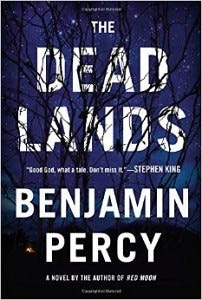
Set in a devastated future America, Ben Percy’s new novel might be the literary equivalent of a Mad Max-style narrative. The novel is a re-imagining of the path taken by Lewis & Clark, but plotted through a dystopian, bombed-out version of the West. Part political thriller, part survival story, Ben Percy has proven again (as he did with the werewolf novel Red Moon) that he is one of the best contemporary genre-benders out there.
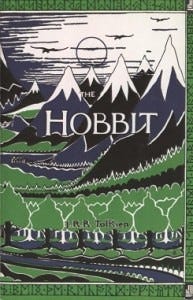
Tolkien is obsessed with road trips! If you don’t believe me think about this: the subtitle (or alternate title) to this book is actually “There and Back Again.” True, there’s some battles with various armies toward the end of this book, but what’s a magical road trip without some dwarf-war action? Tolkien liked this format so much that one could also argue that the entirety of the Lord of the Rings is a massive road trip too. Most of us wouldn’t want to take a road trip to a giant volcano where a certain Dark Lord was hanging out, but then again, maybe we would?
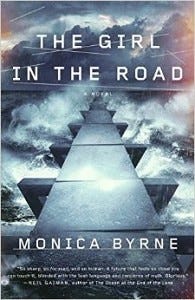
Definitely not a vision of the future that is apocalyptic (post or otherwise), Byrne’s 2014 novel bridges a futuristic India and Africa with a literal futuristic bridge. Told from two parallel narratives, occurring at different times, Byrne science fiction future is certainly dark, but it’s not exactly the same level of cynicism you might normally associate with a near-future novel.
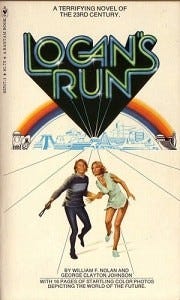
Logan’s Runby William F. Nolan and George Clayton Johnson
While the film adaptation of this book sees Logan and Jessica escaping an enclosed city to discover a decimated Washington D.C. around them, the novel is totally different. There is no enclosed city, but instead an entire futuristic and totally insane America which can be traversed by a high-powered underground subway. From the East Coast to North Dakota, and eventually even to the planet Mars, the 1967 book version of the iconic 1976 film is really, really BIG.
If you’re worried ever about superhero narratives just not being down-to-Earth enough, then check out this memorable storyline from the 70’s. Here, Green Arrow convinces Green Lantern and Green Lantern’s outer-space bosses that it’s time to see how America really lives. Everybody gets into a pick-up truck and drives across America discovering mostly economic and racially charged injustices. While reading a little clumsy and preachy today, it’s still hard to wrap your mind around the fact that DC even attempted this concept. The politics are super left and totally on the nose, which makes it not only a great historical comic artifact, but also a really compelling read.
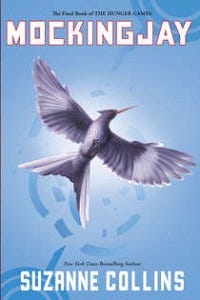
The last book in The Hunger Games trilogy is also a road trip of sorts. In an attempt to restore freedom to Panem, Katniss, Gale and her coterie of freedom fighters go on a variable tour of each of the “Districts” of this post-apocalyptic world. Though vaguely believed to some version of North America, Collins never tells us outright where and what Panem is specifically. Like a lot of great science fiction dystopias, the various cultural trappings of each of the 12 (well, sometimes 13) districts serves a political and sociological analog to real life problems. One-percenters are certainly a target of both Katniss’s arrows and Collins’s prose, but figuring out where they live versus everyone else is what makes this kind of world building a perfect blend of analogy and imagined reality.
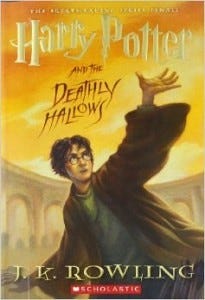
Whoa! Do the ends of popular “kid’s” series always result in a giant road trip? Breaking with the format of every single previous Harry Potter novel, Rowling sent Harry, Ron, and Hermione on a full-on quest across a England. Notably, a lot of this has the Hogwarts wizards chilling out in the “non-magical” world, trying to keep a lid on their wand-waving ways. But, the book is also a grand tour of all sorts of stuff that was mentioned in previous installments, including the house where Harry’s parents were murdered, a favorite pub in Hogsmeade, and more. My favorite part of reading Deathly Hollows when it first came out was thinking to myself “they’re not out of the woods yet,” and then realizing the characters were literally camping in the woods.
You knew this one was going to be on here. We couldn’t resist. You get one guess as to why this is a sci-fi/fantasy road trip that should remind you of Mad Max.
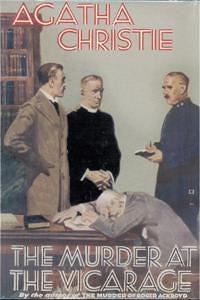
By 1960, Agatha Christie was apparently exhausted with male know-it-alls. She had grown to despise her most famous detective, Hercule Poirot, whom she described as “an egocentric creep.” But her readers had loved the high maintenance Poirot since his first appearance in 1920 — his perfectly groomed moustache, his patent leather shoes, his delicate stomach — so much that he was the only fictional character ever to receive an obituary in the New York Times. It must have been a relief for Christie, in novels starting with The Murder at the Vicarage in 1930, to write about Miss Marple, her little old lady heroine, whose quiet expertise in the comings and goings of village life and the universality of human nature made her an unlikely master detective. She said that Miss Marple and Poirot never solved a mystery together because “Poirot, a complete egoist, would not like being taught his business or having suggestions made to him by an elderly spinster lady.”
Most men don’t, but the twinkling irony with which Miss Marple nudges blustering, blowhard cops in the right direction demonstrates how the Queen of Crime inherited just as much from Jane Austen as Arthur Conan Doyle, employing the sly humor that is a hallmark of British domestic fiction. Christie’s Miss Marple mysteries are ones in which female news and knowledge are vindicated, throwing a smiling side eye at mansplanations and male authorities. Miss Marple’s wisdom is overtly feminine — she relies on her knowledge of the domestic sphere, of relationships — and her methods are equally so, as she exercises her keen women’s intuition. “Intuition,” she says, “is like reading a word without having to spell it out.”
Miss Marple nudges blustering, blowhard cops in the right direction, demonstrating how the Queen of Crime inherited just as much from Jane Austen as Arthur Conan Doyle
Miss Marple elevates the archetype of the spinster, which has been, as Kathy Mezei writes, “a recurring icon in British literature.” This phenomenon reflects a reality of British demographics, particularly after the traumas of two world wars: women outnumbered men, and single women were seen as “lonely, superfluous, and sexually frustrated.” Mezei’s wonderful article “Spinsters, Surveillance, and Speech: The Case of Miss Marple, Miss Mole, and Miss Jekyll” from the Journal of Modern Literature lays out the way that a spinster character has been used by Christie and others to accomplish feats of narrative misdirection, and, more importantly, to “covertly query power and gender relations while simultaneously upholding the status quo.”
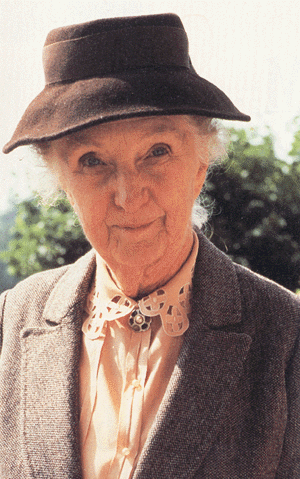
Joan Hickson as Miss Marple
The brilliance of Christie’s deployment of Miss Marple is that she does not turn away from the spinster stereotype. We all know it: old, unmarried women are lonely, nosy, and spend their days eavesdropping and passing judgment. And it is just her apparent superfluousness, the ease with which she may observe society, unnoticed and unimportant, that perfectly situates the spinster to pick up on clues and intrigue. Miss Marple’s ambiguous position in domestic life, neither completely inside or outside the village families she observes, is where she gains her peculiar power to steer Christie’s stories: as Mezei’s mindblower of a sentence puts it, “[the spinster’s] narrative function, in representing the dialectic between seeing and being seen, omniscience and invisibility, often mirrors the ambiguous and hidden role of the author/narrator in relation to his/her characters.”
In this way, Miss Marple is never our narrator, nor does she provide the primary point of view for any of Christie’s novels. Christie’s mysteries only work in so far as they, as Mezei writes, “adroitly distort the reader’s and the characters’ angle of perception” — casting suspicion in every direction, manufacturing red herrings, following dead ends. Like all great magicians, Christie’s skill was sleight of hand, controlling her readers’ attention by flourishing the left hand while manipulating the cards with the right. Miss Marple acts as a guide in the story, or even as a fairy godmother or deus ex machina, reappearing periodically to right the investigation’s course and “readjust the focus of our gaze.”
Like all great magicians, Christie’s skill was sleight of hand, controlling her readers’ attention by flourishing the left hand while manipulating the cards with the right.
Of course, this sleight of hand has always been what Christie’s critics have complained about: that she eliminates “human interest,” as Edmund Wilson wrote in 1944, in favor of “the puzzle.” Wilson’s companion pieces “Why Do People Read Mystery Novels” and “Who Cares Who Killed Roger Ackroyd?” are masterpieces of vintage trolling, baiting readers by writing of the mystery, “As a department of imaginative writing, it looks to me completely dead,” and claiming that he grew out of detective stories by the age of twelve.
These pieces also seem to be opportunities for Wilson to covertly criticize female writers and concerns. The few writers whom he mildly praises, like Rex Stout and John Dickson Carr, are men; he criticizes Dashiell Hammett but seems to reserve the height of his asperity for the women who were at the vanguard of “the Golden Age of Detective Fiction.” He writes that Ngaio Marsh’s writing is not “prose at all except in the sense that distinguishes prose from verse;” of Christie he writes, “Her writing is of a mawkishness and banality which seem to me literally impossible to read;” of Dorothy Sayers, “She does not write very well;” of Margery Allingham, “The story and the writing both showed a surface so wooden and dead that I could not keep my mind on the page.”
The legendary crime writer Raymond Chandler wrote a response to Wilson’s first piece with his essay “The Simple Art of Murder,” effectively a defense of Hammett and a further heaping on of scorn for traditional English detective novels. He expands on Wilson’s critique of “the puzzle,” writing that the skills that contribute to artful writing and those that create a clever mystery are incompatible. “The fellow who can write you a vivid and colorful prose simply won’t be bothered with the coolie labor of breaking down unbreakable alibis,” he writes. “The master of rare knowledge is living psychologically in the age of the hoop skirt.”
But buried in these criticisms is an implicit statement about what kind of human beings make authentic characters and which reality is worthy of realism. Wilson writes that he skipped many sections of “conversations between conventional English village characters” in the books of the writers he refers to as “these ladies,” while heralding Chandler’s Farewell, My Lovely as a “novel of adventure.” Chandler says of the jaunty amateur detective in a Dorothy Sayers novel, “The English police seem to endure him with their customary stoicism; but I shudder to think of what the boys down at the Homicide Bureau in my city would do to him.” The “domestication of crime” that came with the rise of Christie and her cohort was necessarily a feminization of crime, and that emasculation is what Wilson and Chandler are writing against — Wilson goes so far as to say that Chandler is not a detective novelist at all; his writing is more allied with the spy stories of Graham Greene.
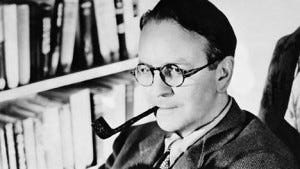
Raymond Chandler
Chandler’s essay blames the enfeebling gentility of the detective story on the genre’s readers: he repeatedly characterizes them as “old ladies” who “like their murders scented with magnolia blossoms and do not care to be reminded that murder is an act of infinite cruelty.” In Chandler’s scheme, what Hammett and his “tough-minded” ilk brought to the detective story was a bracing, and specifically masculine, morality. “Hammett gave murder back to the kind of people that commit it for reasons,” Chandler writes, “not just to provide a corpse.” Then the only valid crime writing is tough guys writing about tough guys killing other tough guys. But one forgets, as Miss Marple says, “One does see so much evil in a village.” Or more to the point, as Miss Marple also says, “Clever young men know so little of life.”
The noir stories of Chandler and Hammett are about the malignant effects of a decaying, corrupt institution: the American city. Village mysteries are about the same, but their focus is tighter: the traditional family and its domineering patriarch. “This apparent example of English nostalgia,” Mezei writes of the Golden Age mystery, “has exposed one odd and dysfunctional household after another.” The secret subversion in this genre comes, as Mezei points out, as these mysteries explore not a threat to the status quo from the outside — chaos invading the otherwise orderly home — but from the inside. Their focus is on what is hidden, on secret identities, on the disorder and resentment that already exists within every family. Mezei quotes from Alison Light that Christie was “an iconoclast whose monitoring of the plots of family life aims to upset the Victorian image of home, sweet home.”
This “Victorian” connection is an interesting one: Miss Marple is often characterized as a Victorian because of her conservatism and her views of good and evil, but also the darkness and suspicion of her mind. “A mind like a sink, I should think,” one character says of her. “A real Victorian type.” Christie was also a real Victorian type. She was engaged by Victorian crazes like the one for travel and exotica — she was one of the first British people to surf standing up on Waikiki. Her mother believed she could talk to the dead, and when Christie famously went missing for eleven days in 1926, Sir Arthur Conan Doyle used a medium to search for her, continuing the Victorian mania for spiritualism.
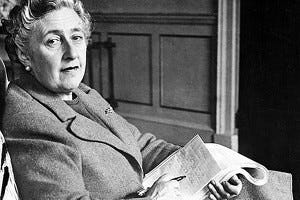
Agatha Christie
Conan Doyle and Wilkie Collins were her literary heroes, as well they might be; after all, Edmund Wilson made the bold declaration that “the detective story proper had borne all its finest fruits by the end of the nineteenth century.” Collins’ The Woman in White was one of the earliest “detective novels,” and when it became the most popular book in England in 1859, reviewers leveled similar criticisms at it as Wilson did at Christie. “Our curiosity once satisfied, the charm is gone,” one reviewer wrote of the mystery in Collins’ novel. Even in the embryo days of the detective story, critics were weary of the formula, the puzzle, the sleight of hand that twists and turns our attention. But The Woman in White was a novel which innovated by borrowing from journalism, playing on the British public’s growing fascination with lurid court cases, as they devoured accounts of poisoning, bigamy, and false imprisonment. We think of the Victorian era as a time of repression and suffocating tradition, but it was also the time of a steadily germinating modernity. A population with dual preoccupations with “home, sweet home” and with salacious crime stories: who else could that beget than Agatha Christie, and all her brothers and sisters writing what we sneeringly refer to as “popular” fiction, genre fiction, airport fiction?
All our criticisms of genre fiction — that it relies too much on the sensationalism of a shocking plot; that it is unwieldy and messy; that it is too contemporary, resisting the classic’s tight-lipped timelessness; that it appeals too much to its audience’s emotions — sidestep the fact that the novel began as a popular form, one as potentially mind-rotting as TV, comic books, or Candy Crush. And it was never more so than in the Victorian era, when Charles Dickens published his own and others’ novels (including The Woman in White) in serial form, swaying with his audience’s desires. Those writers were shocking and suspenseful and sentimental and funny — they gave the people what they wanted. And if popular fiction is too formulaic, then we should tell that to Shakespeare the next time he writes about a Duke disguising himself to entrap his evil brother.
the novel began as a popular form, one as potentially mind-rotting as TV, comic books, or Candy Crush.
Shakespeare is our most enduring example of English popular fiction, and in his weaker moments he was just as messy and repetitive and the rest. Christie was a Shakespeare devotee — her only daughter was named Rosalind, after the heroine of As You Like It. In the 1950 Miss Marple novel A Murder is Announced, an unexpectedly sensitive policeman muses to himself that one of the characters would make a good Rosalind, and this sets the tone for the madcap novel, with multiple cases of mistaken identity, twins separated at birth, and even, in proper Shakespearean style, ending with a wedding.
Framing Christie’s novels as Shakespearean comedies is a fun thought experiment — I suppose we shouldn’t be surprised that arguably the most popular novelist of all time (her books have sold two billion copies worldwide) is often funny. And she used comedic techniques passed down from Shakespeare and the Victorians — being too current, too meta, too cute — to sweetly barb back at her detractors. In A Murder is Announced, Miss Marple talks about reading Hammett’s stories. “I understand from my nephew Raymond that he is at the top of the tree in what is called the ‘tough’ style of literature,” she says, winkingly paraphrasing Chandler’s critique of the English mystery, of characters like herself. Miss Marple was Christie’s way of further feminizing an already feminine genre, of doubling down on her mysteries by old ladies about old ladies for old ladies.
Hello, and welcome to my week-by-week review of everything in the world. Today I am reviewing Game of Thrones.
You’ve probably heard of the TV show called Game of Thrones. I watched an episode the other day to see what all the fuss is about. I thought it was going to be a fun game show, like a modern twist on musical chairs. It wasn’t that at all. It’s basically like The Hobbit but with nudity. I’m glad the Hobbit didn’t have any nudity, because none of the characters were very attractive.
Game of Thrones fixes The Hobbit problem by hiring lots of attractive actresses and actors. I’ll be honest: I like seeing naked ladies, but I don’t like it when only the ladies are naked. I didn’t really see much male nudity. That seems unfair. If a wizard is uncomfortable being nude, there’s no reason they couldn’t give him a CGI penis.
In some ways the show is very accurate. For instance, a lot of the scenes are dark because they didn’t have electricity in England in the early 1800s. While it makes it hard for me to see what’s happening, I appreciate the commitment to authenticity.
However, some details, like the dragons, are completely inaccurate. Except for some religious extremists, there is not a single scientist who will say that man and dragons coexisted. Everyone knows that.
There are a lot of tough guys in this show but I didn’t recognize any of them. I’d like to see some big name, tough-guy actors like The Rock, Sean Penn, or Shia LaBeouf. And tough women, too. Katharine Hepburn was pretty tough but she’s dead. Whoever is the modern-day Katharine Hepburn. I like Amy Schumer a lot. I’d like to see her on Game of Thrones. I bet she’d ask for a CGI penis.
I have a lot of other ideas for the show, which I wrote down and mailed to George Martin, who is listed as the show’s creator. I hope he takes my ideas into consideration and implements some of them. George, if you’re reading this, I don’t need to be credited, I just want to make it a better show.
BEST FEATURE: Lots of candles everywhere. I think candles are romantic. WORST FEATURE: The dragons don’t talk.
Please join me next week when I’ll be reviewing The Honeymooners.
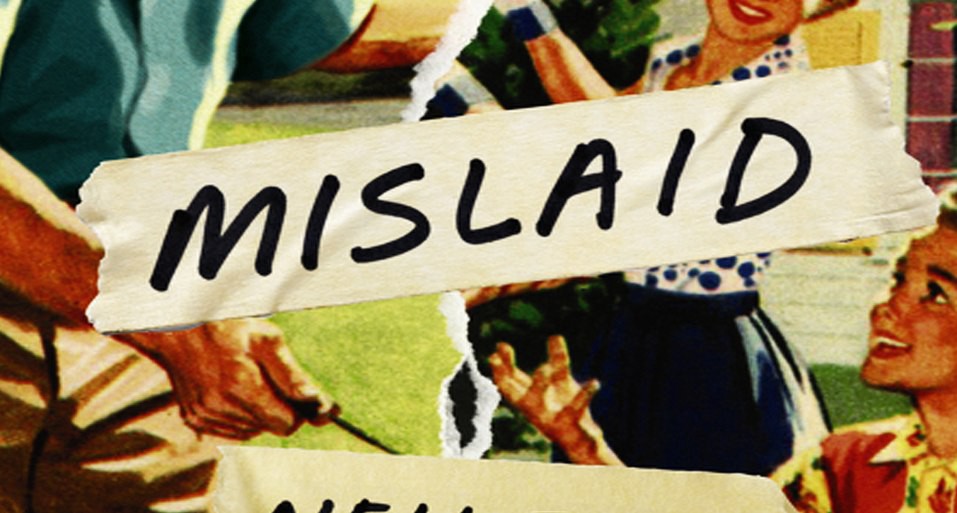
Perhaps most impressive about Nell Zink’s forthcoming Mislaid (May 19) is the author’s seemingly endless capacity for wit. When her protagonist, Peggy, gives birth to her gay husband’s son (Peggy herself is a lesbian), he proclaims that there won’t be any circumcision, believing that the practice was “dreamed up by moralists and lotion salesmen to make hand jobs chafe.” As a young man, the son asks his father, “Remember Antietam?” His father, Lee, replies, “sure, a lot of good men died,” and the son retorts, “no, I mean when I drove the car.” Zink peppers her story with clever one-liners and quick exchanges. Her characters think fast and speak even faster — about everything from circumcision to philosophy. When their marriage inevitably disintegrates, Peggy runs away from Lee and begins concealing her identity. She tells a “feminist encounter group” that her husband was an entomologist, “feeling that an intellectual in the family might make her butchering of Foucault seem less out of place.” It’s smart, sharp prose that invests the reader in the story.
The plot itself features a quirky, surprising series of comic adventures: Lee and his son, Byrdie, continue their lives in Stillwater, Virginia, where Lee is a poet and professor at an all-women’s university carrying on affairs with both men and women. Byrdie attends the University of Virginia where he’s tapped by a secret society and develops an interest in business administration, architecture, social work, and running for office. Peggy steals the identity of a black mother and daughter for herself and her daughter, Mireille. She begins hunting night crawlers and then collecting psychedelic mushrooms to support them. An alluring lesbian professor named Loredana, who goes by the name of Luke and is writing about a black lesbian playwright, comes into Peggy’s orbit.
“I didn’t want to join a fraternity anyway,” says Temple, Mereille’s boyfriend. “I was going to join a liberty first, and then an equality.” Sure, it’s a good joke, but it feels like something any of her characters, too smart for their own good, could have said. In fact, little emotion lurks beneath the surface throughout the novel. The omniscient narrator tells the reader what he or she should know, and there’s little to question. After Peggy abandons her husband and son and runs away with her daughter, the narrator states, “here a person might ask: Was Meg self-centered or what?” and answers that question explicitly: “Meg was self-centered. Early life spent fighting for chances to be herself, planning the cockeyed social suicide of manhood in the arm; weeks of unrequited lesbianism…” The narrator continues, listing all the events in the character’s life that have made her the way she is, or at least the way the narrator wants the reader to view her. There’s no subtext, no subtlety, no mystery for the reader to unpack. Thus, while the narrative touches on many loaded subjects — race, sexuality, affirmative action, welfare, drug trafficking, the feminist movement — the views come across without nuance since the injustices are blatant and occur to unreliable, underdeveloped characters.
Perhaps what’s most striking about Zink’s treatment is her insistence that her themes can be funny. She can crowd a novel full of the most contentious topics in our society and make it a pure comedy. This is a brave choice, an indication of Zink’s confidence in her own writing and humor to depict potentially troubling racial, sexual, and socioeconomic politics. Ultimately, Zink is able to pull off what Peggy, an aspiring playwright, can’t. As Peggy hones her craft, it’s “like honing a primitive tool, not a forged blade. Life with Lee had taught her to be laconic. She could quip. So her plays all ended on page two.” Zink, remarkably, turns her quips into a cohesive, full-length novel full of hijinks and clever remarks. It’s enjoyable, if not as thought provoking as it could be. There’s an unusual zest to her writing and in the zany situations she dreams up. It’s the voice of the narrator, and one might say Zink herself, that leaves the most lasting impression. And that, certainly, is admirable.
[Editor’s note: read “The Wallcreeper,” from Nell Zink’s previous novel of the same name, as recommended by Dorothy, a Publishing Project in Electric Literature’s Recommended Reading]
Sign up for our newsletter to get submission announcements and stay on top of our best work.
YOUR INBOX IS LIT
Enjoy strange, diverting work from The Commuter on Mondays, absorbing fiction from Recommended Reading on Wednesdays, and a roundup of our best work of the week on Fridays. Personalize your subscription preferences here.