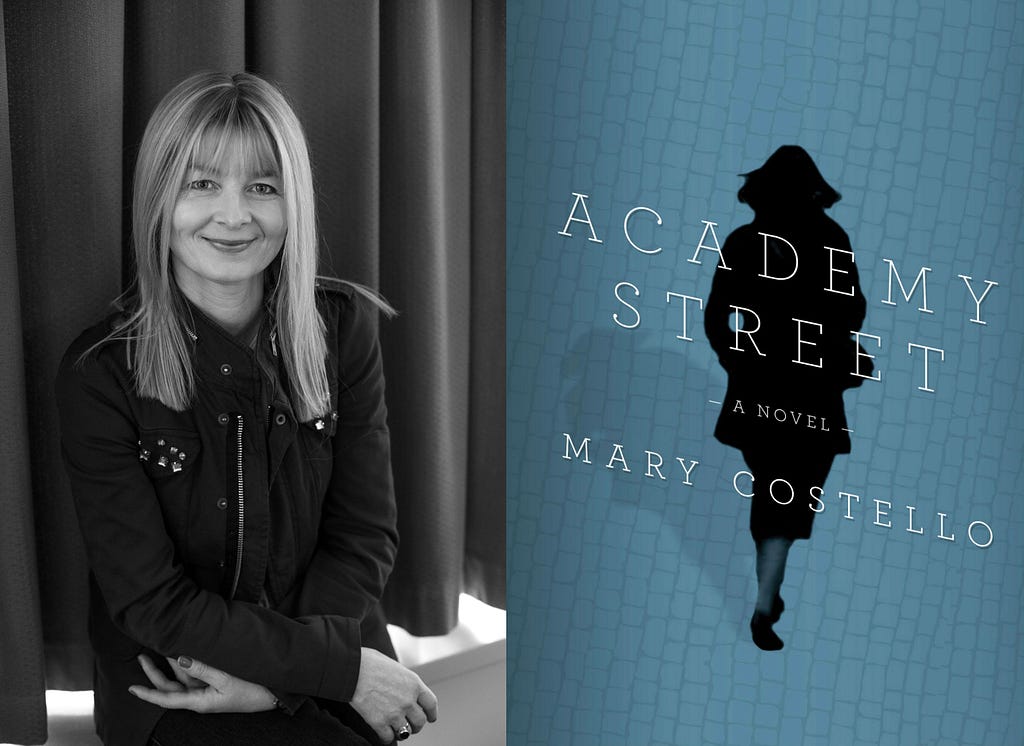
Occasional Glimpses of the Sublime, a conversation with Mary Costello, author of Academy Street

by Johanna Lane

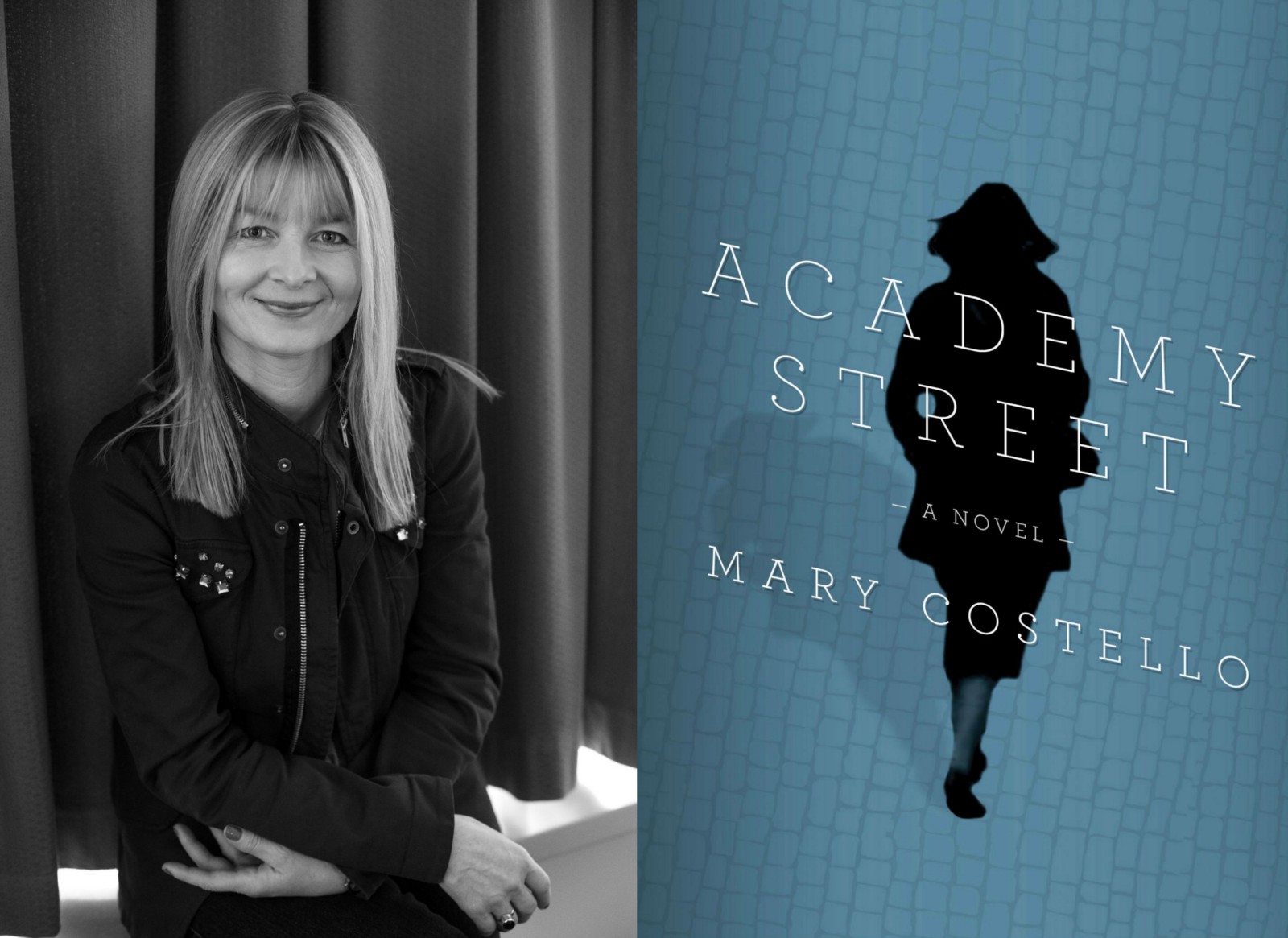
Earlier this month, Mary Costello’s debut novel, Academy Street — winner of the Best Novel Prize at the 2014 Irish Book Awards — was released in the US. Academy Street is a portrait of Tess Lohan, a single mother come from Ireland to forge a life in New York. We asked Johanna Lane — who moved from Ireland to New York in 2001, and whose own debut novel, Black Lake, will be released in paperback on May 5th — to talk with Costello for Electric Literature. They discussed emigration, the Irish in New York, J.M. Coetzee, and the different demands of a short story and a novel.

Johanna Lane: I love the work of J.M. Coetzee and in my mind you and he are closely aligned. Not only do you share the last name of one of his characters, Elizabeth Costello, but you mention another, Michael K, in your novel, Academy Street. Some of his novels are elliptical, as is yours, which was one of my favorite things about it, but another writer might have chosen to tell the story of Tess’s life in 500+ pages. You took less than 150; why?

Mary Costello: Thank you, Johanna. Coetzee is one of my favourite writers, so this a great compliment. It’s the integrity of his work that so impresses — the sensitivity, the refined feeling, the constant endeavour to imagine the lives of others, human and non-human. The way his characters cogitate on life and death, suffering, salvation…and are unafraid to face awkward truths. With Coetzee there’s no escape from the self. And yes, the coincidence of the Costello surname sort of floored me when I first came on it!

I never set out to write a short novel — I thought Academy Street would be longer. I wrote it in a fairly linear fashion over one year, although it had been incubating for several. I found Tess’s voice early on, and tried to keep tight to it. She dictated the tone and pace and duration and led me across those bridges from one period of her life into the next without too much fuss or detail. She’s an introvert — an intuitive introvert — so things don’t need to be spelt out or laboured over; they can be gleaned.

I’ve always written short stories — my first book was a collection of stories — so I’m probably naturally inclined towards brevity. Plus, when I speak I have an almost pathological fear of boring people and this might, unconsciously, have a bearing on the writing too. The writing self won’t tolerate loquaciousness!

JL: I was having dinner with another writer the other night and we were discussing tone. I find that I very often forget what happened in books, but I remember the tone of novels I read ten or more years ago. Speaking of Coetzee, though I haven’t read In the Heart of the Country in a very long time, its tone still settles on me now when I think of the book- the same goes for Waiting for the Barbarians. You mentioned in your last answer that Tess dictated the tone of Academy Street; how do you understand the concept of tone? How does it affect your work and your response to the work of others?

MC: I think of tone as a kind of force field around the character that has agency over the narrative. I find it difficult to talk about tone without referring to character and voice. In the case of Tess, there’s an air of quiet trepidation attached to the way she lives. I had to convey this trepidation, this quietude, in language that is apt for her. The way she thinks and moves and has her being needed to be reflected in the language and syntax — and in the point of view, too. Without ever deciding, I employed close third person point-of-view, so the tone that emerged is intimate.

Getting the tone right is very important. It’s not something that can be forced or rushed — it seems to come almost involuntarily. And it can be easily lost too. At times during the writing of the novel I felt it slipping and I grew very anxious. But there was nothing to be done — except step away and wait. Without the right tone, the writing always feels false.

You mention In the Heart of the Country and how the tone still settles on you. I find that most of Coetzee’s books cause a pall to descend — and just the thought or the sight of them can evoke this feeling. Denis Johnson’s Train Dreams has that effect on me too. And speaking of palls, Marilyn Robinson’s novel Housekeeping comes to mind. The tone is delicate, elegiac, conveying the ethereal quality of Ruthie and Sylvia. And alongside this delicate tone is an atmosphere of endangerment and doom that’s felt by the reader in the very act of reading the book.

JL: How does being Irish shape your fiction, either in terms of form or content, or both?

MC: There’s no doubt that being Irish has a huge bearing on how and what I write, just as being Canadian or American has a bearing on what Alice Munro or Marilynne Robinson write. Ireland is where I landed on earth, and so it’s part of my literary landscape and heritage through story, myth, song, poetry — it’s in my DNA. The particular rhythm and cadence of the language as it’s spoken here is present, so my writing voice is Irish. How could it not be? But I don’t intentionally write about Ireland or Irishness — it’s just there, natural, not something I’m conscious of or that needs to be inserted.

As regards content, I write about love, loss, death, fate, men and women, the interior life — subjects common to all nationalities. The settings and the outer landscapes of my characters’ lives are mostly Irish — though most of Academy Street unfolds in New York — but these matter less to me than their inner landscapes — what Robert Musil called ‘the floating life within.’

I don’t think being Irish has a huge bearing on the form I choose to write in. I started writing stories in my early twenties because I had lots of isolated characters and disparate images and ideas and the short story was a form that could accommodate them. I’ve written stories for years but then the reach of Tess’s life in Academy Street needed a longer form. The Irish have a great reputation for short stories — the Irish short story travels well — and it was the Irish writer Frank O’Connor famously coined the term ‘the lonely voice’ to describe what is essential in a short story… that ‘intense awareness of human loneliness’. And the short story is particularly suited to depicting isolation, melancholia. But loneliness and isolation are universal and short story writers from all over the world, not just Ireland, do these very well.

JL: What’s the most difficult aspect of the writing life for you?

MC: Fear, self-doubt, anxiety that I won’t be able to realise the characters and the story as I ‘hear’ them. Holding my nerve. Finding the exact words — which is usually impossible. Finding the voice, too. I feel great relief and gratitude when I find the voice — though of course it can be difficult to hold onto.

JL: Can you tell us a little of how you came to writing?

MC: Writing was never on my radar when I was growing up — I never dreamt of being a writer. I grew up in the west of Ireland and came to college in Dublin when I was 17. I studied English and was always a reader. When I was 22 something began to gnaw, something I couldn’t put my finger on. During a period of insomnia the thought just dropped down me out of the blue one night: I want to write. I have no idea where that came from. My first two stories were published, one of which was shortlisted for a well-known Irish prize, the Hennessy award.

I’d gotten married when I was 23 and moved to the suburbs, and I was teaching fulltime. Then somehow, writing began to slip to the margins of my life — I couldn’t seem to accommodate everything. I wasn’t part of any writing community either. Writing felt like a burden, a secret, an interruption to life, and I tried to give it up — six months or more would go by when I wouldn’t write. But it never went away entirely. Stories would push up and plague me until I had to write them.

My marriage broke up after ten years and I continued to scribble away. And then in 2010 — I was well into my forties by then– I sent two stories to a literary magazine called The Stinging Fly here in Dublin. The editor liked them and published them and asked if I had more. And I had, and he wanted to publish them — he runs a publishing house — which is how my collection, The China Factory, came about.

JL: You’ve worked successfully in the short story form and in the novel form; what are the different demands they make on you as a writer?

MC: For me, the challenge in both forms is to keep the story in the air; find the precise language, the right voice. I’ve written stories for longer and I’ve a great love for the form — its claustrophobic feeling, its intensity. There’s an intuitive quality to stories and less transparency — something always lurks beneath the surface.

Pacing is different in a novel, obviously, and one needs to be more patient. But there’s more breathing space. When I was writing my novel I wrote each chapter in much the same way as I’d write a story. I didn’t write one draft straight through– I wrote each chapter and then rewrote it many times before moving on. I didn’t think long-term… I edged my way forward.

So, in many ways the same demands exist in both forms — the need to keep the thing taut and the language exacting. I can’t say if one is more demanding than the other… A story has to be kept it in the air for maybe 20 or 30 pages and novel for 200–300 pages, so one has to hold one’s nerve for longer with a novel!

JL: I teach in the neighborhood Tess first lives in, Washington Heights; how did you evoke a city, a country, you’ve never lived in so convincingly?

MC: Two of my mother’s sisters and a brother emigrated to New York in the late 1950s and early 60’s. One of her sisters, Carmel, was a nurse in New York and lived in an apartment on Academy Street in Inwood at the northern end of Manhattan. She worked in the New York Presbyterian Hospital for four years before returning and settling back in Galway. When I was growing up she told me stories — and still does — and I got a real sense of her life and times in New York.

I’ve always been in thrall to New York — I grew up on American TV, film, music. Also, we got photographs of aunts, uncles, cousins from America that I pored over as a child, all of them looking more beautiful than my Irish family! And I thought: this is what America does, it makes people beautiful. As you say, I’ve never lived in New York but have visited many times. I was there in the summer of 2011 and I used to take the A train up to 207th Street in Inwood, the last stop. I found Academy Street and the apartment building where my aunt had lived. I walked around the streets and the park, visited the church, the library; imagining the lives of my aunts, my uncle; hearing the echoes of their footsteps on the streets, the footsteps of so many Irish emigrants who’d lived there. There is something about that generation of young men and women — their innocence and earnestness, their lack of cynicism too — that moves me. One day I sat on a bench across the street from the school as parents gathered to collect their children. I could see the little heads of the children in an upstairs classroom, and tiny hands being raised and lowered. In that moment Tess’s whole life seemed to unfold before me.

JL: Why do you think the story of the unwed, single Irish mother continues to capture our imagination at a time when it’s no longer taboo- or certainly no longer as taboo as it once was?

MC: I think any human suffering — especially one caused by intolerance and prejudice — strikes a chord with people.

And it’s not that long ago that single motherhood carried a great stigma in Ireland and was regarded as a mark of shame and disgrace for families — such prejudices pertained right through the 70’s and even the 80’s. Of course this wasn’t unique to Ireland but it persisted for longer here, and in the last two decades we’ve heard the stories and testimonies of those who suffered — sometimes wanton cruelty — at the hands of church and state institutions and women’s own families too. So many lives were ruptured and the victims are still enduring the great emotional and psychic pain. Those were dark times … I think there might be some feeling of collective guilt in Irish society now — at any rate there has been a much greater readiness to face the past and give voice to the voiceless.

JL: What do you think Tess’s life would have been like if she’d never emigrated?

MC: I imagine she’d have continued nursing in Dublin, maybe gotten married, had a family. One thing is fairly certain — if she’d had a child outside marriage she would’ve had to give him/her up for adoption.

Would she have fared better, been happier, suffered less if she’d stayed in Ireland? Who knows? Tess is an introvert by nature and would always have found it difficult to mediate the outer world. I think, too, she would always have had some inner longing, some ache for ‘home’ — a metaphysical home, that eternal longing to put her finger on something sublime or numinous. I’m not sure she’d have discovered her love of books as she did in New York — which of course helped sublimate many of her anxieties and gave her occasional glimpses of the sublime.

JL: As an Irish writer, did you have any hesitation about “owning” major events in US history, like the Kennedy assassination and 9/11?

MC: I don’t think the imagination recognises international borders. Altering or tamping down a story or doing anything that compromises its integrity would be a form of self-censorship and isn’t something I could do. When I’m writing, I don’t think about a reader or my agent or my publisher. My only concern, my only allegiance, is to my story and my characters. I know this is a broad and complex issue, but, in the actual writing, a writer can only do what he/she sees fit and abide by their own conscience and the needs of their stories.

The global shock and outpouring of grief at those signature events — like JFK’s assassination and 9/11 — is natural in the face of such human loss. But there’s also the fact that America is a nation of world nationalities so we all feel, to some extent, that they are our losses too. Then there’s the strong Irish connection through emigration, which is felt as familial for many. My mother can point to the exact spot in the kitchen where she was standing as a young woman when the news came on the radio of Kennedy’s death. A national day of mourning was held in Ireland on the Friday after 9/11 and businesses shut down and people who’d never set foot inside a church in their lives went to memorial Masses and services to honour the dead and share in the grief. These tragedies left their imprint on our national psyche too. Years after 9/11, I accidentally discovered that a distant cousin died in the Twin Towers. The knowledge that a blood relative of mine had perished that day had a profound effect on me and brought that catastrophe closer, forced me to relate to it in an even more personal way.

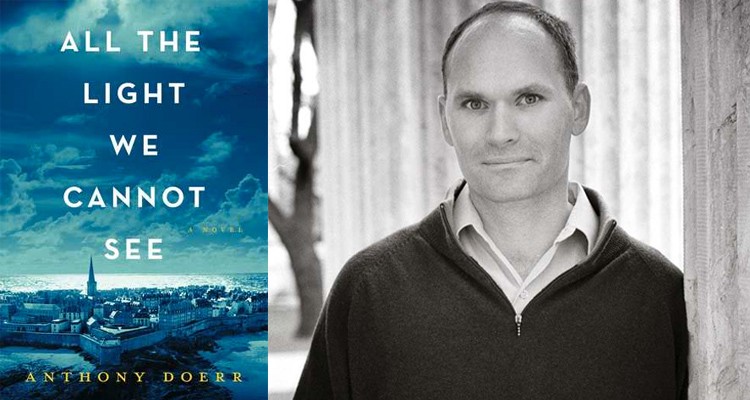
Anthony Doerr Wins Pulitzer Prize for All the Light We Cannot See

Anthony Doerr won the Pulitzer Prize in Fiction today for his best-selling historical novel All the Light We Cannot See. The novel, which was the break-away literary fiction novel of last year, was cited by the Pulitzer Prize as “an imaginative and intricate novel inspired by the horrors of World War II and written in short, elegant chapters that explore human nature and the contradictory power of technology.” Doerr will be awarded $10,000.

The three finalists in fiction were Let Me Be Frank with You by Richard Ford, The Moor’s Account by Laila Lalami, and Lovely, Dark, Deep by Joyce Carol Oates.

The award for Poetry went to Digest by Gregory Pardlo and the award for General Nonfiction went to The Sixth Extinction: An Unnatural History by Elizabeth Kolbert. The full list of awards can be seen here.

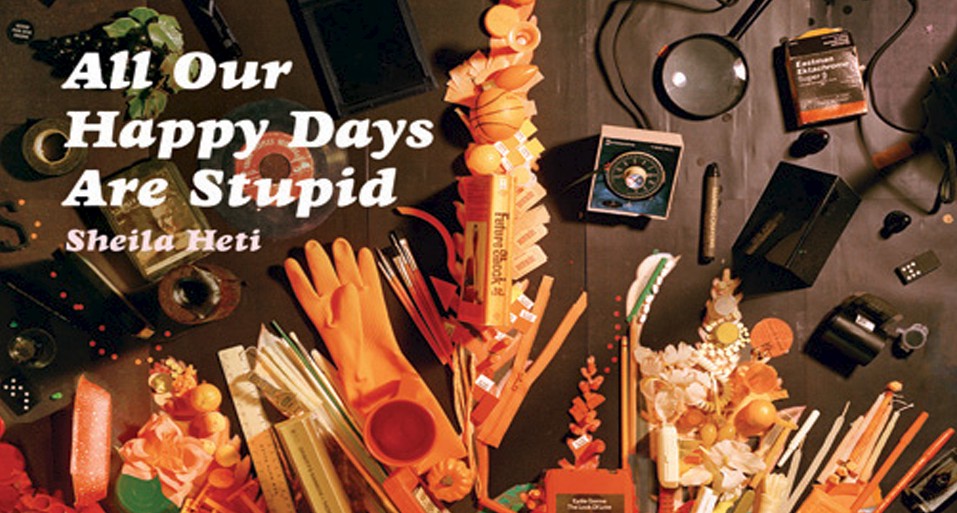
The Bright Side of Things: All Our Happy Days Are Stupid by Sheila Heti

Hailed as ‘unproduceable’ by Nightwood Theatre, the group for which it was written, All Our Happy Days Are Stupid is the impossible play made manifest. Until recently, it was merely the motif around which Toronto-born Sheila Heti’s 2012 novel, How Should a Person Be?, was constructed, in which she tracked her failure to finish the play. However, over ten years after its initial draft, Heti’s theatrical albatross has been liberated from her wilfully ignored notebooks. McSweeney’s publication of the play is the final stage of an organic process. All Our Happy Days Are Stupid has been carried to term after an extremely long and difficult gestation.

As is de rigueur, the play’s initial run was crowdfunded by an Indiegogo campaign, and premiered at storefront theatre Videofag in 2013 in a low-budget production by Canadian theatre company Suburban Beast. Its ensemble cast consists of professionals and non-actors–often Heti’s friends–with several roles played by the same person. Initially staged to audiences no larger than thirty people, the play has gone on to enjoy two sold-out runs; the first at Toronto’s Harbourfront Centre, followed by a New York production in late February of this year, at the experimental theatre space The Kitchen. With starkly monochromatic backdrop and costumes, its scenery and props thickly outlined in black, the set has a cartoon quality, with no attempts made at replicating locations. The lack of color and softness is extremely effective in mirroring Heti’s pared down, blunt script, and her characters’ brutal honesty.

Although written in 2001, the play is Heti’s seventh published work, following 2014’s collaborative collection, Women in Clothes, which featured contributions from over 600 women from all across the globe. Co-edited with Leanne Shapton and Heidi Julavits, and comprising of interviews, photographs and testimony, the book examines the relationship between those who identify as female and their clothing. Much of Heti’s writing is focused on women and womanhood; in particular the politics of female relationships, and enduring nature of friendship verses heterosexual romance.

Heti achieved commercial success with How Should a Person Be?, her partially fictional, semi-autobiographical novel, which careens from the graphically sexual to hysterically funny in a matter of pages. Casting herself and friends as the novel’s characters, she often recorded conversations and used these transcriptions in lieu of a traditional narrative, giving the novel an immediate and intimate quality. Heti studied playwriting before temporarily abandoning it to write literary fiction, and her background in theatre can be glimpsed in the novel, despite her self-proclaimed ‘failure’ as a playwright. In presenting dialogue as script, in addition to her division of the novel into five acts, Heti lends an air of theatricality, further emphasized by her penchant for histrionics.

The melodramatic tragicomedy of All Our Happy Days Are Stupid dramatizes the volatile encounters between people experiencing a trauma. Set at the height of summer, first in “gaudy, bubblegum” Paris and later Cannes, it follows the doomed vacation of Mr. and Ms. Oddi (“OH-dee”) and their daughter Jenny, whose trip aligns with that of Daniel Sing and his mother and father, Mr. and Mrs. Sing. When twelve-year-old Daniel goes missing, lost amidst a Parisian parade, his disappearance sets off a sequence of events in which the play’s characters become caught up in existential doubts and crises of identity, and we are given a fly-on-the-wall perspective of relationships, and indeed families, breaking down.

Suburban Beast’s Jordan Tannahill provided the foreword, in which he refers to its epitomization of the ‘Heti-esque’. Considering a dramatic equivalent (which is difficult), All Our Happy Days Are Stupid is also–without wanting to draw too close a comparison–Pinteresque, with Heti’s use of the “comedy of menace” to hint at the power-play between her characters through their mundane, even dull, conversations, and elusive pasts. While not quite absurdist theatre, Heti borrows from the genre’s existentialism, especially with regards to the female characters’ quests for meaning in the face of unfulfilling marriages and a disinterested universe.

When commissioned by feminist group Nightwood Theatre in 2001, Heti asked “does it have to be a feminist play?” to which the response was “No…but it has to be about women.” This allows a fairly open approach, and Heti uses the vagueness to her advantage, ignoring obvious feminist themes and tropes in favor of her frank examination of failing relationships, difficult friendships, and middle-aged women on the verge of nervous breakdowns. Rather that focusing specifically on womanhood or femininity, All Our Happy Days Are Stupid instead explores the hopes, fears and failings inherent to all, regardless of gender. Where feminism comes into play is Heti’s exploration of the complexities of friendships between women, particularly the less palatable side of female companionship.

Upon first reading, the depiction of female relationships in All Our Happy Days Are Stupid is understated and less immediately relatable than those in Heti’s autobiographical How Should a Person Be?. This could in part be due to the play’s detachment through fiction, as this time Heti’s voice is hidden behind characters, and we read the play from an audience’s perspective. The lead characters are all female; the “young for her age” Jenny Oddi, her “vain and a little glamorous” mother Ms. Oddi, and Mrs. Sing, described as “tense and hostile”. The male characters, Mr Oddi. Mr Sing, his son Daniel, and older iteration in successful pop-singer Dan (played by The New Pornographer’s Dan Bejar), are more supporting cast, although Dan appears intermittently to perform a soundtrack of sorts. The ‘action,’ predominantly taking the form of heated discussions and antagonistic remarks, is at its most vitriolic and effective when concerning the female cast. We learn the women’s thoughts through conversations with their husbands, which bring intentions to light, and offer sympathetic explanations for behaviour that often appears inexcusably disrespectful–especially in the case of the play’s star, Ms. Oddi.

Jenny Oddi, balanced precariously on the cusp of puberty and thus caught in the excruciating zone between child and woman, already exhibits more compassion when reacting to her friend’s vanishing than her mother, the acerbic Ms. Oddi:

Ms. Oddi: You have a tear in your eye!

Jenny: I am trying to hold it in.

Ms. Oddi: Well you’re doing a terrible job! Let it out, Jenny, you’re not proving anything.

Through her victimization, Jenny is perhaps the most sympathetic character, as despite her young age she is insightful, and desperate to be respected as an adult. Of the fateful parade that later swallows Daniel, she remarks “My parents think it’s amusing for me but it’s not. I think it’s so limited,” but her mother, dismissive of Jenny’s attempts at maturity, calls her “a great naïf”. Heti effectively evokes the frustration of adolescence, and female readers may find themselves recalling, with discomfort, their twelve-year-old selves.

Despite appearing long-suffering, Mr. Oddi is pushed to his limit by his wife’s endless criticisms. After she describes an acquaintance’s house as smelling like “onions and sweat and soil,” he snaps:

Mr. Oddi: You’re not a poet, Grace

Ms. Oddi: (hurt) I’m not trying to be a poet.

Mr. Oddi: …trying to describe the way things are. Leave that to the poets…for heaven’s sake, Grace!

Ms. Oddi: I was just searching for the words.

Mr. Oddi: A poet doesn’t search for the words, just ladies trying to look all poetical!

This could be a thinly disguised reference to Heti’s own turbulent writing process, and her desperate quest to define herself, both as a woman and a writer, but always left “searching for the words”. Heti skilfully communicates interior thoughts in a way that, while encouraging engagement, also evokes aversion and even disgust. So, while Ms. Oddi is not a likeable person, her impolite actions and unwarranted lectures at times echo our own internal monologues and compulsions. As a result, she is wildly funny, her lines witty in their sharpness, and we are attracted by her ‘take no prisoners’ approach.

While initially appalled by Ms. Oddi’s rudeness, her female compatriot, Mrs. Sing, is still drawn to her, much like an impressionable moth to a flame; “In her face was something of the brutal woman. I do like brutal women (…) Oh, think of it. I would just admire her… sit and admire her and stare”. Vulnerable in the wake of her son’s disappearance, and finding little comfort from her husband, Mrs Sing seeks the kinship of a strong, if unwelcoming, female presence. Taking the other woman to one side, she breaks down:

Mrs. Sing: It’s not like you imagine it. You find that even oranges look menacing to you. The whole world turns inside out, and you see nothing but the maggots! The midgets and the maggots!

Ms. Oddi: I wouldn’t know about that, Mrs Sing. I have always tried to look on the bright side of things.

Oddi’s intentional impoliteness is, again, laughable, and we are encouraged to find comedy in her disdain for the other woman. But our laughter is hollow, for sadness quickly follows, as we empathize with Mrs. Sing, confused and in pain, reaching out in hope for a friend but getting nothing. Heti’s script plays with us, like a cat toying with a mouse, as brief moments of hilarity mask the darkness lying at its core.

To an extent, All Our Happy Days Are Stupid can be read as an extension of How Should a Person Be?, in particular Heti’s exploration of the complexities of friendships between women. There are certainly echoes of Heti’s friendship with Margaux Williamson in that between Ms Oddi and Mrs Sing. However, while Heti used her own attachments in the novel, her play’s characters are fictional, their situations invented. We are not given insight into what has shaped the characters of Ms Oddi and Mrs Sing into the sharp, bold, and fairly unlikeable women they are, but the nature of their marriages are certainly hinted to be partly responsible.

Men, for Heti, provide a sandpaper-like surface for women to rub up against. A source of joy and tension, passion and antagonism, the actions of the male characters bring the female leads together, while at the same time setting them against each other. The disappearance of Daniel triggers not only his parents marital turmoil but also in a way that of the Oddi’s, as Ms. Oddi reacts to Jenny’s sorrow, and Mr. Oddi’s failure to appreciate her, by vanishing herself. The play is strewn with awkward conversations between the two couples, each prodding at the other’s shortcomings, in scenarios too real for comfort. In a delightfully odd scene, where Ms. Oddi is requested to play the flute at a royal dinner, her husband’s dismissal of the honor elicits a strong reaction:

Ms. Oddi: Must you spoil everything good in my life! For once I am the one who is necessary. I am the one who will make the evening shine! (…) You want to keep me tucked away in this hotel room, away from the eyes of the world. Why didn’t I get on the stage? Why didn’t I pursue my flute? Instead I took care of Jenny.

It would appear more deeply seeded issues are at work here, and with Ms. Oddi’s unhappiness as both wife and mother illuminated, her subsequent escape to the heady romanticism of Cannes makes sense.

Act One ends with Jenny–so desperate to be an adult but not yet ready for the hardships that come with age–witnessing her mother’s abandonment of their family, her father left “crumpled on the stoop” of the hotel. Act Two opens with Ms. Oddi and Mrs. Sing in Cannes, a town infamous for glamour and excess. Mrs. Sing’s fixation on the other woman is based in ill-advised admiration for Oddi’s spontaneity, independence, and self-assuredness, traits we know are not as genuine as they appear. These scenes between the women are excruciating–both are damaged, lost, and alone, searching for affirmation in all the wrong places; casual sex, alcohol, and anonymity, which is clearly the opposite of what they dearly want: to be seen.

Heti herself is no stranger to such pursuit for self-definition, and while How Should a Person Be? recorded her struggle–and was self-obsessed to the point of vanity–All Our Happy Days Are Stupid inhabits the struggles of others with perceptive sympathy. Tannahill comments:

After years of workshops and feedback and rewrites and letdowns, what began as a play can feel like the furthest thing from playing. It becomes drudgery. It becomes a vortex of existential malaise and self-doubt.

With this in mind, All Our Happy Days Are Stupid–a work Heti considers “something upon which the reflected light of my experience and knowledge could be seen”–can be regarded as a metaphor for our personal search for self-worth and happiness, a warning against seeking to ground such value in others.

All Our Happy Days Are Stupid

by Sheila Heti

Powells.com

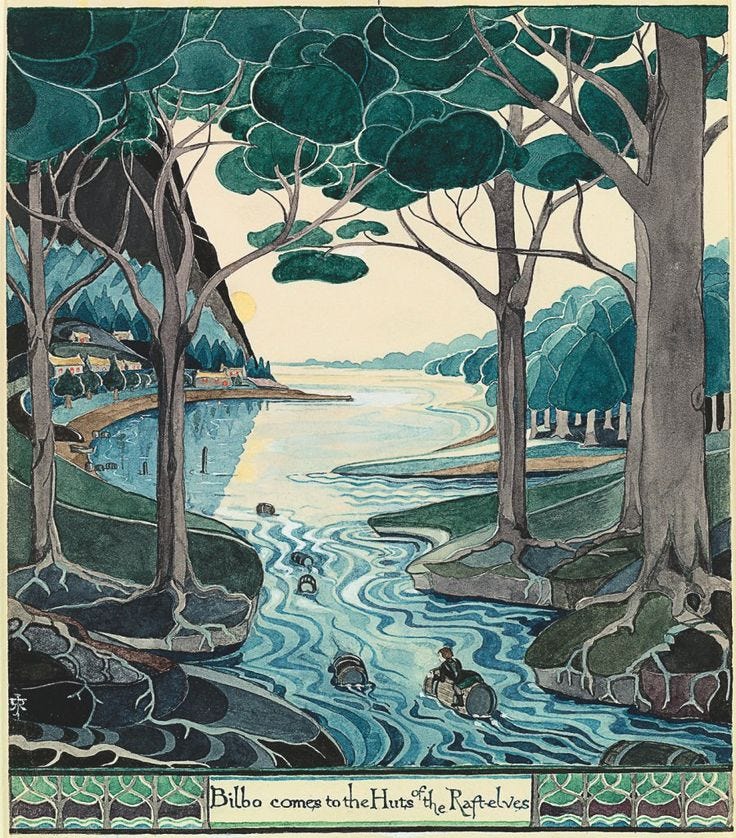
The Genius of Tolkien’s Original The Hobbit Dust Jacket

Tolkien’s original artwork for The Hobbit dust jacket is now on display at “The Marks of Genius” exhibit at the Bodleian Library. Other work featured includes Shakespeare’s First Folio, The Gutenberg Bible, and works by Isaac Newton. The artwork was used on the first edition of The Hobbit, a rare copy of which was recently donated to the Texas A&M Libraries by George R. R. Martin:

Many fantasy fans might not realize that Tolkien was a visual artist, but he created many beautiful illustrations for his genre-defining fantasy works.

Bilbo

(h/t Tolkien Society)

Sunday Sundries: Literary Links from Around the Web (April 19th)

Looking for some Sunday reading? Here are some literary links from around the web that you might have missed:

A reader’s guide to the works of Cormac McCarthy

154 short films for the 154 sonnets of Shakespeare

Amelia Gray’s literary idol is Shirley Jackson

Alexander Chee takes a look at the current popularity of the serial novel across genres

Game of Totes is down to 8 literary houses vying for the canvas throne

The Millions on fame, money, and day jobs for writers

Sherman Alexie talks about how his YA novel keeps being banned

Are these the world’s oddest libraries?

A lost passage from A Wrinkle in Time sheds some light on Madeleine L’Engle’s ideas

Infographic: The Science of Speed Reading

Turns out the method of reading you likely utilized at least a few times in college may have some benefits after all. According to a new infographic, speed reading is actually proven to be quite helpful in absorbing and retaining a large amount of information quickly, allowing for greater productivity and efficiency, both in daily life and the workplace. For more information on how to improve your speed reading technique and interesting facts about the method, check out the full infographic.

speed reading

Game of Totes: Canvas Is Coming (Round 2: The Sweet Sixteen)

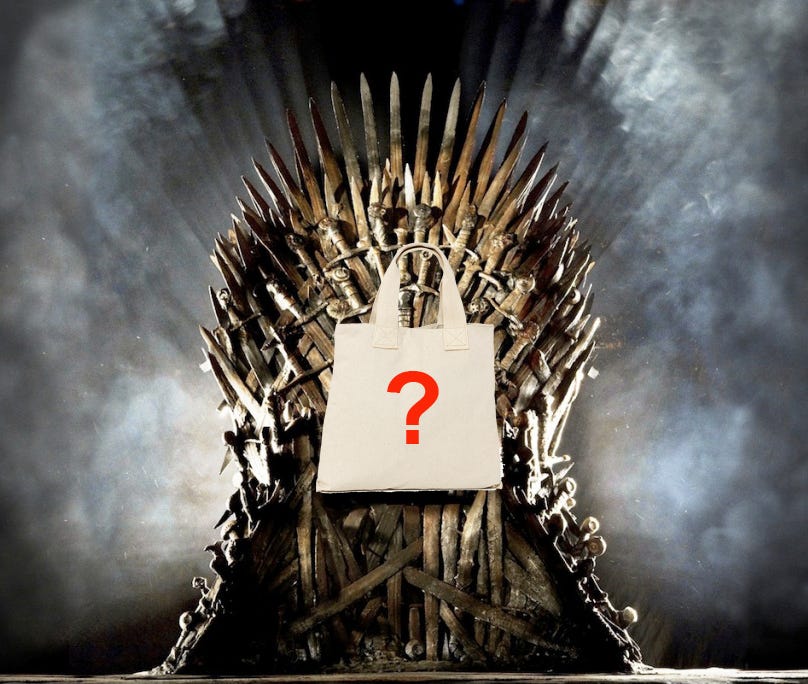
The War for the Canvas Throne began two weeks ago as 33 totes battled for the crown. In the first round, the public voted and decided who would advance. The 17 totes with the most votes (there was a tie for 16th) advanced to this round where they were seeded head-to-head and found themselves at the mercy of nine ruthless judges. The eight winners below will enter the final glorious battle at Housing Works bookstore in NYC on Monday, the 20th of April.

The final ruling tote will be decided by judges Camille Perri (Cosmopolitan’s book-editor-at-large), Saeed Jones (poet, Prelude to Bruise, BuzzFeed Literary Editor), Bev Rivero (publicist at The New Press), and Dan Wilbur (writer and comedian).The event will be hosted by Jason Diamond and Lincoln Michel, feature readings from Jen Doll and Kyle Chayka, and free wine and PBR while supplies last! Come and see who is crowned ruler of the literary tote world.

Iron throne

Let the next round of tote bloodshed begin:

Biblio

VS.

Knopf

WILD CARD: Biblioasis (16T) vs. Knopf (16T)

Let’s get this out of the way: Biblioasis wins.

I do really like that Knopf’s entry might lead to a marriage at some point in the future. Maybe a dreamy stranger will read your tote bag and ask you what you’ve been reading and from this, eternal love will blossom. And the possibility of eternal love gets some points and sympathy.

But Biblioasis. Biblioasis dropped an F bomb on their tote. They have what appears to be an actual dire wolf modelling their tote. On these two merits alone, they would advance. But also, Biblioasis’s tote is bragging about how awesome Biblioasis is, I like this. We here at Game of Totes like this. I was personally not aware of Biblioasis before this competition, but on the strength of their tote, I now want to buy all of their things. The tote therefore accomplished it’s intended goal. Biblioasis wins. Canadian winter is coming.

WINNER: Biblioasis

JUDGE: Max Neely-Cohen (Author, Echo of the Boom)

MelvilleHouse

VS.

Biblio

Melville House (1) vs. Biblioasis (16)

Melville House has always been the indie publisher with teeth. It approaches literature and publishing with a kind of snark and swagger that’s snobbishly self-aware. With the a single quote — Bartleby’s “I would prefer not to” — the Melville House tote has captured exactly what makes the prickly publisher special. It’s not just clever, it’s an intriguing identifier of literary culture.

If the Biblioasis tote accomplishes anything, it’s proving that designing a great tote requires more thought than just slapping some text on a bag. The uneven type design isn’t ugly, but it’s a bit lazy. Plus “Ten Years of Fucking Awesome Books” sounds like you’ve been having sex with books for a decade. More than that, the Biblioasis tote feels juvenile to me, like the fifth grade bully who curses to make him/herself appear tough and cool. You can’t fake attitude. Well, I mean, you can try. But you might end up with an annoying tote.

WINNER: Melville House

JUDGE: Kevin Nguyen (Editorial Director at Oyster)

tinhouse

VS.

blunderbuss

Tin House (8T) vs. Blunderbuss (8T)

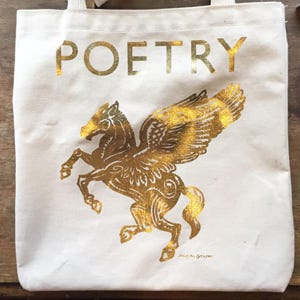
To pick a winner in this match between Blunderbuss Magazine and Tin House, I simply asked myself, Which of these two tote bags does a better job at making me want to read a book? The winner happens to be the one I find more beautiful and happens to be the one that makes me happier to live on this planet, but mostly it’s about being the one that made me want to read a book and that’s why I chose Tin House’s. While staring at these two tote bags, both of which I like very much, I realized, Hey, I have a copy of the Whitman Illuminated Tin House published and I wonder if it is as wonderful as I remember it to be. It is. Both the tote bag and the book are illustrated by Allen Crawford and the book is glorious and labyrinthine and filled with delicate humans and fanciful monsters, like whatever that antlered Gryphon Whitman on the tote bag is. Seeing that tote bag made me need to look at that book and that’s enough to make it the winning tote bag. Also, of course I had to pick the poetry tote bag. And also, that Gryphon Whitman could easily be my favorite character in Harry Potter 8, so that’s even more bonus points and of course Tin House wins it.

WINNER: Tin House

JUDGE: Kenneth Coble (Bookseller, Elliott Bay Books)

poetry

VS.

Lithub

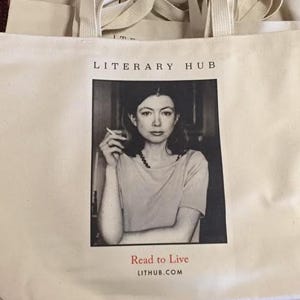
Poetry (4) vs. Lit Hub (28)

It was a very tough decision, but I’ve decided to vote in favor of Lit Hub.

My verdict:

I have to give it to Lit Hub for creating a simple, monochrome tote that harnesses the perpetual cool of Joan Didion. It also creates a high standard for the quality of books I’d put in it–I have to image she’d be judging–and hopefully approving- her tote’s contents. What’s more, I think whether or not people recognize who the picture is of could work as a litmus test for how well I’d get along with them. I’d be deep in the stacks of some independent bookstore in a new city with the tote slung over my shoulder. A stranger–probably handsome, probably bearded, definitely with glasses–gestures to the bag. “Joan Didion, huh?” We get coffee in a café and before long, we’ll have descended into a literary love affair, gazing meaningfully into each other’s eyes and reading passages from Play It as It Lays to each other in bed. Of course, we both eventually cannibalize the experience of our bitter breakup for literature, and the tote will just become a bitter reminder of him and the transient nature of all happiness, but that’s not the tote’s fault. Team Joan Tote!

WINNER: Lit Hub

JUDGE: Dana Schwartz (Guy in Your MFA & Dystopian YA)

Riverhead

VS.

JoyceCarolTotes

Riverhead (5) vs. Jai-Alai (12)

If we lived in an ideal world, I would be wearing both of these tote bags right now — one on each shoulder, with one of my cats inside each — and I would be judging this face-off based on how well the bags held the cats (and how good the resulting photos were). An additional criterion would be whether the cats curled up on either of the bags once I took them off and casually strewed them on the couch.

But we do not live in an ideal world. No, we live in the cruel, imperfect world that is the internet, and so I am left to judge these two tote bags based on their images. (Which, incidentally, is also how collectors judge paintings they’re considering dropping hundreds of thousands of dollars on, so, you know, could be worse.)

Because I am unable to make them, I am a sucker for puns, and so when I first saw JOYCE CAROL TOTES, I thought for sure my vote would go to Jai-Alai. But over the course of the past few days, I’ve found my judgment shifting… Because that Riverhead bag is pretty. And it’s so nice how the books look like they’re part of the waves, which while we’re at it sort of look like cat ears. And now I’m picturing cats reading books as they lazily float down a river, and how can you say no to a bag that gives your mind such blissed-out weirdness?

What’s more, because we live in the world of the internet (even when we’re IRL), Jai-Alai’s tote — although extremely clever — does come with one potential hazard: people who see you wearing it might think you like Joyce Carol Oates’s Twitter feed. And that would be…uncomfortable. Better, I think, to take the Joyce Carol Oates novel, put it in the Riverhead Books tote, and carry it with you to wherever you need.

WINNER: Riverhead

JUDGE: Jillian Steinhauer (Senior editor at Hyperallergic)

Outofprint

VS.

litograph

Out of Print (2) vs. Litograph (15)

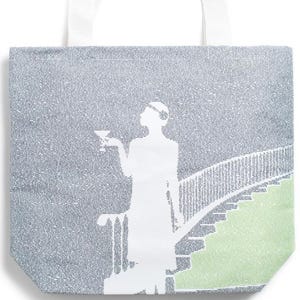
Out of Print has a nice library theme going on. I love the promise of a brand new card with no, um, baggage — no fines to pay on this one. But maybe it’s too clean. Litographs’s Great Gatsby tote bag has 20K words from the novel built into its art. With this tote bag you don’t even need a phone to play with in order to quell your social anxiety (I’m assuming you have some form of social anxiety if you are heatedly following Game of Totes). You can avoid the world simply by getting lost in reading your bag.

WINNER: Litograph

JUDGE: Maris Kreizman (Slaughterhouse 90210)

BOMB

VS.

Omiami

BOMB Magazine (7) vs. O, Miami (10)

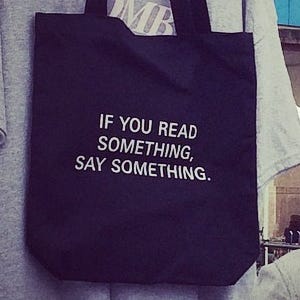
O, Miami gets points for their Game of Thrones joke with me — I love it, and the Flamingo is good, but… I give this one to BOMB. “If you read something say something” makes a creepy NSA moment into something about literary enthusiasm and the darker color is better for when the bag smacks your coffee hand and it splashes on the bag. Unless that O, Miami bag is coffee proof, BOMB is the one I’d take.

WINNER: BOMB

JUDGE: Alexander Chee (Author, The Queen of the Night)

Gigantic

VS.

TheStrand

Gigantic (3) vs. The Strand (14)

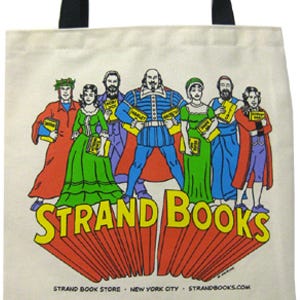
While I respect The Strand’s efforts to put a new spin on a go-to tote (big-ups to being the branded bag most seen in New York City), I’d have to go with Gigantic’s efforts here. Sure, “The Whale” is a little on-the-nose for a literary bag, but I have to say it’s too cute for me to pick anything else.

WINNER: Gigantic

JUDGE: Tyler Coates (Deputy Editor of Decider)

ORBooks

VS.

TNI

OR Books (6) vs. The New Inquiry (11)

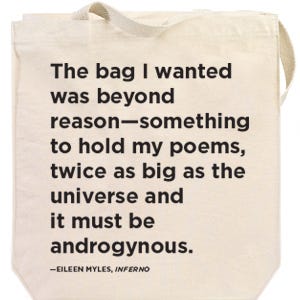
Okay, tote fiends, so this is how it went down. I considered three things: visual design, quality of material, and what it can carry. Both OR Books and The New Inquiry totes were on the lighter side of the canvas spectrum, so there was no clear winner there; same size too (enough to hold a few books, a magazine, a wallet, but not really big enough to cram a drink and lunch into without fear of disfiguring). Needless to say, neither of these totes could carry an animal, unless they were of the gerbil/ferret varietal. Ok, so on to design. While I love (crush-crush-crush) Eileen Myles, the font of the OR books bag reminds me too much of all the other HelveticAmericanApparel-esque totes and t-shirts out there. It was a tough call, but since skewering tiny businessmen with my eye-blades is second in my book only to reading, The New Inquiry tote won this round.

WINNER: The New Inquiry

JUDGE: Nadxi Nieto (Writer and designer)

***

Which of these eight winning totes will be the one true tote king? Come out to Housing Works on April 20th to find out! And be sure to come wearing your favorite tote!

Shame and Ridicule in Indiana: William H.

Indiana map

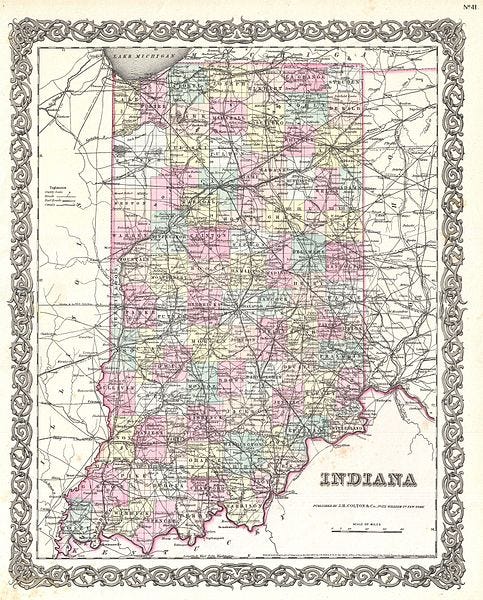
Where is Indiana? Forget geography; if you can say with confidence if it’s located to the east or west of the Mississippi, you’re ahead of the curve. No, I’m thinking of mythology, that America of Madison Avenue and Sunset Boulevard, the Alamo and Antietam. In this spiritual landscape, Indiana isn’t misunderstood. It’s ignored.

John Jeremiah Sullivan described the state’s placelessness in “The Final Comeback of Axl Rose,” his essay about one of Indiana’s favorite sons.

Given the relevant maps and a pointer, I know I could convince even the most exacting minds that when the vast and blood-soaked jigsaw puzzle that is this country’s regional scheme coalesced into more or less its present configuration after the Civil War, somebody dropped a piece, which left a void, and they called the void “central Indiana.” I’m not trying to say there’s no there there. I’m trying to say there’s no there. Think about it; get systematic on it. What’s the most nowhere part of America? The Midwest, right? But once you get into the Midwest, you find that each of the different nowherenesses has laid claim to its own somewhereness. There are the lonely plains in Iowa. In Michigan there’s a Gordon Lightfoot song. Ohio has its very blandness and averageness, faintly comical, to cling to. All of them have something. But now I invite you to close your eyes, and when I say ‘Indiana’ … blue screen, no? And we are speaking only of Indiana generally, which includes southern Indiana, where I grew up, and northern Indiana, which touches a Great Lake. We have not even narrowed it down to central Indiana. Central Indiana? That’s like, “Where are you?” I’m nowhere. “Go there.”

I’ve lived in Indiana for much of my life, and can attest to the veracity of Sullivan’s characterization. If you had asked what I thought of my home state, I would have answered that I don’t think much about it. This can be an advantage, at least for a writer. Whereas other regions may have demanded my attention — asking insistently what I thought of their landscapes, histories, and dialects — Indiana let my imagination wander. I could explore the particularities of my own inner reality, its variety belying the relative blankness of my external circumstances. I looked to books, movies, and TV to populate this reality, and every so often, I came across a story that took place in Indiana. It was oddly reassuring to have my state’s existence confirmed by prime time television. Eerie, Indiana was possibly the most prominent example, a TV show from the early 90s that was like The X-Files for kids. Its fantastical nature confirmed what I had intuited: Indiana was what you made of it.

Recently, however, Indiana’s blankness has given way to notoriety. This past March, Governor Mike Pence signed into law the Religious Freedom Restoration Act. The particulars of this law have been well-covered. Suffice it to say, the law used innocuous, vaguely upbeat language, as laws are wont to do, that would have made permissible a host of discriminatory actions against gay and lesbian residents of the state. Same-sex marriage was legalized here last year, a move that angered certain legislators and residents, and RFRA appears to have been designed to give those legislators and residents a loophole that would have allowed them to ignore the ruling. In a sense, Pence as the governor was relating to the state not unlike the way I have as a writer, taking the blankness of Indiana and refashioning it to serve his own needs. And to a degree, he was successful.

Overnight, Indiana went from being the middle child of the Middle West to the First Church of Evil and Intolerance. “#BoycottIndiana!” implored my Twitter and Facebook timelines, and at first I was onboard, ready to attempt the seemingly physically impossible feat of boycotting myself. I was ashamed, and doubly so. I am a Hoosier and a Christian, having been raised in an evangelical, homeschooled subculture that has thrived in Indiana for decades. I used to believe being gay was a sin, and wasn’t disabused of the notion until I went to college, a Christian one, and made friends who were gay, and whose devotion put mine to shame. Everyone was saying the worst things about Indiana, and I was inclined to agree.

Soon, however, I saw that there were many residents who disagreed, vehemently, with RFRA and its implications. There were major protests in downtown Indianapolis. Mayor Greg Ballard, a Republican, implored Gov. Pence to repeal the law and help restore the city’s reputation as a desirable site for business and tourism. The Indianapolis Star ran a front-page editorial that asked Pence, in 100-point font, to FIX THIS LAW. Plenty of Hoosiers were angry. So why were my social media accounts wallpapered with #BoycottIndiana rather than, say, #RecallRFRA? Why did the entire state become a metonym for the worst impulses of certain of its citizens?

I looked for answers, as I usually do, in literature. Admittedly, literature has a better track record of asking questions than giving answers. But questions can be more telling, and so I turned to a few writers who have considered the question of the nowhere that is Indiana.

***

William H. Gass’s “In the Heart of the Heart of the Country” is not just one of my favorite stories about Indiana. It’s one of my favorite stories ever. In the annals of literary history, if Indiana were known for nothing else than inspiring this meditation on heartbreak and loneliness, that would be more than enough to assure its relevance.

Gass wrote the story in the early 1960s when he was living in Brookston and teaching at nearby Purdue University. The narrator refers to it as B, “a small town fastened to a field in Indiana.” We learn little about the narrator’s personal life; the one salient detail he offers is that he is “in retirement from love,” having recently ended a relationship with a woman who haunts his narration, appearing suddenly at the ends of sentences. There is no plot to speak of, the story of the narrator’s life having effectively ended. Instead, the narrator records a series of notes about B, its citizens, habits and customs.

PEOPLE

In the cinders at the station boys sit smoking steadily in darkened cars, their arms bent out the windows, white shirts glowing behind the glass. Nine o’clock is the best time. They sit in a line facing the highway — two or three or four of them — idling their engines. As you walk by a machine may growl at you or a pair of headlights flare up briefly. In a moment one will pull out, spinning cinders behind it, to stalk impatiently up and down the dark streets or roar half a mile into the country before returning to its place in line and pulling up.

Throughout the story, the implicit question is this: are the people of B inherently sad and lonesome, or do they appear as such to the narrator because he is sad and lonesome? It’s almost as if the narrator is a magnet and the people are iron filings, snapping into formation as soon as he brings his attention to bear upon them. Places that lack definition can be eager to be defined, no matter how.

But in defining the particulars of B, the narrator also defines himself, and this is what gives the story its power, the willingness to have his identity bound up with Indiana. Even before RFRA, Indiana had been something of a catch-all for Middle American backwardness, as in Unbreakable Kimmy Schmidt. It’s a mostly delightful show, peopled with characters who first appear stereotypical, but soon acquire depth and idiosyncrasy. The exception to that, however, are the residents of Kimmy’s hometown of Durnsville, IN. Everyone there is either stupid or incompetent, or both. Its depiction of Midwesterners was offensive, I guess, but it honestly didn’t offend me. It bored me. It was lazy, unwilling to find anything to relate to in the lives and personalities of small-town Hoosiers.

Gass’s narrator frequently finds the residents of B to be crude and slovenly, but he doesn’t push them away. He draws them closer, their crudeness and slovenliness becoming his own. The best way to get to know oneself, he suggests, is to get to know one’s neighbors.

This Midwest. A dissonance of parts and people, we are a consonance of Towns. Like a man grown fat in everything but heart, we overlabor; our outlook never really urban, never rural either, we enlarge and linger at the same time, as Alice both changed and remained the same in her story. You are blond. I put my hand upon your belly; feel it tremble from my trembling. We always drive large cars in my section of the country. How could you be a comfort to me now?


***

Everyone wants to claim David Foster Wallace. I often want to tell East Coast types to keep their hands off him, he belongs to the Midwest, but that would violate the core tenet of Midwestern politeness.

Wallace was raised in rural Illinois and spent significant chunks of his adult life in the region. He turned his attention to Indiana in “The Suffering Channel,” a novella-length story from the collection Oblivion. Where Gass considered the state on its own terms, Wallace toggles between rural Indiana and the New York media world, posing questions of celebrity, audience and which, exactly, is which.

It’s also a 90-page gross-out joke, delivered with fully committed deadpan blankness.

Skip Atawater is a journalist who was born and raised in Indiana. He now works for Style magazine (think People), writing for its WHAT IN THE WORLD? section, which covers unusual, even bizarre, human interest stories that still retain an upbeat angle. Atwater returns to his home state, to a small town east of Indianapolis, to interview Brint Moltke and his wife Amber. Brint possesses a quality you could call either a talent or a medical condition: he shits art. Literally. His bowel movements come out in the form of intricately detailed sculptures, which are then retrieved, lacquered and displayed, mostly at his home, but also at local 4-H fairs. Atwater thinks Moltke’s story is incredible and wants to write it up for Style, but his superiors worry that the subject matter, in all senses of the term, is far too nauseating for the magazine’s readers. Through a rather convoluted plot involving a new cable venture called the Suffering Channel, which loops “montages of photos involving anguish or pain,” Atwater wins over his superiors, and Moltke’s story runs in the issue of Style dated September 10, 2001.

What is Wallace trying to say with this? Is it a vision of the country as an enormous physical body, with New York as the brain and the Midwest as the digestive system? A disavowal of the cerebral, of the head, in favor of the gut? The closest thing to a thesis comes when Atwater is considering the “paradoxical intercourse of celebrity and audience” that informs every issue of Style:

It was more the deeper, more tragic and universal conflict of which the celebrity paradox was a part. The conflict between the subjective centrality of our own lives versus our awareness of its objective insignificance. Atwater knew — as did everyone at Style, though by some strange unspoken consensus it was never said aloud — that this was the single great informing conflict of the American psyche. The management of insignificance. It was the great syncretic bond of US monoculture. It was everywhere, at the root of everything — of impatience in long lines, of cheating on taxes, of movements in fashion and music and art, of marketing.

How to manage one’s insignificance? It’s a question everyone has to consider, though it may have a different inflection here in Indiana, where insignificance is sometimes assumed, by residents and observers both. You can follow the exploits of celebrities deemed as significant, retweeting their aphorisms and reblogging photo sets to experience a contact high from secondhand fame. You can make like Brint Moltke, expressing himself with the only resources he had at hand, resources that others might call waste. Perhaps I’m setting up a false binary. I’m lingering here, though, because I think this passage gets at the sense of insignificance that Gov. Pence and supporters of RFRA are experiencing. Yes, people are talking shit about Indiana. But at least they’re talking about it. People do stupid things to get attention all the time. Disagree with their actions, certainly, but I think any American could recognize and even empathize with the motives of Pence and his cohorts: the desire not to be ignored.

***

I want to close by considering a writer who examined a different brand of Indiana blankness. Etheridge Knight spent six years in an Indiana prison for robbery, the kind of outrageous sentence a black man would have taken as par for the course in the 1960s but today would seem — well, never mind.

Knight was marginalized in a marginal state. Even if he had tried to know himself by knowing his neighbors, it’s likely that his neighbors wouldn’t have let him do so. But the indifference he faced throughout his life didn’t embitter him, as he writes in “Birthday Poem,” composed in Indianapolis on April 19, 1975.

The sun rose today, and
The sun went down
Over the trees beyond the river;
No crashed thunder
Nor jagged lightning
Flashed my forty-four years across
The heavens. I am here.
I am alone. With the Indianapolis / News

Sitting, under this indiana sky
I lean against a gravestone and feel
The warm wine on my tongue.
My eyes move along the corridors
Of the stars, searching
For a sign, for a certainty

As definite as the cold concrete
Pressing against my back.
Still the stars mock
Me and the moon is my judge.

But only the moon.

’Cause I ain’t screwed no thumbs
Nor dropped no bombs — 
Tho my name is naughty to the ears of some
And I ain’t revealed the secrets of my brothers
Tho my balls’ve / been pinched
And my back’s / been / scarred

And I ain’t never stopped loving no / one
O I never stopped loving no / one

Only the moon can judge Indiana. It’s a state that mostly gets ignored, and occasionally ridiculed, by the rest of the country, but no matter. Anyone is welcome to come here and see a reflection of themselves in the unlikeliest places, no matter what any law says.

Haruki Murakami and Chimamanda Ngozi Adichie Make TIME’s 100 Most Influential People

TIME magazine has revealed it’s 100 Most Influential People list. Among the usual list of CEOs and politicians, two fantastic fiction writers made the cut. Here is Yoko Ono on perennial Nobel prize contender Haruki Murakami:

He is a writer of great imagination and human sympathy, one who has enthralled millions of readers by building fictional worlds that are uniquely his. Murakami-san has a singular vision, as informed by pop culture as it is by deep channels of Japanese tradition.

Also honored among the 100 was Nigerian author Chimamanda Ngozi Adichie. TIME deputy managing editor Radhika Jones did the write up:

It’s the rare novelist who in the space of a year finds her words sampled by Beyoncé, optioned by Lupita Nyong’o and honored with the National Book Critics Circle Award for fiction. But the Nigerian writer Chimamanda Ngozi Adichie is just that sort of novelist.

Read the whole list here.