Beyond the Borders of Expectation: The Guild of Saint Cooper by Shya Scanlon

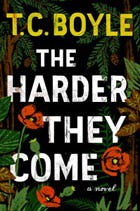
“‘[A]rt is born of the individual’s unique response to his own existence,’” one of the characters says in Shya Scanlon’s new novel, The Guild of Saint Cooper. Scanlon’s readers’ experiences are colored, too, by the characters’ response to their existence, and the changes they make as they rewrite their own pasts. Scanlon’s novel follows Blake, an author living with his mother in “post-evacuation Seattle” who is asked to write a retelling of the city’s history that casts Twin Peaks’ Special Agent Dale Cooper as the peoples’ hero. As Blake begins his canonical text, the city’s history, and his own life, is changed irreparably. In the fabric of his novel, Scanlon demonstrates our complicated relationship with truth; this tricky novel works itself up into a frenzy in order to pose questions about the trust we, as readers, place in narrative.

The structure of Scanlon’s novel is unique and sometimes the author loses us — as Blake begins writing, we are taken back in time to an alternate universe. In this way Scanlon comments on the fallacy of memory. Once things begin to change, the characters struggle to maintain their thread on place and memory, often being unable to remember how they got to where they are. Blake questions his own memories as we are to believe he’s simultaneously writing them.

“I nodded. I tried to remember something, anything.

‘Do you mean a memory of having memory, or a memory of the memory itself?’

Goldie thought about this. ‘I like you,’ he said. ‘So what I’m thinking is, if you can’t have a memory of it, it’s not an experience. Which means it’s, whatever, something else. A whole different type of thing. I don’t give a shit what’s going on in the brain.’”

With a novel such as this, the writer must be allowed some freedom to challenge traditional ideas of plot and structure. But this also means that we experience some of the characters’ confusion while we read them experiencing it. Is this the point of Scanlon’s work? Perhaps. But it can make for a disoriented reading experience. The first section of the book is a long, explicative passage that the reader will initially want to turn way from but he is able to shine a light on our collective comfort with narratives, particularly as they relate to the stories and theories we come to trust in the ever-evolving news cycle. While Blake writes a new narrative, he questions his old work. In the first section (before he begins the work that will alter his past), he also wonders about the relevance of what he writes. In each timeline there’s tension between what we want to read and what we need to read, whether because we need to escapism or witness literature:

“After reading over the book I’d begun before everything fell to shit, I felt like abandoning the project. The fantastical plot and airy themes that before felt somehow noble in their abstraction now felt merely escapist. I was worried that the only literature it made sense to pursue was that of witness, and I knew exactly nothing about witness literature.”

Blake’s realizations about the power of his work allow Scanlon some pseudo-Fight Club-style revelations. Eventually Blake’s identity is called into question as much as his role in the city’s historical narrative.

“‘Blake,’ he said, ‘you set all this in motion.’

‘I did?’

I was holding onto nothing now. My fingers left the tabletop.

‘You were the reason I went undercover in the first place. It was you who discovered what Weyerhouser was up to with our extraterrestrial visitors, and you whose first experience with transpositional epiphany led us to the discovery of Existencelastic Macrobial Foreshortening.’”

Scanlon utilizes a form of escapism that challenges the notions of the genre. In some ways he is most relevant to current events when he begins to write about aliens, special agents from TV shows, and glowing lights. The farther away from the original timeline Scanlon takes us, the more he has to say.

Scanlon’s most compelling argument is one for comfort with ambiguity — as a philosophy — the idea that we can both hold an idea in our minds and not believe it:

“‘Self-deception? It’s basically the ability to hold two opposing beliefs at the same time. For some reason this was always represented by the letter P. As in, P and not-P.’

I could tell Josie was trying to think of an example, so I gave her one.

‘Say you’re an alcoholic, I mean you’re really addicted, and you know this, or part of you knows it. But at the same time, you tell yourself you’re in control.’”

Scanlon puts his reader through the same philosophical process as his characters. Are we to believe in both his first narrative and the alternate? Scanlon pushes us toward negative capability, and some readers will be more comfortable with this than others. But it’s worth acknowledging that this complicates the readability of the book for any reader. Even if we are tracking right along with the author, he’s asking us to retain parallel storylines at the same time.

“‘Truth is truth,’” Blake says, stating the central tension of The Guild of Saint Cooper aloud. When other characters challenge him — and challenge the idea of narrative itself, it’s clear that we’re each in different places with respect to our level of trust in stories. Some of us need them in order to frame the world we observe. Others would rather ignore the story and examine life on its own terms. Scanlon’s unusual and complicated work draws our attention to this fundamental difference. The Guild of Saint Cooper unwrites as it writes; Scanlon bends his narrative to suit this bizarre and twisted story. If you can suspend your disbelief, Scanlon’s wild ride will take you past the borders of what seems possible.

The Guild of Saint Cooper

by Shya Scanlon

Powells.com

The Utter Ambivalence of Connection, an interview with Colin Barrett, author of Young Skins

by Dan Sheehan

young skins

My town is nowhere you’ve been, but you know its ilk. A roundabout off a national road, an industrial estate, a five-screen Cineplex, a century of pubs packed inside the square mile of the town’s limits. The Atlantic is near; the gnarled jawbone of the coastline with its gull-infested promontories is near. Summer evenings, and in the manure-scented pastures of the satellite parishes the Zen bovines lift their heads to contemplate the V8 howls of the boy racers tearing through the back lanes.

So begins Colin Barrett’s mesmerizing debut collection of stories, Young Skins, released to near-universal critical acclaim and, in the months between its Irish and US publication, a raft of major literary awards. His brutal, linguistically stylish tales of Sisyphean young men, voluntarily trapped within the confines of the fictional west of Ireland town of Glanbeigh, have elicited high praise from Colum McCann, Anne Enright, Colm Toibin, Sam Lipsyte, and The New York Times. I sat down with Colin on a warm evening in late March in the Bowery’s Swift Hibernian Lounge to discuss the author’s love of language, the intriguing open-endedness of the short story form, and the perils of writing what you know.

Dan Sheehan: In the last twelve months or so you’ve gone from being published in Ireland with The Stinging Fly Press to winning the Rooney Prize for Irish Literature, the Guardian First Book Award, and the Frank O’Connor Short Story Award. You’ve also had a story in the New Yorker and a rave review in The New York Times. That’s a pretty crazy year. How’s it’s been for you?

Colin Barrett: Well it’s been very good. I’ve nothing to compare it to obviously, but initially I was just very proud of myself for writing the collection and getting it published in Ireland. I am aware that there’s been an unusual amount of attention for a first book, especially for a book of short stories. So it’s been busy. It’s been hectic. It’s been strange. It’s been almost like having an actual job again purely in the context of the volume of emails that come in, which hasn’t been this crazy since I was back working in Vodafone as a Quality Service Operative. You end up inadvertently being rude to people because you forget to get back to them.

DS: I think the old ‘Out of Office’ email is your best friend there.

CB: I don’t have one but I really should set it up. “I’m just stepping outside and I may be gone for some time.”

DS: “Back in five minutes or two weeks, depending on how I feel.”

CB: That might work.

DS: Is there something in your depiction of this small fictional town [Glanbeigh], aside from the quality of writing and storytelling itself, that gets to people in some universal way? Young Skins has been receiving fantastic reviews from within Ireland but also from the UK, the US, the Netherlands and beyond. Do you think you’ve hit upon something that’s ubiquitous to small towns or the shadows of small towns, something that people can feel in their own communities in isolated parts of whatever country they may be from?

I honestly didn’t think anyone would get it. Or to be more specific, I thought the only people who would get it would be the people from the area where I live and that they wouldn’t like me for it.

CB: It would seem so, but it certainly wasn’t a conscious, premeditated thing. In one of Martin Amis’ books, The Information, there’s a bunch of prominent authors in the same room together, all throwing each other catty looks, and Amis’ narrator, who is a failed literary novelist, says that the reason they’re all so envious and competitive with one another is that they’re all after what there’s only one of, The Universal. This idea that if you can somehow package your work accessibly it’ll be the key to widespread recognition. And of course the reality is you have absolutely no idea you’re doing something like that at the time. I thought this book couldn’t be more niche. I mean, it’s six short stories and a novella. I jokingly said at a festival recently that this is what all publishers and agents want, they want a short story collection with a novella thrown in. Not everyone laughed, some of them were writing it down sincerely going “this is it! Forget my YA trilogy.” So I certainly couldn’t have planned in advance that people would get it, especially as it is set in the west of Ireland, written with a heavy vernacular influence, a dialect at work. I’ve always liked that kind of voice writing, or regional writing as it’s called somewhat disparagingly over here. Language with an accent, language with a distinctive cadence. I honestly didn’t think anyone would get it. Or to be more specific, I thought the only people who would get it would be the people from the area where I live and that they wouldn’t like me for it.

DS: That you’d be resented by the only people who would find it intelligible.

CB: Exactly, resentment would inevitably entail some recognition. And yet the opposite seems to have happened. Even just anecdotally on twitter you get someone from say, the inner city in London, who says “yes, this is exactly what it was like being a teenager when I was growing up,” and over here [in the US] it seems to have also had some sort of resonance. But you can never really know in advance. All I focused on was the language and that was the lens through which I looked at how it would be perceived. Not that I didn’t consider the plots themselves but I was just so language-focused in the writing. I hoped the book would be positively received, but the idea of it impacting in other ways — beyond hopefully having some kind of literary competence — of actually resonating as stories, that’s been a very pleasant surprise. And I don’t know how I did it, if I did it.

DS: Staying with your use of language, I remember once reading a blurb for Wells Tower’s short story collection [Everything Ravaged, Everything Burned] which I thought could easily be applied to your own work. It said of the stories, “they contain sentences so good you want to cut them out and pin them to the wall.” Is there a particular type of punch you want to land when you approach sentence construction?

CB: There’s definitely an effect you’re going for, and you’re going for it at that level, sentence by sentence. I believe other writers when they tell me they perhaps don’t approach it that way — that they work at a paragraph or even a chapter level — but it’s the only way I do it. It’s the distance I want each unit of my concentration to be trained on at any one time. Sentence by sentence. Not to get all John Banville about it, but he said that if he gets two good sentences written a day then he’s happy. I produce a little bit more than that but if I keep two of the sentences I write each day then I’m pretty happy. I certainly don’t beat myself up about timelines or word counts or anything like that. It can take me a long time to get started on a story, or to get it to go somewhere; it can be the kind of extensive period of time that would probably discourage a lot of other people who would assume they must be doing something wrong. It could take a month to get the first three paragraphs right, but that’s because you’re trying to find the particular register and cadence that you’re going to tune the rest of the story to. I’ve just always loved that kind of writing. You mentioned Wells Tower and I really like that collection. Kevin Barry was doing it in Ireland with There Are Little Kingdoms and that was a book that meant a lot to me. It was incidental that he was Irish, but what he was doing with language was definitely something I wanted to emulate.

DS: It seems to me, with regard to both yourself and Kevin Barry, that even without the Irish colloquialisms and the vernacular people seem so entranced by, you guys could successfully apply that focus on the sound of the sentence and its visceral impact to other voices in other communities that have their own particular brand of jargon.

CB: Right. Anything that’s not formal or correct English. Anything that’s a deviation or a deformation of that, I’m happy with.

DS: Formal or correct English can get a little bit boring anyway.

I use big words as well as the vernacular and I like to blend the two shamelessly, and that’s what writing is for, that’s what literature is for, in my opinion anyway.

CB: It can. I mean, I can end up sounding a bit zealous about this to the point of coming across as censorious of other styles, and it’s not really that. There just happens to be a style I’m interesting in writing in. There are some wonderfully written books that I love which utilise very minimalistic, transparent language, but nonetheless, when I try to do that, it sucks, and I’m just not intrinsically as excited by it. I’m always looking for an energy in my writing so that it comes through with that certain kind of textural raggedyness. Not being afraid to mix up registers, you know? I use big words as well as the vernacular and I like to blend the two shamelessly, and that’s what writing is for, that’s what literature is for, in my opinion anyway.

DS: And I think that works. For me at least, the leaps in and out of different registers didn’t feel jarring or show-offy. When the writing moves back and forth from the highfalutin interior language of one character, to the guttural, grunting dialogue of another, the transition is admirably seamless. Sometimes when this transition doesn’t quite work in a piece of writing, when, say, too much emphasis is placed on the former, while it can still be impressive technically, the organic quality of the scene is lost. Do you avoid that trap naturally in the writing process or is it a case of drifting and having to consciously pull yourself back?

CB: Well my earlier drafts, as well as being unintelligible, are usually quite dense and I probably actually dilute the language a bit as I get closer to the finished product, while still wanting to keep a certain kind of textural density. I’m really happy that it doesn’t come off as too cerebral or unsuccessful in its welding of two styles that normally would not mesh. I’m glad that it seems organic and credible. I was writing for years before I wrote these stories so it was one of those situations where, for a long time, I didn’t want to write about where I was from. I just didn’t think that there was anything special or interesting about where I lived, that it had any intrinsic value or merit. I couldn’t see it at the time.

DS: You’re from Mayo [a county in the west of Ireland] originally?

CB: Yes. I’ve been away for about twelve years now. I go back regularly but I haven’t lived there for twelve years, and I think it took a while, being away and coming back, before it clicked in my head and I realized that yes, you’re allowed write about small town, so-called “marginal” things and that you can still get everything you want, story-wise and emotion-wise, as well as thematically and linguistically. And that realization comes from just reading. You encounter books that blow your head off and that you want to emulate, so you see how you can adapt your own material to that. It took a lot of work and a lot of practice to make it sound credible and even then I wasn’t one hundred per cent sure. I had a great editor [Declan Meade at The Stinging Fly] whose taste I intrinsically trusted so I thought, well, if it can get past him it mustn’t be too bad. Even now, you’re still never one hundred per cent sure that it won’t be interpreted as ringing false or dismissed as over-written.

DS: And then on top of all that you’ve got a community in which you live whose opinions of your depictions you have to worry about.

CB: Pitchforks at the ready.

DS: One thing I noticed, both throughout the collection and in your recent New Yorker short story [“The Ways”], is that while none of your characters could be considered heroes in the traditional mould, there is something heroic in their unflinching loyalty to one another, whether it’s Arm and Dympna in “Calm With Horses,” Tug and Jimmy in “The Clancy Kid,” or the trio of orphans in “The Ways.” Was it a conscious decision to make loyalty the virtue that sustains them through what could be deemed a purgatorial existence, or did you see it more as a shackle that prevents them from escaping this world, this stagnant way of living?

CB: I guess, and this could be me talking after the fact, one of the things the stories are about is the utter ambivalence of connection. It wasn’t a premeditated thing but I saw it emerge and recur as I was writing. There’s no conventional nuclear family structure; nonetheless, very few of the characters are truly isolated. They may be alienated from the people around them, but they are still part of some sort of improvised family unit, there’s still a partial familial structure in place. They are embedded in the community, for better or worse, and I think that’s an ambivalent thing. I wanted to write about characters who stayed. The ones who were born on this little patch of earth and live there at a time when there are all these potential options for where you can go and what you can do, and yet decide to eschew most of those options. They decide to just not do anything. Or they decide to do something within a very circumscribed area and live a very circumscribed life. That’s what I was intrigued by: that people would decide to wall themselves up in what they have already known. I thought of some of these characters as being almost like the luddite monks who make the decision to hide themselves away in the seminary and live this austere, closed-off existence. In a non-religious sense of course, we are talking about bouncers and petrol station attendants here. But it’s the idea of asking what consolations do you get by deciding to reject everything else that’s out there and sticking to what you know to the point where you can’t function anywhere else. And I think it’s probably true; if you don’t get out by a certain point, you never will.

DS: And yet these characters, they’re lonely and they’re frustrated and they’re longing for something more, but they’re not, for the most part, despairing. They’re quite stoic about their lot. I’m thinking in particular of Bat [the embattled protagonist of “Stand Your Skin”] who has been dealt a pretty rough hand by all accounts but still ticks along and does what he feels he ought even though he has every reason to rage against all those around him and abandon this place.

CB: Bat is one of the more extreme examples, and he was very interesting to write. I just think of him as a good guy really. He is a good guy, he wouldn’t hurt anybody. It’s the mystery of this kind of a character, that ability to just forebear things, silently and stoically, and I wrote the story trying to push him to the point where maybe he would react. To me, some of these characters really are enigmas. Getting back to what I was saying earlier, I grew up as a teenager in a small town, and I couldn’t wait to leave. I left, went to college, moved somewhere relatively cosmopolitan, so I was one of the “leavers,” and for years I didn’t think much about the people who didn’t leave. But then I started to, and I realized that they were the ones I wanted to write about. I didn’t want to write about characters coming back. I didn’t want that outside perspective. I wanted to keep things closed in, tight, to really try and engage with these characters at their level and treat their lives and their perspectives seriously. I was mindful of not wanting to patronise or condescend, or to simply have them there to didactically hammer home a point to the reader. I wanted to leave a little thread of hopefulness in most of the stories, an idea that maybe these characters are getting something out of their lives, even if it’s not articulated at the surface level of the story. When I think of Bat in “Stand Your Skin,” which is probably my favourite story in the collection, things don’t exactly end badly for that character. He’s still fine.

DS: It’s not hopeless.

CB: No, it’s not hopeless. We just step out. It’s interesting that some readers will look at it as an inevitable tragedy just being postponed, but I don’t know that it is. He’s surviving.

DS: It struck me when I read it that the easier thing to do and perhaps the expected thing to do would be to have some grand gesture at the close, maybe a suicide, which ninety-nine times out of one hundred is not the reality. But people want closure, they want to close the loop on these grotesques, and you don’t do that.

CB: Well closure can be moving, but it also allows you to process what you’ve read. You get catharsis, you get a way out, a way to be moved in a satisfying way rather than being left hanging. That’s what short stories are so great at, and probably a reason why they’ll never be that popular no matter how brilliant they are. They refuse that closure. The open-endedness of them is something I love. You can subject a character, and by extension a reader, to a state, an experience and just not close it off. You’re left disorientated by this lack of closure in a story so it’s maybe more of a challenge than reading a novel or a story that does give you the gratification of a nice, tidy final gesture. It can be tragic but it’s still easier than not having a gesture there at all.

DS: I suppose, if you had done that in these stories, you would have run the risk of dehumanizing your characters. Of telling us that these are simple people whose hard lives are open and closed, and therefore making them more easily digestible for the reader, when they are every bit as complex as the people who have left them behind on this tiny patch of land.

CB: Exactly. I didn’t want to judge them or have them be purely examples of something. That awful idea of being an example of something, economic tragedy or reductive masculinity or whatever. They can be those things, but you want to purposely avoid reducing them to only that. Because if all you want to do is make a statement about those things, just go and write an essay about them. You want to defeat the grand gesture and keep the story alive for the reader. That’s what I love as a reader and maybe every reader isn’t up for that but…tough.

DS: There is a school of thought, which I’m sure you’ve encountered, that says the quality of Irish writing took a dip during the Celtic Tiger years [the period of Irish economic prosperity between 1996 and 2008], that somehow we can’t write as effectively when we’re not in thrall to some manner of misery or stagnation. Do you think a book like this would exist without the recession, without the new wave of Irish emigration, or are these characters who operate outside of that world altogether?

The margins are always the margins.

CB: To me, they would have existed outside of it. I started writing these stories in 2008, when the Celtic Tiger was being violently put down, bludgeoned to death with a shoe you could say, and though I was aware of it, it wouldn’t have consciously fed into the writing at the time. The margins are always the margins. All lot of these characters would have been as equally immune to economic growth as they would be to collapse. These are people who have deliberately disconnected themselves from certain things so they would never have graduated to the level of being able to take advantage of the Celtic Tiger. I just wanted to write about these marginal characters who in any other circumstances would be considered maladjusted in some way, but who are generally able to function where they are, as long as nothing changes.

DS: I suppose maybe we ascribe too much significance to everything that happens now in Ireland in light of the crash. Maybe some things just always were and will continue to be regardless of whether the economy goes up or down.

CB: It’s hard to know. It is interesting though. I suppose, as a reader, from 1996 when I was fourteen up until 2006/07, around the time I read Kevin Barry’s collection [There are Little Kingdoms], there didn’t seem to be that much visible, almost like there was a generation of writers missing or something. I don’t know why exactly they would be. I certainly have noticed since, and this is one direct consequence of the recession, that there are a lot of young, hungry writers in Ireland at the moment. They come out of colleges with no chance of getting a job, but they take that energy and end up getting a lot of writing done at a scarily young age. They’re actually fired up by the apparent lack of opportunities. There’s no temptation to take a nice job with health insurance or buy an apartment you can’t afford. Writing has always had very low overheads.

DS: Are you at liberty to disclose anything about your next project?

CB: It’s a novel. I tried writing several novels, in my twenties, before I began writing short stories, and it’s something I always saw myself doing. I’m in the early stages at the moment and it’s exciting, but it’s also nerve wracking because it feels like I’m starting at the beginning all over again.

DS: It is a very different beast.

CB: Totally different. Short stories and novels, they both need to be well written but that’s about all they have in common! The intensity of your sentences has to be completely different, it has to be distributed in a different way and I’m slowly learning that. I’m not taking it lightly and it hasn’t been a seamless transition, but then again, when I started writing the stories that was a struggle too.

DS: You actually began writing poetry, in the very beginning, is that right? That transition must have been difficult too.

CB: Yeah, I went from trying to write poetry to novels and then to short stories. Poetry probably helped with the short story writing though because poetry is quite close, just in terms of that density and economy of language on the page. The language has to be interesting, it has to be impactful, it has to have layers and nuance and dimensions to it. But you physically don’t have much of it. That impactfulness through brevity, to me makes it a lot closer to short fiction than one might initially think.

DS: I suppose it’s difficult to sustain that kind of intensity of language for very long in a novel without it overwhelming the reader.

Because both novels and short stories have narrative, because they’re both narrative forms, there’s the illusion, or maybe the delusion, that they’re closer than they actually are.

CB: I think you can do it, but you have to be very clever about it. In novels there are different focuses you have to respect. Because both novels and short stories have narrative, because they’re both narrative forms, there’s the illusion, or maybe the delusion, that they’re closer than they actually are. The narrative is very different in short stories. In short stories everything is also working at a more symbolic level, a more figurative level of language than it is in a novel. It’s something that’s very difficult to talk about in a coherent way. When I think of some of my favourite short stories, I think of someone like Chekhov, who is considered the father of a certain kind of template of short story writing. He has a story called “The Horse Thieves” which is this bizarre fever dream of a narrative. It’s just one amazing set-piece/image after another and it has the qualities of a poem. It has this imaginative arc that has so little to do with the imprimaturs of conventional narrative. It just moves from one dream sequence to another, but in a way that is totally non-gratuitous, that is always moving and resonant and says so much more with less. You’d ruin it by trying to make it longer. I suppose as I try to write this novel I’m always wondering “What is it about this story that I can’t express in five thousand words, that I can’t condense down to ten pages? What is it about this story that requires more?” Because if doesn’t really require more than that then it should be a short story. So it’s a total re-orientation of where your head’s at and what you think narrative is.

DS: So would you say that one of the main reasons for writing this novel is that you have a story to tell that can only be told in that particular form?

CB: I’m not a big fan of the idea that there’s a story you have to tell. I suppose I just think of the novel as a different kind of freedom. The short story is one kind of freedom and I’ve worked a lot in it to the point where I probably do need a break, but more than that I think I’m just interested in the other kinds of freedom that the novel allows. Again, the novel is such a bizarre form. We have a popular conception of what it is: a narrative in chronological order; containing rounded, psychologically nuanced characters; more or less realist, and then of course every novel I like is a gross rejection of all those things (laughs) so we’ll see where mine goes. God only knows. I’m learning as I go but I am enjoying the process.

DS: One last question: Kevin Barry said once that he considers the ‘Kill your darlings’ maxim to be a hoary old piece of writing advice that, for him, rings utterly false. Is there a piece of hoary old conventional writing wisdom that you have found, from your own writing experience, to be total bullshit?

CB: That’s a good question. I’ve so little comprehension of what the rules are meant to be anyway that I don’t know which are the ones I should be breaking. I think I remember getting a question like that before and I think my answer was something like “write what you know.” I think that’s nonsense, which is a funny thing to say because I’ve written a book that is totally of my own experiences. But the problem with that classic piece of advice is that people tend to take it literally. They think it means you must write autobiographically. But the whole thing changes when you put it into fiction and it becomes something else entirely. You suddenly have permission to write about all the things you don’t actually know. I’ve never been a bouncer, for instance, but fiction allowed me to move into the shadows, into the negative spaces outside of my own experiences, which were proximate to my fiction. My fiction shares a border line with my experience but I’m writing on the other side of the fence, where everything that has never happened to you is congregating. Writing what you know should be about moving over to that other side of the fence and entering that other world; using what you know to get to a place of uncertainty and fear and ambiguity because that’s where all the good writing is, on the other side of all that. As it is, “write what you know” is a treacherously simple piece of advice that people should always ignore because it tends to give them permission to use writing as a security blanket. It basically says that if you’re writing about what you’re comfortable with then you’re on the right track when of course the truth is the exact opposite. It’s only when you get into that zone of queasy, almost nauseating incertitude that you know you’re in the right place. That’s what I try to communicate, albeit in nicer terms, to people who are trying to write: when you’re on the verge of absolute collapse because you don’t know what you’re doing, that’s when you’ve hit the good stuff, that’s when it’s working.

Two Dictionaries: Roommates, Texting, and Werewolves in German and English

On my desk right now are two dictionaries that I use for my translating work. The first, its dust jacket long missing, is a hardbound Oxford-Duden German Dictionary which, published in 2005, features German to English entries in the front, English to German in the back, and between them a set of appendices. I also use an English dictionary, a likewise jacket-less volume of the Oxford Dictionary and Thesaurus, American Edition, published in 1996, in which word definitions are supplemented with root language of origin as well as synonyms and antonyms, and which, like the Oxford Duden, also features a number of appendices.

The appendices of the English dictionary have an encyclopedic sheen to them that I find kind of inspiring. Appendix 12 is a list of all the countries in the world; Appendix 9 gives weights and measures in both Standard and Metric, common temperatures in Celsius and Fahrenheit, and a selection of geometric formulas, such as the formula for finding the volume of a right circular cone: V = 1/3πr2h. Appendix 14 lists, in order, all the presidents of the United States, with place of birth, party, and term, from George Washington, 1732–99, to William J. Clinton 1946-.

My favorite is Appendix 11, Architecture, which begins with a diagram of a Greek Doric temple with all its structural features labeled, from architrave to tympanum. Below it, on the same page, are diagrams of Doric, Ionic, and Corinthian columns. The page opposite is given over to cathedrals. There are diagrams of five different periods of window, from Norman, 12th c., to Perpendicular tracery, 15th c.; below these are three kinds of vaults — groined, ribbed, and fan — and one diagram of a Hammer-beam roof. In the top left hand corner is a detail of the side of a gothic cathedral, with a cutaway of the interior showing aisle, nave, spandrel, triforium, and clerestory. On the church’s exterior there are only two features indicated: A bridge-like form, level on top with an arced underside, dropping diagonally from the main body of the structure to an outer vertical support, which is called a flying buttress; and, further down, a small indistinct protrusion, a tiny rough outline, really just a squiggle of ink in the diagram — this is labeled “gargoyle.”

There’s an appendix on musical notation, an appendix of selected proverbs, and an appendix that lists the books of the Bible, complete with apocrypha. It’s easy to draw the conclusion that the makers of the Oxford Dictionary have made an attempt to condense the main pillars of Western knowledge into the volume’s back pages. It’s a Quixotic pursuit, and the effect is charming. By comparison, the appendices of the Oxford Duden seem far more practical in intent. They are given in the form of instructions and examples, those for English-speakers printed on the lefthand side of the page, those for German-speakers on the right, and have to do mainly with quotidian matters, such as how you might write a résumé or apply for a job.

I wouldn’t expect the German dictionary’s appendices to try and tackle grand themes; day-to-day exchange between languages is hard enough. Still, some of the Oxford-Duden entries are so specific and mundane that the effect is baffling. You learn how to book not only a hotel room, but also a campsite; you also learn, on the next page, how to cancel these reservations. In the section headed “The world of work,” in addition to examples of résumés and job applications, there are separate form letters for “asking for work to be undertaken” and, just to cover all bases, “complaining about quality of work.”

Of all these appendices, my favorite is towards the end. Its header, in English, is “SMS (electronic text messaging).” The appendix contains two lists, one in English and one in German, of common abbreviations used in text messaging. When I first encountered the lists, the English entries were in many respects just as illuminating as the German. I learned, for example, that (in 2005 at least) “lol” could mean both “laughing out loud” and “lots of luck.” “Gal” meant “get a life”; “imho” meant “in my humble opinion”; “xlnt” meant “excellent”; “3sum” meant “threesome” — this last being a bit more salacious than I’d expected to get from the staff at Oxford-Duden. As for the German, the entries were by turns logical, odd, and unsettling. The first entry, for example, “8ung”, meaning Achtung, made perfect sense — and made me think of the song “Sk8er boi” by Avril Lavigne. This was followed, however, by the mildly disturbing “ads,” meaning alles deine Schuld — “it’s all your fault.” Certain of the entries simply chopped words in half and put strings of them together to form an uncanny pidgin with no apparent relation to the language I’d learned: “mamima”; “lidumino”; “mumidire”; “ko5mispä.” Just imagine being the poor middle schooler who can’t decipher this digital pig latin.

The German surrounding cellphone communications has always struck me as being, well, goofy. The clunky “SMS,” short for “Short Message Service,” which English speakers ditched early on in favor of “text message” or now simply “text,” was still in currency when I lived in Germany a few years ago. Ich schicke dir ein SMS, I’ll send you an SMS, was a commonplace, though to be fair I have heard the less clunky Nachricht — message — as well. The common German word for cellphone, Handy, is also a bit on the funny side. It seems to have derived from “handheld” or some other word referencing “hand,” but it’s spoken aloud as it would be in English, rhyming with “dandy,” not like the German Hand, where the vowel sound is more like the short o in “bond.” There are other explanations for where Handy came from, but it seems clear that it belongs to that group of orphaned words that derive from a foreign language but that aren’t actually used by native speakers of the language from which they are derived.

Not that I mean to rag on speakers of German. There are of course plenty of converse examples, too. To pick one that’s especially widespread: “Beer Stein,” which English speakers use in referring to the large mugs Germans drink beer out of, isn’t, ahem, “actually” German. Native speakers would say either Krug or Glas, or maybe Bierkrug or Bierglas, depending on which Biergarten or Bierkeller they happened to be sitting in, since some will serve their beer in porcelain vessels, while others opt for glass. (The kind of beer ordered can also determine the container in which it arrives.) One colorful theory for the word’s emergence is that American soldiers stationed in Germany after World War II mistook the material of the mugs they were drinking out of — and here I assume they would have to have been the porcelain kind — for stone, and because Stein is German for “stone,” and these soldiers were perhaps attempting to charm their hosts by making an effort to speak their language, the malapropism was born. Returning home to the U.S. with a few of these “Steins” in their duffel bags to display on shelves in basement rec rooms across the country, these soldiers secured a place for the word in English. And today, to complete the loop, you can find shops in Munich and throughout the German-speaking world with signs, in English, hawking ornate “Beer Steins” to tourists.

But the back-and-forth between languages needn’t always be so thorny. In the Mel Brooks movie Young Frankenstein, there’s a short bit that hinges on a pun on the word “Werewolf.” The scene goes like this: Dr. Frankenstein, played by Gene Wilder, and Inga, the love interest, played by Teri Garr, are riding near the castle in a hay cart driven by Igor, the hunchback, who’s played by Marty Feldman. There’s a howl offscreen. Inga says, darkly:

“Werewolf.”

“Werewolf?” Frankenstein replies, and Igor, driving the cart, says:

“There,” pointing first to his right, “there wolf,” and then up ahead, “there castle.”

I like to think the joke would still work in translation. The German word for werewolf is Werwolf — you drop an e and say the w’s like v’s, but it’s basically the same. The English word derives, so explains my 1996 Oxford Dictionary and Thesaurus, American Edition, from the Old English werewulf, were meaning “man” and wulf meaning, well, “wolf”; presumably that root is common to the German word as well. Similar to English, in which “were-” is a homonym of the interrogative pronoun “where,” Wer- in German is orthographically identical to the interrogative pronoun for “who.” So, if Inga — who in the movie, incidentally, is German — were to say, speaking German:

“Werwolf.”

And young Frankenstein were to say:

“Werwolf?” in reply, then Igor, taking their meaning to be “who wolf?”, could conceivably say:

“Der. Der Wolf. Der Palast.” and could mean either “The wolf. The castle”; or, and this would of course be necessary to make the joke actually function, could reply using der not as a direct article, but rather, as is not uncommonly the case in German usage, as a pronoun, so that his answer to Wilder’s “Who wolf?” would be, roughly:

“Him. Him wolf. Him castle.”

Granted, the standard choice for “castle” would be das Schloss, and the whole thing’s agrammatical, but then for that matter so is “there wolf,” and at any rate, in both cases it would make sense for Frankenstein, confused, to then ask, as he does in the film:

“Why are you talking like that?”

Sadly it doesn’t always work out so tidily. Not long ago I was struggling with a story that featured characters living in an apartment together who are not related to one another — so they’re roommates, basically. The German word for this arrangement is Wohngemeinschaft, or WG. More than once in the story the characters are said to eine WG gründen or eine WG aufschlagen — roughly, they found or they start up a WG.

It would seem that — syntactically, at least — Germans place great importance on their shared living situations. The concept doesn’t quite line up in English. We live in apartments, we have roommates, but there’s not really a tidy noun we use to refer to the arrangement — houseshare, maybe, but it smacks a little of affectation, and also kind of calls to mind timeshare, which is way off. What’s more, we’d never say of an apartment-where-we-live-with-roommates that we “started it up” or “founded it.” The situation is born of economic necessity and brokered by Craigslist. It would be hard to imagine placing on it the implicit stamp of approval that an action verb confers. In my translation, I had to find a passive approximation.

And yet, later on, I was speaking with a former roommate and I happened to mention the difficulties I had had with this translation. This former roommate, who is from New Zealand, informed me that a verb for living-in-an-apartment-with-roommates does, in fact, exist, or it does in New Zealand, anyway. There, they call it “flatting.”

I thought of this former roommate recently when looking up a word in my (English) dictionary. As sometimes happens, in flipping through to find one entry, my eye was drawn to another. This chance entry was for “Strine,” which can refer to either “a comic transliteration of Australian speech, e.g. Emma chissitt = ‘How much is it?’ ” or “(esp. uneducated) Australian English.” The word derives from the speech to which it refers: “Strine” is what “Australian” becomes in the mouth of someone speaking Strine. Here is an English word, meant to describe a corrupted form of spoken English, that is itself an instance of that corruption. Sitting alone at my desk, I said Emma chissitt out loud and chuckled. At that moment it wasn’t lost on me that my Kiwi former roommate would likely not have been too pleased with my thinking of her in conjunction with Australian speech. Clearly I’ve got a few beer steins of my own, sitting there in the rec room of my mind, collecting dust.

When all of this cultural and linguistic overlap gets to be too much, I like to turn back to the Oxford-Duden appendix on text messaging. Alongside the list of common abbreviations, there is another list — much shorter, only 20 entries — of emoticons. There are weird differences here, too, of course. The German entry for Kuss, or kiss, gives two emoticons, :-* or :-x. Both of these appear on the English side as well, but the entry is labeled, with confusing hyperbole, “big kiss!” Further, there is no German equivalent for X=, which apparently means “fingers crossed,” because this expression, and the hand gesture to which it refers, doesn’t have that same meaning for German speakers. There is a rough equivalent: you can say in German, Ich drücke dir die Daumen, or, literally, “I’ll tuck my thumbs in for you,” which conveys the same I-hope-you-succeed-in-your-endeavor meaning as saying to someone “I’ll keep my fingers crossed.” Unlike the English expression, though, it doesn’t have the secondary meaning of schoolyard insincerity. You can’t have your thumbs tucked behind your back and expect to get out of that foursquare game you’d agreed to play in. And if there’s an emoticon for thumb-tucking, it’s not listed here.

Happily, the final entry is identical on both sides of the page. This is true even though, at seven characters, it is the most complicated by far of all the emoticons given, and also, since it doesn’t convey an actual emotion, it’s not really, technically, an emoticon at all. Whatever you want to call it, it appears in the dictionary as follows: @}-,-‘-. A rose, the dictionary seems to tell us, by any other name, is still as sw33t.

Midweek Links: Literary Links from Around the Web (April 15th)

Looking for some interesting reading to get you through hump day? Here are some literary links from around the web to check out:

novel drawing

The Lit Hub launched, here’s an interesting article on “drawing” a novel

Is browsing a bookstore and then buying online a “genteel form of shoplifting”?

The original drafts of Cormac McCarthy’s Blood Meridian

Ever wonder if you are trapped in a J. D. Salinger story?

How syntax shapes insanity in William Shakespeare

Libraries come in all shapes and sizes

Kara Walker reviews the new Toni Morrison

Nobel Prize winner Guenter Grass passed away this week

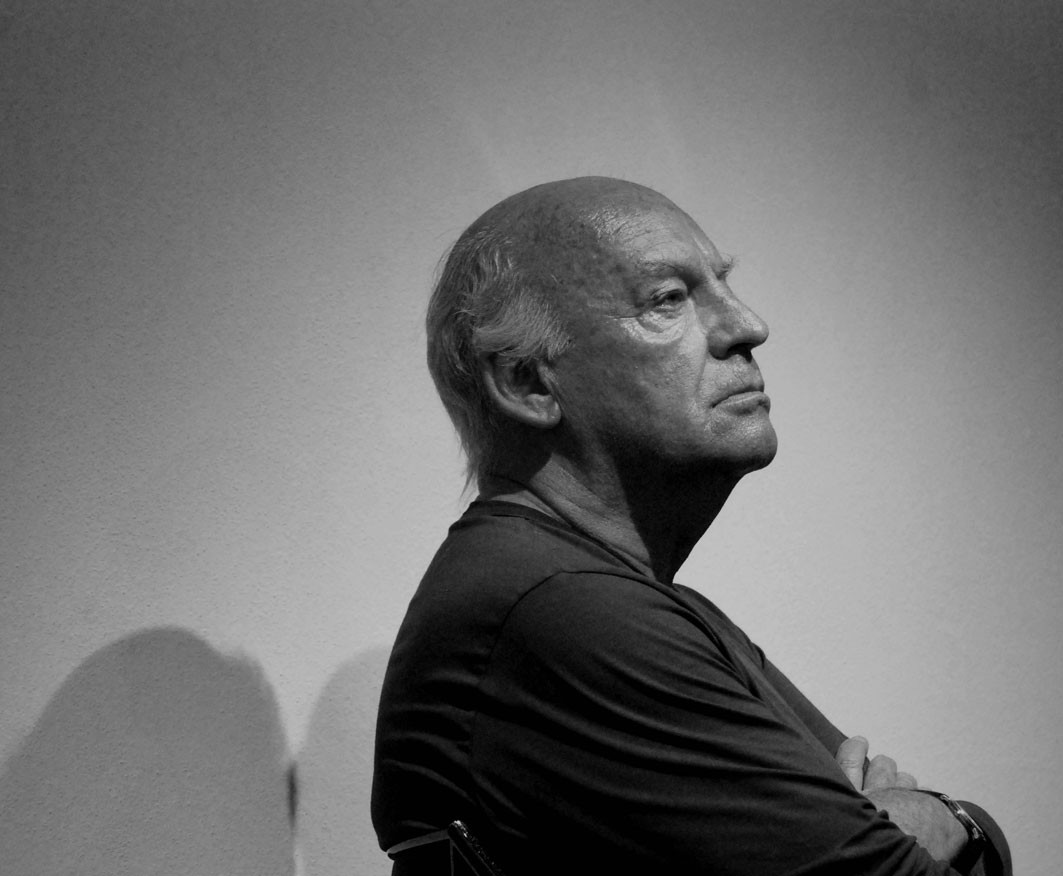
So did the acclaimed Uruguayan author Eduardo Galeano

Lastly, Amazon struck a deal with another Big 5 publisher

Words of Art: James Hannaham’s “Lengthy Statements/Brief Statements” at the Kimberly Klark Gallery

[Editor’s note: James Hannaham will teach a short story workshop in partnership with Electric Literature and Catapult on April 27th. There are still a few spots left.]

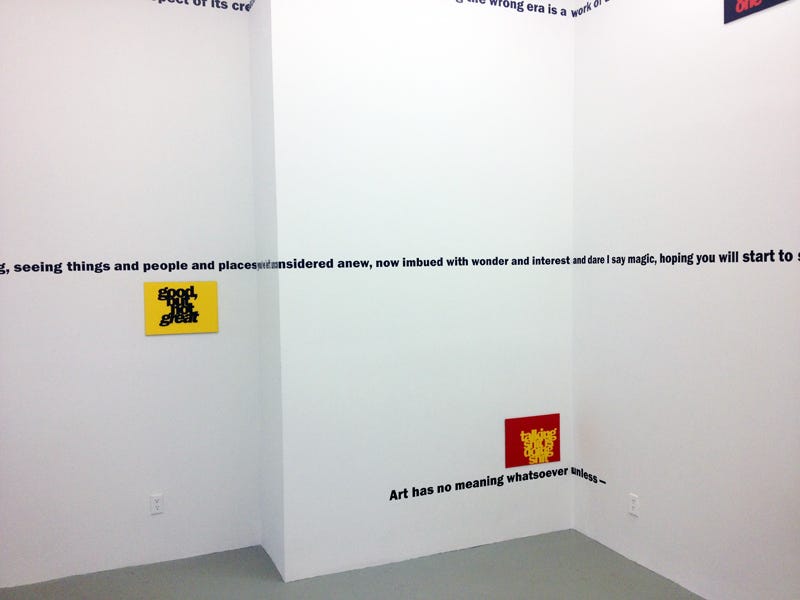
If you were walking on Woodward Avenue in Ridgewood Queens and you peeked into the window of the Kimberly Klark gallery right this second, you’d see that the art in this gallery isn’t painting, drawing, sculpture, installation or performance; it’s writing on the walls. We all know writing is “art,” but what happens when writing becomes art-art? In a polygot-tastic move, novelist James Hannaham (Delicious Foods) is the accomplished artist behind the new text-based art show “Lengthy Statements/Brief Statements.” His work reminds us — among other things — of the thin and sometimes arbitrary line between “art” and “writing.”

James Hannaham art

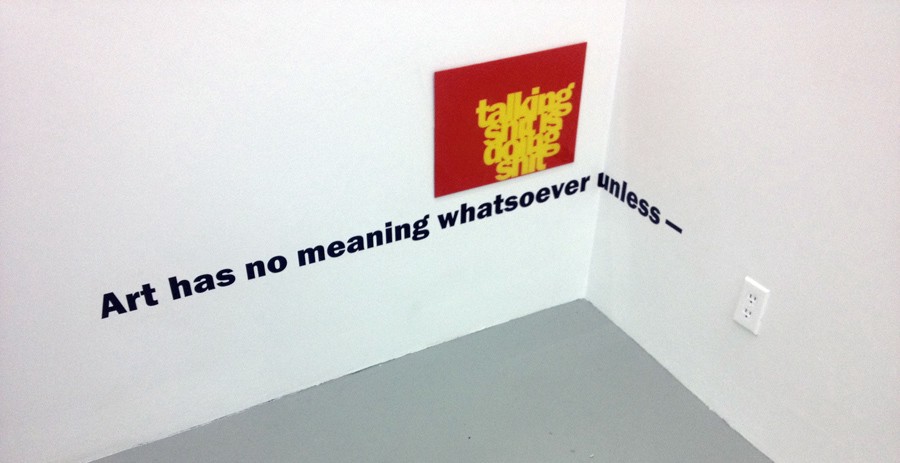
On the small white walls of the gallery are three sentences (well, maybe four) in black letters which wrap around the length of the gallery, over the window around corners and into and out of a small closet. Reproducing the contents of the sentences in their entirety here would be a total spoiler, so I’ll just say there’s something about the sentences being in a physical space that is essential of the experience of reading them. At the opening, a lot of the folks were spinning around on their heels, bobbing their heads around, and embodying these sentences — turning their bodies and transforming the act of reading into a sort of shuffling subtle softshoe. The contents of the sentences play with certain statements we all make — or have all heard — about the creative process.

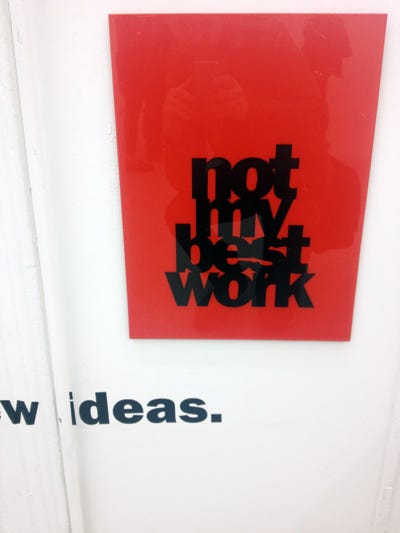
Punctuating the wrap-around sentences are rectangular individual signs containing punchy phrases that sound like they’ve come straight out of a parody of a creative writing workshop. “Not My Best Work,” is any easy favorite for anyone who has created anything, but the more biting “It Fails On Its Own Terms” asserts a wonderfully glib and paradoxical smack to the critical brain. This one is located toward the floor of the gallery making you crane your neck to look at it and literally look down on the phrase. While this is happening, you’re forced think if you’ve used this phrase before and whether or not you were totally full of shit when you said it. What are a thing’s “own terms” anyway?

Intentionally, the font used is very similar to the font of the MoMA. Hannaham wielded a vinyl letter cutter to craft these statements, which if you squint a certain way is an even more hardcore way of “writing” than using a vintage typewriter. Hannaham told me that the font is Franklin Gothic Heavy, or something close to it. “The earlier work I’ve done, ‘didactics’ and ‘wall texts’ is intended to look exactly like something at MoMA.” This sensibility was echoed by one of the gallery’s curators who said to me at opening on Saturday, “What if the wall text you see at a show could be the show? Sometimes there’s a feeling of having read the wall text in an art museum. I think this show creates that feeling.” All of this follows in the footsteps of Hannahams previous text-based art shows like “Card Tricks,” which actually did attempt, in the author/artist’s words were “wall texts for artworks which were impossible to fabricate.”

Still, when we read wall text in museums, we don’t think about a person actually making the letters, but in this case, we do. Both the creation of the letters and affixing them to the walls of the gallery is a quotidian process very different (perhaps) from the wall texts at places like MoMA. But, Hannaham did clarify to me that “None of it [the creation of the letters] is ‘freehand’ exactly, except for the install itself. The cutter precisely cuts out the lettering and then you have to remove the parts of the vinyl you don’t want…”

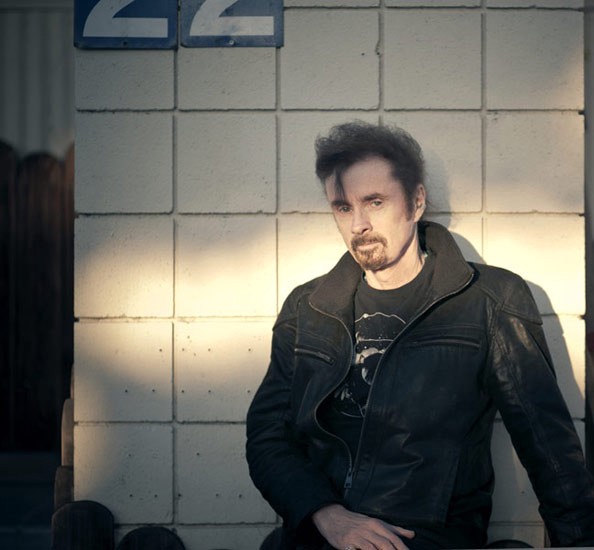
James Hannaham

Cutting and removing sentences you don’t want with precision is something writers generally do with Microsoft track-changes. Here, Hannaham is doing it with his hands and a blade, combining the notions that art is something we do with our brains versus something we do with our hands.

Kimberly Klark has a set of curators/ directors who all wanted to remain anonymous for the purpose of this article. One of the directors who helped to develop and install “Length Statements/Brief Statements,” told me at Saturday’s opening that this text-based show “is the first like it,” but was keen to point out the gallery itself “doesn’t have any specific aesthetic thrust.” This notion was supported by another gallery director who mentioned that the Kimberly Klark gallery is “trying to do multi-disciplinary programming in a holistic way.” In chatting with everyone, it was clear that none of these curators/artists are just one thing or another and that the Kimberly Klark gallery is just as likely to have a poetry reading as it is to have a traditional art show.

Of course text-based art like Hannaham’s is not completely new. From Jenny Holzer to Bruce Nauman, words as art made for the world of art are certainly a thing. In a sense, everybody likes text based art because it’s a comforting medium for those who feel like they’re lay-people when it comes to “real” art. Still, because James Hannaham is such a literary figure, this bridging of text and art succeeds in ways that perhaps Holzer or Nauman’s pieces never could.

As one of the directors and I were trying to pick our favorite phrase in the show, someone said they thought the statements were successful because we were seeing “prepackaged sentences and the types of things you hear because people want an excuse to talk.”

At which point I closed my mouth and we stood there, totally silent and reading.

“Lengthy Statements/Brief Statements” is on display at the Kimberly Klark gallery until 5/10/15.

We Are The Olfanauts

by Deji Bryce Olukotun, recommended by OR Books

U have to whyff this.

Cant.

Y not? ☹

Just cant.

Shes bak.

Dont care. Send it up.

I pasted in the link anyway, ignoring Aubrey’s decision.

www.olfanautics.com/13503093!hsfi9hhhh

I knew she would whyff it eventually. One click and you were there. You may as well download it directly into your brain, and with a whyff the effect was nearly as instantaneous. I played the video again to confirm that it was as special as I remembered.

Close-up of a desk. Glass top on a chrome frame. On the desk, a knife, a leather strap, a small glass bowl, and the girl’s wrist. Light tan skin. The whyff: hints of lilac, clearly the girl’s perfume.

She holds the knife in her palm and waves her second hand over it, like a game show hostess displaying a valuable prize. Then she stabs the tip of her finger with the knife and lets her blood trickle into the bowl. The whyff is not of pain, nor the metallic scent of blood. It smells like the richest, freshest strawberries, collected right there in the bowl. And you can hear her laughing.

I should say that the girl appeared to stab the tip of her finger with the knife. You see, there was no proof that she had actually done it. When I slowed the video down, and advanced it frame by frame, her index finger and thumb obscured my view at the exact moment of puncture. She may have stabbed her own finger, or she may have somehow burst a capsule of fake blood with her fingers. Or, more likely, based on the whyff, a capsule of concentrated strawberry essence. It was either the work of a skillful illusionist or a deranged sadomasochist. With my Trunk on, it smelled hilarious.

Aubrey eventually messaged back: Told u to send it up.

What abt the whyff??

Send it up.

Shld Private Review.

Send it up.

Cmon, grrl. Strawberries!

This was the second video this user had posted, and each had ended with a whyff that completely subverted the image of the video with humor. It felt like she was playing with us, questioning whether we would believe our eyes or other senses. Wasn’t that reason enough to Private Review? To talk it through? Last week, Aubrey and I had met in the Private Review rooms twice. I wasn’t going to let her ruin my discovery, though. Instead of sending it up, as she had ordered, I posted the link to ALL-TEAM. Immediately I heard gasps in the cubicles around me.

“Oh, shit, Renton!”

“She’s back!”

“Aw, man, I bet she’s hot!”

Then they went back to their keypads and we began a group chat.

You gonna send it up?

What do you think?

Think we shld.

You smell the strawberries?

I thought it was raspberries.

You cant see the wound.

She a kid?

No, shes 18+.

You hear her laughing?

Crazy grl.

I let the discussion go on for some time as the team chatted amongst themselves, enjoying the fact that with every passing moment the post was staying online, and some new stranger could appreciate its artistry. There was something beautiful about the glass and the steel and the blood. Only the essentials, the sterility of the table against the violence engendered in the blade. The whorls in the redness as the blood filled the bowl, the burst of strawberries and the laughter, ethereal, hovering above it all.

In the end someone sent it up. I wasn’t surprised. We were paid to be cautious, to keep the slipstream of information flowing at all costs, even if it meant removing some of it from the world.

Our team was based in a multibillion-dollar technology park fifteen kilometers outside Nairobi, and our data servers, which would have made us liable under Kenyan law, floated above national airspace in tethered balloons. The Danish architect had modeled the Olfanautics complex after a scene from Karen Blixen’s novel, as if that was what we secretly aspired to, a coffee ranch nestled against the foothills of some dew-soaked savannah. The cafeteria was intended to replicate the feel of a safari tent. Catenary steel cables held up an undulating layer of fabric, which gleamed white in the midday sun. In reality, the tent was the closest I had ever been to a safari. I only left Nairobi to go rock climbing.

Aubrey found me as I was ordering a double veggie burger with half a bun and six spears of broccollini. I could tell from the few frayed braids poking out of her headwrap that she had not slept well last night, nor had she gone to the campus hairdresser to clean herself up. I reached for her thigh as soon as she sat down but she swatted it away.

“I told you to send it up.”

“Nice to see you, too, Aubrey,” I said.

“I’m your boss, Renton. If I say send the video up, then send it up. You’re making me look bad.”

That was the problem with dating your supervisor. She thought any discussion could be resolved by pulling rank.

“Didn’t you whyff the strawberries? They were hilarious, hey. That girl’s an actress or something.”

“We don’t know that, Renton. She could have really been cutting herself. Or someone could have been forcing her off camera and layered in that whyff afterward. We don’t even know if she’s a she. It could be a man.”

Aubrey always pulled her liberal philosophy on me, as if I couldn’t trust my own nose.

“The metadata said she was a twenty-four-year-old woman,” I said. “I looked at the time signatures. The whyff was recorded simultaneously.”

“The signatures could have been spoofed.”

“That’s only happened once.”

I wasn’t concerned about speaking to Aubrey so intimately in the cafeteria. No one would have believed that we were together, because for all appearances, I was a handsome young Kenyan man with his pick of eligible women, and Aubrey was a frumpy foreigner from Somewhere Else. But they were using the wrong sense when they judged her.

“Aubs, maybe you should eat something.”

“We can’t Private Review anymore, Renton.”

“Here, have one,” I offered. I liked to eat broccolini from the spear to the tip, leaving the head for last.

“Those rooms are set aside for us to do our jobs.”

“It’s high in folate. And iron.”

She glanced around. “Would you stop bloody ignoring me!”

“I think you need to eat something.”

“I don’t want any of those bloody things. They’re not natural. They were invented by some scientist.”

“At least it’s food.” I showed her the screen of my Quantiband on my wrist. “Says I need five hundred milligrams of iron today, and these will give me a thousand. Don’t shoot the messenger, hey. I do what I’m told.”

“Just not when your boss is the one telling you,” she said, and walked away. Only after I had finished my broccolini spears did I realize that she hadn’t been wearing her Quantiband.

That evening I tried to forget my conversation with Aubrey because I wanted to be totally focused on my Passion. In three years, I planned to freeclimb the sheer granite face of the Orabeskopf Wall in Namibia, one of the most difficult routes in southern Africa, and I had meticulously plotted out my conditioning, fitness, and routes with my personal fitness instructor, whose name was Rocky. You see, because of my work on Trust & Safety, we were afforded certain additional privileges: a trainer (mine was Rocky), a psychologist, a full subscription Quantiband, an additional five floating holidays, a stipend of OlfaBucks that we could use at the gift shop, and access to a sleep specialist. The company would support one Passion for each of us. It could be running a marathon, completing a competitive Scrabble tournament, or knitting a quilt. What mattered is that you chose a Passion with a measureable goal. That’s why I loved my Quantiband: it calculated my heart rate, blood pressure, distance walked, calories, alertness, mood, sleep quality, and even the frequency with which I had sex. When I was treating my body well, my Quantiband felt as light as air, but it could constrict itself around my wrist like a snake when I veered off my programmed routine.

My role at T&S was fairly simple: to respond to content flagged by our users that violated our Terms of Service. Olfanautics was the global pioneer in scented social media. Our Whyff product allowed users to send scents to people around the world. It was originally a stand-alone device that utilized four fundamental scents — woody, pungent, sweet, and decayed — and combined them proportionately in a spray to mimic real scents, but few people could afford to buy it. As the technology grew better, and tinier, Olfanautics became a standard feature of smartphones that could also record video and audio. Many users would whyff frequently at first and then save it for special occasions, like showing off a fresh baked pie during the holidays, or sharing a vacation by the beach. Some users would turn off the feature when they wanted more privacy but most preferred to have the ability to whyff, if they might need it, than not to have it. Then there were people like me who whyffed incessantly, who became so enthralled by the unlimited palate of experience that we sought out its very source.

My main job was to monitor the whyffs that users considered suspicious or objectionable. I did so through my Trunk, a tube that looked like the oxygen mask of a fighter jet pilot. Between each Whyff, the Trunk would inject a neutral scent to cleanse my palate. You see, scent is determined more by your tongue than your nose — think of how hard it is to taste anything when you have a bad cold — and everyone on my team had a significantly higher number of papillae on our tongues than your average user. In another era, we might have been perfumers selling bottles of lavender along the cobblestone of Grasse. Today we were the Olfanauts. We transported our users safely and peacefully to exciting realms of discovery. So went our tagline.

I loved our tagline.

The video safety team would pull down the usual garbage: sexual content, violence, self-mutilation, and child pornography. But sometimes people would inject a whyff into an otherwise normal video. A video of a birthday cake might stink like feces, or a trickling stream might reek of decomposition. Usually these were hatchet jobs that were crudely added to the video, and our software would automatically flag the whyffs because of their metadata. Occasionally we’d come across a whyff of skilled artistry, when the scent would waft through the Trunk like a sublime wind. Like the girl with the knife.

When I couldn’t decide on a case by myself, I could present it to my supervisor, Aubrey, and then she had the option of sending it up to the Deciders — members of the legal and marketing teams back in Denmark. Only Aubrey had ever met them, although we had all been flown to Copenhagen for orientation when we were hired. (That was a legendary trip, hey.)

Rocky was waiting for me at the gym when I arrived. He was a grizzly, colored South African with a bursting Afro and wind-seared skin. He claimed to have broken thirty-two bones, fifteen of which he had shattered on the same fall in the Dolomites back when he was a competitive climber. He wore glasses with thick black plastic rims that he had owned for so long that they had twice gone in, and out, of fashion while they were still on his nose. He’d switched from rock climbing to bouldering after he had gnarled his right leg, and I had seen videos of him skittering under impossible slabs of granite like a dassie.

I began strapping on my harness.

“Wait, wait, bru,” Rocky said. “Let’s hit the fingerboard first.”

“Quantiband doesn’t say I need to get on the fingerboard until next week. I’m supposed to climb.”

“That thing doesn’t know how to climb.”

“It knows how to measure my progress. That’s what it’s supposed to do.”

Rocky sighed. “Alright, big man. Think you know what you’re doing? Give this route a try, then.” He hooked me in to his carabiner and illuminated a green climbing path for me to follow on the wall.

I gleefully dipped my hands in my powder bag. I love the smell of the powder as you grab the first holds. It smells like freedom, hey, as if I am climbing towards my dreams. Before long I had pulled myself about thirty feet off the ground. Then I got to a problem that I couldn’t navigate. There was a nasty slither of a hold that I thought I could crimp, and as I dug my fingers in, my hand stiffened from fatigue and my feet slid out from under me. I tried to dyno my hip onto the hold but it was too late. And I was falling rapidly towards the mats below.

My head snapped forward so hard that my nose bashed into kneecap.

“Got ya!” Rocky said. He gradually lowered me to the ground.

I clutched at my nose as he unclipped my harness. I could feel numbness spreading along my eye socket.

“You all right there, bru?”

“No, I’m not alright! Why the fuck didn’t you catch me earlier, Rocky?”

Rocky recoiled: “Why the fuck did you fall?”

“I couldn’t crimp it. The route was too hard.”

“Here, let me look at your nose. Come on, move your hand out of the way.” I let go, and the blood rushed in painfully. “It’s alright, bru. You’re not bleeding. It was a light knock.”

“Bloody hell.” I was relieved but I could feel my nostrils filling with something. Mucus? Blood? The air was already starting to feel stale. It was as if the smells were slipping past me, as if the room was coated in a skein of mud.

“You weren’t prepared for it, bru,” he went on, tapping his temple with his finger. “It was a simple problem. It wasn’t your finger strength but your mind that failed you.”

I didn’t like Rocky’s tone. I paid him to help me fulfill my Passion, not to cause me more problems. I was in line for a promotion soon. “How am I supposed to go to work tomorrow if I can’t even smell your stinking breath? You made a mistake, Rocky. Just admit it.”

“That’s kak. I’m not the one who fell.”

I began tapping away on my Quantiband. “Says here that I shouldn’t have been doing this route for three weeks. This wasn’t part of the program. I could report you for this.”

Now I had his attention. “Calm down there, bru. There’s no need to report it.”

At Olfanautics, the numbers didn’t lie. The Quantiband would have measured the speed of my fall in meters per second as well as my rise in pulse. If I could show, objectively, that someone had put my work at risk then he would be dismissed immediately. The same went for all of us.

“Why shouldn’t I report you?”

“Because then you wouldn’t get any better at climbing. I wanted to challenge you, bru. You can’t control everything when you’re out there. That’s part of climbing.”

“But it’s not part of the program. The program says I get better in three weeks. That’s the whole point. If you want to challenge me then put it in the program.”

“Come on, let’s forget it, Renton. You’re right. My mistake, bru. I put in the wrong route.” He tapped on the wall and illuminated a yellow route, one that I had already successfully completed twice before. “This is what the program wanted, right?”

He grabbed for the carabiner on my harness, but I pushed his hand away. “No, I need to get some ice for my nose.”

“Come on, bru. Your nose is fine. You took a small knock, is all. Let’s hook you in. Yellow’s still a bastard of a route. You haven’t even free-climbed it yet.”

It was so easy to screenshot my Quantiband, and even easier to send it to security. I looked at him blankly as if I didn’t understand, buying time. He began pleading with me to hook me in, insistently, pathetically even.

“What are you waiting for, Renton? It was a simple mistake. Let me hook you in!”

“No, it’s too late.”

Olfanautics only allowed the perimeter security to carry guns. So the ones who arrived wielded batons, but the effect was still intimidating enough to prevent Rocky from putting up any sort of struggle.

“You think the Orabeskopf Wall gives a shit about that thing on your wrist, bru?” he shouted back. “You think that thing is going to save you when you’re on the wall and a vulture starts pecking at your fingers? That’s what happened to me! I was like Prometheus, getting my liver pecked out by an eagle, bru. I didn’t have one of those kak wristbands. I let it eat my own hand and then I climbed up that wall! The Orabeskopf says fuck-all to your wrist! That wind will tear you off that route and splatter your brains in the sand!”

But I’d heard that story about the vulture many times before, and it didn’t scare me anymore. My Quantiband told me that there was a one in ten million chance of it ever happening to me. I had whyffed some terrible things during my time at Olfanautics — ritual dismemberment by a militia in Bukavu with a volcano looming in the background, a woman being raped on a frozen canal in Ottawa, and once, a manhole cover in Nagoya crushing an old nun on the sidewalk after it was ejected by a blast of gas. If Rocky had whyffed these things, too, he might have left with a little more dignity. The world was not a fair place, and I was the one who helped people forget that fact. As soon as he had left, I put in an order for a new fitness instructor.

Except for the death of the nun in Nagoya, which crept into my dreams and made me sad in a way that I don’t think I’ll ever understand (the ferocious spin of the manhole cover, the febrile skull), I had learned to forget the horrific smells that permeated my Trunk. I had trained for months at Olfanautics to expunge them from my mind, and the regimen had worked for the most part. You have to let things go, you see.

But I hadn’t finished my climbing routine, so I felt edgy when I took the shuttle back to the Olfanautics housing complex, and my nose hurt like hell. The pain from my fall had spread from the base of my skull to my shoulders, and seemed to be wrapping itself around my chest.

My apartment had two bedrooms, a small balcony, and one and a half bathrooms. Behind it, I had a tolerable view of a tennis court surrounded by electrified razor wire. My unit was subsidized so it was still cheaper than living in the city, and I was permitted to invite guests, usually my parents, to stay with me for six days per month.

Aubrey was sipping on a beer at the living room table when I opened the door.

“What happened to your face?”

“Took a fall at the gym.”

“What about those bandages?”

“It’s to keep my nostrils open. Doctor said there might be some temporary blockage.” When she didn’t say anything, I added: “I should still be able to put in my shift tomorrow.”

“I’m not worried about that anymore.”

Her face was as distraught as when we’d met in the cafeteria. If she’d been wearing her Quantiband, it would have been twisted tight around her wrist like a tourniquet. But she still didn’t have it on. Maybe it was that sense of freedom that made her come over to me. Because the next thing I knew, she began opening the buttons of my shirt. I didn’t stop her. Aubrey was the most beautiful woman I had ever met. Her natural odor was enough to turn my head, and she layered on essential oils so that she was a fragrant mosaic, a true artiste who could compose entire olfascapes of inspired brilliance. I had never been able to resist her. On our first secret date, she had guessed what cologne I would wear and applied an extract of argan nuts on her skin, so that when we touched we smelled like buttered popcorn. I found other women repulsive by comparison, as if they had showered themselves in crude perfume.

But as she slowly peeled off my shirt, my bashed-in nose seemed to be obscuring everything. “I can’t smell you.”

“Then feel me.”

In the Private Review rooms, Aubrey and I would sniff each other more than we licked or kissed, and this took time. When we were really horny, we’d inhale each other’s most private scents — our groins, armpits, and anuses — like animals in the throes of estrus. But with my swollen nose I felt clumsy, as if I was watching myself make love from a distance, and my fingertips couldn’t make up for the lack of sensation. Aubrey, on the other hand, enjoyed every second of it. She lingered over my bandages and wrapped herself around me. Then she dug her hips into mine until she came. Even with her breasts flopping against my face and her full buttocks in my hands I couldn’t stay aroused without my sense of smell, and we both gave up trying.

As we lay on my bed, Aubrey announced: “This isn’t working.” She always said depressing things after sex.

“It’s my fault. I couldn’t get into it.”

“No, Renton. I mean us. I’m your boss. We can’t do this anymore.”

I turned to face her, suddenly concerned. “What do you mean?”

“The Deciders know.”

“You told them?”

“No, the Private Review rooms are all monitored. They’ve known for some time and they confronted me about it.”

I tried to remember everything we might have done or said to each other. She normally made me take off my Quantiband in the Private Review rooms.

“Did they whyff it, too?”

“I don’t think so — at least, I wouldn’t see the point of that. They tracked our bands to see how often we were meeting. I clearly violated my Terms of Reference. I’m your boss and it should never have happened. I’ve got to go see them tomorrow.”

“They’re flying you to Copenhagen?”

“Yeah.”

“That’s a good sign, right? They wouldn’t fly you up there if they wanted to fire you.”

She considered this. “I suppose so.”

“Why did you come here tonight, Aubs?”

“I wanted to do it one last time.”

I raised from the bed to look out the window. Beyond the tennis court were rows upon rows of sagging acacia trees that the Danish architect had planted all around the campus, but the soil was too damp for the trees and their roots were slowly drowning. I had never liked them. Their pollen gave me sneezing fits. If I had my way, I’d have them all cut down. “How can you say it’s the last time? How is that fair? Shouldn’t I also know when it’s the last time? You can’t break it off and say it’s the last time without telling me!”

“I’m sorry, Renton. It’s not just the Deciders. It’s — it’s the unreality of it.”

“Was it the video of the girl? The strawberries?”

“No, that’s not it.”

“I meant it as a joke. There’s no need to break up over a thing like that.”

“You know what I spent this morning doing? Watching a woman eat a goat alive. She had filed her teeth into points, Renton. Like a vampire. Even had the makeup on. Her girlfriend — I think that’s who it was — was screaming at her to eat more. Shrieking at her to eat more. The poor beast was pinned down by stakes and the girl was tearing into its belly. The stench! Of piss and shit, the goat was in so much pain it was expelling what little bit of life it had left in it. Trying to die.”

I had never seen Aubrey cry before, and I feared what it might mean.

“Who would do such a thing, Renton? To a harmless animal? I vomited into my Trunk it was so disgusting.”

I could see that she wanted me to feel what she had felt, smell what she had smelled, but I couldn’t let her get to me. Every Olfanaut who burned out tried to drag everyone else down with them. The psychologists had taught us it was called transference. I began searching desperately for my Quantiband, which she must have torn off during sex.

“Why don’t you go see the psychologists, Aubs? That’s what they’re there for.”

“They wouldn’t understand.”

“Of course they would! Mimi helped me with the nun thing. I’m sure she can help you with whatever is bothering you.”

I found my Quantiband beneath my sock at the foot of the bed. I didn’t remember taking the sock off, because I was still wearing the other one.

“Mimi can’t help me, Renton. She can’t help a thing like that. Tell me, when was the last time you left the campus?”

“I go to the Rain Drop all the time.”

“That’s still on the campus!”

“So what? It’s a bar. I like the people there. We have a lot in common.”

“I mean, when was the last time you went downtown? Or anywhere people don’t have to whyff a conversation?”

“My family doesn’t live downtown. They’re out in Kibera.”

“That’s not my point. What we see all day — it’s not right. We made love over a Nazi bookburning last week. A bloody bookburning.”

“We took that video down, Aubrey. We prevented the rest of the world from smelling that filth. That’s something to be proud of. Sure, we had sex in there but we did our job in the end. That’s what matters. We have one job here, and we do it right. I’m sure that’s all the Deciders care about too. That’s why I fired Rocky.”

“What are you talking about?”

I hadn’t meant to tell her, because I knew she’d try to make me feel bad, but now it was too late. “He put me on a dangerous route. That’s how I hurt my nose.”

“So you fired him?”

“Of course! Rocky had it coming to him, Aubs. I’d told him a thousand times that we had to follow the program. It’s not my fault he can’t listen to directions.”

“That’s what I mean by unreality. So what if you hurt your nose — he has a family! How will he survive without this job?”

“What about my family?” I grabbed a glass from the kitchen, and filled it in the sink. “Do you realize this is the only neighborhood within twenty kilometers where you can do this? Drink water straight from the tap? My parents drive here for their drinking water. I’m putting my sister through school. I pay for every funeral in my family. That’s as real as it gets.” I pointed to my Quantiband. “This says right here that I was climbing the wrong route when I fell. Rocky hurt my nose, the tool of my trade. I’m in line for a promotion now and I can’t take the risk. I need someone reliable. Trustworthy. I don’t need his bloody war stories. I need someone safe. Who can commit to the program.”

Aubrey stared at me blankly for a few moments. “You don’t see what this does to us, do you? Today was my big test to determine if I could join the Deciders. And I failed it, Renton. I failed it horribly. Because I told them that if I had my way I’d exterminate those girls from the face of the Earth. I wasn’t thinking about justice. I was thinking about revenge. Revenge on behalf of a mangy fucking goat.”

I drank my glass slowly, trying to taste the filtered water. They ran it through reverse osmosis and then a layer of sand, which normally gave it a delightful mineral quality. But I couldn’t taste a thing.

“You’re not going to get a promotion, Renton. Look at yourself in the mirror and then take a look at management. I recommended you twice but they said you don’t have the pedigree. When was the last time a local was promoted?”

Now I knew Aubrey was planning to move away all along. And she wanted to hurt me while doing it, whatever for I had no idea. That was what happened in the videos. That was what those people did to each other. Even after all we’d been through, I refused to let her do this to me. It was the slippery hold on the wall. The tumble from the granite, the brains in the sand.

“I’m going to be the first one, then.”

You can’t let it all weigh on your shoulders. That’s what Mimi had told me about the nun. You’ve got to let things go.

I snapped my finger. “I know what’s changed — it’s you, Aubrey.”

“Me?”

“Yes, you need a new Passion.”

“You weren’t listening.”

“You made that short film last year, right? That was too close to home. We whyff videos all day, hey. You’ve got to choose something else. Something that really gets you chuffed! Like writing a book. Or dancing. You’ve got to focus on the positive, Aubs! Think of all the value we’re creating for our users. Think about how we protected them from that Nazi video. We saved a little bit of joy for two billion users around the world. We have to celebrate that! You can’t dwell on these things. We’re watching so no one else has to!”

As I went on like this, Aubrey’s face brightened, and before long she seemed to be coming around to the idea. So I was surprised, when I pulled her in for a kiss, and she said: “If evil is humanity turned against itself, Renton, then who are we?”

“We’re the Olfanauts,” I said proudly.

Aubrey left Olfanautics two weeks later, and she was kind enough to say goodbye to me. She also transferred me all of her OlfaBucks, which would allow me to order something from the gift shop, and I think she knew, in her heart, that I would spend it on a Hyperlite Bivouack that I had told her about a few months ago, which I planned to use when I freeclimbed the Orabeskopf Wall in Namibia. I won’t lie — I started dreaming about the nun again as soon as Aubrey left, and I had to work extra hard at my Passion to get that old woman to leave me alone in my sleep. It’s funny how sometimes you only understand what people mean well after they say it. Because I realized that Rocky had been right all along, that I had to be like Prometheus giving the fire to humanity, and that I couldn’t worry about some bird pecking at my fingers as I made my grand ascent.

Ultimate Truths: a conversation with T.C. Boyle

harder they come

There is no need to introduce T.C. Boyle. With the recent publication of The Harder They Come, Boyle’s 25th book in 36 years, he is clearly an institution. If you are a reader, you have at the very least come across his name, a couple of his books, or a story or two of his in a major publication. I have been reading Boyle’s work for half my life. It is a little surreal to be able to say that about a living writer, but it’s comforting, too. He writes and publishes with such consistency that I look forward each year to a new novel or story collection.

Admittedly, there hasn’t been a book by Boyle that I haven’t enjoyed, but The Harder They Come is his most action-driven novel since Talk Talk, and his most engaging plot since The Women. In many ways it is a culmination of a lot of his previous work, his prose and his imagination are firing on all cylinders.

Boyle and I spoke by phone, he in a hotel room in St. Louis and I in an empty office at my day job in southern Oregon. We spoke about geese flying by his window in the shape of a “T,” how I read his 2006 novel, Talk Talk in a single sitting during a 9-hour layover in the Seattle airport, and what he deemed ultimate truths. And all that was before I forced myself to be disciplined and actually interview him.

RWB: One thing that struck me was a review that likened the opening of The Harder They Come to a Clint Eastwood-esque revenge. That irked me. It seemed short-sighted. I think violence and violence as a response isn’t inherently equal to revenge, and in the case of the book it’s more about a reclamation.

TCB: I like your take on it and I agree with you. I haven’t read hardly any of the reviews, so I haven’t seen that one, but I agree with you totally. This is a kind of an instinctive act that Sten commits. It has nothing to do with revenge. You look at the typical American movie, a thriller or revenge thing, and the bad guys are exclusively bad and the good guys exclusively good. And the first half hour, the bad guy, you know, rapes the good guy’s buddies and then sets his house on fire and beats him up. And then in the last parts of the movie the good guy blows him away and we all cheer. Well, I think things are a little more complicated than that. So, the joy for me in writing something like The Harder They Come is to enter deeply into these three characters who are very different from me and to try to appreciate their points of view. And again, this is what literature can do that film doesn’t necessarily do, or that literature can do better because it’s a one-on-one with the reader, and the reader has to reconstruct this for him or herself. So, yeah, I’m with you there.

RWB: Film has to be such a distillation. I grew up around film, filmmakers, and it was what I originally went to school for, but there is definitely a limit to what you can get across in an hour and a half or two hours.

But I think literature can uniquely give you the kind of point of view that is not available in any other art form.

TCB: Absolutely. I love film, incidentally, and you know the new phenomenon of these series on TV, that’s where film is headed, where you’re getting thirty episodes of something. It’s like, War and Peace if it was a trilogy and you could get deeply into each character, and it’s great. Don’t get me wrong, I love film. But I think literature can uniquely give you the kind of point of view that is not available in any other art form. Simply, again, because it’s a one-on-one, reader and writer, and you are filming it in your head.

RWB: Returning to reclamation, the more I thought about it, the more I started to see it in your other work as well. From trying to reclaim identity in Talk Talk or reclaiming the environment, which has come up in multiple titles, and everyone in The Harder They Come seems to be trying to reclaim something. I mean, Sten is trying to reclaim his youth or at least his usefulness, and Sara is trying to reclaim her independence from government or from people she sees as trying to have authority over her, and Adam is trying to reclaim some kind of, I think, an independence that is almost amorphous to him, but definitely involves taking back this sense of belonging to the environment rather than belonging to civilization.

TCB: Yeah, I love it. I love your take on the characters. That’s brilliant. [Laughs] That’s all you have to do, just write that.

RWB: Do you think that concept of reclamation is inherent to human struggle or is there something in that that you’re particularly interested in uncovering?

TCB: Wow. Every story or book is totally different and I just follow it. I don’t have an outline, I don’t have a statement to make, I just follow it. Obviously, I love your interpretation and I could write a thesis on each of my books, but that’s not my job and it’s wrong for me to try and interpret because that kills it for the reader. So, yeah, I like the idea of this reclamation of all three characters as you have expressed, that’s just perfect. I don’t know if this is natural to us. It was natural to these three characters as the drama unfolded. I worked day to day, it moved forward, I made little discoveries, and I see what their interplay is, and that’s how it worked out in this particular book. And I like how you’re tracing it to other books as well. Certainly it’s got to be one of my themes. You know, you don’t begin writing with your themes, you don’t even know what your themes are. You don’t even think about it, you just do the work and then you can see as you go back how it all lines up.

RWB: I never realized how often I used ribs, the imagery of ribs, in my poetry until someone pointed it out and then I got very self-conscious about it.

TCB: [Laughs] Yeah, don’t let it worry you. It’s going to happen with your work, that’s what makes your work individual from everybody else’s, so I don’t let it worry me. I don’t really care what people say about the work or what their expectations are because if they like what I’m doing they have to follow me and they have to trust me, you know. And then on my webpage you always hear people come on and say, ‘aw, I wish you would write more crazy off the wall stories like you did in Descent of Man.’ All right, great, I don’t reject that, I still will. I’ve still written a couple like that every story session, but, you know, follow me. I don’t know where I’m going and I hope it’s going to be worth your while.

RWB: That’s got to be part of the fun, I think, not only for the reader, but as a writer. If you don’t know where you’re going then you get the ability to surprise yourself.

I love writers who take you to a new place every time and you don’t know where it’s going to be, but they’re going to turn you on.

TCB: Right, and so you’re not doing the same thing over and over. I know it’s comforting to some readers, like when you were stuck in that airport surrounded by crap. Some readers love crap, because crap is comforting, you know what’s going to happen. It’s always the same, it’s the same detective, somebody dies, and then they figure it out. To me that’s totally boring. I love writers who take you to a new place every time and you don’t know where it’s going to be, but they’re going to turn you on. That’s the writer I hope that I am. That’s what interests me most of all.

RWB: Yeah, I think I’ve found that. I mean, at this point I think I’ve read at least 85% of your books and the rest are in my to-read pile.

TCB: Well, for instance this book follows San Miguel. San Miguel was difficult for me to write because it’s very hermetic, it’s just three women on an island from their point of view and in a historic period also, and I wanted to do it without irony. My natural form of discourse is to be a wise guy and use humor and irony, and I wanted to see if I could do it. First of all, it’s coming out of a fragmentary memoir and a diary, and these women don’t use irony and I wanted to be true to that. It’s hard for me to do, but I wanted to see if I could do it. So, now this book opens the world up. Now you’ve got action and we’re out in the wide world, but they both have to do with nature and trying to live in nature, or with nature, or apart from nature. Or, as you explained it, to try and reclaim your place in nature outside of society all together.

RWB: And I think looking at your novels versus your short stories, when I started The Harder They Come, that opening chapter with Sten and his wife in Costa Rica, that almost felt to me like I was reading one of your short stories, so it was really interesting to see how you went from there and opened up this whole universe around that.

TCB: I should say that I didn’t write it as a short story, it’s just the first chapter, even though it was published in Harper’s last month as if it were a complete story. But as you can see, you turn the page and we are in the same scene and the story continues. So, yeah, it did have a kind of set piece quality to it, but I think you could say this also about the opening chapter of When the Killing’s Done, which has the same effect for me. But still, it’s just part of a larger piece. I didn’t conceive it as a story and expand it. I’ve never had the experience, in fact, of having a story and expanding it to a novel or vice versa, shrinking something down. I’m very, kind of singleminded. I write a novel and I’m going to stick with it until I’m done, then I’ll write stories until they peter out, and then I’ll write a novel and so on. So, I’m glad it has that effect, but it is part of a larger piece.

RWB: Another thing that really fascinated me about the book is the look at mental health, regarding Adam. I’ve read about the inspirations behind that with schizophrenia, as well as the true stories that inspired the book.

TCB: You read the thing on Buzzfeed? The little essay?

RWB: Yeah.

TCB: Okay.

RWB: Something I worry about in terms of mental health and the gun violence we see in this country is not only the stigma that exists already, but when you see someone go shoot up a school or something and then find out that person was bipolar or schizophrenic, to me that feels like it’s going to concern people more. Do you think exploring that in art is a way we can combat that stigma?

TCB: I’m only examining individual cases. I mean, we could say that anyone who shoots up a school or a movie theater is insane in one way or another, right? You’d have to say Hitler was insane, yes? That’s just a definition. I’m just concerned with individual cases here, I don’t know if schizophrenics will be stigmatized. Obviously the smallest percentage of schizophrenics are like Adam. My friend didn’t shoot anybody, you know. Actually the two schizophrenics I’ve known well are totally non-violent. So, I don’t really know how to respond to that exactly. Except that you have to look at individual cases. As you know, we have these psychotropic drugs we can give to people that are mentally disabled in one way or another and they can help balance out the problem. However, then we throw them out on the streets and they don’t take the drugs and they’re there screaming on a street corner all day long. It’s a real problem of our society where people need care but we threw a lot of them out on the streets and closed down the mental hospitals. I don’t know if that’s doing our society a lot of good.

RWB: After writing a character like Adam do you feel like you understand something about that that you didn’t before?

TCB: Well, certainly the challenge here was to enter into Adam’s way of thinking and try to give that to the reader, and I would hope that, you know, as I said earlier that all three characters are very different from me and from most people who will read the book, I think you should understand them and sympathize with them to a degree. I mean, we can’t condone that Adam killed two people, we can’t condone, necessarily, that Sten killed this man even if it was in self-defense, and I don’t know if we can condone Sara’s attitude towards being against all society and paying her taxes and not being a citizen. Yet, I hope that we could understand them, and so that’s what I’m trying to do in the case of Adam.

You know, I’ve written a schizophrenic before in Stanley McCormick of Riven Rock. But I had his complete psychiatric record. A thousand pages of it. So, what he saw were the actual things he reported to his psychiatrist. In the case of Adam, I do have this fifty page police report of the actual guy. And some of the odd things mentioned in it, that he was arrested for going to the Chinese consulate and throwing these Chinese stars he’d made over the wall. What do I make of that? I tried to see a possibility from the character’s point of view of why he would do these things. And my discovery of his obsession with [John] Colter seemed to bring that all together for me, the Chinese as aliens and the new hostiles and so on and so on.

RWB: That was one thing that fascinated me, was that subtext of the Chinese consulate episode, because there’s not necessarily a lot of detail on it but there’s a lot of little clues that you leave along the way that his lack of stability has been increasing over time.

TCB: Right, and so how does this disease develop, or this imbalance develop, and what do you do about it, and how might this individual be perceiving the world that’s different from us? You know, when I published Riven Rock, back in ’98, I happened to be on tour. I’m constantly on tour. [Laughs] I was in Seattle, and I have media escorts in every town and I know them well. They’re wonderful, they get me where I need to go, radio stations and so on, and the woman there was sick or something and she had one of her employees, a new person, a middle aged woman, and she told me that the book was very moving for her because her brother was schizophrenic and she hadn’t seen him in ten years. He refused to take his drugs, he dropped out of society, and she had just gotten in contact with him a couple weeks before. He was living by himself in a little apartment and he brought her over, and what he does is, everyday, he does a hit of straight LSD. So, can you imagine? This is how he is trying to self-medicate to bring his wiring into some degree of normalcy. I mean, that is just astonishing. So, every case has got to be totally different. And it’s very hard for us to try and imagine what perceptions are. It’s hard for us to understand anybody’s point of view or anybody’s perceptions, but particularly in this case.

So, I wrote that essay because of my friend, two friends actually, but my very closest friend. It just presents a tremendous narrative challenge and I think that was probably one of the motivating factors of writing the book. I did research on a lot of shooters. Sadly, they are very similar in a lot of ways and there’s a kind of competition amongst them, of course, to up the ante. Like ISIS, for instance, are outrageous and violent and callous and horrible and the next. But this one individual spoke to me because of the nature connection.

RWB: It seemed like there was a big difference from some of your other work, but that is something that makes it make sense in terms of your work as well.

TCB: We go into nature to heal. One of the things that motivated my writing Drop City was a book by John Haines, the Alaskan poet who went up there after World War II and he wrote a book, it’s called, I think, The Stars, the Snow, the Fire. After WWII, he was in post-traumatic stress, and he went and lived in this fur trapper for a couple of years near Fairbanks at the time. He went there in order to heal. To just be in nature and you’re focused in nature on just surviving and living within nature day-to-day without the accoutrements of civilization or the aggravations of civilization or, actually, the competition of other people.

We go to nature to heal, and in Adam’s case he wasn’t able to fully let go of civilization. He had to constantly go back to Sara even though he belittled himself for it, he knew it was weak, but he had to go back and get the medicine for giardia, for instance. He couldn’t be fully in nature, and again, this is the proposition in Drop City, too. That was during the hippy era when there was the back-to-the-Earth movement. Let’s drop off this capitalist wheel which is taking us to destruction of everything and let’s try to live more simply. Well, that’s great, but is it possible with seven billion people and nature shrinking?

RWB: It almost seems like a cruel irony. We’ve put ourselves so deep into modernity that going away from that completely is getting harder and harder no matter what our intentions are.

I am in this deep trance each day for hours. I’m popping back and forth, in and out of it.

TCB: I don’t know about you, but I am able to get out of everything through writing. I am in this deep trance each day for hours. I’m popping back and forth, in and out of it. That’s one way. But, I like to spend time in nature for the same reason. I shut everything off. When I’m done with work I’m not going to worry about emails or anything else. I’m just done, that’s it, it’s over for the day. And I like to go out and do something else, something in nature if I can, whether that’s going out in the backwoods of the yard or keeping the house from falling down or up on the mountains when I’m done with work. During the summer I’m just in the mountains hiking around with the dog. I need that. I need that so much, and a lot of people in society have no experience of it. We say save the forests or save the environment, but most people don’t have any experience, they don’t even know what we’re talking about.

RWB: Especially in the continental states there’s such a distance between where we are and where there’s true nature without distractions.

TCB: Absolutely. Now more and more, we’re an electronic society where there is no society, where everybody is living a virtual reality, everybody is locked inside behind their gates and their apartments, their condos, everything is delivered to them, there’s no kind of village life where you walk to the bank and see people and make jokes. There’s nothing like that. Everything is delivered. The last place, the last bastion of people seeing people is bars. You know, of course, in my basement lab I’m working on a bar app so you don’t have to leave home, it just springs up around you in your apartment and you’ve got your babes there and your drinks. [Laughs] Why go out?

RWB: That app would be very dangerous.

TCB: It would be very dangerous. Do you, by any chance, know my story “The Relive Box” in The New Yorker?

RWB: I remember seeing you post about it on your site.

TCB: It’s one of those inventions like this. It’s about gaming, video games.

RWB: I’m on the precipice of that age, I grew up with computers and so a lot of my life has been involved in technology, but there’s still a cut off. There are still things that younger generations are doing, playing games that I just can’t wrap my head around.

But people don’t know how to shut off, they’re afraid to be missing something.

TCB: Everything in its place. Like TV, for instance, the reason I resent TV is because I grew up in a working class family. The TV went on when we got home from school and work and went off when we went to bed. That was the whole thing, there was nothing else. It’s okay, if you know how to shut things off. But people don’t know how to shut off, they’re afraid to be missing something. The 24/7 news cycle. Give me a break. When I’m home I read the newspaper every morning and I’m depressed and life sucks, but up on the mountain there is no internet and there is no newspaper and after a couple days I feel a lot better about life and humanity. It’s simple.

RWB: I can’t read the newspaper. My wife does, cover to cover, and I tell her that, I can’t read it for that reason, it just makes me too depressed about things.

TCB: And enraged, not to mention.

RWB: Exactly.

Another aspect of the book that really grabbed me was Sara’s hope to be a sovereign person, she mentions all the time that she doesn’t have a ‘contract’ with the government. Between California and Oregon we have a lot of those folks, we had an incident here last summer with a gentleman who was trying to claim he was separate from the government and it didn’t end well. And, I found that really fascinating with Sara, because on the one hand she put herself right in the thick of being involved with society, she hasn’t gone to the Adam lengths of trying to go back to nature, but she still wants to be divorced from everything she doesn’t want to personally be involved with. It’s kind of selective.

TCB: Exactly, and Adam, too. Adam’s just more extreme about it. This is where the themes of the book start to come to me, when I discovered Sara and wrote her after the first Sten section, so it’s about American anti-authoritarianism. I’ve been taught from the youngest age to be skeptical of authority and not march in lockstep with everyone else, think for yourself, etc. But, where is the line between that and this bogus sovereign citizens movement, where as I imply a little in the book, they have this belief about the universal commercial code that absolves them from paying taxes, and there are gurus like Jerry Kane, who was killed in a shootout with the police, who are just violently anti-government and have some kind of program to ‘prove’ it’s okay. And, of course, I’d love to not have to pay my taxes or wear my seatbelt. Or, you go to a park and there are all these prohibitions. Or, the “nanny state” where you can’t smoke and all this stuff. Okay. Again, where is the line between we all agree to cooperate and have a society or we all are going to be just, or at least a third of the world is ruled by bully boys and gangs at this point. Especially all these societies in the Middle East and Africa that are rundown and just taken over by gangs. All of that, I think, these questions are raised by The Harder They Come.

RWB: There is just so much about the book that fascinated me. I was really impressed with the way all those themes managed to tie together, even as related as some of them are, I thought it was impressive that they came together so strongly.

TCB: Thanks so much, Ryan. I love to hear that. You’re one of the readers I’m writing for, that really get it. But, on the other hand, like you when you’re writing, I’m just following it. Yes, this is my twenty-fifth book and I love to do it, this is my life and I write in order to make something and also to order my thoughts and reflect on things. I couldn’t do it otherwise. And I’m glad that you see it all comes together so tightly, that’s very pleasing to me because when you make something, whether it’s a pot that you’re going to fire or a story or a piece of furniture or whatever it is, you’re just following your own nature to see how it turns out. The joy of it is to see if it turns out. And how it’s going to turn out. And as I’m moving through it, day by day, I’m seeing how it’s alive and how all the scenes come out and how it is going to be tightly structured and that’s part of the joy of making something that you feel is good. But really, wow, I’m just doing what comes natural.

RWB: I’m sure it helps having the longevity that you’ve had, it probably ingrains a bit of that.

TCB: Yeah, and I don’t want to repeat myself. A lot of writers burn out and keep writing the same books over and over. I won’t mention any names here, but even good writers who get locked into something and write the same thing over and over. I keep trying to mix it up to keep myself and the audience interested.

RWB: Speaking as a reader, I think that is part of what makes waiting for the next book from a writer so worth it and so exciting.

TCB: Well, good. I always blab about the next book, and you already know about it, The Terranauts. It’s got two women and one man as narrators and they’re “I” narrators, and I’ve never quite done it that way before and it’s proving to be kind of fascinating as a technique itself, because as you know, one “I” narrator can contradict another. So, it’s sort of like a close third person point of view, but they are in fact first person narrators.

RWB: I’m really excited to see where that goes. Just based on what you’ve mentioned.

TCB: Me, too. [Laughs] I mean, I’ve only got it half done but I can see where it’s going and I can’t wait to get back to it. And I’m going back to environmental themes. So we had San Miguel locked down on this island, and then we blow it open with The Harder They Come, and now we’re going and taking a man-made environment, a man-made world, a biosphere, with 3,800 species locked inside. Can we have a self-generating biosphere? Can we make that if we needed to when this environment collapses? I wonder.

Five Times Terry Pratchett’s Novels Were There For Me

I was devastated to hear about the death of Terry Pratchett a few weeks ago. He had Alzheimer’s, yes, but I expected him to live long in spite of it. The best-selling author of several fantasy books, the bulk of which consisted of the Discworld series, a fantasy satire series that explored everything from Shakespearean elves to the birth of media. I first found his Discworld books during that important time between middle school and high school, so they’ve greatly influenced my very neural circuitry. The Discworld novels weren’t just playful, satirical fantasies: they were about idealism and justice and inner strength — important texts for me when I was trying to determine and articulate my own values.

I would say most of the Discworld novels switched on the lights in my head, but I made a list of five, in the order I read them. Each one shaped me politically and personally in ways that I could only see in hindsight. And they’ve stayed with me through the years, as I’ve reread for guidance or even just to return to Discworld.

thief of time

1. Thief of Time

I moved to a new town in seventh grade. Sure, it was only 40 minutes away from my old town, but in New Jersey that felt like 40 light years.

In Thief of Time, there’s a character that is described thus:

Jeremy tried to be an interesting person. The trouble was that he was the kind of person who, having decided to be an interesting person, would first of all try to find a book called How To Be An Interesting Person and then see whether there were any courses available.

I had already felt like a stranger in a strange land in my hometown, and the only problem with this new town was that I hadn’t been here long enough to learn all their secret codes. Everyone operated on rules that felt false, even as they worked: wearing designer clothes, going to certain parties, following the right trends. I would try doing these things, not understanding their purpose but hoping for some of their benefits, and do them incorrectly anyway. My clothes would be too scruffy, I would feel ill paying so much for designer, and I couldn’t comprehend the reasoning for a party where you weren’t discussing your feelings and thoughts with your friends.

Thief of Time was the first book I read of the Discworld series, a wry, self-aware land where I felt right at home. Even though Thief of Time was about time traveling monks and witches and Death’s granddaughter and the apocalypse, it felt true. Truer than reality, in some ways: It was about the importance of learning and accepting who you really are, what humanity means, and saving the world, and that felt real to me.

the fifth elephant

2. The Fifth Elephant

Is it odd to say that I still relate to Commander Sam Vimes of the city police department in Ankh-Morpork? But then, I’ve met other strong-valued women who also feel a common connection to Sam Vimes. I think it’s because he’s especially stubborn about his values, a common theme among my female friends. I read this at the end of eighth grade only a few months after the Invasion of Iraq, which to me felt like yet another war America was embroiling ourselves in, for reasons still unknown, despite the buzzwords I would see on TV and hear among the adults in my life.

Vimes was promoted nearly every book, but this book, with his turn as a diplomat, was particularly of importance to me. I should mention now that I have a Master’s in Public Diplomacy. (It’s not that odd — my program director loved the original Star Trek and would reference it in class all the time.) Anyone who’s read anything about diplomacy knows that international relations is full of people who understand the academic notions of diplomacy but not necessarily the etiquette of juggling different interests all at once. Vimes was very bad at being a traditional diplomat, which translated into meaning he was good at being an unconventional diplomat: a little too authentic to be completely tactful and a little too empathetic to be a total jingoist.

In a way, I learned everything about diplomacy from this book. Alright, it’s more like I learned some common ideas that run through diplomatic relations which were satirized in this book: there’s the doublespeak, the subtext, and the casual references to national sovereignty (I was also in Model United Nations in high school). The book came out in 2000, so it still used the pre-9/11 trope of veiled references to Western international relations to Eastern Europe and Russia, but it felt just as relevant no matter who were ascribing as our enemies.

monstrous regiment

3. Monstrous Regiment

I was an angry young feminist when I was in middle school, vibrating with self-righteous energy. This was before it became more popular to be feminist, even before Dove co-opted the term for capitalist purposes.

I read this book right before entering high school. I’d already seen what middle school meant in terms of presenting yourself as a woman — the way you walk (with a sway) and talk (quieter than I could manage), and I knew I was extremely unprepared for high school. Probably mostly in the way that I couldn’t stop talking about feminism and equality.

In Monstrous Regiment, Polly Perks dresses up as a man to go into the army to find her brother. Before doing so, she even has a sequence where she mentally coaches herself to walk more like a man:

At least women swung only their hips. Young men swung everything, from the shoulders down. You have to try to occupy a lot of space, she thought. It makes you look bigger, like a tomcat fluffing his tail.

She is surprised to meet quite a few women in her situation. But they all have their particular reasons to join the army, and it’s not necessarily to fight the good fight. I’ve written about this trope before, but whenever a woman goes to war under a guise, she’s usually partly escaping a method of sexist oppression. Perks lives in a country with a religious bent to their wars — a god that makes ridiculous rules over colors and food and women. Vimes makes a reappearance as a diplomat, but Perks is particularly self-aware about her country’s situation and international image: she sees that her situation can be put in a compromising position if she is too eager for a larger power’s help. It’s a canny way of seeing the patronizing way one country can exert power and seem to aid another, not unlike the patronizing way certain women are treated like political figureheads rather than political figures in their own right.

the truth

4. The Truth

It’s odd to put the Truth on the list because I find the main character so annoying as an adult. With his slightly tactless argumentative nature, William de Worde was a totally new perspective for me. He struggles with class relations and being, well, kind of a pompous jerk — which most characters point out to him. William may have come from a rich, privileged family (not unlike my new environment) but wants to get away from his overbearing, racist father and be a better person. He accidentally starts a newspaper with some dwarves, a vampire, and a romantic interest.

This I read in the beginning of high school, during the 2004 Kerry and Bush election. I joined the speech and debate team, which was perfect for someone with social anxiety, highly sensitivity and super shyness — no, wait. Just kidding. What I mean was, not only was I surrounded by proto-lawyers, I was trying to make sense of the debates storm on in the political arena as well. What was frustrating for me — and still is — because I felt that these arguments (both IRL and in the political arena) came from a sense of ego and bluster more than being truthful and authentic.

I liked how William forced himself to talk to new people, and worked to undo the patriarchal programming in his head, and also did I mention that everyone called him out on his jerkishness? I was young enough that I still found it natural to relate to characters who were deeply, openly flawed. I mean, I still relate to them now, but more egotistical and megalomaniacal women than problematic jerks. William de Worde was a whole new vantage point on characters I was used to relating to — like Vimes and Vetinari — and showed that they were fools in this scheme where they were meant to be fooled. The Truth spun a disturbing plot of the use of power, evoking political thrillers like The Manchurian Candidate or All the Presidents’ Men. Discworld novels treat implicit power structures with even more disgust than those movies do: according to Pratchett’s more idealistic plots, money and power can poison morality when used to uphold said money and power. Sure, it’s simplistic ideology, but the twist in this story is William de Worde’s purposeful pulling away from his aristocratic family: it meant he was willingly rejecting the power structures he knew he was himself complicit in.

going postal

5. Going Postal

Going Postal is the weirdest book in the Discworld series — it’s about a con man named Moist von Lipwig who is tricked into becoming postmaster of the crumbling post office — but somehow it’s the one I hold closest to my heart. The writing is amazing as Pratchett goes deep into Moist’s psyche. Sure, Moist is a simple con man, but his interiority is highly relatable in that he can see how he looks from the outside and how it contrasted with his insides. He was very good at knowing how things would “look,” at the methodology to how you presented yourself that could convince others to trust you. There was something a little too smart about Moist, as if his criminal ways came from boredom more than loose morals.

I was finishing my first year of high school when I read Going Postal. By this time, I knew I would never learn the language of being cool, or calm, or sure. I would always be hungry with curiosity, slightly obsessive in my researching efforts, and reviewing and planning and exploring possibilities of what could be in my mind.

But while I knew who I wasn’t, there was such a large gap between who I wanted to be and who I was. Somehow, Going Postal articulated this gap for me in a way no young adult novel could. It wasn’t about being a certain way, it was about seeing the gap and not understanding how to manage it. While it was frustrating to know this at my young age, it seems especially helpful now. Because while there was a gap, I knew there was a gap. I knew that even if this was how it was now, this wasn’t going to be it for me.

Moist was different from past Discworld characters because he was primarily dishonest, but he still hewed to a certain value system. He, too, knew there was a gap — not in who he wanted to be, but in his value system and what he valued. He played with what other people valued in a big way in a way that made them trust him. They did so wholeheartedly that he felt obligated to make himself more trustworthy.

Eduardo Galeano, Celebrated Leftist Author, Dies at Age 74

Uruguayan journalist and novelist Eduardo Galeano has passed away at age 74 after a struggle with cancer. Galeano was a prolific author, but his best-known work is perhaps 1971’s Open Veins of Latin America: Five Centuries of the Pillage of a Continent, an exploration of the history and the continued pillage of Latin America by Europe and the US. The book was banned in several Latin American countries under military dictatorships, and Galeano was exiled after a Military junta took power in Uruguay in 1973. Galeano also wrote poetry, fiction, and journalism in his long career. His work often combined myth, journalism, history, and literature. He died in Montevideo, Uruguay, where he was also born.

POETRY: Three by Troy Jollimore

Oriole

A bend in the river.
A flaw in the surface.
How many continents
has this lone oriole
crossed to come balance
on our sagging clothesline,
and what urgent thing
is he trying to tell us?
That those who could translate
his song are lagging
a thousand miles
behind? Or that those
who can speak both his tongue
and ours have not yet
been born, that we will go
into the ground
and a thousand years pass
before their eyes open,
the wayward atoms
of our nests and tongues
having been dispersed,
reassigned, and repurposed
into their bright,
unforeseeable bodies?

Lament

No more swamp existence for you, with all
its pleasures, all that rooting around
in forgotten quarters for forgotten nickels.
No more meretricious jazz piano
eliding your way between gross destinations,
unreviewed memoirs by former conundrums,
videos of venal comebacking musicians
going viral on the spiral screen. No more
slowly starving cathedrals into being,
no more convalescing by feel, no more
nosing out the neglected harmonica part
that was meant to fluff out the flourish but got
buried so deep in the mix you could get
the bends coming up from that. No more
lonesome nights on the couch of the cute girl who
will never think of you as anything but
“that sad guy that sleeps on my couch sometimes.”
No more paid lunch hours reciting quasi-
pornography in limbic pentameter, no more
coughing up eloquently Venn-diagrammed
faux-Whitmanesque vibes. No more driving everyone
nuts insisting that the less frequently
listened-to B-side is where the genius really lies.
No more perturbing the air with your smooth
but inscrutable pantomime gestures. No more
bop bop bopping along the Via
Negativa while grasping the dangling string
of a helium balloon bouquet with all
thy might, as if it somehow really mattered,
as if, if you could only hold on…
No more lamenting the precipitous decline
of the panic industry, the sudden disappearance
of the Flightless Dough, the unforeseen renaissance
of the infidels with their zinfandels. No more
making goddamn sure that your goddamn verbs
agree with your goddamn nouns, no more
assaulting strangers with spray cheese in
the street to protest your parents’ politics.
No more wet dreams, no more dry ice, no more
dry heaves, no more wetware, no more sad sacks,
the anti-world has given you notice,
there’s no more going going, no more coming coming back.

Fireworks

First we tamed heat, and we called it fire.
Then we tamed light, and we called it the movies.
Then came the sky, such an obvious idea
we were kicking our unhelpful hands for hours,
and birds to puff up the little scars in it.
Fortune-tellers arrived the next day,
there was much spirit traffic in the streets,
and I decided I wanted to call you up
but we hadn’t taught telephones how to ring yet.
People used to play with every part of
the pig back then, which is how you know
that we are in serious decline. Why not
declare war on those who think otherwise?
But that would be messy and frustrating and
Saturnalia is equally entertaining,
even though I hear its organizing committee
is as rotten as last month’s melons.
Egalitarianism may be in a soft
death spiral but scientists tell us new forms
of thought will continue evolving in all sorts
of corners and crevices your average human
couldn’t finesse a finger into,
which might be a source of hope in dark times
and is, at any rate, something fine
to chat about idly at cocktail parties.
Tonight there will be fireworks, thousands of miles
from any human observer and on
the sub-molecular level. I’m going
to get a bottle of wine anyway,
and a lightweight folding picnic table.
I’m hoping that you’ll come too.