Electric Literature Seeks an Editorial Intern for Summer 2015

Electric Literature internships introduce undergraduate and graduate students, and emerging writers to digital publishing and the New York literary scene. Because we are a small, not-for-profit publisher, we provide unique opportunities for professional development and resume-building.

As an Electric Literature intern, you are encouraged to become involved in any aspect of our work that interests you. Sure, you’ll go to the post-office, but you’ll also do things like contribute to editorial decisions, interview authors, and attend cool literary events.

Responsibilities:

  • Read submissions and participate in editorial discussions
  • Comb the web and social media for breaking literary news
  • Copy edit
  • Migrate the Recommended Reading archives
  • Contribute content to electricliterature.com
  • Staff events
  • Select images to pair with articles
  • Update contact databases

Skills:

  • Knowledge of WordPress, Tumblr, and social media platforms
  • Familiarity with HTML
  • Basic understanding of Photoshop and inDesign
  • Firm grasp of grammar and spelling, with a hawkish attention to detail

The ideal candidate:

  • Has an educational background in literature or creative writing
  • Participates in the contemporary literary scene
  • Regularly reads literary magazines and literary websites (including but not limited to Recommended Reading and electricliterature.com)
  • Believes strongly in the Electric Literature mission: To amplify the power of storytelling with digital innovation
  • Is hard working, pays great attention to detail, and can work independently
  • Writes clearly and with personality
  • Has an eye for design and knows what images will grab reader’s attention

This is an unpaid, part time internship (10–20 hours/week), with opportunities for hire. Candidates must be able to come to our office in the Flatiron district of Manhattan at least 3 days/week. We are happy to work with universities and MFA programs to provide course credit, though do not need to be a student to apply. This 3 month internship runs from late May through August (exact dates are flexible). To apply, please send a cover letter and resume to editors@electricliterature.com by May 6, 2015.

The Most Overused Short Story Titles

Clarkesworld magazine, one of the great SF/F literary magazines, recently reached 50,000 submissions and editor Neil Clarke decided to run an analysis to see what the most common titles were. Here were the fifteen titles most frequently submitted to the magazine:

  • Dust
  • The Gift
  • Home
  • Hunger
  • Homecoming
  • The Box
  • Monsters
  • Lost and Found
  • Sacrifice
  • The Hunt
  • Flight
  • Heartless
  • The End
  • Alone
  • Legacy

You can see the full list here and the Worldle image, shown above, of all titles. Clarkesworld is a SF/F magazine, but an analysis of literary magazine submissions would probably look pretty similar: a lot of one or two word titles that list one central element or sum up the feeling with an abstract noun — “The Game,” “The Child,” “Memories,” “Choice,” “Patience.” The title is the first thing any reader, including a submissions reader, will see, so the next time you submit make sure you aren’t sending a title that’s been used a million times before.

(h/t io9)

Midweek Links: Literary Links from Around the Web (April 22nd)

Looking for some interesting reading to get you through hump day? Here are some literary links from around the web to check out:

Ryan Britt on how science fiction sees the future of reading

An argument for why we still need physical books

Has US literature woken up from the American Dream?

Anthony Doerr won the Pulitzer Prize in Fiction

Making typos? Blame your brain

Flavorwire picks the 50 greatest American poetry books of the last five years

Robert Freeman on Lovecraft’s great monster Cthulhu

Courtney Maum explains why it’s not necessarily so great to be a debut author

Evidence of Fatherhood

Dad Thing

My first night back in L.A., I went to Neal McDonagh’s house because he said he wanted to talk. Neal is a sports agent now. He handles celebrity athletes, spends his days dealing with all these celebrity concerns. I wasn’t planning to visit him, but he found out I’d be in town to see my dad and dropped me a line. So I had to go over. Neal and I grew up together. We’ve known each other too long for me to slip in and out of L.A. without stopping by.

The two of us stood around his kitchen island drinking scotch. The kitchen island was draped in tarp and the floor was covered with brown paper. He had a TV crew in to renovate his house, the one he owned in the Palisades, and everything in there crinkled to the touch. It was a beautiful place, a white modern box with frosted-glass picture windows, blonde-wood accents in the interior. I know; I’d seen it before. After he and Heather first moved there, I flew in for the housewarming party. But that was five years ago. Neal and I weren’t as close anymore. New York kept me busy. I hadn’t even sent him a note when he and Heather had their boy. I found out about Max the same as strangers did: Facebook.

“Wait until you see him,” Neal said. “You’re going to think Max is so handsome. He’s such a good-looking kid.”

“I hope I get to,” I replied.

“I hope you do too. How long are you in town, Bill? How long can you stay?”

“Don’t know yet. Maybe a week.”

“I wish you were here longer. But I get it. I understand. I can’t imagine what you’re going through. How is your dad?”

I rubbed my mouth and hoped whatever I said sounded believable. I didn’t want to get too far into that conversation. The hospital smell still clung to my fingers, sweet and heavy, like bad fruit. “Better,” I decided to tell him.

“That’s good.” He nodded deep as though he believed me, as though encouraging me to go on. But between the delay at LAX and traffic on the 405 and then spending the afternoon with my father, I didn’t feel much like expanding. I didn’t even want to be in California. I looked around his kitchen. I saw the holes in his walls, the insulation stuffed up against his baseboards.

“So when did all this happen?” I asked.

Neal grinned. “Wait until you see what they’ve done.” He began to pace, tracking plaster dust across his brown paper floors. “You won’t believe it. This house is going to be famous. This house is going to shine.”

Neal’s tall and thin, with thick black hair cropped tight at the temples. He hadn’t changed much since high school. He still liked sports watches with gold links and playing around with stereo equipment. He’d wired his duplex so he could use his phone as a remote. Right then we were listening to hits from the nineties, all these rappers I barely remembered. He commented on them, what happened to Eazy-E and ODB and Tupac and Big Pun — how hard they’d all been, how sad they’d all turned out. Then he started in about fatherhood. Neal said having Max saved his marriage. He said since he’d become a dad he and Heather were better than ever. They’d quit the drugs. They weren’t trying to kill each other with good times anymore.

“You’re going to love Max’s room,” he continued. “It’s probably the size of your whole apartment.”

I laughed. “Probably.” I drained my glass and set it down on the tarp.

“You’re going to wish you had a room like it when you were a kid.” He stared at me. It took him a while to blink. “I’ve been dying to show it to you. I’ve been dying to show you everything they’ve done.” Neal pointed at my tumbler. “You want another?”

I said yes even though I didn’t like this scotch. It was full of peat and smelled like sore-throat medicine. But Neal said he bought it to celebrate my being home. I couldn’t turn him down.

“You know you’re welcome to stay whenever you like. Whatever the reason.” Neal inhaled. “Soraya’s slept over a few times.”

“She always liked to hang with you,” I said.

“I never let the good ones go.”

“Heather’s all right with that?”

“God, yes. They’re close.”

“What does Heather think about the renovation?”

“She’s going to love it.” Neal pursed his lips. “It’s my gift to her. Sort of.”

“That’s nice. Must be expensive.”

He shook his head. “It’s paid for. Besides, it’d be more expensive if I didn’t do it.” He laughed. “You don’t even know. Soraya’s been helping me out with the décor. She’s been helping me decide what Heather would like.” He tossed back the rest of his drink and his face went tight. “Soraya wants to see you, by the way. I invited her over. But don’t worry. I told her you were in rough shape.”

I knew Soraya from high school too. She was pretty and dark and even at seventeen had the husky voice of someone who was used to telling people no. Her mother lived in Riyadh and her father managed shopping malls in the U.A.E. He was always away on business. Growing up, Neal and I spent a lot of time at her house. We smoked cigarettes together. We did a lot of cocaine. Then I went to school out east. They kept the party going back here.

“Where’d she sleep?” I asked.

“The guest room. Your room.” Neal thrust his hands into his jeans and cocked an eyebrow at me. “That’s what Soraya calls it: ‘Bill’s room.’ I designed it with you in mind.”

“Neal, you’re too much.” I laughed again, expecting him to laugh also. When he didn’t, I went on. “You didn’t have to do that.”

He put his scotch on top of the fridge and came right up to me, close enough to smell the peat on his breath. He placed his hands on my shoulders. “You know I’ve missed you, right?” There was a slushy look in his eyes.

“Sure,” I told him. His hands were hot.

Neal grinned again. “Okay, then. Come on.” He tilted his head toward the foyer. “Don’t bother taking off your shoes.” We walked single file into the heart of his home. Neal led the way. His sneakers left prints in the plaster dust for me to follow.

As he started the tour, Neal explained it like this: one of his basketball players owned a piece of a production company. The production company had been developing a pilot called Renovation Revolution, a design show where a TV crew turns a regular place into somebody’s idea of a dream home. Anyway, last March, the basketball player brought a producer over so Neal could help them with a contract. One thing led to another and the producer pitched Neal on renovating his house. Neal’s house was already most peoples’ idea of a dream home, but the producer said there was always room for improvement, and the basketball player assured him that if the producer was involved, the house would turn out to be fly. Neal told them that sounded good to him. He wanted to live in a house that was fly. He said he had to convince Heather, but it didn’t take much. Who wouldn’t want their house renovated by a professional television crew?

“I have no idea,” I said, following him up the stairs.

The basketball player and the producer sold the concept to HGTV. If the network picked up the series, Neal’s house would air on the first episode. The Renovation Revolution crew had been filming for most of the summer. They were pleased because the property had good bones, or that’s what they said. They liked the floor-to-ceiling windows and complimented Neal on his backyard, which sloped upward at forty-five degrees. I was lucky enough to be there the weekend before the big reveal.

“Heather’s going to be shocked,” Neal said. “I owed her this. I didn’t think it would turn out this well.”

Heather and Max were with her parents in Calabasas. They’d been up north for the past few months and hadn’t seen any of the work, which was as it was supposed to be. Even if she knew about it in theory, the TV people wanted to capture Heather genuinely surprised when Neal showed her what they’d done. They wanted tears, is what Neal said.

“Did I tell you about the night Heather fell? That’s where she landed.” He stood above me, pointing at a stair midway up. “God, what a mess. She slipped and cracked her face open on the way down.”

“You didn’t mention it.”

“There was so much blood. I’ve never seen anyone bleed so much. She left a dark mark there we never could get out of the wood.”

I couldn’t see any mark. The stair was covered in brown paper. “They redo the stairs?”

Neal smiled. “Stained and varnished.” He shook his head. “What a crazy night. I thought she broke her jaw.”

At the top of the staircase, beyond Neal, I could see more of the work they’d done. Fresh paint on the walls, new crown moldings, coach-lamp fixtures drilled at intervals into the hallway. Beyond that I could hear the TV crew. There was murmuring and shuffling around and some hammering now and then.

“I tell you what, Bill, I am just so thankful.” He held the bridge of his nose and sniffled. “We’re really moving ahead here. You should have been around last week.”

“I can’t believe Heather hasn’t seen any of this.”

Neal glanced down at me and started to say something else, but his eyes narrowed and he swallowed it back. He ran his hand along the bannister, leaving tracks in the dust. “Things are really different. I’ve never been so well. I wish you’d visit more often. It’d be a help. I’d like you to be part of Max’s life.”

“Sure,” I said. “I mean, we’ll see. It depends on the hospital.”

“Did they figure out what’s wrong with him?”

I stared at Neal’s sneakers and thought about how to answer that. My skin felt greasy. I hadn’t had a chance to wash up. I hadn’t even checked into the hotel. If we kept drinking like this I’d need a lift later on, and it was already hard to shape my thoughts into words. What could I tell him that would make him understand? But the silence went on too long, and the dust in the house was making my throat swell, and there was an ache in my lower back, and I didn’t want Neal looking at me with his wet brown eyes. I opened my mouth, to say what I don’t know. As I was about to talk, something upstairs crashed and shattered and exploded all over the place. From the noise you could tell there would be thousands of tiny pieces to clean up. Whatever it was, it was ruined.

“Fuck,” Neal said.

“That’s not good,” I replied. But he’d already turned away. He bounded up the stairs two at a time.

I found him in the master bedroom at the end of the hall. A couple of workmen were by the foot of the bed, standing over a downed TV light. There was a cameraman in the far corner. He held his camera up on his shoulder and chewed his lip. Neal stood in front of them with his hands on his waist. The crew had already removed the paper from the floor, and the bedroom looked empty but finished. I could see they’d done a good job. The walls were cream and the floor was dark and glossy, this rich chestnut color. Shards of glass were scattered everywhere all over it. The smell of varnish was so sharp it stung.

“You’ve got to unplug that light,” Neal told them. “It’s going to burn the wood.”

One of the workmen bent over the cord. He took his time pulling it out of the power strip. Neal’s face went red.

“What’s your name?” he asked. “Tell me your name. I want the network to know what kind of assholes they hire.”

“Hey.” I touched Neal’s back. “Hey, man.” That workman glanced at the two of us in a way that made me understand it had been a long couple of months. His T-shirt and khakis were loose and wrinkled. His hair was patchy, scalp gleaming through in parts.

“Just clean it up.” Neal’s back shook under my hand. “Do it now.” He looked at me from over his shoulder. “How much time do you have? Can you stay? I want you to see the rest of what they’ve done.”

“I’m here now,” I said. “I’m not going anywhere.”

“Great.” He took my hand and pulled me across the hall.

They’d done a good job with Max’s room too. There was an area rug with an airport design woven into the fabric. I stood in the middle of a runway and tried to take it all in. I could feel Neal behind me waiting for a reaction.

The walls were painted charcoal gray. There were wooden bunk beds in one corner with a strong wooden ladder connecting them, both of the beds made up with gray duvet covers. The window seat was a plush gray cushion. It was growing dark outside, but I could still see Neal’s yard out there, palm trees and Japanese maples rustling around in the evening breeze. The light fixture above us was glass, shaped like an airplane. The bulb went into the nosecone. The ceiling was a deeper gray than the walls, spattered with white paint. At first I thought the paint was a mistake but then I realized the spatters were supposed to be stars.

“How old is he?” I asked.

“He’ll be three in May.”

“That’s amazing,” I said, staring up at the light. I’d meant to sleep on the flight in but hadn’t been able. I kept hearing my father’s voice whenever I closed my eyes, the dirty, throaty sound of him over the phone. I was the only family left my dad could talk to. My mom was living in Phoenix with her boyfriend, and she decided not to come. I asked her to, pleaded with her, but she changed the subject. She didn’t want to hear about my dad. He’d been in finance for the studios. The way he used to work — long days, over weekends, whatever he was doing when he wasn’t home — my mom used to yell at me that he treated us like a hotel. He was the kind of man you could count on never to get sick, even if you hoped he would. But he did get sick. Eventually.

“You missed some good times out here, Bill. Ever since Max it’s been better and better.”

“I’ll bet.”

“It was touch and go for a while, though. That night Heather fell, Soraya came over. She accused me of pushing her. Unbelievable. Down the stairs! Like I’d hurt my own wife. Soraya said she was going to call the cops. ‘You’re going to jail this time, Neal,’ that’s what she said.”

“But you didn’t.”

“It turned out all right. Soraya helped me clean her up.” Neal laughed. “Heather kept saying, ‘Hit me, motherfucker. Break my mouth, I love you so much.’ Things like that. God, we were so high. It was like high school.”

I let my eye trail across the spatters on Max’s ceiling, not counting them, not doing much of anything. High school was twenty-five years ago.

“But enough of this depressing talk,” he continued. I heard his keys jingle. “Tell me about you. I want to know what you’ve been doing. Are you seeing anyone?”

I fixed on one of the larger spatters. “Not lately,” I said. I didn’t tell him that I kept long hours at the editing studio. I didn’t tell him I worked most weekends. There wasn’t time to see anyone with a schedule like that, which was okay with me. I do detail work, things that require focus. I keep distractions to a minimum. There are times when I’ll leave my phone in my bag all day without checking. The way I look at it, anyone who needs me will keep trying until they get through. The hospital had to call four times before I picked up. I didn’t know the number, but I recognized the area code. Whoever it was, I figured they’d have bad news. I was right.

“You’re a catch, Bill.” Neal’s keys kept on jingling. “Heather always says that about you. ‘Bill’s a dream.’”

“I don’t know about that.”

“It’s enough to make a guy jealous.”

“That’s sweet of her.” I liked Heather, but I didn’t know her too well. She and Neal started dating after I left town. I turned to tell him how I’d like to see her whenever she returned, but Neal wasn’t paying attention. He was holding a glassine bag in his left hand, digging into the powder inside it with a key he held in his right. He leaned over the key and sniffed. He rubbed his nose. Then he held out his works for me.

I said thanks and took the bag and his keys and considered Heather’s comments while he asked if I’d rather hear Liquid Swords or The Chronic. I said I was fine with whatever. He pressed play on his phone but kept the volume low enough for me to hear everything else in the house. Across the hall the TV crew shuffled around, setting up shots. I did a polite little bump and stared up at the light fixture, thinking about booking my return ticket. I didn’t want to have to take the red-eye, but I would if it came to that. I’d fly out on whatever.

“Max is going to be a real heartbreaker,” Neal said. “He’s already got two girlfriends. He reminds me of us, the way we were when we were kids.”

“Sure,” I told him, tasting the chemical drip at the back of my tongue. My throat stung, went numb and roughened on the inside. I didn’t really know what Neal was talking about. We met at baseball practice in ninth grade. He’d been a good hitter, a good pitcher, talented at all that stuff. I was terrible, one of those kids so lost in his thoughts that the safest place to be parked was deep in left field. Even so I fumbled every ball struck my way. Neal could have made fun of me, but he didn’t. He spent time after games and on weekends showing me how to hit, giving me pitching lessons. I never became good, but I got to a place where I could hold my own. The other team wouldn’t cower when I was up at the plate, but they didn’t laugh either. Neither did the guys in my dugout. All that stuttered through my head as I gave him back his bag and his keys and told him how much I was enjoying the tour of his house.

“Look at this, Bill!” He threw his arms out wide, as if presenting the room to an audience. “It’ll make the girls weak in the knees. I’ll have to supervise when his girlfriends come to play. ‘No sleepovers until you’re eight,’ that’ll be the rule.”

I clasped my hands and ground my teeth. I ground them so hard I thought Neal might hear. But he just paced the airport rug and talked about how he’d help plan the décor of Max’s pad, and then he described Max’s gorgeous four-year-old girlfriends. I listened to him for a while, and then I listened to Dr. Dre whisper about big dicks and murder, and then my thoughts turned to the electrodes attached to my father’s chest, the hair stuck underneath them, how much they’d hurt him if the nurses ever pulled them off. Fine, I thought, let them hurt. Sweat popped out along my hairline.

“It would be such a treat if you were here when Heather gets back,” Neal said, nodding at me. “She’d love it. You wouldn’t have to be on camera. I don’t think they’d want you on camera. But I’d like you to see it. Can you be here?”

“When is that going to be, exactly?” I asked in a thick voice.

“We haven’t settled on a — ”

Downstairs a door slammed. I heard a person crinkling around down there, calling out his name. Neal grinned. “Soraya.”

We found her sitting on his kitchen island. She was half-lidded and shiny, leaning back on the tarp, supporting herself with her hands. She swayed slightly. Neal bent over to kiss her on the cheek. She rubbed his back. I kissed her too, which was more difficult than it sounds. She was a moving target.

“You’re looking healthy, Bill,” she said. “How long are you here?”

“I don’t really know,” I answered. Soraya was prettier than I remembered. Her face was thinner, cheekbones more pronounced. She wore a cropped black jacket and light jeans tucked into black leather boots. Neal moved around us and uncorked his scotch. My eyes felt too hot for my head and I couldn’t stop clenching my jaw.

“You ought to be here when Heather gets back,” Soraya said, watching Neal pour a couple of drinks. “You wouldn’t want to miss the big show. Neal told you about everything?”

“He did. I want to. I don’t know if I can.”

“It’s going to be pretty emotional.” She tossed her hair off her shoulder. “I’m expecting fireworks.”

Neal handed me a tumbler. I sipped at the scotch. It loosened up my throat, which I was grateful for. Neal took a drink from his and licked his lips. “If they’re not finished, there’ll be fireworks. Count on it.”

Soraya stared at him, crossing her legs. The big muscle in her thigh bulged under her denim. “They’re almost done, Neal.”

“They’ve been almost done for two weeks.”

“That’s how it goes,” she said. “You expect too much from everyone.”

“They promised.”

“Contractors. What can you do?”

Neal’s face went red. “Heather can’t come back to this. It’s not finished. What happens if they don’t finish?”

Soraya rolled her eyes at him and shrugged. To me she said, “You should come home more, Bill. He’s no fun without you.” She shot Neal a look. “Where’s my drink?”

“I didn’t know you wanted one.”

Soraya peeled herself off the kitchen island tarp and wobbled to her feet. She nearly turned over on her ankle, then righted herself and stumbled a little as she walked to his cabinet and got a glass. His brown paper floors crinkled under her heels.

“You’re driving,” Neal told her, standing between her and the scotch.

“So?”

“You’re already drunk.”

She leaned around him and picked up the bottle. She poured herself a tall one, a good double, maybe more. The scotch slapped the inside of her tumbler. Some of it spilled, making dark spots on the paper beneath us.

“God, you’re sloppy,” Neal said. “You’re the sloppiest girl I know.”

“Please.” She smiled at him and winked at me. “That’s not true. Everyone knows wives get drunker than girlfriends.”

“Not me,” he said. “I don’t know that.”

Soraya walked my way and draped an arm around my waist. She curled her fingers over my stomach but looked at him when she spoke. “Really, Neal.”

“Heather won’t touch the stuff.”

“And whose fault is that?”

Neal’s face darkened another shade. “That’s enough.” He crossed his arms over his chest. “I haven’t told Bill. I haven’t told my parents. I’ve barely told anyone.”

“Told what?” I asked. Soraya leaned against my shoulder. Strands of her hair, thick and black, caught on my lip. Her hair product tasted like hand sanitizer.

For a moment I didn’t know if Neal was going to respond. He squinted at her and he squinted at me. His face went blank, as if whatever was going through his head was caustic as turpentine. Then he said, “Heather’s pregnant.”

“Hey, congratulations,” I told him.

“She’s not even twelve weeks.”

“How’s she doing?”

“Okay. Max is excited. He wants a brother.”

“That’s a good thing.”

“Yeah, very good. I’m happy about it.” But he stared at Soraya with that erased look, and his shoulders shook a little, and his mouth was thin and white.

Soraya ignored him and began shimmying against me in time to the music. She raised her drink in the air and sang along with Dre and Snoop, dancing as though she was mugging for a camera, like she was hard, like all of us were hard as hell:

It’s like this and like that and like this and uh

It’s like that and like this and like that and uh

I pushed her away and picked her hair off my lip. “It’s a boy?”

“Too early to tell. We’re just hoping it’s healthy.”

“That’s very cool, man.” I meant it. I was an only child. I’d always wanted a brother or a sister, someone I might have been able to talk to when things went dark, when my parents were screaming at each other, slamming doors, keeping gin and whiskey on the bureau in their bedroom. One time after school my senior year I came home and found my dad’s Audi parked in the driveway, my dad sitting behind the wheel. I waved at him but he didn’t wave back. I went inside and did some homework and screwed around on Nintendo and called people on the phone. Then Neal came over to pick me up in his Jetta so we could go cruise Melrose or Sunset and talk to girls the way we always did, and when I left the house I saw my dad sitting there, still belted into the driver’s seat of his convertible, hands on the wheel at ten and two like he was thinking hard about driving someplace else.

“It’s awesome,” said Soraya.

“Yeah.” Neal dug around in his pocket. He wagged the bag in front of us. “You want?”

I told him I was fine. He opened the bag and shook some out on the tarp and cut himself a rail and cut Soraya a rail too. He asked me again and still I said no. So he did his and she did hers and afterward she watched me with red and bulging eyes while Neal licked his thumb and pressed it to the tarp. He put his thumb in his mouth. Then he spat and spat again and rubbed his tongue with his fingers. “Tastes like plaster.”

Soraya laughed. It took Neal a second, but he laughed also. The two of them were always so close. One time when Heather and Neal were visiting New York and we were out for dinner, he excused himself to go to the bathroom and Heather told me she was mystified by how close they were. She said it was the kind of thing that could make you crazy if you thought about it long enough.

“I showed him Max’s room,” said Neal.

Soraya grinned at me. “Beautiful, right? Max is such a little hottie.”

“You bet.” I cleared my throat and sipped my scotch. Then I said, “What are you going to do about a nursery?”

“You’ve got to show him,” she said to Neal. “I can’t believe he hasn’t seen it.”

Neal bit his lip. “Here’s the thing, Bill,” he started. “It’s only temporary.”

Soraya slapped him on the back. “It’s a baby, asshole.”

“The nursery is temporary.”

She crooked a finger at me. “Come on. I’ll take you.” She walked toward the vestibule. As she passed she held my elbow. “I heard about your dad.”

The nursery was on the main floor, past the staircase, behind the sunken living room. There was a door in the living room wall that allowed access. Neal said that at one point he’d been using it as an office, but the TV crew had redesigned it to have a housewares-catalogue feel. They’d painted it light steel gray and put up taupe linen curtains. A white daybed, still wrapped in plastic, rested against the far wall.

“Obviously it’s not done yet, but I had you in mind,” Neal said. “ I have a set of speakers picked out. I’m going to wire it so you can control the music in here yourself. You can listen to whatever you want.”

“I don’t understand,” I told him. “This is the nursery?”

“Like I said, it’s temporary.”

“This is going to be the nursery,” Soraya said, “whenever Heather gets back. They’ll have to do some work in here before the baby comes.” I felt the bloodshot weight of her eyes on my chest, my chin, my forehead. “You really should have come home sooner, Bill. He’s been planning this guest room for you for a while.”

“Bill will be able to stay here.” Neal nodded at me. “Don’t worry, Bill. I’ll keep this room open for you. This isn’t a one-purpose room.”

Soraya laughed. “It sure isn’t.”

“Enough.” Neal’s face blanked out again. “That’s plenty from you.”

“Don’t you think Bill should know what happened in here?”

“Is that something you should be talking about?”

“I don’t know,” Soraya replied. “I think it’s interesting. I think it’s a real conversation starter.”

“Can you even remember?” Neal asked. “Because here’s what I remember. You were drunk. You were so drunk you could barely stand.”

Soraya frowned at him, twisting her mouth to the side of her face. Then she turned to me. “You heard about the night Heather fell?”

“Yes. I heard everything turned out all right.”

“Keep it up,” he said. “See what happens.”

She took my hand and pulled me toward the daybed. “That’s where she rested after. Well, not there. That’s a new couch. She bled all over the old couch.” Soraya pointed at the floor. “There were teeth everywhere. She spat them out and I picked them up. I saved them for her, but the doctors couldn’t do anything with them. You can’t do anything with broken teeth.”

Neal held the bridge of his nose.

“I wiped her face. I cleaned the blood off her chin. We went through towels. Neal was — actually, where were you, Neal?” When he didn’t answer, she continued. “So I’m holding her hand and Heather goes, ‘He doesn’t want it.’ And I’m like, ‘What?’ And she goes, ‘The baby.’” Soraya shook her head. “I thought she was talking about Max. But she wasn’t talking about Max.”

I tried to take my hand away, but she held firm, smiling. “Bill, you should know these things.”

“I think you ought to go,” Neal told her. He used a quiet voice.

Soraya laughed again. “What do you think?” she asked me, her eyes hot and dry. “Do you think Heather’s going to come back to this?”

Neal walked over to us. He yanked Soraya’s hand out of my hand. He spun her around and held her by the shoulders and put his face right up to her face, so close he looked as if he was going to try to chew it off. But he didn’t. He screamed instead.

“You don’t know what it’s like for us. You have no idea.”

We three went silent. Upstairs the shuffling stopped. One of the crew called down, making himself heard over Dre and Snoop and all that breathing we were doing in the nursery. “Everything okay?”

Soraya glared at Neal until the rage began to leave him and the flush drained from his face. “No,” she whispered, so that only we could hear. “Everything is not okay.” She looked at me. “Or what do you think, Bill? Am I wrong?”

Neal dropped his hands from her shoulders while Soraya waited for me to respond. When she understood I wasn’t going to, she went on. “I think I’ll have another drink. Want one? I’d like to know what’s going on with you. I’d like to hear about your father. I’m sure Neal would too. I’m sure Neal would love to talk about anything other than this.” She walked out of the nursery straight and true, high-heeled boots clipping against his crisp paper floors.

Neal slumped a little. I saw the sweat on his neck, the wild and electric hairs on his arms. “Tell me something good,” he said in a thin, crumbling way. He was staring at the floor, so at first I couldn’t tell if he was talking to me at all. “I need to hear it, Bill. One good thing. Just one.”

I thought about responding quick, before one of the crew shuffled downstairs to check on us, but all that came to mind was my father’s private room, the needles in his veins. The monitor at his bedside. The beeps it made. The old-fruit smell of him. The thin and patchy look of his hair, stuck up at all angles, greasy against his pillow. It took a long moment, and then something in me felt ready. “Okay,” I said. “Here’s what I know.”

The Game of Totes Has Been Won!

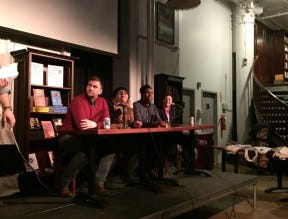
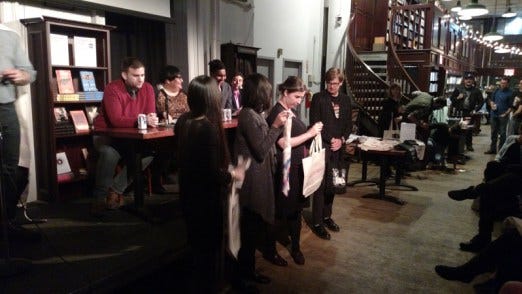
Over the past few weeks we have asked a simple question: who will win the Game of Totes? Last night, during the tournament of Housingworkshall, a victor emerged from the slaughter: Tin House. We congratulate Tin House on what will surely be a long and glorious reign! And we say farewell to the runners-up: Riverhead (second place), The New Inquiry (third), Lit Hub, Melville House, Gigantic, BOMB Magazine, and Litographs. (Click on their names to view and/or purchase their fantastic yet ultimately untriumphant totes.)

The victor was picked by our panel of expert tote judges: Camille Perri, Saeed Jones, Bev Rivero, and Dan Wilbur. We want to thank them as well as Housing Works, our readers Jen Doll and Kyle Chayka, the judges for round two, everyone who voted in round one, and everyone who came out last night!

Lincoln Michel and Jason Diamond

Hosts Jason Diamond and Lincoln Michel

Hosts Jason Diamond and Lincoln Michel

the merciless judges

the merciless judges

the crowd howling for blood

the crowd howling for blood

The competing knights

The competing knights

the final four

the final four

Ser Rob Spillman takes the canvas crown for House Tin House

Ser Rob Spillman takes the canvas crown for House Tin House

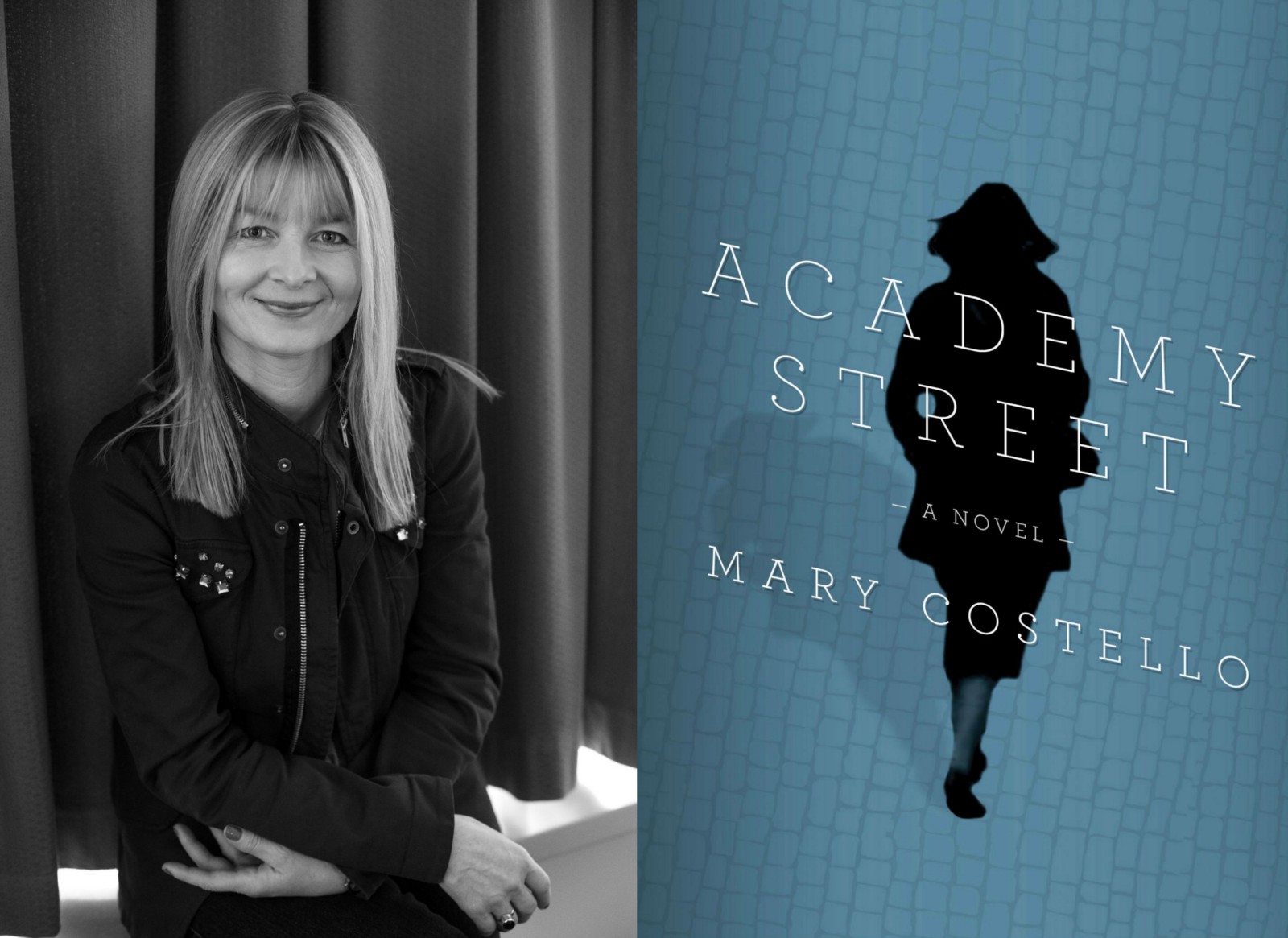
Occasional Glimpses of the Sublime, a conversation with Mary Costello, author of Academy Street

by Johanna Lane

Earlier this month, Mary Costello’s debut novel, Academy Street — winner of the Best Novel Prize at the 2014 Irish Book Awards — was released in the US. Academy Street is a portrait of Tess Lohan, a single mother come from Ireland to forge a life in New York. We asked Johanna Lane — who moved from Ireland to New York in 2001, and whose own debut novel, Black Lake, will be released in paperback on May 5th — to talk with Costello for Electric Literature. They discussed emigration, the Irish in New York, J.M. Coetzee, and the different demands of a short story and a novel.

Johanna Lane: I love the work of J.M. Coetzee and in my mind you and he are closely aligned. Not only do you share the last name of one of his characters, Elizabeth Costello, but you mention another, Michael K, in your novel, Academy Street. Some of his novels are elliptical, as is yours, which was one of my favorite things about it, but another writer might have chosen to tell the story of Tess’s life in 500+ pages. You took less than 150; why?

Mary Costello: Thank you, Johanna. Coetzee is one of my favourite writers, so this a great compliment. It’s the integrity of his work that so impresses — the sensitivity, the refined feeling, the constant endeavour to imagine the lives of others, human and non-human. The way his characters cogitate on life and death, suffering, salvation…and are unafraid to face awkward truths. With Coetzee there’s no escape from the self. And yes, the coincidence of the Costello surname sort of floored me when I first came on it!

I never set out to write a short novel — I thought Academy Street would be longer. I wrote it in a fairly linear fashion over one year, although it had been incubating for several. I found Tess’s voice early on, and tried to keep tight to it. She dictated the tone and pace and duration and led me across those bridges from one period of her life into the next without too much fuss or detail. She’s an introvert — an intuitive introvert — so things don’t need to be spelt out or laboured over; they can be gleaned.

I’ve always written short stories — my first book was a collection of stories — so I’m probably naturally inclined towards brevity. Plus, when I speak I have an almost pathological fear of boring people and this might, unconsciously, have a bearing on the writing too. The writing self won’t tolerate loquaciousness!

JL: I was having dinner with another writer the other night and we were discussing tone. I find that I very often forget what happened in books, but I remember the tone of novels I read ten or more years ago. Speaking of Coetzee, though I haven’t read In the Heart of the Country in a very long time, its tone still settles on me now when I think of the book- the same goes for Waiting for the Barbarians. You mentioned in your last answer that Tess dictated the tone of Academy Street; how do you understand the concept of tone? How does it affect your work and your response to the work of others?

MC: I think of tone as a kind of force field around the character that has agency over the narrative. I find it difficult to talk about tone without referring to character and voice. In the case of Tess, there’s an air of quiet trepidation attached to the way she lives. I had to convey this trepidation, this quietude, in language that is apt for her. The way she thinks and moves and has her being needed to be reflected in the language and syntax — and in the point of view, too. Without ever deciding, I employed close third person point-of-view, so the tone that emerged is intimate.

Getting the tone right is very important. It’s not something that can be forced or rushed — it seems to come almost involuntarily. And it can be easily lost too. At times during the writing of the novel I felt it slipping and I grew very anxious. But there was nothing to be done — except step away and wait. Without the right tone, the writing always feels false.

You mention In the Heart of the Country and how the tone still settles on you. I find that most of Coetzee’s books cause a pall to descend — and just the thought or the sight of them can evoke this feeling. Denis Johnson’s Train Dreams has that effect on me too. And speaking of palls, Marilyn Robinson’s novel Housekeeping comes to mind. The tone is delicate, elegiac, conveying the ethereal quality of Ruthie and Sylvia. And alongside this delicate tone is an atmosphere of endangerment and doom that’s felt by the reader in the very act of reading the book.

JL: How does being Irish shape your fiction, either in terms of form or content, or both?

MC: There’s no doubt that being Irish has a huge bearing on how and what I write, just as being Canadian or American has a bearing on what Alice Munro or Marilynne Robinson write. Ireland is where I landed on earth, and so it’s part of my literary landscape and heritage through story, myth, song, poetry — it’s in my DNA. The particular rhythm and cadence of the language as it’s spoken here is present, so my writing voice is Irish. How could it not be? But I don’t intentionally write about Ireland or Irishness — it’s just there, natural, not something I’m conscious of or that needs to be inserted.

As regards content, I write about love, loss, death, fate, men and women, the interior life — subjects common to all nationalities. The settings and the outer landscapes of my characters’ lives are mostly Irish — though most of Academy Street unfolds in New York — but these matter less to me than their inner landscapes — what Robert Musil called ‘the floating life within.’

I don’t think being Irish has a huge bearing on the form I choose to write in. I started writing stories in my early twenties because I had lots of isolated characters and disparate images and ideas and the short story was a form that could accommodate them. I’ve written stories for years but then the reach of Tess’s life in Academy Street needed a longer form. The Irish have a great reputation for short stories — the Irish short story travels well — and it was the Irish writer Frank O’Connor famously coined the term ‘the lonely voice’ to describe what is essential in a short story… that ‘intense awareness of human loneliness’. And the short story is particularly suited to depicting isolation, melancholia. But loneliness and isolation are universal and short story writers from all over the world, not just Ireland, do these very well.

JL: What’s the most difficult aspect of the writing life for you?

MC: Fear, self-doubt, anxiety that I won’t be able to realise the characters and the story as I ‘hear’ them. Holding my nerve. Finding the exact words — which is usually impossible. Finding the voice, too. I feel great relief and gratitude when I find the voice — though of course it can be difficult to hold onto.

JL: Can you tell us a little of how you came to writing?

MC: Writing was never on my radar when I was growing up — I never dreamt of being a writer. I grew up in the west of Ireland and came to college in Dublin when I was 17. I studied English and was always a reader. When I was 22 something began to gnaw, something I couldn’t put my finger on. During a period of insomnia the thought just dropped down me out of the blue one night: I want to write. I have no idea where that came from. My first two stories were published, one of which was shortlisted for a well-known Irish prize, the Hennessy award.

I’d gotten married when I was 23 and moved to the suburbs, and I was teaching fulltime. Then somehow, writing began to slip to the margins of my life — I couldn’t seem to accommodate everything. I wasn’t part of any writing community either. Writing felt like a burden, a secret, an interruption to life, and I tried to give it up — six months or more would go by when I wouldn’t write. But it never went away entirely. Stories would push up and plague me until I had to write them.

My marriage broke up after ten years and I continued to scribble away. And then in 2010 — I was well into my forties by then– I sent two stories to a literary magazine called The Stinging Fly here in Dublin. The editor liked them and published them and asked if I had more. And I had, and he wanted to publish them — he runs a publishing house — which is how my collection, The China Factory, came about.

JL: You’ve worked successfully in the short story form and in the novel form; what are the different demands they make on you as a writer?

MC: For me, the challenge in both forms is to keep the story in the air; find the precise language, the right voice. I’ve written stories for longer and I’ve a great love for the form — its claustrophobic feeling, its intensity. There’s an intuitive quality to stories and less transparency — something always lurks beneath the surface.

Pacing is different in a novel, obviously, and one needs to be more patient. But there’s more breathing space. When I was writing my novel I wrote each chapter in much the same way as I’d write a story. I didn’t write one draft straight through– I wrote each chapter and then rewrote it many times before moving on. I didn’t think long-term… I edged my way forward.

So, in many ways the same demands exist in both forms — the need to keep the thing taut and the language exacting. I can’t say if one is more demanding than the other… A story has to be kept it in the air for maybe 20 or 30 pages and novel for 200–300 pages, so one has to hold one’s nerve for longer with a novel!

JL: I teach in the neighborhood Tess first lives in, Washington Heights; how did you evoke a city, a country, you’ve never lived in so convincingly?

MC: Two of my mother’s sisters and a brother emigrated to New York in the late 1950s and early 60’s. One of her sisters, Carmel, was a nurse in New York and lived in an apartment on Academy Street in Inwood at the northern end of Manhattan. She worked in the New York Presbyterian Hospital for four years before returning and settling back in Galway. When I was growing up she told me stories — and still does — and I got a real sense of her life and times in New York.

I’ve always been in thrall to New York — I grew up on American TV, film, music. Also, we got photographs of aunts, uncles, cousins from America that I pored over as a child, all of them looking more beautiful than my Irish family! And I thought: this is what America does, it makes people beautiful. As you say, I’ve never lived in New York but have visited many times. I was there in the summer of 2011 and I used to take the A train up to 207th Street in Inwood, the last stop. I found Academy Street and the apartment building where my aunt had lived. I walked around the streets and the park, visited the church, the library; imagining the lives of my aunts, my uncle; hearing the echoes of their footsteps on the streets, the footsteps of so many Irish emigrants who’d lived there. There is something about that generation of young men and women — their innocence and earnestness, their lack of cynicism too — that moves me. One day I sat on a bench across the street from the school as parents gathered to collect their children. I could see the little heads of the children in an upstairs classroom, and tiny hands being raised and lowered. In that moment Tess’s whole life seemed to unfold before me.

JL: Why do you think the story of the unwed, single Irish mother continues to capture our imagination at a time when it’s no longer taboo- or certainly no longer as taboo as it once was?

MC: I think any human suffering — especially one caused by intolerance and prejudice — strikes a chord with people.

And it’s not that long ago that single motherhood carried a great stigma in Ireland and was regarded as a mark of shame and disgrace for families — such prejudices pertained right through the 70’s and even the 80’s. Of course this wasn’t unique to Ireland but it persisted for longer here, and in the last two decades we’ve heard the stories and testimonies of those who suffered — sometimes wanton cruelty — at the hands of church and state institutions and women’s own families too. So many lives were ruptured and the victims are still enduring the great emotional and psychic pain. Those were dark times … I think there might be some feeling of collective guilt in Irish society now — at any rate there has been a much greater readiness to face the past and give voice to the voiceless.

JL: What do you think Tess’s life would have been like if she’d never emigrated?

MC: I imagine she’d have continued nursing in Dublin, maybe gotten married, had a family. One thing is fairly certain — if she’d had a child outside marriage she would’ve had to give him/her up for adoption.

Would she have fared better, been happier, suffered less if she’d stayed in Ireland? Who knows? Tess is an introvert by nature and would always have found it difficult to mediate the outer world. I think, too, she would always have had some inner longing, some ache for ‘home’ — a metaphysical home, that eternal longing to put her finger on something sublime or numinous. I’m not sure she’d have discovered her love of books as she did in New York — which of course helped sublimate many of her anxieties and gave her occasional glimpses of the sublime.

JL: As an Irish writer, did you have any hesitation about “owning” major events in US history, like the Kennedy assassination and 9/11?

MC: I don’t think the imagination recognises international borders. Altering or tamping down a story or doing anything that compromises its integrity would be a form of self-censorship and isn’t something I could do. When I’m writing, I don’t think about a reader or my agent or my publisher. My only concern, my only allegiance, is to my story and my characters. I know this is a broad and complex issue, but, in the actual writing, a writer can only do what he/she sees fit and abide by their own conscience and the needs of their stories.

The global shock and outpouring of grief at those signature events — like JFK’s assassination and 9/11 — is natural in the face of such human loss. But there’s also the fact that America is a nation of world nationalities so we all feel, to some extent, that they are our losses too. Then there’s the strong Irish connection through emigration, which is felt as familial for many. My mother can point to the exact spot in the kitchen where she was standing as a young woman when the news came on the radio of Kennedy’s death. A national day of mourning was held in Ireland on the Friday after 9/11 and businesses shut down and people who’d never set foot inside a church in their lives went to memorial Masses and services to honour the dead and share in the grief. These tragedies left their imprint on our national psyche too. Years after 9/11, I accidentally discovered that a distant cousin died in the Twin Towers. The knowledge that a blood relative of mine had perished that day had a profound effect on me and brought that catastrophe closer, forced me to relate to it in an even more personal way.

Anthony Doerr Wins Pulitzer Prize for All the Light We Cannot See

Anthony Doerr won the Pulitzer Prize in Fiction today for his best-selling historical novel All the Light We Cannot See. The novel, which was the break-away literary fiction novel of last year, was cited by the Pulitzer Prize as “an imaginative and intricate novel inspired by the horrors of World War II and written in short, elegant chapters that explore human nature and the contradictory power of technology.” Doerr will be awarded $10,000.

The three finalists in fiction were Let Me Be Frank with You by Richard Ford, The Moor’s Account by Laila Lalami, and Lovely, Dark, Deep by Joyce Carol Oates.

The award for Poetry went to Digest by Gregory Pardlo and the award for General Nonfiction went to The Sixth Extinction: An Unnatural History by Elizabeth Kolbert. The full list of awards can be seen here.

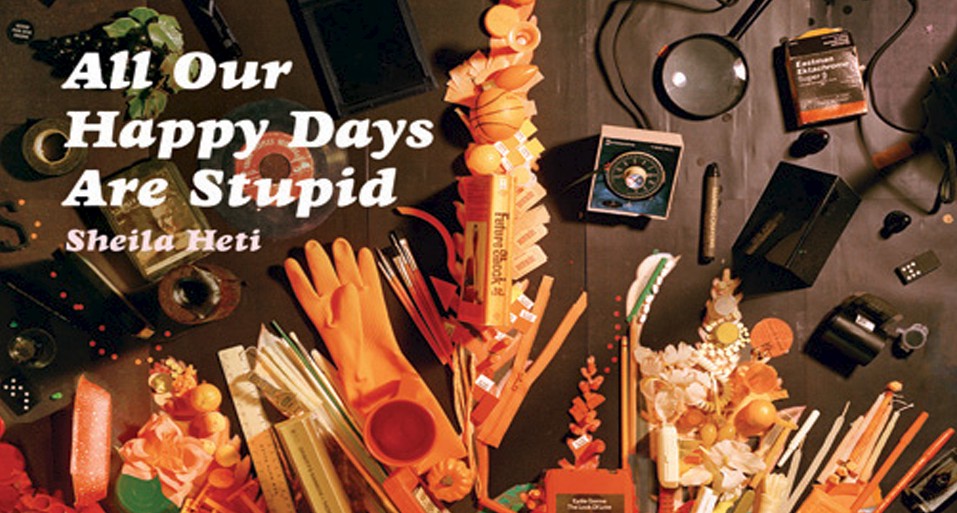
The Bright Side of Things: All Our Happy Days Are Stupid by Sheila Heti

Hailed as ‘unproduceable’ by Nightwood Theatre, the group for which it was written, All Our Happy Days Are Stupid is the impossible play made manifest. Until recently, it was merely the motif around which Toronto-born Sheila Heti’s 2012 novel, How Should a Person Be?, was constructed, in which she tracked her failure to finish the play. However, over ten years after its initial draft, Heti’s theatrical albatross has been liberated from her wilfully ignored notebooks. McSweeney’s publication of the play is the final stage of an organic process. All Our Happy Days Are Stupid has been carried to term after an extremely long and difficult gestation.

As is de rigueur, the play’s initial run was crowdfunded by an Indiegogo campaign, and premiered at storefront theatre Videofag in 2013 in a low-budget production by Canadian theatre company Suburban Beast. Its ensemble cast consists of professionals and non-actors–often Heti’s friends–with several roles played by the same person. Initially staged to audiences no larger than thirty people, the play has gone on to enjoy two sold-out runs; the first at Toronto’s Harbourfront Centre, followed by a New York production in late February of this year, at the experimental theatre space The Kitchen. With starkly monochromatic backdrop and costumes, its scenery and props thickly outlined in black, the set has a cartoon quality, with no attempts made at replicating locations. The lack of color and softness is extremely effective in mirroring Heti’s pared down, blunt script, and her characters’ brutal honesty.

Although written in 2001, the play is Heti’s seventh published work, following 2014’s collaborative collection, Women in Clothes, which featured contributions from over 600 women from all across the globe. Co-edited with Leanne Shapton and Heidi Julavits, and comprising of interviews, photographs and testimony, the book examines the relationship between those who identify as female and their clothing. Much of Heti’s writing is focused on women and womanhood; in particular the politics of female relationships, and enduring nature of friendship verses heterosexual romance.

Heti achieved commercial success with How Should a Person Be?, her partially fictional, semi-autobiographical novel, which careens from the graphically sexual to hysterically funny in a matter of pages. Casting herself and friends as the novel’s characters, she often recorded conversations and used these transcriptions in lieu of a traditional narrative, giving the novel an immediate and intimate quality. Heti studied playwriting before temporarily abandoning it to write literary fiction, and her background in theatre can be glimpsed in the novel, despite her self-proclaimed ‘failure’ as a playwright. In presenting dialogue as script, in addition to her division of the novel into five acts, Heti lends an air of theatricality, further emphasized by her penchant for histrionics.

The melodramatic tragicomedy of All Our Happy Days Are Stupid dramatizes the volatile encounters between people experiencing a trauma. Set at the height of summer, first in “gaudy, bubblegum” Paris and later Cannes, it follows the doomed vacation of Mr. and Ms. Oddi (“OH-dee”) and their daughter Jenny, whose trip aligns with that of Daniel Sing and his mother and father, Mr. and Mrs. Sing. When twelve-year-old Daniel goes missing, lost amidst a Parisian parade, his disappearance sets off a sequence of events in which the play’s characters become caught up in existential doubts and crises of identity, and we are given a fly-on-the-wall perspective of relationships, and indeed families, breaking down.

Suburban Beast’s Jordan Tannahill provided the foreword, in which he refers to its epitomization of the ‘Heti-esque’. Considering a dramatic equivalent (which is difficult), All Our Happy Days Are Stupid is also–without wanting to draw too close a comparison–Pinteresque, with Heti’s use of the “comedy of menace” to hint at the power-play between her characters through their mundane, even dull, conversations, and elusive pasts. While not quite absurdist theatre, Heti borrows from the genre’s existentialism, especially with regards to the female characters’ quests for meaning in the face of unfulfilling marriages and a disinterested universe.

When commissioned by feminist group Nightwood Theatre in 2001, Heti asked “does it have to be a feminist play?” to which the response was “No…but it has to be about women.” This allows a fairly open approach, and Heti uses the vagueness to her advantage, ignoring obvious feminist themes and tropes in favor of her frank examination of failing relationships, difficult friendships, and middle-aged women on the verge of nervous breakdowns. Rather that focusing specifically on womanhood or femininity, All Our Happy Days Are Stupid instead explores the hopes, fears and failings inherent to all, regardless of gender. Where feminism comes into play is Heti’s exploration of the complexities of friendships between women, particularly the less palatable side of female companionship.

Upon first reading, the depiction of female relationships in All Our Happy Days Are Stupid is understated and less immediately relatable than those in Heti’s autobiographical How Should a Person Be?. This could in part be due to the play’s detachment through fiction, as this time Heti’s voice is hidden behind characters, and we read the play from an audience’s perspective. The lead characters are all female; the “young for her age” Jenny Oddi, her “vain and a little glamorous” mother Ms. Oddi, and Mrs. Sing, described as “tense and hostile”. The male characters, Mr Oddi. Mr Sing, his son Daniel, and older iteration in successful pop-singer Dan (played by The New Pornographer’s Dan Bejar), are more supporting cast, although Dan appears intermittently to perform a soundtrack of sorts. The ‘action,’ predominantly taking the form of heated discussions and antagonistic remarks, is at its most vitriolic and effective when concerning the female cast. We learn the women’s thoughts through conversations with their husbands, which bring intentions to light, and offer sympathetic explanations for behaviour that often appears inexcusably disrespectful–especially in the case of the play’s star, Ms. Oddi.

Jenny Oddi, balanced precariously on the cusp of puberty and thus caught in the excruciating zone between child and woman, already exhibits more compassion when reacting to her friend’s vanishing than her mother, the acerbic Ms. Oddi:

Ms. Oddi: You have a tear in your eye!

Jenny: I am trying to hold it in.

Ms. Oddi: Well you’re doing a terrible job! Let it out, Jenny, you’re not proving anything.

Through her victimization, Jenny is perhaps the most sympathetic character, as despite her young age she is insightful, and desperate to be respected as an adult. Of the fateful parade that later swallows Daniel, she remarks “My parents think it’s amusing for me but it’s not. I think it’s so limited,” but her mother, dismissive of Jenny’s attempts at maturity, calls her “a great naïf”. Heti effectively evokes the frustration of adolescence, and female readers may find themselves recalling, with discomfort, their twelve-year-old selves.

Despite appearing long-suffering, Mr. Oddi is pushed to his limit by his wife’s endless criticisms. After she describes an acquaintance’s house as smelling like “onions and sweat and soil,” he snaps:

Mr. Oddi: You’re not a poet, Grace

Ms. Oddi: (hurt) I’m not trying to be a poet.

Mr. Oddi: …trying to describe the way things are. Leave that to the poets…for heaven’s sake, Grace!

Ms. Oddi: I was just searching for the words.

Mr. Oddi: A poet doesn’t search for the words, just ladies trying to look all poetical!

This could be a thinly disguised reference to Heti’s own turbulent writing process, and her desperate quest to define herself, both as a woman and a writer, but always left “searching for the words”. Heti skilfully communicates interior thoughts in a way that, while encouraging engagement, also evokes aversion and even disgust. So, while Ms. Oddi is not a likeable person, her impolite actions and unwarranted lectures at times echo our own internal monologues and compulsions. As a result, she is wildly funny, her lines witty in their sharpness, and we are attracted by her ‘take no prisoners’ approach.

While initially appalled by Ms. Oddi’s rudeness, her female compatriot, Mrs. Sing, is still drawn to her, much like an impressionable moth to a flame; “In her face was something of the brutal woman. I do like brutal women (…) Oh, think of it. I would just admire her… sit and admire her and stare”. Vulnerable in the wake of her son’s disappearance, and finding little comfort from her husband, Mrs Sing seeks the kinship of a strong, if unwelcoming, female presence. Taking the other woman to one side, she breaks down:

Mrs. Sing: It’s not like you imagine it. You find that even oranges look menacing to you. The whole world turns inside out, and you see nothing but the maggots! The midgets and the maggots!

Ms. Oddi: I wouldn’t know about that, Mrs Sing. I have always tried to look on the bright side of things.

Oddi’s intentional impoliteness is, again, laughable, and we are encouraged to find comedy in her disdain for the other woman. But our laughter is hollow, for sadness quickly follows, as we empathize with Mrs. Sing, confused and in pain, reaching out in hope for a friend but getting nothing. Heti’s script plays with us, like a cat toying with a mouse, as brief moments of hilarity mask the darkness lying at its core.

To an extent, All Our Happy Days Are Stupid can be read as an extension of How Should a Person Be?, in particular Heti’s exploration of the complexities of friendships between women. There are certainly echoes of Heti’s friendship with Margaux Williamson in that between Ms Oddi and Mrs Sing. However, while Heti used her own attachments in the novel, her play’s characters are fictional, their situations invented. We are not given insight into what has shaped the characters of Ms Oddi and Mrs Sing into the sharp, bold, and fairly unlikeable women they are, but the nature of their marriages are certainly hinted to be partly responsible.

Men, for Heti, provide a sandpaper-like surface for women to rub up against. A source of joy and tension, passion and antagonism, the actions of the male characters bring the female leads together, while at the same time setting them against each other. The disappearance of Daniel triggers not only his parents marital turmoil but also in a way that of the Oddi’s, as Ms. Oddi reacts to Jenny’s sorrow, and Mr. Oddi’s failure to appreciate her, by vanishing herself. The play is strewn with awkward conversations between the two couples, each prodding at the other’s shortcomings, in scenarios too real for comfort. In a delightfully odd scene, where Ms. Oddi is requested to play the flute at a royal dinner, her husband’s dismissal of the honor elicits a strong reaction:

Ms. Oddi: Must you spoil everything good in my life! For once I am the one who is necessary. I am the one who will make the evening shine! (…) You want to keep me tucked away in this hotel room, away from the eyes of the world. Why didn’t I get on the stage? Why didn’t I pursue my flute? Instead I took care of Jenny.

It would appear more deeply seeded issues are at work here, and with Ms. Oddi’s unhappiness as both wife and mother illuminated, her subsequent escape to the heady romanticism of Cannes makes sense.

Act One ends with Jenny–so desperate to be an adult but not yet ready for the hardships that come with age–witnessing her mother’s abandonment of their family, her father left “crumpled on the stoop” of the hotel. Act Two opens with Ms. Oddi and Mrs. Sing in Cannes, a town infamous for glamour and excess. Mrs. Sing’s fixation on the other woman is based in ill-advised admiration for Oddi’s spontaneity, independence, and self-assuredness, traits we know are not as genuine as they appear. These scenes between the women are excruciating–both are damaged, lost, and alone, searching for affirmation in all the wrong places; casual sex, alcohol, and anonymity, which is clearly the opposite of what they dearly want: to be seen.

Heti herself is no stranger to such pursuit for self-definition, and while How Should a Person Be? recorded her struggle–and was self-obsessed to the point of vanity–All Our Happy Days Are Stupid inhabits the struggles of others with perceptive sympathy. Tannahill comments:

After years of workshops and feedback and rewrites and letdowns, what began as a play can feel like the furthest thing from playing. It becomes drudgery. It becomes a vortex of existential malaise and self-doubt.

With this in mind, All Our Happy Days Are Stupid–a work Heti considers “something upon which the reflected light of my experience and knowledge could be seen”–can be regarded as a metaphor for our personal search for self-worth and happiness, a warning against seeking to ground such value in others.

All Our Happy Days Are Stupid

by Sheila Heti

Powells.com

The Genius of Tolkien’s Original The Hobbit Dust Jacket

Tolkien’s original artwork for The Hobbit dust jacket is now on display at “The Marks of Genius” exhibit at the Bodleian Library. Other work featured includes Shakespeare’s First Folio, The Gutenberg Bible, and works by Isaac Newton. The artwork was used on the first edition of The Hobbit, a rare copy of which was recently donated to the Texas A&M Libraries by George R. R. Martin:

Many fantasy fans might not realize that Tolkien was a visual artist, but he created many beautiful illustrations for his genre-defining fantasy works.

Bilbo

(h/t Tolkien Society)