REVIEW: Limbo by Melania G. Mazzucco

It can sometimes seem like war is a specifically American pastime. This is the case particularly with the wars in the Middle East, since it’s easy to forget that the United Kingdom, Germany, Italy, Jordan, Turkey, Bulgaria and Romania, amongst others, have also sent troops to fight the Taliban. But as far as English-language literature goes, the Iraq and Afghanistan narratives have thus far been restricted to the likes of Kevin Powers, Ben Fountain, and Phil Klay — that is, white American men. But that is no longer the case.

Melania G. Mazzucco, an Italian writer whose novel, Limbo, was translated to English by Virginia Jewiss, offers an original take on the disillusionment of war. The novel itself exists in a sort of limbo, unfolding in the strange winter days that fill the end of the old year and the beginning of the new.

Just before Christmas, Manuela Paris returns to Italy from the war. She’s nationally recognized as a hero, albeit a broken one. During the opening of an Afghani girls school, a twelve-year-old suicide bomber detonated close enough to Manuela that she was sent home with crippling flashbacks and a body that may never fully heal. With her very identity tied to her image as a fighter, Manuela struggles to readjust to the slow life of her seaside hometown.

In the off-season hotel across the street, a shadowy figure slowly materializes into a character, and eventually into Manuela’s lover. Mattia helps Manuela heal, but reveals nothing about his strange past. Manuela’s best friend, her sister Vanessa, remains suspicious of this unforthcoming stranger, but he allows Manuela to evolve from a dark, angry victim into someone with the strength to reflect on her past.

Structurally, “Limbo” alternates between “Live” chapters and Manuela’s “Homework,” an assignment from her psychologist who’s told her to write down the experiences of Afghanistan. These first-person accounts offer a contrast to the star-crossed yet damaged woman she is in the “Live” sections; in the Middle East, Manuela seems a completely different character. Alternatively, the “Live” chapters are, on the whole, less successful, and at their worst, a close-omniscient racket. In a chance encounter with a policeman, for example, Mazzucco writes:

“ID” the officer insists. Harshly, because headquarters radioed in about a brawl that involved racist insults that had broken out on the soccer field just as he was about to go off duty, and he and his wife have to go to a dinner at his in-laws, out in the country, almost an hour’s drive, and he has to shower first, and now he’s going to be late, fucking hell.

But the “Homework” sections boom with a view of Afghanistan that is refreshingly un-American; Mazzucco’s is a distinctly Italian war. Walking the fine line between support-the-troops-but-hate-the-war, she observes through a supporting character:

Don’t you think the twenty-first-century Italians should break the spell of history that compels them to act like servants in other people’s wars? It’s been this way since even before Italy existed as a nation. The Crimean War, World War I, World War II, Yugoslavia, Somalia, Iraq. We go to war so as not to be left out, but without any real reason, which means we end up being there without real conviction, without the consensus of the people. It must be frustrating to be a soldier in a country that makes war that way.

Mazzucco is especially empathetic toward Manuela’s right to fight in a man’s world. One incident of bullying resolves in Manuela leaving a bloody tampon on a peer’s pillow, proving that she doesn’t use her womanhood as an excuse to be treated more delicately.

I’m a woman and a commander. And I represent my country…It took us two thousand years to get here, it may seem like a travesty to some, but to me it’s a victory…

Compared to the ferocity and vibrancy of Mazzucco’s research and politics in the “Homework” parts of Limbo, Manuela and Mattia’s romance is hard to believe. Mattia falls unreservedly in love with Manuela and, by all appearances, is written to be a “Prince Charming” through and through. The romance unfolds as all romances do: Manuela throws away her nice, do-no-wrong boyfriend from before the war for Mattia, who, although slightly edgier, seems of the same cut:

He kisses her again, and when his tongue is tired he slips his mouth and nose under her sweater as well. Just then the enormous shadow of an Airbus cover them, five hundred people who could look down into the dark mirror of Lake Bracciano and wouldn’t see them. No one can see Sergeant Paris, who lets herself be touched, licked, sucked, caressed by a stranger on a paddleboat. She is invisible. There’s no smoke when wind fans the flames. Reprehensible behavior. A black mark on her record. What the hell, she’s on leave. And she doesn’t even know if she’s still in the army.

Mazzucco tends to lean on unnecessary intensifiers and an over-reliance of familiar similes in her prose; the entire narrative, as a result, feels forcefully insistent. It’s also redundant: Manuela’s complexities are compelling enough to carry the story forward without the demand.

Limbo takes its title, in part, from the reoccurring reference to the Radiohead song, “In Limbo.” However, a better choice might just have been “Karma Police,” where singer Thom Yorke laments, “For a minute there, I lost myself.” Manuela’s minute is only a few weeks, because when Mattia’s love is introduced, her recovery is instantly assured. Why Mattia comes across as the hero who saves Manuela — she being a warrior who has never needed a man to come to her rescue — and why the emphasis of the novel switches to revealing his “secret” seems an empty question. Limbo reverberates when it’s a war story; the rest, it seems, is a fantasy world.

Limbo

by Melania G. Mazzucco

Powells.com

Eight Excellent Literary Podcasts for Your Morning Commute

by Jessica Gross

Forlornly staring at your iTunes library every Thursday morning, missing Serial? Tired of Serial, Serial, SERIAL already and annoyed that I’m invoking it in this intro?

Literati: as you may or may not be aware, there are many, many podcast niches, and they don’t always overlap. (On a recent episode of the business podcast StartUp, the host — who used to work alongside Serial’s host — was surprised to discover that a significant group of his own listeners had never even heard of Serial.) Lucky for us, one of these niches is podcasts for and about writing. Below, some of the best literary podcasts out there.

Jess Walter and Sherman Alexie

A Tiny Sense of Accomplishment

Jess Walter and Sherman Alexie have been friends for years, sharing work and talking about basketball. On their truly excellent podcast, A Tiny Sense of Accomplishment, which launched in August, they do both plus interviews. The guests address “work” from a wide range of perspectives — singer/songwriter Peter Himmelman discusses his artistic process in this great conversation, while Alexie’s wife’s friend Polly’s current major task is convalescing from back surgery. Alexie and Walter discuss their own work, too, and the best part is that they read aloud early drafts of their fiction and poetry. The insights are incredible, and while of course their work is usually pretty excellent, it’s sometimes rough — a reminder for any writer that this stuff doesn’t pop out fully-formed, for anyone.

longform

Longform Podcast

The Longform Podcast features some of the most well-researched interviews anywhere — on par, I’d say, with Fresh Air. (Close, anyway.) The guests are longform nonfiction writers, with a couple of podcasters thrown in there. No fiction here, but the writers, pretty much without fail, approach their craft with intense creativity and skill. A few favorites: the episodes with essayist Meghan Daum, New York Times Magazine staff writer Susan Dominus, Grantland staff writer Wesley Morris, New York magazine writers Jessica Pressler and Dan P. Lee, and New Yorker staff writer Ariel Levy.

Selected Shorts

Selected Shorts

On the Selected Shorts podcast, listen to recordings of live events in which actors read/perform short stories. (Not to brag, but I saw this one, with Lorrie Moore and Sherman Alexie, and It. Was. Amazing.) Only the most recent back episodes are available, so subscribe in iTunes for a weekly installment going forward.

Greenlight

The Greenlight Bookstore Radio Hour

The Greenlight Bookstore Radio Hour, out of its namesake Greenlight Bookstore in Fort Greene, Brooklyn, features authors in conversation with each other. Sometimes nonfiction writers interview novelists; other times it’s fiction-on-fiction. In a favorite episode, Rebecca Mead, New Yorker staff writer and author of My Life in Middlemarch, interviews Elizabeth Gilbert about her novel The Signature of All Things.

New Yorker podcast

New Yorker Fiction Podcast

On each episode of the New Yorker’s Fiction Podcast, a writer who’s been published in the magazine selects a favorite story by another writer to read and discuss. (See all New Yorker podcasts here, or the Fiction Podcast on iTunes here.) Writers are not always the liveliest readers of their own work, but reading fiction they admire deeply is a whole different ballgame.

Slate podcast

Slate’s Audio Book Club

If you’re looking for a book club you can enter and exit at will, and don’t actually have to participate in at all, Slate’s Audio Book Club is for you. A range of Slate critics get together to parse and debate books new and old. Spoilers are guaranteed, so don’t listen until you’ve read.

books and authors

Books and Authors

On the Books and Authors podcast, Cary Barbor, who has a background in arts radio, interviews a range of (mostly fiction) writers, including Roxane Gay, Emily St. John Mandel, Ben Dolnick, and Celeste Ng.

poem of the day

Poem of the Day

The Poetry Foundation’s Poem of the Day podcast is just that: a poem, usually read by the poet, every day. They’re often just a minute or two long — perfect for a new daily ritual.

2015 Edgar Award Finalists for Mystery Writing Announced

The finalists for the Edgars awards have been announced. The awards, named after (it it wasn’t obvious) Edgar Allan Poe are given out by the Mystery Writers of America and are the major awards for mystery fiction. The Edgars cover everything from best novel and best short story to best biography and best TV episode teleplay. The winners will be announced in April. The 2015 Finalists include a mix of familiar names, like Stephen King and Gillian Flynn, alongside newer authors like Adam Sternbergh and Lacy M. Johnson.

Best Novel

This Dark Road to Mercy by Wiley Cash (HarperCollins Publishers — William Morrow)
Wolf by Mo Hayder (Grove/Atlantic — Atlantic Monthly Press)
Mr. Mercedes by Stephen King (Simon & Schuster — Scribner)
The Final Silence by Stuart Neville (Soho Press)
Saints of the Shadow Bible by Ian Rankin (Hachette Book Group — Little, Brown)
Coptown by Karin Slaughter (Penguin Randomhouse — Delacorte Press)

Best First Novel

Dry Bones in the Valley by Tom Bouman (W.W. Norton)
Invisible City by Julia Dahl (Minotaur Books)
The Life We Bury by Allen Eskens (Prometheus Books — Seventh Street Books)
Bad Country by C.B. McKenzie (Minotaur Books — A Thomas Dunne Book)
Shovel Ready by Adam Sternbergh (Crown Publishers)
Murder at the Brightwell by Ashley Weaver (Minotaur Books — A Thomas Dunne Book)

Best Paperback Original

The Secret History of Las Vegas by Chris Abani (Penguin Randomhouse — Penguin Books)
Stay With Me by Alison Gaylin (HarperCollins Publishers — William Morrow)
The Barkeep by William Lashner (Amazon Publishing — Thomas and Mercer)
The Day She Died by Catriona McPherson (Llewellyn Worldwide — Midnight Ink)
The Gone Dead Train by Lisa Turner (HarperCollins Publishers — William Morrow)
World of Trouble by Ben H. Winters (Quirk Books)

Best Fact Crime

Kitty Genovese: The Murder, the Bystanders, the Crime that Changed America
by Kevin Cook (W.W. Norton)
The Savage Harvest: A Tale of Cannibals, Colonialism, and Michael Rockefeller’s Tragic Quest for Primitive Art by Carl Hoffman (HarperCollins Publishers — William Morrow)
The Other Side: A Memoir by Lacy M. Johnson (Tin House Books)
Tinseltown: Murder, Morphine, and Madness at the Dawn of Hollywood
by William Mann (HarperCollins Publishers — Harper)
The Mad Sculptor: The Maniac, the Model, and the Murder that Shook the Nation
by Harold Schechter (Amazon Publishing — New Harvest)

Best Critical/Biographical

The Figure of the Detective: A Literary History and Analysis
by Charles Brownson (McFarland & Company)
James Ellroy: A Companion to the Mystery Fiction
by Jim Mancall (McFarland)
Kiss the Blood Off My Hands: Classic Film Noir by Robert Miklitsch (University of Illinois Press)
Judges & Justice & Lawyers & Law: Exploring the Legal Dimensions of Fiction and Film
by Francis M. Nevins (Perfect Crime Books)
Poe-Land: The Hallowed Haunts of Edgar Allan Poe
by J.W. Ocker (W.W. Norton — Countryman Press)

Best Short Story

“The Snow Angel” — Ellery Queen Mystery Magazine by Doug Allyn (Dell Magazines)
“200 Feet” — Strand Magazine by John Floyd (The Strand)
“What Do You Do?” — Rogues by Gillian Flynn
(Penguin Randomhouse Publishing –Bantam Books)
“Red Eye” — Faceoff by Dennis Lehane vs. Michael Connelly (Simon & Schuster)
“Teddy” — Ellery Queen Mystery Magazine by Brian Tobin (Dell Magazines)

Best Juvenile

Absolutely Truly by Heather Vogel Frederick (Simon & Schuster Books for Young Readers)
Space Case by Stuart Gibbs (Simon & Schuster Books for Young Readers)
Greenglass House by Kate Milford
(Clarion Books — Houghton Mifflin Harcourt Books for Young Readers)
Nick and Tesla’s Super-Cyborg Gadget Glove by “Science Bob” Pflugfelder
and Steve Hockensmith (Quirk Books)
Saving Kabul Corner by N.H. Senzai (Simon & Schuster — Paula Wiseman Books)
Eddie Red, Undercover: Mystery on Museum Mile by Marcia Wells
(Houghton Mifflin Harcourt Books for Young Readers)

Young Adult

The Doubt Factory by Paolo Bacigalupi (Little, Brown Books for Young Readers)
Nearly Gone by Elle Cosimano (Penguin Young Readers Group — Kathy Dawson Books)
Fake ID by Lamar Giles (HarperCollins Children’s Books — Amistad)
The Art of Secrets by James Klise (Algonquin Young Readers)
The Prince of Venice Beach by Blake Nelson (Little, Brown Books for Young Readers)

TV Episode Teleplay

“The Empty Hearse” — Sherlock, Teleplay by Mark Gatiss (Hartswood Films/Masterpiece)
“Unfinished Business” — Blue Bloods, Teleplay by Siobhan Byrne O’Connor (CBS)
“Episode 1” — Happy Valley, Teleplay by Sally Wainwright (Netflix)
“Dream Baby Dream” — The Killing, Teleplay by Sean Whitesell (Netflix)
“Episode 6” — The Game, Teleplay by Toby Whithouse (BBC America)

Robert L. Fish Memorial

“Getaway Girl” — Ellery Queen Mystery Magazine by Zoë Z. Dean (Dell Magazines)

Mary Higgins Clark

A Dark and Twisted Tide by Sharon Bolton (Minotaur Books)
The Stranger You Know by Jane Casey (Minotaur Books)
Invisible City by Julia Dahl (Minotaur Books)
Summer of the Dead by Julia Keller (Minotaur Books)
The Black Hour by Lori Rader-Day (Prometheus Books — Seventh Street Books)

Grand Master

Lois Duncan
James Ellroy

Raven Awards

Ruth & Jon Jordan, Crimespree Magazine
Kathryn Kennison, Magna Cum Murder

Ellery Queen Award

Charles Ardai, Editor & Founder, Hard Case Crime

Midweek Links: Literary Links from Around the Web

Looking for some interesting reading to get you through hump day? Here are some literary links from around the web to check out:

The BBC released a list of the top 12 books of the 21st century (Junot Diaz’s Oscar Wao was number 1)

Listen to Hemingway read Faulkner and Faulkner read Hemingway

Authors and teens share the books that saved their lives

Idris Elba is planing a film trilogy about Edgar Allan Poe fighting Satan

Speaking of Poe, his death is still mysterious

Carolyn Kellogg on celebrating MLK in books

Matt Bell interviews Kate Bernheimer about myths and fairy tales

Beulah Maud Devaney on why you should chose your reading carefully

Haruki Murakami’s advice column has started up

Lastly, if you are worried that you are boring here are 50 books that Flavorwire says will make you more interesting

The Ten Ways Your Life Will Change After You Publish Your First Book (Or So I’m Told)

1. You will look in the bathroom mirror on the morning of your book’s publication and see a face staring back; a real face, not the mass of flesh and flaws that had confronted you every morning before. You won’t dare touch it for fear it will evaporate.

2. You will change your e-mail signature from “Writer” to “Published Author!” You will consider adding a smiley face, but will decide against this.

3. Your mother will start to bring you up, unprompted, in conversation at her weekly dinner gatherings with friends. She will however consistently pluralize an element of your book title that is singular: for example “The Lone Pine Tree” will become “The Lone Pine Trees,” or “The Isolated Tale of My Companionless Descent into Solo Performance” will become “The Isolated Tale of Our Companionless Descent into Solo Performance.” This will always be an improvement on your original title.

4. Your shipment of personal copies will never arrive. Your publisher will not be able to track their fate, nor replace them. A week will pass and you will wander into the animal shelter at a nearby strip mall and find a dog cage lined with the urine-soaked pages of your book. Your eyes will meet the eyes of the miniature schnauzer that resides in your shredded work. You’ll think: this is fate. But the adoption center won’t approve your application because you can’t claim any substantial income.

5. One of the three people who blurbed your book will lose all memory of you or your book’s existence. When they encounter the unfamiliar tome on an acquaintance’s shelf, their own words and name will appear as a haunting blur. They will be happier for this.

6. A student in the one freshman comp class that you teach will turn in a paper about your book. The paper will completely misinterpret your intentions, and point out many problematic elements that make your work irrelevant to contemporary readers. You will consult the real face reflected in your bathroom mirror, and in doing so you will gain the confidence to laugh at yourself, at this situation. Your post about it on social media will be your most popular ever. The likes and favorites will dwarf your book sales. You will give the student an A-minus.

7. The guy who used to sit on your head every lunch break in the middle school courtyard will come across your book in a library and say to his wife that you were “buds.” His wife will not hear him say this. They are having problems. As she walks away he will remember the feeling of your head against his butt cheeks.

8. You will pay out-of-pocket to fly across the country for a reading. There will only be one person in attendance, but this person will shower you with praise as you quietly sign their copy. They will let you know how much the book meant to them, how it spoke to something deep in their chest that they never knew was waiting to be jostled awake, and they will touch your hand and express a desire to take you home if it weren’t for the three more readings they promised to attend that night, by similarly inspiring authors, and aren’t you attending? And why not, and something about literary citizenship, and their face will fall at your claims of exhaustion, and as they approach the exit to the bookstore you will see them swap out your signed copy for an unsigned one on the shelf.

9. Your father will call you for the first time in two years to say congratulations. You will ask if he wants to meet up for a coffee and discuss the book. He will say he hasn’t read it yet, has a big stack, but that it’s somewhere in there. After seven months you will check your father’s blog, where he keeps an updated reading list. He will have given your book two out of five stars and a comment that the book is “of interest if you like the author’s other work.”

10. A few weeks later an interviewer, via e-mail, will ask you what you’re working on next, and you will dash from your laptop to the bathroom and find that you never had a mirror in there in the first place.

The Box

by Arthur Bradford, recommended by John Hodgman

The real estate agent who sold me the house had mentioned the box only in passing.

“There’s a structure in the backyard,” she told me. “You can’t move it. It’s an eminent domain thing, grandfathered in. But it won’t bother you.”

I examined the box more closely later on, before finalizing the purchase. It was about eight feet square, and made of gray, weathered steel, a generic box if there ever was one. I was informed that it was a “transfer box” and inside of it were a set of circuits involved in the underground conduction of electricity. The rusted bolt lock at the base seemed like it hadn’t been opened for years.

“Can I cover it up with vegetation?” I inquired.

The response took three days to arrive and it was, “No.”

But the house was inexpensive and located on the side of a pleasant hill, unobservable by my neighbors, a feature which I liked. I wasn’t up to anything covert, mind you, I just enjoy solitude, and the notion that I might do something like stroll about in my home naked without feeling self-conscious pleased me. In truth I rarely did that.

Earlier that year I’d lost my foot in a wood-chipper accident. I had negotiated a lump payment from the county, with whom I was employed when it happened, and this was how I paid for the house. It goes without saying I would have preferred to keep my foot instead of that house, but I wasn’t entirely displeased with the arrangement. A house for a foot. Worse deals have been struck.

It was during the winter that I first began to notice the heat emanating from the box. A heavy snow had fallen overnight and in the morning I went out for a walk with my dog. Everything was white and pillowy except for that box. It was bare and steam rose from its steel casing. I touched it and nearly burned my fingertips. Later on, I noticed the snow on the ground around the box had begun to melt away as well. By day’s end there was a muddy brown circle, like a moat, surrounding it. I called the power company and was bounced around several different departments before they agreed to send a crew over.

The crew arrived and stared at the box.

“It’s just a box,” they said to me. “It isn’t one of ours. We don’t even know what’s inside of it.”

“Well, can you open it up?” I asked. “I’m concerned about the heat.”

“No, sir,” said the foreman, “we’re not allowed to interfere with this kind of thing. Liability. I suggest you figure out who put this here.”

I called the fire department and by the time they got to my place the box had cooled down.

“Let us know if it starts heating up again,” said the fire chief. “Or get it fixed.”

“I don’t even know what it is,” I said.

The real estate agent who sold me the house put me in touch with the town zoning commission, who were the ones who thought it belonged to the power company. Apparently I had signed something attached to the deed and title in which I agreed to leave that box untouched, but no one was sure who had put it there. The previous owner of the house was dead and, like me, had valued solitude. The box didn’t heat up like that again though, and after a few days I was tempted to forget about it.

My closest neighbors were two women known as the Harper sisters. They lived together in the same run-down farmhouse where they had been born. They grew marijuana on the property and raised a breed of cat known as Manx cats, meaning they had no tails. Suzette, the eldest sister, was over six feet tall and quite skinny. I was afraid of her. Lila, the younger one, wasn’t so tall and smiled a lot. She had a large gap between her two front teeth, which was not unattractive.

Shortly after the box had cooled down Lila showed up at my front door looking for one of her cats.

“His name is Sinclair,” she told me. “He’s friendly and doesn’t usually wander. Has he been around here?”

“I haven’t seen him,” I told her. “Listen, do you know anything about the metal box in my backyard? It was giving off steam when it snowed a few days ago.”

“Steam?” said Lila.

“Well, heat,” I said. “I suppose it was just the snow that turned to steam.”

Lila walked around back with me and together we looked at the box.

“Seems like government work to me,” she said. “I’d be happy to help you bury it. Suzette could bring over the tractor and knock it down.”

“Well, I’m not sure I should do that,” I said. “I was told it wasn’t technically my property.”

“Who told you that?”

“I don’t know,” I said.

Lila gazed down at my prosthetic foot. The prosthesis ended below my knee, but she couldn’t see that. Perhaps she wondered just how far up it went.

“You’re doing pretty well on that thing,” she told me.

“Thanks,” I said. “I’ll keep an eye out for your cat.”
A few weeks later I was awakened by a shrill hissing sound, like a large distressed bird had entered my home. I thought perhaps some appliance had sprung a leak. But after a quick examination I determined the sound was coming from outside, from the box.

I grabbed a maul from the woodshed and slammed it against the box several times. This didn’t help anything. I tried going back to sleep but it wasn’t possible with that noise. I considered driving my car up there and crashing it into the box, but, before I could do that, the hissing stopped.

In the morning I paid a visit to the Harper sisters to see about taking Lila up on her offer to plow over the box with their tractor. Lila and Suzette were sitting at the kitchen table trimming dried-out marijuana plants with a group of teenagers.

“Did you find my cat?” asked Lila.

“No,” I told her. “He’s still gone?”

“We think he died,” said Suzette.

“You think he died,” corrected Lila. “I think he’s gone rogue.”

“Well, I’m wondering if you might be able to bring your tractor over to my place this afternoon,” I said. “That metal box started hissing last night and I couldn’t sleep. I was hoping you could knock it over and bury it.”

“That’s a bad idea,” said Suzette.

“I’ll bring the tractor over at two o’clock,” said Lila.

We all smoked some of their marijuana, which was very strong because it had been grown indoors using seeds shipped from engineers in Holland. One of the teenagers, a guy named Alf, turned out to be Suzette’s son. This surprised me because she didn’t seem old enough to have birthed a teenager, an older teenager at that. He had a beard.

Two o’clock rolled around and none of us had moved from the kitchen.

“Time to get that tractor,” said Lila, punching me in the arm.

Alf volunteered to help with the box-demolition project and another fellow whose name I’ve forgotten agreed to come along as well. We ventured out to the barn where the tractor was kept and Alf and his friend refused to put on coats despite the cold weather. They were tough, punk-rock-type guys who didn’t appear to bathe much, if at all.

First we had to dig out the area around the barn door because it hadn’t been opened since the big snowfall. Then Lila opened up the door and Alf set to work starting up the tractor. It had been sitting there all winter and needed some coaxing. I began poking around the barn looking for a length of chain, which might come in handy if we decided to tow the box away. I peered down into a barrel and discovered Sinclair, the missing cat. He was dead.

“Aw, fuck, he must have gotten stuck in there,” said Lila.

She was upset and the work on the tractor was forgotten. Instead we dug a grave out in the small meadow where they buried their animals. This was hard work because the ground was mostly frozen and we had to use pickaxes. Alf wondered if we might wait until spring, but Lila said that was disrespectful.

Suzette came outside for the burial and expressed the opinion that Sinclair was an old cat and had probably just been looking for a quiet place to die. At first this further agitated Lila, but then she began to take some solace in the notion that Sinclair might not have been struggling and calling out for help. From the looks of his frozen body, he had been in there for quite a while.

Alf’s friend said he had examined the barrel where I’d discovered Sinclair and had seen a mouse skeleton in there as well.

“I bet the cat was chasing after that mouse,” he said.

“So at least he had something to eat,” observed Alf. But then he trailed off on this thought as Lila once again began to cry.

“Why don’t the two of you shut the fuck up?” said Suzette.

We buried the cat and agreed to take on the box project the next day. This was just as well, because when I got home there was a van parked in front of my house and a group of men in white jumpsuits were gathered around the box. I was glad to see people in an official-looking capacity taking interest in it.

“Are you the owners of this box?” I called out to them as I approached.

A small fellow stepped forward and introduced himself as Dr. Cox. “Have you been striking this container?” he asked.

I noticed there were several large dents on the sides where I’d gone at it with the maul the night before.

“It was making a terrible noise,” I told him. “It also got very hot during the snowstorm. Steam was coming off of it and I thought it might explode.”

“So you beat upon it with a stick?” said Dr. Cox.

“I used a maul,” I said. “And I didn’t hit it until the noise came out. I couldn’t sleep. Who are you people anyway?”

There was a pause as Dr. Cox glanced back at his cohorts. One of them stepped forward and handed me a business card that was crowded with words.

“We’re with NOAA,” he said. “And we’re going to ask that you refrain from abusing this device.”

“I don’t know what NOAA is,” I said.

“Look it up,” said Dr. Cox. “We’ve made some adjustments to the device, nothing which concerns you, of course.”

“It does concern me,” I said. “I live here. It keeps making noise and heating up.”

“That shouldn’t happen anymore,” said Dr. Cox. “We appreciate you bringing it to our attention.”

With that, Dr. Cox signaled to his team and they followed him as he walked past me, down the hill, and toward the van. I noticed that the rusted lock on the box’s door had been replaced. I tried to peer down through the small vents to see what was going on inside, but it was dark.

“You’re leaving now?” I called out to the white-coated men. “I’d just like to know what this box is for.”

“Read the notice on your door,” said Dr. Cox. And with that they all piled into the van and left.

The notice on my door was written on letterhead from the National Oceanic and Atmospheric Administration. So that was what “NOAA” stood for. It said, in so many words, that the box belonged to them and it had something to do with the monitoring of atmospheric conditions. It was full of “highly sensitive instruments.” I was forbidden to “interfere with or molest it further,” under penalty of law.

Baffled, but also somewhat impressed at the newfound importance of my backyard, I called up the Harper sisters. Suzette laughed at my news.

“Good thing you dumbasses didn’t go and knock it over,” she said.

Lila was mad though. “Classic government claptrap,” she said.
A few days passed during which the box and I coexisted peaceably, and then, one night, I spotted the shafts of light. They flickered through the vents in the box’s sides. At first I assumed it was sparks, signs of an impending combustion, and I prepared to leave the premises. But then I saw that it was simply light, a steady stream peeking out from within. I crept up next to the box and was very surprised to hear what sounded like voices coming from inside. People! Underground! There was a group of them down there occupying some cavern to which this box was merely an entrance. For so long I had thought it was just a box!

I listened for some time to what they were saying. What I could make out was mostly mundane stuff, arguments about the score of some board game they were playing, a dispute over what they might eat for dinner and how best to prepare it. They had a kitchen down there!

I decided I had had enough. I banged on the box and yelled down to them, “Hey! This is my property! You can’t live underneath my ground! Come out of there!”

There was a quick silence, much the way crickets immediately cease their chirping at the first sign of an intruder. The lights inside clicked off.

“Hello?” I called down to them. “Open up this box! I want to see what’s down there!”

Again, I received no reply. I banged on the box repeatedly and kicked at it with my prosthetic foot.

“Answer me!” I called out. “I heard you talking!”

They were strong-willed though, whoever they were, and they sat quietly in the darkness for a long time. I began to wonder if I’d somehow imagined their presence, if perhaps I was going insane living out here on my own. I got up and stumbled home.

When I told Lila Harper about the voices and the lights I’d seen she came over to my place with a steel cable and a lock.

“We’re going to lock those fuckers in,” she told me.

I liked this idea, though I was wary of Dr. Cox and his orders not to molest the box. Lila had no fear of NOAA, however.

“You think we need a government agency to tell us what the weather is?” she said. “It’s mind control, Georgie. I knew there was something creepy about that box. It’s typical of them to pick on a man with only one foot. You can blame it all on me if they come after you,” she said.

It was exhilarating to see Lila so worked up over this. I’d come across several antigovernment types in my travels up to that point. They all had their favorite conspiracies, but rarely did they ever have the chance to see their paranoia manifest before them. I helped Lila affix the lock and cable so that the box could not be opened. Then Lila smacked the side of the box with a hammer and yelled down through the vents, “We’ve locked you assholes in! You’re stuck!”

She laughed, and for some time there was no response from inside the box. But then, just as we were about to walk away, there came a tapping sound from inside. The tapping grew louder and more frantic and then became a series of loud bangs.

“Can’t get out, can you?” Lila said to the box.

“Hey,” said a timid voice from inside. “Did you really lock us in?”

“You know it!” said Lila.

“Well,” said the voice, “that hardly seems fair.”

“This is my property,” I told the voice. “You all trespassed across my property in order to get in there. You tell your buddy Dr. Cox I’m filing a complaint.”

“Dr. Cox is a moron,” said the voice from inside.

Both Lila and I were a little taken aback by this response. We’d thought of NOAA as a unified front.

“Well,” I said, “how about you tell Dr. Cox to come retrieve you and your friends and get the hell off my property?”

“Now, see here,” said the voice, “we are currently dwelling underground, well below the jurisdiction of your property lines. And besides, the Department of Commerce has declared a right of passage, upholdable by federal law.”

“Department of Commerce?” said Lila.

“Of which NOAA is a division,” said the voice.

“We’re going back inside my house,” I told him. “You all have a fun time down there doing whatever it is you are doing.”

“It’s an ion study!” cried the voice. “Very important research.”

“Come on,” said Lila. “Let’s go.”

She invited me back to her place, where we sat in the kitchen and smoked marijuana while the Manx cats scampered over the counters and tables.

“How come they don’t have tails?” I asked Lila.

“They come from the Isle of Man,” she told me. “Where the wild cats bred with the rabbits.”

Suzette walked in and said, “That’s not true. That’s a myth.”

“I’ve been to the Isle of Man,” said Lila, “and the people there confirm it’s true.”

“Don’t cats need their tails for balance?” I asked. “How come these cats don’t fall over?”

“That’s a silly question,” said Suzette, “especially from a guy with one leg.”

“I have two legs,” I told her. “Just not two feet.”

Then Alf came running in saying I should move my car into the barn because a big storm was coming.

“They say it’s going to drop two feet of snow.”

“I should go home, then,” I said. “What about the people in the box?”

“They weren’t going anywhere anyway,” said Lila, and I agreed with her.

I parked my car inside the big barn, next to the tractor which we had never used. I didn’t believe the storm would amount to much, but Suzette said she could feel its severity in her bones.

It started snowing and strong winds began to howl through the trees. I had been hoping Lila would invite me upstairs to spend the night with her but instead she pulled out some blankets and offered me the couch. Suzette’s bones were right about the storm. It was big and strong, and I slept well with the snow swirling about outside. One of the cats curled up and wedged itself behind my knees.
The storm didn’t let up until past noon the next day. It was a doozy, covering the ground in a heavy blanket of snow and knocking over several trees on the Harper sisters’ land. The snow had built up so thickly on top of their old barn that the roof caved in and we had to dig out my car and the old tractor too. The general digging out took a long time and I couldn’t get back to my house until the following day. Lila came with me when I did return and we were surprised to find that a large tree had crashed down upon the box. The metal structure had been ripped from the concrete foundation and now it lay flipped on its side, covered in snow. There was just a hole where it once stood, with a ladder leading down to the world below. Together Lila and I explored the cavern. It was like a submarine down there, a hallway of rooms filled with old instruments and dusty computers. The people were gone. Signs of a hasty exit were evident, half-packed bags, unfinished food in the refrigerator. Had Dr. Cox come to their rescue in the middle of the storm?

We thought the place was empty but then we heard a little meow. Lila ventured down a hallway and discovered her lost cat, Sinclair, lying happily on a bunk bed.

“Sinclair!” she exclaimed, her eyes welling up with tears. “Sinclair, it’s you. I knew it. It is you.”

I was confused, of course, because I had been under the impression we had buried Sinclair some weeks earlier.

“That must have been another cat,” said Lila. “This one here is Sinclair. I’m sure of it.”

They certainly did seem to know each other, this cat and Lila. She stroked his ears and kissed him, while he purred loudly and kneaded his paws into her lap.

“Perhaps he was reincarnated,” I suggested.

“Perhaps,” said Lila. “I’ve heard of that happening to Manx cats from time to time. They are an ancient breed.”

Surely Suzette would have another explanation, but I for one was willing to accept some of this logic. Who knows what can come of breeding cats and rabbits on some faraway island? Who really knows the power of the great winter storms?

I heard no more from Dr. Cox and his scientist buddies at NOAA. They abandoned their ion study, I suppose. Or maybe they had learned all they sought to know. They say NOAA can control the weather now, that there are satellites roaming the skies with giant mirrors, and certain airplanes seed the clouds with chemicals unfamiliar to us civilians down below. It’s all for our benefit, they say, a great equalization of the rampant forces we’ve unleashed upon nature. We have to do it, they say, otherwise we won’t survive the changes to come.

H.P. Lovecraft Beer to Drive Craft Beer Fans to Utter Madness

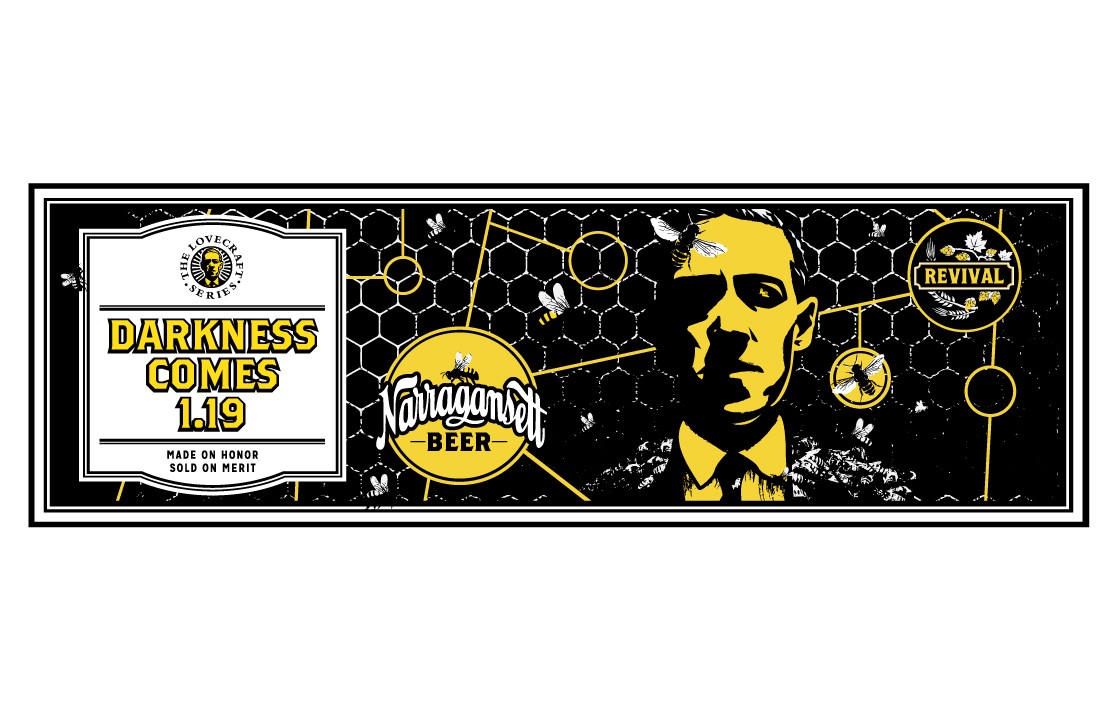
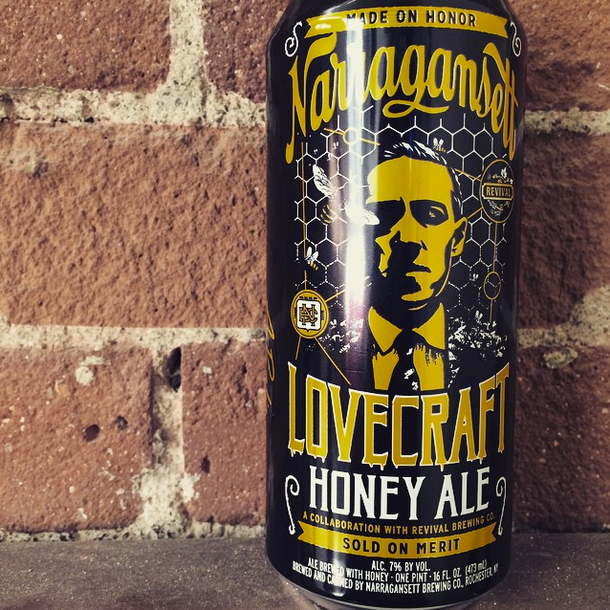
From the horrifying, cyclopean stills of the the Narragansett Brewery, in the thrice-damned Stygian state of Rhode Island, comes an eldritch brew sure to shatter the minds of mere craft beer mortals: the Lovecraft Honey Ale. The beer is made in loathsome conjunction with the non-Euclidean Revival Brewing and is a maddening 7% alcohol by volume.

Horror legend Lovecraft lived most of his life in providence, and Narragansett President Mark Hellendrung explained the choice to Boston:

“This one is really a prologue about H.P. Lovecraft himself,” says Hellendrung. “We picked one of his stories, ‘The Festival,’ where there’s a space mead consumed by a winged creature. What’s great about craft beer is that it’s really breaking the style boundaries and guidelines. So, this is [brewmaster Sean Larkin’s] interpretation of a modern day honey mead through the medium of a beer.”

The Lovecraft Honey Ale is only the first of the Lovecraft-inspired beers. The second will take inspiration from Lovecraft’s novella The Shadow Over Innsmouth.

If you feel a little weird drinking a beer named after a famous teetotaler and pretty gross and racist human, well, we can’t blame you. For those who want to taste the unspeakable brew, it went on sale yesterday.

lovecraft beer

via instagram

(h/t Melville House)

REVIEW: The First Bad Man by Miranda July

Cheryl Glickman likes things done a certain way. She likes everything done a certain way. She lives alone. Each of her activities is governed by a system. No trip to the kitchen is wasted; she doesn’t have time for plates or a mess. All is well until her boss’ 21 year-old daughter, Clee, moves in. But in Miranda July’s new novel, The First Bad Man, Cheryl’s disrupted living situation is the least of her worries.

July lets us peer into Cheryl’s odd life: her anxiety-driven throat congestion, her odd sense that she’s seeing a baby she met when she was nine as he is born into new bodies, her awkward social graces, her habit of peeing in jars when nervous. Cheryl lives an intense fantasy life that often bleeds awkwardly into her social interactions.

But the people surrounding Cheryl are by no means any less strange. She sees a questionable therapist who uses questionable techniques that blur the lines of what can be called “professional.” Cheryl works for a self-defense nonprofit governed by some oddly cherry-picked Japanese workplace traditions. In a revelatory moment about her character, Cheryl tells us that she was asked to work from home. Even in strange situations, she does not quite fit.

Once Carl had called me ginjo, which I thought meant “sister” until he told me it’s Japanese for a man, usually an elderly man, who lives in isolation while he keeps the fire burning for the whole village. […] Then he told me my managerial style was more effective from a distance, so my job was now work-from-home though I was welcome to come in one day a week and for board meetings.

As an aside, it’s worth noting that Cheryl almost never actually works — at home or otherwise — but her relationship with the nonprofit is only one more thread in the strange fabric of her life.

Inside the home, what begins as frustration with Clee’s sloppy habits as a roommate turns into a confused physical tangle. Clee, a buxom blonde bully with hygiene and modesty issues, takes on an active role as aggressor. Cheryl gladly plays the submissive role, and they battle in increasingly bizarre scenarios. They fight regularly — first it’s shoving but then it transforms into mechanically acting out scenarios from the nonprofit’s old instructional videos.

[T]he moment I shut the front door, she grabbed my hair and jerked my head back. A silly gasping noise escaped me. No scenario; she was fighting the old way. It took a moment to reorganize — to switch places with her and become Phillip. He shoved her against the wall. Yes. It had been a while since we’d given it any gusto; this was just the release I needed. She deserved it for her loose behavior.

Cheryl slowly realizes an attraction to Clee, yet like many things, she is not able to understand it directly. Several of the characters in the novel have to be distracted by their own imaginations in order to be physical with the person in front of them. Cheryl takes this to the extreme, creating scenarios that fold back into each other again and again. She turns her submissive fights with Clee into aggressively sexual, bizarrely mental scenarios where she is the attacker. She is less a participant in her own life; rather, she is more like someone acting out perverse versions of truth. July renders Cheryl with a combination of naïveté and wisdom. She understands little about herself or others in the world, yet she is able to float across lines of social and sexual taboos without a sense of guilt.

July’s prose relaxes most into her treatment of Cheryl’s complicated maternal feelings. Sometimes she directs these feelings toward Clee, but ultimately it is her relationship with Kubelko Bondy, the baby she remembers from her own childhood and sees in many faces, that allows July to stretch. As in the rest of The First Bad Man, July avoids cliché. In her descriptions of motherhood she touches the deepest part of Cheryl as a character.

I forced myself to look at the tiny gray body. His eyes were shut. He didn’t know where he was. He couldn’t deduce, from the beeps and the sound of feet on linoleum, that he was in a hospital. He didn’t even know what a hospital was. Every single thing was new and made no sense. Like a horror movie, but he couldn’t even compare it to that because he knew nothing about the genre. Or about horror itself, fear. He couldn’t think, I’m scared — he didn’t even know I.

“Jack is your name now,” she explains to him. “But Kubelko Bondy will always be the name of your soul.” Cheryl has long, silent conversations with the child, not realizing until he has lived with her for months that other people talk to their children. Since July writes Cheryl as a character who exists outside social norms, she is able to tackle social taboos in a way that’s both fresh and even a little cringe-worthy. Both Motherhood and sexuality blur. Sexual drive and the putrid stench of feet. Reincarnation and ageless love. July ventures to the edges of our comfort zone and then pushes on. Nothing about The First Bad Man holds back.

This novel will be talked about for its ability to test boundaries, particularly the boundaries of sexual labels or forbidden love. But it’s worth mentioning the readability of July’s prose. Her success in carrying us through the strange world of Cheryl Glickman is a testament to her skill. This is a bizarre story, but an alluring one, and one that ends in a moment of satisfaction. July creates a character in Cheryl who elicits our empathy, but also a visceral response. Her conviction in her specific belief system makes her a character we want to understand, if not become. She understands herself, and she is most certain of the genesis of Kubelko Bondy. “I didn’t make him,” she acknowledges, “but I did each thing right so he would be made.”

The First Bad Man

by Miranda July

Powells.com

National Book Critics Circle Award Finalists for 2014

The National Book Critics Circle Award finalists for 2014 have just been announced, and it’s a pretty fine list of books and authors. The list includes some luminaries like Marilynne Robinson and Gary Shteyngart, but is notable for including many lesser known and debut authors. Also notable is the near domination of of independent and small presses, with Graywolf Press leading the pack with four nominations (for three books). Tin House, Red Lemonade, Coffee House, Grove, and other indies got nominations as well.

Claudia Rankine’s celebrated book “Citizen” was nominated for both criticism and poetry, and Roz Chast’s graphic memoir was nominated for autobiography.

In addition to the finalists, Toni Morrison won the Ivan Sandrof Lifetime Achievement Award, Phil Klay won the John Leonard Prize for best debut, and Alexandra Chwartz won the Nona Balakian Citation for Excellence in Reviewing, which comes with a $1,000 cash prize, was awarded to New Yorker Assistant Editor Alexandra Schwartz.
AUTOBIOGRAPHY:

Blake Bailey, “The Splendid Things We Planned: A Family Portrait” (W.W. Norton & Co.)
Roz Chast, “Can’t We Talk About Something More Pleasant?” (Bloomsbury)
Lacy M. Johnson, “The Other Side” (Tin House)
Gary Shteyngart, “Little Failure” (Random House)
Meline Toumani, “There Was and There Was Not” (Metropolitan Books)

BIOGRAPHY:

Ezra Greenspan, “William Wells Brown: An African American Life” (W.W. Norton & Co.)
S.C. Gwynne, “Rebel Yell: The Violence, Passion and Redemption of Stonewall Jackson” (Scribner)
John Lahr, “Tennessee Williams: Mad Pilgrimage of the Flesh” (W.W. Norton & Co.)
Ian S. MacNiven, “’Literchoor Is My Beat’: A Life of James Laughlin, Publisher of New Directions” (Farrar, Straus & Giroux)
Miriam Pawel, “The Crusades of Cesar Chavez: A Biography” (Bloomsbury)

CRITICISM:

Eula Biss, “On Immunity: An Innoculation” (Graywolf Press)
Vikram Chandra, “Geek Sublime: The Beauty of Code, the Code of Beauty” (Graywolf Press)
Claudia Rankine, “Citizen: An American Lyric” (Graywolf Press)
Lynne Tillman, “What Would Lynne Tillman Do?” (Red Lemonade)
Ellen Willis, “The Essential Ellen Willis,” edited by Nona Willis Aronowitz (University of Minnesota Press)

FICTION:

Rabih Alameddine, “An Unnecessary Woman” (Grove Press)
Marlon James, “A Brief History of Seven Killings” (Riverhead Books)
Lily King, “Euphoria” (Atlantic Monthly Press)
Chang-rae Lee, “On Such a Full Sea” (Riverhead Books)
Marilynne Robinson, “Lila” (Farrar, Straus and Giroux)

GENERAL NONFICTION:

David Brion Davis, “The Problem of Slavery in the Age of Emancipation” (Alfred A. Knopf)
Peter Finn and Petra Couvee, “The Zhivago Affair: The Kremlin, the CIA, and the Battle over a Forbidden Book” (Pantheon)
Elizabeth Kolbert, “The Sixth Extinction: An Unnatural History” (Henry Holt & Co.)
Thomas Piketty, “Capital in the Twenty-First Century,” translated from the French by Arthur Goldhammer (Belknap Press/Harvard University Press)
Hector Tobar, “Deep Down Dark: The Untold Stories of 33 Men Buried in a Chilean Mine, and the Miracle that Set Them Free” (Farrar, Straus & Giroux)

POETRY
Saeed Jones, “Prelude to Bruise” (Coffee House Press)
Willie Perdomo, “The Essential Hits of Shorty Bon Bon” (Penguin Books)
Claudia Rankine, “Citizen: An American Lyric” (Graywolf Press)
Christian Wiman, “Once in the West” (Farrar, Straus & Giroux)
Jake Adam York, “Abide” (Southern Illinois University Press)

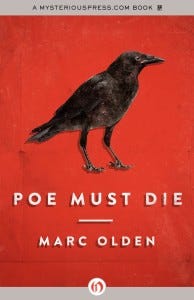
Idris Elba Making Trilogy about Edgar Allan Poe Fighting the Devil

poemustdie

If you’ve been hoping to see a trilogy of films about Gothic author Edgar Allan Poe fighting Satan, well, you are in luck. The Wire alum Idris Elba is producing three films based on Marc Olden’s 1978 novel Poe Must Die. Here is the Amazon book summary:

A satanist threatens the planet, and only Poe has the imagination to stop him

It is said that beneath Solomon’s glorious throne, books were buried that gave the fabled king control over life, death, and demonic power. The throne has been lost for millennia, but now one man seeks to find it, and harness its secrets to unleash hell upon the world. Jonathan is the most powerful psychic on earth, and in service of his god Lucifer he will tear civilization apart. To combat his dark designs, mankind’s hopes rest on a half-mad alcoholic named Edgar Allan Poe.

In the shadows of New York City, Poe drowns his talent in rotgut gin, trying to forget the death of his beloved wife. A bare-knuckle fighter named Pierce James Figg arrives with a letter of introduction from Charles Dickens, to beg Poe’s help chasing down the power-mad devil worshiper. Writer and fighter will stand together, to save humanity from a darkness beyond even Poe’s tortured imagination.

There’s no news on dates or actors yet. Elba is currently only slated to produce, not act.