When I started reading Merritt Tierce’s debut novel about a self-destructive waitress, by page four I thought Tierce had penned the greatest restaurant book on earth. By page six, when protagonist Marie is telling a man she’s had a threesome with and his fiancé about the Christmas dinner specials, I had the shivers: when the fiancé reels about how heavy Marie’s tray looks, Marie quips “If I throw my back out I’ve got your man’s number,” to customers delighted to have landed the table manned by the smart girl. From the get-go, it’s clear that this is an author who understands the perverse power that comes from allowing our female bodies to be used. Which is to say: this is a book that talks about how powerful and fragile and dangerous it is to be a woman living, working, and reproducing in the world we know today.
Love Me Back is restaurant fiction, but it’s mother fiction, too. We meet Marie when she’s a single mom working at a four-star Dallas steakhouse, but we get glimpses of her life when she was a younger and less careful waitress at chain places like Chili’s where she gets fired for selling Vicodin leftover from a dental job. Our Marie is unflappable behind her apron’s armor, so time-tested and ass-grabbed that Danny, the drug-addled general manager at the steakhouse (called “The Restaurant”) assures her that she’s “golden” there. But on her time off, the one constant that hums through this woman’s spiraling body is the siren pull of the baby daughter she didn’t expect, but birthed, and loved, and abandoned, and loves, and keeps abandoning again.
In a book so visceral and vitriolic that Tierce’s insights come at you like thrown acid, it’s hard to pin down the one thing that should make you read it. But for the mothers out there, Tierce has captured the frantic desire to both protect and expel these creatures that come out screaming, red-faced from us, expecting the whole world. Marie is a young mother with a lifetime of truly terrible decisions at her back, and the thing that is so heart-wrenching about her struggle is that Marie is at her most maternal when she’s demoralizing herself.
In an unnamed chapter towards the novel’s end, having ignored her ex-husband’s calls that carry news of their daughter’s illness, Marie returns home with a sex-partner she calls “The Hateful Man” and unplugs her ringing phone to allow him to fuck her doggy style against the couch. When he goes at her too hard and hurts his cock, Marie’s remorse is only for her girl: “I’m sorry, I said again, and I put on my clothes. All I could think about was you, feverish, hurting, wanting me.” Another time, after a threesome with a fellow waiter and his brother that kept her up all night, she returns home to shower and take a morning-after pill and call her daughter who’s getting up for school. “I hear her high-pitched voice say Hi Mama and I hear her crunching toast. I ask her what kind of jelly she’s having today.” During one of the rare days when Marie has her daughter with her, Marie brands her neck with a fondue skewer while her daughter watches re-runs of The Cosby Show, waiting for the laugh track to cover the sound of her burning skin. “You ask to touch it and you are fascinated by how the blister feels full but fragile. You say it’s gross but you want to do it again. You are skeptical. You say I should go to the doctor. You say What kind of bug would do that?”
The things that Marie does are gross, and the fact that she keeps doing them makes them more disturbing still. The inability of Marie to process the young life she’s expected to manage is summed up coarsely midway through the book when her four year-old — an early reader — is helping Marie memorize the different cow parts she needs to know for work. “You have a lisp and I tell you to say brisket over and over just so I can hear it. But when you fall asleep I go into the bathroom and do lines off the map of the steer…. You are so warm but I can’t stop shivering. I feel a soaring bliss — I adore you — I feel a plummeting ugly resentment — I am a pile of shit falling endlessly down a dark shaft.”
Marie is preternaturally gifted at her job, so collected and imperturbable, she’s often put on private room duty to man the escapades of show-off high rollers, thirty men or more. In her free time, she drops off work clothes to be starched and rehearses the ingredients in the chef’s hoisin sauce leading some of her colleagues to wonder, why can’t she nail down the mother thing if she’s so good at this? Why is she shirking her most important job?
“I don’t know what to give her,” she answers to the restaurant’s top grossing waiter and her favorite lover, Cal, when he asks why her daughter isn’t with her. Cal calls bullshit, saying you give “as much as you can”, with love and attention to start. “I want to do it right,” Marie says. “Not much as I can, just right.”
But Love Me Back dares to question what “right” looks like. In a three month time span, Marie fucked (fucked, not slept with) over thirty men who either work at or patronized the steakhouse, and snorted her weight’s worth in coke, but when she’s at her job, she’s “golden” — a currency that’s melted down to pay for her daughter’s after-school care and health insurance, with a third leftover for the child’s dad. On alternate weekends, her daughter gets dropped off at The Restaurant to enjoy a Shirley Temple before going home to her mother’s clean apartment, where Marie is so consumed by love for this creature she’s created, she cuts initials into her skin and presses hot iron to her flesh while her daughter watches TV. Not since Isabelle Hupert in The Piano Teacher have we encountered a woman so incapable of bearing the weight of being loved.
If we can wish one thing for Marie and her creator, Merritt Tierce, it’s that this book will put the term “unlikeable character” to rest. I didn’t like this bone-worked, maddening, cavernous mother, I loved her all the way to her rotted core, and rooted for her — still root for — this modern woman doing the worst version of her best.
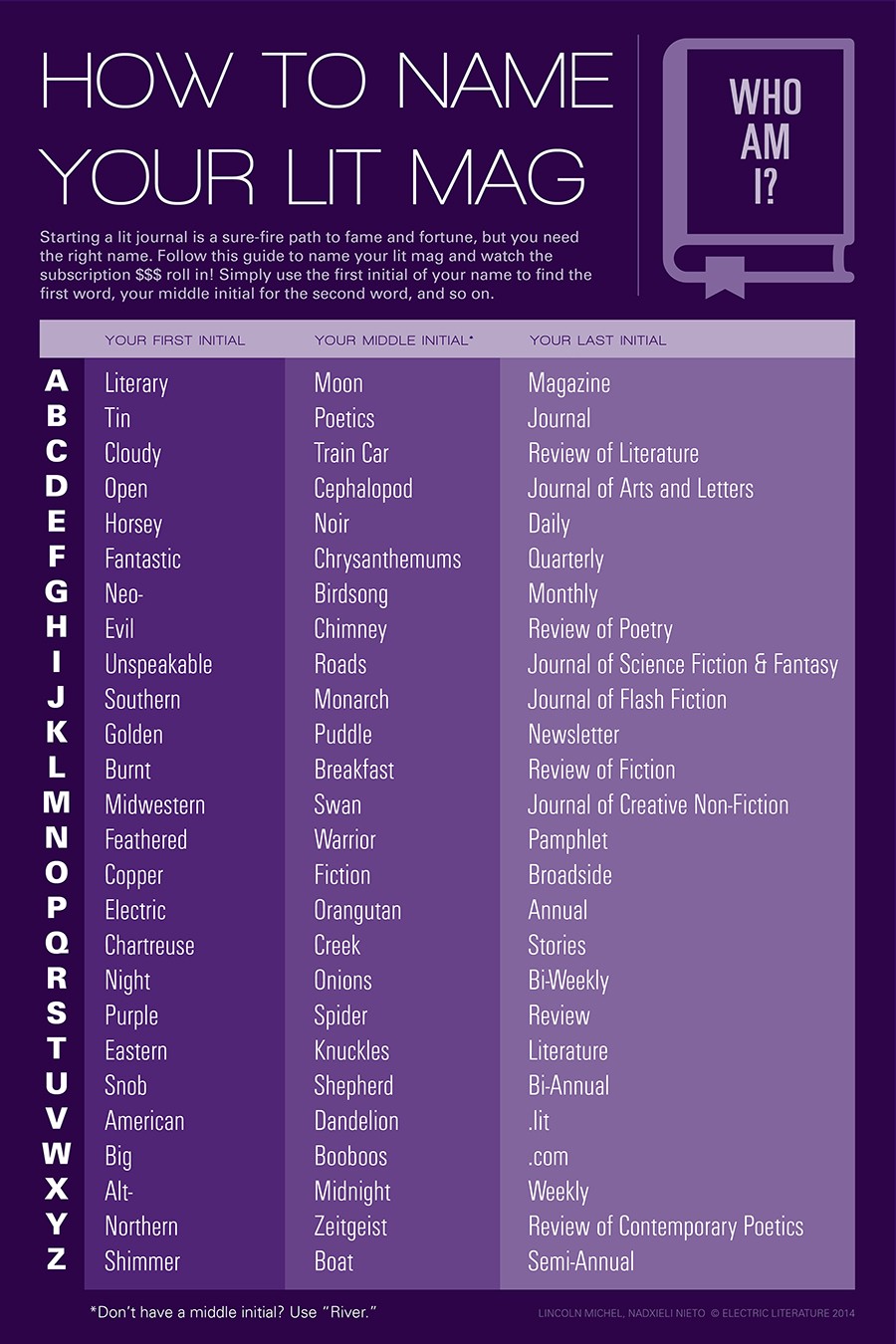
Running, editing, publishing, and producing a literary magazine is easy, but naming one is hard. To help you get past that first hurdle, we’ve created this handy infographic to name your magazine for you.
Cameron Pierce’s Our Love Will Go the Way of the Salmon is an assortment of fish stories — big lies and tall tales. The collection certainly questions both fiction’s purpose and its allure. Pierce’s Our Love features fish in a variety of contexts. In some stories, the fish are main characters; in others, the fish are merely setting or background detail. Though the collection could benefit from a stronger sense of connection between the tales, Our Love reminds us of man’s primal drive for dominance and sport.
Pierce’s characters are risk-takers. Some, like the couple on the run in “Let Love In,” are willing to give up security in favor of achieving a big break. Fishing (or trying to obtain fish) serves as a point of connection for many of the characters — often binding children to their parents well into adulthood. This is a device used by Pierce to raise questions of mortality, and to ground his characters through the act of killing, whether it be for sport or food. Collectively, Pierce’s stories can be taken as an example of the many ways we try to distract ourselves with diversions, how we use shared experience and hobbies to help us relate to each other.
We first see the generational connection in the title story. A grandson takes his wheelchair-bound grandmother fishing, reliving memories of their fishing trips from the past. Together, they reel in the biggest fish they’ve ever caught:
“Come on out, you bastard!”she shouted, muscling a trout toward the shore with her frail arms. That was Grandma. Crippled and blind, but totally mad for fish. My very own Captain Ahab.”
The fish on the line drags them into the water, lifting Grandma from her chair. When the story ends, her grandson looks back to the dock and sees that Grandma is missing. The big fish both brings them together and is the reason for their separation. Pierce returns several times to the idea of storytelling, which pairs nicely with the theme of fishing, and is a way for him to explore the archetypal struggle of man vs. beast. Use of the motif of fishing raises questions about death, risk, and lying. Fishing becomes a more trivial way to resolve man’s need to capture and kill, as it isn’t barbarous enough that most people find it objectionable.
“We didn’t understand the chasms that could open up inside a man and swallow him whole and unless you were there in that jungle yourself, you may never understand the particular chasm we faced. So when people like you ask me what it was like, I try not to let my feelings known. And I sure as hell never tell them the story of the best man I ever knew. But I’m gonna tell you now, because sometimes the lie gets old.”
Characters in Our Love are constantly pondering their own existence. In “The Bass Fisherman’s Wife,” a speculative and humorous examination of the seductive draw of fisherman to fish, Pierce writes of a man who loves his wife without hesitation, saying, “For sixteen years they’d lived as man and wife. Could they live as man and bass?” Without giving the end away, “The Bass” includes a delightful transformational element reminiscent of Aimee Bender’s work. Yet for several other stories like it, Our Love loses its footing. Tales without the strong emotional resonance of familial relationships feel less connected to a thematic ideal and more like they were selected for their literal relevance as stories of fish.
But with “Easiest Kites there are to Fly,” Pierce delivers what becomes his strongest emotional message. A man begins to hallucinate that he is seeing fish. A heightened emotional state following his father’s death brings this on.
“The man didn’t get it either. Another darkness had entered his life. At his daddy’s funeral, an unexpected visitor had showed. That unspeakable fish they caught years before hovered above his daddy’s coffin. Nobody else noticed or acknowledged, but the man, he wept in fear. His wife squeezed his hand and wept harder herself. People around him issued little nods as if to say, ‘We feel you, son. We feel your pain.’When the fish lowered itself onto the coffin, sliming the lacquered lid, the man could no longer contain himself. He cried out, ‘Go away.’
“People thought he spoke of pain and death. Go away, pain. Go away, death. But the man had no beef with pain or death. No move could ever be made in life without inflicting hurt on someone or something else.”
Here, as in many of the other stories, Pierce pushes characters into difficult situations in order to explore their pain.This is when he does his best work. Where for some, fishing is a means of escape, for others it represents madness and obsession.His collection is given weight by this idea of balance — equal and opposite actions — for every time one person advances, another is left behind.
Fish stories and memories haunt these characters’ lives and many are unable to escapetheir own fears and base drives. Pierce’s characters tell stories that are not to be believed. Our Love Will Go the Way of the Salmon challenges our understanding of why we seek out opportunities to kill for sport. Does it say something about us that we bond while hunting lesser animals? For Pierce, fishing is both calming hobby and barbarous obsession. His characters are caught somewhere in between.
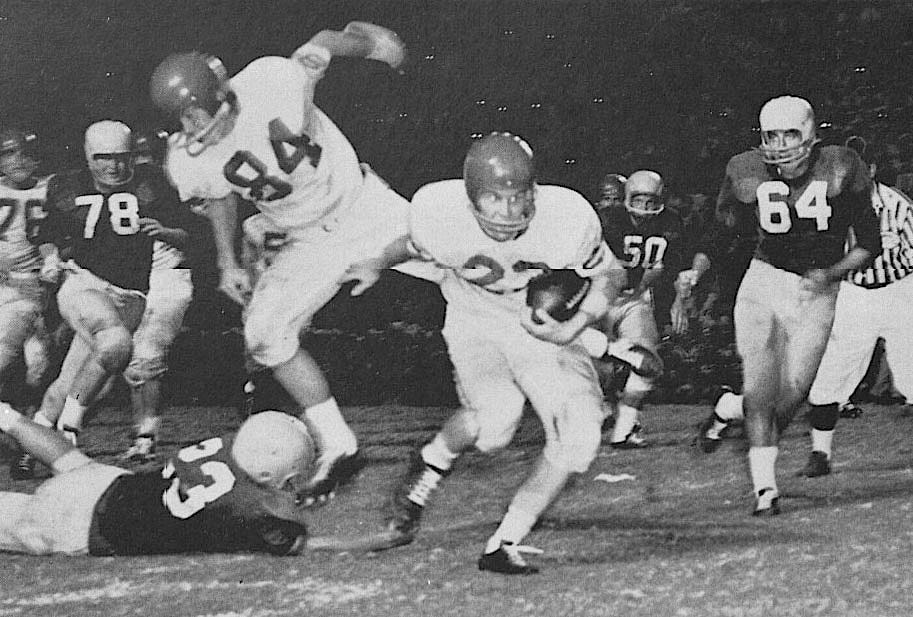
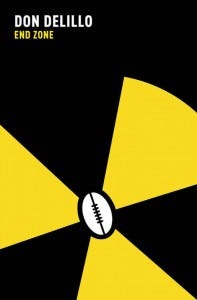
When asked for my favorite Don DeLillo novel (a question that has yet to manifest in the natural course of conversation), I invariably respond with End Zone. A deep cut from the DeLillo library, the book is markedly different than its predecessor (the oft-brilliant Americana): slimmer, sharper, more disciplined, and leavened with his peculiar brand of gallows humor. The themes that come to dominate his later works — namely, a preoccupation with nuclear armament and its apocalyptic consequences — first take root in End Zone. It wouldn’t be a stretch to call it the Great American Football Novel, as so little competition exists (unless we’re counting Matt Christopher titles). The lack of literary interest in the game is surprising, since it serves as the perfect lens through which to examine our fractured state: its ingrained prejudices, gender distortions, money lust, and, above all, the culture of brute violence that has come under increased scrutiny of late.
The lack of literary interest in the game is surprising, since it serves as the perfect lens through which to examine our fractured state: its ingrained prejudices, gender distortions, money lust, and, above all, the culture of brute violence that has come under increased scrutiny of late.
My own love affair with football started early, around seven or eight. I had a shrine dedicated to the Miami Dolphins in the corner of my bedroom, with ephemera ranging from felt pennants to signed photos of my favorite players. I never missed a game on television. Losses reduced me to inconsolable fits of angst and suffering. Sundays passed with trepidation in my household. Bad news meant a storm, and my parents had to be prepared to batten down the hatches.
This zealous fandom continued for the next decade or so. I traveled to Florida to watch their training camp, attended conventions, managed fantasy teams, and even started a football blog (everything short of a porpoise tattoo). It wasn’t until the Richie Incognito bullying scandal that my passion for the game began to level off. Reading Incognito’s racist and homophobic messages to teammate Jonathan Martin opened my eyes to the gladiatorial mentality and language of violence cultivated in NFL locker rooms. Instead of denouncing the actions of Incognito, players vilified Martin for reporting the abuses and seeking emotional support. When Dolphins General Manager Jeff Ireland was notified of the ongoing harassment, he advised Martin to punch Incognito in the face. Because apparently that’s what real men do.
This newfound disillusionment with the game was only compounded by SportsCenter’s daily screenings of Jadeveon Clowney’s thundering tackle on Michigan running back Vincent Smith, which earned Clowney an ESPY award and instant celebrity (the YouTube video of the tackle has logged over five million views). My last iota of interest in the sport was atomized following the Ray Rice assault charges and the NFL’s abysmal attempt to sweep the incriminating evidence under the rug. Mind you, this is not a new tactic in the NFL playbook. Former Bears GM Jerry Angelo recently admitted to concealing “hundreds and hundreds” of abuse cases during his tenure with the team. For many executives, the decision of whether to report a violent crime is less a moral concern than a monetary one.
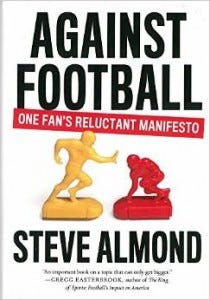
In August, Steve Almond released Against Football: One Fan’s Reluctant Manifesto. The book documents Almond’s own disenchantment with the game and its malignant influence on our culture. An extended chapter is dedicated to the prevalence of brain injuries among former players and the dubious ethics of watching athletes incur repeated blows to the head. Almond offers several prospective changes to curb the most dangerous aspects of the sport, including legislation prohibiting players younger than sixteen from engaging in full contact and imposing a weight limit on participants. Recent studies estimate the average lifespan for an offensive lineman is 52 years, with one in three players experiencing cognitive problems at a significantly younger age than the average person. Combine that with an elevated rate of suicide and chronic pain from bone and ligament damage and you’ve got a veritable minefield of post-retirement health risks for players to navigate. Unfortunately this is not something likely to be remedied with a few simple tweaks to the rules. Physical pain is endemic to the sport and any changes implemented by the league are bound to be disappointingly small and entirely inadequate.
It would be naive for me to claim that watching football inures us to violence, as anyone can tell you there’s a seismic difference between televised violence and experiencing it firsthand. My issue is more with the symbolic qualities of the sport, its embodiment of all the injustices in this country, from corporate tax loopholes (the NFL is a tax-exempt organization) to the war on drugs (the league doles out harsher punishments for drug use than it does for domestic violence) to its history of institutional racism (even with the Rooney Rule, minority coaches and executives are routinely overlooked). The attitudes and practices of the league run so contrary to my personal politics that I can no longer in good conscience allow the sport my patronage.
The attitudes and practices of the league run so contrary to my personal politics that I can no longer in good conscience allow the sport my patronage.
The game came on and we all watched it, marveling at the pros, how easily they did the things we stumbled over. In slow motion the game’s violence became almost tender, a series of lovely and sensual assaults. The camera held on fallen men, on men about to be hit, on those who did the hitting. It was a loving relationship with just a trace of mockery; the camera lingered a big too long, making poetic sport of the wounded. We laughed at the most acrobatic spills and the hardest tackles and at the meanness of some of it, the gang tackles and cheap shots. We laughed especially at the meanness.
Perhaps more than any other sports novel End Zone captures the self-conscious machismo and hyper-militarized speak of the locker room environment (“They’re out to get us. They’ll bleach our skulls with hydrosulfite.” “They’ll rip off our clothes and piss on our bare feet.”) In the heat of West Texas, toughness is valued above all else. Cecil Rector’s dislocated shoulder is corrected with a crude harness. Ron Steeples is knocked out cold and later shepherded back into the game. Jimmy Fife is teased over a ruptured spleen. The tolerance of physical pain is akin to religious rite. Injuries are worn like badges of honor. Players are lured to the program by the promise of pain and sacrifice. Even Gary Harkness, the story’s protagonist, searches for meaning in the game, a reigning sense of order. They believe by surrendering themselves to a collective identity they can be absolved of fear and uncertainty. By uniting toward a common goal they can rise above their individual limitations. Fans of the game seek a similar salve, a means to transcend the mundanities of their day. But like the dizzying hits that are slowly grinding brains into a grayish pulp, I fear how our continued consumption will wear on our own minds.
A Song of Ice and Fire author (and movie theater owner) George R. R. Martin is not happy about Sony’s decision to suppress the James Franco and Seth Rogan film The Interview in the wake of the Sony hack. Martin took to his livejournal to denounce the “corporate cowardice” of Sony and the major movie theater chains allowing anonymous threats cancel the release of a film:
In a stunning display of corporate cowardice, Regal, AMC, and every other major theatre chain in the United States have cancelled their plans to show the new Seth Rogen/ James Franco comedy THE INTERVIEW, because of — yes, seriously, this is not a SOUTH PARK sketch (though I expect it soon will be) — threats from North Korea.
[…]
I mean, really? REALLY?? These gigantic corporations, most of which could buy North Korea with pocket change, are declining to show a film because Kim Jong-Un objects to being mocked?
The level of corporate cowardice here astonishes me. It’s a good thing these guys weren’t around when Charlie Chaplin made THE GREAT DICTATOR. If Kim Jong-Un scares them, Adolf Hitler would have had them shitting in their smallclothes.
Martin went on to say that the theater he owns, the Jean Cocteau Cinema in Santa Fe, will gladly screen the film “assuming that Sony does eventually release the film for theatrical exhibition, rather than streaming it or dumping it as a direct-to-DVD release.” (Although if Sony continues to meet the hackers demands, not even those last two options will be possible.) In a follow-up post, Martin notes that several theaters who planned to show Team America: World Police can’t because Paramount has pulled the film — which also mocks the North Korean government — from exhibition. “Where does it end?” Martin asks.
Meghan Daum’s essay collection, The Unspeakable, broaches subjects we dare not discuss out loud. “At its core,” she tells us in the introduction, “this book is about the ways that some of life’s most burning questions are considered inappropriate for public or even private discussion. It’s about the unspeakable things many of us harbor […] but can only talk about in coded terms.” But beyond speaking the unspeakable, Daum’s book accomplishes something else. It’s an exercise in self-identification, and therefore asks why we need to label ourselves in the first place. Daum tries on many identities over the course of the book. She challenges our expectations of and obligations to each other. What do we really owe each other? Do we have to identify as a foodie, a romantic, a grieving daughter? Or a thankful patient brought back from the edge of a life-threatening illness? What should any of that look like from the outside? In her essays, Daum dissects the duality of expectation and obligation. She asks us to hang in there while she walks uncomfortable lines, promising, “I’m giving it to you as straight as I can.”
In “Matricide,” the opening essay and the book’s most striking, Daum walks us through her role in her dying mother’s last months, and the way emotion and hope intrude into the necessary acts of each day.
It’s amazing what the living expect of the dying. We expect wisdom, insight, bursts of clarity that are then reported back to the undying in the urgent staccato of a telegram. […] We expect them to reminisce over photos, to accept apologies and to make them, to be sad, to be angry, to be grateful. We expect them to clear our consciences, to confirm our fantasies.
“Matricide” is Daum at her best, describing the months preceding her mother’s death, while tracing lines of a difficult family tree. She explains not only her complicated relationship with her mother, but that of her mother with her father, and of her mother with her own mother. The undercurrent of disappointment flowing from one generation to the next colors her feelings as she is expected to provide care, and her writing is both confessional and bold. Daum as grieving daughter isn’t what we’d expect, just as Daum isn’t easily labeled.
In “Not What it Used to Be,” Daum examines the way we’re nostalgic for youth — her own being both the very thing she misses and an exercise in coming up short.
I realize that what I miss most about those times is the very thing that drove me so mad back when I was living in them. What I miss is the feeling that nothing has started yet, that the future towers over the past, that the present is merely a planning phase for the gleaming architecture that will make up the skyline of the rest of my life. But what I forget is the loneliness of all that. If everything is ahead then nothing is behind. You have no ballast. You have no tailwinds either. You hardly ever know what to do, because you’ve hardly done anything.
This particular essay captures the irony of being young: that we are not old enough to appreciate it, and we are so caught up in the miserable details that it’s impossible to enjoy just how much lies ahead. Daum reminds us several times that her younger years were not particularly common, but what she writes is familiar. Readers will identify with the ironic longing she feels for something not so great.
“Honorary Dyke” and “Difference Maker” both question the way that we feel like we have to fit into a box. In “The Joni Mitchell Problem,” Daum gives us a peek into her writer’s origin story, admitting that even what she learned from Joni Mitchell wasn’t simple. “The artist who puts herself out there is not foisting a confession on her audience as much as letting it in on a secret, which she then turns into a story,” she says. She goes on to show how she’s not like other Joni Mitchell fans, and to describe the experience of meeting her hero in a way that sounds as awkward as it was fortuitous. Sometimes even the expectations we have for ourselves are unreasonable.
“It’s now been more than a decade since I moved to Los Angeles,” she says in “Invisible City,” “and I still sometimes feel, as I did back then, vaguely embarrassed about it.” The subject of Los Angeles fits nicely with the rest of the collection, as Daum reveals it to be a place constantly labeling itself. Her revelations about how she has come to know herself in this place — particularly how she has come to know herself beyond a list of descriptors. In LA, she learns to float between the lines. She says, “Los Angeles is where I learned that your ability to see is sometimes only as good as your willingness to go unseen.”
Daum confronts her readers with truth — sometimes shocking, but more importantly, the ordinary and secret truth. It’s familiar because it is the truth we also feel but are afraid to admit. In The Unspeakable, Daum’s strength is the way she puts herself on the line, and asks her reader to think about how he allows himself to be labeled and define his own identity. “This is a story with a happy ending,” she says. “Or at least something close enough.” Daum finds meaning in this middle ground, allowing us to feel like we can hang out there, too.
Writing friendships famously don’t involve much writing, but they tend to involve a lot of books. We met ten years ago at the Clarion West workshop, two nervous college kid weirdos who wanted to write the kind of genre-bending work we’d devoured as readers. Over the course of six weeks, we discovered a shared love of everything from obscure YA to hyper-popular literary novels to translated experimental classics. We’ve never lived in the same city since, but over ten years we’ve exchanged countless emails, phone calls, texts, manuscripts and, most importantly, book recommendations.
But here’s the thing: we could leave books at each other’s apartments or ardently recommend novels all we wanted, but life is fast and weird and we’re both pretty forgetful. For this column, we will assign books that the other has to read in a timely fashion. Sometimes this will be because we loved a book. Sometimes it will be because we find it interesting, or terrible (yes, we will be trolling each other). In any case, you know that glorious feeling you get when someone has actually read the book that you recommended to them? We plan to experience that on a regular basis.
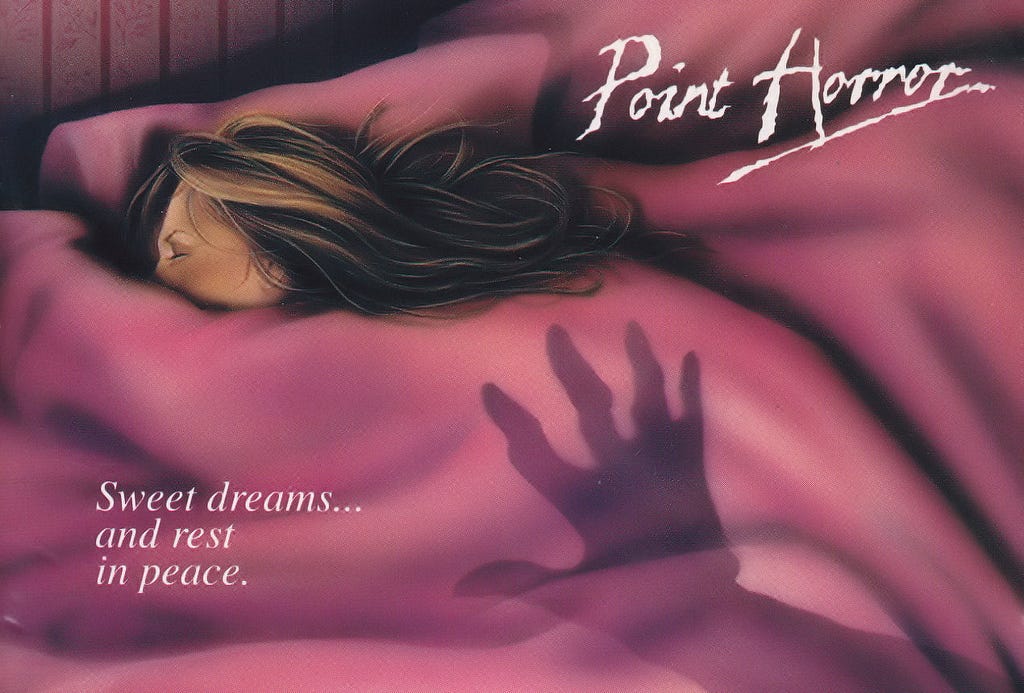
Up first is a weird trip back in time to one of the first things we ever bonded over: The Point Horror series. These were the spinner rack books, the covers with oozy-looking embossed titles and screaming teens. R.L. Stine, Christopher Pike, Caroline B. Cooney, Diane Hoh, Richie Tankersley Cusick.
Point Horror was grindhouse for girls. The disreputable and grim, the stark and shoddy — but for the likes of pre- and early teen us. Not more than we could handle. For a time, it was perfect; it was the exact kind of wrong we were seeking.
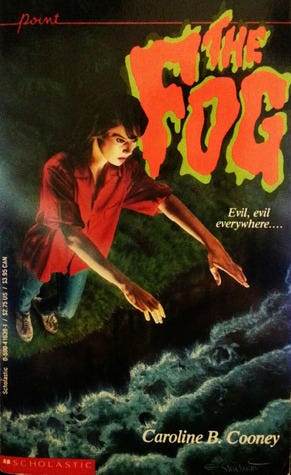
Meghan’s pick for Alice: The Fog
When I was in fourth and fifth grade, I read my way through the entire fiction section of my school library. Or at least I think I did: the reading was a survival tactic, and my memory of the books I inhaled is non-existent. I do remember the despair I felt standing in the stacks, staring at a shelf full of books I’d already read. I don’t remember which of these novels scared me the most; the real answer is probably “all of them.” But when researching our Point Horror glory days, I saw the cover of The Fog and thought, “Oh no. Not that book.”
Of the two of us, Alice is much more the horror writer and the horror fan. She’s the one who re-introduces me to all the bizarre details from Christopher Pike novels I’ve tucked into my subconscious. The Fog is a gas lighting horror story set at a remote boarding school, all words I know would be Alice-approved. Her work is infused with an uncanny darkness that can turn on a dime from hilarious to terrifying, and has and especially keen eye for the dynamics between unlikely communities forced together: she’s even written a story set at a boarding school. But more than that, I was interested to hear her take on a book whose mere thought filled me with dread twenty years later.
Alice’s take on The Fog:
Fog pulls off a neat trick. Author Caroline B. Cooney intended it to be “starter horror” with no bloodshed. But by sidestepping the usual Point Horror standbys of gory-boring stabbings and bludgeonings, Fog instills a deeper sense of horror, one that disturbed me despite my too-oldness for this shit. Thanks, Meghan!
Class is an important part of the horror in this book (and in life, right). Our hero Christina is thirteen, excited to leave her tiny island off the coast of Maine to attend high school on the mainland, along with her older friend Anya and two boring boys. Christina is brave and stubborn and has naturally tri-colored hair — brown, silver, and gold, (yeah, I don’t know either) — but all this is meager protection against the horror we already know she will encounter: that of being a poor kid in a school of rich dickheads. The dickheads mock the islanders for their poverty, their slang, and their rumored lineage of criminals. It being coastal Maine, close attention is also paid to how one wears one’s boat shoes.
The other horror in Fog, inseparable from the sense of class horror, is that Christina and her island compatriots have to board with these smooth assholes named the Shevvingtons in their cliff-top house. The boarders’ bedrooms are chosen and decorated to be maximally creepy, and Mrs. Shevvington serves up gross dinners and spiteful insinuations.
Yes, dinner is food and a creepy bedroom is shelter — but what Fog really highlights is the overwhelming discomfort of such a situation. Of being surrounded by people who can treat you with such an utter lack of dignity — who will treat you worse and worse — because you’ll still never be able to repay them for their kindness. Reading, I felt a smothery, awful sense of powerlessness. I know about the free lunch tickets that Christina uses and I know what it is to be an unwelcome guest, to silently eat what is handed to me or not eat what is not given and to say thank you in response to any kind of treatment.
High school principal Mr. Shevvington is the silver fox hottie, the one who dominates with his charisma and slick talk, the one you would just do anything to please. Meanwhile, Ms. Shevvington, the English teacher, is the nottie, a Dolores Umbridge-esque figure who smiles sadistically with stubbed yellow teeth and controls with false concern and unending rules. It quickly becomes clear that the Shevvingtons’ sole goal and pleasure is to torment and gaslight young women, eventually driving them mad.
Why? We don’t find out. But it’s got to be at least partially a weird sex thing, subtextually speaking. It’s also yet another class thing. Poor Anya, glam and smart, succumbs to a gaslighting onslaught involving a poster of the sea that keeps changing, the noisy tide, and a creep in a brown wetsuit. She goes insane, quits school, and works in a laundromat. Everyone pities her; everyone is grateful to the Shevvingtons for all the help they’ve tried to give Anya. As the Shevvingtons sadly say, “We always thought she would become a wharf rat and now she has.” “Wharf rat,” of course, is the book’s pejorative for a particular kind of working class girl.
This is intensely horrifying; thank goodness Christina is a bad bitch. Throughout, her mantra to herself is, “I am granite.” She is blunt and forthright, sometimes bratty. Later, when Christina pukes on some mean girls, her first post-vom thought is, “What a weapon.” Still, the Shevvingtons do their harrowing best to mess with Christina. Among other things, they ask her to fill out a highly super official form requesting a list of her worst fears (!), and subtly bully her in front of her fellow students. Though Christina isn’t immune to Mr. Shevvington’s psycho hot daddy charms, she ultimately sees him for what he is. “…[S]he remembered that she was granite, not a tern. That Mr. Shevvington did not have the eyes of a mad dog, but of a man who wore contact lenses.”
Yeah, fuck your contact lenses, Mr. Shevvington!
The horror is not the sea. It is not a supernatural force. It is the people who think you are beneath them and will stop at nothing to force you to live out their fantasies of who you are, who you really really are, so that you give up and prove them right. And worst of all, these are the people who often hold all of the institutional power, so that you alone — without parents or friends or teachers — must remember that you are granite.
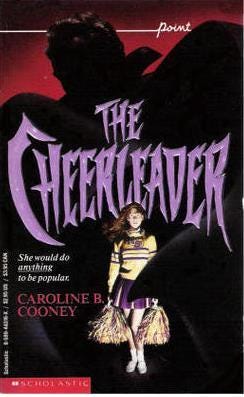
Alice’s pick for Meghan: The Cheerleader
The Point Horror book I chose for Meghan is The Cheerleader by Caroline B. Cooney. This one I do remember pretty clearly. There’s a vampire, who isn’t so much a solid being as an unstable cluster of characteristics. He’s practically Cubist. Here’s the teeth; here’s the spongy, decaying skin; here’s a shard of cloak in the corner of your eye. You never see everything at once.
Then there’s Althea, the lonely girl up in the shuttered room. Because Meghan’s writing is so great at depicting complex relationship dynamics, such as push and pull between wanting/not-wanting, I thought she might find Althea and the vampire kind of interesting. One really uncomfortable thing about this book (and the two others in this trilogy) is that the main characters are made complicit in the vampire’s evildoings. The vampire wants, and because the girl also wants — popularity or beauty or intelligence — the vampire gets.
Meghan’s take on Cheerleader
Althea has a problem: she wants to be a cheerleader but didn’t make the team. This may or may not be because she has no friends and lives in a creepy house with a vampire. In exchange for awakening him (she opened the locked room in a tower, of course), the vampire promises to make her popular, provided she supplies a victim. After she delivers the energies of a young, pretty freshman, Althea makes the squad and befriends the most popular girls in school. She gets a boyfriend and spends a lot of time at Pizza Hut. But the vampire keeps demanding victims, and he’s clearly not just making them “a little tired.” Finally, Althea tries to sacrifice herself to the vampire, only to reject her desire for popularity and escape.
The vampire is the gross, leechy variety: he smells of rot and has mushroom-soft skin. He taunts Althea in that sexual-yet-sexless way vampires excel at when they’re definitely not boyfriend material. His disgusting physical presence is mirrored by the delicious, intoxicating physicality of cute boys. A YA writer friend once pointed out that for all its flaws, Twilight is uniquely invested in Bella’s physical feelings of desire. I could defend The Cheerleader similarly: Althea is a great assessor of boy flesh. There’s a short scene of heterosexual bliss when she rides in the car between two rival suitors, relishing every bump of the knee. She delights in the attentions of not one but two boys with muscles, turns to jelly when one rests his chin on her head. She is equally fascinated by the football team’s nervous faces on the way to a game, a rare crack in their masculine facade.
Althea also meticulously worships the beautiful, perfect cheerleaders she aspires to become. The freshman she sacrifices is a lovely and languid blond; the brunettes on the team “sparkle.” As a closeted kid, I remember this intense, totally not gay worship of female beauty. It served to only further entrap me. Girl culture is a paralyzing amalgamation of homoerotic affection and strictly enforced homophobia: you braid your friend’s beautiful hair while discussing how disgusting it would be to kiss a girl. I used to stare at the lovely popular girls and tell myself I just wanted to be thin and beautiful like them. That my desire was jealousy. I don’t know if I read Althea as closeted here, but if anything, she finds the girls lovelier to look at than any of the boys, who are barely described outside of their touches and smells.
Pizza Hut plays a bizarrely central role in the novel. The popular kids meet constantly in a hidden-away back booth, never actually consuming pizza, just digging the soda and the scene. When someone puts on music in the jukebox (did Pizza Hut have jukeboxes?) Althea declares, “You can’t dance in a Pizza Hut!” And then she does. This is perhaps the happiest moment in the book. There was a Pizza Hut near my high school. No one was hanging out at that weird sad restaurant. My friends and I went to Friendly’s, but we were not cheerleaders. In a way, it’s a weird warping of high school for younger readers: the characters all guzzle soda like it’s booze and hang out at a restaurant for kids.
More than anything else, reading this novel dug up the tyranny of “popular” in middle school life — and the unrelenting finger-shaking at wanting to be popular. Althea’s actions are so heartless she resembles a Shirley Jackson character: a crazed outsider wreaking havoc to attain something she’s entirely unfit for. The girl lives in a haunted house with a locked tower. Of course she’s not cheerleader material. For all we know there’s a missing chapter in the book about poisoning her parents, who never appear. This queasy undertow of evil comes, I suspect, from contradictory characterization rather than literary intent, but the book goes to a darker place than something more polished might have.
Though, really, the novel is too hard on Althea, the maybe-orphan weirdo in the thrall of a vampire who fucking lives in her house. This musty, mushroomy monster is psychologically torturing her, and it turns out all she has to do is stop wanting to be popular. That’s an especially mean manifestation of the advice all adults, including me, give young women: forget being popular, just be yourself!The Cheerleader adds: And any shortcuts you take are evil and totally on you!
That’s the message that would have scared me at that age; maybe it’s what scared Alice too. Because what’s wrong with wanting fun friends and a cute boyfriend, exactly? The scene that moved me most was Althea’s first lonely search for somewhere to sit in the cafeteria. When I hit high school, my friends all ditched me too, and I made a much less successful gambit for popularity via team sports. That hopeless, clawing loneliness of having no one to sit with while you eat your sandwich is not trivial: it’s a sharp reminder of much larger problems. If I could have escaped that minor hell with help from a monster, I might have, too.
***
Alice Sola Kim is a writer whose work appears in Tin House, McSweeney’s, Asimov’s, and Lightspeed. Her website is Alicesolakim.com.
Meghan McCarron’s writing has recently appeared in The Collagist, The Toast, and Gigantic Worlds, and her short fiction has been a finalist for the Nebula and World Fantasy awards. A food and restaurant obsessive, she is the editor of Eater Austin.
When I was asked to compile a comics best of for 2014, my first thought was that there’s no way I’ve read enough of the comics published this year to judge which were “the best.” Then I realized that I didn’t read a whole lot of new comics in 2014 at all. Barely any. I spent too much time drawing, not enough reading. And a panic set in. Am I ignorant? Am I out of touch? So I reached out to my friends and asked them to recommend one comic they loved in 2014. Below are their recommendations (and one of my own), a list that makes me feel secure I’ll be a comics literate once again. This is my reading list for the new year. Might as well make it yours too.
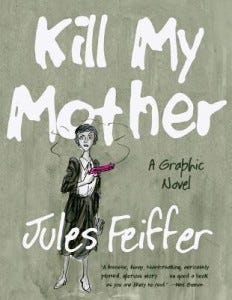
The title might not suggest it, nor does the content, but Jules Feiffer’s newest graphic novel is all about hope. The freshness, the looseness, the newness of Feiffer’s work, in the seventh decade of his career (ninth of his life), shows us that talent need not atrophy, and artists don’t have to stop growing. The inventiveness of his layouts and vitality of his line are as bold as any formal experimentation in the work of Dash Shaw and Frank Santoro. This book, an unruly, globe-spanning story of greed, family, and betrayal, is Feiffer’s first foray in noir.
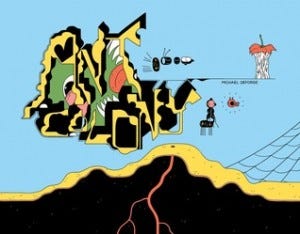
Michael DeForge’s work has been mixing dreams with boredom and elaborate systems in these just real breathtaking ways for years, but Ant Colony is the first sustained narrative he’s done that you can hold in your hands. Ostensibly it’s about a colony of black ants who jerk off into their queen in order to propagate their colony, and also red ants, who are crazy because that’s what the other is right?, and spider milk, which makes you crazy, and a little boy whose father makes him eat a blended up earthworm that gives him visions and turns him into a prophet covered in bee pollen, also his dad who is kind of a dick, and two gay black ants who maybe really don’t get along real well and should at least see a relationship therapist or something, and some cops who are ants, and what we do when the systems that have defined our lives completely collapse. Also there is a centipede who is just a real asshole.
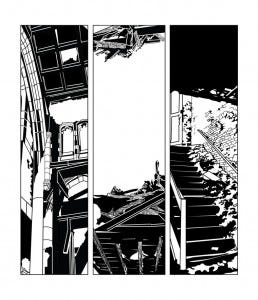
Kristen Radtke’s essay, “City of the Century” (The Normal School) from her graphic memoir in progress on abandoned places is defined by spare, elliptical, and lyrical prose, almost minimalist in its precision and punch, augmented by haunting visual triptychs of abandoned places. In a high-wire conversation between word and image, Radtke reveals how, “Indiana was a place where you could drown and dry up at once.”
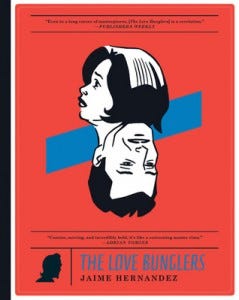
For over 30 years, Jaime Hernandez has been writing and drawing Locas, the greatest serial in American literature. It’s a testament to his talents that the latest installment, The Love Bunglers (Fantagraphics), is also one of the very best. It reveals the childhood secrets of longtime heroine Maggie and brings her on-and-off relationship with Ray D. to a startling climax. The story moves masterfully between time periods, compressing and dilating key moments so that you’re never sure what’s around the next panel. It packs an emotional wallop even if you’re not familiar with the characters. Newcomers are still advised to start from the beginning before tackling The Love Bunglers, while longtime readers will have another reason to be glad they’ve followed Hernandez’s epic, which seems to grow richer and more indelible with each episode.
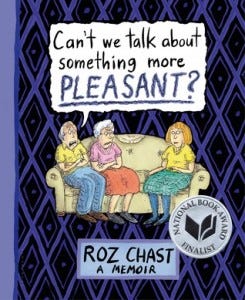
There is a reason everyone loves Roz Chast. Her graphic memoir, Can’t We Talk About Something More Pleasant?, unsparingly chronicles the last years of her parents’ lives while also attempting to make sense of the mechanics of her own psyche and heart. Read this book with dread and gratitude. Dread for its portrayal of what awaits all of us — aging parents, aging selves and, of course, the inevitable, what no one wants to talk about — death. Gratitude for the generosity of Roz Chast’s unstinting details, for her genius and for her amazing wit and line that make this book about a most difficult subject a fun and absolutely necessary read.
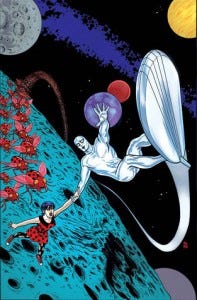
I’ve always seen the Silver Surfer as a kind of guru, the essence of humanity laid bare, a seeker in the universe. No adornments or crazy costumes. He rides his board through the cosmos and just tries to do the best he can. In this new series, Dan Slott and Michael Allred are emphasizing the zany wonder of infinite space and I can’t deny that it’s a ton of fun to read — and look at! Allred unleashes a new mode here, a kind of Kirby/Ditko hybrid passed through Frank Brunner with every issue delivering some kind of visual headtrip that you have to see on the page to believe.
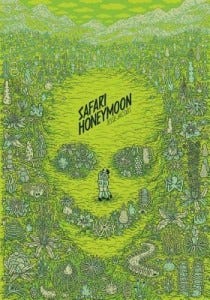
If you haven’t already picked up one of Jesse Jacobs’s books you should do so immediately. One of the most beautiful books I have read this year, Safari Honeymoon (Koyama, 2014) continues Jacobs’s obsession with the weird, following a honeymooning couple as they traverse a strange land where they encounter multi-limbed monsters (they adopt and name one Winston!), odd hogs, humming plant creatures, and creepy parasites (including a parasite that eats and replaces the tongue of their guide!). Jacobs uses a minimal green color palette, which gives the book a self-contained, lush, otherworldly quality, and shows off the beauty of his composition and line work. Every page of this book could be torn out and framed. Seriously.
Fred Rogers said in a 1994 interview: “And so, for me, being quiet and slow is being myself, and that is my gift.” In this and other ways, Rachel and Ben is the comic for the Mister Rogers fan who has grown up. It is quiet and slow. There is a neighborhood. And it has a lot of the same colors as Mister Rogers’ Neighborhood. And Edward Mullany has, and is, a gift.
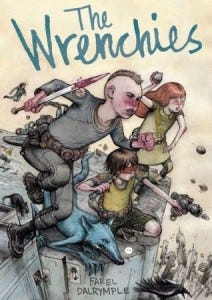
My first encounter with Farel Dalrymple’s work was his graphic novel Pop Gun War, which blended philosophical musings, magic realist elements, a touch of metafiction, and a fondness for punk rock. His latest work, The Wrenchies, takes all that I admired there and cubes it. There’s a sprawling quest, heroic journeys, and some truly nightmarish images, all wrapped in a pair of emotionally harrowing coming-of-age stories.
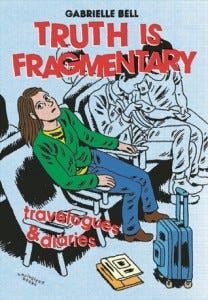
Funny, disarming, and observant, Gabrielle Bell’s new collection of travel and diary comics, Truth Is Fragmentary, offers the quotidian and the surreal — occasionally at the same time — from befriending bears in a post-apocalyptic zombie world to navigating the awkwardnesses of Comic-Con, from rooftops in Brooklyn to cab rides in Colombia, to airports and airplanes around the world. With her wild imagination, self-effacing humor, and seemingly limitless supply of stories, quotes, queries, and insights, Bell is the ideal travel companion.
Writer Paul Rome and composer Roarke Menzies have been friends for several years and projects now, collaborating on their unique brand of performance literature. They first worked together on their show And Once Again, followed by an audio drama called The You Trilogy and a performance at The Bushwick Starr, Calypso.
They’re back at The Bushwick Starr for their latest show, Philadelphia and Other Stories, running from December 18th to 20th. This time, they’ve added additional collaborators. All the stories, written by Rome, are accompanied by a soundtrack composed by Menzies. The stories are followed by songs from musicians Katie Mullins and David Kammerer. The stories themselves will be read by Rome, Menzies, and actress Katie Scholland.
I interviewed Paul and Roarke at Paul’s apartment, where the two were meeting with Katie Mullins and David Kammerer about the music in the show. The topics ranged from Spotify, the closing of beloved NYC venues, academia, movies, and rashes.
Paul and Roarke, why did you choose David and Katie to be musicians in this show?
ROARKE: We’re so lucky.
PAUL: Yeah, we just thought of our favorite musicians. David, from Bushwick Home Companion, we’ve heard him perform on many nights. Katie, at the Arbitration Rock Festival. We select people that we want to work with, have dinner with, and get to know better.
David and Katie, what made you interested in participating?
KATIE: I had read Paul’s novel and I really liked it. I was reading his book on the subway with my hat and gloves in my lap. I was very engrossed in it and then all of the sudden my stop was there, so I jumped up to make my stop, but the hat and gloves stayed on the train. But it was worth it! Also I like these guys. We’ve hung out and that’s it, that’s enough.
DAVID: I’ve seen Paul perform his work many times. I was there early in this process for him. And I thought the stories were amazing, incredibly insightful, funny, and really smart. I just had a blast listening. I also live in the neighborhood. I see these guys a lot and it’s great to run into each other. Occasionally, we get into conversations about music and literature and that’s fun.
How did you pick the songs that you wanted to feature in the show?
ROARKE: Both David and Katie have really stellar solo albums. They’re so listenable and I’m a huge fan. We decided when we brought up the idea, as far as including the songs with the stories, that they would be framed in totally equal lights. Basically, Paul and I were sitting here in his living room and chose the ones. We listened to a handful and it was pretty immediately clear.
KATIE: We did a reading with all the stories and all the songs. I was listening to the stories, and I was like ‘oh, that makes total sense that they chose that’. The theme of the story fits the song.
PAUL: For me, the songs are continuing to resonate in new ways. With a collection of stories, there’s this whole question of how they talk to each other, and the songs are part of that. Hopefully, they all contribute to a deepening of the ideas.
You have an interest in traveling as a theme. The idea of traveling, or going on a journey, is essential to the history of storytelling itself, starting with Homer’s TheOdyssey, which you retold in your previous show Calypso. Traveling seems to be a theme of Philadelphia and Other Stories too. So, what appeals to you about traveling?
PAUL: It’s funny, I’ve done less and less traveling since moving to New York. I relish the opportunity and it does become a time of reflection. When you sleep in a different bed, or drive somewhere different, the change causes new associations and new memories that you didn’t have. You start thinking about old people you haven’t thought of in a long time. I’m interested in that. And traveling with someone else, romantic or otherwise, it’s a very intimate experience. From the food you try, to the music you put on.
ROARKE: When you’re on a trip with someone, you share experiences and memories that you would never think to tell if you were hanging out in another context. Working on this project, working on this show, has been a similar thing. There are these associations that are fired, when you’re in the context of focusing so much on creating this thing. You develop this intimacy and you share a lot. I think that’s how Paul and I became so close, working on projects like this. And now, I think we can tell each other anything.
DAVID: I think something that comes up for me with traveling, and it’s also a method of songwriting, is this idea of possibly getting lost and not knowing where you are, which is a nice place to be sometimes, especially creatively. Just having a how-do-I-get-out–of-here kind of feeling.
Do you have things in theatre that you particularly like, either specific plays or styles of theatre that you like or dislike? For example, I like when the acting and writing is naturalistic, sometimes where it’s literally taken from transcriptions of actual people speaking. Or if it’s not directly transcribed, it’s clearly been written by someone who has listened to speech a lot. Whereas I feel averse to the type of play where it’s a bunch of witty people saying witty things back and forth to each other. That should be an Aaron Sorkin T.V. show or something. But in theatre, I’m interested more in silences and the awkwardness of speech.
ROARKE: The thing that comes to mind that I saw a year or two ago was something called Roman Tragedies that played at BAM. I loved it. Sometimes you’re lucky enough to see something in a theatre that you know you’ll just always remember. This was a Dutch theatre company. They took Shakespeare’s three tragedies that were set in Rome and translated the text into Dutch. They had this array of cameras, a whole camera crew, with monitors, in the middle of the stage. The monitors and a big projector had subtitles in English, but not of the original Shakespeare, it was then translated again from English from the adaptation that they’d done. It was so captivating and it was five and a half hours long. You could watch from the main audience in the opera house, or you could get up and go on stage. They had bars in both of the wings, serving drinks. So you were able to establish this level of comfort, because you could decide where you wanted to be, and have your own choose-your-own-adventure of where you wanted to watch things.
KATIE: My favorite kind of theatre recently has been immersive theatre. My favorite piece I saw two years ago, when I was visiting Berlin. The entire audience went on a boat. It was called Clean Room by Juan Dominguez. We were in a really dark room with cushions and they took us through a guided meditation, that’s how the piece opened. Then we traveled to another room and did this thing with chairs where we interacted with each other. Then we went and had dinner. And then we all went on the boat. There were no actors. He just created an experience.
DAVID: I went to Queen of the Night. That was pretty amazing. It was one of those things where they try to control you as an audience. They’re serving dinner. They separate you from the people you come in with. And there were people from the show who will come and grab you, and take you off somewhere.
PAUL: I want to be a contrarian and say I saw The Importance Of Being Earnest last year and it was fantastic.
ROARKE: Most people don’t spend much time in the theatre. You don’t spend much time in this very quiet, well-lit, place. In this frame. Just that space itself, there’s so much to that, what your mind does, how much it stretches out.
KATIE: Yeah and Philadelphia and Other Stories isn’t a play. It’s a shared literature experience. You can’t read a book with somebody, unless somebody reads it aloud. We’re deciding the pacing, the timing, and the intonation, but other than that it’s like everybody’s reading this together, which is super special.
Paul and Roarke, Philadelphia and Other Stories will be the third live performance I’ve seen you perform. Each time the performances are getting more ambitious and experimenting with new things. What are you planning next?
ROARKE: We started talking about this show, Philadelphia and Other Stories,as an album originally. We’ve talked about doing a recording for a while, so that’s likely going to be something that we do next year. We’ve also talked about a couple of other shows that use this show as a jumping off point, in a non-literal way. One is called Other Stories, where neither Paul nor I would be onstage. It would probably be extending this idea of using interviews and transcriptions of other people’s stories, and then spinning them a bit, fictionalizing them.
Speaking of transcription, I know to form some of these stories, you’d record Paul talking. What was the idea behind that?
ROARKE: We did that first in Calypso, when Paul was writing the stories for the character in the more colloquial tone. We knew what needed to happen in the scene, but how do you make that really chatty? In some ways it’s about time, you can spend a lot of time trying to make something you wrote sound like it’s being spoken spontaneously in the moment. Or you could just talk through the scene, describe it and write that down. During the course of making these shows, we spend so much time together, whether we’re working on something or not, there’s so much bleed. One of the scenes, I just literally transcribed what Paul said and that is in the story now. That’s just a big part of how we work. You know what the plot is going to be, it’s about finding the right language.
The other idea we have for a show would be Brotherly Love, which would be just Paul and I in the show and sort of examining our relationship. Looking at “the bromance” and all the weird ways in which that shows itself, in affection as well as competitiveness and aggression.
Speaking of that, can you talk about that bromance? In terms of your friendship and working relationship?
PAUL: It sounds self-serving, but it’s important to me that it’s fun. And fun becomes torture in the process of getting it right. It’s a twisted kind of fun. For me, it’s great to get Roarke in this kind of context. Even in this interview, once the gears are turning, a lot of awesome, crazy stuff comes out. It’s fun to be around for that and beneficial for the work.
DON’T MISS OUT
Sign up for our newsletter to get submission announcements and stay on top of our best work.
YOUR INBOX IS LIT
Enjoy strange, diverting work from The Commuter on Mondays, absorbing fiction from Recommended Reading on Wednesdays, and a roundup of our best work of the week on Fridays. Personalize your subscription preferences here.