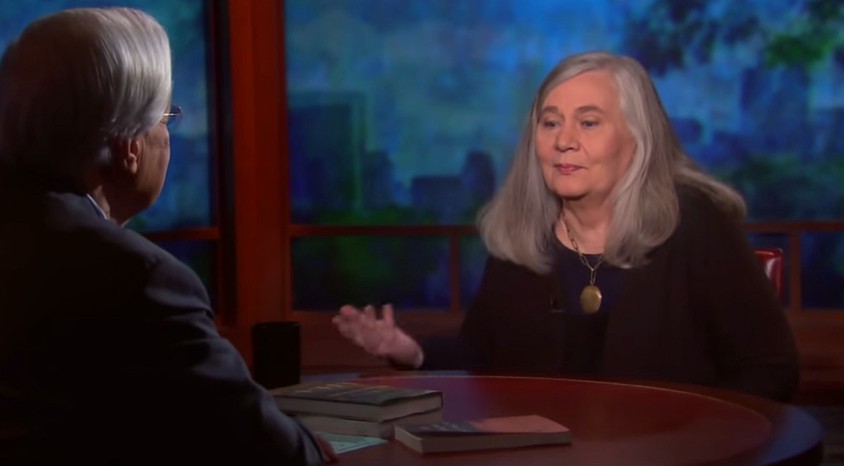
Marilynne Robinson’s new novel, Lila, is getting rave reviews and was a finalist for the National Book Award. In the above video, she talks to Bill Moyers about writing, her faith, and capitalism.



Marilynne Robinson’s new novel, Lila, is getting rave reviews and was a finalist for the National Book Award. In the above video, she talks to Bill Moyers about writing, her faith, and capitalism.
“Searching for a grave is, to some extent, like arranging to meet a stranger in a café…every person could be the one waiting for us; every grave, the one we are searching for.” This introductory salvo from Valeria Luiselli pulls us immediately into the quest anchoring the opening essay of Sidewalks — the search for the grave of the poet Joseph Brodsky in the cemetery of San Michele in Venice. Luiselli’s mission perfectly encapsulates the seeking of the essayist: the haphazard march towards the beacon end-point in the hope of finding some digressive sparks along the way.
These essays are steeped in graveyard melancholy — dried-dead Mexican waterways, dead Russian poets in Venetian cemeteries, detours into nostalgia, the particular strain of suffering encapsulated in the “saudade” of Pessoa’s Book of Disquiet, and the forgotten empty lots, the “relingos”, of Mexico City. Even the living masses of Manhattan comprise a tableau of solitude — doormen as the last bastions of computer-free existence, her isolated neighbors in their solitary apartment pods, glowing computer screens like digital gravestones. Luiselli excavates history — the personal, and the public — melding melancholic requiems with an intense immersion in her present moment. The resulting book is a dizzying and pleasurable experience.
Sidewalks is the type of book that makes me long for Spanish fluency (as my unopened Rosetta Stone box mocks me from by bookshelf). As Luiselli digresses into the untranslatable Portugese “saudade,” I wonder what native beauty I am missing in the translation of Luiselli’s work into English. This collection was first published as “Papeles Falsos” (False Papers) and it is easy to envision the editorial combat while hashing out the new, more audience-friendly English appellation. This new title is a great example of the power of a word — the robust, judgmental “False Papers” replaced by the bland, pedestrian “Sidewalks.” We see a similar exchange in the closing essay, Permanent Residence. Luiselli notes that Brodsky’s ode to his adopted Venice, “Street of the Incurables,” became “Watermark” in the English version. This translation travesty also perhaps driven by the English (and English-speaking) obsession with tamping down that Latin vigor.
“Alternative Routes,” at twelve pages, is the longest offering, and the fulcrum of the collection’s unifying melancholy. Luiselli’s digression into the search for a direct translation for the Portugese “saudade” becomes a dive into nostalgia and melancholy — two items steeped in the pages of her essays. She notes that nostalgia isn’t solely a pining for the past and that “there are things that produce nostalgia in advance.” This is something we instinctually feel when we encounter those perfect moments Luiselli describes as “places in which we know ourselves to be happier than we will ever be afterwards.” This is my favorite passage of the entire collection — one that cuts through the clutter of modernity to hit upon one of those great felt truths of life.
In “Return Ticket,” Luiselli lingers over unpacked boxes of books and ponders our seemingly innate human urge to find and create order from the chaos. She searches for meaning in old annotations and marginalia, finds scraps of mementos tucked in the pages of long-ago read tomes. She discovers a portrait of Duras in the pages of a notebook, before returning to her teenage visage in an old photo. “A face encloses its future faces. In my young face I instinctively read a first wrinkle of doubt, a first smile of indifference: lines of a story I’ll rewrite and understand on a future rereading.” This concluding flourish isanother key moment where Luiselli makes the personal universal. Her sharp clairvoyance conjured up an image of myself at thirteen, and a similar first fracture of doubt evident in my forced school-photo smile. As with many of these essays, Luiselli’s lyric meanderings belie a powerful conclusion, as she rope-a-dopes us into letting our guard down before connecting with an emotive uppercut.
The essay is the writer’s brain at work on the page, and Luiselli’s is an undeniably brilliant mind in motion, alternately playful and melancholic, always seeking hidden meanings in her triumvirate of significant cities. Venice, Mexico City, New York — Luiselli drops us into these locales with minimal context. But she resists the temptation to smother the reader with a preponderance of connective backstory. These gaps in the map — these undeveloped “relingos” — are just as important an aesthetic decision as what to include, and Luiselli’s ethereal minimalism deserves much praise.
In the final essay, “Permanent Residence,” Luiselli ends as she began, in the San Michele cemetery. A final dive into the lagoon of melancholy, nostalgia and mystery, stalking history amongst the gravestones, seeking answers from the silent dead. “I’ve never arrived at any truly interesting conclusion about myself,” Luiselli writes, and whether we believe this stated modesty, it is obvious that she is an essayist with a prodigious talent for drawing conclusions about her world. But conclusions and resolutions are not the primary lure of this collection — it is Luiselli’s beautiful, digressive speculations that entice us to follow her through these pages. And Brodsky’s Venice is the most fitting beacon for her essayistic round-trip — a mesmerizing dreamscape, a tangle of questions and contradictions, a shimmering mystery just tantalizingly out of reach.

by Valeria Luiselli

by Byard Duncan
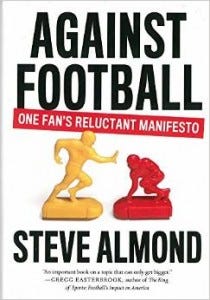
If you, like many modern sports fans, prefer highlight-skimming to the drudgery of actual game-watching, jump right to page 47 of Against Football: One Fan’s Reluctant Manifesto. There, you’ll find the book’s author, Steve Almond, verily jacking up NFL Commissioner Roger Goodell for his organization’s “concerted effort of deception and denial” about long-term health affects associated with the game. Goodell and associates reviewed the evidence, Almond writes, and came to “the same reluctant conclusion that Big Coal and Big Meat did decades ago. The business they run is unsafe for workers.” Therefore, “the moral decision in this situation isn’t very complicated: you stop playing the game until you learn more.”
Almond’s book came out a week before this NFL season started. It’s a top-notch interrogation, loaded with research, interviews, and personal dispatches from the wretched trenches of Oakland Raiders fandom. His thesis is simple: professional football, with its debilitating injuries, hyper-capitalist impulses, celebrations of war, and bastardization of higher education, has become ethically fraught — an ever-blackening boil on America’s collective conscience. At the very least, watching it should provoke within us a sensation of prickly self-scrutiny. In a perfect world, we’d all divest completely, as Almond did.
At just 178 pages, Against Football feels as coiled and sharp as a scorpion’s tail. There’s plenty of evidence to draw from, and Almond displays a knack for clicking its most salient pieces into neat analogies. If a gas leak was causing the same levels of brain damage that high school football games were, he posits, would we evacuate the premises, or would we gather on a Friday night to watch the leak? If the Minnesota Vikings paid a defenseman $18.5 million in 2013, are we OK with admitting to ourselves that such a player is worth the average salaries of 474 Minnesota elementary school teachers? Or 440 paramedics? Or 661 police officers?
That Almond’s an immensely talented essayist matters almost less here than the fact that he’s a bona fide fan — and, thus, a genial antagonist. A good portion of the book is spent rolodexing through formative football memories: a teenage pickup game in which he dislocated a shoulder, popped it back into place, then continued playing. Sundays with his father, watching games and fiddling with their television’s antenna. The missteps of his beloved Raiders, stewed upon with vivid and hilarious masochism. “The point of this book isn’t to shit on your happiness,” he concludes. The goal is to “make an honest conversation between ourselves, and within ourselves, about why we come to football, about why we need a beautiful savage game to feel fully alive, to feel united, and to love the people we love.”
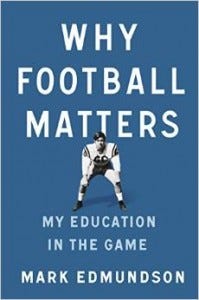
Almond’s not the only one asking these questions. In Why Football Matters: My Education in the Game, University of Virginia English professor Mark Edmundson plumbs his own high school playing experience to develop an argument for the sport’s character-shaping merits. His book, released the week after Almond’s, is much more of a personal tribute than a clinical autopsy; its chapters are slices of impressionistically rendered memoir, dedicated to capital-“V” values like “Courage,” “Patriotism,” “Faith,” and “Manliness.”
Though Edmundson alights briefly on football’s uglier aspects — physical trauma, jingoism, racism — his book deals primarily in nostalgia. Perhaps because of this, the conclusions sometimes feel naïve, even haphazard. Take, for example, his assessment of one practice in the late ’60s, in which a plane flying over his team’s field traced a peace sign in the sky as a form anti-war protest. While a few players extended middle fingers toward the sky, others raised their own peace signs.
“What gave those three guys the wherewithal to part company with the group and get a debate rolling? It’s impossible to say for sure…But I believe part of their courage came from what football had given them. They were surer of themselves than they would have been if they hadn’t managed to negotiate double sessions (twice) and do all those up-downs…”
Certainly football can nurture independence. But are we to believe that its brutal and mundane conditioning drills really cultivate peaceful introspection? Here’s Edmundson again, offering a perspective on football’s physical/psychological after-effects:
“Ballplayers live life rather than contemplating it. They get off their chairs and perform feats that are nothing less than amazing. The rest of us watch in admiration and envy and awe. When these men, these ballplayers come to the ends of their lives, they will at least be able to say for some period that they actually lived.”
The counter-critique here — that “the ends of their lives” are, in fact, exactly what’s at issue; that players with opaque minds and broken bodies are dying early, sometimes by suicide — is glaringly absent from Edmundson’s prose. In fact, near the conclusion of Why Football Matters, he announces proudly that his son, a peewee football star, tackles “with his shoulder and his helmet, and you [hear] the smack up and down the field.”
***
For us rabid sports fans, the temptation here is clear: We should position Against Football and Why Football Matters as opposing sides, then pick a winner. Depending on the strength of our desire to keep watching, we should dismiss Almond for failing to acknowledge the game’s intangible benefits; or we should shun Edmundson for his tone-deaf omission of important facts. One or the other. Just like a football game.
The problem is that this perspective overlooks just how much the two books have in common. It’s actually kind of staggering: Both Almond and Edmundson start off with reminiscences of watching the game alongside their fathers. Both then move to a discussion of football as a salve for intra-familial wounds (for Edmundson, it’s the death of his sister; for Almond, it’s “a home swirling with chaotic rage.”). Both liken football to warfare, then pivot to discussions of the church. Both touch on race, and class, and ensuing issues of exploitation. Yet their final impressions couldn’t be more different.
So what’s going on here? How is it that two well-educated fans had access to the same evidence, during roughly the same time period, and came to such different conclusions? What does it mean that we, as a nation, are watching more football than ever, even as an unprecedented abundance of scandals and ghastly medical data abound? What does making a choice about this beautiful, brutal sport actually look like?
There’s an emerging genre of essays, memoirs and journalism dedicated to these very conundrums — to the contours of our complicity, to watching ourselves watch football. On Edmundson’s side, if such a neat designation can be assigned, are writers like Diane Roberts, whose 2013 Oxford American essay, “Game of Tribes,” includes, paradoxically, both a condemnation of the game’s groupthink and a generous charge of bloodlust. “I’m a Democratic-voting, tree-hugging pinko,” she writes, before concluding that “a good hit is just so goddamned gorgeous.”
Roberts isn’t alone. In a recent issue of the New Yorker, John McPhee recalls a childhood steeped in Princeton football’s “indelible moments.” In one such moment, the team’s star, Bronco Van Lengen, is knocked cold on the field. McPhee’s father, the team’s doctor, runs to his side, just in time for the player to urge open one eye. “’Didn’t I score?’ Actually, not that time, Bronco. Bronco leaps up off the grass, adjusts his helmet, and joins the huddle.” In the context of such winsome prose, it’s easy to overlook the fact that Bronco’s basically jogging into a life-threatening scenario.
Even some former college players, like New York Times contributor Eric Kester, have found ways to move past memories of “shattered fragments from exploded helmets” and argue that football should be preserved. It’s too precious to let go of, Kester writes in a recent Times essay; it’s our “weekly chance to put up our feet and forget, for a few exhilarating hours, our own pain and hardship.”
Responses to Almond’s and Edmundson’s books have reflected this streak of willful evasion, too. In an L.A. Times review that compared the two, the journalist Hector Tobar wrote, “my own season of escapism is about to kick off any day now. I feel really bad about it. And I can hardly wait.” And “Game of Tribes” writer Diane Roberts closes her recent review of Against Football with this admission: “We know about the concussions, the racism, the money, the deranged version of masculinity infecting football; we know it’s going to have to change. Just not yet, not this season.” Don’t make us look, these writers are saying. Don’t make us think. Not when it means so much.
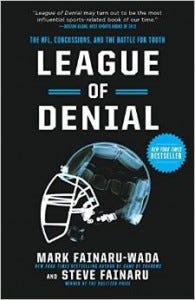
Almond’s camp is considerably less charitable. In 2012, Steve Fainaru and Mark Fainaru Wada, a brother pair of ESPN journalists, completed League of Denial, perhaps the most damning condemnation of professional football on record. The book, which charts the NFL’s recent concussion debacle and its fallout, is equal parts page-turner and Homeric tragedy. Along with the work of other journalists like Jeanne Marie Laskas and Phil Bennett (of GQ and PBS Frontline, respectively), the Fainarus build a seemingly inarguable case against playing and watching football. In one of their book’s most poignant moments, they describe Jake Seau’s decision to quit the sport after his father, the indomitable linebacker Junior Seau, dies of a self-inflicted gunshot wound. It might as well be a Surgeon General’s warning:
“I still love football,” he said. “I grew up with it; I’ve always been around it. I love the game.” But in the most personal and profound way, he was faced with the same uncomfortable questions that the rest of the country was now confronting. With so many alternatives, how can we let our children, our loved ones, ourselves, play a game that may destroy the essence of who we are?”
***
To watch or not to watch. It’s an agonizingly hard decision for us sports fans to consider, especially since we’re accustomed to the tidy dichotomies of my team versus yours. On the one hand is an arsenal of bleak facts, served to us by Almond, the Fainaru brothers, Laskas, and more. On the other is the siren pulse of our own nostalgia, given voice by Edmundson, Roberts, McPhee, Kester, and others. The ethical calculus is jumbled at best: How are we to square a childhood’s worth of fond memories against yet another report of chronic traumatic encephalopathy? How are we to hold up the emotional value of our Sunday ritual against new reports of domestic violence? Or another player’s suicide? Or even one brutal hit?
In a recent TED talk, the Rutgers philosophy professor Ruth Chang explained how to make hard decisions when the two best choices are “on a par,” and neither is the clear winner. Making a choice when two options both present benefits, she says, is incredibly difficult because “we unwittingly assume that values — like justice, beauty kindness — are akin to scientific quantities like length, mass, and weight.” This is why, instead of treating difficult decisions as daunting obstacles, we should accept the fact that “it’s here, in the space of hard choices, that we get to exercise our normative power — the power to create reasons for yourself.” From fallacy comes clarity — and, for us, the power to choose whether we’re the sort of people who derive pleasure from others’ pain.
Chang continues:
“This response in hard choices is a rational response, but it’s not dictated by reasons given to us. Rather, it’s supported by reasons created by us. When we create reasons for ourselves to become this kind of person rather than that, we wholeheartedly become the people that we are. You might say that we become the authors of our own lives.”
So why are we so bad at this? How can we acknowledge mountains of devastating evidence, then crack a beer and watch anyway? It might be that choices in and around sports are not generally hard in this way. For example, I know that if Tom Brady, the quarterback of my beloved New England Patriots, cocks his arm at the proper angle and fires the ball downfield with sufficient force and accuracy, it will be caught. If he does not, it will be incomplete or intercepted. Similarly, if Brady is able to perform this feat more times than his opponent, he will score more points and his team will win the game. This will make him happy, and it will make me happy, too.
We fans appreciate this simplicity. We gorge on it. We prefer it to the shambolic complexity of everyday life, of reality.
The problem is that, given reality’s recent encroachments into our national pastime, such simplicity can no longer be applied to the act of watching Brady, or his receiver, or anyone in the NFL. Our escapist cocoon is irreparably torn. The decision of whether to watch is now pregnant with a clutch of unavoidable considerations about concussions, money, domestic violence, race. Considerations about our own identities.
For better or worse, it’s also an opportunity to become the people we want to be. The information is out there, and it’s essentially unavoidable. No one has the luxury of playing dumb anymore.
***
Every football fan has his own well of nostalgia, and I am no different. I vividly remember crunching through the New England snow in my backyard, diving to catch my father’s passes. I remember demolishing and being demolished with my high school friends during Thanksgiving games. I, like Almond, remember 2003’s “Snow Bowl,” in which my Patriots channeled something divine to beat a vicious and efficient Raiders team.
There are even recent stories. Two months ago, a group of friends and I organized a contest to determine draft order for our fantasy football season. Our “Combine,” we decreed in a run-on email thread, would be modeled loosely on the NFL’s own rookie expo — that erotically charged rodeo of leaping, grunting and hoisting. But unlike in the pros, where results matter and scouts hover like famished buzzards, our evening would contain just four easy-ish components: a series of 50 push-ups, a 100-yard sprint, a punt-off, and a beer mile.
Not a true beer mile, actually. Not the kind that requires a tidy “beer, then quarter mile lap, then beer, then lap, etc.” sequence. In a merciful hack of competitive logistics, we decided that the mile and beers could be completed in any order we saw fit, so long as all laps were run and all beers were consumed. Additionally, for the non-drinkers among us, a twelver of tink-warm Schweppes Ginger Ale stood at the ready. Some of us had knocked off work early to come and stretch. We’d cordoned off one corner of a local park. We were ready.
We were not ready. By 15 minutes into the contest, half of us had vomited. We fudged our push-ups and ran woozy, half-hearted sprints. As local mothers looked on reproachfully, we jackknifed punts into nearby little league games and threw up some more. A few friends tapped out and sat on the grass, nursing their beers and watching the rest of us wobble despicably. We did this because it was fun, yes. But we mostly did it because football means something to us. It gives us an excuse to be close.
Still, when we returned to a friend’s house to conduct the draft, certain questions blared. Would anyone pick up Ray Rice, the Baltimore running back who just days before had been videotaped knocking out his fiancé in an elevator? Who would get Peyton Manning, knowing that his fragile neck is just one jostle away from a career-ending injury? Or Wes Welker, the tiny Broncos receiver who’d sustained so many concussions last season that he’d finished it out wearing a cartoonishly oversized helmet?
We tried to ignore these questions the best we could as we gobbled pizza and made our picks. But as I glanced across this room full of my best friends, the thing I remember most vividly was not their selections, or their booze-rouged cheeks, or who I took first overall. It was the spine of a book one of them was using as a de facto clipboard for his fantasy wish list. Barely visible, but unmistakable.
League of Denial.
Looking for some Sunday reading? Here are some literary links from around the web that you might have missed:
Margaret Atwood explains how to survive a zombie apocalypse
NPR on how to organize your bookshelf
Slate on why independent bookstores are more than just places to buy books
Ever wonder what happens to your brain when you read?
Flavorwire lists 50 books with authors as characters
Joshua Ferris on his literary hero (and EL favorite) Jim Shepard
10 dystopias that are more relevant than ever
I spent years of my life without graphic novels, save for the grocery store Betty & Veronicas I snuck into my mother’s cart (I’ll still splurge on an Archie if I’ve had a bad week). There’s got to be a metaphor for that lack: perhaps a thirsty, shipwrecked sailor who’s never thought to drink from a coconut, or a dilettante who’s never logged on to Pinterest. A lover of all things printed and bound, I shortchanged myself until I started working in a bookstore, where I’d shelve titles like Persepolis and wonder what I was missing. Real readers don’t ignore an entire section of a bookstore; they plunge into it, voraciously. I leapt in headfirst with Alison Bechdel’s Fun Home and never looked back. If you, like me, didn’t grow up flipping through panels, here are a few gateway graphic novels to usher you into this oft-overlooked genre.
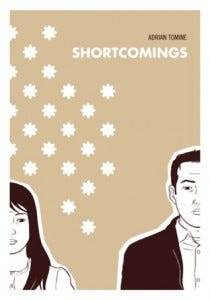
If you like: Cerebral, modern novels that pivot between self-awareness and neuroticism (see: David Foster Wallace) and candid explorations of race (like Chimamanda Ngozi Adichie’s Americanah)…
Try: Adrian Tomine’s Shortcomings, an elegant and spare graphic novel that follows protagonist Ben Tanaka through the labyrinths of his relationships, friendships, and neuroses. Tomine, the man behind the celebrated comic book series Optic Nerve, has had work in The New Yorker and McSweeney’s, among others, and when you read his dart-sharp dialogue alongside his drawings — which radiate Ben’s awkwardness and self-doubt — you’ll see why.
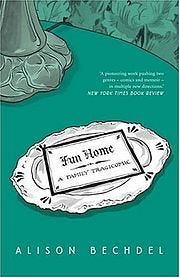
If you like: No-holds-barred, confessional, feminist memoirs like Mary Karr’s The Liars’ Club, Daisy Hernandez’ A Cup of Water Under My Bed or Lena Dunham’s Not That Kind of Girl…
Try: Alison Bechdel’s Fun Home, the artist’s memoir about growing up in her strange and slightly dysfunctional family’s funeral home in rural Pennsylvania. Bechdel’s trichromatic color palette and clean, simple lines lend themselves perfectly to her story, which centers on her relationship with her father, her sexuality, and the truths a family chooses to ignore. Fun Home proves that pictures and text can be as moving and evocative as any great traditional novel.
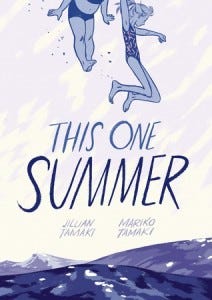
If you like: Coming-of-age stories centered on female relationships like Emily Gould’s Friendship, Grace Paley short stories, or brash explorations of young female sexuality a la Pamela Erens’ The Virgins…
Try: Jillian and Mariko Tamaki’s This One Summer. Written and drawn by a pair of sisters, This One Summer follows two teenage girls as they convene at their summer lake houses. What’s usually a blissful, innocent affair has suddenly changed — as the two girls navigate their ascent into adulthood, relationships strain and their typically sunny vacation gets clouded by boys, fights and big questions looming like thunderheads. Like Bechdel’s Fun Home, Jillian Tamaki keeps it tastefully simple with minimal colors (black, white, and lavender) and clean, effortless lines.
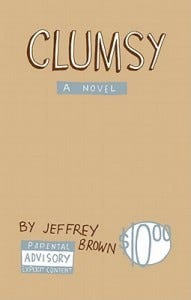
If you like: Fragmented novels or short stories (like Daniel Handler’s Adverbs) or flash-fiction by people like Stuart Dybek…
Try: Jeffrey Brown’s Clumsy. Alternately sweet and sad, Clumsy traces Brown’s real-life relationship with his girlfriend Theresa through a series of vignettes. Their gravity changes from page to page — a heart-rending fight might follow joke about burping. It’s so twee you can almost hear The Moldy Peaches playing in the background, but Brown’s soul-baring dialogue and messy, scribbled drawings are undeniably winsome, perfect for those who like their stories delivered in short, pointed dispatches.
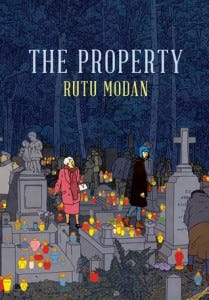
If you like: Travelogues that explore landscapes both interior and exterior (like Justin Go’s The Steady Running of the Hour) with an emphasis on family dynamics in all their glorious oddity (like Yelena Akhtiorskaya’s Panic in a Suitcase)…
Try: Rutu Modan’s The Property. Chronicling a grandmother & granddaughter’s trip to Poland to reclaim a pre-WWII apartment, The Property is a sweet meditation on family and history that takes on gargantuan themes (the Holocaust, namely) while managing both humor and gravity. Modan’s explosive use of color imbues the story with movement and wonder — it’s as if the reader, too, is walking through a new landscape, figuring it out as they go.
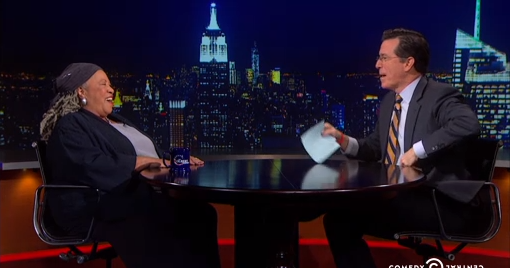
Nobel prize winning writer and all around awesome human Toni Morrison appeared on the Colbert Report this week. She talked about rereading her own work and being surprised at how great it is and then gave Colbert a little lesson on racism. Watch below.
The Colbert Report
Get More: Colbert Report Full Episodes,The Colbert Report on Facebook,Video Archive
Ursula K. Le Guin won a (well-deserved!) Medal for Distinguished Contribution to American Letters at last night’s National Book Awards. Her acceptance speech, which you can watch above, was pretty fantastic. The SF legend began by noting how non-realists writers — especially those labeled “science fiction” or “fantasy” writers — have been excluded from these types of awards for too long (a topic she discussed in depth in a recent interview with Michael Cunningham on this site). She then moved on to talk about “the difference between the production of a market commodity and the practice of an art” and her fears that capitalism’s “profit motive” and the modern publishing environment are selling American literature down the river.
Here is a transcript of the speech transcribed by Parker Higgins:
Thank you Neil, and to the givers of this beautiful reward, my thanks from the heart. My family, my agent, editors, know that my being here is their doing as well as mine, and that the beautiful reward is theirs as much as mine. And I rejoice at accepting it for, and sharing it with, all the writers who were excluded from literature for so long, my fellow authors of fantasy and science fiction — writers of the imagination, who for the last 50 years watched the beautiful rewards go to the so-called realists.
I think hard times are coming when we will be wanting the voices of writers who can see alternatives to how we live now and can see through our fear-stricken society and its obsessive technologies to other ways of being, and even imagine some real grounds for hope. We will need writers who can remember freedom. Poets, visionaries — the realists of a larger reality.
Right now, I think we need writers who know the difference between the production of a market commodity and the practice of an art. Developing written material to suit sales strategies in order to maximize corporate profit and advertising revenue is not quite the same thing as responsible book publishing or authorship. (Thank you, brave applauders.)
Yet I see sales departments given control over editorial; I see my own publishers in a silly panic of ignorance and greed, charging public libraries for an ebook six or seven times more than they charge customers. We just saw a profiteer try to punish a publisher for disobedience and writers threatened by corporate fatwa, and I see a lot of us, the producers who write the books, and make the books, accepting this. Letting commodity profiteers sell us like deodorant, and tell us what to publish and what to write. (Well, I love you too, darling.)
Books, you know, they’re not just commodities. The profit motive often is in conflict with the aims of art. We live in capitalism. Its power seems inescapable. So did the divine right of kings. Any human power can be resisted and changed by human beings. Resistance and change often begin in art, and very often in our art — the art of words.
I have had a long career and a good one. In good company. Now here, at the end of it, I really don’t want to watch American literature get sold down the river. We who live by writing and publishing want — and should demand — our fair share of the proceeds. But the name of our beautiful reward is not profit. It’s name is freedom.
Thank you.
by Ben Apatoff
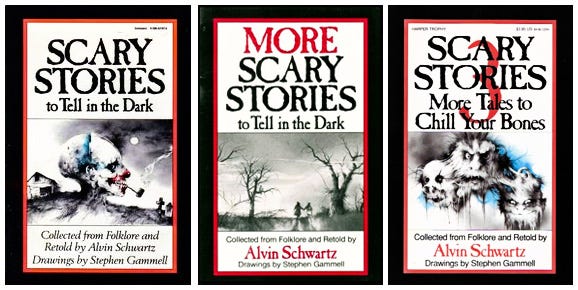
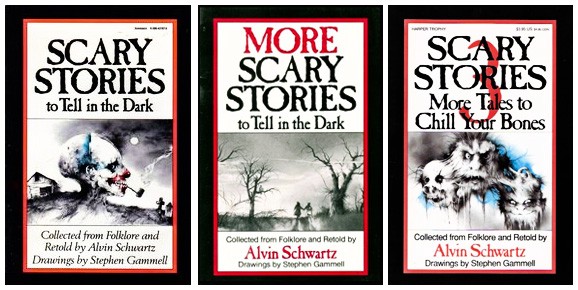
Get ready for nightmares. Alvin Schwartz’s Scary Stories to Tell in the Dark series is heading to the big screen, set to be adapted by BAFTA nominee and frequent Tim Burton collaborator John August (Go, Big Fish, Corpse Bride, Frankenweenie). CBS films will be overseeing the production, and a director has not yet been announced.
The series, which kicked off in 1981 and has sold over 7 millions copies worldwide, famously adapted a number of horror folk tales and urban legends, complete with artist Stephen Gammell’s unsettling illustrations. The film version has been in works for years, with Saw scribes Patrick Melton and Marcus Dunstan originally in talks to write. The film does not have a scheduled release date yet, but if it’s anything like the books it will terrify an entire generation of grade schoolers.
(If you love Scary Stories to Tell in the Dark, authors Matt Bell and Anne Valente revisited the books for Electric Literature last month.)
There’s something ironic about a paperback copy of Justin St. Germain’s Son of a Gun. This not-quite-mystery is full of people wearing hardened exteriors, baked to a crust under the unrelenting Tombstone, Arizona sun. The book’s very existence assures us of a son’s love for his mother, and yet there is an unsentimental, almost hard-boiled quality to St. Germain’s writing. He adeptly conveys the grief and anger he experienced over a decade earlier, but puts up a firewall that prevents the intensity of those emotions from bleeding through into the present.
In September 2001, while the rest of the nation was still reeling from 9/11, St. Germain’s mother was shot point-blank by Ray, her fifth husband. Three months later, Ray was found in his truck, dead of a self-inflicted gunshot wound. The who, what, and how of his mother’s murder had never been in question, but the why continued to haunt him. His mother and Ray lived together in a trailer on an isolated property just outside of Tombstone, where they had landed after wandering the country with only each other for company. By all accounts, they had been happy and in love.
Although Ray’s motive remains elusive, the murder is in fact the culmination of a violent and difficult life, in itself the product of a violent and difficult landscape with a bloody history. St. Germain digs into his mother’s past, contacting her previous husbands — his former stepfathers — many of whom were terribly abusive. One ex-husband, Brian, who alludes to a CIA file on St. Germain’s mother and Ray, drags him to a shady presentation for a multi-level marketing scheme. Another, named Max, the most physically abusive of the lot, meets him at an upscale grill and picks up the tab. St. Germain finds himself incapable of finally knocking him out in revenge, as he had long fantasized.
St. Germain’s mother was plagued by a pattern of violence and difficulty throughout her life, and he artfully connects this with the similarly violent and difficult history of Tombstone and one of its most famous citizens, Wyatt Earp. The city has been unable to escape Earp’s larger-than-life shadow. A town best known for a gunfight that killed three and sent a murderous ripple through the rest of Earp family cannot help its bloody cast. St. Germain’s mother is not just a victim of her own domestic woes; she is yet another in a long line of casualties.
If Son of a Gun is St. Germain’s attempt to process and make sense of his mother’s murder, then it’s unclear to what degree he may have been successful. From a factual standpoint, he discovers very little that he didn’t already know about the circumstances of her death. The book is more of an elegy than an investigation, which is, perhaps, ultimately all it could be: there is simply nothing more to know. The only people who could possibly complete the story are dead. One of the most poignant moments of the book comes when St. Germain is reunited with Chance, the dog that had belonged to Ray, the same dog that St. Germain took in after the murder. The poor dog still acts as if he is haunted by what took place on that out-of-the-way stretch of land a decade before. St. Germain looks into his eyes, “dulled by age and medication,” and pleads with him, “Chance. Tell me what you saw.”
The greatest success of the book is St. Germain’s ability to convey this sense of unresolved frustration. If we, as readers, can feel so unfulfilled when we close the book, it’s easy to imagine how challenging it must be for St. Germain. The emotional firewall starts to make more sense in the face of so many unanswered questions. Memoirs about dead relatives are often an excuse to mourn publicly, but this is not the case for St. Germain. Son of a Gun is a slow-burner, full of remarkably restrained prose, delivered in a seemingly impermeable shell that shows little sign of cracking.

by Justin St. Germain

Editor’s note: Any resemblances to actual celebrities — alive or dead — are miraculously coincidental. Celebrity voices channeled by Courtney Maum.
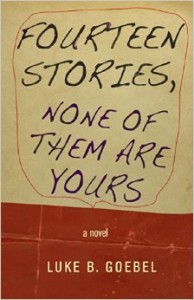
My people: heart. The cottonwoods, the tumbleweeds, the grimy windshield wipers. Too tired, too much coffee. At sunrise today, I finished Luke B. Goebel’s Fourteen Stories, None of Them Are Yours and thought, my work on the continent is done.
I try to teach my students (fiction students — are they fictional?) about honesty. Honesty in all things. For instance: I wrote a story about a slumber party I had with a famous actress and how I didn’t fuck her and it was based on a time I shared a bed with a famous actress and didn’t fuck her, so what do you want to say about that? I’m not one for aliases — acting is my art, but I am myself all over, and that is why I fell so hard — I’ll spell it: viscerally — for this book.
Lean in here. Let’s be honest. I had a hard-on the whole time I was reading Goebel’s words. Goebel writes about women like they’re shiny seaweed mammals: it’s all roses and nishy and female dogs in heat and papered motel wallpaper and rat holes in a ranch. This is the story of a man left by a woman but there’s no mention of cell phones or text messages, and that’s another thing I tell my students: write as if you’re in a beat up Hudson with Kerouac. You know, like in the nineteen-fifties. You’re not going to be in the car with Kerouac and start yacking about your phone, right? So, like, don’t write about text messages in fictional work. Unless it serves the story. And sometimes, when you’re dealing with a famous actress you didn’t sleep with who keeps sending you these snatch shots, sometimes it serves the work.
Okay, so anyway this book has like a really psychedelic structure. Very — I’m going to use industry jargon here, very “self aware.” The beginning of this novel is written by a narrator who refers to himself as “Yours Truly”, which would lead one to believe that Yours Truly is the author, and that this isn’t fiction, but a memoir — but modern criticism would have me separate the art from the artist, what a bore! There is “I”, there is “Yours Truly”, and then Yours Truly goes away. He tells us that he’s going. He tells us, in story 6 of 14, that he’s going to go away for a long time. He’s replaced by a narrator called H. Roc who’s replaced by “Kid” until the story, “Out There” when Yours Truly comes back. I was happy to have him back, I’ll say. The H. Roc chapters were disjointed. What does that mean, disjointed? I’m digitally cleansing this week, I’m off Dictionary.com, all that. Disjointed, the mid-chapters. They rang a little false.
I mean, you know when you’re really in the heat of it and when you are not. One thing a lot of people don’t know about me is that I was supposed to play the role of Captain Jack Sparrow in the Pirates of the Caribbean franchise. That’s right, it was mine first. But let me tell you that when you’re really in the truth of things, the moment hums. The H. Roc chapters in this book didn’t striate. A fancy word again. Imagine me with beaded dreadlocks and a lot of Kohl around my eyes. No way that would have hummed! Did you see me in “Spring Breakers”? The musical interlude with the cocked Glocks and the palm trees and the white piano? Then you have seen my truth.
Here is something like an uncompleted lie: this book isn’t just about a man being left by a woman for another man. In this novel, I/Yours Truly/H. Roc/Kid loses his shit when he’s left by his woman savior, Catherine, for a Spanish man in France. (Ugh. I feel you, bro.) Our fallen hero drives around Manhattan with a Bald Eagle and a pothead. He leaves New York for a one-room ranch in East Texas. He buys a dog with multicolored eyes. He puts on a tie and teaches freshman English to a bunch of freshman. He fails at falling out of love with Catherine, but he doesn’t fail at that. It’s life affirming, isn’t it, Luke B. Goebel? Teaching freshman English?
Things are both bad and beautiful until they get worse. The narrator’s brother dies. He dies, he’s always dead, he was always too much alive. When you really come away from it, despite all the girl smells and the sex needs, “Fourteen Stories, None of them are Yours” is about brotherhood. It is also the story of a man who feels very little sympathy for his mom. There is an incredible scene in some hot resort where people are swimming and paying to ride horseback and paying to be massaged, and the mother sits down with a very expensive haircut and presents to her son with a “new friend” she’s made, a girl he writhed around with the night before, and the narrator wonders “Was Kid so bad as to make a mother set on smiling grimace? When she means to only smile at her kid?” And the child contemplates this trap, this gift, the redhead he’s already slept with who his mother wants him to eat at the table with, and he accepts by saying he’ll go put his riding clothes on, and the mother “smiled only with the muscles in her mouth and jaw.”
Weeeeeeeird, right? There is other stuff. Post bad-trip peyote stuff. Hospitals and such. The point of view shifts. The narrator — screw it, I’m gonna say author — comes in and beseeches us to put the damn book down. He tells us when it’s going to get from bad to worse. He announces when we have arrived at what he considers the most poorly written chapter, and by doing so, it does not become the worst chapter in the book. Although as a creative writing teacher, I have the credentials to affirm that it wasn’t super good.
Towards the end, the tone of “Fourteen Stories” gets contemplative. Our narrator has learned something, a hard something, a lesson that will change him and gnaw at him all his life. Before the narrator, this young brother, leaves for a round-the-world adventure, his older brother asks, “Why don’t you just stick around, Man? Don’t you just want to stick around and spend some time with me?” The narrator does, but he doesn’t. He leaves. And while he is motoring around Portugal on some imported scooter, his brother dies. “Life!” The bereaved writes, after. “It’s not chasing Catherine around. It’s not kid stuff.”
At the end of this book, we’re back with I again. I told you, he got contemplative. He wants the simple stuff: a truck rubbed with a washcloth, moonlight, chores. “A little domestic chore time is what we are up to.” This too, in the book. “You’ve done chores right? We all did chores, no? There were chores to do once. Remember the work that we had to do?”
Some writers write only one book in their lifetime. Some people write only one book in their lifetime. You see, writers can be people, and people can be writers, too. There is such a savage, sad, unsutured urgency to this novel, I wonder if Luke B. Goebel will survive another book. I’d like to see this ranch he wrote in. The holes he didn’t fix. I’m that kind of person: I see holes, I fill the hole, I leave a hole again. I am an artist who peoples and writes. I am a man who does not sleep with famous women in my famous bed. I’ll again quote Goebel here, Goebel, my man friend:
“You’ve been here in the world, have you not? You’ve been in a hotel? There’s nothing else.”
 Thank You!