WHEN BLURBS GO BAD: A famous writer agreed to blurb my book. Then they changed their mind

After reading the email a half-dozen times I still couldn’t believe my good fortune: A prize-winning writer (and I mean all of the prizes) whose writing I admired had agreed to blurb my debut novel, which was slated to be published by an independent press. Per the blurber’s request, I sent off my manuscript and waited for the accolades to roll in. In my mind, I would hitch a ride on the coattails of the blurber’s immense talent and soar past the gatekeepers to literary greatness. Once inside the fortress, others would see what the blurber had seen, and soon the prizes the blurber had won would be mine. Or something like that. (I won’t name the blurber, so if you’re here for the scuttlebutt, please move on.)

A few weeks later, the writer wrote back with unfortunate news. The blurber would not be able to blurb the book after all. The writer reported enjoying the book up to a point, but beyond that point, not so much. They even provided a page number where things went awry, in case I wanted to revisit the story; and if the revision led to major changes in the manuscript, the blurber would be happy to take another look.

I couldn’t believe what I was reading. Major changes to a book that was just six months away from publication?

I prepared to type out my reply with the rage of a thousand furious trolls, but I didn’t know what to say. It’s okay? I understand? It wasn’t okay and I didn’t understand. I felt as if I’d been poleaxed. It would have been better if the blurber had declined to read the book when I emailed in the first place. To receive an endorsement only to have it withdrawn after they’d read the book was like being declined for a second date after having sex on the first.

I’d worked hard, sacrificed much, blah blah blah, and after years of rejection — and a good deal of personal struggle and sacrifice — the book was finally being published. This was my moment of triumph, not an occasion for more rejection. Didn’t the blurber understand that?

This was unfair. This wasn’t how it was supposed to work. This was fucking unacceptable.

*

This wasn’t my first setback. I remember very clearly the day my agent fired me. We met at a restaurant in Los Angeles to discuss my novel manuscript: a book I’d worked on for years and had waited all summer for him to read. Instead of coming up with strategies for revising the book, I’d spent the weeks leading up to our meeting self-medicating with tall boys of beer to erase the hangovers created by drinking Irish whiskey deep into the night. I didn’t want to think about the possibility that my agent wouldn’t like the book, so I hit the bottle hard. Now I’d finally get to hear his thoughts and I was a nervous wreck. I didn’t want him to just like the book. I wanted him to love it.

I don’t remember all the things he said. There were things he liked and things he didn’t. There was one character that really captivated him, but that character didn’t appear until the novel’s last act. That, I thought, was a bad sign. It was about to get a lot worse.

My agent thought the book had a lot going for it. It was right for someone, he told me, just not him.

I had a cold with mild symptoms but an irrepressible cough, so these awkward pauses punctuated the conversation, gaps where all I could do was sputter and cough, and he’d ask me if I was okay. “Yes,” I’d gasp but I was anything but. I numbed my throat with whiskey. I was on my third when my agent gave me the news. Between the whiskey and the cough and my high anxiety, his words didn’t quite register. I didn’t grasp what he was telling me until he encouraged me to explore other opportunities.

Even then it didn’t sink in, such was the strength of my denial. I thought I could fix what was wrong with the novel. I thought I could bring my agent around, make him change the way he felt about the book. I needed to make him love me again, because if he didn’t love me, what chance did I have with the publishing houses, whose love would lift me to the promised land?

Afterwards, I called a friend and told him what happened. “You’ve been fired,” he said. I felt like I’d been kicked in the gut by a mule. I could no longer fool myself into thinking that this awful thing hadn’t happened, because it had, and I wanted to jump into a barrel of single malt whiskey and slowly sink to the bottom. This was my finishing move in those days: to drink until I felt nothing, which was a terrible place for a writer to be.

My friend said all the right things. He gave me a list of tasks to complete: busy work that would outlast the soul searching I needed to do. He told me that although this didn’t seem like a good thing, it was. I would find another agent, the right agent, and he would sell my book. He was right about the agent, but wrong about the book. I shelved it and haven’t shown it to anyone since.

*

Reading the reluctant blurber’s email brought back all those feelings of disappointment and rejection. This can’t be happening to me… again. I needed to do something about these feelings before they morphed into something more substantial like writer’s block or colon cancer.

I don’t drink anymore. When I get down I look for other ways to change my outlook. The next morning I went to the gym. A little loud music and a lot of sweat did the trick. By the time I hit the showers I had a new perspective. What would be better, I asked myself, a mediocre blurb for all the world to see, or a polite and private “no thank you”?

I took this line of thinking a step further: just because someone decided to read my book didn’t mean that they would like it. In fact, it was a sure bet that some readers would hate it. The story wasn’t for everyone. I knew that, but if I was going to get my nose out of joint over a blurb, what was I going to do when the book was published and readers and reviewers started weighing in? How would I react when it got panned?

My novel, I realized, didn’t belong to me anymore. It belonged to those who invested the time to read it. Once a person got ahold of my book, it would become part of his or her experience of the world, not the other way around. It was unreasonable to expect every reader to shower me with love. In fact, it was unreasonable to expect it from anyone. A book isn’t a vehicle for validation. A book’s readers don’t owe its author anything. The sooner I made my peace with that, the better.

After this realization, I felt a lot better. The negativity was never really about the blurber in the first place, but about me. I’d been carrying those feelings of rejection around for a long, long time, and I needed to let them go. I came to see how difficult it must have been for the blurber to write that email, knowing how disappointed I would be. The writer could have lied and said they loved the book when they didn’t. They could have dashed off something vague and insincere — everyone exaggerates a little bit in blurbs, right? — but the blurber didn’t play those games. What had felt like a colossal letdown was actually a valuable lesson in how a professional writer conducts him or herself with integrity.

Although a woman on Amazon who’d given my novel two stars also awarded five stars to a Granada contemporary elongated one-piece toilet with dual flush, the negative review I am destined to receive hasn’t materialized, but I know it’s coming. Thanks to the reluctant blurber, I am ready for it. Blurbs and bad reviews lack the power to make or break a literary career, but they can mess with your head if you let them.

When the bad news comes, I won’t treat it like a setback, but an opportunity to learn about one reader’s response to my work. Nothing more, nothing less. Someday, if I’m asked to blub someone’s book, I’ll bring the same honesty to the work that the blurber who got away brought to mine.

INTERVIEW: Kathleen Founds, author of When Mystical Creatures Attack!

by Daniel Blue Tyx

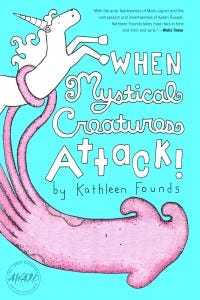
When Mystical Creatures Attack Cover

Kathleen Founds’s novel-in-stories, When Mystical Creatures Attack!, winner of the Iowa Short Fiction Award, begins with a series of journal entries from Ms. Freedman’s high school English classroom in response to the prompt: “Write a one-page story in which your favorite mystical creature resolves the greatest sociopolitical problem of our time.” From there, things only get more surreal. Narrated by way of emails, diary entries, an on-line advice column, and a Methodist women’s fundraising cookbook (recipes include “Dark Night of the Soul Food” and “Valley of the Shadow of Death by Chocolate Cake”), the novel follows the quest of two of Ms. Freedman’s former students to liberate her from an insane asylum run on the “capitalist model of cognitive-behavior therapy” where patients are tasked with rebuilding their Psychiatric Credit Scores. At once madcap comedy, Chihuahua-fanged social satire, and fearless meditation on the nature of inner demons, When Mystical Creatures Attack! asks what it means to live with a whole heart in a deeply unjust world — one in which even our most closely-held ideals can turn against us.

Daniel Blue Tyx: So let’s start with a softball question, just to get us started. I saw that George Saunders said that the thing he loved most about the novel (er…um…sorry, Iowa — am I supposed to call it a collection?) is “the sense that [your] strange and wonderful talent is always working in the service of a deeply humane and hopeful vision of the world.” And the novel itself is a kind of meditation on the nature of what that kind of service to others might actually look like — its necessity, and its limitations. I’m wondering: How does literature itself function within that framework? Is writing in the twenty-first century primarily a way that we keep ourselves as writers sane? Or can it also change the world?

Kathleen Founds: In college, I took a class called “Adventures in Religious Poetry.” We studied Thomas Merton’s translation of Chuang Tzu’s “Poem of the Woodcarver.” In the poem, a woodcarver makes an amazing bell stand for the prince. Everyone at the court is like, “Sweet bell stand! How did you even make it?” The woodcarver explains his creative process. From Merton’s translation: “After three days fasting / I had forgotten gain and success / After five days / I had forgotten praise or criticism / After seven days / I had forgotten my body / With all its limbs / By this time all thought of your Highness / And of the court had faded away / All that might distract me from the work / Had vanished / I was collected in the single thought / Of the bell stand.”

In other words, if you are focused on the reception of your art, you are distracted. Even thinking of the reception in a noble way, as in “This book will change the world!” is a distraction. Martin Luther King said, “If a man is called to be a street sweeper, he should sweep streets even as a Michelangelo painted, or Beethoven composed music or Shakespeare wrote poetry. He should sweep streets so well that all the hosts of heaven and earth will pause to say, ‘here lived a great street sweeper who did his job well.’” There is an intrinsic value in working with your whole heart — even if few notice or value your work.

Writing is cathartic. It lifts me up and calms me down. After writing, I am a better mother, teacher, wife, sister, daughter and friend. Writing enables me to be of service in the world. But I don’t count writing as my contribution to alleviating world-suffering. It seems megalomaniacal to think: “This novel will solve the world!” It would create unbearable pressure. It would keep me from making boner jokes. Unless I somehow ended up thinking: “This boner joke will solve the world.”

That said, if When Mystical Creatures Attack! makes one person laugh or feel less lonely, I will count the book as a success. (A spiritual success. I will count it as a literary success if it gets reviewed in The New York Times and joins Oprah’s book club and wins a Pen/Faulkner Award. The key to avoiding a nervous breakdown this fall will be making sure the spiritual view wins out over my outsize literary ambitions. The two forces are doing battle in my soul at the moment and it feels very rowdy.)

Back to the theme of service — I think of community college teaching, not writing, as my main attempt to make the world a better place. As a younger person, I dreamed of doing work with a far more dramatic social impact (international aid! full time work with at risk youth!). But, like Laura Freedman, I was confronted with “the stunted capacities of my heart.” I do not have what it takes to do full time social work. But, hey, maybe I can help first generation college students enjoy their first English class. We all have to do what we can . . . even if, confronted with the chasm of world-suffering, it does not seem like much.

DBT: In his citation for the Iowa prize, the judge, Wells Tower, compares your work to Karen Russell, which I can definitely see. And there’s obviously some George Saunders in there, too. But as I was reading, I kept thinking about the Russians, and Dostoevsky in particular. Not just because of the multiple references that are in the novel, but also because of the ecstatic lyrical passages, the fearless fixation on the big questions of life and death, good and evil, suffering and redemption, and so on. I imagined the novel as a Dostoevsky novel, if old Fyodor had a web connection, cable TV, and was a woman. Thoughts?

KF: When George Saunders critiqued my MFA thesis, he told me to stop fronting. To be myself. Initially, I was defensive and a little crushed. “I scoop my heart out and put it on paper!” I thought. “And why didn’t George take my thesis and deliver it directly to The New Yorker?” What he was talking about, I think, was my habit of approaching my character’s concerns about good, evil, and the existence of God from a cynical distance. I unconsciously put a coating of cynicism over my stories, assuming it would make them more palatable to literary magazines or peers.

While writing this novel, I kept George Saunders’s advice in mind. “Okay, fine!” I thought. “I will wear my heart on my fucking sleeve. I will just let the preoccupations of my soul run wild.”

My life is pretty staid. But my soul is filled with turbulence, ecstasy, existential terror, despair, and longing for God. Like a Russian novel.

DBT: I agree that the two vocations of teaching and writing have the capacity to work wonderfully together. Not only can writing allow us to become calmer, more fully actualized versions of ourselves — my wife Laura says that she does yoga as meditation, and I write — but I find that teaching also informs my creative work in ways I haven’t always fully appreciated. Looking back at my writing over the past five years (since I started teaching at South Texas College), nearly every piece I’ve completed contains at least some reference to something a student said or did. Especially teaching community college — students have jobs, (often complicated) family entanglements, law enforcement issues, all of those kinds of real-world preoccupations. And a fair number have already failed the course a couple of times, so they need a caring and dedicated mentor. Teaching gives me a sense of purpose when I’m feeling rudderless as a writer, which is a lot of the time. At the same time, my students bring fresh perspectives, rooted in experiences I may or may not share, that challenge me to think about the world, and writing, in a different way.

When I was in graduate school, I remember being told that I spent too much time on my teaching. I was told I was too “nice” to ever be a successful writer. And that made me angry. Granted, teaching can be a time-suck. But for me, you’re either all-in on teaching, or you shouldn’t do it. For that matter, you’re either all-in on life, or you shouldn’t be a writer. Like the quote from MLK — you have to be fully engaged with everything you do.

And that includes parenting…another potential black hole for your time. After the birth of my son, I remember getting so frustrated when he would (inevitably) wake up just when I was starting to get “in the zone” with my writing. It took a lot of practice to learn to simply to simply leave my work behind at those moments, and not expend any unnecessary mental energy thinking about what might have been accomplished. I know that you’ve stayed home quite a bit with your daughter these past two years — and managed to complete an amazing novel in the process. How do you navigate the competing demands of parenting and writing? And teaching, too?

KF: Yes! Teaching offers me an escape from my asphyxiating self-concern. When I’m feeling down, writing doesn’t lift me up. I write a sentence, then stare daggers at it. The sentence’s lack of splendor and genius prove that my attempt to be a writer is a foolhardy, delusional endeavor. Teaching makes me get out of the house, out of my head. After that hour and twenty minutes of 100% engagement with something other than my black thoughts and meager prose, I invariably feel more grounded.

Most of the stories in When Mystical Creatures Attack! have their genesis in jobs. Janice’s rest home stories are inspired by (and by “inspired by” I mean “transcribed from”) my tenure calling bingo at a nursing home. Ms. Freedman’s struggles to wrangle a rowdy class are inspired by my awkward attempt to run an after-school program.

Dan, I remember you describing the creative writing classes you took as an undergraduate. You said everyone wrote stories about “people lying around in their underwear smoking cigarettes.” I think our work as community college teachers saves us from writing stories about people lying around in their underwear smoking cigarettes. For this, we owe our students an eternal debt.

Although now I kind of want us to challenge each other to write fresh, lively, invigorating “smoking cigarettes in underwear” stories. I actually finished When Mystical Creatures Attack! before my daughter was born. I tried sending it to a few agents and they were like, “This is weird. I don’t know what to do with this.” I went through my “They fail to understand my genius! / I will now collapse into a puddle of despair!” routine. Then I had a baby, and didn’t really do anything with the novel until I entered it in the Iowa contest. So, no. I was not able to write a novel while my newborn napped. I was kind of busy weathering emotional roller coasters and leaking milk everywhere.

After Violet was born, I lacked the energy for sustained bouts of fiction. I mostly filled notebooks with descriptions of her chubby neck rolls and milky breath. As she grew older, I wrote essays and humor pieces and drew cartoons and began short stories. To get the time for these modest creative endeavors, it was simple. I just had to give up personal grooming (let those eyebrows grow in! wad up that hair in a bun!), cooking (embrace the frozen burrito!), fashion (hello, saggy maternity pants!), exercise (let breastfeeding burn the calories!) cleaning (forgo dishes in favor of sketching a cartoon about dermoid cysts!) and hanging out with my husband (he’d get home, I’d hand him the baby and go write). So, it is possible to be a mom and a teacher and a writer. You just have to give up everything else that makes you human.

I also hired a babysitter. That helped a lot.

DBT: I can see how it was difficult for agents and editors to know what to make of your novel: How do you market a novel that begins with a whole chapter of journal entries about mystical creatures saving the planet? There’s not exactly a category at Barnes & Noble for madcap comedies that include extended reflections on mental illness, suicide, social inequity, and the nature of the human soul. Though come to think of it, maybe there should be.

Anyway, what I really want to know — marketing aside — is how you approach the use of the strange and the fantastic in your writing. So often, I find that writing outside of the realist vein is weird just to be weird, going after a kind of a shock factor that just isn’t that shocking.

But how does one harness the power of one’s idiosyncratic imagination in the service of a story with a beating human heart? Or, put a different way: How do you make a story weird, but not too weird?

KF: “In the Hall of Old Testament Miracles” (probably the weirdest story in When Mystical Creatures Attack!) was inspired by some real life weirdness in the small Ohio town where I lived after I got my MFA (so that my husband, Dave, could complete his teaching credentials): The “Bible Walk” museum.

The “Bible Walk” museum is home to tableaus of wax figures and mannequins acting out key scenes from the Old and New Testaments. I told my journalist friend Gideon about the museum, and he was like, “you should write an article about life in small town Ohio, I’ll put you in touch with my editor at Harpers.” And I was like, “Sweet! Here is my chance to write my breakout intellectual think-piece cultural critique!” I sat down to write a serious, professional query letter. I typed: “Everyone knows the first second you’re alone with a wax sculpture, it’s going to try to kill you. So why bring the Bible to life with 300 wax figures that are just waiting to hunt us down with shepherd’s crooks and slay us in a manger?”

Harpers, it turned out, was not interested in the piece.

Even when I was trying to be “a serious writer,” my brain was like “But what if the wax figures CAME TO LIFE!?!”

I don’t critically assess my story from a craft perspective and judiciously add weird elements. I try to write something real, then surrender to child-like delight at magic breaking into the mundane.

DBT: This morning, when I stepped outside to take my son to school at 8:15 in the morning, I was greeted with (as you describe in the novel) “searing heat hitting my face like bricks from a bread oven.” You are in California, by the ocean, where I am guessing it is breezy and pleasant. If my math is right it’s been almost a decade since you left, and you’ve lived in practically every corner of the country since. And yet — the landscape of South Texas is such a force in the novel, the details so perfectly chosen. Did you find this distance allowed you a sense of perspective, the ability to render “emotion recollected in tranquility? Is there something in particular about South Texas that has seared it into your imagination?

KF: The first year I lived in South Texas, I tried to write a story every month. The stories were awful. But after I moved away, I looked back through my notebooks, and found these incredibly vivid descriptions of the South Texas landscape. I found journal entries where I’d transcribed the monologues delivered to me by the at-risk youth in my dropout prevention program. Ironically, I hadn’t counted those marginal notations as my “writing time.” I counted my awful stories as my “writing time.” While living in Texas, I couldn’t figure out how to put the journaling I did to burn off steam or my notations on bizarre South Texas highway road-signage into story form. Looking through those notebooks years later, I was finally able to quilt together those patchwork pieces of description and dialogue.

DBT: I keep thinking about what you said about the perils of focusing on reception. In my own work, I find that I am fiercely protective of my privacy as a writer. I don’t share drafts with anyone — not even Laura, who has enabled me this whole time by doing all the things a spouse does to help create a space for writing with two kids — until very late in my process. I’ve often seen this inwardness as a kind of tragic flaw — either an irrational fear of how people will respond to my work, or a missed opportunity to push a particular piece to its full potential with the help of a more objective critical eye. Or maybe it’s just that I’m way too confident in my own abilities to navigate out of the literary corners I’m always painting myself into.

Still, all that being said, I think part of my guardedness is also an attempt to create a space, like in your journal, where I feel that I can be totally honest — both with others, and with myself. And sometimes, like you say, that honesty is a tricky thing. What may feel like honesty one day may a day later feel like just another front.

Anyway, what I’m trying to get to is this: How do you reach a space where you can let the preoccupations of your soul run wild? Helpful hints for achieving a nirvana-like state of creative energy?

KF: That inwardness isn’t a tragic flaw. (Although it is fun and kind of dramatic to imagine you having a tragic flaw.) The privacy is how you create the space for true freedom in your writing. And you do share your work, Dan. You’ve published plenty of your writing.

When I moved to Ohio after graduate school, no one I interacted with had anything to do with the literary world. I was anti-Twitter, I hadn’t heard of Instagram, and I checked Facebook quarterly. There were never more than three fresh messages in my Gmail inbox, and they were all from my mom.

Since my book won the Iowa prize, I’ve made vague lumbering Frankenstein steps towards the online literary world. I joined Twitter. I made a When Mystical Creatures Attack! Facebook page. I researched online literary magazines to see where I might send my book. Associating my computer screen with an imaginary literary audience makes writing harder. I’ve found that I now have to go outside with my pen and spiral notebook to tap into that wild free inner woods of the soul.

Dan, how do you access that place? I remember one time you wrote an innovative, heartbreaking story in one six hour stretch. That seem like pretty profound success tapping into the creative unconscious. I remember I tried to copy your prolific genius and gave myself six hours to write something amazing. I ended up with a short story about an aspiring beauty queen who gets her face chewed off by dachshunds.

DBT: Ah yes, this gets us back to the question about stories that are weird, but not too weird. I have to ask: Why dachshunds?

KF: Dan, do you recall when your wife (then girlfriend) Laura and I were roommates in Texas and we had that rat problem? I heard rats scratching in the walls at night. When everyone got up in the morning, there were rat bites in a bowl of fruit. You examined an apple with little rat teeth marks in it, shrugged, and took a bite. Anyway, I caught one of those rats in a catch-and-release trap and I was walking it to the park when I was accosted by a pack of feral dachshunds. I probably should have stood my ground, but when they got within three feet of me, I dropped the rat cage, turned, and ran.

That’s just Texas, man. But you were saying?

DBT: It’s okay — I was stalling. I wish that I had a good answer — or any answer, really — for your question about accessing the unfiltered subconscious, but the truth is, I just don’t know. Every once in a while, you get lucky, and a piece just comes out (nearly) whole the very first time around. Then again, the essay I just finished took the entire summer to write — and even then, I’m not sure it’s really finished. Or even if it ever will be.

I think maybe the key is not really in being able to access some hitherto inaccessible part of the psyche, or finding some kind of trick to keep the liar inside of us at bay, but rather in simply having a good concept for a story or an essay. If you’re asking an interesting question, or working out an interesting scenario, or have an innovative idea about form or style, or start with a compelling narrative, then the rest will come, sometimes rather quickly.

If you’re not, you could be in trouble. I wrote seven failed novels in graduate school — I don’t think any of them even had a chance to be any good. The basic concepts stunk.

As a writer, though, I’m stubborn. I’ll keep banging away on a piece that didn’t start with a very interesting concept, and the more I struggle, the more invested I become in salvaging it. Sometimes, the piece will move somewhere more interesting — usually after I’ve allowed it to become about something else entirely. Other times, it never gets there.

The thing about it, though, is that I’m a horrible judge of what makes an interesting subject to write about. And I begin every piece with only a vaguely held notion of what it’s going to be about, at least on a thematic level. The only way I know is to just write as much as you can, and see what happens.

That, and to not be afraid of over-writing, or being melodramatic. You can always take it out later.

Anyway, going back to the question of spiritual vs. literary success — I imagine that striking the proper balance is more difficult now that the novel is finished and is being released. Are their ways to make self-promotion more spiritually fulfilling?

KF: The very phrase “self promotion” seems fraught with spiritual peril. I mean . . . what would Jesus do . . . with a Twitter feed?

@sonofgod: Join me at Sermon on the Mount event in Gallilee w/ @JohnTheBaptist! #Blessed

And how would Buddha handle self-promotion, given that Buddha says there is NO self?

My way of coping is to focus on the things I can do that are fun. So, I’m getting my brother to bottle When Mystical Creatures Attack! themed homebrew (if all goes according to plan, it will be a hoppy IPA). I designed some When Mystical Creatures Attack! t-shirts. My book launch party is going to involve a piñata and a bounce house. And I’m working on a cartoon book trailer.

Oh, and I asked a fellow writer to interview me. That’s what this is. And this is fun.

How to Build a Novel About a Teen: on Caitlin Moran’s How to Build a Girl

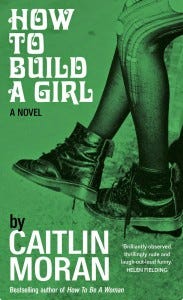
Caitlin Moran novel cover

When I walk into the room to meet Caitlin Moran, she’s wearing a red Hawaiian shirt underneath a blue kimono. She’s just, ya know, hanging out at her publisher’s office on a Saturday, working on one or two of what looks like close to 100 stickies on her MacBook desktop for all her various projects. Her energy is kinetic; she’s warm, friendly, as funny as you might expect, and although she’s a bestselling author and one of the most well-known writers in England, she’s excited and willing to talk about everything from Kate Bush’s recent shows to Dr. Who.

With her latest book and first novel (although her Wikipedia entry does count The Chronicles of Narmo, the book she wroteat the age of 16, among her works), How to Build a Girl, Moran introduces us to Johanna Morrigan. Morrigan is a teenage girl from England’s West Midlands who reinvents herself into Dolly Wilde, a MD 20/20-chugging and lots of sex-having rock journalist. Moran is famous as a bestselling journalist and memoirist, so writing a novel could be tricky territory, especially one with a teen protagonist. As YA fans know, there are simply some adults that can’t write teens. I’ve even had a writer tell me that they didn’t even like kids, but their agent thought YA was a good route for them to try for their next book.

Thankfully, it all works out for Moran. How to Build a Girl is smart, hilarious, fast-paced, and Johanna/Dolly is one of the most unforgettable literary characters you’ll meet in 2014. For anybody who was a weirdo teen without a whole lot of friends, she’s the type of person you either wished you knew or wished you could be. She’s strong but vulnerable, witty, intelligent, and has to keep it all together after dropping out of school so she can go to London to start her journalism career. The novel isn’t too far removed from Moran’s own story, but the novel belongs to her character. “The ratio of truth to bullshit is that of in Little House on the Prairie,” she says. “In that Laura Ingalls Wilder was a pioneer girl, but most of the incidents in those books aren’t things that happened to her. They happened to friends of hers. There are things that she researched. So in that way it’s the same: I’m that pioneer girl. I am that fat, teenage music journalist who goes and has a lot of sex, but a lot of the individual penises that happened to Johanna in the book are not ones that happened to me, they’re ones that happened to friends.”

“I am that fat, teenage music journalist who goes and has a lot of sex, but a lot of the individual penises that happened to Johanna in the book are not ones that happened to me, they’re ones that happened to friends.”

Even though she wasn’t writing a memoir, it wasn’t difficult for Moran to write from the point of view of a teenage journalist venturing into the big city. She could easily conjure up that feeling, she said, because all she did before 16 was sit inside and watch television and movies, so when she finally started going out into the world “everything was so hyper-real.” She lists getting on a train, going to her first rock concert, her first kiss, the first time she went to a party, her first drink, and other firsts in her life that she experienced as a teen, and how she held on to every one of those moments in her head, eventually distilling them into this book that she sees doing something bigger than racking up sales or getting turned into a summer blockbuster.

“The whole reason I wanted to move into fiction is because I am interested in revolution and changing the world. And what I’ve observed through 20 years writing about popular culture and being a fan is that you can change the world.” Moran says that How to Build a Girl is the starting point for a trilogy of books that follows the life of her protagonist into adulthood. She mentions Dickens and Orwell as examples of journalists whose move to fiction helped society confront a number of ills. “It’s amazing that strong girls are getting big at the box office, but these are all kids in a dystopia fighting for their lives,” she says, bringing up Divergent and The Hunger Games. “That would make me a bit anxious if I was a teenage girl and those were the only girls I was seeing. Some days it’s enough of a struggle to get up in a skirt that doesn’t make you feel bodily dysmorphic and walk down the street without getting hassled by some boys.”

How to Build a Girl isn’t a YA novel, mind you. Its protagonist is a teen, but Moran says the book isn’t aimed specifically at younger people. Moran took her cues from other famous fictional teens — from Holden Caulfield to characters in the Brontë sisters’ books — but as she points out, those books weren’t considered young adult literature or even great literature right away. But at their heart, they’re about the same thing as her own book: loner teens. That’s what Moran gets, because that’s what she was. She treats Johanna with a certain amount of care and respect that some authors might not even pay to their adult protagonists. This makes Johanna easy to relate to and How to Build a Girl one of the best coming-of-age books to come out this year.

OCTOBER MIX by Chloe Caldwell

Women: A NOVELLA mix tape

These are songs, most referenced and some not referenced in my book WOMEN. For each song, I wrote one sentence summing up what is going on in the book. SO — spoiler alert! Just kidding. The book is about a break up, to put it lightly. There’s not “plot” really. Themes of playlist: Obsession, lesbians, IDGAF, drunk, broken.

1. Supersuckers: Hungover Together

Finn and the narrator wake up hung over together and a few days later Finn sends the narrator this song.

2. Those Three Days: Lucinda Williams

This is the song Finn and the narrator listen to after the first time they’ve been intimate.

3. Mariah Carey: Obsessed

At this point in the book the narrator and Finn quote Nicki Minaj on American Idol, saying, I’m obsessed with you.

4. Hostile Omish: Vagitarian (Lesbian Love Song)

Finn sends the narrator this song. Self-Explanatory.

5. Cher: The Shoop Shoop song or It’s In His Kiss

The narrator stays home for days and watches Mermaids and binge-eats mac and cheese and this motivates her to find a therapist.

6. Grimes: Oblivion

The narrator and her friend Sabine eat MDMA and do other illicit things, all the while listening to Grimes.

full_WOMEN-web-front-cover

7. CocoRosie: Lemonade

This is for all the CocoRosie haters out there. I love them. Shamelessly. The narrator and Sabine listen to this song and bathe together.

8. Taylor Swift: I Knew You Were Trouble

Elizabeth Ellen cut this scene, but originally there was a scene of the narrator and the girl she was babysitting singing this song in the car. I don’t know if I am grateful or sad she cut it. I’ll probably be grateful in a few years.

9. Melissa Ferrick: Drive

The narrator listens to this song in her basement apartment and masturbates. In the live version, MF sings, “If your girlfriend has more than one towel, she’s probably straight.”

10. Ne-Yo: Mad

The narrator explores her past female friendships and realizes they’ve been codependent.

(My best friend and I used to sing this song to one another: “I don’t want to go to bed, without you, I don’t what you to go to bed, without me” though I just looked up the lyrics and I see we misinterpreted them.)

11. Aerosmith: Dream On

On her birthday, the narrator sings this song in the car, then barfs and pees her pants, in that order.

12. Judy Garland: I Don’t Care

The narrator decides she doesn’t care. She dances around to Judy Garland in the kitchen.

They say I’m crazy got no sense, but I don’t care. They may or may not mean offense, but I don’t care. You see I’m sort of independent. I’m my own superintendent.

13. All Over Me: Loving Annabelle (movie soundtrack)

This song prefaces a really hot sex scene in Loving Annabelle

14. Lucinda Williams: Are You Alright?

Towards the end of the book, the narrator and her mother drive on a highway and listen to this song by Lucinda. They hit two deer with their car.

15. Eric Satie: Gymnopedie

If my book was a silent French film, I would want this song to roll at the end, and have the narrator like, walking around near the French Riviera, smoking Gauloises, a single tear rolling down her cheek, and then a smile. Blows smoke. End film.

***

— CHLOE CALDWELL is the author of the forthcoming novella, Women, (SF/LD Books, October 2014) and the essay collection Legs Get Led Astray (Future Tense Books, April 2012).

“McGlue” (Excerpt) by Ottessa Moshfegh

Recommended by Fence Books

Zanzibar
I wake up.

My shirtfront is stiff and bibbed brown. I take it to be dried blood and I’m a dead man. The ocean air persuades me to doubt, to reel my head in double, triple takes towards my feet. My feet are on the ground. It may be that I fell face first in mud. Anyway, I’m still too drunk to care.

“McGlue!”

A wrathful voice calls out from the direction of sunshine, ship sails hoisting, squeaks of wood and knots, tight. I feel my belly buckle. My head. Just last spring I cracked it jumping from a train of cars — this I remember. I get back down on my knees.

Again, “McGlue!”

This McGlue. It sounds familiar.

A hand grips my shirt and pokes at my back, steers me to the plank and I get on, walking somehow. The ship is leaving. I puke and hold on to the side of the stern and belch bile for a bit watching the water rush past, until land is out of sight. It’s peaceful for a small while after. Then something inside me feels like dying. I turn my head and cough. Two teeth skip from my mouth and scatter across the deck like dice.

Eventually I am put to bed down under. I fish around my pockets for a bottle and find one.

“McGlue,” says the cabin boy, the sissy, “hand that shit over here.”

I swig it back. Some spills down my neck and wets my soiled collar. I let the empty bottle fall to the floor.

“You’re bleeding,” says the fag.

“So I am,” I say, pulling my hand away from my throat. It’s dark, rummy blood, I taste it. Must be mine, I think. I think of what use it may have if I get thirsty later. Fag looks worried. I don’t mind that he unbuttons my shirt, don’t even beat his hands away as he steers my neck one way, then the other. Too tired. Inspection time. He says he finds no holes in me to speak of. “Ah ha,” I tell him. Fag’s face has a weird sneer, and he looks a little scared and hovers there over me, red hair tucked carefully into a wool cap, a dot of sweat sitting in the trivet of his upper lip just below his little nose. He looks me in the eye, I’d say, with some fear.

“No touch,” I say, ruffling the blanket back up. It’s a grey-and-red striped blanket that smells of lambs’ milk. I hold it over my face while Fag goes about. It’s good here under the blanket. My breath shows in the dark. So dark I could almost sleep.

My mind travels the cold hills of Peru where I got lost one night. A fat woman fed me milk from her tit and I rode a shaggy dog back down along a river to the coast. Johnson was there with the captain, waiting. That was trouble. Hit warm with the rum now I close my eyes.

“What have you done?” says the captain next time I open them. The blanket is stripped away like a whip. Saunders removes my shoes. I hear the boat creak. Someone walks down the hall ringing a bell for supper. The captain stands there by the cot. “We want to hear you say it,” says the captain. I feel sick and tired. I fall asleep again.

They are moving mouths. Saunders and the fag stand by the door. Fag holds a bottle, Saunders dangles keys.

“Gimme.” My voice breaks. I can breathe, hear. He passes the bottle over.

“You killed Johnson,” says Saunders.

I get a good half the bottle down and steady my neck, fold my shoulders back. I feel my jaw let go, look down, remembering blood. My shirt is gone.

“Where’s my shirt.”

“Did you really do it?” says the fag. “Officer Pratt says he saw you. Drunk at the pub in Stone Town. Then run away to the dock just before they found him in the alley.”

“Trash, it’s cold. All possessed till takers of this anti-fogmatico, thank you, faggot,” I say. Drink.

“They found him stabbed in the heart dead, man,” says Saunders, gripping the keys, eyebrows smarting.

“Who has a brick in a hat, Saunders? Quit it, now. It’s keeping me all-overish. Is there food?” The fag takes the empty bottle from where I lay it on the blanket. I feel like dreaming. “Where’s your freckles, Puck? Let’s trade places.”

They aren’t talking to me anymore.

“Food, man. Shit.” I’m completely awake now. In one glance I take in the room: placards, grey-painted wood walls, wire hooks, some hung-up duck and Guernsey frocks, a grey, shield-shaped mirror. Sunlight hazes in, block-style, speckled with white dust. The shadows of men on deck pass along the walls through the small rectangular windows up high above my cot. An empty cot on either side of me. A whine and creak of ship and ocean. I yearn for ale and a song. This is home — me down in the heart of the drifting vessel, wanting, going somewhere.

Saunders and Fag pass words and go out and I hear Saunders lock the door and I protest with, “Come back and smile, Saunders. Give me the goods, what’s up?” and nothing happens.

It’s not the first time I’ve been in the hole on this trip. Will be made to work the pump well each morning and darn sails like an old maid once I’m well again. I think of my mother as I imagine her always at the loom through the nailed-down windows of the mill, me a wee tip-toed kid, fingers hoisting my eyes barely above the horizon of the window ledge, watching my stoop-backed, prim, high-nosed mom at work, and watching her again that night at the table in our little house, calling me and brother “good boys,” pushing crumbs, counting coins and coughing, my sisters in bed already, my mother’s pale, tuckered out hair splayed across her back. All the stars outside just sitting there. The cold rinse of Salem night after running hot all day. I’d throw a rock at a window if I could, if I had one. Did Saunders say Johnson was in unkeeps? I’ll get up and see about it.

I get up. My head thwarts around and I see nothing, then I see stars. Saunders called Johnson dead, I think. I greet the cot again, blind. Saunders will come back with Johnson and have a laugh. Until then I’ll ride my cogitations out through the stabbing pains in my skull, the licking waves. Most likely I’ll doze then wake up to bread and butter and hot beans and whiskey and it’ll be night and we’ll be halfway to China and they’ll say, “Hit the well, McGlue,” like after my last bout. I try to remember the port of call I got this wet in.

Zanzibar.

Think of someplace you’d like to go.

I can see again. I take my lids between my fingers and hold them open, take a colt-step towards the mirror. A bit closer and I stumble. A rope is tied around my ankle and bound to the bedpost.

I call out, and my voice makes me ill to hear it. Get back down to the cot, McGlue. Yes, thank you. The stars come out. I look for the moon, but it eludes me. I can’t find or measure my way. Drift, drift. If I just close my eyes I’ll get there.

I sleep some more.

Indian Ocean
I wake with fever. I know fever because there’s a wet rag folded on my brow. The fag attends me bedside with a book in his lap, one leg swinging from a crabapple–shaped knee. My arms are tied to my thighs, ears shut up, face bandaged around and there’s water dripping through the cracks in the deck ceiling and when I breathe I taste a harsh kick of lye and shit. On the dropped-down table slat there’s an opened bottle of pickled cabbage and a cake of bread. I look up. The drops of deckwater fall in my eyes and burn. Fag wields a pale wooden tenon in his hand, arm hovering above my head motherly almost.

I open my mouth to curse.

But Fag sticks the tenon lengthwise between my teeth. I rattle around a bit.

“It’s what you got, McGlue,” Fag says, holding down my neck.

I’m thirsty so I look him in the eye as best I can.

“We can’t give you anymore, so don’t even ask,” is his answer.

He thinks he’s got something over me. I let him have it and rattle around some more. With difficulty I use my tongue to taste the roof of my mouth and get salt-air and shit. It’s not good. I’d like something sweet about now. There was a little outpost in Borneo that sold wine made out of honey I remember. That was good. The girls there stood around fanning themselves with silver plates, tits and nipples set above tight chainmail vests. Those girls’ hips, narrow like young boys’, hopped a firm beat between my hands when I willed it, like they were somehow inside my mind, listening. I sat in the shade and I took them into the road to dance when it cooled down and I felt like dancing. Johnson, too. Then “Keep back,” he’d said, trotting off, “watch for the fat one, yell ‘pig’ if you see him come,” pulling one of the girls behind the jungle curtain back aways and I’d continue to dance and keep my hands on the girl’s hips and when the fat one came I just grabbed my pistol from my boot and shot it at the stars. The girls loved it, screaming and running, then laughing and creeping back from behind the dark palm fronds with their hands over their mouths. The fat one holding his belly nods to the fresh bottle on the little stool they use as a table. Forget Johnson, the worried, shameful rat. I sit and drink and watch the sky. A girl comes and takes my hand and we dance some more. Johnson shows up again.

“So soon, old man?” I holler, watching him walk back to the road, his girl slunk back in the dark, chainmail aflash in moonglow. Always with a girl. He sheds a tear for her, or what he’s done, as we set sail. Always a tear. I laugh. “Why not stay awhile,” I used to say, “build up a nice family, learn the language?” and he’d shove off and reemerge hours later all cool and fixed, talk to the captain on the virtues of clippers over cutters and be asking how he’d got in the racket and so on, starry-eyed. Make me sick. I watch the girls now in a line waving goodbye from the shore, picture them standing along the crack in the ceiling of this darkening room, eyes ashimmer like drops of water, and I rattle on.

Drink, please.

I’ve been this sick before.

“Shit,” I try to say, but the tenon’s got my tongue again. I look at Fag. His eyes are on his lap, reading lines.

If Fag won’t give me rum then let me suck the brine from that cabbage at the very least, I think. I get myself on my right side, planning something. Fag gets up and digs his elbow in the nook of my waist. I spit the tenon out onto the floor. Blood leaks from my mouth.

“Happy now, fagger?” I slurp. My voice hurts my head. My head, I seem to recall, has a big crack in it.

“Count a blessing, McGlue. Next stop’s Mac Harbour, where we ought to just set you right down with the rest of the cons.”

“Pleased if you do,” I say, and slam my head back against the cot. The effect is good: a sharp taste of blood in the back of my throat and I see black for a while, then white. Sleep again.

Macquarie Harbour, Tasmania
We’re docked and most mates are ashore but blackies locked in the next cabin are snoring. Then I hear one pour something in a cup. I’m awake. I rub my wrists rough up against my hips and get the ropes undone, get up and drag the foot of my cot to the wall and take a breath. I see a canteen on the dropped-down table. So I drag the cot that way and grab it and drink till it’s empty. Just water. It glaciers down my tubes the opposite of piss on snow and I double over and curse — my first words in days. The blackies mumble. Then I drag the cot to the wall again and step up on it, look through the high window over the deck. It’s blue everywhere. The sky is blue. The clouds are blue. The ocean’s blue. The slow zig-zag of a seagull sways in my eyes in such a way they start to water. Am I crying? If this side of the ship was facing land I think I’d puke for wanting. Any other day I’d be purchasing a tin of tobacco, taking some in my gums quick then more in a pipe, squint, drum my chest, yell at Johnson to get on. How many hours till the ship’s loaded, I’d find out. We’d take a ride to town, see what they’ve got to get into here. A country full of murderers and thieves must have good stuff, I’m thinking. Blood wine, I’m thinking. Whiskey made from ladies’ fingers. Some kind of strong snuff from bad plants used to treat the blackhearts in lock-up. Roasted meats. Pies filled with sugar plums, rats, brandy. I can bet I know what the mates would be saying. Nasty, wrench-pussied women all about. I am starving.

“Starving!” I yell out to the sea.

They said I’ve done something wrong? Johnson must be angry and won’t come down to make it right. Not yet. And they’ve just left me down here to starve. Haven’t had a drop in days more so. They’ll see this inanition and be so damned they’ll fall to my feet and pass up hot cross buns slathered in fresh butter and beg I forgive them. All of them: Johnson, Pratt, Captain, Saunders, the fagger, the entire world one by one. Like a good priest I’ll pat their heads and nod. I’ll dunk my skull into a barrel of gin.

I feel happy imagining my hand on Johnson’s bowed head, the black, gleaming hair through my fingers. I’d twirl it around like a little girl does braids, pinch his cheeks, let some of my hungryman drool drip down on his face, unhook the frog in my throat, “Johnny,” I’ll say. “A toast.” Two cups of ale up and down our mouths and our seamen’s beards are full of foamy slaver. It was like that in Salem, nights we waited to leave port. The red in Johnson’s cheeks blooms like flowers every time he swallows, then fades again while he talks. His hair, black and slick as hot tar, never flails or wanders from where it lies, no matter what the wind or rain. “Pretty,” they say. He called me “Soaplocker” for how I wore my hair when we first met: so long in front I’d wrap it around my ears and it’d hold. He says he took me for a kid like fifteen the night he found me and thought himself a real hero.

I have to laugh. The first time I saw Johnson I thought he was one of those asshole Charlies you hear engage with kids out in the woods for a few cents a suck or whatnot. I know these types well.

“You think,” he’d said, “that rum will keep you from freezing the night?”

I had my hat over my face, bottle between my knees, slowly melting my ass into a seat of snow propped up dead-tired against a tree. Johnson sat on a horse.

“Get going,” I said. A Charlie or not, I didn’t care. I’d made it a few days into a jag by that night, somewhere between New Haven and Orange. I was never going home again. I could see the ice-paved beach through the moonlit trees. I had another whole, full bottle — a double pint — in my coat pocket, and some money left. I was good. That was my thinking.

But Johnson wouldn’t leave. His horse reared up and he pulled and steered her back, both his breath and horse snort steaming out like ghostly spirits leaving their bodies, like some child’s scary poem. I tried to laugh but my face had frozen. I remember that.

“You’ll die out here,” said Johnson. “Let me take you into town.”

“Go fuck,” I told him. He acted like he didn’t hear and steered the horse around some more.

“Puck, you say?” he said. I took a drink. “A boy’s read Shakespeare comes to spend the night on ice. Aw…” He slapped his horse’s rump. “Get on that, Nicky Bottom.”

He acted like a fag but didn’t look like one. A joke, I thought. Making fun of me, what I’d expect him to be. He leaned down and put his hand in my face for me to take hold of. He asked where I came from, and when I’d said, “Salem,” he laughed.

“I was born there,” he said, pulling me up.

I’d been hammered down bad before and by this time — I was twenty-two, twenty-three — I knew that I was doomed. I’d accustomed myself to that most of all. For some reason, though, I went along: I got up on the horse and grabbed the saddle strap where I could and we rode. It must have been just as cold on that horse as it was sitting back there in the snow. But he could be right, Johnson. He may have saved my life.

We headed south and rode all through the night as I recall. Johnson said around Stratford I leaned my head up on his shoulder and snored. I woke up, must have been days later, in Mamaroneck in the afternoon, head on a clean white tablecloth, smelling fish fry.

Johnson stood by the stove with his back to me and his arm around a girl. The girl brought a plate to the table. There was a brown fried fish. “Nick here won’t eat that, sister,” he said. “Give him potatoes. I think that’s all he can stomach for now, that right?”

I nodded.

Johnson came and sat and ate the fish with a silver fork, one hand in his lap.

“McGlue,” I told him.

He gave me his hand again.

Fag unlocks the door hours later. It’s turned grey, early evening. He’s wearing a funny green sweater. He leaves a crate of oranges on the dropped-down, then comes and stands over me. I fold my hands.

“Captain says to give you food. There’s some oranges. I’ll send you down a plate later. And I guess some ale. But captain said no more rum. You’ve got a big hole in your head, McGlue.”

I touch the crack with my finger. My ears ring. I wake up more, it’s like a bright, sunny day and nowhere to go. All the more rum I’ll need, I think.

“You need to go, you go here,” he says, going back out to the hall and carrying in a big tin bucket. He sets it carefully by the bed.

“Many thanks, faggot,” I say. “Throw me an orange.”

He selects one and tosses it softly into my open palms. Nice little fag, I think. Good boy, I’m thinking, watching him leave and lock the door. I pierce the dimpled orange peel with my thickened, yellow thumbnail. The perfume rouses the hairs in my nose, making my eyes water. I sniff deep. My head fills with the sour spray, scratching an itch deep in my brain. It’s good. I take a bite, peel and all. It’s not good. This is me now: puking fruit into a bucket already half full of blackie piss and shit.

I lay back down and close my eyes. Soon there will be hot food. The thought makes my stomach turn. A mug of cold ale more like it. I’ll sleep till then, think of Shanghai. The so-often swept and scoured plaza. The great clock. The perfect skin of the girl. No variation. You could paint her in three colors: yellow, black and red.

Fag wakes me in the dark with a cold plate of hash and digs a fork into my fist. “No ale,” he says. “Captain’s orders.” Still just remembering my name, what man I am, I sit up in my cot and eat as best I can.
South Pacific, a month later
I’ve been studying a Walch’s Tasmanian almanac, memorizing pages, not to let my mind-muscle go to flub like my arms and legs have after almost a month, I guess, of lying down here, imprisoned. Sometimes when I look down, a less-thinking part of me looks up at the shapes and curves of my flesh and bone which have taken on a kind of pale and pretty shiftiness, like a young country girl in winter. I lift the sheets and stare and stare. Well, it’s a good game to play when I’m too bored to think. My mind wanders watching it rise and tarry. If they give me food in the morning and it’s not too cold, I tend to pass the time aloud, sing the songs I learned in school, talk to an invisible Johnson, have a laugh or two, get some soul out. I’ve asked Saunders and Fag to provide me with some diversions. “Let me walk around the ship. You think I’ll swim away?” I say. They tell me I should be happy with what I’ve got to read — three letters raised on the blue glass bottle of O-I-L. They don’t know about the almanac. They keep saying I’ve killed Johnson.

Without Johnson around to have look-aftering, and all these mates down on me as a killer, I miss the rum. I am beginning to hear what they say I’ve done. Fag says I should lay here quietly and pray. I tell him I’m thirsty. I flip the blanket down and lift my johns.

“Fagger,” I say. “If I was thirsty, would you afford this?”

I see his eyes twitch, the fag.

“You smell like a dead horse’s ass, McGlue.” His scoff is so huffy, I laugh.

I look down at the lovely alabaster ridged cliffs and valleys of my body, scribbled with little light brown curls down into a shag of darkened, wet and heady hell. A tall mug of port would be good. I’d kiss you, I think. It makes itself known, unshies itself from the dark down there.

“Hello,” I say to it. It rises.

Fagger’s watching.

“The fag’ll have none of you then,” I say, and lick my hand.

“Fag,” I say, reaching down to it, “stay with me.”

He sees well the game I’m playing. He stays.

That evening he brings me a hogshead of ale.

The next morning, a bottle of the good stuff.

I’m good again. I don’t read the almanac as much. Hell hides in the ditch and my eyes are dry.

South Pacific
Captain comes in. He’s got on a new jet black felt hat.

“What’s worse, McGlue? You want to confess today?”

“I didn’t do it,” I say.

“And you don’t recall.”

“No recollection.”

“Show me your hands,” he says, and I stretch them out towards him best I can. They warble and drift from side to side. He steadies one between his two warm palms. Then he slaps it, hard. A naughty child. I don’t laugh.

“Word’s been sent to your mother, McGlue. You’ll be tried in Salem, most likely in the first degree. Or even second degree. The greatest degree if you want to know what I think you’re due.” That idiot. He wrenches his face and looks away and sways back on his heels and tries again to look me in the face but can’t and wrenches his face again. He resembles a drowned man: doughy-faced, unbearded, eyes bulging and colorless, veins showing clearly at his throat. “You think it’s one big gag, don’t you. Lie down here all day, do no work, think you’ve got the world in a book. Drunken trash,” he calls me. “I never saw what Johnson said you’d be any good for, and I was right. Don’t want to think what his family would have to say to you. Why would anyone? People are gonna want to know why you did it, McGlue. Better start thinking real hard. What have you been thinking all this time?”

I fold my hands and sit up a little in the cot. I just look at him like, What?

“We’ll be home in a month,” he says. He comes a bit closer and looks down at my head from above, I guess at the crack. Inspection time. On his way out he catches scent of the piss and shit bucket, and looks at the fag and cocks his chin at it, and goes out with his head down. His chin is gutty and flubbed like a fish that way. I wonder who would ever want to fuck such a man.

Things get slow down here.

There was a little Hindu man sitting cross-legged in the market in Calcutta waving a sword around his head. Johnson elbowed me at the sight of him, so we stopped and watched him put the blade down his throat, all the way till the handle was just sitting on his teeth. Some men came and the little man ran off, his head still thrown back, moving nimbly like a little lizard.

I asked Johnson how he could’ve survived such impalement.

“It’s all empty in there, Nicky,” he told me, drumming his chest. “Like a tunnel.” Then he knocked on my head. “You may be just clear of junk up here instead,” he said.

What I have been thinking, captain, is what is exempt from import tax in one country is what I’d like to stick through the crack in my skull to start to fill it: hay, oranges, lemons, pineapples, cocoa nuts, grapes, green fruit, and vegetables of every variety, and linseed oil cake. Horses, pigs, poultry, dogs, and living animals of every description, except cattle and sheep. Corks, bark, firewood, logwood, and dyewoods. Copper or yellow metal, rod bolts or sheathing, and copper and yellow metal nails. Felt for sheathing, oakum and junk, pitch, tar, and resin. Sail canvas, boats, and boat oars.

I fill my head with ships’ blocks, binnacle lamps, signal lamps, compasses, shackles, sheaves, deadeyes, rings and thimbles, dead lights, anchors, and chain cables of every description, and galvanized iron wire rope. Lime juice and ice. Printed books, music, and newspapers, maps, charts, globes, and uncut cardboard, millboard, and pasteboard. Ink, printing presses, printing type, and other printing materials. Passengers’ baggage or cabin furniture arriving in the colony at any time within three months before or after the owner thereof. Tablets, memorial windows, harmoniums, organs, bells, and clocks specially imported for churches or chapels. Hides and skins of every description, raw and unmanufactured. Veneers of all sorts. Rattans, split or unsplit.

Carriage shafts, spokes, naves, and felloes. School slates and slate pencils, slates for roofing, and slates and stone for flagging. Marble, granite, slate, or stone in rough block.

Soda ash, caustic soda, and silicate of soda. Cotton waste, woollen waste, candle cotton, wool, flax, hemp, tow, and jute, unmanufactured. Specimens of natural history, mineralogy, or botany. Gold dust, gold bars, bullion, and coin. Coir bristles and hair unmanufactured. Broom heads and stocks, partly manufactured for brushmaking purposes. Jars of glass or of earthenware, specially imported for jam. Rod bar hoop sheet plate and pig iron and piglead share moulds and mould boards. Epsom salts, citric acid, sulphuric acid, muriatic acid, carbolic acid. Hair cloth for hopkilns. Wines and spirits.

Captain.

What’s true?

We stayed a night in Mamaroneck, and though I’d have liked to get out and have a run at a grog shop, Johnson said we had to get up early to ride into the city, and laid out for me a set of his old clothes across the back of a chair: heavy brown trousers, a clean shirt, vest and woolen frock coat.

“New Haven is good for two things,” said Johnson, undressing for bed. “Sam Colts and cotton gin.” I watched him from where I stood, warming myself by the fire. His arms were thin and finely wrought. Hands red and afog in what I could only think what must be beauty. “I’m done,” he said, getting into bed. “New York is full of rich people, money, and wine. You just have to learn how to not take too much or you’ll get shut down.”

I stood there with my hands in my pockets. I was thinking he was a ride somewhere and another few meals until I got there.

“Who’s the girl?” I asked him.

“An old maid,” was his answer.

I stood there some more and watched him rub his eyes in a cracked mirror on the bedside table. “What you want me here for?”

“You got a gun?” he asked.

“Yeah.”

“And you haven’t shot me yet,” he said.

“No.”

He threw a blanket at the rug by the fire and rolled over.

In the morning we found that Johnson’s trousers were too long on me and he had the girl hem them while I sat in my long johns by the fire and he got the horse ready.

North Sea, south of Long Fourties
There is a storm in the night and the boat rocks. Mates clamber up and down the hall and across the deck, hollering over the wind and rain. Raise the sails, furl the sails, repair the rigging, I remember all that. I stand on the cot to look out the window, wipe my face, watch the lightning flash through the white tower of flags, whipping crazy, the bow flying high, chair scraping along the floor behind me, the black seas all around. The ship tilts and rain spills in through the window onto the cot. I get up and drag the cot up against the door. This kind of dizzy makes sense when I walk. The piss and shit bucket I wedge in the corner. I’d like a smoke. I tip the cot to get the water off and lay back down. This is like high seas. The best part. I close my eyes, let the room spin.
“If you can’t sleep, think of things you like to eat, things you see walking down a road, girls’ names. Say them in your head, again and again, until you’re done.”

“I’m never done, Johnson,” I tell him. “It’s what I always need, one more.”

“Johnson, Johnson, Johnson, Johnson…”

September Fiction Prompts Culled from the News

Each month we gather some news headlines that are strange enough to be fiction. Here’s yet another batch of headlines to get your creative juices flowing along with suggested genres:

Supernatural Horror: Cobra’s severed head awakes from the dead to kill chinese chef

Courtroom Thriller: Judge orders lawyer to put on socks

Action Erotica: Post-threesome hamburger meat taste test leads to bathroom brawl

Hardboiled Detective Fiction: Fugitive hides from police in oven

Softboiled Detective Fiction: Tuckered out jewel thief arrested after falling asleep mid-robbery

Eggs Benedict Detective Fiction: Man arrested after washing hair with mayo in public fountain

Animal Fable: Great Dane Gets 43 Pairs of Socks Stuck in Stomach

Corporate Fable: Restaurant serves noodles laced with heroin

Comedy: Flight makes emergency landing because woman wouldn’t stop singing Whitney Houston song “I Will Always Love You

REVIEW: How to Catch a Coyote by Christy Crutchfield

From the Encyclopedia of Coyotes: They are nothing like Wile E.

Christy Crutchfield’s How to Catch a Coyote is about a family caught in its own trap. So many hurtful things are said and so many assumptions are made that there’s really no way out without a break. Daniel struggles to make sense of his parents’ breakup, of his sister’s accusations of an incestuous relationship with her father, and of his father’s propensity for trapping the wild dogs. Crutchfield’s novel uses time shifts as a device to reveal secrets and alternate points of view, giving the reader insight into both the turmoil of the family and its aftereffects.

Family members in Coyote each struggle with their roles and whether or not they have done right by each other. Daniel is the baby, the one the family tries to shield from harm. After one particularly terrible night with his wife, Daniel’s father takes him to McDonald’s, and wonders about the character of his son. “A thing has to bend not to break,” his father observes —

and he doesn’t know why he wasn’t terrified back then that the giant metal coil would snap and send the cage tumbling, daughter and all. It’s good — today — that his son is afraid of everything…

Hill, Daniel’s father, thinks in terms of trapping. It’s an idea that Crutchfield comes back to repeatedly; however, the repetition of this idea works because it is Hill’s vocabulary for understanding the world. It functions a metaphor, but not a heavy handed one. Much of the novel deals specifically with Hill’s angst about capturing coyotes and Daniel’s obsessions with them. The coyotes are a manifestation of Daniel’s fears (when he hears them in the night and imagines them coming for him) as well as a way for him to help understand his father.

Truth is a central issue in the novel. We learn early on that there has been an accusation of incest by Dakota, Hill’s daughter. Crutchfield methodically undermines each character’s reliability so that the truth seems out of the reader’s grasp. The work is stronger for it, as conviction would seem to act against the nature of these accusations. The undermining begins with Hill describing Daniel: “Who knows what Daniel knows? He’s not that observant, not the brightest kid. It’s everything to love and hate about him.” In this family, nobody can be entirely believable. Even Hill’s assessment of Daniel as “not that observant” is belied by Daniel’s obsessions and fears. Daniel just doesn’t communicate his understanding of the truth to those around him, so Hill can easily dismiss him.

In the chapters that focus on Hill’s wife, Maryanne, a woman whose actions are mostly reactionary attempts to salvage what she can of her family, we learn that Daniel becomes the family’s one hope: “You may have failed with your husband,” Maryanne tells herself. “You may have failed with your daughter. But this one, you got right.” There is the sense that her steady job and the establishment of routine for her son can save at least Daniel from the wreckage.

Dinner at the table will get your boy a scholarship, will keep him out of trouble. He is still salvageable. He is still grateful.

But remember, it’s not about children-as-do-overs, no matter how true this feels.

But, like her husband’s assessment of Daniel as lacking discernment, Maryanne’s idealistic hope that she can save him also reveals the family’s lack of understanding of each other. In Daniel’s chapters, we see not only his struggle to respond to what his family has told him he is for his whole life, but also his struggle to define for himself, who he is and what he thinks about his own path moving forward.

Dakota, Daniel’s older sister and the catalyst for their parents’ separation, is the wild card. Unapologetic and bold, she wields accusations in a manner that makes us question her motives. But Crutchfield shows the same depth of character in her portrayal of Dakota, as Dakota clearly speaks out of pain. Daniel’s reactions to her are most profound, probably because she does not allow him to hide.

“This, dear brother, is what incest breeds.”

But if spreading the gene pool is best, why does everyone say you are attracted to people who look like you?

One of the best qualities of Crutchfield’s novel is how the stories changes in time and perspective allow for ideas to surface repeatedly, often with a subtle shift. Dakota makes Daniel promise he will only be attracted to someone who looks different than him — a clear reference to the accusation — but in Daniel’s attempts to understand her, he admits a kind of comfort with the familiar.

This idea of repetition, or layering, also serves to strengthen Crutchfield’s choices about playing with form. Some of her chapters are writing samples of her characters, including the opening “How to Write a Family History,” which is Daniel’s attempt at a family timeline. In “A List of Fears,” we see Hill’s concerns about his family through an ordered list with titles like

5) IF EVERYTHING IS RUINED, IT’S A FATHER’S FAULT

Details like this become more than aphorisms when they show up later in the story, as with Hill’s list of questions:

Is it always the father’s fault?

Is breaking a leg the only way to keep a dog from running away?

Is it considered abuse to set something free?

Is it only the father’s fault?

Is he even allowed to ask that question?

Is he allowed to ask the next question?

And, Jesus, does it make a difference?

Crutchfield manages to take our attention away from the “did he or didn’t he” storyline and to draw our attention to another one: What becomes of this broken family? And what of Daniel, the “little gentleman?” How can one possibly live up to that kind of pressure?

Chapters in How to Catch a Coyote read as discrete short stories, though its cohesiveness ensures that they work as a whole. Crutchfield’s ordering of these stories intensifies the impact of the information revealed and seeing these characters at vastly different time periods means we are able to check our own assumptions about their futures against what really happens. How to Catch a Coyote is good work, especially when it is pushing against the reader’s expectation of having the answers. This is a book that haunts the reader, much like the coyotes do for Daniel.

Click here to be redirected to Publishing Genius, where you may purchase How to Catch a Coyote.

You Are a Young Writer

You are a young writer about to graduate with an undergraduate degree. You enjoy writing, you enjoy reading, and you even enjoy not yet knowing the Who or the When or the Where of What’s Next.

One afternoon while talking with a professor, friend, or mentor about your excitement about not knowing What’s Next, you for the first time hear about MFA.

MFA sounds like everything you never thought could ever happen in the same place happening in the same place.

I’ll put you two in touch, says your professor, friend, or mentor.

You get a drink with MFA.

MFA says, Time to Write, Writers to Study Under and With, Many Ways of Thinking and Feeling and Making with Craft, Deadlines and Discipline, Writer Friends You’ll Have for Life.

MFA is dreamy, and the more MFA talks the dreamier MFA becomes, but there’s a practical you inside you that you have lately been encouraged to develop, and somewhat against your will, this you prompts you to ask, And then?

And then you write or you don’t, says MFA. Or you both.

You finish your beer thoughtfully.

Someone asks MFA if MFA wants to play darts. MFA does.

You start to ask a question, but MFA says, I’m terminal.

You apply to a number of MFAs.

You are rejected by a number of MFAs, and waitlisted by one, and offered partial aid by another, and by another you are offered a full tuition fellowship in exchange for teaching and hot damn does this offer has you feeling on top of things you didn’t know had tops to feel on top of. You move to the state the school is in. Classes start: you read recklessly and you write ravenously, you write in forms and in modes that are new to you, and you’re astonished, and you for the first time teach, you’re a student with students, and you make friends with your fellow writers, friends from the East Coast and the West Coast and the Southwest and the South and the Midwest, you’re from the Midwest, with your Midwestern friends you disagree on what constitutes the Midwest, and with everyone else you altogether disagree on what constitutes writing and poetry and story and essay and art, and constitution, and you attend and give readings, and you work for a literary magazine, and on funding you travel to conferences, and you play pool and darts and poker and you drink beers and boozes and smoke cigarettes and cigars and you do some drugs maybe and you love, you love hard, you love the friends you share so much with, and yes, you make some rather wretched mistakes, some shameful blunders, and maybe there’s some rivalry and jealousy but you stay away from the circles of spite, the circles that spin on the talk that sinks community, and instead you write, and in your last year you write a book.

You are a young writer about to graduate with a graduate degree.

You say to MFA, And now?

MFA is busy with someone else who is buying MFA a drink.

You wait. The place gets crowded. It gets a little late.

You begin to say something to MFA but MFA says, I AM TERMINAL, and you begin to respond but MFA says, TERMINAL, and you stop.

MFA bar-whispers, WRITE.

You submit your book to contests, presses, and agents. You read and submit to literary magazines, where you find a lot of work you really love.

You wait to hear back about your book.

It’s not a very good book, you think, but you’re sure you’ll be someday glad you wrote it, you hope, possibly.

Your significant other gets a good job at a small university in a small town somewhere far away from where you both grew up. You move with your significant other. You liked teaching when you were with MFA, so you adjunct, you adjunct at more than one university for less money and benefits than when you were teaching with MFA.

You’re not as good at teaching as you remember.

You get a beer with Adjuncting.

Adjuncting says, If you look for reasons to be bitter, you’ll find them wherever you look. Don’t look.

Your book is rejected.

It’s not a very good book, you say to Adjuncting. But I’m glad I wrote it.

Adjuncting gets drunk.

Adjuncting says, Look for reasons to be bitter! Find them everywhere! I can’t pay this tab!

Things get lousy with your significant other.

Some of the pieces you send to literary magazines get accepted. These pieces are very different from the pieces in your rejected book.

You take pedagogy workshops at one of the universities you’re teaching at and you get better at teaching.

You wonder what What’s Next is doing.

You wonder what it would be like to have a salary.

You wonder what it would be like to live where you’ve always wanted to live.

Your little brother, who has a salary and lives in Chicago, takes his girlfriend on a trip to Hawaii. You used to fart on your little brother’s head.

You are active in the communities of the universities you teach at. You show up and you volunteer and you participate, and you mean it.

You teach Creative Writing classes and with every one get better at teaching.

You apply for full-time visiting and tenure track positions. You don’t have a book. You don’t get close to getting interviews.

You visit your MFA writer friends. One friend is adjuncting in the town in which you got your MFA, and one is a copyeditor in Chicago and is getting married, and one runs a Trader Joe’s in Santa Fe and is having a baby, and one works for a non-profit in DC that promotes healthcare through the arts, and one is getting a PhD in Literature and Creative Writing.

“I’ll put you two in touch,” says this friend.

You get a scotch with PhD.

PhD says, Time to Write, which might mean even more to you now, and Writers to Study Under and With, which if that means less you might try something else, and Deadlines and Discipline, helpful, very helpful, and Writer Friends, beyond value, and a Better Chance at a Full-Time Teaching Position, Probably.

You ask, And then?

You get the job or you don’t, says PhD. Not both.

You start to say something but PhD says, with air quotes, MFA is “terminal.”

You finish your scotch thoughtfully.

And maybe you apply.

And maybe you’re offered a full tuition teaching fellowship, and you accept, and you move away from your significant other to the city PhD is in, and you read recklessly and you write ravenously, and you love hard, and whether or not you feel like a young writer you spur, joke, and bite yourself into making the most of the many things that PhD puts before you, meaning, yes, the literature and theory and professionalization courses you maybe never took with MFA, but even more than that, your work, and one morning it comes to you that PhD isn’t MFA on Steroids or MFA on Crack or MFA on top of your significant other that time you walked into the bedroom after coming home from a canceled flight, no, it’s none of those things but it is heavier, or older, or denser, and maybe you can lift it over the circles of spite and carry it through to the end of the first year, where with the help of the summer, you finish a new book.

And maybe at PhD you feel on top of things you didn’t think you’d ever feel on top of again, meaning, your work.

And maybe at PhD you feel as if you’re standing at some dark bleak bridge, emptying your messenger bag into the mouth of a troll.

And maybe at PhD you feel like a clown whose every footstep is a fart on your own head.

And maybe at PhD you try to get ahold of What’s Next, but What’s Next is busy, and a new professor, friend, or mentor says, I’ll put you two in touch, and it happens, you get a coffee in a crowded coffee shop with What’s Next, but What’s Next won’t look at you, What’s Next just stares over your shoulder, and you yell, Do I get my PhD and get a position somewhere or do I get my PhD and never get a position anywhere and get some other job somewhere or does a position open at one of the schools I adjuncted at and I get it and then it ends and it’s back to what I just said or do I get a book published and if I get a book published do I need my PhD!

No one in the coffee shop reacts to your yelling. Not even you.

You feel done, but you know you aren’t.

What’s Next? says What’s Next, not looking at you.

You drink your coffee. You don’t know.

You say, You don’t know.

What’s Next says, You are a young writer. Write.