Books are weapons in the war of ideas

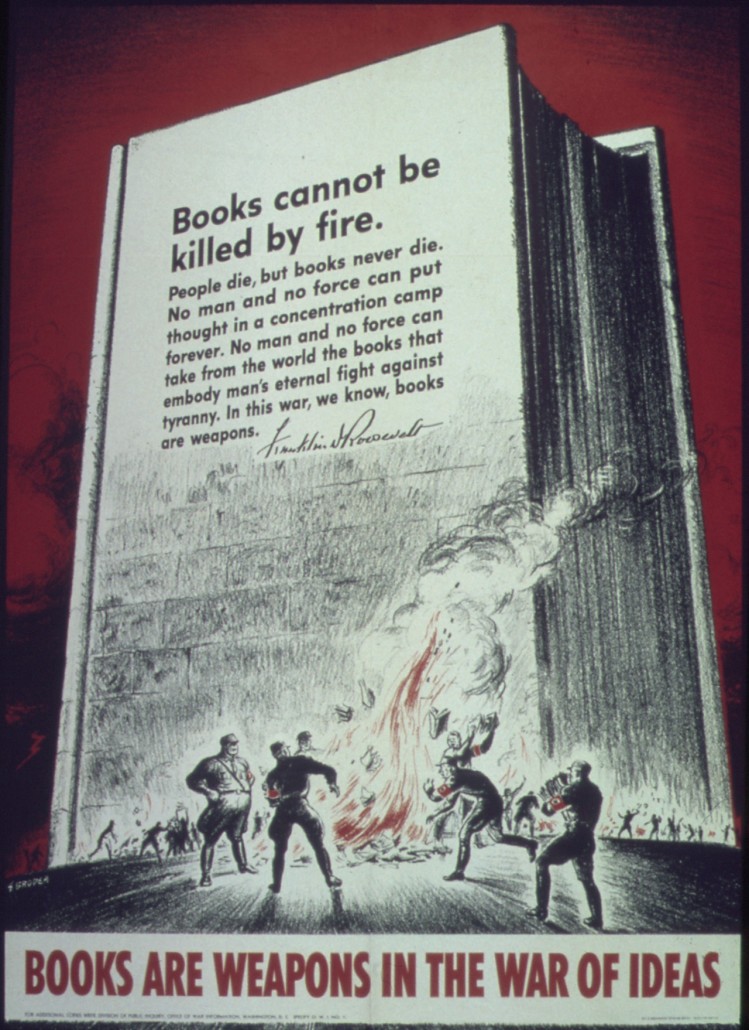
This week is Banned Books Week, a celebration of freedom and a reminder that censorship is always around the corner. This WWII-era poster includes a great quote by FDR about the importance of books in the fight against tyranny.

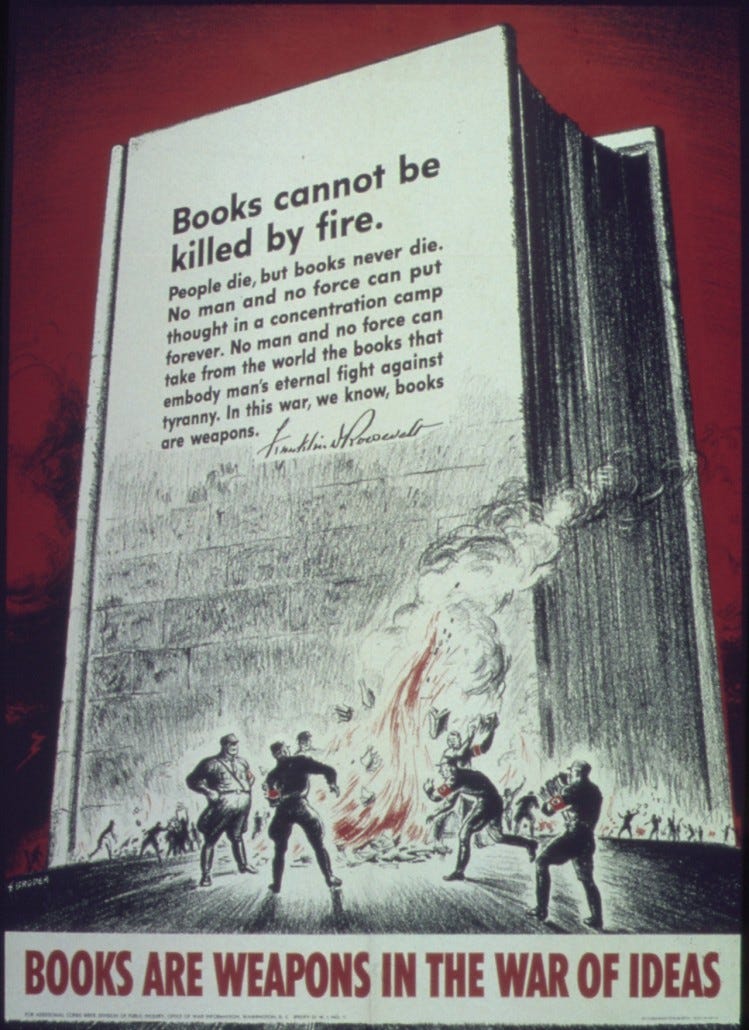
book burning

“Books cannot be killed by fire. People die, but books never die. No man and no force can put thought in a concentration camp forever. No man and no force can take from the world the books that embody man’s eternal fight against tyranny. In this war, we know, books are weapons.”

-Franklin D. Roosevelt

(h/t boiledleather)

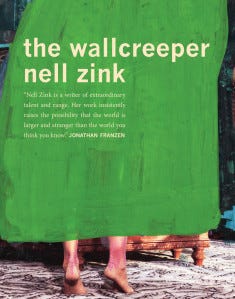
The Wallcreeper (Excerpt)

by Nell Zink, recommended by Dorothy, a publishing project

Elvis said he wanted to go dancing, which would involve staying out very late. Going dancing was his reason for being, and he wanted to share it with me. I wasn’t sure I could get that past Stephen, but I agreed to try. Stephen said, “That sounds like a date.”

“It totally is a date. Obviously this guy wants in my pants. But I mean, when’s the last time you went dancing? For me I think it was my sophomore year. And I wouldn’t know where to go. He’s a nice guy. I’m sure you know him. The guy with the beard at the gas station. He’s totally harmless. He’s a disciple of Slavoj Žižek.”

Stephen snapped the International Herald Tribune tight to turn the page. “That is the tiredest line in Christendom,” he said.

“I know. It’s not his fault he’s a tragic figure. It’s never a tragic figure’s fault. That’s what makes them tragic. But he says he knows this really fun place to go dancing, not a disco but, like, a bar where they play all kind of ‘mixed music.’”

“Do you need a chaperone?”

“Would you please?” I said. I couldn’t really say no. We picked Elvis up at his place. I had never been there. It was farther out of town, up at the edge of the woods. An old house. He came out as soon as the car pulled up. The street obviously didn’t get much traffic late at night. Elvis directed us to the most pitiful bar I ever saw. Young men unlikely to be in the possession of Swiss passports danced with eyes half-closed, snapping their fingers, while women in various states of disrepair jockeyed into their axes of attention. Lumpy, lantern-jawed, pockmarked, bucktoothed, short, tall, or simply drunken women, here to pick up devil-may-care subaltern gigolos for a night of horror.

I saw Elvis through new eyes. “You are so much beautiful,” he would often say charmingly as he worshipped at the altar of my body. Looking around, I could only think that a bar where I am the best-looking woman by a factor of ten is not a bar where I want to be, and that beauty is apparently relative. I felt both better- and worse-looking than before. Better because I was suddenly reminded that the world is not all college girls and secretaries and trophy wives, and worse because everything in the whole universe is contagious if you look at it long enough. Just opening your eyes puts you in front of a mirror, psychologically speaking. Garbage in, garbage out. Or rather, garbage goes in, but you never get rid of it. It just lies there turning to dust and slowly wafting a thin layer of grime on to every other object in your brain. Scraping the gunk off is not only a major challenge, but the chief burden of human existence. That’s why I keep things so clean. Otherwise I would see little flecks of Rudolf-shit everywhere I looked, from Fragonard to the Duino Elegies.

“I am not staying here,” Stephen said. “Do you want to stay?”

Elvis asked if he knew another place. Our next stop was called Mancuso’s Loft. It was running drum ’n’ bass. The proprietor waved us in. Here I saw Stephen through new eyes. Then I ran to the ladies’ room and stuffed my ears with toilet paper. Stephen led me to the floor and yelled, “I’m going to dance a little bit!” He then proceeded to dance as if he had never seen me, or any other human being, before in his life. Cranes came to mind.

Touching my elbow, Elvis remarked, “This club is so much beautiful,” and headed for the bar. Elvis was right. In Mancuso’s Loft, I felt below average-looking and quite conspicuously ill-dressed. My pants revealed nothing whatever. My shoes were comfy. My shirt had long sleeves so thick I was soon terribly hot.

“I like your husband,” Elvis said. I said that was not really his assigned task. “No, he has something. Un certain je ne sais quoi. You know what I need? A girlfriend. By myself, I am never getting into this place. You think they let me in? A brown man alone, with a beard? Ha!”

“You’re not brown! You’re lily-white anywhere but Denmark!”

“Many times, I am standing in the queue outside clubs like this. And all the time, I think I am living in Berne. But I am not living in Berne. I am living in the Berne that reveals itself to me, okay, a white ‘Yugo’ if you please but with no connections, with nothing. A cashier in the petrol station, with nothing to his account but a few women. Yes, I say it openly. I have nothing to offer this town but my body. My body to strike the keys of the cash register, my body to find other bodies and search for warmth. My body is my capital. You, this beautiful woman, are my social capital. And then I was taking you, you particularly, to this horrible bar. I see now it is so very horrible, this bar.”

“Elvis, calm down,” I said. “You’re a model of successful integration. You even speak Berndeutsch, and you’ve only been here eleven years!”

“Are they speaking Berndeutsch in this club? No, they speak French!” I didn’t know how he had decided on that one, because I could barely hear even him, much less other people. “I speak the language of the gas station! I have shamed myself. I hoped to leverage one woman to meet another. Not to earn a woman with the honest work and the natural beauty of my body! This crazy Swiss language has made me a capitalist of women! And what is my wages? I insult you, the most beautiful woman in Switzerland. This town has made of me a body without a brain. I will leave this place and go to Geneva,” he concluded, taking both my hands.

“Don’t do that,” I said.

“No, I won’t if you don’t permit it!” he cried ecstatically, throwing his arms around me.

Stephen drifted over, bouncing on the tips of his toes, and beckoned to me. “You need ketamine?” he whispered.

“Umm, no?” I said.

“I got three,” he said. “I think I might stay here. You want the car keys? I’ll take a taxi.”

“Don’t give Elvis any drugs.”

“I don’t take drugs,” Elvis volunteered. He had never been in a band, so he could hear much better than we could. Stephen and I were always stage-whispering about people sitting near us in cafés and drawing stares.

“That’s dandy,” I said. I pocketed the keys and took Elvis’s hand. “Let’s blow this joint. That okay with you?”

Stephen mouthed the word, “Arrivederci.”

We arrived at the wind-struck farmhouse where Elvis lived with (judging from angle of the stairs) a herd of chamois and mounted to the third floor hand in hand. After a warm and harmonious session of sixty-nine (Elvis was not too tall) to the sounds of Montenegrin folk rock (East Elysium — my favorite song was “Wings [Who You Are?]”), he said, “I want to buttfuck you.”

“What is it with guys?” I said. “You’re all obsessed.”

“I never mentioned it before!”

“So where did you get the idea? From bad porn with stock footage from the sixties? From daring postmodern novels like Lady Chatterley’s Lover?”

“From doing it.”

“FYI, it’s no fun, so forget it.”

“Just forget it?”

“Forget it.”

Elvis said mournfully, “If you loved me, you wouldn’t care that it’s ‘no fun.’ That’s the difference between our thing and a real love.”

“Wait a second,” I said. “I don’t mean to sound like a crank, but are you saying that what makes our relationship valuable is my willingness to suffer for you? Are you aware that I’ve never suffered for you for even, like, one second? That’s what makes our relationship so optimal, in my opinion.”

“You must have done buttfucking to know that it’s ‘no fun.’ So you suffered for someone else, right?”

“So now you want to move up in the world?”

“I’m in love with you. I want a sign that I mean so much to you.”

“You asked me if I’d move to Geneva with you, and I said no. You accepted that right away.”

“I can’t ask so much of you. That’s too much.”

“Are you aware that if you gave me a choice, like if I actually had two options in life, anal sex and moving to Geneva — ”

“You would move to Geneva?” He threw his arms around me again, quivering with spontaneous joy.

“You’re not understanding me,” I said, pushing pillows in the corner so I could sit up. “There’s suffering, and then there’s boring stuff, and then there’s stuff that’s just plain stupid. I’ve done my share of suffering for Stephen. And other guys. Like crucifixion, I mean that level of suffering. Like St. Laurence. ‘Turn me over! I’m done on this side!’ I don’t see what that has to do with having a good relationship. It should be about getting through difficult stuff together. Difficult stuff the world throws at you, not difficult stuff you do to each other. The difference right now between me and St. Laurence is, he didn’t have the option of taking his hand off the hot stove.”

“You are fierce,” he replied, pulling the blanket up around his naked body to hide it. “I am never asking another woman for buttfucking.”

“Are you bisexual?”

He frowned. “I am polymorphous pervert! Where I find love!”

I shifted back into neutral and once again accepted the need for negative capability in this world. We had loving, beautiful sex just as soon as we could get ourselves to stop talking — loving and beautiful in the expressionist, pathetic-fallacy sense in which you might say a meadow was loving and beautiful even if it was full of hamsters ready to kill each other on sight, but only when they’re awake. I mean, you just ignore the hamsters and look at the big picture.

The next day, around six p.m. after he woke up, Stephen said, “Let’s make a baby.”

“I feel like Saint Laurence on the gridiron,” I said.

“No, you’re mixed up. Miscarriage is nothing compared to childbirth. You got off easy. You’re like Saint Laurence saying he doesn’t want to go to Italy in July. I’m asking you right now to risk your life and health for my reproductive success. I feed, you breed. Come on!”

“Sounds tempting,” I said. “If I could lay eggs and you agreed to sit on them, I might even do it.”

“Can we fake it?” he said. “Are you fertile?”

“Not exactly.”

“Then meet the father of your triplets!”

“You’re totally insane,” I said approvingly. Stephen was actually sort of interesting when his mind opened the iron gates a crack and let the light out.

“The central ruling principle of my life,” Stephen explained in a grandfatherly way, “is ‘Let’s Not And Say We Did.’ Most people don’t give a fuck what you’ve done and not done. If I put a picture of you and a baby on my desk, I can get promoted. All anybody wants to know is little sketchy bits of information, strictly censored, and that’s enough. It’s more than enough. Did you ever sit down and actually make a list of what you know about, like, Togo? ‘Is in Africa.’ That would be the grand total of your knowledge. But when people say the word ‘Togo’ you let it pass, the same way you let hundreds of people pass you on the street and in the halls every day. And every one of them is as big as Togo, inside.”

“That’s pure bathos, and I know nothing about Togo,” I said. “But somebody like, say, Omar’s wife, I don’t know her either, but what with my life wisdom and mirror neurons and all that, I figure I have a pretty good sense of what she’s about. But only because I’ve met her. I mean, if I said, ‘Togo is charming,’ you’d get the idea that you liked it until further notice, but if then I said, ‘Togo brags about doing those impossible word puzzle things in the Atlantic and dropping out of Harvard med to get a doctorate in nutrition,’ you’d think, who is it trying to impress? But you haven’t even begun to talk about its secret sorrows or whatever.”

“You can bet your buttons Togo has secret sorrows,” Stephen said. “If anybody knew what they were, the world would be filled with raw, bowel-torn howling. That’s Stanislaw Lem. I was going to say, I didn’t love you when I married you. It was like, ‘Let’s Not And Say We Did.’ But now I feel like Apu in The World of Apu, except instead of being faithful to me and dying in childbirth like you’re supposed to, you’re fucking this Arab guy. So tell me, Tiff, what is going on?”

“He’s Montenegrin!”

“Montenegrin my ass! He’s Syrian if he’s a day! ‘Elvis’! It’s like a Filipino telemarketer calling himself Aragorn!”

I pouted.

“Ever try to make a list of everything you know about Elvis?”

“What would be the point? I was just trying to have some exciting sex.”

“Could you not try?”

I was silent.

“Could you love me a little?”

“Actually I do love you. Elvis told me. It’s breaking his heart.”

On Monday morning I bought the International Herald Tribune and some milk and said, “Elvis, I need to talk to you.” For the first time I noticed that he was reading Hürriyet. Over coffee at my place, he explained that his family had left Montenegro some generations before. But their women preserved the legendary beauty and kindness of the people of Montenegro, once immortalized so memorably by Cervantes in his lady of Ulcinj (D’ulcinea), and their men weren’t bad either. He showed me his Turkish passport. His name really was Elvis.

“Tiffany, my love,” he said. “What does it matter where I am from? You are an American! You know better than any shit European that we are all equal children of God!”

The next Saturday we went birding to an ugly artificial lake and Stephen asked me to talk about myself. “Let’s see,” I said, “being little sucked, but it had its advantages. Sledding is a lot more exciting before you turn ten. Of course I couldn’t really swim until I was eleven.”

“And then?”

“Well, my parents weren’t real particular about their choice of a boarding school, so I went to basically a home for wayward girls. I didn’t learn a whole lot. Like, our chemistry teacher was the choir director’s wife. I used to play around in the lab on weekends. I used to dump all the mercury on the counter and play with it.”

“Yeah?”

“I was supposed to go to Bryn Mawr after my junior year, but it was too much money, so I took a scholarship to Agnes Scott.”

He shuddered appreciatively.

“Then I moved to Philly and got a job, and then I met you.”

“Short life.”

“Well, life is short.”

“My child bride.”

“Hey, it’s not that bad! I had a thing with the riding coach at school, and in Philly I OD’d on heroin and they called me crusty mattress-back!”

“What?”

“I’m kidding. That was somebody else. This girl name of, um, Cindy — ”

“You just made her up.”

“Okay, her name was Candy. I’m serious. Candy Hart. It sounds like a transvestite from Andy Warhol’s factory, so probably she made it up. She said she was from Blue Bell, so probably she was from Lancaster, and she said she was fourteen, so probably she was seventeen. I’ve never met anybody I can be entirely sure I’ve actually met.”

We saw bearded reedlings and a ruff. We would have seen more, but there were dog walkers there scaring everything off.

We went on a birding vacation to the lagoons of Bardawil. All the men I saw there reminded me of Elvis.

When I got back I demanded answers. He cradled his coffee in his hands and said, “Now I am telling you the truth. I am a Syrian Jew. My grandfather converted to Catholicism in 1948, but he took a Druze name by mistake and was not trusted by the Forces Libanaises, so then — ”

“Just shut up,” I said. “I think you’re cute. That’s your nationality. Cute.”

On the phone my sister said, “Tiff, you have got to get a life. You think I have time to have sex? Guess again! I spend so much money on outfits for work I had to get another job!”
I said to Stephen at dinner that maybe we should try again to have a child. Our marriage had begun in the most daunting way imaginable. We had barely known each other, and then we had those accidents and that jarring disconnect between causes (empty-headed young people liking each other, wallcreepers) and effects (pain, death).

He objected. He said, “I’m sure there are couples that are fated to be together, like they meet each other in kindergarten and date on and off for twenty years, and finally they give up because they realize they’ve gotten so far down their common road that there’s nobody else in the entire universe they can talk to, because they have a private language and everything like that. Do you really think that applies to us? What do we have in common? We don’t even have Rudi anymore.”

“A baby would be something in common.”

“That’s it. Have kids and turn so weird from the stress that nobody else ever understands another word we say. A couple that’s completely wrapped up in each other can get through anything, because they don’t have a choice. Right now we have the option of floating through life without being chained to anybody, but instead we pile on a ton of bricks and go whomp down to the ground.”

“Are we ever going to both want a baby at the same time?”

“I hope not!” Stephen said. “I want to float through life. I like being with you, and I don’t want to be chained to anybody. I mean, when you got pregnant, I could deal, but if you’re not pregnant, I can also deal.”

“That’s a relief. I was afraid if I didn’t have kids soon, you’d make me get a job.”

He paused and looked at me fixedly for a good ten seconds. “I’m starting to catch on to you,” he said. “You were born wasted. You live in a naturally occurring k-hole.”

“I do my best.”

“Here’s the deal. I need your baby for my life list. It’s one of the ten thousand things I need to do before I die, along with climbing Mt. Everest and seeing the pink and white terraces of Rotomahana. The baby is the ultimate mega-tick.”

“Like a moa,” I suggested.

“Exactly. There will never be another one like it, and there was never one like it ever, so actually it’s a moa that arose from spontaneous generation. A quantum moa.”

“Babies are totally quantum,” I said. “That’s why it feels so weird when they die. You feel like it had its whole entire life taken away and all the lights went out at once, like it got raptured out of its first tooth and high school graduation in the same moment.”

We munched on food for a bit.

I said, “Stephen, may I ask you something? When we had anal sex that one time, was that for your life list?”

“Yeah.”

“It wasn’t on my list.”

“I’m sorry. I figured human beings are curious. I try not to avert my eyes when life throws new experiences my way. But I guess nobody ever asked me to stick the pelagics up my ass.”

A Public Space Announces 2015 Emerging Writer Fellowships

by Ben Apatoff

Brooklyn independent literature magazine A Public Space has opened applications for its 2015 Emerging Writer Fellowships, in which three writers will be selected for the six-month program. Perks, according to the APS web site, include the following:

– A ​mentorship from an established author who has previously contributed to A Public Space;
– Publication in the magazine;
– ​A contributor’s payment of $1,000;
– ​Free workspace in our Brooklyn offices​ (optional)​.

Interested writers can apply here, free of charge. Applications are due by October 15, 2014, and the fellowship period runs March 1, 2015 — September 1, 2015.

Cormac McCarthy Smiles

by Matt Bell

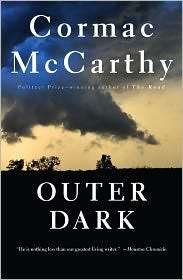
Outer Dark Cover

One of the rules I’ve heard taught most often in writing workshops is that you shouldn’t use “smile” or “shrug” too frequently — if at all — as they can serve as a sort of crutch keeping you from writing stronger and more-telling action around your dialogue. I’ve said it myself, and one of the things I often look for in revision are opportunities to replace those smiles and shrugs that do creep in with something better. (Of course, one thing about writing is that as soon as you stamp out one weak move, you almost immediately find a replacement addiction, which might account for all the cigarette smoking that happens during dialogue in seemingly everyone’s early stories, including mine.) Still, while there is definitely some truth to this, every rule has its exceptions, and there are surely plenty of smiles and shrugs in even the best books.

For example, I recently reread Cormac McCarthy’s Outer Dark, which is notably full of horrific violence: people are murdered with brush-hooks and bodies are left hanging from trees, there’s grave-robbing and vultures eating the flesh of the dead and hordes of pigs being run off the edge of cliffs alongside their drover, among much else (and that’s not even mentioning the act of incest and attempted infanticide that kicks off the main action of the book). But despite the incredible violence and the gravity of its plot, there is also an awful lot of smiling happening — and McCarthy’s smiles are often accompanied by adverbs, a violation of another “rule” I hear constantly from other writers that, while again containing a portion of helpful advice, is really just the expression of a particular once-dominant aesthetic.

McCarthy is one of my favorite writers, and his prose is impeccable throughout Outer Dark, mixing what the New York Times called “a style compounded of Appalachian phrases as plain and as functional as an ax” with “a second diction taken from that rich store of English which is there in the dictionary to be used by those who can.” Nothing about his prose or the novel as a whole is diminished by the many times his character smile — sometimes “slightly,” sometimes “weakly,” sometimes “dreamily,” sometimes with smiles “whitelipped” or “malignant” or “wincing” — and it’s a good reminder that very few rules hold up everywhere, and that great writers are constantly breaking or disregarding the guidelines that get parroted so often in our writing classes.

In 242 pages, McCarthy uses the word “smile” thirty-three times, more than once every ten pages. More than half of the thirty-three occurrences are verbs used for people actually smiling:

Holme smiled.

Holme smiled slightly.

Holme smiled weakly.

The man smiled again.

She saw the man smile.

The woman smiled and she smiled back.

His assassin smiled upon him with bright teeth, the faces of the other two peering from either shoulder in consubstantial monstrosity, a grim triune that watched wordless, affable.

The beehiver smiled his little smile and slung the coat upon his shoulder again and they went on.

The tinker smiled and captured the beanbowl between his thin shanks and wiped up the remnants with the last of the bread.

Then it started, an explosion of curses and oaths in such ingenious combinations that the other smiled appreciatively.

John smiled cynically, the gun cradled in the crook of his arm.

The lawyer nodded and smiled.

Harmon looked up and smiled.

The squire smiled.

The bearded one smiled.

The blind man smiled.

He smiled dreamily.

The storekeeper started to smile and then he stopped smiling.

“Smile” is also used frequently as a noun:

You like two pennies, the clerk said with a small malignant smile.

There was a trace of a smile at his mouthcorners.

The other stood with long arms dangling at his sides, slightly stooped, his jaw hanging and mouth agape in a slavering smile.

He spared a wincing smile to this traveler.

She tucked the package beneath her arm and set forth, shortgaited and stiffly, humming softly to herself and so into the sunshine that washed fitfully with the spring wind over the glade, turning her face up to the sky and bestowing upon it a smile all bland and burdenless as a child’s.

At the corner a man sprang up, a face pale and contorted in a whitelipped smile, and brought the slat flatwise across his back with a sound that exploded clear through him.

They altered their course and came upon a log road down which the wagon receded in two thin tracks and upon a burst lizard who dragged his small blue bowels through the dirt, breaking into a trot, a run, the first of them reaching the horse and seizing the reins and turning up to the driver a mindless smile, clutching the horse’s withers and clinging there like some small and vicious anthroparian and the driver rising in remonstration from the wagon box so that when the next one came up behind him sideways in a sort of dance and swung the brush-hook it missed his neck and took him in the small of the back severing his spine and when he fell he fell unhinged sideways and without a cry.

Here McCarthy uses “smile” as both a noun and a verb in the same sentence:

He waited very still by the side of the road, but the blind man passing turned his head and smiled upon him his blind smile.

There’s also a few uses of “smile” indicating its absence:

Clark never had smiled.

He stood rigid and upright in the coffin-sized doorway with no expression, no hint of a smile, no list to his bearing.

Once it’s used to indicate an expression that is not quite smiling:

The man’s teeth appeared and went away again as if he had smiled.

And finally, there’s one use of a “smile” as a metaphor — and as terrible as it is in context, it’s maybe even worse coming last after this list of less gruesome uses:

Holme saw the blade wink in the light like a long cat’s eye slant and malevolent and a dark smile erupted on the child’s throat and went all broken down the front of it.

What about McCarthy’s other books? There are six smiles in The Road, plus one almost-smile. “Smile” appears sixty-three times in Blood Meridian, including twenty-four occurrences of the phrase “The judged smiled,” and it appears 118 times in Suttree. The word appears thirty-four times in No Country for Old Men, only five times in Child of God, and — strangely — exactly fifty-six times in each book of The Border Trilogy, for a total of 168 occurrences across the three books.

But so what? The higher-than-average amount of smiling in McCarthy’s books doesn’t necessarily affect the quality of the work, only its character. Another perennial English teacher admonishment is how the exclamation point should be used incredibly sparingly and that each writer only gets a certain number of exclamation points for his or her career. Whatever his starting allowance, it’s a good bet McCarthy has never used one in a novel, since he’s been quoted as saying exclamation marks and semicolons “have no place in literature.” (An editor of his once remembered seeing him use a single colon, somewhere.) But the absence of exclamation points isn’t by itself what makes McCarthy a great writer, and you’re unlikely to see that particular statistic cited in reviews of his work, although his unorthodox punctuation is often mentioned.

Adherence to the “rules” is perhaps best when it’s a private thing, and teaching others the ones we’ve been taught or the ones we’ve discovered should perhaps be more sharing what’s worked for us or in books we’ve loved than it is handing down directives. We all have our rules we try to live by upon the page, which despite how frequently we repeat them to others are perhaps most useful only to ourselves, as a reminder of the constraints we’ve chosen to place upon our art, the ways we hope to arrive at a better prose than we might otherwise produce. The trick is not to let those constraints become straightjackets, leaving us incapable of fully expressing the stories we’ve set out to tell, and so it’s often worth studying the ways in which a great writer has violated these commonly-expressed tenets of “good writing” in order to get somewhere even greater. As my friend Drew Johnson said to me recently, in a conversation about Faulkner’s preferring to tell rather than show in some of the best parts of The Sound and the Fury: “My favorite thing about this discipline is that there’s no rule that isn’t a dare.”

REVIEW: The Inevitable June by Bob Schofield

The presence of narrative cohesion usually signals the existence of a comprehensible story; however, a text can be wild and unexplainable despite the presence of these identifiable components. Bob Schofield’s The Inevitable June is a perfect example. At once a collection of art, a series of loosely interconnected passages, and a playful collision of hitherto unexplored couplings of language and ideas, this short book defies categorization and challenges the reader. Yes, The Inevitable June lacks a definitive plot.

The nameless narrator offers what could be considered daily journal entries that deal with a plethora of feelings and actions that range from the commonplace to the fantastic, with the latter being much more prevalent than the former. In fact, even the “normal” actions are performed within the realm of the surreal. The passages take place during the thirty days of a month of June of an undisclosed year and include a plane, an octopus having sex with its own meat, an unnamed woman, and a horse made of light bulbs. The feeling that there’s a hidden meaning behind the all the chaos is inescapable.

Given that the book is a maelstrom of ideas, any paragraph serves as synopsis:

“Back when I was eight inches tall I wanted to be a bullfighter. Now I reach for a lemon. I eat the peel. I eat rows of tiny men in top hats. I grow into a radioactive monster and start beating up the sky. I wipe down every dish inside your floating dream fortress.”

This is a brave book and it resembles nothing else out there. Schofield is pushing the boundaries of reason by aggressively stretching language in delightfully odd directions. The result is a disjointed narrative that has enough structure to be a lot of fun nothings or a text packed with profound meaning. While this duality is enough to make The Inevitable June a thought-provoking read, perhaps Schofield’s most impressive accomplishment is the ease with which the text facilitates suspension of disbelief. Here is a world in which a woman releasing fish from the nets in her belly that subsequently explode into universes is not only acceptable but almost reasonable.

The artwork presented in the book adds to the surreal feel of the text. The drawings seem to explore loneliness, sadness, and identity, only to then morph into a visual storyboard where a giant black octopus that lives in the sky devours an airplane. Also, there are a dozen pages in which a black box gives birth to rhizomatic tendrils that take over the page and suggest further invasion, which is something that invites analysis as much as the narrative itself.

The abyss between Schofield’s ideas and what’s on the page is at once inexistent and insurmountable, and that dichotomy makes The Inevitable June a special tome despite the fact that it can be read in twenty minutes. Significance appears to be there, just beyond the reader’s reach, beckoning:

“This morning I locked into a staring contest with an ice sculpture version of my inner child. His icicles grew into my nose, leaving white columns there. His sweaty palms numbed my face off. By noon he had completely melted.”

This is a book that begs to be deconstructed and interpreted, while also managing to not take itself so seriously. The Inevitable June is a funny mix of words and art that can be taken at face value without it losing its power. Schofield achieved something with this strange combination of hilarity, tragedy, and art, but describing that achievement, just like understanding the book, is something better left to the reader.

Inevetable June

by Bob Schofield

Powells.com

VIDEO: Lydia Davis Reads “Goodbye Louise”

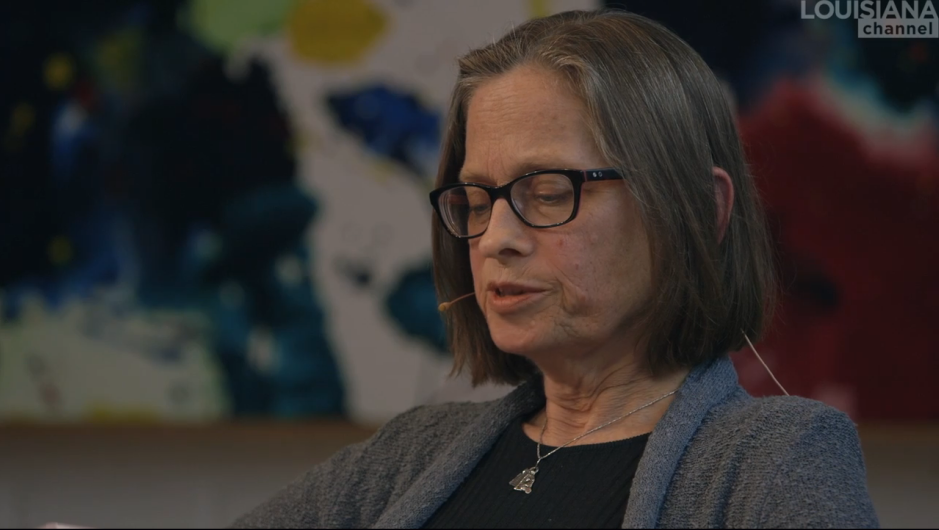
In the above video, from Louisiana Channel, Lydia Davis reads one of her characteristically innovative and quietly humorous pieces titled “Goodbye Louise.” Davis says the piece hasn’t been published because it is an ongoing collection of all the times people have mistakenly addressed her (“Linda, Lyidia, Lindon,” etc.).

The reading was filmed in August during the Louisiana Literature Festival at the Louisiana Museum of Modern Art, Denmark. Check out Louisiana Channel for lots of other interesting literary and arts videos.

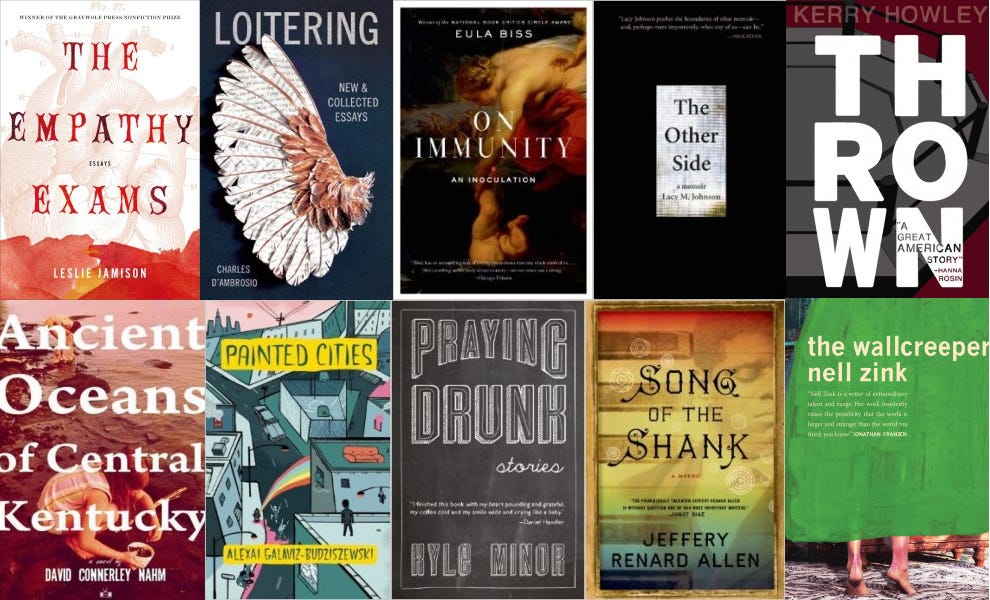
Ten Indie Titles the National Book Awards Overlooked

by Kristen Radtke and Michael Taeckens

As is seemingly inevitable, the unveiling of the National Book Award long lists this week generated as much fanfare as it did controversy, much of the latter having to do with the fact that nine out of ten writers on the nonfiction long list are white males (but, in all sincerity, a major huzzah for Roz Chast!). As Carolyn Kellogg rightly pointed out, however, the poetry and young people’s literature long lists were evenly split between male and female writers — and the fiction list, which was revealed after Kellog’s article was published, is likewise split.

There was also notable criticism directed at the lack of racial diversity among the nominees. One aspect that has gone without much notice, however, is the almost complete absence of small-press books among those in contention for the award. Out of all forty books on the long lists, only four of them — all poetry — were published by small presses: Graywolf Press, Letter Machine Press, and Nightboat Books. It seems particularly unfortunate that for the second year in a row, no small presses were represented in either the fiction or nonfiction categories.

There’s been much debate about what the National Book Awards are for and what kinds of books they should represent. We don’t wish to add to that here, but to instead applaud the many worthy writers on the long lists (the fiction list in particular is dazzling) and to also give a shout out to the many worthy books published by small presses this year. In that spirit, we asked an array of booksellers, critics, and writers alike which indie press books they would have liked to see on the long lists and compiled the top five in fiction and nonfiction. Any books that were not eligible for the National Book Award (e.g., author not a U.S. citizen, book published outside of date parameters for 2014) were excluded. (Eimear McBride’s A Girl Is a Half-Formed Thing [Coffee House Press] most certainly would have been on the fiction list below if she were a U.S. citizen.) Each book had to have at least two nominations to make the list; neither one of us participated in the nomination process.

The contributors include Amanda Bullock, Julie Buntin, Tobias Carroll, Josh Cook, Alex Crowley, Jason Diamond, Melissa Faliveno, Joe Fassler, Michele Filgate, Linnie Greene, Ami Greko, Gabe Habash, Liberty Hardy, Jynne Martin, Emily Russo Murtagh, Maud Newton, Kevin Nguyen, Steph Opitz, Bethanne Patrick, Rafe Posey, Emily Pullen, Annalisa Quinn, Rachel Riederer, Michael Schaub, Rick Simonson, Stephen Sparks, and Stacie Michelle Williams.

— Kristen Radtke (@KristenRadtke) and Michael Taeckens (@mtaeckens)

* * *

Nonfiction

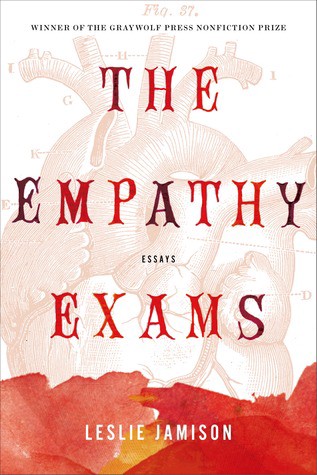
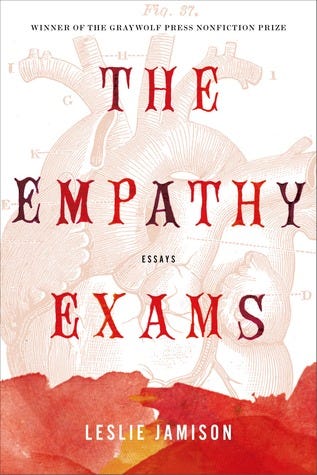
Empathy Exams

The Empathy Exams (Graywolf Press), Leslie Jamison

Loitering book cover

Loitering: New and Collected Essays* (Tin House), Charles D’Ambrosio

On Immunity

On Immunity: An Inoculation (Graywolf Press), Eula Biss

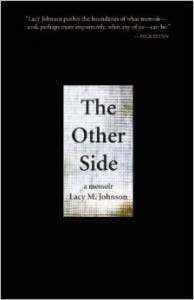
theotherside

The Other Side (Tin House), Lacy M. Johnson

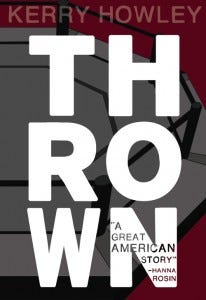
Thrown book cover

Thrown (Sarabande Books), Kerry Howley

Fiction

ancient oceans, kentucky, book cover

Ancient Oceans of Central Kentucky (Two Dollar Radio), David Connerly Nahm

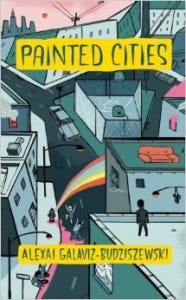
painted cities

Painted Cities (McSweeney’s), Alexai Galaviz-Budziszewski

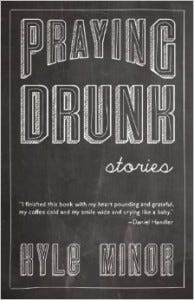
Kyle Minor praying drunk

Praying Drunk (Sarabande Books), Kyle Minor

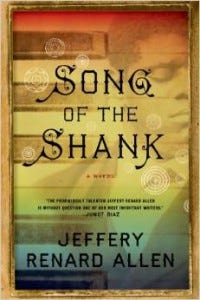
song of the shank

Song of the Shank (Graywolf Press), Jeffery Renard Allen

The wallcreeper book

The Wallcreeper (The Dorothy Project), Nell Zink

* Portions of Charles D’Ambrosio’s Loitering appeared in a book many years previous, but the Tin House edition includes much new and revised content.

Nota bene: The winners of The Firecracker Awards, sponsored by CLMP (Council of Literary Magazine and Presses) and exclusively reserved for books by small presses, will be announced in May 2015 at Book Expo America.

REVIEW: 10:04 by Ben Lerner

Within the first page of Ben Lerner’s 10:04, he managed to convince me to never eat octopus again. The protagonist, a writer who’s set to receive a sizeable advance, is enjoying a celebratory meal with his agent at a swanky restaurant noted for serving tiny cephalopods that have been massaged to death. He describes eating an animal that “decorates its lair, has been observed at complicated play,” then goes on to sense “a conflation of taste and touch as salt was rubbed into the suction cups; a terror localized in my extremities, bypassing the brain completely.” This is a rather heavy hinting at the metafictive manipulation to come, and exactly what makes 10:04 a strikingly original and energetic novel.

10:04 is set primarily in New York City, with the story bookended by hurricanes; it begins with the relatively benign Irene and ends with the unprecedented destruction wrought by Sandy. The year between the two storms is long and circuitous: Our unnamed narrator is attempting to tease a full-length novel out of a well-received short story, helping his best friend conceive a child (through in-vitro fertilization because, as she’s proclaimed to him, “fucking you would be bizarre”), dating the acclaimed conceptual artist of the moment, and dealing with a potentially fatal heart condition. There are also two notable, comically trying experiences: mentoring Roberto, an elementary school student from Sunset Park, and embarking on a writer’s residency in Marfa.

Lerner’s protagonist, much like the one in his debut novel, Leaving the Atocha Station, is incredibly anxious, to the point where his extreme neurosis makes him affable. Take, for example, his twisting musings on his own selfishness:

“While I stirred the vegetables I realized with slowly dawning alarm that I couldn’t remember the last time I’d cooked by myself for another person — I could not, in fact, ever remember having done so…On various occasions, I’d said to a woman I was interested in, ‘I would invite you to dinner, but I’m a terrible cook,’ at which point I would hope she’d say, ‘I’m a great cook,’ so I could ask her to come over and teach me; then we’d get drunk in the kitchen while I displayed what I hoped was my endearing clumsiness, never learning anything.”

In fact, the dining scenes are some of the most enjoyable to read in the book. His protagonist typically gets drunk (“All that vanished with the first sip of gin…without ceremony I dispatched the giant steak I had ordered, inhaled it, basically…”), and becomes simultaneously more gregarious and neurotic; these scenes manage to sizzle with manic energy while, at the same time, be somberly observant. Lerner enters staid affairs and builds recognizable caricatures out of some very serious people: “The distinguished professor was sitting immediately across from the distinguished male author and seemed more than happy to receive his logorreah; a younger woman — probably also an English professor but too young to be distinguished — was sitting beside him, smiling bravely, realizing her evening was doomed.”

10:04 is creatively layered in a way that is fresh and exhilarating — the narrator is in the process of writing the book that readers happen to be digesting, but Lerner also includes the short story, “The Golden Vanity,” which gained him attention after being published in The New Yorker in 2012, as well as another fictitious children’s book that he helps his mentee publish. (They are both excellent in their own rights.) One of Lerner’s great strengths, as with Atocha, is the quiet hilarity of his prose; it’s self-deprecating without being overdone. The narrator takes care to point out every bit of absurdity, both internal and observed. The humor (think: awkward attempts at masturbating in the fertility clinic) doesn’t make his more poignant scenes — describing his father dealing with his grandmother’s death, or wading through post-Sandy New York — any less touching. Rather, it bolsters the serious affairs and draws you deeper into the narrator’s psyche so that you find yourself hanging on to every word of his winding, exquisitely-crafted sentences.

10:04: A Novel

by Ben Lerner

Powells.com

Madness in Cervantes’ Spain

by Joseph Jaynes Rositano

In reading Don Quixote, the greatest novel of “madness,” it is helpful to understand that Cervantes wrote in a culture whose social constructions of madness were no less nuanced — and in some ways no less humane — than our own. Dale Shuger’s Don Quixote in the Archives: Madness and Literature in Early Modern Spain illustrates this by examining documents from over one hundred legal cases in which the defense of insanity was invoked.

Madness (locura) played a complex and highly public role in the social life of Cervantes’ Spain. Though some of the “mad” (locos) were confined to institutions, most were not. And even the institutionalized were not hidden from public view: large groups of them were paraded daily through city streetssometimes in motley garb, riding on mules — to collect donations that defrayed the expenses of their confinement.

We often contrast contemporary treatment of the mentally ill with a hazily imagined barbaric past. The horizon of this imagined past is always receding: in the 1950s (the era made infamous by One Flew Over the Cuckoo’s Nest), when a half million Americans were confined to state mental hospitals with few legal protections — — and lobotomy was a common practice, psychiatry saw itself as humane and progressive. Now, we might consider it evidence of progress that our mental hospitals hold less than a tenth of the numbers they once did; yet many of those who would have been hospitalized at midcentury are now in jail, prison, or homeless.

Just as those diagnosed with mental illness in our time are met with a mixture of sympathy and stigma, early modern Spaniards had ambivalent attitudes toward those they deemed mad. Locos were often excused for their deviant behavior; but they were also commonly targeted for open mockery, as happens constantly to Don Quixote.

In Cervantes’ Spain, madness was a legal defense both in secular courts and in the Inquisition. People accused of heresy often pled insanity — sometimes with success. But an official label of locura could result in curtailment of one’s legal rights — as a diagnosis of mental illness can in our time.

In early modern Spain, physicians testified in court as expert witnesses, claiming to discern true madness from malingering. Priests distinguished demonic possession from both — and from “legitimate” mystical experiences. Of course, there was nothing scientific about any of this; but then, psychiatric diagnosis still lacks an objective, biological basis today.

Asylum charters make it clear that, at least in theory, the mad were to be treated with compassion. Available evidence suggests that physical restraints (such as cages) were only used as a last resort. This is not to say there was no cruelty or maltreatment: confinement precipitates abuse — as the treatment of people diagnosed with mental illness in contemporary US prisons testifies.

Cervantes’ Spain, for all its cruelty, had its claims to compassion as well. Locura had spiritual significance, and charity toward locos was viewed as particularly meritorious. During the celebration of Holy Week, twelve asylum residents were chosen to play the Twelve Apostles. Asylum administrators washed these “Apostles’” feet.

In studying the history — and literature — of mental illness, we are better served by turning a skeptical eye on the practices of our own era than by a smugly superior attitude toward our predecessors.

Boot of the Boot

by Luke B. Goebel, recommended by FC2

If I ever meet a man named Manuelo from Paris, he’d better watch his fucking head. I mean it. I told her one day when I was soaked with rain, in a white shirt stained brown from shoulder to opposite hip, from a cheap leather strap wet from the rain. I was using the strap to hold a bag with my belongings in it. It needed to be said. I’d been walking in rain lost talking, talking to myself, appearing at an art opening in NY to meet Catherine, and each past boyfriend of hers came by to shake my wet hand. Each one looked at me and stifled a gasp, a laugh, a crack — I gripped her elbow, staring at her ex’s tie clip, and said, “Never make me shake hands. If we don’t make it, don’t you ever introduce me. You hear me? I don’t want to be anybody’s former anybody. Please, don’t make me shake a damn hand. I might not give it back.” Giving her some credit, I wasn’t easy to be with.

I looked through a very expensive telescope in a grocery store parking lot tonight, and saw what’s out there.

And it’s impressive!

I mean in space.

I saw the craters of the moon in blinding bone white brilliance, rippling in light and I don’t know what. But rippling and bone white right into the craters was mostly enough.

I saw Saturn.

This is not a metaphor. This is not about Manuelo and whatever he is doing over there with Catherine in the boot of the boot. Can you imagine what he is doing with her? In Italy! Christ!

(This is all what I felt and wrote while living at the new ranch only a few months and Catherine went off with a Spanish man named Manuelo who she’d met in Paris, where she was visiting during living for a few months in Italy after I moved to Texas, and we were still together, and I felt it, the moment he touched her and I somehow knew it, what had happened, while staring at St. Jude’s Chapel’s mural, sitting down to coffee and steak and eggs in Dallas, and later found out, and the times matched up, and I fell to writing this all down.)

I tried to give the man anything. Anything. Food, bottles of wine, sushi, my home to stay in. He wanted nothing — the man with the scope.

I want to tell you about the man with the scope. I mean to tell you what is out there around us in space. I want to tell you about her.

Catherine. Her name is like space and what there is unto itself that I saw out there. Last time I told it I showed her all wrong — in the wrong light. Last time, she came back and we went to Puerto Rico. We saw wild horses. We swam in the dark before the moon rose to swim and the water lit up wherever we swam and made glowing dots green on our skins in the dark. We had rode a motorbike all over the island, me driving too fast, as fast as it would go over the wild, bumpy, bare earth to the sea to swim in a bioluminescent bay full of sharks. Her dark hair and pale skin and a vein dark across her unknown heart.

I was held up at gunpoint by a man in Puerto Rico and the man who held me up had tears in his eyes. I made him give me a cigarette after I gave him my money, which wasn’t much. I had thought about punching him, since it was just me and him, and he was bleary eyed, leaning against a palm tree on a motorbike, but I just made him light my cigarette. He was so Christian about it. Him crying for robbing me in the dark. He had a great .45. Catherine was back in the room, naked under the sheets. I was six and a half feet tall, searching, white fake Indian cowboy, with the world going two-thousand m.p.h. around itself at any given point, and the peyote in my senses for six years so far, as I went cooling through my pants and sky and the world and I made that sonofabitch light my cigarette and he cried and circled me in his hidden drugged pain. For the shame of not carrying his pain without the drugs, maybe he cried. I was still overcoming pancreatitis. (There’s more to this story. This was before Texas, after the hospital, before Manuelo.) He had his friends come over from across the street where they’d hid in the dark. Back then I felt if I stared anyone in the eyes they could see my inner self, straight from the peyote, could see I was the real genuine leather. Now I’d be afraid and serious. They tried to translate but I already spoke Spanish. I’m talking about he who robbed me and lit my cig and his friends from across the street. They were so sad when they heard about the pancreatitis. I made the mistake and told the crying robber I didn’t want the rest of his cigarettes because I was getting over pancreatitis. They said the word pancreatitis like the last part of the word was titties. I felt so foolish, smoking, as a cop drove past and I signaled I was doing fine.

She won’t come back this time. (Catherine. It’s been years.)

[I went on my first date after Catherine, and the woman’s tooth had broken in half the night before. She kept the date and stuck the tooth, the broken away half, up in her gumline to hold it in there. It was one of her front ones. She kept excusing herself to the bathroom. With dinner served, it kept falling out and she would say, “My tooth. My tooth!” and cover her mouth with her hand and relocate to the bathroom for repair. During the meal, it (her tooth) kept falling out into her creamy pasta and she would search and dig for it with her fork. I took her home by cab after the dinner during which her half (tooth!) kept coming out, remember, and she would return to the bathroom and return to the table. I was embarrassed, but as a man, you know, you can’t just leave. You can’t just say, “I’m sorry, this isn’t working. I am going to go home.” There are certain performances, you know, for everyone, and we aren’t all animals, us animals. She tried to get me to kiss her wildly in the cab. I wish I could say I had wildly kissed her. That I had kissed her and gone mad with passion. I kept thinking about Catherine and what I was doing in exchange for losing her. Fink I was. I should have thought, what a girl! So willing and ready to see me she comes with a broken tooth stuck up within the gumline.]

I moved into the ranch house full of a family’s things. There’s pictures of boys with big ears on a wall. One wall has a cutout of Texas made from yellow wood, with varnished little shelves. On a clothespin glued into a tin of an old heat lamp is a sign made many years ago. It says, Mother my darling Mother my dear… I love you… I love you… each day of the year. There is a candle in a drawer, shaped as an 8. There is a bottle of Norrel perfume in the bathroom and photos of people who came from Mother my darling, Mother my dear, and I am not from this family. I rent this home. The Mother my darling is dead as can be.

Catherine is hard and keeps herself to herself and everyone who sees her sees she is hard but there is something else to Catherine. She has a child inside her — a girl who may have written the sign from the shelf on the wall. She hasn’t lost that. She is intact. She can write, too. Have anyone. What a beauty full of brains and a good heart, but I said I would show her this time. Anything went wrong with me, she’d say, “I think it’s a good thing” and then tell me why. She would hold my ear to cool us down. She put up with me being insane in NY, smoking, on nicotine patch systems, chewing drugged gums, running too many miles in all directions snapping on my forehead with my fingers and dressed in the same clothes everyday, panicking with visions in NYC. We moved to my family’s home in Oregon in the desert. We bought lingerie and had fires. She took to running. Her hardness has kept the child in her alive, maybe, along with her immense beauty, or she isn’t hard at all but I made her so with me (first chasing her around before and after classes with the old man in the hat, then when I was with her and cowering in New York in her room, smoking up all night with fear from exhaustion and so in love with her while she just tried to sleep, me talking and moaning and putting it in her with her sleeping, thinking and sensing with my corpus something evil all around in the buzzing city night, me: up, up, up. In love with the old man with the feather in the city with the city in America with America! She and I both working to be true.) Manuelo must see her, now. I wanted to make her pregnant and have a live baby. I once or twice or every time came inside her with hope we might make life without her consent — to carry on the great family. Hers and mine, both.

There was and is a church in the town where I grew up and at the front is a mural in gold squares and blues and reds and greens and it is Jesus with a pierced side bleeding and the blood turns to fire and the fire into wine in a chalice and from the chalice doves appear and fly upwards in rippling white. My parents married in the church. I was baptized in the church and I loved the church and later I became afraid of the church and loved the church as well.

(My brother was baptized there too. We wore the same lace gown. He then I. We were like little Christs and grew side by side toward our trouble making heartfelt lives. We had our differences of course. We didn’t stay two by two. We each had our path, but by the end and the way through we never turned a back. We always loved one another. In the end and all through he loved me and let me grow up the way I did, into the thing I am, the man, if you want to say that, and I always felt and feel he was the secret greatest. There’s more of him to come! [He died at 33, year I am now.] I cannot believe he has gone on, rode on ahead, not here with us, me, crazy, and my family, dead. But I wrote this before he left.)

(I smoked a strange drug with an Indian when I was a younger man and went back to the church ((on the drug)) in Ohio with my spirit. You leave your body on this drug. I saw the stained glass windows pinwheel with light and geometry. They were always beautiful in physical presence. But this was warmth and light not from the sun through glass but from God, or from the soul of the self, the universe, from the tomahawk of what was loaded up for me in that pipe, which the brain lets rip when you die, which also makes you dream, and there was no anxiety of being — anxiety that being separate from the universe is the source of all pain and suffering I wasn’t separated. I felt God beside me and in me and I in It. Looking without the eyes. Feeling God behind the poker face. I felt the world after death and it is beyond impressive! Hours later a car flew off a cliff before the rig I was in, which had a driver who’d picked me up hitching. Who had one leg but never mind that, the driver’s half leg. This was real life. The car that flew off the road landed at a forty-five degree angle and nose planted in the river, standing on its grill in the water like an enormous arrow. I rushed down a herder’s path and held a boy alive and in shock and felt parts of him go soft. He looked into my eyes, which back then were clear and I showed anyone. Others had come down switchbacks from the road high above. “You’re doing fine,” I told him. I felt the easiest sense of calm. Old God and me looking into him with great affection. A helicopter came out of the sky. Times like that the world isn’t doing too bad in America. Boys and girls coming down in a helicopter to save him and his girlfriend, she in worse shape, who knows if she lived. He did, I believe, but her, who knows. They lifted them into the sky. There we were, finding our own way home from then on and forever. I was sort of wearing a half dressed outfit, by this time, and the man with the half leg had me drive him to the Mission in San Francisco, my golden town. The driver, now I’ll tell you, had lost half his leg in a single nod off on junk. Circulation. Me in a half dressed state, barechested in youth. When he scored and shot, what was I still doing there? He filled the center chute with his own blood mixing with the junk. I guess I wanted to see it live, and then he shot some up to the sky. There was, on the ceiling of the RV he drove, blood and brown from before. What was my cue? Arrivederci, I was off, and not to cocksucking Italy.)

Sometimes I get to thinking of her over there with Manuelo and Italy and how it’s every girl’s dream to go to Paris and fall in love and then I get in my little rig and drive to walmart in town and walk around at two or two-twenty-three a.m. and look at anyone. Look at all those people. I have seen an odd armadillo in the grass tottering on its legs — and I think of all the men who ever loved and lost and went out to outer space to live with themselves.

Then a song on the radio plays as I drive over the stumpenly remains of a freshskinned skunk torso twisted in the roadway stinking through the boat of my car’s undercarriage.

She’s over there in Paris with Manuelo. She was visiting Italy only, she said. You have got to love the thing that will not cease itself or be killed or to let itself die. Guess that’s not us. Once it’s gone, how can you love it? Is it something else you are loving then? When it comes to sexual love? Mother my darling… Mother my dear… I love you… I love you.

I picture them in Paris. I have never been there, but I imagine the streets are prettier than here.

In a desk in this home I rent there is a box of Mirado quality writing pencils — the best! There is a small clear sharpening box taped to the box of pencils. Somebody taped that there. Let me tell you, they’re the best!

At the grocery store tonight, there was a man with a very nice telescope. He was waiting for fools like me who wanted to look out into space. He moved the position of the telescope and found the moon. I looked into the scope.

I once saw my sister being born. Me and my brother did. I watched a man in a uniform with scalpel and blood dripped into a silver bowl and I watched my mother scream. Yell, really. Yell and yell. Whoop. Whoop. Whoop. Mother my darling… Mother my dear…

Saturn was so far away, even through the telescope, it looked like a little trick on a screen.

Manuelo isn’t half the crazy that I am. I can prove that, too.

Why do you suppose he did it? Why are we so interested in space? Whose stars are those you see at night? Who has got his hands upon Catherine right now? Her skin lit up green in a dark moonless bay? Her whole heart alive. The man with the telescope, his eyes were screwed up like he hadn’t spent much time looking at things down here. What do you think makes a man do a thing like that?