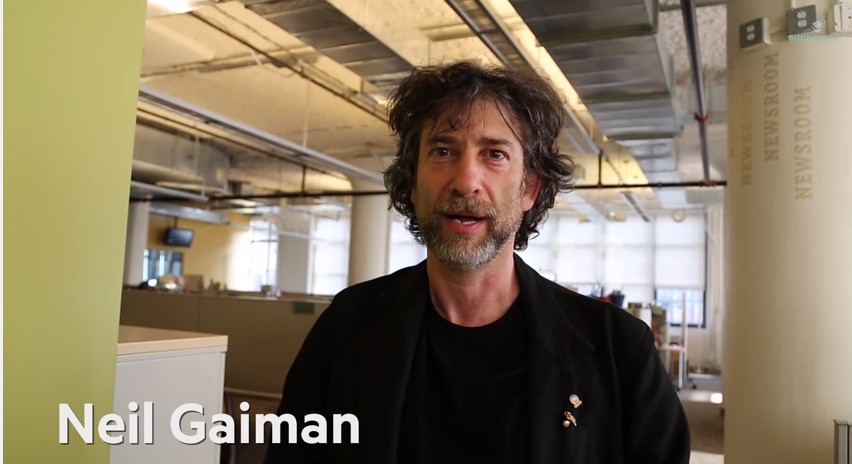
This short video by WNYC lets us get into the mind of famous fantasy author Neil Gaiman. Gaiman will host the Halloween episode of WNYC’s Selected Shorts this October.



This short video by WNYC lets us get into the mind of famous fantasy author Neil Gaiman. Gaiman will host the Halloween episode of WNYC’s Selected Shorts this October.
Ellen Wölke was the shape of an apple, round and enormous. She had been heavy for years — and every year it surprised her, the way it surprises a person to learn that they graduated forty years ago, not ten. Still, she knew it to be different now, because when she ate, people watched. People used to look at Ellen for other reasons, this wispy woman, with long, rib-skimming hair the color of red milky tea. Now it was only: how does such size happen? (Or if they knew Ellen: yes, that’s how that size happens.)
Not long ago, Ellen counted the number of times she’d eaten in one day: fourteen. That was more than usual, and half of it was blind eating, emotional eating. She counted silently, tapping her fingers on a placemat with a plate of plum cake on it and a half-drunk glass of milk. Dory was sitting across from her, with his own slice of cake, his glass of milk full. He was wearing his dress shirt buttoned up but without a tie, a purgatorial mode Ellen associated with architects and people who didn’t dress themselves.
Dory was now both of those things. Although he’d always worn a tie before.
“You look Amish,” she said, not really to Dory, and also not to May, who was making herself busy washing Ellen’s cake pan, and was from the Philippines, and wouldn’t know the Amish. In truth, Dory looked more retarded than anything, his eyes reverting to childhood, his features slowly, giddily capitulating.
Even a year ago, he had still been the old Dory, the real Dory, forgetful, but not so much that it turned his insides out: he couldn’t remember the name of Ellen’s place of work, the institute that she’d founded decades before — The Children’s Place? The Children’s Center? It’s the Learning Center? Are you sure? Then he couldn’t remember how to adjust his drafting table, then he didn’t know where his fine-tip pens were.
When they were first married, forty-five years ago, Ellen used to accuse Dory of a hyper-vigilance that bordered on the obsessive. An architect is an architect, and a German architect, enough said, but still, it was something to get used to, something Ellen could only work around. All the fine-tip pens had to go in a certain narrow white ceramic cup. The cup needed to be in the upper left-hand corner of the desk. There were a million things like that. Dory used to say that when he was a youth, his head had always been in the clouds. He would lose a shoe on his way to school. He would become deaf when drawing pictures of fanciful mazes or crazy Christmas trees in class, the teacher repeating his name over and over: Dorian, Dorian Wölke, bist du da?
To become an integrated man of line and angle he had needed to train those tendencies out of himself. The fine-tip pens needed to be in the cup, said Dory, because if not, they would be in the bathroom, the bedroom, the fridge.
Ellen found pens in the fridge. She phoned the doctor. Dory’s diagnosis was Alzheimer’s. Early.
“Must we call it early when I am seventy-one years old?” asked Dory.
“You could have thirty years ahead of you,” is what the doctor answered.
At first, it wasn’t what Dory called the heart of his brain that was being affected, just the outer areas. Ellen sent Dory to buy canned artichokes and when he returned bewildered, saying he was unable to locate his reason for being in the supermarket, that he felt he was “half in a dream,” Ellen’s legs began to tremble, like the ground was shuddering under her feet.
“Well, I know that I still like artichokes, and fresh more than canned,” said Dory defensively, as if having his tastes about him meant nothing could be too wrong.
Of course taste had always been a fortress for Dory. He was famous for a kind of rabble-rousing sternness — the sort that went over better internationally than at home. He often argued that his ideal building would be totally invisible, making his structures in gleaming glass as if it was a concession. Ellen met and married him while he was embroiled in the controversy over the last project he would ever undertake in Montreal (from then on he would always favor work in Europe and Japan): the Champ de Mars metro station, 1967, a merciless glass box aboveground with expanses of glass wall underground, displaying monolithic rock face. The other stations were friendly affairs with bubbly orange plastic seating and op-art murals. Ellen still remembers watching her new husband on a small black-and-white television, sitting placidly in his chair as a critic in a psychedelic shirt called the station a mean, modernist throwback.
“Aha, but there cannot be such a thing as a modernist throwback,” Dory corrected, his square face poreless as paper under the hot lights. “Only a modernist throw-now, or in a degenerate state, a modernist throw-forward. A train goes along a track, through an underground tunnel. There is a sense to be followed there. It is not orange plastic blobbery.”
Dory’s symptoms worsened after the diagnosis. The doctor said this often happened — a letting go — although when Ellen described some of the examples of degeneration to the doctor, he said he could not comment on whether these were Alzheimer’s symptoms or changes in aesthetic preference. Dory had eagled in on a very small tear in the low beige loveseat in his study, where for more than four decades he’d sat every morning to gather his thoughts. Dory wanted Ellen to fix the tear with a patch he’d found in the house — something from when their daughter, Sam, was a girl, heart-shaped, red gingham, insanely wrong for the subdued sable of his Italian loveseat.
The day prior, she’d found a greeting card propped up on Dory’s drafting table, blank, as if waiting for inscription. On the front of the card was a photograph of a baby, sleeping in a flowerpot, wearing a costume hat that looked like a large daisy. Dory’s standard stationery sat in stolid stacks nearby — the white stock with letterhead so light you needed full sunlight to see it properly: DORIAN WOLKE AND ASSOCIATES.
When Ellen asked Dory about the baby card, he looked at it as if he had never seen it before.
“Oh, isn’t that sweet?” he said, bringing it close to his face, his narrow black glasses. “Remember when Sam was a baby, and she’d look up with those eyes?”
It wasn’t usual, either, his pulling Sam into conversation, just like that. It was always better between them when they didn’t speak of Sam.
Dory was still going to the office every day, a short walk from the house, but Ellen became anxious when seeing him go. He’d stopped talking about builds and articulations and elevations. He ambled out the door every morning with none of his normal velocity. And what if baby cards were infiltrating the office? All those tight, strict people.
It had occurred to Ellen to follow her husband, and one morning she got as far as the car in the driveway. Keys in the ignition, she talked herself down. Dory was just going to the office. If there was a real problem, Dory’s partner Suskind would phone her. When Sam had begun cutting school, leaving the house in that same unbusy way, there had been a call from the school soon enough. How was Samantha’s mononucleosis?
But Suskind didn’t call, so Ellen phoned him. His silences were long. He said Dory was coming in late and taking unusually long lunches. Otherwise, he said Dory looked to be keeping very busy, drafting in his office for hours.
“Oh, so he has a new project?” asked Ellen.
“It seems more like doodles,” said Suskind. “Personal stuff.”
Ellen vaguely said that Dorian was taking medication.
“He made a very intricate drawing of a dollhouse for a junior partner’s eight-year-old daughter,” continued Suskind, who, after so many decades, still had no name on Dory’s intractable letterhead.
A few times, Ellen had caught herself counting backwards, dazedly tapping a table or chair or steering wheel: 2014, 2004, 1994, minus 2 = 22 years. She had reached the point where her old pain was such a familiar padding, she was able to feel it in a way that didn’t cause immediate suffering. For years there would barely be a day when she didn’t have a minutes-long freeze-out moment, standing stock-still in some hallway, overcome by everything she was holding down.
But with all this Dory stuff, past reactions were returning, storylines coming back. Sam’s “mononucleosis” had been hooky on a grand scale. Ellen watched her current students, with their pinging phones, and thought about how it would be impossible to disappear as effectively as back when Sam started skipping class to ride the metros all day. Now, the child would come home and the parent could say, I couldn’t reach you, and begin their investigation.
Back in 1992, Sam could do more of what she wanted, and what she wanted was to experience the connections between metro lines; to see whether she could travel through every intersection, from every possible direction, within a certain time frame. The mission had taken on some edge of urgency.
“And every day you’re doing this metro thing alone, Sam?”
“Well, Mom, it’s not exactly a group activity.”
This type of quirky experimentation wasn’t unusual. Sam went on these trips: spans of not eating meat, or boycotting any but primary colors, or only taking down class notes in code. Once she decided not to speak for a week. She walked around with a notebook opened to a page on which she had written, I have taken a vow of silence. Thank you for your understanding. Dory had always been enchanted by these eccentricities. At dinner parties, he would describe his daughter’s stints, roaring with laughter, while Ellen had to force herself not to make connections between her daughter and the type of behaviors she saw every day at the Learning Center. After all, the Center wasn’t only for kids who had to wear helmets or couldn’t be touched. It was also for the growing number of borderline cases, kids nearly functional, or just functional. Colleagues increasingly used the term “on the spectrum.”
“Don’t worry,” Sam said, flinging her lanky legs out in front of her, her undone shoelaces whipping her shins. “I am doing all my homework. I am just doing it on the metro.”
She would enter McGill the following year, at fifteen.
The dean of the university, the brother-in-law of one of the architects at Dory’s firm, came for coffee. Ellen, an excellent and prolific baker, offered plain cookies from a box. Sam went on some long, dazzling spiel about Montreal’s concrete architecture, something she probably memorized — likely by accident — from one of the journals Dory often had stacked on the kitchen table. The dean was convinced, and Dory, who was set on getting Sam out of her wholly regular high school early, beamed at the done deal.
But Ellen knew it was trouble to put a teenager in university three years early. Sam didn’t have an easy time with friends. And this metro thing gave Ellen a creepy feeling, like some gateway had opened, although into what, who knew.
Ellen also noticed that Sam had taken to fishing out old toys from the garage: a pony with a long pink mane you could brush; a sticker album with a sparse collection in it; a few cats, hearts, babies with pudgy faces in scalloped frames. Sam never cared for these things much as an actual child. She always showed more interest in maps, or indeed math, or making small, complicated universes of her own design. Once, when she was eight, she spent days creating an increasingly elaborate metro system that ran throughout her bedroom, ransacking Ellen’s sewing basket for buttons and the pantry for chocolate chips and Dory’s trash can for punched-out holes. Ellen and Dory tiptoed over the dozens of snaking dot-lines.
“Sam, dear, why does this metro line climb the wall?” asked Dory, lifting his glasses to closely examine a row of buttons taped straight up a wall, like a done-up shirt, ending at the window above Sam’s bed.
“Well. All my train tracks are elevated,” Sam explained in that bossy, know-it-all way that often annoyed Ellen. “That,” she said, pointing to the window, “is where they turn into air tracks.”
The night after they found out about Sam’s absences, Dory took off his glasses and put them by his low bedside table and then got under the white sheets of the broad white bed he shared with Ellen. Scratching his brows, as if to free them of tics, he said he saw Sam’s subway project as “exploration.” Ellen wrenched the sheets off herself, and stood over the bed, her nightgown quivering, her arms crossed over her then-bony chest.
“Sam is clearly overwhelmed!” she said, half hoping that their daughter, down the hall with her twitching antenna ears, heard. There was no question McGill should be deferred. “And I don’t care what strings the dean pulled! I know my Sam!”
“I just don’t think we should coddle her for the sake of comfort,” answered Dory, measuredly.
“Comfort can foster laziness,” he continued, as if musing about one of his glass cubes.
Ellen watched her husband’s square face, his mouth opening and closing with pompous stupid words, his small eyes nude and pathetic without their glasses, and she hated him and Sam at the same time, the two of them, with all their collusion — their big alien brains and cold-fish affection and long accordion-legs. Sam would miss stairs, curbs, and Dory would tell her that she needed to think her limbs into submission, the same way he had when he was her age. Head in the cloud and knees meet the ground, he would drill, while Ellen was reduced to flapping mother, dabbing with antiseptic.
“Ow! Leave me alone, Mom!”
“Yes, leave her already, Ellen.”
The first semester at McGill was difficult. Sam didn’t show up to classes. She called her art history professor “the pedophile,” and her urban design class her “urban disaster” class. She refused breakfast in the morning, and at night wouldn’t have anything but strawberry jam sandwiches and Perrier. One morning, she refused to get up and Dory physically lifted her out of her bed and plunked her in the hallway.
Ellen heard the strange bodily thud from the kitchen and ran upstairs to find her daughter lying like a corpse on the floor, her eyes closed, her arms crossed over a pink stuffed monkey that had come with her out of bed. Oddly, Ellen still remembers first thinking how unusual it was, that Dory and Sam had had this close contact, the house’s two avowed “non-huggers,” both of whom would flinch when embraced, even by her.
That was the beginning of that day: November 6, 1992.
The people in the Champ de Mars metro who later saw the tall girl with the backpack and loose shoelace step off the platform said they could not tell whether she had wanted to. She just looked like she wasn’t thinking about what she was doing. “It was like the platform ended under her feet,” said one woman, hoarse with tears, because she’d seen everything from just a meter away, the pink monkey blasting out of the girl’s backpack on impact, “and her feet didn’t notice.”
For a while, after that, Ellen had needed Dory out of the house. It looked bad, him leaving to save some European bank building in the month after Sam’s death, but the truth was that Ellen wanted him away. She looked at him and all she saw was Sam, and all the instincts Ellen had ignored, because she couldn’t manage to hurdle them over Dory’s certainties.
The split lasted several months, Ellen deciding eventually that even a Dory she found guilty was better than the new loneliness alone. During his absence, Ellen could do nothing but bake, for hours, tears welling into her flour, her mixing bowls weirdly the same, her cakes coming up impossibly the same, and every single thing besides them floating off in all directions, in some stark, over-clear atmosphere, air she didn’t know.
Her skirts were increasingly too tight. At night, sleep was distant. Ellen would close her eyes and imagine putting her entire face in a big white cake with white icing. She’d get out of bed, and go downstairs and bake something more sensible — as if bran muffins or zucchini bread were some normalizing force. It still makes Ellen shudder in nearly intolerable shame, now, when she recalls the night she ran out of most ingredients, and the sun came up to reveal countertops crowded with six hundred meringues, and Ellen still sweating over the stove, as if catering an Easter wedding.
Somewhere in herself, through all the years since, Ellen thought that her pain, a pain that came to feel sealed, but never healed (and all mothers who lose children know this, how the pain becomes like a hide you get used to, but which is never useful, the way other pains can be), would absolve her from future hardship.
She organized her continuing life around this belief. She would never divorce, no matter how much love was lost. She would not become ill, no matter how fat she became. If Dory died, he’d die an old man, suddenly, in his sleep. Because the worst thing had already happened to her, and she’d absorbed the blow and remained upright. Surely, for this, some kind of immunity? Some reward?
The day Dory didn’t show up at work, Suskind had waited until noon, and then phoned. Was Dorian with Ellen? No? Well, he was not at the office.
Ellen put on her coat, which billowed like a tent around her round waist in the city wind. She scoured the likeliest streets, trying not to miss a corner, a block, every hour explaining to Suskind from her cellphone that no, he should not be calling the police. In truth, she began wondering whether the police were needed. She was losing track of where she’d been, dizzy in her coat, her face mapped red with exploding blood vessels, and Dory was nowhere. She found herself outraged by her own worry. How long was the right amount of time to do this? She imagined waiting at home, in the kitchen, the kettle coming on. Eventually, Dory would return, or be returned.
Then she knew where to find him.
Before the city redesigned it, commuters had nicknamed Champ de Mars the Stone Aquarium, the Glass Coffin. And even with Dory’s ingenious dehumidification techniques and innovative glazing, the windows showcasing the underground rock often wept with condensation. They were replaced with black granite. Ellen recalled how Dory railed that his station had been made to look like it was “coated in nouveau riche kitchen counter.”
Walking to the station, an embedded shard shifted in Ellen’s heart. She envisioned Dory, confused in his new way, with those too-bright eyes, on the platform, being roughly handled by security. He gains his old self too late, asking in his wrong-accented French, Do you know who I am? I built this bloody station.
Oui, oui, monsieur, of course you did.
Banishing the fantasy before she could dissect it — because something in her did relish it — Ellen paid for the metro, took the escalator underground, and, from the concrete mezzanine over the tracks, saw Dory. He was sitting on a bench, his back against the granite wall of the eastbound platform, his briefcase on his lap. He was using it as a desk. He seemed to be drawing.
With his glasses and fine pens, Dory still looked like himself, even while his metro station was nearly unrecognizable. He had been totally right about the new materials being wrong. Over time, the black granite had taken on strange stains. In the sections backing the platform benches, the stone had absorbed the heat and oils off the people sitting and waiting for the trains, making darker, human-shaped blobs appear in the granite. The Ghosts of Champ de Mars, people called them, not without superstition, because the station had by then gained a reputation for being jinxed, dark beyond its design flaws. They said you could feel those shadows on your back.
A security guard approached Ellen. She must have been there a while. Did Madame need help in knowing which train to take? Ellen pointed at Dory. She spoke with the overspecific voice she used with parents at the Learning Center. She needed all her powers. “That man with the briefcase,” she enunciated. “He is my husband. He is okay. He is an architect — ”
“Oh, he’s here all the time,” said the guard, chuckling, motioning to Dory with his chin. “The guy who makes pictures. He draws like that for hours, and then he gives it away and leaves, like he’s finished his day of work. Me? I’ve talked to him; hello and good day. I could tell he was an artist or something, not just a crazy — ”
The guard suggested Ellen go back up the escalator, to see the woman who took tickets upstairs. Dory had given her one of the drawings. Nearing the glass ticket booth, Ellen was bothered that she couldn’t remember if it had been part of Dory’s original design. She’d have to get a longer view. If there was a certain amount of room on either side of it, then she’d know it was Dory’s. His symmetry was to her predictable.
The ticket taker had a tan the color of doll skin and pink nail polish, too thickly applied. She held up the page for Ellen, her spidery, fake-looking lashes blinking. Ellen wondered whether it was normal for women like this to take jobs in the metro. Maybe it was.
“It’s nice, you know?” said the ticket taker, her voice crackly behind the booth’s glass. “To have something that somebody really made?”
The drawing was Dory’s, but unlike anything of Dory’s Ellen had ever seen. It was a heart of unimaginable complexity — full of rooms, staircases, landings, elevations, a heart almost limitless in its tiny, line-drawn chambers. Ellen became breathless with ownership and irritation: this girl behind glass, with this loony valentine Ellen could barely comprehend as being related to her own life. She arranged her big coat about herself.
“How do I know that he really gave this to you?” said Ellen, more sharply than she’d wanted.
“Well, why would I make it up?” said the ticket taker. “Getting a picture from some guy who hangs around the metro drawing hearts all day?”
Soon Dory was forgetting basic things: where his clothes were kept, how to dial Ellen’s cell number, how to eat a muffin still in its paper cup. He was home all the time. Ellen needed to place an ad for a caregiver. In fielding calls, Ellen felt a little bloom of relief, a warmish ember of freedom amid the grey exhaustion clouding her lower back. She could just leave for the Learning Center five mornings a week. If she needed a haircut, she could just leave the house and get one. A nurse would stay with Dory. Ellen could just leave him. That would be fine.
All the caregivers were middle-aged Philippinas with springtime names: April and May and Vivian. When June Phan called, Ellen thought she was also caregiver. June quickly corrected her. She had that irritating young person’s habit of making every line sound like a question: “I’m, like, a reporter?”
“Dory!”
“I’m with the McGill Daily? The student paper?”
“Dory, pull the paper off the muffin — Dorian!”
“Should I call back?”
“No — Dorian, can you hear me? Paper off! A reporter. Okay. Yes?”
“I am doing a story. I mean I want to. About Dorian Wolke, I mean, your husband — ”
It’s a wonder Ellen didn’t hang up then. The old Dory had hated journalists. He never gave the people writing about buildings any of his time. He used to call what they did “dancing about architecture,” in other words, skirting the point. He always said the same thing: his buildings were entirely transparent. No interpretation required.
But June Phan had information. Did Mrs. Wolke know about Dory’s drawing in the metro? She did? Well, did she know there were at least thirty of these drawings? Always hearts, always given to girls, usually college students, or, June suggested, girls who looked like students to Dory.
“And just so you know, like, I don’t want you thinking I am going to make him look perverted for that — ”
June began seeing Dory in the same week as May began working for Ellen — May, with her many depressing accessories: strings with clips so Dory could keep things around his neck; large-print checklists placed everywhere from bedside to toilet; plastic baskets for grouping stuff together; all things Ellen hadn’t even come close to thinking of.
Watching June Phan remove her knit hat and fold her long, maroon-tinted hair over one shoulder, Ellen considered how death was simply the only way out now. It would be her death or it would be Dory’s, and if it were hers, she might not mind that much. Dory used to say the way to deal with this type of feeling was to remove yourself from it. Look at it in hard light and say, oh, hello, idiotic emotion, you are not me, you are just an emotion. In Dory’s view, there was no such thing as a person trapped by feelings. Position yourself correctly, and all the trouble in the world could just slide over you, water over rock.
In the kitchen, May was giving Dory applesauce.
“The applesauce is homemade,” Ellen said to June, addled by the day-lit vision of Dory and his nurse — he with his shirt done all the way up under a red-striped bib, she in a tunic with an all-over teddy bear pattern.
“Oh, lucky Mr. Dory-Dory! You have a young girl visitor! A beautiful girl!”
June removed from her backpack two well-worn notebooks, a pile of photocopies, and a digital recorder.
Dory beamed at June from above his candy cane bib, an accidental Santa Claus, an avuncular uncle, a Werther’s butterscotch chef with gleaming eyes.
“Will you be okay with everyone leaving the room?” June asked Dory directly.
Dory nodded, clearing his throat.
“Just, first, dear!” he said. “Can you please tell me and your mother why it took you so long to get here?”
Usually the interviews lasted twenty minutes. Ellen made a project of cleaning the basement, filling garbage bags for the charity truck, when June was with Dory. She had gotten as far as the room they always called the larder — a dry, windowless warren in the middle of the basement that she used as a second pantry. It was one of the few places in the house with no windows, its dry smell of old flour and paper bags of sugar never changing. Ellen found a bunch of dead meal moths on a shelf, disintegrating. She brushed the powdered wings and carcasses into her palm, and found she could hear June from where she stood. She now had the cadence of a teacher.
“Can you talk about this heart you drew?” asked June.
“I made that?”
“You made it in Champ de Mars. Do you remember?”
“I know that place very well. Champ de Mars!”
“How do you feel about it? Do you miss your glass walls?”
“Oh, they won’t be taking those down for some time yet.”
“What do you mean?”
“Well, my dear, we are long before any of that mess.”
“You think we are before? Like, we’re in the 1990s? Sitting in this kitchen? Now?”
“Of course we are! After all, you are here, right?”
Ellen put down the open flour bag she was holding, flecked with moths like chocolate chips in batter. She clomped up the stairs and was soon pulling open her kitchen drawers and cupboards. The spoons, the bowls, the mixer, four black plums from the fridge.
“I am baking a cake,” she announced, clattering her pans.
“What kind of cake?” asked June, above the din, as if this too was material.
“Plum, as you can see, from the plums,” said Ellen, unkindly.
“But Ellen!” said Dory, standing up in the noise. “Sam doesn’t like plum cake. She likes chocolate cake. Chocolate cake with cream cheese icing!”
Ellen looked at the counter, June at her tape recorder.
“Sam doesn’t like plum cake,” Dory said again. “She likes chocolate cake with cream cheese icing. So why don’t you make us some chocolate cake, then?”
As Ellen ushered June out of the house, apologizing firmly, she didn’t know that June’s newspaper article would lead to many more like it, like one dagger after another, all of them framing Dory’s decline in the same feel-good way. The New York Times called her husband’s dementia “a historic creative awakening,” this man who made so many glass boxes back in the twentieth century.
June Phan will move to New York for an internship, and before she leaves she will call Ellen and say she would like to come and say goodbye to Dory. On that day, Ellen will hide his diapers and his wheelchair and his cans of protein drink, and wait with the kettle on, listening for the doorbell, as if something in its ringing might awake another beginning, or at least an end, but the girl will forget, and never come.
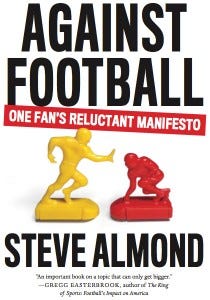
Steve Almond isn’t scared to rake some muck. In his latest book, Against Football: One Fan’s Reluctant Manifesto, Almond tackles his personal obsession head on. “I’ve spent years trying to quit football,” he confesses, only to succumb, like many Americans, to the game’s allure. He acknowledges a need for distraction in a world where “sea levels rose 3.2 millimeters last year. The Nikkei average is down 6 percent. Dick Cheney remains sentient.” He explores our fascination with football’s athletes, how we, a mimetic species, “want to find magic within ourselves. And, failing that, we want to watch as someone else does.”
But mainly Almond grapples with football’s moral complications. Many of its players are hand-picked from impoverished communities, sequestered from the general population, exploited for their strengths, then cast off when damaged. (The average player can expect up to die two decades earlier than his fans). Sexual violence by players is condoned; when the assaulted speak out, they are slut-shamed. How at a time when our government is cutting social support networks, taxpayers are bankrolling stadiums with no return on their investment. “That’s not even capitalism, that’s feudalism,” Almond notes.
Almond’s book offers no solutions, just raises questions. Yet with the NFL slated to become as big as McDonald’s and Nike within ten years, Against Football is a provocative book relevant to the sports’ fans and critics alike.
Almond and I first met at the Tin House Writer’s Workshop in Portland. We spoke about muckraking by phone.
Who were your favorite muckrakers? Who influenced you?
For sure Steinbeck. He did a series of features for a SF newspaper that explored the plight of migrant workers in CA. He spent years on it before trying to write the Grapes of Wrath, a great book that resonates louder and louder as America descends into its capitalistic psychosis, and it all started from his muckraking.
What are your favorite protest novels?
Let Us Now Praise Famous Men by James Agee is what we would call now immersion journalism. What he is really writing about is the American story of poverty vs. great wealth. Upton Sinclair’s The Jungle is an amazing book, deeply disturbing.
An amazing muckraker who does not get enough love is Debbie Nathan. She wrote one of my favorite books of all time, Women and Other Aliens, mostly journalism she did for the Texas Monthly while living in El Paso. She writes so beautifully about what it’s like when a wealthy country is up against a country where people are starving to death. Which is really our border situation when you look at it with moral clarity. Immigrants want to come to the United States not because we espouse noble values, but because we are the land of plenty. We represent the exact same dream to those kids on the border as California represented to the migrant workers that Steinbeck wrote about.
Muckrackers are simply the people who take a step back and ask basic moral questions. Why are there these huge disparities in wealth on our planet? How does this wealth affect our perception of human worth? Why do we treat people who believe so deeply in the American dream as criminals simply because they were born at a certain latitude and longitude that isn’t the United States? Or because they have the wrong color skin?
Were there any cultural factors that led to your muckraking?
I’m a child of Watergate, of the Seventies, when investigative journalism was a big deal. It’s hard for younger people to imagine this, but the media hasn’t always been this big stimulation game. It wasn’t all about getting clicks and keeping eyeballs glued to some fabricated fucking soap opera narrative completely divorced from the moral implications of how our political actors behave. I believed in Woodward and Bernstein, in the idea that a corrupt president could be taken down by an intrepid free press. I remember watching Nixon resign and absorbing the idea that these guys took down a crooked lying corrupt administration.
How did your family background impact your writing?
My parents were part of the countercultural movement; there was a real discussion of morality in our house. My parents were both involved in the protests against the Vietnam War and the larger social causes of that time: The War on Poverty, the Civil Rights Movement. They were deep believers in social justice, which is not a political thing. It is a moral thing. It does not fit in the cable news rubric of politics as bloodsport. It’s more like, “Hey, if you see suffering in the world, part of your job as a human being is to be a little bit responsible for alleviating that suffering in whatever way you can.”
Plus, my folks were psychiatrists so they were concerned about the insides of people, why we make the decisions we make. What inside of us reduces our capacity to feel sympathy for others or activates our self-destructive capacity? Those questions are really psychological questions and the place that answers them most powerfully for me is literature, both fiction and nonfiction. All of these preoccupations come straight from my family. And if you want to trace it back a few more generations, I come from a long line of rabbis who are asking big questions about the world and why it operates as it does. And how, as it spirals into chaos and confusion, we make sense of the world? How do we make meaning from this incessant rush of experience? These concerns — maybe I should call them anxieties — have always been in the groundwater.
How did those questions lead you to writing a manifesto against one of your favorite pastimes?
Part of the job of the rhetorician is to argue with the world, but the more interesting question is why do you do that? Before you spend your time complaining about the rest of the world, why are you going to watch the Oakland Raiders play football on a Sunday? Why have you chosen to orient your whole life around watching some corporatized combat between grown men in black and silver uniforms, when you’ve got other business to conduct. And when you know that the game itself is corrupt on six different levels?
The point of Against Football is not just that the game fosters a tolerance for greed and violence and misogyny and militarism. The real intention is to investigate why fans like me, who know all this, still become obsessed, why we give so much of our head and hearts to this corrupt game.
The point of Against Football is not just that the game fosters a tolerance for greed and violence and misogyny and militarism. The real intention is to investigate why fans like me, who know all this, still become obsessed, why we give so much of our head and hearts to this corrupt game.
For me, the answer comes down to the family I grew up in, my own neuroses about masculinity and competitiveness, and how I made my place in my family, and the family of man, by becoming an athlete and a fan. I’m not trying to strongarm the reader so much as understand my own crazy.
I think we’re in an historical moment where people are finally starting to question the hazards of the game, where the biggest thing in America has also become one of the most morally complicated.
Yeah, you knew Sept 11th was serious because they cancelled all the football games.
Interestingly, the more I researched football, the more I saw it as reflection of American pathologies. I wanted to figure out how it operates on our psyches — our sexual identities, our racial identities, our attitudes towards war and soldiers. It became a lot deeper and darker and it kept expanding.
I wasn’t expecting it to be as muckraking as it is. I wasn’t expecting, for instance, to write so much about cases of sexual assault. But those cases are so stark. It’s so obvious that we, as a culture, grant certain privileges and prerogatives to these players. They become our archetypes of masculinity.
Any case of sexual assault is disturbing and frightening. But a much of the community in Steubenville, Ohio tried to cover up a brutal sexual assault simply because the perpetrators were high school football stars. They looked past the fact that a young woman has been physically and psychologically traumatized.
The more I looked at the way in which America’s brain operates on football the more disturbed I became. And I wondered: what might America look like if we did not devote so much time to this game? If we did not spend so much time watching men slam into each other until many of them get brain damaged? I realized that football was a window onto this larger question of wealth and poverty in the country. Like anything, when you really look at it, it’s about everything.
It was interesting the way you tie the rise of television and nationalism. It’s interesting because while you are tracing the dominance of football during the Iraq War, the most recent one, I was noticing at the same time the rise of the celebrity industrial complex. Both of them they are all distractions from all the things that are really involving us, right?
They’re distractions from an anxiety that Americans justifiably feel. Most of our civic institutions are broken. Our political system is broken. It’s broken because moneyed interests want it to be broken, because their businesses run better when government is inefficient and corrupt. People don’t have political heroes. And there is something about sports that does appeal to us on a very fundamental level: the American ideal of a meritocracy. And also to our exceptionalism, our desire to see and associate ourselves with greatness. Plus, there’s the inherent drama of the game itself, which is real. It’s not just brutal. It’s a brutal form of beauty. Football is like the Doritos of sport: it’s been engineered to hit our bliss point.
Football is like the Doritos of sport: it’s been engineered to hit our bliss point.
Did you have any nervousness about having written a manifesto against America’s favorite pastime?
Football is just a game. But it’s also a huge industry and a huge national passion. It occupies a lot of our psychological and emotional real estate. It’s the job of writers and artists to probe the meaning of that terrain. This is just the business I’m in.
And I want a whole bunch of people to read it. They can hate it all they want, but at least read it. I want women who have no interest in the game but understand its cultural import to read it. I want reluctant fans like me to read it. I want Chuck Klosterman and Bill Simmons and all the members of the sports media to read it. I know I’ll face some hating and I’ll take that. I just want the book to spur a larger discussion that goes beyond concussions, that also asks us to confront the false dream that football has sold us.
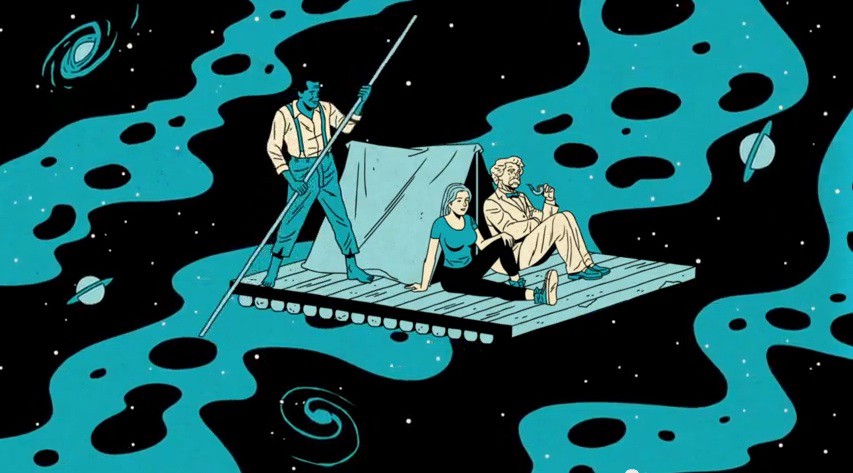
This snazzily-illustrated TED-Ed video from Jessica Wise explains how our reality is changed by the fiction we read and write.
Here’s the transcript:
Emily Dickinson said, over a century ago, that “There is no frigate like a book to take us Lands away,” and it’s true. When we pick up a book, turn on the TV, or watch a movie, we are carried away down the currents of story into a world of imagination. And when we land, once more, on a shore that is both new and familiar, something strange happens. Stepping onto the shore, we’re changed. We don’t retrace the footsteps of the author or character we’ve followed here. No, instead we walk a mile in their shoes.
Researchers in psychology and neuroscience, child development and biology are finally starting to gain quantifiable scientific evidence of what writers and readers have always known … that stories have a unique ability to change a person’s point of view. Scholars are discovering evidence that stories shape culture and that much of what we belief about life comes, not from fact, but from fiction; that our ideas of class, marriage, and even gender are relatively new, and that many ideologies which held sway for centuries were revised within the eighteenth century and re-drafted in the pages of the early Novel.
Imagine a world where class and not hard work decide a person’s worth… a world where woman is man’s more untamed copy… a world where marriage for love is a novel notion…
Well, that was the world in which Samuel Richardson’s Pamela first appeared. Richardson’s love story starred a poor serving-class protagonist who was both morally superior and smarter than her upper-class suitor. And, challenging a slew of traditions, it caused a ruckus. There was more press for Pamela than for Parliament. It spawned debate and counter-fictions. Still, for all those who couldn’t accept Pamela; others were eager for this new fictional world. This best-seller and all its literary heirs — Pride and Prejudice, Jane Eyre, and, yes, even Twilight — have continuously shared the same tale and taught similar lessons which are now conventional and commonplace.
Similarly, some scholars are telling us that Darwin’s theory of evolution is highly indebted to the plots he read and loved. His theory privileges smartness, swiftness, and adaptability to change — all core characteristics in a hero. Whether you’re reading Harry Potter or Great Expectations, you’re reading the kind of plot that inspired Darwin. Yet recent studies show that his theory might not be the whole story. Our sense of being one man or one woman (or even one species) taking on the challenges of the world might be wrong. Instead of being hard-wired for competition, for being the solitary heroes in our own story, we might be instead members of a shared quest: more Hobbit, than Harry.
Sometimes, of course, the shoes we’ve been walking in can get plain worn out. After all, we haven’t walked a mile in Austen’s shoes or Twain’s, we’ve walked about 100 trillion miles in them.
This isn’t to say we can’t read and enjoy the classics. We should travel with Dickens: let Pip teach us what to expect from ourselves… Have a talk with Austen and Elizabeth about our prides and prejudices. We should float, with Twain, down the Mississippi and have Jim show us what it means to be good.
But on our journey, we’ll keep in mind that the terrain has changed. We’ll start shopping around for boots that were made for walking into a new era.
Take, for instance, Katniss Everdeen and her battle with the Capitol. Can Hunger Games lead us into thinking about capitalism in a new way? Can it teach us a lesson about why the individual should not put herself before the group?
Will Uglies reflect the dangers of pursuing a perfect body and letting the media define what is beautiful?
Will Seekers trod a path beyond global warming? Will the life-and-death struggles of Toklo, Kallik, Lusa, and the other bears chart a course for understanding animals and our place in their world?
Only the future will tell which stories will engage our imagination, which tales of make-believe will make tomorrow, but the good news is this: there are new stories to venture in every day, new tales that promise to influence, to create, and to spark change … stories that you might even write yourself.
So I guess the final question is this: what story will you try on next?
by Matthew Nolan

As the U.S. Open arrives, so do additional opportunities to lament the current state of American men’s tennis. The Williams sisters have been superstars of the women’s game for years, but we haven’t had a Grand Slam men’s singles champion since Andy Roddick in 2003 and only two Americans currently sit in the top 50, none in the top ten. The Open’s thirteenth seed, the fast-serving 6’ 10” John Isner, has been the most consistent American in the last few years, and he has not yet gotten past a Grand Slam quarterfinal. Would the late David Foster Wallace, perhaps the greatest writer about tennis ever, have joined in the lamentations? It would seem hard to believe.
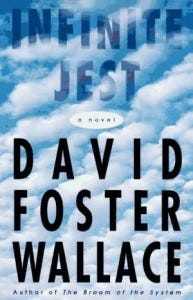
August and early September always mark the peak of interest for American tennis fans. The North American hard court season allows us to watch consistent, live tennis for the first time all year during normal waking hours. But this occasion will be punctuated by numerous commentators asking where the next generation of elite male players, in the tradition of John McEnroe, Andre Agassi, and Pete Sampras, has gone. These grumblings often put blame on the high-profile academies and player development programs, but such blanket criticism doesn’t take into account the complexities of tennis that go beyond elite training, complexities that David Foster Wallace, once a regionally ranked junior player, detailed thoroughly in both nonfiction articles and in one strand of his famously long 1996 novel, Infinite Jest.
Set partly in a fictional Massachusetts tennis academy, Infinite Jest devotes significant time to the young players who spend their days struggling with both their own tennis game and a wide range of other challenges, which often are related to, and manifested in, tennis. In both his fiction and nonfiction, Wallace’s writings about the game point to the small but important variables overlooked in many tennis discussions. He shows that tennis is too subtle and demanding to allow for a formula that ensures elite player development. Blaming the American tennis academies for being unable to churn out superstars seems misguided when the difficulties of the sport are laid out for inspection. For instance, as Wallace wrote in his 2006 Roger Federer appreciation, “In terms of a player’s hitting an incoming ball, tennis is actually more a game of micrometers: vanishingly tiny changes around the moment of impact will have large effects on how and where the ball travels.”
“In terms of a player’s hitting an incoming ball, tennis is actually more a game of micrometers: vanishingly tiny changes around the moment of impact will have large effects on how and where the ball travels.”
In his 1991 Harper’s article, “Tennis, Trigonometry, Tornadoes,”
Wallace examines his own teen psyche as a junior tennis player in the Midwest, and ends up offering evidence of the considerable mental requirements of even junior-level tennis. Mathematically minded, he found solace in many of the strategic aspects of tennis, figuring out the angles (you had to have “the ability to calculate not merely your own angles but the angles of response to your angles”) and the local conditions (“I had gotten so prescient at using surface, sun and gusts that I was regarded as a kind of physical savant, a medicine boy of wind and heat.”) But the weather, just like natural athleticism, injuries, and an opponent, is one of the variables that make tennis a supremely challenging sport. The frustration that he felt as the uncontrollable variables became more and more prevalent in his playing is a pain that can surely be felt by many players, both American and foreign, who struggle to ever equal previous successes. It was a personal affront to Wallace when he felt betrayed “at around fifteen when so many single-minded flailing boys became abruptly mannish and tall.” Just like many gifted tennis players who never achieve their projections, “I began to, very quietly, resent my physical place in the great schema.” This resentment and bitterness, “a kind of slow root-rot,” as Wallace once put it, can be severe enough that it ruins a professional player’s career. It’s no surprise that many professionals — and academies — now employ mental coaches.
Wallace’s insight into elite tennis’s physical requirements also helps explain why becoming an elite tennis player is so difficult. For an article that ran in Esquire in 1996 and was published in a slightly different form in the collection A Supposedly Fun Thing I’ll Never Do Again, Wallace traveled to the Canadian Open, in part to profile an up-and-coming American, Michael Joyce. Wallace was quickly drawn into the dedication and effort that the less highly ranked players exhibited. Joyce, then 22, is described as a player who has “an almost ascetic focus.” and “no interests outside of tennis.” With a certain melancholy recognition of his own tennis-playing limits, Wallace comprehends “just how good these professionals are” after witnessing an ordinary practice session between two lower-ranked players. Serious tennis, he argues, “is a kind of art.” Thinking mathematically again, Wallace writes that “no CPU yet existent could compute the expansion of variables for even a single exchange” at this high level of play. But from his descriptions of the intensity and talent of these largely ignored players, it’s possible to understand the elusive gulf between a talented American journeyman and an American superstar.
In a passage that seems to pinpoint an “it factor” required of elite success in ATP tennis, Wallace compares one aspect of then 79th-ranked Michael Joyce’s game to that of eight-time Grand Slam champion Andre Agassi. Wallace calls Agassi’s vision “literally one in a billion,” allowing him “to hit his groundstrokes as hard as he can just about every time.” Joyce’s “hand-eye coordination is superlative, in the top 1% of all athletes everywhere,” but he “still has to take some incremental bit of steam off most of his groundstrokes if he wants to direct them.” The subtle yet meaningful differences between professional players in the top 10 and the lower half of the top 100 indicate some of the complexities of elite tennis.
Wallace’s appreciation of the “wholly distinct levels to competitive tennis — levels so distinct that what’s being played is in its essence a whole different game” may have reached its high point when he had the opportunity to witness Roger Federer’s 2006 Wimbledon run. The 16-time Grand Slam champion epitomized, in Wallace’s view, the ideal combination of the many skills needed to dominate the difficult sport. He describes Federer as not only a “first-rate power-baseliner.” There was “also his intelligence, his occult anticipation, his court sense, his ability to read and manipulate opponents, to mix spins and speeds, to misdirect and disguise, to use tactical foresight and peripheral vision and kinesthetic range instead of just rote pace.” Wallace recognizes Federer’s gifts as those that cannot be taught through drilling. Like a superhero, Federer seems “exempt, at least in part, from certain physical laws…. The approaching ball hangs, for him, a split-second longer than it ought to.”
Wallace’s discerning tennis essays and fiction made it clear that elite tennis players cannot simply be manufactured through training by academies and player development programs.
Wallace’s discerning tennis essays and fiction made it clear that elite tennis players cannot simply be manufactured through training by academies and player development programs. The fact that there are aspects of success that go beyond the academy helps to explain why the current top 20 players in the world represent 14 different countries, and almost all come from different training backgrounds. The recent success of junior male players, like U.S. Open Wild Card Noah Rubin from the training facility run by John McEnroe (another Wallace favorite), will excite Americans, but enthusiasm needs to be tempered with Wallace-ian recognition of the nature of the game. Wallace would not likely have lamented the state of American men’s tennis but instead would have probably sympathized with the ongoing struggles of all players, regardless of national origin. Likening tennis to life itself, a veteran player and coach in Infinite Jest respectfully sums up the game: “It is tragic and sad and chaotic and lovely.”
America never tires of a good apocalypse. It’s been over three quarters of a century since audiences listened, rapt, to a broadcast describing Martians invading New York City; this summer hundreds of thousands flocked to watch San Francisco get stomped on by a giant lizard. And while it came to fame surfing the Steven Colbert “bump,” Edan Lepucki’s post-apocalyptic thriller California is the literary equivalent of a summer blockbuster — fun, fast paced, but perhaps a little too familiar.
The narrative follows married couple Cal and Frida, two among the last remaining humans on earth. Snowstorms and other natural disasters have decimated the United States and the survivors are either hiding in the woods, as Cal and Frida are, or are living in so-called “communities,” where the 99% can afford to lock the rest of the world out of their paradise (remember 2013’s Elysium?). But when you’re in love — truly in love — it can sometimes feel like there’s no one else on the planet but the two of you. “You know what I like best about this place?,” Cal asks his wife, then answers, “No one can hear me fucking your brains out.”
But are they really so very alone? It would seem that there are other survivors hiding in the forests of California too. And then comes the real kicker: Frida is pregnant. Now more than ever before the need to find other humans is essential. But in California, the past is never truly past and there are more than a few memories waiting for Cal and Frida in the secretive community they must join in order to survive.
Lepucki has attributed, and thanked, Colbert for the overwhelming reception to her debut novel (she spent three days at Powell’s signing ten thousand pre-ordered copies of her book). Rather than have California fall casualty to Hachette and Amazon’s war, Colbert assured it was a success; while his goal was commendable, California’s own efforts get tangled up in the delivery. Technical inconsistencies abound: one exchange has a character claiming that spikes protecting a community of survivors “weren’t that old,” followed on the next page by the assessment that, “they’d built [the spikes] long ago.” So-called “Pirates” have, unbelievably, conditioned survivors into literally cowering at the sight of anything red (be it blood or an item of clothing). But most irksome of all is that California fails to give itself the rein to try something — anything — new with the post-apocalyptic plot line. Instead, it comes across as Lepucki’s self-indulgent contribution to the well-trodden doomsday narrative, as opposed to what would surprise and impress a reader: That is, a break from the genre’s well-worn conventions.
This is mostly because, in prioritizing her politics and concept over the dynamics between Cal and Frida, Lepucki has made an easy mistake. Writers err when they forget that it’s the characters a reader cares about — at least more than they care about any apocalypse or smoke-and-mirrors games concerning characters’ pasts. The familiarity of Cal and Frida’s relationship offers little for anyone to invest in. Couples fight; this doesn’t make a reader inherently interested, or the story inherently tense. Instead, a reader might just be annoyed because, despite parenthood looming, Cal and Frida act absurdly juvenile. Cal wonders if a mutual friend “made fun of him” behind his back so that “when Frida saw Cal again, she had the urge to laugh, and had to force herself not to.” Playground politics reign. The couple keep secrets, give each other the silent treatment. “Try to hide your boner,” Frida will childishly snap, or Cal will comment that something “kind of weirds me out.” If California is testing their relationship, the result is befuddling rather than wrenching. The bickering couple, with which readers might try to relate, instead alienates. Little about Cal and Frida’s interactions feel natural.
California’s biggest twist comes when a mysterious third character is (re)introduced to the narrative. But in doing so, Lepucki recreates a recognizable dynamic that was long ago tread by Margaret Atwood with Snowman, Crake and Oryx (and like Oryx and Crake, California falls victim to what TV Tropes terms “Everyone Went to School Together.”) Additionally, the stunt itself — bringing a character back from the dead — is a formula that’s best left to the soap operas. As a result, the reader is betrayed to believe that nothing in Lepucki’s world is ever permanent or threatening (this persists, even with a gun being tossed about during the final act). There’s even talk of a beheading, but it’s described so blandly by another character that one wonders if it even affected her at all: “[it] was horrible, but…we wanted to see it.” Afterwards, their conversation casually progresses to the topic of architecture. California’s post-apocalyptic concept comes across as oddly sterile, concluding with an empty finale without any real confrontation or development in the characters.
America loves a good apocalypse — but the trouble is, it knows this story by heart. California is just another Godzilla: flashy, entertaining, hyped, and ultimately forgettable.

by Edan Lepucki

Discard Pile reviews books that were recently withdrawn from the collection at the Barstow School in Kansas City, Missouri.
Field Guide to Disease: A Handbook for World Travelers
By Berton Roueché
Little, Brown and Co., 1967
$4.95
Entered Barstow School Library: Feb. 15, 1968
In his disgustingly riveting Field Guide to Disease, Berton Roueché suggests that travelers stricken with diseases “near [their] natural dwelling place…have every chance of receiving prompt and proper treatment.” As an example he uses, “histoplasmosis in Kansas City.” I live and work in Kansas City. Roueché says I have probably had this fungus invasion that he deems endemic to this part of the United States. The good news: the disease is mostly relatively benign. The not-so-good-news: the “conspicuous manifestation” proves fatal.
Normally I worry about (mostly in order) my family, the general state of American culture, geo-political conflict, the NSA, getting smushed by an asteroid, and globe-hopping strains of Ebola. Roueché provides me with a menagerie of new fears and horrorshow descriptions of tapeworms, fungi, and spirochetes, mosquitoes, midges, and microbes.
Roueché documents the history of 27 different and often unpronounceable diseases with the ruthless efficiency of a virus. Each section begins with a general overview of the disease, followed by a recounting of its linage, usually to ancient times. He catalogs names of scientific pioneers and quotes from their work; he writes of Roman encyclopedists and their takes on malaria. He tells us that Darwin probably suffered from Chagas’ disease, that yellow fever inspired Wagner and Coleridge. Roueché gives us Boccaccio on the plague, Virgil musing on anthrax, Aristotle holding court on rabies.
For all his fascinating history, though, Roueché revels in the gnarliness of symptoms, as though he wants to craft the physiological version of Naked Lunch — worms that slither out of people’s feet, furuncles of parasites, hallucinatory fevers, so so much swelling, and the occasional blood vomit. To wit, Roueché calls the L. loa, the carrier of loiasis, “a restlessly peripatetic” worm that prowls the human body. He continues, “Victims of loisas frequently first become aware of their condition when standing at a mirror. An adult L. loa is around an inch in length and its passage across the eyeball takes about a minute. The pain experienced by the victim during that moments is generally both physically and psychologically exquisite.”
Such macabre glee provides an uncanny level of unintentional humor not normally found in field guides to disease. Those who fall victim to brucellosis (an undulant fever), “frequently become neurotic and are considered as pests by their relatives and friends.” He argues that the growing numbers of types of diseases “are triumphant evidence of progress.” Diphyllobothriasis, a fish tapeworm disease has a life cycle of “baroque complexity.” And his simple advice for those adventuring in exotic locales, “These are not, like diseases of degeneration, the result of constitutional decline and decay, but of parasitical invasion, and their avoidance is thus not completely a matter of chance. The prudent traveler can avoid the woods or streams or crowded streets and stores in which some of them are most frequently found.”
While nightmares will certainly follow, I rather enjoyed the naughty schoolboy voice of Roueché in his Field Guide to Disease, and remember, as he tells us in the first line of the book, “This book is not intended to alarm.”
by Maru Pabón
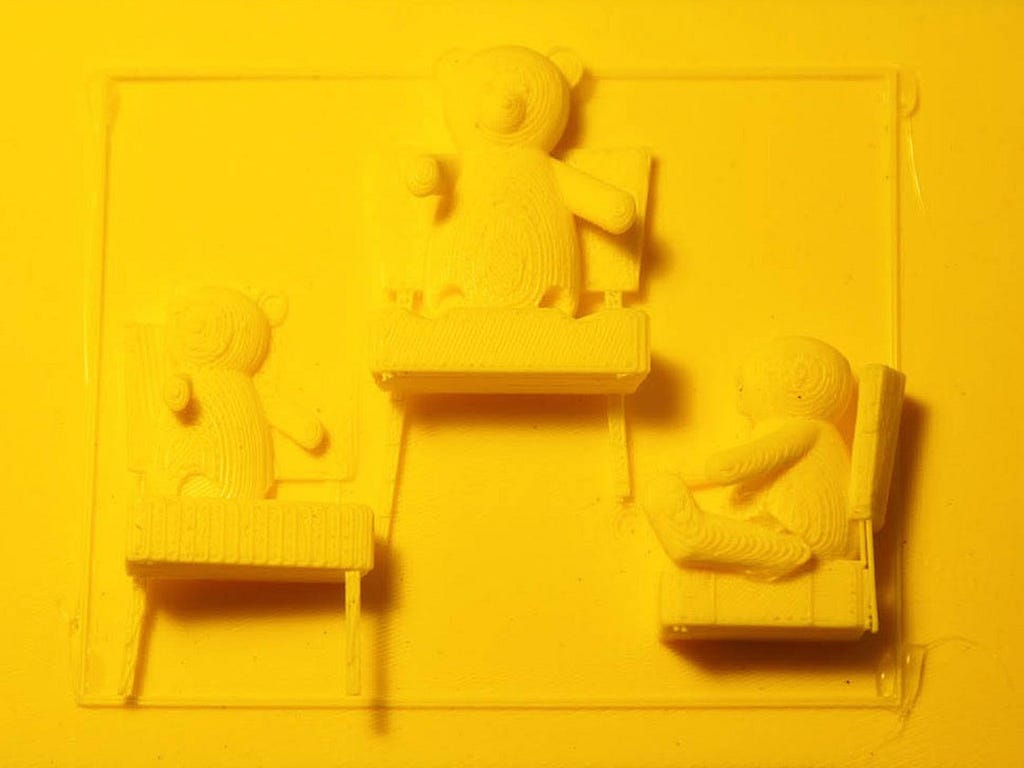
Researchers at the University of Colorado, Boulder, have created the Tactile Picture Books Project, a series of 3-D printed books that go beyond the possibilities of braille. Propelled by the increasing accessibility of this technology, the team at Boulder has transformed the classic images of Goodnight Moon and Harold and the Purple Crayon into tactile forms. These 3-D printed figures, which emerge from the page in the shape of objects within the text, are meant to guide visually impaired children through the stories’ landscapes, allowing them to feel the representations they cannot see.
The Tactile Picture Books Project’s mission statement reads: “One day, every household will have a 3D printer to make tactile picture books for children to touch and enjoy at home.” Though there’s a long way to go before that happens, you can learn more about how to contribute to the project here.
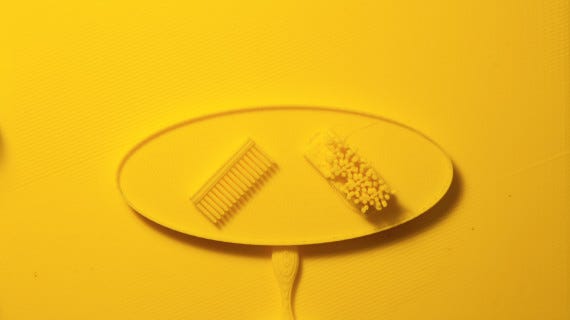
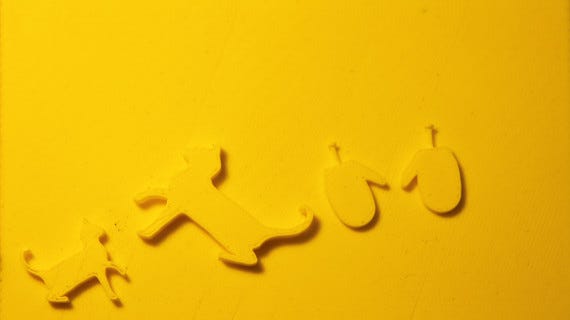
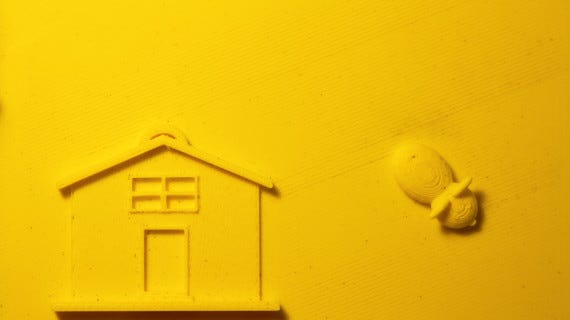
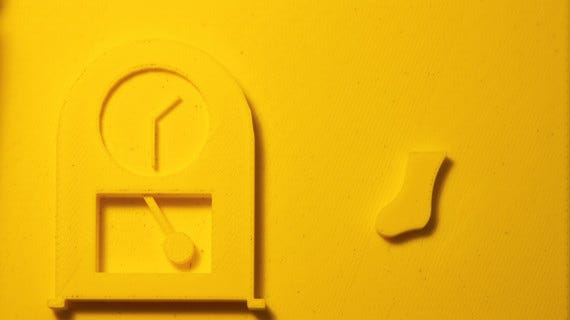
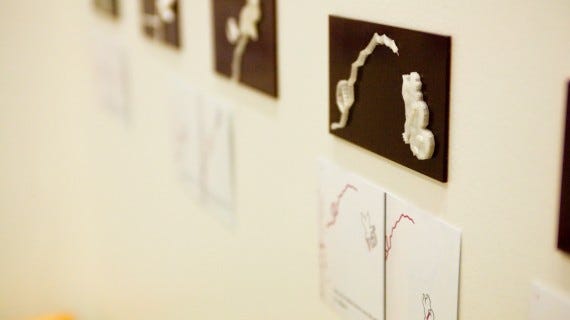
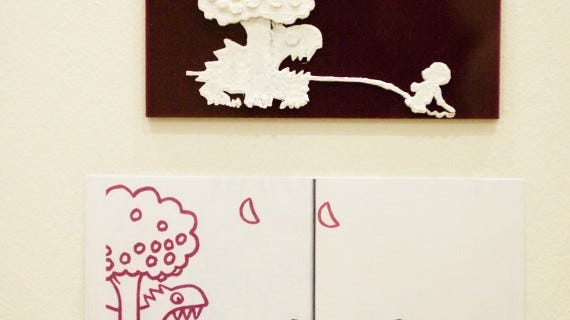


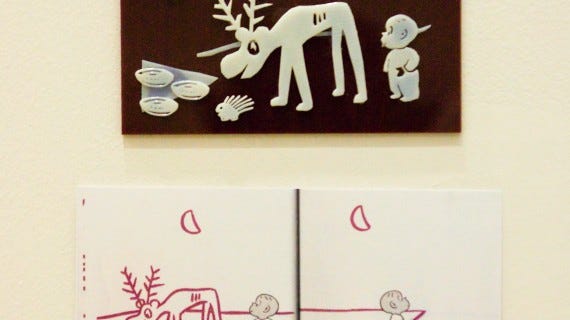
2D graphics in a 3D, tactile way on a scale appropriate for the cognitive abilities and interests of young children — See more at: http://www.colorado.edu/news/releases/2014/06/23/picture-books-visually-impaired-kids-go-3d-thanks-cu-boulder-research-team#sthash.gCCBDO8Q.dpuf
represent 2D graphics in a 3D, tactile way on a scale appropriate for the cognitive abilities and interests of young children — See more at: http://www.colorado.edu/news/releases/2014/06/23/picture-books-visually-impaired-kids-go-3d-thanks-cu-boulder-research-team#sthash.gCCBDO8Q.dpuf
represent 2D graphics in a 3D, tactile way on a scale appropriate for the cognitive abilities and interests of young children — See more at: http://www.colorado.edu/news/releases/2014/06/23/picture-books-visually-impaired-kids-go-3d-thanks-cu-boulder-research-team#sthash.gCCBDO8Q.dpuf
represent 2D graphics in a 3D, tactile way on a scale appropriate for the cognitive abilities and interests of young children — See more at: http://www.colorado.edu/news/releases/2014/06/23/picture-books-visually-impaired-kids-go-3d-thanks-cu-boulder-research-team#sthash.gCCBDO8Q.dpuf
WAX asks authors to discuss a subject outside the world of writing that nevertheless fuels their writing life. Topics include: lessons learned from Repo Man with regard to atmosphere and place, the drone metal music that plays during writing time. The point is to witness a writer from an uncommon creative angle, and to revel in the excitement of an outsider’s point of view.
Today’s Subject: Dolan Morgan I first came across Dolan Morgan’s work via a published piece in Vol. 1 Brooklyn. The story, “Why the Things You Use Every Day Might Kill You #11: The Spoked Wheel That Turns Paper through a Dot Matrix Printer,” was strange and hilarious and vivid and unsettling. Yet it also contained a clear fascination with anachronistic technology, a heartfelt search for the pulse beating inside our junk. In this interview, we discuss hypothetical brochures to antique shop conferences, erotica projected through the lens of chemistry textbooks, and why you have to truly love the useless before you can use it as inspiration.

Screen grab of spam text received by Dolan Morgan
Matthew Thompson: When I first approached you for this interview, and inquired about sources of influence outside the world of literature, you provided this just incredible list…
Dolan Morgan: Ha, I think it was something like: spam, ads, pyramid schemes, outdated chemistry books, forgotten New Age hocus pocus, old newspaper accounts, self-help books, coupon circulars, and all manner of what might otherwise be considered junk.
MT: It sounds like the back room of a dusty antique shop. Are you attracted to these kinds of spaces as a writer? To collections of our disposed-of stuff?
DM: Yes and no. An antique shop, in fact, represents exactly what I’m not drawn to. That is, in order to qualify as merchandise for such a shop, an item has to be of some significant value. This value can be culturally determined or assigned by committee, but either way antique shops are the endpoint of a massive filtering system through which histories are passed. Only the ‘good stuff’ gets through. Or at least that’s the idea. It’s a bullshit idea, but that’s the idea.
MT: So not charmed by the ‘good stuff’…
DM: No. I’m more likely to be interested in the brochures for whatever Big National Conference antique sellers feel compelled to attend. Picture the pamphlet you might receive at this event’s registration: it exudes word-play, puns and clipart, but in a few hours will be trash, gone and forgotten. This kind of literature is all around us, and it’s not headed to the antique shop. I’m interested in this. I’m interested in what doesn’t pass through the filter. I’ll give you an example. One summer, when I was really struggling to get by, I took a job at a company that purported to improve website traffic for their clients. My job was to write an endless stream of blog posts related to these clients’ areas of business: everything from dryers, car maintenance, numismatics, catering, reclaimed auto-parts, asbestos abatement, event planning, emergency vehicle lighting equipment, to hotel supplies. We could write anything we wanted, so long as the post landed around 500 words and contained key terms linked to the client’s site. I did this all day. No one read the blogs. Not at all. Of course not. The blogs weren’t intended to be read, but instead were intended to look like they were intended to be read. Taken as a whole, this type of literature represents a massive trove of material, constantly being generated, and constantly influencing the world around us. We’re quite literally surrounded by it, and I reject the idea that the impact of this kind of ephemera is trivial.
MT: That’s an attractive take on ephemera, which, by its definition, is often dismissed as inconsequential. How do you see its impact upon the world as more than trivial?
DM: The cumulative effect of many small factors can make large-scale change. Isn’t that the very concept of democracy? Many little voices culminating in some big shift? I’ll give you a more sinister example: I once had a job at a polling company, a real wonky establishment that would soon be shut down for shady practices. I was 17ish at the time. Somewhere between 30–40 employees sat at computers and called home-phone after home-phone, all across the country, in the hopes of getting whoever answered to participate in a survey. These surveys varied day to day and the topics differed greatly. Often they dealt with an upcoming election, or with some kind of impending referendum. The surveys masqueraded as neutral attempts to gather information (for what purpose? what study? what authority? we weren’t told), but were anything but neutral. A typical question sequence might look something like this: 1) “if I told you politician X killed a man, would that make you more or less likely to vote for him?” followed by 2) “if I told you politician Y donated a billion dollars to a children’s hospital, would that make you more or less likely to vote for him?”
MT: I might have spoken to you once before…
DM: My apologies! Now, nobody likes this crap. It’s a nuisance, and no one will celebrate these surveys’ authors. But not for lack of impact. Millions of people have been on the receiving end of this literature — and it is a kind of literature. Someone writes it. Someone takes great care in writing it, in crafting it just so, wherever and whenever they can, moving from shady business to shady business, first above a Pilates center, then behind the storage facility, or maybe in a dentist’s basement. They’re the roving troubadours of our time, these data center polling auteurs, and they’ll remain equally unheralded and anonymous. Which might be a shame.
MT: That notion of anonymity is interesting. I’m curious if part of what draws you to said forgotten literature, in addition to the writing (which we’ll get to in a second), is the unnamed author behind each piece. The roving troubadours of data center questionnaires.Is there a flash of familiarity for you as a writer? A moment of sympathy shared over the solitude of writing? Or perhaps it is a kind of revulsion, an aspiration to be anything but forgotten?
DM: The hidden writers behind it all are not the most compelling part to me. (Likewise, the idea of writing-toward-immortality, or to escape obscurity, is very much not on my radar.) Rather, I’m compelled by the quiet way that ‘useless’ things accumulate and ultimately shape our lives, often in ways we struggle to recognize. I’m drawn to how objects intended for one purpose can incidentally contribute to another. In this way, pointing out the writer alone is a bit limiting — because a writer is just one of many peripheral lives that surround something useless or absurd.
MT: Let’s talk about how ‘useless’ things shape our lives. We’ve discussed the metaphysical effect these forgotten objects have on your approach to writing. I’m wondering how they physically influence your written work.
DM: The influence takes a lot of different forms. The first and most obvious one is structural. Things like self-help books, consumer guides, advice columns, textbooks, spam emails, and data collections contain their own unique organizational systems, and it’s a joy to shove narrative into those shapes, or to coil those parameters around a story. And, good lord, it’s not about gimmickry. Please. I can’t stress that enough. Rather, I honestly believe that there are important things hidden inside interoffice memos, astrology pamphlets, and unsolicited phone calls. Magic things. I believe that information about ourselves and the world around us, information that might otherwise go unseen, can be revealed and newly considered by inhabiting or invoking ephemeral forms. I’ll give you a kind of concrete example. For IMMATERIAL, the digital magazine arm of Marina Abramovic Institute, we recently sat down for a conversation with Jer Thorp, an amazing data visualization expert. He takes huge amounts of information and organizes it into gorgeous representations. One thing that really struck me during the conversation was Mr. Thorp balking at the idea of “dry” data sets. He explains that some peers pity him for being hired to work with eBay’s data, an immense collection. Boring!, they say, or, I’m sorry you have to deal with that. Yet Mr. Thorp cannot understand this view. A data set is not “dry,” he says. It cannot be. Because it represents an enormous sea of human experience, waiting to be found and expressed. Thorp invents ways to communicate those hidden pockets of humanity to others through graphic visualization and computer modeling, but I don’t think a writer’s task is very far off.
When I think, for example, about erotica told through the lens of a chemistry textbook, I don’t think, heh, what a joke, I think: what’s hidden here. What wants to be said. What wants to be heard. Most things in this world will never be said or heard, and there’s nothing we can do about that, but you take an infomercial, crack it open, and see what falls out. There’s something important in there, I promise. All of this crap piled up around us supports and forms the world we live in — all of these useless communiqués and reports create a kind of mold in which everything we believe in can exist — and we do a great disservice to ourselves by subtracting them wholesale from our stories and from our self-image. A person is just a shape in the middle of so much spam, an outline held together by so many bus routes and banner ads, a little hollow rendered clear by all the junk surrounding it.
MT: What you’re saying conjures this kind of primordial ooze feedback loop — a stinky swamp from which our personalities spring, and one to which we contribute via our own interests and peculiarities. Is there a particular story or poem we could examine that grew out of this pool of consumer guides, coupon circulars, old self-help books?

Moan for Bigfoot by Virginia Wade
DM: There are many. I wrote a series of small pieces modeled after the short-lived Google Places review system (which was replaced two years ago by Google+ Local). When people purchased copies of that work online, I threw their money away in the street and marked it on Google Maps. To commemorate the absurdity of this endeavor, I ceremoniously destroyed all of the pieces by smashing a tablet computer with a hammer at WORD Bookstore.
I just published a story in the style of monster erotica, a genre that is often dismissed and reviled (for good reason), and the story is influenced specifically by items like the Moan for Bigfoot series. Works in this genre are produced in high volume, like pulp novels of yore, often going under the literary radar, yet have reportedly earned authors upwards of $30,000 in a single month. Ah, the secret power of the useless!
I’ve got a chapbook coming out soon, co-written with Joe DeLuca, called Episodes and Commercial Interruptions, and the poems I contributed are all constructed using lines from the show “Mad Men.” That’s a popular show, so it might not seem like ephemera at first glance, but the majority of dialog in television shows washes over us like a river and just disappears. I don’t know where it goes, but of course this body of language also continues to live inside us somewhere. I come to the river to be baptized, or so they say, and it’s the same with television.
In my book, That’s When the Knives Come Down, there are two stories in particular that are enormously influenced by specific artifacts. The story, “Kiss My Annulus,” details one man’s journey into the heart of internet scams, and an entire section was inspired by a very peculiar spam email I once received. I’ve tried at length to find this email, but I fear I wisely deleted it. I truly regret trashing it because now I can’t reproduce it here for your pleasure, and because I think it was perhaps a once-in-a-lifetime, call-to-action kind of spam, the value of which I didn’t fully appreciate at the time. It contained a document, a PDF, that explained how to start your own spamming business, including all of the tools and methods you might want to use, broken into categories. It was a detailed invitation to become the man behind the curtain, and I incorporated much of the sentiments into the story, including the line, “there are a lot of hornies out there,” which was a kind of unbelievable crux to the document’s argument.
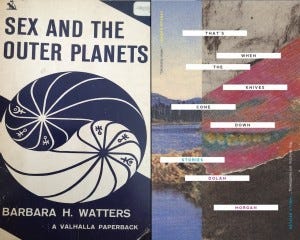
Cover of Sex and the Outer Planets by Barbara Watters (left), alongside Morgan’s upcoming collection,
That’s When the Knives Come Down (right)
Another story in the collection, “How to Have Sex on Other Planets,” was inspired largely by a used book that I found called Sex and the Outer Planets. When I took it home to read, I experienced grave disappointment that the book was not an exploration of sex on Jupiter, but instead a poorly argued social critique. I decided to, er, be the change I want to see in the world, and created the story I was hoping to have read. “How to Have Sex on Other Planets” incorporates actual language from the book and uses the overall structure as a general starting point, but it also takes influence from science texts, travel brochures, how-to guides and performance scores (the story is just directions for having sex on other planets).
MT: What strikes me while listening to you speak is gratitude. In most hands, this would be a gimmick; said artifacts would be employed facilely, with a smirking intellect behind the execution. Yet, with your work, I sense a deep appreciation for the source material. Are your stories and poems the conclusion to these disparate pieces, akin to a collage work built out of repurposed parts? Or is your writing a means of regeneration? Of continuation?
DM: I am grateful. Every source is a limitation, which is good for me because I’m terrible at freedom. Some writers flourish on the blank page, absorbing power from white space and unfettered options. Not me. If I go to clean my apartment, for example, and there are numerous paths I might take in order to get things tidy, I freeze up. I literally come to a stop and zone out, Lysol in hand. Friends find me standing in a doorway, blank-faced and slack-jawed, as if someone suddenly hit the Dolan off-switch. I just don’t know how to move forward with that many options and so I short circuit. I have to set up arbitrary structures to follow: socks first, loose change second, then papers/mail. Writing is the same thing for me, only worse. I enter a blank page and cease to exist. The experience for me is akin to time travel. I enter the computer and emerge silently in the future.
I function best within constraints and stupid limitations. I feel at home and find genuine pleasure in pushing against walls and constrictions. I like breaking rules, and you can’t break them if there aren’t any. Ads, spam, dismissed genres, how-to guides and brochures all provide such rules. These rules each amount to a kind of game that one can enter into and play. For me, the process is distinctly human: we recognize limitations or obstacles in the world and endeavor to circumvent or undo them. There’s great satisfaction in creating and reading works that mimic this process. It is inherently playful, yes, but I don’t think play is childish. Play is an almost spiritual undertaking. When we give ourselves over to a set of rules, or follow them to their conclusion (or engineer a way to use them in a manner beyond their initial intention), we access something new or even impossible. And this is where the gratitude and appreciation really comes in: you have to love or adore these useless things to truly participate in them without condescension. You can’t just put on a spam outfit and dance around, or say hey look at me with my funny pamphlet language. Then you’re an asshole. You have to really give yourself over to it. I had a teacher once who said: approach every text as if it is right and you are wrong. I try to do this with everything, but especially ephemera. There’s something quasi-religious about it — you dive into an absurdity, something that doesn’t necessarily make any sense to you, and see where the ritual takes you. Of course, people have always done this. We create traditions and iconographies that help us forego reason, and for a moment step outside the bounds of our everyday world. We often require sacred objects to help us do this, but I’ll argue that any old thing will suffice. You can take communion with a fax, break bread with a VHS tape, or transcend life with a phone bill. Each object is its own religion awaiting a congregation. And so I don’t think of my work as either a conclusion or even a continuation of source material, but rather an homage or meditation within a kind of pointless spirituality that doesn’t exist.
Dolan Morgan lives and writes in Greenpoint, Brooklyn, where he is an editor at The Atlas Review. His work has been featured in The Believer, Pank, Field, Contrary, TRNSFR and many others. His new book, That’s When the Knives Come Down, is out now from Aforementioned Productions. Find more at www.dolanmorgan.com.
[Editor’s note: Dolan Morgan’s story “Nuée Ardente” was published earlier this week in Electric Literature’s weekly fiction magazine, Recommended Reading.]
Yesterday was the birthday of horror legend — and kind of awful human — H. P. Lovecraft, so it seems like a good time to link to artist Michael Bukowski’s ambitious Yog-Blogsoth project:
This blog will be an attempt to draw all the creatures Lovecraft ever wrote about or mentioned. In some cases his descriptions are very detailed and precise and in other cases he simply names creatures but all require a level of interpretation and imagination.
Bukowski started the drawings back in 2010 and four years later he is still going. Each illustration includes relevant quotes and descriptions from Lovecraft’s writings. Check out all the illustrations at Yog-Blogsoth and Bukowski’s Etsy store StoreDesGhoules.
Deep One
Astaroth

Mi-Go
Shub-Niggurath

Mutant Penguin

Spawn of Cthulhu
Yog-Sothoth

Gug
Moonbeast
Cthulhu
Headless Moon Calf
Hastur
 Thank You!