I was working on a story recently when the influence of David Ohle became too overwhelming to continue. I was proud to have channeled a writer I admire, but I also felt compromised, like I’d taken his influence too far to see the story through as my own.
The fact that I hadn’t, and still haven’t, read Ohle didn’t temper this feeling. I was communicating the version of me that is drawn toward the Internet’s version of him. After years of consuming Ohle reviews, interviews, essays, blurbs, and Amazon book descriptions, whatever of him I’d absorbed was ready to come out.
Of course you don’t have to read an author’s work to have to deal with their influence. Major figures like Faulkner, Pynchon, Bolaño, and David Foster Wallace cast such a wide shadow that they’re a liability for every writer today. You can’t write except by writing against them, trying to get out from under, not least because even if you haven’t read them your potential readers have, so the risk of having failed to negotiate their influence is unavoidable.
But this is a pre-Internet phenomenon, determined by the massive dents these writers put in literary culture through their books and public personae. Ohle’s case is different. The pride I felt in having written the story that reminded me of him came from how far out there it was, like I’d traveled to the edge of my mind and looked over. My recoil at seeing his half-formed shape on the other side came from fearing that he’d already colonized this outpost without my understanding how, and thus perhaps that there was no virgin territory anywhere.
I first saw the name David Ohle in an online Brian Evenson interview and immediately started splashing around for more of him. I found out from Amazon (he doesn’t have a Wikipedia page) that his books include the cult classic Motorman (1972), the more recent semi-sequels The Age of Sinatra (2004) and The Pisstown Chaos (2008), and something called The Old Reactor,coming out from Dzanc this fall. Everything I gathered about these, and the author-image they conjure, bonded with something in me that I’ve come to call him.
I was drawn to the fact that he’d been an assistant to Burroughs and then gone basically unseen for decades, while Motorman was renowned but out of print. He’s had a renaissance recently, getting credit from a new generation of dark and Weird fiction writers for having fleshed out a dystopia that Amazon describes with phrases like “disease and forced-relocation,”“random vouchers of innocence,” “elective deformation,” and forcible “shifting,” whereby people are “separated from — and then randomly coupled with — one another.” These people have names like Stinkers, Jellyheads, Mr. Bunce, President Ratt, and Reverend Herman Hooker, “an American Divine.” When I let my mind wander to this world, I enthusiastically picture insectoid sex acts mashed up with El Topo style violence, mediated by semi-comedic American rituals and authoritarian cults.
Taking all of my Internet reading together, I’ve probably consumed as many words about Ohle’s body of work as that body actually contains. I’ve touched his stuff enough to have its residue in me, but haven’t yet culled the time and attention to go there for real, despite my sense that the world I’m working to develop in my fiction shares a map with his.
This is par for the course with Internet reading: it takes up my time without my setting that time aside for it, and fills me with images and thoughts that I don’t perceive going in, like radiation. When I read a book or watch a film, it’s usually after I’ve finished work for the day and am fueled by relief. I can then dedicate my attention fully to communing with someone else, making linear progress through a single text.
Internet reading, on the other hand, comes only before a work session, and it’s a part of the day I try to minimize while it tries to maximize itself. I open my laptop and open the document I want to work on, and then, in a trance, I drift online to float above my work until I’m ready to be in it. This kind of reading is always transitional, fueled by addictive repetition, guilt, fear, and the nervous patience of waiting for emails.
The mass of other people’s work that makes up my path through these Internet sessions is a space between the total openness of the outside world, where I’m one of billions, and the closed chamber where I’m alone with whatever I’m working on, sealed in with the Internet-blocking Freedom app as soon as I manage to activate it. It’s a warm and nutrient-rich bath between the beach of daily life and the cold, black water of actual writing.
I used to punish myself for the amount of time I spent like this, wishing I could just sit down at my laptop and start typing on cue. But lately, thinking about Ohle and dozens of others who have filtered into me in this way, I realize that this time, however inefficient, is crucial.
It’s an outgrowth of the hours I spent in the video store in my hometown in the 90s, when I was four through fourteen. I’d wander the aisles after school way before I was allowed to see anything over PG, and worship whatever looked most potent — Friday the 13th, Silence of the Lambs, Texas Chainsaw Massacre, Body Double, Reservoir Dogs, Natural Born Killers. I’d take down the cardboard boxes and sit on the floor with them, staring at the photos of bloody, burnt, dazed, or half-naked people on the back, and, above all, at the R rating (or, in the case of Wide Sargasso Sea, Henry and June, Showgirls, and Tokyo Decadence, NC-17, letters so powerful I had to close my eyes while whispering them). I’d try to imagine how these photos might come to life over the course of the film’s stated running time to produce a total vision so far beyond my grasp, like an afterlife.
These photos became source material for a pretend movie that has swollen into the inner grotesque that defines my thinking still. Lynch and Cronenberg were primary influences long before I’d seen their work or absorbed any cultural baggage about its import. I spent my childhood impersonating them in a kind of hero worship that was also my first inkling about how inner worlds can be let out and developed in reality.
The source of these videos’ power was their taboo. When I actually saw them at fifteen, I loved some and was bored by others, but none held the infinite allure they once did. Today, because of time pressure and distraction, Ohle’s Amazon page is taboo in a similar sense: with access to an obscene amount of media, the fantasy of working my way through all of it (of reading “everything I need to”) is both humiliating and erotic, like groveling before a master who beats me down every time I try to stand. So I obsess over a body of work like Ohle’s and dream of the day when I’ll be able to give myself to it and nothing else, just as I dream of creating something on that scale.
Until then, I churn through articles and read pieces of what others have to say, ruminating on all this pulp until my mind starts to write his books in lieu of reading them. Synopses become premises.
In these online minutes or hours, I drift along with my mouth open, absorbing whatever’s floating by, never chewing or even swallowing, just letting it all seep pre-chewed into me. The impurity of this content makes it far more consumable than anything pure, even a little bit of which is filling. This brine of Netflix and Amazon and iTunes, reviews and interviews, recaps and best-of lists and hostile and giddy comment threads, fills me with growths that are half-me and half-everyone. The basement of the video store, with its off-limits porn room hidden behind a door that was meant to look like a wall, was a primitive version of the same phenomenon.
Negotiating this kind of influence is not the same as taking on the giants of the culture I’m trying to find my place in, first stepping into and then crawling out of their shadows. Theirs is a rigorous, daytime influence. Ohle, who exists in shadow rather than casting one, exerts a less pure but perhaps even more profound influence over me, as it’s his residue, not Faulkner’s or Pynchon’s, that’s dripping from me when I finally get offline and down to work.
[DISCLAIMER: The post below involves Short Story Thursdays alone and is in no way affiliated with any pop-up ads or sidebars you may be presented with on this site also advertizing a free short story a week. If you like the shit below, emailing shutyourlazymouthandread@shortstorythursdays.com is the only way to join. It’s a super long email address, I know. Sorry. But I hope you like it. And I hope you do it. Thank you.]
Well hello there, you guys. My name is Jacob Tomsky and this, right here, is my final post on Electric Literature. I am here to pummel you into submission and coerce you to join my non-profit short story organization called Short Story Thursdays.
It basically takes wonderful classic literature and jams it right into an email for you, every Thursday morning. One short story a week. All classics. No garbage. With profane introductions by me. Who is me? Basically, no one.
I guess I done wrote that book real good or something.
But I run this non-profit, absolutely free short story service and if you have any more questions about that you can find information from these two sources:
2- This single-take video where I am sitting in my own apartment and just scriptlessly bullshitting about SST: Video Introduction
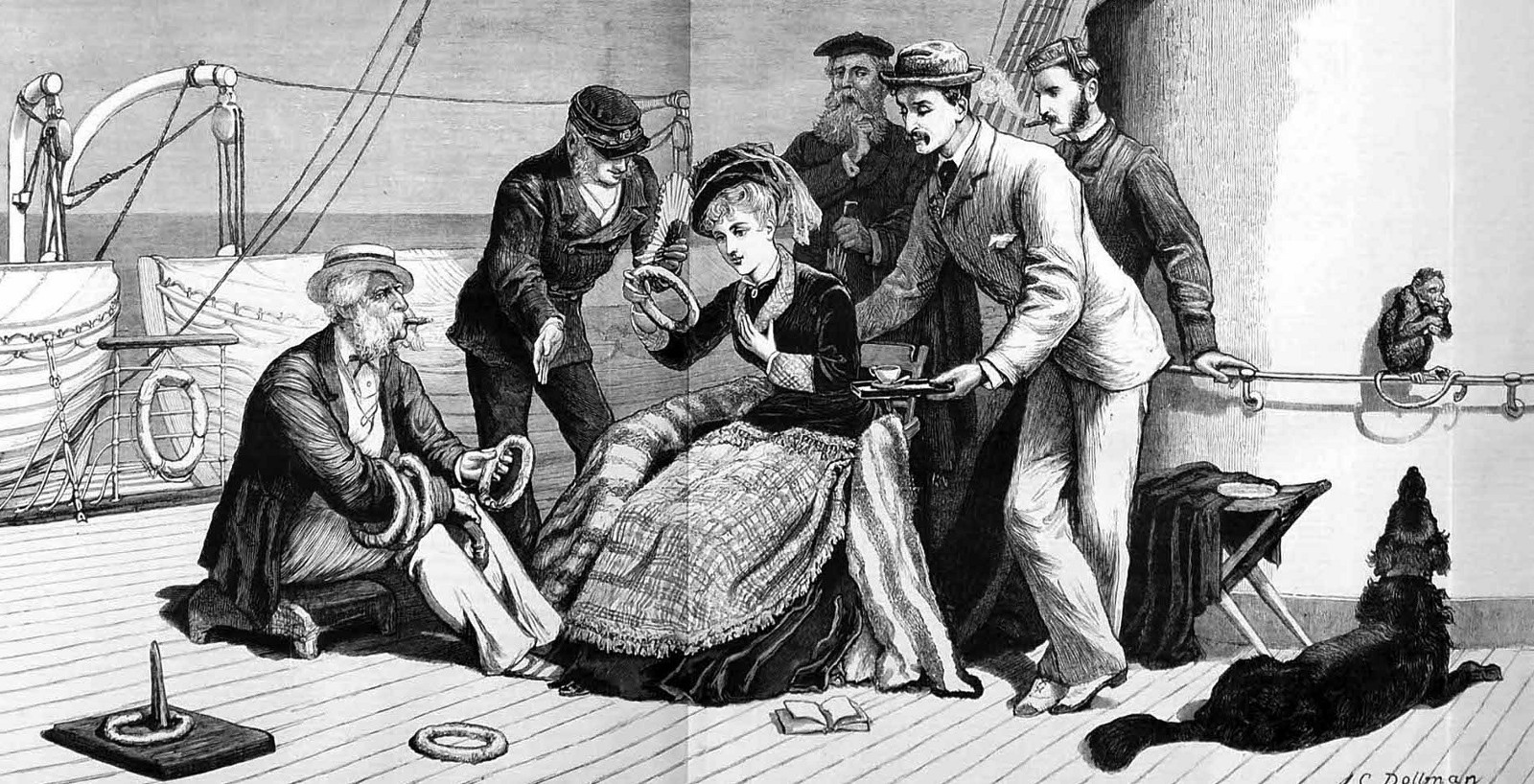
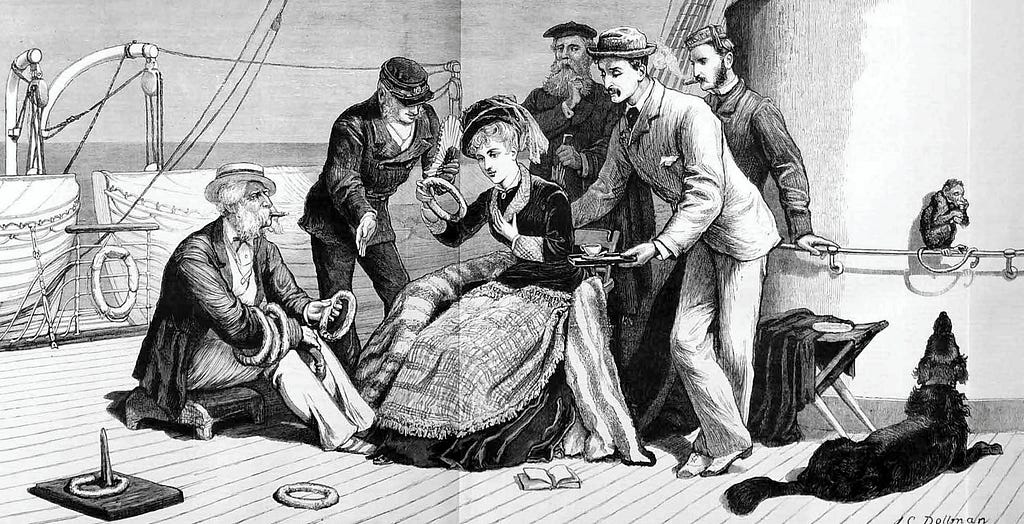
But I’ve been here for the past three weeks, presenting ocean fiction to everybody, like some kind of asshole. Because, recently, moronically, I took a freighter over the Atlantic Ocean, sailing all the way back home to America after a four-month absence. And so I have been sharing a bit about that experience and pairing it with classic short fiction about transatlantic travel.
At the start of the ten-day freighter trip, I was terrified and you can read that post and short story here. Then, for the second post, I was still definitely terrified out there in the middle of the ocean and you can see pictures of my fear and read that post and story here. Then, for the third post, I started to realize I was actually going to make it home, to the life I left behind. And it made me anxious.
Today is the conclusion. The container ship has crossed the whole Atlantic going goddamn 13 miles an hour with me on it, and just the crew. But I am clear of danger now. We are close to the outer lip of America’s east coast. A chopper could get out here and save me if something, like my appendix, exploded inside of my body.
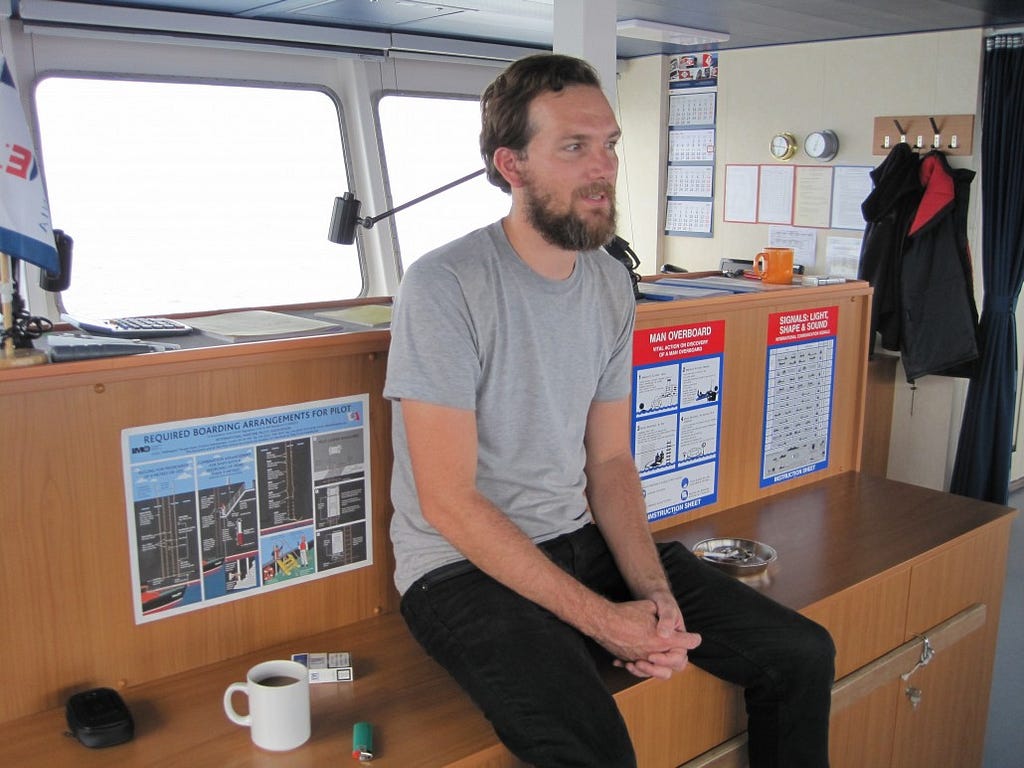
Here is a picture of me on the bridge on one of the final days, pretty much certain I was going to make it home.
Why is it making me sad to think of that time? Returning home is always confusing to your heart. Returning home means returning to your troubles and your life and your shit apartment: Even constant fear of death seems better than that, I guess. And that leads me to this week’s final classic short story.
It’s by Willa Cather. Willa Cather is amazing. She wrote this story, “On the Gull’s Road,” in 1908. It’s about falling in love on a transatlantic steamer ship. Doomed love. The most fleshy kind. Honestly the first time I read this short story I almost cried, but I couldn’t cry because I was at work and I was only reading to make it look like I was working and nothing I have ever read or done at work, that was work-related, could possibly ever make me cry, so I didn’t cry at all I just forced one of my co-workers to read it. And that, pretty much that right there, this story, was the reason I started this organization. Because, though the man I handed it to wasn’t a reader, honestly he told me he’d never read a book all the way through in his life, not even in school; when I gave it to him, he walked away to read it and came back also sad about it, he came back opened up by literature, came back with his heart all stretched out and bruised a little and we talked about it and I thought to myself that maybe I should be making people do this? And that first reader also turned into one of SST’s most astute readers. I even asked him, after we both read this story, “Hey, what’s up with the title though? ‘On the Gull’s Road.’ What’s that about?” He looked at me like I was an idiot and said, in a heavy, born and raised in New York accent, “Damn, Jake, it’s the Gull’s Road. You know kid, like, the ocean? The Gull’s Road. Fuck. You’re an idiot. What’re we reading next though?”
I am an idiot. I have done so many stupid things in my life and hurt people and lost over and over again. But this project, starting Short Story Thursdays, is one of my best and favorite things. It makes me happy and I think it makes some other people happy too.
But I am an idiot. And once I was certain I was an idiot then I thought it best to make myself a useful idiot. Learn a skill or something. So this is my skill, I guess. Or at least it’s where I put all my idiotic energies. And I hope some of you guys on Electric Literature enjoyed this. I mean, if you didn’t enjoy it, then, probably, fuck you? Because I tried and you really can’t get mad at someone for trying to do something. So many people never try to do shit.
Those are the full-on idiots.
So I’ll go now, but you can email me at shutyourlazymouthandread@shortstorythursdays.com if you want to keep going with this and join the 4,000 other readers who also care about SST and we can laugh and get depressed and make jokes and bullshit and stretch our hearts out till there is room for more of everything inside of them like beauty and love and sadness.
I’ll put in a few more pictures before I go of the freighter sailing headlong into an American harbor, at sunrise, and then below that you’ll find the lovely Willa Cather story.
Thanks for giving this a chance and reading and I hope to hear from some of you.
Writing this shit made me all sad for some reason. Now I’m all sad.
It often happens that one or another of my friends stops before a red chalk drawing in my study and asks me where I ever found so lovely a creature. I have never told the story of that picture to any one, and the beautiful woman on the wall, until yesterday, in all these twenty years has spoken to no one but me. Yesterday a young painter, a countryman of mine, came to consult me on a matter of business, and upon seeing my drawing of Alexandra Ebbling, straightway forgot his errand. He examined the date upon the sketch and asked me, very earnestly, if I could tell him whether the lady were still living. When I answered him, he stepped back from the picture and said slowly:
“So long ago? She must have been very young. She was happy?”
“As to that, who can say — about any one of us?” I replied. “Out of all that is supposed to make for happiness, she had very little.”
We returned to the object of his visit, but when he bade me goodbye at the door his troubled gaze again went back to the drawing, and it was only by turning sharply about that he took his eyes away from her.
I went back to my study fire, and as the rain kept away less impetuous visitors, I had a long time in which to think of Mrs. Ebbling. I even got out the little box she gave me, which I had not opened for years, and when Mrs. Hemway brought my tea I had barely time to close the lid and defeat her disapproving gaze.
My young countryman’s perplexity, as he looked at Mrs. Ebbling, had recalled to me the delight and pain she gave me when I was of his years. I sat looking at her face and trying to see it through his eyes — freshly, as I saw it first upon the deck of the Germania, twenty years ago. Was it her loveliness, I often ask myself, or her loneliness, or her simplicity, or was it merely my own youth? Was her mystery only that of the mysterious North out of which she came? I still feel that she was very different from all the beautiful and brilliant women I have known; as the night is different from the day, or as the sea is different from the land. But this is our story, as it comes back to me.
For two years I had been studying Italian and working in the capacity of clerk to the American legation at Rome, and I was going home to secure my first consular appointment. Upon boarding my steamer at Genoa, I saw my luggage into my cabin and then started for a rapid circuit of the deck. Everything promised well. The boat was thinly peopled, even for a July crossing; the decks were roomy; the day was fine; the sea was blue; I was sure of my appointment, and, best of all, I was coming back to Italy. All these things were in my mind when I stopped sharply before a chaise longue placed sidewise near the stern. Its occupant was a woman, apparently ill, who lay with her eyes closed, and in her open arm was a chubby little red-haired girl, asleep. I can still remember that first glance at Mrs. Ebbling, and how I stopped as a wheel does when the band slips. Her splendid, vigorous body lay still and relaxed under the loose folds of her clothing, her white throat and arms and red-gold hair were drenched with sunlight. Such hair as it was: wayward as some kind of gleaming seaweed that curls and undulates with the tide. A moment gave me her face; the high cheek-bones, the thin cheeks, the gentle chin, arching back to a girlish throat, and the singular loveliness of the mouth. Even then it flashed through me that the mouth gave the whole face its peculiar beauty and distinction. It was proud and sad and tender, and strangely calm. The curve of the lips could not have been cut more cleanly with the most delicate instrument, and whatever shade of feeling passed over them seemed to partake of their exquisiteness.
But I am anticipating. While I stood stupidly staring (as if, at twenty-five, I had never before beheld a beautiful woman) the whistles broke into a hoarse scream, and the deck under us began to vibrate. The woman opened her eyes, and the little girl struggled into a sitting position, rolled out of her mother’s arm, and ran to the deck rail. After putting my chair near the stern, I went forward to see the gang-plank up and did not return until we were dragging out to sea at the end of a long tow-line.
The woman in the chaise longue was still alone. She lay there all day, looking at the sea. The little girl, Carin, played noisily about the deck. Occasionally she returned and struggled up into the chair, plunged her head, round and red as a little pumpkin, against her mother’s shoulder in an impetuous embrace, and then struggled down again with a lively flourishing of arms and legs. Her mother took such opportunities to pull up the child’s socks or to smooth the fiery little braids; her beautiful hands, rather large and very white, played about the riotous little girl with a quieting tenderness. Carin chattered away in Italian and kept asking for her father, only to be told that he was busy.
When any of the ship’s officers passed, they stopped for a word with my neighbor, and I heard the first mate address her as Mrs. Ebbling. When they spoke to her, she smiled appreciatively and answered in low, faltering Italian, but I fancied that she was glad when they passed on and left her to her fixed contemplation of the sea. Her eyes seemed to drink the color of it all day long, and after every interruption they went back to it. There was a kind of pleasure in watching her satisfaction, a kind of excitement in wondering what the water made her remember or forget. She seemed not to wish to talk to any one, but I knew I should like to hear whatever she might be thinking. One could catch some hint of her thoughts, I imagined, from the shadows that came and went across her lips, like the reflection of light clouds. She had a pile of books beside her, but she did not read, and neither could I. I gave up trying at last, and watched the sea, very conscious of her presence, almost of her thoughts. When the sun dropped low and shone in her face, I rose and asked if she would like me to move her chair. She smiled and thanked me, but said the sun was good for her. Her yellow-hazel eyes followed me for a moment and then went back to the sea.
After the first bugle sounded for dinner, a heavy man in uniform came up the deck and stood beside the chaise longue, looking down at its two occupants with a smile of satisfied possession. The breast of his trim coat was hidden by waves of soft blond beard, as long and heavy as a woman’s hair, which blew about his face in glittering profusion. He wore a large turquoise ring upon the thick hand that he rubbed good-humoredly over the little girl’s head. To her he spoke Italian, but he and his wife conversed in some Scandinavian tongue. He stood stroking his fine beard until the second bugle blew, then bent stiffly from his hips, like a soldier, and patted his wife’s hand as it lay on the arm of her chair. He hurried down the deck, taking stock of the passengers as he went, and stopped before a thin girl with frizzed hair and a lace coat, asking her a facetious question in thick English. They began to talk about Chicago and went below. Later I saw him at the head of his table in the dining room, the befrizzed Chicago lady on his left. They must have got a famous start at luncheon, for by the end of the dinner Ebbling was peeling figs for her and presenting them on the end of a fork.
The Doctor confided to me that Ebbling was the chief engineer and the dandy of the boat; but this time he would have to behave himself, for he had brought his sick wife along for the voyage. She had a bad heart valve, he added, and was in a serious way.
After dinner Ebbling disappeared, presumably to his engines, and at ten o’clock, when the stewardess came to put Mrs. Ebbling to bed, I helped her to rise from her chair, and the second mate ran up and supported her down to her cabin. About midnight I found the engineer in the card room, playing with the Doctor, an Italian naval officer, and the commodore of a Long Island yacht club. His face was even pinker than it had been at dinner, and his fine beard was full of smoke. I thought a long while about Ebbling and his wife before I went to sleep.
The next morning we tied up at Naples to take on our cargo, and I went on shore for the day. I did not, however, entirely escape the ubiquitous engineer, whom I saw lunching with the Long Island commodore at a hotel in the Santa Lucia. When I returned to the boat in the early evening, the passengers had gone down to dinner, and I found Mrs. Ebbling quite alone upon the deserted deck. I approached her and asked whether she had had a dull day. She looked up smiling and shook her head, as if her Italian had quite failed her. I saw that she was flushed with excitement, and her yellow eyes were shining like two clear topazes.
“Dull? Oh, no! I love to watch Naples from the sea, in this white heat. She has just lain there on her hillside among the vines and laughed for me all day long. I have been able to pick out many of the places I like best.”
I felt that she was really going to talk to me at last. She had turned to me frankly, as to an old acquaintance, and seemed not to be hiding from me anything of what she felt. I sat down in a glow of pleasure and excitement and asked her if she knew Naples well.
“Oh, yes! I lived there for a year after I was first married. My husband has a great many friends in Naples. But he was at sea most of the time, so I went about alone. Nothing helps one to know a city like that. I came first by sea, like this. Directly to Naples from Finmark, and I had never been South before.” Mrs. Ebbling stopped and looked over my shoulder. Then, with a quick, eager glance at me, she said abruptly: “It was like a baptism of fire. Nothing has ever been quite the same since. Imagine how this bay looked to a Finmark girl. It seemed like the overture to Italy.”
I laughed. “And then one goes up the country — song by song and wine by wine.”
Mrs. Ebbling sighed. “Ah, yes. It must be fine to follow it. I have never been away from the seaports myself. We live now in Genoa.”
The deck steward brought her tray, and I moved forward a little and stood by the rail. When I looked back, she smiled and nodded to let me know that she was not missing anything. I could feel her intentness as keenly as if she were standing beside me.
The sun had disappeared over the high ridge behind the city, and the stone pines stood black and flat against the fires of the afterglow. The lilac haze that hung over the long, lazy slopes of Vesuvius warmed with golden light, and films of blue vapor began to float down toward Baiae. The sky, the sea, and the city between them turned a shimmering violet, fading grayer as the lights began to glow like luminous pearls along the water-front, — the necklace of an irreclaimable queen. Behind me I heard a low exclamation; a slight, stifled sound, but it seemed the perfect vocalization of that weariness with which we at last let go of beauty, after we have held it until the senses are darkened. When I turned to her again, she seemed to have fallen asleep.
That night, as we were moving out to sea and the tail lights of Naples were winking across the widening stretch of black water, I helped Mrs. Ebbling to the foot of the stairway. She drew herself up from her chair with effort and leaned on me wearily. I could have carried her all night without fatigue.
“May I come and talk to you to-morrow?” I asked. She did not reply at once. “Like an old friend?” I added. She gave me her languid hand, and her mouth, set with the exertion of walking, softened altogether. “Grazia,” she murmured.
I returned to the deck and joined a group of my countrywomen, who, primed with inexhaustible information, were discussing the baseness of Renaissance art. They were intelligent and alert, and as they leaned forward in their deck chairs under the circle of light, their faces recalled to me Rembrandt’s picture of a clinical lecture. I heard them through, against my will, and then went to the stern to smoke and to see the last of the island lights. The sky had clouded over, and a soft, melancholy wind was rushing over the sea. I could not help thinking how disappointed I would be if rain should keep Mrs. Ebbling in her cabin to-morrow. My mind played constantly with her image. At one moment she was very clear and directly in front of me; the next she was far away. Whatever else I thought about, some part of my consciousness was busy with Mrs. Ebbling; hunting for her, finding her, losing her, then groping again. How was it that I was so conscious of whatever she might be feeling? that when she sat still behind me and watched the evening sky, I had had a sense of speed and change, almost of danger; and when she was tired and sighed, I had wished for night and loneliness.
II
Though when we are young we seldom think much about it, there is now and again a golden day when we feel a sudden, arrogant pride in our youth; in the lightness of our feet and the strength of our arms, in the warm fluid that courses so surely within us; when we are conscious of something powerful and mercurial in our breasts, which comes up wave after wave and leaves us irresponsible and free. All the next morning I felt this flow of life, which continually impelled me toward Mrs. Ebbling. After the merest greeting, however, I kept away. I found it pleasant to thwart myself, to measure myself against a current that was sure to carry me with it in the end. I was content to let her watch the sea — the sea that seemed now to have come into me, warm and soft, still and strong. I played shuffleboard with the Commodore, who was anxious to keep down his figure, and ran about the deck with the stout legs of the little pumpkin-colored Carin about my neck. It was not until the child was having her afternoon nap below that I at last came up and stood beside her mother.
“You are better to-day,” I exclaimed, looking down at her white gown. She colored unreasonably, and I laughed with a familiarity which she must have accepted as the mere foolish noise of happiness, or it would have seemed impertinent.
We talked at first of a hundred trivial things, and we watched the sea. The coast of Sardinia had lain to our port for some hours and would lie there for hours to come, now advancing in rocky promontories, now retreating behind blue bays. It was the naked south coast of the island, and though our course held very near the shore, not a village or habitation was visible; there was not even a goat-herd’s hut hidden away among the low pinkish sand hills. Pinkish sand hills and yellow head-lands; with dull-colored scrubby bushes massed about their bases and following the dried water-courses. A narrow strip of beach glistened like white paint between the purple sea and the umber rocks, and the whole island lay gleaming in the yellow sunshine and translucent air. Not a wave broke on that fringe of white sand, not the shadow of a cloud played across the bare hills. In the air about us, there was no sound but that of a vessel moving rapidly through absolutely still water. She seemed like some great sea-animal, swimming silently, her head well up. The sea before us was so rich and heavy and opaque that it might have been lapis lazuli. It was the blue of legend, simply; the color that satisfies the soul like sleep.
And it was of the sea we talked, for it was the substance of Mrs. Ebbling’s story. She seemed always to have been swept along by ocean streams, warm or cold, and to have hovered about the edge of great waters. She was born and had grown up in a little fishing town on the Arctic ocean. Her father was a doctor, a widower, who lived with his daughter and who divided his time between his books and his fishing rod. Her uncle was skipper on a coasting vessel, and with him she had made many trips along the Norwegian coast. But she was always reading and thinking about the blue seas of the South.
“There was a curious old woman in our village, Dame Ericson, who had been in Italy in her youth. She had gone to Rome to study art, and had copied a great many pictures there. She was well connected, but had little money, and as she grew older and poorer she sold her pictures one by one, until there was scarcely a well-to-do family in our district that did not own one of Dame Ericson’s paintings. But she brought home many other strange things; a little orange-tree which she cherished until the day of her death, and bits of colored marble, and sea shells and pieces of coral, and a thin flask full of water from the Mediterranean. When I was a little girl she used to show me her things and tell me about the South; about the coral fishers, and the pink islands, and the smoking mountains, and the old, underground Naples. I suppose the water in her flask was like any other, but it never seemed so to me. It looked so elastic and alive, that I used to think if one unsealed the bottle something penetrating and fruitful might leap out and work an enchantment over Finmark.”
Lars Ebbling, I learned, was one of her father’s friends. She could remember him from the time when she was a little girl and he a dashing young man who used to come home from the sea and make a stir in the village. After he got his promotion to an Atlantic liner and went South, she did not see him until the summer she was twenty, when he came home to marry her. That was five years ago. The little girl, Carin, was three. From her talk, one might have supposed that Ebbling was proprietor of the Mediterranean and its adjacent lands, and could have kept her away at his pleasure. Her own rights in him she seemed not to consider.
But we wasted very little time on Lars Ebbling. We talked, like two very young persons, of arms and men, of the sea beneath us and the shores it washed. We were carried a little beyond ourselves, for we were in the presence of the things of youth that never change; fleeing past them. To-morrow they would be gone, and no effort of will or memory could bring them back again. All about us was the sea of great adventure, and below us, caught somewhere in its gleaming meshes, were the bones of nations and navies . . . . . nations and navies that gave youth its hope and made life something more than a hunger of the bowels. The unpeopled Sardinian coast unfolded gently before us, like something left over out of a world that was gone; a place that might well have had no later news since the corn ships brought the tidings of Actium.
“I shall never go to Sardinia,” said Mrs. Ebbling. “It could not possibly be as beautiful as this.”
“Neither shall I,” I replied.
As I was going down to dinner that evening, I was stopped by Lars Ebbling, freshly brushed and scented, wearing a white uniform, and polished and glistening as one of his own engines. He smiled at me with his own kind of geniality. “You have been very kind to talk to my wife,” he explained. “It is very bad for her this trip that she speaks no English. I am indebted to you.”
I told him curtly that he was mistaken, but my acrimony made no impression upon his blandness. I felt that I should certainly strike the fellow if he stood there much longer, running his blue ring up and down his beard. I should probably have hated any man who was Mrs. Ebbling’s husband, but Ebbling made me sick.
III
The next day I began my drawing of Mrs. Ebbling. She seemed pleased and a little puzzled when I asked her to sit for me. It occurred to me that she had always been among dull people who took her looks as a matter of course, and that she was not at all sure that she was really beautiful. I can see now her quick, confused look of pleasure. I thought very little about the drawing then, except that the making of it gave me an opportunity to study her face; to look as long as I pleased into her yellow eyes, at the noble lines of her mouth, at her splendid, vigorous hair.
“We have a yellow vine at home,” I told her, “that is very like your hair. It seems to be growing while one looks at it, and it twines and tangles about itself and throws out little tendrils in the wind.”
“Has it any name?”
“We call it love vine.”
How little a thing could disconcert her!
As for me, nothing disconcerted me. I awoke every morning with a sense of speed and joy. At night I loved to hear the swish of the water rushing by. As fast as the pistons could carry us, as fast as the water could bear us, we were going forward to something delightful; to something together. When Mrs. Ebbling told me that she and her husband would be five days in the docks in New York and then return to Genoa, I was not disturbed, for I did not believe her. I came and went, and she sat still all day, watching the water. I heard an American lady say that she watched it like one who is going to die, but even that did not frighten me: I somehow felt that she had promised me to live.
All those long blue days when I sat beside her talking about Finmark and the sea, she must have known that I loved her. I sat with my hands idle on my knees and let the tide come up in me. It carried me so swiftly that, across the narrow space of deck between us, it must have swayed her, too, a little. I had no wish to disturb or distress her. If a little, a very little of it reached her, I was satisfied. If it drew her softly, but drew her, I wanted no more. Sometimes I could see that even the light pressure of my thoughts made her paler. One still evening, after a long talk, she whispered to me, “You must go and walk now, and — don’t think about me.” She had been held too long and too closely in my thoughts, and she begged me to release her for a little while. I went out into the bow and put her far away, at the sky line, with the faintest star, and thought of her gently across the water. When I went back to her, she was asleep.
But even in those first days I had my hours of misery. Why, for instance, should she have been born in Finmark, and why should Lars Ebbling have been her only door of escape? Why should she be silently taking leave of the world at the age when I was just beginning it, having had nothing, nothing of whatever is worth while?
She never talked about taking leave of things, and yet I sometimes felt that she was counting the sunsets. One yellow afternoon, when we were gliding between the shores of Spain and Africa, she spoke of her illness for the first time. I had got some magnolias at Gibraltar, and she wore a bunch of them in her girdle and the rest lay on her lap. She held the cool leaves against her cheek and fingered the white petals. “I can never,” she remarked, “get enough of the flowers of the South. They make me breathless, just as they did at first. Because of them I should like to live a long while — almost forever.”
I leaned forward and looked at her. “We could live almost forever if we had enough courage. It’s of our lives that we die. If we had the courage to change it all, to run away to some blue coast like that over there, we could live on and on, until we were tired.”
She smiled tolerantly and looked southward through half shut eyes. “I am afraid I should never have courage enough to go behind that mountain, at least. Look at it, it looks as if it hid horrible things.”
A sea mist, blown in from the Atlantic, began to mask the impassive African coast, and above the fog, the grey mountain peak took on the angry red of the sunset. It burned sullen and threatening until the dark land drew the night about her and settled back into the sea. We watched it sink, while under us, slowly but ever increasing, we felt the throb of the Atlantic come and go, the thrill of the vast, untamed waters of that lugubrious and passionate sea. I drew Mrs. Ebbling’s wraps about her and shut the magnolias under her cloak. When I left her, she slipped me one warm, white flower.
IV
From the Straits of Gibraltar we dropped into the abyss, and by morning we were rolling in the trough of a sea that drew us down and held us deep, shaking us gently back and forth until the timbers creaked, and then shooting us out on the crest of a swelling mountain. The water was bright and blue, but so cold that the breath of it penetrated one’s bones, as if the chill of the deep under-fathoms of the sea were being loosed upon us. There were not more than a dozen people upon the deck that morning, and Mrs. Ebbling was sheltered behind the stern, muffled in a sea jacket, with drops of moisture upon her long lashes and on her hair. When a shower of icy spray beat back over the deck rail, she took it gleefully.
“After all,” she insisted, “this is my own kind of water; the kind I was born in. This is first cousin to the Pole waters, and the sea we have left is only a kind of fairy tale. It’s like the burnt out volcanoes; its day is over. This is the real sea now, where the doings of the world go on.”
“It is not our reality, at any rate,” I answered.
“Oh, yes, it is! These are the waters that carry men to their work, and they will carry you to yours.”
I sat down and watched her hair grow more alive and iridescent in the moisture. “You are pleased to take an attitude,” I complained.
“No, I don’t love realities any more than another, but I admit them, all the same.”
“And who are you and I to define the realities?”
“Our minds define them clearly enough, yours and mine, everybody’s. Those are the lines we never cross, though we flee from the equator to the Pole. I have never really got out of Finmark, of course. I shall live and die in a fishing town on the Arctic ocean, and the blue seas and the pink islands are as much a dream as they ever were. All the same, I shall continue to dream them.”
The Gulf Stream gave us warm blue days again, but pale, like sad memories. The water had faded, and the thin, tepid sunshine made something tighten about one’s heart. The stars watched us coldly, and seemed always to be asking me what I was going to do. The advancing line on the chart, which at first had been mere foolishness, began to mean something, and the wind from the west brought disturbing fears and forebodings. I slept lightly, and all day I was restless and uncertain except when I was with Mrs. Ebbling. She quieted me as she did little Carin, and soothed me without saying anything, as she had done that evening at Naples when we watched the sunset. It seemed to me that every day her eyes grew more tender and her lips more calm. A kind of fortitude seemed to be gathering about her mouth, and I dreaded it. Yet when, in an involuntary glance, I put to her the question that tortured me, her eyes always met mine steadily, deep and gentle and full of reassurance. That I had my word at last, happened almost by accident.
On the second night out from shore there was the concert for the Sailors’ Orphanage, and Mrs. Ebbling dressed and went down to dinner for the first time, and sat on her husband’s right. I was not the only one who was glad to see her. Even the women were pleased. She wore a pale green gown, and she came up out of it regally white and gold. I was so proud that I blushed when any one spoke of her. After dinner she was standing by her deck-chair talking to her husband when people began to go below for the concert. She took up a long cloak and attempted to put it on. The wind blew the light thing about, and Ebbling chatted and smiled his public smile while she struggled with it. Suddenly his roving eye caught sight of the Chicago girl, who was having a similar difficulty with her draperies, and he pranced half the length of the deck to assist her. I had been watching from the rail, and when she was left alone I threw my cigar away and wrapped Mrs. Ebbling up roughly.
“Don’t go down,” I begged. “Stay up here. I want to talk to you.”
She hesitated a moment and looked at me thoughtfully. Then, with a sigh, she sat down. Every one hurried down to the saloon, and we were absolutely alone at last, behind the shelter of the stern, with the thick darkness all about us and a warm east wind rushing over the sea. I was too sore and angry to think. I leaned toward her, holding the arm of her chair with both hands, and began anywhere.
“You remember those two blue coasts out of Gibraltar? It shall be either one you choose, if you will come with me. I have not much money, but we shall get on somehow. There has got to be an end of this. We are neither one of us cowards, and this is humiliating, intolerable.”
She sat looking down at her hands, and I pulled her chair impatiently toward me.
“I felt,” she said at last, “that you were going to say something like this. You are sorry for me, and I don’t wish to be pitied. You think Ebbling neglects me, but you are mistaken. He has had his disappointments, too. He wants children and a gay, hospitable house, and he is tied to a sick woman who can not get on with people. He has more to complain of than I have, and yet he bears with me. I am grateful to him, and there is no more to be said.”
“Oh, isn’t there?” I cried, “and I?”
She laid her hand entreatingly upon my arm. “Ah, you! you! Don’t ask me to talk about that. You — “ Her fingers slipped down my coat sleeve to my hand and pressed it. I caught her two hands and held them, telling her I would never let them go.
“And you meant to leave me day after tomorrow, to say goodbye to me as you will to the other people on this boat? You meant to cut me adrift like this, with my heart on fire and all my life unspent in me?”
She sighed despondently. “I am willing to suffer — whatever I must suffer — to have had you,” she answered simply. “I was ill — and so lonely — and it came so quickly and quietly. Ah, don’t begrudge it to me! Do not leave me in bitterness. If I have been wrong, forgive me.” She bowed her head and pressed my fingers entreatingly. A warm tear splashed on my hand. It occurred to me that she bore my anger as she bore little Carin’s importunities, as she bore Ebbling. What a circle of pettiness she had about her! I fell back in my chair and my hands dropped at my side. I felt like a creature with its back broken. I asked her what she wished me to do.
“Don’t ask me,” she whispered. “There is nothing that we can do. I thought you knew that. You forget that — that I am too ill to begin my life over. Even if there were nothing else in the way, that would be enough. And that is what has made it all possible, our loving each other, I mean. If I were well, we couldn’t have had even this much. Don’t reproach me. Hasn’t it been at all pleasant to you to find me waiting for you every morning, to feel me thinking of you when you went to sleep? Every night I have watched the sea for you, as if it were mine and I had made it, and I have listened to the water rushing by you, full of sleep and youth and hope. And everything you had done or said during the day came back to me, and when I went to sleep it was only to feel you more. You see there was never any one else; I have never thought of any one in the dark but you.” She spoke pleadingly, and her voice had sunk so low that I could scarcely hear her.
“And yet you will do nothing,” I groaned. “You will dare nothing. You will give me nothing.”
“Don’t say that. When I leave you day after tomorrow, I shall have given you all my life. I can’t tell you how, but it is true. There is something in each of us that does not belong to the family or to society, not even to ourselves. Sometimes it is given in marriage, and sometimes it is given in love, but oftener it is never given at all. We have nothing to do with giving or withholding it. It is a wild thing that sings in us once and flies away and never comes back, and mine has flown to you. When one loves like that, it is enough, somehow. The other things can go if they must. That is why I can live without you, and die without you.”
I caught her hands and looked into her eyes that shone warm in the darkness. She shivered and whispered in a tone so different from any I ever heard from her before or afterward: “Do you grudge it to me? You are so young and strong, and you have everything before you. I shall have only a little while to want you in — and I could want you forever and not weary.” I kissed her hair, her cheeks, her lips, until her head fell forward on my shoulder and she put my face away with her soft, trembling fingers. She took my hand and held it close to her, in both her own. We sat silent, and the moments came and went, bringing us closer and closer, and the wind and water rushed by us, obliterating our tomorrows and all our yesterdays.
The next day Mrs. Ebbling kept her cabin, and I sat stupidly by her chair until dark, with the rugged little girl to keep me company, and an occasional nod from the engineer.
I saw Mrs. Ebbling again only for a few moments, when we were coming into the New York harbor. She wore a street dress and a hat, and these alone would have made her seem far away from me. She was very pale, and looked down when she spoke to me, as if she had been guilty of a wrong toward me. I have never been able to remember that interview without heartache and shame, but then I was too desperate to care about anything. I stood like a wooden post and let her approach me, let her speak to me, let her leave me. She came up to me as if it were a hard thing to do, and held out a little package, timidly, and her gloved hand shook as if she were afraid of me.
“I want to give you something,” she said. “You will not want it now, so I shall ask you to keep it until you hear from me. You gave me your address a long time ago, when you were making that drawing. Some day I shall write to you and ask you to open this. You must not come to tell me goodbye this morning, but I shall be watching you when you go ashore. Please don’t forget that.”
I took the little box mechanically and thanked her. I think my eyes must have filled, for she uttered an exclamation of pity, touched my sleeve quickly, and left me. It was one of those strange, low, musical exclamations which meant everything and nothing, like the one that had thrilled me that night at Naples, and it was the last sound I ever heard from her lips.
An hour later I went on shore, one of those who crowded over the gang-plank the moment it was lowered. But the next afternoon I wandered back to the docks and went on board the Germania. I asked for the engineer, and he came up in his shirt sleeves from the engine room. He was red and dishevelled, angry and voluble; his bright eye had a hard glint, and I did not once see his masterful smile. When he heard my inquiry he became profane. Mrs. Ebbling had sailed for Bremen on the Hobenstauffen that morning at eleven o’clock. She had decided to return by the northern route and pay a visit to her father in Finmark. She was in no condition to travel alone, he said. He evidently smarted under her extravagance. But who, he asked, with a blow of his fist on the rail, could stand between a woman and her whim? She had always been a wilful girl, and she had a doting father behind her. When she set her head with the wind, there was no holding her; she ought to have married the Arctic Ocean. I think Ebbling was still talking when I walked away.
I spent that winter in New York. My consular appointment hung fire (indeed, I did not pursue it with much enthusiasm), and I had a good many idle hours in which to think of Mrs. Ebbling. She had never mentioned the name of her father’s village, and somehow I could never quite bring myself to go to the docks when Ebbling’s boat was in and ask for news of her. More than once I made up my mind definitely to go to Finmark and take my chance at finding her; the shipping people would know where Ebbling came from. But I never went. I have often wondered why. When my resolve was made and my courage high, when I could almost feel myself approaching her, suddenly everything crumbled under me, and I fell back as I had done that night when I dropped her hands, after telling her, only a moment before, that I would never let them go.
In the twilight of a wet March day, when the gutters were running black outside and the Square was liquefying under crusts of dirty snow, the housekeeper brought me a damp letter which bore a blurred foreign postmark. It was from Niels Nannestad, who wrote that it was his sad duty to inform me that his daughter, Alexandra Ebbling, had died on the second day of February, in the twenty-sixth year of her age. Complying with her request, he inclosed a letter which she had written some days before her death.
I at last brought myself to break the seal of the second letter. It read thus:
“My Friend: —
You may open now the little package I gave you. May I ask you to keep it? I gave it to you because there is no one else who would care about it in just that way. Ever since I left you I have been thinking what it would be like to live a lifetime caring and being cared for like that. It was not the life I was meant to live, and yet, in a way, I have been living it ever since I first knew you.
“Of course you understand now why I could not go with you. I would have spoiled your life for you. Besides that, I was ill — and I was too proud to give you the shadow of myself. I had much to give you, if you had come earlier. As it was, I was ashamed. Vanity sometimes saves us when nothing else will, and mine saved you. Thank you for everything. I hold this to my heart, where I once held your hand. Alexandra.”
The dusk had thickened into night long before I got up from my chair and took the little box from its place in my desk drawer. I opened it and lifted out a thick coil, cut from where her hair grew thickest and brightest. It was tied firmly at one end, and when it fell over my arm it curled and clung about my sleeve like a living thing set free. How it gleamed, how it still gleams in the firelight! It was warm and softly scented under my lips, and stirred under my breath like seaweed in the tide. This, and a withered magnolia flower, and two pink sea shells; nothing more. And it was all twenty years ago!
Running from 1952 to 1961, This is Your Life was an emotionally intense experiment in early reality TV. Subjects were lured to the studio under false pretenses, then host Ralph Edwards presented them with a leather-bound book featuring the name of the show and the name of the subject (and the name of that episode’s commercial sponsor). The subject was allowed several seconds to react with apparently genuine surprise and/or horror before Edwards launched into the story of his or her life. The host’s storytelling was punctuated by the appearance of significant people from the subject’s past: teachers, childhood friends, former colleagues.
TIME once called This is Your Life “the most sickeningly sentimental show on the air,” which is, of course, why people loved it. During the handful of episodes I recently watched, I wept no fewer than three times. The show seems to be most itself when exploiting the tragedies of its subjects’ lives, and so the purest This is Your Life episode of all must be the one that tells the story of Kiyoshi Tanimoto, a Japanese Methodist minister and survivor of the atomic bombing of Hiroshima.
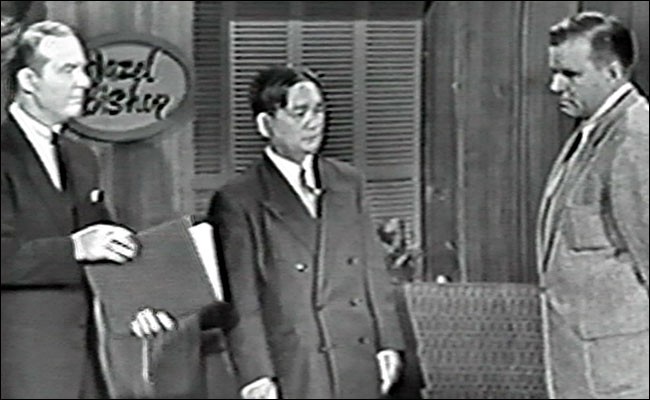
Many of This is Your Life’s guests were in the entertainment industry, so it was often necessary to construct elaborate subterfuges to get them to the studio without spoiling the surprise. In the case of Tanimoto, this was not necessary. Japan did not receive the program. At the time, Tanimoto was visiting the United States with 25 young women, fellow survivors of the atom bomb who had been badly disfigured. They were going to Mount Sinai Hospital for reconstructive surgery, and Tanimoto believed that he was in the studio to be interviewed about these women and their suffering.
Ralph Edwards was a prolific creator of game shows, and his signature program was Truth or Consequences, a wacky sort of prototype for shows like Nickelodeon’s Double Dare, which explains the tendency of This is Your Life to feel like a game show. There are prizes, but all the questions are rhetorical and the answers rarely heard. The idea is that the show’s research team has already learned everything there is to know about the subject, so when Edwards asks Tanimoto a question, there is clearly a correct answer and that answer is so strongly implied by the question’s phrasing that there is in fact no need to speak it.
In a representative exchange, as Edwards describes the morning of the bombing, he reaches the moment when the Hiroshima air raid siren sounded (the show attempts to make the memory more vivid for a startled Tanimoto by playing the same sound in the studio) and asks, “Did you run for cover?”
“Uh,” says Tanimoto. The answer is no, but he feels like that’s not what he’s supposed to say.
“Not when the siren blew,” says Edwards. “You were used to that. Every morning it went off, didn’t it? As I understand, there were U.S. Army reconnaissance planes flying overhead most of the time, so this was taken for granted, this air raid siren.”
My description so far fails to capture how truly repellent This is Your Life can be, but I do believe that the show was made with good intentions. Edwards got the idea for the program when asked to do something for paraplegic soldiers (presumably survivors, like Tanimoto, of World War II) in Birmingham General Hospital. He decided to tell the life story of one of those soldiers in a way that would make sense of his terrible present circumstances by weaving a narrative that began with happy childhood and concluded with the promise of a better future. In other words: The program had been conceived of as a means of making sense of the effects of war on ordinary people.
However, that need to make sense of the past at all costs, combined with the norms of 1950s television, makes Tanimoto’s episode seem painfully tone deaf when it’s not grossly offensive. It’s not only that Edwards mostly refuses to let his subject speak, it’s that he continually takes the liberty of describing Tanimoto’s feelings and memories to Tanimoto, often speaking over him to do so. While the minister speaks in a normal, human voice, Edwards, who came up in radio, continually speak-shouts in a domineering, condescending tone. He embodies an America that will bomb your home, kill your neighbors, surprise you with an interview on a deeply personal, traumatic experience and then — rather than allow you to tell your own story — tell you what happened and how you felt about it. At times, This is Your Life feels like a nightmare in which Bob Barker breaks into your home to shout a condescending bedtime story made up of your worst memories while all of America watches.
The most striking moment of Tanimoto’s episode comes at the halfway mark, when he is finally allowed to speak about what he saw after the bomb detonated. “I saw the whole city on fire,” he says. “And many people running away from the city in the silence. Their skin peeling off and hanging from face, from arm, but strange to say, in silence, it looked like a procession of ghosts.”
“Did you know that Hiroshima had been the first city to feel the force of atomic power?” asks Edwards.
“Well, I didn’t know what happened,” says Tanimoto. How could he have? The question is absurd.
At this point, Robert Lewis, copilot of the Enola Gay, makes his second appearance. We have heard from him once already, near the six-minute mark, when his silhouette spoke a foreboding line about where he was on the morning of August 6, 1945: flying over Japan, in a bomber. This first appearance seemed to tip the show’s hand as to Lewis’s identity, and while I imagine it was introduced primarily as a way of building suspense, I wonder if it was also designed to give Tanimoto some warning of what would soon happen.
The minister does seem prepared when the time comes. The moment is staged such that we cannot see Tanimoto’s face, but he moves quickly to shake Lewis’s hand. For his part, the pilot looks nervous and deeply ashamed. As he recalled into a microphone before entering the set, Lewis famously wrote in his log “My God, what have we done?” after seeing all of Hiroshima ablaze. (The same phrase would appear on the cover of TIME on the 40th anniversary of the bombing and had been widely reported in the atom bomb’s initial coverage, though it was frequently trimmed to only the first two words; apparently, the question that followed was not one that most people were eager to ask.) Though the handshake itself seems to go well, when the two separate, they both become more cagey. Lewis struggles to meet Tanimoto’s eyes, and Tanimoto leans away from Lewis, regarding him with what appears to be a mix of skepticism and concern bordering on fear. Edwards braces Tanimoto with a hand on his back, presumably with the justification that the shot will look better that way. When Edwards lowers his hand, Tanimoto takes another small step backward, his hands clenching.
Lewis proceeds to narrate — at length and without interruption — his experience of bombing Hiroshima. His speech is uneven, and he sways slightly as he speaks. (Alcohol may have had something to do with it; in a This American Life story about This is Your Life, Allison Silverman reports that “people say” Lewis was drunk.) Referring to Lewis’s famous quote and to the way that Tanimoto thought “My God, my God” as he searched for his family, Edwards wraps things up with a neat little bow: “And so Reverend Tanimoto, you on the ground, and you on your military mission, Captain Lewis, in the air, both appealed to a power greater than your own.” The pair continue to regard each other across a gap of four feet. They are sharing a moment far stranger than Edwards, than This is Your Life, than 1950s America, is willing to acknowledge.
When Edwards dismisses Lewis from the stage (to the latter’s visible relief), Tanimoto does something enormously kind: He smiles warmly and shakes Lewis’s hand. Lewis touches him with both hands, and Tanimoto does the same, holding Lewis there an instant longer after he begins to pull away.
The rest of the episode functions as a lengthy coda. Tanimoto’s wife and children are brought onto the stage, and he is delighted to see them. Edwards narrates in brief the days, months and years that followed: Tanimoto’s struggle and failure to help the survivors, the way he brought food to his family, the bombing of Nagasaki, the emperor’s radio announcement of Japan’s surrender, the rebuilding of Hiroshima. Tanimoto appears to be on the verge of tears. Edwards explains about the disfigured young women that Tanimoto has travelled to help, whom U.S. media called “the Hiroshima Maidens.” (In Japan, these women were understood as members of a much larger category called hibakusha, meaning “explosion-affected people.”) Two of the maidens appear on This is Your Life. “To avoid causing them any embarrassment” the program does not reveal their faces; they appear only as shadows behind a screen. One of the pair speaks at length in Japanese. Edwards translates her statement: “They said they’re happy to be in America and thankful to the United States for what they’re doing now for them.” Of course Edwards doesn’t speak Japanese; he already knew what they would say.
We break for an advertisement for nail polish. This is the second such ad; the first came at the outset of the show. There would have been another in the middle, but, as Edwards explained, the sponsor kindly allowed them to forego that advertisement due to the program’s serious nature.
Once the ad is over, prizes are distributed to Tanimoto and his family: a 16mm film of the episode and a projector with which to watch it; a 16mm movie camera; for Mrs. Tanimoto, a custom-designed golden charm bracelet; for Mr. Tanimoto, cufflinks; and finally, for the Hiroshima Maidens and other hibakusha, a medical fund to pay for their care. Robert Lewis, who has been awkwardly standing behind the couch and over Tanimoto’s shoulder for some time now, finally speaks up: “Mr. Edwards, on behalf of the entire crew that participated in that mission, my company, and my lovely family, I would like to make the first contribution.” (Not everyone in the crew would have appreciated such a gesture: Lewis’s copilot, Paul Tibbets, insisted right up to his death that they had been in the right.) The audience applauds. The sponsors each contribute $500. The audience applauds.
“I know that our audience will be just as generous,” says Edwards, “for this is the American way.”
It is Edwards’s need, the need of his program and the need of their sponsors to retell this story — the story of an incomprehensible horror perpetrated by the American military on behalf of the American people — in a way that allows America to remain the hero. The fact that we destroyed the lives of so many can be forgiven, or at least forgotten, if now we pony up for some of their treatment. The “American way” is not wholesale slaughter, but the selective generosity that follows. It is our magnanimity in bloody victory.
Tanimoto remembered his experience on This is Your Life fondly, according to his daughter, who discussed it with Allison Silverman for This American Life. The minister shared his episode with English-speaking guests to his home and even exchanged letters with Robert Lewis. (I would much rather read their correspondence than see This Is Your Life ever again.) But those letters never assuaged Lewis’s guilt. The pilot later took up sculpture, and his most notorious piece was called “‘God’s Wind’ at Hiroshima?” It was a marble mushroom cloud with blood pouring down the sides.
As he heaves down through the weeds with a plate in his hand and a smear of jelly on his lips we watch him and stay silent. Our bellies are roaring. Not a full meal in days. Just a can of beans yesterday — while we wait out the next train — the Chicago–Detroit most likely, tomorrow around ten — and stay calm, listening to that high Middle Western bitterness in his voice as he talks about the pie cherries and the wonderfully flaky crust and the way he found it steaming on the sill, waiting for him as he expected. He talks about how the man of the house was inside listening to a radio show, clearly visible through the front parlor window, with a shotgun at his side, just the shadow of it poking up alongside his chair. Same son of a bitch who chased me out of there a while back, he explains. Then he pauses for a minute and we fear — I feel this in the way the other fellows hunch lower, bringing their heels up to the fire — he’ll circle all the way back to the beginning of his story again, starting with how he had left this camp — a couple of years back — and hiked several miles to a street, lined with old maples, that on first impression had seemed very much like the one he’d grown up on, although he wasn’t sure because years of drifting on the road had worn the details from his memory, so many miles behind him in the form of bad drink and that mind-numbing case of lockjaw he claims he had in Pittsburgh. (The antitoxin, he explained, had been administered just in time, saving him from the worst of it. A kind flophouse doctor named Williams had tended to his wound, cleaning it out and wrapping it nicely, giving him a bottle of muscle pills.) He hiked into town — the first time — to stumble upon a house that held a resemblance to whatever was left in his memory: a farmhouse with weatherworn clapboard. A side garden with rosebushes and, back beyond a fence, a vegetable patch with pole beans. Not just the same house — he had explained — but the same sweet smell emanating from the garden where far back beyond a few willow trees a brook ran, burbling and so on and so forth. He went on too long about the brook and one of the men (who exactly, I can’t recall) said, I wish you still had that case of lockjaw. (That was the night he was christened Lockjaw Kid.) He stood out in the road and absorbed the scene and felt an overwhelming sense that he was home; a sense so powerful it held him fast and — in his words — made him fearful that he’d find it too much to his liking if he went up to beg a meal. So he went back down to the camp with an empty belly and decided to leave well enough alone until, months later, coming through these parts again after a stint of work in Chicago (Lockjaw couched his life story in the idea of employment, using it as a tool of sorts to get his point across. Whereas the rest of us had long ago given up talking of labor in any form, unless it was to say something along the lines of: Worked myself so hard I’ll never work again; or, I’d work if I could find a suitable form of employment that didn’t involve work) he decided to hike the six miles into town to take another look, not sure what he was searching for because by that time the initial visit — he said last time he told the story — had become only a vague memory, burned away by drink and travel; aforesaid confession itself attesting to a hole in his story about having worked in Chicago and giving away the fact that he had, more likely, hung on and headed all the way out to the coast for the winter, whiling his time in the warmth, plucking the proverbial fruit directly from the trees and so on and so forth. We didn’t give a shit. That part of his story had simply given us a chance to give him a hard time, saying, You were out in California if you were anywhere, you dumb shit. Not anywhere near Chicago looking for work. You couldn’t handle Chicago winters. Only work you would’ve found in Chicago would’ve been meat work. You couldn’t handle meat work. You’re not strong enough to lug meat. Meat would do you in, and so on and so forth. Whatever the case, he said, shrugging us off, going on to explain how he hiked the six miles up to town again and came to the strangely familiar house again: smell of the brook. (You smelled the brook the first time you went up poking around, you dumb moron, Lefty said. And he said, Let me qualify and say not just the smell but the exact way it came from — well, how shall I put this? The smell of clear, clean brook water — potable as all hell — filtered through wild myrtle and jimsonweed and the like came to me from a precise point in my past, some exact place, so to speak.) He stood outside the house again, gathering his courage for a knock at the back door, preparing a story for the lady who would appear, most likely in an apron, looking down with wary eyes at one more vagrant coming through to beg a meal. I had a whopper ready, he said, and then he paused to let us ponder our own boilerplate beg-tales of woe. Haven’t eaten in a week & will work for food was the basic boilerplate, with maybe the following flourish: I suffered cancer of the blood (bone, liver, stomach, take your pick) and survived and have been looking for orchard work (blueberry, apple) but it’s the off-season so I’m hungry, ma’am. That sort of thing. Of course his version included lockjaw. Hello, ma’am, I’m sorry to bother you but I’m looking for a meal & some work. (Again, always the meal & work formula. That was the covenant that had to be sealed because most surely the man of the house would show up, expecting as much.) He moved his mouth strangely and tightened his jaw. I suffered from a case of lockjaw back in Pittsburgh, he told the lady. I lost my mill job on account of it, he added. Then he drove home the particulars — he assured us — going into not only Pittsburgh itself (all that heavy industry), but also saying he had worked at Homestead, pouring hot steel, and then even deeper (maybe this was later, at the table with the entire family, he added quickly, sensing our disbelief) to explain that once a blast furnace was cooked up, it ran for months and you couldn’t stop to think because the work was so hard and relentless, pouring ladles and so on and so forth. Then he gave her one or two genuine tears, because if Lockjaw had one talent it was the ability to cry on command. (He would say: I’m going to cry for you, boys, and then, one at a time, thick tears would dangle on the edges of his eyelids, hang there, and roll slowly down his cheeks. Oft times he’d just come back to the fire, sit, rub his hands together, and start the tears. You’ll rust up tight, Lockjaw, one of the men would inevitably say.) In any case, the lady of the house — she was young with a breadbasket face, all cheekbones and delicate eyes — looked down at him (he stayed two steps down. Another technique: always look as short and stubby and nonthreatening as possible) and saw the tears and beckoned him with a gentle wave of her hand, bringing him into the kitchen, which was warm with the smell of baking bread. (Jesus, our stomachs twitched when he told this part. To think of it. The warmth of the stove and the smell of the baking! We were chewing stones! That’s how hungry we were. Bark & weeds.) So there he was in the kitchen, watching the lady as she opened the stove and leaned over to poke a toothpick into a cake, pulling it out and holding it up, looking at it the way you’d examine a gemstone while all the time keeping an eye on him, nodding softly as he described — again — the way it felt to lose what you thought of as permanent employment after learning all the ropes, becoming one of the best steel pourers — not sure what the lingo was, but making it up nicely — able to pour from a ladle to a dipper to a thimble. (He’d gotten those terms from his old man. They were called thimbles, much to the amusement of the outside world. His father had done millwork in Pittsburgh. Came home stinking of taconite. He spoke of his father the way we all spoke of our old men, casually, zeroing in as much as possible on particular faults — hard drinking, a heavy hand. The old man hit like a heavyweight, quick and hard, his fist out of the blue. The old man had one up on Dempsey. You’d turn around to a fist in your face. A big hamfisted old brute bastard. Worked like a mule and came home to the bottle. That sort of thing.) In any case, he popped a few more tears for the lady and accepted her offer of a cup of tea. At this point, he stared at the campfire and licked his lips and said, I knew the place, you see. The kitchen had a familiar feel, what with the same rooster clock over the stove that I remembered as a boy. Then he tapered off again into silence and we knew he was digging for details. Any case, no matter, he said. At that point I was busy laying out my story, pleading my case. (We understood that if he had let up talking he might have opened up a place for speculation on the part of the homeowner. The lady of the house might — if you stopped talking, or said something off the mark — turn away and begin thinking in a general way about hoboes: the scum of the world, leaving behind civility not because of some personal anguish but rather out of a desire — wanderlust would be the word that came to her mind — to let one minute simply vanish behind another. You had to spin out a yarn and keep spinning until the food was in your belly and you were out the door. The story had to be just right and had to begin at your point of origin, building honestly out of a few facts of your life, maybe not the place of birth exactly but somewhere you knew so well you could draw details in a persuasive, natural way. You drew not from your own down-and-out-of-luck story, because your own down-and-out-of-luck story would only sound sad-sack and tawdry, but rather from an amalgamation of other tales you’d heard: a girlfriend who’d gone sour, a bad turn of luck in the grain market, a gambling debt to a Chicago bootlegger. Then you had to weave your needs into your story carefully, placing them in the proper perspective to the bad luck so that it would seem frank & honest & clean-hearted. Too much of one thing — the desire to eat a certain dish, say, goulash, or a hankering for a specific vegetable, say, lima beans — and your words would sound tainted and you’d be reduced to what you really were: a man with no exact destination trying to dupe a woman into thinking you had some kind of forward vision. A man with no plans whatsoever trying as best he could — at that particular moment — to sound like a man who knew, at least to some degree, where he might be heading in relation to his point of origin. To speak with too much honesty would be to expose a frank, scary nakedness that would send the lady of the house off — using some lame excuse to leave the room — to phone the sheriff. To earn her trust, you sat there in the kitchen and went at it and struck the right balance, turning, as a last resort, to the facts of railroad life, naming a particular junction, the way an interlocking mechanism worked, or how to read semaphores, for example, before swinging back wide to the general nature of your suffering.) We knew all of the above and even knew, too, that when he described, a moment later, the strange all-knowing sensation he got sitting in that kitchen, he was telling us the truth, because each of us had at one point or another seen some resemblance of home in the structure of a house, or a water silo, or a water pump handle, or the smell of juniper bushes in combination with brook water, or the way plaster flaked, up near the ceiling, from the lathe. Even men reared in orphanages had wandered upon a particular part of their past. All of us had stood on some lonely street — nothing but summer afternoon chaff in the air, the crickets murmuring drily off in the brush — and stared at the windows of a house to see a little boy staring back, parting the curtain with his tiny fingers.
You sit down to the table, set with the good silver, the warmth of domestic life all around, maybe a kid — most likely wide-eyed, expecting a story of adventure, looking you up and down without judgment, maybe even admiration, while you dig in and speak through the food, telling a few stories to keep the conversation on an even keel. You talk about train junctions, being as specific as possible, making mention of the big one in Hammond, Indiana, the interlocking rods stretching delicately from the tower to the switches. Then you use that location to spin the boilerplate story about the sick old coot who somehow traveled from Pittsburgh or Denver (take your pick), making a long journey, only to find himself stumbling and falling across one of the control rods, bending it down, saving the day because the distracted and lonely switchman up in the tower had put his hand on the wrong lever (one of those stiff Armstrong levers) only to find it jammed up somehow — ice froze, most likely, because the story was usually set at dawn, midwinter — and then had sent a runner kid out to inspect the rod, and when the runner kid was out the switchman went to the board and spotted his error, and the runner kid (you slow down and key in to this point) found the half-dead hobo lying across the rod. You shift to the runner’s point of view. You explain how during the kid’s year on the job he had found a dozen or more such souls in the wee hours of dawn: young boys curled fetal in the weeds; old hoboes, gaunt and stately, staring up at the sky; men quivering from head to toe while their lips uttered inane statements to some unseen partner. You shake your head and mention God’s will, fate, Providence, luck, as the idea settles across the table — hopefully, if you spun the yarn correctly — that hoboes do indeed serve a function in God’s universe. (Not believing it one whit, yourself.) If the point isn’t taken, you backtrack again to the fact that if the switchman had pulled the lever, two trains would’ve collided at top speed coming in, each one, along the lovely, well-maintained — graded with sparkling clean ballast to keep the weeds down — straightaway, baked up good and hot for the final approach, eager, wanting in that strange way to go as fast as possible before the inevitable slowdown — noting here that nothing bothers an engineer more than having to brake down for a switch array, hating the clumsy, awkward way the train rattles from one track to another. To spice it up, if the point still hasn’t been taken, you fill them in on crash lore, the hotbox burnouts — overheated wheel-journal accidents of yore; crown sheet failures — a swhooooosh of superheated steam producing massive disembowelments, mounds of superheater tubes bursting out of the belly of enormous engines, spilling out like so much spaghetti. All of those unbelievable catastrophic betrayals of industrial structure that result in absurd scenes: one locomotive resting atop another, rocking gently while the rescue workers, standing to the side, strike a pose for the postcard photographer. You go on to explain the different attitudes: engineers who dread head-ons, staring mutely out into the darkness while the brakeman grabs his flagging kit — fuses, track torpedoes — and runs ahead to protect the train.
At the dining room table with the entire family, Lockjaw had turned to the boilerplate story, personalizing it by adding that he had been given medical care in Pittsburgh (an injection of antitoxin by a kindly charity doctor; the wound cleaned out and bandaged; a bottle of muscle pills to boot) and had found himself wandering off before the cure set in, only to collapse several hundred miles away on the rods at Stateline junction, giving all the details — about the rods, the way the tower worked — and keeping the tone even and believable until the entire table was wide-eyed for a moment, with the exception of the man of the house who, it turned out, had done a stint as a brakeman on the Nickleplate, worked his way up to conductor, and then used his earnings to put himself through the University of Chicago Law School. The man of the house began asking questions, casually at first, not in a lawyerly voice but in a fatherly tone, one after another, each one more specific, until he did have a lawyerly tone that said, unspoken: Once you’ve eaten you pack yourself up and ship out of town before I call the sheriff on you. Go back to your wanderlust and stop taking advantage of hardworking folks. Right then, Lockjaw thought he was safe and sound. Dinner & the boot. Cast off with a full belly, as simple as that. But the lawyerly voice continued — Lockjaw went into this in great detail, spelling out how it had shifted from leisurely cross-examination questions — You sure you fell across a rod hard enough to bend it? You sure now you saved the day exactly as you’re saying, son? To tighter, more exact questions: Where you say you’re from? What kind of work you say you did in Pittsburgh? Did you say you poured from a ladle into a thimble, or from a ladle into a scoop? You said interlocking mechanism? You sure those things aren’t fail-safe? You said an eastbound and a westbound approach on the same line? (At this point, most of the men around the fire knew how the story would turn. They understood the way in which such questions pushed a man into a corner. Each answer nudged against the last. Each answer depended on a casualness, an ease and quickness of response, that began to give way to a tension in the air until the man of the house felt his suspicions confirmed in the way the answers came between bites, because you’d be eating in haste, making sure your belly was as full up as fast as possible, chewing and turning to the lady, and, as a last ditch, making mention of a beloved mother who cooked food almost, but not quite, nearly, but not exactly, as good. These are the best biscuits I’ve ever had, and that’s factoring in the fact that I’m so hungry. Even if I wasn’t this hungry, I’d find these the best biscuits I’ve had in my entire life.)
When Lockjaw told this part of the story, the men by the fire nodded with appreciation because he was spinning it all out nicely, building it up, playing it out as much as he could, heading toward the inevitable chase-off. One way or another the man of the house would cast him off his property. He’d stiffen and adjust his shirt collar, clearing his throat, taking his time, finding the proper primness. A stance had to be found in which casting off the hobo would appear — to the lady of the house — to be not an act of unkindness but one of justice. Otherwise he’d have an evening of bitterness. When the man turned to God — as expected — after the cross-examination about work, employment, and the train incident — Lockjaw felt his full belly pushing against his shirt — a man could eat only so much on such a hungry gut, of course — and had the cup to his mouth when the question was broached, in general terms, about his relationship to Christ. Have you taken Christ? the man said, holding his hands down beside his plate. Have you taken Christ as your Holy Savior and Redeemer? (I knew it. Fuck, I knew it, the men around the fire muttered. Could’ve set a clock to know that was coming. Can’t go nowhere without being asked that one.) At that point, the man of the house listened keenly, not so much to the answer — because he’d never expect to get anything but a yes from a hobo wanting grub — but to the quickness of the response, the pace with which Lockjaw had said, Yes, sir, I took Christ back in Hammond, Indiana, without pausing one minute to consider the width and breadth of his beloved Lord, as would a normal God-fearing soul, saved by Christ but still unable to believe his good grace and luck. (Gotta pause and make like you’re thinking it out, Lefty muttered. Gotta let them see you think. If they don’t see you thinking, you ain’t thinking.) Lockjaw had given his answer just a fraction of a second too quickly, and in doing so had given his host a chance to recognize — in that lack of space between the proposed question and the given answer — the flimsiness of his belief. Here Lockjaw petered off a bit, lost track of his train of thought, and slugged good and hard from the bottle in his hand, lifting it high, tossing his head back and then popping the neck from his lips and shaking his head hard while looking off into the trees as if he’d find out there, in the dark weeds, a man in white robes with a kind face and a bearded chin with his arms raised in blessing. Fuck, he said. All the man of the house saw was a goddamn hungry tramp trying to scare up some grub. We faced off while his wife prattled away about the weather, or some sort of thing, giving her husband a look that said: Be nice, don’t throw him out until he’s had a slice of my pie. But the man of the house ignored her and kept his eyes on mine until he could see right into them, Lockjaw said, pausing to stare harder into the woods and to give us time enough to consider — as we warmed our feet — that it was all a part of the boilerplate: The man of the house’s gaze would be long & sad & deep & lonely & full of the anguish of his position in the world, upstanding & fine & good & dandy & dusted off, no matter what he did for a living, farming or ranching or foreclosing on farms, doctoring or lawyering — no matter how much dust he had on him during his work he’d be clean & spiffy with a starched collar & watch chain & cufflinks & lean, smooth, small fingers no good for anything, really, except sorting through papers or pulling a trigger when the time came. A little dainty trigger finger itching to use an old Winchester tucked upstairs under the bed, hazy with lint but with a bullet in the chamber ready for such a moment: cocky young hobo comes in to beg a meal and wins over the little wife only to sit at the table with utter disrespect, offering up cockamamy stories that make the son go wide-eyed and turn the heart.
As Lockjaw described the stare-down with the man of the house, his voice became softer, and he said, The man of the house excused himself for a moment. He begged my pardon and went clomping up the stairs, and I told the lady I probably should be going but she told me about her pie, said she wanted me to have a bite of it before I left, and I told her maybe I’d have to pass on the pie, and we went together to the kitchen, he said while we leaned in intently and listened to him because the story had taken a turn we hadn’t expected. For the sake of decorum, most of us would’ve stayed at the table until the gun appeared. Most of us would’ve stuck it out and held our own as long as we could, sensing how far we might push it so that the lady would at least give him — the man of the house — a piece of her mind, saying, Honey, you’re being hard on the poor boy. He doesn’t mean any harm. Put that gun away. Even if his story was a bit far-fetched, he’s just hungry, and so on and so forth, while the cold, steely eyes of the man of the house bore the kind of furtive, secretive message that could only be passed between a wandering man, a man of the road, and a man nailed to the cross of his domestic life.
Months ago, when he first told the story, Lockjaw had explained that he’d gone off into the kitchen with the lady (while overhead the man of the house clomped, dragging the gun out from under the bed), who gave a delightful turn, letting her hair, golden and shiny and freshly washed, sway around her head, leaning down lightly to expose her delicate, fine neck, and then leaning a bit more so that her skirt pressed against the table while she cut him a slice of pie. Right then I felt it and knew it and was sure of it, he said. I was sure that she was my mother and had somehow forgotten me, or lost whatever she had of her ability to recognize me. I know it sounds strange, he added, pausing to look at us, going from one man to the next, waiting for one of us to make a snide remark. The rooster clock in the kitchen and the layout and the fact that the street was exactly like the one I grew up on and the way the pump handle outside the kitchen window was off balance; not to mention the willows out back, and beyond them that smell of the creek I mentioned, and the way the barn had been converted to serve as a garage for the car, and the fact that around the time I took to the road my mother was readying to have another son, and that boy would’ve been close to the right age by my calculation — give or take — to be the one she wanted. I would’ve asked her to confirm my premonition if the old man hadn’t come down and chased me clean out of there before I could even have a bite.
Whatever the case, Lockjaw had fooled himself into believing his own story, one way or another, and across the fire that night he had dared us to put up some bit of sense in the form of a question, just one, but none of us had it in him to do so, because we were too hungry. (At least I think this is why we let him simply close his story down. He shut it down and began to weep. He cried in a sniffy, real sort of way, gasping for breath, cinching his face up tight into his open palms, rubbing them up into his grief again and again. He was faking it, Hank said later. He was pulling out his usual trump card. He had me up until that point. Then his story fell apart.) None of us said a word as night closed over us and the fire went dead and we slept as much as we could, waking to stare up into the cold, flinty sky, pondering the meal he had eaten — the green beans waxy and steaming, the mashed potatoes dripping fresh butter, and of course the pork, thick and dripping with juice, waiting to be cut into and lifted to the mouth of our dreams. Then the train came the next day and we went off into another round of wander — west through Gary, through the yards, holding on, not getting off, sticking together for the most part, heading to the coast for the winter and then east again until we found ourselves at the same junction a year later, the same trees and double switch and cross-tracks where the line came down out of Michigan and linked up with the Chicago track, and once again, as if for the first time, Lockjaw said he recognized the place and then, slowly, bit by bit, he remembered the last visit and said he was going back, heading up through the verge with his thumbs hooked in his pockets, turning once to say he’d try to bring us back a bit of pie. By golly, she said she’d put the pie on the sill for me, he said. She told me anytime I wanted to come back, she’d have it waiting for me. If you remember what I told you, I was running out the door with the gun behind me when she called it out to me, he added, turning one last time before he disappeared from sight. (Forgot all about that foolishness, Hank said. Guess he’s home again, Lefty said. And we all had a big, overripe belly laugh at the kid’s expense, going on for a few minutes with the gibes, because in Lincoln and in Carson and Mill City and from one shitting crop town to the next he had come back from whatever meal he had scrounged up with the same kind of feeling. He seemed to have an instinct for finding a lady willing to give in to his stories.) By the time he came back the jokes were dead and our hunger was acute. Like I said before, he had the pie on his face and a plate in his hand and he’s already talking, speaking through the crumbs and directly to our hunger, starting in on it again, and when he comes to the smell of the brook, we interrupt only to make sure he doesn’t go back over the story from the beginning again, sparking him with occasional barbs, holding back the snide comments but in doing so knowing — in that heart of hearts — that we’ll make up for our kindness by leaving him behind the next morning, letting him sleep the sleep of the pie, just a snoring mound up in the weeds.
Editor’s note: Any resemblances to actual celebrities — alive or dead — are miraculously coincidental. Celebrity voices channeled by Courtney Maum.
The flapjacket of Stacey D’Erasmo’s latest novel, Wonderland vows that her depiction of a forty year-old fallen rock star’s comeback tour “takes us deep into that dreamed-of world — music, fame, and art.” But what it does better than anything is show us what it feels like when you wake up from that dream. Groggy, caffeinated, coked up, sweat-stained, bored out of your skull, or gut deep in depression from a drug comedown, “Wonderland” shows us the underbelly of the rock star life: work days that don’t start until five o’clock, apartments that have to be subletted to strangers, a garbage bag full of personal effects shoved into the furthest corner of a closet, the lovers who have wives.
I love d’Erasmo’s irreverent, gifted protagonist, Anna Brundage. I love her with the beacon kind of idolatry that people used to feel for me. Aside from the intoxicating lull of d’Erasmo’s writing, (her word choices are unpredictable; her sentences short and thick, then sparse, then long), there was the sheer jolt of recognition that came from reading about the hopes and failures of someone so much like myself.
Anna Brundage is the product of two artists: a father who was commercially successful, and a mother who was not. Before I became known for sweetly singing sexually explicit lyrics in a vibrato-less voice, before I blended pop and low fi into my own garage of girl-next-door sound, I was a visual artist. A bad one. Or rather, neither good nor bad enough to “make it” where it counts. A little bit humbled that other people’s opinions were pushing me in a direction I always thought I’d take,
I moved back to Chicago, got underneath the covers of the alt music scene. I started shopping around a demo tape called “Girly Sound.” Matador records gave me a chance, and I turned that chance into “Exile in Guyville,” an album that would come to be ranked by Rolling Stone as one of the 500 Greatest Records of All Time. Back then, in the early nineties, I was a code word. A household noun. And then I lost my way a little. Got married. Divorced him. Came back down.
In 2002, Anna Brundage also invented a new sound. “I became the girl of the stumbling half-note, the note that thrilled the smart people of 2002 and made them feel the heroism of stumbling. My sound wasn’t the propulsive, cathartic shamanism of, you know, fill in the blank with your favorite name. My sound was the sound of the gap, the place where the seams show, where your fate feels like it’s quietly rotting inside your head…The record sounded simultaneously like a dress slipping off a bare shoulder and a girl falling down a well.”
If only we could hear it, the fictional album called “Whale” that made this fictional woman count. Upon its release, this antelope of a woman with “exclamatory” red hair and endless legs became a star in the galaxies that mattered, the elected deity of new sound: “Around the indie recording studios, I became, for a season, a verb. ‘Brundaging’ meant tearing up the sound, erasing half of it, sending it skittering over the abyss.”
Anna follows up her breakthrough album with an experimental homage to mating deer called “Bang Bang”, born into existence in a French chateau lent by a well-connected colleague, an album that is more the product of a hyperactive listlessness than love. “Bang Bang” is an album created by young minds imperiled by good health and self-importance, coaxed into thinking that they’d created a sound that stood for something meaningful after too much coke and pizza shared in the forest after dark. “But in that emptiness, it was now obvious, was the answer. We had had it upside down, or inside out. Bang Bang wouldn’t be the deer, but the absence of the mighty deer, the displaced air where the virile, lonely deer hovered just beneath the surface, just out of sight, just beyond the shadow line of the clearing.”
Yeah. So. That album didn’t do very well. Fast forward through seven years of Anna Brundage working as a carpentry instructor for well-to-do children in an all girls school in Manhattan’s upper east side, neither writing, nor listening to, nor singing any songs. When the muse comes for her again, it comes with empty pockets: Anna has to sell a valuable piece of her father’s artwork to fund her comeback tour.
Is it worth it? Does Anna, effectively, “come back?” “Am I my father or my mother?” She asks in a short chapter entitled “Freedom.” “Think twice before answering.”
The irony of a comeback tour is that we never come back as the thing, the girl, the person, that we were before. Sure, we can sing our greatest hits and sell out noted venues, but the Liz Phair that whispered two stanzas of “Glory” underneath a flamingo-pink halogen at the Troubadour to a sold-out crowd, the Liz that wanted your fresh young jimmy cramming slamming ramming in her, the Liz that shivered for hours outside the back entrance of Chicago’s Double Door in micro shorts and arm warmers just to get her demo to Urge Overkill’s Nash Kato, that Liz Phair will not be coming back, anytime, anywhere, anymore.
In my current iteration, — dirty minded middle-aged mom pop slut, unabashed fan of both Xbox and bukkake facials — I am deemed a “sell-out.” I’m making albums no one wants and I’ve been skewered for it, for not gifting what was wanted. Anna’s comeback tour proves to be a commercial failure, but she regains some sense of self. So who is failing whom, really? Or rather, what is failing what?
The lesson of “Wonderland,” if in fact there is one, (which there isn’t: Stacey d’Erasmo is too rock star for that), is that when you’re a performer, you carry the possibilities of your future performances and the realities of past ones all the time.
Intellectually and emotionally, the stage is always there. Sometimes this stage looks anticipative, bleach-cleaned and too-bright, outfitted with plenty of standing room for your dreams. Other times your presence on that stage is red hot and too urgent, it’s that synchronous feeling when you “blow the song through the back of the rickety concert hall and out into the night, folded, gleaming, fast, faster, unbroken, alive, whirling inside the secret chamber, rose and gold, unstoppable, irresistible, straight into the veins, hair raising.” But other times — most times — this inner stage is littered with unfulfilled hopes and realized fears. It is a place that smells of beer that is increasingly lighter, and tasteless, and sticky all the same, the air ripe with sex that probably won’t be had.
Wonderland is a book that takes us deep into our fantasies about what we are, what we have been, and what we might become. And it is a book about navigating dreams. The bad ones feel like a wet animal on our breastbones. They make it hard to breathe. But the good ones are worse, actually. They taunt and haunt and mock you when you wake. Even if you shut your eyes so tightly you see light specks, you can’t fight your way back into them again.
Forest of Fortune is dedicated to J.J. Orsborn and so is this playlist. Play it loud.
1. “Black Car” The Spits
I met J.J. at a punk rock show in Ocean Beach shortly after I moved to San Diego. The Stitches and Broken Bottles were playing with a local band whose name I can’t remember. After the show, J.J. shouted at me through the window of his black Lincoln Continental as he roared out of the parking lot. “We are here to laugh at the odds and live our lives so well that Death will tremble to take us!” I remember typing it into my phone. I didn’t realize it was a quote from Charles Bukowski.
2. “Gothic Chicks” Broken Bottles
A couple years later, Broken Bottles singer Jess the Mess died after a drug overdose.
3. “I Get Nervous” Lost Sounds
I didn’t know many people in San Diego. I’d recently started a new job at an Indian casino and I hated it. There was an incredible amount of negative energy swirling around that place. That seems obvious now but it wasn’t then.
4. “I Am the Cancer” Smogtown
I countered the bad vibrations at the casino with bad decisions at the bar. I drank after work, during my lunch break, on the job. Maintenance drinking. At the punk rock show is where I really ripped it up. It seemed like J.J. was at every show. He had this laugh that you could hear over all the chaos and confusion. If J.J. was laughing, everything was good. I wasn’t the only one who felt this way. Everyone loved him.
5. “Lennox Loner” Smut Peddlers
When “Blood Visions” came out, I went to see Jay Reatard with J.J. at Bar Pink. He’d driven up to Anaheim the night before to see Jay play at The Doll Hut, but the show got canceled when Jay got into a scuffle with some dickhead in the audience. J.J. was back for more the next night. He was indomitable that way. When he got hit and run while riding his skateboard, the doctors told him he might never walk or talk again. But here he was at the bar, laughing his laugh, making Death tremble.
6. “Oh It’s Such a Shame” Jay Reatard
Jay Reatard died from a drug overdose a little over a year later.
7. “Voltron” Swing Ding Amigos
There are some songs that make you want to put as many drugs into your body as possible. This is one of those songs.
8. “Fuck You This Place Is Dead Anyway” Tiltwheel
J.J. came over to my house for a St. Patrick’s Day party. He showed up with a pint bottle of Jim Beam, which I immediately confiscated, and forced him to drink Irish whiskey instead. I remember asking him about an Irish bar close to where he lived. “It’s horrible,” he said. “We should go there.” We never did.
9. “(I’m) Stranded” The Saints
J.J. overdosed less than a year later. This was one of his favorite songs.
10. “This Dimension” Clorox Girls
A couple weeks before J.J. died, he called and left a message. He was standing outside a bar and saw me drive by. He told me to turn around and come have a beer with him. Maybe more. You never know. And then that laugh. I didn’t take the call, didn’t turn around, and now I’ll never know.
Photo by Jason Gutierrez
11. “Better Off Dead” The Stitches
I wish you could have seen how many people were at his funeral.
12. “Black Hats” Fucked Up
There was a barbecue before J.J.’s benefit show. Everyone brought something to put on the grill and the host dutifully cooked it up. We were all so gacked to the gills on whiskey, cocaine and grief that nobody could eat. The meat kept piling up. Hot dogs, chicken, steak. Slabs of charred meat. I only remember bits and pieces of that weekend — a late night score, being asked to leave a country western bar early in the morning, a not-so-super Super Bowl in a Mexican restaurant — but I remember the meat, a grotesque tribute to our dead friend. I haven’t taken a drink since.
13. “Like Eye Contact in an Elevator” Dillinger Four
This is the record I mourned J.J. to. I listened to it over and over again during the long drives to and from the casino. The lyric “paralyzed from the neck up” describes how I felt 24/7. This one still gets me. They all get me.
14. “I Don’t Wanna Be a Rich” Guilty Razors
J.J. knew his punk rock. He used to sing the intro to this song in a mincing falsetto and I never knew what the fuck he was going on about. After he died, a friend made a compilation CD for me, and this song was on it. The first time I heard the intro it was like I’d finally gotten a joke that had been years in the telling.
15. “I Can’t Dream” Wavves
Oxford American hired me to write about Jay Reatard. The magazine rejected my pitch when Jay was alive but now that he was dead they wanted the story. I went to Memphis in the middle of August to talk to people who knew Jay. I didn’t rent a car. I wanted to walk where Jay walked, eat where Jay ate. The temperature didn’t drop below 100 degrees the whole time I was there. I went a little delirious in the heat. I walked up and down the street Jay lived on and made audio recordings of the cicadas. I came to an overpass and saw a pile of clothes stacked neatly on the edge. My shirt. My shoes. But it was all a mirage. I wasn’t researching Jay Reatard. I was haunting him.
16. “Total Destruction” Lost Sounds
The magazine killed the piece. I don’t blame them. They asked for a story about Jay Reatard and I gave them one about J.J.
17. “Your Soul” Mind Spiders
I had a beautiful dream. I was at a party with J.J. Some kind of picnic. He gave me a present. I could tell he’d wrapped it himself. I opened it up and found a bottle of booze inside. That’s not for you, he said, and took the bottle away from me. I woke up alone in a hotel room far from home and burst into tears.
18. “It Ain’t Gonna Save Me” Jay Reatard
Jay Reatard sang that nothing could save him, but I know J.J. saved me. Looking for meaning in the death of a loved one is a fool’s journey. You have to make your own meaning. J.J. is no longer with us but I’m still here. He didn’t die so I could live. Fuck no. That’s not what I’m saying, but as long as I stay sober, no one can call J.J.’s death meaningless. I put that on me and I wear it every day. I owe him so much. My marriage. My driver’s license. My art. I never could have finished this book without the gifts he has given me. I’m not afraid anymore. My secrets have all been shattered. I’m living the shit out of this life, laughing and crying and making Death tremble to take me.
This weekend we restored your faith in humanity’s ability to put cats on the cover of science fiction books. “But,” the people clamored, “our faith in humanity’s ability to put dogs on the cover of science fiction books is in question!” We have heard your cries. Humbly, we submit the following:
Backswing by Aaron Burch is a provocative, melancholy, and meditative collection. The prose is riveting, the stories, strange and uncannily familiar. Many of the tales have a Biblical grandeur to them, modernized allegories exposing the solitude of the hero tossed into an urban monomyth. If the Hero’s Journey has three stages in the Departure, Initiation, and Return, Burch flips conventions in the “Church Van” where the story begins with a Return. A man literally starts eating the pieces of his old church van. As he makes a feast of the car parts, he recalls memories with his father who just passed away:
“He thought of a saying his father had. We find God in our cars, son, he’d like to say. Densmore never quite knew who his father meant by ‘we’ — everyone? just the two of them? — but he liked to think of it both ways. As a universality but also as something only the Densmore men shared… I find God every time I have to go anywhere and get in my car and leave this house, he’d say.”
The unusual feast becomes a communion, a confession, and a baptism as he reflects on all the experiences he had within the van. His epiphanies and his appetite for mechanical parts betray his yearnings for identity in relation to both his father and, on a grander scope, the universe. Later, spectators, mystified by his actions, are moved to almost religious reverence:
“We watched as the man continued to ignore us, eating the van as if no one was watching, as if there was nothing odd or special about it. And the more he didn’t say anything, the more meaning we gave it all.”
Watching him is akin to seeing a Marian apparition or a weeping statue, a supernatural act that fills the observer with a sense of the miraculous. This becomes the odd tale of a religious icon, a savior born from the gustatory morsels of engines and car seats. Burch acts as a mechanic for the broken pieces of humanity, assembling them, revving up their engines, and then driving them for the showcase. While the bigger themes permeate many of the stories, like “The Stain,” which literally keeps on growing on the window, a monolithic corruption of a viral brush, it’s the personal tales from youth that are especially poignant.
It’s Tyler’s fifteenth birthday in the story, “Unzipped,” and he, in a Kafkaesque turn of a more sartorial nature, discovers a physical zipper on his chest. The zipper becomes a manifestation of his teenage angst, all the layers he wants to simultaneously hide and reveal, to bare and shut away. While elements of the surreal often pop up in the collection, Burch’s prose grounds their plight in humanistic terms, an anchor of emotion tying them to our reality.
“With his left hand, Tyler pushes down on the skin on either side of the zipper. He can feel the warm touch of his heart beating into his fingers and holds his hand there until the warmth pulls it in a little further. Like holding it close to the fire after playing in the snow, his entire hand heats up, sending the warmth up and through his arm, into his body.”
Tyler’s innards are literally exposed and the story follows him into his first “sexual” experience which is both messy and frustrating. He wants to get closer to his classroom crush, Jessica, but is afraid of what she will think when she sees the zipper on his chest. So without much of an explanation, he leaves, and again, sustained in teenage logic, he’s more worried about what he’ll tell his best friend than what Jessica will think about his sudden egress or why the zipper is even there. The frailties of experience highlight the feeling the fact that the fear of rejection is often more of an impetus than lust, crumbling before the onus of expectation.
Train Time is a fascinating contemplation of time fueled by expectations. Even though it’s the last story in the collection, I read it first, wanting to read the stories from the end to beginning. It helped establish the thematic tracks that led me through Backswing. Told from a first-person perspective, the narrator is aboard the train “because I thought it might be fun, thought I could see some of the country and meet and talk to other travelers, try to get as much out of the travel as possible.” A young woman gets on board and their exchange is minimal. But after she leaves, he thinks about her, lingering on her memory, musing over possibilities:
“…in another version, an alternate to the alternate, we didn’t go play cards with the group of guys but instead sat together all day, spilling our lives to each other. I’d tell her my stories about fireflies and my ex-girlfriend who I’d gone to the Farmer’s Market with and who I’d always bought a single flower for…”
His alternate universe is dripping with regret as he longs for a moment of genuine communication, a bridging of gaps, a track to connect opposite coasts. The narrator’s mental journey and his reflections on temporal meanderings are the ballasts on which the story is built, as are many of the pieces in the collection.
My wife and I have been learning golf of late. It looks much easier on television than it is in real life. The backswing is hard to master, even with tons of practice. The stroke is a complex set of movements that falls apart with even the slightest misstep. In each of the stories in Backswing, Burch sucks us into a hole and fires literary condors with an elan that makes his drives almost seem easy. Experience teaches us otherwise. I suddenly feel a zipper on my chest, want to eat car parts, and wish I could get on a train to travel across America. Burch reminds us making the par pales in comparison to iterating on one’s flawed form, seeking solace in the destitute yearnings to perfect one’s stroke.
David Shapiro is the author of You’re Not Much Use To Anyone, a fictionalized account of his immediate post-grad life. After finishing NYU, David started the blog Pitchfork Reviews Reviews, which garnered enough notoriety through its combination of personal vulnerability and social insight that the New York Times interviewed him for it. After shutting down the blog, Shapiro enjoyed a successful freelancing career. He is now ditching it, and writing altogether, for law school.
We spoke on his roof about his book, quitting writing, law school, anonymity — Shapiro is not his real name; he chose a name common enough that it would be tough to Google. In his head, nobody will ever find out about this entire persona. (I get the sensation this is fun for him.) — and how to end a story about a character who hasn’t learned anything.
Ari Lipsitz: So the character is named David. The book calls itself semi-autobiographical. When writing the book, how did you approach the — hold on, what do I call the protagonist? David? You?
David Shapiro: You can say “the character David.”
AL: Okay, how did you approach the character David, in relation to your own self? Were you aware you were writing a character, or was it purely autobiographical? And how are we supposed to approach this character in relation to David-the-author?
DS: It’s so embarrassing to say that it’s me. I guess the character is an exaggerated part of me. To the character, 300 Tumblr followers is the whole world. This is the biggest thing that has or will ever happen to this character. The whole enterprise is so embarrassing.
AL:What’s embarrassing about it?
DS: How much the character cares. It’s not becoming to be so obviously desperate. The character is such a loser. David just wants people to like him in such a desperate and transparent way. It’s embarrassing for it to reflect on me, and even more embarrassing that it has the air of truth.
When I finished writing it, and first sent it to my agent, I sent a really long disclaimer email, saying that he couldn’t talk to anyone about it, and that I wouldn’t talk to him again if he did. I was afraid that when I wrote it, someone would call my parents and have me committed to a mental institution and I would have to explain that there were some parts that were true and some parts that weren’t.
There are things that I would never tell anyone and have never told anyone. People who read it text me or email me, “I really like this part. This part is really funny,” or “This part is really sad.” Then I remember the real-life basis for that part, and I feel so embarrassed to know that another person has read it — that another person knows me that way. People read it and say, “I’ve been friends with you for years, and I learned more about you reading this book for a half hour than I ever have in talking to you.” It’s scary to hear that.
AL:Scared that they think the book is true, or that they think they understand you from it?
DS: I dread the possibility that when I’m 50, someone will read it, and think it’s all true and assess me based on that suspicion. It is, factually, not all true. There are a lot of things that are shifted in time, and a lot of details that people have told me about themselves that I thought would be fitting.
It’s a lot more untrue for all of the other characters. There are things that come out of the mouths of other characters that have bases in real-life people that those people never said.
AL: Many of the characters scan as real individuals. For example, there’s the 14 year-old fashion blogger from Texas — easy enough to pinpoint. But then if you know the right people, you could piece together who the minor characters are. Did you experience any resistance from your friends?
DS: I feel really guilty about it. I feel exploitative. A friend of mine who is the basis for a character asked, “How could you have done this? I never signed up for this. I never thought that you would think of doing something like this.” If someone had written about me as a character in a book the way that I wrote about other people in the book, I don’t know if I could ever look at them or talk to them again. I don’t know if I could ever be in the same room as them again.
I still do worry that they might wake up one morning and be like, “Damn, the cons of being friends with David have really outweighed the pros, fuck that guy.” I guess that’s some part of why I never want to do anything like this book again.
AL: You wrote this when you were 22, as a first-time writer who has stated you’ve read maybe 12 books outside of school. At 26, what is it like grappling with the personal issues of someone who just graduated college?
DS: I tried to take as many of the embarrassing parts out as I could. And I didn’t succeed entirely, or even that much. But yeah, sometimes it’s awkward to talk to my editor about scenes in the book. They are things I thought to myself, wrote, and other people read them, but I still pretend I never thought.
There are intimate romantic scenes in the book i’m mortified to read. I can’t read. Maybe when I’m 50, I’ll be able to read those parts again. But it’s so embarrassing now. I also can’t read anything about the book: I can’t read the blurbs on the back of the book, and I can’t read any of the marketing. One of my publicists told me she would send me a review of the book today, and I told her, “Don’t. I can’t read it.” I don’t like to read anything about the book. I won’t read this interview.
AL: Okay, okay. Is there any avenue in which you think the book was successful?
DS: The best thing about the book is that it’s easy to read, and it’s short. It has propulsion — once you start reading it, you can read it in one sitting. I’m proud that at least I’ve heard it’s readable. I’d rather have written a readable book that’s horrible and embarrassing than a good book you could never get through.
AL: The book can be emotionally vulnerable — it gives the character David room to act petty, jealous, short-sighted, and occasionally even malicious. One of the most poignant parts of the book is when David reconnects with his ex-girlfriend Emma, and shuts off when he hears she is dating someone after moving away. (Favorite line: “Remember when you told me to start my Tumblr? It has 15,000 followers now. How many followers does the mountain man’s Tumblr have? Does he Tumbl all the way down the mountain?”) It doesn’t make him look good — and because he is so similar to you, were you concerned readers would associate you two? You could have written David as a self-congratulatory character.
DS: I wouldn’t know how to write a self-congratulatory character — or be a self-congratulatory person. Everything good that happens to me, I feel guilty about it. I don’t think there would be anything I could do that would make me feel satisfied with myself.
It was hard for the character to understand why the character Emma would leave, rather than stay in New York to hang out with him. But she’s under the same pressure to find a job and do something. But he doesn’t realize it. He’s not considerate in any way — of her or anyone else. He goes through a lot of trying to figure out what he’s trying to do for the next 40 to 60 years of his life. And Emma is doing exactly the same thing. And they never talk about it.
He never shares any anxiety. He never has any meaningful conversation with her about anything but their relationship. They never talked to each other like adults, or what I imagine adults talk about. But he doesn’t ever share anything. He’s lying or misrepresenting to everyone about what he does, and how satisfied he is about what he does. He never gives her an opportunity to explain she’s dealing with exactly the same thing. And she assumes he isn’t because he never says, “I have a super shitty job.”
AL:The ending is interesting. It feels like it tries to resolve a tension, but gets annoyed with itself and gives up.
DS: What’s the ending of a book supposed to be? The character learns something? There’s a coming of age? That feels false. I haven’t come of age yet. I don’t have any wisdom to share on almost any subject. It felt stilted to write an ending with a strong resolution, or even any resolution. I’m listening to the first Clap Your Hands Say Yeah Album. The last song just ends in the middle, as opposed to the volume going down and fading out. It leaves you wanting more in a way.
What’s the phrase: it’s better to burn out than fade away? I think it’s better to completely extinguish yourself.
AL:And the major catharsis of the book is a little fizzled. Throughout the whole book, David is preoccupied by the supposed intrigue and social superiority of Pitchfork writers, and it motivates him to start the blog. But the major catharsis — Pitchfork writers are just typical bozos like him — is undercut quickly.
DS: Yeah, that’s a really short part: Realizing that Pitchfork writers are just like other people around the same age, who live around the same areas, who sleep with approximately the same women, who aren’t poor but don’t have that much money — who are basically the same. It’s kind of elided.
AL: The whole book is elided, kind of. What was the idea behind withholding that catharsis?
DS: There’s a climactic sex scene wherein the real focus is getting McDonald’s after sex. The highlight of the sex scene is he gets a McFish. Sometimes a profound realization, when it happens in real life, isn’t handed to you with tablets on Mount Sinai. You just figure it out eventually. When I was emailing my agent about the book, I told him my idea. He said, “That sounds interesting. What’s the conflict?” I wrote back, “What do you mean by conflict? Like a scheduling conflict?” It doesn’t come naturally to think of it that way.
AL: The book ends with David deciding to commit to law school. But it’s ambivalent — his pushy Israeli parents are uncertain if he really wants it, and he doesn’t know how to communicate with them. Does the book have an opinion on David’s future — if it’s a good thing he’s quitting?
DS: I don’t know if the book can have an opinion exactly, but it seems the narrator just wants to figure something/anything out — so law school, medical school, engineering school, moving to The Outback and raising kangaroos — just anything would be sick. The narrator loves his parents and wishes they could also be 22 year-olds who thought of themselves as failures and had graduated into a hopeless economy so they could understand how the narrator’s first and only taste of success might feel.
But at the same time, he understands that they are adults whose job is parenting, which sometimes entails forcing the kid to make bright decisions that appear to crush his dreams at the time but he will come to appreciate later. Maybe the book should have been called You’ll Understand When You’re Older, David.
AL: And now you’re 26 and in law school. Are you truly done writing?
DS: I’m retired.
AL: Just from books, or from any writing?
DS: I think I’ll do reporting if it’s something I’m interested in. Before I went to school, I worked as a blogger for a few months. There were parts of it I really liked. But as a blogger, you have to cover stuff you’re not personally interested in, if only because there’s a demand for constant content. So I ended up doing some stuff that felt perfunctory. And now, I feel like my writing is better because I’m covering things I’m enthusiastic about all the time.
But once I start working, I won’t write anymore.
AL: And you’re totally fine with that? You’ve been called a talented voice. You got interviewed in the Times. You’ve been published everywhere. You’re okay with retiring?
DS: I look forward to it. I really liked writing when I was 21 or 22. Every since then, it’s seemed like more of a job. I wrote the book when I was 22. So it came at a point when I was still writing in a way I was proud of. Not that I’m not proud now.
AL: You aggressively bisect your lives. (At the bar, when a law firm friend approached him, he furtively admitted the existence of his book and begged the friend not to tell anyone.) Do you think of yourself as David S. the law student, or David Shapiro? Is there a difference?
DS: I think I’m both, although the writing/reporting I’ve done has sometimes been helpful in terms of training me to ask questions in a way that’s helpful in a legal setting. I think I am really both, although would like to be more David S. And less David Shapiro as I get older.
AL: How long will you keep up the separation?
DS: Until I kill off David Shapiro right after this book comes out.
AL: You’ve been open about your unequivocal love of law school. Do you think that young people are missing something when they commit to creative careers, as opposed to a professional lifestyle?
DS: I don’t know if people are missing something about law school — I guess I just think people are focusing on the bad parts without considering the great parts. Law school gave me the chance to deal with a million fascinating and fundamentally irresolvable problems. After a few weeks in law school, I felt like, for the first time, I was reaching something like my cognitive potential. I felt like I was doing what I was put on this planet to do.
AL: I guess I believe that you love it. But I also believe you want to love it, in a way.
DS: It’s like someone both simultaneously believing that their husband is the love of their life, and wanting to believe their husband is the love of their life because it’s convenient based on the choices they’ve made. I both believe and want to believe it.
Look, the title pretty much explains it all. It’s covers of science fiction books with cats on the cover. You need a reason? It will reaffirm your faith in humanity’s ability to publish books with cats on the cover or something. What more do you want from us? (Maybe you want dogs on SF covers?)
DON’T MISS OUT
Sign up for our newsletter to get submission announcements and stay on top of our best work.
YOUR INBOX IS LIT
Enjoy strange, diverting work from The Commuter on Mondays, absorbing fiction from Recommended Reading on Wednesdays, and a roundup of our best work of the week on Fridays. Personalize your subscription preferences here.