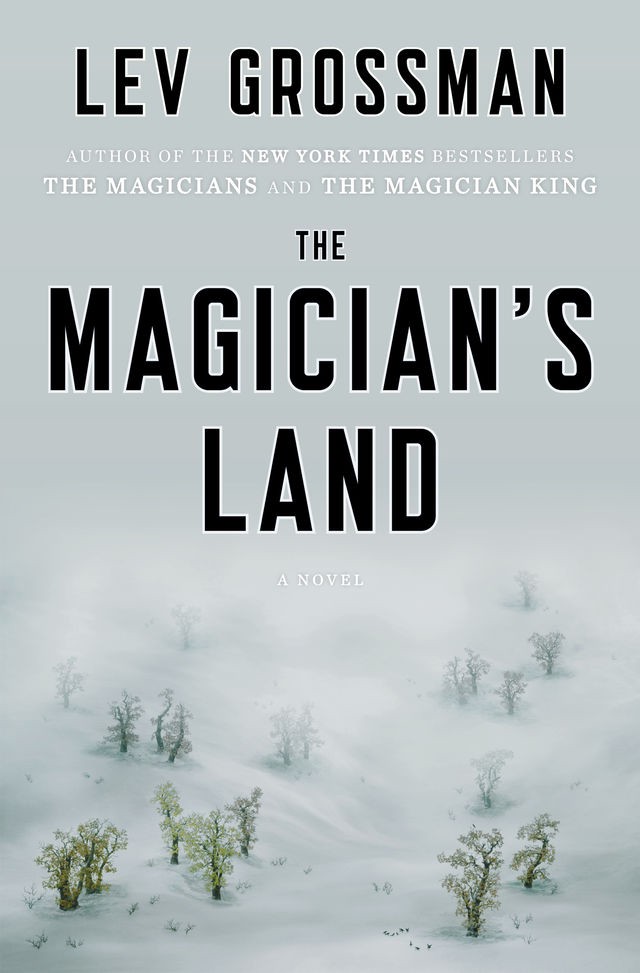
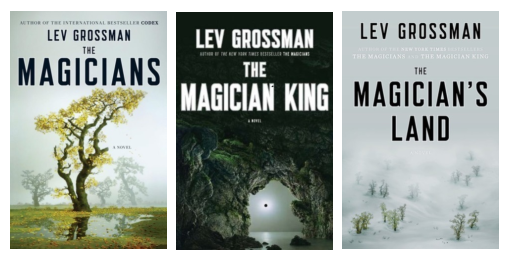
The tailer for the third installment of Lev Grossman fantastic Magicians trilogy is here, and it has a pretty literary star-studded cast: Neil Gaiman, Peter Straub, Terry Brooks, Rainbow Rowell, Gary Shteyngart, and more make appearances. The Magician’s Landwill be out this August. Check it out above.
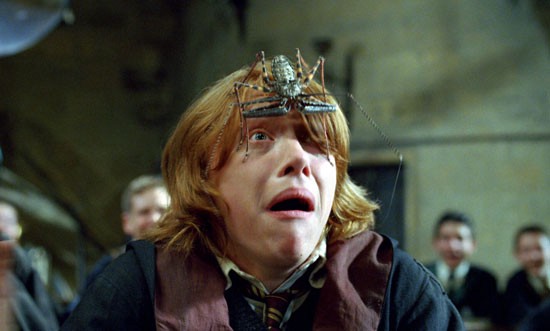
If you’ve been dying to read a story about what happens to Harry and Ron’s hair when they reach mid-30s — sporting “threads of silver” and “thinning slightly” respectively — you are in luck!
J. K. Rowling has just published a new story on her Pottermore website that checks in on our heroes in their adult years. Titled “Dumbledore’s Army Reunites,” the piece is written in the form of a gossip column. The adult wizards are caught attending a Quidditch match by gossip columnist Rita Skeeter. It’s the first time that Rowling has written about the characters since the epilogue of the final novel. Ginny is a reporter, Hermione is a rising star in the Ministry of Magic, Neville may have a drinking problem, and Harry has a new scar indicating he is top-secret Auror agent.
The piece is up on Pottermore, but only available to subscribers and currently crashing under the weight of fan traffic currently. You might need to wait to find out if Ron has a video game addiction, how large Harry’s potbelly has gotten, or whether Hermione “can have it all” as both a witch and mom.
Rowling says she has “no plans” to write further mid-30s Potter stories.
To celebrate it’s 20th anniversary, Riverhead Books is giving away three Little Free Libraries stocked with Riverhead titles. If you have never seen them, Little Free Libraries are small public libraries operating on a “take a book, leave a book” model. There are thousands of them around the country, but if your community doesn’t have one yet you could win one from Riverhead.
Two of the Riverhead libraries are already heading to communities, but Riverhead is accepting entries for the third. Five finalists will be picked by a panel of Riverhead authors: Junot Diaz, Dan Pink, and Emma Straub. The public will vote to choose the final winner. The libraries are designed by Art Director Helen Yentus and team.
In the beginning, before the Word there were the words in the beginning, a seeding from which nothingness gains form.
Before the first sentence of her laser smart, affecting, confounding, recalcitrant, infuriating, relentlessly stylish debut novel, Nobody Is Ever Missing, Catherine Lacey presents the entirety of John Berryman’s “Dream Song 29.” Berryman’s career is frequently reduced to the shaping forces of two monumental events: the gunshot suicide of his father and the poet’s own suicidal leap. In the first stanza of “Dream Song 29,” Berryman’s alter ego, Henry, assesses the eternal wracking of that first death, an undoing that forever changed the poet’s name and possessed such gravity that no passage of time could ever budge its crushing weight.
Lacey’s novel, too,begins with an absence — without a word, the narrator, Elyria, drops out of her life in New York, abandoning her home, her math professor husband, and her steady job writing for a network soap opera in order to pursue an off-handed invitation from an older poet, Werner, who amid casual discussion had made the type of if you’re ever in my neck of the woods offer that is commonly extended when no one ever comes to that particular neck of the woods: in this case, a homestead in the middle of nowhere on the opposite side of the world.
New Zealand.
Before swapping one “New” for another, Elyria’s adult life was shaped by the loss of her adopted sister, Ruby, a promising math prodigy who leapt to her death in a campus courtyard. The professor was the last person to see Ruby alive — he and Elyria met and found connection through the bond of this negation.
During the opening sequences of the novel, Elyria appears much like one of the female narrators in Laura van den Berg’s short stories, the competent women of “We Are Calling To Offer You A Fabulous Life” or “Up High In The Air,” women who are compelled by an urgent need to shed the burdens and trappings of their dissatisfying lives. There is such a buildup, such a nasty crust formed of one faulty decision crystalized atop another, that the only way to stay whole is with a clean break from the past.
What is your greatest fear? a clinician asks Elyria amid a battery of questions.
I did everything wrong, she answers.
The italics are Lacey’s: Eschewing double-quotes, all of the novel’s spoken dialogue is formatted with italics, infusing conversed words with a sense of remoteness and otherness while emphasizing the indeterminate passage of time between the events and their narration. Elyria’s voice is delivered from a distance that ranges from a few seconds to a gap of several years. Can standards of time or a notional future exist in a state of emptiness? Reading Heidegger, I got lost in being and haven’t yet found my way to time, but in the world of Nobody Is Ever Missing the past seems measured more by resonance and magnitude than temporal distance. Elyria only looks back — never forward — and from the limited “now” of her vantage point everything else is “then.”
“Being alone was what I wanted; being alone was not what I wanted. I didn’t want to want anything; I wanted to want everything.”
If you believe that storytelling begins with a character who wants and needs something and must face obstacles in order to get it, Catherine Lacey means to defy your expectations.
“Every questioning is a seeking,” Heidegger wrote in Being and Time. “Every seeking takes its lead beforehand from what is sought.”Elyria doesn’t simply seek to discard the clinging matter of her life; she wants to lose herself without holding any corresponding motivation to find herself. Though disdaining the hollow person she’s become in married life, Elyria is also suspicious of her core, feeling that deep down she has “a wildebeest renting a room in her.” Hitchhiking toward Werner’s farm, she sometimes suppresses this wildebeest nature and sometimes lets it snort. In her prior life, Elyria had imagined resolving arguments with her husband by stabbing herself in the eyeball or detonating an explosive in his head: Only the flimsy line of inhibition separates the instinct to horrific violence and the thrust for blood.
In the third and final stanza of “Dream Song 29,” Henry feels so unmoored that the only way he knows for sure he hasn’t lost himself to the animal state of a compulsive killer is by making a mental tally of all those close to him; “nobody is ever missing”in this reckoning, and that tenuous accounting is the only assurance he’s maintained a grip.
Somewhere in Henry is John Berryman (born John Allyn Smith, Jr.): the thread of identity. Richard Wright explored the severance of this thread in The Outsider, during which a depressed postal worker is beset by debt problems, marriage problems, mistress problems, booze problems, a mass of problems begetting problems until a way out presents itself: a fatal subway crash and a mistake identifying him among the dead. Relieved of his burdensome identity, cutting all ties to his past, the postal worker walks away from his old life and into an unbound freedom within which nothing prevents him from committing murder after murder:
“He had acted, had shattered the dream that surrounded him, and now the world, including himself in it, had turned mockingly into a concrete, waking nightmare from which he could see no way of escaping. He had become what he had tried to destroy, had taken on the guise of the monster he had slain.”
As she thumbs rides across New Zealand, one friendly Kiwi after another warns Elyria of the risks of being raped and/or dismembered by some crazed man in a van.
Men in vans offer Elyria rides. She accepts. They tend to be agreeable sorts. Wanting nothing but the minimum from others, Elyria tends not to be an acute perceiver of character; rather than generating friction through interaction or conflict with offbeat locals, Lacey creates momentum through sheer prosodic dexterity:
“It became clear after some hours of waiting on the narrow, tree-lined road where the nurse had let me out that some places are not good places to be a person and not a car and that was where I was; occasional cars sped around the road bend and I ended up frightening the drivers the way that wild animals do when they stand stunned dumb in a road. The cars would slow or swerve or honk and I wished I could honk back — I know, I know — why am I here?
Using short chapters to stop for breath, Lacey stacks clause upon clause with unerring rhythm, one of those glorious gifts that not everyone’s been given and guided by that fabulous inner ear she teases out assonances and upends predictable constructions, modulating her phrases with repetitions, inversions, and tautly-strung wit, the novel propelled by sentences that wind their way inward before springing back out with renewed velocity.
Also similar to van den Berg — and underscored by the equations chalked by Elyria’s husband — Lacey writes characters who often function in accordance with physical principles, creating a world populated by conduits and catalysts and voids, with universal laws acting upon relationships, movement, and the order of things. Elyria appears as something loose and negatively charged, briefly connecting to anything positive in a superficial bond that quickly degrades under the stress of her malaise.
Reaching Werner’s farm, Elyria finally finds a sort of precarious balance. She entertains no intellectual, sexual, philosophical, or psychological interest in the older poet; his casual offer seeded her decision to leave and in his presence she achieves a sustainable form of stasis. Sustainable for her but not him. Elyria’s elemental sadness weighs so heavily that he finally asks her to “remove herself” from his presence.
And here, at the midpoint of the book, Elyria is set fully adrift. Her initial leaving at least offered the orientating points of departure and destination; once “removed” from Werner’s farm, she has nowhere to be and neither the desire nor the means to get there. She sleeps in parks and eats from trash cans, occasionally accepting a kindly-offered meal or a temporary shelter before shuddering loose and wandering again.
“I hiked up a path and into the woods, thinking about and almost having a real feeling — a feeling like, this is really sad, this is a sad place to be, a sad part of my life, maybe just a sad life. The woods were not particularly beautiful. I was not impressed by the trees.”
Offering a lay psychoanalysis of a fictional character is — at best — foolhardy, but as Elyria’s emptiness grows and acts upon itself she offers the reader an intensely-realized view of depression, where nothing positive seems possible and the defiance of help is an insidious, self-perpetuating aspect of the pathology: Were Elyria capable of accepting a helping hand to boost her toward a more satisfying way of being, she wouldn’t be stuck in such a hole in the first place.
The novel can feel like picking up a child when they’ve gone deliberately boneless, a passive disembodying through which they actively become heavier, their entire mass nothing but displaced resistance, and as they flop and sandbag you become increasing frustrated, muttering curses you swore you wouldn’t voice and laboring against that deadweight, forced into being someone you didn’t intend to be simply in order to move from Point A to Point B. In this manner, a smaller body is able to exert control over a larger one. This “child” metaphor is not a paternalistic infantilizing of either author or narrator; within the novel, the notion of “growing up” or existing as a grown-up is a recurring concern, and in-keeping with her character, Elyria at times idealizes, and at other times wishes to transcend, a child-like existence. Elyria was 22 when she married, with her husband a decade older and possessed of an array of independent life experiences she feels she lacked:
“What I meant was I knew I had to do something that I didn’t know how to do, which was leaving the adult way, the grown-up way, stating the problem, filling out the paperwork, doing all these adult things, but I knew that wasn’t the whole problem, that I didn’t just want a divorce from my husband, but a divorce from everything, to divorce my own history.”
Elyria’s inability to settle into the adult world is largely bred by her unwillingness to say what’s on her mind. In her interactions, what she wishes (or imagines) she had said and what she actually does say consistently diverge: steering mightily from conflict, Elyria is left further and further from herself, further and further from the words of hers that act upon the world, the words that define her to those in the world around her, leaving her stuck between the interior world of the unsaid and the exterior world of unmeant compromises and capitulations.
In an essay “Against Bless-Your-Heart Manners” published earlier this year at Guernica, Lacey wrote about the “paralyzing politeness”that affects residents of the South, with “the tradition of courtesy and avoidance at all costs” inhibiting the advance of social progress. While arguing for the need to forgo tidy niceties in favor of candid speech, the essay proper is paired with a sidebar of off-the-cuff footnotes, a reflexive, reflective id in which the author speaks far more freely than in the body of the text.
Some things are easier done than said.
While still at the farm, Elyria asks Werner why lambs give up so easily when it’s their time to be slaughtered: “They are not giving up, he said. They are just being polite.”
In Wright’s The Outsider, a woman who fell in love with the ex-postal worker ultimately leaps from an apartment window when she realizes she gave herself over to a man who contained such a terrifying void. Her name is Eva; his, Cross:
“She had fled from him forever; she had taken one swift look into the black depths of his heart, into the churning horror of his deeds and had been so revolted that she had chosen this way out, had slammed the door on her life.”
Because Elyria wants nothing, and nothing is capable of causing her to change, Lacey is forced to find new ways of saying the same thing over and over. From this absence she pulls at strand after strand of remarkable prose, but a time comes when matters grow more dire and emptiness threatens to collapse on itself and yet above it all Lacey continues to pull more colored streamers from her sleeve. Time may or may not be real, but pages are, and the more she pulls, the more those silks begin to seem purple and frayed: Through repetition and exposure, terrific artistry can take on the appearance of mere legerdemain.
Following the epigraph of “Dream Song 29,” Nobody Is Ever Missing begins with an immediate grabber of an opening line, the first of many: “There might be people in this world who can read minds against their will and if that kind of person exists I am pretty sure my husband is one of them.” This dynamic lead indicates a time when her husband suspected Elyria was about to leave; only thereafter, for the entirety of the book, neither she nor her husband suggest he had any sort of involuntary ESP, as both continually operate from the perspective that he was utterly blind-sided by her sudden disappearance.
Can an object define itself from a false beginning? Or does that untrue step cause a thing to forever lose its way?
Elyria’s narration proves unreliable both from the pitfalls of her memory and psyche as well as the inconsistency born of sentences that shimmer beautifully but often don’t sync with the internal logic of their fictional world. The novel’s principal flaw and principal concern are one and the same: the inability to remain grounded in what came prior.
Looked at from a certain angle, this may not be a flaw at all.
As a seed of disharmony in their relationship, on their honeymoon Elyria’s husband tells her that she has “two options” with regard to how she can engage with her feelings. Elyria seethes under this binary, determined to prove that a galaxy of options exists. As the novel progresses, as Elyria fully removes herself from the mores and memories of her past, the existing narrative is left with only two possibilities: she will, or she will not. The irony and tragedy is that whichever arc she pursues, both come full circle to an identical end.
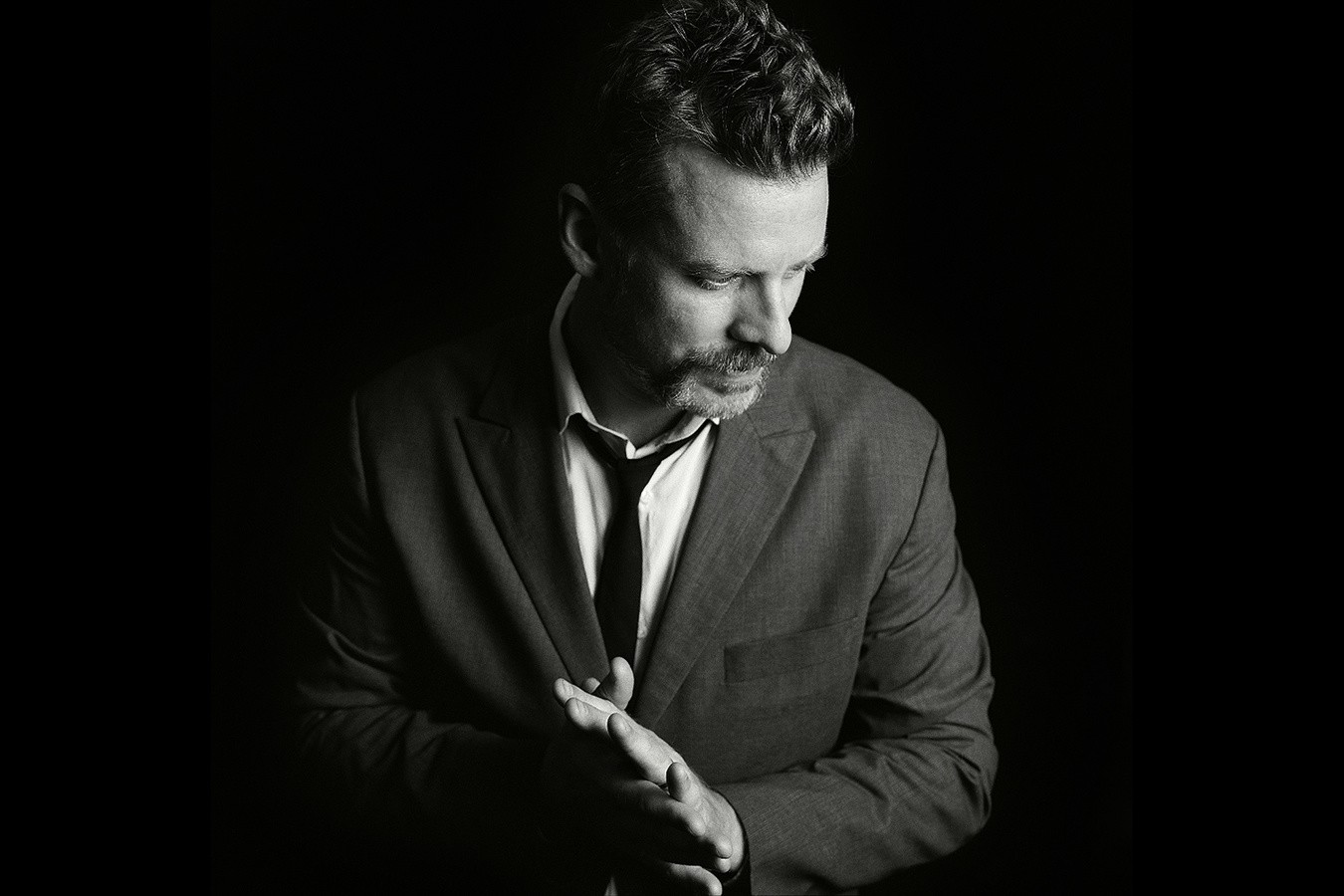
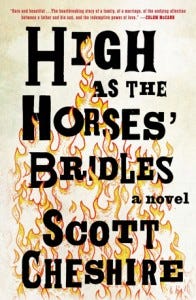
Those who know Scott Cheshire know the sort of decency he exudes, a kind inseparable from that of a searcher who has seen the precipice and taken true gauge of its depths. High as the Horses’ Bridles is a torrential debut novel. It’s bold. It’s substantive. It’s formally inventive. From within the whirly circles of the NYC literary scene, it can sometimes appear that writers shun serious treatment of the day’s banner subjects, those scrolled across the country at large, even one as wide and clear and pervasive as evangelical Christianity. Are we daunted? Over the span of centuries, stories have a way, it seems, of slipping into religious texts and leaving their individual authors behind. This past Father’s Day (apropos, it turns out, for High as the Horses’ Bridles), I had the distinct pleasure of chatting by email with Scott. We talked the Book of Revelation, humor, rewriting, and what science and faith might have to say to each other. — J.T. Price
J. T. Price: In the mode of Galifianakis, I’ll start by asking, Why horses? Why a novel about horses?
Scott Cheshire: I have never heard of this Galifianakis. I assume he’s a lesser Greek poet, or something…
JTP: Yeah, renown for a collaborative epic poem called The Hangover…
SC: It’s actually a very good question. I never set out to write a book with “horses” in the title, and while I did write a book in which there are horses, it’s certainly not about horses. It’s about a troubled family, and it’s about religious legacy, a struggle with faith, and the difficult reuniting of a father and son — all of that, and yet the kernel of all that drama is an apocalyptic vision the son, Josiah, has, as a boy. The vision of a horse. Something I’ve not yet really considered, I guess, is why the vision of a horse?
JTP: If you don’t mind… I’ve actually got a page marked, from the later stages of the book. (Breaking the Galifianakis mold…) This is the estranged wife of the protagonist asking the same question: “But why horses? Why not as high as tank treads, if this is supposed to impress me? Or high as a Chevrolet’s side mirrors, and for two thousand years the faithful are wondering, What’s a side mirror? What’s a Chevy?”
SC: I like to think it’s a funny book, and maybe those lines give a sense of that, so thanks for bringing them up. I guess the answer to all this is partly the wonderfully anachronistic image of a warhorse. I mean, if there is a Second Coming it somehow makes sense that it would happen via horse, a great white horse. And yet horses also suggests a woefully ill-prepared return to battle. At least, if you read the image literally, which most believers do. That’s the fascinating and self-defeating essence of prophecy: it’s of its time, so it dates.
As far as giving the book its title, there were a few contenders.
Flannery O’Connor says: “The only way to learn to write short stories is to write them, and then try to discover what you have done.”
I would dare go a bit further, and say it’s not only how I learned to write, but it’s how I will always write. I write, and only discover what’s there afterward. In this case, I discovered horses, among other things. They figured in the book in a sort of mysterious way, even for me. Plus it’s a damn good phrase, and I can say that because it isn’t mine. It comes from Revelation.
JTP: Now, as psychoanalyst or self-realization guru: how greatly did the Book of Revelation shape your own childhood, your expectations of the adult world? How fluent are you with it now? And did you find yourself returning to those pages while writing High As The Horses’ Bridles? How did those successive returns feel?
SC: Revelation looms large for me, always has since childhood. We read and studied it weekly at church, probably more than any other book. And for that I guess it gave me a rather apocalyptic perspective on the world. More than most, I guess, but not nearly as much as some.
Harold Bloom has a good book about American Christianities (of which there are many) called The American Religion, and in it he calls Revelation “the preferred text,” for some sects. He also calls it a “nightmare of a book.” He’s right on both counts, but I also think he sells the book way short. Nightmares come in all forms, and Revelation is one to which we all collectively and perennially return. And I do mean all of us. There’s something disturbingly attractive about the violently apocalyptic endgame scenario.
JTP: Sort of the Reservoir Dogs, video game final level, ‘guess I’ll end the novel in a melee like Bonfire of the Vanities’ phenomenon? The Book of Revelation being a foundational text in that regard…
SC: Absolutely. There is something gloriously and strangely legitimizing about it. Before I started the book, I hadn’t looked at Revelation for years, decades, even. But at some point I realized it was in some ways the book from which this novel comes. And so I had to return to it, reconsider it, and re-familiarize myself with its pages. I found the best way to do that was to immerse myself in the history of the book, remove it from its contemporary cultural trappings — which incidentally have almost nothing at all to do with the genesis of the work.
JTP: You’re reminding me of an excellent essay of yours on the subject…
SC: Well, thanks for saying that. Writing that essay was difficult, mostly because it was the first time I tried to honestly ask myself the question: why am I writing this novel? I had deliberately buried myself in the work of a few modern scholars, studies of American religious history, eschatology, and the ancient apocalyptic form. My shelves are stuffed with them. Writing the essay felt like the first time I’d come up for air. At some point I realized, wait a second, Revelation is basically just a dream. It’s a dream of vengeance and reward, at its core. And I get that. I think we all do.
JTP: Apocalypse fiction is hot (or is it cold?). Some of the contemporary treatments are fantastical or readymade allegories, while others provide much more disturbingly plausible scenarios. In contrast, your novel feels like a kind of patient zero study, one that parses underlying sources of doomsday visions, in both their individual and collective form. The wild world-historical impossibility of the question aside, what is it about visions of apocalypse that won’t leave us — I mean, the human species — alone? Dogs, for example, probably don’t have the same preoccupation. Although I guess I can’t be sure.
SC: This is the big question, isn’t it? Why? I think the answer is pretty simple: it makes sense. That is to say, it makes time itself make sense. It gives existence narrative form. Closure. It’s no accident the Bible ends with Revelation. Any first year MFA student would say, I think, End it here.
JTP: Or there’d be a comment, ‘Um, the tone shifted here a bit and made me feel kicked out of the story…’
SC: Yes! Or something like — I get that He’s out to end the world, and all, but I don’t know what He really wants, you know?
The ancients used to write these stories and deliver them aloud during wartime, including Revelation. It was therapeutic.
And who doesn’t like a little drama? A little blood? Apocalypse is the über-action scene. And I for one love those movies, even the bad ones. They get my cash every time.
In my book, apocalypse works just this way for Josiah’s father, who desperately wants it all to make sense, especially after losing his wife. And when she passes, that apocalyptic longing is entirely domesticated. He tries to bring it on himself, within his very own home. It should also be said that, in the classic sense, the End is essentially just the Beginning. Even Revelation ends on a note of hope. The Future will be Better. Next time! And this can be comforting when you lose a loved one. As far as Josie, well, I think he’s trying to dismantle the apocalyptic mindset. And it’s hard. As far as dogs: my pug, Olive, I pray fears nothing at all.
JTP: Josiah Laudermilk, aka Josie, your protagonist: where did you find him? A Queens-raised childhood biblical prodigy turned successful young California beach-town entrepreneur. When we make his grown acquaintance, he is flagging on multiple fronts: romantic, familial, and, prior success aside, professional…
SC: Well, it might seem exotic to some that I was a kid preacher, but in that community everyone was expected at some point to preach and deliver sermons, especially the boys. So it seemed natural to me to use that history, and it weirdly made sense for the reader. I wanted the opening scene to feel grand and new, and less and less alien for the reader. A young boy on the occasion of his first large-scale sermon would experience the scene in just that way, hence young Josiah.
JTP: It’s interesting, that scene, I felt almost like we were inside the mind of the adult Josiah as he attempts to reconstruct this incredibly powerful experience from his childhood in minute detail. The sense of time passing slows down…
SC: Oh man, I love you saying that, because that is exactly how I imagined it. In fact, as far as I’m concerned that whole first section is a first-person narrative. “First-person removed,” we’ll call it. I think I just invented a newish perspective. That whole section is a movement from third to first, from “them” to “me.” It embraces the other. He’s claiming his personal history.
On the other hand, making the leap to adult Josiah was difficult, for lots of reasons. One being: how do you make something not happening (the end of the world) dramatically interesting? And can it sustain a whole book? And so I started thinking about the thousands of people whom every time are disappointed by yet another failed religious End Times prophecy — which happened recently, in 2011, with Harold Camping and his followers. That whole non-shebang definitely played a part in why I wrote the essay you brought up earlier. Of course, for lots of believers it’s simply a matter of reworking the numbers, and deciding on a “more precise” date. But for others it means the end to their faith, and what a terrible and conflicted sense of disappointment that must be. To me, that was an interesting problem. How do you un-know what you thought you knew? Josie (no longer Josiah) attempts to un-know, and he grapples with and reads the physical world as he becomes newly accustomed to it. He made me see the daily world around me in brand new ways. It was a thrilling perspective to write from, and not entirely unfamiliar.
JTP: The story unlocks in the manner of a nesting doll: one enormously pivotal scene opening to reveal successive stages in the lives of Josie and his family and friends. Over the novel’s course, time seems somehow to both advance and retreat while the narrative layering deepens. I wonder if you could talk a little bit about the structure?
SC: The structure of the book was absolutely its most difficult aspect. I wanted to figure out a way of denying the book a linear narrative because I felt that otherwise it would be too sympathetic to the apocalyptic model of time. Beginning. Middle. End.
The middle section, called “The Ends,” at some point started taking on a circular shape, constantly doubling back on itself, which if I’m honest is closer to how I experience the world, anyway.
The past and the immediate past are always alive in the present, and I’m ever trying to reconcile the two. Josie experiences the world in just that way, constantly circumnavigating what it means to be alive at any given moment. It also became a way of creating dramatic tension, casting Josie in the “now,” with few cues to the reader of how he got there. The last thing I wrote was the closing section of the book and yet it might be called the beginning proper of the novel. We go back in time and place. Which ultimately felt right, making the whole book something of a circle.
JTP: For all the gloom and foreboding suggested by your big subject, there is no shortage of humor or emotionally articulate exchanges to accompany the darker atmospherics. Even the most desolate of occurrences (and, yea, desolation there is) seems informed by almost its opposite. Does this sort of sensibility approach a world-view?
SC: It is, for me anyway, and for the longest time the book did not reflect that. It was much darker, or at least as dark with very little comic relief. And then at some point I gave the manuscript to my friend Alex Gilvarry, who is not only a fantastic novelist, but also one of the funniest writers and people I know. He read it and said, “You know in real life you make me laugh, you’re funny. But this is not funny. At all. You should make it more like you.” That changed the book tremendously, and I might even say changed me as a writer. I let Josie be both morbid and funny. A good mix, I think. I mean life is funny — and sometimes it’s ugly, sad, tragic, and painful, but also funny. Maybe it’s my way of dealing with the world. William James says a fundamental difference between the religious and the non-religious is their respective relationship to the universe. The religious agree with it. The non-religious agree to it.
JTP: At one with the flow versus making an idiosyncratic path despite it? Or is that too simplistic?
SC: Not at all. The lazier critical take on the apocalyptic perspective is “they’re just doing what they’re told.” But it’s a perspective on the world that takes a lot of deliberate mental work. As far as I’m concerned, I’m of the latter persuasion. I agree to it all, yes, but reluctantly, and not without laughing.
JTP: I’ve read a fair amount of fiction and watched with dispassion as the epiphany, James Joyce-model, goes in and out of style. If I may say so, you have achieved some higher-level proficiency with the dramatic epiphany. Josie, it seems like, is capable of experiencing epiphanies within epiphanies. What I mean to say is you dramatize the need to believe with remarkable acuity. How about that?
SC: I like it! And I assume you know that super essay by Charles Baxter, “Against Epiphanies,” in which he says if life were truly like most American “literary” fiction then it must be the case that people all over the country are struck with epiphanies all day long and everywhere.
JTP: Yes, great observation from a great essay.
SC: This is palpably not the case.
How many epiphanies have I had in my life thus far? Any? Maybe one.
And even that one came on more like slow-heating water just about to boil a frog. All of a sudden, it hit me — so I jumped before the situation killed me. The formal literary epiphany, The Wonder Years-like sudden realization occurring on a regular basis does not resemble any conscious reality I know of. And yet there is something to the consciousness of a person who tries to be alive to every moment as he can. This inevitably fails, sure, but it’s still a viable, if unsustainable, tack. This is Josie’s mission, and it’s a classically apocalyptic one, which, lest we forget, comes from the Greek for revelation, “a removing of the veil.” Which sounds a hell of a lot like epiphany. The difference being Josie’s attempt is deliberate. The classic and not always believable literary epiphany is accidental. It suddenly just happens. It’s pretty passive. Josie, on the other hand, is actively looking for ways to make the physical world around him deliver a new experience, to learn from it. This is how he hopes to redeem himself, I think, in the eyes of his business partner, his ex-wife, and his father.
JTP: A semi-obscure writer once wrote, “A novel might be the brilliant lived sermon that found no root in organized religion as currently composited.” Is there anything to this theory, do you think?
SC: I believe the writer is Price — J. Now him, I’ve heard of. And I’ve actually read the article, more than once. Why? Because a question I’ve been taken with for many years is at the heart of that lovely phrase. You often hear people, usually non-religious people, say things like ‘Love is my religion,’ or ‘Music is my religion,’ even ‘Food is my religion.’ And of course I’ve heard writers say ‘Writing is my religion.’
JTP: ‘Baseball is my religion.’ ‘Used bookstores are my religion.’ ‘The internet is my religion.’
SC: And more to the point: why does this get my goat? I think it’s because it seems too easy a way out of having to debate a subject or answer a question directly. It’s a way to avoid thinking about what you actually think.
JTP: You mean in the sense that by switching out the context, whatever is under discussion suddenly melts into air?
SC: Exactly. But I’m also inclined to agree. If, as James says, the religious agree with the universe, well, there is little better way to agree with a universe, or a even a world, than to write a novel. Hell, you’re creating the thing. That is a godly move. Not to mention all the ritual that generally goes with writing. Most of the writers I know are ritualistic, which is not to necessarily say disciplined. I have rules by which I write (when I write, when I don’t), rules for what I do before and after I write. I have totems. These are all religiously inflected inclinations. Perhaps the least religious aspect of writing is the solitude. There is no community, at least not involved in the act of writing anyway. In this way the public reading, especially something like the marathon readings mentioned in that piece, do resemble a religious service. It’s communal. Then again, James famously defines religion as “the feelings, acts, and experiences, of individual men in their solitude, so far as they apprehend themselves to stand in relation to whatever they consider the divine.” Solitude! And if that doesn’t sound like a writer I don’t know what does. You see my problem here.
JTP: There’s definitely a tension. Published in 1941, Virginia Woolf’s final novel Between the Acts explores the overlap between faith, technological progress, and the performing arts in a small town theatrical production, a play meant to reprise the entirety of Britain’s history in the shadow of WWII. As the show on the village green approaches the modern moment, an audience member observes, “It’s odd that science, so they tell me, is making things (so to speak) more spiritual…” This observation also appears key to the thematics of High as the Horses’ Bridles… I should note too, that Woolf complicates things, true to form, by having another attendee remark, “If one spirit animates the whole, what about the aeroplanes?” (Aeroplanes. Why did people ever stop calling them that — and in what spirit?)
SC: I hear you. It’s a very pretty word. And I have not read the book, but I will, so I can sound smarter the next time I’m asked this question. I will say this, though, about the notion and the apparent dichotomy between science and spirit: it’s all about wanting to know, wanting to transcend the known limits of humanity, as such, and reallyknow, you know? I remember reading William Gibson’s Neuromancer and thinking, ‘all of this comes from Revelation.’ Even his physical description of cyberspace I’m convinced was artfully stolen from the Bible. As technophilic as that book is, and yes it’s sort of the extreme example, it uses the very skin it claims to slough off and tells pretty much a story of religious spiritual ascent. Very strange. As far as literal science, well, it’s certainly taken on some new dimensions that present a more supernatural picture, no? Other dimensions. Other universes. Other types of time. Frankly, I think it’s a terrific time to be alive, and the things we learn every day, even a mere glimpse at deep-space photography, or a short article on quantum physics for a layman like me, outstrips and outdoes the very dated notion of God so many cling to. That old God is actually not enough to contain what we know about the universe. Maybe it’s high time we redefine God, or better yet leave the idea indefinable, which seems better suited to the idea of God to begin with.
JTP: Today is Sunday and also Father’s Day, which seems somehow apropos in light of your novel’s principal themes. The fraying and mending of a father-son bond, specifically in regard to religious identification, comprises the crux of the story. Where does June 15th, 2014 find Scott Cheshire?
SC: This is a deeply personal question and I welcome it. Here is where I am: I’m in my living room, answering these lovely and thoughtful questions, happy to have a reader take my work seriously. After all, that’s why it’s there. It’s my opening gambit in what I hope proves to be a good and long conversation. My wife is out for a run. The pug is asleep by the air conditioner. Snoring. And I spoke with my father just a few hours ago. He is reading my book right now and is reading, he tells me, every page twice. Once so he can hear my voice, and, once again, so he can follow the story. I think that’s beautiful, and I thanked him for it.
For a long time I was afraid to send the book to my dad, or my mom for that matter. There was the typical fear of the first novelist.
Will they understand this is not about them? That it comes from me, yes, but it’s not me? But I was mostly afraid because of the subject matter. My parents are deeply and proudly religious, as they should be. And so I feared a book that examined one facet of the American religious life would offend. It did not. It does not. I asked my father if he remembered the story of Jacob wrestling with the angel. I said writing this book was my wrestling with angels, if that makes any sense. He said of course it did. And then he said I’d made them proud.
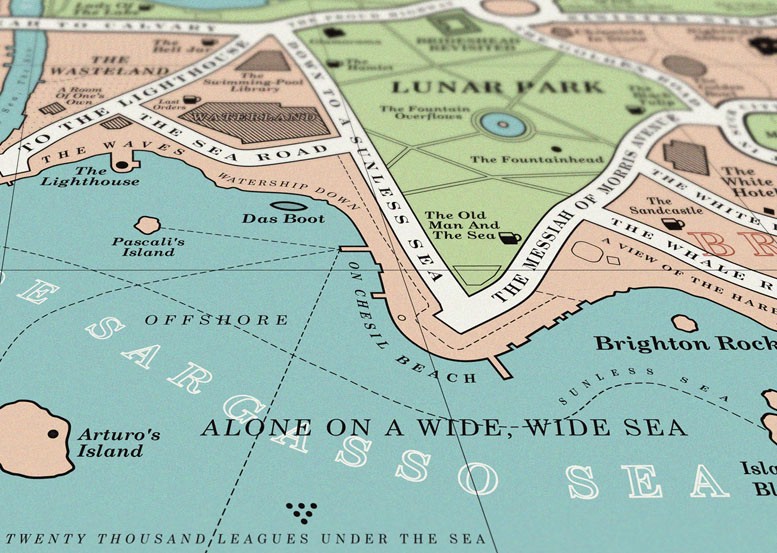
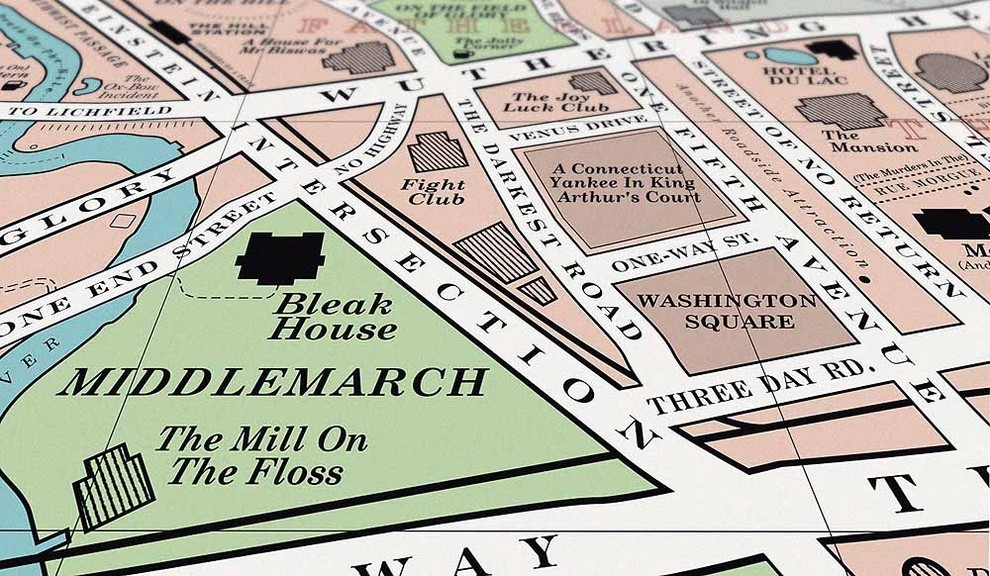
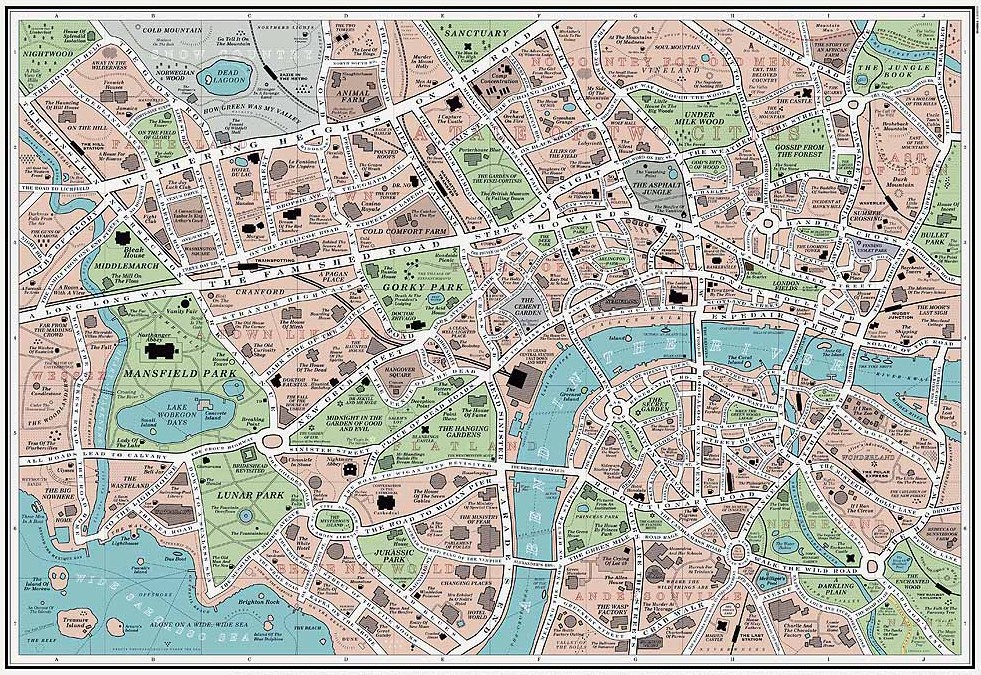
A few days ago we posted this imaginary map of a city where every movie takes place, and luckily there is a literary version too! This map doesn’t include every novel, obviously, but it does include literary locations from “over 600 books from the history of English Literature (and a few favourites from further afield).”
In this bookish city, Animal Farm is a farm off of Wuthering Heights road. The park system includes Lunar Park, Jurassic Park, Mansfield Park, and The Asphalt Jungle. You can go hiking At the Mountains of Madness and Cold Mountain, or take a dip in Dead Lagoon.
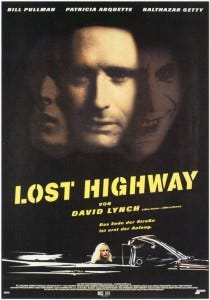
There’s a scene in David Lynch’s 1997 neo-noir head-trip Lost Highway thathas Fred (Bill Pullman) taking down shots at a bar in the midst of a party when a short man with black hair and insanely staring eyes, his face painted with Kabuki makeup (played by real-life acquitted murderer Robert Blake and credited as “Mystery Man”) approaches him through the crowd. The sound cuts outs but for their voices.
Blake: We’ve met before, haven’t we?
Pullman: I don’t think so. Where was it you think we met?
Blake: At your house, don’t you remember?
Pullman: No, no I don’t. You’re sure?
Blake: Of course. As a matter of fact, I’m there right now.
To prove it Blake proceeds to take out his cellphone, encouraging Pullman to call him. When Pullman does, Blake’s voice picks up on the other end before emitting a surround-sound cackle that comes from both the Blake at the party and the Blake at Pullman’s house, jolting the audience from its trance of unease into terror. That the best scene in Lost Highway is also one that speaks forcefully to its major theme of surveillance is convenient for my purposes here. Lost Highway is an underrated movie by Lynch, I’ve come to think, yet just like all of Lynch’s movies it traffics in identity switches, inexplicably malevolent supernatural figures, female sexuality with teeth and the transcendental meditation-inflected pacing which is the director’s trademark. The film takes its anchor in two intersecting yet also directly abutting storylines; one of them involves the tortured marriage between Fred, a jazz saxophonist (played by Pullman) and his cuckolding wife, Renee (Patricia Arquette), while the other follows the embroilments among a car mechanic (Balthazar Getty), a rage-aholic mobster (Robbert Loggia) and the mobster’s moll (also played by Patricia Arquette) who may or may not be Renee’s infernal double. The story begins with Fred and Renee living in their modern and dimly lit LA home, where they start to receive a series of sinister videotapes that show, by way of fuzzy tracking shots, the front of their house, their living room, their sleeping bodies. The aura of someone scrutinizing Fred and Renee’s every waking breath Lynch underscores with his wandering and casually invasive camerawork, often with a blood-red curtain lurking just beyond the shot. Angelo Baldamenti, Lynch’s soundtrack man, lays down a haunting, electronic overlay, alongside guest appearances from Nine Inch Nails, Marilyn Manson and David Bowie. The tone of the film is a testament to Lynch’s playful and ever-evolving relationship to genre, specifically his love of pulp; you’d be hard-pressed to find a pulpier figure than Robert Blake’s incessantly questioning angel of destruction or a pulpier circumstance than the decaying marriage of a nightclub saxophonist to a smoky-voiced femme fatale.
Lynch’s genre bending and meta-textuality underscores the thematic concern of surveillance.
The film’s as aware of itself as a film as its characters are of the forces that watch them. A sort of schizophrenia begins the show amid the reels as the movie’s conventions part ways with themselves. As matters between Fred and Renee arrive at their culmination, there is a shift in the film that starkly divides the first movement from the second — the saxophonist, Fred (Pullman) turns into a completely different person, the mechanic (Balthazar Getty) — and gleefully logic begins to unravel as Lost Highway takes off in a second direction with lingering echoes that presage the first: Patricia Arquette, now a blonde gangster moll; the imp in Kabuki face paint from the party. As you are watching David Lynch, there are no answers by the end. The mechanic turns back into the saxophonist and as the film concludes vice-versa. But no matter how much their identities shift the two men stay, at root, the same. They are passive and prideful and, as the film builds, capable of committing or being complicit in nauseous-making acts of violence. Surveillance comes to mean far more than a man at a party or strange VHS’ but in itself an act of violence that tears one asunder from one’s truest self.
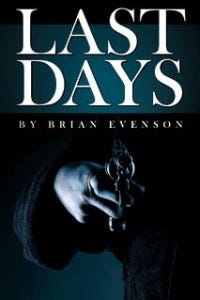
THE TORSO: Last Days by Brian Evenson (2009)
A similar upheaval of personhood takes place in Brian Evenson’s 2nd novel Last Days (also a neo-noir with pulpy splashes of Gothic horror)in which a mutilated P.I., Kline, reminiscent of Dashiell Hammett’s Continental Op from his gangland novel Red Harvest (1929), finds himself a subject of surveillance among the ranks of a cult that functions on the principle that limbless-ness equals godliness. As early as page 1, Last Days reckons with the alienating wages of surveillance: “It was only later that [Kline] realized the reason they had called him, but by then it was too late for the information to do him any good. At the time, all the two men had told him on the telephone was that they’d seen his picture in the paper, read about his infiltration and so-called heroism and how, even when faced with the man with the cleaver — or the “gentleman with the cleaver” as they chose to call him — he hadn’t flinched, hadn’t given a thing away.” That “reason,” forebodingly alluded to by Evenson in the novel’s opening sentence, becomes somewhat of an existential red herring over the course of Last Days as
Evenson embarks his anti-hero through a rat’s maze of double-crossings, metaphysical trapdoors and many, many murders.
At the outset, Kline is called upon in his infinite bad-assery to investigate the murder of the cult’s founder Aline — after losing his arm in a scuffle right before the book picks up, Kline self-cauterizes the wound on a hot-plate. And while the real reason that he was recruited continually escapes his grasp, Kline’s M.O. diverts from the mystery at hand to wanting no more than to be left alone. Herein lies Evenson’s mordantly funny nod to Red Harvest — the Continental Op, too, wants only to be left in peace — his Lynchian existentialism and his tongue-in-cheek approach to the theme of surveillance in the novel. While the justifiably paranoid “they” who are tracking Kline’s every movement in Last Days — and who find their rhyme in Blake’s Mystery Man from Lost Highway — are possessed of a set of lofty, hierarchal ideals deriving, in part, from the Bible (“And if thy right hand offend thee, cut it off, and cast it from thee: for it is profitable for thee that one of thy members should perish, and not that thy whole body should be cast into hell”) Kline fights toward a goal no loftier than the basic human need for restful solitude. As this prospect is withheld from him with escalating sadism, a split occurs in both the character and the plot of the novel similar to that which takes place in Lost Highway between the saxophonist and the auto-mechanic, between causality and chaos. Kline, no more passive than Pullman or Getty in the hostile world of Lynch’s film, is driven to commit an operatic act of violence of which, when Last Days begins, the reader may not have imagined him capable. “If I use only one clip,” Kline ponders in the pages leading up to the novel’s grisly climax, “…maybe I can still come out of this human.” But Kline speaks truer than he knows. What’s at stake in the novel, finally, is neither Kline’s desire to be left in peace nor the riddle of what happened to Aline but Kline’s personhood, as it’s been all along. Kline’s loss of self-sovereignty to the surveillance and manipulation of the cult drives drives him to reclaim it by unspeakable means. At the end of the novel he’s more than he was: an instrument of “holy wrath.”
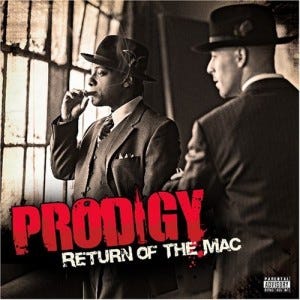
THE LEGS: Prodigy’s Return of the Mac (2007)
Prodigy (formerly of Mobb Deep) composes an elegy to surveillance and paranoia in the rapper’s 2nd solo albumReturn of the Mac. Loosely grouped in with the brief horror-core craze of the early 90’s alongside Gravediggaz and Flatlinerz, Prodigy pick-axes into incisive psychological ground on this East-Coast-pride themed record where the beats are damn dirty, the lyrics relentless. On one of the album’s singles, “Mac 10 Handle,” Prodigy raps: “I sit alone in my dirty ass room starin’ at candles/ High on drugs — all alone wit my hand on the Mac 10 Handle/ Schemin’ on you niggas…
By myself in my four-corner room watchin’ Hard Boiled, I feel like I’m crazy… They got eyes in the sky, we under surveillance… Gotta watch what I say, they tappin’ my cell phone
/ They wanna sneak and peek inside my home/ I’m paranoid and it’s not the weed/ In my rearview mirror, each car they follow me…” As though the reference to John Woo’s Chinese shoot-em-up Hard Boiled (1992) weren’t testament enough, Prodigy and so much of horror-core hip-hop wallows unabashedly in pulp noir and various other forms of genre experimentation. One need look no further than the schlock-celebratory video for “Mac 10 Handle,” in which a shirtless and prodigiously tattooed Prodigy, well, sits “all alone in [his] four-corner room” surrounded by occult candles and the grim debris of prolonged intoxication, washing his corn-rowed head in his hands in between bouts of loading his clip and stabbing the cushions of a couch that gushes real blood. The video even contains a cameo appearance from cinematic boogeyman Michael Myers alongside images of a snake burrowing through the ocular cavities of a human skull and a Halloween-mask Satan enticing Prodigy to “put some work in.” And this he proceeds to do, cruising his car around Queens while scanning the street for real or imagined enemies, his face in a rictus of kinetic alertness that recalls Kline’s take-no-prisoners massacre at the end of Last Days or Pullman/Getty’s bloody dash for redemption in Lost Highway. And yet the paranoia and surveillance that pervades the song — and the record as a whole — has roots in the real world as well, specifically the East Coast-West Coast criminal one-upmanship of the mid-to-late 90’s which tragically took the lives of both Tupac Shakur and Biggie Smalls, and Prodigy’s own rocky Queens upbringing. By juxtaposing the effects of real with imagined violence on Return of the Mac Prodigy seems to be suggesting a split in his own fictionalized consciousness similar to that which Pullman/Getty and Kline experience in Lost Highway and Last Days. He’s aggressive one moment and tender the next; he’s cocksure, forceful, scared as hell. Over the course of the album, surveillance and paranoia have the sum effect of worrying away the rapper’s personhood, reducing him to something blank to which his most immediate circumstances affix themselves — in “Mac 10 Handle,” an unsavory diet of spliffs, murder films and jugs of Henny. As Prodigy raps on the album’s other single, “Return of the Mac, aka New York Shit,” “Heard ya workin’ with the D’s, you a New York snitch/ I’m tryn’a make a hundred mil’, that’s New York rich/ Back an’ forth to Philly with these New York bricks… I got eleven Mac 11’s, thirty-eight .38’s/ Nine 9’s, ten Mac-10’s, this shit don’t end…” The compulsively violent and utterly isolated ceaselessness of Prodigy’s condition on many of the songs on Return of the Mac is the scariest thing about it. In many ways, Prodigy seems to be attempting to extract the gangster lifestyle from its diamond-encrusted cultural context; it’s as much as process of de-glamorization as it is one of de-familiarization — “Too much of that gangsta music,” raps Prodigy in “Mac 10 Handle, “nah this reality rap/ I really go through with it…”
And so while the characters from <em>Lost Highway </em>and <em>Last Days</em> come under surveillance by unknowable forces, the forces compromising Prodigy are utterly banal — his rivals, his lust for cash-money, himself.
The prison of the self at last — say, a “four-corner room” where we all sit “starin’ at candles, high on drugs” — amounts to surveillance at its furthest (or shortest, as it were) conceivable tether. The one pair of eyes you can never escape is looking at this screen right now.
Alternative Cuts:
Reflections in a Golden Eye by Carson McCullers (1967); Blood Simple dir. Joel & Ethan Coen (1984); The Wilding by Benjamin Percy (2011)
Jealousy by Allain Robbe-Grillet (1957); Caché dir. Michael Heneke (2005); Marcel Duchamp’s Étante Donnés (1946–1966)
The Untouchable by John Banville (1998); Tinker, Tailor, Soldier, Spy dir. Tomas Alfredson (2011); The Pogues’ If I Should Fall From the Grace of God (1988)
The Lives of Others dir. Florian Henckel von Donnersmarck (2006); Pulp’s This is Hardcore (1998); Thomas Mann’s Death in Venice (1912)
If you are in London this summer, be sure to check out Books About Town’s 50 literary benches spread throughout the city. The benches are sponsored by the National Literacy Trust to “remind Londoners on the streets of the joy of reading books.” Everyone from Virginia Woolf and Oscar Wilde to Ian Fleming and Cressida Cowell are represented. View more of them here.
We may be home to Amazon, but that doesn’t mean we have to like it. If you want to get your literature from places that don’t also sell fertilizer and hemorrhoid cream, here’s where to find expertly curated selections, book lovers galore and great places to read.
EBBC has everything: great selections, an online store (which includes e-books), helpful staff, all-star readings, a cafe that’s way more delicious than Starbucks, and a beautiful, light-filled storefront that makes it easy and enjoyable to hang out for hours.
The Central Library is all kinds of free, and it happens to be an architectural marvel as well. Check out the video installations, explore the book spiral and do some reading, sketching or writing at the community desks upstairs.
Located in the newly reinvigorated Pioneer Square neighborhood, Wessel & Lieberman has an impressive rare book collection ($4,750 for a multi-volume collection of Thomas Hardy’s The Dynasts, anyone?). Find the perfect addition for your museum-quality shelves, or imagine what your library would look like if you became the next J.K. Rowling.
I love a good mystery as much as my grandma, and I’m sure she’d also be charmed by this little basement bookshop. Specializing in everything from cozy to true crime genres, this shop is obviously a labor of love (case in point: the Our Story section on their website) — stop by on your way between downtown and Pioneer Square.
Take a break from the Pike Place Market crowd by ducking into this collectively owned book oasis, located near the famous Public Market sign. A fixture of Seattle’s radical community since 1973, Left Bank carries a selection of over 10,000 titles, organized into sections ranging from anarchism to parenting (because raising little anti-authoritarian kids is hard work).
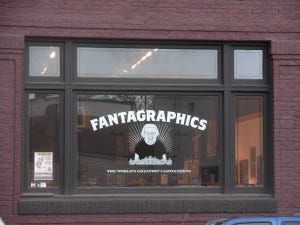
The storefront of indie comix press Fantagraphics is located in Georgetown, a happening industrial area just south of downtown. Aside from being a mecca for comic book fans, the store shares space with Georgetown Records, making it a destination for vinyl junkies too. Plus, it’s a great excuse to check out the neighborhood. Grab a book and head to a nearby coffee shop, brewery or bar.
Nestled into a house-shaped storefront in the quiet Wallingford neighborhood, this all-poem bookstore is a poetry lover’s dream. Go and gorge yourself immediately, or ask one of the lovely owners (poets, of course) for some ideas on where to start.
This is a great general bookstore, but even better is its cozy, wood-paneled bar, Third Place Pub. Grab a book upstairs and head down to the basement to read it with a beer (or five).
This tidy used bookstore in the University District has a sweet selection of high-quality secondhand books, as well as expensive out-of-print and rare titles. Rest assured, you’ll be able to afford something.
With its delicious selection of cookbooks, carefully curated by actual chefs, this cute little bookstore is sure to make you hungry — especially if you stumble in during one of their on-site cooking classes.
DON’T MISS OUT
Sign up for our newsletter to get submission announcements and stay on top of our best work.
YOUR INBOX IS LIT
Enjoy strange, diverting work from The Commuter on Mondays, absorbing fiction from Recommended Reading on Wednesdays, and a roundup of our best work of the week on Fridays. Personalize your subscription preferences here.