I was in Florence, Italy, when my father died. It was Easter Sunday and I was staying with old friends, the Marchettis, in their apartment near Piazza delle Cure, a quiet neighborhood on the north edge of town that you entered from via Faentina. We hadn’t gone into the center for the big Easter celebration, but we’d watched the dove and the exploding cart on the television.
We were just sitting down to our first course — a rich broth thickened with egg yolks — when I got a telephone call from my sister. My sister doesn’t speak Italian, but she managed to make herself understood, and Signora Marchetti waved me to the phone in the small entrance hallway.
“Are you ready for this?” my sister said.
“I’m ready.”
“Dad’s dead,” she said. “Out at the club. He fell down in the locker room. Drunk. They couldn’t rouse him. He was dead by the time they got him to the hospital.”
“I thought they kicked him out of the club?”
“He got reinstated. He got a lawyer and threatened to sue them.”
My father had taken up golf late in life. He was a natural athlete and was soon competing with the club champion. After my mother’s death, he bought a small Airstream trailer and rented space on a lot across the road from the club entrance so he wouldn’t have to drive home at night if he stayed late at the bar, which he often did.
“Where are you now?” I asked.
“I went out to the trailer earlier, just to have a look, but I’m at the house now. Dad’s house.”
“It must be pretty early.”
“Seven o’clock,” she said.
I pictured my sister, Gracie, in the breakfast nook of the kitchen we’d grown up in, in a lovely Dutch Colonial house about a mile north of town — a house that my father had built himself with help from his father. I pictured her sitting on the built-in blue bench at the built-in blue table, the cord from the phone on the wall stretched over her shoulder.
“What are you doing?” I asked.
“Just sitting here.”
“How are you?”
“I’m fine, in fact. How about you?”
“I’m fine too.”
“Have you met up with your friend yet?”
I’d come to Florence ostensibly to borrow one of Galileo’s telescopes for the Galileo exhibit at the Museum of Science and Industry in Chicago, where I was employed as an exhibit developer. But really I’d come to see a woman with whom I was madly in love, a Scottish Italian fresco restorer, Rosella Douglas, who was working on the frescoes in the apse of Santa Croce.
I looked up at the Marchettis eating their soup at the long table in what was a combined kitchen–living room–dining room. Was someone listening to me? Luca was the only one who understood English, but he was seated at the far end of the table next to his grandmother.
“She’s skiing in the Dolomites,” I said. “She’ll be back tomorrow night. I’m going to meet her at the station. Have you called people yet?”
“I’m going to do that today.”
“Do you want me to come home?”
She laughed.
“What about the funeral?”
“His body went to the junior college. They did the removal last night. They’ve started a mortuary science program. They’ll cremate what’s left… send us the ashes.”
“Dad was full of surprises, wasn’t he?”
“We’ll have to have some kind of memorial service when you get back. Maybe out at the cemetery.”
My sister and I had been looking forward to this moment, but we hadn’t really planned ahead. “Whatever you want to do will be fine,” I said. “You’re the one who’s had to put up with him.”
“Sometimes I think I should have moved away, like you did. But then I met Pete, and that was that. No way Pete was going to leave Green Arbor.” Though they were divorced now, and Pete had, in fact, left Green Arbor. Probably to get away from my father, who had treated him like an errand boy.
There were sixteen of us at the long table. Signora Marchetti (Claudia) had kept a bowl of soup warm for me. Chiara, who was my age, forty, put it on the table in front of me and stood for a moment with her hand on my shoulder. I’d spent a year at the Marchettis as an exchange student when I was in high school, and then again when I came back to Florence on a study-abroad program, and then at various other times over the years. Chiara was like a second sister, and Luca like a younger brother. I got on well with all of them and with their cousins and aunts and uncles and with the grandmother, Nonna Agostina, who was seated in the place of honor at the head of the table.
Faces turned toward me as I took my place at the opposite end of the table from Nonna Agostina.
“My sister,” I said. “Calling to wish me a happy Easter.”
I had to make a conscious effort to suppress my relief, my sudden joy, though, in fact, it was more complicated than that. I was glad that my father was dead, but I wasn’t glad that I was glad. I would have preferred to be grief-stricken. And I was saddened by the sharp contrast between my own little family — Gracie, Dad, and me — with the extended family — four generations — passing their empty plates to Chiara and Luca, who were helping their mother and father clear the table. But the soup was delicious, and so was the roast baby lamb. Sensation is sensation.
When I first heard of the Oedipus complex at the University of Michigan — we were reading Oedipus in a “Great Books” course — I knew exactly what Freud was talking about. Dad had become more and more abusive toward my mother, who suffered from tic douloureux. She was a lovely woman, small in stature, but big-hearted, generous spirited, deeply religious. She played the organ and directed the choir at the Methodist church. You just married me for the money, he’d say to her. Drunk. For a free ride. It would have been a blessing if he’d died first. She could have lived out her last years in peace instead of in a nightmare.
And where was I? I’d run away. To Ann Arbor. And then Chicago. It was my sister who bore the brunt of my father’s anger during the last years of my mother’s life, and beyond. I was afraid of my father — most people were — and my only attempt to intervene was a disaster: It’s Christmas Eve. I’m a wise fool, just home from Ann Arbor for Christmas vacation. My sister has taken Mom out on a last-minute shopping trip. They’re not home by five o’clock and Dad is working himself up into a rage. Every fifteen minutes or so he goes out to his gun room at the back of the garage for a nip of Jack Daniels, which he has to do because drinking is not allowed in our house. “I try to be a good husband…” he says, over and over. “I do everything I can… And now look at this…” He shrugs helplessly. “She’ll be overtired.” He’s indulging in his favorite fantasy, which is that everything he does is for my mother’s sake. He calls me in Ann Arbor, for example, on Sunday mornings. If I’m at home, in my dorm room in Adams House in the West Quad, which I usually am, he’ll want to know why I’m not in church. “Your mother wants you to go to church… And you’ll go. Next Sunday you’ll attend the Methodist church or I’ll come up there and find out the reason why.”
It’s late when my mother and sister get home — after six o’clock. They’ve had a wonderful time, but Dad blows a gasket, is in a towering rage. I can hear him chewing out my mother in the bedroom. “You know better than to get overtired… I try to be a good husband, I try to do the best I can, and now look at you. You’ve been gone for four hours… You’ve tired yourself out. You know better…” And so on.
The bedroom door is not locked. Mom is sitting on the bed. Dad is shouting at her, repeating himself. “What were you thinking?… How could you?… I do everything I can… I try to be a good husband, but…”
“Leave her alone,” I say. “She had a good time. Why do you have to ruin it?”
Dad gives me a look of contempt. “Get out.”
“Leave her alone,” I say. “You’re too drunk to know what you’re doing.”
This is the Oedipal moment. I would kill him if I dared, if I could.
He’s a big man. Drunk. “Like a raging bull elephant in musth,” as my sister and I sometimes say to each other later.
He slaps me so hard I fall down.
My mother is crying.
I get up and he slaps me again, backhanded, on the other side of my face.
I run out of the room.
And that’s a story I’ve never told to anyone before, but one I’ve had to live with for years. I’ve never been able to forget, or to forgive. But there’s more.
Later on — Dad asleep in his chair — we do the usual. My sister and her husband, Pete, and their daughter, Megan, are there. Mom reads the Christmas story from the Gospel of Luke. We’ve decorated the tree, and there’s a fire in the fireplace. We don’t talk about what happened. Maybe that silence is the greater act of cowardice. Megan, age twelve, is the only one who stands up to my father. When she was little, he would force her to eat sweet potatoes or candied carrots, which she couldn’t stand, and he’d make a big battle out of it. She’d eat the sweet potatoes or candied carrots or whatever it was and then throw up on the table. Finally, he gave up. But he respected her. At least he left her alone.
Later on, in the middle of the night, I can hear him typing. He’s retired early — too early — in order to spend more time hunting and fishing. He’s turned his wholesale lumber business, which specialized in choice hardwoods — cherry from western Pennsylvania and West Virginia, yellow poplar from Appalachia, yellow birch from Canada, black walnut from Indiana — over to some of his key employees, who have embezzled so much money that the company has fallen into the hands of the receivers, a phrase that my father repeats over and over: fallen into the hands of the receivers. He wants to go back into business and repay the creditors, firms he’d done business with over the years. But the credit rating agency won’t give him back his old credit rating, and without his credit rating, he can’t, or won’t, go back into business, and that’s what the letter is about — addressed not to the men who defrauded him, but to the credit rating bureau. He’s been working on it — sending it out, demanding meetings, switching lawyers — for six or seven years, working on it day and night, including Christmas Eve. On Christmas morning we go over the letter again. It’s the same letter every year. It’s a good thing he doesn’t have a computer, because then he wouldn’t have to retype it, and the typing is a kind of therapy for him. He types so hard he ruins two or three Underwood office typewriters a year.
In any case, we go over the letter as if nothing had happened the night before. I advise him to go easy on the capital letters, and he agrees. He retypes the letter, jabbing at the keys with two thick fingers, a job that takes him about twenty minutes. I look it over again. There are a couple of typos. He retypes it again, and then again. Pretty soon all the adjectives and verbs are recapitalized. For emphasis. “Although I am neither RICH nor POWERFUL, nonetheless if you THINK…” Then the nouns and adverbs. And then every word: “ALTHOUGH I AM NEITHER RICH NOR POWERFUL, NONETHELESS, IF YOU THINK…”
On Easter evening at the Marchettis, after most of the relatives, including Nonna Agostina, had gone home, I played a beautiful mahogany guitar that Luca, a professional musician, got in Paris the year before. I knew a handful of Italian songs and we sang “Bella Ciao” and “Il Cacciatore Gaetano.” It was a twelve-fret classical guitar with a wide neck and short scale, very easy to play. I tuned it down to an open G and played a new version of “Corrina, Corrina” that I’d found on YouTube, on an Italian site, actually. The song articulated the kind of melancholy I often experience after a few glasses of wine, and I was moved to open my heart to the Marchettis. I did not, however, tell them that my father had died drunk in the locker room of the Green Arbor Country Club. I just said how moved I was to see four generations together with the grandmother at the head of the table. Four generations.
And then the truth came out with a bang: No one could stand the grandmother, Signora Marchetti’s mother. Signora Marchetti had one brother and two sisters, and they moved Nonna Agostina around from house to house. But she kept her old casa near Palazzo Strozzi, even though she went back to it only once a year. She was tight with money. She was always changing her will to punish her children, usually the son or daughter she was living with. Everyone hated her. Even the grandchildren.
I was floored. It was like discovering that there’s no Santa Claus — or no Easter Bunny. It was worse than that. It was like discovering… I didn’t know what it was like discovering. I still don’t.
Rosella — the woman I was in love with — was going to take the CIT bus from Cortina d’Ampezzo, where she’d been skiing with her friend and his children, to Venice, and then a Eurostar to Florence. I drank a coffee in the station bar, checked the schedule, and then waited for her on a bench at the end of track 6. We’d met at a party in Hyde Park (Chicago, not London) to which I’d been invited because I spoke Italian, which turned out not to be necessary. “We’ll speak Italian when you come to Italy,” she said. “But in the United States we’ll speak English.” Her mother was from the Orkney Islands and her father was Italian. She spoke English fluently, but with a pronounced Scottish accent. She didn’t say “wee” and “bonny,” but she rolled her r’s and collapsed her words into as few syllables as possible, and the first time we made love she said, “Whun ye feel it coomin, luv, tock it oot,” because she suddenly remembered that she’d forgotten to take her birth-control pill. I took it out, spilled my seed on the bed, and she laughed and drew me down to her. She tasted sweet and salty.
She’d come to Chicago for a conference on fresco restoration. I took some time off and went to a couple of her lectures at the Art Institute, and one at the Newberry Library, and I showed her the main sights, including some of the exhibits I’d worked on at the Museum of Science and Industry: “The History of Computers,” “Life Tech,” “Blue Planet, Red Planet.” She’d spent time in California and New York, but it was her first time in Chicago, and she expected to find an old bluesman on every street corner, but she had to settle for Roy Book Binder at the Old Town School and Cephas & Wiggins at Buddy Guy’s, and all the time, I was thinking that what we were doing was having a little adventure, una piccola avventura. But by the time I dropped her off at O’Hare — she was on her way to New York — she had become the person in whose eyes I wanted to shine, and I gave her a Galilean-style telescope kit I’d created for the Galileo exhibit out of a cardboard mailing tube and a pair of lenses. It was two feet long and we managed to squeeze it into her suitcase at the last minute.
She wasn’t married, and neither was I, but she was somebody’s mistress and lived in a house on this somebody’s estate on the side of Monte Ceceri, above Fiesole. “It’s one of those complicated European affairs,” she said. “You Americans, you Middle-of-the-Westerners, wouldn’t understand.” She laughed. I was standing with her in the check-in line in the United Terminal.
“I understand all right,” I said. “You’ve got yourself a sugar daddy in Fiesole, and he cheats on his wife and now you’re cheating on him.”
“Sugarrr daddy.” She growled. “That’s exactly what I told you: you don’t understand a thing.”
Sitting by the tracks in the station in Florence, I could close my eyes and still hear her laughter over the sound of the trains. Love made the world bigger, louder, more surprising, brought what was blurry into sharp focus. But what about my parents? What had happened? What had gone wrong? Would things have been better if my mother had allowed my father to drink in the house? That was one theory, my ex-brother-in-law’s theory, and it made a certain amount of sense. But it was a theory I didn’t want to pursue. But going back even further. I could remember the first time I heard them quarreling. Adults didn’t quarrel in Green Arbor, Michigan. Not when I was growing up, and that’s why it made such an impression on me. I woke up in the night. My mother wasn’t saying anything, but my father was shouting something about the new mantel over the fireplace in the living room. “God damn it,” he shouted, “if you didn’t want it that way, you should have said so.” I couldn’t hear my mother, and I never figured out what the problem was with the mantel.
At the University of Michigan I majored in philosophy. I read Thomas Kuhn and Karl Popper and specialized in philosophy of science, which is how I wound up in Chicago at the Museum of Science and Industry as an exhibit developer. On Tuesday I was going to ask the director of the Museo di Storia della Scienza in Florence if I could borrow Galileo’s telescope for the Galileo exhibit at MSI. It was out of the question, I’d told my boss. The famous telescope that Galileo used for his observations for Sidereus Nuncius was going to the Franklin Institute in Philadelphia. But there was a second telescope, a smaller prototype that we were aiming at. It had a magnification of 14x, as opposed to 20x, and a focal length of 1330mm with a 26mm aperture.
I was thinking about this second telescope — comparing it in my mind to the telescope kit I’d put together for the exhibit — when Rosella came up behind me and put her arms around me. “Sorpreso?”
“Stupito,” I said. Amazed. I really was amazed. Amazed to be taken by surprise like that, and to hear Italian instead of Scots coming out of her mouth.
We backed up a little, looked each other up and down, and stepped into each other’s embrace. The train, which had backed into the station, was already pulling out, on its way to Rome. We walked to the new parking lot, and I hoisted her big suitcase into the trunk of a smallish Alfa Romeo.
“Is this a Spider?” I asked. It was the only kind of Alfa Romeo I could name.
“A Brera,” she said. “It’s small, but not too small. I couldn’t fit this suitcase into a Spider. Would you like to drive it?”
I declined automatically. I’d never driven in Italy and had no desire to. But then all of a sudden it hit me: I could buy a car like this. I could buy two of them. I could buy anything I wanted. Now that my father was dead, I was rich.
“Momento,” I said. “Maybe I will drive.”
I hadn’t been to bed with a woman since Rosella’s two-week stay in Chicago, the previous October, and I didn’t want to disturb the prospect of bliss by telling her about my father’s death. In my mind, what had started as a piccola avventura, with a predictable trajectory, had turned into the real thing. Even before she left Chicago. But what was the “real thing”? And how would it turn out? On the one hand, I wanted to deromanticize it. We were both adults, after all. This wasn’t a teenage infatuation. On the other hand… But you can’t think about these things when you’re driving in Italy. Rosella guided me through a complex maze of streets in which you have to go south in order to go north, east in order to go west, until finally we were on the familiar bus route up to Fiesole, and then through the piazza in Fiesole and on up Monte Ceceri and down a narrow wooded lane that was like a tunnel, green as dark as midnight, till we came to a big wooden door in a stone wall. It was thrilling. Rosella got out, opened the door, I drove through, and she closed the door and got back into the car. It was like a fairy tale; and the house, her house, the house provided for her by her sugar daddy, was like a glass palace. Like the Philip Johnson glass house in New Canaan, Connecticut.
“I’m the one who suggested the glass,” she said. “So now he said I have to live here. I used to live closer to the villa. Further down the road.” The road disappeared into the darkness.
“Well, you’re pretty isolated,” I said.
“We can pull the drapes,” she said. “If you’re self-conscious.”
Maybe I was self-conscious, but I didn’t say so.
“Let’s go to bed right away,” she said, once we got into the house. “Then we can enjoy our dinner later. Besides, it’s chilly in here. That will give it a chance to warm up.” She adjusted the thermostat. “We can talk later. You can tell me all about Galileo. His tomb’s in Santa Croce, you know.”
“Yes,” I said. “I’m going to see if we can borrow it for the MSI exhibit.”
“The tomb?” Then she laughed. She had pinned her hair back, and in the bedroom, she stood in front of a mirror and combed it out. Hurry up and wait. She was making me wait, but I didn’t mind. I studied an etching on the wall signed Rembrandt van Rijn: a young couple making love.
“Is this real? I ask. I mean really a Rembrandt?”
“Yes, but it’s not mine. It comes with the house.”
“The woman has three hands.”
“He forgot to erase one when he changed the position. But look at the smile on her face.”
It was a lovely smile, a wonderful smile, like the smile on the face of a young woman I’d been watching over and over on a YouTube video — a slide-guitar version of “Corrina, Corrina.”
I watched Rosella’s shadow moving on the wall as she took her clothes off. When she turned toward me and smiled a smile that spread through her whole body, I could see tiny creases under her eyes. She was irresistible. But over her shoulder, in the mirror, I could see something moving outside the bedroom window, something at the edge of the darkness. The drapes had not been pulled. I turned to look. It was an enormous white pig, coming closer, walking stiff-legged. She came right up to the glass wall and pressed her nose up against it. For a moment I thought I was coming unstrung, but Rosella put her hand on my back, as if to steady me.
“It’s Elena,” she said. “She’s supposed to be penned in up at the villa, but sometimes she gets loose. She’s attracted to the light. They have quite a few animals.”
“They?”
“The family.”
“She’s huge.”
“Over two hundred fifty kilos. Do you want me to chase her away?”
“No, no,” I said. “It’s all right.”
“She’ll wander off when I turn out the light.”
After we had made love, Rosella cooked spaghetti with garlic and oil, the simplest meal in the world, and one of the most satisfying. No salad — the shops were closed on Easter Monday evening. There was nothing else to eat in the house except some crackers and a bowl of apples, big Granny Smiths, past their prime. We each ate an apple, using knives and forks.
After supper, we went outside and looked at the night sky through the crude cardboard telescope I’d given Rosella. No sign of Elena. The moon was full, but due to the small field of vision inherent in the design, you could see only half of it at a time.
“Before Galileo,” I said, “astronomers thought that the sky had been completely explored. Everything — all the planets, all the fixed stars — had been cataloged. There was nothing more to discover. Who would have thought that by sticking two eyeglass lenses into the ends of a tube…”
“They had eyeglasses?”
“Eyeglasses were invented in the late Middle Ages,” I said. “That’s what you’ve got in this tube, more or less. Sixteen dollars for a pair of lenses, thirty-five dollars for the whole kit.”
We looked at the North Star and at Vega, which was rising in the northeast, and at Jupiter, though the telescope wasn’t powerful enough to pick out the moons, and then we went back inside and looked through Rosella’s computer at a dvd with close-up photos — a slide show — of Rosella’s own work between the Gothic ribs at the top of the apse of Santa Croce — the Cappella Maggiore. We looked at hands and feet and robes and faces that had been cleaned, and the tips of an angel’s wings, the feathers newly restored to their original luster.
“Fresco restoration is a craft,” she said. “You have to be an artisan, to work with your hands without leaving a mark. And at the same time, you have to be an artist, to use your imagination, and you’ve got to be a scientist too, a chemist; you’ve got to know how to inject polyvinylacetate resin into areas where the plaster surface is in danger of separating and breaking. You’ve got to know how to apply a solution of dimethylformamide to salt efflorescences of calcium carbonate. You’ve got to know how to apply diluted acrylic resin to consolidate pigments that are not adhering well. And you’ve got to be an historian, your job is to hang onto things that are passing away, disintegrating, your job is to preserve the old visual culture. Now we’re in a new visual culture. It’s impoverished in some ways, but rich in others. The problem is that people don’t know how to understand the symbols, how to read them critically.”
“OK,” I said. “You don’t have to be so defensive. I get your point. Is this a speech you give to tourists?”
“Something I go over in my own mind to convince myself that what I’m doing is important.” She stopped and smiled. “I tend to get carried away. You’ll have to come up on the scaffolding with me, then you’ll understand.”
Scaffolding? The top of a Gothic cathedral? I was picturing Juliette Binoche in The English Patient, hoisted up to the top of a church so she can examine the frescoes. No thanks. But I didn’t want Rosella to know that I was afraid of heights. I wasn’t cripplingly acrophobic, but I never stood close to the floor-to-ceiling windows in a high rise, and I never took the glass elevators in Water Tower Place.
“You’ll have to wear a hard hat,” she said, too interested in the slide show to notice my lack of enthusiasm, interested in the frescoes not so much as works of art, but as things, physical objects, subject to decay in a way that a poem or a piece of music is not. “When they’re covered on the outside,” she said, “with an accumulation of dirt and grime and candle smoke, you can clean them. When they’re threatened from the inside by corrosive salts erupting from within the very stones of the cathedral, you can dissolve the salts. But when they’re gone, like half the Giotto frescoes in the Peruzzi Chapel, they’re gone forever.”
When the slide show was over, I sat down at the computer and Googled the YouTube site on the Internet, the one with the smiling woman. It’s an Italian site and the men you see at the opening are Italian, and the man wearing headphones says something in Italian — too fast for me — and counts down in Italian. The voice of the singer sounds like an old black man from the Delta, but the video doesn’t match the audio. The young man playing a guitar in the video is strumming away wildly with a flatpick, but what you hear on the audio track is someone fingerpicking a slow blues: Corrina, Corrina, where you been so long? And then, during the second and third verses, you see the young man and this lovely woman sitting together. Talking. She turns to him and smiles.
“Look at her smile,” I said. “It’s like the smile in the etching.”
Rosella looked at me, astonished. “That’s Joan Baez,” she said. “And Bob Dylan.”
“Really? It doesn’t say that on the website.”
“Porcamadonna! How could you not recognize Joan Baez and Bob Dylan? You’re kidding me?”
“No, I had no idea.”
“Well,” she said, “they’re very young.”
“That’s not Bob Dylan singing, is it?”
She shook her head. “I don’t think so.”
“He can do gravelly,” I said. “And he’s the one who made that song popular.”
We went back to bed. Rosella left the light on. She couldn’t stop smiling. “I can’t believe you didn’t recognize Joan Baez and Bob Dylan.” And she — Rosella — seemed to have three hands, like the woman in the etching, all pinching, tickling, massaging, scratching, poking.
Afterward she fell asleep, but I was wide awake. I propped myself up on one elbow and watched her for a while, and then I got up and went outside. I slipped on my leather jacket, which I’d bought at a discount store in Chicago, and put an apple in one of the side pockets. I turned the porch light on. A bicycle was leaning against the side of the house, and I was tempted to go for a spin. The road, or lane, led back down to Fiesole or up to the villa. But it was too dark to see, and the house was too isolated. Low streaky clouds had covered the moon. There was almost no light except the light from the house itself, the porch light, and a lamp on the table next to the bed, which I’d left on. I could see into the bedroom. Rosella had covered herself with a sheet.
I walked out to the edge of the darkness, out of sight of the house. I could sense trees, but I couldn’t tell what kind they were. Maybe olive trees. I felt a branch but couldn’t find any olives. It was too early anyway. It wasn’t cold, but it was chilly, and after a few minutes I was ready to go back inside. But I’d forgotten about Elena. Two hundred fifty kilos. A third of a ton. Pure white, like the moon. She was standing under the light, between me and the door. I walked around the house. There’s another door that opens into the kitchen. But it was locked. I knew enough about pigs not to challenge her. I’d helped my girlfriend’s father rustle hogs a couple of times when I was in high school, and what I knew was that if a farmer had a heart attack in his field, the pigs would eat him.
I took the apple out of my jacket pocket and held it out to her. “Elena,” I said. “How about a nice Granny Smith?” She really was enormous.
“Elena, Elena, vieni mi qua, come and get this nice apple.” I took a bite out of the apple. She moved her head, and I could see she was tempted. It took about five minutes to lure her away from the front door. She moved toward me in her stiff-legged gait. Closer and closer. She seemed interested, rather than hostile, as if she were interrogating me. I thought about throwing the apple down on the ground, but decided against it. I held it in the palm of my hand as she came closer. She knocked it out of my hand with her snout, waited for my reaction, then picked it up with her mouth. I walked around her, slowly, on my way to the door, trailing my fingertips over her back, which looked furry but felt scratchy as sand paper.
She raised her head, looking for another apple. I went inside, brought out the bowl of apples, and fed them to her one at a time till they were all gone. And then I got back into bed with Rosella.
On Tuesday morning, I met with the director of the Museo di Storia della Scienza, who was pleased that I spoke Italian. He didn’t make any promises about the second telescope, but he sent me to the Fondazione Scienza e Tecnica in via Giusti, near the Protestant Cemetery, where I spent a pleasant afternoon, though our own collection at MSI already contained most of the sixteenth-century astronomical and mathematical instruments that we needed for the exhibit.
On my way to Piazza Santa Croce to meet Rosella, I stopped and browsed the windows of several real estate agencies. I liked the looks of a two-bedroom apartment on Borgo Pinti for €600.000. It would be perfect. Rosella could walk to work. The words of the notice embedded themselves in my brain: LUMINOSO appartamento. It was on the piano nobile of an old palazzo that had been recently restored. Large living room. Modern kitchen. Two bedrooms. Two baths. Rooftop terrace. I was feeling optimistic that evening as the waiter at the Osteria dei Pazzi, who knew Rosella by name, seated us at a table by the window. But Rosella was preoccupied because, out of the blue, the Italian government had decided that it needed to exercise more control over restorers. The first step was a decree that all restorers would have to have a university degree.
“All of a sudden twenty thousand restorers aren’t restorers,” she kept saying. “This country is impossible. You can’t live here.” She tore off a chunk of pane toscano and put it in her mouth. “And this bread is ridiculous. Everywhere else in the whole world they know enough to put salt in their bread. The Florentines are the only people in the whole world who don’t know this. What is the matter with these people? It’s insane.”
“That’s because their food is so salty already.”
“Instead of putting so much salt in the food, they should put some of it in the bread. Twenty thousand restorers won’t be restorers if the Italian government has its way.” She shook her head.
She ordered the antipastone for both of us. I understood that antipastone meant “big antipasto,” but I didn’t understand that it meant that the waiters would keep bringing us food till we couldn’t possibly eat any more, not even one more olive: salami, prosciutto, cheeses, octopus salad, anchovies, roast vegetables, roast beef, lardo di colonnata — thin white slices of lard that have been specially cured in marble basins at Colonnata, near Carrara. But lard nonetheless, a Tuscan delicacy.
It was while we were eating straight lard that I proposed to Rosella. I didn’t know what I’d do if she laughed in my face. My clothes, my suitcase, were at her house, so I couldn’t have just walked out of the restaurant. I was trying to stay focused in the present moment, to detach myself from the result, to identify with the watcher watching myself rather than with my ego.
She didn’t laugh, nor did she throw herself into my arms. She listened as if she were listening to a business proposition. The fact that we were in love was very important, but it was only one part of a larger picture.
She called to the head waiter, a man who burst into song every so often, and asked for another quarto of wine. It wasn’t a fancy place. Comfortable. Not too expensive.
I told her about my father’s death, though I didn’t mention that he’d died on Easter Sunday, only four days ago, and she became tender and understanding. But, she said, she had her own situation to consider, the situation that was too complicated for an American to understand, the situation that involved a rich older man who had a life of his own — a wife, several children, old money, old aristocracy, a big estate with several houses, animals… She was right. I didn’t understand.
“How would we live?” she wanted to know. “Fresco restorers don’t make a lot of money. How would you find a job in Italy?”
I had, in fact, given this question some thought, but I didn’t want to play my trump card, didn’t want to tell her that now that my father was dead, I was a rich man too. I wanted her to meet me halfway.
“Museum jobs,” she said, “any state jobs, are impossible to get. You’d have to enter a concorso, a competitive examination, along with hundreds of other people. And even if you won, which you wouldn’t, because the exams are rigged — there’s a lot of horse trading — you might be sent to Calabria.”
“One of the American programs? There are forty-three of them in Florence.”
“You wouldn’t make enough money.”
Our waiter had cleared the table and brought a bottle of vin santo and some biscotti di Prato. Rosella dipped a biscotto into her glass of wine.
“Rosella,” I said. “I want this to matter. I want us to matter, you and I. I want us to be important. This isn’t a little adventure.”
“You never know what’s important and what’s not important till it’s over, do you?”
On Wednesday and Thursday afternoons, around five o’clock, we met at the statue of Dante in Piazza Santa Croce and then took the No. 7 bus up to Fiesole, where she’d left her Alfa Romeo Brera parked near the Roman amphitheater. Sometimes she took the tunnel-like lane, sometimes a regular road that took us past the villa where her sugar daddy lived.
We made love first thing every evening, early, so we could enjoy our dinner later. Elena did not reappear, but we went up to visit her in her pen behind the villa. The signora was in Rome; the signore and his older son were still in the Dolomites, where the slopes were covered with snow year round.
“She’s got a very low center of gravity,” Rosella said as we admired the gigantic sow. “But she’s very fast. If you want her to move forward, you have to enter her flight zone from behind the point of balance, which is right between her shoulders; and you have to remember, her field of vision is almost three hundred sixty degrees, so the only time she can’t see you is if you’re right behind her. If you want her to back up, you have to enter the flight zone from in front of the point of balance.”
“You know a lot about pigs,” I said.
“I know a lot about Elena,” she said.
She’d borrowed a guitar from a fellow restorer so I could play for her. I tuned it down to an open G and played “Corrina, Corrina” while she cooked. I used a table knife as a slide.
“You know,” she said. “I don’t like the second verse of that song.” She repeated the last line: “ain’t got Corrina, life don’t mean a thing. I don’t think you can look to another person for your salvation, to give meaning to your life.”
“Then I won’t sing it again,” I said.
On Friday morning — we were going to have lunch later at the Osteria dei Pazzi — we met at Dante’s cenotaph in the right aisle of the basilica. She wanted to take me up to the vault at the top of the apse, where she was working on the feet of St. Francis himself. The vault at the top of the apse was about the last place I wanted to be. The scaffolding was massive, not at all like the sort of thing painters put up at the side of a house. It filled the entire apse of Capella Maggiore. Even so, looking up into that airy dome — I counted nine levels or floors — made me a little bit seasick.
I had secured the second Galileo telescope, as well as an unusual astrolabe, so I wouldn’t be going home empty-handed. There were still contracts to negotiate regarding the insurance, method of transportation, dates, and so on. I wouldn’t be carrying the telescope, which looked like a piece of broom handle, back in my suitcase, of course, but I would finish up my part on Monday. The MSI lawyers would worry about the fine print. But I was not in a mood to congratulate myself, because I didn’t know if I’d see Rosella again after today, didn’t know if she’d be back from organizing a demonstration in Rome, didn’t know what she’d decided, or what would be settled up in the apse, didn’t know if whatever it was we were doing was important, or if it would turn out to be just a piccola avventura, didn’t tell her about the luminoso apartment. Not yet anyway.
The elevator made me nervous, though it was huge, so we put on hard hats and took the stairs. Up nine stories, each floor supported by metal braces inserted into the holes in the wall that had been made when the church was built in the thirteenth century.
Rosella stopped to chat with someone on each level and to introduce me and to explain what was going on. You could see the joins where one day’s work, or giornata, had overlapped another. In places, you could see traces of the preparatory drawing in verdaccio, a sort of second underdrawing that repeated and corrected the sinopia, or first underdrawing. You could see places where the pigment layer was flaking, and areas where the pigment itself had been weakened by the binding medium or by surface abrasion. She explained the properties of the different fixatives (organic and inorganic), emulsions, and solvents (volatile and polar) that were used to remedy these problems.
We stopped on the eighth level for a cup of coffee in a large office, the sort of office you might find in downtown Chicago — full of desks, waste baskets, lamps, a copy machine, a fax machine, telephones. And an espresso maker.
The apse had been frescoed by Agnolo Gaddi, who had learned from his more famous father, Taddeo, and from Giotto, but who had done something different, moving toward the international Gothic style. But the scaffolding makes it impossible to take in the big picture, “The History of the True Cross.”
Rosella was working on the frescoes between the ribs of a vaulted arch at the very top of the apse. We were face to face with St. Francis, the four Evangelists, and the risen Christ, and we had to take off our hard hats so we wouldn’t scrape the ceiling.
“Vaults need special treatment,” she said, “because the undersurface is lath rather than stone.”
“What about these big cracks?” I asked. “Are you going to seal them up?”
“No,” she said. “If you fill them, that just redirects the stress. You smooth them out and seal the raw stone at the edges so it doesn’t disintegrate any further.”
I was so overwhelmed just by the idea of being up there that I forgot to be afraid. Overwhelmed and feeling very special, very much the insider. I even let Rosella walk me to the edge of the scaffolding so I could look down into the big barnlike nave. She put her hand on my back to steady me, as she had done when Elena first appeared at the glass wall of her bedroom.
Far below us groups of tourists followed guides holding bright umbrellas, stopping in front of the famous tombs: Dante’s (empty), Machiavelli’s, Michelangelo’s, Galileo’s, Rossini’s. A service was being conducted in one of the smaller chapels directly below us. We couldn’t see the priest, but we could see the people in an area that had been roped off. Everywhere you looked people were taking photos. Isolated worshippers were scattered here and there. In the right aisle, a mother and father consulted a guidebook while two children ran up and down the aisle. They had to make way for a mother and teenage daughter pushing an infant in a stroller. A workman rolled a cart of stuff to the elevator. Some women in blue aprons were polishing the altar railings. (The main altar had been relocated to make room for the scaffolding.) A priest hurried toward the sacristy — we couldn’t see the entrance from the scaffolding. Two other priests, crossing paths in front of the pulpit, stopped to chat. A line snaked out in front of a confessional. Two young lovers held hands. Two middle-aged women held hands. A beggar sat on the pavement by the ticket booth. You couldn’t just wander in anymore. You had to pay. A bridal party had gathered around the ticket booth and the bride was arguing with the woman who sold the tickets. Probably a wedding party on their way to the wedding hall in Palazzo Vecchio.
What had happened to the original Franciscan vows of poverty? Legend has it that one of the friars responsible for the construction of the elaborate basilica was now in Purgatory being struck on the head by two hammers continuously.
Rosella pointed out the line of the water from the big flood of 1966. The basilica — the whole Santa Croce district — was in the flood plain. The water had burst the huge doors.
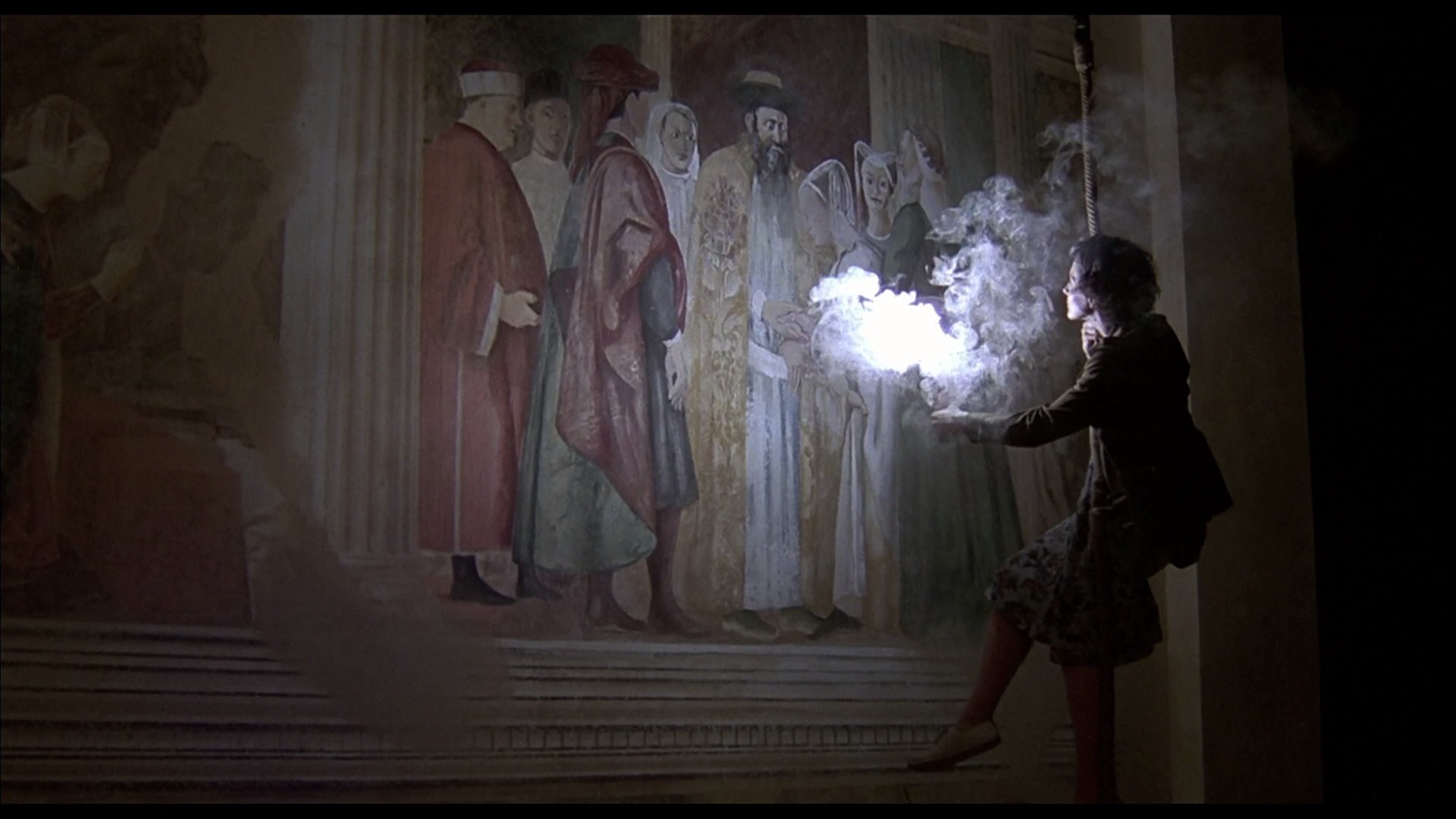
I thought this view of the nave was what Rosella had wanted to show me. But I was wrong. What she wanted to show me was in a corner, in a small space at the base of one of the ribs, where the intonaco had been completely worn away. She pointed to a small oval portrait. A man in a floppy medieval hat, bright red — a jester? a peasant? a noble? a holy fool? I didn’t recognize him at first. I was reading it as a late medieval portrait, and I was only semiliterate. It didn’t make sense. I had to adjust my eyes. And then I recognized myself. It was me. This was her gift to me. At first I didn’t understand. Then I did. And I understood that she was saying good-bye, that it was now too late to play my trump card, my ace in the hole. Too late to say I was rich, too late to tell her about the appartamento LUMINOSO on Borgo Pinti with the terrace on the roof.
“It’s true a fresco,” she said: “the lath, then the arriccio, the sinopia, the intonaco, the paint applied to the wet plaster. Then a few details a secco. Certain pigments you can’t use in true fresco. It will be there for centuries. You can see St. Francis and the Evangelists.”
“And they can see me,” I said. “Can you do this?” I added. “I mean, can you get away with it?”
“I’ve already gotten away with it.”
My sister and I spent the week before Christmas in the old family home surrounded by old familiar things — the bright blue table in the breakfast nook, the deep red davenport in the living room that was always threatening to collapse, my mother’s walnut Steinway piano, the silverware and the plates we’d eaten off of as children, the glasses we’d drunk out of, Dad’s typewriter on the desk in the little office off the front hall. A copy of the letter still curled up in the rollers. Two of the keys — the s and the t — were completely broken, but he’d kept typing anyway: alhough i am neiher rich nor powerful, nonehele, if you hink…
I had never gotten around to playing my trump card in Florence, and it was just as well, because my father left his estate, valued at about eight million dollars, to the Methodist church. Except for the house, which went to my sister, and the Airstream trailer, which went to me. The church already had a new roof and a new electronic organ. The brick walls had been tuck-pointed, and the pastor was living in a new parsonage. It wasn’t Santa Croce, but it was something.
On Sunday, two days before Christmas, my sister and I went to the ceremony in which the new organ was dedicated to my mother. And afterward, we went out to the cemetery, just the two of us, and buried the urn that held Dad’s ashes. The ground was frozen, but the hole, which had been dug months earlier, had been filled with straw. All we had to do was stick the urn in the ground. Someone from the cemetery would cover it with dirt and sod. But later.
We could have contested the will, but we didn’t, and we didn’t experience the rancor we might have felt. Eight million dollars. I could have bought the appartamento luminoso in Borgo Pinti. Gracie could have quit her job at the library and moved to the Florida Keys with her new boyfriend. Liberation, not rancor, was what we experienced. We were finally out from under. The money would have weighed us down. We were better off as we were. The Galileo exhibit was on schedule. Gracie had become the head librarian in Green Arbor. The library was planning to expand. We were almost festive at the cemetery.
On Christmas Eve we pan-fried a couple of small steaks and cooked some mushrooms and made a salad and drank most of a bottle of Bordeaux, and then we sat on the davenport in front of the fire in the living room and enjoyed the Christmas tree we’d decorated earlier. In the morning Gracie’s boyfriend and his two kids were coming. We were going to cook a turkey and everything that goes with a turkey. Gracie had already baked the pies.
I’d sold the Airstream, and Gracie had put the house up for sale. We opened another bottle of wine and fought off the ghosts of Christmases past, though many of them were happy ones, and I told her about Rosella, told her the story I’ve told you: Easter dinner at the Marchettis, the Rembrandt etching of the woman with three hands, the huge sow pressing her nose against the glass wall and then knocking the big Granny Smith apple out of my hand with her snout, the YouTube video of Joan Baez and Bob Dylan, looking through the window at Rosella asleep, the lardo di colonnata in the Osteria dei Pazzi, drinking coffee in an office on the eighth floor of the scaffolding, removing my hard hat so it wouldn’t scrape the ceiling in Santa Croce, Jesus and the Evangelists, looking down at the nave without fear — fear overwhelmed by beauty. And my picture. Painted in the true fresco manner. A gift from the heart.
“Did it matter?” I asked my sister. “Was it important? Did it matter? Does anything matter? You know what she said to me? Rosella?”
“What did she say?”
“She said ‘you never know if something matters till it’s over.’ And now it’s over, and I still don’t know. What’s the measure of change? Shouldn’t something be different now? If she’d said yes, then it would have ‘mattered’ because it would have been a turning point in my life. Everything would be different. I’d be in Italy right now. You could be in Italy too. Or Florida. Down in the Keys.”
“But she didn’t say yes. And you couldn’t have bought the luminoso apartment anyway, because you didn’t inherit any money.” Gracie leaned forward and poured the last of the wine into my glass. I thought the davenport was going to collapse under the weight of my questions: “Was it important? Is anything important? What does it all mean? What does anything mean? Does anything mean anything? Was it a piccola avventura that turned out to be a grande passion or a grande passion that turned out to be a piccola avventura? A story like mine should end with a comes-to-realize moment. But I haven’t realized anything.”
“Or a fails-to-realize moment,” she said.
“But if it’s fails-to-realize, that means there must have been something to realize, something I missed. Doesn’t it?”
“Stay calm and carry on,” she said.
“Sorry,” I said. “I’ll be all right.”
“How about this, little brother: Maybe it’s like money in the bank, a savings account, or an IRA or a money-market fund at a brokerage house. When you need some emotional capital, you’ll be able to draw on it.” She stood up. “But I’m going to bed.”
“Sleep tight,” I said. “Don’t let the bedbugs bite.”
That night, lying in the bottom bunk of the old cedar bed that matched my old cedar desk, I read for a while — Thucydides’ History. In Rex Warner’s translation. A book I’d read in my first year at Michigan. But I didn’t get very far. I turned out the light. The silence was unnerving — an occasional car on Kruger road, the lights swishing across the room, the usual creaks of an old house, my sister closing and opening the bathroom door. I listened harder, kept listening harder and harder till I could hear Rosella’s voice in my ear: “Whun ye feel it coomin, luv, tock it oot,” till I could hear my mother playing The Harmonious Blacksmith on the piano downstairs, till I could hear Gracie sobbing at the kitchen table after Pete left her and moved up to Battle Creek, and someone who was not Bob Dylan singing “Corrina, Corrina” on an Italian website, and the sharp whistle of the coal mine at the Museum of Science and Industry, and Elena grunting with pleasure as she chomps down the apples that I hand-feed her, and even the clack clack clack of my father’s typewriter in his little office off the front hall, and I knew that I had nothing to lose, that nothing is ever lost.