We are co-hosting a party this Thursday in Brooklyn for the launch of our columnist Courtney Maum’s book! Come on out! Facebook event here.




We are co-hosting a party this Thursday in Brooklyn for the launch of our columnist Courtney Maum’s book! Come on out! Facebook event here.
Pilot Season by James Brubaker is a catalogue of American dreams, superstitions, stereotypes, beliefs, ideals, frailties, phobias, desires, and everything in between. If television is a mirror into the soul of the modern consumer, televised listings represent the mired ambitions that struggle to breakout and achieve the ultimate dream of celebrity, decorated by brand-name commercials. On the surface, Pilot Season is a list of synopses revolving around “pilot episodes,” those tantalizing first episodes created to try and sell an entire season’s worth of a TV series. Many digitized corpses are buried in the catacomb of unseen television. Brubaker uses the limbs to elevate to a platform where he can act as cultural anthropologist.
He’s dissecting the American psyche one trite plot twist at a time
, exposing the vacuity of cultural dross. But he does it with a sense of humor. Brubaker nods to the layers of sitcoms that have fossilized themselves into our zeitgeist, like when he dissects a new pilot called I Love Lucy.
“This is neither a re-boot of the classic sitcom, nor a reimagining. The show is neither an adaptation nor a remake. The new I Love Lucy will be a shot-for-shot representation of the original series, in its entirety.”
But rather than being a simple clone, “It will also function as a parody of historical attitudes toward fame, fortune, and the American dream.”
While some of the pilot episodes are creative hybrids of shows in existence, each serves to satirize, illuminate, and juxtapose those “historical attitudes.”
Unlike a television show, where viewers simply watch what’s presented in the tube, the shifting narratives force an examination of the lens we each bring to the screen along with our own biases. “Nuts & Bolts” is about a family of androids who try to hide their mechanical nature from their neighbors. Described as a “sci-fi drama with comedic undertones,” the thematic focus revolves around the question: “Is it possible that these androids, trying to appear human, are more human than the flesh and blood humans surrounding them?” The androids shed light into their humanity, just as the TV shows reveal glimpses into the nature of the observers. There’s a show for almost every demographic, interest broken down by category into equations amounting to pitch points.
One of the more interesting points comes in “Clanking Replicator.” It stars “ED-209” who “is a lonely robot living a society full of fruitful self-replicating robots.” Those familiar with the original Robocop film know ED-209 as the tank-like behemoth that is as destructive as it is dumb, a summation of a company that is cashing in on people’s insecurities. To flip that around and have a show focused on this combat model’s personal struggle for replication is both absurdly provocative and disturbingly hilarious. Some might say exploitative for its rebranding of a familiar franchise; for others, a waft of violent nostalgia.
Within the list of pilots, there are family tales, love stories, economic upheaval as social commentary, a show where two people compete to accrue more debt, and a show called “Regrets.”
“Regrets” is a “reality show in which subjects close to death discuss their regrets and deliver farewell messages to their loved ones.” For the producers, nothing is sacred. Nothing is off limits when it comes to gaining an audience. Sex appeal, hunger, and death are the base instincts manipulated for Nielsen points (1,142,000 households per point in 2012–13), arbitrary millions fueling a drive for things no one needs. Shares stand for the percentage of television sets tuned in to any given program, begging the questions, which TV show represents your interest? Even the act of flipping to a station is an act of commodification, codification, and ultimately, machinification. Pilot Season reminds us that we are all androids in one form or another, even when we do our best to hide from it. Whether it’s drama or comedy depends on your perspective and your taste. Some might call it damn good entertainment. Others might call it social satire cloaked in light crystal displays. James Brubaker’s collection is a cable channel of literature that can’t be missed, if only to remind us of our humanly interdependence with stories in any shape, form, or pixel.

by James Brubaker

My fiction workshop is discussing an undergraduate’s short story about a bad breakup. It is detailed and told earnestly through entries in the dumped girl’s journal. At the end the narrator looks back and realizes that, through writing about this loss and disappointment, she’s created something permanent and beautiful.
“I liked your story,” one boy begins, “except you’re not supposed to write about writing.”
I ask the class if this is a rule they’ve heard before. Several nod in agreement.
Someone backs him up. “Yeah, you’re not supposed to. Readers just want a good story.”
Surely. But isn’t a story about writers just as likely to be as good (or as bad) as a story about shepherds or architects or above-ground swimming pool salesmen?
One girl says, “If you write about writing then they’ll just think you’re in love with yourself.”
I reflect that, of all the writers I’ve known over the years, an excess of self-love doesn’t top the list of their afflictions. Maybe some got into writing because they were in love with the sound of their own voices, but the best writers write because we can’t stand being alone with it.
“Maybe books are like laws and sausages. Nobody wants to know how they’re made.
But people buy memoirs and biographies about writers by the boatload.
Fans write letters, go to readings, follow authors on Twitter… even if many readers don’t especially care, it isn’t like books are made by grinding up animal byproducts and extruding them into intestinal casings (though I think Palahniuk may have tried). Aside from being tedious, there’s nothing inherently repugnant about the writing process, is there?
“People will think you don’t have anything else to say,” someone else ventures.
But, I point out, this particular story is also plenty else: young love, disappointment, fear… and doesn’t it add something surprising, even uplifting, to suggest that heartbreak becomes beautiful when shared with others? Surely there’s a country song or twelve hundred in there.
Does any other art form face this prohibition? Rembrandt, Velazquéz, Molenaer, Courbet, Vermeer… there is a long tradition of painters painting painters painting. Vivian Maier, Robert Mapplethorpe, Andy Warhol, and Annie Leibovitz all turned their cameras on themselves, long before selfies were cool. Shakespeare’s Hamlet and A Midsummer’s Night Dream each involve the production of other plays. The hit Broadway farce Noises Off is about staging a farce. A Chorus Line, a musical about musicals, ran for 7 bajillion performances.
Can dancers dance about dancing? Do sculptors sculpt about sculpting? If someone hasn’t already written an opera about opera singers staging an opera, they should. I’d go see that.
Sunset Boulevard, The Artist, The Player, 8 ½, Ed Wood, Adaptation, Day for Night, Barton Fink — just a few movies about people making movies. How about The Mary Tyler Moore Show, The Hour, 30 Rock, Murphy Brown, Episodes, The Comeback, The Larry Sanders Show? All TV shows about TV shows. Aaron Sorkin has done three: Sports Night, Studio 60 on the Sunset Strip, and now The Newsroom, (plus a Broadway play called The Farnsworth Invention about the man who invented television.)
OK, so then what about books? Is writing about writing really forbidden?
No, in fact, it turns out you can find novels featuring writers written by: Jonathan Ames, Martin Amis, Margaret Atwood, Paul Auster, James Baldwin, Nicholson Baker, John Barth, Saul Bellow, William Boyd, Truman Capote, Michael Chabon, J.M. Coetzee, Michael Cunningham, Don DeLillo, Geoff Dyer, Dave Eggers, Richard Ford, John Irving, Henry James, Erica Jong, James Joyce, Jack Kerouac, Stephen King, Barbara Kingsolver, Nicole Krauss, Joseph Heller, Doris Lessing, Mario Vargas Llosa, Thomas Mann, William Somerset Maughm, Ian McEwan, Stephen Millhauser, David Mitchell, George Orwell, Philip Roth, Richard Russo, JD Salinger, Carol Shields, Wallace Stegner, Lawrence Sterne, William Styron, Amy Tan, Colm Tóibín, Kurt Vonnegut, Adelle Waldman, Nathaniel West, Jeanette Winterson, Thomas Wolfe, and Richard Wright — and surely this list is nowhere near exhaustive.
With so many excellent examples to the contrary, why, then, would we tell young writers not to write about writing? After all we’ve been telling them over and over again to “write what they know” — here, at least, is something they surely know.
But perhaps this is exactly the concern. Because what we’re really telling them when we say “write what you know,” but also “don’t write about writing” is… “get out there and know something else!”
Whenever our class discusses great novels and stories, we inevitably discuss the lives of their authors as well.
Because we’re naturally curious about how books are written the students want to know about the real life experience that the authors brought to the page — that Herman Melville spent time on ships, that Hunter S. Thompson did tons of drugs, and that Sylvia Plath struggled with mental illness. And they aren’t bothered by the fact that Ishmael, or Raoul Duke, or Esther Greenwood are (gasp!) writers, because they feel reassured that their creators weren’t a bunch of navel-gazing, ivory-tower-inhabiting no-nothings — they weren’t just writers.
I ask my seniors what their plans are for after graduation. There is a consensus among them that MFA programs are a big waste of time and money. Besides, they are sick of sitting in classrooms, while real life is going by out there. No, they are interviewing to Teach for America. They have unpaid internships at non-profits. They are going to Portland or Bed-Stuy. They are going to hang around movie sets in LA. They are moving back home again. They are pretty much uniformly terrified. They ask me what they should do. What’s going to be best for their writing?
When I was a senior, feeling just as terrified, I asked my professors the same question. Get on with living, or with writing? One of them told me to get my MFA, but only if it wasn’t going to cost me anything. This didn’t help much, as the one program I’d gotten into was offering no financial aid at all. I went to speak to a Dean, to see if he would sponsor me for a fellowship that might pay some of the tuition. He laughed and said there was absolutely no way. “If you want to be a writer you’ve got to get out there and wander the desert! Get some grist for the mill!”
Though after four years of studying writing I knew not to mix my metaphors, I also knew I was only just beginning to grasp the discipline it’d take to get better. Without some structure, I feared the voice I’d begun to find would fade to a whisper.
So I took out loans to pay for school and moved to New York City (which incidentally has never had any shortage of grist for young writers). And when I got there I did the only thing that any writer should be required to do — I worked my ass off.
I went to my classes. I read three books a week, sometimes more. I wrote dozens of stories, sent them out, and pinned the rejections to my wall. Between classes I fixed computers part-time, worked with kids in a public school, taught speed reading to adults in New Jersey, and tutored at a city college. I wrote a novel about New Jersey and tossed it in a drawer. I adjuncted for $2000 a semester, five classes a semester, at two schools an hour and a half apart. I took a course on captaining a catamaran. I watched my parents lose their house. I watched two close family members die very slowly; a third one went while no one was looking. I paid off (some of) the loans, and wrote a novel about a family living on a boat. I spent a week in Africa (drove through some desert at least), tossed that second novel in a drawer. I watched a friend struggle with mental illness and addiction. I got married. I taught some more. I wrote a book about a guy whose friend has a mental illness. I went to Thailand. I moved to Brooklyn. I tossed the third novel in a drawer. I wrote sixty-six new stories in twenty-four months and then wrote another book — and that one finally got published.
It’s about writers writing about writers writing. I’d pause to appreciate the irony of this, but I don’t really have time — I just became a father and started writing another novel.
I don’t say this just to pat myself on the back (though I think I will anyway, thanks). I say it to illustrate the point — that the Dean was an idiot, because wherever you wander, grist happens.
You don’t need to board a ship or inhale a pharmacy or stick your head in an oven — at least not in the name of being a better writer.
Life will do its thing, one way or the other — the question is, once it does, will you have been practicing? Can you turn that into something permanent and beautiful? Can you write about what you’ll know — as well as the many things you won’t? Can you write so well that nobody can tell the difference?
First as a student and now as a teacher I’ve sat in classrooms beside young men and women who want to be writers. They can’t stand being alone with the sound of their own voices. Some of them have witnessed atrocities, suffered abuse, lost their parents, stared down addiction, been to jail, mental institutions, and lived on the streets. Others have managed to get by relatively safe and sound. But here’s the best part… when they I read their stories, I can’t tell which are which.
For me this is one of the greatest joys in reading fiction. Where does it all come from? Life experience? Vivid imagination? I have no idea what their lives are like; I only know what they write and that they’re all choosing to be in my class.
It isn’t an easy A; there aren’t bright job prospects at the end. We meet once a week for three and a half hours in a tiny basement room in the Natural Sciences building. It is too hot and the windows cannot be opened, which is unfortunate because it makes the room attractive to the fruit flies being bred in the genetics labs. We spend a good amount of time swatting at things no one else can see. Some of them write what they know, and they know plenty. Some of them write what they don’t, which is basically everything. But they are hard workers and they are rule-breakers. They believe that what they are writing matters. So I do, too.
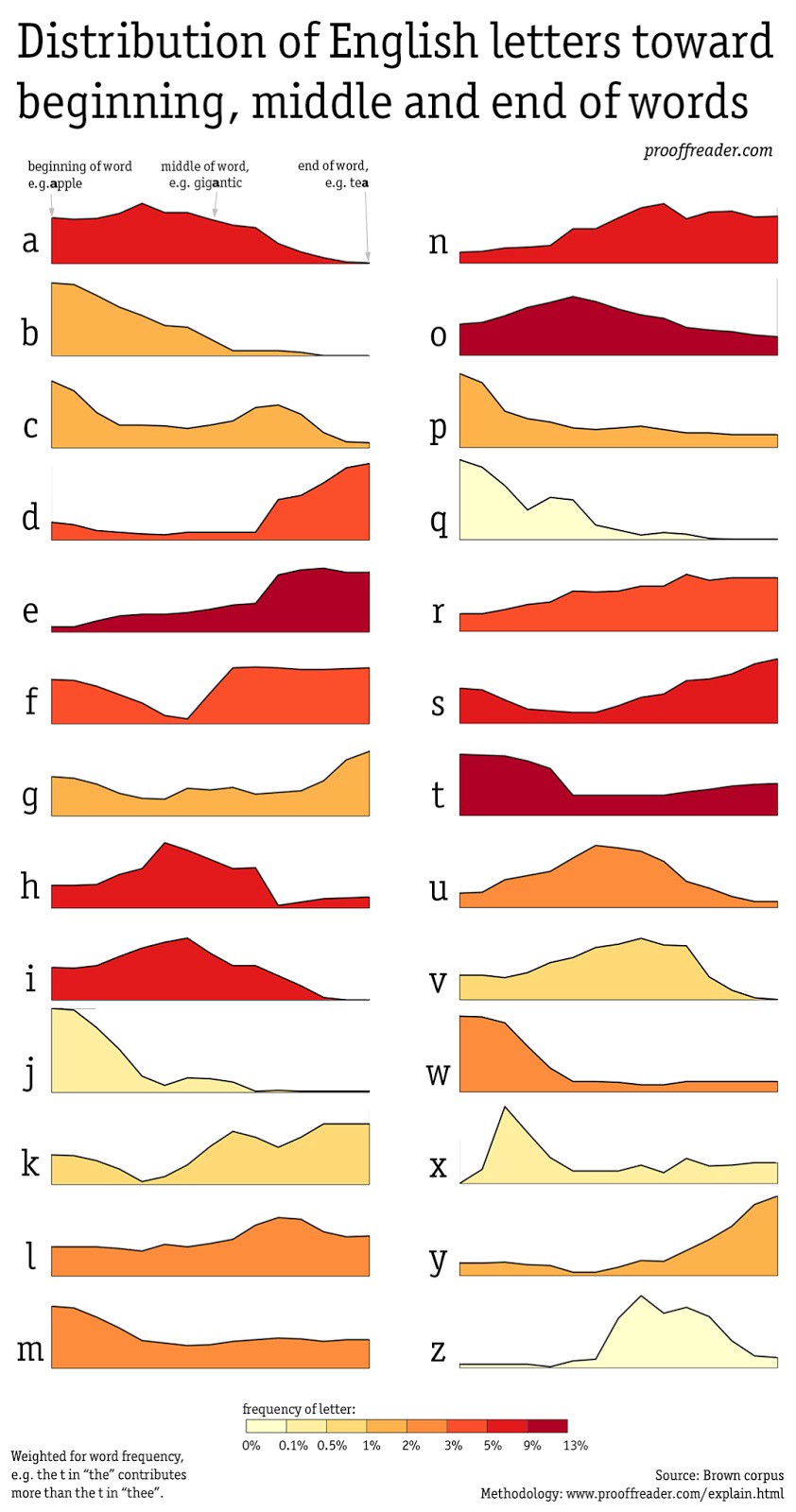
Prooffreader has created this interesting infographic on how letters are distributed in the English language. Good info to know for your next Scrabble tournament.
Last week, writer and tweeter extraordinaire Elizabeth McCracken tweeted this:
21 years into a publishing career & I still have no idea what to say when someone says, “A writer? Have I heard of anything you’ve written?”
There is something unique about the way people talk to writers. Strangers seem very willing to offer career advice — “self-publishing is where the money is!” — literary advice — “People love vampires!” — or to oddly ask you to guess what work they’ve read in their life and if any of yours is among it. It got me thinking about what it would be like it people talked about other professions in this way.
“Ah, a middle school teacher? Have I met any of the students you’ve ever taught?”
“Cool, I always wanted to be a car salesmen. Maybe when I retire I’ll settle down and just work on selling that Buick I’ve had in my head for years.”
“Huh. A chef. Do people still eat food?”
“An accountant? Wow, I haven’t even looked at a number since high school.”
“You own a hardware shop? Nice! Do you sell tools with wood handles? People love wood handles, you should really sell tools with those.”
“So Chet tells me you’re a bartender. Would I have tasted any of the drinks you make?”
“News anchor? Okay here’s a news story I’ve been thinking about for years: the vice president slips into a vat of grape jelly. People would love that story, right? It’s yours! I’ll never have time to get away from work and break the story to a national audience myself.”
“Non-profit grant writer? Hmm. My 7-year-old niece is into non-profits. Do you write grants for any children’s non-profits? Maybe she’s read one of your grants.”
“Software programmer? Like, for actual computers sold in stores or just as a hobby?”
“Gastroenterologist? My aunt tried to be a gastroenterologist. Hard to make a living doing that! Hahaha!”
“Menswear designer for J. Crew? Interesting. Have you tried selling your clothes yourself on Etsy instead? I hear people are making millions self-designing on the internet these days.”
“You said a Wall Street banker? Interesting. Would I know any of the economies you ruined with borderline illegal practices?"
by Matt Bell
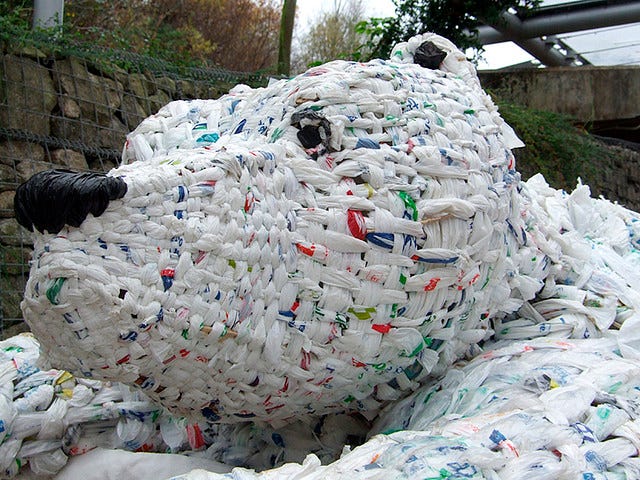
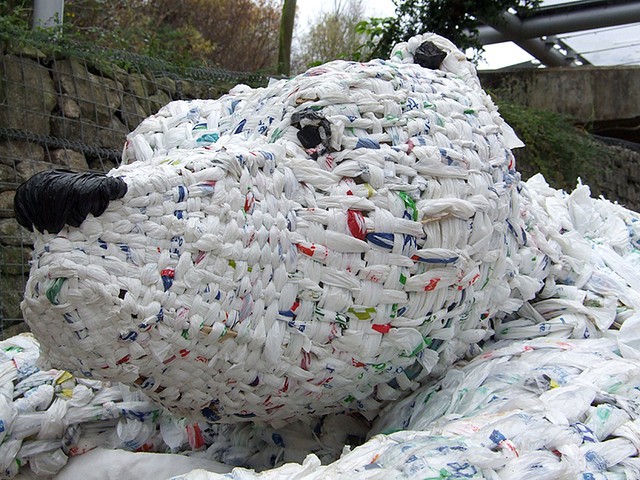
Every time we move, I again encounter the shopping bags full of shopping bags, saved to be recycled but never recycled, instead just accumulating in some dark corner of our house, like a plastic rat king. And every time it makes me think of Sam Lipsyte’s The Ask, with its obsession with such bags inside of bags. From four different parts of the novel:
“Some natty loon sat alone at the next table. He wore a pilled herringbone blazer, crusty at the cuffs, guarded a shopping bag packed with neatly folded shopping bags.”
“The shopping bag stuffed with shopping bags was never far from reach, but when I asked him its meaning or purpose he told me I didn’t have proper clearance.”
“Maybe someday Bernie, still getting over his father’s untimely but somehow not surprising death, would take his new girlfriend to see the disturbing but brilliant drawings by the kiddie-diddler who spent most of his adult life guarding a shopping bag full of shopping bags in a doughnut shop not far from where he, Bernie, grew up, but who also, unbeknownst to the world, inhabited a fabulous and secret universe of the mind.”
“I listened to the rustle of the food bags. Paper and plastic. You could recycle the paper, slip the plastic over your head. Recycle yourself.”
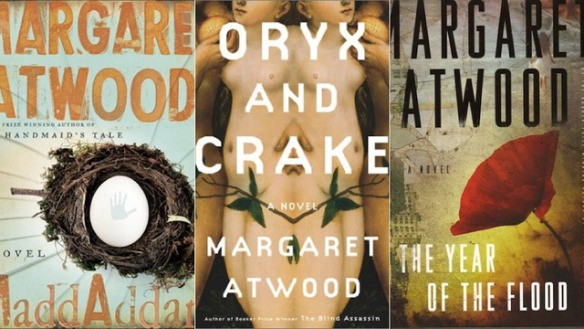
The title pretty much says it all. The word on the street is that HBO and Darren Aronofsky are adapting Margaret Atwood’s MaddAddam, a trilogy of dystopian novels that was completed last year. The novels — Oryx & Crake, The Year of the Flood, and MaddAddam — take place in a futuristic world where corporations have replaced governments and genetic modification is rampant. (Oryx & Crake was discussed in last week’s installment of MEDIA FRANKENSTEIN.)
Considering how awesomely HBO has adapted George R. R. Martin’s dark and epic A Song of Ice and Fire series, this seems like a pretty great match.
In reality, the easiest way to get on with a novel is to lock yourself in a garden shed with a laptop and a flask of coffee. The garden shed doesn’t require an application fee. The garden shed won’t reject you. But for writers looking for something more inspiring, here are a handful of more unusual writer residencies to consider.

Write A House
The Renaissance City writer
In what they call a twist on the writer’s residency, the Detroit Write a House project simply gives you a house, forever. In a forward-thinking piece of urban outreach, young people renovate homes left vacant in the wake of the city’s bankruptcy giving them vocational training. These houses are then made available to writers. Much like dropping a ship in the ocean for coral to grow on, they’re artificially stimulating the march of gentrification on the premise that creative people imbue a place with value, and that value is something other people, with more money than writers, are drawn to. Everyone wins. Though for now, there are just a few houses available.
Apply via writeahouse.org
Writer on wheels
There was something about the #AmtrakResidency that particularly appealed to writers, perhaps the romantic notion of spending dozens of hours ensconced in a railway carriage with just your imagination, a laptop and the high-speed views of the Great American outdoors to inspire you. Like the premise of so many good residency programs, there’s nothing better to do than write, that is, once the dining car bar has closed. For two to five days join the ranks of writers who have penned great work on trains, such as novelist Alexander Chee, who kick started this campaign after a casual remark in his PEN Ten interview.There has been some debate over the fine print, so consider the terms carefully before you apply.
Winners will be selected through March 31, 2015; Apply here.
The Carpenter Ranch in Colorado
Like a literary remake of City Slickers, The Colorado Art Ranch will fulfill your American West fantasies by offering residencies on a working cattle ranch to a group of artists and writers. Each resident is assigned a local Art Buddy to get them orientated and facilitate their interaction with the community. At the end of your time you present your work at the Artposita (that’s a little Artposium, for those unsure). This is just one of many AIRs offered by the Colorado Art Ranch, who move between remote spots across the state.
Next residency programme runs between September 1st to 30th with the deadline for applications June 1, 2014; coloradoartranch.org

Jack Kerouac House
Follow in Kerouc’s footsteps
The weight of literary heritage can either weigh heavily on your shoulders or inspire. The Kerouac Project aims for the latter, offering four three-month residencies a year in the Orlando cottage where Jack himself wrote Dharma Bums. They give you an $800 food stipend and all utilities are included, meaning you can focus on writing your masterpiece, while trying not to compare yourself to Kerouac at every other word. You’re encouraged to participate with the Central Florida Community through readings and workshops, as well.
Apply throughout the year at kerouacproject.org
Take to the parks
Most writers’ at some point hanker for total isolation away from the distraction and temptation of fellow humanity. The National Parks Service offers just that. Each of the 50 participating parks’ AIR programs has a unique set-up: the four-week Glacier National Park’s cabin has views of Lake McDonald and the snow-peaked mountains beyond; or Denali National Park and Preserve sends you to the East Fork cabin to write in the total wilderness without running water or electricity. The notable Headlands AIR program might suit the less intrepid, located just outside San Francisco, which is currently accepting applications for 2015.
Each park has its own application procedure and dates; nps.gov/getinvolved/artist-in-residence.htm
Hole up in a hotel room
Thomas Wolfe wrote two novels at New York’s Chelsea Hotel, Tennessee Williams wrote his last play A House Not Meant to Stand at the Elysee, and Welsh poet and writer Dylan Thomas lived in the Washington Square Hotel (then the Hotel Earle) after being removed from his previous hotel for debauchery. Perhaps it is this long and occasionally checkered history that inspired The Standard, in partnership with The Paris Review, to offer its Writer-in-Residence program. For the first three weeks in July 2014, the East Village hotel will provide a room free of charge to a writer already under contract. Though with all the salubrious pleasures of Downtown NYC on your doorstep, discipline will be paramount.
The submission period for 2014 is now closed, so get your material ready for next year; theparisreview.org/standardculture

Shakespeare & Company
And further afield:
For the bohemian: Paris’ historic Shakespeare & Company allows writers to sleep in the bookshop as long as they dedicate a certain number of hours to stacking shelves and giving readings. shakespeareandcompany.com
For the escapist: You can’t get further from civilization than the Antarctic. The National Science Foundation Antarctic Artists and Writers Program hosts writers and artists in extreme conditions who are engaging with projects surrounding the southernmost continent. nsf.gov
For a cultural exchange: The Sanskriti Foundation has over seven acres of land on the foothills of the Aravali range, and has hosted over 600 artists, writers and scholars since 1993. Through their local network, they will facilitate collaborations with your local Indian creative counterparts. sanskritifoundation.org
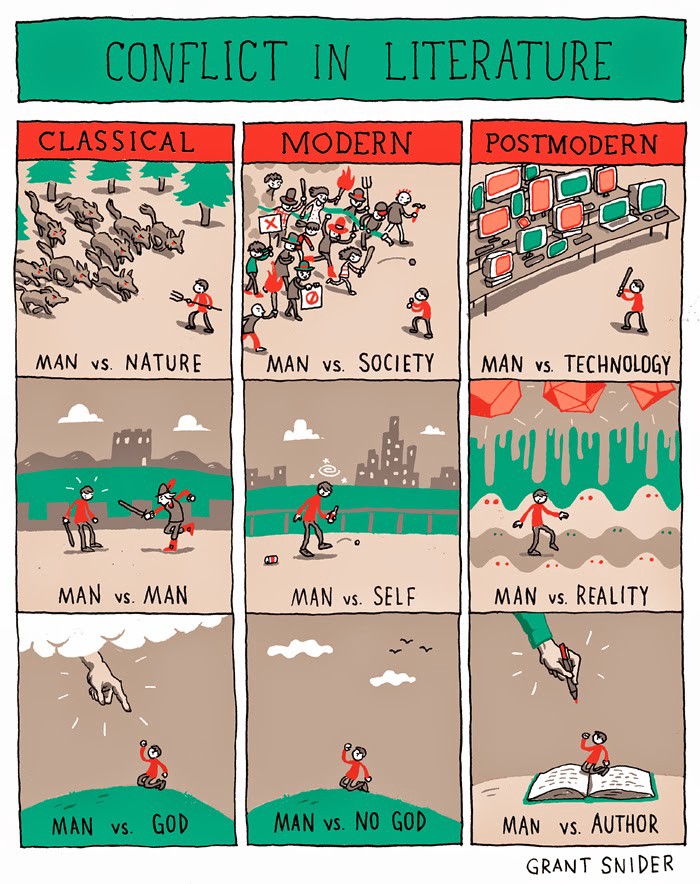
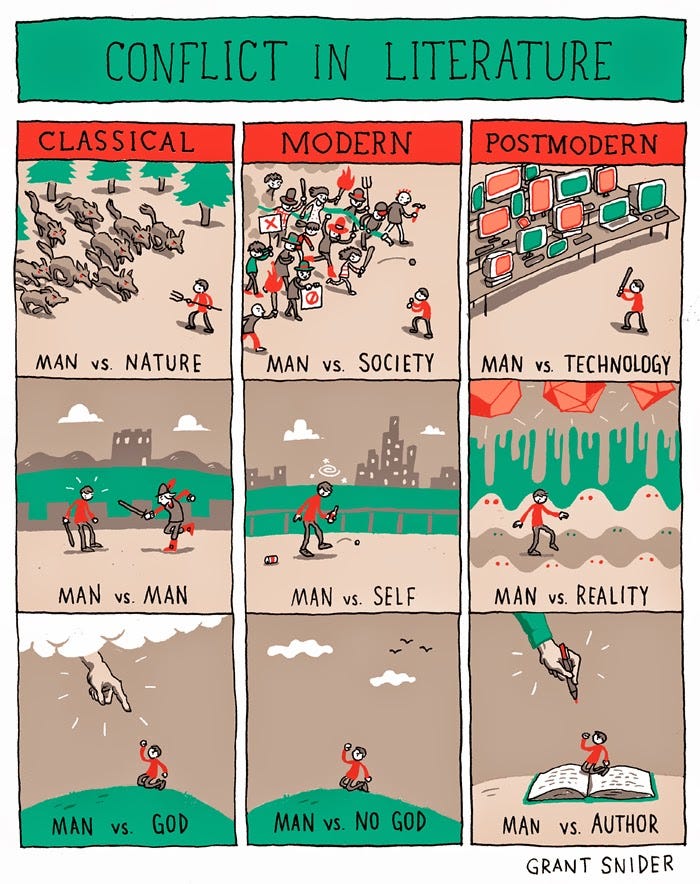
This smart comic by Grant Snider, which is available in his shop as a poster, breaks down the archetypal conflicts in literature… although he did leave out man vs. computerized wolf god.
 Thank You!