Interview with “Used Books” Artist Ben Sisto

by Josh Milberg

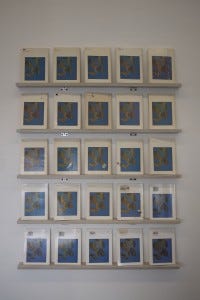
The afternoon of Saturday, March 7th, I was walking down Broadway along the division between Bed-Stuy and Bushwick when I saw books on display in a gallery. To be more precise, I saw the same title shelved over and over. I walked into “Used Books,” an exhibition by Ben Sisto, curated by Joshua Caleb Weibley. The component I’d seen from outside was called “Interaction of Interaction of Color” and features 25 different print-runs of an art theory book that details how colors are perceived differently when put near to or pulled apart from others. That book is, of course, called Interaction of Color. Sisto purchased his copies second-hand through online retailers like Albris, Abe Books, and through local shops like The Strand, Book Thug Nation, and Spoonbill & Sugartown.

I emailed Sisto to find out more about the exhibition, which runs through March 16th at Scott Goodman’s Good Work Gallery (1100 Broadway, Brooklyn), and about his take on books as objects.

Can you explain how you’ve applied concepts from Interaction of Color to the books themselves — as artifacts?

I should start by saying most of my works start with the title or some kind of pun. If all goes well from there, the pun leads to a deeper discussion about production, values, attribution, etc. But I like having an ice-breaker.

I picked up a copy of Interaction of Color from Book Thug Nation and two things came to mind. First, this is a really important book with reference to art history and color theory, which I’d never read. So I bought it (still have not read it). Then, I remembered Imitation of Imitation of Christ, an anonymous fashion project from the ’00s that playfully jabbed at Imitation of Christ, a fashion label Chloë Sevigny was involved with.

These two titles merged and I thought “Interaction of Interaction of Color.” So the next thought is: If that project were to exist, what would it look like? The most obvious concept was to display a few copies of the book side by side, allowing their respective wear and tear to be showcased through comparison.

Ben Sisto, Interaction of Interaction of Color

Ben Sisto, Interaction of Interaction of Color

What anomalies or differences have you found from copy to copy (e.g. typos, different artwork, dog ears, marginalia, types of paper used)?

The project really took shape when I compared early and late print runs (there are 28 runs in all). Actually, this project is why I know about print-runs, how they are accounted for. In looking at two copies, I noticed the back-cover images were not exactly the same. The image is a collage of leaves on a blue background; some leaves are torn at the edges, but the tears have slightly different shapes in later runs. Well, different according to me, and most people I’ve shown.

I called Yale to get to the bottom of it. I had crafted a tale in my mind where some printer accidentally damaged (in my version he/she spills a Dunkin’ Donuts “Great One” coffee) the original in error and then painstakingly created a bootleg to replace it. Yale looked into it for me, and we learned the collage was actually originally created by Eva Hesse when she studied under Albers, which we all thought was a nice tidbit.

So the mystery lives on. But, in addition to that aspect I really find the respective book’s yellowing over time, price stickers, inclusion of a URL in later years, etc. to all be quite beautiful when looked at as a group. One has an old Rizzoli sticker. One was likely used as a cutting-surface. One was sent from Australia, but all were printed in Massachusetts. Many journeys in there.

Now that e-readers make it possible to read works without pages or binding, do you think there are any particular features that book manufacturers should employ to keep books relevant, at least as relevant as they’ve been for the last few years?

I’m not sure I’m the best person to comment on this, honestly. For my part, I buy mostly used books which I plan on chopping up and re-displaying, because I’m interested in copyright infringement’s potential to produce a positive economic impact on secondary markets. I’d like someone to see a work I made with five $2 books, and then make it themselves for $10 and have our collective $20 go towards Housing Works.

When I buy a new book, it’s usually an art book. My main gripe with art books is when the hand of the designer/layout-team overpowers the work itself. A lot of art books end up as graphic design projects with images used like lorem ipsum copy. I’d much rather just see images of the work alone on the page and, as needed, related interviews and timelines towards the end. Keep it classy.

Are there any features you’ve seen or would like to see employed in electronic texts that might further divorce them from printed works?

I wouldn’t say they are divorced at present, or that they ever will be. They coexist. I can read a short story on an e-reader on the train, but feel and understand the same content differently if on the beach with an old paperback folding and bending in my hands. It has sand in some of the pages which I’m okay with. In fact, I enjoy. I would be less okay with sand inside an e-reader. They are different experiences, and it’s important to try and revisit content across multiple platforms and see what’s lost or gained with each translation.

I actually think that we’ll get to a point with culture/technology where you won’t be able to tell the difference between a printed and electronic book, anyhow. Not to sound overly Kurzweilian, but I do believe that within 100 years or less, life born from or in collaboration with “artificial” intelligence will have the option to experience the printed page if desired. Or not.

For the next two questions, imagine we’re in the future. All traditional libraries have disappeared and only a small percentage of the population still own actual bound books, but there are books in museums where you can read for a bit if you like. Which books are in the museum?

The complete set of all possible books.

What has our culture lost when most of our books are behind museum doors?

Here, I think a more appropriate question is, “What has our culture lost when most of our cultural products are behind closed doors, generally?”

The greatest threat to the printed word, to education, to democracy right now is the debate over network neutrality and the open Internet. If we lose this one, we (as in “We The People”) are doomed.

So, here I’d like to plug the Electronic Frontier Foundation, Fight for the Future, and Public Knowledge, if I may. This isn’t a perfect metaphor, but they are fighting to ensure admission to the museum stays donation-based, sliding-scale, etc.

Ben Sisto (b. 1980) lives in Brooklyn, NY. He earned a BFA from the Massachusetts College of Art in 2002 and has since organized or somehow been involved with maybe 1,000 events or so, art shows, concerts, DJ nights, readings, mini-festivals, etc. Most recently he ran Public Assembly (RIP) in Williamsburg and above it, PACS Gallery. At present he produces cultural programs for Ace Hotel New York and is the world’s leading expert on the history of “Who Let the Dogs Out?”

Dispatches from the Road: Made To Break Seattle

February 26th marked the inauguration of the national book tour D. Foy is making in support of his debut novel, Made to Break, set for release from Two Dollar Radio on March 18th. The timing couldn’t have been better: it coincided with this year’s AWP conference in Seattle. Here is the first installment of his tour blog.

2/26

A brutal but amazing day.

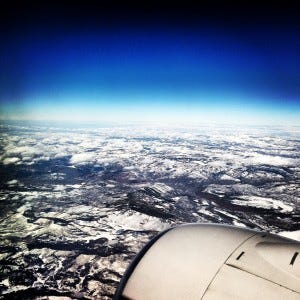
I rose at 3 a.m. for pick up at 4:30, then hopped on a 5:40 flight out of La Guardia, narrowly escaping yet another storm hammering NYC courtesy of our new, exceedingly unwelcome chum, Polar Vortex.

At a layover at George Bush Intercontinental Airport in Houston (they actually named an airport after him?), I somehow experienced a preponderance of obese men in camouflage hunting jackets roaming the terminals. I was not surprised. A crappy burrito and a-very-difficult-phone-call-I-didn’t-want-to-have-with-an-old-friend later, I was informed via Twitter that I’d just walked past Ursula (whom till then I only knew on Twitter). We met and chatted, then boarded the plane for very different seats. Did this seemingly chance encounter augur more to come? I’ve had an Indiegogo campaign up for a few days now, and the last people I’d expect have, like rabbits from hats, been appearing to support me.

photo 1-2

After another five-hour flight packed into the window seat by Robin, a heavy-set academic from a border hamlet near Mexico and fellow AWP pilgrim who talked my ear off about the dirty machine that is capitalism, I snared a cab to the Grand Hyatt, intending to freshen up with a nap before my reading that night. But instead of sleeping, I thought of Robin’s father, about whom Robin had also talked incessantly. Robin never said so, but based on his many fraught innuendos, it seemed impossible that his father — a Norwegian manic-depressive who spent his life tripping through a litany of failed endeavors, from carpentry, computer programming, farming, selling cars, and etc. — had not committed suicide.

I went down to the Starbucks attached to the hotel: my concierge had informed me that it was one of only a few cafés with a Clover press, which makes coffee with twice the normal caffeine. Satisfactorily juiced, I proceeded to my reading with Cari Luna, Jeff Jackson, Matt Bell, and Sean Madigan Hoen up on Capitol Hill, at Still Liquor. Tod Goldberg, our nimble-witted host, decided in the midst of reading my bio that I looked like a punk-rock Don Draper, and announced as much to the packed house. Everyone laughed. I shrugged and got up to read sans mic, Abe-Lincoln style start to finish.

2/27

I experienced a very surreal moment. I’m spoiled at home: without fail I stumble straight for the coffee first thing each morning and stand before the machine mumbling and drooling until it’s ready, and would never at pain of death be caught outside my apartment until my system’s caffeinated. Today, though, I awakened in the Grand Hyatt after having been up for 24 hours and was forced into the world to forage for caffeine. I put on my flip flops and sweats (i.e. pajamas) and quasi-sleepwalked to the Starbucks, where, to my horror (really), I found it teeming with bushy-eyed AWP attendees, with fresh clothes and styled hair and shaved and made-up faces, AWP badges dangling from their necks as they chattered and texted and did all the other things people with functioning brains do. I felt like one of HG Wells’ troglodyte morlocks risen from a twenty-year coma, forced to take a chemistry exam. Or something. The next day, in response to my Facebook post about the same, the writer and critic Vince Passaro commented: “Do you see now how AWP fosters conformity among those who should never ever ever consider conforming? See? It was happening to you right there? Who are all those fucking Ohioans anyway?”

photo 5

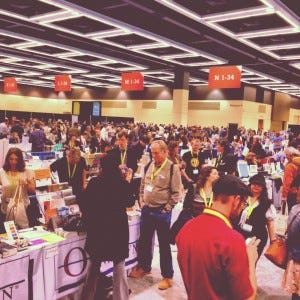
I roamed the book fair all day with Jeff Jackson, my friend, label mate, and author of Mira Corpora (lately shortlisted for a LA Times Fiction Prize), picking up more books and swag than anyone has a right to. That evening, I dined alone at a fancy sushi joint near Pike Place Market, then hit a reading up the hill, put on by Gigantic magazine, featuring the likes of Adam Wilson and James Yeh. There may have been a thousand people from Ohio milling about the conference, though I wouldn’t have cared if they’d hatched from eggs. Conversations great and small had the feel of no less than the epic. And anyway, for whatever it’s shortcomings, Ohio is the home of Two Dollar Radio, my publishing house, and of its power-duo founders, Eric Obenauf and Eliza Jane Wood-Obenauf. In my opinion, these guys will in years to come be recognized en par with James Laughlin of New Directions and Barney Rosset of Grove for the groundbreaking work they’ve been publishing. Grace Krilanovich? Anne-Marie Kinney? Karolina Waklawiak, Scott McClanahan, Bennett Sims, Jeff Jackson? That I’m among this company is hard to believe, honestly.

In sum: this was the first day of my first AWP, and it was signature.

Overheard on the street that night:

Punk kid to the girl walking her dog: “Hey, dude, you look awesome in that jacket!”
Second punk kid to first punk kid: “What the fuck is a Chinese light bulb?”

And then:

The white hipster kid walking up the street with a boom box on his shoulder, playing Michael Jackson’s “Billy Jean,” his gang of his friends around him, and, as the kids pass by, the middle-aged lesbian couple pointing at the boom box while saying, “What, that’s a thing again?”

2/28

photo 4

Another day on the floor of AWP’s book fair, hobnobbing with everybody and their uncle.

But the big event this day was my reading that night. Yet another power couple, Carrie Seitzinger and Matty Byloo (of Small Doggies Press and NAILED Magazine), organized a reading in a private studio in the Queen Anne hood of Seattle. But for Jeff, JS Breukelaar, and Patrick Wensick, I had no idea who the other writers were. We drove out to this seeming No Man’s Land, convinced we’d be our own audience but — lo and behold — instead arrived at another packed house. But way, way, way better were the amazing writers we were graced to share the stage with: the aforementioned kings and queens, plus Brian Tibbetts (editor of the Portland Review) and the mindblowing poets Rachel McKibbens, Robert Lashley, and Jacob Rakovan (the last two of which actually made us all weep). I walked away with more gratitude and awe for the indie publishing scene that I’d had going in. Since the economic collapse of 2008, the ensuing, more concentrated consolidation of the major publishing houses, and the exile to the hinterlands of obscurity of writers absent any perceived commercial promise, the indie houses that have manifested to fill the void are putting out truly great stuff. It can only be a matter of time before that great stuff attains the wider attention it deserves. A thought: the internet is villainous in 101 different ways, but it’s surely a major factor in the literary renaissance now under way. The presses at work today would’ve been inconceivable twenty years back, much less ten, I think. The reading tonight was undoubtedly the best I’ve been to in years.

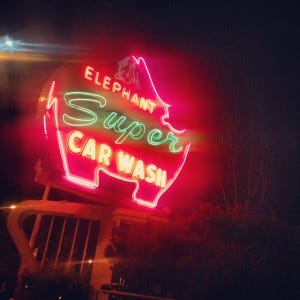
Some vintage Seattle neon along the way to the reading:

photo 1-1

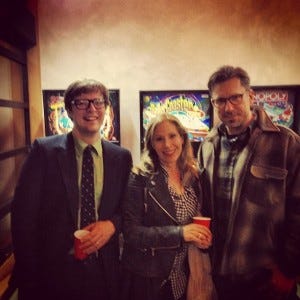
Patrick Wensick, JS Breukelaar, and me:

Patrick Wensick Jenny Breuklaar and D

At the FSG Literature party that night, I hung with the crews from Mellow Pages Library and Electric Literature and rubbed elbows with the likes of Joseph Riippi, Matt Bell, and Adam Robinson. Later, in our room, until 3am, Jeff J and I engaged in spirited debate about Picasso, Warhol, and Dylan. He loves them all. I don’t. Mad respect to Sir Jackson!

3/1

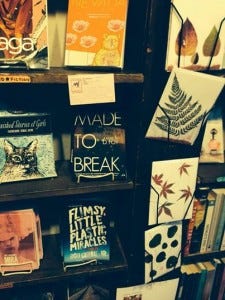
MTB on Shelf at Left Bank Books Seattle

More bookfair hobnobbing. More swag. More fatigue. This thing goes on and on!

I met my pal Ron Tanner for lunch at Mod Pizza and talked about our sugar addictions. Ron is a veteran of national book tours and knows every bakery and café, it seems, in every town across the country. He told me about the pie places I should hit in Portland. He might as well have been talking about heroin.

But that night, I hit my last reading of AWP, at Left Bank Books, with Jeff again, plus Scott McClanahan, Joseph Riippi, Noah Cicero, J David Osbourne, Juliet Escoria, JS Breukelaar and others, all of whom, again, were incredible. I can’t remember the last time I’ve attended three successive readings, each of which was nutty good. But best of all, I got to see for the first time ever my book on the shelf of a bookstore. The feeling is ineffable. Had I not been surrounded by pals, I would’ve cried for sure.

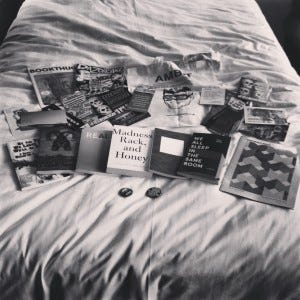
Here’s what the end of AWP looks like the morning of departure:

photo 1

Girl and Giraffe

The man called George Adamson lived a long life, long and rough and most of it in the African bush. He set up house in a tent with a thatch roof and dirt floor, full of liquor and books. He smoked a pipe with a long stem, sported a white goatee and went around bare-chested in khaki shorts — a small, fit man, deeply tanned. He was murdered in his eighty-third year by Somali lion poachers.

Joy Adamson, his wife and the author of Born Free, had been stabbed to death a few years before. She bled out alone, on the road where she fell. They were somewhat estranged by the time of Joy’s death. They had cats instead of children — George had raised scores of lions, while Joy had moved on from lions to cheetahs to leopards — and lions and leopards could not cohabit, so George and Joy lived apart. They maintained contact, but they were hundreds of miles distant.

Two of George’s adoptive children, Girl and Boy, had come to live with him in the early nineteen-sixties. This was in Kenya, where the Second Battalion of the Scots Guards was stationed to fight a mutiny in Dares-Salaam. It was the tail end of the British empire in East Africa.

When Girl and Boy were nine months old, the Scots Guards brought them to the plains beneath Mount Kenya, to a farm where a British company was filming Born Free. Along with twenty-two other lions, Girl and Boy had roles in the movie. Afterward most of the lions were sent to zoos, where they would live out their lives in narrow spaces. But Girl and Boy were given to Adamson, who had become attached to them during filming. He took them to a place named Meru, where he made a camp.

Meru was in red-earth country, with reticulated giraffes browsing among the acacia and thornbush. Zebras roamed in families and the odd solitary rhino passed through the brush; there were ostriches, too, and an aging elephant named Rudkin, who plundered tomatoes.

Girl was one of Adamson’s success stories whereas her brother, Boy, was an extravagant failure; yet Boy was the one that Adamson deeply loved.

Girl had been fed all her life, but she took readily to the hunt. Her first kill was a jeering baboon, her second an eland with a broken leg, her third a baby zebra. From there she took down a full-grown cow eland and was soon accomplished. Meanwhile Boy did not feel moved to kill for himself; he merely feasted off the animals she brought down.

So Girl became a wild lion, but Boy did not. Boy remained close to Adamson all his life, often in camp, between two worlds. Though he made forays into the wild, he did not vanish within it. And on one occasion, hanging around camp while people were visiting, he stuck his head into a jeep and bit the arm of a seven year-old boy. This boy was the son of the local park warden; soon an order came down for Boy’s execution.

But before Adamson could carry out the shooting — he was busy protesting to bureaucrats, who declined to listen — Boy was found under a bush with a porcupine quill through one eye and a broken leg. If not euthanized on the spot he would have to be moved; so Adamson sat on the ground beside him until the veterinarian could fly in, by turns drinking whiskey, brandishing his rifle and sleeping.

After triage in camp Adamson prepared for an airlift to a better-equipped facility. He and Boy would live on a private estate of Joy’s while he nursed the animal back to health. And as they were loading the lion into Adamson’s pickup for the airstrip, Girl — though she had barely seen her brother for a year — emerged suddenly from the bush. She jumped onto the back of the truck, where Boy lay sedated and wrapped in a blanket. No one was able to entice her away, so they began the drive to the airstrip with Girl along for the ride.

But on the way she spotted a young giraffe by the road and became distracted. She jumped off the pickup. She was a wild lion now, and wild lions are hungry.

That was the last time Adamson saw Girl and the last time she saw any of them. Later, when Adamson returned to Meru, he would search for her fruitlessly.

Boy grew irritable in temperament after the surgery, due to the steel rod in his leg: And who among us might not become cantankerous? Two years after he and Girl were parted, he suddenly attacked a man named Stanley who had tended him with gentle care through illness and injury. Adamson heard a scream and went running with his rifle to find that Boy had bitten deep into Stanley’s shoulder; he turned and shot his beloved lion through the heart and then tended to his friend, who bled to death from a severed jugular inside ten minutes.

In Adamson’s autobiography the end of Boy is well described, while the end of Girl, who lived out her days in the wild, is invisible. Happy endings often are.

But there is one more report of Girl outside Adamson’s published writings. It was made by a man who claimed to have visited Adamson in his camp the year before his murder, one Stefan Juncker based in Tübingen, Germany. Juncker said he had made a pilgrimage to see Adamson at Kora, where he was living with his final lions. Since Adamson constantly welcomed guests to his camp, such a visit would not have been uncommon.

The two men sat beside a fire one night and Adamson — in his cups, which the German implied was not rare — became melancholy. He remembered a time when he had not been alone, before his wife and his brother had died. He remembered his old companions, sitting there at the base of the hills among the boulders and the thornbush; he remembered all his lions, his women and his men.

His brother Terence, who had lived with him at Kora, had in his dotage discovered that he had what Adamson called “a talent for divining.” By wielding a swinging pendulum over a map, he could determine the location of lost or wanted things. This included water, missing persons and lions, which he correctly located about 60 percent of the time. Adamson was skeptical in theory, not being much given to magical thinking, but had to admit that his brother’s method led him to his lions faster than spoor- or radio-based tracking. It was inexplicable, he said, but there it was.

Since Terence had died of an embolism two years before, Adamson no longer had a diviner.

At this point Adamson gestured toward a flower bush a few feet away. That was where Terence lay now, he said. And there, he said, turning, over there by a tree was dear Boy’s grave; he had buried his favorite lion himself, though others had dug up the corpse later to see proof that he was dead. He had been forced to rebury him several times.

The German was disturbed. He did not like the fact that Adamson had laid his brother to rest a stone’s throw from a killer.

There was much that science had not yet understood, went on Adamson, about the minds of lions and men and how they might meet. Divining was one example — had the lions somehow told Terence where they could be found? — but he had also known others. In fact, he said, he would tell of an odd event he had once witnessed. Over the years he had thought of it now and then, he said; and at this point a warm, low wind sprang up from the Tana River and blew out the embers of their campfire, sinking them into darkness.

He had thought of it over the years, he repeated, but he had mentioned it to no one. He would tell it, if the German could keep a secret.

Of course, lied the German.

It was when he was first taking Girl out to hunt. This was in Meru, he said, in the mid-nineteen-sixties. Of course now, more than twenty years later, Girl would have to be long dead.

All your stories end with someone dead, said the German.

All my stories? asked Adamson.

He and Girl had been walking through the forest together and had emerged into a clearing, where they surprised a herd of giraffes browsing. The herd quickly took off, galloping away before Adamson had a chance to count them, but they left behind a gangly foal without the sense to run. Perfect prey. It should fall easily. It stood stupidly, blinking, backed up against a large tree.

Girl charged, with Adamson standing by proudly. She had made several kills in the preceding days and he considered her a prodigy.

But abruptly she stopped, pulling up short. Her ears were flat; then they pricked. She and the foal seemed to be studying each other. Adamson was shocked, bordering on indignant, but he remained in the copse. Possibly Girl sensed something wrong with the giraffe, he thought; or possibly there were other predators behind it, competition in the form of a clan of hyenas he could not see.

As he waited Girl stood unmoving, crouched a few feet from her quarry. Then the giraffe reached up slowly and mouthed a branch with its mobile, rubbery lips. It chewed.

Adamson was flabbergasted. Possibly the animal recognized his lion as a neophyte hunter: But how could it? Giraffes were not insightful; they had the dullness of most placid grazers. Either way, the animal should be bolting. Girl would be on him in a second, fast as light.

He could see Girl only from the rear; her tail twitched, her shoulders hunched. He could not see her face, which frustrated him, he told the German, for a lion’s face is extraordinary in its capacity for expression. What was she waiting for?

Then again, he thought, as he watched the stillness between them and held his own breath, the foal was going nowhere. Maybe Girl was hypnotized by the future: Maybe she saw the arc of her own leap, was already feeling the exhilaration of flight and the impact, the smell and weight of the foal as it crumpled beneath her, as she dragged and wrestled and tore it down, worried the tough hide and sweet flesh. Possibly she was waiting, pent up and ready.

But no. Girl straightened; she relaxed. She sniffed around the foal’s long legs. She jumped onto a dry log. She yawned.

And the giraffe kept eating, munching and grunting softly. It shifted on its feet; it stooped down, head dipping toward Girl and up again to the branches, where it tore and chewed, tore and chewed, with a complacent singularity of purpose.

There was sun on the log, glancing across the nape of the lion’s neck so that her face was illuminated, the rest of her in shadow. She licked a paw and lay down.

Adamson, squatting in the bushes, stayed put. His body was still but his mind worked hard, puzzling. He considered giraffes. Terence had a weakness for elephants; himself, he was strictly a lion man. But giraffes, though morphological freaks, had never interested either of them. Artiodactyla, for one thing: the order of camel, swine and bovids. Not suited for long-term relationships. Strictly for riding, eating or milking, really. He pitied them, but not much. There were no refrigerators in nature, after all; meat and milk had to keep themselves fresh.

After years in the bush he saw all animals as predators or prey. The tourists that came through his camp wanting to pet the lions? Now those were strictly prey, he mused.

Then, recalled to the present after a pause: No offense.

None taken, said the German heartily.

In fact the German had felt a prickle of annoyance. The flight in, on a single-engine Cessna in jolting turbulence, had made him squeeze his eyes shut and pray silently to a God in whom he did not believe. For this?

An old alcoholic, he thought angrily, with poor hygiene — that was all. He had been eight years of age when he saw Born Free, living in a claustrophobic bourgeois household in Stuttgart. His father was fat as blood sausage and his mother used a bottle of hairspray a week. He thought Adamson and his beautiful wife were like Tarzan and Jane.

But Kirsten had disapproved of this trip, and she was probably right: nothing more than a midlife crisis.

The smoke from Adamson’s pipe was spicy. The German was disgusted by smoking — frankly, any man fool enough to do it deserved what he got — but he had to admit the pipe smelled far better than cigarettes.

You were saying, the German reminded him. Girl and giraffe?

Yes, said Adamson softly.

The old man was frail, thought the German, with the ranginess of a hungry dog; his muscles had no flesh between them. He had nothing to spare.

So Girl had lain there on the log in the sun, dozing while the giraffe moved from tree to tree. The sun crossed the sky and clouds massed, casting a leaden grayness over the low hills. Adamson stayed seated in the scrub, drank from a flask and puffed on his pipe. There was a silver elegance to the day, which was unusually mild and breezy; he listened to the wind rattle the branches and whisper the dry grass. Birds alit in the trees and moved off — he noticed mostly black-headed weavers and mourning doves — and Girl and the giraffe ignored them. The shadows grew longer; the sun was sinking. Adamson began to feel impatient, pulled back to camp. He had things he should do before dark.

It was almost dusk when the giraffe moved. It ambled over and bent its head to Girl again, who stirred.

While it is not true, said Adamson solemnly to the German, that giraffes never lie down, as legend has it, it is true that they do so rarely and for a very short time. And never, he said, in his experience, did they lie down at the feet of their predators.

And yet this was what the foal did.

It had been a good day, said Adamson, and raised his glass.

As he talked, the German had built up the fire again, and now he saw the flames reflecting off amber. He was regretting his choice. The choice had been between Africa or Mallorca, where his wife was now suntanning.

The foal lay down deliberately, said Adamson, right beside the dry log. It was deliberate.

And Girl stretched her legs, as a cat will do, luxurious and long, all four straight out at their fullest reach like table legs. She stretched and rose, jumped languidly off the log and paused. Then she leaned down over the foal and sank in her teeth.

The movement, said Adamson, was gentle. The foal barely struggled; its legs jerked reflexively but soon it was still.

Later, he said, he almost believed he had dreamed the episode. But he came to believe, over the years, that a call and answer had passed between Girl and the giraffe: the foal had asked for and been granted reprieve. Girl had given him a whole afternoon in which to feel the thorny branches and leaves in his mouth, the sun and shade cross his neck, his heavy lashes blink in the air.

It was a free afternoon, because all afternoon the foal had been free of the past and free of the future. Completely free.

It was almost, said Adamson, as though the possibilities of the world had streamed through Girl and the giraffe: And he, a hunched-over primate in the bushes, had been the dumb one, with his insistent frustration at that which he could not easily fathom, his restless, churning efforts to achieve knowledge. Being a primate, he watched; being a primate, he was separate forever. The two of them opened up beyond all he knew of their natures, suspended. They were fluid in time and space, and between them flowed the utter acceptance of both of their deaths.

They had been together, said Adamson, closer than he had ever been to anyone. They had given; they had given; they had shimmered with spirit.

Spirits, thought the German, glancing at the luminous dial of his watch: yes indeed. Bushmill’s, J&B, Ballantine, Cutty Sark and Glenlivet on special occasions.

This was in Kenya in the late nineteen-eighties, decades after the Mau Mau rebellion brought the deaths of two hundred whites and twenty thousand blacks. A new homespun corruption had replaced the old foreign repression; fewer and fewer lions roamed the grasslands of East Africa, and the British were long gone.

Review: And Every Day Was Overcast by Paul Kwiatkowski

by Kalliopi Mathios

And Every Day Was Overcast is a uniquely Floridian story, with muted palm tree landscapes establishing the mood of this illustrated novel. The photographic narratives seem to come from under the narrator’s bed, a dusted-off photo album holding memories from a time when we still developed film, dropping off our tiny plastic canisters into the hands of a complete stranger: encapsulated in a time when our phones were not also cameras, alarm clocks, and notebooks.

The narrator shares a grungy luster of frustrated, bored teenagers, seemingly snapping photos while laughing among friends, tripping forward after too many drinks or too many drugs–or both. Yet while Kwiatkowski shares an underexposed Florida, he equally enacts the narratives of teens across America, straddling the cusp of disenchanted suburbia and devastating rural poverty.

every-day-int

Transmissions–short commentaries that act almost like text messages sent to the reader– utilize equally visual and textual means to convey information. This break from text-based prose invites the reader to experience intimate moments between characters as the characters themselves might visually experience it. When our narrator sends his spy into the girls’ locker room, we too study these photographs, feeling as though we are a part of his secret; we become accomplices in teenage deviancy.

Kwiatkowski’s debut work experiments with the modern novel, pushing it closer to a more visually based art form. And Every Day Was Overcast reminded me of Jessica Anthony’s young adult novel, Chopsticks. With scribbled notes and text messages, it resembles a print documentary, examining the life of a missing piano prodigy and the events leading up to her disappearance. Like Anthony, Kwiatkowski chooses photographs over text, providing the reader with fictional artifacts to better understand the complexities of character and narrative.

Such personalized visual connections deepen our ability to make meaning and give more context to today’s increasingly visual reader. Kwiatkowski’s photographs support a lyrical prose with exceptionally descriptive moments that firmly place the reader “over Seminole Indian burial grounds… a paradise of strip malls, prefab housing, amusement parks, and other areas of diversion.” Recalling memories from his teen years, our narrator describes an acid trip where he lays still on his back and listens to a handheld radio:

…I heard more rolling waves of static occasionally punctuated by pirate radio signals of Latin music, muffled trucker jargon, jerk-off talk, church organs absorbing the pious ramblings of low-budget evangelicals.

And Every Day Was Overcast situates the reader alongside the narrator and his cast of lovers, strangers, and subversive friends: we gawk and cringe, recalling our own youth and the complexities it carried. Kwiatkowski beautifully illustrates, both in visual image and in written word, how he found acceptance with a transient group of misfits, in a dreary palm-tree town.

Every Day Was Overcast by Paul Kwiatkowski

Every Day Was Overcast by Paul Kwiatkowski

And Every Day Was Overcast was published by Black Balloon. A limited number of signed copies can be purchased from Whisper Editions.

REVIEW: Bark by Lorrie Moore

In “Debarking,” the opening story of Lorrie Moore’s latest collection, Bark, recently-divorced Ira worries that he may be too critical of his new love-interest: “Either she was stupid or crazy or he was already being too hard on her. Not being hard on people — ‘You bark at them,’ Marilyn [his ex-wife] used to say — was something he was trying to work on.” This, coupled with the story’s title, marks the beginning of a play-on-words that Moore sustains throughout the entirety of the wildly anticipated collection. Bark contains numerous references within its pages, from the three poem excerpts chosen as epigraphs, to various characters’ dogs, to the description of the cerebral cortex. In these stories, bark (or a bark, whether human or canine) is an aggressive cry, a warning call, and a protective layer. It is a method of self-defense.

Moore’s short fiction explores the myriad ways that we, as Americans and as humans, attempt to defend ourselves from both personal and political vulnerabilities.

Long-time fans of Moore’s work will not be surprised to find the characters in Bark shielding themselves with the armor of humor, wit, and wordplay. Her signature bon mots are plentiful, her parenthetical asides are peppered with exclamation points, and there’s no shortage of hilariously outlandish metaphors. About Ira’s aforementioned love-interest, she writes: “The nipples of her breasts were long, cylindrical, and stiff, so that her chest looked somewhat as if two small sink plungers had flown across the room and suctioned themselves there.” These inimitable one-liners have helped build Moore’s reputation as a funny writer ever since her first story collection, Self-Help, was published in 1985. Of course, the most comical lines almost always hint at a bleaker worldview just below the surface. In Bark’s closing story, “Thank You For Having Me,” the divorced, single mom at a wedding describes the bridesmaids’ pastel dresses in terms of their pharmaceutical counterparts: “One the light peach of baby aspirin; one the seafoam green of low-dose clonazepam; the other the pale daffodil of the next lowest dose of clonazepam.” Moore pushes the dark humor to extremes that may irritate certain readers, but

her dagger-sharp witticisms are in top form in this collection — they’re not just indicative of her characters’ underlying sorrows, but also uproariously, side-splittingly funny.

When it comes to love, especially for women, the humor in Bark is darker and the prospects grimmer than ever before in Moore’s fiction, which is quite dark and quite grim indeed. “Paper Losses,” about a divorce after twenty years of marriage, begins with hatred — “Although Kit and Rafe had met in the peace movement, marching, organizing, making no nukes signs, now they wanted to kill each other” — and follows Kit along her journey to hopeless resignation: “A woman had to choose her own particular unhappiness carefully. That was the only happiness in life: to choose the best unhappiness.” Women are incredibly cruel to other women, criticizing each other’s choices as too feminist or not feminist enough, exhibiting embarrassing displays of jealousy and resentment, and intentionally deluding each other about current relationships:

“Romantic hope: from where did women get it? Certainly not from men, who were walking caveat emptors. No, women got it from other women, because in the end women would rather be rid of one another than have to endure themselves on a daily basis. So they urged each other into relationships. ‘He loves you! You can see it in his eyes!’ they lied.”

Pessimism regarding romantic love has been constant in Moore’s fiction but in Bark, she enhances the hopelessness we feel for her characters by experimenting with nonlinear narratives.

Several stories take sudden, giant leaps forward in time to provide glimpses of devastating futures.

“Subject to Search,” one of the book’s most overtly political stories, features an American woman in France meeting her lover, a US intelligence agent, for lunch. He has just learned he must immediately leave the country (and, by extension, her) due to recently reported “torture incidents involving American troops at a Baghdad prison.” In the midst of her confusion and disappointment, the narrative skips ahead to reveal the truly heartbreaking future that awaits this couple. Although readers are eventually left with an earlier, more hopeful moment in this relationship, it’s tinged with a sense of foreboding. In seemingly pleasant moments, there exists the inevitability of a downturn. For the unmarried, the recently divorced, and even those currently dating or married in Bark, the likelihood of finding and sustaining love seems improbable at best, impossible at worst.

Where Bark really distinguishes itself from Moore’s previous work is in this melding of the personal and the political — the way political events both shape and reflect her characters’ personal concerns. The real world feels more tangible here than in some of Moore’s previous collections, in which characters sometimes seem to be playing out their personal dramas in a small vacuum. The environment in these stories feels more sharply rendered. Simple details, like a truck speeding by with a NO HILLARY NO WAY sticker affixed to its bumper, both contextualize and complicate the stories’ settings. And while the material of Moore’s fiction has frequently been described as domestic, as in “relating to family,” another definition of domestic, “of the internal affairs of a nation,” is also an apt descriptor. These characters would not be the same lovers, spouses, or divorcees if they were not also Americans living in these unique moments in American history.

Of course, the ways in which various administrations’ foreign and domestic policies impact American citizens is not a new theme in Moore’s writing. In a 2005 interview in The Believer, she discussed the relationship of her writing to politics, explaining that she was “interested in the way that the workings of governments and elected officials intrude upon the lives and minds of people who feel generally safe from the immediate effects of such workings.” In “How to Become a Writer,” one of her earliest and most frequently anthologized stories, a character finds herself at a loss for words when she attempts to write about the physical and mental damage her brother suffers after returning from Vietnam. And the second half of Moore’s 2009 novel A Gate at the Stairs revolves around the devastating loss of the main character’s brother, Robert, an Army recruit killed in Afghanistan. However, unlike previous collections in which political events appear in only a few stories, and A Gate at the Stairs, which spans several years, the stories in Bark work together to comprise over a decade of significant events in the American political landscape. Arranged in the chronological order of their publication dates, they span the decade between 2003 and 2013, covering everything from the US invasion of Iraq, to the torture at Abu Ghraib, to Obama’s election, to the economic downturn. In “Foes,” which was originally published in The Guardian just days before the 2008 election, a liberal writer named Bake McKurty gets into a political argument with a self-proclaimed “evil lobbyist” seated next to him at a literary fundraiser in DC. When the lobbyist reveals startling information about how the events of 9/11 impacted her personally,

Moore draws attention to the ways that humans (whether they be foes, friends, or lovers) often fail to understand and have compassion for one another due to their own fear-based self-defenses.

As an author, one of Moore’s most distinctive and admirable qualities has always been her own defensiveness. In today’s publishing world, as many authors (whether by choice or necessity) join Twitter, post on Tumblr, and agree to every proffered interview and engagement in order to promote their work, Moore remains relatively quiet. She consents to few interviews and when she does, refuses to respond to questions that annoy her. In fact, as she fields questions about her work and writing life,

one often gets the sense that she’s engaging in an act of resistance

. Rarely, if ever, has she been comfortable talking about her current writing projects, and she certainly becomes indignant with any insinuation that her fiction may be thinly-veiled autobiography. “A writer can’t control the reception of one’s work,” she said in The Believer in 2005, “or the perception of its author — as much as one would like to. You just have to put on your helmet and boots and get out your pen.” Bark is an excellent example of one of the best contemporary writers in America doing just that.

So, what do we do when we are faced with a close friend’s death, a crumbling marriage, a child’s illness, a terrorist attack? How do we go on living despite loneliness and pain and sorrow? How do we continue to live in this country when we disagree strongly with its policies? Moore does not provide answers in Bark. Instead, she has written a vital work of literature that holds a mirror up to the American public, showing us exactly what we have been doing: creating elaborate suits of armor, isolating ourselves as a means of self-defense, and barking — perhaps so loudly that we can hear nothing else.

Bark: Stories

by Lorrie Moore

Powells.com

Have You Read the #AmtrakResidency’s Fine Print?

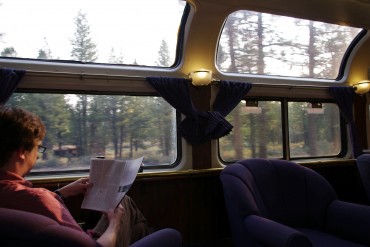
Writers and trains have a long, complicated history. In a December PEN American interview, writer Alexander Chee casually mentioned that he loved to write on trains and wished there were some kind of residency offered for writers. Jessica Gross pounced on the idea and took her cause to Twitter. Faster than anyone could realize what was happening, Amtrak embraced the idea and awarded Gross a trial residency, in the form of a free round-trip ride from New York to Chicago.

After what must have been very quick deliberation, Amtrak released the official guidelines and application form for the #AmtrakResidency Program this weekend. But while many writers immediately jumped at the opportunity to apply, others have noticed some troubling language in the program’s Official Terms. As Elliott Holt pointed out on Twitter, clause 6 states:

In submitting an Application, Applicant hereby grants Sponsor the absolute, worldwide, and irrevocable right to use, modify, publish, publicly display, distribute, and copy Applicant’s Application, in whole or in part, for any purpose, including, but not limited to, advertising and marketing, and to sublicense such rights to any third parties.

To our non-legally-trained eyes, the terms come just short of granting Amtrak actual ownership of writers’ application materials — namely, the required writing sample. Amtrak has reserved the right to use the writing samples of all applicants (not just the winners) in any way they see fit, as well as the right to extend the same privilege to a third party of their choosing.

The same clause goes on to state that “[f]or the avoidance of doubt, one’s Application will NOT be kept confidential.” Additionally, “[u]pon Sponsor’s request and without compensation, Applicant agrees to sign any additional documentation that Sponsor may require so as to effect, perfect or record the preceding grant of rights.” This seems awfully open-ended to our (again) non-legally-trained eyes.

While every publication and contest organizer can create their own individual agreements with writers who submit their work, the general consensus in the publishing world is that publications aren’t interested in owning writers’ work outright, but simply in publishing it. Amtrak is demanding an exorbitant level of control over applicants’ writing — writing which, it should be noted, isn’t being submitted in order to be considered for publication. The spirit of the program’s Official Terms seems to run counter to the ideas of creativity and authorship that are espoused by the diverse community of writers whose support helped make the residency a reality in the first place.

On Sunday, Alexander Chee tweeted that he had reached out to Amtrak regarding clause 6, and Amtrak has “responded that they are working to address [the] concerns.” Replying to some inquiring writers via Twitter, Amtrak said that they “would reach out to/have a conversation with any applicant before using their work for promotional purposes.” Of course, the Official Terms do not require this, nor is there anything to prevent Amtrak from using writing samples however they choose even after contacting the author.

It remains to be seen what, if any, changes will be made to the legal terms. In the meantime, it’s a good lesson for writers and artists of any kind to always read the fine print before handing over their work.

Film Adaptation of Dostoyevsky’s “The Double” Comes to NYC This Month

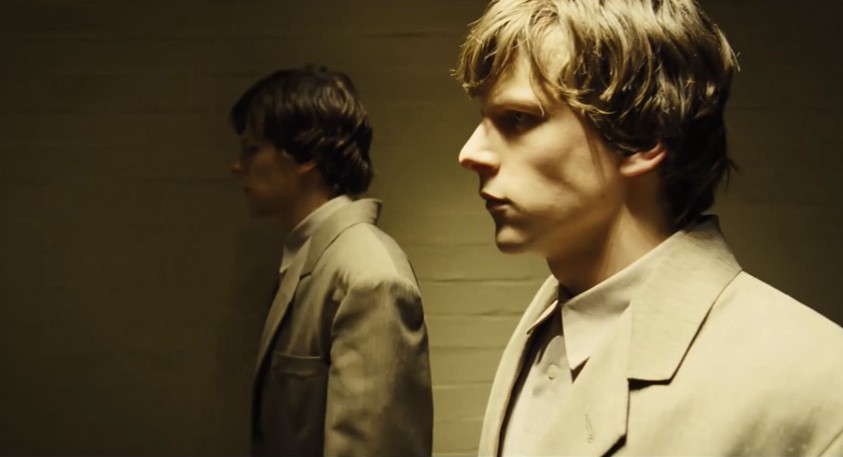
Bringing a novella of Fyodor Dostoyevsky’s to the big screen is a fool’s errand — that is, unless you have a uniquely distinct vision. Director Richard Ayoade seems to understand this; his forthcoming take on The Double has been compared to the style of fellow Brit Terry Gilliam for its blend of the madcap and the dark. Jesse Eisenberg (and Jesse Eisenberg) will play Simon James (and James Simon), the Anglicization of the The Double’s original Golyadkins. The cast also includes Mia Wasikowska, Wallace Shawn, Yasmin Paige, Noah Taylor, James Fox, and Sally Hawkins.

Perhaps the greatest doppelgänger story ever written, The Double concerns Golyadkin, a government worker, who goes mad when he meets someone who appears to be his exact double, only more confident and aggressive — that is to say, his exact opposite. At first the two Golyadkins are friends, but, as you get the sense in the trailer, that doesn’t last long.

A handful of New Yorkers will be able to see The Double early, at the New Directors/New Films series on March 24th and 29th. For Film Society and MoMa members, tickets are already available. Otherwise, visit the New Directors’ website to buy general sale tickets, which are available starting today. The film will not have a public release stateside until May 9th, so see it early.

INTERVIEW: Susan Straight, Author of “Highwire Moon” and “Between Heaven and Here”

Susan Straight is an anomaly. She has published eight novels and two childrens’ books. She has won the Edgar Award, been a finalist for the National Book Award and the Los Angeles Times Book Award, and most recently, she received the Kirsch Award for lifetime achievement. Aside from two years at graduate school, she has managed to achieve all this without leaving her hometown, Riverside, California. In fact, she can see the hospital where she was born from her kitchen window. She jokes about it, saying that her daughters had to put paper over the window so she wouldn’t stare, which is funny but also troubling.

Riverside sits in chaparral country, where tumbleweeds roll through dusty lawns and palm trees mark the boulevards. I met with Straight on campus at the University of California, Riverside, where she is a Distinguished Professor of Creative Writing and the director of the graduate program.

At one of your readings, you said that A Tree Grows in Brooklyn was one of the main inspirations that led you to leave Riverside. Is that true?

A Tree Grows in Brooklyn made me think, “Oh, to be a writer, you have to go to a place like Brooklyn, sit out on a fire escape, live above a restaurant — live this really intense urban life.” I thought that I had to leave Riverside, and I did when I was done with USC.

There was this whole New York thing, too. We used to ride the bus, my husband and I. We would go down to Manhattan, stay in the Flower District, in somebody’s loft and just walk around New York. And this was around the time of breakdancing and rap music, and it was really different for us, because we came from a completely different kind of Black culture in Riverside. And here we were in New York, where everything looked so different. That was a big deal to me, because it made me write about home. I started missing tumbleweeds and palm trees and chain-link fences and graffiti. And I really missed our friends back home. So, I think that’s when I started writing the stories that were in Aquaboogie, and actually I wrote the beginning of Highwire Moon, too.

Do you think that’s common among writers, that they have to move away from home in order to write about their hometown?

I think everyone is completely different, and there are absolutely two different schools. I think that some people go away, and they reinvent themselves. They move to Brooklyn and they write about Brooklyn. Or they move to L.A. I mean, David Ulin wrote this great essay about Joan Didion. He was from New York, moved to San Francisco, read Joan Didion, and now he’s Mr. California writer. And that is so fascinating to me. But then there are some others of us, who carry these seeds of home, always. And I had not really understood this until I got to Take One Candle Light a Room. A character says her mother never forgave her for moving an hour away to Los Angeles. And it’s true, and then she said that her mother’s reaction taught her the phrase that I use now at a lot of readings. There are two kinds of people in the world: people who leave and people who stay. And I’ve given this talk all over the country, and I’ve asked people in the audience, how many of you were born within an hour of where you live now; how many of you live more than an hour away? And then at three separate readings, people came up to me and said, “But there’s a third category.” And I said, “What?” And they said, “People who leave and then come back.” And I said, “Oh my gosh, you’re right. We are such a particular brand of losers. How could I have overlooked us?” So now I have the third category: people who left and then came back. Loserdom. That’s me. I like it.

You mentioned that every young writer needs early help from a mentor, the way that Baldwin and Neugeboren gave you direction. After receiving the Kirsch Award, do you still look to your peers for guidance, or do you feel as though you can guide yourself at this point?

Going off to UMass, I met James Baldwin and Jay Neugeboren, and that really did transform my writing life. Jay Neugeboren taught me to line edit my stories. The first story I turned in to him, he said, “This is a great story, but it starts on page five.” I was just — you know how we are when we’re young writers — we’re like, “What? Those first five pages are faceted jewels.” That’s what I was thinking, like, what? I can’t get rid of those first five pages. And he was just like, “Yep, just cut them.” So, I remember thinking that that was how you have to look at writing. You have to get direction from someone.

James Baldwin taught me about secondary characters. I always say that — that James Baldwin had looked at a story I had written about a girl on the bus. And he said, “The heart of the story is when she gets to work and she talks to Lenard.” And I looked at him, thinking, “What on Earth is this man talking about? That is a little tiny moment in the story, and the character of Lenard was this tall black guy who was gay, and he was balding, and he worked with this young 19-year-old.” And it took me until I came home to Riverside and was working at Job Corps and trying to write these stories.

There were things that James Baldwin and Jay [Neugeboren] said to me that I didn’t understand until five years later. But that’s why you need a great teacher like that. Now I look at secondary characters as the absolute key to everything I do. And it was because James Baldwin had said that to me all those years ago: to pay attention to who you think are minor characters. They hold a lot of the answers.

At this point, I show all my work to my best friend, Holly, whom I met in graduate school. I just showed her the first hundred pages of my new novel. We still trade after 30 years. She’s the one who is really hard on me and says, “Nope, there is no way that she would do this. There’s no way that Cali would ever say this to someone.” And she’s usually right.

You have said that you carried around the characters from your Rio Seco trilogy for 15 years before you were finally able to finish the last book of the three, Between Heaven and Here. Do you need something to knock loose with a character or particular story before you feel comfortable writing about it?

Every day to get here, I drive past the house of someone who is 70-something years old, almost 80, and this person was the product of a rape. And I’ve known this person — you know, he’s someone whom I respected all my life, and this was something that I heard told to me twice in two sentences. And every day, I see this person and wave. And I always think about the life that this person’s led and all the children he’s raised. And those are the things that are hard to write about, because they might be something that you have to carry around with you for awhile to be able to imagine. And that’s what young fiction writers often are not willing to do, or they feel like they don’t have the time to do, because the culture is different now. You’re supposed to be selling something, and you’re supposed to be posting on Facebook, and you’re supposed to be writing things all the time. Think about Alice Munro and the old way that you walked around and thought about something, you know? And think about how long it took to produce something. It’s a strange antithesis to modern culture right now. But for me, I’m in my car, driving around and I’m thinking, or I’m hanging out with people who are 80 and 90 years old. There’s a sort of slower rhythm to my day, because I live here. I’m not in the city.

If You’re Reading This You’re Wasting Time

Think you know how to read? You’re wrong. You were actually wasting precious seconds actually reading those words when you should have been focusing on the optimal recognition point (ORP) instead.

The Guardian reported on Spritz, a new app that promises to dramatically increase your reading speeds.

When you’re reading, say the app’s creators, “the eye seeks a certain point within the word, which we call the optimal recognition point, or ORP. After your eyes find the ORP, your brain starts to process the meaning of the word that you’re viewing…when reading, only around 20% of your time is spent processing content. The remaining 80% is spent physically moving your eyes from word to word and scanning for the next ORP.”

The average reading speed is 220 words per minute, but the company claims that by “Spritzing” you can hit speeds of 1,000 WPM, fast enough to read a 1,000 page novel in 10 hours. You can see ORP-powered Spritz in action in the video below, set at a reading speed of 600 WPM.

Head to spritzinc.com to learn more.

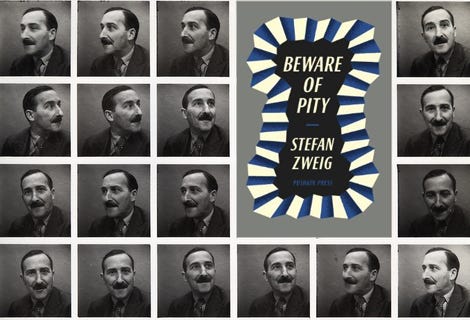
Beware of Memory: On Reading Stefan Zweig’s “Beware of Pity”

by Tara Isabella Burton

For years, Beware of Pity was the most important book I’d never read. I’d read other books by its author, Stefan Zweig: a melancholic Austrian Jew whose chronicles of pre-war Vienna filled me with an aimless nostalgia for Habsburgs I had never known. I’d loved them all.

But Beware of Pity–Zweig’s only novel–was the only one I was afraid to read.

I never admitted this to myself. I came up with excuses: I was too busy; I’d read enough about Vienna that month; the copy on the bookstore shelf was too expensive; all of these were lies. I was afraid to read Beware of Pity because the first man I’d ever loved had called it his favorite book, when I was 17 and an idiot, and he 18 and weighed down by his worldliness.

He’d told me about the book over one of our more awkward coffees, in that interstitial period between togetherness and estrangement engendered by our long-distance romance.

He summarized the plot for me. It was the story of a young Austrian officer at a dinner party who asks his host’s daughter to dance, only to discover that she is lame, and that his request has humiliated her. In a desperate effort to make amends, the officer begins to call on the girl more regularly, only to be drawn into a sickening cycle of codependence and guilt. In my lover’s description, the girl was an appalling predator, using her sickness as a net to lure in an unsuspecting and upright officer, hell-bent upon receiving romantic satisfaction at the price of his sanity.

We broke up not long after, and in the completeness of our separation I had nothing left of him.

It was only natural that I’d come across Zweig on my own. It was our shared love of the melancholy, of the nostalgic, of Sehnsucht for a world we’d never known or could know–Zweig’s stock-in-trade–that had first brought the two of us together. We loved so many of the same things. I loved, in my turn, The Royal Game, The Post-Office Girl, Letter from an Unknown Woman.

But Beware of Pity I could not face. To do so, I felt, would be too dangerous–like rifling through someone’s letters after a death. I would discover things about him, about myself, about us, that I would not be able to withstand. I would have no way of asking him what he meant, by responding as strongly as he had to the young officer Hofmiller, whether he saw me in the pale and crippled Edith, whether he loved the book because he believed, deep down, that the women who loved him were predators, and that he was bound to them by the hopelessness of guilt. I would be left alone with my own reading, my own questions: with the mirage of us suffusing every scene.

The choice to avoid the book became less and less conscious as the years went on. I idly downloaded a copy onto my Kindle, telling myself that I’d read it later. I moved on in other ways: I fell in love with other men, found a partner, learned about his own loves and fears through the books that he loved, that he lent me, that now line our shared shelves. I read the best and the worst of us in the stories we both knew.

Almost six years after my ex told me that he’d just finished reading Beware of Pity, it dawned on me that I was ready to read it myself. I steeled myself for the discoveries I would make, for the weaknesses–in myself and in him–I would uncover. I steeled myself for the story of a pathetic and manipulative woman who forced a hapless man to stay with her, despite having never loved her, and told myself I was past caring about that now.

But Zweig is a better writer than that.

The novel opens in 1938 with an older Hofmiller looking back upon his life. He is a decorated veteran, celebrated for his courage in the first World War. But he is also, as he tells the nameless writer that encounters him in a Viennese cafe, a fraud. He is, he tells his companion, one of those “deserters from their own responsibilities”–he bolted into war to avoid a greater burden of guilt.

Hofmiller is a coward, he tells us; he is a fool. He bumbles into his embarrassing incident with Edith as a result of his own ineptitude. He had arrived late, after all, and had not seen his hosts sit down to dinner, had not witnessed Edith on her crutches. He accidentally gives Edith false hope about the likelihood of a cure that will make her walk again. He leads her on romantically, unable to contend with the possibility that a lame girl might experience capacious sexual desire. He is well-meaning to the point of buffoonery, but his good intentions lead Edith into her own psychic hell.

At times, it’s true, I found myself disturbed at Hofmiller’s horror at Edith’s love for him, found myself achingly conscious of what it means to be a woman who once loved a man more than he loves her:

“She wants, she demands, she desires you with every fibre of her being, with her body, with her blood. She wants your hands, your hair, your lips, your manhood, your night and your day, your emotions, your senses, and all your thought and dreams… I now know that it is the most senseless, the most inescapable, affliction that can befall a man to be loved against his will.”

But where Zweig excels is not in his depiction of a proto-Lawrentian terror of the rapacious harpy, but rather in the complexity of what love–requited or not–might be. Hofmiller is repelled by Edith, but by the time he guiltily agrees to marry her, late in the novel, he finds–intoxicated by his power–that he is able to love the woman he has made happy, in spite of its genesis.

“Like a true lover, I postponed the moment of leaving the girl who loved me. How pleasant it would be, I thought, to sit beside her bed, stroking the delicate, tender hand in mine again and again, seeing the rosy smile of happiness light up her face.”

When Hofmiller at last, fatally, repudiates his love for Edith, it is due not to his lack of feeling for her but rather to his embarrassment at being connected to a woman seen by the town as ugly and undesirable. He denies his engagement to a group of fellow officers, though he instantly regrets it, and in so doing precipitates Edith’s suicide. His frantic attempts to reach Edith to explain are delayed, with catastrophic consequences, by the news of the assassination of the Archduke Franz Ferdinand. A new world order marks the young Hofmiller’s launch into adulthood: his crimes of the heart are mirrored, on a grander scale, by the global crimes to come.

I had expected a novel about unrequited love, and, to some extent, Beware of Pity is precisely that. But, far more important, Beware is a novel about the complexity of human emotions: about how people hurt one another without meaning to, about how love is as much borne of the happiness one can give as the happiness one can get, and how its absence is inextricably tied up with embarrassment, with shame, with the fear of proclaiming one’s love before one’s fellow soldiers, fellow men. It is about how Hofmiller grows up, with brutal abruptness, and realizes that he lives in a world far more complex, with boundaries between emotions far more easily blurred, than he expected.

The famous nostalgia that suffuses Beware of Pity is only illusory. Zweig’s heady and atmospheric prose comes close to convincing us that the world before 1914 was an easier, a simpler, a more beautiful place. But what we really mourn is not Austria’s innocence, but Hofmiller’s. By the time war dawns, at the book’s close, we know that it is not only the world that has changed, but Hofmiller’s perception of his place in it.

When I finished Beware of Pity, I did mourn: softly, in my own way. Not for the boy I had loved, nor for the man he has doubtless now become, but for our twinned innocence: for how unaware we both were, of how complicated the relationship between two people can be, how no easy narrative defines the way we love and lose.

I do not know if my Beware of Pity, read so many years later, is the same Beware of Pity my ex read, once upon a time. Perhaps he read it, after all, as a straightforward case of a man trapped into commitment against his will. Perhaps he read it because it was the sort of book a well-read teenager wanted to boast about having on his shelf. Perhaps he rereads it, now, and wonders, as I do, at the impossibility of easy answers, when it comes to two people in love.

If I had read Beware of Pity five years ago, it might have hurt me as I had feared it would. I might have read it as my own story: hated Hofmiller, hated myself in Edith. But reading it now, over hot tea in the midst of a polar vortex, I found myself hating neither of them, understanding them both. Feeling something like compassion, maybe pity. Maybe even love.