Fantastically Strange: A Talk with Karen Russell and A.M. Homes

by Sean Campbell

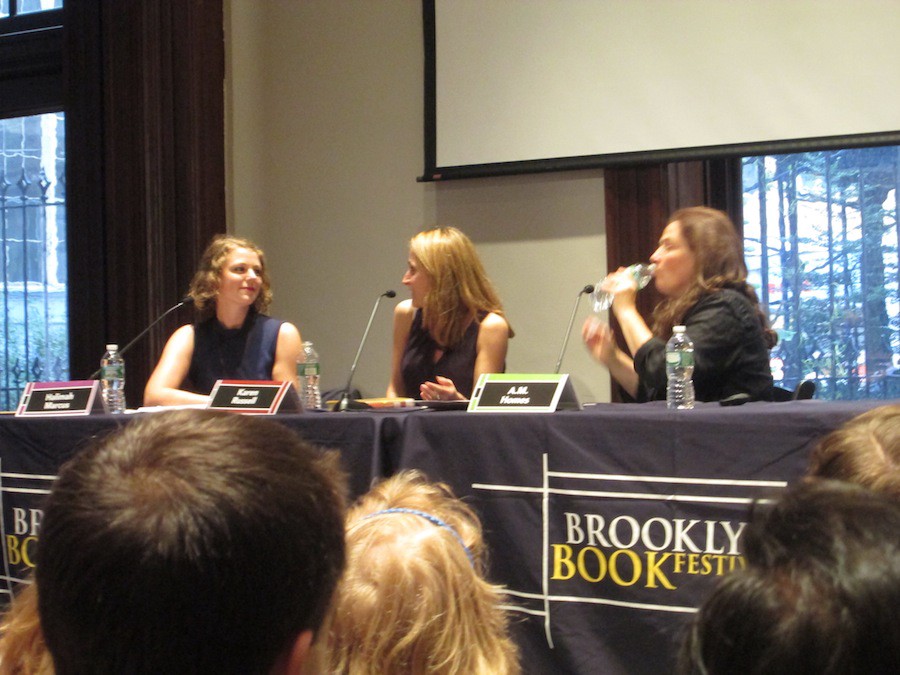
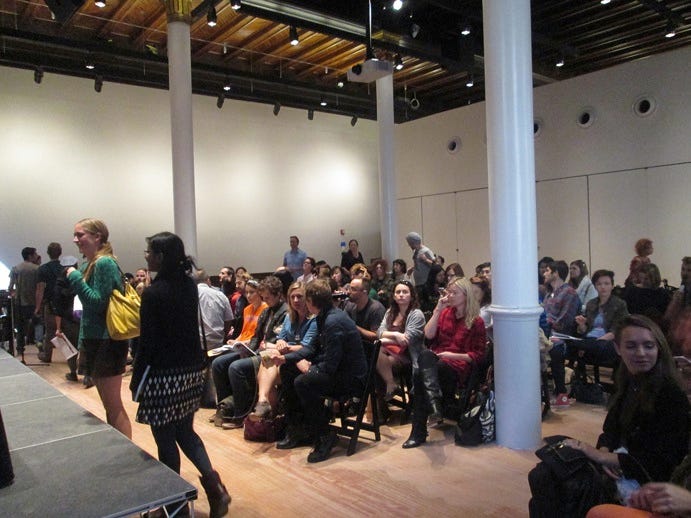
At the Brooklyn Book Festival, the line went out the door and around the corner to get into The Fantastic and the Strange, a reading and talk with Manuel Gonzales (The Miniature Wife), Karen Russell (Vampires in the Lemon Grove), and A.M. Homes (The Safety of Objects) and moderated by Halimah Marcus, co-editor of Electric Literature. Manuel Gonzales couldn’t make it, and he was missed, but Karen and A.M. were well worth the price of admission (even though, like all Book Festival events, this was a free event.)

Below is a synopsis of the discussion — in the interest of brevity, the questions have been paraphrased, the answers have not.

PackedHouse (1)

What strange thing have you written that you thought you just weren’t going to get away with?

Karen Russell: Do I never not feel that way?

A.M. Homes: For me, with fiction, I’m trying to reach a heightened sense of reality. I kind of go to the outside edges of what’s plausible. Otherwise, why am I going to ask you to stop what you’re doing and read this story if it is just a document of everyday life?

How about fitting to the logic of a story and using the audience’s imagination as a tool?

KR: I think [when writing a story] you’re trying to find a register where the truth is not just in the story… You want to engineer this impossible architecture and that is what’s going to be possible in this place. It’s not just putting wolves in pants.

AH: I start with the question of who is the least likely character. It lets me look at the story from a different perspective and crack it open.

Doesn’t technology make our lives strange?

AH: I’m fascinated by science, stuff like 3-D printing. In Princeton they even printed an ear. Technology has changed the way we’re thinking, the way we’re living.

KR: If I didn’t have stories to read, I feel like something would be lost. Stories slow things down. Everything now is just so chaotic.

What inspires your strange side?

AH: Strange side?

KR: I know, as if there was another one.

OK, how about your research when writing? How do you go about making things seem real?

AH: If it’s something I don’t already know, I have to know a lot about it in order to write about it with authority. I need to know more than what I will use to be clear about what I am thinking. My most fantastical elements are the most grounded and logical; they don’t come from nowhere.

What about your concepts, how do you make them work?

KR: I have many concepts that never take on their own life. The constraints just don’t let it work… It’s sort of like love. It’ll either happen or it won’t. Either there is some chemistry that will ignite, or not.

Saguaro

CHAPTER THREE — FAME

This part. This is a story I’m not too inclined to tell unless you are particularly interested in tales of full-grown men turning into worthless assholes. I’d rather not linger. Right now, where we’re at, I’m only nineteen. In less than ten pages I’ll be forty-eight.

When I got back to Arizona, Mom was living with a macho goober named Chris who sweat like a hog and ate like one too. I stared him straight in the eyes when we met, put a little extra into the handshake, and he gave a look back like, You stay out of my way and I’ll stay out of yours. Fine by me. I fixed up an old bike I found in the back of his garage and spent a lot of time riding it around, dropping all that coleslaw fat. It felt good. Mom saw the infected gashes in my belly and sent me back to the same doctor who’d delivered me. He gave me some antibiotics and I was better in less than a week.

Even though I’d failed in New York, was back amongst the lazy cacti and willow wrens, I knew it wasn’t over. I was practicing guitar and singing every day for hours on end. I spent so long on my songs that I started to go crazy, started thinking that when I played them no one would hear them. That they’d be invisible to the ears.

Eventually I had to prop a two-by-four against the door to keep Mom and Chris out. Otherwise, they’d be in there every five minutes, “Get a job, Bobby,” “Pitch in around here now and then why don’t you?” No thanks. I had bigger plans. Ten or so damn hours a day, alone with a six-string and my thoughts. I had the passion of a priest — had to. That’s the way it happens. That way and no other, unless you want to be The Monkees. And if you do, then fuck you.

The clubs in Arizona weren’t like the ones in New York, but they might as well have been. They were letting me play, but nobody was listening. Back there in shadows and leather I was nothing but music to drink by. I may as well have been a juke with all its lights burnt out. I was going to have to do something to get these people’s attention.

One day after a particularly sad show, I walked in on Chris sitting on the couch drinking lemonade in his underwear. I looked him over real casual and said, “Boy, you sure is ugly.” He was covering up quick with a dusty old afghan from the back of the couch, and he said back at me, “Why don’t you look at yourself, Bobby.”

And that’s just what I did. I went to the bathroom, looked at myself in the mirror. My long black hair was hanging down in my face like a veil. I looked like one big ornery Indian, and I asked myself, “What you hiding back there, Chief?”

Then I pulled back the veil, saw my face. I didn’t like it any better than I had before, but I decided, fuck it, it’s time to show the world. I went to the kitchen, right past Chris, got myself a bottle of olive oil and poured some into my palms. Smoothed my hair back with an unbreakable comb. Slick.

Then I figured, looking at that face, I’m showing the world this monster, may as well show them the rest of me. I went to the store the next day and bought some pink polo shirts. Three of them.

I looked at the world of Rock and Roll and said, “Fuck you.” Fuck your black, fuck your leather. It’s time for Bobby Bird, my friend. It’s time for pink cotton.

And I swear to Christ that the next time I went out to sing, people were watching. The troll was gone, and there was something alluring about this new ugly, so bold and clean as it were — a pockmarked mask floating above the pink canvas of my chest. That was a place where the women could project their fantasies, the men themselves. Shit, I don’t know, something just worked. I was up there smelling like a strawberry and screaming like my soul was on fire. I was actually performing for a change, and it felt different. It felt like it did in the Jamaican’s backyard. At the end of the night the club owner invited me back to play again, slipped me an extra ten.

It went on and on like that, eventually filling good-sized clubs, getting enough money so that I could stock the cupboard with canned chili and cereal, keep Mom and Chris content. And then came that mythic figure that pops up sooner or later in every one of these tales of talent gone awry — the Record Man. Mine was named Pat Hui-hui (Hooey-hooey) and he was a big fat Hawaiian. The first time I saw him he was way back in the deep of the club wearing a suit too nice for the joint. He smoked a long black cigar, the tip of it smoldering in the shadows like the devil’s dick.

When he called me over for a drink I noticed that his tie was printed with flowers and palm fronds — he was working the Hawaiian angle. Probably wore a lei to board meetings. Anyhow, this big man orders a round, then tells me he’s driven his Cadillac all the way from Los Angeles just to sit here in this shitty little club, baiting me to ask him why.

“Why?” I ask.

“To see you,” he says, putting a finger smack dab in the middle of my chest. And that was the Midas touch. It wouldn’t be too long after that that I turned to gold. Gold that turned to shit just as quick.

I hate to say it, but I lived in fame’s dark palaces for a good three decades. There’s about a thousand pictures to back it up, a dozen or so tacky little albums. If you’re a big Bobby Bird fan, to be totally honest, I wouldn’t trust your taste. My first album was a very good thing, the last the same, but everything in between is just awful. Those albums weren’t about music, but about meeting contract requirements and proliferating the decadence. Man, those pictures. Trendy hats and handmade overcoats, lounging poolside beside some milk-fed model with a blasé expression. I’ve got boxes of this shit up in the attic. I can spend hours up there like some goddamn archeologist. But the archeologist’s got the easier job: the cavemen made more sense than I ever did. I look at those pictures and I don’t know who the fuck that little guy is.

My memories from back then are like lily pads. I can hop from one to the other, but there’s nothing in between but brackish water. Maybe some guy’s face, blue and half-composed, floats up from the depths from time to time, maybe a baked potato and an unloaded handgun bob beside him, but the pieces don’t fit together. So I keep on hopping amongst the few solid things that’ve survived what I put my mind through, what I put my body through.

The things I do remember are often random and unimportant: a fried steak in Berkeley, a conversation outside a filling station in North Dakota. And there’s a whole lot of worthless trippy shit mixed in for good measure — memories of trips gone bad. One time dropping acid with these three girls I barely know. They’re all laughing girls, laughing so loud that their jaws stretch to the floor, melt into the shag carpeting. And I look down and see an ant working his way through the tread of my boot having a pint-sized adventure. I bring the boot up to my waist to look for him, and he’s gone. I start screaming. I was sure that little ant was headed for one place: my urethra. I knew if we didn’t find him he was going to find his way right into me, maybe start a colony in my ball sack. Night ends with me, weeping, face and belly mashed into the shag as these sweet tripping girls pick over me like chimpanzees, petting my back and assuring me that they’re going to find him. Like three good moms.

As much as I can’t stand looking at the stuff up in the attic, back then I was loving myself. After every show some girl who didn’t know any better would come back to my room and look at me all night long with an expression I didn’t deserve. But I saw myself in those big, fawning eyes, started to believe that I was whatever they were seeing. Like I said, I was an asshole. Listen to what I once said in an interview:

ROLLING STONE: Bird is an interesting last name, is that your real name?

BOBBY BIRD: Real as my first.

RS: Do you have any Indian blood?

BB: Only on my hands.

See, man? Anything to be snide. Anything at all. I love Indians, every last tribe. Even Apaches.

And on top of being a prick, I started getting snobbish. I wanted my beers from foreign lands, or at the very least Colorado. There better be a pyramid or a dragon on that label, my friend, the old blue ribbon just ain’t going to cut it anymore. Where’s the wine list?

And my women, too, I preferred from far away places. When they march the groupies back you’ve had so much sex with so many beautiful women that it doesn’t even matter anymore. You have to get creative. I want one that’s black with blue eyes, one that’s tall and Chinese, how ‘bout Chinese and black. It just goes on and on.

Every place you go people have trays of fancy food laid out for you, olives and beef, so inevitably you start to get fat. And then you start to get mean too, waking up every morning to some fat bastard staring back at you from the cold mirror. Once they put me in a suite with a mirror above the bed, and if I looked ugly before, I didn’t look any better beside that beautiful girl they’d brought in for me. We looked like two different kinds of animals.

Groupies aren’t as great as you’ve imagined them to be, either. It’s like Mick Jagger said to me once, “Every last one a’ these girls comes t’ me expecting an unforgettable night with Mick the sex-god, Mick the god a’ rock and roll. Sometimes you just want t’ cry t’ somebody ‘bout your mum.”

See, I’m telling you all this not as an excuse, but as a warning. You think you’re above becoming an asshole? Then you’re the same kind of guy who thinks he can smoke without becoming addicted, and you’re the most prone to become an addict. Take this bit of advice: don’t forget who your friends are. The more you take good things for granted, the faster they go away.

I wish I’d have taken some advice back then. I remember one time running into John Lennon. I grabbed him by his white lapels and said, “What’s your secret, man?” And he said to me, in that funny voice of his, “My advice, get married and stay married.” I think he thought I was going to punch him. Must’ve talked to Bob. Truly, those Beatles were funny guys. Every last one of them.

Well, I took half of John’s advice. In the middle of all this madness one of our tours wound up in sunny Pasadena, California. A cute and quiet blond named Nancy Sue Redmond came back to my room with me, left her diamond earrings with her sister before she ducked into my limo.

Back in the room, all full of Jack, I was all over her like a zombie. She kicked me in the balls and ran away crying. Coughing there on the carpet, it was the first time I’d been rejected since meeting big fat Hui-hui.

I was a nomad at the time, had a bunch of apartments in posh neighborhoods, so I didn’t have any place to be getting back to. I just stayed right there in the Marriott. And Bobby goes a-courtin’.

I had a private eye find her parents’ house, started sending fruit baskets with cute letters written by a young and serious screenwriter named Jonnie who would later go on to write the movie The Last Starfighter. Eventually she agreed to meet me at a coffee shop called Conrad’s. We had a nice talk, and even though she accepted my apology she wouldn’t let me pay for her sandwich.

We started dating. I was on a lot of downers at the time, and I’d just sleep with those thick hotel curtains shut tight. Hibernating. Getting up just to go on the dates, paying the bellboy twenty dollars to literally pull me out of bed and throw buckets of ice water at my chest until my gluey eyes peeled open.

After six months of mellow courtship, we got married. She got pregnant. Aiming to be responsible, I got off all the Quaaludes I was taking. And ironically enough, once clear-headed, I realized that this was not where I wanted to be. As the months ticked by, as I watched Nancy swell like a calzone in an Italian’s oven, a mighty wanderlust grew in me faster than the baby in her. Tot just couldn’t keep up. So I got back on the road, stayed there. I won’t go into details, but let’s just say I didn’t raise that boy.

I don’t think I’m a bad man, but during those days I may have been. I was a weak-ass man for sure. The only thing I can say in defense of myself is that all of that shit — the excess — didn’t feel like me. It was a suit that didn’t quite fit. But something pretty big was going to have to happen before I’d go ahead and get it tailored. And then it did.

One midnight we were driving through Arizona when out my window I spotted a great big blue bull a story tall before a dinky hardware store. Babe the Blue Ox. I remembered this from when I was a kid, remembered it being much bigger. Now it looked like something I could tango with. I’m Paul Bunyan, motherfucker, I thought. Then I shouted it out, “Motherfuckers, I’m Paul Bunyan, stop this fucking bus!”

And, of course, they did just as I said.

Outside, stars twinkling, I stumbled drunk and breathing steam to Babe and looked him in the face. I slapped his hollow chest, and the sound inside of him said back to me, “Hello, brother. Hello, father.” I fell forward, caught myself against him, and rested my forehead against his smooth fiberglass hide. Planted a couple of kisses.

The drummer, a shaggy kid named Ralph Peralta who loved to roll, stepped out into the gravel and walked up behind me. He loved the highway is what I mean, loved watching the trees blur past. He kept a dime store notebook in his denim jacket where he wrote down poems full of heartache that he was going to set to music and record with his cousins in Nashville. Once when he was asleep I flipped through it and saw right away that this kid knew what he was talking about. Knew more than I ever would. It would have made a beautiful album.

“Bobby,” Ralph says, “What the fuck are we doing?”

I turn to him, slap Babe again. “I want this.”

“What?” he says, says it sharp, and he’s looking at me like I’m a fucking idiot. This was an expression I well-deserved, but I didn’t see myself in it. What the fuck did that kid know?

So I shout past him to our manager, “Seth, I want this thing.”

Serious Seth comes stumbling off the bus with his sleeping blindfold up on his forehead. “Okay, Bobby,” he says, quite like a mother. Shrewd son of a bitch knew how to pick his battles.

And then everyone gets to work for me. The other musicians are asleep with hats over their eyes, some passed out, but Ralph stays outside and watches the whole thing. We were going to be late for our show in Tucson, but I didn’t care. I wanted old Babe, needed my compadre by my side.

I tore the plastic off a fresh bottle of rye and watched my man-machine work for me. Somebody called the sheriff, he called the owner of the hardware store, somebody rented us a trailer. And when the sun started rising, painting my world colors of orange, a couple of kids paid in cash were roping Babe into the trailer, rolling him up behind the bus. I had no idea what I was going to do with this fucking thing, but I was happy to have it.

As things were winding up a small crowd gathered. High school kids in coats and hats, wanting to see Bobby Bird, wanting to get all the details of this story so they could tell their friends the next day. Little did they know, with their thermoses and plastic cameras, that they were seeing Bobby Bird on his last day as a practicing musician.

Just as everything was wrapping up I moseyed over to Ralph who was chewing a toothpick and shivering in the cold. “What do you think Ralph?” I said. I really didn’t know; that’s how subjective my experience had become.

“I think,” he said, and took out his toothpick, “that someday I’m going to be a big musician, maybe even bigger than you, and I think it’s important that I remember all of this,” and he stabbed the scene with his toothpick, turned and looked me in the eyes, “because I never, ever, want to get like this.”

I stared at him for a minute, stared at him like I was his boss, but his gaze didn’t break. Then I turned and got up onto the bus. I settled deep into my chair and smelled my whiskey. Fuck that kid.

Minutes later we were back on the highway, Babe a caboose. I glanced back at him from time to time — his saucer eyes dead and staring — to remind myself that I was Paul Bunyan.

Then, going down through the canyon past Bumble Bee, the trailer kinked on a tight turn and flipped the bus. Screaming metal, sparks, Babe flying to pieces. The smell of burning oil.

I woke up sometime later in the hospital, doped up as some young nurse was pulling plastic ribbons out of my shins. I watched her work for a minute, finding the pain curious. She thought I was still passed out and I didn’t make a noise to let her know I wasn’t. Then a few gurneys rolled past. My band. Steve Bridges, piano, was screaming and grabbing his shins. Ben Ten, bass, was huffing and puffing, changing colors before my very eyes. Rich Sends, slide guitar, was laughing like a maniac. And poor Ralph Peralta, drums, I had to recognize by his denim jacket. His head was torn clean off. And no one ever found it.

About Literature

by Gabi Gleichmann

I lived in Hungary for the first decade of my life, back when the country was held in the steely grip of the Communist Party and the truths of the authorities could never be questioned. The media were controlled by the state, and journalists were accomplished liars about everything except the scores of soccer matches.

Those seeking truth had to resort to works of literature

, even though the official censors kept a close watch on such publications.

In search of the few available crumbs of truth, my parents bought copies of all new novels and poetry collections published in the country. Our home was like a library, piled high with books, and my first vivid experiences of the world of books were purely sensual delights: the smell of paper and printer’s ink, the nuanced colors of the book jackets. Later, once I’d learned to read, I traveled, powered by the fuel of the alphabet, to inner and outer worlds, down into the depths of history, sometimes into the future, toward the vast riches of life that extended farther than any eye could see. I spent time with people who had lived long before me in places I would never be able to visit; perhaps those places had never existed at all. I often curled up under the covers to read, living in a boundless world of dreams, full of adventures.

For a long time my favorite book was One Thousand and One Nights, that perpetually enchanting cocktail filled to the brim with the most delicious ingredients of the Middle Eastern storyteller’s art, spiced with liberal doses of invention and humor, sensuality and cruelty. Sometimes I would skip school, preferring the company of Aladdin, Ali Baba and Sinbad the sailor. One time I was caught and as my mother seized me by the ear, I couldn’t help exclaiming, “I wish I was grown up already and could spend all my time just reading, reading and reading!” Perhaps that episode was influential in my decision ten years later to dedicate myself full time to a life in the world of books.

My next tumultuous literary experience came in my late teens when I read The Trial. It was earth-shaking for me. With just the first few pages I realized that I adored Kafka, especially the tension between dazzling light and absolute depths of darkness that characterized his prose. More than anything else I was impressed by his conversational style, recognizable for its simplicity and crystal clear transparency. And I took his motto for my own: “Correctly comprehending a thing is no guarantee that one hasn’t failed to understand it at the same time.”

Kafka the strict moralist became my guide, one who pointed out the right path but never disclosed the goal.

That great prophet of ambiguities taught me to look at the world with fresh eyes and without illusions. Reading Kafka gave me insight into myself; I discovered that I’m a complicated, eclectic and urban Jew, one who believes in no God but still has spiritual needs, and, I hope, has a moral dimension: a man who accepts uncertainty as the only constant and change as the only certainty.

Others who have enriched my world are the great writers of Latin America. Gabriel García Marquez and Mario Vargas Llosa have taught me that within a work of the imagination everything can exist simultaneously and on the same level, outside our familiar sense of chronology, with no distinctions drawn between the realistic and the fantastic or between reality and myth. Their approach allows one to create a world complete in itself, a landscape in which everything leaps into view as if lit by a flash of lightning.

I’ve lived my whole life surrounded by novels, works of the imagination and invented stories. The question therefore presents itself: Why, exactly, do I read and write?

As far as I’m concerned, reading and writing serve the same purpose. They help me to come to grips with myself and with the world around me. I read and write to see more clearly, to fully develop and to exactly express my feelings and thoughts. I do this above all in order to explore and to encounter — not things that I already know, but instead those that still remain obscure to me, half intuited and virtually unknown. For I aim to push my way into that hidden reality and perceive things in new ways. In such an endeavor, not even cutting-edge psychological research can come close to what poetry can achieve.

I am never alone when I read or write, even though a casual observer would see these activities as elements of a profession practiced entirely in isolation. In a different sense, however, they provide one with an ample and rewarding circle of acquaintances. When I read, I enter a world conceived by another person, and when I write, I am reaching out to my fellow human beings. These tasks sustain and uplift my spirit by extending its worlds of fantasy, feeling and play. In literature nothing is sacred. Its works are the products of dreams, thoughts, feelings and fantasies that never petrify into dogma.

Literature is the eternal conversation of the human race.

Beside, literature is the only tool we have to give back the face and the life of dead people who has fallen into oblivion.

***

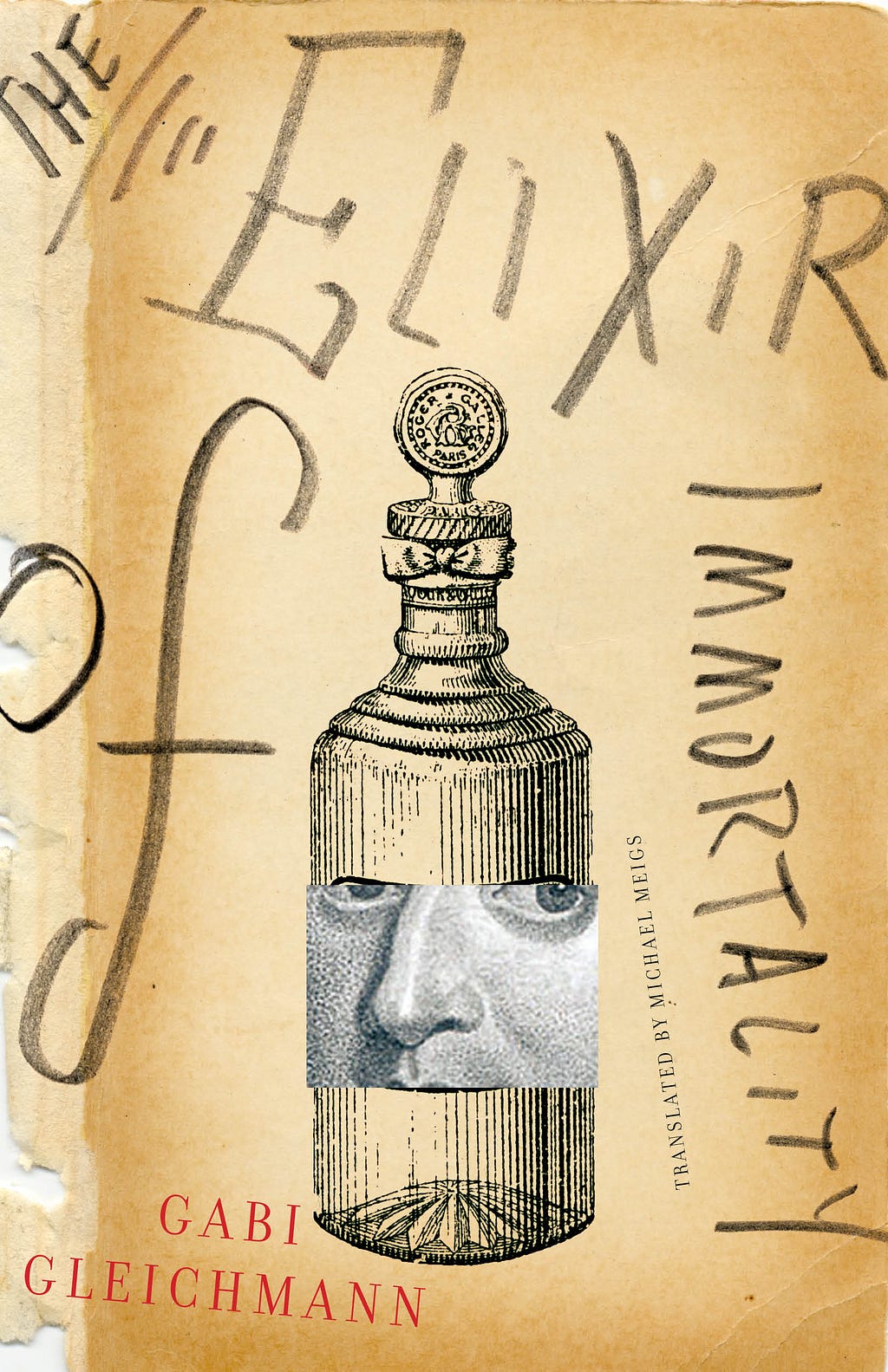
— Gabi Gleichmann was born in Budapest in 1954 and raised in Sweden. After studies in literature and philosophy, he worked as a journalist and served as president of the Swedish PEN organization. Gleichmann now lives in Oslo and works as a writer, publisher, and literary critic. His first novel, The Elixir of Immortality, was sold to eleven countries prior to its first publication.

THE WRITING LIFE: The Unappreciated Genius of John Stanwell

by Seth Fried

In discussions of the literary masters of the last century, no name has been more frequently omitted than John Stanwell, a man who is only now beginning to be recognized as one of the most brilliant and consistently overlooked writers in recent history. In his life, he published twenty-three books, each of which was a critical and commercial failure at the time of its publication. This, despite the fact that his body of work contains some of the greatest masterpieces that Western culture has ever overlooked.

Many have attributed the failure of his first book to a problem with the typesetting. His debut novel, titled Wind Burn, was a semi-autobiographical account of his experiences growing up as an orphan in Philadelphia during the Great Depression. Stanwell didn’t realize that it was customary for authors to tip their book’s typesetter, and so instead of the name John Stanwell the book was published under the name John “Small Penis” Hitler. This had a significant impact on sales. His second novel was properly attributed to him, but in this instance the typesetter replaced the correct title Of Time And Memory with the erroneous Trends in Pedophelia. Stanwell experienced similar difficulties with his third and fourth books until the typesetter in question finally quit.

Due to his general lack of success, Stanwell was largely ignored by his contemporaries. Though, once at a party Truman Capote threw him down a flight of stairs as a joke. And Nabokov once criticized Trends in Pedophelia as being one of the most disappointing books he’d ever read. Beyond that, his impact on the writers of his day was nonexistent.

j.stanwell copy

His career experienced further setbacks in 1952 when he was called before the House of Un-American Activities Committee. Stanwell had once done some yard work for Elia Kazan, who had provided the committee with his entire rolodex in exchange for a signed photograph of Joe McCarthy. The Committee attempted to denounce Stanwell as a communist, but due to the chairman’s poor penmanship it was officially reported that Stanwell was guilty of being a “cormorant.” He was therefore forcibly relocated to the Alaska Maritime Wildlife Refuge where he lived for eleven years as an exotic bird. After some time he managed to clear his name, but the stigma of the accusation remained attached to him throughout his career. Even later in life he was occasionally followed around by graduate students who would attempt to measure his wingspan and collect samples of his droppings.

It seemed that some relief had finally come after the publication of his eighteenth novel in 1985, The Meek Shall Inherit, when he received a letter informing him that he was to be the recipient of a prestigious award from the Good Book Writing Council. Unfortunately, when he attempted to accept the honor he learned that there was no such award or council. Rather, a gang of neighborhood children who knew him to be a writer had invented both in order to lure him into an abandoned building and torment him with water balloons. By the time police finally happened onto the scene, the children had relaxed their bullying into a cabaret atmosphere, forcing Stanwell to sing jazz standards while they drank juiceboxes and continued to half-heartedly throw balloons at him. The officers stayed for a few songs, and then broke it up.

The incident left Stanwell deeply shaken. When he later received a letter from the National Book Critics Circle informing him that they wanted to present him with a lifetime achievement award, he tore the letter up and hid in his crawl space for a little over a month.

These hardships did not manage to diminish his literary output. In his last years, he published five novels in quick succession. These were among Stanwell’s best and most accessible works. However, due to a mix up, the books were all printed in Defaka, an endangered Nigerian language with only two hundred remaining native speakers. This fact significantly reduced their potential readership. Though he did manage to become wildly popular in certain parts of southeast Nigeria, a success that has only recently begun to trickle back to the United States.

But even though Stanwell did not live long enough to witness his work reach a wider audience, he was always perfectly happy in his writing and was often heard to remark that he felt blessed to have been able to know the joys of creative work. He died in his sleep on May 17th, 1995, while being mauled by an escaped jaguar from the local zoo.

***
Illustrations by Matt McCann.
Matt McCann works at the photo desk of The New York Times, and in his free time draws pictures.

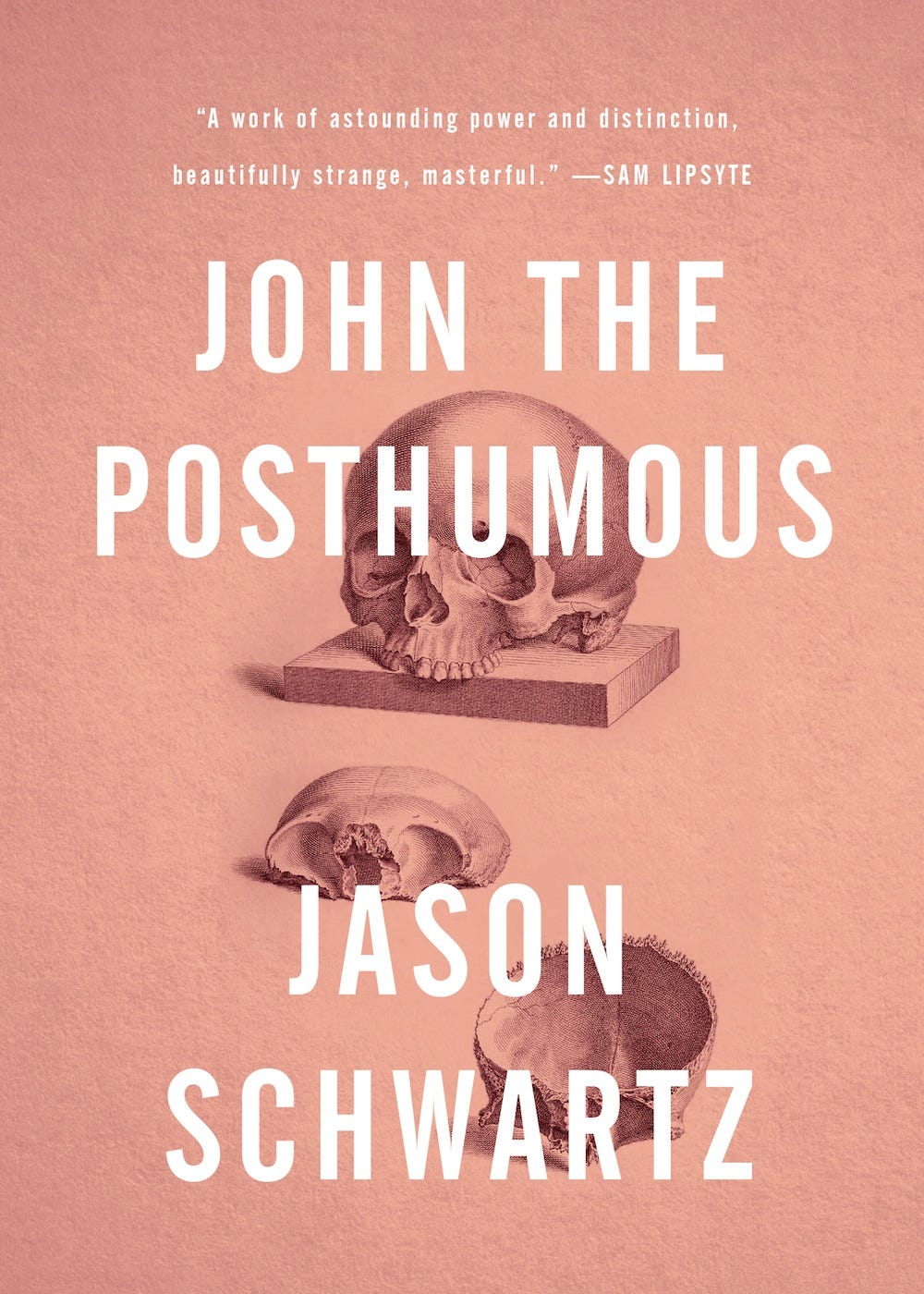
REVIEW: John the Posthumous by Jason Schwartz

by David Winters

Conventionally, a review of a novel should offer some sort of synopsis. Such a review might climb to all sorts of interpretive heights, but still, a basic part of its job is to summarise its subject’s plot. At an elementary level, reviews are expected to be about what books are “about.” And this is precisely where Jason Schwartz’s new novel poses a problem. John the Posthumous is impossible to synopsise.

Put bluntly, this book will beat any critic’s attempt to boil it down to a summary.

But it doesn’t follow from this that the book has no plot. Rather, John the Posthumous reminds us as readers that plots aren’t reducible to what we can describe. Instead, as with crimes or conspiracies, plots can be something we try to discover — with no certainty of success.

In this respect, Schwartz’s writing spins the reading experience into reverse. His prose puts readers in a position where the most rudimentary aspects of reading are no longer givens, but goals. Our literary traditions train us to want certain “returns” from the task of reading. Usually, we’d like novels to leave us with a better understanding of ourselves; a better idea of where we belong in the world. But Schwartz’s work shrinks from the world, like a whirlpool, pulling us down to a depth from which nothing returns to the surface. Or maybe it’s more like a dream — one whose meaning can’t be translated back into waking language. Whatever the metaphor, this sort of writing frustrates some fundamental assumptions about the consolations of fiction. In short, Schwartz is difficult.

John the Posthumous articulates an alien linguistic world, woven together from Biblical quotes, opaque legal cases, and allusions to Winslow Homer’s paintings — not to mention eighteenth-century conduct books, histories of the French monarchy, and the floor-plans of abandoned properties (that’s just to begin with). The book is a baffling accumulation of folklore and apocrypha, convincing fictions and far-fetched facts. To take one example, Schwartz’s narrator cryptically claims that “some Colonial maps display rows of daggers for fenceposts, and rows of cannons for houses.” Later he remarks — apparently at random — that “maps of the body, in early anatomy, display the organs as houses in a town.” Now, imagine a book built wholly out of such statements; a map that collates other maps — of history, culture, and literature — and then madly scrambles their landmarks. This, for instance, is a typical passage:

The parable of the bed — I imagine the Bible contains no such item. What delicate phrases we must, therefore, do without. Tin knives and burnt blankets, a plague gate. Buried nightdresses, whether diseased or in pieces, find considerable favour in chronicles of a more Teutonic sort. While the parable of the gown ends, once again, without evidence of my wife.

So far, so impenetrable — but let’s take a different tack. Threaded throughout these strange declarations, the words “wife” and “wives” arise thirty-five times. Also, “adultery” and associated words (“adulterer”, “adulteress”, the Latin “adultera” and, “to use the legal term… adulterium”) make twenty appearances. Correspondingly, “cuckold” and “cuckoldry” (which the narrator notably calls “my proper topic”) occur on ten occasions. “Bed”, “bedsheets”, “bedclothes” and “bedroom” combine to a total of ninety. So, it’s striking that “knife”, “knives” and “blade” add up to sixty-seven. “Blood” appears twenty times, “throat” nineteen, and “murder” and “kill” total twenty again.

Forty-four instances of “burn”, “burnt”, “burning”, “fire” and “flame” fan out across the text.

Finally, tellingly, there are twenty-one uses of “body”, always appearing alongside such phrases as “in agony”, “oddly marked”, “in distress”, “broken”, and, of course, “burnt.”

Now we’re getting somewhere: whether or not Schwartz provides a “plot”, he at least leaves a trail of breadcrumbs; a path through the labyrinth. Schwartz’s assorted facts and falsehoods hint at a hidden “history of adultery” — or, as the narrator later describes it, “a geometry of nuptial detail.” And the pivotal piece of this puzzle — the wife — is unnervingly absent. On one level, then, the book can be read as a killer’s confession — perhaps a coded personal journal, peppered with clues; or a rulebook for a meta-literary murder mystery. But Schwartz isn’t merely playing games. The power of John the Posthumous stems less from the promise of solving a puzzle, more from the emotions evoked when that promise is broken. Ultimately, what the book is “about” can’t be reconstructed into a narrative arc. All that’s left, then, is the trauma of narrative’s aftermath. Not stories, but feelings of fragmentation and loss form the lifeblood of John the Posthumous.

So, whenever Schwartz seems on the verge of revealing a story — or simply a sense of “progression” — he suddenly swerves, reversing away from revelation. And on closer inspection, this sort of reversal structures the book right down to the sentence level. The narrator’s claims nearly always entail either self-contradiction (he describes a scene as “north of the slaughter, or south of it”), equivocation (he calls a character “Edward, or perhaps Edmond”), or painstaking qualification (“or, more precisely” is his favoured formula). At one point he declares, “The word adultery derives from cry,” but then admits that it “does not; just as you had suspected.” In this way, his words recoil back into themselves — offering meaning with one hand; occluding it with the other. What gets left over from this operation — the remainder of Schwartz’s equation — is only an outline, an aura of an untold story.

Schwartz’s extraordinary style is entirely his own.

Yet no writer’s style comes from nowhere; even the most striking styles are imprinted by influences, or “precursors,” as Harold Bloom puts it. If anyone has played a part in shaping Schwartz’s prose, it would be Gordon Lish — the editor who published Schwartz’s early stories in The Quarterly, and his first book, A German Picturesque, through Knopf in the ’90s. Lish’s term for the recursive technique sketched out above is “consecution” — a way of writing by “walking backwards,” as some have described it. Through consecution, the narrative progresses by mining what has just been written: each sentence treats the previous one as a store of potential to be unpacked, or subverted. Of course, this is a simplification — the approach encompasses an entire aesthetic philosophy — but suffice to say, there’s a logic to Schwartz’s manipulations of meaning; a method in his madness.

Robert Musil once said that writing should combine “precision and soul.” But Schwartz has perfected his own compound of precision and menace. As his narrator proclaims, “ornament, according to one argument, portends death.” In his collection A German Picturesque, Schwartz had already shown a mastery of minutiae, crafting obsessive descriptions of trinkets — “bracelets”, “scrollwork”, “a Brussels-lace mantilla” — in order to conjure sadness and wonder from their inconsequence. In fact, Schwartz’s authorial gaze is as raptly exacting as Robbe-Grillet’s; Lish himself has described his style as “a totalized form of attention.” And John the Posthumous further intensifies this closeness of focus — only here Schwartz turns his attention to horror. In a sense, every scene is a murder scene; every ornament — “the rod, the shade, the ring” — an “emblem of betrayal.” Alluding to occult codes in old Bibles, the narrator remarks that “Satan appears to the left of every phrase. So goes one old notion.” And this is true of John the Posthumous too; the devil is in the details:

In our family Bible: the flyleaf is inscribed in blue ink, in a narrow hand. From husband to wife — followed by a month, a slash, a year. There is a curious break in the number eight. And a mark of sorts, a smudge — a tiny form in the corner of the page.

Perhaps such vignettes speak to the very spirit of John the Posthumous. The text’s chief achievement is its evocation of vast, expansive emotions — sorrow, dread, religious terror — from the most meagre materials; in Schwartz, each “mark” and “smudge” summons up a whole world. And as readers we lose ourselves in this world, as we would in a labyrinth — only, it is one we can never escape from. The closer we get to a sense of its centre, the more it withdraws; the more intricate its construction becomes. This is the reason why Schwartz’s novel — or better, his devilish stylistic edifice — can’t be reduced to a “story.” Ultimately, it’s less like a book than a fractal; a shape whose complexity never diminishes, all the way down to the smallest scale. Gilles Deleuze detected such qualities in the dense ornamentation of baroque art; a style, as he said, whose “twists and turns and folds unfurl all the way to infinity.” Fractal baroque: an unfurling art that enfolds us in incomprehension, in fear, but also in irreducible beauty. This would be a fitting description of Schwartz’s difficult genius — and of the infinite inner world that his writing inhabits.

Leg

“Leg” by Steven Polansky

When Dave Long tagged up and tried for third, everyone had to laugh. A bonehead move, and, for Dave — typically a prudent guy — uncharacteristic. As he took off, Dave laughed, too, at his own folly. Church-league softball, one gone in the last inning, not a blessed thing on the line — the game was without meaning and out of reach — and he went on a shallow fly to left.

“Good Lord,” his wife, Susan, said to the woman next to her. She was sitting in the aluminum bleachers with the rest of the Bethany Baptist bunch. She had arrived late — barely in time to see Dave reach second on an overthrow. He was surprised to see her. Susan Long was a busy, charitable woman. She worked half time keeping the books for Nunez Chiropractic and gave her afternoons and evenings to business of the church, the school, the community. Before the game, Dave and his son, Randy, grabbed some food downtown — as they did two or three times a week. Given her responsibilities at the church, which included a leadership role in Christian education, her several Bible-studies and support groups, her involvement in such service arms as Member Care and Prayer Chain and Meals on Wheels, Susan had little time to prepare supper, or eat it. “What the heck is he doing?” she said.

Dave was trying for third. There was no question: he knew he should stay at second, he should not go, and he went. The left fielder, Pastor Jeff, of the Alliance Church, had a cannon. He looked at Dave as if Dave were pursued by demons. Pastor Jeff spoke to him. In shallow left field he was close enough to speak to Dave as he headed for third.

“Where are you going, Dave?” Pastor Jeff said. “You’re dead, man.”

Dave smiled. He liked Pastor Jeff. On the street. He hadn’t cared for his manner in the pulpit, the few times he’d heard him preach. Pastor Jeff was too tall — he was six feet nine — and his preaching posture was stooped and condescending. He was also too familiar and digressive for Dave, who had been raised in the cooler, straighter logic of the Episcopalians. But Pastor Jeff had the straight truth here: Dave was dead. To rights. Dave had been fast, but he was forty-four now, and he was too slow to pull this sort of stunt.

Dave’s son, his only child, Randy, stood a way off, down the third-base line, behind the Cyclone fence. He was hanging from the fence as if tethered there, his arms stretched out above his head, his fingers laced through the wire, the toes of his sneakers wedged in the bottommost holes. He shook his head back and forth, almost violently. Randy was thirteen. He had not wanted to come watch his father play.

“God,” he said when Dave tagged up. “Stupid. You’re stupid.”

Randy was a big, strong kid. He was, almost all the time now, angry at his father. He could tolerate his mother, but everything about Dave, who you would have thought the more approachable parent, enraged him.

Randy hated the way Dave dressed. He hated his whole wardrobe, in particular a blue down jacket Dave had had for years and wore when he drove Randy to school on winter mornings.

“You garbageman,” Randy would say to him. “You look like a garbageman. You grunge monkey.”

Dave liked this latter expression; he tried not to smile.

“Laugh,” Randy said. “Laugh. The garbagemen dress better than you do.” Dave’s beard, which he kept respectably trimmed, made Randy angry. “No kisses, wolfman,” Randy said, if Dave bent over his bed to kiss him good night. “You werewolf. You’re scaring me, wolfman.”

Randy spoke with stage disdain of Dave’s friends. Dave’s car, a Taurus wagon, was boring and dumb — for Randy, an emblem of all that was insufferable and pedestrian about his father. But the thing that really drove Randy wild was that Dave liked to read. Dave rose every morning at five so he could spend a quiet hour reading and thinking and praying. Which left him irredeemable in Randy’s eyes. If Dave sent Randy to his room or otherwise disciplined him — this happened more often than Dave wanted — Randy would say, in his cruelest, most hateful voice, “Why don’t you just go read a book, Mr. Reading Man. Mr. Vocabulary. Go pray, you praying mantis.”

Watching Randy, in his father’s presence — the way his face went tight, the way his back stiffened — listening to the explosive, primitive noises he made in place of speech, you could see the boy’s anger was beyond his control and understanding. It had sandbagged the kid, hit him blind side. It made Dave very sad. He missed the easy love of his son. He missed talking to Randy, he missed his companionship, and he felt sorry for him, because in the periodic rests between peals of rage, when he took breath, Randy was clearly dazed and spent and, himself, sad.

Sometimes it was hard for Dave to remember that this abrasive, scowling thing, always coming at him, was his own son. Randy would bump him or leer or growl, make some foul and belligerent gesture, and before he’d had time to set or check himself, Dave would have responded in kind. “You shut your mouth, punk, or I’ll shut it for you,” Dave might say. He would grab Randy’s arm above the elbow and squeeze it hard, trying to hurt him, and he would fill with regret and shame.

Randy said, “Stupid. You’re stupid,” and Dave, slow but hellbent for third, heard him.

Shoot, Dave thought. Poor kid. What am I doing?

Pastor Jeff threw a rope to the third baseman, also named Jeff, who worked in the auto-salvage yard. This layman Jeff caught the ball and straddled the bag, waiting for Dave, who was still only halfway there.

“Dumb,” Randy said. “You are stupid.” He untangled himself from the fence and turned his back to the field.

The third-base coach, Pastor Rick, senior pastor at Bethany Baptist, was at a loss. When the ball left the bat, a weak fly, he had raised his hands, palms out, signaling Dave to stay put. “Hold up, Gomer,” he shouted, but it was too late — Dave had committed himself.

Pastor Rick was Dave’s age. They met downtown once a week for lunch to discuss Scripture and Dave’s personal journey in faith. They had that day, over turkey melts and iced tea, considered Matthew 7:13–14, a familiar passage Dave had lately found compelling and vexing: “Enter through the narrow gate. For wide is the gate and broad is the road that leads to destruction, and many enter through it. But small is the gate and narrow the road that leads to life, and only a few find it.” After a space of silent meditation, Pastor Rick asked Dave what he thought the Gospel writer might have meant by the word “narrow.” They had their Bibles on the table before them.

“Apart from the obvious?” Dave said.

“Yes,” said Pastor Rick. “Are you asking because you know, or because you want to know?”

“The second,” Pastor Rick said. “I don’t know. How would I know?”

“You’re Baptist.”

“No shit,” Pastor Rick said.

“If we knew what the Hebrew was,” Dave said. “Or the Greek.”

“Good question. I don’t. So?”

Dave thought a moment.

“Maybe as in severe,” he said. “I don’t know. Narrow. As in pinched. It pinches you to go through. What’s the word? Straits. Straitened. Maybe exclusive. Most people are excluded. They are left out. Unpopular. Maybe narrow as in simple. Sheer. Simple. Severe. Did I already say that?”

“Yes, you did.”

“Yeah, well that’s what I come up with.”

“Good stuff,” Pastor Rick said.

“What have you got?” Dave said.

“Half my sermon. Thanks.”

A female fan on the Bethany side was yelling, “Slide, Dave, slide!” This was a joke, because no one slid in church league — the guys were too old, too sedate — and, besides, Dave was wearing shorts. Everyone laughed. Dave heard the call for him to slide, and he, too, found the proposition laughable.

Then he slid. He raised his right hand in a fist. He yelled, “Oh, mama!” And from six feet away, and at what was for him top speed, he slid into third. Under the tag. Around the tag, really. No one who watched could believe it. It was the best, the only hook slide anyone had ever seen in that church league.

The base paths were a hard, dry, gravelly dirt, and Dave tore up his leg. He stood up, called time, and limped off the bag. He looked down at his leg, the left, which was badly abraded from ankle to knee. Beneath a thin film of dirt, which Dave tried to wipe off with his hand, the leg was livid, strawberry, a crosshatch of ruts and gashes, bits of sand and gravel in the wounds.

Pastor Rick was beside him. He put his arm around Dave.

“Why did you do that?” Dave said. “Ouch.”

“Wild man. You okay?” Pastor Rick said. “Nice slide.”

“Thanks. I’m okay I think.”

“Can you walk? You want a runner?”

“Nah,” Dave said. “I’m fine.”

“You sure?”

“Yeah,” Dave said.

Pastor Rick patted Dave on the rump. “All right, then. Go get ‘em.”

Dave turned to the crowd. He smiled sheepishly and waved.

Susan stood up in the stands.

“I’m okay,” he said.

“Big jerk,” she said to herself as she sat down. Then, to the woman next to her, “I don’t believe it.” She took a magazine out of her purse and looked at the cover. She stood up. She shook the magazine at Dave. He pretended to cower, and the crowd laughed.

Randy, who had wheeled to watch the play from the left-field foul line, was embarrassed: that his father slid; that his father slid in shorts and hurt himself sliding; that the slide, in this context — a game for coots and feebs and wacko fundamentalists — was inordinately, ridiculously good; and, on top of it all, that his mother had got into this bad circus act. Randy began to drift in his father’s direction, up the line. Dave watched his unwitting tack with gratitude and wonder. He looked at Randy, shrugged his shoulders, and smiled, a bit goofily.

It was only when Dave smiled at him that Randy realized he was moving toward his father. He wrenched himself away. Randy turned and headed for the parking lot.

Dave’s leg looked bad, painful, but it didn’t really begin to hurt until after the next batter, Lloyd Weeks, who worked for Dave at the cereal plant, tapped a ground ball to the pitcher, stranding Dave at third and rendering perfectly gratuitous his miracle slide.

Randy caught a ride with his mother, who left as soon as the game ended, taking time only to tell Dave to get home and clean up his leg. To give Randy some time for his anger, Dave stayed to help gather the equipment, then wound up going for a beer with Pastor Rick and a few of the men. His leg was stinging. He doused it with cold water from a spigot by the backstop. At Tiny’s, he ordered a beer and a Scotch. He poured out the Scotch on his napkin and swabbed his leg.

“Shoot,” Dave said. “That stings.”

“That is one ugly leg,” said Pastor Rick.

Pastor Jeff of the Alliance Church held up his Diet Coke and waggled it. “Just for the record,” he said. “And if anyone asks, I wasn’t here.”

“Who was?” said Pastor Rick.

“Great slide,” said Pastor Jeff to Dave. “I had you nailed.”

“Never in doubt,” Dave said.

Dave nursed his beer, listening to Pastor Rick and Pastor Jeff disagree about glossolalia and about the dangers (Pastor Jeff) and appeals (Pastor Rick) of ecumenism, and then commiserate about the unremitting demands of the lectionary.

“You write me this week’s,” said Pastor Rick. “I’ll give you half the take.”

“I’ll do it for nothing,” said Pastor Jeff. “You preach what I write.”

“Sure, sure,” said Pastor Rick. He looked over at Dave. “My guys couldn’t handle it.”

“Talk about speaking in tongues,” Dave said.

Pastor Jeff laughed, then sat up very straight.

“I cast thee out, little feller,” he said to Dave.

“I was just leaving,” Dave said.

When Dave got home it was half past nine, and Susan was already asleep. Randy was closed up in his room listening to his music. Dave stood outside the door. Randy had the volume dow, but Dave could still feel in his feet the pulse of the bass and the drum. It was a song he knew.

They

They betray

I’m your true friend now

They

They’ll betray

I’m forever there

He knew the song, he knew the CD. Metallica. Randy played it often and loud, and Dave had listened to it several times, on his own, when Randy wasn’t around.

Hate

I’m your hate

I’m your hate when you want love

The boy had taste. This music was virtuoso stuff, and Dave thought it might lead him to other forms. But the lyrics, which seemed to speak to Randy so nearly — the spirit, pitch-dark and bereft, to which Randy vibrated with such sympathy — made Dave unhappy and fearful. He’d told Randy, once, that he liked the music.

Randy needed no time to work into his rage. “You don’t like it. You don’t know anything about it. You’ve never even heard it.”

“I’ve heard it,” Dave said, backing off. “I think it’s good. Forget it.”

“You don’t know anything,” Randy said. “Keep out of my room. Don’t touch my stuff.”

Dave showered, and dabbed his leg with a soapy washcloth. The injury was worse than he’d thought. There was almost no skin left on the wound, which covered a sizable portion of the leg, from the ankle to the knee. It looked as if someone had gone at his leg with a cheese grater. The tissue around the lesions was pink and swollen. When they were clean, they would not stop bleeding. The blood didn’t flow so much as pool up, and he used a roll of toilet paper trying to stanch it. When it still would not stop, he wrapped his lower leg tightly in some gauze bandage he dug out of the vanity drawer and fastened that with adhesive tape. Almost at once, his leg began to throb. It felt hot. It was already infected, he figured. He lay down on the living-room couch and elevated his leg with a cushion. After a few minutes the blood had seeped through the gauze, and Dave gingerly removed it. There would be no way to stitch the thing — the surface area was far too large and irregular. He thought about going over to the emergency room. Instead, he boiled some water in a pot. He soaked a fresh dish towel in the water, lifted it out with salad tongs, and, thinking to cauterize the wound, applied it to his leg. It scalded him. He cried out but held the towel to his leg as long as he could bear to.

Then he sat down on the kitchen floor, his left leg stretched out before him, and prayed.

His praying was rarely premeditated or formal. Most often it was a phototropic sort of turn, a moment in which he gave thanks or stilled himself to listen for guidance. He shied from petitionary prayer. With all he had, it felt scurvy — scriptural commendation notwithstanding — to ask for more. This night, his leg hurting to the bone, he permitted himself a request.

“Father,” he said quietly, “please help me to see what I can do for Randy. He is in great pain. I love him. If it is your will, show me what I might do to bring him peace.”

Dave looked up. Randy was watching him from the bottom of the stairs.

“Amen,” Dave said. He smiled. “Hey, bud.”

Randy said nothing. He stood looking at Dave.

Dave got to his feet.

“Man, this sucker hurts,” he said. “What are you up to?”

“You screamed,” Randy said. He did not move from his spot on the stairs.

“I burned myself,” Dave said.

“I came down.”

“Thanks,” Dave said. “I’m okay.”

Randy snorted. He shook his head and went back upstairs.

The doctor used the word “suppuration.” Despite Dave’s homespun palliatives, the wound had begun to form and discharge pus. So much that by the end of the next day, when Dave came home from work and called the doctor, the pants he’d worn to the plant were sodden and glued to his leg.

“You’d better come in and let me look at it,” the doctor said. “Can you come in sometime tomorrow?”

“I can’t,” Dave said. “I can’t get away. What do I do for it on my own?”

“You keep it clean,” the doctor said. “You use a topical dressing. Bacitracin. Neosporin. I’ll tell you this: if it’s as infected as it sounds, you’ll need a course of oral antibiotics. Perhaps even intramuscular.”

“Or what?” Dave said.

“What are you asking?”

“I’m asking what might happen.”

“That’s not a question,” the doctor said. “All sorts of things might happen. Which is why we don’t fool around. Staph. Strep. Massive swelling. You want more? Gangrene. Sepsis. Work at it, you could lose your leg. Does that scare you?”

“Yes,” Dave said.

“Good,” the doctor said. “Because we’re not negotiating. You come in. Day after tomorrow.”

“If I can,” Dave said.

“No, no. Not if you can. You come in.”

The leg continued to weep. After several days, the pain was so bad, so deep, he could not put any weight on it. Though he tried keeping it clean, it had begun to smell. At night he removed the dressing and left the wound open to the air.

“Randy gone?” Susan said. She was on her way to Nunez Chiropractic and stopped in the kitchen to sit with Dave for a minute while he ate breakfast.

“He’s gone,” Dave said.

“How did he go?”

“He was peaceful,” Dave said. “I don’t know — light. He seemed lighter. I said goodbye. Then he said goodbye. No agony. No outbursts. We had ourselves a remarkable morning.”

“What’s your day like?” Susan said.

“Good,” he said. “The same. The usual. What about yours? You busy?”

“The usual,” she said. “Listen a minute. I’m concerned about you. About your leg.”

“Don’t be,” he said.

“It’s bad.”

“Not too bad,” he said. “It’s better today.”

“I’ve thrown away two pairs of your pants,” she said. “And I can see. You can’t walk. How can you say it’s better?”

“It is. I’ll be fine.”

“Why don’t you go to the doctor? Did you call him?”

“I did call,” Dave said. “He told me what to do for it. I’ve got an ointment. What about dinner? We in or out?”

“I’ll make something,” Susan said. “Dinner. You tell me now. What’s going on?”

“What?” he said.

“Tell me what you’re doing. Because I’m concerned. I’m worried. And I’ve got to go. Please. What are you doing?”

“Nothing.”

“Nothing,” she said.

“Hacking around. Whatever. You know me.”

“I know you,” she said. “We’re talking about your leg.”

“It will be fine,” he said.

Dave did not go to work. Without crutches or a cane he could not make it to the car. He phoned his secretary and told her he’d be out of town for several days, maybe a week. He devised, halfheartedly, a story about his mother, who suddenly needed tending to. His secretary was confused by the story, but she did not question him. He would call her again, that afternoon, he said, to fill her in. Could she handle things for a while in his absence?

He spent the morning stretched out on the couch, the living-room curtains drawn, in prayer. At one point he woke from a near trance to find his heart wildly beating, as if he’d just run a set of wind sprints. He was not flushed or dizzy or short of breath. He felt calm and relaxed, except for the steady thrum of pain in his leg and his heart thumping away. The strangeness of it made him laugh. He took a few deep breaths and closed his eyes.

In the afternoon, just before Randy got home from school, the doctor called.

“I called your office,” the doctor said. “You weren’t there.”

“I’m here,” Dave said. He was, by then, on the cool kitchen floor, supine, three crocheted hot pads beneath his head, his left leg raised slightly, the foot resting on a cookie tin.

“Your secretary said you were out of town.”

“I haven’t left yet,” Dave said.

“I want to know how your leg is, David, and why you didn’t come in as I asked.”

“The leg is fine,” Dave said. “I put that ointment on it. It’s looking good.”

“No more discharge?”

“None.”

“It’s healing?” the doctor said. “The pain is subsiding?”

“Seems to be,” Dave said.

“So. Good. That’s good. You’re lucky. These things can turn nasty if they’re not attended to. You got lucky. The next time I tell you to come in I want you to come in.”

“I will,” Dave said. “Thanks for calling.”

Dave was on the kitchen floor when Randy came home from school. He thought about getting to his feet, but he had found a comfortable, if somewhat ludicrous, position and was unwilling, even for Randy, to suffer the pain that would attend trying to stand up. Randy came into the kitchen for his snack. He looked at Dave lying on the floor and stepped over him on his way to the refrigerator.

“Thanks for not stomping me,” Dave said.

Randy got out the milk and poured himself a glass. “What are you doing?” he said.

“It’s cool down here. I’m having a little trouble standing.”

“What is it?” Randy said, without looking at him. “Your leg again?”

This was the first mention Randy had made of Dave’s leg, though Dave could see, in the way Randy had behaved the past few days — restrained, even equable — that he’d been aware of it.

“How was school?”

“Okay,” Randy said.

“Any trouble?”

“No.”

“Have you got homework?”

“No. A little.”

“Get yourself something to eat,” Dave said.

“I am,” Randy said, and he began probing the refrigerator. He took out packages of Muenster cheese and sliced ham and a jar of mayonnaise. “Where’s Mom?”

“Out,” Dave said. “What do you need?”

“Nothing. Where are we going for dinner?”

“Here,” Dave said.

Randy made himself a sandwich.

“You hungry?” Dave said. A question he regretted as soon as he had asked it. It was the sort of question — nervous and dumb and self-evidently posed to fill the uneasy space between him and his son — that invariably caused in Randy a detonation.

“Starving,” Randy said.

“Well, leave some room for dinner.”

“I am,” Randy said.

Sunday afternoon was hot, and Pastor Rick came by the house, in cutoff jeans, tank top, baseball cap, and flip-flops, to see Dave. Susan had put him up to it. She’d lingered in the narthex after the service to talk to him. Pastor Rick had begun to worry about Dave on his own. He hadn’t heard from him in nearly a week, and, seeing Susan in church alone that morning, he thought something might be wrong. Dave was as steadfast a parishioner as Pastor Rick had. Susan was undisguisedly afraid. She said the whole thing was inexplicable. Dave could no longer walk at all. No matter how tenderly she urged, no matter how forcefully she insisted, he would not go to the doctor. He claimed it was simply a matter of keeping off the leg for a few more days. But, so far as she could see, it was worse. She admitted that he seemed calm and reasonable and in amazingly good spirits, but he could not get off the couch, and spent his time now in the living room.

“Where is that gimp?” Pastor Rick said, loudly enough for Dave to hear. Susan had gone to the door to let him in. “Why is this room so dark? What is this thing on the couch? Can’t we open the curtains?”

“It’s cooler like this,” Dave said. He was glad to see Pastor Rick. “Sit down. Relax. You’re not in charge here. This is my house, bud.”

“Tough guy,” Pastor Rick said as he sat in a cane rocker opposite Dave, who, to receive his friend, had worked himself up to a sitting position.

“What’s with you?” Pastor Rick said.

“Not much.”

“Where you been?”

“Here and there. Mostly here.”

“You missed a game. Susan, you got anything to drink?”

“What would you like?” She was standing at the entrance to the living room.

“You got a beer?”

“We do,” she said.

“Cold?”

She nodded.

“Bring it on,” he said. “You want one, Dave?”

“I’m fine,” Dave said.

The two men talked for about an hour in the darkened room. Susan delivered the beer, then left them alone. They talked, first, about baseball. At one point Pastor Rick turned on the TV, and they watched the last two innings of a game. They talked about their children, their faith. Pastor Rick had been chafing under denominational expectations, these having especially to do, as he described it to Dave, with his maverick preference for the indicative Gospel over the imperative, for the good news over the dos and don’ts. There were, likewise, the expectations of the particular body of believers at Bethany Baptist, which he divided roughly into two camps. Those with what he called a “mature” faith were at ease with a theology and homiletics less than prescriptive. The others, new to the faith, or unable to push beyond a relatively simplistic version of it, were skittish without a neatly packaged set of rules and admonishments.

“I think you got it backward,” Dave said.

“Oh, yeah? How’s that?”

“It’s we mature ones who need the hard line. We don’t know what to do with grace once we’ve got it. It’s too much for us. It’s too much. We don’t know how to behave. And so we behave as we always did, grace or no. I’ve been thinking about this.”

“I see that,” said Pastor Rick.

“I have. We’re sloppy. We’re slack. We’re smug. We’re just flat-out disappointing. You got to whip us into shape, or we embarrass ourselves. And each other.”

“Be careful what you ask for,” Pastor Rick said.

Just before he left, he turned the conversation directly to the question of Dave’s leg.

“You don’t need to do this,” he said. “It isn’t called for.”

“I know,” Dave said.

“It’s crazy.”

“What do I say?”

“You don’t say anything,” Pastor Rick said. “You go to the doctor, is what you do.”

“Maybe I will.”

“Don’t, and I’ll be back to take you myself.”

The family had supper that night in the living room — Dave ate on the couch, Susan on the cane rocker from a tray, and Randy on the floor in front of the television. Susan fixed a light salad and made fresh lemonade; it was too hot to eat much else, though Randy asked for a grilled-cheese sandwich. It was a quiet meal. Dave and Susan hardly spoke. Randy watched a sports-magazine show; he was subdued, well-mannered. Dave, who was light-headed and running a low-grade fever, was happy. After supper he fell asleep on the couch. He was not aware of Susan and Randy going up to bed.

At two in the morning, he woke when Randy came down the stairs. Dave turned on the table lamp behind his head, and when his eyes got used to the light, he could see that Randy was crying. He was standing at the foot of the couch, a plaid cotton blanket draped shawl-like over his shoulders. He was wearing boxer shorts and nothing else, and he was weeping. Dave looked at him for a moment, certifying that he was neither dream nor delirium.

“Randy,” Dave said. “You okay? What time is it?”

“I don’t know,” the boy said. “Two. I’m okay”

“What’s wrong?”

“I came down.”

“Have you been asleep?”

“No.”

“I was out cold,” Dave said. “What’s going on?”

“Nothing,” Randy said.

“You’re crying.”

“I’m not crying,” Randy said. “I came down because I want to say something. Go to the doctor. That’s all I came down for.”

“Hold a minute,” Dave said. “Let me get up here.”

Without thinking, Dave swung his feet off the couch and tried to stand up. He wanted to touch Randy. To make some sort of physical contact with his son. To comfort him, put his arm around his shoulder, hold him. Dave’s left foot touched the floor, and the pain in his leg was astonishing. It knocked him flat on the couch.

“Whoa,” Dave said. “Hold the doors. Good Christ.”

“Do you see?” Randy said. “For shit’s sake, Dad. Do you see? Are you nuts? What are you doing?”

“I’m not sure,” Dave said. “I’m really not sure.”

“Oh, man. Oh, man. What are you doing? Go to the doctor.”

It was, by then, too late. He would lose the leg.

“That’s not a bad idea,” Dave said. “I will.”

Field Notes from a Fulbright Scholar: The Eye

On a Fulbright to Montréal, fiction writer Cam Terwilliger will be reporting, expounding, fulminating, and otherwise commenting on his adventures in Canada. While he’s there, he’ll be writing a novel set on the border between the warring colonies of Québec and New York in the year 1757.

100_0557

A few weeks ago, I arrived in Montréal with nothing but what I could carry. I’ll be living here for a year on a Fulbright Scholarship, working on a novel about the French and Indian War (a book I half-jokingly refer to as a rewrite of The Last of the Mohicans). Given all the time I’ve spent studying the history of British, American, French, and native culture mingling (and fighting) in the area, it was a bit of a shock to actually arrive to Montréal — you know — in the present. In the span of an hour, I was rocketed out of the past: a sudden fast-forward, a look at how the whole messy, brutal, convoluted story turned out. There’s a lot to say about a place as complicated as Montréal (both past and present). But let’s start with first impressions. One thing, in particular, made a deep impression — to put it mildly.

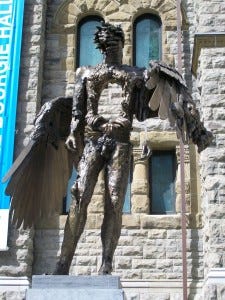
Outside Montréal’s Museum of Fine Arts stands a deformed angel. You wouldn’t think a bronze statue could give you the sense of melting flesh. But this one does. The angel’s pose is surprisingly casual given the fact that there’s a hole in its chest and that its wings are draped with what appear to be tumors. Should I mention there’s also a pair of human hands clawing their way out of the hole in its chest? And that its face is covered by a writhing mass of still more human hands? The whole thing is terrifying. But, also, it’s difficult to look away.

I discovered the statue on my first day in Montréal and it burned itself into my mind instantaneously. I kept wondering: what kind of city puts this in front of its museum of fine arts? As it turns out, the statue is a product of Montréal native David Altmejd, a piece he calls “The Eye,” which only makes things more unsettlingly mysterious since — of all the bodily matter featured — there is not one eye. Yet, somehow, the statue suits the place.

A hint of mystery and confusion appears to be sown into the fabric of life here.

Montréal is a city that embraces the protean, the heterogenous, the strange.

The most obvious example of this is the language issue. Even something as banal as standing in line at the post office becomes an exercise in controlled chaos as the clerks respond to one person in French then, a split second later, jump into English for the next in the queue. Of course most Americans think of this duality whenever they think of Montréal, a town that makes the list of the world’s most bilingual cities (Miami, Barcelona etc.). But what many forget is that in Montréal these two languages are only the start. Wandering through downtown, you’re just as likely to hear Chinese, Arabic, Italian, or Haitian Creole. And immediately outside the city you’ll find not one but two reservations of the Mohawk people, a group reinvigorating their own language with regular classes on how to speak Kanien’kéha. Really: it’s the Tower of Babel up here.

Perhaps this tolerance for — even craving for — plurality has its roots in the province’s start. In this way, what I’ve learned about Québec’s history in my novel research seems to make Montréal understandable — a little bit, anyway. Unlike most North American colonies Québec was never dictated by a single culture. The initial colonists lived in concert with the natives, often intermarrying, a situation that lead to interdependence. Then, after England lost America to revolution, things got even stranger when British loyalists streamed into Québec, a colony they’d conquered just twenty years before. Though these transplants were technically “in charge” they were also just a tiny minority with limited control over day-to-day issues. To me, it seems like this initial three-way impasse gave birth to a country that had no choice but to embrace tolerance. In the coming centuries, the situation allowed more, and more, and more cultures to take root, begetting dizzying complexity, like mirrors reflecting mirrors reflecting mirrors.

Naturally there’s been plenty of tension between these groups. But the city that’s been produced is — without exaggeration — stunning.

As you might guess from the prominence of the deformed angel, the unfamiliar is not only tolerated, but celebrated.

Just about anything goes in Montréal’s public space, a fact attested to by the countless (and still multiplying) festivals, extolling everything from the Arab world to African and Creole cinema to fringe theater and heavy metal.

A few hours after discovering “The Eye,” I took a walk in the forested mountain at the center of Montréal, its famous park, Mont Royal. I wanted to escape the city’s activity for a time, but what I found there was even more bizarre. There were packs of people of all ages and ethnicities, many of them running up and down the steps built into the face of the mountain for exercise, some even bear-crawling (a form of extreme workout it seemed). Yet further up the slope, another man gleefully launched himself down a flight of 200 steps on his mountain bike. Finally, when I arrived at the top, I found still more people, dozens of teenagers parked at a scenic overlook, the doors of their cars thrown open to blast hip-hop, a haze of weed smoke in the air. Amid it all, three raccoons weaved through the crowd, eliciting laughs, garbage dangling from the animals’ mouths. Perhaps this frenzy was only the craving for life that comes in the last days of summer, when the grip of winter can already be seen in the blushing leaves. But it seems to me that it was more than that, too. It was the joyful, laissez-faire character of the city rising to the top.

From the edge of Mont Royal, I looked to the cityscape spreading below, skyscrapers and fieldstone row houses side by side. Somewhere inside it was “The Eye.” I imagined the thousands of people jostling into each other throughout the neighborhoods surrounding it, a shifting human mosaic. Then I thought of the hands climbing from the angel’s chest. It occurred to me for the first time that the image was like the birth of something. Perhaps the angel wasn’t disintegrating after all. Perhaps it was transforming, an endless rebirth in a city forever in flux.

INTERVIEW: Gabriel Birnbaum of Wilder Maker

by Josh Milberg

I met Gabriel Birnbaum, the lead singer of Wilder Maker, through mutual friends, a year or two ago. This last summer the band played a show with Boatwater, cbend, and Nathan Xander on a roof in Bed-Stuy on one of those hot nights when the sun sets around 9:00 and the light hangs pink over Manhattan in what is probably enough smog, gray market perfume, and hot garbage-emissions to lessen your lifespan. You see the city ripple something unhealthy like Juicy Couture after legs have quit walking. Your friends say relax, that you’re just seeing heatwaves. It’s either that or you’re crazy. And maybe you are because the streets just below you aren’t so different from the ones you’ve been judging just over the river. They’re still filled with sweating cops and wafting garbage. But the real reason you’re crazy is you’ve decided there’s reward in the heat and harsh of the city You have bands playing on rooftops as loud as you need and, in between sets, you overhear them talking about the authors they crib and which of their words they’ve worked in. What you’re hearing is music and what you’re seeing is beautiful.

Wilder Maker’s new album, Year of Endless Light came out earlier this month. I asked Gabriel about the album’s literary influences. Below is his response.

“Around the time I was finishing ‘Song For The Singer,’ my roommate Alex Morris read me a poem called ‘Monologue For An Onion’ by Suji Kwock Kim. It’s a poem about how desire destroys the desirer, and it came back to me many times while writing Year of Endless Light, in which characters starving with desire again and again fail to love one another. ‘Singer’ is about many things, but one of the main influences was my brief affair with someone to whom I was clearly a symbol of escape from some much larger personal terror: ‘When she holds me in her arms I know it is not me at all.’ When the affair was all said and done I felt power and anger but I had a hard time finding the language to express it until I heard Kim’s poem. I stole the last line, ‘A heart that will one day beat you to death.’ I loved it for the heartbeat pun but it’s also one of the purest expressions of violence of the heart I’ve ever heard.

“While Kim’s poem unified a song that was nearly complete, a sentence from Isaak Babel’s Red Cavalry spawned an entire set of lyrics in ‘Invisible Order’. ‘The breath of an invisible order of things glimmered beneath the crumbling ruin of the priest’s house,’ his narrator says, half-drunk on rum, a moment so evocative for me that I lifted it from the First Cavalry Army and Polish-Soviet War and planted it on an ex-girlfriend’s sofa by NYU. I first wrote, ‘the breath of an invisible order of things shone beneath the ruin of your parents’ house,’ in which the priest’s house became a Manhattan townhouse but eventually that detail was spirited out as it was awkward to sing and didn’t really evoke the right image.

“Later in the same song, I tried to slip in a little Eliot during a section about the difficulty of touring. On tour, you live in a state of such transience that you almost don’t exist, which is also a pretty solid metaphor for the paltriness of most human endeavor. Eliot writes ‘I have measured out my life with coffee spoons,’ which became ‘I see my life laid out in coffee spoons/from ship to shore to ship to shore to ship to shore.’ Something about the borrowed phrase was too conspicuous, though, and I had to cut it. The poem is too recognizable. It carries such referential weight that it would wash out the rest of the lyrics, turning them into a shadow of ‘Prufrock.’ Lyrics are all about conjuring a mood, and one misstep can destroy the whole thing.”

You can get a hold of Year of Endless Light here.

Photo by Devin Tepleski

The Best of the Brooklyn Book Fest

The Brooklyn Book Festival is this Sunday, and with so many great events that day (and leading up to it) it’s difficult to know how to spend your time. So here’s a list of our favorite, most anticipated BKBF13 panels and readings. Don’t forget to visit us at Booth 162 to get a free tattoo from Saguaro our upcoming novel release!

10 a.m.

The Heart is a Lonely Hunter:

BOROUGH HALL COMMUNITY ROOM (209 Joralemon Street) We love to talk about love: new love, old loves and — the worst kind of all — love interrupted. More than that, we love to read about love. Jess Row (The Train to Lo Wu), and J. Courtney Sullivan (The Engagements) bring us stories about the history of the diamond ring across America, the decline of a marriage in London, and the intimate lives of characters in Hong Kong. Moderated by Rachel Fershleiser.

The So-Called ‘Post-Feminist, Post-Racial’ Life in Publishing

BOROUGH HALL COURTROOM (209 Joralemon Street) Best-selling author Deborah Copaken Kogan sparked a firestorm with her explosive essay in The Nation, and her experience as a 21st-century female author was marked by slut-shaming, name-calling and an enduring lack of respect. Poet, activist and author of sixteen books, Sonia Sanchez (Homegirls and Handgrenades) has consistently addressed the lack of respect for the struggles and lives of Black America. Author and founder of Feministing, Jessica Valenti, has devoted considerable time to transforming the media landscape for women. Moderated by Rob Spillman (Tin House)

11 a.m.

Who? New!

i.2.necessary-errors-caleb-crain

BOROUGH HALL COURTROOM (209 Joralemon Street) The Brooklyn Book Festival picks five of the year’s most impressive debut novelists who will read from their work: A.X. Ahmad (The Caretaker), Caleb Crain (Necessary Errors), Ursula DeYoung (Shorecliff), Michele Forbes (Ghost Moth), and Ayana Mathis (The Twelve Tribes of Hattie).

12 p.m.

Poets Laureate Past and Present Reading:

MAIN STAGE (Borough Hall Plaza) Tina Chang (Brooklyn Poet Laureate), Ashley August (New York Youth Poet Laureate), Marie Howe (New York State Poet Laureate), and Charles Simic (US Poet Laureate 2007–08) read from their work. Introduced by Alice Quinn, Poetry Society of America.

Cities and their Ghosts, Past and Future:

BOROUGH HALL COMMUNITY ROOM (209 Joralemon Street) What phantoms continue to haunt the landscape of our cities and our dreams? And how will these apparitions appear to us in the future, in a world even more shrouded in mystery? Basque author Kirmen Uribe (Mean While Take My Hand) searches for roots in Spain and abroad; Patricio Pron (My Fathers’ Ghost is Climbing in the Rain) reckons with his father’s hidden life and Chang-Rae Lee (On Such a Full Sea) depicts a bleak vision of an apocalyptic Baltimore. Short readings and discussion. Moderated by Valeria Luiselli.

Arts and Politics in Fiction:

BROOKLYN HISTORICAL SOCIETY AUDITORIUM (128 Pierrepont Street) Art has always been a tool for political and social change. In these novels, it comes in the form of protest-pop songs, motorcycle photography and high-end fashion. Alex Gilvarry (From the Memoirs of a Non-Enemy Combatant), Rachel Kushner (The Flamethrowers) and Nicholson Baker (Traveling Sprinkler) shed new light on the timeless relationship between art and politics. Moderated by Joel Whitney.

1 p.m.

The Wonder Years:

Elliott Holt is joined by Ben Dolnick and Meg Wolitzer at 1 p.m.

Elliott Holt is joined by Ben Dolnick and Meg Wolitzer at 1 p.m.

ST. FRANCIS MCARDLE (180 Remsen Street) With friends like these…In these novels by Meg Wolitzer (The Interestings), Ben Dolnick (At the Bottom of Everything), and Elliott Holt (You Are One of Them), childhood friends weave in and out of each other’s lives as they grow into adulthood and out of each other. These friends are bound by history as much as they are by hidden jealousy, guilt, and deathly deception. Friendship is complicated. Moderated by Steph Opitz (Texas Book Festival).

Brooklyn Book Festival Presents Lois Lowry, 2013 BoBi Honoree:

ST. FRANCIS AUDITORIUM (180 Remsen Street) Enjoy the Newbery award-winning author of The Giver and Number the Stars. She is one of the most important figures in youth literature today and admired for boldly writing about dystopian societies and the importance of cherishing human connections. In conversation with 2013 Newbery Medalist Katherine Applegate (The One and Only Ivan).

2 p.m.

Creating Dangerously in a Dangerous World

BOROUGH HALL COURTROOM (209 Joralemon Street) How do different forms — fiction, reportage, memoir and essay — capture different realities, especially when the principal subject is the trauma of war and violence? Join three authors whose work explores horrific visions from a variety of angles: Edwidge Danticat (Claire of the Sea Light), Courtney Angela Brkic (The First Rule of Swimming) and Dinaw Mengestu (How to Read the Air). Moderated by Bhakti Shringarpure, editor of Warscapes.

Love, Villainy, Ethics and Karaoke: Chuck Klosterman and Rob Sheffield in Conversation.

MAIN STAGE (Borough Hall Plaza) With trademark wit and insight, essayist, novelist and New York Times “Ethicist” Chuck Klosterman (I Wear the Black Hat: Grappling with Villains Real and Imagined) and Rolling Stone scribe and memoirist Rob Sheffield (Turn Around Bright Eyes: The Rituals of Love and Karaoke) grapple with issues of life and love, fantasy and memory, heroes and villains past, present, pop cultural and personal. Moderated by Ed Park.

Writers Who Read:

ST. ANN & THE HOLY TRINITY CHURCH (157 Montague Street) These stories come alive on paper, but nothing’s better than hearing Jonathan Ames (Wake Up, Sir!), Sapphire (The Kid), and Tao Lin (Taipei) read their vivid prose aloud. Colorful, memorable characters riddled with tragedy and emotional issues truly come to life when embodied by their brilliant, charismatic creators.

3 p.m.

The Faces of Brooklyn:

BOROUGH HALL COURTROOM (209 Joralemon Street) New York’s coolest borough is home to hipsters, people who dislike hipsters and literary stars — among them, Brooklyn enthusiasts Pete Hamill (The Christmas Kid), Adelle Waldman (The Love Affairs of Nathaniel P.) and Adrian Tomine (New York Drawings). These powerhouses plant uniquely different characters in a nostalgic Brooklyn, a contemporary Brooklyn and a colorful Brooklyn that jumps off the page. Moderated by Penina Roth (Franklin Park Reading Series).

Real People, Imagined Stories:

ST. FRANCIS AUDITORIUM (180 Remsen Street) These novels are so fascinating that it’s easy to forget they’re based on the lives of very real historical figures. Amy Brill (The Movement of Stars), Colum McCann (TransAtlantic), and Montague Kobbé (The Night of the Rambler) examine the lesser-known stories of the first female astronomer, a fifteen-hour revolution in Anguilla, and three generations of Irish women whose stories of hope and survival are played out against a century and a half of Irish-American history. Moderated by Jeffrey Lependorf (CLMP).

3:30

Idols, Gods, and Kings:

ST. ANN & THE HOLY TRINITY CHURCH (157 Montague Street) Literary forces Teddy Wayne (The Love Song of Jonny Valentine), Tom Wolfe (Back to Blood) and Cristina García (King of Cuba) explore the concept of power with three very different casts: an eleven-year-old superstar’s road to fame; the varied, shady folks running an election in Miami; and a fictionalized Fidel Castro and his vengeful exile. Moderated by Greg Cowles (The New York Times).

4 p.m.

Author Karen Russell, who'll be joined by another Recommended Reading alum, A.M. Homes, in conversation with our own Halimah Marcus

Author Karen Russell, who’ll be joined by another Recommended Reading alum, A.M. Homes, in conversation with our own Halimah Marcus

The Fantastic and the Strange

BROOKLYN HISTORICAL SOCIETY AUDITORIUM (128 Pierrepont Street) Three visionary writers take the world as we know it and flip it on its side. Manuel Gonzales (The Miniature Wife), Karen Russell (Vampires in the Lemon Grove), and A.M. Homes (The Safety of Objects) weave together the realistic and the unbelievable to create a magical, sometimes chilling approach to storytelling. Short readings and discussion. Moderated by Halimah Marcus (Electric Literature).

Mind Over Matter

BROOKLYN LAW SCHOOL STUDENT LOUNGE (250 Joralemon St.) There’s something weird going on here. A man’s cultish promise to cure loneliness leads to an unexpected situation. A woman discovers her gift to fix the scandals of those around her but not her own. A fishy epidemic of advanced dementia rages in a hospital in post-9/11 America. Fiona Maazel (Woke Up Lonely), Jonathan Dee (A Thousand Pardons), and Lore Segal (Half the Kingdom) show that, often, what we seek to control ends up controlling us instead. Moderated by Ken Chen, Asian American Writers Workshop.

5 p.m.

Let’s Talk About (Writing) Sex

Sam Lipsyte talks about sex at 5 p.m.

Sam Lipsyte talks about sex at 5 p.m.

MAIN STAGE (Borough Hall Plaza) Everyone’s writing about it. Sam Lipsyte (The Fun Parts) pens sardonic short stories about sex in a misanthropic world. Amy Grace Loyd (The Affairs of Others) depicts an apartment building filled with violence, mystery, and, of course, sex. And Susan Choi (My Education) puts a (sexy) new twist on the student-teacher relationship. Short readings and discussion. Moderated by Angela Ledgerwood (Cosmopolitan Magazine).

Something to Hide: Writers Against the Surveillance State.

ST. ANN & THE HOLY TRINITY CHURCH (157 Montague Street) Recent leaks have revealed the breathtaking reach of the National Security Agency’s secret surveillance programs. Should writers and readers be concerned? A fast-paced mosaic of readings by leading PEN members and others to provoke reflection on the dangers surveillance poses to the freedom to think and create, and to celebrate the role writers have played in defying those dangers. Join Brooklyn Book Festival authors Edwidge Danticat, Francine Prose and Andre Aciman, radio host Leonard Lopate and NSA whistleblower, Tom Drake, and others. Presented by PEN American Center, the American Civil Liberties Union, and the New York Civil Liberties Union.

Reality Check

BROOKLYN LAW SCHOOL STUDENT LOUNGE (250 Joralemon St.) The transition from 20’s to 30’s — school to work, dating to relationships, moving in, out and on is not just a work in process but a creative process! Iris Smyles (Iris Has Free Time) Adelle Waldman (The Love Affairs of Nathaniel P) and Royal Young (Fame Shark) represent the self examination of this generation in memoir and fiction. Moderated by Matthew Love, Time Out New York