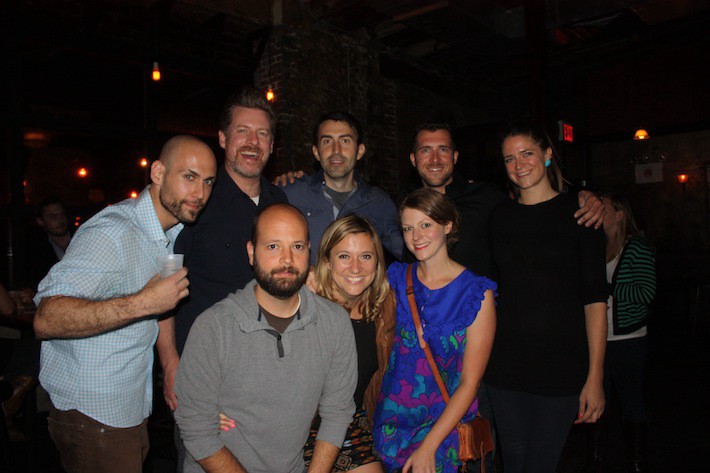
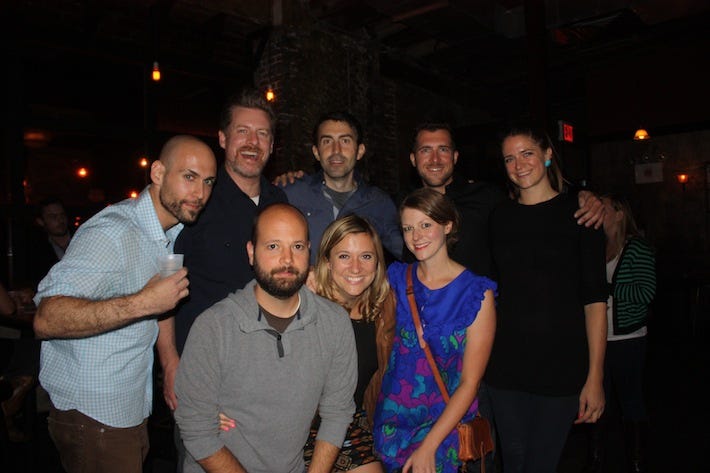
We did it right on Monday night to start off the bookend events leading up to the Brooklyn Book Festival. There was drinking, dancing, and some people allegedly talked about reading and writing and other such things. It was the only bar in Brooklyn (at least that night) that you could hear a mob of people discussing the latest trends in indie publishing, and then step into the next room (where Planet Rump was DJing) to see a gaggle of writers moving to in a broken rhythm that only they could call dancing.
Thanks to Greenhook Ginsmiths and Brooklyn Brewery, the drinks were reasonably priced, and everyone took advantage. Electric Literature’s co-hosts Lincoln Michel and James Yeh represented Gigantic mag, Rachel Fershleiser repped Tumblr and all things bookish.
The conversation was intelligent, the tunes were tight, and enough cheap drinks made everyone seem like James Brown.
Editor’s note: The following slideshow is courtesy of Elise DeChard
For the first time in the 63 year history of the National Book Awards, the National Book Foundation has the released longlists for each of it’s four categories (fiction, non-fiction, poetry, and young people’s literature). The fiction longlist was announced this morning, and includes a range of established and debut writers.
Patrick is fourteen, this is earth, it’s dark, it’s cold out, he’s American, he’s white, straight, not everyone has cell phones, he’s sitting on the carpet of the TV room on the third floor holding the remote in both hands in his lap. He’s sitting with one leg tucked under the other on the deep shag oval rug, his back against an enormous ottoman. Other elements of the modular sofa orbit him. It’s a solid, stable position. On the second floor and on the other side of the house, behind a door off the hall that overlooks the living room, his parents sleep in a high walnut bed, under a moss green comforter. A tabby cat curls into his mother’s hair. Patrick has seen his mother asleep with the cat like that, practically suctioned. Against his will, it grosses him out a little.
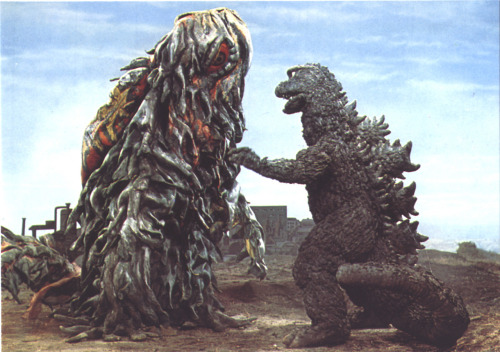
In the video, the Smog Monster, a wad of wet-looking gray cotton with static red eyes, has not yet met Godzilla. It hardly matters that it eventually meets Godzilla because in the end all that Patrick will remember about the movie is a scene that’s not actually in the movie. It’s something he figured must be happening offscreen based on the girls in their gym outfits collapsing and four men playing cards, incinerated. He remembers how the toxic, billowing Smog Monster sweeps through the sky and, as it passes between the white-gray sun and the gray-gray earth, its shadow passes over millions of people whose faces are like beads. Flesh blows from the people like sand, leaving millions of skeletons coating the hills, dead faces like the pattern in a printed fabric, a city-sized, TV-sized sheet stretched flat. He’s not Jewish but he’s seen old films on cable of mass holocaust graves, and the shot he imagines could be lifted from one as a sick, low-budget solution; he pictures the Japanese filmmakers scurrying like the scientists in the movie, but with armfuls of unspooling film instead of fists of sloshing beakers. If he’d been born just a few years later, he might not even know about film. This Holocaust landscape, the bodies making a pattern you could turn into wallpaper, is what he imagines whenever there are reports of genocide coming from the kitchen radio or one of the televisions that dot the house. But later it’s all blended up with this dumb video that moved him in the night.
He’s wearing light blue cotton pajama bottoms and a thin sweatshirt his father wore playing hockey in college. His clavicle is incredibly delicate, poking out of the ring of the sweatshirt. Soon a professor, in subtitles, suggests that the Smog Monster rode in on a comet, a space pollution scientific freak organism. No one in Patrick’s generation uses the word “ozone” to worry about the planet. Soon there’s the scene where the girl’s dancing on a stage in front of a multicolored projection of magnified pond scum. Patrick finds he’s thinking of ice. He’s picturing his father moving alone with his hockey stick across their neighbor’s vast lawn that fills and freezes over every year. That afternoon he’d gone into his father’s dresser for a sweatshirt and found the tape there, at the bottom of the drawer where porn ought to be. He then, in fact, set his watch for three a.m. and chose the third floor TV room instead of the living room for that very reason. Imagine, porn rising past the hallway balcony like steam, curling under the doorway and creeping under the covers to where his father lay, a man, a man with a wife and a son, with a fine, high bed, with snow-covered land, borderless and unobstructed all the way to the deep pine woods.
Instead, Patrick is watching a boy in stupid-looking high-waisted shorts follow his grandfather along the beach. The movie is so badly made that when his attention wanders for even a moment he has no idea what’s going on. There are drunken Japanese hippies having visions of people turning into fish. In a long sequence, first Godzilla and then the Smog Monster stare into the screen at a series of angles. It will be years before it occurs to him that this was meant to be a dramatic showdown. He and his first real girlfriend will have broken into an abandoned grocery store. It’d been fun, racing their absurdly large carts down the emptied aisles — the absence of color, the inorganic skeleton — until he hadn’t seen her in a while. He’ll be running the cart through produce, wads of colored tissue and packing straw floating on the naked geometric planes of display islands, and suddenly feel done with it, the need to go at the level of panic. He’ll run the cart along the tops of the aisles — dairy, beverage, cereal, frozen food, natural, ethnic, snacks, baking goods — increasingly furious because he’s been texting her and texting her. Where r u? finally she’s way down at the other end of canned goods. She’s deep in the lowest shelf, swallowed to her torso, her legs coming out of her ass in a stark V. For a second he’ll think she’s dead, something having shoved her in there. Then she emerges with a can held up like a torch. She says, “Look: a soup!” they lock eyes across the vast speckled linoleum. She’s so happy, and he’s so angry. He thinks, pow. He remembers sitting secretly among furniture in the tip of a house that is pointing its nose to the moon, and above him nothing but the stratosphere.
When the movie’s over Patrick brings the cassette with him to his room and slips it under the extra pillow. For a long time he tries to sleep, facing it in the dark. He tries to think about the porn he’d expected, but his thoughts keep shifting back to the crumbling bodies, the masses of them in grainy gray and ashen white. It hurts. He longs for porn, but he can’t make it happen in a way that’s not horrible and sick.
In the morning, kitchen sounds rise past the balcony. Patrick’s window is nearly covered in frost, a vast miniature white forest, and through the ice-branches he can see his father crossing the yard in his long brown coat and overboots, using a black branch for a walking stick, poking it into the snow. He can walk on the snow for a couple of steps but then crunches through. Cold comes off the window and the sun is soft and clean. His father, alternately light and heavy, comes off as funny. Patrick pulls his feather blanket around his shoulders and shuffles downstairs in his wool socks. His mother is holding their terrier on one arm and wiggling a frying pan over the stove with the other. In the pan are three eggs, whites oval, yolks off-center in each. She’s wearing a quilted bathrobe with a print-version of gingham patches. Patrick uses a foot to pull a chair out from the table and then sits in it, not really facing the table, not really facing his mother, either. He’s in a beam of sunlight. He blinks and yawns. He pulls at the blanket so he’s not sitting on so much of it.
“I don’t think I want an egg, Mom,” he says.
“Someone’ll eat it. You still sleepy?” She crouches to let the terrier hop off her arm. He shakes himself as if he’s wet and then leaps into Patrick’s lap. Patrick holds the little dog at arm’s length and it licks at the sunny air. Patrick likes the dog, but he doesn’t like it to lick him, and lately the licking has been seeping into his overall opinion of the dog.
His father comes in, stamping, and then unclasps the dozen clasps on each overboot and pulls them off. He’s wearing his slippers underneath, and he’s got the newspaper. His mother turns the radio on and it sends out classical music. Strings. Copland? “Brrrr. Chilly, chilly,” his father says. After he hangs his coat on one of the pegs by the door he crosses to the fridge, mussing Patrick’s hair as he passes by, sending the threads of dust in the sunbeam into tantrums. In a moment that no one notices, the dust plumes into the shape of the Smog Monster.
Patrick’s father takes bread out and puts slices in the toaster. Soon they’re all at the table. Toast, butter, jam, eggs, coffee, juice. Sometimes when Patrick comes home from school after practice or late from a game his parents will be off somewhere in the house, but at the kitchen table will be his father’s briefcase on one chair and his mother’s briefcase on the chair opposite it, these abbreviated versions of them, like sentries.
Three days later it’s a Wednesday and at lunch Patrick and his friend Arbuckle, first name shunned and practically forgotten, get lost in conversation at the far end of the snow-covered soccer field where they like to sit on this extremely wide, ragged stump of a tree that’s near the edge of the woods but not really part of the woods. They don’t know it, because it’s their first year at the high school, but for ages it’d been a climbing tree, and only that summer it’d been proclaimed dead enough to be dangerous. Kids used to congregate at the tree, but now it’s just a stump and no one cares about it.
So Patrick and Arbuckle get to class late, starting back across the field when they hear the bell, trying to run through the snow at first but then giving up, taking it easy, trudging with their heads low, arms folded, still talking, thinking something through. Then Arbuckle heads off for French and Patrick steps into his biology class but no one even looks at him as he enters, snow pressed into shapes quietly dropping from the treads of his boots. He stops a few steps in. The room feels funny. They’re all watching the television on its wheeled cart. It sits at the front of the rows of one-armed desks, and Mr. Bernard is sitting in Patrick’s — in the second row, watching. News is on. There’s footage of raging, raging fire. It’s raging in a box in the upper-right of the screen. Patrick’s seen commercials for a videotape of fire you can play to make your television more festive — he and Arbuckle joked about buying it for his uptight parents, ages ago, when they saw it in a dollar bin. But they didn’t buy it because after they thought of it, the joke was over.
This fire, however, is a real fire, raging in the city of Los Angeles. Something swooped overhead and dropped, or dropped something. Something fell burning from the sky and what is it, chemicals, flaming viruses, maybe nuclear — whatever it is, California is burning on the television and burning across the country. There’s also no way to tell how far away the video is being shot from because looking at fire up close is pretty much the same as looking at fire far away, as long as it fills the screen. “My country,” people say on the TV, anchors and men on the street. “Our country.”
Patrick stays in his spot on the periphery. All around the room are posters of biology things. Definitive drawings of cross-sections of plants and animals. Everyone listens to the reporters, watching the fire. Landmarks are gone forever, museums and mansions enumerated by one after another correspondent. A series of explosions level the hills. One of Mr. Bernard’s hands is clinging to the slender arm of Patrick’s desk. He has a round head, glasses, and strings of black hair that his scalp shows through. He’s got a quirk of smoothing his hand across them. He’s about the same height and build as Patrick, and while Patrick has tried to picture the lives of some other teachers, he has never even thought about Mr. Bernard except in terms of biology. Now that Mr. Bernard is in his spot, Patrick follows the teacher’s eyes to the intercom, back to the television, then back to the intercom. The speaker is dangling from its wires in a corner near the ceiling over the blackboard, but everyone knows it’s done nothing but occasionally spit for months. Mr. Bernard’s homeroom just does the pledge on their own. Notes come from the office, if anything. If Patrick moved to the front of the room, that could complete a kind of reversal, and the thought comes close but doesn’t actually cross his mind. He stays by the door. He is looking at Mr. Bernard for some ideas of what to think, but meanwhile Mr. Bernard’s mind is filled with the fire and includes Patrick only as a sort of pixel among many student-pixels massed over time. He’s an okay teacher who occasionally, maybe every few years, gets swept up in a kid. He’ll find himself thinking about the kid’s life, and trying to do something to help the kid, and have to pull himself back.
The reporter they’re watching gets a message in her ear to move farther from the billowing fire, and when she sends it back to the anchor Mr. Bernard says, “We’ll wait and there’ll be an announcement.” None of the kids are saying anything, but two girls link fingers across the aisle. Outside, it’s snowing again. Patrick lets his backpack slip to the floor and into the puddle from his boots. After a while Mr. Bernard says, “I have an announcement,” but then the news anchor says something about the fires raging into San Diego, Santa Barbara, about speculations, who is responsible, and he doesn’t say anything.
In the doorway, Patrick remembers another emergency with Mr. Bernard, back in September. One of the kids in their class had tried to kill himself by taking all the prescriptions he scrounged up in his house. It was supposed to be assembly where everyone processed together, and that had already happened, but the kid had been in their biology class before the coma, and the girl who had been his partner in collecting specimens had been assigned to join another group, making a threesome. In class, the girl kept saying, “It’s just not going to be the same.” It came off a little like she was complaining about the group, and after about the third time she said it, Mr. Bernard lost his temper. Patrick had never seen a teacher lose his temper like that. He said, “Hold it, listen up, class,” and then just went off. He was grasping a wooden yardstick for some reason. He wore such ridiculous plaid pants no one could tell if they were an intentional joke, but Patrick saw him shake, and in the doorway he remembers being afraid the man was going to cry, praying and praying his teacher wouldn’t cry. He remembers this vibrating hope against hope, he remembers not what Mr. Bernard said but how angry it made him to see his teacher out of control like that, and then the memory dives back under the surface and his mind doesn’t hook onto it again.
Mr. Bernard will always remember what he said. He said, “I know you’re all freaking out and excited. I know it feels like this changes everything, and I know half of you are thinking that might be cool, even necessary. But let me tell you, I know several of you in this very room have experienced some real hardship. And some of you are going to learn very soon what tragedy is if you don’t know it already. That, my friends, is life,” he said. He dropped the yardstick accidentally and it made a huge smack hitting the floor. He’d been teaching for twenty years. He’d talked to kids whose parents beat each other, who were sick, dying, kids whose parents fucked them when they were babies. He’d had a refugee kid who never spoke, whose eyes rested only on the things between people, and who the fuck knows what happened in the world to do that to her. “I am here to tell you that nothing is changed,” he said that day. “Ice ages come and go. Stars supernova and nothing is changed. Species go extinct every day. So you can take heart in that.” After school, Patrick had said something to Arbuckle about Mr. Bernard losing it in class and never thought of it again until now. In fact, three months later and the school is pretty used to one of them being off in a coma. It’s what Mr. Bernard might call resilience.
“I have to go home,” Mr. Bernard says, sick of it, rising from Patrick’s desk and returning to his own. “If you want to stay, I’ll stay here if you want me to stay, but otherwise I’m going.”
Busses aren’t around, the parking lot is crazy, and Patrick gets a ride with a senior who lives on his street. Sara has a lot of light brown, almost golden fluffy hair, and even though she’s not a big deal at the school, she doesn’t usually say anything to him. Their parents know each other, but even as children, Sara and Patrick never got along. It’s no loss either way. Practically all he knows about her is that she’s adopted and she’s part black. Biracial, which sounds like a part of an insect. Multiethnic, which sounds like a ride at a carnival. Sara’s got a black Trans Am with a red interior — not the kind of car most kids go for in this district in this moment in history — and her hair really stands out against it. Her eyes are sunken and blurry, and while some kids look a little dazed, and some kids are running around like they’re high on sugar, Sara has clearly been crying. Maybe she knows someone in California. Patrick has an older cousin who lived in Santa Cruz for a while but now he’s back.
Her hair rises in the wind in one fluffy mass.
“You okay?” he says. Her hair looks like the Smog Monster, and while it’s true that he doesn’t like her, it’s such a juvenile thought he pushes it aside.
“This is all so very fucked up,” Sara says, shaking her head. She’s being nice. That’s one thing being stripped and raw can make you, nice, but he’s skeptical. He thinks she’s so immersed in what she’s feeling that she’s assuming everyone feels exactly like her and that’s what makes her be so nice. She’s feeling her commonality with all humankind, and it doesn’t matter what he feels.
They’re rising and falling along the slick, curving road. Long rows of evergreens line some of the properties, and acres of snow separate the road from the houses it leads to. There’s an old donkey who lives with a pony in a post-and-rail paddock with a little wooden shelter. When they pass the paddock, the donkey is lying in the snow, curled like a dog on a hearth, and the pony is standing over it. Gray donkey, white pony, dark rail fence, pale, pale sky.
Sara wants to drive him right up to his house, she insists on it, but it’s a very long driveway and though it’s plowed, it’s icy. They have an extremely grown-up-sounding conversation, a kind of I’ll-get-the-check, no-no-I’ll-get-the-check exchange, over whether or not she should drive all the way down the driveway. Patrick wins by saying he wants to get the mail and when he gets out he just says, “Thanks. Really Sara, the walk will do me good,” which completely freaks him out for a second, like the remark comes directly from the future. He gets the mail but instead of walking down the driveway, he uses his father’s footprints across the loping yard. They’re left from days ago, iced over and just that one set.
Inside, Patrick’s parents are upstairs in their bed on the green comforter in their work clothes, watching California burn on TV. Their shoes are in the hall, empty and at odd angles, as if the people in them had disintegrated mid-step. When Patrick arrives in the doorway, his parents hold out their arms and he gets up into the high walnut bed with them. Patrick’s mother shifts so that he can share the green pillow she’s leaning on. He can smell that she’s had a cigarette. The cat’s in his father’s lap, her tail dripping over onto Patrick’s leg, shifting like a hunting snake. The terrier hops up and his mother distracts it from the cat by nudging it playfully with her feet. The terrier bites at her toes and then lies down, leaning into the curves of her arches. The TV continues its coverage. The fire is spreading. It’s past Fresno. It’s consuming the state but has yet to cross over its lines. Suspects accumulate, worldwide. The anchor chokes up, waxes and relates. Sometimes Patrick’s father offers an analysis and sometimes his mother offers an analysis. They talk about who could have done it, who in the world. Patrick points to the map on the television and says things like, “I didn’t know that country was pronounced like that. I think that lady said it wrong. Is it bigger or smaller than, say, Kansas?” Or he asks, “Is stocking up dumb? Are we stocked up?”
But mostly he finds he’s feeling wonderful and warm, there between his parents, with the cat and the dog. It’s such a big and carefully furnished house for there to be so many lives in those few square feet of space. He thinks, I am in the moment. Nothing is dirty. Everything is either very near or very far. The fan turns overhead, pushing heated air down.
At ten p.m., Patrick is already in his bed, reading by the light of a little clip-on book light that came with a magazine subscription. It’s cheap and the bulb doesn’t fit right in its socket. The light keeps flickering. His father is upstairs in the TV room, still watching the coverage.
They’d eaten cheese sandwiches for dinner, in his parents’ room, a picnic on the comforter. They thought about ordering pizza, but no one wanted to go wait at the end of the driveway. His mother cried for a while. “Your whole generation is shot,” she said to Patrick, and then tried to take it back. Patrick cried a little, too, at this idea of being part of a generation, but also because his mother was crying. She’d taken her suit jacket off and had her bathrobe on over her blouse and trousers. She fell asleep like that, among them. He wanted to talk it all through with Arbuckle, but because Arbuckle’s family resists technology as harmful, they have only one telephone and one telephone line. When Patrick called, Arbuckle said they weren’t allowed to tie it up. He said they had people in California.
Now, in bed, Patrick’s reading a superhero comic, one from years ago when he used to read them all the time. In this one, the main superhero girl is losing control of her powers, they’re just getting way out of hand. She’s hovering in space about to destroy an entire planet and she can’t stop herself. The bulb in his tiny lamp is flickering and then, just as she’s sure her head will explode, a soft beam of light slides in and out of his window and he hears a far-off impact. He gets to his knees and looks out the window. Far across the yard and up at the road at the end of the driveway there’s a streetlamp, and the lamp shines a diffuse oval on the ground. The black road and the snow divide the lit space. There’s a car in the light, crossing the line. Patrick gets his glasses from the night table and then he can see that the car has crashed into the mailbox. The silver mailbox itself is in the yard, shining in the car’s headlights, and the headlights stretch toward the house like the antennae of a bug from another world.
He listens for his father or mother to respond in some way, but they don’t. He puts on his slippers and pulls a big wool sweater on over the pajamas and sweatshirt he’s been wearing to bed every night. Then he trots across the landing and peeks into his parents’ room. His mother is there, still asleep. He trots upstairs far enough to hear the television still going, a newsperson interviewing a rescuer just off his shift, the sound of the fire like static behind their voices.
At the kitchen door he takes his father’s overboots and clasps the clasps over his slippers and the legs of his pajamas. He puts on a hat, a brown one with earflaps and strings, as if you’d ever tie them under your chin. He takes a flashlight from the utility closet and stuffs a pair of gloves into his waistband, but as soon as he steps outside, the cold smacks him hard enough that he puts them on. The driveway is densely iced so he jogs at the edge, where at least there are crumbled pieces for traction, but still he slips twice, catching himself on the snow bank. Even before he recognizes the car, he recognizes the fuzzy cloud of hair over the steering wheel. He’s worried for a second that he’s about to encounter something he’s not prepared for, something that could change his life. If her face is gone, he thinks, if I lift her hair and she has no face….
But Sara raises her head and her face is intact, puffy though. She watches him approach and opens the car door as he nears. She shifts in her seat, putting her feet on the snow. He doesn’t come all the way up to her. She’s still older, she’s still a senior, and even though he’s feeling a softness toward her, part of him knows it’ll be short-lived because she is, after all, okay.
“So, you’re okay?” he says.
“Do you think it’ll go?”
He crunches a few steps around to the front of the car and there’s a place in its nose that’s pretty smushed. Still, the hood is down and intact, and although the bumper is twisted and part of it’s come undone, it’s not blocking anything that he can see. Part of the post that held the mailbox is sort of impaling it, between the body and the bumper, coming up across the radiator grille, which is bent back to accommodate it. If the post doesn’t hold to the ground, though, he thinks the car ought to go.
“Want me to try to back it out?”
“It’s my car, Patrick.” It’s a rebuke, and he almost snaps back at her, something about leaving his warm bed, but when he looks at her through the windshield the expression on her face stops him, and he watches her hear herself, and change her mind. Then she says, “Why don’t you get in? If we can get it going, I’ll show you something.”
He gets in. The car backs out pretty much immediately. He pulls the brake and then gets out and looks with his flashlight. The mailbox post is still wedged up there, but when he looks under the car, the end of it hovers over the pavement maybe half a foot. He gets back in. “I think it’ll be okay,” he says. “But go slow.”
“Fuck it,” Sara says.
They go fast, but he’s not scared. Her face is lit by the green glow of the instrument panel and it strikes him what a baby face she has. It’s a little thrilling, the turn things have taken, driving away from the house in the night. If it was Arbuckle, he’d have some pot, but if it was Arbuckle, they wouldn’t have a car.
Patrick doesn’t remember it, but the way his family met Sara’s was that when they’d first moved into the house, back when Patrick was seven, Sara’s parents came over. “It was so nice,” Patrick’s mother said when she mentioned it to Patrick. This was around when he started middle school and was worried about all the kids he knew from elementary who wouldn’t be there, and all the kids he didn’t know who would. He’d asked what it was like when they first moved into the neighborhood, after his father finished his degrees and finally had a real salary. Sara and her family were minor characters in his mother’s story about fitting in — it was their first real place, she said, a place of their own, but his family had roots here and hers did not, so it was a little uneven-feeling at first. Sara’s parents came over when there were still boxes everywhere. Patrick had pictured a dumpy mom in a kind of summery dress with strawberries on it, and a gray father in a warped fedora, holding a casserole with silver potholders. His mother said, “When I saw them, I thought, what a nice neighborhood this must be. But then they gave us flyers from their church and it didn’t seem like they were just being nice anymore.” Still, after it turned out that Patrick’s mother represented her company when it was a client of Sara’s father’s department at his company, sometimes the couples paired up at social functions, and a few times when Patrick’s family had a party, Sara’s family came. Once, they set up a buffet in the living room and Patrick and Sara watched from the balcony. Sara got bored quickly, and took her book to the third-floor TV room. Patrick stayed watching. He was ten, maybe eleven. From above, the grownups really did look like aliens, in their shiny clothing. Their arms were coming right out of their heads, the little nubs of their feet poking out the edges of their pant legs.
“I was going to California,” says Sara. Her hair glows warmly around her face in the black-green light. “Not tonight — I’ll show you where I was going tonight. But the whole idea was to graduate and then get the fuck to California.”
“You know people there?”
“No,” she says, annoyed. “I mean yes, like I have aunts there, and they have progeny. But I was going besides that.” She shakes her head as if that will get rid of being annoyed, but then stops, and he thinks it must hurt from the crash. “I mean, I don’t care if those people are there. It’s such a big place. It never even mattered that they were there. I could just go, you know, oranges, sunshine. Better people. I was going to go there and change my life, and now it’s gone.”
“Are you an actress?” he says, instead of asking if these are real biological aunts she’s talking about, which is what he wants to know.
“Fuck no. Jesus, Patrick, don’t you have any imagination?”
He can’t believe she has the power to hurt him, but when she says this, she does. He hears static. Even though he plays soccer, Patrick primarily pegs himself as an imaginative person. He reads a lot of pulp sci-fi novels, but he also reads a lot of books on history, intellectual things. He thinks of himself as an imaginative person in a school full of unimaginative people. A town of them, too. A whole world. But when Sara accuses him, he can see, for a second, like a door opening in a room so dark you never knew there was a door, how he has no imagination at all.
Sara makes a fairly wild turn and the car slides a bit before settling into a more controlled bumping across the icy gravel road. “Don’t you want to know where we’re going?”
He waits for her to go ahead and tell him, but she doesn’t, so then he says, “Yes.” She raises and lowers her eyebrows, something he can’t really see but still manages to picture is happening. When she still doesn’t answer, he thinks quickly and then says, “No.”
It turns out it’s a cave, and Patrick will not forget it. They’d parked the car. They brought his flashlight. They pushed through bare thorny bushes to a tractor path so deep in sealed snow it could be a frozen creek. They hardly broke through at all. Somewhere in their American history, Patrick’s family owned a lot of land, and he wondered if they might have owned these woods, these mountains. In the darkness the side of a mountain rose. As they walked, the mountain shifted from brush-covered and snow-buried mulch to stony walls and what actually was a frozen creek running along it. Sara took his arm, the one not holding the flashlight, pulled him down the embankment, and they crossed the frozen creek. It was cold, but with no wind, so not cold enough to hurt. When they came to the cave he hardly knew he was in it until she had him seated on a mound of pine needles.
He shines the flashlight around, and when the beam hits her eyes they flash yellow. He tells himself she’s a girl, not an animal, but he can’t help it — it’s a cave, she’s immersed in it, and her eyes flashed. He can’t tell what she ’s doing — touching the walls, looking for something she left?
“Cool,” he says. “I didn’t know there were caves out here.” It’s a small enough space that it seems stupid to ask if they can make a fire, but he asks anyway. “I know, I know,” he says, laughing. “But it’s a cave. I had to ask.”
“No,” she says. He can hear her smiling. “We can have a fire.” She makes a fire right outside the opening, so the smoke has somewhere to go but they can still catch some heat. It’s amazing that she can, that in the middle of snow she can just shove around and gather enough branches. She uses a cigarette lighter from her pocket, and a twisted-up receipt. It was dry before it snowed, and now that the snow’s frozen, the twigs hiss and pop but get it going fine.
Again, he feels cozy. He can’t help it. California is burning, the fire gobbling Eureka, all that marijuana up in smoke, people and animals are dying, the air is poisoned, the ocean is boiling, fishes making for Hawaii as fast as their flippers will carry them, rock tops exploding from sea cliffs like missiles, and he feels cozy, trying to figure out if maybe he’s attracted to Sara. He knows the one about how people have sex in the last moments before the end of the world, but it doesn’t feel like the end of the world. Is that why he doesn’t feel like he ought to be having sex? She has that black car, and she built a fire for him, and they’re in a cave in the night in woods that suddenly feel like his own. Nice contained crackling little shadowcasting world. Her puffy face is so soft-looking and her hair comes out of her hat like clouds from behind a sun. She takes her hat off and shakes the hair. Patrick takes off his overboots and sits there on his pine needles in his slippers in the cave, feeling at home. He holds his hat in his lap and ties and unties the earflap strings.
It strikes him that he doesn’t have to go back, not if he doesn’t want to. Lately Arbuckle has been becoming a Marxist. When Patrick said, “So you want to kill millions of people and make everyone poor?” Arbuckle said, “Marxism is a critique of capitalism.” Then when Patrick asked his father about it, his father laughed. He said, “Tell Arbuckle to let me know when he comes up with a better system,” and when Patrick went back to Arbuckle with that, Arbuckle said, “Not to disrespect your dad, but you don’t have to have all the answers to think there’s a problem, you just have to think there might be a better way.”
In the cave Patrick thinks, But I like my home.
“How’s it been at your house?” he asks Sara. He’s shining his flashlight around the space, sweeping the light along the walls. There’s not much space to cover but still, it feels like what he’s doing is sweeping, covering the space in a methodical way, the way a scenting dog covers a field.
“Dad’s out of town. Mom worked late because everyone went home. She likes the office quiet. She said keep a list of who calls to say they’re okay.”
“Harsh,” Patrick says.
“I guess she ’s upset but you’d never know it. She says work is therapeutic. And otherwise you let them win. She says, gotta put food on the table. I hate therapy.”
“Like you’re going to starve.”
“I know, really.” Then she says, “I don’t think just sitting here is moral.” She’s saying words off-hand, but he has never seen anyone so stripped as she seems to be right now. She’s phasing in and out as he moves the light. Her hair keeps reminding him of things. The Smog Monster, of course. Then with the hat it reminded him of fried eggs. Now it’s the most silent explosion in history.
He keeps moving the light from the flashlight along the walls. It’s hard to see past its dim concentric circles to the rock itself. It’s impossible to tell what color anything is. He thinks about how it feels in his bed in the dark, the house like a layer cake, like geographic time. He thinks about generation after generation. Sometimes his parents say “When this house is yours,” and sometimes they say “The world is your oyster,” or “When you leave the nest.” Meanwhile, beyond what Patrick will ever know, Sara’s having a fantasy. She’s running through a field of dry summer wheat with a guiding moon, holding a lantern high, near her head. Within the lantern’s light is only wheat, her head, her invisible pounding heart, but her mind is reaching. In her other hand, she’s carrying a message with a wax seal. It’s something she expects to have to eat once it’s delivered. She’s wearing a billowing white shirt and a leather vest that laces up the front. The fantasy takes place during the Revolutionary War. Or it’s a vision of the future.
At some point, Patrick realizes he’s been looking, all this time, sweeping the walls, for ancient drawings.
They stay in their round little cave and look at their little half-in, half-out fire. The harder they look at the fire, the closer it seems to get. At some point Sara notices that for one thing, she’s basically trapped them in the cave. If something came from behind, like a wild animal, they’d have to go through the fire to get out. But there’s nothing behind them except the back of the cave. Something would have to come to life from nothing in order to get them.
Two weeks and two days later California is kaput. It’s a heaving, flattened, blowing, billowing mass of ash and soot and toxicity. It’s Saturday morning, and Patrick’s parents are eating breakfast side by side in bed, kind of an ordeal because they had to go downstairs, make it, and then carry it up on trays. The cat and the terrier are off somewhere, hunting. Patrick comes in with a cup of coffee and sits in the walnut armchair between the door and their bed, sipping. He has a clear view of the room, the antiques that furnish it, his mother and father floating among comforters, the line of their sight that leads to the news. The television beams steadily from a converted armoire with shutters poised like wings to contain it. Televisions should be popping and fizzling out all over town, but they are inexhaustible.
Sara’s gone. After the cave, Patrick had felt bright and awake but she was sleepy so he drove the black car. He had never driven a car with a sleeping person in it. Along the way, the post fell from its nose and rattled to the side of the road. At the top of his driveway, he stopped the car and had a few moments of looking at Sara. He touched her right where the edge of her sweater met her neck, to wake her up. Then they both got out, crossed paths wordlessly, and she took her place in the driver’s seat.
She yawned. She said, “The snow’s pink,” and then drove away.
A few days later her parents called his parents. Patrick listened on the TV room extension. Now it’s two weeks and she still hasn’t been back to school, just hijacked the disaster for him and disappeared. The parents think she’s gone looking for her real family. Her mother’s reported it to the police. She’s making posters. She said, “We tried to give her stability in this crazy world.”
Patrick keeps expecting the disappearance to show up on the news, but he can’t even remember if this is the kind of thing that would be news before California. He keeps having dreams they’re in the cave, that it’s the end of the world and he’s seducing her. He can’t help it. Things get pretty pornographic. Now, now, now, she says. Now, now. No. Now. Sometimes there are cave drawings on the wall of horses and buffalo, arrows flying, and sometimes the drawings come to life and trample them with delicate massaging hooves while they’re fucking. Why is it surprising, he wonders, that drawings made of outlines, drawings that are translucent, worn over thousands of years, have almost no weight? Why is he so sure they ought to be able to kill him?
He tried to talk everything through with Arbuckle at lunch on the tree stump at school, surrounded by old snow. Footprints were everywhere, even though there was no reason for anyone to go out in the field. He tried not to do what he’s seen boys like him do in movies, movies that he can’t tell if they’re about him or making fun of him. He didn’t say, “She was hot and I could of fucked her,” the way he would in one of those movies. He said, “She took me to a cave, and I felt like I was moving through time.”
Arbuckle said, “If she didn’t get kidnapped it’s irresponsible to take off like that.”
Patrick felt his insides grow taut, heat up. “That’s bullshit,” he said. “One thing about Sara, she’s deep.” He knows California doesn’t exist, but the way he imagines it, that’s still where she’s gone. He knows the coast is a soup of ash and mud from what’s left of the ocean, but he still thinks of her there, swooping over this primordial glop, as if to witness the emergence of something like a whole new planet, as if she could be the one creating whatever will become of it.
“Deep or stupid,” Arbuckle said, like this happened every day. Patrick couldn’t believe it. He kept looking at Arbuckle and thinking, Is this my generation? Arbuckle kept talking. He explained how the secret money behind the government did it to California and was trying to put the blame all over the map. “It’s our own damn fault,” he said, solemnly. “We did it to ourselves.”
“Did what?” Patrick yelled. “You’re fine. Sara’s gone!”
“Where the hell did all this Sara come from?” Arbuckle yelled back. “All you ever talk about anymore is Sara.”
Patrick said nothing. He just stared at Arbuckle as if they were at opposite ends of the vast white field.
Not to mention, the kid from their class still hasn’t woken up, doesn’t know a thing about any of it.
Back home in the armchair, Patrick is watching his mother trying to keep the tray balanced on her knees as she maneuvers her butter knife into the butter. Folded and refolded sections of newspaper bob in the green waves of the comforter. The television pursues its intrigues. He pictures himself and the TV both in orbit around his parents in their bed. He zeroes in on his father, who seems to be growing a beard.
“Dad,” he says, “did you know there’s a debate on the internet about whether Godzilla is a boy or a girl?”
“No, I did not know that,” he says.
“Did you know that Godzilla was born of U.S. atrocities perpetrated against Japan but by the seventies turned into the defender of Tokyo?”
“I may,” says his father, “have been vaguely aware.” He gives his focus to Patrick. “Why?”
“Well,” Patrick says, “because I’ve been wondering: how come you have Godzilla Versus the Smog Monster hidden in your sweater drawer?”
Patrick’s mother laughs and puts down her knife. “You have Godzilla Versus the Smog Monster hidden in your sweater drawer?”
“What are you doing in my sweater drawer?” asks his father. Patrick plucks at the front of the hockey sweatshirt, to point it out. “Oh,” says his dad, and goes back to his muffin. “I used to love that sweatshirt,” he says. Goofy crumbs tumble.
“No, Dad, really,” says Patrick. “A person doesn’t just hide things for no reason.” somewhere in the night he made a decision that if he wanted to say something, he’d just say it, given the circumstances. There’s an umbrella leaning against the side of the chair, and half-consciously, Patrick picks it up and holds it in his lap. Across the room, his father’s face shifts — it’s not a shadow falling over, not a sudden light in his eyes, there isn’t something inside him trying to get out, not anything like that. All it is, is his father looks frightened, truly frightened, just for a moment, but in a way that he has never seen before in his father, or perhaps anyone. Then he recovers. He looks at his son, and he says, “I forgot.”
“Come on, honey,” says his mother. “Why do you have Godzilla Versus the Smog Monster hidden in your sweater drawer? After all these years,” she says to Patrick, winking, “it’s good to know we still have mystery.”
“I forgot,” his father insists, and this time Patrick doesn’t believe him, not for a second. He knows the one about the boy realizing his father is not so strong and wise after all, is maybe even a cheat, a crook, a scoundrel. He finds that the umbrella he’s holding has shifted in his grasp so that it’s pointing at the bed, and the way he’s holding it, he’s shocked to notice, is like he’s holding his dick. He pushes it off his lap and then reaches down and picks it up again. He wonders what to do with it, and then puts it back exactly where it was before, leaning against the side of the chair.
On one wall of the bedroom is a hunt print, painted by a once-famous painter for Patrick’s great-grand-someone, depicting land that used to be in the family. Horses and dogs leap a log, no fox in sight. Across from it there’s a gilt-framed botanical, the kind that shows how a plant goes from seed to seeding. Who knows where that came from. They echo, wall to wall. His mother is propped on her elbow, curled up a little, gazing into the ashes on TV.
“It’s so weird,” his father says. He stares at a correspondent who is standing on the edge of Nevada.
“Really Dad, it doesn’t matter.”
“What?” says his father.
“Never mind,” says Patrick. There’s his father, lost, as if lost in a vast tundra. It’s the first time Patrick’s looked at his father and really seen himself there, in the past and the future at once. It shakes him. It makes a little dust rise. He tries to think of reasons to hide a video, other than what’s recorded on it — ways it could be symbolic as an object. He thinks, Something he watched when he cheated on my mother. He thinks, Something he never watched because the day he rented it he embezzled money at work and got away with it ever since. And that’s the limit of his imagination. For years, when he dreams embarrassing dreams of Sara, she’s the Smog Monster, swooping over hills and valleys, a friendly toxic pollution freak from outer space. But one day when he’s a man, out there living in a freezing city, such as it is, working at a job, playing in a band at least for now, he looks out his window through the frost forest and what he sees, finally, does not feel like land that is his or belongs to him in any way.
Editor’s note: Any resemblances to actual celebrities — alive or dead — are miraculously coincidental. Celebrity voices channeled by Courtney Maum.
Recent reports have informed you that I am “exhausted” but in a “safe location” and/or “sampling Georgian bread with cheese.” That might have been true three weeks ago, but as I’ve proven time and time again, the world cannot keep up with the Certified Ethical Hacker, a.k.a. The Boundless Informant, a.k.a Snowy D!
So, my “safe location” is the franchised Cinnabon® in Hartford’s Bradley Airport. Sarah Harrison of Wikileaks had a mad hookup: while on her gap year from University — which she spent skiing and downing fruity drinks — she slept with this chairlift operator who remains madly in love with her. Anyway, he works at the airport Cinnabon® now. His name is Dave.
I spend most of the day in the dry storage room with the vats of cream cheese icing, which don’t need to be refrigerated, interestingly enough. I tried to find out why, exactly, but the “nutrition” section of the Cinnabon® website blocked me with a 404 Service Error: just another example of the way America bars you from information that would do you good.
I’m basically subsisting on a diet of Minibons®, Peanut Butter Luna Bars®, and airline packs of pretzels, all three of which contribute to the relentless constipation which is both a hindrance and a boon in my current state. Although Dave has offered to supply me with the portable toilet from his stepfather’s party boat, I haven’t sunk that low yet and, for the time being, prefer to do my business between the hours of two a.m. and six a.m. when the airport’s closed.
Aside from Cinnabon’s® Tropical Blast Chillattas® that remind me of the exotic fruit platters I used to get at the Waipahu Costco back home, another pleasure of mine has been nighttime perusals of the Cover 2 Cover bookshop next door. Now, granted, their young adult sci-fi section is seriously out of date, and they don’t carry Wired, but you know, I get it. It’s Connecticut.
Accordingly, I’ve been spending a lot of time with O Mag — curiously addictive — and making my way through the summer blockbusters which were all written by girls. Or women, rather. This was a major complaint of my potentially ex-girlfriend Lindsay, the acrobatic pole dancer, that I called women over thirty “girls.” But listen: it’s hard to think of a woman who uploads semi-naked selfies with her head in a Forever 21 bag as anything but a girl.
So the first book I started with was You Are One of Them by Elliott Holt. As it deals with the neuroses and skepticism that the Cold War years have left the protagonist with, along with a Kafkaesque search for a long-lost best friend who might (or might not be) alive in Russia, this was obviously the first novel I devoured (ha!) in the storage closet of Cinnabon®.
Holt’s debut novel is filled with the are-they-or-aren’t-they questions that barb our twenty-first century lives. Where is the line between national security and our right to information privacy, on and offline? What is fact, and what is propaganda? Did those twenty-seven people really “like” the picture of my Cilantro Barbeque spare-ribs, or were they just being nice?
There’s a real sense of loneliness and loss that colors this tight novel, and I’ll admit that there were some afternoon bouts of weeping when I imagined the people and places I’ll never see again. (I think the extreme emotions I’ve been experiencing recently also have to do with the excessive processed sugar and carbohydrates in my current diet, but I’ll tip my steel frames to Holt: this book was really good.)
Next up, Tampa by Alissa Nutting. This book has a black felt cover, and, in the unrelenting solitude of this storage space, I spent a lot of time pretending it was a loving, purring cat.
And what a lot of loving and purring there was in this book! I’m glad that I was alone to read this because if anyone had glanced over my shoulder at the content, I’d be out of a lot more than a US passport. I mean, penning a whole novel from the POV of a female pedophile? Well, that puts the “nuts” in Nutting, ha ha ha. So I was really in to this but there was so much sex in it, it made me want to jack off which felt like a pretty inhospitable and unsanitary thing to do to Dave, who only just two minutes ago brought me an Odwalla® Green Monster smoothie for my aforementioned constipation. So, my advice to you if you want to read this is to kick it high-school style with the iPhone® flashlight app in bed.
The last book I’ve read here was The Interestings by Meg Wolitzer. It’s a big book, so it took me a long time. Also — and I’m gonna guess that I’m not the first to make such a pun — but it wasn’t super interesting. Here’s the thing about a 468-page novel that deals chiefly with the emotions of envy and greed: you feel really shitty (and envious) by the end.
The novel covers the various trajectories of a group of friends who met as teenagers at a performing arts camp called Spirit in the Woods. As an alumni of the Brighter Future Computer Center of Pasquotank County®, I totally get the camp phenomenon, and the type of friendships formed that can last your entire life, but, like, these people really liked camp. I mean, the main character, Julie, ends up going back to camp when she can’t handle the financial and social pressures of her New York life. This, I can relate to: even on my computer technician salary of 200K, I couldn’t afford Manhattan. I mean, last time I checked, signature cocktails at the “Virtual Mixology” bar in the Brooklyn sector of Second Life® were L$ 27, and I just don’t have that kind of money (real or virtual) to spend on GIRLS.
So, now I’m kind of gloomy because the newest Stephen King book won’t hit the Cover 2 Cover shelves until September 24th and Dave said they’re out of mango syrup for my morning Chillatta® so it’s like, what does an exiled computer specialist dissident do with himself today? If Dave could procure me with a wig and maybe a mustache, I could get one of the $10 for 10 minute massages I saw when he wheeled me into the airport under a cart stacked with bleached flour, but I know this isn’t the time to take significant risks, even if they are in the service of my very tense and out-of-shape shoulders.
For now, I wait, penning postcards of Connecticut monuments to my probably ex-girlfriend that I’ll never get to send. I mean, how long can a girl wait without knowing where — or who — you are? It’s a shame, really. The one of the Birdcraft Sanctuary is particularly nice.
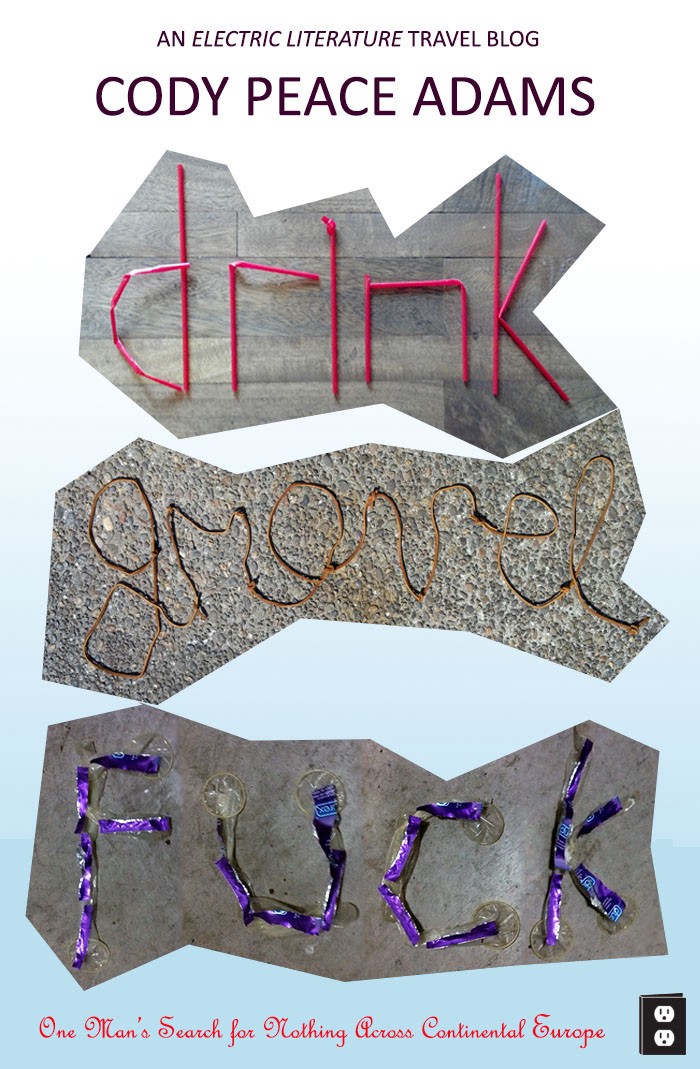
The author will embark on a two-month tour through notable locations in Western and Central Europe, and provide scintillating commentary on over-remarked phenomena on a weekly basis.
Background:
Through a combination of poor decision-making, bad luck, and constitutional maladaptation, I’d ended up living hand-to-mouth in a legally contested sublet in not-ready-for-primetime Crown Heights. Holding down three erratic part-time jobs in the hopes of having adequate time to work on a stalled novel, I instead devoted my vocational flexibility to nurturing despair and building up a sensory tolerance for bodega cans with the word “Ice” on the label. In short, the author viewed the world through shit-tinted glasses and had little hope for material or spiritual advancement.
Catalyst:
The sudden resolution of a long-simmering personal injury lawsuit left me with a cash windfall in the early summer of 2013. The only unifying notion that cut through my subsequent money mania was to finally do some old-fashioned old-world traveling; this idea manically snowballed into pulling up stakes in New York, moving back in with my mother in Salem, Oregon, and planning an itinerary for the Fall while I worked on a few short stories in a safe, non-stimulating environment and performed daily calisthenics.
Preparatory Findings:
Seven weeks oozed by in a state of previously unimaginable spiritual stupor and moral turpitude. A planned immersion into Rosetta Stone French, Levels 1–4 rerouted into dozens of hours of video games. Hundreds of dollars disappeared into ubiquitous Oregon state video poker machines and crossword scratch-off lotto tickets. A pass was made at a friend’s freshly minted ex-wife during a brown-out interlude at a 10-year high school reunion. The exercise routine grew indifferent and yielded no visible results. $10,000 was pledged and withdrawn from Harry Knowles’ Kickstarter as part of an elaborate trolling scheme. Contradictory schedule I and II drugs were free-based with a stripper. Communication between my mother and I ceased almost completely.
Itinerary:
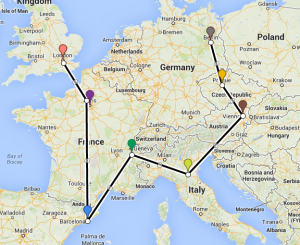
I fly to London in early September, and will spend four days with a group of British friends following an eight-year absence from the UK.
I head to Paris, where I will reside in an entire AirBnB flat for eighteen days and have no contact with a known soul.
I arrive in Barcelona in late September for a week’s stay in an AirBnb room, this time in a habitated apartment.
I find my way to the chalet of friend’s family in the Swiss Alps for a stay of unknown duration beginning in early October.
I meet up with a friend somewhere in Italy for a week, possibly Bologna.
Vienna maybe?
An AirBnb room share awaits in Prague in mid-to-late October.
Two friends and I will occupy an AirBnB flat in Berlin for nine days in late October.
I fly back to Oregon on Nov. 1st, refreshed or destroyed.
C.V.
I know nothing about any of these places other than London, where I studied abroad for a semester. I procrastinated away any advanced planning and compiled no points of interest or activities. I speak no languages other than a remnant of high school Spanish.
Inventory:
One backpack and one piece of medium-sized roller luggage.
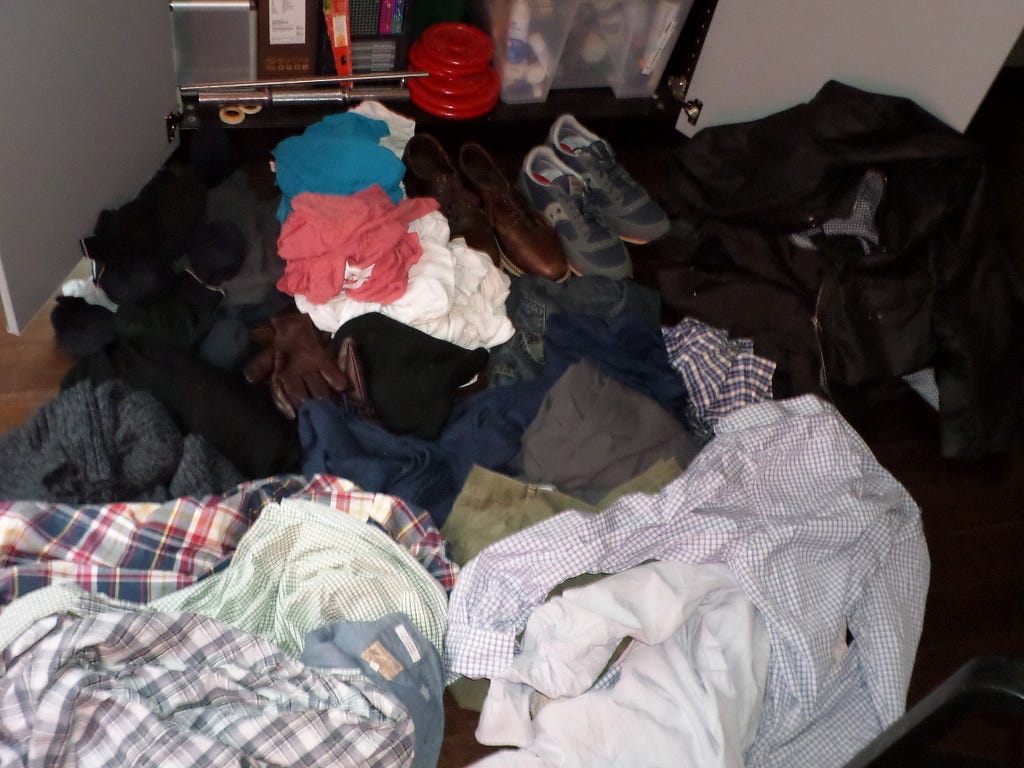
Four pairs of pants, eight button-ups, eight undershirts, eight pairs of socks, eight pairs of underwear, two sweaters, one pair of pajama bottoms, one scarf, one beanie, one pair of gloves, one light jacket, one winter coat, one pair of sneakers, and one pair of work shoes. I am greatly scared of gaining too much weight during the journey to be able to wear these clothes without appearing ridiculous.
Prescriptions of Adderall, Ambien, an antibiotic, and Viagra. The first two are for my broken brain and the last is for my broken penis (re: above mentioned personal injury) and is largely aspirational.
One Chromebook, on which I will write the ensuing posts on this blog.
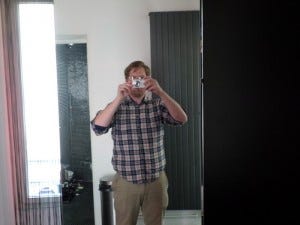
One point-and-click digital camera, the sort of thing I haven’t owned in years, and which now comes with an astoundingly unnecessary 20-megapixel imaging capacity. I can’t imagine what I’d want to take pictures of, but perhaps there will exist amusing graffiti.
One power adapter and one voltage converter.
One American passport and one Eurorail pass. I haven’t checked schedules at all and I have no idea how train travel works, but hope to smoke inside and become inveigled in a murder mystery.
One electronic cigarette and 40 nicotine capsules. I’m going to attempt to smoke as few actual cigarettes as possible while traveling, but this is probably a joke.
One copy of V, one copy of the Economic and Philosophic Manuscripts of 1844, and one copy of Finnegan’s Wake. I figure I might as well look like as big a twat as possible while reading in foreign lands.
Abstract:
I originally lacked any great animating desire for this trip, and treated it like an impending back-to-school marker to excuse the personal anarchy of the intervening summer and lack of coherent long-term life planning. Now, on the eve of my departure, I’m shaken and soul-scraped, with a tenuous grasp on the nature of self after blitzing a bevy of personal red lines. This excursion, then, must now either rebuild my sense of adult autonomy and stabilize my flatlining telos or burn what’s left of these constructs to the ground.
Why do I hate talking to strangers, have no interests, and never want to do anything? At what point will the money I’m blowing feel real? Do I have a personality, or am I just gyrating amalgam of neurosis, addiction, aesthetic preference, and hormone?
Are these questions answerable via the brute-forcing of novel experience? By leaving this European tour negligently under-planned, will I discover a wellspring of fortitude and ingenuity that allows me to experience the present, untainted by past shame or future terror?
If I change my surroundings, will I change?
Or will I blow $20,000, kill 2,000 brain cells, embarrass myself 200 times, gain 20 pounds, fall two steps down Maslow’s hierarchy, and learn nothing about myself, other people, or the world at large?
I first met poet Matthew Zingg at the recently-deceased Fireside Follies Reading Series which was co-curated by Mike Lala and Eric Nelson in Brooklyn. On a recent trip to Baltimore, where Matt now lives, we drank some bourbon while talking alternative country and horror films.
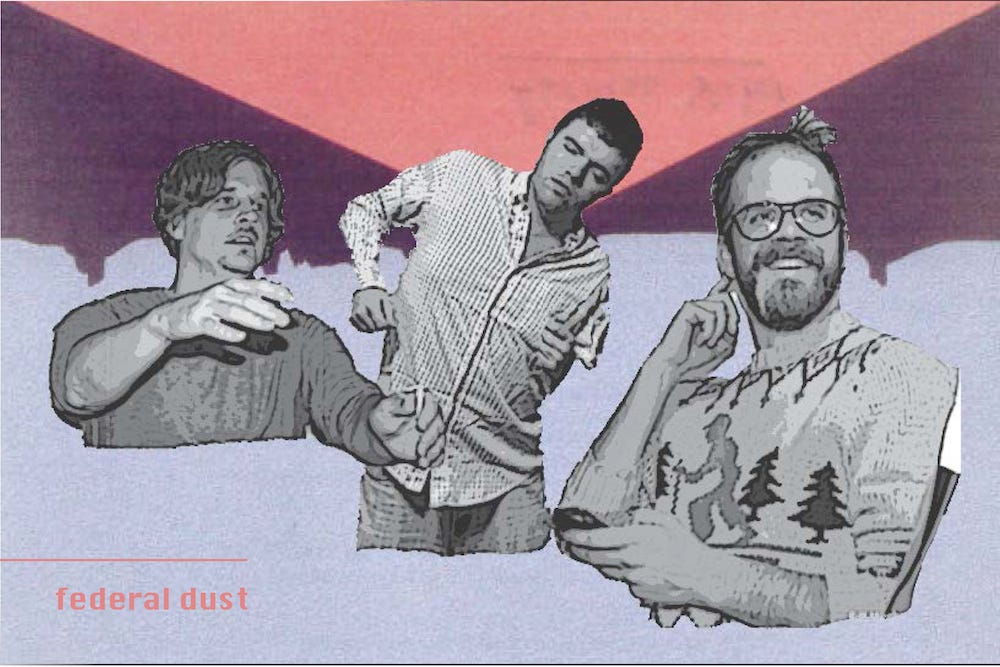
After I got back to Brooklyn, he announced he’d be starting his own series called Federal Dust, which kicked off this past Saturday (there’s a slideshow below). I sent interview questions to Matt and the first three readers (Joe Young, Adam Robinson, and Scott McClanahan) via a Google Doc. The questions ended up being answered as individual emails, meaning some answers came without context for what was said beforehand. It makes for odd reading.
Electric Literature: Joe, knowing that, in addition to writing, you’re a visual artist, I asked you to make a spiffy rendering of you and the other folks interviewed. You graciously supplied the graphic above with you on the left, Scott in the middle, and Adam on the right. Here’s my follow-up: Is Adam blissfully unaware that you and Scott are about to levy a hellacious zombie attack his way or is this more Adam catches a reflection of the dance floor behind him at AWP?
Joe Young: If Adam is the congenial visionary digging stanzas off the new floor of the near horizon and Scott is in the peripatetic paper shaman’s mountain trance then I’m the unweary somnambulist just watching for their arrival.
EL: Adam, now that we know your fate as should have been evident to me by the subtle sexiness of the others behind you in Joe’s graphic (and the mischief in your almond-shaped eyes), I feel I should mention that I’ve seen you stand up at a reading and tell everyone who you planned on having sex with. Has a reading ever gotten you laid?
Adam Robinson: Thanks for asking!
EL: Scott, I won’t insult you by asking the same question I asked Adam. I once saw you read at the Franklin Park Reading Series and we all caught the vapors. It was like you channeled superhuman intensity which is charming to those into superhumanity and the occult. Toward the end, you walked up to the crowd and began chanting. Where do you draw that presence from? Is it paranormal, religious, a long line of bullshitting salesman?
Scott McClanahan: I don’t know.
EL: Speaking of out-of-the-ordinary presence…Joe, you’re writing site-specific microfiction and putting it on buildings. This is great news for people who think books might as well be holding up buildings, as well as those of us resigned to live inside them. Tell me more about the influence of each building to its corresponding work and vice versa.
Young: That’s a pretty good idea actually, to suggest my stories go on a load bearing wall, to let words carry at least some weight in the culture. But yes, the building, the wall, that wall’s function, the room it occupies, the kinds of people doing their own occupying, all of that goes into my thinking/contemplating when writing a microfiction I’ll install somewhere. I like to think it all gets folded up in the words.
As for how the story influences the building, I really don’t know. I realized a while ago that other people are usually better able to tell me what my stories are about than I am, so it’ll be interesting to see what a house or cafe has to say about one of my story installations over the long term.
EL: Changing gears, Matt, what’s up with the name of the series? Sounds very dark.
Matthew Zingg: Well, originally Federal Dust is the title of a Silver Jews song (I’m a big fan), and my neighborhood, where the series is held, is called Federal Hill. When I was throwing names around for the series, Federal Dust somehow popped up. So that’s the lazy explanation. It was just a matter of coincidence.
But recently, a friend pointed out to me that writers and poets comprise a sort of federation, which is another way of saying community, I guess. Plus the notion that something can be monumental and negligible at the same time has always been, for me, a good way of thinking about language and its aims. Maybe that’s dark or sad, but it’s also liberating.
EL: Adam, my mind is pretty much one track. Who do you think writes the good sexy stuff nowadays?
Robinson: The answer is, and always shall be, Grace Paley. Sorry everyone after her!
EL: Lastly, Matt: You once cribbed, “cruelty is the first act of grace,” and dropped in one of your poems. You recently moved from New York to Baltimore, each of which has enough folks describing the cruelty within. Can Federal Dust bestow us a helping of grace?
Zingg: Haha. Clearly I’m prone to cherry-pick (see: steal) ideas from others. That line owes itself to Flannery O’Connor. It’s kind of like her mantra.
All cities are cruel and graceful in one way or another.
I miss New York on a regular basis. There is just so much there — an enormous literature scene, countless readings, no shortage of talented and varied voices, and not to mention people that I love to the very core of my yokel heart. New York is everywhere. Leaving and learning to live without New York was a cruel and difficult process, it was a tough break-up, but Baltimore turned out to be more generous than I could have ever imagined.
This isn’t a judgment of either city, but here I have space to move around, literally and figuratively. I feel lighter, and isn’t that a symptom of grace? Maybe Federal Dust is my way of saying ‘thank you’ to a place that was so quick to take me in and make me feel like a part of something. Maybe. I haven’t thought that far ahead yet.
This slideshow requires JavaScript.
Editor’s note: Held (almost) every first Saturday of the month, Baltimore’s newest reading series, Federal Dust, seeks to bring together the very best local and national writers for an intimate reading. The premier event featured Scott McClanahan (Crapalachia, Stories V!) along with Baltimore’s own Adam Robinson (Adam Robinson and Other Poems, Publishing Genius Press) and Joseph Young (Easter Rabbit, 5 Drawings of a Maryland Sky), plus music by Boat Water. The readings take place at 1003 Light Street. They are free and open to the public.
— Josh Milberg is Director of Promotions and Outreach for Electric Literature. Right now he’s pretty keen on Baltimore’s Moss of Aura.
There are those who wish to know, and there are those who don’t wish to know. At first Tem made fun of me in that condescending way of his (a flick of my nipple, a grape tossed at my nose) when I claimed to be among the former; when he realized I meant it, he grew anxious, and when he realized I really did mean it, his anxiety morphed into terror.
“Why?” he demanded tearfully in the middle of the night. “Why why why?”
I couldn’t answer. I had no answer.
“This isn’t only about you, you know,” he scolded. “It affects me too. Hell, maybe it affects me more than it affects you. I don’t want to sit around for a bunch of decades awaiting the worst day of my life.”
Touched, I reached out to squeeze his hand in the dark. Grudgingly, he squeezed back. I would have preferred to be like Tem, of course I would have! If only I could have known it was possible to know and still have been fine with ignorance. But now that the technology had been mastered, the knowledge was available to every citizen for a nominal fee.
Tem stood in the doorway as I buttoned the blue wool coat he’d given me for, I think, our four-year anniversary a couple years back.
“I don’t want to know where you’re going,” he said. He glared.
“Fine,” I said, matter-of-factly checking my purse for my keys, my eye-drops. “I won’t tell you.”
“I forbid you to leave this apartment,” he said.
“Oh honey,” I sighed. I did feel bad. “That’s just not in your character.”
With a tremor, he fell away from the doorway to let me pass. He slouched against the wall, arms crossed, staring at me, his eyes wet and so very dark. Splendid Tem.
After I stepped out, I heard the deadbolt sliding into place.
“So?” Tem said when I unlocked the deadbolt, stepped back inside. He was standing right there in the hallway, his eyes darker than ever, his slouch more pronounced. I was willing to believe he hadn’t moved in the 127 minutes I’d been gone.
“So,” I replied forcefully. I was shaken, I’ll admit it, but I refused to shake him with my shakenness.
“You …?” He mouthed the question more than spoke it.
I nodded curtly. No way was I going to tell him about the bureaucratic office with its pale yellow walls that either smelled like urine or brought it so strongly to mind that one’s own associations created the odor. It never ceases to amaze me that, even as our country forges into the future with ever more bedazzling devices and technologies, the archaic infrastructure rots away beneath our feet, the pavement and the rails, the schools and the DMV. In any case: Tem would not know, today or ever, about the place I’d gone, about the humming machine that looked like a low-budge ATM (could they really do no better?), about the chilly metal buttons of the keypad into which I punched my social security number after waiting in line for over forty-five minutes behind other soon-to-be Knowers. There was a silent, grim camaraderie among us; surely I was not the only one who felt it. Yet carefully, deliberately, desperately, I avoided looking at their faces as they stepped away from the machine and exited the room. Grief, relief — I didn’t want to know. I had to do what I’d come to do. And what did my face look like, I wonder, as I glanced down at the paper the slot spat out at me, as I folded it up and stepped away from the machine?
Tem held his hand out, his fingers spread wide, his palm quivering but receptive.
“Okay, lay it on me,” he said. The words were light, almost jovial, but I could tell they were the five hardest words he’d ever uttered. I swore to never again accuse Tem of being less than courageous. And I applauded myself for going straight from the bureaucratic office to the canal, for standing there above the sickly greenish water, for glancing once more at the piece of paper, for tearing it into as many scraps as possible though it was essentially a scrap to begin with, for dropping it into the factory-scented breeze. I’d thought it was the right thing to do, and now I knew it was. Tem should not have to live under the same roof with that piece of paper.
“I don’t have it,” I said brightly.
“You don’t?” he gasped, suspended between joy and confusion. “You mean you changed your — ”
Poor Tem.
“I got it,” I said, before he could go too far down that road. “I got it, and then I got rid of it.”
He stared at me, waiting.
“I mean, after memorizing it, of course.”
I watched him deflate.
“Fuck you,” he said. “I’m sorry, but fuck you.”
“Yeah,” I said sympathetically. “I know.”
“You do know!” he raged, seizing upon the word. “You know! You know!”
He was thrashing about, he was so pissed, he was grabbing me, he was weeping, he half-collapsed upon me. I navigated us down the hallway to the old couch.
When he finally quieted, he was different. Maybe different than he’d ever been.
“Tell me,” he calmly commanded. His voice just at the threshold of my hearing.
“Are you sure?” I said. My voice sounded too loud, too hard. In that moment I found myself, my insistence on knowing, profoundly annoying. I despised myself as part of Tem surely despised me then. Suddenly it seemed quite likely that I’d made a catastrophic error. The kind of error that could ruin the rest of my life.
Tem nodded, gazed evenly at me.
I became wildly scared; I who’d so boldly sought knowledge now did not even dare give voice to a date.
Tem nodded again, controlled, miserable. It was my responsibility to inform him.
“April 17 — ” I began.
But Tem shrieked before I could finish. “Stop!” he cried, shoving his fingers into his ears, his calmness vanished. “Stop stop stop stop! Never mind! I don’t want to know! Don’t! Don’t don’t don’t!”
“OKAY!” I screamed, loud enough that he could hear it through his fingers. It was lonely — ever so lonely — to hold this knowledge alone. April 17, 2043: a tattoo inside my brain. But it was as it should be. It was the choice I had made. Tem wished to be spared, and spare him I would.
It was an okay lifespan. Not enough — is it ever enough? — but enough to have a life; enough to work a job, to raise children, perhaps to meet a grandchild or two. Certainly abbreviated, though; shorter than average; too short, yes; but not tragically short.
And so in many ways I could live a life like any other. Like Tem’s. I could go blithely along, indulging my petty concerns, lacking perspective, frequently forgetting I wasn’t immortal. Yet it would be a lie if I said a single day passed without me thinking about April 17, 2043.
In those early years, I’d sink into a black mood come mid-April. I’d lie in bed for a couple of days, clinging to the sheets, my heart a big swollen wound. Tem would bring me cereal, tea. But after the kids were born I had no time for such self-indulgence, and I began to mark April 17 in smaller, kinder ways. Would buy myself a tiny gift, a bar of dark chocolate or a clutch of daffodils. As time went on, I permitted myself slightly more elaborate gestures — a new dress, an afternoon champagne at some hushed bar. I always felt extravagant on April 17; I’d leave a tip of twenty-five percent, hand out a five-dollar bill to any vagrant who happened to cross my path. You can’t take it with you and all that.
Tem tried hard to forget what he’d heard, but every time April 17 came around again, I could feel his awareness of it, a slight buzz in the way he looked at me, tenderness and fury rolled up in one. “Oh,” he’d say, staring hard at the daffodils (their stems already weakening) as I stepped through the door. “That.”
I’d make a reservation for us at a fancy restaurant; I’d schedule a weekend getaway. Luxuries we spent the whole rest of the year carefully avoiding. Meanwhile, my birthday languished unnoticed in July.
Tem would sigh and pack his overnight case. We sat drinking coffee in rocking chairs on the front porch of a bed-and-breakfast on a hill in the chill of early spring. Tem was generous to me; it was his least favorite day of the year, but he managed to pretend; we’d stroll. We’d eat ice cream. The silly little band-aids.
My life would seem normal — bland, really — to an outside observer, but I tell you that for me it has been rich, layered and rich. I realize that it just looks like 2.2 children, a bureaucratic job and a long marriage, an average number of blessings and curses, but there have been so many moments, almost an infinity of moments — soaping up the kids’ hair when they were tiny, walking from the parking lot to the office on a bird-studded Friday morning, smelling the back of Tem’s neck in the middle of the night. What can I say. I don’t mean to be sentimental, but these are not small things. As the cliché of our time goes, The deeper that sorrow carves into your being, the more joy you can contain. This is no time to go into the ups and downs, the stillbirths and the car accident and the estrangement and what happened to my brother, but I will say that I believe the above statement to be true.
April 17. I’d lived that date thirty-one times already before I learned about April 17, 2043. Isn’t it macabre to know that we’ve lived the date of our death many times, passing by it each year as the calendar turns? And doesn’t it perhaps deflate that horror just a bit to take the mystery out of it, to actually know, to not have every date bear the heavy possibility of someday being the date of one’s death?
I do not know the answer to this question.
April 17, 2043. The knowledge heightened my life. The knowledge burdened my life. I regretted knowing. I was grateful to know.
I’ve never been the type to bungee jump or skydive, yet in many small ways I lived more courageously than others. More courageously than Tem, for instance. I knew when to fear death, yes, but that also meant I knew when not to fear it. I’d gone to the grocery store during times of quarantine. I’d volunteered at the hospital, driven in blizzards, ridden roller coasters so rickety Tem wouldn’t let the kids on them.
But I have to admit that December 31, 2042, was a fearful day for me.
“Are you okay?” Tem said after the kids had gone home. We’d hosted everyone for a last supper of the year, both children and their spouses, and our son’s six-month-old, our first grandchild, bright as a brand-new penny. At the dinner table, our radiant daughter and her bashful husband announced that they were expecting in August. Amid the raucous cheers and exclamations, no one noticed that I wasn’t cheering or exclaiming. The child I’d miss by four months. The ache was vast, vast. I couldn’t speak. I watched them, their hugs and high-fives, as though from behind a glass wall.
“Oh god, Ellie,” Tem said painfully, sinking onto the couch in the dark living room. “Oh god.”
“No,” I lied, joining him on the couch. “Not this year.”
Tem embraced me so warmly, with such relief, that I felt cruel. I couldn’t bear myself. I stood up and, unsteady with dread, limped toward the bathroom.
“Ellie?” he said. “You’re limping?”
“My foot fell asleep,” I lied again, yanking the door shut behind me.
I stood there in the bathroom, hunched over the sink, clinging to the sink, staring at my face in the mirror until it no longer felt like my face. This would develop into a distasteful and disorienting but addictive habit over the course of the next three and a half months.
Aside from the increasing frequency with which I found myself falling into myself in the bathroom mirror, I got pretty good at hiding my dread. From Tem, and even at times from myself. We planted bulbs; we bought a cooler for summer picnics. I pretended and pretended; it felt nice to pretend.
Yet when Tem asked, on April 10, what I’d planned for this year’s getaway, the veil fell away. Given the circumstance, I had — of course — neglected to make any plans for the 17th. The dread rushed outward from my gut until my entire body was hot and cold.
Panicking, I looked across the table at Tem, who was gazing at me openly, hopefully, boyishly, the way he’d looked at me for almost four decades. Tem and I — we’ve been so lucky in love.
“Tem,” I choked.
“You okay?” he said.
And then he realized.
“Damn it, Ellie!” he yelled. “Why’d you have to — !”
I still didn’t know, just as I hadn’t known way back then.
I quietly quit my job, handed in the paperwork, and Tem took the week off, and we spent every minute together and invited the blissfully ignorant kids out for brunch (I clutched the baby, forced her to stay in my lap even as she tried to wiggle and whine her way out, until eventually I had to hand her over to her mother, a chunk of my heart squirming away from me). Everything I saw — a gas station, a tree, a flagpole — I thought how it would go on existing, just the same. Tem and I had more sex than we’d had in the previous twelve months combined. Briefly I hung suspended and immortal in orgasm, and a few times, lying sun-stroked in bed in the late afternoon, felt infinite. What can I say, what did we do? We held hands under the covers. We made fettuccine alfredo and, cleaning the kitchen, listened to our favorite radio show. I dried the dishes with a green dishcloth, warm and damp.
On the morning of April 17, 2043, I was half-amazed to open my eyes to the light. Six hours and four minutes into the day, and I was alive. Petrified, scared to move even a muscle, I wondered how death would come for me. I supposed I’d been hoping it would come mercifully, in the soft sleep of early morning. I turned to Tem, who wasn’t in bed beside me.
“Tem!” I screamed.
He was in the doorway before I’d reached the “m,” his face stricken.
“Tem,” I said plaintively, joyously. He looked so good to me, standing there holding two coffee mugs, his ancient baby-blue robe.
“I thought you were dying!” he exclaimed.
I thought you were dying. It sounded like a figure of speech. But he meant it so literally, so very literally, that I gave a short sharp laugh.
Would it be a heart attack, a stroke, a tumble down the basement stairs? I had the inclination to stay in bed resting my head on Tem, see if I might somehow sneak through the day, but by 10 a.m. I was still alive and feeling antsy, bold. Why lie here whimpering when it was coming for me no matter what?
“Let’s go out,” I said.
Tem looked at me doubtfully.
“It’s not like I’m sick or anything.” I threw the sheets aside, stood up, pulled on my old comfy jeans.
The outside seemed more dangerous — there it could be a falling branch, a malfunctioning crane, a truck raring up onto the sidewalk. But it could just as easily catch me at home — misplaced rat poison, a chunk of meat lodged in my throat, a slick bathtub.
“Okay,” I said as I stepped out the door, Tem hesitant behind me.
We walked, looking this way and that as we went, hyperaware of everything. Vigilant. I felt like a newborn person, passing so alertly through the world. It was such an anti-death day; the crocuses. Tem kept saying these beautiful, solemn one-liners that would work well if they happened to be the last words he ever said to me, but what I really wanted to hear was throwaway words (all those thousands of times Tem had said “What?” patiently or irritably or absentmindedly when I’d mumbled something from the other room), so eventually I had to tell him to please stop.
“You’re stressing me out,” I said.
“I’m stressing you out?” Tem scoffed. But he did stop saying the solemn things. We strolled and got coffee, we strolled some more and got lunch, we sat in a park, each additional moment a small shock, we sat in another park, we got more coffee, we strolled and got dinner. Every time I caught a glimpse of us reflected in a window, I had to look again — who was that aging couple in the glass, the balding shuffling guy hanging onto the grandmother in the saggy jeans? Still, old though we’d become, my senses felt bright and young, supremely sensitive to the taste of the coffee, the color of the rising grass, the sound of kids whispering on the playground. I felt carefree and at the same time the opposite of carefree, as though I could sense the seismic activity taking place beneath the bench where we sat, gazing up at kites. Is it strange to say that this day reminded me of the first day I’d ever spent with Tem, thirty-eight years ago?
The afternoon gave way to a serene blue evening, the moon a sharp and perfect half, and we sat on our small front porch, watching cars glide down our street. At times the air buzzed with invisible threat, and at times it just felt like air. But the instant I noticed it just felt like air, it would begin to buzz with invisible threat once more.
Come 11:45 pm, we were inside, brushing our teeth, shaking. Tem dropped his toothbrush in the toilet. I grabbed it out for him. Would I simply collapse onto the floor, or would it be a burglar with a weapon?
What if there had been an error? Remembering back to that humble machine, that thin scrap of paper, the cold buttons of the keypad, I indulged in the fantasy I’d avoided over the years. It suddenly seemed possible that I’d punched my social in wrong, one digit off. Or that there had been some kind of bureaucratic mistake, some malfunction deep within the machine. Or perhaps I’d mixed up the digits — April 13, 2047. If I lived beyond April 17, 2043, where would the new boundaries of my life lie?
Shakily, I washed Tem’s toothbrush in steaming hot water from the faucet; it wouldn’t be me lingering in the aisle of the drugstore, considering the potential replacements, the colors.
We stood there staring at each other in the bathroom mirror. This time I didn’t fall into my own reflection — Tem, I was looking at Tem, that’s what I was doing.
Why had it never occurred to me that it might be something that would kill Tem too?
In all of these years, truly, I had never once entertained that possibility. But it could be a meteorite, a bomb, an earthquake, a fire.
I unlocked my eyes from Tem’s reflection and grabbed the real Tem. I clung to him like I was clinging to a cliff, and he clung right back.
I counted ten tense seconds. The pulse in his neck.
“Should we — ?” I said.
“What?” Tem said quickly, almost hopefully, as though I was about to propose a solution.
“I don’t know,” I said. “Go to bed? It’s way past our bedtime.”
“Bedtime!” Tem said as though I was hilarious, though he didn’t manage a laugh.
11:54pm on April 17, 2043. We are both alive and well. Yet I mustn’t get ahead of myself. There are still six minutes remaining.
The shortlist for the 2013 Man Booker Prize shortlist was announced this morning. The six authors listed below represent five different countries, range in age from 28 to 67, and have written as many as 15 books or as few as two.
The listing appeared in a post at the Man Booker website, which highlights the diversity of the list and what it means for the prize and for the contemporary literary world.
“And what does the list say about the writers? It is clear that the perennial complaint that fiction is too safe and unadventurous is a ridiculous one; it shows that the novel remains a multi-faceted thing; that writing and inspiration knows no geographical borders; that diaspora tales are a powerful strand in imaginative thinking; and that human voices, in all their diversity, drive fiction.”
Authors on the shortlist receive a £2,500 prize and a designer bound copy of their book.
This literary fact was provided by The Factspace, a potentially award-winning webcomic written and drawn by Seth Fried and Julia Mehoke. You can check out more true facts here.
THE DOCTOR WENT TO SEE THE RABBI. “Tell me, rabbi, please,” he said, “about God.”
The rabbi pulled out some books. She talked about Jacob wrestling the angel. She talked about Heschel and the kernel of wonder as a seedling that could grow into awe. She tugged at her braid and told a Hasidic story about how at the end of one’s life, it is said that you will need to apologize to God for the ways you have not lived.
“Not for the usual sins,” she said. “For the sin of living small.”
The doctor sat in his suit in his chair and fidgeted. Although he had initiated the conversation, he found the word God offensive, the same way he disliked it when people spoke about remodeling their kitchens.
“I’m sorry,” he said, standing. “I cannot seem to understand what you are saying. Are you speaking English?”
“English?” said the rabbi, closing a book. Dust motes floated off the pages into the room and caught the light as they glided upward. She wrinkled her forehead as if she was double-checking in there. “Yes,” she said.
A few months later, the rabbi became sick. She had a disease of the blood, a disease that needed weekly transfusions that she scheduled on Wednesdays so she would be at her best for Shabbat.
The doctor who had come to see her was a doctor of blood. A transfusionist. He had chosen this profession because blood was at the center of all of it. It was either blood, or the heart, or the brain. Or the lungs. He picked blood because it was everywhere. He was never even slightly interested in skin, or feet, joints, or even genitals. It was the most central core stuff of life and death that made him tolerate all those godawful courses in anatomy and biochemistry.
She thought of him as she sat with her husband, staring at their enfolded hands, wondering what to do.
“That man,” she said, looking up. “That man who came by a few months ago.”
When the rabbi was in her paper gown she looked smaller, of the earth, and the doctor did not mind the role reversal.
“I’m so sorry you have to go through this,” he said.
The rabbi lay down on the cold table. She offered her arm. The blood drained from her; the blood of another person filled her. The doctor stood beside her and placed the instruments in a line.
The rabbi came for many transfusions, and she recovered at a brisk pace, filled with the blood of Hindus and Lutherans. The treatments went so well she didn’t have to visit as often anymore, and the doctor missed seeing her at the clinic. After a month had gone by, he went to her office again, where he found her talking to another rabbi, massaging the bottom of a stockinged foot. He stood outside the door as she sifted through her shelves, finding a book, opening it to a page, the two rabbis huddled shoulder to shoulder, commenting, gesturing. The age-old activity of Jews.
The doctor stayed near the door. He was not one to interrupt.
It was when the rabbi was locking up that she glanced over and saw him. Her color was back. Her eyes were clear. She was an attractive woman, with a kind, bearish husband, one raven-haired child, pink dots of warmth in the centers of her cheeks. She hugged him, and pressed his hand, and thanked him, and he said he would like to talk to her again.
“About God?” she asked.
“I’m not sure,” he said. “I don’t think so.”
They went to a coffee shop, because she could now go no longer than two hours without food.
She asked him why blood. He explained. The river. They picked at a croissant on wax paper between them. The radio expelled old pop songs. He felt something stir inside him when beside her, but it was not lust, and it was not religion. What was it? “I feel a stirring, when I sit with you,” he said, rolling his coffee mug in his hands. “But it is not lustful.”
“I’m married,” she said, as an afterthought. She had bright blue clay earrings on, formed into the shapes of stars.
“It’s like the coffee tastes more like coffee,” he said.
She sipped hers.
“There’s good coffee here,” she said.
“It’s not that.”
There was a pause. He found it awkward. She did not seem to mind. She dipped a croissant end into her coffee and the buttery layers soaked up the warmth.
“I gave you the blood of other religions,” he blurted.
She laughed out loud, lifting out the croissant. “No problem,” she said. “I like what you gave me. It’s great. How’d you know?”
“There’s a box on the donation form,” he said. “An optional box.”
“Ah,” she nodded.
“I went with those who had checked the optional box.”
“How interesting that it’s a box on a form,” she said, chewing. “I’ve never heard of that before.”
He scratched his nose. “It’s new.”
“Hospital rules?”
“No.”
“Who made the form?”
“Me,” he said.
“You can do that?”
“Sure,” he shrugged. “No one thinks to question an extra form. Plus, it’s optional.”
“So, who’d I get?” she asked, now dipping the croissant torso.
His hands were shaking, slightly. He put them flat on the table, to calm them. He wasn’t sure why he was so nervous around her.
“Christians,” he said. “Of all sorts. Including a Jehovah’s Witness. Several Muslims. A few Jews.”
“Maybe it’s a new route to world peace,” she said. “Transfuse people.”
“And atheists?” he said, tentatively.
“What about them?”
“I gave you atheist blood, too,” he said. He cringed, visibly.
She laughed again. All that warmth in her laugh, like it could embrace someone across a room.
“I don’t hate the atheists,” she said.
“I’m an atheist,” he said, a little too loud, and he reached out for her hand.
For a second, she held his. His hand was much wider than hers and her hands, not usually considered dainty, looked small and slender next to his.
“I’m not here to push anything on you,” she said. “Many Jews I know are atheist Jews.”
“Your eyes shine,” he said. “How do they do that?”
“Blood,” she said.
They slipped into the affair, even though it was not an affair. It was never anything to do with losing clothes. It was not the deep sharing of feelings. It was almost entirely one-sided. It was simple, like he’d slipped slightly into her blood, and she slipped strongly into his thinking. She had one or two dreams in which he played a part, as a kind of helpful direction-giver when lost on a highway, dreams she was only mildly aware of when she woke up and went to shower.
For the most part, she focused on the congregants who needed comfort, and her husband and young son with the amazing brown eyes. The doctor, however, cultivated thoughts of her like a fresh little garden. Sometimes he pulled out her chart just to reread her basic stats because the numbers brought him something akin to joy. To joy, really — the numbers lifted his heart and step, buoyed his day. It was just knowing this person was alive, he thought. That he had helped her, maybe even saved her, and now she was out there talking about all this business he did not believe in.
God, he said, in his car, driving from hospital to home. What a word. Much had been made already of its similarity to “dog,” but as he wound through the streets, he particularly enjoyed conjuring up the image in his head of some kind of old and glowing man on a leash.
Not that he believed in such things, but he wondered if giving her atheist blood might in fact turn her into an atheist, and he felt guilty at the thought but also pleased — like she could come over to his house and they could browse his bookshelves, shoulder-to-shoulder, and read Sartre together, or a dash of Camus, and then stand on chairs in old-fashioned hats and drop apples from great heights to the floor.
He returned to the rabbi’s office. His mother was not well. She had cancer. She was in the hospital. Her illness had little to do with blood, or at least not his kind of blood, and so he’d stood around her hospital room, awkward, without a task. He watched the TV, attached to the ceiling with metal straps and hooks, the show pointing down upon them. He loved his mother, even though she seemed to be so private a person he had not understood much about her. She only ever told him on a daily basis about her day.
“I went to the grocery store,” she would say. “I got my hair done.”
“What else?” he asked once.
“I ate potato chips,” she said. “I talked to your Aunt Sophie.”
“About what?” he said.
She hummed, thinking. “About everything, I suppose,” she said. “And how are you?”
“I’m fine,” he said. “I bought a radio. But what do you mean, everything?”
She paused on the phone. He could hear her unpacking groceries. “Sophie tells me about everything she is thinking and feeling,” his mother said. “It’s very interesting.”
“And you?”
“I so enjoy hearing what Sophie has to say,” she said.
“I have been unable to work very much this week,” he told the rabbi. “I took two days off.”
“Makes sense,” she said. She was wearing a navy blue suit, maybe because she had attended a funeral, or a business meeting. The daily workings of a rabbi’s schedule were highly mysterious to him.
She was also surrounded by cardboard boxes of donations for a charity drive and had just started sorting items into piles. A kid clothing pile, an adult clothing pile, a book pile, a toy pile.
“Want to help?” she asked.
“Sure.” He took the free seat. She had a pile of books in her lap and was separating them into kid and adult levels.
“And my son is not doing well, either,” he said, settling in. “He lives with my ex-wife. He failed algebra.”
He opened a donation box. Sweaters. The rabbi was divvying up her book piles, but he could tell she was listening. She divvied quietly.
“I tried to tutor him,” he said, “but I didn’t know how. I forgot algebra.”
The rabbi nodded. “Who remembers?”
“My ex-wife doesn’t like to talk about it,” he said. “My mother is doing a little better. They say she can go home tomorrow.”
He listed all the people on his fingers. Mother, son, ex. Looked at his hands. Ham-handed, he’d been called, as a boy. Big fingers. He had turned out to be very deft with needles, which had surprised everybody.
“And how are you holding up?” the rabbi asked.
“Fine,” he said.
He folded up the sweaters. Two had fairly large moth holes eating up the sleeves. “This okay?” he asked, showing her.
“Agh, no,” she said. She pointed under her desk. “Ungivables.”
He tossed over the sweaters, began folding others.
“What a stressful time,” said the rabbi.
“You say that to all the visitors,” he said, smiling a little.
She smiled back. “I still mean it.”
He folded the arms in carefully, then made the sweaters into tidy squares, smoothing down the fronts, so that each one looked new, like it had just been taken from a box at a department store and placed upon a table.
“Let me ask you a question,” said the rabbi, balancing the last book in the adult pile. “You’re here to see me. Why?”
“Because I like seeing you.”
“I like seeing you, too. But you could go to a friend. To a colleague.”
“You think doctors know how to talk about this stuff?”
She pulled a pile of animal toys into her lap, including an unusually large red plastic chicken.
“Bock-bock,” she said, moving the chicken up and down.
“I like seeing you,” the doctor said again.
“Well,” said the rabbi, steadying the chicken in her lap. “I ask because I have a rabbi kind of thing to say.”
“Let’s hear it,” he said.
“It’s not a secular comment, is what I’m saying,” said the rabbi. “It will probably piss off the atheist.”
“I get it, that’s okay,” said the doctor, pressing hands down on his pants. He placed his neat pile of sweaters in the adult pile. “I came here. Let’s hear it.”
She touched the plastic comb on the chicken’s head, gently.
“You could pray,” she said. “Either on your own, or with us.”
“Oh, that?” said the doctor, shaking his head. “The ‘p’ word? No.”
“Not to an old-man-in-the-sky kind of God,” she said. “Not to solve all your problems. Just to ask for some help.”
“Oh,” said the doctor. “Nah. I don’t do that sort of thing.”
“Why not?” she said. There was no edge to her voice. Just interest.
The doctor put a small bottle of bubbles in the kid pile.
“Bubbles!” he said.
He looked back at her.
“Just because I think it’s useless,” he said. “And a little creepy.”
She laughed. “Okay,” she said. The red chicken bobbed in her lap. “Fair enough.” She glanced at the adult clothes pile.
“What beautiful folding,” she said.
He had opened another box and found a mushed pile of t-shirts, washed but unfolded, as if they had gone straight from the dryer into the donation box.
“And,” he said, after a minute, shaking out a t-shirt. “Just to play along. You know. I wouldn’t want to use up the line space.”
“What line space?” she said. She placed the chicken in the kid pile. “You mean like margins?”
He swept his hand in the air. “No, a line,” he said. “A line-line. Like in the post office. Let’s say there’s a line. Of people praying. And I added my prayer to it. Well, I don’t want to take up someone else’s space in line with my half-assed half-believing baloney prayer.”
She laughed, again. Now she had a pile of very-loved stuffed animals in her lap. She was looking so well. He could not help but feel a little proud of how she was looking. He had made sure she had gotten very good blood.
“You atheists,” she said. “Scratch the surface and so many of you are so old school.”
He coughed. “What do you mean?”
“As if there’s a line!” she said. She released the herd of stuffed animals into the kid toy pile.
“But one prayer could edge out another prayer,” he said.
“I don’t see how,” she said.
“It’s just logic!” he said. He felt the sweat beading up, on his forehead. All those sweaters, all that wool. It was May. They were doing a clothing and toy drive for some holiday. Tu B’Shvat? Or was that January? Wasn’t that about trees? Who needed sweaters now?
“If I’m… praying,” he said, growing a little impatient, “and there are people across the world who pray five times a day, well, I think their prayer should be heard first, before my prayer, because they have, well, ‘earned’ their prayer spot in line, just as I would earn my place in line if I attended a museum opening and arrived at noon with a sack lunch for a three pm opening. There!” he said, sitting back, folding his arms.
The rabbi leaned in. She seemed to have forgotten about the piles for the moment. Her eyes were beams of light. “But there’s no line,” she said.
“How do you know?”
“Well, I don’t know,” she said. “But you’re using an example that doesn’t fit. An example that is of this daily world. You have to think differently.”
“All we know is of this world,” he said.
“True,” she said. “True.”
The doctor sniffed. “Or don’t you think the prayer lines get scrambled, with too many people praying?”
“I don’t think it’s like the phone system,” she said.
“Why not?” He held himself tight. “Six billion people on the planet, right? Some of them pray every day. Several times a day! All day!”
“But — ” she said.
“I have no interest in cutting in the queue,” he said.
“I don’t think it’s a merit system,” she said. “Or a queue.”
“But it would have to be, right?” he said. “There has to be some linear order. A way for whomever is supposedly listening to decide what to listen to first?”
She pushed her hair off her face. “I’m not sure God even has ears like that,” she said.
He laughed. “Well, then it’s even more pointless than I thought!”
She paused. She was looking in the middle distance, gathering. He could see she did not want to flood him. So much flooding, alone, pouring out of her eyes.
“Go ahead,” he said.
“Okay,” she said, slowly. A leftover giraffe fell on the floor.
“Here,” he said, picking it up.
She furrowed her forehead, thinking. Took the giraffe, absently stroked its back.
“The best way I can think to describe it,” she said, “is the way, when you’re driving on the freeway at night, how everyone can see the moon in their window. Every car, on the road. Every car feels the moon is following that car. Even in the other direction, right? Everyone in that entire hemisphere can see the moon and think it is there for them, is following where they go.
“You’ve had that experience?”
“Many times,” he said. “I see the moon right out my window.”
She kept petting the giraffe, as if it were a cat. Petting the little giraffe ears.
“That,” she said, “is a little closer to how I imagine it works. Whether or not you pray has absolutely nothing to do with the person to your left. It’s like saying you shouldn’t get the moon in your window, or else the other cars wouldn’t get the moon in their windows. But everyone gets the moon. It’s not an option, to not have the moon in your window. You just see it. It’s there.”
She paused. The window in the office grew golden with late afternoon.
“Half the world can’t see the moon,” said the doctor.
“It’s not the greatest example,” said the rabbi.
“Plus, the moon is far,” the doctor said, brushing lint off a t-shirt. “That’s why everyone has access.”
“True,” said the rabbi.
“So, is God far?”
“I don’t think those distance terms apply in the same way,” she said.
“Then I don’t understand the example.”
“It’s not — ” she said, clasping her hands together around the giraffe. “It’s not so literal.”
“I am literal,” he said. “I think literally. The moon is also unresponsive.”
She shook her head. “I’m sorry,” she said. “It’s hard to find the right example. I’m not saying pray to the moon,” she said. “Truly. I’m just trying to think up a way to talk about why there’s no queue, you know?”
“You don’t think God has ears?”
She sat back in her chair. “Not like our ears.”
He laughed, short. “I’m a doctor,” he said, putting all the folded t-shirts into a tidy stack.
She re-settled herself. Her face was warm, flushed.
“And are these prayers to be answered?” he said.
She seemed to be resting now, the urgency quieting, and he could see her shifting modes, back to her regular rabbi self, her teacher self, returning to the statements she said maybe once a week, twice a week, to different audiences. “In Judaism we pray for a variety of reasons,” she said, gently tucking the giraffe next to a few worn teddy bears. She closed her eyes. “Out of gratitude. Out of despair, asking for comfort. Out of confusion. Out of anger, in defiance. To be with. To share oneself. Not for results, tangible material results, especially on Shabbat — isn’t that interesting? We’re not to ask for anything tangible on Shabbat, which is, I think, one of the nicest times to pray all together.”
He flashed on an image of a hamburger, at a drive-through near his home, in a tinfoil pocket.
“Right now it might be helpful,” she said. “That’s all I’m saying.”
He wiped his hands clear on his pants. “I still think it’s hokum,” he said.
“Okay,” she said. She opened her eyes. Her forehead relaxed. “That’s okay. I’ll stop. I just wanted to talk it through with you. I’m glad you stayed.”
He wiped his forehead with his sleeve. It was hot in her office.
“I apologize for being so stubborn.”
“You weren’t stubborn,” she said, leaning over and unpeeling the tape to open up a new box. “You were actually pretty open. In a way, in my book, we just did it.”
“Did what?”
“Prayed, in a way,” she said. “Wrestled with it.”
“Why do you say that?” He sat up taller. For some reason, the thought made him angry.
“Because you’re leaning in,” she said, unfolding the box flaps. “Because I am tired, in a way that I recognize. Because you seem to be fighting up from under some water. Into what, I don’t know. Into something. Because we were talking about it deeply,” she said. “I could feel it.”
“We were having an argument!” he said. He stood up, but her office was too small to pace so he turned away, and stepped away, and found himself going through the door and going down the hall to use the bathroom. Down the long dark narrow hallway, with its closed office doors, and framed yarn art telling stories of the Old Testament. Once inside the bathroom, the motion sensor light clicked on; it was the end of the day, and no one had been in for over an hour. The space held the loneliness particular to an unused bathroom, the glare of fluorescent lights, the echo of sink and crumpling paper, the tired isolation of one person in an office building, alone, at night, working too late. He used up 10 paper towels on his face and neck until he was sufficiently dry. He washed his hands carefully in the sink. He took the back exit.
The rabbi sat in her office for 45 minutes, unpacking the last donation boxes, to see if he would return, but he did not return, and so she shouldered her bag and walked the seven blocks home.
The doctor found his car in the parking lot, one of the last three there, and joined the flow on the street. He drove with his air conditioner fan on full blast, into traffic as the sun set, into dusk, with the full moon rising in his rear view mirror, almost taunting him with her big presence in his car alone and every car around and none of it being how he liked to think or was interested in thinking. And yet. Why did he love the rabbi? He loved her. He got home, and looked through the mail, and he had driven past the drive-through, so instead he sent out for a meatball sandwich, which he ate in pieces, because it was too unwieldy to eat all at once, and even the bread he cut into bite-sized parts. He could feel it, just feel it, the glimmer of something that he did not understand. He would never call it God. He would not call it prayer. But just beyond his sandwich, and the four TV shows he watched back to back, and his tooth brushing, and his face washing, and his nighttime reading of a magazine, and his light switching off, just the faint realization that there were many ways to live a life and that some people were living a life that was very different than his, and the way they lived was beyond him and also didn’t interest him and yet he could sense it. Comfort and fear rose together inside him. Like standing in the middle of a meadow, where no one had his back.
DON’T MISS OUT
Sign up for our newsletter to get submission announcements and stay on top of our best work.
YOUR INBOX IS LIT
Enjoy strange, diverting work from The Commuter on Mondays, absorbing fiction from Recommended Reading on Wednesdays, and a roundup of our best work of the week on Fridays. Personalize your subscription preferences here.