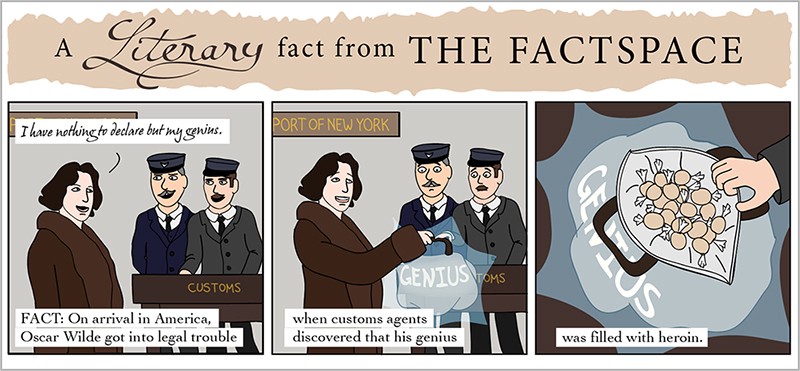
by Seth Fried
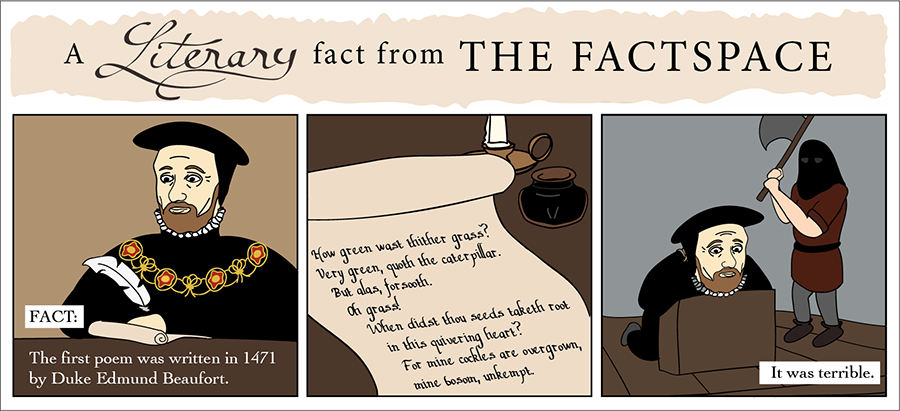
This literary fact was provided by The Factspace, a potentially award-winning webcomic written and drawn by Seth Fried and Julia Mehoke. You can check out more true facts here.



by Seth Fried
This literary fact was provided by The Factspace, a potentially award-winning webcomic written and drawn by Seth Fried and Julia Mehoke. You can check out more true facts here.
THE DOCTOR WENT TO SEE THE RABBI. “Tell me, rabbi, please,” he said, “about God.”
The rabbi pulled out some books. She talked about Jacob wrestling the angel. She talked about Heschel and the kernel of wonder as a seedling that could grow into awe. She tugged at her braid and told a Hasidic story about how at the end of one’s life, it is said that you will need to apologize to God for the ways you have not lived.
“Not for the usual sins,” she said. “For the sin of living small.”
The doctor sat in his suit in his chair and fidgeted. Although he had initiated the conversation, he found the word God offensive, the same way he disliked it when people spoke about remodeling their kitchens.
“I’m sorry,” he said, standing. “I cannot seem to understand what you are saying. Are you speaking English?”
“English?” said the rabbi, closing a book. Dust motes floated off the pages into the room and caught the light as they glided upward. She wrinkled her forehead as if she was double-checking in there. “Yes,” she said.
A few months later, the rabbi became sick. She had a disease of the blood, a disease that needed weekly transfusions that she scheduled on Wednesdays so she would be at her best for Shabbat.
The doctor who had come to see her was a doctor of blood. A transfusionist. He had chosen this profession because blood was at the center of all of it. It was either blood, or the heart, or the brain. Or the lungs. He picked blood because it was everywhere. He was never even slightly interested in skin, or feet, joints, or even genitals. It was the most central core stuff of life and death that made him tolerate all those godawful courses in anatomy and biochemistry.
She thought of him as she sat with her husband, staring at their enfolded hands, wondering what to do.
“That man,” she said, looking up. “That man who came by a few months ago.”
When the rabbi was in her paper gown she looked smaller, of the earth, and the doctor did not mind the role reversal.
“I’m so sorry you have to go through this,” he said.
The rabbi lay down on the cold table. She offered her arm. The blood drained from her; the blood of another person filled her. The doctor stood beside her and placed the instruments in a line.
The rabbi came for many transfusions, and she recovered at a brisk pace, filled with the blood of Hindus and Lutherans. The treatments went so well she didn’t have to visit as often anymore, and the doctor missed seeing her at the clinic. After a month had gone by, he went to her office again, where he found her talking to another rabbi, massaging the bottom of a stockinged foot. He stood outside the door as she sifted through her shelves, finding a book, opening it to a page, the two rabbis huddled shoulder to shoulder, commenting, gesturing. The age-old activity of Jews.
The doctor stayed near the door. He was not one to interrupt.
It was when the rabbi was locking up that she glanced over and saw him. Her color was back. Her eyes were clear. She was an attractive woman, with a kind, bearish husband, one raven-haired child, pink dots of warmth in the centers of her cheeks. She hugged him, and pressed his hand, and thanked him, and he said he would like to talk to her again.
“About God?” she asked.
“I’m not sure,” he said. “I don’t think so.”
They went to a coffee shop, because she could now go no longer than two hours without food.
She asked him why blood. He explained. The river. They picked at a croissant on wax paper between them. The radio expelled old pop songs. He felt something stir inside him when beside her, but it was not lust, and it was not religion. What was it? “I feel a stirring, when I sit with you,” he said, rolling his coffee mug in his hands. “But it is not lustful.”
“I’m married,” she said, as an afterthought. She had bright blue clay earrings on, formed into the shapes of stars.
“It’s like the coffee tastes more like coffee,” he said.
She sipped hers.
“There’s good coffee here,” she said.
“It’s not that.”
There was a pause. He found it awkward. She did not seem to mind. She dipped a croissant end into her coffee and the buttery layers soaked up the warmth.
“I gave you the blood of other religions,” he blurted.
She laughed out loud, lifting out the croissant. “No problem,” she said. “I like what you gave me. It’s great. How’d you know?”
“There’s a box on the donation form,” he said. “An optional box.”
“Ah,” she nodded.
“I went with those who had checked the optional box.”
“How interesting that it’s a box on a form,” she said, chewing. “I’ve never heard of that before.”
He scratched his nose. “It’s new.”
“Hospital rules?”
“No.”
“Who made the form?”
“Me,” he said.
“You can do that?”
“Sure,” he shrugged. “No one thinks to question an extra form. Plus, it’s optional.”
“So, who’d I get?” she asked, now dipping the croissant torso.
His hands were shaking, slightly. He put them flat on the table, to calm them. He wasn’t sure why he was so nervous around her.
“Christians,” he said. “Of all sorts. Including a Jehovah’s Witness. Several Muslims. A few Jews.”
“Maybe it’s a new route to world peace,” she said. “Transfuse people.”
“And atheists?” he said, tentatively.
“What about them?”
“I gave you atheist blood, too,” he said. He cringed, visibly.
She laughed again. All that warmth in her laugh, like it could embrace someone across a room.
“I don’t hate the atheists,” she said.
“I’m an atheist,” he said, a little too loud, and he reached out for her hand.
For a second, she held his. His hand was much wider than hers and her hands, not usually considered dainty, looked small and slender next to his.
“I’m not here to push anything on you,” she said. “Many Jews I know are atheist Jews.”
“Your eyes shine,” he said. “How do they do that?”
“Blood,” she said.
They slipped into the affair, even though it was not an affair. It was never anything to do with losing clothes. It was not the deep sharing of feelings. It was almost entirely one-sided. It was simple, like he’d slipped slightly into her blood, and she slipped strongly into his thinking. She had one or two dreams in which he played a part, as a kind of helpful direction-giver when lost on a highway, dreams she was only mildly aware of when she woke up and went to shower.
For the most part, she focused on the congregants who needed comfort, and her husband and young son with the amazing brown eyes. The doctor, however, cultivated thoughts of her like a fresh little garden. Sometimes he pulled out her chart just to reread her basic stats because the numbers brought him something akin to joy. To joy, really — the numbers lifted his heart and step, buoyed his day. It was just knowing this person was alive, he thought. That he had helped her, maybe even saved her, and now she was out there talking about all this business he did not believe in.
God, he said, in his car, driving from hospital to home. What a word. Much had been made already of its similarity to “dog,” but as he wound through the streets, he particularly enjoyed conjuring up the image in his head of some kind of old and glowing man on a leash.
Not that he believed in such things, but he wondered if giving her atheist blood might in fact turn her into an atheist, and he felt guilty at the thought but also pleased — like she could come over to his house and they could browse his bookshelves, shoulder-to-shoulder, and read Sartre together, or a dash of Camus, and then stand on chairs in old-fashioned hats and drop apples from great heights to the floor.
He returned to the rabbi’s office. His mother was not well. She had cancer. She was in the hospital. Her illness had little to do with blood, or at least not his kind of blood, and so he’d stood around her hospital room, awkward, without a task. He watched the TV, attached to the ceiling with metal straps and hooks, the show pointing down upon them. He loved his mother, even though she seemed to be so private a person he had not understood much about her. She only ever told him on a daily basis about her day.
“I went to the grocery store,” she would say. “I got my hair done.”
“What else?” he asked once.
“I ate potato chips,” she said. “I talked to your Aunt Sophie.”
“About what?” he said.
She hummed, thinking. “About everything, I suppose,” she said. “And how are you?”
“I’m fine,” he said. “I bought a radio. But what do you mean, everything?”
She paused on the phone. He could hear her unpacking groceries. “Sophie tells me about everything she is thinking and feeling,” his mother said. “It’s very interesting.”
“And you?”
“I so enjoy hearing what Sophie has to say,” she said.
“I have been unable to work very much this week,” he told the rabbi. “I took two days off.”
“Makes sense,” she said. She was wearing a navy blue suit, maybe because she had attended a funeral, or a business meeting. The daily workings of a rabbi’s schedule were highly mysterious to him.
She was also surrounded by cardboard boxes of donations for a charity drive and had just started sorting items into piles. A kid clothing pile, an adult clothing pile, a book pile, a toy pile.
“Want to help?” she asked.
“Sure.” He took the free seat. She had a pile of books in her lap and was separating them into kid and adult levels.
“And my son is not doing well, either,” he said, settling in. “He lives with my ex-wife. He failed algebra.”
He opened a donation box. Sweaters. The rabbi was divvying up her book piles, but he could tell she was listening. She divvied quietly.
“I tried to tutor him,” he said, “but I didn’t know how. I forgot algebra.”
The rabbi nodded. “Who remembers?”
“My ex-wife doesn’t like to talk about it,” he said. “My mother is doing a little better. They say she can go home tomorrow.”
He listed all the people on his fingers. Mother, son, ex. Looked at his hands. Ham-handed, he’d been called, as a boy. Big fingers. He had turned out to be very deft with needles, which had surprised everybody.
“And how are you holding up?” the rabbi asked.
“Fine,” he said.
He folded up the sweaters. Two had fairly large moth holes eating up the sleeves. “This okay?” he asked, showing her.
“Agh, no,” she said. She pointed under her desk. “Ungivables.”
He tossed over the sweaters, began folding others.
“What a stressful time,” said the rabbi.
“You say that to all the visitors,” he said, smiling a little.
She smiled back. “I still mean it.”
He folded the arms in carefully, then made the sweaters into tidy squares, smoothing down the fronts, so that each one looked new, like it had just been taken from a box at a department store and placed upon a table.
“Let me ask you a question,” said the rabbi, balancing the last book in the adult pile. “You’re here to see me. Why?”
“Because I like seeing you.”
“I like seeing you, too. But you could go to a friend. To a colleague.”
“You think doctors know how to talk about this stuff?”
She pulled a pile of animal toys into her lap, including an unusually large red plastic chicken.
“Bock-bock,” she said, moving the chicken up and down.
“I like seeing you,” the doctor said again.
“Well,” said the rabbi, steadying the chicken in her lap. “I ask because I have a rabbi kind of thing to say.”
“Let’s hear it,” he said.
“It’s not a secular comment, is what I’m saying,” said the rabbi. “It will probably piss off the atheist.”
“I get it, that’s okay,” said the doctor, pressing hands down on his pants. He placed his neat pile of sweaters in the adult pile. “I came here. Let’s hear it.”
She touched the plastic comb on the chicken’s head, gently.
“You could pray,” she said. “Either on your own, or with us.”
“Oh, that?” said the doctor, shaking his head. “The ‘p’ word? No.”
“Not to an old-man-in-the-sky kind of God,” she said. “Not to solve all your problems. Just to ask for some help.”
“Oh,” said the doctor. “Nah. I don’t do that sort of thing.”
“Why not?” she said. There was no edge to her voice. Just interest.
The doctor put a small bottle of bubbles in the kid pile.
“Bubbles!” he said.
He looked back at her.
“Just because I think it’s useless,” he said. “And a little creepy.”
She laughed. “Okay,” she said. The red chicken bobbed in her lap. “Fair enough.” She glanced at the adult clothes pile.
“What beautiful folding,” she said.
He had opened another box and found a mushed pile of t-shirts, washed but unfolded, as if they had gone straight from the dryer into the donation box.
“And,” he said, after a minute, shaking out a t-shirt. “Just to play along. You know. I wouldn’t want to use up the line space.”
“What line space?” she said. She placed the chicken in the kid pile. “You mean like margins?”
He swept his hand in the air. “No, a line,” he said. “A line-line. Like in the post office. Let’s say there’s a line. Of people praying. And I added my prayer to it. Well, I don’t want to take up someone else’s space in line with my half-assed half-believing baloney prayer.”
She laughed, again. Now she had a pile of very-loved stuffed animals in her lap. She was looking so well. He could not help but feel a little proud of how she was looking. He had made sure she had gotten very good blood.
“You atheists,” she said. “Scratch the surface and so many of you are so old school.”
He coughed. “What do you mean?”
“As if there’s a line!” she said. She released the herd of stuffed animals into the kid toy pile.
“But one prayer could edge out another prayer,” he said.
“I don’t see how,” she said.
“It’s just logic!” he said. He felt the sweat beading up, on his forehead. All those sweaters, all that wool. It was May. They were doing a clothing and toy drive for some holiday. Tu B’Shvat? Or was that January? Wasn’t that about trees? Who needed sweaters now?
“If I’m… praying,” he said, growing a little impatient, “and there are people across the world who pray five times a day, well, I think their prayer should be heard first, before my prayer, because they have, well, ‘earned’ their prayer spot in line, just as I would earn my place in line if I attended a museum opening and arrived at noon with a sack lunch for a three pm opening. There!” he said, sitting back, folding his arms.
The rabbi leaned in. She seemed to have forgotten about the piles for the moment. Her eyes were beams of light. “But there’s no line,” she said.
“How do you know?”
“Well, I don’t know,” she said. “But you’re using an example that doesn’t fit. An example that is of this daily world. You have to think differently.”
“All we know is of this world,” he said.
“True,” she said. “True.”
The doctor sniffed. “Or don’t you think the prayer lines get scrambled, with too many people praying?”
“I don’t think it’s like the phone system,” she said.
“Why not?” He held himself tight. “Six billion people on the planet, right? Some of them pray every day. Several times a day! All day!”
“But — ” she said.
“I have no interest in cutting in the queue,” he said.
“I don’t think it’s a merit system,” she said. “Or a queue.”
“But it would have to be, right?” he said. “There has to be some linear order. A way for whomever is supposedly listening to decide what to listen to first?”
She pushed her hair off her face. “I’m not sure God even has ears like that,” she said.
He laughed. “Well, then it’s even more pointless than I thought!”
She paused. She was looking in the middle distance, gathering. He could see she did not want to flood him. So much flooding, alone, pouring out of her eyes.
“Go ahead,” he said.
“Okay,” she said, slowly. A leftover giraffe fell on the floor.
“Here,” he said, picking it up.
She furrowed her forehead, thinking. Took the giraffe, absently stroked its back.
“The best way I can think to describe it,” she said, “is the way, when you’re driving on the freeway at night, how everyone can see the moon in their window. Every car, on the road. Every car feels the moon is following that car. Even in the other direction, right? Everyone in that entire hemisphere can see the moon and think it is there for them, is following where they go.
“You’ve had that experience?”
“Many times,” he said. “I see the moon right out my window.”
She kept petting the giraffe, as if it were a cat. Petting the little giraffe ears.
“That,” she said, “is a little closer to how I imagine it works. Whether or not you pray has absolutely nothing to do with the person to your left. It’s like saying you shouldn’t get the moon in your window, or else the other cars wouldn’t get the moon in their windows. But everyone gets the moon. It’s not an option, to not have the moon in your window. You just see it. It’s there.”
She paused. The window in the office grew golden with late afternoon.
“Half the world can’t see the moon,” said the doctor.
“It’s not the greatest example,” said the rabbi.
“Plus, the moon is far,” the doctor said, brushing lint off a t-shirt. “That’s why everyone has access.”
“True,” said the rabbi.
“So, is God far?”
“I don’t think those distance terms apply in the same way,” she said.
“Then I don’t understand the example.”
“It’s not — ” she said, clasping her hands together around the giraffe. “It’s not so literal.”
“I am literal,” he said. “I think literally. The moon is also unresponsive.”
She shook her head. “I’m sorry,” she said. “It’s hard to find the right example. I’m not saying pray to the moon,” she said. “Truly. I’m just trying to think up a way to talk about why there’s no queue, you know?”
“You don’t think God has ears?”
She sat back in her chair. “Not like our ears.”
He laughed, short. “I’m a doctor,” he said, putting all the folded t-shirts into a tidy stack.
She re-settled herself. Her face was warm, flushed.
“And are these prayers to be answered?” he said.
She seemed to be resting now, the urgency quieting, and he could see her shifting modes, back to her regular rabbi self, her teacher self, returning to the statements she said maybe once a week, twice a week, to different audiences. “In Judaism we pray for a variety of reasons,” she said, gently tucking the giraffe next to a few worn teddy bears. She closed her eyes. “Out of gratitude. Out of despair, asking for comfort. Out of confusion. Out of anger, in defiance. To be with. To share oneself. Not for results, tangible material results, especially on Shabbat — isn’t that interesting? We’re not to ask for anything tangible on Shabbat, which is, I think, one of the nicest times to pray all together.”
He flashed on an image of a hamburger, at a drive-through near his home, in a tinfoil pocket.
“Right now it might be helpful,” she said. “That’s all I’m saying.”
He wiped his hands clear on his pants. “I still think it’s hokum,” he said.
“Okay,” she said. She opened her eyes. Her forehead relaxed. “That’s okay. I’ll stop. I just wanted to talk it through with you. I’m glad you stayed.”
He wiped his forehead with his sleeve. It was hot in her office.
“I apologize for being so stubborn.”
“You weren’t stubborn,” she said, leaning over and unpeeling the tape to open up a new box. “You were actually pretty open. In a way, in my book, we just did it.”
“Did what?”
“Prayed, in a way,” she said. “Wrestled with it.”
“Why do you say that?” He sat up taller. For some reason, the thought made him angry.
“Because you’re leaning in,” she said, unfolding the box flaps. “Because I am tired, in a way that I recognize. Because you seem to be fighting up from under some water. Into what, I don’t know. Into something. Because we were talking about it deeply,” she said. “I could feel it.”
“We were having an argument!” he said. He stood up, but her office was too small to pace so he turned away, and stepped away, and found himself going through the door and going down the hall to use the bathroom. Down the long dark narrow hallway, with its closed office doors, and framed yarn art telling stories of the Old Testament. Once inside the bathroom, the motion sensor light clicked on; it was the end of the day, and no one had been in for over an hour. The space held the loneliness particular to an unused bathroom, the glare of fluorescent lights, the echo of sink and crumpling paper, the tired isolation of one person in an office building, alone, at night, working too late. He used up 10 paper towels on his face and neck until he was sufficiently dry. He washed his hands carefully in the sink. He took the back exit.
The rabbi sat in her office for 45 minutes, unpacking the last donation boxes, to see if he would return, but he did not return, and so she shouldered her bag and walked the seven blocks home.
The doctor found his car in the parking lot, one of the last three there, and joined the flow on the street. He drove with his air conditioner fan on full blast, into traffic as the sun set, into dusk, with the full moon rising in his rear view mirror, almost taunting him with her big presence in his car alone and every car around and none of it being how he liked to think or was interested in thinking. And yet. Why did he love the rabbi? He loved her. He got home, and looked through the mail, and he had driven past the drive-through, so instead he sent out for a meatball sandwich, which he ate in pieces, because it was too unwieldy to eat all at once, and even the bread he cut into bite-sized parts. He could feel it, just feel it, the glimmer of something that he did not understand. He would never call it God. He would not call it prayer. But just beyond his sandwich, and the four TV shows he watched back to back, and his tooth brushing, and his face washing, and his nighttime reading of a magazine, and his light switching off, just the faint realization that there were many ways to live a life and that some people were living a life that was very different than his, and the way they lived was beyond him and also didn’t interest him and yet he could sense it. Comfort and fear rose together inside him. Like standing in the middle of a meadow, where no one had his back.
Scratch That Itch
I don’t usually listen to music when I am physically at my desk writing. But music is a huge inspiration, and I often turn to these songs when I need something to get me going, when I need to manifest an itch. I’m the type of person to listen to a song over and over; I once listened to “Purple Rain” the entire 8 hours of a workday. A lot of these songs make me feel nostalgic, which, I’m beginning to understand, is an important part of my “process,” as nostalgia calls up many important emotions and memories I’d like to examine via my writing. So, with all that in mind, here is my playlist of songs that stop me in my tracks, that make me feel, make me think, make me want to write.
* denotes that song was not available on Spotify
1. Jason Isbell, “Cover Me Up”
This is the true embodiment of what I mean when I say the voice is the story, and the story is the voice. You could ignore the words and still feel exactly what he means just by listening to the rawness in his voice. But the words, man. “It’s cold in this room and I ain’t goin’ out to chop wood.” I don’t think you could find a better lyricist than Mr. Isbell. If you looked you’d run into his old bandmates Mike Cooley and Patterson Hood, who are equally as good, but not better. This song is like the dirt and the shovel for me. Do you know what I mean? I become a grave, in the best possible way.
2. Young Heart Attack, “Starlite”
Who wouldn’t want to go out and fuck shit up (or fuck the page up) while this song plays on a loop on the cassette deck you stole from your dying granny’s bedside? I love the threat hidden in “I’m gonna prove I’m a man, can you understand?” The perfect rock song. This is also my sister-in-law’s old band and every time I listen to this song I feel like I should bow down to her.
3. Drake featuring Lil’ Wayne and Young Jeezy, “I’m Goin In”
“If I said I’m goin in then I mothafuckin meant it” — I say that to myself any time I get nervous before a reading. I guess it should also be noted that this is the song I was listening to, over and over, as I wrote “Three Things You Should Know About Peggy Paula.” This song makes my heart race, like I’m being dared. The misogyny in it is ridiculous.
4. Belly, “Feed the Tree”
I’m sorry, but it’s just impossible for me not to feel fired up when I hear Tanya Donelly’s voice. And the classic 90s chunky guitar mmm-MM. My mouth starts to water. I could write forty coming of age stories.
5. A Flock of Seagulls, “Space Age Love Song”
If you ever want to feel like you did when you had a crush on the first boy who liked you back, listen to this song. Feelings like that make me want to write more than anything.
6. Bob Seger & The Silver Bullet Band, “Someday Lady You’ll Accomp’ny Me”*
You know how sometimes as a child you’d witness emotions or situations you wanted badly to understand, so you pretended that you did? That’s how I feel when I listen to this song. Like I’m watching my mom staring into the middle distance nodding to this song, and like I may never know the fathoms inside her. I think being a writer is a constant attempt at approximating those fathoms.
7. Bruce Springsteen, “Thunder Road”
“You ain’t a beauty but hey you’re alright.” I mean. So many possible stories just from that one line. But then there’s also the imperfect piano, the overreaching lyrics, Bruce’s Jersey squawk. It’s perfect. Stop reading this and go try and write something that comes close.
8. Chromatics, “Tick of the Clock”
Sometimes you just need something with a badass beat that makes you feel like a badass yourself, so you can get through these final lines. Or so you can start something. Or so you can feel like you’re above all the hate you throw at yourself.
9. Liz Phair, “Go West”
Liz Phair’s voice is what I would call “deadpan,” which I guess is why I’m not a music critic. But by “deadpan” I mean she doesn’t try to dress up what she’s saying or who she is. It feels incredibly brave, and it’s something I try to do when I write. I don’t want to soften any blows.
What the hell is going on in this song? Vanity talks innocently, endlessly, of her simple grooming rituals. The beats are threatening, menacing. The song ends with “Smoke a cigarette / I’m not ready yet.” The song is called “Make Up,” and sure, it’s about make-up on the surface, but everything else is telling you it’s about something more. Vanity is clearly a maniac. Who is she talking to? What is that person doing? Is he chained? This is the type of song I will never not love. I’ve tried to write a story set to it many times.
11. The xx, “VCR” (Matthew Dear remix)*
Listening to this in the sleep-deprived, scary days after my son was born brought me back to myself. Everyone needs songs like those. Listen to them over and over and over. I listen to this one when I’m a few sentences from being done with something.
12. Green Day, “J.A.R.”
The pop-punk in this song is relentless and perfect. Makes me want to be relentless too. And it ends with this earnest declaration that you hope pans out but that you know probably won’t, and not just because Billie Joe doesn’t even finish the sentence.
13. Drive-by Truckers, “The Opening Act”
The DBTs are amazing storytellers. And sometimes you just need to hear a story in order to get back to writing your own. This song starts in one place and ends up somewhere totally different. You’re in a shitty bar watching some has-been band playing a set, and that’s not even the saddest part: the person singing this song is the opening act for the has-been band! But then the song ends with the singer on the road, kind of looking around, taking stock. “And I’m drivin north as the sun is risin / over a technicolor horizon / I reached out to touch you [this is the first time any “you” is even mentioned! Brilliant!] but you’re not there / you’re a thousand miles away from here / So I turned up the radio / heard some preacher talkin salvation / my tank is half full / and I reached over and changed the station.” Listen to that part in the song and try not to feel baptized. Try not to want to write something just like it.
14. Third Eye Blind, “Motorcycle Drive By”
I love this band. And as a writer, I’m a firm believer in letting yourself dip into things that let you feel melodramatic, sad, wistful, empowered. This song makes me feel all of those things.
15. Babes in Toyland, “Handsome and Gretel”
Sometimes I need to feel mean.
***
— Lindsay Hunter is the author of the story collections Daddy’s and DON’T KISS ME. Her novel is forthcoming on FSG Originals in the fall of 2014. Find her at lindsayhunter.com.
Welcome back to the Critical Hit Awards for book reviews. This is a round-up, a recommended reading list, and — why not? — a terribly prestigious and coveted prize. Winners receive a bang-up gift from Field Notes, our beloved sponsor. Nominate your favorite recent review by tweeting it at @electriclit with the hashtag #criticalhit, or cast your vote in the comments section below.
Our guest judge is Lincoln Michel, a co-founder and co-editor of Gigantic.
Electric Literature: You went negative on us, Lincoln. All of the winners you picked are negative reviews. Why?
Lincoln Michel: I purposely sought out negative or, at the very least, mixed reviews. I tend to need constraints for something like this, and it was easier to narrow down this way. But I guess more importantly I think that intelligent negative reviews are an important part of critical culture, and they seem to be disappearing. (See Jacob Silverman on the topic.) The idea that we should always be nice and positive when reviewing is very common.
Let me make it clear that I don’t blame reviewers.
Most reviewers don’t lie, they just don’t bother reviewing books they don’t like.
Unless you are employed as a critic — a rarity these days — then you really only write reviews now and then to (maybe) make a small amount of money or to help build up your profile as a writer. When that’s the case, why write a negative review? So you can irritate that writer’s agent or editor who you wish to become your agent or editor? So you can get a barrage of angry comments about how you are a “hater”? So that writer can spit on you at a party? And then there are the other common arguments about how in an era when everyone is worried about the state of publishing, why risk hurting book sales. Shouldn’t we just promote what we like?
My belief, though, is that as our critical culture withers, we — readers, critics, editors, writers — actually think and talk less intelligently about books. You don’t see this aversion to negative reviews in music, film, or TV criticism. Consequently, it is often easier to find a spirited and challenging discussion of the latest Mad Men or Breaking Bad episode than the latest major novel… at least in public.
So, yeah, that’s a long-winded way of saying that I think negative reviews are important and deserve to be highlighted. I have also found that negative reviews are often more enjoyable to read, even when I disagree with them. They force me to think.
One of the winners you picked is a negative review of David Shields. He seems to be one of those villains — Tao Lin and James Franco being others — who allow critics to put on a white hat and ride to our rescue, playing the good guys for once. Do critics need villains?
Hmm, that’s an interesting question.
Part of what is important about critical reviews is that they force a critic — and then the reader — to take a stand.
Individually, some critics may need to define their ideals by slaying “villains.”
If what you mean is critical pile-ons, it is probably true that negative reviews tend to clump around a handful of authors. Part of that is because only popular writers warrant negative reviews in many people’s eyes. Why waste space attacking a mid-list author who few people will read anyway? Another reason may be that since negative reviews are frowned upon, but critics still have a desire to occasionally be critical, certain writers become safe outlets. Once one critic writes negatively about a book, other may feel free to join in.
That said, I wouldn’t personally lump those writers together. James Franco is a writer that everyone seems to love to hate on. (Although personally I think celebrities could be doing much worse things than promoting poetry and Faulkner.)David Shields and Tao Lin strike me more as legitimately controversial authors in which critical opinion is truly divided. I know that some of the most bitter, and also interesting, discussions among my friends have been about the latter two. When I wrote my own negative review of Reality Hunger, I felt like it was one of the few negative reviews of a book that was otherwise getting lavish praise and an all-star line-up of blurbs. In the years since, I think the reputation of that book has cooled a lot though.
You’ve been drawing a lot of comics lately, if I’m not mistaken. Where does that impulse come from? Does illustrating a knock-knock joke make you feel like a kid again, or does it arise from a very complex appreciation of Calvino and Borges (and Jack Handey and Félix Fénéon)?
I do draw comics now and then (you can see them here). I’d like to say it comes from a complex appreciation of those authors — and I deeply love all four, some of my biggest influences — but probably I just secretly wish I was a comedian. It’s liberating to work in another art form.
Kickstarter! Wow, right? You more than doubled your fundraising goal for Gigantic Worlds, the anthology of science flash fiction that you’re publishing with stories by Jonathan Lethem, J. G. Ballard, Lynne Tillman, etc. Is Kickstarter the future?
Thanks! Kickstarter worked very well for us, and we really couldn’t be happier with the experience. However, since I’m promoting critical reviews here, I guess I might as well express some criticism of the crowdsourcing model. I think Kickstarter is fantastic for specific projects by smaller organizations that couldn’t get funding otherwise. In that model, Kickstarter works really effectively as a preordering system.
So that’s great. The downside is that we seem to be moving to a mindset in which paying for art (whether films, books, music, etc.) is a form of charity. The New York Times had a good article on how Kickstarter functions as part of a gift economy. I think this is true and great to an extent. But my fear is that we shift to this idea that artist should make everything for free and we should be able to consume as much as we want without paying, unless we feel like it. I don’t think that’s a healthy place for a society to be. Especially when the money saved compensating artists is just going to massive, exploitative companies like Apple and Microsoft. I’ve heard people actually say things like, “I can’t afford to pay for books. I just spent 500 dollars on this iPad!”
And the winners are…
Dear Life by Alice Munro
Reviewed by Christian Lorentzen at the London Review of Books
When I asked my critic friends what recent reviews stood out to them, the most frequently mentioned was Christian Lorentzen’s skewering of Alice Munro’s oeuvre. Whether you agree or disagree with Lortentzen, the review is sharply written, piercing, and — somewhat rare for book reviews — really enjoyable to read.
“So she writes only short stories, but the stories are richer than most novels. Over a career now in its sixth decade, she’s rehearsed the same themes again and again, but that’s because she’s a master of variation. She has preternatural powers of sympathy and empathy, but she’s never sentimental. She writes about and redeems ordinary life, ordinary people — ‘people people people’, as Jonathan Franzen puts it.”
(If you want a good response, consider reading Kyle Minor’s defense of Munro in Salon.)
My Education by Susan Choi
reviewed by Emily Cooke in The New York Times
Emily Cooke is an extremely thoughtful and serious critic. Here recent review of Susan Choi shows her admiring much of the novel, smartly placing it in a larger cultural conversation, but ultimately finding it falling flat:
“…the somewhat indiscriminate attentiveness of her prose tends to plane smooth the texture of her narratives. A trivial dinner conversation in Choi’s hands receives the same careful scrutiny as a life-altering betrayal. The effect, in the end, is of a keen but somewhat purposeless talent. The more sweepingly Choi applies her considerable gifts, the more difficult it is to say what particularly matters to this writer and why.”
Night Film by Marisha Pessl
Reviewed by Michelle Dean in Flavorwire
Marisha Pessl’s newest novel is getting very polarizing reviews (here is Janet Malsin eviscerating it in The New York Times and here is Amanda Bullock lauding it in Everyday eBook.) I enjoy how Dean focuses on Pessl’s use of faux-internet ephemera, explaining why she thinks Pessl fails, but also how writers could do better incorporating the internet into fiction.
“When the narrator writes of ‘setting up a post’ on the Internet or ‘like and dislike’ buttons, it’s a signal that the author herself is not online much — which means that this novel’s attempts to mimic certain Internet effects are, at best, half-assed.”
How Literature Saved My Life by David Shields
Reviewed by JW McCormack in The New Inquiry
JW McCormack’s biting review of David Shields’s How Literature Saved My Life is the most entertaining book review I’ve read this year. McCormack is equal parts hilarious and insightful, deftly skewering Shields by his own logic:
“Liberally sprinkled quotes define Shields’ disease. Here’s E.M. Cioran from Tears and Saints: “The universe is a solitary space, and all its creatures do nothing but reinforce its solitude. In it, I have never met anyone, I have only stumbled across ghosts.’ Shields’ faith that ‘appropriated and remixed words [embody] my argument’ doesn’t always serve him; Cioran sounds on the mark, but Shields’s ventriloquizing Pierre Menard sounds a tad shrill. He’s clearly met someone, or his book wouldn’t be so saturated with sentences curbed from former students or letters to and from famous friends.”
(I hope the reader will forgive me for listing a review that briefly mentions a review of my own, but McCormack’s review really deserves a read.)
***
Congratulations to our winners! Please contact Brian Hurley to claim your Field Notes prize.
Read a good review lately? Nominate it for a Critical Hit Award by tweeting it at @electriclit with the hashtag #criticalhit or cast your vote in the comments section below.
***
– Lincoln Michel is a cofounder and coeditor of Gigantic. His fiction and criticism appear in Tin House, The Believer, NOON, The Paris Review Daily, and Electric Literature’s Recommended Reading.
– Brian Hurley is Books Editor at The Rumpus, Curator of the Critical Hit Awards, and coeditor of Fiction Advocate.
THE GRANDFATHER, DEAD FOR MORE THAN THIRTY YEARS, had been twice disturbed in his long repose by the constancy and possessiveness of his widow. She removed his bones first to Louisiana and then to Texas, as if she had set out to find her own burial place, knowing well she would never return to the places she had left. In Texas she set up a small cemetery in a corner of her first farm, and as the family connection grew, and oddments of relations came over from Kentucky to settle, it contained at last about twenty graves. After the grandmother’s death, part of her land was to be sold for the benefit of certain of her children, and the cemetery happened to lie in the part set aside for sale. It was necessary to take up the bodies and bury them again in the family plot in the big new public cemetery, where Grandmother had been recently buried. At long last her husband was to lie beside her for eternity, as she had planned.
The family cemetery had been a pleasant small neglected garden of tangled rose bushes and ragged cedar trees and cypress, the simple flat stones rising out of uncropped sweet-smelling wild grass. The graves were lying open and empty one burning day when Miranda and her brother Paul, who often went together to hunt rabbits and doves, propped their twenty-two Winchester rifles carefully against the rail fence, climbed over and explored among the graves. She was nine years old and he was twelve.
They peered into the pits all shaped alike with such purposeful accuracy, and looking at each other with pleased adventurous eyes, they said in solemn tones: “These were graves!” trying by words to shape a special, suitable emotion in their minds, but they felt nothing except an agreeable thrill of wonder: they were seeing a new sight, doing something they had not done before. In them both there was also a small disappointment at the entire commonplaceness of the actual spectacle. Even if it had once contained a coffin for years upon years, when the coffin was gone a grave was just a hole in the ground. Miranda leaped into the pit that had held her grandfather’s bones. Scratching around aimlessly and pleasurably, as any young animal, she scooped up a lump of earth and weighed it in her palm. It had a pleasantly sweet, corrupt smell, being mixed with cedar needles and small leaves, and as the crumbs fell apart, she saw a silver dove no larger than a hazel nut, with spread wings and a neat fan-shaped tail. The breast had a deep round hollow in it. Turning it up to the fierce sunlight, she saw that the inside of the hollow was cut in little whorls. She scrambled out, over the pile of loose earth that had fallen back into one end of the grave, calling to Paul that she had found something, he must guess what… His head appeared smiling over the rim of another grave. He waved a closed hand at her: “I’ve got something too!” They ran to compare treasures, making a game of it, so many guesses each, all wrong, and a final show-down with opened palms. Paul had found a thin wide gold ring carved with intricate flowers and leaves. Miranda was smitten at the sight of the ring and wished to have it. Paul seemed more impressed by the dove. They made a trade, with some little bickering. After he had got the dove in his hand, Paul said, “Don’t you know what this is? This is a screw head for a coffin! … I’ll bet nobody else in the world has one like this!”
Miranda glanced at it without covetousness. She had the gold ring on her thumb; it fitted perfectly. “Maybe we ought to go now,” she said, “maybe one of the n****rs’ll see us and tell somebody.” They knew the land had been sold, the cemetery was no longer theirs, and they felt like trespassers. They climbed back over the fence, slung their rifles loosely under their arms — they had been shooting at targets with various kinds of firearms since they were seven years old-and set out to look for the rabbits and doves or whatever small game might happen along,
On these expeditions Miranda always followed at Paul’s heels along the path, obeying instructions about handling her gun when going through fences; learning how to stand it up properly so it would not slip and fire unexpectedly; how to wait her time for a shot and not just bang away in the air without looking, spoiling shots for Paul, who really could hit things if given a chance. Now and then, in her excitement at seeing birds whizz up suddenly before her face, or a rabbit leap across her very toes, she lost her head, and almost without sighting she flung her rifle up and pulled the trigger. She hardly ever hit any sort of mark. She had no proper sense of hunting at all. Her brother would be often completely disgusted with her. “You don’t care whether you get your bird or not,” he said. “That’s no way to hunt.” Miranda could not understand his indignation. She had seen him smash his hat and yell with fury when he had missed his aim. “What I like about shooting,” said Miranda, with exasperating inconsequence, “is pulling the trigger and hearing the noise.”
“Then, by golly,” said Paul, “whyn’t you go back to the range and shoot at tin cans!”
“I’d just as soon,” said Miranda, “only like this, we walk around more.”
“Well, you just stay behind and stop spoiling my shots,” said Paul, who, when he made a kill, wanted to be certain he had made it. Miranda, who alone brought down a bird once in twenty rounds, always claimed as her own any game they got when they fired at the same moment. It was tiresome and unfair and her brother was sick of it.
“Now, the first dove we see, or the first rabbit, is mine,” he told her, “And the next will be yours. Remember that and don’t get smarty.”
“What about snakes?” asked Miranda idly. “Can I have the first snake?”
Waving her thumb gently and watching her gold ring glitter, Miranda lost interest in shooting. She was wearing her summer roughing outfit: dark blue overalls, a light blue shirt, a hired-man’s straw hat, and rough brown sandals. Her brother had the same outfit except his was a sober hickory-nut color. Ordinarily Miranda preferred her overalls to any other dress, though it was making rather a scandal in the countryside, for the year was 1903, and in the back country the law of female decorum had teeth in it. Her father had been criticized for letting his girls dress like boys and go careering around astride barebacked horses. It was said the motherless family was running down, with the grandmother no longer there to hold it together. Miranda knew this, though she could not say how. She had met along the road old women of the kind who smoked corncob pipes, who had treated her grandmother with most sincere respect. They slanted their gummy old eyes side-ways at the granddaughter and said, “Ain’t you ashamed of yo’self, Missy? It’s aginst the Scriptures to dress like that. Whut yo’ Pappy thinkin’ about?” Miranda, with her powerful social sense, which was like a fine set of antennae radiating from every pore of her skin, would feel ashamed because she knew well it was rude and ill-bred to shock anybody, even bad-tempered old crones; though she had faith in her father’s judgment and was perfectly comfortable in the clothes. Her father had said, “They’re just what you need, and they’ll save your dresses for school…” This sounded quite simple and natural to her. She had been brought up in rigorous economy. Wastefulness was vulgar. It was also a sin. These were truths; she had heard them repeated many times and never once disputed.
Now the ring, shining with the serene purity of fine gold on her rather grubby thumb, turned her feelings against her overalls and sockless feet, toes sticking through the thick brown leather straps. She wanted to go back to the farm house, take a good cold bath, dust herself with plenty of her sister’s violet talcum powder — provided she was not present to object, of course — put on the thinnest, most becoming dress she owned, with a big sash, and sit in a wicker chair under the trees… These things were not all she wanted, of course; she had vague stirrings of desire for luxury and a grand way of living which could not take precise form in her imagination, being founded on a family legend of past wealth and leisure. But these immediate comforts were what she could have, and she wanted them at once. She lagged rather far behind Paul, and once she thought of just turning back without a word and going home. She stopped, thinking that Paul would never do that to her, and so she would have to tell him. When a rabbit leaped, she let Paul have it without dispute. He killed it with one shot.
When she came up with him, he was already kneeling, examining the wound, the rabbit trailing from his hands. “Right through the head,” he said complacently, as if he had aimed for it. He took out his sharp, competent Bowie knife and started to skin the body. He did it very cleanly and quickly. Uncle Jimbilly knew how to prepare the skins so that Miranda always had fur coats for her dolls, for though she never cared much for her dolls, she liked seeing them in fur coats. The children knelt facing each other over the dead animal. Miranda watched admiringly while her brother stripped the skin away as if he were taking off a glove. The flayed flesh emerged dark scarlet, sleek, firm; Miranda with thumb and finger felt the long fine muscles with the silvery flat strips binding them to the joints. Brother lifted the oddly bloated belly. “Look,” he said, in a low, amazed voice. “It was going to have young ones.”
Very carefully he slit the thin flesh from the center ribs to the flanks, and a scarlet bag appeared. He slit again and pulled the bag open, and there lay a bundle of tiny rabbits, each wrapped in a thin scarlet veil. The brother pulled these off and there they were, dark grey, their sleek wet down lying in minute even ripples, over pink skin, like a baby’s head just washed; their unbelievably small delicate ears folded close, their little blind faces almost featureless.
Miranda said, “Oh, I want to see,” under her breath. She looked and looked — excited but not frightened, for she was accustomed to the sight of animals killed in hunting — filled with pity and astonishment and a kind of shocked delight in the wonderful little creatures for their own sakes, they were so pretty. She touched one of them ever so carefully. “Ah, there’s blood running over them,” she said, and began to tremble without knowing why. Yet she wanted most deeply to see and to know. Having seen, she felt at once as if she had known all along. The very memory of her former ignorance faded, she had always known just this. No one had ever told her anything outright, she had been rather unobservant of the animal life around her because she was so accustomed to animals. They seemed simply disorderly and unaccountably rude in their habits, but altogether natural and not very interesting. Her brother had spoken as if he had known about everything all along. He may have seen all this before. He had never said a word to her, but she knew now a part at least of what he knew. She understood a little of the secret, formless intuitions in her own mind and body, which had been clearing up, taking form, so gradually and so steadily she had not realized that she was learning what she had to know. Paul said cautiously, as if he were talking about something forbidden: “They were just about ready to be born.” His voice dropped on the last word. “I know,” said Miranda, “like kittens. I know, like babies.” She was quietly and terribly agitated, standing again with her rifle under her arm, looking down at the bloody heap. “I don’t want the skin,” she said. “I won’t have it.” Paul buried the young rabbits again in their mother’s body, wrapped the skin around her, carried her to a clump of sage bushes, and hid her away. He came out again at once and said to Miranda, with an eager friendliness, a confidential tone quite unusual in him, as if he were taking her into an important secret on equal terms: “Listen now. Now you listen to me, and don’t ever forget. Don’t you ever tell a living soul that you saw this. Don’t tell a soul. Don’t tell Dad because I’ll get into trouble. He’ll say I’m leading you into things you ought not to do. He’s always saying that. So now don’t you go and forget and blab out sometime the way you’re always doing… Now, that’s a secret. Don’t you tell.”
Miranda never told, she did not even wish to tell anybody. She thought about the whole worrisome affair with confused unhappiness for a few days. Then it sank quietly into her mind and was heaped over by accumulated thousands of impressions, for nearly twenty years. One day she was picking her path among the puddles and crushed refuse of a market street in a strange city of a strange country, when, without warning, in totality, plain and clear in its true colors as if she looked through a frame upon a scene that had not stirred nor changed since the moment it happened, the episode of the far-off day leaped from its burial place before her mind’s eye. She was so reasonlessly horrified she halted suddenly staring, the scene before her eyes dimmed by the vision back of them. An Indian vendor had held up before her a tray of dyed-sugar sweets, shaped like all kinds of small creatures: birds, baby chicks, baby rabbits, lambs, baby pigs. They were in gay colors and smelled of vanilla, maybe… It was a very hot day and the smell in the market, with its piles of raw flesh and wilting flowers, was like the mingled sweetness and corruption she had smelled that other day in the empty cemetery at home: the day she had remembered vaguely always until now as the time she and her brother had found treasure in the opened graves. Instantly upon this thought the dreadful vision faded, and she saw clearly her brother, whose childhood face she had forgotten, standing again in the blazing sunshine, again twelve years old, a pleased sober smile in his eyes, turning the silver dove over and over in his hands.
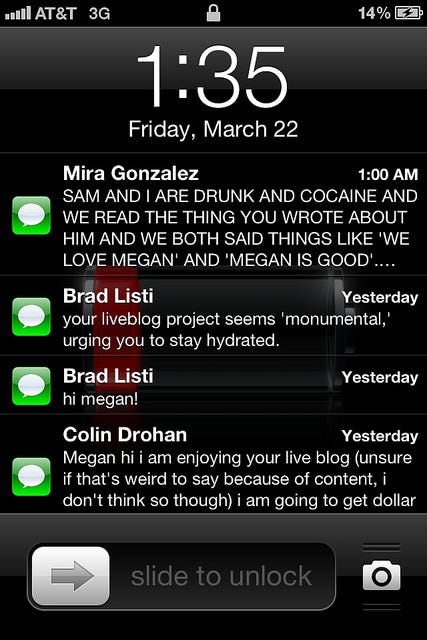
This past March, Megan Boyle — the author of Selected Unpublished Blog Posts of a Mexican Panda Express Employee, a columnist at Vice, and the muse for Tao Lin’s latest novel Taipei — began keeping a liveblog on her tumblr. The intention behind this was to write about everything she did, in hopes that, according to one of her tweets, the project would serve as “negative reinforcement,” thus forcing her to behave better due to the self-imposed lack of privacy.
My initial reaction was one of derision: Why would someone waste their time doing that? And then I kept on reading… and reading… until I realized that something interesting was happening. At the surface level, I was entertained by Boyle’s sense of humor and massive drug use, and I enjoyed the voyeuristic quality the format lent. But it soon became clear that there was more going on in Boyle’s writing than shallow entertainment. This was not the written equivalent of a reality TV show. This was a painfully honest and raw record of a person’s life, filtered through a keyboard and not much else. In some ways, what Boyle is doing is the opposite of how social media is commonly used: this is not limited to clever one-liners, flattering self-portraits, and crafted reflections. Instead, the project is dedicated to recording the whole truth — the fights, the failures, the insecurities — the things that we normally would never share publicly, the things we might not even tell our closest friends.
The blog — now in its fifth month and around the same length as Don Quixote — has gone through numerous phases, and Boyle’s diligence for the project has waxed and waned. What began as an attempt at instilling discipline has morphed into a monolith of text that has taken on a life of its own, giving birth to a massive ask.fm account (where Boyle answers anonymous questions with an unusual amount of depth and sincerity) and numerous YouTube videos.
In the spirit of the ongoing nature of the liveblog, Boyle and I conducted a series of short interviews about the blog via Skype video over a period of three months.
— Juliet Escoria for Electric Literature
— –
Wednesday, May 1, 10 pm EST
Liveblog length: ~180,000 words
Notes: Megan is at her mother’s house near Baltimore
Electric Literature: Have you thought about doing anything more permanent or formal with the liveblog, like turning it into essays or a book?
Megan Boyle: I’ve thought about it. I’d like that. I like the idea of it being totally unedited, so it documents how thoughts work. But that might not be good for readability.
EL: Gabby Bess was saying the liveblog was like performance art, and I agree with that, in that it’s a different way to use the internet, a way to erase privacy.
Boyle: Yeah, it feels different than other writing, in that I’m less worried. I don’t know, actually I am. Nevermind.
EL: Are you less worried about the order of the words and the syntax?
Boyle: I won’t let that stop me from writing something down. That part’s cool.
I forgot that it’s fun to just go, rather than think “I’m going to write about this,” and then two hours later I’m on the same word.
It seems good to just keep cycling through thoughts.
EL: Has the liveblog changed your interactions with your friends? Are they more self-conscious?
Boyle: I don’t know. They’re a pretty self-conscious crew, in general (laughs). And I don’t even really see them a lot. I don’t think it’s changed anything.
EL: Has your ex-boyfriend Zachary [German] said anything?
Boyle: Oh yeah. A little with him. We’ve argued about it, like he’s said, “Oh it wasn’t like that, she gave me her phone number.”
EL: So he’s reading it?
Boyle: He was. Then he told me, “I don’t want to waste my time with that.” He seems really touchy about how he’s portrayed, like people won’t separate him from my perception of him.
I’m trying to get away from changing what I write because of what other people will think.
But it’s hard, really really hard.
— –
Saturday, May 18, 10:40 pm EST
Liveblog length: ~224,000 words
Notes: On May 5, Megan began to leave certain dates or events blank, and then update what happened during them later.
EL: Did the re-cap of blog posts do anything for you?
Boyle: It felt really shitty to look at it. I can’t even re-read it. It was really tedious to go through it, and it was all barely distinguishable from the next. It felt like, “What difference does it make?” I felt really bad that night.
EL: Like a “What am I doing with my life” kind of thing?
Boyle: Yeah. Like this has got to stop. This feeling of not knowing what I’m doing. Most people have a long term idea of what they want, and I feel like I just live impulse to impulse. It doesn’t feel good. The liveblog is making me more sensitive, knowing I’ll have to write stuff down. It takes a lot of time from people, like I haven’t really hung out with other people much.
EL: If it’s making you less satisfied or happy to do it, then why are you continuing to do so?
Boyle: I think I have a hope that it will do something. I like thinking about if I do it for 5 or 10 years or my whole life. That seems cool to me, that’s exciting. I feel like I can push myself out of it somehow.
EL: Is the liveblog giving you any problems in your interpersonal relationships?
Boyle: Sort of, in that I feel like it’s harder for me to have them, or to have the energy to want to have them.
I kind of dread having to hang out with people because I know I’ll have to write about what we did.
Lately I’ve been putting off writing about doing mushrooms with my friend, who seems to really want me to do it, which makes me want to do it less.
— –
Monday, May 27, 1 am EST
Liveblog length: ~246,000 words
Notes: Megan seems to be getting progressively more and more depressed.
EL: Are you depressed?
Boyle: (Long pause.) Yeah.
EL: Are you uncomfortable talking about this? Because we could talk about something lighter.
Boyle: I’m uncomfortable talking about this but it’s not bad. It seems interesting to me to be uncomfortable.
EL: Okay. I’ll ask you uncomfortable questions then. Do you think the liveblog has anything to do with it, or is this just the trajectory that you were hoping the liveblog would prevent?
Boyle: I thought it would prevent it. I thought it would help me actualize things because I’m writing them down. I did feel a crest when I began doing this, and I thought it would make me act different. But instead I’m allowing myself to be this way, instead of pushing myself to be the opposite way. I feel like I’m getting to a point where I’ll feel sick of allowing myself to feel bad. It’s got to be something different soon. But I can’t even remember if I’ve felt this bad before. It seems like things could always be worse.
EL: It seems like there’s this push-pull of wanting the quality of your blog to be true, in that you blog everything, versus wanting it to not suck out your life.
Boyle: It’s fun to write about the good times and then go back and realize there’s things I might have forgotten the details of otherwise. But I feel weighted, big time, by this sense of obligation. Like I’m not doing enough, always. The minute I feel obligated to do anything I don’t want to do it. But I haven’t ever tried to fully stick with something. I dropped out of school five times, and even the way I do relationships — it’s like something gets bad enough and I just peace out. Or the other person peaces out. It feels good to think that maybe I’m growing by doing this, or
if I just keep wading through the shit of it, then something else will have to happen. But it’s also very possible that I’ll just wade in the shit forever.
— –
Tuesday, June 18, 11:40 pm EST
Liveblog length: 289,000 words
Notes: 4 dates in June were left entirely blank. Megan has begun dating a person a person who she refers to as “[omitted]”. She is very drunk during this Skype session.
EL: Why did you stop liveblogging as consistently?
Boyle: I thought liveblogging — well, there was a time when I first moved into the apartment where I thought I had nothing interesting to say and I was annoyed by myself so I had to let it go for a while. That was before June. Then I started putting polls [about how to update the blank dates] on the blog, and then I met someone. That started making me feel happy and I liked spending time with him. But there was also an element where if people found out who he was then both of us would be in trouble. I’m in a weird place now of what I can talk about. Like, “How much should I write about you?”
EL: It seems like you’ve been paying more attention to what’s important to you and not the liveblog.
Boyle: Yeah, I definitely feel happier, like more of a person who can do stuff. The thing I used to return to every night was, “Oh, I have to write in the liveblog.” But now lately it’s been, “Oh, I’m happy about this person, maybe I don’t quite have to write about all of it.” I’ve been feeling better.
EL: Are you sick of liveblogging?

Boyle: A little bit. But I’m still interested in the idea of keeping going until it’s impossible to not go anymore.
EL: Until the internet is dead.
Boyle: Yeah. Or until my whole life is — wouldn’t it be cool if 500 years from now like a kid could find a thing like, “Woah this person’s life, like totally and full.” I feel interested in making that. So that’s why I don’t quite want to stop all the way yet.
EL: I thought it was interesting when you were talking about how people would be surprised that you believed in God, and then began to discuss what your beliefs were. It seems to me that God is more taboo to talk about than say, sex or drugs.
Boyle: When I wrote that, I had that feeling in mind. Nobody talks about what they believe. I went through that “God doesn’t exist” phase, but I feel like that’s off-putting. It’s like punk music: Fuck fuck fuck! Nothing matters, nothing matters!
Jesus. I’m so not going to be able to say what I mean to say right now (laughs). But if you really think about it, it’s weird that… like why would anything be here? Why would you and me be here talking? Why would there be colors? [The idea of God] seems really happy and positive to me. It makes me think like, “Yeah, I wanna keep going on.”
[Megan’s laptop appears to fall onto the floor. Skype session ends abruptly.]
— –
Monday, August 12, 5 am EST
Liveblog length: ~358,000 words
Notes: The liveblog was on hiatus from mid-July through August 1. Megan and [omitted] have broken up. She is Skyping me from a room at the La Quinta Inn in Rhode Island.
EL: What are some things that you’ve written about that you like the most?
Boyle: I liked a lot of stuff in the beginning. I was having a lot of crazy ideas. Like a reality TV show with Blake Butler and I — I imagined the whole commercial, it was called “Man of the House” — where we got to booby-trap the other person’s houses overnight and the goal is to stay awake for one week [March 19 ~6pm]. And stuff with my mom. I like writing down how she talks. I feel very affectionate about her when I write about her, I guess.
EL: Did [omitted] have an influence on the blog, or did your relationship with him have an influence on it?

Boyle: I think both. I was sort of in the beginning avoiding writing about him. And then I didn’t hear from him for a couple weeks and I thought, “Don’t leave him out, it doesn’t matter, write everything.” But then I went over for dinner and something felt different. And he had read everything. He’s very private, and doesn’t have like anything on the internet.
I was rationalizing it at the time, that it had nothing to do with him but it definitely did have something to do with him — the reason that I stopped [liveblogging]. I was spending a lot of time with him and I was like, “I can’t write about this cus it’s going to fuck up our dynamic. He’d probably like me more if I was ambitious in other ways.”
EL: So do you think you could liveblog and have it not fuck with either the blog or your relationship, if the person was more supportive of it, or is that impossible?
Boyle: I think definitely. It’s definitely possible. I could do it if someone was supportive. Like Tao and I used to do that for fun. We used to get done doing something and he’d be like “Okay, you write your account and I’ll write my account.” And then we’d trade accounts and — in Word documents they have “Track Changes” — and we would comment on each other’s accounts, and then we’d talk about our comments. It was so fun! I loved that.
EL: It seems like a common theme of the blog is your interest in tracking how your thoughts work, like the actual stream of consciousness in your brain. I was wondering if you could elaborate on that — the psychology of recording things, and why that’s interesting to you.
Boyle: It’s like the time lapse thing that happens in our interviews. Sometimes I can see your mouth moving but then I won’t hear you talk for a while. I feel like it’s the same thing, where I’ll think something and somewhere between the thinking of something and the action of doing something else, there’s a time lapse.
Oftentimes I won’t even get why I did something until after I’ve written about it.
EL: You said on the blog that you liked the idea of having “the most information on the internet” [June 20].What’s appealing about that?
Boyle: I was in the bathroom the other day, and I was really mad at like, everyone, for not doing [a liveblog]. It was like “Everyone should have to do this!” (laughs). I just wish every person had something where you could see exactly what was going on in their heads — there’s no mystery, there’s no wondering, there’s more certainty about stuff. No guessing. I don’t feel like I have that. Instead there’s a lot of uncertainty and fear and insecurity about other people. So I feel like I’m providing a service, maybe (laughs), in terms of anyone who wants to get to know me. In case they were wondering, “Is there something bad?” Yeah. There is. This is the bad stuff. You can take it or leave it.
EL: I think that’s one of the things I like about your writing — the fact that it’s so transparent in a way that most people wouldn’t be comfortable with doing. Most people don’t want to be vulnerable, or exposed, or have their flaws shown.
Boyle: That’s what I felt like was the big difference between [omitted] and me. [Omitted] is very guarded. It doesn’t make sense to me. It doesn’t make sense to me, in the way that I don’t understand why anyone would think there was something wrong with being gay. Why would you cover up something about yourself?
— –
If reading five months of blog entries sounds a bit daunting to you, you can sample Boyle’s blog on various alternative–literature-themed websites and tumblrs.
***
— Megan Boyle lives in New York City. Her book Selected Unpublished Blog Posts of a Mexican Panda Express Employee was released from Muumuu House in 2011; it has since sold out and is currently available as an e-book. The second printing of the book will be available in four weeks.
— Juliet Escoria likes doing interviews. Her book Black Cloud will be released from Civil Coping Mechanisms in 2014. She has a Twitter.
by Seth Fried
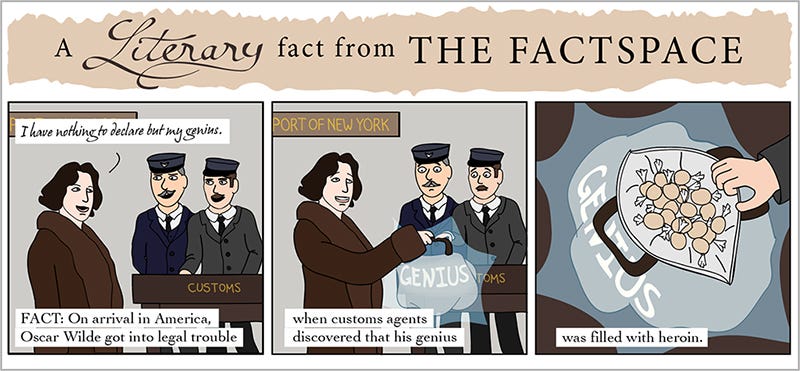
This literary fact was provided by The Factspace, a potentially award-winning webcomic written and drawn by Seth Fried and Julia Mehoke. You can check out more true facts here.
At Tablet, acclaimed Israeli author Etgar Keret describes how his literary career began during his mandatory military service in one of the “most heavily guarded army bases in Israel.”
“The fact that I had typed all those made-up sentences was exciting, but also frightening. I felt as if I had to find someone to read the story right away, and even if he didn’t like or understand it, he could calm me down and tell me that writing it was perfectly all right, and not just another step on my road to insanity.
“The first potential reader didn’t arrive until 14 hours later. He was the pockmarked sergeant who was supposed to relieve me and take the next shift. In a voice trying to sound calm, I told him that I’d written a short story and wanted him to read it. He took off his sunglasses and said indifferently, ‘No way. Fuck off.’”
Find out more about Etgar’s first story at Tablet, and read the actual story here.
And read his story for Recommended Reading here.
by Sean Campbell

This slideshow requires JavaScript.
It was kind of like summer, but not really: a group of hot artists showcasing some of their best work at WORD for a reading hosted by Electric Literature, Emily Books, and The Atlas Review.
Emily Cooke started us off with a woman struggling through grad school and life with some pages from the novel, Cassandra at the Wedding, by Dorothy Baker. On a grad student with literary aspirations and pedigree: “I’d prefer it if I was the writer and have all the other writers write their theses about me… It’s not easy for the child of a writer to become a writer. I don’t know why, it just is.”
Helen Philips read from her story about a foreboding future, The Knowers, soon to appear in Recommended Reading. “And I applauded myself for going straight from the bureaucratic office to the canal, for standing there above the sickly greenish water, for glancing once more at the piece of paper, for tearing it into as many scraps as possible though it was essentially a scrap to begin with, for dropping it into the factory-scented breeze.” You can also see the sentence in action in Electric Literature’s latest Single Sentence Animation.
Matt Dojny followed with You Are the Stepson, staring the portly, irresistible, and blind Lacey Roommate, who happens to be boning the narrator’s mom and every other woman within reach. “You wouldn’t expect a blind man to get so much trim, but you would be sadly mistaken.” According to the mom, “he’s like a true artist of love making do to being more touch oriented.” See also: the situation with this ant.
Then there was the southern hospitality of poet Alex Morris whose speaker has lost his leg but refuses to let it go: “O.T. hopped up and found the nurse. She was behind the curtain cradling his severed leg, singing to it, calling it Baby Mosses. OT plucked it from her. She was gonna scream. He put the finger to her lips. He put it to her nose. He gave her pink-eye.”
Montana Ray said it best when she closed out the night with the beats of her percussionist, Lalo, and some words from her “guns and butter”: “Suddenly, everyone was Jamaican and shirtless, without a fruit-stand in walking distance.”
But there were plenty of cookies and wine to make up for the crowd’s abrupt, Caribbean transformation and the lack of fresh produce.
Today, Ray Bradbury would be 93 years-old. In the video below, Bradbury, the celebrated author of Fahrenheit 451, discusses his early years of rejection and above all persistence.
“I wasn’t writing exterior stuff. I wasn’t writing for the right or the left or the in between. I was writing for me.”
 Thank You!