THE HIGHEST STREET IN THE BLUE MOSLEM TOWN skirted the edge of a cliff. She walked over to the thick protecting wall and looked down. The tide was out, and the flat dirty rocks below were swarming with skinny boys. A Moslem woman came up to the blue wall and stood next to her, grazing her hip with the basket she was carrying. She pretended not to notice her, and kept her eyes fixed on a white dog that had just slipped down the side of a rock and plunged into a crater of sea water. The sound of its bark was earsplitting. Then the woman jabbed the basket firmly into her ribs, and she looked up.
“That one is a porcupine,” said the woman, pointing a henna-stained finger into the basket.
This was true. A large dead porcupine lay there, with a pair of new yellow socks folded on top of it.
She looked again at the woman. She was dressed in a haik, and the white cloth covering the lower half of her face was loose, about to fall down.
“I am Zodelia,” she announced in a high voice. “And you are Betsoul’s friend.” The loose cloth slipped below her chin and hung there like a bib. She did not pull it up.
“You sit in her house and you sleep in her house and you eat in her house,” the woman went on, and she nodded in agreement. “Your name is Jeanie and you live in a hotel with other Nazarenes. How much does the hotel cost you?”
A loaf of bread shaped like a disc flopped on to the ground from inside the folds of the woman’s haik, and she did not have to answer her question. With some difficulty the woman picked the loaf up and stuffed it in between the quills of the porcupine and the basket handle. Then she set the basket down on the top of the blue wall and turned to her with bright eyes.
“I am the people in the hotel,“ she said. “Watch me.”
She was pleased because she knew that the woman who called herself Zodelia was about to present her with a little skit. It would be delightful to watch, since all the people of the town spoke and gesticulated as though they had studied at the Comédie Française.
“The people in the hotel,” Zodelia announce, formally beginning her skit. “I am the people in the hotel.”
“‘Good-bye, Jeanie, good-bye. Where are you going?’
“‘I am going to the Moslem house to visit my Moslem friends, Betsoul and her family. I will sit in a Moslem room and eat Moslem food and sleep on a Moslem bed.’
“‘Jeanie, Jeanie, when will you come back to us in the hotel and sleep in your own room?’
“‘I will come back to you in three days. I will come back and sit in a Nazarene room and eat Nazarene food and sleep on a Nazarene bed. I will spend half the week with the Moslem friends and half with the Nazarenes.’”
The woman’s voice had a triumphant ring as she finished the sentence; then, without announcing the end of the sketch, she walked over to the wall and put one arm around her basket.
Down below, just at the edge of the cliff’s shadow, a Moslem woman was seated on a rock, washing her legs in one of the holes filled with sea water. Her haik was piled on her lap and she was huddled over it, examining her feet.
“She is looking at the ocean,” said Zodelia.
She was not looking at the ocean; with her head down and the mass of cloth in her lap she could not possibly have seen it; she would have had to straighten up and turn around.
“She is not looking at the ocean,” she said.
“She is looking at the ocean,” Zodelia repeated, as if she had not spoken.
She decided to change the subject. “Why do you have a porcupine with you?” she asked her, although she knew that some of the Moslems, particularly the country people, enjoyed eating them.
“It is a present for my aunt. Do you like it?”
“Yes,” she said. “I like porcupines. I like big porcupines and little ones, too.”
Zodelia seemed bewildered, and then bored, and she decided she had somehow ruined the conversation by mentioning small porcupines.
“Where is your mother?” Zodelia said at length.
“My mother is in the country in her own house,” she said automatically; she had answered the question a hundred times.
“Why don’t you write her a letter and tell her to come here? You can take her on a promenade and show her the ocean. After that she can go back to her own country and sit in her house.” She picked up her basket and adjusted the strip of cloth over her mouth. “Would you like to go to a wedding?” she asked her.
She said she would love to go to a wedding, and they started off down the crooked blue street, heading into the wind. As they passed a small shop Zodelia stopped. “Stand here,” she said. “I want to buy something.”
After studying the display for a minute or two Zodelia poked her and pointed to some cakes inside a square box with glass sides. “Nice?” she asked her. “Or not nice?”
The cakes were dusty and coated with a thin, ugly-colored icing. They were called Galletas Ortiz.
“They are very nice,” she replied, and bought her a dozen of them. Zodelia thanked her briefly and they walked on. Presently they turned off the street into a narrow alley and started downhill. Soon Zodelia stopped at a door on the right, and lifted the heavy brass knocker in the form of a fist.
“The wedding is here?” she said to her.
Zodelia shook her head and looked grave. “There is no wedding here,” she said.
A child opened the door and quickly hid behind it, covering her face. She followed Zodelia across the black and white tile floor of the closed patio. The walls were washed in blue, and a cold light shone through the broken panes of glass far above their heads. There was a door on each side of the patio. Outside one of them, barring the threshold, was a row of pointed slippers. Zodelia stepped out of her own shoes and set them down near the others.
She stood behind Zodelia and began to take off her own shoes. It took her a long time because there was a knot in one of her laces. When she was ready, Zodelia took her hand and pulled her along with her into a dimly lit room, where she led her over to a mattress which lay against the wall.
“Sit,” she told her, and she obeyed. Then, without further comment she walked off, heading for the far end of the room. Because her eyes had not grown used to the dimness, she had the impression of a figure disappearing down a long corridor. Then she began to see the brass bars of a bed, glowing weakly in the darkness.
Only a few feet away, in the middle of the carpet, sat an old lady in a dress made of green and purple curtain fabric. Through the many rents in the material she could see the printed cotton dress and the tan sweater underneath. Across the room several women sat along another mattress, and further along the mattress three babies were sleeping in a row, each one close against the wall with its head resting on a fancy cushion.
“Is it nice here?” It was Zodelia, who had returned without her haik. Her black crepe European dress hung unbelted down to her ankles, almost grazing her bare feet. The hem was lopsided. “It is nice here?” she asked again, crouching on her haunches in front of her and pointing at the old woman. “That one is Tetum,” she said. The old lady plunged both hands into a bowl of raw chopped meat and began shaping the stuff into balls.
“Tetum,” echoed the ladies on the mattress.
“This Nazarene,” said Zoldelia, gesturing in her direction, “spends half her time in a Moslem house with Moslem friends and the other half in a Nazarene hotel with other Nazarenes.”
“That’s nice,” said the woman opposite. “Half with Moslem friends and half with Nazarenes.”
The old lady looked very stern. She noticed that her bony cheeks were tattooed with tiny blue crosses.
Zodelia stared back at her stupidly. “I don’t know why,” she said, shrugging one fat shoulder. It was clear that the picture she had been painting for them had suddenly lost all its charm for her.
“Is she crazy?” the old lady asked.
“No,” Zodelia answered listlessly. “She is not crazy.” There were shrieks of laughter from the mattress.
The old lady fastened her sharp eyes on the visitor, and she saw that they were heavily outlined in black.“Where is your husband?” she demanded.
“He’s traveling in the desert.”
“Selling things,” Zodelia put in. This was the popular explanation for her husband’s trips; she did not try to contradict it.
“Where is your mother?” the old lady asked.
“My mother is in our country in her own house.”
“Why don’t you go and sit with your mother in her own house?” she scolded. “The hotel costs a lot of money.”
“In the city where I was born,” she began, “there are many, many automobiles and many, many trucks.”
The women on the mattress were smiling pleasantly. “Is that true?” remarked the one in the center in a tone of polite interest.
“I hate trucks,” she told the woman with feeling.
The old lady lifted the bowl of meat off her lap and set it down on the carpet. “Trucks are nice,” she said severely
“That’s true,” the woman agreed, after only a moment’s hesitation. “Trucks are very nice.”
“Do you like trucks?” she asked Zodelia, thinking that because of their relatively greater intimacy she might perhaps agree with her.
“Yes,” she said. “They are nice. Trucks are very nice.” She seemed lost in meditation, but only for an instant. “Everything is nice,” she announced, with a look of triumph.
“It’s the truth,” the women said from their mattress. “Everything is nice.”
They all looked happy, but the old lady was still frowning. “Aicha!” she yelled, twisting her neck so that her voice could be heard in the patio. “Bring the tea!”
Several little girls came into the room carrying the tea things and a low round table.
“Pass the cakes to the Nazarene,” she told the smallest child, who was carrying a cut-glass dish piled with cakes. She saw that they were the ones she had bought for Zodelia; she did not want any of them. She wanted to go home.
“Eat!” the woman called out from their mattress. “Eat the cakes.”
The child pushed the glass dish forward.
“The dinner at the hotel is ready,” she said, standing up.
“Drink tea,” said the old woman scornfully. “Later you will sit with the other Nazarenes and eat their food.”
“The Nazarenes will be angry if I’m late.” She realized that she was lying stupidly, but she could not stop. “They will hit me!” She tried to look wild and frightened.
“Drink tea. They will not hit you,” the old woman told her. “Sit down and drink tea.”
The child was still offering the glass dish as she backed away toward the door. Outside she sat down on the black and white tiles to lace her shoes. Only Zodelia followed her into the patio.
“Come back,” the others were calling. “Come back into the room.”
Then she noticed the porcupine basket standing nearby against the wall. “Is that old lady in the room your aunt? Is she the one you were bringing the porcupine to?” she asked her.
“No. She is not my aunt.”
“Where is your aunt?”
“My aunt is in her own house.”
“When will you take the porcupine to her?” She wanted to keep talking, so that Zodelia would be distracted and forget to fuss about her departure.
“The porcupine sits here,” she said firmly. “In my own house.”
She decided not to ask her again about the wedding.
When they reached the door Zodelia opened it just enough to let her through. “Good-bye,” she said behind her. “I shall see you tomorrow, if Allah wills it.”
“When?”
“Four o’clock.” It was obvious that she had chosen the first figure that had some into her head. Before closing the door she reached out and pressed two of the dry Spanish cakes into her hand. “Eat them,” she said graciously. “Eat them at the hotel with the Nazarenes.”
She started up the steep alley, headed once again for the walk along the cliff. The houses on either side of her were so close that she could smell the dampness of the walls and feel it on her cheeks like a thicker air.
When she reached the place where she had met Zodelia she went over to the wall and leaned on it. Although the sun had sunk behind the houses, the sky was still luminous and the blue of the wall had deepened. She rubbed her fingers along it: the wash was fresh and a little of the powdery stuff came off. And she remembered how once she had reached out to touch the face of a clown because it had awakened some longing. It had happened at a little circus, but not when she was a child.
Any slush pile reader can tell you how often we see gimmicks masquerading as short stories, faux-histories and parody articles that create (or try to create) fictional worlds, too often without any payoff. Saunders, Egan, and McSweeney’s are the most successful purveyors of super solid gimmick stories — but they’re also responsible for recruiting an army of weak imitators. So when I received a review copy of Ben Stroud’s Byzantium — with back-cover references to globe-trotting and even the dreaded historical fiction designation — I’ll admit I feared the worst.
How wrong I was, and what a pleasure this book is. Each of Stroud’s stories and each of his characters — a horny teenaged roofer looking for a date in tornado-ravaged Texas; a jealous, cuckolded devotee to a new religion — inform their historical moments not with pedantic summary but with the well-placed detail: a teacher, whose wife catches him cheating, sits in one of his students’ chairs and begs forgiveness; at dinner, an in-over-his-head spy is fed “turtles cooked in their own shells.” A playfulness with language abounds as well, an ability to make fresh the mundane: “The news,” narrates one character, speaking of a particularly confounding revelation, “cinched around my cerebellum so tight I couldn’t even twitch.”
For a collection of stories as dense and varied as those found here, summary is superfluous. But I’ll say this:
Stroud works as well in the historical mode as any writer I’ve recently encountered
, leading the reader across millennia — from seventh-century Constantinople (in “Byzantium,” which first appeared in Electric Literature no. 4) to the antebellum American South (in “Borden’s Meat Biscuit,” about an unhinged inventor tasked — somewhat hilariously — with concocting a proto-Spam for rogue soldiers looking to capture Honduras for the Confederacy). At the start of each new story, the reader knows not where she’s going, nor with whom, only that her guide will likely make someone, somewhere her victim. For a writer so clearly influenced by the stories of Sherlock Holmes (see “The Moor,” the final story in this collection), this is part of Stroud’s mystery.
It’s “The Moor,” in particular, that stands out, with its straightforward reimagination of these Holmsian characters and themes (Our narrator asks: “How does one compare Burke’s cases, weigh the greatness of his reasoned deduction in one against that required for another?”). Of all the stories, this finale comes closest to contradicting my earliest sentence, in that its distanced tone clearly and self-consciously mirrors an academic summary. But I can forgive this — am happy to, frankly — because in this story the form serves the mystery (yes, there’s mystery here too), the heartbreak (which reads surprisingly sincere), and, most importantly, the joy.
Here, the author does far more that his contemporaries: his play with cliché transcends “experimental fiction,” because his experiment works.
Stroud journeys with an earnestness (and I use the word positively), and without irony. These are stories not too cool for their own good, stories told in clear and straightforward language; their forms and styles mask neither emptiness in thought nor emptiness in spirit. Reading these stories, one easily imagines Stroud researching his subjects, becoming an expert — if he’s not an expert, then he’s a damn good con man. Reading these stories, you’ll get the sense Stroud found each one essential, and you’ll feel the same way.
Today, Charles Bukowski would be 93 years-old. Given his reputation for vice, one can only imagine how he’d celebrate (and it is really fun to imagine). HarperCollins is celebrating with a whole mess of Bukowski audio books.
You can listen to a little Ham on Rye, narrated by Christian Baskous, below. Find the rest (and more, including discounted eBooks) at the HarperCollins tribute page.
1. After you move back home to work on your novel, slump into a depression. Feel like nothing really matters. Open up MS Word a lot but don’t type much. Make a video for one of the two stories you wrote the year after grad school, which feels silly because stories aren’t about videos.
2. Go to your new psychiatrist. Tell him you feel depressed. That isn’t normal, he says. If your medication was working properly, you would only feel depressed when something depressing was going on in your life. He wants to up your medication.
3. Decide fuck that, you’d rather be mildly unstable than incredibly doped-up on psych meds.
4. Your self-loathing from moving home to write a novel but not actually writing a novel kicks in.
You start writing. You don’t really feel like you know what you’re doing, but that’s okay because nobody knows what they’re doing when they begin a novel.
5. At some point, late at night, when you are supposed to be working on the novel but are instead just obsessively ruminating about your life, look back at the past year or so and realize you have been cycling between periods of low-grade depression and low-grade mania. You had previously blamed your mental instability on the fact that you’d recently gotten sober and sometimes it takes a while to adjust to living life not-fucked-up.
6. Go back to the psychiatrist. Tell him you’d like to try new medication.
7. Continue working on the novel. It isn’t an enjoyable experience. The only joy you get from it, really, is watching the word count go up in the little sidebar of MS Word. The sentences aren’t coming out right; they aren’t in your “voice.” The dialogue feels canned, like some bad YA novel.
Tell yourself this is okay: it’ll all get fixed in the revision process. A part of you knows this can’t get fixed in any revision process.
Wonder if it is possible to finish the book by next June, which is the deadline you’d given yourself.
8. It’s January now. You’ve been off and on a lot of psychiatric medications in the past few months. Some of them were pretty terrible. You get put on an anti-psychotic that is brand new to the market. After only one day, you feel great. You feel happy. You are full of energy. You feel — normal.
9. After two days, start wondering if maybe you are feeling too good (which is strange because anti-psychotics are supposed to bring you “down”). It’s hard to say. It’s not like you have much of a reference for what “normal” feels like, anyway, which is something that happens when you have a bad case of the mental illness, and do a lot of drugs and drink a lot for many years and then get sober.
10. On the fifth day, go to work. While there, decide your novel is shit and you should give it up. This makes you feel a little bit sad, but mostly it feels like a relief.
11. Later in the day, you realize you are indeed feeling way too good. You recognize this feeling. The last time you felt it was in 2007, when you were off your medication. This is mania.
12. Go to a friend’s house after work that day. Start crying and telling her inappropriately deep thoughts about your life: how you feel like you don’t know what you’re doing, how you want to do so much but there’s never any time, how the world is both so terrible and wonderful that you feel paralyzed and incapable of doing anything that means anything at all. At some point sob, “I don’t want to write a novel! I just want to write short stories.” (You actually don’t remember saying any of this; your friend tells you about it months later. It sounds exactly like the things the bipolar girl in SLC Punk says. How embarrassing.)
13. After an hour at your friend’s, realize you’re quickly slipping into a very bad mental state. Your mother picks you up to take you to the emergency room. On the way, start feeling like you are having a very bad acid trip. When you walk into the emergency room, the women at the front look very alarmed. Even though you’re crazy, it still alarms you that you made the women who sit at the front desk of the ER look alarmed.
14. Your mother brings your laptop in from the car. Type up a ten-page, single-spaced Word document while you are in the ER. The document is barely decipherable, but the main theme is THIS IS WHAT IT’S LIKE TO BE BIPOLAR IN 2013.
15. Get sedated and leave the ER. Go to an evaluation at the mental hospital the next day. Get admitted to the outpatient program. Ban yourself from typing on a laptop until you are better, because you recognize that if you think everything you write is genius, it is actually the mania and not the truth. Fill up an old journal with notes for your bipolar book instead.
16. Get better. Get a new psychiatrist. Get a strange feeling that the mental and emotional struggles you’ve been dealing with your whole life are going to be mostly okay now. You can put the energy you used to put into just staying afloat into writing. Wonder if this is still just the mania talking.
Realize the book is not going to come pouring out of you in a burst
, the way you thought it would when you were crazy. This bums you out, because you still wanted to have a book done by June.
18. Visit New York. Go to some readings. Get mad because several months ago you wrote a story that for once wasn’t about drugs and no one wanted to publish it and it seems like the only things people want to read about is drugs and sex. Decide to write a story about drugs and sex out of spite. The writing comes easy. Tell your friend, who may or may not be an editor at a literary magazine that you may or may not have worked for since you were in grad school, that you’re writing a story out of spite. She laughs and says, “You should do that. You should write a book of stories that correspond with some sort of emotion.”
19. Go home. Doubt yourself and your writing. In an attempt to encourage you, a friend says, “I know you have a lot of great books in you. At least two little books and one giant book.”
20. Think about that. A little book. A little book with corresponding emotions. Look at websites for the small presses you like. A lot of their releases are less than a hundred pages. Copy five stories you’ve previously published plus the one you wrote that isn’t about drugs into a Word document. Be surprised by the page count. You are going to write six more stories: there will be twelve in total.
21. Decide you are going to write this book however the fuck you want. Whatever comes naturally to you. Stop worrying that writing stories about drugs is derivative, and that you should be pushing yourself to write about something different. Decide you want to tell these stories your way, and this means the stories will have pictures. Decide you do want to make videos for the stories, that perhaps there was something in the idea you had last summer.
22. Find yourself working on the little book when you should be doing work for your paying job. Find yourself working on the little book when you should be sleeping, doing laundry, showering, eating, etc. Find yourself declining most social invitations in favor of sitting alone in front of your laptop. When you do go out, find yourself feeling partially removed, like one gear in your brain refuses to leave the dark world of your stories. Find yourself writing more than you’ve ever written in your life. Sometimes the stories you write turn out bad, so you discard them, but mostly the stories feel right. They all stem from terrible memories from terrible times in your past. They are often painful to write, but they also feel honest and true.
23.
Discover the things that help you write are not the same as the things you’ve heard help people write.
You don’t write in silence, you don’t get up early in the morning, you don’t write at the same time each day. Instead, you do this:
a) Stay up most nights until it gets light out. Sleep all day.
b) Ingest massive amounts of caffeine. Smoke massive amounts of cigarettes.
d) Think about: all the times you’ve felt like a failure, all the people you’re jealous of, all the people who gave you some indication that you couldn’t write (including those who innocently asked you if you’d be self-publishing your book), and especially the mean voice in your head that says you suck and can’t write and taking writing seriously is stupid and pointless and no one will ever read your writing anyway. Cram this all up into a tight little ball until it becomes fuel.
Writing this book doesn’t feel meditative, the way you heard that writing should feel. Writing this book feels like a fight. It feels like you are punching and beating things, and you are winning.
24. Work on the layout for the book. Work on the photos for the book. Work on the videos for the book. All this visual stuff is not distracting, like you were afraid it might be. All this visual stuff is satisfying, and makes the stories come together that much more clearly in your head.
25. Soon you have twelve stories. Go back and read the story that wasn’t about drugs, that no one would publish, that you thought was so good. Realize the reason no one would publish it is because it actually isn’t very good at all. Discard it. Write another story. This one hurts the most to write, and so it becomes your favorite.
26. Edit the shit out of the stories.
27. Late one night in June — or actually early one morning — finish editing the final story and realize the book is done. Feel confused about how you feel. Part of you is happy and proud. The other part of you is afraid. You wish there was some sort of socially-designated action that one was supposed to take when finishing a book, like stomping on a wine glass.
28. Send the book out to the few places and people you know that would be receptive to receiving such a thing. Your stomach feels twisty afterward.
29. Hear some things back. They’re positive things. Some of them are so positive that one day, while stuck in traffic, you start crying. You’ve turned all these ugly feelings and memories into something good, something that people relate and react to. Still, the twisty feeling in your stomach intensifies, and you find yourself waking up in the middle of the night, afraid that maybe you’ve written a book that people seem to like, but one that will never be published.
30. The twisty thing doesn’t last long. Wake up one day to the e-mail you’ve been waiting for. Sometimes you dream about e-mails that don’t exist, and think this is maybe another dream e-mail. It’s not. The editor of a small press — one that puts out books you like, and is the press you thought might possibly be the best fit for your work — loves and wants to publish your book.
31. Receiving this email doesn’t feel the way you thought it would. Ask yourself if this is what you want. You’re not sure. Talk to some friends. They tell you it’s okay to take some time to think.
32. That night, get real quiet with yourself. Listen to the voice in your head, the non-mean one. E-mail the publisher. Tell him you’d like to see the contract. Feel really strange. In some ways, this has happened so fast. In some ways, it hasn’t happened quickly at all. It feels strange to have worked for something, and to have gotten what you wanted, when there’s a mean voice in your head that says you suck, that writing is a stupid thing to do, that you’re only destined to fail.
33. On the Fourth of July, sign the contract. Let everything sink in. The thoughts and feelings settle. You feel so nervous, but it’s a good nervous. You identify the word that references the good kind of nervous: you feel excited.
PEN America just announced that Sergio De La Pava, author of The Naked Singularity, has won the 2013 PEN/Robert W. Bingham Prize. The annual $25,000 prize goes to an author “whose debut work — a first novel or collection of short stories published in 2012 — represents distinguished literary achievement and suggests great promise.”
To see the other 2013 PEN Literary Award winners, including Katherine Boo, Robert Hass, and Frank Deford, click here.
The man is running, gasping, down a winding blacktopped road lined with monstrous, inexpensive-looking homes. It is suburban dusk in the springtime: the lukewarm air smells of sweet damp lawn-cuttings, virgin asphalt, and dogwood blossoms. Behind and beneath these smells is another smell — the acrid tang of burnt coffee, emanating, as always, from the man’s armpits and his breath.
For the purposes of this story, the man will be identified as L.
L. is nobody’s idea of attractive: avocado-sized Adam’s apple, birdlike wrists, curly orange-gray hair. His bony body is distinguished by a round, larded belly that appeared suddenly one day when he was 33 years old.
L. is possibly a sociopath.
He definitely has a cancerous lump on his person.
L. is running from his stepson, who is slowly pursuing him on a bicycle. The bicycle is too small for the stepson, and its chain is slightly rusted, which is why the stepson has not yet caught up with his stepfather. The stepson might be better served if he simply got off the bicycle and pursued his stepfather on foot. However, to be honest, he is savoring the slow-motion element of the chase, because it gives him pleasure to see his stepfather’s fearful expression — and, because the stepson is dreading what might happen next.
The stepfather stumbles and veers to the side of the road, coming to rest in front of a flowering dogwood. He leans into the tree, embracing it, fingers desperately caressing its bark as though attempting to read a message encoded there. The stepson drags his shoe along the paved road until the bicycle wobbles to a stop a few feet later. He’s almost disappointed that the stepfather has given up so easily.
Tucked within the stepson’s jacket is an M&P .32–20 that has never been fired. The stepson does not consider himself a violent person by nature, but he desires an apology from the stepfather.
Due to the situation with the ant.
Lyman
Firstly let me apologize for my handwriting which I realize looks like chickenscratch. Unfortunately you can’t teach old dogs new tricks and I am past the point of no return in regards to penmanship. Secondly I wish to state that I have nothing but positive things to report regarding this fine Bed & Breakfast. Don & Marissa have been splendid hosts — the meals uniformly excellent (homemade blueberry scones) — and I have very much enjoyed exploring historic Downtown Newport. It fascinates me to imagine the history that has occurred in this town — During the Revolution, General Rochambeau, head of French forces assisting General Washington, housed two of his aides-de-camp in our Colonial Inn (says the brochure). I wonder if these “aides-de-camp” possibly slept here in Room Number Nine (aka The Captain’s Quarters)?
Truly this room has been like a home away from home for me. The 12-over-12 paned windows and authentic colonial cove moldings are absolutely charming. And I was surprised & intrigued to note the distinctive rose-patterned wallpaper on the walls which is curiously reminiscent of the wallpaper in my childhood home of Paducah, KY — in truth if I blur my vision these walls might be my own childhood walls. I say curiously reminiscent because it is the story of this rose-patterned wallpaper of long ago that brings me to Rhode Island in the first place. A coincidence that makes my visit seem all the more pregnant. Let me explain to you what I mean.
Following the death of my beloved father my mother remarried a man by the name of Dr. Lyman Winterbottom. Lyman insisted that I call him Father and because he was a man who did not tolerate disobedience I did as he requested. But in my heart and mind he always remained Lyman. When Lyman moved into our home in Paducah he immediately took to complaining about the wallpaper that covered nearly every room of the house. This wallpaper as previously noted was not dissimilar from the wallpaper here in The Captain’s Quarters where I now sit & write. It was of a yellowish hue with light blue vertical stripes and a decorative pattern of miniature pink & white rosebuds. This was the wallpaper that my mother & father had picked out together and that my dear old Dad himself had applied to our walls. From the moment that Lyman set foot into our home he began to grumble about being surrounded by walls that were so feminine and milquetoast and old-fashioned. My mother laughed it off at first but it became clear over time that Lyman’s grudge against the wallpaper was significant and not humorous.
One fateful day Lyman spotted a large brown carpenter ant on the kitchen wall and spontaneously crushed it with his thumb — leaving a faint brown smudge on one of the flowers. He was a tidy man and this smudge annoyed him to no end. My mother scrubbed & scrubbed and yet the stain remained. The fact that such a tiny mark was so disturbing to Lyman gives a sense of his character. He claimed that because the stain was adjacent to his breakfast nook and at the height of his eyeballs he therefore could not help but observe it daily while drinking his Chock full o’Nuts. Lyman had the notion to remove the spot of wallpaper where this smudge remained and so with hammer and chisel (and turning a deaf ear to Mother’s protests) he chipped away at the offending area. “See there?” he said. “Look at the improvement. Now what say we remove it all?” Mother simply frowned at her now imperfect kitchen wall and said nothing.
Time passed and then a few weeks later Mother & I traveled to Caruthersville to visit with my late father’s family. Lyman stayed behind explaining that he had too many things to attend to about the house. When we returned three days later it was readily apparent what Lyman’s scheme had been — for there was a man in a gray uniform in our living room steaming the wallpaper off the walls.
Mother began screaming & crying for the fellow to stop but it was too late. He had already removed the wallpaper from all of the other rooms. And so we now looked upon surroundings of white naked plaster. As you can imagine my mother was terribly distressed and very much heartbroken by this action. I recollect that she compared it to having her own skin unnaturally removed from her body. I think that in hindsight the wallpaper had been a Symbol of my father and once the wallpaper was gone it was as though his memory and his spirit had been violently exorcised from our home.
Lyman eventually vanished from our lives as well but not before he had left additional heartbreak & destruction in his wake. I will spare you the details as they are not pretty to hear. Sometimes I look back on those years and wonder if I am misremembering the man or making mountains out of molehills. But then I recall the wallpaper and know that a man who would do such a thing might surely be capable of anything.
At this point in my tale I must confess. My reason for visiting this unfamiliar but beautiful town of Newport, RI is related to this aforementioned stepfather. After some investigative research I have learned that Lyman retired to Newport approx. 3 years ago and has been enjoying his Golden Years here in quiet seclusion. I have not seen him since he abruptly vacated the home of my mother & myself in the year 1977 which is almost 22 years ago. I hear that his days are numbered due to a cancer and I intend to surprise him with a visit. For Lyman has been nothing but a stain upon this world — and before he departs, I hope to help him discover the shame that he should rightly feel.
The shame that must surely abide somewhere in his unfurnished heart.
Lacey
Me and my mom bring Lacey to the doctor once a week because Lacey’s super fucking sick. Not sick enough, as far as I’m concerned.
On this specific morning, the lady at the desk tells me Dr. Pa is late. I go inform Lacey, and he says: “Where the hell is she?”
“I don’t know, Lacey,” I say. “She’s just late, Lacey.” Then I chuckle a small chuckle. I chuckle almost every time I speak Lacey’s name aloud. Cagney & Lacey. Lacey underpants. It’s a hilarious name.
“Enough with the chuckles,” Lacey growls. Lacey’s super-touchy about his name. And who can blame him?
Lacey is actually Lacey’s first name, which makes it even more stupid. Lacey’s last name is Roommate, which is also hilarious. Lacey Roommate. (It’s actually pronounced roh-oh-mah-tay. But still.)
In my brain, he’ll always be Lacey Underpants.
“I guess let’s wait,” I say, and my mom and me and Lacey sit down in Dr. Pa’s waiting room. I look over the magazines: Yankee, Maxim, Sunset. The covers of the magazines are wrinkled, like somebody pissed on them a long time ago, so I don’t even pick one up.
“I’m dying of thirst,” says Lacey. “Get me a cup of water?”
I glance over at my mom. She’s reading an article in Cosmo about finding your man’s G-spot, or something, and isn’t paying attention to us. I turn back to Lacey and tell him: “They don’t have any water.”
This is a lie. There’s a big Poland Springs cooler in the corner.
I treat Lacey generally poorly because Lacey moved in on my mom the minute my dad died, and has been married to her for six years, and has been screwing around on her since day one. He’ll bone anything that isn’t tied down. He’s boning this woman Margaret who comes over and reads him books out loud; he’s boning his ex-wife, even though she weighs about 400 pounds; he’s boning the surprisingly hot docent who volunteers with him at the Nautical Museum. He’s boning Barry Fitzpatrick’s stepmom. And I’m pretty sure he’s even boning our female mailman.
Lacey’s super brazen about his lifestyle, and I see it all, and I know he knows I see it all, and he doesn’t care. He has no regrets. “I’m living life, kid,” he always tells me. “No retreat, no surrender. No regrets!”
My mom sees nothing. So I’m the one who has to keep Lacey’s shitty secrets — a burden like the weight of all of those women combined, including the fat one.
And that’s why I don’t get Lacey a cup of water.
Full disclosure: Lacey’s blind. Which is why he doesn’t know I’m lying about the Poland Springs.
Lacey and my mom met at Blind Checkers Night at Saint Spyridon Greek Orthodox Church, where my mom volunteers. Neither of them are technically Greek.
You wouldn’t assume a blind guy could get so much trim, but you’d be sadly mistaken. Females apparently enjoy boning guys who can’t see them. My mom says that doing it with a blind guy is amazing, because he’s like a true artist of lovemaking, due to being more touch-oriented.
Whenever she starts down this road, I tell her, “I do not want to hear about this.”
Case in point: we’re sitting there in the waiting room, and she’s eating a Cinnabon, and out of the blue she says: “You know, Lacey loves it when I bite on his bottom when we’re doing the sixty-nine.”
I cover my ears and grimace, which makes them both giggle, and eggs my mom on.
“Lacey likes blowing on my body,” she says. “He pretends he’s the north wind, and I’m a tiny moist sailboat.”
“Ma!” I say. “Please, just, stop.”
“Honey, don’t be such a prude,” she says. “You’re old enough now to hear these things. Human sensuality is a beautiful form of self-expression.”
Lacey strokes my mom’s face and says, “I love fingering your dimples. It’s the penultimate eroticism.”
“Lacey!” I yell. “Inappropriate!”
But the two of them just laugh at me.
Sometimes I wonder what Lacey and my mom have in common. Then I remember that they both like getting my goat. It’s a favorite sport for them. Also, they both like Chock full o’Nuts coffee. That’s about it, as far as I can tell.
Dr. Pa finally comes rushing into the office, ignoring all of the patients and scurrying into the back room. After a few minutes, the receptionist says, “Mr. Roommate, the doctor will see you now.” Pronouncing his name the wrong way.
“Thanks,” Lacey says, standing and walking towards Dr. Pa’s office, though he’s about to walk smack into a wall. Lacey is pretty bad at being blind.
“Go with,” my mom tells me, not looking up. “I need to finish my article.”
I pause, I sigh, I make a disgusted noise. Then I get up and grab the arm of my stepdad and drag him into Dr. Pa’s office.
Dr. Pa is a Chinese lady with a massive bosom. Or maybe she’s Japanese, or from Iran, for all I know. She’s 100% super-fine, whatever she is. She smiles when she sees Lacey.
“Mr. Roommate,” she says, pronouncing his name the right way. “How are you feeling today?”
There’s a Billy Joel song, “Uptown Girl,” playing over the speakers in her office, and Lacey starts doing a stupid-looking doo-wop jig along to the music. “I’m good,” he says, shaking his pear-shaped ass. “Whoomp! There it is!”
Dr. Pa actually laughs, like Lacey is so incredibly charming. Lacey sits down and he and Dr. Pa start talking about Lacey’s diet, sleep, pain, blah-blah-blah. Meanwhile I’m just standing there, staring at my shoes, thinking about absolutely nothing at all, wanting them to hurry up and finish up already so I can escort Lacey out of there.
And that’s when I see the Dorito.
It’s really just a little piece of a Dorito, and it seems to be dragging itself across the floor, like it’s haunted. It takes me a couple seconds to get that there is an ant underneath. My first thought is, it seems pretty unsanitary, an ant and a Dorito in a doctor’s office. But, it’s also undeniably impressive. I read once that ants can carry 500 times their weight — or maybe 50 times. It definitely had a five in it. Either way, it’s impressive. I weigh 184 pounds; times 50, that’s like 10,000 pounds. I don’t even know what weighs 10,000 pounds. A doctor’s office?
So I’m watching this ant, and it’s actually weirdly entertaining, seeing it struggling with this enormous thing, just doing everything it can to haul this little piece of food to wherever it was going — probably to some kind of nest to feed his millions of children. Now, I’m not going to tell you that I got all inspired and emotional, standing there in Dr. Pa’s office, observing the efforts of this random ant. But let’s just say I’m watching that ant closely, and I’m curious to see where it’s trying to go to, and if it’s going to succeed. Because what it’s trying to do is something that is not easy.
Then Dr. Pa says, “Okay, hop up on the table, and let’s take a look at you.” And then Lacey stands up — and he crushes the ant and the ant’s Dorito underneath his big fucking blind foot.
Oblivious, Lacey says to Dr. Pa: “Oh! Naughty woman are you!” Talking like Yoda, for some reason. “Wanting to inspect my body, do you?”
Dr. Pa laughs, and they’re both laughing together, and I’m just staring at Lacey’s foot, picturing the ant underneath. The ant that Lacey never even knew was there.
Lacey shuffles towards the table, and I plainly see the ant and the Dorito on the floor. The remains of them; just a brown smear and orange dust. I turn to say something to Lacey. Dr. Pa is helping him onto the table, and her hand rests on his knee for a second or two longer than seems necessary or appropriate. She smiles at him. And Lacey smiles back at her, like he can actually see her smile. And then they both turn to me and say, at basically the same time: “You can go back to the waiting room now.”
And I realize: Lacey’s screwing Dr. Pa, too. He’s literally screwing everybody he knows.
My blood boils, and that’s when, out of nowhere: a gun appears in my head. Lacey’s gun, that he keeps in the Reeboks box under the bedskirt. As if he could even shoot the thing. I think about that gun, and wonder about how Lacey might feel if it was pointed at his ugly backside. If he would still have no regrets.
It makes me smile, just thinking about it.
Liptower
…SO — IF YOU FEEL COMFORTABLE DISCUSSING IT, I’D LIKE TO HEAR ABOUT THE EVENTS LEADING UP TO THE… INCIDENT. WITH YOUR STEPFATHER.
Yes. All right.
REMIND ME, WHAT WAS HIS NAME?
Liptauer. Peter Liptauer. I always just called him Liptauer, because it annoyed him — being addressed by his last name.
YOU ENJOYED ANNOYING HIM.
It’s funny, I’d actually call him Liptower. Spelled T-o-w-e-r, instead of T-a-u-e-r.
I’M NOT SURE IF I —
In my head, I mean. I’d change the spelling of his last name.
I SEE. THAT’S INTERESTING.
Is it?
WHY DO YOU THINK YOU DID THAT?
Not sure. It gave me… satisfaction.
IT WAS EMPOWERING.
Maybe.
DID YOU FEEL POWERLESS AROUND HIM?
No. I don’t know. It was just a stupid kid thing. I’d picture — it’s funny, I’d forgotten this — I’d picture an enormous tower, made out of slimy lips.
IT AMUSED YOU.
Yeah.
NOW, ABOUT THIS STORY. REGARDING LIPTAUER —
Yeah. It’s… it’s a weird story.
THERE ARE ABSOLUTELY NO JUDGMENTS IN THIS ROOM.
It’s even kind of a boring story.
IT SEEMS IMPORTANT TO YOU. BUT IF YOU’D PREFER WE —
I was twelve.
ALL RIGHT. TWELVE YEARS OLD.
It was nighttime, and I was in my bedroom. Up in the attic. The walls were slanted because of the roof, and I’d covered them with posters. It had some serious shag carpeting. It was a pretty cool room. Anyway, I was writing a book report for Cry, the Beloved Country. Ever read it?
I BELIEVE SO, YES.
So boring. What’s it even about? Anyhow, I’m in my room, trying to write this report, and then, well, I see this ant. On my desk.
AN ANT.
This little ant. A carpenter ant.
ALL RIGHT.
We used to get them every summer. Swarms of them. I’d put apple cider vinegar on a rag and wipe them up. Ants hate vinegar. It’s a good trick.
I’M NOT FAMILIAR WITH THAT.
Anyway, eventually, Liptower would get around to putting down some traps and they’d go away. So it was surprising to see this one single ant, because it wasn’t ant season. This was, like, a rogue ant. Flying solo.
GO ON.
So, it comes crawling across the desk towards me — and I was conditioned to kill these ants, because, like I said, we used to get tons of them. But for some reason, I didn’t kill this one. I just looked at it, and blew on it. Blew it backwards.
ALL RIGHT.
But then, after a second, it kind of got its bearings and started — you know, this is going to really sound kind of —
PLEASE, GO ON. I’M INTERESTED.
So — the ant was sort of running towards me again. As if it really wanted to come and see me, or something. So I blew on it again. And then it comes at me again. And I’m looking at it, thinking, this ant really wants to come over here. So then I put out my hand. Spontaneously.
TO PICK IT UP.
I guess. I just put my hand down, and the ant hopped right on it. Like it was a little dog or something. Some kind of pet. It starts running around on my hand, very excited. And I sort of studied it, and — it looked unique, somehow. Very black and smooth and shiny and streamlined. Kind of beautiful. Like, it looked like an alien robot ant. It just looked different from the normal ants we had.
HMM.
It was as if my eyes were microscopes, and I could see the ant unnaturally well, in extra detail. It’s possible that I’d never looked closely at an ant before.
SOMETIMES, THE FAMILIAR CAN SEEM UNFAMILIAR WHEN WE INSPECT IT. BRINGING IT TO OUR FULL ATTENTION.
Right. Right. Like when you say a word so many times —
THAT’S RIGHT —
— and it suddenly sounds weird. Like… yoghurt. Yoghurt. Yoghurt. Yo —
I UNDERSTAND.
Okay. So I’m looking at this ant, and then I’m like, What am I doing? And I put the ant down, and it runs around a bit, and then it starts coming for me again, and I blow on it really hard, blow it right off the table. Because I had to finish my book report.
OKAY.
Then, whatever, I don’t really think about it. I go to sleep, and the next morning I get up and I’m in the shower, and I start thinking about this ant again, for some reason. Just thinking about how it was strange. How it was acting like a dog. It was just an odd thing, the way it was acting. I know this sounds crazy.
IT DOESN’T SOUND CRAZY AT ALL.
If you did think it sounded crazy, though, you couldn’t say so.
PLEASE, CONTINUE.
I… so… anyways, so I’m thinking about this ant, randomly, and then I get out of the shower, and I’m drying myself, and then I… well, the ant was there. On the edge of the sink. Just sitting there. Like it was hanging out, waiting for me.
AN ANT WAS ON THE SINK.
Yes. But it was the same ant. I know, this is the part where it starts to sound crazy. It’s possible, I know, that it was some random other ant. But, the thing was, I just knew it was the same ant. It looked the same — all smooth and robotic-looking. It was like, this was the one ant in our house. The only ant. I feel certain.
I SEE.
I understand it’s theoretically possible that this was a different ant. A second ant. But it wasn’t.
ALL RIGHT.
I know, you’re thinking: Sure, whatever…
NOT AT ALL. GO ON.
I see the ant, and I put my hand out, and it climbs right up on me again. And it’s climbing all around on my hand, and my arm, like it’s… like it’s at Ant Disney World. Just, so happy. And the particularly weird part was it made me really happy, too. Having this ant on me. And…
GO ON.
I… I don’t know.
TAKE YOUR TIME.
No, it’s just…
I CAN SEE YOU’RE BECOMING EMOTIONAL.
IT’S ALL RIGHT. IT’S ALL RIGHT. TAKE YOUR TIME.
…Okay. I —
DO YOU WANT A —
No. I’m fine. This just sounds ridiculous. What I’m about to say.
ABSOLUTELY NOT.
It’s just, I knew that the ant was…
YOU’RE SMILING. I’M SO CURIOUS — WHAT WAS THIS ANT?
It’s just, the ant, I knew — it was… well, I knew it was my dad.
THE ANT WAS… I’M SORRY, DO YOU MEAN —
I don’t necessarily believe in, you know, whatever, but this wasn’t even about that — it was just, I recognized him. He —
YOUR FATHER PASSED AWAY WHEN YOU WERE… LET’S SEE, YOU WERE —
Six.
AND YOU REMEMBER HIM WELL?
You know, yeah. Pretty much. Semi-well.
YOU WERE CLOSE?
When he was home, yeah, we were really close. He was very — you know, loving, etcetera. But he wasn’t always around, consistently. It’s not all rose-tinted memories. He wasn’t… he didn’t, like… he traveled. He wasn’t in the backyard every weekend, teaching me how to throw a football, or whatever. I probably still can’t really throw a football the right way…
DID YOU LOOK UP TO HIM?
Yeah. No. I don’t know. Maybe let’s save, like, the dad-talk for another session.
WHATEVER YOU WANT.
I mean, the gist of it was, I missed him, and I was living with stupid Liptower, with his fucking opera music and, whatever, macrobiotic crap, and I don’t know… Can I just tell the story?
PLEASE.
It’s fine. I’m sorry. I —
JUST SO I FULLY UNDERSTAND — YOU BELIEVE THAT THIS ANT WAS… HOW WOULD YOU CHARACTERIZE IT? SHALL WE SAY, HE WAS THE REINCARNATION OF YOUR —
Well, when you put it like that, it sounds —
I’M JUST TRYING TO MAKE SURE THAT I —
All I can say is, it was just obvious. That he’d come back. And he was an ant. It was just something that I knew, positively. As sure as I’m here right now, sitting here, I was sure that he was my dad.
AND HOW DID THAT MAKE YOU FEEL?
It was… I mean, great, you know?
TO BE WITH HIM AGAIN.
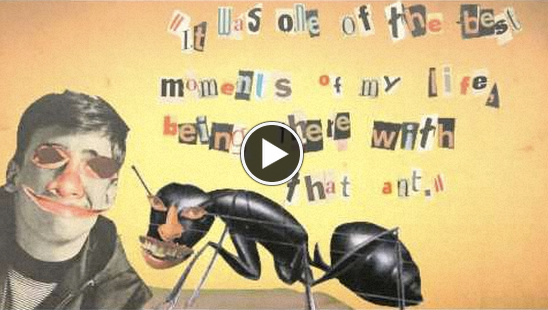
It was one of the best moments in my life, being there with that ant. It felt like pure… love. Like he was the essence of love, there. Concentrated. And I started… I mean, I just started bawling. Standing there, naked, with this ant on my arm, crying. I had to sit down.
I’M SURE IT WAS VERY EMOTIONAL. IT SOUNDS AS IF —
It was just crazy, I know.
NO.
I felt like I was losing my mind with happiness. I kind of held my arm up to my face, and — I know how this sounds, but — the ant and I, like, touched noses. Like it gave me a kiss. I see how you’re looking at me…
IT’S ACTUALLY VERY TOUCHING.
It was.
SO THEN —
And so then, of course, there’s a knock on the door.
YOUR STEPFATHER.
That’s right.
WHERE WAS YOUR MOTHER?
I don’t know. Work. I’m sure. Working.
SO, YOUR STEPFATHER —
So Liptower knocks, acting all concerned. “Heyyy. You okay in there, buddy?” That’s how he talked. Mr. Sensitive. “Heyyy. Buddy? You all right?”
HE WAS WORRIED. HE HEARD YOU CRYING.
Yeah, but, no. Liptower… he was one of these people who wasn’t some obvious asshole — he wasn’t some evil stepfather in a movie, screaming and beating the shit out of me or whatever. He was the most normal, vanilla, boring-seeming person you’d ever meet. But there was something missing. If that makes sense. He acted very regular, but he had a weird emptiness. He was like a blank slate.
A CIPHER.
I guess. Like, you could imagine him being a great guy, but you could also imagine him torturing kittens in the basement or something. And, talking with him was like talking to someone from outer space. Some alien who had watched movies about humans, and did a pretty good impression of a human, but just wasn’t quite there.
HE LACKED EMPATHY, WOULD YOU SAY?
Empathy. Maybe. He was just a creep. He literally gave me the creeps — I’d be sitting somewhere, reading a book or something, and then my spine would start tingling, and I’d turn around and see Liptower standing behind me, watching me. He was always creeping around the house. And he’d say, “Howdy, partner, whatcha reading?” as if it was a normal thing to sneak up on somebody like that. But I knew what he was doing.
WHICH WAS WHAT?
Which was… I don’t know. I don’t know what his goal was. All I’m saying is that this wasn’t someone just innocently walking around the house. He was watching me. Following me. Waiting for something.
I SEE. THAT’S INTERESTING.
I guess.
SO… HE WAS OUTSIDE THE DOOR —
So he’s knocking, and I freeze, with my arm outstretched, and I immediately stop crying. And I’m like, “I’m fine, Liptower,” and he says, “Are you sure, pal?” And I tell him yes, and then he stands outside there for a long time. I can hear him, just breathing. And then he finally goes away.
BUT YOU FEEL CERTAIN THAT HIS CONCERN WAS NOT GENUINE.
Exactly. Why? Do you think that I’m —
I’M NOT SUGGESTING ANYTHING. SIMPLY CLARIFYING.
Trust me. Liptower was none too worried. I’m not making this up. About him being a closet psychopath.
I KNOW YOU’RE NOT.
But you’re thinking, maybe Liptower was actually a totally normal nice innocent guy, and maybe I’m —
ABSOLUTELY NOT.
I don’t care if you are thinking that. I know what I know.
PLEASE, TELL ME WHAT HAPPENS NEXT.
What happens next is, I’m in the bathroom, and I have to figure out what to do with him. With my father. Because — this ant is tiny. That’s the thing. It’s, like, about this big. I’m terrified I’m going to accidentally hurt him. So I put him carefully back onto the sink, and I throw on my clothes and rummage through the drawers of the little cabinet, and I find a box of matches. Matches for when Liptower would use the toilet — he’d light a match afterwards. Freak. So I throw the matches out, and I coax my dad into the box. And I whisper, “Dad, just hang out in there for a little bit. I’ll get you out soon.” And I slide the matchbox shut, and put it in my pocket.
HOW ARE YOU FEELING AT THIS POINT?
I’m feeling, I don’t know, nervous, but mostly just very happy and excited. But, definitely nervous.
SO, YOU —
I walk into the kitchen, and Liptower is there, eating some muesli or whatever. And he tries to still be all like, “Hey, kiddo, everything okay?” but I just ignore him and make a beeline upstairs to my room. I kept an old Chock full o’Nuts can full of spare change, and I dumped the change into a drawer and started making a nice little home in there for my dad. Because, the thing is, I had to leave to go to school, and I didn’t trust carrying him around in my pocket all day — I was terrified of crushing him. I had this fern on my windowsill, so I rip off some leaves and put them in there, just to give it a natural feel. And then I put some Kleenex in there as a sort of bed, and I put this little wooden train in, because carpenter ants like to chew on wood, for whatever reason. And I spit into a bottle cap and put that in there for him to drink, and I put a couple of Mike & Ikes in there, because I knew ants like sugar. So I figured he had enough to eat and drink for the time that I was at school. Then I take out the matchbox and slowly slide it open. And he immediately climbs out onto my hand, all excited. “You go in here,” I say, and I show him the coffee can — and then I very carefully put my dad in there. The ant.
ALL RIGHT.
And then I put on the lid, and poked a ton of holes in it. I thought about leaving the can on the windowsill, because I had some dumb idea that ants maybe needed sunlight. But then I thought some more about it, and I realized that’d probably cook him alive. And I thought about how carpenter ants spend a ton of time burrowing underground and into floorboards, and that he wouldn’t mind being in the dark, and so I put the can on the top shelf in my closet and tell him I’d see him soon. I stand there for about a minute, just talking quietly to my dad a little more, because I don’t want to leave him, then finally I say goodbye and start to shut the closet. And just then, I hear a sound, like footsteps on the stairs. And I get a terrible feeling in my stomach.
BECAUSE YOU THOUGHT YOUR STEPDAD —
Well, I wasn’t totally sure what I’d heard. I didn’t know if he’d even come upstairs — or if he had, what he’d seen, or what he’d heard. My door was wide open. But I was late for school and I just chose to believe that I was imagining it. I should’ve known. So I went downstairs, and Liptower was in the living room, rummaging through the hall closet. He said something about doing some spring cleaning. Liptower was sick at the time, which is why he just hung around the house all day, cooking and cleaning and listening to opera.
HE HAD CANCER.
That’s right. I guess I told you that before.
YES.
So I went to school. And I felt awful all day. Just an awful feeling in my gut.
YOU WERE WORRIED ABOUT —
Yeah, just a general worried feeling, all day long. It was torture. When the bell finally rang, I rode my bike home as fast as I could, though the chain was all messed up, so it took me forever. I burst into the house, and Liptower’s at the table, reading the paper. He says something to me, asking what I’m doing, but I just run past him upstairs and to my room. The door to the closet is wide open, and I’m already crying when I go look in there. And the coffee can’s gone.
IT WAS —
And I run downstairs, and I say, “Fucker, what did you do with him?” And Liptower’s smiling and frowning at me, in this fake calm way, and says, “Whom are you referring to?” And I know he knows. I know he knows what he did. “The coffee can,” I say. “Where is it?” And he’s like, “Coffee can…?” And he looks all pensive for a minute, then says, “Oh, in your room? Yes, I was cleaning. The can just seemed to be filled with trash. I tossed it.” And I can barely say anything. But I know. I know he’d been watching me, at the door. “Where’s the trash?” I ask him. I can barely talk. “I put it out,” he says, “Sorry, was it something important…?” And I’m running outside before he even finishes the sentence. And then I stop dead on the lawn, because there’s nothing on the curb. It’s empty. And I say, out loud, “Today is Monday.” Because the garbage men pick the trash up on Monday. And… I knew he was gone.
YOU SUSPECTED THAT YOUR STEPFATHER HAD INTENTIONALLY DONE THIS.
There was no suspecting. I knew it. I knew how he was. It was like, he’d been following me around for so long. Waiting for something like this. A chance.
AND —
So, I’m just standing there, totally frozen in place. And then Liptower comes outside, and he tells me he’s going for a stroll, to get some fresh air. Super casual. He doesn’t even ask me why I’m freaking out about this coffee can. See? He knew. And he starts walking down the street. I think he’s literally whistling a little tune as he walks. Not a care in the goddamn world.
AND THEN, WAS THIS WHEN YOU GOT THE —
Yeah. I ran inside. To his bedroom. When I got back outside, he was already halfway down the road. I can picture the scene exactly: Liptower ambling along, in his ugly yellow shirt. Blending in with the flowers on the trees. And I had this clear vision — a premonition — of him getting away with what he’d done. I couldn’t let that happen. My bike was still sitting there from before, so I got on it. I went after him. I had to. You see? Because he knew exactly what he’d done. He knew. He knew exactly. Don’t you see?
L. has started running again, though even more slowly now — so slowly that it might be more accurate to say that he is walking, or staggering. The stepson, who had been waiting patiently for the stepfather to catch his second wind, resumes his leisurely pursuit.
Despite the fact that he is barely exerting himself, the stepson is drenched in sweat. The air has become a few degrees cooler; his damp clothes cling uncomfortably to his flesh. Suddenly he wants this to be finished.
L. turns his head in the direction of the stepson — then, comically, trips and falls, letting out a yell as he crumples onto the asphalt. He makes no attempt to stand up again.
The stepson dismounts and approaches the man on the ground, tapping the gun against his leg. The stepfather forms a lattice with his fingers, covering his face. He says that he doesn’t understand. What is it, he says. What is it.
We released a brand new issue of Recommended Reading today, “You Are the Stepson” by Matt Dojny. In her introduction, Halimah Marcus, Electric Literature’s Co-Editor, says it reads “as if the story was assigned by the fiction gods of on high.”
The sentence: “It was one of the best moments of my life, being there with that ant.”
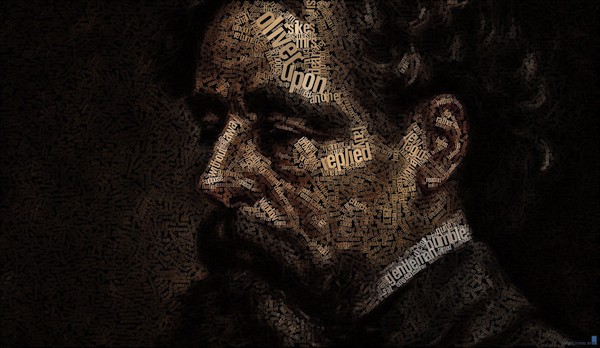
Artist Juan Osborne spins “you are what you eat” into “you are what you write” in his typographic portrait of Charles Dickens. Osborne counted the words from 50 Dickens books, including Oliver Twist and Great Expectations, and then used the most frequent to create his portrait. Below are Dickens’ most commonly used words, according to Osborne:
“oliver (868), upon (755), replied (548), bumble (399), gentleman (366), lady (359), sikes (357), dear (330), jew (325), fagin (317), sir (314), away (298), another (275), without (253), woman (229), poor (204), window (202), shall (192), heart (185), quite (181), child (177), arm (172), brownlow (167), something (166), returned (164), doctor (161), master (161), manner (160), whether (156), moment (153), observed (152), seen (150), london (149), sat (149), indeed (147), present (147), office (145), rather (145), bill (144), speak (143), expression (139)”
See Osborne’s other typographic portraits of famous figures here.
Let’s face the ugly truth: uplifting kids’ movies — the ones where elephants fly and turbo-charged snails can achieve their high-velocity dreams — are simply unrealistic. “Almost uniformly, the protagonists’ primary liability, such as Dumbo’s giant ears, eventually turns into their greatest strength,” argues Luke Epplin at The Atlantic. “But first the characters must relinquish the crutch of the magic feather — or, more generally, surmount their biggest fears — and believe that their greatness comes from within.”
The problem, warns Epplin, isn’t just that parents are being subjected to one formulaic plot after another, but that we’re telling kids that they needn’t be satisfied with a life of monotonous drudgery. (Spoiler alert: life is monotonous drudgery). But Charlie Brown, America’s favorite loser, knows the truth. Epplin points to A Boy Name Charlie Brown as a narrative that sticks to the appropriately realistic truth: if you’re a loser you’ll always be a loser, so stop worrying about it and kick that goddamn football.
Now, I love Charlie Brown, and I love whimsical narratives about hopeless perseverance, but when cartoon characters get too real it can be disturbing. For example, there’s a scene in Toy Story 3 in which the plucky plastic heroes are pulled towards an incinerator. Do they panic? Do they refuse to give up without a fight? Do they maintain hope? Nope. They just give up and accept death and wait for the inferno to reduce their lives and dreams to ash.
Maybe Epplin is right and kids movies are responsible for “a generation weaned on instant gratification.” But maybe that’s better than the alternative.
*** — Benjamin Samuel is the co-editor of Electric Literature. Yes, he watched Toy Story 3, because there was nothing else on Netflix and he doesn’t have to explain himself. Find him on Twitter.
Last week, we hosted a contest with Other Press for the best tweets fitting the theme of #FictionDates. The contest was judged author Elizabeth Cohen, and three winners received signed copies of her brand new collection The Hypothetical Girl, a book of digital love stories.
Below are the 3 prize winning entries, along with other honorable mentions (including Jodi Picoult!).*
Elizabeth Cohen, author of the collection “Hypothetical Girl” (Other Press), judged a contest for the best tweets fitting the #FictionDates theme. Here are the winners and other notable entries.
*Lolita references have been excluded, because, there were too many of them and they were all awful by definition.
DON’T MISS OUT
Sign up for our newsletter to get submission announcements and stay on top of our best work.
YOUR INBOX IS LIT
Enjoy strange, diverting work from The Commuter on Mondays, absorbing fiction from Recommended Reading on Wednesdays, and a roundup of our best work of the week on Fridays. Personalize your subscription preferences here.