Eisenberg got us started with a section from Screw Everyone: Sleeping My Way to Monogamy. Apparently, her last one night stand had a thing for stuffed cartoon cats: “Rob’s room was full of, and I mean covered with, Garfields.” Understandably, “the sight of this altered Jim Davis’s bedroom killed any sexy, warm, or even safe feelings.”
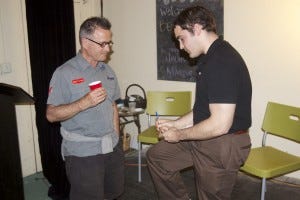
1. Dan Kennedy, “This is what a book looks like” 2. Fans John Mertens, Dan Vigliano, and AJ Wax
Then it was Kennedy lifting us up with some life coaching from his novel: “There is no reason to beat oneself up about switching to beer early in the day, as the prospect of getting back into jogging is daunting. Something is required to take the edge off. Drinking before noon [is] an OK thing, especially when it is fueling a man in an athletic way, or in a way that lets him realize his dreams.”
How does Dan Kennedy write ‘funny’? “I personally just try to capture the depression that frightens me… It’s usually me alone in a hotel or apartment feeling sad, alone and strange and weird. Then type I something out.”
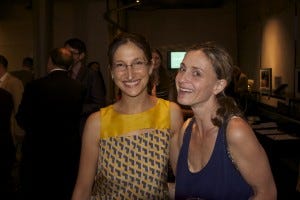
1. Le crowd 2. Pals Valentine Lysikatos, Dan TaufikSenior Consultant, Bridget Mcfadden and Gina Levitan
Kennedy asked Eisenberg, “How do you write a story from your life? There can only be one ridiculously hung dude with 50 Garfields on his wall.” Eisenberg said, “I do say that he is well endowed. That was all he cared about. He was like, ‘Thanks for the story!’”
And then there was the process question. It’s always lurking. So, what is Kennedy’s process? “I write like how I watch Netflix or smoke or any other compulsive behavior… Writing is the one bad habit that I have that leads to something.”
***
–Sean Campbell lives, writes, and occasionally updates his blog in Bed-Stuy
Last night the Authors Guild Dinner was held at the Edison Ballroom, an art deco hall off Times Square fit for Baz Luhrmann. Guests gathered on the balcony for cocktails and hors d’oeuvres (the bacon-wrapped scallops won my unscientific taste test) before heading downstairs for dinner.
After welcome remarks by Authors Guild Foundation President Sidney Offit and Authors Guild President Scott Turow, our host for the evening, author and comedian Andy Borowitz, took the stage. “Phillip Roth and me, people like that, were sitting around trying to come up with a theme for tonight,” he said, adding that ideas like “Amazon is trying to kill us” were bandied about, but everyone agreed that the evening needed good news. The good news for struggling writers, apparently, is in greeting cards. Did you know that Maya Angelou wrote for Hallmark? (It’s true, I Googled it.)
And thus Mr. Borowitz presented a few possible cards from well-known authors:
Samuel Taylor Coleridge: In Xanadu did Kubla Khan a Stately pleasure-dome decree: but since I don’t make that kind of dough, here’s a Christmas card me.
Dylan Thomas: Do not go gentle into that good night, old age should burn and rave at close of day; rage, rage against the dying of the light, and have a happy Mother’s Day.
Geoffery Chaucer: Whan that April with his showres soote The droughte of March hath perced to the roote, And bathed every veine in swich licour, It’s just five months till Yum Kippur.
Needless to say, laughter drowned out the sound of forks clinking against plates (a choice of red snapper or steak). For more information about the Authors Guild, including mission, history, and services, visit authorsguild.org.
– Halimah Marcus is the Co-Editor of Electric Literature. Find her on twitter @HalimahMarcus
Recently I had the great fortune to travel across America to read in some of her greatest independent bookstores. From Square Books in Oxford, Mississippi to Politics & Prose in Washington D.C., I spoke with booksellers who have been at this for decades. They have outlasted Borders, are hanging tough with Barnes & Noble, and are refusing to flinch as Amazon closes in on all sides. How do these underdogs keep on picking up yardage when the game seems hopelessly stacked against them?
A great bookstore can be, to borrow a phrase from Hemingway, a “clean well-lighted place,” in other words, somewhere bright and pleasant where people can pass their time. Many readers know the joy of spending an hour, or four, just browsing some well-manicured shelves. Whereas spending just two minutes clicking around in the Amazon Marketplace is liable to make you hurl a Kindle at the wall. (No, I have all those Loorie Moore books already. No, I would not want to read the new Norah Roberts instead! No, I do not want a Studs in Spurs wall calendar from 2011!)
But beyond fundamentals such as mastering the art of what Beatrice.com blogger Ron Hogan calls “The Handsell”, what are the top indie stores doing to stay relevant?
This month Square Books, in Oxford, Mississippi, was named Bookstore of the Year by Publisher’s Weekly and it’s not hard to see why. From just one small store in 1979, they’ve now expanded to three locations, all close in the town square. There is Square Books itself, which features two spacious floors of fiction and nonfiction, including an entire wall dedicated to the works of William Faulkner, who lived in Oxford for most of his writing life. Hanging above the staircase are signed photos of Ann Patchett, Michael Chabon, and many other authors who have passed through. Then there is Off Square Books, just a block away, dedicated to lifestyle books. Just around the corner is the original store, which has now become Square Books Jr., filled with children’s books.
To pay for all that footage, Square Books pulls in crowds of Ole Miss students, tourists, and townsfolk. Since 2000 they have produced the Thacker Mountain Radio Hour either at the store or at the local opera house, with live jazz and blues music from local musicians and short readings by authors from new books. Locals pour in to see the weekly show, and others listen in on Rebel Radio 92.1 FM and Mississippi Public Radio, reminded often to shop at Square Books whenever they’re in Oxford next.
At Greenlight Books in Brooklyn, events are held not just in the evenings for adult readers, but also during the daytime for parents eager to bring little ones out into the world for a sing-a-long. A stoic staff member stands outside to guard the legion of parked strollers and by the end of story hour there is hardly a child departing without new books in hand. Nearby Community Books also welcomes young readers, with a beautiful garden and a host of indoor pets. (Note, the cat does not like to be touched, but does like to tweet @TinyTheUsurper). And for those who can’t make it into the store? They’ll deliver locally by bicycle, for free.
Across the country at Seattle’s Elliott Bay Books, survival has been all about location, location … you get the point. Originally located near the waterfront not too far from Pike’s Place Market, the bookstore saw its foot traffic steadily decline along with the neighborhood. Even though it meant abandoning their original home of 35 years, they relocated uptown to the Capitol Hill neighborhood in 2010 and business has boomed ever since.
Down in Sonoma County, Copperfield’s Books has five stores to host events, but they also draw their readers out to surrounding local businesses. A Debut Dinner ticket gets you a copy of a book by a new author and a meal at a trendy restaurant, where the author reads and mingles with diners. Or you could go in for a Debut Brew at the local beer garden, where the storytelling goes down a lot easier than the free pint of local Russian River Sour Beer. Or if you would rather dress up than down, you can go to a High Tea, where Tudor Rose tea and scones compliment a lineup of “the very best female writers.”
Getting to meet authors is still a big draw, but with so many books and readers with diverse tastes, it is harder to find guests who’ll please the masses. So the Bay Area’s “liveliest bookstore” Book Passage, in nearby Marin County does (wait for it) 600 events a year, for readers old and young. In a single day you can hear a reading, take a French class, meet in the kitchen with one of their local “Cooks with Books,” and sit in on a memoir writing seminar. With that kind of frequency the locals know that whenever they stop by something enlightening will be happening. Book Passage has found success by becoming not just a store but a community center.
Tattered Cover in Denver has taken its role as the center of a community to new lengths. When, in 2000, local police arrived at the store with a search warrant to obtain records relating to books purchased by a customer suspected of methamphetamine manufacture, the owners of Tattered Cover refused to turn over their receipts. They fought the case, at great expense, for many years, taking it all the way to the Colorado Supreme Court where Justice Bender upheld the protections of the First Amendment.
That might seem a lot of effort to protect a possible drug manufacturer, but to Tattered Cover the bookseller/bookbuyer relationship is something sacred. As they stated to their community on their blog after a judge ruled in their favor, “Imagine if the government knew what books you were reading. Would you buy a copy of Al-Qaida: The Battle Against Western Tyranny, The Anarchist’s Cookbook or Mein Kampf? Fortunately, for those of us living in Colorado, this Orwellian scenario is only a hypothetical.”
No surprise then, that when the store moved locations a few years ago, dozens of people from the community volunteered to help them move their stock, one shelf at a time. The woman who hosted my event there told me afterwards that she doesn’t technically work there. She’s actually a local librarian, but she just helps out at the store whenever she can.
Nestled out in the mountains near Vail, I found The Bookworm of Edwards, where they join Colorado Mountain College and local libraries to sponsor the One Valley, One Book program, where hundreds of local residents annually agree to read the same book so that they can discuss it with more or less anyone they encounter all year. A similar spirit lives behind the Signed First Editions Club at Politics & Prose, in Washington D.C. which offers their monthly subscribers… you guessed it, a signed first edition copy of a new book. Not only do programs like these bring in a reliable stream of monthly sales, but they reach out beyond the local community to readers around the world. I signed copies of my own book (shameless plug alert) for similar programs at three different independent stores, each of which told me they mail books to readers as far away as Australia every month.
If it seems extraordinary that someone living in Sydney would sign up for a mail-order book club in Oxford, Mississippi, that’s because it is. The indie stores don’t offer free shipping (although neither does Amazon in Australia), and Sydney certainly has plenty of its own independent bookstores. But it speaks to the relationship that some readers can feel towards their hometown booksellers — even halfway around the planet, there are loyal ex-pats willing to pay more to sustain a vibrant reading community.
These outliers can’t sustain independent stores single-handedly, but they are an indication of the type of bond that can be forged when bookstores become more than simply marketplaces or showrooms. Yes, Amazon.com can sell you practically any book on the planet, and while you’re there you can order up a birdfeeder, a snow shovel, gourmet pasta sauces, a box of Cheerios, new wiper blades, maternity clothes… etc. etc. But can it tell you about this magical perfect book by a little-known Austrian author from 1976 that is being reprinted with a new forward by that contemporary nonfiction writer you totally love? Can you step inside and thank the guy behind the counter for the tip? Can you chat with him for twenty minutes about the brilliance of chapter three, and then stick around for a discussion group about challenges facing modern poets?
Not everyone puts books or bookstores at the center of their lives in this way. But to be a reader of any stripe, in an age of on-demand streaming video, is already a choice for a path of greater resistance towards potentially richer rewards. This is the promise at the heart of every book, and in the soul of every independent bookstore: this could be your classroom, your playground, your concert hall, your cultural center. So long as this promise is renewed, month after month, year after year, neither books nor bookstores have anything to fear.
*** — Kristopher Jansma is a writer and teacher living in New York City. His debut novel, The Unchangeable Spots of Leopards, was published by Viking Press in March 2013.
EXCELLENT POINT, COOKIEKITTY7, one that most certainly deserves serious consideration, but before I address it I would like to bring another matter — of equal, or, perhaps, even, yes, greater (!!!) importance — to the group’s attention.
First, though, let me say once again how happy I am to be here on this essential culinary site, where every recipe, opinion, viewpoint, and perspective is given the consideration it so richly deserves.
For this, I humbly thank you.
(THANK YOU!!!!!)
Tonight, friends, let us continue together in the grand tradition of online democratic society — rough, fragile experiment that it remains — in strict defiance of the forces dedicated to crushing it under the black boot heel of petty fascism.
Let us also say: welcome!
Welcome to all who have heretofore been shunted from society’s fellowship because of their ability (and willingness!) to express unpopular but prescient opinions clearly, forcefully, and — this is crucial — without apology.
Welcome! Let us begin!
First, I admit I have hinted at this matter in previous comments (cf. “Yummy Vegetarian Lasagna for Two”), yet I have always hesitated bringing this case fully to bear for fear of what scandalous rumors and/or slanderous opinions might have previously crossed your screens.
But now I feel so strongly that for the good of our collective endeavor this issue must be brought up that I am disregarding the personal risk to my reputation such attention-bringing might afford, and I am plunging forward because this case has such grave repercussions for us all.
Risking everything on behalf of it is perhaps still not quite enough.
Now, normally, I am as light and carefree as the law allows, but for the past few months this matter has brought me terribly low.
Let me lay it plain: I have been, by a childish and ignorant member of the online community, banned.
More: My input regarding Charli and Nico’s wedding is no longer even considered for publication!
I have no idea why, and no one will give me the courtesy of a proper response.
At first, I thought perhaps it was benign neglect, to re-appropriate a phrase, but I’ve since realized something much more sinister is afoot, so now — since I am no longer even allowed on Charlico.com — I am bringing this matter before you here on this august and humane recipe blog you call, surely in jest, BrendaCookingFun.com.
No doubt, scandalous rumors and libelous character assassinations have passed before your eyes, sent, as ever, by Charli and Nico’s “best man,” Chris Novtalis — that sulfurous toad, that young dullard, that tyrant erroneously allowed to be in charge of Charlico.com out of misguided goodwill or charity — but please hear me out.
I am just a citizen who wishes his voice not be silenced.
My banishment from Charlico.com has obviously been an immense personal loss for me, not only because I made so many wonderful friends and admirers through that site, but because together my cortege and I made great strides toward solving a number of problems of the world.
I know that sounds grandiose, but I firmly believe that, just as Margaret Mitchell once said, “A small number of devoted individuals can, in fact, change the course of history; indeed, this is the only thing that ever has!” — yes, in my case, just look at the record!
Take heed!
It is all by some miracle still on the site for the world to see, if only said world could stop pursuing vile distraction long enough to read and take note.
It is shocking to see such truths laid out in plain sight, I know, but it is even more shocking to see them ignored, though I have come to expect no less from the sad excuse for “society” we float through.
Lest you get the wrong impression, let me be clear that I am not so narcissistic or naive as to think you would consider my personal loss, great as it is, worthy of your in-demand time. Not because you lack compassion! No, don’t think I write tonight to insult you!
Fear not! Despite what you have heard of me, I am not that man.
No, you wouldn’t consider my personal tragedy of much importance because you are spending your time working diligently to solve what you see as the great problems we all face in this fearful and horrid episode called “life.”
Yes, but hear me out — my tragedy and the world’s are not so different. No, in fact, shocking as it may sound, I believe they are ONE AND THE SAME!!!
The exclamation points, I know, seem out of place or perhaps too much, but you see I’m quite an exuberant fellow, a joyful soul, really, and I can let my emotions get the best of me like a schoolgirl face to face with a succulent lolly, but it is all only for the greater good since, as I hope you’ll see, underneath the emotion there is cold hard reason, such that is missing greatly in this ill-begotten world of incorrigible ineptitude.
I have had so many — SO MANY! — friends and acquaintances tell me, at long last, that they see my point after all, and yes, it seems I was right all along, and had only exposed my solution with too bright a flash of rhetoric.
I am working on this admitted character flaw, but I hope you’ll agree that it is a relatively minor one, especially when it is often the reader’s own flaws that prevent him (or her!) from seeing my point.
A mere distraction, though. I’m quite likable, really.
In fact, I think we could be great friends if given the chance to meet, if I could be allowed to arrive at your very doorstep with a rose in my teeth. (TRA LA!)
But let’s not get too far ahead of ourselves.
You see, I would be perfectly willing to look past my own personal feelings of being slighted, abused, and wantonly rejected by this cruel and imagination-less “best man” if I weren’t able to see in my personal issue the problems of the world.
I, a humble man of limited means, alone in life except for a vast but distant group of online peers, simply wanted to put my modest writerly talents to use in service of gnosis.
Contrary to what you might think, the fact that my banishment has become the central topic of discussion for this particular wedding and its affiliated blog does not in any way cloud my thinking about the overall concepts at play.
I see the “big picture” despite the bride’s continued silence toward me (surely kept up on the advice of the groom’s brother, the wretched best man and moderator, Chris Novtalis, who fancies himself some kind of chivalrous knight instead of, accurately, a bilious nuisance), and in fact, I did not even seek out that particular blog but rather had it thrust upon me by fate and simple geometry.
Triangles and pyramids, my dears!
Natural shapes, true, though they are not nearly as simple or as ordinary as they first appear, especially when they manifest themselves in human relationships, as they do more often than one might expect, if one knows how to look.
The impatient reader here surely asks, “Fascinating, but how does this revelation lead in any way to the full-blown catastrophe on the previously mentioned wedding blog?”
Gravioria manent, dear readers.
Gravioria manent.
Allow me a brief reminisce: I once had a particularly contentious encounter with a confused and dissolute young woman I like to call My First Love, or MFL.
We do not (yet!) need to go into detail about MFL, but suffice it to say that in the years since this encounter I have desperately wanted to explain myself more articulately to MFL, as well as to see what might have become of her, how she has developed both emotionally and physically in the time since our memorable encounter.
Despite these dreams — and despite my dedication — I have had little luck tracking MFL down in the “meat space,” since it seems she refuses to register her utilities in her maiden name, nor will she list her phone number in the white pages of any conceivable locale.
Quite frustrating, yes, since I simply want to tell her that I misunderstood my role, lo those many years ago.
For reasons that seem silly now, it was, in the first few days of my unemployment, QUITE IMPORTANT for me to explain myself thusly to her, and my inability to find MFL began to cause me serious harm.
The dark folds began, once again, to smother and choke me.
But then — praise be! — fate intervened and my search for MFL became a mere prelude to this Charli matter.
Let me explain.
Since I had been given this gift of time away from employment, I embarked on a few long-delayed projects, including the aforementioned search for MFL, and one such project involved obtaining images of certain female politicians.
In the course of searching for a particularly choice candidate — one I will not name, for fear of giving her my unpaid endorsement — I came across a luminous image that was clearly A BOLT FROM BEYOND!
The image itself first appeared quite ordinary — “my” candidate waving smugly to a group of protesters — but in the background, in amongst this motley group, I spied a young brunette insouciantly waving a placard while staring directly into the camera’s lens with a kind of dégagé pout that could not but stir a proper man’s soul.
My eyes took in this young brunette — her gleaming doll’s teeth, her eyes done up in slipshod shadow, her rabbit nostrils midquiver, all on display in the background of this idiotic campaign shot — and I immediately felt as if I had once again fallen through a wormhole into the past, for, dear readers, this young woman in the campaign photo looked EXACTLY like MFL as I had known her twenty years ago!
Are you still seated, readers?
Yes?
Then, I have not made myself clear.
How can I accurately explain the singularity of this?
It’s not as if MFL had a common look — no, she seemed a one-of-a-kind beauty, a very particular taste, a young Ally Sheedy in a bulky sweater hiding quite an array of goodies — and so the idea that someone twenty years later would strike the same pose, cut the same profile, shock the same system…well, it might as well have been a narwhal leaping from a city sewer system to impale a passerby with its tusk.
What were the odds?
The odds were so improbable that the fact of this occurrence clearly indicated that the true structure of reality had been made manifest in our false world in order to tell me…what?
WHAT WAS THE STRUCTURE OF REALITY TRYING TO TELL ME?!?!?!
Perhaps, I thought then, slumped over my keyboard from mental fatigue, this young replica of MFL and I would have an opportunity to correct the mistakes of the past.
Perhaps, I thought, brightening, there may indeed be second acts in life.
Perhaps, yes, I sat up straight, I do have one or two adventures left in this dim interval.
Perhaps there is a reason I have been cast aside from the workaday world.
Perhaps I do indeed have a purpose in this new millennium!
I lifted my head from atop my keyboard, raised my fist to the sky, and yelled, “YES!!!!”
I made a personal vow then and there to investigate, for, if given the chance, I would do everything in my power to give this new young woman the benefit of my love!!!!!
Unbowed by the tracking devices surely installed in the search engine I am forced to use, I set to work with my detective skills and unsurpassed vigor to uncover the identity of this young beauty.
In no time — never mind how, ye cops! — I had a name: Charli Vistons.
And — in a blink — I had a Facebook page.
Wondrous bounty!
I deliriously noted her interests and affiliations, her likes and (implied) dislikes, all laid bare for the world to see like some streetwalker’s tawdry wares, and, dear readers, disappointment did not touch me, for Charli was not only the very image of MFL, but it seemed she possessed the spirit of MFL as well!
Salinger, the Beatles, Dusty Springfield, Harold and Maude, the Umbrellas of Cherbourg — it was all the same!
I felt the stars aligning after noting that Charli lived a mere hundred miles from me, a day’s journey, and she worked semipublicly “on campus” as a “Film Studies Teaching Associate” at my very alma mater.
Film studies!
It truly was all happening again!
I began an itinerary in my head, had gotten halfway down the interstate of my mind, in fact, when I saw — brutal fate! — that Charli was “in a relationship.”
Dagger!
What was this twist?
Worse, it seemed she was to be — ah — married.
And soon!
Samsara had seen fit to deal me yet another blow, eh?
I shook my fist at the ceiling, then out the window at the sky.
I rent my night garment (still worn from the previous night) and clawed at my chest.
After a few long minutes of this, I found I could not ignore my feelings any longer, and so in a flurry of clicks and scrolls I delved further into the life of Charli Vistons, obstacles be damned!
I saw, of course, that the young beauty’s fiancé was a rotund pud of a man named Nico, unworthy of her succulent charms.
I admit, this was more than a bit shocking — surely she could do better? — but I followed the chain duly, hoping to find some indication that Charli would not be throwing her life away, that perhaps her fiancé was handsome on the inside.
Sadly, he was just as dull and insipid, it seemed, inside as he was out.
Thinking Nico’s Facebook profile might offer a different and perhaps better perspective on Charli’s situation, I clicked on each morsel offered there until I arrived, finally, on a link to the dire and garish wedding website, Charlico.com.
I stayed there, despite the insult to my sensibility, in good faith.
Once there on the “splash page,” I felt I had sufficiently calmed down — I admit I can get carried away — and could accept whatever role in Charli’s life destiny assigned me: teacher, lover, admirer, friend.
I knew I could still help Charli — which, dear readers, is all I have ever wanted to do! — but I knew even then I must be judicious about my battles. I couldn’t simply heave myself headlong into her life.
That was, of course, the mistake I had made with MFL.
So, how to approach Charli?
Would her “wedding” really happen?
Was the whole thing as ghoulish as it seemed?
The hidden world does reveal itself to us, readers, if only we take the time to look.
I proceeded with my clicking, and, thinking I was headed to Charlico.com’s “registry,” where I could perhaps offer some consumer advocacy, I must have misclicked in a moment of inattention, for lo, I found myself unwittingly “on the blog.”
My browsing history reveals that this fatal act happened in the small hours of a Wednesday morning.
Immediately upon load of the Charlico.com/blog page, I became confused.
Society had clearly declared to me on numerous occasions that weddings were private celebrations restricted from public online discussion, and yet, here was a wedding website with a very public blog?!?!
Why?
Momentarily perplexed, the thought came suddenly that perhaps this wedding party wanted to discuss the issues!
Yes, of course!
That is why lovely Charli had a wedding blog!
For me!
Maybe there was hope after all, maybe, I said to myself. I could not only scrub my past clean, but also strike out anew with a joyous community!
Naively renewed, I dedicated myself to studying the behavior on the blog, cataloging the speakers, the arguments, and the ever-present rhetorical follies. It was a time of study.
The facts: Here were two young people without real jobs, prospects, or ideology, set to marry in the countryside out of, one assumes, boredom — an everyday occurrence, nothing special, and yet, I felt, in this case, it was somehow indeed extraordinary.
At first I couldn’t quite put my finger on why.
True, the principal players resembled some from my past, but I vowed not to let the Personal distract me from the larger issues at hand, for beyond the resemblances to my previous intimate entanglement (MFL), and despite the poor match between Charli and Nico, I felt there was the potential for something special here.
But what?
I continued my observations, and despite what you might think (and, I admit, despite what I initially predicted), I found the perspectives of the young people on the blog to actually be quite engaging.
In fact, after a time, I found them peculiarly resplendent with compassion, wit, and intellectual vigor.
Believe me, I was as surprised as you.
The more I read, the more I found in these voices a rare potential to bring into being a true haven, a shelter from the worldly storm of sorrow and strife, a space where a small group of forward thinkers could discuss the issues without society’s censors concealing them.
I had found kindred spirits dedicated to the free exchange of ideas, and I thought I could content myself by simply observing and taking note.
Soon though, it became clear the blog was missing a key element, a sagacity that comes with age that could activate the yeast, as it were, and bring the loaf of true thought into the world. The blog was missing my presence.
So, gingerly at first, I tried out my own voice in a meek little comment on a now-forgotten post (cf. “Alternate directions to the Clark House Inn”), and, gracious, I found that I was embraced!
Cousin_Kevin said, and I quote from memory, “It’s true that there is quite the ‘wedding industry,’ but I don’t think WE REALLY need to go on and on about it here, dude. Congrats, Charlico!”
When I read this response to my meager posting, I’m not ashamed to say it was one of the happiest days of my life.
Truly!
And so many wonderful days ensued of adroit badinage (I won’t deny that I took great pleasure in the back and forth) that I literally lost track of time, spending hours upon hours engaged in joyous debate with all comers — Linksys181, Cousin_Kevin, nico!, Emma_1, and, yes, even Chris.
Dear readers, it was then that I understood this blog itself offered the revolution I had been searching for. Why? Because this seemingly private blog offered FREE AND OPEN COMMENTS!
The personal is absolutely political, after all.
Of course blog comments in general, dear readers, are revolutionary because they allow for point X, which dilates our triangular perception from simple A, B, and C into the pyramidal realms.
Before comments, we all thought only in these paltry terms: “words = writer/reality.”
Now, of course, it seems comical to those of us in the know that anyone would live such a restricted life, but, dear readers, many still do to this day!
The words these ignorant saps read, the worlds they assume, are only bound manifestations of various writers’ consciousnesses mingling with reality, and so unwittingly these “readers” literally TAKE THE WRITERS’ words for it — “it” in this case being the very reality we drift through on a daily basis.
!!!!!!!!
As we know, comments change all of this.
On a blog with comments, the writer and his reality mingle to make the words as ever — but outside, on a separate plane, the commenter is THERE evaluating this mingling manifestation, weighing veracity and fidelity on the scales of justice.
And he will not keep quiet!
No, the true commenter alone advocates on behalf of reality unbeholden, and so now, with comments, we have a new equation:
(Words = Writer/Reality) COMMENTER
And thus a new, expanded universe!
The true commenter takes nothing at face value but remains intractably, joyously skeptical of any purported reality.
Of course, most commenters don’t take advantage of this coveted position.
Most commenters simply parrot the writer’s version of reality with hopes of some condescending pat on the head — sad! — but the form itself is revolutionary, for even in the seeming non sequitor spam comment soliciting consumers for penile enhancement, our conception of reality has been, yes, enhanced!
And so, in this spirit, on Charlico.com/blog, I saw suddenly how I would be able to enhance this wedding party’s reality.
If allowed to reach its full potential, the blog and its commenters could be, I thought, yes, a harbinger of beautiful things to come, for I saw quite clearly that the wedding blog’s comments existed for me, in order to facilitate my role within Charli’s life.
The comments were a gift from the gnosis, delivered so I could have the opportunity to not only be of use to the young, but to cleanse my soul of clinging problems of the past.
Thus, with hopes high, still unaware of the pyramid’s exact dimension or how exactly I would perform, once again, the role of point X, I began my initiative.
Happy?
Yes.
But even in those delirious hours, despite my happiness, I sensed a lurking evil.
Something was not quite right.
It was as if, hidden beneath the floorboards of our meticulously constructed yet still tenuous shelter, the carcass of some dead mammal sat decomposing in a riot of flies, maggots, and brainy juice, out of sight of casual onlookers, threatening to undermine with its rot whatever foundation might have been established above.
How could I tell something was wrong?
Easy.
After every true comment I made, a snide, mocking tone emerged from the false commenters in response, first from just one, then from another, and then commenter after commenter began chortling at my (correction: our) earnest striving toward a better tomorrow, as if I/we were a kind of amusing mascot rather than a sage.
Being a sensitive sort, as well as a seasoned hand at online discussion, I did not simply “let it go,” as I have often been advised to do.
Oh, yes, how many times have I been told to ignore my feelings, bottle them up, and simply skip on down the path to another web community.
I can even hear you now — “Web community? What about life away from the computer? A family? A garden? Go for a walk! Ride a bike! Get away from the screen!”
You can never know it, but how cruel such remarks are to me.
You see, I cannot.
There are reasons, even those besides the fact that when I do journey to different web communities I feel — no, I know! — that the impetuous twerp Chris Novtalis is on Charlico.com/blog working away to undo all of my efforts.
He’s fanning the flames of rumor, innuendo, and, yes, a legal term is necessary: defamation.
He wouldn’t have an online community — a reason to live? — if it weren’t for me, but he goes on day after day taunting me.
He deploys the letters of my name in muddled anagrammical jibes at my character, he reworks my carefully wrought language in pathetic efforts to take credit for my ideas, and then, of course, he makes direct attacks on my good name and character.
Chris, this peasant of a man, telling his vast and undeserved audience that I am “psychotic” and “boring” and “not even a part of the wedding.”
Boring! Is that a capital offense now?
God forbid I would bore such a fertile mind as that bloodsucker has!
Boring!
From such a racist, sexist, classist, ageist Neanderthal I suppose I should see that as a compliment!
But, alas, I cannot.
I see it for what it is: a base and degrading insult from an inferior.
Do you want to know what happens when I try to “move on,” as you suggest?
Do you?
Well, I’ll tell you.
I get heart palpitations.
I get night sweats.
I’m sure I run a fever (though I haven’t confirmed due to a childhood trauma involving thermometers).
A heavy, static-filled succubus sits on my neck, jams its arm down my throat, and stops up my breath until I force myself to go to the computer to see what vile filth is cascading down the corridors of the internet unchecked while I’ve been away.
And every time, I find that I am right! There it is! It is ALWAYS there — and worse than I imagined!
Hear me out: Like everyone else, I wake up each morning. A deceptively simple phrase, true, but what a gift! I am grateful!
This morning, for example, in the dank June air, consciousness broke over me like a pane of glass, and for a few minutes I felt free and clear of strife, anxiety, and horror.
I thought I might take in a film or eat a nice apple, work on a screen or teleplay. In short, live my life. But then, I remembered.
I thought of the putrid excrescence spewing out into the world as I was lying there, and so I lurched from my cot to my desk and I turned on the computer.
Horror! Filth!
I admit, because he is a crafty little devil, sometimes I think of the runty, Skittle-brained moderator and chuckle, Oh, that’s all he’s got?
Sometimes I even leave the room, go buy my meager rations (as my submitted recipes indicate, I cook everything in my coffeemaker — instantly! — oatmeal, polenta, Tasty Bite Indian cuisine, rice; it’s an ingenious system, if I may pay myself that compliment, and quite cost-effective considering my “condition”), but while I’m out a phrase or even the subtle implication of a phrase inevitably comes crashing back into my mind, where it festers and oozes until I’m back at my “desk,” blinded by fury.
I’m surprised I can even type. But type I must! And what does he want? Finally, what does this goon want?
Only the complete annihilation of my person, my history, and, I suppose, my ideas.
I believe he would kill me, given the chance, and so I am justified in my actions because it is a fight to the death. It is truly either him or me, and I am not one to back down!
Why does he hate me so?
Because I know that he has plans for the bride.
Shocking?
Yes.
Quite.
But you should know that I don’t level this accusation lightly or without merit. I know, because I did not let it go. No, I began to investigate further.
As many of you know, I soon pulled back the floorboard in question and uncovered the stinkmaker, the sock-puppet handler, the chortler, the fascist, the overweening point C of the love triangle:
Chris Novtalis!!!!
Assassin!
Yes, I was as shocked as anyone that it turned out to be the best man and wedding BLOG MODERATOR, who, I might as well make it plain again here, had (and has!) plans not only to degrade the idea of marriage, but to ravish the bride, Charli, and destroy her happiness with lusty violation in flagrant delicto!
Those who do not study history, etc.
I know at first you will doubtlessly find it at best curious that someone with coital plans for the bride would be such a vocal cheerleader for a marriage involving, primarily, his brother, but don’t let the blinders society has saddled you with restrict your reason.
Remember the basics of geometry, my dears, for Chris surely does.
He wishes to assume the role of C, to shoot his line straight through Charli’s B, obliterating Nico’s A.
Squirp is the horrendous noise I imagine this act making.
Squirp.
Squirp.
Squirp.
Over and over again!
For you see, Chris does not wish to expand the triangle into a pyramid, but rather to reduce it to a fascist line.
Clearly, Chris wants this marriage to go forward simply so he can have dear Charli close at hand, as part of his “family,” and thus within his filthy reach in order to violate her repeatedly and at will behind the back of his sad, pathetic brother Nico (point A).
This would, of course, simply be hurtful toward Nico and destructive to Charli (i.e., none of my business), if it weren’t symptomatic of the larger issues at play.
Proof?
My word is not good enough for you?
Well, I can’t blame you, since most of you aren’t aware of my record as online justice-seeker and truth-teller, so how about this, an e-mail I received from “Charli” soon after my campaign began. I present it here in toto:
Hello,
I don’t know who you are, or why you write the terrible things that you do on our website, but I’m writing today to ask you to please stop.
Please do not comment anymore on our blog. It is hurtful and destructive. Please. Just stop.
You’re a writer, a real one, and I respect your gifts. As you know, I’m a writer too, and so I know what it’s like to be misunderstood.
I’m guessing from what you’ve written in the comments that you feel like you aren’t in control of the narrative of your life. People — on our blog, and I’m sure elsewhere — accuse you of being a number of things you swear you are not. I believe you.
But I have to tell you: your writing only makes it worse.
This is hard to understand, I know, because it’s clear that all you have ever done is write in an attempt to give shape to what you’ve called “the lurching chaos of our time.” You say you’ve begun to feel like “an emptied-out version of what you had hoped you’d be,” and I don’t doubt it. But this is not the answer.
I’m sure you don’t believe me when I say I understand, but maybe I can prove it to you.
Years ago Nico read hurtful things I had once written about him in my journal. I was trying to weigh the pros and cons of staying with him after a fight, and I wrote down thoughts I would never say aloud in an attempt to understand my own muddled thinking. Nico read these thoughts — never mind how — and our relationship nearly didn’t recover. In fact, to this day I’ve felt only dread and paranoia when I’ve written anything down — even this e-mail — worried I’ll somehow hurt him again without intending to.
To make matters worse, for some reason Nico showed his mother what I had written. This woman is soon to be my mother-in-law. When she finished reading she said, jokingly, to Nico: “I’m not sure I should’ve let you shack up with that bitch!”
You see, I was misunderstood. Just like you.
Or how about this:
A film studies student of mine who was upset about his grade put e-mails I wrote to him up on his blog — along with pictures of me taken from my friends’ public Flickr accounts, some of them in my bathing suit. Other former students of mine, all male, wrote terrible, hurtful things about me in the comments, but what could I do? Write in and tell them to stop looking? Of course not. Sometimes, you have to just let it go.
I’m begging you, as a sympathetic friend, to please do just that. Whatever has caused you to latch on to us, please, just let it go. Please, please leave us alone.
Sincerely, Charli
Well, dear readers, I must tell you this ruse nearly worked. I felt touched in my very soul by these hysterical words, ashamed that I had caused Charli to feel further misery when all I had wanted was to love her. So much strife! She sounded deranged!
Had I caused her so much trouble merely by commenting?
My god!
But then I thought, Isn’t it CONVENIENT for her to have had so many similar experiences at her fingertips, ready to be deployed at just the right moment? Isn’t the language employed to convey these feelings a bit too deranged and yet still precise? Isn’t this e-mail a bit too, dare I say, mannered?
Yes, of course it was!
Because it wasn’t Charli at all!
It was Chris himself who must have sent this epistle from Charli’s account!!!!!
It was the only explanation, since I know she couldn’t truly want me to stop enlightening her.
Nice try, scoundrel!
I copied the false letter in its entirety and posted it on the blog for the community to see, and just like clockwork I received the following note from Chris, the Charlico.com/ blog “moderator,” whom I’m sure must have been appointed to his position on a day in which the bride was too overtaxed to see he is, in fact, retarded.
Now, don’t take offense — I don’t use the word “retarded” to put down the disabled but rather to illustrate in the most succinct way possible that this horrid cur is malformed, that something must have gone wrong very early, in the womb perhaps, or even in the very first coupling of dna strands; a fateful deficiency of protein or glucose caused him to take on that slack-jawed look, that high slope of forehead, and that squeezed-melon of a skull.
How sad his mother must have been when she beheld him in the nursery!
I don’t doubt she considered heaving such a creature into a dumpster on her way home, or smothering him with her begowned belly whilst still in her hospital bed.
And if she had! How we would have been so happily spared such trouble! ☺:
Hey ***hole,
**** you, you ****ing piece of diseased intestinal waste.
Fun time is over.
If you publish one more comment, send one more e-mail, leave one more voicemail, contact me, Nico, Charli, or anyone else in the family in any way again, I will ****ing kill you.
You are a sociopath.
Seek help.
If I see you on the street — ever — I will push your ****ing teeth in with the heel of my hand.
I will rip your nostrils out with my fingers and shove the little flaps of skin down your throat until you choke.
I will cut you from your ****** to your scalp with my **** and **** in your chest cavity, you *******.
**** you.
**** off.
Die.
— Chris
Oh my!
I am aghast even to cut and paste such filth into this post.
I vow to, as far as I am able, keep my comments free from the language implied by the asterisks, but you see I must give you a sense of what I’m up against.
You need to be shown the truth so you can see how troubled your own online endeavors — your life’s work — might be at this very moment!
For if any of you are sheltering or employing a wretch like Chris, let’s be clear: you are abetting criminal activities that will not go unpunished.
I mean, my nostrils!?
I believe, dear me, he would, too!
How was this person given any authority at all?
The mind reels.
I know I should go to the police with such a threat, and no doubt that is what you will advise me to do — or may even be doing yourself at this very moment — but please, hear me out.
The police?
I do not want the police.
Not yet.
It is possible to solve this without getting the State involved, though I am, of course, keeping all the correspondence from this sorrowful episode on file, just in case.
I have found records such as these useful in the past.
In fact, it is thanks to my record keeping that I was exonerated, officially cleared of any wrongdoing, in that infamous case years ago with MFL, which I may have occasion to revisit with you at some point in the future.
Rest assured that those points A and B got their comeuppance — and more! — once I was released from the hospital (C got his, of course, but I was not at fault).
In fact, there are a few choice details from that affair no one has yet turned up, and if the time is ever right and you turn out to be the compassionate and trustworthy compatriots (or compatriotesses!) I assume you to be, then I daresay I will let you in on it.
My word!
I’ve gone off again!
I must be subconsciously trying to distance myself from those hateful and poisonous attacks sent to me before and quoted above (defecate in my chest cavity? That does NOT sound sanitary☺).
But — Chris’s words — there they are.
As frightful as they may be for you to look at, think of me!
I have to live with them!
A man is never a prophet in his own country.
I believe this is the saying.
But what of a man with no country?
Might he be recognized as a prophet simply because he has no local pharmacist, no chauffeur, no passel of gossiping ladies to destroy his reputation from inside out?
Sadly, in my case, it seems I am not to be recognized as a prophet anywhere but scorned forever everywhere, even after my detractors see the light and come to accept — embrace, even! — my ideas.
All continue to shun me as if no one had thrown the cold water of reality and reason on their fevered brains.
But not just reality and reason, passion and wit too!
The Lit List is a sometimes-weekly compendium of New York’s finest literary events and readings. All events are 100% free unless stated otherwise. Something you think we should know about? Email dish@electricliterature.com
It’s also BEA week in NYC, which means that your liver and brain finally go on that week-long bender they’ve been promising you for the whole year!
Tuesday, May 28
Christine Vines invites you over to 2A to see 50-foot projections of Teju Cole, Fiona Maazel, Aryn Kyle, and Jessica Soffer on a wall behind a taco cart. Something she calls Fiction Addiction. 8PM
Dan Kennedy, of The Moth fame, launches American Spirit at PowerHouse Arena at 7 PM.
Housing Works throws “Yes is the Answer: Prog NYC BEA Party 2013” at 7PM, with Rick Moody, Charles Bock, Wesley Stace, Rob Roberge, Marc Weingarten, and more. Readings, signings, and music.
Wednesday, May 29
“The IM Readings” at Happy Ending Lounge at 7:30PM. Their tumblr promises Moses’ tablets and the Guttenberg bible, but, curiously, mentions nothing about emojis. Ancient emojis perhaps?
The lit podcast Bookrageous is throwing a huge BEA party at Housing Works with Nathan Larson, Rosie Schaap, Sarah Maclean, and Teddy Wayne. The store is staying open until 10PM with lots of free drinks, raffle tickets, and nicely perfumed book people. Starts at 7.
Thursday, May 30
Elliott Holt appears at The Center for Fiction to discuss her debut novel, You Are One of Them, with some guy named Michael Cunningham. 7 PM.
Friday, May 31
Karen Green is at 192 Books to launch her novel Bough Down. The description: “In this unusual narrative constructed of crystalline fragments of prose interspersed with miniature collages, Green conjures the urgency and inscrutability of a world shaped by love and loss.” Yep. 7PM.
Saturday, June 1
Enclave Reading Series Spring Finale: Jessica Hagedorn, Michael Cunningham and debut poet Angelo Nikolopolus at Cakeshop from 4–6 PM. Cool!
“NY ❤’s NW: A Backyard Reading” at Unnameable Books with Joseph Riippi, Kevin Sampsell, Dawn Raffel, Matt Nelson, and Polly Bresnick. 8PM.
Aside from his well-known gig as the host of the popular podcast and live show The Moth, Dan Kennedy is also the author of two memoirs and a contributor to GQ and McSweeney’s Internet Tendency. His first book, Loser Goes First, is a trek through Kennedy’s adolescence and early adulthood, often citing awkward situations with employers and ex-girlfriends. By contrast, American Spirit, which launches May 28th, turns some of Dan’s real life friends into characters. While it’s fiction, “the stuff I had to make up is obvious,” he says.
I met Dan at a Moth party at the Moth HQ in Soho when the show became a national radio broadcast, and tried to find out the backstory to his satire “The Real Housewives of Beverly Hills: Season 99” on McSweeney’s Internet Tendency, a satirical short parody of the reality show, “The Real Housewives of Beverly Hills” set in an apocalyptical future. But parties being parties, I didn’t hear as much as I wanted.
Months later, we sat in his favorite corner (the far back right) at “S’Nice” in the West Village, where we discussed satire, storytelling in the digital age and American Spirit.
EL: Your book comes out at the end of May. Are you doing a live performance [like you would at The Moth]? Going on tour?
Kennedy: Oh, I tour it up.
EL: [Laughs] Oh, you tour it up?
Kennedy: There’s a reason there’s always a tour. I don’t really know what happens to me, but it’s like a cross between like a funny reading and an anxiety attack. Like, a low-grade anxiety attack. And a Moth show. A combination of those three things. It usually takes place at a bookstore or a club.
EL: You mentioned that you were introverted, but that you have this onstage presence that’s the opposite — [Laughs] you’re making this face! [Dan furrows his eyebrows and pouts his lips] Do you feel that having this introversion affects the way that you present on stage, or the way that you come out, or are you all not that introverted?
Kennedy: You know, I’m really introverted and it’s not a shtick, and when I used to hear performers talk, or writers or anyone who does anything public, talk about how shy they can get — I saw someone recently who literally gave me a flyer and he was like, “Hey man, I’m doing a show about my shyness,” and I was like, “What the fuck, seriously? You’re doing a show about your shyness? This has all gone too far. We should all just quit.”
But, I mean I get really nervous, but I’m very comfortable. It’s weird. I’m nervous about the idea of doing it. I say yes almost habitually, for the last 13 years, I’ve just said, “Yes. Just book it, just book it, book it. And, send me where I need to be.” And I’m always surprised that I said ‘yes,’ or scared that I said ‘yes.’ It’s something I can do, and it’s something people tell me I’m good at, so intellectually I’m like “This is obviously a psychology sort of con-job that you’re doing to yourself to get freaked out, because literally you’ve done this over 1,000 times.” You know if you’re nervous and excited before you go on that you’re going to be better or [that it will be] worth the money. Although this bookstore thing is free. So I should really rethink this whole thing. I guess they buy a book?
EL: You would hope. What do you think makes TheMoth so successful at this day and age?
Kennedy: I used to say that it was finally having a chance to speak uninterrupted for five or ten minutes in New York City, and everyone was like, “Fuck yes! Sign me up!” But now that we do shows all over the country, and all over the world. I just think it’s what people do. I almost don’t even think The Moth is popular, so much as The Moth just decided to give a place to do what people do. That’s all it is.
As soon as people see the show or take part in the show, they’re like, “Oh, right, I’ve been doing this my whole life.” And I also think it taps into something — as corny as it sounds — I think it taps into something really hugely loving. I’ve just never felt anything like it. Just sitting in a crowd, not even being on the bill, or hosting, or just going to a show, or being on stage, it’s amazing to say something, hear people laugh, and look down and it’s not like fool laughter. It’s not like, “Oh, we’re all really hip and we’re laughing at the hip thing you said.” It’s like, “Oh my god, all of our families went camping together, this is so awesome.” It seems somehow sweet and really wholesome to me. I never thought I’d say stuff like this. It’s like that version of yourself you are when you go to your friend’s house for Thanksgiving… to their family’s house for Thanksgiving, but they’re your friends and they’re cool I’m not saying this really well.
See this is an example of being nervous. I’ve done a lot of interviews, and I can imagine a million clear concise things to say, but when I actually do it, it’s like, ah fuck.
EL: I think you’re doing great.
Kennedy: Yeah it’s okay. It’s normal. It’s not normal, but…and it’s funny. I see certain people that I’ve known through the years that have gone on and done certain things and they’ve been on sitcoms, or they’ve been in movies, or they play way bigger stand up shows now, stuff like that, and it’s funny because there’s this part of me where I’m like, “Why aren’t I doing that?” and then there’s this absolutely honest inventory where I go, “Because, you would never, you would literally not say, ‘yes’ to showing up and trying to act happy.” There’s footage out there, somewhere, of me out there of me standing on the Total Request Live set, trying to sound excited about introducing a pop video. And, that’s really the only answer that there is: the nervousness is genuine. But it’s also weird too. I feel a little bit of suburban shame. To get all those people here tonight, and then talk.
EL: I think that those people gather because of that sense of compassion, or whatever it is that you’re describing.
Kennedy: It’s amazing at this point. The Moth was the only family I had in New York and I just clung to it. And now it’s weird to go different places, to go all over that country, and have that feeling that you’re around people you really like or that you’re your best self with. There’s a huge like therapy or rehab component to what we do, somehow. I don’t know how. But everybody gets up there and shares the shame and laughs and feels better or talks about something that’s not necessarily funny. You feel a lot lighter.
EL: Are there any horror stories from The Moth? Have you gotten into fistfights?
Kennedy: No, but it’s really weird you mention that. I’ve been waiting to get in trouble for a really long time. For like, 15 years, ever since I first started. I’ve probably only been seriously been doing this for 10 years. And I’m always waiting to get in trouble. Sometimes I think someone will just hit me in the face. When Rock On came out I thought “I’m going to get sued for seven figures by Warner Music, I’m just going to, I know it.”
EL: Well, you can always hope. I really liked Loser Goes First. Your stories aren’t controversial, they’re universal … that sounded silly.
Kennedy: We both have subtitles underneath us right now about what we think we sound like right now, so it’s okay.
EL: It’s an honest account of who you are. You’re not trying to be a fictional character, and you’re not superimposing some other idea of what you think you should be. It’s actually what happened. I don’t know if there’s any hyperbole in there…No?
Kennedy: That’s the most beautiful part.
EL: I think it’s impossible to get flack for putting who you are out there in the world. I guess people do get flack for memoirs, but you’re not in charge of the Iraq war…
Kennedy: I think it’s somehow to me comforting to know there are a lot of people that hate what I do. When you first start, you think, “Well it was in Entertainment Weekly, I guess everyone likes it!” There’s this weird dumb precious sort of young thing. But then it becomes comforting to know that some people are like, “Dude, fucking whatever.” And in a weird way, I’m like, “Yeah I know, sorry, want to go out after this?”
EL: Back to writing satire for McSweeney’s…
Kennedy: Wouldn’t that be funny if you just got everything on purpose a little bit wrong, just to shake me up: “Back to writing your science fiction for Miss Sweeney, I believe, is the name of this site.” And then I’m like, “No, it’s actually called…”
“So, you’re in a play about the Mothman? Mothman or something like this?”
“Uh, no, it’s actually…”
EL: [Nods yes] You wrote “The Real Housewives of Beverly Hills: Season 99” in a hotel room while you were watching the reality show imagining how it would eventually spin out 100 years in the future. Is all of your satire that spontaneous? Were you angry when you were watching that show?
Kennedy: Just about everything on the McSweeney’s site is urgent and spontaneous, and usually in an attempt to feel better or in the fear of depression. I’m an addict — I don’t do drugs anymore or drink or anything, but if something bad comes along, like that show, I start off just trying to do a little bit of it and then it’s 5 a.m. and I’ve done a lot of it. And I get sad. It sounds weak to say sad, but it just broke my heart that people were being that way to each other.
It’s the alcohol too that gets me down in that show. Don’t you understand that maybe you shouldn’t be drinking if you drink gin in a car and then strike someone with your hand because you don’t like them — in a limo? I’m like, “It could be better for both of you.” And then I told my girlfriend about it, “I was in a hotel while I was out, I watched this show and you know this is just bad, it’s getting out of hand, something is going to happen,” and then she said one of the guys killed himself. That was years ago. And then other times I just laugh and flip off the TV and say that’s not sad, those are fucking rich white people that drink too much. Sad is babies being born with cancer. And the other thing is, a lot of these little satirical indictments that I write don’t come from my best self, I don’t think. In “Pleased to Meet the Facebook Version of You,” I’m the Facebook version of you. I’m full of shit. I’m completely flawed. I’ve made mistakes and I want people to think of me in a certain way. I’m exactly the person that I appear to be railing against. Jesus. I’m sad now.
EL: Okay, so let’s go back to, are there any stories…?
Kennedy: Let’s go back to why you’re flawed…
EL: [Shakes head no] So there really are no funny stories from The Moth? I find that really hard to believe.
Kennedy: That’s great, that’s great. “So you don’t really have one interesting anecdote about all this shit you do? It’s just a bunch of self-important stuff like you were just blabbing?” Ah, pretty much.
EL: [Laughs]
Kennedy: Funny stories, yeah there’s always a funny story. Let me think.
A guy fainted like a sack of potatoes and that kind of freaked me out. Like, I was on stage, and I just came back to sit down, and Jennifer Hixon, my producer and I, used to sit in the front of the side of the stage, and we always invited people up to sit, since it was so packed, to sit on the side of the stage with us in chairs. I was saying something, and then I was done, and I sat down next to Jennifer, and I felt this large, I don’t know what it was. I heard this commotion and then stuff fell against me, and then it was a man.
EL: I just realized there is a dead fly in the middle of the table.
Kennedy: Is it dead? I hope it’s not just sleeping. So that was weird. I’m sure I’ll think of something as soon as I lie down in bed tonight, “I can’t believe I didn’t say anything about…” but there’s always something. I’m just trying to think of what. Let’s pause and think of what.
[Pause]
There used to be a guy at the Nuyorican, Miguel, who would echo me, this older gentleman, and he’d bring merch for the Nuyorican, and he would set it up on the end of the bar, and then just proceed to drink. He was hilarious; he was like a Puerto Rican version of the old man on The Muppets. I loved it. It was the best heckling on the face of the planet. Sometimes, I’d just go back and forth with this guy for what felt like an eternity. Essentially it’d just be this weird moment for us, having this strange conversation back and forth over the heads of 200 people.
EL: In American Spirit the characters are sort of morphed from the real life characters you know. Can you describe that process?
Kennedy: The last nonfiction thing I did was a few years ago. I went and stayed with my parents, kind of on a dare from my editor, for 30 nights straight. And I loved it. That was the trick, it was this weird twist that I loved it and we’d all wake up in the morning and read Reader’s Digest together. We were reading the workplace humor column in Reader’s Digest over oatmeal, and it occurred to me that none of us had jobs, my mom my dad or me. I was like, why are we reading workplace humor? I wrote about that, and it came out in the magazine, and they had a big photo shoot at my parent’s house. Everyone was really sweet to them, and that was really nice. But there was a certain aspect to that where it just felt really weird. It just felt like, this isn’t right to drag people you love into this stuff. My mom hasn’t had time to get used to seeing her face in a magazine on a newsstand. It’s a little shocking to everybody. I don’t want to do that to people that I love.
When I first started thinking about writing a novel, I thought, “All this stuff on McSweeney’s is fiction, you’ve been doing this for a really long time.” So, I just came off this period of my life, a bunch of stuff just collided. I had never really traveled that much before in my life. It was a year I was gone a lot. I was everywhere from an island in the Baltic off the coast of Sweden to working in a record store in the Midwest for a month to report on it. It was a crazy year and I had a couple friends, I was at an age where I had a couple of friends that got seriously wealthy off of Wall Street and the Internet, during that boom. It was freaking weird, how do you adjust to this? It feels like all your life you’re 19, 20, 21, and then all of a sudden you wake up and you’re like, some of us are in movies now, and some of us made a killing in tech. We’re like grownups now I didn’t have anywhere to tell these stories, and I didn’t want to drag my friends or write about them very directly.
EL: Protect the innocent.
Kennedy: I mean the stuff I had to make up is obvious.
EL: What do you think is the most profound change for storytelling in digital media and you can’t say the Internet?
Kennedy: I’d say personal computers.
EL: [Laughs] Most profound change in storytelling in digital media.
Kennedy: Somehow there’s a new currency, when we’re having a sandwich. We feel the need to let 4,000 people know that. That’s kind of odd. I think that might be the biggest thing. On a less cynical note, there’s a really beautifully written obituary, and it went crazy on social media. His daughter wrote it, and it was a beautiful, funny piece of writing. Heartfelt. That might have been a rousing story at a dinner table for that young woman, x number of years ago, and now it’s the sort of thing where, it goes up on her site, her Tumblr or something, and then the next thing you know, millions of people are passing it around because it’s good, and heartfelt and deserves to be read.
EL: Are you implying that this currency is good and bad?
Kennedy: It is weird. Twitter, I love Twitter. I’m addicted to it and I love it. But it is odd too.
EL: I know that they hire people who have over 1,000 Twitter followers. At agencies, there are certain requirements that you have to meet socially before they look at your application.
Kennedy: That’s ridiculous.
EL: Followers are money now.
Kennedy: That’s the dumbest barometer of a person’s effectiveness.
EL: I agree, because you can buy 1,000 Twitter followers right?
Kennedy: I have 4,500 twitter followers. In terms of a hire, if that got me in the door, and they ask, “Well, why did you have that many?” “I say stupid shit at four in the morning.” “Welcome aboard, we have high hopes for you, guy that says stupid shit at four in the morning.”
EL: [Laughs] I don’t know. A lot of brands are into that. Because it’s like instant sharing, if you have a million followers, even if it’s funny or stupid. Have you seen brands that hijack hash tags?
Kennedy: But you know, a cool thing to say happening too, this was the one thing I was going to say, that’s brilliant is that it’s self-policing, which I love. I think The Moth kind of shares that. Like everybody says how do you make sure the stories are true, how do you make sure the people are good, how do you make sure this and that The community does that itself. Everyone wants to be good, and everyone wants to be true. No one really tolerates the stuff that’s the antithesis of what they want to experience in that community.
Social media is pretty funny too. The other night, Capital One credit cards — it was like three in the morning — promoted a tweet in my timeline that said, “Retweet if your team is still dancing” and then it had was a picture of a basketball and a megaphone. And I didn’t really know what that meant, but it was literally Capital One. So I replied, “Re-tweet if you understand that it takes a person 22 years to pull off just 2,000 dollars of credit card debt making minimum payments at 18% APR.” I expanded the conversation to see what other people were saying, and they were saying, “I hate your credit cards and I’m quitting your bank.” If you’re doing it for that reason, it’s so hilarious, it’s like the square detective that’s in a club like, “Hey, can I buy a marijuana? I want to get down!” People are just like, “The fuck? Get out of here, man.” Love that.
***
— Haniya Rae is the assistant art editor for Guernica, and writes about media and advertising for Digiday.
At this year’s The Common in the City celebration (hosted by the Amherst, MA-based journal and held on the seventh floor of NYU’s august Arthur L. Carter Journalism Institute), commoners and royalty alike gathered to hear live jazz, bid on justifiably-pricy artwork, and listen to André Aciman read from his new novel Harvard Square, a novel that speaks to the intersection of place and identity.
1. The Common Editor Jennifer Acker, contributor Amy Brill 2. Beats: NYC Hot 3
Aciman — who’s published both fiction and memoir — opened with a note on his uneasy relationship with autobiographical writing. “Once you write something,” he posited, “you don’t know if you made it up or if it happened.” His excerpt introduced listeners to the conman-like Kalaj, who, says Aciman, has no education but is “an encyclopedia of notions.” With a keen ear for the well-crafted rant, Aciman charmed the crowd with Kalaj’s manic take on American exceptionalism and excess, with our mad needs for what he calls “jumbo ersatz.”
1. Matt Weiland, Paul Morris & André Aciman 2. Emma Patterson, Jody Klein (Brandt & Hockman) & Maya Ziv (HarperCollins)
The line became the night’s de facto catch phrase, but the party’s tone was one of humility and community, not hubris. “One odd thing about the lit world is that you can work with people for many months and still never meet! An event like this confronts that,” said Sonya Chung, The Common’s Associate Editor. “It’s an odd challenge, especially for a publication so focused on place.”
***
–Jake Zucker is the Editorial Assistant for Electric Literature’s Recommended Reading, and wears sunglasses on the net.
“The Bennett Sims we have here tonight,” warned Emily Pullen, manager of Brooklyn’s WORD, “is notthe Episcopal bishop from Atlanta in the seventies… If he was, we’d have our very own undead specimen.” Double-tough luck, then, for zombie fans, as Sims — the recent Iowa grad who wowed last night at WORD — promises his new book (A Questionable Shape, out this month from Two Dollar Radio) is “a zombie novel with no zombies — [in A Questionable Shape] they’re all quarantined.”
1. Pals Silvia Lu, Elizabeth Grossman & Conor Hanick 2. Bennett Sims, sadly not a bishop
Following Pullen’s loving introduction (“The novel felt bigger than itself when I was reading it, which is what I always look for in fiction”) and a short reading from Sims, our own Halimah Marcus spoke to the author about his process, film theory, and why he skips over footnotes when reading his work aloud.1
As for his undead focus, Sims pointed to a fascination with zombie movies in high school that warped into an undergraduate thesis, in which he looked at zombie metaphors that pop up in across a swath of disciplines: in political science, mind-body philosophy, psycho-analysis, etc. Years later, he “novelized” the thesis, made its issues life-or-death for a set of living characters left in the aftermath of a zombie apocalypse — all of whom must figure out for themselves what it means to be undead (and alive).
1. A new fan 2. Josh Dzieza (The Daily Beast) Sica Quick (Penumbra) and saxaphonist Daniel Stark
In the universe of Sims’s novel, there are no zombie movies — they just don’t exist — but that doesn’t mean Sims has forgotten them. For films at their pure, monstery best, he pointed to Dawn of the Dead and The Beyond (an Italian film) as his favorites in the genre. But his book, by its nature, is something else entirely: Cinema’s passive camera lets you get away with more, he said. “You have to work a lot harder to be visionary [with prose].”
Sims closed the evening with zombie trivia, giving away copies of his books to correct answerers. (Q: Which real-life neurotoxin do some botanists fear/hope/claim might cause real-life zombie-ism?) (A: If you want to know, you should’ve come to WORD.)
***
–Jake Zucker is the Editorial Assistant for Electric Literature’s Recommended Reading, and wears sunglasses on the net.
1. They appear throughout the novel, and Sims loves them because “they hold your brain in suspense between two threads of thought”; but there’s no place for them out loud: “The ear cannot hold [these threads] like the eye can.↩
Simon Orff was on his third wife. He lived with her in a glassy beach house in Malibu. His second wife had returned to New York after the divorce, and his first, Holly, the mother of his two daughters, his only children, lived with them and Simon’s successor in the hills west of the Hollywood sign. Vanessa was seventeen, and Monterey, called Monty, was thirteen.
On a Friday afternoon in November, a clear day with little surf, Simon stood on his balcony smoking a cigar and scrolling through his phone while he waited for Holly to drop off the girls.
“Dolphins,” his wife Natalie called from inside.
Simon glanced at the ocean. Dorsal fins rolled up through the water like the cogs of submerged gears. “Hmm,” he said, but not loudly enough because she appeared in the sliding door, leaning against its edge, one bare foot flexed against the other’s top.
“Did you see?”
“I saw,” he said. “Dolphins. Beautiful.”
She came to press against his back, her forehead between his shoulder blades. “Very convincing,” she said into his shirt.
Simon suspected she was using him as a windbreak, as she was underdressed even for the warm day, in tiny shorts and a thin t-shirt. Whenever Holly came to the house, Natalie, who was twenty-six and compact as a gymnast, showed skin and bounced around and chirped in a higher, more cheerful voice than usual. No one could say Natalie didn’t make an effort. After two years of marriage, she still acted like she was trying to charm Simon into a second date.
“Doorbell,” Simon said, stubbing out his cigar and taking her hand as he went to answer. He was not above flaunting Natalie to Holly, though he’d never gotten a perceptible rise out of her with any of his women, not even the TV actresses or the movie star. Holly was stoic as a samurai. When he had allowed her to discover his cheating, she had not made a scene, had simply spent a few weeks closing herself to him and then left. He had not cheated because he stopped wanting her — he still wanted her, years later — but, even so, he had succumbed to anticipatory horror of her aging, of losing his desire. Lasting satisfaction seemed impossible when more women were always springing up, when there were so many points of comparison walking around, so many what-ifs.
Before he gave up on shrinks, one had suggested he might be a sex addict, but he thought of himself as more of an idiot savant, terrible at love but almost mystically in touch with the grand biological suction that pulled people together.
Vanessa and Monty were standing well back from the door when he opened it, an abundance of suitcases strewn around their feet. They were slumped in identical, defeated postures against the waist-high Buddhas that decorated his walkway, arms folded across their chests. Both had long yellow falls of bleached and curled hair and wore interchangeable Bohemian get-ups: flimsy dresses, bare legs, and loose boots drooping with straps and buckles. Their faces were dwarfed by huge sunglasses, and Vanessa cradled her Chihuahua, Scarlett, in the crook of her arm. Holly, perceptible through the tinted windows of her SUV only as more sunglasses and pale hair, waved, and drove off. Simon watched his gate close slowly after her bumper. According to Vanessa, she described their marriage as a misunderstanding.
“Ladies!” said Natalie. “Looking amazing, as always.”
The girls stared her down. “Thanks,” Monty said finally, flinching slightly, torn between politeness and fealty to her sister, who hated everything chipper, including Natalie.
Vanessa gestured at their luggage. “Should we bring this in? Or . . . ?”
“No, I’m ready.” Simon reached for his bag inside the door and kissed Natalie goodbye. Vanessa was already at the back of his Range Rover, heaving in the first of her suitcases and tossing the dog after it.
“Are you sure you don’t want me to come?” Natalie said. “I’d be happy to.”
“No,” he said. “You stay here.” He had not tried to say it, but Natalie’s presence would complicate things beyond usefulness. He assumed she understood in some way that he was bringing the girls along as a distraction, a talisman against the grimness of his task. If he had to referee their squabbles and navigate their quicksilver emotions while sifting through his father’s possessions, he hoped the house would not seem so empty, or he hoped at least the emptiness would be neutral.
“I would say we don’t want to go,” Vanessa said when they were all in the car, “but you don’t care.”
“Not even a little,” he said. “You overpacked. It’s only one night.”
“We like having our things,” Monty said with the breezy air she adopted when quoting Van.
He steered along PCH past fish restaurants, the secretive gates and garages of other beach houses, blinding stretches of ocean. The girls sat together in back, their ears covered with huge padded headphones and their eyes concealed by their sunglasses. When he looked in the rearview mirror, he saw a pair of impassive helicopter pilots. Vanessa jiggled Scarlett as though she were a colicky baby. The dog emitted a constant high-frequency whine that was almost, but not quite, out of Simon’s hearing.
“Monty, what did you learn in school today?” he said.
The girls each pushed one headphone back. “What?” asked Monty.
“I asked what you learned in school today.”
“You’re such a cliché,” said Van.
“I wasn’t talking to you,” he told Van. “You don’t go to school.” Vanessa was studying for her GED with a tutor. Pursing her lips, she sealed off her exposed ear and turned to the window, tucking Scarlett’s skull under her chin.
“When can I stop going to school?” Monty asked.
“When you have a Ph.D.,” Simon said. “Come on. What did you learn?”
“Lots of stuff.”
“What stuff?”
“I don’t know. Like some stuff about fractions. Some stuff about the gold rush. Oh my God, did you know a corpse can have a boner?”
Loudly, over music only she could hear, Vanessa said, “I knew that.”
“They taught you that in school?” Simon asked Monty.
Monty waved a hand. “It’s what I learned. I think it’s gross.”
“I think it’s cool,” said Vanessa, still too loud. “One last hurrah.”
“It’d be so embarrassing,” said Monty.
Vanessa dumped Scarlett onto the seat and pulled her headphones down around her neck. “Well, you don’t have to worry about it. You don’t have a dick.”
“Vanessa,” Simon said sternly.
“Maybe I’ll get a sex change someday,” Monty said. “And then what?”
“Can you even get a boner after you’ve had a sex change?” Vanessa bumped Simon’s seat. “Dad?”
“How would I know?”
“Even if you had a boner,” Vanessa said to Monty, “you’d be dead, so you wouldn’t know.”
“But what if I’m hovering above myself watching myself be dead?”
“Actually,” Simon said, “They call it angel lust.”
“Call what angel lust?” Monty said.
“When a corpse — ” he stopped himself from saying gets excited, “has an erection.”
“Why do you even know that?” Van demanded, scornful.
“It’s a term. People who deal with dead bodies use it. A friend of mine — ”
“What friend?” Van always wanted to know the players.
“Mitch Kettlebaum. He was at Universal with me. When he was a kid, he was home sick from school, and his mom was out of town for some reason. So his dad brought him along to work, which would have been fine except his dad was a coroner. He sat Mitch down with a pile of folders and told him to keep himself busy. So Mitch opened the top one, and the first thing in it was a full-size glossy photo of a guy in a dress hanging from a banister with a belt around his neck and his, ah, equipment out.”
In the mirror, Van nodded sagely. “Autoerotic asphyxiation,” she said. “Like David Carradine.”
“The twist was that the guy was wearing his mother’s dress, and she was the one who found him.”
“How old was he?” Monty asked.
“I don’t know. Middle-aged.”
“No,” she said, “your friend.”
“Oh. Ten or eleven, maybe.” Simon had always thought there was the seed of a movie in Mitch’s anecdote. At least a great scene.
“That’s horrible,” Monty said. “His dad sounds really irresponsible.”
“Dad let us see all those horror movies when we were little,” Van said. “Movies aren’t real,” said Simon.
Two years previously, without consulting Simon, Holly had yielded to Vanessa’s begging, found her an agent and taken her around on auditions, and when Van was still sixteen Simon had found himself sitting in a movie theater watching her get her throat slit in a B horror flick. Then, right after the film came out, Holly informed him that she had found Vanessa having sex with her boyfriend in Holly’s bed. (“But we put a towel down,” Van explained.) The boyfriend in question was a television actor, a player of bit parts on crime, law, and medical shows: a teenage murder suspect here, a cancer patient there. Simon knew, even if the boy didn’t, that his looks and talent would not age well, and he would vanish from the scene soon enough.
Vanessa, on the other hand, had the potential to be a star, at least for a little while — her blandly flawless beauty compensated for her mediocre acting — but now Simon could not look at her without seeing her either being murdered or having sex. That Van so strongly resembled her mother didn’t help, nor did the fact that he had first bedded Holly when she was Vanessa’s age. Seventeen and a star high-jumper, an L.A. girl with parents too committed to being cool to disapprove of their daughter running around with an older man. Simon had been twenty-five, still a studio lackey, a dusty country mouse disguised in suits bought at Saks from a sympathetic saleswoman who gave him discounts in exchange for his going as her date to events where her ex-husband would be. He had slept with the saleswoman a few times, all the while thinking of Holly, of Holly’s legs, long and tan and perfectly relaxed as she sailed backwards over the bar. If he could have chosen a moment to freeze time, he would have stopped her just before her dangling ponytail touched the fat, blue cushion, the toes of her white track shoes pointing at the sky.
The freeway drew the Range Rover out of the city and up into the mountains, where the dry grass was a perfect golden yellow, the color some Beverly Hills stylist had tried to make his daughters’ hair. Grazing black cattle were so dark against the luminosity of the grass that they appeared as voids, four-legged holes to starless space.
The gray pipes and open chutes of the aqueduct climbed up and slid down the slopes among the dams and artificial lakes. On the other side, down in the valley, a dusty haze hung over the fields and orchards, muting the green of the leaves and making the whole place, a fertile place, seem barren.
They passed a dairy farm, shit-crusted cows milling around clammy towers of hay bales. Monty said, “Those are just milk cows, right?”
Simon nodded. “Right.”
“They still get eaten,” said Van. “Dairy cows aren’t retired to a petting zoo somewhere.”
“Why would you tell me that?” Monty said. She had always been a soft-hearted child, outraged by the mistreatment of innocents. “I didn’t need to know that.”
“You’re not even a vegetarian,” said Van.
“Yes, I am,” Monty said. “This week, anyway.”
“What do you mean?” Simon asked.
“Monty’s doing the Master Cleanse.” Vanessa held Scarlett up to her face and pursed her lips.
“Which one is that?”
Monty waved a metal water bottle at him in the mirror. “Water, cayenne pepper, maple syrup, lemon juice.”
“That’s all you’re eating?”
“Plus the laxative teas,” Vanessa said. “You wouldn’t believe what comes out of you.”
“I don’t like this,” Simon said.
Monty shook her head fervently. “No, it’s good. It purifies your system. Mom does it sometimes.”
“I read that Delia does it, too,” Van added.
Delia Fairbanks was the star of a film Simon was producing, a teen comedy called Curfew. “Delia does lots of things I wouldn’t want you to do,” he said.
Vanessa leaned forward between the seats, radiating anger. He had refused to cast her, and she had not forgiven him. “Like what? Be in movies?”
Delia, who was nineteen, was trying to sleep with Simon. Delia was a coke-head. Delia was bulimic. Delia had an enema once a week — she had told him herself. Delia cried when she accidentally ate cheese. “She spends all her free time studying,” he said, “and she goes to bed by nine every night. She’s taken a vow of celibacy, and she’s sworn off shopping.”
“Shut up,” Vanessa said. “That’s not true.”
The house where Simon grew up was plain, square, and stucco, lonely in an infinite flatness of farmland. Simon had not been inside for five years. He had driven out every Christmas to collect his father, but Alfred was always waiting at the end of the gravel driveway, standing beside the green duffel bag he’d had since his army days. Once Simon was an hour late on purpose to see if the old man would give up and go back inside or at least sit down, but there he’d been on the road’s dusty shoulder, upright, listing at a slight angle, patient as a mailbox. Alfred hadn’t said anything when he got in the car, just turned on talk radio and folded his arms. The old man had died without fanfare and rotted in his armchair for at least two weeks before the guy checking the gas meter spotted him through the window.
Bell peppers grew in the fields around the house, land that had once belonged to Alfred, but the old man had sold it off to a conglomerate except for the few acres where he kept a vegetable garden, a row of orange trees, some dust and gravel, and bits of farming equipment too rusted to sell. As far as Simon knew, his father hadn’t been with a woman since his mother. Difficult to believe that in thirty years, Alfred hadn’t found a weathered floozy in a bar, a hooker, a lonely neighbor, someone. Simon’s mother had died young, a Chicago girl ill-suited to the heat and the work, though the climate could hardly be blamed for her aneurysm at forty-eight, when Simon was still in high school. Simon would be forty-eight in a month, an age that had once seemed impossibly distant, too young to die but old enough to be fully formed, and would have seemed insignificant, just another year, if his mother’s death had not turned forty-eight years into its own unit of measurement, a lifespan.
As he turned onto the drive, dust rose up and settled on the Range Rover’s shiny black hood. The house looked as it always had except for a swathe of tiles the wind had pulled off the roof and deposited near the front door in a heap of red shards. Alfred’s beater of a truck was parked off to the side, prickly brush growing up around its tires. In the far distance, mountaintops hovered against the newsprint sky, their bulk obscured by haze. A key used to be hidden under a rock, although Simon couldn’t be positive it still was. He stooped, pawing around while the girls loitered in the car, unwilling to concede they had nowhere else to go.
“Found it!” He held up the key but elicited no response from the Range Rover. He went and tapped on the window. Inside, Scarlett yipped faintly. He tapped until they opened up.
When they were all finally in the house, standing on the gritty tiles of the dark entryway and peering into the afternoon murk, Monty said, “I think I smell something bad.”
“No,” said Simon though he, too, was straining for any lingering, morbid whiff of his father. “The cleaners have been here. The chair was the problem, anyway, and that’s gone.”
Vanessa set Scarlett down on the tiles. The dog lowered herself to sit, found the tiles too cold for her bald little ass, and assumed a bow-legged crouch instead, shivering and pop-eyed. The girls, floating in their pale, diaphanous dresses and surrounded by their excess of luggage, looked like storybook figures, a fantasy of orphans. “Why can’t we stay in a hotel?” Vanessa asked.
“There isn’t one for forty miles,” Simon said, flipping a light switch without effect. “We’re going to go through everything and take what we want. Then we can go home.”
“I feel bad looting Alfred’s stuff,” said Vanessa. The girls had always referred to their grandfather by his first name.
“Why? You loot your mother’s things all the time.” For emphasis, he nudged a monogrammed suitcase with his loafer. “Say goodbye to the house while you’re at it. The people who bought the land are going to tear it down.” He hit another switch, and a lamp fluttered to life.
Monty’s eyes filled with tears. “You sold it?”
“To the pepper farm.”
“You didn’t tell us that,” she said passionately. “Why can’t we keep it?”
“It’s not a puppy,” Van said.
“You’ve never wanted to come out here before,” he said. “I couldn’t get either of you to come see Alfred.”
Vanessa scooped up Scarlett and started jiggling her again. “It’s not like you came either. That’s why Alfred was dead in his chair for so long.”
“He was dead in his chair because he was a hermit. It wasn’t my fault.”
“Just admit it. You hated coming here.” Van had Holly’s way of pushing out her jaw and raising her eyebrows, and Simon’s temper was goosed as if by his ex-wife.
“The day I was finally going to leave for L.A.,” he said, keeping his voice low, “Alfred slashed the tires of the car I’d bought with my own money. He pretended he didn’t know anything about it. He said some local kids must have done it — Mexican kids, he said — but I know it was him. I had to stay and work another summer to pay for new ones. He sold off his land for nothing just to spite me. He ruined himself to make me feel guilty.”
“How do you know it was Alfred?” Monty was still near tears. Simon wondered how she survived such an emotional life. She was like Scarlett, spending her waking hours in a tizzy of muddled feelings and then collapsing into extravagant periods of sleep.
“I just do.”
Vanessa looked distressed, but her voice still reached for haughty. “How was I supposed to know anything about your relationship?” she said. “If you told me anything ever, then I wouldn’t think the wrong thing all the time.”
Simon stared at her. He had long since given up on having any influence over Vanessa’s thoughts. “Everybody thinks the wrong thing all the time,” he said. “You’re not special.”
Simon bypassed his own room. He knew what was in there: nothing. A bed with a naked mattress. A desk with empty drawers, an empty closet. At one time a Dodgers pennant had been pinned to the wall, but it irritated his father (“What’s wrong with the Cubs?”) and disappeared as soon as Simon left for the city.
He went to his father’s bedroom and started going through the bureau. He felt a twinge of sadness for the socks and graying t-shirts he dropped in a trash bag, some stingy echo of Monty’s grief for the doomed house. Tired old suspenders, red paisley hankies, belts. He remembered sorting through his mother’s things. The clothing of the dead emanated a melancholy as pungent as mothballs.
“There’s nothing here,” Vanessa said from the doorway. “Seriously, I’ve never seen someone with so little stuff. All I’m taking is this.” She held up a record, Hymns by Johnny Cash.
“Do you have a record player?”
“Fine,” she said. “I won’t take it.”
“I only meant that you could take Alfred’s record player, too.”
“I don’t want a whole record player. Just…never mind.”
Irritated, Simon pulled open the last drawer, extracted a pile of fraying BVDs, and added them to the trash. In the back of the drawer was a tin of black Kiwi shoe polish and a postcard from Mexico City. He turned the postcard over. Nothing. Not even an address or stamp. The surface of the dresser, too, was bare. Cynthia, Simon’s decorator, was always complaining about how he cluttered up her tranquil, Zen designs with impulsively purchased objets d’art, like the four-foot-tall electric green vase acquired while filming a rom-com in Paris. “Nothing should even try to compete with this spectacular view,” she had said, opening her arms to encompass his enormous windows, the distant horizon, Natalie on the couch. But Simon didn’t like expanses, flatness. The Malibu house made him uneasy. He preferred Holly’s neighborhood with the curving streets, high walls, and cascades of bougainvillea that conjured, for Simon, the secluded, beguiling atmosphere of a harem.
Van gave a big sarcastic wave. “Hello. Dad. We’re bored.”
“Can’t you find something to do?”
“We’re bored,” Monty said by way of rebuttal, sidling around Vanessa and flopping on her back on the bed with her feet hanging off the edge. Her legs looked twiggy in her clunky boots. “This is sad and boring,” she said to the ceiling.
“Why don’t you two play outside?”
“I don’t play,” Vanessa said in disgust. “I’m not a child.”
“Neither am I,” said Monty.
But they went out anyway. From the bedroom window, Simon saw them sitting on plastic crates under the orange trees. When had childhood become such an embarrassment? He had not wanted to be young either, back when he was, but only because he had recognized that age and work and money would be his means of escape. His daughters wanted the allure of youth but not the simplicity.
Monty was combing Vanessa’s hair with her fingers, and Vanessa was talking on her phone, probably to her boyfriend. Simon tried to fight off the usual images and failed: Van fucking, Van being murdered. Since when was boredom a humanitarian issue? He was supposed to swoop in with rations of gossip magazines and satellite TV. Simon was bored, too, bored with his work, his children, his father’s bleak possessions, his eager, nubile wife. Where was the person assigned to make him un-bored?
Delia Fairbanks had, at first, herded him into a sort of avuncular familiarity when he was on the set of Curfew, punching him in the belly, telling him odd lies and calling him gullible when he believed her, stealing his cigars. Then, while popping her small fists against the slight softness at his waist, she had whispered, “Is it true what they say about you and the casting couch? Should I be offended you haven’t tried anything with me? What makes those bitches so special?”
“It’s not true anymore,” he said. And it wasn’t. He was old and wise enough to avoid a mess as toxic as Delia. But then one day he had sat with her in craft services, and while she flirted and nattered at him in her cokehead way, he watched her pick fat black olives out of her salad and eat them absentmindedly off her fingertips like a child. She popped one black-capped finger into her mouth after another, and he felt the beginnings of temptation. That seed of purity buried in so much counterfeit smut intrigued him. During his early career he had wanted to make gritty dramas about urban crime, but he’d been destined for candy-colored high school flicks and films that ended with a couple kissing, the camera pulling back to reveal a charming, sunny street, a skyline, back and back to suggest that the whole planet was merely an elaborate backdrop for a kiss.
From the top shelf of his father’s closet, Simon pulled down a red leather valise, a woman’s bag, cracked with use and age, empty except for an ancient packet of marigold seeds and another postcard of Mexico City, also blank. Had his parents even been to Mexico City? He had no idea. Probably his father had forgotten about the valise years ago; probably there was nothing for Simon to decode, no secret message having to do with Mexico City. The plainness of his father’s possessions, their paltriness, made them seem like clues to something, some larger mystery involving Simon and his parents. In Simon’s memory, his mother and father had been quiet in each other’s company, placid, not affectionate, which he supposed for some people might be happiness and for others could be misery. In the bathroom, he found a threadbare towel and a dreary collection of old creams and ointments. Toenail clippers. A stray tube of lipstick turned pale and waxy. A straight razor. Simon was holding that murderous instrument up to the light, marveling at his father’s technological stubbornness, when Vanessa said, “Dad.”
He jumped and spun around. “What? What is it?”
Confronted with the razor, she looked surprised but not afraid. In the horror film, she had come into her pink and white bedroom, humming to herself, while the killer was hiding under her bed. From that angle, through the killer’s eyes, the audience watched her strip off her cheerleading uniform. Then her ankles danced up to the bed, and the killer reached out and grabbed one. Van’s 30-foot-tall face had opened in a scream, showing the fleshy darkness at the back of her throat and her perfect white teeth. “We’re still bored,” she said. “We’re going out to get some food.”
“I thought we’d all go to Louie’s later.”
“We’re hungry now, and we hate that place.”
“You don’t hate Louie’s. I thought Monty was only eating syrup anyway.”
“I’m just riding along,” Monty called from the bedroom. “Hey, whose bag is this?”
“Grandma’s,” said Simon, realizing he couldn’t know for sure that the red valise and the lipstick had indeed belonged to his mother and not some other woman.
“I can’t get it open,” Monty said.
Simon craned around the doorway. Monty was not talking about the valise, which sat unnoticed on the dresser, but was lying on her stomach on the bed and fussing with something on the floor. He could see straight up her dress. The sight of her thong shocked him, a ruched purple V that disappeared between her shadowy, childish buttocks. He retreated back into the bathroom. “Where were you going to go?” he asked Vanessa.
“The truckstop. They have a Subway.”
“By the freeway? You won’t eat at Louie’s, but you’ll drive twenty miles to get a sandwich? We can go to the Chinese place instead.”
“We hate all the places around here. People look at us too much.”
“But of course you’re not trying to be conspicuous.” He made a sweeping gesture at her bare legs and clavicle, her eyeliner, her hair. “You’re the one who wants to be in movies. Think of all the people who’ll look at you then.”
“I get paid to be in movies.”
“In a movie.”
“No thanks to you.” She pushed her jaw out, just like Holly. “I wouldn’t be getting paid to eat a hamburger at Louie’s while a bunch of Mexicans stare at me.”
“Don’t be racist,” Monty said in the other room, her voice muffled.
“While a bunch of farm workers stare at me.”
“No,” he said. “We’re eating as a family.”
“Oh my God!” Monty squealed.
“Is it so horrible that we’d eat together? Jesus!”
“Oh my God, oh my God!”
Monty had dropped from the bed onto the floor. Only the yellow top of her head was visible. He went around and found her straddling an open briefcase he’d never seen before, full of photographs, hundreds of them, all of naked women.
“Get away from there,” he said.
Monty leapt up onto the bed and rolled around, squeaking with shocked excitement.
“Let me see!” Van demanded.
“No.” Simon closed the briefcase and set it on the dresser, his back to the girls. Van grabbed his arm. He shook her off. “Get away, Van!” He opened the case.
“Who are they of?” Van asked Monty. “Did Alfred take them?”
“Oh, my God,” Monty said, breathless. “I think they’re of Grandma.”
Simon pushed the photos around. They were all of his mother, naked or in pushed-up nightgowns or big, plain bras but no panties, in varying poses, her skin canary yellow from the fading of the prints and the lamplight that had illuminated her on the same bed where Monty was burying her face in the pillows.
“It’s true!” Van yelled in Simon’s ear. She had snuck up behind him to get a look. “Oh, my God! She looks like a banana! A hairy banana!”
“Freaky!” Monty said. “Grandma and Grandpa were such freaks!”
Vanessa threw herself onto the bed. “What’s so freaky about taking naked pictures?” she said, seizing her sister’s thigh and squeezing. “What do you know?”
“I know tons!” Monty shrieked, trying to fight off Vanessa. “I know more than you think!”
Simon looked from the mess of jaundiced skin and rampant bush that was his mother to the flailing legs and disheveled blond hair of his daughters. They were yelping and laughing, verging on hysteria, tussling the way dogs will when seeking release. He felt the early swelling of a nervous erection, the kind he used to get when he was around Monty’s age.
“Stop!” he cried. “Enough!”
The girls went quiet and still, watching him with alert, steady eyes. Monty lay on her side, crowded up against the headboard, her dress flipped up high on one thigh. Vanessa, lower on the bed and curled around her sister’s legs, held her father’s gaze as she reached up and tugged Monty’s hem down into place.
In the field that abutted Alfred’s property, hunched workers picked bell peppers and carried them in tall buckets on their shoulders to a truck parked between the rows. Simon stood on the front step and watched, fingering his cigar case in his pocket. Usually he loved the ritual of cutting and lighting, but now the prospect seemed tiresome and overwhelming. He had told the girls they could go and eat whatever they wanted because that had seemed easiest, an efficient retreat from chaos. In the dusty gloaming, the peppers had the muddy color and dull shine of organs, hearts or livers. He checked the time. Van and Monty had been gone more than an hour, and he had done nothing but stand and watch the harvest. An afternoon in the house and he was turning into his father, becoming someone who stood and stared.
He considered what to do with the photos. Burning them seemed melodramatic, but he had no wish to take them home and begin decades of custodianship. He wondered where his father had gotten them printed and if he had been embarrassed to pick them up. Whenever Simon was single, he used an old nude Polaroid of Holly to bookmark whatever script or novel galley was on his bedside table. When he wasn’t, he kept the photo under the pen tray in his desk and checked on it occasionally, wanting to make sure she was still there, only eighteen or nineteen, on her back on the rumpled sheets of an afternoon bed, legs crossed, face averted in giddy embarrassment. He would have to destroy that before he died; he should have destroyed it already.
He couldn’t know what Vanessa had seen in his face or, heaven forbid, the contours of his pants that had made her cover up her sister. Sometimes he tried to imagine what life would be like if sex did not exist, if humans divided mitotically and there were no cause for the mess of desires that had led Simon to have had many, many lovers, more than he could remember. He had kept track for some years but eventually stopped counting, thinking it was better to forget, simpler. After all that, he could still be surprised by the real grief he could cause even the most casual partners. He took the necessary precautions, unspooled airtight, preemptively exculpatory talks about just having fun, keeping things light, but two people in the same bed, almost in the same body, could operate according to radically different systems. During the act he went away somewhere alone, somewhere internal but empty as space, and then, while he came back unchanged, relieved of a simple pressure, sometimes — often — the woman underwent a mysterious shift, became euphoric but fragile, melancholy in anticipation of being discarded or flippant in an effort to conceal a new, hard edge of possession. He always tried to do what was easy. He philandered when it was easy, married when it was easy. Decades on the path of least resistance and yet nothing was easier. Had it been easiest for his father to hole up in his house and wait for death? The photos revealed everything and nothing. He didn’t trust himself to tell healthy marital lust from compulsion or experimentation or unwelcome obsession. Few of the photos showed his mother’s face, and those that did captured a neutral, detached expression. He had seen, in harrowing close-up, the flesh from which he had emerged, but the meaning of those ruddy folds eluded him.
The Range Rover appeared down the road, moving slowly. It turned and crept up the driveway, stopping in front of him. Monty’s stricken face stared out through the windshield. She rested her forehead against the steering wheel. He went around and opened her door. A strange smell struck him: perfume and teenagers, something sour underneath.
“Where’s your sister? What are you doing driving?” he demanded. “Why are you driving?”
Monty shook with huge, infantile sobs. She lifted her hands imploringly and let them fall back to the steering wheel, clutching the leather. He wondered how long it had been since she’d eaten.
“You don’t have a license.” He felt a twinge of vertigo. Did she have a license? It seemed possible he had lost track of his place in time, dropped through a few years without noticing. “Monterey?”
“There was a dog,” she gasped. “Van hit it, and then she wouldn’t stop.”
“A dog?”
“It ran into the road. She didn’t even try to miss it. I said to stop, to see if we could help it, but she wouldn’t. She drove faster, Dad. She tried to tell me it was a coyote and not a dog — but it was a dog, I saw it, a grey dog — and then she said there was nothing we could do, but she didn’t know that. And I called her a murderer, because she is. We could at least have tried. She’s such a bitch. She thinks she’s a movie star, but she’s just a bitch.”
How could Monty have this much passion even when she was half-starved? Where did it come from? “Where is Van?”
“I left her at Subway.”
“At the truckstop?”
She nodded. Her face, full of grief, was a child’s face. Strands of hair clung to her damp jaw. Her mascara, running down her smooth, downy cheeks, made her look like a tragic urchin, a child whore, Brooke Shields in Pretty Baby, Jodi Foster in Taxi Driver. He saw Van’s face, thirty feet high and full of light, retreating from him, her lips parting as the knife rose into the foreground. His mother, yellow, on all fours. Van wandering through a maze of parked trucks in the dark. An animal tide washed through him. He wanted to strike Monty and to embrace her, but could do neither.
“I worry so much about dogs,” she said. “All I wanted was to get through my life without running one over.”
“Monty,” he said, “you can’t worry about all the dogs in the world. It’s too much.”
“I’m sorry,” she said, and he thought she meant about the dogs until he saw she was pointing at the passenger seat. Watery vomit had collected in the seams of the leather, an afternoon’s worth of lemon juice, maple syrup, and cayenne pepper. She started to cry harder. “I’m really sorry.”
“Okay,” he said, patting her shoulder. “All right.” He pulled his phone from his pocket. “I’m going to call your sister. Do me a favor, and go get something to clean it up.”
She slipped past him, then turned back. “Why did you bring us here? You made us come when we didn’t want to.”
“I just wanted some company,” Simon said, but she was walking away. He remembered how, when she was a child and had thrown a tantrum in the car, he had pulled over, dragged her by the arm to the road’s grassy verge, tugged down her shorts, and whacked her twice on the ass. Monty had watched him over her shoulder with the same disappointed expression he’d just seen, her small face coated again with tears.
A whimper came from the car. He opened the back door and found Scarlett on the floor, staring up at him with mournful, buggy eyes. He lifted the dog and held her quivering body against his chest with one arm, jouncing her the way Van did, like she was an infant. She felt fragile, breakable as a bird. Van had been a small baby but not a fragile one, and he had never worried much about her getting hurt. He worried about her running away, being lost or taken. And now she was lost, and he was doing nothing. He was too afraid, too daunted by the scene that must ensue — the scolding, the mediating, the reconciling — even to call her, to retrieve, at least, her voice.
His phone buzzed against his palm, startling him. It was Holly.
“I’m in the car,” Holly explained. “On my way to pick her up.”
“She called you?” Simon said. “You’re driving all the way out here? That’s crazy. I’ll get her. I’ll be there in half an hour.”
“No, I’m almost there. We thought it was better not to call you right away.”
“So now I need to be finessed.”
“It’s not like that,” she said. “We all know women aren’t your strong suit. I mean, they are but they aren’t. We’re trying to make this easier for everyone. It will be better if I’m there.”
She was manipulating him — easier — but, in spite of himself, he relaxed. “It would have been helpful to know my thirteen-year-old was driving around by herself at night.”
“Everything’s okay. There’s nothing to hit out here except dogs. ”
Holly had a way of stating facts while being completely wrongheaded about their context that incensed Simon. “Nothing to hit but dogs. Okay. She’s thirteen. She’s — never mind. Why wouldn’t Van just stop and see if they could help the damn dog?”
“She says she couldn’t deal.”
“What does that mean?”
“She didn’t want to know if it was dead. She didn’t want to see it close up. She was afraid.”
“That’s no excuse,” Simon said, knowing he would have been afraid, too.
Monty was milling around the kitchen with her wretched water bottle, and Simon sent her outside to work on his passenger seat with towels and some saddle soap he’d found in a cupboard. After she sopped up the mess and cleaned the leather, a mania seemed to take possession of her, driving her to soap and polish all the other seats and to uncoil Alfred’s ancient garden hose and wash the car in the dark. “You don’t have to wash the whole car,” he told her. “I just wanted you to clean up your puke.”
“It feels good,” she said. She crouched down, sponging a hubcap. Somewhere in her frenzy, the bottom of her dress had gotten soaked, and the hem dragged in the dust and gravel. “I need to do something.”
“You should eat.”
“No!” She looked up at him, fierce but supplicating. “I have one more day. I won’t quit.”
“Okay,” he said, backing off. “One more day. Then you eat.”
When they came up the drive, Simon was standing in the front door watching Monty buff the Range Rover with a towel. Holly’s car stopped, humming a low note. The engine died, but the headlights stayed on. Van and Holly were getting the lay of the land, exchanging a few final strategic words. Simon, caught in the glare, shielded his eyes. Monty went to stand in front of the car, letting the towel drip, backlit in her filmy dress so that her body was a shadow in a glowing cocoon. She lifted one hand in greeting. Vanessa got out, arms folded over her chest, and came toward her. At first it looked like they would embrace, but then, with remarkable speed, Monty whipped Van across the face with the towel. Simon saw the knotted bones of Monty’s small hand as she drew her arm back and the flash of white cloth. He heard the wet, vicious slap but reacted slowly, almost dreamily. Van had dropped to the gravel, and Monty, shocking in her savageness, was kicking her with one of her complicated, fashionable boots before he managed to move from the doorway. Vanessa rolled away, arms over her head, as Simon lifted Monty, still kicking, into the air and hauled her away. “She’s not a person!” Monty was screaming. “She has no soul!”
His daughter’s body was light but wild, coiling and uncoiling as she struggled to free herself. Van stood up, and in the fan of light he saw her scraped and dusty face, her maddened eyes, the blood dripping from her nose over her lips. She took a step in his direction. Monty strained, wanting to be set loose, her boots scraping at the gravel. Vanessa strode toward them. “Holly!” Simon shouted at the car. “Holly!”
Vanessa was a slapper and a clawer, and she fell on them with open palms, going for her sister’s face and shoulders with messy swipes, catching Simon as often as not. Monty’s boot heels scraped his shins as she kicked at her sister. Then Holly was there, too, behind Van, grabbing her arms and pulling her back until they’d opened a few tense feet between the girls. Monty stomped hard on Simon’s foot. The pain was so sharp and so surprising that he let her go, or pushed her away, really, and she charged at Van and Holly, knocking them over and going down with them in a heap onto the gravel. “Quit it, you little psycho!” Van yelled. Holly wriggled out from under Van and got to her knees, trying to separate them.
Simon limped for the hose that Monty had left running. He pushed out a strong, cold spray with his thumb, aiming it at Monty, then Van, following them as they scrambled away, catching Holly accidentally at first and then coming back to her on purpose, methodical as a hitman, spraying one then the other then the other, filling in any dry areas left on their clothes, riding a malicious high that he would never quite understand and that would still trouble him years later. He had always perceived a chaos in women about to break loose. Now he was driving it back into them, putting shattered pieces back together like film run in reverse.
When he still lived in this house, he had seen his father break up a dogfight this way, driving the snarling animals apart, filling their snouts with water so they grimaced and sneezed.
“Simon,” Holly shouted, “enough!” He kept spraying. Holly picked herself up, walked back to the house, and cranked the water off. Simon let the hose droop in his hand.
“What are we doing?” she said. “What kind of family is this?”
Simon and the girls looked at one another in guilty solidarity, co-defendants. The word family shocked him slightly. He did not think of himself as having a family, only wives and children.
“Answer me,” Holly said.
In the headlights, the thin jersey of her long-sleeved shirt, now drenched, showed the elastic edges of her bra, the line of her ribs, the shallow dimple of her navel. Holly was not so different from how she’d been — the lithe high jumper, the young body in his faded Polaroid. He had been young, too, on the other side of the camera, just being a little kinky, taking a picture of his girl, wanting to preserve that afternoon and the way he felt and the shape of her body on the bed. He had been unaware of how time would flow through the image like water through a grate. Van and Monty sat crying on the gravel, ghosts of their mother. The man and woman who had conspired to make that Polaroid had made them, too. Simon might have fanned them into being as he waved the photo in the air, waiting for the image to appear. When he went back to L.A., he would destroy it. Like his father’s photos, it was a memento of a loss that had already been endured.
The Lit List is a sometimes-weekly compendium of New York’s finest literary events and readings. All events are 100% free unless stated otherwise. Something you think we should know about? Email dish@electricliterature.com
Monday She’s drawn for the NYT, McSweeneys, Vanity Fair and now you? Lisa Hanawalt launches My Dirty Dumb Eyes at PowerHouse Arena from 7.
Tuesday Rad ladies celebrate a rad lady: Rowena Kennedy-Epstein, Eileen Myles, Lynne Tillman and Katha Pollit gather round Muriel Rukeyeser’s previously unpublished book Savage Coast. McNally J from 7.
What does it mean to be “intersex”? Find out when Abigail Tarttelin reads from her novel Golden Boy at PowerHouse Arena from 7.
Wednesday Mixer Reading Series gets mixy with readers Melissa Febos, Ioanna Opidee, Jessica Lillien, Leah Schnelbach, Joshua Lazarus and John Fenlon Hogan chez Cakeshop from 8.
Your debut was like wow: Ayana Mathis, whose book The Twelve Tribes of Hattie was lauded by Oprah, and Paul Harding, who won the Pulitzer for Tinkers, chat it up at The Strand from 7. (Must purchase Mathis’ book or a $15 Strand gift card to attend.)
The Common celebrates its first year with a benefit/reading/auction/band. Who’s the in the band? Oh, you know, David Gates, James Wood, Wyatt Mason, Sven Birkerts and such. Where o where? 20 Cooper Square from 6:30. ($50 tix)
Thursday Debut novelist Bennett Sims reads from A Questionable Shape and talks things out with our own Halimah Marcus at WORD from 7.
— Erika Anderson is one-half of The Outlet’s editorial team. (The other half is here.)
DON’T MISS OUT
Sign up for our newsletter to get submission announcements and stay on top of our best work.
YOUR INBOX IS LIT
Enjoy strange, diverting work from The Commuter on Mondays, absorbing fiction from Recommended Reading on Wednesdays, and a roundup of our best work of the week on Fridays. Personalize your subscription preferences here.