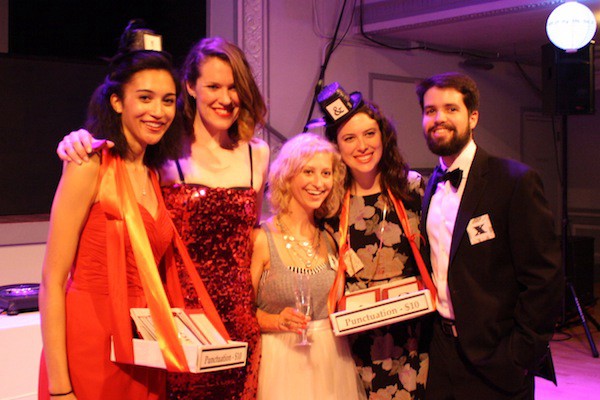
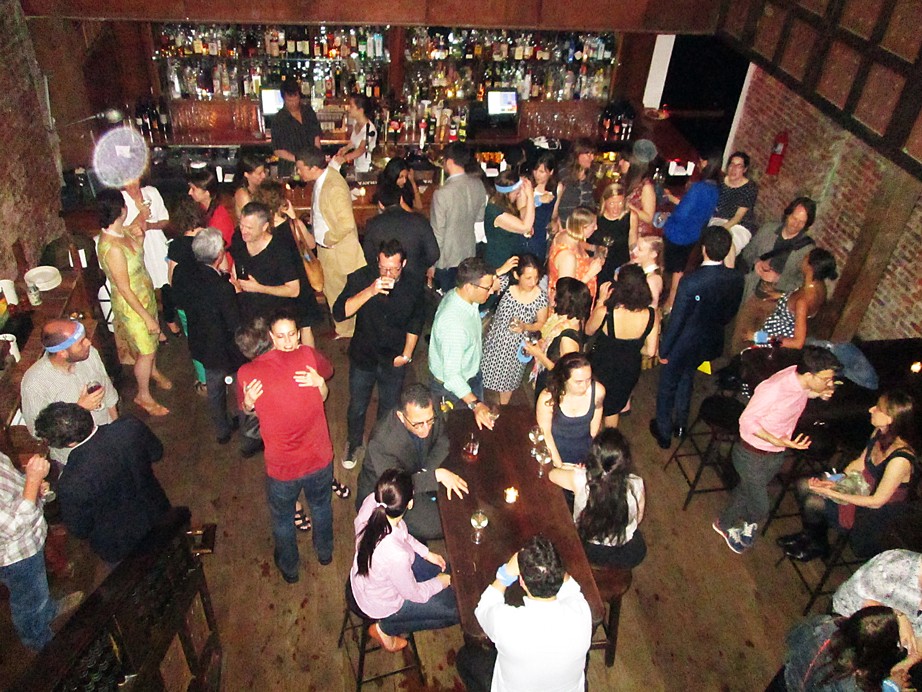
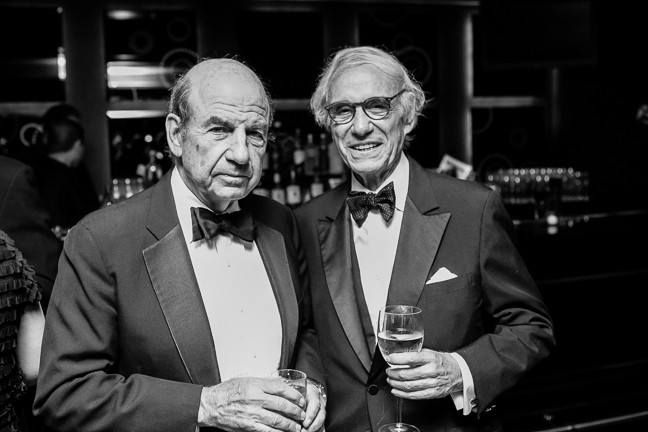
Word to the wise: the One Story Debutante Ball, which transpired yestereve at Roulette in Brooklyn, is actually fancy. How can you tell? The ginger and gin cocktails, the Dixieland melodies from the Blue Vipers, and especially the elegant attire. Emerald was the color of the evening, boldly worn by authors Téa Obreht, Marie-Helene Bertino and Helen Phillips. On the other side of the spectrum, Hannah Tinti, the “mother” of One Story, “rocked,” as we say in modern parlance, a corset and a Tim Burton-esque fascinator.
Marybeth Batcha, One Story publisher, read the first lines of the debutantes’ books, such as “The day my mom checked out, Razor Blade Baby moved in” by Claire Vaye Watkins and “The trouble: You want Thing A but are stuck with Thing B” from Douglas Watson. Batcha sent them on their way with writerly tidings, “May your book sell thousands of copies, may you never get a bad review.”
Emma Straub introduced Dan Chaon, One Story Mentor of the Year, who told us that “Nothing gives me more pleasure than going into a class of freshman [and thinking] is there someone I can make more miserable by introducing them to the loneliness and frustration of the writer’s life?” The answer is always yes.
Cigarette girls (and boys) peddled punctuation as opposed to the standard smokes. What was all the rage? The exclamation mark followed by the ampersand followed by the interrobang. If punctuation was insufficiently satisfying, words were available — not just any words, but words with special, secret definitions by authors both living and deceased; Jane Austen was responsible for “Love,” Aleksander Hemon for “Stuff,” and Shakespeare for the word of the evening, “Bedazzled,” which first appeared in The Taming of the Shrew: “Pardon, old father, my mistaking eyes, that have been so bedazzled with the sun that everything I look on seemeth green.”
**
— Erika Anderson(text), online editor at The Outlet. She like/likes twitter.
— Kai Twanmoh (photographs) is a sometimes contributor to The Outlet. You can find her here.
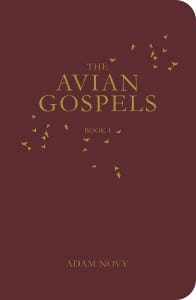
I first met Adam Novy about four years ago when he was an instructor at Orange Coast College in Costa Mesa, California, where I was re-taking English 101 because of a transfer credit debacle. When I talked to him after class, I learned that we’d been at Pratt Institute around the same time, lived in adjacent neighborhoods of Clinton Hill and Bed-Stuy, and were both huge fans of The Smiths and The Replacements. Just as I was starting to take fiction writing seriously, he learned his novel,The Avian Gospels, would be published through HOBART’s SF/LD imprint in the summer of 2010.
The first run of The Avian Gospels sold out at the end of last year, and is now being re-printed in a handsome one-volume edition through SF/LD. On a recent trip home, I caught up with Adam in South Pasadena, and talked ska, books, high school coaches, and mythologies
EL: You’re a writer in LA: I’m curious to hear your thoughts on the writerly-ness of the place.
Novy: Many writers live here but most of them work in Hollywood, for TV or the movies, or they’re trying to, but then there is this other culture of people writing fiction or poetry, and it’s really nice for us, because we don’t feel like we’re competing for oxygen. I loved Brooklyn, but there’s the old saw about how when you get on the Q, there’s like 12 other people there who are trying to do exactly what you do and you glare at each other and go home and update your Tumblrs with gifs that show how jealous you are. That hasn’t happened to me here.
Of course the weather’s lovely. There seems to be an absence of unhappiness and suffering, or at least the folks are keeping it to themselves. I’m never in a puddle. There is so much space. I can sleep like eight hours in a row. I know that these are all clichés but I am living them devoutly. In New York, it felt like there was a subway stop in my bed.
EL: I’m always interested in hearing about how writers stave off the crushing fear of, well, writing. Like, do you have a squeeze toy on your desk to fend off the demons?
Novy: First, I am very, very afraid of failure and it bothers me every day. I’ve started swimming in this incredibly beautiful pool in the middle of a canyon at the Rose Bowl Aquatic Center. I go for long walks all the time. South Pasadena’s a nice place to walk around, although sometimes you look crazy if you’re walking in the suburbs. I miss New York for that.
I mean, I don’t smoke. I quit Facebook. I quit Twitter. I’m definitely trying to eliminate ways to waste time. The Internet makes me anxious. It’s a place that people go to quell their anxiety but it only gives them more anxiety. So I have limited that fear, at least.
EL: Yeah, one of the big concerns of your novel, for me, is how we conceive our origin myths and legends, and especially how we now ingest reality. The dystopian qualities sort of allegorized the way we read Facebook: scrolling through confessionals, jokes, cat memes, Kim Jong-Un’s latest threat. Was this a concern for you? How characters — and we, as people — process political trauma and re-conceive reality?
Novy: I started messing around with this voice that generated this book right after 9/11. At the time, there was this origin myth about what had happened, about guys in caves and whatever, but of course it made no sense, and we didn’t understand what we had seen or who we were in relation to it. We didn’t know our relationship to Osama Bin Laden. The more confused we got, the more decisive we had to be. There wasn’t any time to stop and think.
At some point, we effected this radical separation from ourselves. We just turned into a completely different people, invading countries and destroying them, destroying ourselves, doing things we can’t take back. Maybe we had always been like that to some extent but something about this was new. I was really, really horrified by that, but interested in it as a writer. I could feel it physically.
I was interested in putting characters in a place where they had to be decisive even though they didn’t know who they were in relation to the world. And their origins were perplexing to them. The characters in my book have to act like people who they are not in order to be who they have to be. They have to be phonies.
EL: Yeah, like your narrator has to pretend to be the authority, but we watch this narrator break and become self-aware.
Novy: I was really interested in this high school teacher I had. He was this bullying fucking prick and the JV basketball coach. He was obsessed with the idea that FDR was a bad president and Herbert Hoover was a good president, and he thought Hoover’s reaction to the Great Depression was the right one. He would dissolve in class — we weren’t even talking about the Great Depression, and he’d say, “FDR got it totally wrong,” or, “Kennedy got it wrong,” or, “LBJ got it wrong with the Great Society, you don’t fight poverty that way, you make people pull themselves up by the bootstraps.” He loved the expression “Pull yourself up by the bootstraps,” but he couldn’t pronounce it at all, he spoke in wild grand repetitive loops, like someone obsessed, which he clearly was, and fired off spittle like a geyser. It was fantastic. What I saw was an individual in turmoil who’d been assigned a role of authority which he wasn’t suited for at all. So he was up there, in the middle of the day, ranting and being wrong, babbling to himself, and everybody else was sleeping except for this one guy, me, who was completely enthralled by the spectacle of this person who had authority and used it to discredit himself.
That’s what I really adore: the authority figure who reveals himself accidentally, in front of everyone. I really just channeled that voice — a voice that was telling a story it was clearly lying about, and clearly it felt bad, but it was also indignant and self-righteous and sanctimonious. I probably made the voice of the book more eloquent and pretentious than this teacher was, who was the least articulate person in the room.
EL: Your book ends in this really great and difficult spot: it’s cathartic, but not in that we experience schadenfreude and feel relieved. It forces readers to contemplate. It leaves them with a question.
Novy: I need a happy ending as much as any American and I feel existentially abandoned if I don’t get one, but I think happy endings make us stupid. It’s a little embarrassing that we have to cheer up the reader so much. Aren’t there drugs for that? I know why writers imply that we’re supposed to teach the reader to be more generous and more sympathetic, and that we create the possibility for something better by putting that better vision in our work, but I also feel like we have a job to give the reader the tools to understand loss. One way to say it is that writing can help us repair the world, but it can also help us understand loss, and maybe to know if loss didn’t have to happen the way it did. I guess I lean more heavily on loss, probably because of its relationship to power. Power is probably my subject.
The art critic Boris Groys, who I’m otherwise not so psyched on, says contemporary artists aspire to a balance of the elements in their work — loss, consolation, jokes, pathos, without any single one of them prevailing — to illustrate how democracy should work. In other words, it’s a kind of good manners. I’m so imbued with this idea that writing shouldn’t be political that it feels almost unprofessional bringing it up. I could really talk about this all day. Many fine writers, by the way, are writing books that simply don’t have any truck with politics and this probably doesn’t apply to them at all. But like I said before, my subject is power, so endings have a certain currency to me.
EL: Right. And amidst all of this, you also have this thriller/love story and gypsies playing ska. Can we talk about ska for a minute?
Novy: I really love ska. I made a decision years before I started this book that whatever books I wrote would have some kind of ska in them. And I really love gypsy music, which has some things in common with ska: they’re really anxious and exuberant and they’ve got this insistent beat. The melodies are sad and yet they celebrate. Ska added fun to the book.
EL: Your book inhabits this space between fiction and philosophy. Brian Evenson has this great essay in the journal symploke, and it was about the importance of strengthening the space and dialogue between fiction and philosophy in creative writing classes.
Novy: I like fiction with a lot of ideas in it. I haven’t read the Evenson essay, but I agree that fiction has a role to play in the history and the progress of ideas, and some of us need to take that role at least a little seriously. We can do things that philosophers cannot do. We can have dialogue with different voices. We can have debates. We can illustrate things through action and through the formal character of our work, and we can embody ideas and contradiction. And we can deal with difference in a very important way. In a better way than almost nobody else can.
EL: Are you working on anything right now?
Novy: I’m working on a novel about Perseus and Medusa before they get discovered. The early days of Perseus and Medusa. It takes place partially in mythic Greece and partially the suburb I grew up in. The characters are in the middle of mythic history. One thing about mythology I’ve always been really interested is what the characters know about their place and time in history. There’s this idea that the world is new and folks are creating meaning as they go along. Do they know they’re creating meaning? And what would it be like to be a teenager under those circumstances? Or a parent raising those teenagers, what would it be like? The prose is maybe more normal than The Avian Gospels, but the heart of the book is probably darker.
**
Adam Novy is the author of a novel, The Avian Gospels, and his work has been published in Dossier, The Believer, The Collagist, The Denver Quarterly, and American Letters and Commentary. He lives in southern California and teaches for at least two colleges.
Ryan Chang’s fictions and essays have appeared in Everyday Genius, Vol. 1 Brooklyn, and elsewhere. He tweets at @avantbored
PETER RARELY WAS ON HIS WAY HOME BY TRAIN from Inverness in the Scottish Highlands, where he supported a course for students on the bagpipes, at his own expense, since everyone was complaining that with the advance of the gramophone and the radio this illustrious and ancient form of music was dying out. He had just been up for the closing ceremony and was feeling very pleased with the way things had gone. If only my bear sanctuary would do as well, he mused. Another of his great concerns was that these remarkable animals had become extinct in the British Isles, and he had made a home in the Welsh forests for some bears imported from Transylvania.
But his main worry was his number-counters. He had hired some unemployed people to count up to 7,300,000 without stopping. Two had already given up, three were still counting, but when he had left London even the best of them had only managed something like 1,250,000. Where might he have got up to since?
In the express dining car he caught sight of a familiar face. It was the writer Tom Maclean. Maclean was sitting on his own, sipping spoonfuls of mock turtle soup, gazing thoughtfully into the distance, and jotting down the occasional word on his notepad.
“May I?” Rarely asked, settling himself down beside the writer. “I’m not disturbing you?”
“You certainly are, very much so,” Maclean replied with obvious delight. “Please stay and disturb me some more. It would be a real kindness.”
Rarely began to feel somewhat alarmed. The thought had flashed through his mind that he might not be the most eccentric person on the train.
“Because, you see, I’m working,” Maclean continued. “I’m preparing notes for a radio broadcast about my Scottish experiences. At least while I’m talking to you I won’t be working. Sir, the amount I have to do is intolerable. I’m fed up with myself, absolutely fed up. I’ve just been to Scotland for a bit of a rest. I tell you — I was there for a month — in that time I translated a novel from the French, wrote two essays and a novella, eight sketches for the Morning Glory, six book reviews for the Spectator and ten longer articles for a forthcoming lexicon entitled Women, Children and Dogs in the Service of Humanity. And I’ve still got two radio talks waiting to be done.”
“That’s very interesting,” said Rarely. “I always thought that writers like you lay around all day waiting for inspiration, and then wrote only once it had struck. You seem to have a lot more to do than my own rather simpler sort of millionaire.”
“I’ve no idea how hard a millionaire works, because I heartily dislike those sort of people, present company always excepted, of course. But the number of things I have to deal with has become more than I can bear. You’ve just heard what my holiday consisted of. You can imagine how much I do when I’m actually working. I have to submit two novels to my publisher every year, three articles for the paper every week…then there are my book reviews and reader’s reports. I have to dash off the odd novella to show that I am still a creative writer, plus the odd bit of scholarship, so that I don’t get dulled by all the other writing; oh, yes, and the publicity notices for my friend’s books, and the little demolition jobs on those by my enemies…What does all that come to?”
“Monstrous. How do you manage it? When do you do all this writing?”
“You should really be asking, when do I not? I fall asleep writing, and wake up writing. I plan my hero’s fate in my dreams, and the moment I open my eyes the signing-off phrase for my radio broadcast comes into my head.”
“And when do you live?”
“Never. I’ve no time for sport, and none for love. For years the only women I’ve spoken to have been the ones bringing manuscripts, and believe me, they aren’t the most congenial. But that’s not the real problem. The problem is finding time to read.”
“But you’ve just been telling me about your book reviews and reader’s reports…You must surely have to read those, at least.”
“Oh yes, sir, I read an appalling amount — six or seven hours a day. But only the sort of things that publishers and editors lumber me with, or books I need for something I’m writing. Do you know, I would really love to read a book purely for its own sake. Something that’d be of no use to me whatsoever. The stories of Hans Christian Andersen, for example. For years I’ve been dying to read The Ugly Duckling and I’ve never got round to it.”
Rarely pondered this for a moment, then blurted out: “But why the devil do you work so hard?”
“For a living, my dear sir, to make a living. You of course wouldn’t know this, but ordinary people have to earn their crust. With you, its almost automatic. I’m not a popular writer, my books aren’t suitable for turning into films, I don’t have the sort of brazenness that would enable me to write plays. I’m just a grey literary journeyman, and I have to slave away morning, noon and night simply to make ends meet.”
“If I might ask a rather impertinent question, how much do you earn?”
“Five or six hundred a year.”
“What? For all that work? That is appalling. My heart really goes out to you. And you aren’t even a dying art-form, like the bagpipes.”
“I will be, sooner or later. Nobody wants the sort of thing I do.”
“Listen here, Maclean. I’ve a proposition to make. I’ll pay you a thousand pounds a year. Now, don’t jump up in excitement. Of course I’m not giving it to you for nothing. In return I would ask you, as from today, not to write another word. Not a single one. Do you accept my offer?”
“Do I accept? What a question! Do you think if my guardian angel flew in through the window I’d give her a good kicking? Sir, you are restoring me to life and humanity. There will be tears in my eyes every time I pronounce your name. Sir…my angel…henceforth I shall spend all my time fishing. And chasing women, women who don’t bring me manuscripts, and who never open a book. Illiterates, in fact. And I shall read The Ugly Duckling and the Summa of Thomas Aquinas. And I shall be the first happy writer in the history of literature. Because I won’t be writing.”
A month later Tom Maclean was visiting his sister Jeannie, the wife of Colonel Prescot, who lived in Bournemouth. They were talking over lunch about their far-flung family — Uncle Arthur the country doctor, and his wife who wore such very odd hats; Alastair, the famous seal hunter; John, who had bought a farm in South Africa and sent native penny whistles to the children; Mary, who had just married again; and poor Charles, who would never amount to anything.
“And how are you, Tom? Tell me about yourself,” said Jeannie. Since their mother’s death she had played a somewhat maternal role in his life. “Are you working a lot?”
“I’m not doing anything these days. I haven’t written a word for a month. I go fishing, and I read the foreign papers. I’ve learnt Portuguese — a wonderful language. Now I’ve come home for a week’s walking. I’ve bought myself two puppies — Sealyhams — and I’m training them up. And as for women…” And he lapsed into a bashful silence.
“Splendid. And are you happy?”
“Happy? I’m only now starting to feel really myself. I used to be a slave. The last dirty slave. These days I live like the Good Lord himself. In France.”
“I’m so glad, Tom, really glad. Because I’ve been wanting to say to you for some time that you should relax and join in with things a bit more. But what I don’t understand is why you look so unwell. Your face is rather pale and careworn. Why is that?”
“I’ve no idea. Perhaps all the walking — ”
“It’s as if you’re not really satisfied, Tom. Look, I know your face. There’s something missing in your life.”
“No, no. You’re quite wrong about that. I’ve never felt so well. I feel like a god!” he shouted angrily.
Jeannie was so astonished she made no reply.
They took coffee in the sitting room. Then Tom went through to the family library to stretch out and do some reading. There he found his fifteen-year-old nephew Fred sitting at the desk, scratching his head.
“Hello, Freddie. Why such a miserable face? Is some- thing wrong?”
“Wrong? It’s this pesky homework! I’ve got this essay to write for tomorrow, about Shakespeare and Milton. I’m supposed to ‘compare and contrast’ them. Isn’t that crazy? Why were these two blighters ever born? And it’s Bournemouth v. Aston Villa this afternoon.”
“Shakespeare and Milton? Hmm. You know what, my lad? You go off to the match, and I’ll write your essay. It’d be a shame to waste such a fine Sunday afternoon. Shakespeare and Milton. What a joke!”
“Would you really, Uncle Tom? I always said you were a thoroughly decent chap, Dad can say what he likes…”
And out he dashed.
Two hours later Jeannie came into the library. She found Tom working away feverishly, surrounded by densely scribbled sheets of paper, with a Shakespeare on the floor and Milton and the other classics scattered everywhere. The moment she entered Tom glanced up at the ceiling to show his irritation. He clearly didn’t take kindly to being interrupted.
“What are you doing, Tom?”
“Oh, er…I’m helping Freddie with his homework. ‘Compare Shakespeare and Milton,’ I ask you! At first glance, you’d never think what a good subject it is. I’ve written fifteen sides and still hardly touched on the matter. I think the teacher will be pleased.”
A few days later Tom Maclean called on Peter Rarely. He found the millionaire in his music room, working on an experiment to get thirty parrots to speak in chorus. He nodded briefly as Tom entered. The parrots, who were in the middle of “God Save the King,” fell silent.
“Sir,” Maclean began, very formally and clearly embarrassed. “I am compelled to renege on our agreement. I must ask you not to remit the usual sum next month. I’m terribly sorry. I know it’s not exactly playing the game, but I really have no choice in the matter.”
“What? You want to start writing again?”
“Again? Now I want to start in earnest. So far I’ve just been lazing around. I’ve got the outlines of a five-volume novel sequence, an autobiography of indeterminate length and a life of James IV of Scotland. It’s time I really got going on them.”
“But haven’t you been happy without your writing?”
“No, sir. It’s just no good. If you threw me in prison I’d write in blood on my underwear, like that Mr. Kazinczy my Hungarian friend told me about. I wish you good day.”
1937
About the Author
Antal Szerb was born in Budapest in 1901 and died in January 1944. The dates resonate. They create a frame. Initially a devout Catholic, he grew up in the shadow of his Jewish ancestry, amidst the collapse of Empire, the dismemberment of Hungary itself, two bloody revolutions, and the relentless drift towards war. He died in a forced labour camp just days before it was “liberated” by the advancing Soviet army.
Szerb’s achievements in that time are of two sorts: what he wrote, and what he became. Denied the university post he so richly deserved, he taught languages in a commercial secondary school. By personality he was perfectly unsuited for the role, and his students adored him. Toiling through the night, he produced volume after volume of critical and scholarly works, almost always breaking new ground. The aim was to show his countrymen the depth of their own tradition and the riches that lay beyond. Placing Hungary firmly in the Western tradition was a political as well as a cultural project.
At the same time he produced a series of enchanting novels and stories: playfully ironic, always gentle, they contemplate human folly with an amused tolerance. They never condemn. His last, Oliver VII, the most generously benign of all, was written with a yellow star in the ascendant. Those who knew him thought him the cleverest, and the kindest, man they had ever met.
About the Translator
Len Rix studied various languages before falling under the spell of Hungarian. In 2006 he was awarded the Oxford Weidenfeld Translation Prize.
About the Guest Editor
Pushkin Press was founded in 1997. Having first rediscovered European classics of the twentieth century, Pushkin now publishes novels, essays, memoirs, children’s books, and everything from timeless classics to the urgent and contemporary.
In 2013, Pushkin Press will publish a new edition of the short-story collection Love in a Bottle with a revised introduction and additional, never-before-published material by Antal Szerb (U.S. pub date: August 13, 2013).
Pushkin books represent exciting, high-quality writing from around the world. Pushkin publishes widely acclaimed, brilliant authors such as Stefan Zweig, Marcel Aymé, Antal Szerb, Paul Morand and Yasushi Inoue, as well as some of the most exciting contemporary and often prize-winning writers. Pushkin Press publishes the world’s best stories, to be read and read again.
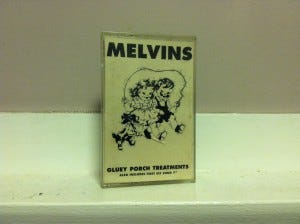
I like the Melvins, and so should you. So here are some of their songs. I’m no good at writing about music, though, so I just jotted down some things I remember from different grades in school.
1. “Night Goat” from Houdini
In first grade I was fascinated by the stapler. I always wanted to staple things. But the teacher kept it in a drawer in her desk and she never let me use it.
2. “Let Me Roll It” from Freak Puke
In second grade the teacher threatened to wash out some kid’s mouth with soap and I raised my hand and told her that she wasn’t legally allowed to do that and she looked at me and said “So what.”
3. “Black Santa” from The Bootlicker
Third grade… I got a C in Penmanship. And, I gotta say, it was well-deserved.
This is like the best song ever recorded. I don’t really remember much about fourth grade except that the teacher read us James and the Giant Peach. Which is almost as good as Danny, the Champion of the World! Though not quite. (But hey, what is.)
5. “Shevil” from Stoner Witch
Fifth grade… I learned how to do the Rubik’s Cube by memorizing a book, like a fucking robot.
6. “It’s Shoved” from Bullhead
I had to give a class report on Egyptian Gods and after I was done and sat down the teacher stood up and said, “Of course now we all know that there is only one God.”
7. “Youth of America” from Melvins EP
I taped every AC/DC album off of Rob Esposito. Also my family finally got a TV so I watched a lot of “Three’s Company.” (This is a Wipers cover; it’s really good when the Melvins do it live. You should probably go see them.)
8. “Isabella” from King Buzzo
In eighth grade I was very unhappy and prayed to be dead a lot. (It didn’t work.) I mostly like this song because I used to have a parrot named Isabella, but still, the drums are pretty cool.
9. “The Smiling Cobra” from Nude With Boots
In ninth grade I discovered chocolate donuts and ate them every day for lunch. Don’t ask me how I didn’t know about chocolate donuts before. We’re all blind to the things we don’t see.
10. “Up The Dumper” from The Bootlicker
It’s a love song! You should email it to your girlfriend. Oh, and in tenth grade… in tenth grade… I have no idea. I saw the Melvins play this song live one time in San Diego and afterward I walked outside and a plane flew overhead. But, like, really LOW overhead. Like it seemed like I could reach up and touch it if I wanted. Pretty exciting story, huh? I’ll tell you it again sometime.
11. “Roadbull” from Stoner Witch
Junior year I asked this girl to the prom and she said yes and then the next day she called me up and told me she’d rather go alone.
12. “My Generation” from The Bride Screamed Murder
Senior year… I played so much tennis my elbow turned black and I couldn’t move it for two weeks. This despite the fact that I never won a single tennis match in my life. Also I listened to a lot of Slayer. (South of Heaven, mostly.)
13. “Foaming” from Hostile Ambient Takeover
College… I ate a lot of pizza. I took a class called Hitchcock/Renoir/Godard and read The Canterbury Tales and ate toast in my room late at night and had a Mad Max poster on the wall. Right before Christmas break my room caught on fire and the fire trucks came screaming across the freshman yard and sprayed water all over everything I owned. It was pretty amazing, actually.
14. “Black Betty” from Everybody Loves Sausages
Nothing caught on fire, but I did bowl the best game of my life — a 239! In San Jose.
15. “Lovely Butterfly” from Honky
I discovered gin.
16. “Leeech” from Gluey Porch Treatments
Yes, three E’s in “Leeech.” I guess because the leech has drunk so much blood the middle part of it has expanded. (Sorta like me with the gin at that point… never went by “Been” though.)
17. “Ramblin’ Man” from The Crybaby
Well I guess two years of film school get condensed into one entry, which is fine: I wrote some screenplays (don’t ask me what they were about) and watched Enter the Dragon about 850 times. But what the hell — I just realized I forgot Kindergarten! And nursery school — where I got bitten on the nose by the guinea pig during naptime! But now I guess it’s too late. By the way that’s Hank Williams III doing the vocals on this track. And, also, that’s the last track. Though not for any particular reason.
So yeah. There’s the playlist. Melvins fans will no doubt be scandalized by the absence of “Boris,” which is probably their most famous song. Personally, I’m more pissed about the lack of “The Bit,” which is for some reason not available on Spotify. So, to make up for it, here’s the entirety of Stag from YouTube (“The Bit” is the very first track):
And while I’m sitting here linking from YouTube, here are the Melvins live in concert. Be sure to watch the whole thing! There may be a quiz on it later.
***
— Ben Loory’s fables and tales have appeared in The New Yorker, on NPR’s This American Life, and live at Selected Shorts. His book Stories for Nighttime and Some for the Day(Penguin, 2011) was a selection of the Barnes & Noble Discover Great New Writers Program. He lives in Los Angeles, California.
If you pay attention to the internet literary world, you’ve probably seen the sparkly images of Tao Lin’s new novel, Taipei, for a while now. Well, the wait is over, kids — the book comes out tomorrow.
The body of Lin’s work bares its fare share of hallmarks: a prevalence of technology and internet “culture,” direct and clear prose, and a magnification of the mundanities of life that renders it absurd. Taipei features all of this, but allows for a greater resonance than Lin’s previous work by letting us explore the protagonist’s thoughts and feelings. The book chronicles a lot of drug use (surprise), travel, and plenty of family tension, but is mostly a fictionalized account of his highly-public courtship, marriage, and eventual break-up with Megan Boyle (Paul and Erin, in the book). We are shown a couple cursed by a hyperactive proclivity for self-analysis and reflection, and all the pain and hilarity that results is presented without pretense or even much of an explanation, causing the book to bear Lin’s trademarked sleekness while also managing to be deceptively heartbreaking.
Lin agreed to do an interview with me via Gchat, but only after I promised not to ask any “annoying questions about craft” (my words). The result is as follows.
***DRUGS***
JE: What is your favorite drug?
Tao: I don’t know. I think most of the time, or something like 50% to 80% of the time, my feeling is that I dislike & want to gradually use less drugs.
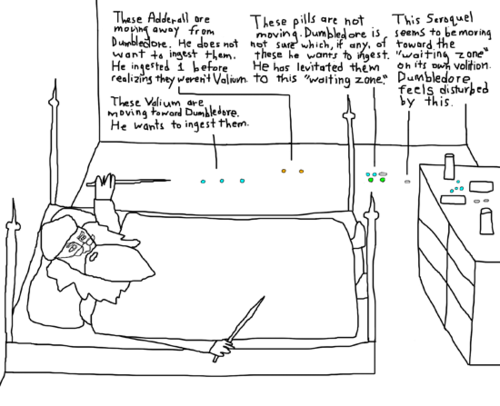
I think I’ve tweeted that I want to strangle whomever invented Adderall.
JE: Adderall is a terrible drug and I think it is totally fucked up they give it to little kids.
But that is also how I got A’s in college.
Tao: I think it is very bleak that a percentage of elementary school kids have been prescribed Adderall & use it daily.
Or middle school or high school kids.
JE: Yeah, I feel like it should only be used in a way to abuse it, like people should view it for what it is, which is clean speed.
Tao: I agree. I’m 99% certain there isn’t something called ADHD that is cured, or helped, by Adderall.
JE: Did Adderall help you write the book? Cus I know you asked for it on the internet, but it seems like it hinders creativity, at least from my experience.
Tao: I think Adderall helped in that it increased my motivation to do anything, but that’s not exclusive to writing. And I’m sure I probably would’ve been more motivated if instead of Adderall I, like, did cardiovascular exercise every day.
JE: Yeah, most drugs actually cancel out and then intensify what we wanted them to do in the first place.
Tao: It seems like, a lot of the time, when drugs get discussed, the concept of “tolerance” is completely ignored.
That you need to use more for the same effect, and that, say, if you get, like, +5 motivation…then later you’ll experience -5 motivation.
JE: Yeah, I was confused by why Paul & Erin did so much MDMA, cus that stops working as well if you do it multiple times in a week.
Tao: I think they were, at points, subconsciously ignoring that the body will become tolerant to [maybe anything, any chemical reaction], like if Paul read something online saying like “it’s okay to take MDMA every day, I took it every day for 5 years,” he would, at certain points in the book, immediately use that to easily justify using more MDMA.
JE: And ignore it if he read somewhere that it’s bad to do it too much, puts holes in the brain, builds tolerance, etc.?
Tao: Like how at the end of part 4 he keeps stressing that they did all that cocaine, MDMA, Adderall, caffeine and still feel okay…because he wanted to believe that there’s a way, like a magical way, just by ingesting something, to feel good without having to do any work and without the consequence of feeling bad later.
Yeah, and ignore things he reads that say it’s bad.
JE: Makes sense, like magic for grown-ups.
Tao: The entire spectrum of information — from it being some magical potion with no side effects, to it being easily fatal and that it literally causes holes in your brain — seems to be out there, so basically you can believe anything and probably easily find evidence, or some person’s thoughts they’ve typed on some message board or published in Time Magazine to support your belief.
JE: Yeah, and it seems like most people are rather extreme in their beliefs, from one pole to another.
When in truth, drugs are fine if you use them occasionally — perhaps even good — but when it turns into “abuse” then they become a negative thing.
Tao: I think people feel pressure to stress their point. Like if they don’t overstate the situation — this is true, I feel, with media that is conventionally trusted like the New York Times — it won’t be notable enough, or as notable as a piece by another person who’s willing to exaggerate things, to get published.
Photo courtesy of Brea Souders
***FLORIDA, MIDDLE SCHOOL, AND ALSO THE ‘90s***
JE: You grew up mostly in Florida, right?
Tao: Yes, Central Florida.
JE: Can you please explain to me why Florida is so weird, cus it seems like all the good episodes of Cops take place in Florida.
Like, “It’s not my baggie, I was just holding it for a friend.”
Tao: I think I only lived in non-weird areas of Florida. It seemed normal to me. People seemed nice, crime seemed low.
I went to a large public school.
JE: And what was that like?
Tao: Everyone seemed nice. I was endeared by how nice everyone was. And I assume the kids in private schools were maybe even nicer.
I have one memory of racism.
In my high school of maybe 1500 kids there were maybe, like, 10 Asians.
One kid who lived in like a more rural area called me, I think, a chink. But he was routinely called a “redneck” or “hick” by everyone and was like sort of my friend.
JE: Was he trying to hurt your feelings for some reason?
Tao: I don’t think so. I think it was probably language that was normal in his household. It was also middle school, so maybe he was trying to be mean. But I remember that him calling me that was, like, frowned upon by everyone.
There wasn’t racism, pretty much, in my view. But everyone called everyone else “faggots” a lot.
I remember being one of the only kids who wouldn’t say that word. There were others that wouldn’t say it, and I felt camaraderie with them.
JE: Yeah, I am not sure if I am right about this, but I feel like ours was possibly the last generation where homophobia/gay-bashing was okay, socially
Tao: Maybe. I’d be interested in what kids are calling each other today, in the middle school I went to.
JE: Yeah
Tao: The word “gay” was used so often, when I was in middle school. “That’s gay.” “You’re gay.” “This is gay.”
Kurt Cobain was respected by everyone during middle school, or maybe like 95%, I think, at my school, and I’m pretty sure he didn’t approve of derogatory usage of “gay” or “faggot.”
I think he died when I was in 7th grade.
He went to jail for spraypainting “God is gay” somewhere, I think.
JE: hahaha
That’s a good reason to go to jail
JE: I am trying to think of someone who functions as a Kurt Cobain in terms of popularity but also importance/artistic credibility/whatever and I can’t, but maybe I am too old or pessimistic to judge that properly
Tao: Let’s try to think of someone.
I can’t, so far.
JE: I was thinking of Kanye but I think I only like Kanye because he’s not afraid to say dumb shit.
Tao: A lot of people dislike Kanye also.
I feel like almost no one disliked Kurt Cobain.
JE: I feel like the ’90s had a lot of good shit going on, with things like Nirvana & also rap
Tao: I feel like a lot of my favorite things came out in 1999.
JE: like what?
Tao: I feel like probably it’s because we were 16 or 17 in 1999.
Maybe most people feel like their favorite things came out when they were 16 and 17.
Tao: Actually all I can think of currently, from 1999, is Being John Malkovich.
JE: I referenced that movie in class today and my students had no idea what I was talking about.
It made me sad.
Tao: Nirvana is referenced throughout Taipei.
JE: Yeah, I noticed that
Tao: Kurt Cobain died at 27.
***POSITIVES & NEGATIVES***
JE: Are you depressed?
Tao: I don’t know. I think I’m gradually realizing I’ve never had definitions for these words: depressed, lonely, [I can’t think of a third word at the moment…lol].
The definitions have always come from elsewhere.
JE: Well, do you feel optimistic, or calm, or self-assured, or motivated?
I am trying to think of adjectives that are less vague and the opposite of depressed
Tao: I might’ve never invented those words, or their synonyms, so wouldn’t know what I think I know, or feel a certain way maybe, if I’d never heard them.
I don’t think I have definitions for those words either.
I feel anxiety in certain situations.
JE: Like, what kind of anxiety?
Tao: In social situations, most intense in high school or college maybe, I’d feel overwhelmed by negative thoughts and be unable to speak coherently, or my face would twitch, or seem to me like it was twitching. I’d blush, feel unable to look at the other person’s face, things like that.
JE: Do you have mostly positive thoughts now?
Tao: I don’t know if I have a definition for “positive thought.”
For example someone today texted me a screenshot of a tweet that said something like “do what makes you feel alive” and their next text said “crack.”
But “do what makes you feel alive” would conventionally be viewed as a positive thought, right?
JE: Punching your hand through a window makes you feel alive but that isn’t positive.
I dunno, I feel like that is inspirational poster bullshit.
Tao: Yeah, so I don’t know what a positive thought is. It depends on the situation and the person.
What would you view as a positive thought?
JE: Hmm, like waking up in the morning and being excited for the day.
And if you have to go to work, or do work, then feeling like your work is interesting or important or at least challenging, and if you’re going to see someone else, then you’re excited to see them.
Tao: But someone who has robbed a bank and gotten away with the money will probably have that experience the next morning. Or someone who wakes to a scene in which their favorite drugs are on their bedside table.
You can’t force excitement, so it’s not a thought, I don’t think.
Or maybe actually you can.
Tao: If I view any thoughts as negative…I’m not certain about this but…it would probably be thoughts that have an effect of directly (probably its mostly indirectly) censoring other thoughts, of defining other thoughts as “negative,” or implying certain thoughts are “negative,” regardless of the person or situation.
JE: Yeah that’s what they talk about in DBT
that by saying “negative” you are judging it
and thus being negative
Tao: What’s DBT stand for?
JE: dialectical behavior therapy
it’s like cognitive behavioral therapy but it makes more sense
Tao: I seem unable to have my ideas ready, at whatever moment, to tell people.
I want to collect them in, like, a book maybe, at some point, so I can refer people to whatever chapter.
JE: Haha
Just hand people the book when you’re talking
Tao: Yeah, that’s partly how I feel about all my books.
***AND ONE ABOUT A SMOOTHIE***
JE: I want to ask one more question which is what’s your favorite smoothie recipe
Tao: Hm, that depends. If I’m focused on just “funneling” something healthy down my throat then maybe raw coconut water & any greens like spinach or cilantro. If I want to slowly enjoy a smoothie, with like a spoon, maybe frozen bananas, raw coconut water, avocado.
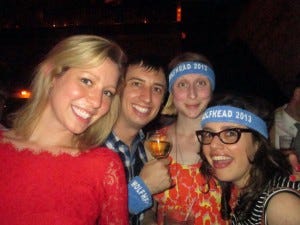
How do people make it through Book Expo America? By escaping the Javits Center and heading to parties and after parties and after after parties all over the city. “Wolfhead 2013,” hosted by Greywolf Press and Riverhead Books in the Copper Room of the Brass Monkey, was the kind of party where people would interrupt themselves mid-sentence and say, “Is that David Schickler? I love that guy. Hold my drink, I’m going to say hello.”
L: Lydia Hirt at Riverhead, Cameron Ackeroyd at Random House, author Emma Straub & Maris Kreizman of Slaughterhouse 90210
R: Lincoln Michel, Co-Editor of Gigantic, Parul Sehgal of the New York Times Book Review & Rose Friedman, NPR Books
The drink they were holding was likely a vodka/grapefruit juice combo usually referred to as a Greyhound but on this evening was knowns as a Wolf’s Head. As with any open bar, everyone drank until they forgot how awkward they were, or became even more awkward.
Later on crashers poured in from other (less fun) BEA parties, and who could blame them? They wanted to fête the fêted writers (and to fête in general): Kathryn Davis, Stacey D’Erasmo, Anton DiSclafani, Jessica Francis Kane, Chang-Rae Lee, Fiona Maazel, David Schickler and Meg Wolitzer. We raised a glass to glass raising, to writing, and to survival of another BEA. ***
–Sean Campbell lives, writes, and occasionally updates his blog in Bed-Stuy
A prodigious debut novel offers a new spin on the problem of the undead
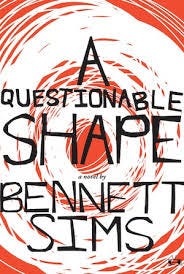
Yes, A Questionable Shape is that zombie novel you’ve been hearing about, but don’t believe the publicity: Bennett Sims, the book’s author, is barely interested in genre at all. This isn’t even The Keep or Motherless Brooklyn — something that stokes the intellect while still delivering generic thrills. I get no sense Bennett Sims loves zombies.
In the novel, Michael Vermaelen (the narrator) and Matt Mazoch search Baton Rouge for Matt’s father, who has recently disappeared and might now be a zombie. Meanwhile, Michael and his girlfriend Rachel feel the stress of this search on their relationship. Rachel begins to fear Matt’s motivations: is there any possibility he might want to kill his old man? After all, what else is one to do with an undead dad?
Mostly, this book is concerned with memory. The undead “return to the familiar,” wandering “to nostalgically charged sites from their former lives.” Do they understand why they remember what they remember? Do any of us? For all the talk about the undead, Sims uses very few tropes from zombie narratives — not even to subvert them. He demonstrates little affection for genre.
Instead, Sims demonstrates great affection for David Foster Wallace (with whom he studied at Pomona), and who can blame him? The late genius has exerted probably the farthest-reaching influence on young writers since Raymond Carver. And, it must be said, AQS is sometimes very reminiscent of Wallace. Very, very reminiscent. Distractingly so. And I’m not just talking stylistics, like the footnotes that invade the bottom of nearly all of Sims’ pages, or the way the dialogue is quoted with apostrophes (a detail Wallace was very insistent upon in Infinite Jest).
I’m talking about the hyperawareness of the narrator, and his obsessive need to describe every little detail (the browning of an apple and the white man on pedestrian signals each get a landslide of explication). I’m talking about the narrator’s (and, by extension, Sims’s) effort to make absolutely clear every possible character motivation and philosophical underpinning of the novel, like a PhD candidate concerned that the point hasn’t yet been adequately argued.
Of course, Wallace isn’t the only source for this sort of influence (and, in fairness, Sims has mentioned Nicholson Baker as a model for some passages). But who gives a shit, really? Any 20-something-year-old writer who doesn’t wear his/her influences on his/her sleeve probably doesn’t love books enough to still be writing 10 years later. Bennett Sims is insanely talented. Even when he “does” Wallace (or Baker), he does him better than nearly anyone else.
Over and over again, Sims demonstrates astonishing skill with image. Shadows sweep “back and forth, like a massive phantasmal broom.” The wax at the base of a candlestick looks “as if a congregation of gnarled ghosts was kneeling in prayer before the flame.” These similes transform the familiar world into surreal gems, so concrete that I can feel each in my hand.
In the details of his characters, Sims is nothing short of brilliant. Rachel misses her own father so much that when a burglar breaks into her car and smokes the same brand of cigarette her old man used to smoke, she feels grateful for the stench in her upholstery — the scent that reminds her of dad. God, that’s so bizarre and funny and sad, all at once.
Another vivid relationship in the novel is between Michael (the narrator) and Rachel, who feel as much like a couple as any other fictional characters I can think of. At one point, they must practice a technique of “de-familiarization,” which consists of them sitting on the floor and staring at each other’s face until it becomes unrecognizable. They learned about this process from the FIGHT THE BITE, an oft-referred-to pamphlet (and a great George Saunders-like touch) that describes the protocol for surviving the zombie outbreak. The de-familiarization process is essential: one day, Michael might need to use it when beating zombie Rachel to death.
Michael remains something of a cipher, and intentionally so. Sims uses him as a pivot point between Rachel’s belief that zombies should be treated humanely and Matt’s belief that the zombies aren’t humans at all and should be left to die in the hurricanes headed to Louisiana. Parallels with the Bush administration’s response to Katrina are not hard to draw, but the book stretches farther than that: at what point do we start to see others as inhuman? In this manner, AQS becomes something of a political/social allegory.
So let’s call A Questionable Shape what it is: an extraordinarily prodigious debut novel that hasn’t quite struggled out from under its influences but exhibits numerous flashes of its own sort of crazed brilliance. But don’t forget: Even David Foster Wallace had to do Pynchon before he could do himself. When Bennett Sims writes a masterpiece very soon, I won’t be surprised.
Read an excerpt from A Questionable Shape over at Recommended Reading. For more fiction from Bennett Sims, check out his story “White Dialogues” here.
***
— Benjamin Rybeck’s reviews have also appeared in V Magazine. His fiction has received “special mention” and “notable reading” distinctions from The Pushcart Prize Anthology and The Best American Nonrequired Reading, respectively.
The Lit List is a sometimes-weekly compendium of New York’s finest literary events and readings. All events are 100% free unless stated otherwise. Something you think we should know about? Email dish@electricliterature.com
Monday, June 3
Elliott Holt launches her debut novel You Are One of Them at Powerhouse Arena in DUMBO at 7PM. RSVP appreciated, dudes.
Tuesday, June 4
OR Books and Jeanne Thornton, a Lambda Literary Award finalist, celebrate LGBT literature at The Dalloway at 7PM. Eileen Myles, Autostraddle, and Miracle Jones will be in tow. One-time only chance to see Eileen Myles in a Virginia Woolf themed bar. Ever. Go.
Wednesday, June 5
Tao Lin launches his new novel Taipei at Powerhouse Arena, DJed by Pitchfork Media staff writers Jenn Pelly and Carrie Battan. I am also hoping Tao will have a slideshow of this series of photos. 7PM.
McNally Jackson Books hosts the US launch of Cahier 18: Her Not All Her, a play by Austrian Nobel laureate Elfriede Jelinek that is about, around, and from Robert Walser. The translator Damion Searls and novelist Katie Kitamura will be there to discuss this work. 7PM.
Thursday, June 6
A reminder to all you ticketholders that Thursday is the One Story Debutante Ball at Roulette, starting at 7PM sharp. Pluck those eyebrows and grease those fly-aways, you beautiful people.
Friday, June 7
If you couldn’t make it to the One Story Debutante Ball because you noticed a run in that dress last minute, all of the debutantes will be at Greenlight Bookstore at 7:30PM, including 2013 The Story Prize winner Claire Vaye Watkins. Oh joy!
It’s quiet this weekend in the literary wonderland called New York City, folks, but not all is lost. It is Tom Jones’ birthday on Saturday. I bet you forgot.
Eisenberg got us started with a section from Screw Everyone: Sleeping My Way to Monogamy. Apparently, her last one night stand had a thing for stuffed cartoon cats: “Rob’s room was full of, and I mean covered with, Garfields.” Understandably, “the sight of this altered Jim Davis’s bedroom killed any sexy, warm, or even safe feelings.”
1. Dan Kennedy, “This is what a book looks like” 2. Fans John Mertens, Dan Vigliano, and AJ Wax
Then it was Kennedy lifting us up with some life coaching from his novel: “There is no reason to beat oneself up about switching to beer early in the day, as the prospect of getting back into jogging is daunting. Something is required to take the edge off. Drinking before noon [is] an OK thing, especially when it is fueling a man in an athletic way, or in a way that lets him realize his dreams.”
How does Dan Kennedy write ‘funny’? “I personally just try to capture the depression that frightens me… It’s usually me alone in a hotel or apartment feeling sad, alone and strange and weird. Then type I something out.”
1. Le crowd 2. Pals Valentine Lysikatos, Dan TaufikSenior Consultant, Bridget Mcfadden and Gina Levitan
Kennedy asked Eisenberg, “How do you write a story from your life? There can only be one ridiculously hung dude with 50 Garfields on his wall.” Eisenberg said, “I do say that he is well endowed. That was all he cared about. He was like, ‘Thanks for the story!’”
And then there was the process question. It’s always lurking. So, what is Kennedy’s process? “I write like how I watch Netflix or smoke or any other compulsive behavior… Writing is the one bad habit that I have that leads to something.”
***
–Sean Campbell lives, writes, and occasionally updates his blog in Bed-Stuy
Last night the Authors Guild Dinner was held at the Edison Ballroom, an art deco hall off Times Square fit for Baz Luhrmann. Guests gathered on the balcony for cocktails and hors d’oeuvres (the bacon-wrapped scallops won my unscientific taste test) before heading downstairs for dinner.
After welcome remarks by Authors Guild Foundation President Sidney Offit and Authors Guild President Scott Turow, our host for the evening, author and comedian Andy Borowitz, took the stage. “Phillip Roth and me, people like that, were sitting around trying to come up with a theme for tonight,” he said, adding that ideas like “Amazon is trying to kill us” were bandied about, but everyone agreed that the evening needed good news. The good news for struggling writers, apparently, is in greeting cards. Did you know that Maya Angelou wrote for Hallmark? (It’s true, I Googled it.)
And thus Mr. Borowitz presented a few possible cards from well-known authors:
Samuel Taylor Coleridge: In Xanadu did Kubla Khan a Stately pleasure-dome decree: but since I don’t make that kind of dough, here’s a Christmas card me.
Dylan Thomas: Do not go gentle into that good night, old age should burn and rave at close of day; rage, rage against the dying of the light, and have a happy Mother’s Day.
Geoffery Chaucer: Whan that April with his showres soote The droughte of March hath perced to the roote, And bathed every veine in swich licour, It’s just five months till Yum Kippur.
Needless to say, laughter drowned out the sound of forks clinking against plates (a choice of red snapper or steak). For more information about the Authors Guild, including mission, history, and services, visit authorsguild.org.
– Halimah Marcus is the Co-Editor of Electric Literature. Find her on twitter @HalimahMarcus
Sign up for our newsletter to get submission announcements and stay on top of our best work.
YOUR INBOX IS LIT
Enjoy strange, diverting work from The Commuter on Mondays, absorbing fiction from Recommended Reading on Wednesdays, and a roundup of our best work of the week on Fridays. Personalize your subscription preferences here.