Craft
Quick, Playful Writing Exercises for When You’re Feeling Stuck
These unintimidating experiments will reinvigorate your writing when you need a breakthrough
A student recently asked, looking at the bookshelf in my office, “How did all these people get from here to there? From words on a screen to bound on the shelf?” I started to give her practical advice about staying in the chair and reading the right novels, but that is only a small part of how a piece of art grows up.
We are not ever just writers—we are also sons and daughters of good parents and disappointing parents and we are partners who need to grab a quart of milk on the way home and parents who crawl into bed with the little ones late at night to admire them when they are still, even though we know we don’t have any tiredness to spare. We are students and teachers. We are readers, taking in the universes created by other minds. Our stories and poems and essays are written in and among and because of these moments. A scene is not only a moment on the page that takes place in space and time—the writing of that scene takes place in space and time too. I remember working on an especially dark section of my first novel, No One Is Here Except All of Us, in which the character based on my great-grandmother escapes pogroms by fleeing with her children into the Russian wilderness where she survives on tree bark, and it so happened that this writing day took place beside a swimming pool at a Southern California hotel where my father-in-law was staying while he visited us. I spent the morning in the shade surrounded by Disneyland-bound families and I wrote about starvation. You can’t see that in the pages, but the energy of that good, easy day provided an opposite to the story from the past and its fictional counterpart. That strange pairing was part of how I powered the writing.
We do not write outside of our lives or in spite of them, but because of them. Writers make a choice to carve out significant time—some squeeze writing in while a baby sleeps on their chest or during the lunch hour. Some dictate a story while driving to work. The walls of stuck-ness are easily built. Time is always short; fear is a capable bricklayer; self-doubt and envy can construct a windowless room in seconds. While I love encouragement and good cheer (can you see me waving my pom-poms? I am!), those are not enough to free us. What I believe in, what has worked for me over and over, is a repertoire of small, playful, and unintimidating experiments. Lots of them. A small choice is huge. So often you need a little light, some air, and a handle turns in your hand, you peek through to the next thing, and you’re back, you’re in, you’re running.
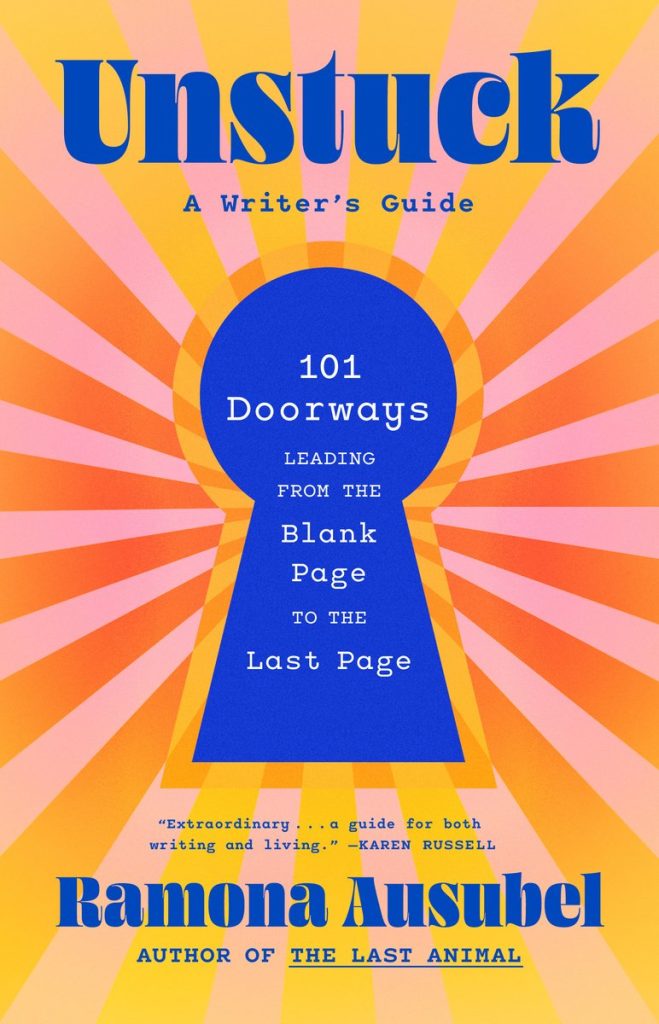
My new book, Unstuck, contains all the skeleton keys to all the secret doors I know—I’m sharing a few of them with you here.
Doorway: Begin Anywhere
There Is No Better Time, No Right Answer
You have this idea for a novel. A young woman disappears in the woods, or a new planet is colonized, or two people fall in love. Ahead of you there are no fewer than one jillion decisions: Are we in 1876? Is the couple driven apart by their hateful fathers? Does the book take place over the course of twenty-four hours or a year? Is it told in first person? And that’s only the big stuff. Every page is a string of words picked by you. Every scene is populated, full of characters and places (real or imagined) where every tree, every vase full of dead flowers, every old, tired cat is placed there by you.
We do not write outside of our lives or in spite of them, but because of them.
You cannot, no matter how much you wish, know at the start how this will unfold. Like all the best parts of being alive, it requires you to enter without a map or a promise of success.
I was in such a place when my eldest child was in the fifth grade and it was time to go on tours of middle schools. I had spent the morning staring at a Word document on which I intended to begin a new novel. The document was a white, ominous nothingness. My job was much too big. Defeated, I closed the computer and picked up my kid at his sweet little elementary school, a place that had seen him through the pandemic, that had brought him from a tiny person to a big kid. We drove to a middle school and parked. Nervous eleven-year-olds and their more nervous parents hummed in small groups. Inside, the building felt huge. The echo of sneakers in the concrete stairwells, and halls leading to other halls. How were we here? How was my small person going to be okay in this wilderness? We came around the corner and there was a lit theater marquee at the end of the hall with these words: “BEGIN ANYWHERE.—John Cage.” I stood there for a long minute. My child tugged at me. He did not know how to be a middle schooler yet, as he would not know how to be a high schooler a few years later or all the steps to come after. I did not know what this new novel would contain, as I had not known how the three before it would work until I had written through the years and the many drafts. “I’m ready,” I said, and we began there, at the anywhere where we stood.
Key
You are here. You are anywhere. Start with a single scene, a single memory, a single question. Set a timer and keep writing for twenty minutes. Whatever you have done at the end of that time, your page is no longer blank, and you have, beautifully, gloriously, begun.
Doorway: Primordial Slush
The Matter from Which All Life Is Created
What I have come to understand is that you can’t start where you intend to end up (i.e., a book that feels like a book) because you have to start three billion years before that. I’m writing fast, following curiosity and questions, writing scenes even if I have no idea where they’re going, writing backstory for characters so I can figure out who everyone is, writing place and space. Eventually you want a book-shaped thing, but before that it takes the shape of a freshly bloomed tulip, the back half of a rhinoceros, a mountain stream, a bird’s nest. And before that it’s a beam of light or a ball of clay. I remember a friend asking how my second novel was going and I said, “It’s a swamp monster that oozes around on the floor waiting for me to feed it dead fishes? Is that an answer?”
This was not the creature I wanted. I wanted a unicorn or at least a sturdy, faithful dog. But here is what I now understand: You don’t get a dog right away, you have to evolve there. You have to start with a vat of primordial slush, the making of all life, and that slush is not pretty or decipherable. Then something crawls out and maybe it’s a tiny little swamp monster. You need that guy. Yes, that draft is super drooly and it’s awkward and lumpy and leaves mud all over the place. The swamp monster will grow arms and legs. When you come back to the second draft, he’ll be sitting up at a table and you can tie a little checked napkin around his neck and feed him crème brûlée. And when you loop back for a third draft, he’ll have grown a lovely coat of fur and now he’s looking more like a recognizable animal. A yak, maybe, or one of those Scottish Highland cows with the long red bangs. In draft four you have an apple tree that’s about to bloom and in draft six you have a crescent moon and in draft eight you have a wolf and in draft ten you can start to tuck all these eras carefully together between covers and hand it to someone and when they read it, by magic (and months or years of work), the story that you saw in your mind pops open in the mind of that reader and that’s when you get to start calling it a book, but by then I hope you trust that it’s also still a yak and still a moon, and that your old sloshy swamp guy is in there covered in primordial soup—the energy and possibility of the entire universe dripping from his slimy, squiggly body.
What I’m trying to tell you is that it’s going to be so much messier than you can possibly believe. Our job is to trust the mess. To trust the dust storms and the mud bogs and not rush on toward premature order. Order only matters if it contains something real. Sure, you can write a novel that follows a set of very clear rules and expectations, but you will have written a container, not contents. You will have a harness but no dog. Don’t skip the mess, because that’s where the magic lives.
It’s going to be so much messier than you can possibly believe. Our job is to trust the mess.
Do you hear that this is not a quality assessment? Yes, a first draft can be shitty, but it’s hard to get very excited about sitting down to write a shitty first draft when quality control is already in the room.
There’s a dude in a white coat with a hairnet and a magnifying glass and he’s waiting for me to hurry up and take my failures and turn them into candy apples he can sell. If I’m trying to make candy apples, then a beehive is a failure. If I’m trying to write a novel, then a mud bog is a failure. And even if we are welcoming of failure, as we should be, as it is critical to be, I’m sorry but I’m kicking that white coat guy out the fire escape. There is no quality assessment in the primordial slush draft. The universe did not feel inadequate when all it had was an explosion in space from which all life would emerge.
Key
This is not a key you turn once. As you move through your first draft, you must keep going through this door-way over and over. Write the following on a sticky note and put it on your wall: It’s not supposed to make sense yet.
You might live in the slush for weeks or months or even years. When life begins to crawl out onto land it could happen quickly, a sudden understanding of your project and what it wants to become. Or it might happen slowly, one little toe out in the sunshine, then back underwater.
This is about the intentional, heartfelt creation of energetic, weird, unformed life. Every writer you’ve ever admired lives here too.
It’s not supposed to make sense yet. It’s not supposed to be a book yet. I am discovering something still unknown on this earth. Create energy. Repeat.
Doorway: Writer Physics
Follow the Energy
A story or a poem or an essay has logic, but it’s also a living thing. Imagine that a cat walks softly across the black landscape of a burned neighborhood. One valid approach might be to follow the logic: How did this fire start? Who or what was lost? What will happen to the people who used to live here? Those are good questions and you may answer them, but sometimes logic can sideline us on a kind of frontage road next to the story that never seems to merge into the real stuff of it.
Writer physics, which happily does not require a familiarity with the theory of relativity, is the practice of noticing and following the energy in your pages. That cat moves over the ground, and the ground is radiating with everything that was burned. The ash is full of the energetic force of the house, which was full of the energetic force of the ten years (let’s say) a family lived inside that space. The baby who was born on the kitchen floor after a labor too quick to get to the hospital; the photo album of great-grandparents in Hungary; a hundred dinners eaten on a simple plate, a shard of which is under one of the cat’s paws.
What happens when the family pulls up in a car in front of this changed place? Follow the energy between the people and the plate shards, the memories, the cat. Maybe the cat, afraid and traumatized, jumps at one of the children and scratches her, and the cut gets infected by something in the ash. Maybe the father becomes obsessed with rebuilding a certain room in the house exactly as it was. Maybe the mother returns in secret alone at night and digs through the rubble herself, looking for remains of her old life. Maybe there’s a coyote, also scavenging. All of these ideas grow from pressing together two sources of energy: a character and an object, a feeling and another feeling, a character and a tiny moment, a tiny moment and an object. Energy makes energy. Pretty soon that mother is running after the coyote, which has the cat in its jaws. Pretty soon, she’s got a jagged piece of wood, once part of her living room wall. Where does the energy go next?
Key
Take a survey of the energetic forces moving through a scene, image, or moment. Close your eyes and try to feel them swirling around. Pick two and press them together, see what happens when the energy of one thing mixes with the energy of another. What changes? What new force is born?
Now you have the keys to some of these doors, but where you go will be a place entirely undiscovered, all your own. Send me a postcard when you get there.
Excerpted from Unstuck: 101 Doorways Leading from the Blank Page to the Last Page by Ramona Ausubel. Copyright © 2026 by Ramona Ausubel. Published with permission from Tin House, an imprint of Zando, LLC.