Personal Narrative
The Concept of the Asian Robot Maid Has Haunted My Life
Who is this mechanical maid everyone wants to conjure into existence? What is this job we’re so desperate to give her?
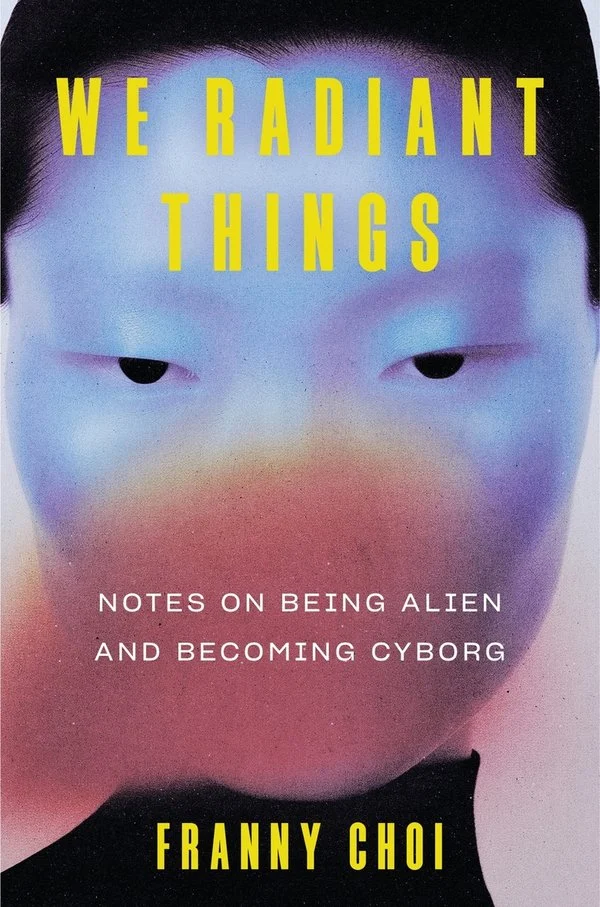
“I, Roomba,” excerpted from We Radiant Things by Franny Choi
We named her Rosie. She was a gift from my parents, who have seemed mildly horrified by the state of every apartment I’ve ever lived in. The day she arrived, I did a little dance; it hardly mattered that she had no face. “Good job, Rosie!” we said when she navigated out from under a chair. “Oh, Rosie, I’m sorry,” I said, untangling a yarn ball from her teeth as she blinked in polite distress. I slid merrily around the hardwood in my socks, clearing shoes and backpacks out of her path. She and the cat kept things civil. I was sorry when she died.
It was the middle of the semester when Rosie suddenly stopped working, and Cameron and I were both too overwhelmed with teaching to figure out the repair process. So I went back to vacuuming, by which I mean I mostly stopped. Rosie had always been less a time-saver, anyway, than a promise—a slow, cylindrical portal to the house of my imagination, where fiddle-leaf figs thrived in natural light and the floors were so clean you felt compelled to crawl rather than walk back in your shoes if you forgot your keys. The ideal house was an extension of the ideal me, a properly Korean and feminine me, an attentive me who could make things gleam and grow instead of slowly ruining them. I took up a habit of making fun of my domestic failings, which was either a way to flaunt my tiny rebellion against the ideal me or a path I could cut through the shame of failing to live up to her.
Like my jokes, Rosie cast a protective sheen of camp over the whole conversation. Sublimely unaware of her ridiculousness, she bounced from wall to wall, distracting everyone from her real job: to help me avoid the humiliation of using my own body to keep up the house, well cast as it was for the role.
The Roomba floor-vacuuming robot first came on the market in 2002, made by the company iRobot. Founded in 1990 by three roboticists from MIT, iRobot spent most of its first decade developing robots for space and military operations. In 2001, its PackBot made headlines when it was used to search the ruins of the World Trade Center for survivors after the 9/11 attacks. The following year, a fleet of Pack-Bots was deployed to Iraq and Afghanistan, while in the US, iRobot released the Roomba, armed with capabilities initially honed for the battlefield. But its military lineage was largely overshadowed by the flurry of comparisons to everyone’s favorite robot maid.
“Remember Rosie, the clunky metal automaton maid who kept the TV cartoon Jetsons’ carpets spotless? Well, she has been down-sized in favor of a Frisbee-size model,” began a review of the Roomba in U.S. News and World Report soon after its release.1 Public reception ranged from confusion to geeky delight to disappointment about the machine’s limitations. “While it is more fun than vacuuming yourself, it is not as effective,” conceded a New York Times review.2 More than one outlet questioned whether the novelty of having a real-life home robot was worth the 200 dollar sticker price.
Still, by 2004, over a million units had been sold. As iRobot developed its sensors and navigation systems, the Roomba got steadily better. Whereas it had originally bounced somewhat randomly from wall to wall, it began to learn the layouts of rooms, mapping out routes and learning to adapt as people moved furniture around. By the early 2010s, the Roomba had solidified its place as the most widely adopted domestic robot ever invented, and in 2021, when sales surged as a result of the COVID-19 pandemic, the company was valued at $3.5 billion.3 According to Henny Admoni of Carnegie Mellon University’s Robotics Institute, the reason for its success was simple: “It does one thing. And it does it really well.”4
But what if you could have one robot at home that could do all the things well? That dream has been around since at least the late 19th century. In M L Campbell’s 1893 short story “The Automatic Maid-of-All-Work,” an inventor promises his wife that his new automaton will take on all the household chores, from preparing breakfast to chopping firewood. It doesn’t end well—the robot eventually chases a cow into a nearby river with an ax—and many researchers seem to have taken the warning to heart, focusing on robots that take on specific tasks, like folding laundry or transporting objects from room to room.
Who is she, this mechanical maid everyone is trying to conjure into existence? What is this job we’re so desperate to give her?
But in our wider imagination, the clamor for an automatic maid-of-all-work persists. News outlets have been announcing that she’s just around the corner for at least the past 35 years: There was Hubot in 1981, Nuvo in 2005, Mahru-Z in 2010. In 2018, tech reporters called Aeolus “a step closer to the Jetsons.”5 A few years later, media reported excitedly on Samsung’s Bot Handy. In 2021, Elon Musk accelerated the race to build an all-purpose humanoid robot with the announcement of Optimus, prompting a surge of competitors despite having little more than a mock-up to show investors (in lieu of a prototype, they had a guy dance onstage in a spandex robot costume). At the time of this writing, buzzy articles about the 1X Neo, the Figure 03, and the Apptronik Apollo are making the rounds. A 2026 report from Barclay’s Research estimated that the two-to-three-billion-dollar global humanoid robot industry could surge to 200 billion dollars by 2035.6
“Where Are All the Household Robots We Were Promised?” reads one headline. “Why Don’t We Have Robot Maids Yet?” asks another. The articles are illustrated with stills from The Jetsons, Star Wars, Metropolis; actors in suits, their arms posed in the same odd angles. Metallic women with golden limbs serve coffee, as men in ties hold out their mugs. Who is she, this mechanical maid everyone is trying to conjure into existence? What is this job we’re so desperate to give her?
“Where’s Our Rosie?” demands an article in Time magazine.7 Mine’s downstairs, carrying an enormous weight, though she hasn’t moved in months.
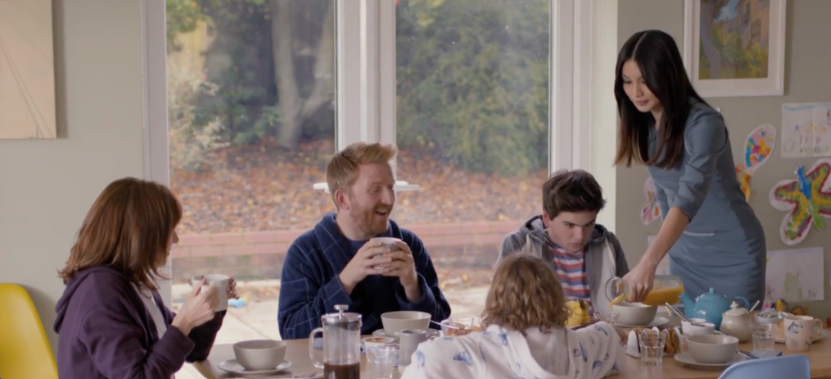
In the British Channel 4 series Humans, Gemma Chan vacuums, cooks, wipes counters, pours coffee, folds laundry, packs lunches, reads bedtime stories, takes out the trash, loads and unloads the dishwasher. She pushes the iron in long, steady strokes across the shirts. After sex, she pulls up her panties and rises to clean herself. She moves through rooms without making a sound. At night, she plugs herself into the kitchen wall to charge.
Chan is first introduced as Anita, a domestic robot purchased by the white Hawkins family to help keep up their suburban London home. Based on the Swedish series Äkta människor (Real humans), the show takes place in an alternate present in which much of the labor force has been replaced by the robot “synthetics” (“synths” for short), which are nearly indistinguishable from humans. The machines are strictly regulated and not at all sentient—at least, they’re not supposed to be. The show’s first season follows a fugitive band of synths who have been gifted with consciousness, as they attempt to find and rescue Gemma Chan’s character, Mia, from domestic servitude. Captured, refurbished, and sold to the Hawkinses under the name Anita, Mia’s personality is trapped somewhere inside Anita, watching as her own body obediently cooks, cleans, minds the children, and strips naked “for insurance purposes.”
It is no accident that the Chinese British Gemma Chan was cast in this role. I know this, even before realizing that the original role was played by Korean Swedish Lisette T. Pagler. I know this before watching Chan vacuum and serve breakfast; before the sex scene; before the leering grin the salesman flashes at the blond father, Joe Hawkins (played by Tom Goodman-Hill) when he purchases her. I have a pretty good idea about why it’s Gemma before the end of the cold open, her face illuminated in profile by the moon’s light, one placid face among hundreds of inert others, each of them standing by dutifully to absorb someone’s fantasy.
I can’t stop thinking about that look that passes between Joe and the sales clerk, which happens so quickly I miss it on my first watch. The clerk hands Joe some paperwork, looks at Anita just offscreen, then back at Joe with a knowing smile, a wink. “Have fun with that one,” the wink says. Or maybe, “You dirty bastard, good for you.” There’s an old joke there, so old and loud (even if Joe frowns, trying to refuse to hear it) that a wink is all it takes for it to break the surface. The history of jokes about Asian women, sex, and subservience anticipates Anita’s arrival; by the time Gemma Chan walks on set, it has already formed a perfect outline for her to disappear into.
My family’s histories with domestic and care labor—the years my mother babysat under the table before she became a nurse, my aunts in nail and hair salons, the way my sister’s life nearly buckled under the weight of caretaking for her controlling husband when he became disabled—all skirt my edges, not quite touching. In Seattle, I sat with my sister as she used the word “robot” to describe how she felt, cleaning as her husband directed, assembling furniture he’d ordered, arranging frames on the wall to his specifications. “I’m not asking you to think, I’m asking you to do,” he would snap when she veered from his instructions. Becoming a robot was how she bore it: “I just told myself, ‘Okay, I’m not a person, I’m just his hands,’” she recounted. It made it a little more possible to bear, to try to convince herself of this.
I’ve never been forced into the position of the Asian robot maid, but despite this (or maybe because of it), she has haunted my life. She was in the room when a housemate got mad about the mess in the kitchen; when two white women in a row mistook me for an employee in the grocery store; when I experimented with cam sex and men gave me directions for how to touch myself.
I’ve never been forced into the position of the Asian robot maid, but despite this (or maybe because of it), she has haunted my life.
She was particularly loud with my ex B, who was white and had very specific ideas about how the dishes ought to be stacked. B was the kind of person who would get on his knees and scrub the inside of the toilet bowl with a sponge. Next to that kind of dedication, I was embarrassed to be so squeamish. What I’d previously touted as a rebellion against feminine ideals of cleanliness was, in this context, suddenly repackaged into a lack of humility—or worse, laziness. Maybe a more generous way of putting it is that, for B, cleaning was a way to promise we would show up for each other, to say we didn’t mind getting our hands dirty in the process. So when, one summer afternoon, he suggested that we spend the afternoon cleaning out his car, I jumped at the opportunity to seem willing and industrious, even cheerful. Underneath, there was another me, watching as I bent to vacuum under the seats. Sweating through my shirt in the July sun, I tried to quiet her by telling myself it was a matter of egalitarianism, or love. This was the only way it could work: the picture I made as I knelt on the asphalt, his dust in my face. We’re in this together, I scolded myself. Stop being paranoid. I’m a cool girlfriend.
“Now, Gemma,” says Alan Carr, “When you got the call from your agent: ‘We’re looking for a robotic, synthetic, dead-behind-the-eyes creature . . .’”
“I mean,” Chan laughs, throwing up her hands, “I was born to play the part!”8
She’s being a good sport, or trying, at least. It’s 2015, and she and two other cast members are on Carr’s show Chatty Man to plug the first season of Humans. Compared with her costars, Chan seems uncomfortable on the couch. At one point, she tries to chime in but gets cut off by Katherine Parkinson (who plays Laura Hawkins), swooping in with a well-timed joke. Chan can’t quite seem to keep up with the conversation’s tight pacing, lets a little too much dead air into her answers. It’s only once Carr prompts her to show the audience how to move like a “synthetic” that things start to click into place.
“It was little, subtle things that we had to learn,” Chan explains, sitting up. “As a synth, it’s the eyes that lead all the movements. The eyes go first, then the head, then the body.”9 The studio goes quiet as she demonstrates, joint by smooth joint, the technique of performing technology. She’s regained control of the show now. Everyone watches, mesmerized, as Gemma Chan disappears and Anita the synthetic swings into view.
In the 1975 film The Stepford Wives, the robots don’t seem particularly robotic. There are no jerky movements, no C-3PO arms or flat, monotonous voices. When the women of Stepford, Connecticut, get replaced by animatronic doubles, they simply seem more pleasant, with a healthy dose of vapidity. Their voices become melodic. They beam at each other and chatter about housework; they glide, slow and dreamlike, across the supermarket’s linoleum floors. It’s the little things, subtle things. I imagine, if some part of the Stepford wives remains buried in the CPU controlling their new robotic limbs, that alongside the terror of losing control, there might also be another feeling. Maybe it’s something like relief: relief in having no choice, finally, but to follow the old script. How it eliminates the need for improvisation, the burden of constantly trying to make yourself fit into someone else’s relentless pacing.
Meanwhile, this:
On YouTube, there are hundreds of videos of Asian women performing The Maid. These are videos by women, mostly from the Philippines, who are seeking work in Hong Kong or Singapore or the United Arab Emirates, recording interviews for agencies like MaidCV.com (now defunct), which promise to place them in homes overseas. “I am available as soon as possible,” they recite over and over in response to the unseen interviewer’s questions. “I would always ask my employers for permission.” They speak softly, but not too softly. They are nervous. They seem grateful when the interviewer completes their English sentences, repeating back the words “as soon as possible” with relieved smiles. Jimena Ortuzar, a performance studies scholar who has written about these videos, points out that these women’s ability to travel across borders to secure work is dependent on their ability to “perform the ideal foreign maid,” calling these videos “the first step for domestic workers in learning how to exhibit deferential conduct towards employers”—a demonstration of their willingness, that is, to occupy a subordinate position in their new countries.10
There is no parallel I can make between this and what’s come before that is fair to the differential of power that exists between Gemma Chan and the women of MaidCV.com, between the fantasy of an expensive, mixed-race Chinese robot maid and the realities of global capitalism that push thousands of Southeast Asian workers across borders each year, into work that is precarious and taxing and often invisible. Maybe the breadth of that difference means there is no room for these women in this essay, though the truth is, I can’t think about Humans without thinking about them. In every scene, they’re in the background, showing up dutifully again and again to that question: Where’s our Rosie? Maybe they are failing to answer it. Maybe they’re back home by now, spending their days with their children and friends. Maybe they are sitting in a church far from home, or wandering the mall, or fighting for the rights of fellow domestic workers, or trying not to feel their hearts break when an old song comes on the radio.
What are you dreaming of, Marilou, Ria, Evelyn, Felisa, Margarita, L.E., Rosalie, Joy? I’m holding you with me as I write.
I watched the first season of Humans in a marathon session over a few late, lonely nights in the depths of grad school. That Thanksgiving, I flew to B’s New England hometown to spend the holiday with his family, and everyone was, as usual, very nice to me. No one mistook me for the nanny, or treated me like anything but a member of the family. I smiled; I chatted; I helped chop vegetables; I played with the kids, to whom I was practically an aunt. I was proud of how seamlessly I performed this role. And then, in the picture that was later uploaded to Facebook, there I was, the only exception in a sea of white; there, in the corner, clutching the dog, whose hair was black like mine. No one had treated me anything like a maid. But there was a new problem: I was becoming a wife.
Poor Laura Hawkins, the mom trying to have it all.
As one might expect of any piece of media that calls itself Humans, it’s a big show: deep philosophical questions about the nature of humanity, lots of plot, government conspiracies, secret labs, brewing wars. But in the show’s first season, most of the real drama happens in the home, and largely in the tight, electric space between Mia/Anita and Laura Hawkins, the mother of the family she serves. Laura is, we’re told, a busy civil rights lawyer, and it’s when one of her work trips leaves husband Joe at home, struggling to care for the three kids on his own, that he goes out and buys Anita in a fit of humiliation. Anita’s presence restores Joe to his position as the patriarch, which he seems to drink in, grinning as he’s finally served a proper breakfast. Meanwhile, Anita throws Laura’s status in the home into crisis. The house is cleaner than it’s ever been, yes, but the children seem more distant. The youngest child, Sophie, wants the pretty new artificial mom to read to her at bedtime. The oldest, Mattie, is still angry about her mother’s long absences. (“I did text,” Laura tries. “Mother of the Year,” Mattie replies, rolling her eyes.) Laura tries to bake a birthday cake for her middle child, Toby, and burns it. Meanwhile, the lithe Asian robot with beautiful hair plays video games with the kids and packs them perfect bento lunches. Poor Laura. She’s the soon-to-be Stepford wife looking her replacement in the face, bumping into her own obsolescence on the carpeted stairs.
Even though she’s introduced as a busy working mother, Laura seems, oddly, not to spend any of the time newly freed up by Anita’s arrival for either work or leisure. Instead, she stalks Anita around the house, spends her evenings googling “why is my synth acting weird,” obsessively guards her maternal turf. “Don’t check in on Sophie anymore,” she tells Anita when she catches her staring at the sleeping child. “That’s my job. Clear?”
On YouTube, there are hundreds of videos of Asian women performing The Maid.
One might think it would be Laura who benefited most from this new arrangement—or at least, such has long been the promise of household technology. From the electric iron to the washing machine, 20th-century manufacturers marketed appliances as “time-saving” devices that would ease the burdens of white, middle-class housewives, while largely ignoring the scores of Black women who bore what Angela Davis calls the “double burden” of doing their own housekeeping while also working outside the home.11The critic Rachele Dini points out that these companies “increasingly placed white women’s liberation, and a rhetoric of progress and modernity, at the center of their promotional strategies,” appropriating the language of second-wave feminism to sell their products.12 One 1971 ad for a Roper stove features women holding picket signs that read no pot washing! and stop menu monotony! Another, from 1950, shows a woman dressed in convict stripes with her arms raised in triumph, a speech bubble above her head reading, “At Last! I’m Free . . . thanks to my new Westinghouse Frost-Free Refrigerator.”
But many scholars, including Davis, have argued that household technology has mostly not freed housewives to work less, but instead pushed them to clean and produce more. In her seminal book More Work for Mother, Ruth Schwartz Cowan analyzes technological advances in the home throughout the industrial period, showing how each one reconfigured housework, raising cleanliness standards and ultimately creating even more work.13 (Studies suggest that the Roomba is no exception: Users tend to spend as much time cleaning their floors after purchasing a robot vacuum as they did before they owned one.)14 This principle was foundational for the Wages for Housework Movement of the early 1970s. “A high mechanization of domestic chores doesn’t free any time for the woman,” wrote Mariarosa Dalla Costa and Selma James, two of the movement’s founders, in their 1972 essay, “Women and the Subversion of Community.” “Her workday is unending not because she has machines, but because she is isolated.”15
I suspect that Dalla Costa and James are using the term “isolated” to gesture to the Marxist concept of the worker’s alienation from her work under capitalism. But I can’t help thinking about how intensely isolation—as in loneliness—shrouds the character of Laura Hawkins. We first meet her sitting alone in a dark hotel room, trying to call home and getting the answering machine. She is often shown through doorframes and windows, blocked at odd angles from other characters, as if something is keeping her just at the threshold of sociality, even within her own home. She doesn’t appear to have any friends, speaks just once to a work acquaintance, and is totally, mysteriously cut off from her own immediate family (as a result, we later learn, of a tragic accident in her childhood).
Earlier in this essay, I called Laura “the mother,” which would be a reductive way to describe any real person. However, within Humans, Laura’s life does seem to have been pared down to this single title, this mere verb: mother. What is she without it? When Anita arrives, feeding, cleaning, super-parenting, stating with a robot’s blunt logic, “It is self-evident that, in many ways, I can take better care of your children than you”—who could blame a person for raging against this attack on the last shred of herself? Who could blame her for clinging to the only scrap of personhood left to keep her company?
Once, sometime in late adolescence, during the years when I studied every change in pressure between my parents like a meteorologist, they had a fight. I don’t remember what it was about, or who won, only that it must have been a bad one, bad enough to touch that room inside my mother where she kept her shame—it’s only now, some 15 years later, that I’ve realized how often she was trying to wrestle that door shut. At some point in the fight, my father complained about the shoes in the entryway. “Look at this mess,” he might have said, to illustrate some deficiency, which stands out to me as one of the only times I remember him berating her about housework. I wonder if she became furious when he said it, or if it’s my own fury that rises, now, to meet the memory.
A few hours after the fight, we left to catch a movie. We—my two siblings and I—all tumbled out of the house and piled into the minivan, and my mother was, as usual, the last to come out. As usual, my dad paced in the driveway as my mother rushed through her last tasks: lotioning her hands, putting away food, turning off the lights. “Come on!” he called, or maybe he started to, and stopped.
Because my mother was at the doorway, bent over the shoes. There was no spite in her movements, no revenge. As the engine ran and the cicadas kept time overhead, we watched her through the open garage door. With quick, diligent movements, my mother straightened the shoes into neat rows. She seemed almost cheerful as she did it, a good sport. It was as if she was reassembling some little offering that had gotten toppled over, wooden block letters spelling out the words good and mother. We waited. Our mother was busy putting her goodness back together, and we had nothing to do but watch.
In his 2015 book Enchanted Objects: Design, Human Desire, and the Internet of Things, MIT Media Lab researcher David Rose offers seven principles for designing successful household technology, including things like “glanceability” and “affordability.” The last of these is something he calls “lovability.”16 To provoke feelings of affection rather than suspicion or annoyance toward our smart devices, designers use cute interfaces and pleasant chimes, give them faces so that they resemble adorable pets.17
In one of the earliest reviews of the Roomba, the author makes no attempt to hide how much the thing has endeared itself to him. “The little beeping guy, no longer a stranger but a member of our household, has a personality,” it reads. “You root it on in its quest.”18 Maybe, the implication goes, that’s enough of a reason to keep it around.
Cameron’s jobs are dishes, laundry, and remembering about trash day. Mine are floors, lunch, and whatever else seems fun to do at the time. To say it this way, privileging the sonic qualities of the sentences, might suggest an evenness to the division of labor in our household. It’s not even. He does more, or at least I feel convinced that he does. It’s possible that, even if we tallied up all the hours and divided the work clean down the middle, I would still have this nagging feeling that I wasn’t pulling my weight. Or, to be more precise: There is no level of housework equality within the tight space between us that would make it feel just. The Asian robot maid haunting me falters and shorts when it makes contact with the history of Black domestic work haunting him; what would “clean down the middle” even mean? We are, as always, up against too much. We’ve each absorbed too many lessons about what we’re for—the thing we can do, and do well, that makes us worth the sticker price.
One afternoon when we’re both working from home, Cameron comes downstairs to find me washing yesterday’s dishes as leftovers bubble on the stove.
“Sorry, sorry!” he says, bounding into the kitchen.
“No sorry! What are you saying sorry for?” I say, but I don’t look up. I’m concentrated on the baking sheet I’m scrubbing, which I usually avoid when it shows up in the sink. I don’t like how unwieldy it is, how hard it is to balance as I scrub, how I always end up slopping some water out of the sink, or accidentally shooting a bit up into my face when the sponge hits the edge. It’s no great act of courage to wash one baking sheet, I know, and still I feel a little brave, a little good, doing this odious task that my partner does not, in fact, mind a bit.
Do you see how helpful I can be? I’m not so useless, after all, am I? Not so selfish? Not a waste?
Humming a little to myself, I notice Cameron then, in the corner of my vision. He’s wavering, balanced on the balls of his feet, his eyes wide and watchful. I see it then: the scared thing inside of him, which I’ve flushed out in my attempt to protect the scared thing in me.
“Cameron,” I say, “are you nervous because you think I’m doing your job, and you think that means you’re in trouble?”
“Yes,” he admits. With gusto, I assure him otherwise. I tell him how much I love him, lean over to kiss his cheek extravagantly. He still looks worried. “Am I conscripting you into labor?” he asks.
“You are not conscripting me into labor,” I say.
“Okay.”
“I promise.”
“Okay,” he says, and practices trying to believe me.
This is a little routine we run through: the admission, the reassurance, the settling of terms. There’s a sweetness to the repetition, though maybe also something a little sad. Nobody is in trouble, nobody is forced, nobody is mad, we assure each other, again and again. An uglier part of the truth is that sometimes I am mad, for no reason I can ever name. Sometimes, when moving around the kitchen, clicking on the stove, scrubbing a pot, sweeping the floor, I start, inexplicably, to fume. It’s as if someone’s pressed “run” on a program I don’t remember installing, and I can’t stop it, only watch as my inner monologue processes the commands: Why do I have to do everything / Imagine what I could accomplish / Must be nice to spend all day . . .
I think, and I feel, and I know better. Sometimes the knowing is just a wall I hit before running off, back toward the center of the room where I keep my shame.
I wish queerness eased it. It helps, of course it helps. And yet in some ways, it was easier to demand the separation between lovability and housework in the context of a straight relationship. Or, if not easier to do it, easier to believe in the righteousness of the demand, to cling to it like a raft in the steady current of compulsory heterosexuality. Don’t love me for my ability to do housework, I could say, and trust in the solidity of what I was pushing against. It was a terrible current; an old and awful joke, yes, but a familiar one.
There is no level of housework equality within the tight space between us that would make it feel just.
The absence of a unidirectional flow of power (if such a thing ever really does exist between two people) doesn’t make power disappear. If anything, untethering ourselves from certain scripts about “men” and “women” just means we find ourselves tripping over those scripts in more unexpected places. We fumble through rooms, hitting obstacles as we go, learning the contours of this particular terrain between us, this strange, new home made up of utterly predictable furniture.
“Look, it’s not the working away, really. It’s just, I’m not always sure how much you want to come home,” Joe says. He and Laura are in bed, slumped together at the end of the day. In Laura’s face is something small, something scared, which she’s finally, briefly, let show. “I feel . . . avoided,” Joe continues. “I think Mats does too. That’s why I want the synth. . . . I didn’t buy Anita to replace you. I bought her to get you back.”
I’ve been having dreams about Cameron leaving. Sometimes, it’s already too late; he’s packed and gone. In other dreams, there is still a chance to convince him to stay, though I’m never sure how to do it. (In one, I eat a human finger, as some act of penance or payment. You can tell me what you think it means.)
The hard truth is that there is no chore, no gesture, no series of codes that can guarantee that my love stays, that he won’t one day, as Laura does, give a little sigh of despair as he steels himself to enter our door. There is no amount of goodness we can perform, no amount of laundry or vacuuming, or egalitarian splitting of duties, or saying the right thing, or scolding ourselves, or any other kind of discipline that can ensure our safety from the threat of loneliness. Lovability is something else, something other than all the other functions that a technology performs in the home. I left B, eventually, not because he wasn’t a good and caring partner, a conscientious cohabitant, a thoughtful friend, a solid dude; not even, really, because he was white and straight. I left because, eventually, my life with him stopped feeling like my life, which I guess is just another way of saying I fell out of love.
Nobody is in trouble, Cameron and I tell each other over and over. It means, among other things, that no one is asking anyone to be a wife, or a maid, or an excellent appliance. It is so much more terrifying than that: my job is to be who I am, and to accept the love that does or does not arrive as a result.
Good god. It is the hardest job I have ever done.
I wish it on each of us.
- Michael Shaffer, “Roomba Intelligent Floorvac,” U.S. News and World Report, November 25, 2002.
↩︎ - Sam Lubell, “Test Drive; Rooting for Roomba: Can It Catch the Dust Bunnies?,” The New York Times, December 26, 2002, https://www.nytimes .com/2002/12/26/technology/test-drive-rooting-for-roomba-can-it-catch-the-dust-bunnies.html.
↩︎ - iRobot has since fallen from grace and filed for bankruptcy, due in part to rising costs and heavy competition from Chinese manufacturers. In December 2025 (a few weeks before I made final edits on this essay), iRobot was bought out by the Shenzhen-based Picea Robotics.
↩︎ - Henny Admoni, “Our Robot Partners: Inside a Research Lab Exploring the Future of Human-Machine Collaboration,” interview by Todd Bishop, Geek Wire, May 20, 2022, https://www.geekwire.com/2022/our-robot-partners-inside -a-research-lab-exploring-the-future-of-human-machine-collaboration/.
↩︎ - Peter Holley, “This Robot Maid Takes Us One Step Closer to ‘The Jetsons,’” The Washington Post, January 11, 2018, https://www.washingtonpost.com/news/innovations/wp/2018/01/11/this-robotic-maid-takes-us-one-step-closer-to-the-jetsons/.
↩︎ - Zornitsa Todorova and Carlos Eduardo Garcia Martinez, “AI Gets Physical: Innovation Meets Opportunity,” Barclays Impact Series 14, January 14, 2026, https://www.ib.barclays/our-insights/series/impact-series/ai-gets-physical-innovation-meets-opportunity.html.
↩︎ - Keith Wagstaff, “Where’s Our Rosie? Why We Don’t Have Domestic Robots Yet,” Time, December 21, 2011.
↩︎ - Alan Carr: Chatty Man, series 14, episode 13, “Mark Ronson, Samuel L. Jack son, Entourage cast, Humans cast,” aired June 12, 2015, Channel 4.
↩︎ - Kathryn Shattuck, “Gemma Chan Explains the Art of Being a Robot on ‘Humans,’” The New York Times, June 26, 2015, https://www.nytimes.com /2015/06/28/arts/television/gemma-chan-explains-the-art-of-being-a-robot-on-humans.html.
↩︎ - Jimena Ortuzar, “Performing the ‘Foreign Maid’ in the Global Market,” TDR: The Drama Review 62, no. 1 (2018): 105,101, https://doi.org/10.1162/DRAM_a_00721.
↩︎ - Angela Y. Davis, “The Approaching Obsolescence of Housework: A Working Class Perspective,” in Women, Race & Class (Random House, 1981), 231-233.
↩︎ - Rachele Dini, “All-Electric” Narratives: Time-Saving Appliances and Domesticity in American Literature, 1945–2020 (Bloomsbury Academic, 2021), 15.
↩︎ - Dini, “All-Electric” Narratives, 122. ↩︎
- Dini, “All-Electric” Narratives, 123. ↩︎
- Ruth Schwartz Cowan, More Work for Mother: The Ironies of Household Technology from the Open Hearth to the Microwave (Basic Books, 1983).
↩︎ - David Rose, Enchanted Objects: Design, Human Desire, and the Internet of Things (Scribner, 2014), 173-192. ↩︎
- Tom N. Coggins, “More Work for Roomba? Domestic Robots, Housework and the Production of Privacy,” Prometheus: Critical Studies in Innovation 38, no. 1 (2022), special issue, “Designing for Value Change,” https://www.scienceopen.com/hosted-document?doi=10.13169/prometheus.38.1.0098.
↩︎ - Mariarosa Dalla Costa and Selma James, “Women and the Subversion of Community,” in The Power of Women and the Subversion of the Community, 3rd ed. (Falling Wall Press, 1975), 29. Originally written and circulated in 1972.
↩︎
From We Radiant Things by Franny Choi. Copyright © 2026 by Franny Choi. Excerpted by permission of Ecco, an imprint of HarperCollins Publishers.