Interviews
THE RADIANCE Finds Narrative Juice in the Ancient Greeks’ Forms of Love
Playwright and novelist Ayad Akhtar on TikTok dramaturgy, the audiences we write for, and being part of the canon that evokes soul

I first encountered Ayad Akhtar’s work when I saw his groundbreaking play Disgraced towards the end of its Broadway run at the Lyceum Theater in New York City and before it won the 2013 Pulitzer Prize for Drama. The night was electric, on-stage and off-stage. I attended the show with my older sister and together we witnessed and heard arguments over the show two blocks away from the theater, presumably from patrons like us, on our way to the subway station. I hadn’t heard that type of heated discussion over a play ever. The polemic on stage literally spilled to the streets.
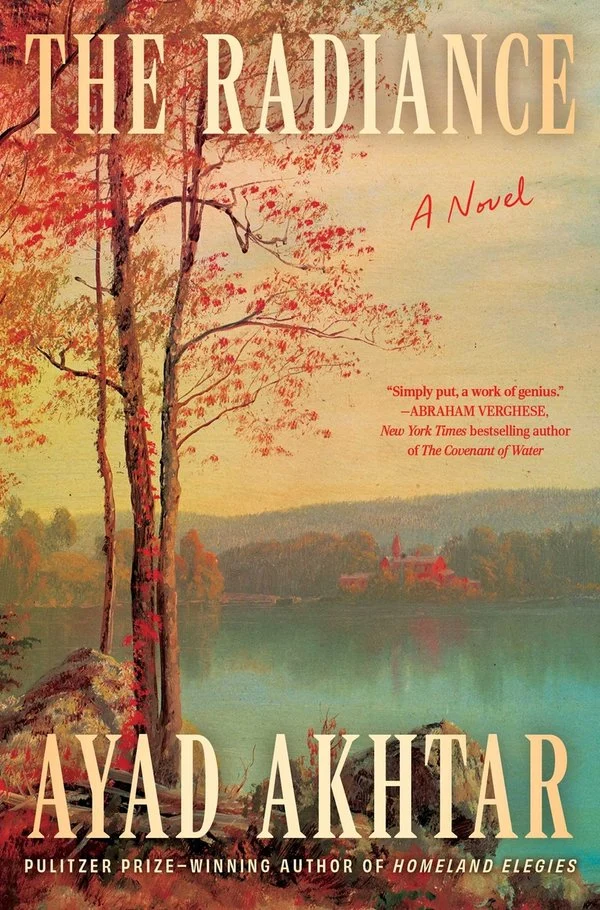
But Akthar is not just a dramatist, he is also an accomplished novelist. His third and latest novel, The Radiance is a departure from his plot-driven Aristotelian dramaturgy. The main character, also named Ayad, gets into a near-fatal car accident in rural New York where he’s set to teach at a university, and this event upends how he views the world. The novel is expansive in form and content, blurring the edges between revelation and madness. It also feels deeply invested in interiority—particularly in how consciousness absorbs and refracts power, ideology, and desire.
In our interview, Akhtar and I spoke about the audience, “TikTok dramaturgy” and attention spans, the way he’s dealt with the canon, and how his training in drama influences the way he writes prose.
Cherry Lou Sy: I’m a big fan of your playwriting and your prose work. It’s incredible that you’re able to do such high-level work in both, which is rare. How do you decide when something is going to be a play versus a novel?
Ayad Akhtar: It’s a great question. With plays, there has to be a sense of immediacy to what you’re doing, it has to translate across the divide between audience and viewer. You don’t have the ability to whisper, if you will, into a reader’s ear the way a novelist can. On stage you can’t really “explain” nuance or overtly convey context. You’ve got to depict it through dialogue and action. Certain kinds just feel more active from jump, requiring less of the viewer or the reader to get involved in—to be more fully immersed. Also, political work, political language, somehow seems to work better in the theater than it does in prose. There’s something about an audience listening to characters talk about something that gives them enough distance to assess it on their own terms, to feel less as if they are being preached to, or persuaded. Rhetoric has an inherent stage value, as we see in Shakespeare endlessly. Both considerations, action and politics, suggest parameters, certain kinds of stories, that make more sense in dramatic form.
I’ve been feeling increasingly that readers are less patient, and that they’re less patient with the long crawl of a three-act structure.
I would never have known how to do The Radiance as a play. Even though there are play-like elements in it—there are scenes that read like a play—there’s so much context around all of that, I wouldn’t know how to get it to the viewer.
CS: I was thinking about how The Radiance is formatted. Can you talk a little about how you decided to plot it, if we can even use that word loosely?
AA: A few top-level things. One is that I’ve been feeling increasingly that readers are less patient, and that they’re less patient with the long crawl of a three-act structure. They don’t want to invest in a beginning if they don’t already know what the middle is going to promise, and they’re very eager to figure out what the end is. So there’s a different way of thinking about structure, which is not three-part, beginning, middle, and end, but two-part. It’s about setting a reader’s expectation and then immediately frustrating or fulfilling that expectation and bringing up a new expectation. It’s closer to a kind of TikTok dramaturgy, if you will.
I don’t use that tongue in cheek. In Indian classical music there is this idea of the process of getting to the essential juice of the melody—that it takes time to unfold all of the aspects that can eventually allow that juice to be disclosed and savored. One of the things happening with the social media model of narrative construction is that we’re getting to the narrative juice very quickly, with fewer preliminaries, less or almost no build-up. So one of the things I knew I was going to do was tell aspects of this story over and over—not in a strict retelling per se, but advancing the story by reframing and continually disclosing more of it. Each time the story advances, it’s in a sense being re-narrated—now as a legal filing, now as a campus report, now as Lucie’s monologue, now in therapy sessions, etc, etc—and in the process, the arc and implications of the story’s events change, and keep changing. This keeps the story shifting. So the reader always has a live question, not “what happens next” but “what is this story now,” and that tension, I hoped, would carry them through the more demanding passages. The difficulty, I’m hoping, is compensated by absorption.
The other structural element I thought a fair bit about is that the book is about love. It’s very clearly about Eros—as there’s much talk about it, but it’s equally about the other “forms” of love as articulated in the Greek philosophical tradition: Agape, or love of one’s fellow person; Storge, or love of kin; and Eros, or desire. The first section tracks a movement through Storge, the second Agape, and the third is Eros. Each ends with a kind of crescendo of that form. So there were lots of structural things I was thinking about in order to tie it together—so that even if the reader didn’t consciously understand what the structure was, there was actually a structure of expectation and fulfillment that they were experiencing, and they wouldn’t get bored.
CS: I love that phrase you coined, TikTok dramaturgy. And this telling of the same story in multiple formats made me think of Ovid’s Metamorphoses—this sort of nesting of stories. Then there’s the colonial side. I’m sorry, but I call the storytellers the Ayads: there’s Ayad the writer and Ayad the character. In my head this has been Schrödinger’s Ayad.
With Ayad the character, I felt like all of the Western canon was already in one part of his brain, and the colonial or post-colonial brain on the other side. Dare I say the left side? From my reading, it felt like the Western part is the mind and the Eastern part is this spiritual body, and that Ayad the character is trying to reconcile them—and only reconciles through this accident, where he’s forced to jigsaw-puzzle himself back together.
AA: That’s a beautiful reading. It reminds me of something I thought about when I was writing the book. Carl Jung has a wonderful memoir called Memories, Dreams, Reflections, where there are so many things he talks about that are remarkable and hard to understand because they seem miraculous. In one of them, he’s visiting a Native American reservation during a trip through the United States, sometime in the ’30s maybe, and he comes across an elder who says something to him that he finds quite remarkable. This is what Jung quotes him as saying, and I’m not going to get this exactly right: “We get confused sometimes when the white man talks about being here (pointing to the head), because we’re here, he said (pointing to the heart). We don’t understand what it is to say that you’re in the head.”
I don’t know if I have an ideal reader. I write to the part of myself that is like a kid who doesn’t want to be bored.
There are traditions where the intelligence of the heart is the place of unity, where the axial split can be unified. And I’m also thinking about Plato and The Symposium, because of course Plato’s all over this book in different ways. In The Symposium, he has Aristophanes say that we used to be a circle, and then we were cut in half, and we’re looking for our other half. In a weird way, all this left-right stuff is a kind of metaphor for that too—for being divided and searching for that other half.
CS: You said something earlier about your interest in audience and audience reaction, and in the book the character talks about his relationship with the audience. That made me think about the audience in a theater versus the individual reading a book. Do you expect that the reader will know all the references? I had to look up a lot of these things. I felt a little dumb, but in a good way—I felt like there is so much more I don’t know, and that this book was teaching me. Could you talk about your ideal reader, and who you were writing this book for?
AA: With the theater, I get a chance to be with the audience. In previews, especially on Broadway, I get three weeks to be with them. So whatever audience I thought I was writing for, I get to experience the audience I actually wrote for, with every single play I write. That’s a whole process where the play comes into view in a different way, and I do a lot of rewrites. Obviously with a book it’s different.
I don’t know if I have an ideal reader. I write to the part of myself that is like a kid who doesn’t want to be bored. So I’m trying to keep myself engaged, but in a way that I hope is open to anybody who wants to engage. It’s true that sometimes the demands of the language, or sometimes the demands of some of the ideas, can be more involved. I enjoy that myself when I encounter it in others’ work. The writer I spend the most time reading is Shakespeare, and I always have to work with him. I find that the work is incredibly well rewarded—when I put the work in, I get a really great benefit. So part of my mindset is that I want to do something that tests me. It may challenge the reader a bit, but it’s challenging me, too. And I think that’s okay.
CS: I don’t know if I should be surprised that the writer you spend the most time with is Shakespeare. That tells me you have a classical brain. One of my questions was about your actor training—that’s how you started, with Grotowski, right? Has that influenced your writing?
AA: It has, because I understand how much is possible to embody in language. As an actor, you have to embody complex ideas and emotions physically, but also through speaking, and convey them with an immediacy and an intuitive force to an audience right here, right now, without thinking getting in the way. The audience has to feel it. They have to feel that richness, those contradictions. So I was trained to understand that, and it became part of my way of thinking about writing, and about art, and about what storytelling can do: the sense of embodiment, the embodiment of complexity. And nobody does that better than Shakespeare. He’s the best at that.
CS: Earlier I was watching an interview you did with Jeffrey Goldberg at The Atlantic about your play McNeal, and you mentioned that Shakespeare stole.
AA: Yes, I recall telling him that 70 percent of the words in [King] Lear are taken from another play with a similar title and much of the same plot—but a very, very different and terrible play. Shakespeare had acted in that play 20 years before he wrote his own version. That’s an interesting model of literary creation.
CS: It literalizes that quote we hear so often—that great artists steal.
AA: Lesser artists borrow, great artists steal. It’s attributed to Picasso, but it may also have been said by Stravinsky, with Picasso stealing it. And it’s also something TS Eliot says. Who knows where he may have gotten it from.
CS: When you’re working through ideas—and it looks like you’re working through ideas of greatness, of what it means to be great, which means dealing with the canon—how do you deal with the canon in your work? How do you deploy that thinking, in the sense of this is who I’m in conversation with, rather than, I don’t know, #ownvoices?
AA: I know exactly what you mean. It’s a question I don’t think I’ve ever gotten before. Thank you for it.
There are two aspects to the so-called canon. One is the status aspect. There’s a way in which canonical works signal status, or are attempts to reach for status, at least on the part of critics and also on the part of readers. So if a writer is going to deploy that kind of capital, it’s invariably going to trigger that feeling that there’s a status maneuver involved here. In the end, that’s less interesting to me than the second aspect of the canon, which is duration, or why some works really endure—what patterns, what resonances, what themes, what characterizations have made a work remain with us for 2,000 years. The Great Speech in Plato’s Phaedrus, for example. To use a work like that, it has to be able to continue to convey that to me.
Continuing to think of ourselves as machines is not only going to continue to destroy our environment and destroy our world, it’s going to destroy us.
I remember reading Saul Bellow’s Ravelstein. I’d read so many of his books, and he had been so important to me when I was much younger, and I always felt that there was something about Bellow that was timid when it came to metaphysical questions. He had a real desire to talk about metaphysics, but he couldn’t quite bring himself to do it, because mid-century—the 1960s, 1970s—it wasn’t acceptable within literary circles to talk about such things. Honestly, it still isn’t, but not as unacceptable as back then. When I read his last book, Ravelstein, which was about Allan Bloom, his close friend who had studied and taught Plato his whole life and effortlessly talked about metaphysics in such a rich way. Bellow clearly looked up to Bloom, admired him. By using Bloom as his template for the novel’s main character, Abe Ravelstein, Bellow was finally to do justice to his metaphysical impulse, in large part because he could model a character who channeled Plato.
That was very instructive to me. If I really wanted to get into the questions about the nature of reality—and of course they remain questions; the book doesn’t answer, even while raising a lot of them—I was going to have to find a way to elevate the reader’s field of awareness, linguistically and associatively. What works would help me do that? Plato, Emerson, Dostoyevsky, and so much of the rest of the stuff that’s in the book.
CS: In that interview with Jeffrey, there was talk about AI and the soul. Reading The Radiance, it felt like the character was attempting to put into words Ayad the character’s feeling of what a soul is, as he was experiencing it.
AA: That’s it. Which suggests maybe the book actually succeeds at what it’s attempting, because that’s exactly it.
CS: But I had to work to get there, because the space created in the book is not only immersive but also expansive. That could be challenging for a lot of people because—if we use your term, TikTok dramaturgy—everybody wants that 10 second understanding of what they’re consuming. So where do you see this book landing in our current moment, where AI, to use a term you’ve used, is at its pre-Cambrian explosion?
AA: I think I said in that interview with Jeff that this era of automated cognition, and automated mirroring of human behavior, was going to create an increasing awareness that we are not machines—that we are different from the machines, and that the question of what we are, and what the soul might be, or what we used to talk about when we talked about the soul, that those conversations are going to come back. And I think we’re already seeing it. We’re already seeing this resurgence of interest in faith in different ways, new questions around experience related to psychedelics, etc, etc.
All of that is bubbling up into the mainstream as we start understanding that we’re not machines, and that continuing to think of ourselves as machines is not only going to continue to destroy our environment and destroy our world, it’s going to destroy us. We have to find a different way of thinking about ourselves. So I hope the book is part of whatever that movement is—of opening up once again, maybe for the first time in a long time, certain questions within literary fiction. The Russians talked about the soul all the time. I don’t know why we can’t. We should be able to.
CS: Because we’re capitalists.
AA: So there you have it!